Local

On the Cheap Listings

0

On the Cheap listings are compiled by Lucy Schiller and Caitlin Donohue. Submit items for the listings at listings@sfbg.com. For further information on how to submit items for the listings, see Picks.

WEDNESDAY 18

Pinball tournament Vitus, 201 Broadway, Oakl. www.vitusoakland.com. 6:50 p.m., $5. Those adept at flipping the bird may discover an easy crossover into the dexterous world of pinball. Vitus hosts a tournament chock-full of raffle prizes.

A Negotiated Landscape discussion University Press Books, 2430 Bancroft, Berk. www.universitypressbooks.com. 6-7:30 p.m., free. Urban studies professor Jasper Rubin follows and examines the political wranglings over the San Francisco waterfront in his latest book, detailing grassroots activism against major development projects.

Stand-up comedy showcase Bazaar Cafe, 5927 California, SF. (415) 831-5620, www.dannydechi.com. 7 p.m., free. Bizarro winter germs got you feeling a little under-the-fog-cover? Head out to this yuckfest, featuring Danny Dechi and a passel of his funny buddies: Jill Bourque, Dhaya Lakshminarayanan, Mike Capozzola, and Rebecca Arthur, to name a few.

THURSDAY 19

Inside Story Time Café Royale, 800 Post, SF. www.caferoyale-sf.com. 6:30-8:30 p.m., $3-5. Local authors doing readings that match tonight’s theme, “aspirations.” Hopeful readings, at that.

Eric Shanower’s Road to Oz Cartoon Art Museum, 655 Mission, SF. www.cartoonart.org. 7-9 p.m., $5 suggested donation. Accomplished cartoonist Eric Shanower has made it his life’s work to convert L. Frank Baum’s Oz books into Marvel Comics graphic novels. He details his journey down his own yellow brick road as a struggling artist.

FRIDAY 20

Fullmetal Alchemist: the Sacred Star of Milos screening Film Society Cinema, 1746 Post, SF. www.sffs.org. 2, 4:30, 7, 9:15 p.m. $9-11. The latest installment in an anime series which explores Europe’s industrial revolution, alchemy, and popular resistance comes to the SF Film Society.

SF Dump artist-in-residency art opening Environmental Learning Center Gallery, 503 Tunnel, SF. www.recologysf.com. 5-9 p.m., free; Also Sat/21 1-5 p.m., free. There can be no cooler artist-in-residency program than that of Recology, which sets up its creative types to craft art from the detritus found in the dump itself. Great works have sprung from this collaboration, and this weekend Ethan Estess, Donna Anderson, and Terry Berlier will surely add to that canon.

SATURDAY 21

Gina Osterloh lecture Yerba Buena Center for the Arts, 701 Mission, SF. www.ybca.org. 2-4 p.m., $7. Osterloh’s latest work Anonymous Front, created in conjunction with a massage therapy school for the blind in the Philippines, explores blindness and identity with eye-deceiving photographs.

Ikebana demonstration Ortega Branch Library, 3223 Ortega, SF. www.sfpl.org. 2 p.m., free. Chizuko Nakamura gently coaxes flowers into sophisticated submission in a demonstration of the traditional Japanese arranging art.

Kulinarya: A Filipino culinary showdown Carnelian by the Bay, 1 Ferry Plaza, SF. www.kulinarya2.eventbrite.com. 4 p.m., free. Featuring a cornucopia of Filipino edibles and goods, this second annual event showcases the pili nut, which according to one expert is pretty much the next macadamia.

SUNDAY 22

Seasonal plant sale Hayes Valley Farm, 450 Laguna, SF. www.hayesvalleyfarm.com. Noon-5 p.m., free. Windowbox chard beats out the six-dollar variety any day. Hayes Valley Farm provides sturdy seedlings, hardy fruit trees (including pluots!), and those ever-prolific seedbombs, perfect for those whose personal green space is constrained to a crack in the sidewalk.

MONDAY 23

Ben Ehrenreich and Robert Arellano reading The Booksmith, 1644 Haight, SF. www.booksmith.com. 7:30 p.m., free. Ehrenreich’s dystopian novel Ether has been likened to “Bambi directed by Quentin Tarantino,” while Arellano’s Curse the Names is the story of an apocalypse-to-be deep in the Sangre de Cristo Mountains.

TUESDAY 24

“The Language of Flowers” lecture San Francisco Library, 100 Larkin, SF. www.sfpl.org. 6 p.m., free. Never send an ill-timed chrysanthemum again! Author Vanessa Diffenbaugh is doing a reading from her new book about the Victorian art of figuring out what severed dead blooms can say about you and the object of your affection.

Chem Dawg to the rescue

17

caitlin@sfbg.com

HERBWISE The Kings of Destruction, more popularly known as KOD, were an hour and a half late for our interview. Being that the hip-hop-graff-clothing-medical-marijuana-advocacy collective is from the East Bay and we had arranged to meet at the Guardian Potrero Hill office, I figured I’d better look for them.

I didn’t have to go far: all five of the group’s members who had stopped by were sitting amid SF political activists in the Guardian conference room, mistakenly ensconced in a discussion of the new supervisoral district lines. They’d introduced themselves along with everyone else, but then faltered when the meeting’s facilitator asked to what he owed the pleasure of having Oakland residents at the table.

All good. Soon enough I have Dogz One, Lil’ Zane, Josh, Tase 1, and Don Juan assembled on the roof standing around a picnic table and talking about marijuana. They’ve brought some of their products for show ‘n’ tell; t-shirts emblazoned with characters culled from local marijuana strains. They’ve brought Grape Ape, a gorilla pulling on a joint with a purple berry-emblazoned baseball hat. Another shirt features Chem Dawg, a husky that figures in an upcoming KOD comic book in which the character (Dogz One is his alter-ego) will fight the government’s attempts to keep marijuana from the people. Pending designs include Girl Scouts Cookies, which will feature a woman wearing a midriff-bearing scout uniform in honor of the SF-specific strain rumored to smell of pastries (those buds available locally at the Green Door dispensary).

Kings of Destruction started out as a graffiti crew, and though members still throw up pieces on walls occasionally (“go down around the train tracks, you’ll see some things,” counsels Don Juan) now its focus is on — state — legal activities: music, clothing, and the catalyst for this interview, advocating for medical marijuana. Though I’m unable to hear samples of the tracks before press time, the group tells me members have been in the studio laying down tracks about their medicine, and they hope to join this spring’s Prohibition Tour (www.prohibitiontour.com), a California college event series that plans to raise awareness among students this spring with lectures and musical performances.

“Oakland has been on the forefront of the medical marijuana movement, so we’re trying to keep everything alive so that everyone can keep their medicine,” says Don Juan. Many in the group are patients and growers themselves who naturally find themselves in the activist role around friends and family who don’t use weed.

KOD sees marijuana as a healthy alternative to pharmaceuticals — many of which have adversely affected friends’ lives in their East Bay community. A prime example is bo, as the promethazine-codeine cough syrup that figures prominently in Bay Area hip-hop these days is popularly called. Compared to the dangers of that kind of drug, KOD members say, the federal government’s resistance to legalizing marijuana seems foolish. Not that there aren’t side effects of marijuana: “You might get a little hungry, might go to sleep,” says Don Juan. “You might just lay back instead of getting mad when somebody cusses you out,” adds Tase 1.

In closing, I ask KOD to tell me a story about the group and marijuana. They give each other looks and chuckle. Finally Tase 1 steps up to the plate. “One time, we were going to do something bad. And then we smoked some weed.” 

Find KOD clothing at www.kronicoverdose.com


Wall played

0

Also in this issue, Guardian writer Matt Sussman on who got the hype — and who earned it — in the galleries at Art Basel Miami 2011

VISUAL ART The popular face of Miami is made of aqua blue views and chrome rims, but the parts of Wynwood that haven’t been covered by murals yet look more like asphalt and the muted tones of low-cost rentals. Since the 1950s it’s been largely a Puerto Rican neighborhood. It’s also where many African Americans moved when they got priced out of the Overtown neighborhood to the south, where they were originally relegated by Jim Crow laws.

But, in a high-low art tornado last month, Wynwood is also where I learn that the popular legend labeling the Mission District the neighborhood with the most densely-packed street art in the world is total bunk.

Wynwood’s main drag Second Avenue is Clarion Alley on acid. Having come straight from Miami International Airport, my rental car barely inches down the strip, so omnipresent are the weaving, goggling packs of urban art voyeurs in oversized silk shirt-dresses and vertiginous wedge heels or where’d-you-get-’em sneakers. The only sign of the neighborhood’s year-round residents are the sporadic flaggers in self-bought orange vests waving cars into parking spots.

Angry sharks, Persian cat-women, color-washed streetcars, and owls sitting shotgun in convertibles — sometimes layered on top of each other — grace walls here. Designs pour off walls and onto the sidewalk. Here, the fairytale nymphs and walking houses of Os Gemeos on a fancy restaurant; there, a massive black-and-white photo wheatpaste by JR of bulging, watching eyes that echo the look of passers-by. I nearly break my neck on Mexico City artists Sego and Saner’s horned beetle-men, who clutch amulets and wear fanged leopard masks on the backs of their heads. Absolut Vodka has occupied a parking lot with a temporary open-air club, dotting it with human-sized aerosol cans and fencing it off with chainlink. It’s enough to make any street art fan lose their shit, or at least the rental car.

I’ve parachuted into the middle of Miami’s yearly art inferno, a.k.a. the week that the Art Basel art fair comes to town. Since 2002, this Swedish import has filled Miami Beach Convention Center with astronomically-priced works from over 260 international galleries. Umpteen ancillary art and design fairs populate deco hotel-land and its surrounds during this time — the city becomes one largely, loudly turned-out gallery opening.

Wynwood, with its surplus of 80-foot blank walls, hosts many an art collection — but it’s most visible contribution to the scene is its dense network of murals. Of these, the undisputed center is a compound of buildings grouped around a courtyard of marquee works dubbed Wynwood Walls. The properties were purchased by (in)famous neighborhood rejuvenator Tony Goldman in 2004. Many hold Goldman responsible for the gentrification of Soho, South Beach, and city center Philadelphia.

Wynwood Walls is his carefully orchestrated attempt to use the allure of street art to change the area’s economic fortune. Shortly before Art Basel 2011, Goldman produced a series of YouTube shorts dubbed “Here Comes the Neighborhood,” in which longtime graffiti photographer Martha Cooper cheerfully opines “Now we’ve got something [street art] that people are calling the biggest art movement in history of the world. And it just might be.”

The night of my arrival, the amount of in-progress murals at which the crawling traffic gives one an opportunity to gawk is striking. At least a dozen artists labor within a four-block radius, greeting fans, drinking beers and staring up at their half-finished creations contemplatively.

Such was the mood in which I find Buenos Aires street artist Ever, who along with an assistant is completing a massive wall featuring two disembodied heads emitting his signature riotously colorful cognitive mapping hives, which in the past he’s painted emerging from the brains of Mao Tse-Tung and his own younger brother. Ever was flown up by a community-based Atlanta street art festival, Living Walls, to paint a Second Avenue parking lot wall as part of the festival’s first project outside of Georgia.

It’s not his first international street art festival, but Ever is among the artists under-impressed with the Basel-time scene in Wynwood.

“It’s like the alcohol. I hate the shit — but one drink more!” We talk when the dust of Basel has long settled; Ever, fellow street and gallery artist Apex, and I perched around Apex’s studio in a Market and Sixth Street garment factory building.

Apex, who has been to Miami during Basel week four times, and twice to paint the crystallized, color-saturated “super burner” murals he is known for, explains that for him, the problem is exploitation. Street artists typically paint walls for a pittance or for free, in a neighborhood where businesses are making boatloads of money off spectators that come to marvel.

“You have, like, Tony Goldman, he gives a certain amount of money, property owners make money, but artists, a few make money,” Apex explains. “The rest, no. Artists get caught in the excitement of it. But who is getting paid off of it?”

“Who wins,” Ever adds.

“If someone is making money off of it, you should know who that is,” concludes Apex.

But the two artists agree that Art Basel week is an excellent education in the workings of the high art world for aspiring professionals, and that the camaraderie that flourishes between street artists can be important, inspirational.

And of course, the parties. Basel is known for them — 2011 featured everything from the $200-a-ticket “Fuck Me I’m Famous” David Guetta show to surprise kudos for the partykids from Pharrell onstage at Yelawolf’s Saturday night gig at a castle-shaped outdoor club in Wynwood. On my first night in town, the whole Living Walls gang — organizers, artists, errant alternative journalist from San Francisco — pile into cars and hit the Design District to check out the opening of the group show of Primary Flight, a local collective that got its start commissioning murals wall-by-wall in Wynwood.

“We started noticing we weren’t the breadwinners of the galleries,” Primary Flight founder Books Bischof tells me in a phone interview. “It was like fuck you, we’re going to take to the streets. We’re all curators in a sense, so we might as well get up and be seen.” Bischof logged time connecting with local graffiti crews and Wynwood’s homeless population to make sure he had community support for bringing the art crowd into the neighborhood during Basel week. He somewhat resents Goldman’s “just buy it” approach. “When we learned about [his Wynwood building purchases] we were like, well that’s kind of fucked.” (Though officially the two camps exist amicably, Goldman told me he upon arriving in the neighborhood he found Primary Flight’s piecemeal approach to its murals “helter-skelter.”)

But along with Wynwood’s art scene, Primary Flight has grown. In addition to its mural program — through which Apex painted his 2011 Miami wall — attendees at the collective’s gallery space could take in traditional paintings and sculptures, but also Mira Kum’s “I Pig, Therefore I Am” installation featuring the artist in the nude, living with two pigs in a small enclosure for 104 hours. “We represent artists with a street art, fuck you swagger,” comments Bischof.

Things are much more established now in Wynwood, which by most counts serves as Miami’s arts district year-round. There are expensive coffeeshops and bars, fine restaurants, precious florists, and blocks of galleries selling accessible art. (During Art Basel week, one of these is given over to an artist who specializes in kawaii food art printed onto affordable decals and posters. An entire wall is covered in swirly-topped ice cream cones in a hundred color options.)

Though professional street art certainly existed prior to his engagement, this upscaling can largely be attributed to Goldman’s speculative interest. Goldman’s PR agency sends me press materials dubbing Wynwood “the next great discovery in the Goldman Properties portfolio.” His company’s general methodology is to buy up historic buildings in socioeconomically depressed neighborhoods and fill them with upscale businesses that attract more pedestrian traffic.

There is little doubt that Goldman envisions the future of Wynwood as a place where housing units rent for far more than many of its current residents can afford. His team has spent considerable time and effort working with Miami’s city council on creating live-work zoning in Wynwood (not unsimilar to the type of zoning that loaded San Francisco’s SoMa with high cost condos). After the Basel hangover has dissipated, I get a chance to talk with him.

“When I went to Wynwood and I had boxy warehouse buildings, it was a much different challenge for me,” says Goldman during our decorous phone interview. “Now I could be free. Some people would look at ugly buildings and empty parking lots and loading zones — what I saw was an international outdoor street art museum. Huge canvas opportunities.” He bought six of those buildings in the center of the neighborhood, two of which now house spendy restaurants run by his son and daughter.

Goldman is not completely without street art cred. Since 1984, he has owned a massive wall on Manhattan’s Bowery and Houston Streets that has hosted murals from Keith Haring, Barry McGee, and Shepard Fairey. “[Street art] is freer in a lot of ways than walking in a museum, which a lot of street artists consider graveyards,” he says. “Not that I agree with them, not that I disagree with them either. I think Wynwood Walls is one place that has validated the art form as an important contribution to contemporary art.”

But Wynwood Walls also serves as the main attraction to an area in which Goldman Properties has monetarily invested. “It [is] a center place that the arts district really didn’t have, a town square, a centerpiece that was defined architecturally,” reflects Goldman. “It served its purpose.”

But perhaps this use of street art as tool of gentrification is not so incongruous. After all, most if not all professional street artists are able to create murals only by selling gallery-ready pieces. Ever tells of painting a mural for Coca-Cola with studiomate Jaz, only to use his paycheck to create three more public walls. “The reality of art is you always need a rich person,” he says.

Which is, more or less, to say that even in Wynwood, professional street art is not entirely soulless. Take for example one of Ever’s favorite Wynwood pieces, done by Spanish artist Escif. The wall was so popular, in fact, it merited a cameo in a “Here Comes the Neighborhood” episode. And not for its bright colors or revolutionary design; it’s just black capital letters on a flat white background.

But it does have a pretty direct message for good-intentioned folks in Wynwood. It says: “Remember, u’re not doing it for the money.”

What recession?

0

Also in this issue: Guardian culture editor Caitlin Donohue on Art Basel Miami 2011’s street art scene

VISUAL ART Now in its 10th year, Art Basel Miami Beach (ABMB)— the art world’s annual “spring beak” during which power brokers, status-seekers, and a curious public descend on Miami Beach over the first weekend in December — makes for an easy target, engorging South Beach’s already cartoonish version of “living large” by bringing its own cold strains of entitlement, status, and exclusivity.

Perhaps this is what advertising mogul and mega-collector Charles Saatchi decried (somewhat sanctimoniously) as “the hideousness of the art world” in an op-ed piece for the UK Guardian, conveniently published during the fair’s run. Those who liked to show off certainly did: luxury SUVs continually clogged the viaducts across Biscayne Bay; I counted more blue-chip handbags and heels than in the September issue of Vogue; and there was always buzz of a party or dinner you weren’t on the list for. (Party-crashing is ABMB’s unofficial blood sport).

“I just stopped Tweeting,” remarked a social media manager for a San Francisco museum, as we shared a bleary-eyed ride to the airport on Monday night. “I mean, how many jokes can you make about the money?”

My van-mate’s fatigue was understandable. The fair itself is exhausting, having grown to include some 260 international exhibitors that transform the Miami Beach Convention Center into a warren of aisles and booths, as well as programs of outdoor sculpture, video, and a series of panel discussions and Q&As. And this isn’t even including the aforementioned endless circuit of afterhours soirées.

But his bafflement also pointed towards the way business is done at Art Basel, bringing to mind Marx’s characterization of capital as a kind of magic act. Most of the transactions happened offstage, with a majority of pieces selling before the fair had even opened. As a curator friend jokingly asked, echoing sentiments she has been hearing all weekend from gallery associates: “Where’s the recession?”

There certainly wasn’t much in the way of finger-pointing on the convention center floor. Threats of an Occupy-style protest remained just that. Danish collective Superflex’s giant flags emblazoned with logos of bankrupt banks (at Peter Blum Gallery) attempted to reveal the elephant in the room. They might have been overpowered, however, by the flash of Barbara Kruger’s riotous wall texts at Mary Boone, which proclaimed “Money makes money” and “Plenty should be enough.” The ripest visual metaphor for wasteful abundance was certainly Paulo Nazareth’s “Banana Market/Art Market,” a green Volkswagen van filled with real bananas that spilled out onto the convention floor.

Even though the writing was on the wall, visitors seemed more keen on getting their pictures taken with some of the single-artist installations that were part of the”Ark Kabinett” program. Ai Weiwei’s barren tree made from pieces of dead tree trunks collected in Southern China had almost as long of a queue as Elmgreen and Dragset’s marble sculpture of a neoclassical male nude hooked up to an IV, the centerpiece of Amigos, the un-ambiguously gay duo’s deconstructed bathhouse that took over Galeria Helga de Alvear’s booths.

There were a few welcome surprises: new LA-based artist Melodie Mousset’s mixed-media piece “On Stoning and Unstoning” (at Vielmetter) offered a politically astute and formally bold tonic to the generally conservative, painting-heavy selection, as did older sexually and politically frank pieces by second-wave feminist artists such as Martha Rosler and Joan Semmel.

However, the most exciting art could be found outside the convention center, mainly in the rapidly-gentrifying Wynwood neighborhood which now boasts more than 40 galleries (nearly quadruple the number from eight years ago). Many of Miami’s biggest collectors have followed suit, setting up warehouses in the adjacent Design District where their collections are on view to the public.

“Frames and Documents,” the Ella Fontanalas-Cisneros Collection’s sensitively curated selection of Conceptualist art from the 1960s to the late ’80s— which juxtaposed the work of Central and South American artists with that of their American and European contemporaries — was brimful with lush aesthetic rewards delivered with the barest of means.

I renewed too many loves that afternoon (and found some new ones, as well) to list in full, but another institutional stand-out was the Miami Art Museum’s “American People, Black Light,” a retrospective of Faith Ringgold’s early paintings from the ’60s that capture with unflinching clarity the anguish, ambivalence and rage of the Civil Rights era. Given Ringgold’s profile, it’s shocking that they’ve never been the subject of their own exhibition until now.

Much has been made of the “trickle down” effect ABMB has had on the cultural revitalization of Miami. (Wynwood is the most frequently cited example). The most hopeful and lasting sign I saw of any such change was a few blocks down from the Cisneros collection, at the small gallery Wet Heat Project. For the group show “A Piece of Me” pairs of art students from local high schools had been matched with four mid-career alumni from Miami’s New World School of the Arts. Each student team then conceived, developed, and produced a video installation in response to a piece by their alumni mentor, with both the final video pieces and those works that inspired them on display in the gallery.

What could’ve been a gimmicky set-up resulted in some truly inventive, thoughtful, and original work on the part of the students. Moreover, “A Piece of Me” offers one portable model for bridging the community at large and the art community. As Max Gonzalez, one of the participating students who was on hand, said of his installation, “It was go big or go home for us.”

Next to that vote of confidence, the Miami Beach Convention Center floor — littered with big names and bigger baubles destined for law firm lobbies and penthouse living rooms — seemed that many more miles away.

Matt Sussman writes the Guardian’s biweekly Hairy Eyeball column.

Localized Appreesh: The Fucking Buckaroos

2

Localized Appreesh is our weekly thank-you column to the musicians that make the Bay. Each week a band/music-maker with a show, album release, or general good news is highlighted and spotlit. To be considered, contact emilysavage@sfbg.com.

It takes some serious chutzpah to name your band the Fucking Buckaroos. But then, the Fucking Buckaroos is a seriously ballsy act. Eschewing glamour and easy labeling, the playful San Francisco band blazes dusty trails, boasting a noisy, boozy, punkish bluegrass clatter.

The punkabilly act’s newest release (suitably titled The Fucking Buckaroos: II) is said to “make the angriest metalhead a Christian and the soberest dad chug a bottle of Night Train,” whatever that means. See for yourself, the Fucking Buckaroos are offering their new album by donation. Be a gentleperson and pony up for the record, then ride that bucking bronco (49 Van Ness-Mission) down to the Knockout for the riotous album release party this weekend.  How many more cowboy references can I fit here? A horse walks into a bar:

Year and location of origin: San Francisco, 2004
Band name origin: Buck Owens had his Buckaroos, so why couldn’t Fuck Owens have his Fucking Buckaroos?
Band motto: Shiniest coat, best of show!
Description of sound in 10 words or less: New-Rage Punkabilly Psychograss
Instrumentation: Mandolin, Banjo, Guitar, Bass, Drums, (in studio: Accordion, Piano, Lapsteel, Tuned 40oz Bottles)
Most recent release: The Fucking Buckaroos: II.
Best part about life as a Bay Area band:  Having so many cities to play right at your fingertips.
Worst part about life as a Bay Area band: Not having a combined place to both practice and hang out.
First record/cassette tape/or CD ever purchased: Weird Al Even Worse.
Most recent record/cassette tape/CD/or Mp3 purchased/borrowed from the Web: Ovens “Now It’s Over” 7″
Favorite local eatery and dish: Mission’s Kitchen – Breakfast Burrito.

The Fucking Buckaroos
With Filthy Thieving Bastards, Deadly Gallows
Sat/21, 4-8 p.m., $8
Knockout
3223 Mission, SF
(415) 550-6994
www.theknockoutsf.com

There are no words for this:
http://www.youtube.com/watch?v=vZBY-a4Eqqg&feature=related

Occupy Nation

15

news@sfbg.com

The Occupy movement that spread across the country last fall has already changed the national discussion: It’s brought attention to the serious, systemic problem of gross inequities of wealth and power and the mass hardships that have resulted from that imbalance.

Occupy put a new paradigm in the political debate — the 1 percent is exploiting the 99 percent — and it’s tapping the energy and imagination of a new generation of activists.

When Adbusters magazine first proposed the idea of occupying Wall Street last summer, kicking off on Sept. 17, it called for a focus on how money was corrupting the political system. “Democracy not Corporatocracy,” the magazine declared — but that focus quickly broadened to encompass related issues ranging from foreclosures and the housing crisis to self-dealing financiers and industrialists who take ever more profits but provide fewer jobs to the ways that poor and disenfranchised people suffer disproportionately in this economic system.

It was a primal scream, sounded most strongly by young people who decided it was time to fight for their future. The participants have used the prompt to create a movement that drew from all walks of life: recent college graduates and the homeless, labor leaders and anarchists, communities of colors and old hippies, returning soldiers and business people. They’re voicing a wide variety of concerns and issues, but they share a common interest in empowering the average person, challenging the status quo, and demanding economic justice.

We chronicled and actively supported the Occupy movement from its early days through its repeated expulsions from public plazas by police, particularly in San Francisco, Oakland, and Berkeley. We supported the right of the protesters to remain — even as we understood they couldn’t and shouldn’t simply stay forever. Occupy needed to evolve if it was to hold the public’s interest. The movement would ultimately morph into something else.

That time has come. This spring, Occupy is poised to return as a mass movement — and there’s no shortage of energy or ideas about what comes next. Countless activists have proposed occupying foreclosed homes, shutting down ports and blocking business in bank lobbies. Those all have merit. But if the movement is going to challenge the hegemony of the 1 percent, it will involve moving onto a larger stage and coming together around bold ideas — like a national convention in Washington, D.C. to write new rules for the nation’s political and economic systems.

Imagine thousands of Occupy activists spending the spring drafting Constitutional amendments — for example, to end corporate personhood and repeal the Citizens United decision that gave corporations unlimited ability to influence elections — and a broader platform for deep and lasting change in the United States.

Imagine a broad-based discussion — in meetings and on the web — to develop a platform for economic justice, a set of ideas that could range from self-sustaining community economics to profound changes in the way America is governed.

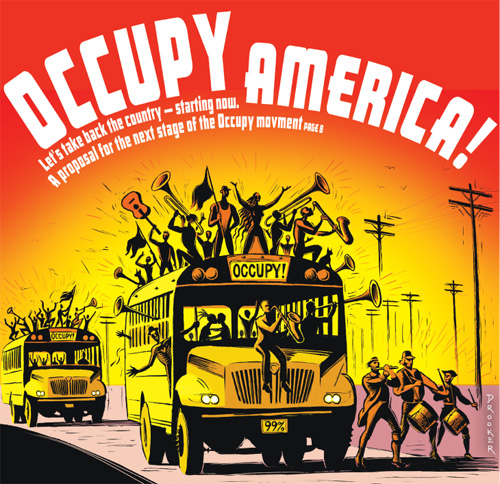
Imagine thousands of activists crossing the country in caravans, occupying public space in cities along the way, and winding up with a convention in Washington, D.C.

Imagine organizing a week of activities — not just political meetings but parties and cultural events — to make Occupy the center of the nation’s attention and an inspiring example for an international audience.

Imagine ending with a massive mobilization that brings hundreds of thousands of people to the nation’s capitol — and into the movement.

Occupy activists are already having discussions about some of these concepts (see sidebar). Thousands of activists are already converging on D.C. right now for the Occupy Congress, one of many projects that the movement can build on.


DEFINING MOMENTS

Mass social movements of the 20th Century often had defining moments — the S.F. General Strike of 1934; the Bonus Army’s occupation of Washington D.C.; the Freedom Rides, bus boycotts and Rev. Martin Luther King Jr.’s March on Washington; Earth Day 1970; the Vietnam War teach-ins and moratoriums. None of those movements were politically monolithic; all of them had internal conflicts over tactics and strategies.

But they came together in ways that made a political statement, created long-term organizing efforts, and led to significant reforms. Occupy can do the same — and more. At a time of historic inequities in wealth and power, when the rich and the right wing are stealing the future of generations of Americans, the potential for real change is enormous.

If something’s going to happen this spring and summer, the planning should get under way now.

A convention could begin in late June, in Washington D.C. — with the goal of ratifying on the Fourth of July a platform document that presents the movement’s positions, principles, and demands. Occupy groups from around the country would endorse the idea in their General Assemblies, according to procedures that they have already established and refined through the fall, and make it their own.

This winter and spring, activists would develop and hone the various proposals that would be considered at the convention and the procedures for adopting them. They could develop regional working groups or use online tools to broadly crowd-source solutions, like the people of Iceland did last year when they wrote a new constitution for that country. They would build support for ideas to meet the convention’s high-bar for its platform, probably the 90 percent threshold that many Occupy groups have adopted for taking action.

Whatever form that document takes, the exercise would unite the movement around a specific, achievable goal and give it something that it has lacked so far: an agenda and set of demands on the existing system — and a set of alternative approaches to politics.

While it might contain a multitude of issues and solutions to the complicated problems we face, it would represent the simple premise our nation was founded on: the people’s right to create a government of their choosing.

There’s already an Occupy group planning a convention in Philadelphia that weekend, and there’s a lot of symbolic value to the day. After all, on another July 4th long ago, a group of people met in Philly to draft a document called the Declaration of Independence that said, among other things, that “governments … deriv[e] their just powers from the consent of the governed … [and] whenever any Form of Government becomes destructive of these ends, it is the Right of the People to alter or to abolish it, and to institute new Government, laying its foundation on such principles and organizing its powers in such form, as to them shall seem most likely to effect their Safety and Happiness.”


ON THE ROAD

If the date is right and the organizing effort is effective, there’s no reason that Occupy couldn’t get close to a million people into the nation’s capital for an economic justice march and rally.

That, combined with teach-ins, events and days of action across the country, could kick off a new stage of a movement that has the greatest potential in a generation or more to change the direction of American politics.

Creating a platform for constitutional and political reform is perhaps even more important than the final product. In other words, the journey is even more important than the destination — and when we say journey, we mean that literally.

Occupy groups from around the country could travel together in zig-zagging paths to the Capitol, stopping and rallying in — indeed, Occupying! — every major city in the country along the way.

It could begin a week or more before the conference, along the coasts and the northern and southern borders: San Francisco and Savannah, Los Angeles and New York City, Seattle and Miami, Chicago and El Paso, Billings and New Orleans — Portland, Oregon and Portland, Maine.

At each stop, participants would gather in that city’s central plaza or another significant area with their tents and supplies, stage a rally and general assembly, and peacefully occupy for a night. Then they would break camp in the morning, travel to the next city, and do it all over again.

Along the way, the movement would attract international media attention and new participants. The caravans could also begin the work of writing the convention platform, dividing the many tasks up into regional working groups that could work on solutions and new structures in the encampments or on the road.

At each stop, the caravan would assert the right to assemble for the night at the place of its choosing, without seeking permits or submitting to any higher authorities. And at the end of that journey, the various caravans could converge on the National Mall in Washington D.C., set up a massive tent city with infrastructure needed to maintain it for a week or so, and assert the right to stay there until the job was done.

The final document would probably need to be hammered out in a convention hall with delegates from each of the participating cities, and those delegates could confer with their constituencies according to whatever procedures they prescribe. This and many of the details — from how to respond to police crackdowns to consulting of experts to the specific scope and procedures of this democratic exercise — would need to be developed over the spring.

But the Occupy movement has already started this conversation and developed the mechanisms for self-governance. It may be messy and contentious and probably even seem doomed at times, but that’s always the case with grassroots organizations that lack top-down structures.

Proposals will range from the eminently reasonable (asking Congress to end corporate personhood) to the seemingly crazy (rewriting the entire U.S. Constitution). But an Occupy platform will have value no matter what it says. We’re not fond of quoting Milton Friedman, the late right-wing economist, but he had a remarkable statement about the value of bold ideas:

“It is worth discussing radical changes, not in the expectation that they will be adopted promptly, but for two other reasons. One is to construct an ideal goal, so that incremental changes can be judged by whether they move the institutional structure toward or away from that ideal. The other reason is very different. It is so that if a crisis requiring or facilitating radical change does arrive, alternatives will be available that have been carefully developed and fully explored.”

After the delegates in the convention hall have approved the document, they could present it to the larger encampment — and use it as the basis for a massive rally on the final day. Then the occupiers can go back home — where the real work will begin.

Because Occupy will wind up spawning dozens, hundreds of local and national organizations — small and large, working on urban issues and state issues and national and international issues.


WASHINGTON’S BEEN OCCUPIED BEFORE

The history of social movements in this country offers some important lessons for Occupy.

The notion of direct action — of in-your-face demonstrations designed to force injustice onto the national stage, sometimes involving occupying public space — has long been a part of protest politics in this country. In fact, in the depth of the Great Depression, more than 40,000 former soldiers occupied a marsh on the edge of Washington D.C., created a self-sustaining campground, and demanded that bonus money promised at the end of World War I be paid out immediately.

The so-called Bonus Army attracted tremendous national attention before General Douglas Macarthur, assisted by Major George Patton and Major Dwight Eisenhower, used active-duty troops to roust the occupiers.

The Freedom Rides of the early 1960s showed the spirit of independence and democratic direct action. Raymond Arsenault, a professor at the University of South Florida, brilliantly outlines the story of the early civil rights actions in a 2007 Oxford University Press book (Freedom Rides: 1961 and the Struggle for Racial Justice) that became a national phenomenon when Oprah Winfrey devoted a show and a substantial online exhibition to it.

Arsenault notes that the rides were not popular with what was then the mainstream of the civil rights movement — no less a leader than Thurgood Marshall thought the idea of a mixed group of black and white people riding buses together through the deep south was dangerous and could lead to a political backlash. The riders were denounced as “agitators” and initially were isolated.

The first freedom ride, in May, 1961, left Washington D.C. but never reached its destination of New Orleans; the bus was surrounded by angry mobs in Birmingham, Alabama, and the drivers refused to continue.

But soon other rides rose up spontaneously, and in the end there were more than 60, with 430 riders. Writes Arsenault:

“Deliberately provoking a crisis of authority, the Riders challenged Federal officials to enforce the law and uphold the constitutional right to travel without being subjected to degrading and humiliating racial restrictions … None of the obstacles placed in their path—not widespread censure, not political and financial pressure, not arrest and imprisonment, not even the threat of death—seemed to weaken their commitment to nonviolent struggle. On the contrary, the hardships and suffering imposed upon them appeared to stiffen their resolve.”

The Occupy movement has already shown similar resolve — and the police batons, tear gas, pepper spray, and rubber bullets have only given the movement more energy and determination.

David S. Meyer, a professor at U.C. Irvine and an expert on the history of political movements, notes that the civil rights movement went in different directions after the freedom rides and the March on Washington. Some wanted to continue direct action; some wanted to continue the fight in the court system and push Congress to adopt civil rights laws; some thought the best tactic was to work to elect African Americans to local, state and federal office.

Actually, all of those things were necessary — and Occupy will need to work on a multitude of levels, too, and with a diversity of tactics.

Single-day events have had an impact, too. Earth Day, 1970, was probably the largest single demonstration of the era — in part because it was so decentralized. A national organization designed events in some cities — but hundreds of other environmentalists took the opportunity to do their own actions, some involving disrupting the operations of polluters. The outcome wasn’t a national platform but the birth of dozens of new organizations, some of which are still around today.

There’s an unavoidable dilemma here for this wonderfully anarchic movement: The larger it gets, the more it develops the ability to demand and win reforms, the more it will need structure and organization. And the more that happens, the further Occupy will move from its original leaderless experiment in true grassroots democracy.

But these are the problems a movement wants to have — dealing with growth and expanding influence is a lot more pleasant than realizing (as a lot of traditional progressive political groups have) that you aren’t getting anywhere.

All of the discussions around the next step for Occupy are taking place in the context of a presidential election that will also likely change the makeup of Congress. That’s an opportunity — and a challenge. As Meyer notes, “social movements often dissipate in election years, when money and energy goes into electoral campaigns.” At the same time, Occupy has already influenced the national debate — and that can continue through the election season, even if (as is likely) neither of the major party candidates is talking seriously about economic justice.

That’s why a formal platform could be so useful — candidates from President Obama to members or Congress can be presented with the proposals, and judged on their response.

Some of the Occupy groups are talking about creating a third political party — a daunting task, but certainly worth discussion.

But the important thing is to let this genie out of the bottle, to move Occupy into the next level of politics, to use a convention, rally, and national event to reassert the power of the people to control our political and economic institutions — and to change or abolish them as we see fit.

OCCUPY AMERICA IS ALREADY UNDERWAY

All across the country, Occupy organizers are developing and implementing creative ways to connect and come together, many of which we drew from for our proposal. We hope all of these people will build on each other’s ideas, work together, and harness their power.

From invading the halls of Congress to “occutripping” road trips to ballot initiatives, here is a list of groups already working on ways to Occupy America:


OCCUPY CONGRESS

Occupy Congress is an effort to bring people from around the country — and, in many cases, from around the world — to Washington DC on Jan. 17. The idea is to “bring the message of Occupy to the doorstep of the capital.” The day’s planned events include a “multi-occupation general assembly,” as well as teach-ins, idea sharing, open mics, and a protest in front of the Capitol building.

A huge network of transportation sharing was formed around Occupy Congress, with a busy Ridebuzz ridesharing online bulletin board, and several Occupy camps organizing buses all around the country, as well as in Montreal and Quebec.

There are still two Occupy tent cities in DC, the Occupy DC encampment at McPherson Square and an occupation called Freedom Plaza, just blocks from the White House. Both will be accepting hundreds of new occupiers for the event, although a poster on the Occupy Congress website warns that “the McPherson Square Park Service will be enforcing a 500 person limit.”

www.occupyyourcongress.info


OCCUPY BUS

The Occupy Bus service was set up for Occupy Congress, but organizers say if the idea works out, it can grow and repeat for other national Occupy calls to action. They have set up buses leaving from 60 cities in 28 U.S. states as well as Canada’s Quebec province. The buses are free to those who can’t afford to pay, and for those who pay, all profits will be donated to Occupy DC camps.

If all goes to plan, buses will be packed with passengers, their gear, and bigger donations for the event, as the “undercarriages of a bus are voluminous.” What gear do they expect each occupier to bring? “One large bag, one small bag, and a tent.”

congress.occupybus.com


DENVER OCCUTRIP

Many occupations have put together car and busloads of people to road trip to other occupations, hoping to learn, teach, network, and connect the movement across geographic barriers. One example is the Denver Occutrip, in which a handful of protesters toured West Coast occupations. The tenacious Occupy Denver recently made headlines when, rather than allow police to easily dismantle their encampment, a couple of occupiers set the camp on fire. It sent delegates to Occupations in Las Vegas, Los Angeles, Long Beach, Oakland, San Francisco, Berkeley, and Sacramento.

Sean Valdez, one of the participants, said the trip was important to “get the full story. What I’d been told by the media was that Occupy Oakland was pretty much dead, but we got there and saw there are still tons of dedicated, organized people working on it. It was important to see it with our own eyes, and gave a lot of hope for Occupy.”

Like lots of road-tripping Occupiers, they made it to Oakland for the Dec. 12 West Coast Port Shutdown action there. In fact, “occutrippers” from all around the country have flocked to Bay Area occupations in general, and especially the uniquely radical Occupy Oakland.

www.occupydenver.org/denver-occutrip-road-trip/


OCCUPY THE CONSTITUTION

An Occupy Wall Street offshoot — Constitution Working Group, Occupy the Constitution — argues that many of the Occupy movements concerns stem from violations of the constitution. They hope to address this with several petitions on issues such as corporate bailouts, war powers, public education, and the Federal Reserve bank. The group hopes to get signatures from 3-5 percent of the United States population before the list of petitions is “formally served to the appropriate elected officials.”

www.givemeliberty.org/occupy


THE 99% DECLARATION

This is a super-patriotic take on the Occupy movement, described on its website as an “effort run solely by the energy of volunteers who care about our great country and want to bring it back to its GLORY.” The group’s detailed plan includes holding nationwide elections on the weekend of March 30 to choose two delegates from “each of the 435 congressional districts plus Washington, D.C. and the U.S. Territories.”

These delegates would write up lists of grievances with the help of their Occupy constituents, then convene on July 4, 2012 in Philadelphia for a National General Assembly. They plan to present a unified list of grievances to Congress, the President, and the Supreme Court. If the grievances are not addressed, they would “reconvene to organize a new grassroots campaign for political candidates who publicly pledge to redress the grievances. These candidates will seek election for all open Congressional seats in the mid-term election of 2014 and in the elections of 2016 and 2018.”

www.the-99-declaration.org/


MOVE TO AMEND/OCCUPY THE COURTS

Move to Amend is a coalition focusing on one of the Occupy movement’s main concerns: corporate personhood. The group hopes to overturn the Citizens United vs. Federal Elections Commission ruling and “amend our Constitution to firmly establish that money is not speech, and that human beings, not corporations, are persons entitled to constitutional rights.”

The group has drafted a petition, signed so far by more than 150,000 people, and established chapters across the country. Its next big step is a national day of action called Occupy the Courts on Jan. 20. On the anniversary of the Citizens United ruling, the group plans to “Occupy the US Supreme Court” and hold solidarity occupations in federal courts around the country.

www.movetoamend.org/


THE OCCUPY CARAVAN

The Occupy Caravan idea originated at Occupy Wall Street, but the group has been coordinating with occupations across the country. If all goes according to plan, a caravan of RVs, cars, and buses will leave Los Angeles in April and take a trip through the South to 16 different Occupations before ending up in Washington DC.

Buddy, one of the organizers, tells us that the group already has “a commitment right now of 10 to 11 RVs, scores of vehicles, and a bio-diesel green machine bus. This caravan will visit cities, encircle city halls, and visit the local Occupy groups to assert their presence, and move on to the next, not stopping for long in each destination.”

This caravan is all about the journey, calling itself a “civil rights vacation with friends and family” and planning to gather “more RVs, more cars, more supporters…and more LOVE” along the way.

occupycaravan.webs.com

OCCUPY WALL STREET WEST

The Occupy movement in San Francisco has been relatively quiet for the past few weeks, but it’s planning to reemerge with a bang on Jan. 20, with an all-day, multi-event rally and march that aims to shut down the Financial District.

The protest is an effort to bring attention to banks’ complicity in the housing crisis plaguing the United States, and how that process manifests itself here in San Francisco.

At least 20 events are planned, centered in the Financial District. The plans range from teach-ins at banks to “occupy the Civic Center playground” for kids to a planned building takeover where hundreds are expected to risk arrest. A list of planned events can be found at www.occupywallstwest.org/wordpress/?page_id=74.

The day is presented by the Occupy SF Housing Coalition, which includes 10 housing rights and homeless advocacy groups. Dozens of other organizations will be involved in demonstrations throughout the day. “We’re asking the banks to start doing the right thing,” said Gene Doherty, a media spokesperson for the Occupy SF Housing Coalition. “No more foreclosures and evictions for profits. On the 20th, we will bring this message to the headquarters of those banks.”


Editorial: Mayor Lee, support Prop. 13 reform

4

EDITORIAL You want a quick way to cut a huge chunk out of the city’s budget deficit? A way to save essential services without having to put a tax increase before the voters?

Just force the owners of large commercial properties to pay their property taxes.

It’s an open secret in California that the biggest properties are bought and sold under a loophole in the Proposition 13 that prevents city’s from reassessing them. It’s a fairly easy scam, one that almost never happens with lower-priced residential property: Instead of selling, say, a large commercial office building, the owners simply incorporate the building as a limited liability corporation and then sell shares in the LLC. That doesn’t count as a property transfer under Proposition 13, so the building is never reassessed.

That means a building that may have sold for $500 million still pays taxes on an earlier assessment, which is often far, far lower. That loophole alone is costing San Francisco millions of dollars a year, according to Assessor Phil Ting.

The California Tax Reform Association, in a May, 2010 report, notes that many of the biggest mergers, acquisitions, and property sales in the state over the past 30 years have taken place with legal tricks that keep property taxes artificially low.

Assembly Member Tom Ammiano has introduced a bill, AB 448, that would classify any substantive transfer of property, even if it’s done through subsidiaries and corporate shells, as a sale and allow counties to reassess the property. It’s a fairly mild step, far short of a split-roll measure that would treat commercial and residential property differently. In fact, Ting told us, 99 percent of all commercial sales (mostly smaller properties) don’t use the loophole. It’s just (once again) the 1 percent taking advantage of everyone else.

Los Angeles Mayor Antonio Villaraigosa has contacted Ammiano and asked to testify and help pass the bill. But at press time, Ammiano had heard nothing from San Francisco Mayor Ed Lee. (Lee’s spokesperson, Christine Falvey, told us she didn’t think the bill was still alive. It is.)

Lee needs to take a high-profile position in support of this bill — and he needs to encourage every other mayor in the state to do the same. The Board of Supervisors ought to pass a resolution of support — and push the County Supervisors Association of California to make this bill a top priority.

Making even a minor, eminently reasonable change in Prop. 13 is tough, and Ammiano’s best chance is if local elected officials really push for this. It’s crazy that Mayor Lee isn’t leading the way.


Event marks the one-year anniversary of the KUSF shutdown

0

Tomorrow marks the one-year anniversary of the secret three-way deal between media conglomerate Entercom and the University of Southern California, whereby the University of San Francisco entered into a contract to sell the KUSF 90.3 FM license to the detriment of the local community.

The sale was announced on Tuesday, January 18, 2011, when the station was abruptly shut down.

Join the protest in front of Entercom in the morning, and then attend the evening event with speakers, DJs, and who knows what else? Just be there.

Listen to KUSF in Exile for up to date info about the event here.

Wednesday, January 18 | Protest from 10-11am @ Entercom, 201 Third St., SF | WIX Lounge event from 7-10pm @ 3169 22nd St., SF


“Toto, I don’t think we’re in Kansas anymore”: Good Vibrations’ company leaders on getting big

0

What will be the San Francisco-in-the-aughtteens equivalent of the creation of Good Vibrations in the Mission District in 1977? Let’s hope some fresh new sexuality invention is fomenting that will be rocking our beds in three decades with the robustness that Good Vibes has shown. From that initial single location, the well-lit place for women to shop for vibrators has expanded to encompass not only six brick-and-mortar shops (five in the Bay Area, one in Massachusetts) — but also a robust online business that has taken the original founders’ dreams of teaching America how to have safer, better sex and made it a reality. In 2007, the one-time worker-owned co-op turned corporation was sold to GVA-TWN, a Cleveland, Ohio sex toy company. 

But the engineers behind the Good Vibes brand say it hasn’t stopped growing. Last week, on the occasion of the brand’s new branch opening (on Lakeshore Avenue in Oakland Jan. 28, details below) the Guardian conducted email interviews with the company’s chief operating officer Jackie Strano and staff sexologist Carol Queen. The woman waxed pleasurably — dammit, now everything is sounding dirty — on the company’s possible digital education programs of the future, Carol Queen shared her views on a future with a Good Vibes location in every American city, plus we reveal what the hell a SESA is, and how it can help improve your orgasms.


San Francisco Bay Guardian: Good Vibrations’ store locations have been growing in leaps and bounds recently. Have online sales been burgeoning at an equal rate?

Jackie Strano, chief operating officer: We are up in double-digit percentages and are grateful for our loyal and fabulous customers. It’s a good place to be after some hard and lean years. We have been committed to keeping expenses down and making the company healthy again. We are still here 35 years later and have learned some hard lessons along the way. We’re grateful for everyone who visits goodvibes.com and who writes and yelps about us. We have always relied on grass roots word of mouth and are proud that our stellar reputation is still intact.

Carol Queen, staff sexologist: We also have always known how significant it is to people to have access to a live experience in one of our brick-and-mortar stores. This is the context within which the Good Vibrations difference was developed, and it really does matter to people when they can see and touch the products, leaf through the books, and talk to a Sex Educator Sales Associate (SESA).


SFBG: What is the company’s vision of success? How big does it want to get? Are there going to be Good Vibes in Kansas someday?

CQ: If we were in Kansas, would Dorothy have to stop saying “Toto, I don’t think we’re in Kansas anymore?” Actually, there has been a faction since co-op days that wanted Good Vibrations to be everywhere — we devoted an entire annual planning meeting to this in about 1997! And we have certainly discussed the possibility of expanding into other regions. Success in that context would mean that people in a much wider range of the US would know about and have access to a Good Vibes store and that we would be able to influence other cities with our values about sex education and culture, as we have in the Bay Area.

JS: Success is paying all your bills, making payroll, opening new stores, introducing new products, being the go-to source for reliable and accurate information on sexual health, and pushing out campaigns like our Ecorotic rating system. But success is also being agents for social change for 35 years and success to me is hearing from someone or meeting someone who says we helped change their life for the better. The original company vision was to have a store in every city so people would have access to a safe and welcoming space to learn more about sex and sexual health. This was before the Internet exploded and companies like Amazon ever existed. We have similar goals still, but overall success is staying solvent and profitable while we reach the masses and keep changing people’s lives for the better.


SFBG: Are there plans to expand the educational opportunities the company’s known for?

JS: Absolutely. We have been active in this arena over the last year, especially where we have sponsored college tours of certified sex educators and we are currently pursuing digital channels for our education department to be featured. We are the only company in our sector that employs two Ph.D.s on staff and we continue to train our staff with the program originated by us. We also partner with many bloggers, authors, and educators at large.

CQ: Wherever we expand, there will be educational programming; we will develop it hand-in-hand with the new area’s existing resources, and take advantage of the fact that many sex educators today travel widely to teach and offer workshops. Charlie Glickman, my colleague in the education department of GV, already does SESA trainings (our in-house staff sex-ed trainings) via webconferencing, so who knows, there may also be more virtual opportunities for education that we can develop.


SFBG: Do you still consider it a San Francisco company?

JS: Yes of course. We are proud of our roots here. Mind you we have been part of the greater Bay Area, including Berkeley and Oakland for decades but our headquarters are here. Our website serves the world and we have stores in Berkeley, Oakland, and Brookline, Massachusetts. We have partnered with many national organizations throughout the years but we are always involved in local communities of all genders, races, and classes here in the Bay Area, including San Francisco where we have four stores.

CQ: At our core, absolutely. We could only have been founded and grown in San Francisco.


SFBG: How has the way Good Vibes markets itself changed over the years?

JS: It’s interesting to look at old catalogs and marketing collateral because the message and logo hasn’t changed much at all, but the collateral and graphics change as we morphed from proprietary illustrations to branded photos and other campaigns depending upon what event we were sponsoring or what season we were calling out. As I said before, we have always relied on grassroots word-of-mouth and customer loyalty, and I think that social media helps translate that perfectly in this day and age. We have always marketed ourselves as the clean, well-lit, women-focused vibrator store where people feel safe and welcomed. We will never change our mantra that “pleasure is your birthright.” We may have an event called “Mommy’s Playdate,” as some of us get older and have kids (ha ha), and our newer stores have a more boutique imprint and overall feel — but we still just want to have fun and hope that people get that when they think of us. We are extremely pleased that things have gotten more mainstream around sexuality, and that sexual health and education are more accepted in the daily dialogue, but we are spoiled by being in some coastal cities and progressive areas. There is still a lot of work to do for everyone to feel safe and welcomed and we are tireless in our efforts to change the world and not just our own backyard.

CQ: We’re very much the same AND different when it comes to marketing. For the first 15 years or so of GV’s existence we did little beyond guerilla marketing — our fully-developed education program began as a way to get new people to enter the store. Then as now, our number one source of new customers is word-of-mouth, though we now have social networking to help boost that — [it’s not just] people bringing their Kansas cousin in to buy a Hitachi Magic Wand! That said, my own role at Good Vibrations developed to try to leverage editorial opportunities. We were the first company to offer a Ph.D. sexologist as a press commentator or expert, and by the end of the 1990s we were judiciously buying advertising in national publications, not just local ones. The other very-much-noticed change was when we began using photos, not just drawn graphics, in our ads and catalogs.


SFBG: Are there any product areas that the company would like to expand into? What about trans-oriented gear?

CQ: Well, we do have some trans-related products, especially for transmen — in fact, our wholesale division distributes packers (along with lots of vibrators and other toys) to other stores around the world. This has been the biggest in-house change lately, in fact — that we are taking charge of this part of the product line and marketing it to other companies, not just selling these items exclusively. I believe our next ideas for product development will involve the wealth of informational content we’ve developed over the years.

JS: Yes we are very keen on product development and bringing new offerings to market especially that are non-toxic and good for you. We carry a lot of products that are transgender-oriented and actually have a transgendered shopping guide on our web site. We were the first ones to do so, others have copied us now but we were the first. We also have a sex and gender policy we are very proud of that is built into the company handbook and culture. 


Good Vibrations’ Lakeshore store opening

Jan. 28 6-9 p.m., free

Good Vibrations

3219 Lakeshore, Oakl.

(510) 788-2389

www.goodvibes.com

How to celebrate MLK Jr. Day in the Bay

0

Use your national day of service wisely —  jump in one of of the day’s volunteering fairs, take in a black history flick, catch some awe-inspiring youth spoken word, learn about colleges 

“In the Name of Love” MLK musical tribute

Mavis Staples, the Oakland Interfaith Gospel Choir, Youth Speaks (that group’s going to be busy! See below), and Oakland’s Children’s Community Choir occupy the deco wonderland of the Paramount for this stirring tribute to the great man’s work. Hyped as the only non-denominational musical tribute to MLK Jr. in Oakland, the program also features the presentation of humanitarian awards. 

Sun/15 7 p.m., $18 

Paramount Theatre

2025 Broadway, Oakl.

www.livingjazz.org


Freedom Trains

Planning on spending your MLK Day in the city? Every year, the Martin Luther King Jr. Association of Santa Clara sponsors the Freedom Trains so that everyone can afford to make it to the celebrations. Instead of paying $17.50 for a round-trip ticket on Caltrain, today it’s just $10 – and you’ll be treated to in-route presentations on the importance of the civil rights movement in our lives. 

Mon/16, $10

Departs San Jose 9:30 a.m., arrives in San Francisco 10:55 a.m. (see website for stops in-between)

Rod Diridon train station

65 Cahill, San Jose

www.scvmlk.org


“Renewing the Dream” MLK Jr. birthday celebration

A health fair, a civil rights film festival, children’s reading celebration, interfaith commemoration, special presentations, and free entry to the Contemporary Jewish Museum, Museum of the African Diaspora, and Children’s Creativity Museum give you and yours plenty to do if you feel like spending your Monday in San Francisco’s (greener, sorry Union Square) living room. Down to attend? Check your local transportation agency for possible discounts to the event.

Mon/16 11 a.m.-5 p.m., free

Yerba Buena Gardens

Mission between Third and Fourth Sts., SF

www.norcalmlk.com


“What is Your Dream?” MLK Jr. day of service

Soak in the spirit of the day by spending it at MoAD. The regular museum offerings (currently featuring “Collected: Stories of Acquisition and Reclamation,” about the contributions of people of African descent to the American zeitgeist) will be free to the public, there will be screenings of MLK films and a documentary on a barber who turned into a civil rights leader during the 2008 elections, chalk drawings outside on the sidewalk, and vision boarding galore. But the day’s not just for remembering and dreaming – the Historically Black Colleges and Universities Fair will be providing concrete information on education for tomorrow’s march-leaders and soul-freers. 

Mon/16 11 a.m.-5 p.m., free

Museum of the African Diaspora

685 Mission, SF

(415) 358-7200

www.moadsf.org


Parks Conservancy’s MLK Jr. day of service

Let the Parks Conservancy plug you into a wildlife restoration project – you’re too late to sign up for restoring the gardens on Alcatraz, but there’s still time to help out at Crissy Field, Fort Baker, Muir Woods, Ocean Beach, and the Presidio. Contact volunteer@parksconservancy.org to reserve your spot. 

Mon/16 various times, free

Various locations, SF

(415) 561-3077

www.parksconservancy.org


MLK Jr. Day service fair

Spend your day off work (if you have it off work) with your family making a difference in the Bay Area. Organizers of this event have made it easy for you: choose from over 25 different projects from serving food at shelters, planting trees – even making toys and biscuits for homeless puppies and kitties. All ages welcome. 

Mon/16 7:30 a.m.-4 p.m., free

Oshman Family Jewish Community Center

3921 Fabian Way, Palo Alto

www.paloaltojcc.org


Piedmont’s annual MLK Jr. Day celebration

First: eating. All comers are invited to bring a dish that reflects their own cultural heritage to this lunchtime potluck at the Piedmont Community Center. Once those pressing matters have been tended: music. Oaktown Jazz will provide some lilting melodies, and Piedmont students will make presentations on the significance of the day. Capping off the festivities, the 1993 movie At the River I Stand, which revolves around the 1968 Memphis sanitation workers’ strike and concurrent assasination of King. 

Mon/16 noon-3 p.m.

Piedmont Community Center

777 Highland, Piedmont

(510) 420-1534

loiscorrin@gmail.com


“Bringing the Noise for Dr. Martin Luther King, Jr.” 

If you haven’t been to a Youth Speaks spoken word event, pack tissues and your future-seeing 3-D goggles – the young people that the organization gives an opportunity to perform are the truth. On no other day of the year should this be more evident, because these kids are all about having a dream. Today’s event brings performers to the stage who have worked up pieces on what they’d like the future to bring, imbued as ever with the fire of Youth Speaks performances. Could there be a more relevant forum to attend on today’s holiday?

Mon/16 7 p.m., $16

Herbst Theatre

401 Van Ness, SF

(415) 621-6600

www.youthspeaks.org


“Martin Luther King Jr. Day Double Feature”

“All of us have something to say, but some are never heard” — Richard Pryor, Wattstax (1973). MLK Jr. Day calls into question how we remember the past. The Wattstax concert is sometimes recalled derivatively as “the black Woodstock.” But while soul music may have been the response, the event was put on by Stax Records to commemorate and come to terms with the seventh anniversary of the Watts Riots in LA, which challenged the limits of MLK Jr.’s nonviolent philosophy. As a double feature the Wattstax documentary will be shown with The Black Power Mixtape 1967-1975 (2011), a revelatory look at a movement’s era that sadly took the distance of continent and a few decades to make. 

Wattstax 3, 7p.m.; The Black Power Mixtape 4:55, 8:55 p.m., $7.50–$10

Castro Theatre

429 Castro, SF

(415) 621-6120

www.castrotheatre.com


Martin Luther

It’s the second coming! Not really, no relation actually. But this R&B-funk crooner spins out tunes appropriately uplifting for this day of rememberance and looking forward. Bliss out, eyes closed, mind on the change you want to make, at this smoothed-out groovefest. 

Mon/16 8-9:30 p.m., $15

Yoshi’s

510 Embarcadero, Oakl.

(510) 238-9200

www.yoshis.com

Maximum Consumption: Vegan cookbook release party with live jazz at MOAD

1

In a rather appetizing blend of vegan culinary skill and music, The Museum of the African Diaspora will soon play host to cookbook author Bryant Terry and a smattering of local musicians.

The event goes down Jan. 24 at the museum. It’s to commemorate and celebrate the release of Terry’s newest book, The Inspired Vegan: Seasonal Ingredients, Creative Recipes, Mouthwatering Menus, and, it’s Terry’s birthday party. He’s an Oakland-based eco-chef and food justice activist who was a Food and Society Policy Fellow with the W.K. Kellogg and Fair Food Foundations.

http://www.youtube.com/watch?v=dAH1dawfw70&feature=results_video&playnext=1&list=PL61B876749C0F605E

I know from first-hand experience the joy of Terry’s teaching, having devoured his 2009 book, Vegan Soul Kitchen. That book came with a soundtrack to each dish, a feature I dig in any cookbook but especially Vegan Soul Kitchen. My favorite meal was the open-faced barbecue tempeh sandwich with cayenne-carrot coleslaw. The crunchy-spice of the coleslaw on that rich barbecue protein is heavenly. It’s making me hungry just thinking about it.

And yes, I know what you’re thinking; there will indeed be seasonal, creative, and mouthwatering food at the party itself. The event features food by Roger Feely and Soul Cucina food truck with recipes from The Inspired Vegan and drink from Slow Down Wines.

http://www.youtube.com/watch?v=7OM2rmOdZzQ

Also worth the price of admission ($15-$30 by the way): an appearance by the finger-snapping jazz group the Marcus Shelby Trio, lead by award-winning composer and bassist Marcus Shelby, along with performances by Renee Wilson, and DJs Max Champ and Ellen Choy. 

Book Release and Birthday Party with Bryant Terry
Jan. 24, 7:30 p.m., $15-$30  (with signed book)
Museum of the African Diaspora
685 Mission, SF
(415) 358-7200
www.moadsf.org

Residents slam proposal for more parking meters

65

Nothing makes people more angry than when the city tries to take away their free street parking. The San Francisco Municipal Transportation Agency was reminded of that fact at a City Hall hearing this morning when residents and business owners unleashed a storm of angry criticism over a proposal to install new parking meters in Potrero Hill, Dogpatch, Mission Bay, and parts of the Mission District.

The plans for this pilot program, which were released on Dec. 20, are intended to address the increased demand for parking in the “Mission Bay Parkshed” from development now underway in the area, as well as concerns about increased demand for street spaces once the parking lot at Folsom and 17th Street is converted into a park.

As with previous SFMTA proposals for extended parking meter hours – which were also met with angry criticism – the idea is to encourage increased use of transit and to free up more street parking space for business customers by discouraging local residents from taking up street parking spots for extended periods of time.

But even people who support that idea in concept say that the SFMTA plans are badly designed and don’t take into account the conditions on the ground, largely because they say planners did an abysmal job of outreach and gathering community input before creating the plans.

“I’m urging a cooling off period,” said Tony Kelly, president of the Potrero Boosters Neighborhood Association. He wants to see more active parking management of that neighborhood, but said planners need to better consult local residents. “We’ve earned that right in our neighborhood and you have not earned our trust.”

And that was among the more mild criticisms at this sometimes raucous hearing, where there were standing room only crowds in the main hearing room and an overflow room showing the hearing on television. Officials were accused of hostility to working families, incompetence, arrogance, and with trying to drive businesses out of town.

“Are you insane?” asked one commenter, while another asked, “How do you look at yourself in the mirror?” Several business owners said they would leave the city in the plans were implemented, and one said half of his employees were driven to tears over the proposals. “I don’t hear anyone asking for meters,” said one commenter. “I don’t hear anyone saying this is good.”

But there are those who say the city shouldn’t be expected to supply free parking to residents who choose to own cars, particularly given the SFMTA’s tight budget situation and the role that drivers searching for limited street parking spaces play in increasing traffic congestion in the city, thus slowing down Muni.

“On behalf of Livable City (and as a Mission District resident), I want to express our support for the expansion of SFpark meters into the Mission Bay, 12th and Folsom, and 17th and Folsom neighborhoods,” Livable City Executive Director Tom Radulovich wrote in a recent letter to the SFMTA. “Each of these areas is seeing intensified activity – new residents, new businesses, and new restaurants, bars, and entertainment venues – and each is badly in need of intelligent parking management. The expansion of metered spaces will provide the parking turnover that neighborhood-serving businesses need. SFpark metering and pricing will also reduce cruising for parking in these neighborhoods.”

But the opinions expressed at the hearing were almost uniformly critical, saying the plans actually call for meters on streets that are mostly residential and that they need more work. We’ll have more detailed analysis of the proposals and related issues in upcoming issues of the Guardian.

First drag queen to run the Milk Club

5

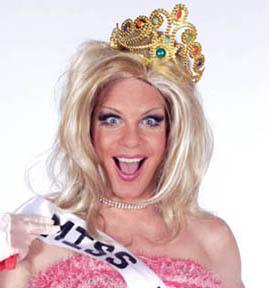
Here’s some good news for some bleak days: Anna Conda, whose given name is Glendon Hyde, is set to become the first drag queen to serve as president of the Milk Club. Glendon, a well known and exceptionally talented local performer, ran for District 6 supervisor in 2010 as a strong progressive and has been active in district as well as citywide politics as a member of the Entertainment Commission.

Gabriel Haaland reminds me that Anna Conda will not be the first trans person to serve as Milk Club president — Haaland had the job years ago. But still: Politics is serious, and Anna Conda takes it seriously — but a little fun in life makes it all bearable. And I suspect that Anna will make the Milke Club meetings lively. Congratulations!

Live Shots: Phonte and 9th Wonder at New Parish

0

I’ve heard complaints that the Occupy movement doesn’t have a clear message, but Saturday night you could read it from a passing car. At an intersection off of Broadway, where a large crowd had gathered, a few people held up a giant banner on the corner that read “FUCK THE POLICE.” And as we passed groups of officers in riot gear and searched for parking among  the cop cars on nearly every block, it was also obvious that a confrontation was brewing.

It may have been N.W.A. out on the streets, but inside the New Parish where a show was taking place, it was strictly no beefing. Rapper Phonte and DJ/producer 9th Wonder, formerly members of North Carolina’s alternative hip-hop group Little Brother, were finally performing together after settling some outstanding public grievances.

Addressing the crowd midway through the show, Phonte — in a playfully straight-forward manner — explained that he’d done a lot of growing in the last year, and that he’d learned that mistakes have a way of  living on the Internet. Recalling some Southern gospel preaching, he asked the audience to repeat the word “perpetuity” after him, on top of turning to their neighbors and saying “You got to own up to your own shit.”

Support included local openers including Richmond’s Locksmith and D.U.S.T. from Zion I’s crew as well as tour mates Median and Rapsody, but the focus of the show was definitely Phonte and 9th, who ripped through a set of material including both LB and more recent solo work. Part of their speed was necessity. “Grown man rap time,” Phonte called it, explaining that being an aging artist meant that you have an aging audience, with children, bills, and responsibilities, well past the point where “you can spend the whole god damn night at the rap show.”

On the plus side, having an older audience means that they are also likely to be more familiar with your work. When the beat dropped on “Lovin’ It,” a major track from LB’s 2005 concept album, The Minstrel Show, the whole crowd went off.  

But what really surprised me was to see a couple upstairs singing to each other the call and response section of “Make Me Hot,” a short proto-soul/Percy Miracles from LB’s 2003 debut The Listening. There was a sense of coming together (if you put the civil unrest an police action going down half a mile away out of mind.).

And considering that Phonte said it was his first sold out “solo” show in the Bay Area, definitely a long time coming. Which may have been why, despite expressing a plan to “Come to the show, spit these raps, take my ass home,” he didn’t seem to be rushing it.

Our Weekly Picks: January 11-17

0

WEDNESDAY 11

The Finches

The Finches are keen on the sounds of the 1960s and ’70s. While checking the band’s website recently, I found a couple of mixes that founding members Carolyn Pennypacker Riggs and Aaron Olson put together, comprised of songs by Harry Nilsson, Donovan, the Byrds, Joni Mitchell, and others. You might have been able to guess that they listened to some of those when writing their own songs. On the Finches’ most recent album, 2011’s On Golden Hill (their first in four years), there are smidgens of proto-punk, psychedelic rock, and singer-songwriter folk soaked in ’60s sheen. But while the band may quote from the past, the music is for now, distinctly their own. (James H. Miller)

With Brainstorm, and the Key Losers

9 p.m., $7

Hemlock Tavern

1131 Polk, SF

(415) 596-7777

www.hemlocktavern.com


Victims Family

With wailing guitar, gruff vocals, and jazzy bass lines, Victims Family has long crouched above the standard crusted punk pack, creating an aggressive punk-jazz-metal hybrid assault with political-circus style lyrics that satisfy the thinking-man’s pit. The long-standing hardcore act — born of Santa Rosa circa 1984 — is on Jello Biafra’s Alternative Tentacles label; AT describes Victims Family’s music in a fittingly verbose fashion: “groove/thrash/bad-acid/punk/noise/metal/samba.” All of the above. The band’s Elbo Room show this week is its first of the year, and the lineup is an Alternative Tentacles Showcase, fleshed out by the excellent Fleshies and Pins Of Light. Here’s to a pit-filled 2012. (Emily Savage)

With Fleshies, and Pins of Light

9 p.m., $10

Elbo Room

647 Valencia, SF

(415) 552-7788

www.elbo.com


THURSDAY 12

Burnt Ones

Though I’m not sure what it is about San Francisco that sparks the formation of retro garage-pop bands, I’m positive that Burnt Ones are doing it better than most. This trio laces sweet pop melodies with heavy reverb for some sweaty, good old fashioned fun. It’s been a while since Burnt Ones released its catchy debut LP Black Teeth & Golden Tongues (Roaring Colonel), yet it remains a staple in my rotation. Check out the addictive single, “Gonna Listen To T.Rex (All Night Long).” If this heavy hitter doesn’t get stuck in your head for the rest of the week, you might wanna get yourself checked out. (Frances Capell)

With the Mallard, and Koko and the Sweetmeats

9 p.m., $6

Hemlock Tavern

1131 Polk, SF

(415) 923-0925

www.hemlocktavern.com


French Cassettes

While there may not be anything explicitly French about this quartet of garage rockers from the Bay, the Baroque pop ménage they embrace along with their refined musical sensibilities suggests the French Cassettes are more quintessentially so than one might imagine. It’s a preference towards subtlety over excess, and an emphasis on the minutiae. A touch of strings here, a tinge of electric energy there, and a deep reserve of catchy hooks borrowed and reinvented from some of their forerunners in pop art. Think Kinks and Beatles, but more demure; The Shins but less morose. Their first EP Summer Darling came out last year and now the band starts the year off rocking ever-so-effortlessly at a divey venue in the Mission. (Courtney Garcia)

9 p.m., $8

Brick and Mortar Music Hall

1710 Mission, SF

(415) 800-8782

www.brickandmortarmusic.com


“Le Martyre de Saint Sébastien”

Here’s the stereotypical scandal in a nutshell: According to Roman Catholic legend, Saint Sébastien was martyred in the third century BCE during Emperor Diocletian’s persecution of Christians. First he was shot through with arrows (the homoerotic possibilities of a half-naked youth being pierced many times while in religious ecstasy has not escaped centuries of artists), then he was clubbed to death. In 1911, French composer Claude Debussy, with Italian poet Gabriele d’Annunzio, wrote a five act mystery about the saint’s life, incorporating narrative and musical accompaniment. But the star ballerina, Ida Rubinstein, was a Jewish woman, so Pope Pius X (himself later canonized) instructed Catholics to shun the performances, martyring the work. Le sigh. Now here’s the music: grounded yet unearthly, full of Debussy’s restless, swirling chords augmented with sacred-sounding chants and hypnotic figures. This multimedia interpretation by the SF Symphony, featuring narrator Frederica von Stade, should shoot to the stars.

Through Sat/14

8 p.m., $35–$140

Davies Symphony Hall

201 Van Ness, SF

(415) 864-6400

www.sfsymphony.org


FRIDAY 13

“For Your Consideration”

Unless you have the time, coin, and stamina to globe-trot around to every festival, you’re likely missing out on quite a bit of tasty international cinema. Sure, the latest Pedro Almodóvar will always hit the local art-house joint, but more obscure (and no less worthy) films that lack big-money distribution probably will not. Fortunately, San Rafael is a lot closer than Berlin or Cannes, where “For Your Consideration: A Selection of Oscar Submissions from Around the World” unspools starting today, with Sweden’s Beyond (starring Noomi “I Had the Dragon Tattoo First” Rapace); Hungarian standout Béla Tarr’s latest, The Turin Horse; Bulgarian youth-gone-wild treatise Tilt; and several others, including a movie from the Philippines (The Woman in the Septic Tank) that spoofs awards-grubbing “message” films. (Cheryl Eddy)

Through Jan. 19, $6.35–$10.25

Christopher B. Smith Rafael Film Center

1118 Fourth St., San Rafael

(415) 454-1222

www.cafilm.org


Ellis Avery

“La Belle Rafaela” (1927) is a decadent, highly erotic painting by the Polish Art Deco painter Tamara de Lempicka. The model de Lempicka used for the piece was Rafaela Fano — a woman she hired off the streets of Paris, painted several times, and with whom she became romantically involved. “La Belle” depicts Rafaela as a curvaceous nude, bathed in shadows, and flinching with euphoria. It conveys such feverish sensuality that probably would have been unachievable had the artist’s desires not been utterly real. The painting inspired author Ellis Avery to write The Last Nude, a historical novel that re-imagines the love affair from the perspective of Fano. At Books Inc., Avery reads from this story that plunges into the depths of a forbidden romance set in glamorous 1920s Paris. (Miller)

7:30 p.m., Free

Books Inc.

2275 Market, SF

(415) 864-6777

www.booksinc.net


“Midnites for Maniacs: The Mind is a Terrible Thing to Taste”

Oh, you didn’t think Midnites for Maniacs programmer Jesse Hawthorne Ficks would program a Friday the 13th flick to coincide with today’s sinister day-and-date combo? (Well, he might, but he’d pick one of the more ridiculous entries, like the one where Jason takes outer space.) Nay, fiends, tonight’s triple-feature is face-warping enough to be themed “The Mind is a Terrible Thing to Taste.” It kicks off with Sam Raimi’s 1992 Army of Darkness (Bruce. Fucking. Campbell.); followed by American Psycho, which came out in 2000 but remains eerily current in all ways (fashions excepted); and Alice Cooper’s Welcome to My Nightmare, a 1975 concert film capturing the shock rocker in his prime. All this for $12! Hockey mask optional. (Eddy)

7:30 p.m., $12

Castro Theatre

429 Castro, SF

(415) 621-6120

www.castrotheatre.com


Devo

If there is any band that is a testament to the variance in public recognition, it’s Devo. To many, it is simply the band with the flowerpot hats that sang “Whip It.” Another group, however, will assert that Devo is the greatest musical act to ever come out of the Akron, Ohio area (Ha! Take that the Black Keys!) and that those “hats” are in fact Energy Domes. But while its 2010 album Something For Everybody — the first in 20 years since 1990’s Smooth Noodle Maps — was ostensibly market tested to please all camps, it largely represents a return to the formula of cynical yet mind-numbingly catchy pop that made it a quintessential cult band in the first place. (Ryan Prendiville)

Through Sat/14, 9 p.m., $50

Fillmore

1850 Geary, SF

(415) 346-6000

www.thefillmore.com


SATURDAY 14

Coast Jumper

I recently put together a list of my top 10 self-released albums of 2011, and I’m now kicking myself for not listening to Coast Jumper’s ambitious Grand Opening before I did. As far as debuts go, this Bandcamp gem is surprisingly lush and cohesive. There are a few glimpses of Vampire Weekend and Grizzly Bear, but above all Grand Opening presents a young indie rock five-piece making an exciting contribution to our local music scene. So, I’m making a late New Year’s resolution to pay close attention to Coast Jumper in 2012. (Capell)

With Dogcatcher, Briertone, and Colin Carthen

9 p.m., $10

Hotel Utah

500 Fourth St, SF

(415) 546-6300

www.hotelutah.com


SUNDAY 15

Max Cooper

With a PhD in computational biology and a tendency to name, if not organize, tracks after abstract scientific concepts (see the Serie trilogy of Harmonisch, Stochastisch, and Chaotisch) the UK’s Max Cooper could come across as a purely heady figure — a brain floating in a jar in some IDM lab. But Cooper has made a name for himself — appearing on Resident Advisor’s Top 100 DJs of 2011 — with ambient techno that manages to be moving. A delicate, light touch at work, whether a twinkle of keys or burst of static, Cooper’s evocative effects create familiar cinematic imagery: a walk in the rain, a passing car, a gasp emitted from bright red lips. (Prendiville)

With William Wardlaw, Max Jack vs. Pedro Arbulu, Max Gardner vs. Brian Knarfield

9 p.m., $15–$20

Monarch

101 Sixth St., SF

(415) 284-9774

www.monarchsf.com


Vetiver

Vetiver’s lead singer Andy Cabic proved the value of wandering when his strolls through the Richmond District led to another critically-acclaimed album for one of San Francisco’s most compelling folk bands. The band gained serious traction last spring with the release of The Errant Charm, a title hinting there may be inherent misdeed in such vagrancy; though the music, channeling ’60s-style acoustics and California daze, is meant for musing. Through the close of last year the disheveled crooners were playing what seemed like every city in the country, promoting their newest record, and spreading the love. Now they return to their roots. The oracle predicts a jam session on a sparkly night in the Bay. (Garcia)

With Magic Trick, Prairiedog, DJ Britt Govea

8 p.m., $20

Independent

628 Divisadero, SF

(415) 771-1421

www.theindependentsf.com


MONDAY 16

“Martin Luther King Jr. Day Double Feature”

“All of us have something to say, but some are never heard” — Richard Pryor, Wattstax (1973). MLK Jr. Day calls into question how we remember the past. The Wattstax concert is sometimes recalled derivatively as “the black Woodstock.” But while soul music may have been the response, the event was put on by Stax Records to commemorate and come to terms with the seventh anniversary of the Watts Riots in LA, which challenged the limits of MLK Jr.’s nonviolent philosophy. As a double feature the Wattstax documentary will be shown with The Black Power Mixtape 1967-1975 (2011), a revelatory look at a movement’s era that sadly took the distance of continent and a few decades to make. (Prendiville)

Wattstax 3, 7p.m.; The Black Power Mixtape 4:55, 8:55 p.m., $7.50–$10

Castro Theatre

429 Castro, SF

(415) 621-6120

www.castrotheatre.com


The Guardian listings deadline is two weeks prior to our Wednesday publication date. To submit an item for consideration, please include the title of the event, a brief description of the event, date and time, venue name, street address (listing cross streets only isn’t sufficient), city, telephone number readers can call for more information, telephone number for media, and admission costs. Send information to Listings, the Guardian Building, 135 Mississippi St., SF, CA 94107; fax to (415) 487-2506; or e-mail (paste press release into e-mail body — no text attachments, please) to listings@sfbg.com. Digital photos may be submitted in jpeg format; the image must be at least 240 dpi and four inches by six inches in size. We regret we cannot accept listings over the phone.

Film Listings

0

Film listings are edited by Cheryl Eddy. Reviewers are Kimberly Chun, Max Goldberg, Dennis Harvey, Lynn Rapoport, and Matt Sussman. For rep house showtimes, see Rep Clock.

OPENING

*Battle for Brooklyn Posed as neither a left nor a right issue (though George Will does drift into view at one improbable moment), Michael Galinsky’s powerful documentary does the exhaustive, long-haul work of charting the fight between residents and business owners in Brooklyn’s Prospect Heights as they oppose the condemnation of their property — oh-so-inconveniently in the way of the proposed Atlantic Yards, a mammoth Frank Gehry-designed development involving a basketball arena for the New Jersey Nets and more than a dozen skyscrapers. The scrappy residents and activists, led in part by graphic designer Daniel Goldstein, face seemingly unbeatable forces: developer Forest City Ratner, which looks to Eminent Domain to seize a community’s land, whether it likes it or not; a complicit and corrupt state and city government; and other members of a diverse, divided community who are clamoring for the jobs that Ratner’s PR machine promises. Galinsky imparts the impact of the project — and its devastating effects on the neighborhood, despite alternate proposals and the recent real estate bust — over the course of eight years, with hundreds of hours of footage, time-lapse images, and a fortunate focus on one every-guy hero: Goldstein, who loses a fiancé and finds love at the ramparts, while his home is shorn away, all around him. Along the way, the viewer gets an education on the infuriating ways that these sorts of boondoggles get pushed through all opposition — the corollaries between this struggle and, say, the building of the 49ers stadium in Santa Clara are there for the viewer to draw. (1:33) Roxie. (Chun)

Beauty and the Beast 3D Disney’s “tale as old as time” returns in spiffy 3D form. Dancing candelabra in yo’ face! (1:24)

Carnage Nancy (Kate Winslet) and Alan (Christoph Waltz) have arrived in the apartment of Penelope (Jodie Foster) and Michael (John C. Reilly) to discuss proper follow-up to a playground incident in which one of their children went ballistic on another. But this grownup discussion about conduct between children quickly degenerates into a four-way living room sandbox melee, as the couples reveal snobbish disdain toward one another’s presumed values and the cracks in each marriage are duly bared. Roman Polanski’s unnecessary screen translation of Yasmina Reza’s play remains awkwardly rooted to the stage, where its contrivances would have seemed less obvious, or at least apt for the medium. There’s some fun to be had watching these actors play variously self-involved, accusatory Manhattanites who enact a very lite Who’s Afraid of Virginia Woolf? amid way too much single-malt Scotch ingestion. But the text gets crudely farcical after a while, and its critiques of the characters’ shallow materialism, bad parenting, knee-jerk liberal empathy, privileged class indifference, etc. would resonate more if those faults weren’t so cartoonishly drawn. In the end, Carnage‘s high-profile talent obliterates rather than illuminates the material — it’s like aiming a bazooka at a napkin. (1:20) Balboa, Embarcadero, Shattuck. (Harvey)

Cleanflix See Trash. (1:32) Roxie.

Contraband A former smuggler (Mark Wahlberg) comes out of retirement to chase one last score. Don’t they always? (1:49)

*Hipsters Though it might misleadingly draw a horde of Hipster Bingo look-alikes, the title of this goofy, passionate, generous-hearted Russian musical is fully earned. Director Valery Todorovsky’s let’s-put-on-a-show gumption, twinkly earnestness, and clownish costumes are likely drive today’s too-cool-for-schoolies out the theater, but if they stick around, the razzle-dazzle charm and cinematic flair that the filmmaker applies to this adaptation of Yuri Korotkov’s book, Boogie Bones, should win them over. The dateline is Moscow, 1955, and the scene is a West Side Story-style showdown between the hard-partying, rebellious boogie-woogie stilyagi, or hipsters, in love with American jazz and culture, and the terribly serious, grayed-out Communist hardliners who equate flashy fashion with individualistic decadence. Yet one comrade, Mels (Anton Shagin), finds himself crossing party lines after an encounter with fetching “Good Time” Polly (Oksana Akinshina of 2002’s Lilya 4-Ever) and slowly begins to assemble the look, the moves, the music, and the bad reputation that come with life as a hipster. A few of the film’s plot turns may be a bit tough to swallow, and some details, such as the music, don’t adhere strictly to era, but the affection Todorovsky feels for his characters, their plight, and musicals (particularly Baz Luhrmann’s) gleams through, especially when the director tracks alongside his freedom-loving protagonists as they occupy the streets with their subcultural kin of yesterday and today. (2:05) Lumiere, Shattuck, Smith Rafael. (Chun)

The Iron Lady Curiously like Clint Eastwood’s 2011 J. Edgar, this biopic from director Phyllida Lloyd and scenarist Abi Morgan takes on a political life of length, breadth and controversy — yet it mostly skims over the politics in favor of a generally admiring take on a famous narrow-minded megalomaniac’s “gumption” as an underdog who drove herself to the top. Looking back on her career from a senile old age spent in the illusory company of dead spouse Denis (Jim Broadbent), Meryl Streep’s ex-British Prime Minister Margaret Thatcher steamrolls past hurdles of class and gender while ironically re-enforcing the fustiest Tory values. She’s essentially a spluttering Lord in skirts, absolutist in her belief that money and power rule because they ought to, and any protesting rabble don’t represent the “real England.” That’s a mindset that might well have been explored more fruitfully via less flatly literal-minded portraiture, though Lloyd does make a few late, lame efforts at sub-Ken Russell hallucinatory style. Likely to satisfy no one — anywhere on the ideological scale — seriously interested in the motivations and consequences of a major political life, this skin-deep Lady will mostly appeal to those who just want to see another bravura impersonation added to La Streep’s gallery. Yes, it’s a technically impressive performance, but unlikely to be remembered as one of her more depthed ones, let alone among her better vehicles. (1:45) Albany. (Harvey)

Joyful Noise As heartfelt and anodyne as the singing underdogs at its center, Joyful Noise offers a spirited if ultimately hamstrung spin on a familiar set-up (anyone seen 1993’s Sister Act 2?). Queen Latifah and Dolly Parton (returning to the screen after a two decade hiatus) do most of the heavy lifting as working-class single mother Vi Rose Hill and flashy widow G.G. Sparrow, respectively, who find themselves locking horns as they strategize how to take the small-town Georgia church choir they both sing in to the big-time Gospel competition that gives the film its title. There’s also the matter of G.G.’s city-slicked grandson’s aggressive courting of Vi Rose’s precocious teenage daughter, who, it turns out, like many of the supporting players here, can out-belt most American Idol finalists. Writer-director Todd Graff’s script works in some genial digs at Parton’s fabulous artifice (“Who cares if I’ve had a few little nips and tucks? God didn’t make plastic surgeons so they could starve!” she proudly declares), but Parton’s singing often provides the emotional expressiveness that her face now has trouble conveying. Latifah’s performance is the biggest surprise in a movie that seems all but hatched from a Disney channel writers meeting: Vi Rose radiates both light and heat, tempering Joyful Noise‘s steady stream of homespun treacle with some much-needed righteousness and fury. (1:58) (Sussman)

*Kill All Redneck Pricks: A Documentary About the Band Called KARP An isolated instance of gonzo male adolescent noise in the forest of Beat Happening-type indie twee and riot grrliness that dominated Olympia, Wash.’s fertile early 1990s music scene, KARP (originally known by this documentary’s moniker) was composed of three nerdy middle-school friends from bleak neighboring Tumwater. Granted purpose by the majestic sludge of the Melvins, they dropped out of high school to become primitive sound-alikes, then gradually found their own voice in heavy, aggressive music with some pop chops and silly attitude. (At one point they adopted wrestling superhero personae, including a drag one.) “So dark and so clowny at the same time,” this “really earnest-ridiculous teenage explosion” made a name for itself touring tirelessly and recording occasionally over the decade’s course. In classic rock-doc bio fashion, however, nothing ended happily ever after: Alcoholism, drug addiction, a suicide attempt, and yea greater tragedy in time befell these kids who were pretty much born to play with each other. Even if you’ve never heard (or heard of) KARP before, William Badley’s excellent feature — packed with performance footage and scenester recollections — will make you wistful for the band’s loss. (1:25) Roxie. (Harvey)

ONGOING

*The Adventures of Tintin Producer Peter Jackson and director Steven Spielberg join forces to adapt the work of Belgian comic creator Hergé, using performance-capture 3D animation (and featuring that new technology’s most prominent performer, Andy Serkis, in a key role). Hergé wrote over 20 volumes following the globe-trotting exploits of intrepid young reporter Tintin (Jamie Bell) and his canine companion, Snowy; The Adventures of Tintin draws from a trio of books dating from the early 1940s, tweaking the tales a bit but retaining the series’ ebullient energy and sharp humor. After he impulsively buys a model ship, Tintin is sucked into a mystery involving a long-lost pirate treasure sought by the sinister Sakharine (Daniel Craig) and, eventually, newfound Tintin ally Captain Haddock (Serkis). Fan favorites Thompson and Thomson (Simon Pegg and Nick Frost — frequent compadre Edgar Wright co-wrote the script) and a certain “Milanese Nightingale” make appearances in a story that careens between exotic locales and high-seas battles, and is packed with epic chase scenes that would leave Indiana Jones breathless. And in case you were worried, Tintin boasts the least creepy, least “uncanny valley” performance-capture animation I’ve seen to date. (1:47) 1000 Van Ness, Presidio. (Eddy)

Alvin and the Chipmunks: Chip-wrecked (1:27) 1000 Van Ness.

*The Artist With the charisma-oozing agility of Douglas Fairbanks swashbuckling his way past opponents and the supreme confidence of Rudolph Valentino leaning, mid-swoon, into a maiden, French director-writer Michel Hazanavicius hits a sweet spot, or beauty mark of sorts, with his radiant new film The Artist. In a feat worthy of Fairbanks or Errol Flynn, Hazanavicius juggles a marvelously layered love story between a man and a woman, tensions between the silents and the talkies, and a movie buff’s appreciation of the power of film — embodied in particular by early Hollywood’s union of European artistry and American commerce. Dashing silent film star George Valentin (Jean Dujardin, who channels Fairbanks, Flynn, and William Powell — and won this year’s Cannes best actor prize) is at the height of his career, adorable Jack Russell by his side, until the talkies threaten to relegate him to yesterday’s news. The talent nurtured in the thick of the studio system yearns for real power, telling the newspapers, “I’m not a puppet anymore — I’m an artist,” and finances and directs his own melodrama, while his youthful protégé Peppy Miller (Bérénice Béjo) becomes a yakky flapper age’s new It Girl. Both a crowd-pleasing entertainment and a loving précis on early film history, The Artist never checks its brains at the door, remaining self-aware of its own conceit and its forebears, yet unashamed to touch the audience, without an ounce of cynicism. (1:40) California, Embarcadero, 1000 Van Ness, Piedmont, Sundance Kabuki. (Chun)

The Conquest Yet another entry in the relatively new, burgeoning genre of mostly comic biopics portraying political figures still or at least recently in office, Xavier Durringer’s film chronicles conservative Nicolas Sarkozy’s rise to the French presidency. As cannily impersonated by Denis Podalydès, Sarkozy (a.k.a. the Midget, to his detractors) is a Napoleon complex-afflicted shark whose need for perpetual careerist motion cancels out enjoyment even for his triumphs — save, perhaps, a momentary gloat over enemies left trampled. At the start he’s already neared the top of the government ladder, albeit not nearly near enough. Several years’ further upward scrambling are framed by flash-forwards to 2007, when he’s on the verge of finally becoming president, albeit at the cost of “top advisor” and long-suffering first wife Cécilia (Florence Pernel) jumping ship. Her earlier lament “Our life has become a TV show” has been ignored by a spouse quite happy living an almost entirely public, media-hounded life. (Although as his popularity continues to sink, Sarkozy almost certainly doesn’t feel that way now.) Without depiction of or insight into the main figure’s background, The Conquest becomes an entertaining but superficial, near-farcical enterprise providing little insight into what makes him tick. But then, that’s the problem with instant biographies — it’s a lot easier to grasp a significant figure’s complexities when enough time has passed for hindsight to clear the immediate fog of scandal, spectacle, and grotesquerie. (1:45) Smith Rafael. (Harvey)

A Dangerous Method Cool and chatty (unsurprisingly, given its subject matter and the fact that it’s based on a play and a novel), David Cronenberg’s latest begins in 1904 Zurich as a shrieking patient (Keira Knightley) is escorted into the care of psychiatrist Carl Jung (Michael Fassbender). Dr. Jung, an admirer of Sigmund Freud, tests the “talking cure” on the woman, who turns out to be the fiercely intelligent and conveniently beautiful Sabina Spielrein. An attraction, both intellectual and sexual, soon develops, no matter that Jung is Sabina’s doctor, or that he happens to be married to a prim wife whose family wealth keeps him in boats and lake houses. Meanwhile, Jung and Freud (an excellent Viggo Mortensen) begin corresponding, eventually meeting and forming a friendship that’s tested first when Sabina comes between them, and later when Jung expresses a growing interest in fringe pursuits like parapsychology. The scenes between Freud and Jung are A Dangerous Method‘s most intriguing — save those brief few involving Vincent Cassel as a doctor-turned-patient who advises Jung to “never repress anything” — but the film is mostly concerned with Jung’s various Sabina-related dramas. Pity that this is a tightly-wound Fassbender’s least dynamic performance of the year, and that Knightley, way over the top in Sabina’s hysterical scenes, telegraphs “casting mistake” from the get-go. (1:39) Albany, Embarcadero, Sundance Kabuki. (Eddy)

The Darkest Hour (1:29) 1000 Van Ness.

*The Descendants Like all of Alexander Payne’s films save 1996 debut Citizen Ruth, The Descendants is an adaptation, this time from Kaui Hart Hemmings’ excellent 2007 novel. Matt King (George Clooney) is a Honolulu lawyer burdened by various things, mostly a) being a haole (i.e. white) person nonetheless descended from Hawaiian royalty, rich in real estate most natives figure his kind stole from them; and b) being father to two children by a wife who’s been in a coma since a boating accident three weeks ago. Already having a hard time transitioning from workaholic to hands-on dad, Matt soon finds out this new role is permanent, like it or not — spouse Elizabeth (Patricia Hastie, just briefly seen animate) will not wake up. The Descendants covers the few days in which Matt has to share this news with Elizabeth’s loved ones, mostly notably Shailene Woodley and Amara Miller as disparately rebellious teen and 10-year-old daughters. Plus there’s the unpleasant discovery that the glam, sporty, demanding wife he’d increasingly seemed “not enough” for had indeed been looking elsewhere. When has George Clooney suggested insecurity enough to play a man afraid he’s too small in character for a larger-than-life spouse? But dressed here in oversized shorts and Hawaiian shirts, the usually suave performer looks shrunken and paunchy; his hooded eyes convey the stung joke’s-on-me viewpoint of someone who figures acknowledging depression would be an undeserved indulgence. Payne’s film can’t translate all the book’s rueful hilarity, fit in much marital backstory, or quite get across the evolving weirdness of Miller’s Scottie — though the young actors are all fine — but the film’s reined-in observations of odd yet relatable adult and family lives are all the more satisfying for lack of grandiose ambition. (1:55) California, Piedmont, Presidio, SF Center, Sundance Kabuki. (Harvey)

The Devil Inside (1:27) 1000 Van Ness.

*Drive Such a lovely way to Drive, drunk on the sensual depths of a lush, saturated jewel tone palette and a dreamlike, almost luxurious pacing that gives off the steamy hothouse pop romanticism of ’80s-era Michael Mann and David Lynch — with the bracing, impactful flecks of threat and ultraviolence that might accompany a car chase, a moody noir, or both, as filtered through a first-wave music video. Drive comes dressed in the klassic komforts — from the Steve McQueen-esque stances and perfectly cut jackets of Ryan Gosling as the Driver Who Shall Remain Nameless to the foreboding lingering in the shadows and the wittily static, statuesque strippers that decorate the background. Gosling’s Driver is in line with Mann’s other upstanding working men who hew to an old-school moral code and are excellent at what they do, regardless of what side of the law they’re working: he likes to keep it clear and simple — his services as a wheelman boil down to five minutes, in and out — but matters get messy when he falls for sweet-faced neighbor Irene (Carey Mulligan), who lives down the hall with her small son, and her ex-con husband (Oscar Isaac) is dragged back into the game. Populated by pungent side players like Albert Brooks, Bryan Cranston, Ron Perlman, and Christina Hendricks, and scattered with readily embeddable moments like a life-changing elevator kiss that goes bloodily wrong-right, Drive turns into a real coming-out affair for both Danish director Nicolas Winding Refn (2008’s Bronson), who rises above any crisis of influence or confluence of genre to pick up the po-mo baton that Lynch left behind, and 2011’s MVP Ryan Gosling, who gets to flex his leading-man muscles in a truly cinematic role, an anti-hero and under-the-hood psychopath looking for the real hero within. (1:40) Lumiere. (Chun)

*Everyday Sunshine: The Story of Fishbone This doc offers a lively, revealing look at SoCal ska-punk rockers Fishbone, a band that formed circa 1979 in a San Fernando Valley junior high newly filled with bussed-in South Central kids. In its heyday, Fishbone enjoyed cult success with hits like “Party at Ground Zero” and the tune that gives the film its title; Everyday Sunshine speaks to Fishbone’s broad appeal, as famous faces chime in to reminisce (and longtime fan Laurence Fishburne narrates), but it also illuminates some of the reasons its members never became megastars. Codirectors Chris Metzler (a San Francisco resident best-known for 2004’s Plagues and Pleasures on the Salton Sea) and Lev Anderson spent months on the road with the band, capturing the infectious energy of its live shows in addition to behind-the-scenes tension. Past members add their voices, but the main protagonists are bassist-vocalist Norwood Fisher and lead vocalist-saxophone player Angelo Moore. Their intertwining stories offer a poignant portrait of creative soulmates who’ve weathered many storms (personality conflicts, legal and money troubles, an industry that didn’t know how to categorize them) without once giving up on their music. In addition to its compelling story, the film’s quirkier stylistic choices, including animation, lift Everyday Sunshine above the crowded field of traditional music docs. (1:47) Roxie. (Eddy)

*The Girl With the Dragon Tattoo The meeting of Stieg Larsson’s first “Millennium” book and David Fincher promised fireworks, as he’s a director who can be equally vivid and exacting with just the elements key to the series: procedural detail, obsession, violence, tweaked genre conventions, mind games, haunted protagonists, and expansive story arcs. But perhaps because this possible franchise launch had to be rushed into production to ride the Larsson wave, what should have been a terrific matchup turns out to be just a good one — superior in some stylistic departments (notably Trent Reznor and Atticus Ross’ pulsing score), but overall neither an improvement nor a disappointment in comparison to the uninspired but effective 2009 Swedish film version. Daniel Craig plays Mikael Blomkvist, the muckraking Stockholm journalist whose public disgrace after a failed expose of a suspect corporate tycoon makes him the perfect candidate for an unexpected assignment: staying sequestered in the wealthy, warring Vanger clan’s island home to secretly investigate a teenage girl’s disappearance and presumed murder 40 years ago. His testy helpmate is the singular Lisbeth Salander (Rooney Mara), antisocial hacker, researcher, and ex-mental patient par excellence. Nearly three hours long, the compressed, slightly altered (get over it) storyline nonetheless feels rushed at times; Fincher manages the rare feat of making mostly internet research exciting in filmic terms, yet oddly the book’s more shocking episodes of sex and/or mayhem don’t have the memorable impact one might expect from him. The leads are fine, as is the big support cast of recognizable faces (Christopher Plummer, Stellan Skarsgård, Robin Wright, etc.) But the knockout suspense, atmosphere, and urgency one hoped for isn’t present in this intelligent, not entirely satisfying treatment. On the other hand, maybe those who’ve already read the books and seen the prior films have already had so much exposure to this material that a revelatory experience is no longer possible. (2:38) Four Star, Marina, 1000 Van Ness, Sundance Kabuki, SF Center. (Harvey)

Le Havre Aki Kaurismäki’s second French-language film (following 1992’s La Vie de Boheme) offers commentary on modern immigration issues wrapped in the gauze of a feel good fairy tale and cozy French provincialism a la Marcel Pagnol. Worried about the health of his hospitalized wife (Kaurismäki regular Kati Outinen), veteran layabout and sometime shoe shiner Marcel (Andre Wilms) gets some welcome distraction in coming to the aid of Idrissa (Blondin Miguel), a young African illegally trying to make way to his mother in London while eluding the gendarmes. Marcel’s whole neighborhood of port-town busybodies and industrious émigrés eventually join in the cause, turning Le Havre into a sort of old-folks caper comedy with an incongruously sunny take on a rising European multiculturalism in which there are no real racist xenophobes, just grumps deserving comeuppance. Incongruous because Kaurismäki is, of course, the king of sardonically funny Finnish miserabilism — and while it’s charmed many on the festival circuit, this combination of his usual poker-faced style and feel-good storytelling formula may strike others as an oil-and-water mismatch. (1:43) Opera Plaza. (Harvey)

Hugo Hugo turns on an obviously genius conceit: Martin Scorsese, working with 3D, CGI, and a host of other gimmicky effects, creates a children’s fable that ultimately concerns one of early film’s pioneering special-effects fantasists. That enthusiasm for moviemaking magic, transferred across more than a century of film history, was catching, judging from Scorsese’s fizzy, exhilarating, almost-nauseating vault through an oh-so-faux Parisian train station and his carefully layered vortex of picture planes as Hugo Cabret (Asa Butterfield), an intrepid engineering genius of an urchin, scrambles across catwalk above a buzzing station and a hotheaded station inspector (Sacha Baron Cohen). Despite the special effects fireworks going off all around him, Hugo has it rough: after the passing of his beloved father (Jude Law), he has been stuck with an nasty drunk of a caretaker uncle (Ray Winstone), who leaves his duties of clock upkeep at a Paris train station to his charge. Hugo must steal croissants to survive and mechanical toy parts to work on the elaborate, enigmatic automaton he was repairing with his father, until he’s caught by the fierce toy seller (Ben Kingsley) with a mysterious lousy mood and a cute, bright ward, Isabelle (Chloe Grace Moretz). Although the surprisingly dark-ish Hugo gives Scorsese a chance to dabble a new technological toolbox — and the chance to wax pedantically, if passionately, about the importance of film archival studies — the effort never quite despite transcends its self-conscious dazzle, lagging pacing, diffuse narrative, and simplistic screenplay by John Logan, based on Brian Selznick’s book. Even the actorly heavy lifting provided by assets like Kingsley and Moretz and the backloaded love for the fantastic proponents at the dawn of filmmaking fail to help matters. Scorsese attempts to steal a little of the latters’ zeal, but one can only imagine what those wizards would do with motion-capture animation or a blockbuster-sized server farm. (2:07) 1000 Van Ness, Shattuck, Sundance Kabuki. (Chun)

In the Land of Blood and Honey The grudging, occasionally outright hostile tone some critics, culture vultures, and fan types have taken toward In the Land of Blood and Honey points toward a fundamental problem most of them have, though few admit it: the belief that Angelina Jolie is just too damn famous, too much a figure of public speculation and private fantasy, to be taken seriously — let alone to make a movie about rape and genocide during the Balkans Wars. But the fact is, her narrative debut as writer and director would probably be getting reviews in the respectable-to-rave range if created by anyone else. It’s certainly gotten some of those, but you’d be hard-pressed not to glimpse a certain “Who does she think she is?” resentment behind others who see the film as heavy-handed do-gooderism from a chick who should leave cinematic commentary about profoundly tragic historical events to people who are less … er, sexy. Not that Blood and Honey doesn’t have its genuine faults. There’s contrivance in the way that young Muslim painter Ajla (Zana Marjanovic) and Serb cop Danijel (Goran Kostic) have a first date just as the war reaches 1992 Sarajevo, then intersect again when she’s a POW and he’s an officer in the Serbian Army. This allows him to save her from the regular rapes other women prisoners suffer at the hands of guards, and eventually to set her up as his protected mistress, a breach of code that is unwelcome news to the ears of his powerful father General Nobosjsa (Rade Serbedzija), a fanatical “ethnic cleanser.” This premise is typical movie exceptionalism, even if it’s still a good step above the usual device of casting a Western character-star as our guide in unpleasant foreign affairs. While not a great movie, Blood and Honey is a very good one; an honorable achievement, not just a vehicle for honorable intentions. Of course the point is nothing more complicated than “War is hell,” but how often do movies actually punch that across, as opposed to pouting a bit while making war look exciting? (2:07) Opera Plaza, SF Center. (Harvey)

J. Edgar The usual polished, sober understatement of Clint Eastwood’s directing style and the highlights-compiling CliffsNotes nature of Dustin Lance Black’s screenplay turn out to be interestingly wrong choices for this biopic about one of the last American century’s most divisive figures. Interesting in that they’re perhaps among the very few who would now dare viewing the late, longtime FBI chief with so much admiration tempered by awareness of his faults — rather than the other way around. After all, Hoover (played by Leonardo DiCaprio) strengthened his bureau in ways that, yes, often protected citizens and state, but at what cost? The D.C. native eventually took to frequently “bending” the law, witch-hunting dubious national enemies (he thought the Civil Rights movement our worst threat since the bomb-planting Bolshevik anarchists of half a century earlier), blackmailing personal ones, weakening individual rights against surveillance, hoarding power (he resented the White House’s superior authority), lying publicly, and doing just about anything to heighten his own fame. A movie that internalized and communicated his rising paranoid megalomania (ironically Hoover died during the presidency of Nixon, his equal in that regard) might have stood some chance of making us understand this contradiction-riddled cipher. But J. Edgar is doggedly neutral, almost colorless (literally so, in near-monochrome visual presentation), its weird appreciation of the subject’s perfectionism and stick-to-it-iveness shutting out almost any penetrating insight. (Plus there’s Eastwood’s own by-now-de rigueur soundtrack of quasi-jazz noodling to make what is vivid here seem more dull and polite.) The love that dare not speak its name — or, evidently, risk more than a rare peck on the cheek — between Hoover and right-hand-man/life companion Clyde Tolson (Armie Hammer, very good if poorly served by his old-age makeup) becomes both the most compelling and borderline-silly thing here, fueled by a nervous discretion that seems equal parts Black’s interest and Eastwood’s discomfort. While you might think the directors polar opposites in many ways, the movie J. Edgar ultimately recalls most is Oliver Stone’s 1995 Nixon: both ambitiously, rather sympathetically grapple with still-warm dead gorgons and lose, filmmaker and lead performance alike laboring admirably to intelligent yet curiously stilted effect. (2:17) Opera Plaza, Shattuck. (Harvey)

King of Devil’s Island When teenaged Erling (Benjamin Helstad) arrives at Bastøy Prison — more labor camp than reform school — he’s more worldly than many of the other boys there, especially Olav (Trond Nilssen), though the newcomer and long-time inmate bond over a shared fascination with seafaring life. That’s about the only happy thing that happens in Bastøy; set in 1915, King of Devil’s Island is based on the Norwegian island prison’s troubled past, and a rebellion that erupts when the boys reach the breaking point. Surprisingly, it’s not the exhausting work (hauling rocks and trees as rain and snow whip across gloomy fjords) that leads to unrest — it’s the failure of the camp’s strict-but-not-sadistic overseer (go-to stern Scandinavian Stellan Skarsgård) to remove a “housefather” with rapey tendencies. An overlong running time enables a few too many climaxes (though the big uprising is well-earned, and cathartic), but director Marius Holst avoids melodrama, and powerful performances, particularly by the glowering Helstad, elevate the grim King above typical hell-is-for-children fare. (1:54) SFFS New People Cinema. (Eddy)

*Melancholia Lars von Trier is a filmmaker so fond of courting controversy it’s like he does it in spite of himself — his rambling comments about Hitler (“I’m a Nazi”) were enough to get him banned from the Cannes Film Festival earlier this year, where Melancholia had its debut (and star Kirsten Dunst won Best Actress). Oops. Maybe after the (here’s that word again) controversy that accompanied 2009’s Antichrist, von Trier felt like he needed a shocking context for his more mellow latest. Pity that, for Melancholia is one of his strongest, most thoughtful works to date. Split into two parts, the film follows first the opulent, disastrous, never-ending wedding reception of Justine (Dunst) and Michael (Alexander Skarsgard), held at a lavish estate owned by John (Kiefer Sutherland), the tweedy husband of Justine’s sister, Claire (Charlotte Gainsbourg). Amid the turmoil of arguments (John Hurt and Charlotte Rampling as Justine and Claire’s divorced parents), pushy guests (Stellan Skarsgard as Justine’s boss), livid wedding planner (Udo Kier, amazing), and hurt feelings (Michael is the least-wanted groom since Kris Humphries), it’s clear that something is wrong with Justine beyond just marital jitters. The film’s second half begins an unspecified amount of time later, as Claire talks her severely depressed, near-catatonic sister into moving into John’s mansion. As Justine mopes, it’s revealed that a small planet, Melancholia — glimpsed in Melancholia‘s Wagner-scored opening overture — is set to pass perilously close to Earth. John, an amateur astronomer, is thrilled; Claire, fearful for her young son’s future and goaded into high anxiety by internet doomsayers, is convinced the planets will collide, no matter what John says. Since Justine (apparently von Trier’s stand-in for himself) is convinced that the world’s an irredeemably evil place, she takes the news with a shrug. Von Trier’s vision of the apocalypse is somber and surprisingly poetic; Dunst and Gainsbourg do outstanding work as polar-opposite sisters whose very different reactions to impending disaster are equally extreme. (2:15) Lumiere, Shattuck. (Eddy)

Midnight in Paris Owen Wilson plays Gil, a self-confessed “Hollywood hack” visiting the City of Light with his conservative future in-laws and crassly materialistic fiancée Inez (Rachel McAdams). A romantic obviously at odds with their selfish pragmatism (somehow he hasn’t realized that yet), he’s in love with Paris and particularly its fabled artistic past. Walking back to his hotel alone one night, he’s beckoned into an antique vehicle and finds himself transported to the 1920s, at every turn meeting the Fitzgeralds, Gertrude Stein (Kathy Bates), Dali (Adrien Brody), etc. He also meets Adriana (Marion Cotillard), a woman alluring enough to be fought over by Hemingway (Corey Stoll) and Picasso (Marcial di Fonzo Bo) — though she fancies aspiring literary novelist Gil. Woody Allen’s latest is a pleasant trifle, no more, no less. Its toying with a form of magical escapism from the dreary present recalls The Purple Rose of Cairo (1985), albeit without that film’s greater structural ingeniousness and considerable heart. None of the actors are at their best, though Cotillard is indeed beguiling and Wilson dithers charmingly as usual. Still — it’s pleasant. (1:34) Shattuck. (Harvey)

Mission Impossible: Ghost Protocol No world landmark (the Kremlin, the Burj Khalifia) is too iconic and/or freaking tall for uber-adrenalized Impossible Missions Force agent Ethan Hunt (Tom Cruise) and his team (Jeremy Renner, Paula Patton, Simon “Comic Relief” Pegg) to infiltrate, climb, assume false identities in, use as a home base for unleashing futuristic spy technology that seems almost plausible (with the help of lots of iPads), race a BMW through, etc. One kind of gets the sense that Cruise and company sat down with a piece of paper and were like, “What stunts haven’t we done before, and how many of them can I do with my shirt off?” Celebrated animation director Brad Bird (2004’s The Incredibles) is right at home with Ghost Protocol as his first live-action effort — the film’s plot (set in the present day, it involves a positively vintage blend of Russians and nukes) and even its unmemorable villain take a back seat to Cruise’s secret-agent shenanigans, most of which take the form of a crazy plan that must be altered at the last minute, resulting in an even crazier plan, which must be implemented despite the sudden appearance of yet another ludicrously daunting obstacle, like, say, a howling sandstorm. For maximum big dumb fun, make sure you catch the IMAX version. A warning, though: any time the movie screeches to a halt to explore emotions or attempt characterization … zzz. (2:13) 1000 Van Ness, Presidio. (Eddy)

My Week With Marilyn Statuette-clutching odds are high for Michelle Williams, as her impersonation of a famous dead celebrity is “well-rounded” in the sense that we get to see her drunk, disorderly, depressed, and so forth. Her Marilyn Monroe is a conscientious performance. But when the movie isn’t rolling in the expected pathos, it’s having other characters point out how instinctive and “magical” Monroe is onscreen — and Williams doesn’t have that in her. Who could? Williams is remarkable playing figures so ordinary you might look right through them on the street, in Wendy and Lucy (2008), Blue Valentine (2010), etc. But as Monroe, all she can do is play the little-lost girl behind the sizzle. Without the sizzle. Which is, admittedly, exactly what My Week — based on a dubious true story — asks of her. It is true that in 1956 the Hollywood icon traveled to England to co-star with director Sir Laurence Olivier (Kenneth Branagh) in a fluff romance, The Prince and the Showgirl; and that she drove him crazy with her tardiness, mood swings, and crises. It’s debatable whether she really got so chummy with young production gofer Colin Clark, our wistful guide down memory lane. He’s played with simpering wide-eyed adoration by Eddie Redmayne, and his suitably same-aged secondary romantic interest (Emma Watson) is even duller. This conceit could have made for a sly semi-factual comedy of egos, neurosis, and miscommunication. But in a rare big-screen foray, U.K. TV staples director Simon Curtis and scenarist Adrian Hodges play it all with formulaic earnestness — Marilyn is the wounded angel who turns a starstruck boy into a brokenhearted but wiser man as the inevitable atrocious score orders our eyes to mist over. (1:36) Balboa, Clay, Marina, Shattuck. (Harvey)

*Pariah A teenage girl stands stock-still in a dark nightclub, gazing with desire and fear at the half-naked female dancers on the stage. Later, riding home on the bus, she slowly removes the layers of butch that held her together in the club, stripping down to some version of the person her parents need to see when she walks in the door. Nearly wordlessly, the opening scenes of Dee Rees’s Pariah poignantly depict the embattled internal life of Alike (Adepero Oduye), a 17-year-old African American girl living in Brooklyn with her family and struggling both to be seen as she is and to determine what that might look like. The battles are being waged externally, too, between Alike’s adoring father (Charles Parnell), living in willful ignorance, and angry, rigid mother (Kim Wayans), desperately enforcing a feminine dress code and steering Alike away from openly butch friend Laura (Pernell Walker). Rees’ script beautifully conveys a household of landmines and chasms, which widen as husband and wife and daughter struggle and fail to communicate, asking the wrong questions, fearfully skirting the truth about Alike’s sexuality and her parents’ crumbling marriage. And the world outside proves full of romantic pitfalls and the tensions of longtime friendship and peer pressure. The poems in which the talented Alike takes solace and makes her way toward a more truthful existence are beautiful, but at a certain point the lyricism overtakes the film, forcing an ending that is tidy but less than satisfying. (1:26) Embarcadero. (Rapoport)

*Shame It’s been a big 2011 for Michael Fassbender, with Jane Eyre, X-Men: First Class, Shame, and A Dangerous Method raising his profile from art-house standout to legit movie star (of the “movie stars who can also act” variety). Shame may only reach one-zillionth of X-Men‘s audience due to its NC-17 rating, but this re-teaming with Hunger (2008) director Steve McQueen is Fassbender’s highest achievement to date. He plays Brandon, a New Yorker whose life is tightly calibrated to enable a raging sex addiction within an otherwise sterile existence, including an undefined corporate job and a spartan (yet expensive-looking) apartment. When brash, needy, messy younger sister Cissy (Carey Mulligan, speaking of actors having banner years) shows up, yakking her life all over his, chaos results. Shame is a movie that unfolds in subtle details and oversized actions, with artful direction despite its oft-salacious content. If scattered moments seem forced (loopy Cissy’s sudden transformation, for one scene, into a classy jazz singer), the emotions — particularly the titular one — never feel less than real and raw. (1:39) Bridge, Embarcadero, Shattuck. (Eddy)

Sherlock Holmes: A Game of Shadows Maybe Guy Ritchie should’ve quit while he was ahead. Thanks to strong performances from Robert Downey Jr. and Jude Law, the British director’s first Holmes flick proved surprisingly fun. Two years later, it’s clear that Ritchie’s well of creatitivity has run dry. Sherlock Holmes: A Game of Shadows is cliched and overlong, burying a few good ideas under an avalanche of tired action movie stalwarts gone steampunk. To be fair, the set design and art direction are still sumptuous, creating a hyperbolic, detailed vision of Victorian Europe. New cast additions Jared Harris (as Moriarty, maliciously polite) and Stephen Fry (as Mycroft, eccentric and nude) do well with limited material. Noomi Rapace, playing a helpful gypsy, is superfluous. Downey Jr. and Law are still game for some amusing PG-13 homoeroticism, but it’s the former’s disinterested performance that ensures the movie’s downfall. Forced to make do without witty quips or interesting deductions, the Holmes of A Game of Shadows is part bruiser, part buffoon. The game’s a flop, Watson. (2:09) 1000 Van Ness, SF Center, Sundance Kabuki. (Ben Richardson)

The Skin I Live In I’d like to think that Pedro Almodóvar is too far along in his frequently-celebrated career to be having a midlife crisis, but all the classic signs are on display in his flashy, disjointed new thriller. Still mourning the death of his burn victim wife and removed from his psychologically disturbed daughter, brilliant-but-ethically compromised plastic surgeon Robert (played with smoldering creepiness by former Almodóvar heartthrob Antonio Banderas) throws himself into developing a new injury-resistant form of prosthetic skin, testing it on his mysterious live-in guinea pig, Vera (the gorgeous Elena Anaya, whose every curve is on view thanks to an après-ski-ready body suit). Eventually, all hell breaks loose, as does Vera, whose back story, as we find out, owes equally to 1960’s Eyes Without a Face and perhaps one of the Saw films. And that’s not even the half of it — to fully recount every sharp turn, digression and MacGuffin thrown at us would take the entirety of this review. That’s not news for Almodóvar, though. Much like Rainer Werner Fassbinder before him, Almodóvar’s métier is melodrama, as refracted through a gay cinephile’s recuperative affections. His strength as a filmmaker is to keep us emotionally tethered to the story he’s telling, amidst all the allusions, sex changes and plot twists torn straight from a telenovela. The real shame of The Skin I Live In is that so much happens that you don’t actually have time to care much about any of it. Although its many surfaces are beautiful to behold (thanks largely to cinematographer José Luis Alcaine), The Skin I Live In ultimately lacks a key muscle: a heart. (1:57) Opera Plaza. (Sussman)

*Sutro’s: The Palace at Land’s End Filmmaker Tom Wyrsch (2008’s Watch Horror Films, Keep America Strong and 2009’s Remembering Playland) explores the unique and fascinating history behind San Francisco’s Sutro Baths in his latest project, an enjoyable documentary that covers the stories behind Adolph Sutro, the construction of his swimming pools, and the amazingly diverse, and somewhat strange collection of other attractions that entertained generations of locals that came to Land’s End for amusement. Told through interviews with local historians and residents, the narrative is illustrated with a host of rarely-seen historic photographs, archival film footage, contemporary video, and images of old documents, advertisements and newspapers. The film should appeal not only to older viewers who fondly remember going to Sutro’s as children, and sadly recall it burning down in 1966, but also younger audiences who have wandered through the ruins below the Cliff House and wondered what once stood there. (1:24) Balboa. (Sean McCourt)

*Tinker Tailor Soldier Spy Tomas Alfredson (2008’s Let the Right One In) directs from Bridget O’Connor and Peter Straughan’s sterling adaptation of John le Carré’s classic spy vs. spy tale, with Gary Oldman making the role of George Smiley (famously embodied by Alec Guinness in the 1979 miniseries) completely his own. Your complete attention is demanded, and deserved, by this tale of a Cold War-era, recently retired MI6 agent (Oldman) pressed back into service at “the Circus” to ferret out a Soviet mole. Building off Oldman’s masterful, understated performance, Alfredson layers intrigue and an attention to weird details (a fly buzzing around a car, the sound of toast being scraped with butter) that heighten the film’s deceptively beige 1970s palette. With espionage-movie trappings galore (safe houses, code machines), a returned-to flashback to a surreal office Christmas party, and bang-on supporting performances by John Hurt, Mark Strong, Colin Firth, Toby Jones, and the suddenly ubiquitous Benedict Cumberbatch, Tinker Tailor epitomizes rule one of filmmaking: show me, don’t tell me. A movie that assumes its audience isn’t completely brain-dead is cause for celebration and multiple viewings — not to mention a place among the year’s best. (2:07) 1000 Van Ness, Piedmont, SF Center, Shattuck, Sundance Kabuki. (Eddy)

*War Horse If the idea of watching heroic horses getting slaughtered amid the brutal trench warfare of World War I fills your heart with disgust, then you might want to applaud Steven Spielberg and his relatively sensitive touch with that material in the heartrending War Horse. The PG-13 rating also gives you some idea that the director will be hewing to the movie’s origins as a children’s book. Spielberg paints this tale about loss of innocence, be it in the fields of the farm or the battle, in broad strokes, but here, you might feel a bit less manipulated by his prowess as a crowd-pleasing storyteller, less conscious about the legacy he draws on, and more immersed in a story that stays as close as it can to its animal protagonist’s point of view, short of pulling a Mr. Ed. War Horse opens with Joey’s birth and follows him as he’s sold to a struggling English farm run by traumatized war veteran Ted (Peter Mullan), his spunky wife Rose (Emily Watson), and his animal-loving son Albert (Jeremy Irvine). Circumstance — and an unyielding landlord (David Thewlis) — sends Joey off to the so-called Great War, first into the care of an honorable captain (Tom Hiddleston), later a French girl (Celine Buckens), and worst, into the arms of the German enemy, where he toils as a disposable beast of burden charged with hauling the literal machines of war uphill. Spielberg shields viewers both young and old from the more explicit horrors, though gracefully imparts war’s terrors, sending fresh chills through a viewer when, for instance, a child riding a horse disappears over a ridge and fails to return. No one’s immune from tears, and you have to wonder how much healing is actually possible at War Horse‘s conclusion, despite its stylized, symbolism-laden beauty. Nonetheless cinephiles will glean a certain pleasure from images that clearly nod to the blood-red skies of Gone With the Wind (1939), the ominous deep focus of Orson Wells, and the too-bright Technicolor clarity-slash-artifice of National Velvet (1944). (2:26) 1000 Van Ness, SF Center, Shattuck, Sundance Kabuki. (Chun)

We Bought A Zoo “If you could choose between animals or humans or animals, which would you choose?” is a standard question among passionate critter lovers, and Cameron Crowe and company go out of their way to outline which side of the divide they stand on. The result won’t please animal-centric fans of, say, Rise of the Planet of the Apes. Reporter Benjamin Mee (Matt Damon) has just lost his beloved wife and is so overwhelmed by all the solo dad time he’s had with his two cute kids, Dylan (Colin Ford) and Rosie (Maggie Elizabeth Jones), that he’s ready to do something rash. Despite the advice of his brother (Thomas Haden Church), he quits his newspaper job and throws his lot in with the ultimate child’s amusement: he buys a ramshackle zoo in the boonies and tries his darnedest to fix it. Coming with the property is the fetching if brusque zookeeper Kelly (Scarlett Johansson, slightly bushier of eyebrow — read: homelier — than usual) and a mixed bag of kooky workers (including Elle Fanning and Crowe fave Patrick Fugit). The challenge for Ben is to get the zoo up to speed, with zero previous experience and limited lucre. Unfortunately Crowe takes the human vs. animal choice to heart and errs on the side of the humanoids: there’s way too few animals here and far too little about the zoo itself. Much like an overbearing zookeeper, the filmmaker protects us from this semi-tame kingdom, when really a viewer wants to know is, when are we going to get more stories about the animals? Can we have a real tour of the grounds? Even the comic efforts of Haden Church and J.B. Smoove as Ben’s realtor aren’t enough to whisk away one’s impatience (or the unsettling feeling that Ben’s affinity for a elderly ailing tiger will end with an SF Zoo-style arm removal) with all these damn people standing between us and the creatures, like a crowd of gawkers hogging the view of the lions. (2:03) 1000 Van Ness. (Chun)

*Young Adult We first meet Mavis Gary (Charlize Theron) passed out next to last night’s bar pickup, whose name she won’t remember upon waking. You get the feeling this scenario happens a lot to Mavis — she’s the aging Manhattan model who seems like a trophy until the guy realizes she’s an even bigger asshole than he is. Plus, she’s in Minneapolis, on a house-grade scotch budget, where the denizens of the Midwestern home town she’s long abandoned assume she’s living a relatively glittering existence as swinging single and published author (albeit ghost author, of a petering-out tween fiction franchise). But no, her life is empty. Save your sympathy, however — Mavis might feel she’s missing something, but her consumerist values and incredible selfishness aren’t going to be sacrificed in finding it. After getting a courtesy baby announcement from old boyfriend Buddy (Patrick Wilson), she makes a determination as arbitrary as it is adamant: they were always meant to be together, and she needs to reclaim him so they can re-live their glory as King Jock and Queen Bitch of high school. Never mind that Buddy is quite happy where he is — let alone that new baby, and a wife (Elizabeth Reaser) less glam but cooler than Mavis will ever be. Acting as her confidant on this kamikaze mission is ex-classmate Matt (Patton Oswalt), who wants to reverse time about two decades for very different reasons. This reunion for the Juno (2007) duo of director Jason Reitman and writer Diablo Cody puts the latter’s facile wit to more complex, mature, organic use — though this ruthless yet quiet black character comedy is no uptempo crowd-pleaser. Rather, it’s an insidious, incisive commentary on such entertainments, as well as on juvie fiction like Sweet Valley High, whose adaptation is what Cody was developing before this tangent trumped it. It’s a surprisingly nervy movie, more like a 20-years-later sequel to Heathers (1988) than to Juno. (1:34) California, Four Star, 1000 Van Ness, Presidio, Vogue. (Harvey) *


 

Winter looks

0

Once upon a time, it was not 2012 and global warming had not amped up its breakneck pace towards tsunami apocalypse, earth crust melt, and vacuum-suck hurtling into the skies. (See ya, fundamentalists!)

In remembrance of these times, and recognizing that we are a long way yet from Indian summer, we asked a stylist (Leah Perloff, who also drops and pops on the decks for glitter-glued dance-down Stay Gold), a blogger (Erin Hagstrom, creator of the quietly ravishing and eminently resourceful Calivintage), and a boutique (urban-Western flannel-wrangler hotspot Welcome Stranger, represented by store manager Justin Hagar) to put together looks you can work in whipping winds and/or gentle, dewy showers.

The resulting outfits — which ace photog Matthew Reamer captured in his Mission District studio — utilized pieces from local boutiques like Mira Mira and Mission Statement. That means you can cop a lot of it for yourself. Which you should, because the thing about the end of the world is that no one’s going to care about your credit score anymore.

We hope.

>>LEAH PERLOFF: Lush layers

>>ERIN HAGSTROM: Stylin’ in the rain

>>WELCOME STRANGER: Warm, warm on the range

Bikes and sailboats

8

OPINION I’m not much of a sailor. In fact, I’ve been known to turn more than a little green when venturing out on the bay under sail. So it may seem a little odd that I am excited about the America’s Cup regatta coming to San Francisco. This high-profile international yacht race has the potential to accomplish even more impressive feats on land than on water, ultimately leaving a legacy of safer streets and more accessible neighborhoods.

An anticipated five million spectators will put the city’s transportation infrastructure to the test. It starts this summer with the qualifying races, then ramps up in summer, 2013, when upward of a half million people are expected to travel to the waterfront on peak race days.

There’s no possible way to move all of these people around this tightly packed city in cars. For proof, talk to anyone who’s been near the waterfront during Fleet Week, a traffic nightmare at a fraction of the size of the America’s Cup.

The Mayor’s Office plan for the America’s Cup wisely puts bicycle transportation front and center. Event planners and politicians know that traffic and parking constraints will preclude many from driving, and transit capacity can be stretched only so far so fast.

Event organizers propose investing in a robust bike share program, park-and-ride lots where visitors can ditch their cars on the edge of the city and pedal the last few miles, and plenty of secure valet bike parking lots.

The most important component is ensuring that the city also invests in safe, comfortable routes welcoming the wide diversity of people who will be trying out two wheels — people who are likely to continue biking long after the events if they have a good experience.

A top priority must be the Embarcadero. Already an enormously popular — and overcrowded — bike route for locals and visitors, the Embarcadero should be made more welcoming to the huge numbers of people who will be drawn there on bikes and by foot.

On big event days, the plan calls for temporarily designating an existing travel lane as bicycle-only space and freeing up the pathway for walking — a more comfortable set-up for everyone.

I urge city leaders to take advantage of this opportunity to pilot a permanent, dedicated bikeway on the waterside of the roadway — the EmBIKEadero. It’s a low-cost, easy way to reconnect people with the waterfront and offer an unparalleled biking experience.

Imagine riding on a mini-version of Sunday Streets on the Embarcadero any day of the week. Imagine a New York City-style high line for S.F.’s waterfront, from Mission Bay to the Golden Gate Bridge. Imagine a way to connect diverse neighborhoods and draw people to local businesses…long after the yachts have left the bay.

The city should also use the momentum behind the America’s Cup to test other opportunities for safe, more welcoming streets, including Polk Street, a major connector to the northern waterfront and already an important route for the growing number of people biking in San Francisco.

Market Street should continue to be a site for innovation. Recent pilot programs prioritizing biking, walking, and transit are already proving to save bus riders time and the Muni system big dollars.

The America’s Cup is our opportunity not only to stage a world-class event, but to build toward a world-class bicycling city.

Leah Shahum is executive director of the San Francisco Bicycle Coalition. To learn more about the San Francisco Bicycle Coalition’s vision for the EmBIKEadero, see connectingthecity.org

Editor’s notes

0

tredmond@sfbg.com

It’s hard for California cities to raise taxes. Almost anything that amounts to a tax hike has to go before the voters, and most of the time, it requires a two-thirds vote.

But in a year when the local legislators are also up for election — and six of the supervisorial districts are up this fall — the voters can pass taxes with a simple majority.

That’s one reason that 2012 is a perfect year for tax reform in San Francisco. The other is the spirit of Occupy.

The tent-city protests changed the political dynamics all over the country, putting the message of economic injustice on the agenda and on the front pages. That’s even more true in this city, which was one of the epicenters of the national movement.

Mayor Ed Lee announced in his inauguration speech that he’s going to be the mayor “of the 100 percent,” an effort to preach the message that we’re all good pals and we all love each other here in this great city of ours, but the truth is we aren’t, and we don’t. The very rich in San Francisco not only have little in common with the rest of us; for the most part, they like it that way. The biggest corporations and wealthiest individuals have an interest in preserving economic injustice, and they’ve shown repeatedly that they will go to great lengths to prevent progressive change.

San Francisco needs to change the way it raises revenue, and one of the key elements of that is the local business tax. Right now it’s a flat tax on payroll, and a lot of people (including me) don’t like it. So there’s movement for a new type of tax, maybe on gross receipts.

That’s fine — but it has to be more than a shift in how taxes are determined. San Francisco desperately needs more money — probably at least $250 million a year — to balance the budget without further cuts and to make up for what the state and federal government have taken away. And a new business tax needs to be progressive — to hit the biggest and the richest harder than the small and struggling.

I fear the mayor is not going to be pushing that kind of agenda, so someone on the board has to do it. This is the year that a “tax the one percent” measure can win. But we need to get started now.

The state (and local) tax measures

1

The state of the state tax measures is more and more confusing; as Calitics notes, Jerry Brown, who has a half-assed tax plan that relies too much on sales taxes, wants everyone else out of the way, but you don’t say things like that to really, really rich people, and a really rich person wants her own tax measure, which is much more progressive but earmarks the money just for schools, which isn’t particularly helpful.

And there may be more.

The always-insightful and hardly-ever wrong folks at CalBuzz say Jerry’s got to stop everyone else from cluttering the ballot, else all of the plans will fail. Which is definately CW — but it doesn’t always work that way. There were five competing ballot measures aimed at insurance reform (some of them industry fakes) in 1998, and the voters still approved the real one, Prop. 103.

But taxes are a bit different — and if the voters see the various options not as alternatives but as many ways to raise taxes higher and higher, they might all go down.

And there’s another factor here: I’m hoping that there’s a serious business-tax reform measure on the San Francisco ballot. And if there are several state tax measures (attracting intense and big-money opposition) and there’s another one on the local ballot, we might be in trouble.

Maybe Jerry should get with Molly Munger and cut a deal: The guv makes his plan more progressive, Munger helps fund it — and local governments can join in the fight to “tax the 1 percent.” Then we can all win. Maybe.

The 49ers in SF? Give it up

4

Some folks just won’t accept the reality that the 49ers are gone. It’s over: The team is moving to Santa Clara. And you know what? It’s not the end of the world.

There’s not going to be a new billion-dollar football stadium in San Francisco, and for one very good reason: Nobody wants to pay for it. With all the financial problems facing this city, there’s no way the taxpayers are going to cough up that kind of money. Mike Antonini’s shadowy “investment company” doesn’t seem likely to put up the money; that’s not how stadiums are built. And the Niners owners, who could afford it, have made it clear they want public money to pay for their grand spanking new private castle.

When the Giants were talking about bulding a new stadium downtown, team representatives got the message loud and clear: San Francisco wasn’t going to pay the tab. So the team raised the money itself, got the approvals and built a park that has brought a significant amount of new economic activity into the city. It’s helps immensely that the Giants did something else — they didn’t try to build a parking lot. No public money, no parking — and look what we got: A stadium people walk or bike or ride transit to — and a thriving business district that lives off the money people spend drinking and eating before and after the games.

You don’t get that at Candlestick. Everyone drives in, watches the game, and drives away. That’s partially a football culture thing — football fans tend to like tailgate parties. But businesses in the area don’t get a whole lot of patronage from Niners fans (many of whom come from the Peninsula anyway).

So losing the team — other than the indignity of somebody talking about the “Santa Clara 49ers” — isn’t such a big deal for San Francisco. It’s too bad — done right, in the right location, a privately funded football stadium with very limited parking could be a cool thing for this city. But that’s not what the York family wants. So let the suckers in Santa Clara spend their money on it — and deal with the traffic and the fact that nobody will stick around after the game for a beer or a burger in any local restaurant.

Besides: Anyone with any sense knows that baseball is better live and football is better on TV.

Localized Appreesh: Prize

0

Localized Appreesh is our weekly thank-you column to the musicians that make the Bay. Each week a band/music-maker with a show, album release, or general good news is highlighted and spotlit. To be considered, contact emilysavage@sfbg.com.

Perhaps it’s a sign of these chilling, uneasy times, but there seems to be an opera-meets-electro thing happening right now (looking at you, Austra), and I’m not about to complain. The removed digital synth laid over with dramatic, emotion-packed operatic vocals is a shivery, highly effective combo. Local digi-folkster Prize knows this firsthand. A classically trained musician, she fled the world of strict opera and meshed her given skill with the digital toys of the future. Plus, she threw in a dash of Victorian cabaret. 

This weekend at Hotel Utah she premieres the music video for her song “Terror Machine” – machine, check, high drama, check – off The Split EP, recorded by Ian Pellicci at Tiny Telephone. At the show you can expect a gothy carnival of lasers, lights, and shredded lace.

Year and location of persona origin:
 I had been writing my own music while studying at the conservatory for a bit before I came up with Prize. It was probably around 2010, when I started becoming sick of the tightly-laced opera world, when I came up with my deconstructed Victorian aesthetic.
Performer name origin: I came up with the name as I was falling asleep- I had a story running in my head about a young child finding a Crackerjack prize. I thought it captured a feeling of curiosity and excitement, and I had a feeling that the name would make me feel sparkly.
Performer motto: Drink more water than whisky.
Description of sound in 10 words or less: Minimal, electro-orchestral arrangements of siren songs. Primadonna folk-punk.
Instrumentation: Vocals, guitar, drums, synth, violin, cello.
Most recent release: The Split EP.
Best part about life as a Bay Area performer: I have performed at the coolest places even as a young singer, and I didn’t have to live in LA.
Worst part about life as a Bay Area performer: Well, I have a Master’s in Music and I still had to live out of my van for four months to make things work.
First record/cassette tape/or CD ever purchased: I had the entire Madonna discography on cassette tape by the time I was 11.
Most recent record/cassette tape/CD/or Mp3 purchased/borrowed from the Web: I recently downloaded ill.Gates’ free track, a freakybass remix of Die Antwoord.
Favorite local eatery and dish: Millenium for overall vegetarian dining experience, and the garlic spread from Stinking Rose for the best actual thing to put in my mouth.

http://www.youtube.com/watch?v=MeVDVGUYAII

Prize
With the Cuss, and Deeper
Fr/13, 9 p.m., $8
Hotel Utah
500 Fourth St., SF
(415) 546-6300
www.hotelutah.com