Local

How to celebrate Martin Luther King, Jr. Day in the Bay

0

Use your national day of service wisely —  jump in one of of the day’s volunteering fairs, take in a black history flick, catch some awe-inspiring youth spoken word, learn about colleges 

“In the Name of Love” MLK musical tribute

Mavis Staples, the Oakland Interfaith Gospel Choir, Youth Speaks (that group’s going to be busy! See below), and Oakland’s Children’s Community Choir occupy the deco wonderland of the Paramount for this stirring tribute to the great man’s work. Hyped as the only non-denominational musical tribute to MLK Jr. in Oakland, the program also features the presentation of humanitarian awards. 

Sun/15 7 p.m., $18 

Paramount Theatre

2025 Broadway, Oakl.

www.livingjazz.org


Freedom Trains

Planning on spending your MLK Day in the city? Every year, the Martin Luther King Jr. Association of Santa Clara sponsors the Freedom Trains so that everyone can afford to make it to the celebrations. Instead of paying $17.50 for a round-trip ticket on Caltrain, today it’s just $10 – and you’ll be treated to in-route presentations on the importance of the civil rights movement in our lives. 

Mon/16, $10

Departs San Jose 9:30 a.m., arrives in San Francisco 10:55 a.m. (see website for stops in-between)

Rod Diridon train station

65 Cahill, San Jose

www.scvmlk.org


“Renewing the Dream” MLK Jr. birthday celebration

A health fair, a civil rights film festival, children’s reading celebration, interfaith commemoration, special presentations, and free entry to the Contemporary Jewish Museum, Museum of the African Diaspora, and Children’s Creativity Museum give you and yours plenty to do if you feel like spending your Monday in San Francisco’s (greener, sorry Union Square) living room. Down to attend? Check your local transportation agency for possible discounts to the event.

Mon/16 11 a.m.-5 p.m., free

Yerba Buena Gardens

Mission between Third and Fourth Sts., SF

www.norcalmlk.com


“What is Your Dream?” MLK Jr. day of service

Soak in the spirit of the day by spending it at MoAD. The regular museum offerings (currently featuring “Collected: Stories of Acquisition and Reclamation,” about the contributions of people of African descent to the American zeitgeist) will be free to the public, there will be screenings of MLK films and a documentary on a barber who turned into a civil rights leader during the 2008 elections, chalk drawings outside on the sidewalk, and vision boarding galore. But the day’s not just for remembering and dreaming – the Historically Black Colleges and Universities Fair will be providing concrete information on education for tomorrow’s march-leaders and soul-freers. 

Mon/16 11 a.m.-5 p.m., free

Museum of the African Diaspora

685 Mission, SF

(415) 358-7200

www.moadsf.org


Parks Conservancy’s MLK Jr. day of service

Let the Parks Conservancy plug you into a wildlife restoration project – you’re too late to sign up for restoring the gardens on Alcatraz, but there’s still time to help out at Crissy Field, Fort Baker, Muir Woods, Ocean Beach, and the Presidio. Contact volunteer@parksconservancy.org to reserve your spot. 

Mon/16 various times, free

Various locations, SF

(415) 561-3077

www.parksconservancy.org


MLK Jr. Day service fair

Spend your day off work (if you have it off work) with your family making a difference in the Bay Area. Organizers of this event have made it easy for you: choose from over 25 different projects from serving food at shelters, planting trees – even making toys and biscuits for homeless puppies and kitties. All ages welcome. 

Mon/16 7:30 a.m.-4 p.m., free

Oshman Family Jewish Community Center

3921 Fabian Way, Palo Alto

www.paloaltojcc.org


Piedmont’s annual MLK Jr. Day celebration

First: eating. All comers are invited to bring a dish that reflects their own cultural heritage to this lunchtime potluck at the Piedmont Community Center. Once those pressing matters have been tended: music. Oaktown Jazz will provide some lilting melodies, and Piedmont students will make presentations on the significance of the day. Capping off the festivities, the 1993 movie At the River I Stand, which revolves around the 1968 Memphis sanitation workers’ strike and concurrent assasination of King. 

Mon/16 noon-3 p.m.

Piedmont Community Center

777 Highland, Piedmont

(510) 420-1534

loiscorrin@gmail.com


“Bringing the Noise for Dr. Martin Luther King, Jr.” 

If you haven’t been to a Youth Speaks spoken word event, pack tissues and your future-seeing 3-D goggles – the young people that the organization gives an opportunity to perform are the truth. On no other day of the year should this be more evident, because these kids are all about having a dream. Today’s event brings performers to the stage who have worked up pieces on what they’d like the future to bring, imbued as ever with the fire of Youth Speaks performances. Could there be a more relevant forum to attend on today’s holiday?

Mon/16 7 p.m., $16

Herbst Theatre

401 Van Ness, SF

(415) 621-6600

www.youthspeaks.org


“Martin Luther King Jr. Day Double Feature”

“All of us have something to say, but some are never heard” — Richard Pryor, Wattstax (1973). MLK Jr. Day calls into question how we remember the past. The Wattstax concert is sometimes recalled derivatively as “the black Woodstock.” But while soul music may have been the response, the event was put on by Stax Records to commemorate and come to terms with the seventh anniversary of the Watts Riots in LA, which challenged the limits of MLK Jr.’s nonviolent philosophy. As a double feature the Wattstax documentary will be shown with The Black Power Mixtape 1967-1975 (2011), a revelatory look at a movement’s era that sadly took the distance of continent and a few decades to make. 

Wattstax 3, 7p.m.; The Black Power Mixtape 4:55, 8:55 p.m., $7.50–$10

Castro Theatre

429 Castro, SF

(415) 621-6120

www.castrotheatre.com


Martin Luther

It’s the second coming! Not really, no relation actually. But this R&B-funk crooner spins out tunes appropriately uplifting for this day of rememberance and looking forward. Bliss out, eyes closed, mind on the change you want to make, at this smoothed-out groovefest. 

Mon/16 8-9:30 p.m., $15

Yoshi’s

510 Embarcadero, Oakl.

(510) 238-9200

www.yoshis.com

Ed Lee’s 100 percent

26

I expected a lot of talk about togetherness at the mayor’s inauguration, but Ed Lee went a step further: He acually announced that he wants to be the mayor “for the 100 percent.” That’s a remarkable statement when you think about it, and it indicates to me that Lee doesn’t want to be, and isn’t going to be, and activist leader.

It’s nice to talk at political events about how we’re all in this together, how everyone in San Francisco is part of the same nice big city family, how we all really love each other and can hold hands and build a better city and all that happy horsehit. But the truth is, we aren’t, and we can’t.

San Francisco is a divided city, increasingly split between the rich and the poor, the powerful and the powerless. The politics are bitterly divided — and not because the progressives fought with former mayor Gavin Newsom. No: There are people who are used to getting their way in this town, and they have been for years, and they make up an oligarchy that stands with big landlords, and big developers, and big corporations, often using terms like “job creation”  to disguise an agenda of tax breaks, minimal regulation and a disdain for social justice.

That’s not conspiracy theory; it’s fact, and anyone who has been a part of this city for a long as me knows it.

It’s about political power. An activist, progressive mayor would acknowlege that fact — and the fact that power is never surrendered voluntarily. Sorry to spoil your spirit of togetherness, Ed, but Willie Brown and his clients, including Pacific Gas and Electric Company, have very little in common with me; I want to kick PG&E out of San Francisco and replace it with a publicly-owned utility. There is no compromise here, no middle ground — PG&E has to lose for us to win.

Not every issue in San Francisco is like that — some of the 1 percenters are all in favor of bicycle lanes and same-sex marriage and a lot of other wonderful things. There are plenty of areas where everyone in San Francisco can work together for the glory of our collective greatness.

But there are also issues that involve, yes, class warfare. Ed Lee must know that; he’s been around long enough, fought enough bad guys, stood up for the poor people. But he also apparently thinks he can be mayor and be pals with Brown and the billionaires — and still be on the side of the 99 percent. And it doesn’t work that way. Not if you want to make economic justice a part of the local agenda.

I think Lee’s going to be a lot better than Gavin Newsom, who was intractable and a jerk. But this notion that you never have to pick sides, that there is no 99 percent on one side up against a 1 percent on the other, is either cluelessness or bullshit. And I don’t think Lee is clueless.

Review: Keep it couch-side for Courtney Trouble’s latest Live Sex Show

3

The phrase “live sex show” invokes a history of glitzy spectacle designed for the viewer eager to escape the intimate, nuanced relationships of home. But a recently released film from director Courtney Trouble turns that idea on its head. Filmed at the Center for Sex and Culture’s annual Masturbate-A-Thon, every scene from Trouble’s Live Sex Show (Trouble Films) takes places on and around a grand green couch – and the live sex that takes place is as intimate and nuanced as it gets.

The sex in the film range from peeks that make the viewer feel voyeristic,  to fourth-wall breaking performative coupling, and actors seem to be having tons of fun playing with these varying approaches. 

Jolene Parton and Peter Devries fuck in a way that feels unaltered from if they had been on a couch in their living room. They switch between positions naturally, and do not strain to “open up” for the camera as mainstream porn actors are taught to do. Nonetheless, the scene delivers super-sexy shots of tits, ass, genitals, and sweaty orgasms – not to mention hot cuddling action after climax. 

Tina Horn and Roger Wood power-play their way through a spanking and strap-on scene, screaming and grunting with a gusto that straddles the line between “real sex” and “performance.”  In one nice moment, their movements end naturally and morph into a bow that is greeted with cheers from the audience. When the two realize they’re not being yanked with a cane, however, they shrug and keep fucking. 

This show’s indisputable main attraction is a scene with legendary porn star and sex positive crusader Nina Hartley and the young, wildly popular Jiz Lee. These two play to the audience, delivering a wonderful comedy routine-anatomy lesson-crash course in how tell your partner what you want during sex. 

Their scene does with joy and ease what the sex workers’ rights movement has been working on for years; it makes it clear that porn actors are workers who spend time having sex on camera, but who are also complete human beings with real lives and real desires. It’s sexy and exciting when, faced with Lee’s dripping pussy and smiling face Hartley exclaims, “I love my job!”

It’s also unashamedly political. Ditto Hartley’s expert dirty talk—“you’re so tight, so slick, so strong,” she moans to Lee during the fisting. Commenting on the strength of vaginal muscles is almost as unexpected as the scene’s end, with Hartley asking Lee about college majors. 

One of the ideas of queer porn is that it is made by and for people who have been oppressed and not considered part of the sexual “norm”—those with nonwhite, trans, queer, hairy, natural bodies, among others. 

People like this are often in mainstream porn, but framed as fetishes. Watching lesbians, strap-on, trans people, interracial sex is considered kinky. 

Like all good queer porn, Live Sex Show shows that when not “normal” people have sex, it’s about their own enjoyment; not who’s watching.  Wood fucks Horn with a strap on, and both parties are clearly having a blast. Lee can’t get enough of the fact that great sexcapade with icon Hartley, and brags about it to the audience. When the audience whoops and cheers, you can tell it’s because they’re just that pleased to see hot performers having such a great time.

In the immortal words of the Lady Gaga parody that went viral on YouTube, “Queer Porn this Way”: “Porn that humanizes is so hot, you’ll want that shit on DVD.” 

Yeah, you probably will.

Pick up your copy of Live Sex Show at www.courtneytrouble.com/films

The Bay Guardian respects all gender identities and preferred pronouns. This post was updated per Jiz Lee’s request to be referred to as ‘they.’

Who will push progressive taxes in 2012?

47

Mayor Ed Lee talked to the Examiner about his plans for the next year, and it’s a lot of the usual political crap: I’m going to create jobs, I’m going to bring people together and promote civility, ho hum. But he did mention, briefly, the need to change the city’s business tax, and here’s how he put it:

We have given ourselves four months to reach out to all the business groups. There will be different views and opinions. You can have a hybrid [between a payroll and gross receipts tax], and you can also have a phase-in period of time. We want to have a good conversation with everybody and get their best ideas, and then use those ideas to craft what we think could be on the ballot. We’re not saying it has to be on the November ballot, but it could be. We want to have something that is not job punishing, but also something that does not decrease our revenue.

First: He’s going to reach out to all the business groups — but what about everyone else in the city? The level of business taxes has a direct impact on city services; is that not part of the equation? Clearly, he’s talking about something that’s at best revenue-neutral, something that “does not decrease our revenue.”

And please, don’t tell me about “job punishing” — it makes me even crazier than I already am. Look: There has to be a business tax in San Francisco. And any time you tax businesses, you take money for the city that could be used for other things. In some cases — not that many — the extra money might be used to hire a few people. In reality, for most businesses, the payroll tax is absolutely NOT a factor in job creation. It sounds bad — Gasp! a tax on jobs! — but the truth is that payroll is a rough approximation for the size of a company, and that’s what the city uses as a tax base.

Of course, we could change that to a gross receipts tax — another rough approximation for the size of a company. It’s also imperfect — some companies have a lot of money (VC funding, for example) and a lot of employees, but at this point not much in the way of sales. Some companies (supermarkets, for example) have high gross receipts but relatively low profit margins. And, of course, if you do a gross receipts tax the same people who complain about the payroll tax will have a new line: The GR tax penalizes growth! It penalizes success! The more money you make the more you pay! Unfair! Un-American! Job killer!

Because some people in this town (mostly big business types) just want lower taxes, period — not different taxes, lower taxes

So let’s get rid of the “job killer” rhetoric and start talking about what the city’s tax policy should be. And it should go like this: The individuals and businesses with the most money should pay the highest tax rates. The rich don’t pay their fare share anywhere in the U.S., and while the mayor and the supervisors can’t change federal policy, they can do their part on a modest level at home.

This a great year for tax reform in San Francisco. The spirit of Occupy is very much alive. There is, for the first time in decades, a national discussion about income and wealth inequality. There’s strong evidence that the middle class is vanishing in San Francisco. And, thanks to the wierdness of state law, in 2012, when there’s an election for the Board of Supervisors, a tax measure can pass with a simple majority vote In many ways, this is the single most important policy issue in the city, the one that defines who pays for what and who gets what and whether (public sector) jobs are created or destroyed and what kind of a city we want to be.

So let’s take it seriously. Instead of allowing Mayor Lee and the (big) business folks set the agenda, the progressives really need to move forward on a tax-reform plan that looks at making big business pay more and small business pay less — and that brings in another $250 million a year for the local coffers If gross receipts is the flavor of the day, I’m good with that — but not a flat tax. Exempt, say, the first $250,000 (or the first $500,000, whatever, run the numbers and see what we can afford). Put a 1 percent tax on the next million, a 1.5 percent tax on all receipts between $1.5 million and $5 million, a 2 percent tax on $5 million to $10 million and 3 percent on everything higher. Adjust the numbers either way, but that’s the general idea. Then add in a tax on commercial rents (again, exempt the first $500,000 or whatever) to make sure the the big landlords (who get away with murder under Prop. 13) are paying, too. And yes, based on market supply and demand, some will try to pass that on to their tenants, but companies (including a lot of law firms) that rent enough space to be paying millions of dollars a year in rent can afford to modest tax hike.

It will take the city controller or the city’s economist to do the math and see what the options are and how you get to $250 million net new revenue, so my proposal is just a start. But somebody needs to take this on, some member of the Board of Supervisors — or else we’ll just be responding to what the Chamber of Commerce wants. Who wants to be the champion of Tax Reform for the 99 Percent? Time is getting short.

Daly is back in a progressive leadership role

45

Chris Daly, a pivotal organizer of progressive politics during his decade on the San Francisco Board of Supervisors, has returned to a high-profile role in the movement. Last month, he went to work for Service Employees International Union Local 1021, the city’s largest public employee year. And today, he was named its interim political director.

“I’m excited and I think everyone here is excited to have Chris’s talent and experience and energy on this team,” local President Roxanne Sanchez, who was elected as part of a progressive reform slate in 2010, told the Guardian. “Part of the vision of the executive board, and the mandate that we were elected on, is to build a long-lasting sense of power at the rank-and-file level.”

Even before lending support to the Occupy movement and its challenge to the power of the richest 1 percent of society, Local 1021 was targeting banks and other downtown financial institutions with its Fight for a Fair Economy campaign. Now Daly can continue pushing that agenda and connecting the dots between the consolidation of wealth and the hardships faced by workers and local government.

“The spark has been the Occupy movement, but it’s been 1021 that has been helping to instigate some of these possible next steps…It has an opportunity to be successful if there’s some institutional support for it,” Daly said of San Francisco’s progressive movement, which suffered a setback when he and other board progressives were termed out, and a bit of a revival in the fall with the emergence of OccupySF.

“Occupy is going to need some foundation to continue its work,” Daly said. “Without organizational or structural support, that could have been a one-time thing.”

But now, during an important election year when the union’s contracts with the city expire, Daly sees an opportunity to forward the interests of both union members and the broader progressive movement. Both Daly and Sanchez say educating their members and the general public about the importance of progressive issues is essential to advocating for their members, who are among the city’s lowest paid workers and those who have suffered the most layoffs in recent years.

“If there’s not a notion of the distribution of wealth and the 99 percent, we won’t be successful,” Daly said. “Downtown is powerful, and labor needs to be here to offset the power of downtown. Without that, we’re stuck.”

Sanchez said the reorganization now underway in her union, of which hiring Daly is a key component, is about turning the clock back on the labor movement and returning to an agenda of broadly building working class power, as unions did in the ’30s and ’40s before becoming more bureaucratic institutions in the ’50s.

“Chris, and his perspective of building community strength, is our focus,” Sanchez said. “This is the time when unions have to help move a working family agenda and to push back on the opportunistic wealthy interests in this society.”

In the year since he left the board, Daly has been running the bar he purchased, The Buck (formerly Buck Tavern) – which became like a progressive clubhouse and gathering spot – as well as helping John Avalos’s mayoral run and other campaigns. Daly says he wants to maintain that role by continuing to tend bar on Friday nights, but he plans to pour most of his energies into a new role that is really a continuation of his old role.

“For me, it was never about being on the Board of Supervisors. It was about trying to make the progressive movement strong and more effective…In some ways, I was one of the unofficial political directors of progressive San Francisco,” Daly told us. “I have a strong motivation to build a progressive political program, and now I have the opportunity to do that.”

Nite Trax: Techno wizard Never Knows’ 11 from ’11

0

Local techno producer and live performer Marc Kate, a.k.a. Silence Fiction, a.k.a. Husband, a.k.a. Never Knows comes to us from the future with this heady emendation of the recent musical past, replete with technicolor shadows, tripped-out mixtape passings, overdue redos, shapeshifting pop sublimity, fortunate live distortion, and bass hauntology. Check it.  

>>Young Galaxy, “Shapeshifting”

I can’t imagine pop music being more sublime than this. 

>>Trish’s Mind Bending Motorway Mix

On January 14th, we lost Trish Keenan, vocalist of Broadcast, one of the most beautiful and haunting voices of our time. Before she passed, she made this bizarre, tripped-out mixtape for a friend.

01 Mind Bending Motorway Mix – Single Track by Abandapart

>>The Horrors, Skying

They’ve traded their Prayers on Fire and Tago Mago for Madchester and Ultravox. My favorite retro-synthesists.

>>The Soft Moon live at Milk

The worst live sound I’ve ever heard. As if someone treated the speakers to violent stabbings at soundcheck. Somehow, the torrential force of the Soft Moon through that PA created a gorgeous, terrifying squalor.

>>Simon Reynolds, Retromania

A great diagnosis for the current cultural trap we’re all in – reveling in the past rather than evolving towards an unknown future. Too bad it doesn’t come with a repair kit.

>>My Bloody Valentine, Loveless Remastered

This release was delayed several times in 2011. And at this rate, it may never come out. Sometimes perfection takes a little time. Or sometimes an endless amount of silence before the sensuous scream.

>>Blondes live at Public Works

Tabletop electronics that fuse techno with Krautrock. I love their recordings, but live, they created an even more technicolor density.

>>Kangding Ray – OR

My favorite raster-noton release in a long time. It’s austere and lush and a bit EBM and a bit techno and even skirts the edges of hauntological dubstep.

>>Bear in Heaven – I Love You, It’s Cool streaming preview

This album doesn’t come out until April 2012, but it’s streaming from the band’s website. However, it has been time-stretched to take four months to play beginning to end. Go there now. I’m sure it’s still droning on.

>>Honey Soundsystem

I don’t make it down to the Holy Cow every Sunday night for the HSS party, but I’m always thankful when I do. Favorite weekly.

>>Occupy

What’s more compelling than people vocalizing their righteous discontent? I’m excited to hear what’s next.

Stuck in reverse

18

Some days, you wake up, check the news, and wonder just what the hell happened to this country. And I’m not talking about that nutty right-wing view that we’ve strayed from the original vision laid out for us by the authors of the Constitution or the Bible. I have just the opposite view: I’m wondering why those people seem so intent on dragging us back into the bad old days of bygone centuries, when white male property owners ran things as they saw fit.

A dangerously intolerant religious fundamentalist who longs for the Puritan days, Rick Santorum, essentially tied for first place in the Iowa Republican presidential caucuses. And he was part of an entire field of candidates that wants to revoke women’s reproductive and LGBT rights, deny that industrialization has affected the environment and should be addressed, dismantle already decimated government agencies, simply let the strong exploit the weak, and hope that Jesus comes back to save us from ourselves. Their strange reverence for the Constitution apparently stems from wanting to drag us back into the 18th century.

And don’t even get me started on President Barack Obama and his worthless Democratic Party, which is only a bit better than the truly heinous Republicans. At least Obama says some of the right things – like wanting to raise taxes on millionaires, reverse Bush-era attacks on civil liberties, respect states’ medical marijuana laws, and use diplomacy rather than only bellicosity with concerning countries like Iran – even though he acts in contradiction of those statements, over and over again.

It’s no better in the Golden State, where the yestercentury crowd now wants to abandon plans for a high-speed rail system that has already been awarded $3.5 billion in federal transportation funding and for which California voters authorized another $10 billion in bond funding. Why? Because a panel headed by an Orange County douchebag says the business plan isn’t detailed enough and the money for the entire $100 billion buildout isn’t nailed down yet. Well guess what? California also doesn’t have a plan for when its highway and airport systems get overwhelmed by population growth over the next 20 years. And criticizing the viability of high-speed rail – something most other advanced countries figured out how to build decades ago – isn’t exactly going to help secure private equity commitments. It’s a super fast train, folks – not some scary satanic iron horse from the future – people will pay to ride it.

But the situation must be better here in liberal San Francisco, right? Wrong! Mayor Ed Lee, the San Francisco Chronicle, and all their business community allies continue to relentlessly push their belief that the main job of government is to create private sector jobs, even though most economists say a politician’s ability to do so is limited at best.

Lee is pushing for all city legislation to be measured by whether it creates private sector jobs, as if protecting the environment, preserving public sector jobs, or safeguarding the health, welfare, and workers’ rights of citizens weren’t also under the purview of local government. A Chronicle editorial today called Lee the most “realistic city leader in memory. He’s all about creating jobs, repaving streets, sprucing up faded Market Street and fixing Muni’s flaws,” the same goals the paper was focused on a century ago.

But the main trust of the editorial was calling for Lee to also focus on homelessness. Not poverty, mind you, but homelessness. “A decrease in jobless numbers is important, but so are fewer shopping carts pushed along sidewalks and a drop in the numbers of mentally ill in doorways and on park benches,” they wrote. In other words, they just don’t want to see poor people on the streets, because that newspaper and its fiscally conservative editorial writers and base of readers certainly haven’t been calling for a fairer distribution of this city’s wealth, or even higher taxes on the rich that might fund more subsidized housing programs or mental health treatment. I get the feeling they’d be content to just allow shanty towns on our southern border where our low-wage workers can live, just like the Third World cities that they seem to want to emulate.

Ugh, so depressing, so ridiculous, so regressive. I think I’m going back to bed now.

The GOP and class warfare

42

Every political consultant knows that words like “together” and “unite” play well with voters. That’s why you hear them so much on the campaign trail, from races for local office to presidential campaigns. Remember Obama’s signature speech, with his signature line?

Now even as we speak, there are those who are preparing to divide us, the spin masters, the negative ad peddlers who embrace the politics of anything goes. Well, I say to them tonight, there is not a liberal America and a conservative America – there is the United States of America. There is not a Black America and a White America and Latino America and Asian America – there’s the United States of America.

Now the Republicans are claiming that it’s the Obama administration that’s dividing America:

Democrats will “poison the American spirit by pitting one American against another and engaging in class warfare,” Romney said. “I believe in an America that is one nation under God, and I will keep it that way.”

But here’s the thing: Obama actually tried to work with both sides. I wish he hadn’t tried so hard, since the Republicans have no interest in helping him govern, but you can’t say he was a divider. The GOP candidates, on the other hand, can’t possibly succeed without being divisive; as Kos points, that’s all they have:

Their entire schtick is predicated on pitting Americans against Americans. Without such demonization, they would be unable to function as an ongoing concern.

I don’t have to run for office, so I can get away with saying this: I am not a uniter, not in the sense that the politicians are using the word. I want us all to get along and I’m not a fan of violence, but there’s already a war on in this country. There’s a class war — and our side didn’t start it. Americans have already been pitted against each other — not by Obama but by a small group of the very rich and the political toadies who support them, who have systematically dismantled the tax, education and service system that once made at least an attempt at creating a country with a level playing field, a stable middle class and an income and wealth distribution curve that wasn’t grossly distorted.

The one percent has declared war on the rest of us. And we’re supposed to sit here and take it and not fight back?

Or should we attempt to drown corporatocracy in the bathtub?

8 Mile blues

0

There have been a number of documentaries lately reflecting a fascination with Detroit as a ruined giant, our very own (barely) living Pompeii. Local residents have made films lamenting the extreme poverty and the bungled public-corporate policies that largely created it. Non-locals, particularly those state-funded Europeans, have made others whimsically extolling the environ’s pockets of reversion to agrarian culture — seeing utopian futurism there rather than a grimly comic last resort. Or they’ve exploited its accidental status as the world’s largest open-air gallery for the aesthetics of extreme urban decay.

James R. Petix’s It Came From Detroit is like none of the above. In fact the movie it most resembles in some ways is Doug Pray’s 1996 Hype!, which documented the still-fresh boom and bust of grunge — a phenom you may have thought about recently given the, er, hype attendant around Nevermind‘s 20th anniversary. About a decade after Seattle flew the flannel flag high, Detroit too had a musical moment that conquered the nation … or at least was supposed to.

Motor City’s answer to grunge — as framed by a media finally certain it had found the ever-elusive "next Seattle" — was garage, a term that had already gained some new traction from the 1980s Paisley Underground and related ’60s revivalist movements. Sporting chops barely above the Shaggs level when they started out, turbulent trio the Gories’ willfully primitive abandon triggered something, igniting a DIY scene that would eventually encompass such stellar acts as the Wildbunch, the Hentchmen, the Go, Detroit Cobras, the Dirtbombs, Electric Six, and more.

The scene was primed to explode, and when the White Stripes became Cover Boy and Girl on music mags ’round the world, their improbable success seemed sure to spread. A publicity frenzy peaked in 2003, when the Stripes vs. Von Bondies "feud" reached maximum impact via Jack White’s fist on Jason Stollsteimer’s face. But the rough-edged, rootsy focus of Detroit’s disparate new music stalled short of making further commercial inroads; while their sounds ranged from punk blues to goth bluegrass and beyond, nearly all the bands had the kind of live dynamic that can only be muted in the recording studio.

The label-signing frenzy fast over, for most it was back to the drag queen bars, bowling alleys, and coffee shops that had served as Gories venues early on, back to the lowly dayjobs (when found) and sleeping in cars when even rock bottom rent is too much. But the myriad interviewees in It Came don’t seem particularly disillusioned. As more than one points out, when you’re from Detroit you keep your expectations low and make music for love, because nobody’s gonna become a star. Almost nobody, that is.

IT CAME FROM DETROIT

Thurs/5, 7:30 and 9:30 p.m., $6.50-$10

Roxie Theater

3117 16th St., SF

www.roxie.com

Current events

0

arts@sfbg.com

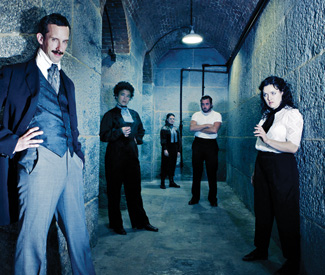
THEATER In early December, Christopher W. White, artistic director of Bay Area ensemble theater company Mugwumpin, showed me around the cool, slightly fusty basement rooms of San Francisco’s Old Mint. Used apparently for storage now, this large subterranean area beneath the Doric columns and Greco-Roman grandeur of “the Granite Lady” was where, beginning in the latter 19th century, the action really happened: the white-hot smelting of money, in one of the most active U.S. mints in its day. You wouldn’t know it now to look around at the gutted rooms with their odd detritus, dim walls, and sunken cement chambers, but in the 1930s one-third of the country’s gold was housed here. It’s a kind of catacomb of local and national history, and especially the history of money power.

Theater, by contrast, is not a moneymaking enterprise, generally speaking. For that matter, neither is free wireless energy from the air — one of the grandest ideas to motivate the stunningly brilliant and influential mind of Nikola Tesla, the little remembered Serbian-American inventor, Thomas Edison rival, and father of alternating current (AC). But the two come together quite naturally here, underground, where the spirits of industrial wealth and labor commingle so forcefully.

This weekend, which marks the anniversary of Nikola Tesla’s death in 1943, also marks the opening of Future Motive Power, an original ensemble-driven work that culminates a year of research and experimentation by one of the Bay Area’s foremost practitioners of devised theater. Mugwumpin’s production takes place in a section of this very basement, where audiences will alternately sit in and wander around a site-specific piece built from the ground up, with painstaking fidelity to historical details — and a commitment to reaching toward aesthetic and dramatic possibilities in concert with one of the most imaginative minds of the modern age.

His approach to science, like many a great innovator, had much in common with an artistic impulse. Exhibiting a transcendent creative ability, he worked with blueprints in his head, visualizing an idea for a new machine in unfathomable detail. He worked obsessively, often going with little or no sleep. His wide-ranging imagination was prodded by a consistent desire to serve humanity, but he had few close relationships and found everyday forms of physical contact unbearable. He’d probably merit a few psycho-clinical acronyms today, but let’s just say he was eccentric. Tesla’s brilliance, under-appreciated influence, idiosyncrasies, and sad fate have made him a compelling figure to artists and writers for years, even as his achievements remain historically obscured by, among other things, the legacy of savvy self-promoter Edison.

Alternately supported and bounded by the capitalist forces represented in these serious granite walls under the Old Mint, Tesla had a mind and heart remarkably free of the normal limits. His amazing career — balancing tenuously the forces of nature, social idealism, and the capitalist marketplace — speaks to some of the weightiest themes confronting the world today.

But those come later. Chris White — who plays the thin, fastidious inventor with a primly sympathetic mien, his eager certainty chastened by the half-lost alertness of the outsider — says the idea for the piece simply began with a song he couldn’t get out of his head: “Tesla’s Hotel Room,” by neo-country act the Handsome Family.


“In the last days of wonder

When spirits still flew

Where we sat holding hands

In half-darkened rooms

Nikola Tesla in the Hotel New Yorker

Nursing sick pigeons in the half-open window”


The song’s particular brilliance lies partly in connecting Tesla’s scientific genius with a spiritualist age, when science, philosophy, and religious mysticism commingled lustily in séances, theosophy, Swedenborgianism, and the like. It churns tragedy and prophesy in the tradition of the American ballad, channeling that “old weird America” Greil Marcus writes about. That deep stream of popular culture (as opposed to top-down manufactured mass culture) has inspired great things from Mugwumpin before (Frankie Done It 291 Ways, for instance, whose wildly disparate theatrical riffs on the “Frankie and Johnny” ballad was a highlight of the 2006 season.) This is Mugwumpin territory par excellence.

In keeping with Mugwumpin’s modus operandi, the yearlong process for Future Motive Power involved research and input from each member of the ensemble (Misti Boettiger, Joseph Estlack, Natalie Greene, Rami Margron, and White). By the time final rehearsals began inside the Mint, the piece contained a purposefully anti-linear, fragmented set of scenes very much in the vein of Mugwumpin’s past work — a kind of archeological approach to storytelling in which an intricately choreographed and physically dynamic set of vignettes and movement-designs extrapolate freely from certain evocative material fragments.

“At one point the J.P. Morgan character [I play] was just a table and tablecloth with my head sticking out of the top,” notes founding company member Estlack. “I’d move around everywhere with this table. I liked that a lot, but we can’t keep everything.”

The piece also has a director — something not every Mugwumpin production has used. Susannah Martin, an accomplished local director making her company debut, has come onboard to help guide the shaping of the piece, though she happily admits it’s not a typical gig working with such a highly collaborative, anti-hierarchical ensemble. Much initial time was spent, she says, “figuring out how I can be of best use to everybody. [Unlike productions with other companies,] it’s not my responsibility to hold the vision of this piece — it’s all our responsibility.”

It is rare to see so much discussion among all parties during a rehearsal, but it seems to contribute to the unusual dynamism of the results. To watch the actors rehearse, it’s as if the fluid staging aspired to Tesla’s own poetical, mercurial mind — represented here, aptly enough, not just by White but by three female characters (Boettiger, Greene, and Margron) personifying not muses so much as the willful, vaguely unhinged creative forces working with and through him.

Rehearsal continues with these three characters pulling a long electric cord into a square, as Tesla’s tussle with rival radio-technology pioneer Guglielmo Marconi (Estlack, who incarnates all Tesla’s principal antagonists including Edison) becomes a rumble inside a boxing ring. A moment later the boxing ring has morphed again into an image of Tesla raising Wardenclyffe, the wireless energy tower he partly erected on Long Island with Morgan’s money — that is, until Morgan discovered it was power to the people Tesla had in mind, and pulled the plug.

FUTURE MOTIVE POWER

Through Jan. 29

Previews Fri/6-Sat/7, 8 p.m.; opens Sun/8, 8 p.m.

Runs Fri.-Sun., 8 p.m., $15-$30 (previews, pay what you can)

Old Mint

88 Fifth St., SF www.mugwumpin.org

Time is now

0

emilysavage@sfbg.com

Music Last spring there was no end in sight. The future seemed bleak for what was once a promising project — the chance of a lifetime for Bay Area septet the 21st Century. Now, a full year after its intended release, the colorful debut album, The City, will see the light of day.

The struggle for The City began in 2010 with Kickstarter. Well, technically it began with an idea. Multi-instrumentalist Bevan Herbekian had been bouncing around the world since graduating from U.C. Santa Cruz. He’d come to San Francisco, the city closest to his Northern California-born heart, then promptly traveled to Europe, back to SF, next out to the Middle East — Israel, Egypt, Jordan — a quick stop in New Orleans and he was again back to the Bay. During those years, he was collecting sound. A guitarist, bassist, pianist and singer-songwriter since age 12, he fiddled with mandolin and banjo. In Jerusalem, he was gifted a small guitar and ended up busking a few times at a local shuk.

Upon Herbekian’s return to San Francisco, he decided to create the band of his dreams, an expansive folk-pop act with intricate arrangements, multi-part harmonies, and plenty of acoustic instruments. He gathered up friends, former bandmates, and a few Craigslisters, and created the 21st Century. The band now includes a lead guitarist, rhythm guitarist, bassist, drummer, keyboardists, a trumpet player, a set of musical sisters, and the occasional live saxophonist.

Herbekian then worked on a set of creamy folk-pop tunes with abstract lyrics touching on the darkness and ebullient light of moving to a new city, specifically San Francisco (though he now resides in Berkeley). Sitting in the eternally packed Mission Pie, Herbekian recounts crafting the songs for The City, while he was living just down the street from the restaurant, near 25th and Bryant. “[the song] ‘We Are Waiters’ has some specifics about living in San Francisco, in the Mission,” he pauses, taking a moment to collect his thoughts, “[it’s] about being young, living in this city, and going back and forth between feeling exuberant and like you don’t know how to reconcile that with adulthood.” A common refrain in this adult-kid city of ours.

He recounts the battle to release The City. “It honestly felt like this project was fated to never be completed. There was always some catch, some snag.” In the summer of 2010 the band met a producer who wanted to record and promote the album. Void of funds enough to travel and record, the 21st Century turned to Kickstarter and brought in $11,000, which Herbekian describes as “nuts” and “truly amazing.”

With funding in place, the band flew to Texas, recorded the album, then returned home to await mixing. Something got lost in translation however, and the mixes, which was returned to them months after recording (in spring of 2011) were “way off the mark.”

“[Our music] is relatively pop-based, but I like to think that there’s a sense of artistry to it. We really pay attention to the details and do all these big arrangements, but the mixes just sounded like glossy top 40 pop,” explains Herbekian. He wanted more Brian Wilson, less Justin Bieber. He next made the difficult decision to part ways with the producer, gather the loose tracks, and find another way to finish the album. A few band members left at this point, and Herbekian felt the pressure weighing down.

“Four weeks after that decision was made we were left with a fraction of our musical family, still in debt, and no relationship with the person who we were hoping was going to be our ticket to something — and all these sessions we had no idea what to do with.” Herbekian had worked on home recording projects, but nothing of this scale.

By chance, one of the band members was pals with Ben Tanner, a touring musician and producer who works at Fame Studios in Muscle Shoals, Alabama. “I had him take a shot at the song that I thought was the absolute worst and he resurrected it.” Tanner continued to resurrect the album, piece by piece, working closely with Herbekian. The two wrote tireless emails and many late night phone calls transpired; they were sending mixes back and forth for months. “I’ve never met him in person but he’s a saint to me,” Herbekian enthuses.

The hard work has paid off, and Herbekian beams as he finally holds the completed album in his hands. The City‘s release party is this weekend at Red Devil Lounge and he can hardly believe it. At this point the process has taken so long that the band already has a batch of new songs, two full albums-worth. For this one, Herbekian says, “We might just go back to recording it ourselves.” *


The 21st Century

With the Blank Tapes, Mark David Ashworth, and Muralismo

Fri/6, 8 p.m., $10

Red Devil Lounge

1695 Polk, SF

(415) 921-1695

www.reddevillounge.com

Our Weekly Picks: January 4-10

0

WEDNESDAY 4

Starfucker

Reptilians, the latest LP from Portland, Ore.’s Starfucker, shows a clear obsession with death. But, you might not realize it from the opening track, “Born,” which takes a Flaming Lips style approach and brings some rock skuzz to a child-like stare into the abyss. This band keeps getting bigger (as does its audience — this Oakland date was added after two scheduled shows this week sold out,) and now with five touring members, the sounds gotten more expansive: euphoric electronica, Australian/Minogue-ish pop, 8bit arpeggios, Pixies’ bass lines, plus the signature Alan Watts samples. It could be a little much for a synth rock group, but for now, considering impending annihilation, Starfucker doesn’t seem to give a fuck. (Ryan Prendiville)

With Painted Palms, and Feelings

9 p.m., $20–$23

New Parish

579 18th St., Oakl.

(415) 371-1631

www.thenewparish.com


Week End

Yes, there was a standout 2011 movie called Weekend — Nottingham guy meets bound-for-America Nottingham guy for a one-night stand that turns out to be something more — but this screening is of another film with a very similar name, 1967’s Week End. Pro-tip: add Weekend to your Netflix queue and add Week End to your weekend plans. Jean-Luc Godard’s surreal, prescient satire of our ever-declining civilization, featuring cinema’s most epic (and most epically-filmed) traffic jam, unspools on the big screen in the form of a brand-new 35mm print. Oui-kend! (Cheryl Eddy)

Fri/6-Sun/8, 7 and 9:15 p.m. (also Sat/7-Sun/8, 2:30 and 4:45 p.m.), $7.50–<\d>$10

Castro Theatre

429 Castro, SF

(415) 621-6120


Grass Widow

Celebrate the first Friday of 2012 in Oakland with a free performance by San Francisco’s popular harmonizing punk trio, Grass Widow. Traipse through forward-thinking art instillations at nearby galleries as part of Art Murmur, then pop into the Uptown for an early start — doors are at 6 p.m. so there’s ample drinking time before bands. And those bands are high quality. Every time I see Grass Widow live, I’m smacked with its sheer blistering force; last catching the act upon its return from tour at a Public Works show featuring the resurgent Erase Errata, I was again swept up by the pummeling skills of guitarist Raven Mahon, drummer Lillian Maring, and bassist Hannah Lew. Art, drinks, and cheap-o rock’n’roll, it’ll be a solid First Fridays escape from reality. (Emily Savage)

With Culture Kids, Churches, and Wave Array

9 p.m., free

Uptown 1928 Telegraph, Oakl.

(510) 451-8100

www.uptownnightclub.com


Stripmall Architecture

The video for Stripmall Architecture’s “Radium Girls” features a neon-painted Rebecca Coseboom making weird “come hither” faces as she sings into the camera. It’s trippy and alluring, and it’s precisely how I would describe the local quartet’s dark-tinted pop music. Though Stripmall Architecture might be somewhat under your radar, founding couple Rebecca and Ryan Coseboom have worked with DJ Shadow, and Cocteau Twins guitarist Robin Guthrie, and toured the country with Bob Mould. The group wails on guitars and synthesizers, but Rebecca’s angelic voice is the driving force of its sound. After watching “Radium Girls,” I found a bunch of clips of the freaky light show the band puts on for live performances. So, you should probably check them out. (Frances Capell)

With Return to Mono and TIGERcat

9 p.m., $10

Rickshaw Stop

155 Fell, SF

(415) 861-2011

www.rickshawstop.com


FRIDAY 6

Frank & Tony

Francis Harris (a.k.a. Adultnapper) has a gift for building minimal tracks. One of the best songs of the last year, “Idiot Fair (feat. Black Light Smoke)” was a restrained bit of deep tech house released on Berlin’s Poker Flat Recordings. A steady bump with a little shake and some alternating clipped keys and snares for five minute — it didn’t slow build, it pleasantly idled — until a pair of brooding, stressed male vocals dropped into play. While Scissor and Thread — a Brooklyn-based label Harris started with players including French DJ (Tony) Anthony Collins — bills itself as an independent rather than dance imprint, the releases so far from Harris and Black Light Smoke sound quite promising. (Prendiville)

With Adnan Sharif (Forward), Michael Perry (Fedora)

9:30 p.m., $10–$15

Public Works

161 Erie, SF

(415) 932-0955

www.publicsf.com


The Proud

Local playwright Aaron Loeb’s previous work was entitled Abraham Lincoln’s Big, Gay Dance Party and featured a chorus line of dancin’ beardos in stovepipe hats. His latest, The Proud, workshopping at Dance Brigade’s Dance Mission Theater, features a more serious subject matter (presented in collaboration with Iraq Vets Against the War, the play is about post-traumatic stress disorder) — but a no less memorable chorus, in the form of Dance Bridgade’a formidable drummers and dancers. The Proud is drawn from interviews with Bay Area veterans of Iraq and Afghanistan, focusing on both PTSD and — in keeping with Dance Brigade’s commitment to feminist themes — the treatment of women in the military. Even in “staged reading” form, The Proud promises to be powerful stuff. (Eddy)

Sat/7, 8 p.m.; Sun/8, 6 p.m.; Mon/9, 5 p.m., free

Dance Mission Theater

3316 24th St., SF

(415) 826-4441

www.dancemission.com


SATURDAY 7

“Primo”

What gentle vibrations run through a family that produces a plural of career artists? Somewhere back in the generations was a genetic seed planted, later blooming into progeny given to walking the world with paint-spattered paws and dreamy gazes fixed on rooftops or the curvature of a cat’s cheekbones? Pending a scientific conclusion, we can look to the new art exhibition by cousins Hugh and David D’Andrade for clues. Budding geneticists will find comparisons of the two’s bodies of work — Hugh’s illustrative dream world most recently featured on an iconic Occupy flier, David’s sweeps of pigment that seem almost sculpture-like — to be catnip for the dabbler in DNA studies. (Caitlin Donohue)

Through Feb. 18

Opening reception: 6-9:30 p.m., free

a.Muse gallery

614 Alabama, SF

(415) 279-6281

www.yourmusegallery.com


“Accordions with Love II”

This event is actually a double whammy, two full shows of squeezebox pride. First, there’s the early show, “Accordion Babes Review” which kicks off at happy hour and includes accordion-filled sets by Yeti, Amber Lee & the Anomalies, Luz Gaxiola & Circus Finelli, Vagabondage, and more. Next up, there’s “The Big Squeeze,” the nighttime show beginning at 9 p.m. This one features Mark Growden, Gabrielle Ekedal & Angus Matin, Eggplant Casino, and yes, even more. It’s a packed lineup, one that should envitably lead to your perfect come-on for the night, “My, how your accordion bellows.” (Savage)

5 p.m. and 9 p.m., $10 per show

Amnesia

835 Valencia, SF

(415) 970-0012

www.amnesiathebar.com

Phonte and 9th Wonder

It’s a little hard to wrap my head around the notion that Charity Starts At Home, released in September, is the debut solo album from North Carolina Justus League rapper Phonte. One of the most straight-talking, artistically varied artists around, Phonte has done practically everything but a solo album: classic underground records with the group Little Brother, the electronic R&B project Foreign Exchange with Dutch producer Nicolay (hip-hop’s answer to the Postal Service), and alter-egos like Tigallo and the hilariously authentic old school soul singer, Percy Miracles. Among it’s highlights, Charity sees the MC once again collaborating (after a 6 year break) with top-tier producer and former Little Brother member 9th Wonder. (Prendiville)

With Median, Rapsody

9 p.m., $22-40

New Parish

579 18th St., Oakl.

(415) 371-1631

www.thenewparish.com


SUNDAY 8

The Future of Motive Power

Nikola Tesla died at the New Yorker Hotel in 1943, alone and without a cent to his name. In the last years of his life, the “electric wizard” behind wireless communication and the induction motor had been promoting a death ray, subsisting on vegetable potions, and obsessing about pigeons (he claimed to love one pigeon like “a man loves a woman”). Future Motive Power, a play by the local performance ensemble Mugwumpin, is inspired by the inventor-wizard’s life, its peculiarities and myths, and the science that lives in its wake. Created specifically for the historic Old Mint, it’s a self-proclaimed “performative fever dream.” (James H. Miller)

8 p.m., $30 includes drinks and hors d’oeuvres

Old Mint

88 Fifth St., SF

(415) 967-1574

www.mugwumpin.org


MONDAY 9

Soft White Sixties

A congregant at the church of classic, mind-reeling Seventies rock, Soft White Sixties once described its sound as “Rock ‘n’ roll, heavy on the roll, dipped in soul.” This audio-fanatic show is particularly fitting for SWS and its followers for it’s part of Communion, a live music forum began in the UK by Mumford & Sons’ Ben Lovett, Kevin Jones, and noted producer Ian Grimbl. Established in 2006 London, Communion began as a monthly showcase for emerging singer-songwriters, a modern-day creative salon. It came to San Francisco near the end of last year, and continues to produce unique lineups and fanciful collaborations monthly at Cafe Du Nord. (Savage)

With Zane Carney, Big Eagle, Gabriel Kelly, and Amy Blashkie

8:30pm, $12.

Cafe Du Nord

2170 Market, SF

(415) 861-5016

www.cafedunord.com


TUESDAY 10

Thee Cormans

In the grand tradition of costumed surf punk bands that straddle rock’n’roll and comedic timing (Phantom Surfers, Mummies), here comes Thee Cormans, a green-skinned, gorilla-masked, bug-eyed gang of wily monster motorcyclists in ripped vests riding curling waves of reverb. And like its rowdy foreparents, this fuzzed out Southern California based band has a live show that puts tender mumbling indie acts to shame. That exuberance also fits in neatly with Thee Cormans’ label, In the Red, which itself is making waves for a future-retro mishmosh output of eccentric weirdos, cultured punks, and generally genre-less acts. Viva costumery. (Savage)

With the Shrouds, the Khans, and Swiss Family Skiers

8:30 p.m., $6

Hemlock Tavern

1131 Polk, SF

(415) 923-0923

www.hemlocktavern.com 

The Guardian listings deadline is two weeks prior to our Wednesday publication date. To submit an item for consideration, please include the title of the event, a brief description of the event, date and time, venue name, street address (listing cross streets only isn’t sufficient), city, telephone number readers can call for more information, telephone number for media, and admission costs. Send information to Listings, the Guardian Building, 135 Mississippi St., SF, CA 94107; fax to (415) 487-2506; or e-mail (paste press release into e-mail body — no text attachments, please) to listings@sfbg.com. Digital photos may be submitted in jpeg format; the image must be at least 240 dpi and four inches by six inches in size. We regret we cannot accept listings over the phone.

By the roots

0

caitlin@sfbg.com

HERBWISE Where (besides this column, of course) do you get the latest on marijuana? When it comes to distributing accurate information about buds, Steph Sherer, executive director of medical cannabis advocacy group Americans for Safe Access (ASA), makes no bones about her organization’s role. “Most of our members depend on us for news,” she told the Guardian in a recent phone interview.

Even when clashes between marijuana proponents and the government are brought to light — not always a given in this political climate — Sherer finds the one note handling of cannabis issues by the mainstream media troubling. “[Cannabis] gets thrown on [journalists covering] judicial beats instead of getting picked up by the human interest, or the health and science side of things,” she said.

ASA’s response to this dearth of useful reporting on cannabis was to develop a free iPhone application that serves as a media catch-all for medical marijuana advocates. At no cost, anyone concerned with losing their right to access their medicine safely — or who wants to learn the latest about the sticky green — can now download an interface that pulls together news updates, alerts for upcoming political actions, and materials that can add to one’s activism repertoire; things like phone numbers for legal counsel and advocacy training videos.

For Sherer, the app has the potential to empower the people in the crossfire of the ongoing clashes between the federal government and state-legal growing and retail facilities: patients. “We are creating a platform that empowers people to be their own advocate. The people who can advocate for this the best are the people who are affected.” 

ASA EXECUTIVE DIRECTOR STEPH SHERER’S TOP 6 CANNABIS STORIES YOU MIGHT HAVE MISSED IN 2011

1. In March, the National Cancer Institute recognized marijuana’s medical benefit, classifying it as a “complementary alternative medicine.” Days later, the reference was diluted on its website, per the recommendation of the National Institutes on Drug Abuse.

2. After Obama’s Justice Department fought their appeal, Californian breast cancer survivor Dr. Mollie Frye and her husband were sent to prison in April for five years because of their state-legal growing operation.

3. In October, California patient advocates sued the Obama Administration for violating the 10th Amendment by coercing and obstructing local and state officials, preventing them from implementing medical marijuana laws.

4. The governors of Washington State and Rhode Island petitioned the federal government to reschedule cannabis to allow for medical use.

5. In Connecticut and New Jersey, governors continue to move forward with cannabis access legislation despite threats from US Attorneys.

6. 63-year old Norman Smith uses cannabis to mitigate the symptoms of his inoperable liver cancer. Smith is being denied a transplant from Los Angeles’ Cedar Sinai Medical Center until he agrees to stop using cannabis.


An open letter to Ed Lee

76

OPINION Dear Mr. Mayor,

During the next week you will be appointing the a supervisor for District 5, an area of the city that has been historically considered the most progressive part of one of the most progressive cities in the country. It will be a signature decision for you in the next year, and will reveal the tone of your administration. Will you be a consensus mayor — or will you carry on your predecessor’s fight with progressives?

You have many qualified choices, but there is probably only one on your list that a majority of progressives would consider a clear progressive choice: Christina Olague, president of the Planning Commission. There are some who have hesitations about her, but ironically those hesitations are based on her relationship to you and her support for your candidacy for mayor. I have to admit, as a supporter of progressive Supervisor John Avalos for mayor, I shared some disappointment that she didn’t support John.

I’m sure there’s intense pressure on you to choose a more moderate choice, and I’m sure there are from your perspective some valid points to that argument. That said, District 5 deserves progressive representation.

I am a Haight resident, and I ran for Supervisor in District 5 in 2004. Supervisor Ross Mirkarimi came in first, I came in second, and Lisa Feldstein came in third. Both Lisa and I have spoken repeatedly about whether we would run next year, and we have even discussed running as a slate. Most political analysts think one of us would have a decent shot at winning — but I think both of us would support Christina, assuming that her votes continue to reflect her commitment to the progressive values of the district.

Christina not only supported you, she also supported Mirkarimi in 2004, and Matt Gonzalez when he ran for supervisor in 2000. She was appointed to the Planning Commission by Gonzalez and has been reappointed repeatedly by progressive supervisors to that commission. While her votes have not been perfect, by and large, her record is excellent; she has never succumbed to pressure, has listened well to all sides, and has ultimately done what she thought was right.

For example, she stood up for tenants’ rights when the landlord from Park Merced came to the Planning Commission to ask that 1,500 apartments be demolished, all of which were subject to the city’s rent control ordinance. She recognized the flaws in the landlord’s argument that a side agreement (negotiated without the local tenant groups involved) would prevent rent hikes and evictions. Olague was on the right side of history on the Park Merced deal, and has a long record of building tenant and senior tenant power. That’s the kind of leadership we need for District 5, an area comprised of primarily renters. I believe Olague will be a supervisor tenants can trust.

I can’t guarantee that all progressives will stand down if Olague gets the seat. The ego game is what it is. You have learned that from politics, I’m sure. But I think most progressive institutions and progressive activists will see her appointment as a victory and will support her candidacy for Supervisor next fall, as they should if she shows that her votes reflect the trends and values of District 5.

With Christina Olague, you have a win-win. You appoint a supervisor who reflects the progressive values of the district and who is also electable in November. 

Gabriel Haaland is an elected member of the San Francisco Democratic County Central Committee and an LGBT labor and tenant activist.

City Hall’s 2012 agenda

16

EDITORIAL There’s so much on the to-do list for San Francisco in 2012 that it’s hard to know where to start. This is a city in serious trouble, with unstable finances, a severe housing crisis, increased poverty and extreme wealth, a shrinking middle class, crumbling and unreliable infrastructure, a transportation system that’s a mess, no coherent energy policy — and a history of political stalemate from mayors who have refused to work with progressives on the Board of Supervisors.

Now that Ed Lee has won a four-year term, he and the supervisors need to start taking on some of the major issues — and if the mayor wants to be successful, he needs to realize that he can’t be another Gavin Newsom, someone who is an obstacle to real reform.

Here are just a few of the things the mayor and the board should put on the agenda for 2012:

• Fill Sup. Ross Mirkarimi’s seat with an economic progressive. This will be one of the first and most telling moves of the new Lee administration — and it’s critical that the mayor appoint a District 5 supervisor who is a credible progressive, someone who supports higher taxes on the rich and better city services for the needy and is independent of Lee’s more dubious political allies.

• Make the local tax code more fair — and bring in some new revenue. Everybody’s talking about changing the payroll tax, which makes sense: Only a small fraction of city businesses even pay the tax (which is not a “job killer” but is far too limited). Sup. David Chiu had a good proposal last year that he abandoned; it called for a gross receipts tax combined with a commercial rent tax — a way to get big landlords and companies (like law firms) that pay no business tax at all to contribute their fair share. That’s a good starting point — but in the end, the city needs more money, and the new system should be set up to bring in at least $100 million more a year.

• Create a linkage between affordable and market-rate housing. This has to be one of the key priorities for the next year: San Francisco’s housing stock is way out of balance, and it’s getting worse. The city’s own General Plan mandates that 60 percent of all new housing should be available at below-market-rate prices; the best San Francisco ever gets from the developers of condos for the rich is 20 percent. The supervisors need to enact legislation tying the construction of new market-rate housing to an acceptable minimum level of affordable housing to keep the city from becoming a place where only the very rich can live.

• Demand a good community-benefits agreement from CPMC. The California Pacific Medical Center has a massive new hospital project planned for Van Ness Avenue — and so far, CPMC officials are refusing to provide the housing, transportation and public health mitigations that the city is asking for. This will be a key test of the new Lee administration — the mayor has to demonstrate that he’s willing to play hardball, and refuse to allow the project to move forward unless hospital officials reach agreement with community activists on an acceptable benefits agreement.

• Make CleanEnergySF work. A recent study by the website Energy Self-Reliant States shows that by 2017 — in just five years — the cost of solar energy in San Francisco will drop below the cost of Pacific Gas and Electric Company’s fossil-fuel and nuclear mix. So the city’s new electricity program, CleanEnergySF, needs to be planning now to build out both a large-scale solar infrastructure system and small-scale distributed generation facilities on residential and commercial roofs and set the agenda of offering clean, cheaper energy to everyone in the city. The money from the city’s generation can be used to purchase distribution facilities to phase out PG&E altogether.

• Don’t let Oracle Corp. take over even more of the waterfront. The America’s Cup continues to move forward — but at every step of the way, multibillionaire Oracle CEO Larry Ellison is trying to squeeze the city for more. Mayor Lee has to make it clear: We’ve given one of the richest people in the world vast amounts of valuable real estate already. He doesn’t need a giant TV screen in the Bay or more land swaps or more city benefits. Enough is enough.

There’s plenty more, but even completing part of this list would put the city on the right road forward. Happy new year.

Yee offers a package of government sunshine bills

1

California Sen.Leland Yee (D-SF) may have finished in a disappointing fifth place in the mayor’s race, garnering just 7.5 percent of the first place votes. But now he’s back to working in a realm where he’s really distinguished himself as a politician: opening up government agencies to greater sunshine and public scrutiny.

When the California Legislature reconvenes tomorrow (Wed/4) morning, Yee says he will introduce a series of bills giving the public better access to information. That builds on a record for championing sunshine, which earned Yee a James Madison Freedom of Information Award from the Northern California chapter of the Society of Professional Journalists in 2010.

In the past, he’s taken on the University of California and California State University systems, including a measure last year aimed at the latter for trying to keep secret high speaker’s fees paid to Sarah Palin. This time, Yee’s first target is the California Public Utilities Commission (CPUC) and its cozy and secretive approach to regulating Pacific Gas & Electric and other utilities. 

Senate Bill 1000 would subject the CPUC to the same California Public Records Act disclosure requirements as other state agencies, ending special exemptions granted to the agency back in the 1950s. CPUC documents are assumed to be confidential unless overtly made public by the CPUC board — the polar opposite standard of the CPRA, which assumes all documents are public unless they meet specific exemption requirements.

As the Bay Guardian, San Francisco Chronicle, and other media outlets have reported in the wake of PG&E’s deadly gas pipeline explosion in San Bruno, the CPUC has blocked release of incident reports, pipeline safety inspections, audits, and other information that could show what other areas might be at risk of a similar tragedy and evidence of exposed PG&E’s negligence in the explosion, as a federal review panel concluded. A CPUC spokesperson said the agency is studying the legislation and didn’t have an immediate comment. 

“The CPUC is supposed to be there to protect us and not as a barrier to public access,” Yee said in a public statement.

SB 1001 would double the $50 annual registration fee paid by lobbyists in California and use that revenue to improve the Cal-Access campaign finance and lobbying database operated by the Secretary of State’s Office. That system has periodically crashed in recent months because of outdated technology. 

“It is simply unacceptable that the public cannot access basic information on campaign contributions and lobbying activity,” said Yee.  “The crash of Cal-Access not only prevents public access, it means government is not being transparent or being held accountable.”

SB 1002 would require that when government agencies are asked for public documents that are available in electronic form, that they do so using formats that are easily searchable by keyword using current technology. That has been a big issue for years in San Francisco, where sunshine advocates have long called for the city to be more user-friendly when it complies with the Sunshine Ordinance.

“Producing a 2,000 page electronic document that cannot be searched or sorted is inadequate and almost useless,” said Yee. “For too long, many government agencies – either by choice or inertia – have been living in the Stone Age when it comes to producing public documents.”

SF 2003 would amend the Brown Act open meeting law to allow for injunctive or declaratory relief for past violations, thus preventing agencies from repeatedly violating that law. It addresses a loophole created by the court’s interpretation of the act in its McKee v. County of Tulare decision. 

Finally, Yee is also pushing for the Assembly to approve Senate Constitutional Amendment 7, which the Senate approved last year. It would exempt the Brown Act from requirements that the state pay for mandates on local government, which last year caused the Commission on State Mandates to pay out $20 million from the state budget to local governments for acts such as posting agendas and which has caused the Brown Act to be temporarily suspended during past state fiscal crises.

“Our open meeting laws are too important to be made optional every time the state runs short of money,” Yee said. “SCA 7 will ensure government agencies provide the public the information they deserve.”

Peter Scheer, executive director of the California First Amendment Coalition, praised Yee’s efforts.

“It’s a very valuable and important package of measures to plug loopholes, some recently created and some that have been with us for too long,” Scheer told us.

While most of the legislation takes on fairly narrow issues, Scheer said each address very real and important problems that journalists and the general public have encountered. “None would be particularly difficult to implement,” he said. “But collectively, they would make it easier to hold public officials accountable.”

Battling big box

1

news@sfbg.com   

In neighborhood commercial districts, national chains and other formula retail stores such as PETCO, Target, Subway, Walmart, and Starbucks are hot button issues for residents who don’t want to see San Francisco turn into a strip mall or have local money pulled from the community.

Sup. Eric Mar and other city officials want to make sure local small businesses aren’t being unnecessarily hurt by competition from national chains, which is why he called a hearing on Dec. 5 to discuss big box retailers and their impacts on San Francisco’s small businesses, neighborhoods, workers, and economy.

“There is no vehicle to see the impacts of big business on the city,” Mar told us, saying he is contemplating legislation to do just that.

Mar was part of city efforts to keep formula pet stores from locating in the Richmond area, working with a coalition of pet food small businesses concerned about PETCO and Pet Food Express trying to move into the area. But it isn’t just pet stores.

“There is a perception that Walmart might make a move into the city since we already have stores like Fresh n’ Easy,” Mar’s Legislative Aide Nick Pagoulatos told us.

The city doesn’t have a comprehensive analysis on how these companies impact San Francisco. Mar says he wants to “have a clear scale of their influence and see what we need to do to protect small business in San Francisco.”

History of wariness

In 2004, the Board of Supervisors adopted the first Formula Retail Use Control legislation, an ordinance that “prohibited Formula Retail in one district; required Conditional Use Authorization in another; and established notification requirements in all neighborhood commercial districts.”

The Planning Code changed again after a voter ballot initiative in 2007, Proposition G, required any formula retail use in neighborhood commercial districts to obtain a conditional use permit, which gave neighboring businesses a chance to weigh in during a public hearing.

Mar said the intent wasn’t to bar big box retail from entering the city, but to simply give neighborhoods a voice. But now, he said the city needs to take a more comprehensive look at what’s coming and how they will impact the city.

Small Business Commissioner Kathleen Dooley echoed the concern, which extends even beyond city limits. “I’ve heard through the rumor mill that Lowe’s in South San Francisco is going to close and

Walmart is looking to take that space since they know they’d never get into the city,” she told us. “It’s bad enough that Target is opening stores [in San Francisco]. They are the quintessential big box because they sell everything.”

Target is in the process of opening a massive store inside the Metreon in SoMa, and another store at Geary and Masonic. Mar isn’t diametrically opposed to the big box industry, but he thinks those companies should be appropriately situated.

“I’ve seen that people in Richmond are positive toward big box like Target coming into the district, but some are nervous that it will take down business,” he told us. “There are some property spaces that are supposed to be for big box, like the property at Geary and Masonic where the old Sears and Toys”R”Us used to be.”

But it’s not easy to figure out what other big box stores have their sights set on the city. The Planning Department’s list of projects in the pipeline aren’t always filed under the name of the business, making it difficult to stay vigilant.

For example, while application #3710017 at 350 Mission Street describes the project as a “95,000 sq. ft. building of office, retail and accessory uses,” it isn’t clear what businesses are actually setting up shop. And these days, some big box stores are coming in smaller boxes.

Prototype stores such as Unleashed by PETCO are specifically designed to squeeze into smaller property spaces so they can get into neighbor corridors that are typically reserved for small businesses.

More help needed

During the Dec. 5 hearing before the Land Use and Economic Development Committee, Sup. Scott Wiener echoed Mar concerns, commenting that he wants to see how the Planning Commission could “improve the Conditional Use process since we see a pushback of strong neighborhood activity.”

Dooley recalled an issue from 2009 when the Small Business Commission formally asked the Planning Commission not to authorize a PETCO in the Richmond because “the surrounding area was already well served by pet stores.” The board ultimately stopped PETCO, but Pet Food Express did locate a store nearby, which Dooley said has already taken a toll on the locally owned pet food suppliers.

“Big box stores carry a huge number of products that impact other stores,” she said. “Big box is a category killer in the neighborhood…the Planning Commission needs new criteria for formula retail because there are several different types.”

Some superstores require parking lots, taking up additional land, and increasing traffic in certain neighborhoods. Yet one trait that most chain stores have in common is that they extract more money from San Francisco than locally owned businesses, whose revenues tend to circulate locally.

“With every dollar spent at local stores, 65 cents will go back into the community, while only a quarter will be returned from a big box.” Rick Karp, owner of the 50-year-old Cole Hardware, said at the hearing, citing various studies on the issue.

Small business owners are asking for economic impact reports to be included in project applications from chain stores to see just how they measure up to their locally owned counterparts.

When Lowe’s entered his district, Karp says he lost 18 percent of his business and was forced to eliminate six full-time jobs. He appealed to city officials to “keep big box out of San Francisco because it impacts the efficacy of neighborhood shopping.”

Once chain stores puts the locals out of business, the consumer is stuck with set prices and reduced variety. But critics say it isn’t just consumers and small business owners who suffer, but workers as well. They singled out Walmart as notorious for union-busting and poor labor standards.

“We can use our land use ordinances and powers to set a basic minimum labor standard. Big box must abide by that and also include health care if implemented in local government [legislation],” Mar said.

But Steven Pitts, a labor policy specialist at UC Berkeley, told us there is a connection between low prices and low wages.

“People who work at Walmart are poorer than those who shop there,” he told us. “Therefore, if prices were raised to increase wages for employees, the burden wouldn’t be on people of lower income.”
Opposing Walmart

To illustrate how Walmart would adversely affect San Francisco’s workforce, the hearing included two employees of Walmart, Barbara Collins and Ronald Phillips from Placerville, who helped create Organization United for Respect at Walmart (OURWalmart) to push for better benefits and labor standards.

“We want to hold Walmart accountable,” said Collins, whose last annual income from Walmart was $15,000 annually, a salary she realized couldn’t support her four children. “Walmart says they pay living wages. No, they don’t.”

Phillips said that Walmart has “a tendency to fire people for any reason and then does not have to pay for the benefits… I was one of these people, but I was rehired.”

For the past three months, Phillips says she has worked at least six days and 40 hours per week, but that she still qualified for welfare assistance.

Also at the hearing, SF Locally Owned Merchants Alliance unveiled a study showing that formula retail costs nearly as many jobs as it creates. A domino effect occurs when stores close because fewer customers circulate to other nearby stores.

But the group noted that consumer habits are probably even more important than city regulations. The SFLOMA study found that if 10 percent of San Franciscans shifted their spending to locally owned small businesses, consumers would create 1,300 jobs and $190 million in the city.

And that would be good for everyone: owners, consumers, and workers. Steven Cornell, owner of Brownie’s Hardware, said that small business pays good wages, typically above the minimum wage, as well as sick leave, health coverage, and other benefits. As he told the hearing, “Local businesses have been doing this for 20 to 30 years since we are already invested in the community.”

OccupyOakland rings in the new year with protests against police

21

Occupy Oakland kicked off the year with two marches protesting police and prisons. A march to the Oakland City Jail on New Year’s Eve was followed by a march against police brutality on New Year’s Day, ending with a rally against police violence. Speakers at the rally indicated that the Bay’s most radicalized Occupy group may focus on an anti-police repression theme in the new year.

About 300 people attended a nighttime demonstration in Oakland City Center on Dec. 31. Protesters left Oscar Grant/Frank Ogawa Plaza at 9:45 and marched to the city jail. About 20 Occupy Oakland protesters remain in jail after several different incidents of arrest in the past weeks.

At the jail, protesters spoke about police repression, set off fireworks, and chanted “inside or outside, we’re all on the same side.” Many reported seeing solidarity fists sticking out from between bars on the jail’s windows.

The demonstration was part of a national call for New Year’s Eve jail solidarity protests, and similar “noise demonstrations,” in which protesters made noise outside jails to show solidarity with inmates. Similar protests took place in 25 cities around the world.

The march featured a giant banner stating “Fuck the police.”

Around 11:30 pm, protesters marched back for a dance party on the plaza. “At midnight, we did the countdown like everyone else,” said Patrick, who has been involved in OccupySF and Occupy Oakland.

A banner dropped in the plaza read, “Out with the old. Occupy 2012.”

At 1 pm on Jan. 1, Occupy Oakland participants gathered once again. They marched to Fruitvale Bart Station in an anti-police brutality march commemorating Oscar Grant. The unarmed young Oakland man was killed on Jan. 1, 2009 by BART Police Officer Johannes Mehserle, who was convicted of involuntary manslaughter for the shooting and given a two-year prison sentence.

The march was followed by a rally and speak-out with about 500 in attendance. Several women with sons and grandsons who had been killed by police in San Francisco and Oakland shared their experiences. Adam Jordan, member of the Oscar Grant Committee for Justice, said that Occupy Oakland had helped unify the local community against police brutality.

Several speakers agreed that police violence against the poor and people of color and recent arrests at Occupy Oakland, as well as tear gas and other weapons used against Occupy Oakland protesters, are all connected. “It’s all systemic. It’s the same problem,” Jordan said. “The police that are attacking everyone in Occupy Oakland now have been attacking black people for centuries.”

Members of Oscar Grant’s family, including his mother, his young daughter, his fiancé, his uncle, and several cousins, were also present, and many spoke.

Gerald Smith, an organizer with Occupy Oakland and member of the Oscar Grant Committee Against Police Brutality and Repression, read aloud a message from Angela Davis, who has proposed nationwide demonstrations to free political prisoners on Feb. 20. He also talked about several proposals to continue to protest against police violence in the East Bay, including picketing the Alameda County District Attorney’s office and emergency meetings the following day every time an Oakland resident is killed by a police officer.

In a reference to the leaderless, “horizontal” structure that has defined Occupy groups around the world, Smith said to the crowd, “How much will we do this? It’s up to you. I hope you know by now, you decide everything.”

Localized Appreesh: Swiftumz

0

Localized Appreesh is our weekly thank-you column to the musicians that make the Bay. Each week a band/music-maker with a show, album release, or general good news is highlighted and spotlit. To be considered, contact emilysavage@sfbg.com. This installment is guest written by Frances Capell.

If you pick up a copy of Swiftumz’s (a.k.a. Chris McVicker’s) LP, Don’t Trip (Holy Mountain), you’ll notice a purple sticker that says “CALL ME,” and lists his phone number. Weird, yes, but it’s the same endearing candor that lights up McVicker’s darling lo-fi pop tunes. His retro guitar hooks and fragile, imperfect voice remind me of Girls’ Chris Owens, but McVicker is one of a kind. Check out the album, give him a call, or go see him at the Hemlock Tavern this Saturday.

Year and location of origin: We’ve all been playing music together for years, this incarnation is new and based around my solo project.
Band name origin: A nickname some people call me.
Band motto: “Short sets!”? Do bands have motto’s? I think we are all into having fun playing music together, being productive at practice so we can be good live.
Description of sound in 10 words or less: Short, heartfelt, pretty pop songs with good instrumental arrangements.
Instrumentation: Two guitars/drums/bass and whatever else is called for.
Most recent release: Don’t Trip LP (Holy Mountain Records). Released October 2011.
Best part about life as a Bay Area band: Feel like this is the best place to live, and that translates to most aspects of life and art.
Worst part about life as a Bay Area band: I don’t know, I think we all really like it here.
First record/cassette tape/or CD ever purchased: Prince 1999.
Most recent record/cassette tape/CD/or Mp3 purchased/borrowed from the Web: Bought last week at Aquarius: Fac.Dance Compilation, Scare Dem Crew The Album, Dictators Manifest Destiny.
Favorite local eatery and dish: Fresh Dungeness crabs! [ed note: but from where, Swiftumz?]

Swiftumz
With Wet Illustrated and Meercaz
Sat/7, 9:30 p.m., $6
Hemlock Tavern
1131 Polk, SF
(415) 923-0925
www.hemlocktavern.com

Warming up with the picturesque video for “Day We Met:”
https://www.youtube.com/watch?v=SH-Oh_NhDr4

Hey kittens! Cat show this weekend in San Jose

6

Surely the most exciting news to penetrate your post-holiday malaise this morn: on Fri/7 and Sat/8 you will have the chance to attend a bonafide cat show. Fancy beasts, silky coats, whisker wars? You bet.

The Tails and No Tails Cat Club is hosting the two-day extravaganza at the Santa Clara County Fairgrounds. The club is a member of the Cat Fanciers’ Association, the world’s largest pedigreed cat registry that was established back in 1906 to the plaintive meows of a nation of four-legged felines awaiting their dry kibble (or oatmeal and milk-drenched bread, as the case may have been).

Here is what you will find upon your arrival at the show. Furry friends will be competing for best in show honors, from the ear-tufted, behemoth Maine coon to the – here, quoting from the press release – “mysterious Birman cat.” You will have the chance to chop it up with breeders, asking them questions that may well lead them landing your vote for the vaunted Spectator’s Choice award. 

Any feline frenzy that the event evokes in your brand-new 2012 self can be cemented with an on-site adoption from a local agency, and door proceeds will be donated to local cat advocates, like the no-kill shelter Town Cats of Morgan Hill.

How will you make it to Friday with your holiday cheer intact? Taking a look at this history of cat food commercials, perhaps?


Tails and No Tails Cat Show

Sat/7 10 a.m.-5 p.m.; Sun/8 9 a.m.-5 p.m., $8

Santa Clara County Fairgrounds

Gateway Hall, 344 Tully, San Jose 

www.tailsandnotails.com


Guardian editorial: City Hall’s 2012 agenda

20

EDITORIAL There’s so much on the to-do list for San Francisco in 2012 that it’s hard to know where to start. This is a city in serious trouble, with unstable finances, a severe housing crisis, increased poverty and extreme wealth, a shrinking middle class, crumbling and unreliable infrastructure, a transportation system that’s a mess, no coherent energy policy — and a history of political stalemate from mayors who have refused to work with progressives on the Board of Supervisors.

Now that Ed Lee has won a four-year term, he and the supervisors need to start taking on some of the major issues — and if the mayor wants to be successful, he needs to realize that he can’t be another Gavin Newsom, or Willie Brown, mayors who were an obstacle  to real reform.

Here are just a few of the things the mayor and the board should put on the agenda for 2012:

+Fill Sup. Ross Mirkarimi’s seat with an economic progressive. This will be one of the first and most telling moves of the new Lee administration — and it’s critical that the mayor appoint a District 5 supervisor who is a credible progressive, someone who supports higher taxes on the rich and better city services for the needy and is independent of Lee’s more dubious political allies.

+Make the local tax code more fair — and bring in some new revenue. Everybody’s talking about changing the payroll tax, which makes sense: Only a small fraction of city businesses even pay the tax (which is not a “job killer” but is far too limited). Sup. David Chiu had a good proposal last year that he abandoned; it called for a gross receipts tax combined with a commercial rent tax — a way to get big landlords and companies (like law firms) that pay no business tax at all to contribute their fair share. That’s a good starting point — but in the end, the city needs more money, and the new system should be set up to bring in at least $100 million more a year.

+Create a linkage between affordable and market-rate housing. This has to be one of the key priorities for the next year: San Francisco’s housing stock is way out of balance, and it getting worse. The city’s own General Plan mandates that 60 percent of all new housing should be available at below-market-rate prices; the best San Francisco ever gets from the developers of condos for the rich is 20 percent. The supervisors need to enact legislation tying the construction of new market-rate housing to an acceptable minimum level of affordable housing to keep the city from becoming a place where only the very rich can live.

+Demand a good community-benefits agreement from CPMC. The California Pacific Medical Center has a massive new hospital project planned for Van Ness Avenue — and so far, CPMC officials are refusing to provide the housing, transportation and public health mitigations that the city is asking for. This will be a key test of the new Lee administration — the mayor has to demonstrate that he’s willing to play hardball, and refuse to allow the project to move forward unless hospital officials reach agreement with community activists on an acceptable benefits agreement.

+Make CleanEnergySF work. A recent study by the website Energy Self-Reliant States shows that by 2017 — in just five years — the cost of solar energy in San Francisco will drop below the cost of Pacific Gas and Electric Company’s fossil-fuel and nuclear mix. So the city’s new electricity program, CleanEnergySF, needs to be planning now to build out both a large-scale solar infrastructure system and small-scale distributed generation facilities on residential and commercial roofs and set the agenda of offering clean, cheaper energy to everyone in the city. The money from the city’s generation can be used to purchase distribution facilities to phase out PG&E altogether.

+Don’t let Oracle Corp. take over even more of the waterfront. The America’s Cup continues to move forward — but at every step of the way, multibillionaire Oracle CEO Larry Ellison is trying to squeeze the city for more. Mayor Lee has to make it clear: We’ve given one of the richest people in the world vast amounts of valuable real estate already. He doesn’t need a giant TV screen in the Bay or more land swaps or more city benefits. Enough is enough.

There’s plenty more, but even completing part of this list would put the city on the right road forward. Happy new year.


Nite Trax: EPS1 of Blaktroniks rings it in

0

Local soultronica astronaut EPS1 (aka Edd Dee Pee) of the Bay’s rad Blaktroniks project drops this neo-sexy, chills-up mix in anticipation of his upcoming New Year’s Eve party in San Francisco. This blend features songs released on the Blaktroniks’ label, Tokyo Dawn (with a contribution from my heroes at Oakland’s Deepblak). It’s seriously warming my winter right now — calling up some youthful memories of hanging downtown and looking for love, refracted through forward-thinking production techniques, and then moving on into some deep jams.  

Pre 2012 Podcast Blaktroniks by BLAKTRONIKS

This is gonna be a special one.

NYE CONFIDENCE STARTER 2012

9 p.m.-3 a.m., $10.

Siete Potencias Africanas Gallery

777 O’Farrell, SF.

www.sietepotenciasafricanas.com

More info here.

Following court ruling, SF Redevelopment seeks a “legislative fix”

1

Redevelopment agencies were dealt a statewide hit after a unanimous ruling Dec. 29 by the California Supreme Court decided not only that lawmakers had the ability to terminate the agencies, but that those agencies could not continue forward with redevelopment projects as smaller entities.


Assembly Bills 1X 26, which eliminates redevelopment agencies but makes existing redevelopment housing projects an “enforceable obligation,” and 1X 27, which would have required agencies to make payments to the state of California in exchange for continuing to exist in smaller form, both came under scrutiny by the state Supreme Court. AB26 was upheld, but AB27 was considered illegal.

While large-scale redevelopment projects in San Francisco have generated no shortage of criticism and controversy, Mayor Ed Lee described the decision as disappointing and harmful for the city’s future.

“Redevelopment has not only played a critical role in creating jobs, transforming disadvantaged communities and delivering affordable housing, but it has spurred economic growth for our entire City at a time when we needed it most,” Lee said in a statement issued earlier today.

Gov. Jerry Brown introduced the idea of eliminating redevelopment agencies about a year ago as part of budget cuts designed to revitalize the state economy, as the Guardian reported last January. Today’s decision, which leaves the state with $1.7 billion more to work with in the first year of implementation of this plan, may help cushion the blow as state legislators seek to balance the budget.

However, the San Francisco Redevelopment Agency isn’t giving up.

“We are aggressively looking at solutions, most likely a legislative fix, to provide for redevelopment to continue,” S.F. Redevelopment Agency executive director, Tiffany Bohee, told the Guardian. “The state will do what it needs to do to fill the hole [in the state budget] but there are unintended consequences.”

Private funding from companies like Lennar Homes supplementing state funding has made the continuation of redevelopment projects in San Francisco’s Mission Bay, Bayview Hunters Point Shipyard, and Treasure Island possible. Lee maintains that these areas will remain unaffected.

The legislation does, however, affect future projects. “We call on the state to find a legislative solution to this problem” Lee’s statement noted. “And while we are committed to working with the state, we have already started to look at local solutions and alternatives.”

Bohee echoed the mayor’s resolve. “We are committed to the long haul and focused on what the next steps are,” she said.