Live

Live at the Rrazz is closing for good

1

Sadly, another music institution in the city is shuttering. Live at the Rrazz (otherwise known as the Rrazz Room), which went through a series of difficulties and legal issues this past year, including an ill-fated venue change, has announced it will be closing for good.

In an email to its patrons last week (including the Bay Area Reporter’s BARtab, which tipped us off) and now on the front page of its website, Rrazz said, “As many of you know. the last several months have been monumentally challenging for us. It seems like all the forces in the universe have been working against us.”

In any situation, it’s a sad day when a nightclub turns off the lights. Under slightly different monikers and variations, Live at the Rrazz has been presenting shows in San Francisco for 12 years, often focusing on souful crooners, R&B, jazz, funk, and doo-wop acts in performance slots. Performers as diverse as Lil Kim, Pete Escovedo, Paula West, Shirley Jones, Rita Moreno, and Jefferson Starship have all stopped by the Rrazz over the years.

The Rrazz Room was first housed in the Plush Room at the then-York Hotel and moved to the Hotel Nikko from 2007 through the end of ’12. Yet after a dispute with the Hotel Nikko (with Rrazz owners Robert Kotonly and Rory Paull alleging racism by the hotel’s management), it moved to the mezzanine level at 1000 Van Ness. That was open only sporadically, with the Rrazz later posting on its site about permit and noise issues, and canceling performances.

It was supposed to be resolved by April 30 (at the earliest) but now it appears the Rrazz has pulled back, effectively ending operations.

Here’s more from that Rrazz letter

“We will miss the loyal audiences (many of which would report back to us on their particular likes and dislikes), dedicated work force (servers, bartenders, tech), super talented musicians, consistent press supporters, and many absolutely phenomenal performers who have been on this journey with us. Without all of you, we would not have been able to realize this dream.

At the end of the day, we are so very proud to have been able to accomplish so much in a relatively short amount of time. We are very humbled and appreciative to the San Francisco Bay Area for its willingness to let us realize our full potential. The experiences and relationships we will walk away with are priceless. “

Rhye keeps it smooth, sexy at Bimbo’s

1

With the audience seated at tables under warm lighting, the mood was set at Bimbo’s on Wednesday night for a very intimate evening with the mysterious Rhye. Canadian producer-vocalist Mike Milosh and Robin Hannibal (of Danish duo Quadron) have turned heads in the indie world with their soulful, jazzy collaboration, and March 2013 album, Woman, mostly inspired by Milosh’s intense connection with his wife. At Rhye’s live show, that passionate love felt universal – and palpable – between the audience and the band.

LA-based DJ Nosaj Thing provided a perfect lead into the show. His thoughtfully arranged collage of samples toured the world from London dubstep to Indian drumming, then came home to artists like Flying Lotus and Dntel, who hail from the same Los Angeles electronic scene as Nosaj. This situated us in the musical environment where Milosh and Hannibal began their collaboration, and provided a mechanical link to the jazzy show that would follow.

Rhye opened casually, with several slower, moody tracks. The audience was lulled in,  exploring the textures, emphasis, and softer sounds that have developed from the duo’s time spent working and touring together. It was all very sensual, with rhythmically stroked cello and violin, mellow drums, and melodic keyboard.

Milosh’s androgynous vocals entered to loving cheers from the audience. These sounded more raw than on the album, but the strain in his voice worked well, lending a more passionate note to the performance. Not that there wasn’t a great deal of passion coming from Hannibal’s soulful ardor with both keyboard and piano.

Hannibal’s talent became more prominent as the set heated up and the mood tipped toward sexy. The rhythm got everyone going, incorporating some electronic sounds and bringing out the trombone. As the audience started to get maybe a little too into the feeling of “Last Dance” and “Major Minor Love,” Milosh brought everyone back down to earth with his borderline obnoxious banter over solos by each player.

The synergy between the backing musicians in the extended instrumental breaks gave the evening a jazzy feel, which coupled well with their soulful playing. Unlike other backing bands that can often seem ancillary to the recording artists, this group seemed to work together, continuing the creative process.

Towards the peak of the show, Milosh gathered the audience in a chorus of “Happy Birthday” for his wife, but never dropped the beat by rolling it right into Rhye’s hit song, “Open,” performed as a serenade to his inspirational woman. Throughout the performance Milosh kept a sense of command, moderating, providing percussion, and bringing in the feel of mechanic composition from his electronic work.

They closed the show on a mournful note with Milosh’s song, “It’s Over,” from one of his solo electronic albums. It sounded strangely beautiful arranged for the band and tied everything together as a reminder of the more painful side of love…it almost made me feel okay that there was no encore.

Live Shots: Burgerama II outtakes

1

Ed. note: Andre Torrez’s feature story on Burger Records, tape culture, and Burgerama II will be in next week’s issue of the Guardian. Here’s photographer Dallis Willard‘s images and impressions of the Santa Ana festival.

At the end of March, my friend Andre and I flew down to LA to check out Burgerama II. The second annual garage-slop festival drew a sold out crowd of kids ready to dine on $5 burgers and stage antics. As someone who feels pretty comfortable with the Bay Area’s rock scene, it was a great chance to check out how the other half of California gets down.

Pulling into the Observatory’s parking lot, the differences were readily apparent. Teens dragging along parents, floppy neo-hippy hats, and lots of face make-up seemed to be the norm.

In San Francisco, audiences seems to come in two flavors. Either “This is the first/best concert I’ve ever been to, so I’m going to go completely bananas.” or “I’ve spent two hours on this outfit, so I can be seen at this obscure side project. Please don’t bump me or dance too close to my hair.”

The vibe in Santa Ana seemed to be one of excitement and camaraderie. Kids were all around checking the stage times and discussing who they were looking forward to seeing the most. Security cracked jokes as they hustled everyone through the entrance. Even the bartender was overly apologetic that he couldn’t serve me since I had forgotten to get a drink bracelet.

The bands seemed to be having a great weekend as well. Hunx gave a fan a mid-set haircut for her birthday. A sea of female fans washed over the security barriers to swarm the stage, and plant kisses on their favorite Black Lips members. My favorite memory was of the entire venue trying to cram into the tiny Constellation room to watch Shannon and the Clams.

Over all, it was a great weekend. My only regret was not buying a Burger Records t-shirt before they were all sold out. I guess that’ll be first on my agenda for next year. — Dallis Willard, dalliswillard.com.

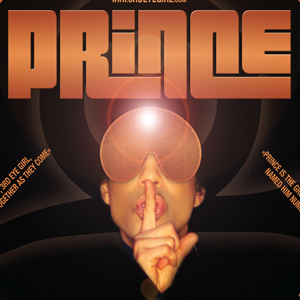
Promo: Enter to win tickets to see Prince (yes, that Prince)

0

Enter to win tickets to see PRINCE at DNA Lounge!

DNA Lounge is proud to present seven-time Grammy Award winner and Multi-Platinum artist PRINCE!

Four shows!

• Tue Apr 23, 6:30pm;

• Tue Apr 23, 10pm;

• Wed Apr 24, 6:30pm;

• Wed Apr 24, 10pm!

This tour will introduce his brand new, all-female backing band, 3RDEYEGIRL, featuring acclaimed Canadian guitarist Donna Grantis, Danish bass guitarist Ida Nielsen, and Kentucky-native drummer Hannah Ford.

3RDEYEGIRL recently made their national television debut on NBC’s Late Night With Jimmy Fallon, in which Prince and the band performed his newly released song “Screwdriver” and classic tune “Bambi.”

Rolling Stone has named Prince “one of the world’s greatest guitarists,” and 3RDEYEGIRL is already turning critics’ heads. Says Sticky Magazine of guitarist Donna Grantis: “the full impact of Grantis is her live performance: the interaction with other musicians onstage, the improvisational wizardry and the sheer passion that can be felt.” The Current raves about Ida Nielsen and drummer Hannah Ford: “Nielsen and Ford prove to be a powerhouse rhythm section.” Guitar Center echoes of Ford: “From the moment the show opens until it closes, you will feel the excitement and power of Hannah’s assault on her drum kit.”

Get more info here.

To enter, email your full name (as it appears on your ID) and your choice of performance (see above) to sfbgpromos@sfbg.com with “PRINCE” in the subject. One lucky-as-hell and randomly chosen reader will win a pair of tickets by Fri/19. Good luck!

Live Shots: Keystone XL pipeline protest

8

Photos by Bowerbird Photography

SFBG’s Rebecca Bowe reported on the anti-pipeline protesters who greeted President Obama yesterday in the cold and fog. SFBG photographers from Bowerbird Photography were there as well. After the jump, Ariel of Bowerbird’s take on the scene. 

Young and old showed up Wednesday evening, shouting to have their voices heard over the polite clinking of knives and forks at a $32,500 a plate dinner organized for Pres. Obama at the Getty’s home in Pacific Heights. Whenever the President rolls into town, so many different lobbying groups come to raise their banners and clear their throats that it is easy to mistake the gathering for a traveling carnival of weirdness.

Yet, this time felt different. While various groups still made their causes known (and advocated for single payer health care, releasing Bradley Manning, and closing Guantanamo Bay), the overwhelming preponderance of protesters stood together in unity and urged Pres. Obama to prevent construction of the Keystone XL pipeline.

Even though the diversity in age, ethnicity and attire (yes, someone showed up wearing sequins and roller blades – this is San Francisco after all!) ranged wide, solidarity on this single issue was strong.  Both sides of the sidewalk shouted together against building the pipeline. Apparently, the oil supporters (if any), did not show.  Perhaps they found warm comfort in a limousine ride to a fancy dinner at the Getty residence.

Who knows? While the outcome of the fight for Pres. Obama’s ear is unknown, it is clear that hundreds of protesters shivering in the fog and cold got hoarse trying.

Obama greeted with anti-pipeline protesters

Hundreds of protesters gathered in San Francisco’s upscale Pacific Heights neighborhood on April 3 to greet President Barack Obama with signs and chants opposing the Keystone XL pipeline. Nationwide, environmentalists have been pressuring the president in recent months to reject construction permits for the oil infrastructure project, which would transport oil to U.S. refineries from Canada’s Alberta tar sands.

The president was in San Francisco for a $32,500 per person Democratic Congressional Campaign Committee (DCCC) fundraiser at the mansion of San Francisco billionaires Gordon and Ann Getty, preceded by a $5,000 per person cocktail reception hosted at the Sea Cliff residence of Tom Steyer, a billionaire former hedge fund manager, and his wife Kat Taylor. Steyer and Taylor are vocal critics of the pipeline and have donated to environmental causes.

>>See more pics from the protest here.

Around 6 p.m., protesters gathered to parade past the rows of mansions, braving the chilly mist as they sang, chanted and waved signs opposing the pipeline. “If the environment were a bank, it would have been saved already,” one handmade cardboard sign read.

Police set up barricades to restrict access to the Getty residence, and when protesters spilled into the nearby intersection of Broadway and Divisadero, police officers stationed on the street with megaphones joined with motorcycle cops in urging the crowd backward onto the sidewalk, creating a tight squeeze.

Chants included phrases like, “What do we say to the president? No pipeline for the one percent!” And, “Hey, Obama, we don’t want no pipeline drama.” The action was organized by a host of prominent environmental organizations including 350.org, the Sierra Club, Friends of the Earth, Credo Action, and the Rainforest Action Network (RAN).

Guardian video by Rebecca Bowe

Just before the events got underway, the Guardian encountered Michael Klein, a major donor and former board chair of the radical environmental organization RAN. Klein, who said he’s served on the boards of other environmental organizations as well, is also a member of the DCCC – and he said he’s “really close” with Steyer, the billionaire environmentalist who was playing host to the president that evening.

“I know how Tom feels about it, and he’s not a supporter” of the Keystone XL pipeline, Klein told the Guardian. “This whole area is filled with so much ambivalence and contradiction. It’s a really complex area, and it’s not an easy situation politically for the president.”

Klein was dressed down in a windbreaker, standing on the sidewalk outside a stately residence where protesters, some of them from RAN, were beginning to congregate. Asked what brought him out to the protest that day, he responded, “I live here.”

Yet Klein had no plans to drop in on his neighbors, the Gettys, that night. “I was invited to the events,” he told the Guardian, but “I couldn’t go,” as a matter of principle. And besides, when it comes to fancy black-tie fundraising galas, “I don’t like those events anyway,” Klein said.

Localized Appreesh: Sunbeam Rd.

0

Localized Appreesh is our thank-you column to the musicians that make the Bay. To be considered, contact emilysavage@sfbg.com

I’m a lover of past treasures. I like my music vinyl, and I like my mail snail. Sure, I download thousands (millions would be hyperbolic, right?) of tracks a year, send hundreds of emails a day, tweet with the rest of them, and then some. Technology is still my friend, but vintage pleasures will always be my lover. Hence, my delight with the arrival of a colorfully confetti’d physical postcard from psychedelia-minded local fuzz-pop trio Sunbeam Rd., announcing the group’s 50th show.

The  San Francisco band’s debut LP, Breathers, came out last October, and I slept on it then, so I’m not making the same mistake twice. And while its psychedelic guitars, tender melodies, and fuzz-layered pop hooks may be blissfully of another era, Sunbeam Rd. also knows how to harness modern technology – it raised enough money through Kickstarter last year to press the record on vinyl. 

The band is made up of brothers Trevor Hacker and Clive Hacker, along with Harrison Pollack – all graphic design graduates from California College of the Arts (you might get a sense of that in the cat-filled video for swirling “Lucy”).

Check it out below and then see the trio live this weekend at Bottom of the Hill, celebrating 50 performances on the Sunbeam Rd.
http://www.youtube.com/watch?v=Z8ziAxlNZa4

Year and location of origin: TREVOR: We formed in early 2009 after setting up a drumset and some amps in the kitchen of the flat where Harrison and I used to live near Glen Park. Our roommates must have hated us.

Band name origin: HARRISON: In the ’80s, NASA was planning to build a big spaceport near the Air Force base in our hometown. It was slated to be like the West Coast Cape Canaveral but NASA pulled out at the last minute for some reason relating to the Challenger disaster, leaving the town in a severe recession.

One time my friend that worked on the base took me to the hangars that NASA built and never used. “The Sunbeam Road” was the nickname give to one of the landing strips, which had been gradually falling apart over the last 20-30 years. It was a super eerie place in contrast to the overly optimistic name. It kind of stuck with me for some reason.

Band motto: CLIVE: Wise men say forgiveness is divine, but never pay full price for late pizza.

Description of sound in 10 words or less: Hook-laden, fuzz-saturated trance states.

Instrumentation: CLIVE: Drums; TREVOR: Vox/Guitar; HARRISON: Bass.

Most recent release: BREATHERS (our debut LP) and BREATHERS Remixed.

Best part about life as a Bay Area band:
TREVOR: Road trips to Mt. Diablo, Big Sur, Point Reyes, and course all of the live music & great record stores.

HARRISON: Close proximity to the Based God.

CLIVE: What Harrison said; Also, it’s certainly never boring being a band in the Bay Area. There’s constantly something new and/or different happening that has yet to be explored.

Worst part about life as a Bay Area band:

TREVOR: It aint cheap!

HARRISON: The feeling that the Based God is so close, yet so far away.

CLIVE: What Harrison said; Also, it’s too easy to be complacent here in San Francisco.  

First album ever purchased:

CLIVE: I believe it was Whatever and Ever Amen by Ben Folds Five.

TREVOR: Blur, Blur.

HARRISON: Smash, The Offspring.

Most recent album purchased/downloaded:

CLIVE:  Acquiring the Taste, Gentle Giant.

TREVOR: Stone Shift, Larry Ochs Sax and Drumming Core.

HARRISON: Jack The Tab/Tekno Acid Beat, Psychic TV.

Favorite local eatery and dish:

CLIVE: #19 on the menu at Evergreen Garden (pho with five-spice chicken). It’s just great!

TREVOR: Little Yangon in Daly City. Pork and sour bamboo shoot curry with coconut rice

HARRISON: Taqueria Vallarta’s street tacos are basically the only things I like to eat.

Sunbeam Rd.
With Halsted
Sun/7, 9pm, $9
Bottom of the Hill
1233 17 St., SF
www.bottomofthehill.com

Stage listings

0

Stage listings are compiled by Guardian staff. Performance times may change; call venues to confirm. Reviewers are Robert Avila, Rita Felciano, and Nicole Gluckstern. Submit items for the listings at listings@sfbg.com.

THEATER

OPENING

The Bereaved Thick House, 1695 18th St, SF; www.crowdedfire.org. $10-35. Previews Thu/4-Sat/6, 8pm. Opens Mon/8, 8pm. Runs Wed-Sat, 8pm. Through April 27. Crowded Fire Theater launches its Mainstage season with Thomas Bradshaw’s wicked comedy about “sex, drugs, and the American dream.”

Carnival! Eureka Theatre, 215 Jackson, SF; www.42ndstreetmoon.org. $25-75. Previews Wed/3, 7pm; Thu/4-Fri/5, 8pm. Opens Sat/6, 6pm. Runs Wed, 7pm; Thu-Fri, 8pm; Sat, 6pm (also April 13, 1pm); Sun, 3pm. Through April 21. 42nd Street Moon performs the Tony Award-winning musical.

Show Me Yours: Songs of Innocence and Experience Alcove Theater, 414 Mason, Ste 502, SF; www.thealcovetheater.com. $27. Opens Thu/5, 8pm. Runs Thu-Sat, 8pm; Sun, 5pm. Through April 27. New Musical Theater of San Francisco performs a new musical revue written by Pen and Piano, the company’s resident group of writers and composers.

BAY AREA

The Arsonists Aurora Theatre, 2081 Addison, Berk; www.auroratheatre.org. $35-60. Previews Fri/5-Sat/6 and April 10, 8pm; Sun/7, 2pm; Tue/9, 7pm. Opens April 11, 8pm. Runs Tue and Sun, 7pm (also Sun, 2pm); Wed-Sat, 8pm. Through May 12. Aurora Theatre Company performs Max Frisch’s classic comic parable, translated by Alistair Beaton.

Being Earnest Mountain View Center for the Performing Arts, 500 Castro, Mtn View; www.theatreworks.org. $23-73. Previews Wed/3-Fri/5, 8pm. Opens Sat/6. Runs Tue-Wed, 7:30pm; Thu-Sat, 8pm (also Sat, 2pm); Sun, 2 and 7pm. Through April 28. TheatreWorks performs the world premiere of Paul Gordon’s musical take on Oscar Wilde’s comedy.

Love Letters Various Marin County venues; www.porchlight.net. $15-30. April 5-28. Porch Light Theater performs A.R. Gurney’s romantic play at four different Marin venues; check website for addresses and showtimes.

“Pear Slices” Pear Avenue Theatre, 1220 Pear, Mtn View; www.thepear.org. $10-30. Previews Thu/4, 8pm. Opens Fri/5, 8pm. Runs Thu-Sat, 8pm; Sun, 2pm. Through April 28. Nine original short plays by members of the Pear Playwrights Guild.

ONGOING

The Bus New Conservatory Theatre Center, 25 Van Ness, SF; www.nctcsf.org. $32-45. Wed-Sat, 8pm; Sun, 2pm. Through April 28. NCTC performs James Lantz’s tale of two young men whose meeting place for their secret relationship is a church bus.

The Chairs Exit on Taylor, 277 Taylor, SF; www.cuttingball.com. $20-45. Thu/4, 7:30pm; Fri/5-Sat/6, 8pm (also Sat/6, 2pm); Sun/7, 5pm. In Rob Melrose’s new translation of Eugene Ionesco’s The Chairs, an elderly couple sit in the austere parlor of their lonely lighthouse, chortling over a spate of private wordplay and reminiscing of sprightlier times, until their initially frantic and disjointed dialogue settles into a smooth flow, well-polished by decades of endearments and gentle bickering. Possibly the last two survivors of a not entirely explained apocalypse, the isolated nonagenarians (magnificently played by David Sinaiko and Tamar Cohn) nevertheless make it known that important guests are expected to arrive at any moment in order to hear a hired orator (Derek Fischer) deliver the Old Man’s “message,” which he has spent a lifetime honing. As the doorbell begins to ring, a jarring squall, and invisible guests and dozens of mismatched chairs begin to crowd their peaceable empire in claustrophobia-inducing numbers, their companionable seclusion is shattered for good. Director Annie Elias manages to coax both gravitas and decorum out of this little-produced, yet influential absurdist relic, imbuing her protagonists with a depth of character that belies their farcical circumstances, while Theodore J.H. Hulsker’s murmuring sound design of crashing waves, angry winds, and the strident doorbell could almost be another character in the play, so thoroughly does it set the tone in ways that Ionesco might not have approved of, but is all the better for. (Gluckstern)

The Couch Tides Theatre, 533 Sutter, Second Flr, SF; www.3girlstheatre.org. $30. Thu/4-Sat/6, 8pm; Sun/7, 2pm. As the centerpiece of its second annual festival of plays in honor of Women’s History Month, 3Girls Theatre, devoted to Bay Area women playwrights, revives Lynne Kaufman’s fitful but enjoyable 1985 dramatic comedy about the inception of the famous sexual and psychiatric triangle between Carl Jung (Peter Ruocco), wife Emma Jung (Courtney Walsh), and his mistress and analysand Toni Wolff (Maggie Mason). In this, her first play, Kaufman (whose most recent play, Acid Test, explores the life of Ram Dass) folds in Carl’s critical 1912 break with mentor Sigmund Freud (Louis Parnell) for an action-packed day Chez Jung. (Also on the scene is the Jung’s precocious daughter Katherine, played by a sure and animated Hattie Rose Allen Bellino). Amy Glazer directs a solid cast who convincingly blends the farcical aspects of the dialogue with its meatier and more dramatic ones, as new ties and power dynamics are sometimes roughly, other times genteelly negotiated. The former is usually the stuff of high comedy, as when Freud goes apoplectic upon learning Jung is not necessarily the disciple and “son” he had thought him to be. And Jung’s (proto-) New Agey leanings only add fuel to the fire: When Carl turns to the I Ching to decide on the best course of action for his career going forward, Freud erupts, “You idiot! You’re playing tiddlywinks with the human race!” But it is ultimately the politics of love and the household that take center stage, with Walsh’s vulnerable yet ever dignified Emma emerging as, if not the greatest psychiatrist, perhaps the greatest strategist of them all. (Avila)

Eurydice Gough Street Playhouse, 1622 Gough, SF; www.custommade.org. $25-30. Thu-Sat, 8pm; Sun, 7pm. Through April 14. Custom Made Theatre Co. performs Sarah Ruhl’s inventive take on the Orpheus and Eurydice myth, exploring the story through the heroine’s eyes.

Foodies! The Musical Shelton Theater, 533 Sutter, SF; www.foodiesthemusical.com. $30-34. Fri-Sat, 8pm. Open-ended. AWAT Productions presents Morris Bobrow’s musical comedy revue all about food.

The Happy Ones Magic Theatre, Fort Mason Center, Bldg D, Third Flr, SF; www.magictheatre.org. $22-62. Opens Wed/3, 8pm. Runs Wed-Sat, 8pm (also Sat, 2:30pm; no matinee April 20); Sun, 2:30pm; Tue, 7pm. Through April 21. An Orange County appliance store owner finds his life turned upside down in Julie Marie Myatt’s drama at Magic Theatre.

reasons to be pretty San Francisco Playhouse, 450 Post, Second Flr, SF; www.sfplayhouse.org. $30-100. Tue-Thu, 7pm; Fri-Sat, 8pm (also Sat, 3pm). Through May 11. San Francisco Playhouse’s tenth season continues with Neil LaBute’s romantic drama.

The Resurrection of SHE Brava Theater Center, 2781 24th St, SF; www.brava.org. $20-30. Thu/4-Sat/6, 8pm; Sun/7, 3pm. San Francisco’s inimitable Rhodessa Jones is the beguiling heart of this musically transcendent and visually evocative performance-memoir, co-produced by Brava Theater and Cultural Odyssey. It’s a surefooted meander through a great swath of personal and historical experience led by an African American woman whose decades-long theater career has been the expression and instigation of many female “resurrections.” Backed by a multimedia collage designed by Stephanie Johnson and Pam Peniston, and accompanied onstage by excellent multi-instrumentalists and composers Idris Ackamoor (who also directed the show) and David Molina, Jones begins with a fraught poetical invocation of an African girl child roaming free on the deck of a slave ship. From there she delves into a by turns humorous, harrowing, and inspiring narrative rooted in her own Southern family history and the origins of what she calls her life-saving encounter with theater — one manifestation of which has been her powerful work with incarcerated women in the Medea Project. A recent iteration of the Project, in South Africa’s Naturena prison, forms the narrative anchor of the second act. A formidable performer and expert storyteller, Jones commands attention whether channeling specific characters, speaking impromptu to her audience, or erupting into song (in one a several canny musical numbers). In the process, she makes trivial the show’s few hiccups or loose ends with a sense of communion as impressive as her remarkable life. (Avila)

Sex and the City: LIVE! Rebel, 1760 Market, SF; trannyshack.com/sexandthecity. $25. Wed, 7 and 9pm. Open-ended. It seems a no-brainer. Not just the HBO series itself — that’s definitely missing some gray matter — but putting it onstage as a drag show. Mais naturellement! Why was Sex and the City not conceived of as a drag show in the first place? Making the sordid not exactly palatable but somehow, I don’t know, friendlier (and the canned a little cannier), Velvet Rage Productions mounts two verbatim episodes from the widely adored cable show, with Trannyshack’s Heklina in a smashing portrayal of SJP’s Carrie; D’Arcy Drollinger stealing much of the show as ever-randy Samantha (already more or less a gay man trapped in a woman’s body); Lady Bear as an endearingly out-to-lunch Miranda; and ever assured, quick-witted Trixxie Carr as pent-up Charlotte. There’s also a solid and enjoyable supporting cast courtesy of Cookie Dough, Jordan Wheeler, and Leigh Crow (as Mr. Big). That’s some heavyweight talent trodding the straining boards of bar Rebel’s tiny stage. The show’s still two-dimensional, even in 3D, but noticeably bigger than your 50″ plasma flat panel. (Avila)

Steve Seabrook: Better Than You Marsh San Francisco, 1062 Valencia, SF; www.themarsh.org. $15-50. Thu, 8pm; Sat, 8:30pm. Extended through May 18. Self-awareness, self-actualization, self-aggrandizement — for these things we turn to the professionals: the self-empowerment coaches, the self-help authors and motivational speakers. What’s the good of having a “self” unless someone shows you how to use it? Writer-performer Kurt Bodden’s Steve Seabrook wants to sell you on a better you, but his “Better Than You” weekend seminar (and tie-in book series, assorted CDs, and other paraphernalia) belies a certain divided loyalty in its own self-flattering title. The bitter fruit of the personal growth industry may sound overly ripe for the picking, but Bodden’s deftly executed “seminar” and its behind-the-scenes reveals, directed by Mark Kenward, explore the terrain with panache, cool wit, and shrewd characterization. As both writer and performer, Bodden keeps his Steve Seabrook just this side of overly sensational or maudlin, a believable figure, finally, whose all-too-ordinary life ends up something of a modest model of its own. (Avila)

Tinsel Tarts in a Hot Coma: The Next Cockettes Musical Hypnodrome, 575 10th St, SF; www.thrillpeddlers.com. $30-35. Opens Thu/4, 8pm. Runs Thu-Sat, 8pm. Through June 1. Thrillpeddlers’ sixth annual Theatre of the Ridiculous Revival presents a restored version of the Cockettes’ 1971 Art Deco-inspired musical extravaganza.

The Voice: One Man’s Journey Into Sex Addition and Recovery Stage Werx Theater, 446 Valencia, SF; thevoice.brownpapertickets.com. $10-18. Fri/5-Sat/6, 8pm. Ticket sales for David Kleinberg’s autobiographical solo show benefit 12-step sex addiction recovery programs and other non-profits.

BAY AREA

The Coast of Utopia: Voyage & Shipwreck Ashby Stage, 1901 Ashby, Berk; www.shotgunplayers.org. $20-35. Shipwreck runs Wed-Thu, 7pm; Fri-Sat, 8pm; Sun, 5pm. Through May 5. Voyage opens Wed/3, 3pm. Runs April 13, 20, 27, and May 4, 3pm. Last year in the Shotgun Players’ production of Voyage, the first part of Tom Stoppard’s The Coast of Utopia trilogy (also playing in repertory through May 4), we were introduced to a tight circle of Russian thinkers and dreamers, chafing against the oppressive regime of Nicholas I. In the second part, Shipwrecked, we find them older, perhaps wiser, struggling to keep their revolutionary ideals alive while also juggling familial concerns and personal passions. Focused mainly on Alexander Herzen (Patrick Kelley Jones) and family, Shipwrecked travels from Russia to Germany, France, Italy, and the English Channel, buffeted from all directions by the forces of the uprisings and burgeoning political consciousness of the European proletariat. It’s an unwieldy, sprawling world that Stoppard, and history, have built (made somewhat more so by the Shotgun production’s strangely languid pace during even the most dramatic sequences) but it’s worth making the effort to spend time absorbing the singular world views of Russian émigré Herzen, his impulsively passionate wife Natalie (Caitlyn Louchard), the cantankerous, influential critic Vissarion Belinsky (Nick Medina), professional rabble-rouser Michael Bakunin (Joseph Salazar) and up-and-coming writer Ivan Turgenev (Richard Reinholdt) as they desperately seek to carve out both their personal identities and a greater, cohesive Russian one from the imperfect turmoil of Western philosophy. (Gluckstern)

Fallaci Berkeley Repertory Theatre, 2015 Addison, Berk; www.berkeleyrep.org. $29-89. Tue, Thu-Sat, 8pm (also Sat, 2pm); Wed and Sun, 7pm (also Sun, 2pm). Through April 21. Berkeley Rep performs Pulitzer-winning journalist Lawrence Wright’s new play about Italian journalist Oriana Fallaci.

The Mountaintop Lucie Stern Theatre, 1305 Middlefield, Palo Alto; www.theatreworks.org. $23-75. Wed/3-Thu/4, 11am (also Thu/4, 8pm); Sat/6, 8pm; Sun/7, 2pm. TheatreWorks performs Katori Hall’s play that re-imagines the events on the night before Dr. Martin Luther King, Jr.’s assassination.

The Real Americans Marsh Berkeley, 2120 Allston, Berk; www.themarsh.org. $25-50. Fri/5, 8pm; Sat/6, 5pm. Dan Hoyle shifts his popular show about small-town America to the Marsh’s Berkeley outpost.

The Whipping Man Marin Theatre Center, 397 Miller, Mill Valley; www.marintheatre.org. $36-57. Tue-Sat, 8pm (also April 20, 2pm; April 11, 1pm); Wed, 7:30pm; Sun, 2 and 7pm. Through April 21. Marin Theatre Company performs the Bay Area premiere of Matthew Lopez’s Civil War drama.

PERFORMANCE/DANCE

“The Buddy Club Children’s Shows” Randall Museum, 199 Museum Wy, SF; www.thebuddyclub.com. Sun/7, 11am. $8. The Bubble Lady performs.

“Cabaret Showcase Showdown: Best Pop Cabaret Singer” Martuni’s, 4 Valencia, SF; (415) 241-0205. Sun/7, 7pm. $7. With guest judge Dylan Germick and musical arranger Lynden Bair.

Caroline Lugo and Carolé Acuña’s Ballet Flamenco Peña Pachamama, 1630 Powell, SF; www.carolinalugo.com. Sun/7 and April 13, 6:15pm. $15-19. Flamenco performance by the mother-daughter dance company, featuring live musicians.

“Fifth Annual Flow Show/San Francisco” Dance Mission Theater, 3316 24th St, SF; www.dancemission.com. Fri/5-Sat/6, 8pm; Sun/7, 7pm. $20 (no one turned away for lack of funds). Contemporary dance and flow arts showcase, incorporating props like hoops and yo-yos.

“A Kind of Sad Love Song” Bindlestiff Studio, 185 Sixth St, SF; www.bindlestiffstudio.org. Thu-Sat, 8pm (also Sat, 3:30pm); Sun/7, 3:30pm. Through April 14. $10-20. Bindlestiff Studio presents the world premiere of Jeffrey Lo’s relationship drama, performed in repertory by two separate casts of Pilipino American actors.

“The Madness of the Elephant” Jewish Community Center of San Francisco, Kanbar Hall, 3200 California, SF; www.jccsf.org/arts. Fri/5-Sat/6, 8pm. $15-30. West African dance, music, and theater group Duniya Dance and Drum Company perform an exploration of the reign of Guinea’s first president, Sekou Touré.

“Miss Coco Peru: She’s Got Balls!” Castro Theatre, 429 Castro, SF; www.ticketfly.com. Sat/6, 8pm. $28-45. Miss Coco Peru (a.k.a. Clinton Leupp) reminisces about her life in this solo musical comedy.

“Mission Position Live” Cinecave, 1034 Valencia, SF; www.missionpositionlive.com. Thu, 8pm. Ongoing. $10. Stand-up comedy with rotating performers.

“The Moth StorySLAM” Rickshaw Stop, 155 Fell, SF; www.rickshawstop.com. Mon/8, 7pm. $8-16. Open mic storytelling competition affiliated with KQED’s “The Moth Radio Hour.”

“OCB: Obsessive Compulsive Broadway” Martuni’s, 4 Valencia, SF; www.brownpapertickets.com. Wed/3, 7pm. $7. Steven Slatten performs a comedy about the highs and lows of working on Broadway, with songs from Rent, Hair, and other shows.

Ophelia Fort Mason Center (starting at the Firehouse), Marina at Laguna, SF; www.carteblanche-sf.com. Thu and Sat-Sun, 8:30pm. Through April 14. $22. Carte Blanche performs a walk-through performance featuring dance, theater, and interactive video.

“Pamtastic’s Comedy Clubhouse Presents: The Mutiny Radio Comedy Showcase” Mutiny Radio, 2781 21st St, SF; www.mutinyradio.org. Fri/5, 8:30pm. $5-20. With Jamie Bell, Vince Mancini, Dustin Hempstead, and more.

Red Hots Burlesque El Rio, 3158 Mission, SF; www.redhotsburlesque.com. Wed, 7:30-9pm. Ongoing. $5-10. Come for the burlesque show, stay for OMG! Karaoke starting at 8pm (no cover for karaoke).

“Rotunda Dance Series: San Francisco Ballet School Trainee Program” San Francisco City Hall, Van Ness and Grove, SF; www.dancersgroup.org. Fri/5, noon. Free. The most advanced students at SF Ballet’s school present a free, public performance under City Hall’s rotunda.

“San Francisco Magic Parlor” Chancellor Hotel Union Square, 433 Powell, SF; www.sfmagicparlor.com. Thu-Sat, 8pm. Ongoing. $40. Magic vignettes with conjurer and storyteller Walt Anthony.

“Up in the Air” Garage, 715 Bryant, SF; www.milissapayne.com. Wed/3-Thu/4, 8pm. New dance work inspired by hot air ballooning by the Milissa Payne Project.

BAY AREA

“The Divine Game” Ashby Stage, 1901 Ashby, Berk; www.shotgunplayers.org. April 15 and 29, 8pm. $20. First Person Singular and Shotgun Cabaret present this dramatic re-enactment of Nabokov teaching at Cornell in the 1950s.

“I Look Like An Egg, But I Identify as a Cookie” Ashby Stage, 1901 Ashby, Berk; www.shotgunplayers.org. Mon/8-Tue/9, 8pm. $20. Heather Gold brings her hit solo comedy (with cookies!) to the East Bay.


Conflicted dictator

0

DANCE “Next door,” you are told in the packed Senegalese restaurant in the heart of the Mission. “Back there,” you hear, as a hand points in a very dark, very empty bar you enter through an unmarked door. What’s “back there”? It’s a large space, perhaps formerly used for storage, lit by blinking Christmas tree lights and two blinding spots. You wonder what a former African dictator would have thought about a celebration of his life being created in such circumstances. But then why would anybody want to pay tribute to a man who was responsible for the death of thousands of his fellow citizens?

The head of state in question is Sékou Touré, nicknamed “Syli” or “the Elephant,” who led Guinea to independence and in 1958 became the country’s first president. On the night I visit its practice space, Duniya Dance and Drum Company is working on piece about Touré, The Madness of the Elephant, which will world-premiere this weekend.

The elephant is still Guinea’s national symbol, says Duniya’s musical director, Guinea-born Alpha Oumar “Bongo” Sidibe, adding with some pride that their national soccer team is also called Syli. (“They are very good — they’ll go to the world championship.”)

But Sidibe also knows all about Touré’s darker side. “He was a Marxist and he did not tolerate dissent,” he explains. “But he also was a good man, a revolutionary and a man with a vision. His madness was both good and bad. He was the first president of my country. He gave hope to the people; he supported and built our culture. I would not be here as a dancer and as a musician if it was not for him.”

The first ensemble that put African dance on the world stage was Guinea’s Les Ballets Africains; it also became the continent’s first national dance company.

But Touré’s major act of “madness” came with independence when, says Sidibe, “he was the first guy in the world who dared to say ‘no’ to Charles de Gaulle,” rejecting Francophone post-colonial attempts to shape and control the country.

It’s with that crucial moment in Guinea’s history that Madness opens. It recalls the speech in which Touré declared Guineans would rather live poor but free than rich and enslaved. The rehearsing crowd leaps, cheers, and embraces each other to the drummers playing the national rhythm created for that historic occasion.

It’s a curious group. Four of the dancers are Africans with professional performance experience, but for the other eight the African rhythms and steps are clearly foreign. Yet they embody them well.

When these dancers auditioned for Duniya’s artistic director, Joti Singh, they thought they were enrolling in Bhangra, a folkloric dance from North East India. “I told them right away that we might also do African dance,” the American-born Sing, who’s of Punjabi descent, explains. As a child Singh learned to perform Bhangra at family celebrations and cultural festival, but she lost interest as she got older.

In college, she discovered West African dance and became passionate about it. She has twice traveled to and studied in Africa, speaks some Sousou — “I can understand much better than I can speak it” — and finds herself very comfortable in both worlds. Evidently, her dancers feel the same way “Everyone is welcome,” smiles Sidibe at a question surrounding possible cultural conflicts.

In another scene, rehearsed between much teasing and laughter, a group of what looked like women in an open-air market is attacked by baton-twirling thugs. They stand up to the men. The incident, explains Sidibe, was based on fact. “Touré created a special police to enforce Marxist economic principles. But one day the women marched to the Presidential Palace singing and chanting their objections. He abolished the force the same day.”

As is wont in much of West African culture, a djeli (a storyteller), accompanied by the balafon (a wooden xylophone) will provide the through line for Madness‘ musical, dramatic, and choreographed sequences. Sighs Singh, “That has been the hardest part of this project — trying to hold all these wonderful artists together in one place.”

“THE MADNESS OF THE ELEPHANT”

Fri/5-Sat/6, 8pm, $15-30

Jewish Community Center of San Francisco

Kanbar Hall, 3200 California, SF

www.jccsf.org/arts


Are you experimental?

0

cheryl@sfbg.com

FILM At 52, the San Francisco Cinematheque is nearly the same age as the San Francisco International Film Festival, which kicks off its 56th incarnation later this month. And though there’s bound to be some filmmaker overlap between SFIFF and SF Cinematheque’s fourth annual Crossroads festival,

fans of avant-garde, experimental, and non-commercial films won’t want to miss the latter, a weekend packed with works by 48 artists across eight esoterically-titled programs.

Crossroads, which is curated by Cinematheque artistic director Steve Polta, boasts several world premieres, including a pair worthy of particular attention: Jodie Mack’s Dusty Stacks of Mom: The Poster Project, and Scott Stark’s The Realist. At 40-something minutes each, these are among the longer works included in the program; both make the most of their running times to achieve artistically innovative and thematically complex results.

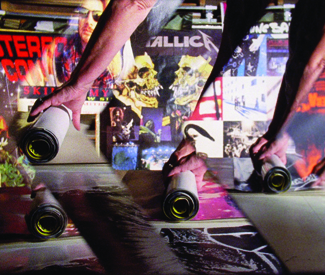
A partially animated, fully musical chronicle of the rise and fall of her mother’s mail-order poster shop, Mack’s Dusty Stacks of Mom lifts its tunes and certain motifs from Dark Side of the Moon. (Though the connection is never explained, it’s likely the Dark Side poster was a best-seller for the store, which specialized in dorm-room classics.) “Come and tour with me/my mother’s poster factory,” Mack sings by way of narration, as her camera discovers piles of cardboard tubes, stacks of handwritten invoices (which hint at why the business faltered in the Internet age), and images of stars like Leonardo DiCaprio and Johnny Depp frozen in time as their 1990s selves.

Stop-motion animation and eye-candy collages bring these paper performers to life, with Mack’s good-sport mother appearing periodically alongside what’s left of her inventory. Though some of the Pink Floyd covers-with-new-lyrics can skew a bit twee, Dusty Stacks‘ visuals never falter; this was clearly a labor-intensive labor of love for Mack, who teaches animation at Dartmouth. A particularly inspired sequence flashes between the holy trinity of college-dude decor: Che, Bob Marley, and Tony Montana.

Dusty Stacks anchors Crossroads’ “Gigs in the Sky: Let There Be More Light!”, which contains films tied together by music and “this post-Kenneth Anger kind of colorful thing,” as Polta calls it. Unlike more mainstream fests, which curate shorts programs with an eye for obvious links between the works, Polta tapped into a more intuitive process.

“The program ‘on the beach (at night)’ has a really interesting film by Jim Drain and Ben Russell called Ponce de León. It’s got these really strange camera techniques in it, and the way it deals with visual space is really interesting, outside of what it’s saying about the way people spend their time and the way generations look back and forth at each other,” he says. “When I saw the opening film of that program, Danielle Short’s Lost Ambulation, it was like, ‘Oh yeah. There’s this sort of depth and flatness going on.’ At a certain level there’s a whole thread in the avant-garde world about these issues; it’s just like talking about painting when you talk about depth and flatness.”

The programs began to take shape early on, while he was looking at all 400-something Crossroads submissions. “You start to take notes: here are some trends. This film and that film would look really interesting back to back. They start to assemble in these little sort of gravitational groups,” he says. “That’s the fun, or the challenge, of curatorial work. It’s like cooking: how can you get a certain kind of flavor, and what can you do to bring that flavor out? Here’s a really interesting film, and putting this other film next to it will sort of change the way you look at it.”

However, he adds, “I also think it’s worth leaving these connections a little bit mysterious. It’s interesting to kind of put these ideas out there and let the viewers sort of pick up on them, or not.”

Local filmmaker Scott Stark is the only artist in this year’s Crossroads to command a solo program (save the inclusion of a 1947 short by Fernand Léger). Stark’s latest, The Realist, uses flickering images of mannequins and consumer goods to investigate themes of “loneliness, desire, and presenting yourself in a certain way,” Polta says; it’s a mesmerizing work. But Polta is quick to note that, again, a sense of mystery is key to the viewing experience. “Part of the fun of The Realist is discovering, as you’re watching it, that there’s some suggestion of a narrative.”

A program of sorta-family-related films, “(as if clinging could save us),” contains another of Polta’s standouts: Jonathan Schwartz’s Animals Moving to the Sound of Drums.

“The film resonates with a well-known classical avant-garde film, [Jack Chambers’ 1970] The Hart of London, which also has to do with repetition of generational experiences through time, and relationships between animals and humans,” Polta says. More than that, though, “[Schwartz] makes films that are really bold in the ways they reach out and embrace sentimentality and emotionalism. They have a faith in sincere emotion that hasn’t been really hip in the last decade. I’d like to think that there’s a balance of that in this festival, between a certain kind of irony and a certain kind of sincerity. People are trying to work that out right now in the avant-garde world right now, whether to be sincere or ironic.”

Another emerging avant-garde star, Michael Robinson, has addressed this dichotomy in his work. His dreamy, glimmering 45-minute Circle in the Sand closes out Crossroads’ last program, “Slaves of Sleep”/”Destroy, She Said.”

“[Robinson has] made a lot of short films using found footage, stuff from video games, and music you’d hear on the radio — but in a way that sort of dares you to squeeze some real, serious emotion out of pop culture that most people would treat as this kind of ironic thing,” Polta says. “Circle in the Sand is mostly, if not completely, footage that he shot. It’s a science fiction film with a vague narrative; it feels like it’s set at a certain point in human evolution where the mundane world that we live in now isn’t going to matter anymore. It’s got a lot of mystery in it about what’s going to happen next to the human race — which is what we’re sort of leaving you with in the final program.” *

CROSSROADS 2013

Fri/5-Sun/7, $10 (festival pass, $50)

Victoria Theatre

2961 16th St, SF

www.sfcinematheque.org


Sabor de Oaxaca

4

marke@sfbg.com

WORLD EATS The first thing you probably need to know about the magical Southern Mexican state of Oaxaca is that sensory overload is always on the menu.

Ancient sci-fi Zapotecan ruins, Technicolor one-story colonial buildings, and an endless stream of live music, whirling dance, outspoken political protest, and eye-popping art justify the eponymous capital city’s reputation as one of the most vibrant crucibles of human culture on the planet. (Seriously, there is live music and dancing, from traditional to punk, outdoors in multiple venues until 3am most nights. San Francisco, where you at?)

The soaring mountains of the countryside host innumerable villages, each with their own dazzling take on local customs and artistic expression. The beaches, like renowned global hippie-nudist beauty Zipolite, expand expectations by drawing a saucy mix of laidback locals, hard-partying city folk, and misfit spiritual wanderers from around the world who greet the golden waves with fire-twirling at sunset and impossible-looking naked yoga at dawn. And for any travelers worried that this land of UNESCO World Heritage Sites has been completely sanitized for first-world tourists, there’s plenty of everyday chaotic Mexican street life and colorful off-the-map adventures in which to satisfactorily immerse oneself.

But all that’s not even talking about the food. Any foodie explorer worth her rock salt knows that Oaxaca is the “land of the seven moles” — rich, fragrant sauces, traditionally poured over roasted turkey, made from a range of pulverized ingredients including chili peppers, chocolate, nuts, cloves, dried fruit, and tomatillos. (A great SF introduction to mole can still sometimes be found at the Mission’s La Oaxaqueña, which has unfortunately been seesawing lately between being one of the city’s best restaurants and a bacon-wrapped hot dog stand on random nights.)

But in an area where dozens of indigenous languages are still spoken and villages are separated by vertiginous, day-long hikes through spruce cloud forests dripping with blooming epiphytes and eerie Spanish moss — by all means take a couple days out of your stay for a eco hike with Expediciones Sierra Norte to blow your nature-loving mind — innovation and improvisation is a way of life. Hunky Beau and I hopped down there for a far-too-affordable March getaway, and here’s what we dug our forks into.


ON THE STREETS

Mole gets all the press, but the backbone of Oaxacan street cuisine is the piping hot tlayuda, a very large grilled tortilla loaded with with bean sauce, guacamole, fresh and stringy Oaxacan cheese, and a hunk of grilled meat or scoop of zesty tinga de pollo stew that’s either served open-faced like a pizza or folded over like a crepe. The best ones we found in the city were at a pair of carts on Calle las Casas, conveniently located just down the street from the historic La Casa del Mezcal, opened in 1935. Ensconced in the Casa’s low light, you can slow-sip several kinds of maguey-derived liquor among baroquely carved wood fixtures, kitschy paintings of Zapotec warrior gods, and a motley assortment of fascinating locals. The mezcal flows until 3am, and the roughly $2.50 tlayudas even later, so you’re set for a good night out.

Oaxaca’s favorite fast food: the tlayuda. Photo by David Schnur

Or snatch a tlayuda for a perfect cheap dinner, paired with a steamy, meaty bowl of pozole from the carts down the block. (Fun fact: pozole is descended from the stew Zapotecs used to make of leftover human sacrifice parts. Now it’s mostly pork and corn.) Cheap breakfastwise, we were blown away by the scrumptious, hefty $2 morning chorizo- and omelet-filled tacquitos toasted on hot rocks by charming women on Calle García Vigil, near the Mercado 20 de Noviembre main market. Self-serve bakery Pan Bamby across from the huge, ever-bustling central zócalo serves a dizzying array of perfectly flaky empanadas for about 30 cents each, including several rare veggie options like creamed spinach and spiced vegetables. And, as always, the market is the best place to acquaint yourself cheaply with the local cuisine: witness the overflowing seafood cocktails at Mariscos Panchos and delectably overloaded roasted pork soft tacos, five for $3, at Carnitas Patlan.

Fascinating traditional drinks served at outdoor cart Nieves Cholito el Tule in the Plazuela de Carmen Alta include tejate (a crazy-sweet maize and cacao Zapotecan drink with a plasticky foam on top), chilacayote (made from a succulent squash with edible seeds as chewy treats), and syrupy tuna, a.k.a. cactus fruit.

And the mole? I want you to look up fabulously dramatic, yodeling folk singer Geo Meneses right now and imagine her backed by a full orchestra (six tubas!) in the open air of Oaxaca suburb Santa Cruz Xoxocotlan, which hosts enchanting, slightly witchy open-air Tuesday evening “Martes de Brujas” concerts, featuring an array of miracle street tamales from local venodors: chicken marinated in chocolaty mole negro, pork in tangy red mole coloradito or zippy mole verde, wrapped in eucalyptus-like yerba santa leaf. Kind of unbelievable.


IN THE SEATS

Mole, of course, also served as an entry into the more experimental cuisine of this tastebud paradise. When you can get a three-course meal for two with a bottle of surprisingly satisfying Mexican wine (Casa Madero of Parras de la Fuente is producing a quality chenin blanc, and Baja’s Cavas Valmar a perky grenache) for around $50, we went and splurged a little.

Intimate and colorful La Olla, near the imposing Santa Domingo church, is where you go for regional authenticity with flair. Wide, thin slices of beef tongue soaked in a mole verde of almonds, raisins, tomatillo, and cilantro; mole negro de fandango, a fantasy-fulfilling 25-ingredient mole negro over roasted chicken; and mole amarillo con pitiona, lively and yellow with corn masa, three kinds of peppers, and lemon verbena vanished from our table in a mad scramble of sauce-sopping tortillas.

La Biznaga is the hip joint, a “very slow regional food” operation named for a portly flowering cactus, its large courtyard decked out in vibrant Cuban hues, with towering chalkboards announcing the fascinating menu and a globe-hopping clientele lapping up pulque cocktails. (Mixing with milky, beer-like pulque, derived from the maguey plant, is super-trendy in Mexico right now, and should hit here any minute.) An appetizer of yerba santa-wrapped bricks of Oaxacan cheese drizzled with citrus liqueur-infused crema came off a lot lighter than it sounds. “El Necio,” a large hunk of flank steak stewed in a mole-like sauce of smoked chili, plums, and mezcal submerged us in flavor world several fathoms deep, while a mushroom and goat cheese-spiked coloradito lifted a fleshy fish fillet to the top of our list.

Jicama taquitos with grasshoppers, corn smut, and quesillo at Casa Oaxaca. Photo by David Schnur

If you’re looking for a true gourmet Oaxacan experience, though, the gorgeous Mission-style Casa Oaxaca, with its upstairs dining patio overlooking the kaleidoscopic downtown street hustle, is where you’ll find some of the most forward-thinking menu items that still pack an authentic local punch. Salsa is mixed and ground to tasted tableside in traditional molcajete mortar. Start with the exquisite, crunchy jicama taquitos filled with fried grasshoppers, cuitlacoche (corn smut), and quesillo cheese. Then, as the candlelight and atmosphere take hold, move on to absurdly tender venison bathed in ethereal mole amarillo and juicy slices of duck breast covered in nutty, deep orange mole almendrado.

Finally, for desert, slip back out into the captivating streets and share the refreshing carrot-apple-pecan ice cream flavor Beso Oaxaqueño, as the hypnotic local marimba music known as son istmeño drifts from the zócalo.

Two men, one spark

0

emilysavage@sfbg.com

TOFU AND WHISKEY It’s the B-story scene that rules 1983’s Valley Girl. Popped collar-sporting Skip is nervously riding his bike to the suburban home of his preppy high school girlfriend, Suzi — but we the audience know he’s more interested in her young step-mom. (He met the feisty Valley mom when she served him sushi at a house party. Gross me out.) It’s a palpable moment of orgasmic anticipation — with a surprise twist — that bops along perfectly to the soundtrack: “Eaten By the Monster of Love,” by experimental pop duo, Sparks (www.allsparks.com).

“Well, it’s worse than war, it’s worse than death/There ain’t too many left who ain’t been/Eaten by the monster of love(Don’t let it get me),” Sparks vocalist Russell Mael opines with a wide-ranging, Broadway-ready bravado, as his brother Ron Mael tickles a bouncy new wave blast out of his keyboards and synthesizers.

This is just one iteration of Sparks — the flashy new wave version, proudly on display in ’82’s Angst in My Pants LP, two tracks of which were used in that early Nicolas Cage vehicle, Valley Girl. But that’s only a small snippet of the band’s robust timeline, which got a running start in ’71 at UCLA, and continues to this day, with 22 albums and counting.

Sparks has had countless rebirths since the first record was released in ’71, the band then known as Halfnelson. There have been landmark albums like ’74’s electric Kimono My House, with that iconic cover of two powdered and kimono-swathed ladies, along with ’83’s synth-heavy In Outer Space, ’02’s chamber pop Lil’ Beethoven, and most recently, ’09’s The Seduction of Ingmar Bergman, a radio musical commissioned by Sveriges Radio Radioteatern, the radio drama department of Sweden’s national radio broadcaster. (More on that later.)

“It seems like the people that stick with Sparks appreciate that the band doesn’t rest on its laurels,” says Russell, a lifelong Angeleno, speaking to me from his home “in the hills above Beverly Hills.”

“I think that’s why we’re really proud of what we’re doing now; it doesn’t sound like a band that’s necessary had 22 albums,” he says. “Someone can come in fresh — a person that’s maybe never heard of Sparks — and if they hear the latest thing, we would be just as happy as we would be for them to have heard the first album.”

Sparks will perform much of its extensive back catalog during its Two Hands, One Mouth (the hands on the keyboard, mouth at the mic) tour’s rare stop in San Francisco next week, April 9 and 10 at the Chapel, 777 Valencia, SF. www.thechapelsf.com. As of press time, only April 10 is sold out.

The brothers Mael have recorded with dozens of other musicians over the decades, and nearly always toured with a live backing band, so the Two Hands, One Mouth trip has been a unique challenge. “It’s kind of the ultimate expression of self-containment for the band,” Russell says. “We just thought that at this point, it might be an interesting challenge to see what would happen if we just played as the two of us, and without computers or backing tracks.”

He adds, as if reading my mind, “It sounds simple, but we also didn’t want it to read as oh, singer-songwriter, that kind of thing where it lulls you to sleep with an acoustic guitar. We wanted it to keep the power that Sparks has had with the recordings and live band.”

The process has been about choosing the appropriate songs from the duo’s rich recording history, and distilling it with just one keyboard, and vocals. So far, the tour’s been well-received in Europe and Japan, with fans commenting on how this format has brought the strong vocals and songwriting to the forefront.

And the Maels work hard to layer those lyrics with humor, depth, and a drop of speculation. “It’s important to us to have something that’s provocative, but in ways that maybe aren’t like, being a punk band with a stance that you know what it is in five minutes. The Sparks stance is a little bit hard to articulate and place. We kind of like that too, that there is an ambiguity to what we’re doing.”

Their most recent project is that The Seduction of Ingmar Bergman piece. The plot of the radio drama is a farcical situation imagining that Ingmar Bergman had been lured to Hollywood and got trapped in the LA film industry in his worst nightmare — a big-budget action film he can’t figure out how to escape. The Swedish radio spot went so well that Sparks was asked to perform it live at the LA Film Festival last year, where they did so with a cast of 14.

The brothers are currently working on turning it into an ongoing theatrical performance — and also a motion picture. They have the Canadian director Guy Madden on board to direct, but still need the financial backing, so they’ll be flying out to the Cannes Film Festival in May to look for funders.

But before Cannes, Sparks will first play the massive sweaty shitshow that is Coachella for the first time. And yes, they will do it as a stripped-down duo — still just Two Hands, One Mouth.

“We know the show works in our own context, so we thought we should be faithful to ourselves and do it there as well, even if it seems incongruous with what you might expect at a big festival,” Russell says. Do I detect a tiny smirk through the phone? Perhaps wishful thinking on my end.

“It’ll be received however it will be received — [but] it will be different from other things there,” he says. “You tend to get blinded by an assault of 160 indie bands doing their indie thing. We’ll be doing whatever we do, whatever you want to call it.”


ESBEN AND THE WITCH

With swelling crescendos, emotional lyrics, gothy undertones, and shimmering vocals in tow, UK post-rock trio Esben and the Witch comes across the pond for the first time in two years, on tour with newest record, Wash The Sins Not Only The Face (Matador). Should be a witchy one. With Heliotropes.

Thu/4, 9pm, $13. Brick and Mortar Music Hall, 1710 Mission, SF. www.brickandmortarmusic.com.


GLAM.I.ROCK

Lyrically gifted young Oakland rapper Glam.I.Rock — the first half an acronym for “Good Lyrics And Music” — will perform a free in-store during Art Murmur this Friday. If you want to be in on an artist at the tipping point, this would be your chance. The MC has that classic ’90s female-empowerment hip-hop vibe but with some different interests (check the “Who is Glam.I.Rock?” video of her tapping out the Rugrats theme), and a more modern style.

Though like her predecessors, she still very much reps her home-base, performing “Inspire Oakland” at Oakland Digital’s Inspiration Awards last December. Makes sense, she’s the daughter of Nic Nac — the only female member of the Mobb crew — and Dangerous Dame, a member of Too $hort’s Dangerous Crew. Glam.I.Rock’s debut EP, The Feel, recently dropped on Savvie1ent/The Olive Street Agency.

Fri/5, 8pm, free. Oaklandish, 1444 Broadway, Oakl. www.oaklandish.com.


Precious Metal

0

emilysavage@sfbg.com

MUSIC A lot of elements needed to come together to inspire Metal Mother’s new record, Ionika. You can almost picture the woman behind the sobriquet, crouching in some foggy wooded wonderland, scooping up soil and critters, ancient buried treasures of forgotten societies and precious metals. Before we get into specifics, let’s slip off the mask. Metal Mother is really, mostly, the glossy coating of one delicate Oakland musician: Taara Tati.

In between the release and subsequent tour after her first album, 2011’s Bonfire Diaries, and the making of Ionika, which comes out in a week on April 16, Tati collected experiences that affected her future output. She picked wisdom up from extensive travels, Pagan and Celtic traditions, tales of ancient warrior women, and Sufjan Steven’s ’10 album The Age of Adz (which she listened to while exploring Europe for a month). Add to that Game of Thrones, the city of Oakland, the music of Son Lux, and all of Kate Bush. But the clearest running thread throughout Ionika is fascination with Druids.

“Getting into the whole ancient Celtic cultures thing, it was very matriarchal and tribal,” she says, sitting in her “incredibly cheap” Victorian in downtown Oakland. “It was a really profound lifestyle. The more I discover about that, the more I want to learn about it, to be able to see that history and sort of represent that in a way, or glean some power from that.”

She references the culture’s interest in psychoactive medicines, and Queen Boudica, a Joan of Arc-like figure of a British Iceni tribe who led an uprising against the Roman Empire.

“I really came into a full-on obsession last year when I was traveling in Europe. I went on this full journey to all these different ancient sites and sacred sites, and it was empowering for me to be there, and to feel the history of that land, and… my ancestors.”

Her lifelong inspirations, however, seem to have sprung from competing worlds; darkness and light, the electronic and the natural, woman and machine. And all those influences, all those cosmic connections are poured chaotically into Ionika, a densely layered, moody, and deeply spiritual release of 11 solid tracks.

The key track is first single “Prism,” a stunning Grimes-ish (if Grimes were a bit more wild) song with Tati’s many vocal tracks delicately laced throughout twitchy beats and drums. Equally breathy is “Prism”‘s sonic twin “Tactillium.” Some tracks waver questionably — “Windexx’d” kicks off with a harrowing grind and ghostly howl — while others sound as if they were ripped directly from her innards. The epic “Little Ghost” (clocking in at 7 minutes and 29 seconds) begins lightly with Tati’s crisp, otherworldly soprano vocals and a few click-click-clicks of the machines, then builds into an Enya-esque soundscape, with gently pulsating electronic drum hits.

Much of Ionika’s form and sensibility came from David Earl, an Oakland producer and sound engineer whom Tati met through friends. A multi-instrumentalist, Tati would write the songs’ skeletons alone in her Victorian — along with the vocals, and most of the melodies — then bring them to Earl and the two of them would pile on those folded ribbons of sound, with Earl adding crucial rhythms with beats and additional backing tracks.

“It was kind of insane, we had so many crazy, creative whims we went with. We didn’t really delete as much as I thought we were going to delete in the end, you know? We just went for it.”

“He took everything and put it on digital steroids, basically,” she says.


MOTHER RISING

Tati was raised “literally in the woods in Northern California,” in tiny Occidental, Calif. (population: 1,115) in Sonoma County, just west of Santa Rosa.

“I was left to entertain myself with the birds and insects and the critters out there. I have a huge love for the elemental part of the world, and also tribal rhythms and acoustic music and basic sounds forms in that way.”

These influences are clear in the earthly, rich melodies and rhythms of Metal Mother. The other half to her whole came when she began exploring rave culture in the ’90s. This is where she discovered electronic music.

It took both of these elements — the lush forest hangouts and the eye-opening rave nights to create the Metal Mother sound and aesthetic.

“It’s not super planned out, but those are just my preferences,” Tati says.

And yet, from the beginning, Tati has been almost entirely in control of her sound and career. While she’s picked up local musicians along the way, in particular to play as her backing band at live shows, and of course, Earl was a huge part of Ionika, she’s been the only constant of Metal Mother.

“I made every creative choice around the album,” she says. “I’m trying to really preserve my own sense of spirituality within putting out an image of myself around my music, to the world, outside of my own personal circle. That’s a huge part of who I am on a daily basis. I love herbs, rituals, and everything witchy, and I don’t want to have to tone that side down.” She laughs, a warm, frequent, occasionally nervous-sounding giggle.

After spending her early 20s in the street performance and renegade guerrilla performance art scene — mostly as part of the North Bay Art and Revolution, and a renegade little troupe called Action Creature Theatre — Tati unexpectedly shifted focus to music. She’d always dabbled in keyboards, but had never taken playing too seriously. And she’d all along been crafting poems and songs of her own. (Her mother was a theater director, which might explain the affinity for all things artistic expression.)

After friends discovered her “funny, quirky little keyboard songs,” they convinced her to play live, which she did and then quickly found her calling. “I’ve just been following all the open doors, that’s kind of how I operate my life. It’s just like, [going] where the doors are opening. And the doors started opening with music, rapidly, so I just went that direction.”

She named her new project Metal Mother, after the elemental fierceness of a mother and also a planet.

“I was just kind of wanting it to be like, maternal and loving and nurturing obviously, because I like to make pretty music and feel euphoric, but also that kind of fierceness because yeah, the world is a crazy place,” she says. “You’ve got to have that strength to endure some of the crude realities we’re faced with.” Those realities seem clearer when she describes looking out her bedroom window, to the poverty she’s faced with daily outside her doorstep, the homeless people huddled across the street, the loud chaos of the city whizzing by.

The name “Metal Mother” itself came from Joseph Campbell’s book, The Hero With a Thousand Faces, in which he talks of an ancient Chinese myth about the marriage of the Metal Mother and the Wood Prince — and that’s what brought lightness and darkness together, creating the human race.

It took most critics a minute to figure out that Metal Mother was not, in fact, a metal act.

After first album Bonfire Diaries came out in ’11, with its exhilarating single, “Shake,” Metal Mother was hailed as “ambient, sexy,” “beautiful, eerie, unfamiliar.” One review described the album as “tight, ethereal art pop filled with Bjork avant ambiance, Kate Bush drama, and tense Celtic underpinnings.”

Tati was on the cover of Performer Magazine, and featured in the Guardian’s first “On the Rise” batch of up-and-coming musicians last year, in which I wrote she was “some sort of neon, acid-drenched wood nymph.” (It works especially in the context of the video for “Shake,” viewing of which is highly suggested.)


THRUSTING FORWARD

Now, with the hardest part of Ionika over, Tati is free to pursue her next big project — Post Primal, a kind of loosely defined record label and collective she’s working to put together. Ionika is the label’s first release, and the only other band so far officially involved is Mortar and Pestle. But Tati has big plans for the near-future, boosted by others acts approaching her to express interest in Post Primal. Though, she admits, they’re still in the process of defining just what it will be.

“The whole goal is really to have a platform for more context for all of us to associate ourselves with. It’s also more of a collective, because I don’t really have a ton of money or anything to put out anybody else’s record, it’s just basically like we’re sharing resources, we’re sharing contacts and exposure.”

She also is hoping to find a warehouse space in Oakland to put on interactive collective showcases, and create a hub, a new music community in the heart of the adopted city she’s clearly still enamored of, more than six years after moving here. “I love Oakland so much. I’ve gone to a lot of other cities and checked out a lot of other scenes, but I always come home like, this is where I need to be, and this is where I want to grow.”

Metal Mother’s record release party takes place next month, May 2 at Public Works (www.publicsf.com) with all female-front acts: Tearist, Uncanny Valley, and Some Ember.


Heads Up: 7 must-see concerts this week

0

Is everyone else emotionally and physically exhausted from the Easter/Passover-torrential hailing downpour-April Fool’s Day (who can you trust on the Internet?) mess of the last few days? I certainly am, and I only participated in a few of those spiritual debacles.

No mind, I’m ready to strap on my wellies and/or sunglasses and embark on a week of Esben and the Witch, Mac DeMarco, Babysitter, Glam.I.Rock, Portland Cello Project, Future Twin, and Polkacide with Fuxedos.

Here are your must-see Bay Area concerts this week/end:

Mac DeMarco
“Mac DeMarco has written seven albums and EPs on a guitar that he bought for 30 Canadian dollars. He uses effects pedals that he claims no serious musician would be caught dead with. He’s self released four albums and coined a new genre — “jizz jazz.” Listening to DeMarco’s jangling, blissed-out pop tends to be a pleasant, laid-back experience, more reminiscent of surf pop than jazz. His calming baritone, soft and velvety, sounds like a less depressed Ian Curtis. Compared to his summery sound, DeMarco’s live shows, full of lewd humor, nudity, and scaling stage equipment with wild abandon, provide a sharp contrast. If you are easily shocked or offended, this may not be the show for you.” — Haley Zaremba
With Trails and Ways, Cocktails, Calvin Love
Wed/3, 8pm, $12
Rickshaw Stop
155 Fell, SF
(415) 861-2011
www.rickshawstop.com
https://www.youtube.com/watch?v=6bfTTeZOrs4

Portland Cello Project
The Portland, Oreg.-based indie orchestra, which is seven-deep on the cello, by the way, will play selections from the Beck song reader featuring Laura Gibson, along with some Brubeck and Bach, for good measure.
Wed/3, 8pm, $25
Yoshi’s SF
1330 Fillmore, SF
www.yoshis.com
http://www.youtube.com/watch?v=4K8ou0iA_68

Esben and the Witch
With swelling crescendos, emotional lyrics, gothy undertones, and shimmering vocals in tow, UK post-rock trio Esben and the Witch comes across the pond for the first time in two years, on tour with newest record, Wash The Sins Not Only The Face (Matador). Should be a witchy one.
With Heliotropes.
Thu/4, 9pm, $13
Brick and Mortar Music Hall
1710 Mission, SF.
www.brickandmortarmusic.com
https://www.youtube.com/watch?v=cnfx0cij2rw

Babysitter
Victoria, BC “grunge-and-roll” / “long-hair scuzz rocker” trio Babysitter has made its way through the tapes-splits-and-EPs scene since forming in 2010. Now signed to Montreal tastemaker label, Psychic Handshake Record, the band released its first proper full-length, Eye, in late ’12. This current tour takes the thrashy punks through house shows and taquerias, as it should.
With Easy Living, Hazels Wart
Thu/4, 7pm, $5
Casa Sanchez
2778 24th, SF
Facebook: Babysitter
https://www.youtube.com/watch?v=5yqP71Y87_4

Glam.I.Rock
Lyrically gifted young Oakland rapper Glam.I.Rock — the first half an acronym for “Good Lyrics And Music” — will perform a free in-store during Art Murmur this Friday. If you want to be in on an artist at the tipping point, this would be your chance. The MC has that classic ’90s female-empowerment hip-hop vibe but with some different interests (check the “Who is Glam.I.Rock?” video of her tapping out the Rugrats theme), and a more modern style. Though like her predecessors, she still very much reps her home-base, performing “Inspire Oakland” at the city’s Digital’s Inspiration Awards last December. Makes sense, she’s the daughter of Nic Nac — the only female member of the Mobb crew — and and Dangerous Dame, a member of Too $hort’s Dangerous Crew. Glam.I.Rock’s debut EP, The Feel, recently dropped on Savvie1ent/The Olive Street Agency.
Fri/5, 8pm, free.
Oaklandish
1444 Broadway, Oakl.
(510) 251-9500
www.oaklandish.com
https://www.youtube.com/watch?v=cHVIRAIFBEU

Rock/See: A Concert for the Roxie Theater
In the grand tradition of Live Aid, Farm Aid, and Kidney Now! (that last one might have been fictional), musicians in SF are stepping up to help something they care about: the Mission’s beloved Roxie Theater. The event is to support the Roxie’s campaign to renovate and upgrade its smaller theater, the Little Roxie. As the theater explains , “While many nonprofit arts organizations are joining forces with corporate entities…[we’re] partnering with members of San Francisco’s indie music community.” The Rock/See benefit boasts live performances by favored Bay Area lo-fi/garage rockers Thee Oh Sees, Sonny and the Sunsets, Future Twin, and Assateague. Being that this is for a movie hub, local filmmakers and artists are also getting in on the support: the event includes projections by Barry Jenkins, Jim Granato, and more.
Fri/5, 8:30pm, $25
Verdi Club
2424 Mariposa, SF
www.roxie.com
https://www.youtube.com/watch?v=ZMEGlZCY1o0

Polkacide and Fuxedos
“Sometimes, sweet serendipity steps up to create a lineup so stunningly perfect you can’t believe it’s true. That pretty much sums up the upcoming Polkacide and Fuxedos co-headlining gig, with the imitable Borts Minorts along for the ride as opening act. Individually, each band is well-worth the price of admission alone. You’ve got your punk rock polka, your post-punk, big band, nihilistic freakout (plus props) — and your avant-garde alien lifeform wields his dangerous dance moves and a bass made from a ski.”  —  Nicole Gluckstern
Sat/6, 9:30pm, $12
Bottom of the Hill
1233 17th St, SF
(415) 861-1615
www.bottomofthehill.com
https://www.youtube.com/watch?v=2IdrMuOdVPg

Live Shots: Texas is the Reason at Bimbo’s

1

Texas is the Reason’s show at Bimbo’s was not sold out, but it sure seemed packed as I struggled to find a good vantage point on Friday night. When I eventually got a clear view, I saw that the stage was hazily lit by dark blue-purple lights. The amplifiers and drum kit on stage were glowing, heavily draped with white Christmas lights. The visual, in its stark simplicity, was stunning.

This perfect, quiet kickoff was the reassurance I needed to prove that this wouldn’t be the gaudy, overwrought reunion that I had feared, but the graceful, tasteful gathering that I had hoped for.

Texas is the Reason was originally created in a flash flood of sad basement bands in the early ’90s. This era in rock saw an extreme surplus of angst and overly-emotional, self-indulgent music that created the term emo and then turned it into a dirty word. Distracted by all the Dashboard Confessionals and Saves the Days, it’s easy to forget about the bands that started the movement and influenced an entire era of musicians — the bands worth listening to.

Texas is the Reason was one of those watershed early emo bands. The band only released an EP and one full album before imploding in 1997, but its take on post-hardcore had already quietly spread its influence across the industry. Just around 16 years later, the group has resurfaced for one final nine-stop tour before it officially and permanently disbands.

The audience, which had been waiting at least a decade, to see this band, screamed as Texas is the Reason slunk onto the stage and started tearing through its first song. The hiatus took no toll on the band’s live presence. Guitarist Norm Arenas’ reverential expression seemed like transcendence as Scott Weingard swung his bass around like a weapon and Garrett Kahn crooned a whine, looking appropriately pained.

The sound, packed in taut layers over Chris Daly’s focused drumming, packed a serious punch. The musicians seem to play with great ease, as their years of experience have created an unbelievably tight groove. The entire performance, more than anything, seemed incredibly sincere. The lyrics didn’t seem outdated or outgrown, the songs were treated with just as much respect and conviction as they would be if they were new.

Fans responded in kind, shouting “thank you” between the songs. Some sang along, but most watched quietly and intently, stoically swaying and nodding. In the midst of shouted requests, one woman called out, “Anything! You guys rock! Play whatever you want!” This comment perfectly embodied the content, appreciative atmosphere of the concert.

The entire show felt like a meeting of old friends, catching up. The band clearly felt this closeness and camaraderie as well. “We’re happy you’re with us,” Kahn shouted, before asking, quite seriously, “Who’s coming to Los Angeles with us tomorrow? We’ve got room in the fucking van! Who’s coming?”

The band made no attempt to shield the crowd from its future state. “How many of you are seeing us for the first time tonight?” Kahn asked. “Well it’s the last time. It’s bittersweet.” After about an hour, the set drew to an emotional close. “This will be our last one,” Kahn told the crowd. “These songs belong to you now. They’re yours.”

Live Shots: Flume at the Rickshaw Stop

0

Every time I’ve been to Popscene in the last few years, and I mean every time, I see the same guy. Deep 30s, clean cut, and so meticulously well-dressed that it’s conspicuous. Particularly conspicuous when he’s gravitating around a pair of black lingerie wearing girls dancing like they can’t drink. But I guess that mix is fairly typical of Thursdays at the Rickshaw Stop, for the weekly event that always brings in a new crowd by being an 18+ dance party, while maintaining a certain following with the promise of seeing an emerging music act that “could be the next big thing.”

Or, as the case was with Australian electronic producer Flume on Thursday night, the next Porter Robinson. As in “OMG, can you believe he’s only 20?” and the additional hype that goes with it. The crowd was sold out and eager to hear him DJ, many in the audience probably choosing the show over more established popular EDM acts playing that night like Major Lazer at the Independent or the Skrillex/Diplo (he’s everywhere) event going on for the video game convention.

“Is everyone excited to see Flume?” Dexter Tortoriello of opener Houses asked, in the cliched end of set mic break, before making the astute observation, “If we were in Australia right now, we’d be seeing him in a stadium, but instead we’re at Rickshaw Stop.”  Flume – real name Harley Streten – had a sudden rise that included knocking One Direction off the top chart spot with his self-titled debut.

Sorry to say, despite Tortoriello’s excitement, Houses performance was strangely out of place. I caught what was at the time just a duo of Tortoriello and musical-romantic partner Megan Messina at Public Works in November and, while it had been pretty awkward in a shoegazing sort of way, they showed promise and an underlying energy waiting to get out, particularly with tracks like “Reds.”

Thursday they had the addition of a drummer and a guitarist, and Messina had a lot more to do and seemed less contained by nervousness, but strangely played new, more sonorous, thoughtful, and ultimately indistinct music. It was particularly noticeable as they made a consciously slow start coming off of a pop hip-hop track DJ Aaron Axelson played, causing someone to yell out “Drums!” at the end of their first song. “It feels cold up here,” a guy in a hoodie told his friends, which usually isn’t the case at the event.

Flume came on to the sounds of chopped vocals and faux-Afropop “More Than You Thought” from his album, and I made the conscious choice to not try to get back up front to try and get a picture. The real reason is I wimped out. The aesthetic reason is there are no satisfying photos of anyone in front of Macbooks. But the jealous reason is he’s young* and handsome, as the girls in front of me who have been in love with him for soooooooo long will point out, and doesn’t really need it.

On record, Flume is entirely listenable, a palatable mix of dub grooves, steady hip-hop beats, and jazzy, spacy tweaks that occasionally recall Flying Lotus, perfectly paired with pop vocals from a range of singers. His live show aims to be just as pleasing mixing in recognizable hits like Mos Def’s “Mathmatics” and Biggie’s “Juicy.” A little easy and a little bit too much cultural appropriation for my tastes, but it worked on the crowd.

 At one point – the climax of the set really – Flume followed a version of Major Lazer’s “Get Free” (complete with a trance build and dubstep breakdown) with two of his best songs, “Insane” and “On Top.” Featuring lovely, pitch shifted vocals by Moon Holiday and the line “the only risk is that you go insane,” “Insane” is the kind of euphoric  track  you can get lost in, and the best hints at the depths Flume could delve into in the future.

But the electro hip-hop of “On Top” is the current album’s best statement of where the 20 year old is now. “All that I want in my life is the chance to do my thing,” the chorus says, and it’s entirely aspirational, before the triumphant verses kick in. “The nights forever young, it’s us that gets old,” is basically saying YOLO, but comes off a little closer to “Carpe Diem.” Or whatever is Latin for “night.”

*As his suburban origin story goes, he learned to make music from software he found in a cereal box at an age when people like me were trying to figure out masturbation.

Bow down to the robo-proletariat!

0

 
Radically refashioning a host of reactionary fashions, La Pocha Nostra Live Art Laboratory puts all borders up for grabs. The international performance art troupe returns to San Francisco Sat/30 for the US premiere of La Pocha Nostra’s latest creation, Corpo Insurrecto 3.0: The Robo-Proletariat.
 
A performance project by Guillermo Gómez-Peña, Roberto Sifuentes, and Erica Mott (with LPN associates Brittany Chavez, Rico Martin, Marcos Nájera, Esther Baker Tarpaga, and Allison Wyper), Corpo Insurrecto 3.0: The Robo-Proletariat asks the time-old question: What might you discover at the intersection of “an aging deviant shaman, a Neo-Aztec priest making romantic religious tableaux with a goat, a flamenco drag king, and an Oil Spill Madonna”?


 Audience members are invited to help figure this one out, in corporeal dialogue with the performers, in what LPN calls a “wonderfully clumsy but efficient form of radical democratic practice.” The piece will also be an exactingly strange multidisciplinary exploration of the forms ideology and power take on and through the body. LPN’s exuberant Chicano cyborg/cyberpunk sensibilities brilliantly limn the boundary lines defining the (secretly amorphous) “truths” and “identities” of masscult’s virtual reality show — those hipster beards concealing the voracious colonial maw of capitalist society.
 
In related news: In coming back from Mexico City to home-base San Francisco, LPN’s artistic director — artist/intellectual and border-crosser extraordinaire, Gómez-Peña — returns too from the border town of illness, from whence he is steadily extricating himself and about which he has written powerfully and eloquently here.

Corpo Insurrecto 3.0: The Robo-Proletariat

Sat/30th, 8pm, $15-20

435 23rd St, SF

http://theperformanceartinstitute.org, www.brownpapertickets.com/event/350355


I survived the “Real World: San Francisco” marathon

0

 The 28th season of The Real World premieres tonight, and the trailer features some crying bros and a lot of slapping in Portland, Ore. To remind us of the show’s less … well, shitty origins, MTV ran a “retro marathon” of its first three seasons last weekend.

Before the Teen Mom franchise, before Jersey Shore (and its ever-multiplying spin-offs), and before something called Buckwild that I don’t feel like researching, there were true stories of seven strangers picked to live in houses in New York and Los Angeles. And then in 1994, some strangers came to the wonderful city of San Francisco. The third season, last weekend’s grand finale, often gets credited with sparking the show’s popularity and indirectly launching the reality TV craze. It almost lives up to its reputation.

Usually, watching a reality television show after it’s finished airing presents a predicament; the knowledge that the cast has returned to the world outside the screen takes away the precept — flimsy as it is to begin with — that we are seeing reality unfold. Watching the San Francisco season is a different experience. The 19 years of distance, a huge cultural gap (OMG, no smartphones!), makes the show a historical document.

The Real World: San Francisco is a fascinating record of 20-something life in the mid-90s (OMG, no texting!). And because at that time, the channel dealt with issues besides teen pregnancy, it’s also a depiction of an earlier era of gay rights, of a different political climate, and of a time when an AIDS educator had to reassure his peers that they did not need to fear sharing a bathroom with someone HIV-positive.

Pedro Zamora, one of the first openly gay and HIV-positive men on TV, has been tasked with the responsibility of giving a face to history (the use of B-roll that supplements parts of his story, such as his emigration from Cuba, adds to the sense of his role in the show as documentary). Bill Clinton, who took up the cause of honoring Zamora, believed his stint on The Real World made giant strides in the effort to humanize the struggle with HIV/AIDS and that lends great historical weight to the show.

So, counter to the typical experience of re-watching reality TV, our awareness of events after San Francisco heightens the drama. Knowledge of Pedro’s death right after the season’s premier gives his plotline — for lack of a better term — an eery poignancy. On a happier note, Pam Ling and Judd Winick’s marriage in 2001 their season makes us look for clues in their innocent beginnings as friends during taping. The show becomes primary source material for their romance. Less pleasant is the tale of Puck (David Rainey), the roommate kicked out of the house, whose life after the show comes as no surprise at all. (Don’t worry, he got out of jail in time to film this interview before the marathon.)

How can any reality show claim to show an authentic view of history, though? It probably can’t, but It’s worth noting that The Real World‘s claim to be a social experiment had some legitimacy back then; people didn’t sign up for reality TV to achieve the same fame that they do today because the cult of the reality TV star had not yet exploded (in 1994, Kim Kardashian was still in the early stages of puberty). As a result, most of the cast was intelligent and had real goals that made them compelling and seemingly genuine. (We do, however, find a proto-reality TV star in Rachel Campos, the pretty girl who gave up dreams of academia when she met her husband on Road Rules: All Stars. For a while, she occasionally guest-hosted The View, and her Wikipedia page lists her occupation as “television personality.”)

Much of what makes The Real World: San Francisco entertaining nearly two decades later, though, are the things that make all ‘90s artifacts entertaining. It is a history of those fun outdated cultural signs that make “Buzzfeed Rewind” slide shows so heartwarming for millennials. Look at the low resolution! Note the light wash high-waisted jeans worn by men and women alike! Everyone’s rollerblading! Remember pagers?

And don’t worry, there are the requisite black-and-white confessionals, a comically suggestive musical score, and some drama, too — yelling, making out (and subsequent regret), and name-calling. But a word of warning for fans of Bad Girls Club and Tila Tequila: the name-calling doesn’t get much worse than “brat.”

Which brings me to a final point that, yes, the show mostly lives up to its reputation; The Real World: San Francisco is compelling as a historical record and nostalgia machine, but I have to admit that overall, I found it a little bland. The cast has a good time together, argues about house cleanliness over the dinner table, and learns from each other, but the fact that one of the few drunken escapades happens as a ladies’ night in floral pajamas made the whole day-to-day feel a little too charming.

It’s official: today’s television has ruined me. I don’t want to see interesting people with ambitious goals or downtrodden youth with the passion to make society more tolerant. I don’t want a document of reality at all, but an absurd heightening of it.

Even so, I think I’ll probably skip The Real World: Portland.

Oh, and if you want your own fix of retro reality, you can stream the complete San Francisco season here.

No golden years for LGBT seniors

139

According to studies, queer seniors are poorer than their straight counterparts. They’re half as likely to have health insurance, and two-thirds as likely to live alone. Not to mention facing discrimination in medical and social services, retirement homes, and nursing care facilities. So much for the “golden years.”
Here in San Francisco, LGBT seniors face another grave threat: evictions. Many of our elderly live in rent-controlled apartments that are targeted by real-estate speculators and investors out to make big bucks turning them into tenancies-in-common.

With median rents close to $3,000 a month and vacancy rates low, the odds are pretty good that an evicted senior won’t find an affordable place in the city. For a senior with AIDS, an eviction is especially threatening since our city offers the best treatment and services. Studies show that people with AIDS who lose their apartments tend to die sooner, especially if they become homeless. 

The only LGBT organization that actually addresses the housing needs of queer seniors is Open House. Its 110 units at 55 Laguna will be the first affordable queer senior housing development in the city. I hope it’s not the last. As for seniors with AIDS, there’s only one AIDS organization in the vast list of groups and services — the AIDS Housing Alliance — that actually finds housing for its clients. It was started by Brian Basinger, a gay man with AIDS, after he was evicted and his apartment was sold as a TIC.

No one knows how many LGBT seniors have been, and are being, evicted. Ditto for how many seniors with AIDS end up on the streets. We also don’t have stats on how many transgender seniors are victims of real estate greed or live in absolute terror of losing their homes. 

The Rent Board doesn’t break down its eviction stats by sexual orientation or even age. The city’s homeless count doesn’t mention if someone’s queer or transgender. There is no way to determine how many LGBT seniors live in SROs or with life-threatening conditions such as mold or lack of heat. Or how many live in homes that have been — or are being — foreclosed.

That’s why the housing subcommittee of the city’s LGBT Aging Policy Task Force is holding a hearing into the housing needs and concerns of queer seniors. Information is power.

All LGBT seniors — housed and homeless — are invited to come testify about their housing issues. Whether they live in an SRO or a home that they own, whether they sleep in a shelter or a rent-controlled apartment, whether they’re in a subsidized unit or an illegal in-law, the subcommittee wants to hear from them about their concerns and needs.

The subcommittee will ultimately be making recommendations that will be included in a task force report on what the city can do to address LGBT issues.
LGBT seniors deserve their golden years.

The hearing is Monday, April 1, 9am to 12 noon, room 416, City Hall. Written testimony accepted. For more info, call Tommi at 415-703-8634.
Tommi Avicolli Mecca is a longtime queer and tenants rights/affordable housing activist who works for Housing Rights Committee. He is a member of the LGBT Aging Policy Task Force.

LGBT youth law, ignored

Thirteen years ago, the San Francisco Board of Supervisors enacted an ordinance designed to make city services more accessible to lesbian, gay, bisexual and transgender youth. Under Chapter 12N of the San Francisco Administrative Code, city departments must provide LGBT sensitivity training “to any employee or volunteer who has direct contact with youth.” It also applies to any collaborative youth service providers who receive $50,000 or more in city funding.

Fueled with great intentions, 12N is the letter of the law in a city known for its tolerance and forward-thinking, progressive values. “San Francisco is committed to ensuring that LGBTQ youth receive the same level of dignity and respect as granted to all residents when encountering city services and programs,” a statement on the Human Rights Commission website reads.

There’s only one problem. With the exception of one department, 12N has never actually been implemented.

Last week, Paul Monge-Rodriguez, a 23-year-old appointee to the San Francisco Youth Commission, approached the Harvey Milk LGBT Democratic Club to point out that 12N has never been put into practice.

“To this day, there’s only one city department in compliance, and that’s the Department of Public Health,” Monge-Rodriguez explained in an interview with the Guardian. Other major service providers include the Human Services Agency, the Department of Children Youth & their Families, and the Office of Economic and Workforce Development.

An effort to push implementation, led by the Youth Commission, the Human Rights Commission and LYRIC — a nonprofit organization addressing issues facing LGBT youth — is gaining traction. Sup. John Avalos called for a hearing; following Monge-Rodriguez’s presentation, the Milk Club voted to formally support the effort.

“We pass these laws, but then when it comes to putting it in action, we don’t always live up to the legislation,” Avalos told the Guardian. “Basically, the city hasn’t implemented the program in terms of providing training for city staff.”

Jodi Schwartz, executive director of LYRIC, argues that 12N implementation should involve collection of sexual orientation and transgender identity data so as to better inform agencies about the populations they serve. The San Francisco Unified School District is the only district nationwide that collects sexual orientation and gender identity data when studying risk behavior for middle and high school students — and the results of a 2011 SFUSD anonymous survey revealed an alarming number of suicide attempts reported among queer youth.

According to SFUSD’s suicide indicators analysis, more than a third of high school students and nearly half of middle school students who self-identified as transgender reported having attempted suicide at some point; meanwhile, about a third of middle school students and about 17 percent of high school students who identified as lesbian, gay or bisexual also reported having attempted suicide.

The data is based on extrapolations and assumes no overlap between transgender and LGB populations, and concrete data in this realm is generally difficult to obtain. But based on the SFUSD data, LYRIC estimated that more than 1,000 LGBT students in middle and high school had reported attempting suicide. It’s a disturbing figure to say the least. If other agencies begin collecting such data, Schwartz argues, “they’ll use it to inform their priorities as an institution.”

Youth Commissioner Mia Tu Mutch, 22, helped create a training video that was shown to city staff at the Department of Public Health as part of a pilot program to initiate the sensitivity training mandated under 12N.

“Some of the stories talked about trans people feeling unsafe or unwelcome by service providers,” she explained when asked about the video, which was not made publicly available. “One featured a gender-queer young person who felt more comfortable using gender-neutral terms, but the intake person went out of their way to use the wrong pronoun.”

Tu Mutch worked with LYRIC to create a Tumblr site, entitled 12N Now or Never, featuring photographs of queer youth holding up signs asking for immediate 12N implementation. Her own sign reads, “I need 12N because youth shouldn’t have to educate adults.” Another message, posted by a young person named Vincent, reads, “I need 12N because I don’t want my kids to be judged like I was.”

“I think it just speaks to the bureaucratic process,” David Miree, spokesperson for the Human Rights Commission, responded when asked about the long delay. “The great intentions were there to put it into an ordinance. But what had to happen was, there had to be someone, or some community, or some agency” to step in and make it happen.

Schwartz takes a different view on why so little has been done. “There’s a lack of political will,” she says, “to invest the resources to do the transformation that’s necessary.”