Kids

The good news about the mid-year state cuts

6

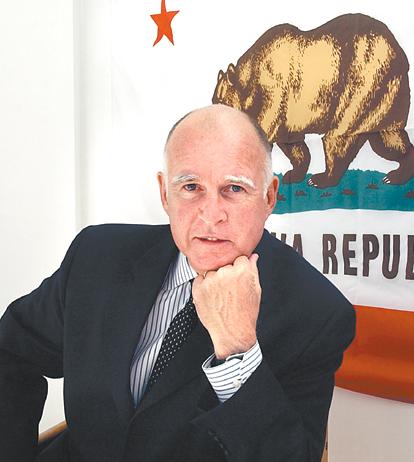
Well, there isn’t much good news, really — Gov. Jerry just announced another $1 billion in cuts, mostly to education and services for the disabled and poor. Check out the state’s priorities: $429.6 million in cuts to education, $225 million in cuts to MediCal, In-Home Supportive Services and developmental services — and a whopping $20 million in cuts to the prison system.

Supporters of K-12 education will walk away a little happier than they expected; the direct cuts (which could have meant losing an entire week of the school year) will amount to far less, only about $11 a student. But that doesn’t include $248 million in cuts to state funding for school transportation, which a lot of district will have to absorb in other ways. In San Francisco, it’s easier for kids in middle school and high school to take Muni; in more rural areas, school buses are a bigger deal.

Missing in a lot of the MSM coverage of the midyear cuts is the fact that the state is actually spending more money than expected. As Calitics points out, that’s no surprise:

It turns out that during a bad economic period, people need more services, but in the current climate in Sacramento, getting the legislature to approve the revenues for those services is an impossible feat even for somebody with the experience of Jerry Brown.

But here’s what’s interesting. In his press conference, Brown noted that the bright spot on the state’s fiscal front was increased money coming in from Prop. 63 — a surtax on incomes of more than $1 million to pay for services for the mentally ill. Which means that there’s additional money to be made by taxing the very rich.

And the voters seem more than willing to do just that.


G-O-S-S-I-Ping with the PreZcotts

1

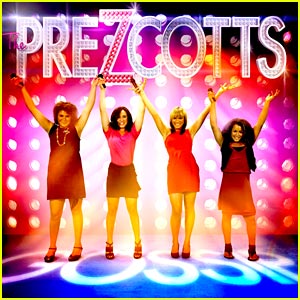
It is rare that you get a chance to kick it with a girl group in its early stages. In my admittedly paltry experience in the matter, they emerge full-grown into one’s consciousness. Blame it on lax Disney Channel-watching regime, blame it on the commercial music hype machine — typically by the time one catches wind of a Miley Cyrus four-pack, they already have their own line of hair extensions and rapt fan club. 

Which is why time was of the essence when the email from the PrezCotts‘s publicist came. “You HAVE to Check Out the Dynamite New Modesto-Based Girl Group the PreZcotts!” it preached. Unique capitalization, it was soon to be revealed, is a trademark trope of the PreZcotts’ canon.

“What I love about the girls is that they really represent what teens nowadays go through and look like,” said the email. “They avoid the artificial and sometimes overly matured look of their pop star contemporaries and stick to an empowering and inspirational message of believing in oneself and loving yourself for who and how you are.”

And so, I made a date to meet the PreZcotts. Westfield Mall food court, Monday afternoon seemed like an appropriate place and time.

Perched on some benches, the four PrezCott sisters were on their fourth trip to San Francisco with their manager, an ex-Metallica employee named Frank Munoz, who is on his first foray into the world of teen pop. They (the young women) were wearing vests and gold and pink and zebra prints, which inspired oddly maternal feelings in me. 

What road had led AnaLeyna, ChaLyn, RaNelle, and MaRiah to this sister group? What did the publicist mean by avoiding the overly matured look of their contemporaries? What was the message behind their music? Was any of this their idea in the first place?

“We want to be role models,” said AnaLeyna, who as the songwriter and oldest sister was the first to provide the answer to most questions. She’s the gang leader, clearly. “A lot of our songs are emotionally inspiring.” 

The PreZcotts get with god. They started singing in church at incredibly young ages. Their mom limited the kinds of songs they could listen to as young(er) whippersnappers. ChaLyn mentions that she is the only one who does not believe in evolution in her high school science class (but doesn’t preach contrary theories, at least not in the interview: “I don’t understand how it happened really, I’m not a scientist.”)

As Christians, they’re a bit leery of the scandalizing nature of pop culture. “We try and keep it honorable and appropriate,” AnaLeyna said. When asked how they will avoid the pitfalls of celebrity, a la Miley’s pole dancing or Lindsay Lohan’s… well, everything, the PreZcotts seemed sure that family and their religion will keep them on track. Of those who have fallen before: “They must be under so much pressure, like they crack or something,” AnaLeyna reasoned, graciously. The PreZcotts talked about their faith candidly, a remarkable feat in an interview with a Guardian reporter that gave one the impression that maybe no one has vetted the publication before the interview. 

But they do seem ready to take their family vessel to the top, these sisters. They want to bolster kids their ages through tragedies, share with them what happened when their own dad passed away (his face and birth-death dates adorns their debut album’s liner notes). 

Guardian photo by Caitlin Donohue

His passing hasn’t been the only rough spot for the girls from Modesto. All four of them have had to deal with bullying — AnaLeyna had to be homeschooled when the harassment got to be too much at her school. “MaRiah always feel like she doesn’t have any friends,” the eldest PreZcott told me, MaRiah quickly turning her face away at the statement. “Gossip” is AnaLeyna’s response to bullying. “It really is affecting people everywhere.”

Though at times the girls seemed unsure of how to answer questions, they haven’t been shoved into a gimmick yet. You get the impressions that their songs are comprised of things that they actually think need to be said. 

But I’m sure it was Munoz who suggested that the girls cover a Metallica song. 

The song features the PreZcotts and Japanese guitar prodigy Yuto Miyazawa. Through a neat trick, it was published on the Metallica Youtube channel, where at the time of writing it has recieved over 31,000 views. But as it is a Youtube video, it has Youtube comments — and reading through them after my interview with the girls it makes me wanna bash heads. Bullies! 

“A lot of the Metallica fans were pretty teed off that a teen pop had covered the song — they were the ones commenting,” said Munoz. The girls seemed a little distressed, so we had a satisfying conversation about how people can get real pigheaded when they’re anonymous on the Internet. 

The PreZcotts’ album smells like strawberries. 

Packaged in pink and images of the girls in lights, its materials have been infused with a strawberry scent that persists a day or so past the time you tear off its shrink wrap. 

The reason for this, Munoz explained to me, is to counteract the younger generation’s tendency to listen to all their music in Internet single form. Indeed, when I asked the PreZcotts what their favorite albums were, I was met with little more than searching stares. (Later we ascertained that some of their favorite artists were Alicia Keyes, Disney pop princess Selena Gomez, and Mariah Carey — though many of these singers release some songs deemed inappropriate by the girls). 

As their publicist had promised me they would, the PreZcotts asked if I’d like to hear them sing something acappella. I said I would, and a few minutes later, in the middle of the mall, I am treated to a private concert. 

“What do you guys want to sing?” asked AnaLeyna. “I want to sing ‘Free Your Mind’ by En Vogue.” Her sisters were fine with that choice, and without losing all of their endearing awkwardness, they start to harmonize like pros. Well, because they are, of course. “We’re here to tell you it’s okay, things happen.” AnaLeyna told me. “No matter what the latest fashion trend is, be yourself.” 

Should Occupy pull back and reinvent itself?

14

Maybe it’s time for the Occupy movement to simply take a bow, step off the national stage for now, and start planning its next big production. Because at this point, Occupy has been a smashing success – winning over its audiences and key critics, influencing the national debate – but it’s in danger of losing that luster if its lingers too long in its current form.

Consider the events of this week. When OccupySF’s long-standing encampment was finally removed by police and city workers, the general public barely noticed or reacted. Unlike during previous police raids, hundreds of supporters didn’t pour in to defend the camp and social media sites didn’t light up with messages of indignation and solidarity.

Why? Well it’s not because people don’t support the movement. Polls have consistently shown most people back Occupy, and even higher percentages support its basic message that the 99 percent are being screwed over by the 1 percent. Top political leaders at every level – Mayor Ed Lee, Gov. Jerry Brown, and President Barack Obama – made statements and speeches this week that echo the themes and ideas that Occupy has injected into the national dialogue.

But the tactic of occupation was only going to get us so far. It was a great way to start a conversation and demonstrate a broad discontent with this country’s inequities and plutocratic excess. Finally, the people have started to challenge those who are exploiting them, and it’s been particularly exciting to see young people fighting to reclaim their stolen futures.

That energy hasn’t dissipated, and it’s interesting to see it morphing into other campaigns, such as the recent takeovers of vacant foreclosed homes, the human rights march planned for tomorrow, and West Coast port shutdown scheduled for Monday. But I predict the crowds blockading the Port of Oakland will be a fraction of the size of the tens of thousands who took to the streets during the Oakland General Strike on Nov. 2.

Then, people were reacting to police violently crushing Occupy Oakland’s peaceful political assembly on Oct. 25, a galvanizing event, much like the raid on Occupy Wall Street and the abusive police tactics against occupiers on the UC Berkeley and UC Davis campuses. Each example showcased the police state’s willingness to use a heavy hand against peaceful protesters, demonstrating for a global audience what an important struggle this is and what we’re up against.

Yet it was hard to summon up much indignation over this week’s raid on OccupySF, even as protesters complained about being given just five minutes to get out and having their belonging seized and destroyed. Mayor Lee had been threatening the raid for weeks and had offered the group a free new home in the Mission – an offer they probably should have taken, one that would have allowed the group to declare victory and have a base of operations throughout the winter.

But unlike my cranky, “you kids get off my lawn” colleagues in the mainstream press, who have consistently derided the movement and valued anti-camping laws over the core constitutional right to peaceably assemble to petition for a redress of grievances, I think Occupy has been extremely important and effective. My desire is to see it evolve and continue.

Mayor Lee and other city officials have praised the goals and worldview of Occupy at every turn, even as they oppose the tactic of camping. As Police Chief Greg Suhr raided OccupySF, he told reporters that “part of the 99 percent removed part of the 99 percent to give the other part of 99 percent some relief,” tipping his hat to Occupy’s basic paradigm. Gov. Brown echoed Occupy’s economic inequity language in his call for higher taxes on the rich this week.

“I’m here in Kansas to reaffirm my deep conviction that we’re greater together than we are on our own. I believe that this country succeeds when everyone gets a fair shot, when everyone does their fair share, when everyone plays by the same rules. These aren’t Democratic values or Republican values. These aren’t 1 percent values or 99 percent values. They’re American values. And we have to reclaim them,” Obama said in his big speech this week, embracing the Occupy paradigm even as he tried to transcend it. But go back and read the whole speech and you’ll see that it would have fit right in during any Occupy General Assembly, with its regular calls to tax the rich, something this movement has given him the political cover to more forcefully advocate.

So the conversation has now begun, thanks largely to this movement. But, as most supporters of Occupy already know, our elected officials won’t simply enact the reforms we need on their own. They will need to be pushed and prodded relentlessly by a restive public, so the supporters of Occupy still have a lot of work to do.

How will they do that and what will it look like? I don’t know, but after watching these smart, creative, courageous, and committed young people and their supporters change the political dynamics of this country over the last three months, I’m anxious to see what they come up with and I stand read to chronicle and support the next phase, whatever it’s called and whenever it begins.

Occupy movement targets foreclosed homes

14

Throughout the Bay Area on Tuesday (Dec. 6), Occupy activists and housing advocates launched what they said will be an ongoing effort to place families back into their foreclosed homes, seizing bank-owned homes to put pressure on the banking industry to cooperate with homeowners in loan trouble.

In San Francisco, San Jose, and Oakland, activists highlighted the nation’s foreclosure crisis by occupying foreclosed homes as part of the Occupy movement’s national day of action against foreclosures. Occupy Oakland activists said the tents are gone in downtown Oakland, but the move toward house occupations represents a new phase for the movement.

“I am here fighting for my home,” said Margarita Ramirez, addressing a crowd of 150 supporters at the West Oakland BART station. Ramirez said her family fell behind on their mortgage payments after her husband was laid off at the onset of the recession. The Ramirez family applied for a loan modification under the federally subsidized Home Affordable Modification Program(HAMP) hoping for some relief, but their lender, Bank of America, denied their request. Though HAMP is a federal program, it is administered though individual mortgage lenders.

According to Ramirez, with time left before her foreclosure, Bank of America urged them to explore other options to save their home. Then, inexplicably, Bank of America sold her home to Fannie Mae, leaving her family out of options despite what Ramirez says is Bank of America’s later admission to the error and willingness to work with the family. Fannie Mae however has held firm that the sale was valid, leaving the Ramirez family in an uncomfortable comprise of renting their own home.

In order to pressure Fannie Mae on behalf of the Ramirez family, activists with Occupy Oakland and Just Cause seized a vacant Fannie Mae owned foreclosure at 1417 Tenth street in West Oakland.

“This house is owned by the federal government, who we pay taxes to,” said Occupy Oakland activist Thaddeus Guidry, who said that he had struggled hard to get by during the recession. As he stood over a grill cooking hotdogs for the crowd gathered in the yard of the newly occupied house, he said he had found new inspiration and hope after becoming part of Occupy Oakland.

“Tonight will be the first night here in the house,” said Guidry. “This is my home now. We hope to house eight people here.”

Fannie Mae, which was effectively foreclosed on by the U.S. Treasury in 2008 under a process know as conservatorship, has received $169 billion in federal bailout money and remains under federal control.

The house on Tenth street is modest but spacious, with electricity and water. Downstairs, Just Cause is getting ready to start an eviction defense clinic. Just Cause organizer Maria Zamudio told the Bay Guardian that the group holds regular eviction defense clinics in San Francisco and Oakland, but the freshly occupied house in West Oakland would serve as a community space that people can drop into to learn their rights.

“We have been doing eviction defense for a long time. Since the recession, we have seen a change to tenants being pressured to leave by banks after landlords lose a house to foreclosure,” said Zamudio. “It is important for tenants to know that they do not need to leave a foreclosed property. The tenant has more rights in these situations then the homeowner.”

Only blocks away, Gayla Newsome stood in front of her house at 1536 Adeline St with another crowd of supporters from Occupy Oakland, and housing advocates from the Alliance of Californians for Community Empowerment(ACCE). She has been out of the house for six months after the foreclosure, leaving her and her children to stay with family in an overcrowded situation as the house sat vacant.

“This is the moment I take my house back. I’m a little scared, a little nervous, but I have to do this for my kids and grandkids. I have to do this for the other people who are going through this,” said Newsome.

Newsome said Chase Bank repeatedly denied receiving her HAMP loan modification paperwork. When she finally sent a copy by certified mail, they acknowledged the application and denied her eligibility in the program.

The eviction came swiftly. Unaware of the looming eviction, and believing she still had time to save her house even though Chase was outside the HAMP program, Newsome was called by her children while at work the morning of July 19.

“The kids were given 10 minutes to grab what they could before they were put on the sidewalk in their pajamas by the bank representative and the sheriff. They called me frantic,” recalled Newsome.

The recession has been hard on West Oakland. One out of 236 houses in West Oakland are in foreclosure, with many more families hard-pressed to hang on. Housing advocates say that foreclosures destabilize entire neighborhoods, as surrounding property values plummet and blight spreads.

“I’m not just here personally to reclaim my house, I’m here to say it is time to reclaim this neighborhood,” said Newsome, who laid the blame for the neighborhood’s sharp decline at the feet of the banks.

Residents of the neighborhood gathered for the rally shared stories of realtors cruising the neighborhood stopping to photograph even properties that are not in foreclosure or for sale.

“This was not an accident, this is redlining,” said Nell Myhand of Just Cause about West Oakland’s housing troubles.

“It’s time to take this to the politicians,” said ACCE organizer Shirley Burnell. “If they are not willing to help us, then they got to go. We will take them to the streets.”

Outside, activists signed up for shifts to help defend Newsome’s home from eviction, and started an emergency phone tree in case of trouble.

“The tents are gone but we are still here!” yelled an Occupy activist from the crowd as home defense clipboards circulated.

“I appreciate everyone doing this with me,” said Newsome. “That’s what Occupy is all about. We will take our homes back one at a time – no, five at a time.”

Cult wonder

0

tredmond@sfbg.com

LIT If you’re shopping for that special thriller fan on your list, you might want to pop an I.O.U. into his or her stocking: the best thriller of the year doesn’t hit bookstores until Dec. 27.

That would be The Innocent (Crown, 336 pp., hardcover $24) by Taylor Stevens, who came out of nowhere to hit the New York Times bestseller list with her first novel, The Informationist. Stephens back with the same series character (Vanessa Michael Munroe), the same edgy but brilliant prose, and a plot that takes us into the real — and chillingly autobiographical — world of an abusive apocalyptic cult.

That’s where Stevens grew up: she was born into the Children of God, where nobody was allowed more than a fifth-grade education, adults took sexual advantage of teenagers, young women were forced into prostitution (all in the name of recruiting new members), and adults were almost as frightened to leave as to stay.

There’s a bit of a J.K. Rowling story here: Stevens started writing The Informationist when she arrived in Houston with her then-husband and two kids. With no job skills, just out of the cult, her family was living on minimum-wage jobs, barely scraping by — and after buying a Robert Ludlum book at a garage sale, she decided to write a thriller. “I was really, really just scraping by, it was horrible,” she told me in a recent phone interview.

“Selling The Informationist changed everything.” Although the money from the bestseller hasn’t fully trickled down to her, “if I want to buy something for the kids, It’s actually possible now.”

The Informationist introduced the world to Monroe, who is slight, sexy, and moves back and forth easily between male and female appearance. She kicks serious ass, speaks 22 languages and peddles black market information. Her childhood was harsh; she spent her teens living with a violent gunrunner in Africa, but the wildness and the pain were the only elements of Stevens that made it into the first book.

Yet Stevens told me she had to write about the cult world at some point. “People keep asking me what my life was like,” she said. “So I can tell them — if you want to know what it was like growing up, read this book, that’s what it was like.”

The characters, she said, are fictional, “but everything that happens in the book happened to someone.”

The Innocent is set in Buenos Aires. A five-year-old girl named Hannah is snatched and brought into the world of The Chosen, led by a charismatic figure known as The Prophet who refers to the world outside the cult at The Void.

Hannah’s father has been searching the world for her, and discovers that the cult is hiding her in Argentina. He convinces Munroe to go in and get her. That involves slipping into the world of the cult herself — and in the process, Stevens shows us a life that very few people have ever experienced. Among the most painful elements: Once Hannah is rescued, she isn’t sure she whether she wants to go back.

Along the way, of course, is vintage Michael Monroe action, including an escape from four armed men in a locked warehouse. (Munroe is better with a knife than most mob thugs.)

The Innocent, for whatever reason, isn’t as raw as The Informationist. There’s less blood and less intense violence. And Monroe is developing as a character — the cold face that she showed us last time is mellowing a bit, and in The Innocent, she even kinda, sorta falls in love. Maybe.

There’s always a challenge in continuing-series characters, and writers have struggled with it since the advent of the modern pop-culture novel. Ian Fleming got bored of James Bond after a few books, and you could tell. John D. MacDonald let Travis McGee get old before his time. Robert. B. Parker never let Spenser change much, but he was Spencer, and that was always enough. Lee Child is struggling to keep Jack Reacher from becoming a caricature of himself.

Stevens is still in the early stages; she told me she’s not even sure where Monroe is going next. Which is why, I think, The Innocent works, and the next one will work, too — you really sense that the writer is growing with her protagonist in this, the best thriller series in a long time.

Cruel revolution

0

cheryl@sfbg.com

LIT “As one survivor told me,” author Julia Scheeres writes in her introduction to A Thousand Lives: The Untold Story of Hope, Deception, and Survival at Jonestown (Free Press, 320 pp., $26), “nobody joins a cult.”

I remembered this refrain, possibly spoken by the same survivor, from Stanley Nelson’s 2006 Jonestown: The Life and Death of Peoples Temple. Recent works like Nelson’s film and Scheeres’ book suggest perceptions about Jonestown are shifting away from sensationalism. The broad strokes are well-known: a charismatic, maniacal preacher; a jungle settlement; over 900 people dead, including a Congressman; a vat of poisoned punch. But the story — explored in A Thousand Lives as a deeply disturbing human tragedy on a nearly unthinkable scale — neither starts nor ends there.

Scheeres, who keeps an office in the San Francisco Writers’ Grotto, pored through recently-released FBI files while researching A Thousand Lives. “The FBI released its files on three CDs, without a real index. So a letter that started on CD one, page 20, could end on CD three, page 350,” she remembers. “Organizing the material — 50,000 pages of documents — a lot of it was really boring shipping manifests. Crop reports. But then, oh, hey! Here’s a memo from the camp doctor discussing with [Jim] Jones how they’re gonna kill everyone.” Building from this material, the book focuses on five Peoples Temple members and views the experience of Jonestown through their eyes.

“[I chose my subjects] based on whether they were still alive, and I was able to interview them at length, or whether they had left a lot of primary source documents behind,” she says. “I also wanted to talk about the different demographics of the church, so you have old, young, black, white. A woman who has an MFA from San Francisco State, and a young black man with a GED from Oakland.”

Though A Thousand Lives does offer some background on Peoples Temple founder Jim Jones, “I wanted to know what it was like to be a rank-and-file member of the church,” Scheeres says. She uncovered powerful evidence that Jonestown was not a mass suicide, as the unfortunate phrase “drinking the Kool-Aid” suggests. Instead, she says, “it was a mass murder.”

As suggested by that sinister memo from the camp doctor, A Thousand Lives’ most startling revelation is that Jones had been fixated on killing his followers long before the events of November 18, 1978. According to Scheeres, he considered loading his congregation onto buses and plunging them off the Golden Gate Bridge, or onto a plane “and having someone shoot the pilot.” (Eerily, he even sent one of his followers to flight school in preparation.)

Soon, though, he was consumed by the idea of Jonestown: “a new society in the middle of the virgin jungle, a utopia that would be free of sexism, racism, elitism, and all other evil-isms,” Scheeres writes. The promises of Jonestown echoed Jones’ seemingly progressive message of equality, which is what attracted most Peoples Temple members to the church in the first place. It was also what had endeared Jones to San Francisco politicians, who were in awe of his ability to “mobilize thousands of people to vote,” according to Scheeres.

But in reality, “he had no desire to see his followers flourish in South America. He was already fantasizing about their deaths. Would his people die for him if he asked them to?” Turns out they had no choice. While she was writing A Thousand Lives, Scheeres took a trip to Guyana and visited what’s left of Jonestown.

“It’s remote, dense jungle,” she says. “Everything looks the same. It would be so easy to get lost. And as you’re walking through, you can hear things slithering in the leaves. Jim Jones told [his followers] that if they tried to escape, they’d be killed by ‘mercenaries’ — really, his sons that were [hiding and] shooting on the camp — or they would be killed by the jungle animals.”

Of course, when they left San Francisco, more or less willingly, Peoples Temple members — like Scheeres subject Hyacinth Thrash, an elderly African American woman who dreamed of a place where racism didn’t exist — expected to find a “utopia,” as they’d been promised.

“[Jones] was so suave and gentle in San Francisco, and would tell you what you wanted to hear, like the ultimate caring father figure. Then once he got down to Jonestown and had everyone trapped there, he just turned. You can hear him on those tapes just screaming, you know. ‘You old bitch, you’re gonna die!’,” Scheeres shudders. “The rank-and-file had no idea that he had this ideation of ‘revolutionary suicide’ until it was too late. They couldn’t escape. They were surrounded by guards holding crossbows, and behind them, a circle of guards with guns, and basically told, ‘If you don’t drink the poison, we’re going to shoot you.'”

Though she has no direct personal connection to Jonestown, Scheeres’ own background, detailed in her 2005 memoir Jesus Land, made her an unusually sympathetic outsider. “The interests aligned: race, religion, seclusion. When I was a teen, my brother and I were sent to this religious reform school in the Dominican Republic, where all of our communications with the outside world were censored, where all of these horrible things were happening that we couldn’t let anybody know about,” she says. “Obviously my situation wasn’t as bad [as Jonestown]. The head of the school wasn’t goading us toward revolutionary suicide. But the whole sense of powerlessness and feeling trapped and helpless — I could identify with that.”

Decades later, Jonestown continues to fascinate; dozens of books have been written by survivors, relatives of survivors, conspiracy theorists, cult experts, and scholars of macabre history. A Thousand Lives — meticulously researched, and written with clear-eyed, sensitive perspective — is a valuable resource for readers seeking truth, not misinformation, about the tragedy.

“Most people under 40 probably don’t remember Jonestown well, if at all. But most people have heard the phrase ‘drinking the Kool-Aid.’ I find that phrase very offensive, because they didn’t drink the Kool-Aid. First of all, it wasn’t Kool-Aid, it was Flavor Aid. Second of all, they were forced to drink the poison. ‘Drinking the Kool-Aid’ implies naïve, stupid, not thinking, kind of dumb, following the leader, and not questioning. And they were questioning. That’s what my book argues throughout,” the author says. “They argued with Jones: ‘We didn’t come down here to die. We came down here for a better life for ourselves and our kids.’ So I think ‘drinking the Kool-Aid’ needs to be excised from the cultural lexicon.”

What’s more, “I hope people will reconsider the conclusions of Jonestown after reading the book,” Scheeres says. “I think it’s a tremendously compelling tale; 918 people died that day, as a result of Jim Jones, and younger generations need to be cognizant of that. Again, he had his people trapped in Guyana, so by the time they were saying, ‘I want to go home’ — and that’s another heartbreaking thing, was finding all these notes from people to Jim Jones, saying ‘I want to go home. I want to go back to San Francisco. I hate it here. I’m miserable. My children are afraid and I don’t know how to tell them that death is a good thing’ — [it was too late]. Reading all of those notes, these voices have been silenced. Now, finally, I feel like I am the loudspeaker, or their medium for letting their voices be heard. It’s too late [to save them]. They’ve been dead for 33 years. But for the record — they did not want to die.”

www.juliascheeres.com


Get read!

0


ROCK AND ROLL ALWAYS FORGETS

By Chuck Eddy

Duke University Press

352 pp., paper, $24.95

Chuck Eddy glides through music criticism like a grumpy fanatic. Each article included in Rock and Roll Always Forgets — culled from Eddy’s vast back catalogue of music journalism articles, beginning with the early 1980s — is packed with cultural references, touchstones, facts, witty asides, a dash of snark, and acknowledgments of once-obscure acts. Yet, he approaches each band like he’s the first to have discovered it. He’s a musical anthropologist, but also, archeologist, digging up the remains of musicians past, lest we forget. Take a piece on a Marilyn Manson show, written in 1996. More than simply describing the stage and the crowd (which he does, expertly: “[they] wore too much black makeup, but they didn’t scare me — most seemed to be upper-middle-class Catholic school teens from the burbs…”). He wanders near profundity, dissecting Manson’s overall persona, his ticks, his own cultural references, and those who came before him, namely Alice Cooper, but a great many more. Most importantly, Eddy alludes to why that all matters in the least. (Emily Savage)


TROPIC OF CHAOS

By Christian Parenti

Nation Books

295 pp., hardcover, $25.99

Through historical research and on-the-ground reporting in Kenya, war-torn areas of Afghanistan, and other regions marked by intense conflict, Christian Parenti offers an unusual and compelling analysis of violence through the lens of the environment. Tropic of Chaos: Climate Change and the New Geography of Violence teases out the idea that increasingly unstable weather patterns stemming from climate change have fueled conflict throughout impoverished areas of the Global South. In the savannahs of northwest Kenya, for instance, deadly cattle raids have intensified as intertribal warfare heats up in the face of water scarcity. Recurring droughts and floods in Afghanistan have made it exceedingly difficult for farmers raise traditional crops, making them increasingly reliant drought-resistant poppy — the raw ingredient for heroin — for economic survival. Parenti also turns a sharp eye upon the repression, surveillance, and counterinsurgency that first-world nations have employed to combat growing violence in water-scarce, conflict-ridden regions, and calls for a more enlightened approach. (Rebecca Bowe)


CAFE LIFE SAN FRANCISCO

by Joe Wolff

Interlink Books

224 pp., paperback $20

Small quirks in this guide to the city’s cafes and coffeehouses — the sixth in a series that includes Sydney, New York, and Venice — will let you know its not strictly, strictly for locals. Java Beach is lumped in with more gearhead-oriented Mojo Bicycle Cafe and Ninth Avenue’s Arizmendi Bakery is filed under the catchall “Sunset District and vicinity.” The introduction’s discussion of “San Fran” versus “Frisco” versus “the City” is one that became boring long ago. But those things matter little. In-depth histories of some of your favorite cafes, from Java Beach to Philz’ to Caffé Baonecci are lucid looks at the facts and rewards of small entrepreneurship in the city. And Roger Paperno’s loving photography of velvet crema and foccacia sheets combines with words to create an ode to the city’s third spaces that any caffeine-laptop addict will appreciate in their stocking. (Caitlin Donohue)


LIONS OF THE WEST: HEROES AND VILLAINS OF THE WESTWARD EXPANSION

By Robert Morgan

Algonquin Books

497 pp., hardcover, $29.95

Biography can be the best history; stories of the people who changed the world (for better, and often for worse) are more compelling than turgid texts of dates and places. Lions of the West recounts the development of the American frontier from the end of the Revolutionary War to the Civil War era through the lives of 10 men. Yeah, all men. In fact, Morgan (by choice or by the longtime bias of American historians) makes it appear as if all of the great and evil deeds done as the nation moved Westward Ho were the province of the male of the species. At times, the profiles are a bit over the top (I don’t really care that much about Kit Carson’s personal life.) Overall, though, it’s a detailed, lively, and informative book that minces no words, especially when discussing the theft of much of the southwest from Mexico. San Franciscans will enjoy learning who Stockton, Sloat, Castro, Winfield, and a few other streets were named after. (Tim Redmond)


VHS: ABSURD, ODD, AND RIDICULOUS RELICS FROM THE VIDEOTAPE ERA

By Joe Pickett and Nick Prueher

Running Press

272 pp., paper, $14

Found Footage Festival founders and comedy writers Joe Pickett and Nick Prueher are apparently the Indiana Joneses of VHS, unearthing remarkable video package cover art that would otherwise be relegated to hoarder basements, bonfires, and anywhere else the worst (a.k.a., the best) videotapes go to die. I salute these dudes, even though the captions they tag each page with aren’t always funny or necessary. Truly, the covers (soft-focus and garish, tacky and baffling) speak for themselves, direct dispatches from ye olden days, long before YouTube brought WTF-ness to anyone with an Internet connection. You see, children, back in the 1980s or 90s, home viewers had to seek this shit out: instruction in squirrel-calling, chair-dancing, seduction, hairstyling (“What the Heck Am I Going to Do With My Hair?”), baby-proofing, spotting counterfeit Beanie Babies, etc. Straight-to-video masterpieces (F.A.R.T.: The Movie). Horrible exercise fads (“Bunnetics: The Buttocks Workout”). Well-meaning but also ghoulish-looking self-improvement vids (“Face Aerobics”). Every page is magical. Your mind will be blown. (Cheryl Eddy)


BI-RITE MARKET’S EAT GOOD FOOD

By Sam Mogannam and Dabney Gough

Ten Speed Press

297 pp., hardcover, $32.50

Bi-Rite Market is the ultimate neighborhood grocery. Shockingly small (with ambition to expand), it’s jam-packed with the best in organic produce, meats, cheeses, and artisan food products, much of it local. Now, Bi-Rite founder Mogannam has a new book loaded with recipes for such inviting delectables as white bean puree with prosciutto crespelle and strawberry rhubarb pie. But don’t relegate it to the cookbook category. Hewing to Bi-Rite’s mantra of creating community through food, the authors share extensive tips on shopping seasonally and locally for the healthiest and best-tasting products, no matter where you may live. You’ll learn what to look for at the grocery, storage and usage tips, and more. Well-illustrated sections feature produce (broken down by season), wine, beer, cheese, deli meats, butchery, baked goods, and even farmer profiles. Bonus: stay tuned for Sweet Cream and Sugar Cones, Bi-Rite’s ice cream and frozen treats recipe book from its renowned creamery, out this April. (No word yet on whether it’ll tell us how to beat the ever-present line outside.) (Virginia Miller)


DAMNED

By Chuck Palahniuk

Doubleday

247 pp., hardcover, $25

Welcome to Hell, as seen through the eyes of 13-year-old Madison Spencer, the daughter of a jet-setting yet eco-hyperconscious movie starlet and philanthropist. This is Dante’s Inferno meets The Breakfast Club, a film that overtly informs the plot and its main characters. As in Palahniuk’s breakout novel Fight Club, it’s hard distinguish between reality and perception as Maddy leads readers past the Vomit Pond, across Dandruff Desert, and right into Satan’s black Town Car. As she recalls her final weeks on earth, you’re pretty sure that she didn’t really die from a marijuana overdose. Clearly, things are not what they seem as the novel looses an American teenager’s perspective on modern life in both the underworld and earthly realm, with wry commentary on everything from pop culture and capitalist excess to the defeated religions whose fallen gods roam Hades. The gags alone — like the telemarketing and chatroom porn the damned deliver to Earth, and Hell’s endless loop of The English Patient — make this a tough book to put down, all the way to its slightly unsatisfying conclusion. (Steven T. Jones)


BEST AMERICAN COMICS 2011

edited by Alison Bechdel

Houghton Mifflin Harcourt,

352 pp., paperback $25

Chris Ware’s textbooky flowcharts; Angie Wang’s Technicolor, spiraling pistil-armed super-flower-heroine; Peter and Maria Hoy’s intricately plotted cause-and-effect grid art — the sixth year of this hardcover assemblage of the year in superlative strip art soars as a holiday gift for your fave comic nerd. Visual trickery and innovative page staging aside, many of the graphic narratives in this book hold up on plot alone. An excerpt from Kevin Mutch’s Fantastic Life effectively mines zombie philosophy, dating paranoia, and begging drinks off your service industry friends for comic gold. Many of the best pieces, perhaps indicative of the graphic novel mood these days, explore the darker side of the human psyche. But what graphic novel fan is unfamiliar with complicated? (Caitlin Donohue)


THE TIPSY VEGAN

By John Schlimm

Lifelong Books/Da Capo

164 pp., paper, $17

Every time I think we’re past the stereotype of the sullen, uptight vegan, I get another comment like, “Wait, don’t you only eat vegetables?” Why yes, I do eat plenty of veggies, but I also eat decadent dishes such as The Tipsy Vegan‘s Party Monster Pancakes, loaded with the sweet nectar of amaretto and drenched in syrup. This book is a carnivorous teetotaler’s nightmare, boasting 75 boozy recipes stuffed with everything from “beer to brandy” for the liquor-loving vegan cooks among us. It’s not, as I initially imagined, a book on vegan cocktails — that would be far too easy. Written by John Schlimm (Ultimate Beer Lover’s Cookbook), a member of “one of the oldest brewing families in the United States,” the book includes booze-infused treats for parties, brunch, and supper: fried avocados, slur-baaaaked peaches with Cointreau, “Bruschetta on a Bender” — all of which kind of sound like stoner food to me. An nice touch: glossy food porn shots on every page. (Emily Savage)


PROJECT DOG

By Kira Stackhouse

self-published

352 pp., hardcover, $34.99

Local photographer Kira Stackhouse experienced an inspiration so intense that she ditched her high-profile marketing job to pursue it: she would photograph specimens of the 50 most popular canine breeds officially registered with the American Kennel Club (“purebred dogs”) that had been purchased from professional breeders — and pair them with photos of the exact same kinds of dogs found in local dog rescues and shelters. The purpose was to start a dialogue about the effects of professional breeding and highlight the many kinds of dogs available for adoption (and also to change peoples’ perceptions about rescue dogs). But a major part of the story — and what makes this book so fantastic — is the wonderful doggy photography and sumptuous layout. Dogs are posed, or pose themselves, against iconic Bay Area backdrops, accompanied by often hilarious, always revealing, biographies and profiles. Project Dog became an online sensation: this book cements its reputation. Available at www.projectdog.net. (Marke B.)


LISTEN TO THIS

By Alex Ross

Picador

384 pp., paper, $18

In the expanded paperback edition of his absorbing and erudite collection of essays, Alex Ross of the New Yorker writes what could be called his mantra as critic: “I have always wanted to talk about classical music as if it were popular music, and popular music as if it were classical.” Ross listened exclusively to classical until he was 20, something he admits may sound “freakish.” But whether he’s describing Björk in her recording studio in Iceland, or composer John Luther Adams’ sound and light installation in Alaska, Ross draws from an immeasurable well of knowledge and plunges into his subject with gusto. He can find commonalities between Radiohead’s “Pyramid Song” and Stravinsky’s Firebird Suite, clear away the myths that have clouded both Franz Shubert and Bob Dylan, and thoroughly explain why OK Computer and John Cage’s 4’33” are equally astonishing. Informative, eye opening, Ross is every lover of music thrown harmoniously into one. (James H. Miller)


MY FAMILY TABLE

By John Besh

Andrews McMeel Publishing

272 pp., hardcover, $35

To know anything about New Orleans’ dining scene is to know John Besh. As one of Nola’s great chefs, he has a number of restaurants, including the acclaimed August, elevating local cuisine in forward-thinking ways. His original book My New Orleans is a striking post-Katrina tome to one of the greatest cities in the world and its vibrant culinary history. It’s a gorgeous coffee table volume packed with photos of the region’s people, places, and foods — more than 200 recipes from Mardi Gras specialties to gumbo, many with a contemporary twist. Besh just released, My Family Table, with welcoming, everyday recipes he cooks with his family that are healthy, fresh, simple, and heartwarming. Besh’s star power (Iron Chef champion and James Beard award-winner that he is) never dominates. Like New Orleans, it’s a visually beautiful book, but this time themed by “School Nights,” “Breakfast with my Boys,” and recipes like “Curried Anything” or “Creamy Any Vegetable Soup.” Closing with the key element of cooking, the communal, he writes: “If asked what my last meal would be, I’d reply, ‘Any Sunday supper at home, cooked with love, for people I love.'” (Virginia Miller)


FOUR SEASONS OF YOSEMITE: A PHOTOGRAPHER’S JOURNEY

By Mark Boster

Time Capsule Press

128 pages, hardcover, $34.95

John Muir would have loved this book, the spectacular result of a passionate love affair with Yosemite National Park involving all of the principals in this impressive project. Muir helped glorify and preserve Yosemite with his voice and pen. Robert Redford, who fell in love with Yosemite as an 11-year-old boy recovering from a mild case of polio, wrote an eloquent introduction to the book. Photojournalist, Mark Boster was smitten by the beauty and grandeur of the Yosemite when he first visited the park as a child with his family. He spent a year in the park detailing its seasonal changes in more than 100 magnificent pictures. “I felt the breezes, analyzed the light, listened to the sound of the rivers and falls, and tried to capture the images that moved me,” he writes in his introduction. Catherine Hamm’s delicate haiku add a poetic touch to many scenes. (The two principals who brought this project to life with loving care are Narda Zacchino, a former editor of LA Times and the Chronicle, and Dickson Louie, a former executive at both those papers. Zacchino serves as publisher and editor and Louie as president and CEO of Time Capsule Press, which specializes in creating books by using the archival content of newspapers and magazines.) Available at www.fourseasonsofyosemite.com (Bruce B. Brugmann)


THE PDT COCKTAIL BOOK

By Jim Meehan

Sterling Epicure

368 pp., hardcover, $24.95

Few bars have made as much impact on the New York cocktail (and thus the international) scene than PDT. Known as an early mover in the speakeasy trend, PDT revives classic recipes and invents new ones in the classic spirit. Bartender Jim Meehan put PDT on the map, and he’s since gone on to write about drink and educate bar managers and tenders everywhere. In the PDT Cocktail Book, he shares more than 300 cocktail recipes in a comprehensive collection inspired by classic tomes like The Savoy Cocktail Book. There are recipes from generations of hard-working bartenders, tips on glassware, bar tools, equipment, garnishes, techniques, a listing of seasonal ingredients, even a spirits primer. In keeping with PDT’s connection to neighboring Crif Dogs who serve creative dogs in the bar, there’s a section of hot dog recipes from big-name chefs who are regulars at the bar, including David Chang (Momofuku), Wylie Dufresne (WD-50), and Daniel Humm (Eleven Madison Park). From the comfort of home, cook up a Mason Dog fried in cornmeal and huitlacoche (corn smut/fungus, a Mexican specialty) to go with the Little Bit of Country cocktail, which mixes bourbon, maple, and jalapeño. (Virginia Miller)


EVERYTHING IS ITS OWN REWARD: AN ALL OVER COFFEE COLLECTION

By Paul Madonna

City Lights

240 pp., hardcover, $27.95

Like Ben Katchor’s classic “Julius Knipl, Real Estate Photographer,” local artist Paul Madonna’s “All Over Coffee” — published every Sunday in the Chronicle and on essential Web zine The Rumpus (www.therumpus.net) — draws me into a psychic space that is at once serene and troubled, surreal and hyperreal. The effect comes as much from the drawing style as the dreamlike non-narrative: both are direct descendants of Winsor McKay’s “Little Nemo.” Madonna gets an extra chills-up-the-spine boost from his illustrations of semi-familiar San Francisco architecture and intersections, lucid as etchings of bleached Kodachrome shots. For this second collection of the strip, he broadens his nib to include not only the City by the Bay, but Paris, Rome, Buenos Aires, and Tokyo. Overheard quotes, snatches of philosophical discourse, interior monologue snippets, existential doubts, random observations, and short stories are floated over the images to capture a peculiarly lovely eddies in the zeitgeist.


I DON’T WANT TO KILL YOU

By Dan Wells

Tor

320 pp., paperback, $11.95

Some of this is sick shit. You need a warped sense of humor and a love for random violence to enjoy the tale of a young man who lives with his mom in a mortuary and fights a demon made of black goo who takes over the minds and bodies of humans. But it’s a different type of thriller — complete with its own kinda sweet moments of teenage love and angst — and it’s packed with great detail. (Did you know that undertakers use Vaseline to fill up bullet holes? Cool.) John Wayne Cleaver, perfect name for a demon hunter, is a sociopath who is beastly to his mother and can’t get along with the other kids . Except for a super-hot chick who he thinks must be a demon, otherwise why would she like such a loser geek? The demon is nasty and gouges out eyes, cuts off tongues, sticks bodies on poles … you gotta check it out. (Tim Redmond)


RICE AND CURRY: SRI LANKAN HOME COOKING

S.H. Fernando, Jr.

Hippocrene Books

224 pp., paperback, $19.95

After a tongue-inflaming visit to the East Village’s fantastic Sigiri restaurant in NYC a couple weeks back, my interest in — and lust for — spicy Sri Lankan treats like kiri hodhi (coconut milk gravy), rossam (coriander-tamarind broth), kool (seafood soup), Jaffna goat curry, and ulundu vai (savory donuts) was, er, inflamed. Fortunately for me, author “Skiz” Fernando recently spent a year on the island rediscovering his roots and delving into the varied cuisine (later serving as a guide for that cheeky culinary colonist Anthony Bourdain). The punchy, informative Rice and Curry is the result, and includes nice introductions to Sri Lankan geography and history, as well as tips on what to stock in your cupboard to achieve the certain Sri Lankan “oomph” that sets the cuisine apart from Indian. A particular passage that profiles Leela, Fernando’s aunt’s ancient maid, offers some real insight into the island’s food tradition and customs — and yields a marvelous, corruscating crab curry from her hometown of Chilaw, just in time for Dungeness season. (Marke B.)


HEDY’S FOLLY: THE LIFE AND BREAKTHROUGH INVENTIONS OF HEDY LAMARR

By Richard Rhodes

Doubleday

261 pp., hardcover, $26.95

An author best-known for his 1986 Pulitzer-winning The Making of the Atomic Bomb, Richard Rhodes might seem like an unlikely biographer for movie stunner Hedy Lamarr, who lit up Golden Age films like Cecil B. DeMille’s 1949 epic Samson and Delilah. But her above-average qualities (she was called “the most beautiful woman in the world”) extended beyond the superficial. After escaping her gilded-cage marriage to an Austrian munitions magnate, Lamarr found success — and five more husbands — in Hollywood; between roles, she started inventing “to challenge and amuse herself.” During World War II, she got serious about her hobby. Showbiz circles led her to avant-garde musician George Antheil, renowned for his groundbreaking composition for 1924 short Ballet Mécanique. As Rhodes writes, “[Lamarr] began thinking about how to invent a remote-control torpedo to attack submarines just at the time she met Antheil, who knew quite a lot about how to synchronize player pianos.” Together, the “charming Austrian girl” and “the bad boy of music” worked on that torpedo, as well as “spread-spectrum radio,” an innovation that paved the way for contemporary wireless technology. Unlikely? Yes. Fascinating? Indeed. Never underestimate a beautiful woman — or a skilled writer’s ability to humanize complicated characters and bring drama to a tale loaded with tech-speak. (Cheryl Eddy)


COME, THIEF

By Jane Hirschfield

Knopf

98 pp., hardcover, $25

As it happens, one of Bay Area poet Jane Hirschfield’s passages currently adorns the famous Kahn and Keville auto repair shop’s marquee in the Tenderloin: “What some could not have escaped/ others will find by decision/ each we call fate.” Well, you could never blame her for not thinking big. As a well-known and approachable poet, she sports a blurb from O, The Oprah Magazine on this, her ninth collection, the first in six years since releasing her arresting After. And while her slightly witchy, be-scarved, grandiloquent persona screams marketable poetess, there’s some understated magic in her latest poems. These ones are full of plums and glass and vague Zen spells that give off, in their overall effect, an rueful, anticipatory sigh. Some childlike wonder seeps in: “Another year ends./ This one, I ate Kyoto pickles,” says “Washing Doorknobs,” my favorite from the collection. “But one thing you’ll never hear from a cat/ is Excuse me” goes “A Small-Sized Mystery.” Sometimes you can almost Hirschfield her straining for ambiguity, the poems’ heavy life lessons tearing through her delicate webs of observation. Still, each poem here showcases Hirschfield’s incisive power. (Marke B.)


PLENTY

By Yotam Ottolenghi

Chronicle Books

287 pp., hardcover, $35

Recently I returned to London, eating my way extensively through the city. One of my gustatory highlights was Yotam Ottolenghi’s beloved bakery and restaurant, Ottolenghi (with four locations). Not only were his baked goods otherworldly delights, his straightforward but elegant dishes using pristine ingredients were among the freshest and satisfying of my London travels. Plenty, his new cookbook, is a cleanly designed book with vivid photos of recipes like broccoli gorgonzola pie and mushroom herb polenta. Most impressive? Ottolenghi’s recipes are 100% vegetarian. The meat-free aspect is barely emphasized, and one feels no lack in the diverse range of flavors (with Middle Eastern influences) presented. Since 2006, Ottolenghi has penned the UK Guardian’s vegetarian column — and he’s not even a vegetarian! This speaks to how respected he’s become as a chef in his use of veggies and grains. Plenty shows this talent off, but most importantly delivers approachable, easy-to-replicate recipes to tickle our palates. (Virginia Miller)


HILLBILLY NATIONALISTS, URBAN RACE REBELS, AND BLACK POWER

By Amy Sonnie and James Tracy

Melville House

201 pp., paper, $16.95

Gazing back in time to the era when the Black Panthers were serving up free breakfast to low income youth and coming into the crosshairs of COINTELPRO, few may be aware that an interracial coalition of radical organizers included a contingent of poor white southerners bent on fighting capitalism in solidarity with communities of color. Written by a cofounder of the Center for Media Justice and a longtime San Francisco housing activist, this detailed bit of radical history spotlights the organizing efforts of poor whites, transplanted from rural Appalachia to the low-income Uptown neighborhood of Chicago, to build coalitions of poor people in solidarity with civil rights leaders. Groups like Jobs or Income Now (JOIN), the Young Patriots, and Rising Up Angry launched campaigns against neglectful landlords and cops who brutalized their youth. They represented the white arc of the multiracial Rainbow Coalition, initiated by the Black Panthers in Chicago as “a code word for class struggle.” Bizarre as it may seem, “It became common to see [Panther] Fred Hampton ‘give a typically awe-inspiring speech on revolutionary struggle, while white men wearing berets, sunglasses, and Confederate rebel flags sewn into their jackets helped provide security for him.'”

(Rebecca Bowe)


MR. KILL

By Martin Limon

Soho Press

376 pp., hardcover, $24

Korea in the 1970s. The United States has 50,000 troops in country, mostly near the Demilitarized Zone, and they don’t always behave. In general, the Korean authorities allow the military to police its own — but when a young Korean woman is brutally raped on a train to Seoul, and the assailant appears to be an American, all hell breaks loose. Martin Limon lived in Korea for ten years, and he does a (fairly) good job of presenting a portrait of the Cold War tensions between the two supposed allies. There’s a little bit of American bias — the author is former military himself — and his potrayal of Korean society isn’t as sensitive or oddly loving as John Burdett’s descriptions of Thailand in the Bankok 8 series. Limon’s great storytelling and his lively and compelling protagonists, Sergeants George Sureno and Ernie Bascom, pull readers past those issues. Perfect gift for someone who likes international crime thrillers. (Tim Redmond)


THE RECIPE PROJECT

By One Ring Zero

Black Balloon Publishing

116 pp., hardcover, $24.95

It’s part cookbook, part music journalism, part rock opus, and hell, part coffee table book. The Recipe Project (subhead “A Delectable Extravaganza of Food and Music”) is a concept spearheaded by New York-based gypsy-klezmer act One Ring Zero. The band’s co-founders, Michael Hearst and Joshua Camp, created songs using the recipes of well-known chefs (Mario Batali, Isa Chandra Moskowitz, Chris Cosentino) as the word-for-word lyrics. The meals themselves served as musical influence; each recipe inspired a different sound. While the songs are not likely ones you’d listen to say, on a long lonesome drive, they do have a glint of childlike glee. It’s conceptual. The true genius of this project is its overall cohesiveness. It’s an all-in-one package. Follow the recipe, listen to the song, get some interesting background factoids. The Recipe Project also includes full recipe playlists, articles by rock journalists, and some pretty interesting interviews with chefs. (Emily Savage)


CARY GRANT: DARK ANGEL

By Geoffrey Wansell

Arcade Publishing

192 pp., hardcover, $24.95

Back in print (it was originally released in 1996), this paen to the dapper star of North By Northwest (1959), An Affair to Remember (1957), Notorious (1946), His Girl Friday (1940), and approximately 10 zillion other classic films is somewhere between a biography and a coffee-table book. It’s worth picking up for the lavish black-and-white photos alone, illustrating the span of Cary Grant’s career with film stills, behind-the-scenes shots, and the occasional almost-candid image (did he ever take a bad picture)? The accompanying text is straightforward, but — as its title suggests — doesn’t shy away from Grant’s well-documented countercultural experiments. (“Grant became so enthusiastic about the value of LSD that he extolled its virtues during the shooting of his next picture.”) Nor does it gloss over Grant’s vices (he smoked 30 to 40 cigarettes a day) and sometimes troubled personal life (he was married five times). But the book’s chief focus is Grant’s brilliant career. As Stanley Donen, who directed him three times, remarks to author Geoffrey Wansell, “He’s thought of as a man who achieved a certain elegance and savoir faire. But in truth he was a fantastic actor.” (Cheryl Eddy)


NATURAL HISTORY OF SAN FRANCISCO BAY

By Ariel Rubissow Okamoto and Kathleen M. Wong

University of California Press

352 pp., paperback, $24.95

Drag queens, beat poets, burlesque dancers, hyphy rappers, dot com techies — the human species of the Bay Area have been well-documented, but information on the non-human dwellers of the bay itself has been left to scattered guidebooks, obscure blogs, and academic sources. Authors Rubissow Okamoto and Wong have collected a wealth of biological and environmental information in their book, published this November. The cross-country saga of the striped bass, the hidden beauty of eelgrass, the varied contentions of the California water wars are presented in highly readable, easily digestible sections. The emphasis here is on environmental impact and recent conservation developments — I did not know that it’s officially dangerous to eat more than one pound a month of fish from the bay! — and the history of decades of restoration triumphs and setbacks is related sleekly and straightforwardly. Absorbing all the information in this illuminating primer helped me appreciate the seething loveliness and churning forces that make up the place I call home. (Marke B.)




Hey, hey, Hayes

0

virginia@sfbg.com

APPETITE For years, Hayes has been a strong dining neighborhood. Absinthe, Arlequin, Suppenkuche, the Blue Bottle garage are stalwarts. Recent additions Boxing Room and Nojo beautifully diversify Hayes’ cuisine. A slew of newer eateries have arrived, especially on the tiny lot known as the Proxy Project (www.proxysf.net), an open air setting for the new Biergarten, Smitten Ice Cream, and Ritual Coffee. I’m into Proxy’s funky, industrial areas sectioned off by chain-link fences. However, I don’t find the waits often associated with Biergarten worth it, nor Smitten’s ice cream near as delicious as the fun of watching it being made in liquid nitrogen machines.

One of the best shops I’ve been to in years is just-opened Gourmet and More. French owners stock the store predominantly with French grocery goods, from ciders to foie gras (the latter at least for now). There’s a charcuterie station with meat slicer, and an enchanting little refrigerated cheese room, including gems like a camembert from Calvados (a region in Normandy), soaked in calvados (apple brandy from the region). A local Frenchman makes L’Artisan Macarons (www.lartisanmacaron.com), selling them here individually or by the box — I tried the eggnog and pumpkin ones.

I’ve just about given up on visiting new kiddie studio-cafe, Seesaw (www.seesawsf.com). With minimal hours (Fri-Sun), it seems to be closed or booked with a private party each time I’ve come by to try the unusual offering of Danish Smørrebrød (“butter and bread”): open-faced pumpernickel rye with topping choices like egg salad or herring. Kids, or rather, their parents, sure seem to like the place.

Here are some other new Hayes Valley spots that are rising to the top:


PEACEFUL TEA RETREAT, SURPRISING DIM SUM

Taste (535 Octavia, SF. 415-552-5668, www.tasteteasf.com) is an Asian tea house with soothing atmosphere serving impeccable teas in a gaiwan (personal covered bowl) with housemade baked goods, run by husband and wife team (she’s the baker). Early stand-outs include soft, grassy Misty Mountain tea from Jiangxi, China ($5 gaiwan, or $8 gong fu cha for sharing). Dim sum staples like pork buns ($2.50) are OK, but unusual items shine. A red bean wheat bun ($2.75) and veggie curry wheat bun filled with potato, carrot, cabbage ($2.75) taste both healthy and comforting, warm with a dreamy, doughy texture. Tea plays prominent in pu-er macarons ($1.75), while scones are made with fresh tea leaves ($2.50). I like the earthy oolong version.

To sample more for less than it costs individually, try tea pairings for one ($18), two ($38), or three ($58) people. Order for one includes gaiwan tea, three steamed buns, one scone, two macarons, one sesame ball, and an exotic fruit bowl. Pure bliss.


SEXY EURO-STYLE CAFE WITH APERITIFS AND BOOKS

What: One of the charming sisters behind Two Sisters Bar and Books (579 Hayes, SF. 415-863-3655, www.2sistersbarandbooks.com) greets you as you enter this narrow strip of a cafe, lined in classic wallpaper, with a cozy window seat, a handful of small tables, and a tiny bar — all bathed in early jazz music and inspired by European travels (including a bookstore in Krakow, a cafe in Vienna, and a bar in Paris), mixed with Brooklyn funk and NorCal roots. Perfect for a casual date or performance aperitif, this is the kind of neighborhood cafe I’ve been waiting for.

Sans full liquor license, the sisters offer inspired amaro-, beer-, and wine-based cocktails. The Iggy ($7) is a salty aperitif of silky Punt e Mes vermouth and grapefruit juice with salt rim. Port of SF ($7) is likewise refreshing with Madeira, lime, ginger, and Pilsner beer. For a husky Manhattan stand-in, go with The Duke’s Son ($9): Amontillado sherry, Carpano Antica vermouth and bitters. Food is made with care in a tiny kitchen. A blanched brussel leaf salad ($8) is my dish of choice. Freshly laden with creamy French feta, cherry tomatoes, and roasted corn, it sings in lemon vinaigrette. Savory bread pudding ($6) is made with fennel, tomato, Manchego cheese, roasted garlic, and black truffle oil.


EAST COAST SPIRIT IN A CALIFORNIA BISTRO

Debuting two weeks ago, Dobbs Ferry (409 Gough, SF. 415-551-7700, www.dobbsferrysf.com) comes from restaurateurs with an East Coast background (Dobbs Ferry in Westchester County, NY, is the hometown of two of the owners). Executive chef Mike Yakura, formerly of Ozumo Restaurant Group www.ozumo.com, helms: they’re dubbing the place a “California bistro” with “small town” New York cooking. The three-room space is decorated in muted browns and black with white walls.

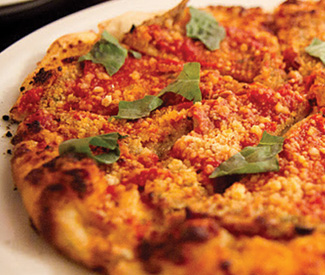
Skip the unbalanced cocktails, and head for the dishes. Salads are crisp and straightforward. Eggplant parm pizza ($14) is a pleasant pie of breaded eggplant and basil. Kudos to my waiter for offering extra red sauce: without it the slices are too bready. Crispy sweetbreads ($12) over mustard sauce with bacon are unexpectedly satisfying, while a juicy half ($22) or whole ($35) chicken scarpariello somehow evoked childhood. (Half is enough chicken for two, with gently fried potato cubes like elevated tator tots, Molinari Italian sausage, sweet peppers and a peperoncini for good measure. The broth is the clincher: tart, zingy, savory, it ties the whole uniquely comforting dish together.

Subscribe to Virgina’s twice-monthly newsletter, The Perfect Spot, www.theperfectspotsf.com


Live Shots: Dan Deacon at New Parish

0

You go to Dan Deacon in a bad mood – a no-good-reason sort of bad mood, where you’ve been sleeping a lot just to turn it off. (Works for a while, until the stress dreams start.) And even though you’d seen this guy a few times before, you have doubts about the show. Do you really enjoy the music, the high-pitched, manic indie electronics with screeching chipmunk vocals over it? Has he progressed enough as an artist to make a return worthwhile, or enough to brave the crush of an amped up, teenage and hyper crowd?

And once inside the New Parish, Deacon’s fan base seems even younger than last time. There are even old stone-faces seated in comfy chairs along the balcony, obvious school-night-in-Oakland chaperones for the giddy kids below. Peter O’Connell — one of the openers along with locals Chasms and Nero’s Day at Disneyland — plays off this crowd, asking and answering, “You know what I hate?” “Parents.”

A lovably buffoonish, intentionally bad comedian who comes to the stage pre-doused with sweat and proceeds to spill pocket change at every opportunity, O’Connell hails from Deacon’s Wham City performer collective, and shares the inept genius DIY-crap aesthetic. As with the late night oeuvre of Tim and Eric, there’s a silly, winking method to the mindlessness that appeals alternately to both the perma-stoned and a simple pre-pube/acid sense of cartoonish fun. 
 

To stand outside, it’s easy to dismiss much of what’s going on as gimmicky. (Or to look down from above, and think somebody needs to have that D.A.R.E. talk when they get home.) Deacon, a grizzly hipster geek king of a man, performs down in the crowd, an array of multicolored controllers and keys set up on a folding table. At one side is a precariously rigged tower of brilliant strobes capped by a neon green skull, lights that don’t seem to just accompany the music but race it to a more spastic tempo (a one-two punch that knocks every concrete thought out of your head.)

Sometimes these lights are all that can be made out, as the crowd, in full on mob mode crushes closer. “I can see this is going to be one of those shows,” Deacon says, narrowly avoiding being crushed between the stage and his equipment, another night of hurt legs and resorting to performing on the other side, equipment turned upside down, until security shows up to give him some space.  

There’s not much room around him, and nowhere for a jaded observer to stand. Deacon — more happy cult leader than the pious religious figure that his name and the location suggests — lays out the performance with interactive elements: contests and interpretive dance numbers led by audience members (a couple of costumed gnomes, tonight,) telepathic renditions of “Happy Birthday,” multiple requests to “take a knee for a sec.”

It’s basically peer pressure. Give in and before you know it you’ve crawled/danced through a human tunnel — stretching out the door, through the patio, back across the floor and upstairs to the balcony — and come out the other end, where you’re holding hands in the air with a red-headed woman you’ve never seen before as the two of you giggle like school children. An old, forgotten feeling, and refreshingly better than sleeping.

The She’s on Girls, Women’s Audio Mission, and soccer practice

0

The She’s have opened for Girls, played with Thao with the Get Down Stay Down, and this month, released an infectious, surfy garage-pop debut album, Then It Starts To Feel Like Summer (the record release show is this Saturday at Bottom of the Hill).

Oh, and the band members – bassist Samantha Perez, vocalist Hannah Valente, guitarist Eva Treadway, and drummer Sinclair Riley – are all juniors in high school. But don’t diminish their talent by seeing She’s as a novelty, “young, all-girl band.” They’ve got the chops. I got the lowdown from the Bay Area quartet after school this week, discussing playing against stereotypes, life with punk parents, dream shows (hint: they’ve already played theirs), and kindergarten enemies.

San Francisco Bay Guardian: What were the first concerts you attended?
Hannah Valente: One of the first concerts we attended as a group was Blondie at the Fillmore. It was really inspiring to see a woman with such a powerful voice.
Samantha Perez: For me, I went to a lot of punk shows with my parents growing up because they were in the punk scene. It inspired me to begin playing music because I love the atmosphere and energy at shows.
SFBG: When did you start playing music and what influenced that?
Eva Treadway: We all grew up with music around us, both from our parents and also from growing up in SF. I was raised on a mix of old country blues records from my dad and Grateful Dead jams from my mom, which, come to think of it, is an interesting mix. As a kid I was crazy about the Beatles, and that was what really sparked my interest in picking up a guitar. I asked my parents for lessons and I had my first few lessons when I was about 10. When I started songwriting with the other members of the band, making music got really exciting for me again. Because we all come from different musical backgrounds – there was by no means Grateful Dead in Sami’s household growing up – but we also share really similar ideas and tastes in music.
Sinclair Riley: I started playing piano when I was about seven, then a few other classical instruments, but I didn’t start playing drums until the beginning of The She’s. My dad had a Beach Boys CD that he would always play in the car when he was driving, and I always liked driving with him so that I could listen to it because it was so much more interesting to me, I loved it so much more than anything I was playing on piano.
SP: I started playing guitar when I was seven years old. I was really resistant to play guitar, but my dad bought me a pink daisy-shaped one, so I got into it. As the years went on, I liked it more and more and then I started to sing in the San Francisco Girls Chorus, but I really wanted to start writing songs and start preforming.
HV: I was really influenced by my dad. He always seemed to be playing guitar around the house, so I just started singing with him. When I was like, three, I would sing with him while I took baths. I always liked music because it helped me connect to people. I’m shy, so it’s nice to have another way to communicate.
SFBG: How did you meet?
SP: We all met in kindergarten, and we were really close friends except me and Eva. We were enemies. In fifth grade we started playing music together and through that we became closer friends. It all started one day after soccer practice when Hannah said she had learned to play the Aly & AJ version of “Walking on Sunshine.” Eventually, the whole soccer team was in the band, but in the end it came down to just us four.
SFBG: Can you tell me a little about the process of making Then it Starts to Feel Like Summer?
SR: It was a pretty long yet satisfying process. About half the songs we already had written, and the others we wrote during the process of recording. It was so wonderful to get the opportunity to record at Women’s Audio Mission. It was really fun being in the studio and getting to take our time on this one. On this album we tried to capture the sound of what we play live. The ladies there are so nice and also taught us a bout the engineering aspect as well.
SFBG: What influences your sound? Who influences you personally?
HV: We are said to be a cross between the Ramones and the Ronettes, we really like the Beach Boys and other ’60s garage music. We’re always listening to new types of music, like ’60s country, local bands, and of course, pop.
ET: We’re influenced by going places and walking around San Francisco.
From listening to great songs, Lennon/McCartney of course, Brian Wilson, George Harrison, Phil Spector, even Britney Spears. Pretty much everything Christopher Owens from Girls writes I find inspiring.
SFBG: Where do you write music? Is it a group effort?
SR: Normally what happens is someone will bring in a guitar part or a melody or some part of a song, and we’ll all work together in our practice area (Hannah’s basement) to finalize the song – add lyrics, harmonies.
SFBG:  What’s been the most surreal experience thus far in the band? The weirdest?
HV: Hand’s down the most surreal show was playing with Girls at the Fillmore. Not only did we get to play with one of our favorite bands to listen to, but we also got to play on a stage where so many inspirational artists have performed.
SP: Playing at such a historic venue was unbelievable. The audience was great, the sound was great, the food backstage was great…it just really couldn’t have turned out any better. On the other hand, the weirdest experience we’ve had was probably when we were asked to play on TV on an early news broadcasting at like, 5 a.m.. We stayed the night in San Jose on a school night so that we could get to the studio at 3 a.m. and still be on time for school. However, we just happened to be there the same day that the San Bruno pipelines exploded, which meant our segment was canceled. It was a long, sleepy ride to school that morning, but at least we looked TV ready for all our peers!
SFBG. Who would play your dream show?
HV: Our first dream show would be to play with Girls, but then that actually happened. Then I would say to play with Magic Kids, but that also happened. After that, it would be the Morning Benders, but yes, that happened, too.
SP: Perhaps now our dream show would be with the early Beach Boys, once we build a time traveling machine, maybe that will be possible.
SFBG: Is it difficult working as an underage band in the San Francisco music scene?
EV: I think the most difficult part about being an underage musician (apart from sometimes not being allowed into to our own shows) is being treated as some sort of novelty act. It seems like a lot of times people feel that it is enough to describe our band as a “young all-girl band”, which really says nothing about our music. When people write reviews I wish they would remember that our age and gender are facts, and it doesn’t really go much deeper than that. It is true that being teenagers in the SF music scene is exciting for us. We’ve gotten to meet and even perform with some of our idols, and I know that that is something most teenagers don’t have the opportunity to do. I am proud of what we’ve done at this point in our lives, both as a band and as individuals and I feel fortunate to know what I am passionate about early on. The way I see it, it only leaves us time to grow.
SFBG: Is the She’s an intentionally all-female band?
SR: Not really, it just happened. We formed the band at that age when boys have cooties, and it’s been no boys ever since. We get treated differently since we’re a young all-girl teenage band though, and it’s made us stronger. We can go against the stereotype that girls and teenagers aren’t as capable as others.
SFBG: Do you consider yourselves feminists?
HV: We want women to be taken more seriously in the whole music industry. Every step of the way, our album was made by women. We hope to inspire other girls to get involved in this industry because women are way underrepresented.

The She’s
With Tijuana Panthers, Melted Toys
Sat/3, 10 p.m., $10
Bottom of the Hill
1233 17th St., SF
(415) 621-4455
www.bottomofthehill.com

Clark shadows

0

TRASH If you were around in the waning days of drive-ins and urban grindhouses, the heydays of video stores and 1980s late-night cable, or were a Mystery Science Theatre 3000 fan, the name Greydon Clark might ring a faint bell — maybe even a warning bell.

For 25 years Clark was a prolific independent director, writer, producer, and even bit-part actor in the realm of low-budget exploitation movies designed for quick playoff in second-run theaters, graveyard-shift broadcast slots, and on rental shelves. Most were retreads of well-worn genre trends, a couple outright imitations of recent hits; they rarely hit the radar of mainstream critics, let alone awards-giving bodies — not even the Golden Raspberries. Though his last two features were futuristic adventures, Clark himself was relegated to cinema’s past by the turn of the millennium, having “aged out” in a business where an obsession with youth trickles down even to the least prestigious off-camera creative roles.

Now just short of 70, Clark is still around, selling memorabilia on his website, appearing at fan conventions, and the like. This Friday he’ll be at the Roxie for a Midnites for Maniacs tribute triple-bill featuring rare 35mm screenings of features long out of circulation.

First up is 1978’s Hi-Riders, a hybridization of then-current Smokey and the Bandit (1977) knockoffs and the earlier biker-flick vogue that’s one of his most enjoyable films. Frequent Clark collaborator Darby Hinton and busy stunt performer (through 1997’s Titanic) Diane Peterson are the nominal stars of a raucous action cheapie that pits muscle-car aficionados against each other, then against trigger-happy yokels ordered to kill by a vengeful fat cat who proclaims “Animals like that should be exterminated!” Acting pitched at a 10 on the hysteria scale, skinny dipping, and good crashes involving an actual bitchin’ Camaro ensue.

This is followed by Joysticks (1983), a prior Midnites for Maniacs midnight selection that remains a giddy high-lowlight in the short-lived 80s subgenre of movies about videogaming. How can it miss, with Porky’s-style gags, a hero named McDorfus, secondary “punk” villain King Vidiot (played by Napoleon Dynamite’s future Uncle Rico), and a theme song Tipper Gore might have taken exception to (“Jerk it left, jerk it right, shoot it hard, shoot it straight, video to the maaaaaax!!!”)?

Last and quite possibly least is 1982’s Wacko, one of several Airplane!-like slasher spoofs at the time. Its genial flailing about in search of laughs ropes in several of Clark’s favorite falling stars (Joe Don Baker, Stella Stevens, George Kennedy) and one future celebrity (pre-“Dice Man” Andrew Clay, as Fonz-y high school stud Tony Schlongini). If you were 10 years old (or 15 and stoned) in 1982, this was probably the funniest thing ever. So regress already.

But this selection offers just the tip of the native Michigander’s celluloid iceberg. Driving west on a whim in the 1960s, Clark managed to score work as both an actor and scenarist with Z-budget multihyphenate role model Al Adamson, including the incredible Satan’s Sadists (1969) and incredibler Dracula vs. Frankenstein (1971).

Those experiences empowered him to direct, co-write, and act in 1973’s The Bad Bunch (Kiss The Establishment Goodbye was one of several alternative titles), a drama of Vietnam War-era racial tensions that was shot in Watts for less than $15,000. It was clumsily crafted and crudely melodramatic, but serious-minded enough — despite gratuitous boobs and opening song “Honky Mutha Nigga Lover” — to set him on a more determinedly commercial, costs recouping path from then on.

Thus 1976’s Black Shampoo, an outrageous blaxploitation cash-in on Warren Beatty’s heterosexual hairdresser lothario hit, followed quickly by the unforgettably named (if otherwise forgettable) Satan’s Cheerleaders (1977), tentacled-alien-Frisbee-creature horror Without Warning (1980, with a very young David Caruso as one victim), and so forth. They inevitably featured once-hot, now economically-priced Hollywood names of a certain age (Clu Gulager, Jack Palance, Yvonne De Carlo etc.), attractive youngers mostly never to be heard from again, and Clark regulars like actress spouse Jacqueline Cole. (The fact that so many of his actors and crew came back for more suggests that he’s a pleasant guy to work for.)

Some of these movies actually require the MST3K treatment they got (i.e. 1985 Joe Don vs. Mafia shoot ’em up Final Justice) to be watchable. Some, like 1990 psychological thriller Out of Sight, Out of Her Mind or 1980 sci-fi fantasy The Return (a rare upgrade to then-current B-level stars in Cybill Shepard and Jan-Michael Vincent), didn’t get it and aren’t.

But others are inspirationally silly, with enough hints to make it clear that their creator was in on the joke. Probably the most widely seen of his films is acknowledged camp classic The Forbidden Dance, one of two lambada movies released on the same day in 1990. It stars former Miss USA and future Mulholland Drive (2001) enigma Laura Harring as an Amazonian tribal princess who comes to Beverly Hills (accompanied by “witch doctor” Sid Haig) to attract attention to rainforest destruction via the healing power of public ass-grinding. All this and an ozone depletion message make it Clark’s Inconvenient Truth, just as The Bad Bunch was his Crash.

Less socially conscious but equally nuts are Uninvited (1988), in which a yacht full of the expected veteran actors and hot young ‘uns are terrorized by a mutant lab-experiment cat puppet; and Russian Holiday (1992), a daft espionage thriller with Susan Blakely as a tourist haplessly playing Nancy Drew amidst Moscow neck-snappings.

Then there’s 1989’s Skinheads: The Second Coming of Hate. Its hilarious racist, sexist, swastika-emblazoned goon squad makes the mistake of pursuing clean-cut “good” kids into the wilderness lair of survivalist Chuck Connors, who fought in World War II and knows just what to do with a buncha neo-Nazi scum. It’s pretty much the Reefer Madness of Reagan-era fascist punk gang movies (1982’s Class of 1984, 1984’s Savage Streets, etc.) — a category that surely calls for its own Midnites for Maniacs tribute.


“MORE FUN THAN GAMES! A TRIBUTE TO GREYDON CLARK”

Fri/2, triple-feature starts at 7 p.m., $12

Roxie Theater

3117 16th St., SF

(415) 863-1087 www.midnitesformaniacs.com

Astral projections

0

arts@sfbg.com

THEATER A savage and seductive performer with a potent skill set, Erin Markey has been busy these last several years conquering New York’s downtown performance scene. But she’s no stranger to San Francisco. The rising 30-year-old performance artist, actor, and playwright credits visits to the Bay Area with some formative experiences, including her introduction to pole dancing — subject of her acclaimed one-woman play, Puppy Love: A Stripper’s Tail — and the invention of her drag persona, Hardy Dardy, the Michigan patriarch of her new multimedia, multi-character musical solo show, The Dardy Family Home Movies by Stephen Sondheim by Erin Markey. So it’s fitting as well as plain badass that the new piece receives its world premiere here, this week, under the auspices of the San Francisco Film Society’s KinoTek program.

Why SFFS? Markey was last out in San Francisco in 2009, on a bill with Beth Lisick and Tara Jepsen, when Film Society programmer Sean Uyehara saw her and was floored. “I thought, ‘This woman is going to be famous,'” remembers Uyehara, who describes Markey’s ferocious ability to woo and alarm and audience at almost the same moment. He stayed in touch. Later, Markey’s proposed Dardy Family piece, which avails itself of several screens for live camera feeds and pre-recorded video projections, made it a candidate for KinoTek, Uyehara’s bailiwick — though he admits it’s the most theater-like piece SFFS has taken onboard since initiating the cross-platform programming stream in the mid-aughts.

“We’re presenting a play, essentially,” says Uyehara, adding, “It’s based around this idea of home movies and how these home movies interact with a ‘normal’ Midwestern family. So I could see the potential for a hybrid program developed out of that.”

Markey, reared in the South and Midwest, studied theater and gender studies at the University of Michigan, where renowned NEA Four performance artist and faculty member Holly Hughes became a critical influence. Today she enjoys a growing reputation as an intensely charismatic shape-shifter in the queer performance and cabaret scenes, and a sharp and daring actor at large (her turn in an intimate, site-specific production of Green Eyes, a violent and erotic Tennessee Williams one-act, won her raves at last January’s Under the Radar Festival, in a production now headed to Boston.) I spoke with Markey by phone from New York about the background to The Dardy Family Home Movies.

San Francisco Bay Guardian You’ve said you became a stripper to save money to move to New York, but were inspired by the pole dancers you’d first seen in SF. It almost sounds like a post-graduate program for you in performance. Was it a big adjustment?  

Erin Markey It was a big adjustment. The dynamics between the girls that work there are really complicated. I knew I was leaving, so I had a different relationship to it than most. But it was hugely influential. It’s such an isolated, specific, weird context, with arbitrary sets of rules that you can only figure out by doing it wrong. It was almost the perfect thing to do for somebody who was studying queer studies and theater practice as well. It was constantly surprising me, and defying everything that I was reading about, in terms of feminism. Because there are camps — people being pro-porn or anti-porn, for example.

But it’s just so complicated. There’s almost nothing else to do but make creative work around it, just to reflect and acknowledge how complicated it is. I think it does that work much more service than being just “for” or “against.” The experience really changed my relationship to storytelling. Performing there feels really similar to performing for any crowd. But in that context you never know what exploitation means, if you’re being exploited or if you’re exploiting them because you’re affecting this interest. It feels similar to acting and doing cabaret and stuff like that. So I tried to tease out what felt the most sincere, even if it was really absurdist and ridiculous — that feels most sincere sometimes. Those just go in and out: being really absurd and being hard and real.

SFBG Can you explain who the Dardys are?

EM Actually, maybe 10 years ago, I don’t remember when, but in San Francisco I went to a drag king competition. There was a workshop, and I took it. We were all making drag king characters. I used to sing a little song in my head all the time, like a gibberish song: “hardee, dardee, hardee, har …” So I just decided to name my guy Hardy Dardy. He ended up being my go-to drag persona. He’s actually been in almost every show I’ve ever made on some level, even if he wasn’t named as Hardy Dardy. He was in Puppy Love, and he was in a show that I made about being my sister’s maid of honor.

He had his own show called The Curse, which was talk-show style. During that show, I ended up having to flesh out more of his life. His wife was first introduced in Puppy Love, actually. He mentions briefly that he went to the strip club when he got upset one day. So Molly became his wife, and I became very interested in her. She’s definitely not my mom, but she could be very good friends with her. I started making the Dardy Family Home Movies based on Molly’s experience mostly — her dealing with her kids leaving home, and having to re-understand her entire identity. I watched my mom go through that. All she wanted to do was be a good stay-at-home mom. It’s not like other professions where the older you get supposedly the higher up you get in the ranks, and the more you become what you wanted to be in the first place. You prepare these children to leave and be good people, and then they leave.

SFBG It’s sort of built-in obsolescence.

EM I thought about that a lot when I thought about the women at the strip club — how they depreciate in value over time, because youth is a really important part of making money in that context. It seems like this dark cloud hanging over these women’s heads. As an actor, I know what the value of being young is in this industry. It hangs over our heads as well. This show [includes] the conversation between Molly and her daughter, Kelly — who’s “a lot like me,” heh, heh — and who’s ultimately talking about being a performer. These things I’m talking about aren’t crazy explicit [in the show] necessarily. It’s a family of characters that I’ve been developing over years. But in the subtext of everything, this stuff is definitely there. 

THE DARDY FAMILY HOME MOVIES BY STEPHEN SONDHEIM BY ERIN MARKEY

Through Dec. 11

Fri.-Sat., 8 p.m.; Sun., 6 p.m., $15

SFFS New People Cinema

1746 Post, SF

www.sffs.org

The food divide

4

news@sfbg.com

Antonia Williams is part of a slow, quiet food revolution. After battling obesity for much of her adult life, the 26-year-old lifelong Bayview resident did some research. “I realized it had a lot to do with the food I consumed,” she told us. “As a result of growing up in the neighborhood, I suffer from obesity. I’m overweight because of the lack of options for good healthy food.”

“It’s what I grew up on, McDonald’s and a lot of fried food for dinner,” she recalls. “The grocery stores in the area were very limited in what they offered. I believe my parents weren’t as educated or aware” about health and nutrition.

Williams managed to escape this bad foods trap, change her personal diet, and now works as a “food guardian” for the nonprofit Southeast Food Access (SEFA), helping to bring more nutritious fare to the Bayview.

The complex of challenges Williams faced simply to eat well—the fast food all around her, the dearth of grocery stores, and lack of awareness—reflects the array of systemic barriers to good food that keep tens of thousands of San Franciscans in chronically poor health.

Under the weight of recession and double-digit unemployment, San Francisco’s chronic food divide has grown deeper and wider. From regions of the city like Bayview, Excelsior, and other Southeast neighborhoods, to seniors surviving on marginal fixed incomes, to the city’s swelling unemployed and underemployed who rely on food pantries, access to fresh food is a daily geographic and economic battle.

Roughly one in five San Franciscans each day has no reliable source of adequate sustenance and must scramble for food from soup kitchens, food pantries, or other “emergency” supplies that have become a structural part of the city’s food system, according to the San Francisco Food Bank.

Each month, more than 100,000 families rely on the Food Bank to help feed themselves — nearly double the amount from 2006. Economic recession has dramatically increased the number of city residents using food stamps (known as “CalFresh”) each month, rising from 29,008 in 2008 to 44,185 in 2010.

Yet even that rise belies a far deeper need: only 47 percent of those qualifying for CalFresh are actually accessing benefits, according to a data analysis by California Food Policy Advocates; at minimum, more than 40,000 additional city residents are entitled to get this help, and thus eat better.

Across the city, parallel economic and food divides compound one another, spelling serious trouble for people’s basic nutrition and health — in turn depleting their energy, cognition, and ability to do everything from succeeding in school to getting a job.


BEYOND GROCERY STORES

In Bayview, where poverty and unemployment run about double citywide averages, these geographic and economic food divides come to a head. District 10, encompassing Bayview/Hunters Point (BVHP), features some of the city’s most grocery-impoverished neighborhoods, and has the highest rates of CalFresh usage.

This confluence of lack and need—compounded by a prevalence of fast food and liquor stores over fresh food offerings—has inspired Antonia Williams and other residents to fight for better food in their neighborhoods.

As one of four paid Food Guardians for SEFA, Williams spends about 20 hours a week examining grocery store shelves in Bayview, talking with consumers and food retailers, and educating both about the need for more fresh non-processed foods.

One recent victory: armed with customer survey data, she convinced the Bayview Foods Co. to stock low-sodium tomato paste. Next on Williams’ food improvement list is getting more low-sodium products, less cholesterol, and more fiber on the shelves.

These may sound like small steps, but they’re part of a larger effort to get healthier food in Bayview, where chronic diseases such as obesity, diabetes and heart disease are rampant. “I think a lot of people just don’t know the link between the food we are eating and these chronic diseases,” says Williams.

The Bayview is among the city’s most food-deprived districts, with just 63 percent of residents living within a half-mile of a supermarket (in Excelsior, it’s 57 percent), compared with 84 percent citywide. That ratio improved somewhat with the arrival this August of Fresh & Easy supermarket on Third Street, but access to fresh produce remains limited — a situation that numerous studies show contributes greatly to chronic undernourishment and disease.

Indeed, statistics show Bayview area residents suffer by far the city’s “highest rates of everything negative,” as former district supervisor Sophie Maxwell puts it: obesity, diabetes, heart disease, and cancer.

Ironically, the Bayview’s Third Street is home to the city’s bustling produce warehouses, which rattle early every morning with trucks and crates full of fruits and vegetable, “but you have to go out of the district to get it,” says Maxwell, who helped spearhead a Food Security Task Force while in office. “I was very much aware of [the food access problem] because of what I had to do to get food myself.”

Much of Third Street remains a boulevard of liquor stores and fried and fast food. According to Tia Shimada of California Food Policy Advocates, “A lot of what we see instead of food deserts is food swamps, where the amount of healthy nutritious food available is overwhelmed by all the fast food and junk food.”

Despite a seemingly diverse landscape of food businesses, “There’s a saturation in neighborhoods with unhealthy choices,” SEFA’s Tracey Patterson argues. “When the cheapest choice in front of you is fatty comfort food and fast food, that’s what you get accustomed to eating. The easier options quickly become habit.”

Kenny Hill, a 23-year-old food guardian and Bayview resident, puts it like this: “What we have in our community, that’s what we eat.” But he says history and culture play a role, too. “We need to change the culture of what’s considered good…Growing up eating salad, people would say, ‘Why are you eating that? That’s white people’s food.'”

In other words, it takes more than getting a grocery store—which itself involved a nearly 20-year struggle for Bayview residents and leaders. “Food access is just one part of the issue. Even if you get a grocery store, that doesn’t solve the problem,” says Patterson, whose group, SEFA, espouses “three pillars” to fix the area’s food problems: more grocery stores; education and health literacy; and expanded urban agriculture. “None on their own is enough.”


HUNGER CROSSES LINES

Getting a job isn’t enough either, statistics show. A recent study by the USDA cited by the Food Security Task Force shows that 70 percent of families nationwide with “food insecure” children have at least one member working full-time. And in San Francisco, the task force found, “39 percent of the households that receive weekly groceries through the SF Food Bank include at least one working adult. Only 18 percent of clients are homeless.”

At least by federal definitions of poverty, food insecurity isn’t just for poor people anymore — particularly in San Francisco, where exorbitant housing and other costs compound people’s struggles to meet their food needs. “If you just look at the poverty level, you’re missing a lot of people who are struggling to make ends meet,” says Colleen Rivecca, advocacy coordinator with St. Anthony’s Foundation. “Hunger and health and housing are so interconnected.”

Indeed, while the Federal Poverty Level for a family of three is $18,310, cost-of-living research by the INSIGHT Center for Community Economic Development found that in San Francisco, this family would need almost $40,000 more than that to make ends meet.

Rivecca says the ongoing recession is simultaneously deepening the food divides and undermining efforts to address it. For instance, SSI recipients must make do with $77 a month less than they got in 2009, while California is the only state where SSI cannot be supplemented by food stamps.

According to the Food Security Task Force, San Francisco “has an inordinately high number of residents who are elderly, low-income and/or blind and disabled — over 47,000 residents receive SSI.” Many are homebound, socially isolated, and living in SRO units without kitchens, and no means of preparing their own food. So it’s no surprise that these same people, who need help the most, often get it the least.

Due to “misconceptions about what qualifies,” says CFPA’s Kerry Birnbach, only 5 percent of Californians eligible for Social Security participate in CalFresh. “Senior citizens are more isolated, and the more isolated you are, the less likely you are to know about it.” Birnbach says that leads to lower nutrition, less energy, and greater hospitalization rates. “It’s not having food on the table — choosing between food and medicine.”

A 2006 study by the San Francisco Department of Aging and Adult Services found that while the city’s elders “received approximately 12.2 million free meals through all of the programs in the City including food pantries, free dining rooms, and home delivered meals, the gap between the number of meals served and the number of meals needed was somewhere between 6 [million] and 9 million meals annually.”


BAND-AID FOOD SYSTEM

As television cameras made clear on Thanksgiving, there’s no shortage of food and meal giveaway programs, soup kitchens run by churches and nonprofits — a whole constellation of ad hoc benevolence spread across the city. But this kind of “emergency food assistance” has become a structural part of the city’s dietary landscape.

Another main ingredient in the city’s food infrastructure is seemingly cheap fast food, which for many poor people becomes the diet of first and last resort. Sup. Eric Mar recalls meeting with teenage mothers and hearing one parent speak about dumpster diving at McDonald’s for what she called “fancy dinner.”

“The cheapest possible food like McDonald’s is seen as a luxury,” says Mar, who last year passed legislation preventing fast food chains from selling kids meals with toys unless they improved their nutrition content. “Poor people rely on whatever’s out there, and when McDonald’s or Burger King sells cheap, it undercuts families’ efforts to get healthy.”

District 10 Sup. Malia Cohen sees the impacts of fast food and junk food every day in Bayview. “There is no infrastructure out there to de-program people” from long-standing fast food habits. “I don’t fault people for eating fast food, but I do want them to think twice and know they have a choice.”

So what is the choice, and how will the city address its deep food divides, which cut across geographic and demographic lines?

So far, it’s a patchwork project. As one step, the supervisors in April passed a new zoning ordinance designed to encourage more urban food production. In Bayview, Cohen says, “We’re looking at urban agriculture as something that’s viable” to feed low-income residents.

Despite the arrival of Fresh & Easy, BVHP remains a critical flashpoint for the food security fight. Markets for fresh produce are few and far between. In 2006 the Department of the Environment teamed with Girls 2000 and Literacy for Environmental Justice to create the Bayview Hunters’ Point Farmers Market, but for a variety of reasons, the customer base wasn’t sufficient for farmers to keep selling there, and the project stalled. Now there is talk of reviving a farmers market in the area.

But for larger, more structural change to take hold, Mar argues, the food gap “has to be a citywide goal and priority.” And, he notes, bigger forces — notably agribusiness lobbies and congressional agriculture committees — make local progress more difficult. “It’s hard because the Farm Bill allows these food companies and commodity groups to keep their prices lower, and small businesses and producers have a hard time keeping their prices low,” encouraging more fast food and obesity and other diet-related diseases.


GREEN GLIMMERS

On a chilly gray late afternoon the day before Thanksgiving, we met with Patterson, Williams, and two other food guardians at Bridgeview Community Garden on the corner of Newhall and Revere in Bayview. Perched on a small chunk of slope overlooking houses and freeway traffic, the plot offers a thriving little harvest of tomatoes, kale, leeks, basil, and other vegetables and herbs. It’s not a lot of food, but along with other nearby agriculture, such as Quesada Gardens and the larger Alemany Farm, it helps bolster residents’ weekly dose of fresh produce.

Equally important, it gives budding food activists like Antonia Williams and Kenny Hill reason to believe things can change. After yanking a healthy crop of leeks from the soil, fellow food guardian Jazz Vassar, 25, notes, “There are a lot of community organizations doing good work here. We have high hopes to change things.”

Even as they work to nourish a different food future, the food guardians are acutely aware of the jagged rocks and stubborn old roots that need to be cleared. Asked what the city should do about Bayview’s many-layered food struggles, Hill responds: “Realize there is a problem in Bayview, and allocate resources here. There are statistics that this is a food desert, there are high rates of crime—people have to wake up and see that people here have been disenfranchised.”

It’s not about having the city do it for them, says Hill. “Give us something to latch on to so we can help ourselves.”

Former Bay Guardian city editor Christopher D. Cook is the author of Diet for a Dead Planet: Big Business and the Coming Food Crisis.

Editor’s Notes

2

tredmond@sfbg.com

I want to take a few Republicans on a road trip.

A few days after the GOP-led Congress cut off funding for high-speed rail in California, I drove to Los Angeles for Thanksgiving. I wish the critics of the project were with me in the car, with two kids fighting in the back seat, constant traffic delays, and about as unpleasant an automobile excursion as you can imagine.

I hate driving. When I was 16, in the New York suburbs, all I wanted to do was drive; now I can’t stand it. But when you’re invited to a friend’s house 380 miles away and flying is too expensive and the one rail line that lumbers along the north-south corridor takes 14 hours and is always three or four hours late, there’s not much of an option.

And even by my standards, I-5 is a miserable experience. It’s crowded, it stinks like the piss of 5,000 doomed cows, and it goes on forever. On and on and on, through fields where big agricultural corporations using heavily subsidized water grow cotton in the desert, up the grapevine, down the grapevine, fighting trucks and too many cars, no place to stop and stretch your legs … I-5 isn’t a working road like 101, where people commute to work and go shopping and get on and off after a few miles. Most of the way from Sacramento to L.A., there’s nowhere to go — 40 miles or more between exits. Everybody on the road — all 10,000 or 20,000 or 50,000 or however many gasoline-powered steel boxes were crammed onto the concrete ribbon Thanksgiving week — were in it for the long haul. People drive I-5 to get from one end of the state to the other; that’s why the thing exists.

And that’s why it’s about the best place in the country to run a high-speed rail line.

Seriously: I bet 90 percent of the people on that wretched roadway Thanksgiving week would have been thrilled to take a train directly from downtown San Francisco (or Sacramento) to Union Station in L.A. — particularly if the ride took half the time of the drive and cost about the same.

I can talk forever about fossil fuels and climate change and air pollution and all the reasons people should get out of their cars. But all you have to do to convince any reasonable person that driving from S.F. to L.A. is a bad idea is to do it.

Dick Meister: Newt’s wacko 18th century idea

0

Providing services is secondary to them, however needed the services might be. Saving money is their concern, whatever the consequences of the savings might be.

In case you haven’t heard the details of Rep Gingrich’s outrageous suggestion, let me recap what he’s said about it over the past week or so. Honest, this is exactly what he’s proposed.

You know those child labor laws that were first enacted in the 19th century to protect children from serious exploitation – laws that limit their working hours, give them time to get a decent education and protect them from workplace dangers that could very well lead to serious harm?

Those laws are still in effect, on the state and federal level. The federal law limits the working hours of children under 16 to no more than three hours a day or 18 hours a week when school is in session or 40 hours a week when school is not in session. Some states limit working hours even more.

Ah, but that’s too much for Newt Gingrich. He calls the child labor laws “truly stupid.” That’s right: “stupid.” That surely puts Gingrich right where he belongs, squarely in the 18th century.

Gingrich’s 18th century plan calls for schools to “get rid of unionized school janitors “and hire poor school kids to clean the schools in low-income neighborhoods.”. That’s what the man said. Just think of that. And he wants to be president!

But Gingrich is right on one thing. Yes, as he says, kid janitors “would be dramatically less expensive than unionized janitors.” But obviously the difference is well worth paying, although not to Rep. Gingrich.

But don’t be too hard on the man. He’s only talking about working the kids a mere 20 hours a week.  And this, said Gingrich, would empower them to succeed. He actually said that kids in the poorest neighborhoods are trapped by the child labor laws that prevent them from earning money. They also, of course, protect kids from serious exploitation, but that apparently doesn’t concern Gingrich.

So what should schools do to carry out Gingrich’s 18th century plan? “Get rid of their unionized janitors, have one master janitor and pay local students to take care of the school . . .the kids would actually do work.”

Why, that would give them “pride in the schools.” And the students “would begin the process of rising.

What next? Have classes in janitoring? Put teachers to work with brooms, too?

AFSCME is currently asking people to add their names to an on-line letter that says Gingrich’s idea “is outrageous, dangerous and downright hogwash.” You can add your name to the letter at www.reallynewt.com.

The letter notes that “doing janitorial work in a school entails sanitizing toilets, handling hazardous cleaning chemicals and scrubbing floors hunched over a mop for hours. It’s hard to imagine a nine-year-old doing any of those tasks. Come on.”

The union cites another important point that Gingrich ignores: A lot of those unionized janitors he’d replace with kids are parents. And their janitorial jobs “put a roof over kids’ heads, food on the table, and provide them with health care and the chance to get an education.

“That job is the only thing between a kid and poverty. Firing someone’s mom and hiring the kid for less money, isn’t exactly the ‘process of rising.'”

Could it possibly be that Newt Gingrich is willing to exploit children 18th century style in order to boost his campaign for president?  You make the call.

Dick Meister, former labor editor of the SF Chronicle and KQED-TV Newsroom, has covered labor and politics for more than a half-century. Contact him through his website, www.dickmeister.com, which includes more than 350 of his columns.

Zero-calorie pleasures: McSweeney’s children’s imprint takes over a gallery

0

There is no better guilty pleasure than children’s book art. Calorie-free, family-friendly, welcoming characters. Mixed with the verbaciousness (I made up that word for the occasion) of McSweeney’s, this is prime post-Thanksgiving eye candy. Y’know, when you’re too food-hungover to delve overmuch in character and plot. This is why we saved the above slideshow of images from McSweeney’s upcoming art opening (Dec. 3) at Electric Works for a sleepy Nov. 25 Friday morning, enjoy.

Among the gems of “McSweeney’s McMullens: Artwork from Children’s Books, plus 1,032 Illustrated Lunch Bags”: Jordan Crane’s Keep Our Secrets, a book that mimics everyone’s favorite T-shirt from the 1990s, the one that changed colors when you breathed on it. Hypercolor! 

Hypercolor is an apt word to describe the rest of the offerings: Amy Martin’s ecstatic illustrations for Symphony City, the ever-lovely Clare Rojas‘ reticent creatures that she’s appropriated for Shelia Heti’s We Need a Horse. Peruse the offerings above and know this — there will also be paper bag art. The images come from books already cobbled together by McSweeney’s children’s imprint McMullens, and some hail from tomes still in the cobbling process. Throughout the duration of the exhibit celebrity readings will be held, open to any hipster reader kids willing to sit and listen. And there will be a gift shop on premises. Think lots of books and the standard nonsensical McSweeney’s swag — banana slicers and fish-scrubbing gloves, I hear. 

Rounding out the exhibit, in the “deluxe reading room” supplied for the young’ns, are paper bags. These are creations by Robert Barnes, another example of prosaic items brought into greatness by a little doodle. There will be hundreds of them. 

So, not to bite on L.E. Leone overmuch but, new favorite art exhibit. 


“McSweeney’s McMullens: Artwork from Children’s Books, plus 1,032 Illustrated Lunch Bags”

Dec. 3 – Jan. 7

Opening reception: Dec. 3, 4-8 p.m., free

Electric Works 

130 Eighth St., SF

(415) 626-5496

www.sfelectricworks.com


Our Weekly Picks: November 23-29

0

WEDNESDAY 23

Immortal Technique

“So now that it’s proven, that a soldier of revolution/ Or head of an empire, disguised in a constitution/ Can not escape the retribution or manipulation/ Of the self-appointed rulers of the planet’s corporations.” So says Afro-Peruvian rapper Immortal Technique on new mixtape The Martyr (Viper Records). Born Felipe Coronel, Tech seizes every opportunity to eviscerate American class warfare and excoriate the United States government’s complicity. Tech’s angry sermons get a little lost in the first half of Martyr because of distracting riffs taken from the Beatles, Aerosmith, and The Goonies soundtrack, though there is a clever reworking of ABBA’s “Money, Money, Money” in reference to this generation’s “Rich Man’s World (1%).” Pure, undiluted Tech shines through on the mixtape’s second half. Swill with care. (Kevin Lee)

With Chino XL, Da Circle, DJ GI Joe

8 p.m., $32.50

Fillmore

1805 Geary, SF

(415) 346-6000

www.thefillmore.com


MOM’s Family Funk’tion

Before you indulge in caloric binges, first endear yourself to the soulful 1960s sound that has always sounded sweeter during the holidays: Motown. No one knows and appreciates this more than the masterminds behind MOM (Motown on Mondays) who bring originals, remixes, and “close relatives” of Motown label songs to venues and events across San Francisco, including Madrone Art Bar, Public Works, SF Funk Fest, even the Treasure Island Music Festival. The first MOM’s Family Funk’tion goes down the night before the turkey funeral that is Thanksgiving at Brick & Mortar, with DJs Gordo, Timo, Phleck, and Matteo spinning the tracks that get the tail-feathers shaking. The crew from MOM promises to provide “toasty soul and fresh funk jams.” (Emily Savage)

10 p.m., $5

Brick & Mortar Music Hall

1710 Mission, SF

(415) 800-8782

www.brickandmortarmusic.com


tUnE-YarDs

Before her set at Pitchfork Music Festival last summer, we were all given tubes of neon yellow warpaint so we could emulate tUnE-YarDs’ Merrill Garbus. Though we may have resembled her, it was no use. We would never be as badass as the woman on stage looping ukulele, smashing drums, and wailing something fierce. With help from additional saxophonists and drummers, the playful jams of Garbus’ quirky hit album w h o k i l l (4AD) burst forth into the calculated cacophony that is tUnE-YarDs. (Frances Capell)

With Pat Jordache

8 p.m., $23

Regency Ballroom

1300 Van Ness, SF

(415) 673-5716

www.theregencyballroom.com


FRIDAY 25

“Sing-A-Long Sound of Music”

Chances are “Sing-A-Long Sound of Music,” the classic musical from 1964 with lyric subtitles so the whole theater can burst into song, is your mother’s dream come true — unless I am the only one who has watched their mom caper around the house, singing “My Favorite Things” (a possibility). It’s fortunate that “Sing-A-Long Sound of Music” should show the weekend after Thanksgiving. If mom’s in town, it’s your best bet. Additionally, the theater hands out goody bags, holds a pre-film concert featuring organist David Hegarty, as well as a costume contest. Your mom can dress up as Maria, of course, and you can dress as one of the Von Trapp children. Come on, do it for family. (James H. Miller)

7 p.m., $15

Castro Theater

429 Castro, SF

(415) 621-6120

www.castrotheater.com


Nadastrom

Are there a lot of orphans in the DJ community? Why are they active the weekend after Thanksgiving, when touring bands are presumably in food comas? Thankfully, there’s still down and dirty shows like this to sweat the gravy out, featuring a big lineup of international and SF DJs including Nadastrom, the progenitors of the bastard toddler of Dutch house and reggaeton: moombahton. Put on by Soundpieces, Camp?, and Irie Cartel, the proceeds of the event will benefit DJs Bogl and Benjammin Taylor, who lost their home in the fire above the Haight and Fillmore Walgreens a couple months back.(Ryan Prendiville)

With Truth (NZ), Stylust Beats (CAN), Lorne B (CAN), Tuffist (SP), Dnae Beats and more

10 p.m., $15 advance

103 Harriet, SF

(415) 431-1200

www.1015.com


“Velveteen Rabbit”

There is a lovely tradition in English children’s books that dresses issues around growing up with imagination and a gentle but firm hold on reality. Winnie the Pooh and Wind in the Willows are two of them. Marjorie Williams’ 1922 The Velveteen Rabbit is another. ODC/Dance’s KT Nelson, a young mother at the time, choreographed it 24 years ago. Today, it’s as fresh and imaginative as ever, with wonderfully colorful costumes, Benjamin Britten’s splendid score and Geoff Hoyle’s intimate narration. The two-person high Nana has just a touch of Victorian strictness about cleaning up the nursery but her efficiency is more than held in check by the toys who have minds of their own. Opening performance is Grandparents’ (20 percent off) and photo day (Rita Felciano)

Through Dec. 11, times vary, $15–$45

Novellus Theater

Yerba Buena Center for the Arts

700 Howard, SF

(415) 978-2787

www.ybca.org


“Great Dickens Christmas Fair”

Do not discount the Dickens Fair’s potential for holiday weekend shenanigans. Opportunities for hijinx abound, and not just because the fair’s 800 performers — from dirty-overcoated “guvnah!” drunks to crinoline-encased ladies who tea — are encouraged to interact in character with passers-by (mess with them gently! They love it!) The fair fills the cavernous Cow Palace, and houses a corsetry with live models coordinated by local cinchers Dark Garden, an adventurer’s salon where you can share your rollicking tales of shot glass exploration with fantastically mustached gents — and yes, you can booze your face off. Four bars, people! Including an absinthery in an alley, where you can mix chemically-induced hallucinations in with your environment-induced ones. (Caitlin Donohue)

Through Dec. 18, $22–$25

Cow Palace

2600 Geneva, SF

1-800-510-1558

www.dickensfair.com


Boys Noize

Here’s a great way to shed those new extra turkey (or Tofurkey) pounds — waddle into the Mezzanine Saturday night in your most comfortable tight jeans and dance your ass off. Boys Noize throws down the kind of relentlessly squelchy music that might make pioneers of Detroit’s minimal techno scene wince. Noize, actually the moniker of German DJ Alex Ridha, has been busy as of late, pushing releases on his record label, BoysNoize Records and its digital offshoot BNR Trax. The label’s sounds range from acidy techno to sinister electro, with a sprinkle of wobbly dubstep and a dash of oddball, leftfield sounds — much like the label’s creator himself. (Lee)

10 p.m., $30

Mezzanine

444 Jessie, SF

415) 625-8880

www.mezzaninesf.com


SUNDAY 11/27

Jeffrey Luck Lucas and Nebulous Orchestra

The Mission District’s Episcopal Church of St. John the Evangelist is no ordinary church — sure, it holds regular worship services, but it is also highly progressive (vocally supportive of LGBT rights, for example), boasts a colorful mural on one of its exterior walls, and is staunchly community-oriented, welcoming the occasional secular event into its historic (circa 1910, after being rebuilt post-1906 quake) building. Tonight’s performance features Mission troubadour Jeffrey Luck Lucas, heading up an “orchestra” (pipe organ, oboes, clarinets, strings, and more) comprised of other local musicians. You can bet that the acoustics in the church — itself known for a strong music program — will render the experience even more amen-worthy. (Cheryl Eddy)

With Gloaming Boys

6 p.m., $8–$20 (no one turned away for lack of funds)

Episcopal Church of St. John the Evangelist

1661 15th St., SF

www.saintjohnsf.org


MONDAY 11/28

“You Are All Captains”

A beguiling and beautiful meta-fiction, You All Are Captains grew out of Oliver Laxe’s experience teaching film workshops to local kids in Tangiers. Everyone plays themselves in this reflexive movie, though Laxe casts himself as the fool — a presumptuous European director guiding students to his own ends. The disguise allows him to realize sly but substantive reflections upon the ontology and ethics of filming. It’s fitting that You All Are Captains is making its local premier in a classroom: a U.C. Berkeley student group flying under the banner of “Picturing Neo-Imperialism” has invited Laxe to present his debut in person more than a year after it won the FIPRESCI critics’ award at Cannes. (Max Goldberg)

7 p.m., free

UC Berkeley

Dwinelle B-4, Berk.

www.pnwg.wordpress.com/events


TUESDAY 11/29

Metal Mother

By some standards, Oakland’s Tara Tati came into music fairly late: she didn’t take up the piano seriously until she was 23. But you wouldn’t guess as much listening to her ethnic fusion project, Metal Mother. On the debut album Bonfire Diaries, the singer-songwriter builds up a bold and elemental sound. With its trudging percussion and distinctly dark temper, Metal Mother invokes ’80s goth rock, ethnic fusion bands like Dead Can Dance, and at times, world ambient soundscapes. And yet, at heart, Tati sounds like a pop artist in the same vein as Björk circa Homogenic, and that alone implies talent. (Miller)

With Horns of Happiness, Mortar and Pestle, Birdseye

8 p.m., $10

Cafe Du Nord

2170 Market, SF

(415) 861- 5061

www.cafedunord.com


Retox

Is the Locust a joke? With its speedy deliver, high vocals, beepy attack synth, and masked personas, I never could quite decide. And yet, who cares? The energy level was always high, the shows always masterful absurdist romps. Justin Pearson and Gabe Serbian from the screamy ’90s-born Three One G act have now formed Retox — like Locust 2.0. Masks now off, and sounds a bit filled in (but really, just a smidge — its new album clocks in at 13 minutes total), it’s shinier, thicker, less jokey. It’s helter-skelter rock’n’roll, minus the screeching buzz-saw, the painful intro to “Boredom is Counter-Revolutionary” notwithstanding. The band is matched well with frantic experimental Japanese noise-punk act Melt-Banana. Anticipate high-energy, non-medical spasms. (Savage)

With Melt-Banana, Peace Creep

9 p.m., $14

Bottom of the Hill

1233 17th St., SF

(415) 621-4455

www.bottomofthehill.com

On the Cheap Listings

0

Submit items for the listings at listings@sfbg.com. For further information on how to submit items for the listings, see Picks.

WEDNESDAY 23

Broken Circles reading and benefit Sacred Grounds Coffee House, 2095 Hayes, SF. www.joangelfand.com. 7:30 p.m., free. On the eve of the largest feast of the year, it may be prudent to remember that not everyone can celebrate Thanksgiving over heaping piles of food. Inspiring sister readings around the country, Broken Circles: A Gathering of Poems for Hunger has compiled the work of numerous poets writing on the ever-pressing subject of hunger. Canned food and monetary donations assist the San Francisco Food Bank.

THURSDAY 24

Thanksgiving Dinner Café Gratitude, 2400 Harrison, SF; 1730 Shattuck, Berk.; 2200 Fourth St., San Rafael. www.cafegratitude.com. Noon – 3 p.m., free. Meaty drumsticks may not be for everyone, but decadent mid-afternoon feasts sure are. Café Gratitude serves a free vegan version of the traditional smorgasbord, offering a butternut squash tamale, pecan and persimmon salad, cranberry salsa, and chocolate macaroons. Volunteers are needed to help officiate, see website to sign up.

FRIDAY 25

Parade of Lights and Winter Wonderland 4th and A St., San Rafael. 12 – 8 p.m.. Also Sat/26, 9 a.m. – 12 p.m., free. If it’s possible to one-up any of the admittedly great holiday fairs from the past few months, San Rafael’s winter-themed version does it this year with forty tons of snow dumped onto a downtown street for kids’ sledding. Got a little cousin you’ve been meaning to spend QT with? Ask Jimmy’s mom for a playdate with the little man.

Ways and Means Committee concert Yoshi’s, 1330 Fillmore, SF. 6 – 9 p.m., free. Yoshi’s tried-and-true sushi and jazz combo comes to the everyperson with a new (free) series spotlighting local musicians. This week: the six-member Ways and Means Committee.

SATURDAY 26

Christmas in San Francisco Crystal Fair Building A, Fort Mason Center, 99 Marina, SF. www.crystalfair.com. Also Sun/27. 10 a.m. – 6 p.m., $6. Whether you’re here because of an off-kilter aura, bad back, or for want of a nice necklace, thousands of gleaming rocks await at Fort Mason.

Berkeley Artisans Holiday Open Studio Various locations, Berk. www.berkeleyartisans.com. Also Sun/27 and December weekends. 11 a.m.-6 p.m., free. Hadley Williams, who creates exquisite pieces from (among other things) pasta and masking tape, and Lewis Suzuki, a 91-year-old landscape painter, are among the Berkeley artists opening their studios on weekends for the next month.

SUNDAY 27

Golden Gate Park Cyclocross Metson Lake, Middle Drive West, Golden Gate Park, SF. www.bayareacx.com.11 a.m. – 3 p.m., free. After years of slight tweaking, the course for today’s race is projected to provide serious challenges to even the most quadricep-blessed of riders. Running behind Metson Lake and through the trees of Golden Gate Park, the Cyclocross is open to last-minute entries as well as those ready to stand for hours watching the athletically gifted.

MONDAY 28

A Night with Peter Stamm, Chronicle Books, 680 2nd St., SF. www.catranslation.org. 6:00 p.m., free. Swiss author Peter Stamm must pen good drinking prose: a discussion of his well-received novels comes accompanied by an open bar funded by the Swiss Consulate.

TUESDAY 29

The Problem of the Color(blind) discussion University Press Books, 2430 Bancroft, Berk. www.universitypressbooks.com. 5:30 – 7:00 p.m., free. Brandi Catanese teaches in the theater and African American studies departments at Cal. The two disciplines inform her latest book on race neutrality within American popular culture. In it, she covers topics ranging from Ice Cube’s family movie star status to playwright August Wilson.

“History of Noe Valley” talk St. Philip’s Catholic Church, 725 Diamond, SF. www.friendsofnoevalley.com. 7:30 – 9 p.m., $5. Bill Yenne has illustrated for Rolling Stone. He’s written six books on the subject of beer. He’s authored works on Sitting Bull and Alexander the Great. He’s also an expert on a subject closer to home: Noe Valley, where he’s lived for thirty-seven years.

Journalism, Academia and Censorship talk Koret Auditorium, Main Library, 100 Larkin, SF. www.sfpl.org. 6 p.m., free. David Barsamian, founder of Alternative Radio and repeated interviewer of Noam Chomsky talks censorship. It’s a subject he knows well: Barsamian was deported on account of his opinions from India this past September.


Small-screen hero

0

arts@sfbg.com

FILM While he’s always kept a fairly low profile doing it, probably no director who calls the Bay Area home has balanced our penchant for documentary work and independence with a successful commercial (meaning Hollywood) career as gracefully, or as long, as John Korty. Now 75, the Marin resident is in the midst of a major retrospective — incredibly, his first — at the Christopher B. Smith Rafael Film Center, which runs through December 4.

You’ve already missed his first feature (whimsical 1966 indie The Crazy-Quilt), his latest (veteran rock ‘n’ roller portrait John Allair Digs In!), and one of the most popular broadcast documentaries ever: 1977’s Who Are The DeBolts (And Where Did They Get 19 Kids?), about a Piedmont, Calif. couple and their huge clan of mostly adopted children, many disabled war orphans. But there’s still plenty left that conveys the diversity of Korty’s output, even if it just scratches the surface of his nearly 50-year career — which began auspiciously enough with an Oscar nomination for 1964’s short anti-smoking satire Breaking the Habit.

That same year the native Hoosier moved with his Bolex to Stinson Beach. Filled with the era’s infinite youthful ambition, he made three features in fast succession, though despite all awards and admiring reviews, they took much longer actually getting released at a time when art house meant foreign films. The Crazy-Quilt mixed Chaplin-esque pathos with the antic and existential in its charting a dedicated cynic and a “girl who believed in everything” from meet-cute to shared grumpy old age. Likewise shot all over SF and Marin, 1967’s Funnyman had influential improv group the Committee member (and future sitcom staple) Peter Bonerz as a gifted comedian who’s a petulant boy-man offstage. Barely theatrically released in 1971, four years after its festival debut, its Rafael showing was probably its first local appearance in decades.

Korty had resisted Hollywood overtures since Crazy-Quilt, though he did work for Francis Ford Coppola’s then-fledgling American Zoetrope for a couple of years. In 1972, however, he commenced a prolific 26-year run of major-network TV movies, starting on a high note with odd utopian sci-fi fantasy The People (in which William Shatner restrains himself) and permanently-scarring teen cautionary tale Go Ask Alice.

Sometimes the material was a little schlocky (like 1991’s Suzanne Somers autobiographical dramatization Keeping Secrets, not to mention a little thing from 1984 called The Ewok Adventure), but more often his sights were set unusually high, with results sometimes among the very finest in the much disparaged telepic genre. Certainly considered such were two landmark films the Rafael shows for free over the next couple weeks: 1974’s The Autobiography of Miss Jane Pittman, with Cicely Tyson as the ex-slave whose 100 years take her all the way to a 1960s civil rights march; and 1976’s Farewell to Manzanar, depicting America’s internment camps for Japanese-heritage citizens during World War II.

Once he’d crossed into broadcast, Korty had relatively few big-screen opportunities; the drippy 1978 Love Story sequel Oliver’s Story probably made him wish for even fewer. Getting a very rare revival at the Rafael is the more indie-sensibility ’76 Alex and the Gypsy, an offbeat if uneven comic romance between delightful Geneviève Bujold’s Roma woman and Jack Lemmon (basically playing Jack Lemmon) as her bail bondsman.

Korty’s longtime animation jones has rarely won much attention, despite its scattered presence in his filmography (like Funnyman‘s brief cartoon interludes). But it found full expression in 1983’s feature Twice Upon a Time, which closes the Rafael series. Regrettably underseen even by professed animation fanatics, a theatrical nonstarter, and DVD (let alone Blu-ray) holdout, it utilizes cut-out techniques Korty devised himself to follow “all purpose animal” Lorenzo, his sidekick Mum (who “speaks” in foley effects), and their fight to prevent evil Synonamess Botch from dropping “nightmare bombs” into the subconscious minds of sleepers worldwide. It’s a charming odyssey that recalls 1968’s Yellow Submarine in applying adult wit and design imagination to child-friendly ‘toonery.

As if all this weren’t rangy enough, a November 27 shorts program traverses ground from a 1961 documentary (The Language of Faces, chronicling a Quaker peace vigil at the Pentagon) to brief Sesame Street animations and 1974’s The Music School, a half-hour John Updike miniature from PBS’ American Short Stories series. *

“THE FILMS OF JOHN KORTY”

Through Dec. 4, $6.75–<\d>$10.25

Christopher B. Smith Rafael Film Center

1118 Fourth St., San Rafael

(415) 454-1222

www.cafilm.org


Standing room only

0

arts@sfbg.com

DANCE We go to dance performances to be entranced, or at least intrigued, by well-physicalized movement ideas. But it helps if choreographers work with collaborators who not only enhance basic concepts but also bring their own perspectives to the dance-making process. Two programs last weekend, Liss Fain Dance’s playfully evocative The False and True Are One and LEVYdance’s delicious ROMP, showed just how successful the result of that kind of cooperation can be. Interestingly, Liss Fain and Benjamin Levy also contributed to the recent trend of abandoning the proscenium theater — too expensive? Too hierarchical? Too restrictive? — in favor of “installations” in which audiences move around the performance space.

Choreographers seem to feel that nudging audiences out of their seats will engage them more actively because they can choose when they want to focus on something. Personally, I am not convinced that this process involves a viewer more intently. However, the format’s informality, its sense of being invited in, suggests a welcoming atmosphere that can make dance watching, at least for a time, a lot of fun.

Perhaps the greatest gain that the installation format offers is the closeness it offers between audience and dancers. To observe muscles stretching less than a foot away, to hear the breathing that accompanies a strenuous lift, and to see a tiny adjustment to balance and gravity that a dancer makes is a gift that a traditional theater cannot provide. What you loose in overall perspective is compensated for by the intimacy between observer and performer.

For that to happen, choreographers need designers who can create the appropriate environment. False and True‘s Matthew Antaky and ROMP‘s Jack Beuttler chose the square as a basic format. Both modulated the idea to support the choreography to excellent effect.

Antaky’s transparent fiberglass panels made for muted perspectives on the four squares within the bigger square that the dancers inhabited. The design looked a little like a board game and was airy enough to allow for a number of pathways for the dancers. Into the absolute center he placed a slightly raised podium — suggesting a private writing and thinking space — for narrator Nancy Shelby, whose reading of Lydia Davis’ musings set False and True‘s tone. Fain’s controlled yet free-flowing choreography for nine dancers — the uneven number was most refreshing given Antaky’s strict geometry — constantly shifted between all the available spaces and groupings. Dancers picked up and modified sequences in a game of unstated rules, but they also became part of the audience, watching their colleagues or listening intently to Shelby.

Beuttler’s square for the rambunctious ROMP at first suggested a town plaza in which people, i.e. the audience, had pulled chairs around into an informal café setting. In the latter part of the work, tables around the periphery reseated the audience banquet-style; they both framed a central performing area and then became the platform for a moving menu of passing delicacies as dancers slithered, cavorted, and leapt in close-up. The audience ate it up, laughing, talking, and taking pictures. I wouldn’t have been surprised if they had tried tip the artists.

Levy’s fast-paced and exuberant choreography for himself, Mélodie Casta, and Scott Marlowe pulled in a group of nine auxiliary dancers — some of them still students — who raced and dove between the seated audience without a single misstep. Their energy was that of kids released at the end of the school year, but their discipline and exactitude was that of professionals. An intricately structured trio for Levy’s own dancers highlighted their eccentric individuality but gradually deepened into cheek-to-cheek slow dancing.

As for that audience participation that both choreographers wanted, Levy’s public lustily participated. But a funny thing happened during False and True. Despite the exhortation to move around, the audience mostly stood and sat. Seeing those dancers be so vigorous and intent and yet so quiet — Dan Wool’s score was a modicum of discreteness — cast a spell that you didn’t want to break.