Kids
17th annual Kate Wolf music festival
Chuckle connection: The Bay’s most diverse comedic line-up goes on tour
There’s no question that a childhood spent growing up Ethiopian in Haight-Ashbury made fertile ground in which to grow a stand-up career. That’s where Yanye Abeba is coming from. Abeba is performing in Kung Pao Kosher Comedy‘s second Color of Funny comedy tour on Thu/21 and Fri/22. Her schtick will be part of a unique line-up — and afterall, how many other people can pull on the interactions between their first generation African father and the homeless kids on Haight Street for their funny?
The divergent Color of Funny’s line-up can perhaps best be described as a comedic gumbo. Other performers include one of India’s few professional female stand-ups, venture capitalist turned storyteller Dhaya Lakshminarayanan. Joining her, award-winning broadcast journalist Maureen Langan (at the Thu/21 Berkeley show only) will bring tales of being the daughter of an Irish immigrant mother and garbage man father. Recent college graduate Nathan Habib (at the Fri/22 Santa Cruz) grew up in a Jewish-Israeli household with a Latvian mother and an Italian-raised dad. [Editor’s note: we interviewed Habib about pushy moms and Chinese restaurants back when he was a fresh-faced 21 years old.]
“There are so many points of view in this world,” Abeba says of this group of funny people in an interview with the Guardian. “Talking about our experiences in a comedic way gets people interested. They realize that even though their parents are from the ‘burbs and mine are from Africa, we have common experiences.”
Abeba’s acts recurrently discuss the clash between her Ethiopian and American backgrounds. “Ethiopian culture is so different from American culture and it makes for great comedy,” she says, adding that she is still shocked by how many people can’t find Ethiopia on a map but know the region was starving. “Inspired by Whoopie Goldberg,” Abeba employs comedy to combat cultural ignorance. Lately, she says her stand-up is focused increasingly on politics because she is concerned about this country.
“I worry that people have become apathetic and aren’t really paying attention as their lives slip deeper into poverty,” says the comedian.
So when the Occupy movement arrived in SF, Abeba was excited and began attending events. But she quickly became disenfranchised when she encountered people whose focus was on personal issues with parents and cops, not capitalism or the banking system.
That disconnect became punchline fodder. “I just looked at it as another source for material,” she says. “Don’t get me wrong, I believe in the original message of the Occupy movement and I think that it is time things changed so that more people have opportunity. I think this country is for everyone, not just the Koch brothers.”
So she’s not diminished the Occupy ethos – but she is looping its reality in with her own activism of simply being a woman in stand-up. Because there are not many female comedians, and even less female comedians of color, Abeba has had to roll over several gender stereotypes.
“I have a had a lot of men in this industry tell me that women have no place doing comedy, and that women aren’t funny,” she says. “They think all we do is talk about our periods and dating.”
She adds that if she had a nickel for every time she heard a man talk about anal sex and some hot chick, she would own a Range Rover.
“Some of my favorite local comedians are different from the mold,” she says. “They are transgender, disabled, Indian, gay, and their point of view matters. As you get to know them through their comedy, you become more accepting of some one who is different because they touched you with their truth.”
“Kung Pao Kosher Comedy Presents the Second (Sorta-Annual) Color of Funny”
Thu/21 8pm, $20
Julia Morgan Theatre
2640 College, Berk.
Fri/22 8pm, $20
Kuumbwa Jazz Center
320 Cedar, Santa Cruz
Our Weekly Picks: June 20-26
THURSDAY 21
SF Symphony Presents: Duke Bluebeard’s Castle
This’ll be dark and delicious. Young British filmmaker Nick Hillel’s innovative, sculptural projections have appeared in videos for the Beastie Boys, Baaba Maal, Cirque du Soleil, and Matthew Herbert. He’s set to direct and design the SF Symphony’s semi-staged performance of composer Bela Bartok’s wickedly gorgeous 1911 mini-opera setting of the Bluebeard legend: a young bride wanders through her older husband’s nightmarish castle, discovering seven rooms that include a torture chamber, a gleaming treasure, a lake of tears, and, finally, her own horrible fate. Somehow this is not a downer! Probably because the music’s so entrancing — here voiced by mezzo-soprano Michelle DeYoung and bass-baritone Alan Held — and the tale so engrossing. Plus you get awesome pianist Jeremy Denk performing Franz Liszt’s Piano Concerto #1 and a clubby afterparty on Fri/22 with John Vanderslice and Magik*Magik Orchestra. No lake of tears here. (Marke B.)
Thu/21-Sat/23, 8pm, $35–$145
Davies Symphony Hall
201 Van Ness, SF
FRIDAY 22
“David Shrigley: Brain Activity”
Glasgow-based artist David Shrigley’s signature cartoons are hilariously deadpan: crude drawings and doodles; short stories filled with crossed-out corrections; a “Lost Pet” poster, taped to a tree, seeing a certain pigeon (“Normal size. A bit mangy looking.”) He’s also an animator, spoken-word performer, photographer, music-video director, occasional DJ, and taxidermist — witness the “I’m Dead” image, featuring a stiffly obedient Jack Russell, being used to promote “Brain Activity” at the Yerba Buena Center for the Arts (“Is this the sickest art show ever?” tut-tutted the Daily Mail). This is the only stateside stop for “Brain Activity,” so don’t miss the chance to witness, and chuckle at, the work of this offbeat art star. (Cheryl Eddy)
Through Sept. 23
Opening tonight with performance by Blasted Canyons, 8-10pm, $12–$15
Artist lecture Sat/23, 2pm, free with gallery admission ($8–$10)
Yerba Buena Center for the Arts
701 Mission, SF
“Mission in the Mix”
Talk to anybody who has ever sat through an evening of hip-hop, you are likely to hear: “It was so much fun.” Talk to somebody dancing in a hip-hop group, same thing: “so much fun.” In some ways the yearly “Mission in the Mix” is a kind of preview of the big hip-hop fiesta in November, to which dancers fly in from who knows where. But, Micaya, the soul force behind that event, has always stressed her love for the local dancers who might not necessarily be ready yet for the big tent. So this is her chance to make them shine in a more intimate but no less rollicking environment. (Rita Felciano)
Through June 30; Fri-Sat, 8pm, Sun, 7pm, $17
Dance Mission Theater
3316 24th St. SF
(415) 826-4441
Royal Headache
Musical debates can give you a…total migraine. With the US release of the self-titled album from Australia’s Royal Headache earlier this year, finding out about the band now is like coming into an argument halfway. Having built up a reputation through its live performances, the band — whose members are named Law, Joe, Shorty, and Shogun — is at the center of Sydney’s burgeoning garage rock scene, combining additional powerpop and R&B. The key element, though, is the naturally soulful voice of singer Shogun, alternately hailed as either a rock’n’roll messiah or the unwelcome return of Rod Stewart. (Ryan Prendiville)
With Yi, Synthetic ID
7pm, $8
1-2-3-4 GO! Records
423 40th St., Oakl.
Death to All
Seven members of the pioneering death metal band Death are uniting to embark on a seven-stop tour beginning in San Francisco. The band’s first album Scream Bloody Gore, released 25 years ago, is widely considered to be the first true death metal album. This tour comes 11 years after the death of founding member Chuck Schuldiner due to brain cancer, and is intended to celebrate his life as well as to raise awareness and money for Sweet Relief, a nonprofit organization that helps foot medical bills for musicians. Never before has shredding, head-banging brutality been so morally sound. (Haley Zaremba)
With Gorguts
9pm, $32
Regency Ballroom
1300 Van Ness, SF
(415) 673-5716
Horse Meat Disco
Honey Soundsystem has good reason to be proud. Its parties — focused more on quality music than marketing to a stereotype — have been an energizing force for and beyond the SF gay community. Now Honey is starting off a packed Pride weekend by bringing out London’s Horse Meat Disco. Boldly called “without a doubt the most important disco club night in the world” the collective shares Honey’s expansive take on the genre, releasing borderless mixes as likely to feature edits of Talking Heads and Mungolian Jetset as Sylvester. The night also features the return of DIY synth wiz Gavin Russom, not in a DJ set, but with his live ensemble, the Crystal Ark.(Prendiville)
With Poolside (live), Honey Soundsystem DJs
9pm Doors, $17 Advance
Mezzanine
444 Jessie, SF
(415) 625-8880
SATURDAY 23
Bicycle Music Festival
Though LovEvolution may have be out-Darwined by the War on Fun, we (gosh darn) still have Bicycle Music Festival providing ambulatory audio in our city streets. The fest, split between two free outdoor locations, is completely pedal-powered — attendees morph into volunteers when they grab saddles and lend their quad muscles to the generator cause. This year, festival co-founder Shake Your Peace! makes its triumphal return, attendance may hit 1,000, and Birds & Batteries, Rupa and the April Fishes, and Major Powers and the Lo-Fi Symphony will be among those taking the stage. Catch the thrilling cross-city processional at 5pm to see members of Jazz Mafia roll through intersections without missing a beat. (Caitlin Donohue)
Noon-11pm, free
Noon-5pm: Log Cabin Meadow, Golden Gate Park, SF
6-11pm: Showplace Triangle, Irwin and 8th St., SF
Mark Gardener
A mainstay of Britain’s legendary early-’90s shoegaze scene, Ride embraced the Beatles-on-drugs songbook, turned its guitars up to 11, and filtered the result through a viscous, Phil Spectorian cloud of pink noise. Now, 15 years after Ride’s disbandment, the band’s vocalist and guitarist Mark Gardener is coming stateside to honor the 20th anniversary of its sophomore effort, Going Blank Again: an album equally indebted to the Stone Roses’ jangly pop, and Kevin Shields’ shapeshifting production dynamics. Those of you jonesing for another My Bloody Valentine reunion appearance, take note: this is the show of the weekend to seize upon. (Taylor Kaplan)
With Sky Parade, Silent Pictures, DJ Dennis the Menace
9:30pm, $15
Cafe du Nord
2170 Market, SF
(415) 861-5016
MONDAY 25
Friends
Friends will be friends. But only the best of them will house your ass after a bedbug infestation — or so the story of Bushwick, Brooklyn’s dynamo five-piece, Friends, goes. Frontperson Samantha Urbani opened her home to future bandmates Lesley Hann (bassist) and Oliver Duncan (drummer) after the two were hit with a bout of the six-legged bloodsuckers, and jamming ensued. Tapping Matthew Molnar and Nikki Shapiro to round out the lineup, Urbani and friends instantly honed in on a funky, tropical, soul-tinged, and totally danceable kind of pop music. Friends — formerly known as Perpetual Crush — hit the ground flying in 2011, releasing much buzzed about singles “Friend Crush” and “I’m His Girl.” Debut full-length album Manifest! is out now — just in time to have a summah. (Julia B. Chan)
With Splash!, Young Digerati
9pm, $12
Bottom of the Hill
1233 17th, SF
(415) 621-4455
TUESDAY 26
“Jurassic Live: Dino Action Show”
The T.rex is coming! The velociraptors are here! All the way from Austin, Tex., Old Murder House Theatre — producers of Aliens on Ice … I highly recommend YouTubing it — brings its latest blockbuster homage to the Children’s Fairyland Theatre. This venue usually excludes grown-ups without kids in tow, but this interpretation of 1993’s Jurassic Park is “intended for mature audiences,” which I hope means plenty of stage blood during the “clever girl” scene. Also in store: cardboard-and-duct-tape reptiles, DIY contraband-toting devices disguised as shaving-cream cans, a bewigged dude playing Laura Dern, and more. Eat your heart out, Spielberg! (Eddy)
8:30pm, $20
Children’s Fairyland Theatre
699 Bellevue, Oakl.
The Hundred in the Hands
This glammed-out electro duo from Brooklyn produces dreamy pop songs with a shimmery disco tinge. Vocalist Eleanore Everdell is classically trained, her background in opera leading not to overpowering vibrato but instead to lush vocal stylings that add a warm depth to their dance-friendly tracks. Keyboardist and programmer Jason Friedman brings his art school education to the band’s online publication THITH ZINE, which highlights their favorite music, art, and design. The zine’s DIY foundation compliments the raw feel of the duo’s catchy homemade beats. Named after the Lakota Nation term for a battle resulting in the slaying of 100 members of the opposing army, the Hundred in the Hands promise to deliver a powerful, take-no-prisoners performance. (Zaremba)
With Silver Swans, Teenage Sweater
8pm, $12
Rickshaw Stop
155 Fell, SF
(415) 861-2011
KWJAZ
Often associated with the “hypnagogic pop” movement that’s put the blogosphere into overdrive (think chillwave, but artier/weirder/more “washed out”) SF’s own KWJAZ has taken the cassette-fetishist subculture by storm. Churning out a gloriously hazy brand of jam-based pop, mastermind Peter Berends specializes in a more drawn-out approach than most of his peers; KWJAZ’s self-titled debut, released this year on the hipper-than-thou Not Not Fun Records, consists solely of two extended tracks, jazzily oozing from one murky, spliffed-out groove to the next. Pink Floyd for Hype Williams fans? Ariel Pink for the Soft Machine crowd? Bear witness, and decide for yourself. (Kaplan)
With Aloonaluna, Aja
9pm, $5
Hemlock
1131 Polk, SF
(415) 923-0923
The Guardian listings deadline is two weeks prior to our Wednesday publication date. To submit an item for consideration, please include the title of the event, a brief description of the event, date and time, venue name, street address (listing cross streets only isn’t sufficient), city, telephone number readers can call for more information, telephone number for media, and admission costs. Send information to Listings, 71 Stevenson Street, Second Floor, SF, CA 94105 or email (paste press release into email body — no attachments, please) to listings@sfbg.com. Digital photos may be submitted in jpeg format; the image must be at least 240 dpi and four inches by six inches in size. We regret we cannot accept listings over the phone.
Film Listings
Frameline36, the San Francisco International LGBT Film Festival, runs through Sun/24 at Castro Theatre, 429 Castro, SF; Roxie Theater, 3117 16th St., SF; Victoria Theatre, 2961 16th St., SF; and Rialto Cinemas Elmwood, 2966 College, Berk. For tickets (most shows $9-$11) and schedule, visit www.frameline.org.
OPENING
Abraham Lincoln: Vampire Hunter America’s 16th president jumps aboard the bloodsucker bandwagon. (1:45) Presidio.
Brave Kelly Macdonald, Emma Thompson, and Billy Connolly star in Pixar’s fantasy about a strong-willed girl who brings turmoil upon her Scottish kingdom when she defies a long-held tradition. (1:33) Balboa, Presidio, Shattuck.
5 Broken Cameras Palestinian Emad Burnat bought his first camcorder in 2005 with the intention of bottling family memories, but when Israeli forces began the construction of settlements in Bil’in (his home village in the West Bank) Burnat stumbled into activist-filmmaker territory. In documenting his community’s nonviolent resistance to the Israeli occupation, Burnat’s friends and family (much like his cameras) are shot at, injured, and even killed. His son Gabreel’s first words are “wall” and “cartridge,” epitomizing the psychological toll of the struggle. Israeli forces are depicted as an eerily faceless entity, with colonialist aspirations run amok. Burnat isn’t interested in highlighting the political delicacy of the situation, and frankly, he’s given us something far more powerful than your average piece of fair-and-balanced journalism on the Israel-Palestine conflict. Splitting the difference between home-video montage and war-zone nightmare, 5 Broken Cameras skillfully merges the political and the personal, profoundly humanizing the Palestinian movement for independence. (1:30) Embarcadero, Shattuck. (Taylor Kaplan)
Found Memories The literal Portuguese-to-English translation of this film’s title — “stories that exist only when remembered” — is clunky, but more poignantly accurate than Found Memories. At first, it’s not entirely clear if Brazilian Júlia Murat is making a narrative or a documentary. In an tiny, isolated community populated by elderly people, Madalena (Sonia Guedes) follows a schedule she’s kept for years, probably decades: making bread, attending church, doing chores, tending the cemetery gates, writing love letters to a long-absent partner (“Isn’t it strange that after all these years, I still find your things around the house?”), and grousing at the “annoying old man” who grinds the town’s coffee beans. One day, young photographer Rita (Lisa Fávero) drifts into the village, an exotic import from the outside, modern world. Slowly, despite their differences, the women become friends. That’s about it for plot, but as this deliberately-paced film reflects on aging, dying, and memories (particularly in the form of photographs), it offers atmospheric food for thought, and a few moments of droll humor. Note, however, that viewer patience is a requirement to reap its rewards. (1:38) SF Film Society Cinema. (Eddy)
The Invisible War Kirby Dick’s searing documentary takes a look at the prevalence of rape within U.S. military ranks, a problem whose unbelievably high levels of occurrence would long ago have caused huge public outcry and imposed reform in any other institutional context. Yet because it’s the military — where certain codes of loyalty, machismo, and insularity dominate from the grunt level to the highest ranks — the issue has not only been effectively kept secret, but perpetrators almost never suffer any disciplinary measures, let alone jail time or dishonorable discharges. Meanwhile the women — some studies estimate 20% of all female personnel (and 1% of the men) suffer sexual assault from colleagues — are further traumatized by an atmosphere that creates ideal conditions for stalking, rape, and “blame the victim” aftermaths from superiors. (Indeed, for many the superior to whom they would have reported an attack was the one who attacked them.) Most end up quitting promising service careers (often pursued because of generations of family enlistment), dealing with the serious mental health consequences on their own. The subjects who’ve come forward on the issue here are inspiring in their bravery, and dedication to a patriotic cause and vocation that ultimately, bitterly betrayed them. Their stories are so engrossing that The Invisible War is as compulsively watchable as its topic and statistics are inherently appalling. (1:39) Metreon. (Harvey)
Oslo, August 31st Heroin movies are rarely much fun, and Oslo is no exception, though here the stress lies not in grisly realism but visceral emotional honesty. Following an abortive, Virginia Woolf-esque suicide attempt during evening leave from his rehab center, recovering addict Anders visits Oslo for a job interview. He reconnects bittersweetly with an old friend, tries and fails to meet up with his sister, and eventually submerges himself in the nightlife that once fueled his self-destruction. Expressionistic editing conveys Anders’ sense of detachment and urge for release, with scenes and sounds intercut achronologically and striking sound design which homes in on stray conversations. A late intellectual milieu is signified throughout, quite humorously, by serious discussions of popular television dramas, presumably an update of similar concerns addressed in Pierre Drieu La Rochelle’s 1931 novel Le Feu follet, on which the film is based. (1:35) Elmwood, Embarcadero, Smith Rafael. (Sam Stander)
Seeking a Friend for the End of the World See “Apocalypse Meh.” (1:41) Marina, Piedmont, Shattuck.
Ultrasonic Is it madness to imagine a stylish new twist on the claustrophobic conspiracy thriller? Multi-hyphenate director, co-writer, and cinematographer (and musician and software engineer) Rohit Colin Rao manages just that with this head-turning indie feature film debut, while managing to translate a stark indie aesthetic encapsulated by Dischord and Touch and Go bands, lovers of Rust Belt warehouses and waffle houses, culture vultures who revere both Don DeLillo and Wisconsin Death Trip, and critics who lean too hard on the descriptor “angular.” Musician Simon York (Silas Gordon Brigham) is one denizen firmly placed in that cultural landscape, but the pressures of funding his combo’s album, coping with the diminishing returns of his music teacher livelihood, and anticipating the arrival of a baby with his wife, Ruth (Cate Buscher), seem to be piling on his murky brow. Simon begins to hear a hard-to-pin-down sound that no one else can detect, though Ruth’s eccentric and possibly certified conspiracy-theorist brother Jonas (Sam Repshas) is quick to affirm — and build on — his fears. Painting his handsome, stylized mise-en-scène in noiry blacks and wintry whites, Rohit positively revels in this post-punk jewel of a world he’s assembled, and it’s a compelling one even if it’s far from perfect and ultimately shies away from the deepest shadows. (1:30) Roxie. (Chun)
Ongoing
Bel Ami Judging from recent attempts to shake off the gloomy atmosphere and undead company of the Twilight franchise, Robert Pattinson enjoys a good period piece, but hasn’t quite worked out how to help make one. Last year’s Depression-era Water for Elephants was a tepid romance, and Declan Donnellan and Nick Ormerod’s belle epoque–set Bel Ami is an ungainly, oddly paced adaptation of the Guy de Maupassant novel of the same name. A down-and-out former soldier of peasant stock, Georges Duroy (Pattinson) — or “Bel Ami,” as his female admirers call him — gains a brief entrée into the upper echelons of France’s fourth estate and parlays it into a more permanent set of social footholds, campaigning for the affections of a triumvirate of Parisian power wives (Christina Ricci, Uma Thurman, and Kristin Scott Thomas) as he makes his ascent. His route is confusing, though; the film pitches forward at an alarming pace, its scenes clumsily stacked together with little character development or context to smooth the way, and Pattinson’s performance doesn’t clarify much. Duroy shifts perplexingly between rapacious and soulful modes, eyeing the ladies with a vaguely carnivorous expression as he enters drawing rooms, dining rooms, and bedrooms, but leaving us with little sense of his true appetites or other motivations. (1:42) Lumiere, Smith Rafael. (Rapoport)
Bernie Jack Black plays the titular new assistant funeral director liked by everybody in small-town Carthage, Tex. He works especially hard to ingratiate himself with shrewish local widow Marjorie (Shirley MacLaine), but there are benefits — estranged from her own family, she not only accepts him as a friend (then companion, then servant, then as virtual “property”), but makes him her sole heir. Richard Linklater’s latest is based on a true-crime story, although in execution it’s as much a cheerful social satire as I Love You Philip Morris and The Informant! (both 2009), two other recent fact-based movies about likable felons. Black gets to sing (his character being a musical theater queen, among other things), while Linklater gets to affectionately mock a very different stratum of Lone Star State culture from the one he started out with in 1991’s Slacker. There’s a rich gallery of supporting characters, most played by little-known local actors or actual townspeople, with Matthew McConaughey’s vainglorious county prosecutor one delectable exception. Bernie is its director’s best in some time, not to mention a whole lot of fun. (1:39) Embarcadero, Four Star, Presidio, Shattuck, Smith Rafael. (Harvey)
The Best Exotic Marigold Hotel (1:42) Albany, Four Star, Piedmont, SF Center, Sundance Kabuki.
A Cat in Paris This year’s Best Animated Film nominees: big-budget entries Kung Fu Panda 2, Puss in Boots, and eventual winner Rango, plus Chico and Rita, which opened just before Oscar night, and French mega-dark-horse A Cat in Paris. Sure, Jean-Loup Felicioli and Alain Gagnol’s film failed to cash in on 2011’s Paris craze, but it’s still a charming if featherweight noir caper, being released stateside in an English version that features the voices of Marcia Gay Harden and Anjelica Huston. A streetwise kitty named Dino spends his days hanging with Zoey, a little girl who’s gone mute since the death of her father — a cop killed in the line of duty. Zoey’s mother (Harden), also a cop, is hellbent on catching the murderer, a notorious crook named Costa who runs his criminal empire with Reservoir Dogs-style imprecision. At night, Dino sneaks out and accompanies an affable burglar on his prowlings. When Zoey falls into Costa’s clutches, her mom, the thief, and (natch) the feisty feline join forces to rescue her, in a series of rooftop chase scenes that climax atop Notre Dame. At just over an hour, A Cat in Paris is sweetly old-fashioned and suitable for audiences of all ages, though staunch dog lovers may raise an objection or two. (1:07) Opera Plaza. (Eddy)
Dark Shadows Conceptually, there’s nothing wrong with attempting to turn a now semi-obscure supernaturally themed soap opera with a five-year run in the late 1960s and early ’70s into a feature film. Particularly if the film brings together the sweetly creepy triumvirate of Tim Burton, Johnny Depp, and Helena Bonham Carter and emerges during an ongoing moment for vampires, werewolves, and other things that go hump in the night. Depp plays long-enduring vampire Barnabas Collins, the undead scion of a once-powerful 18th-century New England family that by the 1970s — the groovy decade in which the bulk of the story is set — has suffered a shabby deterioration. Barnabas forms a pact with present-day Collins matriarch Elizabeth (Michelle Pfeiffer) to raise the household — currently comprising her disaffected daughter, Carolyn (Chloë Grace Moretz), her derelict brother, Roger (Jonny Lee Miller), his mournful young son, David (Gulliver McGrath), David’s live-in lush of a psychiatrist, Dr. Hoffman (Carter), and the family’s overtaxed manservant, Willie (Jackie Earle Haley) — to its former stature, while taking down a lunatic, love-struck, and rather vindictive witch named Angelique (Eva Green). The latter, a victim of unrequited love, is the cause of all Barnabas’s woes and, by extension, the entire clan’s, but Angelique can only be blamed for so much. Beyond her hocus-pocus jurisdiction is the film’s manic pileup of plot twists, tonal shifts, and campy scenery-chewing by Depp, a startling onslaught that no lava lamp joke, no pallid reaction shot, no room-demolishing act of paranormal carnality set to Barry White, and no cameo by Alice Cooper can temper. (2:00) SF Center. (Rapoport)
The Dictator As expected, The Dictator is, yet again, Sacha Baron Cohen doing his bumbling-foreigner shtick. Said character (here, a ruthless, spoiled North African dictator) travels to America and learns a heaping teaspoon of valuable lessons, which are then flung upon the audience — an audience which, by film’s end, has spent 80 minutes squealing at a no-holds-barred mix of disgusting gags, tasteless jokes, and schadenfreude. If you can’t forgive Cohen for carbon-copying his Borat (2006) formula, at least you can muster admiration for his ability to be an equal-opportunity offender (dinged: Arabs, Jews, African Americans, white Americans, women of all ethnicities, and green activists) — and for that last-act zinger of a speech. If The Dictator doesn’t quite reach Borat‘s hilarious heights, it’s still proudly repulsive, smart in spite of itself, and guaranteed to get a rise out of anyone who watches it. (1:23) 1000 Van Ness, SF Center, Shattuck. (Eddy)
Double Trouble When crooks nab a priceless painting from a Taipei museum, two security guards — wannabe hero Jay (Jaycee “Son of Jackie” Chan) and Chinese-tourist-on-vacation Ocean (Xia Yu) — reluctantly team up to recover the piece. A road trip of sorts ensues, laden with petty bickering, wacky melees, bonding moments, mistaken identity, gangsters both comical and sinister, and other buddy-comedy trappings. As expected, there are a few high-flying fight scenes; in the film’s production notes, director David Hsun-Wei Chang reveals he was inspired by the Rush Hour movies. Alas, Chan is neither as charismatic nor as breathtakingly nimble as his father (and, obvi, Xia is no Chris Tucker). It should be noted, however, that one of the slithery art thieves is played by underwear model Jessica C., famed in Hong Kong for her “police siren boobs.” So there’s that. (1:29) Metreon. (Eddy)
Elena The opening, almost still image of breaking dawn amid bare trees — the twigs in the foreground almost imperceptibly developing definition and the sky gradually growing ever lighter and pinker in the corners of the frame — beautifully exemplifies the crux of this well-wrought, refined noir, which spins slowly on the streams of dog-eat-dog survival that rush beneath even the most moneyed echelons of Moscow. Sixtyish former nurse Elena (Nadezhda Markina) is still little more than a live-in caretaker for Vladimir (Andrey Smirnov), her affluent husband of almost 10 years. She sleeps in a separate bed in their modernist-chic condo and dutifully funnels money to her beloved layabout son and his family. Vladimir has less of a relationship with his rebellious bad-seed daughter (Yelena Lyadova), who may be too smart and hedonistic for her own good. When a certain unlikely reunion threatens Elena’s survival — and what she perceives as the survival of her own spawn — a kind of deadly dawn breaks over the seemingly obedient hausfrau, and she’s driven to desperate ends. Bathing his scenes in chilled blue light and velvety dark shadows, filmmaker Andrey Zvyagintsev (2003’s The Return) keeps a detached but close eye on the proceedings while displaying an uncanny talent for plucking the telling detail out of the wash of daily routine and coaxing magnetic performances from his cast. (1:49) Lumiere. (Chun)
Headhunters Despite being the most sought-after corporate headhunter in Oslo, Roger (Aksel Hennie) still doesn’t make enough money to placate his gorgeous wife; his raging Napoleon complex certainly doesn’t help matters. Crime is, as always, the only solution, so Roger’s been supplementing his income by stealthily relieving his rich, status-conscious clients of their most expensive artworks (with help from his slightly unhinged partner, who works for a home-security company). When Roger meets the dashing Clas Greve (Nikolaj Coster-Waldau of Game of Thrones) — a Danish exec with a sinister, mysterious military past, now looking to take over a top job in Norway — he’s more interested in a near-priceless painting rumored to be stashed in Greve’s apartment. The heist is on, but faster than you can say “MacGuffin,” all hell breaks loose (in startlingly gory fashion), and the very charming Roger is using his considerable wits to stay alive. Based on a best-selling “Scandi-noir” novel, Headhunters is just as clever as it is suspenseful. See this version before Hollywood swoops in for the inevitable (rumored) remake. (1:40) Lumiere. (Eddy)
The Hunger Games Katniss Everdeen (Jennifer Lawrence) is a teenager living in a totalitarian state whose 12 impoverished districts, as retribution for an earlier uprising, must pay tribute to the so-called Capitol every year, sacrificing one boy and one girl each to the Hunger Games. A battle royal set in a perilous arena and broadcast live to the Capitol as gripping diversion and to the districts as sadistic propaganda, the Hunger Games are, depending on your viewpoint, a “pageant of honor, courage, and sacrifice” or a brutal, pointless bloodbath involving children as young as 12. When her little sister’s name comes up in the annual lottery, Katniss volunteers to take her place and is joined by a boy named Peeta Mellark (Josh Hutcherson), with whom she shares an old, unspoken bond. Tasked with translating to the screen the first installment of Suzanne Collins’s rabidly admired trilogy, writer-director Gary Ross (2003’s Seabiscuit, 1998’s Pleasantville) telescopes the book’s drawn-out, dread-filled tale into a manageable two-plus-hour entertainment, making great (and horrifying) use of the original work’s action, but losing a good deal of the narrative detail and emotional force. Elizabeth Banks is comic and unrecognizable as Effie Trinket, the two tributes’ chaperone; Lenny Kravitz gives a blank, flattened reading as their stylist, Cinna; and Donald Sutherland is sufficiently creepy and bloodless as the country’s leader, President Snow. More exceptionally cast are Woody Harrelson as Katniss and Peeta’s surly, alcoholic mentor, Haymitch Abernathy, and Stanley Tucci as games emcee Caesar Flickerman, flashing a bank of gleaming teeth at each contestant as he probes their dire circumstances with the oily superficiality of a talk show host. (2:22) 1000 Van Ness. (Rapoport)
Hysteria Tanya Wexler’s period romantic comedy gleefully depicts the genesis of the world’s most popular sex toy out of the inchoate murk of Victorian quackishness. In this dulcet version of events, real-life vibrator inventor Mortimer Granville (Hugh Dancy) is a handsome young London doctor with such progressive convictions as a belief in the existence of germs. He is, however, a man of his times and thus swallows unblinking the umbrella diagnosis of women with symptoms like anxiety, frustration, and restlessness as victims of a plague-like uterine disorder known as hysteria. Landing a job in the high-end practice of Dr. Robert Dalrymple (Jonathan Pryce), whose clientele consists entirely of dissatisfied housewives seeking treatments of “medicinal massage” and subsequent “parosysm,” Granville becomes acquainted with Dalrymple’s two daughters, the decorous Emily (Felicity Jones) and the first-wave feminist Charlotte (Maggie Gyllenhaal). A subsequent bout of RSI offers empirical evidence for the adage about necessity being the mother of invention, with the ever-underused Rupert Everett playing Edmund St. John-Smythe, Granville’s aristocratic friend and partner in electrical engineering. (1:35) Opera Plaza. (Rapoport)
The Intouchables Cries of “racism” seem a bit out of hand when it comes to this likable albeit far-from-challenging French comedy loosely based on a real-life relationship between a wealthy white quadriplegic and his caretaker of color. The term “cliché” is more accurate. And where were these critics when 1989’s Driving Miss Daisy and 2011’s The Help — movies that seem designed to make nostalgic honkies feel good about those fraught relationships skewed to their advantage—were coming down the pike? (It also might be more interesting to look at how these films about race always hinge on economies in which whites must pay blacks to interact with/educate/enlighten them.) In any case, Omar Sy, portraying Senegalese immigrant Driss, threatens to upset all those pundits’ apple carts with his sheer life force, even when he’s shaking solo on the dance floor to sounds as effortlessly unprovocative, and old-school, as Earth, Wind, and Fire. In fact, everything about The Intouchables is as old school as 1982’s 48 Hrs., spinning off the still laugh-grabbing humor that comes with juxtaposing a hipper, more streetwise black guy with a hapless, moneyed chalky. The wheelchair-bound Philippe (Francois Cluzet) is more vulnerable than most, and he has a hard time getting along with any of his nurses, until he meets Driss, who only wants his signature for his social services papers. It’s not long before the cultured, classical music-loving Philippe’s defenses are broken down by Driss’ flip, somewhat honest take on the follies and pretensions of high culture — a bigger deal in France than in the new world, no doubt. Director-writer Olivier Nakache and Eric Toledano aren’t trying to innovate —they seem more set on crafting an effervescent blockbuster that out-blockbusters Hollywood — and the biggest compliment might be that the stateside remake is already rumored to be in the works. (1:52) Embarcadero. (Chun)
Jiro Dreams of Sushi Celebrity-chef culture has surely reached some kind of zeitgeist, what with the omnipresence of Top Chef and other cooking-themed shows, and the headlines-making power of people like Paula Deen (diabetes) and Mario Batali (sued for ripping off his wait staff). Unconcerned with the trappings of fame — you’ll never see him driving a Guy Fieri-style garish sports car — is Jiro Ono, 85-year-old proprietor of Sukiyabashi Jiro, a tiny, world-renowned sushi restaurant tucked into Tokyo’s Ginza station. Jiro, a highly-disciplined perfectionist who believes in simple, yet flavorful food, has devoted his entire life to the pursuit of “deliciousness” — to the point of sushi invading his dreams, as the title of David Gelb’s reverential documentary suggests. But Jiro Dreams of Sushi goes deeper than food-prep porn (though, indeed, there’s plenty of that); it also examines the existential conflicts faced by Jiro’s two middle-aged sons. Both were strongly encouraged to enter the family business — and in the intervening years, have had to accept the soul-crushing fact that no matter how good their sushi is, it’ll never be seen as exceeding the creations of their legendary father. (1:21) Bridge. (Eddy)
Lola Versus Greta Gerwig’s embattled late-twentysomething, the titular Lola, apologetically invokes the Saturn return to explain the chaos that enters her life when her emotionally underdeveloped boyfriend proposes, panics, and dumps her. Workaday elements of the industry-standard romantic comedy surface, lightly revised: a crass, loopy BFF (co-writer Zoe Lister Jones) who can’t find true love and says things like “I have to go wash my vagina”; a vaguely soulful male friend (Hamish Linklater, 2011’s The Future) who’s secretly harboring nonplatonic feelings (or maybe just an opportunistic streak); wacky yet vaguely successful Age of Aquarius parents (a somewhat toneless Debra Winger and a nicely gone-to-seed Bill Pullman). One can see why it would be tempting to blame a planet’s galactic travels for the solipsistic meandering that Lola engages in, bemusedly lurching, often under chemical influences, from one bout of poor decision-making to the next. She claims to be searching for a path out of the chaos into some calmer place (fittingly, she’s a comp lit Ph.D. candidate who’s writing her dissertation on silence), but as the movie transports us mercilessly from one scene of turmoil to the next, we have little reason to believe her. The script has funny moments, and Gerwig sometimes succeeds in making Lola feel like a charming disaster, but her personal discoveries, while certainly valuable, feel false and forced. (1:26) Metreon. (Rapoport)
Madagascar 3: Europe’s Most Wanted (1:33) Balboa, Metreon, 1000 Van Ness, Presidio.
Marvel’s The Avengers The conflict — a mystical blue cube containing earth-shattering (literally) powers is stolen, with evil intent — isn’t the reason to see this long-hyped culmination of numerous prequels spotlighting its heroic characters. Nay, the joy here is the whole “getting’ the band back together!” vibe; director and co-writer Joss Whedon knows you’re just dying to see Captain America (Chris Evans) bicker with Iron Man (a scene-stealing Robert Downey Jr.); Thor (Chris Hemsworth) clash with bad-boy brother Loki (Tom Hiddleston); and the Hulk (Mark Ruffalo) get angry as often as possible. (Also part of the crew, but kinda mostly just there to look good in their tight outfits: Jeremy Renner’s Hawkeye and Scarlett Johansson’s Black Widow.) Then, of course, there’s Nick Fury (Samuel L. Jackson) running the whole Marvel-ous show, with one good eye and almost as many wry quips as Downey’s Tony Stark. Basically, The Avengers gives you everything you want (characters delivering trademark lines and traits), everything you expect (shit blowing up, humanity being saved, etc.), and even makes room for a few surprises. It doesn’t transcend the comic-book genre (like 2008’s The Dark Knight did), but honestly, it ain’t trying to. The Avengers wants only to entertain, and entertain it does. (2:23) Metreon, 1000 Van Ness, Sundance Kabuki. (Eddy)
Men in Black III Why not? It’s been ten years since Men in Black II (the one where Lara Flynn Boyle and Johnny Knoxville — remember them? — played the villains), Will Smith has barely aged, and he hasn’t made a full-on comedy since, what, 2005’s Hitch? Here, he does a variation on his always-agreeable exasperated-guy routine, clashing with his grim, gimlet-eyed partner Agent K (Tommy Lee Jones, and in a younger incarnation, a spot-on Josh Brolin) in a plot that involves a vicious alien named Boris (Flight of the Conchords’ Jermaine Clement), time travel, Andy Warhol, the moon (as both space-exploration destination and modern-day space-jail location), and lines that only Smith’s delivery can make funny (“This looks like it comes from planet damn.“) It’s cheerful (save a bit of melodrama at the end), crisply paced, and is neither a must-see masterpiece nor something you should mindfully sleep through if it pops up among your in-flight selections. Oh, and it’s in 3D. Well, why not? (1:42) 1000 Van Ness, SF Center, Shattuck. (Eddy)
Moonrise Kingdom Does Wes Anderson’s new film mark a live-action return to form after 2007’s disappointingly wan Darjeeling Limited? More or less. Does it tick all the Andersonian style and content boxes? Indubitably. In the most obvious deviation Anderson has taken with Moonrise, he gives us his first period piece, a romance set in 1965 on a fictional island off the New England coast. After a chance encounter at a church play, pre-teen Khaki Scout Sam (newcomer Jared Gilman) instantly falls for the raven-suited, sable-haired Suzy Bishop (Kara Hayward, ditto). The two become pen pals, and quickly bond over the shared misery of being misunderstood by both authority figures and fellow kids. The bespectacled Sam is an orphan, ostracized by his foster parents and scout troop (much to the dismay of its straight-arrow leader Edward Norton). Suzy despises her clueless attorney parents, played with gusto by Bill Murray and Frances McDormand in some of the film’s funniest and best scenes. When the two kids run off together, the whole thing begins to resemble a kind of tween version of Godard’s 1965 lovers-on the-lam fantasia Pierrot le Fou. But like most of Anderson’s stuff, it has a gauzy sentimentality more akin to Truffaut than Godard. Imagine if the sequence in 2001’s The Royal Tenenbaums where Margot and Richie run away to the Museum of Natural History had been given the feature treatment: it’s a simple yet inspired idea, and it becomes a charming little tale of the perils of growing up and selling out the fantasy. But it doesn’t feel remotely risky. It’s simply too damn tame. (1:37) California, Metreon, Piedmont, Sundance Kabuki. (Michelle Devereaux)
Music From the Big House See review at sfbg.com/pixel_vision. (1:27) Sundance Kabuki.
Peace, Love and Misunderstanding How is that even as a bona fide senior, Jane Fonda continues to embody this country’s ambivalence toward women? I suspect it’s a testament to her actorly prowess and sheer charisma that she’s played such a part in defining several eras’ archetypes — from sex kitten to counterculture-heavy Hanoi Jane to dressed-for-success feminist icon to aerobics queen to trophy wife. Here, among the talents in Bruce Beresford’s intergenerational chick-flick-gone-indie as a loud, proud, and larger-than-life hippie earth mama, she threatens to eclipse her paler, less colorful offspring, women like Catherine Keener and Elizabeth Olsen, who ordinarily shine brighter than those that surround them. It’s ostensibly the tale of high-powered lawyer Diane (Keener): her husband (Kyle MacLachlan) has asked for a divorce, so in a not-quite-explicable tailspin, she packs her kids, Zoe (Olsen) and Jake (Nat Wolff), into the car and heads to Woodstock to see her artist mom Grace (Fonda) for the first time in two decades. Grace is beyond overjoyed — dying to introduce the grandchildren to her protests, outdoor concerts, and own personal growhouse — while urbanite Diane and her kids find attractive, natch, diversions in the country, in the form of Jude (Jeffrey Dean Morgan), Cole (Chace Crawford), and Tara (Marissa O’Donnell). Yet there’s a lot of troubled water for the mother and daughter to cross, in order to truly come together. Despite some strong characterization and dialogue, Peace doesn’t quite fly — or make much sense at its close — due to the some patchy storytelling: the schematic rom-com arch fails to provide adequate scaffolding to support the required leaps of faith. But that’s not to deny the charm of the highly identifiable, generous-spirited Grace, a familiar Bay Area archetype if there ever was one, who Fonda charges with the joy and sadness of fallible parent who was making up the rules as she went along. (1:36) Opera Plaza, Shattuck, Smith Rafael. (Chun)
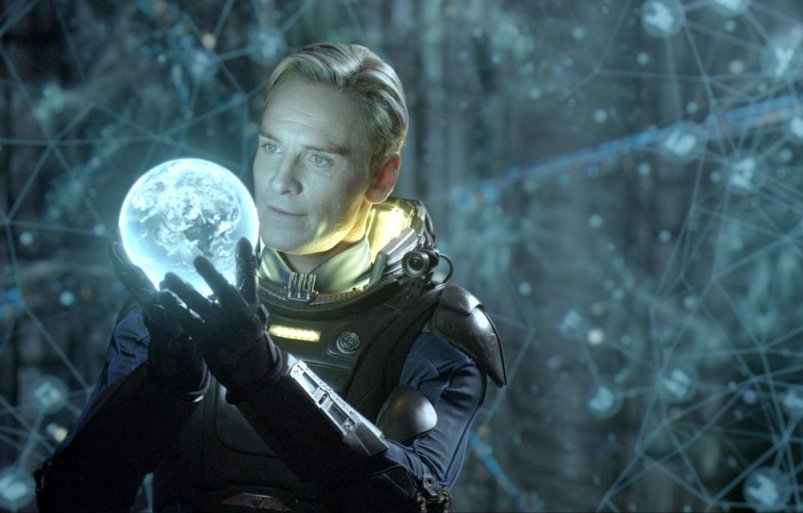
Prometheus Ridley Scott’s return to outer space — after an extended stay in Russell Crowe-landia — is most welcome. Some may complain Prometheus too closely resembles Scott’s Alien (1979), for which it serves as a prequel of sorts. Prometheus also resembles, among others, The Thing (1982), 2001: A Space Odyssey (1968), and Event Horizon (1997). But I love those movies (yes, even Event Horizon), and I am totally fine with the guy who made Alien borrowing from all of them and making the classiest, most gorgeous sci-fi B-movie in years. Sure, some of the science is wonky, and the themes of faith and creation can get a bit woo-woo, but Prometheus is deep-space discombobulation at its finest, with only a miscast Logan Marshall-Green (apparently, cocky dude-bros are still in effect at the turn of the next millennium) marring an otherwise killer cast: Noomi Rapace as a dreamy (yet awesomely tough) scientist; Idris Elba as Prometheus‘ wisecracking captain; Charlize Theron as the Weyland Corportation’s icy overseer; and Michael Fassbender, giving his finest performance to date as the ship’s Lawrence of Arabia-obsessed android. (2:03) Metreon, 1000 Van Ness, Sundance Kabuki. (Eddy)
Rock of Ages (2:03) California, Four Star, Marina, 1000 Van Ness, SF Center, Sundance Kabuki.
Safety Not Guaranteed San Francisco-born director Colin Trevorrow’s narrative debut feature Safety Not Guaranteed, written by Derek Connolly, has an improbable setup: not that rural loner Kenneth (Mark Duplass) would place a personal ad for a time travel partner (“Must bring own weapons”), but that a Seattle alt-weekly magazine would pay expenses for a vainglorious staff reporter (Jake Johnson, hilarious) and two interns (Aubrey Plaza, Karan Soni) to stalk him for a fluff feature over the course of several days. The publishing budget allowing that today is true science-fiction. But never mind. Inserting herself “undercover” when a direct approach fails, Plaza’s slightly goth college grad finds she actually likes obsessive, paranoid weirdo Kenneth, and is intrigued by his seemingly insane but dead serious mission. For most of its length Safety falls safely into the category of off-center indie comedics, delivering various loopy and crass behavior with a practiced deadpan, providing just enough character depth to achieve eventual poignancy. Then it takes a major leap — one it would be criminal to spoil, but which turns an admirable little movie into something conceptually surprising, reckless, and rather exhilarating. (1:34) Metreon, Shattuck. (Harvey)
Snow White and the Huntsman It’s unclear why the zeitgeist has blessed us this year with two warring iterations of the Snow White fairy tale, one broadly comedic (April’s Mirror Mirror), one starkly emo. But it was only natural that Kristen Stewart would land in the latter rendering, breaking open the hearts of swamp beasts and swordsmen alike with the chaste glory of her mien. As Snow White flees the henchmen and hired killers dispatched by her seriously evil stepmother, Queen Ravenna (Charlize Theron), and traverses a blasted, virulent forest populated with hallucinogenic vapors and other life-threatening obstacles, Stewart need not act so much as radiate a dazzling benignity, weeping the tears of a martyr rather than a frightened young girl. (Unfortunately, when required to deliver a rallying declaration of war, she sounds as if she’s speaking in tongues after a heavy hit on the crack pipe.) It’s slightly uncomfortable to be asked, alongside a grieving, drunken huntsman (The Avengers’ Chris Hemsworth), a handful of dwarfs (including Ian McShane and Toby Jones), and the kingdom’s other suffering citizenry, to fall worshipfully in line behind such a creature. But first-time director Rupert Sanders’s film keeps pace with its lovely heroine visually, constructing a gorgeous world in which armies of black glass shatter on battlefields, white stags dissolve into hosts of butterflies, and a fairy sanctuary within the blighted kingdom is an eye-popping fantasia verging on the hysterical. Theron’s Ravenna, equipped in modernist fashion with a backstory for her sociopathic tendencies, is credible and captivating as an unhinged slayer of men, thief of youth, destroyer of kingdoms, and consumer of the hearts of tiny birds. (2:07) Metreon, 1000 Van Ness, Shattuck. (Rapoport)
That’s My Boy (1:55) Metreon, SF Center.
Turn Me On, Dammit! The 15-year-old heroine of writer-director Jannicke Systad Jacobsen’s Turn Me On, Dammit! is first heard in voice-over, flatly cataloging the over familiar elements of the small town in rural Norway where she lives — and first seen lying on the kitchen floor of her house sharing an intimate moment with a phone sex operator named Stig (Per Kjerstad). Largely ruled by her hormones and longing to get it on with someone other than herself and the disembodied Stig, Alma (Helene Bergsholm) spends large segments of her life unspooling sexual fantasies starring Artur (Matias Myren), the boy she has a crush on, and Sebjorn (Jon Bleiklie Devik), who runs the grocery store where she works and is the father of her two closest friends: burgeoning political activist Sara (Malin Bjorhovde) and full-fledged mean girl Ingrid (Beate Stofring). Back in real life, a strange and awkward physical interaction with Artur leads Alma, excited and confused, to describe the experience to her friends, a mistake that precipitously leads to total social ostracism among her peers. With the possible exception of some unnecessary dog reaction shots during the aforementioned opening scene, documentary maker Jacobsen’s first narrative feature film is an engaging and impressive debut, presenting a sympathetic and uncoy depiction of a young girl’s sexuality and exploiting the rich contrast between Alma’s gauzier fantasies and the realities of her waking world to poignantly comic effect. (1:16) Opera Plaza. (Rapoport)
The Woman in the Fifth A rumpled American writer with a hinted-at dark past (Ethan Hawke) shows up in Paris, to the horror of his French ex-wife and confused delight of his six-year-old daughter. An ill-advised nap on public transportation results in all of his bags being stolen; broke and out of sorts, he takes a grimy room above a café and a gig monitoring the surveillance-cam feed at what’s obviously some kind of illegal enterprise. During the day he stalks his daughter and romances both sophisticated Margit (Kristen Scott Thomas) and nubile Ania (Joanna Kulig); he also dodges his hostile neighbor (Mamadou Minte) and shady boss (Samir Guesmi). Based on Douglas Kennedy’s novel, the latest from Pawel Pawlikowski (2004’s My Summer of Love), offers some third-act twists (gory, distressing ones) that suggest Hawke’s character (and, by extension, the viewer) may not be perceiving reality with 100 percent accuracy. Moody, melancholy, not-entirely-satisfying stuff. (1:23) SF Film Society Cinema. (Eddy)
Your Sister’s Sister The new movie from Lynn Shelton — who directed star and (fellow mumblecore director) Mark Duplass in her shaggily amusing Humpday (2009) — opens somberly, at a Seattle wake where his Jack makes his deceased brother’s friends uncomfortable by pointing out that the do-gooder guy they’d loved just the last couple years was a bully and jerk for many years before his reformation. This outburst prompts an offer from friend-slash-mutual-crush Iris (Emily Blunt) that he get his head together for a few days at her family’s empty vacation house on a nearby island. Arriving via ferry and bike, he is disconcerted to find someone already in residence — Iris’ sister Hannah (Rosemarie DeWitt), who’s grieving a loss of her own (she’s split with her girlfriend). Several tequila shots later, two Kinsey-scale opposites meet, which creates complications when Iris turns up the next day. A bit slight in immediate retrospect and contrived in its wrap-up, Shelton’s film is nonetheless insinuating, likable, and a little touching while you’re watching it. That’s largely thanks to the actors’ appeal — especially Duplass, who fills in a blunderingly lucky (and unlucky) character’s many blanks with lived-in understatement. (1:30) Albany, Embarcadero, Sundance Kabuki. (Harvey)
After the raid
caitlin@sfbg.com
HERBWISE It is exceedingly difficult to get Oaksterdam University founder Richard Lee to talk about himself. I have him — the person who drove the Proposition 19 legalization campaign, whose house and cannabis trade school were raided by federal agents in April, who through his businesses’ success has helped revitalize and make safe a previously gloomy stretch of downtown Oakland — on the phone to talk about the lifetime achievement award he will be receiving from High Times at this week’s Cannabis Cup (Sat/23-Sun/24).
I want him to share his emotional journey since government agents poured into his home, what’s it’s like to be the public face of the flashpoint between California and national government over marijuana. High Times editorial director Malcolm MacKinnon calls Lee a “fearless trailblazer,” perhaps he’d like to make grand predictions about the future of pot? At least describe exactly what’s happening with Oaksterdam, post-raid. But Lee prefers to stress the latest poll numbers on legalization.
“All the national polls and the Colorado polls are going our way,” he says. “If you could get the word out about that, that’d be great.” FYI, on June 6 Rasmussen Reports found that 61 percent of Coloradoans support regulating cannabis like alcohol and cigarettes.
Lee has retired from university administration — he’s referred to as a professor emeritus, although he is still teaching classes in cannabis policy, history, and advocacy. In his “big Converse All-Stars” (as she calls them) now stands Dale Sky Jones. She once developed Oaksterdam’s curriculum and now joins a short list of female leaders in the marijuana industry as the university’s president.
“When the federal government came in, they took the curriculum, the computers — everything else that was the blood and breathe, heart and soul of the school short of the tables and chairs and teachers,” Jones says in a phone interview. Under her watch, the finances of “top-heavy” Oaksterdam’s gift shop, dispensary, and university have split and are now under separate ownership. Staff is attempting to rebuild curriculum from email records. 45 employees have lost their job because of the disruption in business affairs. “This was a violation on so many levels for the staff of Oaksterdam,” Jones says, sadly.
But life goes on. Lee says his “students are great, they have lots of energy and enthusiasm.” And the cultural contributions that the school and its founder have hardly been negated by federal intervention. “[Lee] brought the debate about marijuana policy reform to the kitchen table,” says Jones. “Before Prop. 19, the only time parents and kids had conversations around marijuana it was ‘where the hell did you find it? who are your jackass friends?’ It was always a negative discussion. This was the first time that families were able to discuss marijuana as a policy issue.”
This weekend’s Cannabis Cup will bring the pot world’s focus back here, as some of NorCal’s [author’s note: and hence, the world’s] best strains compete for the title of best indica, sativa, edibles, etc. Lee’s lifetime achievement award (presented at 7pm on Sun/24) will just confirm what we all already knew: even when it comes to activists, we grow things better out here.
HIGH TIMES CANNABIS CUP
Sat/23 noon-10pm, Sun/24 noon-9:30pm; one-day pass $40, two-day pass $65 advance, $80 at door
Craneway Pavilion
1414 Harbour Way, Richmond
Make it better now
yael@sfbg.com
Noted queer writer and speaker Dan Savage sent a hopeful message to LGBT youth with his 2010 YouTube video, “It Gets Better.” But many queer youth in the Bay Area say they aren’t willing to wait.
“If my adult self could talk to my 14 year old self and tell him anything, I would tell him to really believe the lyrics from “Somewhere,” from West Side Story. There really is a place for us. There really is a place for you. And that one day you will have friends that love and support you, you will find love, you will find a community. And that life gets better,” Savage said.
Savage and his partner Terry Miller’s message went viral. It inspired hundreds of similar videos and eventually led to the creation of the It Gets Better Project, headquartered in Los Angeles. The videos were a response to a tragic cluster of suicides by children bullied for seeming gay, a trend that was only unusual in that the media picked up on it. And for many teens across the country, the “It Gets Better” videos provided crucial hope and support.
But last week, I was talking to Stephanie, Lolo, Ose, and Mia Tu Mutch, four Bay Area teens, about what its like to be a queer youth today. We were talking at the Lavender Youth Recreation and Information Center (LYRIC), a center for queer youth in the heart of the Castro.
When I asked about the “It Gets Better” videos, they all had the same reaction: “Ugh. I don’t like those videos. I don’t like those at all.”
“Those videos are depressing,” Lolo said.
“Yeah. ‘Just wait ’til you’re an adult?'” Stephanie asked.
“Just wait ’til you’re an adult, and your problems will go away,” Mia said, shaking her head.
“And it’s celebrities, too,” Ose noted. “‘I got thousands of dollars, and it gets better!'”
The four of them are facilitators at LYRIC, leading weekly community-building workshops that deal with issues queer kids face. Between 17 and 21 years old, these youth are not waiting for it to get better. They’re doing it for themselves.
LYRIC’S OUTREACH
LYRIC definitely promotes pride and empowerment. Founded in 1988, LYRIC organizers worked to secure funding for a physical space a few years later. Since then, this purple house on Collingwood has functioned as a crucial center for Bay Area queer youth. It offers counseling, food, clothing, community building workshops that kids teach, and a safe place to hang out.
But LYRIC, like many nonprofits, has felt the impact of the severe government cuts to health and human services. As a result, its budget has suffered steady declines from approximately $1.2 million in 2008 to $954,000 this, year primarily due to shrinking government funding.
But LYRIC refuses to give up offering paid internships, a rarity in the nonprofit world.
“The City has made it clear that they no longer intend to invest significant funding into subsidized employment model programs — they want to serve greater numbers of youth at a much lower unit cost — even if we all understand that some of the most marginalized youth will no longer be getting the intensive level of support they need to make it to a successful adulthood” LYRIC’s Executive Director Jodi Schwartz told me, explaining that the organization is now growing support by more grassroots funding networks.
“We used to hire 60-70 young people per year, now it’s more like 20,” Schwartz says.
The organization still serves about 400 young people per year.
“I would guess we have 6,000 queer youth living in the city,” Schwartz said. “So we’re not reaching everyone. Not to say that all those 6,000 queer youth need a LYRIC, but they need community. We all need community.”
Youth from across the country come to San Francisco seeking that community. Often they have escaped intolerant, abusive, or dangerous situations in their families or hometowns. But when they arrive in this storied city, these youth are often disappointed.
“I was that kid who left a small town in Texas and who got to San Francisco as fast as I could,” Mia told me. “And I was like, you know, I’ll figure it out, I’ll find a job, and I’ll do this and that. And it was really hard.”
” I think that the difference is that there are more LGBT specific languages and policies, and organizations that are affirming. All of that is the best in the US, probably,” Mia said. “And there are all these cultural groups and all of that. But queerphobia and transphobia exist here just like it exists everywhere else.”
“So my big thing is how we have all these systems in place that make us a little more queer friendly,” she said. “But how do we actually get the public to stop hating people, to stop doing hate crimes, to stop bullying?”
Ose, who now lives in the Bayview, grew up closer to the city. But coming from a religious family in Modesto, he says, “I had heard things about the Castro itself. I always thought the Castro was the devil…I was a church boy.”
He remembers fear that someone he knew would recognize him in the forbidden neighborhood, that “my mom would find out and be like, what are you doing in the Castro? So I was scared to death my parents would find out I was coming to the Castro.”
That was two years ago. Now, Ose works in the Castro, and he was dressed in cut-off shorts and a slicked back Mohawk, long painted nails clicking on the table. “I’m hella gayed out,” he happily reports.
When Mia made it to San Francisco, she initially settled into the Tenderloin, rather than the gentrifying Castro.
“As a trans person, a lot of trans history is in the Tenderloin and there’s a lot of trans women who live in the Tenderloin and who work in the Tenderloin,” she explained. “So I feel more at home there. Even though it isn’t technically the gay neighborhood, it’s always been the queer ghetto and that’s where the low income and queer people of color live a lot.”
The Tenderloin is also the site of many of the services that queer youth use. Mia made some of her first local connections at Trans: Thrive, a program of the Asian Pacific Islander Center. And many of the kids at LYRIC, as well as the city’s other queer teens, benefit from Larkin Street Youth Services.
The homeless shelter oversees the only beds reserved for queer youth in the city, all 22 of them, a number Schwartz believes in inadequate. A report from Larkin Street in 2010 found that 30 percent of the homeless youth they serve identify as LGBTQQ (lesbian, gay, bisexual, transgender, queer, or questioning).
LYRIC is part of the Community Partnership for LGBTQQ Youth and the Dimensions Clinic Collaborative, which includes service organizations like the queer-specific health clinic Dimensions, the nearby LGBT Center, the Bay Area Young Positives HIV health and support nonprofit, and the city’s Department of Public Health. But LYRIC is one of only a few organizations that focuses on fun, informative community-building workshops.
ACCEPTANCE NOW
Savage promised queer kids that, in the distant future, they would “have friends that love and support you, you will find love, you will find a community.” But LYRIC’s workshops, largely envisioned and run by the youth themselves, show kids that they don’t need to wait: they can create those supportive networks for themselves, in the here and now.
Another such community-building effort was on display at the LGBT Center on June 15: Youth Speaks’ queer poetry slam Queeriosity. The show, which was preceded by five weeks of free poetry workshops for and by queer youth, brought together young queer people from across the Bay Area, and one could feel the love and support in the air.
“Queeriosity is important because, in the poetry scene, we have so many people with so many different backgrounds,” Milani Pelley, one of the show’s hosts and a poet who works with youth in the workshops, told me. “A lot of times people who get identified in the LGBT category, they don’t have that space where they’re front and center and it’s a space for them. It’s very important that we celebrate everyone.”
Pelley, 24, has been working with Youth Speaks since she was 16. She said the message of the It Gets Better videos might be too simple.
“Thinking about being an adult versus a teenager, adults go through the same things,” she said. “The only difference is it’s not encouraged to speak out about it, you’re supposed to act like you have it together and it’s okay.”
Mia said youthful teasing and bullying are precursors to hate crimes: “Bullying and hate crimes are related because it’s all about people not accepting you, and then violently reacting to who are. So either throwing insults or beating you up.”
On April 29, Brandy Martell, an African American trans woman, was murdered in Oakland in a likely hate crime. CeCe McDonald’s recent case has also exhibited the dangers and injustice trans women of color face. The young Chicago woman defended herself against a bigoted attacker who she ended up killing, only to spend time in solitary confinement while awaiting trial, get convicted on manslaughter, and, last week, be placed in a men’s prison to serve her sentence.
I asked the four LYRIC teachers about the campaigns of national organizations like the Human Rights Committee — such as marriage equity or LGBT soldiers — and they all shook their heads.
“There’s a huge disconnect between the national platforms of the major gay organizations and the actual realities of queer youth,” Mia said. “Like they don’t even have queer youth in the majority of their meetings, but then they act like they’re the ones fighting for our rights, you know.”
For example, she said “marriage equality wouldn’t affect me at all. Yeah, it would be okay, it would be better if it was equal across the board. But when you have people dying because of hate crimes, and dying because of bullying, and dying because they don’t have a place to stay and they’re on the streets, it’s like, I just feel like those are a lot more pressing than getting a piece of paper from the government.”
SETTING THE AGENDA
Mia serves on the city’s Youth Commission, where she’s designing training programs for service providers to work with LGBT youth. Ose is working with Schwartz to create programming for LGBTQ youth who don’t want to take the common path of rejecting religion and spirituality as they come to terms with other parts of their identity.
“I go to church a lot,” Ose explained. “I grew up as a Christian. And I wanted to touch base on that because a lot of times, the youth that I come across, the majority of them are being silenced…I’m still going through some issues with my own church, especially with my pastor because just recently I’ve heard that he dislikes me over the fact of the way I dress, the way I act, my feminine gestures.”
Stephanie sighed and said, “I wish there were more LYRICS around the city. One in Bayview, one in every district. And Oakland too.”
“People who provide counseling, food, clothes, water if you need it,” Lola added. “A safe space to go to, a place where you can make friends, and make connections. There need to be more places like that specifically for queer youth.”
Even in San Francisco, harassment is a reality in youth programs and schools. In 2009, the SFUSD studied Youth Risk Behavior in San Francisco’s elementary through high school public schools, and found that more than 80 percent of students reported hearing anti-gay remarks at school, and more than 40 percent said they had never heard school staff stop others from making those remarks. The survey also found that students who identified as LGBT were significantly more likely than their peers to report skipping school out of concern for their safety.
Queer youth will never stop finding informal networks of support. But structured settings like LYRIC can be vital. At places like LYRIC, youth find the community, the love, and the friends that Savage promised would appear with time — before they turn 18.
“It’s easier to build relationships and to build community when its structured, when it has a little bit of structure like, hey, this is a queer specified setting, we’re going to talk to each other, we’re going to hang out, we’re gonna do this, and then you kind of build community off of that. And because it’s based on identity, you feel more comfortable to talk about that,” Mia explained. “You have to change your reality. And you have to be the one to change it for yourself. Because ain’t nobody gonna make it better for you.”
Free Muni for kids: Tough slog at the MTC
There are plenty of reasons I like the David Campos free Muni for youth plan. Anything that gets the next generation used to seeing Muni as the primary form of transportation in town is a good idea. It’s a great benefit for low-income kids (and around SF these days, the only ones who we’re giving any benefits to are businesses that get tax breaks, and those breaks are worth far more than the modest cost of the Campos plan). But it’s particularly important this year, because the school district is in serious financial straights and is probably going to eliminate most school-bus transportation next year. So poor kids and kids whose parents don’t have cars will have a harder time getting to school.
The supervisors approved this, and the mayor signed off on it — but some of the money is supposed to come from the Metropolitan Transportation Commission, made up of regional representatives, and Campos is having a tough battle.
The MTC staff recommended that SF get $4 million in regional transit money for the idea, but not all, or even most, of the 16 members of the panel want to see one city get money for something all of them would love to do.
But: Someone has to try this as a pilot project, and SF, with the highest per-capita transit ridership, is a good place to start.
Sup. Scott Wiener is also on the MTC, representing San Francisco, and he’s totally against the free Muni for youth plan. And when it come up at an MTC committee, he was willing to vote for it — “I realize I lost that battle, and at the MTC I’m representing San Francisco,” he said — but only if MTC stipulated that no additional city money would go to the program.
And that kind of screws the whole thing up, since it will be hard to do with just the $4 million.
Ugh. Such a great idea, for a fraction of the money we’re handing out like hot dogs to everyone who asks for a tax break. Why don’t the poor kids get a break for once?
Beach daze with buzzing brother act Wildlife Control
What would it be like if a day of your life was filmed then released into the wilds of the web? Better yet, what if you and your brother were musicians, and you produced, directed, and released your first big, innovative music video – shot over a full day at Ocean Beach in San Francisco – and it ended up going viral on Youtube, before the release of a full-length album?
Well, your band Wildlife Control would be a rather buzzed about act. And it would leave the people wanting even more (debut EP Spin was released this March). Brothers Neil and Sumul Shah, hailing from a rural Pennsylvania town – now based in Brooklyn and San Francisco respectively – spent a day in early February filming said music video for their new single “Analog or Digital” on a windswept beach, using a unique combination of time-lapse and stop-motion techniques.
In the video, it appears that the background is moving faster than real time, while the band’s movements are stagnant, choppy, like a slow-moving slideshow; it creates an effect that looks their feet are closely hovering over the sand.
This effect was created by a series of more than 3,000 individual photographs. The process was tiring for the brothers, holding the poses for such a long stretch of time, “We got really stiff” laughed Sumul during a conversation at Cafe Mediterranean in Berkeley.
Wildlife Control’s sound is far from rigid, it’s based in breezy pop – poppy enough to appeal to mainstream audiences – and layered with rock’n’roll riffs, and some jazz influences. There are layers to peel back with each listen, more depth than initially meets the ear.
http://www.youtube.com/watch?v=boGyFAYomBo
“We grew up in a whole family of musicians, Sumul reflected. “Our parents both imparted the importance of music from an early age. They wanted us to dive deep into it. Our dad is a trained classical Indian musician.” In fact, he plays Tabla on their future full-length release. “Music was all around, all the time; from an early age we always heard good music.”
Sumul added that – along with that family of musicians – he was also inspired by teachers, other artists, and inspirational folk with a clarity of vision, ticking off a list that included Steve Jobs, the Beatles, and Johann Sebastian Bach.
“When we would go with our friends in their parents’ minivan, I didn’t get what they listened to. The cheesy kids’ music was just not what we were exposed to in our family,” he laughed. “There is a necessity to some extent to have music appropriate for kids, but I don’t believe they should need their own weird kids’ music. A child can appreciate music like the Beatles.”
While the brothers grew up surrounded by music and have been playing together for some time, they’ve just barely dipped their toes in the modern world of viral music videos. With the “Analog or Digital” video, they made a concerted effort to capture their personalities.
“We thought, what better way to do it then to film an entire day to ourselves, and then compress that down into the three minutes of the song,” Sumul said. “Certain aspects of it were very planned out, but otherwise we just wanted to have fun and be ourselves.”
The song is anchored by a steady drum line, and the story-telling of the lyrics instantly create a potential for nostalgia; the musical bridge adds a dramatic flair that makes the song all the more memorable.
“It’s interesting that it went viral; all we really want is to make music for anyone who wants to hear it and be exposed to it.” Sumul said. “To live in an age where we can get so much fan response amazes us,” adding, “we totally live in the future and we love that.”
Wildlife Control
With Coast Jumper
Mon/18, 8pm, $13
Brick and Mortar Music Hall
1710 Mission, SF
(415) 800-8782
www.brickandmortarmusic.com
The 8 Washington embarrassment
I wasn’t shocked by the vote on 8 Washington. I knew it was happening; I knew we’d lost when the EIR went through. I knew we couldn’t count on a solid progressive bloc any more. I knew that the lobbying was intense.
But I have to say, at the end of the day I was embarrassed. Because the supervisors sold the city cheap.
In the earlier board discussions, Sup. Christina Olague and Sup. Eric Mar mentioned their concerns about the heigh and bulk of the project and said they would work with the developer, Simon Snellgrove, on changes. But the final project was exactly the same size.
Olague and Sup. Jane Kim were concerned about the amount of parking; the developer agreed to cut 50 spaces. But the actual size of the garage won’t be reduced at all; the only promise: There won’t be valet parking, so maybe not so many cars will fit.
Yes, Snellgrove agreed to set aside some scholarships for low-income kids to swim in the pool, which is a great thing and I fully support it. For a project that, according to available figures, will net the developer $200 million in profit — according to Sup. David Chiu’s analysis, a 72 percent rate of return — the scholarship money is peanuts.
There’s an additional 50 cent parking levy to pay for surface improvements in the area.
But as Chiu asked at the June 12 meeting, “Is the city getting an appropriate level of benefits based on Snellgrove’s profits?” Project foe Brad Paul — a veteran of more than 30 years of the city’s development wars — doesn’t think so. “They got nothing,” he told me.
Here’s how it went down:
Chiu started off by introducing the board’s budget analyis, Harvey Rose. Rose said he’d reviewed the finances of the project, and concluded that the city would get $50 million less out of the project than the developer or the Port of San Francisco, which owns some of the land and is a primary proponent, had originally claimed. Chiu also noted that not all the documents were in the file, but nobody else seemed to care.
In fact, through most of the discussion — limited discussion — and final votes, it was pretty clear that nobody was swayed by any of the facts that Chiu put forward. This deal was done long before the board members took their seats.
Chiu offered a series of amendments, none of them terribly radical. He pointed out that the deal requires the city to pay the developer $5 million for open-space improvements. “That’s an anomaly,” Chiu said, and moved that it be removed.
Kim, who throughout the meeting was the strongest supporter of the project, argued that the city often reimburses developers for open space. More, she said, compared to what the city has asked other major residential developers to give, this project is just dandy. “I would not say this is not a fair deal for the city,” she told her colleagues.
The vote on the $5 million giveaway? Developer 6, SF 5. Siding with Snellgrove: Christina Olague, Scott Wiener, Carmen Chu, Sean Elsbernd, Mark Farrell, and Jane Kim. Siding with Chiu and project opponents: John Avalos, David Campos, Malia Cohen, and Eric Mar. It’s an odd lineup — Cohen doesn’t always vote with the progressives, and I have to say it’s strange to see Kim and Olague siding with the four most conservative supervisors.
Chius’s second proposal: Since the city’s benefits were $50 million less than advertised, why not add $14 million to the affordable housing fee?
Developer: 7. Affordable housing: 4. Voting for the developer: Olague, Wiener, Chu, Elsbernd, Farrell, Kim and Mar.
Okay, one last try. Chiu suggested maybe just $2 million more for affordable housing. Wiener, as is he way, went off on his usual complaint that too much of the affordable housing money is for poor people and not enough for the middle class. The final vote:
Developer: 6. Affordable housing: 5. Voting for the developer: Olague, Wiener, Chu, Elsbernd, Farrell, Kim.
Kim, again, took the lead in promoting the deal on the final vote, saying that a parking lot and a private club were not a good use for the space and that “we are achieving here is a higher and better use for the land.” That’s what every developer talks about, by the way — higher and better use.
She also talked about One Rincon, that hideous tower next to the Bay Bridge that was approved after then-Sup. Chris Daly cut a deal with the developer that the San Francisco Chronicle denounced as a “shakedown.”
Kim said that, considering the much-smaller size of the Snellgrove project, the benefits were richer than the Rincon deal.
I never liked the Rincon deal — that tower’s a disaster, an ugly scar on the skyline, and there was nowhere near enough affordable housing money. That’s because I think that the city should be building six affordable units for every four market-rate units, that there’s no need for more housing for the very rich and that our current housing policy is a disaster. (The Guardian wrote an editorial at the time that said it was good that Daly had gotten that much money, but was dubious about the whole project. In retrospect, we were too kind.)
I think all my readers at this point know that. So does Daly.
But I asked the former supervisor anyway to comment on the difference between 8 Washington and One Rincon. His thoughts:
1. The Rincon Hill agreement was negotiated by the district Supervisor working together with the communities most impacted by the development. 8 Washington was opposed by the district Supervisor and many nearby residents.
2. Most people in the South of Market were not diametrically opposed to highrise development in that location. The Planning Department had been working on a Rincon Hill neighborhood plan and was recommending upzoning for the area.
3. Rincon Hill had no waterfront trust issues.
4. The Rincon HIll development impact fee was $25 per square foot (over and above the required inclusionary affordable housing fee even though the Mayor’s Office contended that over $20 per square foot would kill the deal.) According to Kim’s release, her 8 Washington deal netted an additional $2 million for affordable housing and a $.50 parking surcharge. This even though development in Rincon Hill is not as valuable as the northern waterfront.
Folks: I think the city got taken to the cleaners here. I’ll stipulate that I’m against this project for much broader reasons. And maybe I’m just an old commie who thinks that the richer you are, the more you should give back, that the affordable housing fees on the most expensive condos in San Francisco should be higher than normal, that if Snellgrove nets $200 million, then the city by definition left too much on the table.
But I don’t think I’m alone in believing that if you’re going to approve something that will make a developer this rich, and let him use public land to do it, on the waterfront, you ought to get your fair share. And that didn’t happen.
Embarrassing.
Win a pair of VIP passes to the Sierra Nevada World Music Festival
Epiphany Artists presents the 19th Annual Sierra Nevada World Music Festival.
SNWMF once again brings you some of the greats in world, roots, dancehall and reggae. This years lineup features Jimmy Cliff, Luciano, Third World, J Boog, Iration, Katchafire, David Rodigan, Stone Love, and many more. With two stages, a late night dancehall, an interactive kids program with workshops and dedicated performances, food from around the globe, and the best in arts and crafts vendors, SNWMF is a fantastic way to kick off the Summer Solstice with the whole family. Single day, three day, and limited camping tickets are available here.
Win a pair of VIP passes to the festival, which includes a three-day ticket, side-stage view, and both non-alcoholic beverages and beer. Email sfbgpromos@sfbg.com with Sierra Nevada World Music Festival and leave your name and phone number. One randomly chosen winner will receive a phone call Friday, June 15 at noon. Good luck!
Friday thru Sunday, June 22-24 @ Mendocino County Fairgrounds in Boonville, CA
Distant craving
le.chicken.farmer@gmail.com
CHEAP EATS After two days of eating nothing but barbecue, fried chickens, and cupcakes, we started actually craving health food. I speak for the whole de la Cooter household, of which I am a small but important satellite. When I’m there, the kids come and jump on my bed in the morning, and mom and dad get to sleep a little longer.
That’s my importance.
Oh, and I am the one who cleans the cellar — mostly so I can put things in it. But still.
It’s nice to feel like you are part of a family, maybe you’ve noticed. And I have had no shortage of family in my life, but the blood ones are mostly very far away, so I can’t very well bathe their kids and sing them to sleep, let alone play with them.
It was nice when I was a nanny and got paid for all of the above, but I think I like being “like family” even better.
For one thing, I can argue for fried chicken and barbecue, and win! That was how it went my first day back: Barbecue for lunch, fried chicken for dinner.
And the next day was K. Chunk’s birthday, so we made pancakes with almost everything in the world in them for breakfast, by request, and then had pretty much cupcakes for lunch.
Now, Crawdad de la Cooter’s mister, Mr. Crawdad de la Cooter, makes THE best cake I have ever had. That’s why I will always, no matter where in the world I am, come chugging home for his kids’s birthdays. That’s one reason.
And it’s not anything fancy, either. Chocolate cake with white frosting. But you wouldn’t believe how moist. You wouldn’t believe how perfectly iced. Your teeth crunch then cream through the sugary, buttery quarter-inch of heaven, which blends so beautifully with the cakey softness below . . . you want to cry. But you’re too busy licking your lips and angling for your next bite.
I don’t even like cake! I’m a pie girl, all the way.
But now I like cake, thanks to Mr. Crawdad.
Anyway, after the birthday party, when the dust and wrapping paper had cleared and the Chunks de la Cooter were playing with their toys and it was time to start thinking about dinner, Mr. Crawdad says what he almost always says, at such times: Nature’s Express.
And whereas normally I would counter with, “Barbecue,” or “Fried,” I was like, “Damn straight.” And he and me grabbed our jackets and headed down to Solano to pick up.
Nature’s Express is exactly like it sounds, only moreso. It’s not just health food fast food; it’s vegan. The last time I craved vegan food was in 1997. And to give you some idea how long ago that was, it was 15 years ago.
As I recall, I hated it, but that was out of sheer curmudgeonliness. Though I am not likely to crave specifically vegan fare for another 15 years, I loved Nature’s Express. Loved it.
As in: new favorite restaurant. For real, Chunks.
I mean, sure, at first when I saw the bookshelf of vegan propaganda and the coolers full of kombucha, I almost ran screaming from the bright, friendly little joint.
But I’m glad I didn’t. The avocado and quinoa wrap was delicious, especially when I got down to the pickled ginger and jalapenos. There was also hummus, lettuce, and cabbage slaw in there, and the nice thing about vegan is you don’t have to worry about mayonnaise!
I also got the 5-A-Day smoothie, with kale, cucumber, beets, and celery, plus fruit. In fact, I take back what I said about 15 years. I’m craving another one of these earthy, refreshing juices right now.
The Chunks de la Cooter split a Brazilian Super Model smoothie, which is apple, açai, mango, and flax seeds, and I tried this and liked it, but not as much as mine.
Loved the quinoa salad, the cumin-lime dressing, with corn, cilantro, peppers, and onion.
Crawdad got the “essential lentil” — lentils over greens with an avocado dressing, hot sauce, and more slaw — which I tried, and liked.
Her mister got the spicy chik-un taco, about which he was very excited, so I tried this too. It was fine. Fake meat, though.
That’s where I draw the line.
NATURE’S EXPRESS
Daily 11:30am-8pm
1823 Solano, Berk.
(510) 527-5331
D, MC, V
No alcohol
Out for more
arts@sfbg.com
FRAMELINE It was Blue (1993) and Swoon (1992) and Frisk (1995), or My Own Private Idaho (1991) and The Hours and Times (1991). Paris Is Burning (1990). The Incredibly True Adventure of Two Girls in Love (1995).
It probably depended a little on who you were and what you’d seen lately that made you feel grateful to be coinciding with this point on the timeline of queer cinema. For me, it was Lilies (1996) and Go Fish (1997), and All Over Me (1997) and Beautiful Thing (1996), and every other gay teen romance, and any totally f***ed up thing Gregg Araki chose to put onscreen (including 1995’s Doom Generation, billed as “a heterosexual film by Gregg Araki,” which made straight look like a fairly provisional state of being). It was kind of like irony or porn — I couldn’t exactly define it, but I was pretty sure I knew it when I saw it while bingeing, mid–gay adolescence, on whatever the 1990s had to offer in the way of LGBT experience on film. “It” being this thing called New Queer Cinema, a term that film critic and scholar (and past Guardian contributor) B. Ruby Rich had coined in a 1992 essay in the British film journal Sight & Sound.
Rich, these days teaching in UC Santa Cruz’s Film and Digital Media Department, offered up the idea of New Queer Cinema as a way to frame a ragged-edged genre that she saw emerging. Populating it were films that told unfamiliar, upsetting, outrageous, and sometimes deeply lyrical stories of queer experience, forcing a more complicated picture onto the screen. As many of them gained a cultural foothold (seldom reaching deep into the mainstream, but drawing respectable numbers of art-house-goers), they made a space around themselves for more such films to follow their unsettling examples.
Over the next decade and beyond, the genre, and the larger, disparate queer culture, welcomed a world of untold stories; films like My Own Private Idaho and later Velvet Goldmine (1998) and Boys Don’t Cry (1999) entered the popular culture by way of some combination of star and story power; and one morning we woke up to the sight of significant swaths of the country heading to the multiplex to watch a swoony, gloomy tale of two cowboys in love.
Now, somehow, Brokeback Mountain (2005) is starting to seem like a long time ago, and you could say that New Queer Cinema has both evolved and devolved, a fact reflected in the rom-com-packed LGBT section of your friendly neighborhood video store as well as in each passing year’s Frameline festival catalog. This year, the San Francisco International LGBT Film Festival offers the opportunity to compare and contrast, casting its eyes back on the genre 20 years after Rich pronounced its existence and sketched its parameters.
In addition to presenting Rich with its annual Frameline Award, the fest has programmed a retrospective of four films that offer a sense of New Queer Cinema’s expansive scope and permeable borders: Alex Sichel’s dark-and-light, riot grrrl music–infused All Over Me (costarring a baby-faced Leisha Hailey from The L Word); Ana Kokkinos’s Head On (1998), about a reckless but closeted young man living in a tight-knit Greek Australian community; Gregg Araki’s violent, trashily romantic, HIV-inflected road movie The Living End (1992); and Cheryl Dunye’s experimental mix of documentary and dyke drama The Watermelon Woman (1996). (In 2012’s Mommy Is Coming, also screening, Dunye adds to the mix Berlin sex clubs, explicit taxicab-backseat role play, and a parent-child dynamic likely to leave you flinching in horror.)
Elsewhere in the fest, French writer-director Virginie Despentes’s Bye Bye Blondie has a mosh pit soundtrack and follows, clumsily, Araki’s frenetic and unrestrained example. Béatrice Dalle (1986’s Betty Blue) and Emmanuelle Béart (2002’s 8 Women) play former teenage punk rock sweethearts who met in a mental institution and reunite after a long estrangement to reenact the past and rip open old wounds. A high point, though not for their relationship, occurs when Dalle’s slightly unhinged character tells a woman at a highbrow cocktail party, populated by Paris’s public-intellectual set, that her dress is sectarian, before physically assaulting another guest. Cloying and soap operatic, offering the gauzy fantasy fulfillment of a Harlequin Romance, Nicole Conn’s A Perfect Ending nevertheless earns points for its premise of an uptight housewife who employs the services of a call girl — and for casting Morgan Fairchild as a madam who uses her Barbie collection as a staffing organizational tool.
Other queer stories are more successfully delineated. Aurora Guerrero’s coming-of-age tale Mosquita y Mari, which screened at the SF International Film Fest in April, soulfully and subtly captures the ambiguous friendship that develops between two Latina high schoolers struggling with unspoken feelings as well as pressures both familial and financial. In Joshua Sanchez’s Four, adapted from a play by Christopher Shinn, Fourth of July fireworks and a mood of lonely isolation serve as a backdrop to four disparate individuals’ uncomfortable attempts to find physical and emotional connection. Stephen Cone’s The Wise Kids is set in and around a Southern Baptist church in Charleston, South Carolina, and tracks a trio of teenagers as they sort out the facts of their religious and sexual identities.
There’s a startlingly small quantity of queer baby-making going on in this year’s fest compared with recent years, and the family proposed in writer-director Jonathan Lisecki’s romantic comedy Gayby (as well as Ash Christian’s Petunia) is not necessarily nuclear or easy to encapsulate in kindergarten on “Let’s draw our family tree!” day, marrying the concept of queer family to the Heather-has-two-mommies narrative. The film’s gay-boy Matt and straight-girl BFF Jenn decide that it’s time to settle down and start a family together, but reject the idea of turkey basting or consulting a fertility specialist in favor of comically awkward, highly unerotic, goal-oriented sexual intercourse.
Come to think of it, their method could resonate with the procreation-only, can’t-wait-to-be-raptured crowd, who might be less enthusiastic when the pair switch to good old-fashioned DIY insemination and Matt’s friend Nelson (a scene-stealing Lisecki) brings over a container of holy cat cremains to sanctify the proceedings. Either way, with queer spawning sometimes serving as the rope in a tug-of-war argument about heteronormativity, queer identity, transgression, and basic rights, an unruly rom-com about queer family planning is a fitting entry in a genre and a festival that have both grown into panoramic representations of the queer world.
FRAMELINE36
June 14-24, most shows $9-$11
Various venues
You @ the festival
cheryl@sfbg.com
FRAMELINE What happens when a human being becomes a meme? This is the question at the heart of Me @ The Zoo, about YouTube celebrity Chris Crocker — destined to be forever known for his sobbing rant imploring the universe to “Leave Britney alone!”
What could have been a one-joke documentary is, to filmmakers Chris Moukarbel and Valerie Veatch’s credit, a layered look at insta-fame in the internet age, the perils of cultivating an oversized persona (particularly while living in a small, closed-minded town), and the hard lesson that life in the spotlight also equals life under a microscope.
Far from being reducible to a single screen grab, Chris Crocker is a deeply complicated person. As the film begins, he knows exactly who he would like to be — her name rhymes with “Britney Spears” — but is a little less certain about who he actually is. Growing up in Bristol, Tenn. (“A good place to live,” an oft-filmed town sign reassures us), Crocker was bullied for being gay; in high school, home-schooling became necessary. With few friends and little supervision (his troubled mother is a peripheral presence; he lives with his grandparents — the parents of his completely absent father), the bright, charismatic, attention-starved teen turned to the burgeoning world of internet video.
Despite homophobic haters all too happy to shower him with ugly, threatening comments, he became a MySpace sensation with his manic, lip-glossed, gender-bending videos. He cultivated a bratty catch phrase: “Bitch, please!” When YouTube appeared in 2005 (the doc’s title comes from the site’s very first upload), Crocker was one of its early addicts, and his fame grew along with his subscriber count. He danced, he provoked his tough-as-nails grandma, he modeled wigs, and he vlogged, often with exaggerated emotion. When his idol took a dive into paparazzi-documented insanity in 2007 (Feb.: head shave; Sept.: disastrous “comeback” performance on MTV), of course he made a video about it. He could not have known that the clip, which currently has over 43 million views, would go viral, and that suddenly everybody would know about Chris Crocker.
Yay! It’s what he wanted! But was it? “I love acting like I don’t want it,” he gleefully announces, faux-shunning photographers trailing behind him on a visit to Los Angeles. But the Crocker zeitgeist ends nearly as soon as it starts. His reality show (to be called Chris Crocker: Behind the Curtains) fails to find a network, and he soon becomes yesterday’s novelty-news hook. Back in Tennessee, he’s surprisingly sanguine about his short-shrift stab at stardom and eventual slide into notoriety: “I’m one of the first people who’s famous for not being famous,” he says. And later: “I can’t stop being myself.”
As the kids say, haters gonna hate. But when being yourself brings you such joy, who cares? Nickolas Bird and Eleanor Sharpe’s effervescent Ballroom Rules follows a team of Australian same-sex ballroom dancers as they train for the Gay Games. The action revolves around Melbourne’s only LGBT-centric ballroom studio, Dance Cats, and its crew of dedicated learners. Comparisons to 1992’s Strictly Ballroom (frustrating practice sessions; copious sequins; stuffy jerks who oversee the mainstream ballroom scene) can be made, except same-sex dancers must be what the movie calls “ambi-dance-trous” — able to switch leader-follower roles mid-routine. That the Dance Cats crew is such a warm, often hilarious group who’ve overcome much (homophobia is the least of it) to get where they are makes Ballroom Rules that much more inspiring.
Also inspiring: the Lance Bass-produced Mississippi: I Am, Harriet Hirshorn and Katherine Linton’s short doc about what it’s like to be a gay teen in the deep South. Hint: it sucks year-round, but prom season is especially dicey. Julie Wyman’s STRONG!, about Olympic weightlifter Cheryl Haworth, follows the 290-pound athlete as she hefts mind-blowing amounts in the gym and speaks honestly about her issues with confidence and body image. Haworth is a delight (her nickname is “Fun”), and while STRONG!‘s more serious themes are important, the off-the-cuff scenes with its subject (her car, a hilariously retro 1979 Lincoln Continental, is dubbed “Mary Todd”) are just as memorable.
Two more docs worth mentioning, about a pair of men whose fascinating lives are ideally suited for cinematic exploration: the PBS-ish Revealing Mr. Maugham, about hugely successful playwright and author W. Somerset Maugham, whose works are still being made into films today; and Times of Harvey Milk-ish Vito, about groundbreaking activist and Celluloid Closet author Vito Russo — a spot-on opening-night choice for Frameline.
Film Listings
Film listings are edited by Cheryl Eddy. Reviewers are Kimberly Chun, Max Goldberg, Dennis Harvey, and Lynn Rapoport. For rep house showtimes, see Rep Clock.
FRAMELINE36
Frameline36, the San Francisco International LGBT Film Festival, runs June 14-24 at Castro Theatre, 429 Castro, SF; Roxie Theater, 3117 16th St., SF; Victoria Theatre, 2961 16th St., SF; and Rialto Cinemas Elmwood, 2966 College, Berk. For tickets (most shows $9-$11) and schedule, visit www.frameline.org.
OPENING
Lola Versus Greta Gerwig’s embattled late-twentysomething, the titular Lola, apologetically invokes the Saturn return to explain the chaos that enters her life when her emotionally underdeveloped boyfriend proposes, panics, and dumps her. Workaday elements of the industry-standard romantic comedy surface, lightly revised: a crass, loopy BFF (co-writer Zoe Lister Jones) who can’t find true love and says things like “I have to go wash my vagina”; a vaguely soulful male friend (Hamish Linklater, 2011’s The Future) who’s secretly harboring nonplatonic feelings (or maybe just an opportunistic streak); wacky yet vaguely successful Age of Aquarius parents (a somewhat toneless Debra Winger and a nicely gone-to-seed Bill Pullman). One can see why it would be tempting to blame a planet’s galactic travels for the solipsistic meandering that Lola engages in, bemusedly lurching, often under chemical influences, from one bout of poor decision-making to the next. She claims to be searching for a path out of the chaos into some calmer place (fittingly, she’s a comp lit Ph.D. candidate who’s writing her dissertation on silence), but as the movie transports us mercilessly from one scene of turmoil to the next, we have little reason to believe her. The script has funny moments, and Gerwig sometimes succeeds in making Lola feel like a charming disaster, but her personal discoveries, while certainly valuable, feel false and forced. (1:26) Metreon, Sundance Kabuki. (Rapoport)
Rock of Ages Bang your head, 80s-style, in this big-screen take on the jukebox musical. Tom Cruise, Catherine Zeta-Jones, the chick from last year’s Footloose remake, and Alec Baldwin star. (2:03) California, Four Star, Marina.
Safety Not Guaranteed See “Most Likely to Succeed.” (1:34) Metreon, Shattuck.
That’s My Boy Adam Sandler plays Andy Samberg’s long-lost pop in a movie originally titled I Hate You Dad. Just in time for Father’s Day! (1:55)
Tonight You’re Mine Ah, the old chained-together gimmick, so effective in creating conflict in movies like 1973 women-in-prison classic Black Mama, White Mama. Alas, Tonight You’re Mine contains zero escaped cons, and is instead a pretty contrived love story about two rockers who’re inexplicably handcuffed together, mid-argument, by a mysterious man prowling the grounds at Scotland’s massive T in the Park music festival. Whether or not Adam (Luke Treadaway, last seen getting very stoned mid-alien invasion in 2011’s Attack the Block) and Morello (Game of Thrones‘ Natalie Tena) will ditch their clearly-wrong-for-them partners and fall for each other is hardly up for debate. What saves Tonight You’re Mine is its authentic rock-festival atmosphere; director David Mackenzie filmed amid the actual chaos of the 2010 T in the Park fest, so there’s plenty of mud, inebriated extras, and background music swirling around the budding romance. Also, though her character is underdeveloped here, Tena has a punky appeal that suggests a star on the rise. (1:20) Lumiere. (Eddy)
Turn Me On, Dammit! The 15-year-old heroine of writer-director Jannicke Systad Jacobsen’s Turn Me On, Dammit! is first heard in voice-over, flatly cataloging the over familiar elements of the small town in rural Norway where she lives — and first seen lying on the kitchen floor of her house sharing an intimate moment with a phone sex operator named Stig (Per Kjerstad). Largely ruled by her hormones and longing to get it on with someone other than herself and the disembodied Stig, Alma (Helene Bergsholm) spends large segments of her life unspooling sexual fantasies starring Artur (Matias Myren), the boy she has a crush on, and Sebjorn (Jon Bleiklie Devik), who runs the grocery store where she works and is the father of her two closest friends: burgeoning political activist Sara (Malin Bjorhovde) and full-fledged mean girl Ingrid (Beate Stofring). Back in real life, a strange and awkward physical interaction with Artur leads Alma, excited and confused, to describe the experience to her friends, a mistake that precipitously leads to total social ostracism among her peers. With the possible exception of some unnecessary dog reaction shots during the aforementioned opening scene, documentary maker Jacobsen’s first narrative feature film is an engaging and impressive debut, presenting a sympathetic and uncoy depiction of a young girl’s sexuality and exploiting the rich contrast between Alma’s gauzier fantasies and the realities of her waking world to poignantly comic effect. (1:16) Embarcadero. (Rapoport)
The Woman in the Fifth A rumpled American writer with a hinted-at dark past (Ethan Hawke) shows up in Paris, to the horror of his French ex-wife and confused delight of his six-year-old daughter. An ill-advised nap on public transportation results in all of his bags being stolen; broke and out of sorts, he takes a grimy room above a café and a gig monitoring the surveillance-cam feed at what’s obviously some kind of illegal enterprise. During the day he stalks his daughter and romances both sophisticated Margit (Kristen Scott Thomas) and nubile Ania (Joanna Kulig); he also dodges his hostile neighbor (Mamadou Minte) and shady boss (Samir Guesmi). Based on Douglas Kennedy’s novel, the latest from Pawel Pawlikowski (2004’s My Summer of Love), offers some third-act twists (gory, distressing ones) that suggest Hawke’s character (and, by extension, the viewer) may not be perceiving reality with 100 percent accuracy. Moody, melancholy, not-entirely-satisfying stuff. (1:23) SF Film Society Cinema. (Eddy)
Your Sister’s Sister See “Most Likely to Succeed.” (1:30) Embarcadero.
ONGOING
Battleship During idle moments before the action revs up, the aliens start menacing, and the deadly razor balls-cum-air mines start rampaging, wrap your noggin around these random brainwaves: can Taylor Kitsch be any better named? Is it possible for Alexander Skarsgård’s glassy eyes to get any deader? Where are all the Hawaiians, Asians, and people of color in this white-bread vision of Hawaii? All matters to puzzle over in this toy franchise hopeful directed by ex-Chicago Hope regular Peter Berg. The 2007 Transformers is the best this gung-ho hybrid of up-with-the-military “Army of One” commercial and alien invasion flick — with plenty of blow-’em-up-real-good explosions and a dab of J-monster movies, but the writing never quite rises to the occasion. Here, an international group of navy folk and their ships are convening in Hawaii for playful war games, though the exercises turn somewhat more serious when alien vessels splash down in the middle of the fun —and some mild, no-investment family drama: Alex (Kitsch) is the screw-up younger brother of stony-faced naval man Stone (Skarsgård) and courting the daughter (Brooklyn Decker) of the fleet commander (Liam Neesom), who seems to hate his guts. The ultimate battle with space invaders, however, promises to turn that all around, as Alex is forced to sailor up and lead crew mates like Rihanna and work with former opponents like Captain Nagata (Tadanobu Asano). Here, at least, in the shadow of Pearl Harbor, U.S. and Japanese naval dudes can heal the wounds of World War II and bond in battle against the last unimpeachable interstellar villains who couldn’t give a rat’s ass if you say “I sunk your battleship.” But Berg’s muddled direction doesn’t help when it comes to piecing out the chronology and balancing assorted perspectives in this latest effort to equate militarism with the games big and little kids play. (2:11) SF Center. (Chun)
Bel Ami Judging from recent attempts to shake off the gloomy atmosphere and undead company of the Twilight franchise, Robert Pattinson enjoys a good period piece, but hasn’t quite worked out how to help make one. Last year’s Depression-era Water for Elephants was a tepid romance, and Declan Donnellan and Nick Ormerod’s belle epoque–set Bel Ami is an ungainly, oddly paced adaptation of the Guy de Maupassant novel of the same name. A down-and-out former soldier of peasant stock, Georges Duroy (Pattinson) — or “Bel Ami,” as his female admirers call him — gains a brief entrée into the upper echelons of France’s fourth estate and parlays it into a more permanent set of social footholds, campaigning for the affections of a triumvirate of Parisian power wives (Christina Ricci, Uma Thurman, and Kristin Scott Thomas) as he makes his ascent. His route is confusing, though; the film pitches forward at an alarming pace, its scenes clumsily stacked together with little character development or context to smooth the way, and Pattinson’s performance doesn’t clarify much. Duroy shifts perplexingly between rapacious and soulful modes, eyeing the ladies with a vaguely carnivorous expression as he enters drawing rooms, dining rooms, and bedrooms, but leaving us with little sense of his true appetites or other motivations. (1:42) Clay, Shattuck, Smith Rafael. (Rapoport)
Bernie Jack Black plays the titular new assistant funeral director liked by everybody in small-town Carthage, Tex. He works especially hard to ingratiate himself with shrewish local widow Marjorie (Shirley MacLaine), but there are benefits — estranged from her own family, she not only accepts him as a friend (then companion, then servant, then as virtual “property”), but makes him her sole heir. Richard Linklater’s latest is based on a true-crime story, although in execution it’s as much a cheerful social satire as I Love You Philip Morris and The Informant! (both 2009), two other recent fact-based movies about likable felons. Black gets to sing (his character being a musical theater queen, among other things), while Linklater gets to affectionately mock a very different stratum of Lone Star State culture from the one he started out with in 1991’s Slacker. There’s a rich gallery of supporting characters, most played by little-known local actors or actual townspeople, with Matthew McConaughey’s vainglorious county prosecutor one delectable exception. Bernie is its director’s best in some time, not to mention a whole lot of fun. (1:39) Embarcadero, Piedmont, Presidio, Shattuck, Smith Rafael. (Harvey)
The Best Exotic Marigold Hotel (1:42) Albany, 1000 Van Ness, Piedmont, Presidio, SF Center, Sundance Kabuki.
The Cabin in the Woods If the name “Joss Whedon” doesn’t provide all the reason you need to bum-rush The Cabin in the Woods (Whedon produced and co-wrote, with director and frequent collaborator Drew Goddard), well, there’s not much more that can be revealed without ruining the entire movie. In a very, very small nutshell, it’s about a group of college kids (including Chris “Thor” Hemsworth) whose weekend jaunt to a rural cabin goes horribly awry, as such weekend jaunts tend to do in horror movies (the Texas Chainsaw and Evil Dead movies are heavily referenced). But this is no ordinary nightmare — its peculiarities are cleverly, carefully revealed, and the movie’s inside-out takedown of scary movies produces some very unexpected (and delightfully blood-gushing) twists and turns. Plus: the always-awesome Richard Jenkins, and in-jokes galore for genre fans. (1:35) Metreon. (Eddy)
A Cat in Paris This year’s Best Animated Film nominees: big-budget entries Kung Fu Panda 2, Puss in Boots, and eventual winner Rango, plus Chico and Rita, which opened just before Oscar night, and French mega-dark-horse A Cat in Paris. Sure, Jean-Loup Felicioli and Alain Gagnol’s film failed to cash in on 2011’s Paris craze, but it’s still a charming if featherweight noir caper, being released stateside in an English version that features the voices of Marcia Gay Harden and Anjelica Huston. A streetwise kitty named Dino spends his days hanging with Zoey, a little girl who’s gone mute since the death of her father — a cop killed in the line of duty. Zoey’s mother (Harden), also a cop, is hellbent on catching the murderer, a notorious crook named Costa who runs his criminal empire with Reservoir Dogs-style imprecision. At night, Dino sneaks out and accompanies an affable burglar on his prowlings. When Zoey falls into Costa’s clutches, her mom, the thief, and (natch) the feisty feline join forces to rescue her, in a series of rooftop chase scenes that climax atop Notre Dame. At just over an hour, A Cat in Paris is sweetly old-fashioned and suitable for audiences of all ages, though staunch dog lovers may raise an objection or two. (1:07) Opera Plaza, Shattuck. (Eddy)
Chernobyl Diaries Despite the peripheral input of Oren Peli, who scored big with 2009’s Paranormal Activity, this sorry excuse for a horror movie offers up a sample platter of shit we’ve already seen before: the vacation-from-hell genre, the city-slickers-versus-yokels genre, the don’t-poke-around-in-the-abandoned-nuclear-facility genre. Er, all right. I will admit the setting — spooky ghost town Pripyat, which abuts the Chernobyl reactors — is inspired, which actually makes first-time director Bradley Parker’s film even more of a disappointment. Douchey college kids — characters so one-dimensional their names might as well be “I Will Die First,” “I Will Make the Obviously Stupid-Ass Decision to Run Into the Woods in the Direction of Those Strange Noises We’ve Been Hearing,” and “I Will Be the Guy Who Starts Screaming Right When We’re Trying to Hide” — get in a rickety van with a sketchy guide for an “extreme tour” of you-know-where. Turns out, in addition to providing backdrops for Facebook-wall photo ops, the ‘Nobe is home to quite the cornucopia of beasties. Suggested alternate titles: Chernobyl Hostel. Wrong Turn (Off Chernobyl’s Only Road). Don’t Go In the Basement (of Chernobyl). Piranha-nobyl. Cujo-nobyl. Night of the Things in Chernobyl That Aren’t Dead. The Chernobyls Have Eyes. (1:26) SF Center. (Eddy)
The Color Wheel Carlen Altman, a nervous comedian who moonlights as a Jewish rosary maker, was doing stand-up in Brooklyn when filmmaker Alex Ross Perry approached her about collaborating on a project. The idea for a brother-sister movie came to be: The Color Wheel, a droll and perverse take on vexed lives in transition, tinged with 16mm. Perry directed, produced, and edited the film while co-writing with Altman. When the film begins, a dopey JR (Altman) shows up at the apartment of her misanthropic brother Colin (Perry). JR convinces him to help move her stuff out of her professor ex-boyfriend’s place. Inevitably, their Northeastern road trip follows other tangents, taking the pair on a hilarious and sad journey that raises more questions than answers about their fraught relationship. They meet a lot of jerks, but no one more so than themselves; their characters, filterless with no desire to grow up or shut up, are far behind everyone they encounter. With all its zeitgeisty humor and lovably awful people, The Color Wheel takes some dark turns — it begins as a charming, dour comedy, but ends up viscerally queasy and pitiful, with its two leads as mixed-up as ever. (1:23) Roxie. (Ryan Lattanzio)
Crooked Arrows (1:45) 1000 Van Ness.
Dark Shadows Conceptually, there’s nothing wrong with attempting to turn a now semi-obscure supernaturally themed soap opera with a five-year run in the late 1960s and early ’70s into a feature film. Particularly if the film brings together the sweetly creepy triumvirate of Tim Burton, Johnny Depp, and Helena Bonham Carter and emerges during an ongoing moment for vampires, werewolves, and other things that go hump in the night. Depp plays long-enduring vampire Barnabas Collins, the undead scion of a once-powerful 18th-century New England family that by the 1970s — the groovy decade in which the bulk of the story is set — has suffered a shabby deterioration. Barnabas forms a pact with present-day Collins matriarch Elizabeth (Michelle Pfeiffer) to raise the household — currently comprising her disaffected daughter, Carolyn (Chloë Grace Moretz), her derelict brother, Roger (Jonny Lee Miller), his mournful young son, David (Gulliver McGrath), David’s live-in lush of a psychiatrist, Dr. Hoffman (Carter), and the family’s overtaxed manservant, Willie (Jackie Earle Haley) — to its former stature, while taking down a lunatic, love-struck, and rather vindictive witch named Angelique (Eva Green). The latter, a victim of unrequited love, is the cause of all Barnabas’s woes and, by extension, the entire clan’s, but Angelique can only be blamed for so much. Beyond her hocus-pocus jurisdiction is the film’s manic pileup of plot twists, tonal shifts, and campy scenery-chewing by Depp, a startling onslaught that no lava lamp joke, no pallid reaction shot, no room-demolishing act of paranormal carnality set to Barry White, and no cameo by Alice Cooper can temper. (2:00) Metreon, 1000 Van Ness. (Rapoport)
The Dictator As expected, The Dictator is, yet again, Sacha Baron Cohen doing his bumbling-foreigner shtick. Said character (here, a ruthless, spoiled North African dictator) travels to America and learns a heaping teaspoon of valuable lessons, which are then flung upon the audience — an audience which, by film’s end, has spent 80 minutes squealing at a no-holds-barred mix of disgusting gags, tasteless jokes, and schadenfreude. If you can’t forgive Cohen for carbon-copying his Borat (2006) formula, at least you can muster admiration for his ability to be an equal-opportunity offender (dinged: Arabs, Jews, African Americans, white Americans, women of all ethnicities, and green activists) — and for that last-act zinger of a speech. If The Dictator doesn’t quite reach Borat‘s hilarious heights, it’s still proudly repulsive, smart in spite of itself, and guaranteed to get a rise out of anyone who watches it. (1:23) 1000 Van Ness, SF Center, Shattuck, Sundance Kabuki. (Eddy)
Double Trouble When crooks nab a priceless painting from a Taipei museum, two security guards — wannabe hero Jay (Jaycee “Son of Jackie” Chan) and Chinese-tourist-on-vacation Ocean (Xia Yu) — reluctantly team up to recover the piece. A road trip of sorts ensues, laden with petty bickering, wacky melees, bonding moments, mistaken identity, gangsters both comical and sinister, and other buddy-comedy trappings. As expected, there are a few high-flying fight scenes; in the film’s production notes, director David Hsun-Wei Chang reveals he was inspired by the Rush Hour movies. Alas, Chan is neither as charismatic nor as breathtakingly nimble as his father (and, obvi, Xia is no Chris Tucker). It should be noted, however, that one of the slithery art thieves is played by underwear model Jessica C., famed in Hong Kong for her “police siren boobs.” So there’s that. (1:29) Metreon. (Eddy)
Elena The opening, almost still image of breaking dawn amid bare trees — the twigs in the foreground almost imperceptibly developing definition and the sky gradually growing ever lighter and pinker in the corners of the frame — beautifully exemplifies the crux of this well-wrought, refined noir, which spins slowly on the streams of dog-eat-dog survival that rush beneath even the most moneyed echelons of Moscow. Sixtyish former nurse Elena (Nadezhda Markina) is still little more than a live-in caretaker for Vladimir (Andrey Smirnov), her affluent husband of almost 10 years. She sleeps in a separate bed in their modernist-chic condo and dutifully funnels money to her beloved layabout son and his family. Vladimir has less of a relationship with his rebellious bad-seed daughter (Yelena Lyadova), who may be too smart and hedonistic for her own good. When a certain unlikely reunion threatens Elena’s survival — and what she perceives as the survival of her own spawn — a kind of deadly dawn breaks over the seemingly obedient hausfrau, and she’s driven to desperate ends. Bathing his scenes in chilled blue light and velvety dark shadows, filmmaker Andrey Zvyagintsev (2003’s The Return) keeps a detached but close eye on the proceedings while displaying an uncanny talent for plucking the telling detail out of the wash of daily routine and coaxing magnetic performances from his performers. (1:49) Lumiere, Shattuck. (Chun)
First Position Bess Kargman’s documentary follows a handful of exceptional young ballet dancers, ranging in age from 10 to 17, over the course of a year as they prepare for the Youth America Grand Prix, the world’s largest ballet scholarship competition. Those who make it from the semifinals (in which some 5,000 dancers aged 9 to 19 perform in 15 cities around the world) to the finals (which bring some 300 contestants to New York City) compete for scholarships to prestigious ballet schools, dance-company contracts, and general notice by both the judges and the company directors in the audience. The film’s subjects come from varied backgrounds — 16-year-old Joan Sebastian lives and studies in NYC, far from his family in Colombia; 14-year-old Michaela was born in civil war-torn Sierra Leone and adopted from an orphanage by an American couple in Philadelphia; 11-year-old Aran, an American, lives in Italy with his mother while his father serves in Kuwait. The common threads in their stories are the daily sacrifices made by them as well as their families, whose energies and other resources are largely poured into these children’s single-minded pursuit. We get a vague sense of the difficult world they are driving themselves, in nearly every waking hour, to enter. But the film largely keeps its focus on the challenges of preparing for the competition, offering us many magnificent shots of the dancers pushing their bodies to mesmerizing physical extremes both on- and offstage. (1:34) Opera Plaza, Shattuck. (Rapoport)
For Greater Glory (2:15) SF Center.
Headhunters Despite being the most sought-after corporate headhunter in Oslo, Roger (Aksel Hennie) still doesn’t make enough money to placate his gorgeous wife; his raging Napoleon complex certainly doesn’t help matters. Crime is, as always, the only solution, so Roger’s been supplementing his income by stealthily relieving his rich, status-conscious clients of their most expensive artworks (with help from his slightly unhinged partner, who works for a home-security company). When Roger meets the dashing Clas Greve (Nikolaj Coster-Waldau of Game of Thrones) — a Danish exec with a sinister, mysterious military past, now looking to take over a top job in Norway — he’s more interested in a near-priceless painting rumored to be stashed in Greve’s apartment. The heist is on, but faster than you can say “MacGuffin,” all hell breaks loose (in startlingly gory fashion), and the very charming Roger is using his considerable wits to stay alive. Based on a best-selling “Scandi-noir” novel, Headhunters is just as clever as it is suspenseful. See this version before Hollywood swoops in for the inevitable (rumored) remake. (1:40) Lumiere. (Eddy)
The Hunger Games Katniss Everdeen (Jennifer Lawrence) is a teenager living in a totalitarian state whose 12 impoverished districts, as retribution for an earlier uprising, must pay tribute to the so-called Capitol every year, sacrificing one boy and one girl each to the Hunger Games. A battle royal set in a perilous arena and broadcast live to the Capitol as gripping diversion and to the districts as sadistic propaganda, the Hunger Games are, depending on your viewpoint, a “pageant of honor, courage, and sacrifice” or a brutal, pointless bloodbath involving children as young as 12. When her little sister’s name comes up in the annual lottery, Katniss volunteers to take her place and is joined by a boy named Peeta Mellark (Josh Hutcherson), with whom she shares an old, unspoken bond. Tasked with translating to the screen the first installment of Suzanne Collins’s rabidly admired trilogy, writer-director Gary Ross (2003’s Seabiscuit, 1998’s Pleasantville) telescopes the book’s drawn-out, dread-filled tale into a manageable two-plus-hour entertainment, making great (and horrifying) use of the original work’s action, but losing a good deal of the narrative detail and emotional force. Elizabeth Banks is comic and unrecognizable as Effie Trinket, the two tributes’ chaperone; Lenny Kravitz gives a blank, flattened reading as their stylist, Cinna; and Donald Sutherland is sufficiently creepy and bloodless as the country’s leader, President Snow. More exceptionally cast are Woody Harrelson as Katniss and Peeta’s surly, alcoholic mentor, Haymitch Abernathy, and Stanley Tucci as games emcee Caesar Flickerman, flashing a bank of gleaming teeth at each contestant as he probes their dire circumstances with the oily superficiality of a talk show host. (2:22) 1000 Van Ness. (Rapoport)
Hysteria Tanya Wexler’s period romantic comedy gleefully depicts the genesis of the world’s most popular sex toy out of the inchoate murk of Victorian quackishness. In this dulcet version of events, real-life vibrator inventor Mortimer Granville (Hugh Dancy) is a handsome young London doctor with such progressive convictions as a belief in the existence of germs. He is, however, a man of his times and thus swallows unblinking the umbrella diagnosis of women with symptoms like anxiety, frustration, and restlessness as victims of a plague-like uterine disorder known as hysteria. Landing a job in the high-end practice of Dr. Robert Dalrymple (Jonathan Pryce), whose clientele consists entirely of dissatisfied housewives seeking treatments of “medicinal massage” and subsequent “parosysm,” Granville becomes acquainted with Dalrymple’s two daughters, the decorous Emily (Felicity Jones) and the first-wave feminist Charlotte (Maggie Gyllenhaal). A subsequent bout of RSI offers empirical evidence for the adage about necessity being the mother of invention, with the ever-underused Rupert Everett playing Edmund St. John-Smythe, Granville’s aristocratic friend and partner in electrical engineering. (1:35) Opera Plaza. (Rapoport)
I Wish It’s tempting to hold Hirokazu Kore-eda’s I Wish up to that other kids adventure story in the theaters, Wes Anderson’s Moonrise Kingdom, but that’s a disservice to Anderson: his arch look back at an age of innocence comes off as loftily contrived in contrast to this gently empathetic, ground-level view of children’s dreams and desires, one that falls well short of preciousness, thanks to Kore-eda’s acute eye for a changing Japan. Brothers Koichi and Ryunosuke (real-life sibs Koki and Ohshiro Maeda) are living apart like their two parents: the former bunks with his mother (Nene Otsuka) and grandparents in Kagoshima, where he plots to get his parents together again and frets over the ash-spewing still-active volcano; the latter is busy enabling his laid-back guitar-playing father (Jo Odagiri of 2003’s Bright Future) on the other side of the island, where he grows fava beans, eats takeout, and hangs out with pals like budding actress Megumi (Kara Uchida). These offspring of Peter Pan-like parents, who have had a tough time growing up and fulfilling their own dreams, have been forced to grow up fast — but Koichi is pinning his hopes on something faster: the new bullet train line that will link his town with his brother’s. He gets it in his mind that if a wish is made when the first trains pass each other, a miracle, like his bickering parents’ reunion, will occur. The kids conspire to grab to that magical moment, by hook or crook, and a little help from an elderly couple that might have stepped out of an older, more gracious Japan, as rhapsodized by Yasujiro Ozu. And as with his devastating portrait of abandoned kids eking out a living on their own, Nobody Knows (2004), Kore-eda effortlessly coaxes great performances out of his child actors. Like Nobody Knows‘s Akira, Koichi and Ryunosuke are determined to persevere, post-familial meltdown, through all personal Armageddons, be they triggered by volcano, tsunami, or heartbreak. (2:08) Smith Rafael. (Chun)
The Intouchables Cries of “racism” seem a bit out of hand when it comes to this likable albeit far-from-challenging French comedy loosely based on a real-life relationship between a wealthy white quadriplegic and his caretaker of color. The term “cliché” is more accurate. And where were these critics when 1989’s Driving Miss Daisy and 2011’s The Help — movies that seem designed to make nostalgic honkies feel good about those fraught relationships skewed to their advantage—were coming down the pike? (It also might be more interesting to look at how these films about race always hinge on economies in which whites must pay blacks to interact with/educate/enlighten them.) In any case, Omar Sy, portraying Senegalese immigrant Driss, threatens to upset all those pundits’ apple carts with his sheer life force, even when he’s shaking solo on the dance floor to sounds as effortlessly unprovocative, and old-school, as Earth, Wind, and Fire. In fact, everything about The Intouchables is as old school as 1982’s 48 Hrs., spinning off the still laugh-grabbing humor that comes with juxtaposing a hipper, more streetwise black guy with a hapless, moneyed chalky. The wheelchair-bound Philippe (Francois Cluzet) is more vulnerable than most, and he has a hard time getting along with any of his nurses, until he meets Driss, who only wants his signature for his social services papers. It’s not long before the cultured, classical music-loving Philippe’s defenses are broken down by Driss’ flip, somewhat honest take on the follies and pretensions of high culture — a bigger deal in France than in the new world, no doubt. Director-writer Olivier Nakache and Eric Toledano aren’t trying to innovate —they seem more set on crafting an effervescent blockbuster that out-blockbusters Hollywood — and the biggest compliment might be that the stateside remake is already rumored to be in the works. (1:52) Embarcadero. (Chun)
Jiro Dreams of Sushi Celebrity-chef culture has surely reached some kind of zeitgeist, what with the omnipresence of Top Chef and other cooking-themed shows, and the headlines-making power of people like Paula Deen (diabetes) and Mario Batali (sued for ripping off his wait staff). Unconcerned with the trappings of fame — you’ll never see him driving a Guy Fieri-style garish sports car — is Jiro Ono, 85-year-old proprietor of Sukiyabashi Jiro, a tiny, world-renowned sushi restaurant tucked into Tokyo’s Ginza station. Jiro, a highly-disciplined perfectionist who believes in simple, yet flavorful food, has devoted his entire life to the pursuit of “deliciousness” — to the point of sushi invading his dreams, as the title of David Gelb’s reverential documentary suggests. But Jiro Dreams of Sushi goes deeper than food-prep porn (though, indeed, there’s plenty of that); it also examines the existential conflicts faced by Jiro’s two middle-aged sons. Both were strongly encouraged to enter the family business — and in the intervening years, have had to accept the soul-crushing fact that no matter how good their sushi is, it’ll never be seen as exceeding the creations of their legendary father. (1:21) Bridge. (Eddy)
Madagascar 3: Europe’s Most Wanted (1:33) Metreon, 1000 Van Ness, Presidio.
Marvel’s The Avengers The conflict — a mystical blue cube containing earth-shattering (literally) powers is stolen, with evil intent — isn’t the reason to see this long-hyped culmination of numerous prequels spotlighting its heroic characters. Nay, the joy here is the whole “getting’ the band back together!” vibe; director and co-writer Joss Whedon knows you’re just dying to see Captain America (Chris Evans) bicker with Iron Man (a scene-stealing Robert Downey Jr.); Thor (Chris Hemsworth) clash with bad-boy brother Loki (Tom Hiddleston); and the Hulk (Mark Ruffalo) get angry as often as possible. (Also part of the crew, but kinda mostly just there to look good in their tight outfits: Jeremy Renner’s Hawkeye and Scarlett Johansson’s Black Widow.) Then, of course, there’s Nick Fury (Samuel L. Jackson) running the whole Marvel-ous show, with one good eye and almost as many wry quips as Downey’s Tony Stark. Basically, The Avengers gives you everything you want (characters delivering trademark lines and traits), everything you expect (shit blowing up, humanity being saved, etc.), and even makes room for a few surprises. It doesn’t transcend the comic-book genre (like 2008’s The Dark Knight did), but honestly, it ain’t trying to. The Avengers wants only to entertain, and entertain it does. (2:23) Metreon, 1000 Van Ness, Sundance Kabuki. (Eddy)
Men in Black III Why not? It’s been ten years since Men in Black II (the one where Lara Flynn Boyle and Johnny Knoxville — remember them? — played the villains), Will Smith has barely aged, and he hasn’t made a full-on comedy since, what, 2005’s Hitch? Here, he does a variation on his always-agreeable exasperated-guy routine, clashing with his grim, gimlet-eyed partner Agent K (Tommy Lee Jones, and in a younger incarnation, a spot-on Josh Brolin) in a plot that involves a vicious alien named Boris (Flight of the Conchords’ Jermaine Clement), time travel, Andy Warhol, the moon (as both space-exploration destination and modern-day space-jail location), and lines that only Smith’s delivery can make funny (“This looks like it comes from planet damn.“) It’s cheerful (save a bit of melodrama at the end), crisply paced, and is neither a must-see masterpiece nor something you should mindfully sleep through if it pops up among your in-flight selections. Oh, and it’s in 3D. Well, why not? (1:42) 1000 Van Ness, SF Center, Shattuck, Sundance Kabuki. (Eddy)
Moonrise Kingdom Does Wes Anderson’s new film mark a live-action return to form after 2007’s disappointingly wan Darjeeling Limited? More or less. Does it tick all the Andersonian style and content boxes? Indubitably. In the most obvious deviation Anderson has taken with Moonrise, he gives us his first period piece, a romance set in 1965 on a fictional island off the New England coast. After a chance encounter at a church play, pre-teen Khaki Scout Sam (newcomer Jared Gilman) instantly falls for the raven-suited, sable-haired Suzy Bishop (Kara Hayward, ditto). The two become pen pals, and quickly bond over the shared misery of being misunderstood by both authority figures and fellow kids. The bespectacled Sam is an orphan, ostracized by his foster parents and scout troop (much to the dismay of its straight-arrow leader Edward Norton). Suzy despises her clueless attorney parents, played with gusto by Bill Murray and Frances McDormand in some of the film’s funniest and best scenes. When the two kids run off together, the whole thing begins to resemble a kind of tween version of Godard’s 1965 lovers-on the-lam fantasia Pierrot le Fou. But like most of Anderson’s stuff, it has a gauzy sentimentality more akin to Truffaut than Godard. Imagine if the sequence in 2001’s The Royal Tenenbaums where Margot and Richie run away to the Museum of Natural History had been given the feature treatment: it’s a simple yet inspired idea, and it becomes a charming little tale of the perils of growing up and selling out the fantasy. But it doesn’t feel remotely risky. It’s simply too damn tame. (1:37) California, Metreon, Piedmont, Sundance Kabuki. (Michelle Devereaux)
Peace, Love and Misunderstanding How is that even as a bona fide senior, Jane Fonda continues to embody this country’s ambivalence toward women? I suspect it’s a testament to her actorly prowess and sheer charisma that she’s played such a part in defining several eras’ archetypes — from sex kitten to counterculture-heavy Hanoi Jane to dressed-for-success feminist icon to aerobics queen to trophy wife. Here, among the talents in Bruce Beresford’s intergenerational chick-flick-gone-indie as a loud, proud, and larger-than-life hippie earth mama, she threatens to eclipse her paler, less colorful offspring, women like Catherine Keener and Elizabeth Olsen, who ordinarily shine brighter than those that surround them. It’s ostensibly the tale of high-powered lawyer Diane (Keener): her husband (Kyle MacLachlan) has asked for a divorce, so in a not-quite-explicable tailspin, she packs her kids, Zoe (Olsen) and Jake (Nat Wolff), into the car and heads to Woodstock to see her artist mom Grace (Fonda) for the first time in two decades. Grace is beyond overjoyed — dying to introduce the grandchildren to her protests, outdoor concerts, and own personal growhouse — while urbanite Diane and her kids find attractive, natch, diversions in the country, in the form of Jude (Jeffrey Dean Morgan), Cole (Chace Crawford), and Tara (Marissa O’Donnell). Yet there’s a lot of troubled water for the mother and daughter to cross, in order to truly come together. Despite some strong characterization and dialogue, Peace doesn’t quite fly — or make much sense at its close — due to the some patchy storytelling: the schematic rom-com arch fails to provide adequate scaffolding to support the required leaps of faith. But that’s not to deny the charm of the highly identifiable, generous-spirited Grace, a familiar Bay Area archetype if there ever was one, who Fonda charges with the joy and sadness of fallible parent who was making up the rules as she went along. (1:36) Albany, Embarcadero, Smith Rafael. (Chun)
Polisse Comparisons to The Wire are not to be tossed around lightly, but when the Hollywood Reporter likened Polisse to an entire season of the masterpiece cop show packed into a single film, it was onto something. Director, co-writer, and star Maïwenn (the object of desire in 2003’s High Tension) hung out with real officers serving in Paris’ Child Protection Unit, drawing inspiration from their dealings with pedophiles, young rape victims, negligent mothers, pint-sized pickpockets, and the like (another TV show worth mentioning in comparison: Law & Order: SVU). But Polisse (the title is deliberately misspelled, as if by a child) is no simple procedural; it plunges the viewer directly into the day-to-day lives of its boisterous characters, who are juggling not just stressful careers but also plenty of after-hours troubles, particularly relationship issues. Between heart wrenching moments on the job (and off), the unit indulges in massive cut-loose episodes of what amounts to group therapy: charades, dance parties, and room-clearing arguments, most of which involve huge quantities of booze. Watching Polisse is a messy, emotional, rewarding experience; no wonder it picked up the Jury Prize at the 2011 Cannes Film Festival. (2:07) Opera Plaza. (Eddy)
Prometheus Ridley Scott’s return to outer space — after an extended stay in Russell Crowe-landia — is most welcome. Some may complain Prometheus too closely resembles Scott’s Alien (1979), for which it serves as a prequel of sorts. Prometheus also resembles, among others, The Thing (1982), 2001: A Space Odyssey (1968), and Event Horizon (1997). But I love those movies (yes, even Event Horizon), and I am totally fine with the guy who made Alien borrowing from all of them and making the classiest, most gorgeous sci-fi B-movie in years. Sure, some of the science is wonky, and the themes of faith and creation can get a bit woo-woo, but Prometheus is deep-space discombobulation at its finest, with only a miscast Logan Marshall-Green (apparently, cocky dude-bros are still in effect at the turn of the next millennium) marring an otherwise killer cast: Noomi Rapace as a dreamy (yet awesomely tough) scientist; Idris Elba as Prometheus‘ wisecracking captain; Charlize Theron as the Weyland Corportation’s icy overseer; and Michael Fassbender, giving his finest performance to date as the ship’s Lawrence of Arabia-obsessed android. (2:03) Four Star, Marina, Metreon, 1000 Van Ness, Sundance Kabuki. (Eddy)
Snow White and the Huntsman It’s unclear why the zeitgeist has blessed us this year with two warring iterations of the Snow White fairy tale, one broadly comedic (April’s Mirror Mirror), one starkly emo. But it was only natural that Kristen Stewart would land in the latter rendering, breaking open the hearts of swamp beasts and swordsmen alike with the chaste glory of her mien. As Snow White flees the henchmen and hired killers dispatched by her seriously evil stepmother, Queen Ravenna (Charlize Theron), and traverses a blasted, virulent forest populated with hallucinogenic vapors and other life-threatening obstacles, Stewart need not act so much as radiate a dazzling benignity, weeping the tears of a martyr rather than a frightened young girl. (Unfortunately, when required to deliver a rallying declaration of war, she sounds as if she’s speaking in tongues after a heavy hit on the crack pipe.) It’s slightly uncomfortable to be asked, alongside a grieving, drunken huntsman (The Avengers’ Chris Hemsworth), a handful of dwarfs (including Ian McShane and Toby Jones), and the kingdom’s other suffering citizenry, to fall worshipfully in line behind such a creature. But first-time director Rupert Sanders’s film keeps pace with its lovely heroine visually, constructing a gorgeous world in which armies of black glass shatter on battlefields, white stags dissolve into hosts of butterflies, and a fairy sanctuary within the blighted kingdom is an eye-popping fantasia verging on the hysterical. Theron’s Ravenna, equipped in modernist fashion with a backstory for her sociopathic tendencies, is credible and captivating as an unhinged slayer of men, thief of youth, destroyer of kingdoms, and consumer of the hearts of tiny birds. (2:07) Metreon, 1000 Van Ness, Presidio, Shattuck. (Rapoport)
What to Expect When You’re Expecting You needn’t direct what you know, but the first major misstep in this ensemble comedy was tapping a man, Kirk Jones (2005’s Nanny McPhee), to helm. Apparently Nicole Holofcener, Nancy Meyers, and Nora Ephron were too busy — busy making films not based on self-help bestsellers. Instead, What to Expect shows how marginal women can be to certain Hollywood blockbuster decision makers. On the surface, it’s all about the gals and their experiences, as an array of women from somewhat different, if pretty uniformly bourgie, walks of life — fitness star Cameron Diaz, baby store owner Elizabeth Banks, food truck chef Anna Kendrick, and trophy wife Brooklyn Decker — all find themselves knocked up. The odd woman out, surprisingly, is the boho photog played by Jennifer Lopez, who aspires to nest with a baby adopted from Ethiopia. But despite the frantic efforts of Banks, who shoulders the comedy burden here with hormones gone wild and gassy, and the climax, which should choke up all present and wannabe moms, the women are consistently upstaged by the bros, primarily the “Dudes Group” of dads headed up by Chris Rock and Thomas Lennon. Unlike the far-too-prominent, shruggable storyline involving an expectant father and son (Dennis Quaid and Ben Falcone), that crew gets the funniest, and perhaps most perceptive lines, in a baldly patriarchal play to the fellows forced into the cineplexes. Can’t the ladies catch a break, even as their waters are breaking? (1:50) SF Center. (Chun) *

What $40 million buys
OPINION I am a diehard and devoted follower of the round-ball. Basketball. If the game did not exist, I wouldn’t spend a minute — hot or cold — planted in front of telly, save the half hour my kids and I watch the new Regular Show. I have no idea who wins the beauty contests or who is villain or hero on reality TV, couldn’t ID you the hit sitcom star of today, don’t know and don’t care.
For this reason, I am intimately aware of the massive anti-Prop 29 campaign waged by the tobacco companies (their target audience is male and of a certain age).
Prop. 29 narrowly lost last Tuesday, almost entirely due to the $40 million plus poured into its defeat from out of state interests, specifically RJ Reynolds.
Without that money, Prop. 29 passes easily, a no-brainer. A dollar-a-pack tax to raise $735 million a year for cancer research, with the secondary effect of smoking reduction (the costlier cigarettes are, the more likely one will quit — also, despite the misinformation, a raised tax on cigarettes doesn’t lead to bootlegging, as is Internet myth).
But at least a half dozen times per NBA playoff game, a grave looking woman in a medical outfit came on the air to warn us of the incipient dangers of this horrible idea — a new bureaucracy, new taxes (well, duh), money going out of state — relentless repetition of talking points ramrodded down the throats of the viewer.
I am told that Lance Armstrong made a pro-29 spot. Never saw it and now, I never will.
In most instances, I would have opposed Prop. 29 myself. I dislike sin taxes. I dislike the idea that one person’s poison is more pernicious than another when less than 15 percent of our state smokes and a much higher percentage is overweight. But the pounding of the tobacco industry — a far more diabolical and lethal group of parasites than even the lowliest dope dealer (but legal, of course and subsidized by the taxpayer) planted enough doubt in the minds of semi-interested sports fans to send a well-meaning and job creating piece of legislation onto the shoals of defeat.
This event, coupled with the Koch family’s purchase of the Wisconsin recall, signals the possible death knell for American democracy. The fact that money is speech and corporations are people has been codified into law doesn’t change the reality that said sentiment is gibberish intended to consolidate a permanent plutocrat class that, on any whim, can simply bury their opposition in an avalanche of half truths and outright lies.
If you own the megaphone, the transmitter, and the mouth, we are not equal — if you are heard and I am not, no one ever hears my side. And that’s where we’re going.
The saddest moment in all of this was taking a trip to a liquor store the other day with my kids to get some sodas and hearing the owner’s justification for supporting No on 29 — “this will wipe me out.” When I pointed out that maybe soon he could sell marijuana in the place of cigarettes when it becomes legal, he turned pale and exclaimed “I don’t want that shit in here”.
Marlboro’s and Jack Daniels, ok. The chronic, no.
And that’s the mindset in America’s most progressive state. I wasn’t made for these times at all.
Johnny Angel Wendell is a talk show host at KTLK-AM1150 and KFI-AM640 in Los Angeles and an American roots musician
Live Shots: Advance Base at Cafe Du Nord
For a smallish setup with little fuss, few musicians, and a minimalist sound, there was a lot to take in last night at Advance Base’s Cafe Du Nord appearance; a night otherwise known as Owen Ashworth’s (Casiotone for the Painfully Alone) first time playing SF in this new incarnation as Advance Base, since he essentially broke up with himself. And no, he would not be playing CFTPA songs.
Vintage instruments were packed neatly on the stage: Ashworth’s boxy 1970s-era Rhodes 54 electric piano, an Omnichord, an autoharp, a sampler, various pedals and twisty lit-up knobs and buttons. And then there was Ashworth himself, his bespectacled face and tall slumping shoulders, a decade’s worth of songwriting weighing down on them as he hunched over the Rhodes. His set began with that anticipation, his years of performances as another act behind him, a question of where it would begin.
At first, he sat alone, as he did as Casiotone (though didn’t he normally stand back then? No matter), and opened with springy, sample-driven, “Summer Music,” which actually is more of a breakup song, with a knife-twisting nostalgic pull in the repeated lyrics “The sound of music from the kitchen boombox” – like nothing changes yet everything ends with that old stereo continually pumping out sounds in another room, just out of sight. You’re gone and I’m still here.
“Summer Music” is also the first track off Advance Base’s newly released debut LP A Shut-Ins Prayer. It felt like there was a sigh of relief from the crowd after that intro – phew – our own tense shoulders lowered. He hasn’t changed, too much (we collectively thought this, right?)
On the next song, “New Gospel” – and through much of the set – he invited his fellow Chicagoan Jody Weinmann and touring opener Nick Krgovich up on stage to join him in song, on backup vocals and autoharp/keyboard respectively. Krgovich had proved himself a worthy musical companion during his own set; he’s a strong performer (who also used the Rhodes) with a powerful, jazz-inflected singing voice – and he chose great cover songs, originals by ’70s folk singer John Martin and Neil Young, to anchor his time. The crowd was too sparse during Krgovich’s earlier set, a shame really.
He also told the story of meeting Ashworth for the first time a decade ago in Krgovich’s native Vancouver. He said, “hi, I’m Owen.” Krgovich said “that’s the loneliest name in the world.” They’ve been stage-sharing pals ever since. Ashworth repeated the story during his set.
As a trio at Du Nord, Krgovich, Ashworth, and Weinmann turned nearly country fair folk, and moved onward to “The Sister You Never Had,” an elegant waltz, followed by “Christmas in Oakland.” The crowd made a light whooping sound at the mention of Oakland and Ashworth deadpanned, “Oh, you guys know Oakland?”
Much of the set was filled with the tracks off A Shut-Ins Prayer, but Advance Base also dropped in new songs like “Christmas in Milwaukee” and another that told the twee-cute story about a lost cat.
That song supposedly told the story of Ashworth’s cat back home in Chicago, how it ran away and they covered the neighborhood with “Lost Cat” posters, which totally bummed out his friends. He sang of idiot well-wishers who promised the cat would simply return on its own, and of checking the local SPCA religiously. Straining to hear the end of the sung story, we smiled as we learned the once-forlorn cat had been found, and was home safe.
Ashworth ended the set by asking the crowd if they had any questions (favorite color is blue, favorite baseball team is the Giants), and telling a joke about kids getting nutty when parents are out of town, all this before profusely thanking us for being there with him on this weirdly nostalgic evening for a brand new act.
Win tickets to Sunset Island electronic music picnic
Sunset Music presents: 4th annual SUNSET ISLAND: an electronic music picnic with music, dancing, art and art cars, and food trucks.
Check the website or the Facebook event page for more details. To win a pair of tickets, email sfbgpromos@sfbg.com with “Sunset Island” in the subject and include your full name for will-call. Five lucky winners will get a reply with confirmation on Friday, June 8 at 4pm.
Sunday, June 10 from noon-9pm @ The Great Lawn, Treasure Island, SF | $5-$15, Kids 12 and under are free
Zombies are so last week. This week: ALIENS RULE!
Prometheus, fuck yeah! Finally, after way too many spoiler-y trailers, Ridley Scott’s new sci-fi epic reaches theaters. My review below, along with a few others this week worth seeing, if aliens and such don’t float your boat. (But seriously, Prometheus! Worth seeing, even if aliens don’t float your boat.)
Also worth checking out: the Pacific Film Archive’s series highlighting local experimental talent Nathaniel Dorsky (Max Goldberg’s write-up here) and the Yerba Buena Center for the Arts’ exciting “New Filipino Cinema” programming (Dennis Harvey reports here, with a bonus midnight-movie DVD recommendation here).
Elena The opening, almost still image of breaking dawn amid bare trees — the twigs in the foreground almost imperceptibly developing definition and the sky gradually growing ever lighter and pinker in the corners of the frame — beautifully exemplifies the crux of this well-wrought, refined noir, which spins slowly on the streams of dog-eat-dog survival that rush beneath even the most moneyed echelons of Moscow. Sixtyish former nurse Elena (Nadezhda Markina) is still little more than a live-in caretaker for Vladimir (Andrey Smirnov), her affluent husband of almost 10 years. She sleeps in a separate bed in their modernist-chic condo and dutifully funnels money to her beloved layabout son and his family. Vladimir has less of a relationship with his rebellious bad-seed daughter (Yelena Lyadova), who may be too smart and hedonistic for her own good. When a certain unlikely reunion threatens Elena’s survival — and what she perceives as the survival of her own spawn — a kind of deadly dawn breaks over the seemingly obedient hausfrau, and she’s driven to desperate ends. Bathing his scenes in chilled blue light and velvety dark shadows, filmmaker Andrey Zvyagintsev (2003’s The Return) keeps a detached but close eye on the proceedings while displaying an uncanny talent for plucking the telling detail out of the wash of daily routine and coaxing magnetic performances from his performers. (1:49) (Kimberly Chun)
Peace, Love and Misunderstanding How is that even as a bona fide senior, Jane Fonda continues to embody this country’s ambivalence toward women? I suspect it’s a testament to her actorly prowess and sheer charisma that she’s played such a part in defining several eras’ archetypes — from sex kitten to counterculture-heavy Hanoi Jane to dressed-for-success feminist icon to aerobics queen to trophy wife. Here, among the talents in Bruce Beresford’s intergenerational chick-flick-gone-indie as a loud, proud, and larger-than-life hippie earth mama, she threatens to eclipse her paler, less colorful offspring, women like Catherine Keener and Elizabeth Olsen, who ordinarily shine brighter than those that surround them. It’s ostensibly the tale of high-powered lawyer Diane (Keener): her husband (Kyle MacLachlan) has asked for a divorce, so in a not-quite-explicable tailspin, she packs her kids, Zoe (Olsen) and Jake (Nat Wolff), into the car and heads to Woodstock to see her artist mom Grace (Fonda) for the first time in two decades. Grace is beyond overjoyed — dying to introduce the grandchildren to her protests, outdoor concerts, and own personal growhouse — while urbanite Diane and her kids find attractive, natch, diversions in the country, in the form of Jude (Jeffrey Dean Morgan), Cole (Chace Crawford), and Tara (Marissa O’Donnell). Yet there’s a lot of troubled water for the mother and daughter to cross, in order to truly come together. Despite some strong characterization and dialogue, Peace doesn’t quite fly — or make much sense at its close — due to the some patchy storytelling: the schematic rom-com arch fails to provide adequate scaffolding to support the required leaps of faith. But that’s not to deny the charm of the highly identifiable, generous-spirited Grace, a familiar Bay Area archetype if there ever was one, who Fonda charges with the joy and sadness of fallible parent who was making up the rules as she went along. (1:36) (Chun)
[No trailer on purpose. Spoilers, y’all.]
Prometheus Ridley Scott’s return to outer space — after an extended stay in Russell Crowe-landia — is most welcome. Some may complain Prometheus too closely resembles Scott’s Alien (1979), for which it serves as a prequel of sorts. Prometheus also resembles, among others, The Thing (1982), 2001: A Space Odyssey (1968), and Event Horizon (1997). But I love those movies (yes, even Event Horizon), and I am totally fine with the guy who made Alien borrowing from all of them and making the classiest, most gorgeous sci-fi B-movie in years. Sure, some of the science is wonky, and the themes of faith and creation can get a bit woo-woo, but Prometheus is deep-space discombobulation at its finest, with only a miscast Logan Marshall-Green (apparently, cocky dude-bros are still in effect at the turn of the next millennium) marring an otherwise killer cast: Noomi Rapace as a dreamy (yet awesomely tough) scientist; Idris Elba as Prometheus‘ wisecracking captain; Charlize Theron as the Weyland Corportation’s icy overseer; and Michael Fassbender, giving his finest performance to date as the ship’s Lawrence of Arabia-obsessed android. (2:03) (Cheryl Eddy)
Sure cure for election burnout? Watch this video of activist kids summer camp
So what if the most popular adjective to describe this week’s election was “adorable”? By all accounts, we have a generation on the up with the vigor and verve to right all the atrocities ours has committed in regards to social justice, sustainable food systems, fossil fuel dependence, etc. At least, such is the impression given by the promo video sent to us by Youth Empowered Action Camps, a project started by activist Nora Kramer in the hopes of providing a safe, fun place for kids to find their cause. Wanna see hope, encapsulated? Keep going for the video and more info on raddest summer camp ever.
Last year, we interviewed Kramer about her motivation for starting the YEA camps, which will take place this summer in Portland, Northern California and — new for 2012! — New Jersey. Said Kramer:
Sometimes kids who care or speak up about environmental or other issues are made fun of or criticized and get discouraged. I feel like our world is facing so many challenges, and we need to bring youth together with like-minded peers and adults to support them in taking action so they can bring about the world they want to see. If there can be successful summer camps for kids who like volleyball or theater or play the violin, why not for youth who want to make the world a better place?
YEA kids get to hang out with other conscientious young ones (ages 12 to 17), snack on delicious vegan foods, and develop action plans to take into the school year. What kind of action plans, you ask? Past campers have created anti-bullying and recycling programs in their schools, held birthday fundraisers for Planned Parenthood — even started a bakery that sells animal product-free wedding cakes.
Scholarships are available for low-income youth. Spaces are still open for summer 2012, so grab the nearest rad teenager and sign them up.
Youth Empowered Action Camp (Northern California)
July 21-28, $950
Pescadero, Calif.
Revival signs
emilysavage@sfbg.com
MUSIC A few musicians with slick hair and black-frame glasses are seen setting up their equipment in Chicago’s Hi-Style Studio: amps, a mustard Telecaster, glittering gold drums, a huge stand-up bass, and vintage condenser microphones. What year is this?
The drum hits crack and the bass strings ripple with heavy plucks. The finger-snapping beat is unavoidable, almost cloying in its blitheness. Potent vocals reminiscent of Little Richard suddenly overpower it all. It’s Broken Arrow, Oklahoma’s JD McPherson — singing so hard a craggy vein in his otherwise smooth forehead bulges — in the video for the single that has brought him this far: “North Side Gal.”
It’s due to be inescapable this summer. “The Chicago Cubs have actually been playing that song at the stadium during games,” McPherson says during a phone call from his car, where the singer-songwriter-occasional vegetarian is waiting on an order of red pepper tofu. “It’s really exciting. There’s really no other team I’d rather have that song associated with. It’s the ultimate old ballpark, underdog team.”
Like contemporaries Nick Waterhouse (who, coincidentally, is also playing San Francisco this week, and un-coincidentally is also profiled in this issue) and Nick Curran and the Lowlifes, McPherson is tackling the invigorating rock’n’roll power and bluesy vocals of early R&B and 1950s rock, exploring retro record-making processes,while nonchalantly dressing the part.
It’s another revival, likely to sell well across the mainstream in the Heartland, but also appeal to the underground listeners throughout rockabilly pockets. Though this is beyond classic rockabilly’s precise replications of the past, past kitsch and overwhelming aesthetics. These band leaders with undeniable guitar skills and a very modern drive have something that can only be described, apologetically, as star power. Out of the smoky clubs and into the mind’s eye.
And while rockin’ McPherson may have the sound, the side-parted hair, and the analog recording process back-story like the others in this current resurgence, his own background is fairly different; if the more soulful California boy Waterhouse is Rat Pack wool suits, McPherson is dusty rolled denim.
McPherson was raised on a cattle farm in Buffalo Valley, Southeast Oklahoma — dutifully feeding the cows before school — but later fell into a nearby punk scene, and met his wife (and mother to his two young daughters) at a new wave-goth club night in Tulsa; wearing a Smiths shirt herself, she approached him to say,”You look like a Smiths fan.” She’s now his biggest supporter, sitting patiently while he runs by new guitar parts or song lyrics. She’s also the original “North Side Gal.”
But before all that, before his interest in punk and new-wave, before the wife and kids, and long before the release of his modern reinterpretation of early rock’n’roll record, Signs and Signifiers, he was just a 13-year-old kid in the Midwest learning to play the guitar.
His much older brothers showed him their ’70s-era Lynyrd Skynyrd, Allman Brothers, and Jimi Hendrix records. He grew obsessed with Led Zeppelin then Van Halen, and later, Nirvana, which led to searches for punk origins records by the Stooges and the Ramones. As a late teen, he discovered early rock’n’roll, the backbeat to all those spinning vinyl dreams.
“I found the Decca recordings of Buddy Holly, and that sort of seemed to marry the exuberance of the Ramones, with the country Arcadian aesthetic that I was growing up around. It made sense…and it got me.”
His teenage punk band began interjecting Buddy Holly’s “Rocking Around with Ollie Vee” into their sets; the sound had a pervasive pull, and he fell backwards, deeper into the roots of rock’n’roll — Screamin’ Jay Hawkins, blues artists his Alabama-born dad loved such as Muddy Waters and John Lee Hooker, and early jazz musicians.
He looked to Little Richard in particular, to whom he has garnered favorable comparisons (see the beginning of this story). Because of his style, and, perhaps, his skin color, he’s also seen comparisons to Elvis. “I love Elvis, I mean, I lo-ove Elvis,” he stretches out the “of” sound in the word “love” with an endearingly twangy accent. “I don’t know if there’s a huge musical similarity between us and Elvis, maybe instrumentation-wise, but we’re way more Specialty Records than Sun Records.”
“Little Richard is my favorite recording artist,” he continues, “[I’m] way more interested in Elvis’ black counterparts and predecessors. I do love rockabilly, but we don’t interject a lot of hillbilly sounds into our rhythm and blues the way Elvis did.”
In the ’90s Midwest, pop-country was taking over the airwaves, Billy Ray Cyrus and the like — it’s what all McPherson’s high school classmates were popping in the tape decks. It wasn’t for him. Perhaps this is why he shies away from any hillbilly sounds, those that can lead to psychobilly when mixed with the punk roots. Not that he disparages rockabilly.
“There’s a subculture of all these bands that have no intention of doing anything other than just really faithfully reproducing these sounds, there’s a lot more rockabilly and Western swing bands doing that thing, [yet] these are folks that are putting out quality music.”
But in those scenes and beyond he saw a shortage of the more straight-forward rock’n’roll he loved. That’s why he and musical partner Jimmy Sutton (the gray fox thumping those stand-up bass strings in the “North Side Gal” video) decided to make the DIY, all-analog Signs and Signfiers album in the first place. “So our record basically was almost like an art project, like ‘let’s just make this record and do what we always wanted to do.'”
The drummer on the album was Alex Hall, who doubled as the engineer. Now he’s still “in the family,” often playing keyboards with the band; drummer Jason Smay is on the current tour. During the recording process, McPherson and Sutton would run through a song then Hall would head into the control booth to mix. He’d set the levels, start the tape, run in, then get behind the drums. “That was kind of the magic of it, it was essentially mixed as we recorded it. Real fast, instant gratification. It’s the best way to record.”
Like contemporary Waterhouse noted, McPherson of course has his own connections with modern technology and has used digital recording processes in the past, but he prefers the analog way, to extract that authentic sound. “I’ve seen the amazing things you can do in a digital environment, but there’s some special thing to getting a band live in the studio and recording an actual performance. And then you know, the equipment sounds amazing too.”
While the record was originally released in 2010 on Sutton’s tiny Hi-Style label, the “North Side Gal” single and album have really started picking up this year. With the homemade video as the ultimate calling card, Rounder Records signed the band and rereleased the album this spring. The video has gained half a million views as of press time, and the band’s television debut is tonight on Conan. Despite all that, they’re still relatively unknown in the US, but McPherson and his band have a huge following in the UK — they regularly play sold-out shows and festivals, and have daily rotation on BBC Radio.
During the recording process, and up until the end of the 2011 school year, McPherson was still employed in a local Broken Arrow middle school as a computer and arts teacher (he went to college for fine arts). When he was laid off last summer he says he told the band, “well, I’m getting a paycheck through the summer, so let’s tour and try to make some money while I look for another job.” They’ve been touring consistently ever since.
Perhaps this batch of ’50s-inspired rockers and analog R&B crooners will move beyond the past, and into the future musical pantheon, gaining elusive mainstream success. Or maybe they’ll remain lovable underdogs. Only time will tell. For your McPherson fix now, you could always take in a Cubs game. Check back at the end of summer ’12.
JD MCPHERSON
With Toshio Hirano
Thu/7, 8pm, $21
Great American Music Hall
859 O’Farrell, SF
(415) 885-0750
Dream not deferred
yael@sfbg.com
On Monday, June 4, students at the Meadows-Livingstone School rehearsed for their annual end-of-the-year performance. It was bleak and rainy out, but the small, essentially one-room schoolhouse that houses the private elementary school was bursting with energy.
Twenty kids, first through sixth graders, were practicing: they sang Wade in the Water and a welcoming song in Swahili. During The Greatest Love of All, a seven-year old crooned her solo: “People need someone to look up to, I never found anyone who fulfilled my needs.” But then the kids broke out into the Neville Brothers’ Sister Rosa, (“Thank you Miss Rosa, you are the spark! You started our freedom movement!”) and then a rap about Malcolm X.
At this school, located at Potrero and 25th streets, those needs are fulfilled.
This end-of-the-year performance will showcase what the children have learned all year in an elementary school education built around lessons on African and African American history and culture. As Gail Meadows, the school’s founder and principal, puts it: “We have an Afro-centric school. We have a classical African Civilization class, and have books, videos, games, focused on African Americans. The kids learn African songs, they learn African American field songs.”
Meadows says is offers more than the cursory black history that is usually taught: “At most schools, you’ll learn about Rosa Parks and Martin Luther King, and that’s it.”
All of the children at Meadows-Livingstone are of African descent. “We’re not nationalists,” Meadows says. “The kids understand the world is of many colors, and you can’t live in this world by yourself.”
But spending some crucial elementary school time specifically for African Americans, Meadows believes, does wonders for her students’ abilities to navigate that world.
As Meadows tells it, she’s motivated partly because she didn’t get the same experience as a child. “I lived in a small campus town and went to an all-white school. My mother used to say that she had to undo everything that was done.”
Her education included books shaped by her parents to include black children (“They would search tirelessly for children’s books representing people of color, or they would just change the stories”) and distrust of television (“My father would say, why watch something that doesn’t validate you as a child?”). At her school, she recalls being in “a play that included a line, ‘Don’t drink coffee. It will make you black, and that’s bad.'”
For children in San Francisco today, Meadows says this feeling of belonging is as important as ever. “There’s an exodus of people of color out of San Francisco,” she says. “That means children of color are in classrooms with people who are not educated about African American culture. And they’re educated by a media that gives them a skewed view of who they are.”
This lack of education can often lead to racist bullying. a large reason why many students transfer to Meadows’ school.
“There are students that transfer into my school after having bad experiences, and they don’t know how to confront the person who said something offensive to them,” says Meadows. “In my school they learn to confront. An angry confrontation isn’t productive. It should be direct, they should be able to explain, here’s the real story about that stereotype.”
This education helps when kids leave the Meadows-Livingstone school for middle schools across the city.
“People ask them questions like, are you in a gang? Do you have a house? All these stereotypes they’ve read about, all of a sudden they’re right there,” Meadows says. “If you know who you are, you can live through that. Its easier.”
At a recent visit to the school, some students described their own experiences.
“Sometimes, when I was at my old school, they talked about blacks badly,” said one student. “They said they were stupid and dumb. And I still didn’t believe it, but now I learned about my heritage and I learned that we’re stronger and we have more spirit.”
Or, as he said, “Black power makes me feel strong.”
A 12-year-old who would be leaving the school soon told me a story of how the school influenced. “One of the kids in my neighborhood, he said, ‘We’re all niggers,'” he explained. “I said, ‘No we’re not. We’re regular black kids.'”
As another child put it, “Black power means that you have strength and nobody can push you around, like, like you’re just a little duck and everyone else is a coyote.”
From a long line of teachers, Meadows’ life work has been dedicated to educating and empowering young people. She taught her first class at age 10, before studying education at Kansas State University. She was teaching at Montessori schools when she decided to start her own.
Meadows-Livingstone school came out of a wave of alternative education informed by 1960s liberation movements. The Black Panther party, a part of the history that the children Meadows-Livingstone learn, had a 10-point platform laying out the ways that racism intersects with inequality in education, along with housing, treatment by the justice system, and other facets of society.
Point five says, “We believe in an educational system that will give to our people a knowledge of the self. If you do not have knowledge of yourself and your position in the society and in the world, then you will have little chance to know anything else.”
Meadows-Livingstone continues this part of the Panther legacy, and not just ideologically.
“At one point in our school we had maybe 15 kids whose relatives had been Panthers,” says Meadows.
“We have a grandfather who brings fruit every week,” she says, continuing the spirit of the Free Breakfast Program. “And he was a Panther.”
The children also learn about prominent Panthers. “They play a Panther tag game, and they would cry if they couldn’t be Angela Davis or Huey P. Newton,” she said.
On Fridays, the children read poetry. “They really like to recite poems written by African Americans, it gives them hope. They’re stuck on Langston Hughes, they like Gwendolyn Brooks too.”
The school costs $700 a month, but many of the students are subsidized by The Basic Fund, a private foundation.
Meadows also uses partnerships with city institutions to enhance the curriculum. The children spend time every week swimming at Garfield public pool on Treat Street, and playing tennis, and partnering with Acrosports for tumbling lessons. The swimming lessons hold a particularly strong symbolism, as generations of African Americans in Jim Crow states were denied opportunities to swim.
Tributes to Black historical figures decorate the school’s walls. Children’s art on “Black Inventors” and “Louis Armstrong, the king of jazz” are displayed, along with a large version of the iconic photograph of John Carlos and Tommie Smith doing the Black Power salute at the 1968 Olympics.
When asked about Malcolm X, 20 hands shot up to talk about a figure important to their studies.
As one child explained it: “Malcolm X, he said if somebody’s hits you or hurts your family, he’s not going to turn the other cheek. He’s going to fight back. He’s like, you hurt my family, I’ll hurt yours. Martin Luther King, he said if a white person hits you, don’t fight back, make peace.”
“That’s nonviolence” another chimed in.
When listing their personal heroes, many kids included King and Malcolm. “Muhammad Ali, Yele, and you, Gail!” one exclaimed, the middle hero referring to the school’s drumming and African Civilization teacher, Akinyele Sadiq.
In the summer, most of the students go off to Camp Winnarainbow, the hippie-circus camp that Meadows calls “almost like an extension of our school.” Many of the children have parents who attended the school, and when I ask if they’re excited to graduate, all the kids frown and one says, “I don’t want to leave!” Others are more calm at the question. The school provides a safe haven for bullied kids and a source of ethnic pride. One 12-year-old tells me that when he goes to middle school next year, he’ll make new friends but, “I won’t follow them if they do something bad.” He sighs when I ask if he will be sad to leave. “Yeah,” he says, “But we all have to move on.”
Mayor Lee’s priorities are wrong
By Margaret Brodkin
OPINION There was much back slapping at City Hall last week as officials congratulated themselves on what was described as a welcome “philosophical shift” in San Francisco politics.
The beneficiary of the acclaim and virtual political consensus was Mayor Ed Lee’s proposed budget, the largest in history — including an unexpected windfall of new revenue. The budget’s signature element, described in glowing terms by the San Francisco Chronicle’s C.W. Nevius and warranting its own special mayoral press conference, is the expansion of the police and fire budgets — an $82 million increase over two years.
Amid last week’s ovations was an unsettling silence from voices normally willing to cut through obscure numbers and rhetoric. Not one official commented that the best way to ensure public safety is to build strong children, families, and communities.
The cumulative impact of the devastating state budget and years of inadequate funding on families and children should not permit celebration. In light of millions in unanticipated revenue, politicians should not be satisfied with addressing urgent needs simply by sparing a few city departments from cuts, as appeared to be the case. Here’s what they should be thinking about:
• Our schools face the worst budget cuts ever, with SFUSD preparing to lay off 400 employees, reduce the already-too-short school year, increase class size, eliminate most school bus lines and all high school after-school programs, and under-fund everything from food to special education.
• Our childcare system is being gutted by the state, with $20 million in losses this year on top of $9 million from last year. This will impact thousands of families and result in the closure of centers and family childcare homes. Many fewer parents will be eligible for childcare subsidies (no one with two kids earning more than $37,500 a year will qualify) — pushing parents out of work and onto “welfare,” and children out of quality care and into unsafe settings.
• Support systems for children with disabilities are being eliminated and reduced through simultaneous cuts in multiple agencies.
• Young people entering community colleges or state universities face years of uncertainty — including whether their campuses will even exist. Already, the majority of SF students who enter City College are unable to graduate — stymied by costs, lack of educational support, or the inability to get classes they need.
It appears that little of the new millions will address these problems. The mayor’s budget does not even fully fund the voter-approved Public Education Enrichment Fund, passed in 2004 to provide essential services to public schools and preschools. Funding falls short by more than $10 million. Providing schools the funds to which they are legally entitled is the least we can do when the city lands millions in new resources.
Let’s be clear: crime is at historic lows — and has gotten that way with 200 fewer officers than the mayor is now advancing. There is little rationale to suddenly swell the ranks, at a cost of $140,000 per officer. The Fire Department’s inefficiencies have been well documented by city budget experts, and many cost-saving recommendations have yet to be implemented.
Before signing off on a budget they have not yet discussed in public (as it appeared to last week), the Board of Supervisors must evaluate fiscal options in full view. Private meetings with the mayor are no substitute for a robust debate now that the revenue facts are known. This is the city’s first two-year budget, and its policy direction will impact us all for years to come.
What looks to Nevius like a positive “drama-free, signature moment” for San Francisco, looks to many advocates for children and families like an abdication of responsibility.
Margaret Brodkin is a former executive director of Coleman Advocates for Children, director of the Department of Children, Youth and their Families and New Day for Learning, and a veteran of numerous budget processes