Jobs

Workers celebrate launch of wage theft task force

3

San Francisco’s wage theft task force, approved in June, had its first meeting today.

The wage theft task force formed to strengthen the city response to workers exploited by wage theft, which can include non-payment of the minimum wage or of hours worked, non-payment of overtime, illegal deductions from worker paychecks, or failure to pay a worker at all.

The group is made up of workers’ rights advocates and government leaders at labor law enforcement agencies, as well as workers and employers. They plan to meet monthly and to release a report in one year with recommendations to the Board of Supervisors for legislation to continue to combat wage theft.

They were also joined by Dolores Huerta at an announcement today celebrating the first meeting. Huerta co-founded the United Farm Workers with César Chávez and has led a life dedicated to ending exploitation of workers. Wage theft, she said, “is not something that only affects workers.”

It hurts employers, she said, by putting “honest employers at a disadvantage.” And “the government loses too,” in the form of dollars lost for social security, unemployment insurance, and other government services funded by taxes on wages paid to employees.

Many workers are reluctant to speak out when they are denied pay, fearing retaliation or losing their jobs.

“When you are living paycheck to paycheck, if you lose your job, your whole family is going to suffer,” said Huerta.

Despite these obstacles, workers have come forward for years to expose the widespread problem.

One such worker, Afredil Colindies, was present at today’s announcement. “I was working seven days a week with no breaks. Sometimes I would get paid, sometimes I would go through extended periods without getting paid,” said Colindies. “When the café where he worked went out of busines, he said, “I still had unpaid wages.”

“The reason we in City Hall finally realized how big a problem this is, is that they had the courage to come forward” said Sup. Campos who helped create the task force alongside Sup. Eric Mar.

“Although the governor has vetoed the domestic workers bill of rights, we are still moving forward for workers here in San Francisco” said Mar.

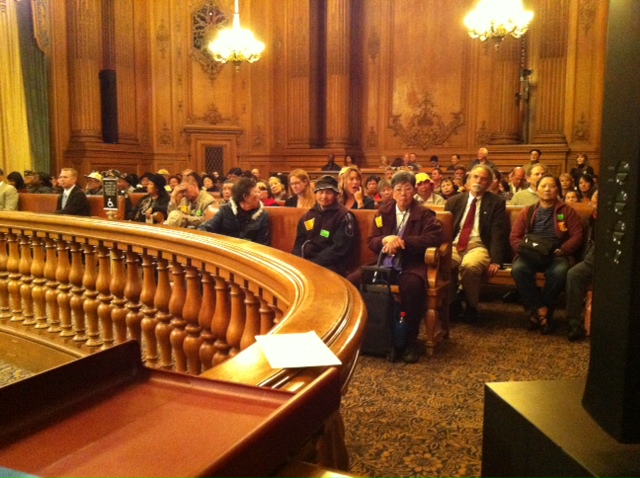
About 50 workers were in the room celebrating the launch of the task force, the result of years of work from groups like the Progressive Workers Alliance- a coalition of the Chinese Progressiave Association, Young Workers United, the Filipino Community Center and others. The room broke into an energetic chant of “si se puede,” the rallying cry of United Farm Workers, as the announcement ended.

“What starts in San Francisco goes through California, then all across the country” said Huerta.

We were here

4

FILM “I feel like I was maybe here, a while back. Or I’m older than I really am, and I just have this young body and spirit and mind — but I have a memory of this place when it was bangin’,” says video blogger Crystal Starr in new doc Detropia, gazing at the Detroit skyline from an abandoned building somewhere on the West Side, puffing a little joint.

Most people who grew up in the Rust Belt, kicking around the ghostly landscape of industrial decay, know this feeling intimately. But for those of us from Detroit, once-glamorous capital of American manufacturing and symbol of the triumph of capitalism, the sentiment is especially keen. We feel like we were born with the history of the city in our bones.

Another common feeling is that of dread upon hearing that yet another arty documentary (or brow-furrowing article, or glossy photo book) about the Motor City’s current economic state is coming down the pipe. The narrative arc of such things is usually this: remember Motown? Cars were amazing. Then there were scary riots, probably out of thin air. Then the jobs left. Isn’t Detroit sad now? Look how spooky this abandoned train station from the 1930s is! America is over. Wait! Some hipsters are starting a farm downtown! There may be hope after all. But who knows?

Detropia, directed by Heidi Ewing, who grew up near Detroit, and Rachel Grady, doesn’t exactly deconstruct that crusty storyline (non-spoiler alert: the hipster-farmers become performance artists). But this important and beautiful film shows how much more of the Detroit tale takes on meaning and shape when told through the voices of people who actually live there, with a cinematic eye that doesn’t shy away from reality, even as it bends it to narrative ends. (In Detropia, even a plastic-wrapped head of iceberg lettuce is a metaphor.)

http://www.youtube.com/watch?v=SRce1KFsH-g

Those voices include Starr and several others, including George MacGregor, president of the United Auto Workers Local 22, who is filmed during the painful closure of an American Axle plant; Tommy Stephens, slight-but-wise owner of an old school bar-restaurant; and a jaunty band of scrap-metal salvagers who should become the subject of a documentary in their own right.

Yes, the film has a somber tone and melancholy style. Grim statistics — “in the last 10 years, Michigan has lost 50 percent of its manufacturing jobs;” “six million workers lost their jobs” — are dutifully displayed. Current Detroit industries, like casino gambling or techno and hip-hop music, and their effect on the economy are left unexamined. And yes, the ruins of Detroit look gorgeous. (One thing Detropia gets spot-on is how the pervasively humid, green-gray light of the coastal city echoes off peeled paint and crumbling yellow-red brick.)

But when you hear MacGregor at his desk gently telling an elderly retiree on speakerphone that she has no vision insurance — it was one of the union compromises of the auto industry bailout — right before he launches into a mesmerizing rhapsody on the middle class, the camera lingering on his greased hair and patchwork sweater, you realize the utopia of Detropia isn’t the hoped-for return of the old days. It’s the insistence of humanity to persevere and form a community, no matter how crazy things get.

DETROPIA opens Fri/28 in Bay Area theaters.

Mission residents connect at community meeting

7

Police hosted a Mission community meeting yesterday in response to the Sept. 16 death of Jesus Solis, 20, who was shot at Treat Ave and 26th St. But before the meeting could take place on its scheduled date, another shooting took place; police officers shot Oscar Barceñas, 22, Sept. 20. Barceñas has survived his injuries.

The second shooting sparked two nights of late-night demonstrations during which protesters broke the windows of banks and a local business and painted “killers” on the Mission police station.

At last night’s meeting, Police Chief Greg Suhr, district Captain Robert Moser, and district Sup. David Campos spoke to a group of more than 100, then listened as the group asked questions, commented on their experiences and made suggestions. Ricardo Garcia-Acosta, regional director of the Community Response Network, took a seat next to the city officials about halfway through the meeting to address the community as well.
 
Suhr said that Barceñas may have been planning to act in revenge for the death of Solis.

Many at the meeting spoke of their mourning process for Solis, known as Chuy. He had been working, employed with help from the office of Sup. David Campos, before he was killed last week.

“This individual was trying go change his life. He was going to work, we was trying to turn his life around,” Campos said during the meeting.

Long-time Mission resident Roberto Hernandez said that he has been to 50 meetings after deaths of people in the community.

“I’ve buried too many kids in this barrio,” said Hernandez.

How to help?

Some residents at the meeting called for increased police presence, and one requested mounted police at Garfield Park. Others, such as Yaron Milgram, owner of two upscale restaurants in the 24th street area, expressed a desire to be more involved in the community.

“I know that there’s been a lot of change, and I know I’m considered part of that change,” said Milgram.

Many at the meeting had suggestions of how other residents could help.

Some advocated getting to know neighbors.

“For some of you hear who are quick to call the cops, when’s the last time you went outside and said how, how are you guys doing? What are your names?” said Garcia-Acosta.

“It really hurts when you hear people ask for these youth to be pushed out of the neighbrohood,” said Susana Rojas, director of the Mission Clubhouse. “Never forget they’re somebody’s son, they’re somebody’s brother, they might be somebody’s dad.”

She said that, if residents didn’t want to talk to the kids themselves, “talk to the people that are working with them” to learn more about them. She recommended donating to local community centers like the Mission Boys and Girls Club and the Good Samaritan Family Resource Center, where the meeting was held.

“A lot of the people I work with, they’re angry,” said Jae Maldonado, Community School Coordinator at Buena Vista/ Horace Mann. “The community is changing at a pace they don’t have any control over.”

Maldonado suggested that local business owners play an active role in getting resources and jobs to youth, offering Mission Pie as an example of a company that employs local youth and helps prepare employees for careers in catering or baking.

One resident, Anabelle Bolaños, decided to help set up a police and community meeting in Spanish, which she hopes can take place monthly. According to staff at the Mission Police Department, the first such meeting is tentatively scheduled to take place at some point in November. Tonight, police will host their regular community meeting at Mission Police Station meeting, which occur the last Tuesday of every month at 6pm.

Rojas also announced a “peace march,” to leave Thursday from 24th and Mission at 4pm.

City College has too many teachers. Damn.

12

So the state auditors have determined that City College is in serious financial trouble, which we knew, and has ascertained the reason: There are too many teachers, and they get paid too well.

Damn. That sounds like a terrible situation. Too many teachers! Horrors! Let’s fire some of them today!

Seriously: I know the district has problems, and I know that a lot of people inside the district feel that department heads have too much power, and there’s an awful lot of political patronage going around. It’s been a nightmare for more than a decade, with too many incompetent and corrupt people controlling the College Board, protecting their allies in administration, and treating the place as a personal fiefdom.

I think things have gotten a little better since the ascension of a more progressive majority on the board and the departure of Chancellor Phil Day and his crooked crew, but it’s still a mess.

But isn’t it a sad statement on San Francisco, and California, and the United States today that an auditor could look at a college that serves working-class and poor kids, immigrants, people who need jobs skills, and a broad, diverse community and say: You  have too many teachers? Isn’t is sad that the auditors, in a city that has about the highest cost of living in the Western United States, think teachers — teachers — are getting paid too much money?

Makes you want to throw up.

Yeah, let’s get the City College house in order, and recognize that expenses have to meet revenues, and make the tough decisions. But along the way, let’s ask ourselves: Is this what we really want?


Committee approves CleanPowerSF over downtown opposition

51

The question of whether San Francisco creates a renewable energy program that offers an alternative to Pacific Gas & Electric got its first major hearing at City Hall today, with the business community claiming it’s too expensive and supporters arguing that the time has come for the city to address climate change and the long-term energy needs of city residents and businesses.

The Board of Supervisors Budget & Finance Committee voted 2-1 in favor creating CleanPowerSF, entering into a contract with Shell Energy Northern California to administer the program, and devoting $19.5 million from the San Francisco Public Utility Commission’s water fund to help launch it and buy clean power for city residents.

Sups. John Avalos and Jane Kim supported the project, while Sup. Carmen Chu was opposed. It now goes to the full Board of Supervisors next week, where it is expected to have progressive support and be opposed by the fiscal conservatives.

“I do think we will have the necessary majority to get this through,” the measure’s sponsor, Sup. David Campos, told us. But one open question is whether Mayor Ed Lee will veto a measure that his SFPUC appointees developed but his downtown allies are trying to kill, and if so, whether there are eight supervisors willing to override a veto.

But Campos noted that SFPUC officials testified today that CleanPowerSF is the only way they’ve identified to meet the city’s ambitious official goals for reducing greenhouse gas emissions, which call for a reduction of 20 percent below 1990 levels by the end of this year and an 80 percent reduction by 2050.

Supporters who testified today included environmentalists, progressive groups, and young people who cast addressing climate change as the defining struggle of their generation. “This, not to go overboard, is the most important vote you’ll ever do,” said the Sierra Club’s Arthur Feinstein.

Those who spoke against the program included the usual array of downtown groups that have traditionally defended PG&E’s interests – including the Committee on Jobs, Golden Gate Restaurant Association, and Plan C – and they were joined by an unusually large number of elderly Asian individuals wearing stickers opposing the project.

“It’s a bad program that doesn’t meet even the basic elements of its original promise,” said Chris Wright, executive director of the Committee on Jobs, which PG&E has helped fund since its inception. Like most CleanPowerSF opponents, they have long opposed even the concept of community choice aggregation (CCA), the state law that allowed the city to create CleanPowerSF.

PG&E’s longtime support by local politicians has eroded in recent years because of its overkill campaigns against public power initiatives and supporters and its negligence in the deadly San Bruno pipeline explosion.

Even GGRA Executive Director Rob Black told the committee, “PG&E, a local company, candidly has its problems.” But he and other project opponents – and even a few supporters of the project – centered much of their opposition on the involvement of Shell, which has a bad reputation and environmental record, like almost every other multinational energy company.

“I have the same qualms about Shell that everyone else does,” said Katherine Roberts, who said that she nonetheless supports the project, calling it the only way for most San Franciscans to directly support the development of renewable energy sources. Shell was the sole bidder on a project that requires enormous financial wherewithal.

Campos calls the focus on Shell a diversionary tactic: “PG&E already buys energy from Shell. To the extent people don’t want Shell in the picture, Shell is already in the picture.”

Both the supervisors and the mayor will be under intense pressure to derail CleanPowerSF, with that campaign led by downtown groups and IBEW Local 1245, the union that represents PG&E workers. Sup. Scott Wiener, who says he’s still undecided, told us that his office was flooded with phone calls today, mostly in opposition to the project.

PG&E union mounts attack on Clean Power SF

31

The union that represents PG&E workers — and has opposed every single public-power initiative in modern San Francisco history — just launched an attack on Clean Power SF. And the union’s business representative is having a hard time explaining exactly why he’s working with PG&E to try to undermine this modest step toward public power.

Hunter Stern, with IBEW Local 1245, sent a press release out Sept. 11 announcing the start of a campaign to convince the supervisors not to approve the Clean Power SF plan. The line of attack: Shell Energy, which got the contract to supply sustainable energy to customers in the city, in competition with PG&E. The pitch:

San Francisco city government is considering a proposal to partner with Shell Energy of North America to inaugurate SF’s so-called “clean power” program. If the Board of Supervisors approves the proposal, San Francisco would pay millions to Shell, one of the most notorious environmental violators in business today.

Shell’s a pretty bad company. So is PG&E. So is just about everyone in the energy business. Not justifying Shell’s behavior, just noting: If you want a contractor to deliver electricty to San Francisco, you aren’t going to get a cool independent small business. You aren’t even going to get Google. These folks are evil, all of them.

Oh, and by the way: Shell Energy also sells power to PG&E (pdf). Stern’s boss has a contract similar to what the city is going to get. So the PG&E power we all pay for today is in part Shell power. And as Sup. David Campos points out, it wasn’t as if the city chose Shell over some better competitors: There was no other company out there anywhere in the world that responded to the city’s bid process and offered to work with Clean Power SF.

The key point here is that Clean Power SF is going to use Shell as a bridge — the private outfit will deliver power generated at renewable facililities to the city’s power operation, which will resell it to customers … for a while. The goal is to use the revenue stream from the sales of power to back bonds that will allow the city to build its own renewable energy system. Five, maybe ten years down the road, San Francisco will have solar generators on city property (including large swaths of Public Utilities Commission property in the East Bay), wind generators, maybe at some point tidal generators, and will be able to sell cheap, clean, local power to customers. Shell will be gone.

Let’s face it: this is a step on the path to creating a city-owned and city-run power system — that is, a step to eliminating PG&E as a player in San Francisco’s energy future. Public power will be cheaper and cleaner — and it’s going to take a while to get there. Which is why we need to start now.

PG&E knows this, too, and is fighting to block Clean Power SF, which comes before the board’s Budget and Finance Committee Sept. 12. Now IBEW is allied, as usual, with the giant company.

The Stern press release talks about how Clean Power SF will be expensive:

The average home can expect to see a rate increase of 77% over their current PG&E electricity generation rates. That comes out to an increase of over $200 per year.  The higher cost of power would eat up more and more of the City budget, forcing service reductions and costing San Francisco vitally needed jobs. Our local economy would take a multi-million dollar hit.

Actually, not true: The only people who will pay for Clean Power SF are the ones who want it. The idea is that a significant number of San Franciscans will be willing to pay a little more — maybe $10 a month — to help save the planet. The ones who want to stick with PG&E wil have every opportunity to do so. The city budget isn’t taking a hit — municipal services already use the city’s Hetch Hetchy hydropower. This doesn’t cost the city money or jobs.

It will, of course, hurt PG&E.

I called Hunter Stern to talk about all of this, and we had a long conversation. He was polite and answered all of my questions. Sort of.

He insisted that IBEW isn’t against community choice aggregation, that he’s only worried about the city budget and the impacts on ratepayers. And Shell. So we started going around in circles, like this:

Me: So you don’t oppose Clean Power SF?

Stern: We are not opposed to community choice aggregation. Just to this contract with Shell.

Me: I’m told Shell is the only contractor willing to fulfill this role.

Stern: That’s what I’m told, too.

Me: So if you support CCA, what should the city do?

Stern: Find somebody else.

Me: The city has made it clear there IS nobody else.

Stern: We should put this on hold and wait around until there is.

Me: Why is IBEW unhappy with Shell?

Stern: This is contracting out.

Me: Is Shell Energy a nonunion company?

Stern: They don’t generate power, they just buy and sell, so they don’t really have any employees who could be in IBEW.

Me: So what if they city can use this revenue to build its own renewables, with union labor?

Stern: We aren’t opposed to the city building its own renewables.

Me: But the idea here is to use the revenue stream from Clean Power SF to raise money for local renewables.

Stern: You don’t need revenue to build local renewables. Just creativity.

Me: But the city has a huge budget problem now. There’s no money to build local generation unless you have a revenue stream to bond against.

Stern: There are creative ways to do it.

Me: So you support CCA. You support building local renewables.Clean Power SF is a CCA program to build local renewables. Shell is the only company that answered the city’s call for bids for this project. You don’t have any labor issues with Shell. I don’t understand where you’re coming from.

Stern: I don’t disagree with your checklist.

Me: So why are you against this project?

Stern: We don’t think this is good for the city or for the ratepayers.

Me: But the ratepayers don’t have to be a part of it if they don’t want to.

Stern: I think the way the city is approaching that is a good strategy.

Round and round and round. It was making my head hurt. I wish I’d put it on tape so you could all listen.

I passed the press release along to Tyrone Jue at the SFPUC. He had a pretty clear response:

This attack is not surprising. IBEW is one of the largest unions at PG&E. They historically side with PG&E on all their issues. The fact is CleanPowerSF will not cost IBEW workers jobs. Ironically, the local renewable build out phase will be creating even more green union jobs. This happens while we weaning ourselves off dirty fossil fuel sources.San Franciscans want the choice to embrace a clean energy future. While PG&E shareholders stand to lose with CleanPowerSF, the consumer and environment stand to win.

He added:

Our ‘little creativity’ involves reinvesting revenue into aggressive energy efficiency and local renewable generation projects.  We’re simply not motivated to maximize profit at the expense of our customers or the environment.   Our common sense goal is to reinvest revenue into real projects that will reduce San Francisco’s carbon footprint, create local jobs, and build a sustainable energy future that is better for the environment and our customers.

Ugh. This is going to be a battle royal. I hope there are six votes on the board for Clean Power SF, which is imperfect but important. And then Mayor Lee will have to decide whether to side with his highly respected SFPUC general manager, Ed Harrington, who wants to make this happen, and PG&E, which doesn’t.

Oh, by the way: PG&E pays Willie Brown about $250,000 a year as a “legal retainer.” And I hear the mayor takes his phone calls.

Commissioners sharpen Mirkarimi case and select unlikely rep

165

 The Ethics Commission wrapped up nearly six months worth of proceedings on the official misconduct charges against suspended Sheriff Ross Mirkarimi today, finalizing its findings of fact and choosing Chair Benedict Hur to make its presentation to the Board of Supervisors even though he was the sole dissenting vote against removing Mirkarimi from office. 

After making the key decisions during a marathon meeting on Aug. 16, today’s hearing was mostly about mopping up, and it was the most sparsely attended of the hearings so far. But there were still a couple of tough issues to hash out, and the commissioners who voted against Mirkarimi tried to strengthen their case at the last minute.
The City Charter mandates removal of an official if at least nine supervisors find he committed official misconduct. The commission had earlier discussed how they viewed that finding and the punishment as separate issues, but decided against recommending a punishment after discussing that charter language. 
Commissioner Beverly Hayon today sought to remove any doubt about where she stood, adding a personal statement into the record that she thought the sustained charges — its 4-1 finding that Mirkarimi’s grabbed his wife’s arm during a Dec. 31 argument and subsequently pleaded guilty to false imprisonment — warranted Mirkarimi’s removal.
In a sign that the commissioners are paying attention to the political climate that has formed up around their deliberations, she made a reference to a discussion and vote last month by the Commission on the Status of Women and sought to clarify any “confusion” about where she stood.
Commissioner Paul Renne also sought to sharpen the findings of fact by adding language indicating the commission found the testimony of Mirkarimi and his wife, Eliana Lopez, to be a less credible and compelling description of what happened on Dec. 31 than the tearful 45-second video that neighbor Ivory Madison helped her make days after the incident displaying the bruise on her arm and saying she wanted to document the incident in case they divorced and there was a custody battle over their three-year-old son. 
That language was inserted in the document without objection, a decision that drew a sharp rebuke from Lopez’s attorney, Paula Canny, during the public comment portion of the hearing. “My client wants you to know that you’re flat out wrong,” Canny said, criticizing the commission’s hostile treatment of both Lopez and Linnette Peralta-Haynes, Lopez’s confidante on the day Madison unexpectedly called the police. 
“It has to be Eliana is not credible to justify your finding,” Canny said, accusing commissioners of selecting facts to fit impressions they formed when watching the emotional video. “The only reason Eliana made that video is to be used in a custody dispute.”
Mirkarimi attorney David Waggoner tried unsuccessfully to make changes to a commission summary document that he called “very one-sided,” including trying to add language indicating that the commission had unanimously rejected most of the charges that Mayor Ed Lee brought against Mirkarimi, such as witness dissuasion, abuse of power, and interfering with a police investigation. 
Waggoner also objected to Hur’s suggestion that attorney Scott Emblidge, who is doing pro bono legal work on the proceedings for both the commission and the Board of Supervisors, calling it a conflict of interest given that the commission’s role is akin to that of prosecutor. And on that point, he found support from Renne, who was unaware that Emblidge will also be advising the supervisors, a dual role he found troubling. “I’m a little surprised and I don’t know why the board doesn’t have independent counsel,” Renne said.
Emblidge promised a “dry recitation” of the commission’s findings, but Waggoner recommended the commission’s executive director, John St Croix, when pressed by Hur for an alternative, a choice Hur rejected because St. Croix hasn’t been present at all the hearings. Finally, Renne suggested that Hur do the presentation, saying that he has been fair and represented all arguments well during the proceedings so far, something that Hayon and Commissioner Dorothy Liu enthusiastically agreed with. 
It was an unconventional decision given that Hur made strong arguments on Aug. 16 about the troubling precedent that he thinks the commission’s decision represents, saying it gives the mayor too much power and opens the door to political manipulation if the official misconduct provisions are construed so broadly.
But he accepted the duty, telling the commissioners: “I’m willing to do it. It is awkward given that I was in the dissenting view, but I’ll do my best.”The case is expected to be sent to the board by Sept. 18 and it will have 30 days to act, meaning the decision will be just a few weeks before an election in which five supervisors are running to keep their jobs.Mirkarimi’s team has sought to delay the transfer of the case until after the election, noting many political interest groups and supervisorial candidates have been publicly putting pressure on the supervisors to remove Mirkarimi.

SF School Board members are suddenly pals

11

I’m used to negative campaigning in San Francisco School Board races. Two years ago, much of the effort candidates were putting forward seemed to be about trashing Margaret Brodkin. These days, I’m getting emails from all sides telling me IN CAPITAL LETTERS who the Guardian should never endorse.

And the board itself has been bitterly divided at times; Rachel Norton and Jill Wynns used to constantly fight with Sandra Fewer. There were two factions on the board, and there’s no way either side would support a member of the opposing crew.

But a funny thing is happening this fall. Among the torrent of trash-talk, the three incumbents — Norton, Wynns, and Fewer — have nothing bad to say about each other. In fact, everyone agrees that the board is working more closely together than it has in years, and while they aren’t always saying so in public, Wynns, Fewer and Norton are quietly helping each other out with their campaigns. All three told us they’d be happy to see their colleagues win re-election.

And it’s all because of the teacher’s union.

Back in March, the school board, by a 5-1 vote, did something almost unheard of in this union town: They discarded the rule of seniority and protected the jobs of 70 mostly newer teachers while issuing layoff notices to teachers with time on the job. The superintendent, Carlos Garcia, wanted to end the cycle of high turnover at 14 school with historically low performance rates, so he created a special “superintendent’s zone.” Teachers who agreed to work in schools that veterans often sought to avoid received extra training and support. Principals sought to build working teams that would stick together.

Then came the annual pink-slip ritual.

The SFUSD administration doesn’t know in the spring how much money it’s going to have for the next fiscal year. That’s because the state doesn’t finalize it’s budget until summer. And by law, the district is required to give teachers notice in March if they might be laid off come September.

So every year, the district issues pink slips to several hundred teachers — and most years, most of those layoffs are later rescinded.

Layoffs are mostly, but not entirely, done by seniority — teachers with advanced skills that are hard to find (special-ed teachers and some math and science teachers, for example) are exempt from the normal layoff process. But the union didn’t consider the 70 Superintendent Zone teachers as fitting that description — and when the board sided with Garcia and protected those teachers from pink slips, union leaders were furious.

Fewer, a staunch progressive who had never so directly defied the union before, told us she was so nervous before the vote that she wasn’t sure she could speak. But speak she did — making a strong statement that the visible, measurable progress in those 14 schools justified a tough decision. Four of her colleagues, including Wynns and Norton, backed her up.

For the United Educators of San Francisco, this was unacceptable. Seniority is at the heart of most union contracts, and once you carve out exceptions like this, the union argued, you go down a very dangerous path. An administrative law judge agreed, and ruled in May that the district acted improperly.

As it turns out, enough layoffs were rescinded that it isn’t really an issue any more — but the bad blood is still there. UESF has refused to support a single incumbent for re-election. Ken Tray, a UESF representative, told me that the superintendent was “at war with the teachers union” and called the vote “a toxic mess.”

But the ire of the union has brought the incumbents closer together. Wynns and Fewer have something in common now. They feel like they’ve been through — to use Tray’s term — a war together.

Not, I suspect, what UESF had in mind. But it’s happening. And it could affect the outcome of the election.

Nite Trax: The Eagle flies again

41

I hung out yesterday evening with the new occupants of the Eagle Tavern (now known as the SF Eagle, apparently) at a celebration of the lease-signing at the Lone Star Saloon. Alex Montiel and Mike Leon seem perfect to replace the former Eagle operators Joe and John: Tough-looking and leather-bearish, a tad gruff at first but friendly once they warm to you, and a wee bit shy of the press right now.

They’ll be releasing their full plans for the storied queer bar in a couple weeks, but I did manage to squeeze some juicy info out of Alex. They hope to open the bar in time for Halloween, the liquor license has indeed been secured (in fact, they have two!), and they’ll be doing their best to return some of the Eagle’s ambiance to the now-pretty-much-gutted space, with a few slight modifications to the bar layout for code and traffic flow reasons.   

It’s certainly been a long, winding, super-convoluted road to get to this point!

I’m not sure anyone can convey all the twists and turns and backroom mechanations of the whole thing — Jay Barmann at Grubstreet has done some excellent reporting on it all, but there were still many, many balls in the air, shall we say, and the shady politics got slightly out of control. The fight to keep a historically queer space queer — despite the previous occupants’ quasi-abandonment, despite the lucrative offers from upscale restaurants, despite the limited power and will of the city to legislate such things — was a bit of a hot gay potato for the past year. (The Eagle’s infamous, charitable Sunday Beer Busts lived on in monthly form at El Rio in the Mission, at least.)

Even the idea of a “historic queer space” was questioned: if the Sisters of Perpetual Indulgence had sanctified it, and the ashes of multiple queer people were scattered about a place that raised tens of throusands of dollars for amazing local causes and was regarded as the heart of the old school gay leather rock ‘n roll biker community, was it important enough to fight for?

Hats off to Milk Club president and outspoken queer activist Glendon Anna Conda Hyde for saying, “Hell yes!”

Glendon (identified slightly incorrectly in a recent Chron story as the Norm of the Eagle’s “Cheers” — that was actually the frizzy-haired dear in the thong and flip-flops who stood around clutching a goblet of piss) kept the Eagle issue at the forefront of the city’s debate about gentrification and the loss of queer nightlife spaces, angering some fussy queens with his usual passion and stridency, but in the end succeeding in rallying an assortment of powerful players to the Eagle’s defense.

I talked to Glendon today about how the whole thing went down. His basic summation was that Supervisors David Campos and Jane Kim did excellent jobs of making sure the Eagle stayed queer (Sup. Scott Weiner does not get very high marks from him in this regard), and that dubious dealings by the person supposedly representing the owner of the building — who lives north of the city, and who Glendon said had indeed wanted to welcome in new queer owners all along — were what kept screwing everything up. Finally the building owner (actually, the manager of a trust that includes several elderly owners) awarded the lease to Mike and Alex after he realized what was happening with his representation and the reaction of the community.

“I think it’s so great,” Glendon told me. “People keep saying that you can’t revitalize queer nightlife in SoMa — but that’s just a lazy excuse for gentrification. I’m glad we could band together to ensure a future for queer spaces in this city. We should be proud of what happened here. Our shared queer history is a powerful force. 

“We’re still fighting for an officially recognized queer historical district in SoMa that will honor those who came before us, and also help preserve lively alternative queer spaces. Supervisor Christina Olague and CMAC [California Music and Culture Association] is working hard on that. One of the major problems is that it’s illegal to say something has to be or remain ‘gay.’ I think we saw here that it can be done within the limits of current boundaries.”

As for the future of the Eagle? “Mike and Alex have indicated that while they’ll still be preserving the main traditions and atmosphere — as well as probably hiring some of the old staff back — they are hoping it will be a much more open space. Already the Lexington Club is planning to host a fundraiser to help them remodel, so that suggests the Eagle will be more women-friendly, and there may be new parties there from some of the city’s younger promoters as well.”

My favorite part of this whole thing — besides the colorful faux-funeral outside Foreign Cinema restaurant, or the “assless chaps” takeover of the Skylark bar (both at one point identified as villains in the Eagle saga)? Beyond the banding together of the community to save an actually cool place that is a huge and drunken part of my life (also, DJ Don Baird on Sundays was secretly the best DJ in the city)?

At one point it was announced that the Eagle was to become a fancy pizza place with a wood-fired oven on the back patio. Glendon turned to me and hissed: “I always knew the straights wanted to put us in the oven!” 

Parting gift

0

news@sfbg.com

Retirement is knocking at Ed Harrington’s door. But the San Francisco Public Utilities Commission general manager is hesitating, not quite able to muster the will needed to walk out the door. He has something that he wants to finish first.

The sage city veteran has labored for years to launch an historic program so transformative that it would finally allow city residents and businesses to reject a homicidal utility monopoly and the dirty electricity that it sells. Success could be mere weeks away; failure would be a bitter blow.

Twice in the past 27 months, Harrington and his staff have fumbled efforts to launch the city’s long-promised community choice aggregation (CCA) program. The program, CleanPowerSF, would give Pacific Gas & Electric (PG&E) customers the option of switching over to a publicly backed electricity provider selling green, climate-friendly power.

The energy would continue to be ferried into homes and other buildings over PG&E’s electrical grid, and customers who switch would continue to receive their bills from PG&E. Those gas and electricity bills could initially swell by an average of one quarter, but the mix of power that they pay for would jump from 20 percent renewable up to 100 percent renewable.

Harrington’s previous CleanPowerSF launch schemes collapsed in mid-2010 and again early last year without getting off of the ground, largely because nobody — neither the city nor private industry — would shoulder the large financial risks. Unlike those failed efforts, which would have offered a private company virtual carte blanche to sell power to as many PG&E customers as possible, the latest CCA proposal resembles a successful program operating in Marin County. The Marin program started small in early 2010 and is already growing at a rapid clip as it pursues true energy independence.

For the next few weeks, despite having previously planned to retire in August, Harrington will oversee a last-ditch effort to drive approval of his latest iteration of CleanPowerSF by the Board of Supervisors. “I’ve offered to stay into September so that we can have the CCA discussions at the board,” Harrington told the Bay Guardian.

Harrington declined to discuss the latest version of CleanPowerSF, the real and perceived financial risks of which will be hashed out by the Budget and Finance Committee, referring questions to a spokesperson.

But environmentalists and local “green jobs” advocates who just 12 months ago were panning CleanPowerSF, ready to block its passage through the board, are now lauding it. They say the change came about after Harrington met directly with them and seemingly changed his own mind about how the program should be run.

The program would initially see Shell Corp. sell 20 to 30 megawatts of renewable electricity generated in far-flung places to fewer than 100,000 residential customers. Instead of fostering new supplies of renewable energy, San Francisco residents may initially buy power at premium prices from existing wind, solar, and other green facilities. That might make San Franciscans feel warm and fuzzy, but it wouldn’t necessarily reduce the nation’s overall carbon footprint.

The activists agree that it’s a crying shame to get into bed with an evil multinational oil company. But they say it’s an acceptable start, as long as the program evolves into something far more meaningful — into something resembling the Marin Clean Energy model. Like in Marin, the activists want San Francisco to use CleanPowerSF revenues to help build its own solar, wind, and other renewable energy and energy efficiency projects, many of them right here in city limits. They want the city to sell those power and the energy efficiency gains directly to CleanPowerSF customers.

Over the coming years, the SFPUC could gradually add enough clean electricity at competitive rates into the CleanPowerSF mix, generated by its own facilities and purchased off the open energy market, to meet the needs of all the city’s residents and businesses.

The build-out of solar power plants and other renewable energy facilities has always been imagined as an integral element of CleanPowerSF. But until last October, critics say SFPUC officials were treating the build-out as an afterthought, making little effort to lock in plans to move forward with the construction as a structured part of a CCA program.

“The SFPUC staff decided they wanted to do this the easy way and just buy energy,” said Eric Brooks, a regular at City Hall hearings who chairs the San Francisco Green Party’s sustainability committee and has spent years working with the SFPUC on CleanPowerSF. “They wanted to do that because it was easy — you can just declare victory.”

Once the general manager started to meet directly with local activists, Brooks says, “Harrington started hearing what we had been saying to the staff for all these years about how important the build-out is.” Harrington began to understand the importance of a renewable energy build-out that begins as soon as the new program launches. In turn, the activists threw their support behind Harrington and the program.

Brooks said that the build-out of city-owned renewable energy facilities could create thousands of jobs. It could also lead to energy independence in a city where environmentalism is a badge of honor, but where PG&E continues to sell nuclear and polluting fossil fuel energy without facing any competition.

“This is the perfect solution to the climate crisis and the economic crisis,” Brooks said. “We need to create a green New Deal. That’s the depth of crisis that we’re in, economically and environmentally.”

Such a build-out is also expected to build support for the program at the Board of Supervisors. Without it, the City Controller’s Office calculated that the city’s economy could take a hit to the tune of $8 million over five years after CleanPowerSF launches in the spring in additional electricity expenses, potentially jeopardizing about 100 jobs. But that analysis failed to consider the thousands of jobs that could be created laying panels, installing turbines, and performing other tasks if the city develops its own renewable energy supplies as a part of the program.

It’s impossible right now to say precisely what type of renewable energy facilities would be built by San Francisco: A $2 million study that would paint that picture is planned. But Paul Fenn, president of Local Power Inc., which is helping the SFPUC prepare to call for bids from companies interested in building the facilities, said they could include everything from solar panel arrays to customers’ energy efficiency gains to a wave energy plant.

The first CleanPowerSF committee hearing is scheduled Sept. 12, followed at some point thereafter by an historic board vote that will almost certainly prove contentious, likely pitting the board’s progressive members who have long supported public power against some of its fiscal conservatives.

Much of the debate will focus on an initial $19.5 million investment by the city. Of that money, about one-third would be used as collateral — a pool of cash held in escrow and available to reimburse Shell if the program flops. SFPUC spokesperson Charles Sheehan said the $7 million in collateral would gradually be recouped by San Francisco if the program moves forward successfully.

Another $2 million would fund CleanPowerSF customers’ energy efficiency programs; $2 million would help customers install solar panels; and $2 million would be spent on the study to determine how best to build out the portfolio of renewable energy plants owned by San Francisco. The rest of the money would cover operating and startup expenses, and it could be recouped later through power sales.

In a town where PG&E wields tremendous political and financial influence, proposing to gamble public funds establishing a competitor to the company is always sure to be thoroughly scrutinized, if not outright opposed and criticized. Supporters of the program, however, say that the gamble is a safe and necessary one that could have sweeping workforce and economic benefits.

“I don’t think that we can afford not to do CCA,” said Sup. David Campos, the program’s most active supporter on the Board of Supervisors. “So long as something like CCA is not in place, PG&E will continue to be the only game in town. I think it’s important for us to give consumers in San Francisco an alternative to PG&E.”

CleanPowerSF has long suffered an identity crisis that has harmed its prospects of legislative approval. Opponents deride it as a public power scheme and they work on behalf of PG&E to quash it. But ardent public power supporters do not see it that way: They consider CleanPowerSF to be little more than a minor stepping stone toward public power, and they have not rallied around it nearly as much as they have rallied around some of the storied yet unsuccessful public power campaigns of years past.

If Harrington can clinch lawmaker approval for CleanPowerSF before he retires, he will have provided city residents with a lasting choice in what kind of electricity they buy.

“I think that any effort to compete with PG&E is seen as public power,” Campos said. “But this is really about providing a choice.”


Dick Meister: Let’s count our blessings on Labor Day!

2

By Dick Meister

Dick Meister, former labor editor of the SF Chronicle and KQED-TV Newsroom, has covered labor and politics for more than a half-century. Contact him through his website, www.dickmeister.com, which includes more than 350 of his columns.

OK, it’s time to celebrate Labor Day, time to celebrate the labor movement that won a wide range of benefits for working people. That includes, of course, a paid day off on Labor Day and other holidays or extra pay for working on the holidays. But there’s much more than that. Much more.

We can also thank unions for:

* The eight-hour workday with meal and rest breaks.

* Forty-hour work weeks and three-day holiday weekends.

* Overtime pay and paid vacations, sick leave and maternity leave.

 * Major help in the enactment of anti-child labor law laws and increased public education funding.

* Medicare and retirement and disability benefits.

* Job security and other workers’ rights.

* A strong political voice for unions that helped enact Social Security, unemployment insurance, workers compensation, health and safety and minimum wage laws and has helped elect pro-worker office holders.

* Important help in the passage of key civil rights and civil liberties laws that have particularly helped political dissidents, women and minorities and military veterans.

Certainly not every worker enjoys all the union-backed benefits. But even the non-union workers who make up the vast majority of working people these days have many of the benefits. And, thanks to the efforts of unions, they have the opportunity to win all of the benefits.

You can be sure that on this Labor Day, as on all others, political candidates will have lots to say about unions.  You can expect, however, that not much will be heard from Republicans. Their usual ranting in behalf of their moneyed backers about the evils of “Big Labor” and “union bosses” will be muted, lest they offend potential blue-collar supporters. Democrats undoubtedly will voice their usual support for union members and workers generally, many sincerely, some simply in hopes of gaining blue-collar support.

Union opponents seem to forget that unions are democratic organizations, whose members generally have a strong voice in their unions’ activities.  Union officers are elected, after all, and so are answerable to their members.

Union positions on political candidates and issues, as well as financial contributions to candidates, are not dictated by union officers, despite what anti-union politicians assert. Union positions and union political spending are determined by the votes of union members, usually on the recommendations of their Committees on Political Education (COPE). Officers who don’t reflect their members’ position face replacement by membership vote.

Once, Labor Day meant big parades in cities nationwide. But no more. Although union numbers continue shrinking, unions are surely here to stay. They’ve fought their way into the Establishment. They still parade here and there, but no longer feel that parading is necessary to show their strength and importance.

Unions are much more likely to mark Labor Day with the political activity that has become as important to them as economic activity since their arrival into the ranks of the economically accepted.

Thus the Labor Day messages of union leaders will stress politics. That will largely include support for President Obama, despite union complaints that he has not worked hard enough to overcome congressional opposition to pro-labor reforms that he’s proposed or supported. From labor’s point-of-view, Obama is nevertheless very much preferable to Mitt Romney, just as most other Democrats are preferable to their Republican opponents.

Despite much opinion to the contrary, the union stress on politics, rather on winning broader public support for unionization, does not mean that all unions have reached a permanent, unshakeable position in society.

Nor does it mean that unions are not still fighting battles that are as almost as significant as those of the 1930s and 1940s that drew broad support from a public which sometimes frowns on unions, now that they have secured the strong position in society which the public helped them win.

Labor influence is not measured strictly by the number of union members, because of labor’s strong influence in politics and because the wages and conditions of unionized workers set the standard for all workers. Yet numbers are important, and unions generally have been struggling just to keep overall membership steady.

Currently, only about 12 percent of privately employed workers are unionized. But while their numbers have remained low, the figure for unionized public employees has grown to nearly 40 percent. That has put public employee unions in the vanguard of the labor movement, and given the movement new, badly needed strength, although also raising strong political opposition to public employee unions.

There are some fairly solid reasons for the decline in union membership overall, ironically including the unions’ loss of their position as underdogs, the widespread granting of union conditions to non-union workers and illegal employer interference in voting by workers on whether to unionize.

Perhaps the most important reason for the decline in union membership has been a fundamental change in the workforce. Once dominated by blue-collar production workers, it has come to be dominated by white-collar service workers. But organized labor sometimes has been slow to move into white-collar fields outside of public employment.

Labor Day should cause us to reflect on the great importance of the labor movement’s vital mission – its organizing of workers to win economic and political strength and helping elect pro-worker officeholders, its help in creating jobs and otherwise aiding the millions of Americans who remain unemployed or otherwise in economic distress.

So while you may not be able to see a parade on Labor Day, labor is still doing many other things well worth watching, and well worth supporting.

A footnote: Despite what the standard history books say, the first real Labor Day celebration was not held in New York City in 1882, but 14 years earlier right here in San Francisco. That was on February 21, 1868. Three thousand paraded the city’s streets by torchlight to mark enactment of the 8-hour-day law in California.

Happy Labor Day!

Dick Meister, former labor editor of the SF Chronicle and KQED-TV Newsroom, has covered labor and politics for more than a half-century. Contact him through his website, www.dickmeister.com, which includes more than 350 of his columns.

Diamond Dave’s report from Romneyville

27

Activists from San Francisco and around the country are descending on Tampa this week to protest the Republican National Convention. I got a call this morning from Diamond Dave Whitaker, the poet who hung with the beats and the hippies in his 75 years, CCSF student senator and San Francisco legend. He’s has been serving food to protesters at election-season conventions for almost three decades. His first was 1984, the Democratic Convention here in San Francisco before he got hooked and headed to Dallas to protest the Republicans. Along with a few hundred others, Diamond Dave braved the rain, but missed the full effects of Hurricane Isaac on the tent city last night. The RNC starts officially starts today (though many of the day’s events have been called off due tot the hurricane warning.)

“I’m talking in the midst of Romneyville,” he said. “Folks came from far and wide to camp out together, cause a ruckus and be here.”

What’s Romneyville? “It’s a homeless camp, a poor peoples camp,” said Dave. He’s been there a week setting up the Food Not Bombs kitchen, and Romneyville grew up around him. It now has few hundred tents, he said. But most people arrived today, so as the convention gets started, it will probably grow. “Two buses from Zuccotti Square came today,” he said.

Romneyville is put together in part by the Poor Peoples Economic Human Rights Campaign. Dave said Green Party vice presidential nominee Cheri Honkala, a formerly homeless mother herself who works with the Poor Peoples campaign, is a fixture around the camp.

“Our demands are housing for all, food for all, healthcare for all, and living wages for all. We call for an end to foreclosures and homelessness, an end to the war on the poor, both here and abroad. An end to criminalization of poverty. Money for jobs and housing, not for war!” says a statement from the group.

More protesters are staying over at the Occupy Tampa encampment.

A permitted march left this morning, and Diamond Dave says there’s another, unpermitted, planned for 3pm est. Many citizen journalists and livestreamers are documenting the events, one can be found at mobilebroadcastnews.com.

But so far, his work has been handing out free meals with Food Not Bombs.

“We fed the masses this morning for sure,” he said.

Dick Meister: Green is good for us all

3

By Dick Meister

Dick Meister, former labor editor of the SF Chronicle and KQED-TV Newsroom, has covered labor and politics for more than a half-century. Contact him through his website, www.dickmeister.com, which includes more than 350 of his columns.

Millions of American workers badly need jobs, and the owners of many thousands of commercial buildings badly need “green retrofitting” to improve their energy efficiency and thus cut operational costs while simultaneously helping clean up the environment.

The conclusion should be obvious: Let the retrofitting begin, for the benefit of everyone – those who need the work, the employers who want it done, and the rest of us , who would benefit greatly from it.

Details of what could and should be done – and why and by whom – are laid out in a new briefing paper from the well-regarded National Employment Law Project, otherwise known as NELP.

Perhaps what’s most important about green retrofitting is that it’s what NELP calls “a powerful job creation tool.”

It can indeed be that. As NELP reported, “Estimates show that a mix of tax credits, new building code requirements and loans for commercial energy efficiency upgrades would create upwards of 160,000 new jobs,” possibly hundreds of thousands more, over the next year.  That certainly would significantly lower the high unemployment rate that has plagued the country for far too long, encourage investment and otherwise jolt the lagging economy.

Construction workers have been hit particularly hard by unemployment, and it is they who have the skills and knowledge “that could be put to work cutting greenhouse gas omissions and making our cities cleaner and more efficient places to live,” notes Christine Owens, NELP’s executive director.

She says many construction workers, as well as other workers, also are needed to improve existing commercial buildings “in a common-sense way while also meeting the challenges of climate change.” NELP says more than three-fourths of all the electricity produced in the United States is used to operate the buildings, “making improved energy efficiency an increasingly recognized part of reducing the nation’s greenhouse gases.”

Simply providing jobs would not be enough.  NELP argues that government policy makers supporting green retrofitting and the jobs it creates should make certain they are “good jobs with strong workplace standards and fair pay and job security.” That’s an absolute necessity if jobs in the retrofit industry are to be truly sustainable. At a minimum, that would call for providing workers increased pay and better chances of being promoted to higher-paying jobs.

NELP cites three cities – Los Angeles, Seattle and Milwaukee – that have developed programs which have won the support of workers, environmentalists and commercial building owners, in large part by backing retrofitting projects that, while creating jobs, also help owners cut their costs and increase their income.

Los Angeles has adopted a city ordinance that calls for retrofits of city-owned buildings, a process for settling labor conflicts that arise during the work, and an effort to ensure that Los Angeles residents have access to training for retrofitting work.

In Seattle, the city has an agreement with retrofit contractors on setting pay and providing job training for their employees.

Milwaukee has a new energy-efficiency program that offers building owners the chance to qualify for financial aid in exchange for using contractors committed to hiring local workers and “adhering to quality workplace standards.”

It’s now time for other cities nationwide to take action. There’s no legitimate reason for inaction. We have a great need to modernize and expand our infrastructure, diminish environmental pollution and provide work for the jobless. We have shown it can be done.  So let’s do it!

Dick Meister, former labor editor of the SF Chronicle and KQED-TV Newsroom, has covered labor and politics for more than a half-century. Contact him through his website, www.dickmeister.com, which includes more than 350 of his columns.


Are free Golden Gate Park events fading away?

25

San Francisco’s countercultural community was built at least partly through free concerts and gatherings in Golden Gate Park, including the legendary Human Be-In and Grateful Dead and Jefferson Airplane concerts in the late-’60s. But these days, as corporations starve local government but seize public spaces, grassroots groups and populist performances are being forced out of the park.

Events without expensive tickets and corporate sponsorships (such as this month’s Outside Lands) or endowments from dead billionaires (Hardly Strictly Bluegrass Festival, coming up in early October) just can’t afford the rising fees charged by the Recreation and Parks Department, a reality that is quietly ending an important San Francisco tradition and legacy.

A few weeks ago, organizers of the Power to the Peaceful Festival – a free concert featuring Michael Franti and Spearhead and other big acts, which drew tens of thousands of people to the meadow formerly known as Speedway annually for more than a decade – announced that it was canceling next month’s event because of onerous fees.

“The only way to have produced the festival this year would have been to turn it into a ticketed event,” organizers wrote in their July 31 announcement. RPD officials were going to charge the event $77,000 in permit fees this year, dealing it a death blow after also forcing the cancellation of last year’s event by instituting a strict 40,000 attendee cap, which was nearly impossible to enforce for a free event.

If we accept the neoliberal perspective that has taken hold of San Francisco – which sees government’s role as facilitating whatever corporations want to do and hoping they share some of their profits, or at least create some good jobs – it makes sense. After all, the cash-strapped RPD made $1.7 million in profit-sharing off Outside Lands this year, up from $1.4 million last year.

The same logic has caused RPD, under the mercenary leadership of Director Phil Ginsburg, to rent out its recreation centers to the highest bidders and fire the recreation directors that used to treat them as public resources, and to let the private City Fields Foundation cover many parks in artificial turf. Again, through a strictly economic lens, it makes a certain amount of sense.

“As the steward of our parks, the Department works with event organizers to host diverse events in our parks, it is our shared responsibility to make sure the City and the event organizers have plans and resources in place to care for our park land and ensure public safety. The Department is always ready to work with all event organizers to modify their event planning for safe and successful events,” RPD spokesperson Connie Chan told us.

Power to the Peaceful – ironically, an event celebrating the plight of ordinary people against powerful political and economic interests around the world – just didn’t have the resources to meet the standard, so out they go. Same thing with the venerable Anarchist Book Faire, which was also forced from the park by rising fees this year after 17 years in the park’s County Fair Building.

Again, there’s a note of irony to this exodus, with city officials suddenly deciding the anarchists could no longer police themselves and needed to pay for four Park Police officers to watch over a festival that has been without violent incident throughout its history, unless you count a speaker getting pied last year (which the self-sufficient anarchists easily dealt with on their own).

“We had put this thing on for 17 years and there were no problems until this new guy came,” Joey Cain of Bound Together Bookstore, which puts on a free event whose fees have steadily risen to almost $14,000. “We’ve had to increase our rates every year, and we were starting to lose some vendors.”

On top of that, city officials had also cracked down on free offerings that surrounded the free event, banning Food Not Bombs from serving free meals to visitors and people from setting up information tables outside the main event.

So now the event, coming up in March, will be held at the Armory. Cain admitted that rent on the building they used in Golden Gate Park was still fairly cheap compared to similar sized venues around town, “as it should be, being owned by the city.”

But when city departments like RPD become dependent on corporate contributions, public spaces become commodified, and we begin to lose access to the last places in town where our creator endowed us with the right to assemble freely and pursue our happiness: our public parks.

Alerts

0

WEDNESDAY 22

Lockout ruling victory march Castlewood Country Club, 707 Country Club Circle, Pleasanton; www.endthelockout.org. 5-6pm, free. Castlewood Country Club workers have been out of work and replaced by low-paid, non-union workers for two years. They haven’t stopped fighting to get their jobs back, and on Aug. 17, the National Labor Relations Board ruled that the lockout is illegal and Castlewood Country Club must reinstate their jobs. Come march for victory for the workers. Also, come march for support on the road ahead, as the country club will likely appeal or delay the process.

FRIDAY 24

Heal the Streets graduation celebration Nile Hall, Preservation Park, 668 13th St., Oakl; www.ellabakercenter.org. 5-7pm, free. "If we truly want to address violence, we must engage youth impacted by it so they can heal, have positive alternatives, and take action." That’s the philosophy of the Ella Baker Center’s Heal the Streets program, where young people spend 10 months in theater workshops and conversation, coming up with practical and creative ideas. Friday, they will be graduating from the program, presenting their theater piece and their findings. Come celebrate with them.

SATURDAY 25

American Indian market and pow wow 56 Julian, SF; www.friendshiphousesf.org. 10am-6pm, free. This eighth annual street festival features a pow wow, dance, hand drum contest and dance contests (both with cash prizes), and vendor booths with arts and crafts and food. In 1953, Congress passed a resolution to seize more than a million acres of American Indian land. This resulted in massive displacement and movement of Native Americans to major cities, including the Bay Area. To provide support and a community center, Friendship House was founded in San Francisco. Now, it still provides several programs, including this annual street festival.

SUNDAY 26

National day of action for women’s rights 24th and Mission, SF; www.defendwomensright.org. 12pm, free. On this day in 1920, the 19th Amendment passed, finally giving women the right to vote. This year, attacks on women spread throughout the country. The day before the Republican and Democratic national conventions, protests will be held in several cities nationwide to show that the people will not tolerate attacks on reproductive rights. Women Organized to Resist and Defend asked dozens of women why they will be marching, and the answers, shown in photos on their website, range from "to shut down sexual assault" to "women’s health is not secondary" to "ICE and homeland security perpetuate violence against women." Will you march?

Shifts in feminism in Japan’s anti-nuke movement Omiiroo Gallery, 400 Franklin, Oakl; nonukesaction.wordpress.com. 6pm, free. After the Fukushima nuclear disaster last year, a movement of Japanese parents who no longer trusted the government’s word that the nuclear industry was safe took root. Parents formed study groups on radiation and used their own Geiger counters at home and at their children’s schools. Mari Matsumoto, a Tokyo writer who was in the middle of it, focuses on feminism and reproductive labor in the context of nuclear radiation. She will be speaking at this event, along with a screening of the film "How nukes got to Japan." The event is a potluck, and seating is available, but organizers recommend you bring a pillow to sit on the floor in case it runs out.

MONDAY 27

Eyewitness from Tahrir Square Audre Lorde Room, The Women’s Building, 3543 18th St., SF; www.occupyforumsf.org. 6pm, free. Gihan Abou Zeid had years of experience working to end violence against women and coordinating with various UN efforts before she became involved in the Egyptian Revolution. She has since helped to found Mayadin Al-Tahrir (Liberation Places), an effort to bring the liberation that was found in Tahrir Square to new places all over Egypt. After the successful ousting of Hosni Mubarak, many women have continued to protest sexual assaults and other violence. Zeid will speak on women’s experiences in the revolution and the ongoing fight for gender justice.

Lee appoints Santos, a staunch development advocate, to CCSF board

22

Rodrigo Santos, a structural engineer who heads the pro-development advocacy group San Francisco Coalition for Responsible Growth, had already raised an unheard of amount of money in his race for the City College of San Francisco Board of Trustees, $113,153 in just six months, mostly from real estate and development interests.

Today, he got another big boost when Mayor Ed Lee appointed Santos to fill the vacancy on that board created by the recent death of Milton Marks, giving the ambitious Santos a big advantage in the fall contest and perhaps signaling Lee’s support for making deep program cuts to satisfy the accrediting commission’s demand that CCSF cut expenditures and beef up its reserves.

“Tough decisions and reform are what City College needs at this time,” Lee said at a press conference this afternoon, calling Santos “someone who shares my vision of reform and will support the tough decisions ahead.”

Although Lee said Santos “is committed and passionate about education,” Santos hasn’t been active on education issues before running for this office. His passions seem to lie mostly with advocating for developers and opposing government regulations in front of the Planning Commission and other bodies, where he regularly testifies, and in helping fellow conservatives gain power on city boards and commissions.

The appointment continues Lee’s pattern of appointing and relying on controversial conservatives in key areas, from his chief fundraiser and economic adviser, venture capitalist Ron Conway, to his recent reappointment to the Planning Commission of Republican Michael Antonini, who gave Santos the maximum $500 contribution in his CCSF race.

“I join an institution that must be saved. I am absolutely committed to that goal,” Santos told a press conference in the Mayor’s Office. He said that he will work to “achieve consensus” around solutions to the troubled institution’s problems, while also declaring, “We must support the interim chancellor, Pamila Fisher.”

But rather than someone who seeks political compromise, Santos’ reputation is as more of polarizing and ideologically conservative firebrand who regularly criticizes government and progressives as part of the downtown alliance that includes Plan C, Committee on Jobs, Building Owners and Managers Association, the SF Chamber of Commerce, and the Board of Realtors PAC

“I actually find him to be pretty divisive in trying to work on issues at [the Department of Building Inspection],” Debra Walker, who served with Santos on the Building Inspection Commission. “He always seems to come into a situation attacking and I hope he doesn’t bring that to this board.”

Walker, a longtime progressive activist and former supervisorial candidate, said that she and her political allies have long endured nasty attacks from Santos and his CRG bretheren.

“They spend all of their time attacking progressives and he gets pretty intense about attacking rather than working with people,” she said. “CRG is about getting people elected who are conservative, that’s their whole reason for existence, perpetuating the real estate industry’s impact of city policies, which has had a negative impact on the middle class.”

Asked about that reputation by the Guardian, both Lee and Santos denied it and refused to answer follow-up questions. Santos said CRG has a “diverse membership” and told us, “I don’t know why you would cast that as polarizing.”

Yet its board is made up almost exclusively of real estate and development interests who have shown themselves to be politically ambitious, winning key mayoral appointments to the Building Inspection and Small Business commissions and working with mayoral staffers to hold onto key leadership positions, edging out supervisorial appointees in the process.

Sup. John Avalos, who was targeted by a CRG independent expenditure campaign in 2008, said that he researched Santos’ background on education issues and was a little surprised not to find anything. “More than anything, the appointment says more about Lee’s pro business leanings,” Avalos told us.

It was also telling that Lee included two of the most conservative CCSF trustees in his press conference, Natalie Berg and Anita Grier, but that more liberal trustees Chris Jackson and John Rizzo were neither consulted nor notified directly about the appointment. “I’m sorry the mayor didn’t involve us more or let us know,” Rizzo told us.

While Rizzo didn’t endorse Santos – instead backing Jackson, Steve Ngo, and Rafael Mandelman (who Rizzo said “really does have the best interests of the district at heart”) – he didn’t want to offer an opinion on Santos, saying that he wants to work constructively with him to solve the district’s problems: “I welcome him to the board and hope he will welcome the work we’ve been doing.”

Santos told reporters that he starts every work day with an “open house” at his office from 5:20-8am, discussing various issues with anyone who wants to stop by, before getting into his engineering and administrative work for his firm, Santos & Urrutia. “I will bring that same commitment to City College,” he pledged.

Country Country Club workers plan picket after step towards victory

0

Workers at Castlewood Country Club in Pleasanton, represented by UNITE HERE Local 2850, received a favorable decision from Administrative Law Judge Clifford Anderson of the National Labor Relations Board on Monday. He found that the club owes all 61 union workers two years of back pay– and their jobs back.

“For the workers it feels like a relief to be believed in some way,” said Local 2850 organizer Sarah Norr. “The workers have been saying for two years that Castlewood was not really trying to reach a compromise.”

The food service workers and janitors of Local 2850 at Castlewood haven’t worked in two years. Instead, they picket the club and march. But they’re not on strike– they would love to go back to work. They’re on lockout.

In Feb. 2010, the club tried to hike up their health care costs, significantly increase the hours per week that would be considered full-time, and cut pay. After heated negotiations, the club refused to allow workers to return to their jobs and hired non-union replacements.

Negotiations have continued since, but according to Norr, they haven’t been productive. In Aug. 2010 the management presented a new set of proposals, which Norr called worst than the first. It would have allowed for the club to keep on the temporary workers that had replaced the union workers during the lockout and do away with seniority in scheduling and layoffs, as well as allowed for increased subcontracting. That was when the union filed a complaint with the NLRB.

In Aug. 2011, the General Counsel of the NLRB issued a decision that there was sufficient evidence to prosecute Castlewood for violating federal labor law. After hearing nine days of testimony for various stakeholders on both sides, Judge Anderson ruled that the alleged violations had occured.

He found that the lockout was illegal, and recommended that the NLRB order Castlewood to reinstate the locked-out workers and pay them two years of back wages and benefits.

Jerry Olson, Castlewood Country Club’s general manager, told us that the club hasn’t decided yet if they will be complying with the judge’s order.

“We just received the ruling today in the mail, and we’re considering all our options,” Olson said Aug. 21. “We certainly respect the administrative law judge.”

“We were surprised,” said Olson. “We expected to win the case.”

“It’s important for folks to understand that this doesn’t guarantee that its all over,” Norr said. “Castlewood does have the option of asking for a review of the case from the NLRB in Washington, DC.” Such a review could take years, prolonging the lockout but also increasing the amount of back pay the club would need to pay if they lose.

Workers plan to picket the club Aug. 22 at 5pm, celebrating their victory and demanding that the club comply.

“We’re thrilled about the decision, but we know we could still have a long fight in front of us,” said Castlewood janitor Francisca Carranza in a press release. “We’ll be here for as long as it takes to get our jobs back and win a fair contract with health care for our kids. We know people in the community will stand behind us, just like they always have over the past two years.”

The end of work as we know it

21

I read Player Piano in high school, when all of us were suburban kids were discovering Vonnegut. (We were also discovering Herman Hesse, for reasons I will never understand, and we talked about Slaughterhouse Five and The Glass Bead Game as if we were some sort of intellectuals. I read a couple of the Hesse books and found them dry and pointless. I loved Vonnegut, particularly God Bless You Mr. Rosewater.)

At any rate, even in the 1970s, Player Piano didn’t seem that far away, and it was one of the formative books of my crazy political consciouness of the time, and it got me thinking, years later, about unemployment. When I was first out in San Francisco, all of my friends were busy — and not many of them were working for pay at a traditional job. And I thought, as the nation went into a deep recession and everyone talked about creating jobs, that what people really needed was money, not jobs. For almost everyone I knew — people involved in politics and art and theater and writing and troublemaking — a job was just a way to pay the rent. And if we didn’t have to work to make ends meet, so much the better. We all had a lot to do, much of which would never earn us any money; get rid of the damn jobs and we could do it all a lot better.

Yes, as Vonnegut made very clear, people got, and get, a lot of their self-worth from what they do for a living, particularly if it’s skilled work. But maybe that’s not the way it always ought to be — particularly if the day when robots take over almost all manufacturing is rapidly approaching.

John Markoff of the New York Times has a mind-bending piece about robots taking over jobs that even a few years ago were too complicated to be done by machines:

 The falling costs and growing sophistication of robots have touched off a renewed debate among economists and technologists over how quickly jobs will be lost. This year, Erik Brynjolfsson and Andrew McAfee, economists at the Massachusetts Institute of Technology, made the case for a rapid transformation. “The pace and scale of this encroachment into human skills is relatively recent and has profound economic implications,” they wrote in their book, “Race Against the Machine.” In their minds, the advent of low-cost automation foretells changes on the scale of the revolution in agricultural technology over the last century, when farming employment in the United States fell from 40 percent of the work force to about 2 percent today. The analogy is not only to the industrialization of agriculture but also to the electrification of manufacturing in the past century, Mr. McAfee argues.

The “debate” can go on as long as you want, but the reality is that a lot of what we now call “work” will soon be done by machines — sooner than a lot of us think — and that will mean, if nothing else changes, a nightmarish society where the gap between the rich and poor is even worse and the middle class is in a free-fall collapse. Consider:

In one example, a robotic manufacturing system initially cost $250,000 and replaced two machine operators, each earning $50,000 a year. Over the 15-year life of the system, the machines yielded $3.5 million in labor and productivity savings.

So who gets that $3.5 million? Not to be all Marxist or anything, (heaven forbid), but right now, under modern industrial capitalism, none of it goes to the displaced workers. In theory, the robots could allow them to do something else with their lives — teach, or mentor kids, or paint, or learn to speak a couple new languages, or build a new house to retire in, or whatever. The robots don’t need to be paid, and that “productivity savings” could go directly to the wealth of society as a whole, making life better for all of us. But it won’t — the whole $3.5 million is kept by the factory owner, and the displaced worker gets nothing — except depression, a lower standard of living, and the opportunity to scramble for a job that takes less skill and pays less.

If we’re going to survive as a stable society, two things are going to have to happen. We’re going to have to accept that “work” in the traditional sense is not going to be the only, or even main, source of people’s income — and that’s okay. And the only way that’s going to work is if we mandate that the saving from more efficient technology go to everyone, not just the elite.

Pretty radical shit, huh? I must be out of my mind. Kind of like that ol’ Commie Kurt was in 1952, when he saw this coming.


Appetite: Delicious new cuisine and cocktail reads

0

Fermentation and distillation, hot plats and sugar cones, sweet creams and brokeasses … These eight books were released this spring, and are among the best of what has landed on my desk this year:

TRADITIONAL DISTILLATION: ART AND PASSION
by Huber Germain-Robin

Anyone who knows US craft distilling knows Hubert Germain-Robin, one of the pioneers in the American craft distilling movement. He was making world class, French-style brandies (he is French, after all) since the early ’80s right here in Northern California at Germain-Robin, which he co-founded, an example to generations after him of what true, elegant brandies should be. As he states in the introduction, “When I came to California in 1981, I realized the unbelievable potential of the New World, with such diversity in grape varietals, microclimates, and less demanding restrictions than there are in France.”

He just released his first book, Traditional Distillation, and, as the inside cover states, it’s an ode to the “passion, art and poetry” behind distillation. I’ve seen a few (there’s really not many) technical distillation books that get into still types or cutting the “heads and tails” of a distillation batch. Germain-Robin’s book (the first in a series of books on brandy production) is a thoughtful essay, covering the technical but doing so in an artistic, poetic way. The book boasts an Old World, classic look, delving into the philosophy behind distillation as much as process. A romantic sensibility pervades this book and passion speaks from the pages – there is even poetry and classic art included, doing justice to the reason people like myself (one who rarely had a drink in younger years), fell in love with the artisan craft and history behind distillation. It’s a short, succinct book, but a unique one. Hubert captures the beauty of the craft, giving concrete advice for would-be distillers everywhere, ensuring that his incredible knowledge and legacy is shared with many more.

THE ART OF FERMENTATION by Sandor Ellix Katz

Just released June 12, The Art of Fermentation (with forward by none other than Michael Pollan) is sure to be the gold standard on fermentation. Katz published Wild Fermentation in 2003, at the time dubbed the “fermenting bible” by Newsweek. As the press release states for his new, elegantly understated book, he now has an additional decade of experimentation behind this one. The first book of its kind, it contains recipes, yes, but ultimately is a 400+ page textbook on all things fermentation, its history and processes, and DIY steps in a range of categories from meads, wines and ciders to meat, fish and eggs. There’s plenty of study material for food and drink folk alike, whether an extensive section on sour tonic beverages (from kombucha to kvass) or details on fermenting beans, seeds and nuts. Katz’ book makes me want to start fermenting my own potato beer immediately.

TAKE AWAY by Jean-Francois Mallet

Take Away is a lovely photo book. Released in the US in April (first released in France in 2009), this beauty of a book is a virtual escape around the world, immersing the reader in street foodscapes and dishes from Shanghai to the Ukraine. Be warned: perusing this book is difficult on an empty stomach. And for those of us who thrive on travel and exploring every nook and cranny of a city or region, Mallet’s approachable, street savvy photography also induces travel lust.

CINDY’S SUPPER CLUB: Meals from Around the World to Share with Family and Friends by Cindy Pawlcyn

Cindy Pawlcyn is one of California’s trailblazing chefs, aiding Napa in becoming a dining destination when opening Mustard’s Grill nearly 30 years ago along with subsequent restaurants, like Cindy’s Backstreet Kitchen. She’s written a few cookbooks, but I particularly enjoy her newest, out this May: Cindy’s Supper Club. A book based on favorite international recipes prepared in her supper clubs with friends, the recipes span the globe from Russia and Hungary to Lebanon, Peru, Korea. Cindy’s intros to each selected country and recipe feel comfortable, like a chef chatting about their travels and technique as you sit with them in their kitchen. Though recipes tend toward the heartwarming, soulful kind, many list more than ten ingredients and aren’t exactly simple. But for cooks ready to try something new yet not fussy, adventure lies within these pages, whether Flemish meatloaf in spicy tomato gravy or white gazpacho (made of white bread, milk, almonds, garlic, olive oil, sherry vinegar) with peeled white grapes.

PLATS DU JOUR: the girl and the fig’s Journey Through the Seasons in Wine Country by Sondra Bernstein

Just see if you don’t long to move to Sonoma after spending time with Plats du Jour, a large, photographic book capturing Sonoma’s vibrancy. With a range of recipes from Sondra Bernstein’s beloved girl and the fig duo and Italian restaurant, Estate, the book journeys well beyond recipes. Sectioned by seasons, there’s highlights on wine, cheese, and produce, pairing possibilities, origins of foods, cocktail hour menus, and seasonal menus to recreate at home. Interspersed throughout are drink recipes, such as the perennially popular lavender mojito from girl and the fig http://www.platsdujour.net/#!home/mainPage. Photos and stories of trailblazing Sonoma farmers keep the reader rooted to a sense of place. Though the variety of info might initially seem disparate, it weaves into an inspiring whole urging one to seek out ingredients from their own farmers markets and entertain or cook inspired by the invigorating spirit behind Bernstein’s book and the artisans of Sonoma.

SWEET CREAM AND SUGAR CONES
by Kris Hoogerhyde, Anne Walker, and Dabney Gough

Bi-Rite’s ice cream essentially needs no introduction. For those in San Francisco, it’s already an institution. For foodies nationally, the beloved market’s ice cream has been written up in most national food magazines, among the best ice creameries in the country. Thankfully this spring, founders Anne Walker and Kris Hoogerhyde, along with writer Dabney Gough, have released a book, Sweet Cream and Sugar Cones, sharing many of Bi-Rite’s lauded recipes (yes, their legendary salted caramel ice cream, which spawned dozens of imitations around the nation, is included), and many more besides, including sweets far beyond ice cream, from cookies to pie. The book is grouped in ingredient-themed sections like chocolate, coffee, vanilla, citrus or nuts. I take to the herbs and spices section with recipes like basil or peach leaf ice cream, picante galia melon pops, and my favorite Bi-Rite flavor of recent years, Ricanelas (cinnamon and Snickerdoodles). Having already tried a couple of the recipes, they are easy to follow, and, of course, delicious.

SUNSET EDIBLE GARDEN COOKBOOK

Sunset has cornered DIY gardening and cooking for decades in their magazine and cookbooks, with recipes and step-by-step gardening instructions. Their latest book, Edible Garden Cookbook, just out this spring, is another winner with accessible recipes, growing-harvesting-storage-cooking tips and varietal lists on a wealth of vegetables (from peas to cucumbers), herbs (mint to thyme), and fruits (melons to stone fruit). Creative recipe twists enliven everyday dishes like an icebox salad layered in a casserole dish or kabocha squash filled with Arabic lamb stew.

THE BROKEASS GOURMET COOKBOOK by Gabi Moskowitz
(Review by Andi Berlin)

Chasing the elusive paycheck is a tiresome routine, but at least it’ll taste good with the new BrokeAss Gourmet cookbook from San Franciscan Gabi Moskowitz (not to be confused with Broke-Ass Stuart.) The former kindergarten teacher-turned-caterer-turned-Internet-celebrity founded the website BrokeAss Gourmet after seeing friends laid off from tech jobs and eating junk. Taking a conversational, gal-pal tone, Gabi guides us through the essentials of running an eclectic kitchen – from stocking a full pantry to boosting cheap proteins with flavorful sauces. Recipes like vegetable lasagna with wonton wrappers demonstrate her craftiness. The book is high on kitsch: rather than photographs, illustrations of animals stand beside cheeky anecdotes (“Because bacon really does make everything better.”) Moskowitz paints a vivid Bay Area landscape, adapting several recipes from ethnic joints and buzzy spots like Bakesale Betty. And if she relies too heavily on sriracha sauce, forgive her. When you’ve got to shove off to work early morning after morning, it’s often the call of the rooster that gets you going.

Subscribe to Virgina’s twice-monthly newsletter, The Perfect Spot, www.theperfectspotsf.com

If you want my advice

0

CAREERS AND ED In July, the unemployment rate in California was 11 percent. Which got us thinking: what’s the smart way to job hunt these days? We’re not the only ones — this month, the Commonwealth Club is hosting a series of lectures and workshops called “The Future of Work.” We tapped two of the series’ experts for email interviews, asking Marty Nemko, author of Cool Careers For Dummies, and Joel Garfinkle, Oakland-based career coach, for their takes on the matter. They offered two points of view on today’s dreary job market. Upside? Nemko, who spoke on August 1, is positive that more workers will be needed to implement upcoming immigration reform. Of course, he also foresaw growth in “bio-chemical terrorism.” Oh, the future.

San Francisco Bay Guardian: Tell us about your Commonwealth Club event.

Marty Nemko: [My focus was] on which careers are likely to burgeon [in] the result of [an] Obama win — which ones polls and Intrade [a speculative, crowd-sourced website] betting suggest will occur. I’ll also talk about how to survive and even thrive during what may be America’s decline and fall.

Joel Garfinkle: Working hard and being good at what you do is not enough to attain the level of success you truly deserve. So what exactly makes one person more successful than another? The answer: leveraging and applying perception, visibility, and influence better than anyone else.

SFBG: What kinds of issues are older workers facing in terms of getting new jobs?

MN: It’s very tough to convince an employer that a 40-year old with no experience is better than a 25-year old with experience. In this job market, the employer doesn’t have to settle.

JG: Mid-life career transitions occur because after years of success, many of my clients find that they lack fulfillment. Success isn’t enough anymore to satisfy them. [But] it’s difficult to make a mid-life career transition due to the lack of financial stability that exists when making the change. Learning of new skills in a different profession can be a daunting and intimidating task.

SFBG: What are some place that are still proving fruitful for job searchers?

MN: Some of my predicted areas for growth are auditing for corporations, the US Treasury, and the IRS; immigration-related bureaucrats that will be needed after Obama gets comprehensive immigration reform after the election; health care advocates to help people get the health care they need as ObamaCare is implemented; and bio-chemical terrorism. Anything mandated will be the last sort of employment to get cut. Lastly, multicultural marketers to address the tastes of the fastest-growing ethnic groups.

JG: Information technology is still growing. About two-thirds of hiring manages have been adding staff this year and will continue to add headcount to the IT departments. Health care is still pretty in-demand due to rising ages in the US. And many employers have had difficulty finding and hiring enough engineers.

SFBG: Should people still be striving for their dream job? Is that idea still relevant?

MN: It’s in the Bay Area’s drinking water. If there was a motto on the San Francisco flag, it would be “Do what you love and who cares if the money follows. My parents will support me.”

JG: The increase in collective desire to love one’s job comes from something missing in a person’s life. Statistics over the years have stayed consistent in stating that over two-thirds of Americans are unhappy in their jobs. The task is to recognize that people are uniquely special, have something to give, have a talent no one else shares in quite the same way.

MARTY NEMKO: “KEYS TO BEATING THE ODDS IN STARTING A BUSINESS”

(next lecture) Thu/9 6pm, $20

Commonwealth Club 

595 Market, Second Floor, SF

JOEL GARFINKLE: “GETTING AHEAD AND TAKING YOUR CAREER TO THE NEXT LEVEL”

Aug. 30, 7pm, $15 

Silicon Valley Bank

3005 Tasman, Santa Clara

(415) 597-6700

www.commonwealthclub.org