Jane Kim

Shelter from the storm

0

rebeccab@sfbg.com

Ms. Li has a petite build, but she’s physically strong. Hauling around dish bins and boxes of produce weighing 50 pounds was part of her daily routine when she worked shifts lasting 12 hours a day, six days a week, at a San Francisco Chinatown eatery that later made headlines for its poor labor standards.

Li, who did not share her full name for fear of retaliation, says things have improved slightly since the days she worked at King Tin Restaurant, which closed its doors abruptly in 2004 after workers who hadn’t seen paychecks in months filed an onslaught of complaints. At the time, her husband was unemployed and she was struggling to support her two teenagers on a single paycheck totaling $950 a month.

It took about five years before the San Francisco Office of Labor Standards Enforcement (OLSE), the City Attorney’s Office, and grassroots advocates with the Chinese Progressive Association (CPA) finally succeeded in forcing the restaurant’s previous owner to grant Li and other workers the back wages they were owed.

Now, she’s working 12 hour shifts, five days a week at a different restaurant, but says she still isn’t receiving minimum wage or overtime pay. Li aided in the efforts of the Progressive Workers Alliance (PWA) to urge members of the Board of Supervisors to pass the Wage Theft Prevention Ordinance, which aims to strengthen enforcement of local labor standards by empowering OLSE to take a more proactive role against employers who don’t pay workers what they’re owed.

As a kitchen worker at a high-end restaurant in downtown San Francisco, Li receives a monthly paycheck totaling a little more than $1,400 before taxes. Take-home pay is less, because the employer deducts for meals, a requirement that cannot be dodged even if employees bring their own food.

Li told the Guardian her coworkers are angry about the working conditions, but fear of job loss keeps them silent. “Some of my coworkers work so hard that they cry,” she said, speaking through a translator. “One worker was burned badly in the kitchen, and didn’t receive worker’s compensation or paid sick leave.” That person uses their own ointment to treat the burns, she added.

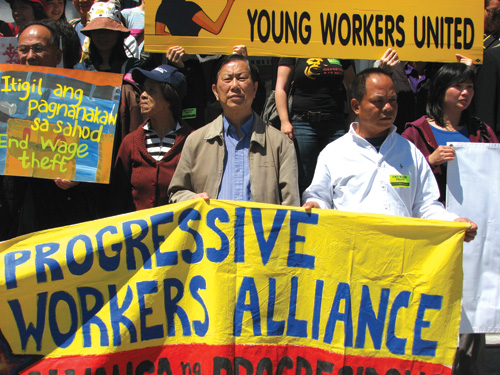
As she described her predicament at the CPA office in Chinatown, student volunteers were creating a banner to be displayed during a press event at City Hall. They arranged folded red and yellow petitions signed by workers in similar situations to spell out PWA, for Progressive Worker’s Alliance, to urge city officials to crack down on employers who violate local labor laws.

PWA has been meeting regularly since last year, but the organizations that are part of the advocacy group have been engaged in organizing low-wage workers for much longer. Over the course of more than three years, CPA interviewed hundreds of restaurant workers in Chinatown, and their surveys revealed that about half were not receiving San Francisco’s minimum wage, while about 75 percent weren’t being paid overtime when they worked more than 40 hours a week. Yet the problem of wage theft in San Francisco extends well beyond Chinatown.

PWA includes representatives from CPA, the Filipino Community Center, Young Workers United, People Organized to Win Employment Rights (POWER), the San Francisco Day Labor Program, and Pride at Work, among others. On August 2, workers and organizers with PWA burst into thunderous applause after the Board of Supervisors voted unanimously to pass the Wage Theft Prevention Ordinance on first reading. This represented a major victory.

“With the economic crisis, and the backlash against workers, we felt that as a small grassroots organization, we needed to have a more powerful voice and a specific space for worker issues to be brought to light,” CPA lead organizer Shaw San Liu said of the impetus behind PWA.

“You’re talking about workers who are pretty vulnerable — not knowing the laws, not speaking the language. People who need a job and cannot afford to lose it are vulnerable to exploitation,” Liu said.

While labor laws in San Francisco are uniquely strong, with mandatory paid sick leave and local minimum wage established at $9.92 per hour, “When it comes to implementation and enforcement, there’s still a lot left to be desired,” Liu said. As things stand, investigation of employer violations are predicated on worker complaints, and it can take years for a worker to get a hearing if they’re owed back wages.

The Wage Theft Prevention Ordinance doubles the fines for employers who retaliate against workers who file complaints. It allows OLSE investigators to issue immediate citations if they detect a problem in a workplace. When an employer comes under investigation, it requires them to post a notice informing workers that they have a right to cooperate with investigators — and imposes a fine for failing to post the notice. It also establishes a one-year timeline in which cases brought to OSLE’s attention must be resolved.

Under the new law, employers would also be required to provide contact information to their workers, an important change for day laborers who are sometimes taken to job sites where they perform manual labor, only to be dropped off later without payment and no way to get in touch with their temporary bosses.

“You have raised awareness about the crisis of wage theft,” OLSE director Donna Levitt told workers at an Aug. 2 rally outside City Hall. “And we have made it clear that wage theft will not be tolerated in our city.”

The ordinance was spearheaded by Sups. David Campos and Eric Mar, with Sups. Jane Kim, John Avalos, Ross Mirkarimi, and Board President David Chiu signing on as co-sponsors. Members of PWA met with supervisors to win their support, and even succeeded in bringing on board the influential Golden Gate Restaurant Association.

“The fact is that even though we have minimum wage laws in place, those laws are still being violated not only throughout the country, but here in San Francisco,” Campos told the Guardian. “Wage theft is a crime, and we need to make sure that there is adequate enforcement — and that requires a change in the law so that we provide [OLSE] more tools and more power to make sure that the rights of workers are protected.”

Victoria Aquino, 66, spent several years working 16-hour hours without minimum wage or overtime pay as the sole live-in caregiver for six disabled patients at a San Francisco care center. Her duties included feeding patients, bathing them, changing diapers, and cleaning.

“The patients would knock to wake me up and ask me for cigarettes or food in the middle of the night,” she recounted, “and I wasn’t paid for that.” She first complained to OLSE after one of the patients physically attacked her, leaving her black and blue with a permanently injured finger, and later sought the help of the Filipino Community Center to file a claim demanding back wages. It took months, but her employer eventually settled, agreeing to pay $60,000 in back wages and reduce her shifts to eight hours a day.

Aquino said she became involved with the Filipino Community Center because “there are a lot of caregivers still suffering, and more than I suffered — especially those who don’t know the laws. I sympathize for them. It hurts me when I hear some caregivers who are no longer supposed to work. They’re past their 70s, and they’re still working.”

Fall ballot gets stripped of progressive measures

25

The San Francisco Tenants Union suffered a pair of disappointing setbacks in the last week – first when a referendum on the Parkmerced project narrowly failed to qualify for the fall ballot, then when progressive supervisors withdrew a proposed ballot measure to prevent demolition of existing rental housing – leaving the fall ballot without any progressive measures (unless one counts the sales tax measure that was unanimously approved this week by the Board of Supervisors).

Also dropped from the ballot this week was another progressive measure that would have prevented the Recreation and Park Department from entering into new commercial leases of parks and recreation centers, a measure written by the citizens group Take Back Our Parks to reverse RPD’s recent push to monetize more of its assets.

Yet unlike last week’s removal of a third measure placed on the ballot by at least four progressive supervisors – the Fair Shelter Initiative, written by the Coalition on Homelessness, which was unhappy that Sup. Jane Kim dropped her support under pressure from the Mayor’s Office – it was the sponsoring groups that asked the supervisors to remove the two measures this week.

Sponsors of the parks measure say it had some legal problems that would have complicated the campaign, particularly after an analysis by the City Attorney’s Office concluded that it could affect things like private party reservations and leases associated with the America’s Cup.

Ted Gullicksen of the San Francisco Tenants Union said his group concluded there were legal problems with the anti-demolition measure as well and that it wouldn’t affect the demolition of 1,500 housing units associated with the Board of Supervisors’ 6-5 vote to approve the massive Parkmerced project, which was the catalyst for the measure.

SFTU sponsored the signature-gathering campaign to do a referendum on that vote, but the Elections Department concluded on July 29 that of the 18,487 signatures that were turned in, just 12,917 were valid, falling short of the 14,336 they needed. Gullicksen said delays in qualifying the 56-page petition gave them just three weeks to gather signatures, and a freak mid-June rainstorm hurt that effort as well.

“We knew from the get-go that it was going to be a challenge,” he said. “It was very disappointing that we fell just short.”

But he said there was a silver lining: “It sent a message to the supervisors. David Chiu [the swing vote on the Parkmerced approval] called me the next day to say he’d make sure demolitions don’t become an epidemic.”

Sup. David Campos – who helped sponsor all three measures and even kept his name on the shelter measure after Sups. Eric Mar and Kim had removed theirs – told us, “I think it’s disappointing that there isn’t a measure on the ballot to excite the progressive base, but at the end of the day, we do have an exciting mayor’s race and races for sheriff and district attorney.”

Campos has endorsed John Avalos of mayor and Ross Mirkarimi for sheriff, but has not yet made an endorsement for DA.

Taking out the trash

1

sarah@sfbg.com

A controversial city waste disposal contract appeared primed for final approval by the Board of Supervisors on July 26 (after Guardian press time) — despite being challenged by a lawsuit and initiative campaign — after two progressive supervisors rescinded their initial vote in a July 20 committee hearing and supported awarding the contract to Recology.

City staff had recommended awarding the 10-year, $112-million landfill disposal and facilitation agreement to Recology (formerly NorCal Waste Systems, Inc.), which has grown from a locally based company to the 10th largest waste management firm in the US, with $652 million in annual revenue, according to Waste Age magazine.

If the full board follows the unanimous recommendation of its Budget & Finance Committee, the vote will authorize Recology to transport and dispose up to 5 million tons of the city’s solid waste at the company’s Ostrom Road landfill in Wheatland, Yuba County. The contract will take effect when San Francisco’s disposal agreement at Waste Management Inc.’s Altamont landfill in Livermore expires — estimated to occur in 2015.

The deal will cement Recology’s control, at least for a 10-year period, over all aspects of the city’s solid waste stream, at a cost of about $225 million per year, even as the company faces significant challenges, many related to the city’s 1932 refuse collection and disposal ordinance.

That law, approved during the Great Depression to prevent conflict between competing garbage haulers, has resulted in Recology’s exercising complete control over trash collection and transportation in San Francisco, without having to bid on those contracts or pay the city franchise fees.

During the negotiations over the city’s next landfill contract — the only aspect of San Francisco’s waste stream put out to bid — this 79-year-old law was invoked to explain why Recology has the sole authority to transport trash and compostables to Wheatland, which is 130 miles from San Francisco.

The move also comes as Yuba County is contemplating significantly increasing dumping fees at the landfill — from $4.40 per ton to $20 or $30 per ton — a hike that could erase the $100 million that the Department of the Environment (DoE) claims the Recology deal would save over a competing bid by Waste Management Inc. WM is the largest waste firm in the U.S., according to Waste Age, with about $12.5 billion in annual revenues.

On July 18, WM filed a lawsuit in San Francisco Superior Court to prevent the city from approving the agreements with Recology on the grounds that they violate the city’s competitive bid laws.

“The Department of the Environment inappropriately and unlawfully expanded the scope of its 2009 ‘request for proposal for landfill disposal capacity’ and, therefore, violated the city’s competitive procurement laws,” WM alleges in the suit.

WM has long held that DoE inappropriately issued a tentative contract award for both the transportation and disposal of solid waste to Recology without soliciting any other transportation bids. But DoE, which gleans $7 million annually (to operate recycling, green building, and environmental justice programs and long-term planning for waste disposal) from rates that Recology’s customers pay, ruled last year that WM’s objections are “without merit.”

Now WM is asking the court to require DoE to scrap its award to Recology and issue a new request for proposals to comply with competitive bidding requirements.

“There is ample time for the department to issue a new RFP,” WM stated July 18, noting that there is plenty of room at its Altamont landfill to accommodate the city’s waste after the contract expires.

That same week, a coalition led by retired Judge Quentin Kopp, community activist Tony Kelly, and Waste Solutions CEO David Gavrich announced that it had submitted enough signatures to qualify an initiative on the June 2012 ballot requiring competitive bidding and franchise fees from any company that seeks to win any aspect of the city’s solid waste business.

Kelly says his group was unable to collect enough signatures in time for the November election because Recology hired the city’s two biggest signature-gathering firms to circulate what he calls a “phony petition” in support of Recology’s performance in San Francisco. And signature gatherers say they were harassed by Recology boosters while trying to petition citywide.

“But I believe the question of whether candidates support competitive bidding will continue to be a defining issue this fall,” Kelly said.

The board’s decision on the landfill agreements has already been delayed several months, following a February 2011 Budget and Legislative Analyst report recommending that the board consider submitting a proposition to the voters to repeal the 1932 refuse ordinance so that future collection and transportation services be put to bid. The report also recommended that future residential and commercial refuse collection rates be subject to board approval.

But with two progressive supervisors running in citywide elections this fall, and with Recology exerting massive pressure on elected officials, the Kelly coalition could not find four supervisors to place such a charter amendment on the November ballot, forcing them to launch their own initiative.

And at the July 20 meeting of the board’s Budget and Finance Committee, Sup. Ross Mirkarimi, who is running for sheriff, and Sup. Jane Kim rescinded their initial decision to send the agreements to the full Board without recommendation. Instead, after the committee had moved on to other business, they joined Chair Carmen Chu, one of the most conservative supervisors, in forwarding the Recology agreements to the full board with unanimous support.

Mirkarimi interrupted the committee’s next discussion to rescind the landfill vote. “I think there was some misunderstanding a little bit in wrapping up the landfill agreements with Recology, ” Mirkarimi said. He said that he asked for the vote to be rescinded, “so we can accurately reflect some of the sentiments being articulated here. I think we just learned some things on the fly.”

In many respects, the switch by Kim and Mirkarimi made sense: prior to their initial vote, they made positive statements about the proposed agreements, but also stated an interest in exploring the appropriateness of the city’s 1932 law.

“Overall, I think this was a good contract,” Kim said. But she noted that, thanks to the 1932 ordinance, the city doesn’t get franchise fees. And she claimed that it only gets half of what other Bay Area cities get from their waste contractors. “So, I’m really interested in continuing that conversation, but I think it’s a separate conversation,” she said.

Mirkarimi said it was his concerns that led the committee to “put a pause” on the Recology agreements until it could “undertake more homework.” He also noted that his office “held a number of meetings” and he tried to “leverage this opportunity to reanimate activity at the Port.”

“I was hoping that we might be able to arrive at something much more deliverable,” Mirkarimi said, presumably referring to the fact that these efforts resulted in DoE unveiling an amendment to include two “possible changes” to operations and facilities at the Port of San Francisco in the agreements.

These changes involve utilizing other modes of transportation, including barges, as alternatives to the rail-haul plan proposed in the agreement. They also call for developing new facilities at the Port for handling waste, recyclables, organics, and other refuse. The cost of such alternatives would be passed onto the rate payers.

“I think that, cost-effectively, we may be able to insert the Port into this equation, but it’s not ready for prime-time yet,” Mirkarimi said. He concluded by saying that Recology has been innovative in reducing the city’s waste stream.

“This should be a front-burner conversation,” Mirkarimi said, noting that former Mayor Gavin Newsom focused on making San Francisco “the greenest city” in the United States. He added that San Francisco claims to have a 77 percent diversion rate, the highest in the U.S., and said, “That comes at a cost, it doesn’t come for free.”

After the meeting, DoE deputy director David Assmann said that the City Attorney’s Office is reviewing WM’s filing. “But it’s too soon to comment,” Assmann said.

He also claimed that, thanks to the 1932 ordinance, “there was no practical way” for another company to transport San Francisco’s waste to its designated landfill, “other than building a second transfer station outside the city.”

But Kelly continued to express concerns that the agreements are not competitive, and that the city lacks a contract and ensuing franchise fees. “They are running this as if it’s still the 1950s,” he said.

Kelly claimed that Recology Vice President John Legnitto, who is the 2011 chair of the SF Chamber of Commerce’s Board of Directors, recently told him that Recology has been in negotiations with City Hall around a $4 million franchise fee, but that the money would now be spent opposing Kelly’s competitive bidding initiative.

Kim removes homeless shelter reform measure from ballot

8

Under pressure from the Mayor’s Office, Sup. Jane Kim today removed her sponsorship of the Fair Shelters Initiatives, effectively killing the measure that was set to appear on the November ballot, according to activists working on the issue. Sup. Eric Mar reportedly followed Kim’s lead and also removed his sponsorship, telling activists he was deferring to Kim’s decision.

“We hardly expected the supervisors would put a measure forward and then cave in before the campaign had even started,” said Bob Offer-Westort of the Coalition on Homelessness, which had asked Kim to be the lead sponsor of a measure that he said is the homeless community’s highest priority.

The measure would have removed shelter beds from the definition of housing under the city’s voter-approved Care Not Cash program, thus freeing up beds for the larger homeless population that is often denied space in shelters even as beds reserved for CNC recipients – who give up most of their welfare support in return for housing and services – often remain vacant.

The measure — which was sponsored by Sups. Ross Mirkarimi, David Campos, and John Avalos, in addition to Kim and Mar, giving it one more than the four votes it needed to make the ballot – had been harshly criticized by the San Francisco Chamber of Commerce and other downtown groups, as well as Mayor Ed Lee and other moderate politicians, who said it would somehow destroy CNC and attract more homeless people to the city.

In a recent email blast, Chamber head Steve Falk called the measure “alarming” and was “effectively dismantling the nationally-recognized program.” He tried to use the 100 nightly vacant shelter beds as a rationale against the measure (despite the fact that was the very problem the measure tried to correct), and wrote, “This measure is nothing more than pure politics to turn out progressive voters in a crowded mayoral race.”

Kim and her staffers haven’t returned Guardian calls for comments, and neither Mar nor Mirkarimi could be reached. But Offer-Westort said the arm-twisting by the Mayor’s Office shows just how little things have really changed at City Hall.

“It sets a really bad precedent when once again a mayor bullies members of the Board of Supervisors to get his way,” he said, noting that Kim still claimed to support the reform in her conversations with COH members. “It certainly wasn’t because she changed her mind about whether this was right or wrong. It had more to do with her concerns over the board’s relationship with Room 200.”

Will Kopp’s competitive bidding initiative derail Recology’s train to Yuba?

1

Sponsors of an initiative to require competitive bidding on all aspects of the city’s multi-million-dollar garbage services say they plan to deliver their initiative petitions to the Department of Elections this afternoon. The petitions contain 12,000 signatures, far more than the 7,000-8,000 required, effectively signalling that, even after the city weeds out non-valid signatures, the initiative will qualify for the June 2012 election.

The move threatens to give the Board a political migraine, since the Board is set to vote July 26 on a Department of Environment resolution to expand Recology (formerly Norcal Waste System, Inc)’s monopoly on San Francisco’s garbage and recycling services.

In fact, the DoE resolution contains two separate agreements: a $112 million long-term landfill disposal agreement that was competitively bid, and a facilitation agreement that governs how waste is transported to the landfill and that was not competitively bid. As such, the city’s facilitation agreement is already the subject of a lawsuit that Waste Management Inc. filed in San Francisco Superior Court last week.

Sponsors of the competitive bidding ordinance, which include retired judge Quentin Kopp, community activist Tony Kelly and Waste Solutions CEO David Gavrich,believe the Board should delay voting on the landfill disposal and facilititation agreements until next summer, after voters have had a chance to weigh in on the bigger question of whether folks want competitive bidding on all the city’s garbage-related services, which are worth a quarter of a billion, each year. “

“It would be disrespectful to voters to accept a resolution while an initiative is pending,” Kopp stated.

“It would make sense if they severe the landfill disposal and facilitation agreements into two files,” Kelly added, referring to how the two separate agreements are currently lumped into one item on the Board’s July 26 agenda, under the section titled “recommendations of the Budget and Finance sub-committee.”

How the deal got filed in the B&F sub-committee’s recommended section is another story unto itself: Last Wednesday, after Sups. Ross Mirkarimi and Jane Kim, who sit on the Board’s Budget and Finance sub-committee, voted to send the deal to the Board with no recommendation, (a vote that suggested that they had some concerns with the deal) and after members of the public who came to testify about the item had left,  Mirkarimi asked to rescind the landfill vote.

“I think there was some misunderstanding a little bit in wrapping up the landfill agreements with Recology, “ Mirkarimi said, as he asked for the vote to be rescinded, “so we can accurately reflect some of the sentiments being articulated here.”
“I think we just learned some things on the fly,” Mirkarimi stated, as he and Kim joined committee chair Sup. Carmen Chu, one of the Board’s more conservative members, in sending the deal to the full Board “with recommendation.”

The Guardian learned of the vote switcheroo, after the DoE, which is apparently anxious to see the Recology agreements move forward, contacted us to say that our blog post about the Budget and Finance sub-committee, incorrectly stated that Mirkarimi and Kim had not given the deal their unmitigated thumbs-up. (The Guardian has since amended its blog post to accurately reflect what happened at the meeting, after this reporter and most members of the public, except the Chamber of Commerce’s Jim Lazarus, who supports the Recology agreements, had left the Board’s Chambers.)

Asked about the last-minute move to amend the vote Kelly said, “It was Ross at his Rossest.”

And in many ways, Mirkarimi’s move to rescind made sense: neither he nor Kim had registered any problems with the landfill disposal and facilitation agreements during the committee hearing, though a number of seemingly valid concerns were raised, including the observation by Yuba County supervisor Roger Abe that Yuba County is considering raising its host fees at Recology’’s Ostrom Road landfill in Wheatland from $4.40 a ton to $20- $30 a ton. If Yuba County does raise itsw fees, the move could wipe out the estimated $100 million in savings that DoE claims Recology’s proposal represents for San Francisco ratepayers. According to Abe, Yuba’s fees have not been raised for 14 years, and his county, which is one of the poorest in California, could use the additional income, especially if it is going to see its local landfill fill up faster than anticipated, thanks to San Francisco sending up to 5 million tons of trash over a 10-year period.

To be fair, Mirkarimi did warn that it would be unwise to dismiss Yuba County’s concerns , but he countered that any county can raise its fees. And DoE suggested that it was unlikely that Yuba County can raise its fees excessively, because those same fees would have to be paid by the other municipalities that use the Ostrom ROad dump, most of which are small towns that can’t afford to pay as much as relatively prosperous Bay Area cities like San Francicso.

Instead, Mirkarimi and Kim reserved most of their concerns for the bigger question of whether San Francisco ratepayers are best served by the city’s continuing lack of competitive bidding and franchise fee requirements on San Francisco’s remaining $225-million-a-year garbage collection related services–concerns that seem to bring us back full circle to Kopp and Kelly’s competitive bidding ordinance, which they had hoped to qualifty for

Asked how many supervisors he thought will stand up tomorrow and dig into the details of the DoE agreements and how they contradict with the requirements of the Kopp-Kelly-Gavrich competing bidding initiative, Kelly said, “Two.”

If so, that’s not likely to derail Recology’s train to Yuba, especially given that Mayor Ed Lee, who holds veto power over any item that less than eight supervisors support or oppose, told the Guardian in February that he believes Recology had earned its privilege.

But so far the City Attorney’s Office is remaining mum about the potential impact of WM’s lawsuit on Recology’s train to Yuba County, a silence that will give the Board the political cover they apparently so desperately need, if they vote tomorrow to haul San Francisco’s trash to Yuba County by rail, an arrangement that won’t start until after the city’s current contract at Waste Management’s Altamont landfill expires, something that is not anticipated to happen until 2015, based on the city’s current diversion rates.


Recology president Mike Sangiacomo disses the Guardian as landfill agreements head to full Board

4

Dressed in neon- yellow vests, a crowd of Recology employees filed into the Board’s Chambers to witness the Board’s Budget and Finance subcommittee, which Sup. Carmen Chu chairs, vote to forward the Department of Environment’s proposal to award the city’s landfill disposal and facilitation agreements to Recology (formerly NorCal Waste, Inc), to the full Board.

The B&F vote wasn’t exactly a surprise. In the past six months, Recology’s top brass have been exerting pressure on the committee members to approve the agreements, which got delayed after folks started raising questions about the lack of a franchise fee and competitive bidding on all other aspects of San Francisco’s multimillion dollar municipal solid waste stream. And lobbyist Alex Clemens reported $17, 134.25 in promised payments from Recology between January and June 2011 for services that included contact with B&F subcommittee vice-chair Ross Mirkarimi in mid-June.

If the full Board goes ahead and gives the green light July 26, that approval would authorize Recology, which Waste Age’s June 2011 issue named as the 10th largest waste management company in the U.S.,  to start transporting and disposing up to 5 million tons of municipal solid waste in its Ostrom Road Landfill in Wheatland, Yuba County, once the city’s agreement at Waste Management’s Altamont landfill in Livermore expires, which is expected to happen some time in 2014 or 2015.

The initial refusal of Mirkarimi and fellow B&F subcommittee member Sup. Jane Kim to agree to Chu’s suggestion that they forward the proposed agreements “with recommendation” appeared to be indications that both supervisors harbored some concerns about the deal. UPDATE: But According to DoE communications director Mark Westlund, before yesterday’s meeting was over, Mirkarimi called to rescind the vote on the landfill item asking for it to go to the full Board with recommendation. Jane Kim concurred, and so now it goes to the Board with unanimous committee support. 

“Overall, I think this was a good contract,” Kim said during the July 20 hearing.

Kim added that she thinks “We need to continue the dialogue,” about the city’s 1932 refuse collection and disposal ordinance, which resulted in Recology gaining a monopoly over every aspect of the city’s $225 million-a-year waste stream, except the $11-million-a-year landfill disposal agreement.

Kim noted that under the arrangement that grew out of the 1932 ordiance the city doesn’t get a  franchise fee. And she claimed that San Francisco is getting half of what other Bay Area cities, which all have franchise fees, get from their waste contractors. “So, I’m really interested in continuing that conversation, but I think it’s a separate conversation,” Kim said.

Mirkarimi, who is running for sheriff this fall, noted that he has been “the most outspoken member” of the committee on the Recology item, and that his concerns were what led the committee to “put a pause” on the deal, until the committee could “undertake more homework.”

Thanks to that pause, the city’s LAFCO committee was able to commission a report on what other jurisdictions do around transporting and disposing of their solid waste in landfills, and Mirkarimi noted that his office “held a number of meetings” and he tried to leverage this opportunity to “reanimate activity at the Port.”

“I was hoping we might be able to arrive at something much more deliverable,” Mirkarimi said, presumably referring to the fact that these efforts only resulted in DoE unveiling a last-minute amendment to include two “possible changes” to operations and facilities at the Port of San Francisco in the agreements.

These possible changes, which DoE director Melanie Nutter presented during the July 20 hearing, involve a) utilizing modes of transportation, including barges, other than, or in addition to, the rail haul plan proposed in the agreement, b) developing new facilities at the Port for the handling of waste, recyclables, organics and other refuse, meeting no later than the fifth anniversary of the agreement to discuss the feasibility of such changes, and c) incorporating into the rates, or otherwise financing, the cost of implementing such transportation alternatives and the cost of such facilities.

“I think that cost-effectively we may be able to insert the Port into this equation, but it’s not ready for prime-time yet,” Mirkarimi observed.

Mirkarimi concluded by noting the many innovative things Recology has done in terms of making the city’s waste disposal system more environmentally friendly. “This should be a front-burner conversation,” Mirkarimi said noting that Mayor Gavin Newsom made it a focus of his administration to make San Francisco the greenest city. Referring to the fact that San Francisco claims to have a 77 percent diversion rate—the highest in the U.S—Mirkarimi said, “That comes at a cost, it doesn’t come for free.”

Mirkarimi’s comments came in the wake of Nutter’s claims that Recology’s bid for the landfill disposal agreement will save ratepayers $130 million, over the 10-year course of the agreement, compared to the bid that Waste Management submitted. “This is the best deal for San Francisco,” Nutter said.

Nutter’s estimates were repeated by Jim Lazarus, who spoke on behalf of the SF Chamber of Commerce and the Alliance for Jobs and Sustainable Growth. “This is the right contract for the people of San Francisco,” Lazarus said.

But Nutter’s $130 million estimate was thrown into question by Yuba County Sup. Roger Abe, who had driven the 130 miles from Wheatland to alert San Francisco  that Recology’s bid is based on the assumption that Yuba County will only charge San Francisco a $4.40 per ton host fee.

As Abe pointed out, Yuba’s rates have not changed in 14 years, and his county is considering increasing them later this year by up to $20 or $30 a ton.
Such an increase, multiplied by the 5-million tons of garbage in the agreement, could dramatically increase the cost to San Francisco ratepayers over the course of 10 years, Abe observed..

[If Yuba County approves an increase, and diesel fuel prices also increase, it could eliminate much of the cost differential between Recology’s and WM’s bid: a recent Budget and Legislative Analyst report shows that Recology would charge $58.94 a ton, ($28.53 for tipping and other fees + $30.14 transportation cost per ton), while WM would charge $66.79 for tipping and other fees + $18.33 transportation costs per ton.). But if diesel rises above $2:30 a gallon, SF ratepayers could also get hit with a fuel surcharge.]

Also speaking at the hearing was former D10 supervisorial candidate Tony Kelly, who along with retired Judge Quentin Kopp, David Gavrich’s SF Bay Railroad, and other concerned citizens, recently gathered 12,000 signatures to qualify a petition to require all aspects of San Francisco’s $225-million-a-year waste services to be put out to bid, and to require the winning bidder to pay San Francisco an annual franchise fee.

Kelly et al were originally aiming to qualify their petition for the 2011 ballot, but they blame what Kelly described during public comment as, “a very expensive advertising campaign,” by Recology, plus harassment of petition gatherers and signers, as why they ultimately had to delay qualifying their initiative until the June 2012 election cycle.

Kelly urged the committee to probe the details of a $10 million Special Reserve fund, which Recology could access, under the terms of its facilitation agreement, to cover all its expenses that have not yet been reimbursed through rate hikes. “You’d think the Budget and Finance sub-committee would want to explore those things,” Kelly said.

David Gavrich, who is also President & CEO of Waste Solutions Group, which has hauled 6 million tons of waste in the last 20 years, said approving the landfill disposal agreement, without knowing what rates Yuba County are about to set, was tantamount to “opening up San Francisco’s check book to Yuba County.”

“Recology has never moved a single ton by rail,” Gavrich also asserted.

But while none of the supervisors asked for any clarification of details in the proposed agreements, including the last-minute amendment, during the hearing, Chu was quick to comment about Gavrich’s “blank check” comment, noting that any county can increase its rates. “Alameda County already charges a lot more, so there are no guarantees either way,” Chu said.

She also claimed that the agreements had been subjected to a “very extensive, competitive and open process, especially around tipping fees.” What Chu didn’t mention is that earlier this week, WM filed a writ of mandate with San Francisco Superior Court to prevent the final award of a new long-term solid waste transportation agreement and landfill disposal contract to Recology ordinances, on the grounds that the deal violates the City’s competitive procurement laws.

Instead, Chu urged moving on the deal as soon as possible, by invoking the specter of a disaster hitting San Francisco before a landfill agreement is reached.
“Imagine if we had to go to the open market,” Chu said, apparently ignoring the fact that WM has stated that it would take SF’s waste in an emergency.

After the vote, Kelly expressed concern that the agreements are not competitive, but cost-plus, which means all costs get passed along to ratepayers. And that the city continues to lack a contract and ensuing franchise fees. “They are running this as if it’s still the 1950s,” Kelly said.

Kelly claimed that Recology Vice President John Legnitto, who is the 2011 Chair of the SF Chamber of Commerce’s Board, told him that Recology had been in negotiations with City Hall around a $4 million franchise fee, but that the money would now be spent opposing Kelly et al’s competitive bidding initiative.
But when the Guardian approached Legnitto after the hearing, he refused to comment, telling me my questions should go to Recology’s Robert Reed.
And Recology President Mike Sangiacomo, who was speaking to Chronicle reporter Rachel Gordon rudely told me, “Not today thank you,” when I approached him seeking comment on the Board committee’s vote.

“What did you do to him?” Gordon asked, as she followed Sangiacomo into a corner of City Hall. Er, nothing. Except what any self-respecting reporter would do. Like ask questions, read documents, and challenge the spin.

But that something clearly has ruffled the feathers of Recology’s top brass.
 “It’s like Godzilla, it’s like Monster Island, they can’t help themselves,” Beyond Chron’s Eric Smith commented to me during the hearing. “I’m disgusted by how money, labor and all these different entities can influence what happens. They don’t care about the little people. They care about the bottom line.”

Smith, who ran for D10 supervisor in 2010, spoke to the huge pressure that has been exerted on those supervisors who have publicly raised questions about Recology’s monopoly over all other aspects of the city’s $225 million-per-year waste stream. “Big corporations like Recology throw big money around and intimidate the electeds,” Smith said.

Meanwhile, DoE deputy director David Assmann confirmed that the City Attorney’s Office is looking at WM’s writ of mandate. But Assmann added that it is too early to respond to questions about the implications of that legal action on the Recology agreements.

Assmann also responded to a number of questions I’d already raised on the Guardian’s blog about the juicy details buried in the Recology agreements, beginning with a special reserve fund that was established in 1988, as part of Recology’s facilitation agreement that governed the transportation of waste to WM’s Altamont landfill, which is where San Francisco has been depositing its trash since 1987, and that will be rolled over to form the basis of a new special reserve fund.

Assmann said the fund currently contains almost $29 million, but only needs a baseline of $15 million. The extra funds will be the subject of a hearing this fall, he said, to determine how to use the balance, including exploring the possibility of using the funds, which were collected through a 1.3 percent surcharge on ratepayers, to lower the garbage rates.

Assmann also noted that while there is no limit on how much Yuba County can theoretically increase its host fees, “there has to be a nexus with associated costs,” and that Yuba County supervisors would have to bring any such proposed increase, which would also apply to all their other landfill users, to their voters.

Assmann further noted that the idea behind developing new facilities relates to the city’s 2020 goal of zero waste is “to get to zero waste we need new methods of handling waste,” Assmann told me explaining that San Francisco wants to be able to take residual material and process it so it could be recycled and wouldn’t end up in the landfill.

Assmann said a consultant is comparing the feasibility of building those facilities on land next to Recology’s Tunnel Road facility in Brisbane, or on land the Port owns in San Francisco, and the report should be completed later this year. He also noted that the transportation amendment would allow the City to switch or improve its transportation mode, during the life of the agreement, should cleaner technologies be developed, “including trains that run on less polluting fuel.”

Assmann clarified that San Francisco ratepayers won’t be footing the cost of building a new rail spur in Yuba County. “We’re not paying capital costs. The rail spur is not a cost that Recology can charge because it’s out of county. And if San Francisco only produces 2 million tons during the life of the agreement, we are under no obligation beyond that.”

And he noted that a potential $10 million contingency payment would only go into play if the City gave Recology the green light, and the company incurred costs related to rail haul, and the City then reneged on its deal, at which point Recology could then use its incurred costs to justify why it needs up to $10 million to included in the garbage rates.

All interesting details as we approach the Board’s July 26 vote—with a lawsuit hanging over the City’s head. So stay tuned…

Wage theft prevention ordinance moves forward

Supervisors expressed strong support July 20 for an ordinance that a San Francisco coalition of labor advocates is pushing for to prevent wage theft and shore up protections for low-income workers. Spearheaded by Sups. Eric Mar and David Campos with Sups. Ross Mirkarimi, Jane Kim, John Avalos, and David Chiu as co-sponsors, the legislation would enhance the power of the city’s Office of Labor Standards and Enforcement (OLSE) and double fines for employers who retaliate against workers.

Dozens of low-wage restaurant workers, caregivers, and day laborers turned out for a July 20 Budget & Finance Committee meeting to speak in support of the Wage Theft Prevention Ordinance, which was drafted in partnership with the Progressive Workers Alliance. The umbrella organization includes grassroots advocacy groups such as the Chinese Progressive Association, the Filipino Community Center, Pride at Work, Young Workers United, and others.

A restaurant worker who gave his name as Edwin said during the hearing that he’d been granted no work breaks, no time off, and had his tips stolen by his employer during a two-and-a-half year stint in a San Francisco establishment, only to be fired for trying to take a paid sick day. “When I was let go, I did not receive payment for my last days there,” he said.

His experience is not uncommon. An in-depth study of labor conditions in Chinatown restaurants conducted by the Chinese Progressive Association found that some 76 percent of employees did not receive overtime pay when they worked more than 40 hours in a week, and roughly half were not being paid San Francisco’s minumum wage of $9.92 an hour.

“People who need a job and can’t afford to lose it are vulnerable to exploitation,” Shaw San Liu, an organizer with the Chinese Progressive Association who has been instrumental in advancing the campaign to end wage theft, told the Guardian.

The ordinance would increase fines against employers from $500 to $1,000 for retaliating against workers who stand up for their rights under local labor laws. It would establish $500 penalties for employers who don’t bother to post notice of the minimum wage, don’t provide contact information, neglect to notify employees when OLSE is conducting a workplace investigation, or fail to comply with settlement agreements in the wake of a dispute. It would also establish a timeline in which worker complaints must be addressed.

“The fact is that even though we have minimum wage laws in place, those laws are still being violated not only throughout the country but here in San Francisco,” Campos told the Guardian. “Wage theft is a crime, and we need to make sure that there is adequate enforcement — and that requires a change in the law so that we provide the Office of Labor Standards and Enforcement more tools and more power to make sure that the rights of workers are protected. Not only does it protect workers, but it also protects businesses, because the vast majority of businesses in San Francisco are actually … complying with the law, and it’s not fair for them to let a small minority that are not doing that get away with it.”

So far, the ordinance is moving through the board approval process with little resistance. Mayor Ed Lee has voiced support, and Budget Committee Chair Carmen Chu, who is often at odds with board progressives, said she supported the goal of preventing wage theft and thanked advocates for their efforts during the hearing. The item was continued to the following week due to several last-minute changes, and will go before the full board on Aug. 2.

The long wait for sleep

7

rebeccab@sfbg.com

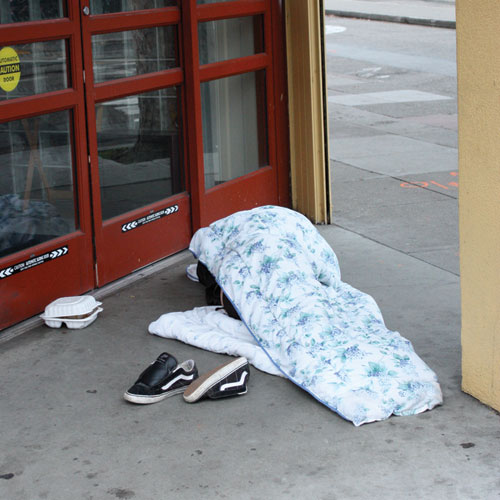
Rodney Palmer is 52, and he uses a cane because he has a bad hip. Walking is painful for the homeless native San Franciscan, but to reserve a bed at a shelter, he’s got to get up early and cover a lot of ground. “I get up at 4 a.m. and go to Glide” in hopes of getting a long-term shelter bed, he told the Guardian. “By the time I get there, there’s people sleeping on the ground.”

People arrive at the homeless assistance center so early because the shelter beds that can be reserved for 90 days free up at 7 a.m. on a first-come, first-served basis — and they’re quickly snapped up.

Palmer reached into his sock and pulled out a small plastic bag full of painkillers to demonstrate how he copes. Lately he hasn’t had any luck getting a long-term bed, so he’s devoting many hours a day to getting on wait lists for overnight beds. That means heading to drop-in centers in SoMa and the Mission, where at least there are chairs he can rest in. “It’s an all-day job,” he said. When it comes to waiting outside, “I feel vulnerable. People can die like that when the winter comes.”


BEYOND SHELTER

A coalition of homeless advocates is trying to change the way shelter beds are allocated in San Francisco, and District 6 Supervisor Jane Kim has taken up their cause, spearheading an initiative for the Nov. 8 ballot. The Fair Shelter Initiative would eliminate “shelter” from the definition of housing under Care Not Cash, the signature homeless policy created under former Mayor Gavin Newsom.

Since about 41 percent of shelter beds are set aside as housing for Care Not Cash recipients — who represent an estimated 7 percent of the city’s homeless population — advocates say the move would effectively free up long-term shelter space for veterans, disabled people, seniors, and others who don’t qualify for Care Not Cash. It would, they say, give everyone an equal shot at getting a bed.

At the same time, proponents say, it would solve a recurring problem of beds going unfilled even as shelter seekers wait for hours on end only to be turned away or to finally give up, discouraged by the system.

Cyn Bivens, a peer advocate at Mission Neighborhood Resource Center, says roughly 60 people sign up for shelter beds on a given day at his facility. People who are trying for the 90-day beds show up before 7 a.m.

“They may drop between one and five beds, but we may have 50 people in line,” Bivens explains. “Usually, by 7:15, I’m saying sorry, they’ve only dropped two beds.” People then continue to sign up all day in hopes of reserving overnight beds, which are released later in the day. Bivens estimates that about half the people who start out seeking a bed don’t wind up getting one.

While Kim and supporters of the Fair Shelter Initiative view the proposed change as a simple adjustment that would improve a dysfunctional system, they face opposition from Mayor Ed Lee and Human Services Agency Director Trent Rohrer, who have described it as a bid to dismantle Care Not Cash.


$59 A MONTH

As things stand, several hundred indigent adults in San Francisco benefit from County Adult Assistance Programs (CAAP), an umbrella encompassing General Assistance and several other programs intended for people who are waiting to receive Social Security Income (SSI) or seeking employment.

Each month, CAAP beneficiaries are allocated a maximum of $422, or $342 in the case of General Assistance recipients, but they never actually see that money. Instead, under Care Not Cash, they receive $65 and $59, respectively, since the rest is deducted for housing. Some CAAP recipients have actual housing in single-room occupancy (SRO) hotels, but roughly two-thirds are guaranteed shelter beds to meet their housing needs, according to an estimate from the Coalition on Homelessness.

The upshot of this system is that most CAAP recipients are effectively made to pay up to $357 a month from their benefits to sleep on a cot in a shelter, provided they make it there by curfew. For one frustrated homeless man on General Assistance who spoke at a July 14 hearing about the proposed initiative, living on less than $2 a day rather than closer to $11 a day was making it very difficult for him to improve his situation.

“I’m trying to look for work,” he said, adding that he’d seen job postings in other cities. “How am I going to subsidize my trip to Emeryville or San Jose? I’m stuck, and there are things that I cannot do.”

Mark Leach, another homeless CAAP beneficiary, said the low cash grant posed a vexing problem for him too: “I can’t afford to pay my phone bill.” Living on nothing more than $65 a month can mean living in isolation, with no way to receive calls in case work becomes available.

Another issue arising from the current system, according to Bob Offer-Westort of the Coalition on Homelessness, is that a disproportionately high number of beds are reserved for the relatively small number of CAAP recipients citywide, and those program beneficiaries don’t always use their beds. Some don’t make it to the shelter in time for curfew, others couch surf, and still others may prefer to sleep outside, far from the confines and crowds of the shelters. If they don’t show up to claim the bed, it will eventually become available to someone else for the night — but that can take hours. So people who either aren’t enrolled in CAAP or don’t already have long-term beds are reduced to waiting, day after day, for space to free up overnight.

If the Fair Shelter Initiative were in place, CAAP recipients “won’t be guaranteed a shelter bed” as part of Care Not Cash, says Offer-Westort. “But they’ll be competing for more beds,” he added, which “should reduce the wait time.”

In the meantime, CAAP recipients who aren’t being housed in SROs or some other transitional housing would receive the full amount of their benefits. Rohrer, the HSA director, seized on this point as problematic, saying that doling out the full cash grants would draw people to San Francisco from other counties where benefits are lower. “If we start to get folks from other counties and states … the result will be more homeless people in San Francisco and less access for folks,” Rohrer said.

Jennifer Friedenbach of the Coalition on Homelessness countered this, saying, “they have never been able to prove that people will come from out of town.” She addressed the notion that the Fair Shelter Initiative would dismantle Care Not Cash by saying, “It’s news to me — big news — that shelter is the entirety of Care Not Cash.”

Opponents of the measure who spoke at the hearing argued that $422 a month was too much to give to a homeless person because it could feed addiction. While it’s true that many homeless people in San Francisco have substance-abuse issues, many others are disabled or have just fallen on hard times. Advocates say they’ve noted a surge in newly homeless people accessing services, particularly women.


HUNDREDS OF BEDS CUT

Compounding the overall problem is that more than 300 shelter beds have been lost since 2004. During the hearing, L.J. Cirilo ticked off a long list of homeless service programs and facilities that had vanished in recent years due to budget cuts, going on for several minutes.

Palmer falls into the category of people who might benefit from a shorter wait time if Kim’s initiative were in place. He was just one of many who turned up at the Mission Neighborhood Resource Center — a homeless drop-in center that offers a clinic, shower, and laundry facilities — to watch a movie and eat supper. Two of the others there said they had experienced traumatic brain injuries and had been victims of identity theft. A construction worker explained that he was seeking odd jobs with little luck. Another man shuffled impatiently back and forth as he spoke, scratching incessantly, while he condemned the entire homeless services system as corrupt.

The measure has drawn opposition from Mayor Lee, who is “concerned that changes to Care Not Cash may begin a process that would unravel the program,” according to Christine Falvey, Lee’s spokesperson. “He wants to make sure we don’t do anything to prevent our department from providing the program.”

Falvey also noted that Lee was interested in meeting with advocates to find an administrative fix, rather than a ballot initiative, that could address concerns about the shortcomings of the shelter system. Kim expressed some openness to that idea at a hearing, but seemed committed to moving forward with changing the system that’s in place. “We do want to address inequity,” she said. “There absolutely should be no vacant beds.”

Digging into the juicy details of Recology’s proposed landfill disposal and facilitation agreements

1

Last weekend, I tried to review online the details of the landfill disposal and facilitation agreements with Recology that the Board’s Budget & Finance committee votes on Wednesday, July 20, (assuming Waste Management’s petition for a writ of mandate doesn’t throw a monkey wrench into the committee’s scheduled vote on those agreements. And when I finally got to view the agreements in person, they raised a number of questions.

(WM has asked the Superior Court to issue a temporary, preliminary and permanent injunction, immediately enjoining the City and Recology from conducting any further action in connection with those agreements, including finally awarding them to Recology, and requiring the City to set aside and vacate the agreements, based on the grounds that they were not procured in accordance with the City’s competitive procurement laws. But as of press time, the City Attorney’s office had not issued any statement leading me to conclude that the hearing will proceed as planned.)

As it happens, my online research was thwarted by the fact that not all of the details in the proposed agreement with Recology are available electronically. So, on Monday I headed to City Hall. And I spent most of the day in the Clerk of the Board’s office, where I reviewed a) the contract language, b) the history of how the Recology was tentatively awarded the 10-year landfill disposal contract by the Department of the Environment, c) how Waste Management has been complaining ever since about what it perceives to be the unfair process whereby Recology was also awarded the city’s facilitation agreement, which governs how San Francisco’s waste would be hauled to the landfill, and d) why the Budget and Legislative Analyst recommended that the Board consider submitting a proposition to the voters to repeal the city’s 1932 refuse ordinance so future refuse collection and transportation services would be awarded under the city’s normal competitive bidding process, and require that refuse collection rates for residential and commercial services be henceforth subject to Board approval.

Heading into tomorrow’s hearing at 10 a.m, the Board has still not submitted any such ordinance (So, here are some of the questions that came up as a result of my research that I would like to learn more about before the committee takes its vote.

1. Why pay $10 million to build a rail spur in Yuba County if San Francisco’s goal is to have zero waste by 2020?

The landfill disposal agreement grants the city the right to deposit at Recology’s Ostrom Road landfill in Wheatland, Yuba County, all solid waste collected in San Francisco until Dec. 31, 2025, or until 5 million tons has been deposited. But according to the landfill disposal agreement’s Appendix B, which cites the city’s landfill disposal targets, San Francisco is projected to produce 2.4 million tons of trash between now and 2019, with zero waste projected for 2020. That got me wondering why get San Francisco ratepayers paying $10 million for the construction of a rail spur in Yuba County that would only get a few years heavy use, if these estimates are indeed accurate?

2. Just how green is my city?

According to the landfill agreement, the commencement date, when all or substantially all of the city’s solid waste is first accepted, may not be later than January 1, 2019. But according to the agreement’s Appendix B, San Francisco has an annual disposal target of 36, 614 tons in 2019, and zero waste in 2020. So are those figures just pie in the sky? And if so, is San Francisco’s claim to be the “greenest city in the U.S.” a tad overblown? Or is an independent agency like Cal ReCycle auditing these claims?

3. Oops. Are we about to authorize a $10-million annual slush fund?

Last year, the city held a hearing to consider plans to reallocate 1.3 percent of its ratepayers’ overall refuse rates that previously went to a special reserve fund that then contained $28 million, and that was initially created as a result of the city’s 1987 facilitation agreement to cover extraordinary costs associated with WM’s Altamont landfill and hazardous waste control and disposal.

There are still several years to go at Altamont (see number 1), but last fall, the Rate Board, which consisted of then City Administrator (and now mayor) Ed Lee, Deputy City Controller Monique Zmuda and SFPUC director Ed Harrington, voted 3-0 to authorize the Director of Public Works to reallocate the 1.3 percent billing surcharge to an impound account to offset DPW’s recycling and waste management costs for the period of July 1, 2010 to September 30, 2011.

“The change will not affect the monthly rate charged for residential collection service and the reallocation will be reviewed as part of the public process to review and update refuse rates, expected to take place in 2011 or 2012,” DPW’s website stated. “The city is proposing these changes to help meet San Francisco’s goal of diverting 75 percent of its waste from landfills by 2010 and to achieve zero waste by 2020.” (See number 2 in my list.)

The city also noted the need for a public hearing to discuss the special reserve fund and its uses, before September 30, 2011 (which is 10 weeks away). But to date, there appears not to have been any such hearing. Meanwhile, the city’s proposed amended facilitation agreement with Recology mentions establishing another special reserve fund, for no less than $10 million, this time funded from a one percent surcharge on all waste delivered to Recology’s transfer station, landfill and back-up landfill.

And the agreement stipulates that Recology may draw upon the reserve fund “from time to time” to reimburse costs that have or will be incurred by Recology, but have not yet been fully reimbursed, (“e.g. because a corresponding adjustment in rates has not yet taken effect, or has taken effect but has not yet been fully reimbursed.”) Such costs include all fees and penalties, including the $10 million cost of constructing a new rail spur and facility in Yuba County that Recology could become liable for if the city breaches the landfill disposal contract, or there is a delay in the contract’s commencement date.

So, does this mean that Recology will potentially have access to an additional $10 million a year for a decade, in addition to its guaranteed $200 million-a-year from the rest of the city’s collection, consolidation, transfer and composting non-biddable agreements? And does that inflate the worth of Recology’s landfill disposal and facilitation agreements by an additional $100 million?

4. Why isn’t the business related to San Francisco’s mandatory composting ordinance put out to bid, since our organics appear to be processed in Vacaville?

In the city’s master file on the disposal and facilitation agreements, I came across the following figures related to the carbon footprint of the city’s proposed rail tranportation plan: in 2008, an estimated 471, 551 tons of San Francisco material were trucked to Waste Management’s Altamont landfill. And 140,213 tons were hauled to the Hay Road landfill in Vacaville of which 105,704 tons were composted, and the remaining 34,509 tons were used as alternative daily cover.

Moving forward, the proposed plan is to rail transport the city’s annual tonnage to Recology’s Ostrom Road landfill for disposal, organics processing and alternative daily cover, and transport some of the organics for digestion by the East Bay Municipal Utility District. What’s less clear is the value of the city’s mandatory composting ordinance from a business perspective, how it came to fall under Recology’s monopoly, given that it’s being processed outside city limits, and whether the organics hauling was factored into DoE’s “green” equation, when evaluating landfill disposal proposals, and Recology’s facilitation agreement?

5. Has WM actually acquired a temporary writ and if so, what does this mean for any vote that the Board subcommittee takes on the proposed agreements? Neither the City Attorney’s Office nor WM’s attorneys got back to me with an answer to this question, as of press time, but it would be good to clear this question up before the voting begins tomorrow.

I have more questions which I hope Sups. Carmen Chu, Jane Kim and Ross Mirkarimi, who sit on the Board’s Budget & Finance sub-Committee, will drill into tomorrow, but either way, stay tuned as we approach what promises to be an educational vote tomorrow, one way or another….

Mayor Lee’s budget deal

0

The way the daily newspapers are presenting it, the budget that Mayor Ed Lee and the Board of Supervisors Budget and Finance Committee negotiated represents a new era of civility and cooperation at City Hall. The committee, after marathon negotiations, approved the $6.8 billion deal unanimously. Both sides called it a good process and a good result.

And indeed, by any standard, the way Lee worked with community groups was a huge breakthrough. After 16 years of essentially being cut out of the process under mayors Willie Brown and Gavin Newsom, the stakeholders — the people who provide the essential city services — were actually at the table. And the final blueprint isn’t as bad as it could be.

But it’s still a budget that does nothing to restore the roughly $1 billion of General Fund cuts over the past five years, that seeks no new taxes from big business or the wealthy, and that includes spending on a new Police Academy class that even the mayor doesn’t think the city needs.

And from the start, the mayor and his staff were absolutely determined to privatize security at the city’s two big public hospitals — even when it makes no political or fiscal sense.

The privatization plan was the centerpiece of what became a 13-hour shuttle diplomacy session, as staffers and supervisors sought to reach a deal they could all accept. The Mayor’s Office — particularly Steve Kawa, the chief of staff — put immense pressure on the committee members to accept a plan to replace deputy sheriffs with private security guards at San Francisco General and Laguna Honda hospitals. In the grand scheme of things, the $3 million in projected savings wasn’t a huge deal — but the politics was unnecessarily bloody. It’s as if Lee and Kawa were determined to privatize something, whatever the cost.

In the end, Sup. Jane Kim deserves considerable credit for holding firm and refusing to accept the proposal — and since Sup. David Chiu went along with her, they joined Sup. Ross Mirkarimi as a three-vote majority on the five-member panel and shot it down.

Police Chief Greg Suhr pushed for funding for a new police academy class to train 35 officers at a cost of $3.5 million (that’s $100,000 a cop). “I don’t think the department has looked hard enough at how we deploy the existing officers,” Sup. John Avalos told us.

And some key issues are still up in the air — for example, whether the mayor will adequately fund public financing of the November campaigns. With at least eight serious candidates running for mayor (not counting Lee), and most of them looking for the public financing that will help level the playing field, the city’s going to have to come up with at least several million dollars. That’s critical to the fairness of the election.

The bottom line remains: This city has been deeply damaged by years of cuts. And the next budget needs to start with a plan to repair that.

Editorial: Mayor Lee’s budget deal

1

The way the daily newspapers are presenting it, the budget that Mayor Ed Lee and the Board of Supervisors Budget and Finance Committee negotiated represents a new era of civility and cooperation at City Hall. The committee, after marathon negotiations, approved the $6.8 billion deal unanimously. Both sides called it a good process and a good result.

And indeed, by any standard, the way Lee worked with community groups was a huge breakthrough. After 16 years of essentially being cut out of the process under mayors Willie Brown and Gavin Newsom, the stakeholders — the people who provide the essential city services — were actually at the table. And the final blueprint isn’t as bad as it could be.

But it’s still a budget that does nothing to restore the roughly $1 billion of General Fund cuts over the past five years, that seeks no new taxes from big business or the wealthy, and that includes spending on a new Police Academy class that even the mayor doesn’t think the city needs.

And from the start, the mayor and his staff were absolutely determined to privatize security at the city’s two big public hospitals — even when it makes no political or fiscal sense.

The privatization plan was the centerpiece of what became a 13-hour shuttle diplomacy session, as staffers and supervisors sought to reach a deal they could all accept. The Mayor’s Office — particularly Steve Kawa, the chief of staff — put immense pressure on the committee members to accept a plan to replace deputy sheriffs with private security guards at San Francisco General and Laguna Honda hospitals. In the grand scheme of things, the $3 million in projected savings wasn’t a huge deal — but the politics was unnecessarily bloody. It’s as if Lee and Kawa were determined to privatize something, whatever the cost.

In the end, Sup. Jane Kim deserves considerable credit for holding firm and refusing to accept the proposal — and since Sup. David Chiu went along with her, they joined Sup. Ross Mirkarimi as a three-vote majority on the five-member panel and shot it down.

Police Chief Greg Suhr pushed for funding for a new police academy class to train 35 officers at a cost of $3.5 million (that’s $100,000 a cop). “I don’t think the department has looked hard enough at how we deploy the existing officers,” Sup. John Avalos told us.

And some key issues are still up in the air — for example, whether the mayor will adequately fund public financing of the November campaigns. With at least eight serious candidates running for mayor (not counting Lee), and most of them looking for the public financing that will help level the playing field, the city’s going to have to come up with at least several million dollars. That’s critical to the fairness of the election.

The bottom line remains: This city has been deeply damaged by years of cuts. And the next budget needs to start with a plan to repair that.


Three good initiatives for the fall

2

The progressive wing of the Board of Supervisors (including, to her credit, Sup. Jane Kim) has placed three important reform measures on the November ballot. That the measures are headed for the voters is a clear indication of the shift of power at the board — progressives no longer have a reliable six votes. But the progressives still have the ability to push issues — and in an mayoral election year, these measures will provide a valuable gauge for the candidates and create broad-based organizing opportunities.

The measures include a ban on the demolition of more than 50 units of rent-controlled housing; a ban on further admissions charges at parks or leasing park facilities to private companies; and a requirement that participants in the Care Not Cash program get an actual housing unit — not just a shelter bed — before their welfare grants are cut.

The supervisors are under immense pressure to back off from those proposals, and if two of the five supporters pull their names before the final deadline of July 14, the measures won’t make the ballot. Some argue that the controversy over the measures could threaten the mayoral campaign of progressive standard-bearer John Avalos. But Avalos told us he supports all three measures and has no interest in turning back. He’s right — the supervisors should hold firm and insist on a public vote on all three.

The Care Not Cash reform has already generated a lot of controversy. Mayor Ed Lee has denounced it, saying it will destroy the entire program, and two mayoral candidates, former Sup. Bevan Dufty and Assessor-Recorder Phil Ting, have come out against it. But the measure is pretty simple and straightforward: it says that a bed in a shelter doesn’t count as “housing.”

That’s a critical definition, because under Care Not Cash, the city tries to put homeless welfare recipients into housing, mostly single-room-occupancy hotels — and in exchange, takes back most of the welfare grants. But by law, a bed in a shelter counts as a home — so the minute the city finds someone a cot to sleep on in a noisy, sometimes dangerous shelter with no privacy and arbitrary curfews and rules, that person loses most of his or her welfare grant. Along the way, the city locks up shelter beds for people in the CNC program — so when other homeless people show up for a place to sleep, they’re told there’s no room. That’s a sign of a broken system.

The housing demolition measure comes as a response to a badly flawed proposal to rebuild Parkmerced — tearing down hundreds of rent-controlled housing units in the process. The parks measure is an attempt to stop Phil Ginsburg, head of the Recreation and Parks Department, from turning public property over to private for-profit firms in an effort to raise cash.

The community groups and grassroots sponsors of these measures have a responsibility to organize and mount serious campaigns; there’s going to be big-money opposition. But it’s worth having all three on the ballot in November.

Editorial: Three good initiatives for the fall ballot

16

The progressive wing of the Board of Supervisors (including, to her credit, Sup. Jane Kim) has placed three important reform measures on the November ballot. That the measures are headed for the voters is a clear indication of the shift of power at the board — progressives no longer have a reliable six votes. But the progressives still have the ability to push issues — and in an mayoral election year, these measures will provide a valuable gauge for the candidates and create broad-based organizing opportunities.

The measures include a ban on the demolition of more than 50 units of rent-controlled housing; a ban on further admissions charges at parks or leasing park facilities to private companies; and a requirement that participants in the Care Not Cash program get an actual housing unit — not just a shelter bed — before their welfare grants are cut.

The supervisors are under immense pressure to back off from those proposals, and if two of the five supporters pull their names before the final deadline of July 14, the measures won’t make the ballot. Some argue that the controversy over the measures could threaten the mayoral campaign of progressive standard-bearer John Avalos. But Avalos told us he supports all three measures and has no interest in turning back. He’s right — the supervisors should hold firm and insist on a public vote on all three.

The Care Not Cash reform has already generated a lot of controversy. Mayor Ed Lee has denounced it, saying it will destroy the entire program, and two mayoral candidates, former Sup. Bevan Dufty and Assessor-Recorder Phil Ting, have come out against it. But the measure is pretty simple and straightforward: it says that a bed in a shelter doesn’t count as “housing.”

That’s a critical definition, because under Care Not Cash, the city tries to put homeless welfare recipients into housing, mostly single-room-occupancy hotels — and in exchange, takes back most of the welfare grants. But by law, a bed in a shelter counts as a home — so the minute the city finds someone a cot to sleep on in a noisy, sometimes dangerous shelter with no privacy and arbitrary curfews and rules, that person loses most of his or her welfare grant. Along the way, the city locks up shelter beds for people in the CNC program — so when other homeless people show up for a place to sleep, they’re told there’s no room. That’s a sign of a broken system.

The housing demolition measure comes as a response to a badly flawed proposal to rebuild Parkmerced — tearing down hundreds of rent-controlled housing units in the process. The parks measure is an attempt to stop Phil Ginsburg, head of the Recreation and Parks Department, from turning public property over to private for-profit firms in an effort to raise cash.

The community groups and grassroots sponsors of these measures have a responsibility to organize and mount serious campaigns; there’s going to be big-money opposition. But it’s worth having all three on the ballot in November.


Ethics chief says “Run, Ed, Run” must register honestly

24

As the pseudo-campaign to convince Mayor Ed Lee to change his mind and run for mayor prepares to open a campaign office tomorrow morning – an event with all the trappings of a real campaign but without the candidate or the regulatory controls – the Ethics Commission is asking it to re-register in a less deceptive way.

As the Examiner reported this morning, Progress for All, the group behind the Run, Ed, Run campaign – which has set up a website, bought advertising, and printed and circulated campaign materials around the sole purpose of promoting a mayoral campaign – registered as a political action committee (one not subject to campaign contribution limits or other controls) even though Ethics Director John St. Croix said it is clearly formed around a primary purpose.

Today, St. Croix tells the Guardian that he has asked Progress for All to re-register as a committee formed around the specific purpose of promoting Lee for mayor, but that “I don’t know that they responded completely in the affirmative.” Guardian calls to the group’s main contract Gordon Chin, who also runs the Chinatown Community Development Center, were not returned.

Despite statements to the Examiner by Progress for All campaign consultant Enrique Pearce that this campaign isn’t unprecedented (he cited the 1999 mayoral write-in campaign of Tom Ammiano, who was a willing participant in the effort and formed a campaign committee), St. Croix said it is unprecedented and his office is figuring out how to regulate it.

“There aren’t regulations specifically designed for a scenario like his,” he told us. “They can’t operate in the absence of regulations.”

Right now, while Progress for All lists five co-chairs of the committee, the public has no way of knowing who’s funding the group, how much individual donors have given, or how much is being spent to make the campaign appear to have popular support. That will become more clear at the end of July when the semi-annual campaign finance reports are due, and St. Croix said his office plans to “carefully examine” those filings in order to decide how to proceed.

The group’s current filings list its purpose as “general civic education and public affairs,” but St. Croix said the public has a right to know that it has actually formed around a single candidate. While the courts have struck down fundraising limits for committees like this, the group’s website seems to limit contributions to the maximum individual contribution of $500, apparently acknowledging that there are potential legal problems with its current approach.

Lee has repeatedly said that he doesn’t want to run for mayor and has not encouraged this effort, but he has done little to discourage the efforts by a group led by his closest political allies, so he could be sullied by group’s tactics if he eventually decides to run. St. Croix says that if Lee runs and his campaign has any overlap with the current efforts, it will raised troubling issues of whether there has been any collusion between the two campaigns, which is illegal.

Despite the concerns expressed by Ethics, the agency doesn’t have a great track record of being tough with powerful campaign finance violators, as a Grand Jury report released this week argues. For example, although the Guardian and Bay Citizen each reported back in October about an independent expenditure (partially funded by Willie Brown) on behalf of Jane Kim’s supervisorial campaign that was done through Pearce’s Left Coast Communications, which was Kim’s campaign consultant, that apparently illegal action was never followed up by the Ethics Commission. St. Croix has said he can’t comment on that incident, and he responded to the grand jury report by noting that its recommendations were mild even though “the report itself uses some fighting words,” and he said he was preparing a formal response.

Although some activists have argued that those expressing concerns about this stealth campaign are somehow being undemocratic, the reality is that Progress for All is the only mayoral campaign not playing by the rules. And there are rules that govern elections, rules set up precisely so the public knows who’s really behind the campaign propaganda.

Fixing Care not Cash

18

I will admit to a bias up front: I was against Care Not Cash in 2002, when Gavin Newsom used it as a cynical play to get elected mayor by bashing the homeless. I always argued that the city would be taking away the already-tiny welfare payments from people in exchange for housing that isn’t there. Imagine living on $422 a month in San Francisco. Now imagine that’s been cut to $59 a month — because the city’s determined that you can sleep in a shelter bed. Great fucking deal.


And that’s what happens. Care not Cash allows the city to reduce a homeless person’s general assistance grant to $59 a month as soon as the city finds housing for the person. And a shelter counts as housing.


There are lots of problems with the scenario — like this and and this. In essence, the city sets aside a certain number of shelter beds for people in the CNC program, but they don’t all show up, so there are empty beds — and people who need a place to sleep can’t get them because they’re earmarked as “housing” for an anti-homeless program.


So five supervisors have come up with a ballot initiative that would make one small, but significant change in the Care Not Cash legislation. It would specify that shelters don’t count as housing. That’s it. That’s the entire amendment. (You can read the proposed law here (pdf)


It makes perfect logical sense. You want to tell a homeless person that instead of giving you welfare payments, we’re going to give you housing? Fine. Then make it housing. Wasn’t that the premise of CNC from the start?


But somehow, CNC stalwarts (including those who make money off the program) are outraged, claiming this will gut the entire effort. In the Chronicle story, Mayor Ed Lee notes that


“By removing the shelter system from the available benefits provided to Care Not Cash recipients, we dismantle this path to getting people housed, ultimately undermining the success of the nationally recognized, award-winning program.”


Of course, the proposal doesn’t remove the shelter system from the available benefits. Sup. Jane Kim, the sponsor, and her colleagues aren’t talking about shutting down shelters or kicking homeless people out. The measure just says you can’t take someone’s welfare grant away just because you found him or her a temporary cot in a noisy, often unsafe shelter that offers no privacy and operates under random rules that at lot of us would find intolerable. 


Again, my bias is against the entire premise of Care Not Cash. I think the city (and the state and the feds) ought to be providing homeless people with enough money to get a place to live and enough to eat. That’s the way it used to work — when I arrived in San Francisco, you could actually afford to rent a room in a shared house with General Assistance money, and you could live reasonably — not in luxury, but reasonably — on federal SSI payments. But the cost of housing has so outstripped the increase in welfare payments that people wind up on the streets. 


But if we’re going to do the Care Not Cash thing, shouldn’t the city be required to provide real housing before the grants get cut off?


Randy Shaw, who runs a bunch of Care Not Cash hotels under city contract, doesn’t think so. He argues that


[T]he measure repeals CNC’s central premise that homeless single adults on welfare should not get $422 per month if they refuse SRO housing. The initiative also dramatically reverses San Francisco homeless policy: it replaces a system designed to get homeless people housed with one subsidizing homeless people to live permanently in shelters. The measure increases homelessness and provides no alternative funding to make up for the millions of CNC dollars that would be eliminated from the city’s supportive housing budget.


 I understand the concern about the CNC money (some of which, again, goes to Shaw’s operation). If the city starts paying $422 a month to some people who are now only getting $59, that money will have to come from someplace. But this whole notion that the proposed change will allow the city to give cash grants to people who “refuse SRO housing” seems a bit off.


“We haven’t changed that part at all,” Jennifer Freidenbach, who runs the Coalition on Homelessness and was involved in drafting the measure, told me. “People who refuse SRO housing would still get their grants cut.”


I asked Shaw about this — and also about my understanding that there isn’t enough SRO housing for every homeless person who wants a place to live. Should people on the waiting list get their grants cut off because the city can stick them in a shelter in the meantime?


For whatever reason, my old pal Randy hasn’t responded. (I continue to be boggled by two things — Shaw never calls people before he trashes them, and he seems unwilling to have substantive debates with me when I want to talk to him. That last time I emailed him to ask why he didn’t call people for comment, he responded: “I see the issue very differently and disagree with your premise.” How is that helpful? This time he didn’t answer at all.)


The oddest thing is that Shaw — a longtime housing advocate who has spent 30 years working to help low-income people — has adopted a remarkably strident, even harsh tone that reminds me of the rhetoric that Newsom and his allies used to use. Consider:


Understand we are talking about people who have the option of accepting permanent housing but refuse. People who want to get a full city grant, live in a city-funded shelter, but want the right to pay nothing.


Jeez. Those lazy welfare bums who want “the right” to a place to live and a miniscule, tiny cash grant.


There was a time when liberals used to talk about a guaranteed national income. Now the debate in progressive San Francisco involves bashing poor people. Wow. 


Will partisan agendas shape the redrawing of political lines? — UPDATED

14

UPDATED BELOW In the midst of a political realignment at City Hall that is still shaking out, the Board of Supervisors Rules Committee is today (Thurs/23) considering appointments to the Redistricting Task Force, the body that will redraw supervisorial districts using the latest census data. And its choices will say a great deal about the role of integrity and impartiality in the new “politics of civility.”

This commission will arguably have more influence on the city’s political dynamics over the next decade than any other, so overtly partisan appointees should be viewed with great suspicion. Larry Bush at CitiReport did a nice rundown of the applicants and their backgrounds, but the Rules Committee will be where the real action is.

President David Chiu stacked the committee with a conservative majority (Sups. Mark Farrell and Sean Elsbernd) and named a chair (Sup. Jane Kim) whose political loyalties are tough to peg right now. Will she seek an appointee who doesn’t have a political agenda, or will she seek to reward a partisan ally like applicant Paul Hogarth, who worked on her campaign and writes for BeyondChron.org, a propaganda outlet for Kim-backers Randy Shaw and the Willie Brown/Rose Pak/David Ho cabal that elevated Ed Lee into Room 200 and is desperately trying to keep him there.

There are other problematic applicants as well, including Potrero View Publisher Steven Moss, who ran for supervisor in D10 last year and has shown a penchant for seeking payback against his perceived enemies (including the Guardian, which ran articles questioning his residency status). Applicant Ron Dudum has also shown a vindictive streak – following up his failed D2 supervisorial campaigns with an unsuccessful lawsuit challenging the ranked-choice voting system – that would make him a worrisome figure to have on this task force.

So far, three people have been named to the body by the Elections Commission: gadfly/policy wonk David Pilpel, Google attorney Melissa Tidwell, and Mark Schreiber, the managing general partner of Cooper White & Cooper. So already, this is tilting toward a business community bias that will probably get worse once Mayor Ed Lee makes his three appointments to the nine-member commission.

Given how the Rules Committee is stacked, its three recommendations are likely to raise questions that the full board will need to put to rest when it takes the matter up on Tuesday. Voters need to have faith that partisan agendas aren’t shaping the city’s most important political lines, and now is the moment to ensure they have that confidence.

UPDATE: The committee voted unanimously to recommend Eric McDonnell, the chief operating officer of United Way of the Bay Area; Jenny Lam, director of community initiatives for Chinese for Affirmative Action and a board member of Chinatown Community Children’s Center; and Mike Alonso, a “security professional” with Corporate Security Services who got his law degree from New College in 2007 but never worked as a lawyer.

Measure would make getting a shelter bed easier and more fair

3

More than three years after a Guardian investigation found that San Francisco’s homeless shelter system is an unnecessarily confusing, difficult to navigate, and inequitable boondoggle that routinely denies people use of even vacant shelter beds, voters in November will get a chance to change a system created largely by former Mayor Gavin Newsom’s Care Not Cash program.

Care Not Cash was sold to voters in 2002 as a program that reduced the general assistance payments to homeless individuals in exchange for the city giving them housing and support services. But that housing often turned out to be simply a shelter bed, and after years of city budget cutting closed homeless shelters, nearly half the remaining beds were set aside for Care Not Cash clients whether they used them or not.

So Sup. Jane Kim and four progressive supervisors, working with the Coalition on Homelessness, yesterday approved the creation of a “Fair Shelter” ballot measure to require that Care Not Cash clients get more than simply a shelter bed and that shelter beds be opened up to all who need them on a more equitable and sensible basis.

But Mayor Ed Lee and others who helped create the current system are criticizing the measure and using the same deceptive claims that have masked the problem for years. “Care Not Cash is premised on providing a path to housing and services. That path begins with shelter for those who need it. By removing the shelter system from the available benefits provided to Care Not Cash recipients, we dismantle this path to getting people housed, ultimately undermining the success of this nationally recognized, award-winning program,” Lee said in a statement issued yesterday.

Human Services Agency Director Trent Rhorer, Newsom’s point person in creating the system, told the Chronicle that the measure would threaten Care Not Cash and attract more homeless people to the city by making it easier to get into shelters. He also denied there was a problem, noting that about 100 of the city’s 1,100 shelter beds are vacant each night.

But there’s a gaping contradiction at the heart of Rhorer’s rhetoric, demonstrating that the city’s real intention is to make life as difficult as possible for the homeless in the hopes that they’ll simply leave the city, as Guardian reporters found when they spent a week trying to sleep in the shelters. Vacant beds are only made available late at night, and claiming one often involves long uncertain waits and crosstown run-arounds between where people register and where they might ultimately sleep.

It’s a dehumanizing and deceptive system that COH and the city’s Homeless Shelter Monitoring Committee have long been seeking to change. “The inclusion of shelter in the original ordinance has resulted in an unintended negative consequence of wreaking havoc on the city’s publicly funded shelter system. People with disabilities, seniors, working homeless people and undocumented people have a disadvantage in garnering access to shelter beds under the current system,” Shelter Monitoring Committee Chair LJ Cirilo said in a statement put out by COH, which noted that 43 percent of shelter beds are reserved by Care Not Cash recipients, although they represent only about 14 percent of the city’s homeless population.

Daly: SFBG profiled the wrong guy

88

When I interviewed Chris Daly for this week’s cover story on David Chiu and the political realignment at City Hall, Daly said we were putting the wrong guy on the cover.

“If the story is about political realignment, it’s about David Ho,” Daly told me of the political consultant who once worked on his and other progressive campaigns, but who helped engineer a split in the progressive movement with the help of consultant Enrique Pearce and District 3 Sup. Jane Kim, whose campaign they worked on together last year, beating early progressive favorite Debra Walker.

Daly said the political realignment that has taken place at City Hall has more to do with Kim and Ho – in collusion with former Mayor Willie Brown, Chinatown Chamber head Rose Pak, and Tenderloin power broker Randy Shaw – than it does with Chiu, who Daly considers simply a pawn in someone else’s game. Ho is seeking to be Pak’s successor as Chinatown political boss, and he and Pearce have been out there doing the ground work Pak’s effort to convince Lee to remain mayor.

“Any realignment that exists is about David Ho and I think it has more to do with the District 6 race than the District 3 race,” Daly said. “As far as David Chiu and realignment, they are separate things.”

While Ho and Pearce have traditionally worked on progressive campaigns – particularly in high-profile contests like this year’s mayor’s race, where John Avalos is the clear progressive favorite – they are now some of the strongest behind-the-scenes backers of the campaign to convince Ed Lee to run. Neither Ho nor Pearce returned our calls for comment.

“That’s the whole realignment,” Daly said, explaining that it was the peeling of entities like Chinatown Community Development Corporation and the Tenderloin Housing Clinic away from the progressive coalition of the last decade that has cast progressive supervisors into the wilderness and empowered Chiu and Kim, who in turn brought Lee to power.

“It’s not a seismic realignment, it’s a minor realignment, it just happens to be who’s in power,” Daly said. “It was a minor political shift that caused a big change at City Hall.”

Power has now consolidated around Mayor Lee, as well as those who convinced Chiu to put him there, including the powerful players who helped elect Kim. “These people, as far I can tell, have disowned Chiu,” Daly said. “He did what they wanted but he failed the loyalty test in the process.”

Chiu has so quickly fallen from favor that even Planning Commission President Christina Olague, who spoke at Chiu’s campaign launch event on the steps of City Hall just two months ago, is now one of the co-chairs of a committee pushing Lee to run, along with others connected to CCDC and the Pak/Brown power center.

Kim has also notably withheld her mayoral endorsement. She tells us that she’s waiting until after budget season, but the real reason is likely to wait and see whether Lee gets into the race. Daly said this new political power center has been playing the long game, starting with supporting Chiu back in 2008.

“Peskin kind of brought him up, and then I – tactically or a strategic blunder – I made the mistake of not bringing someone up,” Daly said, insisting that he’s always questioned Chiu’s political loyalties. “I had doubts from the beginning. Ultimately, it was Jane Kim and David Ho who tag teamed me and got me on board.”

Daly said Chui’s last-minute move to cross his progressive colleagues and back Lee for mayor “irreparably harmed him with progressives,” while doing little to win over a new political base. “He miscalculated the damage it would do to him,” Daly said.

Chiu’s dependability was also called into question when he was openly considering a deal with Gavin Newsom to be named district attorney, which would have allowed Newsom to appoint his replacement in D3, a move that he didn’t check with Pak.

“He gave control of his political base to someone else,” Avalos told us, offering that if Chiu was going to be so narrowly ambitious then he should have taken Newsom’s offer to become district attorney.

Even those around Chiu have emphasized his independence from Pak, who has desperately been looking for someone she could count on to back and prevent Leland Yee from winning the mayor’s office. And if Lee doesn’t run, sources say she’s likely to back another political veteran such as Dennis Herrera or Michela Alioto-Pier.

But given how deftly Ho and his allies have grabbed power at City Hall, I’d say they have a pretty good chance of convincing Lee to run, despite the mayor’s resistance. And if Lee runs, Daly, USF Professor Corey Cook, and others we interviewed say he would probably win.

Treasure Island: 11 ayes, no sight

6

On June 7, the San Francisco Board of Supervisors voted 11-0 to reject an appeal of the Treasure Island environmental impact report. The appeal was brought by Arc Ecology and our colleagues the Sierra Club, Golden Gate Audubon Society, Wild Equity, former Sup. Aaron Peskin, and Yerba Buena Island resident Ken Masters.

The board will tell you that the Department of City Planning and the Mayor’s Office of Economic and Workforce Development found the appeal lacking in merit.

In the appeal, we claimed the EIR lacked the specificity to qualify as a project EIR, which means that after it passes, the city will have substantially limited the ability of any future Board of Supervisors to address the project’s actual environmental impacts. But these impacts cannot and will not be known until actual development proposals, none of which presently exist, are made.

Sup. Jane Kim and city planning staffers argued that the EIR had almost too much specificity. For example, without showing a single confirming diagram, project sponsors claimed they could cut as many as 100 stories off the proposed skyscrapers — yet keep the same number of condos without increasing the bulk, height, or number of buildings in the overall project. How? Through the Harry Potter-like magic of “flex buildings and zones.”

The board will tell you that this project presents a vision of a new community unrivaled in the Bay Area and nation — a new Athens. But the supervisors don’t seem to realize that it’s a development with a population larger than Emeryville, about the size of Albany. Indeed, the separate dedicated buildings of affordable homes truly make Treasure Island like Athens of old, with poorer people segregated from the rich.

They don’t see that this is a self-reflecting vision blithely unconcerned about the impacts it will have on the greater Bay Area region, and that it’s a bloated project that will vastly exceed the region’s capacity to support it. It’s a project whose impacts will enslave legions of people to longer commutes as more cars flood the bridge, pushing traffic like rising sea levels into the upper reaches of East Bay freeways. Nor are project proponents particularly concerned about the impacts of air pollution blowing from the bridge and the region’s freeways into Berkeley, Emeryville, and Oakland.

Finally, neither the supervisors, nor the city planners, nor the Office of Economic and Workforce Development seem to be aware that San Francisco currently has 30,000 vacant housing units. It will cost a projected $577,000 to build each Treasure Island unit. But more units could be built on San Francisco’s mainland with almost no impact, simply by allowing rental units in the basements of some of our stock of 130,000 single-family homes.

That kind of housing isn’t as luxurious as a 45-story view of the bay from Treasure Island perhaps — but at a cost of $100,000 to $200,000 per unit, more than half of those in-law apartments could be rented at or below market rate. Infill housing of that sort would also mean greater stability for established home owners, more jobs and business opportunities, and more riders for Muni.

Still, the appellants weren’t trying to halt any project at Treasure Island. The appeal was about was fixing the deficiencies in the EIR and right-sizing the project so it can move forward with its benefits intact.

In the Tarot, the Five of Cups depicts an individual so besotted by that possibilities floating before his eyes that he stands mesmerized, believing they are at hand — of course, in reality he’s fooling himself. In the case of Treasure Island, the supervisors and city officials are intoxicated by the visions floating in the bay — and are thus blinded to the better options of making this city and region more sustainable and affordable.

Tipping point

3

sarah@sfbg.com

On June 14, members of the Board of Supervisors will vote to appoint a new member of the Police Commission — in the wake of a messy string of alleged police misconduct scandals that, progressives argue, underscore why having strong civilian oversight is critical to ensuring a transparent, accountable police department the public can trust.

The appointment comes less than two months after San Francisco native Greg Suhr was sworn in as chief in the wake of Mayor Gavin Newsom’s decision to appoint former Chief George Gascón as the next district attorney — a move that has served to muddy the D.A. Office’s efforts to investigate the alleged police misconduct.

Further complicating the board’s choice is the heated battle that erupted over the appointment, led in part by members of two Democratic clubs that represent lesbian, gay, bisexual, and transgender communities.

The Alice B. Toklas LGBT Democratic Club has officially endorsed Julius Turman, a gay attorney and community activist who was a former assistant U.S. attorney and the first African American president of the Alice club. Turman currently works for Morgan, Lewis & Bockius, where he represents companies in actions for wrongful termination, employment discrimination, and unfair competition. He is also state Sen. Mark Leno’s (D-SF) proxy to the San Francisco Democratic County Central Committee and serves on the Human Rights Commission.

On the other side, members of the Harvey Milk LGBT Democratic Club, the voice of the city’s queer left, are supporting David Waggoner, an attorney and community activist who is a former Milk Club president. Waggoner has worked on police use-of-force policy and as a pro bono attorney for the National Lawyers Guild at the Oakland Citizen’s Police Review Board, and been a passionate advocate for the LGBT community, immigrants’ rights, people with disabilities, and the homeless.

The other two applicants for the post are Vanessa Jackson, a staffer at a women’s shelter with experience in counseling ex-offenders; and Phillip Hogan, a former police officer who serves on the board of the Nob Hill Association and has been trying to get on a commission for years.

Although both Jackson and Hogan have diverse experience with law enforcement — Jackson as an African American woman who claims the police have “no respect for people of color” and Hogan as a former police officer of Lebanese-Irish descent who manages real estate — neither has the support of the LGBT community. The position occupied by Deputy District Attorney James Hammer for the last two years, and Human Rights Commission director Theresa Sparks occupied before that, is widely considered to be an LGBT seat.


WHO’S THE REFORMER?

So now the fight is about whether Turman or Waggoner would be the strongest reformer.

In a recent open letter, former Board Presidents Harry Britt, Aaron Peskin. and Matt Gonzalez expressed support for Waggoner. “While most hardworking police officers perform their jobs admirably, insufficient oversight and poor management systems have led to significant problems,” their letter stated. “Despite these widely reported problems, the Police Commission has failed to adequately address these issues. San Francisco needs real reform, not more of the same. We believe David Waggoner will be that voice at this critical time.”

At the June 2 Rules Committee hearing, Waggoner proposed taking away master keys to single-resident occupancy (SRO) hotels from the police. “Significant abuse of that resulted in seriously tarnishing the department,” he said.

Turman made an equally impassioned — if less stridently reformist-sounding — speech. “Why would we allow an officer to enter a home, regardless of the master key rule, which I’m not a fan of?” Turman asked. He also said Tasers are dangerous weapons with unintended consequences. “I fear communities of color will suffer more from Taser use.”

Waggoner’s supporters noted that their candidate has more than 15 years of police accountability experience. Turman’s supporters vouched for his integrity, maturity, ability to build consensus, and “belief in strategically serving his community.”

In the end, Sups. Sean Elsbernd and Mark Farrell voted for Turman, while Rules Committee Chair Sup. Jane Kim voted for Waggoner.

That means Turman’s name has been forwarded to the full board with a recommendation. But because the Rules Committee interviewed all the candidates, the board can still appoint any of them.

At the Rules Committee, Sup. Scott Wiener voiced support for Turman. And Board President David Chiu recently told the Guardian that he has known Turman for years, has worked with him professionally, and will vote for him. “I found him to be fair, thoughtful, and compassionate,” Chiu said, noting that he believes the role of the commission is “to provide oversight and set policy.”

Sup. David Campos, one of the solid progressive votes on the board and a longtime Milk Club member, believes Waggoner would make an excellent commissioner but is a friend of Turman, and believes he’ll be a strong voice for reform. “Sean [Elsbernd] and Mark [Farrell] could be in for a big surprise if Julius gets appointed,” Campos mused shortly after Elsbernd and Farrell voted for Turman.

Campos recalled how he and Turman started working at the same firm years ago. “So I got to know him well,” he said, adding he is “like a family member.

“By virtue of his involvement with Alice, some folks think Julius will be a certain way,” Campos added. “But I believe he’ll take a progressive point of view on the issues. He has both the knowledge and the experience with the police, he understand the important role that police oversight and the Police Commission play in making the SFPD accountable.”

Kim told us that she primarily voted for Waggoner because she knows him the best, and not out of concern that Turman wouldn’t do a good job. “I’m more familiar with David and that’s what tipped the scale,” Kim said. “It’s great to have two strong LGBT attorneys who have a clear understanding of public safety issues, the law, and are advocates for the community.”

But Debra Walker, who ran against Kim last November, steadfastly supports Waggoner. “Julius has been active in the Alice B. Toklas club for a while, he’s a prosecutor, while David is more of a citizen’s defense attorney,” she said.

Turman continues to be dogged by reports of domestic violence, thanks to a lawsuit that Turman’s former domestic partner Philip Horne filed in March 2006 alleging that Turman came into his house when he was sleeping on New Year’s Day 2006 and tried to strangle him.

Horne claimed he “was terrified that the lack of air supply would cause him to pass out and potentially die at the hands of such a jealous and unmerciful former lover.” He alleged he was able to calm Turman down only to see him get enraged again and punch Horne in the face seven to 10 times. When Horne decided he needed to go to the emergency room, the complaint states, Turman grabbed his phone and keys saying, “If you leave, you’ll never see the cats (alive) again,” and “I will report you to the state bar.”

Horne claimed he ran outside screaming for help and that when SFPD arrived, they arrested Turman for domestic violence and called an ambulance for Horne.

Turman responded in July 2006 to what he described as Horne’s “unverified complaint,” arguing he acted in “self-defense” and that the conduct Horne complained of “constituted mutual combat.” He added that “damages, if any, suffered by Horne were caused in whole or in part by entities or persons other than Turman.”

In the end, no criminal charges were ever filed against Turman and the case was settled out of court. Turman now says “I’ve done nothing wrong and these allegations are false.”

Campos warns people not to jump to conclusions. “We need to remember that there is a presumption of innocence,” Campos said. “Yes, there was a court case, but there was never a conviction. Yes, there was a settlement, but people do that for a lot of reasons.”

Turman told the Rules Committee that the incident was from “an extremely difficult time that is now being used against me as a political sideshow.”

Meanwhile, Campos notes that without a reform-minded mayor, there will be only so much any board-appointed police commissioners can do. “What we really need to implement police reform is a mayor who is willing to do that,” he said. “Otherwise it’s going to be very difficult because the mayor still gets to appoint four commissioners and mayor still gets to control who is in charge of the police department.”


WHAT DIRECTION?

Civil liberties advocates praised as a “first step in the right direction” Suhr’s May 18 decision to issue an order clarifying that SFPD officers assigned to the FBI’s joint terrorism taskforce should adhere to SFPD policies and procedures set by the Police Commission, not FBI guidelines.

But in the coming months, the commission will have to decide whether to push a Portland-style resolution around SFPD involvement with the FBI. The commission also will be dealing with fallout from the other scandals, including the crime lab, the use of force against mentally ill suspects, and videos that allegedly show police conducting warrantless search and seizure raids in single residential occupancy hotels.

These scandals have progressives arguing that it’s critical that the board’s three seats on the commission are occupied by applicants with proven track records of reform.

Waggoner notes that in 2003, voters approved Prop. H., which changed the composition of the commission from five to seven members. Four are appointed by the mayor; three by the board.

Last year, he said, the commission made significant progress in the right direction when it adopted new rules after the Jan. 2 shooting of a man in a wheelchair in SoMa. “That was not the first time an unarmed person with a disability was killed,” he said. “After Prop. H and a crisis, the commission finally took steps. It remains to be seen if Chief Suhr will implement that.”

Waggonner said the current arrangement “creates tension between people who are more willing to defer to the chief on policy issues and being in an advisory capacity, as opposed to people who want to be in the forefront of setting policy.”

That tension played out when Commissioners James Hammer, Angela Chan, and Petra DeJesus tried to find consensus on the Taser controversy last year. “Overall they worked well together. But there’s been no progress yet on Tasers,” he said, noting that the commission eventually decided on a pilot project.

Waggoner said he would be in favor of the commission having a more active role and exerting its authority under the city charter to set policy, but in collaboration with the chief.

The Police Commission’s May 18 joint hearing with the Human Rights Commission about FBI spying concerns was a symbol of the broader issue at the Police Commission. The majority of the commission didn’t see any major problems — but the progressives were highly critical. “Is the commission there to set policy and take leadership, or is it there in an advisory capacity?” Waggoner asked.

With Hammer’s departure, Chan and DeJesus, both board-appointed women of color, are the most progressive members of the commission. Chan hopes Hammer’s replacement believes in strong civilian oversight. “We should never be a rubber stamp for the police department,” he said. “We need to take community concerns very seriously. When the police department is doing great things, we should support them — but if we see something wrong, we should not be afraid to speak out.”

Turman told the Guardian that “being the voice for reform and advising are not mutually exclusive roles — and an effective police commissioner needs to be both.

“I would advocate for series of meetings with representatives from the Arab community, the SFPD, and the FBI to increase communication and understanding of each side’s perspective on exactly what we need to implement in San Francisco,” Turman said.

Asked more about Tasers, Turman said that “one of the things I would be interested in pursuing is a recognition by some that female officers are less likely to incapacitate during an arrest, which could lead to learning for the larger police force.”

But does this means Turman will turn out to be a swing vote for Tasers? Only time — and the board’s June 14 vote — will tell.

Sneaky campaign to draft Lee sullies political environment

92

At a time when City Hall is taking on several important issues – from the budget and pension reform to massive projects such CPMC’s mega hospital and housing project and the redevelopment of Parkmerced and Treasure Island – an ambitious cabal of political operators bent of convincing Mayor Ed Lee to break his word and run for office is poisoning the environment under the dome.

A series of unfolding events over the last week makes it clear that Sup. Jane Kim’s campaign team – political consultants Enrique Pearce and David Ho, Tenderloin shot-caller Randy Shaw, and their political benefactors Willie Brown and Rose Pak – are orchestrating another campaign to convince Lee to run for office, apparently abandoning the mayoral campaign of Board President David Chiu.

The Bay Citizen reported that Pearce was pursuing creation of a mayoral campaign that Lee could simply step into, while blogger Michael Petrelis caught Pearce creating fake signs of a grassroots groundswell for Lee over the weekend. That effort joins another one by the Chronicle and a couple of downtown politicos to create the appearance of popular demand for Lee to run despite a large field of well-qualified mayoral candidates representing a wide variety of constituencies.

And then today, Shaw joined the effort with a post in his Beyond Chron blog that posed as political analysis, praising the John Avalos campaign – an obvious effort to ingratiate himself to the progressive movement that Shaw alienated by aggressively pushing the Twitter tax break deal and Kim’s candidacy – while trying to torpedo the other mayoral campaigns, calling for Lee to run, and offering a logic-tortured take on why the public wouldn’t care if Lee breaks his word.

Pearce and Ho – who sources say have been aggressively trying to drum up support for Lee in private meetings around town over the last couple weeks – didn’t return our calls. Kim, who is close to both Chiu and Avalos, told us she is withholding her mayoral endorsement until after the budget season – which, probably not coincidentally, is when Lee would get into the race if he runs.

Fog City Journal owner Luke Thomas, who Petrelis caught taking photos for Pearce over the weekend – told us Pearce’s Left Coast Communications, “hired me in my capacity as a professional photographer to take photographs of people holding ‘Run Ed Run!’ signs and should not be construed as an endorsement of the effort to draft Ed Lee into the mayor’s race.”

In an interview with the Guardian last week, Lee reiterated his pledge not to run for mayor – which was the basis for his appointment as a caretaker mayor to finish the last year of Gavin Newsom’s term – but acknowledged that Pak and others have been actively trying to convince him to run. Pak has an open disdain for candidate Leland Yee and fears his ascension to Room 200 would end the strong influence that Pak and Brown have over the Mayor’s Office and various department heads.

“I am not running. I’ve told people that. Obviously, there is a group of good friends and people who would be happy for me to make a different decision, so they’re going to use their time trying to persuade me. I’ve told them I’m not interested and I have my personal reasons for doing that but they’re not convinced that someone who has held this office for five months and not fallen into a deep abyss would not want to be in this office and run for mayor. I’ve been honest with people that I’m not a politician. I’ve never really run for office nor have I ever indicated to people that I’d like to run for mayor of San Francisco. That’s just not in my nature so it’s been a discussion that is very foreign to me that has been very distracting for me in many ways because I set myself a pretty aggressive piece of work that this office has to get to. The way I do it is very intensely. I do meet a lot of people and seek their input before I made a decision,” Lee told us.

Even Sup. Sean Elsbernd, who nominated Lee for mayor, told the Chronicle that he doesn’t support the effort to pressure Lee into running and he feels like it could hurt sensitive efforts to craft compromises on the budget and pension reform. When asked by the Guardian whether he would categorically rule out a run for mayor, Lee told us he would.

“I’ve been very adamant about that yet my friends will still come up to me and they’ll spend half their time talking to me about it. And I say thank you, I’m glad you’re not calling me a bum and trying to kick me out,” Lee told us, noting that Pak – a longtime ally who helped engineer the deal to get Lee into office, for which Chiu was the swing vote, parting from his five one-time progressive supervisorial allies in the process – has been one of the more vociferous advocates on him running.

Asked whether there are any conditions under which he might change his mind, Lee told us, “If every one of the current supervisors in office asked me to run and those supervisors who are running voluntarily dropped out.” But Avalos says he’s committed to remain in the race, and his campaign has been endorsed by three other progressive supervisors.

Vote your vote away

The article has been changed from the print version to correct an error.

In a surprising move that is causing a strong backlash from progressives and other groups that have won important reforms at the ballot box, Sup. Scott Wiener is pushing a charter amendment that would allow the Board of Supervisors to change or repeal voter-approved ballot measures years after they become law.

If voters approve Wiener’s charter amendment, among the most vulnerable reforms may be tenant protections such as limitations on rent increases, relocation assistance for no-fault tenant removal, and owner move-in eviction limits, to name a few.

The Rules Committee heard concerned testimony about the proposal May 19 and opted to hold off on voting to send it to the full board for approval until the next meeting on June 2 to allow for more public comment.

If approved, the amendment will be on the November ballot, although the public may be confused about why such an amendment would be on the ballot in the first place. The measure covers ordinances and resolutions that were placed on the ballot by supervisors, and Wiener has said he plans to amend the measure to exempt those placed on the ballot by voter petition. Changes to taxes or bonds are not a part of the amendment because those are required by state law to go to the ballot box.

Paradoxically, Wiener’s reasoning for the proposal is that he believes voters are bogged down with too many ballot measures with complex issues that need changes, measures he claims the board could deal with more efficiently. But critics say it makes progressive reforms vulnerable to attack by a board that is heavily influenced by big-money interests.

At the committee meeting, about a dozen people spoke in opposition to the amendment, saying it seemed broad in scope and would be a more appropriate change at the state level.

Matthias Mormino, a legislative aide to Sup. Jane Kim, who chairs the Rules Committee, said that his boss is still on the fence. “She has concerns and hasn’t made up her mind yet.”

Currently California is one of the last states where a voter-approved initiative cannot be subject to veto, amendment, or repeal, except by the voters.

“It’s not a radical thing,” Wiener told the Guardian about the proposed amendment. “My thinking is that we should do our jobs. We elect public officials to make decisions every week. I wanted to strike a balance where the voters still have a strong say.”

But how strong of a say will the voting public have in cases where voter-approved initiatives are changed by the decisions of a board of politicians with their own influences and bias?

Wiener stated that he had no specific initiatives in mind when he decided to propose the amendment nor was he targeting any kind of legislation, except ones that are “outdated.” Wiener cited an example of updating campaign consultant reporting from quarterly to monthly as a change that needed to happen but could seemingly be a nuisance at the ballot box.

He is proposing a tiered system in which, for the first three years, an initiative is untouchable. In four years, a two-thirds majority vote by the board could make changes to initiatives; after seven years, a simple majority could do so. That means a raft of tenant measures approved in the 1990s could come under immediate attack.

“Does he not like our sick-leave policy?” Sup. John Avalos told us. “It’s so vague and unclear on what he is trying to do. I’m afraid that he is trying to change laws that are popular with the voters. It’s not a democratic way to resolve policy issues.”

Calvin Welch, a longtime progressive and housing activist, has his own theory on Wiener’s proposal. “Voters don’t have a big problem discerning which ones they agree with and which ones they don’t,” he said about voter-approved initiatives.

He did the number-crunching and concluded that of the 983 policy ordinances on the books, 207 (21 percent) were policy initiatives. Of those, 102 (about 10 percent) were approved by the voters.

“Not quite overwhelming the ballot,” Welch said. “The argument that what is promoting this — the inundation of the initiatives — is not borne of the facts.”

Welch believes Wiener is targeting certain landlord and tenant issues that date back to 1978, when San Francisco voters first started adopting rent control measures. “That is what the agenda is all about — roughly 30 measures that deal with rent control and growth control,” he said.

Wiener denies this is an attack on tenants, and claims he doesn’t have a specific agenda in mind. “This is long-term reform, not immediate gratification reform. To take the big, big step, we would have to change state law. This is just a modest first step.”

Welch also took issue with the idea of “election proportionality,” calling the measure an undemocratic power grab since many initiatives in San Francisco’s history were approved with more than 200,000 votes.

“Mayors don’t get 200,000 votes — these measures do,” Welch said. “That a body can overrule thousands of voters undermines the election process of San Francisco. Why not limit government actors instead of the people? It’s about what Sup. Wiener wants to change.”

Budget set-asides have long been a target for legislators, explained Chelsea Boilard, a budget analyst with Coleman Advocates for Children and Youth. Historically in San Francisco, moderate politicians have mostly honed in on social service programs, not those with a lot of clout and political backing, like police and fire budgets. Although the Children’s Fund, which was set up by a charter amendment, would be exempt, other social program priorities set by voters could be eroded.

“The reality is that the police and fire departments don’t have to go to City Hall every year to defend their budgets, but health and human services do,” Boilard said.

While many on the left would love for the California Legislature to have the authority to make changes in the property-tax-limiting Proposition 13 — like by removing commercial property from being taxed at artificially low levels — activists see real danger in Wiener’s measure.

“I think this is bad policy. I know folks are frustrated with Prop. 13, for example, and wish it was easier to amend or repeal. But the way he’s going about this is odd to me,” political activist Karen Babbitt told us. “For one thing, it appears to apply to retroactively to existing ordinances and policy declarations.”

Babbitt also cites legal research indicating that Wiener’s proposal might contradict state law and be subject to legal challenge if it passes. Plus, that challenge could come from any direction since it would allow liberal and conservative reforms to be challenged by the board.

One proposition that would fall under Wiener’s amendment is Proposition L, the sit-lie ordinance approved last year that prohibits sitting or lying on public sidewalks between 7 am and 11 p.m. After a divisive campaign against the measure, police began enforcing it in April. In three years and with enough votes by the board, the board could repeal a law that Wiener supports.

“It’s really interesting,” said Bob-Offer Westort, a civil rights organizer with the San Francisco Coalition of Homelessness. “I have a lot of questions. I guess it cuts both ways. We’d like to see the aggressive panhandling law changed. We’d like to see the sit-lie repealed. There are definitely things, with the right composition of the board, we would benefit from. And there are things that we would not want to see changed.”

Either way, the measure could result in some divisive fights at the board. “One person presenting this as a way to get it done is not the answer,” Avalos said. “I worry that he will use the amendment to dismantle certain voter-approved laws.”