Jane Kim

SF supervisors urge city to defy federal immigration holds

57

The San Francisco Board of Supervisors yesterday (Tues/13) approved a resolution calling for the city to adopt stronger policies for resisting federal efforts to deport undocumented immigrants who live here. It is the latest move to support the city’s Sanctuary City status and counter the federal Secure Communities (S-Com) program, a new database that allows the feds to circumvent local policies protecting local immigrants who have been arrested but not convicted of any crimes.

The resolution urges the Sheriff’s and Juvenile Probation departments not to honor civil immigration detainer requests from U.S. Immigration and Customs Enforcement until there is a written agreement to have ICE pay for all local costs associated with the incarcerations. The Santa Clara County Board of Supervisors adopted a similar policy in October, a move also being pursued in Chicago, New York City, Washington DC, and other jurisdictions.

“It doesn’t make communities safer. In fact, it makes immigrant communities less safe,” Sup. Eric Mar, who authored the resolution, said of S-Com, noting that it makes immigrants less likely to report crimes or cooperate with police. “I urge you to support this message and to follow the lead of jurisdictions like Santa Clara and Chicago, Cook County.”

Sups. David Campos and Jane Kim asked to join Mar and Board President David Chiu as co-sponsors of the measure, which was then approved on an 8-3 vote, with Sups. Sean Elsbernd, Mark Farrell, and Carmen Chu in dissent. Members of the San Francisco Immigrant Right Defense Committee, who had lobbied hard for the resolution and who packed board chambers, erupted in a sustained standing ovation after the vote.

Angela Chan, an attorney with Asian Law Caucus who helped lead the effort, afterward told supporters, “It’s because of this group’s hard work that we got a lot more votes than we thought we’d get,” noting they only had six solid votes going in. “Thank you, happy holiday, and we have lots more work to do.”

Chan hopes the resolution will give political cover to Ross Mirkarimi – who supported the measure as a supervisor and who takes over as sheriff at the end of the month – to expand policies created this year by Sheriff Michael Hennessey to resist some immigration detainer requests. Mirkarimi hasn’t yet returned calls for comment on the issue.

San Francisco has a fraught recent history on how to handle undocumented immigrants accused of crimes. Two years ago, the board adopted a policy of refusing to report them to the feds until they had been convicted of serious crimes, approving the Campos-authored legislation on a veto-proof 8-3 vote, only to have then-Mayor Gavin Newsom refuse to enforce the policy. After that highly charged fight, the creation of the S-Com program allowed the feds to circumvent those restrictions by directly finding out whether local inmates are undocumented, making moot Mayor Ed Lee’s agreement to partially implement the Campos legislation.

As we report in this week’s paper, this is one of a number of issues related to local control and an overreaching police state where Bay Area communities such as Berkeley, San Francisco, Richmond, and San Jose are trying to push back on the federal government. Sup. Jane Kim is currently working on an ordinance to restrict the participation of San Francisco http://www.sfbg.com/2011/04/26/spies-blue. Advocates say she plans to introduce the measure next month, but Kim told us she’s have some difficulty getting sign-off from the City Attorney’s Office.

Policing the police

2

Bay Area cities have been at the forefront of local challenges to the police state, making stands on issues including racial profiling, deportations of undocumented immigrants, the use of force against peaceful protests, and police intelligence-gathering and surveillance of law-abiding citizens. But the city of Berkeley is creating comprehensive policies to address all of these issues in a proposed Peace and Justice Ordinance that is now being developed.

The effort comes against the backdrop of clashes between police and Occupy movement protesters, including the violent Oct. 25 police raid on OccupyOakland, with Berkeley Police and other jurisdictions on the scene.

Among other things, Berkeley is redefining when it will join other communities in what’s called “mutual aid” agreements — deals that require nearby agencies to help each other out when one public-safety department is overwhelmed.

It’s not terribly controversial when it applies to firefighting — but some people in San Francisco and Berkeley weren’t happy to see their officers joining the Oakland cops in the crackdown in peaceful protesters.

Berkeley officials also want to limit the ability of local cops to work with the FBI and federal immigration agents.

The effort began quietly last summer with behind-the-scene organizing spearheaded by the Washington D.C.-based Bill of Rights Defense Committee, which reached out to a wide variety of groups, include the NAACP, the ACLU, Asian Law Caucus, National Lawyers Guild, the Coalition for a Safe Berkeley, and the city’s Peace and Justice Commission.

“It was a series of one-on-one conversations with the leaders of these groups and then getting them into a room together,” said Bill of Rights Defense Committee Executive Director Shahid Buttar.

That effort got a major push forward last month when Councilmembers Jesse Arreguin and Kriss Worthington led an effort to suspend mutual aid agreements the Berkeley Police Department has with the University of California police and two other police agencies — as well as two city policy documents — over concerns about the use of force against peaceful protesters and domestic surveillance activities.

The council approved the proposal unanimously. Ironically, on the day after the vote, the university launched a violent and controversial crackdown on the OccupyCal encampment — without the help of Berkeley Police.

“It sends the message that we’re not going to try to suppress people’s rights to demonstrate and express themselves,” Arreguin told the Guardian.

The timing of the violent police raid on OccupyOakland — which made international headlines — helped elevate the issue. “What happened in Oakland made people very concerned,” Arreguin said.

Peace and Justice Commission member George Lippman agreed: “People were so shocked by what happened in Oakland that they didn’t resist. …To me, it comes down to what are our values.”

Arreguin used public records laws to obtain the mutual aid agreements between the various cities and then, with help from activists, identified provisions that conflict with Berkeley laws and values. Worthington said that work was crucial to winning over other members of the council: “If it was a generic objection to the whole thing, we would not have won the vote.”

The agreements that the council suspended were with the UC police, the Northern California Regional Intelligence Center (an arm of the Joint Terrorism Task Force, a domestic surveillance pact that has ramped up activities since 9/11), the Urban Area Security Initiative (a creation of the Department of Homeland Security), the city’s Criminal Intelligence Policy, and its Jail Policy (which directs local officers to honor federal immigration holds).

“There is a real potential for problems when we give police the blank check to respond to mutual aid agreements,” he said. “We’re trying to ensure they respect this community’s values.”


“WE DON’T DO ICE’S JOB.”

Arreguin and other members of his coalition have been working on modifying provisions of these documents, and they are expected to return to the council for a vote next month. But that’s just the first step in Berkeley’s efforts to create comprehensive peace and justice policies, covering civil liberties, crowd control policies, use of force, and cooperation with other policing agencies.

“The ordinance we’re discussing would cover a lot of these areas,” Arreguin said. “What we’re trying to achieve here is more accountability.”

For example, the police are the ones who decide what is an “emergency situation” that would trigger a mutual aid response. But should a peaceful protest that blocks traffic or goes on an unpermitted march be considered an emergency? “It may not be appropriate for us to respond to every request, particularly when it comes to political activities,” Arreguin said. “Just because people are breaking laws, that shouldn’t be a pretext to respond to mutual aid.”

In a similar vein, the coalition is developing policies to support Berkeley’s status as a sanctuary city for immigrants of all kinds and looking for ways to resist the federal Secure Communities program, a national database of fingerprints and arrest information that allows Immigration and Customs Enforcement agents to place detention holds on those suspected of being undocumented immigrants.

The boards of supervisors in San Francisco, Santa Clara, and other jurisdictions have tried unsuccessfully to opt out of the program, something that requires state approval. But the activists say Santa Clara has become a model by following up with an ordinance that says the county won’t honor the federal requests until they have a signed written agreement to cover all the county’s costs associated with honoring the holds.

“We don’t do ICE’s job,” Sup. George Shirakawa told supporters after the Oct. 17 vote, according to published reports. Arreguin called the effort “a smart approach and we want to see if we can do it in Berkeley.”

Other Bay Area cities have also begun to examine issues related to a police state that has expanded since the 9/11 attacks, including Richmond and Piedmont. In San Francisco, the latest process of challenging the role of local police officers in domestic surveillance — issues the city has periodically wrestled with for decades — began earlier this year (“Spies in blue,” April 26). It led to an ordinance that would limit that activity, which activists say Sup. Jane Kim will introduce next month.

“If our local police are going to work with the FBI at all, they have to observe our local laws,” says John Crew, the police practices expert with the ACLU-Northern California who has been helping develop San Francisco’s ordinance. “Far to often, the FBI has shown interest in protest activities that have nothing to do with illegal activities.”

For example, documents unearthed by a lawsuit filed by the ACLU and the Bay Guardian and through other avenues show FBI coordination with local police agencies related to the Occupy protests, those aimed at BART, and in the aftermath of the trail of Johannes Merserle, the former BART officer who shot Oscar Grant. The UC Board of Regents also canceled a meeting last month where a large protest was organized, citing unspecified intelligence about threats to public safety.

Crew noted that a right to privacy is written into California’s constitution, yet San Francisco has two experienced police inspectors assigned full-time to work with FBI and its Joint Terrorism Task Force. “They aren’t focused on laws being broken, but on collecting massive amounts of information,” Crew said.


SURVEILLANCE IN THE SPOTLIGHT

Veena Dubal of the Asian Law Caucus, which has also been involved with Berkeley coalition, is happy to finally be connecting various issues related to an overreaching police state. “What’s really exciting about the ordinance is it’s pushing back on all these very problematic federal polices that have really gone after communities of color,” she said. “The people being spied on in Berkeley are not the people who live in the hills, it’s the students and people of color.”

She said the Occupy movement, its broad appeal to the 99 percent, and police overreaction to peaceful protests have helped to highlight some of these longstanding policing issues and caused more people to feel affected by this struggle.

“The Occupy movement certainly brings these issues to an audience that wasn’t concerned about it before. Surveillance and police brutality, all the sudden that’s in the spotlight.” she said, noting that people have begun to question their willingness to give police more power after 9/11. “More and more people are understanding that the powers the government took aren’t just being directed at terrorists, but members of their families.”

Willie Phillips of Berkeley’s NAACP chapter, a lifelong Berkeley resident who has experienced discrimination and racial profiling by police his whole life, said it’s good to finally build a coalition that broadens support for addressing policing issues.

“It gets people discussing issues that overlap and creating that kind of dialogue is important,” he told us. “Separation only creates a division in addressing the issue that we’re facing…..We have to start looking at our commonalities and our hopes, instead of fear, because fear is what divides us.”

Phillips said the Occupy movement, with its engaged young people who have stood strong against aggressive police tactics, has helped place the spotlight back on policing issues after progress on combating racial profiling in the ’90s was derailed by 9/11.

“It’s shows that everyone can be marginalized,” Phillips said of the Occupy movement. “Ninety-nine percent of people have been marginalized and that context helps us understand each other.”

Arreguin hopes that Berkeley’s work in this realm sparks discussions with other Bay Area jurisdictions. “We want to work on a regional level to deal with these issues,” he said, later adding, “I’ve been alarmed as the police state has developed over the years.”

Asked whether he’s gotten any pushback from police to his efforts, Arreguin said Police Chief Michael Meehan and his department have been very cooperative and that “our police are just waiting for a dialogue about what kind of changes we want to see.”

A Berkeley Police spokesperson says the department won’t comment on political matters. Berkeley Police Association President Tim Kaplan said mutual aid agreements are important to public safety, but that “we do feel like we’re part of the Berkeley community and we want to work with the city and its citizens….We’re going to do what the law says.”

And the coalition is intent on writing some of the country’s most progressive laws for policing the police.

“The victory we had on mutual aid agreements is very exciting and we have an opportunity to make some real changes,” Arreguin said.

Buttar said his organization has helped to facilitate similar coalitions in about 30 cities, from Los Angeles to Hartford, Conn. But he said Berkeley’s is the biggest and has the most ambitious agenda. “I tend to think that just getting the coalition together is a win,” Buttar said. “So, to that extent, Berkeley is already a model.”

Progressives split on bag ban, ex-cons

12

A couple of interesting votes at the Board of Supes Dec. 6. Sup. Ross Mirkarimi lost two pieces of legislation — a mandate that stores charge for bags at checkout counters and a tax credit for companies that hire ex-offenders.

The bag ban went down 7-4. Well, actually, it was continued to February, by which time Mirkarimi will be gone. Sup. Jane Kim said she wanted to see more outreach to minority businesses, and was quoted in the press saying she would support it at a future date, but I suspect the delay marks the end of the bill. Without Mirkarimi around to push it, the measure will probably just die. It’s odd because San Francisco used to be on the cutting edge of environmental issues; the bag ban is getting picked up by other cities and will probably be law all over the country in a decade.

Voting for the continuation were three supes who said they supported the “concept” — Scott Wiener, David Chiu and Kim.

The ex-offender tax credit went down 6-5 — and on this one, Sup. Malia Cohen, who is not always with the progressives but whose district has the largest number of parolees in the city, supported Mirkarimi. So did Kim, Eric Mar, and David Campos. The swing vote: Sup. John Avalos, the progressive leader in the mayor’s race and one of the most solid left votes on the board.

Avalos told me that he doesn’t support tax breaks; he’s been consistent on that, and I understand. I don’t support tax breaks, either. I don’t think they’re very effective and they cost the city money. But there are two elements that make this unusual — for one, if anyone actually used the tax credit and hired an ex-offender, the money the city would likely save by keeping that person from going back to jail would greatly exceed the amount of the tax reduction.

Besides, I was waiting to see Lee come up with an excuse to veto the bill — particularly at a time when more and more ex-offenders are going to be released in San Francisco. I know this is just petty politics and all that, but this was a tough decision involving a very unpopular group (nobody wants to be nice to former criminals) — and Lee got off easy.

Lee benefits from vetoing health care reform

25

Downtown groups that pressured Mayor Ed Lee to veto legislation that would have prevented businesses from raiding their employees’ health savings accounts have been funneling big bucks into independent expenditure campaigns formed to keep Lee in the Mayor’s Office.

Meanwhile, the Board of Supervisors today strengthened a weak alternative to the vetoed legislation by Board President David Chiu, which it then continued for two weeks. The amendments by Sup. Malia Cohen were unanimously approved by the board, but her five allies in supporting the vetoed legislation – David Campos, John Avalos, Ross Mirkarimi, Jane Kim, and Eric Mar – preferred that the measure be returned to committee for more analysis, losing on a 6-5 vote.

“We need more time to understand the implications of the amendments. We’re not sure if it actually closes the loophole,” Campos, the vetoed measure’s sponsor, said of provisions in the Health Care Security Ordinance – the city’s landmark measure that required employers to provide some health coverage to employees – that allowed businesses last year to pocket more than $50 million from health savings accounts they created for their employees.

One Cohen amendment specifically addressed one of the more egregious violations – restaurants that charge customers at 3-5 percent surcharge for employee health care and than pocket that money at the end of the year – which Chiu had addressed only by calling for more scrutiny of the tactic by the Office of Labor Standards. She also would require businesses to keep two years worth of contributions in the account, rather than the one year sought by Chiu to address the so-called “January problem” of businesses draining the account at the end of every year and leaving nothing for employees who get sick or injured at the start of the year.

It was perhaps a sign of the heat that Lee took from labor and consumer groups for his veto that he quickly issued a press release today praising the supervisors for addressing the issue. “I applaud President Chiu, Supervisor Cohen, organized labor, small business owners, and the Department of Public Health for finding the solutions to this important public policy that can strengthen our City’s landmark Health Care Security Ordinance. By closing the loophole through these proposed amendments, we can increase access to health care, protect jobs in our small businesses and protect consumers while growing our economy at the same time,” it read.

But Lee appears to have already benefited from heeding the demands of downtown – particularly the San Francisco Chamber of Commerce and Golden Gate Restaurant Association (GGRA) – who made defeating the Campos legislation a top priority, casting it as a new “fee” that would drain $50 million from the local economy.

The San Francisco Alliance for Jobs and Sustainable Growth PAC, created by notorious downtown bagman Jim Sutton, is the best-funded on the four independent expenditure groups that are supporting Lee, taking in $390,000 this fall, including $27,000 from the GGRA and $25,000 from the Chamber’s SF Forward group. Both groups also support the Committee on Jobs, which kicked in $110,000 to the Alliance campaign. GGRA also gave another $10,000 to the pension reform campaign that Lee is pushing, support the Chamber had threatened to withhold if the Campos measure was approved.

GGRA Executive Director Rob Black denied this was pay-to-play politics, noting that the Alliance is also supporting DA George Gascon, Sheriff candidate Chris Cunnie and two ballot measures. “But absolutely, the mayor’s name is on there and the organization voted to endorse him,” Black said.

GGRA voted in August to endorse Lee, Chiu, and Michela Alioto-Pier for mayor. Black said the organization is “generally supportive of Sup. Chiu’s approach to reforming the Health Care Security Ordinance,” and Black specifically said it supports improving requirements that businesses notify employees about the health savings accounts and how to use them.

The GGRA led the original fight against the HCSO in 2006, which was sponsored by then-Sup. Tom Ammiano, who lined up a veto-proof majority on the progressive-dominated board and eventually persuaded then-Mayor Gavin Newsom to support it. The measure created the Healthy San Francisco program and required employers to spend a minimum amount per employee on health care, although federal ERISA law bars cities from prescribing how that money is spent.

GGRA challenged the employer mandate all the way to the U.S. Supreme Court on the grounds that it violated ERISA, losing the case. Many of its members restaurants then opted to use health savings accounts rather than paying into Healthy San Francisco or private health insurance, even though health experts say such accounts are the worst option.

Campos and his allies have maintained that money in these health savings accounts belongs to employees and that businesses that use and raid them gain an unfair competitive advantage at the expense of their employees, customers, and city taxpayers, who are often forced to foot the bill for the uninsured.

Campos and the coalition that supports him has said they may take this issue to voters if the Chiu/Lee legislative fix doesn’t address their concerns.

SF supervisors support OccupySF’s 24/7 encampment

56

The San Francisco Board of Supervisors today approved a resolution supporting Occupy Wall Street and the right of OccupySF to maintain a 24/7 encampment in Justin Herman Plaza, although sponsors of the measure narrowly lost a fight over amending the measure to allow police to use force if “there is an objective threat to safety or health.”

The sponsors of the measure – Sups. John Avalos, David Campos, Eric Mar, and Jane Kim – noted that heath and safety concerns were used as a pretext for both police raids on OccupySF and for last week’s violent police crackdown on the Occupy Oakland encampment, something San Francisco officials uniformly say they want to avoid here. Those four sponsors were joined by Sup. Ross Mirkarimi in opposing the amendment by Sup. Scott Wiener, which passed on a 6-5 vote.

But the overall measure – which urges Mayor Ed Lee to drop his opposition to tents and other camping infrastructure and not order another police raid on the camp – was then approved on an 8-3 vote, with Sups. Mark Farrell, Carmen Chu, and Sean Elsbernd in dissent. Farrell and Chu both expressed support for the movement’s call for addressing severe economic inequities in the country, but they oppose the tactic of occupation.

Board President David Chiu, the swing vote on allowing the resolution to be watered down, said his vote was an effort to get as much support for the measure as possible. “For me, it was important to build consensus here at the board,” he said, praising the work that city officials and OccupySF participants have done to resolve their differences. “I have been very impressed with the behavior of individuals involved in this movement.”

Wiener had made a number of amendments to the resolution that Avalos accepted without objection, drawing the line only at the change that would specifically allow for police to use force to dislodge the protesters. While the nonbinding resolution doesn’t compel any action by Lee or the SFPD, Avalos praised the mayor for meeting privately with OccupySF members after he seemed to take a firm public stand again allowing camping.

“I do want to thank the mayor for coming to the table on how our public spaces can be used,” Avalos said. Kim echoed the point, noting that, “A ton of progress has been made.” The Mayor’s Office has not yet responded to Guardian requests for comment on the resolution or his current position on OccupySF, but we’ll update this post when we hear back.

Wiener and others also thanked Avalos for taking the lead role in addressing this issue. “I want to thank Sup. Avalos for being so open and collaborative,” Wiener said, noting that he’s been very impressed with how OccupySF has handled itself throughout the standoff. “I’m very supportive of OccupySF…It’s been incredibly peaceful and people have been friendly and passionate.”

Superviors and labor leaders challenge Lee’s OccupySF stance

41

Mayor Ed Lee has put the city and its police force on a collision course with not only OccupySF, but also several members of the Board of Supervisors and top labor leaders who support the movement and want the city to allow its encampment to continue.

They spoke at a special hearing of the City Operations and Neighborhood Services Committee that was convened by Chair John Avalos this morning, supporting a resolution that Avalos created to allow OccupySF to have tents and other infrastructure that Lee opposes. The resolution – which is co-sponsored by Sups. Eric Mar, David Campos, and Jane Kim – was approved by the committee and is set to be considered by the full Board of Supervisors tomorrow (Tues/1).

“It is something I am wholeheartedly supporting because it is an expression of great frustration and concern about the economic system,” Avalos said. “We need to speak with a greater voice about changing our economic system so it works for the many and not just the few,” Avalos said, explaining why he is “wholeheartedly supporting” the OccupySF movement.

But Avalos said he’s been frustrated that Lee and the police have raided the camp twice and are threatening more, something that Avalos has been trying to mediate since the first raid on Oct. 5. He also said the city should learn from Oakland that using the police force to stop the movement only makes it stronger.

“If we were to try to stop it from happening, it would just encourage more people to take part in it,” he said, noting that more midnight raids are dangerous for both police and protesters. “We have to figure out as a city how we’re going to facilitate, encourage, and accommodate this movement.”

But instead, Avalos said Lee’s stand against allowing tents or an kind of encampment, while claiming to support the message OccupySF, has created a tense standoff. “I’ve seen very mixed messages come out of this administration,” Avalos said, adding that nobody believes police statements that the massing of SFPD cops in riot gear on Oct. 26 was only a training exercise.

Mar said OccupySF deserves tremendous credit for holding the space and being responsive to the health and safety concerns raised by city officials. “I’ve seen a transformation in the movement in the last three weeks that is truly impressive,” Mar said. “I’ve also seen, during the General Assemblies, an incredible exercise in democracy.”

He also disputed accusations that the camps are dirty and that the movement is unfocused. “Don’t believe the hype from the mainstream media but look at the messages coming out of this movement,” said Mar, who was wearing a “We are the 99 percent” sticker.

“We should allow OccupySF to do what they’re doing,” Campos said. “It’s good for San Francisco.”

Campos also called out Lee and Oakland Mayor Jean Quan for ordering violent raids on the peaceful encampment, disputing the idea that “somehow it’s okay for us to spend the limited resources we have on these kinds of police actions…I hope we don’t have Mayors Quan and Lee wasting resources that could be better spent elsewhere.”

During the public comment portion of the hearing, each of the more than two dozen speakers supported the resolution.

“What this resolution does is it calls on the other supervisors and the mayor to decide how they want to deal with OccupySF,” said Gus Feldman of SEIU Local 1021.

Representatives of several labor unions and the San Francisco Labor Council that have voted to endorse OccupySF spoke at the hearing, include Ken Tray with United Educators of San Francisco, who gave a rousing speech in support of the movement.

“The times have changed and the political landscape has shifted,” Tray said, ticking off a long list of reasons for supporting the movement, from San Francisco’s long tradition of advocating for progressive change to the fact that “the schoolchildren of San Francisco are being denied resources because the 1 percent refuse to pay their fair share.”

Frank Martin del Campo of the SF Labor Council displayed the bruises on his arm inflicted by police during the raid on the Occupy Oakland, saying “this was an attempt to criminalize dissent…It represents the politicization of the police.”

Labor Council Executive Director Tim Paulson said, “I just want to be clear that we are the 99 percent….We want Occupy San Francisco to be there 24/7.” He and others say the Occupy movement is highlighting deep economic inequities that the labor movement has long been raising as well. “OccupySF has called the question on really important issues we’ve been struggling with for years,” said Gabriel Haaland of SEIU Local 1021

“Here is a peaceful protest being answered with violence,” said Pilar Schiavo of California Nurses Association, which has been supporting the occupations. This is an important political struggle, she said, and “It’s time for the mayor to decide what side he’s on.”

Many speakers focused their criticism on Lee, such as Brad Newsham, who said, “Any official who would send in the riot police to deal with this camp does not deserve to be mayor of San Francisco.” He said the city should set an example for the country by formally allowing the encampment to continue, and he turned to the young protesters in the room and said, “Hold your ground and we’ll try to get your back.”

Sean Semans, an active member of OccupySF since the beginning, thanked Avalos and the other progressive supervisors for “saving us when nobody would,” and he expressed frustration with the Mayor’s Office.

“The mayor still doesn’t recognize us, he won’t come down and see the work we’re doing,” Semans said. “We can do all kinds of work when we’re not fighting to protect our First Amendment rights.”

He was part of an OccupySF delegation that met with Lee last week, and Semans said the mayor offered to help get the protesters rooms in SRO hotels or meals from local soup kitchens, showing that he has a fundamental misunderstanding about what this occupation is about.

As Semans said, “It shows what we’re dealing with here.”

How OccupySF thwarted a police raid

9

More than 1,000 people amassed at the OccupySF camp last night based on word that police would be raiding the camp. At 4:30 am, there were still 500 gathered in Justin Herman Plaza when OccupySF organizer Ryan Andreola finally announced: “We just got a report from an official police statement that the raid has been called off because there were not enough police for the number of people here,” as the crowd erupted in applause.

It was the end of what was for many protesters a long — and remarkably successful — day. Word began circulating of possible police altercation at 6 a.m. October 26, when police passed through the encampment handing out notices titled “You are subject to arrest,” which claimed that the protest was in violation of several city and state laws and had become a public health hazard.

On Oct 19, city officials had communicated to OccupySF that they would provide portable toilets, but a week later had not followed through; to deal immediately with public health concerns, protesters acquired them on their own.

Around 8:00, having received various tips and seen a document warning nearby businesses of police activity that night, OccupySF put out a call for supporters, saying police raid was confirmed. Justin Herman Plaza officially closes at 10 p.m., so protesters mobilized to be ready for an attack then.
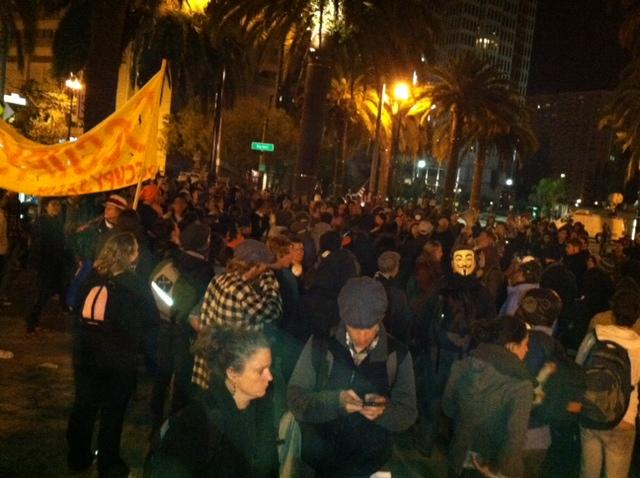
At 9:00, hundreds of people were at the encampment and were meeting about tactics in case the raid occurred. For the next several hours, as hundreds more continued to pour into camp, supporters practiced formations to defend the camp and separate those who were willing to risk arrest from those who weren’t.

At 9:30, photos began circulating social media of scores of police in riot gear waiting with six muni buses near the police operations building in Potrero Hill. Many feared that they were gearing up to descend on Justin Herman Plaza.

Different groups, including a group of clergy, SF Labor Council representatives, a meditation circle and groups practicing blockade formations met throughout the camp. Drum circles continuously pounded, and the Brass Liberation Orchestra jammed throughout the night.

Nurses and medic volunteers distributed materials to protect from and relieve the effects of tear gas, and National Lawyers Guild volunteers scoured the camp making sure protesters had their legal hotline phone number. Talk of the violence and mass arrests at Occupy Oakland that had happened the past few days permeated the group.

The BART stations closest to the OccupySF and Oakland camps were closed last night due to “civil disturbance,” but many supporters still crossed the Bay to swell the OccupySF ranks.

At 10:00, between 500 and 600 people had gathered at the camp. Protesters danced to the constant music and chanted political cries to the beat: “This system has got to die, hella hella occupy!”

Others waited in defense formation around the camp. After spotting Supervisor John Avalos, many began imploring him to sit down in the ranks, which he did.

As the night went on, sightings of police with buses continued. Some protesters joked, “the police are on the way, but they’re taking Muni so it will be a few hours.”

At 12:40, though much of the camp’s kitchen supplies and food had been moved offsite, protesters continued to serve free food. A young man serving up salad and bread gestured to several cases of food, saying “this has all been donated within the last hour.”

At 1 a.m., the group had reached its peak numbers. All sides of Justin Herman Plaza were blocked by masses of people, who also spilled out into the street on Steuart and Market, attracting virtually all passers-by into the crowd. Organizers urged supporters to stay prepared, but as one woman emphasized on a bullhorn “Remember, 99 percent means we are all individuals. It’s your choice how you respond.”

At 1:30, an impromptu speak-out began as protesters, amplified by the Peoples Mic, explained who they were and why they were there that night. Ten minutes later the group decided to allow a makeshift press conference, giving a formal space for five city officials present to speak.

Supervisors John Avalos, Jane Kim, David Campos, David Chiu and Eric Mar, along with state Senator Leland Yee, professed their support for OccupySF and commitment to protecting it from raids. The group was met with mixed responses. Many cheered their support, and one woman said, “I’m from Oakland and I wish Oakland supervisors had done what San Francisco supervisors have done tonight.” Others were less receptive, crying “I don’t trust you!” and “remember, these are the same supervisors that helped pass sit-lie!”

After the politicians finished speaking at 2:00, many supporters left the camp. One man declared, “I’m glad they came, but they do not represent us.”
About 30 minutes later, new reports were coming in that police were massing at Treasure Island. Protesters surveyed their drastically reduced numbers, and voted on what new formations to practice. As the group discussed, drummers punctuated each point, keeping energy high.

Protesters organized new strategies, but by 3:38 there was still no sign of cops. Representatives of labor organizations began a spontaneous rally, speaking to why they supported OccupySF. Mentions of Occupy Oakland’s vote to call for a general strike on Wednesday November 2 circulated, and one labor rep recalled the 1934 general strike.

At 4 a.m., hundreds were still awake and prepared in the camp. Said protester Robert Duddy, “I’m tired. I stayed up last night until 5:30 after getting the notice that we might be evicted. I think they’re trying to wait us out and have our numbers dwindle.” Duddy added that he did not expect the police to show up that night.

Won-Yin Tang wasn’t convinced. “I won’t feel [that we’ve won] until 7 a.m. when they’re not waiting in riot gear anymore. We have to stay focused. When everyone leaves, that’s when they’ll come.”

At 4:30, the long-awaited announcement of victory came. The crowd cheered, and many headed to nearby Muni stations, now open for the morning. Said protester Sam Miller, waiting exhausted in Embarcadero Station, “Tonight was a great triumph of the human sprit. It was the middle class showing we can’t be beaten down anymore. We’re not the zombies that they think we are.”

Protester Sean Semans also celebrated. Said Semans, “We won tonight. Now we just have to sure, if we need to, we can do the same thing tomorrow.”
Staying up until 5 a.m. on weeknights is no easy call to action. But it seems thousands throughout the Bay Area are willing to step up to the plate.

Big victory for OccupySF, Occupy Oakland reconvenes after crackdown (VIDEO)

36

(UPDATED/CORRECTED AT 11:30 AM)The Occupy movements in San Francisco and Oakland reportedly scored big victories last night, with huge numbers of people overcoming police crackdowns and the shutdown of public transit stations, turning back city efforts to clear the OccupySF encampment and voting in the General Assembly in Oakland to call a general strike for Nov. 2.

We’ll have a full reports later today. Occupy Oakland protesters showed up outside a cordoned-off Frank Ogawa Plaza to figure out how to respond to the previous day’s aggressive police raid, which made national news and left Iraq War veteran Scott Olsen in the hospital with a fractured skull after apparently being hit by a tear gas canister or some other projectile fired by police.

In San Francisco, Mayor Ed Lee and the SFPD threatened to shut down the OccupySF encampment over alleged public health problems – which the movement tried to address by bringing in their own porta-potties because the city refused to provide them at night – but the camp swelled with supporters. Among them were mayoral candidates John Avalos, Leland Yee, Jeff Adachi, and David Chiu, as well as Sups. Jane Kim, Eric Mar, and David Campos.

Video by Rebecca Bowe

They spoke to the crowd around 2 a.m., expressing their support and saying that neither police nor Lee had responded to requests for information about the city’s intentions. Other notables on the scene included writer Rebecca Solnit, SF Democratic Party Chair Aaron Peskin, Shawn San Liu of the Chinese Progressive Association, and local labor leaders Tim Paulson, Gabriel Haaland, and Mike Casey. Spirits were high, and protesters were ready to link arms and form a human blockade in the event that police showed up.

SF police reportedly massed nearby in the early morning hours, preparing to clear Justin Herman Plaza, and there were rumors that hundreds more were on the way. BART stations in the area were shut down to prevent more arrivals, while police in Oakland also reportedly stopped protesters there who tried to cross the bay to support OccupySF. But the raid was then reportedly called off because police were outnumbered and possibly to avoid a repeat of the violence and mass arrests that have plagued Oakland since the decision to clear the encampment there, and protesters sent out jubilant messages of victory.

Check back later for video and eyewitness details of what went down, from the the Guardian’s Rebecca Bowe (who contributed to this report) and Yael Chanoff, as well as information on what comes next. Or follow the Oakland live stream here or San Francisco live stream here.

Mixed messages

0

steve@sfbg.com

In San Francisco — the first major city to launch a midnight police raid to break up an Occupy encampment, which it repeated Oct. 16 — city officials are struggling with contradictions between claims of supporting the movement but opposing its tactic of occupation. Protesters have reacted to those mixed messages by erecting a growing tent city in defiance of Mayor Ed Lee’s public statements on the issue.

The situation remained fluid at Guardian press time, with OccupySF members unsure when and whether to expect another raid. That sort of standoff has repeated itself in cities around the country. But it seems particularly fraught here in the final weeks of a closely contested mayor’s race as Lee’s stated belief that “a balance is possible” is put to the test.

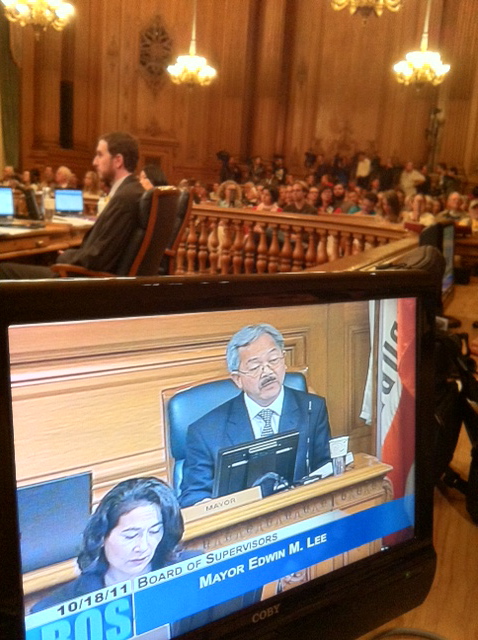
On Oct. 18, when hundreds of OccupySF protesters and their supporters entered City Hall to testify at the Board of Supervisors hearing — where Lee appeared for the monthly question time and was asked by Sup. Jane Kim to “describe the plan that our offices have been developing” to facilitate the OccupySF movement — it became clear there was no plan and that Lee was standing by the city’s ban on overnight camping.

“From the very beginning, I have fully supported the spirit of the Occupy movement…To those who have come today and who come day after day as part of this movement, let me say now that we stand with you in expressing anger and frustration at the so-called too big to fail and the big financial institutions,” Lee said at the hearing.

“Then don’t send the police in to destroy it,” yelled a woman from the crowd.

“Well, we are working with you,” Lee responded as Board President David Chiu banged his gavel at the interruption and said, “excuse me, you are out of order” and the packed hearing room erupted in shouts and applause at calling out the contradiction in the mayor’s position.

“Well, we are working with you. We are working with you to help raise your voice peacefully and will protect and defend your right to protest and your freedom of speech,” Lee continued, eliciting scattered groans from the crowd. “But that’s not the same thing as pitching tents and lighting fires in public places and parks that are meant for use by everyone in our city. But we can make accommodations and we have, and we can do this while not endangering public safety in any way.”

Afterward, as Lee was surrounded by a scrum of journalists asking about the issue, he made his stand even more clear. “We’re going to draw the line with overnight camping and especially structures,” Lee told reporters. Asked why the police raids have taken place in the middle of the night and why San Francisco is banning practices being allowed in other occupied cities, such as tents and kitchens, he offered only nonresponsive answers before being whisked away by his security detail.

Back inside the hearing room, Sup. John Avalos — who has led efforts to mediate the conflict and prevent police raids — called Lee’s comments “very frustrating. I’m alarmed that he is moving toward nightly standoffs with the Occupy movement.” After watching video of the chaotic Oct. 16 raid, at which several protesters were injured by police officers, Avalos called the situation “unsafe for both sides.”

Six of the 11 supervisors voiced support for OccupySF during the meeting, although Kim — who supports OccupySF and Lee’s mayoral campaign and whose District 6 includes the two protest encampments, in Justin Herman Plaza and outside the Federal Reserve — said at the hearing, “We’re all struggling to figure out the best way to accommodate it.”

Indeed, when the Guardian sought details on “the plan” Kim said she was developing with Lee, her staffers told us there was nothing in writing or major tenets they would convey. And mayoral Press Secretary Christine Falvey told us, “There’s not really a plan, per se, because the movement is so fluid,” although she confirmed that the city would not allow tents or other structures: “The tactic of camping overnight, he does not support.”

But OccupySF protesters were defiant as they streamed to the microphone by the dozens during public comment, decrying the city’s crackdown and claiming the right to occupy public spaces and to have the basic infrastructure to do so. As a woman named Magic proclaimed, “This can be a celebration or a battle, but we will not back down.”

The next afternoon, a large group of OccupySF protesters took their complaints about mistreatment by officers to the Police Commission meeting. Previously, Police Chief Greg Suhr had taken the same stance as Lee, with whom he had consulted before ordering the raid, claiming to support OccupySF but oppose overnight camping (see “Crackdown came from the top,” Oct. 11).

“We will surgically and as best as possible and with as much restraint as possible try to deal with the hazards while protecting people’s First Amendment rights,” Suhr had said, reiterating a ban on tents and infrastructure.

But by the end of the long Police Commission hearing — which was peppered by angry denunciations and chants of “SFPD where is your humanity?” — Suhr seemed to soften his position: “We have no future plans to go into the demonstration. We know that it’s for the long haul.”

OccupySF members interpreted Suhr’s remarks, which went on to raise concerns over potential future public health hazards that a growing encampment might present, as a change in the policy Lee had outlined a day earlier, erupting in the cheer, “Now that’s what I’m talking about!”

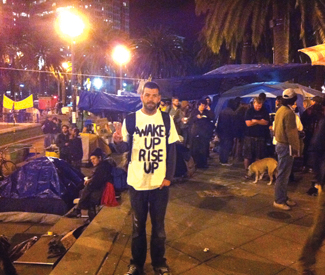
In the wake of that meeting, more than 40 tents — including a working kitchen and fully stocked medical tent — have been erected in Justin Herman Plaza, although neither the Police Department nor Mayor’s Office have answered Guardian inquiries seeking to clarify what current city policy is regarding OccupySF. But for now, protesters have declared victory over the city and are happy to be turning their full attention back toward powerful banks, corrupt corporations, and the rest of “the 1 percent.”

“I’m really proud of the OccupySF participants who went to the meeting today,” Zoe D’Hauthuille, a 19-year-old protester, told the Guardian after the Oct. 18 meeting. “I feel like they were really honest and super effective at getting people to realize that we need certain things, and that the city is violating our rights.”

The selling of Ed Lee

0

steve@sfbg.com

Ed Lee has gone through a remarkable makeover in the last year, transformed from the mild-mannered city bureaucrat who reluctantly became interim mayor to a political powerhouse backed by wealthy special interests waging one of the best-funded and least transparent mayoral campaigns in modern San Francisco history.

The affable anti-politician who opened Room 200 up to a variety of groups and individuals that his predecessor had shut out — a trait that won Lee some progressive accolades, particularly during the budget season — has become an elusive mayoral candidate who skipped most of the debates, ducked his Guardian endorsement interview, and speaks mostly through prepared public statements peppered with contradictions that he won’t address.

The old Ed Lee is still in there somewhere, with his folksy charm and unshakable belief that there’s compromise and consensus possible on even the most divisive issues. But the Ed Lee that is running for mayor is largely a creation of the political operatives who pushed him to break his word and run, from brazen power brokers Willie Brown and Rose Pak to political consultants David Ho and Enrique Pearce to the wealthy backers who seek to maintain their control over the city.

So we thought it might be educational to retrace the steps that brought us to this moment, as they were covered at the time by the Guardian and other local media outlets.

Caretaker mayor

The story begins quite suddenly on Jan. 4, when the Board of Supervisors convened to consider a replacement for Gavin Newsom, who had been elected lieutenant governor but delayed his swearing-in to prevent the board from choosing a progressive interim mayor who might then have an advantage in the fall elections. Newsom and other political centrists insisted on a “caretaker mayor” who pledged to vacate the office after serving the final year of the current term.

It was the final regular meeting of the old board, four days before the four newly elected supervisors would take office. What had been a bare majority of progressive supervisors openly talked about naming former mayor Art Agnos, or Sheriff Michael Hennessey, or maybe Democratic Party Chair Aaron Peskin as a caretaker mayor.

When then-Sup. Bevan Dufty said he would support Hennessey, someone Newsom had already said was acceptable, the progressive supervisors decided to coalesce around Hennessey. That was mostly because the moderates on the board had suddenly united behind a rival candidate who had consistently said didn’t want the job: City Administrator Ed Lee.

Board President David Chiu was the first in the progressive bloc to breaks ranks and back Lee, saying that had long been his first choice. Dufty became the swing vote, and he abstained from voting as the marathon meeting passed the 10 p.m. mark, at which point he asked for a recess and walked down to Room 200 to consult with Newsom.

At the time, Dufty said no deals had been cut and that he was just looking for assurances that Lee wouldn’t run for a full term (Dufty was already running for mayor) and that he would defend the sanctuary city law. But during his endorsement interview with the Guardian last month, he confessed to another reason: Newsom told him that Hennessey had pledged to get rid of Chief-of-Staff Steve Kawa, a pro-downtown political fixer from the Brown era who was despised by progressive groups but liked by Dufty.

Chiu and others stressed Lee’s roots as a progressive tenants rights attorney, the importance of having a non-political technocrat close the ideological gap at City Hall and get things done, particularly on the budget. So everyone just hoped for the best.

“Run, Ed, Run”

The drumbeat began within just a couple months, with downtown-oriented politicos and Lee supporters urging him to run for mayor in the wake of a successful if controversial legislative push by Lee, Chiu, and Sup. Jane Kim to give million of dollars in tax breaks to Twitter and other businesses in the mid-Market and Tenderloin areas.

In mid-May, Pak and her allies created Progress for All, registering it as a “general civic education and public affairs” committee even though its sole purpose was to use large donations from corporations with city contracts or who had worked with Pak before to fund a high-profile “Run, Ed, Run” campaign, which plastered the city with posters featuring a likeness of Lee.

Initially, that campaign and its promotional materials were created by Pak (who refuses to speak to the Guardian) and political consultant Enrique Pearce (who did not return calls for this article) of Left Coast Communications, which had just run Kim’s successful D6 victory over progressive opponent Debra Walker, along with Pak protégé David Ho.

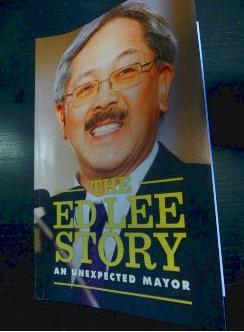
During that campaign, the Guardian and Bay Citizen discovered Pearce running an independent expenditure campaign called New Day for SF, funded mostly by Willie Brown, out of his office, despite bans of IEs coordinating with official campaigns. That tactic would repeat itself over the coming months, drawing criticism but never any sanctions from the toothless Ethics Commission. Pearce was hired by two more pro-Lee IEs: Committee for Effective City Management and SF Neighbor Alliance, for which he wrote the book The Ed Lee Story, a supposedly “unauthorized biography” filled with photos and personal details about Lee.

Publicly, the campaign was fronted by noted Brown allies such as his former planning commissioner Shelly Bradford-Bell, Pak allies including Chinatown Community Development Center director Gordon Chin, and a more surprising political figure, Christina Olague, a progressive board appointee to the Planning Commission. She had already surprised and disappointed some of her progressive allies on Feb. 28 when she endorsed Chiu for mayor during his campaign kickoff, and even more when she got behind Lee.

Olague recently told us the moves did indeed elicit scorn from some longtime allies, but she defends the latter decision as being based on Lee’s experience and willingness to dialogue with progressives who had been shut out by Newsom, noting that she had been asked to join the campaign by Chin. Olague also said the decision was partially strategic: “If we get progressives to support him early on, maybe we’ll have a seat at the table.”

Right up until the end, Lee told reporters that he planned to honor his word and not run. During a Guardian interview in July when we pressed him on the point, Lee said he would only run if every member of the Board of Supervisors asked him to, although about half the board publicly said that he shouldn’t, including Sup. Sean Elsbernd, who nominated him for interim mayor.

And then, just before the filing deadline in early August, Lee announced that he had changed his mind and was running for mayor, the powers of incumbency instant catapulting him into the frontrunner position where he remains today, according to the most recent poll by the Bay Citizen and University of San Francisco.

Lee the politician

With his late entry into the race and decision to forgo public financing and its attendant spending limits, one might think that Lee would have to campaign aggressively to keep his job. But most of the heavy lifting has so far been done by his taxpayer-financed Office of Communications (which issues press releases at least daily) and by corporate-funded surrogates in a series of coordinated “independent” groups (see Rebecca Bowe’s story, “The billionaires’ mayor”).

That has left Lee to simply act as mayor, where he’s made a series of decisions that favor the business community and complement the “jobs” mantra cited relentlessly by centrist politicians playing on people’s economic insecurities.

Yet Lee has been elusive on the campaign trail and to reporters who seek more detailed explanations about his stands on issue or contradictions in his positions, and his spokespersons sometimes offer only misleading doublespeak.

For example, Lee’s office announced plans to veto legislation by Sup. David Campos that would prevent businesses from meeting their city obligation to provide a minimum level of employee health benefits through health savings accounts that these businesses would then pocket at the end of the year, taking $50 million last year even though some of that money had been put in by restaurant customer’s paying 5 percent surcharges on their bills.

Although Campos, the five other supervisors who voted for the measure, four other mayoral candidates, and its many supporters in the labor and consumer rights movements maintained the money belonged to workers who desperately needed it to afford expensive health care, the San Francisco Chamber of Commerce said it was about “jobs” that would be protected only if businesses could keep that money.

Lee parroted the position but tried to push the political damage until after the election, issuing a statement entitled “Mayor Lee Convenes Group to Improve Health Care Access & Protect Jobs,” saying that he would seek to “develop a consensus strategy” on the divisive issue — one in which Campos said “we have a fundamental disagreement” — that would take weeks to play out.

After a frustrating back-and-forth with Lee Press Secretary Christine Falvey by email, it’s still unclear how to resolve the contradiction between whether businesses could seize these funds or whether they belonged to employees, with her latest statement being, “The Mayor absolutely wants these funds spent on providing access to quality primary and preventative health care because this is the business’s obligation under HCSO. Making sure that these funds go to pay for health care is the most important objective.”

Similarly, when police raided the OccupySF encampment on Oct. 5, Lee’s office issued a statement that was a classic case of politicians trying to have it both ways, expressing support for the movement and its goal to “occupy” public space, but also supporting the need to police to clear the encampment of those same occupiers.

But now, in the wake of a repeat raid on Oct. 16 that has inflamed passions on the issue, the question is whether Lee can run out the clock and retain the office he gained on the promise of being someone more than a typical politician.

OccupySF appeals to City Hall, but the standoff continues

40

Frustrated by repeated late-night police raids on their encampments and empty statements of support by top city officials, hundreds of protesters with OccupySF entered City Hall today – under the watchful eyes of a large police presence with riot gear at the ready – to testify at today’s Board of Supervisors meeting.

The meeting began with the scripted monthly question time session with Mayor Ed Lee, who was asked by Sup. Jane Kim – whose District 6 includes the OccupySF encampment, which she visited for a couple hours last night – to “describe the plan that our offices have been developing” to facilitate the OccupySF movement.

But in Lee’s response and in exchanges with journalists after the meeting, as well as Guardian interviews with people in both offices, it doesn’t seem city officials have a coherent plan for carrying out Lee’s contradictory goals of supporting the Occupy movement and keeping sidewalks and parks clear of encampments.

Kim seemed to acknowledge as much later in the meeting when she said voiced support for OccupySF and for city officials who object to tents, kitchens, and other basic infrastructure that the month-old movement needs to continue. “We’re all struggling to figure out the best way to accommodate it,” she said.

Lee’s message was even more muddled, saying he supported the movement and agreed with its economic justice message. “From the very beginning, I have fully supported the spirit of the OccupySF movement,” Lee told the crowd, transitioning into reciting a litany of economic development efforts with little relevance to the demands of the movement.

“Then don’t send the police in to destroy it,” a protester shouted from the audience, which was filled to capacity and had a line out front and an overflow room. “We are working with you,” Lee responded, but then went on to complain about the lack of consistent contacts in the leaderless movement and emphasizing his bottom line that any kind of encampment with infrastructure is an impermissible violation of city codes.

“I need to make sure our public spaces are open to be used by anyone,” he said. Later, his Press Secretary Christine Falvey clarified the mayor’s stance by saying he supports the message but not the movement: “The tactic of camping overnight, he does not support.”  

Afterward, talking to reporters, Lee couldn’t really explain why the police needed to do their raids in the middle of the night, why San Francisco is cracking down on conditions that are being allowed in many other Occupy cities, or how the movement might be able to avoid future crackdowns if it continues, ignoring questions about where OccupySF might be able to go to avoid police raids.

Sup. John Avalos, who has been working to try to mediate the dispute between OccupySF and the city, responded to Lee’s speech by calling it “very frustrating. I’m alarmed that he is moving toward nightly standoffs with the Occupy movement.” Avalos says he supports protesters’ right to peacefully occupy public spaces and acknowledges their need for basic supplies to do so, calling the current standoff, “unsafe for both sides.”

“I’m proud to say that we are the 99 percent,” Sup. Eric Mar said, echoing the movement’s mantra and saying he would defer to Avalos’ leadership to create a “resolution strongly holding the police accountable for the crackdowns.”

Avalos had invited OccupySF participants to raise their concerns during the public comment portion of the meeting, and he said that he plans to use their input to form a resolution or plan for how the city should accommodate a movement that six of the 11 supervisors professed to support at the meeting.

When the long line of OccupySF protesters finally took to the microphone for public comment, they made it clear that the issue wasn’t as complicated as some city officials were trying to make it.
“It is outrageous and inhumane to see our camp raided in the middle of the night by San Francisco Police,” Magic, a middle-aged woman and lifelong activist, told the supervisors, closing with, “This can be a celebration or a battle, but we will not back down.”

Several speakers were dismissive of city claims to be protecting public health and safety, noting how dangerous the midnight confrontations have been, saying food and shelter are basic human needs, and noting how peaceful and cooperative OccupySF has been with the escalating series of city demands as the protest’s numbers have grown.

Michael Goldman said police have asked them to return to the sidewalk in front of the Federal Reserve, where they are densely packed in what he called unsafe conditions. “We have too many people to fit in front of 101 Market,” he said.

That was what prompted the move to nearby Justin Herman Plaza, where police cracked down Sunday night, citing a violation of the park’s 10 pm curfew. Another protester who works at the Ferry Building angrily noted that even before OccupySF began, he regularly watched city crews chase the homeless away from the site at 3 am with water trucks.

“We are a peaceful and nonviolent people and we do not deserve to be treated this way by our city and our country,” he said.  

“They were waiting to be talked to and not just run over by the police,” said iconic San Francisco activist Father Louie Vitale, who gestured to the waiting protesters and said, “We’re very proud of these people, very proud.”

It was a point echoed by others like local resident Andy Blue, who said, “They are doing a great service to this city and the world.”

City contractors plunk down for Lee

Representatives from Stellar Services, an IT infrastructure services provider that also does business as 4 U Services, contributed a total of $7,500 in support of Mayor Ed Lee’s bid for a full term, filings with the San Francisco Ethics Commission show. The New York-based company holds a contract with the San Francisco Public Utilities commission (SFPUC) and has been paid $91,737.80 to date for programming and coding services.

Lee also received a maximum $500 contribution from a senior vice president at AECOM, another city contractor. While the contributions may have squared with campaign finance law, significant support from companies doing business with the city nevertheless give the impression of businesses attempting to advance their own interests through political influence.

The majority of the contributions from Stellar came in the form of a $5,000 donation from 4 U Services to the Committee for Effective City Management, an independent expenditure committee created in support of Lee that recently hosted a Lee fundraiser in Millbrae honoring special guests Sup. Jane Kim and former Mayor Willie Brown.

4 U, according to its website, also does business as Stellar Services, a company based in New York that has an office in San Francisco. “Stellar is currently a sub-consultant that is working to develop our new online invoicing system called SOLIS,” SFPUC spokesperson Tyrone Jue told the Guardian. “The invoicing system centralizes and streamlines the invoicing process, makes invoicing transaction transparent to all users, increases reporting and transparency, and makes invoicing completely paperless.” Jue noted that the contract was signed in July 2009, and the SOLIS pilot program is underway.

The remainder of contributions from Stellar were made to Lee’s official mayoral campaign. Five individuals who listed Stellar Services or 4 U Services as their employer, including company founder and president Liang Chen, made maximum contributions of $500, according to a report filed with the San Francisco Ethics Commission.

Shaista Shaikh of the Ethics Commission noted that it is legal for city contractors to make contributions to independent expenditure committees formed in support of a candidate for public office. City contractors run afoul of ethics law if they make campaign contributions to an elected official who must approve the contract at any time during contract negotiations or until six months have passed from the date of contract approval, she explained. Since the contract with Stellar was approved in 2009, the contribution would have been made well past the six-month mark  — so it apparently squares with the campaign finance reform ordinance.

Reached by phone, Lee spokesperson Tony Winnicker told the Guardian that if the contract was approved in 2009, it would not be included in a database of city contractors maintained by the campaign, since “there’s no prohibition” against accepting campaign money after the six-month ban has passed. “So that should not be a concern to the Guardian,” he said.

On Sept. 17, Lee received a maximum $500 contribution from Joseph G. Moss, Jr., who listed his occupation as a senior vice president of AECOM in Atlanta, according to an Ethics filing. Lee received another $875 in contributions from AECOM employees, Ethics records show. According a press release on the AECOM website which seems to have been taken down since the Guardian highlighted it, an AECOM joint venture was awarded a $150 million contract for program management services for the SFPUC’s wastewater improvement program on Aug. 16. AECOM is also a partner in a joint venture working on construction of the controversial Central Subway project.   

Since the contractor contribution ban (Section 1.126 of the city’s campaign finance reform ordinance) sets a number of parameters for determining the legality of contributions, it wasn’t immediately clear whether the contributions from AECOM were in line with the ordinance.

Regardless of whether the campaign cash falls on the right side of the law, however, substantial support for Lee from city contractors is likely to raise eyebrows, especially in light of concerns progressives have raised that San Francisco is about to witness a resurgence of the pay-to-play politics that characterized City Hall under Brown.

Will Mayor Lee veto legislation that helps workers and protects consumers?

10

After the Board of Supervisors today voted 6-5 to bar San Francisco businesses from pocketing money they and their patrons set aside for employee health care, Mayor Ed Lee faces a tough but telling choice: Whether to heed business community demands that he veto legislation that has wide labor and consumer support.
A veto is widely expected, but complicating that decision is the position that was staked out today by one of his main rivals as a mayoral candidate, Leland Yee, who issued a statement echoing supporters claims that this is an issue of workers’ rights and consumer protection versus corporate greed: “This is a defining issue of who we are as a city. If Ed Lee vetoes this legislation, one of my first acts as Mayor will be to reverse his veto and sign this legislation into law.”
Neither Lee’s mayoral nor campaign spokespersons answered a Guardian email about whether he will veto the measure, which would kill it unless two supervisors who opposed the measure (David Chiu, Sean Elsbernd, Mark Farrell, Carmen Chu, and Scott Wiener) break ranks, which is unlikely given the polarization on this measure. San Francisco Chamber of Commerce officials have made a top priority of killing the measure, even threatening to withdraw support from Prop. C, the pension reform measure that they helped create with Lee.
At issue is the roughly $50 million per year that San Francisco businesses have been taking from health savings accounts they create for employee health care – funds that are often subsidized by 3-5 percent surcharges that many restaurants have chosen to tack onto their customers bills – under legislation that then-Sup. Tom Ammiano created to require employers to provide health care coverage for their employees.
The position of the Chamber – which fought Ammiano’s legislation and supported years of unsuccessful lawsuits challenging it – is that this $50 million “loss” to city businesses would be a “job killer.” Chiu has also accepted that paradigm and introduced legislation that would let businesses use that money, but require them to let employees know they can tap into it and other reforms. But supporters of the legislation say these businesses are deceiving their customers, defying city law, and stealing from their employees.
“People have tried to complicate this issue, but it is a simple issue. It’s about the right of workers to have health care,” Sup. David Campos, the author of the legislation, said at today’s hearing.
Campos said he would limit his comments, given how widely the issue has already been discussed, and he announced a limitation on how long employees could tap the fund after their termination “in the spirit of compromise.” But then opposing supervisors attacked the measure, its timing, and supporters’ refusal to “compromise,” with Elsbernd chiding Campos that his legislation is “not the best way to encourage jobs.”
So Campos went into more detail about why his measure was needed, noting that Chiu’s alternative would cap an employee’s access to health care at just $4,300, far less than the cost of a night’s hospital stay and a small fraction of the cost of a serious ailment. “You’re looking at a situation where very little could be provided for them,” Campos said.
He also said how important it is to ban the fraudulent practice of restaurants charging customers for employee health care costs and then simply keeping the money, a practice that a recent Wall Street Journal investigation discovered was widespread. Campos said 80 percent of the money collected on diners’ bills is pocketed by the restaurants.
“When consumers are paying for this, the expectation is that workers will have basic coverage,” Campos said, noting that his legislation would guarantee that “every cent that that consumer pays is actually spent on health care…This is not just about workers, it’s about consumer protection.”
Even worse, Campos noted that these consumers are actually paying twice for restaurant employees’ health coverage, first on their dinner bills, and then again as taxpayers when those uninsured employees end up in General Hospital with their expenses paid for by the city.
Under the federal ERISA law – which was the basis for the failed lawsuit challenging the city program, brought primarily by the Golden Gate Restaurant Association – the city cannot tell employers how to provide health coverage, and so they have the option of providing health insurance, paying into the city’s Healthy San Francisco plan, or providing the medical savings accounts that this legislation addresses.
Sup. Jane Kim said she supported the legislation largely because of the horror stories she’s heard from employees who not only weren’t told of the existence of these accounts, but who were denied payment for medical procedures even after they learned about them. She also said the city could be vulnerable to another ERISA lawsuit if it took Chiu’s approach of directing how businesses used their funds, citing an earlier discussion of the board’s role in protecting the city from litigation.
On that issue, Kim today introduced an alternative to legislation by Farrell and Elsbernd that would end the city’s program of providing matching funds to publicly financed mayoral and supervisorial candidates once their privately financed competitors break the spending cap. The US Supreme Court recently ruled a similar program in Arizona to be unconstitutional.
The Chamber and other downtown groups – mostly supporters of Mayor Lee, who are close to breaking the spending limits – had signaled their intent to sue the city over the issue. The Farrell/Elsbernd legislation, which needed eight votes to change the voter-approved program, today failed on a 6-5 vote, with Sups. Campos, Kim, John Avalos, Eric Mar, and Ross Mirkarimi opposed.

The Hangover: Sept. 30-Oct. 2

0

Jounce with us, if you will, through the Guardian staff’s frenzied weekend. Here’s our live reviews, hot raging, random sightings.

**The wonderfully energetic (and wonderfully tall) Robin Simmons puts on an occasional gig in the middle of Dolores Park called the Boombox Affair, hooking up a wall of old boomboxes as turntable speakers and letting disco-minded DJs go nuts with their all-vinyl obsessions. On Friday’s Odyssey party at Deco Lounge, he went indoors and at night hosting a three-hour set by DJ David Harness that reminded of those ancient “back in the day” days. Just 30-40 freaks, many of whom were previously unfamiliar to each other, jacking all night in the dark to some heavy tunes as the walls sweat and pounded. Hopefully the party will come back around soon. (Marke B.)

**I was not acquainted with the work of dOP before I attended Friday night’s Liaison Showcase at Public Works — the French techno trio has some excellent grooves and an absurdly over-the-top “sexy” aesthetic that would make their hits like “Horny” hilarious, if they weren’t actually very, very horny. Example: the chain-smoking boys are just fine wiggling around onstage half-naked, and the singer-rapper-screamer is one of the hottest little tattooed bear cubs I’ve ever seen. He spent most of the set playing with his nipples and shaking sweat from his shoulder hair. The crowd ate it up. (Marke B.)

**Saturday at the Warfield for Amon Tobin’s ISAM tour was like entering the 22nd century, except surrounded by young Pixar workers who couldn’t stop screaming, “Amaaazing!” everytime one of the realtime 3-D effects of the stage set was unveiled. Why? Because it really was amaaazing. Opener Eskmo did an entrancing job live-sampling cookware and plastic Coke bottles to build left-field grooves that weren’t afraid of floor-bending tempo changes. (Marke B.)

**With flickering string lights strung from the center of the grand ballroom and splayed out brass instruments across the stage, Beirut’s performance at the Fox Theater in Oakland on Saturday warmed like a fancy indoor county fair. The sound, which can be bass-problematic at the Fox, was good this evening, near perfect for the otherworldly folk-marching band from Santa Fe. Ringleader Zach Condon switched back and forth from ukulele to his beloved trumpet, singing in deep baritone throughout, once stepping to his newly rediscovered favorite, the keys. Here’s our interview with Condon from last week. (Emily Savage)

**What else is there to say about Saturday’s Hard French party besides the fact that Scott Weiner got to express his gratitude to us for his official Guardian ass towel? The queer patio shakefest at El Rio (theme: “Hardly Strictly French.” Overalls.) featured hand-wagging talents of many of the candidates for November’s city elections. Plus, Sups. Weiner and Jane Kim tagged along for the ride and they aren’t even running for anything. (Caitlin Donohue)

**The crowd at Odd Future’s show at the Warfield on Friday may have looked like Warped Tour cool kids, but you couldn’t fault them on their choice in music. The crew from Compton bug-eyed and jello-kneed through and generally crushed their set, although we were all out of their by 11 p.m. What Warfield, not into bands hurling their most enthusiastic devotees back into the crowds spine-first? Here’s the full review, btw. (Caitlin Donohue) 

**So we only made it to Sunday of Hardly Strictly Bluegrass, but damn if that afternoon’s Devotchka set and red wine from the bottle wasn’t a welcome entree to sunny banjo strumming. Even the crowd itself was hotter than ever (where did all these surfer-hippie hotties come from and to whence have they now returned?) — and in contrast to Outside Lands’ frenzied crowds, filtered through the fenceless areas calmly and happily. Yay free concerts! Happy birthday, Mr. Hellman. (Caitlin Donohue)

Progressives battle downtown over economic and political reforms

63

Battles between progressive members of the Board of Supervisors and downtown power brokers such as the San Francisco Chamber of Commerce defined City Hall politics for much of the last decade, until the new politics of “civility” and compromise took hold this year, a dynamic that has favored downtown interests. But now, a pair of important, high-profile issues headed to the full board on Tuesday has revived the old dynamic. And in both cases, wealthy interests are putting enormous pressure on the board.

The first involves a proposal – put forward by Sups. Sean Elsbernd and Mark Farrell, the two most conservative supervisors – to gut the city’s system for publicly financing campaigns because downtown is threatening a lawsuit. They propose to end San Francisco’s program of giving publicly financed candidates more money when a privately funded candidate exceeds the spending cap because the Supreme Court recently struck down similar provisions in Arizona.

This week, after convening in closed session to discuss the threat of litigation by downtown groups, the board voted 7-3 – with Sups. David Campos, Jane Kim, and Eric Mar opposed, and Sup. Ross Mirkarimi absent because he rushed out to large structure fire in his district – for the Elsbernd/Farrell measure, one vote short of the supermajority needed to amend the current city law.

Campaign finance reform advocates such as Steven Hill argue that it’s unfair to modify the city program right in the middle of an election season in which Mayor Ed Lee and the wealthy independent expenditure groups supporting him are poised to spend millions of dollars to defeat a large field of mostly publicly funded mayoral candidates.

Hill and his allies are appealing to Mirkarimi – who told the Chronicle that he is leaning toward supporting the amendment when the measure returns to the board on Tuesday – not to support what they consider an overly broad capitulation to downtown’s threats. They’re also lobbying Sup. John Avalos to switch his vote, while downtown players are putting the screws to supervisors as well.

In an interview with the Guardian, Mirkarimi clarified his stance, noting that he was the sponsor of the original public financing law and his goal is to protect it, even if it needs to be modified to withstand a legal challenge. “I’m looking for alternatives to fortify San Francisco’s program,” he told us, noting that he missed some of this week’s discussion and he’s hoping something can be done to retain provisions that level the financial playing field with wealthy candidates.

Meanwhile, downtown forces are pulling out the stops to kill Sup. David Campos’ legislation that would prevent San Francisco businesses from pocketing money they set aside for their employees’ health care under a city mandate that they provide health coverage – totaling about $50 million last year – legislation that gets its first hearing tomorrow (Friday/30) at 10 am.

Board President David Chiu has put forward competing legislation that is more to the Chamber’s liking, letting businesses (mostly restaurants that are even placing surcharges of customers’ bills, ostensibly to subsidize their legal obligations) keep the money. But Campos and his labor allies believe they have the six votes they need to pass the legislation, thanks largely to moderate Sup. Malia Cohen’s pledge to support the measure.

While even some supporters have quibbled with the timing of this measure, Campos notes the urgency of keeping money intended for workers in their hands. “It’s an outrage and the longer we wait, the worse it gets,” Campos tells us, noting that the practice, “is what many of us consider fraud.”

Unfortunately, even if the board approves the measure this Tuesday, it will still need the signature of Mayor Lee to become law. While he hasn’t formally taken a position, given that his political base is the downtown crowd, he’s expected to veto the measure. But we’ll ask him about it tomorrow when he’s scheduled to meet with the Guardian for an endorsement interview at 2 pm.

Alerts

0

alert@sfbg.com

WEDNESDAY 21


Guardian Mayoral Forum

This Guardian-sponsored mayoral forum caps a series of five events this summer in which community members, policy experts, and progressive groups have created an agenda that serves all San Franciscans (see “A new progressive agenda, 9/13/11). All the major mayoral candidates have been asked to review that agenda and they’ll publicly weigh in with where they stand on the issues and solutions it addresses.

6 p.m., free

LGBT Center

1800 Market, SF

www.sfbg.com


Medicaid matters

Join the Independent Living Resource Center of San Francisco and other groups representing seniors, the disabled, and social justice advocates in a demonstration against the deep cuts to Medicaid that are now being discussed by Congress and the White House. Attendees will be asked to write their names and stories on a blank strip of paper that will be linked together in a long chain.

Noon, free

Civic Center Plaza

Polk and Grove, SF

www.ilrcsf.org/Rally/rally.htm


Rev. Billy at Revolution Books

Writers and performance artists Savitri D and Bill Talen will discuss their new book, The Reverend Billy Project: From Rehearsal Hall to Super Mall with the Church of Life After Shopping, which chronicles their creation of an effective and inspiring anti-consumerist group in New York City. Talen assumes his evangelical alter ego of Reverend Billy to preach against the evils of everything from corporate-controlled sweatshops and chain stores to mountain-top removal coal mining, delivering heavy message with a fun and engaging flair, backed by a large choir.

7 p.m., free

Revolution Books

2425 Channing, Berk.

www.revolutionbooks.org


FRIDAY 23

The ARTery Project

The San Francisco Arts Commission and various City Hall officials have been trying to enliven the Central Market area with series of arts initiatives they’ve dubbed the ARTery Project, ranging from the Art in Storefronts effort to the recent placement of artist Karen Cusolito’s Dandelion sculpture (originally created for Burning Man) in United Nations Plaza. The commission’s 2011 photography interns will display their work on the project during this reception.

5-7 p.m. Free

Sup. Jane Kim’s office

City Hall

1 Dr. Carlton B. Goodlett, SF

www.sfartscommission.org/artery


Mail items for Alerts to the Guardian Building, 135 Mississippi St., SF, CA 94107; fax to (415) 437-3658; or e-mail alert@sfbg.com. Please include a contact telephone number. Items must be received at least one week prior to the publication date.

Burning Man enters a deliberative new phase

6

I didn’t see SF Sups. David Chiu and Jane Kim on their brief tour of Black Rock City last week, but I did get the chance to participate in a more authentic political awakening at Burning Man this year, one marked by an increasing number of well-attended public discussions about where this strange and vibrant culture is headed.

And they are discussions that will continue back here in the default world, at events ranging from those sponsored by the new Burning Man Project to the readings that I’m doing for my book, The Tribes of Burning Man, including tomorrow evening (Fri/9) at True Stories Lounge in the Makeout Room, where I’ll appear with writers Joyce Maynard, Adam Hochschild, Gary Kamiya, Alicia Erian, Tyche Hendricks, and moderator Evelyn Nieves.

I was invited onto four different stages (although I regretfully missed one gig due to a miscommunication) at Burning Man this year, and most had capacity crowds of engaged burners who were eager to discuss what’s next and offer their ideas, many of them very insightful and well-developed.

Frankly, I wasn’t sure whether people would want to take time out of their vacations in this fun-filled city to attend lectures and discussions, and the fact that so many did – in venues and stages that popped up all over the playa – shows just how much widespread interest there is in transforming Burning Man into more than just an annual party.

“We were overflowing and people would come back days later and say it was the best discussion we ever had out there,” says D’Andre of Revolution Camp, which hosted talks all week (including the one I missed, for which he said a crowd of about 50 people showed up, about the same size crowd that showed up for my talk on Sunday at Center Camp Stage – which I mistakenly had conflated with my Revolution Camp booking…again, my apologies).

Burning Man board member Marian Goodell said they had similarly great turnouts for the daily public availabilities of the 17 board members of the new Burning Man Project, the nonprofit that will shepherd this culture into its next phase. “There was quite a lively discussion and usually people waiting to talk to the board members,” she said. “It was super successful.”

I had my own private session with new board member Chris Weitz (a longtime burner and film producer and director) in between the presentations that we each gave at the GER Talks, a speaker series hosted by the venerable theme camp Ashram Galactica, where he is the former head concierge.

I urged him to use this opportunity to create a more inclusive and representative governance structure for the 25-year-old Burning Man event, which has always been run by a handful of key players with little by way of checks-and-balances, belying the hyper-collaborative nature of this culture. It was the same message that I had for each of my crowds out there, there this is our culture and it’s up to us to determine its future direction and initiatives.

And if the interest and engagement levels that I saw on the playa this year are any indication, burners are finally ready, willing, and able to start taking this thing to the next level. Or as founder Larry Harvey said in my book, a quote from 2008 that I cited in each of my talks, “That city is connecting to itself faster than anyone knows. And if they can do that, they can connect to the world. That’s why for the last three years I’ve done these sociopolitical themes, so they know they can apply it. Because if it’s just a vacation, well, we’ve been on vacation long enough.”

Central Subway gravy train shows how City Hall works

69

Despite its skyrocketing cost, inefficient design, and a growing chorus of criticism – ranging from a Wall Street Journal editorial today to an op-ed in the SF Chronicle last week – the Central Subway project continues to move forward for one simple reason: rich and powerful people want it to happen, whether it makes sense or not, because it benefits them directly.

“The subway is a case study in government incompetence and wasted taxpayer money,” the Wall Street Journal wrote in a “Review & Outlook” piece today (full text below), but it was only partially correct. The Central Subway is actually a case study in how things get done at City Hall, and how connected contractors and their political patrons make off with that taxpayer money.

“San Francisco is embarking on a Big Dig of the West, and unless our local leadership applies the brakes soon, the damage to our transit systems will be all but guaranteed. I urge local and national leaders to recognize what is obvious and stop this train to nowhere,” former San Francisco Transportation Agency Chair Jake McGoldrick wrote in his Aug. 18 op-ed.

But that isn’t likely to happen, given the political dynamics that have taken root at City Hall this year. Remember, this project was the result of a mutually beneficial deal that then-Mayor Willie Brown cut with Chinatown power broker Rose Pak back in 2003 (when the project was estimated at $648 million, before it ballooned to its current price tag of $1.6 billion).

This was the same duo that engineered the appointment of Ed Lee as interim mayor earlier this year and then pushed him to break his word and run to retain control of Room 200, as well as pressuring David Chiu into being the swing vote to give Lee that job and secretly backing Jane Kim’s run for the Board of Supervisors. All are big supporters of the Central Subway project, despite all the experts calling it an wasteful boondoggle that will be the most expensive 1.7-mile piece of track ever built in this country.

But the opinion of fiscal and transportation policy experts matters little in a town that is once again being governed by shameless power brokers. Hell, Brown even uses his weekly column in the Chronicle to confirm his weekly breakfast date (every Monday at the St. Regis Hotel) with his “friend” and client Jack Baylis, a top executive at AECOM, the main contractor for the Central Subway, as well as the America’s Cup, Transbay Terminal, the rebuild of the city’s sewer system, and all the other most lucrative city contracts.

In turn, AECOM kicks down contracts and payouts to a network of political supporters that will ensure that the project gets built, such as Chinatown Community Development Center, which signed an $810,000 contract in December to support the Central Subway in unspecified ways right before CCDC and its director Gordon Chin provided crucial support for getting Lee into the Mayor’s Office, where he can ensure the Central Subway project remains on track.

Yes, it’s just that crass and obvious. And it isn’t even about politics. Hell, Baylis is a Republican from Los Angeles, despite his meddling in San Francisco’s political affairs by sponsoring the Alliance for Jobs and Sustainable Growth and other groups that will be doing independent expenditures on behalf of Lee this fall, trying to tell us that “it’s all about civility.”

No, it’s about money and it’s about power, straight up. The Central Subway is really more of a gravy train than a sensible transit project, but that’s just how business is being done at City Hall these days.

One of the people who has long criticized the project – noting how Chinatown would be served far better with surface transit options, at a fraction of the cost – is Tom Radulovich, executive director of Livable City and an elected BART board member. He was heartened to see so many more voices – from the editorials to a recent Civil Grand Jury report to internal audits in the San Francisco Municipal Transportation Agency, which will lose money operating the new system – echoing his concerns.

“There are more people who seem to be sharing my thoughts,” Radulovich said. “It would be good to have a civic debate on this.”

But he’s not confident that will happen, despite the fresh wave of concerns. “There’s a lot of stuff that looks like planning that has gone into justifying this,” he said. “When the political culture of City Hall and the planning culture come together, this is what you get.”


Full text of WSJ article:

Off the San Francisco Rails

Tony Bennett may have left his heart in San Francisco, but the politicians who contrived the city’s Chinatown subway project must have left their brains somewhere else. The subway is a case study in government incompetence and wasted taxpayer money.

P.S. The Obama Administration is all for it.

Former Mayor Willie Brown sold a half-cent sales tax hike to voters in 2003 to pay for the 1.7-mile line on the pretext that the subway would ease congestion on Chinatown’s crowded buses, but he was more interested in obtaining the political support of Chinatown’s power brokers. In 2003, the city estimated the line would cost $647 million, but the latest prediction is $1.6 billion, or nearly $100 million for each tenth of a mile.

Transportation experts say the subway’s design is seriously flawed and that improving the existing bus and light-rail service would make more sense. The subway misses connections with 25 of the 30 light-rail and bus lines that it crosses, and there’s no direct connection to the 104-mile Bay Area Rapid Transit line or to the ferry.

Commuters will have to travel eight stories underground to catch the train and walk nearly a quarter of a mile to connect to the Market Street light-rail lines—after riding the subway for only a half mile. Tom Rubin, the former treasurer-controller of Southern California Rapid Transit District, calculates that taking the bus would be five to 10 minutes faster along every segment.

The city’s metro system, which is already running $150 million operating deficits, isn’t likely to have the money to keep the subway running in any case. Last month the San Francisco Civil Grand Jury, a watchdog group, warned that the subway’s costs “could stretch the existing maintenance environment [of the metro system] to the breaking point” and will defer the purchase of a new communications system.

Alas, San Francisco will likely drag national taxpayer money into the bay too. The city has applied for a multiyear $942 million “full funding grant agreement” from the Federal Transit Administration (FTA) to cover 60% of its capital costs. In 1964 Congress created a back-door earmark program called “New Starts” to subsidize local transportation projects. The FTA rates and recommends projects for grants, and Congress usually rubber-stamps its recommendations.

In January 2010, Transportation Secretary Ray LaHood modified the grant criteria by adding environmental and communal benefits and minimizing cost-effectiveness. The change effectively means that any project can get federal funding as long as its sponsors claim they’re moving cars off the road.

“Measuring only cost and how fast a project can move the most people the greatest distance simply misses the boat,” Mr. LaHood wrote in January 2010 on his Fast Lane blog. “Look, everywhere I go, people tell me they want better transportation in their communities. They want the opportunity to leave their cars behind . . . And to enjoy clean, green neighborhoods. The old way of doing things just doesn’t value what people want.” We’re told Mr. LaHood is smarter than he sounds.

The FTA has given the Chinatown subway one of its highest project ratings, which virtually assures a full funding grant agreement. Once the city receives such an agreement, the feds are obligated to provide whatever funds they promise. The FTA won’t approve the agreements until the fall, so there’s still hope that someone wises up and nixes the project. Oh, and if Congress is looking for discretionary programs to cut, New Starts would be a good start.

Chiu and Kim are making a quick trip to Burning Man

18

Board of Supervisors President David Chiu will take a day off from his busy mayoral campaign next week to attend Burning Man, which he’ll fly into on a small private airplane along with Sup. Jane Kim and spend less than 24 hours on the ground.

“For several years, I’ve wanted to visit the Black Rock Desert to learn about how Burning Man is building 21st Century community, creating art, and fostering sustainability,” Chiu told the Guardian after we learned about the trip from several sources.

Black Rock City LLC, the company that stages Burning Man – an arts and cultural extravaganza that began in 1986 on San Francisco’s Baker Beach and now takes place in Nevada’s Black Rock Desert – has long sought to woo influential city officials to the event, offering free tickets to elected officials and some board aides. With this year’s move into a new Mid-Market headquarters space and creation of the new Burning Man Project nonprofit, both the LLC and City Hall have more reason than ever to seek stronger ties.

Sup. Eric Mar, who attended his first Burning Man last year, will be returning this year on his own to spent most of the week on the playa. By contrast, Chiu and Kim will fly into an airport set up at the event on the morning of Sept. 1 – accompanied by activists Sunny Angulo and Dan Nguyen-Tan, who will essentially staff them during their visit – stay in accommodations set up by supporters and the LLC, and fly out the next morning.

“It’ll be a super quick trip,” Chiu said, but he says that he’s excited to experience the event because, “Burning Man is an extension of our San Francisco community.”

Neither Kim nor Angulo returned calls for comment. Sources who helped set up the trip say they are trying to keep the value of the contributions to each supervisor under California’s $420 limit on gifts to public officials, and that if the value of the tickets, flight, and accommodations exceed that, Kim and Chiu will pay for the difference.

Organizers of the trip were also trying to woo another mayoral candidate, Sup. John Avalos, who considered it but ultimately decided against it. “Can’t pull away, what with being from a working family and with the kids and campaign and all,” he told us.

Tickets to Burning Man, which runs from Aug. 29-Sept. 5, sold out for the first time in its history this year, setting off a mad scramble for tickets that belied the event’s focus on a decommodified gift economy. To deal with that escalating demand, the event is expected to grow from a population of around 52,000 this year up to 70,000 within five years.

To learn more about the event and the culture is has spawned, check out our recent guide; read my book, The Tribes of Burning Man: How an Experimental City in the Desert is Shaping the New American Counterculture; or listen to the podcast of KQED’s Forum that I was on last week with event founder Larry Harvey and celebrated artist Karen Cusolito.

Who doesn’t support Ed Lee?

37

One of the more interesting things about the Democratic County Central Committee’s mayoral endorsements was the lack of support for Mayor Ed Lee among the eight state and federal office holders who sit on the panel.


Under the party charter, any Democrat who lives in the city and represents San Francisco in Sacramento or Washington gets to vote at the DCCC. So U.S. Senator Dianne Feinstein, U.S. Reps. Nancy Pelosi and Jackie Speier, state Senators Mark Leno and Leland Yee, State Assembly Members Tom Ammiano and Fiona Ma and Attorney General Kamala Harris all had a say in who the party would support for mayor. None of those people ever show up at the meetings, but they’re allowed to appoint an alternate to represent their views.


And only Feinstein voted to endorse Lee.


Pelosi’s alternate didn’t show up for the endorsement meeting. Speier abstained. Yee voted for himself. Leno voted No Endorsement. Ammiano suported Avalos. Harris abstained. Fiona Ma voted for Bevan Dufty.


Not a rousing show of support for the incumbent.


(It would have been interesting if Lt. Governor Gavin Newsom were still on the DCCC, but Gav has moved to Marin, and he will now have the distinct honor of serving on that county’s committee.)


Meanwhile: I almost want to ignore Randy Shaw’s attempt to portray the DCCC (and some white progressives in general) as racist for not supporting any of the Asian candidates, since I think it’s too easy to throw that word around in this city, and journalists ought to be pretty careful when they do it. White people (like me and Randy Shaw) need to be particularly sensitive to race issues in the media — and I do think there are real tensions between some old-line progressives and emerging Asian political leaders who don’t always agree with progressives on issues. But that sensitivity should include not sensationalizing race or using race to score political points.


That said, it’s worth noting that of the four Asians on the Board of Supervisors, the DCCC endorsed three (Eric Mar, David Chiu, and Carmen Chu). The only one who didn’t get the DCCC nod for supervisor was Shaw’s candidate in District 6, Jane Kim.


Oh, and the Number 1 candidate endorsed by the Democratic Party is Latino. And the two fastest-growing non-white political populations in the city are Asians and Latinos.


You can fight forever about the politics of the DCCC endorsement and why the panel only chose two candidates. The Guardian will almost certainly support three, since that’s how RCV works. Why Yee, who has the support of both SEIU Local 1021 and the Sierra Club, got only two votes at the DCCC is a fair question. Why Chiu, who is a member of the DCCC, didn’t win the third slot is also an interesting political question. But I honestly don’t think race was a factor. Maybe I’m wrong.    


And as for the whole flap about Aaron Peskin, Rose Pak and the People’s Republic of China (based, by the way, on Peskin’s comments in a Falun Gong newspaper): I met with Rose Pak a few weeks ago, and in the course of talking about Leland Yee (who I will be profiling in the Aug. 31 Guardian) she told me that some progressives were accusing her of being a Communist — a reference to comments by Peskin and Chris Daly linking her to the PRC. She called it “red baiting.”


Just for the record: I’d by happy if Pak WAS a communist — maybe she’d be more interested in income redistribution, progressive taxation and land reform in San Francisco. I like communists. I even got me a picture of ol’ Leon Trostky hangin’ in my office (along with a picture of John Ross, another noted pinko). And years ago, when I had a garage, I really did have a commie flag tacked up on the wall. A friend bought it for me in the Soviet Union back in the day, and one of the reasons I loved it was that it was so poorly made that it started to unravel the minute I stuck the tacks in it, and the colors weren’t quite right, and the silkscreened hammer and sickle was way off center. Go team.


Seriously, I think the era when the label “Communist” was a serious smear is long over. Nobody cares any more. Besides, China isn’t really a Communist country these days, is it? I’m not an expert on the Chinese economy, but it seems much more hyper-capitalist to me. And it’s safe to say that there’s no Cuba-style forced economic equality in China, a country that has a handful of billionaires and a lot of very poor people and may have even worse income distribution than the United States.


Maybe we could talk about the issues?