International

Celebrate a book about DJs at a bar that is in said book

0

A rather strange-looking book alit upon my desk the other day. It told me it would teach me how to fold underwear. It lied. Luckily, the book did contain a rather amusing little cat-and-mouse story about a cute SF DJ traversing Hong Kong and surrounds in the exuberant days of the late 1990s. This is local author Steven Fruhmoto’s Underwear Origami — a misleading title if ere I’ve heard one. Nonetheless, Mr. Fruhmoto invites you to swallow your dismay at not being able to learn how to fold underwear (it’s a metaphor), and accompany him to the location of the book’s first scene for some beveraging, reading, and book signing on Sat/28. 

I read the book, and recommend for anyone who is into tales that revolve around international party scenes, casual drug use, and Norweigan pop stars emerging from dancing mushrooms. Fruhmoto is a product of Dartmouth College’s masters program in electro-acoustic music — founded in 1989, do you believe? — and Underwear Origami‘s tone is educated in the bpm of the music that fuels its characters, but also literate enough that the whole thing doesn’t come off as a product of someone’s bed-bound Burning Man comedown. 

Why the 1990s, though? Don’t we have enough DJs around these days. Says Fruhmoto, via an email sent to the Guardian in response to that question: 

I lived in San Francisco from 1994 to 2002. The period of the mid- to late ’90s was a uniquely optimistic time in the city, and I wanted to capture the exuberance and innocence of that time. It was pre-9/11, with no Osama Bin Laden, no Iraq, no Guantanamo, no Great Recession, etc. It was also the early days of the Internet, with the excitement of the dot-com phenomenon, and the US economy was booming overall.

I suppose if I were to have set the book in current times, the feel might be a lot more edgy, because the 1990s were a very different time. Also, the advancement of music composition and performance technology, and the advent of the social media connectedness of people would be important themes. In terms of music, I’d probably be talking about the phenomenon of the mainstreaming of electronic musicians, and new genres like dub-step, glitchhop, etc.

Anyways, I suppose we’re all in for some unique optimism. Drop by the Noc Noc for a free beer when you buy a paperback copy of the book. 

Underwear Origami book signing 

Sat/28 6-8pm, free

Noc Noc

557 Haight, SF

www.nocnocs.com

Our Weekly Picks: July 18-24

0

WEDNESDAY 18

Waters

Former Port O’Brien band leader Van Pierzalowski founded Waters on the shores of Norway, New York, California, and Alaska. He’s now touring with his new Norwegian bandmates, for their album Out in the Light, and will open for Nada Surf in cities across US this summer, with a final stop in Oslo, Norway. Port O’Brien’s ragged edges and nautically inspired lyrics can still be found in this new project, but its debut album is receiving critical acclaim for its grungier sound, and for Pierzalowski’s decision to stretch out his vocals, reaching new heights. Check out standout track “Take Us Out to the Coast” and get ready to rock. (Shauna C. Keddy)

With Tijuana Panthers, Chasms, Churches

7:30pm, $12

Brick and Mortar Music Hall

1710 Mission, SF

(415) 800-8782

www.brickandmortarmusic.com


The Bouncing Souls

These New Jersey punks have been inciting fist pumping and circle pits for over 20 years, and they celebrated this milestone by self-releasing their ninth studio album Comet this week. The Bouncing Souls have been important players in the punk scene for years, pioneering the lighter side of the genre and hitting the road for seven Warped Tours. Their relentless touring has earned the Souls a dedicated, cross-generational following, from ’90s diehards to the teens who discovered them last summer. There’s nothing complex, nuanced, or hip about a Bouncing Souls song, but that’s what makes these party-punk anthems so accessible. Leave your thinking caps at home and get ready to rage. (Haley Zaremba)

With the Menzingers, Luther

8pm, $21

Slim’s

333 11th St, SF

(415) 255-0333

www.slimspresents.com


THURSDAY 19

Roy Davies

As founder, key songwriter, singer and guitarist for legendary British Invasion innovators the Kinks, Ray Davies penned classics such as “You Really Got Me,” “All Day and All of The Night,” “Lola,” and many more. His latest release, last year’s See My Friends featured a who’s who of legendary musical guests including Metallica, Bruce Springsteen, Lucinda Williams, Alex Chilton, and Billy Corgan, all performing with the icon on re-interpretations of his most famous tunes. Fans won’t want to miss the Rock and Roll Hall of Famer when he plays a relatively intimate show at the equally historic Fillmore here in San Francisco. (Sean McCourt)

With The 88

8pm, $50

Fillmore

1805 Geary, SF

(415) 371-5500

www.thefillmore.com


Beachwood Sparks

Many may recognize the warm and fuzzy sounds of Beachwood Sparks’ cover of Sade’s “By Your Side” from the indie-hit film Scott Pilgrim Vs. the World. Fans who have checked out their music beyond the popular cover will know that country and indie-rock sounds more so define this band. Its new album, The Tarnished Gold, finds the group over a decade into its career delivering just the kind of LA-influenced summer jams that have made it such a beloved California act. The album achieves a sound of great ease, and is receiving praise from the likes of NPR, which applauded the band for its ability to create a seemingly effortless sound that transports listeners. Beachwood Sparks’ Americana and ’70 pop sounds may induce listeners into making daisy chains in grassy fields. (Keddy)

With Allah-Las, Sweet Chariot, DJ Britt Govea

7:30pm, $18

Independent

628 Divisadero, SF

(415) 771-1421

www.theindependentsf.com


Fountains of Wayne

After a 16-year career, Fountains of Wayne is still tragically unknown. Even the Grammy it nabbed in 2003 was a nod to its obscurity — the band, which had been together for seven years at that point, was given the award for Best New Artist. After the band’s five minutes of fame with the Grammy moment and its cheesetastic international chart-topping single “Stacey’s Mom,” it faded again into the background. Years later, these guys can still write some wickedly funny pop songs and they’ll leave you wondering why they never fully broke through. (Zaremba)

With Mike Viola

8pm, $26

Great American Music Hall

859 O’Farrell, SF

(415) 885-0750

www.slimspresents.com


FRIDAY 20

Friday Nights at the de Young: African Diaspora

This week’s installment of Friday Nights at the de Young treats us to traditional African Manding music in both song and dance, along with an art demonstration by artist-in-residence alum Ramekon O’Arwisters. Attendees can bring their own pieces of fabric to the event and should be ready to share a life story: the goal of O’Arwisters’ demonstration is to examine weaving through storytelling and crocheting, giving a taste of the African-American folk art and textile tradition. The packed Friday night lineup also includes “Love Letters,” a lecture by C. Derrick Jones, nephew of Harlem Renaissance pioneer Aaron Douglas. Jones’ aerial dance group Catch Me Bird is currently putting together a project called Off the Walls, based on the work of his uncle. (Keddy)

6pm, free

De Young Museum

15 Hagiwara Tea Garden, SF

(415) 750-3600

deyoung.famsf.org


“Steve Prefontaine Film Festival”

Local distance runners who’re about to start tapering for the San Francisco Marathon (July 29!) — and have already planned their Olympics viewing parties (go Shalane!) — will not want to miss Film Night in the Park’s “Steve Prefontaine Film Festival,” highlighting the awesome achievements of the Oregon legend. The record-breaking athlete, who helped popularize running in the 1970s (the fact that he was a babe, mustache and all, didn’t hurt), died at age 24 in a single-car accident — giving rise to the nickname “the James Dean of running” — but remains an inspiration for his intense dedication to the sport. The Pre double-feature includes Robert Towne’s 1998 Without Limits, starring Billy Crudup (not to be confused with 1997’s competing biopic Prefontaine, starring Jared Leto), and the 1995 documentary Fire on the Track: The Steve Prefontaine Story. (Cheryl Eddy)

8pm, donations accepted

Creek Park

451 Sir Francis Drake Blvd., San Anselmo

www.filmnight.org


“PERSIAN LOOKING”

Maryam Rostami’s theatrical exploration of her Persian heritage has extended from deeply moving solo theater (last summer’s play-in-progress preview “Persepolis, Texas”) to hilariously relevant drag — not many performers can bring down the house with a number performed in a deconstructed burqa, using only eyebrows to “lip-sync.” Her latest ensemble piece, “PERSIAN LOOKING” is “specifically about the way that Middle Eastern women living in the West process the news that we hear about our sisters living in warzones back ‘home.” It’s paired with another cool-sounding examination of women in the contemporary world: Cara Rose DeFabio’s “She Was a Computer,” which uses language from obsolete computer manuals and the audience’s own cell phones, among other things, to look at how gadgetry and its social currency are passed down through female generations. (Marke B.)

8pm, $20

Also Sat/21, 8pm; Sun/22, 2pm and 8pm

CounterPulse

1310 Mission, SF

(415) 626-2060

www.counterpulse.org


Sam Bush

Multi-instrumentalist Sam Bush has been highly influential in the bluegrass and “newgrass” genres of Americana music, performing with artists such as Lyle Lovett, Bela Fleck, Emmylou Harris, and more, all while inspiring a world of fans with his excellent mandolin, fiddle, banjo, and guitar playing skills. Recently honored with the Americana Music Association Lifetime Achievement Award — quite a feat considering he only just turned 60 — Bush released his latest album Circles Around Me in 2009, and continues to thrive on stage, where he switches off instruments and energetically blends a host of sounds all into a joyous mix. (McCourt)

9pm, $26

Great American Music Hall

859 O’Farrell St., SF

(415) 885-0750

www.slimspresents.com


SATURDAY 21

Phono Del Sol Music and Food Festival

Out of the darkened beer-soaked clubs and into the dewy green park with you. The Phono Del Sol Music and Food Festival returns this weekend, and the price is still right. It’s just $7 to $10 max (unless you go VIP) for the pleasure of chilling in the grass with pals while rollicking locals Fresh & Onlys, sincere globe-trotters Unknown Mortal Orchestra, and Santa Barbara synth-and-flute freaks Gardens & Villa fill the park with sweet music. Produced by the Bay Bridged blog, this year’s curated lineup also includes Vivian Girl Katy Goodman’s shimmery solo effort La Sera, along with Northern California bred acts such as Dominant Legs, Sea of Bees, and Mwahaha. Its bears mention that the food lineup also rocks, and nearly a dozen local food trucks will come roaring over the hill: munch on the spicy fusion of Kung Fu Tacos, Doc’s of the Bay, Kasa Indian, Voodoo Van, Frozen Kuhsterd, and more. (Emily Savage)

Noon-6pm. $7–$10.

Potrero Del Sol Park

25th Street at Utah, SF

www.phonodelsol.com


My Best Fiend

One of a handful of of rock bands on the esteemed Warp Records’ largely electronic roster, My Best Fiend cranks out pastoral ballads of human frailty that mutate slyly into psychedelic, space-bound epics. The Brooklyn outfit’s debut full-length, In Ghostlike Fading, emanates a distinctly ’70s vibe, recalling the heady propulsion of Pink Floyd’s looser, slower jams; the stoned disillusionment of David Crosby’s If I Could Only Remember My Name; the sun-drenched melancholy of Neil Young’s Harvest. Not to be mistaken for a group of twentysomethings halfassedly replicating their parents’ record collections, My Best Fiend sets its tunnel vision on a specific time and place in rock music, channeling it poignantly, respectfully, ecstatically. (Taylor Kaplan)

With White Cloud

9pm, $10

Brick & Mortar Music Hall

1710 Mission, SF

(415) 800-8782

www.brickandmortarmusic.com


Sonny and the Sunsets

San Francisco native Sonny Smith likes to keep himself busy. This summer saw the release of his band’s third album in as many years. Before that he was was occupied with his “100 Albums” project, in which Smith collaborated with visual artists to invent 100 different album covers by 100 fake bands as well as a single off each of the faux records, which he wrote and recorded with the help of other Bay Area artists such as Ty Segall and Thee Oh Sees’ John Dwyer. Longtime Companion, his latest (real) effort, is not as grandiose or harebrained as some of Smith’s other creations, but its simple Americana charm is just as stunning. (Zaremba)

With Wet Illustrated, Pink Films, Cool Ghouls

9pm, $15

Independent

628 Divisadero, SF

(415) 771-1421

www.theindependentsf.com


TUESDAY 24

Ava Luna

Reminiscent of TV On the Radio in its thorny, postmodernist treatment of soul, punk, and R&B, and the Dirty Projectors, with their anything-goes vocal dynamics, Ava Luna’s sound is in a constant state of flux, too busy searching and experimenting to settle into a comfortable groove. Remarkably dense, brimming with tension, and jumping wildly between musical languages, the Brooklyn band’s newly released debut LP, Ice Level, bears the audacity of a group with a much longer resume. In an age of too many laptop shows, and rock bands resorting to predictable schtick, this dynamic seven-piece ought to deliver a richly stimulating, thrillingly unstable performance. (Kaplan)

With That Ghost, Youngman Grand

9pm, $10

Bottom of the Hill

1233 17th St., SF

(415) 621-4455

www.bottomofthehill.com

The Guardian listings deadline is two weeks prior to our Wednesday publication date. To submit an item for consideration, please include the title of the event, a brief description of the event, date and time, venue name, street address (listing cross streets only isn’t sufficient), city, telephone number readers can call for more information, telephone number for media, and admission costs. Send information to Listings, the Guardian Building, 135 Mississippi St., SF, CA 94107; fax to (415) 487-2506; or e-mail (paste press release into e-mail body — no text attachments, please) to listings@sfbg.com. Digital photos may be submitted in jpeg format; the image must be at least 240 dpi and four inches by six inches in size. We regret we cannot accept listings over the phone.

Trust the police?

11

yael@sfbg.com

On July 16, 2011, Kenneth Harding Jr. lay bleeding on the ground. He was surrounded by San Francisco Police officers, who were in turn surrounded by neighbors and community members. The minutes ticked by and no ambulance arrived. After 28 minutes, Harding was dead at 19. The official story: after being stopped in a Muni fare check, Harding ran from police, drew a gun, and shot himself.

A year later, family members and community supporters maintain that the official story is a lie. A protest on his death’s anniversary this week shut down Muni service for an hour in his honor.

But protesters weren’t speaking of just Harding. Since he was killed by law enforcement officers, so were Charles Hill, Alan Blueford, and Derrick Gaines. All have led to varying degrees of protest that feed tensions between the cops and segments of the community.

Hill’s fatal shooting by a BART cop in San Francisco sparked last summer’s OpBART demonstrations, the energy from which flowed into early manifestations of the Bay Area’s Occupy movement, which was also marked by tense standoffs with cops that were followed by “fuck the police” marches throughout the Bay Area.

Despite such lingering tensions, Mayor Ed Lee recently suggested curbing gun violence by giving cops stop-and-frisk authority, a controversial idea that has been the subject of massive protest movements in New York City where what critics say is widespread racial profiling heightens tensions between police and communities of color.

Lee’s idea was widely criticized, triggering the Board of Supervisors to pass a resolution on July 10 criticizing the idea, urging Lee to abandon it, and saying it would destroy trust between the community and police.

There has always been tension in San Francisco between police and segments of the community, but a series of emotional, high-profile episodes and unsatisfying official responses over the last year has frayed that relationship even more than normal.


HARDING’S CASE

When Harding was killed, his mother Denika Chatman moved from Seattle to San Francisco. She wanted to convict the officers she believes murdered him. But the SFPD announced within weeks of the shooting that Harding had shot himself.

Now, Chatman and attorney John Burris have filed a federal lawsuit. “I know that it was murder,” she said. “I know his human rights had been violated.”

Chatman and other family members and friends maintain that when Harding was stopped while off-boarding the T train by SFPD officers and asked for proof of paying the $2 fair, he was unarmed. Harding ran, and those officers drew guns and shot him.

Police say that Harding had pulled out a gun as he ran and shot at police, prompting their return fire. They didn’t recover a gun at the scene, but after a weeklong “community effort,” police say a neighbor turned in a gun found at the scene.

The gun shot .38 caliber bullets, police reported—smaller than the .40 caliber bullets in a standard-issue SFPD weapon. The police crime lab then concluded Harding’s fatal wound was from a .38 caliber bullet, a finding confirmed later by the Office of the Medical Examiner.

A widely circulated video show’s Harding on the ground, bleeding to death, as police stand around him.

But as SFPD spokesperson Carlos Manfredi tells it, “The officers did not just stand around. Officers had just been involved in a violent confrontation, they were fearful for their lives…A hostile crowd began surrounding the officers.”

“It wasn’t until more officers arrived on scene to assist the primary officers and prevent them from being surrounded by a hostile crowd that could have potentially escalated the situation. Not to mention, the ambulance would not be able to enter a violent scene that could potentially put their lives at risk, until we feel it is safe,” he said. “Remember, the officers did not know if Harding was laying under the gun. Approaching an armed gunmen who was shooting at officers is extremely dangerous and life-threatening.”

But many say the police shouldn’t be afraid of the community it patrols. When Chatman moved to the Bay Area, she says, she found a community in Bayview-Hunters Point. She also found support in a movement against police violence, made up largely of grieving mothers.

When hundreds marched in San Francisco demanding that George Zimmerman be charged with murdering Trayvon Martin in Florida, Chatman joined other African American mothers in condemning police killings of their sons. Since Martin’s death, similar deaths have continued in the Bay Area.

Alan Blueford, 18, was killed May 6 in Oakland three weeks before he graduated high school. Derrrick Gaines was 15 when he was fatally shot June 5 in South San Francisco. Each case feeds anew the fears and resentments some communities feel toward the police.


POLICING THE COMMUNITY

Some Occupy reactions continued a tradition of a certain type of radical response to police: just get them out. For many, police are like foreign occupying forces in neighborhoods, afraid of locals they don’t understand and willing to shoot to kill in mildly threatening situations. Harding and Gaines were running away when they were shot; Blueford was allegedly wielding a screwdriver. In all these situations, shooting to wound likely would have sufficed for self-defense.

When asked how she would like to see police interact differently with Bayview-Hunters Point residents, Chatman didn’t see much potential. “Not at this point,” Chatman said. “There’s been too many murders. Things would have to change drastically. And the mayor trying to implement a stop and frisk? Kenny is a worst example of stop and frisk and racial profiling.”

Indeed, at the end of a tense year, Mayor Lee’s idea of adopting the stop-and-frisk tactics used in New York and Philadelphia has been met with intense dissent. Sup. Malia Cohen — whose District 10 includes Bayview-Hunters Point — and former Mayor Willie Brown, two of the mayor’s supporters, immediately came out against the idea.

“San Francisco should remain focused on community policing that values both law enforcement and building relationships with communities who live with gun violence. Anything less would undermine decades of hard work in building trust between local law enforcement and our neighborhoods,” she wrote in a San Francisco Chronicle op-ed.

Even the SFPD is wary of the idea.

“We are not passing stop and frisk,” Manfredi told the Guardian. “It’s not even an option on the table for the department. We’re using the same method we’ve been using this whole time: probable cause and reasonable suspicion.”


A TROUBLING PATTERN

The anniversary of Harding’s death comes a week after the Malcolm X Grassroots Movement released a highly circulated report that concluded an African American is killed by a police officer or someone “deputized to act in their name” every 40 hours.

“We call [the killings] ‘extrajudicial’,” the report notes, “because they happen without trial or any due process, against all international law and human rights conventions.” The report notes that only nine people have been charged in the 110 killings it looks at, and none convicted.

On paper, San Francisco isn’t having a particulary bad year. Manfredi said there have been “two officer-involved shootings and at least one was a fatality” so far in 2012. That’s compared to eight officer-involved shootings with three fatalities in 2011 and 14 officer-involved shootings with three fatalities in 2010.

But community perceptions and unease can linger for a long time when incidents don’t seem properly investigated or atoned for.

“It’s very alarming. Especially the rate that it’s happening at. And anybody is paying attention, they’re starting use all the same stories for all these young black teenage males that they’re murdering,” Chatman said.

Alan Blueford, 18, was killed by Oakland Police on May 6. He was confronted by police on suspicion of hiding a gun and ran away. Police first said he had drawn a gun and shot an officer as he ran; an investigation later revealed that the officer who was injured shot himself in the foot. There has been no evidence uncovered that Blueford had a gun.

A month later, Derrick Gaines, 15, was confronted by South San Francisco police, again for looking suspicious. Police say he ran away and drew a gun, and that they needed to fire in self-defense. At a community speak-out July 13, Gaines’ mother, Rachel Guido Red, said she had just received the coroner’s report. It’s conclusion? “Derrick was shot in the back.”

She related what she believes happened: “He was running. He was scared. He was tripped by the officer, and he didn’t have a chance to pick himself up because this man played judge, jury, and executioner.”

Over and over, police investigations clear the cops of wrongdoing, as an investigation of Hill’s shooting on a San Francisco BART platform recently did. Chatman said lawsuits like the one she filed are often the only way to seek justice.


DEMANDS FOR CHANGE

Chatman wants to see shoot-to-kill policies changed. “I would like to see a bill passed making these people responsible for murder,” she said. “And then maybe they’ll start going back to original ways, of maybe wounding somebody, firing a warning shot, or doing something to injure the person, instead of shooting to kill. Because now they all come with their guns drawn. How come every police man there has to shoot? Why do they all have to shoot? Why can’t one officer shoot, and just shoot to wound?”

Manfredi said the policy isn’t shoot-to-kill, but it isn’t shoot-to-wound either. Instead, it’s to aim for “center mass” (the torso area) and shoot until there is no longer a threat. “We never, ever had a shoot to kill policy,” he said. “We shoot to stop the threat. And once we assess the threat and realize there’s no longer a threat, then we stop.”

Sharen Hewitt, founder of the Community Leadership Academy and Emergency Response Project (CLAER) is also indignant about Harding’s murder. “I don’t think that I should pay for Kenneth Harding to be shot down in my streets because he didn’t have two dollars,” she said.

In her decade of work with CLAER, Hewitt has overseen many projects that improved conditions for families whose children were killed by police, from funding funerals for families who can’t pay to bury their dead to counseling for family members other than biological parents of murdered kids. CLAER also sends emergency responders to sites of murders.

“We thought it was important to deal with the immediacy of the homicide and provide support so we could mitigate the possibility of retaliation,” Hewitt said.

Hewitt also has ideas for how to increase trust in police. “They need to understand the nuances, so they see Johnny with the hoodie on and know, he’s a star quarterback. I’d like to see my cops, paid by my tax dollars, not going to Sonoma County to spend them. One day the officer might be out running and he’ll have a hood on, and he’ll understand the nuances of what people are going through,” Hewitt said. She also advocates for housing set-aside for police in every neighborhood, insuring that officers live in neighborhoods they patrol.

We asked Manfredi about this idea. “I’m a big proponent of having officers live in the community where they work, because then they can engage with the community,” he agreed. But, he said, “one of the major issues about San Francisco, the cost of living is extremely high. To buy a home out here, we’re talking in the millions of dollars. That’s just too expensive.”

He said that to make the idea work, the city would need to “implement some type of program or plan where they offer discounts for public officials so they can afford to live in the city.” He explained that even in less expensive areas like Bayview and Sunnydale, the cost of housing would be too high for police officers to raise a family.

The current entry-level salary for SFPD officers is $88,842 to $112,164. By comparison, the median household income in San Francisco is about $71,000. According to city-data.com, the median household income in Bayview is $47,147. In Sunnydale, Hewitt’s neighborhood, that figure is $33,641. “I would say, the police are part of the community,” Hewitt said. “And they must be held to community standards. What I’d like to do is make it part of common thought that they are perceived as community members.” She said the African American community has differing ideas on how to address police-related problem, but the tension is widely felt. “It’s not like the black community is monolithic,” she said, “although we are bearing the collective brunt.”

Melody machers

0

>>Read Cheryl Eddy’s take on this year’s SFJFF documentaries here.

SFJFF “All greatness comes from pain.” The simple statement comes from Raoul Felder, brother of legendary R&B songwriter Doc Pomus, in the beautiful, crushing mediation on his brother’s life, A.K.A. Doc Pomus, the closing-night film of the San Francisco Jewish Film Festival.

Doc wrote some of the greatest music of a generation: R&B and early rock’n’roll standards such as “This Magic Moment,” “A Teenager in Love,” “Save the Last Dance For Me,” and “Viva Las Vegas” — songs made famous by the likes of Dion, the Drifters, and Elvis Presley. Jewish, debilitated by polio, and vastly overweight, Doc defied expectations while struggling with a lifetime of outsider status and physical pain.

It’s a subject that runs — albeit in far paler shades — throughout many of the fest’s music-filled documentaries. Defying limitations, strength through struggle, alienation, outsiders looking in; these all come up again and again. Tsuris to nachas, struggle to get to joy. All that plays out in the films, along with wildly varying (R&B, hip-hop, classical old world violin, 1990s-era Australian grunge pop) and vibrant music created by the subjects.

In Y-Love, about the gay, formerly Hasidic (still Orthodox) black Jewish rapper, these themes of isolation persist, almost painfully so. Having just come out during the year of filming, Y-Love seems to be smack dab in the midst of his struggle, and not yet capable of showing it all to the cameras following him through performances in Israel, his childhood neighborhood in Baltimore, and a New York recording studio. Most of these scenes are a bit long, focusing intently on Y-Love’s furrowed brow as he talks in great detail about the past without revealing much about how it’s affecting him now.

That’s not to say he hasn’t achieved something notable — we see that part. Y-Love does have followers, his records are starting to gain some traction, his YouTube videos have plenty of hits. He’s an anomaly in the communities he’s chosen (Judaism, the hip-hop scene), and owes his burgeoning artist status to this. He defied an agonizing childhood with an alcoholic, drug-addicted mother by turning to Judaism — a religion he first heard of in a TV commercial, a story he mentions in most interviews — and using word flow to study Torah.

On the other side of the world, and from an entirely different generation, there’s Jascha Heifetz, the gifted subject of God’s Fiddler. Growing up in rural Russia in the early part of the last century (he passed away in 1987), he was attached to the violin nearly since birth — a voice-over tells the story of Heifetz as a baby being soothed by the instrument’s sound — and a prodigy by age 5. Heifetz struggled with a demanding father and rising anti-Semitism, and had to fight to live in Saint Petersburg: the city had a quota for the amount of Jews allowed within its limits, not to mention the amount of Jews allowed to study at its prestigious music conservatory. But his eventual international attention and success led to a period of rebellion; negative reviews led the wunderkind to contemplate suicide. Emerging from the darkness, he re-focused on his instrument — but never again smiled while playing.

Though Ben Lee was born in Sydney, Australia some 77 years later, his musical journey — traced in fun, frenzied, colorful doc Ben Lee: Catch My Disease — mirrors Heifetz’s in certain ways. His first bout with fame also came at an early age, as a precocious tween in ’93 with his band Noise Addict. He went on to achieve higher levels of attention as a solo artist, steadily releasing poppier albums throughout the late ’90s and early ’00s, but never again reached as wide an audience outside of Oz (where he is a bona fide superstar).

Catch My Disease features interviews with ’90s mainstays and enduring entertainers like Thurston Moore (who discovered Lee as a child), Beastie Boy Mike D (who signed him to Grand Royal), actor Winona Ryder, and former girlfriend Claire Danes; Lee emerges as a well-rounded, exuberantly talented musician, always chasing a seemingly unattainable level of success.

SAN FRANCISCO JEWISH FILM FESTIVAL

July 19-August 6, most shows $12

Various Bay Area venues

www.sfjff.org

Noir to nerds: 8 artsy-cultural happenings you could check out this week

0

Remember the time you lived in one of the most exciting, cultured places in the world? Hold up, that’s right now. Check our picks for 8 amazing — and oftentimes free — ways to spend your nights and days this week.

Jim Nisbet: Old and Cold

Jim Nisbet’s protagonist is old, cold, and totally cool. A confusing infusion of mystery, Dexter-style serial murder, and flat-out noir creepiness, Nisbet’s Old and Cold follows the wrongdoings of a man who lives under a bridge and will do anything for a martini. All the action is enveloped within our dear city’s seven miles of dive bars, beaches, and grey sidewalk.

Wed/16, 7pm, free

City Lights Bookstore 

261 Columbus, SF

www.citylights.com 

Nerd Nite! 

What’s better than a gregarious gaggle of boozed-up nerds? Robin Marks, Nick Bouskill, and Justin Benttinen will each give three snarky-smart 30-minute lectures at the Rickshaw as a part of the monthly lecture series Nerd Nite. Covering a broad span of topics — peer-reviewed journal satire, to the nasty nuances of nitrogen, to a history of bizarre invention and innovation in San Francisco — the lecture series even offers a brief break for DJs. Drink, dance, and dig the dork.

Wed/18, 7:30-11pm, $9

Rickshaw Stop

155 Fell, SF

www.rickshawstop.com 

Pint Sized Plays 

Usually stationed in the Tenderloin’s Cafe Royale, San Francisco Theater Pub’s Pint Sized Plays is making a special performance at the Plough and the Stars. With more than 10 directors crammed into 90 minute show, variety is guaranteed: there’ll be images of love and loss from Megan Cohen’s Beeeeeeaar, Stuart Bousel and Megan Cohen’s Llama let us follow the travails and triumphs of a llama at a crossroads, and William Bivin’s Celia Sh**s makes an appearance reminding us that, well, everybody sh**s. 

Wed/18, 8pm, free

The Plough and the Stars

116 Clement, SF

sftheaterpub.wordpress.com

Renegade Craft Fair 

Your dreams of glass-blown bug figurines, artisan jewelry, and paper-mache wall hangings have been answered. The fifth annual Renegade Craft Fair makes its appearance at the Fort Mason Festival Pavilion for a day of showcasing unique, artisan products from over 250 emerging crafters. Enjoy a day of (hopefully) sunshine, food, drink, and, most importantly, art that you can actually use. 

Sat/21-Sun/22, 11am-7pm, free

Fort Mason, SF

www.renegadecraft.com

Brave New Voices International Youth Poetry Grand Slam 

America’s youth has something to say and you’re going to listen, dammit. The creativity and eloquence of these performers aged 13 to 19 are not to be taken lightly at the 15th annual BNV grand slam finals. BNV was created by Youth Speaks in 1998 to represent a forum of dialogue for a new, socially-aware, mutually respecting, and artistically-active generation of young individuals who are anything but shy. The competition and festival runs from July 17-21, with the the culminating grand slam competition offering an inspiring and hopeful alternative to your regular Saturday night. 

Sat/21 7pm, $20

Fox Theater

1807 Telegraph, Oakl.

www.youthspeaks.org

LaborFest book fair and poetry reading 

The annual LaborFest kicks off the arts portion with an all-day reading series at the Mission Cultural Center for Latino Arts. Speakers, poets, and authors like award-winning Sean Burns with his biography, Archie Green, The Making of a Working Class Hero will be present as testament to the longstanding collaboration between labor, community, and art. 

Sun/22, 10am-9pm, free

Mission Cultural Center for Latino Arts

2868 Mission, SF

www.laborfest.net

Dana Johnson and Paula Priamos

Dana Johnson and Paula Priamos paint an ironically dark picture of sunny Southern California as they read from their two books Elsewhere, CA and The Shyster’s Daughter. Johnson’s novel follows the search for self-discovery of Avery, a black girl growing up in Los Angeles who doesn’t seem to fit in to her community’s vision of ideal femininity and ideal blackness. Priamos’ book takes a memoir-turned-noir tone, remembering her own family’s actions and anxieties after the conviction of murderer Kevin Cooper for murdering an innocent family in a neighborhood not far from their very own. 

Mon/23, 7pm, free

Books, Inc.

601 Van Ness, SF

www.booksinc.net

Sketch Tuesdays

The ultimate place to see and be seen. Sketch Tuesdays brings a night of live art making and artist-to-buyer exchange to 111 Minna. This Tuesday’s artsy attendees can look forward to an all-female lineup of live artists and International Museum of Women, a full bar, music from DJ Pre-K, and current exhibition, “Shinkasen Conspiracy” by Last Gasp Publishing. 

Tue/24, 6-10pm, free

111 Minna, SF

www.sketchtuesdays.com

Localized Appreesh: Sun Hop Fat

2

Localized Appreesh is our weekly thank-you column to the musicians that make the Bay. To be considered, contact emilysavage@sfbg.com.

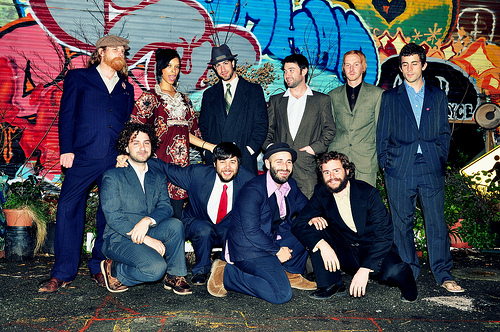
Sun Hop Fat is a local 12-piece inspired by the ecstatic late 1960s Swinging Addis period of Ethio-pop, which itself was at least partially inspired by James Brown. The modern band lays out that inspiration groundwork in each track, building off the legacy and adding its own grooves, coming off like a jazzy Ethio-pop orchestra.


Fronted by vocalist-flautist Krystal Nzoiwu and Bay Area native Daniel Silberstein, Sun Hop Fats’ silky flow, joyously booming brass, and funky rhythm section create naturally bopping underground jazz club atmospheres, and are said to inspire a live dance experience. One might assume a hindrance to on-stage movement given their sheer quantity, yet they do indeed incite the party promised.

The East Bay band brings that raucous party west this weekend for a headlining Slim’s show alongside some psychedelic soul bands traveling up the coast from Santa Cruz.

http://www.youtube.com/watch?v=PMBH8syvmwo

Year and location of origin:  2008 in the Belly of the Vulcan Lofts, Fruitvale.

Band name origin:  Taken from a market near our practice space. We liked the sound and the fact that we could buy gummies and live animals there.

Band motto: Put your faith in the Red Chair of Doom.

Description of sound in 10 words or less: Mulatu Astake inspired dark jazz and soul from Ethiopia’s Swinging Addis period.

Instrumentation: Horns: Krystal Nzoiwu (flute and vocals) Dan Sarna (trumpet) Scotty Maxx (trumpet) Nicholas Gyorkos (trombone), Ryan Morgan (trombone) Jeremy Greene (tenor sax). Rhythm section: Harrison Murphy (keys), Reese Bullen (drums) Jesse Toews (bass) Theo Winston (guitar) Daniel Silberstein (Percussion and vocals).

Most recent release: The Fernet Suite on Electric Sparkyland Records.

Best part about life as a Bay Area band: Great venues, great friends, strong dancers, good drinks.

Worst part about life as a Bay Area band: Public transportation system in the East Bay. No 24/7 BART trains.

First album ever purchased: Theo, Appetite for Destruction by Guns ‘N’ Roses;  Daniel:  3 Years, 5 Months & 2 Days in the Life Of… by Arrested Development.

Most recent album purchased/downloaded:  Theo: Queen “A Day at the Races,” waiting for the new Dirty Projectors album;  Daniel : Blue Mitchell “Booty” and Takamba.

Favorite local eatery and dish: Theo: The El Gordo taco truck on International Blvd. Al parstor tacos!; Daniel: Phnom Phen House, I have been eating BBQ chicken there since I was 10.

Sun Hop Fat
With Harry & the Hit Men, On the Spot Trio
Fri/13, 9pm, $13
Slim’s
333 11 St., SF
(415) 255-0333
www.slimspresents.com

Our Weekly Picks: July 11-17

0

WEDNESDAY 11

Marat/Sade

San Francisco theater fiends: are you ready for this? Marc Huestis local producer of such memorable star ‘n’ movie events as “A Carrie White Christmas with Piper Laurie” and “Linda Blair Live!” is collaborating with Thrillpeddlers San Francisco’s delightfully daring theater troupe, known for its Grand Guignol and Cockettes-inspired productions to heat up foggy July with Marat/Sade. Peter Weiss’ play with music (it won a Tony for Best Play; the 1967 movie version starred most of the Royal Shakespeare Company actors who’d originated the roles) is set just after the French Revolution and is “performed” by Charenton Asylum inmates, with the Marquis de Sade directing. Judging by the talent behind this show, you’d be insane (ahem) to miss it. (Cheryl Eddy)

Through July 29

Previews Wed/11-Thu/12, 8pm, $20

Opens Fri/13, 8pm, $38

Runs Wed-Sat, 8pm; Sun, 7pm (also July 22, 1:30pm), $25–$38

Brava Theater

2781 24th St., SF

(415) 863-0611

www.ticketfly.com


Campfire Guitar Lessons

If you’ve ever felt bummed when a friend whips out a guitar at a group gathering, a jam session begins, and you’re the only person who can’t join in on the fun, this class may be for you. The San Francisco Free School offers weekly Campfire Guitar Songs lessons to those in need of practice. The songs change every week but teachers Joergen and Marco favor classic bands and musicians such as the Beatles, Bob Dylan, Cat Stevens, and the Who, as well as Gospel music, nursery rhymes, and traditional tunes. They recommend doing some preliminary guitar playing at home so the group can work at a good pace, and remember: bring your own guitar. Learn the basics so you can impress your musically inclined friends, and join in at the next impromptu band night. (Shauna C. Keddy)

6pm, free

The Hapiness Institute, SF

1720 Market, SF

www.thehappinessinstitute.org


FIDLAR

Looking for a new party mantra? FIDLAR’s got you covered. This LA band’s name is an acronym for Fuck it Dog Life’s a Risk. If that’s not what you’re looking for, check out its singles “Wake Bake Skate” and “Black Out Stout.” This band’s lo-fi garage-punk is the perfect summer soundtrack, whether you’re surfing, skating, crowd surfing, or drinking. Especially drinking. Instead of pointing to like-minded artists, the band credits Four Loko, Coors Light, and a laundry list of college-caliber booze brands as its influences. Take a hint, grab your tall cans, and get ready to rage. (Haley Zaremba)

With Meat Market, the Shrills

9pm, $10

Bottom of the Hill

1233 17th St., SF

(415) 626-4455

www.bottomofthehill.com


THURSDAY 12

Steel Panther

For the spandex-clad, Aqua Net-sprayed members of Steel Panther, the 1980s hair metal scene never went away; the Los Angeles quartet keeps the glory days of the Sunset Strip alive and well with its hilariously over the top and outrageous, but nonetheless hard rocking, sound and attitude. The band’s second album, Ball Out, dropped last year, and featured a host of anthem-worthy tunes that you and your bandana-wearing buddies can sing along with tonight when it hits the city — “Supersonic Sex Machine,” “17 Girls In A Row,” and of course, “It Won’t Suck Itself.” (Sean McCourt)

8pm, $22.50–$25

Regency Ballroom

1290 Sutter St., SF

(415) 673-5716

www.theregencyballroom.com


FRIDAY 13

Mugsy Wine Bar Bastille Day pop-up happy hour

Storm the fortress of this Mission dive’s patio — it shouldn’t be too hard, there’s no cover — for El Rio’s new pop-up wine bar. Mugsy Wine Bar is organized by Granate Sosnof, mainly so that Sosnof could have a decent cup of vino while her partner works behind the Tecate-margarita-serving bar. Sosnof focuses on wines made by queer, people of color, and family producers and to honor the 223rd year of commemoration of the storming of the Bastille, Mugsy will be serving a sparkling Blanc de Noir Cremant de Bourgnone, the 2009 Cotes du Rhone from Le Clos du Caillou. If ever there were an excuse to wear your sequined beret around any one besides your cat, this is it. (Caitlin Donohue)

5:30-8:30pm, free

El Rio

3158 Mission, SF

(415) 282-3325

www.elriosf.com

mugsywinbar.tumblr.com


Reverend Horton Heat

It may be hard to believe, but the rockabilly juggernaut that is the Reverend Horton Heat has been hitting stages for more than 25 years now — and as fans of the Texas musician and same-named trio know, the band’s strong suit is its live show, which the group captured for posterity during an August 2010 concert at the historic Fillmore right here in San Francisco. Due for release later this month, 25 To Life is the new DVD/CD set documenting that night’s musical mayhem; until then, get off the couch and catch the boys live and in person, back in the Bay. (McCourt)

With Supersuckers, Goddamn Gallows

Fri/13-Sat/14, 9pm, $20–$25

Uptown

1928 Telegraph, Oakl.

(510) 451-8100

www.uptownnightclub.com


SS2

There is no single unifying thread that weaves all the motley, underground S.S. Records bands together. As the laudable DIY Sacramento label and online shop puts it, “the records we put out and the ones that we carry we actually listen to” (emphasis mine). Crystal balling it, chances are that you’ve listened to some of these bands too, or you should be: San Francisco legends Icky Boyfriends, Spray Paint, Lamps, Musk, and the list goes on. Last year, the label celebrated a decade of life with its own intimate music fest. It went so well, they’re doing it again. Bands such as the aforementioned Icky Boyfriends along with late ’80s psych-garage stalwarts Monoshock, and newer Modern Lovers-ish LA weirdos Wounded Lion (now on In the Red) will come together to play the two-day 11th anniversary gathering this weekend. (Emily Savage)

Fri/13-Sat/14, 9pm, $12 each day

Hemlock Tavern

1131 Polk Street, SF (415) 923-0923

www.hemlocktavern.com


Com Truise

Seth Haley’s technicolor electro-funk under the Com Truise moniker has all the subtlety of a giant bowl of Fruity Pebbles. His newly released full-length, In Decay, finds the Jersey-based synth-nut fine-tuning his bloggy brand of retro-futurism, with a nostalgic approach resembling Rustie or Onra. The oversaturated arpeggios pop like neon paintballs; the basslines rip like buzzsaws; the hex-drums evoke every supposedly ill-advised ’80s-ism you secretly never want to forget. Haley’s giddily excessive production ties this all together with an immediacy that should result in an exhilarating live show. Throwing restraint to the wind, Com Truise’s music revels in its garishness. (Taylor Kaplan)

With Baauer, Kid 606, Jim-E Stack, Giraffage

10pm, $15

103 Harriet, SF

(415) 264-1015

www.1015.com


SATURDAY 14

DJs from Mars

You know the basics: European DJ duo dons masks for a frisson of anonymity in our Age of Overexposure (in this case basically cardboard boxes with faces painted on them), mashes up popular tunes over aggressive electro beats, and become renowned for their antics both onstage and off, possibly involving bared breasts and chainsaws — don’t worry, not both things simultaneously. You are perhaps also familiar with that great contemporary international DJ woe: having to cancel your tour due to visa issues. Happily, Italian duo DJs from Mars manage to transcend all your familiarities. Sure, the boys(?) have got the EDM rock star schtick down, but it’s never been more polished or goofy-nuts. They’ve also got the visas, and their rescheduled tour stop at the Bootie mashup party should be what the kids used to call a real banger. (Marke B.)

9pm, $10–$20

DNA Lounge

375 11th St., SF

www.bootiesf.com


SUNDAY 15

Aesop Rock

Recently rated the industry’s most intelligent rapper by Listverse, San Francisco resident Aesop Rock is a hip-hop maverick with a quick tongue and sharp wit that will leave your feet tapping and your head spinning. His je ne sais quois coolness seems to increase with every move he makes, from collaborating with Atmosphere’s Slug to peppering his rhymes with obscure science fiction references to touring with alternative folk royalty Kimya Dawson to writing a song about Grubstake, Polk Street’s notorious greasy spoon and late-night vomitorium. See you there after the show. (Zaremba)

With Rob Sonic & DJ Big Wiz

8pm, $22.50 Fillmore

1805 Geary, SF

(415) 346-6000

www.thefillmore.com


MONDAY 16

Janka Nabay & the Bubu Gang

Sierra Leone’s Janka Nabay is the self-proclaimed King of Bubu — a traditional Muslim music genre with a lightning tempo. When Nabay relocated to New York in 2009, his passion for music and the frenetic energy of bubu gained the attention of the local music scenesters. As a result, Nabay is now backed by the Bubu Gang, an impressive array of Brooklyn indie-rockers that includes members of Chairlift, Skeletons, and Gang Gang Dance. The group recently signed with David Byrne’s record label Luaka Bop; now they’re bringing their catchy beats and bamboo pipes to the West Coast, so dust off those dancing shoes. (Zaremba).

With Sun Araw, Cash Pony

8pm, $12

Rickshaw Stop

155 Fell, SF

(415) 861-2011

www.rickshawstop.com


TUESDAY 17

Shearwater

You’d be forgiven for thinking Shearwater was beamed in from a bygone era. A time when lush, spacious production wasn’t restricted to lifestyle music for the boomer-dad demographic. On its eighth LP, Animal Joy, the Austin-based collective, and Okkervil River spinoff, out-luxuriates the competition yet again, further developing its high-concept brand of art-rock with a cavernous, naturalistic production sound worthy of Talk Talk. Frontperson Jonathan Meiburg’s vocals are surprisingly elegant for a guy on Sub Pop, bearing the full-throated quiver of Antony Hegarty or Scott Walker via Climate of Hunter. Shearwater’s Animal Joy is the sound of analog integrity trumping digital expedience; hopefully, Shearwater’s stage presence will reflect this old-school sense of refinement. (Kaplan)

With Husky, Gold Leaves

9pm, $12

Bottom of the Hill

1233 17th St., SF

(415) 621-4455

www.bottomofthehill.com

The Guardian listings deadline is two weeks prior to our Wednesday publication date. To submit an item for consideration, please include the title of the event, a brief description of the event, date and time, venue name, street address (listing cross streets only isn’t sufficient), city, telephone number readers can call for more information, telephone number for media, and admission costs. Send information to Listings, the Guardian Building, 135 Mississippi St., SF, CA 94107; fax to (415) 487-2506; or e-mail (paste press release into e-mail body — no text attachments, please) to listings@sfbg.com. Digital photos may be submitted in jpeg format; the image must be at least 240 dpi and four inches by six inches in size. We regret we cannot accept listings over the phone.

Film Listings

0

Film listings are edited by Cheryl Eddy. Reviewers are Kimberly Chun, Max Goldberg, Dennis Harvey, and Lynn Rapoport. For rep house showtimes, see Rep Clock. For complete film listings, see www.sfbg.com.

OPENING

Ballplayer: Pelotero With upbeat music, slick editing, and narration by John Leguizamo, Ballplayer: Pelotero is an entertaining, enlightening investigation into exactly why the Dominican Republic produces so many baseball stars. Comparisons to acclaimed sports doc Hoop Dreams (1994) are apt, as filmmakers Ross Finkel, Trevor Martin, and Jonathan Paley travel to the DR to follow a pair of teenage baseball players dreaming of big-league stardom (and big-league paychecks). But the Hoop Dreams kids weren’t being confronted by the shady, sinister, bottom-line-obsessed recruiters working for Major League Baseball, which maintains a pee-wee farm system of sorts in the country to train young prospects — the best of whom are snapped up at the magic age of 16 for bargain-basement (relatively speaking) prices. And in this environment, questions about numbers reign supreme: how much with each kid be signed for? And, more intriguingly, is either kid lying about his true age? (1:12) SF Film Society Cinema. (Eddy)

Bonsái Awkward young love blooms in this Chilean import, a hit at the 2012 San Francisco International Film Festival. (1:35) SF Film Society Cinema.

Crazy Eyes Los Angeles thirtysomething Zach (Lukas Haas, playing a character apparently based on writer-director Adam Sherman — which, if true, yikes) doesn’t do anything but party from the minute he wakes up ’till the moment he passes out. Since he’s conveniently, inexplicably rich, he also has plenty of time to chase tail; occasionally, very occasionally, he’ll make time for his concerned parents and young son, the product of a failed marriage to a woman openly portrayed as a gold digger. Adding to this noxious brew is Rebecca (Madeline Zima), Zach’s vapid drinking buddy; she refuses to have sex with him, so he becomes obsessed with her — see, she’s the one thing the man who has everything can’t have. Deep, man. This is the cinematic equivalent of all that slurring, flailing, late-night drama that goes down outside your local dive bar, amplified to magnificently self-indulgent levels. (1:36) Lumiere, Shattuck. (Eddy)

Crazy Wisdom Not exactly your average Buddhist leader, Chogyam Trungpa was one part monk to two parts rock star. Recognized as a reincarnated master while still an infant, he left Tibet behind to flee Chinese government forces in 1960, eventually landing in the UK, where he founded its first Buddhist center. A decade later he’d move to the US, founding its first Buddhist university. Amidst all that achievement and enlightenment-spreading, however, he also found time to marry a 16-year-old upper-class Brit, have myriad affairs with students, partially paralyze himself driving a car into a shop front, frequently get drunk in public, and so forth — even though, incongruously, he frowned upon marijuana (and rock music). All this made sense in a tradition of Tibetan Buddhist “crazy wisdom” — or so his supporters would (and still) claim in his defense. Having left this life at age 48, his body exhausted by decades of hedonistic excess, he still has a powerful hold over diverse, multi-faith followers and acquaintances who recall his extraordinary spiritual-personal magnetism. Johanna Demetrakas’ entertaining documentary gathers up testimony from a gamut of them, including Ram Dass, Allen Ginsberg, Robert Thurman, and Anne Waldman. (1:26) Roxie. (Harvey)

The Do-Deca-Pentathlon An annual family gathering sets the stage for revival of the poisonously competitive rivalry between two thirty-something siblings. Mark (Steve Zissis) has a devoted wife (Jennifer Lafleur), a teenage son (Red Williams), a home, and steady job, but he can still be easily goaded into a frustrated rage by brother Jeremy (Mark Kelly), who has none of the above but still gloats over his alleged victory in an adolescent fraternal mini-Olympics two decades earlier. Their uncomfortable reunion provides an opportunity to settle that score once and for all — even if they must (not very successfully) try to hide this epic athletic rematch between nearly middle-aged schlubs from their disapproving relatives. Penned by the Duplass Brothers (2011’s Jeff, Who Lives at Home), and shot several years ago, this feels like a Will Ferrell-John C. Reilly (or whoever) comedy writ small, with the variously normal and silly competitive heats only mildly amusing, and the character drama only slightly more depthed than it would be in a more commercial, slapsticky vehicle. Plus, it’s hard to care much about whether the bros achieve reconciliation, since Jeremy is a little too effectively drawn as an annoying, bullying prick in the early going. There’s a clever idea at Pentathlon‘s center, but this just passably diverting feature doesn’t make all that much of it. (1:30) Sundance Kabuki. (Harvey)

“Family Screening: The Storytellers Show” A one-time-only engagement, this cosmopolitan, family-friendly compilation of short films is a mixed bag, both content and quality-wise. Certain selections — the beautifully, imaginatively animated, Storyteller (Kahanikar) of England; the live-action, Aussie Play Lunch — are inhibited by the heavy-handed drive to tell a linear story or push a message, while others (the Tim Burton-ish, Alan Rickman-narrated Boy in the Bubble) put forth compelling narratives, hindered by wishy-washy CGI. Strongest are the visually-driven films (the silent, mixed-media Paper Piano from Venezuela, in which a young girl crosses the “dangerous urban jungle” to get to her music lesson), and those whose stories flow naturally (the live-action, left-field documentary The Vacuum Kid, about a tweenage boy who enthusiastically collects vacuum cleaners). As a whole, “The Storytellers Show” is perfectly viable entertainment — but with competition like A Cat in Paris, it’s not compulsory viewing, either. (1:06) SF Film Society Cinema. (Taylor Kaplan)

Farewell, My Queen (Benoît Jacquot, France, 2012) Opening early on the morning of July 14, 1789, Farewell, My Queen depicts four days at the Palace of Versailles on the eve of the French Revolution, as witnessed by a young woman named Sidonie Laborde (Léa Seydoux) who serves as reader to Marie Antoinette (Diane Kruger). Sidonie displays a singular and romantic devotion to the queen, while the latter’s loyalties are split between a heedless amour propre and her grand passion for the Duchess de Polignac (Virginie Ledoyen). These domestic matters and other regal whims loom large in the tiny galaxy of the queen’s retinue, so that while elsewhere in the palace, in shadowy, candle-lit corridors, courtiers and their servants mingle to exchange news, rumor, panicky theories, and evacuation plans, in the queen’s quarters the task of embroidering a dahlia for a projected gown at times overshadows the storming of the Bastille and the much larger catastrophe on the horizon. (1:39) Embarcadero. (Rapoport)

Ice Age: Continental Drift This time with pirates. (1:27) Presidio.

Magic of Belle Isle Morgan Freeman and Virginia Madsen star in this Rob Reiner-directed drama about an alcoholic writer who gets a new lease on life after befriending the neighbors at his lakeside cabin. (1:49) Opera Plaza.

Patang (The Kite) Loving memories tethered to a place (Ahmedabad, India), moment (the city’s kite festival, the largest of its kind in the country), and season (according to the Hindu calendar, the event coincides with the day that wind direction shifts) beautifully suffuse this first feature film by director and co-writer Prashant Bhargava. Certainly Patang (The Kite) is the story of a family: Delhi businessman Jayesh (Mukund Shukla) has returned with his freewheeling, movie-camera-toting daughter Priya (Sugandha Garg) to his majestically ramshackle family home, where he supports his mother, sister-in-law (Seema Biswas of 1994’s Bandit Queen), and nephew Chakku (Nawazuddin Siddiqui). He’s come to indulge his childhood love of kite flying and to introduce Priya to Ahmedabad’s old-world sights and ways. Entangled among the strands of story are past resentments —harbored by Chakku against his paternalistic uncle — and new hopes, particularly in the form of a budding romance between Priya and Bobby (Aakash Maherya), the son of the kite shop owner. Above all — and as much a presence as any other — is the city, with its fleeting pleasures and memorable faces, captured with vérité verve and sensuous lyricism on small HD cameras by Bhargava and director of photography Shanker Raman. Their imagery imprints on a viewer like an early memory, darting to mind like those many bright kites dancing buoyantly in the city sky. (1:32) Metreon. (Chun)

Red Dog Already a monster hit in Australia, provenance of the Babe movies, this animal-centric charmer comes to the Bay Area as part of the Windrider Bay Area Film Forum in Atherton. It’s based on Louis de Bernières’ collection of tales (and tall tales) about a legendary canine that roamed the country’s Northwestern wilderness in the 1970s. Director Kriv Stenders centers his film in the mining burg that erected a statue to the animal after its death — an event that serves as the movie’s starting point, as the townspeople gather to toast Red Dog’s many contributions to the community (in addition to providing a much-needed source of amusement in a bleak, barren place, he also became a mascot for the local union, match-made multiple couples, prevented a suicide-by-shark attempt, and engaged in epic brawls with his arch-nemesis, Red Cat). It’s a shaggy, sentimental story elevated by some appealing human performances — Josh Lucas is the token American star, though Aussie film fans will recognize Noah Taylor and Keisha Castle-Hughes — and, of course, one very charismatic pooch. If you can’t make the trek down the peninsula for the screening, Red Dog will be available On Demand starting August 14; the DVD will be out September 4. (1:32) Menlo-Atherton Performing Arts Center. (Eddy)

ONGOING

Beasts of the Southern Wild Six months after winning the Grand Jury Prize at Sundance (and a Cannes Camera d’Or), Beasts of the Southern Wild proves capable of enduring a second or third viewing with its originality and strangeness fully intact. Magical realism is a primarily literary device that isn’t attempted very often in U.S. cinema, and succeeds very rarely. But this intersection between Faulkner and fairy tale, a fable about — improbably — Hurricane Katrina, is mysterious and unruly and enchanting. Benh Zeitlin’s film is wildly cinematic from the outset, as voiceover narration from six-year-old Hushpuppy (Quvenzhané Wallis) offers simple commentary on her rather fantastical life. She abides in the Bathtub, an imaginary chunk of bayou country south of New Orleans whose residents live closer to nature, amid the detritus of civilization. Seemingly everything is some alchemical combination of scrap heap, flesh, and soil. But not all is well: when “the storm” floods the land, the holdouts are forced at federal gunpoint to evacuate. With its elements of magic, mythological exodus, and evolutionary biology, Beasts goes way out on a conceptual limb; you could argue it achieves many (if not more) of the same goals Terrence Malick’s 2011 The Tree of Life did at a fraction of that film’s cost and length. (1:31) Bridge, California, Embarcadero, Smith Rafael. (Harvey)

Neil Young Journeys Interested in going back further with Neil Young, back beyond 1969’s Everybody Knows This Is Nowhere? With Neil Young: Heart of Gold (2006) and Neil Young Trunk Show (2009) under his belt, Jonathan Demme has clearly earned the trust of the singer-songwriter, who occasionally likes to flex his multi-hyphenate creative muscles as a director himself, working under the name Bernard Shakey. The music-loving filmmaker tails Young as he drives through his hometown of Omemee, Ontario, shares glimpses of his school, named after his newspaper-man father, his small-town streets, and his home, and then takes it back to the stage and performs at Toronto’s Massey Hall. The stories and sights will interest mostly Young fans — you definitely get a feel for Young’s roots, but the place and its tales won’t jump out dramatically; they merely visualize factoids one can cull from sources like James McDonough’s bio Shakey — but performance dominates this concert film. Playing solo on guitar, harmonica, and in at least one memorable instance, pipe organ (for a hammered-home “After the Gold Rush”), the songs range from the still-moving, sprawling “Ohio” to “Love and War” off 2010’s Le Noise. It’s all love here for the Young diehard, though for an insightful, passionate tour doc, one might look to Shakey’s own CSNY/ Deja Vu (2008) or, for the performer’s finest cinematic performances, to Rust Never Sleeps (1979) and The Last Waltz (1978). (1:27) SF Center, Shattuck. (Chun) *


Our Weekly Picks: July 4-10

0

WEDNESDAY 4

“For the Greater Good, Or The Last Election”

Real quick, if you’re new here: San Francisco Mime Troupe productions do not contain any mimes of the painted-face-and-striped-shirt variety. The company’s first performances (in 1959) were silent, but since those early days, SFMT has evolved into its current, much-loved form: presenting lively political musicals at parks and other venues across NorCal every summer. Previous plays have feasted on such satire-ready topics as big oil, religious fanatacism, and the corporate takeover of America; this year, the headlines once again supply a ripe subject: one percenters behaving badly. For the Greater Good, Or The Last Election is actually a re-working of The Poor of New York, a soapy drama written in 1857 with greedy themes that still ring true in the good ol’ 21st. (Cheryl Eddy)

Various venues through Sept. 8

Wed/4 and Sat/7-Sun/8, 2pm, free (donations accepted)

Dolores Park, 18th St. at Dolores, SF

www.sfmt.org


THURSDAY 5

Skerik’s Bandalabra

For those of you bitching about jazz’s irrelevance in the 21st century: meet Skerik. The Seattle-based saxophonist performs with total abandon, filtering his horn through a tangle of effects pedals as he solos with incendiary force. Resembling a rock frontperson as much as a jazz bandleader, Skerik has spearheaded a handful of projects, from Garage a Trois, to the Tortoise-y Critters Buggin. He describes his latest outfit, Skerik’s Bandalabra, as conjuring “Fela Kuti meeting Steve Reich in rock’s backyard,” and with a lineup of several of Seattle’s hottest session players in tow, it’s one of his tightest, most funkified ensembles yet. Ever had the urge to hear a sax fed through a wah-wah pedal? Well then, look no further. (Taylor Kaplan)

With Wil Blades Trio

9:30pm, $10

Boom Boom Room

1601 Fillmore, SF

(415) 673-8000

www.boomboomblues.com


Smokey Robinson with the San Francisco Symphony

R&B legend Smokey Robinson got his start in the music business back in the 1950s, forming the Miracles while he was still in high school and eventually leading the band to stardom: they were Motown Records’ first million-selling artists on the strengths of hit songs such as “Shop Around,” “You’ve Really Got A Hold On Me,” “I Second That Emotion,” and “Ooh Baby Baby.” The velvet-voiced Robinson has continued to write and perform ever since, and has earned a host of well-deserved awards and accolades, including being honored by the Kennedy Center in 2006. Fans won’t want to miss the music icon tonight when he performs a special show with the San Francisco Symphony. (Sean McCourt)

7:30pm, $15–$115

Davies Symphony Hall

201 Van Ness, SF

(415) 864-6000

www.sfsymphony.org


Liars

Based in LA, then Jersey, then Berlin, then NYC, Liars change locales as often as they switch musical directions. The three-piece has come a long way since their early days in the “dance-punk” compartment, but since the brawny, percussive Drum’s Not Dead (2006) they’ve struggled a bit to deliver a definitive statement. This year’s WIXIW (say wish-you) finds Liars reinventing the wheel again, to produce their most synthified affair yet; picture the rocktronic fusion of Kid A-era Radiohead, approached with the finely calibrated ambience of Bjork’s Vespertine, Trent Reznor’s swagger, and Tom Waits’ lumbering dynamics. How will this abrupt switch in instrumentation affect their live setup? Will the band approach their older work with an electronic edge? Liars thrive on this sense of uncertainty. (Kaplan)

With Cadence Weapon 8pm, $22.50 Great American Music Hall 859 O’Farrell, SF

(415) 885-0750

www.slimspresents.com


FRIDAY 6

“Kung Fu Double-Feature”

Summer programming at the Roxie ain’t nothing to fuck with. Witness the kung fu double punch of 1979’s The Mystery of Chessboxing, a.k.a. Ninja Checkmate, featuring a villain named Ghost Face Killer who inspired you-know-which Staten Island hip-hop star; and Five Elemental Ninjas, a.k.a. Chinese Super Ninjas, which came out in 1982 and is therefore a late-ish entry from director Chang Cheh, superstar helmer for Hong Kong’s powerhouse Shaw Brothers Studio. What you won’t get: CG, 3D, Oscar-caliber acting, logic. What you can expect: rare 35mm prints of both films, supernatural ninjas cloaked in gold lamé, blood-squirting violence, an overabundance of unnecessary camera zooms, and some of the most hilariously stilted dubbing ever committed to celluloid. (Eddy)

Five Element Ninjas, 7:30pm; The Mystery of Chess Boxing, 9:30pm, $6.50–$10

Roxie Theater

3117 16th St., SF

www.roxie.com


Paper Bird

With seven members and no leader, Paper Bird should be a logistical nightmare, but this native Denver band has been making seamlessly joyful noise for five years. Contributions from nearly 10 different songwriters make its work, fresh, eclectic, and unpredictable. And despite the size of the group, Paper Bird exudes a charming sense of intimacy. Focused on vocal harmony, banjo, and brass, the band plays danceable folk music for all ages. These hometown heroes have been voted in Colorado’s top 10 underground bands for three years running by the Denver Post and were recently featured in NPR’s All Things Considered and now they’ve come to win the heart of the Bay Area. (Haley Zaremba)

With Muralismo, Corpus Callosum

9:30pm, $10

Hotel Utah

500 Fourth St., SF

(415) 546-6300

www.hotelutah.com


Foxtails Brigade

Laura Weinbach is a creative force to be reckoned with. Her band Foxtails Brigade spins whimsical tales woven with violin accompaniment by Anton Patzner (Judgement Day). The band just released the third episode of their “Farmhouse Sessions” series on Youtube — revel in Weinbach’s on-point articulation of the chorus, “I am not my, I am not myself/ We are not our, we are not ourselves” over the rhythmic picking of Patzner’s violin, Joe Lewis jamming on the guitar, and a steady drumbeat provided by Josh Pollack. For her springtime release, The Bread and the Bait, Weinbach was inspired by narratives of the Victorian Era, resulting in a lush and intricate sound. Check out her unabashedly romantic cover of Edith Piaf’s “La Vie in Rose,” a fan favorite,. If that doesn’t get you hooked, well then I’ll eat my Victorian Era laced bonnet. (Shauna C. Keddy)

With La Dee Da, Missing Parts

9:30pm, $10

Starry Plough

3101 Shattuck, Berk.

(510) 841-2082

www.starryploughpub.com


Swing U Benefit Ball

Modern city dwellers: it’s time to head out to the middle of the bay and swing back in time to an era that saw the glamorous Golden Gate International Exposition of 1939 hosting visitors from around the world on Treasure Island, greeted by local pirate pin-up queen Zoe Dell Lantis. Tonight’s classic USO-themed “Swing U Benefit Ball” will feature live music, dancing, pirate pin-up contests, vintage vendors, historical presentations, and more, all paying tribute to the important role that Treasure Island played in the development of the San Francisco Bay Area, and raising funds for the Treasure Island Museum. (McCourt)

7pm, $15–$30

Winery SF

200 California Ave., Building 180 North, Treasure Island, SF

www.sfswingfest.com


SATURDAY 7

All My Friends Are Still Dead

What would your survival chances be if you were a poor fish in a bowl, watching your fellow fish friends die off thanks to an irresponsible owner? How would it feel to try to make friends if you were the Grim Reaper? Enjoy a hilarious take on these predicaments and more in All My Friends Are Dead, an illustrated book by Jory John (contributor to NY Times, SF Chronicle, and Believer Magazine) and actor-writer Avery Monsen. John will read from the book’s sequel, All My Friends Are Still Dead, at bookstore-museum Paxton Gate’s Curiosities for Kids today. Reminiscent of Lemony Snicket (A Series of Unfortunate Events) and his morbid childrens’ tales, their book is an ironic yet endearing anti-fable — each page is cringe-worthy yet laughter-inducing. (Keddy)

Paxton Gate’s Curiosities for Kids

1pm, free

766 Valencia, SF

(415) 252-9990

www.paxtongate.com


Y La Bamba

Indie-folk rockers Y La Bamba have been steadily making a name for themselves over the past couple of years, earning praise from the likes of NPR and musically popping up in television programs such as “Bones.” The latter is a fine example of a creative producer seizing upon the Portland-based band’s haunting and ethereal, yet rich and full sound, which is propelled by singer-songwriter Luzelena Mendoza, whose vocals float and weave above and throughout Latin-inspired rhythms and unique backing vocals. The band’s new album, Court The Storm, was produced by Los Lobos member Steve Berlin, and released this February — catch Y La Bamba in an intimate setting while you still can. (McCourt)

9pm, $16

Great American Music Hall

859 O’Farrell St., SF

(415) 885-0750

www.slimspresents.com


Blackalicious

This Sacramento rap duo has a lot more going for it than just an awesome name. Rapper Gift of Gab and DJ Chief Xcel, who met in high school, have been spinning catchy hip-hop tracks for more than a decade. Like fellow West Coast Rappers Jurassic 5 and Pharcyde, Blackalicious eschews the misogyny and violence too often synonymous with rap music. Their multi-syllabic rhymes are both complex and uplifting. Their debut album Nia is Swahili for “purpose” and spirituality is an important feature of their lives and work. When they hit the stage these down-to-earth, self-described “everyday brothers” will make your head bob, your feet tap, and your mind expand. (Zaremba)

With Richie Cunning, Raw-G

9pm, $25

The Independent

628 Divisadero, SF

(415) 771-1421

www.theindependentsf.com


MONDAY 9

The Eric Andre Show

If David Lynch were given his own late-nite program on a public-access channel in Pete & Pete’s basement, it might look and feel somewhat like The Eric Andre Show. Hosted by the LA-based stand-up comic, Adult Swim’s perverse, unhinged excuse for a talk show makes it way to the live stage with real/fake celebrity appearances (fake-George Clooney chugging coffee, perhaps?), charmingly incompetent house band, and incredibly seedy production values in full force. Beloved Oakland hip-hop duo Main Attrakionz will bring their hazy, lo-fi productions to the show as well, rounding out an evening of deranged, unpredictable, and supremely stoned entertainment. No Visine required. (Kaplan)

With Main Attrakionz, Stroy Moyd, Chris Garcia 8pm, $10 Rickshaw Stop 155 Fell, SF (415) 861-2011 www.rickshawstop.com

Show trial

0

arts@sfbg.com

THEATER The set (by Beowulf Boritt) is almost unassuming in its simplicity: just a trio of receding frames arching over the stage, each progressively more askew, and beneath them a jumble of aluminum chairs piled to one side. Still, such simplicity also hints at, and soon delivers, rich complexity.

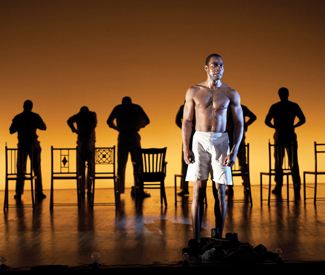
The chairs become many things over the course of the evening but first of all a bus stop, where an African American woman (C. Kelly Wright) in 1950s dress waits and remembers. This mute opening scene then gives way to a reverie and nightmare — a memory and history that take the form of a highly fraught “entertainment” — as a man in a white suit and a black string bow tie (Hal Linden), invariably recalling the Old South if only via the emblem of a certain fast-food chicken franchise, comes onto the stage and pronounces the start of the show.

That would be a minstrel show, a notorious artifact of 19th and 20th century American popular culture, which returns with subversive vengeance in The Scottsboro Boys — the iridescent 2010 Broadway musical by the famed song-making team of John Kander and the late Fred Ebb, in collaboration with equally-no-slouch associates David Thompson (book) and Susan Stroman (director and choreographer). Making an impressive Bay Area debut at American Conservatory Theater, The Scottsboro Boys revisits the trials and the international cause célèbre sparked by the false accusation of rape leveled by two white women at nine freight-train–hopping African American youths (all teenagers ranging in age from 13 to 19) in Depression-era Alabama.

If this seems a heavy subject for a musical, that hardly prevents The Scottsboro Boys from being exquisitely well wrought and enthralling, thanks to an excellent score (channeled wonderfully by Eric Ebbenga’s pit orchestra), Stroman’s devilishly potent staging and choreography, and a strikingly multifaceted, charismatic cast that includes a memorable Clifton Duncan as Haywood Patterson, upon whose memoir, Scottsboro Boy, the narrative partly draws (David Bazemore, Cornelius Bethea, Nile Bullock, Christopher James Culberson, Eric Jackson, Jared Joseph, James T. Lane, JC Montgomery, Clifton Oliver, and Clinton Roane make up the rest of the outstanding ensemble).

At the same time, it’s precisely the mesh-clash of form and content —recalling similar canny deployments of popular theatrical forms Kander and Ebb’s Cabaret and Chicago — that makes Scottsboro a vigorous, if sometimes simplified excavation of the case, as well as this country’s ongoing convolutions over race, sex, ethnicity, and class. A productive tension arises between the show’s exquisite spectacle and the often uncomfortable, even macabre content of the storyline. In just one example, a winning tap number erupts in the young men’s shared jail cell, inspired by the terrifying proximity of the electric chair. So charged a number generates as much thought as emotion, as the audience shifts uneasily in a place where popular entertainment mingles pleasure and complicity, truth and artifice.

The subversive appropriation of minstrelsy is not unique to Scottsboro —there’s the San Francisco Mime Troupe’s 1965 production of Minstrel Show, Or Civil Rights in a Cracker Barrel, Suzan-Lori Parks’ use of minstrel tropes in Topdog/Underdog and The America Play, and Spike Lee’s 2000 film Bamboozled, for instance — but the musical deploys it with its own intent, humanizing the young men whose lives were permanently altered by their arrest and the subsequent trials, which became international news when the Communist-led International Labor Defense got involved, sending in celebrated New York attorney Samuel Liebowitz as the new defense counsel. That the trials were themselves the lesser evil in a white Southern regime of lynching and mob justice (waiting, essentially, just outside the walls of the jailhouse) is never lost on the audience either.

Thompson’s admirable book, meanwhile, in the figure of the woman at the bus stop (an unnamed Rosa Parks) bearing witness to the events of the past, draws a line from the Scottsboro case to the later Civil Rights Movement. But, ironically, the use of Rosa Parks obscures as much as it reveals if we think of her as a lone actor who sparks a revolt against an unjust system. She too was a member of a movement culture, one that had built on the activism of the 1930s that first brought the Scottsboro case to light. *

THE SCOTTSBORO BOYS

Extended through July 22, $20-$95

American Conservatory Theater

415 Geary, SF

www.act-sf.org

Guardian voices: The labor agreement that changed SF

18

This year marks the 53rd anniversary of the beginnings of  negotiations between the International Longshoreman’s and Warehouseman’s Union and the Pacific Maritime Association over what came to be known as the “Mechanization and Modernization Agreement.”  Signed in October, 1960, after months of talks,  the “M and M agreement” transformed San Francisco’s economy forever, moving its founding industry — shipping and trans shipping — to the East Bay, opening up the land once devoted to maritime uses to real estate development, and setting off the modern political era of San Francisco.

The agreement allowed containerization to come into the San Francisco Bay, making obsolete  the finger piers along San Francisco’s waterfront and the ILWU’s “gangs” that worked on them, hand-loading “break bulk” cargo into the holds of cargo ships. The new technology of shipping cargo in a single  container that could be transported by truck, train, and ship without unloading  transformed maritime trade.

During World War II, shipbuilding and shipping were  fundamental in the effort to move billions of tons of supplies and millions of troops across the global battlefield. In both cases the  San Francisco Bay was ground zero in that in that effort.

Kaiser and Bechtel, two Bay Area-based construction companies, wildly successful in undertaking huge construction projects during the New Deal, were urged to build ships during the war. Kaiser in Richmond and Bechtel in Sausalito constructed  huge shipyards that  built cargo ships by the hundreds, bringing tens of thousands of workers to the Bay Area and changing the demographics of the region for ever. These huge industrial centers didn’t last after the war, and while they transformed who lived in the region, they didn’t really have a lasting economic impact.

But wartime changes in cargo handling did.

For as long as San Francisco had been a city, it depended on its port as the base of its economy. The Gold Rush happened here in part because we had a port and the world rushed in on ships. The enduring fortunes were made during that period by merchants and shipping companies were totally dependent on shipping and cargo handling.

At the heart of the maritime economy was the longshoreman who, by hand, loaded and unloaded ships’ holds. The demand for speed during WWII saw the then-revolutionary introduction of the fork lift truck on the piers of San Francisco, replacing hands with a machine for the first time in the history of the San Francisco waterfront.

But that was only the beginning. New ship designs and new shipping techniques were invented to meet the needs of global war. Since most of the Pacific islands that were the military objectives of the war had no ports or piers, ships were designed that could land directly on a beach and unload preloaded trucks.  Preloaded containers were simply stacked on the decks of Liberty ships, avoiding the need to load the cargo below decks.  By the Korean War these containers were in such regular use by the Army that ships were modified to carry only them, replacing below-deck cargo entirely.

Since ports and piers had been major targets during the war and required extensive rebuilding in both Europe and Asia,  new cargo handling techniques were built into these new facilities, making US ports, undamaged by the war, outmoded and old fashioned.  If US ports were to keep up they had to be modernized.  But who would pay for these new facilities: the shipping business or the government?

San Francisco was still governed by an unbroken line of Republican Mayors during this key period: the anti-New Deal, pro-Mussolini Angelo Rossi; the shipping line owner and anti- ILWU leader Roger Lapham; the pro-real-estate development Elmer Robinson; and finally, the last Republican Mayor of San Francisco, the pro-urban-renewal stalwart George Christopher. These four had no desire to rebuild the waterfront and make the ILWU even stronger. Indeed, Robinson and his successor Christopher had a vision of the waterfront as prime real estate, not working waterfront.

And so, with no commitment to the maritime industry from the city’s leadership and with technological change making the status quo impossible to maintain, Harry Bridges and the leadership of the ILWU cut the best deal they could for their existing members: the 1960 M and M agreement, which gave all existing longshore workers lifetime jobs and very good pay — but sealed the fate of San Francisco waterfront.

By 1962 the Port of Oakland had built its first container facility, and that same year, the first containership, the S.S. Elizabethport, docked and begin loading. By the mid 1970’s, the ILWU was no longer a force in the San Francesco labor movement, its leadership taken by the Building Trades unions  whose  numbers increased as the development boom, fueled by land made vacant by the loss of the maritime industry, grew.

For the rest of the Bay Area, it was San Francisco’s model of waterfront as real estate development that was followed, not Oakland’s investment in cargo shipping. By 1965, development of the Bay was so intense that the McAteer-Petris Act was passed, creating the Bay Conservation and Development Commission, a regional body aimed at limiting the powers of local governments (like San Francisco) in filling and over-developing the Bay.

The 8 Washington battle, the struggle over the Hunters Point shipyard, and the looming battle over the use of a port pier for the Warriors arena all have their history deeply rooted in the 1960 M and M agreement.

In this second decade of the 21st century, our greatest challenge is creating and sustaining meaningful employment. Would our prospects be better if we had somehow been able to keep some maritime uses at the port? Would families in Bay View-Hunters Point be more able to buy homes in their own neighborhood if the same kinds of jobs that allowed their grandparents to buy theirs still existed? Would the boom-or-bust cycle of our real-estate dependent local economy been so disruptive if we had a more steady state base of a maritime sector — which kept the Great Depression from being so devastating in San Francisco in the1930s?

These questions are real — and should show that the shape of our economy is made by us and the decisions we make, locally, not solely by techological change, global trends or the far-too-palsied invisible hand of the free market.

The Feds are watching — badly

9

yael@sfbg.com

So, you’re a law enforcement officer in training for participation on a local Joint Terrorism Task Force. Or a student at the United States Military Academy at West Point, involved in the counterterrorism training program developed in partnership with the FBI. Or you’re an FBI agent training up to deal with terrorist threats.

Get ready for FBI training in dealing with Arab and Muslim populations.

Take note that “Western cultural values” include “rational, straight line thinking” and a tendency to “identify problems and solve them through logical decision-making process” — while “Arab cultural values” are “emotional based” and “facts are colored by emotion and subjectivity.”

Be advised that Arabs have “no concept of privacy” and “no concept of ‘constructive criticism'” and that in Arab culture it is “acceptable to interrupt conversations to convey information or make requests.”

“Westerners think, act, then feel,” an FBI powerpoint briefing notes, while “Arabs feel, act, then think.”

Those are some of the most dramatic examples of racial profiling and outright racist stereotyping revealed in thousands of pages of documents obtained under the Freedom of Information Act by the Bay Guardian, the ACLU of Northern California and the Asian Law Caucus.

The documents show a pattern of cultural insensitivity, sometimes bordering on the ridiculous, not only tolerated by promoted as official instructions by the FBI. The records also show a broad pattern of surveillance of people who have engaged in no criminal activity and aren’t even suspected of crimes, but have been targeted because of their race or religion.

Pieces of this story have come out over the past year as the ACLU has charged the FBI with racial profiling and Attorney General Eric Holder has insisted it’s not happening. And some of the documents — which are not always properly dated — may be a few years old.

But none of it is ancient history: All of the material has been used by the FBI in the past few years, under the Obama administration.

This is the first complete report with the full details on a pattern of behavior that is, at the very least, disturbing — and in some parts, reminiscent of the notorious (and widely discredited) COINTELPRO program that sought to undermine and disrupt political groups in the 1960s.

The information suggests that the federal government is using methods that are not only imprecise and xenophobic but utterly ineffective in protecting the American public.

“This is the worst way to pursue security,” Hatem Bazian, professor of Near East Studies at UC Berkeley, told us.

CULTURAL STEREOTYPES

Dozens of documents attempt to describe “Arabs and Muslims” but other groups aren’t left out of the sweeping stereotyping and blatant racism and xenophobia that the FBI has used in its training guides. One training presentation is titled “The Chinese.” The materials give such tips as “informality is perceived as disrespectful.” The presentation warns “expect your gift (money) to be refused” but advises to give “a simple gift with significant meaning- tangerines or oranges (with stems/leaves.)” But “never give a clock as a gift! (death!)”

And if those in the training on “The Chinese” find themselves in “interactions with the opposite sex,” then “touching, too many compliments, may imply a romantic liaison is desired — be careful!”

The vast majority of the “cultural awareness” training materials imply that the authors believe that the law enforcement personnel receiving the training will never be female or interact with female members of the groups they describe. Some warn repeatedly to never ask Arabs how “females in their family” are doing in polite conversation.

A presentation on “Arab and Muslim culture” compares the western thought process with that of all Arabs. According to the FBI, westerners are “rational” thinkers; Arabs, on the other hand, are “emotion based.” A slideshow on cross-cultural interrogation techniques says, “It is characteristic of the Arabic mind to be swayed more by words than ideas and more by ideas than facts.”

Bazian said the FBI’s generalizations about the Arab intellect are “ideological constructs reflective of the orientalist discourse.”

“Many of these individuals have not done any primary sociological, psychological, or historical work in the Arab/Muslim world,” said Bazian, who works on UC Berkeley’s Islamophobia Research & Documentation Project. “What they basically do is take a text from a particular historical period and pick these points and put it as reflective of contemporary Muslim society. Most of these statements have no basis in any critical analysis. They’re not rooted in any type of research.”

Included in the FBI’s recommended reading list for counterterrorism agents-in-training is the “Politically Incorrect Guide to Islam,” in which “Islam expert Robert Spencer reveals Islam’s ongoing, unshakeable quest for global conquest and why the West today faces the same threat as the Crusaders did.”

It’s not exactly an academically sound piece of work, Bazian told us. Spencer and his cohorts are “political hacks,” the professor said. “They come from neo-con backgrounds. Even saying ‘extreme right wing’ is giving them credit; they’re way down below the cliff. They create this contrast between western society and the rest of the world based on a nostalgic idea of western society.”

Arab culture is often the target these days, but the rhetoric recalls that used during the Chinese Exclusionary Act era, and toward Latinos in the United States today, Bazian said.

“They pick on the weakest, most vulnerable people in western society at a particular time and lay blame on them,” he said.

The FBI’s xenophobic approach to interrogation training—which involves warning new agents that “If an Arab is scared, he will often lie to try to avoid trouble”—is not even productive, Bazian said.

“If you go to people with professional training in interrogation and investigation, they’ll say none of this gives them access to security. If anything, it creates a greater global misunderstanding.”

RACIAL MAPPING

And the creation of misunderstanding doesn’t stop there. The FBI is also involved in an intelligence-gathering method known as racial mapping. Racial mapping involves local FBI offices tracking groups in their “domains” based on race and ethnicity.

In blog post, the ACLU writes, “Empirical data show that terrorists and criminals do not fit neat racial, ethnic, nation-origin or religious stereotypes, and using such flawed profiles is a recipe for failure.” In the Counterterrorism Textbook read by all trainees the FBI seems to agree, warning multiple times that there is no such thing as a typical terrorist and that making assumptions based on stereotypes is dangerous and unproductive.

Yet the FBI files we’ve acquired reveal that the bureau consistently does just that. Though the Department of Justice prohibited race from being “used to any degree” in law enforcement investigations in 2003, a convenient and potentially unconstitutional exception allows racial profiling in national security matters.

When the FBI created its Domestic Investigation and Operations Guide in 2008, it used that loophole to permit the mapping of racial and ethnic demographic information and to keep tabs on “behavioral characteristics reasonably associated with a particular criminal or terrorist element of an ethnic community,” the ACLU reported.

Communities in San Francisco have been the victims of this prejudicial loophole more than once. In 2009, the ACLU reported that the FBI justified mapping and investigating the Chinese American population in the city because “within this community there has been organized crime for generations.” Likewise, the bureau collected demographic data on the Russian population because of the “Russian criminal enterprises” known to exist in San Francisco.

The loophole, however, may not even apply to these investigations in the first place.

According to Michael German, a 16-year veteran of the FBI and senior analyst with the ACLU, these investigations don’t fit the national security description. “In intelligence notes on Chinese and Russian organized crime, those are not national security issues,” German told us. “Those are all clearly criminal investigations.”

German has brought attention to another troubling use of racial mapping — documents revealing that the FBI’s Atlanta bureau tracks Georgia’s African American population.

The stated reason is a threat of black separatist groups; the documents name the New Black Panther Party and the Black Hebrew Israelites as the black separatist groups that pose a threat.

German wrote about this problematic practice in a May 29 article on the website Firedoglake.

“The problem with these documents,” German told us, “is that it’s not black separatists or alleged black separatists who are being tracked — it’s the entire black community in Georgia.”

“Those individuals and those communities are being targeted only for their race,” German said. “Were it not for their race they wouldn’t be part of that assessment. There is no reason to do that, accept to treat that community differently than the way it treats other communities. It’s problematic from a constitutional standpoint.”

The New Black Panther Party was founded in Dallas and has mostly East Coast chapters. According to the Southern Poverty Law Center, which tracks hate United States hate groups, “The group portrays itself as a militant, modern-day expression of the black power movement (it frequently engages in armed protests of alleged police brutality and the like), but principals of the original Black Panther Party of the 1960s and 1970s— a militant, but non-racist, left-wing organization — have rejected the new Panthers as a ‘black racist hate group’ and contested their hijacking of the Panther name and symbol.” The Black Hebrew Israelites is another fringe group, an apocalyptic group whose ideology holds that black Americans are God’s chosen people.

Both groups have written and spoken record of racist and violent rhetoric, but record of violent or criminal acts are hard to find.

“I’d say they’re a fairly small part of the radical right, and generally quite small. As far as we know, there is virtually no connection between these groups and criminal activity,” Mark Potok, a senior fellow with the SPLC, told the Guardian.

According to Potok, the center’s list of hate groups in operation in 2011 includes four organizations classified as black separatist, which, between them, have 140 chapters. Those chapters are counted as 140 of the list’s 1,018 groups.

“Most of the rest of the list are white supremacist groups,” Potok notes. “There are some exceptions — anti-gay groups and anti-Muslim groups.” After a quick count, Potok found 688 groups to be “straight-up white supremacist.”

The majority of these hate groups may be white supremacist — but the FBI is not involved in tracking white populations.

Last October, the FBI’s press office responded to the ACLU’s concerns with racial mapping. “These efforts are intended to address specific threats, not particular communities,” the agency’s statement reads.

“These domain management efforts seek to use existing, available government data to locate and better understand the communities that are potential victims of the threats. There must be an understanding of the communities we protect in order to focus our limited human and financial resources in the areas where those resources are most needed.”

With that defense, resources continue to pour into racial mapping efforts.

Black separatist organizations are not the only groups to be targeted for political beliefs. Groups such as “anarchist extremists” and “animal rights/environmental extremists” are also, according to the FBI, groups to watch out for.

A training presentation for the Bay Area’s Joint Terrorism Task Force includes a list of those groups: “animal rights/eco terrorism, anarchists, white separatists, black separatists, militia/sovereign citizens, and ‘lone offender’.”

How do you spot a potential “animal rights extremist”? According to the documents, “ideology and concepts” found among this group includes a “complete vegan lifestyle,” and activities include the promotion of “anti-capitalist literature.” In other words, your roommate is probably a terrorist.

SPYING ON MUSLIMS

Racial mapping is not the only FBI practice that targets people just for being members of groups “associated with crimes.” The FBI routinely gathers information on Muslims through deceptive “community outreach” programs.

Memoranda we’ve obtained reveal that FBI agents, operating under the guise of community outreach, attended various events hosted by local Muslim organizations in order to gather intelligence between 2007 and 2009.

When agents attended Ramadan Iftar dinners in San Francisco, they wrote down participants’ contact information and documented their conversations and opinions. At an alleged outreach event at CSU Chico, they recorded a conversation with a student about the Saudi Student Association’s activities and even took the student’s picture. That information was sent to the FBI in Washington, DC, the ACLU reported.

Writing down information on individuals’ First Amendment activities—in this case without any evidence that they were notified or asked—violates the federal Privacy Act, the ACLU says. Using access to community events to gather personal information undermines the FBI’s stated effort to form relationships with Muslim leaders and community members.

And covert surveillance can also have an immediate and hazardous impact on the unwitting subjects.

“It’s becoming more of a public discourse that these FBI background checks are affecting immigration status, the ability to send money back home, and generally creating an environment of fear,” said Miriam Zouvounis, membership coordinator with San Francisco’s Arab Resource and Organizing Center.

The organization has helped clients who have been detained for months because their names were mistakenly placed on a no-fly list, and others whose immigration processes have taken up to ten years because they were erroneously perceived as threatening, Zouvounis said.

“The process of information collecting on covert and overt levels is accelerating, and definitely a present reality in San Francisco. People don’t want to be civically engaged if that material’s being used against them,” she said.

ONLINE SPYING

“Extremism online is the most serious international terrorist threat in the world.” Or so says FBI training materials in a presentation entitled “Extremism online,” meant for those training to be online covert employees. The documents teach OCEs to scan through comment threads and enter chat rooms, searching for people whose speech may be “operational.”

This surveillance has led to investigations.

Some of the documents are individual files and summaries of individual files, and many note that the person (often someone who was convicted, so the name isn’t redacted in the documents) was “detected via the Internet.” Some examples: “Mohamad Osman Mohamud, detected via the Internet, discussing Jihad plans” and “Hosam Smadi, detected via the Internet: online chats.” Both men were 19 when they were convicted of crimes.

These men — and the many more who have not been accused of any criminal activity but are likely under surveillance or investigation by OCEs — could have been “detected via the Internet” in a variety of ways, according to German.

“It could be that the chats were open source, or that an informant was in the chat room, or a person participating simply turned them over to the FBI, none of which would require any legal process,” German explained.

“It could also be monitored under FISA [ the Foreign Intelligence Surveillance Act] or traditional criminal wiretaps, which would require court warrants (secret ones under FISA). Finally, the stored chat logs retained on third party servers could have been obtained with Patriot Act Section 215 orders, or what’s called a “D” order under the Stored Communications Act (if held for over 180 days),” German detailed in an email.

So what kind of speech are OCEs looking out for to peg potential terrorist threats? The Extremism Online presentation has a list of “major themes and language used in online extremist writings,” which includes Islam-related terms such as “Caliphate, Al-Ansar, Al-Rafidah, Mushrik, and Munafiq” as well as the Arabic words “Akhi, Uhkti, Ameen, Du’aa, Shari’ah, and Iman” (brother, sister, amen, prayer, Islamic law, and faith.) Other words the agents are told to look out for: “crusaders, hypocrites, dogs and pigs,” and any discussion of “occupation of Muslim lands.”

The FBI can really get into your business if agents confiscate your possessions. Personal computers, cell phones, and other electronic devices, according to the documents, are routinely checked out at Regional Computer Forensics Labs.

The nearest one to San Francisco is in Menlo Park, where employees brag of having investigated thousands of pieces of data.

Law enforcement routinely confiscates property after arrests, and if local cops are involved with the FBI through the Joint Terrorism Task Forces or other partnerships, they may very well send the belongings of those arrested to be checked out at a local RCFL. But there are other ways the FBI can obtain your electronics.

“Certainly the FBI has the authority to obtain computers and other devices with search warrants, either traditional search warrants where the individual is given notice or expedited warrants where the person isn’t aware,” German told the Guardian, noting that the second type of warrant is the preferred method, for obvious reasons, when the Feds plan to search a confiscated computer.

“The FBI also works with immigrations and customs enforcement, so laptops and other devices seized at the border the FBI can gain access to. There are myriad ways they can get them.”

“DISRUPTION”

A 2009 FBI memorandum on investigating suspected terrorists reveals that the Bureau encourages its agents to implement a “disruption strategy” that German wrote is “eerily reminiscent” of the COINTELPRO tactics used to stop political organizers in the1960s. “If the risk to public safety is too great, or if all significant intelligence has been collected, and/or the threat is otherwise resolved, investigators may, with substantive desk coordination and concurrence, implement a disruption strategy,” one memo reads. Investigators can conduct interviews, make arrests, or use any number of other undefined “tools” to “effectively disrupt subject’s [sic] activities.” Such disruption strategies have been used in the past to investigate and shut down First Amendment-protected activity, German said. The reintroduction of such tactics could open the door for a major breach of the subjects’ constitutional rights.

A MATTER OF PRIORITIES 

“After September 11th, 2001, the FBI realigned its mission and purpose to reflect the global and domestic threats that face the US,” begins an orientation packet for members of Joint Terrorism Task Forces. “FBI director Robert M. Meuller III defined the following as the top ten priorities (in order of importance) that confront the Bureau today,” Number one on the list: Protect the United States from terrorist attack.

Indeed, after 9/11, the FBI prioritized terrorism investigations, a shift from the previous focus on criminal investigations. Classified as national security threats, these investigations are not subject to the same type of privacy and anti-racial discrimination protections that other criminal investigations might be.

Terrorist threats, apparently, are to be found in mosques, in online conversations that involve criticism of US foreign policy, in entire populations of African Americans or Chinese Americans in given areas. In recent years, simply speaking Arabic online or being black makes a person a suspect and potential target of surveillance.

Look out America, especially members of that celebrated “melting pot.” The feds are watching.

Ladies and gentleman, the Bay’s youth spoken word team (and where you can see them spit)

0

Hey you, over-20 person. Do you ever wonder what what on the minds of today’s teens? The answers are heavy, and they soar from the mouths of spoken word poets — especially those of the recently-announced team that will be representing the Bay Area at this year’s Brave New Voices international slam on July 21. Care to meet them?


Bay Area grand slam champion: Nyabingha McDowell, Richmond, Salesian High School, age 15

Obasi Davis Oakland, Berkeley High School, 16

Colleen Hamilton-Lecky Berkeley, Berkeley High School, 15

Allison Kephart Pacifica, Oceana High School, 17

Marje Kilpatrick Richmond, Holy Names High School, 15

Queen Nefertiti Shabazz Berkeley, Lick-Wilmerding High School, 17


Take note of the names above. These young people deserve our support. Consider them your Baybies. 

This year, the BNV International Youth Poetry Slam Festival will bring more than 500 poets and their mentors from around the globe for five days of open mics, preliminary poetry slams, and writing workshops beginning July 19. 

For the kids, the competition is an opportunity to spit the most difficult, strange, or meaningful aspects of their lives into a mic. For the listeners, the slam is just that — a shock to the senses in a society that rarely lets its kids go unedited. 

In preparation for the festival, teams of four to six poets aged 13 to 18, have been selected by way of city and region-wide poetry slams throughout the year. Locally, the SF nonprofit Youth Speaks organizes and coordinates BNV representatives. Youth Speaks is also the progenitor of the festival, which has now spread to include participants from Guam, South Africa, Taiwan, and New Zealand among other countries. 

After rehearsing, rewriting, and reinventing their poetry for months, the poets step into the final spotlight for three rounds of onstage recitation, both in tandem and solo.  Meanwhile, the kids offstage get to meet and spit words with poetic peers that hail from places like New York, Chicago, South Africa and Taiwan. 

James Kass, founder and executive director of Youth Speaks, says it is important that participants come from varied backgrounds. 

“The kids get to know each other and hear from each other, and see their similarities and differences,” he says. “They really represent the changing demographics in the country. They really represent the future of the country.”

15-year old  Nyabingha McDowell at the Bay Area grand slam finals. Photo by Ashleigh Reddy

He adds that it is just as important to bring in a diverse audience. 

 “A lot of adults, their main interaction with teenagers — if they don’t have kids — is through the mass media. We want to dispel those myths and stereotypes that are created. Adults need to hear directly from teenagers what they’re talking about and who they are.”

Now a decade and a half old, BNV began in San Francisco in 1998 following an inaugural Youth Speaks Teen Poetry Slam the previous year. 

“I look back to the very first [BNV] we did when there were only four teams and we had hardly any crowd,” Kass says. “But the kids that came from these four different cities immediately started connecting and started feeling that they were part of a larger movement.”

The BNV Festival takes place in a different US city each year, but this year’s competition brings the beatniks back home to the Bay. Says Kass: “If you think you don’t like poetry, if you think you don’t know what’s going on in the youth world, come check it out because it’s a whole different experience. It’s an incredible place to be.”

Brave New Voices International Youth Poetry Slam finals

July 21, 7pm, $20

Fox Theatre 

1807 Telegraph, Oakl.

www.bravenewvoices.org

FREE tickets to see Clem Burke (Blondie) and Glen Matlock (Sex Pistols) of The International Swingers

0

The Guardian, SF Gate and the SF Weekly present a FREE show at the Red Devil Lounge this Sunday, June 24 featuring so many music legends on one stage. Come celebrate the start of summer with the rock legends of the International Swingers. Drummer, Clem Burke is a founding member of Blondie and also played with Bob Dylan. On bass is Glen Matlock, of Sex Pistols fame. Guitarist James Stevenson played with Gen X and Gene Loves Jezebel. And tenor, Gary Twinn, singer for Twenty Flight Rockers, and Speedtwinn, leads the way. Guests are invited to reserve their FREE tickets (2 max per person) at Ticketfly (no ticket fee, no surcharge, no nothing) for that you will want to secure your tickets before the show. You must arrive before 9 pm to get your free tickets that will be held at Will Call. Otherwise it will be $20. Dig? For more information check out the event here.

To reserve your FREE tickets click here . Want to go in style? For VIP tickets / accommodations please contact reddevilbooking@me.com. This includes reserved tables, no waiting in line, and reduced surcharges. These are available on a first-come, first-serve basis exclusively through our e-mail address. This event is 21 and over.

Sunday, June 24 at 8 @ The Red Devil Lounge, 1655 Polk St, SF | $20


Film Listings

0

Frameline36, the San Francisco International LGBT Film Festival, runs through Sun/24 at Castro Theatre, 429 Castro, SF; Roxie Theater, 3117 16th St., SF; Victoria Theatre, 2961 16th St., SF; and Rialto Cinemas Elmwood, 2966 College, Berk. For tickets (most shows $9-$11) and schedule, visit www.frameline.org.

OPENING

Abraham Lincoln: Vampire Hunter America’s 16th president jumps aboard the bloodsucker bandwagon. (1:45) Presidio.

Brave Kelly Macdonald, Emma Thompson, and Billy Connolly star in Pixar’s fantasy about a strong-willed girl who brings turmoil upon her Scottish kingdom when she defies a long-held tradition. (1:33) Balboa, Presidio, Shattuck.

5 Broken Cameras Palestinian Emad Burnat bought his first camcorder in 2005 with the intention of bottling family memories, but when Israeli forces began the construction of settlements in Bil’in (his home village in the West Bank) Burnat stumbled into activist-filmmaker territory. In documenting his community’s nonviolent resistance to the Israeli occupation, Burnat’s friends and family (much like his cameras) are shot at, injured, and even killed. His son Gabreel’s first words are “wall” and “cartridge,” epitomizing the psychological toll of the struggle. Israeli forces are depicted as an eerily faceless entity, with colonialist aspirations run amok. Burnat isn’t interested in highlighting the political delicacy of the situation, and frankly, he’s given us something far more powerful than your average piece of fair-and-balanced journalism on the Israel-Palestine conflict. Splitting the difference between home-video montage and war-zone nightmare, 5 Broken Cameras skillfully merges the political and the personal, profoundly humanizing the Palestinian movement for independence. (1:30) Embarcadero, Shattuck. (Taylor Kaplan)

Found Memories The literal Portuguese-to-English translation of this film’s title — “stories that exist only when remembered” — is clunky, but more poignantly accurate than Found Memories. At first, it’s not entirely clear if Brazilian Júlia Murat is making a narrative or a documentary. In an tiny, isolated community populated by elderly people, Madalena (Sonia Guedes) follows a schedule she’s kept for years, probably decades: making bread, attending church, doing chores, tending the cemetery gates, writing love letters to a long-absent partner (“Isn’t it strange that after all these years, I still find your things around the house?”), and grousing at the “annoying old man” who grinds the town’s coffee beans. One day, young photographer Rita (Lisa Fávero) drifts into the village, an exotic import from the outside, modern world. Slowly, despite their differences, the women become friends. That’s about it for plot, but as this deliberately-paced film reflects on aging, dying, and memories (particularly in the form of photographs), it offers atmospheric food for thought, and a few moments of droll humor. Note, however, that viewer patience is a requirement to reap its rewards. (1:38) SF Film Society Cinema. (Eddy)

The Invisible War Kirby Dick’s searing documentary takes a look at the prevalence of rape within U.S. military ranks, a problem whose unbelievably high levels of occurrence would long ago have caused huge public outcry and imposed reform in any other institutional context. Yet because it’s the military — where certain codes of loyalty, machismo, and insularity dominate from the grunt level to the highest ranks — the issue has not only been effectively kept secret, but perpetrators almost never suffer any disciplinary measures, let alone jail time or dishonorable discharges. Meanwhile the women — some studies estimate 20% of all female personnel (and 1% of the men) suffer sexual assault from colleagues — are further traumatized by an atmosphere that creates ideal conditions for stalking, rape, and “blame the victim” aftermaths from superiors. (Indeed, for many the superior to whom they would have reported an attack was the one who attacked them.) Most end up quitting promising service careers (often pursued because of generations of family enlistment), dealing with the serious mental health consequences on their own. The subjects who’ve come forward on the issue here are inspiring in their bravery, and dedication to a patriotic cause and vocation that ultimately, bitterly betrayed them. Their stories are so engrossing that The Invisible War is as compulsively watchable as its topic and statistics are inherently appalling. (1:39) Metreon. (Harvey) 

Oslo, August 31st Heroin movies are rarely much fun, and Oslo is no exception, though here the stress lies not in grisly realism but visceral emotional honesty. Following an abortive, Virginia Woolf-esque suicide attempt during evening leave from his rehab center, recovering addict Anders visits Oslo for a job interview. He reconnects bittersweetly with an old friend, tries and fails to meet up with his sister, and eventually submerges himself in the nightlife that once fueled his self-destruction. Expressionistic editing conveys Anders’ sense of detachment and urge for release, with scenes and sounds intercut achronologically and striking sound design which homes in on stray conversations. A late intellectual milieu is signified throughout, quite humorously, by serious discussions of popular television dramas, presumably an update of similar concerns addressed in Pierre Drieu La Rochelle’s 1931 novel Le Feu follet, on which the film is based. (1:35) Elmwood, Embarcadero, Smith Rafael. (Sam Stander)

Seeking a Friend for the End of the World See “Apocalypse Meh.” (1:41) Marina, Piedmont, Shattuck.

Ultrasonic Is it madness to imagine a stylish new twist on the claustrophobic conspiracy thriller? Multi-hyphenate director, co-writer, and cinematographer (and musician and software engineer) Rohit Colin Rao manages just that with this head-turning indie feature film debut, while managing to translate a stark indie aesthetic encapsulated by Dischord and Touch and Go bands, lovers of Rust Belt warehouses and waffle houses, culture vultures who revere both Don DeLillo and Wisconsin Death Trip, and critics who lean too hard on the descriptor “angular.” Musician Simon York (Silas Gordon Brigham) is one denizen firmly placed in that cultural landscape, but the pressures of funding his combo’s album, coping with the diminishing returns of his music teacher livelihood, and anticipating the arrival of a baby with his wife, Ruth (Cate Buscher), seem to be piling on his murky brow. Simon begins to hear a hard-to-pin-down sound that no one else can detect, though Ruth’s eccentric and possibly certified conspiracy-theorist brother Jonas (Sam Repshas) is quick to affirm — and build on — his fears. Painting his handsome, stylized mise-en-scène in noiry blacks and wintry whites, Rohit positively revels in this post-punk jewel of a world he’s assembled, and it’s a compelling one even if it’s far from perfect and ultimately shies away from the deepest shadows. (1:30) Roxie. (Chun)

Ongoing 

Bel Ami Judging from recent attempts to shake off the gloomy atmosphere and undead company of the Twilight franchise, Robert Pattinson enjoys a good period piece, but hasn’t quite worked out how to help make one. Last year’s Depression-era Water for Elephants was a tepid romance, and Declan Donnellan and Nick Ormerod’s belle epoque–set Bel Ami is an ungainly, oddly paced adaptation of the Guy de Maupassant novel of the same name. A down-and-out former soldier of peasant stock, Georges Duroy (Pattinson) — or “Bel Ami,” as his female admirers call him — gains a brief entrée into the upper echelons of France’s fourth estate and parlays it into a more permanent set of social footholds, campaigning for the affections of a triumvirate of Parisian power wives (Christina Ricci, Uma Thurman, and Kristin Scott Thomas) as he makes his ascent. His route is confusing, though; the film pitches forward at an alarming pace, its scenes clumsily stacked together with little character development or context to smooth the way, and Pattinson’s performance doesn’t clarify much. Duroy shifts perplexingly between rapacious and soulful modes, eyeing the ladies with a vaguely carnivorous expression as he enters drawing rooms, dining rooms, and bedrooms, but leaving us with little sense of his true appetites or other motivations. (1:42) Lumiere, Smith Rafael. (Rapoport) 

Bernie Jack Black plays the titular new assistant funeral director liked by everybody in small-town Carthage, Tex. He works especially hard to ingratiate himself with shrewish local widow Marjorie (Shirley MacLaine), but there are benefits — estranged from her own family, she not only accepts him as a friend (then companion, then servant, then as virtual “property”), but makes him her sole heir. Richard Linklater’s latest is based on a true-crime story, although in execution it’s as much a cheerful social satire as I Love You Philip Morris and The Informant! (both 2009), two other recent fact-based movies about likable felons. Black gets to sing (his character being a musical theater queen, among other things), while Linklater gets to affectionately mock a very different stratum of Lone Star State culture from the one he started out with in 1991’s Slacker. There’s a rich gallery of supporting characters, most played by little-known local actors or actual townspeople, with Matthew McConaughey’s vainglorious county prosecutor one delectable exception. Bernie is its director’s best in some time, not to mention a whole lot of fun. (1:39) Embarcadero, Four Star, Presidio, Shattuck, Smith Rafael. (Harvey)

The Best Exotic Marigold Hotel (1:42) Albany, Four Star, Piedmont, SF Center, Sundance Kabuki.

A Cat in Paris This year’s Best Animated Film nominees: big-budget entries Kung Fu Panda 2, Puss in Boots, and eventual winner Rango, plus Chico and Rita, which opened just before Oscar night, and French mega-dark-horse A Cat in Paris. Sure, Jean-Loup Felicioli and Alain Gagnol’s film failed to cash in on 2011’s Paris craze, but it’s still a charming if featherweight noir caper, being released stateside in an English version that features the voices of Marcia Gay Harden and Anjelica Huston. A streetwise kitty named Dino spends his days hanging with Zoey, a little girl who’s gone mute since the death of her father — a cop killed in the line of duty. Zoey’s mother (Harden), also a cop, is hellbent on catching the murderer, a notorious crook named Costa who runs his criminal empire with Reservoir Dogs-style imprecision. At night, Dino sneaks out and accompanies an affable burglar on his prowlings. When Zoey falls into Costa’s clutches, her mom, the thief, and (natch) the feisty feline join forces to rescue her, in a series of rooftop chase scenes that climax atop Notre Dame. At just over an hour, A Cat in Paris is sweetly old-fashioned and suitable for audiences of all ages, though staunch dog lovers may raise an objection or two. (1:07) Opera Plaza. (Eddy) 

Dark Shadows Conceptually, there’s nothing wrong with attempting to turn a now semi-obscure supernaturally themed soap opera with a five-year run in the late 1960s and early ’70s into a feature film. Particularly if the film brings together the sweetly creepy triumvirate of Tim Burton, Johnny Depp, and Helena Bonham Carter and emerges during an ongoing moment for vampires, werewolves, and other things that go hump in the night. Depp plays long-enduring vampire Barnabas Collins, the undead scion of a once-powerful 18th-century New England family that by the 1970s — the groovy decade in which the bulk of the story is set — has suffered a shabby deterioration. Barnabas forms a pact with present-day Collins matriarch Elizabeth (Michelle Pfeiffer) to raise the household — currently comprising her disaffected daughter, Carolyn (Chloë Grace Moretz), her derelict brother, Roger (Jonny Lee Miller), his mournful young son, David (Gulliver McGrath), David’s live-in lush of a psychiatrist, Dr. Hoffman (Carter), and the family’s overtaxed manservant, Willie (Jackie Earle Haley) — to its former stature, while taking down a lunatic, love-struck, and rather vindictive witch named Angelique (Eva Green). The latter, a victim of unrequited love, is the cause of all Barnabas’s woes and, by extension, the entire clan’s, but Angelique can only be blamed for so much. Beyond her hocus-pocus jurisdiction is the film’s manic pileup of plot twists, tonal shifts, and campy scenery-chewing by Depp, a startling onslaught that no lava lamp joke, no pallid reaction shot, no room-demolishing act of paranormal carnality set to Barry White, and no cameo by Alice Cooper can temper. (2:00) SF Center. (Rapoport)

The Dictator As expected, The Dictator is, yet again, Sacha Baron Cohen doing his bumbling-foreigner shtick. Said character (here, a ruthless, spoiled North African dictator) travels to America and learns a heaping teaspoon of valuable lessons, which are then flung upon the audience — an audience which, by film’s end, has spent 80 minutes squealing at a no-holds-barred mix of disgusting gags, tasteless jokes, and schadenfreude. If you can’t forgive Cohen for carbon-copying his Borat (2006) formula, at least you can muster admiration for his ability to be an equal-opportunity offender (dinged: Arabs, Jews, African Americans, white Americans, women of all ethnicities, and green activists) — and for that last-act zinger of a speech. If The Dictator doesn’t quite reach Borat‘s hilarious heights, it’s still proudly repulsive, smart in spite of itself, and guaranteed to get a rise out of anyone who watches it. (1:23) 1000 Van Ness, SF Center, Shattuck. (Eddy)

Double Trouble When crooks nab a priceless painting from a Taipei museum, two security guards — wannabe hero Jay (Jaycee “Son of Jackie” Chan) and Chinese-tourist-on-vacation Ocean (Xia Yu) — reluctantly team up to recover the piece. A road trip of sorts ensues, laden with petty bickering, wacky melees, bonding moments, mistaken identity, gangsters both comical and sinister, and other buddy-comedy trappings. As expected, there are a few high-flying fight scenes; in the film’s production notes, director David Hsun-Wei Chang reveals he was inspired by the Rush Hour movies. Alas, Chan is neither as charismatic nor as breathtakingly nimble as his father (and, obvi, Xia is no Chris Tucker). It should be noted, however, that one of the slithery art thieves is played by underwear model Jessica C., famed in Hong Kong for her “police siren boobs.” So there’s that. (1:29) Metreon. (Eddy)

Elena The opening, almost still image of breaking dawn amid bare trees — the twigs in the foreground almost imperceptibly developing definition and the sky gradually growing ever lighter and pinker in the corners of the frame — beautifully exemplifies the crux of this well-wrought, refined noir, which spins slowly on the streams of dog-eat-dog survival that rush beneath even the most moneyed echelons of Moscow. Sixtyish former nurse Elena (Nadezhda Markina) is still little more than a live-in caretaker for Vladimir (Andrey Smirnov), her affluent husband of almost 10 years. She sleeps in a separate bed in their modernist-chic condo and dutifully funnels money to her beloved layabout son and his family. Vladimir has less of a relationship with his rebellious bad-seed daughter (Yelena Lyadova), who may be too smart and hedonistic for her own good. When a certain unlikely reunion threatens Elena’s survival — and what she perceives as the survival of her own spawn — a kind of deadly dawn breaks over the seemingly obedient hausfrau, and she’s driven to desperate ends. Bathing his scenes in chilled blue light and velvety dark shadows, filmmaker Andrey Zvyagintsev (2003’s The Return) keeps a detached but close eye on the proceedings while displaying an uncanny talent for plucking the telling detail out of the wash of daily routine and coaxing magnetic performances from his cast. (1:49) Lumiere. (Chun)

Headhunters Despite being the most sought-after corporate headhunter in Oslo, Roger (Aksel Hennie) still doesn’t make enough money to placate his gorgeous wife; his raging Napoleon complex certainly doesn’t help matters. Crime is, as always, the only solution, so Roger’s been supplementing his income by stealthily relieving his rich, status-conscious clients of their most expensive artworks (with help from his slightly unhinged partner, who works for a home-security company). When Roger meets the dashing Clas Greve (Nikolaj Coster-Waldau of Game of Thrones) — a Danish exec with a sinister, mysterious military past, now looking to take over a top job in Norway — he’s more interested in a near-priceless painting rumored to be stashed in Greve’s apartment. The heist is on, but faster than you can say “MacGuffin,” all hell breaks loose (in startlingly gory fashion), and the very charming Roger is using his considerable wits to stay alive. Based on a best-selling “Scandi-noir” novel, Headhunters is just as clever as it is suspenseful. See this version before Hollywood swoops in for the inevitable (rumored) remake. (1:40) Lumiere. (Eddy)

The Hunger Games Katniss Everdeen (Jennifer Lawrence) is a teenager living in a totalitarian state whose 12 impoverished districts, as retribution for an earlier uprising, must pay tribute to the so-called Capitol every year, sacrificing one boy and one girl each to the Hunger Games. A battle royal set in a perilous arena and broadcast live to the Capitol as gripping diversion and to the districts as sadistic propaganda, the Hunger Games are, depending on your viewpoint, a “pageant of honor, courage, and sacrifice” or a brutal, pointless bloodbath involving children as young as 12. When her little sister’s name comes up in the ann­ual lottery, Katniss volunteers to take her place and is joined by a boy named Peeta Mellark (Josh Hutcherson), with whom she shares an old, unspoken bond. Tasked with translating to the screen the first installment of Suzanne Collins’s rabidly admired trilogy, writer-director Gary Ross (2003’s Seabiscuit, 1998’s Pleasantville) telescopes the book’s drawn-out, dread-filled tale into a manageable two-plus-hour entertainment, making great (and horrifying) use of the original work’s action, but losing a good deal of the narrative detail and emotional force. Elizabeth Banks is comic and unrecognizable as Effie Trinket, the two tributes’ chaperone; Lenny Kravitz gives a blank, flattened reading as their stylist, Cinna; and Donald Sutherland is sufficiently creepy and bloodless as the country’s leader, President Snow. More exceptionally cast are Woody Harrelson as Katniss and Peeta’s surly, alcoholic mentor, Haymitch Abernathy, and Stanley Tucci as games emcee Caesar Flickerman, flashing a bank of gleaming teeth at each contestant as he probes their dire circumstances with the oily superficiality of a talk show host. (2:22) 1000 Van Ness. (Rapoport)

Hysteria Tanya Wexler’s period romantic comedy gleefully depicts the genesis of the world’s most popular sex toy out of the inchoate murk of Victorian quackishness. In this dulcet version of events, real-life vibrator inventor Mortimer Granville (Hugh Dancy) is a handsome young London doctor with such progressive convictions as a belief in the existence of germs. He is, however, a man of his times and thus swallows unblinking the umbrella diagnosis of women with symptoms like anxiety, frustration, and restlessness as victims of a plague-like uterine disorder known as hysteria. Landing a job in the high-end practice of Dr. Robert Dalrymple (Jonathan Pryce), whose clientele consists entirely of dissatisfied housewives seeking treatments of “medicinal massage” and subsequent “parosysm,” Granville becomes acquainted with Dalrymple’s two daughters, the decorous Emily (Felicity Jones) and the first-wave feminist Charlotte (Maggie Gyllenhaal). A subsequent bout of RSI offers empirical evidence for the adage about necessity being the mother of invention, with the ever-underused Rupert Everett playing Edmund St. John-Smythe, Granville’s aristocratic friend and partner in electrical engineering. (1:35) Opera Plaza. (Rapoport)

The Intouchables Cries of “racism” seem a bit out of hand when it comes to this likable albeit far-from-challenging French comedy loosely based on a real-life relationship between a wealthy white quadriplegic and his caretaker of color. The term “cliché” is more accurate. And where were these critics when 1989’s Driving Miss Daisy and 2011’s The Help — movies that seem designed to make nostalgic honkies feel good about those fraught relationships skewed to their advantage—were coming down the pike? (It also might be more interesting to look at how these films about race always hinge on economies in which whites must pay blacks to interact with/educate/enlighten them.) In any case, Omar Sy, portraying Senegalese immigrant Driss, threatens to upset all those pundits’ apple carts with his sheer life force, even when he’s shaking solo on the dance floor to sounds as effortlessly unprovocative, and old-school, as Earth, Wind, and Fire. In fact, everything about The Intouchables is as old school as 1982’s 48 Hrs., spinning off the still laugh-grabbing humor that comes with juxtaposing a hipper, more streetwise black guy with a hapless, moneyed chalky. The wheelchair-bound Philippe (Francois Cluzet) is more vulnerable than most, and he has a hard time getting along with any of his nurses, until he meets Driss, who only wants his signature for his social services papers. It’s not long before the cultured, classical music-loving Philippe’s defenses are broken down by Driss’ flip, somewhat honest take on the follies and pretensions of high culture — a bigger deal in France than in the new world, no doubt. Director-writer Olivier Nakache and Eric Toledano aren’t trying to innovate —they seem more set on crafting an effervescent blockbuster that out-blockbusters Hollywood — and the biggest compliment might be that the stateside remake is already rumored to be in the works. (1:52) Embarcadero. (Chun)

Jiro Dreams of Sushi Celebrity-chef culture has surely reached some kind of zeitgeist, what with the omnipresence of Top Chef and other cooking-themed shows, and the headlines-making power of people like Paula Deen (diabetes) and Mario Batali (sued for ripping off his wait staff). Unconcerned with the trappings of fame — you’ll never see him driving a Guy Fieri-style garish sports car — is Jiro Ono, 85-year-old proprietor of Sukiyabashi Jiro, a tiny, world-renowned sushi restaurant tucked into Tokyo’s Ginza station. Jiro, a highly-disciplined perfectionist who believes in simple, yet flavorful food, has devoted his entire life to the pursuit of “deliciousness” — to the point of sushi invading his dreams, as the title of David Gelb’s reverential documentary suggests. But Jiro Dreams of Sushi goes deeper than food-prep porn (though, indeed, there’s plenty of that); it also examines the existential conflicts faced by Jiro’s two middle-aged sons. Both were strongly encouraged to enter the family business — and in the intervening years, have had to accept the soul-crushing fact that no matter how good their sushi is, it’ll never be seen as exceeding the creations of their legendary father. (1:21) Bridge. (Eddy)

Lola Versus Greta Gerwig’s embattled late-twentysomething, the titular Lola, apologetically invokes the Saturn return to explain the chaos that enters her life when her emotionally underdeveloped boyfriend proposes, panics, and dumps her. Workaday elements of the industry-standard romantic comedy surface, lightly revised: a crass, loopy BFF (co-writer Zoe Lister Jones) who can’t find true love and says things like “I have to go wash my vagina”; a vaguely soulful male friend (Hamish Linklater, 2011’s The Future) who’s secretly harboring nonplatonic feelings (or maybe just an opportunistic streak); wacky yet vaguely successful Age of Aquarius parents (a somewhat toneless Debra Winger and a nicely gone-to-seed Bill Pullman). One can see why it would be tempting to blame a planet’s galactic travels for the solipsistic meandering that Lola engages in, bemusedly lurching, often under chemical influences, from one bout of poor decision-making to the next. She claims to be searching for a path out of the chaos into some calmer place (fittingly, she’s a comp lit Ph.D. candidate who’s writing her dissertation on silence), but as the movie transports us mercilessly from one scene of turmoil to the next, we have little reason to believe her. The script has funny moments, and Gerwig sometimes succeeds in making Lola feel like a charming disaster, but her personal discoveries, while certainly valuable, feel false and forced. (1:26) Metreon. (Rapoport)

Madagascar 3: Europe’s Most Wanted (1:33) Balboa, Metreon, 1000 Van Ness, Presidio.

Marvel’s The Avengers The conflict — a mystical blue cube containing earth-shattering (literally) powers is stolen, with evil intent — isn’t the reason to see this long-hyped culmination of numerous prequels spotlighting its heroic characters. Nay, the joy here is the whole “getting’ the band back together!” vibe; director and co-writer Joss Whedon knows you’re just dying to see Captain America (Chris Evans) bicker with Iron Man (a scene-stealing Robert Downey Jr.); Thor (Chris Hemsworth) clash with bad-boy brother Loki (Tom Hiddleston); and the Hulk (Mark Ruffalo) get angry as often as possible. (Also part of the crew, but kinda mostly just there to look good in their tight outfits: Jeremy Renner’s Hawkeye and Scarlett Johansson’s Black Widow.) Then, of course, there’s Nick Fury (Samuel L. Jackson) running the whole Marvel-ous show, with one good eye and almost as many wry quips as Downey’s Tony Stark. Basically, The Avengers gives you everything you want (characters delivering trademark lines and traits), everything you expect (shit blowing up, humanity being saved, etc.), and even makes room for a few surprises. It doesn’t transcend the comic-book genre (like 2008’s The Dark Knight did), but honestly, it ain’t trying to. The Avengers wants only to entertain, and entertain it does. (2:23) Metreon, 1000 Van Ness, Sundance Kabuki. (Eddy)

Men in Black III Why not? It’s been ten years since Men in Black II (the one where Lara Flynn Boyle and Johnny Knoxville — remember them? — played the villains), Will Smith has barely aged, and he hasn’t made a full-on comedy since, what, 2005’s Hitch? Here, he does a variation on his always-agreeable exasperated-guy routine, clashing with his grim, gimlet-eyed partner Agent K (Tommy Lee Jones, and in a younger incarnation, a spot-on Josh Brolin) in a plot that involves a vicious alien named Boris (Flight of the Conchords’ Jermaine Clement), time travel, Andy Warhol, the moon (as both space-exploration destination and modern-day space-jail location), and lines that only Smith’s delivery can make funny (“This looks like it comes from planet damn.“) It’s cheerful (save a bit of melodrama at the end), crisply paced, and is neither a must-see masterpiece nor something you should mindfully sleep through if it pops up among your in-flight selections. Oh, and it’s in 3D. Well, why not? (1:42) 1000 Van Ness, SF Center, Shattuck. (Eddy)

Moonrise Kingdom Does Wes Anderson’s new film mark a live-action return to form after 2007’s disappointingly wan Darjeeling Limited? More or less. Does it tick all the Andersonian style and content boxes? Indubitably. In the most obvious deviation Anderson has taken with Moonrise, he gives us his first period piece, a romance set in 1965 on a fictional island off the New England coast. After a chance encounter at a church play, pre-teen Khaki Scout Sam (newcomer Jared Gilman) instantly falls for the raven-suited, sable-haired Suzy Bishop (Kara Hayward, ditto). The two become pen pals, and quickly bond over the shared misery of being misunderstood by both authority figures and fellow kids. The bespectacled Sam is an orphan, ostracized by his foster parents and scout troop (much to the dismay of its straight-arrow leader Edward Norton). Suzy despises her clueless attorney parents, played with gusto by Bill Murray and Frances McDormand in some of the film’s funniest and best scenes. When the two kids run off together, the whole thing begins to resemble a kind of tween version of Godard’s 1965 lovers-on the-lam fantasia Pierrot le Fou. But like most of Anderson’s stuff, it has a gauzy sentimentality more akin to Truffaut than Godard. Imagine if the sequence in 2001’s The Royal Tenenbaums where Margot and Richie run away to the Museum of Natural History had been given the feature treatment: it’s a simple yet inspired idea, and it becomes a charming little tale of the perils of growing up and selling out the fantasy. But it doesn’t feel remotely risky. It’s simply too damn tame. (1:37) California, Metreon, Piedmont, Sundance Kabuki. (Michelle Devereaux)

Music From the Big House See review at sfbg.com/pixel_vision. (1:27) Sundance Kabuki.

Peace, Love and Misunderstanding How is that even as a bona fide senior, Jane Fonda continues to embody this country’s ambivalence toward women? I suspect it’s a testament to her actorly prowess and sheer charisma that she’s played such a part in defining several eras’ archetypes — from sex kitten to counterculture-heavy Hanoi Jane to dressed-for-success feminist icon to aerobics queen to trophy wife. Here, among the talents in Bruce Beresford’s intergenerational chick-flick-gone-indie as a loud, proud, and larger-than-life hippie earth mama, she threatens to eclipse her paler, less colorful offspring, women like Catherine Keener and Elizabeth Olsen, who ordinarily shine brighter than those that surround them. It’s ostensibly the tale of high-powered lawyer Diane (Keener): her husband (Kyle MacLachlan) has asked for a divorce, so in a not-quite-explicable tailspin, she packs her kids, Zoe (Olsen) and Jake (Nat Wolff), into the car and heads to Woodstock to see her artist mom Grace (Fonda) for the first time in two decades. Grace is beyond overjoyed — dying to introduce the grandchildren to her protests, outdoor concerts, and own personal growhouse — while urbanite Diane and her kids find attractive, natch, diversions in the country, in the form of Jude (Jeffrey Dean Morgan), Cole (Chace Crawford), and Tara (Marissa O’Donnell). Yet there’s a lot of troubled water for the mother and daughter to cross, in order to truly come together. Despite some strong characterization and dialogue, Peace doesn’t quite fly — or make much sense at its close — due to the some patchy storytelling: the schematic rom-com arch fails to provide adequate scaffolding to support the required leaps of faith. But that’s not to deny the charm of the highly identifiable, generous-spirited Grace, a familiar Bay Area archetype if there ever was one, who Fonda charges with the joy and sadness of fallible parent who was making up the rules as she went along. (1:36) Opera Plaza, Shattuck, Smith Rafael. (Chun)

Prometheus Ridley Scott’s return to outer space — after an extended stay in Russell Crowe-landia — is most welcome. Some may complain Prometheus too closely resembles Scott’s Alien (1979), for which it serves as a prequel of sorts. Prometheus also resembles, among others, The Thing (1982), 2001: A Space Odyssey (1968), and Event Horizon (1997). But I love those movies (yes, even Event Horizon), and I am totally fine with the guy who made Alien borrowing from all of them and making the classiest, most gorgeous sci-fi B-movie in years. Sure, some of the science is wonky, and the themes of faith and creation can get a bit woo-woo, but Prometheus is deep-space discombobulation at its finest, with only a miscast Logan Marshall-Green (apparently, cocky dude-bros are still in effect at the turn of the next millennium) marring an otherwise killer cast: Noomi Rapace as a dreamy (yet awesomely tough) scientist; Idris Elba as Prometheus‘ wisecracking captain; Charlize Theron as the Weyland Corportation’s icy overseer; and Michael Fassbender, giving his finest performance to date as the ship’s Lawrence of Arabia-obsessed android. (2:03) Metreon, 1000 Van Ness, Sundance Kabuki. (Eddy)

Rock of Ages (2:03) California, Four Star, Marina, 1000 Van Ness, SF Center, Sundance Kabuki.

Safety Not Guaranteed San Francisco-born director Colin Trevorrow’s narrative debut feature Safety Not Guaranteed, written by Derek Connolly, has an improbable setup: not that rural loner Kenneth (Mark Duplass) would place a personal ad for a time travel partner (“Must bring own weapons”), but that a Seattle alt-weekly magazine would pay expenses for a vainglorious staff reporter (Jake Johnson, hilarious) and two interns (Aubrey Plaza, Karan Soni) to stalk him for a fluff feature over the course of several days. The publishing budget allowing that today is true science-fiction. But never mind. Inserting herself “undercover” when a direct approach fails, Plaza’s slightly goth college grad finds she actually likes obsessive, paranoid weirdo Kenneth, and is intrigued by his seemingly insane but dead serious mission. For most of its length Safety falls safely into the category of off-center indie comedics, delivering various loopy and crass behavior with a practiced deadpan, providing just enough character depth to achieve eventual poignancy. Then it takes a major leap — one it would be criminal to spoil, but which turns an admirable little movie into something conceptually surprising, reckless, and rather exhilarating. (1:34) Metreon, Shattuck. (Harvey)

Snow White and the Huntsman It’s unclear why the zeitgeist has blessed us this year with two warring iterations of the Snow White fairy tale, one broadly comedic (April’s Mirror Mirror), one starkly emo. But it was only natural that Kristen Stewart would land in the latter rendering, breaking open the hearts of swamp beasts and swordsmen alike with the chaste glory of her mien. As Snow White flees the henchmen and hired killers dispatched by her seriously evil stepmother, Queen Ravenna (Charlize Theron), and traverses a blasted, virulent forest populated with hallucinogenic vapors and other life-threatening obstacles, Stewart need not act so much as radiate a dazzling benignity, weeping the tears of a martyr rather than a frightened young girl. (Unfortunately, when required to deliver a rallying declaration of war, she sounds as if she’s speaking in tongues after a heavy hit on the crack pipe.) It’s slightly uncomfortable to be asked, alongside a grieving, drunken huntsman (The Avengers’ Chris Hemsworth), a handful of dwarfs (including Ian McShane and Toby Jones), and the kingdom’s other suffering citizenry, to fall worshipfully in line behind such a creature. But first-time director Rupert Sanders’s film keeps pace with its lovely heroine visually, constructing a gorgeous world in which armies of black glass shatter on battlefields, white stags dissolve into hosts of butterflies, and a fairy sanctuary within the blighted kingdom is an eye-popping fantasia verging on the hysterical. Theron’s Ravenna, equipped in modernist fashion with a backstory for her sociopathic tendencies, is credible and captivating as an unhinged slayer of men, thief of youth, destroyer of kingdoms, and consumer of the hearts of tiny birds. (2:07) Metreon, 1000 Van Ness, Shattuck. (Rapoport)

That’s My Boy (1:55) Metreon, SF Center.

Turn Me On, Dammit! The 15-year-old heroine of writer-director Jannicke Systad Jacobsen’s Turn Me On, Dammit! is first heard in voice-over, flatly cataloging the over familiar elements of the small town in rural Norway where she lives — and first seen lying on the kitchen floor of her house sharing an intimate moment with a phone sex operator named Stig (Per Kjerstad). Largely ruled by her hormones and longing to get it on with someone other than herself and the disembodied Stig, Alma (Helene Bergsholm) spends large segments of her life unspooling sexual fantasies starring Artur (Matias Myren), the boy she has a crush on, and Sebjorn (Jon Bleiklie Devik), who runs the grocery store where she works and is the father of her two closest friends: burgeoning political activist Sara (Malin Bjorhovde) and full-fledged mean girl Ingrid (Beate Stofring). Back in real life, a strange and awkward physical interaction with Artur leads Alma, excited and confused, to describe the experience to her friends, a mistake that precipitously leads to total social ostracism among her peers. With the possible exception of some unnecessary dog reaction shots during the aforementioned opening scene, documentary maker Jacobsen’s first narrative feature film is an engaging and impressive debut, presenting a sympathetic and uncoy depiction of a young girl’s sexuality and exploiting the rich contrast between Alma’s gauzier fantasies and the realities of her waking world to poignantly comic effect. (1:16) Opera Plaza. (Rapoport)

The Woman in the Fifth A rumpled American writer with a hinted-at dark past (Ethan Hawke) shows up in Paris, to the horror of his French ex-wife and confused delight of his six-year-old daughter. An ill-advised nap on public transportation results in all of his bags being stolen; broke and out of sorts, he takes a grimy room above a café and a gig monitoring the surveillance-cam feed at what’s obviously some kind of illegal enterprise. During the day he stalks his daughter and romances both sophisticated Margit (Kristen Scott Thomas) and nubile Ania (Joanna Kulig); he also dodges his hostile neighbor (Mamadou Minte) and shady boss (Samir Guesmi). Based on Douglas Kennedy’s novel, the latest from Pawel Pawlikowski (2004’s My Summer of Love), offers some third-act twists (gory, distressing ones) that suggest Hawke’s character (and, by extension, the viewer) may not be perceiving reality with 100 percent accuracy. Moody, melancholy, not-entirely-satisfying stuff. (1:23) SF Film Society Cinema. (Eddy)

Your Sister’s Sister The new movie from Lynn Shelton — who directed star and (fellow mumblecore director) Mark Duplass in her shaggily amusing Humpday (2009) — opens somberly, at a Seattle wake where his Jack makes his deceased brother’s friends uncomfortable by pointing out that the do-gooder guy they’d loved just the last couple years was a bully and jerk for many years before his reformation. This outburst prompts an offer from friend-slash-mutual-crush Iris (Emily Blunt) that he get his head together for a few days at her family’s empty vacation house on a nearby island. Arriving via ferry and bike, he is disconcerted to find someone already in residence — Iris’ sister Hannah (Rosemarie DeWitt), who’s grieving a loss of her own (she’s split with her girlfriend). Several tequila shots later, two Kinsey-scale opposites meet, which creates complications when Iris turns up the next day. A bit slight in immediate retrospect and contrived in its wrap-up, Shelton’s film is nonetheless insinuating, likable, and a little touching while you’re watching it. That’s largely thanks to the actors’ appeal — especially Duplass, who fills in a blunderingly lucky (and unlucky) character’s many blanks with lived-in understatement. (1:30) Albany, Embarcadero, Sundance Kabuki. (Harvey)


Bringing the heat

9

On June 13, more than 400 people, mainly from law enforcement and non-profits, gathered for a conference in downtown Oakland’s Marriott Hotel. Outside, a group of angry protesters gave impassioned speeches before trying to enter the hotel. The complex set of issues involved? The conference was organized to discuss tactics for arresting and charging child sex traffickers, but the protesters said that the conference would do nothing but further the state’s harmful impact on the lives of sex workers.

I wasn’t able to attend the conference itself; the Alameda County District Attorney’s office decided at the last minute that press would not be permitted inside. But from the conference’s description and a talk with Casey Bates, head of DA’s Human Exploitation and Trafficking Unit (HEAT), it seemed that the conference was mostly focused on improving efforts to by law enforcement to find people underage people who are having sex for money and prosecute their “traffickers,” a designation not much different than “pimps.”

According to Bates, the HEAT unit has focused on people selling sex on the street and online, and most are from California or nearby states, although he hopes the efforts can expand to people who are trafficked in from other countries.

Under the law, anyone selling sex under 18 years of age is classified as a CSEC- commercially sexually exploited child.

As DA Nancy O’Malley emphasizes on the HEAT unit website, “We have been fighting to shatter the perception of children as prostitutes and criminals undeserving of protection.  These young people are victims of child abuse.”

The sex workers rights movement, organized by people in the sex industry who see their work as legitimate, has largely called for decriminalization of prostitution and other forms of sex work since the movement off in the 1960s, with new concerns in the 21st century. Many groups have argued that police increase the violence in the lives of prostitutes, harassing and arresting them while not taking violence against sex workers seriously. The much older anti-trafficking movement, (or, as it was called at the beginning of the 20th century, anti- “white slavery,”) has many proponents who disagree, saying all prostitution involves some form of coercion. The two movements have a long history of conflict, and on June 13, this dynamic was thrust into the public eye.

Policing the problem

This conference was described as “comprehensive event designed to enhance the capacity of law enforcement and practitioners to combat commercial sex trafficking of children (CSEC).” 

“Of course we support refuges, housing, and other services for these children,” said Rachel West, an organizer with US Prostitutes Collective. “Why aren’t the police focused on that instead of spending hours on the net looking for women, or going out on the street doing street sweeps?”

But US Prostitutes Collective, part of the International Prostitutes Collective, which has been campaigning for decriminalization of prostitution since 1975, didn’t organize last week’s protest. This time it was Occupy Patriarchy, an Occupy Oakland affiliated group.

Occupy Oakland has not been shy about calling out police behaviors, from infamous incidents like the tear gas-heavy offensive on the Occupy Oakland camp last fall to shootings of local teenagers. The HEAT Conference, which was organized by the DA’s office and played host to law enforcement from across the country, was no exception.

“Whose inside this conference?” said one demonstrator who spoke during a 20-minute speak-out in front of the hotel that afternoon. “61 official speakers are law enforcement agents, DA workers, or politicians with anti-sex worker reputations. 39 speakers are individuals or representatives of non-profits. The vast majority of these work directly with law enforcement or politicians to criminalize sex workers. Where is the voice of the sex workers?” 

“What we find disturbing as anti-capitalists and anti-authoritarians is these police who, to sex workers, are oppressing us,” Clarissa McFaye, one of the demonstrators, told me in an interview. “We know that police are a very violent, fearsome presence in the lives of all sex workers, and we feel the only way that we can abolish child trafficking and exploitative forms of labor, which is all labor in actuality, is to abolish the police state.”

“They think working to enforce criminalization isn’t going to help child victims of sexual slavery. We know they exist, but we don’t feel this is a solution. We don’t think enhancing the ability to arrest people is a solution,” said McFaye.

“We really appreciate a lot of the effort that some of the non profits are doing,” McFaye continued, “We want to talk to them and form a sense of camaraderie with them and tell them that we don’t need the cops. We don’t want them. They’re bad for us.” 

Sex workers rights groups have long spoken out about police treatment of prostitutes. Stories of police harassing sex workers, going through with sexual acts while undercover before making prostitution arrests, and demanding sex in exchange for letting an arrest slide are fairly common. As McFaye told me, “they’re condoning child trafficking because they make deals with pimps.”

“Not to mention that hella cops are tricks,” she added.

Pimps and traffickers, children and minors

The HEAT Unit’s website lists 237 charges and 160 convictions made by the unit between 2006 and 2011. The statistics include trafficking as defined by California Penal Code Section 236.1, California’s Human Trafficking Statute. But they also include charges and convictions for pimping and pandering, sexual assault, kidnapping, and burglary, and the website specifies that “these statistics do not differentiate between child and adult victims, though the majority of HEAT victims are minors.”

The anti-trafficking statute defines a human trafficker as “Any person who deprives or violates the personal liberty of another with the intent to effect or maintain a felony violation of ” one of several anti-pimping, pandering, and solicitation Penal Code violations.

This includes Penal Code section 266 which defines a pimp as someone who, knowing another person has commercial sex, “lives or derives support or maintenance in whole or in part from the earnings or proceeds of the person’s prostitution.” 

But for Bates, “The way a pimp-prostitute relationship works is the pimp takes 100 percent of the cash.”

I brought up the pimp question with Cyd Nova, harm reduction services coordinator at San Francisco’s for sex workers-by sex workers health clinic, the St. James Infirmary.

“I know a lot of street-based sex workers who are totally independent,” said Nova. “Some do split their money with pimps or managers.”

Nova also said pimping’s legal definition can often have questionable consequences. “Legally that would be most peoples partners, children, friends.”

“I have met sex workers who have had their partners charged under pimping codes, which was not their relationship with that person,” Nova told me.

Many “pimping” relationships fall somewhere in between “peoples partners, children, and friends” and “the pimp takes 100 percent of the cash.” Sex workers, a criminalized class, often experience violence from both pimps and clients- but fear for their own consequenes if they report the crimes. I asked Bates his opinion on granting immunity from prostitution charges or a person who comes forward to report all too common violations committed against sex workers like rape, assault and theft.

“We do this all the time in the context of other types of crime that we work with. If it’s a murder, we may be willing to negotiate with our witness to determine whether or not is appropriate to give immunity for the person to testify against this other person, in exchange they won’t be prosecuted for the crime that they committed.”

But Nova said that striking that deal can be a major problem.

“One thing that is an issue for people forced into the industry is they are unable to receive services until they agree to testify against their trafficker. This doesn’t work for the majority of people, and it’s a major issue when you’re talking about services for trafficking victims,” he said.

At the St. James Infirmary, “We have people who have been in situations where they feel that they wanted to leave, but are not willing to bring criminal charges against the person,” he continued.

Nova also described a distinction between the terms “child” and “minor.”

“People have choices in how they use their bodies, and that includes youth. We are living in a world where sometimes people have to choose options that are not ideal,” he said. 

McFaye painted a similar picture, saying that “sex work is a form of work that all genders do sex work can make a lot more money than other options.”

“It allows me to do my political work as well as work a few times a week, instead of working at McDonalds. When I was 17 years old I tried to get a job, couldn’t find anything but shitty house cleaning jobs. Then some sex workers I knew showed me the ropes, and my life’s been a lot better ever since,” she said.

I described a similar situation, in which a minor chooses prostitution to make desperately needed money or escape an abusive situation, to Bates. “There are going to be people that make that claim,” he responded. “There’s no doubt about it. Part of the phenomenon is that a lot of people that are being abused, when they’re being abused, don’t even realize that they’re being abused. That’s a big issue,” said Bates. “People have made the claim, they did what they had to do in a difficult circumstance, and they don’t really see themselves as being a victim of crime. And what I’m suggesting is, that’s not uncommon, it’s part of the victimology actually.” 

He added, “I’m speaking specifically to people that are being trafficked. What you described doesn’t sound as much like a trafficking situation.”

But the law doesn’t allow for that kind of nuance. 

“That is a clear distinction that we want to draw. This is focused on commercial sexual exploitation of children,” Bates said. “When you become 18, you’re given a set of rights and you’re treated differently under the law.”

Solutions

The HEAT Unit’s model is unique, and if the conference has its intended consequences, it may be replicated throughout the country.

For minors that the HEAT unit identifies as CSEC, “The goal is to try to stabilize them, to figure out what services they need, what situation they came from and figure out how we can get that child back on track,” Bates told me.

“Sometimes, that requires that we detain them for a period of time so we can figure out what services are necessary. That’s somewhat controversial, because some people say that’s not appropriate. We believe that it’s in the interest of these girls initially, to figure out what’s necessary. That to turn them back on the street means to turn your back on them, period.”

Many sex workers’ rights groups, however, argue for antoher solution entirely- decriminalization of prostitution. Part of the argument for decriminalization is that sex workers would feel more comfortable coming to police with reports that they are their colleagues had been victims of crimes like rape, assault or theft. 

As Nova said, “California is currently using anti-trafficking federal funds to target all sex workers. They say, if we arrest a bunch of sex workers, some of them are going to be trafficked. This has not proven to be very effective, whereas decriminalization would result in people, who are in coercive work situations, feeling more comfortable coming forward and asking for help.

“They need an evaluation of what kind of practices are going on and what results they’re turning out,” Nova said. “A study where they have conversations with people who have been arrested and detained and talk about what their life was like, what was detrimental and what was beneficial.”

For some of the more anarchist-leaning protesters, however, the police should play no role in the solution.

“What we think would help is if we as sex workers come together is if we come together and combat this exploitation,” McFaye told me.

I asked if there was anything the police could do.

“No,” said McFaye. “They can turn in their badges. That’s what they could do.” 

When the sex workers’ rights movement took off in the ’60s, they joined the debate that had been going on surrounding prostitution and policing for a century. The movement continues- and on Wednesday, a distinctly anti-capitalist side of it made noise. These groups may be piping up more, as the Californians Against Sexual Exploitation (CASE) Act, which would increase funding and resources for policing sex traffickers, goes to the ballot this November.

FREE tickets for Frameline 36

0

This year’s edition of the San Francisco International LGBT Film Festival runs Thursday, June 14 through Sunday, June 24 and is themed “Find Your Story.”

To reflect the diversity within the LGBT community, curators of Frameline 36 have gathered more than 200 films, from shorts to global documentaries and mainstream Hollywood-star narratives. Find more info here.

To receive a pair of vouchers redeemable online for any film, email sfbgpromos@sfbg.com with “Frameline 36” in the subject and provide your name and address. This promo is good while supplies last.

Out for more

0

arts@sfbg.com

FRAMELINE It was Blue (1993) and Swoon (1992) and Frisk (1995), or My Own Private Idaho (1991) and The Hours and Times (1991). Paris Is Burning (1990). The Incredibly True Adventure of Two Girls in Love (1995).

It probably depended a little on who you were and what you’d seen lately that made you feel grateful to be coinciding with this point on the timeline of queer cinema. For me, it was Lilies (1996) and Go Fish (1997), and All Over Me (1997) and Beautiful Thing (1996), and every other gay teen romance, and any totally f***ed up thing Gregg Araki chose to put onscreen (including 1995’s Doom Generation, billed as “a heterosexual film by Gregg Araki,” which made straight look like a fairly provisional state of being). It was kind of like irony or porn — I couldn’t exactly define it, but I was pretty sure I knew it when I saw it while bingeing, mid–gay adolescence, on whatever the 1990s had to offer in the way of LGBT experience on film. “It” being this thing called New Queer Cinema, a term that film critic and scholar (and past Guardian contributor) B. Ruby Rich had coined in a 1992 essay in the British film journal Sight & Sound.

Rich, these days teaching in UC Santa Cruz’s Film and Digital Media Department, offered up the idea of New Queer Cinema as a way to frame a ragged-edged genre that she saw emerging. Populating it were films that told unfamiliar, upsetting, outrageous, and sometimes deeply lyrical stories of queer experience, forcing a more complicated picture onto the screen. As many of them gained a cultural foothold (seldom reaching deep into the mainstream, but drawing respectable numbers of art-house-goers), they made a space around themselves for more such films to follow their unsettling examples.

Over the next decade and beyond, the genre, and the larger, disparate queer culture, welcomed a world of untold stories; films like My Own Private Idaho and later Velvet Goldmine (1998) and Boys Don’t Cry (1999) entered the popular culture by way of some combination of star and story power; and one morning we woke up to the sight of significant swaths of the country heading to the multiplex to watch a swoony, gloomy tale of two cowboys in love.

Now, somehow, Brokeback Mountain (2005) is starting to seem like a long time ago, and you could say that New Queer Cinema has both evolved and devolved, a fact reflected in the rom-com-packed LGBT section of your friendly neighborhood video store as well as in each passing year’s Frameline festival catalog. This year, the San Francisco International LGBT Film Festival offers the opportunity to compare and contrast, casting its eyes back on the genre 20 years after Rich pronounced its existence and sketched its parameters.

In addition to presenting Rich with its annual Frameline Award, the fest has programmed a retrospective of four films that offer a sense of New Queer Cinema’s expansive scope and permeable borders: Alex Sichel’s dark-and-light, riot grrrl music–infused All Over Me (costarring a baby-faced Leisha Hailey from The L Word); Ana Kokkinos’s Head On (1998), about a reckless but closeted young man living in a tight-knit Greek Australian community; Gregg Araki’s violent, trashily romantic, HIV-inflected road movie The Living End (1992); and Cheryl Dunye’s experimental mix of documentary and dyke drama The Watermelon Woman (1996). (In 2012’s Mommy Is Coming, also screening, Dunye adds to the mix Berlin sex clubs, explicit taxicab-backseat role play, and a parent-child dynamic likely to leave you flinching in horror.)

Elsewhere in the fest, French writer-director Virginie Despentes’s Bye Bye Blondie has a mosh pit soundtrack and follows, clumsily, Araki’s frenetic and unrestrained example. Béatrice Dalle (1986’s Betty Blue) and Emmanuelle Béart (2002’s 8 Women) play former teenage punk rock sweethearts who met in a mental institution and reunite after a long estrangement to reenact the past and rip open old wounds. A high point, though not for their relationship, occurs when Dalle’s slightly unhinged character tells a woman at a highbrow cocktail party, populated by Paris’s public-intellectual set, that her dress is sectarian, before physically assaulting another guest. Cloying and soap operatic, offering the gauzy fantasy fulfillment of a Harlequin Romance, Nicole Conn’s A Perfect Ending nevertheless earns points for its premise of an uptight housewife who employs the services of a call girl — and for casting Morgan Fairchild as a madam who uses her Barbie collection as a staffing organizational tool.

Other queer stories are more successfully delineated. Aurora Guerrero’s coming-of-age tale Mosquita y Mari, which screened at the SF International Film Fest in April, soulfully and subtly captures the ambiguous friendship that develops between two Latina high schoolers struggling with unspoken feelings as well as pressures both familial and financial. In Joshua Sanchez’s Four, adapted from a play by Christopher Shinn, Fourth of July fireworks and a mood of lonely isolation serve as a backdrop to four disparate individuals’ uncomfortable attempts to find physical and emotional connection. Stephen Cone’s The Wise Kids is set in and around a Southern Baptist church in Charleston, South Carolina, and tracks a trio of teenagers as they sort out the facts of their religious and sexual identities.

There’s a startlingly small quantity of queer baby-making going on in this year’s fest compared with recent years, and the family proposed in writer-director Jonathan Lisecki’s romantic comedy Gayby (as well as Ash Christian’s Petunia) is not necessarily nuclear or easy to encapsulate in kindergarten on “Let’s draw our family tree!” day, marrying the concept of queer family to the Heather-has-two-mommies narrative. The film’s gay-boy Matt and straight-girl BFF Jenn decide that it’s time to settle down and start a family together, but reject the idea of turkey basting or consulting a fertility specialist in favor of comically awkward, highly unerotic, goal-oriented sexual intercourse.

Come to think of it, their method could resonate with the procreation-only, can’t-wait-to-be-raptured crowd, who might be less enthusiastic when the pair switch to good old-fashioned DIY insemination and Matt’s friend Nelson (a scene-stealing Lisecki) brings over a container of holy cat cremains to sanctify the proceedings. Either way, with queer spawning sometimes serving as the rope in a tug-of-war argument about heteronormativity, queer identity, transgression, and basic rights, an unruly rom-com about queer family planning is a fitting entry in a genre and a festival that have both grown into panoramic representations of the queer world.

FRAMELINE36

June 14-24, most shows $9-$11

Various venues

www.frameline.org