International

SF Stories: Laura Fraser

3

46TH ANNIVERSARY SPECIAL

People marvel that I manage to live in San Francisco on what I make as a freelance writer. They wonder if I have a trust fund, secretly write speeches for CEOs, or run a phone-sex business on the side. They figure I must somehow make over six figures to live in a three-bedroom flat in the Haight with high ceilings, hardwood floors, a big kitchen, and a garden as big as a park.

No: I’m able to be a writer in San Francisco because of rent control.

If it weren’t for rent control, I would not live in the city I love, which has been my home since 1984, when I scored an apartment on Waller Street with one woman I’d met in a magazine collective called Processed World and another who’d just gotten off the Green Tortoise bus.

At first I wasn’t sure I wanted the apartment. It was filthy; the living room had been subdivided into four sections with hanging sheets, and only cockroaches dared to enter the kitchen. It was $750 a month, which seemed astronomical to us at the time. But it was so rundown that no one had ever bothered to rip away the original wainscoting, Victorian cabinets, hardwood floors, or clawfoot tub, so it had a lot of charm under its grime. The landlord — an entrepreneurial hippie who bought about ten buildings when the Haight was at its most depressed — insisted we do community service as part of our rent. We pooled our money, took the place, and began scrubbing and painting.

Over the years, by sheer luck, I never moved. Instead, people moved in with me. I lived with a constant parade of roommates, most of them artists or people who worked for nonprofits. There was a drummer, a guitarist, and a composer. Maria was a young journalist from Mexico City who came here to write about migrant farm workers. Stevious was a political refugee from South Africa who worked at Mother Jones. Gail was a chef who left to join the circus. Natalie taught English to new immigrants. Julia was an avant-garde theatre director. Danielle was a filmmaker who wanted to make a documentary about Ghana, where she’d lived in the Peace Corps. Vince worked for the alternative press. All these people had moved to San Francisco because they wanted to do something creative or humanitarian, and to Waller Street, because our rent made that possible.

During the dot-com boom, my flat became a refuge. Two friends, a photographer and a musician, had been effectively evicted by a landlord who made life so hellish they’d leave, so he could raise the rent at a time when Mission rents went up 40 percent in a year. They had nowhere to go, so they moved in with me. It was a very San Francisco story: the guy was my great-grand-ex, who used to live in the flat above me when we dated, and now he was living in my house with his girlfriend. We cooked and played music and got along fine, until they moved into a flat they could afford — in Oakland.

Until the dot-com years, thanks to rent control, you could make a living as an artist or activist and manage to live in San Francisco, even if it meant eating a lot of burritos. Today, that’s not possible, unless you’re as old as I am and somehow had the luck to hang on to the second apartment you moved into after college. I may envy people who had the foresight to buy real estate in the 1980s or 1990s, but the fact is, I didn’t have the money then, either, for what now seems like a laughably low down payment. Rent control is my equity. The neighbors who live in the mirror-image apartment in my building are not artists or activists; they are tech people, whose rent is double mine, and who do make six figures.

Recently, a talented young novelist visited my flat and was amazed at how spacious it is. He’s struggling to keep on living in San Francisco, and I don’t know how he and his wife manage writing and running an international creative nonprofit while paying our city’s rents, especially with a child. I do know that unless San Francisco makes room for people like him, as it made room for me, with rent control, we will lose the distinctive character of our city—or what remains of it. Rent control made it possible for me to be a writer, but 25 years later, it’s a lot harder for him.

Rent control is essential to keeping San Francisco’s creative character. But it isn’t sufficient if the city wants to help young people who are trying to embark on creative careers outside of the tech sector in San Francisco today. We need affordable housing; we need rent controls to extend to vacant apartments; mainly, we need to want to keep San Francisco weird.

Laura Fraser is the author of the New York Times bestseller An Italian Affair, among other books.

Darker than dark

0

arts@sfbg.com

FILM It is one of those hard truths one must learn to live with: Quentin Tarantino will always have seen more obscure exploitation movies than you. His new Django Unchained will arrive just in time for Christmas like a gift wrapped severed limb, leaving dedicated fanboy/fangirl types just weeks yet to immerse themselves in the world of spaghetti westerns to which it pays homage.

That makes two features in a row he’s made inspired by 1960s and 70s Euro trash cinema, following 2009’s Inglourious Basterds, which tipped hat to the era’s myriad international-coproduction war flicks. If you saw the obscure 1978 Italian film that was based on (and named after), you also probably already know who and what a Django is, how to pronounce him, and maybe even the factoid that countless (seriously, no one knows how many) ersatz Django “sequels” were made to cash in on the 1966 original’s success.

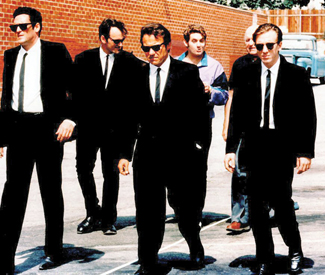
If not, join the more innocent multitudes at the multiplex come December, many of whom will no doubt be asking for one ticket to “Duh-jango,” please. There’s no shame in knowing nothing about such cultural marginalia. But what even faintly hipster-identifying person would admit to not knowing everything there is to know — even being bored with that knowledge — behind Reservoir Dogs (1992), the now 20-year-old Citizen Kane of indie meta guy flicks? How many people can not only quote its every line, but quote the every line of at least a few amongst its own umpteen mostly lousy imitations (yep, that includes you, 1999’s Boondock Saints)?

http://www.youtube.com/watch?v=QvoKT481EmU

In the gradual groundswell of attention that greeted Dogs back then, viewers confidently cited Tarantino’s inspirations (as did he himself), noting the imprint of everything from classic noir titles to Kurosawa. Yet one movie that had a very direct influence was almost completely absent from those discussions, failing to rise from its prior two decades of complete obscurity even in the two decades post-Dogs.

Together at last in one canine-throwdown double bill is Day of the Wolves, that forgotten 1971 thriller — thanks of course to the Roxie Cinema and Elliot Lavine, themselves reunited for the latest installment in “Not Necessarily Noir,” that catch-all occasional series encompassing all things cool and (mostly) celluloid which don’t fit the loose strictures of their long-running actual noir retrospectives. Wolves and Dogs tussle to kick off the two-week schedule this weekend.

Day of the Wolves‘ low profile is somewhat explicable: it was never released theatrically in the US, and for years withheld from legal exhibition due to copyright issues. Still, one marvels how such a flamboyant relic of pure Seventies-ness could have remained under the radar for so long. TV and Vegas comedian Jan Murray is improbably cast as the mastermind who orchestrates the assembly of six career criminals in a secret desert location. All strangers, they’re instructed to call one another only by assigned number, wear identical outfits, and sport full facial hair (some obviously glued-on). Their mission is to “hit a whole town and peel it like an orange” — sealing off a “model community” in the Southwest, emptying every till, then scramming via private plane.

It’s an ingenious plan that counts on the complacent vulnerability of such burgs. In fact, Wellerton’s city council has just demonstrated ideal small-mindedness by firing its police chief (late, SF-born Richard Egan, a second tier 1950s star gone to flab) for the crime of actually enforcing laws on some of its more irresponsible A-list citizens. Thus the population of 7,000 or so is woefully under prepared when they find the power cut off, exit routes blocked, and seven armed desperados in charge.

The early going bears closest resemblance to Reservoir Dogs, and is the most inspired. (Later when the film gets to its prolonged actual climax, it devolves into a more ordinary Western-style shoot-’em-up between the raiders and Egan’s cop-turned vigilante, though there’s a doozy of a final twist.) Writer-director Ferde Grofe Jr., whose career in features sprawled sparsely from the early 60s to the late 80s, demonstrates a real flair for memorable idiosyncrasy, if less so for action. In style and content, Wolves is a perfect time capsule: groovy rock score (with “acid” guitar, bongos, and flute), very wide lapels, and a dune buggy chase. This near-classic B movie will be shown in one mightily color-faded, “pinked-out” 35mm print, an ostensible flaw that plays more like a finishing touch.

“Not Necessarily Noir III” mixes more such rediscoveries with fairly well known cult faves of the last decades, from neo-noirs to Hong Kong action to 70s New Hollywood questing (exceptional 1978 drama Who’ll Stop the Rain with Nick Nolte and Tuesday Weld; the seldom-seen ’71 Cisco Pike with Kris Kristofferson, Gene Hackman, and Warhol superstar Viva). Among its more rarefied titles are two Me Decade Franco-noirs with Jean-Paul Belmondo (who performs some amazing stunts himself in 1971’s The Burglars); 1968’s very disturbing crime thriller Night of the Following Day (wherein white-blond Marlon Brando is the good guy), and a supernatural blaxploitation double bill of very odd, arty 1973 vampire tale Ganja and Hess and the next year’s wacky, tacky voodoo revenge saga Sugar Hill.

Particularly worth checking out is Darker Than Amber, an attempt to launch a James Bond-style series featuring John D. MacDonald’s best-selling Florida sleuth Travis McGee. Unfortunately this 1970 maiden effort flopped, and the film has seldom been seen — especially without cuts — since. Admittedly it has pedestrian TV-style direction from Robert Clouse (who’d hit his sole career peak later with Bruce Lee’s 1973 Enter the Dragon), and the production values are just B-plus. But it’s an ideal vehicle for Rod Taylor, the brawny, wry, relaxed Aussie who should have been a huge star in the 60s and 70s, but despite a couple memorable films (1963’s The Birds, 1960’s The Time Machine) never got the right break. He’s surrounded by a memorable gallery of MacDonald characters, with two body-builder villains (William Smith, Robert Philips) in addition to the frequently shirtless star making this an notably homoerotic entry for the era in a macho action genre.

“NOT NECESSARILY NOIR III”

Oct. 19-31, $6.50-$10

Roxie Theater

3117 16th St., SF

www.roxie.com


Alerts

0

THURSDAY 18

Culture as a weapon: poetry and storytelling SOUL School of Unity and Liberation, 1904 Franklin Suite 904, Oakl; www.schoolofunityandliberation.org, RSVP at info@schoolofunityandliberation.org. 6:30pm, $5-25. The second in a three-part series exploring how art and culture can be a form of political resistance. At this workshop, learn from poet, writer, artist and organizer Erika Vivianna Céspedes about writing that helps build movements. RSVP is required, and if you can’t get into this one, try their next event in the series, an activist printmaking workshop on Oct. 25.

Fall of the I-Hotel film screening New Nothing Cinema, 16 Sherman, SF; newnothing.wordpress.com. 8pm, free. A screening of a film depicting the historic struggle between residents and supporters of the International Hotel and the landlords that wanted it razed and turned into a parking lot. After massive neighborhood “revitalization,” the I-Hotel was one of the last remnants of the once-lively Manilatown neighborhood. See how residents fought for it at a screening presenting by Shaping San Francisco, New Nothing Cinema, and the CIIS Anthropology and Social Change Department.

FRIDAY 19

Say goodbye to condoms as evidence Jane Warner Plaza, 401 Castro, SF; www.tinyurl.com/condommarch. 6-8pm, free. As we reported this week, SFPD has decided to temporarily end the controversial practice of using possession of condoms as evidence in prostitution cases. For a three to six month trial period, condoms will not be seized or photographed if a cop thinks someone might be a sex worker. A group that was planning to march in opposition to the practice will now march in celebration of the decision, and to urge the city to make the trial period permanent.

Disobeying with great love Powell Street Bart station, Powell and Market, SF; www.tinyurl.com/disobeylove. 6pm, free. A flash mob meditation in the middle of the Disneyland-like shopping district. What better way to relax amongst the chaos?

SATURDAY 20

Op Trapwire Department of Homeland Security, 560 Golden Gate Ave, #36127, SF. WikiLeaks let loose information about Trapwire, the now-notorious company that uses surveillance and tracking to monitor people’s movements and aggregate them into patterns. It does this with a network of security cameras across the country, government and law enforcement uses its information, and the whole thing may be illegal. Some Occupy types have called for a national day of action against surveillance on Oct. 20, and San Francisco is joining in.

Picket Mi Pueblo market Mi Pueblo Mercado1630 High, Oakl; dignityandresistance@gmail.com. 1-4pm, free. Mi Pueblo Market is a successful and beloved grocery store chain. Workers were upset to learn that the company signed up to participate in E-Verify, a voluntary program that tracks the immigration status of all new hires. Managers say that the decision was made after serious pressure from ICE and the Department of Homeland Security. Workers and community supporters will picket the store in protest of the new policy.

SUNDAY 21

Amy Goodman speaks First congregational church of Oakland, 2501 Harrison, Oakl; www.kpfa.org/events. 7pm, $15 in advance. Amy Goodman co founded Democracy Now! The War and Peace Report in 1996. Since then, she has consistently brought progressive, hard hitting reporting to television screens and radios, authored a few books, and established herself as a distinctive voice in journalism. She’s also a kick ass speaker. Come hear her share her wisdom at a benefit for KPFA radio, where she’ll be speaking on “The Silenced Majority: Stories of Uprisings, Occupations, Resistance, and Hope”

MONDAY 22

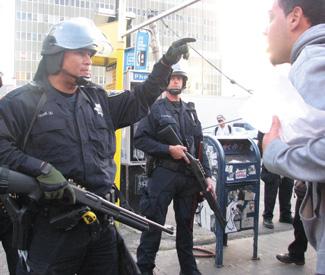
Tasers forum Hamilton Recreation Center, 1900 Geary, SF; www.tinyurl.com/taserforums. 5pm, free. The SFPD has called a public forum to discuss the possible introduction of tasers into the police arsenal. Come to share your thoughts on the idea. And if you want to hear more, show up a half hour early for a community-led forum. “This summer, ACLU delivered a report of 532 documented Taser related deaths in the US since 2001, but that has not stopped SF Police Chief Greg Suhr from pushing the fourth attempt to spend several million dollars to equip SFPD with these deadly weapons,” say organizers.

Happy hunting

0

cheryl@sfbg.com

TV Stainless steel appliances. Hardwood floors. Walk-in closets. The House Hunters drinking game, which lovingly mocks the HGTV program’s predictability, will have even a seasoned lush drunk before the first commercial break. “But there’s nowhere for my man cave!” DRINK.

Brian Balthazar, who is HGTV’s Director of Programming, has a sense of humor about the drinking game (“If I ever played it, I’d be hammered, because I watch a lot of House Hunters!”), and also about some recent online muckraking that revealed that what you see on House Hunters isn’t one hundred percent real. “We’re making a television show, so we manage certain production and time constraints, while honoring the home-buying process,” he explained in a statement to Entertainment Weekly this summer. “To maximize production time, we seek out families who are pretty far along in the process. Often everything moves much more quickly than we can anticipate, so we go back and revisit some of the homes that the family has already seen and we capture their authentic reactions.”

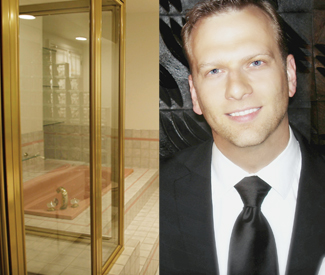
Wait, so reality TV isn’t actually real? Shut the custom-painted front door! “Mostly I was happy that people cared that much about House Hunters,” Balthazar says of the controversy. He’s currently promoting the latest House Hunters spin-off, House Hunters Renovation, which follows buyers as they pursue remodeling projects in their just-purchased homes. The next new episode airs Oct. 21 at 11pm; it follows a couple whose “dream house” (DRINK) contains a pink-and-gold nightmare of a bathroom.

“On this show, we see them buying the homes, and then making all these changes to them. So it’s exciting to be able to show that,” Balthazar says. “But I’m always excited that people are talking about House Hunters and that it has had such longevity. It’s nearing its 1,000th episode this year. That’s more than Law and Order!”

And like Law and Order, every episode of House Hunters is basically the same. “The concept is very clear. You know what’s going to happen on the show,” Balthazar says. “They’re going to see three homes, and we’ll see which one they choose. But what is always different are the homeowners and the homes. That voyeuristic, play-along quality of the show changes every time, which I love. We have some really interesting characters that come along, and everyone has a different reaction to different aspects of a home. I think that’s what makes it such a guilty pleasure among people who love to spy on the real estate process.”

House Hunters International follows the same basic formula, with an obvious difference: instead of a new construction in Indianapolis with a three-car garage (DRINK), the buyer (or renter) is seeking an apartment in a slightly more exotic locale. Like, say, Cambodia. Or Serbia. Or the Arctic Circle.

“I’m amazed at some of the stories the production company we work with on International finds. They’ve developed relationships with real estate agencies all over the world,” Balthazar says. “For a long time we didn’t go to some countries simply because it was too complicated. In some countries, you can’t actually buy a home if you’re not a resident. In others, you have to pay cash completely up front, in full. That was really a daunting thing for us to tackle. And now that the show’s been around for so long a lot of people write in to be on the show. It’s like this grassroots effort in some regards.”

Of course, being so popular has a slight downside. “Everyone that I run into, whether I’m on an airplane or at a party, if I say I work on House Hunters or House Hunters International, inevitably there will be someone saying they want to be on,” Balthazar says. “I actually love that! Though I will admit that occasionally when someone asks me what I do, I just say I’m a writer. [Laughs.] But I’m ultimately so grateful that people want to be on the show.”

Balthazar’s main distraction from an endless parade of buyers seeking open-concept floor plans (DRINK) is his pop-culture website, popgoestheweek.com. He’ll be melding his two interests on a special he’s hosting on HGTV in December.

“It’s called I Bought a Famous House. I go around to homes in Hollywood that were once owned by celebrities,” he says. “It’s interesting see what [the non-famous new owners have] done with them since. In one case, someone kept the house exactly the same as it was when the celebrity owned it. And in another case, with Madonna’s former house in the Hollywood Hills, a guy came in and literally changed almost everything, with the exception of the kitchen. But I think when you buy a seven million dollar house, you probably aren’t as concerned about the kitchen as the rest of the house, because you aren’t doing your own cooking when you have that kind of money!”

Of course, Madonna’s kitchen probably already had granite countertops. DRINK!

www.hgtv.com


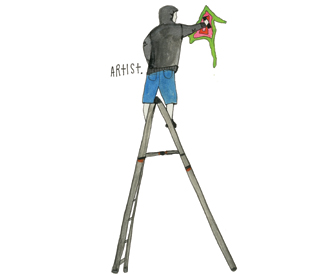
Frog killers in the heat: San Juan’s first street art festival

1

Sego painted a coqui. That makes sense because the soft-spoken Mexican mural artist dabbles luminously in the animal kingdom, improbably creating detailed scenes of magical realism with little more than aerosol cans.

The coqui is Puerto Rico’s mascot, the tranquil frog that defines the nighttime soundscape, and plagues tourists unused to the noise with its chirps. Sego’s wall, part of the first street art festival in San Juan history Los Muros Hablan, was an “aww” moment for the passing cars (and there are a lot of them. Sweltering San Juan lives and dies by the air-conditioned automobile.)

Less than a mile away, Roa is working on an iguana that, despite its vampy, lounging posture, holds a dead coqui in one languid claw. Roa is Belgium, and generally acknowledged to have popularized animal drawings in this brave new world of gallery-approved street artists. Delayed by the theft of his lift’s batteries and a few dehabilitating hangovers, he’s probably still working on the piece in San Juan’s 90 degree humid swampiness.

He left the frog death and pertaining iguana paw for the end of the piece. While I lounged in the shade of an orange road safety buoy last week, I watched cars stop, belching young men whose only desire was to take a picture with Roa. All the better if he was holding his baseball cap over his face (he always is.) Later these images would pop up on Instagram, appropriately hashtagged so that we could review them easily.

I wonder how San Juan will like the crushed coqui. “You can see a lot of things in it,” Roa told me on a late-night ride out to said jungle with some other Los Muros artists and attaches. The long-ago Spanish rule of Puerto Rico, the right-now United States colonization of the island. “There’s a lot of ways to interpret it,” he told me. 

Though one will note a preponderance of animal renderings in the Los Muros Hablan renderings, it wasn’t all frogs and frog-killers in the Santurce streets. Local legend Sofia Maldonado threw up a warning about the 709 women who have been murdered in Puerto Rico between 2000 and 2011. Though Maldonado was the only female muralist at the fest, La Repuesta — the spectacular, grungy club that gave over a back room to serve as Los Muros’ nerve center and gathering spot for the Escuela Central de Artes Visuales (Center High for the Visual Arts) students that assisted, and generally mooned around the artists in the festival — did host a Los Muros ladies night, featuring an all-female cast of live painters and DJs. Women made up the bulk of the audience at an artist panel discussion at San Juan’s Museo de Arte Contemporáneo (Museum of Contemporary Art), looked up at the scenes being sprayed on their city’s walls.

Argentina’s Jaz labored over a mural so layered it came off looking like an illustration from an Illuminati-made children’s book.

Mexico’s Nuezz painted a folkloric, horizontal man in a hat along the side of La Respuesta.

Ever from Buenos Aires is working (again, altitude delays) on a six-story naked woman shooting colorful shapes from her eyes who may or may not bear a resemblance to your humble writer, whose labia may or may have been seen by a substancial segment of San Juan commuters.

Spain’s Aryz (you’ll remember him from that Aesop Rock album cover) gave birth to a mermaid-toned skeleton man on a condo building. 

Juan Fernandez, one half of the La Pandilla duo that along with mosaic artist Celso helped to organize the entire affair, drew endless loops that eventually formed a song bird. Alexis Diaz, the other half, had barely gotten started by the time I left Puerto Rico, so busy was he shuttling fellow artists from hotel to breakfast to wall and replacing stolen lift batteries. I’m sure whatever he’s working on will turn out great though. 

Painting big murals is not, for most of even its stars, a money-making proposition. Los Muros Hablan paid its visiting artists airfare to the island, kitted them out with supplies, and occasionally-late lifts to access the dizzying heights of their canvases in exchange for their services in bringing attention to the often-overlooked Santurce neighborhood.

Santurce’s blocks, though they stand a 10-minute bike ride from the city’s white sand Ocean Park, are largely vacant by night. Flashy new condo developments dot the area, betting that new inhabitants will warm to a walkable ‘hood. One wonders how they feel about dead coquis

In the case of its international visitors, the fest took charge of feeding the beasts, a source of consternation among the local painters. Making murals like these is generally just a way to make one’s impression on the streets, and of course the many bajillions of street art fans addicted to RSS feeds around the world.

Generally at these festivals, the artists wear their painted-ass shorts and sneakers 24 hours a day, and sleep three to a room until they’re off on the next flight — to Australia, to New York, back to Barcelona. They get paid in new tans and Instagram followers, aim for the interest of art collectors. Such is street life, even if you’re in charge of scenery. 

Check next week’s paper for the debut of my new column Street Seen, featuring my interview of all-around Puerto Rican badass — and only female muralist at Los Muros Hablan — Sofia Maldonado

Live Shots: Treasure Island Music Festival 2012

0

Music nerds talk lineups the way sports fans manage fantasy teams, particularly with festivals, where suddenly strategy becomes a part of catching a show. Treasure Island Music Festival, is sort of an exception, since in theory you can catch every single act, given the two alternating stages. At the same time, this means that unless you head to the silent disco or take a nap, one of those geeks will be standing behind you during a set, obsessively talking about how the lineup should be slotted differently.

Day 1
SF’s Dirty Ghosts had the challenging task of being a rock band opening the festival on the traditional hip-hop/electronic day. K. Flay followed, and told the crowd “I know it’s early, but we can still party,” and the local MC proceeded to give a hair tossing performance that had her drummer breaking a snare. It was a decent lead in for Oakland’s the Coup. Boots Riley has been off my radar for a bit, but it appears our ambassador of P-funked rap has been keeping more than his afro tight – pulling from now-more-appropriate-than-ever classics like “5 Million Ways to Kill a C.E.O” and the upcoming Sorry to Bother You.

At 2:31pm, a guy in a tie-dye Quicksilver shirt was vomiting near where Grimes was playing: the festival had started. Like Matthew Dear and Porter Robinson, Grimes is a returning acts from this year’s Noise Pop. Maybe it was just her bandmate’s flowing iridescent ponchos, but Grimes’ sound seemed lighter than at the Rickshaw Stop. I decided I preferred this side of Grimes, but the Euro bubblegum quality of the creepily infantile “Phone Sex” was pushing it. Matthew Dear seemed out of place in full sun on the Bridge Stage, fog machines pumping. His set was similar to what I heard at Public Works, but progressed slowly. Nearing the end of his set the band got into a groove with “You Put a Smell on Me” but it’ was a little late.

Toro y Moi sounded just like when I saw it a couple years back, but would probably have fit in better somewhere on Sunday. Near the end you could hear a DJ on the other stage playing snippets and raising the crowd, partly using soundcheck to hype for Public Enemy. When actually starting, Chuck D arrived on stage, introducing the whole support crew but saved Flavor Flav for last.

The hyperbolic performance took me back to a time before reality TV. Chuck D was outspoken (Fuck BET. Fuck urban radio. Fuck Viacom.) but used time well. Flavor was Flavor, and rambled for five minutes after his time is up. AraabMusik, waiting on the Tunnel Stage didn’t seem to mind: he gave an impressive, sample stuttering finger drumming MPC performance, after having a smoke with his crew.

At 6:01 I saw the guy who’d been throwing up earlier, walking arm in arm with a girl, both smiling and probably holding each other up.

Things started to blur, the time between switching stages seemed to decrease. Porter Robinson left no impression on me. Tycho sounded like a person making slow, thoughtful love to a synthesizer, but whereas it could have been a great lead-in to the xx, suffered from being between Robinson and a high energy performance from the Presets.

Speaking of which, I’ve had an aversion to the Presets (largely stemming from issues I have with Australian pop), but their performance, particularly “If I Know You” won me over. An awkward soundcheck delay for the following band, SBTRKT, meant the worst thing I could say about it is that it felt too short. Producer Aaron Jerome and singer Sampha played to their strengths, closing with “Wildfire” and having what seemed like the whole crowd leaning back and strutting like they were the sexiest, smoothest motherfuckers on the field.

Girl Talk opened with the awesome (and oft utilized) “International Player’s Anthem” by UGK before quickly triggering “Dancin’ in the Dark.” I hear the Boss at least once more before I leave twenty minutes later. I’m sure there was confetti.  

Day 2

Between openers Imperial Teen and Joanna Newsom, things were rather low-key, just all around relaxing, emotional, sunny music (including my returning favorites, Hospitality.) The crowd trickled in steadily and the field fills up with blankets faster than the day before. It’s a rather sedate afternoon, aside from one thing.

Who scheduled Ty Segall – noted garage thrasher, guitar mangler, and kick drum stomper – in that mid-afternoon slot? Love the dude, he sounded great, but he was not much appreciated outside the pit. The blanket crowd? It didn’t dig that. Particularly right between Youth Lagoon’s indie emo Bob Dylan and Gavin’s second cousin. That’s prime time nap time, especially when the first half of Joanna Newsom’s performance can’t be heard past the soundbooth. (Seriously, can Nap Time with Joanna Newsom be a real thing? On Nick Jr. after Yo Gabba Gabba?) The collective bombast of Los Campesinos picked things up – back to back with Segall would have been a hell of a way to wake up.

And bake up. Because Best Coast was playing with the sun going down. When this festival is at its best, the music and the environment seem to play into one another, and from there out, it basically went perfect. I haven’t seen the band since a sloppy show at Regency Ballroom with Wavves a few years back. The basic sound is still the same – beachy guitar pop with a stony edge – but has developed since then. Part of it’s lineup changes, as the new drummer is a lot tighter than before (and has easily the loudest snare of the weekend), part of it’s just improvement. Bethany Consentino apologized for singing a slow song, but there’ was no reason. She can definitely carry a ballad now.

Anticipation iwas high for Divine Fits, the “supergroup” featuring Dan Boeckner, Britt Daniels, and Sam Brown. Mainly I’m sure because a lot of fans were there for the Bay Area debut, but also because of the glorious, Hollywood matte painting skyline waiting for them behind the Tunnel Stage. As soon as they hit the chorus of “Baby Get Worse,” complete with the ’80s throwback keyboard, I was sold. Halfway through the set someone up front was apparently amped enough for Boeckner to ask, “Dude, are you on PCP?” Elsewhere in the crowd people pleasantly remarked, “Hey, this sounds like Spoon.”

Previously I’d thought the crowd seemed thicker due to all the blankets, but when I walked back towards the Bridge Stage, I realizes that simply way more people turned out for some combination of the last three bands.

M83 – returning to the Bay for the first time since their sold out Fillmore shows in the spring – opened with an alien, had lots of lasers, and played that one song. One thing I now know for sure: it is possible to play percussion while doing the running man.

The last act on the Tunnel Stage, Gossip was one of the only real surprises for me this festival. Punk diva Beth Ditto opened by welcoming the audience to comedy night, later commenting that the band hadn’t toured the US in three years, because the Euro is stronger. Crowded at the front of the stage were possibly the most intense fans I saw all weekend, clearly attached not only to Ditto’s vocal talent, but also her empowering, Aretha Franklin-esque sense of Pride. Pointing to the already crowded photo pit, Ditto said cruelly, “I wish there was a lot less space. And a lot more photographers.”

You couldn’t really have more photographers than there were in the pit at the end of the night for the xx, stopping in the Bay Area for the last festival date on their current tour, supporting the sophomore album Coexist.

It was clear that in their live performance the xx tries to capture the same sort of intimacy as their albums, with a stark and stripped down stage and singers Romy Madley Croft and Oliver Sim in the front. Either singer could do well alone, but together there’s an undeniable chemistry, like lovers in dialogue.

In their live show they definitely play into that, while producer Jamie XX stays literally more in the shadows; Sunday night he was up a level behind the pair, manning a series of controllers, cymbals, and drum pads to creates the fundamental beats that the guitars wash over. The resulting music takes its time – I’d call it shoegaze dance if that weren’t such an idiotic concept – and the xx did as well, opening with the enrapturing “Angels,” setting a sensual mood that stayed till then end.

Earlier Ditto had called them, obviously, the Sex Sex. Anyone who really felt that way – or just wanted to get to John Talabot and Jamie XX at Public Works – hopefully caught a cab, as the wait for shuttles off the island at the end of the night were upwards of an hour and a half. Note to self: work that factor into the TIMF strategy next year.

The Helium Safari: The Astonishing Collage Art of Sean Mackaoui

0

Sean Mackaoui likes to cut and paste in his much-loved adopted hometown of Madrid, Spain. His work has adorned newspapers and magazines (El Mundo, The Herald Tribune, Courrier International, The Sunday Times Magazine, El Canto de la Tripulacion, and La Folha de Sao Paulo), dripped off posters (Centro Dramatico Nacional, Spain or Biennale du Cinéma Espagnol de Annecy, France), graced wine labels, adorned book covers, dressed up T-shirts, sold shoes, animated TV spots…. basically anywhere they let him put a collage!

He has exhibited his personal work in galleries around Europe, and occasionally pieces have been known to cross the Atlantic to the shores of the American continent. His proudest recent achievement was to be awarded an Honorary Director’s roll on the board of the San Francisco Collage Centre. For more information, please visit mackaoui.com.

Sean will be in attendance of this one night only event at Grant’s Tomb Gallery in North Beach, with additional montage art by Winston Smith, also in attendance.

Friday, October 19 from  7-11pm @ Grant’s Tomb, 50-A Bannam Alley,  SF | FREE

Fukushima controversies that the mainstream media ignores

11

This week, we wrote our annual analysis of the list of censored stories released by Project Censored. We wrote that “in one study that got little attention, scientists Joseph Mangano and Janette Sherman found that in the period following the Fukushima meltdowns, 14,000 more deaths than average were reported in the US, mostly among infants.”

It’s true that the study got little attention in mainstream media, with a few exceptions including coverage in Al Jazeera. It was, however, the subject of scrutiny from multiple sources.

Sherman is a physician and former advisory board member for the Environmental Protection Agency (EPA) Toxic Substances Control Act, and Mangano is an epidemiologist and public health administrator and researcher.

The debate that followed the release of their study got into important issues of the health effects of the Fukushima Daiichi nuclear disaster. Both those defending and attacking the study, and the general principle of the health impacts of nuclear energy, had their say. But all this happened outside mainstream media, and in the wake of Fukushima, mainstream media has largely ignored health implications. That’s why the story was highlighted by Project Censored, which explores stories underreported by the mainstream media, in their book Censored 2013: Dispatched from the Media Revolution.

An article by Sherman and Mangano about their research was first published in June 2011 in Counterpunch, a left-leaning political newsletter. It was criticized then. Counterpunch came back with a response from their “statistical consultant” Pierre Sprey, who found that there was an increase in infant deaths, although not as stark as the increase Sherman and Mangano found. He found that the increase was amplified by including other cities in the Pacific Northwest in the set.

An updated version of the study was published in a peer-reviewed journal, the Journal of International Health Services, in December.

Sherman and Mangano came to their conclusions by comparing deaths in a set of US cities during a 28-week period during which the meltdown occurred on March 11 to the same 28-week period in 2010. They found that in the 14 weeks before March 11, deaths were up 2.34 percent in 2011, but in the period after the Fukushima disaster, they were up by 4.46 percent. They extrapolated this data and determined a “a projected 13,983 excess U.S. deaths”

Again, the study was widely criticized. One source of critique was Michael Moyer, who wrote an article in Scientific American lambasting the study. He said that the authors cherry-picked the data they used. Moyer wrote that “No attempt is made at providing systematic error estimates, or error estimates of any kind. No attempt is made to catalog any biases that may have crept into the analysis, though a cursory look finds biases a-plenty (the authors are anti-nuclear activists unaffiliated with any research institution).”

But aside from the Scientific American article and a few other instances of mainstream coverage, the critical response to Sherman and Mangano’s story was also underreported. The people who took another look at their numbers were writing for alternative press. Websites like nuclearpoweryesplease.org, whose creators are “are convinced that nuclear power is vital to securing energy production in a sustainable way until science can provide us with a truly limitless source of power.” and atomicinsights.com, written by self-described “pro-nuclear advocate” Rod Adams.

The whole incident raises interesting questions about what constitutes mainstream media and alternative media, the value of peer-review and fact-checking, and the way that corporate interests control news stories. Almost every person who weighed in on this story was likely biased in some way, from the researchers who set out to see if there was a correlation between US deaths and the Fukushima meltdown to the pro-nuclear activists who attacked their study.

The nuclear industry has plenty of mouthpieces. The Nuclear Energy Institute, a lobbying group for nuclear companies, releases its own press statements. A blog associated with the NEI, neinuclearnotes.blogspot.com, has been a part of the online debunking frenzy surrounding Sherman and Mangano’s work.

Does being associated with the nuclear industry make critiques incorrect? In this situation, it seems clear that the refutations are credible.

It does make them suspicious, as the nuclear industry’s profits rely on the belief that nuclear energy is perfectly safe.

Mainstream news is supposed to serve as a credible and reliable source of information. But coverage of the effects of the Fukushima Daiichi disaster have been mostly left up to bloggers and activists. And Sherman and Mangano’s flawed study is far from the only outcry. In Canada, concerns were raised about radiation levels in rainwater. A series of investigations into RadNet, the EPA’s radiological detection network, found that the system suffers from maintenance and reliability issues, and may have reported false low levels of radiation in the weeks following Fukushima.

In Japan, a strong protest movement insists that they and their children aren’t safe following the meltdown. The country announced plans to phase out nuclear power by 2040 following Fukushima. Strong anti-nuclear sentiment also exists in Germany, where the government has plans to phase out nuclear energy by 2022.

In the United States, the controversy over nuclear energy rages on. The nuclear industry is a powerful corporate interest, and likely has something to do with the suppression of mainstream coverage of nuclear hazards. At the same time, corporate flaks are just as capable of creating “alternative” media sources that twist stories to reflect a pro-nuclear agenda. Of course, so are anti-nuclear advocates, who may be equally willing to ignore facts to promote their agenda.
As Censored 2013 points out, that debate is largely underreported by the mainstream media. Nuclear power may not have led to 14,000 excess deaths in the US following the Fukushima disaster. But it has certainly led to a confused circus of less than reliable sources, competing to be believed as truth, while traditional credible reporting falls away.

PROJECT CENSORED 2012

6

yael@sfbg.com

People who get their information exclusively from mainstream media sources may be surprised at the lack of enthusiasm on the left for President Barack Obama in this crucial election. But that’s probably because they weren’t exposed to the full online furor sparked by Obama’s continuation of his predecessor’s overreaching approach to national security, such as signing the 2012 National Defense Authorization Act, which allows the indefinite detention of those accused of supporting terrorism, even US citizens.

We’ll never know how this year’s election would be different if the corporate media adequately covered the NDAA’s indefinite detention clause and many other recent attacks on civil liberties. What we can do is spread the word and support independent media sources that do cover these stories. That’s where Project Censored comes in.

Project Censored has been documenting inadequate media coverage of crucial stories since it began in 1967 at Sonoma State University. Each year, the group considers hundreds of news stories submitted by readers, evaluating their merits. Students search Lexis Nexis and other databases to see if the stories were underreported, and if so, the stories are fact-checked by professors and experts in relevant fields.

A panel of academics and journalists chooses the Top 25 stories and rates their significance. The project maintains a vast online database of underreported news stories that it has “validated” and publishes them in an annual book. Censored 2013: Dispatches from the Media Revolution will be released Oct. 30.

For the second year in row, Project Censored has grouped the Top 25 list into topical “clusters.” This year, categories include “Human cost of war and violence” and “Environment and health.” Project Censored director Mickey Huff told us the idea was to show how various undercovered stories fit together into an alternative narrative, not to say that one story was more censored than another.

“The problem when we had just the list was that it did imply a ranking,” Huff said. “It takes away from how there tends to be a pattern to the types of stories they don’t cover or underreport.”

In May, while Project Censored was working on the list, another 2012 list was issued: the Fortune 500 list of the biggest corporations, whose influence peppers the Project Censored list in a variety of ways.

Consider this year’s top Fortune 500 company: ExxonMobil. The oil company pollutes everywhere it goes, yet most stories about its environmental devastation go underreported. Weapons manufacturers Lockheed Martin (58 on the Fortune list), General Dynamics (92), and Raytheon (117) are tied into stories about US prisoners in slavery conditions manufacturing parts for their weapons and the underreported war crimes in Afghanistan and Libya.

These powerful corporations work together more than most people think. In the chapter exploring the “Global 1 percent,” writers Peter Phillips and Kimberly Soeiro explain how a small number of well-connected people control the majority of the world’s wealth. In it, they use Censored story number 6, “Small network of corporations run the global economy,” to describe how a network of transnational corporations are deeply interconnected, with 147 of them controlling 40 percent of the global economy’s total wealth.

For example, Philips and Soeiro write that in one such company, BlackRock Inc., “The eighteen members of the board of directors are connected to a significant part of the world’s core financial assets. Their decisions can change empires, destroy currencies, and impoverish millions.”

Another cluster of stories, “Women and Gender, Race and Ethnicity,” notes a pattern of underreporting stories that affect a range of marginalized groups. This broad category includes only three articles, and none are listed in the top 10. The stories reveal mistreatment of Palestinian women in Israeli prisons, including being denied medical care and shackled during childbirth, and the rape and sexual assault of women soldiers in the US military. The third story in the category concerns an Alabama anti-immigration bill, HB56, that caused immigrants to flee Alabama in such numbers that farmers felt a dire need to “help farms fill the gap and find sufficient labor.” So the Alabama Department of Agriculture and Industries approached the state’s Department of Corrections about making a deal where prisoners would replace the fleeing farm workers.

But with revolutionary unrest around the world, and the rise of a mass movement that connects disparate issues together into a simple, powerful class analysis — the 99 percent versus the 1 percent paradigm popularized by Occupy Wall Street — this year’s Project Censored offers an element of hope.

It’s not easy to succeed at projects that resist corporate dominance, and when it does happen, the corporate media is sometimes reluctant to cover it. Number seven on the Top 25 list is the story of how the United Nations designated 2012 the International Year of the Cooperative, recognizing the rapid growth of co-op businesses, organizations that are part-owned by all members and whose revenue is shared equitably among members. One billion people worldwide now work in co-ops.

The Year of the Cooperative is not the only good-news story discussed by Project Censored this year. In Chapter 4, Yes! Magazine‘s Sarah Van Gelder lists “12 ways the Occupy movement and other major trends have offered a foundation for a transformative future.” They include a renewed sense of “political self-respect” and fervor to organize in the United States, debunking of economic myths such as the “American dream,” and the blossoming of economic alternatives such as community land trusts, time banking, and micro-energy installations.

They also include results achieved from pressure on government, like the delay of the Keystone Pipeline project, widespread efforts to override the US Supreme Court’s Citizens United ruling, the removal of dams in Washington state after decades of campaigning by Native American and environmental activists, and the enactment of single-payer healthcare in Vermont.

As Dr. Nafeez Mosaddeq Ahmed writes in the book’s foreword, “The majority of people now hold views about Western governments and the nature of power that would have made them social pariahs 10 or 20 years ago.”

Citing polls from the corporate media, Ahmed writes: “The majority are now skeptical of the Iraq War; the majority want an end to US military involvement in Afghanistan; the majority resent the banks and financial sector, and blame them for the financial crisis; most people are now aware of environmental issues, more than ever before, and despite denialist confusion promulgated by fossil fuel industries, the majority in the United States and Britain are deeply concerned about global warming; most people are wary of conventional party politics and disillusioned with the mainstream parliamentary system.”

“In other words,” he writes, “there has been a massive popular shift in public opinion toward a progressive critique of the current political economic system.”

And ultimately, it’s the public — not the president and not the corporations—that will determine the future. There may be hope after all. Here’s Project Censored’s Top 10 list for 2013:


1. SIGNS OF AN EMERGING POLICE STATE

President George W. Bush is remembered largely for his role in curbing civil liberties in the name of his “war on terror.” But it’s President Obama who signed the 2012 NDAA, including its clause allowing for indefinite detention without trial for terrorism suspects. Obama promised that “my Administration will interpret them to avoid the constitutional conflict” — leaving us adrift if and when the next administration chooses to interpret them otherwise. Another law of concern is the National Defense Resources Preparedness Executive Order that Obama issued in March 2012. That order authorizes the President, “in the event of a potential threat to the security of the United States, to take actions necessary to ensure the availability of adequate resources and production capability, including services and critical technology, for national defense requirements.” The president is to be advised on this course of action by “the National Security Council and Homeland Security Council, in conjunction with the National Economic Council.” Journalist Chris Hedges, along with co-plaintiffs including Noam Chomsky and Daniel Ellsberg, won a case challenging the NDAA’s indefinite detention clause on Sept. 1, when a federal judge blocked its enforcement, but her ruling was overturned on Oct. 3, so the clause is back.


2. OCEANS IN PERIL

Big banks aren’t the only entities that our country has deemed “too big to fail.” But our oceans won’t be getting a bailout anytime soon, and their collapse could compromise life itself. In a haunting article highlighted by Project Censored, Mother Jones reporter Julia Whitty paints a tenuous seascape — overfished, acidified, warming — and describes how the destruction of the ocean’s complex ecosystems jeopardizes the entire planet, not just the 70 percent that is water. Whitty compares ocean acidification, caused by global warming, to acidification that was one of the causes of the “Great Dying,” a mass extinction 252 million years ago. Life on earth took 30 million years to recover. In a more hopeful story, a study of 14 protected and 18 non-protected ecosystems in the Mediterranean Sea showed dangerous levels of biomass depletion. But it also showed that the marine reserves were well-enforced, with five to 10 times larger fish populations than in unprotected areas. This encourages establishment and maintenance of more reserves.


3. US DEATHS FROM FUKUSHIMA

A plume of toxic fallout floated to the US after Japan’s tragic Fukushima nuclear disaster on March 11, 2011. The US Environmental Protection Agency found radiation levels in air, water, and milk that were hundreds of times higher than normal across the United States. One month later, the EPA announced that radiation levels had declined, and they would cease testing. But after making a Freedom of Information Act request, journalist Lucas Hixson published emails revealing that on March 24, 2011, the task of collecting nuclear data had been handed off from the US Nuclear Regulatory Commission to the Nuclear Energy Institute, a nuclear industry lobbying group. And in one study that got little attention, scientists Joseph Mangano and Janette Sherman found that in the period following the Fukushima meltdowns, 14,000 more deaths than average were reported in the US, mostly among infants. Later, Mangano and Sherman updated the number to 22,000.


4. FBI AGENTS RESPONSIBLE FOR TERRORIST PLOTS

We know that FBI agents go into communities such as mosques, both undercover and in the guise of building relationships, quietly gathering information about individuals. This is part of an approach to finding what the FBI now considers the most likely kind of terrorists, “lone wolves.” Its strategy: “seeking to identify those disgruntled few who might participate in a plot given the means and the opportunity. And then, in case after case, the government provides the plot, the means, and the opportunity,” writes Mother Jones journalist Trevor Aaronson. The publication, along with the Investigative Reporting Program at the University of California-Berkeley, examined the results of this strategy, 508 cases classified as terrorism-related that have come before the US Department of Justice since the 9/11 terrorist attacks of 2001. In 243 of these cases, an informant was involved; in 49 cases, an informant actually led the plot. And “with three exceptions, all of the high-profile domestic terror plots of the last decade were actually FBI stings.”


5. FEDERAL RESERVE LOANED TRILLIONS TO MAJOR BANKS

The Federal Reserve, the US’s quasi-private central bank, was audited for the first time in its history this year. The audit report states, “From late 2007 through mid-2010, Reserve Banks provided more than a trillion dollars… in emergency loans to the financial sector to address strains in credit markets and to avert failures of individual institutions believed to be a threat to the stability of the financial system.” These loans had significantly less interest and fewer conditions than the high-profile TARP bailouts, and were rife with conflicts of internet. Some examples: the CEO of JP Morgan Chase served as a board member of the New York Federal Reserve at the same time that his bank received more than $390 billion in financial assistance from the Fed. William Dudley, who is now the New York Federal Reserve president, was granted a conflict of interest waiver to let him keep investments in AIG and General Electric at the same time the companies were given bailout funds. The audit was restricted to Federal Reserve lending during the financial crisis. On July 25, 2012, a bill to audit the Fed again, with fewer limitations, authored by Rep. Ron Paul, passed the House of Representatives. HR459 expected to die in the Senate, but the movement behind Paul and his calls to hold the Fed accountable, or abolish it altogether, seem to be growing.


6. SMALL NETWORK OF CORPORATIONS RUN THE GLOBAL ECONOMY

Reporting on a study by researchers from the Swiss Federal Institute in Zurich didn’t make the rounds nearly enough, according to Censored 2013. They found that, of 43,060 transnational companies, 147 control 40 percent of total global wealth. The researchers also built a model visually demonstrating how the connections between companies — what it calls the “super entity” — works. Some have criticized the study, saying control of assets doesn’t equate to ownership. True, but as we clearly saw in the 2008 financial collapse, corporations are capable of mismanaging assets in their control to the detriment of their actual owners. And a largely unregulated super entity like this is vulnerable to global collapse.


7. THE INTERNATIONAL YEAR OF COOPERATIVE

Can something really be censored when it’s straight from the United Nations? According to Project Censored evaluators, the corporate media underreported the UN declaring 2012 to be the International Year of the Cooperative, based on the coop business model’s stunning growth. The UN found that, in 2012, one billion people worldwide are coop member-owners, or one in five adults over the age of 15. The largest is Spain’s Mondragon Corporation, with more than 80,000 member-owners. The UN predicts that by 2025, worker-owned coops will be the world’s fastest growing business model. Worker-owned cooperatives provide for equitable distribution of wealth, genuine connection to the workplace, and, just maybe, a brighter future for our planet.


8. NATO WAR CRIMES IN LIBYA

In January 2012, the BBC “revealed” how British Special Forces agents joined and “blended in” with rebels in Libya to help topple dictator Muammar Gadaffi, a story that alternative media sources had reported a year earlier. NATO admits to bombing a pipe factory in the Libyan city of Brega that was key to the water supply system that brought tap water to 70 percent of Libyans, saying that Gadaffi was storing weapons in the factory. In Censored 2013, writer James F. Tracy makes the point that historical relations between the US and Libya were left out of mainstream news coverage of the NATO campaign; “background knowledge and historical context confirming Al-Qaeda and Western involvement in the destabilization of the Gadaffi regime are also essential for making sense of corporate news narratives depicting the Libyan operation as a popular ‘uprising.'”


9. PRISON SLAVERY IN THE US

On its website, the UNICOR manufacturing corporation proudly proclaims that its products are “made in America.” That’s true, but they’re made in places in the US where labor laws don’t apply, with workers often paid just 23 cents an hour to be exposed to toxic materials with no legal recourse. These places are US prisons. Slavery conditions in prisons aren’t exactly news. It’s literally written into the Constitution; the 13th Amendment, which abolished slavery, outlaws  slavery nor involuntary servitude, except as a punishment for crime whereof the party shall have been duly convicted.” But the article highlighted by Project Censored this year reveal the current state of prison slavery industries, and its ties to war. The majority of products manufactured by inmates are contracted to the Department of Defense. Inmates make complex parts for missile systems, battleship anti-aircraft guns, and landmine sweepers, as well as night-vision goggles, body army, and camouflage uniforms. Of course, this is happening in the context of record high imprisonment in the US, where grossly disproportionate numbers of African Americans and Latinos are imprisoned, and can’t vote even after they’re freed. As psychologist Elliot D. Cohen puts it in this year’s book: “This system of slavery, like that which existed in this country before the Civil War, is also racist, as more than 60 percent of US prisoners are people of color.”


10. HR 347 CRIMINALIZES PROTEST

HR 347, sometimes called the “criminalizing protest” or “anti-Occupy” bill, made some headlines. But concerned lawyers and other citizens worry that it could have disastrous effects for the First Amendment right to protest. Officially called the Federal Restricted Grounds Improvement Act, the law makes it a felony to “knowingly” enter a zone restricted under the law, or engage in “disorderly or disruptive” conduct in or near the zones. The restricted zones include anywhere the Secret Service may be — places such as the White House, areas hosting events deemed “National Special Security Events,” or anywhere visited by the president, vice president, and their immediate families; former presidents, vice presidents, and certain family members; certain foreign dignitaries; major presidential and vice presidential candidates (within 120 days of an election); and other individuals as designated by a presidential executive order. These people could be anywhere, and NSSEs have notoriously included the Democratic and Republican National Conventions, Super Bowls, and the Academy Awards. So far, it seems the only time HR 347 has kicked in is with George Clooney’s high-profile arrest outside the Sudanese embassy. Clooney ultimately was not detained without trial — information that would be almost impossible to censor — but what about the rest of us who exist outside of the mainstream media’s spotlight? A book release party will be held at Moe’s Books, 2476 Telegraph, in Berkeley, on Nov. 3. You can listen to Huff’s radio show Friday morning at 8pm on KPFA.

Rally for Ross at noon today on the City Hall steps

45

Join Sheriff Michael Hennessey; Mayor Art Agnos; Dolores Huerta, Co-Founder of the UFW & Medal of Freedom Recipient; Supervisors Sophie Maxwell, Harry Britt, Doris Ward, Willie Kennedy and Carol Ruth Silver; Public Defender Geoff Brown, and others in calling for the reinstatement of Sheriff Mirkarimi this Tuesday before the Board of Supervisors Vote.

RALLY @ NOON, TUESDAY, OCTOBER 9 2012 – CITY HALL STEPS

The San Francisco Chapter of the National Lawyers Guild, SF Labor Council, Service Employees International Union (SEIU) 1021, Harvey Milk LGBT Democratic Club, Latino Democratic Club, Bernal Heights Democratic Club, District 5 Democratic Club, Padres Unidos, Bay Area Iranian Democrats, SF Green Party, San Francisco Guardian, Bay Area Reporter, Sunset Beacon, and Central City Democrats all Support Reinstatement!!

Come to the rally and show your support too!!!

Dolores Huerta, Co-Founder of the UFW, Medal of Freedom Recipient, Eliana Lopez and Friend

 If you can not make the Rally – Please call you supervisor today – Let them know you Stand with Ross and will not stand for anything but reinstatement!

Click to Donate to the Ross Mirkarimi Legal Defense Fund

or by sending a check to:
Ross Mirkarimi Legal Defense Fund
721 Webster Street
San Francisco, CA 94117


Zombie dogs! Neeson! Southern-fried jail tales! And more, in this week’s new movies

1

It’s finally Halloweentime! (Though Walgreens would have you believe that season started in August.) Hollywood prepares appropriately with a few spookier picks (for kids, Frankenweenie, reviewed below; for older crowds, found-footage anthology V/H/S, discussed in my interview with some of the filmmakers here.) For good measure, you can check out my interview with Dee Wallace, star of some horror classics but making the press rounds for the 30th anniversary Blu-ray release of E.T. The Extraterrestrial.

Of local interest, the Mill Valley Film Festival is up and running, with some stellar picks noted here (HOLY MOTORS!) and an interview with indie pioneer Allison Anders, who debuts her new Strutter at the fest, here.

And, as always, there’s more. Read on for takes on films like The Paperboy and Taken 2, which each define “trashy entertainment” in their own special ways.

http://www.youtube.com/watch?v=QZtKB_KuASc

Bitter Seeds Just what we all needed: more incontrovertible evidence of the bald-faced evil of Monsanto. This documentary on destitute Indian cotton farmers follows an 18-year-old girl named Manjusha, a budding journalist who investigates the vast numbers of farmer suicides since the introduction (and market stranglehold) of “BT” cotton — which uses the corporation’s proprietary GMO technology — in the region of Vidarbha. Before BT took over in 2004, these cotton farmers relied on cheap heritage seed fertilized only by cow dung, but the largely illiterate population fell prey to Monsanto’s marketing blitz and false claims, purchasing biotech seed that resulted in pesticide reliance, failing crops, and spiraling debt. It’s a truly heartbreaking and infuriating story, but much of the action feels stagy and false. Should Indian formality be blamed? Considering the same fate befell Micha X. Peled’s 2005 documentary China Blue, probably not. Still, eff Monsanto. (1:28) Roxie. (Michelle Devereaux)

http://www.youtube.com/watch?v=qngB0vCmZV4

Frankenweenie Tim Burton’s feature-length Frankenweenie expands his 1984 short of the same name (canned by Disney back in the day for being too scary), and is the first black and white film to receive the 3D IMAX treatment. A stop-motion homage to every monster movie Burton ever loved, Frankenweenie is also a revival of the Frankenstein story cute-ified for kids; it takes the showy elements of Mary Shelley’s novel and morphs them to fit Burton’s hyperbolic aesthetic. Elementary-school science wiz Victor takes his disinterred dog from bull terrier to gentle abomination (when the thirsty Sparky drinks, he shoots water out of the seams holding his body parts together). Victor’s competitor in the school science fair, Edgar E. Gore, finds out about Sparky and ropes in classmates to scrape up their dead pets from the town’s eerily utilized pet cemetery and harness the town’s lightning surplus. The film’s answer to Boris Karloff (lisp intact) resurrects a mummified hamster, while a surrogate for Japanese Godzilla maker Ishiro Honda, revives his pet turtle Shelley (get it?) into Gamera. As these experiments aren’t borne of love, they don’t go as well at Victor’s. If you love Burton, Frankenweenie feels like the at-last presentation of a story he’s been dying to tell for years. If you don’t love him, you might wonder why it took him so long to get it out. When Victor’s science teacher leaves the school, he tells Victor an experiment conducted without love is different from one conducted with it: love, he implies, is a variable. If that’s the variable that separates 2003’s Big Fish (heartbreaking) from 2010’s Alice In Wonderland (atrocious), it’s a large one indeed. The love was there for 29 minutes in 1984, but I can’t say it endures when stretched to 87 minutes 22 years later. (1:27) Presidio. (Sara Vizcarrondo)

http://www.youtube.com/watch?v=LHoxzRt9yBI

The Mystical Laws As The Master gathers Oscar buzz for its Scientology-inspired tale, another movie based on the teachings of a similarly-named religion, Japanese fringe sect Happy Science, opens this weekend. But that analogy is incorrect, for The Mystical Laws way more resembles 2000’s Battlefield Earth, demonstrating and preaching its source material’s tenants rather than questioning them. Visit Happy Science’s website and you’ll find a New Age mix of Christianity and Buddhism, with woo-woo about truth and love. Its founder, Ryuho Okawa, claims to the reincarnation of “El Cantare,” sort of an über-god who controls all spiritual activity on Earth. Anyway, now there’s an anime flick based on one of Okawa’s hundreds of books; it’s about an evil overlord with planet-ruling aspirations who gets smacked down by the powerful combo of aliens, a guy who realizes he’s humanity’s “light of hope” (basically a Jesus-Buddha combo, with psychic powers to boot), and an eight-headed flying dragon. There is Nazi iconography; there are Star Wars-inspired plot points. At one point, the hero preaches directly to the camera. It’s all very heavy-handed. A far more amusing use of your time would be to go to Happy Science’s website and click the tab marked “Astonishing Facts” to learn the spiritual fates of historical figures: “Currently Beethoven lives in the lower area of the Bodhisattva Realm of the 7th dimension in the Spirit world, and aims to transcend the sadness evident in parts of his music and become an expert in the music of joy,” while proponent o’ evolution Darwin “is now serving a penance in Abysmal Hell.” Hey, wait a minute! Isn’t science supposed to be “happy?” (2:00) New People, 1746 Post, SF; www.newpeopleworld.com. (Cheryl Eddy)

http://www.youtube.com/watch?v=lEBknhHTe_I

The Oranges In director Julian Farino’s tale of two families, the Wallings and the Ostroffs are neighbors and close friends living in the affluent New Jersey township of West Orange. We meet David Walling (Hugh Laurie), his wife Paige (Catherine Keener), his best friend Terry Ostroff (Oliver Platt), and Terry’s wife, Carol (Allison Janney), during a period of domestic malaise for both couples — four unhappy people who enjoy spending time together — that is destined to be exponentially magnified over the Thanksgiving and Christmas festivities. We learn much of this in voice-over courtesy of stalled-out 24-year-old design school grad Vanessa (Alia Shawkat), a second-generation Walling whose narrative subjectivity the film makes plain. No one will fault Vanessa for editorializing, however, when her Ostroff counterpart, onetime BFF and present-day nemesis Nina (Leighton Meester), returns home after a five-year absence and, amid maternal pressure to date Vanessa’s visiting brother, Toby (Adam Brody), instead embarks on an affair with their father. The ick factor is large, particularly because it takes a while to keep straight all the spouses, offspring, and houses they belong in. But Farino works to convince us that the romantic spark between David and Nina should be judged on its merits rather than with a gut-level revulsion, a reaction we can leave to the film’s principals. To the extent that this is possible, it’s possible to enjoy The Oranges’ intelligent writing and fine cast, whose sympathetic characters (perhaps excluding Nina, whose heedlessness regarding the feelings of others verges on sociopathic) we wish the best of luck in surviving the holidays. (1:30) (Lynn Rapoport)

The Paperboy Lee Daniels scored big with Precious (2009), but this follow-up is so off-kilter in tone and story it will likely polarize critics and confuse audiences, despite its A-list cast. I happened to enjoy the hell out of this tacky, sweat-drenched, gator-gutting, and generally overwrought adaptation of Peter Dexter’s novel (Dexter and Daniels co-wrote the screenplay); it’s kind of a Wild ThingsThe HelpA Time to Kill mash-up, with the ubiquitous Matthew McConaughey starring as Ward Jansen, a Florida newspaper reporter investigating what he thinks is the wrongful murder conviction of Hillary Van Wetter (a repulsively greasy John Cusack). But the movie’s not really about that. Set in 1969 and narrated by Macy Gray, who plays the veteran housekeeper for the Jansens — a clan that also includes college dropout Jack (Zac Efron) — The Paperboy is neither mystery nor thriller. It’s more of a swamp cocktail, with some odd directorial choices (random split-screen here, random zoom there) that maybe seem like exploitation movie homages. As a Southern floozy turned on by “prison cock” (but not, to his chagrin, by the oft-shirtless Jack), Nicole Kidman turns in her trashiest performance since 1995’s To Die For. (1:46) (Cheryl Eddy)

Taken 2 Surprise hit Taken (2008) was a soap opera produced by French action master Luc Besson and designed for export. The divorced-dad-saves-daughter-from-sex-slavery plot may have nagged at some universal parenting anxieties, but it was a Movie of the Week melodrama made on a major movie budget. Taken 2 begins immediately after the last, with sweet teen Kim (Maggie Grace) talking about normalizing after she was drugged and bought for booty. Papa Neeson sees Kim’s mom (Famke Janssen) losing her grip on husband number two and invites them both to holiday in Istanbul following one of his high-stakes security gigs. When the assistant with the money slinks him a fat envelope, Neeson chuckles at his haul. This is the point when women in the audience choose which Neeson they’re watching: the understated super-provider or the warrior-dad whose sense of duty can meet no match. For family men, this is the breeziest bit of vicarious living available; Neeson’s character is a tireless daddy duelist, a man as diligent as he is organized. (This is guy who screams “Victory loves preparation!”) As head-splitting, disorienting, and generally exhausting as the action direction is, Neeson saves his ex-wife and the show in a stream of unclear shootouts. Taken 2 is best suited for the small screen, but whatever the size, no one can stop an international slave trade (or wolves, or Batman) like 21st century Liam. Swoon. (1:31) (Sara Vizcarrondo)

Berkeley Police implement new limits on spying and mutual aid

4

The Berkeley Police Department is undergoing some major policy changes after mounting pressure from the community to enact reforms, with new limits on its participation with other law enforcement agencies.  

“There will be some extra reporting standards required, but procedures have been put in place for us to handle these new requirements,” BPD’s Public Information Officer Jennifer Coats told us, although she did not provide details on how they will be implemented. “This will not affect the high level of service the Berkeley Police Department continues to provide the community.”

Sparked by overzealous police responses to the Occupy movement in neighboring Oakland and UC Berkeley and by the issue of local police agencies working with the FBI to spy on law-abiding citizens, community groups in Berkeley urged city officials to revise policies regarding surveillance, intelligence activities, and police mutual aide.  

Leading the charge was the Coalition for a Safe Berkeley and the ACLU of Northern California.  Both groups attended the Sept. 18th Berkeley City Council meeting where the council voted to modify the city’s policing procedures.

Berkeley police will no longer respond immediately and automatically to mutual aid requests from other police agencies. “The policy change that the council approved said that in a case in which there is not serious or violent crime or destruction of property, that our police will seriously evaluate whether or not to respond,” says Councilmember Jesse Arreguin.  “We won’t automatically respond in cases of civil disobedience or peaceful protest.”

Mutual aid agreements were suspended last year while the city adjusted its policies.

“The Berkeley Police Department has a strong working relationship with other police departments,” writes Coats via email. “We are able to review the need for services on a case by case basis and we look forward to continuing to work closely with other agencies.”

Other revisions include the end of surveillance and intelligence gathering of residents who participate in political activity or express First Amendment rights. Police must also have at least reasonable suspicion in order to submit a Suspicious Activity Report, which will then be reviewed by the City Manager for approval before being made available to other police agencies. 

The council postponed a decision on the issue of immigration jail detainers after the ACLU of Northern California expressed its concerns with the proposed policy. The changes come after a decade of police agencies nationwide upping their law enforcement efforts, particularly in border and coastal states like California where local police often work with federal immigration and customs officers.

“After 9/11, there were a lot of agencies reorganized under the Department of Homeland Security and they all started collaborating in ways they hadn’t before,” says Nadia Kayyali of the Bill of Rights Defense Committee, which consulted with the Coalition for a Safe Berkeley.  “Federal and local collaborations are extending across the country and I have yet to see strong evidence that what they’re doing is making us any safer.”

It was almost one year ago that Occupy Oakland made international headlines as clashes between police and protesters turned violent.  The Oct. 25 melee pit police officers from Oakland, Berkeley, and San Francisco against protesters occupying Frank Ogawa Plaza, resulting in serious injuries to protesters.  The mutual aid deployed from Berkeley left many residents livid after watching their police officers assist in using force against peaceful protesters.  

“If you’re involved in something that hurts the rights and security of protesters in a public place, it raises questions of complicity.  We don’t want our police to be used to halt civil liberties,” says George Lippman of the Berkeley Peace and Justice Commission, which was involved in pushing the reforms. “There should be more oversight given to these types of activities of mutual aid when there are First Amendment activities going on.”

Lippman sees increased law enforcement as a growing trend to militarize local communities nationwide, and he points to the armored tank that Berkeley police almost acquired earlier this year as an example. The City Council blocked that effort and it remains unclear why exactly BPD wanted such a bellicose piece of equipment.  

“Fear is always a great substitute for rational thought in American politics,” says Lippman. “It’s also the benefit of those who profit from warfare to have something to base their weapon sales on.”

San Francisco has also taken steps to limit law enforcement practices. In May, the city implemented legislation that will force police officers collaborating with the FBI to adhere to privacy rights as stated in local and state laws.  Although hailed as a step in the right direction, that legislation was watered down after an earlier version was vetoed by Mayor Ed Lee.

Shake, rattle, and read

1

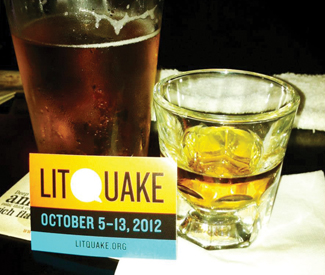
LIT What do you get when you bring together a horde of ravenous bibliophiles in a city that’s known for the possibility of a future catastrophic event? No, not the zombie-nerd apocalypse: Litquake, the largest annual independent literary festival on the West Coast. This year’s nine-day festival runs from Fri/5 through Sat/13, ending with Lit Crawl, the infamous booklovers pub-crawl that words up the Mission. The festival’s venues are as diverse as its writers, ranging from theaters, coffee houses, bars to a barbershop, a bee-keeping supply store, even a parklet. The jam-packed program is expected to bring even more attendees than last year (a whopping 16,581), and features 850 authors in 163 events including hundreds of readings and a multitudinous array of panels and cross-media events.

Originally dubbed Litstock, the festival was conjured up by Jane Ganahl and Jack Boulware at the Edinburgh Castle pub in San Francisco, a watering hole where local authors had been doing readings of their work. Ganahl and Boulware’s idea was simple: get a bunch of writers together to read their work in Golden Gate Park, and see what happens. With the help of Phil Bronstein, then editor of the San Francisco Examiner, they got $300 for a sound system, and on July 16, 1999, Litstock was born. Twenty-five writers read from their work, and to the surprise of Ganahl and Boulware, 300 people came to hear them. In 2002, the festival acquired its new, quintessentially San Francisco moniker, Litquake, and has been growing exponentially — more than 3,650 authors have presented to more than 83,500 people.

(About this year’s installment, Boulware tells the Guardian, “”This year, the festival feels like the programming has more depth than in previous years. We’re including more events at museums, more events outside the city, in particular the Berkeley Ramble, more tributes to noteworthy authors — Lenore Kandel, Woody Guthrie, and Juan Rulfo — and much more diversity in our expanded Lit Crawl schedule. We’re overjoyed to help cement the Bay Area’s rightful place on the national and international literary map.”)

As the story goes, the renaming of the festival in 2002 was partly inspired by an article in USA Today reporting that San Franciscans spend more money on books and alcohol than the residents of any other major city in the nation, according to the Bureau of Labor Statistics. Added to the festival in 2004, Lit Crawl has becoming the living, breathing embodiment of San Francisco’s happy marriage of books and booze — more than 6000 scribes and fans take part in venues in the Mission. San Francisco’s Lit Crawl (this year on Sat/13) has been so successful that there are now Lit Crawls in New York, Austin, Brooklyn and, soon, Seattle.

As neighborhoods go, the Mission is the perfect setting for the event, given its noteworthy independent bookstores and Dave Eggers’s brainchild, 826 Valencia. Like North Beach and the Haight, the city’s former literary hotspots, the Mission has an inherited bohemian spirit (some would call it Beat) that gives life to the idea of literary community.

This year’s Liquake roster of readers is a hefty one, spanning various genres and including such notable participants as Christopher Coake and Daniel Alarcón, both among Granta’s Best of Young American Novelists, along with local legends like US Poet Laureate Robert Hass and poet D.A. Powell. A bound-to-be-popular panel featuring cartoonist Daniel Clowes and Eggers himself will surely to draw a crowd, as the two discuss everything from the creative process to their favorite comics, books, and movies.

And for history buffs, there will be panels on little-known and formerly censored poetry of Beat poet Kandel and a tribute to Jane Austen featuring Karen Joy Fowler, author of bestseller book The Jane Austen Book Club.

It’s a fitting testament to San Francisco’s rich intellectual heritage that, in a city known for its ballooning tech industry (the oft-feared culprit behind literature’s “imminent demise”), San Franciscans’ literary love affair shows no signs of waning. Our lust for books still causes the city to tremble.

LITQUAKE

Fri/5-Sat/13

Various times, venues, and prices, SF.

www.litquake.org


Northern promises

0

On the Road (Walter Salles, US/France/UK/Brazil, 2012) Walter Salles (2004’s The Motorcycle Diaries) engages Diaries screenwriter Jose Rivera to adapt Jack Kerouac’s Beat classic; it’s translated to the screen in a streamlined version, albeit one rife with parties, drugs, jazz, danger, reckless driving, sex, philosophical conversations, soul-searching, and “kicks” galore. Brit Sam Riley (2007’s Control) plays Kerouac stand-in Sal Paradise, observing (and scribbling down) his gritty adventures as they unfold. Most of those adventures come courtesy of charismatic, freewheeling Dean Moriarty (Garrett Hedlund of 2010’s Tron: Legacy), who blows in and out of Sal’s life (and a lot of other people’s lives, too, including wives played by Kristen Stewart and Kirsten Dunst). Beautifully shot, with careful attention to period detail and reverential treatment of the Beat ethos, the film is an admirable effort but a little too shapeless, maybe simply due to the peripatetic nature of its iconic source material, to be completely satisfying. Among the performances, erstwhile teen dream Stewart is an uninhibited standout. Thu/4, 6:30 and 6:45pm, Smith Rafael. (Cheryl Eddy)

Road North (Mika Kaurismäki, Finland) Mika Kaurismäki’s films are generally much more broadly accessible than the dryly minimalist ones of his brother Aki, yet the latter has by far the larger international audience. That might change a bit with this likable seriocomic road trip. Emotionally recessive concert pianist Timo (Samuli Edelmann) is less than delighted one day to find an uninvited guest slumped outside his apartment: the father who abandoned him 30-odd years earlier. Far from having improved himself in the interim, Leo (Vesa-Matti Loiri) is a corpulent slob, convenience store robber, and car thief. But he is insistent in dragging his son on a journey whose full purpose he won’t reveal until its end. Actually, you can guess where it’s headed — but getting there is full of surprises, some touching and some very funny. Fri/5, 9pm, Smith Rafael; Sun/7, 6pm, Sequoia. (Dennis Harvey)

Fat Kid Rules the World (Matthew Lillard, US) It really does suck to be Troy (Jacob Wysocki from 2011’s Terri). An XXL-sized high schooler, he’s invisible to his peers, derided by his little brother (Dylan Arnold), and has lived in general domestic misery since the death of his beloved mother under the heavy-handed rule of his well-meaning but humorless ex-military dad (Billy Campbell). His only friends are online gamers, his only girlfriends the imaginary kind. But all that begins to change when chance throws him across the path of notorious local hell raiser Marcus (Matt O’Leary), who’s been expelled from school, has left the band he fronts, and is equal parts rebel hero to druggy, lyin’ mess. But he randomly decrees Troy is cool, and his new drummer. Even if he’s just being used, Troy’s world is headed for some big changes. Actor Matthew Lillard’s feature directorial debut, based on K.L. Going’s graphic novel, is familiar stuff in outline but a delight in execution, as it trades the usual teen-comedy crudities (a few gratuitous joke fantasy sequences aside) for something more heartfelt and restrained, while still funny. O’Leary from last year’s overlooked Natural Selection is flamboyantly terrific, while on the opposite end of the acting scale Campbell makes repressed emotion count for a lot — he has one wordless moment at a hospital that just might bring you to the tears his character refuses to spill. Sat/6, 3pm, Sequoia; Oct. 11, 7pm, Smith Rafael. (Harvey)

The Central Park Five (Ken Burns, US) Acclaimed documentarian Ken Burns takes on the 1989 rape case that shocked and divided a New York City already overwhelmed by racially-charged violence. The initial crime was horrible enough — a female jogger was brutally assaulted in Central Park — but what happened after was also awful: cops and prosecutors, none of whom agreed to appear in the film, swooped in on a group of African American and Latino teenagers who had been making mischief in the vicinity (NYC’s hysterical media dubbed the acts “wilding,” a term that became forever associated with the event). Just 14 to 16 years old, the boys were questioned for hours and intimidated into giving false, damning confessions. Already guilty in the court of public opinion, the accused were convicted in trials — only to see their convictions vacated years after they’d served their time, when the real assailant was finally identified. Using archival news footage (in one clip, Gov. Mario Cuomo calls the crime “the ultimate shriek of alarm that says none of us are safe”) and contemporary, emotional interviews with the Five, Burns crafts a fascinating study of a crime that ran away with itself, in an environment that encouraged it, leaving lives beyond just the jogger’s devastated in the process. Sat/6, 3:30pm, Smith Rafael; Mon/8, 3:15pm, Smith Rafael. (Eddy)

Rebels with a Cause (Nancy Kelly, US) The huge string of parklands that have made Marin County a jewel of preserved California coastline might easily have become wall-to-wall development — just like the Peninsula — if not for the stubborn conservationists whose efforts are profiled in Nancy Kelly’s documentary. From Congressman Clem Miller — who died in a plane crash just after his Point Reyes National Seashore bill became a reality — to housewife Amy Meyer, who began championing the Golden Gate National Recreation Area because she “needed a project” to keep busy once her kids entered school, they’re testaments to the ability of citizen activism to arrest the seemingly unstoppable forces of money, power and political influence. Theirs is a hidden history of the Bay Area, and of what didn’t come to pass — numerous marinas, subdivisions, and other developments that would have made San Francisco and its surrounds into another Los Angeles. Sat/6, 6:15pm, Sequoia; Tue/9, 4pm, Smith Rafael. (Harvey)

The Sessions (Ben Lewin, US) Polio has long since paralyzed the body of Berkeley poet Mark O’Brien (John Hawkes) from the neck down. Of course his mind is free to roam — but it often roams south of the personal equator, where he hasn’t had the same opportunities as able-bodied people. Thus he enlists the services of Cheryl (Helen Hunt), a professional sex surrogate, to lose his virginity at last. Based on the real-life figures’ experiences, this drama by Australian polio survivor Ben Lewin was a big hit at Sundance this year (then titled The Surrogate), and it’s not hard to see why: this is one of those rare inspirational feel-good stories that doesn’t pander and earns its tears with honest emotional toil. Hawkes is always arresting, but Hunt hasn’t been this good in a long time, and William H. Macy is pure pleasure as a sympathetic priest put in numerous awkward positions with the Lord by Mark’s very down-to-Earth questions and confessions. Sat/6, 7pm, Smith Rafael; Sun/7, noon, Sequoia. (Harvey)

Flicker (Patrik Eklund, Sweden) The provincial HQ of behind-the-times, inept telecommunications company Unicom is locus to a whole bunch of weirdness during the eventful work week chronicled by Swedish writer-director Patrik Eklund’s first feature. To wit: sterility by electrocution, tarantula therapy, grade-school performances of Frankenstein, Ted Danson fixations, workplace application of dunce caps, blind dates, domestic terrorism cults, and scented candle making. If you only see one Scandinavian comedy this year, make it Klown. If you only see two, however, this is definitely the other one. It’s a goofy, lightly surreal delight. Sat/6, 9pm, Smith Rafael; Mon/8, 3:15pm, Smith Rafael. (Harvey)

Jayne Mansfield’s Car (Billy Bob Thornton, US) Billy Bob Thornton’s first directing gig in over a decade is an ensemble piece set in small-town 1969 Alabama — like every U.S. town at the time, a hotbed of generational conflict over the Vietnam War and the generally changin’ times. Particularly defining that gap is the squabbling relationship between hawkish patriarch Jim Caldwell (Robert Duvall) and youngest son Carroll (Kevin Bacon), who — though a World War II veteran, like brother Skip (Thornton) — has appointed himself a sort of elder to the local hippie population. That alone is enough to set Jim’s teeth on edge; he’s put in an even crustier mood upon hearing that his ex-wife has died, and her corpse is being brought back from England by the new family (John Hurt, Ray Stevenson, Frances O’Connor) she’d acquired after leaving him. The awkward meeting between two very different clans quickly thaws in various ways, however, some sexual, some comradely. Dismissed as a garrulous mess in its other festival showings to date, this Car is indeed one rusty, leaky, wayward vehicle at times, with some forced situations and way too much speechifying in the director’s script (co-written with Tom Epperson). But the thematically over ambitious, structurally clumsy movie is watchable nonetheless, with some real strengths: most notably strong performances (especially Thornton’s own) and a real feel for a particular high-Southern Brahmin milieu that hasn’t changed much more in the last 40 years than it did in the prior 40. Thornton will receive the MVFF Award and be interviewed onstage at the film’s screening. Sun/7, 6:30pm, Smith Rafael; Oct. 14, 5pm, Smith Rafael. (Harvey)

Ricky on Leacock (Jane Weiner, France/US) Shot over the last 40 years, since she was her subject’s student, Jane Weiner’s film about globe trotting director-cinematographer Richard Leacock is a fond tribute that pays due respect to the latter’s innovations in the documentary form. Dismayed by the lack of spontaneity that cumbersome equipment forced on the genre, he began devising a series of lightweight, synch-sound cameras that could unobtrusively travel with and capture events as they occurred. While his own mostly TV-targeted fruits of that labor are relatively little-known today, their impact on nonfiction cinema was enormous — and Leacock, who died last year at 89, was clearly charming company. Sun/7, 7pm, Smith Rafael; Mon/8, 9:15pm, 142 Throckmorton. (Harvey)

In Another Country (Hong Sang-soo, Korea) This latest bit of gamesmanship from South Korea’s Hong Sang-soo (2000’s Virgin Stripped Bare by Her Bachelors) has Isabelle Huppert playing three Frenchwomen named Anne visiting the same Korean beachside community under different circumstances in three separate but wryly overlapping stories. In the first, she’s a film director whose presence induces inapt overtures from both her married colleague-host and a strapping young lifeguard. In the more farcical second, she’s a horny spouse herself, married to an absent Korean man; in the third, a woman whose husband has run away with a Korean woman. The same actors as well as variations on the same characters and situations appear in each section, their rejiggered intersections poking fun at Koreans’ attitudes toward foreigners, among other topics. Airy and amusing, In Another Country is a playful divertissement that’s shiny as a bubble, and leaves about as much of a permanent impression. Tue/9, 4:15pm, Sequoia; Oct. 12, 9:45pm, Smith Rafael. (Harvey)

To Kill A Beaver (Jan Jakub Kolski, Poland) Furtive, paranoid, solitary Eryk (Eryk Lubos) returns from places unknown to prepare his dilapidated farmhouse for a mission that, for a long time, remains equally unclear. Veteran Polish director Jan Jakub Kolski’s enigmatic drama takes its time unfolding the mysteries of Eryk’s traumatic past, unstable present, and future purpose. He’s all suspicion when he finds local teen Bezi (Agnieszka Pawelkiewicz) trespassing on his property, but her brazen come-on and hidden vulnerabilities chip away at his ample defenses. This intricate character study in the guise of a thriller puzzle is offbeat and absorbing, thanks in large part to Lubos’ prickly performance as a man as damaged as he is dangerous. Oct. 10, 6:30pm, Smith Rafael; Oct. 11, 9:30pm, Sequoia. (Harvey)

Holy Motors (Leos Carax, France) Holy moly. Offbeat auteur Leos Carax (1999’s Pola X) and frequent star Denis Lavant (1991’s Lovers on the Bridge) collaborate on one of the most bizarrely wonderful films of the year, or any year. Oscar (Lavant) spends every day riding around Paris in a white limo driven by Céline (Edith Scob, whose eerie role in 1960’s Eyes Without a Face is freely referenced here). After making use of the car’s full complement of wigs, theatrical make-up, and costumes, he emerges for “appointments” with unseen “clients,” who apparently observe each vignette as it happens. And don’t even try to predict what’s coming next, or decipher what it all means: this wickedly humorous trip through motion-capture suits, graveyard photo shoots, teen angst, back-alley gangsters, old age, and more (yep, that’s the theme from 1954’s Godzilla you hear; oh, and yep, that’s pop star Kylie Minogue) is equal parts disturbing and delightful. Movies don’t get more original or memorable than this. Oct. 11, 6pm, Sequoia; Oct. 12, 3:15pm, Smith Rafael. (Eddy)

The 35th Mill Valley Film Festival runs Oct. 4-14 at the Christopher B. Smith Rafael Film Center, 1118 Fourth St, San Rafael; Cinéarts@Sequoia, 25 Throckmorton, Mill Valley; and 142 Throckmorton Theatre, Mill Valley. For additional venues, full schedule, and tickets (most shows $13.50), visit www.mvff.com. Additional short reviews at www.sfbg.com.


Downtown development

1

LIT/VISUAL ARTS The term “Mission School” was coined in these pages by Glen Helfand in 2002 to describe a loose-knit group of artists based around the Mission District who were then just beginning to break through into international art world success. These artists — including Barry McGee, Margaret Kilgallen, Chris Johanson, Alicia McCarthy, Rigo 23 and others — made use of found materials and shared an informal aesthetic that was influenced as much by the low rent streets of the city around them as a relaxed, collective Bay Area vibe.

A decade later, it seems safe to say that the Mission School was probably the last major art movement of its kind in this country, and itself the end of an era. For over three decades, significant art and music breakthroughs in this country were linked to specific urban neighborhoods (hip-hop to the South Bronx; Warhol’s Factory to downtown Manhattan, riot grrrl to Olympia, Wash.; grunge to Seattle; Fort Thunder in Providence, RI, etc.) Today, with the rise of the importance of MFA programs as a means to enter the art world, and the lack of locality fostered by the internet, the era of geographic specificity as arts incubator has perhaps passed us for good.

Two new books take us back to those freer, more experimental days at the inception of the SoHo and East Village arts scenes of New York in the 1970s and 80s. 112 Greene Street: The Early Years (1970-1974) (Radius Books, 192 pp., $50) is a brief, but invigorating oral history from the early years of what we now know as SoHo. This just-released catalog to last year’s exhibition at Zwirner Gallery in Chelsea brings to life the sense of discovery and improvisation of the nascent neighborhood scene that centered around the legendary pioneering alternative arts space and its north star, the late Gordon Matta-Clark.

In October 1970, when Jeffrey Lew and Matta-Clark opened 112 Greene Street in the storefront of a “rundown former rag picking factory,” the area south of Houston Street was a wasteland of abandoned former textile factories known as Hell’s Hundred Acres. The space, with its lack of heat, and its raw walls, uneven floors, and poor artificial lighting resembled the city then falling apart all around it. The ruins of the city not only influenced the work; sometimes they literally became work.

Alan Saret remembers walking near Canal Street with Matta-Clark one night when a cornice simply fell off a building right in front of them. Saret found some other cornices on the ground nearby and paid the crew of a passing city garbage truck to haul them back to 112 Greene where they became part of a sculpture piece he called Cornices.

Far from the uptown galleries where Manhattan art world power then was consolidated, 112 Greene’s isolation and state of decay fostered a certain kind of “anything goes” artistic freedom and collaborative spirit. For the first opening at 112 Greene, Matta-Clark jackhammered a hole in the basement floor and filled the area with dirt, where he planted a cherry tree that he kept alive all winter with grow lamps. For a later exhibition, George Trakas wanted to do a two-story sculpture, so he simply cut a hole in the floor so his piece could rise up out of the basement into the main floor. The only rule seemed to be that work had to be created on site and could not be made for sale.

Perhaps predictably, with this last rule, the space could barely keep its doors open. Yet, there is a timeless lesson here for those running arts spaces today: the downfall of 112 Greene came ironically only after it finally achieved financial stability. When Lew landed a big NEA grant in 1973, pure art experimentation and spontaneity gradually gave way to formal scheduling and programming guidelines from the funders in DC, who demanded more and more say in the operation of the space. “The excitement that anything could happen waned as paperwork and schedules were enforced,” remembers Lew. The core group of artists slowly drifted away from 112 Greene, just as the original SoHo, too, was beginning to change all around them into the high-end shopping district it is today.

The SoHo model has become a cynical real estate gentrification strategy, as developers create prefab arts — and shopping — neighborhoods in empty warehouse districts across the country from Miami to Portland, Ore. to Brooklyn. But if, say, Bushwick’s art scene feels less like a real place than the shores of a desert island where hundreds of young artists have been randomly washed up by the storms of the global economy, 112 Greene Street reminds us that the first art neighborhoods were formed organically around genuine community. In 1971, Matta-Clark and artist Carol Goodden started an artist-run collective restaurant in SoHo called Food. By all accounts, Food was not some relational aesthetic stunt; it was a well loved and sincere attempt to provide cheap meals, a gathering place, and jobs to artists in the scene.

112 Greene Street ends before Matta-Clark’s untimely death from pancreatic cancer at age 35 in 1978, and before the artist would famously take the work he developed in the ruins of 112 Greene out into the ruins of the city with a practice he dubbed “Anarchitecture.” He took the city as his canvas, transforming raw space by sawing dramatic cuts in the floors and facades of abandoned buildings in the South Bronx and industrial parts of New Jersey. But the charm and dreamy freedom of the era 112 Greene Street depicts comes through in Matta-Clark’s film, Day’s End. In it, Matta-Clark works calmly with a blowtorch, cutting holes in the steel ceiling of an abandoned city pier on the Hudson River (with no apparent fear of getting caught) as the space slowly fills with radiant light.

A decade later, another artist who would die too young, David Wojnarowicz, would also find a wide-open playground in the rotting piers along the river. Wojnarowicz would spend hours at the piers, writing about what he saw there, having sex with strangers, and drawing murals or writing poetry on the crumbling walls. Wojnarowicz delighted in the ruins and saw the piers as a sign that America’s empire was fading away before his eyes. That today we know it was actually only Wojnarowicz’s world that was about to disappear is just one of the many poignant aspects of Cynthia Carr’s beautiful new book, Fire in the Belly: The Life and Times of David Wojnarowicz (Bloomsbury USA, 624 pp., $35), the first comprehensive biography to date of the artist, writer, and activist who died of AIDS at the age of 39 in 1992.

On the run from an abusive father, Wojnarowicz started sleeping with older men for money while living on the streets in his teens. Drawn to other criminals and outlaws, his first published writings were based on interviews he did with street hustlers, travelers, and homeless people he met in skid row waterfront diners and on hitchhiking trips. In the works of Jean Genet, he found a literary moral universe that helped him make sense of his own worldview. One of his earliest surviving works, a collage entitled St. Genet, depicts the French writer wearing a halo in the foreground while in the background, Jesus is tying off to shoot up. While Wojnarowicz would continue to use such blunt religious imagery in his work, the collage resonates in other ways. Carr reports that it was Kathy Acker who first called Wojnarowicz “a saint” when she appeared with him at his final public reading in 1991. The identification of Wojnarowicz’s life and work with the tragic loss of so many daring, outlaw artists to AIDS is so complete that Wojnarowicz has become a patron saint to young queer and activist artists today, his life story surrounded by an aura of myth.

Carr, a former arts reporter for the Village Voice, carefully picks apart myth from fact: Wojnarowicz didn’t actually start selling his body for money at age nine as he often claimed and he also wasn’t a founding member of ACT UP as many people suppose (though he did participate in some ACT UP protests). Yet, the complex and more human Wojnarowicz that Carr leaves us with is no less inspiring a figure — a self-taught artist whose lifelong struggle to make meaningful art out of his own experience, sexuality, and ultimate diagnosis with an incurable disease would almost by chance place him front and center in the story of the AIDS crisis and the great culture wars of the late 1980s and early ’90s.

Carr, a resident of the East Village now for four decades, became friends with Wojnarowicz late in his life, and she refreshingly breaks journalistic “objectivity” to insert her own eyewitness perspective into the narrative at many key junctures. One senses Fire in the Belly is so good precisely because it is a story only Carr could personally tell. Built on years of observation, Fire in the Belly has the ambitious scope and rich detail of a novel, and, more than a biography, is the story of a fabled East Village scene now irrevocably lost.

Wojnarowicz arrived in a gritty East Village where whole blocks had been abandoned to heroin dealers and bricked up tenements. A nihilistic neighborhood arts scene embraced the decay of the streets as an aesthetic, and galleries like Civilian Warfare Studios presented a giddy cocktail of downtown punk and queer culture mixed with the freshly born graffiti and hip-hop scenes of the South Bronx. Carr relates now-famous events like Gracie Mansion’s “Loo Division” show (mounted in the bathroom of her E. Ninth Street walkup), Keith Haring painting on the snow on the street in front of his show at Fun Gallery, and the exploits of the Wrecking Crew — a team including Wojnarowicz and other artists who would binge on acid and stay awake for days, filling galleries with creepy and crazed collaborative installations.

The artists’ isolation would not protect them from the art world for long. Soon, limos were disgorging passengers at openings on the heroin and rat-filled terra incognita east of First Avenue. East Village stalwarts like Jean-Michel Basquiat and Haring became rich and internationally famous, and even Wojnarowicz became a fairly established up-and-coming art star. The rags-to-riches story of the East Village scene might be the same kind of innocent tale of lost Bohemia as that of 112 Greene, were it not for the AIDS crisis shadowing it the whole time. Carr skillfully juxtaposes the narrative of openings and parties with chronological news reports of the then-unknown new disease. Carr describes a party on Fire Island in July 1981: writer Cookie Mueller read a story from the New York Times out loud to the room about a strange, new “gay cancer”. Photographer Nan Goldin, who was present, remembers today, “We all just kind of laughed.”

Carr’s tale picks up suspense after Wojnarowicz himself is diagnosed with AIDS. Over a breathtaking two-year period, Wojanrowicz embarks on an urgent mission to complete every single art project he’d ever hoped to accomplish in the time left to him in life. In the process he almost reluctantly becomes the fiery AIDS activist we remember today. While working on his career retrospective, he also battles the harassment of his landlord who is determined to evict Wojnarowicz and convert his loft in the gentrifying East Village into a cinema multiplex. He struggles to complete his memoir, even as his work becomes the focus of battles over government funding of art. Soon, Republicans denounce the dying man’s work as obscene and anti-Christian on the floors of Congress, and Wojnarowicz becomes a target of conservative Mississippi preacher Reverand Donald Wildmon’s public attacks. Wojnarowicz absorbed these attacks and the era’s stunning homophobia and turned them into what became the most powerful work of his career, the myth of his own life.

Carr’s book stands along with recent work like Sarah Schulman’s Gentrification of The Mind as a corrective to the uncritical nostalgia for the lost New York City of the 1970s and 80s that seems to have flowed like a river from Patti Smith’s 2009 memoir, Just Kids. These works unromantically detail what has been lost and then lovingly describe exactly how painfully it was all lost. Yet, perhaps all is not lost. While arts neighborhoods like the ones described in 112 Greene Street and Fire in the Belly seem like a thing of the past, the towering myths left behind by figures like Matta-Clark and Wojanrowicz still bring young artists against all odds to the rehabbed neighborhoods of San Francisco and New York today. Everytime Sara Thustra serves a meal at an opening at Adobe Books on 16th Street or Homonomixxx shuts down a Wells Fargo bank, we walk, if just for a short time, the streets of our old familiar city.

David Wojnarowicz: Cynthia Carr and Amy Scholder in Conversation
Wed/3, 7:30pm, free
Lecture Hall
San Francisco Art Institute
800 Chestnut, SF
www.sfai.edu/event/CynthiaCarr

Fierce, forceful, amazing: remembering Robyn Few

0

Robyn Few, innovative sex worker revolutionary and a part of the soul of San Francisco, passed away Sept. 13. 

Robyn was a mother, a grandmother, and a wife. She was a leader. She died in her hometown of Paducah, KY after a long battle with cancer.

Robyn ran away from home when she was 13, and started survival sex. When she was 18, she became a legal sex worker. In a 2008 interview, Robyn remembered how much she loved stripping: “I loved it so much; it was so empowering to be able to get up on the stage…I came alive, and for me being paid to dance and to show my body [that] I was so proud of anyway…it was just an amazing experience.” She worked in massage parlors, as an escort, in an illegal brothel. She got married and had a child. After her divorce, Robyn moved to San Francisco.

Here, she got immersed in activism to legalize marijuana, and continued to do sex work, although she wasn’t out about it to most people she knew. But when she was arrested in 2001 in a nationwide sting, she couldn’t hide it anymore.

“When I was arrested, of course, everybody found out about me, and they treated me differently. They absolutely treated me differently. And here I was, the same person before I was arrested as I was after. I mean nothing had changed about me. Yet I was treated differently because people thought that I shouldn’t be a sex worker. So that made me very angry. And I became a major activist,” Robyn remembers in the 2008 interview. “Just because you’re a sex worker doesn’t mean you’re not a great community citizen. And that’s what I proved. And once I proved that, people began to trust me. And being a sex worker wasn’t so bad for them.”

After her arrest, Robyn remained dedicated to marijuana activism and dove into sex workers’ rights activism. She founded the Sex Workers Outreach Project, which now has chapters all over the US and around the globe. She helped create the International Day to End Violence Against Sex Workers, observed annually on Dec. 17. She spearheaded campaigns to decriminalize prostitution in Berkeley, Measure Q, and San Francisco, Prop. K. She consulted with members of the New Zealand Parliament during a successful bid to decriminalize prostitution there. 

Yesterday, a loving ceremony in honor of Robyn took place outside City Hall, and people from throughout her family and community shared their memories of her. Here are some of the stories.

“Robyn was one of the only people I’ve ever met to turn every party into a political rally and every political rally into a party.” 

“She always brought whores to the stoners and pot to the hookers. And as you can imagine both parties very much appreciated the matchmaking.” 

“She was fierce, forceful, amazing.”

“My mom was a really amazing person, and I will always miss her so much…She was so vibrant and amazing. She always was ready to do whatever she could. She was just an amazing person, and I will miss her.”

“The one thing that Robyn blows me away with more than anyone else on this planet is her ability to love absolutely anyone. Somebody a long time ago told me that the sign of a good sex worker is to be able to love absolutely anyone. And Robyn had that down more than anyone else. I have never seen someone give the same respect to every single human being she met. She had a light that shone through her eyes. She was an angle on the planet, and we’re all very, very blessed to have known her.”

“We were having a panel on coming out, should you or shouldn’t you. And she stood up and she proudly said, ‘I’m a whore!’ and I was just so shocked. And she just started screaming, ‘I’m a whore, and I’m proud! I’m a whore!’ It looked like she had just gone through chemo. And I was just so shocked and touched by her….In honor of Robyn, I would like to stand on the steps of City Hall today and declare my whoreness! There’s nothing to be ashamed of. And she was really inspiring. She was a really inspiring person.”

“She taught me so much, especially about the power of people of color in activist movements.”

“I first met Robyn because she was one of the original bitches of ASA (Americans for Sex Access). That’s what they called us, because all the drug policy groups were mostly men. And they were all very single-issue.”

“I, like a lot of educated women, like we like to call ourselves, thought I was a feminist until I met Robyn Few. Then I realized how full of shit I was. I always thought, well, sex work is exploitative right?… Violence against women is constantly tolerated and legitimized by the whole idea that what somebody chooses to do with their body- right, pro-choice- that what somebody chooses to do with their body is the purveyance of the state. Why do you think that the state should be able to tell you what you should do with your body?”

“I grew up in a very conservative place in Idaho, and Robyn has had a huge impact on my life, in just a mindset of things. And the biggest thing that I’ve learned from her is that all my preconceived notions about the way people should behave and the way things should be have been learned. And they can be learned again, or unlearned.”

“I had been arrested for prostitution, and because I was also a teacher at Berkeley High, it made the national news…. Even though I really just wanted to wear a big, enormous hat, huge glasses, and sneak in and out of court to avoid the whole thing…the activist in me said, OK, well the fucking cameras are on me, and they’re wanting to talk to me, so I need to say something and make use of this opportunity….so my life’s falling apart, I’m never going to be able to teach again. I can’t work because my clients are afraid to come see me, I’m all over the fucking news. I’m totally depressed…and Robyn! Every time I see Robyn she’s like, we’re going to take it to the Supreme Court! Because it was right after Lawrence vs. Texas had settled in the Supreme Court. So Robyn was like, the precedent’s been set, the language is there, we’re going to go for it, this is the case!…Robyn was just so happy. She was so supportive, so happy and so fun. She had sign making parties for my press conference, and every time I saw her she was so happy. OK, but here’s the thing. I eventually found out that she was in the middle of her own court case, a federal case, where she was facing time in prison, and didn’t know yet if she was going to prison. Her sentencing hearing was coming up….And here she is, she’s just this ray of sunshine and positive energy, and so happy and buoyant and supportive. And she never mentioned that she was possibly going to be going to prison for her own case.”

 “As you all know, her laugh is one to treasure, and  her charisma pulls in strangers….When Robyn and I talked about her opting out [of continuing treatment], it wasn’t a gamble on life. It was to choose an end to life, filled with travel and friends and love rather than life’s end governed and shaped by treatment and sterile institutions.”

“She was proud of her whore sisterhood, pleased with what had been accomplished, and confident that the younger SWOP members would continue what she started.”

“She’s created a whole movement. And her tenacity and her drive and her fight and her inspiration is so contagious. It was so contagious.”

“I dedicated a good month trying to help Prop. K pass. And so the day that the decision was going to come down, she rented a limo regardless. She was like, I’m renting a limo, we’re going to party, it’s going to be great. And then I’m hoping, hoping, hoping, I’m all come on Prop. K. We’ve worked so hard on this. Blood, sweat and tears, blood, sweat and tears. And then we hear on the radio the result. And I’m about to cry, and here’s the miracle part. Robyn Few jumps out the top of the limo and she’s all, ‘Yeah! 41.2 percent motherfuckers!’ And that is the miracle mindset…because you did lose the proposition but we won so much….we didn’t lose anything, we gained.”

“Robyn Few died on the same day as one of my other favorite activists, Tupac Shakur. On September 13. And people still remember Tupac’s legacy. And there’s certain activists like that, like Robyn, like Bob Marley. They’re all pot smokers. And I just feel really, really fortunate to have met her, because she is a special activist.”

Robyn Few will be missed.

TIFF happens, part three! Plus top films of the fest

0

Read Jesse Hawthorne Ficks’ first and second reports from the 2012 Toronto International Film Festival.

Dial M For Murder 3D Remastered (Alfred Hitchcock, US) The digitally remastered re-release of Alfred Hitchcock’s only 3D production was introduced by none other than film historian David Bordwell, whose introductory textbooks Film Art (1979) and Film History (1994) have shaped countless film students. After an insightful Hitchcock introduction that left me feeling as if I had downloaded an entire book to my central nervous system in only 12 minutes, the 4K, 3D digital restoration began.

What was most exciting about this often-dismissed Hitchcock flick (aside from the highly effective 3D itself) was recognizing how incorrect critics in 1954 had been when they complained about how pathetic the 3D was utilized. Re-evaluating Dial M For Murder in the present 3D age, it is overwhelmingly clear that Hitchcock understood the complexity of his technique; instead of overusing the “in your face” gimmick he directed his attention toward utilizing the depth of the sets and perfectly placed props near the camera. Fifty-eight years later, even one of Hitchcock’s “lesser” films (even according to himself) is still paving the road for future films and filmmakers.


Frances Ha (Noah Baumbach, US) The adorably awkward Greta Gerwig has been this generation’s “It Girl” since arriving on the indie scene in 2006 by way of director Joe Swanberg’s LOL. Frances Ha has given her what should prove to be her defining role in Noah Baumbach’s equally effervescent effort.
Baumbach’s mumblecore-anticipating, French New Wave-inspired films — Kicking and Screaming (1995), Mr. Jealousy (1997), The Squid and the Whale (2005), Margot at the Wedding (2007), and Greenberg (2010) — showcase flawed characters who some find so intolerable that watching a Baumbach film feels like getting stuck at an upper-class dinner party with the most unlikable people on the planet. But as in a Coen Brothers or Woody Allen film, these characters’ ugly truths are the key to what makes them so memorable.

In fact, it’s why all of Baumbach’s films have struck such a chord with me for 15-plus years. I keep seeing my own personality pitfalls in these Gen X-ers’ self-destructive decisions (I will literally say out loud, “I just pulled a Greenberg.”) And Frances Ha‘s hilarious train-of-thought odyssey is as profound as it is whimsical. With a cast pulled straight out of Lena Dunham’s HBO series Girls and added to the glorious black and white cinematography by Sam Levy (2008’s Wendy and Lucy), this ode to Allen’s Manhattan (1979) most definitely will make it to the top of a ton of critic’s lists. But more importantly you’ll find yourself thinking about the film as it relates to the most embarrassing moments of your own life.

http://www.youtube.com/watch?v=THh1krqYwo4

The Act of Killing (Joshua Oppenheimer, Denmark) Easily one of the most horrific and disturbing films ever made, and what’s even more frightening is that it’s a documentary. I have tried to explain this film to numerous people since being utterly transfixed and totally destroyed by it and often I see an odd glaze creep across the listener’s eyes. Filmed over a six-year period in Indonesia by filmmaker Joshua Oppenheimer, The Act of Killing plays out like a misanthropic satire, where the characters are so honest about their pure apathy towards other human lives that you as a viewer become unaware of what psychological quicksand lies ahead.

Again, this is a documentary and as it painstakingly introduces you to a group of elders in a small Indonesian village, self-revered war heroes from the military coup of the Communist government in 1965. Their leader, Anwar, and his friends decide they don’t want to just tell their war stories for a documentary, they want to re-enact each type of their actual killings in all the flair and glory of the movies that they grew up watching — John Wayne Westerns, extravagant musicals, and gangster epics like Scarface (1983). What ensues feels like Alfred Hitchcock’s Murder! (1930) or even the third act of Hamlet and could leave you absolutely accosted, obliterated, and feeling an unwanted amount of affectionate understanding. Either way, you will never be the same after watching this movie.

http://www.youtube.com/watch?v=pKG63WoOFGI

Berberian Sound Studio (Peter Strickland, UK) My favorite film of the festival takes place on the post-production set of a Dario Argento-esque, Italian horror film in the late 1970s-early 80s. This hypnotic, nostalgic, and ultimately transcendental experimental exercise will test the patience of just about every audience member. But anyone who has worked at a job (much less on the production of a film) where the possibility of losing the concept of time, as well as one’s grasp on reality, is a possibility may be able to conquer this monotonous, mind-bending ode to Brian De Palma’s Blow Out (1981). (Actual quote from a fellow press member leaving the screening: “Are you kidding me?!”)

Another quote — this one by filmmaker Paul Schrader, in his life-altering book Transcendental Style In Film (1972)  — says it best: “I would rather do something really small of some value than do what Marty Scorsese’s doing. I don’t see the fun in that.”

Top films of the 32 films I saw at the Toronto International Film Festival:

1. Peter Strickland’s Berberian Sound Studio (UK)
2. Joshua Oppenheimer’s The Act of Killing (Denmark)
3. Xavier Dolan’s Laurence Anyways (Canada)
4. Michael Haneke’s Amour (Austria)
5. Rob Zombie’s The Lords of Salem (US)
6. Jun Lana’s Bwakaw (Philippines)
7. Miguel Gomes’ Tabu (Portugal)
8. Noah Baumbach’s Frances Ha (US)
9. Brian De Palma’s Passion (Germany/France)
10. Martin McDonagh’s Seven Psychopaths (UK)
11. Bahman Ghobadi’s Rhino Season (Iran/Turkey)
12. Anurag Kashyap’s Gangs of Wasseypur (India)

http://www.youtube.com/watch?v=vrshKIuQyLk

(Buzzed-about fest favorites that I was sadly unable to screen: David O. Russell’s Silver Linings Playbook, Ben Affleck’s Argo, Sarah Polley’s Stories We Tell, Cristian Mungiu’s Beyond the Hills, and Lee Daniels’ The Paperboy).

Jesse Hawthorne Ficks is the Film History Coordinator at the Academy of Art University and hosts Midnites for Maniacs, a film series devoted to underrated, overlooked, and dismissed cinema.

Why do people have a problem with bikes?

68

I’ve always been perplexed at all negativity that gets directed at bicyclists in general, and those who ride on Critical Mass in particular. The people from around the world that I’ve met this week as I worked on our cover story about the 20th anniversary of Critical Mass have been some of the nicest and most positive and life-affirming people I’ve met in a long time, the exact opposite of the sometimes-voiced stereotype that they’re entitled or angry.

So I was interested to read a pair of dueling online posts this week analyzing why motorists and other non-cyclists feel such disproportionate and inexplicable anger and resentment toward a whole class of people who have made a transportation choice that helps everyone, reducing traffic congestion and transit costs while helping protect the environment and reduce dependence on oil.

Their answers range from the affect heuristic, which is the idea that emotional triggers like seeing a cyclist almost get splattered affect our perceptions far more than our reason, to the resentment many drivers feel about being stuck in traffic while cyclists zip past them and just the basic sense of how foreign and strange cycling seems to many who don’t do it.

Some of those arguments ring more true to me than others, but I think the entire discussion is a fascinating one to have in the days leading up to this Friday’s 20th anniversary Critical Mass ride, which will feature a rainbow of nationalities, ideologies, ethnic and class backgrounds, and other traits – their only real commonality being an affinity for bikes.

“I just really like to ride. It’s a meditative thing for me. All my epiphanies come to me on a bike,” Alix Avelen, a 25-year-old woman who just moved to San Francisco from Toronto, bike touring the final leg from Vancouver starting in July, told me during Sunday’s Art Bike/Freak Bike Ride, part of the CM20 celebration.

It was her very first Critical Mass, although she’s been a regular urban cyclist for the last six years, and she believes that it’s important to have events, communities, and cultural happenings that promote cycling: “It just makes sense in cities.”

“We’re going to end up riding bikes because oil is getting more expensive and the streets are becoming more crowded,” rRez, a San Francisco native and longtime supporter of the city’s cycling community, told me on that ride. “Things are changing partly because we want them to change and partly because the old world is not sustainable.”

We can continue to cling to the old ways in the face of evidence that neither local roads nor our taxed planet can accommodate an indefinitely growing number of cars. Or we can encourage more people to try riding bikes, and give us the infrastructure we need to do it safely, rather than seeing us as a hostile force trying to take over your roads.

Even grungy looking anarchists like Justin Hood of the Black Label Bike Club offer surprisingly clear-eyed assessments of the role of bikes and Critical Mass. “The point of Critical Mas is just to go out and ride your bike. It’s not supposed to be about confronting drivers and smashing cars,” Hood said, admitting that there are times and places for such aggressive resistance, just not during this ride. “The point of Critical Mass is that if there’s enough of us, we are traffic. And this Critical Mass coming up is going to be gigantic!”

Or if you’d rather talk than ride, there are some opportunities for that this week as well, including the Shift Happens: Critical Mass at 20 book release party and discussion at 5:45 this afternoon at the Main Library; and the International Critical Mass Symposium from 5-8pm on Saturday at the California Institute of Integral Studies.

TIFF happens, part two!

2

Read Jesse Hawthorne Ficks’ first report from the 2012 Toronto International Film Festival here.

In Another Country (Hong Sang-soo, South Korea) This highly enjoyable Éric Rohmer-esque vehicle for Isabelle Huppert continues Hong’s tradition as being the Korean Woody Allen by making a highly personal comedies. Huppert is masterful bouncing in and out of each random-yet-interconnected sequence, but Yu Jun-sang steals the show as the local lifeguard who hilariously channels Roberto Benigni (circa Jim Jarmusch’s 1986 Down By Law). It’s one of the funniest comic performances of 2012.

http://www.youtube.com/watch?v=kveNw8uD2kY

Passion (Brian De Palma, Germany/France) Brian De Palma is back, and primed for those of us who love the way he remixes his favorite Alfred Hitchcock movies (see: 1976’s Obsession, 1980’s Dressed To Kill, 1984’s Body Double, and 2002’s Femme Fatale). This time, though, De Palma remakes a French thriller: Alain Corneau’s 2010 Love Crime. It begins with a whiter-than-Wonder Bread color scheme and structurally devolves into something much more sinister combined with a crisp HD cinematography by Jose Luis Alcain (of Pedro Almodovar fame.)

De Palma said in the press that he really wanted someone who “understood how to make a woman look beautiful” — and by gawd, leads Rachel McAdams and Noomi Rapace not only look flawless but deliver deliciously diabolical performances. Passion also boasts what has to be one of De Palma’s most exciting conclusions. As soon as it was over, I wanted to watch it again! Who says De Palma peaked with Scarface (1983)?!

http://www.youtube.com/watch?v=j-AkWDkXcMY

Gangs of Wasseypur (Anurag Kashyap, India) Only 10 critics (yes, I counted) at the festival completed both parts of Anurag Kashyap’s Gangs of Wasseypur, which runs five hours and 15 minutes long. But I feel those of us who did are bonded together forever.

This historical Hindi gang epic, which begins in 1941 ends in the present day, is massive film that transcends generations and should make Ram Gopal Varma (of Sarkar films fame, clearly an inspiration here) proud. Director Anurag Kashyap pays attention to the details: wonderfully changing fashion and hair styles, ever-evolving movie posters on the alley walls. Not only is Gangs a tribute to the history of Hindi cinema, it establishs quite brilliantly where and what time period the characters are in — and during a five and half hour movie, you need all the help you can get.

http://www.youtube.com/watch?v=3SiHa6gVuyI&feature=related

Spring Breakers (Harmony Korine, US) This extremely hyped Harmony Korine dream project does exactly what you could ever fantasize about by delivering a T&A-filled exploitation film, led by James Franco as a grimy, gold-grilled-grinning, dreadlocked drug dealer who lives to prey on bikini-clad young girls (which is perfectly punctuated by the brilliant casting of Disney darling Selena Gomez.)

Spring Breakers is poised to become Korine’s most popular film to date, but its commercial appeal will likely overshadow perhaps his greatest film: Lotus Community Workshop, which played the San Francisco International Film Festival earlier this year and features a legendary performance by the almighty Val Kilmer! Don’t miss either of these soon-to-be contemporary cult classics.

http://www.youtube.com/watch?v=jgzkzVI5O3c

Aftershock (Eli Roth and Nicolas Lopez, US) Eli Roth and Nicolas Lopez’s earthquake horror flick Aftershock is a gleefully mean-spirited grindhouse thriller that sends a group of annoying American tourists (led by Roth himself, as the dorkiest douchebag of the year) into earthquake-ridden Santiago, Chile. Throw in every tried and true obstacle from 70s genre flicks such as Mark Robson’s Earthquake (1974) and Wes Craven’s Last House on the Left (1972) and you’ve got either one helluva hilarious tongue-in-cheek horror roughie, or, as some critics leaving the press screening were saying: “One of the worst films of the year. It definitely should go straight-to-streaming.”

http://www.youtube.com/watch?v=1YjIWEky81M

Laurence Anyways (Xavier Dolan, Canada) Winner of the Best Canadian Feature at this year’s fest, Xavier Dolan’s Laurence Anyways is yet another OCD, gorgeously-designed love story; it fits perfectly alongside his extremely personal I Killed My Mother (2009) and his devastatingly spot-on hipster classic Heartbeats (2010).

Once again, Dolan’s characters are allowed to feel obsessive about one another while encased in jaw-dropping mises en scène. Some critics seem to take issue with this 24-year-old’s influences (Wong Kar-wai, Pedro Almodovar), which led many reviews suggesting that Dolan needs to hire an editor (Laurence Anyways clocks in at two hours and 41 minutes).

But I would argue that this epic, gender-bending love story needs to take its time to do what no other film has ever done right. By humanizing not only Laurence, the transgendered lead character (epically performed by Raúl Ruiz’s ingenue, Melvil Poupaud), but also his life-long lover Fred, performed with an Elizabeth Taylor-esque guttural passion by Suzanne Clément, who won the Best Actress prize in this year’s Cannes Film Festival’s sidebar competition, Un Certain Regard.

For those willing to give in to a decade’s worth (1989-1999) of hypnotic set and costume designs, cryptic character development, a crew of campy castaways, and a killer soundtrack ranging from Visage to Celine Dion, Laurence Anyways should elevate Dolan from Canada’s best kept-secret to being an integral leader of a post-gender film movement that is just about to explode.

Jesse Hawthorne Ficks is the Film History Coordinator at the Academy of Art University and hosts Midnites for Maniacs, a film series devoted to underrated, overlooked, and dismissed cinema.

Our Weekly Picks: September 26-October 2

0

WEDNESDAY 26

Amanda Palmer and the Grand Theft Orchestra

Massachusetts singer-songwriter Amanda Palmer has had a busy year. Well, actually she’s had a busy career. Palmer is a previous high school thespian, street performer, co-founder of the Dresden Dolls, subject of a coffee table book, half of musical duo Evelyn Evelyn, and a prolific blogger — and she’s just getting started. This year alone she’s written a song and produced a music video in defense of pubic hair, starred in a Flaming Lips video, released a new solo album, and now she’s back on the road. When Palmer decided to fund her second solo album Theater is Evil on Kickstarter earlier this year, few would have guessed over $1 million would pour in, shattering the site’s record with more than 24,000 individual donations. It looks like she won’t be slowing down any time soon. (Haley Zaremba)

With The Simple Pleasure, Jherek Bischoff, Ronald Reagan

8pm, $25

Fillmore

1805 Geary, SF

(415) 346-3000

www.thefillmore.com


Ghost Parade

Over the past six months, San Francisco-based progressive rock band Ghost Parade has steadily revealed its inaugural tracks, including the particularly catchy “Reach,” whose chorus features the group’s tagline: “we are fast and real.” Intense at times and always poetic, Ghost Parade encourages you to get lost in its hard and fast wall of sound while, simultaneously, inviting you into its stories. These musicians are no strangers to Bottom of the Hill, but this time around they’re headlining. Come for the energy, come for the nascent artistic merriment and, if that’s not enough, come for vocalist-guitarist Justin Bonifacio’s hair. It ranks among the best in San Francisco. Hands down. (Mia Sullivan)

With Stomacher, Soonest

9pm, $10

Bottom of the Hill

1233 17th St., SF

(415) 626-4455

www.bottomofthehill.com


Obituary

It may be hard to believe, but pioneering death metal titan Obituary has been grinding out tracks such as “Chopped In Half” and “Turned Inside Out” for more than 25 years now. The Florida based quartet just wrapped up a series of festival shows in Europe, and is now back for its first tour of the US in several years, part of the epic Carnival of Death tour, slaying stages alongside Broken Hope, Decrepit Birth, Jungle Rot, Encrust, and Feast. The band is promising a fan-favorite set, comprised largely of songs off of its first three classic albums, Slowly We Rot, Cause of Death, and The End Complete. (Sean McCourt)

With DJ Rob Metal

6:30pm, $14–$18

DNA Lounge, 375 11th St., SF.

(415) 626-1409

www.dnalounge.com


THURSDAY 27

“Shocktoberfest 13: The Bride of Death”

The Thrillpeddlers have been killing it lately, with endlessly extended runs of Cockettes revivals and a recent hit production of Marat/Sade. Now the company is poised to kill it again — live! Onstage! With gruesome gore! — in its annual “Shocktoberfest” production. This year’s lucky 13th incarnation includes a classic Grand Guignol one-act (Coals of Fire by Fredrick Whitney, which caused a scandal in 1922 Britain); two contemporary world premieres about mad scientists (The Bride of Death by Michael Phillis and The Twisted Pair by Rob Keefe); and Scrumbly Koldewyn’s “musical spectacle” Those Beautiful Ghouls. And if you think you’re safe just sitting in the audience, wait until the uniquely terrifying spook-show finale — if you’re not afraid of the dark, you will be! (Cheryl Eddy)

Through Nov. 17

Opens Thu/27, 8pm; runs Thu-Sat, 8pm, $25-35

Hypnodrome

575 10th St., SF

www.thrillpeddlers.com


FRIDAY 28

“Animate Your Night: Where It’s AT-AT”

As part of the Walt Disney Family Museum’s new “Animate Your Night” series of after-hours events, tonight’s “Where It’s AT-AT” party celebrates the opening of a new exhibit, Between Frames: The Magic Behind Stop Motion Animation, which looks at the innovative ideas and technical wizardry of the art form that has brought life to a host of magical characters and creations. Among the items party-goers will be able to get a first look at is a classic Gumby figure, the armature of the “Robot Chicken” mascot, and a model of the awesome AT-AT Imperial Walker made by Phil Tippett, as seen in The Empire Strikes Back. (McCourt)

7-10pm, $5–$10

Walt Disney Family Museum

104 Montgomery, SF

(415) 345-6800

www.waltdisney.org


Vir

While “on” Vir, I can’t decide if I’d rather take mass quantities of psychedelics and, well, gaze at my shoes, or embark on an epic, intergalactic quest with a few of my closest tribesmen. Luckily, these options aren’t mutually exclusive. This Oakland-based experimental noise pop trio originally hails from New Zealand and cites Kiwi post-punk groups Gordons, Bailter Space, and HDU as chief influences. Characterized by driving, tribal beats, sardonic, echoing lyrics, and ample fuzz pedal, Vir’s music is, at times, like marching through a lush jungle-like space field and, at other times, like My Bloody Valentine. Could it get much better? (Sullivan)

With Here Come the Saviours, Erik Blood

9:30pm, $7

Hemlock

1131 Polk, SF

(415) 923-0923

www.hemlocktavern.com


SATURDAY 29

Balboa Skatepark opening ceremony

Shredding (on a skateboard) and shredding (with a guitar) go together like pizza and hot dogs — which, incidentally, there will be a whole lot of at the Balboa skateboard park opening this week. While skaters grind their newly opened park behind, local thrasher act Haunted By Heroes — a.k.a. the world’s youngest rock band — along with the Nerv, and Big Shadows will perform out front. Plus, the free event includes the aforementioned ultimate snack foods, skateboard accessory giveaways, and the Youth DJ Collective with DJ/MC Ace, of Reality Check TV. Make like the ramp locals of Thrashin’ (1986) and bring your board, check out frenetic live music, munch cheesy pizza, and relive youth, glorious youth. (Emily Savage)

Noon-5pm, free

Balboa Skatepark

San Jose Avenue and Ocean Avenue, SF

Facebook: BalboaSkateparkOpening2012


Vintage Couture Ball

Let’s hear it for the grown and sexy. While the rest of us drink beer and chug from flasks in the bathroom, they drink Manhattans (up) and sip from nicer flasks, out in the open because unlike some, the motion only serves to make their surroundings more G&S. Class it up and join their ranks for this weekend’s openair fashion gala in the Fillmore — the Vintage Couture Ball (once called the Black Couture Ball) brings Chicago step dancing, a vintage car show, burlesque and swing dancing to SF’s jazz district. Most importantly, heed the dress code — everyone’s fancy black gowns and suits should make the evening pop. (Caitlin Donohue)

7pm-1am, $20

Fillmore between Eddy and Geary, SF

(800) 352-4315

www.vintagecoutureball.com


SUNDAY 30

Hot Water Music

It’s been an exciting year for post-hardcore. It marks the release of industry pioneer Hot Water Music’s first album in nearly a decade and the 19th anniversary since the band’s foundation in 1993. In these two decades, the band has broken up and reunited three different times, taking years off to explore side projects and family life. Though it has been touring sporadically since 2008, the Gainseville band’s eighth album Exister truly marks its triumphant return to the rock scene. The first single off the album, “State of Grace,” tackles the issue of the additives that we ingest every day in our over-processed foods. Whether you care about GMOs or not, you’ll want to catch this tour before Hot Water Music disbands again. (Zaremba)

With Dead To Me, Heartsounds

8pm, $21

Slim’s

333 11th St., SF

(415) 255-0333

www.slimspresents.com


Bebel Gilberto

New York City and Rio de Janeiro are a potent combination. As proof, we offer you Bebel Gilberto, daughter of famed bossanova boss João Gilberto and international star in her own right. Bebel’s 2009 release All in One relies less heavily on the electronic bends and flourishes of her past, its mainly acoustic, gentle guitar strums and chimes behind Brazilian coos. In other words, go to this concert to lower your blood pressure, it will smooth you out. In fact, we’d be hard pressed a better soundtrack to your weekend comedown, or swayfest with that new boo you picked up on last night’s dancefloor. (Donohue)

7pm, $35-70

Herbst Theater

401 Van Ness, SF

www.cityboxoffice.com


Maria Minerva

Like a ’90s TRL countdown as envisioned by Peaking Lights, Maria Minerva’s fuzzed-out hypnagogia is the stuff of bygone pop anthems, filtered experimentally and relentlessly through Macbooks, cheap software, and a boatload of filters and effects. Commended by The Wire for her contribution to the blossoming meta-pop movement, the elusive Estonian producer strikes a captivating balance between high art and radio trash, traditional top-40 conventions and anarchic nonconformity. Minerva’s newly released Will Happiness Find Me? might be her most accessibly structured statement yet, but that doesn’t stop her dubby sonic fog from enshrouding everything in its path. Fans of electronic hooliganism everywhere: meet your new pop diva. (Taylor Kaplan)

With Father Finger, Bobby Browser, EpicSauce DJs

8pm, $12

Rickshaw Stop

155 Fell, SF

(415) 861-2011

www.rickshawstop.com


MONDAY 1

Garbage

When it first arrived on the alternative rock scene back in the mid ’90s, Garbage could have been some sort of pre-fabricated hit machine, considering its members consisted of some of the biggest producers of the time — Butch Vig, Steve Marker, and Duke Erikson — with ex-Angelfish singer Shirley Manson joining the fold. As fans know, however, it quickly became evident that they were much more than that, a band that coalesced as one and produced some of the most memorable tunes of the era. After a series of hiatuses, the quartet is back with an excellent new album, Not Your Kind of People, and a welcome return to the live stage. (McCourt)

With Screaming Females

8pm, $38–$48

Warfield

982 Market, SF

(415) 345-0900

www.thewarfieldtheater.com


The Guardian listings deadline is two weeks prior to our Wednesday publication date. To submit an item for consideration, please include the title of the event, a brief description of the event, date and time, venue name, street address (listing cross streets only isn’t sufficient), city, telephone number readers can call for more information, telephone number for media, and admission costs. Send information to Listings, the Guardian, 225 Bush, 17th Flr., SF, CA 94105; or e-mail (paste press release into e-mail body — no attachments, please) to listings@sfbg.com. Digital photos may be submitted in jpeg format; the image must be at least 240 dpi and four inches by six inches in size. We regret we cannot accept listings over the phone.