Independent

Stop downtown’s attack on RCV

52

OPINION The long-time foes of political reform at the Chamber of Commerce and San Francisco Chronicle have launched an effort to repeal ranked choice voting (RCV) and public financing of campaigns. Supervisors Sean Elsbernd and Mark Farrell have introduced a June 2012 charter amendment to repeal RCV, with public financing also in their crosshairs.

Many of us fought hard to pass these reforms, and I am reminded of when the downtown corporate interests repealed district elections in 1980. They blamed the assassinations of Harvey Milk and George Moscone on district elections and the election of Supervisor Dan White. San Francisco has a history of the anti-reformers waiting for their moment of opportunity. Now these same corporate interests think that moment has arrived again.

The Bay Guardian first reported about an anti-RCV campaign in 2009, when a meeting of downtown business leaders was hosted by Steve Falk, Chamber of Commerce CEO (and past publisher of the Chronicle) to discuss repealing RCV.

As part of that effort, polling also was done to see if they could repeal district elections and public financing. They also filed a bogus anti-RCV lawsuit which was unanimously rejected by two courts. Elsbernd’s repeal legislation is the culmination of their calculated efforts.

It’s clear what these special interests want: a return to the days when local races were decided in low-turnout December elections, and those who had the most money pounded their opponents into submission. An Ethics Commission report in 2003 found that independent expenditures increased by a factor of four during December runoffs, while another study found that voter turnout dropped by more than a third in 10 of the 14 December runoff races held from 2000-2003. Turnout in one city attorney runoff dropped to 16 percent.

Just as importantly, the December electorate did not represent the diversity of San Francisco’s population. Voters in the runoffs were overwhelmingly whiter, older and more conservative than the city as a whole, as voter turnout plummeted in December among racial minorities, the poor and young people. Simply put, a return to December runoffs will allow groups like the Chamber and its allies to dump huge amounts of money into negative campaigns aimed at the more conservative December electorate when most San Franciscans don’t vote.

In the era of unlimited independent expenditures by corporations (thanks the Supreme Court decision in Citizens United), political reforms like RCV are crucial for protecting our democracy. Both RCV and public financing have greatly improved local elections — since their inception San Francisco has doubled the number of racial minorities elected to the Board of Supervisors. Elections are now decided in higher turnout November contests, allowing more people to have a voice in choosing their local representatives. Winning candidates in RCV contests have won with an average of 30 percent more votes than winners in the old December runoffs.

San Francisco has saved $10 million in taxes by not holding second elections, money used for other public needs. Candidates also haven’t needed to raise money for a second election, which helps level the playing field. Progressive candidates have never done well in citywide elections, but this year in RCV contests Ross Mirkarimi was elected sheriff and John Avalos mobilized and finished a strong second. That bodes well for progressives’ future.

It’s no coincidence that Supervisor Elsbernd is trying to get his charter amendment on a low-turnout June ballot, when the electorate is more conservative. The downtown corporate interests are clear on what they must repeal in order to elect the candidates they want — RCV, public financing, and ultimately district elections. Progressives need to be just as clear on what reforms we must defend.

Assemblymember Tom Ammiano represents the 13th District.

On the Cheap Listings

0

Submit items for the listings at listings@sfbg.com. For further information on how to submit items for the listings, see Picks.

THURSDAY 8

Drag Queens on Ice Union Square Ice Rink, 333 Post, SF. www.unionsquareicerink.com. 8-9:30 p.m., $10. Mutha Chucka, Anna Conda, Lil’ Hot Mess and other dazzlingly-named lovelies gleefully speed and twirl through the Union Square ice skater crowd.

Archie Green: the Making of a Working-Class Hero talk Green Arcade, 1680 Market, SF. 7 p.m., free. Historian Sean Burns captured foundational labor activist Archie Green’s story over years of interviews and conversations. Now he shares how Green became a tireless and radical advocate for the preservation of American folklore.


FRIDAY 9

Winter Wunderkammer holiday art sale The Lab, 2948 16th St., SF. www.thelab.org. 6-11 p.m. Also Sat/10, 11 a.m.-4 p.m., free. For the 15th year, the Lab hosts a jewel of a holiday sale where it’s possible to spend anything from one buckaroo to 50. Up for grabs: small-format work by local artists.

OCCUPY! screening Artists’ Television Access, 992 Valencia, SF. www.atasite.org. 6:30 p.m., donation requested. ATA hosts a multimedia collage of the Occupy movement. Poetry, videos, history, aerial maps, and performance art relating to the massive protest are on the docket; all donations directly benefit Occupy San Francisco.

Luke Warm Water and Jim Barnard poetry reading Nefeli Caffe, 1854 Euclid, Berk. (510) 841-6374. 7 p.m., free. Stirring poets Luke Warm Water (a virtuoso of spoken word hailing from Rapid City, South Dakota) and Jim Barnard (cofounder of Berkeley’s Poetry Express readings) join forces for a colorful finger-snapper.


SATURDAY 10

End of Semester show Mission Cultural Center for Latino Arts, 2868 Mission, SF. www.missionculturalcenter.org. 2-5 p.m., $5. Mission Cultural Center showcases the multitudinous and fine community talents it has worked to cultivate this semester, from Afro-Peruvian dancers to Samba Jam Brazilian percussion artists.

Writers with Drinks Make Out Room, 3225 22nd St., SF. www.makeoutroom.com. 7:30-9:30 p.m., $5-10 sliding scale. Gail Carriger, Sean Baby, Mike Jung, and Diana Salier have between them a prestigious prize for young adult lit, a balls-out comic strip, MTV appearances, and a new poetry chapbook on heartache and Wikipedia. The Center for Sex and Culture reaps the proceeds from this all-star reading.

Vagabond Indie Craft Fair Urban Bazaar, 1371 9th Ave., SF. www.vagabondsf.wordpress.com. 12:30-6 p.m., free. Independent artisans and the SF Etsy street team unite amongst Urban Bazaar’s backyard succulents for a small-scale, high-quality local craft fair.

1901 Maritime Christmas Hyde Street Pier, SF. www.nps.gov/safr. 6-9 p.m., free with reservation to (415) 447-5000. If the idea of riding the waves circa 1900 brings to mind scurvy and mishaps with icebergs, you’ve got it wrong. The National Park Service trots out costumed actors and historic ships for a warm, watery Christmas performance by lamplight.

East Bay Alternative Press Book Fair Berkeley City College, 2050 Center, Berk. www.berkeleycitycollege.edu. 10 a.m.-4 p.m., free. Local independent writers, publishers, zinesters and craftspeople flood downtown Berkeley to showcase boundlessly-inventive bookworks.


SUNDAY 11

Christine Schmidt book signing Museum Store, SFMOMA, 151 Third St., SF. www.sfmoma.org. 2 p.m., free. Christine Schmidt, the artist behind Yellow Owl Workshop and those ubiquitous, beautifully-printed California poppy postcard sets, demonstrates a project and signs her recent how-to printmaking book meant for, she says, those with “low budgets and high ambition.”


MONDAY 12

Occupy Phoenix Books readings Phoenix Books, 3957 24th St., SF. www.dogearedbooks.com. 6:30 p.m., free. Young ‘uns from 826 Valencia join Denise Sullivan, author of Keep on Pushing: Black Power Music from Blues to Hip Hop for a night of Occupy-oriented readings. Accompanying the shindig is local Americana act McCabe and Mrs. Miller.

UC’s pick of Bratton to investigate pepper spray incident isn’t reassuring

12

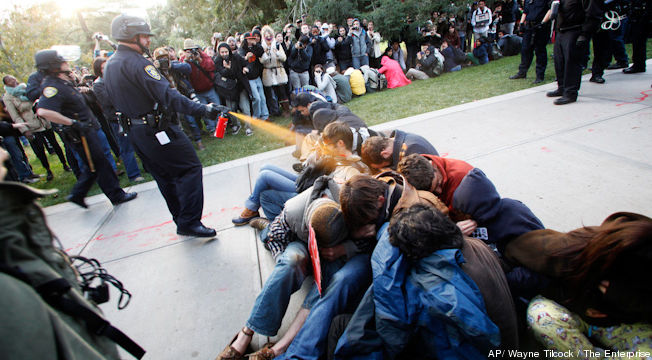
The video images are already iconic, a line of young students sit cross legged, arms linked, at the front edge of an Occupy UC Davis protest, nonviolently protesting the impacts of the economic crisis on the University of California and beyond. As police step forward students begin to chant “the whole world is watching,” and officers disperse fire extinguisher size canisters of pepper spray into the faces of the seated students.

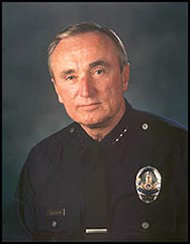
As is turns out the students were right, the whole world was watching, leaving UC Davis with a public relations nightmare that has left the campus police chief and two officers on administrative leave. In the wake of the incident, UC President Mark G. Yudof established an independent review to be conducted within the next 30 days, naming former Los Angeles Police Chief, Bill Bratton, now chairman of Kroll Security, to lead the investigation.

“My intent,” Yudof said, “is to provide the chancellor and the entire University of California community with an independent, unvarnished report about what happened at Davis.”

While UC Davis touts Bratton as “a renowned expert in progressive community policing,” deep questions surround the choice of Bratton. The Council of University of California Faculty Associations (CUCFA) was quick to question the independence of the investigation of police violence at UC Davis, pointing out that Bratton, through Kroll, already holds contracts with the UC system.

“We already know that Kroll has provided security services to at least three UC campuses for the past several years. This in itself would disqualify Mr. Bratton from participating in the investigation,”said CUCFA president Robert Meister. “You would be illustrating the kinds of connection between public higher education and Wall Street that the Occupy UC movement is protesting.”

Bratton also served as president of the Police Executive Research Forum, the police non-profit that facilitated controversial phone discussions between major metropolitan police chiefs in the lead up to the crackdown on the Occupy movement across the nation, raising questions about his ability to lead the UC Davis investigation.

Bratton’s offical bio from the LAPD shows the depth of his involvement in PERF when it states, “He is also the only chief executive to serve two terms as the elected President of the Police Executive Research Forum (PERF).” Bratton was instrumental in the creation of PERF’s hardline 2006 report Police Management of Mass Demonstrations http://www.policeforum.org/library/critical-issues-in-policing-series/MassDemonstrations.pdf for which he receives special recognition in the acknowledgments section of.

“PERF gathered more than 100 invited practitioners and stakeholders at an international forum in San Diego in December 2004 to highlight issues related to mass demonstrations and use-of-force. At this event, Los Angeles Police Chief William J. Bratton set the scene for a lively interaction as he discussed the changing nature of protests and mass demonstration events. He recalled that in the 1960s the issues leading to demonstration events tended to be more community-centered and that the police focus was largely tactical. He noted that today, demonstrations are sometimes orchestrated by far-reaching national and international organizations, coalitions and informal groups subscribing to anarchistic methods,” reads the report.

The manual pays special attention to managing media messaging, devoting a section to media in the wake of a major demonstration: “An integrated media strategy seeks to manage and harness the media attention in order to help achieve the overall policing objectives. By partnering with the media, the potential increases for all parties to win, public confidence to be maintained and the reputation of the law enforcement agencies to be enhanced.”

Though Bratton has moved on as PERF’s president, he keeps close ties with the organization. In April , Bratton was the keynote speaker at a PERF conference on technology and policing held in Washington, DC, a subject Bratton is an expert on due to his role in developing the controversial CompStat system used to “predicatively model” crime in some metropolitan areas.

Bratton is widely recognized as the leading proponent of the “broken windows theory” of policing, which advocates a zero tolerance approach to petty crime. Speaking to the Telegraph(UK) this summer about the historically large youth riots in the UK, he said youth were “emboldened” by over-cautious policing.

“To be effective, a police force should have ‘a lot of arrows in the quiver,’ said Mr Bratton, advocating a doctrine of ‘escalating force’ where weapons including rubber bullets, Tasers, pepper spray and water cannon were all available to commanders,” the paper wrote on August, 12 2011.


Clark shadows

0

TRASH If you were around in the waning days of drive-ins and urban grindhouses, the heydays of video stores and 1980s late-night cable, or were a Mystery Science Theatre 3000 fan, the name Greydon Clark might ring a faint bell — maybe even a warning bell.

For 25 years Clark was a prolific independent director, writer, producer, and even bit-part actor in the realm of low-budget exploitation movies designed for quick playoff in second-run theaters, graveyard-shift broadcast slots, and on rental shelves. Most were retreads of well-worn genre trends, a couple outright imitations of recent hits; they rarely hit the radar of mainstream critics, let alone awards-giving bodies — not even the Golden Raspberries. Though his last two features were futuristic adventures, Clark himself was relegated to cinema’s past by the turn of the millennium, having “aged out” in a business where an obsession with youth trickles down even to the least prestigious off-camera creative roles.

Now just short of 70, Clark is still around, selling memorabilia on his website, appearing at fan conventions, and the like. This Friday he’ll be at the Roxie for a Midnites for Maniacs tribute triple-bill featuring rare 35mm screenings of features long out of circulation.

First up is 1978’s Hi-Riders, a hybridization of then-current Smokey and the Bandit (1977) knockoffs and the earlier biker-flick vogue that’s one of his most enjoyable films. Frequent Clark collaborator Darby Hinton and busy stunt performer (through 1997’s Titanic) Diane Peterson are the nominal stars of a raucous action cheapie that pits muscle-car aficionados against each other, then against trigger-happy yokels ordered to kill by a vengeful fat cat who proclaims “Animals like that should be exterminated!” Acting pitched at a 10 on the hysteria scale, skinny dipping, and good crashes involving an actual bitchin’ Camaro ensue.

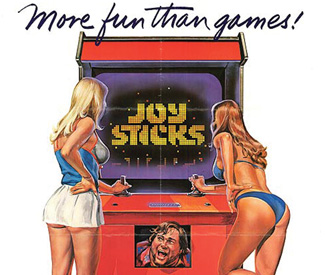
This is followed by Joysticks (1983), a prior Midnites for Maniacs midnight selection that remains a giddy high-lowlight in the short-lived 80s subgenre of movies about videogaming. How can it miss, with Porky’s-style gags, a hero named McDorfus, secondary “punk” villain King Vidiot (played by Napoleon Dynamite’s future Uncle Rico), and a theme song Tipper Gore might have taken exception to (“Jerk it left, jerk it right, shoot it hard, shoot it straight, video to the maaaaaax!!!”)?

Last and quite possibly least is 1982’s Wacko, one of several Airplane!-like slasher spoofs at the time. Its genial flailing about in search of laughs ropes in several of Clark’s favorite falling stars (Joe Don Baker, Stella Stevens, George Kennedy) and one future celebrity (pre-“Dice Man” Andrew Clay, as Fonz-y high school stud Tony Schlongini). If you were 10 years old (or 15 and stoned) in 1982, this was probably the funniest thing ever. So regress already.

But this selection offers just the tip of the native Michigander’s celluloid iceberg. Driving west on a whim in the 1960s, Clark managed to score work as both an actor and scenarist with Z-budget multihyphenate role model Al Adamson, including the incredible Satan’s Sadists (1969) and incredibler Dracula vs. Frankenstein (1971).

Those experiences empowered him to direct, co-write, and act in 1973’s The Bad Bunch (Kiss The Establishment Goodbye was one of several alternative titles), a drama of Vietnam War-era racial tensions that was shot in Watts for less than $15,000. It was clumsily crafted and crudely melodramatic, but serious-minded enough — despite gratuitous boobs and opening song “Honky Mutha Nigga Lover” — to set him on a more determinedly commercial, costs recouping path from then on.

Thus 1976’s Black Shampoo, an outrageous blaxploitation cash-in on Warren Beatty’s heterosexual hairdresser lothario hit, followed quickly by the unforgettably named (if otherwise forgettable) Satan’s Cheerleaders (1977), tentacled-alien-Frisbee-creature horror Without Warning (1980, with a very young David Caruso as one victim), and so forth. They inevitably featured once-hot, now economically-priced Hollywood names of a certain age (Clu Gulager, Jack Palance, Yvonne De Carlo etc.), attractive youngers mostly never to be heard from again, and Clark regulars like actress spouse Jacqueline Cole. (The fact that so many of his actors and crew came back for more suggests that he’s a pleasant guy to work for.)

Some of these movies actually require the MST3K treatment they got (i.e. 1985 Joe Don vs. Mafia shoot ’em up Final Justice) to be watchable. Some, like 1990 psychological thriller Out of Sight, Out of Her Mind or 1980 sci-fi fantasy The Return (a rare upgrade to then-current B-level stars in Cybill Shepard and Jan-Michael Vincent), didn’t get it and aren’t.

But others are inspirationally silly, with enough hints to make it clear that their creator was in on the joke. Probably the most widely seen of his films is acknowledged camp classic The Forbidden Dance, one of two lambada movies released on the same day in 1990. It stars former Miss USA and future Mulholland Drive (2001) enigma Laura Harring as an Amazonian tribal princess who comes to Beverly Hills (accompanied by “witch doctor” Sid Haig) to attract attention to rainforest destruction via the healing power of public ass-grinding. All this and an ozone depletion message make it Clark’s Inconvenient Truth, just as The Bad Bunch was his Crash.

Less socially conscious but equally nuts are Uninvited (1988), in which a yacht full of the expected veteran actors and hot young ‘uns are terrorized by a mutant lab-experiment cat puppet; and Russian Holiday (1992), a daft espionage thriller with Susan Blakely as a tourist haplessly playing Nancy Drew amidst Moscow neck-snappings.

Then there’s 1989’s Skinheads: The Second Coming of Hate. Its hilarious racist, sexist, swastika-emblazoned goon squad makes the mistake of pursuing clean-cut “good” kids into the wilderness lair of survivalist Chuck Connors, who fought in World War II and knows just what to do with a buncha neo-Nazi scum. It’s pretty much the Reefer Madness of Reagan-era fascist punk gang movies (1982’s Class of 1984, 1984’s Savage Streets, etc.) — a category that surely calls for its own Midnites for Maniacs tribute.


“MORE FUN THAN GAMES! A TRIBUTE TO GREYDON CLARK”

Fri/2, triple-feature starts at 7 p.m., $12

Roxie Theater

3117 16th St., SF

(415) 863-1087 www.midnitesformaniacs.com

Hungry much?

4

By Hugh Biggar

news@sfbg.com

Here’s something to chew on with your bagel and coffee—assuming you can afford that in these trying times. Roughly, 2.3 million Californians are receiving official help getting enough to eat, but nearly 3 million others who qualify are not.

In fact, California’s low enrollment in the federal food stamp program, known officially as the Supplemental Nutrition Assistance Program or in California, CalFresh, is costing the state both socially and economically.

“There’s a deepening crisis,” Matthew Sharp, a senior advocate with the nonprofit California Food Policy Advocates, said. “California’s high housing costs and extreme unemployment are two forces that have put pressure on households.”

Despite increasing need, however, less than half of those eligible for Cal Fresh assistance receive it, placing California next to last nationally. In other states, about 75 percent of those eligible for federal food stamp help take part, and some states are well above that threshold. Oregon, for instance, reaches about 90 percent of those who qualify.

In California, though, just about 43 percent of those eligible take part.

Socially, this means, of course, that millions of people are not getting enough to eat, leading to a range of other issues including health problems and hungry children underperforming at school. (In California, about 17 percent of children live in poverty, including roughly 3 million who qualify for free or reduced price meals.)

Economically, low participation in CalFresh also leaves money on the table at time when businesses and California’s tax bureau are badly in need of funds. While the money per day may seem small, $4.50 for individual or about the cost of that bagel and coffee, it can still go a long way. Weekly CalFresh assistance equals $31 for an individual, or $325 monthly for a family of four.

“Food stamps stimulate the economy in a variety of ways,” explained Chris Wimer, associate director of the Stanford Center for the Study of Poverty and Inequality.

For instance, the U.S. Department of Agriculture—the federal administrator of the food stamp program—has found that every $5 spent from food stamps generates about $9 in related economic activity.

Additionally, CFPA has found that boosting California’s food stamp participation to the 75 percent level would generate about $131 million in sales tax revenue, including $27 million for non-general fund expenses.

But instead, low enrollment means California’s loses out on about $5 billion annually or nearly $9 billion in related economic activity. On the county level, this includes losses as well. Los Angeles County is estimated to lose out on $1.3 billion in direct assistance and $2.4 billion in related activity; Alameda County, $106 million and $191 million; San Diego County, $354 million and $634 million.

At the same time, the level of need continues to increase due to a stalled economy and flat wages.

“Overall wages have dramatically declined, particularly in the services industries such as hotel workers,” Sharp said from CFPA’s Los Angeles office, noting that falling incomes have made Cal Fresh an increasingly common supplement to family’s budgets.

In addition, the type of person in need of help has also shifted, and can include college students, those with jobs but not making enough to get by, and senior citizens.

“The variety of households taking part has increased astronomically,” Sharp said. “This includes families that have never struggled with unemployment before and it has had a staggering effect on them.”

Elizabeth Kneebone, a senior research associate at the Brookings Institution, also said the changing face of poverty now increasingly includes the suburbs as well as inner-city neighborhoods. In California, inland cities such as Riverside and Fresno have seen rapid spikes in suburban poverty, she said, sometimes double the levels in urban areas. (In a report published this month, Kneebone also determined that Fresno ranked fifth nationally for neighborhoods with extreme poverty.)

Despite this grim news, California is making some strides towards helping those in need.

In October, for example, Gov. Jerry Brown signed into law several bills that eliminated obstacles to CalFresh enrollment. Assembly Bill 6, for example, ended California’s unusual requirement that mandated that everyone 18 and over in a household receiving CalFresh be finger printed. New laws have also ended a rule requiring CalFresh participants to file quarterly reports. Instead, California will switch to simplified semi-annual, or roughly twice a year reporting, beginning in 2013.

But there are still challenges and threats ahead.

“The recession has erased a lot of the social gains made during the 1990s, so it will take a number of years to make that up,” said Caroline Danielson of the Public Policy Institute of California in Oakland. She also points to a need for smarter policies such as placing jobs closer to communities and public transit.

There is also concern that the current deficit reduction talks at the federal level could also add to the burden on households, increasing their need for supplemental help.

“The [deficit reduction talks] could reduce support for low-income families,” Stanford’s Wimer said. While the food stamp program may not be target, he added, related services such as a women and child component known as WIC could be on the chopping block.

“We’ll have to see how it plays out,” added CFPA’s Sharp. “But right now there is extreme pressure on households and they are struggling to find adequate resources. It is certainly not unreasonable to try to close that 50 percent [CalFresh] gap.”

This story was funded by a grant from the Sierra Health Foundation to do independent reporting on the topic of food access in California.

The problem of the UC police

0

EDITORIAL Twenty years from now, when people look back on the Occupy movement, one of the indelible images will be the video of the University of California police officer casually dousing a group of peaceful, seated students in Davis with pepper spray. It’s a video that’s been seen millions of times around the world. It reflects a serious problem not just with one officer but with the way officials at all levels have responded to the protests — and with the way institutional police forces operate in this state.

In the video, a group of students involved in the OccupyUC movement are seated on the ground with arms linked. Lt. John Pike walks up and down the row, indiscriminately shooting the orange spray — which causes severe pain and breathing problems — over the students, who make no move to resist. It’s horrifying and stunning, the sort of thing that you wouldn’t believe unless you saw it yourself.

The Davis chancellor, Linda Katehi, has been reeling from the incident and is facing calls for her resignation. Pike and the chief of the U.C. Davis police have been put on administrative leave pending an investigation.

But now Assemblymember Tom Ammiano of San Francisco wants to go a step further — he wants to hold hearings in Sacramento not just on this incident but on how police agencies across the state have dealt with mostly nonviolent protesters. He’s absolutely right — and his hearings should also raise a critical question: Why does the University of California need its own armed police force?

The problems with the police at Davis mirror problems with the behavior of the UC Berkeley police — which mirror problems with the BART police. And all of them stem from a central problem: These little police fiefdoms have poor supervision, poor training and limited civilian oversight.

The chancellor of UC Davis doesn’t know anything about running a police department; she’s an electrical engineer and an academic. If she resigns, she’ll be replaced by another academician who knows nothing about law enforcement. And if the UC police misbehave, where do people go to complain? There’s no independent auditor, no office of citizen complaints.

If the Oakland police ran rampant — and they have been known to do exactly that — at least the elected mayor can be held accountable. Same for any city that has a municipal force. But when campus and transit security operations turn into armed paramilitary agencies, it’s a recipe for trouble.

At the very least, the UC police — like the BART police — need an independent oversight agency to handle complaints. But it might be time to discuss whether campuses can best be protected with unarmed security guards supported by local municipal police. The University of California will never take that step on its own, so the state Legislature needs to evaluate whether lawmakers should force the issue.

Guardian editorial: The problem of U.C. police

7

GUARDIAN EDITORIAL Twenty years from now, when people look back on the Occupy movement, one of the indelible images will be the video of the University of California police officer casually dousing a group of peaceful, seated students in Davis with pepper spray. It’s a video that’s been seen millions of times around the world. It reflects a serious problem not just with one officer but with the way officials at all levels have responded to the protests — and with the way institutional police forces operate in this state.

In the video, a group of students involved in the OccupyUC movement are seated on the ground with arms linked. Lt. John Pike walks up and down the row, indiscriminately shooting the orange spray — which causes severe pain and breathing problems — over the students, who make no move to resist. It’s horrifying and stunning, the sort of thing that you wouldn’t believe unless you saw it yourself.

The Davis chancellor, Linda Katehi, has been reeling from the incident and is facing calls for her resignation. Pike and the chief of the U.C. Davis police have been put on administrative leave pending an investigation.

But now Assemblymember Tom Ammiano of San Francisco told us he  wants to go a step further — he  he plans  to hold hearings in Sacramento not just on this incident but on how police agencies across the state have dealt with mostly nonviolent protesters. He’s absolutely right — and his hearings should also raise a critical question: Why does the University of California need its own armed police force?

The problems with the police at Davis mirror problems with the behavior of the U.C. Berkeley police — which mirror problems with the BART police. And all of them stem from a central problem: These little police fiefdoms have poor supervision, poor training,  and limited civilian oversight.

The chancellor of U.C. Davis doesn’t know anything about running a police department; she’s an electrical engineer and an academic. If she resigns, she’ll be replaced by another academician who knows nothing about law enforcement. And if the U.C. police misbehave, where do people go to complain? There’s no independent auditor, no office of citizen complaints.

If the Oakland police ran rampant — and they have been known to do exactly that — at least the elected mayor can be held accountable. Same for any city that has a municipal force. But when campus and transit security operations turn into armed paramilitary agencies, it’s a recipe for trouble.

At the very least, the U.C. police — like the BART police — need an independent oversight agency to handle complaints. But it might be time to discuss whether campuses can best be protected with unarmed security guards supported by local municipal police. The University of California will never take that step on its own, so the state Legislature needs to evaluate whether lawmakers should force the issue.

Postscript: STOP SHOOTING STUDENTS:  The real problem for U.C. Davis’s Kotehi and other U.C. chancellors was illustrated by  this classic J’Accuse open letter by Nathan Brown,  U.C/Davis.assistant professor in the Department of English.

Protesters target UC to demand openness, accountability, and the restoration of cuts

2

UPDATED BELOW — Protesters with ReFund California and other groups are gathering today (Mon/28) at UCSF-Mission Bay and three other UC campuses to protest a teleconference of the UC Board of Regents, which will discuss state funding levels and tuition increases, as well as recent incidents of police violence against nonviolent student protesters.

ReFund California, a coalition of student and labor groups, is angry with the UC’s decision to abruptly cancel the Nov. 16-17 Regents meeting at UCSF, citing public safety concerns surrounding a meeting that the group had been planning a convergence on for months – as well as a hastily called meeting on the day after Thanksgiving.

The group has created a pledge that it wants the Regents to agree to, which includes calling for higher taxes on the rich, a restoration of cuts to the public university systems, removal of commercial land from Prop. 13 property tax caps, and a fee on Wall Street financial transactions.

ReFund California is also dismissive of independent investigations the UC has initiated to look at aggressive police repression of students protests, including police at UC Berkeley using batons and mass arrests to dismantle an OccupyCal tent city and police at UC Davis dousing passive protesters with pepper spray. Video of both incidents went viral and have helped galvanize the overlapping Occupy and student movements.

“No amount of new ‘police protocols’ will prevent violence against students and workers, as long California’s corporate and financial elite along with their representatives among the Regents and administrators of the UC rely on police to address the concerns of students and workers,” the ReFund California Coalition wrote in the letter to the UC.

Today’s action at UCSF – centered around the meeting site at 1675 Owens Street, where a Guardian reporter is on the scene and will offer her report later today – joins similar protests at UC Davis, UCLA, and UC Merced, the four sites where the Regents will gather.

Meanwhile, ReFund and other groups are also angry that the CSU Board of Trustees went ahead with its Nov. 16 meeting behind closed doors, clearing out student protesters and the public before they approved a 9 percent tuition hike, an action that Lt. Gov. Gavin Newsom (a member of that body) denounced.

“While I understand the CSU leadership’s concerns regarding public safety, the spirit of open deliberations has been marred,” Newsom wrote in a Nov. 18 letter to Chancellor Charles Reed, calling for the matter to be re-voted at the Dec. 5 meeting to “allow the full board to hold an open debate, with full public comment and members of the media present.”

In related news, many students and faculty at UC Davis are on strike today to protest the pepper-spraying incident. And tomorrow (Tues/29) at noon, members of OccupyOakland say they plan to retake Frank Ogawa Plaza (which they renamed Oscar Grant Plaza) and set up another 24/7 encampment.

UPDATE NOON: Guardian reporter Christine Deakers says there is a heavy police presence at the UCSF meeting, where only 50 members of the public are allowed inside and most of those seats have been claimed by ReFund California members. When the Regents decided to limit the time for public testimony, the group held a General Assembly in the meeting, drowning out the Regents and causing the meeting to adjourn until 1:30 pm. You can follow her tweets here or here.

UPDATE 1:50 PM: The UC Board of Regents did not reconvene, instead cancelling the rest of the meeting without taking action. The San Francisco Chronicle quotes Newsom as saying he supports the demands of ReFund but that he’s not willing to sign its pledge.

Live Shots: WU LYF at the Independent

0

I showed up pretty early to catch WU LYF at the Independent on Monday night. A cold breeze drifting through the venue and the giant white Wucifix standing on an empty stage made for a decidedly ominous vibe. It quickly warmed up, though, as a sold out crowd filled the place to capacity for the Manchester, UK, quartet’s very first performance in San Francisco.

I was feeling some serious deja vu. Less than two years ago another British four piece, Wild Beasts, had graced the same stage for its inaugural San Francisco show, which was also completely sold out. Pumped as I’d been for Wild Beasts, I was even more excited to watch these young hoodlums perform the intense, grandiose anthems of their breakthrough debut Go Tell Fire To The Mountain.

Exuberant cheers erupted from the audience as WU LYF gathered in front iof the illuminated Wucifix. Leader Ellery Roberts plucked out the first few organ chords of the slow-building opener “L Y F,” then turned his back to the crowd to show off his tattered denim jacket which also bared the mark of the band. Bassist Tom McClung was the most animated member on stage. He handled his instrument with an emphatic flair and provided the high-pitched vocal cries of “Wu” that added a chilling undercurrent to “L Y F” and other songs.

Most bands have a backbone, and WU LYF’s is Evans Kati. The set was driven by Kati’s wailing, melodic guitar. Joe Manning’s bursting percussion was pretty solid, though the drummer looked a bit bored. The raw, energetic “Spitting Blood,” and the fiery, impassioned “Concrete Gold,” were highlights of the evening.

Roberts’ snarling vocals were just as tortured and cathartic as on the record. Between songs, he spoke in mostly unintelligible grunts, which felt a little contrived. When I interviewed the singer a couple weeks ago, he was quite eloquent and soft spoken. It was an unfortunate bias, as the rest of the audience was completely enthralled by the primal character who stood before us.

Though I often had no idea what Roberts what saying, when he commanded us to howl like a desperate pack of wolves, we obeyed. Late in the set, he remarked that the audience was too calm. Roberts’ cheeky observation resulted in a wild, volatile reaction from fans when the band launched into a frenzied rendition of “We Bros.”

Since WU LYF is a relatively new group with a limited catalog of work, the show was without many surprises, save for a lovely instrumental piece led by McClung. Not surprisingly, the band closed with its cinematic Alma Mater, “Heavy Pop.” Though I half-heartedly joined the crowd in cheering for an encore, I knew it was no use. WU LYF had already given us everything they had.

Opener:
Long Beach’s Crystal Antlers opened with a soulful, noisy ruckus. The quartet’s retro garage sound seemed a cross between the Black Keys and Cymbals Eat Guitars. In his flannel and heavy coat, vocalist-bassist Johnny Bell was a vision of grunge. His face remained hidden behind long, sweat-drenched hair. Though the band appeared to have stepped out of the ’90s, its sound was more reminiscent of ’60s psych rock. Crystal Antlers’ keyboardist flaunted some flashy moves that included tipping his synthesizer onto one leg while continuing to play impeccably.

All photos by Wolfgangg Photography..

Localized Appreesh: G-Eazy

0

Localized Appreesh is our weekly thank-you column to the musicians that make the Bay. Each week a band/music-maker with a show, album release, or general good news is highlighted and spotlit. To be considered, contact emilysavage@sfbg.com.

With his razor-sharp cheekbones, stiff pomp, and creamy skin, it’d be easy to hate on East Bay-bred producer G-Eazy (see what I did there?). But musically, what’s to dislike? In his most recent release, the appropriately titled Endless Summer – available free on his website – G-Eazy samples classic doo-wop and mixes it well with bouncy beats, layering it thick with casual cool flow and lyrics that make it once again pop.

His words tend to reflect his personal story (touring/performing) and an appreciation of pop culture. On the title track he makes mention of chopping up the Beach Boys and making it into a jam, and later drops that he’s inspired by Yeezy, Keith Haring, the Beatles, Banksy, Jean-Michel Basquiat, the Meters, and Johnny Cash, all in one couplet.

In a style that is very much his own, G-Eazy’s played shows with Girl Talk and Chiddy Bang, and toured with the likes of megastars Lil’ Wayne, Big Sean, and (juuust right?) Drake. While he currently is “chilling” in New Orleans, he was born and raised in raised in Oakland and Berkeley. Tonight, he opens up the Independent.

Year and location of origin:
The back row of my 9th grade geometry class. I realized I liked writing raps better than taking notes
Name origin: My friend suggested the name. He actually sat next to me in that same class. I needed a name, he suggested it, and it stuck.
Personal motto: Do what you love and love what you do.
Description of sound in 10 words or less: A vintage pop sound, modernized and put into a rap formula. Oops that was 11.
Instrumentation: Well when I’m not playing with my 18 piece band, I’m playing with a DJ. When I’m not playing with a DJ I’m playing with my awesome drummer who also cues the track and does it all himself. I actually haven’t ever played with an 18 piece band, but that would be dope!
Most recent release: The Endless Summer.
Best part about life as a Bay Area rapper/producer: The Bay Area can be really supportive of our own. We have a strong local scene here.
Worst part about life as a Bay Area rapper/producer: The fact that it’s such an isolated, unique market – kinda makes it hard for some rappers to make it out of here and gain recognition elsewhere.
First record/cassette tape/or CD ever purchased: Yellow Submarine. It’s the greatest.
Most recent record/cassette tape/CD/or Mp3 purchased/borrowed from the Web: A$AP Rocky’s project. It’s ok.
Favorite local eatery and dish: Gordo’s on College Ave in Berkeley, without a doubt.

G-Eazy
With Shwayze & Cisco Adler, Mod Sun
Tues/22, 8 p.m., $20
Independent
628 Divisadero, SF
www.theindependentsf.com

Check the video for his reworked version of “Runaround Sue.”
http://www.youtube.com/watch?v=T-dxZ3_3oBs&feature=player_embedded

Pepper spray backlash continues to burn

5

Not only has Lt. John Pike, the police officer who liberally doused nonviolent college students with pepper spray in an incendiary show of excessive police force Nov. 18, become a meme — he’s also generated a raging controversy that has top officials at the University of California Davis in the crosshairs. The incident, which has triggered widespread outrage since videos of it went viral on YouTube, occurred after police responded to student protesters attempting to create an Occupy Davis encampment.

Sen. Leland Yee issued a letter to UC president Mark Yudof Nov. 21, calling for an independent investigation into the pepper spray incident rather than a task force handpicked by UC Davis Chancellor Linda Katehi. The Davis chancellor, who has come under intense pressure since the incident as students call for her resignation, previously announced that she would create a committee to look into the matter and report back after 30 days.

“She gave 30 days to report back,” noted Adam Keigwin, Yee’s chief of staff. “It takes about 30 seconds to realize there’s been wrongdoing.”

In the letter, Yee expressed concern that “it is important that we do not leave the fox to guard the henhouse.” A press statement issued by his office was more direct, noting that Yee “called Katehi’s task force a sham.”

Yudof said Sunday that he would convene all 10 UC campus Chancellors to ensure proper law enforcement reactions in future protests.

Watch this clip to the end, and you’ll witness an incredible moment following the pepper spray incident, when UC Davis students banned together and chanted at police, “You can go!” After a few moments, the police appeared to listen to them, and retreated.

http://www.youtube.com/watch?v=WO4406KJQMc&feature=share
Video by YouTube user waxpancake

Some 5,000 students gathered at the UC Davis quad this afternoon to protest the now-infamous show of police brutality. Katehi waited in line to speak and then apologized to the students.

According to Yee’s press release, “Katehi’s salary is $400,000, reflecting a 27 percent hike from her predecessor. Her compensation package also includes a house provided by UC, $9,000 per year in automobile allowance, relocation expenses now and upon exiting the position, a promised faculty position after leaving the Chancellor’s office, a low-interest home loan after serving as Chancellor, and a generous pension and health care package, among other benefits.”

Sen. Leland Yee is urging all UC and CSU students and employees who are retaliated against or face disciplinary action as a result of their peaceful protest to contact his offices in San Francisco (415-577-7857) or San Mateo (650-340-8840).


Thoughtful hooligans

0

arts@sfbg.com

MUSIC A somber organ chord rings out on the opening track of WU LYF’s Go Tell Fire To The Mountain, “L Y F.” As the distant clash of cymbals grows louder, a wailing guitar lures you in like a siren song. Then Ellery Roberts unleashes a desperate, hellish growl, and you realize that WU LYF is unlike any band you’ve ever heard.

Characterized by Roberts’ guttural snarl and a rich, grandiose sound the band refers to as heavy pop, Go Tell Fire To The Mountain is a cathartic masterpiece born from the restless adolescence of four young Mancunians. WU LYF (an acronym for World Unite! Lucifer Youth Foundation) came together through a firm resistance to a conventional transition into adulthood.

“I didn’t want to go to university,” says Roberts. “I felt like it was kind of the only option I had.” On the phone, Roberts is a far cry from the gravel-throated animal on WU LYF’s debut. The 20-year-old is thoughtful, reserved, and exudes a remarkable intelligence.

Roberts and bandmates Tom McClung, Joe Manning, and Evans Kati were in their mid teens when they began playing together in their native Manchester, England. “When we wrote [the single] ‘Heavy Pop,’ that was the moment,” Roberts says. “It didn’t feel like we were trying to sound like anyone else.”

Sure, Roberts’ vocals easily draw comparisons to Tom Waits, and the band’s epic sound is reminiscent of Godspeed You! Black Emperor or Explosions In The Sky. In an era of rampant imitation and recycling, however, WU LYF has stumbled upon a sound that’s refreshingly unusual.

Expecting “Heavy Pop” to reach only a handful of friends, the group posted the track online. Media outlets caught hold of the song and began speculating wildly about the mystery band from Manchester. Rather than sign a record deal, WU LYF set up a website with vague, anti-authoritarian musings where fans could join the Lucifer Youth Foundation. For a small entry fee, members received the band’s single and a white “bandit flag of allegiance.” This worldwide alignment of hoodlums funded WU LYF’s full length debut.

If “Heavy Pop” marked the genesis of WU LYF, the abandoned church where Go Tell Fire To The Mountain was recorded is the mother that nurtured the beast. The group abstained from working in a studio, which Roberts says “seemed like a mathematic way of making music.” Instead, the foursome went out in search of big, empty spaces.

“We were walking around this old, industrial part and we just came across this church in the middle of a maze of factories,” he says. “It added so much to the record. None of us were really controlling the sound.”

Though Roberts’ impassioned vocals render his words nearly incomprehensible, a quick look at his lyrics reveals a literary astuteness. Go Tell Fire To The Mountain‘s narrative structure was inspired by a screenplay Roberts wrote at the age of 17, and the cinematic album explores themes of camaraderie, mortality, and ambiguous religion.

“We put a lot of ourselves into it,” says Roberts. Although the record’s only been out for a few months, WU LYF has achieved a cult like following that Roberts calls “pretty amazing, but strange.” In the wake of the monstrous reaction to Go Tell Fire To The Mountain, WU LYF is embarking on its most extensive tour thus far.

The band’s been in the US for a few days when we speak so I ask Roberts if he’s spotted any LYF members in the audience. “We’ve seen a couple,” he responds. “It’s always nice to see when you come on stage, [the] fans that have their white flags. You know you’ve got your friends out there.”

WU LYF With Crystal Antlers

Mon/21, 8 p.m., $15

Independent

628 Divisadero, SF

(415) 771-1421

www.theindependentsf.com

Rank complaints

27

steve@sfbg.com

Even before all the votes had been cast on election day, the two most conservative members of the San Francisco Board of Supervisors proposed a ballot measure to repeal the city’s ranked-choice voting (RCV) system, prompting all the usual critics of this voter-approved electoral reform to denounce it as confusing and undemocratic.

Those same two supervisors, Sups. Sean Elsbernd and Mark Farrell, were also the ones who unsuccessfully pushed for a weakening of the public financing system last month, changes that will likely be wrapped into discussions in the coming weeks over how elections are conducted in the city. And progressive supporters of both systems warn that district supervisorial elections will probably be the next target of this concerted push to roll the clock back on electoral reforms in the city.

"The [San Francisco] Chronicle and the [San Francisco] Chamber [of Commerce] have been at it from day one," Steven Hill, who helped crafted both the RCV and public financing systems, told us. "They’re really clear about what they want to eliminate, so we should be clear about what we need to defend and we can’t get confused by this."

Indeed, the Chronicle ran an editorial Nov. 14 advocating the repeal of ranked-choice, calling it "a fundamentally flawed system that is fraught with unintended consequences." The paper, as well as its allies at the Chamber and other downtown institutions, has been equally vociferous in criticizing public financing and district elections.

Hill said that’s because moneyed interests prefer systems that they can manipulate using the millions of dollars in unregulated independent expenditures they can summon — an ability they demonstrated again in his election on behalf of Mayor Ed Lee — such as low-turnout runoff elections, citywide supervisorial races, and elections without the countervailing force of public financing. "They’ve been doing this steadily and looking for ways to chip away at it," Hill said.

But conservatives aren’t the only ones raising questions about RCV; some progressives say the system needs adjustment, too.

Although Farrell opposes all three of those electoral reforms, he insists that his concerns about RCV are about voter confusion and the perception that winners don’t have majority support and could be viewed as illegitimate. "There is just so much voter confusion out there," Farrell said, citing comments from voters who don’t understand how their votes are tabulated to produce a winner.

Hill counters that voters do have a clear understanding of how to rank their choices, downplaying the importance of whether they understand all the details of what happens next. But Farrell said that and the majority rule issue have undermined people’s faith in the elections.

"People get very upset when they realize someone didn’t get a majority of the vote," he told us, referring to how the majority threshold drops as voters’ top three candidates are eliminated. "To me, it’s just simpler to go back to the runoff system."

Many moderate politicians agree. "I don’t like ranked choice voting and I never have," City Attorney Dennis Herrera, who finished third in the mayor’s race, told us on election night. "I defended it all the way to the 9th Circuit [Court of Appeals in his role at City Attorney], but I think it’s bad policy."

Sup. Scott Wiener, a Herrera supporter we spoke to at the same election night party, also wants to see a change. "I supported ranked-choice voting and until recently I continued to support it, but this race changed by mind," Wiener said, attributing the large mayoral candidate field and free-for-all debates to RCV. "There is no way most voters will be able to distinguish among the candidates."

But Hill says it’s a mistake to attribute the large field to RCV, or even to the public financing system that some are also trying to blame, a problem he said can be addressed in other ways, such as changing when and how candidates qualify for public matching funds.

Wiener said he hasn’t made up his mind about repealing RCV, and he said that he absolutely opposes a return to the December runoff election. One alternative he suggested was a system like that in place in New York City, with the initial election in September and the runoff during the general election in November. But he does think some change is needed, and he’s glad Elsbernd and Farrell proposed an RCV repeal.

"They’re starting a conversation with the repeal, but that’s not where it’s going to end," Wiener said.

Indeed, the system still has the support of most progressives, even Sup. John Avalos, who finished second in the mayor’s race and would now be headed into a runoff election against Ed Lee under the old system. "I continue to support ranked choice voting," Avalos told us. It takes six supervisors to play the charter amendment repealing RCV on the ballot.

Sup. Ross Mirkarimi, who was narrowly elected sheriff in the ranked-choice runoff despite a 10-point lead in first place votes, said of the Farrell and Elsbernd proposal, "I do want to hear their criticisms."

"I understand the larger discussion, which was a bit of a misguided approach that some of our colleagues used to go after ranked choice voting on election day," Mirkarimi said. "But they are good politicians and they seized an opportunity."

Mirkarimi did say he was open to "maybe some tweaks. I do think ranked choice works better when you have many choices." Others, such as former Sup. Matt Gonzalez, have also recently advocated a ranked-choice system that allows more choices, which would address the majority-vote criticism because fewer ballots would be exhausted.

Hill said the legislation that voters approved back in 2002 already calls for more choices, but the technology used in the city’s current system only allows three choices. Yet he said the city’s vendor, Dominion Voting Systems, has developed a system allowing up to 11 choices, for which it is currently seeking federal certification.

Although he said various tweaks are possible, "I think the system worked well in this election," Hill said, noting that few San Franciscans would have wanted to drag this long campaign out by another month or to pay for another election.

Maximum Consumption: Justin Bua finds the vegan in hip-hop

4

Hip-hop and jazz visual artist Justin Bua is reeling off the pillars of vegan hip-hop.

Mr. Wiggles, DJ Qbert, Russell Simmons, Dead Prez, KRS-One, Mear One – I think GZA from Wu Tang? But I’d doublecheck that.” (It turns out he’s at least vegetarian, as are four members of the Wu) “I think being vegan is the ultimate expression of hip-hop,” says the B-boy cum bestselling poster artist. 

It was a novel twist to our conversation, which took place over a table at Gracias Madre, Cafe Gratitude’s vegan Mexican restaurant in the Mission. Bua’s new coffeetable portrait book, The Legends of Hip-Hop (Harper Collins, 160 pp, $34.99) came out earlier this month, and he had just performed at the Independent the night before in a show that he hopes to take around the country in 2012. The Bay’s DJ Qbert – one of Bua’s subject for Legends, who was just finishing up his plate of food at the table when I walked into the restaurant – and others had spun while Bua hosted and supplied visuals. The show had sold out, the painter told me. He said tickets were going for “$60, $70” from scalpers. 

But back to veganism. 

“It’s irreverant, subversive, truth,” Bua mused over a creamy, vegan coconut pie when I asked him about the connection between hip-hop and eschewing dairy. “It’s about having a clean head and mind.”

C’mon, even Tupac was on this level. “Let’s change the way we eat, change the way we live, change the way we treat each other,” Bua quotes. “Let’s change the way we eat? He was talking about going vegan.” 

This is Bua’s jam – changing the world through personal actions. He sees his own work to document hip-hop’s legendary emcees, DJs, graffiti artists, producers, and B-boys as a entry in the historical record. Of his swirling, regally distorted works he says “they’re really in the tradition of the Grecos, the Raphaels, the Rubins” – artists which once documented the elite and created some of the few lasting visuals of the times in which we live. 

“I’d like people to take away from The Legends of Hip-Hop that these people are as historically revelant as the kings and the queens, those are the important people of the time.”

He says that given the hip-hop generation’s spending power, that the music has the capacity to change the world. And that it could do it through veganism, the rejection of industrial farming and that invasive act of consuming a fellow earth-dweller. “The ultimate form of respect is to not eat each other. That’s fucking weird.” 

To that end, Bua is considering launching a hip-hop-oriented eco-festival, featuring presentations by the food scientists whose findings have helped change his own lifestyle. So taken is he, in fact, by the power of food, that he and girlfriend Ruby Roth started a cooking blog called We Be Vegan, and he has an affordable super food drink in the works with nutritionist David Wolfe. He calls Wolfe “the most knowledgable person I’ve ever met in my life – and I’ve met Cornell West and Bill Clinton.” He hopes to drop the product in the next few months, insisting “you have an experience when you drink it.”

Ultimately, he’d like to see the people that take strength like he does in hip-hop’s powerful figures translate their message into taking control over their diets. Corporations, he said, can be toppled by what’s in your kitchen cabinet and lower intestine. Big companies should never be trusted to care for the health of the people.

“They know that they’re putting garbage on your plate, but they don’t care because the want that money. We gotta eat simple. Seven billion people on this planet is unstable. You can’t feed the world meat.”


Analyzing the numbers

65

I keep looking at the election numbers, trying to make sense of it all, and the more I look and count and add, the more a couple of things become clear:

1. The absentee vote wasn’t just about Ed Lee. Clearly, the Lee forces got their troops out and did an absentee drive, but the total absentee votes for mayor (62,446) were about the same as the total votes for district attorney (63,354) and most of the propositions.So the people who voted early voted the entrie ballot.

2. The election-day votes were so dramatically different from the absentees that several factors had to be at work. One of them was the phenomenal campaign for John Avalos, which moblized thousands of people and demonstrated how much of a force progressives can be. Keep in mind — Avalos, who had no independent expenditure groups and less money than many of the other candidates — actually came in first on election day. His team worked hard and smart and pulled off a near miracle.

3. The drop-off in support for Lee between the absentees and election day suggests that his popularity was, indeed, declining fast in the past few weeks. The voter fraud scandals had something to do with it, but so did the attacks on Lee by the Herrera and Yee campaigns and by IE groups supporting those two candidates. If Lee hadn’t been so far out in front a month ago, he might not have won. As it is, if he holds on, it won’t be with the kind of mandate he would like to claim.

When the Department of Elections runs the first pass at ranked-choice voting, we’ll get a better idea of how much Lee’s support has fallen; RCV won’t be such a big deal with the absentees since Lee got so many of those first-place votes. The election-day votes will be more telling; when Adachi, Yee and Chiu are eliminated, where do those seconds go? How many will go to Lee — and how many will go anywhere but?

Ed Lee’s absentee coup

27

The most remarkable number in the election results was clear before a single election-day ballot was counted. The absentee ballots were released around 8:30 p.m., and they were stunning: Ed Lee has 26,621 votes. The nearest competitor, John Avalos, was at 7,080.

That’s right — Lee was almost 20,000 votes ahead before election day. And that turned out to be the margin of victory — Avalos actually got more votes than Lee from the people who voted Nov. 8.

The reason Lee is likely to be the next mayor is because — through a combination of traditonal hard work on identifying supporters and getting them to vote by mail and quite possibly some degree of illegal conduct — he had 26,000 votes in the bag long before the polls opened.

He was, of course, helped by the independent expenditure committees and by the fact that he had a natural base in Chinatown (and people on the ground there to get that base to vote). But none of the other campaigns managed to come close to that level of organizing. It’s something progressives have to keep in mind — elections in San Francisco are no longer won and lost on election day.