Housing

A range of rage at Obama visit

0

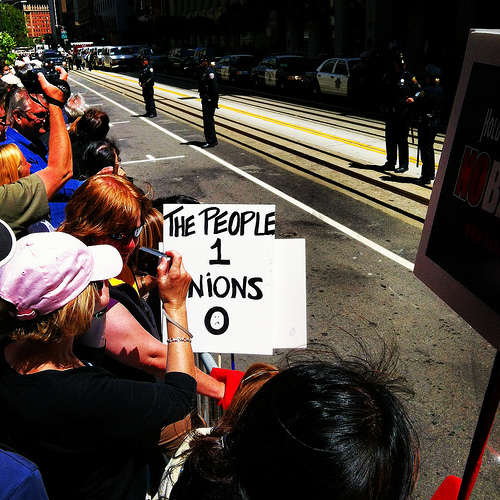
Hundreds gathered in the financial district today as President Obama came through San Francisco for a brief visit, consisting of a high-priced fundraising lunch and no public events. A mostly silent crowd waited patiently to watch the president’s motorcade drive by this afternoon, first at 1 Market St and then at 456 California, before he went off to SFO. On the crowd’s sidelines, handfuls of dissenters from various groups held signs and spoke up with a diverse range of reasons for protesting the president.

On Market, the motorcade went past the Occupy SF campsite at 101 Market St, where a dozen protesters had gathered. Their signs and chants focused on the National Defense Authorization Act. Sections 1021 and 1022 of the act, which the president signed Dec. 31 2011, have been interpreted as allowing for indefinite detention of terrorism suspects in the United States without charge or trial.

National groups Code Pink and World Can’t Wait brought attention to what they called Obama’s war crimes. 

“Code Pink is asking Obama to kill the kill list,” said Nancy Mancias, an organizer with the womens’ peace organization, referring to a list of terror suspects targeted for US attacks that Obama personally oversees. “We want more transparency in the CIA drone program, and victim compensation to the families of those who have been killed in drone strikes.”

World Can’t Wait demonstrators emphasized that Guantanamo Bay detention facility is still open and housing almost 200 prisoners, despite President Obama signing an executive order to close it days after taking office.

For demonstrators from the Center for Biological Diversity and Greenpeace, it’s imperative that the president stop oil drilling in the Arctic.

“There are a couple small permits they still need to get, but Shell is ready to drill in the Arctic in July,” said Miyoko Sakashita, an attorney at the Center for Biological Diversity. 

Sakashita said that drilling there could be dangerous for residents of the region, as well as polar bears, walruses and seals. 

“The conditions are terrible for drilling,” said Sakashita, citing low visibility and icy terrain. “If they can’t stop an oil spill in the gulf of Mexico, how will they stop it in the Arctic?” 

If these conditons do indeed lead to a disastrous oil spill, Greenpeace volunteers will be there first hand to witness it, as the group plans to send vessels of their own to monitor the operations.

Tea party protesters and Ron Paul supporters also came out to see the president. 

“It’s an issue of competence,” said Charles Cagnon, a protester who held a sign calling President Obama a “bad hire.”

“A president is our employee, not a king.”

But Cognan wasn’t too pleased with the competition either. 

“I was a Ron Paul kind of guy,” he said, “but I’ll take Romney. He’s level-headed and competent, and he likes arithmetic.”

“Obama doesn’t like arithmetic,” he continued, as evidenced, according to Cagnon, by the senate rejection of Obama’s budget May 16.

“Bush was terrible,” Cagnon added. “Romney is uninspiring.”

Cagnon and his group sported “Nobama” gear, Code Pink protesters came with signature pink clothing and signs, and a Greenpeace volunteer was dressed as “Frostpaw the polar bear.” Focused for the day on a common enemy of sorts, no conflicts arose between the divergent protest groups. For his part, Cagnon added that despite his right leanings, he loves KPFA radio, and that he believes the tea party has a distrust of government in common with Occupy.

“I’m just glad there’s people out there dissenting,” he said. “We need people like that.”

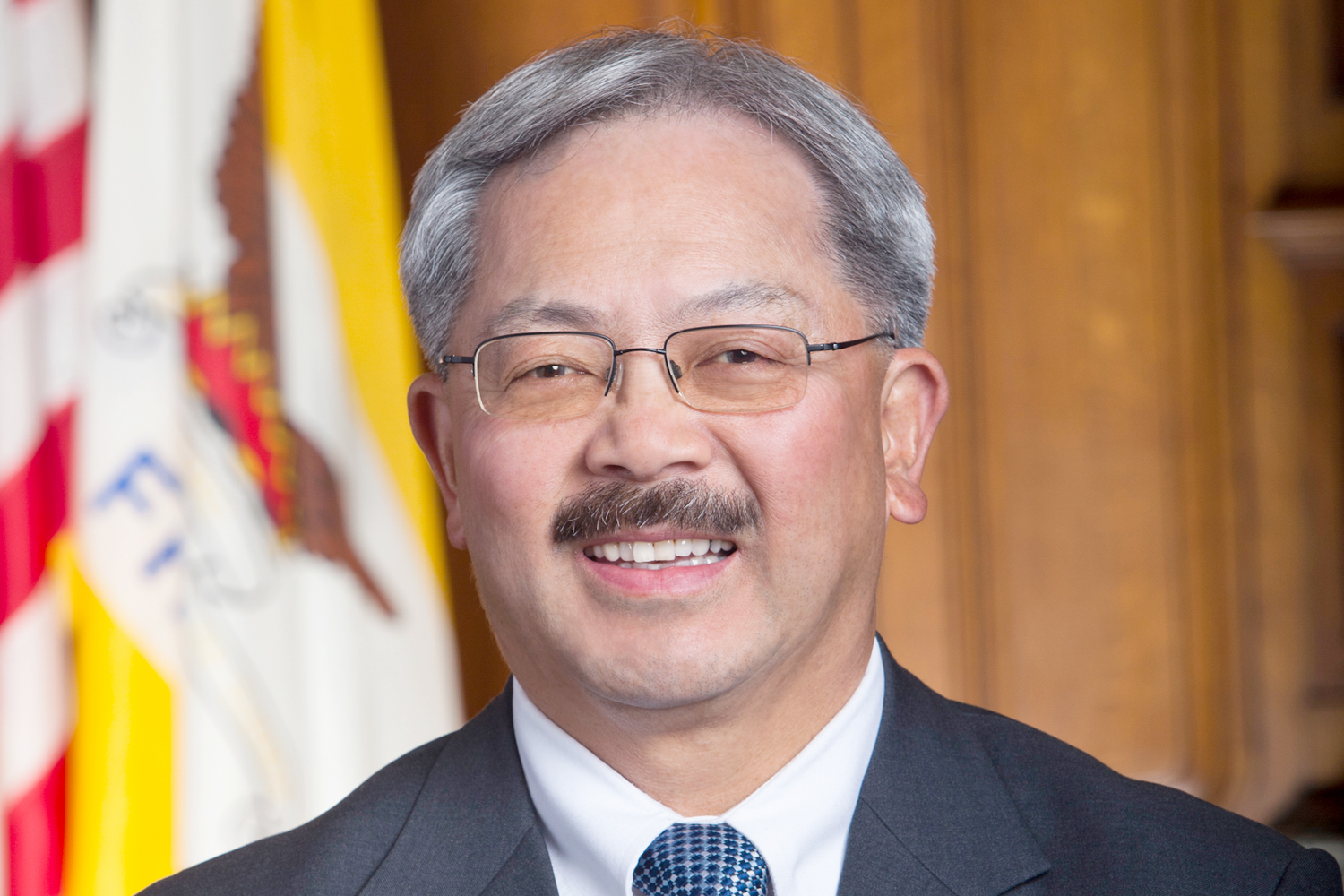
Reading Ed Lee’s mind

15

Political reporters love to believe we can read politician’s minds; it makes us feel important. (And Lord knows, these days we need something to make us feel important.) So let me go way out on a limb here and tell you what Mayor Lee is thinking right now:

1. Gotta minimize Prop. B. It was an aberration, a bunch of rich Nimbys from Telegraph Hill, nothing more to see here. Certainly not a public referendum on my Rec-Park director, Phil Ginsburg, and his efforts to make money by renting out city parks for private events. No no no, just ignore it and maybe it will go away.

2. We won back the Democratic Party. Good move to take a page from Aaron Peskin’s book and run a bunch of elected officials and former elected officials with high name recognition in a low-turnout election. Bevan Dufty, who happens to work for me, would make an excellent chair; should be easy to make that happen.

3. What if we look at the DCCC race in the 17th District as a first-pass primary for the 2014 Assembly seat when Tom Ammiano — who’s just way too independent and won’t get with my program — is termed out? Hmmm … David Chiu, who I can mostly deal with, is in first place — but John Avalos and David Campos are more popular than my pal Scott Wiener. And if the progressives get behind Campos, he’ll be tough to beat. Hmmm….

4. That oddball Michael Breyer ran for Assembly pretending he was me. He even put out a mailer with my mustache on the front suggesting that he’ll be just like I am (except that he’s white and has no experience and no credible program and isn’t going to win). But he got a lot of votes with the Ed Lee card and I could totally control him. Can’t support him over Phil Ting, of course, but maybe I can get him some help behind the scenes.

5. This was an unusual election with radically low turnout. I know I can’t read too much into it. If the DCCC were on the ballot in November, or if there were a real presidential primary to bring people out to vote, the results would be very different. But still: All that new housing for rich people that my mentor Willie Brown and my friend Gavin Newsom got started seems to be having an impact. The city’s getting more conservative. Let’s just keep that one going and I’m home free.

6. What’s up with Lincecum? Damn those Padres.

Nah — the mayor’s too nice a guy to be thinking like that. Right?


Dream not deferred

0

yael@sfbg.com

On Monday, June 4, students at the Meadows-Livingstone School rehearsed for their annual end-of-the-year performance. It was bleak and rainy out, but the small, essentially one-room schoolhouse that houses the private elementary school was bursting with energy.

Twenty kids, first through sixth graders, were practicing: they sang Wade in the Water and a welcoming song in Swahili. During The Greatest Love of All, a seven-year old crooned her solo: “People need someone to look up to, I never found anyone who fulfilled my needs.” But then the kids broke out into the Neville Brothers’ Sister Rosa, (“Thank you Miss Rosa, you are the spark! You started our freedom movement!”) and then a rap about Malcolm X.

At this school, located at Potrero and 25th streets, those needs are fulfilled.

This end-of-the-year performance will showcase what the children have learned all year in an elementary school education built around lessons on African and African American history and culture. As Gail Meadows, the school’s founder and principal, puts it: “We have an Afro-centric school. We have a classical African Civilization class, and have books, videos, games, focused on African Americans. The kids learn African songs, they learn African American field songs.”

Meadows says is offers more than the cursory black history that is usually taught: “At most schools, you’ll learn about Rosa Parks and Martin Luther King, and that’s it.”

All of the children at Meadows-Livingstone are of African descent. “We’re not nationalists,” Meadows says. “The kids understand the world is of many colors, and you can’t live in this world by yourself.”

But spending some crucial elementary school time specifically for African Americans, Meadows believes, does wonders for her students’ abilities to navigate that world.

As Meadows tells it, she’s motivated partly because she didn’t get the same experience as a child. “I lived in a small campus town and went to an all-white school. My mother used to say that she had to undo everything that was done.”

Her education included books shaped by her parents to include black children (“They would search tirelessly for children’s books representing people of color, or they would just change the stories”) and distrust of television (“My father would say, why watch something that doesn’t validate you as a child?”). At her school, she recalls being in “a play that included a line, ‘Don’t drink coffee. It will make you black, and that’s bad.'”

For children in San Francisco today, Meadows says this feeling of belonging is as important as ever. “There’s an exodus of people of color out of San Francisco,” she says. “That means children of color are in classrooms with people who are not educated about African American culture. And they’re educated by a media that gives them a skewed view of who they are.”

This lack of education can often lead to racist bullying. a large reason why many students transfer to Meadows’ school.

“There are students that transfer into my school after having bad experiences, and they don’t know how to confront the person who said something offensive to them,” says Meadows. “In my school they learn to confront. An angry confrontation isn’t productive. It should be direct, they should be able to explain, here’s the real story about that stereotype.”

This education helps when kids leave the Meadows-Livingstone school for middle schools across the city.

“People ask them questions like, are you in a gang? Do you have a house? All these stereotypes they’ve read about, all of a sudden they’re right there,” Meadows says. “If you know who you are, you can live through that. Its easier.”

At a recent visit to the school, some students described their own experiences.

“Sometimes, when I was at my old school, they talked about blacks badly,” said one student. “They said they were stupid and dumb. And I still didn’t believe it, but now I learned about my heritage and I learned that we’re stronger and we have more spirit.”

Or, as he said, “Black power makes me feel strong.”

A 12-year-old who would be leaving the school soon told me a story of how the school influenced. “One of the kids in my neighborhood, he said, ‘We’re all niggers,'” he explained. “I said, ‘No we’re not. We’re regular black kids.'”

As another child put it, “Black power means that you have strength and nobody can push you around, like, like you’re just a little duck and everyone else is a coyote.”

From a long line of teachers, Meadows’ life work has been dedicated to educating and empowering young people. She taught her first class at age 10, before studying education at Kansas State University. She was teaching at Montessori schools when she decided to start her own.

Meadows-Livingstone school came out of a wave of alternative education informed by 1960s liberation movements. The Black Panther party, a part of the history that the children Meadows-Livingstone learn, had a 10-point platform laying out the ways that racism intersects with inequality in education, along with housing, treatment by the justice system, and other facets of society.

Point five says, “We believe in an educational system that will give to our people a knowledge of the self. If you do not have knowledge of yourself and your position in the society and in the world, then you will have little chance to know anything else.”

Meadows-Livingstone continues this part of the Panther legacy, and not just ideologically.

“At one point in our school we had maybe 15 kids whose relatives had been Panthers,” says Meadows.

“We have a grandfather who brings fruit every week,” she says, continuing the spirit of the Free Breakfast Program. “And he was a Panther.”

The children also learn about prominent Panthers. “They play a Panther tag game, and they would cry if they couldn’t be Angela Davis or Huey P. Newton,” she said.

On Fridays, the children read poetry. “They really like to recite poems written by African Americans, it gives them hope. They’re stuck on Langston Hughes, they like Gwendolyn Brooks too.”

The school costs $700 a month, but many of the students are subsidized by The Basic Fund, a private foundation.

Meadows also uses partnerships with city institutions to enhance the curriculum. The children spend time every week swimming at Garfield public pool on Treat Street, and playing tennis, and partnering with Acrosports for tumbling lessons. The swimming lessons hold a particularly strong symbolism, as generations of African Americans in Jim Crow states were denied opportunities to swim.

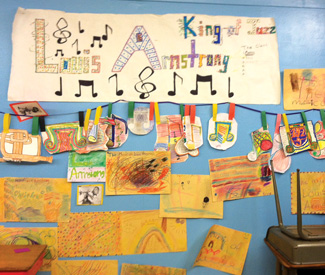
Tributes to Black historical figures decorate the school’s walls. Children’s art on “Black Inventors” and “Louis Armstrong, the king of jazz” are displayed, along with a large version of the iconic photograph of John Carlos and Tommie Smith doing the Black Power salute at the 1968 Olympics.

When asked about Malcolm X, 20 hands shot up to talk about a figure important to their studies.

As one child explained it: “Malcolm X, he said if somebody’s hits you or hurts your family, he’s not going to turn the other cheek. He’s going to fight back. He’s like, you hurt my family, I’ll hurt yours. Martin Luther King, he said if a white person hits you, don’t fight back, make peace.”

“That’s nonviolence” another chimed in.

When listing their personal heroes, many kids included King and Malcolm. “Muhammad Ali, Yele, and you, Gail!” one exclaimed, the middle hero referring to the school’s drumming and African Civilization teacher, Akinyele Sadiq.

In the summer, most of the students go off to Camp Winnarainbow, the hippie-circus camp that Meadows calls “almost like an extension of our school.” Many of the children have parents who attended the school, and when I ask if they’re excited to graduate, all the kids frown and one says, “I don’t want to leave!” Others are more calm at the question. The school provides a safe haven for bullied kids and a source of ethnic pride. One 12-year-old tells me that when he goes to middle school next year, he’ll make new friends but, “I won’t follow them if they do something bad.” He sighs when I ask if he will be sad to leave. “Yeah,” he says, “But we all have to move on.”

Housing and highrise offices

0

EDITORIAL It's something of a civic shame that the only way San Francisco can build a new transit terminal is to sell a private developer the rights to stick a 1,070-foot highrise office tower on public land. In fact, it's a sad statement on the city, state, and local government: Once upon a time — and it wasn't the long ago — tax dollars collected through a progressive system paid for major infrastructure projects.

But there's no easy way to raise $4 billion in tax money for the Transbay Terminal — even though it ought to be seen as part of the high-speed rail project, and the federal and state government ought to be picking up the tab. So San Francisco ambles forward, selling land and lease rights to the highest bidder.

In this case, Gerald Hines of Houston won the right to build the largest highrise west of the Mississippi on property owned by the Transbay Joint Powers Authority. There are all sorts of drawbacks to the deal — among other things, it will cast shadows on a number of city parks, all the way to Portsmouth Square in Chinatown. Like any massive office complex, it will put pressure on Muni, on city streets, on police and fire and other city services — and no commercial office building ever pays its fair share of that burden. And since in this case the major recipient of the money from the project will be the TJPA, the city's General Fund will suffer.

Oh, and the building is ugly.

Meanwhile, city planners want to increase height limits all around the Transbay Terminal and allow hundreds of units of new (luxury) housing and more commercial office space. It's going to be a new highrise neighborhood, complete with a rooftop park and a few little patches of ground-level open space, which won't get a whole lot of sun, particularly in the morning and evening.

And at this point, there's been very little focus on what ought to be the defining issue of this and the other major developments on the city's planning horizon, and that's affordable housing.

This city has a terrible jobs-housing mix. The vast majority of the people who currently work in San Francisco can't afford to buy a house here, and many of them can only rent if they pay for more than the federal standard of one-third of their income for housing. So people who work in hotels and restaurants and city, state and federal offices and hospitals and even financial district companies wind up living far from the city and commuting. Nobody thinks that's a sound environmental policy.

And this kind of full-scale rezoning and development will only make it worse. According to the City Planning Department, the Hines project will pay about $27 million into the city's affordable housing fund, enough to pay for maybe 60 or 70 housing units. That won't even begin to cover the need created by the thousands of employees who will fill that tower. The market-rate housing on the site will almost certainly be beyond the reach of most San Franciscans, and probably many of the office workers who fill the Hines building. And only 35 percent of the new housing — at maximum — will be affordable.

San Francisco has to get a grip. The city can't keep allowing more high-end housing and highrise office space without a plan to meet its housing needs. We're glad to see the mayor talking about a $50 million a year fund, but that will barely meet existing needs; it can't possible keep pace with new development.

So before the supervisors rush ahead to approve this ambitious new downtown district, they need to ask Hines, and the TJPA, and any other developer who comes along, how it intends to meet the demonstrated need for affordable housing that these projects will create — and demand a much higher level of payment that what's currently on the city's books.

On the Cheap May 23-29, 2012

0


WEDNESDAY 23

Cuba in Focus opportunity to hear panel of Cuban experts speak live 2969 Mission, SF. (415) 821-6545, www.answersf.org. 7pm, $5-10 suggested donation. Cuba is becoming more accessible to US citizens, and some of the country’s social accomplishments are admired on a global scale. Is the US government continuing to present a distorted image of Cuba in order to justify its policy of hostility, subversion, and economic and political sanctions? Hear a panel of renowned experts on Cuba’s economy and social issues discuss this and other timely issues.


THURSDAY 24

Revolution, A Love Story book release event Berkeley Fellowship of Unitarian Universalists” Hall, 1924 Cedar, Berk. www.bfuu.org, cindysheehanssoapbox.blogspot.com. 6:30pm potluck, 7pm event, $5-10 suggested donation. No one turned away. Cindy Sheehan presents her reasons for writing this tale about her personal exposure to the Bolivarian revolution in Venezuela in Revolution, A Love Story.


FRIDAY 25

Poetry Reading with Jennifer Arin and Elisabeth Frost 601 Van Ness, SF. (415) 776-1111. 7pm, free. Attend a friendly and fun evening with one poet from the West Coast and one from the East Coast. Tonight, Jennifer Arin reads from her new book of poetry, Ways We Hold, and Elisabeth Frost, winner of the White Pine Press poetry contest, reads from her poetry collection, All of Us.


SATURDAY 26

Dionysian Festival and birthday party for Isadora Duncan Mary Sano Studio 245 Fifth St., SF. (415) 357-1817, www.duncandance.org. 8pm on Sat/26 and 6pm on Sun/27, $16. Celebrate the 135th birthday of local progenitor of modern dance, Isadora Duncan, who was born in San Francisco on May 26, 1877. Mary Sano, one of the foremost interpreters of Duncans legacy will perform traditional Duncan repertoire with her group, as well as some exciting new work.

Urban Homestead Skillshare Festival to inspire self-sustainable living Hayes Valley Farm, 450 Laguna St, SF. www.sfbace.org. 10am-6pm, sliding scale admission. Learn how to backyard compost, create an urban garden, grow fruit trees, raise chickens, grow herbs for medicine, create co-housing, and cultivate oyster mushrooms and more at this sustainable living educational event.

The 34th Annual San Francisco Carnaval Festival Harrison St. between 16th and 23rd Streets, SF. www.sfcarnaval.org. 5/26 and 5/27, 10am-6pm, free. Today and tomorrow, the festival transforms seven blocks of Harrison Street into a wonderland of miscellaneous food, music, dance, art, crafts and other fun activities and events on several stages for the entire family to enjoy. This years festival highlights include three stages of continuous live music from around the globe, salsa dance classes and competitions, childrens activities, and drumming.


SUNDAY 27

A Different Kind of Carnival with Electro Acoustic Brazilian Jungle Music Red Poppy Art House, 2698 Folsom St., SF. www.josegarcia.com. 7pm, $12-20 sliding scale. Take a musical journey into the Amazon in search of healing with Jose Garcia’s new show entitled “Bicho do Mato” (Animal of the Jungle). Introspection, wildlife, and magical deities of Amazonian life are the themes of this show.

Creating a Shamanic Rattle 1663 Mission St., Gruenwald Press 2nd Floor, SF. shamansrattle.eventbrite.com. 2pm-4pm, $15. Within each of us there is a healer/shaman, and in some of us this aspect of the self may appear dormant. During this event you’ll seek to awaken your inner shaman as you create your own unique shamanic rattle using seaweed, dried seeds, stones, sticks, paint, twine, beads and intention, along with some other surprises.


Monday 28

Memorial Day: A Day of Honor and Remembrance Presidio of San Francisco, 34 Graham St., SF. www.presidio.gov, (415) 561-5418. 10am-12pm, free. Join veterans and the community for Memorial Day at the Presidio. A procession will begin along the new green in the Main Post, led by the 191st Army Band. The formal program at 11am in the National Cemetery features music by the 191st Army Band, a color guard, and remarks by military and civilian dignitaries.


TUESDAY 29

Crime and Punishment in SF, a History Association sideshow and talk St. Philip’s Catholic Church, 725 Diamond, SF. 7pm doors, 7:30pm presentation. $5 admission for nonmembers. Almost as soon as gold as discovered at Sutter’s Mill in 1848, the world began to pour (or rush, if you will) into San Francisco. Ever since, sensational crime — frauds, swindles and murders — has been a feature of this city. John Ralston, author of the book This Date in San Francisco, will present an illustrated program on several of these crimes from the beginning of SF through the mid-20th century.


The battle of 8 Washington

tredmond@sfbg.com

More than 100 people showed up May 15 to testify on a condominium development that involves only 134 units, but has become a symbol of the failure of San Francisco’s housing policy.

I didn’t count every single speaker, but it’s fair to say sentiment was about 2-1 against the 8 Washington project. Seniors, tenant advocates, and neighbors spoke of the excessive size and bulk of the complex, the precedent of upzoning the waterfront for the first time in half a century, the loss of the Golden Gateway Swim and Tennis Club — and, more important, the principle of using public land to build the most expensive condos in San Francisco history.

Ted Gullicksen, director of the San Francisco Tenants Union, calls it housing for the 1 percent, but it’s worse than that — it’s actually housing for the top half of the top half of the 1 percent, for the ultra-rich.

It is, even supervisors who voted in favor agreed, housing the city doesn’t need, catering to a population that doesn’t lack housing opportunities — and a project that puts the city even further out of compliance with its own affordable-housing goals.

And in the end, after more than seven hours of testimony, the board voted 8-3 in favor of the developer.

It was a defeat for progressive housing advocates and for Board President David Chiu — and it showed a schism on the board’s left flank that would have been unthinkable a few years ago. And it could also have significant implications for the fall supervisorial elections.

Sup. Jane Kim, usually an ally of Chiu, voted in favor of the project. Sup. Eric Mar, who almost always votes with the board’s left flank, supported it, too, as did Sup. Christina Olague, who is running for re-election in one of the city’s most progressive districts.

At the end of the night, only Sups. David Campos and John Avalos joined Chiu in attempting to derail 8 Washington.

The battle of 8 Washington isn’t over — the vote last week was to approve the environmental impact report and the conditional use permit, but the actual development agreement and rezoning of the site still requires board approval next month.

Both Mar and Olague said they were going to work with the developer to try to get the height and bulk of the 134-unit building reduced.

But a vote against the EIR or the CU would have killed the project, and the thumbs-up is a signal that opponents will have an upward struggle to change the minds of Olague, Kim, and Mar.


DEFINING VOTES

The 8 Washington project is one of a handful of defining votes that will happen over the next few months. The mayor’s proposal for a business tax reform that raises no new revenue, the budget, and the massive California Pacific Medical Center hospital project will force board members to take sides on controversial issues with heavy lobbying on both sides.

In fact, by some accounts, 8 Washington was a beneficiary of the much larger, more complicated — and frankly, more significant — CPMC development.

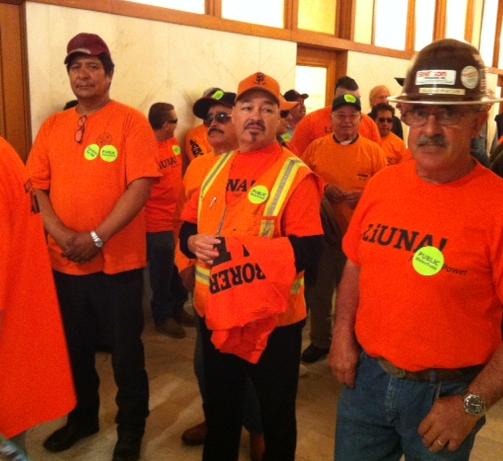
The building trades unions pushed furiously for 8 Washington, which isn’t surprising — the building trades tend to support almost anything that means jobs for their members and have often been in conflict with progressives over development. But the Hotel and Restaurant Employees Union joined the building trades and lined up the San Francisco Labor Council behind the deal.

And for progressive supervisors who are up for re-election and need union support — Olague and Mar, for example — defying the Labor Council on this one was tough. “Labor came out strong for this, and I respect that,” Olague told me. “That was a huge factor for me.”

She also said she’s not thrilled with the deal — “nobody’s jumping up and down. This was a hard one” — but she thinks she can get the developer to pay more fees, particularly for parking.

Kim isn’t facing re-election for another two years, and she told me her vote was all about the $11 million in affordable housing money that the developer will provide to the city. “I looked at the alternatives and I didn’t see anything that would provide any housing money at all,” she said. The money is enough to build perhaps 25 units of low- and moderate-income housing, and that’s a larger percentage than any other developer has offered, she said.

Which is true — although the available figures suggest that Simon Snellgrove, the lead project sponsor, could pay a lot more and still make a whopping profit. And the Council of Community Housing Organizations, which represents the city’s nonprofit affordable housing developers, didn’t support the deal and expressed serious reservations about it.

Several sources close to the lobbying effort told me that the message for the swing-vote supervisors was that labor wanted them to approve at least one of the two construction-job-creating developments. Opposing both CPMC and 8 Washington would have infuriated the unions, but by signing off on this one, the vulnerable supervisors might get a pass on turning down CMPC.

That’s an odd deal for labor, since CPMC is 10 times the size of 8 Washington and will involve far more jobs. But the nurses and operating engineers have been fighting with the health-care giant and there’s little chance that labor will close ranks behind the current hospital deal.

Labor excepted, the hearing was a classic of grassroots against astroturf. Some of the people who showed up and sat in the front row with pro-8 Washington stickers on later told us they had been paid $100 each to attend. Members of the San Francisco Planning and Urban Research Association, to which Snellgrove has donated substantial amounts of money in the past, showed up to promote the project.


BEHIND THE SCENES

But the real action was behind the scenes.

Among those pushing hard for the project were Chinese Chamber of Commerce consultant Rose Pak and community organizer David Ho.

Pak’s support comes after Snellgrove spent years courting the increasingly powerful Chinatown activist, who played a leading role in the effort that got Ed Lee into the Mayor’s Office. Snellgrove has traveled to China with her — and will no doubt be coughing up some money for Pak’s efforts to rebuild Chinese Hospital.

Ho was all over City Hall and was taking the point on the lobbying efforts. Right around midnight, when the final vote was approaching, he entered the board chamber and followed one of Kim’s aides, Matthias Mormino, to the rail where Mormino delivered some documents to the supervisor. Several people who observed the incident told us Ho appeared to be talking Kim in an animated fashion.

Kim told me she didn’t actually speak to Ho at that point, although she’d talked to him at other times about the project, and that “nothing he could have said would have changed anything I did at that point anyway.” Matier and Ross in the San Francisco Chronicle reported that Ho was heard outside afterward saying “don’t worry, she’s fine.”

Matier and Ross have twice mentioned that the project will benefit “Chinatown nonprofits,” but there’s nothing in any public development document to support that assertion.

Chiu told me that no Chinese community leaders called him to urge support for 8 Washington. The money that goes into the affordable housing fund could go to the Chinatown Community Development Corp., where Ho works, but it’s hardly automatic — that money will go into a city fund and can’t be earmarked for any neighborhood or organization.

CCDC director Norman Fong confirmed to me that CCDC wasn’t supporting the project. In fact, Cindy Wu, a CCDC staffer who serves on the city Planning Commission, voted against 8 Washington.

I couldn’t reach Ho to ask why he was working so hard on this deal. But one longtime political insider had a suggestion: “Sometimes it’s not about money, it’s about power. And if you want to have power, you need to win and prove you can win.”

Snellgrove will be sitting pretty if 8 Washington breaks ground. Since it’s a private deal (albeit in part on Port of San Francisco land) there’s no public record of how much money the developer stands to make. But Chiu pointed out during the meeting, and confirmed to me later by phone, that “there are only two data points we know.” One is that Snellgrow informed the Port that he expects to gross $470 million in revenue from selling the condos. The other is that construction costs are expected to come in at about $177 million. Even assuming $25 million in legal and other soft costs, that’s a huge profit margin.

And it suggests the he can well afford either to lower the heights — or, more important, to give the city a much sweeter benefits package. The affordable housing component could be tripled or quadrupled and Snellgrove’s development group would still realize far more return that even the most aggressive lenders demand.

Chiu said he’s disappointed but will continue working to improve the project. “While I was disappointed in the votes,” he said, “many of my colleagues expressed concerns about height, parking, and affordable housing fees that they can address in the upcoming project approvals.”

So what does this mean for the fall elections? It may not be a huge deal — the symbolism of 8 Washington is powerful, but if it’s built, it won’t, by itself, directly change the lives of people in Olague’s District 5 or Mar’s District 1. Certainly the vote on CPMC will have a larger, more lasting impact on the city. Labor’s support for Mar could be a huge factor, and his willingness to break with other progressives to give the building trades a favor could help him with money and organizing efforts. On the other hand, some of Olague’s opponents will use this to differentiate themselves from the incumbent. John Rizzo, who has been running in D5 for almost a year now, told me he strongly opposed 8 Washington. “It’s a clear-cut issue for me, the wrong project and a bad deal for the city.” London Breed, a challenger who is more conservative, told us: “I would not have supported this project,” she said, arguing that the zoning changes set a bad precedent for the waterfront. “There are so many reasons why it shouldn’t have happened,” she said. And while Mar is in a more centrist district, support from the left was critical in his last grassroots campaign. This won’t cost him votes against a more conservative opponent — but if it costs him enthusiasm, that could be just as bad.

Housing for the super rich approved, 8-3

111

The progressive movement and the battle for housing balance and economic justice in San Francisco got walloped May 15 when eight supervisors sided with a developer who wants to build condos for the massively rich on the waterfront.

I watched it all, minus a few minutes while I was putting the kids to bed, all seven and a half hours of testimony and discussion, winding up with a series of pro-developer voters a little after midnight. It was stunning: Opponents of the project came out in droves, many of them seniors, others tenant activists and neighbors. Former City Attorney Louise Renne, who is by no means an anti-development type or any sort of economic radical, led off the arguments in favor of scrapping the environmental impact report and denying the conditional use permit that are needed for 8 Washington to move forward. They brought up so many points that by the end there was nothing more to say: This meets no housing need in San Francisco, further screws up the city’s own mandates for a mix of affordable and market-rate housing, caters to the top half of the top half of the 1 percent, is too tall and bulky for the site, offers the city too little in community benefits and is one of the great development scams of our time.

Then the other side spoke — the city planners who defended the EIR and, briefly, developer Simon Snellgrove. His supporters lined up — and almost all of them talked about the same thing: Construction jobs. I get it, we need construction jobs — but is that a justification for such a bad project? As Sup. David Chiu pointed out, “apartment construction is booming.  There are 22,000 units under construction and 50,000 more in the pipeline.”

Both sides were organized, but only one paid people to show up: At least five people seated in the front row, wearing pro-8 Washington stickers, confirmed that they’d been paid $100 each — in cash — to show up. They didn’t even speak, leaving once they realized that they were misled about the project. One source heard a construction worker say he knew nothing about the project and had been bused in from Sacramento.

And after hearing all of that, the supervisors did what they clearly had decided to do long before a word of testimony was uttered.

The vote to overturn the EIR went like this: favoring the developer were Supervisors Mark Farrell, Jane Kim, Eric Mar, Christina Olague, Malia Cohen, Carmen Chu, Sean Elsbernd and Scott Wiener. Opposing the project were Chiu, John Avalos and David Campos.

Approving the conditional use went along the same voting lines. Chiu couldn’t even get a continuance after arguing that there was no report from the budget analyst and no financial information about whether this is a good deal for the city.

That’s the lineup: Eight votes for the 1 percent. Three votes for the rest of us. I haven’t seen anything this bad in years.

Some fascinating information came out of the discussion. Chiu made clear that the developer doesn’t need the height-limit increase to make a profit off the deal. He estimated that the total sales revenue from the project would be around $470 million and construction costs about $177 million. That’s a huge profit margin, even if you add in another $25 million for upfront soft costs.

Snellgrove’s lawyer, Mary Murphy, tried to duck the financial issues, talking around in circles. Evenutally Chiu got Snellgrove to respond, and he said the costs would be higher and his profit would only be about $80 million. “The capital markets require a high return on these projects,” he said.
Still: $80 million is a lot of money. And while Snellgrove and his allies love to talk about the $11 million in affordable housing money for the city, that’s about 2.3 percent of his total revenue. Which doesn’t sound quite as juicy.

Chiu raised another good question: “Should a condo that sells for $5 million pay the same affordable housing fees as one that sells for $500,000?”
Mar, who is usually a strong progressive, was the big surprise of the night, not only voting the wrong way but teeing up softball questions for the city planners to make the project sound better. It was as if he was reading from the developer’s talking points.

In the end, he said he saw “a lot of benefits from this project,” but promised to work with the developer to advocate for “less bulk and less height.” Olague said the same thing.

But even if it’s a little smaller, this will still be a completely misalignment of housing priorities, a project entirely for the very rich. That’s not going to change.

If anything, they should push for more affordable housing money — a whole lot more. Because what we’re getting is enough for maybe 25 or 30 units, which means 80 percent of the new housing related to this project will be for multimillionaires and 20 percent for everyone else. Keep that pattern going — and there are few signs that it’s about to change — and imagine what this city will be like in 20 years.

It’s not over, not yet: The actual development agreement and the height-limit changes still have to come to the board early in June. And if the mayor signs off on it, opponents are talking serious about a ballot referendum that would be before the voters in November — just when Olague, Mar, Avalos, Campos, and Chiu will be up for re-election.

SF needs healthy housing

My greatest frustration as a tenants’ rights and affordable-housing advocate in San Francisco is that, despite all the good efforts by a lot of good people, we never address the root cause of our housing crisis. We routinely enact laws and ballot initiatives, organize endless demonstrations and elect progressive politicians, but in the final analysis, these efforts are just a Band Aid on a bad system that leaves a lot of people without a roof over their heads.

A few years ago, Brian Basinger of the AIDS Housing Alliance and I pushed “no fast pass to eviction” legislation to stop the eviction of seniors and people with AIDS and other disabilities through the state Ellis Act.

Ellis allows a landlord to override just-cause eviction protections and evict all of the tenants in a building. It’s often used by speculators to flip properties — that is, buy them, evict the tenants, and create a tenancy-in-common (where there’s the same number of owners as there are apartments). The new owners apply for condo conversion so that, instead of sharing a percentage in the building, they actually own their own units.

No Fast Pass says that if someone uses Ellis to evict tenants, then the building can’t convert to condos for ten years. If any of those tenants are seniors or disabled, it can never be converted. The legislation helped. There was a drop in Ellis evictions. Unfortunately, landlords and speculators now employ intimidation, harassment and buy-outs to get rid of tenants, so that they don’t have to Ellis.

It’s time to get beyond Band-Aids. Housing should be a human right, guaranteed for all, as healthcare is in other nations.

When former Supervisor Tom Ammiano realized that 65,000 San Franciscans (15% of the population) were without health coverage, he (not former Mayor Gavin Newsom, who takes credit for it) introduced legislation to create what is now “Healthy San Francisco,” our city’s version of universal healthcare. It’s not perfect, but it tackles the problem the way it should be tackled: by making healthcare a human right and not a luxury.

The same needs to be done for housing.

As long as housing is a commodity, affordable only to those who have the dough, there will always be people left out in the cold — literally. Our city has more than 10,000 homeless people, not to mention scores of others living (through no choice of their own) in deplorable conditions. The city builds more market-rate housing than it needs, while units for those below 50 percent of the city’s median income fall far short of the demand.

A mandate to house everyone in the city has never been tried. I don’t have an exact plan, but a “Housing SF” (like Healthy SF) might be created by pooling together all of our housing resources and aggressively working to pull in more. If the proposed Housing Trust Fund happens, it should be initially used only for those who need it most — the homeless and the poor, remembering that shelters are not housing, even if they’re considered such under Care Not Cash.

Put a moratorium on market-rate housing. Turn all abandoned properties (both city and privately owned) into affordable units. Raise money by letting the big businesses (including the tech companies) cough up some dough. Use land trusts as much as possible to keep the new places affordable into perpetuity.

It’s time to dream big.

Tommi Avicolli Mecca, editor of Smash the Church, Smash the State: The Early Years of Gay Liberation, is a longtime affordable housing advocate.

Our 2012 Small Business Awards

5

WOMEN IN BUSINESS

KELLY MALONE, WORKSHOP AND INDIE MART

In a tech-obsessed society, our hands navigate today’s gleaming gadgets more often than those of yesteryear: a sewing machine, say, or a manual drill. DIY goddess Kelly Malone has spent years trying to change that — and in so doing has created a business that serves as a cultural touchstone for the budding Divisadero Street corridor.

Malone’s brick-and-mortar shop is named Workshop (1798 McAllister, SF. 415-874-9186. www.workshopsf.org), and it’s a place where aspiring crafters receive hours of instruction in oft-neglected skills like sewing, knitting, and terrarium-making — all while drinking Pabst Blue Ribbon and meeting new friends. After receiving an enthusiastic response from her Indie Mart (www.indie-mart.com), a handmade craft fair she started six years ago in the backyard of her Mission digs, Malone saw a need for a hub for would-be crafters.

“I wanted to create a space that was super ‘hit it and quit it,'” she says. “Where you could come in and take a class, but you didn’t necessarily need to become some expert knitter. A place for people to sit down and get their hands dirty, learn to make something, and get inspired.”

Malone started Workshop on scant funding. Instead of relying on bank loans, she looked to her immediate community for investors. “I’ve started every business without money, which has forced me to really put myself out there and grow my businesses by meeting people and being super-passionate about what I do,” she says.

Malone says having a big budget to open her businesses would have been fun, but saving her pennies and having flea markets and garage sales to pay for sewing machines gives her more street cred, DIY all the way.

And like our favorite kind of businesspeople, Malone hardly sees her enterprises as a sterile way to make a quick buck. “I’m never going to get rich off these businesses, but if I get to the point where I can have a couple people on staff like I do now, and have enough to pay bills and go get some beers, hey, that’s good enough for me.” (Mia Sullivan)

CHAIN ALTERNATIVE

SPORTS BASEMENT

Although based locally, Sports Basement (www.sportsbasement.com) is technically a chain, as it now boasts four locations: an 80,000 square-foot building at the old commissary in the Presidio, SoMa’s brick-and-wood location, a store in Sunnyvale that once mimicked the inside of a computer (look for the remaining “ESC” keyboard sign), and another nearing Mount Diablo in Walnut Creek. But beyond the fact that it offers the only real alternative to national conglomerates when it comes to one-stop athletic and outdoor gear, the retail company is fiercely dedicated to its Bay Area community. Plus, its cozy, with hand-painted cardboard signs detailing specials, comfy couches, and super-friendly staff.

Founder Eric Prosnitz came up with the Sports Basement idea in an effort to create a more personalized experience in an off-price retail outlet, something tailored more closely to Northern California’s environment. Products change every week, discounts rule, and employees are encouraged to treat customers as individuals with a continuum of outdoor lifestyle needs. And the Basement recognizes that it’s an expansive company with the power to affect various neighborhoods. Last year, its locations hosted more than 2,000 community groups at 7,000 events, averaging around four events per store per day. Ten-15% of the retail space serves as free community space. Examples: Walnut Creek holds a fundraiser in the form of a kid apparel fashion show, Sunnyvale hosts ASHA for India, an organization dedicated to providing education for underprivileged children in India; Bryant St. houses the AIDS Lifecycle organization, and Presidio is the meeting spot for Golden Gate Mother’s Group — just to mention a few.

Aaron Schweifler, Director of Operations at Sports Basement, says the staff is encouraged to be creatively autonomous, and hopes each store will provide a shopping experience that can “wow” local residents. We are wowed! (Soojin Chang)

TENANT ADVOCATE

GREG MARKOULIS, AMERICAN INDUSTRIAL CENTER

In 1975, Greg Markoulis of American Industrial Center (2345 Third St., SF. www.aicproperties.com) was scouring San Francisco to find a new home for his family’s 25-year-old shoe manufacturing company. When American Can Company, one of the city’s oldest and busiest industrial complexes, offered an attractive deal on a vacant Third Street building, Markoulis gladly took them up. The new abode reinvigorated the company, transforming it from a street corner location to a community space housing more than 285 businesses — now including graphic designers, commercial photographers, architects, light industrial manufacturers, a winery, a yoga center, a martial arts studio, and a medley of Web-based companies and art collectives. That expansive spirit soon spread, helping to reinvigorate the entire Dogpatch area, which had suffered a lengthy period of industrial decline.

Thirty-seven years later, AIC still keeps the family ethos alive. When making executive decisions, Greg Makoulis says the company’s priorities align much more with how relatives interact with one another rather than those of a typical business. “The ideas of the oldest generation with the most experience are considered first,” says Markoulis.

As this side of town is rapidly undergoing gentrification, he could very well have sold the building to a corporation. But he sees his tenants as valuable community members, not just paychecks. Markoulis thrives on finding working solutions to accommodate his tenants, and respects the fact that people’s needs are ever-changing. Markoulis describes AIC’s priority to be “giving everyone a stable place to operate in.”

In Markoulis’ experience, one of the biggest challenges that AIC has faced over the years has to do with the cost and time for newly opening businesses to acquire permits. He hopes to see changes in San Francisco’s building and planning department, because he thinks a faster turnaround would help foster employment opportunities. (Soojin Chang)

CULTURE CHAMPION

DON ALAN, HEMLOCK TAVERN AND CASANOVA LOUNGE

“I think the challenge for San Francisco is to take care of the venues that its got,” says Don Alan of the ever-shrinking live music scene here. Alan has contributed enormously to the preservation of live rock in the City by the Bay with his raucous Hemlock Tavern space in Polk Gulch (1131 Polk, SF. 415-923-0923, www.hemlocktavernsf.com) on the site of former gay bar the Giraffe. He’s also a preservationist of dive bar ambiance, opening Mission District favorite Casanova Lounge, full to the brim of attractive indie young ‘uns on the make.

Alan got his rock start in the on community radio in Madison, WI, soon coming to SF and opening storied live bluegrass and jazz cafe Radio Valencia. “We opened the Casanova while we still had Radio Valencia and we realized that a bar format would work better for live entertainment than a cafe format,” Alan says. “We opened the Hemlock in 2001 after we closed Radio Valencia. I was really excited about having a space like this. I was very interested in having a kind of old Wisconsin tavern feel because that’s where I grew up. It was perfect for me, finding a space that had a small venue so we didn’t have to be concerned about getting 200 people in every night, so we could book the kind of music that we wanted and to have a big enough bar to support that.”

“But basically this is a subsidized entertainment operation. The money is made at the Hemlock’s bar and the culture happens in the back room with the shows. The culture wouldn’t happen without this up here.” So go buy a beer or eight, already, and then take in one of those rarer-and-rarer raging shows. (Mirissa Neff)

EMPLOYEE-OWNED BUSINESS AWARD

MANDELA FOODS COOPERATIVE

“In high school, all I wanted was there to be a place to find fruits and vegetables,” says Mandela Foods Cooperative (1430 Seventh St., Oakl. 510-452-1133, www.mandelafoods.com) worker-owner James Berk. “I never thought I’d be the one that could provide that. It’s an interesting place to be in.”

Before the store opened, Berk’s native West Oakland was a food dessert. A dependence on convenience stores for nutrition was leading to rampant bad health in his community, so when the opportunity arose to be a part of a for-profit, organic-heavy grocery store in Mandela Marketplace, he took it. Responding to the neighborhood’s request, the shop employs and is owned by community residents. These worker-owners make all the shop’s decisions in group meetings, aiming for consensus when it comes to many essential issues.

Now, nearly three years after opening its doors, Mandela Foods Cooperative is a neighborhood staple. The majority of customers live within a radius of a few blocks and come to snap up bestselling items like orange juice, coconut water, and kale (a vegetable Berk said he had never heard of before working at the store.)

Ready-made food is also popular, from full plate meals to sandwiches that neighbors drop in to buy, despite a Subway next door. Though the shop’s focus continues to be on organic, naturally-produced foods, worker-owners see a need for a greater diversity of products: cheap staples alternating with more spendy products geared towards sustainable foodies. Business is stronger than ever right now, too — Berk says the small shop is on pace to break even this year.

So how is it banding with your neighbors to bring the rest of the block ingredients for a healthy diet? About as positive as you’d imagine it to be. “There’s a unity here that I’m not accustomed to,” says Berk. (Caitlin Donohue)

ARTHUR JACKSON DIVERSITY IN SMALL BUSINESS AWARD

CHERYL BURR, PINKIE’S BAKERY AND CITIZEN’S BAND

Cheryl Burr has no idea why her first bakery boss left her 16-year old self in charge of the pastries. “I would never have let a teenager do that at my business!” she chuckles. But really, the guy was showing prescience — Burr and business partner Chris Beerman, who originally shared space in a bakery-bento retail window in Potrero Hill, opened the doors of their Pinkie’s Bakery (1196 Folsom, SF. 415-556-4900, www.pinkiesbakerysf.com) in SoMa nearly three years ago and have been tickling sweet teeth with their skills there ever since.

“I’ve always been a super-strong personality,” Burr tells us, sitting in the sunny table area of Pinkie’s. Though the Asian American breadsmith built a respectable career in high-class kitchens around the city, there came a moment when she wanted to be able to execute her own vision. “I’ve gotten to this point in my career where I didn’t want to answer to anybody.”

So she took control of her own trajectory, renting space in a commercial kitchen, starting her own hustle. Burr supplied pies to wholesale accounts, mainly friends of friends she’d met through her years in the restaurant business. Her commercial space is part of a culinary reinvigoration of the neighborhood around Seventh Street and Folsom. Pinkie’s is a stone’s throw from Bloodhound Bar, Sightglass Coffee, Radius restaurant, Terroir wine bar and more. “There is definitely a sense of community and partnership around here,” says Burr, who will sometimes refer to the strip as “Folsoma.”

Pinkie’s is also a room away from Citizen’s Band, Beerman and Burr’s freshly-sourced diner. The same customers that come for Burr’s famous levain bread and apple butter morning buns can now also order a dinner of poutine with wild mushroom gravy and crispy pork belly right next door.

“We want to continue to refine what we’re doing here,” Burr says when asked about her future business plans. Did that young woman on her first baking job envision the success of her own bread basket? She smiles. “I’m not entirely sure what I envisioned, but it’s different.” (Caitlin Donohue)

GOLDEN SURVIVOR AWARD

PHIL’S ELECTRIC

During World War II, Phil Sidari was commissioned to make artificial limbs for disabled US veterans returning home. The shortage of finished goods during wartime also prompted Sidari to begin constructing small appliances out of spare parts. Thus, 61 years ago, Phil’s Electric (2701 Lombard, SF. 415-921-3776, www.philselectric.com) was born.

Sidari passed away at the ripe old age of 103, but his friends Vicki and Bob Evans took the reins in the 1970s when Phil decided to retire. Vicki says the store has gone through quite a few changes over the years, including a relocation 28 years ago from Fillmore Street to a quiet corner near the gates of the Presidio.

The shop is intimate, homey, and entirely a family affair. Bob and Vicki’s sons Tom and Ken help their parents run the business and provide excellent customer service to their patrons. Phil’s Electric specializes in the repair of vacuums and lamps but also sells coffee makers, blenders, vacuums, razors, and a host of other small electronic items.

Yet the rise of cheap, disposable electronics has made it difficult a business that’s founded on, well, fixing things. “In the past, almost everything got repaired, but that’s changing,” says Vicki. “For example, you can buy a Cuisinart coffeemaker that, after its warranty, there are no parts for it. So you throw it out. Whereas, say 12 years ago, we would have had a part for that and fixed it for you.”

Phil’s Electric also faces stiff competition from the Internet and larger stores. But it does have some advantages. “Internet companies are working out of a warehouse somewhere, so they don’t really have any commitment to the neighborhood or the city or the community,” Vicki says. And the unique thing about San Franciscans, according to Vicki, is our interest in supporting neighborhood businesses. “If we moved this to a suburban area, I don’t know if we’d have that many loyal customers.”

Vicki’s favorite part about the business? The human aspect and her autonomy. “You can interact with your customers and really try to be flexible and meet people’s needs.” (Mia Sullivan)

SMALL BUSINESS ADVOCATE

CALIFORNIA MUSIC AND CULTURE ASSOCIATION

Two years ago, during the climax of the police and regulatory crackdown on San Francisco nightlife that we dubbed the “War of Fun,” the California Music and Culture Association (www.cmacsf.org) was formed to advocate for all the club owners, promoters, DJs, and other creatures of the night who create our urban soundtrack and culture.

Since then, CMAC has become powerful advocate on behalf of nightlife, demonstrating an influence on Mayor Ed Lee and other city leaders and promoting an understanding at City Hall of the important role played by nightlife, which a recent Controller’s Office report found accounts for $4.2 billion in annual economic activity.

“As the recent Controller’s report demonstrated, the small businesses that make up the nightlife economy have a huge impact on the overall economy, and we’re happy the city is starting to realize this,” Alix Rosenthal, co-chair of the CMAC board, told us.

Now, with the help of newly hired Executive Director Laura Hahn, CMAC hopes to move from playing defense against crackdowns and punitive legislation to playing offense by expanding its membership and developing a proactive agenda that will help nightlife and its purveyors flourish.

“Now that we don’t have our back against the wall, we’re trying to expand,” Hahn told us. “We want to bring it to even smaller business owners like individual DJs, promoters, and individual musicians — the backbone of nightlife in San Francisco.”

But not matter what new realms CMAC gets into, small business advocacy will always be at the core of its mission. As Hahn said, “We want to focus on standing up for the little guys who don’t have people fighting for them in City Hall.” CMAC will host the 2012 San Francisco Nightlife Awards, Thursday, May 31 at Mezzanine, doing even more to bring local nightlife to the fore. (Steve Jones)

GOOD NEIGHBOR

SHANNON AMITIN, FARM:TABLE

“People always ask me if I ever consider expanding,” Shannon Amitin, owner of farm:table (754 Post, SF. 415-292-7089, www.farmtablesf.com) says over the phone, although I swear I can hear his eyes twinkling. “I usually laugh and say, ‘Yes, but only if I can find a much smaller space.'”

The joke — or rather the good fortune — here is that Amitin’s bustling Tenderloin cafe and restaurant squeaks just shy of 265 square feet, with a large communal table for sharing some of the best gourmet dishes in the area. Those dishes are delectably evanescent: the three-year-old resto’s changing daily menu is Tweeted each morning for your rising and shining appetite. Featured as I write this: polenta cake + yukon potato hash + soft egg, asiago + rooftop herb frittata.

“Rooftop”? Yep, farm:table harvests most of its herbs and many greens from its roof, adding a bit of green to the neighborhood. Coming soon, another bit of green in the form of a farm:table parklet, whose funding was secured via, what else, Kickstarter. Farm:table itself has become a community hub for nightlife characters, nonprofit advocates, and office workers.

And yes, there is delicious coffee. Amitin cut his teeth dripping cups of Blue Bottle behind the original’s counter, but became disillusioned when Blue Bottle tipped from a friendly experiment into a chain-aspirational juggernaut. “I saw what I didn’t want to do,” he says. “That’s what led me to something small and personal. I have really good people working for me, in a vibrant area, with a crowd that’s open to new flavors. I want to keep that magic.” (Marke B.)

READERS’ CHOICE

PINK BUNNY

It’s been open less than a year, yet Marina luxury erotic goods boutique Pink Bunny (1772 Union, SF. 415-441-7399, www.pinkbunny.biz) has hopped into our readers’ hearts — and possibly other parts as well. Founder and CEO Serene Martinez showcases quality adult toys from the likes of Jimmyjane and gorgeous lingerie in a lovely, well-curated space. Union Street, get kinky!


 

Sonic attack on the poor

3

news@sfbg.com

It was 11pm on Thursday, May 3, and the ballet was just letting out. Affluently dressed dance enthusiasts streamed arm in arm down Grove street towards the Civic Center BART station chatting about the evening performance. That night’s show of Don Quixote at War Memorial and Performing Arts Center was likely excellent judging by the theatergoers’ exuberance.

As they passed by the Bill Graham Civic Auditorium, a half-dozen homeless people seated along the route begged the procession for change. Across the street and a block down Grove, a few homeless individuals had bedded down for the night in front of the Main Library.

It is these encounters, normal to urban life, that are at the center of a controversial strategy by Another Planet Entertainment, which leases the auditorium from the city, to drive the homeless away. They hope that by blasting a late night sampling of industrial noise through the venue’s sound system between the hours of 11pm and 7am, making sleep nearly impossible, that the homeless will be discouraged from congregating there.

A women selling the Street Sheet newspaper on the corner sums up the social tension that invoked the strategy. “They’re doing it to keep the homeless from sleeping there. All these people don’t want to see the homeless when they come through here,” she said, gesturing to the now thin stream from the ballet.

She had heard the noise over the past few nights and described it as deafening. “The first time I heard it I thought the building was under construction, then I thought a motorcycle gang was coming through. It is so bad it makes the windows of the building shake.”

Another Planet had no comment on the racket and would not say if the strategy would continue. But in an interview with the San Francisco Chronicle, company founder Gregg Perloff said the venue has had “an enormous amount of complaints” from their patrons about the homeless.

Late at night, police are powerless to respond to such complaints. The city’s carefully crafted sit-lie ordinance, which bars people from assuming either of those postures on city sidewalks during the day, is lifted between the hours of 11pm and 7am to satisfy constitutional concerns that have overturned similar ordinances in other cities.

“This it the first time I’ve heard of a strategy like this used against the homeless,” Bob Offer-Westort, civil rights organizer with the Coalition on Homelessness, said of the noise. “It is really problematic for a business to say that people on public property not breaking the law are a public nuance. It is a intrusion of a private company on public space.”

Standing in front of the building late on a foggy night, it’s easy to see why the homeless would gravitate to here. The building’s huge awning, covering much of the broad sidewalk, must be the easiest place to stay dry outdoors for many blocks. And since the demolition of the city’s old central bus terminal last year, it is perhaps the largest dry public space in the city’s core.

But is this sonic attack even legal? That’s a question that the Mayor’s Office and the San Francisco Police Department, neither of which answered our repeated inquiries, don’t seem to want to address.

San Francisco’s noise ordinance is a weighty document. Most cities suffice with a paragraph or two to regulate noise, while San Francisco’s ordinance runs nine pages. Noise, or rather the relative lack of it, seems of great importance to the city. There is even a city committee on noise.

The reason for the seriousness the city gives the issue of controlling excess noise is expressed in the very first paragraph of the noise ordinance: “Persistent exposure to elevated levels of community noise is responsible for public health problems including, but not limited to: compromised speech, persistent annoyance, sleep disturbance, physiological and psychological stress, heart disease, high blood pressure, colitis, ulcers, depression, and feelings of helplessness.”

Many of the cities homeless already suffer acutely from conditions on this list. Asked how an already vulnerable population could be affected by random industrial noise known to (and in this case intended to) cause agitation, Offer-Westort said, “It’s crazy to try to create these conditions, they are quite literally trying to create a civil disturbance, and not on their own property, but in a public space.”

With the adverse effects of noise pollution well-outlined, the ordinance goes on to state, “In order to protect public health, it is hereby declared to be the policy of San Francisco to prohibit unwanted, excessive, and avoidable noise.”

The ordinance pays particularly attention to licensed entertainment venues like the Bill Graham auditorium: “No noise or music associated with a licensed Place of Entertainment shall exceed the low frequency ambient noise level defined in Section 2901(f) by more than 8 dBC.”

As a matter of comparison the difference between a whisper and a quiet conversation is roughly an eight decibel increase, a relatively narrow margin. It seems reasonable that if you’re standing outside a venue, and the music coming from inside sounds louder than the person talking next to you, the city’s noise ordinance has been exceeded.

So motorcycles, saws, and other industrial sounds that were described at the auditorium late at night would range around 100 decibels without being amplified. Amplify it enough to shake the window in the building, one can assume it’s louder than a power tool, louder by far than the noise ordinance permits.

Everyone who has ever held a loud late night event in the city know the consequences of breaking the noise ordinance. A knock on the door by the SFPD that comes with a ticket and the end of your gathering. Do it again in a year and the fines doubles.

The strategy at the auditorium seems to be having some effect, but where the homeless will be shuffled off to is anybody’s guess. The reality of the homelessness crisis is there is no place for the homeless to simply move off too. With their numbers in the thousands, only bold political action on behalf of the city’s leadership can solve the problem.

“The root of the problem is that people can’t afford rent. Everyone who rents in San Francisco knows that it is way too expensive to live in this city,” says Offer-Westort. “We stopped creating public housing. Housing has become a commodity, an investment rather then a home, and that has driven up prices.”

Passing back through the area later at night, the building was quiet for the moment. A tow truck was loading a car out front with a beeping alarm, a motorcycle roars by, a boombox is playing across Civic Center Plaza, a man is yelling around the corner only to be drown out by a broken wheeled shopping cart clanking by. If this is the normal late night quiet of the streets, it’s a wonder the homeless get a moments sleep at all. But the building itself remains quiet right now.

A lone homeless man has bedded down in front but has not yet fallen asleep. Young and dreadlocked, he tells me that he has been in town only two days and is unaware of the controversial blasts of noise.

“God I hope they don’t do that,” he said from his sleeping bag. “It’s supposed to rain tonight. Why would they do that? As long as you are up before sunrise and move on, who are you bothering?”

And here in front of the auditorium in the middle of the night, with the concert patrons at home getting a comfortable night’s sleep, the question seemed valid. “It’s mean spirited. I think that we as society agree noise should be maintained at a reasonable level to not bother your neighbors,” said Offer-Westort. “The fact that their neighbors are homeless doesn’t mean they are not part of society.”

Dick Meister: Union rights are civil rights

15

By Dick Meister

Dick Meister, former labor editor of the SF Chronicle and KQED-TV Newsroom, has covered labor and politics for more than a half-century. Contact him through his website, www.dickmeister.com, which includes more than 350 of his columns.

The right of U.S. workers to organize and bargain collectively with their employers unhindered by employer or government interference has been a legal right since the 1930s. Yet there are workers who are unaware of that, and employers who aim to keep them unaware, meanwhile doing their utmost to keep them from exercising what is a basic civil right.

Many employers often claim working people are in any case not much interested in unionization, noting that less than 15 percent of workers currently belong to unions.

But as anyone who has looked beneath the employer claims has discovered, it’s the illegal opposition of employers and the failure of government regulatory agencies to curtail the opposition that’s the basic cause of the low rate of unionization.

If most workers do indeed oppose unionization, then what of the recent polls decisively showing otherwise? And why do so many employers go to the considerable trouble and expense of waging major campaigns against unionization ? Why do they take such illegal actions as firing or otherwise penalizing union supporters?

Could it be that union campaigners might be able to persuade workers to vote for unionization, despite what their employers might have to say? Or despite employer threats to punish them for voting union?

Some employers have now taken the outrageous step of trying to keep employees from even knowing of their legal right to unionization.

Under a National Labor Relations Board ruling last August, employers were to be required as of this April to post notices at their workplaces telling employees of their union rights.

The ruling stemmed from the labor board’s finding that young workers, recent immigrants and workers in non-union workplaces were generally unaware of the labor laws’ guarantees and protections – including, of course, the basic right of workers to unionize.

As the New York Times observed, “the backlash was furious.” The notoriously anti-union National Association of Manufacturers and U.S. Chamber of Commerce filed suits in two federal courts, claiming the law does not expressly permit the NLRB to require employers to post such notices. An appeals court has postponed the effective date of the rule pending further appeals.

The Times noted that the case involves more than “the legality of having to hang a poster in the coffee room. It’s about industry’s attempt to delay rules whenever it cannot derail them outright. It is about preventing workers from gaining knowledge and support to help them press their concerns.”

So unless and until a court rules otherwise, workers will have the right to protections from the labor laws, but not the right to be informed of that through workplace notices and otherwise. Bizarre, certainly, is the word for that.

What workers need above all, even above the right to know their legal rights, is a firm strengthening of those rights. Why not add the right of unionization specifically to the Civil Rights Act? It is, after all, on a par with other basic civil rights such as the right to an education free of discrimination.

The Civil Rights Act, which makes it illegal to discriminate against workers on the basis of their race, ethnicity, gender, religion or national origin, should be expanded to include a specific prohibition of discrimination against pro-union workers.

No less a civil rights champion than Martin Luther King Jr. would agree to that. He knew that the right to unionization is one of the most important civil rights. Virtually his last act was in support of that. For he was slain by an assassin’s bullet in 1968 as he was preparing to lead yet another of the many demonstrations he had led in behalf of striking black sanitation workers in Memphis who were demanding union recognition.

That was but one of many examples of King’s support for workers seeking union recognition as their civil right – a right guaranteed not only by the 77-year-old National Labor Relations Act but also by the Constitution’s First Amendment guarantee of freedom of association.

King declared that the needs of all Americans “are identical with labor’s needs: Decent wages, fair working conditions, livable housing, old-age security, health and welfare measures, conditions in which families can grow, have education for their children, and respect in the community.”

There could be no civil right greater than the right of working people to try to meet such paramount needs, as well as to be clearly informed of their right to

do so through unionization.

Dick Meister, former labor editor of the SF Chronicle and KQED-TV Newsroom, has covered labor and politics for more than a half-century. Contact him through his website, www.dickmeister.com, which includes more than 350 of his columns.

Open Walls Baltimore: What the murals said, how the streets responded

1

Most of you will know the neighborhood I was walking that early evening in from The Wire. In fact, the school where season four was shot was a few blocks away. That TV show is an eternal point of reference for Baltimore’s Greenmount West neighborhood, which Open Walls, the town’s first street art festival which I was in the hood to cover, was hoping to combat. The festival, going since March, will conclude with a closing party on May 25.

“Hey! I have a question for you!” Sometimes when you’re walking through half-vacant blocks at dusk you don’t turn around when people yell at you from across the street (you know white people), but this time the Argentines and I turned. A woman was walking towards us and pointing up at Jetsonorama’s massive, half-finished wheatpaste of a man’s face hovering in the dark above our heads.

>>RELATED READ: CAITLIN DONOHUE’S INTERVIEW WITH GAIA, THE 23-YEAR OLD STREET ARTIST-ORGANIZER OF OPEN WALLS

“What are you guys doing with that wall? Is that Mr. Tony?”

It should be noted that I have little to nothing to do with Open Walls, though I managed to secure a spot sleeping on a half-inflated mattress in 23-year street artist and festival organizer Gaia‘s cavernous live-work space for a week to watch the haphazard business of trucking half-cans of paint and open containers of paste across town in various station wagons by underpaid, incredibily dedicated staff and volunteers.

But even though – alongside season four’s Primary School No. 42 – hundreds of young artists lived in a massive ex-cork factory just a few blocks from where we had our exchange, it struck me the woman that evening saw us (some white and Latino scruffy-types) as a big enough anomaly on her block that she knew we had to be associated with the steet art festival.  

“You know Mr. Tony?” I asked. “Yeah,” she replied, with something that sounded like worry in her voice. “Why is he up on the wall?” “You’ll have to ask the artist,” I said. “Do you like it?” “Oh yeah, it’s really nice,” she told us, walking away, back into the night.

Around the corner in an alleyway, I’d seen Jetsonorama’s mirror-image pasting on either side of the narrow corrdor; a black kid on his bike. It seemed like he was reflecting the neighborhood back at itself, in stark contrast with the neon triangles and backwards wording of Baltimore artist Josh Van Horn’ previously-completed building-sized piece or even Argentine Jaz‘s corner park, which he’d lined with regal, painterly drawings of big cats. 

So that night, back at Gaia’s paint-covered live-work circus, Jetsonorama and I found a quiet place to talk about street art. Of course, I set my Android up wrong and none of the video footage of our epic, enlightening interview recorded, so I’ll steal his quotes from an epic and enlightening blog post he later wrote on his trip to Bmore. 

Jetsonorama, a.k.a. 50-something family physician Chip Thomas, lives on a northeastern Arizona Navajo reservation. He initially came for a four-year engagement to pay back his medical school loans, but, he tells me, “I loved the land, loved the people. So I decided to stay on.” His street art career began in 2009 on a trip to Brazil where he was struck by the sense of community that had arisen among the street artists he met there. 

And so upon his return to the rez, he began printing and posting images from photos he’d taken of people and animals there in the community. Jetsonorama saw them as an expression of the hip-hop culture he’d grown up in, love letters to the beleagured reservation he adored. He called the series Big. His next project was the Painted Desert Project, started with a friend. The work started earning props from those omnipresent street art blogs, and Jetsonorama began an online correspondence with Gaia, another artist who does “site-specific” (often a code word for “something the neighborhood will like”) wheatpastes.

The decision of what to paint is a defining aspect of street artists. Many of the artists at Open Walls like Rome’s Sten and Lex, Argentina’s Jaz, and Capetown’s Freddy Sam, create works that follow a specific artistic canon — like gallery painters, their inspiration can be culled from all over. Others, like Gaia, Jetsonorama, Chris Stain — even the New York artist LNY who dropped through Baltimore for a night to put up his wheatpaste of a boy astride a halo-ed horse — will often choose themes that reflect the geographic location of their work. This approach can often lead to a sense that a piece was created for neighborhood residents, avoiding the fate of pieces like Swoon’s Open Walls wheatpaste of an ancient woman (an Aborigine elder she met in Australia, though that fact was apparent in the finished piece.) The neighborhood, it was said around among the street artists, didn’t really get that piece, found it “creepy.”

Freddy Sam comments on his wall’s reception in Baltimore

To date, Jetsonorama is the only African American artist that is part of the Open Walls, which made his exchanges with neighborhood residents particularly meaningful. 

Indeed, they shaped his time in Baltimore. When Jetsonorama’s first attempt at pasting up Mr. Tony — a neighborhood legend, by the way, known for raising pigeons and wearing quarters in the stretched holes in his earlobes, which Tony will tell you is his change for the payphone — failed on an unprepped wall, he tried again. As he and street artist-festival organizer Nanook worked into the wee hours of the morning on the first draft, the block turned out to support them, telling them how much they liked the piece. So when the wheatpaste refused to stick to the wall, Jetsonorama extended his eight-day trip, eventually staying for two weeks and turning out a second version of Tony and a few other pieces. 

Open Walls Baltimore was all about balancing art and neighborhood – an apt reflection of the city’s plan for those blocks, given that Greenmount West and adjoining Charles North are both parts of the planned Station North arts district. In addition to the half-vacant blocks, Greenmount West is marked by old factories that have been filled with hundreds of working artists. Artists plus low-income renters: an age-old recipe for gentrification.

Those involved with Open Walls are well aware that their project may be a harbinger of higher rents in the neighborhood. “There’s a latent fear of this being one aspect of a changing neighborhood,” festival organizer and 23-year old wheatpaste artist Gaia told me when I interviewed him in his live-work studio space, the chaotic center of Open Walls. 

“Not all developers are totally evil, despite what people may say,” says Ben Stone, executive director of Station North, the area’s arts advocacy organization that is playing a large role in the implementation of Open Walls. Our interview took place at a sidewalk cafe in front of Cafe Bohemian on Charles Street, the bustling center of the North Charles neighborhood that was once the commercial center of the city in addition to being its geographic hub (the bus and train station is a few blocks away.) Stone told me that neighborhood associations envision a future for the area that includes the same number of low income units – but no more. That means that all the infill of those abandoned buildings can be more expensive housing, even “30-story buildings,” Stone says.

Stone tells me that the aim behind Open Walls is to attract real estate developers to the area so more of the empty properties can be turned into housing and other businesses. It also looks to make visible the art scene that is going on in Greenmount West behind the doors like those of the famous Copy Cat, an ex-factory megalith of artist housing. Doing murals out on the street inspires conversation between the street artists and the other residents of Greenmount West. 

Jetsonorama certainly found that to be true. He tells me a handful of stories of neighbors taking pride in the fact that a black man was participating in an endeavor that was seen as being controlled by forces outside the neighborhood. He recounts an exchange that happened while putting up a piece for Open Walls in the Station Village area. A woman stopped at a light, rolled down her car window, and yelled at him the following: 

“That’s nice! I like that. Thank you for sharing your art with us. Be sure to put your name on it when you’re done because if you don’t, the white man will come along and say he did it.”  

What the preservation vote says about the 2012 supervisors

64

UPDATE: Important update at the end of this story

What does it mean that a historic preservation law favored by developers and promoted by Sup. Scott Wiener passed the Board of Supervisors 8-3? Maybe nothing. Historic preservation is a strange poliltical issue, favored by some of the wealthy white homeowner types who love pretty buildings (and aren’t so good on other issues), and this thing was sold as a way to help low-income people and affordable housing. But the reality is that the Wiener measure will make it harder to declare historic districts, and thus will take away a tool that the left can use to stop uncontrolled commercial development. And remember: The affordable housing community wasn’t pushing this bill, and, for the most part, hasn’t had problems with historic preservation. The most progressive political club in the city, the Harvey Milk LGBT Democratic Club, came out strongly against the measure and urged Sup. Christina Olague, a co-sponsor, to oppose it:

We are extremely troubled that you appear to be buying into the flawed, bogus and self-serving arguments by SPUR and other supporters of this legislation that historic preservation is classist and leads to gentrification, interferes with the production of affordable housing and is a tool of San Francisco’s elite.  Nothing could be further from the truth.

There was a way to address the issues of low-income people in historic districts without making it harder to block inappropropriate development, but Wiener’s bill went much further. And while I respect Scott Wiener and find him accessible and straightforward, and I agree with him on some issues, he isn’t someone whose basic agenda promotes the interests of tenants or low-income people. His supporters are much more among the landlord class and the downtown folks. The San Francisco Chronicle, which is a conservative paper on economic and development issues, loved the legislation.

So what happened when this got to the Board? Only three people — the ones the Chron calls “the stalwart left flank of the Board” — voted no.

John Avalos, David Campos and Eric Mar. They are now the solid left flank, the ones who can be counted on to do the right thing on almost every issue. Once upon a time, there were six solid left votes. Now there are three.

What does this mean for the other key issues coming up, including CPMC, 8 Washington, and the city budget? Maybe nothing. As I say, this issue is complicated. Olague told me, for example, that she’s really worried about working-class people who can’t afford to comply with the increased regulations that come with historic districts. Her vote doesn’t mean she’s dropped out of the progressive camp, or that she (or Sups. Jane Kim and David Chiu) can’t be counted on in the future. I really want to believe that this was just an aberration, a vote where I’ll look back in the fall and say: Okay, we disagreed on that one, but nobody’s perfect

Still, it’s kind of depressing: The dependable progressive vote is down to three.

UPDATE/CORRECTION: I didn’t know when I posted this that Olague had spoken to the Milk Club leadership after the club’s statement went out and the club has since issued a correction:

Due to a misunderstanding, Supervisor Christine Olague’s position on the Historic Preservation Commission’s critical role in the life of San Franicsco was misrepresented in our weekly newsletter. Supervisor Olague is looking into ways to help continue Historic District status for the Queer community, the Filipino community in the South of Market area, and the Japantown area. She is specifically looking for wording that would help these plans remain viable and welcomes any questions on her position and on her plan. Our apologies to the Supervisor for this unfortunate mistake.

Bank’s offer to fund vandalism repairs draws activist backlash

55

After young anarchists vandalized cars and businesses during a brief but destructive rampage through the Mission District last week, Wells Fargo was quick to offer $25,000 in grants to repair the damage, which the bank publicized in a press release as “building upon its history of supporting local communities.”

Yet this is the same Wells Fargo that has been targeted by housing rights, labor, and other progressive activists in recent months for its aggressive foreclosure tactics and investments in mountaintop removal coal mining and other heinous activities, culminating in a major standoff between protesters and the company during its annual shareholders meeting in San Francisco on April 24.

The grant money was supposed to be administered mostly by the Valencia Corridor Merchants Association, but the group got an earful from activists during its meeting on Monday night and now its leaders are figuring out how they can extricate themselves from this thorny situation. Among those putting pressure on the group is Sara Shortt, executive director of the Housing Rights Committee of San Francisco, who says the bank is trying to buy allies that it desperately needs right now.

“Wells is trying to divide a wedge between activists who have been working to highlight their irresponsible practices in the community and the businesses we shop at,” Shortt told us. “As a Valencia Street resident, I resent that they are hoping to use my community merchants as a tool for them to gain positive PR, by taking advantage of their desperation after the attacks.”

Bank spokesperson Holly Rockwood emphasized Wells Fargo’s “long history of corporate philanthropy” when I asked her about the donation, and she denied that the corporation was trying to burnish its tarnished image less than week after thousands of activists disrupted the bank’s annual meeting, resulting in 20 arrests. “The timing was simply in response to the wave of vandalism,” Rockwood said.

Nonetheless, merchants association President Deena Davenport said the group is now “backing away from this” to avoid getting in the middle of this fight. “The people with the Housing Rights Committee gave us a lot of good reasons why shouldn’t accept this money,” she said, adding that the association will make a final decision at its meeting this Monday.

While she said that she appreciates the bank’s offer and doesn’t begrudge anyone who wants to accept the money, “we are looking at ways to raise the money ourselves,” including reaching out to local credit unions to see if they would match the Wells Fargo offer, making the same money available but without the heavy political baggage.

Housing for the rich moves forward — fast

39

A proposal to build the most expensive condos in San Francisco history will come before the Board of Supervisors May 15 — and then before the Port Commission May 16, and then before the Board’s Finance Committee May 16, a jumble of hearings and votes that may make it more difficult for critics to be heard.

The 8 Washington project will be one of the most critical votes the board will face in 2012 and will make a lasting statement about the city’s housing policy. And it’s on an odd fast track.

At the board’s May 15 meeting, the supervisors will consider an appeal to the certification of the project’s environmental impact report, and will vote on approving the conditional use authorization for the building complex. If either of those is rejected — that is, if project sponsor Simon Snellgrove can’t line up six votes to approve the EIR and the CU — then the whole thing goes down in flames. The project would still exist in theory, but in practice it would be another two years before it could come back again.

If both of those approvals get through, then the actual development agreement and the financial documents for the project come before the Port Commission the next day — May 16 — at a highly unusual special hearing set for 9am. That’s a tough time to get people to come out and speak against a project, but the Port says it’s necessary, and here’s why:

One hour later, at 10am, the board’s Budget and Finance Committee will consider the same thing. And the Port wants this to get through Budget and Finance before that panel is entirely consumed with the next city budget.

So there will be two nearly simultaneous hearings, both at City Hall, on the same topic, early in the morning. A little difficult for people who want to testify at both. What if the Port hearing goes on until, say, 11:30 or noon (there have been plenty of three-hour hearings on contentious land-use issues in this city)? What if the Budget Committee starts discussion on the item before the Port is through with it?

Brad Benson, the Port’s special projects director, told me that his agency was “in touch with the chair of the Budget Committee. We get the point that people can’t be in two places at the same time.” 

But still, it all seems awfully rushed — particularly since, according to project opponent Sue Hestor, the state Lands Commission also has to sign off on this, and that won’t happen until July.


20 percent by 2020

52

steve@sfbg.com

There’s no doubt that San Francisco is one of the best cities in the United States for bicyclists, a place where near universal support in City Hall has translated into regular cycling infrastructure improvements and pro-cyclist legislation, as a slew of activists and politicians will attest to on May 10 after dismounting from their Bike to Work Day morning rides.

But even the most bike-friendly U.S. cities — including Portland, Ore., Davis, Chicago, and New York City — are still on training wheels compared to our European counterparts, such as Amsterdam and Copenhagen, where around 30 percent of all vehicle trips are by bike. By comparison, even the best U.S. cities are still in the low single digits. [Correction: Davis, which stands alone among U.S. cities, is actually at about 15 percent bike mode share]

Board President David Chiu and other city officials proposed to aggressively address that gap two years ago after returning from a fact-finding trip to Europe that also included Ed Reiskin, executive director of the San Francisco Municipal Transportation Agency (SFMTA), the agency charged with implementing city policies that favor transit riders, cyclists, and pedestrians over motorists.

Chiu sponsored legislation setting the goal of having 20 percent of all vehicle trips in San Francisco be by bike by the year 2020 and calling for the SFMTA to do a study on how to meet that goal. It was overwhelmingly approved by the Board of Supervisors and signed by Mayor Ed Lee, who has regularly cited it and proclaimed his support for what it now official city policy.

But the city will fail to meet that goal, probably by a significant amount, unless there is a radical change on our roadways.

The latest SFMTA traffic survey, released in February, showed that bikes represent about 3.5 percent of vehicle trips, a 71 percent increase in five years. While the San Francisco Bicycle Coalition (SFBC) lauded that gain as “impressive,” it would mean a 571 percent increase in the next seven years to meet the 2020 goal.

The SFMTA study on how to meet the goal is long overdue, with sources telling us its potentially controversial conclusions have it mired by internal concerns and divisions. SFMTA spokesperson Paul Rose told us in March that it was coming out in April, and now he won’t say when to expect it and he won’t even make its authors available to answer our questions.

“We want to make sure everything is addressed before the plan is finalized,” he told us, acknowledging that it’s been a difficult process. “The challenge of reaching the goal is ambitious.”

Chiu acknowledges that the goal he set probably won’t be met and expressed frustration with the SFMTA. “I’m disappointed that two years after we set that goal, there is still no plan,” he told us, adding that to make major gains “will take leadership at the top” and a greater funding commitment to this cost-effective transportation option: “We’re spending budget dust on something that we say is a priority for the city.”

Reiskin also seemed to acknowledge the difficulty in meeting the goal when we asked him about it and he told us, “To get to 20 percent would be a quantum leap, no question, but the good news is there’s strong momentum in the right direction.”

Yet on Bike to Work Day, it’s worth exploring why we’re failing to meet our goal and how we might achieve it. What would have to happen, and what would it look like, to have 20 percent of traffic be people on bikes?


CLOSING THE GAP

SFBC Executive Director Leah Shahum said that all the group’s studies show safety concerns are by far the biggest barrier to getting more people on bikes. Most people are simply scared to share space with automobiles, so SFBC’s top priority has been creating more bikes lanes, particularly lanes that are physically separated from traffic, known as cycletracks, like those on a portion of Market Street.

“We’ve seen it time and again, when you build, they will come,” Shahum said. “People want to feel safe. They want dedicated space on the roadways.”

SFBC’s Connecting the City proposal calls for the creation of four crosstown colored cycletracks totaling 100 miles. Other bike activists emphasize the importance of projects that close key gaps in the current bike network, such as the dangerous section along Oak and Fell streets that separates the Panhandle from the Wiggle, scary spots that deter people from cycling.

That safety concern — and the possibilities for making cycling a more attractive option to more people — extends to neighborhood streets that don’t have bike lanes, where Shahum said measures to slow down automobile traffic and increase motorist awareness of cyclists would help. “What we’re talking about is a calmer, safer, greener, neighborhood-focused street,” she said.

Bike advocates say the goal is to make cycling a safe and attractive option for those 8 to 80 years old, a goal that will require extensive new bike infrastructure — not just new bike lanes, but also more dedicated bike parking — as well as education programs for all road users.

“What I hope is on the drawing board is infrastructure that will make more people feel safe riding, particularly women,” SFMTA board member Cheryl Brinkman, a regular cyclist, told us.

Shahum also praised the Bay Area Rapid Transit District’s new Bike Plan, which seeks to double the percentage of passengers who bike to stations (from 4 percent now up to 8 percent in 10 years), saying Muni should also take steps to better accommodate cyclists. And she praised the city’s bike-sharing program that will debut in August, making 1,000 bikes available to visitors.

But to realize the really big gains San Francisco would need to hit 20 percent by 2020 would take more than just steadily increasing the mileage of bike lanes, says Jason Henderson, a San Francisco State University geography professor who is writing a book on transportation politics. It would take a systemic, fundamental shift, one either deliberately chosen or forced on the city by dire circumstances.

“If gasoline goes to $10 per gallon, sure, we’ll get to 20 percent just because of austerity,” Henderson said. But unless energy prices experience that kind of sudden shock, which would idle cars and overwhelm public transit, thus forcing people onto bikes, getting to 20 percent would take smart planning and political will. In fact, it will require the city to stop catering to drivers and accommodating cars.

Henderson noted that bicycle mode share is as high as 10 percent in some eastern neighborhoods, such as the Mission District, Lower Haight, and in some neighborhoods near Civic Center. “In this part of the city, Muni is crowded and young people get tired of Muni being such a slow option,” Henderson said. “If you live within a certain radius of downtown, it’s easier to bike.”

To build on that, he said the city needs to limit the number of parking spaces built in residential projects in the city core even more than it does now, as well as adding substantially more affordable units. “The most bikeable parts of the city have massive rent increases,” he said. “We have to make sure affordable housing is wrapped around downtown.”

Henderson said city leaders need to show more courage in converting car lanes and street parking spaces into bike lanes, creating bike corridors that parallel those focused on cars or transit, and exempting most bike projects from the detailed environment review that slow their implementation. At the same time, he said the city needs to drastically expand Muni’s capacity to give people more options and compensate for bike improvements that may make driving slower.

“If you want 20 percent bike mode share, you need 30 percent on transit,” he said, noting that public transit ridership in San Francisco is now about 17 percent, far less than in the great bike cities of Amsterdam and Copenhagen, which made a commitment to reducing reliance on the automobile starting in the 1970s. “It’s like a puzzle.”


BARRIERS AND BACKLASH

The kind of active urban planning that Henderson advocates would be anathema to many San Franciscans, particularly people like Rob Anderson, the blogger and activist who sued San Francisco over the lack of studies supporting its Bike Plan and created a four-year court injunction against bike projects that just ended two years ago.

“The only way you could get to 20 percent is creating gridlock in San Francisco. I don’t think it’s going to happen. City Hall is adopting a slogan as transportation policy,” he told us. “It’s a statement of pro-bike, anti-car principle, but it’s not a realistic transportation policy.”

Anderson considers bicycles to be dangerous toys that will never be used by more than a small minority of city residents, believing the majority will always rely on automobiles and there will be a huge political backlash if the city continues to take space from cars for bikes or open space.

Many city officials and cycling advocates say making big gains means convincing people like Anderson that bicycles are not just a viable transportation option, but an important one to facilitate given global warming, oil wars, public health issues, and traffic congestion that will only worsen as the population increases.

“We need to help all San Franciscans see cycling as a legitimate transportation option,” Chiu said. Or as Shahum put it, “It’s prioritizing space for biking, walking, and transit over driving.”

Shahum said the city’s political leaders seem to get it, but she doesn’t feel the same sense of urgency from the city’s planners.

“I feel like the bureaucracy needs to get on board. We have strong political support and the public support is growing,” Shahum said. “We’ve set ambitious, worthwhile, and I think achievable goals, yet nobody is holding the city accountable….It can’t just be a political platitude, it needs to be an actual plan with measureables and people held accountable.”

She cited studies showing that the most bike-friendly cities in the U.S. are spending between $8 million and $40 million a year on bike infrastructure and education programs, “but San Francisco is spending more like $2-3 million, which is peanuts…San Francisco has got to start putting its money where its mouth is to improve biking numbers.”

It’s cheap and easy to stripe new bike lanes. “It’s one of the best investments we can make in terms of mode share,” Reiskin said. That makes cycling advocates question the city’s true commitment to goals like the 2020 policy. “We will need more investment,” Chiu said, “but compared to other modes of transportation, it is far cheaper per mile.”


POLITICAL WILL

So why then has San Francisco slipped back into a slow pace for doing bike projects following a year of rapid improvements after the bike injunction was lifted? And why does the city set arbitrary goals that it doesn’t know how to meet? The answer seems to lie at the intersection of the political and the practical.

“We need a more detailed and comprehensive strategy that says this is where we need to be in five years and this is how we get there,” Sup. David Campos, who chairs the San Francisco Transportation Authority, told us. “I feel like the commitment is there, but it’s a question of what resources you have to devote to that goal.”

But it’s also a question of how those resources are being used, and whether political leaders are grabbing at low-hanging fruit rather than making the tough choices to complete the city’s bike network and weather criticisms like those offered by Anderson.

It often seems as if SFMTA is still prioritizing political projects or experimenting in ways that waste time and money. For example, the most visible improvement to the bike network in the last year, and the one most often cited by Mayor Lee, is the new cycletracks on JFK Drive in Golden Gate Park. But they do little to make cycling more attractive and they may even exacerbate tensions between cyclists and drivers.

It was one of two major bike projects that Mayor Lee announced on Bike to Work Day last year, and it seemed to have more to do with politicians announcing more bike lane mileage that with actually improving the bike network.

The other project Lee announced, just a few blocks of bike lanes on Fell and Oak streets, really was a significant bike safety advance that SFBC has been seeking for several years. But Lee failed to live up to his pledge to install them by the end of 2011 after neighbors complained about the lost parking spots, and the project was pushed back to next year at the earliest.

“We’re talking about three blocks. It’s relatively small in scope but huge in impacts,” Shahum said of the project. “If the pace of change on these three blocks is replicated through the city, it’ll take hundreds of years to meet the [20 percent] goal.” But Lee Press Secretary Christine Falvey said: “The mayor is very much committed to the aggressive goals set to get to 20 percent by 2020 and the city is moving in the right direction. He has also always supported the Oak Fell project and we’re seeing progress.” Yes, but not the kind of progress the city would need to make to meet its own goal. “Chicago is really the leader right now,” Shahum said, noting Chicago Mayor Rahm Emanuel’s commitment to building 25 miles a year of new cycletracks and the city’s advocacy for getting more federal transportation money devoted to urban cycling improvements. “Where does San Francisco fit in this? Do we want to be at that level or not?”

Wiener goes after historic preservation

40


Sup. Scott Wiener is pushing a bill that would make it more difficult to create historic districts in San Francisco, and it’s already cleared the Land Use and Economic Development Committee.

UPDATE: Milk Club calls on Sup. Olague to drop her support for the bill.

The measure hasn’t received a lot of news media attention, but it could have a far-reaching effect on development in San Francisco.

In essence, the Wiener bill amends two parts of the city planning code to tighten the requirements for designating a part of the city as a protected historic area — a designation that makes it harder to demolish or substantially alter buildings.
Developers and some property owners dislike the historic designation. Perservationists see it as a way to prevent the destruction of buildings and neigbhorhoods that are a part of the city’s heritage.

Classic example: In the 1980s, members of the Residential Builders Association were tearing down vintage Victorians in the Richmond district and replacing them with boxy, multi-unit apartments that were worth more money than a single-family home. The builders made a lot of quick cash; the city lost some elegant old houses that can never be replaced.

They couldn’t do that as easily in Alamo Square, which is a historic district.

On the other hand, the owners of those stately well-protected houses in these special districts have to go through increased Planning Department scrutiny any time they want to make any substantial alteration in the structure.

Context: Less than 1 percent of the developed part of San Francisco is currently in a historic district. It’s not a huge deal, and most people don’t pay any attention to this stuff.

But it’s important, and here’s why: One, this city doesn’t care enough about its past — but more important, preservation is a tool that can be used to prevent very bad things from happening.

If we’d had good historic preservation laws in the 1970s, the International Hotel could have been designated an historic structure and wouldn’t have been demolished. Same, possibly, for the Goodman Building. Preservation laws could have been used to fight some of the horrors of redevelopment, which mowed down African American and Filipino neighborhoods in the 1960s and 1970s.

Some of Wiener’s suggestions are relatively benign. He wants to exempt affordable housing units from the laws that apply to historic districts, and Sup. Christina Olague, his co-sponsor, wants an economic hardship exemption so that the owners of buildings, particularly in communities of color, can avoid expensive battles over minor repairs and alterations.

I’m fine with all of that. I’m all for it. Good idea. Although it’s not fair to say that this process was driven by a concern for affordable housing; I spoke to Peter Cohen, at the Council of Community Housing Organizations, and he told me that the idea didn’t come from his crew. Not one affordable housing activist showed up at the Land Use hearing to support the Wiener bill.

But the measure also adds more burdens to the process of designating an historic district. It mandates a written survey of all property owners and occupants in an area proposed for historic designation — an expensive and cumbersome thing that isn’t required for commercial development, demolitions, zoning changes, massive market-rate housing projects, full-on gentrification, or anything else that screws up neighborhoods.
It requires the Planning Commission to consider whether historic preservation conflicts with “the provision of housing to meet the city’s regional housing needs allocation,” which is odd because the commission didn’t consider that when it approved 8 Washington, which directly conflicts with the city’s housing needs allocation, or when it’s allowed 20,000 units of mostly high-end housing over the past decade without any provision for the proper corresponding amount of affordable housing.

In short, it gives opponents of historic preservation more ways to stop new protections. That’s going to make developers very happy.

I asked Wiener why he decided to do this, what the problem was that this law is meant to solve. His answer: There are lots of potential new historic districts (including where he lives, in the Duboce Park and Dolores Street areas) and he wants to be sure that there’s a “robust community process.” Excuse me, Supervisor: There’s a robust community process every time anyone does anything in this town, and designating a historic district is no different.

Also: “A lot of people believe that in some situations, historic preservation can be taken to the extremes. This is a real hot topic for the city.”

Now here’s where it gets interesting (and even more complicated). There’s a neighborhood group called the Mission Dolores Neighborhood Association that’s been trying for almost seven years to get the area between Market and 20, Valencia and Sanchez designated a historic district. Peter Lewis, a musician who has been leading the battle, told me that he got involved because developers were tearing down some important old buildings (a Willis Polk building on Dolores and 15th came down a few years ago) and he wanted to halt it.
The group’s got sophistication and resources — MDNA has raised $80,000 for the necessary studies and has been working the the Planning Department and the Historic Preservation Commission.

Wiener is opposed to the idea — particularly the concept of including the Dolores Street median (designed by John Mclaren, he of Golden Gate Park fame) and Dolores Park in the district. The median’s already a state landmark.

“He’s been very polite to us, but he’s made it clear he doesn’t want to see streets or parks included in any historic designation,” Lewis told me.
Why? Well, for one thing, the Planning Department is talking about building bulb-outs on Dolores as a traffic-calming measure. Historic designation for the median might make that more difficult. And Lewis opposes the bulb-outs for all the wrong reasons: “They just want to get people out of their cars,” he said, dismissively.

But really: Is this all worth pushing a measure that could undermine preservation and encourage demolitions and bad development all over the city? Is the current system really all that bad? Didn’t a measure to strengthen historic preservation (placed on the ballot with an 11-0 vote on the Board of Supervisors) just pass overwhelmingly two years ago?

Because it seems to me that this is a solution in search of a problem.


A street art festival in Baltimore?

2

Ever since I visited the Wynwood neighborhood of Miami during the shock and awe of Art Basel 2011, the concept of street art as an agent of neighborhood change has been loitering around my brain space. What does it mean that an art that was once deemed outsider is now on the radar of bankers and real estate brokers alike as a means of increasing property value?

Perhaps no one has looked more into the matter than Gaia, sociological wheatpaste artist and 23-year old organizer of Baltimore’s first large-scale public arts festival Open Walls. Since March, Gaia has coordinated walls by over 23 artists in his neighborhood of half-vacant blocks of row houses and factory buildings, Greenmount West (and the adjacent, less economically-depressed Charles North.) The area has been pegged as an arts district by Baltimore’s cultural organizations – and perhaps more importantly, the bank sponsors of Open Walls. The festival culminates in a Final Friday celebration on May 25.

Gaia thinks a lot about where his murals are placed. For a wheatpaste series he called his Legacy Project, he installed the faces of developers throughout history — Robert Moses, Le Corbusier — often alongside their most damning quotes, on the very urban areas they irrevocably altered with slum clearance. 

I sat down with him to talk in his studio and festival mission control, a ramshackle converted factory space where the bulk of Open Walls’ artists bunk on air mattresses and sometimes – I can personally attest – in the building’s freight elevator. We talked about what the murals would mean to Baltimore, and geeked out on social contradiction.

SFBG: Tell me about Open Walls.

G: It’s not very community involved. It is more of a street art, public art situation where a lot of material for the work is being generated from the neighborhood. But a lot of it is not specific, it’s just about mural-making. I’ve been trying to find a balance as a curator of site-determined work and work that’s not generated by the context of Baltimore.

SFBG: Why is site-specific street art important for a festival like this?

G: One, it provides more access to the artwork for the initial introduction of the piece to the neighborhood. Advertising and street art, we utilize the same signifiers and tools. The difference being, the artwork attempts to communicate beyond the place of sale. The less specific your work is, the closer to guerrilla branding it is, rather than street art or genuine public art. So by working with the history of a place in a manner that’s determined by the space you’re working in, you circumvent the problem of promoting yourself. You’re not just plastering a single image all over the city – that’s a graffiti mentality that is more like straight advertisement.

SFBG: Why do you like living in Baltimore?

G: I like how tough this city is. It feels almost human in scale. You can be on a first name basis with the neighbors. Plus, I can make a living and not have to work two jobs or be a barista rather than focusing on my art. And it has all these secrets that take a million years to find. All the cutty neighborhoods, all the cutty streets…

SFBG: Do you think that there’s any way current residents will be able to keep their space here in Greenmount West, what with all the arts and revitalization movement?

G: Most of the vacant buildings are owned by the government. It all depends on the government. A significant portion of the neighborhood is subsidized housing. When the government decides to flip this neighborhood, that’ll change everything. Most everything you see that is vacant is vacant for a reason – it’s not this mysterious, mystical, organic situation. A lot of them are being held by speculators, Many public, private organizations are responsible for holding onto them so that something could be done to them. For the most part, it’s decades of the waiting game.

SFBG: Did you talk to neighborhood groups before painting started?

G: We talked to the New Greenmount West Community Association. There was a plan that was presented to them, there was an idea of these are the artists and this is where we want to paint. We worked on lining up landlords with an artist that they dig. Balancing that local aesthetic and the more spectacular aesthetic. We’ve definitely had a little negative feedback and a lot of positive feedback. I think people are wary of it because its the most visible aspect of this process of gentrification. People never walk up to a contractor and say ‘Hey you cant build this building,’ but people walk up to murals all the time. It becomes a lightning rod. There’s a latent fear of this being one aspect of a shifting neighborhood.

SFBG: What does Open Walls mean for Baltimore?

G: We’re coming at this project from a lot of different angles. We want to put Baltimore on the map, at least give it some shine. We want to fuel more interest in the local art scene and make visible what happens invisibly inside. Putting it out on the streets, so you know exactly where you’re at. Really it’s just about pushing the envelope in Baltimore. You know, we have so many vacant properties. But this is also about cooperation between stakeholders in this neighborhood.

A year and a half ago my block was two rows of vacant buildings, the abandoned coat factory, and an abandoned green space in front of my house. Now there’s City Arts, which is subsidized living for artists. There’s a lot going on in the neighborhood, a lot of reinvestment.

There’s so many abandoned buildings in Baltimore. I mean it’s suburbanization fueled by the flow of capital and racism. The city went from one million people to a city of 640,000 so there’s a lot of empty space and not much to do with it. The flow of capital comes back around. We have this aesthetic conjuncture of people moving back to the city. We’ve been experiencing divestment for sixty, seventy years now, so its about time.

SFBG: Is that the goal of the festival, to reverse suburbanization?

G: The goal is to make good art work. The goal is to find a balance between interesting, really inspiring, and also intriguing art on the walls – but also to find a balance between that and something that speaks to the neighborhood. I’ve been [placing] the more spectacular, flashy murals on Charles Street. The theater is there, that’s where all the nightlife is. I’ve been keeping it more local on the west side. It’s all about trying to understand the sliding scale of subjectivity. I try to shy away from artwork “by consensus” if you will. 

Watch this space for Caitlin Donohue’s continued coverage of Open Walls including — duh — shots of the actual murals