Housing

Dick Meister: Only we can save the children

1

By Dick Meister

Dick Meister, former labor editor of the SF Chronicle and KQED-Newsroom, has covered labor and politics for more than a half-century. Contact him through his website, www.dickmeister.com, which includes more than 350 of his columns.

I remember checking into a small hotel in Coimbra, Portugal, with my wife Gerry in 1962, three very heavy suitcases in tow. Rushing out at the urgent clang of the desk clerk’s bell came a uniformed bellhop. A midget, I supposed. But, no, it was a child, nine, maybe ten years old.

He smiled shyly and tugged at the suitcases, eager to lug them up the long, narrow staircases that led to our room. I wouldn’t let go, but the clerk insisted. “It’s his job,” senhor.”

It was indeed his job, one that paid poorly and kept him from school – but a job necessary for his family’s survival.

There were millions of others like him, aged 5 to 15, throughout southern Europe, and Asia and Africa and Latin America, making up as much as one-third of the workforces in some countries. And there still are – 50 years later.

Although most countries have laws against child labor, and it is banned by United Nations’ conventions, there are at least 200 million children now at work in 71 countries.

Many work in slave-like conditions for up to 18 hours a day, seven days a week, on farms, in mines, in factories and elsewhere, to produce goods for sale in this country – food and metal products, jewelry and clothing, toys, carpets, furniture, electronic components, shoes, fireworks, matches, rugs, soccer balls, leather goods, paper cups and much more. Some, like the bellhop we encountered, work in hard, poor paying menial service jobs.

Most must work, whatever the conditions, if their families are to survive. Among them are children sold into bondage by starving parents or put to work to pay off loans made to their parents. Their wages are never enough to erase the debts and are further eroded by exorbitant charges for living accommodations and tools, and fines for “unsatisfactory work.”

Many are forced to live in cramped, dirty housing compounds near their workplaces, some as virtual prisoners forbidden to leave without passes from their overseers

Many of the workplaces are owned, at least in part, by U.S.-based corporations or by local employers under contract to such corporations.

The youngsters’ childhood is denied them. They have little time for play and none for schooling. Like their parents, they are doomed to a life of hard work under abysmal and often dangerous conditions, a life of poverty, ignorance and exploitation.

It could be better for them if the United States would use its great economic strength to challenge the growth of child labor in negotiating trade agreements with nations that allow or encourage the practice. The United States could at least refuse to trade with nations where child labor is common, making U.S. agreement to trade pacts contingent on its trading partners cracking down on child labor.

Given the corporate-oriented stance of Democratic and Republican leaders alike, the prospects for U.S. action are slight. And without U.S. support nothing meaningful can be done to stem the steady growth of child labor.

The nations in which the abuses occur won’t act for fear that would increase labor costs and thus put them at a disadvantage in the highly competitive world market. The United States and other major economic powers won’t act for fear of reducing corporate profits.

That leaves consumers, people like you and me who buy the goods made by children for the great profit of their employers. It’s up to us to find out just what those goods are and refuse to buy them, and to let President Obama, Congress and those who sell the goods know why we are refusing to buy them, and will continue to do so as long as children are used to produce them.

You can be sure that if we don’t act, no one else will. Only we can save the children.

Dick Meister, former labor editor of the SF Chronicle and KQED-Newsroom, has covered labor and politics for more than a half-century. Contact him through his website, www.dickmeister.com, which includes more than 350 of his columns.

The two defining votes of 2012

38

The Board of Supervisors will be facing two votes in the next couple of months that will define this board, establish the extent of the mayor’s political clout — and potentially play a decisive role in the political futures of several board members.

Oh: They’ll also have a lasting impact on the future of this city.

I’m talking about 8 Washington and CPMC — one of them the most important vote on housing policy to come along in years, the other a profound decision that will change the face of the city and alter the health-care infrastructure for decades to come.

Both projects have cleared the Planning Commission, as expected. Neither can go forward without approval from a majority of the supervisors. And there will be intense downtown lobbying on both of them.

The 8 Washington project would create what developer Simon Snellgrove calls the most expensive condos ever built in San Francisco. A piece of waterfront property would become a gated community for the very, very rich, many of whom won’t even live here most of the time. If it’s approved, the economy won’t collapse, neighborhoods won’t be destroyed — but it will make a powerful statement about the city’s housing policy. The message: We build housing for the 1 percent. We are a city that caters only to one very tiny group of people. We are willing to let the needs of the few drive our policy over the needs of the many.

Face it: There is no shortage of housing for the people who will buy Snellgrove’s condos. There’s a severe shortage of housing for most of the people who actually work in San Francisco. And the city’s housing policy is so scewed up that it’s making things worse. That’s the message of 8 Washington.

Then there’s CPMC. California Pacific Medical Center wants to put a snazzy state-of-the art new medical center on Van Ness, which is all well and good. But the giant nonprofit Sutter Health, which operates CPMC, has been openly hostile to some of the city’s demands (for housing, transit and other environmental mitigiation) and the proposal that Mayor Ed Lee has signed off on is way out of balance. There’s not anything even close to a reasonable link between jobs and housing — which will impact the entire city. You bring in a lot of new workers and don’t help build enough housing for them and everyone’s rent goes up.

CPMC also wants to radically downsize St. Luke’s Hospital, the only full-service facility on the south side of town except for the overcrowded and overloaded SF General. Health care for a sizable part of the city will suffer.

This is a very big deal, and the Chamber of Commerce is pushing hard for the supes to approve it. A lot of labor and the entire affordable housing community is against it.

So put those two votes in front of a board where the progressive majority has been very shaky of late — and where Lee will be working hard to line up six votes — and you’ve got potential political dynamite. Supervisor John Avalos told me he has serious concerns about both projects. Sup. David Campos told me he feels the same way. Sup Eric Mar is unlikely to vote for 8 Washington and unlikely to oppose the health-care workers and the progressive leaders who want to block the CPMC deal and make Sutter come back with a better offer, but some elements of labor are pushing hard for 8 Washington and Mar is up for re-election in one of the city’s swing districts.

Sup. David Chiu is against 8 Washington. I’ve called Sups. Jane Kim and Christina Olague (who was not a fan of the project when she was on the Planning Commission) but they haven’t gotten back to me. Olague is running for re-election this fall in the city’s most progressive district, one that’s right on the edge of the CPMC project site; Kim’s district is on the other edge.

You can’t really count to six on either of these projects without getting Chiu and/or Kim and/or Olague. Chiu has no progressive opposition, but if he supports the CPMC deal, someone may decide to challenge him. If Olague supports either project, it will give her opponents plenty of fodder for the fall campaign (John Rizzo, who is running against her, told me he opposes both). If Olague opposes the two projects, it’s going to be much harder for anyone to run against her from the left since she will have demonstrated that she can stand up the mayor on tough issues.

I’ll let you know if I hear more.


Why three families, who never missed a rent payment, may face eviction

6

Alma Sierra has been living in her home at 490 Athens for three years. Sierra, her nine year old son, and two other mothers with their children share a rental unit. They have diligently paid their rent, and her son goes to school across the street. But last year, US Bank foreclosed on the small-time landlords that owned the property- now, the tenants face eviction.

“We’re three single mothers with children. We don’t have the means to just up and leave,” Sierra, a part-time domestic worker, told me through a translator from Causa Justa, an organization that works for tenants’ rights.

Their work helped pass the Just Cause eviction policy for which the organization is named last year.

Under city law, a landlord needs one of 14 reasons to justly evict a tenant. The reasons include failure to pay rent and trashing the property, as well as owner move-in and Ellis Act evictions.

But the foreclosure crisis has brought on a wave of bank-owned properties. These are tricky situations legally; banks generally want to sell the property, a task made more difficult if there are pesky tenants living there.

“The banks want to get rid of the tenants. The realtors for the banks always tell them they can get more money if there aren’t any tenants in it. Because that way they would have to do an owner move-in eviction,” said Tommi Mecca, a long-time tenants’ rights advocate in the city.

According to Mecca, US Bank has been pressuring the three families to leave the building, although no eviction papers have been filed yet. The Guardian is awaiting calls back from US Bank representatives.

In fact, it was only recently that the tenants even learned about the change of ownership, and contacted Causa Justa to ask for assistance.

The San Francisco Housing Rights Committee (SFHRC) got involved, as well- and discovered that the foreclosure had likely taken place in March of 2011.

“We got no notice about it,” said Sierra.

She added that she and the other tenants had continued to pay their rent to the former landlords for almost a year– even after the landlords no longer owned the property.

“It can take many months, in some cases longer, to actually sell property,” said Sarah Shortt, an organizer with the SFHRC.

“So in the meantime the bank is the landlord and they haven’t been responsible in lending or as landlords. They tend to disregard tenants’ rights and trample over the needs and concerns of renters.”

Even when tenants are made aware that the property they live in has been sold back to bank, it can often be difficult to determine who to turn to for repairs, complaints, or even the right address for rent checks.

“One of the things we see a lot of is, the bank acquires the property and then they’re just MIA. Tenants come to us and say, we don’t know who owns our building, where to pay rent, who to ask to fix leaky ceiling. We help them research to find who owner is,” said Shortt.

These situations often end with buy-outs, in which the bank pays the tenants to leave the property. The amount ranges, but according to Mecca, it can often be insubstantial.

“They start at $1,000, $3,000, something really insulting. And it’s only if tenants walk in somewhere like [the SFHRC] that we tell them, wait a minute, your tenancy is worth so much more than that.

As for Sierra and her roommates, they are determined not to leave.

“We don’t want to leave,” said Sierra. “We didn’t do anything wrong.”

At a press conference in front of a branch of US Bank on 16th and Mission today, more than 40 supporters came out to support the tenants in their attempts to stay in their home. In compliance with police, they left an aisle for pedestrians and blocked neither the sidewalk nor the street, and made efforts to allow customers room to enter and exit the bank. The manager opted to lock the doors anyway.

Once the door had been locked, some of the children who live in the unit taped letters they had hoped to deliver inside to the doors. One letter reads in part, “We have nowhere to go. None of our families can afford to move. And we shouldn’t have to. As tenants, we have rights in San Francisco.”

The letters cites a recent report which states that 2.3 million children in the United States have lost their homes to foreclosure  that one in eight children in the United States has been affected by foreclosure (based on data for loans that were made between 2004 and 2008.)

And supporters plan to keep up the pressure on banks in these and other cases of foreclosure and eviction- there’s hardly a lull before an “occupy the auctions dance party” planned for tomorrow.

For Shortt, the housing issue fits squarely into heightened protest activity launched by occupy protesters last fall.

“I think that’s one of the most important pieces of the occupy movement, starting to educate ourselves and each other about how ubiquitous the toll that’s been taken on cities, neighborhoods, communities by banking industry and one percent,” said Shortt.

“Any of these cases we talk about homeowners, renters, it’s the 99 percent we’re talking about, and tends to be the lower tier of the 99 percent, low income people are being disproportionately hit by this.”

The private bus problem

84

If you’re used to riding to work on a crowded, lurching Muni bus that arrives late and costs too much, consider this: Some San Franciscans commute on 50-foot luxury coaches with cushioned seats, wifi, air conditioning and mini television screens. The state-of-the-art vehicles arrive on time — and the service is free.

The buses aren’t regulated by the city and pay nothing for the use of public streets. But these giant private beasts freely and without penalty stop in the Muni zones, clogging traffic, and sometimes preventing the city’s buses from loading and discharging passengers. They barely fit through narrow corridors in neighborhoods like Noe Valley and Glen Park.

City officials agree the fleets of private commuter buses have created a problem — but so far, they’ve done nothing about it.

And most people don’t realize that some of these luxury bus lines are, in effect, open to the public.

The buses primarily serve the city’s growing status as a Silicon Valley bedroom community, carrying commuters to and from the corporate campuses of places like Genentech and Google.

Private shuttle buses have been booming in San Francisco. Genentech has more than 6,000 employees registered in commute programs on 56 routes. Google’s Gbus service transports more than 3,500 daily riders on more than 25 routes, with about 300 scheduled departures. Then there’s Zynga, Gap, California College of Arts, Apple, Google, Yahoo!, and Academy of Art. And the University of California, San Francisco has its own fleet of 50 shuttles.

The good news is that the buses take cars off the road, giving tech workers a much less environmentally damaging way to get to work. Google’s transportation manager, Kevin Mathy, noted in the GoogleBlog that “The Google shuttles have the cleanest diesel engines ever built and run on 5 percent bio-diesel, so they’re partly powered by renewable resources that help reduce our carbon footprint.” He continued, “In fact, we’re the first and largest company with a corporate transportation fleet using engines that meet the Environmental Protection Agency’s 2010 emission standards.”

But nobody at City Hall has any idea how many total buses are running on the San Francisco streets.

Jesse Koehler, a planner at the city’s transportation authority, conducted a study on shuttles that identified a number of problems, most linked to a lack of local regulation.

Requested by then-Supervisor Bevan Dufty, the study, completed in 2011, found that, while shuttles play a valuable role in the overall San Francisco transportation system, there’s little policy guidance or management. In fact, there’s no local oversight, the study found: Shuttle operators are licensed by the state, but the California Public Utilities Commission is mostly concerned with the safety of the equipment and the licensing of the drivers. Local concerns aren’t under the agency’s purview.

And there are plenty of reasons for local concern. Under city law, only Muni buses are allowed to pull over and use the designated bus stops — but Koehler reported, “Shuttles are generally also using these Muni bus spots. Some cases prevent Muni buses from entering the Muni bus zone and having the passengers board late.”

The study notes that “the large majority (approximately 90 percent) of shuttle stops occur at Muni bus zones.” The shuttles take much longer to load and unload than Muni buses (because of their size and the lack of a rear door) and often force the public buses to wait, delaying routes, or to pick up and discharge passengers outside of the bus zone, creating a safety problem.

Shuttle carnage

Local residents surveyed had their own complaints. The study quotes critics saying that “the shuttles can be noisy, especially at night when there isn’t much other traffic or when they are the kind with diesel engines” and “large coach shuttles are noisy on small neighborhood streets.”

Muni routes are designed with the city’s neighborhoods in mind; you don’t see the extra-long articulated coaches that ply Mission Street and Geary Boulevard cramming themselves into the much-tighter and more residential streets of Potrero Hill, Noe Valley, Glen Park and the Castro. That’s not a concern for the giant corporate shuttles; they go where they want.

That can cause problems for pedestrians, bicyclists and drivers who aren’t used to seeing these long, tall buses, which at times take up both lanes, squeezing through turns with barely an inch to spare.

And while Muni drivers are far from perfect, the shuttle safety records are even more of a concern. In November of 2010, a UCSF shuttle bus struck and killed 65-year-old Nu Ha Dam as she was crossing Geary Street at Leavenworth Street. Not even a year later, another UCSF shuttle was involved in a collision, killing Dr. Kevin Allen Mack and injuring four other passengers. A witness confirmed that the shuttle ran a red light.

On February 14, a pedestrian crossing Eddy Street at Leavenworth in the Tenderloin was run over by a paratransit van. The victim was pinned under the shuttle for 20 minutes until he was finally rescued. The victim lived, but suffered several broken bones.

Carli Paine, transportation demand management project manager of the SFMTA, told us that shuttles are a growing component of the San Francisco transportation network and overall, support San Francisco’s greenhouse gas emission goals.

But, she noted, “Because they are relatively new, and a growing one at that, there is really a need to work together between the city and shuttle providers to make sure that our policy framework is supporting shuttles and also working to avoid conflict with shuttles and transit, pedestrians, and bikes.”

Paine noted: “What we’ve heard is that there are places where shuttles do have conflict with other uses and then there are places that work really well, so one of the things we want to find out in those areas where spaces are being shared successfully, is what’s happening.”

Elizabeth Fernandez, press officer at UCSF, said the city doesn’t have any specific rules regarding transit systems like UCSF’s. “With the proliferation of corporate services throughout the city, there are several studies that are ongoing,” she said. “These studies are an attempt to manage the growth of these kinds of shuttle services in regards to volume as well as routing, staging, and parking.”

Tony Kelly, a Potrero Hill community activist, said the root of the problem is the consistent cut in Muni service over the past 20 years. “Potrero Hill is going to double population in the next 15 years,” he said. “People and new housing units are doubling.

“When all the shuttles are in our bus stops, everyone is wondering why we can’t ride these things,” he said. “Why can’t they take it when there is so much unused capacity?”

Hitching a ride

Actually, I rode several UCSF shuttles around the city, and nobody ever asked for identification.

I was picked up at the Muni stop on Sutter St. at the UCSF Mt. Zion Campus (yes, the shuttle pulled — illegally — into the Muni stop to pick up passengers). Fernandez told me the school’s official policy states that “Riding UCSF shuttles is restricted for use by Campus faculty, staff, students, patients and patient family members, and formal guests.” But when I boarded, the driver made no attempt to verify if I was associated with UCSF. I did a full trip, passing through the UCSF Laurel Heights Campus, and then back to Mt Zion. There were no more than seven people on the shuttle, and about 20 seats available for riders. There are also handrails for standing if the bus ever gets too crowded.

I also hopped a Genebus at Glen Park BART and rode to company headquarters in South San Francisco. Again, nobody asked for ID; in fact, Genentech spokesperson Nadine O’Campo said the company is happy to let others who work in the area hitch a ride on the cush coaches.

For information on the Genenbus routes and schedules for the Millbrae bus line, go to www.caltrain.com and look under “schedules.” UCSF also provides shuttle schedules and route maps at www.campuslifeservices.ucsf.edu under transportation. For general information on shuttle providers that provide service from and to BART, visit www.transit.511.org and go to Transit Provider Info.

Riding on these shuttles is an entirely different experience than riding on the Muni. People are friendlier, the buses are clean, the seats were nicer, and the transportation is a lot faster.
A UCSF student on the shuttle, commutes using the BART from South San Francisco to 16th and Mission to take a shuttle to UCSF. She said it’s far better (and cheaper) than driving — and while Muni costs $2, the shuttles are free.

The downside of that, of course, is that some of the shuttles are bleeding off Muni patrons, and riders of other public systems, in effect stealing customers, and thus robbing the transit system of fares. They’re also another example of the privatization of what were once public services. Instead of working with the city and the region to improve transit for everyone, these tech firms have decided to create a private system of their own..

And that may be the most disturbing trend of all.

Gourmet fresh (and cheap)

1

virginia@sfbg.com

APPETITE Trekking around the Bay for what is not at all elusive — excellent food — is ever a pleasure. Finding it on the cheap? Options are endless. Sandwiches stand as one of the easiest ways to fill up for less, making the continued glut of sandwich openings unsurprising. (Check out the Richmond’s new Chomp n’ Swig — hard to top the Bacon Butter Crunch sandwich: white cheddar, tomato, bits of bacon, guacamole. Or in the Mission, the Galley inside Clooney’s Pub at 1401 Valencia serves a meaty French Onion sandwich, yes, like the soup and oh so good.) Beyond mere sandwiches, here are some other affordable delights.


MARKET AND RYE


West Portal is lucky to claim new Market and Rye, from Top Chef alum Ryan Scott. What could be just another sandwich shop is instead an airy, high-ceilinged cafe in yellows and whites under skylights. Salted rye bread is made specifically for the spot by North Beach’s classic Italian French Baking Company (IFBC’s sourdough and wheat bread choices are also available).

Sandwiches ($8.50–9) offer enough playful touches to keep them unique, like Funyuns on roast beef or Cool Ranch Doritos adding crunch to chicken salad layered with avocado spread and pepper jack. I took to the Reuben chicken meatball sandwich on salted rye, its generous contents falling out all over the place, overflowing with 1000 Island dressing, sauerkraut, Swiss cheese, red cabbage caraway slaw, and house chicken meatballs. I almost didn’t miss the corned beef.

Build-your-own-salads offer healthy alternatives, while above average sides ($4 per scoop, $7.50 2 scoops, $10.50 3 scoops) are generous helpings of the likes of roasted zucchini tossed with cherry tomatoes and boccaccini (mini mozzarella balls), enlivened by mint vinaigrette. The side that didn’t work for me was grilled broccoli. It appeared green and verdant, dotted with ricotta and walnuts in red wine dressing, but was so cold, its flavor was stunted.

Housemade root beer float “Twinkies” ($3.50) are a fun finish, though Twinkie-lovers be aware: these are dense, dark cakes filled with a dreamy root beer float cream, neither fluffy nor spongy.

68 West Portal Ave., SF. (415) 564-5950


ALL GOOD PIZZA

A jaunt to Jerrold and Third Street leads to a food truck parked in a Bayview oasis: a parking lot filled with picnic tables, potted cacti, and herbs used for cooking. All Good Pizza — open weekdays only: 10am-2pm — just launched this month from neighborhood locals desiring healthy food and “good, sincere pizza,” with a real commitment to the area (check out the site’s community page).

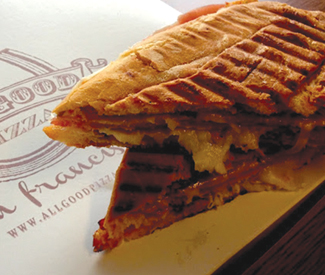
The lot invites lingering over cracker-thin pizzas (a steal at $7), from a basic Margherita to a spicy pie dotted with peppers, fennel, mozzarella, and Louisiana hot links smoked on site. The trailer houses a 650 degree gas-fired oven. These aren’t game-changing pies but there’s nothing like it in the ‘hood — nor are there many healthy salads, like a kale, radicchio, sweet potato crisps, Parmesan, balsamic reserva combo. There are also panini sandwiches ($7) such as a pig-heavy, super salty Nola Muffaletta: Genoa salami, smoked ham, olive salad, fior di latte mozzarella, and provolone cheese.

Italian sodas ($2.50) are all made on premises, like a candy sweet coconut soda evoking coconut oil, beaches and vacation. All this in a Bayview parking lot.

1605 Jerrold Ave., SF. (415) 846-6960, www.allgoodpizza.com


ANDA PIROSHKI

A close childhood pal is Russian and her mother and grandmother often home-baked us unforgettable treats as kids, from blintzes to piroshkis, those little baked buns stuffed with goodness. I still dream of them — a rarity in this town. Not even in Chicago or NY have I tasted any piroshkis as fresh as those at Anda Piroshki, a stall in the tiny but idyllic 331 Cortland marketplace housing a few take-out food purveyors. I’ve eaten Anda at SF Street Food Fest, but the ideal is to arrive at 331 soon after it opens when piroshkis are pulled from the oven piping hot.

The dough is airy yet dense, ever-so-subtly sweet, like a glorified Hawaiian roll. No skimping on fillings — one piroshki ($3.75–4.50) fills me up. Sustainable meats and local ingredients make them relatively guilt-free. Try a button mushroom piroshki overflowing with fresh spinach, or one of ground beef, rice and Swiss, oozing comfort. My favorite is Atlantic smoked salmon and cream cheese accented by black pepper and dill. It makes a savory, creamy breakfast.

The one downside has been a straight-faced, disinterested server who could not be bothered as I asked a question about Russian sodas (like Kvass, a fermented rye soda — pleasing rye notes if too saccharine) and acted the same when I returned a second time… a stark contrast to the friendliness I encounter at every other 331 business. But momentary coldness is still worth those warm piroshkis.

331 Cortland Ave., SF. (415) 271-9055, www.andapiroshki.com

Subscribe to Virgina’s twice-monthly newsletter, The Perfect Spot, www.theperfectspotsf.com


In city workers’ shoes

6

We both work under City Hall’s iconic dome as civil servants. While I often work late into the evening hours as a supervisor, Robert’s back-breaking work as a janitor is often done past the midnight hour, five nights a week.

I had the opportunity to meet Robert last week, as part of the “Walk A Day In Our Shoes” program of Service Employees International Union, Local 1021.

Robert is 52 years old. He’s worked for the city since 1999. Before that, he worked for San Francisco Unified School District. He sweeps and mops the floors and stairs of the famous rotunda and cleans 150 cubicles.

Last week, Robert had me take off my jacket and tie, roll up my sleeves and do his job for a while. I swept the marble floors, which are truly unending. I mopped the grand marble staircase behind happy couples exchanging wedding vows. He let me attempt to push a gigantic whirring machine that felt more like a Zamboni than a vacuum.

When I was younger, I had a summer job as a janitor at a public high school, so I know how truly strenuous Robert’s job is.

Robert injured his spine as a result of pushing that heavy vacuum for years. When he was in the hospital treating his spinal injury, the doctors discovered cancer. While in chemotherapy, he didn’t miss a day of work. He lives cancer-free today.

Robert is also a green pioneer at City Hall — he started a recycling program here before it was popular to do so. After that, the rest of the city caught on. He has photos of himself and the past four mayors in his home. He offers directions to visitors. He has a son, and they both live in his sister’s home. He speaks lovingly of his wife, who he lost to diabetes several years ago.

As our economy evolves, we can’t leave people like Robert — those who support our world-class city —behind. While we court businesses who create new jobs in our city, we also need to reinvest in the people who do the important work that often goes unnoticed.

Hospital workers are up at 4am, preparing meals for patients. Library technicians provide bilingual translation for our children. Others, like Robert, are up until 1am, making sure we have a clean and safe environment to work every day.

After years of concessions to balance deep budget deficits, city workers experienced ongoing cuts to their wages and benefits. In current contract negotiations, they are being asked to give hundreds more each month in healthcare costs to insure their children.

We appreciate all they have done to help our city in times of need. As our city recovers economically, it’s time to thank them, to ask others to help shoulder the costs for affordable housing, parks and recreation facilities and schools, and to reform our local business tax — which is paid by only 10% of our city’s companies.

Last week, I got to know a fellow civil servant whose work we need to remember to value. Which is why I will stand alongside Robert, labor unions, nonprofits, community members and neighbors on Wednesday, April 18, in front of City Hall from 4pm to 7pm. Please join us in supporting the workforce that supports us all, 24 hours a day. 

David Chiu is president of the Board of Supervisors.Thousands of community allies, elected officials, and SEIU 1021 members will rally on Wednesday, April 18 to close tax loopholes on mega banks and corporations from 4pm to 7pm at City Hall.

Pushing back

0

Dexter Cato has no right to be here.

He’s standing on the corner outside the house he bought in 1990. His four kids, still teenagers, grew up here. He was living here when his wife, Christina, passed away following a car accident in 2009. Next door is the house he grew up in, having spent all his life on Quesada Avenue, in the wide streets and residential friendliness of the Bayview.

Still, the bank says Cato doesn’t belong here anymore, evicting him when his home went into foreclosure in August 2010. Yet Cato and his community not only fought back and reoccupied the home last month, they have turned it into a community center and base of operations from which to fight other foreclosures in the area.

The house, at the corner of Quesada and Jenning, is draped with banners, such as “Banks: no foreclosures!” and “keep families in our homes!” In the rain on March 16, when they were unfurled on the property that has remained vacant for nearly two years, surrounded by neighbors and friends, Cato moved back in. It was a gamble and an act of civil disobedience. Now they feel festive; it’s been a month, and no one has shown up to tell Cato he has to leave.

It has become a home base for a who’s who list of “foreclosure fighters,” the name taken on by Cato and others who have, in recent months, gone to extreme means to prevent banks from foreclosing on their homes. There’s Vivian Richardson, who got her foreclosure rescinded after 1,400 emails to her loan servicer. There’s Alberto Del Rio, who was ignored and told that his paperwork was lost during a Kafka-esque two-year loan modification attempt, only to win a meeting with top Wells Fargo executives last month after Occupy Bernal got behind his cause. There’s Carolyn Gage, who took a cue from protesters downtown and occupied her Bayview home in November.

Those taking on the foreclosure crisis certainly have a big task ahead of them. Since the market collapsed in 2008, there have been 12,410 foreclosures in San Francisco, according to data from RealtyTrac as compiled by the Alliance of Californians for Community Empowerment (ACCE). The neighborhoods with the most foreclosures are Ingleside-Excelsior/Crocker Amazon, Visitacion Valley/Sunnydale, and Bayview-Hunters Point, with more than 1,000 in each neighborhood. But the number of home foreclosures are in the hundreds in every neighborhood in San Francisco.

Despite the pandemic, many San Francisco residents say they felt distinctly alone in the events surrounding receiving notice of default.

“I’ve lived in Noe Valley since 1972,” said Kathy Galvess, an activist we spoke to Cato’s basement. “I didn’t know anybody who had been foreclosed on.”

When she got her eviction notice and, hooking up with ACCE and Occupy Bernal, faced her situation and the extent of the crisis, she wondered if her neighbors knew something she didn’t.

“I asked around the neighborhood, no one had any idea,” she said. “That’s how the banks get away with it. We suffer in silence.”

Carolyn Gage echoed that sentiment. “A while ago, foreclosure was shameful. But now it shouldn’t be. It’s happening in a systemic way, so people are getting over that shame,” she told me and several neighbors March 24 during a barbecue at Cato’s house.

This shame came in part from the illusion that the onslaught of seemingly affordable home loans from the housing bubble’s height were, in fact, affordable.

“The easy money fueled the ability for people to refinance every one or two years. A lot of people did that and just lived on it. Certain people used it, some abused it, others got caught up in it,” said CJ Holmes, a real estate broker in Santa Rosa who became interested in understanding the meanings of the crisis when the value of property she owned plummeted in 2008.

While President Bush signed on to Troubled Asset Relief Program (TARP) in 2008, and bailouts to Fannie Mae and Freddie Mac continued to roll out well into the Obama presidency, foreclosures were steadily clearing San Francisco of longtime residents, not to mention property tax and home values on foreclosure-stricken blocks.

There were advocates working on the behalf of those getting evicted. The Alliance of Californians for Community Empowerment looked into cases and worked to discern the complex chain of entitlement, talk to the right people, and try to get loans modified. HUD-certified organizations like the Mission Economic Development Agency (MEDA) and the San Francisco Housing Development Corporation (SFHDC) counseled homeowners and waded through paperwork.

“The modification process takes an average of 12 months to complete,” said Jose Luis Rodriguez, a foreclosure counselor with MEDA, in an email. The loan modification process can make or break a homeowners chances of keeping their home, leaving them in what he called “purgatory.”

Assessor-Recorder Phil Ting later concluded that in 84 percent of foreclosure cases, there was some kind of faulty paperwork.

“We’d fax documents to banks and they would habitually lose documents. We’d have to fax them sometimes up to 10 times,” said Jonathan Segarra, director of communications for MEDA.

Alberto Del Rio had the same issue. During his loan modification struggle, “we kept having to sign up for a new case,” Del Rio told me. “About every three months. Generally because they lost paperwork, or paperwork wasn’t properly transmitted.”

“There was no callback on their part,” he said. “We would have to call to get updates and they would say: oh, it’s closed, you have to start over with the paperwork now.”

But this lost paperwork epidemic, an emblem of the carelessness that ran rampant through the mad expansion of the subprime mortgage industry, has more than one face. It is likely due to lost paperwork, for example, that Cato has been living in the home that is, technically, no longer his.

No one seems to have the title.

At the time of sale, it was owned by Wells Fargo. According to transaction records, the foreclosure is being serviced by American Home Mortgage Servicers; they get a portion of the money, but do not own it. According to Wells Fargo representatives, that bank is now the trustee of the mortgage, also known as the beneficiary.

ACCE has claimed that Wells Fargo “sold the house back to itself,” and that American Home Mortgage Services, the company currently servicing the loan, is a subsidiary of Wells Fargo. Ruben Pulido, a Wells Fargo spokesperson, denies this.

“That’s incorrect. American Home mortgage services is completely different and separate from Wells Fargo,” Pulido told us.

But Martinez believes that “they’re different entities in that they work separately, but they’re the main servicer for Wells Fargo, they only service for Wells Fargo.”

Calls and emails to American Home Mortgage Services went unanswered.

Last fall, as an angry mass suddenly emerged from the American public, cries of “banks got bailed out, we got sold out” rang through the streets. Occupy Bernal and ACCE have had success in the city government, gaining support from Sups David Campos and John Avalos, who represent some of the hardest hit districts, helping facilitate meetings between Wells Fargo representatives and homeowners with foreclosure horror stories, with some success.

Activists also went for more civil disobedience-style tactics. These were on display Feb. 22, when dozens of supporters showed up at Monica Kenney’s Excelsior home. Kenney was in the midst of dealing with a foreclosure that didn’t seem right. She had received a forbearance agreement and made the first payment on it June 27, then was surprised to learn that, June 28, her house had been sold at auction.

“At this point I wrote Wells Fargo and I said, I have this paperwork, and I want you to honor it and rescind the foreclosure,” Kenney explained when she came to speak with us at the Guardian offices. She gave us copies of the forbearance agreement.

“Their response was, we did nothing wrong and the foreclosure will stand,” she said. “So at that point I decided I would fight to retain my home.”

After dishing out most of her savings in a lawsuit and eviction stays, the fight looked grim, and her house was slated for eviction. The plan — the last line of defense — was to simply bring as many people as possible to Kenney’s home and hope they could fend off eviction. Kenney remembers her nerves, huddled up that cold morning with veteran foreclosure fighter Vivian Richardson, worried that no one would show up.

“Then, at six in the morning, I had foreclosure fighters, neighbors, friends, Occupy Bernal, Occupy folks period, they just started showing up at the house, and just sat down, hunkered down with me and said, we’ll do whatever we can to at least dissuade the sheriff,” she recalls

It worked. And it hasn’t stopped working. Many people who have joined with Occupy Bernal and ACCE are still in their homes thanks to everything from lobbying politicians to civil disobedience. Some were evicted despite the protest movement’s best efforts but, thanks to newfound community, they avoided homelessness.

Kathy Galvess wasn’t able to keep her home, but her experience was made much more pleasant by Occupy Bernal. “Stardust got the moving truck and helped me move, out of the goodness of his heart,” she told me. “And if it wasn’t for Vivian, me and my sister would be wandering the streets in these storms we’ve been having.”

It’s that community, it’s that tireless work, it’s that victory in the midst of a sea of ongoing challenges that was celebrated at the barbecue at Cato’s house. It’s hard to know the future of the occupied home. The goal of the coalition supporting it was to keep it until April 24, the day of a Wells Fargo shareholders meeting that a large coalition of advocates are determined to shut down.

But for now, the place has become a community center and a symbol of hope and defiance. Politicians have certainly taken note. The Board of Supervisors passed a resolution last week urging banks to suspend foreclosures in San Francisco.

“It’s great,” Cato said. “That’s what the house is useful for right now. Everyone’s coming in and asking, how can we be a part of this, how can we help.”

San Francisco’s loss

116

news@sfbg.com

San Francisco is increasingly losing its working and creative classes to the East Bay and other jurisdictions — and with them, much of the city’s diversity — largely because of policy decisions that favor expensive, market-rate housing over the city’s own affordable housing goals.

“It’s definitely changing the character of the city,” said James Tracy, an activist with Community Housing Partnership. “It drains a big part of the creative energy of the city, which is why folks came here in the first place.”

>>Is Oakland cooler than San Francisco? Oaklanders respond.

Now, as San Francisco officials consider creating an affordable housing trust fund and other legislative changes, it’s fair to ask: Does City Hall have the political will to reverse the trend?

Census data tells a big part of the story. In 2000, the median owner-occupied home in San Francisco cost $369,400, and by 2010 it had more than doubled to $785,200. Census figures also show median rents have gone from $928 in 2000 up to $1,385 in 2010 — and even a cursory glance at apartment listings show that rents have been steadily rising since then.

Tracy and other affordable housing activists testified at an April 9 hearing before the Board of Supervisors Land Use and Economic Development Committee on a new study by the Budget and Legislative Analyst, commissioned last July by Sup. David Campos, entitled “Performance Audit of San Francisco’s Affordable Housing Policies and Programs.”

“There’s a hearing right now at City Hall about our housing stock and how it’s been skewing upward toward those with higher incomes,” Board President David Chiu told us, noting that it is sounding an alarm that, “Creative individuals that make this place so special are being driven out of the city.”

Oakland City Council member Rebecca Kaplan said that San Francisco’s loss has been a gain for Oakland and other East Bay cities, which are enjoying a new cultural vibrancy that has so far been largely free of the gentrifying impacts that can hurt a city’s diversity.

“You can add more people without getting rid of anybody if you do it right. Most of development is looking at places that are now completely empty like the Lake Merritt BART station parking lot, empty land around the Coliseum, and the West Oakland BART station,” Kaplan told us. “We have to commit to revitalization without displacement.”

Yet the fear among some San Franciscans is that we’ll have just the opposite: displacement that actually hinders the city’s attempts at economic revitalization. “What’s at stake is the economic recovery of the city,” Tracy said. “You can’t have such a large portion of the workforce commuting into the city.”

TOO MANY CONDOS

A big part of the problem is that San Francisco is building plenty of market-rate (read: really expensive) housing, but not nearly enough affordable housing. The report Campos commissioned looked at how well the city did at meeting various housing construction goals it set for itself from 1999 to 2006 in its state-mandated Housing Element, which requires cities to plan for the housing needs of its population and absorb a fair share of the state’s affordable housing needs.

The plan called for 7,363 market-rate units, or 36 percent of the total housing construction, with the balance being housing for those with moderate, low, or very low incomes. Developers built 11,293 market rate units during that time, 154 percent of what was needed and 65 percent of the total housing construction. There were only 725 units built for those with moderate incomes (just 13 percent the goal) and just over half the number of low-income units needed and 83 percent of the very low-income goal met.

“We have to do a better job of monitoring and evaluating each project,” Chiu said. “Every incremental decision we make determines whether this will be a city for just the wealthy.”

The situation for renters is even worse. From 2001-2011, the report showed there were only 1,351 rental units built for people in the low to moderate income range, people who make 50-120 percent of the area median income, which includes a sizable chunk of the working class living in a city where about two-thirds of residents rent.

“The Planning Commission does not receive a sufficiently comprehensive evaluation of the City’s achievement of its housing goals,” the report concluded, calling for the planners and policymakers to evaluate new housing proposals by the benchmark of what kind of housing the city actually needs. Likewise, it concluded that the Board of Supervisors isn’t being regularly given information it needs to correct the imbalance or meet affordable housing needs.

Policy changes made under former Mayor Gavin Newsom also made this bad situation even worse. Developers used to build affordable housing required by the city’s inclusionary housing law rather than pay in-lieu fees to the city by a 3-1 ratio, but since the formulas in that law changed in 2010, 55 percent of developers have opted to pay the fee rather than building housing.

Also in 2010, Newsom instituted a policy that allowed developers to defer payment of about 85 percent of their affordable housing fees, resulting in an additional year-long delay in building affordable housing, from 48 months after the market rate project got permitted to 60 months now.

Tracy and the affordable housing activists say the city needs to reverse these trends if it is to remain diverse. “It’s not even debatable that the majority housing built in the city needs to be affordable,” Tracy said.

Mayor Ed Lee has called for an affordable housing trust fund, the details of which are still being worked out as he prepares to submit it for the November ballot. Chiu said that would help: “I will require a lot of different public policies, but a lot of it will be an affordable housing trust fund.”

GROWTH AND DIVERSITY

San Francisco’s problems have been a boon for Oakland.

“With much love and affection to my dear SF friends, I must say that Oakland is more fun,” Kaplan told us. “Also I think a lot of people are choosing to live in Oakland now for a variety of reasons that aren’t just about price. We have a huge resurgent art scene, an interconnected food, restaurant, and club scene, a place where multicultural community of grassroots artists is thriving, best known from Art Murmur.”

There is fear that Oakland could devolve into the same situation plaguing San Francisco, with rising housing prices that displace its diverse current population, but so far that isn’t happening much. Oakland remains much more racially and economically diverse than San Francisco, particularly as it attracts San Francisco’s ethnically diverse residents.

“We’re not looking at a situation where the people moving into town are necessarily predominantly white,” Kaplan said. “We’re having large growth in quite a range of communities, including growing Ethiopian and Eritrean and Vietnamese populations…If you don’t want to live in a multicultural community, maybe Oakland’s not your cup of tea.”

According to the 2010 census, a language other than English is spoken at home in 40.2 percent of Oakland households, compared to 25.4 percent in San Francisco. “Almost every language in the world spoken in Oakland,” Kaplan said.

African Americans make up 28 percent of Oakland’s population, compared to only 6.1 percent in San Francisco, and 6.2 percent of the population of California. In San Francisco, the number of black-owned businesses is dismal at 2.7 percent, compared to 4 percent statewide and 13.7 percent in Oakland. The census also finds that 25.4 percent Oaklanders are people of Latino origin, compared to San Francisco at 15.1 percent and 37.6 percent statewide. San Francisco is 33.3 percent Asian, compared to Oakland at 16.8 percent and all of California at 13 percent.

Both cities are less white than California as a whole; the state’s white population is 57.6 percent, compared to 34 percent in Oakland and 48.5 percent in San Francisco.

Gentrification shows its face differently depending on the neighborhood. Some say Rockridge, a trendy Oakland neighborhood where prices have recently increased, has gone too far down the path.

“Rockridge has been ‘in’ for a long time, but the prices are staggering and it isn’t as interesting any more,” Barbara Hendrickson, an East Bay real estate agent, told us.

The nationwide foreclosure crisis didn’t spare Oakland and may have sped up its gentrification process. “The neighborhoods are being gentrified by people who buy foreclosures and turn them into sweet remolded homes,” observed Hendrickson.

Yet Kaplan said many of these houses simply remain vacant, driving down values for surrounding properties and destabilizing the community. “I think we need a policy where the county doesn’t process a foreclosure until the bank has proven that they own the note,” said Kaplan, who mentioned that the city has had some success using blight ordinances to hold banks accountable for the empty buildings.

And as if San Francisco didn’t have enough challenges, Kaplan also noted another undeniable advantage: the weather. “The weather is really quite something,” she said. “I have days with a meeting in San Francisco and I always have to remember to bring completely different clothing. Part of why I wanted to live in California was to be able to spend more time outdoors, be healthy, bicycle, things like that. So that’s pretty easy to do over here in Oakland.”

Heading East: The flight from San Francisco

13

EDITORIAL There is no simple free-market solution to gentrification and displacement. There’s no way a crowded city like San Francisco can simply rely on the forces of supply and demand to protect vulnerable populations. And there’s no way the city’s flawed housing policy can prevent the loss of thousands of San Franciscans — particularly young, creative people who help keep a city lively — from fleeing to a town where they can actually afford the rent.

Richard Florida, the famous social and economic theorist who coined the term “creative class” argues that artists and writers and geeks and musicians are the forces that drive modern economies. His pioneering 2002 essay in the Washington Monthly was titled “Why cities without gays and rock bands are losing the economic development race.”

Florida’s something of an elitist and he ignores the contributions that tens of thousands of others (including retired people, union members and nonprofit workers) make a community. He idolizes tech culture and often ignores issues like class and race.

But he’s got a point: Nobody who’s doing anything cool wants to live in a city where everyone is rich and everything is clean and boring. And that’s the danger San Francisco faces.

Just go over to Oakland for a few days and talk to all the people who were once part of this city’s cultural scene. They’ll tell you what anyone with any sense knows: You don’t attract creative people to a city by giving out tax breaks for corporations and building fancy office space. The rock bands that Florida talks about aren’t going to stay in a city because it has high-end jobs for people with advanced degrees. Artists need a place where they can afford the rent.

San Francisco is still a great urban center, by any possible standard, and has all the qualities of diversity, openness, energy, politics and fun that have made generations of immigrants from all over the world want to make it their home. But at a certain point, housing becomes more important than all of the other development issues that local government can address.

Take Andy Duvall, a musician we interviewed who was part of San Francisco for 15 years before he was literally priced out of town. For half of what he was paying in the Mission, Duvall has more than twice the space in Oakland — and the situation is just getting worse. While most of the country is still mired in a deep housing slump (and parts of San Francisco are facing a foreclosure crisis), rents in this town are soaring, beyond the affordability of almost anyone who currently lives here. According to the city’s own statistics, only about 10 percent of San Franciscans can afford the rent on a median market-rate apartment. That means if they’re evicted or lose their homes, they have to leave town.

The supervisors held a hearing April 9 on affordable housing, and the message was profound: “Affordable housing preserves the neighborhood in more ways than one; residents are the foundation on which the economy is built. From any angle, if we can’t afford to live here, there is no city,” observed Val Sinckler, a Western Addition resident.

But while the mayor is working to attract companies that will pay high-end salaries to people who can afford to pay far more rent than the average San Franciscan, he’s a long way from coming up with the money to even begin to mitigate the problem.

An effective policy to preserve San Francisco requires strict regulation (to prevent evictions and displacement), a mandate that commercial developers build housing for their workforce and that residential developers meet the needs of low- and moderate-income residents — and a large investment of public money in affordable housing. If Lee isn’t willing to talk serious about those three crucial elements, then he’s presiding over the decline of one of the world’s coolest cities.

Editorial: The flight from San Francisco

23

EDITORIAL There is no simple free-market solution to gentrification and displacement. There’s no way a crowded city like San Francisco can simply rely on the forces of supply and demand to protect vulnerable populations. And there’s no way the city’s flawed housing policy can prevent the loss of thousands of San Franciscans — particularly young, creative people who help keep a city lively — from fleeing to a town where they can actually afford the rent.

Richard Florida, the famous social and economic theorist who coined the term “creative class” argues that artists and writers and geeks and musicians are the forces that drive modern economies. His pioneering 2002 essay in the Washington Monthly was titled “Why cities without gays and rock bands are losing the economic development race.”

Florida’s something of an elitist and he ignores the contributions that tens of thousands of others (including retired people, union members and nonprofit workers) make a community. He idolizes tech culture and often ignores issues like class and race.

But he’s got a point: Nobody who’s doing anything cool wants to live in a city where everyone is rich and everything is clean and boring. And that’s the danger San Francisco faces.

Just go over to Oakland for a few days and talk to all the people who were once part of this city’s cultural scene. They’ll tell you what anyone with any sense knows: You don’t attract creative people to a city by giving out tax breaks for corporations and building fancy office space. The rock bands that Florida talks about aren’t going to stay in a city because it has high-end jobs for people with advanced degrees. Artists need a place where they can afford the rent.

San Francisco is still a great urban center, by any possible standard, and has all the qualities of diversity, openness, energy, politics and fun that have made generations of immigrants from all over the world want to make it their home. But at a certain point, housing becomes more important than all of the other development issues that local government can address.

Take Andy Duvall, a musician we interviewed who was part of San Francisco for 15 years before he was literally priced out of town. For half of what he was paying in the Mission, Duvall has more than twice the space in Oakland — and the situation is just getting worse. While most of the country is still mired in a deep housing slump (and parts of San Francisco are facing a foreclosure crisis), rents in this town are soaring, beyond the affordability of almost anyone who currently lives here. According to the city’s own statistics, only about 10 percent of San Franciscans can afford the rent on a median market-rate apartment. That means if they’re evicted or lose their homes, they have to leave town.

The supervisors held a hearing April 9 on affordable housing, and the message was profound: “Affordable housing preserves the neighborhood in more ways than one; residents are the foundation on which the economy is built. From any angle, if we can’t afford to live here, there is no city,” observed Val Sinckler, a Western Addition resident.

But while the mayor is working to attract companies that will pay high-end salaries to people who can afford to pay far more rent than the average San Franciscan, he’s a long way from coming up with the money to even begin to mitigate the problem.

An effective policy to preserve San Francisco requires strict regulation (to prevent evictions and displacement), a mandate that commercial developers build housing for their workforce and that residential developers meet the needs of low- and moderate-income residents — and a large investment of public money in affordable housing. If Lee isn’t willing to talk serious about those three crucial elements, then he’s presiding over the decline of one of the world’s coolest cities.


Why Wall Street loves the War on Drugs

46

The raid on Oaksterdam has just about everyone in local politics engaging in a little head-scratching: What possible reason would the Obama administration have to crack down on medical marijuana in an election year? How does it help the president, who will be facing an unsettled and angry electorate in a still-tough economy, to alienate the pot smoking liberals of the world, who were at one point among his most loyal constituents?

What a fucking idiot.

Here’s what make it worse: I don’t think anyone at Goldman Sachs talked to the White House about this, but the 1 percent clearly have a lot to gain from the drug war.

And it has nothing to do with drugs.

Let’s be logical here. There’s only one possible way to increase economic equality in this country, and it involves government intervention. With union membership at a fraction of what it once was, government is the only institution with the power these days to enforce income redistribution. The wealthy have to be forced to pay higher taxes, and that money has to be spent on public education, affordable housing, economic development, public-sector-driven job creation and other programs that are proven to narrow the wealth gap.

But that’s tricky, since the Right has done such an effective job (with the help of corrupt politicians of every stripe, including liberals) of making Americans mistrust government. How do you get people to vote for higher taxes when they think the money’s going to be wasted on pointless wars and crony contracts — and on sending federal agents to roust pot clubs?

The two factors that most accounted for the fall of economic liberalism in the 1960s were Vietnam and pot. My parents generation saw the government as the nation’s leaders who got us out of the Great Depression and won World War II. My generation saw government as the assholes who were sending us to die in Southeast Asia and putting us in jail for smoking weed. That’s why when Ronald Reagan announced that “government is not the solution, it’s the problem,” so many of my peers nodded (through the haze) and said: Right on.

There are more progressives in the Bay Area today who distrust and dislike the federal government than there were before the raids began. We’re going back to the days when “the feds” became a dirty word. And it’s undermining everything that Obama is tyring to do with the economy.

Yeah, Wall Street, which is trying to get rid of pesky regulations, loves this — if you hate the feds in Oaksterdam, it’s hard to love them at the IRS and Securities and Exchange Commission. That’s what the 1 percent relies on. And it’s working.


Reject the CPMC deal

0

EDITORIAL For most of the past year, Mayor Ed Lee had been taking a tough line with California Pacific Medical Center, the health-care giant that wants to build a state-of-the-art 555-bed hospital on Cathedral Hill. The mayor had been telling a stunningly recalcitrant CMPC management that the outfit would have to put upwards of $70 million into affordable housing and spent millions more on transit, neighborhood and charity-care programs to mitigate the impacts of the massive project.

But late in March, something happened. Under immense pressure from the Chamber of Commerce and other big business groups, the mayor buckled and agreed to a deal with woefully inadequate mitigation measures. The supervisors should reject the plan and force CPMC to do better.

The biggest problem with a project this size is the mix of jobs and housing. Lee is properly concerned about creating jobs in a city where unemployment in some neighborhoods is stubbornly high. But the proposed deal only guarantees a tiny fraction of the 1,500 permanent new jobs for San Francisco residents.

That means a city that has almost zero vacancy in affordable housing is going to have to absorb a workforce much of which won’t be able to buy or rent anything at current market rates. That means more competition for scarcer housing and higher rents and home costs for everyone.

By any basic planning logic, CPMC should be on the hook for providing enough affordable housing for at least some reasonable percentage of its workforce. Instead, the hospital chain is offering about $33 million, only $3 million of which will be paid up front. That won’t even address half of the housing impact. Besides, the jobs will be there when construction starts, and more when the hospital opens; the limited affordable housing money will come much later. The highest-paid doctors and administrators may be able to afford the pricey new market-rate condos the city is madly approving — but where, exactly, are the nurses, orderlies, clerks, janitors and other health-care workers going to live?

CPMC has agreed to provide charity care at the same level is currently does — which is abysmally low, among the lowest of all nonprofit hospital chains in California. So that’s not an advantage.

And it has promised to keep open St. Luke’s Hospital in the Mission — the only full-service hospital other than SF General in the southeast part of town. But the proposal calls for cutting the number of beds by nearly two-thirds, from 229 to 80. And it allows for the closure of that hospital if CPMC’s system-wide operating margin falls below 1 percent (something that will be hard for the city to challenge, since CPMC handles the books).

It’s cynical how CPMC is using this critical medical facility in an underserved area as a bargaining chip. Already, hospital lobbyists are warning that St. Luke’s will be shut down if they don’t get what they want on Cathedral Hill.

Meanwhile, CPMC has labor trouble and is refusing to guarantee that existing employees at facilities that will be demolished will be able to keep their jobs and seniority at the new hospital.

We realize that CPMC needs to build a new facility to replace aging and seismically unsafe structures elsewhere in town. But the hospital chain also has a responsibility to address the impacts this project will have on San Francisco. And right now, it’s not a good deal.

Parks and leaks

0

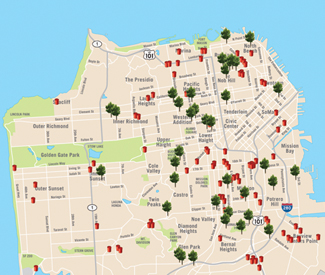
THE GREEN ISSUE It happens suddenly, unexpectedly: you turn a corner or hike up a street and notice, almost out of the blue, a well-kept spot of green, a surreal bit of nature sliced out of all the housing and concrete. According to a list provided to us by San Francisco Recreation and Parks (www.sfrecpark.org), there are 46 designated mini-parks, or pocket parks, nestled in various SF neighborhoods: publicly maintained, accessible areas usually no bigger than the size of a single vacant lot. We set off to discover five perhaps lesser known ones, described in the map below.

Then, in a nod to one of our all-time favorite cartographic-experimental books, Infinite City by Rebecca Solnit (UC Press, 2010, www.rebeccasolnit.com) we decided to overlay a map of locations of leaking underground storage tank (“LUST”) cleanup sites, found at geotracker.waterboards.ca.gov. LUSTs are buried tanks of toxic material, usually containing petroleum but sometimes solvents or other hazardous waste, that threaten groundwater, soil, and air and must be cleaned up — often with the help of state and federal funds — before the land they’re beneath can be built on or repurposed. We’ve plotted 85 LUST sites, many of them former or current gas station locations, whose statuses are under assessment or being monitored or remediated.

There is no direct connection between mini-parks and LUST cleanup sites; we think, though, that there is the suggestion of an environmental tale, a hidden history maybe, in the visual juxtaposition of the two.

>>CLICK HERE TO SEE THE MAP (PDF)

Sea, here

0

arts@sfbg.com

>>See more astounding images from Beneath Cold Seas here.

THE GREEN ISSUE Most people associate underwater photography with the tropics, but the beautiful shots that appear in Beneath Cold Seas (University of Washington, $45, 160pp) were shot in the Pacific Northwest. What’s most striking about the book is the color and vibrance that photographer David Hall was able to capture. It’s a bit mind-blowing to imagine that the hooded nudibranches and grasping octopi found in the book live in the inky depths abutting our very own rocky shores. The next time you take a dip at Baker or Muir Beach don’t forget that you’re frolicking with some seriously stunning fauna. 

SFBG: Where did you shoot Beneath Cold Seas?

DAVID HALL: I shot Beneath Cold Seas in British Columbia. The water tends to be more clear and there’s less pollution because of the small population density. But the same animals in the book are found in Northern California, they don’t recognize international borders. Technically biologists say the ecosystem extends from Southern Alaska down to Point Conception (north of Santa Barbara). That entire area is referred to as the Pacific Northwest.

SFBG: What environmental issues are facing the Pacific Northwest?

DH: One problem is the introduction of alien species. For instance farm-raised salmon taken from New England genetic stock occasionally escape and interbreed with the five or six Pacific species. So you’re getting a genetic mixture which endangers the original Pacific species. But the environmental issues that most people are worried about are overfishing and pollution, like oil spills. As more Canadian oil is being developed and exported to places like China, it will have to be shipped across these waters. So that becomes a concern, especially after what happened in the Gulf of Mexico last year.

SFBG: When did you start taking photos underwater?

DH: Many years ago I took a trip to the Virgin Islands. I’d never seen a coral reef before and was completely overwhelmed by what I saw while snorkeling. I felt that I had to photograph it because I’m not so good at describing things. I went out and bought the best camera I could afford which was a Kodak Instamatic in a plastic housing with flashbulbs. That was how it all started. In those days the bar was very low, if you got an underwater photograph that was somewhat recognizable you could get it published.

http://www.youtube.com/watch?v=NgDfA61OpFI

SFBG: What would you say inspired this project?

DH: At first I started going because I loved the diving, I enjoyed being there and getting photographs. But after the first half dozen trips I realized that the material I was getting was good enough for a book. I got the idea for the book about five years ago, but all in all it took about 15 years.

SFBG: What was a typical shoot like?

DH: I was living on a small boat for a couple of weeks at a time, doing three dives a day, and then reviewing photos at night. The days would be consumed with getting ready for the dive, getting all the equipment on, waiting until the current was just right, getting into the water, diving for an hour, getting back to the boat, getting warm — which takes another hour or two — and then getting ready to dive again. Altogether I made about 500 dives from 1995 to 2010.

Photographing underwater is much more difficult than photographing in air, and photographing in cold water is that much more difficult than photographing in warm water. No one had ever published a good book on underwater photography from a cold water destination in North America before. There are plenty of field guides, and fish ID books for fisherman, but no one had ever published a photographic book that tried to show the character of the ecosystem in an artistic way.

The book required getting a lot of wide angle shots to include the scenery as well as the animals. Getting good clear, colorful photographs in cold water is difficult because of visibility issues. Also cold water filters out all of the warm colors in the spectrum (red, orange, yellow) so to see the colors you have to add light back. So I dive with a pair of powerful flash units that attach to the camera by way of articulated arms that keep my hands free.

SFBG: So there wasn’t someone handling lighting for you?

DH: If I were a National Geographic contract photographer I’d probably have had a few assistants holding lights for me, but I wasn’t so lucky. I had to do everything myself. And in most cases I was diving completely alone.

SFBG: People don’t associate such colorful and exotic creatures with our coast. It’s really wonderful that your book is changing that perception.

DH: I certainly hope that’s what’s happening. The book has been very well received, largely because nobody was aware of what was down there. I mean marine biologists and divers were, but ordinary people had no idea.

People tend to protect what they know and value. Most Americans and Canadians are familiar with the aquatic species that we eat, but there’s a whole ecosystem there that the great majority of us are completely unfamiliar with. I hope my book will make people aware that these things exist and want to feel more protective toward that whole environment.


Editorial: Reject the CPMC deal!

17

EDITORIAL For most of the past year, Mayor Ed Lee had been taking a tough line with California Pacific Medical Center, the health-care giant that wants to build a state-of-the-art 555-bed hospital on Cathedral Hill. The mayor had been telling a stunningly recalcitrant CMPC management that the outfit would have to put upwards of $70 million into affordable housing and spent millions more on transit, neighborhood and charity-care programs to mitigate the impacts of the massive project.

But late in March, something happened. Under immense pressure from the Chamber of Commerce and other big business groups, the mayor buckled and agreed to a deal with woefully inadequate mitigation measures. The supervisors should reject the plan and force CPMC to do better.

The biggest problem with a project this size is the mix of jobs and housing. Lee is properly concerned about creating jobs in a city where unemployment in some neighborhoods is stubbornly high. But the proposed deal only guarantees a tiny fraction of the 1,500 permanent new jobs for San Francisco residents.

That means a city that has almost zero vacancy in affordable housing is going to have to absorb a workforce much of which won’t be able to buy or rent anything at current market rates. That means more competition for scarcer housing and higher rents and home costs for everyone.

By any basic planning logic, CPMC should be on the hook for providing enough affordable housing for at least some reasonable percentage of its workforce. Instead, the hospital chain is offering about $33 million, only $3 million of which will be paid up front. That won’t even address half of the housing impact. Besides, the jobs will be there when construction starts, and more when the hospital opens; the limited affordable housing money will come much later. The highest-paid doctors and administrators may be able to afford the pricey new market-rate condos the city is madly approving — but where, exactly, are the nurses, orderlies, clerks, janitors and other health-care workers going to live?

CPMC has agreed to provide charity care at the same level is currently does — which is abysmally low, among the lowest of all nonprofit hospital chains in California. So that’s not an advantage.

And it has promised to keep open St. Luke’s Hospital in the Mission — the only full-service hospital other than SF General in the southeast part of town. But the proposal calls for cutting the number of beds by nearly two-thirds, from 229 to 80. And it allows for the closure of that hospital if CPMC’s system-wide operating margin falls below 1 percent (something that will be hard for the city to challenge, since CPMC handles the books).

It’s cynical how CPMC is using this critical medical facility in an underserved area as a bargaining chip. Already, hospital lobbyists are warning that St. Luke’s will be shut down if they don’t get what they want on Cathedral Hill.

Meanwhile, CPMC has labor trouble and is refusing to guarantee that existing employees at facilities that will be demolished will be able to keep their jobs and seniority at the new hospital.

We realize that CPMC needs to build a new facility to replace aging and seismically unsafe structures elsewhere in town. But the hospital chain also has a responsibility to address the impacts this project will have on San Francisco. And right now, it’s not a good deal.


The slate controversy at the DCCC

30

There’s nothing like a combination of insider politics, a struggle for control of the local Democratic Party and the ongoing discussion about the need for progressives and moderates to get along better to make for a complicated political story.

Which is exactly what’s going on with Alix Rosenthal’s effort to put together a Women’s Slate for the Democratic County Central Committee.

I’ve spend way too much time trying to figure it all out, but it raises enough interesting issues to make it worth discussion in the progressive community.

The background: For four years, the progressives have controlled the DCCC – and thus the powerful local endorsements for the local Democratic Party. That’s taken considerable organizing – and it’s worked to a great extent because of a remarkable degree of unity among a famously fractious bunch.
In the past two elections, every progressive group, the Harvey Milk Club, the Tenants Union, the teacher’s union, the nurses, the Sierra Club — and the Bay Guardian – has endorsed essentially the slate of candidates. There are problems with that approach – it’s easy for some people or some groups to get excluded, and you get complaints of machine politics – but in reality, there weren’t a lot of people who identified as progressive getting left out. Quite the opposite – the slate organizers were working hard to recruit people to run. Serving on the DCCC isn’t glamorous and it’s a lot of work. (It’s also at times unpleasant — the arguments are harsh, sometimes more so than necessary.)

In 2012, we have a different problem: The people who are called moderates have convinced a lot of high-profile canidates (former Sup. Bevan Dufty, Sup. Malia Cohen, School Board member Hydra Mendoza) – people who will win on name-recognition alone – to run. Combined with the retirement of Aaron Peskin, and the all-but certain re-election of incumbents like Scott Wiener and Leslie Katz (who remains to this day the only member of the DCCC who refuses ever to take my phone calls) and you have the makings of a conservative victory.

Let me take a second on this “moderate” tag. Moderates in San Francisco are people who are liberal on social issues – like, frankly, 80 or 90 percent of the city – but conservative on economic issues. Conservative is the right word here: The moderates don’t typically support higher taxes on the rich and big business, don’t support development controls, are weak on tenant issues, don’t think that housing should be a right of all people and pretty much buy into what in the Clinton era we called neo-liberalism.

The progressives (who have economic policies more like the Democratic Party of FDR and Lyndon Johnson) and the moderates (who have economic policies more like the Democratic Party of  Walter Shorenstein, Dianne Feinstein and Bill Clinton) have been fighting for decades over the future of a city where there aren’t a whole lot of Republicans.

So when I say conservative I’m not talking about Reagan or Santorum — but I’m talking about a very different economic vision than mine.

And while I’m all in favor of being civil and polite to everyone and respecting friends and colleagues who disagree with you, I guess I’m enough of an old commie (with a lower case “c”) to believe deeply in class struggle and the idea that the rich and powerful don’t give up without a fight.

And having a good working relationship with the conservative Democrats (hey, I’m on great terms with Scott Wiener – we talk all the time and I respect him and like him personally) doesn’t mean I’m ready to give up the notion that in the United States and California and San Francisco, 2012, there’s a class war going on. We didn’t start the war, but we have to fight it to survive — and to keep the city from becoming an ossified playground of the very wealthy.

Okay, enough background and rhetoric. On March 29, Rosenthal – who is also my friend and I respect and often support – sent out an email that announced that all of the women running for DCCC were going to work together on a slate:

“The female candidates for the San Francisco Democratic County Central Committee (DCCC) have banded together to form a slate of our own. It’s called Elect Women 2012, and it includes all women running this June in both Assembly districts in San Francisco, moderates and progressives alike. The slate is intended to provide a support network for both new and seasoned candidates, to develop an amicable working relationship between moderate and progressive candidates, and above all to get more women elected to public office.”

 
That’s all good. More women in politics is good. Supporting new candidates is good. A working relationship between progressives and moderates is good.
But here’s the question, and it’s not a new one in San Francisco: Is it a good idea, both politically and as a matter of strategy, to promote the interests of people who largely disagree with you on issues? If a slate of women helps knock off a progressive man in favor of a conservative woman, is that a positive change?

Rosenthal doesn’t think that’s going to happen. We’ve had a couple of long discussions about this, and she’s looked at the math and the current list of candidates, and she thinks her slate is more likely to help a couple of progressive women (Petra DeJesus, for example) who might not otherwise win.
“You need to touch the voters three or four times before they know who you are,” she told me. “The winners will be people who are on several slates, and the progressives have more slates than the moderates.”

The guys who she agrees should really be on the DCCC and might have a close call (Matt Dorsey, for example, a gay man, or Dr. Justin Morgan, an African American man) won’t win or lose on the basis of a competing women’s slate.

Rosenthal ran for office on a pledge to bring more women into the DCCC and into public office, and that’s an important goal – right now, there’s not a single woman among the citywide elected officials in San Francisco. (That hasn’t always been the case — the mayor for 10 (awful) years was Dianne Feinstein, and in the past decade or so we’ve had a female treasurer, assessor, district attorney, city attorney and public defender. But right now: All guys.

The Board of Supes is a bit lopsided, too – seven men, four women.

And for the same reason that putting people of color into office almost by definition changes the perspective of politics, electing women is a progressive value. No matter how sympathetic the straight white men are, there are things we never had to experience and will never really understand.

That said, I would much rather have (mostly progressive) white guy Aaron Peskin run the Democratic Party than (mostly conservative) Asian woman Mary Jung – and so would Rosenthal. “No question, no doubt about it,” she told me.

Now that Jung has all but announced that she wants to be the next party chair, and since a number of the women on the slate will support her over a progressive (and would support her over Rosenthal) – is this doing the movement any good?

Gabriel Haaland, a transgender man and former president of the Harvey Milk Club, points out that “the Milk Club could simply endorse all LGBT candidates for our slate, and there are some who have argued for that over the years. But we don’t — because we work in coalitions, and that kind of slate undermines the whole concept of coalition politics.”

Hene Kelly, who is on the women’s slate but has insisted that the mailings make it clear she isn’t supporting some of the other candidates who will be connected with her, thinks the Rosenthal plan is a bad idea.

“There are people on this slate I could not and would not support because they don’t share my beliefs,” Kelly told me. “These are nice people, but they don’t see San Francisco the way that I do. Mary Jung and I don’t believe in the same things.”

Rosenthal says that the very fact that so many people who disagree on issues can work together on a slate shows that women can get along and end some of the divisiveness on the DCCC. Kelly – who is a passionate and often fierce fighter – disagrees: “I’m not that easy to get along with.”

Kelly is part of what will be a progressive coalition slate – including women and yes, men – and Latinos, African Americans, LGBT people, young people, older people … a mix. An imperfect but generally San Francisco mix. And all of them share the same political values.

Some of the people who don’t like the women’s slate are, indeed, men – and Rosenthal is at least a little proud of that. In another email talking about a Chronicle story, she notes:

“I have already received panicked calls from some male candidates and leaders, it seems there is quite a buzz about us and about Heather’s article. Which is great.  I hear that Malia said some good things, as did Supervisor Wiener.”

Wait — Scott Wiener and Malia Cohen are happy about the slate? This is supposed to be good news? I like Scott and we’ve worked together on issues we agree on, but I didn’t endorse him for office; on the most critical things, we don’t agree at all. And interestingly, there is not one progressive woman quoted as opposing the idea in the Heather Knight piece in the Chron.

I think the panic is not, alas, about men fearing the power of women. There isn’t a progressive man I know who would be unhappy with Hene Kelly running the party.

The question is about whether this effort might help shift the balance of  power away from the progressives – and, frankly, whether all this talk about getting along together is an excuse for watering down what we want to do and what we believe in.

Maybe Alix Rosenthal is right, and her slate — which will spend about $25,000 in what amounts to co-op advertising — will help bump a couple of progressive women to the top and help the left hold on (narrowly, because it will be close) to the DCCC. Maybe the moderate/conservative crew will win a majority, and some of the moderate women will be impressed by the help Rosenthal gave them and elect her chair (which would be a lot better than some of the alternatives).

Maybe politics should be less rancorous and we should all get along better – except that, in my 30 years of experience, getting along with the moderates has always, always, always, led to a watering down of the progressive program and agenda. 

Maybe I’m just a straight white guy who doesn’t get it – and I’m happy to cop to that possibility.

I agree that there aren’t enough women in local political office, that we need to encourage and promote progressive women candidates, that much of the leadership (such as it is) on the left is male — and that needs to change.

But I’m not sure that working to help elect people who disagree with you on the key economic and political issues is good for the values that I think Alix Rosenthal and I share.

It’s tricky, but at least we should be thinking and talking about it. Nicely. I promise.

Guest opinion: Free Muni for all youth

20

On Tuesday, April 3, the Municipal Transportation Agency board faces a decision between providing free Muni passes for all San Francisco youth or providing free passes to only low-income youth. ComMunity advocates and Sup. David Campos have identified the funding. We are calling on the MTA board to take this opportunity to invest in a new generation of transit riders by establishing free Muni for ALL youth.

The movement to win free Muni passes for youth originated from cuts of between 40 percent and 100 percent to yellow school busses over the next two years.  As a society, we have responsibility to make sure youth can access free public education — and as a city we have a responsibility to get kids to school even as state funding is eliminated.

Right now 60 percent of all trips in San Francisco are taken by car, and for years we have not seen a huge change in transit mode share. If San Francisco wants to meet our climate objectives, we need to take steps now to encourage young people to get out of their cars.  In New York City, a program of free transit passes for youth has created generations of loyal transit riders. In order to truly become a transit-first city, we need to do the same here.

While the struggle to afford bus fare is obviously a larger challenge for very low-income families, due to the high cost of living in the city, there are many working-class and middle-income families who also struggle with the costs of transit for their children. The costs of housing, food, healthcare, and transit add up quickly for San Francisco families and have all contributed to a crisis of family flight out of San Francisco.

San Francisco currently has the smallest child population of any major U.S. city. While this is complex problem, requiring a huge investment in affordable housing and a strategy to bring more working-class jobs to the city, by establishing free Muni for all youth the city can take a very concrete step forward towards making the city more family friendly. Thousands of families would benefit from an extremely modest investment of $8.7 million a year.

The low-income youth and parents who have been at the forefront of this movement advocating for the free youth passes are nervous about their own ability to access a low-income-only pass because of the bureaucratic challenges they experience trying to apply to other government programs. The Muni Lifeline pass for low-income adults is very hard to access, requiring applicants to wait for hours during a weekday at the Human Service Agency headquarters.

The Federal Free School Lunch Program requires parents to provide documentation of income level. Using a means test would be difficult and costly to administer and could exclude some low-income young people — especially those from undocumented families and the children of parents who work in the informal economy. San Francisco should not create paperwork barriers that will prevent our young people from getting to school.

The documentation required now to get youth clipper cards prevents many families from getting them. Immigrant families who do not have copies of all their birth certificates are prevented from getting youth passes when they encounter difficulties getting birth records from their native countries.

With all of those factors, it just makes sense to make Muni free for all youth.

Jane Martin is an organizer with People Organized to Win Employment Rights (POWER).

Dick Meister: Cesar Chavez: A true American hero

9

By Dick Meister

Dick Meister, former labor editor of the SF Chronicle and KQED-TV Newsroom, has covered labor and politics for more than a half-century. He’s the co-author of “A Long Time Coming: The Struggle To Unionize American’s Farm Workers” (Macmillan). Contact him through his website, www.dickmeister.com

I hope we can all pause and reflect on the extraordinary life of a true American hero on Saturday (March 31). It’s Cesar Chavez Day, proclaimed by President Obama and observed throughout the country on the 85th birth date of the late founder of the United Farm Workers union.  In California, it’s an official state holiday.

As President Obama noted, Chavez was a leader in launching “one of our nation’s most inspiring movements.” He taught us, Obama added, “that social justice takes action, selflessness and commitment. As we face the challenges of the day, let us do so with the hope and determination of Cesar Chavez.”

Like another American hero, Martin Luther King Jr., Chavez inspired and energized millions of people worldwide to seek and win basic human rights that had long been denied them, and inspired millions of others to join the struggle.

Certainly there are few people in any field more deserving of special attention, certainly no one I’ve met in more than a half-century of labor reporting.

I first met Cesar Chavez when I was covering labor for the SF Chronicle. It was on a hot summer night in 1965 in the little San Joaquin Valley town of Delano, California. Chavez, shining black hair trailing across his forehead, wearing a green plaid shirt that had become almost a uniform, sat behind a makeshift desk topped with bright red Formica.

“Si se puede,” he said repeatedly to me, a highly skeptical reporter, as we talked deep into the early morning hours there in the cluttered shack that served as headquarters for him and the others who were trying to create an effective farm workers union.

“Si se puede! – it can be done!”

But I would not be swayed. Too many others, over too many years, had tried and failed to win for farm workers the union rights they absolutely had to have if they were to escape the severe economic and social deprivation inflicted on them by their grower employers.

The Industrial Workers of the World who stormed across western fields early in the 20th century, the Communists who followed, the socialists, the AFL and CIO organizers – all their efforts had collapsed under the relentless pressure of growers and their powerful political allies.

I was certain this effort would be no different. I was wrong. I had not accounted for the tactical brilliance, creativity, courage and just plain stubbornness of Cesar Chavez, a sad-eyed, disarmingly soft-spoken man who talked of militancy in calm, measured tones, a gentle and incredibly patient man who hid great strategic talent behind shy smiles and an attitude of utter candor.

Chavez grasped the essential fact that farm workers had to organize themselves. Outside organizers, however well intentioned, could not do it. Chavez, a farm worker himself, carefully put together a grass-roots organization that enabled the workers to form their own union, which then sought out – and won – widespread support from influential outsiders.

The key weapon of the organization, newly proclaimed the United Farm Workers, or UFW, was the boycott. It was so effective between 1968 and 1975 that 12 percent of the country’s adult population – that’s 17 million people – quit buying table grapes.

The UFW’s grape boycott and others against wineries and lettuce growers won the first farm union contracts in history in 1970. That led to enactment five years later of the California law – also a first – that requires growers to bargain collectively with workers who vote for unionization. And that led to substantial improvements in the pay, benefits, working conditions and general status of the state’s farm workers. Similar laws, with similar results, have now been enacted elsewhere.

The struggle that finally led to victory was extremely difficult for the impoverished workers, and Chavez risked his health – if not his life – to provide them extreme examples of the sacrifices necessary for victory. Most notably, he engaged in lengthy, highly publicized fasts that helped rally the public to the farm workers’ cause and that may very well have contributed to his untimely death in 1993 at age 66.

Fasts, boycotts. It’s no coincidence that those were the principal tools of Mohandas Gandhi, for Chavez drew much of his inspiration from the Hindu leader.  Like Gandhi and another of his models, Martin Luther King Jr., Chavez fervently believed in the tactics of non-violence. Like them, he showed the world how profoundly effective they can be in seeking justice from even the most powerful opponents.

“We have our bodies and spirits and the justice of our cause as our weapons,” Chavez explained.

His iconic position has been questioned recently by outsiders claiming Chavez acted as a dictator in his last years as head of the UFW. But what the UFW accomplished under his leadership, and how the union accomplished it, will never be forgotten – not by the millions of social activists who have been inspired and energized by the farm workers’ struggle, nor by the workers themselves.

Chavez deservedly remains, and undoubtedly will always remain, an American icon who led the way  to winning important legal rights for farm workers. But more than union contracts, and more than laws, farm workers now have what Cesar Chavez insisted was needed above all else. That, as he told me so many years ago, “is to have the workers truly believe and understand and know that they are free, that they are free men and women, that they are free to stand up and fight for their rights.”

Freedom. No leader has ever left a greater legacy. But the struggle continues. Despite the UFW victories, farm workers are in great need of fully exercising the rights won under Chavez’ leadership. They need to reverse what has been a decline in the UFW’s fortunes in recent years, caused in part by lax enforcement of the laws that granted farm workers union rights.

Many farm workers are still mired in poverty, their pay and working and living conditions a national disgrace. They average less than $10,000 a year and have few – if any – fringe benefits. They suffer seasonal unemployment.

Job security is rare, as many of the workers are desperately poor immigrants from Mexico or Central America who must take whatever is offered or be replaced by other desperately poor workers from the endless stream of immigrants. Child labor is rampant.

Most hiring and firing is done at the whim of employers, many of them wealthy corporate growers or labor contractors who unilaterally set pay and working conditions and otherwise act arbitrarily.

Workers are often exposed to dangerous pesticides and other serious health and safety hazards that make farm work one of the country’s most dangerous occupations. They often even lack such on-the-job amenities as fresh drinking water and field toilets, and almost invariably are forced to live in overcrowded, seriously substandard housing.

Cesar Chavez Day should remind us of the continuing need to take forceful legal steps and other action in behalf of farm workers – to help them overcome their wretched conditions and finally provide a decent life for all those who do the hard, dirty and dangerous work that puts fruit and vegetables on our tables.

We need, in short, to carry on what Cesar Chavez began. We could pay no greater homage to his memory.

 Dick Meister, former labor editor of the SF Chronicle and KQED-TV Newsroom, has covered labor and politics for more than a half-century. He’s the co-author of “A Long Time Coming: The Struggle To Unionize American’s Farm Workers” (Macmillan). Contact him through his website, www.dickmeister.com

Lost at sea

3

cheryl@sfbg.com

AMERICA’S CUP Clear your mind, if you can, of brawls over San Francisco piers and other obscenely expensive parcels of waterfront real estate. Focus solely on the inevitability of the 34th annual America’s Cup.

Summer 2013, it’ll rip into town, offering self-described “adrenaline sailing at its best” to jet-setting yachting enthusiasts. In 2010, the 33rd contest was won in Spanish waters by Oracle Racing, headed up by billionaire Larry Ellison. In 2013, Ellison plans to defend his trophy as the competition (ironically, dealing with its own financial struggles; the San Francisco Business Times reported March 23 that America’s Cup officials laid off half their staff) makes its San Francisco Bay debut.

Of course, average San Franciscans — often found ransacking their couch cushions to scare up burrito funds — couldn’t give a rat’s ass about an event blatantly catering to the one percent. But they should, and here’s why: unless we want to see all those Top-Siders stride directly to wine country after each day of racing concludes, we need to give the visitors (estimates vary on the numbers: 10,000? 200,000?) a reason to hang out in SF, visit its neighborhoods, and spend money locally.

One idea: organize an arts festival with programming complementary to the America’s Cup races. Such an event would potentially offer a huge boost to the local arts scene.

The most passionate supporter of an America’s Cup arts festival has got to be Andrew Wood, executive director of the San Francisco International Arts Festival. Last fall, he announced the 2013 SFIAF would shift its dates from May, when it usually takes place, to July through September. That way, SFIAF could coincide with the race — and be a component in what he envisions as a much larger, citywide event.

“We first contacted the America’s Cup about including an arts component before they even confirmed San Francisco as the venue,” Wood remembers. “They’ve never really had a strong arts component to the America’s Cup before, but they’ve never tried to do anything like they’re trying to do here.”

He’s referring to this particular race’s unique appeal for “a land-based audience.” Geographically speaking, some America’s Cup races are viewable only to television audiences and anyone who happens to have a boat hanging out within sight of the course; the San Francisco Bay obviously offers far more viewing opportunities for landlubbers.

“If you do either of the two largest sporting events in the world — the Olympics and the World Cup — an arts festival is mandatory. You can’t even bid on the Olympics unless you have a festival that’s going to run alongside it,” Wood explains. “[The event will then] appeal to more people. People will stay in the locale longer and spend more money — [especially important for] the America’s Cup, where there’s only racing for an hour a day.”

Money is always a factor when planning for an arts festival of any size, particularly something large enough to entertain 200,000-ish people.

“We can raise a lot of our own money, but what we need is some type of agreement that says we can go out and raise it as the name ‘America’s Cup’,” Wood says, noting that he’s already broached the subject of fundraising with some of the consulates representing countries with boats entered in the race. He’d like to bring artists from all of the participating countries (so far: Italy, Spain, France, South Korea, New Zealand, China, and Sweden) to San Francisco to perform alongside Bay Area arts groups. His grand vision includes theme weeks for each country revolving around the various holidays that happen to fall within the race dates — for example, France’s Bastille Day, July 14.


AN IMPOSSIBLE DREAM?

Wood was optimistic after his first meeting with Mark Bullingham, then the America’s Cup director of marketing, in April 2011.

“Then I jumped into SFIAF in May,” Wood remembers. “When I came back in June or July, he’d resigned. We were never able to get traction with the America’s Cup after that.”

As time for fundraising grows short — and the America’s Cup deal shrinks and evolves as development plans are tinkered with; the latest incarnation was presented to the San Francisco Board of Supervisors March 27 — Wood holds out hope that an arts festival will be included in the deal. A little bit of hope.

“If they let the deal be signed without including an arts component — or even just mentioning ‘Well, we’ll have a future conversation around this’ — then Larry Ellison can do what he wants. Oracle can have some entertainment if they wish, or they can cut the entertainment if they wish,” he says. “The way the actual America’s Cup legislation is written at the moment, the city is going to let the America’s Cup Event Authority escape without having to commit to any type of arts program whatsoever.”

From the city’s point of view, that’s not entirely true. San Francisco’s Office of Economic and Workforce Development acknowledged the importance of having an arts component in a memo titled “America’s Cup Neighborhood Engagement Strategy” presented to the Board of Supervisors February 22, 2012 — though so far, that’s been the only official word on the subject.

“We’re still trying to get our approvals here so we haven’t really moved much beyond [what’s in the memo],” says the OEWD’s Jane Sullivan, Communications Director for the America’s Cup project. “I think what we in the mayor’s office are concentrating on is trying to make sure the economic benefits spread across the city, and probably using the neighborhoods as a focus of how to do that. But certainly that would include the arts component in the neighborhoods and maybe beyond.”

One promising idea outlined in the memo is to use a smart phone app to help alert visitors to neighborhood activities, including arts events.

“There’s an app that exists right now called Sfarts.org that is a project between the [San Francisco] Arts Commission and Grants for the Arts,” Sullivan explains, noting that working with the San Francisco Travel Association would be a way to market the app to visitors.

Though discussions are “ongoing,” Sullivan says the city is focused on “coordination and promotion, and then helping to develop or further develop a robust technology platform to support that.”

When asked if she thinks an official, large-scale arts festival would make its way into the America’s Cup deal, she’s straightforward: “I do not think that’s going to happen.”


X GAMES 2.0

Tony Kelly — facilities manager at Bindlestiff Studio, and a longtime participant in San Francisco’s arts and political scenes — believes that arts events are “the only way to save the America’s Cup” in terms of reaping any of the event’s promised neighborhood economic impact.

“It’s not just having arts events, it’s putting them in places to draw people to the neighborhoods,” he says. “If people go to the races in the afternoon, then you draw them out into the neighborhoods for arts events in the evening, then they actually stay in the city longer. They go to restaurants, bars, hotels, and merchants.”

However, he cautions, “If you think this many people are showing up, you better have things for them to do. If you don’t think this many people are showing up, you better create things so that people do show up. Either way.”

He’s concerned about the city’s strategy of promoting existing arts events without offering additional support to arts groups.

“If the city pretends that we have this ongoing international arts festival any weekend of the year, and therefore we’ll just promote what we already have, and that’ll be our festival during the America’s Cup, that essentially works as a budget cut,” Kelly says. “There’s a certain amount of funding that dribbles down to the arts right now. It is what it is. And then they’re like, ‘We’re gonna add this whole other thing, and we hope you guys can add capacity to handle this stuff, because here come all these people. But no, we’re not going to support it at all.’ That’s a classic unfunded mandate. ‘Oh, you can take this on too.'”

Kelly, Wood, and other members of the arts community have brainstormed a hypothetical list of festival events: an America’s Cup-themed parade, allowing Sunday Streets on Market Street throughout the weeks of racing, outdoor musical performances, an art walk along the Embarcadero, and more, tapping into publicly-owned venues around the city. A sample budget was also drafted.

“It is definitely an example of what could be done fairly quickly and efficiently in this year’s budget, if anyone at City Hall chose to do so,” Kelly says.

Unsurprisingly, Wood shares Kelly’s frustration with the city’s let’s-promote-what’s-in-place plan. “San Francisco has this enormous arts infrastructure that it isn’t using properly,” he says. “Why not hotwire the system to create a program of events that would also complement [arts events which are] already going on? There’s been no real effort to try and corral what’s going on and figure out how it fits together, so that’s what we’ve been trying to do.”

Kelly remains skeptical that the America’s Cup will even draw the promised crowds; he suspects its actual impact on the city will more resemble the X Games — which San Francisco hosted in 1999 and 2000 — than an event “as big as multiple Super Bowls.”

He also views the city’s reluctance to support an arts festival as part of a larger, long-standing problem.

“San Francisco is this great, hip, fun, creative city — why is that? It’s because of the artists. But housing prices keep going up, so more artists have to leave,” he says. “However, when there’s an event that’s counting on us to actually deliver this stuff to the neighborhoods, there’s no support for it. Push is coming to shove and has for a number of years now, and this is just one more obvious, obvious example of it.”

Appetite: The very latest in LA cocktails

0

After years of hunting, the day finally came when I could find proper cocktails in LA, even if the scene itselfwas years behind NYC or SF. I’ve covered LA cocktail bars in recent years as the quality has rapidly grown, with my latest visit yielding the most consistent drinks yet. The LA cocktail renaissance is indeed coming into its own.

There have still been a few hyped-up letdowns, like Next Door Lounge in Hollywood, which is a fantastic space: roomy, mellow, old world, with comfy leather couches, friendly service, and classic Powell and Loy movies playing on a big screen. I absolutely loved the environment which it made it even more disappointing in sampling four expensive drinks ($12-14) to find them unbalanced and generally unappetizing.

Perhaps Next Door’s execution will improve to match the interior. In the meantime, here are some spots worth checking out down south.

Italian and Peruvian pleasures:
SOTTO, Culver City

My favorite drinks this visit were served by my favorite bartender Kate Grutman at Sotto restaurant. She exudes style and panache, while keeping customer service and comfort foremost. In a spacious building housing Picca Peruvian Cantina upstairs, Sotto’s low ceilings and buzzy vibe are the backdrop for Neapolitan pizzas and Italian pleasures like sardines or house lardo on toast.

Both restaurants opened just under a year ago with menus created and bars managed by Julian Cox, well known for his cocktail menu at Rivera in downtown LA. He poured rare Italian amari from Sotto’s vibrant collection, while Kate served cocktails exhibiting restraint, balance, and sheer drinkability. At Sotto, amaro is king and in cocktails is given a range of interpretations.

I particularly adored Kate’s off-menu creation of Junipero gin, Suze, house sage and parsley bitters, Angostura bitters, and vermouth infused with pineapple and thyme. The drink hit all the right herbaceous, bitter, aromatic notes, shining as an aperitif or dinner accompaniment.

More amaro fun was had with a Carroll Gardens, typically made with rye, amaro, and maraschino liqueur. Instead, Kate used Averna, maraschino liqueur, and Cocchi for a bitter brightness. Menu stand-outs include a spiced Amaro Daiquiri: Fall Redux (rhum agricole, lime, Averna, allspice dram), a subtle, soft Smart & Fennel (London dry gin, lemon, house bitter orange marmalade, fennel-scented egg, fennel frond), a boozy but elegant Bicycle Thief (Scotch, Holland gin, vermouth, West Indian orange bitters), and a vivid Il Cavallo Bianco (reposado tequila, pineapple/thyme-infused dry vermouth, Cocchi, grapefruit peel).

PICCA, Culver City

Upstairs from Sotto is the aforementioned bustling Picca. While impeccable Peruvian food is reason to visit, the bar is a destination on its own for South of the Border spirits. Mezcal, tequila, pisco and cachaca are showcased here. There are infusion shots ($6), like pisco with coconut, pineapple or Concord grapes, or mezcal with rocoto pepper.

Cocktails are once again by Julian Cox, while the friendly bartending crew exhibit a love for the spirits they work with. After two visits, my top drink is Zarate’s Tomahawk # 15 ($12). It utilizes my beloved mezcal, infusing it with rocoto peppers, shaken with lemon juice, agave, and huacatay (Peruvian black mint), topping it with a soft cucumber foam. Heat, citrus tart, pepper, smoke and silky sweet weave into a balanced whole.

Boots with Fur ($12) shows off Italia-varietal pisco in a Tiki-inspired drink. Brightly spiced with bonded apple brandy, lime, and ginger, orgeat and falernum offer texture and nuttiness. It’s served over crushed ice in a copper mug, the most playful presentation on the menu. Texture rules in Avocado Project ($12), blending fresh avocado with the excellent Banks 5 Island white rum, lime, agave, ascorbic acid for balance, and a bit of salt for a sweet, salty, vegetal imbibement.

A bartender said actress Frida Pinto (Slumdog Millionaire) was just in days before and they served her their Slumdog Chamomillionaire ($11). Subtle Quebranta pisco earthiness  marries well with red grape cardamom black pepper coulis, balanced by lemon and evaporated cane sugar. Picca’s bar menu is as lively and vivid as its food.

Rum and cigar havens:
CANA RUM BAR, Downtown

Cana Rum Bar transports. Yes, you need a membership to enter, but it’s merely $20 for a whole year. I find this seemingly pretentious charge at the door actually keeps out “riff raff” (allow me to digress for a moment and explain my apparent snobbery. By riff raff, I mean vodka tonic partiers who ruin the setting at some of the more craft cocktail bars. There’s nothing more frustrating for those of us who really care about quality and a relaxed space to imbibe than to have that space overrun by those uninterested in craft and there to get drunk – they can do so at any of the hundreds of bars and clubs around that cater to exactly that crowd. There’s far less quality cocktail havens than party dens, so even more reason we pine for a few civilized spots in which to savor a well-made drink and conversation.)

Don’t worry: the place is sans attitude. Mellow on my visit with roaring patio fireplace, embracing glow, and cozy booths, Cana makes many a night a party with funky DJs and celebrations like Bob Marley’s birthday.

General Manager Allan Katz knows his rum… and his cocktails. Though not as encyclopedic as our own Smuggler’s Cove menu, rum geeks will delight in a well-curated menu grouped by island and continent. There are also tasting flights and cigar pairings.

I’m delighted with cocktails like Tennessee Isle ($12) made with Prichard’s Fine Rum, overripe mango-infused absinthe (subtle), and coconut Peychaud’s bitters. The menu describes it best: “This is what a sazerac would taste like if the wicked witch of the west overtook Kansas and sent Tennessee to the Caribbean via flying monkey.”

On the low alcohol front is a Trader Vic recipe adapted by bartender Danielle, an Angostura Fizz ($13): a full shot of bitters with house pomegranate reduction, lemon, cream. It’s a bitter, frothy, elegant beauty. An Actual Apple Martini ($12) changes the game for a typically dreadful drink using apple-infused Plymouth and Death’s Door gins, Pommeau de Normandie (a marriage of Calvados and fresh apple juice), Dolin Dry Vermouth, and Bitter Truth Creole Bitters. No fake green apple pucker here.

In keeping with Cana’s vibe, the drinks are refined yet entirely approachable.

LA DESCARGA, Hollywood

La Descarga is mobbed when live burlesque and Cuban jazz are scheduled, while bartenders in the main bar seemed disinterested and “too cool” to engage. But in an open air back room (appears to be closed but is vented around the ceiling), I encountered two delightful bartenders who knew their rum. Only a couple basic cocktails are served in this room, otherwise, it’s straight rum and cigars. I truly appreciate that you can bring your own cigar or purchase one from their selection. In the main bar, I made my usual off-menu request and was served a Mr. Boston classic, the Chet Baker cocktail (named after the swoony musician), using Zacapa 23 rum, Punt e Mes, Angostura bitters, honey.

Though I slipped away for live jazz in the body-to-body main room, Renaissance Man and I were more than content to linger in the smooking room over rum and a cigars, savoring La Descarga’s musty, Old World ambiance.

I was delighted with each rum pour selected by back room bartenders:

– A light brown Martinique agricole (French West Indies rhum made from sugar cane juice vs. molasses): lovely Clement Rhum Vieux http://www.ministryofrum.com/rumdetails.php?r=755 exudes minerality with apple brandy and fig notes.
– Vascaya 21yr Cuban-style rum http://www.vizcayarum.com/ from Dominican Republic has whispers of vanilla cream soda.
– Pot-stilled beauty Plantation 1990 https://www.klwines.com/detail.asp?sku=1058663 from Guyana is earthy, even slightly smoky, alongside vanilla and soft spice.

La Descarga evokes Old World Havana: divey, dim, a little run down. Despite the beautiful Hollywood crowd, this is not merely a hipster haven but a true rum bar.

Note: make a reservation (email via the website).

Along Hollywood Blvd.:
LIBRARY BAR, Hollywood

Returning to Library Bar in the Hollywood Roosevelt Hotel confirms thoughts in my review last year: creative, farmers market cocktails remain impeccable, some of the best LA has to offer, but I missed the higher level of service given by Matt Biancaniello in prior visits. Clientele was as frustrating as before, asking for basic, vodka tonic-type cocktails or coffee, packing out the intimate, chic bar the longer we were there, turning it into a pick-up scene.

Despite these downsides, a full farmers market spread and bartender creations (be aware: there is no menu) resulted in more winning drinks. Simple and sweet, Barsol Pisco was perky with mint, agave, lime, and grapefruit.

Mezcal mixed happily with jalapeno heat, herbaceous thyme, and agave for gentle sweetness. Another creation of Basil Hayden bourbon with plump cherry tomatoes, fresh basil, and lemon, defined “garden fresh.”

The best cocktail of the night was bartender Chris Hughes’ Controlada (he also provided best service of the night). Hughes blends five chiles with two of my top agave spirits: Del Maguey’s Chichicapa mezcal and Fortaleza Blanco tequila. Additionally, he adds ginger lemon honey, arbol chile-infused St. Germain elderflower liqueur, red and yellow peppers. It may sound like too many ingredients but balance is spot on. Spice, color and brightness shine, while the overall effect is vivacious and refreshing.

Just be ready for a NYC-priced bill of about $16 per cocktail at the end.

WOOD & VINE, Hollywood

Packed crowds mar the scene at Wood & Vine – I wouldn’t recommend going out of your way for it. But if you’re in the area and on a mild LA night, Wood & Vine’s back patio and laid back staff are inviting.

Late night happy hours keep prices low and though there are only a few cocktails, there’s a solid spirits and beer selection and classic drinks like a Bee’s Knees or classic Daiquiri.

Their own creations vary in quality, from a Millennium, surprisingly delightful with softly bitter Cocchi, gin, and white creme de cacao, to a Kentucky Cashmere, with dominant spice from chai vanilla-infused bourbon, Jelinek Fernet, and chocolate chili bitters, which ultimately felt off balance.

Drinks with a view:
HOTEL WILSHIRE ROOFTOP BAR, Mid-City West

Staying at the new boutique Hotel Wilshire was a welcome respite from busy LA streets. Spending each sunset on their rooftop bar by the pool was a pleasure. Surrounded by LA hills and high rises, it’s a gorgeous urban view and peaceful place from which to take in rosy-pink LA sunsets.

The drinks menu is fairly basic but there is care in the details. They make their own ginger beer, which is delicious on its own or makes a vivid Dark & Stormy, garnished with candied ginger. Also of note, the hotel’s restaurant chef is Eric Greenspan of Next Iron Chef fame.

And you can’t beat that view.

Subscribe to Virgina’s twice-monthly newsletter, The Perfect Spot, www.theperfectspotsf.com

Black Power, then and now

17

“We’re not ever to be caught up in the intellectual masturbation of the question of Black Power. That’s a function of people who are advertisers that call themselves reporters.”

That’s how the radical student and civil rights leader Stokely Carmichael opened a speech about Black Power — a term he helped popularize — at UC Berkeley in 1966. But the ideas and concepts behind Black Power proved to be an enduring ones that are enjoying a resurgence today.

Angela Davis epitomized the Black Power movement to many observers. The author, scholar, and professor was a Black Panther Party member who then joined the Communist Party USA and brought a class analysis to issues of race, building on the movement that began in the ’60s for decades to come.

In recent months, as the Occupy Wall Street movement began to focus the country’s attention on economic and social inequities, Davis has spoken out regularly in support of the movement and drawn connections back to her early activism. She has embraced the “99 percent” paradigm, and the connections between various issues that Occupy activists have sought to highlight.

“Our demands for justice lead us toward demands for prison abolition. And our demands for prison abolition lead us to demands for free, quality education. And our demands for free quality healthcare, and housing, and an end to racism, an end to sexism, an end to homophobia,” Davis said March 1 in Oakland at a benefit for Occupy 4 Prisoners, a coalition of Occupy protesters and prison justice advocates.

Consciousness surrounding those connections can be largely attributed to efforts from Black Power organizers.

“When I listen to the way young people so easily talk about the connectedness of race, gender, and sexual issues, and I remember how we groped our way towards an understanding of those connections, it makes me really proud,” Davis said in a January interview with Independent Lens.

And as Davis said at the March 1 event: “One of the most exciting accomplishments of the Occupy movement has been to force us to engage in conversation, explicit conversation about capitalism, for the first time since the 1930s.”

The movement’s economic message also seemed useful to Kiilu Nyasha, a San Francisco-based journalist and former member of the New Haven Black Panther Party.

“Globalization has already happened. It’s not happening, it’s happened. One percent, internationally, owns and controls 80 percent of the world’s resources. People are dying all over the world of every complexion which you can think of” Nyahsa said March 14 at a panel discussion called Reboot the Rainbow.

The original Rainbow Coalition- the topic of the March 14 panel- included the Black Panther Party, the Puerto Rican Young Lords, and the poor white Young Patriots organization, and was committed to a Black Power concept: organize your own, fight together. Building coalition is more important now than ever.

“It’s not Black Power right now,” says Terry Collins, president of KPOO radio, a black-owned station long focused on community empowerment. “It’s people power. It’s power unto the people who are in need: all the people out there who are out of their homes, students who owe so much that they’re like indentured servants.”

Occupy the Hood is a national effort to encourage participation of people of color in Occupy Wall Street. In its mission statement the group writes, “It is imperative that the voice of people of color is heard at this moment!”

The focus of San Francisco’s Occupy the Hood chapter is “three-fold,” according to organizer Mesha Irizarry: “The cop-watching in neighborhoods that are criminalized, especially poor neighborhood of color. It’s freedom fighters against foreclosures. It’s also bank transfers.”

Occupy the Hood showed up March 16, when a group known as the Foreclosure Fighters- organized and supported Alliance of Californians for Community Empowerment, Homes Not Jails, and related groups—occupied their latest foreclosed home. “We’re liberating this house. We’re taking it out of the hands of the oppressor,” said Archbishop Franzo King of the African Orthodox Church.

“Jesus Christ was an uncompromising revolutionary. He spoke truth to power. Then they killed him for it,” added King in a nod to the radical religious leaders who have influenced liberation movements throughout the years.

Black Power was concerned with self-determination, with organizing within community. That legacy is still strong as San Francisco’s African American communities experience an out-migration and continuing police harassment and violence.

“Black sailors and black army personnel built the shipyard,” said Jameel Patterson, a founder of the Bayview-Hunters Point-based community organization Black Star Liner Incorporated. “Hunters Point, West Point, Harbor Road—they’re all military names. The soldiers stayed there with their families. The area has a rich African American legacy going back to the ’40s. Now it’s fading…we want to make sure that community’s still here 20 years from now.”

Patterson remembers being a child in the ’70s when, on the tail of an era brimming with black liberation efforts. “There were more community events,” he said, but now, “People don’t have connections with each other. That’s what we’re building.”

The group does regular events where they serve free home-cooked meals to residents, reminiscent of the Black Panther Party’s free breakfast program. “With every plate, you get information,” often Know Your Rights reminders for encounters with police, said Tracey Bell-Borden of Black Star Liner.

They have also spent countless hours in City Hall meetings advocating for their community and reporting back on city policies that affect it. “We occupy the Police Commission meeting,” said Bell-Borden.

Police are a central and tricky question for the Black Power movement of the ’60s, as well as organizing efforts today. Black Panther Party members spent years serving free breakfast to children, writing and selling newspapers, and even running election campaigns, but they are often remembered for carrying guns and efforts to “police the police.” So many leaders were arrested that energy that could have gone into feeding or education was often channeled into freeing prisoners.

“I was in the second chapter of the Black Panther Party,” Nyasha said at the March 14 event, “which basically existed to get the first chapter out of jail.”

Recent police crackdowns have fed indignation not just about policing protesters, but about the role police play in poor communities of color. “One thing Occupy has done is address the issue of policing in communities of color, to the extent that some aftermath of what we’re seeing at Occupy is shedding light on how police can sometimes treat people,” said Kimberley Thomas Rapp, executive director of the Lawyers’ Committee for Civil Rights of the Bay Area.

“In black neighborhoods, police should be community partners, not come in and exert more force than necessary. And at protests, they should be there to ensure safety, not just to arrest people unnecessarily or use excessive force,” Rapp said.

Police crackdowns on Occupy are the first exposure many white protesters of the younger generation have had to excessive police force, an issue that was central to the story of the Black Power. Sadly, for many black and other protesters of color, excessive police force is nothing new.

“It’s absolutely the case that police brutality shown towards many Occupy protesters has brought to the forefront the issue of police violence and led to an awakening among many white folks of the day to day reality of police violence that many people of color have lived with now for many years,” Michelle Alexander, author of The New Jim Crow, told the Guardian.

Enraged at police beatings (see “OPD spies on and beats protesters,” Feb. 14) both Occupy Oakland and Occupy San Francisco have held “fuck the police” marches. March 18, after a six-month commemoration celebration brought 3,000 to Zuccotti Park in New York City, followed by 200 arrests and rampant police violence, Occupy Wall Street protesters followed suit, holding their first anti-police brutality march.

Occupy Wall Street has reanimated concepts that burned through the ’60s, such as violence vs. nonviolence, the systemic causes of personal economic woes, and the peoples’ relationship to police. With the consciousness created by Black Power activists, today’s organizers have a foundation on which to build their own answers to these questions, across issues and generations.

National Occupy the Hood has called for action concerning Trayvon Martin, the unarmed black 17-year-old who was shot Feb. 26 and whose confessed killer has yet to be arrested. Taking up high-profile cases of injustice and working more closely with organizers to respond to the needs of local African American communities could bring more power and truth to the rage for justice currently galvanizing a new generation.

“It’s about black re-empowerment,” Archbishop King said. “It’s like the torch, the light of freedom and justice, has actually gone out. And we’re trying to relight that. That’s why I’m so excited about the Occupy movement; it ties into the Black Power struggle. And I think it’s waking up some of us old revolutionaries to stand up.”