Homeless

Occupy SF: Chron, Ex set the eviction stage

29

The OccupySF camp is filthy. There’s violence, drugs and disease. Half the protesters are just drunken thugs who are there to party and make a mess. It’s a public-health hazard. Jeez, it looks like the message is lost and the place has to go.

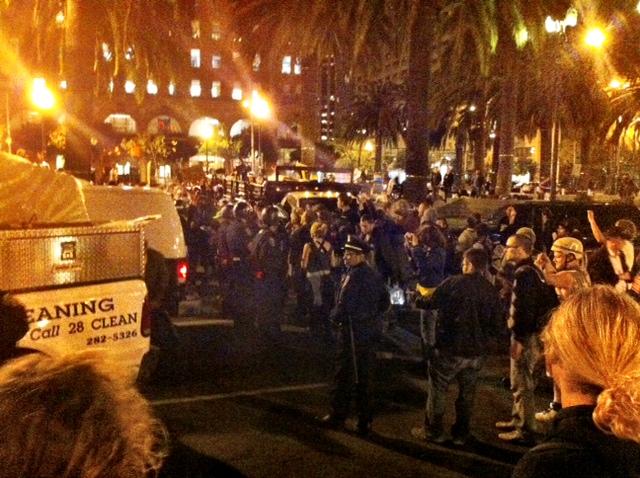
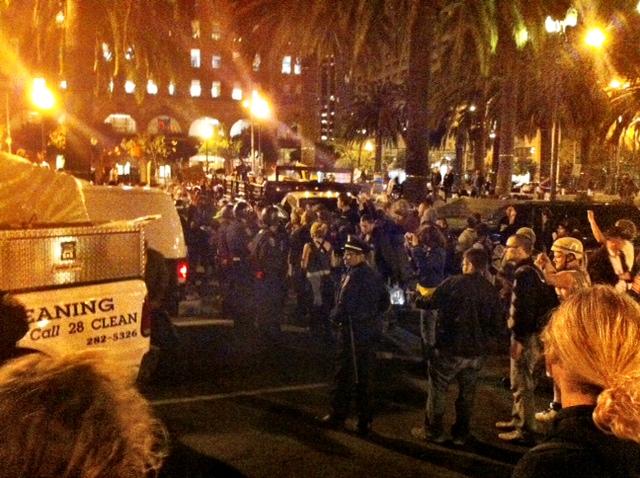
That’s what the Chron and the Ex are saying — and it’s a perfect setup, a ready-made public excuse for Mayor Ed Lee to send the cops in with riot gear and an eviction notice. It could happen tonight, or tomorrow night.

Frankly, Lee needs the bad (for Occupy) press. The movement’s goals are popular in this city, and when he came very close to evicting the campers, with cops running around the city in buses, his popularity dropped. He saw what happened to Jean Quan in Oakland; her tear-gas assault on Occupy Oakland may have been the end of her political career.

But hey, it’s different now: The daily papers are proclaiming that the encampment isn’t about economic inequality any more. It’s devolved into an unruly mob that can’t be tolerated. Who can blame Lee for cleaning it up?

That also happens to be an utterly unfair characterization of what’s going on. Sure, there are homeless people in the camp, and yes, some of them have mental health issues. But OccupySF is talking about the 99 percent, some of whom have suffered greatly in this economy — and it’s no surprise that some of them part of the occupation. Yes, it’s a challenge, but it something that OccupySF is taking on. Oh, and by the way — the homeless people and people with mental health issues (that sometimes lead to violence) will still be on the streets of San Francisco is they evict the Occupy encampment. But they’ll be worse off than they are today.

Yael Chanoff just filed her report on what’s really going on at OccupySF:

At last night’s General Assembly, OccupySF organizer Philip Oje debriefed on that days meeting with Mayor Ed Lee, and participants in the 150-person meeting debated the best next steps. Several different viewpoints were discussed. Many were indignant about reorganizing camp to appease the city, saying that “I didn’t come her to comply with city ordinances that change every day. I came here to do what I think is right.”
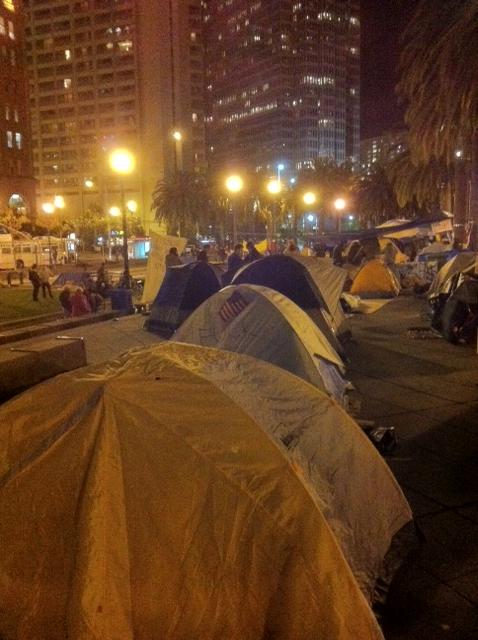
Others believed believed that the camp should do everything possible to comply with the city in order to hopefully avoid a raid (and maintain credibility if one does occur.) It was generally acknowledged that the situation was a Catch-22: The camp could not comply with requirements such as maintaining four feet of space between tents without expanding past Justin Herman Plaza, but the city refused to allow any expansion to stand until their requirements were met. In general, those assembled agreed that regardless of the city’s difficult to follow guidelines, a clean-up would benefit the health and well-being of campers, and got to work.

This comes after a hard week of dealing with the frustrating realities of human interaction in a cramped space. The encampment has grown steadily since its start, and in recent weeks has been home to upwards of 300 people on a regular basis. Many campers would agree that in the past two weeks that tensions have built as high as they did. When Examiner Reporter Mike Aldax spent 24 hours at camp, it was during the peak of conflict.

Indeed, many at OccupySF are frustrated. There is a general feeling that there is not enough time in the day to maintain a safe and caring community that does not exclude anyone as well as progress with the political agenda that the movement stands for. However, there is also a basic agreement that those with addiction, mental illness, and other causes of suffering are affected directly by an unjust society in which a small percentage hoards vast majority of wealth while the masses struggle to afford food, shelter, health care and education; to attempt to exclude those who are in desperate situations, the most in need of emergency action to change our system and our lives, would be morally intolerable hypocrisy.

As famed radical environmentalist Derrick Jensen put it when he came to speak at the encampment November 12, “At the same time you’re building a resistance movement, you’re being put in the position of dealing with the needs of those who have been dispossessed and damaged by the system.”

It’s true: according to Connie Ford, a member of OPEIU Local 3 which represents many on the city’s Homeless Outreach Team, “The homeless come there because it’s safer than the shelters.”

This has caused difficulties in the past few weeks that the camp has been struggling to deal with. The solution is starting to come together. After physical fights began to become a major problem last week, the camp stepped up the process of enacting a culture of community policing. The night of November 15, when “Instigator Jimmy” was involved in an altercation during a general assembly, about 50 formed a mass between him and camp and slowly pushed him off the site, chanting “Whose park? Our park.” As one camper put it, “Jimmy’s individual will was extinguished by our collective will.” This is an experiment in radically non-violent coercion.

Since then, this tactic has been employed to greater and greater success. Last night, when one camper began to instigate conflict, it only took 10 or so others to cause him to leave in the same way, and hardly disrupted the peaceful mood at the site.

In addition, despite starting out completely unequipped to provide medical and mental health to the masses for free, OccupySF has set up a medical tent run by nurses from the National Nurses Association and several “emotional assistance” spaces, one of which has been facilitated by the Icarus Project and other groups with alternative approaches to mental health. According to an OccupySF press release today:
“Forty clergy, including bishops, have recently formed as ‘San Francisco Interfaith Allies of Occupy’ because we share the concerns of the ninety-nine percent,” said Rev. Carol Been of CLUE California, “and they have asked us for help because they were not prepared to handle homelessness, mental illness, people attracted for unseemly reasons not associated with the occupation. Resources have recently begun to be put into place.”

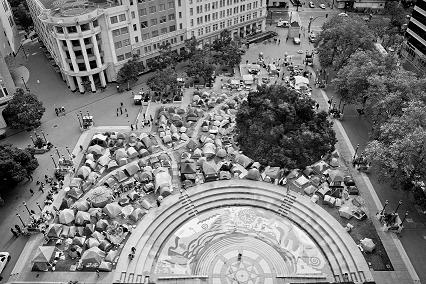
It seems that all of this grappling with difficult issues and hard work on the part of OccupySF has begun to pay off. Last night after General Assembly, campers worked to clear off the Bacci Ball courts as per the city’s request, take down tarps, and space out tents to the extent that they could without expanding past Justin Herman Plaza (renamed by some Bradley Manning Plaza.) Camp was clean and vastly quieter than it had been in previous days.

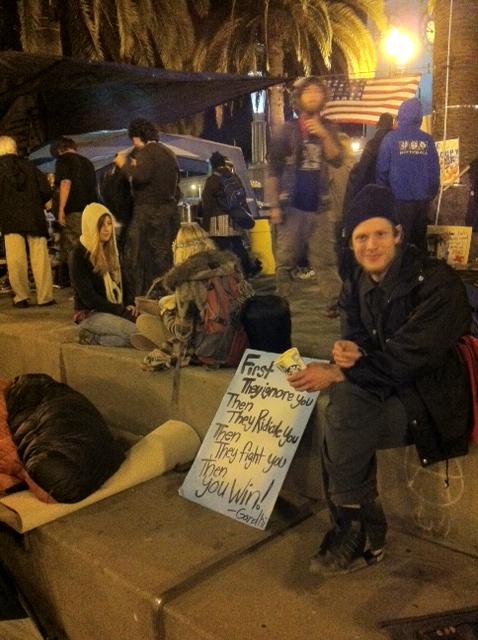
Around midnight, there were about 30 people awake, talking and playing mellow drums on the outskirts of camp while hundreds more slept in the approximately 180 tents. One man who had been sleeping there three weeks said, “There’s a new energy. After we cleaned, a lot of the riff-raff left.” With a grin he added “It looks like there’s still some, but they’ve been over there having some kind of profound conversation all night,” gesturing to the camp east side.

I pitched my tent about 10 feet from the “profound conversation” and drifted off easily, though I admittedly prefer a nice buzz of humanity while I sleep. I was, however, woken up around 6:00, when others began waking up and excitedly discussing the fact that the camp had made it through the night without a police raid.

It remains to be seen if the same will be said for tonight.


There are homeless people and mental problems at Occupy encampments? No duh, that’s the point.

23

The SF Examiner reporter that embedded at the Occupy SF camp just brought back a titillating story of pants-off rowdies, pot smoking, and screaming. This is how it starts (I swear):

The third major fight at the Occupy SF encampment was supposed to be the last of it Monday night after about 100 protesters banished “Jimmy the Instigator.”

Most protesters believed he was responsible for about half the brawls that broke out there in recent days. Once he was gone, tensions eased, and a heartwarming singalong forecast a peaceful night.

Then Nick took off his pants, the drugs and alcohol took their toll and the violence returned.

Examiner staff writer Mike Aldax spent 24 hours at the encampment undercover. He didn’t tell anyone he was a reporter or his real name, which I can tell you is A) arguably unethical as a journalist in a situation that doesn’t explicitly call for it and B) a great way to ensure that you don’t have any honest conversations with any of the people you’re reporting on. 

It’s fine if you’re just there to find ways to belittle protesters though! Like this gem: 

The east side now resembles a scene from “Pirates of the Caribbean.” Drunk people are fighting and yelling incessantly as someone sings a folk song in a low, bluesy voice.

I mean, that verbal imagery is hilarious but then, making fun of addicts is kind of like shooting fish in the bucket. Ahem, homeless fish that have run into all the injustices and inequities in life that the Occupy movement has sprung up in reaction to. 

Aldax differentiates the troublemakers from “responsible protesters” and tells tales of people with mental illness, not to mention someone who asks him for money, hugs him, and asks him for more, and of course, an incident in which he is told to turn his camera off. Of course, he’s undercover so the person that asks him to do so calls him by his psuedonym, which is Mickey (which I consider a fake name with flair, btw, begrudging props). 

I was also at the encampment the other day interviewing occupiers to get a deeper understanding of the society that’s sprung up in Justin Herman Plaza. Only I told the occupiers my real name. Even though I am a member of the media, I am of the belief that even if you are homeless you still merit the basic standards of human interaction. 

A photographer and I were at the Occupy SF info table when Nate Paluga (by the way Examiner, the occupiers have last names), came up and pointed to a cardboard sign that read “equality and justice” amid the brochures and fliers. “I did that,” he told me. “I’m kind of the camp philosopher. This movement means something different to different people, but I haven’t found anyone that disagrees with those being some core values.”

It turned out he was a bike mechanic who left his apartment in Nob Hill to come live at the camp. He also was one of the camp peacekeepers, and knew a fair amount about the “addicts, opportunists, and people suffering from mental illness” profiled in the Examiner post. 

Here’s the thing, Paluga told me – there’s a reason why people are like that. 

“They’re coming from places where there wasn’t a lot of equality and justice and they’re bringing that with them. You gotta step in and tell them ‘you’re gonna be okay.’”

That’s the role he fills on camp, but he says that kind of intervention also serves to reinforce the camp’s core values.

At Occupy SF, there’s a 70-year-old woman who is nuts. She screams a lot, occupiers told me. But she’s also a barometer for them: when people freak out on her, the craziest one there, others know that that person needs to be spoken with, and reminded of why OccupySF is there in the first place. Because we’re all crazy in our own way. There’s homeless people with mental problems at Occupy because there are homeless people with mental problems everywhere — it’s just that at the Occupy encampments they’re not precluded from being heard because of it. 

Paluga wasn’t denying that disruptions or evictions happen at Occupy – but also he was acknowledging that the movement has the responsibility to deal with trodden-upon people in a different way than the castigation techniques of our legal and social system. “You’ll see it,” Paluga told me. “People will step in.”

This line kills me in the Examiner article. In it, Aldax considers the failure of Occupy if the “good” and “bad” protesters are forced to co-exist:

As long as these two communities live side by side, it’s hard to see how the movement’s message will ever transcend the storyline being scripted by the troublemakers. 

But what about the storyline being scripted by the mass media?

Her way

4

arts@sfbg.com

DANCE Early in the 20th century, Ezra Pound declared “the artist is the antenna of the race.” True or false? Do artists have the ability to predict the future, or are they stuck in the present?

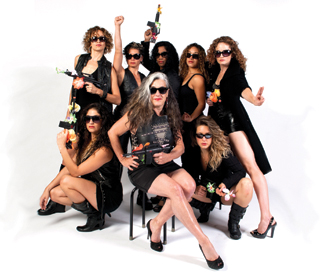
Krissy Keefer, artistic director of Dance Brigade and Dance Mission Theater, tends to side with Pound. While she wouldn’t go as far as writer-performer Guillermo Gómez-Peña, who considers the artist a shaman, she does think that “there is something about the artistic process that opens your brain to see into the future, to see things happening before they actually happen.”

This weekend Keefer and her troupe are celebrating the 35th anniversary of Dance Brigade and its antecedents the Wallflower Order. The performances, all with free admission, include a retrospective of works spanning the last three decades, plus the 2009 Great Liberation Upon Hearing, based on the Tibetan Book of the Dead; Keefer created the work after losing two close friends within the same year.

Women taking charge of their own fate may not be news today, but in 1975, Wallflower’s five female warriors were pioneers. The turmoil of the post-Vietnam era and the rise of feminism had created a climate in which audiences hungered for dance that spoke to their lives. Many of them were women. The company was made up of contentious women, strong dancers, committed activists. They were not about to be stopped, much like their “grandmothers” Isadora Duncan and Martha Graham or, in terms of politics, the characters in 1964 Chinese ballet The Red Detachment of Women.

Most remarkably, Keefer’s commitment to make art addressing issues that matter has not waned — she’s as ready as ever to mount the barricades and make her voice heard through art. In retrospect, it is surprising how much of her past work was highly prescient.

She recently called my attention to my reservations about her having drenched one section of the 2002 Cave Women in images of extreme destruction and war. (At the time, the bloodiness seemed over the top). Almost immediately, all hell broke loose in Afghanistan and the Middle East. Revolutionary Nutcracker Sweetie, a huge success from 1987-1997, features one-percenters the McGreed family, an abused undocumented servant in Clara, and a homeless Sugar Plum Fairy. Issues that were under the radar at the time have become headlines.

Appearing in Nutcracker — with an excellent, Tchaikovsky-based score by jazz composer Mary Watson — were then-little-known artists like Axis Dance Company and aerial dance pioneer Terry Sendgraff; Keith Hennessy played the McGreed’s renegade son.

For all her predilection for “making art that includes themes of social responsibility and dealing with real situations with real people,” Keefer is also very much a creature of the theater. The work has to stand on its artistic feet, perhaps not surprising for a woman who trained as dancer at age six — long before she knew what she wanted to dance about.

The 2005 Dry/Ice, a look at the effects of global warming, for instance, was a commission from the San Francisco International Arts Festival. Now who else, except someone who besotted by the stage, would lug a cast-iron bathtub, weighing over 300 pounds, into Theater Artaud for two performances? “I just wanted to do something about the environment,” she recalls. (Al Gore’s An Inconvenient Truth came out the next year.)

In the 2004 Spell, a collaboration with Hennessy, Keefer became a raging goddess-witch figure doing an exorcism for peace and economic justice. It was a power performance that, given the lives many people have today, probably would play well in the suburbs.

Keefer also takes her social activism outside the theater. In 2000, when she felt that the criteria for acceptance to the San Francisco Ballet School were unjustifiable — based on the experiences of her daughter, eight years old at the time — she complained loud and clear. It started discussions about the female dancer’s body at the time when academics had barely touched the subject. In 2006, she was so furious about the country’s priorities that she ran for Congress. Of course, she knew that she wouldn’t win — but she wanted to take a stand. Even her parents encouraged her to do so. “I can’t believe that I ran against Nancy Pelosi when she was poised to become Speaker of the House,” she laughs today.

Meditation has helped Keefer step away from anger, what she called her “habitual response” to injustice. The resolve was shaken, however, this past summer, when — coming back from a successful East Coast and Caribbean tour with Liberation — all the costumes (transported via Greyhound, the only shipping the company could afford) were stolen. “What can you do?” she shrugs. This Mother Courage of dance will just put her shoulder to the wheel a little harder. 


“FROM WALLFLOWER ORDER TO DANCE BRIGADE: A 35-YEAR RETROSPECTIVE CELEBRATION”

Fri/18-Sat/19, 8 p.m.; Sun/20, 2 p.m., free

Novellus Theater

Yerba Buena Center for the Arts

700 Howard, SF www.dancebrigade.org


“MORE THAN THE SUM OF ITS PARTS:” LOCAL ARTS LUMINARIES TOAST DANCE BRIGADE


DANCE From Brady Street to Dance Mission and beyond, Krissy [Keefer] has been one of the true champions of our dance community, in no small part due to her own artistry. The spirit of her work is visually and musically rich, fundamentally diverse, and deeply committed to social relevance — attributes she’s manifested on so many levels in a long and vital career. Rob Bailis, Former Artistic Director, ODC Theater

In the dance ecology of the Bay Area, Dance Brigade, and especially Krissy Keefer, play such vital role. I can’t think of anyone else as fierce about what she believes in, what she cares about, and how she creates work to reflect those beliefs. In many ways she is our conscience when we might waver in the face of budget cuts and the endless struggle to get money to do work. Because she is so strong about this herself, I really count on her to keep us honest around our vision and our integrity of purpose. Kenneth J. Foster, Executive Director, Yerba Buena Center for the Arts

Krissy Keefer’s life energy is totally invested in professional, community-based, inclusive, and affordable feminist art. She has consistently supported women artists for over 30 years. It is no easy task to maintain an artistic vision and a financially secure organization, and to be able to deal with the high volume of traffic that is required to run a studio anywhere, much less in the most expensive city in the U.S. That piece of real estate at 24th and Mission has always been a port in the storm for the dance community. Mary Alice Fry, Artistic Director, Footloose Dance Company and Shotwell Studios

What makes Dance Brigade’s work special and important is how they take on the big issues facing the world and then find a way to make us laugh. Krissy Keefer is the Jon Stewart of the dance world! Krissy’s perspective, passion and tenacity are testament to the company’s longevity; that a Dance Brigade show dealing with war, greed, or even addressing violence towards women, can be entertaining is powerful. Krissy, in her wonderfully brash and focused manner, has the ability to remind us that we are citizen-dancers, that we need to participate, and that big messages, abstract dance and the hope for social change can happily co-exist on stage. Wayne Hazzard, Executive Director, Dancers’ Group

Dance Brigade’s legacy in the Bay Area is huge. By not allowing their company to become mainstream, they paved the way for alternate companies to see that there is a place at the table for work that is not shiny, slick and influenced by institutional homogenization. Dance Brigade has demonstrated by example that contemporary dance can be messy, political, and uncomfortable. By blurring the lines between politics and art, a whole new generation of politicized artists have been given permission to emerge and that has infused Bay Area dance with a lot of new ideas and energy. Joe Landini, Director, The Garage

Krissy and the Dance Brigade have been at the forefront of bringing political concerns into the theater. They have paved the way, both artistically and practically, for dozens of politically engaged artists who may or may not identify with their work. To me, Dance Mission is a physical embodiment of the importance of the Dance Brigade’s values of democracy. It’s not easy to separate the artistic and the community legacy of Dance Brigade’s work; it’s the combination that makes them so powerful. Jessica Robinson Love, Executive and Artistic Director, CounterPULSE

When Dance Brigade emerged in San Francisco in the mid-’80s as an outgrowth of the nearly-mythical Wallflower Order, they brought together a number of tendencies that were already percolating in the dance community: using dancers of widely varying body types, introducing world music (sometimes performed by the dancers), spoken word, and text narrative, circus and vaudeville tricks and, always, no-holds-barred political content. Dance Brigade inspired other companies to be braver through their example of what might be called gonzo feminist dance. Krissy and her dancers and collaborators took these disparate influences and turned them into powerhouse performances where the whole was more than the sum of its parts. Kary Schulman, Director, Grants for the Arts. (Compiled by Rita Felciano)

AIDS vigil returns at Occupy SF

3

A coalition has come together to bring a striking new component to OccupySF: a rebirth of the ARC/AIDS Vigil. The vigil created an encampment similar to OccupySF’s at UN Plaza in the 1980s and remained there for ten years, protesting the federal government’s refusal to put resources into research and support for people with HIV/AIDS. Some who were involved in the vigil are currently part of the OccupySF encampment as individuals. Now, many hope to make that relationship more direct and active.


Brian Basinger, a longtime activist in several capacities including work with the AIDS Housing Alliance, is one of those involved in this effort. Says Basinger, “We are resurrecting the ARC/AIDS Vigil at 11/11/11 at 11:11 am. We are going to provide housing counseling, bring needle exchange, providing HIV testing, distributing organic vegetarian brown bag lunches, holding a speak-out, and presenting our demands to mayor Ed Lee to cure homelessness for people with HIV/AIDS, LGBT youth and transgender San Franciscans.”

All of this will take place tomorrow from 11am-2pm at Justin Herman Plaza, the site of Occupy SF’s encampment. Or, says Basinger, “Ethel Merman Plaza, as we like to call it.”

Those interested in the speak-out should be sure to get there by 11:11, as that will likely be first on the agenda. The food distribution is planned for the end of the kick-off event.

The group will provide services to the OccupySF encampment and anyone who comes through it. “We’re looking to create a safe space for homeless LGBT youth to gather…queer homelessness is invisible. We experience homelessness differently than the non-gay world.”

Like the ARC/AIDS Vigil of the 1980s and the Occupy Movement today, this event has the potential to be ongoing. Said Basinger plainly, “We won’t leave until we get our demands are met.”

Basinger warns: “It’s going to rain. But we want to highlight that people with fullblown AIDS and cancer are out in the goddamn rain everyday because the mayor has failed. ‘Ed Lee gets it done’- he’s not ‘getting it done’ for people with AIDS.” Basinger added that San Francisco “has the highest rate of homelessness for people with AIDS in the country.”

The group is putting out a call for “Rain gear to keep us warm- tarps and umbrellas.” Added Basinger, “Umbrella, ella, ella. Also, we put out a call for Rhianna. Rhianna, if you’re listening, come tomorrow.”

And with the impossible to predict explosion of the Occupy Movement- hey, anything could happen.


San Francisco’s political spectrum: a primer

120

During yesterday’s post-election wrap-up at the San Francisco Planning and Urban Research Association, political consultant and analyst David Latterman cited the ideological breakdown of San Francisco voters: 19 percent are progressive, 36 percent are liberal, 39 percent are “moderate,” and 6 percent are conservative. I cited those figures in a post I wrote yesterday on the latest election results, and some people responded by asking me to explain those terms, so let me take a crack at that because I think it’s important to understanding the city’s political dynamics.

I even discussed the matter with Latterman – who self-identifies as moderate, whereas I and the Guardian have a progressive worldview. “That’s a fantastic question and I don’t think any of us can give suitable answers,” Latterman said. “These aren’t hard lines. It’s like: I don’t know how to define pornography, but I know it when I see it.” Nonetheless, we agreed on the basic outlines and borders between the labels, even though we might frame them and value them a little differently.

In San Francisco, there is general agreement on most social issues among the moderates, liberals, and progressives, although we may disagree on political tactics. We all basically support gay rights, reproductive freedom, the value of diversity, environmentalism, and freedom of expression. That’s why most people consider San Francisco to be a famously liberal city, because of our tolerance on social issues, which only that 6 percent who are conservatives don’t share.

Yet San Francisco is still a deeply divided city on economic issues, including land use and the role of government. This is where most of the political conflicts and divisions occur, and it is here where our political spectrum is as wide as anywhere – perhaps even wider given the extreme wealth and poverty here, as well as the long history of political activism and the setting of national political trends. And it is in this realm that our labels come from.

A “moderate” in San Francisco – which is a real misnomer despite its widespread usage – is a fiscal conservative: anti-tax, anti-regulation, an almost religious faith in the free market, and a resentment of the poor (particularly the homeless and the jobless) and those who advocate for them. They want bare minimal government and see the role of government as primarily to facilitate economic activity in the private sector and to provide the basic infrastructure that the private sector needs to operate efficiently. They even believe social services should be provided by the private sector, such as nonprofits, rather than by government. On economic issues, they’re almost indistinguishable from conservatives, with whom they disagree on social issues.

On the other end of the spectrum are the progressives, who don’t trust capitalists and large corporations and believe they need to be heavily regulated and taxed to provide for the common good. We believe in progressive taxation and a redistribution of wealth, particularly from the richest 1 percent, and that government has an important role to play in leveling the economic playing field and playing referee. Progressives generally believe this country has been drifting to the right for at least the last 31 years and that this is a dangerous trend that needs to be addressed with fundamental, systemic reforms. And at this point, we’re willing to adopt radical strategies for triggering that change, such as Occupy Wall Street or other forms of civil disobedience.

The liberals of San Francisco are somewhere in the middle. They’re Democrats (or DTS) who don’t believe in radical change or anything that might disrupt the existing order, preferring incremental reforms over long period of time. They accept the legitimacy of the two-party political system and an economic system governed by Wall Street and powerful corporations, and they believe we need to do what we can within that framework. They use neoliberal economic policies like business tax cuts and incentives to encourage private sector job creation and housing development, and they accept a shrinking public sector, which they expect to operate more like the private sector, and a waning labor movement.

The reactions to the OccupySF movement is an interesting illustration of the dividing lines. Moderates have voiced tepid support for the movement’s critique of the growing gap between rich and poor, but they’re appalled at the tactic of occupation, believing curfew and anti-camping laws are more important. Progressives have been the most enthusiastic supporters of a movement that echoes their core values and physically challenges the status quo. Liberals basically support the movement, but they’ve been very uneasy with the tactic of occupation and have been vacillating on how to deal with it.

Latterman and the moderates – as well as many liberals – see ideology as a dirty word, and he was happy that in this election “it was the least ideological race we’ve seen in a long time.” Mayor Ed Lee and Board President David Chiu – both of whom hover in the liberal to moderate range, depending on the issue – also treat the notion of ideology with disdain, claiming to support practical, pragmatic, or common sense solutions to problems.

But progressives see ideology as the essence of politics. They understand the world in terms of class struggle, and believe that the very rich have been aggressively exploiting the people and the planet for too long, and that the only real way to make progress is to fight them and win. They believe in the Occupy paradigm that the 1 percent – the greedy rich who have corrupted our political and economic systems – are actively hostile to the interests of the 99 percent. We know that’s an unsustainable system and we’re hopeful that this is the moment when progress – the core of our belief system, that it’s possible to devise better economic and political systems than the ones we’ve inherited – could finally be attainable if we continue to organize and challenge the system.

That’s my general analysis of San Francisco’s political dynamics. What’s yours?

Occupy camps don’t create social ills, they showcase them

14

By Anna Lacey

OPINION When I entered the public square off Broadway and 14th on Oct. 17 — the site of the Occupy Oakland camp that police violently broke up this week — I immediately felt dazed by the atmosphere. But rather than seeing the squalor that has been highlighted by city officials and the media, I saw it as a place of real possibilities, particularly from my perspective as a social worker

Surrounded by tall buildings, the square is in the heart of downtown Oakland. It felt like I was in a commune of sorts. Walking through the rows of tents, I found myself amidst a sea of commotion; there were children of different ethnicities playing, a crowd was listening to some guy on a microphone talking about political freedom, a marching band was performing, and lines of people were dishing out and receiving free food. The energy in the air was almost tangible.

The police raided the square Monday night, October 24th, arguing that the occupiers were dangerous or directionless substance abusers. They had also been complaining about a rat infestation and other problems and about the camp being a magnet for homeless people. But when I visited the camp several times before it was raided, there were two important points that struck me about what has really been happening in Oakland’s occupation.

First: The occupation did not create new social problems. Instead, the movement has been making existing problems visible. Oakland is a city with an overwhelming crime problem and serious financial woes, a city known by many as “Oaksterdam” because of its many marijuana dispensaries as well as the presence of weed smokers on the streets. It’s a city with rats, gangs, unemployment, and school closures. Existing social problems have become more visible because people have congregated together, largely because they were sick of suffering from social ills in silence and isolation.

It should also be pointed out that the homeless population was in the square before the occupation. Yet only now are they able to receive free healthcare, learn about available social services, and enjoy respite from police harassment. The police were not allowed in the square for two weeks, and participants in the movement voiced extreme pride of the “liberated space.” As one organizer put it, “Here in Oakland we have a history that makes us unable to dialogue with the police. Occupy Oakland is unique due to the legacy of the Oscar Grant movement; we know the police are not on our side.”

It does seem quite clear that, instead of trying to resolve the problems being brought to light in the square, the police would prefer the protesters remain isolated from each other, so as not to bring attention to existing social problems. I suppose a gang of police in riot gear followed by the terrorizing and arrests of almost 100 peaceful organizers is easier, thanks to our flawed governmental system, than responding to the social issues put forth by the public.

Second: The occupation was never a party zone. Quite the opposite, for two weeks the participants functioned as an organized political and social union. By day, various presenters lectured the crowds on such things as the rights and responsibilities of political beings. One evening, several youth spoke of their hopes and dreams, saying things like, “I want to be the future of America, but I can’t if there’s no money to fund my school.”

Dusk would mark the start of the nightly General Assembly, a sort of lengthy debate giving all the opportunity to make propositions to influence the movement. The assembly would last until after midnight, and a 90 percent majority of votes was needed to pass any given proposition. One evening, the General Assembly closed with everyone chanting, “This isn’t Burning Man,” implying the seriousness of the movement and the need to leave the party in the desert.

At the same time, the square was far from utopian. There were a couple of fights, which were deescalated quickly. Another key issue remains how to manage the movement’s ethos of equality while still moving in a unified direction. However, as one organizer put it, “Our power is in the lack of a leader, and our diversity is a blessing. The media doesn’t know how to control the masses.” There are discussions of new occupations to bring attention not only to the recent jailing of many protestors but also to school closures, police brutality, prison hunger strikes, foreclosures, and other social and political injustices.

Obviously, the Occupy Oakland that I experienced was very different than what the media and police accounts would have you believe. I wish I could tell you to come and judge for your self, but unfortunately there is no longer any one identified place to congregate. Instead, following Monday night’s raid and Tuesday’s squirmishes, many involved in the movement have been scattered out on the streets, forced to defend themselves from the police without the sanctuary of a peaceful and supportive liberated space.

Snow Park, along Lake Merritt, originally an extension of the original camp, is currently one meeting place for those involved in the movement. While I think the police’s senseless and heartless behavior has, at least for the time being, destroyed much of the beauty taking place in Occupy Oakland, I still urge you to lend your support. As one occupier told me, “Be a part of the process. It’s not perfect. Then again, if it was so easy, it wouldn’t be worth it.”

Anna Lacey is MSW trainee and therapist with La Clínica de la Raza who lives in Oakland and is working on her master’s in social work at UC Berkeley

Dailies dutifully vomit out the city’s misleading portrait of OccupySF

8

Both the Examiner and the Chronicle reported this morning that the OccupySF encampment has become a public health hazard, setting the stage for what many believe is an imminent police raid. The newspapers’ only source: a notice that the Department of Public Health handed out to protesters, at their camp in Justin Herman Plaza, at 6am today. I have been reporting eyewitness accounts from OccupySF for several weeks, and if any reporters from these papers had bothered to go there themselves, they would be telling a very different story.

The Department of Public Health states that fecal matter, urine and vomit have been observed in Justin Herman Plaza and on surrounding streets. That’s accurate. Like many streets in San Francisco and in any city, members of the public sometimes relieve themselves on the streets. The difference is that at OccupySF, people from the 300-person community camped out there take it upon themselves to clean up any occurrences of waste as soon as it’s observed. Scheduled cleaning teams coordinated by the camp’s  Sanitation Committee sweep the streets three times per day, and wash when necessary. Late last night, even as protesters focused on plans in case of a police raid, which the city has been threatening everyday for most of the week, protesters went over the camp many times over with brooms.

Perhaps these issues could be resolved if the city were to provide the port-o-potties that Police Chief Greg Suhr and Mayor Ed Lee promised OccupySF last week. At last Wednesday’s Police Commissioner meeting, Suhr said, “We have no future plans to go into the demonstration. We know that it’s for the long haul…I’m actually working with the Mayor’s Office personally to put the port-o-potties and the handwashing stations down there to provide sanitation.”

In an Oct. 20 email to OccupySF, the deputy communications director for Mayor Ed Lee stated that “porta-potties are available by request.” A press release from OccupySF today claimed that “Port-o-potties are currently only available during daytime hours. OccupySF’s repeated requests for 24-hour port-o-potties have not been met.” When we asked mayoral Press Secretary Christine Falvey why the city hasn’t helped mitigate the public health issues they seem to be using as a pretext to break up the camp, she said, “There are porta-potties and hand washing stations at 101 Market Street, as the mayor directed, and are available for demonstrators to use. They are delivered in the morning and removed at night.”

I can confirm that port-o-potties for use at night, when no bathrooms on surrounding blocks are available, are yet to arrive. And police certainly have continued to “go into the demonstration”—making rounds and handing out notices from different city departments every day, “reminders” that protesters are illegally camping in a public park, violating sit/lie ordinances, and are now, apparently, a “public health hazard.” Today, a notice was circulated that cited all of these issues and informed protesters: “You are subject to arrest.” The camp is preparing for a possible police raid tonight.

These issues are not unique to San Francisco. Barbara Ehrenreich reported October 24 that, at Occupy demonstrations throughout the country, “for the individual occupier, one problem often overshadows everything else, including job loss, the destruction of the middle class, and the reign of the 1 percent. And that is the single question: Where am I going to pee?” In her piece in Mother Jones, “Why Homelessness is Becoming an Occupy Wall Street Issue,” Ehrenreich notes that “What the Occupy Wall Streeters are beginning to discover, and homeless people have known all along, is that most ordinary, biologically necessary activities are illegal when performed in American streets—not just peeing, but sitting, lying down, and sleeping.” San Francisco has some of the harshest laws in the country in this regard.

Many cities have accommodated Occupy protesters. Why won’t the city bring port-o-potties? And why are city publications reporting the city’s official statements without any perspective from the encampment itself? The people are speaking: that the powers that be won’t listen is what the Occupy movement is fighting against in the first place.

24 hours of occupation

1

rebeccab@sfbg.com

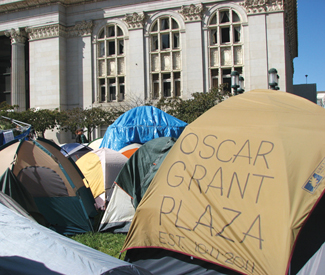
No sooner had I arrived at downtown Oakland’s Frank H. Ogawa Plaza — christened Oscar Grant Plaza by the activists who have established the Occupy Oakland encampment there –than the police showed up.

It was Oct. 18, and the ever-evolving occupation had been going strong for eight days. Oakland City Hall served as a backdrop for the bustling tent village, and the plaza steps were adorned with banners. “Welcome to Oscar Grant Plaza,” one proclaimed. “This is an occupation. We have not asked for permission. We do not allow the police. You are entering a LIBERATED SPACE.”

By press time, a standoff between Oakland police and the 300 to 400 occupiers hadn’t yet occurred, though a clash seemed imminent. City government had declared the autonomous village illegal and issued several eviction notices, citing health and safety concerns, while occupiers had made clear their intentions to stay put.

Around 5 p.m. on Oct. 18, two cops appeared at the camp. They weren’t in uniform, but black polo shirts emblazoned with the words “Tactical Negotiator.” Protesters immediately surrounded them, a customary response to police presence since the encampment was raised. The police said they’d come to “facilitate” a march scheduled to depart from the camp — but the protesters demurred. Occupy Oakland’s General Assembly had not consented to this, they replied.

The impasse didn’t last long, because a group of about 50 tore into the intersection and headed up Broadway. The radical queer march had commenced. “We’re here! We’re queer!” They chanted. “Tax the banks and eat the rich!” Many donned fabulous costumes, and one skinny person clad in form-fitting leopard print carried a sign showing a unicorn bursting from a cage, with the words, “It’s time to break free.”

As the march passed Wells Fargo and Chase, a dozen police vehicles trailed slowly behind, occasionally sounding sirens. Apparently, this was what they’d meant by “facilitating.”

Despite the cat-and-mouse with the cops, the nonviolent demonstration concluded without incident. Protesters returned, flushed and energized, to home base — Occupy Oakland, a vortex of radical defiance against the ills of capitalism that had materialized Oct. 10 and showed no signs of fading. Intrigued, I decided to spend 24 hours there documenting it.


ORGANIZED OPPOSITION

The camp encompassed a lively blend of projects that seemed to have materialized organically. There was a kitchen serving free food, a first aid tent, a media tent where one could power a laptop by bicycle, a free school named for police shooting victim Raheim Brown, an informational booth with stacks of radical literature, a container garden, portable toilets, an arts and crafts space, and a kids’ area. Committees had been set up to tackle safety, sanitation, finances, events, and other duties, replete with color-coded armbands. Regular workshops, political discussions, teach-ins, lectures from notable speakers, and live music performances had all been arranged. Taking it all in, a woman with long gray hair exclaimed, “The ’60s were never this organized!”

Occupy Oakland’s experimental community mushroomed up as part of the wave of encampments established in solidarity with Occupy Wall Street, part of a nationwide movement that has captured the public’s imagination and reinvigorated the left.

“We are reclaiming public space to use as a forum for the people to come together, meet one another, listen to each other, and build power for ourselves,” read a statement on the Occupy Oakland website. “[It] is more than just a speak-out or a camp out. The purpose of our gathering here is to plan actions, to mobilize real resistance, to defend ourselves from the economic and physical war that is being waged against our communities.”

The camp supported a wild and unlikely mix of people united in their disenchantment with the status quo — young and old, black and white, housed and homeless, queer and straight, credentialed and uneducated, vegan and omnivorous — and within this developing space, societal barriers seemed to be falling away.

“It’s an occupation that transcends what it was initially about,” reflected a protester named Miguel. “It’s feeding homeless people, and it’s giving people a place to sleep.”

Protesters didn’t rally around demands. “From my understanding, this is a movement of autonomy, and liberation from … the politics of representation, and the economics of capitalism,” said Bryan R., an organizer who helped plan the occupation. “To engage in dialogue with the power by means of demand is to acknowledge their power over us.”

All decisions were made by consensus in a General Assembly. The occupation had passed resolutions stating that it didn’t back any political parties, supported the Pelican Bay prisoners’ hunger strike, and was in solidarity with striking students and workers.

Rodrick Long, a 21-year-old Oakland native who’d been camped at the occupation for two days when I met him, said he felt he was participating in a piece of Oakland’s history.

“As far as Oakland goes, I just think we need more unity,” he said. “There’s a lot of gang violence, and a lot of poverty. A lot of people don’t show enough that they care about Oakland. But it’s a lot of people here. I didn’t expect this many people to come.”


MANAGING CONFLICT

Occupy Oakland seemed both serious and playful as it journeyed each day toward fomenting the revolution, or maybe just keeping the camp together, depending on who you asked. A tense General Assembly meeting was reportedly held after the city issued the first eviction notice on Oct. 20, and occupiers vowed to hold their ground. But the somber moment broke up when someone kept randomly shouting “Michael Jackson!” — prompting someone to blast the song “Smooth Criminal” over a loudspeaker, sparking an impromptu dance party before everyone got down to business again.

The occupiers were sculpting a self-governed, non-hierarchical mini society in the heart of Oakland as an affront to Wall Street bankers and capitalism itself — a complicated endeavor, to be sure. This was, after all, a mix of perfect strangers, some with mental-health issues (who’d been failed by the very system the occupation was opposing, several people pointed out to me), striving to coexist in a densely populated public park. Illegally.

There were ups and downs. Mainstream newspapers were running headlines about the occupation’s rat problems, television reporters had gotten into tiffs with protesters, and in the hours before I arrived, a man who went by Kali was forced out for starting arguments that eventually came to blows.

The outside world seemed separate from the occupation, though its presence was acutely felt. News vans were parked along the perimeter at all hours of the day, and a live stream sent raw footage directly to the Internet, making the surreal scene feel a bit like a fishbowl.

As night fell, around 150 people congregated in the plaza’s amphitheater for the evening’s General Assembly, which opened with general announcements. Ellen spoke about organizing actions against foreclosures. Jonathan urged a transition from mega-banks to credit unions. Someone proposed expanding the first aid tent into a free clinic that would operate out of an onsite RV. But just as a woman began describing the struggle of revolutionary youth in Uganda, shouts rang out from somewhere in the thicket of tents. Kali was back. Members of the “safer spaces” committee made a beeline toward him to try and deescalate the conflict, while others milled about in alarm and confusion.

Despite mediators’ efforts, Kali went on a rampage, triggering an emergency meeting to determine how best to handle this kind of aggression. Once he departed, however, the encampment’s emotional rollercoaster seemed to wind down.

“It’s up to us to figure out creatively how to maintain the health of this camp,” organizer Louise Michel told me later. “It’s really important for people here to figure out how to problem solve … Everyone has the commitment.”


LOOKING FOR REASONS

Dialogues had been started to address safety issues — but the city of Oakland was highlighting reports of assaults and sexual harassment as reasons the encampment would not be allowed to stay.

Security volunteers were regularly stationed around the plaza perimeter. Tim Simons began his shift around midnight, pacing the sidewalk and gazing out at the deserted downtown Oakland street while maintaining constant communication with his security crew via walkie-talkie.

“It’s been the most intense mixture of people coming together that I’ve ever seen,” reflected Simons, who’d watched the occupation grow since the beginning. “They’re camping here because they want this to become a revolutionary political force. The significant question is: How do we project outward from here? Is this going to become more than just a camp?”

He stressed its significance as a takeover of public space, saying it integrated all manner of people whose lives had been impacted by failed economic policies. Simons also acknowledged the anti-police attitude shared by many occupiers. “In Oakland, it’s really hard to play this game that the police are on our side,” he said. “There’s no real illusion here about what role the cops play.”

That sentiment wasn’t shared by everyone, though. “We’re trying to practice a nonviolent response toward police,” Mindy Stone, who was staying in a tent at the Occupy Oakland overflow camp at Snow Park, told me. “We want to try to make them feel like they are the 99 percent.”

It had been an eventful night. I drifted off to sleep in a borrowed tent, as the banter of people sitting and smoking on park benches floated in.

The next morning was sunny and warm, and the mood of the camp was buoyant. Kitchen volunteers busily prepared food, joking together as they listened to music. Donations flowed in daily from Arizmendi bakery, farmers’ markets, and other generous supporters.

In the arts and crafts area, people were painting a banner to urge people to withdraw their money from major banks by Nov. 5, Guy Fawkes Day. A redhead in a flowing silken outfit wound his way through camp with a garbage bag, asking people if they had pocket trash. A self-defense workshop was in swing, its participants partnered up, giggling, as they practiced holds and blocks.


INCUBATING IDEAS

Dallas Holland was tending wheatgrass, bok choy, herbs, and other edibles in a container garden. “I’ve been overwhelmed with the way the community has come together … It’s amazing to watch this transform into a Mecca of ideas,” she said. “People are having meetings and thinking of ways to perpetuate the movement.” An Alabama native, Holland graduated from college in 2006 and had been unemployed for a year.

Allen Adams, a 37-year-old Oakland native, told me he’d been sleeping outside regularly since before the occupation. “I quadruple up on the shirts. It gets to you,” he said.

He’d had little luck finding work, though he was constantly searching online. With him was Brandy, his well-loved, four-month old pit bull.

“I’ve been struggling all my life,” Adams said. “My dad did, my mom did, my grandmother did. And for what? To have no money.” But he said he was amazed and inspired by the occupation. “I like the fact that people can get together and discuss issues. How can we implement programs to do what California has failed to do? It’s a big task. We’re just working toward betterment. Lasting changes, not just temporary shit.”

Michel echoed these goals. “It’s really bold, and it’s really complex, but no one’s ever lived what we’re trying to do,” she said. “People feel a lot of ownership over what we have here. There’s a sense here of people having each other’s back. Politically, it’s huge.”

During my last hour at Occupy Oakland, David Hilliard, a founding member of the Black Panthers, delivered a speech, driving home the point that the occupation should be organized and focused.

“You’re here, which is a wonderful thing,” Hilliard told the occupiers. “Now we need to have some very basic programs dealing with desires and needs here in Oakland. It can’t be abstract. I can assure you, in a very short time, they’re going to run you out of here. Put something on paper that can help you address the basic desires — otherwise, you’re not going to last long. Get some concrete demands.” *

Parking it

0

CHEAP EATS So they have that classic car show every year in Alameda. It’s a pretty big deal, and Park Street is closed to traffic. The classic cars park in the parking spots, and the people walk down the middle of the road and look at them, and into them, and under the hood.

My own personal interest in classic cars would best be described as D) Nonexistent. But Boink and his dad like to go. They have a whole tradition around it, which ends in pizza. They look at the cars, they eat the pizza. It’s a boy thing. I wouldn’t know.

Except that this particular Saturday I didn’t have any football or soccer or even necessarily baseball to play. And there was an apartment to look at on Park Street, in Alameda. (This was a couple weeks ago, back when Hedgehog and me were still relatively homeless.) So, OK, so, we went.

Hedgehog looked at the apartment without me. We had by this time begun to start to feel almost a little bit paranoid about the fact that no one seemed to want to sublet to us. Not in Berkeley, not in Oakland, not in San Francisco. The day before, we had looked at a shithole in the Tenderloin and, out of desperation, loved it!

But the guy decided to rent to someone else, for no real reason.

“Why?” I asked him on the phone. We had seen the place first. Our credit is perfect. We are clean, upstanding, even accomplished citizens.

“I don’t know,” he said, after a long pause. “No real reason.”

“Oh,” I said. “OK.” Because what else can you say?

This much we knew: it couldn’t possibly be because we are a gay couple, this being San Francisco. So, we decided, it must be me. To wit, that I am too witty. That I am intimidatingly charming, classy-looking, and well-spoked. Technically, I decided this. But Hedgehog agreed to go see the next place by herself. And that was in Alameda. On Park Street. During the car show.

While she was scoping the place out I wandered aimlessly, people watched, car watched, and just generally sat down on a manhole cover. I was hoping to see Boink and his dad, and/or Popeye the Sailor Girl and her mom. I hadn’t seen any of them all since early summer, so was quite unreasonably excited about the possibility of seeing them.

But mostly I saw legs.

Which made me hungry. Then Hedgehog came back and said the apartment was ours for the taking.

Well, hers. But: no tub, no natural light, no me (technically), and it smelled like dude.

“Let’s eat,” I said, standing up.

And then, as if by some sort of cartoon magic, there was Popeye the Sailor Girl, holding her mom’s hand, the both of them looking about as cute as some buttons. What’s more, they were hungry too!

Then Boink and Dad came by, and they were looking cute too, but not hungry, not like us’ns. They just wanted cars and pizza.

Popeye the Sailor Girl and her mom being both gluten free, their favorite restaurant is Burma Superstar. Hedgehog loves Burmese food.

Ergo: our decision was easy. It’s the same place as the one in the city, on Clement Street, only no lines! Not even at exactly lunch time on a beautiful special-event weekend.

I had me some mint chickeny thingy without mint and Hedgehog had duck garlic noodles without hardly any garlic. But to illustrate what a super restaurant Burma Superstar is, both dishes were still good.

And we had the chicken coconut noodle soup, which was especially tasty, of course. It’s kind of like the Thai classic Tom Ka Gai, only eggs instead of mushrooms, which is trading up in my book. Oh, and noodles — which I always thought Tom Ka Gai should have, anyway.

It was so nice to catch up with Popeye the Sailor Girl, and to play Steal Mommy’s Purse with her while her mom was in the restroom.

A delightful time.

A new favorite old favorite restaurant.

And I don’t know about the classic car show but, hey, I like Alameda.

BURMA SUPERSTAR

Lunch: Tue.-Sat. 11 a.m.-3 p.m., Sun. 11:30 a.m.-3 p.m.; Dinner: Tue.-Thu., Sun. 5-9:30 p.m., Fri.-Sat. 5-10 p.m.

1345 Park, Alameda

(510) 522-6200

AE/D/MC/V

Beer & Wine

Avalos offers resolution supporting OccupySF and its camp

57

In the wake of last night’s violent police raid on the Occupy Oakland encampment (a still-tense situation that we’re now on the scene covering) and two similar late-night police crackdowns on OccupySF in recent weeks, Sup. John Avalos and co-sponsors Eric Mar and David Campos are introducing a resolution at today’s San Francisco Board of Supervisors meeting that calls for the city to explicitly allow the OccupySF encampment and its related infrastructure to remain.

That resolution (the full text follows below), which Avalos legislative aide Raquel Redondiez says will be the subject of a special hearing on Monday before being considered by the full board on Tuesday, Nov. 1, grew out of testimony from OccupySF participants that Avalos solicited at last week’s board meeting following a late night police raid on Oct. 16 that resulted in five arrests and many injuries.

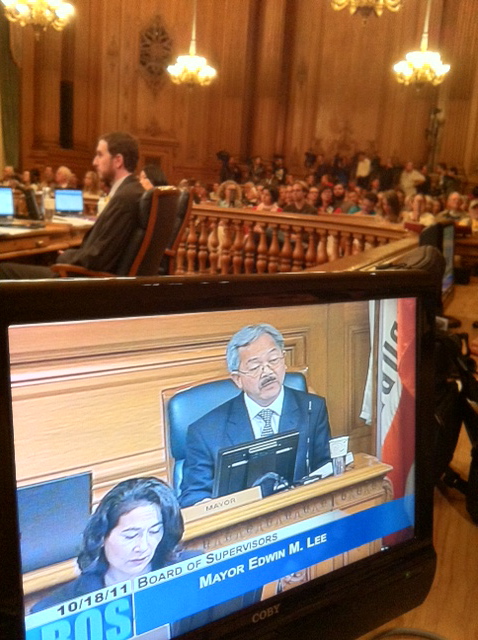
As we report in this week’s paper (see “Mixed messages,” to be posted this evening, Tues/25), at that Oct. 18 board meeting, Mayor Ed Lee took the position that no tents, kitchens, or other infrastructure would be permitted, a stance that Police Chief Greg Suhr seemed to soften slightly at a raucous Police Commission hearing the next day. In the face of those mixed messages, OccupySF grew into a full-blown tent city in Justin Herman Plaza and there have been no real conflicts with police since.

Both the San Francisco Police Department and the Mayor’s Office were slow to respond to messages we left all week seeking to clarify the city’s policy toward OccupySF, but both finally got back to us last night after the article had gone to press.

SFPD spokesperson Daryl Fong told us, “We’re still currently doing daily safety inspections at Justin Herman Plaza and continuing to provide leafletting…We’re educating the campers about violations and concerns for public safety,” such as unsanitary conditions or unsafe camping structures.

But he said OccupySF hasn’t been given any deadlines for removing structures and there are no current plans for another raid. “Our goal is to get compliance from the campers voluntarily,” he said. “This situation is being continually monitored as it progresses.”

When we asked the Mayor’s Office about the contradiction being Lee’s stance and the city’s reaction to the growing tent city, Press Secretary Christine Falvey wrote, “The mayor’s position on Occupy SF has not changed. He has directed his departments to facilitate peaceful protest, but not allow structures, tents, or a permanent campsite. He wants to ensure the area is safe for demonstrators and the general public. If you have been to the site, you may have seen the Fire and Public Health Departments conducting inspections for public health and safety concerns and you may have seen Recreation and Park and Police staff informing people of the parks and public safety codes that prohibit camping equipment. Individuals are being informed daily of this and the city’s Homeless Outreach Team is offering services to anyone in the area who may need it. The policy stands and departments are educating the group about what is and is not allowed and the mayor expects those who want to use the space to protest, to follow the rules.”

But OccupySF protesters say they have no intention of leaving the space, believing it’s their right to be there as part of a national movement spotlighting the greed and corruption of the wealthiest 1 percent of Americans. And when I told Falvey that the encampment seems to defy the mayor’s stated position, she wrote, “The mayor has asked several departments to enforce the existing codes, and I understand a number of informational contacts have gone out daily to educate those using the plaza about what is allowable in addition to Fire and Public Health inspections to make sure open flames or dangerous materials are not being used or stored at the site.”

I told her that didn’t address my question, and I asked for a reaction to the Avalos legislation that would explicitly allow “tents, tarps, First Aid supplies, environmentally clean and fire-safe energy sources, and the ability to store, prepare, and serve hot food,” which is the reality now on the ground. I’ll update this post when I get a response.

In the meantime, here’s the full text of the resolution:

[Expressing Support for Occupy Wall Street Protest Movement and the People’s Right to Peaceful Assembly in San Francisco]

Resolution Supporting the Occupy Wall Street Protest Movement and Urging Mayor Lee to Uphold People’s Right to Peaceful Assembly and Collaborate with Occupy SF to Ensure Safety of the Protestors, their Supporters, and the Greater Public.

WHEREAS, “Occupy Wall Street” was formed by a broad spectrum of people coming together to protest the corporate-serving economic and political system controlled by the 1 percent, profiting at the expense of 99 percent of the people; and

WHEREAS, Three years after the current financial crisis caused by Wall Street speculators and profiteers, the unemployment rate in the United States is still at the highest level since the Great Depression with the unemployment rate in San Francisco currently at 8.3 percent; and,

WHEREAS, The United States’ major banking institutions, which have been bailed-out by the government and United States taxpayers, have done little to prevent massive foreclosure of residential properties or support the revitalization of local economies by sustaining small businesses; and,

WHEREAS, Since 2008, there have been 1.2 million foreclosures in California, with 12,410 homes in San Francisco alone; and,

WHEREAS, The “Occupy Wall Street” protest movement has struck a chord with the people of the United States and around the world, inspiring over 900 similar protests and solidarity actions across the country, where tens of thousands of people have come out to express their deep indignation against Wall Street greed and systemic socio-economic injustices; and,

WHEREAS, The “Occupy” demonstrations are a rapidly growing movement of people from all walks of life with the goal of occupying public space in order to create a shared dialogue and assert demands for economic justice; and,

WHEREAS, The “Occupy” demonstrations have been supported by the California Nurses Association/ National Nurses Association, American Federation of Labor -Congress of Industrial Organizations, Change to Win, International Longshore and Warehouse Union-International, Teamsters Joint Council 7, Services Employees International Union, Laborers International Union of North America, and many others; and,

WHEREAS, The OccupySF demonstrations began in September with small gatherings of people and have since grown and gained supported from thousands of individuals, community and faith-based organizations, and unions; and,

WHEREAS, On October 12, a 500-person march and civil disobedience organized by local community groups received national media attention, exposing the struggles of San Francisco residents against foreclosure, corporate control, and spiraling unemployment; and,

WHEREAS, The October march and protest action culminated in civil disobedience and, despite the arrest of 11 people, lacked any antagonistic conflict between the police and protestors; and,

WHEREAS, Similar to demonstrations in hundreds of cities across the United States, OccupySF demonstrators are asserting their rights to free speech and peaceful assembly 24 hours a day, seven days a week, in order to create public dialogue around corporate control of the political process and public space; and,

WHEREAS, Numerous and various groups continue to join the protesters at OccupySF, including an interfaith clergy contingent and the California Nurses Association, which has set up a First Aid tent to support the protestors and help ensure public safety; and,

WHEREAS, The City of San Francisco has a right and duty to ensure the safety and security of the general public including the protestors and their supporters; and,

WHEREAS, Since the beginning of the protest, City actions have resulted in the confiscation of food, tents, sleeping bags, and other belongings from the OccupySF demonstrators as well as causing preventable injuries and arrests; and,

WHEREAS, The City has a lengthy and proud history of political protest and has upheld the rights of people to free speech, freedom of assembly, and peaceful protest; and,

WHEREAS, With clear leadership from the Mayor, City departments can set a tone of cooperation and collaboration with OccupySF protestors and supporters, help mitigate harm, and address any public safety, health and sanitation concerns, all while avoiding unnecessary conflict; now, therefore, be it

RESOLVED, That the Board of Supervisors supports the Occupy Wall Street protest movement and the rights of all who protest to assemble peacefully and enjoy free speech in the City and County of San Francisco; and, be it

FURTHER RESOLVED, That the Board of Supervisors recognizes that Free Speech and Freedom of Assembly should not be limited to daytime nor short-term activities and we deem the need of protesters to have tents, tarps, First Aid supplies, environmentally clean and fire-safe energy sources, and the ability to store, prepare, and serve hot food reasonable; and, be it

FURTHER RESOLVED, That the Board of Supervisors urges the Mayor, the Police Department, and other City agencies to uphold the rights of protestors to political speech and public assembly, and to recognize that the full exercise of such rights requires that participants are able to attend to the needs of everyday life, and have a space free from harassment; and, be it

FURTHER RESOLVED, That the Board of Supervisors urges Mayor Ed Lee to direct the Recreation and Park Department, the Department of Public Works, the Police Department, and other City agencies, as relevant, to be flexible and to collaborate with protestors for the safe sharing of public spaces, in which demonstrators can exercise their political rights and the City can address legitimate safety concerns while avoiding unnecessary antagonism; and, be it

FURTHER RESOLVED, That the Board of Supervisors urges Mayor Ed Lee, in order to prevent further harm and conflict to any members of the public, including protestors of OccupySF, to direct the Police Department to ensure that there will be no use of force to dislodge the OccupySF demonstrators and confiscate their belongings.

WTF, Chuck?

18

And now for a new installment in the ongoing saga of What the Fuck, Chuck?, our attempt to figure out the unfathomable positions of the Chron’s local columnist, C.W. Nevius. Today’s episode: Why is Nevius so determined to stir up a clash between the police and the OccupySF protesters?

Although the Oakland cops have rousted Occupy Oakland — with a nightime raid, arrests, and the works — things have been pretty mellow in San Francisco for the past week. Police Chief Greg Suhr has tried to avoid sending riot troops in to evict the camp. The campers are working with city officials to get a permit for a stove. The camp is largely peaceful; nobody’s hurting anyone or anything.

Oh, but Chuck is nervous:

Many of the city’s homeless residents have gravitated there, the sanitation is a nightmare, there are rats, and car batteries are neither a safe nor ecological energy source.

Well, there were rats there before the protesters arrived. City officials have offered to set up portable toilets. Car batteries aren’t perfect, but if you charge them by riding a stationary bicycle, the energy is pretty darn ecological. And really, unless you knock the battery over and it cracks and spills, car batteries are pretty safe; the don’t explode or emit fumes. The acid and lead are toxic, but they’re pretty well contained. There are more than 300,000 car batteries on the streets of San Francisco already; every car has one.

And so what if “many of the the city’s homeless residents” have gone to join the protests? Some are eager for the free food and shelter, which is fine — putting the more middle-class radicals side by side with homeless people isn’t a bad thing at all. In fact, it’s about the most radical thing that OccupySF is doing. Homeless people are the most visible victims of the economic injustict that the occupyers are protesting; shouldn’t they be part of the action?

I realize that some homeless people have mental health and substance abuse issues, but those didn’t start with OccupySF. Instead of whining about the situation, the city ought to be taking advantage of it — here’s a group of hard-to-reach folks who social workers can probably connect with more easily in an environment and community that’s supportive.

But Nevius can’t imagine anything good coming of any of this:

As Occupy SF gets bigger and louder, the potential for trouble only increases.

I guess Nevius doesn’t believe it’s possible for an alternative community that includes a wide range of activists and homeless people to grow and make its voice heard without “trouble.” And the only way out is to send in the troops.

What the Fuck, Chuck?


The X Factor: Oh, the drama! Oh, the weeping!

0

Okay, I thought American Idol was getting bad. And I missed Simon Cowell. But the Next Big Thing, called The X Factor — featuring not just Simon but Paula Abdul, along with L.A. Reid (who discovered Rihanna!) and Nichole Sherzinger (from Pussycat Dolls, and she once won Dancing With the Stars) — is out of control.

Epic Fail Number One: The 32 semi-finalists are broken up into four categories — girls, boys, over 30 and (gasp) groups. Four from each category move forward. That means four groups, even though almost all of the groups totally suck, four boys (although at least six of the girls were better than all but two of the boys) and four over 30s (well, I guess people over 30 deserve special consideration, particularly women who were once married to Ike Turner).

Epic Fail Number Two: The semifinal round is set at the judges “houses” (although I can’t believe Simon, who appears only in his designer shades, actually lives full time in that glorious mansion in St. Tropez). L.A. Reid is a serious music dude, but his McMansion in the Hamptons is hideous. Paula is (of course) in Santa Barbara, and Nichole is (of course, maybe, if that’s really her house) in Malibu. It’s like Lifestyles of the Rich and Famous; I desperately wanted to hear Robin Leach introduce the scenery.

Epic Fail Number Three: The Oct 18 show had no music at all. No entertainment. Just two hours of people getting kicked off (and weeping) or getting sent through (and weeping). We watched contestant after contestant bawling as the judges tried to drag out the drama as long as possible by saying things like “the news I have for you isn’t good …. (weep, weep, sniff, my young life is ruined) … actually, it’s fantastic” (weep, weep, joy, hug Simon, I’m gonna be a contender). I’ve never seen so much mascara running down so many cheeks. Pepsi’s the wrong sponsor; should have been Kleenex.

It’s like Total Drama Mansions. I can’t believe anyone (other than Vivian and me) actually sat through that whole thing.

The good news is that the homeless guy (Dexter Haygood) and the burrito maker (Josh Krajcik) made it through to the live performances starting next week. So did Rachel Crow, the 13-year-old from Colorado. Viv would have been boycotting the rest of the season if Simon had kicked her out.

As it is, sigh, we’re still watching, and maybe next week someone will actually sing.

The bad old days

0

tredmond@sfbg.com

Willie L. Brown, according to the Chronicle’s John Cote, is “a tremendously popular figure in the city, viewed by many as an avuncular man-about-town, elder statesman and a uniquely San Franciscan character.” The Ed Lee Story, a hagiographic campaign book, refers to Brown’s “characteristic showmanship and hypnotic charm.” Even Randy Shaw, the housing activist who clashed with Brown over gentrification once upon a time, now says in BeyondChron that Brown’s first term “was the most progressive of any mayor in modern San Francisco history.”

I feel as if I’m living in some sort of strange parallel universe, something out of Orwell or North Korea or the Soviet Union of the 1950s. It’s as if history never happened, as if the years between 1996 and 2004 have just vanished, have been deleted from San Francisco’s collective memory. It’s crazy.

I wonder:

What about the thousands and thousands of people who lost their homes and were tossed out of the city like refugees from a war? What about the rampant corruption at City Hall? What about the legions of unqualified political cronies who got good jobs and commission posts? What about the iron-fisted machine rule that kept local politics closed to all but the loyal insiders? Doesn’t any of that count?

Here are some things that absolutely, undeniable, demonstrably happened while Willie Brown was mayor:

Rents on the East Side of town, particularly in the Mission, tripled and sometimes quadrupled between 1996, when Brown took office, and 2004, when he left. Evictions more than tripled, too, and at one point more than 100 people a month were losing their homes. Most of those people were low-income, long-term tenants. They were forced out because richer people were moving into town during the dot-com boom and could pay more for those apartments. We called it the “Economic Cleansing of San Francisco.”

Every day, it seemed, we’d be out at another rally as the Tenants Union and the Mission Antidisplacement Coalition tried to save another family from the forces of gentrification. Every week, it seemed, another group house full of artists would be served an eviction notice. Everywhere you looked, nonprofits and small businesses were losing space to high-tech companies with plenty of money.

I watched the wrecking crew tear down a studio complex on Bryant Street, forcing more than 100 painters and photographers to leave, to make way for a high-tech office project that was approved even though it violated the local zoning laws — and then was never built. For two years, I walked to get my lunch past the empty hole in the ground that had once been a thriving community.

That was typical. Every developer who waved money in front of the mayor got a building permit, no matter how crazy, illogical or illegal the project was. The Planning Department and the Bureau of Building Inspection were little more than fronts for the lobbyists and Brown cronies who determined development policy in the city.

In October, 1999, the author Paulina Borsook wrote a famous piece in Salon called “How the Internet Ruined San Francisco.” I agreed with the sentiment; the influx of the dot-commers was wrecking all that was cool and weird about the city. But she got one point wrong: The Internet didn’t ruin anything. The Internet was, and is, a technology, a tool, something that, like most technological advances, can be used for good or evil.

Mayor Brown didn’t create the dot-com boom. Although he took credit for an awful lot of things, even Willie didn’t claim to have invented the Internet.

But what he did — and what ruined many San Francisco neighborhoods, and ruined the lives of many San Franciscans — was to let the economic cleansing of the city happen, without raising a finger to slow it down or prevent the evictions or protect the most vulnerable people in the city. Over and over, he encouraged it — by appointing commissioners and supervisors and department heads who allowed evictions and development and displacement in the name of growth and prosperity.

In fact, when reporters from the zine Maximum Rock ‘n’ Roll asked Brown about the problems facing poor people, he told them that the city had become so expensive that poor people would be better off living somewhere else.

Because he didn’t care about poor people, or tenants, or artists, or anyone who lacked money and flash and dazzle and clout. He was the worst kind of imperial mayor.

Here’s how we put in it in our 33rd anniversary issue in 1998:

“Let’s say the next major earthquake that hits San Francisco is of roughly the same magnitude of the Loma Prieta quake of 1989, or maybe just a bit stronger. Let’s say it wipes out right 1,000 houses and leave some 5,000 people homeless … and lets say a few unscrupulous profiteers take advantage of the shortages of critical supplies and charge desperate residents triple the normal rate for food, blankets and drinking water….

“The profiteers, speculators and charlatans would be exposed in the press and roundly, loudly denounced by every political and community leader in the city. The ones who didn’t wind up in jail would be forced to leave town in disgrace.”

Or else they wouldn’t. Because when an economic earthquake ravaged San Francisco during his term, Brown — the most powerful mayor in modern history, a guy who could have had an immense impact on what was happening — went to meet the speculators and profiteers with outstretched arms, welcomed them to the city and partied with them at night.

And when he ran for re-election, they thanked him by funding an astonishing $5 million campaign.

Then there was the corruption. Not only did Brown raise pay-to-play to a new art form, he filled the city payroll and key commissions with campaign workers, former political allies, and cronies, subverting the civil service system and undermining both the function of city agencies and public respect for local government. At least seven Brown appointees were indicted or investigated for criminal misconduct. While sentencing a Housing Authority official to five years in prison, U.S. District Judge Charles Legge decried what he called Third World-style corruption at San Francisco City Hall.

When Mayor Ed Lee, who is now seeking a full four-year term, was asked to give Brown a grade for his eight years in Room 200, Lee said: A-Plus.

Which makes us a little nervous. To say the least.

I’ve been going back through the Guardian archives over the past couple of weeks, picking out some great covers to reproduce (see page 18) and looking at four and a half decades of alternative news coverage of San Francisco. And if there’s one theme that emerges from the stacks and stacks and stacks of papers, it’s that local government matters.

In the 1960s, when the underground press was talking about sex, drugs and dropping out, the Guardian was talking about the ways big corporations were stealing the taxpayers’ money at City Hall. (Okay, the Guardian wrote about sex and drugs too. But sex and drugs and political scandals.)

The difference between the independent alternative press and the underground papers of the era was more than just thematic. The underground publishers were having a great time and celebrating culture, but none of those publications was built to last. From the day they published their first issue in October, 1966, Guardian founders Bruce Brugmann and Jean Dibble intended their paper to become a permanent part of San Francisco.

The Guardian quickly demonstrated that it had a different approach than a lot of the “New Left” — particularly when it came to electoral politics. At a time when some were saying that it made no difference whether Ronald Reagan or Pat Brown won the 1966 governor’s race, the Guardian made the key point about Reagan.

“California cannot afford the luxury of this kind of conservatism,” a Nov. 7, 1966 editorial stated. “Because of the millions of people coming to California, because San Francisco and Los Angeles soon will have the greatest concentration of urban power in history, because farm land and open space is vanishing at a suicidal rate, because technology is putting vast populations out of work, because of the social neglect of our cities and the uglification of our countryside, because we now have the knowledge to bridge the gap between the rich and the poor.”

And while the paper devoted considerable space to reporting on and opposing the war in Vietnam, it was also developing a reputation for local investigative reporting. One June 7, 1971 story showed how the city had all of its short-term deposits in local banks that paid no interest at all. The story parked an investigation by the city’s budget analyst, the resignation of the city treasurer — and a new investment policy that brought the city at least $1 million more revenue a year. (Adjusted for inflation, that’s about $5 million a year, times 40 years is a lot of money that the Guardian brought into the city coffers).

And from the start, the Guardian was a nonpartisan, independent foe of corruption, secrecy and undue influence at City Hall. So while the paper eagerly endorsed Phil Burton (and later his brother, John) for Congress and lauded their antiwar and environmental policies, the Guardian also blasted the Burtons for exercising undue influence back home. The paper strongly endorsed George Moscone for mayor — then denounced him when he fired Harvey Milk from a commission post after Milk had the gall to challenge the Moscone/Burton candidate for state Assembly.

The 1999 Sunshine Ordinance, which dramatically opened up City Hall records, was sponsored and promoted by the Guardian. Willie Brown and his cronies hated it.

It’s probably a misnomer to say that the Burtons, who were a dominant force in local politics in the 1970s and 1980s, ran an old-fashioned machine. They didn’t have the iron control over local politics and the patronage jobs system that the word “machine” implies.

But when Brown became mayor of San Francisco, he had all of that. Brown controlled eight solid votes on the Board of Supervisors (and through various political machinations, had managed to appoint most of them). “He ruled the building,” Assemblymember Tom Ammiano, who was a supervisor during those years, recalled. “If you defied him, you were radioactive.”

And one of the people who rose through the ranks as a loyal Brown appointee was Ed Lee. Who to this day thinks things in that administration were just dandy.


The Lee campaign complains about “guilt by association,” and that’s a legitimate point. Ed Lee isn’t Willie Brown. He’s a lot more open, a lot (a lot) more humble, and as numerous progressives have pointed out to us, his door is open. He doesn’t have the history of sleaze that pretty much defined Brown’s political career.

There will be no “Ed Lee Machine.” In fact, with district elections of supervisors pretty much guaranteeing more diffuse political power in the city, there will never be another mayor able to rule the way Brown did.

And these days, Brown’s clout could easily be overstated. Until he engineered the selection of Ed Lee as mayor, his power seemed to be waning. And even Mayor Lee hasn’t done everything that Brown wanted.

Of course, the Chronicle, which he helped immensely when Hearst Corp. bought the paper and had trouble with federal regulators, has helped Brown by giving him a column that created a new, sanitized persona.

But the important thing about the Brown administration was not so much who was in charge but who benefited. The landlords, the developers, the big corporations got pretty much what they wanted from City Hall. The rest of us got screwed.

And now those same interests — in some cases, the exact same people — who supported, promoted and worked with Willie Brown are backing Lee for mayor. If they thought he was going to be an independent progressive, that money and support wouldn’t be coming in. There are people who miss the machine days — and if they think Ed Lee is their guy, it’s reason to worry.

Corruption matters. When people lose faith in local government because they see the kind of sleaze that was daily business under Brown, then they stop wanting to pay taxes for public services. After all, the mayor is wasting our money already. Lee may be a decent guy — but some of the people he hangs out with, some of the people who are supporting him, have a long and very unpleasant history in this town. And all the time he was sitting there at City Hall, while Brown was running a corrupt operation that did lasting damage, Lee never raised a public finger in protest. I hate to see all the history forgotten when people decide who to support for mayor in November, 2011.

OccupySF appeals to City Hall, but the standoff continues

40

Frustrated by repeated late-night police raids on their encampments and empty statements of support by top city officials, hundreds of protesters with OccupySF entered City Hall today – under the watchful eyes of a large police presence with riot gear at the ready – to testify at today’s Board of Supervisors meeting.

The meeting began with the scripted monthly question time session with Mayor Ed Lee, who was asked by Sup. Jane Kim – whose District 6 includes the OccupySF encampment, which she visited for a couple hours last night – to “describe the plan that our offices have been developing” to facilitate the OccupySF movement.

But in Lee’s response and in exchanges with journalists after the meeting, as well as Guardian interviews with people in both offices, it doesn’t seem city officials have a coherent plan for carrying out Lee’s contradictory goals of supporting the Occupy movement and keeping sidewalks and parks clear of encampments.

Kim seemed to acknowledge as much later in the meeting when she said voiced support for OccupySF and for city officials who object to tents, kitchens, and other basic infrastructure that the month-old movement needs to continue. “We’re all struggling to figure out the best way to accommodate it,” she said.

Lee’s message was even more muddled, saying he supported the movement and agreed with its economic justice message. “From the very beginning, I have fully supported the spirit of the OccupySF movement,” Lee told the crowd, transitioning into reciting a litany of economic development efforts with little relevance to the demands of the movement.

“Then don’t send the police in to destroy it,” a protester shouted from the audience, which was filled to capacity and had a line out front and an overflow room. “We are working with you,” Lee responded, but then went on to complain about the lack of consistent contacts in the leaderless movement and emphasizing his bottom line that any kind of encampment with infrastructure is an impermissible violation of city codes.

“I need to make sure our public spaces are open to be used by anyone,” he said. Later, his Press Secretary Christine Falvey clarified the mayor’s stance by saying he supports the message but not the movement: “The tactic of camping overnight, he does not support.”  

Afterward, talking to reporters, Lee couldn’t really explain why the police needed to do their raids in the middle of the night, why San Francisco is cracking down on conditions that are being allowed in many other Occupy cities, or how the movement might be able to avoid future crackdowns if it continues, ignoring questions about where OccupySF might be able to go to avoid police raids.

Sup. John Avalos, who has been working to try to mediate the dispute between OccupySF and the city, responded to Lee’s speech by calling it “very frustrating. I’m alarmed that he is moving toward nightly standoffs with the Occupy movement.” Avalos says he supports protesters’ right to peacefully occupy public spaces and acknowledges their need for basic supplies to do so, calling the current standoff, “unsafe for both sides.”

“I’m proud to say that we are the 99 percent,” Sup. Eric Mar said, echoing the movement’s mantra and saying he would defer to Avalos’ leadership to create a “resolution strongly holding the police accountable for the crackdowns.”

Avalos had invited OccupySF participants to raise their concerns during the public comment portion of the meeting, and he said that he plans to use their input to form a resolution or plan for how the city should accommodate a movement that six of the 11 supervisors professed to support at the meeting.

When the long line of OccupySF protesters finally took to the microphone for public comment, they made it clear that the issue wasn’t as complicated as some city officials were trying to make it.
“It is outrageous and inhumane to see our camp raided in the middle of the night by San Francisco Police,” Magic, a middle-aged woman and lifelong activist, told the supervisors, closing with, “This can be a celebration or a battle, but we will not back down.”

Several speakers were dismissive of city claims to be protecting public health and safety, noting how dangerous the midnight confrontations have been, saying food and shelter are basic human needs, and noting how peaceful and cooperative OccupySF has been with the escalating series of city demands as the protest’s numbers have grown.

Michael Goldman said police have asked them to return to the sidewalk in front of the Federal Reserve, where they are densely packed in what he called unsafe conditions. “We have too many people to fit in front of 101 Market,” he said.

That was what prompted the move to nearby Justin Herman Plaza, where police cracked down Sunday night, citing a violation of the park’s 10 pm curfew. Another protester who works at the Ferry Building angrily noted that even before OccupySF began, he regularly watched city crews chase the homeless away from the site at 3 am with water trucks.

“We are a peaceful and nonviolent people and we do not deserve to be treated this way by our city and our country,” he said.  

“They were waiting to be talked to and not just run over by the police,” said iconic San Francisco activist Father Louie Vitale, who gestured to the waiting protesters and said, “We’re very proud of these people, very proud.”

It was a point echoed by others like local resident Andy Blue, who said, “They are doing a great service to this city and the world.”

When OccupySF occupied my car

13

By David Adler

I began the week a brooding and self-pitying writer, who was spending far too much time sucking on sour grapes until they were bitter raisins.  I even went back and forth via email with an editor who had rejected one of my stories.  This is not a good way to endear yourself with potential future patrons.  But it had been far too long a time since I’d torched a bridge (and, in this case, I’m fairly certain that I burned the fucker to the ground), and in that sort of “I love the smell of napalm in the morning” empty machismo way, well, I still didn’t feel better.  I felt like I do when I yell at the television while watching a Laker game, screaming at Andrew Bynum as if I were sitting courtside next to Jack Nicholson and sneaking out with him for blow during TV timeouts or just when we damn well wanted to.  I was a crazy man.  A loon in sweats and a Cal hoodie. 

Determined to regain a semblance of human dignity, and equally committed to acquiring as little of it as necessary (the stuff is pricey, I don’t care what my therapist says), I got on the BART last Wednesday, October 5th, at the cavernous and exposed Millbrae station, the end of the peninsula line. 

The electric train screeched and squealed and screamed north into the city, where a half hour later I emerged from the Embarcadero station on Market Street.  A motley camp came into view, pitched on the sidewalk in front of the Federal Reserve building.  It was the Occupy San Francisco Financial District camp.  In solidarity with the original Occupy Wall Street movement, and the dozens other others cropping up daily, which defibrillates my long spasming liberal heart into a peaceful rhythm. The 99% in action. Could’ve been 1969.  They had a kitchen, a library/bookstore, it was a little city of dissent, and the forces of everyday people were now gathering, enlarging the camp’s population, in anticipation of the noon march.  The police were mostly in the background, talking with a few suits and ties out for a smoke, or lunch, who observed with amused smiles on their faces as they looked at the Occupy camp and the crowd.  Stupid people, they seemed to be thinking, though I obviously can’t know.  Perhaps they just didn’t get it. But they didn’t have to.  It was getting itself just fine. 

There were old and young, every race and color and creed.  There were hippies in their seventies and students in their teens and twenties, nurses of all ages, punks and patriots of equal concern, workers and laborers and normal folkies of every stripe and sandal.  Yes there was a progressive and lefty and outsider’s insider vibe to the signs and the chants. Banks got BAILED out, we got SOLD out!! Banks got BAILED out, we got SOLD out!!  We ARE the 99 percent!!  We ARE the 99 percent!!  But that’s the whole friggin’ point. There was a tiny dog, a Puggle the owner told me, who was wearing a sign that said “Justice for the Little Guys.”  A woman who looked to be on lunch break held a small sign aloft: “I’m here because I can’t afford a lobbyist.”  End The Fed.  Tax the Rich.  So many more, so varied.  And my favorite, which was a bit longer:

The Amercian Paradox:
Unionized Public Employees
Cracking Down on Those
Seeking to Save Their Jobs & Pensions

Now, I may not agree with everything and everyone in this movement, not even close, but the fetid financial powercore as the center of this mass and evolving dissent?  Bring it on.  My wife works for a good little bank, worked for another one in Southern California that was shut down by regulators and sold off under dubious circumstances, and those kinds of community institutions have been run over by the too-big-too-fail Gods.  I loved it, in other words.  And we marched.  The official count, I read, was 800.  Horseshit.  No way.  I couldn’t give an exact number, but I know it was many more than that paltry figure.  Cabbies were honking at us, but in a rhythm, a beat that said they were with us and not annoyed.  I carried my sign, given by a representative of the nurse’s union, because their cause really resonates with me: Tax Wall Street Transactions – Heal America.  I waved it for a few miles, but my arms never got sore.  The spirit was grand and vital and patriotic and American.  We were engaged in the only thing freedom really means.  The right to say no to the powers that be, to protest without the fear of unjust reprisal.

And there’s the rub.

After marching, I had to hop the train home quickly and pick up my son from school.  I rode south toward Millbrae, while behind me in the city the ruckus remained and grew and settled back into camp for the night. 

The night.

Always the best time for the authorities to do their dirty work. The next morning, after being told by my wife that on the news they reported the police had busted up the Occupy camp, I watched the videos that had already been posted online.  And there they were, those unionized public employees, heading down the street in riot gear toward the Occupy Camp.  The irony is too rich.  And disturbing.  They came in riot gear, apparently, to protect themselves from a bunch of barefoot hippies and thread-thin vegan rebels. The police confiscated a lot of the stuff from camp, ordering the reluctant Department of Public Works employees to carry out the deed, without giving the kids time enough to gather it themselves.  Then the police got rough, nightsticks into ribs and arms and thighs. All of it, needless to say, completely unnecessary.  The only thing freedom means, and that’s what it gets you.  In America.  Didn’t those police want to set a better example, to be better than the police and soldiers we see all over the world stomping on their people’s hopes?  I guess not.  They’ll say it was a safety issue, a private property issue, that it was this or that, but none of it required riot gear and physical violence at all. Disgraceful and depressing.

On Thursday evening, the 6th, on the Occupy SF website I saw that they had put out a call for anyone with a car or truck to help them get their stuff back.  It had been taken to the Department of Public Works yard off Bayshore.  Friday morning, as I sat staring at my computer trying to write, I decided to do something to help these kids out.  I got in my Prius and headed into the city, to the DPW yard.  On the way there, in my idealistic mind (at least I still have one at my age), I envisioned a huge caravan of progressive minded people arriving on the scene in solidarity, ready to help get this stuff back to whom it rightfully belonged. I wished.  But when I got there a little after nine, I was the only one there.  Soon, however, a tiny old Japanese hatchback rumbled past with what I took to be three activists of various ages riding inside.  They had to be Occupy people, I thought. But they drove past, appearing lost, and turned out of sight at the far corner.  Hmm.  In a few seconds, however, they reappeared, the car pulling to a stop at the red curb where I was standing at what looked like the front door to the DPW offices.

“Are you with Occupy?” I asked the bearded young man in the passenger seat, who had a thick mane of wavy dark hair pulled back into a long ponytail.

Yes, they all answered, who are you?  Where do we park?  The driver was in her sixties, clad in black I noticed, with long gray hair.  The passenger in the back seat was a younger gal, heavy, a punk lesbian vibe about her, with her short cropped hair painted red, blonde, and blue.

“I’m just a guy,” I told them.  “Just someone who showed up to help you out.”  The young gal in the back looked at me oddly, with an expression of curious surprise, then pointed at me slowly, like a b-ball teammate acknowledging a sweet assist, as if thinking, “Yes, even the fake hippies in the Adidas gear are with us!”

“And you probably want to park anywhere you can,” I continued. “I just got lucky across the street there.”

Just then we got the attention of a DPW worker inside the glass door.  A big African-American guy in a yellow work vest, he asked if we were from Occupy and looking to get our stuff back.  He gladly directed us where to pull our cars, and he told us he’d instruct someone to meet us back there.  This is when I learned, from the kid with the ponytail, that the DPW workers were not happy about having to obey the police and confiscate the protesters’ stuff, their own union supporting the Occupy movement.  So the courtesy and patience of all these DPW workers was no surprise.

A few minutes later, as the four of us waited on the sidewalk, I realized I’d forgotten their names, or if we’d exchanged them at all.  I thought we had, but I’m terrible with names, which I told the young guy with the beard and ponytail.

“Chris,” he replied to my re-query. “You’re Dave, right?”

I felt guilty that he remembered and I didn’t. 
“I’m Diana,” the younger gal introduced herself, “And I really have to pee.  You think you guys could form a perimeter here for me so I can go in the bushes?”

I suggested she go behind the black van that was completely blocking some bushes about twenty feet away.  She nodded, good idea, and walked over to relieve herself.

“I’m Dagny,” the older woman said as she sat on the curb and lit a cigarette.  “And the name’s not from that useless fucking Ayn Rand book, thank you very much.”  Dagny seemed an experienced San Francisco hellraiser, and I would discover that she had little time for taking any shit or wasting any time. 

Returning from her bathroom bivouac, Diana was hopping mad.  “You’ll have to excuse me, I really got a fire in me today, after what went down last night.  I may be young, but I can get stuff done.  And today we’re going to.”

I told her I understood the fire she had in her.  When I asked how old she was, she replied twenty-two.  Exactly half my age, I told her.  She thought for a second and mouthed forty-four, barely audible enough to be heard.  Just then another DPW worker showed up and told us to follow him in our cars.  He led us through the sprawling yard, crowded with trucks and tankers and service vehicles of every odd variety and size, many in the repair bays, where workers crawled under and around and atop them like Lilliputians upon Gulliver.

We finally made it to a parking area, filled with more trucks, and with a storage area surrounded by a patchwork chain link fence.  The DPW guy unlocked the fence gate and led us in.  There was junk covered in blue tarps on both sides, with a cleared path in between. Everything on the left, he told us, was homeless stuff, which made sense once we saw how many bicycles and shopping carts poked out from under the tarps.  On the right side was the Occupy SF stuff.  It had rained the previous night, so it was a wet mess of backpacks and chairs and tarps and toolboxes, storage containers and tents and camp stoves, furniture and clothes and food. A lot of food.  They’d been living there, after all. Some of it had spoiled, some was still good.  Chris and Diana were kind of overwhelmed at first, but Dagny just laid it down: let’s just get all the food out first, and figure out what’s still good to keep, and what’s not, and we’ll put the good stuff here, and the bad stuff goes in this trash bag.  Wet clothes over there, office stuff here, tarps in a pile, Dagny continued like a former flower-child field general, until we were moving with as swift an organization as possible under the shorthanded circumstances.

A half-hour later my car had been designated as the de-facto catering truck.  It was full of all the canned food, as well as the fresh stuff that hadn’t gone bad.   Bread and bagels that stayed dry, tea and coffee, oats and nuts, produce that included a large crate of oranges and a box full of various types of squash.

We had my Prius packed tight and Dagny’s hatchback full to the brim, with at least several more trips worth ahead of us, if no other vehicles showed up to help with the rest. More importantly, we had no place to go.  Diana made a harried phone call.  Then Chris made another.  There was supposed to be a storage space rented, but no one could seem to figure out who to contact to find out where it was.  It was then that a pickup truck and an SUV showed up.  Cool, now we could at least get the rest of the stuff loaded, those two trucks should be big enough to hold it all.  The truck and SUV, as well, brought four or five other people.  A guy about my age from Marin, who had picked up a gal from the city, and three younger guys in their early twenties (or so I assumed).  These threee were thin and vegan and dressed in clothes that looked like they’d been living outside for a couple of weeks.  When I introduced myself to one of them, he told me that I could call him “Just One.”  After a few moments, I got it.  A leaderless movement.  He was just one. There was something poetic and beautiful about it.  Just One seemed a tad wary of me at first, but by the end of the day was thanking me profusely.

“I really appreciate it, man.  I was worried I was gonna be the only mule out here.”

With more hands to help and more trucks to load, Just One and his friends started to voice their own concerns about how we should be separating the stuff.  They started to disagree among each other while trying to come to a community decision.  Dagny took charge once again, overriding the consensus confusion.

“We’re packing it all up and just taking it to this damn storage space, if anyone can figure out where the hell it is.  Then we’ll deal with it all there.  These people who volunteered their cars and trucks have to get other places, so we need to waste as little of their time as possible.”
Focused by a veteran of many movements, we got the remaining stuff loaded into the trucks, cramming in furniture and containers and everything we could that seemed worth saving. Dagny had decided to take all the wet clothes that looked like they could be salvaged and washed.  She told the kids that she’d bring it clean and dry to camp the next day.  She even told Chris that she was going to lend him her car for the rest of the day, all he needed to do was drop her off and pick her up from a class she teaches.  Lefty teamwork gave us an energizing rush.  Unity flowed like fine, and rare, wine.  On the last sweep of the space, Chris found the handmade red and black OccupySF flag, that had flown at the campsite. It was under a tarp and was still attached to the end of its long bamboo pole, having survived relatively undamaged.

“Yes!” Chris declared, holding it up.  “The flag survived!”  The others shared his small victory enthusiasm.  “We’ll take it with us,” he told me.

Colors ready to fly again, trucks and cars loaded with recovered possessions, we nonetheless continued to wait.  No one, still, could figure out where this storage space was.  A few people made a few more harried phone calls to certain people, not leaders of course, but people in the movement who might know who else in the movement would know where to send us.

“Quite a lovely clusterfuck” Dagny said to me.  “And what the hell am I thinking?  I’m missing prime smoking time here.”

As the guy from Marin, who brought the truck, finally managed to pin down the location of the storage space, I told Diana she could ride over with me, I had a passenger seat free.  She said okay, but didn’t seem too enthused.  As directions to the storage space were given out, Diana hung out next to the passenger door of Dagny’s car.

“I think she’d be more comfortable riding with you,” I said in Dagny’s ear. 

“I think you’re right.  Take Chris and we’ll meet you there.  It’s easy to find, right down 3rd.”

In the Prius and on the way, Chris told me he’d been living at the camp since he got into San Francisco.  He was raised in New Jersey, then he spent some time in Florida, which he hated.  “So I just took off west, ended up here, and I don’t think I’ll ever leave.  I just love the whole spirit here.”  I told him that I’d just moved to the bay area, with my wife and son, from San Diego, and that I’d spent my whole live in Southern California until we moved up here.  When he asked what I did, I talked for a few minutes about being a Hollywood dropout (though I made some good money for a brief time), and that I was now trying to write some fiction.  After I described what made SoCal and NoCal seem like two separate states, Chris repeated his mantra. “I just love it here.”

“Dagny’s a character,” I said after a moment.

“Oh man, she’s hilarious, you shoulda heard the stuff she was saying on the way over here.”

I asked him about Wednesday night, when the police in riot gear had busted up the Occupy camp in front of The Fed.. 

“They were the instigators of the violence, they really were,” he said.  “I mean a couple people yelled some stupid stuff, but we weren’t violent at all, and they just come at you with those batons.  I got nice lump right here on my arm.”

I said I’d heard that some of the police didn’t want anything to do with it.

“Yeah, there were some who wouldn’t even look at you, and you knew they were just torn and didn’t want to be there.  And the female cops, as usual, were fine.”

“Never had a problem with a woman in uniform,” I told him.  “Never even that cop attitude you get if you have the nerve to politely question them.”

He agreed, his eyes looking for the street off Third where we’d find the storage place. 

“Here it is!”

I made a quick sharp right, and I heard several oranges spill out of the crate and juggle down onto the floor.

Pulling into the parking lot, Chris and I realized everyone had made it there before us, even though we’d left pretty much first.  “That’s how you know we haven’t been in the city long,” he smiled, getting out to help unload.

Most of the food packed into my car, it turned out, was headed for a charity called Food Not Bombs.  I was going to drive it over there, a task Dagny had assigned to me, but she couldn’t get Food Not Bombs to pick up their phone, and no one knew where it was.

“They kind of operate under the radar,” Just One told us.  “They really don’t want the authorities to know where they are, so they kind of move around.”

I was stuck with a carload of provisions with no charity to feed.  Damn.  As my time got short, Dagny saved me again and told the kids that they should unload the food from my car, and set it aside with everything else that wasn’t going to stay at the storage space.
“We’ll put it all into one truck, keep it as organized as we can.”
Good call.  I pulled out the bamboo pole with the OccupySF flag on it.  I waved it around for them, and everyone gave a cheer.  “Let it fly, man!” Chris exhorted.  I flew it from the Prius for my last few minutes there.

Chris and I exchanged cell phone digits, and I told him to keep me in mind if they ever needed a car during the week, that mornings and early afternoons are when I’m mostly free.  We shook hands, and he thanked me again, so genuinely, as did everyone else. 

I drove away, got onto 101 south and headed back to Millbrae.  And, in my swelling head, I heard the line from Jack Kerouac’s “October in the Railroad Earth”: …and here’s all these Millbrae and San Carlos neat-necktied producers and commuters of America and Steel civilization rushing by with San Francisco Chronicles and green Call-Bulletins not even enough time to be disdainful…

I cherish those words: …not even enough time to be disdainful. 

So many critics fit that suit perfectly.  It offends them simply to take the time to disdain it.  It bothers them to even bother.  The people, many young, who started this Occupy movement and continue it, deserve much better, as does the entire nation.  These free and peaceful Americans have made the time to do much more than disdain or merely talk. For now, until who knows when, they have made it their lives to act.

The positive vibes from that day must have carried over, because on Sunday I pulled off another online poker miracle.  (I say another because last year I turned thin air, literally nothing but a few bucks won in a free tournament, into more than ten grand in about four months.  All of it ended up in the bank, thankfully.)

This was an equally daunting assignment.  Two thousand and fifty-six players were entered in the tournament on ClubWPT dot com.  It was first place or nothing.

Four hours later, I had beaten them all.

And I had won the grand prize: a $3500 Main Event seat at the World Poker Tour Jacksonville event in November, plus another $1000 in travel money. 

Now what the hell do I do?  I never play live.  And the tournament is at a dog track, of all places.  Greyhound Rescue, condemn me now.

But I could win a bundle.  Or nothing, in which case I’m still on the hook for taxes on this $4500 package.

Wall Street has their casino, albeit a much more rigged one, and I have mine.  Stay tuned.

The right track

1

DANCE Have you noticed that San Francisco is changing for the better? No, I’m not talking poor and homeless people being given services they need (I wish that were the case) — I’m talking public art.

The concept used to refer to murals, airport exhibits, sculptures in downtown plazas, and those arrows that would periodically pop up on mostly ugly buildings. But dance — unless you count parades and demonstrations as a form of dance — certainly wasn’t part of beautifying the spaces we all live in. But today, dancers are taking to the street and other public arenas, and they look good.

Perhaps it all began in 1995 when Joanna Haigood and her Zaccho Dance Theatre troupers bounced off the Ferry Building’s massive clock, daring it to stop working. Last year they ceremoniously danced down Market Street, memorializing the exodus of middle-class African American residents from San Francisco. Jo Kreiter’s Flyaway Productions has taken to alleys, danced on cranes, and dangled off the mural-covered Women’s Building.

Lovely about this trend is that all these performances were free, and audiences could come upon them almost accidentally. Though still modest in scope, dance is becoming part of our urban environment. “Jewels in the Square” is a weekly dance series in Union Square that runs April through October; the Rotunda Series (first Friday of the month) brings dance into a glorious public space, City Hall. The Mark Foehringer Dance Project curates “Dancing in the Park,” a Golden Gate Park festival during National Dance Week in April, and Mint Plaza seems to have become the latest open-air dance stage for the late-summer Central Market Arts Festival.

But credit for the longest running commitment to taking dance to the people belongs to Kim Epifano’s Epiphany Productions, whose Trolley Dances mark an annual celebration of public transit and public dance. For the eighth year, and for the price of a Muni fare, people can board a streetcar — or “trolley,” as they are called in San Diego, where the event originated — and take a ride to be entertained by some of San Francisco’s finest.

Epifano is an artist with flying hair, unbounded enthusiasm, and a firm belief that if something needs to be done, she can do it. This includes bringing out the creative spark in refugees in Oakland, or developmentally challenged adults in San Francisco, or, for that matter, young dancers whom she set loose in a Mexicali bar. So moving the San Francisco bureaucracy to grant her the various permits needed for this festival is, apparently, child’s play.

The minute Epifano encountered Trolley Dances in Southern California, she knew she wanted to bring it to San Francisco. (“It was fun and it was free,” she remembers.) Over the years, in addition to robust audiences, Trolley Dances has attracted a veritable who’s who of local choreographers — Janice Garrett, Deborah Slater, Joe Goode, Sue-Li Jue, Yannis Adoniou, and Sara Shelton Mann among them.

This weekend, catch a glimpse of Jody Lomask on a seven-foot cube, and Salsamania on the sixth floor of the San Francisco Public Library. KT Nelson will preview a section of Transit: A Vertical Life, in which she celebrates what she calls “urban humanity.” A bike that turns into a bench will be included.

In addition to seeing a panoply of artists — a total of seven this time around — Trolley Dances opens opportunities to visit less-familiar pockets of San Francisco. I had never traveled all the way down the Embarcadero to the Caltrain station until Trolley Dances took me there. This year, Epifano had her own eye-opener. “After all these years of living here, I didn’t even know about West Portal,” she admits — which is where this year’s journey ends.


SAN FRANCISCO TROLLEY DANCES 2011

Sat/15-Sun/16, every 45 minutes from 11 a.m.-2:45 p.m., free with Muni fare ($2)

Tours depart San Francisco Public Library

100 Larkin, SF

(415) 226-1139

www.epiphanydance.org

Homeless families in SF hits record high

10

The number of homeless families awaiting shelter space in San Francisco has reached an all-time high, and homeless advocates say city officials are ignoring the problem, which can have disastrous consequences when parents are forced to choose among bad options out of desperation.

Compass Connecting Point, a nonprofit agency with a city contract to provide homeless services and outreach, reports that 227 families – including 342 children – are now on a waiting list for temporary housing, with waits of at least six months. That’s 13 more families than the previous peak during the height of the recession in 2009.

“We’re seeing an increase in families coming in for the first time,” Elizabeth Ancker, an assistant program manager for the agency, told us. “There is definitely not enough shelter space.”

That’s been a complaint from a variety of homeless individuals and advocates who note that the city has reduced the number of shelter beds due to budget cuts at a time when they are needed more than ever. And a fall ballot measure that would have freed up shelter beds that have been set aside for Care Not Cash recipients and other mayoral pet projects was removed from the November ballot under pressure from Mayor Ed Lee.

“A couple weeks ago, it was the largest number [of homeless families on shelter waiting lists] since the recession first hit, and now it’s just the largest number overall,” Jennifer Friedenbach, executive director of the Coalition on Homelessness, told us. “We’re really concerned and we’re particularly concerned that there has not been any kind of response from the city…The most eerie part is the absolute silence from Room 200.”

Indeed, even the Guardian’s repeated requests for comment from the office of Mayor Ed Lee (aka Room 200) have not yielded any answers or explanations. Friedenbach said Lee’s promise to release more shelter beds from mayoral programs like CNC and the Community Justice Court – where they often go unused despite long shelter waiting lists – have only freed up a few beds, nowhere near the actual demand.

“They’re ignoring the problem,” she said. “What’s happening in San Francisco is a mirror of what’s happening nationally to poor families.”

Some studies place the number of homeless children in the U.S. at 1.5 million, although most advocates believe that number has actually risen in the last two years. Meanwhile, the budgets of nonprofits and government agencies who provide homeless services have been shrinking.

Ancker said her agency – which provides a variety of homeless services and gets partial funding from the city and the U.S. Department of Housing and Urban Development – has actually avoided deep budget cuts in the last two years. “But we have the budget we had when we had 79 families on the waiting list,” she said.

Both she and Friedenbach say homeless families present particular challenges for social service agencies. “What happens with families is they end up being in really unsafe situations,” Friedenbach said. “They’ve forced to stay with people they otherwise wouldn’t, or they end up in their cars, or with children being separated from their parents.”

Ancker agreed: “Right now, the wait for a shelter is six months and increasing, and people can’t wait for six months.”

Inside the occupation

20

Follow the Guardian’s complete Occupy SF coverage here.

Thursday morning, in gray seven o’clock fog, about 100 people asleep in front of the Federal Reserve building began to blink their eyes open. The bustling camp that had been there the day before — a small village of tents, tarps and easy-ups, shelves brimming with books, art supplies, and a display of hundreds of signs — was gone. The kitchen and all their food were missing, too.

“Wake up, everyone’s gotta wake up. Remember, sit/lie kicks in at seven,” urged a few protesters gently, winding their way through the maze of sleeping bags and blankets. No one was in the mood for legal trouble. All the people there, and a few hundred more who had gone home at two and three in the morning, had been a part of OccupySF’s first clash with the police. Someone pushed a cart full of fruit and granola bars. Breakfast. It was the camp’s first food donation since the incident, which had ended only four hours before. In the calm morning air, it was clear: the police could confiscate gear, but they could not stop the protest. It was only the beginning.

To say that OccupySF has grown in the past three weeks does not begin to describe it.

On Wednesday, Oct. 5, the camp was busy, clean, and what organizer Amy O proudly described as “jubilant.” Hundreds exchanged ideas, played music, and made signs and art. Two abundant snack tables providing free food to any and all were only the tip of the iceberg; the kitchen was piled so high that organizers had begun turning away food donations.

This scene contrasted starkly to the demonstration’s first night. Occupy SF started on Sept. 17, the same day as Occupy Wall Street, as one of the solidarity actions now reportedly numbering over 1,000. About 150 people gathered for the protest that first day and only a handful stayed the night. A week later, there was a devoted group of 10 campers. By Oct. 1, a good 40 people were camping and the kitchen and communications sections were set up. When the police showed up late Wednesday night, camp was 200 strong.


AS LONG AS IT TAKES

Spending time at the camp is addictive. Since my first night, I feel something constantly pulling me back. That night, Oct. 1, the camp was lively and half a block long. A big, hot pot of soup sat on the kitchen stove. Next door, the communications area was populated with organizers busily typing on laptops. The medical tent was next, kept pristine but as of yet untouched—its necessity, nonetheless, was evident after that week’s incident in New York when police pepper sprayed a group of young women.

At that point, the San Francisco Police Department had been courteous with OccupySF. They provided escorts on marches and didn’t bother the camp. Soon after arriving, Russell, a friendly 23-year-old from San Diego who has been camping since the first day, greeted me. He told me that there was a Gardening Committee meeting in a few minutes, and I planned to check it out. Next I saw Lesley Moore, 48, an Oakland resident with unrelenting energy and a knack for mediating misunderstandings at meetings.

She carried a clipboard and was compiling a massive list of food, supplies, and every imaginable resource the group might want. I learned that a flood of supporters, eager to donate, had requested info about what the camp needed. She planned to post the list on occupysf.com later that night.

Fifteen people climbed into a tent for the Gardening Committee meeting, keen to begin growing food for the camp. The donations were rolling in, and if there was a project we wanted to do, well, we probably could. We discussed what could grow in the winter and planting more in the spring. The mood was giddy with possibility but a bit uneasy— could we imagine we’d still be here then?

Many participants are determined to stay put. Jreds, a protester who had come from Chico, looked me in the eye and promised, “I’m staying as long as it takes.”

When asked his occupation, Jreds replied, “This is our occupation.”

After years of foreclosures and unemployment, no wonder so many people are motivated and available to work and sleep at a place like this. Wall Street’s unmitigated power has failed to trickle down into economic opportunities for the rest of us, and in this economy, “why don’t you just get a job” is starting to sound like “let them eat cake.”

As John Reimann, 65, a retired carpenter from Oakland, put it, “I’ve been waiting 10 years for something like this.” He helped start Occupy Oakland last week.

Protester Chris L, who says the community at the camp is the best part about it, also plans to stay indefinitely. Billy Gene Hobbs, a promoter from LA who can often be seen jumping and shouting to keep protest crowds pumped, came to visit San Francisco two weeks ago, found the camp, and hasn’t left. Since the police came through, almost 100 more people have joined.

The camp’s population is a source of ongoing discussion. Complaints of “too many hippies” usually die quickly when someone actually comes to camp, where the people they’re referring to are not the only ones and, moreover, are active and responsible organizers.

Others object that the protest is populated mostly with young people, especially white and male. There is active discussion on how to accommodate people with children as well as people with disabilities.

It seems everyone — including the many people of color, folks of all ages, and disabled people who have been organizers and participants in the movement — shares the view that oppressive institutions work hand in hand with the corporate corruption and power that the movement strives to end.


THE PEOPLE’S MIC

Camp life is dotted with calls for the People’s Mic, a tool developed at Occupy Wall Street, where using bullhorn or speakers is illegal. When someone yells “Mic check!” the crowd echoes in response. The person speaks his piece, sentence by sentence, as the crowd repeats. If a few people nearby can hear him, everyone can. For better or for worse, it tends not to amplify ideas people don’t have much taste for; at a recent meeting, when someone insisted that people who had been foreclosed on were greedy and foolish, the People’s Mic’s volume faded fast.

The People’s Mic requires no electricity, discourages rambling, a brilliant improvisation. But the central feature of Occupations throughout the country is the General Assembly. OccupySF has been holding General Assemblies every day at camp at 6 p.m. and on Saturdays at noon in Union Square. In the past week they have consistently boasted a couple hundred participants daily, but continue to practice consensus-based decision-making and participatory democracy. They’re long and often frustrating, but for many, as a standard rallying cry insists, “This is what democracy looks like!”

Many have stepped up at meetings to say that too many men, too many white people, or simply too many of the same voices are being heard. Solidarity efforts like Occupy the Hood, which declares the vital need that people of color make decisions and organize in and along with the occupations, have surfaced nationally.

On Oct. 5, after about 700 people marched on the Financial District with OccupySF, the General Assembly was particularly well attended. It was peppered with invitations and expressions of solidarity, conveyed by representatives of groups from throughout the Bay Area.

The week’s schedule slowly filled: Thursday’s anti-war march, the next day’s teach-in with activist Miguel Robles, a 7 am “Wake Up Action” with Unite-HERE Local 2 on Oct. 10, and plans to coordinate with the LGBT rights group Get Equal for a National Coming Out Day action the next day.

Carolyn DeRoo, a brightly charismatic BART station agent, reveled in the whoops and cheers when she announced that Amalgamated Transit Union Local 1555, the union that represents BART workers, had just voted to endorse Occupy SF. “I got an hour off work today so I could be in the march,” said DeRoo.

She expressed concern over the lack of coherent messaging, hoping it wouldn’t hurt the movement. “I was about to get on a plane to New York because of how badly I wanted to be a part of it,” she said. “I’m so glad it has started in SF.”


THE COPS ARRIVE

But on that fateful night, Oct. 5, meeting ideals were strained. High-tension and often angry debate filled the hours between being warned of police action and its onset, making consensus difficult. Some wanted to take down the camp, unable to risk arrest. There were campers from all walks of life present, including some homeless folks and travelers who would risk losing all or most of their possessions if the police confiscated them. Others didn’t want to see the camp’s growth stunted due to police intimidation.

Dierdre Anglin, 40, an Oakland resident who works in the nonprofit sector, was particularly calm amongst the chaos. “I think the energy got a little high,” she said, as protesters ran around taking down tents and preparing for the imminent police confrontation. “But we have decided to take the stance and to stay here.”

She added, “I personally feel that they are not going to do anything because it would make the police look quite bad. There’s a lot of support for us.” Anglin’s prediction about the cops’ actions, if not their public relations consequences, was mistaken. Police marched in around 1 am, and Department of Public Works employees began to fill their trucks with camp materials.

Billy Gene, ever energetic, raced to lie down on the street in front of trucks and was dragged away, yelling “Don’t be mean!” at police. Many sat and stood in front of trucks. Others could be seen shaking their heads at colleagues’ verbal attacks and murmuring, “that isn’t nonviolent.”

There was no property damage or physical violence on the part of the protesters, although one man was arrested for allegedly punching an officer in the face, which both sides cast as an aberration that didn’t reflect the tenor of the standoff.

At 3 am, protesters surveyed the damage. An organizer addressed the group: “We’re still here, and it’s time to rebuild.” The camp received a donation of blankets and sleeping bags at four o’clock that morning. At five, a small jam session and dance party broke out.

Police have since provided information on how to retrieve confiscated materials, and Police Chief Greg Suhr told us they’ve been actively trying to facilitate getting people their stuff back and allowing the occupation to continue (see accompanying article for more from Suhr).

In the days since, the mood has again turned jubilant. On Thursday afternoon, Oct. 6, about 120 people were gathered at the camp. Signs ranged from “student loan debt is slavery” to “grannies against war.” The next night, the mass of people had increased, and with it the group’s creativity. Protesters could be seen pedaling a stationary bike connected to a battery, powering laptops.

As the sun set Friday, 300 people at camp looked west. They erupted in cheers as a 500-person anti-war demonstration marched onto the site. Market between Main and Embarcadero was shut down as protesters rallied and then held General Assembly. A dozen police lined up near the sidewalk; one told me they were separating OccupySF from the march. The next second, the “march” erupted in chants of “We are the 99 percent,” the Occupy movement’s signature rallying cry. Attempts to divide were futile.

That the movement has no “one message” has in many ways worked to their advantage. It seems hundreds of thousands of people with varying issues and concerns can all agree that an elite class, embodied by Wall Street, has far too much power and money, and that the people must unite against the sorry state of this system. As I looked in the officers’ eyes, I wondered how long even their disconnect from the protesters will last. Most are, after all, the 99 percent too.

After the General Assembly held the street for an hour, police requested that they please move to the sidewalk. A consensus vote decided to oblige. An assembly member proclaimed, words booming with the roar of the People’s Mic, “Let us remember that we took this street, and we could have held it if we wanted to.”

This is the kind of power many haven’t felt in a long time. And I get the feeling that no one intends to relinquish it any time soon.

Period Piece: Life and death at the Columbarium

2

“This place scared the crap out of me,” says Emmitt Watson, caretaker, historian, and tour guide at the San Francisco Columbarium, the only nondenominational spot in San Francisco to be laid to rest. “When I opened the doors, the first thing I saw were two raccoons.”

The Columbarium is a remnant of an earlier era in San Francisco, an era when everything west of Laurel Heights was pretty much a huge graveyard. Built in 1898, the building with a stone rotunda was a landmark in a sea of headstones. 

As San Francisco expanded in physical size and population, the Western cemeteries became a contentious issue. Smell, crime, homeless encampments, and something referred to vaguely as the “putrefactive germ” in newspaper articles were all reasons that were cited to move the dead elsewhere and make room for the living.

So elsewhere it was. Colma, home to 16 cemeteries, became the destination for many a deceased San Franciscan. 

The large-scale digging-up and hauling-out took place over the course of the 1930s. Headstones were refashioned into Buena Vista Park’s gutters and a sea wall at Ocean Beach. Remains not claimed and paid for by family members were reburied in mass graves. No new cemeteries could be built within city limits, and in the midst of the literal upheaval, the Columbarium housed the cremated remains that were to stay. 

The building is endowed with a cathedral’s glory – all gleaming copper, huge archways, and light filtering down from a domed top. But the Columbarium spent almost half a century in utter neglect and abandonment before 1979. That’s when Watson’s employer, the Neptune Society (a cremation and funeral planning company), bought the property. Watson, responsible for this gleaming cache of human remains, struggled with cobwebs as big as his arm, broken stained glass windows, and feral animals. Now, the place is spotless, and smells faintly like a florist’s refrigerated stockroom.

The building sits abruptly at the end of a residential cul-de-sac. Emmitt Watson lives right next door. In a sense, his neighbors include Harvey Milk and Chet Helms, as well as at least 30,000 others (many stashed in the same urn). 

“Evidently it was meant for me,” says Watson of the Columbarium, and many San Franciscans apparently feel the same way. Glass cases along all three floors of the building display yellow “Reserved” signs. “Your niche in history,” reads a Neptune Society brochure. 


San Francisco Columbarium

Mon.-Fri., 8 a.m.-5 p.m.; Sat-Sun, 10 a.m.-3 p.m.

One Loraine, SF

(415) 752-7891

www.neptune-society.com


Taking sit-lie lying down: Graduate student beds down on Haight Street

3

Some things seem strange even for San Francisco. The pedestrian double take was in full effect at the Haight Street curb where Bennett Austin fed the meter for his bed last Thursday. And it wasn’t even Parking Day

Austin hoped to create awareness about the homeless youth who wander, sleep, and hang out on Haight Street. The graduate school student set up a bed to demonstrate that the only safe space for the homeless to sleep in public are curb spots that they must pay for by the hour, joining the tradition of artists speaking out against sit-lie. 

His campaign, “Keep the Meter Running,” spun from last year’s sit-lie ordinance, which prohibits sitting or lying on the sidewalk or public spaces for more than three minutes at a time. Although this law is nominally meant to be enforced uniformly, it is widely understood that it targets the homeless. 

Austin wanted to do something. “I wanted to put creative efforts to solutions,” he told the Guardian that day on Haight Street. He contacted the Homeless Youth Alliance (HYA), a youth-focused organization in the Haight-Asbury which provides food, clothing, showers, counseling, and mental health and medical services to the homeless. Within three weeks his idea was in action. 

The project was also accepting donations for HYA’s HIV prevention program, whose  funding was recently cut, reducing the organization’s total funds by one-third. Mary Howe, founder and executive director for HYA, said she and her staff was very open to Austin’s advertising idea.

“It brings attention to the sit-lie law, which doesn’t solve the problem [of homelessness],” Howe said.  

Austin said he understands that everyone’s circumstances are different and he is hoping his campaign can help people become more open-minded. He said he has received very few negative responses. The first six people to donate to the HYA, Austin said, were homeless youth themselves.

Because the parking spot is paid for and Austin moves the bed every two hours (to comply with San Francisco parking laws) everything he is doing is legal. “Keep the Meter Running,” is costing Austin $16 per day to advertise on a historic street. For him, it is the cheapest and easiest way. 

“I’m reclaiming public space,” he added. “Because these kids are just as much a part of the Haight as the Haight is a part of them.”