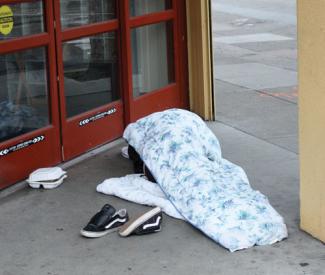
Homeless

Stuck in reverse

18

Some days, you wake up, check the news, and wonder just what the hell happened to this country. And I’m not talking about that nutty right-wing view that we’ve strayed from the original vision laid out for us by the authors of the Constitution or the Bible. I have just the opposite view: I’m wondering why those people seem so intent on dragging us back into the bad old days of bygone centuries, when white male property owners ran things as they saw fit.

A dangerously intolerant religious fundamentalist who longs for the Puritan days, Rick Santorum, essentially tied for first place in the Iowa Republican presidential caucuses. And he was part of an entire field of candidates that wants to revoke women’s reproductive and LGBT rights, deny that industrialization has affected the environment and should be addressed, dismantle already decimated government agencies, simply let the strong exploit the weak, and hope that Jesus comes back to save us from ourselves. Their strange reverence for the Constitution apparently stems from wanting to drag us back into the 18th century.

And don’t even get me started on President Barack Obama and his worthless Democratic Party, which is only a bit better than the truly heinous Republicans. At least Obama says some of the right things – like wanting to raise taxes on millionaires, reverse Bush-era attacks on civil liberties, respect states’ medical marijuana laws, and use diplomacy rather than only bellicosity with concerning countries like Iran – even though he acts in contradiction of those statements, over and over again.

It’s no better in the Golden State, where the yestercentury crowd now wants to abandon plans for a high-speed rail system that has already been awarded $3.5 billion in federal transportation funding and for which California voters authorized another $10 billion in bond funding. Why? Because a panel headed by an Orange County douchebag says the business plan isn’t detailed enough and the money for the entire $100 billion buildout isn’t nailed down yet. Well guess what? California also doesn’t have a plan for when its highway and airport systems get overwhelmed by population growth over the next 20 years. And criticizing the viability of high-speed rail – something most other advanced countries figured out how to build decades ago – isn’t exactly going to help secure private equity commitments. It’s a super fast train, folks – not some scary satanic iron horse from the future – people will pay to ride it.

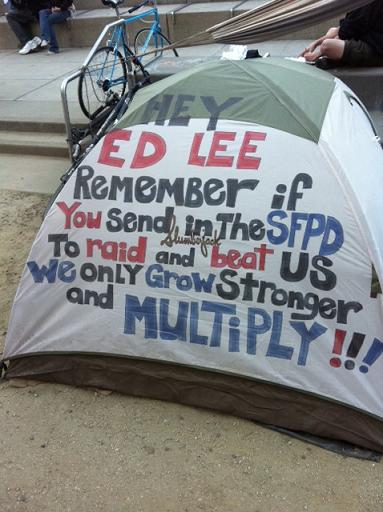
But the situation must be better here in liberal San Francisco, right? Wrong! Mayor Ed Lee, the San Francisco Chronicle, and all their business community allies continue to relentlessly push their belief that the main job of government is to create private sector jobs, even though most economists say a politician’s ability to do so is limited at best.

Lee is pushing for all city legislation to be measured by whether it creates private sector jobs, as if protecting the environment, preserving public sector jobs, or safeguarding the health, welfare, and workers’ rights of citizens weren’t also under the purview of local government. A Chronicle editorial today called Lee the most “realistic city leader in memory. He’s all about creating jobs, repaving streets, sprucing up faded Market Street and fixing Muni’s flaws,” the same goals the paper was focused on a century ago.

But the main trust of the editorial was calling for Lee to also focus on homelessness. Not poverty, mind you, but homelessness. “A decrease in jobless numbers is important, but so are fewer shopping carts pushed along sidewalks and a drop in the numbers of mentally ill in doorways and on park benches,” they wrote. In other words, they just don’t want to see poor people on the streets, because that newspaper and its fiscally conservative editorial writers and base of readers certainly haven’t been calling for a fairer distribution of this city’s wealth, or even higher taxes on the rich that might fund more subsidized housing programs or mental health treatment. I get the feeling they’d be content to just allow shanty towns on our southern border where our low-wage workers can live, just like the Third World cities that they seem to want to emulate.

Ugh, so depressing, so ridiculous, so regressive. I think I’m going back to bed now.

12 arrested in raid of occupied Oakland home

There were 12 arrests in West Oakland today, Dec. 29, after police raided a foreclosed home on 10th Street that Occupy Oakland activists had taken over to use as housing for the homeless and meeting space, according to a press release just issued by Causa Justa :: Just Cause, a housing and immigrant rights organization based in Oakland and S.F.

Here’s a link to live footage shot earlier today: http://www.ustream.tv/recorded/19454451

Organizers are asking supporters to contact the Oakland Police Department and demand the release of those in custody, the press release noted.

Activists took over the Fannie Mae-owned vacant property on Dec. 6, on the National Day of Action, “as a call to stop fraudulent lending practices and illegal evictions by banks,” according to CJJC.

Activists provided two reasons for taking over the property:”To demand that Fannie Mae turn it into low-income housing,” and “In support of the Ramirez family, whose home in East Oakland was improperly foreclosed on by Fannie Mae in May of 2011. Bank of America acting on behalf of Fannie Mae sold the Ramirez home while the bank was supposed to still be working with them. The family is now renting the home they once owned.”

Editor’s notes

4

Tredmond@sfbg.com

I’m not good at holidays. When your world is made of deadlines, the holidays are just one more — gotta get the kids presents, gotta get the tree, gotta make plans, gotta do dinner … one more set of hassles. Bah humbug.

And I’ve never been a big fan of New Year’s Eve. Too many people acting like they’ve never been drunk before and will never be drunk again, and everything costs too much. I drink every day; I can miss New Year’s Eve. Party pooper.

So I don’t do my own new year’s resolutions; I do them for other people. This is what I would like everyone else to do in 2012:

I would like the Occupy organizers to put together a massive day of teach-ins and a march on Washington in the spring, to keep the movement alive and bring in a lot more people.

I would like my fellow dog owners to pick up the shit off the sidewalks.

I would like the Department of Parking and Traffic to put up No Left Turn signs on 16th Street at Potrero and Bryant.

I would like Visconti to lower the price on that really cool lava fountain pen.

I would like the transportation whizzes at City Hall to figure out how to put bike lanes on Oak Street so I can ride back from Golden Gate Park as safely as I can ride to the park.

I would like the supervisors to change the rules for Question Time so the mayor doesn’t get all the questions in advance and there’s a chance for real discussion that isn’t stupid and boring.

I would like middle school English teachers in San Francisco to explain to their students that homeless people are not “hobos.”

I would like the Obama Administration to quit hassling pot dispensaries.

I would like the airlines to start serving cocktails before takeoff.

I would like the thriller writers of America to learn how to write decent sex scenes.

I would like Jerry Brown to endorse the initiative to outlaw the death penalty.

I would like everyone in politics to stop saying the words “together” and “shared” since we aren’t together and I don’t want to share with the rich.

Anything else? Happy New Year.

Occupying the future

0

p { margin-bottom: 0.08in; }

It was a funny feeling, seeing so many faces from Occupy San Francisco and Occupy Oakland in the bright, clean “Gold Room” of San Francisco’s Commonwealth Club, particularly after spending so many nights camping with them and covering the movement.

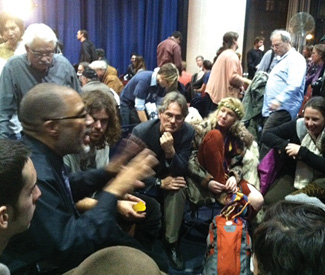
But they were there on Dec. 15, just up Market Street from their old campsites, along with a couple hundred supporters and interested community members, attending a forum on “Occupy: What now? What’s next?” Facilitator Caroline Moriarty Sacks announced that she “expected a civic conversation.” What she got was a very Occupy answer to the question of the evening which, in typical style, redefined the very concept of “civic” conversation.

The forum involved voices from many different parts of the left. Jean Quan, the Oakland mayor with a progressive activist past. George Lakoff, an outspoken liberal professor of linguistics at UC Berkeley. In the audience, dozens of people who support or are interested in Occupy, the mostly leftist San Francisco political milieu. And, of course, representing most of the panel and a good chunk of the audience were the active occupiers: anarchists, peace activists, labor organizers, and everything in between.

During the panels, their perspectives clashed. Yet Occupy strives to be a coalition of everyone, and all of these voices will be important as it progresses. Sacks had planned a 90-minute forum, featuring a panel to answer both moderator and audience questions, a break-out session, and summary reports back.

In their quest to practice participatory democracy, Occupy protesters have become used to long meetings that strive for non-hierarchical structure and a platform to hear the voice of anyone who would like to speak. If there’s one thing they can all agree upon, it’s that they’re a little tired of waiting patiently for their voices to be heard.

During the panel discussion, a few Occupiers started a Peoples Mic, interrupting Mayor Quan. They were escorted out. This fazed no one, and by the time she left the panel, chants demanding her recall rang in the hall. At each disruption, some Occupy-involved folks would object, “Listen to her! I want to hear all viewpoints!”

The tone was rowdy, but not aggressive. Minutes after disrupting the forum, protesters were back on schedule, sitting in small groups engaged in dialogue with other audience members. Even Quan was fine with it; she told the Oakland Tribune, “It was a chance to talk and have dialogue…We fostered a debate.”

This event was a microcosm of the thorny but crucial way that Occupy is uniting the left. The people in the room had something in common: belief in the visions and goals of Occupy. They just disagreed on how to get there.

Discussing, debating, and creatively bridging these differences has been one of the movement’s greatest struggles. But the more Occupy succeeds on the thorny path to unity, the more its strength builds.

Misrepresenting anarchism

Civil disobedience, peace, non-violence—all of these are critical concepts for the Occupy movement, and wrestling with them frankly has been part of the long road towards unification.

This has been done through the application of what’s originally an anarchist concept: embracing a diversity of tactics.

This is what the Occupy protesters did at the Commonwealth Club Forum. Some disapproved of disruptions, others thought them necessary. Individuals acted as they felt was right.

The Occupy supporters who turned their backs on Quan and interrupted her didn’t do it because they are inexplicably rude. They gave their reasons, including still being hurt and angry after Quan unleashed police using tear gas, rubber bullets, and aggression to break up their encampment on Oct. 25.

Quan also was displeased about that night’s events, saying that “No one is happy about what happened around the tear gas and mutual aid.”

The second reason for the reactions was what an Occupy Oakland protester who mic-checked Quan called her “misrepresentation of anarchism.” This has been dismissed and mocked by many press outlets, as if to say: What’s the point of bothering to understand anarchism?

Many people who identify with anarchist principles and tactics are involved with Occupy groups. This has contributed to the growth and development of autonomous communities at camps, as many anarchists have extensive knowledge and practice in building alternative communities based on horizontalism and collective management of resources. Occupy’s anarchist roots go deep.

This has also created controversy when tactics like property destruction and the black bloc, both associated with anarchism, become a part of Occupy. One example was the bank windows smashed and vacant building occupied during Occupy Oakland’s General Strike on Nov. 2, and riot police again responded with tear gas that night. The next day, 700 attended a General Assembly meeting to focus on discussing violence, its nature, and the ethics surrounding it.

Many have been quick to characterize this ongoing debate as a division in the movement. But if unity is to be achieved, these tough conversations are necessary.

Bringing it home

Occupy has been criticized for its lack of leaders, but that has left it open to exciting possibilities. To start a new Occupy project, you just have to convince some people to help you out—you must gain approval from no one. Some have described the organization as a “do-ocracy.” Don’t ask for permission, they say, just do it.

As such, the ideas for moving forward span from handfuls of people on street corners to millions converging on Washington.

Lakoff presented one of these concepts to the group at the Commonwealth Club, what he called “Occupy Elections.” Lakoff said, “Join Democratic clubs, and insist on supporting those people with your general moral principles. If you join Democratic clubs soon, you decide who gets to run. This is how the Tea Party took over.”

Like most ideas floating around in Occupy, there’s already something similar underway. Berkeley resident Joshua Green started the Occupy the Congress initiative, which hopes to organize and fund efforts for candidates “who support the declaration of the occupation of Wall Street.” Congressional candidates such as Elizabeth Warren in Massachusetts and Norman Solomon here in California have expressed support for and goals similar to the Occupy movement.

Occupy Washington DC has taken the message to Congress in other ways. In an open forum with supporters and renowned economists, they developed their Budget Proposal for the 99 Percent and are coordinating with Occupy groups throughout the country to call for a National Occupation of Washington DC starting March 30.

A call to action like that has a chance of being huge. With the West Coast Port Shutdown on Dec. 12, Occupy has demonstrated an ability to coordinate nationally. Those actions also showed Occupy’s growing unity with labor groups, as ILWU members worked closely with Occupy to plan those actions.

On Dec. 6, Occupy demonstrated its dedication to yet another new frontier—occupying foreclosed homes. That was a national day of action called by Occupy Our Homes and Occupy groups in over two dozen cities participated, defending homeowners threatened with eviction and moving the homeless into empty properties.

Hibernation

By the time moderator Melissa Griffin asked her final question to the panel, it was clear that the “civic conversation” had not gone as planned. Two Occupy protesters had been escorted out for interrupting Jean Quan. A handful of others had stood and turned their backs when she spoke. The crowd was restless for their own chance to grill the panelists, and there were only a few minutes left. With a faint look of dismay and hopelessness, Griffin asked the question that had no chance of being quickly answered: What’s next for occupy?

She quoted Kalle Lasn, co-founder of Adbusters, the “culture-jamming” organization credited with prompting Occupy Wall Street. In a recent interview with NPR, Lasn said: “I think that we should hibernate for the winter. We should brainstorm with each other. We should network with each other and then come out swinging next spring.” Griffin asked the panelists if they agreed with that statement.

Of course, some did and some didn’t. In fact, some form of “hibernation” is what many plan to do. In San Francisco, Occupy reading groups, workshops, and educational circles are on the rise. Small actions happen almost daily, ranging from workshops to meetings to marches to pop-up occupations.

Occupiers who were kicked out of camps are sleeping in networks of squats, safe-houses, and what one long-time camper described as “little homeless encampments around the city. We don’t put up an Occupy banner, and police don’t arrest us.”

The forum was a microcosm of the debates and plans brewing within Occupy, and it ended like most Occupy events. New connections had been made. Most people trickled out while several Occupy campers stayed to help stack chairs and clean up from the event. They all eventually exited the warm building, with its empty lobby that could have slept at least 50 people. OccupySF and Oakland activists chatted and advised each other on where to go.

Occupy is a resurgence in the spirit and power of protest and peoples movements, a recognition that the personal is political, that individuals losing their jobs and their homes can have more power in numbers. Organizing and protest has become a lifestyle.

As the Occupiers left the Commonwealth Club building, the future seemed thrilling, although many still needed a place to sleep for the night while those possibilities continue to percolate.

Gifted: Double your pleasure with a matched-funds donation to the Berkeley East Bay Humane Society

0

Consider the cat signal illuminated — the pet protectors have stepped in to save the day. Pawesome, a formidably cute website dedicated to the wellbeing of our faithful animal companions, has announced a dollar-for-dollar campaign to help a shelter still reeling from fire damage. Still struggling to think of a gift for your cat-enthused father? You’ve found it, furry friend.

Since 1927, when it was called the “Animal Rescue Haven” and operated out of an old pool hall, the Berkeley East Bay Humane Society has worked to find shelter for more than 40,000 homeless animals. But a disastrous May 2010 fire in the building’s adoption center took a heavy toll.  More than a year and a half later, the shelter struggles to raise money to rebuild their haven for the feline and canine homeless.

Pawesome is able to contribute 500 dollars, meaning a total of $1,000 could be raised to provide the sweet beasts of the bay with an actual roof over their heads. Donations can be made online through the “Shelter Fire Relief Fund”, just remember to then forward your receipt to pawesomehelps@pawesome.net. 


Revolutionary bedfellows: What Occupy has in common with the sex-positive movement

2

Guardian reporter Yael Chanoff embedded at the Occupy SF and Occupy Oakland encampments during the months-long protest. Here, she reflects on the non-monogamy movement and what it could mean for the 99 percent

Temperatures were running high at Occupy San Francisco. After a day of hard work, the protesters were decompressing. Talented musicians shared their instruments with friends and strangers in impromptu jam sessions. 

The evening in question took place during Occupy SF’s early stages, back when police would swarm at the first sign of a tent being propped up, and all of the 200 or so people who camped out that night mingled and slept in the open air. I sat with two young women and three young men who were all topless, leaning on each other and using laps as pillows. 

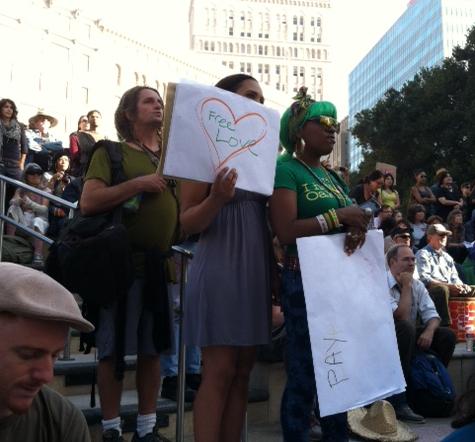
Another occupier, who said he had arrived that day, wandered by. “So,” he asked, “Is this thing about free love?”

“I don’t know” the guy next to me replied. He shrugged at the newcomer. “But we’re definitely doing that.”

RADICAL INTIMACY

One week later, I was sitting in the midst of a very different kind of alternative community. We were inside the Supperclub nightclub, in a hot room scattered with beds. The event’s attendees wore sparse Adam and Eve-themed costumes and glittery pasties winked here and there. A video of bonobos copulating was playing. 

It was a “second base” party, one of the many social calendar offerings of San Francisco’s sex-positive community.  The night – dubbed “Sex at Dawn” after author Christopher Ryan’s book by the same name that explores the historical roots of non-monogamy – would feature a panel discussion with several of the leading lights in the alternative, kinky, political sex community. 

Among the night’s speakers: Dossie Easton, Carol Queen, Philippe Lewis, people who have devoted their lives to creating intellectual and physical spaces where free love is unquestioningly ‘what it’s about.’

Their passion notwithstanding, the party that would follow their talk was not a sex party, strictly speaking. Event producers and Club Exotica founders Philippe “Fuzzy” Lewis and Jocelyn Agloro describe their gatherings as “co-created pieces of temporary social art,” places “for people to explore intimacy, relationships, sensuality, and sexuality — in community.” 

In some ways, the two nights were similar. But in other ways, they were quite different. The cost of admission, for example (Occupy SF: free; Club Exotica’s party: $10-35). And the numerous beds. But I couldn’t help being struck by the similarities. 

Both spaces were populated by humans whose need for connection wasn’t being met anywhere else, humans brought together by an experiment in revolutionary ways of relating to each other based on sharing and compassion. 

As I see it, the two communities have important lessons to share with each other.

THE FUTURE OF LOVE?

Occupy SF’s merry encampment is just a memory now. Justin Herman Plaza is empty these days, and somewhat unsettling – a grim square of concrete, bocce courts, and dead grass where 200 thrilled, at times confused, yet fiercely committed individuals spent two month trying to make a better world. 

But the movement is not over. It’s just in the process of reinventing itself. Forums on “Occupy 2.0” are happening around the country.

And as I think back on that night with those free loving campers, I have to wonder, will Occupy hook up with the sexual liberation movement?

When it comes to sex at Occupy, experiences varied among the individuals I interviewed. One young man who has been involved in polyamorous relationships for several years said he didn’t see anything of the sort at camp. “People have met and started dating here,” he said, “but it’s usually monogamous.”

Be that as it may, more than a few people assured me that “there’s been at least one orgy in the tents.” 

Two campers who had been occupying since late September told me that they were in a polyamorous relationship with a third occupier, and knew of other of other threesomes that had developed at camp. One of them, a calm, smiling young man, said the Occupy SF camp was an environment that definitely encouraged this kind of free love.

“I think it’s because you’re around each other all the time, in this rapid exchange of revolutionary ideas, and that’s another way you connect.”

But is sexual revolution part of the Occupy ethos?

The calm man’s partner was an energetic twenty-year-old known to start dance parties at 4 a.m. when camp was still around. She didn’t think so. 

“I mean, we talk about it with each other,” she said. “But it’s not really a part of the political side of the movement.”

Others found that Occupy had at least encouraged more sexual license, albeit unaccompanied by sex-positive theory. With wide-eyed disbelief one long-time camper told me, “I don’t understand it. I’ve been with more women since I’ve been here, homeless, than I ever did when I was housed.” 

It appeared that societal notions of monogamy were being sloughed off at Occupy SF – but without any of the underlying theories of polyamory espouses by the city’s sex-positive community. Many occupiers I spoke had never heard of any theory of non-monogamy, and agreed that a workshop teaching about alternative relationship models at camp could have helped sort out a lot of their ambiguous sexual experiences. 

Ironically, some of the city’s most qualified teachers might have been in the tent next door to these potential students.

SEXPERTS IN THE TENTS

Joani Blank, founder of Good Vibrations and longtime sexual liberation activist, spent time at Occupy Oakland. She told me that she saw ideas of love, sharing, and interpersonal connection brewing in that camp. 

Said Blank, “the camps encouraged love and acceptance and egalitarianism. With Occupy, there’s been a significant opportunity for the nature of love and friendships to change and be more open, and a lot of people [are] relating to other people who are very much not the same as they are. A variety of relationships are being encouraged and supported because everybody’s united.”

Blank thinks that the camps bred sexual experimentation. “[The occupiers] will jump into sexual experiences they’ve never had. So, for them it’s very liberating. I felt that energy myself the night I stayed there, and it translates easily into other kinds of excitement.”

In the ambiguity that surrounds Occupy’s future, one thing seems clear: this movement won’t survive unless it’s built on our love for our peers. That’s the focus of parties like “Sex At Dawn,” where attendees are not allowed to have intercourse, but instead are encouraged to open up sensually to those around them. 

The quest to open up in ways not traditionally encouraged within the bounds of capitalism was seen by many as a keystone of Occupy. The viral video-upcoming documentary The Revolution is Love focuses on Occupy and protesters’ search to replace consumerism with intimacy. 

Polly Pandemonium, founder of sex club Mission Control and its popular swinger’s party Kinky Salon told me that “the sexual liberation movement and the Occupy movement…we are all working towards the same future. It’s homo sapiens natural predisposition to share rather than hoard and fight. The mutual goal is to help people realize that it’s safe to share, and that they won’t be left out in the cold, and to create a culture which supports and rewards that kind of behavior.”

Even in its current transition phase, Occupy continues to capture the imagination of millions, including many involved in our sexual liberation movement right here in San Francisco. With a new, restless crowd of thousands who saw how community sharing could be applied to sexual relationships at the Occupy camps, some new sexual revolution may be stirring. 

For now, Occupy and the sexual liberation movement are just getting acquainted. But if activists stick with the core notions of sharing and love, we might be seeing the start of a beautiful relationship. 


A step forward and step back for SF’s homeless families

26

As San Francisco grapples with a record-high number of homeless families seeking shelter space during the holiday season, a pair of homeless policy discussions at yesterday’s Board of Supervisors meeting highlighted shortcomings and missed opportunities in the city’s approach to the issue.

Mayor Ed Lee announced that he is opening up more shelter space and public housing units for homeless families, finally relenting to weeks of pressure to address the pressing problem. Yet the board also narrowly approved turning surplus city property over to neighborhood residents rather than using proceeds from selling it to benefit homeless families, as city policies call for.

The property in question, 341 Corbett Avenue, is a vegetated hillside near Upper Market that the city declared a surplus property in 2004, transferring it to the Mayor’s Office of Housing to either develop as housing for poor families or to put the proceeds from its sale toward that purpose. Providing housing for the homeless is what city policy calls for surplus property to be used for, according to 2002’s Surplus City Property Ordinance. The property was assessed at $2.2 million, but it wasn’t developed because of costs associated with the steep hillside, nor was it listed for sale.

Neighbors of the property have sought to use the property for open space and a community garden, so the district’s Sup. Scott Wiener authored legislation to facilitate a community garden by transferring it to the Department of Public Works. The transfer would involve no money, leaving homeless advocates concerned about depriving homeless families of any revenues from the property.

“There are a lot of public assets we could sell if we wanted to fund this need or that,” Wiener told his colleagues, noting that neighbors would rather see a community garden on the site and that Upper Market lacks adequate open space.

But Sups. Jane Kim and Eric Mar led the opposition to the move, saying they didn’t object to that kind of community use of this property, but that city policies need to be followed, particularly considering the dire need for more resources to address the needs of homeless families. “I do have concerns about the precedent we set and also being consistent,” she said, arguing for a delay in the action until city officials find a way to compensate MOH for at least some of the property’s value.

“Overriding the surplus property ordinance is not something I want to do right now,” Sup. John Avalos said.

But the board voted 6-5 to approve the transfer, with progressive Sups. Kim, Avalos, Mar, David Campos, and Ross Mirkarimi in dissent. Housing advocates upset by the action directly their ire at the swing vote, one-time progressive Sup. David Chiu, with activist Tommi Avicolli Mecca sending out an e-mail blast saying, “david chiu betrayed us again — he wouldn’t support continuing the 341 Corbett item so that affordable housing advocates could try and work out a better deal with the Mayor’s Office on Housing and others.”

Meanwhile, the skyrocketing number of homeless families has become a big issue in town since the Guardian broke the story on Oct. 13, with repeated stories in the Chronicle, Examiner, and other media outlets, and homeless advocates staging rallies outside City Hall and unsuccessfully pushing for a meeting with Mayor Lee on the issue.

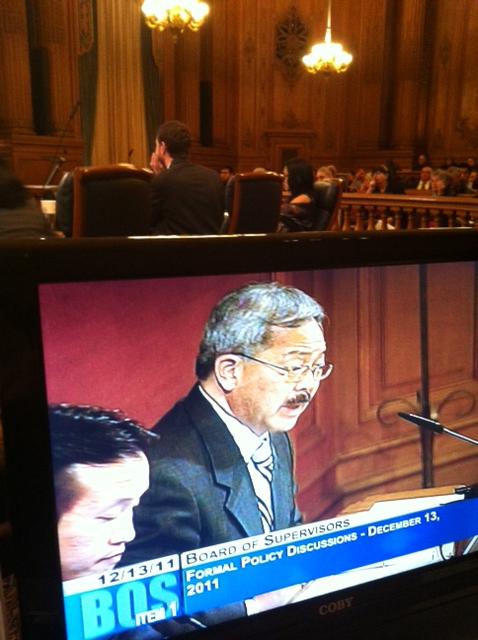
During yesterday’s monthly mayoral question time, Kim asked Lee what he was doing to address the “alarming rate” of homeless families in the city – with 267 families now on a wait list for emergency shelter space, a 356 percent increase since 2007 – specifically challenging him to expand the city’s Rental Subsidy Program by 50 families and open new emergency winter shelters. She also noted three recent suicides in the city by individuals facing homelessness.

“I share your concern about family homelessness in San Francisco. My staff has been hard at work for a long time now trying to proactively respond to this very serious challenge and I’m proud to offer some very constructive, tangible solutions,” Lee said. He announced that his administration had just this week starting expediting the placement of homeless families into vacant public housing units, with 18 families now being processed and a goal of placing about 30 of the 79 families now in shelters into public housing units.

Lee also said that SalesForce.com CEO Marc Benioff is donating $1.5 million to the Home for the Holidays program the city is creating to provide rent subsidies and case management to 160 families, a donation that the city will match. “Their generosity is inspiring,” Lee said.

He also pledged to open up an unspecified number of new family shelter spots and, somewhat bizarrely, tried to wrap this issue into his relentless focus on promoting private sector job creation, mostly through tax breaks that actually cut into the city’s ability to provide direct assistance to homeless families. As Lee said, “The long-term goal is to increase these families’ incomes and to place them into permanent unsubsidized housing.”

For the kids?

2

caitlin@sfbg.com

HERBWISE Mission District dispensary Medithrive has started doing home deliveries. Since Nov. 22 its medical marijuana patients can have buds, tinctures, Auntie Dolores’ brownie bits, and more delivered straight to their apartment doors.

So why are Medithrive customers and staff members peeved? Because the new feature isn’t an expansion in services — it’s a forced shift in the co-op’s business structure. The dispensary was compelled to close its doors on 1933 Mission Street after a Sept. 28 letter from Department of Justice attorney Melinda Haag threatened its landlord with jail time if Medithrive didn’t cease operations in the space within 45 days. (Full disclosure: Medithrive is a Guardian advertiser)

The feds’ given reason was Medithrive’s proximity to Marshall Elementary School, located a 745-foot walk (according to Google Maps) from the dispensary door.

But Marshall’s principal Peter Avila wasn’t consulted on the matter. When called for comment by the Guardian, he said that he had bigger safety concerns.

“Right next door to Medithrive is a liquor store,” Avila said, adding that there is also a methadone clinic across the street from his school. “We have to deal with people passed out on the property, people smoking — those are more the issues than people buying medical marijuana.”

The principal says he patrols Marshall’s immediate neighborhood three to four times a day, dealing with drug addicts, people with mental problems, and the Mission’s homeless population. He called the dispensary “discreet” and never saw any cannabis usage by dispensary patients. Indeed: “They looked pretty much like the people who were coming out of the Walgreens [down the street].” In the past, Medithrive has offered to sponsor health education at Marshall.

Regardless, the dispensary’s Mission Streets doors are shuttered now. On many days, a staff member stands outside, handing out flyers announcing the delivery service to customers unaware that walk-up sales have ceased.

“We’re actually not in such a unique position,” said Medithrive community outreach liaison Hunter Holliman. The Tenderloin’s Divinity Tree and the Mission’s Mr. Nice Guy dispensaries also closed their doors this autumn in light of similar school zone notifications sent to their landlords. The landlord of Marin County marijuana activist Lynnette Shaw, founder of Marin Alliance for Medical Marijuana, was also hit. Shaw intends to fight to stay open.

Holliman says the shift to delivery services has been unexpectedly popular with Medithrive’s customers and allows the dispensary to service patients unable to physically access the storefront location — but it’s not without its challenges. Operations have been transient since the co-op is unable to even stage deliveries from the space on Mission Street. The day that the Guardian called, a voicemail informed patients that due to high call volume they’d have to leave a message so that dispensary staff could call them back. Once contacted by a helpful “budtender,” it took a little over an hour for the order to arrive.

Although Medithrive let go of many employees in its initial closure, it’s hired nearly all back in the transition to the labor-intensive delivery services. The dispensary is still hoping to secure another brick and mortar location, but permitting for new dispensaries has stalled at the city level.

Even if the dispensary’s been booted from its space, at least Medithrive patients still have access to medical cannabis — for now. Holliman is convinced that Bay Area dispensaries haven’t seen the end of legal challenges. “I’m sure there’s more to come,” he said grimly. “The feds are really serious about this.” 

Medithrive’s delivery-only menu is available at www.medithrive.com

Editor’s notes

68

tredmond@sfbg.com

Twenty years ago, if you mapped income distribution in San Francisco on a standard graph, you’d see what the economist call a bell curve: At one end were a small number of very poor families, at the other a small number of very rich, and in between the bulk of the city was somewhere roughly close to what you could call middle class.

Take the 2012 census data and make that graph today and you get the opposite — it’s becoming a U-shape, with more people in poverty and more gross wealth and not as much in the center.

You could see that on stark display at City Hall Dec 12.

At 10 a.m., the City Operations and Neighborhood Services Committee heard several hours of testimony on the alarming rise in the number of homeless families. In the end, the Mayor’s Office agreed to find $3 million to help out.

At 1 p.m., the Land Use and Economic Development Committee heard testimony on a plan to build more housing — on the waterfront, for the top one quarter of the top one percent of the richest people in America, people who will need more than $3 million just for the downpayment on their new digs.

The plan calls for 145 of what Port of San Francisco officials call “high end” or “luxury” condominiums, along with 400 underground parking spaces. “It’s going to be tight on three levels,” a Port official testified. “Most of it will be valet parking.” The developer wants to raise the height limit along the waterfront for the first time in half a century.

The Port, which controls some of the land, will get a cut of all the condo sales, maybe as much as $500,000 a year; that money will go to rebuild old piers and fund a long list of Port projects — including the America’s Cup. (Ted Gullicksen of the San Francisco Tenants Union was sitting next to me at the hearing, and he shook his head at that bit of news. “Condos for rich people to pay for boats for rich people,” he said.)

A long list of people, including former City Planning Director Alan Jacobs and former City Attorney Louise Renne — spoke against the project. Jacobs and Renne both explained that this was single-site spot zoning that would change the half-century consensus that the city should “decrease height toward the waterfront so the people can see and enjoy the meeting of land and water,” as Jacobs put it.

Jacobs gave the committee members his one “absolute truth” about city planning: “If a developer accepts and knows that a rule can’t be broken, then it will be economical to build within it. If he or she think it can be changed, then suddenly it will not be economical. It’s called greed.”

In other words, Simon Snellgrove, the developer of 8 Washington, could make money with a lower-scale project that conforms to existing height limits. But he can make more money if the city gives him a big honkin favor.

But it’s not all about height limits for me. It’s not even about the fact that the project will chop up a tennis and swimming club that serves about 2,000 more-or-less middle-class people in an effort to make life nicer for about 145 very rich people.

It’s about what kind of housing we’re building in San Francisco. “Every study that we’ve seen shows that we’ve vastly overbuilt housing for the wealthy,” Gullicksen testified.

And we’re not just talking the ordinary wealthy here. The most compelling testimony came from Frederick Allardyce, a real-estate broker from Sotheby’s who said he had been involved in the sale of about 70 percent of all luxury condos sold from Washington St. to the waterfront. He gave us a glimpse of who would be living — sort of — at 8 Washington.

The cheapest condos would require an income of $469,000, a downpayment of $625,000, and another $493,000 of liquid reserves. Monthly payment: $13,699. The higher-end units would require an annual income of $1.029 million and a downpayment of $6.5 million.

“That’s not the one percent,” he said. “It’s the top one quarter of the top one percent.”

And, Allardyce explained, most of the people who buy that level of property are so rich that they don’t actually live there. It’s a second or third or fourth home, a place to stay a few weeks out of the year. And since the project involves chopping up a tennis and swim club used by some 2,000 people (who are nowhere near that rich), “you’re eliminating the use of that land by the general public” in favor of a tiny elite.

The developer says that the city will get money to build 33 below-market-rate units. That’s nice; by that standard, 80 percent of the new housing goes to the richest people in the world, and 20 percent for everyone else. That percentage ought to be reversed — and until it is (or at least, until we have a plan to build enough affordable housing for the people who really need a place to live in San Francisco) I can’t imagine why we’d want to be doing favors to feed the greed of developers.

What we’re doing in this city is making life harder for low-income people who are increasingly living on the streets and doing big favors for the spectacularly wealthy. There’s no sanity in our housing policy — except to turn San Francisco even more into a city of the rich.

Style Paige: Homeless youth show off their designing chops

0

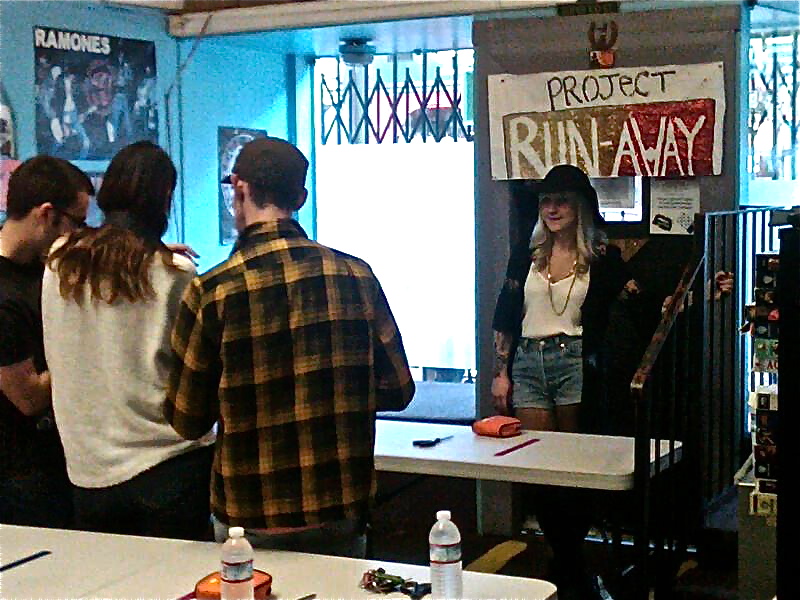
Five fashion-minded homeless youth – two men and three women  – had two hours to complete a fashion challenge using only donated clothing and street friendly supplies. That meant no sewing machines – more like dental floss, duct tape, and art supplies. The result? Find out by attending the Homeless Youth Alliance‘s screening of Project Runaway on Fri/16.

Some of the looks created in the series might come across as obvious – the streetpunk aesthetic of Haight-Ashbury’s homeless youth seems to have influenced a few of the garments. But not all. Other HYA participants went for more avant garde looks, like the “business pirate,” (as a HYA volunteer described one of the looks in a Guardian interview).

At Friday’s event, there will also be a fashion show at which a group of well-known fashion-forward judges will critique the garments and choose which DIY fashionista emerged victorious. The judging panel is still up in the air, but the center is hoping to land a former HYA participant who is now working in the fashion industry and a prominent fashion blogger.

Since the long-time haven for homeless youth has seen its funding recently cut by one-third, 100 percent of the ticket profits will go to the center – and in times like these, and particularly with the holidays fast approaching, a little bit of money can go a long way. Seven dollars will allow a youth at HYA the chance to get legal identification, and $30 will purchase 25 pairs of socks.  

The center hopes this is the first of many screenings of Project Runaway. So be an early adaptor –  come enjoy hors d’oeuvres and the inventiveness of young adults who are street and fashion savvy.


Homeless Youth Alliance screening of Project Runaway

Fri/16 7–8:30 p.m., $10-$30

Sports Basement

1590 Bryant, SF

(415) 437-0100

www.homelessyouthalliance.org


Police arrest 55 in early morning raid at Occupy SF

9

After more than two months, police have successfully cleared out all of the Occupy SF encampment on Market Street between Main Street and the Embarcadero. In an early morning raid, police completely cleared out the Occupy SF protest site at 101 Market St.

More than 50 protesters were present at 101 Market St. on the evening Dec. 10, as well as at a smaller site across the street. No tents, tarps or other structures had been erected; most protesters had sleeping bags and blankets. Following an afternoon march and a small concert that ended by midnight, protesters were quiet and mostly asleep.

Police previously warned protesters that they were in violation of California Penal Code section 647(e), “lodging in a public place.” Police entered the camp and read written notices aloud every 90 minutes or so for more than 24 hours before the raid, but did not give a specific warning as to when enforcement would take place.

Around 4:30 a.m. on Dec. 11, police rushed in, quickly surrounding those who slept in front of the Federal Reserve Building. Without giving them the option to pack up their belongings and leave, police arrested each individual one by one. Protesters who’d set up camp at a smaller site across the street looked on and yelled out in dismay.

Protesters had previously been informed that they were permitted to sleep on the sidewalk between 11 p.m. and 7 a.m., as outlined in San Francisco’s sit-lie ordinance.

Until about 6 a.m., Market Street between Main and Spear streets was blocked off by over 100 police officers in partial riot gear as well as several police vehicles. At about 5 a.m., Department of Public Works crews arrived and started loading all the protesters’ belongings — mostly sleeping bags, blankets, protest signs, and food — into trucks.

Several were arrested on charges other than public lodging. Two protesters, who yelled at police as they lined up on the street, were arrested for obstructing traffic.

One man yelled that he was a homeless war veteran and that he wanted his belongings back, which he’d left on the sidewalk in front of 101 Market. He had been loudly decrying police activity for almost 30 minutes when he jeered that an officer “carried a big stick because he had a small dick,” at which point three officers immediately grabbed him, brought him inside police lines, and were joined by several other officers in pushing him to the ground and zip-tying his wrists. Another man was arrested for spitting near the feet of a policeman.

In one bizarre incident, an officer confiscated a package of bottled water that an individual was carrying at the time of his arrest and then proceeded to distribute the bottles up and down the police line.

A man with a broken foot, who was walking on crutches, was pushed down by police for obstructing the street. He was arrested a few minutes later, after he and several others sat down in a crosswalk in defiance of orders to step onto the sidewalk.

By 6 a.m., everyone who remained at 101 Market St. had been arrested and all of their belongings confiscated; the sidewalk was clear.

Occupy SF began its 24 hour protest at 101 Market St. on Sept. 29. The camp remained until the first police raid on Nov. 20. Protesters subsequently reclaimed the site on Dec. 1.

As things stand, there is no Occupy SF presence at either of the original downtown locations. By 6:45 a.m., about 10 individuals — those who’d evaded arrest — had set up a small protest site, complete with signs and information table, at 532 Market St., in front of the offices of E Trade Financial.

In the past week, Occupy protest sites have also popped up at City College of San Francisco, San Francisco State University, and at the Bank of America at 501 Castro St. Occupy SF State is the only protest camp, complete with tents, still in place today in the city today.

No more Scrooge: A list of nonprofits that still have holiday volunteer slots

1

Mincemeat, Christmas goose, Hannukah gelt, lush sprays of holly bedecking the proverbial halls – traditionally, the December holidays are all about richness, overeating, and expense. But — especially these days — not everyone will be blessed with bounty over the holidays. In trying economic times, the number of San Franciscans struggling to put food on the table let alone buy their loved ones presents is steadily growing. 

So volunteer. San Franciscans have a long-standing tradition of helping out come the holidays, and many of the traditional community meals and grocery hand-outs have filled up their guest lists like a Big Freedia show during Pride Week. Nevertheless, a bunch of opportunities remain for those looking to lend a last-minute hand.

San Francisco Food Bank

Given recent funding cuts to the organization, the San Francisco Food Bank is taking all the help it can get in its quest to feed an ever-growing number of hungry San Franciscans. An enviably efficient volunteer system relies on interested helpers to sign up on an online calendar before showing up for their shift of repackaging food for community distribution.

900 Pennsylvania, SF. www.sffoodbank.org


Glide Memorial Church

Signing up to volunteer with Glide is a bit like jockeying for the last square of fudge. But luckily the organization – a superpower of Samaritan spirit – has a few spots left for December. Chose between an early-morning grocery bag distribution gig or a toy sorting task.

330 Ellis, SF. www.glide.org


St. Anthony’s

Packed to the gills with volunteers for its main events, St. Anthony’s is still calling out for help with two upcoming items: managing curbside drop-offs on December 23rd and 24th and clothing collection throughout the month. Both duties require the volunteer to be at least somewhat physically fit and able to lift 25 pounds of goodies. Shifts are four to five hours long and can be signed up for via a voicemail message to the volunteer hotline (see below). 

150 Golden Gate, SF. (415) 592-2829, www.stanthonysf.org


Tenderloin Tessie

If you’re looking to participate in a volunteer-run, community-oriented holiday dinner, this is one of  the best bets as better-known options are already staffed out the wazoo. Tenderloin Tessie provides holiday meals to homeless, low-income, disabled, and elderly San Franciscans – and has a wide-open sign-up sheet for volunteers. December 24th shifts involve loading and unloading food from the truck while shifts on Christmas Day are dedicated to decorating the dining room, preparing and serving dinner, and cleaning up afterwards. 

First Unitarian Universalist Church, 1187 Franklin, SF. Call Michael Gagne at (415) 584-3252 to register, www.tenderlointessie.com


Meals on Wheels San Francisco

The nationwide organization that delivers healthy meals to homebound seniors is peddling its Chefs of the Bay Area calendar for the next few weeks at various locations throughout the city. Individual volunteers are needed to staff the tables and promote the calendars, the proceeds from which eventually translate into someone’s hot holiday dinner.

1375 Fairfax, SF. Contact Danie Belfield at dbelfield@mowsf.org or call (415) 343-1311, www.mowsf.org


Habitat For Humanity

Habitat Greater San Francisco holds an ongoing inter-faith build on one of their largest projects to date, a 36-unit condominium at 7555 Mission.  No construction experience is necessary, and December 21 marks the start of their Winter Solstice Build, a community-driven effort to get the Daly City residence available to low-income tenants as soon as possible.

7555 Mission, Daly City. Sign up online at www.habitatgsf.org


Little Brothers San Francisco

Not everyone has family around for the holidays, and older San Franciscans can be especially in need of some care and affection. Little Brothers organizes several opportunities for volunteers looking to befriend community elders, from Christmas Day house visits to phone check-ins to help at the office. 

Various locations, SF. Sign up online or at (415) 771-7957, www.littlebrotherssf.org


AIDS Emergency Fund

Unlimited slots for volunteers pretty much guarantees a perfect present of a Christmas Eve dinner for San Franciscans with HIV/AIDS and their families. Last year, more than 1,000 people ate; this year (the 24th such dinner), a similar turnout is expected. Load-in of supplies begins at 10 a.m. on December 23rd and shifts run all day on Christmas Eve, starting at 8 a.m.

War Memorial Veterans Building, 401 Van Ness, SF. www.aef-sf.org, sign up at aefxmas@aol.com.


Jewish Family and Children’s Services

Gather and deliver holiday treats to those who might not otherwise celebrate the holidays on December 16th and 18th at the JFCS. Individuals and groups of volunteers are both welcome; sign up by December 9.

2150 Post, SF. Call (415) 449-3832 or email loril@jfcs.org to sign up. 


SF SPCA

A sprinkling of volunteer spots remains (especially post-Christmas) at the SPCA’s annual window display at Macy’s Union Square. Staff the windows – full of then-and-there-adoptable creatures – to raise money for future SPCA programs. 

Email windowsvolunteer@sfspca.org, use the online calendar, or call (415) 554-3008 to register, www.sfspca.org 


Hayes Valley Farm

Always open to volunteers, Hayes Valley Farm, an off-ramp-turned-urban-ag-oasis, holds special holiday hours for those looking to weed away end-of-year poundage or just engage with some of the happiest plants and gardeners in San Francisco. December 27 marks the first post-holiday gardening session and is sure to host droves of veterans and newbies alike.

450 Laguna, SF. www.hayesvalleyfarm.org


Homeless families still waiting for a meeting … and housing

San Francisco Mayor Ed Lee still has not met with homeless parents organized by the Coalition on Homelessness to discuss their proposed solutions to combat the growing problem of youth homelessness. Nor has the mayor’s office responded to multiple Guardian phone calls inquiring why a meeting hasn’t been scheduled.

Homeless parents organized by the Coalition entered City Hall last Wednesday to raise awareness about a growing problem of San Francisco families lacking a permanent home, and to request a meeting with mayor, whom advocates first contacted Oct. 26.

Coalition on Homeless executive director Jennifer Friedenbach said the mayor’s office had offered to schedule a meeting with a mayoral representative, but not with Lee. “Why would we meet with a representative?” she asked. “We want a meeting with the mayor himself. It should be important for the mayor to meet with parents in a crisis.”

As the Guardian reported last week, the number of homeless families on shelter waitlists citywide has risen to an unprecedented high of 267, while the number of homeless students in public schools identified by San Francisco Unified School District stands at a high of 2,167. Both figures suggest homelessness is on the rise in a city where rents are well above average and the recession has given rise to job loss, evictions, and foreclosures. A nationwide Occupy Our Homes day of action scheduled for today, Dec. 6, is meant to draw attention to tenant evictions and homeowners losing their properties to bank foreclosure.

Part of the problem facing newly homeless families in San Francisco is the lack of availability in public housing and other housing assistance programs such as Section 8 rental assistance vouchers. The waitlist for public housing units in San Francisco stands at between 24,000 and 25,000 — enough would-be tenants to fill the roughly 6,500 units in the city’s public housing system nearly four times over. The San Francisco Housing Authority closed its waitlist for public housing several years ago. The waitlist for Section 8, a separate program administered by the federal government, is also closed.

“Why do waiting lists close? The demand for low-income housing so far outweighs the available vacancy,” said San Francisco Housing Authority (SFHA) spokesperson Rose Dennis. “A number of housing authorities have had to close their waitlists, because we cannot serve the people who are not on the waitlist right now. This is not unique to San Francisco.”

Nevertheless, advocates with the Coalition on Homelessness say part of their strategy is to pressure the mayor to revamp units sitting empty in housing authority properties so they can be used for housing.

Asked about this, Dennis responded that there are relatively few vacancies, and that all vacant units are already in the process of being prepared for new tenants — some of whom have already been identified and promised a unit, and others who are part of a pool of applicants undergoing a screening and selection process.

Housing Rights Committee executive director Sara Shortt, however, told the Guardian public housing tenants she’s worked with have long observed boarded-up units on SFHA properties. She added that they’ve raised concerns about the tendency for empty units to attract rodents, graffiti, or squatters engaged in drug sales or use, which can lead to violence.

Friedenbach said she’d heard from multiple people seeking public housing units who said they’d been promised a unit only to experience delay after delay, for weeks on end. Dennis said it takes SFHA between one and 45 days to move a tenant into a unit once the housing has become available, depending on the status of the tenant.

In addition to the conflicting accounts, another complicating factor is that the actual number of vacancies in housing authority property seems difficult to pin down. Dennis told the Guardian that the occupancy rate in SFHA property typically stands at around 93 percent. Since there are roughly 6,500 units total, this would imply that there are about 450 vacant units. Yet Dennis also stressed that the number of vacant units is always around 225, give or take, and has hovered consistently around that level without any dramatic spikes in vacancy.

A SFHA report to its federal parent agency, the Housing and Urban Development (HUD), which housing advocates received as part of a Freedom of Information request, listed a total of 847 vacant public housing units as of May 2011. That’s nearly twice as high as a 7 percent vacancy rate, and almost four times as high as the 225 vacant units Dennis said the authority consistently has in its system.

“That’s not a vacancy rate,” Dennis explained after we sent her a copy of the document. “That’s a cumulative, historic count that HUD has that is different from day-to-day management. These are not numbers that accurately represent what you would go out and see on a site. These numbers have a lot of other aspects to them.” She added, “The numbers that I gave you are accurate and true.”

The Guardian has placed a call to the Human Services Agency, as well, in hopes of sorting out some of these issues. We’ll update this post if we hear back.

Castro residents clash over proposed restrictions in public spaces

37

UPDATE: This article has been changed to include three corrections.

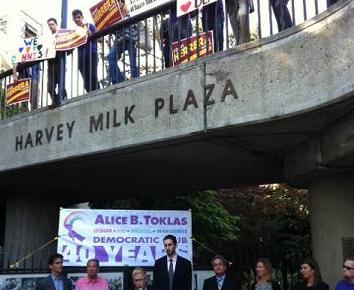
Community activists in the Castro District of San Francisco have been riled up by recent legislation proposed to limit public use of the Harvey Milk and Jane Warner plazas.

The ordinance proposes to ban “wheeled equipment” and prevent people from sleeping, camping, or selling merchandise. Further, the ordinance limits the time that seating will be available to 9 a.m. to 9 p.m. 

“Poor people and low income people can’t live in the neighborhood anymore,” said community activist and Housing Rights Committee member Tommi Avicolli Mecca. “This ordinance is a response to people’s discomfort with people who look homeless in the plaza.”

Mecca believes that this legislation was pushed forward by the Castro/Upper Market Community Benefit District and the Merchants of Upper Market and Castro (MUMC) as a way to privatize the public spaces and, in effect, prevent homeless people from occupying them.

“(The legislation) talks about sleeping and camping. Who is doing that other than homeless people and what printed materials are being distributed other than the Street Sheets?” said Bob Offer-Westort human rights organizer for the Coalition for Homelessness. “All of this really clearly targets homeless people.”

Other community activists, such as blogger Mike Petrelis, believe that this legislation is a preemptive act against the Occupy movement and that meetings discussing the ordinance intentionally excluded activists like himself. “This new legislation is part of a downtown agenda to prevent an Occupy encampment set up,” said Petrelis.

Petrelis wrote about the legislation on his blog, and among his arguments he states that preventing tents to be present in Harvey Milk and Jane Warner plazas expresses direct disapproval of the movement.

“I read this and hear fear on the part of [Sup. Scott] Wiener, MUMC and the CBD that an Occupy the Castro encampment could take root at the top of Market Street,” he said.

Wiener, who is sponsoring the legislation, says that it was drafted under the Pavement to Parks effort to transform the space into park land and that the provisions are standard for that use. 

“We’re trying to have usable vibrant public space and this legislation will help us have it,” Wiener told us. “This legislation provides what we already have in our parks. It’s pretty basic provisions.”

Wiener says that many local merchants and advocates, such as the Sisters of Perpetual Indulgence, have been involved in discussions around of this legislation, but the Sisters have not taken a stand on the measure.

“The Sisters, as far as I know, have not made a collective effort one way or another on the legislation at this time,” said Sister Barbi Mitzvah in an email. “The Sisters individually can comment, but coming from the organization takes a majority vote as we are a 501c3 non profit.”

Whether this legislation addresses homelessness, an attempt to prevent an Occupy Castro movement, or if it is to create a “usable vibrant public space,” the community is demanding participation in this decision.

“Both plazas play a vital role in the Castro community,” Petrelis said. “So why won’t he hold a public meeting?”


OccupySF awaits police raid after rejecting city ultimatum

5

A police raid that could wipe out OccupySF, one of the country’s largest remaining Occupy camps, now seems imminent after the protest group rejected the city’s ultimatum to either voluntarily move to school district property at 1950 Mission Street or face forced eviction.

OccupySF received a written document laying out the terms of this potential agreement yesterday. After a long day of discussion, including a General Assembly meeting last night, OccupySF is refusing to sign the agreement, largely because of concerns about autonomy, as well as visibility and livability at the new site.

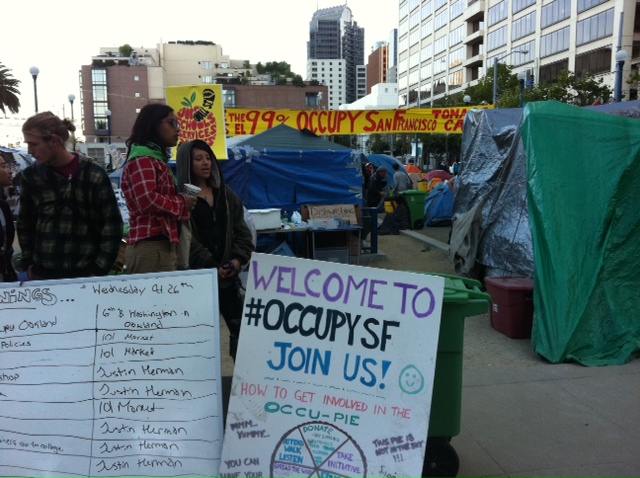
This marks the end of almost a week of talks with the city during which no raids were threatened on the camp. Now that OccupySF has rejected the ultimatum, police are expected to enter the camp and attempt to clear it out tonight or tomorrow night. That could destroy the longest continuous large Occupy encampment in the country. Protesters have been sleeping in public spaces in the Financial District under the name OccupySF since Sept. 17, enduring two previous police raids that only increased support for the group.

After last night’s General Assembly, a working group is meeting to form a defense plan in case of a raid, and it’s still unclear how the standoff will unfold.

The rejection of the offer comes after days of debate at the camp, including a session that took place after the city made clear the exact terms of their proposed contract yesterday afternoon. Around 3:30 p.m., OccupySF liaisons to the city handed out photocopies of a document entitled “Facility License Agreement: 1950 Mission Street.”

If signed, the agreement would have allowed the group to use the former school site until May 31, 2012. There were 17 expectations listed, including no animals or pets, no minors, “no sound/noise greater than 45dBA between 10:00pm and 7:00am,” “no panhandling or loitering,” and “no stoves, flammable liquids, wood storage or gases, open flames allowed on the site.”

What the city called an “agreement” and an “offer,” protesters saw as an ultimatum and, for some, a “veiled threat.” Katt Hobin, one of OccupySF’s key organizers, told the group, “We are operating under violent coercion. They are threatening violence if we don’t evacuate this space.”

Under the agreement, the city would have been the tenants, renting the space from the school board for $2500 per month. The space is a lot surrounded by a 15-foot chain link fence and has several portable buildings. Protesters would have had access to toilets, electricity, and indoor space at the site.

At the current camp at Justin Herman Plaza, which they renamed Bradley Manning Plaza, protesters debated how accepting the agreement would affect their branch of the Occupy movement in terms of autonomy, ability to expand and grow, inclusivity, and long-term viability.

Around 4 pm, hundreds paced camp, talking to each other about how to move forward. Some were interested in the possibility of a deal with the city but felt they could not accept the terms, especially prohibitions on minors and animals.

There seemed to be an understanding that the police would attempt to clear out the current camp in the coming days. Yet many seemed assured that the OccupySF network would stick together even after such a raid. One organizer invoked George Washington, saying, “He knew his army didn’t have to win battles, they just had to stick together. They would lose and they would retreat to a new place, but everyone would know that revolutionary army is still out there.”

Others saw the group’s place in revolutionary history differently. One protester reflected, “I think this is history being made right now. We can take the space and do so much with it. There are inside spaces for the sick and the elderly.”

Dozens of protesters had made up their minds to take the space. They waited with their belongings on the Steuart St and Don Chee Way corner of the plaza. “Jerry the Medic” Selness, who had been acting as OccupySF liaison to the city and speaking with Director of Public Works Mohammed Nuru, had relayed the message that DPW trucks would be coming to pick up those who wanted to move to the new site that afternoon.

One protester said that he and about 30 others had signed a symbolic petition stating that they wanted to accept the space. “We don’t need to sign it as OccupySF,” he said. “We’re Occupy Mission.”

Some had been waiting since the early morning. Around 5 pm, Selness got a call that no trucks would be coming that day because the city was awaiting the General Assembly’s response to its offer. About 100 people convened for the daily General Assembly at 6 pm. Around 9 pm, it was clear that OccupySF would not be signing the agreement as it stood.

The assembly did not object to any individuals or autonomous groups who might want to sign the document. They planned to write a response letter detailing their reasons for the rejection, the text of which will be discussed in a General Assembly tonight (Wed/30) at 6 pm.

Many came and went during the General Assembly, including dozens of people who were coming through OccupySF for the first time. Many organizers and supporters who had been there since the beginning but who not attended for days or weeks came back to discuss this issue, which many believed was important “for Occupy movements across the country.” Representatives from Occupy San Rafael, Occupy Santa Rosa, Occupy Berkeley, Occupy Oakland, Occupy USF, and Occupy Gainesville, FL spoke up, expressing solidarity, requesting support, and giving advice.

One homeless woman who had been living in the camp but had never spoken in GA expressed the opinion that to move would be to get out of the public eye and to concede to the city’s attempts to contain the movement, a much-expressed sentiment at the meeting. She cried, “You can’t move and live limited with their rules and regulations. You’re an eyesore, that’s why they want you to move. It’s political.”

Another woman agreed, declaring, “They can’t tell us how to protest or where to protest.”

Others cautioned against accepting the offer for different reasons. One man who spoke up at GA said that he was a teacher at Civic Center Secondary, formerly Phoenix Continuation School, the previous tenants of the offered space. He warned that the school had moved because of instability and health issues surrounding the flow of Mission Creek underground. Another worker familiar with the area recounted a tale of power-washing the sidewalk on the proposed site only to be confronted with “thousands of rats who poured up from the streets”; an OccupySF member who had surveyed the site earlier that day confirmed that the buildings had several holes in the walls, seeming to indicate a rat infestation.

One of the attendees, a young child, expressed the opinion that “we should stay strong and stay here,” amplified by the Peoples Mic. She also helped keep the meeting’s energy high and going in the right direction, showing aggressive “downward twinkle fingers” that signal disagreement at the proposed prohibition of minors on the site, and yelling “there are children present!” when adults used curse words in their impassioned statements.

Many agreed with Diamond Dave Whitaker, local celebrity in the poetry and radical communities and OccupySF organizer, when he stated: “OccupySF is citywide. We’re an autonomous entity as part of a worldwide network. We’re going to see a number of autonomous occupations arising.”

Whitaker mentioned a planned Occupy USF action to take place Dec. 1, as well as the small contingent that is currently “occupying” outside of Wells Fargo at 1 California Street, across from the former occupation site at 101 Market Street. That site is still blocked off by police barricades.

Occupy LA issued a similar rejection letter November 23, which might form the basis of OccupySF’s letter (Link: http://losangelesga.net/2011/11/assembly-authored-city-response/ ). That camp was raided and disbanded last night.

OccupySF plans to put out a formal response to the proposal and explanation of their decisions tonight.

Public health and Occupy

8

By Sasha J. Cuttler

OPINION On November 17, Mayor Ed Lee’s administration declared OccupySF a "public health nuisance." The mayor and other city officials are using this declaration as a justification to evict the OccupySF camps.

But rather than being a nuisance, the Occupy camps are reclaiming public space and voices while making health disparities more visible. Dozens of health organizations are making statements of solidarity, including the American Public Health Association, with more than 30,000 members, which recently passed a resolution with overwhelming support of the Occupy movement.

San Francisco officials say that overcrowding and inadequate sanitation are causing a threat to public health and safety. But as noted by public health nurse Martha Hawthorne, "When is the last time city department heads have left their offices and taken a walk through the Tenderloin, just minutes away from the San Francisco Occupy site? Smells of human waste? Evidence of street drug use? Garbage on the street? It’s there and has been for years, the inevitable consequence of the lack of affordable housing and years of cutbacks to mental health and substance abuse funding in San Francisco."

As far as overcrowding of tents, Hawthorne goes on to note: "Overcrowding? Go anywhere in the city with a public health nurse. You’ll see multiple families living in one flat, sharing a kitchen, having their own tiny room if they are lucky and can afford it. People sleep in shifts and live elbow-to-elbow in garages, basements, closets, old office spaces — and they are the ones we nurses can see, because at least they have an address. "

The one percent is attempting to maintain control by blaming the victim. Rather than blame the marginalized for their misery, the Occupy movement opens an opportunity for dialogue and mass mobilization while providing tangible assistance to those in need of help right now. Homeless and mentally ill individuals have been receiving food and shelter at Occupy encampments everywhere.

The Occupy movement is making visible the public health consequences of insatiable corporate greed. Income inequality is closely paralleled, unsurprisingly, by poorer health outcomes. The rich are not only getting richer, they are living longer, healthier lives than the majority of us in the 99 percent.

Despite months of Occupy experience world-wide, the only evidence of ill health and injury directly related to the camps can be found in the hundreds of nonviolent activists exposed to clouds of tear gas, fountains of pepper spray, myriads of beatings, and volleys of rubber bullets. These incidents of state-sponsored violence can cause lasting health impacts on the individuals who are exercising their right to free speech and assembly.

We can do better than this. We need to use this gathering as a reminder that health care is a human right and do everything in our power to help, not hinder, the populations we serve.

Like thousands of other public health workers, I believe that the Occupy movement is creating an incredible opportunity that needs to be protected and expanded. Public health does need to be protected — and one of the best ways is through engagement with the Occupy movement, not through its eviction. 2

Sasha J. Cuttler, R.N., Ph.D, is a nurse and SEIU Local 1021 activist

The food divide

4

news@sfbg.com

Antonia Williams is part of a slow, quiet food revolution. After battling obesity for much of her adult life, the 26-year-old lifelong Bayview resident did some research. “I realized it had a lot to do with the food I consumed,” she told us. “As a result of growing up in the neighborhood, I suffer from obesity. I’m overweight because of the lack of options for good healthy food.”

“It’s what I grew up on, McDonald’s and a lot of fried food for dinner,” she recalls. “The grocery stores in the area were very limited in what they offered. I believe my parents weren’t as educated or aware” about health and nutrition.

Williams managed to escape this bad foods trap, change her personal diet, and now works as a “food guardian” for the nonprofit Southeast Food Access (SEFA), helping to bring more nutritious fare to the Bayview.

The complex of challenges Williams faced simply to eat well—the fast food all around her, the dearth of grocery stores, and lack of awareness—reflects the array of systemic barriers to good food that keep tens of thousands of San Franciscans in chronically poor health.

Under the weight of recession and double-digit unemployment, San Francisco’s chronic food divide has grown deeper and wider. From regions of the city like Bayview, Excelsior, and other Southeast neighborhoods, to seniors surviving on marginal fixed incomes, to the city’s swelling unemployed and underemployed who rely on food pantries, access to fresh food is a daily geographic and economic battle.

Roughly one in five San Franciscans each day has no reliable source of adequate sustenance and must scramble for food from soup kitchens, food pantries, or other “emergency” supplies that have become a structural part of the city’s food system, according to the San Francisco Food Bank.

Each month, more than 100,000 families rely on the Food Bank to help feed themselves — nearly double the amount from 2006. Economic recession has dramatically increased the number of city residents using food stamps (known as “CalFresh”) each month, rising from 29,008 in 2008 to 44,185 in 2010.

Yet even that rise belies a far deeper need: only 47 percent of those qualifying for CalFresh are actually accessing benefits, according to a data analysis by California Food Policy Advocates; at minimum, more than 40,000 additional city residents are entitled to get this help, and thus eat better.

Across the city, parallel economic and food divides compound one another, spelling serious trouble for people’s basic nutrition and health — in turn depleting their energy, cognition, and ability to do everything from succeeding in school to getting a job.


BEYOND GROCERY STORES

In Bayview, where poverty and unemployment run about double citywide averages, these geographic and economic food divides come to a head. District 10, encompassing Bayview/Hunters Point (BVHP), features some of the city’s most grocery-impoverished neighborhoods, and has the highest rates of CalFresh usage.

This confluence of lack and need—compounded by a prevalence of fast food and liquor stores over fresh food offerings—has inspired Antonia Williams and other residents to fight for better food in their neighborhoods.

As one of four paid Food Guardians for SEFA, Williams spends about 20 hours a week examining grocery store shelves in Bayview, talking with consumers and food retailers, and educating both about the need for more fresh non-processed foods.

One recent victory: armed with customer survey data, she convinced the Bayview Foods Co. to stock low-sodium tomato paste. Next on Williams’ food improvement list is getting more low-sodium products, less cholesterol, and more fiber on the shelves.

These may sound like small steps, but they’re part of a larger effort to get healthier food in Bayview, where chronic diseases such as obesity, diabetes and heart disease are rampant. “I think a lot of people just don’t know the link between the food we are eating and these chronic diseases,” says Williams.

The Bayview is among the city’s most food-deprived districts, with just 63 percent of residents living within a half-mile of a supermarket (in Excelsior, it’s 57 percent), compared with 84 percent citywide. That ratio improved somewhat with the arrival this August of Fresh & Easy supermarket on Third Street, but access to fresh produce remains limited — a situation that numerous studies show contributes greatly to chronic undernourishment and disease.

Indeed, statistics show Bayview area residents suffer by far the city’s “highest rates of everything negative,” as former district supervisor Sophie Maxwell puts it: obesity, diabetes, heart disease, and cancer.

Ironically, the Bayview’s Third Street is home to the city’s bustling produce warehouses, which rattle early every morning with trucks and crates full of fruits and vegetable, “but you have to go out of the district to get it,” says Maxwell, who helped spearhead a Food Security Task Force while in office. “I was very much aware of [the food access problem] because of what I had to do to get food myself.”

Much of Third Street remains a boulevard of liquor stores and fried and fast food. According to Tia Shimada of California Food Policy Advocates, “A lot of what we see instead of food deserts is food swamps, where the amount of healthy nutritious food available is overwhelmed by all the fast food and junk food.”

Despite a seemingly diverse landscape of food businesses, “There’s a saturation in neighborhoods with unhealthy choices,” SEFA’s Tracey Patterson argues. “When the cheapest choice in front of you is fatty comfort food and fast food, that’s what you get accustomed to eating. The easier options quickly become habit.”

Kenny Hill, a 23-year-old food guardian and Bayview resident, puts it like this: “What we have in our community, that’s what we eat.” But he says history and culture play a role, too. “We need to change the culture of what’s considered good…Growing up eating salad, people would say, ‘Why are you eating that? That’s white people’s food.'”

In other words, it takes more than getting a grocery store—which itself involved a nearly 20-year struggle for Bayview residents and leaders. “Food access is just one part of the issue. Even if you get a grocery store, that doesn’t solve the problem,” says Patterson, whose group, SEFA, espouses “three pillars” to fix the area’s food problems: more grocery stores; education and health literacy; and expanded urban agriculture. “None on their own is enough.”


HUNGER CROSSES LINES

Getting a job isn’t enough either, statistics show. A recent study by the USDA cited by the Food Security Task Force shows that 70 percent of families nationwide with “food insecure” children have at least one member working full-time. And in San Francisco, the task force found, “39 percent of the households that receive weekly groceries through the SF Food Bank include at least one working adult. Only 18 percent of clients are homeless.”

At least by federal definitions of poverty, food insecurity isn’t just for poor people anymore — particularly in San Francisco, where exorbitant housing and other costs compound people’s struggles to meet their food needs. “If you just look at the poverty level, you’re missing a lot of people who are struggling to make ends meet,” says Colleen Rivecca, advocacy coordinator with St. Anthony’s Foundation. “Hunger and health and housing are so interconnected.”

Indeed, while the Federal Poverty Level for a family of three is $18,310, cost-of-living research by the INSIGHT Center for Community Economic Development found that in San Francisco, this family would need almost $40,000 more than that to make ends meet.

Rivecca says the ongoing recession is simultaneously deepening the food divides and undermining efforts to address it. For instance, SSI recipients must make do with $77 a month less than they got in 2009, while California is the only state where SSI cannot be supplemented by food stamps.

According to the Food Security Task Force, San Francisco “has an inordinately high number of residents who are elderly, low-income and/or blind and disabled — over 47,000 residents receive SSI.” Many are homebound, socially isolated, and living in SRO units without kitchens, and no means of preparing their own food. So it’s no surprise that these same people, who need help the most, often get it the least.

Due to “misconceptions about what qualifies,” says CFPA’s Kerry Birnbach, only 5 percent of Californians eligible for Social Security participate in CalFresh. “Senior citizens are more isolated, and the more isolated you are, the less likely you are to know about it.” Birnbach says that leads to lower nutrition, less energy, and greater hospitalization rates. “It’s not having food on the table — choosing between food and medicine.”

A 2006 study by the San Francisco Department of Aging and Adult Services found that while the city’s elders “received approximately 12.2 million free meals through all of the programs in the City including food pantries, free dining rooms, and home delivered meals, the gap between the number of meals served and the number of meals needed was somewhere between 6 [million] and 9 million meals annually.”


BAND-AID FOOD SYSTEM

As television cameras made clear on Thanksgiving, there’s no shortage of food and meal giveaway programs, soup kitchens run by churches and nonprofits — a whole constellation of ad hoc benevolence spread across the city. But this kind of “emergency food assistance” has become a structural part of the city’s dietary landscape.

Another main ingredient in the city’s food infrastructure is seemingly cheap fast food, which for many poor people becomes the diet of first and last resort. Sup. Eric Mar recalls meeting with teenage mothers and hearing one parent speak about dumpster diving at McDonald’s for what she called “fancy dinner.”

“The cheapest possible food like McDonald’s is seen as a luxury,” says Mar, who last year passed legislation preventing fast food chains from selling kids meals with toys unless they improved their nutrition content. “Poor people rely on whatever’s out there, and when McDonald’s or Burger King sells cheap, it undercuts families’ efforts to get healthy.”

District 10 Sup. Malia Cohen sees the impacts of fast food and junk food every day in Bayview. “There is no infrastructure out there to de-program people” from long-standing fast food habits. “I don’t fault people for eating fast food, but I do want them to think twice and know they have a choice.”

So what is the choice, and how will the city address its deep food divides, which cut across geographic and demographic lines?

So far, it’s a patchwork project. As one step, the supervisors in April passed a new zoning ordinance designed to encourage more urban food production. In Bayview, Cohen says, “We’re looking at urban agriculture as something that’s viable” to feed low-income residents.

Despite the arrival of Fresh & Easy, BVHP remains a critical flashpoint for the food security fight. Markets for fresh produce are few and far between. In 2006 the Department of the Environment teamed with Girls 2000 and Literacy for Environmental Justice to create the Bayview Hunters’ Point Farmers Market, but for a variety of reasons, the customer base wasn’t sufficient for farmers to keep selling there, and the project stalled. Now there is talk of reviving a farmers market in the area.

But for larger, more structural change to take hold, Mar argues, the food gap “has to be a citywide goal and priority.” And, he notes, bigger forces — notably agribusiness lobbies and congressional agriculture committees — make local progress more difficult. “It’s hard because the Farm Bill allows these food companies and commodity groups to keep their prices lower, and small businesses and producers have a hard time keeping their prices low,” encouraging more fast food and obesity and other diet-related diseases.


GREEN GLIMMERS

On a chilly gray late afternoon the day before Thanksgiving, we met with Patterson, Williams, and two other food guardians at Bridgeview Community Garden on the corner of Newhall and Revere in Bayview. Perched on a small chunk of slope overlooking houses and freeway traffic, the plot offers a thriving little harvest of tomatoes, kale, leeks, basil, and other vegetables and herbs. It’s not a lot of food, but along with other nearby agriculture, such as Quesada Gardens and the larger Alemany Farm, it helps bolster residents’ weekly dose of fresh produce.

Equally important, it gives budding food activists like Antonia Williams and Kenny Hill reason to believe things can change. After yanking a healthy crop of leeks from the soil, fellow food guardian Jazz Vassar, 25, notes, “There are a lot of community organizations doing good work here. We have high hopes to change things.”

Even as they work to nourish a different food future, the food guardians are acutely aware of the jagged rocks and stubborn old roots that need to be cleared. Asked what the city should do about Bayview’s many-layered food struggles, Hill responds: “Realize there is a problem in Bayview, and allocate resources here. There are statistics that this is a food desert, there are high rates of crime—people have to wake up and see that people here have been disenfranchised.”

It’s not about having the city do it for them, says Hill. “Give us something to latch on to so we can help ourselves.”

Former Bay Guardian city editor Christopher D. Cook is the author of Diet for a Dead Planet: Big Business and the Coming Food Crisis.

Occupy standoffs continue as poll finds public support for the movement

11

As OccupyOakland moves to reoccupy Frank Ogawa/Oscar Grant Plaza today and the burgeoning OccupySF encampment braces for another long-threatened raid by police, a new Field Poll finds that about half of registered California voters identify with the Occupy movement and support its goals, which include taxing the rich and limiting the ability of large corporations to corrupt the political and economic systems.

As the San Francisco Chronicle reports, 46 percent of respondants said they identified with the Occupy movement and 58 percent agree with the cause that prompted it, compared with 32 percent who say they disagree with it. Unsurprisingly, those on the left were more likely to support Occupy while those on the right were more likely to oppose it. A previous Field Poll at the height of the right-wing Tea Party movement found it had only about half as much support as Occupy now enjoys.

Still, as it enters its third month and winter descends on the encampments, Occupy faces myriad challenges. In San Francisco, the mainstream media — particularly curdmugeonly Chronicle columnist CW Nevius — has regularly highlighted conflicts and other conditions in the camps and pushed Mayor Ed Lee to follow-through on his threats to clear the tents from Justin Herman/Bradley Manning Plaza. Rumors abound that a raid could come on Wednesday night, when SFPD beefs up its staffing for training exercises.

In Oakland, the site of some of the most violent police crackdowns on Occupy encampments, OccupyOakland members are right now (noon, Tues/29) marching back into their former home and pledging to set up a 24/7 protest in defiance of city officials. While they seem to be stopping short of a full-blown occupation and tent city, they claim to be setting up a model for the next phase of the Occupy movement.

The group’s press release follows:


FOR IMMEDIATE RELEASE:

Contact:

Phil Horne, Esq., Occupy Oakland Vigil Committee

415-874-9800; occupylaw@riseup.net

www.occupyoakland.org

OCCUPY OAKLAND— RE-OCCUPYING OSCAR GRANT a.k.a. FRANK OGAWA PLAZA

On Tuesday, November 29, 2011 at noon, Occupy Oakland activists will retake Frank Ogawa a.k.a. Oscar Grant Plaza in downtown Oakland with a 24-hour, 7 day-a-week vigil.  Occupiers hope to create a model for a new wave of “Occupation” protest throughout the United States. With the vigil, Occupiers will continue asserting rights guaranteed by the United States Constitution to assemble, speak, and petition government for redress of grievances.  The vigil is not the product of a bargain with Mayor Quan, nor is it negotiated with law enforcement–permission from the city is not required to exercise these constitutionally guaranteed rights.

The structures in the plaza will be symbolic and part of the vigil protest. A teepee will remind the public of the former Occupy camp and historic struggles of the Sioux Indians on the Plains of the U.S.; homeless workers in Hoovervilles during the Great Depression; the “Bonus March” to Washington D.C. by unpaid and unemployed veterans in 1932; Resurrection City following the assassination of Martin Luther King; the AIDS vigil of 1980s San Francisco; and the redwood occupations of Judi Bari and Running Wolf.

Occupy Oakland continues its occupation because residents of Oakland and across the US are still fighting for food, shelter, medical care, school, childcare, and other necessities.  The 1% enjoy 40% of U.S. wealth and 50% ownership of Wall Street stocks and bonds.  The bottom 80% split 7% of the former and just 5% of the latter.  The average 35-year-old in the 99% has a net worth less than $3,000.00.  Occupiers ask the public to consider, “How long does it take an unemployed member of the 99% to go through $3,000.00 and become homeless.” In Oakland, the unemployment rate is nearly double that of the national average. These are issues of crucial relevance to our city.

Occupy Oakland’s vigil declares, “If the 1% won’t share voluntarily through a sense of morality and concern for the well-being of all, then through protest and direct action, we will force change!  Occupy the Plaza!  De-colonize the 99%!”

Occupy Oakland will have sign-up sheets starting Tuesday at 11 am. at the Plaza, but sign up is not a prerequisite for participation in the vigil. Supporters are encouraged to come out day or night to participate.  The Plaza is fully accessible to the differently-abled.

About OccupyOakland:

Occupy Oakland is an emerging social movement without leaders or spokespeople. It is one of 1,570 occupations currently occurring around the world in solidarity with Occupy Wall St. For more information about the other occupations, see: http://www.occupytogether.org/

An up-to-date calendar announcing Oakland actions, and more information can be found at:

http://www.occupyoakland.org/


About that “acrimonious fall”

Catch this. Mayor Ed Lee’s mayoral victory had nothing to do with millions of dollars in campaign contributions from private interests, a sophisticated get-out-the vote effort targeting Lee supporters, the advantage of incumbency, some funny business, or a calculated campaign strategy concentrating efforts on absentee ballots.

Instead, the fact that Lee triumphed over voters’ second pick, the significantly less well-funded progressive candidate Sup. John Avalos, is proof that the left in San Francisco has plummeted into a dark abyss. In fact, the progressive movement has descended so far into disarray and become so irrelevant that its condition warrants front page news.

That’s essentially the narrative that Benjamin Wachs and Joe Eskenazi of the San Francisco Weekly offer in their cover article, “Progressively Worse: The Tumultuous Rise and Acrimonious Fall of the City’s Left,” in which they refer to the Guardian as “the movement’s cajoling ward boss, kingmaker, and sounding board.” Gosh, I feel so goddamn important right now.

Once the blood pressure returned to normal, my initial reaction to this piece was that Wachs and Eskenazi seem to misunderstand who and what progressives actually are. They portray the city’s left as a caricature, a brash bunch of power mongers now on the losing end that can be easily summed up with pithy video game references, Happy Meal toy bans, and bikes.

Witness the contrast between the Weekly’s portrayal of progressives (helped along by former Newsomite Eric Jaye), and the portrait of the left the Guardian offers this week with an Op-Ed written by NTanya Lee — an actual progressive who volunteered for the Avalos for Mayor campaign.

Here’s the Weekly on the left:

“This is an eclectic group, one often bound not by mutual interests as much as mutual enmity — toward Brown, his successors, and the corporate interests of ‘downtown.’ As a result, progressive principles are often wildly inconsistent. Progressives favor more government control over people’s lives for their own good, as when they effectively banned McDonald’s Happy Meals. But sometimes progressives say the government needs to let people make their own choices … Progressives believe government should subsidize homeless people who choose to drink themselves to death, while forbidding parents from buying McNuggets because fast food is bad for us. … Without consistent principles, it’s easy to associate progressives with the craziest ideas to come out of City Hall, and the movement’s bad ideas are memorable. … Daly’s pledge to say ‘Fuck’ at every public meeting makes a killer Internet meme. Hey, let’s legalize prostitution and outlaw plastic bags!”

Here’s Lee on the left:

“The Avalos coalition was largely community forces: SF Rising’s base in working class Black, Latino, Filipino and Chinese communities; the Bike Coalition’s growing base of mostly white bike riders; affinity groups like Filipinos, Queers, Latinos and Arabs for Avalos; progressive Democrats; social networks of creative, young progressive activists affiliated with the League of Young Voters; and loyal families and neighborhood leaders from John’s own District 11. The campaign prioritized communicating to voters in four languages, and according to the Chinese press, John Avalos was the only non-Chinese candidate with a significant Chinese outreach program. There were stalwarts from progressive labor unions (most notably SEIU 1021 and USWW) who threw down — but overall, labor played it safe and invested resources in other guys. And then, in the great surprise development of the race, supporters of the new national occupy movement came to be a strong part of the Team Avalos base because the campaign was so well positioned to resonate with the call to take on the one percent.”

When it comes to takeaways from the November election, the Weekly’s conclusion is essentially opposite that of progressives. While many on the left see themselves as regaining momentum and building the power to rise even in the face of defeat by the established powers-that-be, the Weekly casts San Francisco’s left as deflated and out-of-touch.

Speaking of out-of-touch, the SF Weekly refers to San Francisco’s “increasingly imaginary working class.”  But in reality, 61 percent of students attending public schools in S.F. Unified School District qualify for free or reduced lunch, and a majority of San Franciscans cannot afford market-rate housing.

However, the Weekly is correct in pointing out that shifting demographics have dealt a blow to the progressive base.

“Between 2000 and 2010, the city grew older (every age group over 50 increased), wealthier (there are now 58 percent more households earning $125,000 or more), and more heavily Asian (up from around 30 to nearly 35 percent of the city’s population): exactly the groups progressives don’t win with. These voters don’t respond well to campaigns against developments or for city services, because they’re often living in those developments and don’t need city services.”

I take issue with the Asian part of that statement as a sweeping generalization, however, having witnessed the solid organizing work of the Chinese Progressive Association, for example.

The Weekly also says progressives and the Guardian never called out former Mayor Gavin Newsom for ripping off their best ideas. Oh, they didn’t?  That’s news to me.

The Weekly article implies that progressives got trounced by moderates because jobs are priority No. 1 for voters, and the left has no feasible economic plan — but at the same time, the article completely dismisses ideas that the Guardian has put forth, like creating a municipal bank, implementing Avalos’ Local Hire legislation, or taxing the rich.

Taxing the rich is precisely the kind of economic solution the international Occupy movement is clamoring for, and the concept has even attracted a few unlikely supporters, like billionaires Warren Buffet and Sean Parker, who is not some conservative a*hole by the way.

“The Guardian … stays on the progressive agenda because they put it there, along with taxing the rich, tapping downtown to subsidize Muni, and other measures … Proposing the same old solutions to every new problem turns policies into punch lines.”

Speaking of predictable, no profile authored by the Weekly mentioning the Guardian would be complete without some dig about public power. “The Guardian has been flogging public power since Tesla invented the alternating-current generator,” the S.F. Weekly squawks. Those clever reporters, turning policies into punch lines.

But wait, I thought the problem was that progressives couldn’t get it together on the job creation thing. Consider the CleanPower SF program, which has been strongly advocated for by progressive Sup. and Sheriff-elect Ross Mirkarimi (who it turns out is “not toxic,” according to the Weekly, since he was elected citywide and all). According to an analysis by the Local Clean Energy Alliance, CleanPowerSF will create 983 jobs — 4,357 jobs when indirect job creation is factored in — over the course of three years, assuming the 51 percent renewable energy target is met. Presented with this kind of information, the Weekly will only yawn and say, “Are we on that again?”

That being said, our friends’ article might actually have a pearl of wisdom or two buried somewhere in that nauseating sea of sarcasm. Everyone needs to engage in self-reflection. So right after you’re done throwing up, think about how to take advantage of the opportunity this article presents for a citywide dialogue about progressivism in San Francisco.

Dickens and drag queens and dreidels (oh my!)

0

culture@sfbg.com

HOLIDAY GUIDE 2011 You know what would be a good present to yourself this holiday season? Some ankle weights. Imagine all the almond cake and vegan eggnog you’ll have shoved into your belly by this time next month, you soon-to-be-less-svelte snowy sexpot. Not into approximating a house arrest prisoner? How about pledging to run about to as many as the Bay’s holiday hotspots as possible this year — you’ll be a Kwanzaa cutie in no time a’tall. And with such jingling gems — from costume fairs to drag queens in Union Square and free chamber orchestra performances — you’ll come out on the other side (2012) cut and cultured. 


Union Square iceskating rink Good news for nervous wall-grabbers and double axel spinners alike: the holiday ice rink is back at Union Square. Cue icicle lights, grand romantic gestures, and seizing onto strangers for suddenly-needed support.

Through Jan. 16. 10 a.m.-11:30 p.m. except for when closed for private parties, $10 for 90-minute session. Union Square, SF. www.unionsquareicerink.com


Great Dickens Fair Before Harry Potter and Kate Middleton transformed young Americans into full-blown Anglophiles, a whole different conception of Britain flourished stateside: the Dickensian version, replete with scones and hot toddies. Walk off your burgeoning middle with a jaunt through the Cow Palace’s temporary lamp-lit alleys.

Saturdays and Sundays through Dec. 18, 11 a.m.-7 p.m., $25. Cow Palace, 2600 Geneva, SF. www.dickensfair.com


“The Best Time of Year” SF Symphony Christmas special concert The San Francisco Symphony and Chorus exhale classical Christmas picks and carols to a fully-bedecked Davies Symphony Hall.

Nov.30-Dec.1, 8 p.m., $25–$68. Davies Symphony Hall, 201 Van Ness, SF. (451) 864-6000, www.sfsymphony.org


Working Solutions holiday gift fair Showcasing San Francisco businesses assisted by Working Solutions’ micro loan programs, this fair lets shoppers pick up everything from Bernal Heights-wrought knives to chunks of Mission-crafted chocolate.

Dec. 1, 5-8 p.m., free. 101 Second St., SF. (415) 655-5433, www.tmcworkingsolutions.org


The Golden Girls: The Christmas Episodes Trannyshack takes on the blue-haired wonder that was The Golden Girls in a glitzy, raucous yearly San Francisco tradition.

Thursdays, Fridays, and Saturdays Dec. 1-23, 8 p.m., $25–$30. Victoria Theater, 2961 16th St., SF. www.trannyshack.com


A Christmas Carol There’s no better way to get in the mistletoe mood than to watch old Ebenezer slowly thaw out his icy, pinched heart in the Deco glory of the ACT Theatre.

Dec. 1-24, 7 p.m., $20–$75. American Conservatory Theatre, 415 Geary, SF. (415) 749-2228, www.act-sf.org


Holiday tree-lighting ceremony Jack London Square becomes a Bay-side holiday crèche two hours with live reindeer, snow, wintry tunes, and a tree-lighting to launch the flurry of the holidays.

Dec. 2, 5-7 p.m., free. Jack London Square, Oakl. www.jacklondonsquare.com


Oakland-Alameda Estuary lighted yacht parade How can yachts parade, you ask? With style, we answer — East Bay boat owners trick out their vessels with festive lights visible from the shore.

Dec. 3, 5:30 p.m., free. Visible from Jack London Square, Oakl. www.lightedyachtparade.com


Fantasy of Lights celebration ‘Tis the season for brilliant night-time lights, and Union Street will not be an exception. Stately Victorians provide the glowing background for a holiday gathering featuring everything from a monkey to Santa and his elves.

Dec. 3, 3-7 p.m., free. Union between Van Ness and Steiner, Fillmore between Union and Lombard, SF. www.sresproductions.com


San Francisco Forest Choir Imagine yourself in a snowy Narnia glen, the Forbidden Forest, or roaming through the woods with Hansel and Gretel to the music of the San Francisco Forest Choir, an all-female group who sing in Japanese and English at the Western Addition library.

Dec. 3, 3-4 p.m., free. Western Addition branch library, 1550 Scott, SF. (415) 355-5727, www.sfpl.org.


Sharon Art Studio winter pottery and craft sale Thousands of gleaming pieces are up for sale by this staple of the Bay Area craft scene; lug your loot home and get your bicep curls out of the way for a week.

Dec. 4, 11 a.m., free. Sharon Art Studio, Children’s Playground, Golden Gate Park, SF. (415) 753-7005, www.sharonartstudio.org


SF Chamber Orchestra holiday family concert Circus Bella and the SF Chamber Orchestra team up for a strangely compelling holiday pairing: clownish acrobatics set to the strains of classical music.

Dec. 4, 3-4 p.m., free with RSVP. Bayview Opera House, 4705 Third St., SF. (415) 824-0386, www.bayviewoperahouse.org


Gourmet Ghetto’s snow day For those Bay citizens unfamiliar with the bliss of a true snow day, the Gourmet Ghetto’s version provides a superior version to the rest of the country’s admittedly frigid ones: real snow, yes, but also crafting, hot cocoa and cookies, a Snow Queen, and the warmth of community.

Dec. 5 10 a.m.-3 p.m., free. Andronico’s parking lot, 1550 Shattuck, Berk.; 1-4 p.m., free. M. Lowe and Co., 1519 Shattuck, Berk.; Noon-4 p.m., free. Twig and Fig, 2110 Vine, Berk. www.gourmetghetto.org


“Winter in the Wineries” Sixteen wineries will stamp your passport for a two-month period starting December 2, enabling you to enjoy unlimited tastings, tours, and meet-and-greets throughout Napa Valley.

Various locations and times, Calistoga. www.calistogavisitors.com. $50 for one passport ticket


Palestinian Craft Fair Straight from the hands of Palestinian artists and craftspeople: olive oil-based soap, embroidery, glassware, ceramics, books, honey, and Dead Sea products sold to benefit their makers an ocean away.

Dec. 4, 10 a.m.-4 p.m., free. Live Oak Park, 1301 Shattuck, Berk. (510) 548-0542, www.mecaforpeace.org


“Songs and Harps to Celebrate the Holiday Season” Harpists of the Bay, unite! The young pluckers of the Bay Area Youth Harp Ensemble join the Triskela Celtic Harp Trio to perform holiday pieces from around the world. Singing along is not only encouraged but expected.

Dec. 6, 6 p.m., free. Main Library, 100 Larkin, SF. (415) 557-4400, www.sfpl.org


“Drag Queens on Ice” Break out your very best glitz for a night spent skating next to legions of SF’s drag personalities. A 9:30 p.m. performance by the queens in question ends the evening.

Dec. 8, 8 p.m., $10 for 90-minute session. Union Square, SF. www.unionsquareicerink.com


“A Very Shut-Ins Xmas” The vanguard leaders of the “hulabilly” sound, the Shut-Ins return with a Christmas show to benefit San Francisco’s Legal Assistance to the Elderly.

Dec. 8, 5:30-8 p.m., $20. 50 Mason Social House, 50 Mason, SF. (415) 538-3333, www.laesf.org


Golden Gate Park tree lighting Golden Gate Park’s hundred-foot Monterey cypress (shouldn’t it have a name by now?) transforms into a light-bedecked behemoth for the 82 year.

Dec. 8, 5 p.m., free. McLaren Lodge, 501 Stanyan, SF.


La Cocina gift fair Its cryptic but tasty-sounding “tamale alley” should provide enough of a draw, but La Cocina’s gift fair also promises local vendors selling organic olive oils, handmade pasta, and mushrooms nourished by recycled coffee grounds. Pretty easy to stomach.

Dec. 9, 5-9 p.m., free. Mission Cultural Center for Latino Arts, 2868 Mission, SF. www.lacocinasf.org


Winter Wunderkammer holiday art sale The most you can spend here on one item is 50 bucks, the least a dollar. Accompanied by spiced wine and tunes, small-format works from local artists are on sale. Proceeds from this walk-in curio cabinet benefit The Lab and participating artists.

Opening party Dec. 9, 6-11 p.m., free. Also Dec. 10, 11 a.m.-4 p.m., free. The Lab, 2948 16th St., SF. (415) 864-885, www.thelab.org


California Revels Ah, the revels. This year, the interactive period presentation will sit you smack down at the Round Table. Dance and sing, young knight — no one’s mocking you at this costume-heavy conclave.

Dec. 9-11, 16-18; Fri. 8 p.m., Sat. and Sun. 1 p.m. and 5 p.m., $19-52. Scottish Rite Theater, 2850 19th Ave., SF. (510) 452-8800, www.californiarevels.org


SF Ballet’s Nutcracker Even with its lampoonable name, the Nutcracker remains a incomparable date choice for its lush costumes, fantastical storyline, and ability to trigger childhood flashbacks.

Dec. 9-25, various times, $25–$285. War Memorial Opera House, 301 Van Ness, SF. (415) 865-2000, www.sfballet.org


Misfit Toy Factory For one evening, artists cobble together sculptures, toys, and gifts under one roof to the beat of DJ Yukon Cornelius. Items are sold at the end of the evening for a fixed price of forty dollars.

Dec. 10, 7-10 p.m., free. Root Division, 3175 17th St., SF. (415) 863-7668, www.rootdivision.org


The Revolutionary Nutcracker Sweetie A radical alternative to the holiday classic, Dance Brigade’s version features Clara, an undocumented worker, a homeless Sugar Plum Fairy, and an angel of resistance.

Dec. 10, 2 p.m. and 6 p.m.; Dec. 11, 1 p.m. and 5 p.m., $15–$17. Brava Theater, 2781 24th St., SF. www.dancemission.com


Hanukah festival of light Geared towards the younger set and their handlers, the JCC East Bay’s festival of light features storytelling, menorah making, dreidel games, and a concert by Isaac Zones, a mainstay in the Bay’s Jewish music scene.

Dec. 11, 10 a.m-2 p.m., $5. JCC East Bay, 1414 Walnut, Berk. www.jcceastbay.org.


“Holidays: Christmas, Chanukah, and Other Festive Celebrations” lecture Library docents present an examination of paintings from around the world dealing with everyone’s favorite subject: the giving, feasting, and receiving endemic to the holiday season.

Dec. 14, 6:30-7:30 p.m., free. Glen Park branch library, 2825 Diamond, SF. (415) 355-2858, www.sfpl.org


Mechanics’ Institute holiday gift and poster sale The staggeringly lovely Mechanics’ Institute hosts a large sale of hard-cover and paperback books, gifts, and posters straight from its library.

Dec. 15, 4:30-6:30 p.m., free. Mechanics’ Institute, 57 Post, SF. (415) 393-0100, www.milibrary.org


Holiday youth mariachi concert Three zestful youth mariachi bands perform traditional Mexican holiday music, providing an energizing segue into a sometimes exhausting season.

Dec. 16, 7:30 p.m., $10. Mission Cultural Center for Latino Arts, 2868 Mission, SF. (415) 643-2785, www.missionculturalcenter.org


Holiday Memories double feature Head back to the times of toboggans and candle-lit windows with two short films recounting rural winters of yesteryear. A Child’s Christmas in Wales visualizes Dylan Thomas’ Welsh childhood; The Sweater animatedly recounts Roch Carrier’s Quebecois, hockey-centered upbringing.

Dec. 17, 2 p.m., free with $15 museum admission. The Exploratorium, 3601 Lyon, SF. (415) 561-0360, www.exploratorium.edu


Renegade Craft Fair holiday market For the third year and showcasing more than 250 makers and craftspeople, the Renegade Craft Fair’s holiday happening can be a bit overwhelming. But it’s an undeniably great answer to gifting woes: pick up jewelry, body products, paper goods, clothing, and way, way more, all DIY enough to satisfy your most loca-ttired friend.

Dec. 17-18, 11 a.m.-6 p.m., free. Concourse Exhibition Center, 635 Eighth St., SF. www.renegadecraft.com


Reclaiming Yule ritual It may be chilly outside, but Sebastapol’s midwinter celebration (led by Starhawk, a leader in Bay Area earth-based spirituality) is indoors and full of warmth-inducing activities, namely dancing in honor of the Earth and Sun.

Dec. 18, 6:30 p.m., $7. Sebastopol Community Center, 390 Morris, Sebastapol. www.reclaiming.org


Solstice Eve celebration With a bonfire and roles doled out to participants (rocks, trees and mists), celebrating the longest night of the year on Ocean Beach is actually rather toasty. Bring items to release into the transformative fire — love letters are just the starting point.

Dec. 20, 3:30 p.m., free. Ocean Beach at Taraval, SF. www.reclaiming.org


Bill Graham menorah lighting The lighting itself takes place at 5 p.m., but the hours-long run-up is by no means lacking: traditional Jewish music, arts and crafts, and menorahs for every child fill Union Square starting at 3 p.m.

Dec. 20, 5 p.m., free. Union Square, SF. www.chabadsf.org


Kujichagulia celebration Kwanzaa’s day of personal definition and expression comes to City Hall, followed by a candle-lighting ceremony and dinner at Gussie’s, known for its fried tasties, red velvet cake, and Southern sweet tea.

Dec. 27, noon, City Hall, SF., 6 p.m., Gussies Chicken and Waffles, 1521 Eddy, SF. www.kwanzaasanfrancisco.com


Ujima celebration On Ujima, the third day of the week-long Kwanzaa holiday, community members gather to celebrate a collective spirit of responsibility and work.

Dec. 28, 3-6 p.m., free. Bayview Hunters Point YMCA, 1601 Lane, SF. www.sfpl.org


Keeping Score: Ives Holiday Symphony screening Unrecognized at the time of his death, experimentalist composer Charles Ives labored over his Holiday Symphony, which now gets fitting recognition by the San Francisco Symphony in a library concert that follows an hour-long documentary on the man.

Dec. 29, noon, free. Main Library, 100 Larkin, SF. (415) 557-4400, www.sfpl.org


Kuumba celebration Fittingly, the main San Francisco celebration of Kwanzaa’s Kuumba (day of creativity) occurs in the Jazz Heritage Center, a space shared by musical hotspot Yoshi’s. Celebrate the Fillmore’s manifold musical virtuosos on the last day of the year.

Dec. 31, 1-5 p.m., free. Jazz Heritage Center, 1330 Fillmore, SF. www.jazzheritagecenter.org

The faces and voices of Occupy

33

Who are the 99 percent — and what are they saying? It’s not what you read in the daily papers

To read some of the accounts in the daily papers in San Francisco, and hear some of the national critics, you’d think the people in the local Occupy movement were mostly filthy, drunk, violent social outcasts just looking for a place to party. Or that they’re mad-eyed anarchists who can’t wait to break windows and throw bottles at the police. Or that they’re a confused and leaderless band that can’t figure out what it wants.

When you actually go and spend time at Occupy SF and Occupy Cal and Occupy Oakland, as our reporters have done, you get a very different picture.

The Occupy movement is diverse, complex and powerful. It’s full of people with different backgrounds and perspectives. And they all agree that economic injustice and inequality are at the root of the major problems facing the United States today.

Here are some of those people, the faces and the voices of Occupy — and a celebration of the lives they’re living and the work they’re doing.


The student

Jessica Martin reflects on the First Amendment

Guardian photo by Rebecca Bowe

Jessica Martin stood and held her sign high on the steps of Sproul Hall, at the University of California at Berkeley, while a jubilant crowd of students jammed to classic dance party tunes and set up tents. They were invigorated by a general assembly that had attracted thousands following a Nov. 15 student strike and Day of Action called as part of the Occupy movement. (Their tents were cleared in a police raid two days later, yet students responded with flair, suspending tents high in the air with balloons.)

Martin’s sign proclaimed, “Remember the First Amendment,” and she’d written the text of the Constitutional right to free speech on the other side.

“My mother stood on the steps [of the Lincoln Memorial] in D.C. with Martin Luther King as part of the ‘I Have a Dream’ speech,” said the graduating senior, who’s majoring in Japanese and Linguistics. “And now I stand on the steps of Sproul Hall,” — the birthplace of Berkeley’s Free Speech Movement — “in front of the Martin Luther King Student Union, to defend my First Amendment rights.”

She expressed solidarity with students who were brutalized by police Nov. 9 following their first attempt to establish an occupation.

“Part of what [police] are here to serve and protect is the First Amendment,” Martin said. But on that day, “They met the First Amendment with violence.” (Rebecca Bowe)


The artist

Ernest Doty responds to police brutality

Guardian photo by Rebecca Bowe

In Oakland, a young veteran named Scott Olsen suffered a fractured skull and brain injuries after being hit with a police projectile at an Oct. 25 Occupy Oakland protest. Ernest Doty was one of several who ran to Olsen’s aid and carried him to safety.

“Immediately after I saw Scott go down … I knew I had to get him, and get him out of there,” Doty recounted. “I whistled at another guy, and we both ran in. The cops were shooting at us with rubber bullets.” As they ran up, he said, a flash grenade blew up next to Olsen’s face, just inches from his head injury.

Doty, 32, recently moved to the Bay Area from Albuquerque, New Mexico. An artist who also does spoken word performances, he’s camped overnight at Occupy Oakland and has incorporated words and images from the Occupy movement into his artwork and poetry.

He’s also been personally impacted by tragedies arising from police interactions: Both his stepbrother and his cousin — a veteran who suffered from post-traumatic stress disorder — were shot and killed by police in New Mexico.

Occupy Oakland “has managed to create a community out of chaos,” Doty said. “I think that this movement is going to continue to grow. It’s the 1960s all over again, but it’s broader. It’s going to be a long road. I think encampments, marches, and protests are going to continue into the next year.”(Bowe)

Ernest Doty’s next art show is Dec. 2 from 7 to 11 p.m. at Sticks + Stones Gallery, 815 Broadway, in Oakland.


The peacekeeper

Nate Paluga deals with camp conflict

Guardian photo by Mirissa Neff

Does this man look like he’s an occupier? Depends on your perception of the movement. He’s not homeless — he’s a bike mechanic who lives in Nob Hill and whose girlfriend only tentatively accepts that he’s camping in Justin Herman Plaza. He is young, blunt, and possesses the intense gaze of an activist, belied by a snug red-white-and-blue biker’s cap with “USA” emblazoned on the underbelly of its brim.

Paluga, a self-proclaimed philosopher, has grabbed upon the concepts of “fairness and equality” as the core values of Occupy. “This movement means something different to different people, but I haven’t found anyone that disagrees with those being some core values,” he said as he showed off the bike he uses to move as much as 100 pounds of food and equipment for the camp.

His core values are his guidelines in his other role at Occupy SF: peacekeeper. Paluga said he and others often intervene in the disagreements that can arise in a group-run housing situation populated by diverse socioeconomic and cultural backgrounds.

He said that with aggressive individuals it’s important to reinforce why they’re all there. “They’re coming from places where there wasn’t a lot of equality and justice and they’re bringing that with them. You gotta step in and tell them it’s gonna be okay.” (Caitlin Donohue)


The nester

Two Horses’ permanent protest

Guardian photo by Mirissa Neff

Two Horses might have the most welcoming tent at Occupy SF. Brightly stocked flowerboxes and a welcome mat are outside; inside, the one-time property manager and current homeless man has arranged an air mattress, carpet, and princess accommodations for his 12-year-old blind white cat Luna. There’s even a four-foot tall kitty tower.

The agile feline moves toward the sound of his hand tapping on the floor. “I like the idea of a 24-hour protest,” said Two Horses. He came to the camp a few weeks ago and was impressed by the quality and availability of food available in the encampment’s kitchen, where he said donations come from all over (“it comes from the 99 percent”) at all hours of the day and night.

“I knew I had to do something, so I started volunteering.” He now works the late shift, a core kitchen staffer.

When Michael Moore came by the plaza, Two Horses was impressed. “It wasn’t so much what he said but how he came shuffling up with no entourage, no security, no assistant with a clipboard.” He would, however, like to see more communication between Occupy camps, maybe a livestream video screen to see other cities.

He seems quite at home in his surroundings. “My goal is to look as permanent as I can,” he said, the corners of his mouth turning up crookedly, happily. (Donohue)


The healers

Med tent volunteers from the nurses’ union do it for the patients

Guardian photo by Mirissa Neff

Melissa Thompson has a kid who’s looking at college options; she hopes her family can figure out a way to afford education in a state where public university tuition continues to rise.

But that’s not the only reason she’s at Occupy SF. On a cloudy Friday morning, Thompson sat outside the encampment’s med tent, where she tended to cuts, changed the dressing on wounds, and provided socks, blankets, and tools for basic hygiene. It’s her trade — she’s a nurse, one of the many California Nurses Association members sick of cuts to the country’s public and private health options who were eager to lend their services to the movement.

She’s also one of the determined crew that enlivens Occupy Walnut Creek. What’s it like out there? “It’s been good,” she assured us, brightly. “We’re on the corner, by the Bank of America? We’ve had great reactions at Walnut Creek.”

Thompson said she got involved because “I love being a nurse, number one.” Corporate greed, she said, has led to cuts in her patients’ insurance, leaving them to make tough decisions between feeding their family and filling the prescription for their post-dialysis medications.

She said he hopes the politicians are listening to Occupy. “I don’t understand what the problem is. They need to open up their eyes and see how they’ve damaged us.” (Donohue)


The fabulous

Li Morales and Molly Goldberg talk about Queer Occupy

Queers have long been resisting the ravages of the one percent on the 99 percent. Resistance has looked like coming together on our own, on our own terms, with our own names, genders, and chosen families. Like the (decolonize) occupations in San Francisco, Oakland, around the country and world, our resistance is made out of a stubborn imagination, and can be messy. We are a menagerie of magnificent beasts, with all of our struggles and limitations firmly at the center of the fabulous and fucked-up world we make for ourselves.

In HAVOQ/ SF Pride at Work, we imagine queerness not as a What, an identity whose boundaries we seek to police, a platform from which to put forth our One Demand. Rather, we imagine it as a How: a way of being with one another. We call it Fabulosity. And Fabulosity means drawing on queer histories of re-imagining family as a way of expanding circles of care and responsibility. Fabulosity is to affirm the self-determination of every queer to do queer just exactly how they do. It affirms that under the banner of the 99 percent, we are all uniquely impacted by the ravages of the 1 percent and we come with a diversity of strategies and tactics to resist and survive.

In the gray areas lives our emerging autonomy and interdependence — an autonomy not contingent on capitalism’s insistence on utility. We are not useful. We are not legible. And in that lack of utility and that illegibility, we are not controllable. Because we do not have one demand, but rather a cornucopia of desire. We’re making our fabulous fucked-up world for ourselves, with each other. We always have. (Morales and Goldberg)

Li Morales and Molly Goldberg are members of SF Pride at Work/HAVOQ, a San Francisco-based collective of queers organizing for social and economic justice.


The mechanic

reZz keeps Occupy’s tires filled

Photo by David Martinez

On a Sunday afternoon at Occupy SF, Bike Kitchen volunteer reZz exported the education-oriented bike shop’s mission — and its tools — to Justin Herman Plaza. There he stood, fixing alignment on the wheels of passers-by and occupiers — for free. “Occupy Bike Shop,” as he and other volunteers have come to call the service, has been tinkering out in the plaza two to three times a week.

“It’s been lovely,” he said later in a phone interview with the Guardian. “I’ve purposefully been in a place where it’s open to people in the encampment and people who are passing by. People who stop want to see the occupation in it’s most positive light.” reZz wouldn’t consider camping out at Occupy, but that’s not to say that he doesn’t truck with the movement’s message that public space can — and should — be repurposed.

An avid biker himself, he thinks public bike repair is a great re-envisioning tactic. And fixing poor people’s bikes sends its own message. “This year’s junk is an invented need,” he said. “We’re falling into debt because we think we need a new car every year. Part of the idea of fixing people’s bikes and showing them how to do it brings us away from the artificial scarcity whereby the robber barons and capitalists insist we have to struggle against each other instead of working with each other.” (Donohue)


The medic

Miran Istina has cancer — and helps others

Guardian photo by Yael Chanoff

It had grown dark, and the OccupySF camp was restless as many signs pointed to a raid that night at 101 Market Street. But 18-year-old Miran Istina sat calmly on the sidewalk, medical supplies spread over her lap. “As a medic for OccupySF,” said Istina, “It’s my job to have a well-supplied, well-organized medical kit.”

The tall, wide-eyed teenager, who spends some of the time in a wheelchair, is not just a medic at camp. She has done police liaison and media work as well. And she has a remarkable story.

When she was 14, Istina was diagnosed with chronic myelogenous leukemia. Her family had purchased her health insurance only three months before, and the cancer was in stage two, indicating that she had been sick for at least one year. So the company denied her treatment, which would include a bone-marrow transplant, radiation therapy and chemotherapy, on the basis of a pre-existing condition.

Her family bought a van, left Sisters, Oregon, and started searching for somebody who would treat her. They traveled around the country three years, desperate for the life-saving treatment but unable to pay for it.

Just after her 17th birthday, Istina left her parents in New York and began hitchhiking back to Oregon. “That was my way of saying, I’m done looking for treatment. I’m going to do what makes my heart happy.”

After a little over a year of traveling and exploring her interests, Istina made her way to San Francisco. She was sleeping in Buena Vista Park when she “heard some protesters walking by, going ‘occupy San Francisco! Occupy San Francisco. I figured they were a bunch of radicals and that a street kid like me really wouldn’t be welcome.'”

A few nights later, she did go check it out, looking for a safe place to sleep. “They explained to me what it’s about, and why we’re here, and my story directly sat inside of that.”

She has been living and organizing with OccupySF ever since. She got involved with the medic team after spending a night in the hospital for kidney failure, then being treated for nine days, free, in the camp’s medical tent. “They realized I had a lot of skill as a medic, and gave me a kit.”

In the midst of recent media attacks on the OccupySF community, Istina is defensive: “Every community has its assholes. Every community has that pit that no one goes into because it’s just yucky. For some people in San Francisco it’s the Haight, for the the Haightians- you know, the Haight people- it’s the financial district. For other people it’ll be somewhere else. But I love the community here. “I’ve been hurt by a lot of people in my life,” said Istina. “But I think I can make that right by holding to this pure-hearted motto of universal and unconditional love, for everyone. No exceptions.” (Yael Chanoff)