History

Rum tales

3

virginia@sfbg.com

FEAST Rum has had a rough and tumble history. It was the Royal Navy’s spirit of choice, and on a grim note, benefited from association with the slave trade. Consider the story of Admiral Horatio Nelson, whose body was preserved in a cask of rum after his death in the Battle of Trafalgar en route back to England. Upon arrival, the cask was empty of liquid, the rumor being his crew drank it in hopes of ingesting Nelson’s courageous spirit. From this comes one of rum’s many nicknames, “Nelson’s blood.” The act of imbibing it is often dubbed “tapping the admiral.”

Despite its dark days, rum thrives as the spirit of the Caribbean where, along with Latin America, the majority of the world’s supply is produced. The liquor is associated with island breezes, relaxation, the good life. From airy white rum to the sweet, spiced variety, there’s more complex rum variances than one might initially suspect.

Though no hard and fast rules apply to all rum, here’s a quick rundown of categories:

Light/silver/white rums are often smooth, sometimes sweet, mixable rums ideal for cocktails, made from both sugarcane and molasses. Typically aged briefly, they maintain a colorless look from being aged in stainless steel or neutral oak, or from having their color filtered out.

Gold/amber rums are typically medium-bodied, generally aged in wood barrels. They are the halfway point between light and dark rums.

Dark rums are molasses-based, aged in charred barrels. They are at times quite sweet and silky, at other times complex, best for mixing or sipping.

And there is a wealth of other categories. Spiced rums have, yes, spices and even caramel added. Flavored rums are infused with a wide range of tastes. Overproof rums are high proof spirits that exceed the standard 40 percent ABV. Premium rums are essentially a more refined category of sipping rums. Cachaça is, more or less, a Brazilian rum made solely from sugarcane juice.

In addition to styles, regions determine rum characteristics. The Spanish-speaking Caribbean (namely Cuba, the Dominican Republic, Puerto Rico) and South and Central America are most highly regarded for their smooth añejo style. English-speaking islands (like Barbados, Belize, Jamaica, Saint Kitts, Trinidad) are best known for full, dark rums, including demerara rums made from natural, unrefined demerara sugar. French-speaking Caribbean islands (including Haiti, Guadeloupe, Saint Martin, Martinique) are famed for agricultural rums (rhum agricole), produced solely from sugar cane juice, which are refined, complex, even grassy and funky.

RUM BARS

Where to find good rum in the Bay Area? One of the greatest selections available anywhere, the standard-setting menu at Smuggler’s Cove offers over 200 rums, with flights and pours grouped by style and region. The bar even has a Rumbustion Society encouraging (and rewarding) exploration. Smuggler’s honors the roots of tiki (Don the Beachcomber and Trader Vic’s paraphernalia abound) in its intimate, three-level layout. The cocktail menu is extensive, with sections on Cuban cocktail favorites from Havana’s glory days to modern interpretations of tiki drinks.

650 Gough, SF. (415) 869-1900, www.smugglerscovesf.com

Newly-opened Tradition offers booths (called “snugs”) with themes like New Orleans, Pre-Prohibition, and Scotland, each boasting vintage ads, signs, and barware in keeping with the motif. An artistic menu is likewise themed around each category. One theme is exotic/tiki, that page bearing mostly rum-based cocktails. For a unique rum experience, there’s an extensive house-blended and barrel-aged spirits program, including all manner of spirits finished in house barrels, like Flor de Caña rum in pinot noir or sweet vermouth barrels, imparting unexpected wine notes to the rum.

441 Jones, SF. (415) 474-2284, www.tradbar.com.

Though not a rum bar per se, Bar Agricole, with its impressive modern design and a bar flanked with dramatic photography, is named after French Caribbean rums and boasts a strong rum selection. Agricole perfects classic rum drinks — chat with bartenders about which version of the classic daiquiri you might want to try, they’re well-versed on each. Imbibe lesser-seen classics like a Martinique Crusta from Charles Baker’s Gentleman’s Companion, this particular recipe dating back to 1840 of agricole, lemon, bitters, and Maraska, a Croatian maraschino liqueur.

355 11th St., SF. (415) 355-9400, www.baragricole.com.

For dive bar rum and cheap rum punch, try Hobson’s Choice in Haight-Ashbury (www.hobsonschoice.com). Other notable tiki bars include the transporting East Bay classics, Forbidden Island (www.forbiddenislandalameda.com) and Oakland’s Conga Lounge (www.congolounge.com), not to mention out-of-the-way Tiki Haven (www.tikihavensf.com) in SF’s Outer Sunset.

BEST RUM COCKTAILS THIS YEAR

Brand new to the bar’s fall menu is frothy, light beer and rum beauty, Jasper’s Rum Shaker (a cheeky reference to the 1990s rap song, “Rump Shaker”): Bacardi 8 Rum, Shipyard Pumpkin Ale, lime, pumpkin syrup, cream, egg white, and orange flower water recall a classic Ramos Gin Fizz. Also new to the menu is bartender Taylor White’s Haymaker, which allows Appleton Reserve Rum to shine in a fabulously musty, spiced way with Combier orange liqueur, chai tea infused Punt Mes vermouth, Angostura, and orange bitters.

401 Taylor, SF. (415) 775-7979, www.jasperscornertap.com

An after dinner sipper this summer was AQ’s Senegal at Dusk ($10), a mixture of Lemon Hart rum, coffee and a blissful cardamom banana cream. At Tradition, Kona Kope stands out from an entire book of cocktails. Sweet Diplomatico Reserva Exclusiva rum and barrel-aged spiced rums intermingle with coffee syrup and a touch of coconut cream, evoking lively coffee-tinged tropical breezes. For a milky rum stunner, try Smuggler’s Cove’s Jamaican Milk Punch, reminiscent of traditional Brandy Milk Punch, smooth, frothy, spiced.

1085 Mission, SF. (415) 341-9000, www.aq-sf.com

The Lower Haight joint might not be a rum bar, but Maven’s Nauti’ Mermaid is a winner, mixing Jamaican rum, lime, orange, coconut, and housemade hazelnut orgeat, substituting orgeat’s typical almond base for hazelnuts.

598 Haight, SF. (415) 829-7982, www.maven-sf.com

In downtown Berkeley, Comal’s Black Daiquiri is a refreshingly unique expression, mixing Pampero Aniversario rum, Averna, lime, sugar, and Chiapan coffee tincture for a tart, bitter, sweet, and robust imbibement. Coffee notes don’t dominate, but add a hint of earth and body.

2020 Shattuck, Berk. (510) 926-6300, www.comalberkeley.com

RECOMMENDED RUMS

One of my all-around favorite rums is Brugal 1888 ($54.99), from five generations of family distillers in the Dominican Republic. First aged in American white oak barrels, then finished in Spanish oak, it’s a blend of rums aged five to 14 years that hits the nose with spice, coffee, dried fruits. Tasting it yields notes of bourbon-like caramel, wood, spice, a hint of earth, a complex finish. An affordable sipping rum is Appleton Estate Reserve 12 year ($34.99) from Jamaica, blended by female master blender Joy Spence. It’s bright and bold, but also nutty and buttery. If you can get your hands on Appleton 21 year, it’s a beauty. Fascinating grassy notes, nuts, orange blossom, molasses.

Ron Zacapa 23 year ($37) is a Guatemalan classic, smooth with toffee and spice and crafted by a female master blender Lorena Vasquez. Diplomatico Reserva Exclusiva ($35) is lushly sweet with caramelized brown sugar, a spice-redolent Venezuelan dark rum. Botran Solera 1893 Gran Reserva ($24), a Guatemalan añejo rum, is an affordable, different side of the sweet coin. A blend of five to 14 year old rums, is balanced, not cloying. It tastes of caramelized banana and coconut.

Shellback is a new release of two affordable ($17 per bottle) Barbados-blended rums, ideal for cocktails. The silver is clean, with vanilla smoothness and whispers of tropical fruit, while the spiced is medium-bodied with cinnamon bark, ginger and clove oils, nutmeg, cassia.

Possibly my top white rum, Banks Five Island ($25.99) is rife with character, funk, and elegance — a blend of rums from five islands (hence the name), it’s reminiscent of the Asian-Indonesian sugarcane spirit Batavia Arrack. Banks recently released Banks 7 Golden Age Blend ($30), 23 rums sourced from seven places. It’s a complex as that would imply, dry, nutty, tropical, and rich.

Rhum agricole is my favorite style of rum — it’s often funky, grassy, complex, elegant. I adore the floral, fresh spirit of Clement Martinique Rhum Blanc ($30) and its VSOP ($35), which exhibits spice, coconut, apple, earth. I’m already a fan of the brand’s elegant rhum agricoles from Martinique, and they just released a fresh, smoky six year old ($56), not to mention a cinnamon, wood, and vanilla-inflected 10 year ($73). For a splurge, I adore the unique, cask strength (though still reasonably under 100 proof) 10 year Rhum J.M. Millesime 1997 ($130), which unfolds with toasted nut, lemon, sage, cinnamon.

FURTHER EDUCATION

Started by rum expert and all-around great guy Ed Hamilton, Ministry of Rum is a key resource for all things rum. Find reviews and discussions on just about every rum in existence, plus glossaries, rum basics, and rum events worldwide, including the annual Ministry of Rum tasting held in the Bay Area.

www.ministryofrum.com.

Rum For All is a project started by F. Paul Pacult (publisher-editor of Spirits Journal) and industry expert Sean Ludford. Their website is an online resource of rum primers, select producer profiles, and cocktail recipes. I recently went to their touring seminar when it was in SF, which offered an impressive range of rums to sample side-by-side — which is, of course, the best way to get educated.

www.rumforall.com.

Subscribe to Virgina’s twice-monthly newsletter, The Perfect Spot, www.theperfectspotsf.com

Wedge issues

0

caitlin@sfbg.com

FEAST 2012 It is a trip ill-suited for vegans and anyone with a phobia of fossil fuel. But no one said that the Sonoma Marin Cheese Trail was an endeavor for everyone. Certainly not the faint of belly — even our truncated voyage of five cheesemakers and 61 miles in a day is a lot, lactophilia notwithstanding.

To navigate the trail, we cut off a slice off the map of 27 cheeseries put together by kindly Marin and Sonoma curdmakers. (Check out www.cheesetrail.org for a SMCT map of your own.) Cheese trailing is the perfect excuse to traverse the backroads up north of the Bay Area. And with many producers within forty five minutes of the Golden Gate Bridge, it wasn’t long until we were filling our bellies with goat, sheep, cow, even water buffalo-made wheels.

Cheaply, too! Most producers on the map do tastings, and buying directly from the farm means you cut out the middle man price (Monterey) jack.

Tips before you begin: split samples with your co-pilots. Yes, that generous slice of pesto jack will look sensible when the day is young, but by the road’s end you won’t be able to countenance another slab — devastating.

Truck along a cooler for the ride. We will never forget the 80-degree day that saw us refusing Marin French Cheese Company’s two pounds of brie for $5 deal, for fear of curdle-skunk wafting from our Zipcar’s trunk.

And please: multiple cheeseheads told us that trail pioneers have the tendency to be free food hounds. Settle children, and ask nicely to be fed if samples aren’t forthcoming.

You may well arrive on a foggy morning at this easy-to-miss, munch-sized tasting room in the rolling hills of Marin County. All the better — Nicasio Valley Cheese Company (5300 Nicasio Valley Road, Nicasio. (415) 662-6200, www.nicasiocheese.com) earns rave reviews for its the spreadable, fresh Foggy Morning cheese. It is blessed with versatility (suggested serving methodologies include balsamic-dressed salads, sandwiches, even a baking pan full of pasta shells) and tang. The Swiss family’s cheeses are made from the organic milk of its organic Holsteins, whose herd it has been cultivating for 30 years.

The side yard at Marin French Cheese Company (7500 Red Hill Road, Petaluma. (707) 762-6001, www.marinfrenchcheese.com) is archetypal picnic territory. In the middle of yellowed fields of Marin farmland, its patch of green oasis has a lake, a lush lawn dotted with wooden tables, squawking Canadian geese.

Luckily, inside MFCC’s charming country store you have all the makings of a ur-nosh. Of course, there’s cheese — triple cream bries made on premise (although tours were paused for renovations when we visited, we could still peep hairnetted workers stacking and packing wheels through glass windows at the back of the store.) There are pre-made sandwiches, breads, and a wall of preserves from pineapple to jalapeño and back again. It is here we first learned of the magic of quark, or fresh, soft cheese made from curds that this shop stocks in flavors like strawberry

After sampling a pungent schloss cheese (made on-site since 1901), we were intrigued by the air-pocketed breakfast cheese, one of the first quesos to make its way to the City By the Bay. Marin French’s small wine cellar provides another glimpse into history, its glass case filled with sexy cheesemaker photos from the company’s 147-years.

Drive to Spring Hill Cheese (711 Western, Petaluma. (707) 762-9038, www.springhillcheese.com) and you will see lots of cows. This is a given on the cheese trail — between every sentence in this article there should be one that says “and then we saw cows,” for accuracy’s sake. The road also stocks a glimpse of downtown Petaluma, one of the Main Street-type towns that dot Sonoma County, and is blessed with big, tall trees lining quiet residential streets.

Spring Hill caters to wholesome tastes — in addition to a block of its veggie or pesto jack cheeses or a bag of the spicy Mike’s Firehouse curd, you can grab a slice of Spring Hill-topped pizza, or an icecream cone. We went for a vanilla blend studded with pink Mother’s animal cookies, which we’ve had as a fixin’ before, but mixed in the icecream itself? Revolutionary! And cheap. Our kid’s cup and a bottle of water ran a cool $2.50.

We sat outside the creamery contemplating Spring Hill’s grim-looking mascot cow suspended over its factory across the street, before making a quick stop at Alphabet Shop Thrift Store (217 Western, Petaluma) on our way out of town.

Don’t get to used to Americana simplicity on the trail, because after Petaluma — we go past more cows and a little bit of prefab homeland and — arrive in the town of Sonoma, upper class wine country hub anchored by historic barracks and Spanish mission on a graceful, green center square. Sonoma’s also home to a bakery that caters exclusively to dogs (www.threedog.com).

Here, Vella Cheese (315 Second St. East, Sonoma. (707) 938-3232, www.vellacheese.com) sits in a stone building, tucked away on a block that also hosts familial Sonoma houses and a dashing pair of Clydesdale horses. The edifice was built in 1904 to house a brewery that was unable to withstand Prohibition, for all its sturdy design. Gaetano “Tom” Vella moved in circa 1931. Today, Vella Cheese will sample you a flight of progressively-aged jack cheeses, proof that Gaetano’s cheesemaking spirit still infuses the place.

We flipped for Vella’s mezzo secco jack, pocketing a triangle while visions of red wine in the Sonoma heat traipsed through our dairy-crazed minds. Special kudos to the wink-cute design of the California Daisy cheddar for having the most adorable cheese packaging, ever.

Vella no longer offers tours of the cheesemaking floor, but cheery store staff will instruct you to spy on factory workers through the screen door off the parking lot.

We walked through Sonoma’s shady plaza park to our last stop on the cheese trail: Epicurean Connection (122 West Napa, Sonoma. (707) 935-7960, www.sheanadavis.com). Proprietor Sheana Davis has created a general store worthy of her gourmand town, with cheesemaking classes on second Saturdays and Saturday morning bacon waffle breakfasts. Though the walls are lined with (mostly) locally-made foodstuffs like Rancho Gordo beans, you’ll gravitate towards the refrigerator cases full of cheese and microbrews.

Davis herself makes a soft Delice de la Vallee spread made of goat’s milk and triple cream cow milk. She also coordinated a stellar beer-cheese pairing dinner we attended at this year’s SF Beer Week, so it came as no surprise that the suds offerings at her shop were superb.

What is also superlative is the lunchy dine-in menu at EC. To beat the heat, we made a perfect meal of a watermelon tomato gazpacho (served in a cute lil’ jar) and a tomato-greens salad with a burrata cheese that made us crazy. In a good way.

Bonus points for the doorside stack of Culture magazines (“the word on cheese”) we were able to browse as we ate, contemplating the end of the day’s trail — and the ample dinner options that lay in every direction from Epicurean Connection’s front door.

CELLSpace becomes Inner Mission

1

steve@sfbg.com

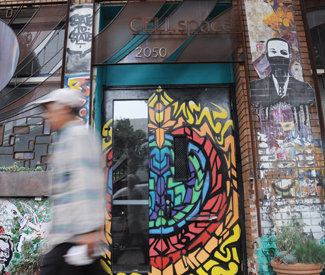
For the last 17 years, CELLspace has been a hub for unique cultural, artistic, and community events in the heart of the Mission. The bad news is that CELLspace is losing its lease, but the good news is it’s being taken over by creative, resourceful people from its community who plan maintain and expand its mission.

In the process, CELLspace is undergoing a renovation and, beginning in early December, getting a new name: Inner Mission.

"We’re calling it an evolution, and we’re trying to hold to that because the CELLspace has an important history and community," says Eric Reid, one of the four new owners. "We’re drawing from a well that we didn’t dig, so we’re trying to keep the neighborhood involved."

So Inner Mission will continue to offer community-based classes such as tango, Aztec dance, and yoga; and evening gatherings by community groups. But along with its recently upgraded sound and lighting systems and well-done new bar, Inner Mission will draw from the creative projects of its new owners and become a nightclub available to host events by outside promoters.

Reid (who sometimes dons clown makeup as his alter ego Manaze) runs Mad Cap Productions, while co-owner Adrian Zelkski runs New Earth Music, co-owner Zach Carson directs the Sustainable Living Road Show, and co-owner Mike Gaines heads the Vau de Vire Society (see "Cue the clowns," 12/3/08), which has been rehearsing and performing at CELLspace in recent years.

"We want to be a constantly throbbing venue as far as the art is concerned, a place for people to explore their creativity," Gaines told us. "We’ve always had the intention of opening up a venue for ourselves, and we want to really accommodate the community as well."

They plan to activate the space for longer hours, including more active curation of the art gallery space in the front of the venue and adding a daytime smoothie and kombucha bar, while also making the overall venue a better nightclub with more regular events — including experimental dinner theater that Reid is excited about producing — rather than the isolated special events that CELLspace has generally done.

While Inner Mission won’t have the nonprofit designation that CELLspace does, the new owners have incorporated as a Certified B Corporation, or Benefit Corporation, a new designation that carries the expectation of greater environmental sustainability, stronger worker protections, and returning more profits and benefits to the community.

"We are going to be the first B Corporation nightclub in the country," Reid said. "We think this is the way things are going."

Gaines also cited the work that Carson does with Sustainable Living Road Show — entertainers and educators in an "old timey carnival road show" that tour in renewable fuel vehicles to teach sustainability — as a key part of their new ethos.

The stated mission of CELLspace is "to provide a safe and supportive public environment for the exploration of art, education, performance and community building. Through cooperative relationships, CELLspace encourages the celebration of intergenerational, cross-cultural collaborations and the promotion of social justice."

Reid and Gaines say they are committed to that same mission even as they seek to make the space more vibrant and accessible, and with a greater focus on the emerging new global consciousness.
Sup. David Campos, who represents the Mission, said CELLspace is an important community institution and he’s happy to hear the new owners plan to continue its current programming. "It sounds like it’s a positive thing, we’ll reach out to them and get more specifics and see how we can work with them."

Men behaving badly

10

The fiasco that was the candidacy of Julian Davis for Supervisor has shed a spotlight on the long simmering sexist underside of progressive San Francisco politics. For years, men have dominated elections and institutions; the lack of women in progressive leadership has been obvious, but too often unaddressed.

San Francisco has a long history of electing women to high office — Dianne Feinstein, Nancy Pelosi, Louise Renne, Kamala Harris … it’s not as if politics in general is controlled by men. But most of those women have been from the more moderate (in some cases, conservative) side. The elected officials who are leaders in the progressive movement have, for most of the past decade or more, been overwhelmingly male.

And it’s hard to ignore the obvious questions: How could so many progressives get behind a candidate with such a history of poor treatment of women? Why did it take so long for the truth to come out? When did attitudes on the left devolve to the point where groping was considered a minor detail?

More important, where are we going from here? How is the progressive movement going to encourage a new generation of women leaders? How are we going to address the perception, and sometimes the reality, that the politics of the San Francisco left is not a welcoming place for women?

It’s going to take a while to talk all of this out, but this week, we want to start the conversation.

>>A NEW FEMINISM FOR SAN FRANCISCO: Community activists on a guide to compassion, redemption, and accountability

>>THE “HEIGHTENED SENSITIVITY” BLUES: Hey progressives, why don’t you stop being such idiots? (An angertorial)

A new feminism for San Francisco

34

OPINION Accountability is one of the hardest things that we have to do. Being accountable stretches us to our very limits as human beings. Blame and deflection is a function of shame, and more often than not, when we make a mistake, it’s more common to point the finger at someone else than it is to acknowledge our mistake and work towards a different practice. The story time and time again is how it never happened — and then when the water gets too hot, there’s generally a soft acknowledgment that something did happen, but by then, the damage is done and trust is broken.

As feminists working in the progressive community for social justice, we are calling for a new type of accountability — one that’s not about demonization or polarization, but instead consists of checking ourselves, checking each other, supporting each other when we are brave, and having the courage and integrity to acknowledge our mistakes and work towards making whole what has been damaged.

Progressives need to take a look at ourselves and come together so that we can advance our vision for San Francisco. We aim to build a progressive movement in San Francisco that is rooted in compassion and love, that acknowledges our contradictions and works to create bridges across class, race, and gender that are so often the typical pitfalls that keep us from accomplishing what we really want and need. Checking ourselves is an act of love for ourselves and for our communities.

The last few weeks in San Francisco have not just been about men behaving badly; it’s also been about women treating each other badly. White feminists in San Francisco came together to “save” Eliana Lopez, an immigrant woman of color, but never actually included her in the conversation — and then treated her like she had Stockholm syndrome. Women who supported Sheriff Ross Mirkarimi were suddenly not feminists anymore. Survivors of domestic violence who supported Mirkarimi and supported redemption were shunned by a large portion of the domestic violence community.

We recognize that there are important reasons why domestic violence law allows charges to brought without the consent of the survivor; however, in this case, these laws were misused. How demoralizing to see a largely white, second-wave feminist advocate community come together around a woman they failed to include in the conversation about what she felt was best for herself and her family. Are we still in the 1950s?

The attempt to remove Mirkarimi from office was a political attack. It does a disservice to the cause of domestic violence to use it as a political tool to unseat a politician. At the same time, it was also regrettable that many progressives supporting the sheriff did not take the domestic violence charges against him seriously enough — both in the initial outcry that surrounded the charges and by being disrespectful towards the domestic violence advocates who testified at City Hall.

On the other hand, following close on the heels of the Mirkarimi situation, District 5 candidate Julian Davis was accused of a troubling history of inappropriate and nonconsensual groping by more than one woman. We have to take into account that there is an unacceptable cultural reality that people are likely to believe accusations against men of color by white women that are untrue, but that is not what has happened with the accusations brought forward about Davis.

In this scenario many in the progressive community knew about this history and were complicit in silencing any real conversation about it. It was only when Davis started intimidating one of the women that brought accusations against him with threats of legal action that a real conversation opened up.

Our goal is not to rehash Davis’s past behavior; everyone deserves redemption. However, it would make it easier for those of us who want to work with him going forward if he could take responsibility for his past instead seeking to silence his accusers.

Many have stood up to support the woman who came forward, but sadly others have not. For women and feminists in our movement it was exceedingly demoralizing to watch people who call themselves progressives attack a woman who came forward or dismiss her allegations because of political allegiances. One blog even went so far as to try and discredit her by alleging that she had been in a pornography film, as if somehow this would cast doubt on her allegations.

We seek a kind of feminism that supports and empowers women to make informed choices about their lives, not the type that falls into the same pattern of erasing the voices of women of color and immigrant women. We are calling for a cutting-edge feminist movement that includes men in our strategy of ending violence against women, and a feminist movement that walks away from this tired dualism between “victims and perpetrators,” when we all know that these so-called perpetrators are often victims of violence themselves.

We are calling for restorative justice that bridges the divides of class and race and gender and makes us stronger to achieve the lives that we want and need. We seek a feminist movement that sees housing and economic justice and racial justice and gender justice as all part of the same movement.

The truth of the matter is that in our progressive movement here in San Francisco, there is still a prominence of straight white men who continue to believe that they are the sole arbitrators of what is or is not progressive in this city, who go after women of color in leadership with a ferocity that they do not for our progressive male counterparts, and who continue to excuse problematic behavior in ways that undermine us all.

So much has happened so quickly that it has been hard to orient ourselves and keep fighting for our rights and our communities. After the election, we call for a public conversation around what it means to be a third- or even fourth-wave feminist progressive that we can build our work around — where men are feminist and women of color leaders can actually get some support from the progressive left. Gabriel Haaland is a queer, transgender Labor feminist and domestic violence survivor. Jane Martin and Alicia Garza are queer, feminist community organizers in San Francisco’s working-class communities of color

Move on, Mr. Mayor

21

EDITORIAL San Francisco politics hasn’t been this tense in years — and it’s not just because of the upcoming election. The battle over Mayor Lee’s attempt to oust Sheriff Ross Mirkarimi has left bitter divisions at City Hall and in communities all over town. And the mayor is only making things worse.

In an odd way — and we say odd because it was so expensive and a misuse of mayoral power — the system worked. Mirkarimi, who had a physical altercation with his wife that left a bruise on her arm, took responsibility and pled guilty to a misdemeanor; he’s now on probation and undergoing counseling.

After the mayor decided to invoke a rarely used Charter provision and suspend Mirkarimi without pay, the Ethics Commission held hearings, conducted and extensive inquiry and voted to uphold the charges, with the chair, Benjamin Hur, strongly dissenting. Every one of the commissioners raised thoughtful points; several poked big holes in the mayor’s case.

Then the Board of Supervisors met — and again, the members carefully considered Mirkarimi’s actions, the language and history of the City Charter, the prevailing law, and the facts of the case. There was remarkably little political grandstanding; we listened to the entire meeting, lasting more than seven hours, and were left with the impression that the supervisors took their job seriously, weighed the case, forced the City Attorney’s Office, representing the mayor, and Mirkarimi’s defense team, to justify their arguments, and rendered a ruling.

Nine votes were needed to remove the sheriff; that’s appropriate for such a profound sanction. Only seven supervisors sided with the mayor, and the four who rejected the charges had excellent, well-stated and credible reasons.

That’s the way the Charter outlined this process playing out, and in the end, the mayor lacked the overwhelming consensus he would have needed to use his executive authority to remove from office someone duly chosen by the voters. It’s done; it’s over. Most of the city would like to move on.

That’s not to say that Mirkarimi should be celebrating. He did an inexcusable thing. Domestic violence advocates have every right to be unhappy with his actions — and nobody, nobody in town should condone his behavior. He’s not denying it, either; he accepted the criminal consequences and will now have to demonstrate that he’s able to do his job.

But the mayor won’t move on. Mirkarimi sent him a note asking for a meeting, and Lee hasn’t responded. That shows a lack of leadership — and a lack of the civility that the mayor promised us when he took office. Ed Lee started this political process, and now that it’s over, he should be leading the effort to pull the city back together, to recognize that there were valid arguments on both sides of this case and his didn’t prevail — and to stop the demonization of people who didn’t agree with him.

Agnos and other progressives rally for Olague

72

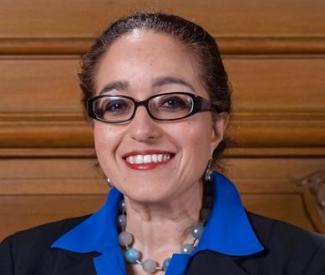
A string of prominent local progressive leaders today offered their support to Sup. Christina Olague – including former Mayor Art Agnos, who announced his endorsement of her in the District 5 supervisorial race – in a rally on the steps of City Hall.

In the process, many voiced a need to broaden and redefine progressivism as valuing independence and diversity of perspective more than just stands on specific issues, traits they said Olague embodies. But more than anything, the rally seemed aimed to consolidating progressive support around Olague as the best hope to beat moderate London Breed in one of the city’s most progressive districts.

“District 5 is often referred to as the most progressive of San Francisco’s supervisorial districts. It includes a diversity of views and opinions on how to meet the challenges all our communities face,” Agnos said. “And it takes a supervisor who know how to listen, to hear and respect those differing views, while working for a resolution that moves us forward.”

Sup. David Campos made only a veiled, indirect reference to the problems some progressives (himself among them) have had with some of Olague’s stands since she was appointed to the job by Mayor Ed Lee, but he said, “Those of us who have worked with her know what’s in her heart…She has been the independent person we always knew she would be and I’m proud to stand with her today.”

Several speakers made reference to Olague’s working class roots, her perspective as a Latina and member of the LGBT community, and her history of progressive activism in San Francisco. Cleve Jones, Gabriel Haaland, Sandra Fewer, and Sup. Eric Mar were among those there to offer support.

“It was a big give by the Mayor’s Office to appoint someone who wasn’t always going to agree with him,” said Sup. Jane Kim, but that was about the only positive reference to the Mayor’s Office, which turned on Olague after she voted to reinstate Sheriff Ross Mirkarimi, setting the stage for her return to the progressive fold.

“To be a progressive is to share an ideology that understands and believes that the best decisions for our city require the participation of all of us, no matter who we are, where we live, or how big our checkbook is,” Agnos said. “As with so many who have endorsed her, that progressive label says she is a politician who understand this fundamental truth.”

SF Rising board member Alicia Garza kicked off the rally by saying, “We are here to set the record straight that the progressive movement is alive and well in San Francisco.” Later, she praise Olague’s history as a community organizer, saying that, “She understands deeply what it means to empower communities.”

Sup. John Avalos, another supervisor who hasn’t always agreed with Olague in the last nine months and just endorsed last week, commended her for the courage it takes to assert her values instead of simply supporting the mayor who appointed her. He said Olague recognizes that, “We live in a city of extremes, with extreme differences between the haves and have-nots.”

Another new progressive endorsement, coming in the wake of one-time progressive favorite Julian Davis’ troubles, was Quintin Mecke, who said he first worked with Olague on anti-gentrification issues 13 years ago. “I trusted her work then and I trust her work today,” he said. Activist Lisa Feldstein – like Mecke, a former D5 candidate – echoed the sentiment.

“I’m here because I really trust Christina and want to fight for her,” Feldstein said. “She comes from a place of integrity and compassion.”

When Olague finally took the podium, she said, “I am humbled by the heartfelt words of my colleagues.” She also tried to help define progressivism in San Francisco, said that it “isn’t about a cult of personality.”

Instead, she said it’s about working to building people’s capacity to create an inclusive and just city. “It’s about building a movement that can weather any storm,” Olague said, closing by saying she’ll ensure “the progressive voice is always strong in District 5 and I’ll keep working to make it heard until I’m blue in the face…I am the most progressive person in the race.”

D5 shakeups flip the dynamics of that wild race

110

[UPDATED AND CORRECTED] Wild and unsettling political dynamics have rocked the District 5 supervisorial race, with three major candidates having prominent endorsements withdrawn, the most significant being this week’s mass exodus of support from the campaign of Julian Davis following his bad handling of allegations that he has mistreated women.

Those withdrawing their endorsements of Davis since Saturday include Sups. John Avalos, David Campos, and Jane Kim, Assembly member Tom Ammiano, the Bay Guardian, the Examiner, and the League of Pissed-Off Voters. The Harvey Milk LGBT Democratic Club has scheduled a vote for Monday on whether to withdraw its sole endorsement of Davis.

Avalos gave his endorsement to Sup. Christina Olague over the weekend, and she seems to be getting more progressive support in the wake of Davis’ flame-out and her Oct. 9 vote in favor of reinstating Sheriff Ross Mirkarimi. That vote triggered a strong backlash against Olague from Mayor Ed Lee and his allies, with San Francisco Police Officers Association withdrawing its endorsement.

But former Mayor Art Agnos reached out to Olague – who he didn’t know previously – after the Mirkarimi vote and is rumored to be considering offering her his endorsement and support. Agnos didn’t confirm or deny the rumor, but he did tell us, “I was very impressed by her commitment to the progressive issues we share.”

Olague has a long history of progressive activism and was a consistently good vote during her tenure on the Planning Commission, but many progressives were concerned by her early support for Lee, who then appointed her to the District 5 seat vacated by Mirkarimi’s election as sheriff, and by some of her votes and behaviors since then.

But now that she’s been viciously attacked by Lee’s staffers and allies over the Mirkarimi vote – and iced out by Lee himself, who she says won’t return her calls and who bailed out on a planned campaign appearance – Olague seems to have a newfound independence. “At the end of the day, we serve constituents and the city, and that’s who we should answer to,” Olague told us, agreeing that she feels freed up by recent developments, as difficult as they’ve been. “You don’t become an indentured servant.”

She told us that her decision last year to co-chair the “Run, Ed, Run” campaign to convince Lee to break his promise and run for a full term to the office he’d been appointed to was based on her belief that “we’d see an infusion of new energy and some more diversity” of both ideology and demographics in the Mayor’s Office.

“Sadly, I’m not seeing those changes happening really. I didn’t sign up for another four years of Gavin Newsom and those thugs, and I’ve seen a lot of that same behavior,” she said. “People who played prominent roles in the Newsom administration continue to play prominent roles in this administration.”

Olague said the schism with the administration began this summer when she supported Avalos in trying to bring in new revenue as part of the business tax reform measure that became Prop. E, which Lee had insisted be revenue neutral before compromising with progressives. That was when Olague said she got her first nasty message from Tony Winnicker, the former Newsom press secretary who now works for Lee and wrote Olague a text during the Mirkarimi hearing telling her “you disgust me and I will work night and day to defeat you.”

Some prominent progressives privately worried that schism was an election ploy designed to help Olague win the race for this progressive district given that Davis had captured most of the influential progressive endorsements. But with Lee and his allies continuing to be openly livid over the Mirkarimi vote – and with solid progressive John Rizzo running a lackluster campaign that has less than $5,000 in the bank – there is growing progressive support for Olague.

The big fear among many progressives is that London Breed will win the race, a concern that has been exacerbated by the support that Breed has been receiving from real estate and development interests, both directly and in independent expenditures by the Association of Realtors, which has spent more than $225,000 in this election cycle hoping to knock out progressives in Districts 1 and 5 and tip the balance of power on the board.

Breed told us that she doesn’t know the Realtors or why they’re offering such strong support, pledging to be an independent vote. “I’ve never made any promises to anyone that I would help anyone or that I would be this way or that,” she told us. “I’m not here to do anyone’s bidding, whether it’s Aaron Peskin or Willie Brown or anyone else.”

Brown helped launch Breed’s political career by [CORRECTED recommending then-Mayor Gavin Newsom] appoint her to the Redevelopment Commission, where Breed supported Lennar and other big developers, but she had a falling out with him earlier this year and made impolitic comments about him to the Fog City Journal, causing US Sen. Dianne Feinstein to withdraw her endorsement of Breed.

Brown, Lee, and Chinatown power broker Rose Pak helped raise money for Olague, who has received the maximum $500 donation from such powerful inside players as venture capitalist Ron Conway (and his wife, Gayle), Michael Cohen, Victor Makras, Lawrence Nibbi, Mark Mosher, and John Whitehurst.

But that was before the Mirkarimi vote, which Lee’s allies seem to see as a litmus test on Olague’s loyalty to them. As Tenderloin Housing Clinic director Randy Shaw, who helped engineer the progressive split that brought Lee to power, put it on his Beyond Chron blog, “Olague’s vote was an act of profound disloyalty not only to the mayor who appointed her, but also to those who pushed the mayor to do so.”

Olague says she’s disturbed by that viewpoint, and by those so blinded by their efforts to demonize Mirkarimi “and exploit and politicize issues around domestic violence” that they have failed to consider the price he has already paid for his actions or the legal standards for removing an elected official. “On something like this, it’s not a question of loyalty. It’s about principles,” she said.

Breed says that she has seen an increase in support since the Mirkarimi vote and the Davis meltdown, but she said that she doesn’t want to talk about those cases or exploit them politically. “I don’t take pleasure in the misery of someone else,” she said, adding her hope that the furor about Mirkarimi will die down. “The decision has been made and it’s time for the city to come together.”

Progressive leaders have made similar calls, but Mirkarimi’s critics are showing no signs of letting the issue go. San Francisco Democratic County Central Committee members Zoe Dunning and Matt Dorsey have put forward a resolution condemning the reinstatement vote and calling for Mirkarimi’s ouster, which the DCCC will consider on Wednesday evening, Oct. 24.

[CORRECTED At that meeting, the DCCC will also consider a motion] to reopen the D5 endorsement process, hoping to change the DCCC’s previous “no endorsement” vote, and sources tell us there is currently a strong backroom effort to give the endorsement to Breed. That vote will be a big test for progressives, which lost their majority control over the DCCC in the June elections.

Meanwhile, D5 candidate Thea Selby – who snagged one of the three endorsements by both the Guardian and the Examiner – continues to run a strong and well-funded campaign that has avoided the carnage taking place in the other campaigns. “I feel like I’m in the middle watching out for flying beams,” she told us, adding that both she and Rizzo have been “the grown-ups in the room, so there’s an opportunity there and I’m hopeful.”

But unlike Rizzo, who has seems strangely absent and didn’t return Guardian phone calls [see UPDATE below], Selby has plenty of money in the bank – nearly $60,000 as of the last official report two weeks ago – and could benefit from voter disgust with the ugly politics at play. “It’s my experience that is driving this,” says this small-businessperson, “and not my lifelong desire to be a politician, and that may ring some bells.”

How the ranked-choice voting system will play out in this mess is anyone’s guess, and even Davis seems to be hoping that he still has a shot, resisting calls by the Guardian and others to withdraw from the race. Poorly funded candidates Andrew Resignato and Hope Johnson this week announced they were joining forces for the “People’s Ticket” after being excluded from a University of San Francisco candidates forum.

But most political observers seem to think this race will come down to a two-person contest between Breed and Olague – who each have more than $45,000 in the bank with which to make a strong final push – and the distinctions between them are becoming clearer as more progressives get behind Olague and the moderates and monied interests get behind Breed.

Olague said she’s still “willing to work with anybody,” but that, “I’m worried that moderate forces will seize this moment to try to destroy us.”

UPDATE 4:45: Rizzo just got back to us and said he’s been actively campaigning and feeling good about his chances. “We have a great team and we’ll have enough resources to reach voters,” Rizzo said. He said that he’s had a stong fundraising push in the last couple weeks since the last campaign financing statement was released, and he noted his endorsements and active support by influential progressives including Ammiano, Campos, and Carole Migden. “We’re doing a lot of retail campaigning, meeting voters and getting the message out.”

Drunks, drugs, kung fu, and rock ‘n’ roll: just another week at the movies

0

This week, get thee to the Roxie for “Not Necessarily Noir III” (Dennis Harvey’s preview here), or the wind-whipped moors for Andrea Arnold’s brutal new Wuthering Heights (my chat with Arnold here). Other new stuff we haven’t reviewed yet: the not-screened-for-critics-because-let’s-face-it-these-movies-are-critic-proof Paranormal Activity 4, and Tyler Perry’s first Madea-free enterprise in some time, Alex Cross.

Read on for more new reviews!

Bel Borba Aqui “The People’s Picasso” and “Brazil’s Pied Piper of Street Art” are both apt descriptions of veteran artist Bel Borba, who has spent decades bringing color and imagination to the streets of Salvador — his seaside hometown, and a place already graced with the nickname “Brazil’s Capital of Happiness.” It’s not a stretch to imagine that Borba’s commitment to public art (a giant Christmas tree made of plastic Coke bottles, a rhinoceros sculpture crafted from old boat planks, hundreds of large-scale mosaics, even a painted airplane) has done its share to lift spirits. Bel Borba Aqui isn’t the sort of doc to delve into its mustachioed subject’s history or personal life (despite a few angry cell phone conversations randomly captured along the way); instead, it’s much like Borba himself — freewheeling and spontaneous, and most alive when it’s showing art being created. Great soundtrack, too. (1:34) Roxie. (Cheryl Eddy)

http://www.youtube.com/watch?v=d-SQ0pgjXm0

Fat Kid Rules the World It really does suck to be Troy (Jacob Wysocki from 2011’s Terri). An XXL-sized high schooler, he’s invisible to his peers, derided by his little brother (Dylan Arnold), and has lived in general domestic misery since the death of his beloved mother under the heavy-handed rule of his well-meaning but humorless ex-military dad (Billy Campbell). His only friends are online gamers, his only girlfriends the imaginary kind. But all that begins to change when chance throws him across the path of notorious local hellraiser Marcus (Matt O’Leary), who’s been expelled from school, has left the band he fronts, and is equal parts rebel hero to druggy, lyin’ mess. But he randomly decrees Troy is cool, and his new drummer. Even if he’s just being used, Troy’s world is headed for some big changes. Actor Matthew Lillard’s feature directorial debut, based on K.L. Going’s graphic novel, is familiar stuff in outline but a delight in execution, as it trades the usual teen-comedy crudities (a few gratuitous joke fantasy sequences aside) for something more heartfelt and restrained, while still funny. O’Leary from last year’s overlooked Natural Selection is flamboyantly terrific, while on the opposite end of the acting scale Campbell makes repressed emotion count for a lot — he has one wordless moment at a hospital that just might bring you to the tears his character refuses to spill. (1:38) (Dennis Harvey)

The House I Live In Much like he did in 2005’s Why We Fight, filmmaker Eugene Jarecki identifies a Big Issue (in that film, the Iraq War) and strips it down, tracing all of the history leading up to the current crisis point. Here, he takes on America’s “war on drugs,” which I put quotes around not just because it was a phrase spoken by Nixon and Reagan, but also because — as The House I Live In ruthlessly exposes — it’s been a failure, a sham, since its origins in the late 1960s. Framing his investigation with the personal story of his family’s housekeeper — whose dedication to the Jarecki family meant that she was absent when her own son turned to drugs — and enfolding a diverse array of interviews (a sympathetic prison guard, addicts and their families, The Wire‘s David Simon) and locations (New York City, Sioux City), Jarecki has created an eye-opening film. Particularly well-explained are segments on how drug laws correlate directly to race and class, and how the prison-industrial complex has played a part in making sure those laws remain as strict as possible. (1:48)  (Cheryl Eddy)

http://www.youtube.com/watch?v=i1vOw9ykpQk

Middle of Nowhere All the reasons why movie publicist turned filmmaker Ava DuVernay scored the best director award at the Sundance Film Festival are up here on the screen. Taking on the emotionally charged yet rarely attempted challenge of picturing the life of the loved one left behind by the incarcerated, DuVernay furthers the cause of telling African American stories — she founded AaFFRM (African-American Film Festival Releasing Movement) and made her directorial debut with 2008 LA hip-hop doc This Is The Life — with Middle of Nowhere. Medical student Ruby (the compelling Emayatzy Corinealdi) appears to have a bright future ahead of her, when her husband Derek (Omari Hardwick) makes some bad choices and is tossed into maximum security prison for eight long years. She swears she’ll wait for him, putting her dreams aside, making the long bus ride out to visit him regularly, and settling for any nursing shift she can. How will she scrape the money together to pay the lawyer for Derek’s parole hearing, cope with the grinding disapproval of her mother (Lorraine Toussaint), support the increasingly hardened and altered Derek, and most importantly, discover a new path for herself? All are handled with rare empathy and compassion by DuVernay, who is rewarded for her care by her cast’s powerful performances. Our reward might be found amid the everyday poetry of Ruby’s life, while she wraps her hair for bed, watches Ali: Fear Eats the Soul (1974), and fantasizes about love in a life interrupted. (1:41) (Kimberly Chun)

http://www.youtube.com/watch?v=80_L_LsOexE

Simon and the Oaks Despite being gripping or heartwarming at times, Simon and the Oaks, based on the novel by Marianne Fredricksson, fails to cohere, serving as another reminder of the perennial dilemma of converting literature to film. It tells the story of Simon (Bill Skarsgard — son of Stellan, younger brother of Alexander), a boy coming of age in World War II Sweden. He befriends Isak, son of a Jewish bookkeeper who fled Nazi Germany, and their families become close when Isak’s father nurtures Simon’s love of books and Isak begins to heal his emotional scars by diving into carpentry work with Simon’s father. The moments of true human compassion between the two families begin to falter as the story jumps around to follow Simon’s search for love and identity. More missteps: Simon’s discovery of classical music is conveyed via a series of “artsy” montages, and his brief affair with a fiery Auschwitz victim — problematic, to say the least. (2:02) (Molly Champlin)

http://www.youtube.com/watch?v=QtT1cKo4RX4

Smashed A heartbreaking lead performance from Mary Elizabeth Winstead drives this tale of a marriage tested when one partner decides to get sober. And it’s time: after an epic night of boozing, first-grade teacher Kate (Winstead) pukes in front of her class, then lies and says she’s pregnant, not anticipating the pushy delight of the school’s principal (Megan Mullally). Plus, Kate’s gotten into the habit of waking up in strange, unsafe places, not really remembering how she stumbled there in the first place. Husband Charlie (Breaking Bad‘s Aaron Paul) sees no reason to give up partying; he’s a music blogger whose “office” is the home his wealthy parents bought for the couple, and his problem isn’t quite as unmanageable as hers (at least, we never see him peeing in a convenience store). After Kate joins AA, she realizes she’ll have to face her problems rather than drinking them away — a potentially clichéd character arc that’s handled without flashy hysterics by director and co-writer (with Susan Burke) James Ponsoldt, and conveyed with grace and pain by Winstead —an actor probably best-known for playing Ramona Flowers in 2010’s Scott Pilgrim vs. the World, but just now revealing the scope of her talent. (1:25) (Cheryl Eddy)

http://www.youtube.com/watch?v=_LSX_UH0F9g

Tai Chi Zero A little boy dubbed “the Freak” for the curious, horn-like growth on his forehead grows up to be Lu Chan (Jaydan Yuan), who becomes a near-supernatural martial arts machine when the horn is punched, panic-button style. But activating the “Three Blossoms of the Crown,” as it’s called, takes a toll on the boy’s health, so he’s sent to the isolated Chen Village to learn their signature moves, though he’s repeatedly told “Chen-style kung fu is not taught to outsiders!” Stephen Fung’s lighthearted direction (characters are introduced with bios about the actors who play them, even the split-second cameos: “Andrew Lau, director of the Infernal Affairs trilogy”), affinity for steampunk and whimsy, engagement of Sammo Hung as action director, and embracing of the absurd (the film’s most-repeated line: “What the hell?”) all bring interest to this otherwise pretty predictable kung-fu tale, with its old-ways-versus-Western-ways conflict and misfit hero. Still, there’s something to be said for batshit insanity. (Be warned, though: Tai Chi Zero is the first in a series, which means one thing: it ends on a cliffhanger. Argh.) (1:34) (Cheryl Eddy)

http://www.youtube.com/watch?v=NWIAjsf9Xq0

The Waiting Room Twenty-four hours in the uneasy limbo of an ER waiting room sounds like a grueling, maddening experience, and that’s certainly a theme in this day-in-the-life film. But local documentarian Peter Nicks has crafted an absorbing portrait of emergency public health care, as experienced by patients and their families at Oakland’s Highland Hospital and as practiced by the staff there. Other themes: no insurance, no primary care physician, and an emergency room being used as a medical facility of first, last, and only resort. Nicks has found a rich array of subjects to tell this complicated story: An anxious, unemployed father sits at his little girl’s bedside. Staffers stare at a computer screen, tracking a flood of admissions and the scarce commodity of available beds. A doctor contemplates the ethics of discharging a homeless addict for the sake of freeing up one of them. And a humorous, ultra-competent triage nurse fields an endless queue of arrivals with humanity and steady nerves. (1:21) (Lynn Rapoport)

Live Shots: ABADA-Capoeira’s “The Spirit of Brazil”

0

Sparking machetes. Lots of them, clanking against each other, as the dancers holding them ran in circles.

I’ll be honest, sitting in the front row was slightly intimidating, and also rather exhilarating! The ABADÁ-Capoeira dance troupe, plus special guests from as far Switzerland, filled the stage with pure energy, in rehearsal for the troupe’s “Spirit of Brazil” show, running Thu/18-Sun/20. 

One of the dances tells the story of an ancient church in Brazil, where people of all religions went to be blessed. It was a moody and beautiful piece. There’s live music, soulful singing by the musicians and the dancers, and, yes, seriously speedy dance moves involving very large, sharp knives. It’s primal, wild, and filled with history. Go see it — just make sure your eyebrows don’t get shaved off!

ABADÁ-Capoeira San Francisco’s “The Spirit of Brazil”
Thur/18-Sat/20, 7pm, $23
Sun, October 21, 3pm
ODC Theater
3153 17th St., SF
www.odcdance.org

Boozy shakes

1

virginia@sfbg.com

APPETITE A wave of old fashioned soda fountains serving alcoholic and non-alcoholic treats alongside quality food is hitting various parts of the country, with two notables in San Francisco.

I’ve already written about the incredible, one-of-a-kind Ice Cream Bar (815 Cole, SF. 415-742-4932, www.theicecreambarsf.com). Reviving the lactart, phosphate, and traditional sassafras root beer, it reaches past the 1950s all the way back to the 1890s. Recent changes at the family friendly shop include the launch of a food menu of comfortable diner fare and the gain of a beer and wine license.

An egg salad sandwich — made with slices of thick, house-baked brioche and served with a pickle and roasted vegetable salad or house-made sweet potato chips, as with all sandwiches here — is soft and lively, with chives, arugula, and the clincher: pimento cheese. My favorite, the tuna melt, evokes childhood, elevated by Gruyere cheese, organic tomatoes, and arugula.

There’s one “must” on the new alcoholic section of the soda fountain menu: a classic Angostura phosphate. Fizzy with acid phosphate, gum foam and soda, a heavy pour of Angostura Bitters makes for a spiced beauty, conjuring fall and winter simultaneously. Can’t Stop is a notable dessert of butterscotch syrup, whole egg and cream, effervescent with Drakes Bay Hefeweizen (adding notes of grain and hay), topped with a musky Carpano Antica vermouth float.

Joining Ice Cream Bar in the fountain revival is the new Corner Store (5 Masonic Ave., 415-359-1800, www.thecornerstore-sf.com), in the old Hukilau space, from 330 Ritch business partners Miles Palliser and Ezra Berman. Old-fashioned in ethos, contemporary in style, this all-day restaurant and fountain serves sodas, candy, beer, wine, and gourmet food. The airy space and outdoor sidewalk patio nod to an era gone by. The menu seems straightforward, but dishes become more intriguing at second glance.

Chef Nick Adams (Salt House, Town Hall) elevates the umpteenth roasted beets plate ($8) with Greek yogurt, candied almonds, purslane, and radicchio in honey vinaigrette: it’s sweet, nutty, earthy, and creamy. Likewise, house smoked salmon ($10) goes well beyond the usual piece of salmon with potato pancake. An herb-laden egg salad flanks a crisp potato pancake, multiple slices of silky, fresh salmon, and mound of lettuce.

Whether a burger ($12) laden with aged cheddar, pickled red onions, pickles and bacon jam, or a fried green tomato sandwich ($9) with burrata and avocado at lunch, items between bread are done right here. Thoughtful $16 entrees are a steal compared to similar dishes at greater cost elsewhere in town, like Snake River pork loin ($16), co-mingling with fennel, marble potatoes, and pancetta, invigorated with shishito peppers and a zippy nectarine mostarda. A side of house brioche dinner rolls ($3) with honey butter and sea salt makes it homey.

Hans Hinrichs (25 Lusk, Foreign Cinema) helms a soda fountain menu of cocktails ($10), boozy shakes ($10), and sodas ($8), using local or American craft spirits whenever possible. Though not the journey through soda fountain history you’ll find at Ice Cream Bar, Hinrichs creates drinks that make you feel like a kid again… with booze.

The Muir Trail is a tribute to local nature, both in name and the use of St. George Terroir Gin, the Bay Area’s native gin. Hinrichs allows the gin to shine alongside tart huckleberry puree (huckleberry juice is infused with a sachet of spices, thinning it out with port wine reduction), dry vermouth, lemon, and bitters. Sans alcohol, Lone Mountain Egg Cream is dulce de leche and sea salt, creamy with milk, perky with seltzer, plus a number of bottled classic sodas like Cheerwine and Dang! Butterscotch Beer ($4).

Spirits-laden shakes induce cravings. 50/50 — spiced rum, orange marmalade, vanilla ice cream — is textured and rich with rum and marmalade, accented by strips of candied orange peel. My youthful favorite, a Grasshopper, is a minty dream with Tempus Fugit’s unparalleled Creme de Menthe and Creme de Cacao, vanilla ice cream, and a hint La Sorciere absinthe to perk up the mint.

Probably my favorite of all three boozy shakes is the Manhattan. Tasting like a real Manhattan, punchy with bourbon, sweet vermouth, cherry syrup, creamy with vanilla ice cream, bourbon shines though Hinrichs uses no more than one ounce of base spirit plus half-to-one ounce of any other liqueur in any given shake. It’s a perfect combination.


Stage Listings

0

Stage listings are compiled by Guardian staff. Performance times may change; call venues to confirm. Reviewers are Robert Avila, Rita Felciano, and Nicole Gluckstern. Submit items for the listings at listings@sfbg.com. For further information on how to submit items for the listings, see Picks.

THEATER

OPENING

And That’s What Little Girls Are Made Of Tides Theatre, 533 Sutter, SF; www.whatgirlsaremadeof.com. $20-30. Opens Thu/19, 8pm. Runs Thu-Sat, 8pm; Sun, 2pm. Through Nov 4. Jennifer Wilson’s multimedia play chronicles her attempts to break into the male-dominated world of venture capital funds.

Fat Pig Boxcar Theatre Studio, 125A Hyde, SF; www.brownpapertickets.com. $20. Opens Thu/18, 8pm. Runs Thu-Sat, 8pm. Through Nov 10. Theater Toda presents Neil LaBute’s dark comedy about a man who faces scrutiny from his friends when he falls for a plus-sized woman.

Fierce Love: Stories From Black Gay Life New Conservatory Theatre Center, 25 Van Ness, SF; www.nctcsf.org. $25-37. Previews Wed/17-Thu/18, 8pm. Opens Fri/19, 8pm. Runs Wed-Sat, 8pm; Sun, 2pm. Through Oct 28. Pomo Afro Homos performs a revival of of its 1991 hit about the struggles of African American gay men in America.

BAY AREA

Richard III Live Oak Theatre, 1301 Shattuck, Berk; www.aeofberkeley.org. $12-15. Opens Fri/19, 8pm. Runs Fri-Sat, 8pm. Through Nov 17. Actors Ensemble of Berkeley performs the Shakespeare classic.

Within the Wheel Live Oak Park, 1301 Shattuck, Berk; www.raggedwing.org. Free. Previews Wed/17, 6pm. Opens Thu/18, 6pm. Runs Thu-Sat, 6pm (last entry 7:30pm; special Halloween show Oct 31). Through Nov 3. Ragged Wing Ensemble presents an immersive performance experience inspired by the Tibetan Book of the Dead.

ONGOING

Bound By Blood Boxcar Theatre Playhouse, 505 Natoma, SF; www.ianiroproductions.com. $20. Thu-Sat, 8pm. Through Oct 27. Opening on the heels of ACT’s production of The Normal Heart, local theater-maker Eric Inman’s Bound By Blood also explores the devastating human fallout of the AIDS crisis as experienced by the two families — one of blood relations and one of chosen friends — of a young gay man, whose death affects them all. Appearing onstage both as a ghost and in a series of flashbacks, Justin Walker (played by Inman) deals with his fear of dying by ditching his meds in favor of drink, and his fear of coming out to his conservative family by postponing the inevitable until it’s too late, leaving his friends holding the burden of his inconvenient truth in their unwilling hands. Awkward moments abound as Justin’s buddies ponder the ethics of outing him posthumously, as his mother (Sally Hogarty) and sister (CC Sheldon) bicker incessantly and his erstwhile "beard" Alice (Abigail Edber) pluckily spearheads the funeral planning. This is Inman’s first full-length play, which helps to explain the often-clunky dialogue and under-developed characters that unfortunately obscure the play’s dramatic potential, but the ideals he champions within — tolerance, self-acceptance, integrity, loyalty, love — are ones well worth exploring, even imperfectly. (Gluckstern)

Elect to Laugh Marsh San Francisco, 1062 Valencia, SF; www.themarsh.org. Tue, 8pm. Through Nov 6. $15-50. Veteran political comedian Will Durst emphasizes he’s watching the news and keeping track of the presidential race "so you don’t have to." No kidding, it sounds like brutal work for anyone other than a professional comedian — for whom alone it must be Willy Wonka’s edible Eden of delicious material. Durst deserves thanks for ingesting this material and converting it into funny, but between the ingesting and out-jesting there’s the risk of turning too palatable what amounts to a deeply offensive excuse for a democratic process, as we once again hurtle and are herded toward another election-year November, with its attendant massive anticlimax and hangover already so close you can touch them. Durst knows his politics and comedy backwards and forwards, and the evolving show, which pops up at the Marsh every Tuesday in the run-up to election night, offers consistent laughs born on his breezy, infectious delivery. One just wishes there were some alternative political universe that also made itself known alongside the deft two-party sportscasting. (Avila)

The Fifth Element: Live! Dark Room Theater, 2263 Mission, SF; www.darkroomsf.com. Fri-Sat, 8pm. Through Oct 27. Comedic adaptation of the 1997 Luc Besson sci-fi epic.

Foodies! The Musical Shelton Theater, 533 Sutter, SF; www.foodiesthemusical.com. $30-34. Fri-Sat, 8pm (no show Nov 17). Open-ended. AWAT Productions presents Morris Bobrow’s musical comedy revue all about food.

Geezer Marsh San Francisco, 1062 Valencia, SF; www.themarsh.org. $30-100. Sat, 8pm; Sun, 7pm. Through Nov 18. Geoff Hoyle’s popular solo show about aging returns.

Love in the Time of Zombies Café Royale, 800 Post, SF; sftheaterpub.wordpress.com. Free ($5 donation suggested). Mon-Tue, 8pm. Through Oct 30. San Francisco Theater Pub performs Kirk Shimano’s "rom-zom-com."

Of Thee I Sing Eureka Theatre, 215 Jackson, SF; www.42ndstmoon.org. $25-75. Wed, 7pm; Thu-Fri, 8pm; Sat, 6pm; Sun, 3pm. Through Oct 21. 42nd Street Moon performs George and Ira Gershwin’s classic political satire.

The Real Americans Marsh San Francisco, 1062 Valencia, SF; www.themarsh.org. $25-50. Fri, 8pm; Sat, 8:30pm. Extended through Oct 27. Dan Hoyle’s hit show, inspired by the people and places he encountered during his 100-day road trip across America in 2009, continues.

Roseanne: Live! Rebel, 1760 Market, SF; www.brownpapertickets.com. $25. Wed, 7 and 9pm (no shows Oct 31). Through Nov 14. Lady Bear, Heklina, D’Arcy Drollinger, and more star in this tribute to the long-running sitcom.

The Scotland Company Exit Theatre, 156 Eddy, SF; www.thunderbirdtheatre.com. $15-25. Thu-Sat, 8pm; Sun, 3pm. Through Oct 27. Thunderbird Theatre Company performs Jake Rosenberg’s new comedy.

Shocktoberfest 13: The Bride of Death Hypnodrome, 575 10th St, SF; www.thrillpeddlers.com. $25-35. Thu-Sat, 8pm. Through Nov 17. Thrillpeddlers’ seasonal assortment of yeasty Grand Guignol playlets is a mixed bag of treats, but it all goes so nicely with the autumnal slink into early nights and dark cravings. Fredrick Whitney’s Coals of Fire is lightly amusing, if far from smoking, as a two-hander about a blind older matron (Leigh Crow) who discovers her young companion (Zelda Koznofski, alternating nights with Nancy French) has been secretly schtupping her husband. I’m a Mummy is a short, not very effective musical interlude by Douglas Byng, featuring the bright pair of Jim Jeske and Annie Larson as Mr. and Mrs., respectively. The titular feature, The Bride of Death, written by Michael Phillis and directed by Russell Blackwood, proves a worthy centerpiece, unfolding an intriguing, well-acted tale about a reporter (Phillis) and his photographer (Flynn DeMarco) arriving at a stormy castle to interview a strangely youthful Grand Guignol stage star (Bonni Suval) making her film debut. After another, this time more rousing musical number, Those Beautiful Ghouls (with music and lyrics by Scrumbly Koldewyn; directed and choreographed by D’Arcy Drollinger), comes the evening’s real high point, The Twisted Pair by Rob Keefe, acted to the bloody hilt by leads Blackwood and DeMarco as the titular duo of scientists driven mad by an experimental batch of ‘crazy’ glue. All of it comes capped, of course, by the company’s signature lights-out spook show. (Avila)

"Strindberg Cycle: The Chamber Plays in Rep" Exit on Taylor, 277 Taylor, SF; www.cuttingball.com. $10-50 (festival pass, $75). Previews Oct 25, 7:30pm and Oct 26, 8pm (part two); Nov 1, 7:30pm and Nov 2, 8pm (part three). Opens Thu/18, 7:30pm (part one); Oct 27, 8pm (part two); and Nov 3, 8pm (part three). Runs Thu, 7:30pm; Fri-Sat, 8pm (also Sat, 2pm); Sun, 5pm. Through Nov 18. Cutting Ball performs a festival of August Strindberg in three parts: The Ghost Sonata, The Pelican and The Black Glove, and Storm and Burned House.

The Waiting Period Marsh San Francisco, 1062 Valencia, SF; www.themarsh.org. $15-50. Thu-Fri, 8pm; Sat, 5pm. Extended through Oct 27. Brian Copeland (comedian, TV and radio personality, and creator-performer of the long-running solo play Not a Genuine Black Man) returns to the Marsh with a new solo, this one based on more recent and messier events` in Copeland’s life. The play concerns an episode of severe depression in which he considered suicide, going so far as to purchase a handgun — the title coming from the legally mandatory 10-day period between purchasing and picking up the weapon, which leaves time for reflections and circumstances that ultimately prevent Copeland from pulling the trigger. A grim subject, but Copeland (with co-developer and director David Ford) ensures there’s plenty of humor as well as frank sentiment along the way. The actor peoples the opening scene in the gun store with a comically if somewhat stereotypically rugged representative of the Second Amendment, for instance, as well as an equally familiar "doood" dude at the service counter. Afterward, we follow Copeland, a just barely coping dad, home to the house recently abandoned by his wife, and through the ordinary routines that become unbearable to the clinically depressed. Copeland also recreates interviews he’s made with other survivors of suicidal depression. Telling someone about such things is vital to preventing their worst outcomes, says Copeland, and telling his own story is meant to encourage others. It’s a worthy aim but only a fitfully engaging piece, since as drama it remains thin, standing at perhaps too respectful a distance from the convoluted torment and alienation at its center. (Avila)

BAY AREA

Acid Test: The Many Incarnations of Ram Dass Marsh Berkeley, 2120 Allston, Berk; www.themarsh.org. $15-50. Thu-Fri, 8pm; Sat, 5pm. Through Nov 24. Lynne Kaufman’s new play stars Warren David Keith as the noted spiritual figure.

Assassins Ashby Stage, 1901 Ashby, Berk; www.shotgunplayers.org. $20-30. Wed-Thu, 7pm; Fri-Sat, 8pm; Sun, 5pm. Through Nov 4. Shotgun Players interrupts this season of dreary electoral debates with an important announcement about the country you live in, as the sure and provocative 1990 musical by Stephen Sondheim (music and lyrics) and John Weidman (book) stitches together American history’s odd assortment of successful and failed presidential assassins to explore the darker recesses of the national mythos. Through an eclectic score of deft period-specific songs and the narrative framework of a feverish carnival shooting gallery — overseen by a nefarious proprietor (Jeff Garrett) — a pageant of kooks and rebels parades, beginning with pioneer assassin John Wilkes Booth (an aptly imposing Galen Murphy-Hoffman). He, in turn, acts as a sort of patron saint to those that follow in his footsteps — including Charles Guiteau (Steven Hess), Leon Czolgosz (Dan Saski), Giuseppe Zangara (Aleph Ayin), John Hinckley (Danny Cozart), Sam Byck (Ryan Drummond), Sara Jane Moore (Rebecca Castelli), Squeaky Fromme (Cody Metzger), and of course Lee Harvey Oswald (Kevin Singer, in a part that doubles with that of the Balladeer). Throughout, director Susannah Martin’s strong cast and musical director David Möschler’s lively eight-piece band insure a raucous, thoughtful, and intimate American fever dream. (Avila)

An Iliad Berkeley Repertory Theatre, Roda Theatre, 2015 Addison, Berk; www.berkeleyrep.org. $14.50-77. Opens Wed/17, 8pm. Runs Tue and Thu-Sat, 8pm (also Sat, 2pm); Wed and Sun, 7pm (also Sun, 2pm). Through Nov 11. Berkeley Rep performs Lisa Peterson and Denis O’Hare’s Homer-inspired tale.

The Kipling Hotel: True Misadventures of the Electric Pink ’80s Marsh Berkeley, 2120 Allston, Berk; www.themarsh.org. $20-50. Sat, 8:30pm; Sun, 7pm. Extended through Dec 16. This new autobiographical solo show by Don Reed, writer-performer of the fine and long-running East 14th, is another slice of the artist’s journey from 1970s Oakland ghetto to comedy-circuit respectability — here via a partial debate-scholarship to UCLA. The titular Los Angeles residency hotel was where Reed lived and worked for a time in the 1980s while attending university. It’s also a rich mine of memory and material for this physically protean and charismatic comic actor, who sails through two acts of often hilarious, sometimes touching vignettes loosely structured around his time on the hotel’s young wait staff, which catered to the needs of elderly patrons who might need conversation as much as breakfast. On opening night, the episodic narrative seemed to pass through several endings before settling on one whose tidy moral was delivered with too heavy a hand, but if the piece runs a little long, it’s only the last 20 minutes that noticeably meanders. And even with some awkward bumps along the way, it’s never a dull thing watching Reed work. (Avila)

Richard the First: Part One, Part Two, Part Three Berkeley City Club, 2315 Durant, Berk; www.centralworks.org. $14-25. Opens Thu/18, 8pm (part one); Fri/19, 8pm (part two); and Sat/20, 8pm (part three). Runs Thu-Sat, 8pm; Sun, 5pm (three-part marathon Sundays, Nov 11 and 18, 2, 5, 8pm). Through Nov 18. This Central Works Method Trilogy presents a rotating schedule of three plays by Gary Graves about the king known as "the Lionheart."

Sex, Slugs and Accordion Marsh Berkeley, 2120 Allston, Berk; www.themarsh.org. $10. Wed, 8pm. Through Nov 14. Jetty Swart, a.k.a. Jet Black Pearl, stars in this "wild and exotic evening of song."

33 Variations TheatreWorks at the Mountain View Center for the Performing Arts, 500 Castro, Mtn View; www.theatreworks.org. $23-73. Tue-Wed, 7:30pm; Thu-Sat, 8pm (also Sat, 2pm); Sun, 2 and 7pm. Through Oct 28. TheatreWorks performs Moisés Kaufman’s drama about a contemporary musicologist struggling to solve one of Beethoven’s greatest mysteries, and a connecting story about the composer himself.

Topdog/Underdog Marin Theatre Company, 397 Miller, Mill Valley; www.marintheatre.org. $36-57. Wed/17, 7:30pm; Thu/18-Sat/20, 8pm (also Sat/20, 2pm); Sun/21, 2 and 7pm. Marin Theatre Company performs Suzan-Lori Parks’ Pulitzer Prize winner about a contentious pair of brothers.

The World’s Funniest Bubble Show Marsh Berkeley, 2120 Allston, Berk; www.themarsh.org. $8-50. Sun, 11am; Nov 23-25, 11am. Through Nov 25. Louis "The Amazing Bubble Man" Pearl brings his lighter-than-air show back to the Marsh.

PERFORMANCE/DANCE

Alonzo King LINES Ballet Yerba Buena Center for the Arts Theater, 700 Howard, SF; www.ybca.org. Fri/19-Sat/20 and Oct 24-27, 8pm; Sun, 5pm. Through Oct 28. The company celebrates 30 years with its fall home season.

BATS Improv Bayfront Theater, B350 Fort Mason Center, SF; www.improv.org. Fri, 8pm, through Oct 26: "This Just In!," $20. Sat, 8pm, through Oct 27: "Improvised Horror Musical," $20.

"Comedy Bodega" Esta Noche Nightclub, 3079 16th St, SF; www.comedybodega.com. Thu, 8pm. Ongoing. No cover (one drink minumum). This week: Amy Miller, Kurt Weitzmann, Martini Paratore, and Jessica Sele.

"Comikaze Lounge" Café Royale, 800 Post, SF; www.comikazelounge.com. Wed/17, 8pm. Free. Stand-up with Casey Ley and more.

"Crooked Little Hearts" Dance Mission Theater, 3316 24th St, SF; www.brownpapertickets.com. Fri/19-Sat/20, 8pm. $20. The Ananta Project’s home season includes a world premiere that uses dance to explore the nuances of human intimacy.

"Gravity (and other large things)" NOHspace, 2840 Mariposa, SF; www.performancelab.org. Fri/19-Sat/20, 8pm; Sun/21, 4pm. $12-25. Right Brain Performancelab present this evening-length dance-theater piece.

"Halloween! The Ballad of Michele Myers" CounterPULSE, 1310 Mission, SF; michelemyers2012.eventbrite.com. Fri-Sun and Oct 31, 8pm. Through Oct 31. $25. Drag superstar Raya Light returns in the seasonally-appropriate horror musical.

"The Hula Show 2012" Palace of Fine Arts, 3301 Lyon, SF; www.naheihulu.org. Sat/20 and Oct 26-27, 8pm; Sun/21 and Oct 28, 8pm (children’s matinee Oct 28, noon). $35-90. Na Lei Hulu I Ka Wekiu performs its annual show, featuring a hula satirizing President Obama’s birth certificate controversy.

"Let Us Find the Words" Contemporary Jewish Museum, 736 Mission, SF; www.thecjm.org. Thu/18, 6:30pm; Fri.19, 1pm. Free with museum admission ($5-12). Actors Dominique Frot and Alexander Muheum present a dramatic reading of letters between poets Ingeborg Bachmann and Paul Celan.

"Perverts Put Out: The Election Erection Edition" Center for Sex and Culture, 1369 Mission, SF; www.sexandculture.org. Sat/20, 7:30. $10-20. Dr. Carol Queen and Simon Sheppard host performances by Jen Cross, Greta Cristina, Gina de Vries, and more.

"San Francisco Magic Parlor" Chancellor Hotel Union Square, 433 Powell, SF; www.sfmagicparlor.com. $40. Thu-Sat, 8pm. Ongoing. Magic vignettes with conjurer and storyteller Walt Anthony.

"San Francisco Trolley Dances 2012" 925 Mission, SF; www.epiphanydance.org. Sat/20-Sun/21, tours leave at 11am, 11:45am, 12:30pm, 1:15pm, 2pm, and 2:45pm. Free with Muni fare ($2). Climb aboard Muni for a unique performance experience at this annual event presented by Kim Epifano’s Epiphany Productions.

ShadowLight Theatre St. Cyprian’s Church, 2097 Turk, SF; www.noevalleymusicseries.com. Sat/20, 8pm. $15. Balinese shadow puppet theater with live gamelan accompaniment.

"Smack Dab" Magnet, 4122 18th St, SF; www.magnetsf.org. Wed/17, 8pm. Free. Open mic featuring local authors Belo Cipriani and Jim Provenzano.

"Times Bones" Kanbar Hall, Jewish Community Center of San Francisco, 3200 California, SF; www.mjdc.org. Thu/18-Sat/20, 8pm; Sun/21, 7pm. $18-31. Margaret Jenkins Dance Company previews a new work that will premiere in 2013.

SF Stories: Jessica C.Kraft

0

46TH ANNIVERSARY SPECIAL Everyone sees the neon signs on street posts over the weekend, but only a few types of people actually stop at estate sales. Early on Friday come the re-sellers—professionals intent on securing cheap, high quality goods that can be resold at pricey consignment shops and on eBay. On Saturdays come the casual shoppers, drawn by the novelty of IKEA prices on antique store treasures. And on Sundays, the hard-core hagglers and bargain hunters arrive, ready to seize upon whatever’s left for a few small bills.

My husband and I have gone “estate saling” all over the city for the past five years. While we’ve found plenty of cheap treasures, our real attraction to these final close-outs is their view into a hidden and historic San Francisco.

Walking into these properties, we marvel at the lush backyard gardens never visible from the street, and the secret views never seen from hilltop public parks. As in any scenic city, San Francisco builders smartly sited properties to maximize views, adding up to tens of thousands of private vistas that each offer a unique glimpse of the lambent sunsets, the columns of fog, or the itinerant Telegraph Hill parrots on parade.

We note how interior design styles have changed through the decades, and wonder how the elderly residents of these homes were able to put up with railroad hallways, stairways both too steep and too narrow, and the classic Doelger home’s miniature bathrooms.

There are always hordes of tchotchkes, outdated kitchenware, and piles of VHS tapes. But curious, bizarre objects also abound, mostly in mildewed basements where World War II veterans kept elaborate workbenches and harbored unconventional passions. An orthopedist in Forest Hill spent his free time jerry-rigging prosthetic devices in his basement, which, by the time of his sale, resembled a museum for medical patents. One dusty workbench was covered with scale models of world-famous buildings; the architect-collector had traveled to each of the sites and brought home a replica. Now his Hagia Sophia and Taj Mahal perch above our bathroom sink. My favorite find from one of these sub-floor collections was a drink stirrer with a pink, cheeky plastic butt affixed to the top. “Bottom’s Up!” the caption read.

Frequenting these sales allows visitors to paint a cultural map of the city that’s more nuanced than what you might learn on a City Guides walking tour. Headed out to the Sunset? You’ll likely find lacquered furniture, multiple tea sets and jade buddhas — but these might be surrounded by Guatemalan embroidery, Irish beer towels or French literature.

Who knew that Cow Hollow’s Union Street used to be a bohemian enclave? Amidst the posh wine bars and jewelry stores, we visited the apartment of a Life photographer and his oil painter wife who collected esoteric religious books, set their table with African textiles and, we imagined, spent evenings seated on the floor listening to sitar ragas. (We now use their Japanese gong to call our family to dinner.)

Stopping in at a sale in Noe Valley with other baby-clad parents, we’re delighted to discover a closet full of Carmen Miranda costumes, sequined carnival masks, fishnet tights and feather boas. A gay couple had lived there together since the ’50s, each year outdoing one another at Halloween. Thanks to them, our New Year’s party last year was extra sparkly.

At a sale just down the street from our house, at the foot of Grandview Heights in the inner Sunset, we inquired about an upright piano. We learned that its owner — a surgeon and well-known jazz photographer — had shot Duke Ellington and other jazz greats playing that very instrument. We never would have imagined that in our quiet hood of dog walkers and weekend gardeners, music history was made.

When we see these homes and prized collections being dismantled and dispersed, we become the last witnesses to episodes in San Francisco history. We get an intimate glimpse of the personalities that used to fill pockets of San Francisco real estate, before many of these neighborhoods became too costly for more than one privileged demographic.

Ultimately, though, we reckon with loss. Someone has died. Their family heirlooms are deracinated; a resale company makes some dough. A family grieves, and is compensated. The perpetual question that these sales seem to ask is: can we, should we, know a life by the objects left behind? When we bring an item home, we feel enriched, as if some facet of our inner world has been represented in solid substance. Yet we can’t help seeing these objects as memento mori. As my husband wistfully observed: when we’re gone, and after our kids have rifled through our dusty, obsolete books and tchotchkes, we’ll likely have one hell of an estate sale ourselves.

Jessica C. Kraft is a San Francisco writer.

Frog killers in the heat: San Juan’s first street art festival

1

Sego painted a coqui. That makes sense because the soft-spoken Mexican mural artist dabbles luminously in the animal kingdom, improbably creating detailed scenes of magical realism with little more than aerosol cans.

The coqui is Puerto Rico’s mascot, the tranquil frog that defines the nighttime soundscape, and plagues tourists unused to the noise with its chirps. Sego’s wall, part of the first street art festival in San Juan history Los Muros Hablan, was an “aww” moment for the passing cars (and there are a lot of them. Sweltering San Juan lives and dies by the air-conditioned automobile.)

Less than a mile away, Roa is working on an iguana that, despite its vampy, lounging posture, holds a dead coqui in one languid claw. Roa is Belgium, and generally acknowledged to have popularized animal drawings in this brave new world of gallery-approved street artists. Delayed by the theft of his lift’s batteries and a few dehabilitating hangovers, he’s probably still working on the piece in San Juan’s 90 degree humid swampiness.

He left the frog death and pertaining iguana paw for the end of the piece. While I lounged in the shade of an orange road safety buoy last week, I watched cars stop, belching young men whose only desire was to take a picture with Roa. All the better if he was holding his baseball cap over his face (he always is.) Later these images would pop up on Instagram, appropriately hashtagged so that we could review them easily.

I wonder how San Juan will like the crushed coqui. “You can see a lot of things in it,” Roa told me on a late-night ride out to said jungle with some other Los Muros artists and attaches. The long-ago Spanish rule of Puerto Rico, the right-now United States colonization of the island. “There’s a lot of ways to interpret it,” he told me. 

Though one will note a preponderance of animal renderings in the Los Muros Hablan renderings, it wasn’t all frogs and frog-killers in the Santurce streets. Local legend Sofia Maldonado threw up a warning about the 709 women who have been murdered in Puerto Rico between 2000 and 2011. Though Maldonado was the only female muralist at the fest, La Repuesta — the spectacular, grungy club that gave over a back room to serve as Los Muros’ nerve center and gathering spot for the Escuela Central de Artes Visuales (Center High for the Visual Arts) students that assisted, and generally mooned around the artists in the festival — did host a Los Muros ladies night, featuring an all-female cast of live painters and DJs. Women made up the bulk of the audience at an artist panel discussion at San Juan’s Museo de Arte Contemporáneo (Museum of Contemporary Art), looked up at the scenes being sprayed on their city’s walls.

Argentina’s Jaz labored over a mural so layered it came off looking like an illustration from an Illuminati-made children’s book.

Mexico’s Nuezz painted a folkloric, horizontal man in a hat along the side of La Respuesta.

Ever from Buenos Aires is working (again, altitude delays) on a six-story naked woman shooting colorful shapes from her eyes who may or may not bear a resemblance to your humble writer, whose labia may or may have been seen by a substancial segment of San Juan commuters.

Spain’s Aryz (you’ll remember him from that Aesop Rock album cover) gave birth to a mermaid-toned skeleton man on a condo building. 

Juan Fernandez, one half of the La Pandilla duo that along with mosaic artist Celso helped to organize the entire affair, drew endless loops that eventually formed a song bird. Alexis Diaz, the other half, had barely gotten started by the time I left Puerto Rico, so busy was he shuttling fellow artists from hotel to breakfast to wall and replacing stolen lift batteries. I’m sure whatever he’s working on will turn out great though. 

Painting big murals is not, for most of even its stars, a money-making proposition. Los Muros Hablan paid its visiting artists airfare to the island, kitted them out with supplies, and occasionally-late lifts to access the dizzying heights of their canvases in exchange for their services in bringing attention to the often-overlooked Santurce neighborhood.

Santurce’s blocks, though they stand a 10-minute bike ride from the city’s white sand Ocean Park, are largely vacant by night. Flashy new condo developments dot the area, betting that new inhabitants will warm to a walkable ‘hood. One wonders how they feel about dead coquis

In the case of its international visitors, the fest took charge of feeding the beasts, a source of consternation among the local painters. Making murals like these is generally just a way to make one’s impression on the streets, and of course the many bajillions of street art fans addicted to RSS feeds around the world.

Generally at these festivals, the artists wear their painted-ass shorts and sneakers 24 hours a day, and sleep three to a room until they’re off on the next flight — to Australia, to New York, back to Barcelona. They get paid in new tans and Instagram followers, aim for the interest of art collectors. Such is street life, even if you’re in charge of scenery. 

Check next week’s paper for the debut of my new column Street Seen, featuring my interview of all-around Puerto Rican badass — and only female muralist at Los Muros Hablan — Sofia Maldonado

Was Realtor-financed attack ad illegally coordinated with Lee?

33

District 1 supervisorial candidate David Lee might have violated election laws prohibiting candidates from coordinating with groups doing independent expenditures after being featured in a pricey attack ad blasting his opponent, incumbent Sup. Eric Mar.

The San Francisco League of Pissed Off Voters yesterday filed a complaint with the Ethics Commission requesting an investigation into illegal coordination between Lee and the Association of Realtors, which produced an ad entitled “Send Mar Back to Mars,” in which Lee appears to have participated in the filming.

“Our concern is that Lee’s campaign has collaborated with the San Francisco Realtors Association in providing footage,” says Fabiana Ochoa, a member of the steering committee for the League.  “That’s really a violation of the law.  It’s a concern this year because we see how national super PACs have an influence on campaigns.”

Lee’s direct fundraising and the allegedly independent expenditures on his behalf this week topped $557,486 – more than any other San Francisco supervisorial campaign in history — prompting the Ethics Commission to again raise the expenditure cap on the public financing in Mar’s race. Lee and his campaign have refused to answer questions about this or other issues. 

“No one has ever seen that kind of spending here in San Francisco.  It’s turned into a challenging and nasty campaign,” Ochoa said.  “It’s a small district but the game has changed.”

Progressive groups — including the League, San Francisco Tenants Union, and Harvey Milk LGBT Democratic Club — are fighting back with a rally scheduled for this Monday at 5pm outside the Realtors Association office at 301 Grove Street. They’re urging participants to bring pots and pans, reminiscent of the group of scowling children who were smeared with dirt and banging pots and pans in the video.   

In an email to the Guardian, the Ethics Commission’s Executive Director John St. Croix said, “The Ethics Commission can not confirm, deny or discuss complaints.” If the Ethics Commission does investigate and finds that Lee knowingly participated in this advertisement, it is unclear what exactly the penalty will be and the District Attorney’s office is not jumping to any conclusions yet. “For now it’s still with the Ethics Commission so we can’t comment on it,” says Stephanie Ong Stillman, press secretary for the D.A.’s office.

In a time when corporations are considered people and wealthy interests have unprecedented political influence in elections, all eyes are on the candidates and how honestly they run their campaigns.  Current San Francisco law prohibits candidates from organizing with independent expenditures like this one.

The ad, which cost $50,000 to make, mocks Mar’s efforts to remove toys from McDonald’s Happy Meals by featuring kids protesting his policies.  The glossy 3 ½ minute commercial is high-quality with Hollywood production value, leaving skeptical viewers wondering if Lee’s cameo was staged and his participation deliberate.   If it was, then Lee also violated laws that ban candidates from accepting campaign contributions exceeding $500.

The Association of Realtors clearly has an interest in David Lee, considering Mar supports tenant rights, and the Tenants Union has make its rally and campaign an effort to “save rent control” and called it a “march on the 1 percent” that is trying to buy the Board of Supervisors and remake San Francisco.

Realtors Association President Jeffery Woo would not discuss the issue when reached by phone.  In an emailed press statement to the Guardian, the Association of Realtors wrote, “ We stand by the facts, and humor, of the video we produced on the election in District 1 and do not plan to remove it from YouTube as it has achieved success in raising important issues in San Francisco.”

The Guardian also reached out to the political media expert who produced the film, Fred Davis, but he did not return our calls. 

Davis, who served as chief media strategist for John McCain’s 2008 presidential campaign, is a Hollywood-based veteran of campaign marketing and has produced some of the most notorious political ads in recent history including the Demon Sheep video for Carly Fiorina’s 2010 GOP senate campaign.  He also created the highly lampooned 2010 ad featuring Delware Senate candidate Christine O’Donnell, who assured viewers that she was “not a witch.” 

Judge for yourself whether Lee participated in the making of this video:


Homes Not Jails protesters released

29

This article has been updated

Nineteen Homes Not Jails protesters who were arrested last night and held on felony charges of vandalism, conspiracy and burglary, many on bail as high as $325,000, have been released.

Their charges have not been dropped. Instead, those arrested have been “discharged pending further investigation,” according to District Attorney spokesperson Stephanie Ong Stillman.

Friends and supporters say that they spent the day calling the office of District Attorney George Gascón, asking him to release the demonstrators.

The arrests were made during a protest marking World Homeless Day. It involved opening and entering a vacant building at 535 Castro St. The building, a commercial ground floor space and second floor apartments, has been vacant seven years. It’s owned by Les Natali, who also owns the vacant Patio Cafe next door as well as several other neighborhood properties.

Homes Not Jails has been protesting landlords who let properties lie vacant since it was founded in 1992. Many in the group were surprised with the charges leveled against those arrested last night,

“My understanding is that after 2008, these actions usually resulted in misdemeanor charges,” said longtime housing rights advocate and Castro resident Tommi Avicolli Mecca.

Mecca said he was surprised at the police response to the protest. At least 80 police officers gathered outside Dolores Park and observed a rally that took place yesterday. They then escorted the march and closed the street, lining up in riot gear, as protesters entered the building. 

“Homes Not Jails has absolutely no history of violence,” said Mecca.

Stillman said that the DA’s office could not go into details about the reasoning for the charges and bail amount, as they cases are under ongoing investigation.

World homeless day protest targets Castro landlord

54

In a protest marking World Homeless Day, the squatter group Homes Not Jails briefly occupied a vacant building on Castro St. tonight. Twenty were arrested.

This is the third year that the group has staged a building occupation to draw attention to buildings that lie vacant while people live on the streets.This year’s demonstration began in Dolores Park, where a group of about 50 held a rally and concert. 

The group then marched up 18th street, chanting “house keys not handcuffs” and “housing is a human right.” 

When the protest arrived at the building, on the 500 block of Castro St., activists opened the building and entered it. From the roof, protesters dropped a banner reading “Gentrification equals assimilation.”

One man who entered the building had seen the march on 18th st. and joined along the way. “I don’t believe there should be this many abandoned houses,” said the man, who identified only as Scott. “I don’t mind being homeless, though,” he added. “I like sleeping under the stars.”

Police lined up across the street and closed Castro between 18th and 19th to traffic. After about 40 minutes, they charged the building. Those on the sidewalk were pushed aside, and those inside the building were arrested. According to SFPD spokesperson Michael Andraychak, there were 20 arrests.

After more than two hours, the police reopened the street.

During that time, Andraychak said, “Several people had run into an annex in the rear. Several had gone downstairs and broke into an adjoining restaurant.” Arrestees were also being searched and processed in the building.

The city’s most recent “Homeless Point-in-Time Count and Survey” finds that there were 6,455 homeless individuals and families living in San Francisco; Homes Not Jails estimates 11,000 homeless individuals. 

In either case, as members of the group often point out, the amount of vacant housing in the city is more than enough to shelter the whole homeless population. The 2011 census finds that San Francisco has 378,261 total housing units, and 9.4 percent, or about 35,000, are vacant.  

Homes Not Jails formed in 1992 to connect these homeless people to these vacant buildings. According to one organizer, the group is “made up of squatters who live in vacant places.”

He said that today’s largely symbolic housing occupation has a purpose. “It’s the experience people have when they come into a vacant, liberated space. There’s no other feeling like that. It’s transformative.”

Last year, the group targeted the Cathedral Hill Hotel , the site of a new hospital project still riled in controversy. They also less conspicuously occupied several other nearby buildings, include the Charlie Hotel. Some of these buildings are still active squats. 

Across the street, a large crowd gathered, watching the action. 

Some neighbors supported the protest. “I think it’s fantastic,” said Jesse Oliver Sanford, who lives two doors down from the building.

Sanford said the building’s long vacancy frustrated him, and the space should instead be used for something beneficial. “You could put a nonprofit soup kitchen there,” said Sanford. “I don’t understand why we’re not providing more services for queer youth. This building is twice the size of LYRIC and just a block away.”

“If the queer history here means anything, we need to have a place with a political base. That means low income and mixed income,” Sanford continued. Instead, he said, low income people are being squeezed out of the neighorhood.  “If you lose your lease, you lose all you have” he said, mentioning that a neighbor of his had recently had his rent increased by $1,000 per month.

The building that protesters occupied, comprised of a ground floor storefront and second floor apartments, has been vacant for more than five years.

The building’s owner, Les Natali, owns several other properties in the Castro. The neighboring Patio Café, the restaurant that protesters allegedly entered, has been vacant for more than ten years. Natali also owns Toad Hall as well as Badlands, where he has come under fire for racist business practices. Natali used to own the Pendulum, “the Castro’s only African American gay bar,” before he closed it, sparking community outrage.

The buiding protesters occupied “used to be the Bakery Café,” remembered a neighbor who didn’t wish to be identified. “It was a great place to hang out and a major employer of young people. It would be great if it was a functioning business or some community benefit, and rent controlled housing on top.”

“This is at least getting a lot close to those real issues,” he said of the protest.

UPDATE: All 20 arrested are being held on charges of burglary, conspiracy and vandalism. Most have bails set at $325,000.

Parsley, sage, rosemary, and timewarp

0

marke@sfbg.com

CULTURE For any of you (guilty!) who have a kneejerk gag-reflex reaction upon hearing the words “Renaissance Faire,” but can’t quite pinpoint the source of your disdain, author Rachel Lee Rubin breaks it down for you three ways: fear of men in tights, fear of voluptuous women squeezed into revealing outfits, and fear of being engulfed by nerd culture. That third category of Renaiphobia includes my own personal terror, being approached by a merry fool and loudly addressed in “castle talk,” that peculiar grammatical melange which embodieth the thithermost in Faire-y frippery. (I would also add another fear: that of hepatitis A, which my husband’s high school friend contracted from a woefully undercooked giant turkey leg.)

“Part of Renaissance Faire culture is inextricably intertwined with this adjacent culture of Renaissance Faire haters,” Rubin told me over the phone from her office in Cambridge, Mass. “I spent so much time among the trolls on Internet message boards, it really hurt my feelings!”

The fascinating, forthcoming Well-Met: Renaissance Faires and the American Counterculture (NYU Press, release date November 19), a study of the phenomenon and its political and cultural echoes by Rubin — a professor of American Studies at the University of Massachusetts, Boston — just might temper any Renaissance indigestion. Its deep and compelling tale of the Faire’s reach, much of it emanating from a specifically Californian aesthetic of soft-golden attitudes and ecstatic liberal expression, certainly had me revisiting some of my own preconceptions, even yearning to be part of the revelry. Somebody polish me a codpiece!

Next year will mark the 50th anniversary of the Faire. (This year’s monthlong Northern California Renaissance Faire in Hollister winds down Sat/13-Sun/14). Amazingly, Well-Met is the first comprehensive historical and anthropological study of the festival, although an official 50th jubilee commemorative album is set to be published next year (www.rpf50book.com).

The Faire’s tale begins with a young Laurel Canyon teacher’s quest to teach her charges at the local community center the history of theater, including the Italian Renaissance form of commedia dell’arte, the rowdy, harlequin-speckled, lute-sountracked populist traveling-theater tradition, a mixed-up version of which the Faire would soon become most identified with. But Phyllis Patterson’s idea of putting on a community festival, dubbed the Renaissance Pleasure Faire, soon became a flashpoint for several cultural and political currents of the time, not least the blacklisting of Hollywood professionals by the House Un-American Activities Committee (with all that out-of-work talent, the first Ren Faire served as both a showbiz bonanza and a backlash to Communist witch hunts); a turning away from mass-produced goods and the harmful effects of global commercialism (with an emphasis on handmade crafts and local community); and the incubation stage of the hippie, including the Faire’s soft-focus, wild-and-free English pastoral style of clothing, soon found donned by top pop minstrels, from the Byrds and the Monkees to the Beatles and the Isley Brothers.

“Even now, the spectre of the long-haired hippie looms in many older conservative minds. And he — it is always a he — belongs to the aesthetic of the Renaissance Faire, guitar in one hand, flower in the other,” Rubin told me.

Also involved in the Faire’s history was the reinvention of theater — the New Vaudeville, including such bigtimers as Firesign Theater, the Flying Karamazov Brothers, Pickle Family Circus, and Bill Irwin — plus the explosion of public community radio (LA’s KPFK and our own KPFA owe much of their golden years to the Faire), and a revisionist historical movement in education. Rubin traces the New Left political movement’s break with the Old Left to the Faire’s liberating effect. But mostly the Faire operated as America’s freak magnet, the most visible manifestation of the counterculture emerging from the conformist 1950s — and a safe space for outsiders of all types.

“Again and again, people told me how the Faire made them feel safe,” Rubin said. “Vietnam veterans told me it was only at Faire that they felt welcome back in the country. There was a huge gay and lesbian presence from the beginning, and the bawdiness encouraged there attracted different sexual expressions. Class difference, too, could be left behind. The costuming echoed that of the masquerade, where a certain amount of anonymity — a shedding of the self at the gates, which is a very important ritual at the Faire — opened up new possibilities.

“The central paradox of the Faire is that it allows you to be more yourself while being someone else.”

Another paradox is the overwhelming anachronism of the Faire — starting with those emblematic turkey legs and continuing through the revealing custom-made chain mail “wench wear” that’s lately become all the rage among female Faire regulars (“playtrons” in castle talk). Somehow, reimagining the historical past makes the Faire more authentic.

“The inspiration to write this book actually came when I took an English friend to one of the fairs,” Rubin said with a laugh. “He was horrified: ‘what have you done to my country’s history?’ And yes, it’s called the Renaissance Faire, but it’s really the idealization of probably 10 years of the whole historical period, in England, and only very select parts of that. But the central notion of the festival is play — even a play on the meaning of ‘renaissance’ itself. It’s almost like steampunk’s relationship with the Victorian era. Except that steampunk starts with one historical period and imagines the future, whereas the Renaissance Faire imagines the past.”

And of course the one constant of every historical endeavor is change. The Faire is now a national institution with a broader appeal than ever. After functioning as an artistic haven in the 1960s and a working class escape in the late ’70s and ’80s (the titillating “freakfest” alternative to Six Flags’ “redneck Disneyland”), it’s lately settled into the role of suburban theme party and gamer-nerd paradise. But that’s changing as well.

“The video game role-players are still there, but the faire doesn’t seem to resonate as much with the current tech crowd, which may be more attracted to material gain than fantasy escapism,” Rubin said. And many regular playtrons are dismayed at what they see as the Disneyfication of the Faire. “Even as a suburban and working class phenomenon, the Faire always functioned as an alternative narrative to everyday life. But now we’re seeing more ‘handmade crafts’ manufactured in China and attempts to corporatize the Faire on larger levels. There has always been an argument about authenticity among playtrons, but now there are more contemporary forces affecting the Faire.”

Yet the original spirit of transformation and togetherness persists. For Well-Met, Rubin visited dozens of Faires across the country, not only documenting several intriguing regional differences but also talking to dedicated playtrons about their personal experiences at the Faire. What emerges is a candid family portrait, full of self-aware whimsy, goofy charm, and awkward situations. (Rubin speaks with playtrons of color about the faire’s often ethnically challenged demographics and writes about the widening of the Faire’s aesthetics to include Islamic World elements, in acknowledgment of the actual Renaissance’s roots.)

Also persistent: the wilder, bawdy side, especially on the last day of many Faires, when parents are warned and much of the self-censorship vanishes, like mead from a sterling goblet gripped by hairy Hobbit knuckles. Profane insults and hilariously vulgarish displays fill the fairgrounds. Will that be the case on Sun/14 at the NorCal Ren Faire? Squeeze yourself into corset and tights and come findeth out.

NORTHERN CALIFORNIA RENAISSANCE FAIRE

Sat/13- Sun/14, $25–$35 (Kids under 12 free), 10am-6pm

Casa de Fruita

10031 Pacheco Pass Hwy, Hollister

www.norcalrenfaire.com

The rescuer

1

cheryl@sfbg.com

FILM A decade or so ago, Ben Affleck was drowning in Bennifer mania and starring in schlock like Daredevil (2003) and Gigli (2003). Rumors percolated that Affleck and Matt Damon hadn’t really written that Oscar-winning script for 1997’s Good Will Hunting — though Damon’s career was bearing more fruit at the time (see: 2002’s The Bourne Identity), the “Jenny From the Block” video was nauseating enough to make anyone question the authenticity of anything Affleck-associated up to that point.

But in 2012, it’s clear the guy who was able to balance being a Kevin Smith muse with getting pumped up to star in Armageddon (1998) was all along plotting the oldest show biz career trajectory in the book: he really wanted to direct. And thank goodness for that.

Argo opens with a vintage Warner Bros. logo and offers a quick history lesson via storyboards and old news footage. If you don’t know the particulars of the 1979 Iranian Revolution, you won’t be an expert after Argo, but the film does a good job of capturing America’s fearful reaction to the events that followed it — particularly the hostage crisis at the US embassy in Tehran. Argo zeroes in on the fate of six embassy staffers who managed to flee to the home of the sympathetic Canadian ambassador (Victor Garber).

Back in Washington, short-tempered CIA agents (including a top-notch Bryan Cranston) cast about for ways to rescue them. Most of the standby “exfil” tactics (give ’em fake identities as English teachers!) are out of the question given the political climate in Iran. Crazier ideas begin to surface. Could the staffers, uh, ride bikes to the Turkish border, maybe? Three hundred miles…in the winter?

Enter Tony Mendez (Affleck), exfil specialist and father to a youngster wrapped up in the era’s sci-fi craze (21st century Jedi will weep at the boy’s mint-condition toy collection). It’s while watching 1973’s Battle for the Planet of the Apes on TV that Tony comes up with what Cranston’s character calls “the best bad idea we have:” the CIA will fund a phony Canadian movie production (corny, intergalactic, and titled Argo) and pretend the six are part of the crew, visiting Iran for a few days on a location shoot. Tony will sneak in, deliver the necessary fake-ID documents, and escort them out. Neither his superiors, nor the six in hiding, have much faith in the idea. (“Is this the part where we say, ‘It’s so crazy it just might work?'” someone asks, beating the cliché to the punch.)

Argo never lets you forget that lives are at stake; we see the Ayatollah’s men scrambling to piece together the identities of the embassy workers even as Tony arrives in Tehran, where he observes a victim of mob justice swinging from a noose over a main street. Every painstakingly forged form, every bluff past a checkpoint official, the anxiety increases, to the point of being laid on a bit thick by the end.

The film has the benefit of being both timely (with US-Iran relations stormy as ever) and entertaining, and though it’s not a masterpiece, it’s Affleck’s best directorial effort to date. He’s capable with the secret-agent suspense stuff, and is careful not to make generalizations about the Iranians depicted in the film. But, appropriately enough given the source, Argo comes alive in its Hollywood scenes. As show-biz veterans who mull over Tony’s plan with a mix of Tinseltown cynicism and patriotic duty, John Goodman and Alan Arkin practically burst with in-joke brio. I could have watched an entire movie just about those two.

Argo is Affleck’s third film — the first not set in Boston, and the second that Affleck himself stars in. Though he cast his brother, Casey Affleck, in 2007’s Gone Baby Gone, he gave himself the lead in 2010’s The Town, a decision that ended up being one of the film’s weak links. (“Oh look,” my movie going companion pointed out during The Town‘s forced-soulful denouement. “He escaped to Beardlandia!”) But his turn in Argo is, refreshingly, more or less vanity-free — just one gratuitous shirtless scene! — a hopeful sign that Affleck the actor may finally be giving Affleck the director the upper hand.


ARGO opens Fri/12 in Bay Area theaters.

The big show

1

cheryl@sfbg.com

FILM/LIT Any horror fan can tell you that John Carpenter directed and co-wrote 1978’s Halloween. But it would require a slightly more credits-obsessed moviegoer to recognize the name of behind-the-scenes maestro Irwin Yablans.

In addition to being Halloween‘s producer, Yablans was also responsible for cult classics like Tourist Trap (1979), Roller Boogie (1979), and Hell Night (1981). His new autobiography, The Man Who Created Halloween: How a Bit of Desperation and Inspiration Gave Birth to the Movie That Changed Hollywood (self-published, 259 pp., $16.95), traces his path from Brooklyn childhood to Hollywood player. Along the way, he served in the army, met the love of his life, feuded with his brother (fellow film producer Frank Yablans), and — on a flight from London to Los Angeles — had a brilliant brainwave about babysitters being stalked by a killer on the scariest night of the year. I spoke with Yablans, who turned 78 this year, over the phone from Southern California.

San Francisco Bay Guardian What inspired you to write a memoir? 

Irwin Yablans I kind of kept quiet about all this stuff through the years because I was only involved in the first three [Halloween films]. I was really not able to gauge the public’s insatiable appetite for Michael Myers! And I got tired of it after awhile. I wanted to do other things. But I came back into the picture because there was a lot of misinformation and revisionist history floating around, and I thought it was time I talked about it. Then, I decided to write a book about my life.

And Halloween is going out into 1,000 theaters on Halloween this year — that’s amazing! When I came up with the little idea on an airplane 35 years ago, little did I know. [Laughs.] There’s a lesson to be learned from that: never underestimate the possibilities of a good idea. Don’t ever assume that because you thought of it, it might not be good. You have to believe in yourself.

[Pauses.] Before I go any further, I have to make a confession: I am a Giants fan. And I have been since 1947, because I was a Giants fan in New York. I was at the Polo Grounds in 1951 and watched Bobby Thomson hit that home run — in case you don’t know what that is, it’s the most famous moment in baseball history. I still watch the Giants every day. And I’ll tell you, they look pretty good this year!

SFBG Why did you decide to go the self-publishing route?

IY Well, I’d never written a book before. I’d always done a little writing for the movies, but about seven or eight years ago I thought I’d sit down with my computer and peck away. The first word I wrote was “cockroaches.” [Laughs.] I wanted to write for my family — I thought I’d leave behind some musings about my life that might be interesting for my kids and my grandchildren. About 50 or 60 pages in, I showed it to some people I respect and they said, “You ought to think about publishing this.”

When I got close to the end, I submitted it to a couple of publishers. I’d never been part of that world before — [and I realized it] was just like how I got into my independent film company. I found a publisher who wanted to publish it, but I found out that if I went with them, not only would they get a large portion of the receipts, but they don’t put any money up, or do any publicity or advertising.

So I said to myself, “Why do I need them?” [I found] CreateSpace on the internet, and I’ve had the most amazing experience. Independence is sort of in my blood. I like doing things myself, [even] my own public relations. You read in the book why we chose Jamie Lee Curtis [for Halloween] — when I met Jamie, I knew she was a fine actress, but I had this vision of getting a photo of her mother, Janet Leigh, and putting Jamie in a similar pose, and submitting it to AP and UPI. We got worldwide publication of that. And that’s the kind of thing I did all the way through with Halloween. You just have to take every opportunity to publicize the picture. Of course, John Carpenter made a very good movie.

SFBG I have to ask about Roller Boogie. It’s a midnight-movie favorite in San Francisco.

IY No kidding! [Laughs.] You know what’s great about that movie? The music! Earth, Wind, and Fire … it’s just a delightful little movie. Just great fun. I think I had more fun making that movie than any other movie I made, because it was so uplifting and so bright — I was on roller skates with my whole family during the shoot. I love the “Boogie Wonderland” number, and Linda Blair was such a charmer.

I tell you, the ’70s and ’80s were a lot of fun for me. I was so busy, making movies, distributing movies, and running all over the world. It was a great experience. I really loved every moment of it.

www.irwinyablans.com


Mirkarimi case — the aftermath

98

So many things to think about after last night’s Board of Supervisors vote on Ross Mirkarimi. It was a dramatic moment in local politics, a clear rejection of the mayor by four supes, including one of his appointees, a show of political courage by some and weakness by others.

But before I get into that, let me say:

I argued against removing Mirkarimi, for a lot of reasons. One of the most important is the precedent here — the City Charter gives the mayor too much power, the ability to singlehandedly remove an elected official for what the city attorney’s office concluded was pretty much any reason at all. There is no definition of “official misconduct” — and the way this case was presented, it could be interpreted really broadly. That’s dangerous, and the supervisors (or four of them, anyway) knew it.

I’m also a believe in restorative justice, in redemption, in the idea that people can do bad things and turn themselves and their lives around.

Still, it’s important to remember that what Mirkarimi did on New Year’s Eve, 2011, was awful, unacceptable. He was, at the very least, a total asshole and a jerk, treating his wife in a way that was — again, at the very least — psychologically abusive. Some of the comments at the board meeting were way off base; some speakers attacked the domestic violence community and made it sound as if Mirkairmi’s crime was pretty minimal.

I agree with David Chiu that the city’s going to have to come together after this — and the progressives who supported Mirkarimi are going to have to reach out to, and work with, the DV advocates. Because domestic violence is no joke, is no “private matter,” is still a major, serious issue in this city, and the worst possible outcome would be a reversal in San Francisco’s progressive policy on handling these cases.

I wish the audience hadn’t erupted in cheers when the final votes were cast. I heard Mirkarimi on Forum this morning, and when Michael Krasny asked if he was “elated,” he indicated that he was. Wrong answer: Nobody should be happy about what happened here. Mirkarimi’s biggest political and personal flaw has always been his ego, which at times bordered on arrogance, and that has to end, today. The sheriff needs to be humble about what happened to him, recognize that nobody “won” this ugly chapter in city history, and get back to work trying to mend fences with his critics. He’s facing the very real possibility of a recall election, and if he acts like he’s been totally vindicated, it’s going to happen.

This is a chance for Mirkarimi to take the notion of restoration and redemption seriously — by doing what Sup. John Avalos suggested at the hearing. He has to become a changed man. He has to show the world that he really, really gets it. Starting now.

Speaking of change …. the Number One Profile in Courage Award goes to Sup. Christina Olague. Olague was under immense pressure from the mayor, who wanted her vote badly. And because of the rotation of the votes, she had to go early, when it wasn’t clear at all which way this was going to turn out. And she came through, 100 percent solid. She made all the right points, and once she said she was going to vote against the mayor’s charges, the whole thing was over. At that point, there was no way David Campos or John Avalos could or would go the other way, so Mirkarimi had his three votes. I have been critical of Olague, but in this case, I want to give full credit: She did the right thing, when it wasn’t easy. She may have just won the election. (Let me clarify that — she may have kept herself from losing the election.)

Sup. Jane Kim was brilliant in her questioning of the mayor’s representatives and her analysis of the case. She showed real leadership and helped set the stage for what happened by pointing out the flaws in the mayor’s case.

And of course, Campos and Avalos, the undeniable, solid left flank of the board, came through.

It wasn’t easy for any of these four supervisors, and they all deserve immense credit.

Not so Eric mar, who I realize is in a tough race, but … when Olague, who has been accused of being too close to the mayor, had the courage to stand up, Mar, who has nearly universal progressive support, did not.

This is a great opportunity for the city to start talking about restorative justice in a serious way. Let’s get started.