Healthcare

Saving City College

43

news@sfbg.com

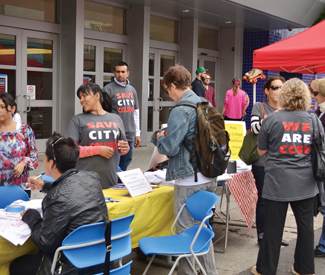
CAREERS AND ED City College of San Francisco (CCSF) is fighting for its life, and that struggle has turned old enemies into new allies. Suddenly, past differences seem less important than the need to work together, bringing a new sense of unity and purpose to the troubled community college.

In June the school was sanctioned and ordered to “show cause” from the Accrediting Commission of Community and Junior Colleges, putting it on the brink of losing its accreditation — certification necessary for the college’s degrees to be worth anything and for the school to secure federal aid (see “City College fights back,” July 17).

Twelve workgroups comprised of faculty, staff, administrators, students, and college board members are working feverishly to prove by October that the school is making major progress. Otherwise, it could face dire consequences.

While few people with any education or political background believe the school will actually close, there are serious consequences if its accreditation is revoked. A special trustee assigned by the state chancellor’s office could assume the powers of the college’s board or the school could be merged with another community college district.

The only college in California to ever suffer both of those fates was Compton Community College in 2006. Though the two colleges serve wildly different communities, many speak of their fates in the same breath. Its shadow hangs over City College like a ghost of what is to come.

WORKING TOGETHER

The newfound sense of common purpose was displayed on Aug. 1 in CCSF conference rooms, where once-battling special interest groups and employees gathered to tackle problems that have plagued the school for years.

The feuds aren’t just of interest to political geeks and college insiders. Infighting and a dysfunctional governance structure had stalled the school from tackling urgent issues, according to the accrediting commission.

“During interviews, criticism regarding the efficiency of the institutional governance process was revealed. The criticism centered on the length of time to reach a recommendation. It was also noted that there may be misunderstanding regarding the role of a recommending body versus a decision-making body,” according to the commission’s report.

That snippet of the 66-page critical report represents years of strife at the school, not only among the school’s elected trustees but also between the board and other college groups on issues ranging from placement testing to school site closures.

The 12 newly formed workgroups — constituted by the Chancellor’s Office and comprised mostly of faculty, administrators, and trustees — met to discuss issues and make recommendations to the system’s decision-making authorities: the Chancellor’s Office and Board of Trustees. One of the workgroups is in charge of evaluating that very decision-making system, with 14 people from different college constituencies hashing out a new style of democracy for the school.

At their first meeting, the members brought in stacks of papers to hand out — research on best practices and policies in college governments around the state and the nation. This particular workgroup discussed how an ideal student government should run, and how to enact those changes at City College.

The workgroups are brainstorming sessions, and each one has a different task ahead of it, including how to measure student learning, leveraging technology to streamline the school, facilities planning, and fiscal planning. Each workgroup acts independently, although some themes and members overlap.

The Board of Trustees is scheduled to meet and report on the progress of the workgroups on August 14 — the day before fall semester classes begin.

A final, preliminary report based on the findings of the dozen workgroups is expected to be completed before the accrediting commission’s October 15 deadline. With everything on the table, from staff layoffs to campus closures, CCSF is an anxious institution facing an uncertain future.

THE GHOST OF COMPTON’S PAST

In Compton, faculty and staff lived in constant fear of losing their jobs between 2002 and 2006, while the school was at risk of losing accreditation. Its path offers some lessons for CCSF.

“From three or four years prior to the accreditation being revoked, every March everybody got a pink slip and then you found out, you know, whether or not you actually had a job to come back to the next year,” Ann Garten, the community relations director of El Camino Community College District, told the Guardian in a phone interview.

El Camino swooped in to save Compton from total closure when its accreditation was revoked in 2006. The fate of employees at City College is a mystery for now, but based on Compton’s experience, part-time faculty are most at risk.

During spring semester, City College had nearly 1,700 instructors, approximately half of which were part-timers, according to college payroll documents. The school’s faculty are represented by the American Federation of Teachers Local 2121.

Classified workers — those who perform services such as administrative support, technology services, and grounds maintenance — could also be at risk. Their numbers exceeded 800 during the last fiscal year, according to the school’s assistant director of research, Steve Spurling.

They are represented by the Service Employees International Union Local 1021, a large and active union that also represents most city workers. In recent years, both unions have already taken pay cuts and freezes on raises and accepted furlough days to help plug the college’s fiscal holes.

If a special trustee were to take over, these workers would become even more vulnerable. But even without a special trustee, will there be layoffs?

Though there is no definitive answer yet, “everything needs to be on the table,” Trustee Steve Ngo told us. Yet most indications are that part-timers are at the most risk.

“I’m not convinced [full time faculty] pay cuts are what is called for. Our part time is the highest paid in the country,” CCSF Chancellor Pamila Fisher told the Associated Student Presidents, made up of elected leaders from CCSF’s eight main campuses. “We pay them health care. That’s unheard of” and could be re-evaluated, she said.

Yet it’s also possible that more creative and aggressive fundraising could save the part-timers and other college functions. Alisa Messer, president of AFT local 2121, said statewide categorical funds exist expressly to help fund part time faculty health care costs, she said, although not all colleges follow through.

“AFT 2121 has been a leader in this state, and in fact in the nation, on increasing parity for part-time/contingent faculty,” Messer said. “We will not allow this crisis to be an excuse to roll back significant progress that has been made on the rights of our most vulnerable faculty.”

The commission’s June report dinged the school for spending higher than average levels on salaries and benefits, 92 percent of their funds to be exact, while other community colleges in the Bay Area have figures in the low to mid 80s.

Yet many of CCSF’s defenders say that comparison isn’t fair or accurate, noting San Francisco’s higher cost of living and the fact that the district provides health coverage to part-time faculty, which most other community colleges in the state do not provide.

SERVING STUDENTS

As the college unites, many conflicts that remain boil down to the question of open access. CCSF currently operates with what it sees as a true community college ethos, where the varied needs of a diverse student population are balanced.

Recent high school graduates preparing for transfer mingle with adult students continuing their education, while English as Second Language (ESL) learners work towards proficiency and others seek new technical skills or transition to a new career.

Many students also take so-called “personal enrichment” courses — one time classes in the arts or languages, for example — that state government has de-prioritized as the budget hole has gotten deeper.

“I think we have to spend money better,” Ngo said, concerning “non-credit” courses, which are primarily classes for adult learners. He pointed to the fact that ESL classes are a full semester long, despite a unique “hop in, hop out” structure to the lessons, which gives students flexibility in their attendance over the course of the semester.

Reducing the number of weeks in a semester that those classes meet could be one possible strategy for saving money, he said. He emphasized that the college needs to work with hard data, and that calculations from what could be saved by such moves aren’t finished.

The number of campuses within the district is also being re-evaluated. “Yes, one of things we’re looking at is whether we should have nine sites. Centers may be combined. We don’t know if that will pay out yet,” Chancellor Fisher told the student presidents, referring to complex funding formulas that could actually prevent CCSF from saving money by closing campuses.

Fisher said officials are researching the possibility of combining campuses in close proximity, which drew a mixed reaction from the presidents. Bouchra Simmons, the Downtown Campus student president, said that combining the Civic Center and Downtown campuses would be disastrous.

“[Downtown Campus] is already pushed to capacity in terms of class size,” Simmons said. And the reverse, moving Downtown Campus students into Civic Center, would make it difficult for her to drop her daughter off at child care and still be able to make it to school on time.

Emanuel Andreas, Southeast Campus president, disagreed when it came to his constituents. “We understand what is happening, and everything needs to be on the table,” he said.

The threat of campus closures and a reduction in non-credit classes are all part of the attack on open access, as some students have said. To combat that, they’ve formed a new student group aimed at educating the city about what they stand to lose.

Project Unity is comprised of Occupy CCSF students, former student trustee Jeffrey Fang, student body President Shanell Williams, and other students, led by the newly elected student Trustee William Walker. They’ve rallied for their school at City Hall, where Supervisors Eric Mar and John Avalos have sponsored a resolution to support City College.

Project Unity met at the Mission Campus shortly after supporting the resolution, and started to plan a grassroots campaign to educate the city and its residents about open access.

Bob Gorringe, a member of Occupy San Francisco, was on hand to help the fledgling group strategize. “[Trustee] Anita Grier came out to the Occupy action council, and she was very open,” Gorringe told the group on July 31, referring to the longtime board member who is not exactly known for her radical tendencies.

Students taking such a vested interest in their college should come as no surprise, considering what happened to Compton before it folded into El Camino.

Although Compton never actually closed, it hemorrhaged students as public fears of the college closing grew larger, and the student body dropped to around 2,000 when El Camino took over, Garten told the Guardian.

Some students went elsewhere, but many appear to have just abandoned the education system.

“We looked at two or three colleges around Compton and none of us had a significant increase in students from the Compton district” enrolling, Garten said.

In other words, it looked like many disillusioned students had simply dropped out, something that nobody wants to see in San Francisco.

MOVING FORWARD

Just over two months remain for CCSF and its supporters to hash out a preliminary plan. Aiding them is a team of experts that will create a detailed report on everything related to the college’s financial woes — possibly the most critical problem area.

The Fiscal Crisis and Management Assistance Team, or FCMAT, explained their process to the college on August 3.

Without revealing any specific details, Michelle Plumbtree, the chief management analyst of FCMAT, warned an audience of a couple dozen interested people that its report would seem negative, but only because that’s exactly what the report is supposed to be: a critical review of problem areas.

“You guys are doing incredible things…But that’s not what we talk about [in our reports],” Plumbtree said.

Mike Hill, another FCMAT team member, succinctly layed out the biggest obstacles to City College’s fiscal future. “This is not a one year problem…We’re looking at three years. What makes that complicated is the governor’s tax, and the parcel tax,” Hill said, referring to Prop. 30 and the San Francisco ballot measure City College sponsored. “There are four scenarios… It’s not predictable.” Prop. 30, the tax measure placed on the ballot by Governor Jerry Brown, wouldn’t raise new revenue for community colleges. If it passes, they simply break even, staving off more drastic cuts. But the parcel tax offers more hope for CCSF, if city voters approve it. It would free up $14 million in revenue for this fiscal year, restoring some of what was lost and prevent the deep cuts and scaled back mission that the school’s support most fear.


Alerts

0

WEDNESDAY 8

Speak up: stop and frisk Southeast Community Complex, 1800 Oakdale, SF; Stop and frisk — the controversial, pretty much definitely Fourth Amendment-violating policy that police in New York cling to despite protest and that Mayor Ed Lee recently proposed implementing in San Francisco — just won’t go away, despite opposition from pretty much everyone. This panel discussion and opportunity to debate issues relating to the proposed stop and frisk policy. The event is presented by the Osiris Coalition and filmmaker Kevin Epps.

First District 5 debate of the season Park Branch Library, 1833 Page, SF; District 5 is in the center of San Francisco, and much of the excitement of November’s city elections will center on its race for supervisor. A wide range of candidates will vie for the coveted spot that Ross Mirkarimi left to become sheriff. All of the candidates have promised to show up to this first debate in the hotly contested race. The debate is presented by District 5 Democratic Club, the District 5 Neighborhood Action Committee, and the Wigg Party.

THURSDAY 9

Occupy the Bay Berkeley Fellowship of Unitarian Universalists’ Hall, 1924 Cedar, Berk; www.bfuu.org. 7pm, $5-10 suggested donation. Filmmakers Name Name and Namey Namey have been documenting Occupy in the Bay Area since the fall. Come reminisce, learn, and be inspired by their film at its premier. You made this history happen, celebrate it, baby!

SATURDAY 11

Black Riders Liberation Party La Peña Cultural Center, 10pm, $5-10. The Black Riders Liberation Party considers itself the new generation of the Black Panther Party, organizing similar programs to stop police violence and gang violence and feed communities. This Saturday, the Party parties. Come celebrate the Black Riders and meet organizers, bring a canned food donation for a discount.

Pistahan Yerba Buena Gardens, Mission and Third St., SF; www.pistahan.net. 11am, free. This giant annual Filipino celebration goes all weekend. Start off the weekend with a parade from Beale and Market streets to Yerba Buena Gardens, where the festival of music, food, performance and education begins.

Foreclosure victory block party 376 Bradford, SF; www.occupybernal.org. 10am, free. Shortly after we named Ross Rhodes a Local Hero (Best of the Bay 2012) for his work protecting his home and those of his Bernal Heights neighbors from unjust foreclosure, he received a loan modification agreement. Come celebrate with Ross and others from Occupy Bernal with a block party at his house. There will be educational presentations about banks’ predatory role in the foreclosure crisis and efforts to fight back in the morning, followed by general partying.

SUNDAY 12

Lessons from Vermont Eric Quezada Center, 518 Valenica, SF; www.collectiveliberation.org. 3-5pm, free. Yes, we have the Affordable Care Act, but it leaves much to be desired, unless you’re in Vermont. There, Governor Peter Shumlin signed universal healthcare into law in May 2011. But of course, Shumlin didn’t do this alone. Come hear a presentation from some of the organizers who won this victory, all the way from the Vermont Workers’ Center.

MONDAY 13

Undocumented and unafraid Asian Law Caucus, 55 Columbus, SF; www.asianlawcaucus.org. 12-1:30pm, free. The Asian Pacific Islander undocumented student group ASPIRE will lead this talk on the immigration rights struggle. The last talk in the Asian Law Caucus-led summer brown bag series is especially timely as undocumented youth work on figuring out if and how they might benefit from President Obama’s policy directive giving limited amnesty to undocumented college students, and what it means for family and friends, especially those already in ICE custody. This talk on the issues youth without legal status face and how to keep building towards the DREAM Act, which would offer broader protections that Obama’s policy.

TUESDAY 14

Milk Club District 5 debate Eric Quezada Center, 518 Valencia, SF; www.milkclub.org. 7-8:30 p.m., free. A District 5 supervisors race debate hosted by the Harvey Milk Democratic Club. Milk Club President Glendon Hyde, aka Anna Conda, says candidates will cover drug policy, public space, sex worker rights, the housing crisis, queer seniors’ issues, and much more. As an extra special bonus, the debate will be hosted by transgender performer Ben McCoy and the Guardian Managing Editor Marke Bieschke.

Dick Meister: Good news–and bad–about jobs

2

By Dick Meister

Dick Meister, former labor editor of the SF Chronicle and KQED-TV Newsroom, has covered labor and politics for more than a half century. Contact him through his website, www.dickmeister.com

It’s of course good news that unemployment among workers in private industry has been steadily declining. But that comes along with the bad news that unemployment among public employees has been growing – and with it a decline in vital government services.

A recent  report in the New York Times has made that very clear.  Reporters Shaila Dewan and Motoko Rich noted that government payrolls grew in the early part of the recovery from the Great Recession in 2009, mainly because of federal stimulus measures. But they said that since then, “the public sector has shrunk by 706,000 jobs.  The losses appeared to be tapering off earlier this year, but have accelerated for the last three months, creating the single biggest drag on the recovery in many areas.”

Albeit slowly, the economy generally has been improving, with state tax revenues expected to go beyond pre-recession levels by next year.  Yet the Times’ reported that “governors and legislatures are keeping a tight rein on spending, whether to refill depleted rainy day funds or because of political inclination.”

Holding tight won’t be easy, with the costs of health care, social services, education and employee pensions steadily rising, and property taxes and other tax revenues steadily shrinking.  More than a dozen states have tried to do it by trimming their aid to local governments. And that will undoubtedly lead to more public worker layoffs, more unemployment and more reductions in important public services.

Local governments already have been making budget cuts that far outweigh the slight economic relief that’s come with a recent growth in state and federal jobs.  It’s certain to worsen, since more than 25 percent of municipalities are planning layoffs this year. 

President Obama has proposed easing the financial plight of states and their employees by providing $30 billion more for teachers, police officers and firefighters.  Such aid is essential if public services – and the compensation of those who provide them – are to be maintained at a significant yet reasonable level.

Predictably, the  conservatives who don’t really care for government are in a snit over Obama’s proposal.  The Times quoted Michael D. Tanner, a senior fellow at the Cato Institute, as complaining that the additional public sector jobs  “must be paid for with more debt and taxes borne by the private sector.”

Now, isn’t that a revelation! Imagine that, people taxing themselves and hiring people to provide services they and everyone else needs if they are to live a decent life, if they are to find meaningful work.

We need more, not less government, and we can provide it by employing for reasonable compensation many of the millions of Americans now suffering from unemployment. We need to open more government jobs for them so they may help provide essential services.

The lack of sufficient public workers, as the Times said, “can mean longer response times to fires, larger class sizes, and in some cases lawsuits when short-staffed agencies are unable to provide the required services.”

The Times quoted Mike Whited, president of the firefighters union local in Muncie, Ind., who said the area which could be reached within eight minutes after an alarm was sounded was cut in half.

The Times said, “Mr. Whited chafed at portrayals of public workers as overpaid or greedy, saying his union and others had made concessions, including paying more for their health insurance and forfeiting raises. I think a lot of people don’t understand what we do. They’re looking for somebody to blame, and I think they’re being led the wrong way.”

One of the hardest hit cities, Trenton, New Jersey, has laid off fully one-third of its police force, hundreds of school district workers and at least 150 other public employees, and now faces loss of 60 more firefighters.

More than half the job losses in local governments have come in education.  Thousands of teachers have been laid off throughout the country, and thousands more are being threatened with layoffs.

 Many teachers have agreed to help ease their school districts financial problems by taking unpaid “furlough days” or agreeing to less pay and benefits than they had sought or had been granted in contract negotiations.

The widespread teacher layoffs have nevertheless continued. In Cleveland, for instance, more than 500 teachers were laid off this spring because  of a claimed $66 million budget shortfall. That came after two years of cutbacks and $25 million in concessions, teachers union leader David Quolke told the Times’ reporters.

One consequence: Some classes will have more than 40 students, a serious hardship on students and teachers alike.

Relatively large teacher layoffs and cuts in public jobs and services generally have hit every state hard, including the largest, wealthiest and most influential states.  In California, for example, Gov. Jerry Brown is threatening to eliminate 15,000 state jobs.

The Times said Pennsylvania “has shed 5,400 government jobs this year, and many school districts and social service agencies are contemplating more layoffs.”

Yes, it will take higher taxes and more public debt in Pennsylvania, California and everywhere else to combat the severe economic problems that have left millions of Americans without the jobs  and public services they so badly need.

Dick Meister, former labor editor of the SF Chronicle and KQED-TV Newsroom, has covered labor and politics for more than a half century. Contact him through his website, www.dickmeister.com

Janitors continue pressure as negotiations’ close draws near

19

As contract negotiations with several employers come to an end August 1, the SEIU Local 87 janitors union has been coming out in force. More than 1,000 rallied in Union Square and marched over the weekend. Today, 500 janitors marched through the financial district.

“If we don’t get no contract, you don’t get no peace,” the crowd chanted as it marched down Market, before turning on First towards Mission. The group periodically stopped to picket intersections.

In negotiations with the city, the Westfield Mall, and Macy’s, janitors risk a significant increase in monthly healthcare costs.

Members have voted to strike if demands are not met.

“Our members clean up after companies that got bailed out, and we’re getting screwed,” said Olga Miranda, president of Local 87.

“We depend on our hands. We work hard for our money, We’re not looking for hand-outs.” a union janitor who preferred to be quoted as Elhady said.

“The trash can outside your office? The bathroom? The hallways? No matter how dirty it is, we do it,” Elhady said. “And we’re not given respect.”

After marching, leaders switched from English to Chinese to Spanish to Arabic as they rallied the crowd to continue fighting for health care benefits.

“We clean these buildings, and we’re proud of it,” Miranda said to cheers from the crowd. “Don’t take away my family’s health and welfare.”

Miranda laid out the next few days, telling that if they have not heard that a resolution has been reached by midnight August 1, “it means we have no contract.” However, she said that the strike would not begin immediately Wednesday.

Another action is planned for tomorrow at 2pm.

Workers launch global Hyatt boycott, hundreds picket at Union Square

1

As shoppers scurried around Union Square yesterday, a picket that drew more than 300 people could be heard for blocks. The grand-scale noise-making was in front of the Grand Hyatt, where workers and supporters demonstrated against what they say is unsafe and unfair treatment of hotel workers.

UNITE HERE Local 2 has been supporting a boycott of a couple Hyatt locations in San Francisco for years now. But this week the national union, along with a broad coalition of supporters, has called for a worldwide boycott of the hotel chain.


Wong says the boycott will end if the Hyatt capitulates to three demands. Two of these are a “fair and mutual process for non-union workers to organize” and to “agree to a fair contract for thousands of unionized Hyatt workers that have been without contract for three years.” But the most important, according to Local  2 spokesperson Julia Wong, is to implement the workplace safety measures that the Occupational Safety and Health Administration (OSHA) recently outlined in a letter to the Hyatt corporation and its CEO, Thomas J. Pritzker.

Year after year, boycott organizers say, Hyatt adds new worker abuses to its track record.

“In 2009, Hyatt fired 100 housekeepers in Boston and replaced them with temporary workers making minimum wage,” Wong said. Rose Sia, a 31-year San Francisco Hyatt worker, recalls being alarmed that Boston workers who had held their jobs for 15 and 20 years were made to train their minimum wage-earning replacements. “They were treated like trash that day,” Sia said.

In a July 2011 incident, Hyatt workers in Chicago were picketing in 100-degree weather when their employers turned on heat lamps to beat down on them.

“They’re continuing to spread subcontracting around in more cities,” Wong said. “In Baltimore there used to be 40 or 50 in-house housekeepers. Now there are only eight or nine, and everybody else is subcontracted.”

Most recently a Hyatt worker in Indianapolis, Elvia Bahena, was fired, she believes, as a direct result of speaking out about her negative workplace experiences at a city council meeting.

Mona Wilson, who has worked at the Grand Hyatt since 1980, says that learning the difference between how union and non-union hotel workers are treated at Hyatt was an “eye-opening experience.”

Many Hyatt workers must clock in 30 every week to receive heathcare benefits, and meeting that quota can be a struggle. “I’ve met with people who work in banquets,” Wilson said. “The guys that move the tables around. They bring them all in, they’ll rush them through to hurry up and finish the job, and then send them home before the shift is over, so they never make enough hours to qualify for healthcare. I’ve met with one guy whose been working there for three years and he hasn’t been able to get healthcare.”

“He’s a regular hired worker, but it’s a non-union hotel,” Wilson said.

Even in San Francisco, where most Hyatt workers are unionized and experience relatively fair treatment, Hyatt workers have seen their workloads increase to back-breaking proportions and had to fight to get raises and benefits.

Sia says Local 2 has been instrumental in improving working conditions. “They are the ones helping us get our pension, get our raise, get everything. Without the union, we’re nothing,” she said.

Workers in San Francisco have been locked in contract negotiations for three years. One of their key issues is the freedom to protest in solidarity with other workers, which Sia says is particularly important as non-union Hyatt workers continue to suffer abuses.

http://www.youtube.com/watch?v=UCbsAl4bQwM
Picketers sing labor songs at yesterday’s demonstration

Hotel workers are largely women, and UNITE HERE’s Hyatt Hurts campaign has always called out their mistreatment as a feminist issue. They protested on International Women’s Day, focusing on two sisters who experienced disrespectful treatment and objectification of their bodies at the Hyatt Santa Clara. A few weeks later, the Reyes sisters met with Gloria Steinem, who pledged her support for the boycott.

Women’s rights groups like the National Organization of Women, the National Women’s Health Network, and the Feminist Majority Foundation have endorsed the worldwide boycott of Hyatt hotels. GLBT rights groups like the National Gay and Lesbian Task Force, the National Stonewall Democrats, the National Black Justice Coalition, and Pride at Work have also signed on. So has the national AFL-CIO.

A more unusual supporter, the NFL Players Association, is also getting behind the boycott, promising that the organization will not spend it’s money at Hyatt and discourage players from staying there.

“Many football players were raised by hardworking men and women who punch time cards just like the hotel workers at Hyatt. This is why we decided to get in the game and support Hyatt housekeepers who suffer abuse and debilitating injuries at work,” said DeMaurice Smith, the association’s executive director.

This kind of support is keeping spirits high for union organizers and workers as they escalate their tactics, but the fight may not be over any time soon.

“It took us seven years to bid the Mariott,” said Chito Cuellar, head of UNITE HERE’s hotel division. “It took us five years to defeat Park 55. It’s been three years that we’ve been fighting the Hyatt. And we don’t know how long it’s going to take, but we know we’re going to win.”

Two calls to investigate SF restaurant surcharges as consumer fraud

49

The surcharges that many San Francisco restaurants charge their customers – ostensibly to help cover their employee health care obligations, although in practice it has often just padded their profits – should be investigated by the District Attorney’s Office as consumer fraud, according to Sup. David Campos and San Francisco’s Civil Grand Jury, which recently issued a scathing report scrutinizing the practice.

Campos raised the issue during Tuesday’s Board of Supervisors meeting, calling for a criminal investigation and City Hall hearing. He even questioned whether businesses that have been so hostile to city’s Health Care Security Ordinance – the landmark 2008 measure that created the Health San Francisco universal care program and required businesses to help pay for their employees’ health coverage – should benefit from the tax cuts it would receive under a business tax reform ballot measure the board also considered that day.

“In the restaurant industry, we have an issue that remains unresolved,” Campos said during the business tax debate, after earlier in the meeting calling for the DA “to begin an investigation for fraud against the people of San Francisco by businesses that use this surcharge.”

DA’s Office spokesperson Stephanie Ong Stillman confirmed that the office is looking at the issue: “The Grand Jury report was just released and we are in the process of evaluating the results.”

Mayor Ed Lee last year vetoed legislation by Campos that would have banned the practice and prevented businesses from simply pocketing money from Employer Health Reimbursement Accounts they create to comply with the mandate (federal law bars the city from dictating how businesses cover employee health care) at the end of each year. Lee later signed a watered down version sponsored by Board President David Chiu requiring employers to keep the money in the fund for two years, to let their employees know about the fund on a quarterly basis, and to dedicate surcharge revenue to employee health care.

Rob Black, executive director of Golden Gate Restaurant Association – which unsuccessfully sued the city over the employer mandate and appealed the case all the way to the US Supreme Court – criticized Campos and the Grand Jury, saying they were relying on data from last year and that the situation has improved since Chiu’s legislation went into effect (Chiu told us data collection from his legislation will allow the city to better assess what’s happening).

“Supervisor Campos know this information is based on data that was prior to the new ordinance,” Black told us, acknowledging that many restaurants profited from the surcharges “but that was before the law was changed.” Campos responded by saying the grand jury concluded that the Chiu legislation didn’t go far enough the prevent the abuses, which are tough to detect because they are based on self reporting by the businesses.

The Grand Jury looked at 38 restaurants, of which 25 used the surcharges and 22 use the reimbursement accounts rather than either health insurance or Healthy San Francisco, which health care experts uniformly say are better options for employees. It analyzed data submitted to the city by these 22 restaurants with a total of 1,562 employees, finding that of the more than $2 million earmarked for the health reimbursement funds, just $123,612 was paid to employees and $1.9 million was kept by the employers.

Black said the quarterly noticing requirement in the Chiu legislation is already helping with the low reimbursement rate: “My hope is, and my belief is, we’re going to see significant…improvements in utilization rates in people taking advantage of their benefits, and that’s great.”

The grand jury also looked specifically at the health care surcharges collected by 18 restaurants with almost $64 million in gross revenue. Despite collecting almost $2.2 million in the surcharges it placed on customers bills, they reimbursed their employees for $1.16 million medical expenses and kept the more than $1 million that remained as profits.

Black criticized the grand jury for selectively picking the restaurants in its study and for targetting private sector businesses rather than the public agencies it traditionally investigates. “They’re outside of what the government charter calls for,” he said.

But Mark Busse, the chair of the Grand Jury Health Committee that led the study, told the Guardian that while it’s unusual to look at the private sector, there was a legitimate public policy interest here and its work was approved and overseen by Presiding Judge Katherine Feinstein (who happens to be the daughter of US Sen. Dianne Feinstein, San Francisco’s former mayor).

He also denies hand-picking the restaurants, saying he asked jurors to simply keep the receipts from all restaurants they frequented. While that may not be representative of all restaurants, he said it was a large enough sample to draw some conclusions and that he was more surprised than anyone at their findings.

“I thought our results would be totally different. I didn’t think they would be that abusive, I really didn’t. I thought we would find we have some outstanding restaurants and entrepreneurs,” Busse said, adding that he was alarmed by their actual findings. “It turned our stomachs. It makes us sick. It is not a level playing field. There are legitimate businesses that accept the spirit of the law and are taking care of their employees, but a lot of them aren’t.”

Given that these employees handle the food of city residents, he said that they should get the health care to which they’re entitled. As Busse told us, “The intention of the jury was to make sure the workers are getting health care and the customers aren’t getting deceived.”

7/27 Update: We heard back from the Mayor’s Office, whose Chief Deputy Communications Director Francis Tsang wrote: “Mayor Lee is a strong supporter of the Healthcare Security Ordinance. The Civil Grand Jury surveyed only 38 restaurants and its report restates facts we already know – some businesses add a surcharge and in the past, it was not well regulated.  Working with Supervisors, Mayor Lee strengthened practices effective January 2, 2012 to ensure employees could make better use of the program.  We will know the results in 2013, when we collect and report on 2012 data informed by the new regulations.”

The NY Times and class struggle

7

The NY Times isn’t exactly a revolutionary left-wing publication — and while columnist Paul Krugman routinely talks about the income and wealth divide, it’s not typically a staple of how the Times cover the news. But David Leonhardt is starting a blog on the decline in the middle class and is going to turn it into an article during the later parts of the presidential campaign — and amazingly enough, he’s got it pretty much right:

In addition to the slow growth in overall size of the pie, the share that has been going to anyone but the richest Americans has been declining. The top-earning 1 percent of households now bring home about 20 percent of total income, up from less than 10 percent 40 years ago. The top-earning 1/10,000th of households — each earning at least $7.8 million a year, many of them working in finance — bring home almost 5 percent of income, up from 1 percent 40 years ago. In the simplest terms, the relatively meager gains the American economy has produced in recent years have largely flowed to a small segment of the most affluent households, leaving middle-class and poor households with slow-growing living standards.

It’s simple, and it’s pretty clear — as is the fact that it’s not random but the result of specific policies. From one of the (many intelligent) comments (my trolls, please take note):

The middle class is an artificial construct, something deliberately created through the enactment of policy. It emerged in the U.S. largely because of political, economic and social changes that were imposed: the New Deal, the Great Society, the creation of the suburbs and highway systems, strong unions that demanded fair wages and protections, etc. All of these developments happened only because people willed them and fought to ensure economic expansion benefited regular people. It could have just as easily gone the other way; indeed, it IS going the other way now (and has been for the last 30 years or so). The choices today are different: to let the markets decide, to deregulate and bolster corporations, to exacerbate the wealth divide, to enforce an unfair tax system, to shift essential costs (healthcare, environmental remediation, etc.) to the taxpayer, and so on. And so the middle class erodes. It should come as no surprise.

What’s talked about less in this NYT piece is the role of government in redistributing income. The idea that the US tax system should take more than half of the income people earn beyond a certain point is hardly radical; as early as the 1920s, the highest earners turned over as much as 70 percent to the government — and unlike today’s billionaires, they actually paid it. The JP Morgans of the world got really really rich AND paid high taxes AND gave a lot of money to public enterprises (public libraries, public museums etc.).

That as much as unionization and post-War industrialization created the middle class.

Another interesting comment:

Our “free-market” policies of the last 30 years have favored efficiency and productivity above all else. The result has been sending American jobs overseas on a massive scale. Now we have inexpensive tee-shirts and computers, but vast unemployment and underemployment. Instead, I believe our culture should favor creating as many high paying middle-class jobs as possible without regard to “productivity”. This requires protective trade barriers. Yes, prices will go up, but for a more affluent society, it’s a cheap price to pay.

Obama talks a good line about the middle class, but he’s not offering any specific ideas that would fundamentally change the direction of US economic policy. In fact, the biggest issue in the campaign isn’t even an issue.

Oh, and by the way: I have to note that Randy Shaw at BeyondChron is now talking about the important of “class diversity.” He’s right — there need to be more tenants (and working-class tenants) on the Planning Commission and Board of Appeals. There also needs to be a consciousness of class issues in general at City Hall — and a discussion of how policies that favor high-tech companies, like those of his beloved Mayor Lee, are pretty clearly NOT in the interests of protecting class diversity in the city.


Guardian feminism panel calls for change, gang activity

31

In the interest of behaving badly, let us first say that we won’t apologize for the “roving feminist gangs” comment, nor the laughter that ensued at our July 11 “Bay Area Feminism Today” panel. In the light of the sexual attacks that have terrorized Mission District residents this year, Celeste Chan’s joke (actually a reference to comments made by Fox News in reference to the New Jersey Seven) has to be read as a self defense tactic — and source of comfort and strength to the women living in the neighborhood. Not a threat to men. Unless they’re commiting sexual assault, of course — but then, women commiting sexual assault will probably have the gang’s wrath to face as well. 

Seven women from all walks of Bay Area activism — arts, nightlife, immigrant advocacy, domestic violence organizations, and more — came together at City College’s Mission branch to discuss what our SF progressive community needs to work on, recent feminist victories, whether they even believe in the term “feminism,” and everything in between. Our “Faces of feminism” cover story announcing the event attracted a decent-sized crowd of around 120 (mainly young women, with zero male elected officials in attendance.) We laughed, we nearly cried, we came away with a lot to think about. Here’s some of the general topics that were discussed. And here’s to this being a spark for continued talks, however a Fourth Wave Bay feminism may take shape.

>>FOR THE FULL BIOS OF OUR PANELISTS, CHECK OUT THE EVENT ANNOUNCEMENT 

Reproductive justice

Reproductive justice has long been a feminist goal, but with the recent spate of attacks on birth control and abortion access it’s come up again. Are we here in the Bay Area isolated from the War On Women?Some panelists thought we can affect the country’s situation positively.

“Part of what we do here in the Bay Area is we send strong women to Washington,” the Drug Policy Alliance‘s Laura Thomas said. “We are responsible for a significant amount of women in Congress.” But California’s reproductive justice situation is more complicated than it may seem. St. James Infirmary‘s Stephany Ashley noted that reproductive health here is under attack with “criminalization of HIV-positive people,”  and that California “just cut all funding for HIV prevention for women.”

>>CHECK OUT REBECCA BOWE’S RECORDED LIVESTREAM OF THE EVENT HERE

Chan, founder of Queer Rebels Productions, added that California is cutting domestic violence services through slashing CalWORKS funding. Mujeres Unidas‘ Juana Flores noted that the Bay’s Latino communities can find it difficult to support aspects of reproductive health because of religion and tradition. But she said that people need to work together and realize that “it’s a real war. It’s a real war on us.” She warned that “politicians are not going to fix things just because they want to improve our lives. We need to fight back.”

Transgender activist and member of SF’s Youth Commission Mia Tu Mutch said that part of the war on women has been a wave of anti-trans legislation across the country, as well as a wave of hate crimes, especially against trans women of color. Some legislation in Tennessee is making it more difficult for trans people to go the bathroom, she said. “Reproductive justice is important, but we also need just the simple right to pee.”

But what about the word itself?

Does feminism have power as its own concept now, or has its work been rightly subsumed into the queer movement, the civil rights movement, and other forms of activism? “A lot of us can agree that there isn’t something you can point to and say, this is the feminist movement in San Francisco,” Ashley said. “But there are many important feminist projects happening.”
Alix Rosenthal, who created a controversial women’s slate in her bid for re-election on the SF Democratic County Central Committee recalled how “30 to 40 years ago, we all had to join together because there weren’t enough of us. Now people have splintered off.” Chan brought up the bicycle scene in 1983’s feminist sci-fi film Born in Flames, and quoted Audre Lourde: “for so long, we’ve been on the edge of each other’s battles.”

Tu Mutch said that she “would rather identify as fighting for LGBT rights, progressive rights” than as feminist. But, she continued that it is “under the system of patriarchy that we’re all getting screwed over.” She said that women are treated as second-class citizens, and trans and gender non-conforming people are treated as third class citizens in our society.  Edaj, longtime Bay Area DJ and director of the Women’s Stage at Pride for a decade, agreed that the word feminism “sparks a lot of emotion in people” and can create obstacles in growing support. Said Flores: “it’s a big word. People call me a feminist when I claim my rights. When I see another women who is suffering or being abused it’s unbearable to me,” Flores said. “When someone calls me a feminist, I feel proud.”

The inward gaze: how does the San Francisco progressive community do on feminist issues?

In a word: okay. But there’s work to be done even here, in “progressive” San Francisco. Thomas led the charge, talking about the state’s current legal ability to shackle women prisoners during childbirth. Tu Mutch expressed a need to stop “pitting groups against each other,” and to get rid of a City Hall attitude that says “my budget is more important than yours.” Tu Mutch said “there’s still rampant transphobia and gender essentialism,” that affects not just women, but the “countless people born with intersex conditions and who identify outside the binary.”

Ashley pointed out that “even some of our favorite male progressive politicians, you don’t see them cultivating leadership among women, queer people, trans people.” She talked about how that’s a traditional feminist organizing principle, “mentorship and meaningful participation, not just tokenizing participation.”

As a (not) side note, there wasn’t a single male politician in the audience that day. As Ashley put it, “patriarchy is really the problem.” Ashley and panel moderator, SFBG culture editor Caitlin Donohue shared the fact that they’ve felt diminished by remarks made by and in the company of the city’s so-called “progressive politicians.”

Recent feminist victories

But enough depressing stuff. How about recent feminist victories, asked an audience member.

This question was met with a disconcerting silence. Until Chan jumped in: “I’m really inspired by the place queer arts are at right now.” She told of the “lineage of resistance” of art that deals with questions like “how do people survive the unimaginable? How do people survive the truly horrific?” Disturbing incidents like that of transgender prisoner Cece McDonald beg the question, “is the perfect victim a dead victim? If you fight back, you’ll be criminalized? Now more than ever we need a movement. We really need to come together,” concluded Chan.

Rosenthal saw hope in surprising places. “Sarah Palin and Michelle Bachman,” she said. “These women are so incompetent. But they made it. They really made it.” She talked about how usually women have had to be five times better than the men they competed with, but “Sarah Palin and Michelle Bachman are not five times better than anyone. But they made it.”
Laura Thomas was inspired by Julia Bluhm, the 14-year old ballet dancer from Maine whose online petition led Seventeen to promise to stop using Photoshop to alter women’s body types. Ashley acknowledged Tu Mutch’s advocacy work, and said she was recently inspired by a “take back the plaza” event Tu Mutch had organized. Edaj was inspired by being named a Pride Grand Marshall, and the feeling that the Pride organization was acknowledging the importance of the space created at the Women’s Stage. She was also inspired by Morningstar Vancil, a Filipino vet who is a two-spirit drag king, and Vancil’s commitment to disabled veterans issues.

Action items

In response to a question that asked what the 2012 action plan for Bay Area feminists should involve, Ashley said “principles of intersectionality, anti-colonialism, anti-capitalism” had to be valued more than they have been in past feminist movements. They’re there in Third Wave feminism, Ashely said, only they are “wrapped up in theory and academia.” Those guiding principles should have “more on the ground” applicability. What needs to happen right now, speaking of on the ground? Back to 2012’s spate of sexual violence in the Mission, there’s a distinct necessity for “a perfect community response that doesn’t involve the police, so that we all of a sudden feel really comfortable taking a walk at 3 in the morning through our favorite neighborhood.”

Flores said that any new form of feminism would need to be about “mutual respect” and “against any form of injustice,” to which Thomas agreed, saying it needs to be “less theory, more practice.” It also, Thomas said “has to deal with gender in a different way. A new feminism needs to go beyond gender, or deal with gender differently” in the sense of respecting gender non-conforming identities. A tricky prospect, she admitted. “How you develop a gendered movement that doesn’t use gender as a defining construct, I don’t know.” More specifically, she underlined the importance of “progressive revenue measures,” and “an end to cuts to childcare and domestic violence programs.” “Our economy’s not coming back through more cuts. We need revenue, more taxes,” she said, to cheers from the crowd. Well this was a Guardian forum, after all. 

Edaj reiterated that “that word scares off a lot of people who might otherwise want to join.” Tu Mutch underlined that it would need to “take up the idea that men and women are opposites. That only serves to degrade women.” A new feminism, she said, would be about “turning away from that and realizing there’s lots of different genders.”

Tu Mutch said she would like to see success for her organization to fight for trans healthcare rights, FEATHER. “People have to spend ridiculous amounts of money to transition,” she said. “We need universal healthcare for all, including trans people.”

Chan pondered the question. In the end, she concluded, “roving feminist gangs,” inspiring at least one angry letter from a slighted middleaged white man in the crowd. Which wasn’t the only reason why we deemed the panel a success, but an important one.

Guardian Voices: There’s something happening here

25

There are distinct signs of the rebirth of a grassroots  balanced-growth  movement in San Francisco, and some small indication that it’s even beginning to shift, ever so slightly,  the politics of the Board of Supervisors.  This is very good news for the vast majority of San Franciscans.

First, a little history.

Land use and the approval of major development projects lie at the very heart of San Francisco politics. Developers and their allies (the building trades, contractors, bankers, architects, land-use lawyers, consultants, and  permit expeditors) are the primary source of political money for candidates for local office. Since the freeway and urban renewal fights of the 1960s, the very definition of  progressive  politics in San Francisco has been the attempt to build a political base of  residents to resist that money.  So-called moderates are simply the political extension of the pro-development lobby using its money to consolidate developer control of the public approval process.

In most cities, land-use issues — zoning, permits, urban design — is left to elites. Not so in San Francisco. Here, land use is talked about at neighborhood meetings and on street corners. The heart the reason is our compact size: 46.7 square miles, and the prohibition of filling in any more of the Bay to create new land. There is no vacant land in San Francisco. Any new major development almost always displaces something already there.  Development is a zero sum game, with winner and losers.  And the losers  leave town.

Land-use politics is about staying here — and that creates real interest among San Francisco residents.

The funding for major development in San Francisco has dramatically changed in the 45 years since the freeway and anti-urban-renewal fights of the mid-1960s. Back then, it was public sector money that fueled development. Yet, with that money, due to the actions of  progressive politicians like Phil and John Burton and George Moscone, came its own remedy: votes to not accept the public money for freeways (Moscone) and votes creating either laws that either prohibited displacement or funded legal assistance to the poor, empowering  them to stop government agencies through litigation (the Burtons at both the state and federal level).

Since the money for freeways and urban renewal was from the government, the focus of the early balanced growth  forces was on government itself, through massive lobbying campaigns to affect officials’ votes (the freeway fight), or the use of government-funded lawyers  to protect poor people’s  interests ( the WACO and TOOR lawsuits against redevelopment).

All of that changed starting in the 1970s, when Richard Nixon and later Ronald Reagan deregulated oversight of urban development by creating a system of  block grants and ended funding for legal assistance for the poor.  Large-scale development was effectively privatized, moving it from being designed, funded, and approved at public meetings by government officials following regulations to being designed and funded in private — and having a Kabuki-play-like public approval process with little real oversight. With the passage of Prop 13 in 1978, which limited the main source of local government revenue — property taxes — local governments became even more reliant on private developer money to create new revenue.

The popular response to this change in the development process in San Francisco was the emergence of a politics that relied on the old progressive-era reforms of the initiative, referendum, and recall. Through a series of initiatives, the community sought to impose regulations on the development process, culminating in the 1986 Proposition M, which actually limited the amount of high-rise office space developers could build, completely imposing the popular will over a supine set of local officials and politicians. Indeed, ten years earlier, again through the initiative processes, the very nature of the Board of Supervisors was changed from a developer-friendly at-large system to a district-election system. Hotly opposed by real estate and development interests, district elections in its brief three years of existence (repealed in the wake of the Moscone-Milk assassinations, even though they were both strong supporters of the system and their assassin opposed it…ironies abound in San Francisco politics) saw limits placed on condo conversions and the passage of rent control.

In each of these multi-year efforts, a citywide coalition was formed, including an ever-expanding set of communities and neighborhoods.  Common interests were defined that cut across race, class, and geography and issues of community (neighborhood) control and funding for essential services like Muni, affordable housing, childcare, and employment training were placed on the table – and developers had to address them if they wanted projects approved.

The point is that balanced growth came from community-based political forces, not elected officials.  Broad movements were built — in the end, encompassing elements of labor. These were victories won not by elected officials but by a popular movement.

In 2000, in the wake of  the dot-com bust, another balanced-growth measure, Prop. L, aimed at cutting then-Mayor Willie Brown’s power over development, was paired with the new district election system — and a broad coalition of forces including labor, community and neighborhood organizations won a major progressive victory.

Every candidate for supervisor who supported the balanced-growth measure won. Every candidate who opposed it and supported Brown lost. While Prop L narrowly lost, its policies and objectives were passed as ordinances by the new Board of Supervisors (banning live-work lofts, closing loopholes in the planning code, requiring neighborhood-based plans for the Mission, SOMA, and Potrero Hill).

But as is so often the case, the victory of 2000 led to the slow dissolution of the coalition that created it. Folks had won. Our supervisors could handle all these issues; we no longer had to. By the end of the term of the supervisors elected as the class of 2000, very little of that citywide coalition existed any more.

With the Great Recession of 2008, advances were rolled back.  Fees on local developers for affordable housing, childcare and transit were deferred in order to stimulate development.  A new era of “moderation” was announced by elected officials, led by Mayor Gavin Newsom. Desires to “attract and retain”  business saw new tax concessions in the name of “jobs” and a new willingness to use open space and public facilities for “private/public partnerships” was announced.

By 2012 any concept of balanced growth had been replaced with a new era of “cooperation” between city officials and developers.

Until recently, that is.

It should be clear to all that for the last four years, City Hall has been eager to approve any scheme presented by private developers — from the America’s Cup nonsense to highrise luxury condos on the waterfront. The siren song of the developers — more revenue if you approve our project — has been proven false again and again, as the revenue never really matches the real costs of these projects. The city’s essential services continue to shrink. Transit fees are too low to pay for the actual new costs of Muni. The affordable housing  fees are too little to actually meet the affordable housing needs of the new, poorly-paid workers employed in the retail and service industry that is always a part of these projects.

More and more of our parks and public open spaces are made available to private users, while few if any new public parks or open spaces are being created.  Indeed, the Department of Parks and Recreation often opposes new public parks — because it can’t maintain what it has.

So it is with fondness that these old eyes see the stirring of what appears to be the awakening political  giant of a new controlled-growth movement.

Here’s how it’s happening: The formation of a multi-neighborhood coalition to oppose fee increases at the Arboretum leads to a bigger coalition to oppose artificial turf  fields in western Golden Gate Park, which leads to an even-bigger coalition placing a policy statement against the privatization of Coit Tower on the ballot and winning.

These are important indications of a broad dissatisfaction with the endless private-public-partnership ( in which all the costs are public and all the profits are private) babble from Rec and Park.

The submission by a broad based coalition of more than 30,000 signatures to place the 8 Washington on the ballot — the first land-use referendum in decades — is an incredibly important achievement, and shows the popular sentiment against much of the City Hall happy talk about development on the waterfront.

But it was the unanimous ( yes, unanimous) vote by the Board of Supervisors last Tuesday to hold California Pacific Medical Center accountable for its constant shape shifting  on its massive project at Geary and Van Ness that shows, perhaps, the outline of the potential future of the balanced-growth movement in San Francisco.

Six supervisors stated their willingness to turn down the environmental impact report on the project unless Sutter/CPMC committed to a project that addressed not only the promise to keep St. Luke’s open for at least 20 years but also hired more San Franciscans, corrected the traffic nightmare predicted for Geary and Van Ness, provided more affordable housing for its own low-income new workforce, and committed  to cap the city’s health care costs as a result of CPMC’s market control the new project would create.

There is always the possibility that the two-week delay will go nowhere, but this kind of talk from this Board of Supervisors to a huge private developer simply has not occurred in the recent past.  No one from Room 200 showed up to twist supervisors’ arms in favor of Sutter.  Sutter was on its own and got rolled.

The coalition that fought Sutter to a standstill at the board, that defined the inadequacies of  the project listed by the supervisors, was a multi-neighborhood, multi-issues organization composed of community, neighborhoods, and labor. Middle class “Baja” Pacific Heights residents and low income seniors from Bernal Heights, non-profit affordable housing advocates and trade unionists, tenant organizers from the Tenderloin and Sierra Club members from the Haight-Ashbury; single moms from the Bayview and Filipino youth from the South of Market.

It was a San Francisco coalition, one that has been working together for nearly three years, blending issues, making concessions to one another and staying together.  A group like this with a set of demands such as these has not prevailed at City Hall for nearly a decade.  It still may not, indeed the chances are slim that its full demands will be achieved.

But this group moved the Board of Supervisors in a way not seen in years.  If the folks mobilized about our parks and the folks mobilized about our waterfront and the folks mobilized about CPMC get together, we have something very big happening. And it might be just in time to make a real difference.
It reminds me of an old saying: “ The people alone are the makers of world history.”

The future of St. Luke’s Hospital

8

The CPMC hospital-rebuild deal is on life support — and some say, to use the harsh medical code, it’s CTD. Stands for Circling the Drain.

IF the arrogant leadership at CPMC and Sutter Health comes back in two weeks with a radically improved plan, and IF community groups get behind it, and IF the supervisors can trust Sutter enought to even consider it, then there’s a chance this creature can be electroshocked back into the land of the living. But that’s a lot of ifs. It’s entirely possible at this point that the city and CPMC are so far away from agreement that the billion-dollar proposal for a fancy spankin new hospital on Van Ness will never happen.

We’re all hopeful. As Emily Lee, an organizer with the Chinese Progressive Association, put it, “we’re hearing a very different tone than they took before.” CPMC is in something of a bind: Its existing main hospital on California St. doesn’t meet state seismic standards, and has to be replaced or upgraded by 2015. And this isn’t a typical business that can just pack up and move out of the city — CPMC would lose far too many patients and too much money. So the crew there has to do business with San Francisco.

But it also has leverage over the city. Everyone in San Francisco agrees that St. Luke’s Hospital in the Mission is a critical part of the city’s health-care infrastucture. Everyone agrees that it has to remain open as a full-service hospital with emergency and acute-care facilities. And everyone agrees that it also has to be rebuilt (at a cost of about $250 million) and that it loses money every year.

Oh, and CPMC owns it. And threatens to close it down if the city won’t move on the Van Ness palace.

 So Sup. David Campos has authored a resolution calling on city officials to start looking into Plan B: What do we do to save St. Luke’s if CPMC won’t put up the money to rebuild and operate it?

It’s a tough question. CPMC, owned by Sutter Health, is a private nonprofit. The city could, in theory, seize the facility under eminent domain, and float a bond to pay for the rebuild and come up with $25 million a year in General Fund money to cover its operating loses, but that seems a stretch, particularly since the taxpayers have already approved a much bigger bond to rebuild SF General.

There are other health-care providers in the city, though — and some argue that St. Luke’s is only a money-loser because CPMC keeps shrinking its operations. “It’s become too small to survive without a subsidy,” Chuck Idelson, from the California Nurses Association, told me. And in theory, Dignity Health or even Kaiser could decide it was worth the investment to assume operations, particularly if the city joined in some sort of partnership to help. UCSF runs a big ol’ hospital on Parnassus Heights, and already helps staff SF General with attending physicians and residents; maybe St. Luke’s could be integrated into the university’s medical training program.

“We need to explore what it would be like if St. Luke’s was operated by someone who cared about the hospital for itself,” Lee said. Unlike CPMC, which seems to care about it largely as a bargaining chip.

Joanne Jung, also with CNA, told me that “there has to be a St. Luke’s. It’s just too important to the city.” And if CPMC doesn’t want to keep it going, “clearly there has to be another operator., someone who has some decency and respect for the community St. Luke’s serves.”

Of course, nobody can force CPMC to sell the hospital or give it to another (competing) provider (although I suspect CPMC would be glad to get rid of it) — and nobody can force Dignity or Kaiser to take it on.

The wildest idea I’ve heard is for the city to use bond money for the rebuild — then let the health-care unions run it. A hospital run by hospital workers. Hospitals used to be run by doctors. But Idelson says CNA doesn’t have anywhere near the kind of money that would be needed to upgrade and expand services — and managing a hospital is a huge undertaking.

Chinese Hospital has its own nonprofit; maybe one gets created for St. Luke’s.

But something has to happen, and we have to start thinking about it now. Otherwise, CPMC can continue to hold the city hostage.


Dick Meister: “We want bread and roses, too”

0

By Dick Meister

Dick Meister, former labor editor of the SF Chronicle and KQED-TV Newsroom, has covered labor and politics for more than a half-century. Contact him through his website, www.dickmeister.com, which includes more than 350 of his columns.

 “Our lives shall not be sweated from birth until life closes;

Hearts starve as well as bodies, give us bread, but give us roses!”

–From a poem by James Oppenheim

Bread and roses. It was the battle cry of the thousands of striking women and their supporters who marched through the streets of Lawrence, Massachusetts, in 1912, in the heart of the textile industry. Although it’s been 100 years since they marched, their militancy and bravery remain among the brightest highlights in the long history of the American labor movement.

The three-months long strike in Lawrence, led by the Industrial Workers of the World (IWW) pitted the 25,000 workers – half of them women under 20, many as young as 14 – against the violently anti-labor textile mill owners, who were strongly backed by the press, politicians , school officials, and clergy.

Striking was difficult for the workers, who had only their poverty-level wages to live on. They had barely enough to pay the rent for the run-down, disease-ridden shacks and tenement flats where most of them lived. Many were constantly in debt, having to borrow money to meet their bare necessities. Health care and other fringe benefits were virtually unheard of, and more than one-third of the workers died in their mid-twenties.

Working conditions were brutal. They commonly worked 12 hours a day in the hot, dusty and dangerous textile mills for but $6 to $8 a week. The workers had neither the leisure time nor the means to improve the quality of their lives, no time or money to enjoy the good things of life – the roses.

They desperately needed the help that unionization could provide them, but that could come only through a strike that would impose even more hardships on the already extremely hard-hit workers.  They hesitated about actually walking off the job, but finally were convinced that striking would bring long-term benefits to them, their families and their communities.

The mill workers moved into action after employers unilaterally cut their already rock-bottom pay even more.  They marched to the mills and throughout Lawrence to the tune of militant labor songs by IWW bard Joe Hill and others, holding high  placards that declared ,”We Want Bread and Roses too,” a demand that soon would be taken up by labor and feminist groups nationwide.

It wasn’t easy, bringing the workers together. They belonged to two-dozen different national groups, speaking 72 languages. They had been purposely kept apart by employers, who kept them in ghettoes by setting up separate housing areas for different nationalities, lest they forget their ethnic differences and join together to challenge their miserable pay and unhealthy conditions.

Employers got their friends in City Hall to enact an ordinance preventing strikers from picketing individual mills, but strikers responded by the extraordinary act of forming a picket line around the perimeters of the entire textile mill district. Thousands of pickets were on the line 24 hours a day throughout the 10-week-long strike.

Some spent part of their evenings hoping to disturb the sleep of strikebreakers who employers had hired to replace them, loudly serenading them with IWW songs.

Thousands paraded through the streets of Lawrence regularly, until the city enacted an ordinance forbidding parades and mass meetings. They switched to sidewalk parades of up to four-dozen strikers and supporters, who locked arms, blocking shoppers and others from entering downtown businesses.

Eventually, martial law was declared, enforced by violent police and militiamen, who charged in to try to break up the marches and other demonstrations. They even tried to block strikers from putting their children on trains that would take them to safety with sympathizers in other cities.  The city called in the Army to block the trains from moving, which led to the killing of a woman striker and the beating of many others, including several children and two pregnant women who had miscarriages.

Then the authorities arrested two of the IWW’s principal leaders for murder, on grounds that their illegal acts had provoked police into the action that led them to kill a striker.

The widespread publicity about the strike finally helped pressure employers to settle. The terms were modest, primarily granting the workers union recognition, a 15 percent pay increase and a 54-hour workweek with overtime pay at double the regular rate.  But the mere recognition of the workers’ right to make and be granted any demands was crucial.  It inspired many other workers, especially women, to also assert their basic rights and brought strong support nationally for many workers who sought decent treatment.

What’s more, many textile mill owners, fearing they also might be struck, granted pay raises totaling almost $15 million to an estimated 438,000 workers throughout New England and elsewhere.

A much longer and lasting result was that the strike put the needs of working women on labor’s agenda for the first time and showed that women could very well provide decisive leadership and indeed win bread – and roses.

Dick Meister, former labor editor of the SF Chronicle and KQED-TV Newsroom, has covered labor and politics for more than a half-century. Contact him through his website, www.dickmeister.com, which includes more than 350 of his columns.


Faces of feminism

7

Is San Francisco still on the cutting edge of women’s issues? I recently spent a sunny Saturday morning buried in the radical archives of Bolerium Books (www.bolerium.com) — which is by the way, an amazing resource for anyone researching labor, African American, First Peoples, and queer history, among other things. Me, I was looking into our city’s rich history of feminist activism, inspiration for our upcoming Guardian “Bay Area Feminism Today” panel discussion. The event will unite amazing females from across the city who have but one thing in common: they’re pushing the envelope when it comes to the definition of what a “women’s issue” is, in a time when very few people claim feminism as their primary crusade. We’ll be talking more about their exciting projects –- but also touching on more universal issues. What is San Francisco’s role in fighting the nationwide attack on reproductive rights? How is our progressive community doing in terms of supporting women and maintaining a feminist perspective on issues?

Women’s work: it’s alive and kicking, and it deserves its moment in the spotlight. Meet our panelists here, in preparation for the real deal. 

THE GUARDIAN PRESENTS: “BAY AREA FEMINISM TODAY”

Wed/11 6-8pm, free

City College of San Francisco Mission campus

1125 Valencia, SF

www.sfbg.com/bayareafeminismtoday


STEPHANY ASHLEY

St. James Infirmary programs director, ex-president of Harvey Milk LGBT Democratic Club


For me, sex worker rights are a feminist issue because they are about body autonomy. As much as reproductive choice is a feminist issue, so too is the right to determine the ways in which we use our bodies, change our bodies, and take care of our bodies. When people are criminalized for their HIV status, denied access to hormones and safe gender transitions, or are afraid to carry condoms because it might lead to police harassment or arrest — these are all feminist issues. At St. James Infirmary (www.stjamesinfirmary.org), we provide healthcare and social services from a peer-based model, so community is really the central aspect of the project. I was excited to chair the Harvey Milk LGBT Democratic Club (www.milkclub.org) last year, because I wanted to keep raising sex workers rights issues as part of the LGBT agenda. At St. James, nearly 70 percent of our community members are LGBTQ, so it’s really critical that sex workers rights are treated as a queer issue, a feminist issue, and a labor issue.

CELESTE CHAN

Artist and founder of Queer Rebels

My partner KB Boyce and I started our production company Queer Rebels (www.queerrebels.com) to honor the feminist and queer of color artists and elders who paved the way. Our main project is “Queer Rebels of the Harlem Renaissance,” a performance extravaganza which took place June 28-30. Such an exciting time! The Harlem Renaissance legacy remains with us to this day. It was an explosion of art, intellect, and sexual liberation led by queer Black artists. I’m also a board member at Community United Against Violence (www.cuav.org). CUAV was formed in the wake of Harvey Milk’s assassination and the White Night riots, and does incredible work to address violence within and against the LGBTQ community. Another way I’m involved with women’s issues is through Femme Conference (www.femme2012.com). In a culture where femininity is both de-valued and the expected norm, Femme Con creates a vital feminist space — this year it takes place in Baltimore, Maryland.

EDAJ

DJ and promoter of queer nightlife

I work in nightlife to provide space for communities that often don’t have spaces to come together. For 15 years, I have been providing music for women as the resident DJ at Mango (every fourth Sunday at El Rio, www.elriosf.com). I also work to support my fellow LGBT veterans by promoting their visibility through my nightlife projects. Ex-Filipino Marine and two-spirit drag king Morningstar Vancil’s story has inspired me to work on creating a space that raises awareness about LGBT veterans, especially women living with disabilities. I also think it’s important to do outreach in the Black LGBT community to help strengthen support for organizations such as the Bayard Rustin LGBT Coalition (www.bayardrustincoalition.com), a group that is not only fighting for Black LGBT equality, but is focused on social change for all oppressed people. After 10 years of executive producing the Women’s Stage at SF Pride, I was honored as a grand marshal this year at an event hosted by the BRC and Soul of Pride. It was beautiful to see so many Black LGBT people dedicated to moving global equality forward. Although there is a need to reach out to everyone in the Black LGBT community, naturally my goal is to first focus on connecting more women, a group that has always been less visible.

JUANA FLORES

Co-director of Mujeres Unidas y Activas

My organization Mujeres Unidas y Activas (www.mujeresunidas.net) is based on a double mission: personal transformation and community power for social justice. MUA is a place where women arrive through different challenges in their lives. We try to provide emotional support and references so that they don’t feel like they’re alone, so that they have strength to begin the process of healing and making changes. Those can include issues of domestic violence, problems with teenage children, labor or housing issues — when they arrive at MUA they begin the process of developing their self esteem and becoming stronger. They also begin to participate in trainings and making changes in their community and to the system through civic and political participation. At MUA, women find a home. They feel comfortable because they’re always welcome. We’re developing strong leadership, leadership that is at the table when it comes to making decisions about our campaigns, like our letter of labor rights and the help we give to victims of domestic violence through our crisis line. Every day our members are developing their ability to be involved in the organization and community, and making changes in their personal and familial lives.

ALIX ROSENTHAL

Attorney and elected member of the SF Democratic County Central Committee

As an elected member of the SF DCCC (www.sfdemocrats.org), the governing body of the SF Democratic Party, I am working to involve the party in recruiting more women to run for political office locally. In the June 2012 election, I assembled a slate of the female candidates for DCCC — we called ourselves “Elect Women 2012.” It was a controversial effort, because it included both progressives and moderates. In the wake of a highly contentious and factional term on the DCCC, we hoped to prove that moderates and progressives can work together to re-energize Democrats in this important presidential election cycle. Running for office in San Francisco is a high stakes game; it is costly and requires an extensive political network. And so the DCCC is where many future candidates get their start — it is where they build the connections necessary to run for higher office, and where they hone their fundraising abilities. By recruiting and supporting women candidates for the DCCC, I am hoping to build a “farm team” of female candidates within the party. This year, I am proud that the seven women incumbents on the DCCC retained our seats in the June election, and that we achieved parity by electing four new women to the party’s governing board. I look forward to seeing what these women can accomplish together.

LAURA THOMAS

Deputy state director of Drug Policy Alliance

Ending the failed war on drugs is a women’s issue because women are far too often bearing the brunt of that failure, losing their freedom, children, economic independence, safety, health, and sometimes their lives as victims of the war on drugs. Women in prison in California can be shackled during childbirth, lose custody of their children because they use legal medical marijuana. They’re vulnerable to HIV and hepatitis C because they or their partners don’t have access to sterile syringes for injecting drugs. My major project for the Drug Policy Alliance (www.drugpolicy.org) is mobilizing San Francisco to show the rest of the world how effective progressive drug policy can be. I want to see San Francisco open the first supervised injection facility in the United States, to end new HIV and hepatitis C infections among people who use drugs. I want us to truly have effective, culturally appropriate substance use treatment for everyone who requests it. I want San Francisco to end the cycle of undercover drug buys-incarceration-recidivism. I want us to address the appalling racial disparities in who gets arrested, convicted, and incarcerated for drug offenses here. I want us to aggressively defend our ground-breaking, well-regulated medical cannabis dispensary system against all federal intervention. San Francisco is leading the way in the United States in addressing the harms of drug use and drug prohibition but we have a lot more we can do.

MIA TU MUTCH

Transgender activist and SF Youth Commission officer

I’ve worked for a plethora of LGBTQ organizations and have been on several national speaking tours. I currently serve as media and public relations officer of the San Francisco Youth Commission, and use my position to promote LGBTQ safety and overall health. I’ve partnered with several city departments in order to create a cultural competency video that will train all service providers on best practices for working with LGBTQ youth. As a vocal advocate against hate crimes and sexual assaults, I’m working with local groups to create a community patrol in the Mission to prevent violence against women and transgender people. I’m also the founder of Fundraising Everywhere for All Transitions: a Health Empowerment Revolution! (FEATHER), a collective aimed at making gender-affirming transitions more affordable for low income transgender people. I work to create avenues of equality for those who benefit the least from patriarchy by creating a culture of safety and support for people of all genders.

Is the Obamacare ruling good news?

33

Chief Justice John Robert’s atypical alignment with the left of the bench today led the Supreme Court to uphold most of the Affordable Care Act—a move generally lauded by liberals. But we spoke with a number of progressives who see Obamacare’s victory as solely a victory for the corrupt health insurance industry, and just another step off the path to a successful single-payer solution.

“This bill was written by and for the health insurance industry,” Clark Newhall,a physician and lawyer who is executive director of Utah’s Health Justice, told us. “It’s always been a bailout. It creates a huge new market of people who are forced to buy a shoddy product from a smarmy industry.”

Newhall said insurance industry execs constantly get $200,000 bonuses while health insurance premiums increase two or threefold. The industry found “accomplices in Obama and the Democratic Congress to do its bidding. It creates a government subsidy for these people so in essence this is simply a transfer of government money to the private insurance industry, similar to the bank bailout,” he said.

Many left-of-center Democrats, in fact, called on the Court to strike down the individual mandate that requires all Americans to either have health insurance or pay a penalty—the penalty the Court determined to be a tax, and thus Constitutional.

“Obama said this is the only way to cover everyone,” Russell Mokhiber, the founder of Single Payer Action who joined with 50 doctors to file an amicus brief with the Court rejecting the individual mandate’s constitutionality based on the Commerce Clause. “There are Constitutional ways to cover everyone. Single-payer already exists in Medicare for those over 65 and Medicaid for poor people. There’s a simple fix, which most of the western industrialized world has. The only way to control costs and cover everyone is single-payer,” he said.

According to Mokhiber, millions of people will still be left lacking insurance. He pointed to his electrician, a 63-year-old postponing a major operation until he can get Medicare in two years. “One hundred and twenty Americans die every day from lack of insurance,” he said.

Twenty-six million people in the country are currently uninsured, and the number is expected to grow even with the upholding of individual mandate, physician and congressional fellow Margaret Flowers told us. Although the ACA includes federal subsidies for some low-income people, many don’t make the cut. For example, employers with more than 49 employees are required to provide affordable care — but only for individuals and not their family members. In turn, the family members are no longer eligible for government subsidies, because a member of their household receives insurance from his or her place of work.

The SCOTUS’s rejection of the portion of Obamacare that took federal funds away from states that refused to expand Medicaid further places a burden on low-income Americans. “Upholding the requirement that individuals buy private insurance while allowing states to opt out of Medicaid expansion is the worst possible outcome,” author Gwendolyn Mink told the Institute for Pubic Accuracy today. “Achieving universal coverage by compelling low income Americans to purchase private insurance may beef up health industry profits but at the expense of people most in need of health care for all.”

Over at the Daily Kos, blogger Armando says the nature of the Roberts opinion could have more long-term detrimental effects on federal power in the future. In fact, he said, it’s “a shot across the bow to the Supreme Court’s New Deal jurisprudence that underpins our modern national government.” Rather than simply explain why the individual mandate qualifies as a tax, Roberts additionally took care to describe why it does not fall under the Necessary and Proper Clause or the Commerce Clause.

“Such a conception of the Necessary and Proper Clause would work a substantial expansion of federal authority,” warned Roberts, causing Justice Ruth Bader Ginsburg to question why he should “strive so mightily to hem in Congress’ capacity to meet the new problems arising constantly in our ever developing modern economy.”

CPMC’s new numbers threaten St. Luke’s and the mayor’s deal

9

Can San Franciscans trust California Pacific Medical Center (CPMC) not to shutter St. Luke’s Hospital once the company gets what it wants from the city? And has the Mayor’s Office, in its desire to please the business community and building trades, accepted and promoted a bad deal that doesn’t adequately protect the city’s interests?

Those are some of the questions that arose Monday during a hearing on CPMC’s $2.5 billion, multi-hospital development proposal before the Board of Supervisors Land Use Committee when officials from the Mayor’s Office revealed that the development agreement they negotiated with CPMC might not be good enough to keep St. Luke’s open.

As we’ve reported, CPMC (a subsidiary of Sutter Health, a not-for-profit corporation that nonetheless has a well-earned reputation for profiteering and other bad corporate behavior) is seeking to build a 550-bed regional luxury hospital atop Cathedral Hill. In exchange, the development deal requires CPMC to rebuild St. Luke’s, a seismically unsafe hospital in the Mission District that is relied on by many low-income San Franciscans (as well as the city, which would otherwise have to shoulder more of that burden at General Hospital).

After years of stalled negotiations between CPMC and two consecutive mayors, Mayor Ed Lee announced a deal in March that would have CPMC build a smaller version of St. Luke’s (with just 80 beds) and agree to keep it open for at least 20 years as long as CPMC’s operating margins didn’t dip below 1 percent in two consecutive years.

Activists had criticized the deal as too small, too short, and without enough guarantees, but Mayor’s Office officials have consistently said they were confident it was enough to keep St. Luke’s from being shuttered. But now, based on new revenue projections offered by CPMC, even those officials have lost confidence in the deal and say it needs to be renegotiated.

“These new 2012 projections, while still showing CPMC will not breach the 1 percent margin, do not offer the same comfort level we previously had,” Ken Rich of the Mayor’s Office of Economic and Workforce Development told the committee.

The news hit like a bombshell, shaking the confidence of even supervisors who strongly supported the deal, such as Sup. Scott Wiener, who called it a “surprising, critical piece of information” and said, “It’s very, very important that this issue is quickly resolved.”

For supervisors who were already skeptical of the deal and CPMC – such as Sup. David Campos, whose District 9 includes St. Luke’s – it was further evidence that this was a bad deal that needed more work before being brought to the board. The Planning Commission has already approved the project and the full board was scheduled to consider it in just a few weeks.

“What does that say about the way the negotiation was done?” Campos told us. “How half-baked can something be? What have we done to verify the numbers that CPMC gave us? And what does this say about CPMC?…If the numbers on St. Luke’s aren’t accurate, how can we trust the rest of what they’re telling us?”

Yet during the hearing, when Campos tried to get reassurances from CPMC officials and requested that the board be allowed to review the company’s financial records, he was rebuffed and belittled by CPMC attorney Pam Duffy – who later tersely apologized for her comments after Committee Chair Eric Mar criticized them as “insulting to the board.”

Campos had questioned Rich about why the city was relying on CPMC rather than independently assessing the numbers. “Maybe if you had done an audit, you wouldn’t be in this position of being surprised by the numbers that were given to you,” Campos told Rich.

But Rich said “projections are guesses, we can’t ever guarantee that they are right,” noting that CPMC had revised its revenue estimates downward for the years after St. Luke’s would open (when it would be absorbing the high costs of construction), making its profit margin slimmer. “CPMC took a more conservative approach to forecasting the rate of increase in hospital charges as well as patient volumes in light of the greater uncertainty in health care finance,” Rich said.

So Campos asked whether the supervisors could review CPMC’s data. Rich, who has reviewed it, replied, “The conditions under which we were shown CPMC’s projections is that those are confidential.”

Campos noted that it is the board’s job to review and approval this deal to determine whether it’s in the city’s best interests, which shouldn’t simply involve trusting CPMC. “Why should the executive branch of the government see those numbers but not the legislative branch?” he asked.
“It’s really not our call,” said Rich, noting that he had no objections to the request.

But when Campos asked CPMC’s Duffy, she offered a legalistic refusal, and when Campos tried to explain his reasoning, she said, “I heard your speech a moment ago” and added, “this isn’t really a game of gotcha.”

When Campos said the board was simply exercising its due diligence over an important project. she said “nothing unusual or untoward has occurred here, and the suggestion that might be the case, I think it unfair.”

But Campos wasn’t alone in wanting more reassurance from CPMC, who supervisors, labor leaders, and community activists have criticized for its secrecy and bad faith negotiating tactics with both the city and its employee unions.

“This announcement is shocking, on a number of levels,” Board President David Chiu said at the hearing, noting that he had met with CPMC officials just days earlier and they hadn’t mentioned the new developments, instead assuring him that their operating margins were high and the deal protected St. Luke’s. “It’s not a great way to build the trust we’ll need to move this forward.”

Rich said he had learned of the new numbers 12 days earlier, drawing a rebuke from Campos and others who said the supervisors should have been notified earlier. But Rich said that he was hoping that the problem would be solved through negotiations with CPMC before the hearing, but that talks over the issue have so far been fruitless.

“We would have vastly preferred to have an agreement in hand,” Rich told the committee, reassuring the supervisors that the Mayor’s Office will not support the project until the St. Luke’s issue is resolved to its satisfaction.

But Sup. Malia Cohen criticized CPMC as an untrustworthy negotiating partner. “CPMC has an interesting corporate culture,” she said, noting that the company has repeatedly misled supervisors and community leaders, accusing it of being “disingenuous in its negotiations.”

Chiu emphasized that this is a make-or-break issue: “This is an escape clause that could allow St. Luke’s – and what St. Luke’s means to the city – to not be operational. So this is an incredibly important question.”

Campos said this latest episode only added to his suspicion that CPMC will play games with its finances to shutter St. Luke’s – whose construction must be completed before CPMC can build Cathedral Hill Hospital – once it gets the lucrative regional medical center that it really wants.

“How do we know they aren’t transferring money out of CPMC into Sutter in order to shut down St. Luke’s?” Campos said, adding that he wants to see a clear guarantee that St. Luke’s will remain open as a full-service hospital. “This deal, as far as I’m concerned, is not ready for prime time.”

Public teacher in a public hospital

7

By Sasha Cuttler

OPINION San Francisco Unified School District teachers and Department of Public Health nurses are going through difficult times. Despite years of service reductions, layoffs, and ceaseless budget pressures, teachers continue to educate San Francisco’s young people while nurses care for the sick and injured.

One week before the end of this school year, Balboa High School math teacher Ruth Radetsky was found unconscious after flying over the handlebars of her bicycle. She was brought to San Francisco General Hospital and Trauma Center, where she was treated for broken ribs, scapula, and cracked vertebrae. Although she suffered a concussion, she avoided a more severe head injury because she wore her bicycle helmet.

After being stabilized in intensive care unit and transferred to the step-down unit, Ruth was instructed by nurses to call for help before trying to get up. She was afraid of the pain but understood the importance of regaining mobility. Her injuries and the side effects of the pain medication put her at high risk for falling. Noting how busy the nurses were, however, Ruth felt badly about having to “bother” the staff.

Ruth and the nurses at SFGH who cared for her have a lot in common. Both education and health care rely upon appropriate ratios: teachers to students and nurses to patients. Students and patients alike benefit from these ratios. Despite the need for enough human resources, adequate staffing depends on other factors as well.

Ruth explained how a reduced class size is not enough. In one of her classes, nearly half of the students had learning needs that required preferential seating. Not everyone can sit in the front seat. Nurses with a floor full of patients who need close observation because they are experiencing delirium tremens, traumatic brain injury, or even a mass casualty event have to do similar triage. In both cases, maintaining the minimum staffing may be inadequate — which is why nurses and teachers need support to achieve quality education and healthcare. And UCLA researchers have demonstrated that lower nursing staffing in hospital wards is associated with increased patient mortality.

While researchers argue about the effect of increased class size and nurse-patient ratios, teachers and nurses in the public sector struggle to maintain professional standards of education and care. Ruth is worried about the effects of teacher layoffs on her students. At the same time, the nurses who cared for her at San Francisco General Hospital are being told that layoffs could result if wages and benefits and staffing aren’t reduced. In both professions, staff is concerned about maintaining adequate services with fewer resources.

Teachers and nurses in the public sector continue to be predominately female. Perhaps because of traditional gender roles, teachers and nurses tend to be apologetic about taking a stand for their own working conditions. Unlike an assembly line worker, a teacher or nurse’s profession is all about people, not things. It is only logical that too many students make it difficult for each to receive the amount of support needed. It’s dangerous for nurses to not have enough time for patient assessment and care.

Teachers such as Ruth Radetsky and the nurses who cared for her embody the very best of public education and health. San Francisco Unified teachers and Department of Public Health nurses should not have to apologize for upholding high standards and demanding a professional environment to teach the young and care for all of San Francisco.

Sasha Cuttler, RN Ph.D, is a nurse and activist in the SEIU Local 1021 RN chapter. He has been friends with Ruth Radetsky for more than 25 years.

Prancing at the revolution

19

marke@sfbg.com

QUEER ISSUE “Right now it seems we have more in common with the Christian Right than the gay liberation movement. We’ve become so focused on marriage as the end-all and be-all of gay rights that it’s completely within the realm of possibility that the next leader of Focus on the Family could be a gay man. We all have to get married now for tax breaks, health care, or to stay in this country? Are you kidding me?” Mattilda Sycamore Bernstein spilled some truth into my hot pink Princess phone.

“I don’t know how we got to this position where we’re either agitating for more tax breaks for the rich via marriage, or we’re treating people like disposable objects on hookup sites because they don’t conform to certain standards. It’s really sickening. How does any of this further any agenda at all besides becoming what we’re supposed to be fighting against? I don’t get it.”

Sycamore Bernstein, who often writes for the Guardian, was speaking about the impetus behind her latest book, Why are Faggots So Afraid of Faggots? Flaming Challenges to Masculinity, Objectification, and the Desire to Conform (AK Press), an invigorating collection of essays from a vast variety of queer people that “challenges the assimilationist norms of a corporate-cozy lifestyle.” (Let’s just say that President Obama’s limp “evolution” on same-sex marriage was not going to be a topic of conversation.) From envisioning a more faggoty Internet and reclaiming perversity as a proud, queer norm to honestly exploring the complex cultural confusions that Western-originating political expressions of gayness can wreak on immigrant and native homos, Faggots goes there with inspiring directness.

“I wanted to put out something that captured the spectrum of radical queer thinking that’s been going on while it seems everyone else was in line to get married. There are so many topics that affect our lives that have just been completely bulldozed by the ‘gay rights’ corporate lobbying groups’ crazed marriagemania.

“For example, Chris Bartlett, in his contribution ‘Gravity and Levity’ talks about how the idea of ‘risk’ in the gay community has been so associated with AIDS that it may have pushed any aspiration towards risk — emotionally, politically, socially — right out of gay consciousness. Yet being gay used to be all about taking risks. It’s what got us so far in the first place!

“I think exploring how the medicalization of AIDS terminology may have numbed us from each other — or how race still defines us in the ‘community,’ or how every dollar sucked into the corporate marriage machine means less for those in need of actual life or death help, or how hate crimes legislation ridiculously puts more power and resources into the hands of the very system oppressing us — is something we desperately need right now. We’re raising an entire generation to think that marriage is the only fight. Meanwhile, we’re discriminating against ourselves in so many other ways.”

Faggots is no mere spitting into the wind, either. Although Sycamore Bernstein has been sounding the assimilationist alarm for years, the prolific author and activist, now living in Seattle, has been surprised by the tome’s positive reception. (“It’s quite shocking!” she says with a lilting laugh.) Edmund White, Samuel R. Delaney, and Mx Justin Vivian Bond offered blurbs, and younger readers and the press have been grabbing onto Faggots’ incendiary yet sophisticated tone. Could the recent wave of AIDS activist nostalgia and a Occupy-like disillusionment with big money Pride sponsorships (embodied locally, especially, by a Wells Fargo advertisement covering the entire front page of Bay Area Reporter’s Pride Issue and a Stoli-sponsored GLAAD Pride float) be buoying the book’s popularity?

“I think the re-emergence of interest in things like ACT UP is very interesting. When I came to San Francisco I was part of ACT UP, and — with everybody dying from drugs, suicide, and AIDS — there was a real drive to come together to confront this massive structural neglect and recognize how brutalities align themselves to bring about our annihilation. But nostalgia can be dangerous without recognizing the reality. There was a very real, very dangerous moment in the 1990s when activism suddenly became about discrimination in the military, of all things.

“It turned from trying to guarantee health care for all to being about whether or not we could go die faster in wars. Whose decision was that?”

Marke B. is the author of Queer: The Ultimate LGBT Gude for Youth (Zest)


Hospital standoff

2

steve@sfbg.com

The controversial and long-awaited proposal by California Pacific Medical Center (CPMC) to build a 550-bed luxury hospital atop Cathedral Hill and to rebuild St. Luke’s Hospital has finally arrived at the Board of Supervisors — where it appears to have little support.

So far, not one supervisor has stepped up to sponsor the deal, and board members say it will have to undergo major changes to meet the city’s needs. “There are still a lot of questions that remain,” Sup. David Campos told us, citing labor, housing, community benefits, and a long list of other issues that he doesn’t believe CPMC has adequately addressed. “It tells me there’s still more work to be done.”

CPMC, which is Sacramento-based nonprofit corporation Sutter Health’s most lucrative affiliate, has been pushing the project for almost a decade. Its advocates have subtly used a state seismic safety deadline for rebuilding St. Luke’s — a hospital relied on by low-income residents of the Mission District and beyond — as leverage to build the massive Cathedral Hill Hospital it envisions as the Mayo Clinic of the West Coast.

But the project’s draft environmental impact report shows the Cathedral Hill Hospital would have huge negative impacts on the city’s transportation system and exacerbate its affordable housing crisis. And CPMC has been in a pitched battle with its labor unions over its refusal to guarantee the new jobs will go to current employees or local residents and be unionized. There are also concerns with the market power CPMC will gain from the project, how that will affect health care costs paid by the city and its residents, and with the company’s appallingly low charity care rates compared to other health care providers (see “Lack of charity,” 12/13/11).

CPMC had refused to budge in negotiations with the Mayor’s Office under two mayors, for which Mayor Ed Lee publicly criticized the company’s intransigence last year. But under pressure from the business community and local trade unions who support the project, Lee cut a deal with CPMC in March.

That development agreement for the $2.5 billion project calls for CPMC to pay $33 million for public transit and roadway improvements, $20 million to endow community clinics and other social services, and $62 million for affordable housing programs, nearly half of which would go toward helping its employees buy existing homes.

While those numbers seem large, community and labor leaders from San Franciscans for Healthcare, Housing, Jobs and Justice (SFHHJJ), which formed in opposition to the project, say they don’t cover anywhere near the project’s full impacts. And given that CPMC made about $180 million in profit last year in San Francisco alone — money that subsidizes the rest of Sutter’s operations — they say the company can and should do better.

“This is about standing up to corporate blackmail,” SFHHJJ member Steve Woo, a community organizer with the Tenderloin Neighborhood Development Corporation, told us.


PIVOTAL PROJECT

CPMC is perhaps the most high-profile project the board will consider this year, one that will impact the city for years, so the political and economic stakes are high.

The Planning Commission voted 5-1 on April 26 to approve the deal and its environmental impact report, citing the project’s economic benefits and the looming deadline for rebuilding St. Luke’s. The Board of Supervisors was scheduled to consider the appeal of that decision on June 12 (after Guardian press time), but activists say supervisors planned to continue the item until July 17.

In the meantime, the board’s Land Use Committee has scheduled a series of hearings on different aspects of the project, starting June 15 with a project overview and presentation on the jobs issue, continuing June 25 with a hearing on its impacts to the health care system. Traffic and neighborhood impacts would be heard the next week, and then housing after that.

Calvin Welch, a progressive activist and nonprofit affordable housing developer, said the project’s EIR makes clear just how paltry CPMC’s proposed mitigation measures are. It indicates that the project’s 3,000 new workers will create a demand for at least 1,400 new two-bedroom housing units. Even accepting that estimate — which Welch says is low given that many employees have families and won’t simply be bunking with one another — the $26 million being provided for new housing construction would only create about 90 affordable studio apartments.

“We’re going to end up, if we want to house that workforce, subsidizing CPMC,” Welch told us.

Compounding that shortcoming is the fact that the Cathedral Hill Hospital is being built in a special use district that city officials established for the Van Ness corridor — where there is a severe need for more housing, particularly affordable units. The SUD calls for developers to build three square feet of residential for every square foot of non-residential development.

“That would require building 3 million square feet of residential housing with this project,” Welch said. “We don’t think $26 million meets the housing requirement for this project, let alone what was envisioned by this [Van Ness corridor] plan.”

SFHHJJ is calling for CPMC to provide at least $73 million for affordable housing, with no more than 20 percent of that going to the company’s first-time homebuyer assistance program. That assistance program does nothing to add to the city’s housing stock and critics call it a valuable employee perk that will only increase the demand for existing housing — and thus drive up prices.

But the business community is strongly backing the deal, and the trade unions are expected to turn out hordes of construction workers at the hearing to make this an issue of jobs — rather than a corporation paying for its impacts to the community.

“After a decade of discussion, debate and compromise, the city’s departments, commissions, labor, business and community groups all agree on CPMC,” San Francisco Chamber of Commerce President Steve Falk wrote in a June 8 e-mail blast entitled “Message to the Board of Supervisors: Don’t Stand in the Way of Progress.”

“The fate of our city’s healthcare infrastructure now lies solely with the Board of Supervisors,” the Chamber says. “When it comes time to vote, let’s insist they make the right choice.”

Yet it’s simply inaccurate to say that labor and community groups support the deal, and both are expected to be well-represented at the hearings.


CARE FOR WHOM?

Economic justice issues related to health care access and costs are another potential pitfall for this project. SFJJHH activists note that no supervisors have signed on to sponsor the project yet — which is unusual for something this big — and that even the board’s most conservative supervisors have raised concerns that the city’s health care costs aren’t adequately contained by the deal.

“There’s a significant amount of dissatisfaction with the deal, even among conservatives,” SFJJHH member Paul Kumar, a spokesperson for the National Union of Healthcare Workers, told the Guardian.

On the progressive side, a big concern is that CPMC is proposing to rebuild the 220-bed St. Luke’s with only 80 beds, which activists say is not enough. And even then, CPMC is only agreeing to operate that hospital for 20 years, or even less time if Sutter’s fortunes turn around and the hospital giant begins losing money.

CPMC Director of Communications Kathryn Graham, responding by email to questions and issues raised by the Guardian, wrote generally and positively about CPMC and the project without addressing the specific concerns about whether housing, transportation, and other mitigation payments are too low.

On the jobs issue, she wrote, “Our project will create 1,500 union construction jobs immediately—and preserves and protects the 6,200 health care professional jobs that exist today at the hospitals. Currently, nearly 50 percent of our current employees live in San Francisco. During the construction phase of this project, we are committed to hire at least 30 percent of workers from San Francisco. We will create 500 permanent new jobs in just the next five years—200 are guaranteed to be local hires from underserved San Francisco neighborhoods. We don’t know where you got the ridiculous idea that our employees must reapply for jobs at our new hospitals. That is incorrect.”

Yet CPMC has resisted requests by the California Nurses Association and other unions to be recognized at the new facility or to agree to card-check neutrality that would make it easier to unionize. And union representatives say CPMC has offered few assurances about staffing, pay, seniority, and other labor issues.

As one CNA official told us, “If they aren’t going to guarantee jobs to the existing employees, those are jobs lost to the city.”

“We’re giving Sutter a franchise over San Francisco’s health care system for 30 to 40 years, so we should ensure there are basic worker and community protections,” Kumar said.

Welch and other activists say they believe CPMC is prepared to offer much more than it has agreed to so far, and they’re calling on the supervisors to be tougher negotiators than the Mayor’s Office was, including being willing to vote down the project and start over if it comes down to that.

“They make too much money in this city to just leave town,” Welch said of CPMC’s implied threat to pull out of San Francisco and shutter St. Luke’s. “It’s bullshit.”

Sutter’s CPMC deal isn’t healthy

28

At 10am on Friday, June 15, at the main chambers of the Board of Supervisors, the first of a series of public hearings will be held on specific aspects of the  development agreement governing the $1.9 billion Sutter Health/California Pacific Medical Center proposal to expand and centralize the giant health-care outfit’s health center by building a new 555 bed hospital at Geary and Van Ness. The deal involves demolishing the existing 220-bed hospital at St. Luke’s at Mission and Cesar Chavez and rebuilding a new 80-bed facility, expanding the Ralph K. Davies hospital at Duboce and Noe and closing down the old Children’s Hospital in Laurel Heights.

The hearing will be the first before the Board of Supervisors. Thus far, the project has been before only the executive branch: the Planning Commission and the mayor. After a brief introduction on the overall project the hearing will focus on the issue of jobs.

This is the largest project to be negotiated by the Lee administration — and although the mayor introduced it to the board in May, not one supervisor has yet joined him to sponsor the legislation. That’s an an odd situation given the importance of the project – and the fact that Mayor Lee can usually count on an automatic four votes from the conservative faction of the board. But not this time.

The hearing was requested by a coalition of more than 60 community, neighborhood, labor, and environmental organizations — San Franciscans for Healthcare, Housing, Jobs and Justice (SFHHJJ) — which has been closely following the project for the last two years.  Members of the coalition have already appealed the project’s environmental impact report, passed last month by the Planning Commission, and SFHHJJ has developed a series of amendments to the agreement that it has been pressing on the Board of Supervisors.  Board President David Chiu agreed to set a series of hearings on the project before it voted on, along with the determination of the appeal of the EIR, in  late July.  SGHHJJ hopes to use the hearings to get across the serious shortcoming of the agreement.  In addition, depending upon the appeal of the EIR,  a law suit may well be filed by some members of the Coalition.

In short, what starts next Friday is a big deal.

Not only is it a big deal in the development war that is at the heart of San Francisco politics, but it also is a big deal given what may well be done by the Supreme Court in deciding the constitutionality of all or part of the Affordable Health Care Act. If Obama’s health reform is struck down by the court, in all or in part, which seems almost certain, Sutter/CPMC’s plan will most definitely take on even more importance for the future of health care and its costs in San Francisco.

Sutter currently controls about a third of the market for health care in San Francisco.  With the construction of this project, it will control about 40 percent — a portion most knowledgable observers feel will give it market dominance  and an ability to actually set health care costs in San Francisco. Sutter’s business model — as shown in Berkeley when it took over Alta Bates and elsewhere in the state – demonstrates that  with a dominate market position, it jacks up prices.

As the San Francisco Chronicle noted in 2010: “…Sutter Health Co. has market power that commands prices 40 to 70 percent higher than its rivals per typical procedure — and pacts with insurers that keep those prices secret”.

A US Supreme Court that weakens or strikes down health care reform will simply re-establish the status-quo ante, a situation in which Sutter will thrive.

And that’s why the board’s conservative members are not supporting Mayor Lee’s deal: it simply does not protect the city — itself a major health care consumer for both its workforce and Healthy San Francisco — from Sutter’s history of turning market power into high health care charges.

SFHHJJ want the development agreement amended to place a cap on the costs charged to the city, allowing Sutter no more than 115 percent of the average charged  by  San Francisco’s other private, nonprofit hospitals.  It also wants Sutter/CPMC low charity care payments pegged at an average of what other nonprofit hospitals contribute, and it is calling for rebuilding St. Luke’s in San Francisco medically underserved south east to 180 beds, not the sure-to-fail size of 80 beds.

But there’s even more to deplore about the proposed deal.

In housing, although the EIR showed that a demand would be created for some 1,500 new two-bedroom homes, Sutter/CPMC agreed to only provide funds to build about 90 such homes. Such a massive shortfall will boost housing prices all other San Franciscans will pay.

The project’s impact on public transit at the Geary / Van Ness intersection will be large and ongoing. More than 20,000 new car trips will be generated at that intersection by the new hospital. Plans for a Bus Rapid Transit raised roadway for the 38 Geary — the most used bus line in the city — will have to be altered at an unknown price since the project calls for all auto traffic to enter the site on the Geary Avenue side.

Again, San Francisco taxpayers will be on the hook to pay for these new costs.

But it is the jobs aspect of the deal that is the most distressing. Sutter/CPMC has a long history of labor disputes with its workforce. Last year it replaced nurses who took a day off to protest their working conditions, and a replacement nurse hired by Sutter accidentally killed a patient. Sutter/CPMC refuses to agree to hire all of its 6,000 current employees for the new facilities. It’s requiring them all to apply as new workers, losing all of their seniority, with a real prospect that many currently employed San Francisco residents will lose their jobs once the new facility opens. All that Sutter/CPMC has agreed to do is hire 50 residents a year for four years – 200 new local jobs, total.

The  June 15 hearing will focus on the jobs issue and public comment is sure to be hot on this laughable “commitment” agreed to by the “jobs” administration.

Calvin Welch is a longtime community organizer living in San Francisco. He currently teachs a course in the development history of San Francisco at San Francisco State University and the University of San Francisco.

Dick Meister: Two big tests for labor

1

By Dick Meister

 Dick Meister, former labor editor of the SF Chronicle and KQED-TV Newsroom, has covered labor and politics for more than a half-century. Contact him through his website, www.dickmeister.com, which includes more than 350 of his columns.

Helping get President Obama re-elected tops organized labor’s political agenda. But for now, unions are rightly focusing on special elections this month in Wisconsin and Arizona, where other labor-friendly Democrats are being challenged by labor foes.

Coming up first, on June 5, is the Wisconsin election to recall Republican Gov. Scott Walker, who’s been labor’s public enemy No. 1 for his blatant anti-union policies. He’s been acclaimed by anti-labor forces nationwide and as widely attacked by labor.

Both sides see the election as highly symbolic, a possible guide for those seeking to limit the union rights of public employees and other workers or, conversely, for those attempting to halt the spread of Walker-like attacks on collective bargaining in private and public employment alike.

There are many reasons for replacing Walker with his recall election opponent, Democratic Mayor Thomas Barrett of Milwaukee. The AFL-CIO has come up with about a dozen reasons, headed by Walker’s severe limiting of the bargaining  rights of Wisconsin’s 380,000 public employees – a key action that helped trigger what Obama has described as a national “assault on unions.”

The AFL-CIO also complains that Walker has:

*”Led Wisconsin to last place in the nation in job creation.”

*”Disenfranchised tens of thousands of young voters, senior citizens and minority voters with voter suppression and voter ID laws.”

*”Put the health care coverage of 17,000 people at risk with unfair budget cuts.”

*”Allowed the extremist, corporate-backed American Legislative Council to exercise extraordinary influence.”

*”Made wage discrimination easier by repealing Wisconsin’s Equal Pay enforcement law.”

*”Attacked public workers’ retirement security.”

*”Blocked the path of young workers to middle class jobs by repealing rules on state apprenticeship programs.”

*”Killed the creation of more than 15,000 jobs when he rejected $810 million in federal  funds to construct a passenger rail system between Milwaukee and Madison.”

*”Sponsored new tax breaks for the wealthy and corporations that will cost the state $2.4 billion over the next 10 years.”

*”Proposed cuts to the state’s earned income tax credit that will raise taxes on 145,000 low-income families with children.”

Despite all that – and more – polls show the recall vote could go either way, with lots of campaign funding for Walker flooding in from  corporations and other union opponents across the country.

Unions have lots of tough campaigning ahead, as they do in Arizona. There, on June 12, a special election will determine who will serve in the Congressional seat held for three terms by Democrat Gabrielle Giffords. She resigned in mid-term this year while still recovering from the serious wounds she suffered during a 2011 shooting in Tucson in which six people were killed.

Ron Barber, a Giffords’ staffer who was wounded in the Tucson attack, will challenge Republican Jesse Kelly in the race to elect a representative to serve the rest of Giffords’ term. Kelly, who ran a close losing race against Giffords in 2010 , opposes  much of what the AFL-CIO supports.

The labor federation is especially unhappy with Kelly’s support for GOP proposals in Congress “which would turn Medicare into a voucher system,” and for getting $68 million in federal stimulus funds for his family’s construction firm while at the same time attacking Obama for creating the stimulus program.

Apparently, says the AFL-CIO, “Kelly lining his own pockets with stimulus dollars is proper. Everything else is socialism.” The AFL-CIO is likewise unhappy with Kelly’s endorsement by organizations considered “extremist and racist” by civil rights groups.

Like labor, Barber is a strong supporter of Social Security and Medicare. But Kelly says that Social Security is a “giant Ponzi scheme” and that Medicare recipients are “on the public dole.”

He’s said health care is a “privilege” and so presumably should not be a government-guaranteed right, and claimed that “the highest quality and lowest cost can only be delivered without the government.”

Kelly wants to reduce the Federal Drug Administration “as much as humanly possible.” He’s also advocated an end to government food safety inspections, leaving individuals to do their own inspections rather than rely on “the nanny state” to do it for them.

No wonder labor is mounting major campaigns against Kelly in Arizona and Walker in Wisconsin. Labor victories are needed there to help protect unions, their members and many others from attempts to weaken the rights, protections and other essential aid provided through government.

Dick Meister, former labor editor of the SF Chronicle and KQED-TV Newsroom, has covered labor and politics for more than a half-century. Contact him through his website, www.dickmeister.com, which includes more than 350 of his columns.