Girls

Alerts

0

WEDNESDAY 15

Bike ride for fallen cyclists Justin Herman Plaza, SF. ramona.wheelright@gmail.com. tinyurl.com/bq623vg. 6:30pm, free. On the third Wednesday of May each year, the Ride of Silence is held in cities throughout the world to honor cyclists injured or killed while riding. The ride is also intended to advocate for safe streets for all users. The San Francisco 2013 contingent will visit nine locations, where ten bicyclists have been killed since 2001, to honor their memories.

THURSDAY 16

Sportswriter Dave Zirin in conversation with KALW’s Rose Aguilar Mission Cultural Center for Latino Arts, 2868 Mission, SF. tinyurl.com/cyujal2. 7pm, $10. The Center for Political Education (CPE) and Solespace present Rose Aguilar, the host of KALW’s “Your Call,” for a special on-stage discussion with noted author Dave Zirin, an author who writes regularly for The Nation and whose commentaries decode the political messages and messaging embedded in sports. Aguilar has hosted Your Call, a daily public affairs radio show on KALW, since 2006. This the only chance to catch Zirin in SF; he’ll appear a second time on May 17 in Oakland (visit link for details).

SATURDAY 18

Yogathon to raise awareness of HIV Madison Square Park, 849 Madison, Oakl. asianhealthservices.org/0518/ 8:30am-1pm, $10. Join Asian Health Services’ HIV/AIDS program for its Fourth Annual Strike a Pose! Yogathon, held in observance of National Asian and Pacific Islander (API) HIV Awareness Day. The event was created to raise awareness and resources for HIV/AIDS prevention within the Asian American, Native Hawaiian, and Pacific Islander (AANHPI) community in Alameda County.

Bay Area Debtors’ Assembly. Unite Here, Local 2, 209 Golden Gate, SF. strike-debt-bay-area.tumblr.com. (415) 568-6037. 2-5pm, free. Strike Debt Bay Area, a local chapter of an international movement formed to resist unjust debt, will host its second Debtors’ Assembly, with the goal of rethinking debt as a political platform for collective resistance and action. Come to the Assembly to learn about tools for escaping debt, sharing resources, skills and experiences, and brainstorming.

MONDAY 20

Eve Ensler reads from her memoir First Congregational Church, 2501 Harrison, Oakl. tinyurl.com/brcvovn. 7:30pm, $35 advance / $38 door. KPFA Radio, Code Pink and Pegasus Books present “Eve Ensler: In the Body of the World,” hosted by Erica Bridgeman. Internationally renowned playwright, activist and author Eve Ensler is the founder of V-Day, the global movement to end violence against women and girls. Ensler will discuss her memoir, In the Body of the World, taking readers through her personal history of sexual abuse, her travels to the Congo, her diagnosis with cervical cancer, and her reflections on the resilience of humanity.

TUESDAY 21

An Evening with Eduardo Galeano First Congregational Church of Oakland, 2501 Harrison, Oakl. tinyurl.com/bl8mb4z. 7:30-9:30pm, $15 advance. One of Latin America’s most distinguished writers, journalists and historians, Eduardo Galeano is the author of the Memory of Fire Trilogy, Open Veins of Latin America, Days and Nights of Love and War, and many other works. Born in Montevideo in 1940, Galeano lived in exile in Argentina and Spain for many years before returning to Uruguay. In his latest work, Children of the Days: A Calendar of Human History, each page has an illuminating story that takes inspiration from that day of the calendar year. Hosted by KPFA Radio.

Fair play

4

arts@sfbg.com

VISUAL ART It’s art fair time again. Last year there were three, this year there are only two, though it looks like artMRKT, which is taking over now defunct SF Fine Art Fair’s slot at Fort Mason, has pretty much absorbed the former’s area galleries. ArtPadSF, the more festive of the two fairs, will again be renting out all the rooms at the Tenderloin’s Phoenix hotel. (Both fairs run Thu/16-Sun/19). I can’t help but wonder, will there be synchronized swimming again in the pool this year?

>>View a slideshow of our fair picks here

Say what you will about whether or not art fairs are a reasonable way to actually engage artworks in a serious way (read: they’re not), they do offer exposure to people that are worth knowing more about. With that in mind, here’s our locals only guide to Bay area artists — some emerging, some established — whose work you can catch at the fairs.


ARTPADSF

Andrew Benson, Johansson Projects

Benson’s sometimes gooey, sometimes crunkly digital video/experimental software work breathes some ragged, frenetic energy into the standard trope of “relationships between the body and technology.” His piece is scheduled to be projected from the Phoenix onto the six-story building next door at 8pm, Thu/16-Sat/18.

Justine Frischmann, Unspeakable Projects

Frischmann’s paintings look like something that one of those spiders on Benzedrine would make. If it lived inside an Etch A Sketch. And used neon spray paint. During a dust storm. Trust me, these are compliments.

David Hevel, Marx & Zavattero

Hevel makes collaged sculptures and sharp pop abstract paintings, usually riffing on American celebrity. His work at the fair will be very MTV 1983.

Scott Hove, Spoke Art

Will Oaklander Hove be showing one of his intensely drugged up fanged wall cakes, a knotted rope work installation, or a surrealism-on-meth painting? Yeah, it all sounds good to me, too.

Jason Kalogiros, Queen’s Nails Gallery

Kalogiros makes edgy, dense, cerebral, photo-based works, lately by manipulating found commercial images. I’m hoping to see a couple from his series of Cartier and Bvlgari watches.

Ed Loftus, Gregory Lind Gallery

Loftus does photorealism pretty much the right way, by marrying intense attention to detail with an obsessive and neurotic subject matter that crawls under your skin ever deeper the more time you spend with it. While you’re in Gregory Lind’s space, also check out Thomas Campbell and Jovi Schnell.

Matt Momchilov, Unspeakable Projects

Momchilov queers punk and rock fandom in the traditional sense of the word, meaning his paintings and sculpture snatch and redirect standard accoutrements of punk fanboys and girls to point that hardcore laser focus in new directions and at more fey subjects.

Gregg Renfrow, Toomey-Tourell

I won’t blame you one bit if you try to lick Renfrow’s luminous, vibrating color field abstractions. His meticulous, precise, wondrous paintings are like visual everlasting gobstoppers, and I fully expect that by the time I see ’em, they’ll have a layer of saliva all over.

Jonathan Runcio, Queen’s Nails Gallery

Runcio makes incisive 2 and 3D work that takes traditional hardedge abstraction in the art concrete vein, shacks it up with remnants of urban architecture, and has a post-formalist lovechild.

www.artpadsf.com


ARTMRKT

Johnna Arnold, Traywick Contemporary

The fair’s Collector’s Lounge will be showing Arnold’s video created to accompany the richly saturated, haunting landscape photos that will be showing offsite at the gallery.

Carol Inez Charney, Slate Contemporary

Charney’s complex photographs were the single most outstanding thing I saw last year at ArtPad. That’s complex like a personality, not like your taxes. A year later, I’m prepared for the brainfreeze again.

Amanda Curreri, Romer Young

Curreri’s precisely conceived conceptual color and abstract works are subtle in that they tend to yield only small nibbles at first pass, but they’re deceptive that way, and usually end up smacking you around by the time it’s all over.

Lauren DiCioccio, Jack Fischer Gallery

DiCioccio has recently been applying her super-meticulous needlework to fastidiously x-ing out individual letters in pages of books, as an act of both scrutiny and physical redaction of the received, mediated world.

Joshua Hagler, Jack Fischer Gallery

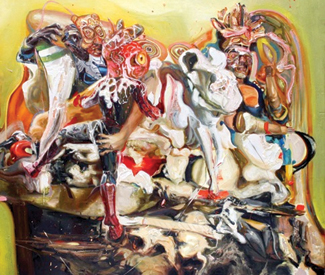
Somewhere in the Hamptons summer home where Glenn Brown and Lucian Freud are renting with Mark Tansey and Matthew Day Jackson, Hagler is stoned on the couch making fart noises with his armpits. That is also a compliment.

Claire Rojas, Gallery Paul Anglim

Sure Gallery Paul Anglim shows Barry McGee, but I’ll be looking at the Rojas paintings, whose hard edge and off-kilter abstractions of interior architectural spaces are spot-on and mesmerizing.

Diane Rosenblum, Slate Contemporary

Rosenblum switches up hyperanalytical and conceptual works that incorporate research, crowdsourced interactions, and photography. I’m hoping to see images from a series of recent photos that work Flickr comments into the image.

Dana Hart Stone, Brian Gross

I can’t wait to examine Hart Stone’s paintings up close, which in the past have been made by repeatedly transferring or printing antique images in rows onto canvas. Also at Brian Gross are Bay Area stalwarts Roy de Forest and Robert Arneson.

Esther Traugot, Chandra Cerrito

Traugot combines found organic objects with crochet. I know what you’re thinking, but this is not a Portlandia skit. She does it the right way, promise.

www.art-mrkt.com/sf

Gatsby who? Check out these cool rep flicks instead! Plus: more new movies.

2

This week: two, count ’em two, series dedicated to oft-overlooked films produced outside the mainstream, dedicated to the seamier things in life: “I Wake Up Dreaming 2013” at the Roxie (Dennis Harvey’s take here), and “Girls! Guns! Ghosts! The Sensational Films of Shintoho” at the Yerba Buena Center for the Arts (I drool here.)

Short takes on wider releases below, including The Great Gatsby, a film adaptation that finally realizes F. Scott Fitzgerald’s deathbed wish: that one day, his most beloved work would be shot in garish 3D. Clearly, only suckers read books anymore.

Aftershock Dumped into theaters without fanfare or advance screenings, this collaboration between co-scenarist/producer/star Eli Roth and Chilean director Nicolás López deserves better — it’s possibly the most luridly entertaining of numerous recent jokey homages to retro grindhouse cinema. Roth plays a character known only as Gringo, a divorced Yank lawyer on vacation traveling around Chile with two local friends, brash Pollo (Nicolás Martínez) and mopey Ariel (Ariel Levy). Their tour of raves, clubs, drugz, and tail-chasing — the rare warm-up half-hour that’s actually very funny and enjoyable — comes to an abrupt halt in Valparaiso. Partying with three newly met multinational lady friends (Lorenza Izzo, Andrea Osvárt, Natasha Yarovenko) they find themselves caught in a major earthquake — and the carnage that it causes is just the beginning of their woes, as crisis piles upon crisis. Spinning ’70s disaster-flick tropes toward crass gore-horror, Aftershock is gleefully trashy enough to get away with outrageous cruelties, including mortal harm served out to characters shockingly high on the cast list. (1:30) (Dennis Harvey)

The Crumbles The awkward slackers and damaged hipsters of The Crumbles live in a sun-strafed, paved-over Los Angeles habitat of coffee shops, taco trucks, bookstores, budding filmmakers, and living room band practice. Darla (Katie Hipol) is slouching nowhere fast when her zany, charismatic cool-girl chum Elisa (Teresa Michelle Lee) enters the picture, looking for a place to crash. Elisa’s wacky, erratic, and unreliable, but she’s also capable of generating real excitement — and a mean little keytar hook — and the girls’ band, the Crumbles, gets off the couch and threatens to get all involved to bust out of their shells. Though director Akira Boch never quite dips into the deep background of his characters’ various dysfunctions — the threatened readings of Darla and Elisa’s psychic friend never quite sheds light — the first-time feature filmmaker has a real feel for the drifting, up-for-anything quality of Cali 20-somethings and an appreciation for their highs and lows that makes this familiar, loving, lets-put-on-show-kids update compelling. (1:13) Roxie. (Kimberly Chun)

The Great Gatsby Every bit as flashy and in-your-face as you’d expect the combo of “Baz Luhrmann,” “Jazz Age,” and “3D” to be, this misguided interpretation of F. Scott Fitzgerald’s classic tale is, at least, overstuffed with visual delights. For that reason only, all the fashion-mag fawning over leading lady Carey Mulligan’s gowns and diamonds, and the opulent production design that surrounds them, seems warranted. And in scenes where spectacle is appropriate — Gatsby’s legendary parties; Tom Buchanan’s wild New York romp with his mistress — Luhrmann delivers in spades. The trade-off is that the subtler aspects of Fitzgerald’s novel are either pushed to the side or shouted from the rooftops. Leonardo DiCaprio, last seen cutting loose in last year’s Django Unchained, makes for a stiff, fumbling Gatsby, laying on the “Old Sports” as thickly as his pancake make-up. There’s nothing here so startlingly memorable as the actor and director’s 1996 prior collaboration, Romeo + Juliet — a more successful (if still lavish and self-consciously audacious) take on an oft-adapted, much-beloved literary work. (2:22) (Cheryl Eddy)

Kiss of the Damned This first feature by Xan Cassavetes isn’t remotely like the Method-y angstfests her late father John used to direct (although he did act in upscale genre movies like 1968’s Rosemary’s Baby and 1978’s The Fury). Instead, it’s an homage to the erotic European horror movies of the late 1960s through early ’80s, with further nods to Dario Argento, 1983’s The Hunger, and other fan-bait. Mysterious Djuna (Joséphine de La Baume) is immediately attracted to hunky screenwriter Paolo (Milo Ventimiglia), and vice versa. But she’s reluctant to follow through, and when he presses, she explains why: she’s a vampire, albeit the respectable kind who only “hunts” wild animals. When he decides that is a drawback he can deal with, they seem set to spend an undead eternity together. Unfortunately, they soon get an unwelcome guest in Djuna’s sister Mimi (Roxane Mesquida), a classic “bad girl” type who has no such compunctions about feasting on “stupid humans,” and whose recklessness threatens the cover of any associated fellow vampire. Like its models, Kiss drags at times, and probably will seem too arty and slow to those attuned to mainstream current horror cinema. But if you’re a dweeb enough to know who the likes of Jean Rollin and Jess Franco are, this aesthetically slavish (on a faithfully low budget) salute to their sexy-bloody vintage schlock should amuse, with Steven Hufsteter’s original score an encyclopedia of vintage Eurotrash soundtrack tropes. (1:37) (Dennis Harvey)

Love is All You Need Copenhagen hairdresser Ida (Trine Dyrholm) has just finished her cancer treatments — with their success still undetermined — when she arrives home to find her longtime husband Leif (Kim Bodnia) boning a coworker on their couch. “I thought you were in chemo” is the closest he comes to an apology before walking out. Ida is determined to maintain a cheerful front when attending the Italian wedding of their daughter Astrid (Molly Blixt Egelind) — even after emotionally deaf Leif shows up with his new girlfriend in tow. Meanwhile brusque businessman and widower Philip (Pierce Brosnan), the groom’s father, is experiencing the discomfort of returning to the villa he once shared with his beloved late wife. This latest from Danish director Susanne Bier and writing partner Anders Thomas Jensen (2006’s After the Wedding, 2004’s Brothers, 2010’s In a Better World) is more conventionally escapist than their norm, with a general romantic-seriocomedy air reinforced by travel-poster-worthy views of the picturesque Italian coastline. They do try to insert greater depth and a more expansive story arc than you’d get in a Hollywood rom com. But all the relationships here are so prickly — between middle-aged leads we never quite believe would attract each other, between the clearly ill-matched aspiring newlyweds, between Paprika Steen’s overbearing sister in-law and everyone — that there’s very little to root for. It’s a romantic movie (as numerous soundtracked variations on “That’s Amore” constantly remind us) in which romance feels like the most contrived element. (1:50) (Dennis Harvey)

Peeples Kerry Washington and Diahann Carroll star in this Tyler Perry-produced family drama set in the Hamptons. (1:35)

Scatter My Ashes at Bergdorf’s This glossy love letter to posh New York City department store Bergdorf Goodman — a place so expensive that shopping there is “an aspirational dream” for the grubby masses, according to one interviewee — would offend with its slobbering take on consumerism if it wasn’t so damn entertaining. The doc’s narrative of sorts is propelled by the small army assembled to create the store’s famed holiday windows; we watch as lavish scenes of upholstered polar bears and sea creatures covered in glittering mosaics (flanking, natch, couture gowns) take shape over the months leading up to the Christmas rush. Along the way, a cavalcade of top designers (Michael Kors, Vera Wang, Giorgio Armani, Jason Wu, Karl Lagerfeld) reminisce on how the store has impacted their respective careers, and longtime employees share anecdotes, the best of which is probably the tale of how John Lennon and Yoko Ono saved the season by buying over 70 fur coats one magical Christmas Eve. Though lip service is paid to the current economic downturn (the Madoff scandal precipitated a startling dropoff in personal-shopper clients), Scatter My Ashes is mostly just superficial, fan-service fun. What do you expect from a store whose best-selling shoe is sparkly, teeteringly tall, and costs $6,000? (1:33) (Cheryl Eddy)

Live Shots: Marina and the Diamonds at the Warfield

0

I like a little grit. Usually I feel that a great show combines unpredictability, recklessness, and some raw, unpolished vulnerability. That’s what makes live music exciting and dynamic. If we wanted flawless vocals and sonically airbrushed instrumentals, we’d just stay at home and listen to the music on iTunes. So I’m trying to figure out why Marina and the Diamonds’ shiny, choreographed, factory-sealed set at the Warfield Sunday night felt so right.
 
Marina looks like an actual Barbie doll, with the kind of proportions people go under the knife for and a no-hair-out-of-place look straight out of a Bettie Page photo shoot. Her live persona is a hyperbolic take on teen idolhood, oozing confidence as she strutted, posed, and gracefully reclined on the daybed featured in her onstage bedroom set (complete with a coat rack, television, and stuffed animals.)
 
As Marina ripped through a packed setlist studded with costume changes and flawlessly executed pop routines, the sold-out audience — 1/3 tween girls, 1/3 their mothers, 1/3 Castro on a Saturday night — screamed and gushed at every opportunity. Fans wore homemade sashes bearing the Marina slogans “teen idle” and “heartbreaker” and nearly everyone had her trademark little black heart painted on their cheeks. And I can see why.
 
Marina is insanely talented. Her rich, clear voice is pitch-perfect. Her songs are catchy, extremely danceable, and overall just good, old-fashioned fun. She shone brightest when the camp factor was turned up to eleven, as it often was, with prop martini glasses full of glitter and neon lighting. Her more stripped down moments, featuring just Marina and a keyboard, lacked the punch and glamour that makes her presence so awesome.
 
But I think what makes Marina so likeable, despite her unbelievable precision and Mattel-like beauty, is that when she sings “I am not a robot,” you believe her. There is something very genuine about Marina’s hyperfeminine persona. When she said, “San Francisco, are you living in this moment right now? Because I am,” it rings true.
 
Usually my feminist blinkers would be going off at the sight of this woman in a crop top singing to tweenage girls about being a prima donna, but instead I found myself singing along with thousands of devoted fans, “Oh my God, you look just like Shakira/ No, no, you’re Catherine Zeta/ Actually, my name’s Marina!”

The simple fact is that Marina knows what she’s doing. Her image doesn’t seem contrived or commercially driven — it seems like a reclaiming of the femme fatale.
 
Marina may not be redefining dance music or pushing any major envelopes, but she rules at what she does. She absolutely dominates the stage, reminding everyone that there’s no shame in letting yourself enjoy a great pop hook, and that a powerful woman can still totally rock a pink vinyl minidress.

Crazy sexy cruel

0

FILM Long before VHS demon Sadako glared one eye through a tent of tangled black hair in 1998’s Ring (American viewers may switch that to “Samara” and “2002”), another angry, swampy-coiffed dame was doing her best to scare the bejesus out of ticket buyers. The year was 1825, and the kabuki play was called Yotsuya Kaidan. Ghost Story of Yotsuya, the 1959 version of that oft-filmed tale — which contains visual motifs made famous by J-horror — kicks off the Yerba Buena Center for the Arts’ titillatingly-titled “Girls! Guns! Ghosts! The Sensational Films of Shintoho” series (Thu/9-May 26).

Exploitation specialist Shintoho is often described as “the Japanese American International Pictures,” with output likened to Roger Corman’s oeuvre. The comparison is apt, what with the overlapping timelines (Shintoho was active from 1949-1961) and shared love of low-budget productions chockablock with daring, sleazy, violent, racy, and otherwise beyond-the-mainstream themes. Most of the films in “Girls!” are under 90 minutes, and a good portion of them are even shorter. Ghost Story of Yotsuya, directed by prolific Shintoho hand Nobuo Nakagawa, clocks in at a pulse-pounding 76 minutes.

It opens on a kabuki stage, with a macabre song hinting at what’s to come: “the greatest horror there is,” we’re warned, is “the fury of a woman maddened.” Though it takes nearly an hour to get to payback o’ clock, that allows plenty of time to pile up just cause: sleazy samurai Iemon woos pretty, naive Iwa (played, respectively, by studio faves Shigeru Amachi and Katsuko Wakasugi) after killing her suspicious father and shoving her sister’s beau over a waterfall. Unsurprisingly, he makes for a cruel, manipulative husband, using his wife for gambling collateral and feeding her “medicine for your circulation” once a younger, richer girl captures his attentions. The poison does a Phantom of the Opera-style number on Iwa’s face before hastening her death. “I will visit my hatred upon you,” Iwa’s pissed-off ghost declares, and boy, does she — no VCR required.

More cranky spirits populate Ghost Cat of Otama Pond (1960), which leans heavily on (blood) red and (supernatural) green lighting effects to weave its tale of, again, revenge from beyond the grave. This time, it’s revenge so patient it waits generations to cause havoc, cursing a contemporary woman who stumbles into an abandoned house when she and her fiancé keep tracing the same route through the woods in a Twilight Zone-ish frame story. (Pro-tip: maybe don’t declare, “I hate cats!” when you encounter one with witchy powers.) A flashback to centuries prior explores a feud between two families that encompasses forced marriages, haunted hairpins, horrific fires, bodies tossed in the titular pond, and a monster that takes on an oddly feline form.

Of course, not all of Shintoho’s films were period-pic screamers. A trio of black-and-white “Girls!” selections embrace pulpy, seedy, noirish characters and situations. Nakagawa’s Death Row Woman (1960) begins, ominously, as a posh family goes duck hunting. (“You could kill a person!” someone remarks of another character’s shooting skill.) Rebel daughter Kyoko (Miyuki Takakura) doesn’t want to marry the man her father has picked out for her — but her stepmother and stepsister are none too pleased with Kyoko’s own choice, for different reasons. When Daddy Dearest suddenly croaks, it’s a death sentence for Kyoko — who is actually guilty only of being shrill pain in the ass. Lightly lascivious woman-in-prison scenes (this isn’t 1983’s Chained Heat or anything) are followed by a daring, Fugitive-style escape, though ain’t nobody getting justice without suffering through a vat full of melodrama first.

Even more entertaining are the two films in “Girls!” directed by Teruo Ishii: 1958’s Flesh Pier and 1960’s Yellow Line. Both make great use of back-alley characters, with fedoras and fishnets to spare. Flesh Pier‘s action is set in Ginza, as an undercover cop who’s in love with a burlesque dancer investigates the city’s “trade in flesh;” also undercover is a female reporter hoping to get a big scoop on same. (This film contains a fashion-show scene in which nightie-clad models smoke cigarettes on the runway.) Meanwhile, Yellow Line follows a moody hitman (Amachi again) who kidnaps a dancer (a sassy Yoko Mihara) and drags her to Kobe’s red-light “Casbah” district, with her newspaper-reporter boyfriend in hot pursuit. (This film contains a hooker named “the Moor,” played by a white actress in blackface.)

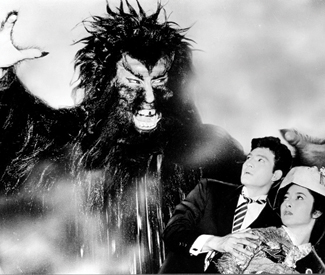
Not available for preview, but likely as mind-blowing as any and all of the above: Michiyoshi Doi’s The Horizon Glitters (1960), described as a “black comedy about a prison break gone wrong;” Toshio Shimura’s 1956 Revenge of the Pearl Queen, about a bodacious, ass-kicking female pearl diver played by Michiko Maeda (a.k.a. “the first Japanese actress to appear in a nude scene in a mainstream film” … this film); and Kyotaro Namiki’s Vampire Bride (1960), in which a scarred young dancer transforms into a horrific, hairy beast. If a picture says a thousand words, the widely circulated still from this film positively shrieks them. 


“GIRLS! GUNS! GHOSTS! THE SENSATIONAL FILMS OF SHINTOHO”

May 9-26, $8-10

Yerba Buena Center for the Arts

701 Mission, SF

www.ybca.org

Girls-only hackerspace teaches critical thinking through crafts

7

Get out your glue sticks girls, it’s time to get crafty. Turns out, all that glitters really is gold for summer campers who will wind up at the girls-only craft camps that Curious Jane is hosting in Marin County this summer. Young women aged six to 12 will glean a wealth of knowledge from DIY-centered classes aimed towards not just inspiring creativity, but cultivating critical thinking skills through projects — costume design, storyboarding graphic novels, toy design, and more.

The Brooklyn-based company, which employs all female camp counselors, is bringing its contribution to girl power to the West Coast for the first time this summer. Curious Jane founder and mother of two Samantha Razook Murphy wanted to provide her daughters with a space to create collaboratively in an high-energy, girl-powered environment — so she made it herself. 

Curious Jane is celebrating its cross-coastal arrival with what it’s calling a hackerspace for girls on May 19, followed by a three-week summer camp session at the San Domenico School in San Anselmo starting July 29. That camp will include the workshops, and a place for girls to engage in hands-on, project based classes exploring basics in design, building, and science, fostering a sense of individual empowerment in a group setting.

The camp’s marketing director Melisa Coburn was eager to hype the arts ‘n’ crafts-a-rama. “My daughter attends the programs and I can tell you from the “mom’ perspective that girls LOVE the programs”, she tells the Guardian in email.

Keep your daughters off the couch this summer — this camp looks great, and the May 19 event would be a great chance to give it a test run. 

Make It/Take It hackerspace for girls

May 19, 12:30pm – 4pm, $20 or $15 if you bring a friend

Marin Art and Garden Center

30 Sir Francis Drake Blvd., Ross

www.curiousjanecamp.com

Rep Clock

0

Schedules are for Wed/8-Tue/14 except where noted. Director and year are given when available. Double and triple features marked with a •. All times pm unless otherwise specified.

ANSWER COALITION 2969 Mission, SF; www.answersf.org. $5-10 (no one turned away for lack of funds). The Battle of Chile: The Power of the People (Guzmán), Wed, 7.

ARTISTS’ TELEVISION ACCESS 992 Valencia, SF; www.atasite.org. $6-10. "Revelcade Applause Night," shorts by Bay Area filmmakers, Fri, 8.

CASTRO 429 Castro, SF; (415) 621-6120, www.castrotheatre.com. $8.50-13. •Badlands (Malick, 1973), Wed, 7, and Electra Glide in Blue (Guercio, 1973), Wed, 8:50. San Francisco International Film Festival, Thu. See festival.sffs.org for schedule. •John Dies at the End (Coscarelli, 2012), Fri, 7, and The Rambler (Reeder, 2013), Fri, 8:55. "Marc Huestis presents: Mother’s Day with Mommie Dearest:" Mildred Pierce (Curtiz, 1945), Sat, 2; Mommie Dearest (Perry, 1981), Sat, 7:30. Evening event ($15; www.ticketfly.com) includes a live appearance by actress Rutanya Alda, with host Matthew Martin. •The Red Shoes (Powell and Pressburger, 1948), Sun, 2:55, 8, and The Life and Death of Colonel Blimp (Powell and Pressburger, 1943), Sun, 5. The Master (Anderson, 2012), Tue, 2, 5, 8.

CHRISTOPHER B. SMITH RAFAEL FILM CENTER 1118 Fourth St, San Rafael; (415) 454-1222, www.cafilm.org. $6.75-$10.25. The Angels’ Share (Loach, 2012), call for dates and times. Blancanieves (Berger, 2012), call for dates and times. In the House (Ozon, 2012), call for dates and times. The Reluctant Fundamentalist (Nair, 2012), call for dates and times. Renoir (Bourdos, 2012), call for dates and times.

GREAT WALL OF OAKLAND West Grand between Broadway and Valley, Oakl; www.oaklandcatvidfest.com. $10-75. "Oakland Internet Cat Video Festival," benefit for the East Bay SPCA with pre-screening events (cat-themed music, animal rescue groups, food trucks, and more), plus an appearance by special guest Dusty the Klepto Kitty, Sat, 3-10.

JEWISH COMMUNITY CENTER OF SAN FRANCISCO Kanbar Hall, 3200 California, SF; www.jccsf.org. $8-12. Under African Skies (Berlinger, 2012), Mon, 7.

MECHANICS’ INSTITUTE 57 Post, SF; (415) 393-0100, milibrary.org/events. $10 (reservations required as seating is limited). "CinemaLit Film Series: Paddy Chayefsky: Scenes from American Lives:" The Catered Affair (Brooks, 1956), Fri, 6.

NEW PARKWAY 474 24th St, Oakl; www.thenewparkway.com. $6-10. "New Parkway Classics:" Wild at Heart (Lynch, 1990), Thu, 9pm. "Thrillville:" Mothra (Honda, 1961), Sun, 6.

OAKLAND PUBLIC LIBRARY 1021 81st Ave, Oakl; www.oaklandlibrary.org. Free. Just a Piece of Cloth (Henze), Sat, 2.

"PLAYGROUND FILM FESTIVAL" Various Bay Area venues; playground-sf.org/filmfest. $10-25. Showcasing Bay Area filmmakers and writers and their short work. Through May 25.

PACIFIC FILM ARCHIVE 2575 Bancroft, Berk; (510) 642-5249, bampfa.berkeley.edu. $5.50-9.50. San Francisco International Film Festival, Wed-Thu. See festival.sffs.org for schedule. "Film and Video Makers at Cal: Works from the Eisner Prize Competition," Fri, 7. PFA closed through June 5.

ROXIE 3117 and 3125 16th St, SF; (415) 863-1087, www.roxie.com. $6.50-11. CXL (Gillane, 2012), Wed, 7:15. The Source Family (Demopoulos and Wille, 2012), Wed-Thu, 7, 9:30. Upstream Color (Carruth, 2013), Wed-Thu, 9. The Crumbles (Boch, 2012), Sat, 3, 5, 7, 9. "I Wake Up Dreaming 2013:" •I Wake Up Screaming (Humberstone, 1941), Fri, 6:15, 9:45, and Blues in the Night (Rossen, 1941), Fri, 8; •Under Age (Dmytryk, 1941), Sat, 2, 6:30; Johnny O’ Clock (Rossen, 1947), Sat, 3:15, 8; and The Monster and the Girl (Heisler, 1941), Sat, 5, 9:45; •Fall Guy (Le Borg, 1947), Sun, 1:30, 6:15; Night Has a Thousand Eyes (Farrow, 1948), Sun, 2:50, 7:45; •Club Havana (Ulmer, 1945), Mon, 6:40, 9:30, and Island of Doomed Men (Barton, 1940), Mon, 8; •Nightmare (Whelan, 1942), Tue, 6:15, 9:50, and All Through the Night (Sherman, 1942), Tue, 8.

VICTORIA THEATRE 2961 16th St, SF; www.peacheschrist.com. $30-35. "The Rocky Horror Show 40th Anniversary Concert Tribute," with Patricia "Magenta" Quinn performing live and other special guests, Fri-Sat, 8 (also Sat, 3).

YERBA BUENA CENTER FOR THE ARTS 701 Mission, SF; www.ybca.org. $8-10. "Girls! Guns! Ghosts! The Sensational Films of Shintoho:" Ghost Story of Yotsuya (Nakagawa, 1959), Thu, 7:30; Flesh Pier (Ishii, 1958), Sun, 2.

Film listings

0

Film listings are edited by Cheryl Eddy. Reviewers are Kimberly Chun, Dennis Harvey, Lynn Rapoport, and Sara Maria Vizcarrondo. For rep house showtimes, see Rep Clock.

SAN FRANCISCO INTERNATIONAL FILM FESTIVAL

The San Francisco International Film Festival runs through Thu/9 at the Castro Theatre, 429 Castro, SF; New People Cinema, 1746 Post, SF; Pacific Film Archive, 2575 Bancroft, Berk; and Sundance Kabuki Cinemas 1881 Post, SF. For tickets (most shows $10-15) and complete schedule, visit festival.sffs.org.

OPENING

The Crumbles The awkward slackers and damaged hipsters of The Crumbles live in a sun-strafed, paved-over Los Angeles habitat of coffee shops, taco trucks, bookstores, budding filmmakers, and living room band practice. Darla (Katie Hipol) is slouching nowhere fast when her zany, charismatic cool-girl chum Elisa (Teresa Michelle Lee) enters the picture, looking for a place to crash. Elisa’s wacky, erratic, and unreliable, but she’s also capable of generating real excitement — and a mean little keytar hook — and the girls’ band, the Crumbles, gets off the couch and threatens to get all involved to bust out of their shells. Though director Akira Boch never quite dips into the deep background of his characters’ various dysfunctions — the threatened readings of Darla and Elisa’s psychic friend never quite sheds light — the first-time feature filmmaker has a real feel for the drifting, up-for-anything quality of Cali 20-somethings and an appreciation for their highs and lows that makes this familiar, loving, lets-put-on-show-kids update compelling. (1:13) Roxie. (Chun)

The Great Gatsby Baz Luhrmann reunites with his Romeo + Juliet (1996) star Leonardo DiCaprio for this long-awaited 3D adaptation of F. Scott Fitzgerald’s classic novel. (2:22) California, Four Star, Marina, Presidio, Vogue.

Kiss of the Damned This first feature by Xan Cassavetes isn’t remotely like the Method-y angstfests her late father John used to direct (although he did act in upscale genre movies like 1968’s Rosemary’s Baby and 1978’s The Fury). Instead, it’s an homage to the erotic European horror movies of the late 1960s through early ’80s, with further nods to Dario Argento, 1983’s The Hunger, and other fan-bait. Mysterious Djuna (Joséphine de La Baume) is immediately attracted to hunky screenwriter Paolo (Milo Ventimiglia), and vice versa. But she’s reluctant to follow through, and when he presses, she explains why: she’s a vampire, albeit the respectable kind who only "hunts" wild animals. When he decides that is a drawback he can deal with, they seem set to spend an undead eternity together. Unfortunately, they soon get an unwelcome guest in Djuna’s sister Mimi (Roxane Mesquida), a classic "bad girl" type who has no such compunctions about feasting on "stupid humans," and whose recklessness threatens the cover of any associated fellow vampire. Like its models, Kiss drags at times, and probably will seem too arty and slow to those attuned to mainstream current horror cinema. But if you’re a dweeb enough to know who the likes of Jean Rollin and Jess Franco are, this aesthetically slavish (on a faithfully low budget) salute to their sexy-bloody vintage schlock should amuse, with Steven Hufsteter’s original score an encyclopedia of vintage Eurotrash soundtrack tropes. (1:37) Shattuck. (Harvey)

Love is All You Need Copenhagen hairdresser Ida (Trine Dyrholm) has just finished her cancer treatments — with their success still undetermined — when she arrives home to find her longtime husband Leif (Kim Bodnia) boning a coworker on their couch. "I thought you were in chemo" is the closest he comes to an apology before walking out. Ida is determined to maintain a cheerful front when attending the Italian wedding of their daughter Astrid (Molly Blixt Egelind) — even after emotionally deaf Leif shows up with his new girlfriend in tow. Meanwhile brusque businessman and widower Philip (Pierce Brosnan), the groom’s father, is experiencing the discomfort of returning to the villa he once shared with his beloved late wife. This latest from Danish director Susanne Bier and writing partner Anders Thomas Jensen (2006’s After the Wedding, 2004’s Brothers, 2010’s In a Better World) is more conventionally escapist than their norm, with a general romantic-seriocomedy air reinforced by travel-poster-worthy views of the picturesque Italian coastline. They do try to insert greater depth and a more expansive story arc than you’d get in a Hollywood rom com. But all the relationships here are so prickly — between middle-aged leads we never quite believe would attract each other, between the clearly ill-matched aspiring newlyweds, between Paprika Steen’s overbearing sister in-law and everyone — that there’s very little to root for. It’s a romantic movie (as numerous soundtracked variations on "That’s Amore" constantly remind us) in which romance feels like the most contrived element. (1:50) Embarcadero. (Harvey)

Peeples Kerry Washington and Diahann Carroll star in this Tyler Perry-produced family drama set in the Hamptons. (1:35)

Scatter My Ashes at Bergdorf’s This glossy love letter to posh New York City department store Bergdorf Goodman — a place so expensive that shopping there is "an aspirational dream" for the grubby masses, according to one interviewee — would offend with its slobbering take on consumerism if it wasn’t so damn entertaining. The doc’s narrative of sorts is propelled by the small army assembled to create the store’s famed holiday windows; we watch as lavish scenes of upholstered polar bears and sea creatures covered in glittering mosaics (flanking, natch, couture gowns) take shape over the months leading up to the Christmas rush. Along the way, a cavalcade of top designers (Michael Kors, Vera Wang, Giorgio Armani, Jason Wu, Karl Lagerfeld) reminisce on how the store has impacted their respective careers, and longtime employees share anecdotes, the best of which is probably the tale of how John Lennon and Yoko Ono saved the season by buying over 70 fur coats one magical Christmas Eve. Though lip service is paid to the current economic downturn (the Madoff scandal precipitated a startling dropoff in personal-shopper clients), Scatter My Ashes is mostly just superficial fun. What do you expect from a store whose best-selling shoe is sparkly, teeteringly tall, and costs $6,000? (1:33) Clay, Shattuck. (Eddy)

ONGOING

The Angels’ Share The latest from British filmmaker Ken Loach (2006’s The Wind that Shakes the Barley) and frequent screenwriter collaborator Paul Leverty contains a fair amount of humor — though it’s still got plenty of their trademark grit and realism. Offered "one last opportunity" by both a legal system he’s frequently disregarded and his exasperated and heavily pregnant girlfriend, ne’er-do-well Glaswegian Robbie (Paul Brannigan) resolves to straighten out his life. But his troubled past proves a formidable roadblock to a brighter future — until he visits a whiskey distillery with the other misfits he’s been performing his court-ordered community service with, and the group hatches an elaborate heist that could bring hope for Robbie and his growing family … if his gang of "scruffs" can pull it off. Granted, there are some familiar elements here, but this 2012 Cannes jury prize winner (the fest’s de facto third-place award) is more enjoyable than predictable — thanks to some whiskey-tasting nerd-out scenes, likable performances by its cast of mostly newcomers, and lines like "Nobody ever bothers anybody wearing a kilt!" (not necessarily true, as it turns out). Thankfully, English subtitles help with the thick Scottish accents. (1:41) Opera Plaza, Smith Rafael. (Eddy)

At Any Price Growing up in rural Iowa very much in the shadow of his older brother, Dean Whipple (Zac Efron) cultivated a chip on his shoulder while dominating the figure 8 races at the local dirt track. When papa Henry (Dennis Quaid) — a keeping-up-appearances type, with secrets a-plenty lurking behind his good ol’ boy grin — realizes Dean is his best hope for keeping the family farm afloat, he launches a hail-mary attempt to salvage their relationship. This latest drama from acclaimed indie director Ramin Bahrani (2008’s Goodbye Solo) is his most ambitious to date, enfolding small-town family drama and stock-car scenes into a pointed commentary on modern agribusiness (Henry deals in GMO corn, and must grapple with the sinister corporate practices that go along with it). But the film never gels, particularly after an extreme, third-act plot twist is deployed to, um, hammer home the title — which refers to prices both monetary and spiritual. A solid supporting cast (Kim Dickens, Heather Graham, Clancy Brown, Red West, newcomer Maika Monroe) helps give the film some much-needed added weight as it veers toward melodrama. (1:45) SF Center. (Eddy)

The Big Wedding The wedding film has impacted our concepts of matrimony, fashion, and marital happiness more than all the textbooks in the world have affected our national testing average; but it’s with that margin of mediocrity I report from the theater trenches of The Big Wedding. With this, the wedding movie again peters to a crawl. Susan Sarandon (an actress I love with a loyalty beyond sense) is Bebe, the stepmother/caterer swept under the rug by the selfishness of her live in lover Don (De Niro), his ex-wife/baby momma Elle (Diane Keaton) and their racist wackjob future in-laws. When Don and Elle faced the end of their marriage, they tried to rekindle with a Columbian orphan. Cue Ben Barnes in brownface. Alejandro is set to wed Amanda Seyfried and when his mother ascends from Columbia for the wedding, he decides Don and Elle have to act like their marriage never ended &ldots; which makes Bebe a mistress. Surprise! A decade of caring selflessly for your lover’s kids has won you a super shitty wedding you still have to cater! To give you a sense of the conflict management on display, Bebe — the film’s graceful savior —drops a drink on Don before fleeing the scene in her Alfa Romeo; she’s the one character not determined to act out her more selfish urges in the style of an MTV reality show. Despite some less imaginative conflicts and degrading "solutions," this blended family still speaks some truth about the endearing embarrassment of the happy family. (1:29) 1000 Van Ness, SF Center. (Vizcarrondo)

Blancanieves If you saw the two crappy overblown Hollywood takes on Snow White last year, my condolences. This is probably its best cinematic incarnation ever not made by someone called Walt. Pablo Berger’s Blancanieves transplants the tale to 1920s Spain and told (à la 2011’s The Artist) in the dialogue-free B&W style of that era’s silent cinema. Here, Snow is the daughter of a famous bullfighter (a beautiful performance by Daniel Giménez Cacho) who’s paralyzed physically in the ring, then emotionally by the death of his flamenco star wife (Inma Cuesta) in childbirth. He can’t bring himself to see his daughter until a grandmother’s death brings little Carmencita (the marvelous Sofía Oria) to the isolated ranch he now shares with nurse-turned-second-wife Encarna — Maribel Verdú as a very Jazz Age evil stepmother. Once the girl matures (now played by the ingratiating, slightly androgynous Macarena García), Encarna senses a rival, and to save her life Carmen literally runs away with the circus — at which point the narrative slumps a bit. But only a bit. Where The Artist was essentially a cleverly sustained gimmick elevated by a wonderful central performance, Blancanieves transcends its ingenious retro trappings to offer something both charming and substantiative. Berger doesn’t treat the story template as a joke — he’s fully adapted it to a culture, place, and time, and treats its inherent pathos with great delicacy. (1:44) Opera Plaza, Shattuck, Smith Rafael. (Harvey)

The Company You Keep Robert Redford directs and stars as a fugitive former member of the Weather Underground, who goes on the run when another member (Susan Sarandon) is arrested and a newspaper reporter (Shia LaBeouf) connects him to a murder 30 years earlier during a Michigan bank robbery. Both the incident and the individuals in The Company You Keep are fictive, but a montage of archival footage at the start of the film is used to place them in the company of real-life radicals and events from the latter days of the 1960s-’70s antiwar movement. (The film’s timeline is a little hard to figure, as the action seems to be present day.) Living under an assumed name, Redford’s Nick Sloan is now a recently widowed public interest lawyer with a nine-year-old daughter, still fighting the good fight from the suburbs of Albany, NY — though some of his movement cohorts would probably argue that point. And as Nick heads cross-country on a hunt for one of them who’s still deep underground, and LaBeouf’s pesky reporter tussles with FBI agents (Terrance Howard and Anna Kendrick) and his besieged editor (Stanley Tucci) — mostly there to pass comment on print journalism’s precipitous decline — there’s plenty of contentious talk, none of it particularly trenchant or involving. Redford packs his earnest, well-intentioned film with stars delineating a constellation of attitudes about revolution, justice, and violent radical action — Julie Christie as an unrepentant radical and Nick’s former lover, Nick Nolte and Richard Jenkins as former movement members, Brendan Gleeson as a Michigan police detective involved in the original investigation, Chris Cooper as Nick’s estranged and disapproving younger brother. But their scrutiny, and the film’s, feels blurry and rote, while the plot’s one major twist seems random and is clumsily exposed. (2:05) Albany, SF Center. (Rapoport)

The Croods (1:38) Metreon, 1000 Van Ness.

Disconnect (1:55) 1000 Van Ness, Presidio, SF Center.

Evil Dead "Sacrilege!" you surely thought when hearing that Sam Raimi’s immortal 1983 classic was being remade. But as far as remakes go, this one from Uruguayan writer-director Fede Alvarez (who’d previously only made some acclaimed genre shorts) is pretty decent. Four youths gather at a former family cabin destination because a fifth (Jane Levy) has staged her own intervention — after a near-fatal OD, she needs her friends to help her go cold turkey. But as a prologue has already informed us, there is a history of witchcraft and demonic possession in this place. The discovery of something very nasty (and smelly) in the cellar, along with a book of demonic incantations that Lou Taylor Pucci is stupid enough to read aloud from, leads to … well, you know. The all-hell that breaks loose here is more sadistically squirm-inducing than the humorously over-the-top gore in Raimi’s original duo (elements of the sublime ’87 Evil Dead II are also deployed here), and the characters are taken much more seriously — without, however, becoming more interesting. Despite a number of déjà vu kamikaze tracking shots through the Michigan forest (though most of the film was actually shot in New Zealand), Raimi’s giddy high energy and black comedy are replaced here by a more earnest if admittedly mostly effective approach, with plenty of decent shocks. No one could replace Bruce Campbell, and perhaps it was wise not to even try. So: pretty good, gory, expertly crafted, very R-rated horror fun, even with too many "It’s not over yet!" false endings. But no one will be playing this version over and over and over again as they (and I) still do the ’80s films. (1:31) Metreon, 1000 Van Ness. (Harvey)

42 Broad and morally cautious, 42 is nonetheless an honorable addition to the small cannon of films about the late, great baseball player Jackie Robinson. When Dodgers owner Branch Rickey (Harrison Ford) declares that he wants a black player in the white major leagues because "The only real color is green!", it’s a cynical explanation that most people buy, and hate him for. It also starts the ball curving for a PR shitstorm. But money is an equal-opportunity leveling device: when Robinson (Chadwick Boseman) tries to use the bathroom at a small-town gas station, he’s denied and tells his manager they should "buy their 99 gallons of gas another place." Naturally the gas attendant concedes, and as 42 progresses, even those who reject Robinson at first turn into men who find out how good they are when they’re tested. Ford, swashbuckling well past his sell-by date, is a fantastic old coot here; his "been there, lived that" prowess makes you proud he once fled the path of a rolling bolder. His power moves here are even greater, but it’s ultimately Robinson’s show, and 42 finds a lot of ways to deliver on facts and still print the legend. (2:08) Metreon, 1000 Van Ness, Sundance Kabuki. (Vizcarrondo)

From Up on Poppy Hill Hayao (dad, who co-wrote) and Goro (son, who directed) Miyazaki collaborate on this tale of two high-school kids — Umi, who does all the cooking at her grandmother’s boarding house, and Shun, a rabble-rouser who runs the school newspaper — in idyllic seaside Yokohama. Plans for the 1964 Olympics earmark a beloved historic clubhouse for demolition, and the budding couple unites behind the cause. The building offers a symbolic nod to Japanese history, while rehabbing it speaks to hopes for a brighter post-war future. But the past keeps interfering: conflict arises when Shun’s memories are triggered by a photo of Umi’s father, presumed lost at sea in the Korean War. There are no whimsical talking animals in this Studio Ghibli release, which investigates some darker-than-usual themes, though the animation is vivid and sparkling per usual. Hollywood types lending their voices to the English-language version include Jamie Lee Curtis, Christina Hendricks, Ron Howard, and Gilllian Anderson. (1:31) Shattuck. (Eddy)

GI Joe: Retaliation The plot exists to justify the action, but any fan of badass-ness will forgive the skimpy storyline for the outlandish badassery in GI Joe: Retaliation. Inspired by action figures and tying loosely to the first flick, Retaliation starts with a game of "secure the defector," followed by "raise the flag," but as soon as the stakes aren’t real, the Joes outright suck. They don’t have "neutral," which is maybe why a mission to rescue and revive the Joes as a force is the most ferocious fight that ever pit metal against plastic. The set pieces are stunning: a mostly silent sequence with Snake Eyes (Ray Park) and Jinx (Elodie Yung) on a mountainside will leave the audience gaping in its high speed wake, and a prison break featuring covert explosives is nonstop amazing. You’ll notice an emphasis on chain link fences and puddles (terra nostra for action figures) and set pieces conceived as if by kids who don’t have a concept of basic irrefutable truths like gravity. It’s just that kind of imagination and ardor and limitlessness that makes this Joe incredible, memorable, and a reason to crack out your toys again. (1:50) Metreon. (Vizcarrondo)

In the House In François Ozon’s first feature since the whimsical 2010 Potiche, he returns somewhat to the playful suspense intrigue of 2003’s Swimming Pool, albeit with a very different tone and context. Fabrice Luchini plays a high school French literature teacher disillusioned by his students’ ever-shrinking articulacy. But he is intrigued by one boy’s surprisingly rich description of his stealth invasion into a classmate’s envied "perfect" family — with lusty interest directed at the "middle class curves" of the mother (Emmanuelle Seigner). As the boy Claude’s writings continue in their possibly fictive, possibly stalker-ish provocations, his teacher grows increasingly unsure whether he’s dealing with a precocious bourgeoisie satirist or a literate budding sociopath — and ambivalent about his (and spouse Kristin Scott Thomas’ stressed gallery-curator’s) growing addiction to these artfully lurid possible exposé s of people he knows. And it escalates from there. Ozon is an expert filmmaker in nimble if not absolute peak form here, no doubt considerably helped by Juan Mayorga’s source play. It’s a smart mainstream entertainment that, had it been Hollywood feature, would doubtless be proclaimed brilliant for its clever tricks and turns. (1:45) Albany, Embarcadero, Smith Rafael. (Harvey)

Iron Man 3 Neither a sinister terrorist dubbed "the Mandarin" (Ben Kingsley) nor a spray-tanned mad scientist (Guy Pearce) are as formidable an enemy to Tony Stark (Robert Downey, Jr.) as Tony Stark himself, the mega-rich playboy last seen in 2012’s Avengers donning his Iron Man suit and thwarting alien destruction. It’s been rough since his big New York minute; he’s been suffering panic attacks and burying himself in his workshop, shutting out his live-in love (Gwyneth Paltrow) in favor of tinkering on an ever-expanding array of manned and un-manned supersuits. But duty, and personal growth, beckon when the above-mentioned villains start behaving very badly. With some help (but not much) from Don Cheadle’s War Machine — now known as "Iron Patriot" thanks to a much-mocked PR campaign — Stark does his saving-the-world routine again. If the plot fails to hit many fresh beats (a few delicious twists aside), the 3D special effects are suitably dazzling, the direction (by series newcomer Shane Black) is appropriately snappy, and Downey, Jr. again makes Stark one of the most charismatic superheros to ever grace the big screen. For now, at least, the continuing Avengers spin-off extravaganza seems justified. (2:06) Marina, 1000 Van Ness, Presidio, Sundance Kabuki. (Eddy)

Jurassic Park 3D "Life finds a way," Jeff Goldblum’s leather-clad mathematician remarks, crystallizing the theme of this 1993 Spielberg classic, which at its core is more about human relationships than genetically manufactured terrors. Of course, it’s got plenty of those, and Jurassic Park doesn’t really need its (admittedly spiffy) 3D upgrade to remain a thoroughly entertaining thriller. The dinosaur effects — particularly the creepy Velociraptors and fan-fave T. rex — still dazzle. Only some early-90s computer references and Laura Dern’s mom jeans mark the film as dated. But a big-screen viewing of what’s become a cable TV staple allows for fresh appreciation of its less-iconic (but no less enjoyable) moments and performances: a pre-megafame Samuel L. Jackson as a weary systems tech; Bob Peck as the park’s skeptical, prodigiously thigh-muscled game warden. Try and forget the tepid sequels — including, dear gawd, 2014’s in-the-works fourth installment. This is all the Jurassic you will ever need. (2:07) 1000 Van Ness, SF Center, Shattuck. (Eddy)

Kon-Tiki In 1947 Norwegian explorer and anthropologist Thor Heyderdahl arranged an expedition on a homemade raft across the Pacific, recreating what he believed was a route by which South Americans traveled to Polynesia in pre-Columbian times. (Although this theory is now disputed.) The six-man crew (plus parrot) survived numerous perils to complete their 101-day, 4300-mile journey intact — winning enormous global attention, particularly through Heyderdahl’s subsequent book and documentary feature. Co-directors Joachim Roenning and Espen Sandberg’s dramatization is a big, impressive physical adventure most arresting for its handsome use of numerous far-flung locations. Where it’s less successful is in stirring much emotional involvement, with the character dynamics underwhelming despite a decent cast led by Pal Sverr Hagen as Thor (who, incredibly, was pretty much a non-swimmer). Nonetheless, this new Kon-Tiki offers all the pleasures of armchair travel, letting you vicariously experience a high-risk voyage few could ever hope (or want) to make in real life. (1:58) Embarcadero. (Harvey)

Mud (2:15) California, Metreon, 1000 Van Ness, Piedmont.

No Long before the Arab Spring, a people’s revolution went down in Chile when a 1988 referendum toppled the country’s dictator, Augusto Pinochet, thanks in part to an ad exec who dared to sell the dream to his countrymen and women — using the relentlessly upbeat, cheesy language of a Pepsi Generation. In No‘s dramatization of this true story, ad man Rene Saavedra (Gael Garcia Bernal) is approached by the opposition to Pinochet’s regime to help them on their campaign to encourage Chile’s people to vote "no" to eight more years under the brutal strongman. Rene’s well-aware of the horrors of the dictatorship; not only are the disappeared common knowledge, his activist ex (Antonia Zegers) has been beaten and jailed with seeming regularity. Going up against his boss (Alfredo Castro), who’s overseeing the Pinochet campaign, Rene takes the brilliant tact in the opposition’s TV programs of selling hope — sound familiar? — promising "Chile, happiness is coming!" amid corny mimes, dancers, and the like. Director-producer Pablo Larrain turns out to be just as genius, shooting with a grainy U-matic ’80s video camera to match his footage with 1988 archival imagery, including the original TV spots, in this invigorating spiritual kin of both 2012’s Argo and 1997’s Wag the Dog. (1:50) Shattuck. (Chun)

Oblivion Spoiler alert: the great alien invasion of 2017 does absolutely zilch to eliminate, or at least ameliorate, the problem of sci-fi movie plot holes. However, puny humans willing to shut down the logic-demanding portions of their brains just might enjoy Oblivion, which is set 60 years after that fateful date and imagines that Earth has been rendered uninhabitable by said invasion. Tom Cruise plays Jack, a repairman who zips down from his sterile housing pod (shared with comely companion Andrea Riseborough) to keep a fleet of drones — dispatched to guard the planet’s remaining resources from alien squatters — in working order. But Something is Not Quite Right; Jack’s been having nostalgia-drenched memories of a bustling, pre-war New York City, and the déjà vu gets worse when a beautiful astronaut (Olga Kurylenko) literally crash-lands into his life. After an inaugural gig helming 2010’s stinky Tron: Legacy, director Joseph Kosinski shows promise, if not perfection, bringing his original tale to the screen. (He does, however, borrow heavily from 1968’s 2001: A Space Odyssey, 1996’s Independence Day, and 2008’s Wall-E, among others.) Still, Oblivion boasts sleek production design, a certain creative flair, and some surprisingly effective plot twists — though also, alas, an overlong running time. (2:05) Metreon, 1000 Van Ness, Sundance Kabuki. (Eddy)

Oz: The Great and Powerful Providing a backstory for the man behind the curtain, director Sam Raimi gives us a prequel of sorts to 1939’s The Wizard of Oz. Herein we follow the adventures of a Depression-era Kansas circus magician named Oscar (James Franco) — Oz to his friends — as he cons, philanders, bickers with his behind-the-scenes assistant Frank (Zach Braff), and eventually sails away in a twister, bound for a Technicolor land of massively proportioned flora, talking fauna, and witches ranging from dazzlingly good to treacherously wicked. From one of them, Theodora (Mila Kunis), he learns that his arrival — in Oz, just to clarify — has set in motion the fulfillment of a prophecy: that a great wizard, also named Oz, will bring about the downfall of a malevolent witch (Rachel Weisz), saving the kingdom and its cheery, goodhearted inhabitants. Unfortunately for this deserving populace, Oz spent his last pre-twister moments with the Baum Bros. Circus (the name a tribute to L. Frank Baum, writer of the Oz children’s books) demonstrating a banged-up moral compass and an undependable streak and proclaiming that he would rather be a great man than a good man. Unfortunately for the rest of us, this theme is revisited ad nauseam as Oz and the oppressively beneficent witch Glinda (Michelle Williams) — whose magic appears to consist mainly of nice soft things like bubbles and fog — stand around debating whether he’s the right man for the task. When the fog clears, though, the view is undeniably pretty. While en route to and from the Emerald City, Oz and his companions — among them a non-evil flying monkey (voiced by Braff) and a rather adorable china doll (Joey King) — wander through a deliriously arresting, Fantasia-esque landscape whose intricate, inventive construction helps distract from the plodding, saccharine rhetoric and unappealing story line. (2:07) SF Center, Shattuck. (Rapoport)

Pain & Gain In mid-1995 members of what became known as the "Sun Gym Gang" — played here by Mark Wahlberg, Dwayne Johnson, and Anthony Mackie — were arrested for a series of crimes including kidnapping, extortion, and murder. Simply wanting to live large, they’d abducted one well-off man (Tony Shalhoub) months earlier, tortured him into signing over all his assets, and left him for dead — yet incredibly the Miami police thought the victim’s story was a tall tale, leaving the perps free until they’d burned through their moolah and sought other victims. Michael Bay’s cartoonish take on a pretty horrific saga repeatedly reminds us that it’s a true story, though the script plays fast and loose with many real-life details. (And strangely it downplays the role steroid abuse presumably played in a lot of very crazy behavior.) In a way, his bombastic style is well-suited to a grotesquely comic thriller about bungling bodybuilder criminals redundantly described here as "dumb stupid fucks." There have been worse Bay movies, even if that’s like saying "This gas isn’t as toxic as the last one." But despite the flirtations with satire of fitness culture, motivational gurus and so forth, his sense of humor stays on a loutish plane, complete with fag-bashing, a dwarf gag, and representation of Miami as basically one big siliconed titty bar. Nor can he pull off a turn toward black comedy that needs the superior intelligence of someone like the Coen Brothers or Soderbergh. As usual everything is overamped, the action sequences overblown, the whole thing overlong, and good actors made to overact. You’ve got to give cranky old Ed Harris credit: playing a private detective, he alone here refuses to be bullied into hamming it up. (2:00) Metreon, 1000 Van Ness, Shattuck. (Harvey)

The Place Beyond the Pines Powerful indie drama Blue Valentine (2010) marked director Derek Cianfrance as one worthy of attention, so it’s with no small amount of fanfare that this follow-up arrives. The Place Beyond the Pines‘ high profile is further enhanced by the presence of Bradley Cooper (currently enjoying a career ascension from Sexiest Man Alive to Oscar-nominated Serious Actor), cast opposite Valentine star Ryan Gosling, though they share just one scene. An overlong, occasionally contrived tale of three generations of fathers, father figures, and sons, Pines‘ initial focus is Gosling’s stunt-motorcycle rider, a character that would feel more exciting if it wasn’t so reminiscent of Gosling’s turn in Drive (2011), albeit with a blonde dye job and tattoos that look like they were applied by the same guy who inked James Franco in Spring Breakers. Robbing banks seems a reasonable way to raise cash for his infant son, as well as a way for Pines to draw in another whole set of characters, in the form of a cop (Cooper) who’s also a new father, and who — as the story shifts ahead 15 years — builds a political career off the case. Of course, fate and the convenience of movie scripts dictate that the mens’ sons will meet, the past will haunt the present and fuck up the future, etc. etc. Ultimately, Pines is an ambitious film that suffers from both its sprawl and some predictable choices (did Ray Liotta really need to play yet another dirty cop?) Halfway through the movie I couldn’t help thinking what might’ve happened if Cianfrance had dared to swap the casting of the main roles; Gosling could’ve been a great ambitious cop-turned-powerful prick, and Cooper could’ve done interesting things with the Evel Knievel-goes-Point Break part. Just sayin’. (2:20) Embarcadero, Four Star, 1000 Van Ness, Piedmont, Presidio, Shattuck, Sundance Kabuki. (Eddy)

The Reluctant Fundamentalist Based on Pakistani novelist Mohsin Hamid’s award-winning 2007 novel, and directed by the acclaimed Mira Nair (2001’s Monsoon Wedding, 2006’s The Namesake), The Reluctant Fundamentalist boasts an international cast (Kate Hudson, Martin Donovan, Kiefer Sutherland, Liev Schreiber, Om Puri) and nearly as many locations. British-Pakistani actor Riz Ahmed (2010’s Four Lions) stars as Changez Khan, a Princeton-educated professor who grants an interview with a reporter (Schreiber) after another prof at Lahore University — an American citizen — is taken hostage; their meeting grows more tense as the atmosphere around them becomes more charged. Most of the film unfolds as an extended flashback, as Changez recounts his years on Wall Street as a talented "soldier in [America’s] economic army," with a brunette Hudson playing Erica, a photographer who becomes his NYC love interest. After 9/11, he begins to lose his lust for star-spangled yuppie success, and soon returns to his homeland to pursue a more meaningful cause. Though it’s mostly an earnest, soul-searching character study, The Reluctant Fundamentalist suddenly decides it wants to be a full-throttle political thriller in its last act; ultimately, it offers only superficial insight into what might inspire someone’s conversion to fundamentalism (one guess: Erica’s embarrassingly bad art installation, which could make anyone hate America). Still, Ahmed is a compelling lead. (2:08) Embarcadero, Shattuck, Smith Rafael. (Eddy)

Renoir The gorgeous, sun-dappled French Riviera setting is the high point of this otherwise low-key drama about the temperamental women (Christa Theret) who was the final muse to elderly painter Auguste Renoir (Michel Bouquet), and who encouraged the filmmaking urges in his son, future cinema great Jean (Vincent Rottiers). Cinematographer Mark Ping Bin Lee (who’s worked with Hou Hsiao-hsein and Wong Kar Wai) lenses Renoir’s leafy, ramshackle estate to maximize its resemblance to the paintings it helped inspire; though her character, Dédée, could kindly be described as "conniving," Theret could not have been better physically cast, with tumbling red curls and pale skin she’s none too shy about showing off. Though the specter of World War I looms in the background, the biggest conflicts in Gilles Bourdos’ film are contained within the household, as Jean frets about his future, Dédée faces the reality of her precarious position in the household (which is staffed by aging models-turned-maids), and Auguste battles ill health by continuing to paint, though he’s in a wheelchair and must have his brushes taped to his hands. Though not much really happens, Renoir is a pleasant, easy-on-the-eyes experience. (1:51) Opera Plaza, Shattuck, Smith Rafael. (Eddy)

The Sapphires The civil rights injustices suffered by these dream girls may be unique to Aboriginal Australians, but they’ll strike a chord with viewers throughout the world — at right about the same spot stoked by the sweet soul music of Motown. Co-written by Tony Briggs, the son of a singer in a real-life Aboriginal girl group, this unrepentant feel-gooder aims to make the lessons of history go down with the good humor and up-from-the-underdog triumph of films like The Full Monty (1997) — the crucial difference in this fun if flawed comedy-romance is that it tells the story of women of color, finding their voices and discovering, yes, their groove. It’s all in the family for these would-be soul sisters, or rather country cousins, bred on Merle Haggard and folk tunes: there’s the charmless and tough Gail (Deborah Mailman), the soulful single mom Julie (Jessica Mauboy, an Australian Idol runner-up), the flirty Cynthia (Miranda Tapsell), and the pale-skinned Kay (Shari Sebbens), the latter passing as white after being forcibly "assimilated" by the government. Their dream is to get off the farm, even if that means entertaining the troops in Vietnam, and the person to help them realize that checkered goal is dissolute piano player Dave (Chris O’Dowd). And O’Dowd is the breakout star to watch here — he adds an loose, erratic energy to an otherwise heavily worked story arc. So when romance sparks for all Sapphires — and the racial tension simmering beneath the sequins rumbles to the surface — the easy pleasures generated by O’Dowd and the music (despite head-scratching inclusions like 1970’s "Run Through the Jungle" in this 1968-set yarn), along with the gently handled lessons in identity politics learned, obliterate any lingering questions left sucking Saigon dust as the narrative plunges forward. They keep you hanging on. (1:38) Opera Plaza, Piedmont, Shattuck. (Chun)

Scary Movie 5 (1:35) Metreon.

The Source Family Under the guidance of charismatic, luxuriously-bearded leader Father Yod (once named Jim Baker, later known as YaHoWha), the Source Family operated one of the country’s first health food restaurants. They lived in a Hollywood Hills mansion, wore flowing robes, assumed dreamy new names, meditated, and studied Father Yod’s custom blend of Eastern and Western philosophy and mysticism. As the home movies that comprise Maria Demopoulos and Jodi Wille’s documentary, The Source Family, suggest, there were golden moments aplenty, even as the mainstream began to view the group with suspicion (and an aging Father Yod’s decision to take multiple wives confused some members — particularly the woman he was already legally married to). Tapping into the group’s extensive film and psych-rock music archives, as well as interviews with surviving members, The Source Family offers a captivating look at what had to be the most earnest (and most photogenic) cult of the 1970s. (1:38) Roxie. (Eddy)

Trance Where did Danny Boyle drop his noir? Somewhere along the way from Shallow Grave (1994) to Slumdog Millionaire (2008)? Finding the thread he misplaced among the obfuscating reflections of London’s corporate-contempo architecture, Boyle strives to put his own character-centered spin on the genre in this collaboration with Grave and Trainspotting (1996) screenwriter John Hodge, though the final product feels distinctly off, despite its Hitchcockian aspirations toward a sort of modern-day Spellbound (1945). Untrustworthy narrator Simon (James McAvoy) is an auctioneer for a Sotheby’s-like house, tasked with protecting the multimillion-dollar artworks on the block, within reason. Then the splashily elaborate theft of Goya’s Witches’ Flight painting goes down on Simon’s watch, and for his trouble, the complicit staffer is concussed by heist leader Franck (Vincent Cassel). Where did those slippery witches fly to? Simon, mixed up with the thieves due to his gambling debts, cries amnesia — the truth appears to be locked in the opaque layers of his jostled brain, and it’s up to hypnotherapist Elizabeth (Rosario Dawson) to uncover the Goya’s resting place. Is she trying to help Simon extricate himself from his impossible situation, seduce Franck, or simply help herself? Boyle tries to transmit the mutable mind games on screen, via the lighting, glass, and watery reflections that are supposed to translate as sleek sophistication. But devices like speedy, back-and-forth edits and off-and-on fourth-wall-battering instances as when Simon locks eyes with the audience, read as dated and cheesy as a banking commercial. The seriously miscast actors also fail to sell Trance on various levels — believability, likeability, etc. — as the very unmesmerized viewer falls into a light coma and the movie twirls, flaming, into the ludicrous. (1:44) SF Center. (Chun)

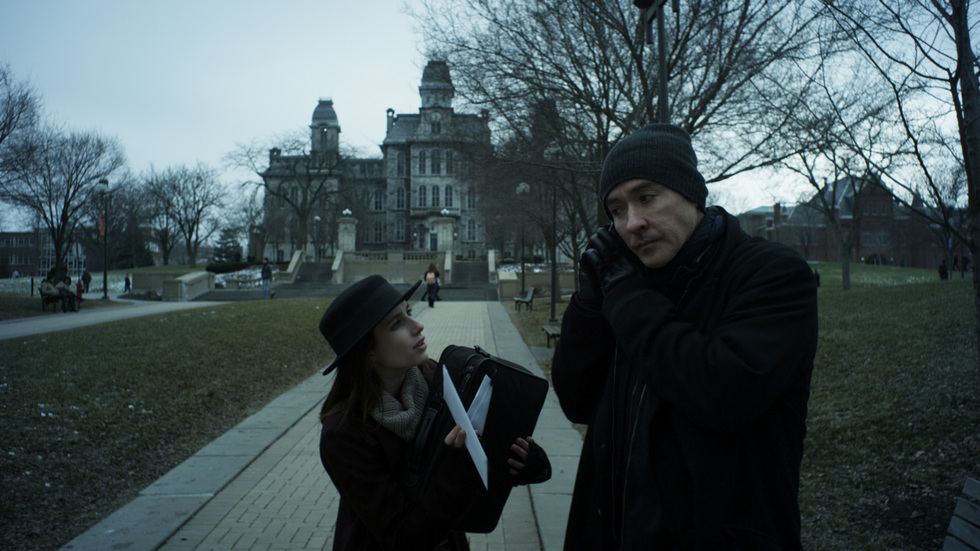
Upstream Color A woman, a man, a pig, a worm, Walden — what? If you enter into Shane Carruth’s Upstream Color expecting things like a linear plot, exposition, and character development, you will exit baffled and distressed. Best to understand in advance that these elements are not part of Carruth’s master plan. In fact, based on my own experiences watching the film twice, I’m fairly certain that not really understanding what’s going on in Upstream Color is part of its loopy allure. Remember Carruth’s 2004 Primer? Did you try to puzzle out that film’s array of overlapping and jigsawed timelines, only to give up and concede that the mystery (and sheer bravado) of that film was part of its, uh, loopy allure? Yeah. Same idea, except writ a few dimensions larger, with more locations, zero tech-speak dialogue, and — yes! — a compelling female lead, played by Amy Seimetz, an indie producer and director in her own right. Enjoying (or even making it all the way through) Upstream Color requires patience and a willingness to forgive some of Carruth’s more pretentious noodlings; in the tradition of experimental filmmaking, it’s a work that’s more concerned with evoking emotions than hitting some kind of three-act structure. Most importantly, it manages to be both maddening and moving at the same time. (1:35) Roxie. (Eddy)

Music listings

0

Since club life is unpredictable, it’s a good idea to call ahead or check the venue’s website to confirm bookings and hours. Prices are listed when provided to us. Visit www.sfbg.com/venue-guide for venue information. Submit items for the listings at listings@sfbg.com. For further information on how to submit items for the listings, see Picks.

WEDNESDAY 8

ROCK/BLUES/HIP-HOP

Andy Cabic and Eric D. Johnson Band, Neal Casal, Bart Davenport Chapel. 9pm, $17.

Michael Barrett Johnny Foley’s Irish House. 10pm, free.

Born Ruffians, Moon Kings Slim’s. 8pm, $17.

Great American Cities, Kallisto, DJ Creepy B Elbo Room. 9pm, $8.

"Johnny Foley’s Dueling Pianos" Johnny Foley’s Irish House. 9pm. With Michael C. vs. Rags Tuttle.

Laura Stevenson Band, Field Mouse, Haunted Summer Bottom of the Hill. 9pm, $12.

Low Magic, Yellow Dress, Jaberi and Deutsch Rickshaw Stop. 8pm, $10.

Tom Odell, Cillie Barnes Café Du Nord. 9:30pm, $15.

Joshua Radin, My Name is You Great American Music Hall. 8pm, $41.

Teddy Riley and Blackstreet featuring Dave Hollister Yoshi’s San Francisco. 10pm, $39.

Two-Tone Steiny and the Cadillacs Biscuits and Blues. 8 and 10pm, $15.

Kurt Vile, Steve Gunn Independent. 8pm, $20.

JAZZ/NEW MUSIC

Dink Dink Dink, Gaucho, Eric Garland’s Jazz Session Amnesia. 7pm, free.

Hammond organ soul jazz blues party with Big Bones Royal Cuckoo, 3203 Mission, SF; www.royalcuckoo.com. 7:30-10:30pm, free.

Edward Schocker Meridian Gallery, 535 Powell, SF; www.meridiangallery.org. 7:30pm, $8-10.

Sophisticated Ladies Rite Spot Café, 2099 Folsom, SF; www.ritespotcafe.net. 9pm, free.

Terry Disley’s Rocking Jazz Trio Burritt Room, 417 Stockton, SF; www.mystichotel.com. 6-9pm, free.

FOLK/WORLD/COUNTRY

Daniel Seidel Plough and Stars. 9pm.

Curt Yagi and the People Standing Behind Me, Katie Garibaldi, Salet, Lauren Sturm Brick and Mortar Music Hall. 8pm, $8.

DANCE CLUBS

Debut DNA Lounge. 8pm, $5 suggested donation. SFEIC students showcase their work in a hair and make-up show, with DJ C-Lektra.

Timba Dance Party Bissip Baobab. 10pm, $5. Timba and salsa Cubana with DJ Walt Diggz.

THURSDAY 9

ROCK/BLUES/HIP-HOP

Allah-Las, Blank Tapes Chapel. 9pm, $17.

Chrysta Bell, Emily Jane White Bimbo’s 365 Club. 8pm, $20.

Brasil Couches, Old & Gray Amnesia. 9pm.

Cloud Cult, JBM Independent. 8pm, $17.

Paula Cole Yoshi’s San Francisco. 8pm, $32.

"An Evening with Chris Thile and Michael Daves" Great American Music Hall. 8pm, $19.

French Cassettes, Ash Reiter, yOya, Annie Girl and the Flight Bottom of the Hill. 9pm, $10.

Glitter Wizard, Carlton Melton, Joy Hemlock Tavern. 8:30pm, $8.

Gunshy Johnny Foley’s Irish House. 10pm, free.

"Johnny Foley’s Dueling Pianos" Johnny Foley’s Irish House. 9pm. With Nathan Temby vs. Michael C.

Machine Gun Kelly Regency Ballroom. 8pm, $28.

Rolando Morales Biscuits and Blues. 8 and 10pm, $16.

Picture Atlantic, Little Daylight, Finish Ticket Rickshaw Stop. 9:30pm, $10. Plus Popscene DJs.

Spanish Moss, Feeding People, Holy Wave, Mr. Elevator and the Brain Hotel Thee Parkside. 9pm, $5.

That1Guy, Captain Ahab’s Motorcycle Club Café Du Nord. 9pm, $15.

Zodiac Death Valley, Leopold and His Fiction, Sporting Life, Rusty Maples, DJ Neil Martinson Brick and Mortar Music Hall. 9pm, $10.

JAZZ/NEW MUSIC

Hammond organ soul jazz blues party with Chris Siebert Royal Cuckoo, 3203 Mission, SF; www.royalcuckoo.com. 7:30-10:30pm, free.

Tin Cup Serenade Rite Spot Café, 2099 Folsom, SF; www.ritespotcafe.net. 9pm, free.

FOLK/WORLD/COUNTRY

Haesemeyer Lost Church, 65 Capp, SF; www.thelostchurch.com. 8pm, $15.

Tipsy House Plough and Stars. 9pm.

DANCE CLUBS

Afrolicious Elbo Room. 9:30pm, $8-15. Six-year anniversary celebration with hosts Pleasuremaker and Señor Oz, plus the Afrolicious 12-piece band, DJ Smash, J Boogie, and Captain Planet.

DAMSF DNA Lounge. 10:30pm, $10-20. Hip-hop performance showcase.

DJ Kaos, Mozhgan, Jason Greer Monarch, 101 Sixth St, SF; monarchsf.ticketfly.com. 10pm, $10.

8bitSF DNA Lounge. 9pm, $11. Chiptunes with DJ Cutman, A_Rival, E.N. Cowell, and more.

Pa’lante! Bissip Baobab. 10pm, $5. Electro-cumbia, dancehall, and soca with DJs Juan G., El Kool Kyle, and Mr. Lucky.

FRIDAY 10

ROCK/BLUES/HIP-HOP

Acid Mothers Temple and the Melting Paraiso UFO, Tjutjuna, 3 Leafs Bottom of the Hill. 10pm, $12.

B.A.P. (Best.Absolute.Perfect.) Warfield. 7:30pm, $40-100.

Body and Soul Johnny Foley’s Irish House. 10pm, free.

Chris Duarte Group Biscuits and Blues. 8 and 10pm, $20.

Dead Winter Carpenters, Cody Canada and the Departed Great American Music Hall. 9pm, $16.

Justin Townes Earle Chapel. 9pm, $20-25.

Greyboy Allstars Independent. 9pm, $25.

"Johnny Foley’s Dueling Pianos" Johnny Foley’s Irish House. 9pm. With Greg Zema, Nathan Temby, and Michael C.

Pokey LaFarge, West Coast Ramblers Rickshaw Stop. 9pm, $13-15.

Of Montreal, Wild Moccasins Slim’s. 9pm, $21.

Paul Collins Beat, Courtney and the Crushers, the Cry Thee Parkside. 9pm, $10.

Lydia Pense and Cold Blood featuring Rick Stevens Yoshi’s San Francisco. 8 and 10pm, $19-26.

Secret Chiefs 3 Café Du Nord. 9:30pm, $20.

Technicolors, Fictionist DNA Lounge. 8pm, $12.

Thrive!, Dewey and the Peoples, Sono Vero, Da Mainland Brick and Mortar Music Hall. 9pm, $15.

Tomihara, Fox and the Law, Tokyo Raid Hemlock Tavern. 9:30pm, $8.

JAZZ/NEW MUSIC

Audium 1616 Bush, SF; www.audium.org. 8:30pm, $20. Theater of sound-sculptured space.

Mike Burns Rite Spot Café, 2099 Folsom, SF; www.ritespotcafe.net. 9pm, free.

Regina Carter, John Blake, Jr. SFJAZZ, 201 Franklin, SF; www.sfjazz.org. 7:30pm, $20-40.

Hammond organ soul jazz blues party Royal Cuckoo, 3203 Mission, SF; www.royalcuckoo.com. 7:30-10:30pm, free.

FOLK/WORLD/COUNTRY

Big Lion, Rich McCulley Plough and Stars. 9pm.

Underskore Orchestra, Sour Mash Hug Band Amnesia. 9pm, $5.

DANCE CLUBS

Afrolicious Elbo Room. 9:30pm, $8-15. Six-year anniversary celebration with hosts Pleasuremaker and Señor Oz, plus the Afrolicious 12-piece band and DJ Smash.

DJ What’s His Fuck Pop’s Bar, 2800 24th St, SF; (415) 401-7677. 9pm, free. Old-school punk and metal.

Indie Slash Amnesia. 10pm. With DJ Danny White.

Kitsune Club Night Mezzanine. 9pm, $17. With Fred Falke, Chrome Sparks, and Beni.

Makossa West Bissip Baobab. 10pm, $5. Classic salsa, funk, Afrobeat, reggae, and more with DJs Wonway Posibul and Joe Quixx.

That 90s Dance Party DNA Lounge. 10pm, $7-9. With DJs Devon, Netik, Sage, Starr, and Myster C.

TBMA, Syd Gris, DJ Icon, Ultraviolet Monarch, 101 Sixth St, SF; monarchsf.ticketfly.com. 10pm, $10.

SATURDAY 11

ROCK/BLUES/HIP-HOP

Big Blu Soul Revue Grant and Green. 9pm, free.

Blame Sally, Lia Rose Great American Music Hall. 9pm, $26-31.

Jay Brannan, Rin Tin Tiger, Plastic Arts Bottom of the Hill. 9pm, $14.

Bright Grey Wing, Rebecca Pronsky, Eight Belles Amnesia. 6:30pm, $7.

Fonseca Regency Ballroom. 8pm, $38.

Greyboy Allstars Independent. 9pm, $25.

Hanalei, Divided Heaven, Rob Carter, Keeley Valentino Thee Parkside. 3pm, free.

"Johnny Foley’s Dueling Pianos" Johnny Foley’s Irish House. 9pm. With Michael C., Greg Zema, and Nathan Temby.

K’Jon Yoshi’s San Francisco. 8 and 10pm, $24-28.

Kids on a Crime Spree, Number One Smash Hits, Manatee Hemlock Tavern. 9:30pm, $7.

Man or Astro-Man?, Terry Malts, Ogres Bimbo’s 365 Club. 9pm, $18.

Meat Sluts, Thee Merry Widows, Dirty Shakers Bender’s, 800 S. Van Ness, SF; www.bendersbar.com. 10pm, $5.

Kate Nash Chapel. 9pm, $18-20.

Rose Windows, Extra Classic, Zig Zags Thee Parkside. 9pm, $8.

Rustangs Riptide. 9:30pm, free.

Secret Chiefs 3 Café Du Nord. 9:30pm, $20.

"Slim’s Goes British: Revue #3" Slim’s. 8:30pm, $15. With RaveUps, Blondies, Haunted by Heroes, and Whitecliff Rangers with special guest Girl Named T. 8:30pm, $15.

Lavay Smith and Her Red Hot Skillet Lickers Biscuits and Blues. 8 and 10pm, $20.

2 Men Will Move You Amnesia. 9pm.

Wild Rumpus Salle Pianos, 1632 C Market, SF; www.wildrumpusmusic.org. 8pm, $15-25.

Wolf + Lamb, Soul Clap, Pillowtalk, Nick Monaco Mezzanine. 9pm, $10-20.

X-Static Johnny Foley’s Irish House. 10pm, free.

JAZZ/NEW MUSIC

Audium 1616 Bush, SF; www.audium.org. 8:30pm, $20. Theater of sound-sculptured space.

Regina Carter SFJAZZ, 201 Franklin, SF; www.sfjazz.org. 11am (family matinee), $5-15, and 7:30pm, $25-60.

Cottontails Rite Spot Café, 2099 Folsom, SF; www.ritespotcafe.net. 9pm, free.

FOLK/WORLD/COUNTRY

Flux Pavilion, Cookie Monsta, Funtcase, Brown and Gammon, Roksonix Warfield. 9pm, $42.

Fogo Na Roupa, DJs Ras Rican, Sake One, and Epic, live percusion by Quique Padilla Bissip Baobab. 10pm, $5. Fundraiser for Mission Girls Violence Prevention Program.

Lovebirds Plough and Stars. 9pm.

Mision Flamenca Bissip Baobab. 7:30pm, $15.

DANCE CLUBS

Bootie SF DNA Lounge. 9pm, $10-15. Mash-ups with A Plus D and others.

Cockblock Rickshaw Stop. 10pm, $10. Queer dance party with DJs Nuxx and Zax.

Dark Days Eagle. 3-6pm. Lady Bear and her Dark Dolls host this beer bust (tickets benefit the AIDS Emergency Fund) with beats from DJ Le Perv and guests.

Tormenta Tropical Elbo Room. 10pm, $5-10. With resident DJs Shawn Reynaldo and Oro11, and guest DJ Quality.

SUNDAY 12

ROCK/BLUES/HIP-HOP

Karina Denike and friends Rite Spot Café, 2099 Folsom, SF; www.ritespotcafe.net. 8:30pm, free.

Hydrophonic, My Victim, Bad Bones Bottom of the Hill. 9pm, $10.

Jamaican Queens, Maus Haus, Black Jeans Brick and Mortar Music Hall. 9pm, $7.

Merchants of Moonshine, DJ Quarterman Jack Champion Thee Parkside. 4pm, free.

Buddy Miller and Jim Lauderdale, Max Gomez Great American Music Hall. 8pm, $23.

Dave Moreno and friends Johnny Foley’s Irish House. 10pm, free.

Rotten Sound, Early Graves, Hellbeard, Aurgurs, Parasitic Explosion DNA Lounge. 7:30pm, $16.

JAZZ/NEW MUSIC

Regina Carter and Carolina Chocolate Drops SFJAZZ, 201 Franklin, SF; www.sfjazz.org. 3 and 7pm, $25-50.

Hammond organ soul jazz blues party with Lavay Smith Royal Cuckoo, 3203 Mission, SF; www.royalcuckoo.com. 7:30-10:30pm, free.

FOLK/WORLD/COUNTRY

Brazil and Beyond Bissip Baobab. 6:30pm, free.

Hipwaders Contemporary Jewish Museum, 736 Mission, SF; www.thecjm.org. Sun, 11am. $10-12 (kids under 18 free).

Junior Brown Yoshi’s San Francisco. 7pm, $25.

Darcy Noonan, Richard Mandel, Jack Gilder, and friends Plough and Stars. 9pm.

Thee Old Country Tupelo, 1337 Grant, SF; www.tupelosf.com. 4pm, free.

MONDAY 13

ROCK/BLUES/HIP-HOP

Damir Johnny Foley’s Irish House. 10pm, free.

Highlands, Orange Revival Brick and Mortar Music Hall. 9pm, $10.

Yngwie Malmsteen Regency Ballroom. 8pm, $32.

Collin Ludlow-Mattson and the Folks, Casual Dolphins, Air Surgeon, Catharsis for Cathedral Elbo Room. 9pm, $6.

Milk Carton Kids, Barefoot Movement Great American Music Hall. 8pm, $17-19.

Sweat Lodge, Photo Atlas, Father President Bottom of the Hill. 9pm, $8.

FOLK/WORLD/COUNTRY

Toshio Hirano Amnesia. 9pm, free.

"The Pick: Open Bluegrass Jam" Amnesia. 6pm.

DANCE CLUBS

Death Guild DNA Lounge. 9:30pm, $3-5. Gothic, industrial, and synthpop with Decay, Joe Radio, and Melting Girl.

TUESDAY 14

ROCK/BLUES/HIP-HOP

Buffalo Tooth, Joy, A Million Billion Dying Sons, Disappearing People, DJ Dahmer Brick and Mortar Music Hall. 9pm, $9.

Go Time, pseudotunesmith, Reliics Bottom of the Hill. 9pm, $8.

IAMX, Moto Boy Slim’s. 8pm, $20.

John Garcia Band Biscuits and Blues. 8 and 10pm, $15.

Kisses, Sister Crayon, Astronauts etc. Rickshaw Stop. 8pm, $10-12.

Laurels, Moonbeams, Fleeting Joys Hemlock Tavern. 8:30pm, $8.

Pow, Cold Beat, Cold Circuits, Daisy World, DJ Ack Ack Ack Knockout. 9:30pm, $6.

Stan Earhart Band Johnny Foley’s Irish House. 10pm, free.

Steve Adamyk Band, Needles // Pins, Primitive Hearts, Adam Widener Thee Parkside. 8pm, $7.

JAZZ/NEW MUSIC

Frisky Frolics Rite Spot Café, 2099 Folsom, SF; www.ritespotcafe.net. 8:30pm, free.

"sfSoundSalonSeries: Xenoglossia/Leishmania (Christopher Burns and Bill Hsu)" Center for New Music, 55 Taylor, SF; www.centerfornewmusic.com. 7:49pm, $10.

Terry Disley’s Rocking Jazz Trio Burritt Room, 417 Stockton, SF; www.mystichotel.com. 6-9pm, free.
DANCE CLUBS
’90s Hip-Hop Sample Night Double Dutch, 3192 16th St, SF; www.thedoubledutch.com. 9pm, free. With Mr. Murdock and DJ Haylow.

Party Radar: Honey Dijon, Kenny Dope, Plastic Plates, Daniel Maloso, Pearson Sound, more

It’s too sunny out to read! My eyes keep glazing over with lusty sparkles and unicorns in mankinis. Let’s meet in the park with a duffel of cold 40s, listen to some fun music with our tops off, and plan our party outfits for the following weekend blowouts (click on the titles for more details).

Oh, and PS: the only reason I didn’t include one of the best parties of the the spring, the Sunset Boat Party, is because it is, as usual, sold out. But check out the Sunset FB page for afterparty deets.

>>PEARSON SOUND

UK wiz kid David Kennedy updates that good ol’ UK bass sound with some neat twists of his own. 

Thu/2, 9:30pm-late, $10-$15. Public Works, 161 Erie, SF.


>>DEEP CRATES

Two great musical tastes will make a delicious, peanut-buttery dance floor sandwich: bathhouse disco prince Bus Station John and house/techno pumper Brian Bejarano giving us some rare classics. Diggin’ deep and finding gold y’all! 

Fri/3, 9pm, $5. UndergroundSF, 424 Haight, SF. 


>>SOME THING: THE BACHELORETTE PARTY

The best art-drag club in the city takes on party buses, “woo girls,” stiletto disasters, and puke-in-the-purse with this celebration of all things Bachelorette. Watch your fucking tiara or you will get cunt-punted into another sorority.

http://www.youtube.com/watch?v=cJNOOBOyn20

Fri/3, 10pm-late, $7. The Stud, 399 9th St., SF. www.studsf.com 


>>DANIEL MALOSO

Cute Spaniard, who in his darker moments can’t quite shake the influence of Liaisons Dangereuses “Los Ninos Del Parque” (and that’s just fine), will have you bopping around at the impeccable No Way Back party.

Fri/3, 10pm-4am, $15. Monarch, 101 Sixth St., SF. www.monarchsf.com


>>KENNY DOPE

The master — as in one half of the actually legendary Masters at Work — bangs out the heavy rhythm house and hip-hoppy jams with equally adept and beloved DJ Spinna.

Sat/4, 10pm-late, $20. Mighty, 119 Utah, SF. www.mighty119.com


>>PLASTIC PLATES

He’s an electro-pop smoothie! Love the Aussie-via-LA producer’s irresistible takes on songs, givng them a moody bounce. 

Sat/4, 9:30pm, $15. Monarch, 101 Sixth St., SF. www.monarchsf.com


>>SWAGGER LIKE US

Supercute, super-diverse monthly queer hip-hop party — where, incidentally, you’ll hear some of the most cutting-edge music going on in the dance world right now. With special guest DJ Rapidfire!

Sun/3, 3-pm, $5-$8. El Rio, 3158 Mission, SF.


>>HONEY DIJON

The first mistress of NYC house has come along way since we all used to cheer at the EndUp back in the day when she’d accidentally play the same record three times. (And yet she ALWAYS turned it out for the children.) Miss Honey will sinko your de mayo. 

>Sun/5, 10pm, $10. Holy Cow, 1535 Folsom, SF. 

Tribeca Film Festival wrap-up: the best of the rest!

2

It was the best of sequesters: oh, Tribeca, how to wrap up the many, many days spent hidden away in the dark, watching flickering images dart across a screen? I can only try, as I speed through the best of the rest — and the notable not-so-muchs.

Kids these days: Poets and the young girls that love them are at the very funny heart of indie comedy Adult World, which is sure to make a star of Emma Roberts. She’s the shrill, just-graduated, wannabe-verse-slinger Amy, who’s moonlighting in an adult video store alongside hollow-eyed cutie Alex (American Horror Story’s Evan Peters) and hoping scuzzball genius will rub off if she “interns” (read: cleans house) for her favorite poet, Rat Billings (writ world-weary and hilariously cynical by John Cusack). First-time feature director Scott Coffrey (also, weirdly, a graduate of the same Honolulu high school where I did my own Amy impression) lets a few rough edges (i.e., edits) show, but it’s all good when the filmmaker winds up Roberts, playing the cringe-worthy Tracy Flick for the chapbook set, and lets her go.

http://www.youtube.com/watch?v=Z6DJSGrfNbk

Just as funny — and very of-the-moment — is G.B.F., as in gay best friend. As in every Bravo-watching gal’s latest, greatest slice of arm candy. Tanner (Michael J. Willett of United States of Tara) is just your average, comic-book-reading closeted gay teen when bestie Brent (Paul Iacono) decides his path to social success will be established once he comes out as the first openly gay teenager at their high school. He’s sure to become the pet pick of the would-be prom queens: the girl-with-the-best-hair Fawcett (Sasha Pieterse of Pretty Little Liars), drama mama Caprice (Xosha Roquemore), and Mormon good girl ‘Shley (Andrea Bowen). Alas, the wholly unprepared Tanner gets outed first — and the battle for the O.G. G.B.F. ensues.

Working with a fast, sassy, and slangy script — and teen comedy vets Natasha Lyonne, Rebecca Gayheart, and Jonathan Silverman — director Darren Stein (1999’s Jawbreaker) has already traversed some of this uber-camp territory: yes, there’s a multiplayer saunter down a high school hall and a maj makeover montage. But the snappy, laugh-out-loud dialogue by first-time screenwriter George Northy (fresh from the Outfest Screenwriting Lab, as he discussed after the film in a Q&A with Stein and much of the cast), along with some high-speed-DSL improvising by the cast, made this one of the more effortlessly enjoyable — and commercial — movies at Tribeca.

Speaking of effortlessly commercial, I mean, adorable: It sounds like NYC went stir-cray for Lil Bub and Friendz, especially when the lil’ permakitten herself materialized for a free open-air screening of the Vice documentary on a Saturday night. Short (at about 60 minutes), sweet, and definitely crammed with more than you’d ever wanted to know about Internet cats (even after Bravo’s LOLwork), their owners, and their merchandising, Lil Bub fortunately keeps its eye firmly trained on the prize, namely the wide-eyed little mutant in the center of a viral firestorm, while framing visits with Nyan Cat, Grumpy Cat, and Keyboard Cat with Bub’s life story.

This runt o’ the litter may not appear to have any bone marrow in her leg bones, zero teeth, a permanently extended tongue, and extra toes on every paw, yet she’s won more than just owner Mike Bridavsky’s heart — she’s repping for all the totes-adorbs misfits out there, making their fortunes just by being themselves (or by creating a grabby persona) on the Interwebs. Now we just need a 24-hour Bub-cam to fill in the gaps of our Bub-Friends-Forever obsession.  

Lighter fare? Paul Verhoeven’s crowd-sourced sex comedy Tricked was a mildly diverting exercise in group think, or better, gang-grope creativity. It’s no The Fourth Man (1983), Starship Troopers (1997), or even Showgirls (1995). There’s only a dash of that eye-tinglingly perverse psycho-drama that Verhoeven specializes in is evident in, perhaps, that tampon spinning in the toilet or this luscious ingenue suddenly flashing her ta-tas.

On the perversity tip — it doesn’t get much more against the grain than cannibalism, Maori family style, in the Kiwi cult-circuit-primed OTT Fresh Meat, which wallows then practically whirls in its own trough of bad taste. When a group of shoot-’em-up screw-ups invade the suburban home of an upstanding Maori suburban family, they learn that their freezer’s contents are less than savory — the hard and gory way — in a tone that seems derived from ‘80s Hong Kong martial arts comedies. Still, you have to appreciate the salacious brio with which director Danny Mulheron tackles this homecoming to Z-grade yuck-fests. 

Keeping it real: Ground-level neorealistic storytelling made its stand in features about everyday, blue-collar folks just trying to keep their head above the … snow. The best of which was Whitewash, a journey into the heart of a murder mystery with Thomas Haden Church cast as a snow-plow driver forced to rough it in the snow-swathed woods of Quebec. Church ably navigates that thin line between a kind of natural, deadpan humor and serious, even deadly, drama.

Kitted out with a cast that includes John Slattery (Mad Men), Adam Driver (Girls), and Margo Martindale (who’s in everything), Bluebird checks in on a similar, northerly terrain, an isolated, snow-cloaked Maine logging town, on the pretext of investigating the dire ramifications of single lapse by a well-meaning school bus driver (Amy Morton of Boss). Frustrated by that traumatized character’s deer-in-the-headlights muteness, you know there’s nowhere to go but up.

Much better, down south in burn-out, strip-mauled Florida, is Sunlight Jr. — otherwise known as Walking Dead heartthrob Norman Reedus’s return to the big screen, as yet another scary redneck, this time wielding a big-wheeled truck rather than a crossbow. Serenaded by an elegant guitar soundtrack by Dinosaur Jr.’s J. Mascis, Naomi Watts is as fantastic as usual, as a convenience-store honey struggling to stay sober and maintain a relationship with a hard-drinking, wheelchair-bound boyfriend (Matt Dillon). Director and writer Laurie Collyer (Sherrybaby) keeps her focus tight, only adding to Sunlight Jr.’s power.

Meanwhile, earnest Iowa farm-centered At Any Price, which opens theatrically in the Bay Area tomorrow, wasn’t quite the breakout movie for a mugging, dead-eyed Dennis Quaid, but it might be for Zac Efron, who rises above the fray in an indie that aspires to the gravitas of A Thousand Acres.

A continent and millions of concerns away in Italy, Ali Blue Eyes made a case for the story of two rebellious teenaged pals — one an Egyptian Muslim, the other a Catholic Italian. Nader (Nader Sarhan) may wear blue contacts in order to, rather lamely, blend in, but his loyalties and cultural ties are tested after a Romanian kid is stabbed in this compelling glimpse into an immigrants world at the edges of affluent Milan.   

http://www.youtube.com/watch?v=wSTjh9Sd5Vs

Shock and awe: Midnight movies abounded — two of the best that I caught were The Machine, a relatively polished, low-budg Frankenstein story set in an English weapons research lab where researchers are intent on building the ultimate cybernetic super soldier. Riddling his script to references to quantum computers and the like, director-writer Caradog James manages to infuse a solid sense of Cronenbergian dread — as well as a tenuous moral ambiguity — into a sci-fi narrative that’s as old as the Romantics.

Much more disappointing — and marred by technical roughness — was Dark Touch, Marina de Van’s (2002’s In My Skin) rendition of Carrie, this time in the form of a telekinetically gifted (or cursed) 11-year-old. I get it — child abuse leads kids to act out, in this case, in murderous ways — I just kept tripping over the lapses in continuity and logic, the beautiful female characters’ uniform Breck Girl look, and the tragic special effects.

Fun, in the way that a blood-sucking brotherhood brandishing the “pointed nails of justice” can only be fun, is Byzantium, Neil Jordan’s return to the world of the undead, so long after 1994’s Interview With a Vampire. Here, the would-be malignant spirits choose to their path by visiting a wicked island that gushes blood when another little vampire is born. They also stroll about conveniently by day — though the isle and its keepers forbid women to make vampires (childbirth, I suppose, is considered sufficient). Still, it’s a trashy good time, with a lush Gemma Arterton wildly vamping as harlot-prey-turned-madam-predator and taking a garrote to her hunter (though after sitting through The Host, I’m not sure how much longer I’m willing to buy Saoirse Ronan’s ethereal space-cadet act).

The final, very wonderful monster in the room? A certain pantless Broadway legend who has shared a stage with Harpo Marx, dated Jack Kennedy, and has had Noel Coward and Stephen Sondheim write for her. The doc Elaine Stritch: Shoot Me follows the feisty song-and-dance Broadway icon on the verge of 87 as she tosses off wisecracks, appears on 30 Rock as the mother of Alec Baldwin’s Jack Donaghy, copes with diabetes, and bosses around documentary maker Chiemi Karasawa. It’s a unique delight — much like its subject. Yes, she just moved out of her digs in the Carlyle Hotel and back to her native Michigan — but Shoot Me allows us to bask in the considerable afterglow left in her wake.

Short takes: SFIFF week two

0

Prince Avalanche (David Gordon Green, US, 2012) It has been somewhat hard to connect the dots between David Gordon Green the abstract-narrative indie poet (2000’s George Washington, 2003’s All the Real Girls) and DGG the mainstream Hollywood comedy director (2008’s Pineapple Express, yay; 2011’s Your Highness and The Sitter, nay nay nay). But here he brings those seemingly irreconcilable personas together, and they make very sweet music indeed. Paul Rudd and Emile Hirsch play two men — one a fussy, married grown-up, another a short-attention-spanned man child — spending the summer in near-total isolation, painting yellow divider lines on recently fire-damaged Texas roads. Their very different personalities clash, and at first the tone seems more conventionally broad than that of the 2011 Icelandic minimalist-comedy (Either Way) this revamp is derived from. But Green has a great deal up his sleeve — gorgeous wide screen imagery, some inspired wordless montages, and a well-earned eventual warmth — that makes the very rare US remake that improves upon its European predecessor. Wed/1, 4pm, and Fri/3, 6:30pm, Kabuki. (Dennis Harvey)

Fill the Void (Rama Burshtein, Israel, 2012) Respectfully rendered and beautifully shot in warm hues, Fill the Void admirably fills the absence on many screens of stories from what might be considered a closed world: the Orthodox Hasidic community in Israel, where a complex web of family ties, duty, and obligation entangles pretty, accordion-playing Shira (Hada Yaron). An obedient daughter, she’s about to agree to an arranged marriage to a young suitor when her much-loved sister (Renana Raz) dies in childbirth. When Shira’s mother (Irit Sheleg) learns the widower Yochay (Yiftach Klein) might marry a woman abroad and take her only grandchild far away, she starts to make noises about fixing Shira up with her son-in-law. The journey the two must take, in possibly going from in-laws to newlyweds, is one that’s simultaneously infuriating, understandable, and touching, made all the more intimate given director Rama Burshtein’s preference for searching close-ups. Her affinity for the Orthodox world is obvious with each loving shot, ultimately infusing her debut feature with a beating heart of humanity. Wed/1, 6:30pm, and Thu/2, 4pm, Kabuki. (Kimberly Chun)

The Strange Little Cat (Ramon Zürcher, Germany, 2013) There’s a strange music to this light-on-its-toes, rhythmic, and ultimately mesmerizing chamber piece by first-time feature director Ramon Zürcher — one seemingly informed by dance, Gerhard Richter, contemporary opera, and Jean-Luc Godard in a latter-day gimlet-eyed state. The arc of a banal yet odd day is traced, within mostly the close confines of a Berlin apartment, as family members enter, interact, and then retreat in a kind of call and response: the mother runs a kitchen machine, a girl cries out as if to mimic its roar, a cousin who looks as if he’s straight out of a Dutch master painting soberly surveys the scene, while the eponymous feline weaves in and out of the action. In fact, that pet is the most domesticated of the lot populating this riveting domestic scene, all of which makes you want to see what Zürcher cooks up next. Wed/1, 9pm; Sun/5, 7pm; and May 8, 4pm, Kabuki. (Chun)

Salma (Kim Longinotto, England/India, 2012) Kept like a prisoner in her in-laws’ house for more than two decades, Salma is more than the most famed woman poet writing in the Tamil language. She’s also an archetypal South Indian woman of her time and place: married as a teen despite her desire to read and write poetry, her body controlled by her husband and family, and her freedom constricted to the point where she was once forced to write on scraps of paper in the toilet and to smuggle her verse out to have it published. What follows is the stuff of fairy tales, as Salma evolves into a politician and heroine who speaks for those otherwise muffled by their burkas and smothered by circumstance. Documentarian Kim Longinotto keeps a close eye on the oppressive culture that once harbored the writer — and inspired her to express herself — yet also takes the time to notice Tamil Nadu’s many small instances of beauty, in mutable pink and purple skies, a gold-flecked green sari, and showy weddings that mark both the beginning, and end, for so many young girls. Documentarian Longinotto whets one’s appetite for more of Salma’s words, while upholding her story’s relevance amid rising consciousness concerning the rights of all women in India. Thu/2, 6:15pm, Kabuki; Sat/4, 2pm, PFA; Sun/5, 3:45pm, New People. (Chun)

Computer Chess (Andrew Bujalski, US, 2013) Mumblecore maestro Andrew Bujalski (2002’s Funny Ha Ha; 2005’s Mutual Appreciation) makes his first period picture, kinda, with this stubbornly, gloriously retro saga set at an early-1980s computer-chess tournament (with a few ventures into the freaky couples-therapy seminar being held at the same hotel). The technology is dated, both on and off-screen, as hulking machines with names like “Tsar 3.0” and “Logic Fortress” battle for nerdly supremacy as a cameraman, wielding the vintage cameras that were actually used to film the feature, observes. Tiny dramas highlighting the deeply human elements lurking amid all that computer code emerge along the way, and though the Poindexters (and the grainy cinematography) are authentically old-school, the humor is wry and awkwardly dry — very 21st century. Keep an eye out for indie icon Wiley Wiggins, last seen hiding from Ben Affleck’s hazing techniques in 1993’s Dazed and Confused, as a stressed-out programmer. Thu/2, 9pm, and Sat/4, 4pm, Kabuki. (Cheryl Eddy)

The Cleaner (Adrián Saba, Peru, 2011) An austere take on substitute-parental bonding dressed in apocalyptic sci-fi clothing, Adrián Saba’s Peruvian feature finds the world ending not with a bang but with a sickly whimper. (If you’ve ever breathed the toxic air or looked at the shit-brown sea around Lima, you’ll find this pretty credible.) A middle-aged loner (Victor Prada) tasked with cleaning up the death sites of citizens felled by a fatal epidemic finds a surviving young boy (Adrian Du Bois) in one such apartment. Their forced, awkward pairing — because the death toll is so high city services can no longer taken in another orphan — is poignant and terse in what’s a minimalist companion to the underrated 2008 adaptation of José Saramago’s plague saga Blindness. Sat/4, 6:15pm, Kabuki; Tue/7, 8:40pm, PFA; May 9, 8:30pm, Kabuki. (Harvey)

Invasion of the Body Snatchers (Philip Kaufman, US, 1978) Yes, Vertigo (1958) is very nice. But here is my alternate choice for Best San Francisco Movie Ever: 2013 SFIFF tributee Philip Kaufman’s 1978 remake of the 1950s sci-fi classic. Donald Sutherland, Brooke Adams, Jeff Goldblum, Veronica Cartwright, and Leonard Nimoy are among the locals who get very paranoid — with no pot brownies involved — when everyone around them starts turning coldly conformist. Given the film’s fond evocation of the city’s loopy, friendly, countercultural vibe at the time, this shift in the psychological weather really is alarming — arguably much more dramatically so than it was the vanilla small-town setting of Don Siegel’s original or Abel Ferrara’s military-base 1994 version. Wonderfully creepy, eccentric, stylish and humorous, it was Kaufman’s first commercial success. He will appear at the Castro screening to discuss it, his career in general, and to accept his Founder’s Directing Award. Sun/5, 7:30pm, Castro. (Harvey)

Waxworks (Paul Leni, Germany, 1924) Paul Leni’s 1924 omnibus horror feature is considered one of the great classics of German Expressionist cinema. A young man (William Dieterle, who went on to a long Hollywood directing career) answers an ad seeking “an imaginative writer for publicity” work at a wax museum. There he’s asked to write “startling tales” about specific wax figures, envisioning himself and the owner’s comely assistant (Olga Belajeff) as hero and heroine in each narrative. The first and longest tale has the two of them as a couple who get unwanted attention from the tyrannical, lusty Caliph of Bagdad (Emil Jannings). It’s an attenuated comic episode sparked by spectacular abstracted “Middle Eastern” sets. Next, Conrad Veidt (of 1920 Expressionist flagship film The Cabinet of Dr. Caligari) plays Ivan the Terrible in a more macabre story of bloodthirst and madness. Finally, Werner Krauss is “Spring-Heeled Jack” (i.e. Jack the Ripper), terrorizing our protagonists in a brief riot of nightmarish superimposed images. SFIFF’s annual silent film extravaganza at the Castro will be accompanied by a stellar quartet of musicians playing an original score: Mike Patton, Scott Amendola, Matthias Bossi, and William Winant. Expect an eclectic and propulsive evening of sounds equally schooled by punk, prog rock, and jazz. Tue/7, 8:30pm, Castro. (Harvey)

Before Midnight (Richard Linklater, US, 2012) Proving (again) that not all sequels are autonomic responses to a marketplace that rewards the overfamiliar, director Richard Linklater and his co-writers Julie Delpy and Ethan Hawke reconnect with the characters Céline and Jesse, whom we first encountered nearly 20 years ago on a train and trailed around Vienna for a night in Before Sunrise, then met again nine years later in Before Sunset. It’s been nine more years since we left them alone in a Paris apartment, Céline adorably dancing to Nina Simone and telling Jesse he’s going to miss his plane. And it looks like he did. The third film finds the two together, yes, and vacationing in Greece’s southern Peloponnese, where the expansive, meandering pace of their interactions — the only mode we’ve ever seen them in — is presented as an unaccustomed luxury amid a span of busy years filled with complications professional and personal. Over the course of a day and an evening, alone together and among friends, the two reveal both the quotidian intimacies of a shared life and the cracks and elisions in their love story. May 9, 7pm, Castro. (Lynn Rapoport) *

The San Francisco International Film Festival runs through May 9 at the Castro Theatre, 429 Castro, SF; New People Cinema, 1746 Post, SF; Pacific Film Archive, 2575 Bancroft, Berk; and Sundance Kabuki Cinemas, 1881 Post, SF. For tickets (most shows $10-15) and info, visit festival.sffs.org.


Rough, rough

0

Le.chicken.farmer@yahoo.com

They have cheerleaders at semi-pro football games. They have semi-pro cheerleaders. At halftime the five of them went out to the 50-yard line of the Rancho Cotate High School football field in Rohnert Park and put on a li’l halftime show.

I’m not a dog. Nevertheless, I really really felt like chasing Frisbees. The girls were good, but the halftime show could have used . . . something. Maybe a semi-pro Frisbee dog.

There was a semi-pro field announcer. Semi-pro concession stand. Semi-pro refs — one with a microphone, so the semi-pro spectators had a clue. There must have been about a hundred of us, maybe two, counting players’ wives and such, and their kids, who were running around on the sidelines, playing catch.

Girls from Hooters were trolling the stands, handing out coupons for a chicken wing special. And members of the North Bay Bruisers, Sonoma County’s roller derby team, were rumbling back and forth across the aluminum bleachers, in their skates, trying to sell raffle tickets.

Hedgehog, semi-pro photographer, was down on the field taking some pretty decent pictures of things. Including: a nice sideline catch, a runner crossing the plane of the end zone, and — late in the second quarter — a punter about to get creamed.

He was Angelo Jeffereys of the Nor Cal Knights, who double-dutied as a running back. And probably the play would have drawn a roughing-the-punter call in the NFL, because the punt blocker got more leg than pigskin.

Semi-pro refs are not flag shy, either, far as I can tell. I think there were two or three penalties on that play alone, and at least one of them was a personal foul. Oddly, though, none were for roughing the punter. Who wasn’t getting up.

One of the North Bay Rattlers tended to him — the same guy who I’d seen seeing to the injured Knight’s quarterback earlier in the half, on the Rattlers’ sideline.

Semi-pro football is rough. Not semi-rough. Rough rough.

But (as I might have mentioned) I’m not a dog. I’m a semi-pro sports writer. I was sitting just under the field announcer’s booth, in the sun, scribbling semi-legible notes on the back of a grocery receipt and just generally enjoying my Saturday.

I love Sonoma County. The air up there, the pace, the ten degrees it has on the city this time of year . . . There are many reasons why the North Bay is one of my favorite bays, but the Rattlers, their semi-pro football team, isn’t one of them.

Not that they’re not good. Oh, they’re that — a little overly so, is the problem. They win by scores like 85-0, 60-0, and, last Saturday against the Knights, 56-6.

The Knights had their moments: Two or three quarterback sacks, an interception . . . Early in the first quarter, trailing only 7-0, Jeffereys boomed a professional-quality punt which briefly changed the complexion of the game, field-positionwise …

After that, and a 15-yard facemask penalty against the Rattlers, the Knights had almost even seemed to be “in it.”

But they couldn’t capitalize, and fifteen game-clock minutes later when Jeffereys finally hobbled off the field after the roughing-the-punter non-call, the sense of in-it-ness was long gone. It was 28-0.

It was 35-0 at the half.

But here’s the thing: There are twelve teams in the West Coast Football Association. At least one of them is capable of beating the Rattlers: The Pacifica Islanders. They already met in the regular season (Rattlers 25, Islanders 17), and will likely face off again for the league championship in June.

If you’re a football fan, like me, you’re going to want to see that rematch.

Meanwhile, the Nor Cal Knights, even with last weekend’s lopsided loss, are 3-2 on the season, which puts them in the middle of the pack. They need a quarterback. (They went through three of them, each as ineffective as the last, against the Rattlers.) But against most WCFA teams, on any given Saturday, they are liable to give you a good ‘un.

These guys are big. Fast. Talented. Brave-bordering-on-maybe-crazy. I mean, it’s not the S.F. Women’s Flag Football League, but it’s fun.

And cheap.

There are teams in Modesto, San Jose, Santa Cruz, Reno . . . And the Knights play their home games at Castlemont High School, in Oakland. Check it out.

West Coast Football Association

www.wcfanetwork.com. Click on “application” for info about joining the league.


Film Listings

0

Film listings are edited by Cheryl Eddy. Reviewers are Kimberly Chun, Dennis Harvey, Lynn Rapoport, and Sara Maria Vizcarrondo. For rep house showtimes, see Rep Clock.

SAN FRANCISCO INTERNATIONAL FILM FESTIVAL

The San Francisco International Film Festival runs through May 9 at the Castro Theatre, 429 Castro, SF; New People Cinema, 1746 Post, SF; Pacific Film Archive, 2575 Bancroft, Berk; and Sundance Kabuki Cinemas 1881 Post, SF. For tickets (most shows $10-15) and complete schedule, visit festival.sffs.org.

OPENING

At Any Price Growing up in rural Iowa very much in the shadow of his older brother, Dean Whipple (Zac Efron) cultivated a chip on his shoulder while dominating the figure 8 races at the local dirt track. When papa Henry (Dennis Quaid) — a keeping-up-appearances type, with secrets a-plenty lurking behind his good ol’ boy grin — realizes Dean is his best hope for keeping the family farm afloat, he launches a hail-mary attempt to salvage their relationship. This latest drama from acclaimed indie director Ramin Bahrani (2008’s Goodbye Solo) is his most ambitious to date, enfolding small-town family drama and stock-car scenes into a pointed commentary on modern agribusiness (Henry deals in GMO corn, and must grapple with the sinister corporate practices that go along with it). But the film never gels, particularly after an extreme, third-act plot twist is deployed to, um, hammer home the title — which refers to prices both monetary and spiritual. A solid supporting cast (Kim Dickens, Heather Graham, Clancy Brown, Red West, newcomer Maika Monroe) helps give the film some much-needed added weight as it veers toward melodrama. (1:45) Sundance Kabuki. (Eddy)

Bert Stern: Original Mad Man Mad man, cad man: both describe photographer Bert Stern, famed for his groundbreaking vodka ads as well as his “Last Sitting” session with Marilyn Monroe (a series he recently re-created, rather regrettably, with Lindsay Lohan). Now in his 80s, he’s coaxed in front of the camera by longtime muse Shannah Laumeister; though their closeness (despite a 40-year age difference) means Bert Stern: Original Mad Man contains a few uncomfortably intimate moments, it also makes for some remarkably candid interviews. And what a life he’s had, melding his voracious appetite for women with a talent for capturing them in stunning, creatively innovative photographs. Though his parade of exes (including celebrated ballet dancer Allegra Kent) remember him with a certain amount of curled-lip disdain, his iconic work — 1959 documentary Jazz on a Summer’s Day, the poster for former co-worker Stanley Kubrick’s 1962 Lolita (those heart-shaped glasses? Stern’s idea) — speaks for itself. (1:50) Opera Plaza, Shattuck. (Eddy)

Iron Man 3 Well, shit. Looks like we got a trilogy on our hands. (2:06) Balboa, Marina, Presidio.

Kon-Tiki This Best Foreign Language Film nominee from Norway dramatizes Thor Heyerdahl’s 1947 Kon-Tiki expedition. (1:58) Embarcadero.

The Reluctant Fundamentalist Based on Pakistani novelist Mohsin Hamid’s award-winning 2007 novel, and directed by the acclaimed Mira Nair (2001’s Monsoon Wedding, 2006’s The Namesake), The Reluctant Fundamentalist boasts an international cast (Kate Hudson, Martin Donovan, Kiefer Sutherland, Liev Schreiber, Om Puri) and nearly as many locations. British-Pakistani actor Riz Ahmed (2010’s Four Lions) stars as Changez Khan, a Princeton-educated professor who grants an interview with a reporter (Schreiber) after another prof at Lahore University — an American citizen — is taken hostage; their meeting grows more tense as the atmosphere around them becomes more charged. Most of the film unfolds as an extended flashback, as Changez recounts his years on Wall Street as a talented “soldier in [America’s] economic army,” with a brunette Hudson playing Erica, a photographer who becomes his NYC love interest. After 9/11, he begins to lose his lust for star-spangled yuppie success, and soon returns to his homeland to pursue a more meaningful cause. Though it’s mostly an earnest, soul-searching character study, The Reluctant Fundamentalist suddenly decides it wants to be a full-throttle political thriller in its last act; ultimately, it offers only superficial insight into what might inspire someone’s conversion to fundamentalism (one guess: Erica’s embarrassingly bad art installation, which could make anyone hate America). Still, Ahmed is a compelling lead. (2:08) Embarcadero, Shattuck. (Eddy)

The Source Family See “Aquarius Rising.” (1:38) Roxie.

ONGOING

The Angels’ Share The latest from British filmmaker Ken Loach (2006’s The Wind that Shakes the Barley) and frequent screenwriter collaborator Paul Leverty contains a fair amount of humor — though it’s still got plenty of their trademark grit and realism. Offered “one last opportunity” by both a legal system he’s frequently disregarded and his exasperated and heavily pregnant girlfriend, ne’er-do-well Glaswegian Robbie (Paul Brannigan) resolves to straighten out his life. But his troubled past proves a formidable roadblock to a brighter future — until he visits a whiskey distillery with the other misfits he’s been performing his court-ordered community service with, and the group hatches an elaborate heist that could bring hope for Robbie and his growing family … if his gang of “scruffs” can pull it off. Granted, there are some familiar elements here, but this 2012 Cannes jury prize winner (the fest’s de facto third-place award) is more enjoyable than predictable — thanks to some whiskey-tasting nerd-out scenes, likable performances by its cast of mostly newcomers, and lines like “Nobody ever bothers anybody wearing a kilt!” (not necessarily true, as it turns out). Thankfully, English subtitles help with the thick Scottish accents. (1:41) Embarcadero. (Eddy)

Arthur Newman (1:41) Metreon.

The Big Wedding The wedding film has impacted our concepts of matrimony, fashion, and marital happiness more than all the textbooks in the world have affected our national testing average; but it’s with that margin of mediocrity I report from the theater trenches of The Big Wedding. With this, the wedding movie again peters to a crawl. Susan Sarandon (an actress I love with a loyalty beyond sense) is Bebe, the stepmother/caterer swept under the rug by the selfishness of her live in lover Don (De Niro), his ex-wife/baby momma Elle (Diane Keaton) and their racist wackjob future in-laws. When Don and Elle faced the end of their marriage, they tried to rekindle with a Columbian orphan. Cue Ben Barnes in brownface. Alejandro is set to wed Amanda Seyfried and when his mother ascends from Columbia for the wedding, he decides Don and Elle have to act like their marriage never ended &ldots; which makes Bebe a mistress. Surprise! A decade of caring selflessly for your lover’s kids has won you a super shitty wedding you still have to cater! To give you a sense of the conflict management on display, Bebe — the film’s graceful savior —drops a drink on Don before fleeing the scene in her Alfa Romeo; she’s the one character not determined to act out her more selfish urges in the style of an MTV reality show. Despite some less imaginative conflicts and degrading “solutions,” this blended family still speaks some truth about the endearing embarrassment of the happy family. (1:29) 1000 Van Ness, Presidio, SF Center. (Vizcarrondo)

Blancanieves If you saw the two crappy overblown Hollywood takes on Snow White last year, my condolences. This is probably its best cinematic incarnation ever not made by someone called Walt. Pablo Berger’s Blancanieves transplants the tale to 1920s Spain and told (à la 2011’s The Artist) in the dialogue-free B&W style of that era’s silent cinema. Here, Snow is the daughter of a famous bullfighter (a beautiful performance by Daniel Giménez Cacho) who’s paralyzed physically in the ring, then emotionally by the death of his flamenco star wife (Inma Cuesta) in childbirth. He can’t bring himself to see his daughter until a grandmother’s death brings little Carmencita (the marvelous Sofía Oria) to the isolated ranch he now shares with nurse-turned-second-wife Encarna — Maribel Verdú as a very Jazz Age evil stepmother. Once the girl matures (now played by the ingratiating, slightly androgynous Macarena García), Encarna senses a rival, and to save her life Carmen literally runs away with the circus — at which point the narrative slumps a bit. But only a bit. Where The Artist was essentially a cleverly sustained gimmick elevated by a wonderful central performance, Blancanieves transcends its ingenious retro trappings to offer something both charming and substantiative. Berger doesn’t treat the story template as a joke — he’s fully adapted it to a culture, place, and time, and treats its inherent pathos with great delicacy. (1:44) Embarcadero, Shattuck, Smith Rafael. (Harvey)

The Company You Keep Robert Redford directs and stars as a fugitive former member of the Weather Underground, who goes on the run when another member (Susan Sarandon) is arrested and a newspaper reporter (Shia LaBeouf) connects him to a murder 30 years earlier during a Michigan bank robbery. Both the incident and the individuals in The Company You Keep are fictive, but a montage of archival footage at the start of the film is used to place them in the company of real-life radicals and events from the latter days of the 1960s-’70s antiwar movement. (The film’s timeline is a little hard to figure, as the action seems to be present day.) Living under an assumed name, Redford’s Nick Sloan is now a recently widowed public interest lawyer with a nine-year-old daughter, still fighting the good fight from the suburbs of Albany, NY — though some of his movement cohorts would probably argue that point. And as Nick heads cross-country on a hunt for one of them who’s still deep underground, and LaBeouf’s pesky reporter tussles with FBI agents (Terrance Howard and Anna Kendrick) and his besieged editor (Stanley Tucci) — mostly there to pass comment on print journalism’s precipitous decline — there’s plenty of contentious talk, none of it particularly trenchant or involving. Redford packs his earnest, well-intentioned film with stars delineating a constellation of attitudes about revolution, justice, and violent radical action — Julie Christie as an unrepentant radical and Nick’s former lover, Nick Nolte and Richard Jenkins as former movement members, Brendan Gleeson as a Michigan police detective involved in the original investigation, Chris Cooper as Nick’s estranged and disapproving younger brother. But their scrutiny, and the film’s, feels blurry and rote, while the plot’s one major twist seems random and is clumsily exposed. (2:05) Albany, SF Center, Sundance Kabuki. (Rapoport)

The Croods (1:38) Metreon, 1000 Van Ness.

Disconnect (1:55) 1000 Van Ness, SF Center, Sundance Kabuki.

Evil Dead “Sacrilege!” you surely thought when hearing that Sam Raimi’s immortal 1983 classic was being remade. But as far as remakes go, this one from Uruguayan writer-director Fede Alvarez (who’d previously only made some acclaimed genre shorts) is pretty decent. Four youths gather at a former family cabin destination because a fifth (Jane Levy) has staged her own intervention — after a near-fatal OD, she needs her friends to help her go cold turkey. But as a prologue has already informed us, there is a history of witchcraft and demonic possession in this place. The discovery of something very nasty (and smelly) in the cellar, along with a book of demonic incantations that Lou Taylor Pucci is stupid enough to read aloud from, leads to … well, you know. The all-hell that breaks loose here is more sadistically squirm-inducing than the humorously over-the-top gore in Raimi’s original duo (elements of the sublime ’87 Evil Dead II are also deployed here), and the characters are taken much more seriously — without, however, becoming more interesting. Despite a number of déjà vu kamikaze tracking shots through the Michigan forest (though most of the film was actually shot in New Zealand), Raimi’s giddy high energy and black comedy are replaced here by a more earnest if admittedly mostly effective approach, with plenty of decent shocks. No one could replace Bruce Campbell, and perhaps it was wise not to even try. So: pretty good, gory, expertly crafted, very R-rated horror fun, even with too many “It’s not over yet!” false endings. But no one will be playing this version over and over and over again as they (and I) still do the ’80s films. (1:31) Metreon, 1000 Van Ness. (Harvey)

42 Broad and morally cautious, 42 is nonetheless an honorable addition to the small cannon of films about the late, great baseball player Jackie Robinson. When Dodgers owner Branch Rickey (Harrison Ford) declares that he wants a black player in the white major leagues because “The only real color is green!”, it’s a cynical explanation that most people buy, and hate him for. It also starts the ball curving for a PR shitstorm. But money is an equal-opportunity leveling device: when Robinson (Chadwick Boseman) tries to use the bathroom at a small-town gas station, he’s denied and tells his manager they should “buy their 99 gallons of gas another place.” Naturally the gas attendant concedes, and as 42 progresses, even those who reject Robinson at first turn into men who find out how good they are when they’re tested. Ford, swashbuckling well past his sell-by date, is a fantastic old coot here; his “been there, lived that” prowess makes you proud he once fled the path of a rolling bolder. His power moves here are even greater, but it’s ultimately Robinson’s show, and 42 finds a lot of ways to deliver on facts and still print the legend. (2:08) Four Star, Marina, Metreon, 1000 Van Ness, Sundance Kabuki. (Vizcarrondo)

From Up on Poppy Hill Hayao (dad, who co-wrote) and Goro (son, who directed) Miyazaki collaborate on this tale of two high-school kids — Umi, who does all the cooking at her grandmother’s boarding house, and Shun, a rabble-rouser who runs the school newspaper — in idyllic seaside Yokohama. Plans for the 1964 Olympics earmark a beloved historic clubhouse for demolition, and the budding couple unites behind the cause. The building offers a symbolic nod to Japanese history, while rehabbing it speaks to hopes for a brighter post-war future. But the past keeps interfering: conflict arises when Shun’s memories are triggered by a photo of Umi’s father, presumed lost at sea in the Korean War. There are no whimsical talking animals in this Studio Ghibli release, which investigates some darker-than-usual themes, though the animation is vivid and sparkling per usual. Hollywood types lending their voices to the English-language version include Jamie Lee Curtis, Christina Hendricks, Ron Howard, and Gilllian Anderson. (1:31) Opera Plaza, Shattuck. (Eddy)

GI Joe: Retaliation The plot exists to justify the action, but any fan of badass-ness will forgive the skimpy storyline for the outlandish badassery in GI Joe: Retaliation. Inspired by action figures and tying loosely to the first flick, Retaliation starts with a game of “secure the defector,” followed by “raise the flag,” but as soon as the stakes aren’t real, the Joes outright suck. They don’t have “neutral,” which is maybe why a mission to rescue and revive the Joes as a force is the most ferocious fight that ever pit metal against plastic. The set pieces are stunning: a mostly silent sequence with Snake Eyes (Ray Park) and Jinx (Elodie Yung) on a mountainside will leave the audience gaping in its high speed wake, and a prison break featuring covert explosives is nonstop amazing. You’ll notice an emphasis on chain link fences and puddles (terra nostra for action figures) and set pieces conceived as if by kids who don’t have a concept of basic irrefutable truths like gravity. It’s just that kind of imagination and ardor and limitlessness that makes this Joe incredible, memorable, and a reason to crack out your toys again. (1:50) Metreon, 1000 Van Ness. (Vizcarrondo)

In the House In François Ozon’s first feature since the whimsical 2010 Potiche, he returns somewhat to the playful suspense intrigue of 2003’s Swimming Pool, albeit with a very different tone and context. Fabrice Luchini plays a high school French literature teacher disillusioned by his students’ ever-shrinking articulacy. But he is intrigued by one boy’s surprisingly rich description of his stealth invasion into a classmate’s envied “perfect” family — with lusty interest directed at the “middle class curves” of the mother (Emmanuelle Seigner). As the boy Claude’s writings continue in their possibly fictive, possibly stalker-ish provocations, his teacher grows increasingly unsure whether he’s dealing with a precocious bourgeoisie satirist or a literate budding sociopath — and ambivalent about his (and spouse Kristin Scott Thomas’ stressed gallery-curator’s) growing addiction to these artfully lurid possible exposé s of people he knows. And it escalates from there. Ozon is an expert filmmaker in nimble if not absolute peak form here, no doubt considerably helped by Juan Mayorga’s source play. It’s a smart mainstream entertainment that, had it been Hollywood feature, would doubtless be proclaimed brilliant for its clever tricks and turns. (1:45) Albany, Clay, Smith Rafael. (Harvey)

Jurassic Park 3D “Life finds a way,” Jeff Goldblum’s leather-clad mathematician remarks, crystallizing the theme of this 1993 Spielberg classic, which at its core is more about human relationships than genetically manufactured terrors. Of course, it’s got plenty of those, and Jurassic Park doesn’t really need its (admittedly spiffy) 3D upgrade to remain a thoroughly entertaining thriller. The dinosaur effects — particularly the creepy Velociraptors and fan-fave T. rex — still dazzle. Only some early-90s computer references and Laura Dern’s mom jeans mark the film as dated. But a big-screen viewing of what’s become a cable TV staple allows for fresh appreciation of its less-iconic (but no less enjoyable) moments and performances: a pre-megafame Samuel L. Jackson as a weary systems tech; Bob Peck as the park’s skeptical, prodigiously thigh-muscled game warden. Try and forget the tepid sequels — including, dear gawd, 2014’s in-the-works fourth installment. This is all the Jurassic you will ever need. (2:07) 1000 Van Ness, SF Center, Shattuck. (Eddy)

Lords of Salem (1:41) Metreon.

Mud (2:15) California, Metreon, Piedmont.

No Long before the Arab Spring, a people’s revolution went down in Chile when a 1988 referendum toppled the country’s dictator, Augusto Pinochet, thanks in part to an ad exec who dared to sell the dream to his countrymen and women — using the relentlessly upbeat, cheesy language of a Pepsi Generation. In No‘s dramatization of this true story, ad man Rene Saavedra (Gael Garcia Bernal) is approached by the opposition to Pinochet’s regime to help them on their campaign to encourage Chile’s people to vote “no” to eight more years under the brutal strongman. Rene’s well-aware of the horrors of the dictatorship; not only are the disappeared common knowledge, his activist ex (Antonia Zegers) has been beaten and jailed with seeming regularity. Going up against his boss (Alfredo Castro), who’s overseeing the Pinochet campaign, Rene takes the brilliant tact in the opposition’s TV programs of selling hope — sound familiar? — promising “Chile, happiness is coming!” amid corny mimes, dancers, and the like. Director-producer Pablo Larrain turns out to be just as genius, shooting with a grainy U-matic ’80s video camera to match his footage with 1988 archival imagery, including the original TV spots, in this invigorating spiritual kin of both 2012’s Argo and 1997’s Wag the Dog. (1:50) New Parkway, Shattuck. (Chun)

Oblivion Spoiler alert: the great alien invasion of 2017 does absolutely zilch to eliminate, or at least ameliorate, the problem of sci-fi movie plot holes. However, puny humans willing to shut down the logic-demanding portions of their brains just might enjoy Oblivion, which is set 60 years after that fateful date and imagines that Earth has been rendered uninhabitable by said invasion. Tom Cruise plays Jack, a repairman who zips down from his sterile housing pod (shared with comely companion Andrea Riseborough) to keep a fleet of drones — dispatched to guard the planet’s remaining resources from alien squatters — in working order. But Something is Not Quite Right; Jack’s been having nostalgia-drenched memories of a bustling, pre-war New York City, and the déjà vu gets worse when a beautiful astronaut (Olga Kurylenko) literally crash-lands into his life. After an inaugural gig helming 2010’s stinky Tron: Legacy, director Joseph Kosinski shows promise, if not perfection, bringing his original tale to the screen. (He does, however, borrow heavily from 1968’s 2001: A Space Odyssey, 1996’s Independence Day, and 2008’s Wall-E, among others.) Still, Oblivion boasts sleek production design, a certain creative flair, and some surprisingly effective plot twists — though also, alas, an overlong running time. (2:05) Metreon, 1000 Van Ness, Presidio, Sundance Kabuki. (Eddy)

Olympus Has Fallen Overstuffed with slo-mo shots of the flag rippling (in breezes likely caused by all the hot air puffing up from the script), this gleefully ham-fisted tribute to America Fuck Yeah estimates the intelligence of its target audience thusly: an establishing shot clearly depicting both the Washington Monument and the US Capitol is tagged “Washington, DC.” Wait, how can you tell? This wannabe Die Hard: The White House follows the one-man-army crusade of secret service agent Mike Banning (Gerard Butler), the last friendly left standing when the President (Aaron Eckhart) and assorted cabinet members are taken hostage by North Korean terrorists. The plot is to ridiculous to recap beyond that, though I will note that Morgan Freeman (as the Speaker of the House) gets to deliver the line “They’ve just opened the gates of hell!” — the high point in a performance that otherwise requires him to sit at a table and look concerned for two hours. With a few more over-the-top scenes or slightly more adventurous casting, Olympus Has Fallen could’ve ascended to action-camp heights. Alas, it’s mostly just mildly amusing, though all that caked-on patriotism is good for a smattering of heartier guffaws. (2:00) 1000 Van Ness, SF Center. (Eddy)

On the Road Walter Salles (2004’s The Motorcycle Diaries) engages Diaries screenwriter Jose Rivera to adapt Jack Kerouac’s Beat classic; it’s translated to the screen in a streamlined version, albeit one rife with parties, drugs, jazz, danger, reckless driving, sex, philosophical conversations, soul-searching, and “kicks” galore. Brit Sam Riley (2007’s Control) plays Kerouac stand-in Sal Paradise, observing (and scribbling down) his gritty adventures as they unfold. Most of those adventures come courtesy of charismatic, freewheeling Dean Moriarty (Garrett Hedlund of 2010’s Tron: Legacy), who blows in and out of Sal’s life (and a lot of other people’s lives, too, including wives played by Kristen Stewart and Kirsten Dunst). Beautifully shot, with careful attention to period detail and reverential treatment of the Beat ethos, the film is an admirable effort but a little too shapeless, maybe simply due to the peripatetic nature of its iconic source material, to be completely satisfying. Among the performances, erstwhile teen dream Stewart is an uninhibited standout. (2:03) Four Star, Smith Rafael. (Eddy)

Oz: The Great and Powerful Providing a backstory for the man behind the curtain, director Sam Raimi gives us a prequel of sorts to 1939’s The Wizard of Oz. Herein we follow the adventures of a Depression-era Kansas circus magician named Oscar (James Franco) — Oz to his friends — as he cons, philanders, bickers with his behind-the-scenes assistant Frank (Zach Braff), and eventually sails away in a twister, bound for a Technicolor land of massively proportioned flora, talking fauna, and witches ranging from dazzlingly good to treacherously wicked. From one of them, Theodora (Mila Kunis), he learns that his arrival — in Oz, just to clarify — has set in motion the fulfillment of a prophecy: that a great wizard, also named Oz, will bring about the downfall of a malevolent witch (Rachel Weisz), saving the kingdom and its cheery, goodhearted inhabitants. Unfortunately for this deserving populace, Oz spent his last pre-twister moments with the Baum Bros. Circus (the name a tribute to L. Frank Baum, writer of the Oz children’s books) demonstrating a banged-up moral compass and an undependable streak and proclaiming that he would rather be a great man than a good man. Unfortunately for the rest of us, this theme is revisited ad nauseam as Oz and the oppressively beneficent witch Glinda (Michelle Williams) — whose magic appears to consist mainly of nice soft things like bubbles and fog — stand around debating whether he’s the right man for the task. When the fog clears, though, the view is undeniably pretty. While en route to and from the Emerald City, Oz and his companions — among them a non-evil flying monkey (voiced by Braff) and a rather adorable china doll (Joey King) — wander through a deliriously arresting, Fantasia-esque landscape whose intricate, inventive construction helps distract from the plodding, saccharine rhetoric and unappealing story line. (2:07) 1000 Van Ness, SF Center, Shattuck, Sundance Kabuki. (Rapoport)

Pain & Gain In mid-1995 members of what became known as the “Sun Gym Gang” — played here by Mark Wahlberg, Dwayne Johnson, and Anthony Mackie — were arrested for a series of crimes including kidnapping, extortion, and murder. Simply wanting to live large, they’d abducted one well-off man (Tony Shalhoub) months earlier, tortured him into signing over all his assets, and left him for dead — yet incredibly the Miami police thought the victim’s story was a tall tale, leaving the perps free until they’d burned through their moolah and sought other victims. Michael Bay’s cartoonish take on a pretty horrific saga repeatedly reminds us that it’s a true story, though the script plays fast and loose with many real-life details. (And strangely it downplays the role steroid abuse presumably played in a lot of very crazy behavior.) In a way, his bombastic style is well-suited to a grotesquely comic thriller about bungling bodybuilder criminals redundantly described here as “dumb stupid fucks.” There have been worse Bay movies, even if that’s like saying “This gas isn’t as toxic as the last one.” But despite the flirtations with satire of fitness culture, motivational gurus and so forth, his sense of humor stays on a loutish plane, complete with fag-bashing, a dwarf gag, and representation of Miami as basically one big siliconed titty bar. Nor can he pull off a turn toward black comedy that needs the superior intelligence of someone like the Coen Brothers or Soderbergh. As usual everything is overamped, the action sequences overblown, the whole thing overlong, and good actors made to overact. You’ve got to give cranky old Ed Harris credit: playing a private detective, he alone here refuses to be bullied into hamming it up. (2:00) Metreon, 1000 Van Ness, Shattuck. (Harvey)

The Place Beyond the Pines Powerful indie drama Blue Valentine (2010) marked director Derek Cianfrance as one worthy of attention, so it’s with no small amount of fanfare that this follow-up arrives. The Place Beyond the Pines‘ high profile is further enhanced by the presence of Bradley Cooper (currently enjoying a career ascension from Sexiest Man Alive to Oscar-nominated Serious Actor), cast opposite Valentine star Ryan Gosling, though they share just one scene. An overlong, occasionally contrived tale of three generations of fathers, father figures, and sons, Pines‘ initial focus is Gosling’s stunt-motorcycle rider, a character that would feel more exciting if it wasn’t so reminiscent of Gosling’s turn in Drive (2011), albeit with a blonde dye job and tattoos that look like they were applied by the same guy who inked James Franco in Spring Breakers. Robbing banks seems a reasonable way to raise cash for his infant son, as well as a way for Pines to draw in another whole set of characters, in the form of a cop (Cooper) who’s also a new father, and who — as the story shifts ahead 15 years — builds a political career off the case. Of course, fate and the convenience of movie scripts dictate that the mens’ sons will meet, the past will haunt the present and fuck up the future, etc. etc. Ultimately, Pines is an ambitious film that suffers from both its sprawl and some predictable choices (did Ray Liotta really need to play yet another dirty cop?) Halfway through the movie I couldn’t help thinking what might’ve happened if Cianfrance had dared to swap the casting of the main roles; Gosling could’ve been a great ambitious cop-turned-powerful prick, and Cooper could’ve done interesting things with the Evel Knievel-goes-Point Break part. Just sayin’. (2:20) California, Embarcadero, 1000 Van Ness, Piedmont, Presidio, Sundance Kabuki. (Eddy)

Quartet Every year there’s at least one: the adorable-old-cootfest, usually British, that proves harmless and reassuring and lightly tear/laughter producing enough to convince a certain demographic that it’s safe to go to the movies again. The last months have seen two, both starring Maggie Smith (who’s also queen of that audience’s home viewing via Downton Abbey). Last year’s The Best Exotic Marigold Hotel, in which Smith played a bitchy old spinster appalled to find herself in India, has already filled the slot. It was formulaic, cute, and sentimental, yes, but it also practiced more restraint than one expected. Now here’s Quartet, which is basically the same flower arrangement with quite a bit more dust on it. Smith plays a bitchy old spinster appalled to find herself forced into spending her twilight years at a home for the elderly. It’s not just any such home, however, but Beecham House, whose residents are retired professional musicians. Gingerly peeking out from her room after a few days’ retreat from public gaze, Smith’s Jean Horton — a famed English soprano — spies a roomful of codgers rolling their hips to Afropop in a dance class. “This is not a retirement home — this is a madhouse!” she pronounces. Oh, the shitty lines that lazy writers have long depended on Smith to make sparkle. Quartet is full of such bunk, adapted with loving fidelity, no doubt, from his own 1999 play by Ronald Harwood, who as a scenarist has done some good adaptations of other people’s work (2002’s The Pianist). But as a generator of original material for about a half-century, he’s mostly proven that it is possible to prosper that long while being in entirely the wrong half-century. Making his directorial debut: 75-year-old Dustin Hoffman, which ought to have yielded a more interesting final product. But with its workmanlike gloss and head-on take on the script’s very predictable beats, Quartet could as well have been directed by any BBC veteran of no particular distinction. (1:38) Smith Rafael. (Harvey)

Renoir The gorgeous, sun-dappled French Riviera setting is the high point of this otherwise low-key drama about the temperamental women (Christa Theret) who was the final muse to elderly painter Auguste Renoir (Michel Bouquet), and who encouraged the filmmaking urges in his son, future cinema great Jean (Vincent Rottiers). Cinematographer Mark Ping Bin Lee (who’s worked with Hou Hsiao-hsein and Wong Kar Wai) lenses Renoir’s leafy, ramshackle estate to maximize its resemblance to the paintings it helped inspire; though her character, Dédée, could kindly be described as “conniving,” Theret could not have been better physically cast, with tumbling red curls and pale skin she’s none too shy about showing off. Though the specter of World War I looms in the background, the biggest conflicts in Gilles Bourdos’ film are contained within the household, as Jean frets about his future, Dédée faces the reality of her precarious position in the household (which is staffed by aging models-turned-maids), and Auguste battles ill health by continuing to paint, though he’s in a wheelchair and must have his brushes taped to his hands. Though not much really happens, Renoir is a pleasant, easy-on-the-eyes experience. (1:51) Opera Plaza, Shattuck, Smith Rafael. (Eddy)

Room 237 What subtexts, hidden meanings, conspiracy theories, and strange coincidences are hidden within Stanley Kubrick’s 1980 horror masterpiece The Shining? Former San Franciscan Rodney Ascher’s wonderfully spooky and unconventional doc burrows deep down the rabbit hole with five Shining-obsessed people, who share their ideas in voice-over as images from that film (and others chosen for reasons both obvious and curious) flow together on the screen. Innovative sound design and a throwback electronic soundtrack contribute to Room 237‘s spellbinding vibe. You’ll never watch The Shining the same way again. (1:42) Roxie. (Eddy)

The Sapphires The civil rights injustices suffered by these dream girls may be unique to Aboriginal Australians, but they’ll strike a chord with viewers throughout the world — at right about the same spot stoked by the sweet soul music of Motown. Co-written by Tony Briggs, the son of a singer in a real-life Aboriginal girl group, this unrepentant feel-gooder aims to make the lessons of history go down with the good humor and up-from-the-underdog triumph of films like The Full Monty (1997) — the crucial difference in this fun if flawed comedy-romance is that it tells the story of women of color, finding their voices and discovering, yes, their groove. It’s all in the family for these would-be soul sisters, or rather country cousins, bred on Merle Haggard and folk tunes: there’s the charmless and tough Gail (Deborah Mailman), the soulful single mom Julie (Jessica Mauboy, an Australian Idol runner-up), the flirty Cynthia (Miranda Tapsell), and the pale-skinned Kay (Shari Sebbens), the latter passing as white after being forcibly “assimilated” by the government. Their dream is to get off the farm, even if that means entertaining the troops in Vietnam, and the person to help them realize that checkered goal is dissolute piano player Dave (Chris O’Dowd). And O’Dowd is the breakout star to watch here — he adds an loose, erratic energy to an otherwise heavily worked story arc. So when romance sparks for all Sapphires — and the racial tension simmering beneath the sequins rumbles to the surface — the easy pleasures generated by O’Dowd and the music (despite head-scratching inclusions like 1970’s “Run Through the Jungle” in this 1968-set yarn), along with the gently handled lessons in identity politics learned, obliterate any lingering questions left sucking Saigon dust as the narrative plunges forward. They keep you hanging on. (1:38) Embarcadero, Piedmont, Shattuck. (Chun)

Scary Movie 5 (1:35) Metreon.

Silver Linings Playbook After guiding two actors to Best Supporting Oscars in 2010’s The Fighter, director David O. Russell returns (adapting his script from Matthew Quick’s novel) with another darkly comedic film about a complicated family that will probably earn some gold of its own. Though he’s obviously not ready to face the outside world, Pat (Bradley Cooper) checks out of the state institution he’s been court-ordered to spend eight months in after displaying some serious anger-management issues. He moves home with his football-obsessed father (Robert De Niro) and worrywart mother (Jacki Weaver of 2010’s Animal Kingdom), where he plunges into a plan to win back his estranged wife. Cooper plays Pat as a man vibrating with troubled energy — always in danger of flying into a rage, even as he pursues his forced-upbeat “silver linings” philosophy. But the movie belongs to Jennifer Lawrence, who proves the chops she showcased (pre-Hunger Games megafame) in 2010’s Winter’s Bone were no fluke. As the damaged-but-determined Tiffany, she’s the left-field element that jolts Pat out of his crazytown funk; she’s also the only reason Playbook‘s dance-competition subplot doesn’t feel eye-rollingly clichéd. The film’s not perfect, but Lawrence’s layered performance — emotional, demanding, bitchy, tough-yet-secretly-tender — damn near is. (2:01) New Parkway. (Eddy)

Spring Breakers The idea of enfant terrible emeritus Harmony Korine — 1997’s Gummo, 2007’s Mister Lonely, 2009’s Trash Humpers — directing something so utterly common as a spring break movie is head-scratching enough, even moreso compounded by the casting of teen dreams Vanessa Hudgens, Selena Gomez, and Ashley Benson as bikini-clad girls gone wild. James Franco co-stars as drug dealer Alien, all platinum teeth and cornrows and shitty tattoos, who befriends the lasses after they’re busted by the fun police. “Are you being serious?” Gomez’s character asks Alien, soon after meeting him. “What do you think?” he grins back. Unschooled filmgoers who stumble into the theater to see their favorite starlets might be shocked by Breakers‘ hard-R hijinks. But Korine fans will understand that this neon-lit, Skrillex-scored tale of debauchery and dirty menace is not to be taken at face value. The subject matter, the cast, the Britney Spears songs, the deliberately lurid camerawork — all carefully-constructed elements in a film that takes not-taking-itself-seriously, very seriously indeed. Korine has said he prefers his films to make “perfect nonsense” instead of perfect sense. The sublime Spring Breakers makes perfect nonsense, and it also makes nonsense perfect. (1:34) New Parkway, 1000 Van Ness. (Eddy)

Starbuck Starbuck has a great (if not entirely original) comedic concept it chooses to play seriocomedically — i.e., less for the laughs it seldom earns than for the heart-tugging it eventually pretty much does. An ingratiatingly rumpled Patrick Huard (a major Quebec star best known for the mega-hit Les Boys series and 2006’s Good Cop, Bad Cop) plays David, erstwhile stellar contributor to a Montreal sperm bank in his salad days. Now older but no wiser, he finds himself confronted by the reality of 533 biologically fathered, now-grown offspring who’ve filed a class action lawsuit to discover his identity even as he deals with mob debt and an exasperated, pregnant semi-ex-girlfriend (Julie LeBreton). This is one of those “loser manboy must semi-grow up fast amid crisis, finding family values en route” scenarios tailor-fit for Adam Sandler. That said, the overlong, stubbornly endearing Starbuck is so much less insufferable than anything Sandler has made since … um, ever? Halfway through, this agreeable movie gets clever — as David stumbles into a meeting of his prodigious anonymous progeny — and remains reasonably so to the satisfyingly hard-won happy ending. It’s still got moments of contrivance, editorial fat (too many montages, for one thing), and more climactic hugs than any self-respecting dramedy needs to get the redemptive point across. Yet it’s also got something few comedies of any national origin have today: a lovely, distinctive, bright yet non-cartoonish widescreen look. (1:48) Four Star. (Harvey)

Tai Chi Hero Six months ago, Tai Chi Zero — Stephen Fung’s nutty tale of a martial arts savant who journeys to an isolated town to learn a top-secret technique — barreled into local theaters. A stylish kung fu flick with a high degree of WTF-ness, Zero ended on a pretty significant cliffhanger, so here’s the cheeky sequel for those who’ve been wondering what happened to Yang Lu Chan (Yuan Xiaochao) — a sweet fool when he’s not in supernatural Hulk-smash mode — and company. A brief intro gets newbies up to speed before the action starts: Lu Chan and the bossy-yet-comely daughter (Angelababy) of the local grandmaster (Tony Leung Ka Fai) have entered into a marriage of convenience — and there’s something fishy about Lu Chan’s brother-in-law, newly returned from a long exile with his own secretive bride. Meanwhile, the family worries about the dreadful “bronze bell prophecy” while the first film’s Westernized villain plots tasty revenge. In addition to all the high-flying, slo-mo scenes of hand-to-hand combat, highlights include a soundtrack filled with unexpected choices (heavy metal, accordion), a cameo by cult actor Peter Stormare (hamming it up big-time), and an army tricked out with steampunky weapons. (1:40) Four Star, Metreon. (Eddy)

Trance Where did Danny Boyle drop his noir? Somewhere along the way from Shallow Grave (1994) to Slumdog Millionaire (2008)? Finding the thread he misplaced among the obfuscating reflections of London’s corporate-contempo architecture, Boyle strives to put his own character-centered spin on the genre in this collaboration with Grave and Trainspotting (1996) screenwriter John Hodge, though the final product feels distinctly off, despite its Hitchcockian aspirations toward a sort of modern-day Spellbound (1945). Untrustworthy narrator Simon (James McAvoy) is an auctioneer for a Sotheby’s-like house, tasked with protecting the multimillion-dollar artworks on the block, within reason. Then the splashily elaborate theft of Goya’s Witches’ Flight painting goes down on Simon’s watch, and for his trouble, the complicit staffer is concussed by heist leader Franck (Vincent Cassel). Where did those slippery witches fly to? Simon, mixed up with the thieves due to his gambling debts, cries amnesia — the truth appears to be locked in the opaque layers of his jostled brain, and it’s up to hypnotherapist Elizabeth (Rosario Dawson) to uncover the Goya’s resting place. Is she trying to help Simon extricate himself from his impossible situation, seduce Franck, or simply help herself? Boyle tries to transmit the mutable mind games on screen, via the lighting, glass, and watery reflections that are supposed to translate as sleek sophistication. But devices like speedy, back-and-forth edits and off-and-on fourth-wall-battering instances as when Simon locks eyes with the audience, read as dated and cheesy as a banking commercial. The seriously miscast actors also fail to sell Trance on various levels — believability, likeability, etc. — as the very unmesmerized viewer falls into a light coma and the movie twirls, flaming, into the ludicrous. (1:44) SF Center, Shattuck, Sundance Kabuki. (Chun)

Upstream Color A woman, a man, a pig, a worm, Walden — what? If you enter into Shane Carruth’s Upstream Color expecting things like a linear plot, exposition, and character development, you will exit baffled and distressed. Best to understand in advance that these elements are not part of Carruth’s master plan. In fact, based on my own experiences watching the film twice, I’m fairly certain that not really understanding what’s going on in Upstream Color is part of its loopy allure. Remember Carruth’s 2004 Primer? Did you try to puzzle out that film’s array of overlapping and jigsawed timelines, only to give up and concede that the mystery (and sheer bravado) of that film was part of its, uh, loopy allure? Yeah. Same idea, except writ a few dimensions larger, with more locations, zero tech-speak dialogue, and — yes! — a compelling female lead, played by Amy Seimetz, an indie producer and director in her own right. Enjoying (or even making it all the way through) Upstream Color requires patience and a willingness to forgive some of Carruth’s more pretentious noodlings; in the tradition of experimental filmmaking, it’s a work that’s more concerned with evoking emotions than hitting some kind of three-act structure. Most importantly, it manages to be both maddening and moving at the same time. (1:35) Roxie. (Eddy) *


Film listings

0

Film listings are edited by Cheryl Eddy. Reviewers are Kimberly Chun, Dennis Harvey, Lynn Rapoport, and Sara Maria Vizcarrondo. For rep house showtimes, see Rep Clock.

SAN FRANCISCO INTERNATIONAL FILM FESTIVAL

The San Francisco International Film Festival runs April 25-May 9 at the Castro Theatre, 429 Castro, SF; New People Cinema, 1746 Post, SF; Pacific Film Archive, 2575 Bancroft, Berk; and Sundance Kabuki Cinemas 1881 Post, SF. For tickets (most shows $10-15) and complete schedule, visit festival.sffs.org.

OPENING

Arthur Newman Colin Firth and Emily Blunt star in this tale of lost souls who find happiness after meeting on a road trip. (1:41)

The Big Wedding According to the poster, The Big Wedding cake-smashes everything Hollywood loves to play on repeat into a single film: it’s an ensemble comedy, a remake of a foreign film, and features Amanda Seyfried as a bride and Robert De Niro as a rascally patriarch. Plus, Robin Williams plays a priest. (1:29) Presidio.

In the House In François Ozon’s first feature since the whimsical 2010 Potiche, he returns somewhat to the playful suspense intrigue of 2003’s Swimming Pool, albeit with a very different tone and context. Fabrice Luchini plays a high school French literature teacher disillusioned by his students’ ever-shrinking articulacy. But he is intrigued by one boy’s surprisingly rich description of his stealth invasion into a classmate’s envied "perfect" family — with lusty interest directed at the "middle class curves" of the mother (Emmanuelle Seigner). As the boy Claude’s writings continue in their possibly fictive, possibly stalker-ish provocations, his teacher grows increasingly unsure whether he’s dealing with a precocious bourgeoisie satirist or a literate budding sociopath — and ambivalent about his (and spouse Kristin Scott Thomas’ stressed gallery-curator’s) growing addiction to these artfully lurid possible exposé s of people he knows. And it escalates from there. Ozon is an expert filmmaker in nimble if not absolute peak form here, no doubt considerably helped by Juan Mayorga’s source play. It’s a smart mainstream entertainment that, had it been Hollywood feature, would doubtless be proclaimed brilliant for its clever tricks and turns. (1:45) Clay. (Harvey)

Mud The latest from Jeff Nichols (2011’s Take Shelter) stars Matthew McConaughey as an escaped con who befriends two Arkansas boys while he’s on the run. (2:15) California.

Pain & Gain Michael Bay directs this action-comedy about an organized crime ring populated by bodybuilders; the cast includes Mark Wahlberg and Dwayne "The Rock" Johnson. (2:00) Shattuck.

Simon Killer Antonio Campos — producer of 2011’s Martha Marcy May Marlene and director of 2008’s Afterschool — helms this dread-filled, urban-noir tale of the ultimate ugly American abroad. Smarting from a recent breakup, Simon (Brady Corbet) roams Paris’ seedier streets, composing letters to his ex in his head while blasting ironically cheerful pop songs in his headphones. But this is no twee tale of redemption: Simon is a sociopath, probably also a psychopath, and we soon fear for the willowy prostitute (Mati Diop of 2008’s 35 Shots of Rum) who is taken in by his manipulative charm. Campos has said that Simon is inspired by convicted murderer and Natalee Holloway suspect Joran van der Sloot, and Corbet’s coolly unnerving performance bears that out. The story, alas, is not nearly as compelling — even without a gold-hearted hooker it’d still hit too many predictable beats. (1:45) Opera Plaza, Shattuck. (Eddy)

Tai Chi Hero Six months ago, Tai Chi Zero — Stephen Fung’s nutty tale of a martial arts savant who journeys to an isolated town to learn a top-secret technique — barreled into local theaters. A stylish kung fu flick with a high degree of WTF-ness, Zero ended on a pretty significant cliffhanger, so here’s the cheeky sequel for those who’ve been wondering what happened to Yang Lu Chan (Yuan Xiaochao) — a sweet fool when he’s not in supernatural Hulk-smash mode — and company. A brief intro gets newbies up to speed before the action starts: Lu Chan and the bossy-yet-comely daughter (Angelababy) of the local grandmaster (Tony Leung Ka Fai) have entered into a marriage of convenience — and there’s something fishy about Lu Chan’s brother-in-law, newly returned from a long exile with his own secretive bride. Meanwhile, the family worries about the dreadful "bronze bell prophecy" while the first film’s Westernized villain plots tasty revenge. In addition to all the high-flying, slo-mo scenes of hand-to-hand combat, highlights include a soundtrack filled with unexpected choices (heavy metal, accordion), a cameo by cult actor Peter Stormare (hamming it up big-time), and an army tricked out with steampunky weapons. (1:40) Metreon. (Eddy)

ONGOING

The Angels’ Share The latest from British filmmaker Ken Loach (2006’s The Wind that Shakes the Barley) and frequent screenwriter collaborator Paul Leverty contains a fair amount of humor — though it’s still got plenty of their trademark grit and realism. Offered "one last opportunity" by both a legal system he’s frequently disregarded and his exasperated and heavily pregnant girlfriend, ne’er-do-well Glaswegian Robbie (Paul Brannigan) resolves to straighten out his life. But his troubled past proves a formidable roadblock to a brighter future — until he visits a whiskey distillery with the other misfits he’s been performing his court-ordered community service with, and the group hatches an elaborate heist that could bring hope for Robbie and his growing family … if his gang of "scruffs" can pull it off. Granted, there are some familiar elements here, but this 2012 Cannes jury prize winner (the fest’s de facto third-place award) is more enjoyable than predictable — thanks to some whiskey-tasting nerd-out scenes, likable performances by its cast of mostly newcomers, and lines like "Nobody ever bothers anybody wearing a kilt!" (not necessarily true, as it turns out). Thankfully, English subtitles help with the thick Scottish accents. (1:41) Embarcadero. (Eddy)

Blancanieves If you saw the two crappy overblown Hollywood takes on Snow White last year, my condolences. This is probably its best cinematic incarnation ever not made by someone called Walt. Pablo Berger’s Blancanieves transplants the tale to 1920s Spain and told (à la 2011’s The Artist) in the dialogue-free B&W style of that era’s silent cinema. Here, Snow is the daughter of a famous bullfighter (a beautiful performance by Daniel Giménez Cacho) who’s paralyzed physically in the ring, then emotionally by the death of his flamenco star wife (Inma Cuesta) in childbirth. He can’t bring himself to see his daughter until a grandmother’s death brings little Carmencita (the marvelous Sofía Oria) to the isolated ranch he now shares with nurse-turned-second-wife Encarna — Maribel Verdú as a very Jazz Age evil stepmother. Once the girl matures (now played by the ingratiating, slightly androgynous Macarena García), Encarna senses a rival, and to save her life Carmen literally runs away with the circus — at which point the narrative slumps a bit. But only a bit. Where The Artist was essentially a cleverly sustained gimmick elevated by a wonderful central performance, Blancanieves transcends its ingenious retro trappings to offer something both charming and substantiative. Berger doesn’t treat the story template as a joke — he’s fully adapted it to a culture, place, and time, and treats its inherent pathos with great delicacy. (1:44) Embarcadero, Shattuck, Smith Rafael. (Harvey)

The Company You Keep Robert Redford directs and stars as a fugitive former member of the Weather Underground, who goes on the run when another member (Susan Sarandon) is arrested and a newspaper reporter (Shia LaBeouf) connects him to a murder 30 years earlier during a Michigan bank robbery. Both the incident and the individuals in The Company You Keep are fictive, but a montage of archival footage at the start of the film is used to place them in the company of real-life radicals and events from the latter days of the 1960s-’70s antiwar movement. (The film’s timeline is a little hard to figure, as the action seems to be present day.) Living under an assumed name, Redford’s Nick Sloan is now a recently widowed public interest lawyer with a nine-year-old daughter, still fighting the good fight from the suburbs of Albany, NY — though some of his movement cohorts would probably argue that point. And as Nick heads cross-country on a hunt for one of them who’s still deep underground, and LaBeouf’s pesky reporter tussles with FBI agents (Terrance Howard and Anna Kendrick) and his besieged editor (Stanley Tucci) — mostly there to pass comment on print journalism’s precipitous decline — there’s plenty of contentious talk, none of it particularly trenchant or involving. Redford packs his earnest, well-intentioned film with stars delineating a constellation of attitudes about revolution, justice, and violent radical action — Julie Christie as an unrepentant radical and Nick’s former lover, Nick Nolte and Richard Jenkins as former movement members, Brendan Gleeson as a Michigan police detective involved in the original investigation, Chris Cooper as Nick’s estranged and disapproving younger brother. But their scrutiny, and the film’s, feels blurry and rote, while the plot’s one major twist seems random and is clumsily exposed. (2:05) Albany, SF Center, Sundance Kabuki. (Rapoport)

The Croods (1:38) Metreon, 1000 Van Ness.

Disconnect (1:55) SF Center, Sundance Kabuki.

Evil Dead "Sacrilege!" you surely thought when hearing that Sam Raimi’s immortal 1983 classic was being remade. But as far as remakes go, this one from Uruguayan writer-director Fede Alvarez (who’d previously only made some acclaimed genre shorts) is pretty decent. Four youths gather at a former family cabin destination because a fifth (Jane Levy) has staged her own intervention — after a near-fatal OD, she needs her friends to help her go cold turkey. But as a prologue has already informed us, there is a history of witchcraft and demonic possession in this place. The discovery of something very nasty (and smelly) in the cellar, along with a book of demonic incantations that Lou Taylor Pucci is stupid enough to read aloud from, leads to … well, you know. The all-hell that breaks loose here is more sadistically squirm-inducing than the humorously over-the-top gore in Raimi’s original duo (elements of the sublime ’87 Evil Dead II are also deployed here), and the characters are taken much more seriously — without, however, becoming more interesting. Despite a number of déjà vu kamikaze tracking shots through the Michigan forest (though most of the film was actually shot in New Zealand), Raimi’s giddy high energy and black comedy are replaced here by a more earnest if admittedly mostly effective approach, with plenty of decent shocks. No one could replace Bruce Campbell, and perhaps it was wise not to even try. So: pretty good, gory, expertly crafted, very R-rated horror fun, even with too many "It’s not over yet!" false endings. But no one will be playing this version over and over and over again as they (and I) still do the ’80s films. (1:31) Metreon, 1000 Van Ness. (Harvey)

42 Broad and morally cautious, 42 is nonetheless an honorable addition to the small cannon of films about the late, great baseball player Jackie Robinson. When Dodgers owner Branch Rickey (Harrison Ford) declares that he wants a black player in the white major leagues because "The only real color is green!", it’s a cynical explanation that most people buy, and hate him for. It also starts the ball curving for a PR shitstorm. But money is an equal-opportunity leveling device: when Robinson (Chadwick Boseman) tries to use the bathroom at a small-town gas station, he’s denied and tells his manager they should "buy their 99 gallons of gas another place." Naturally the gas attendant concedes, and as 42 progresses, even those who reject Robinson at first turn into men who find out how good they are when they’re tested. Ford, swashbuckling well past his sell-by date, is a fantastic old coot here; his "been there, lived that" prowess makes you proud he once fled the path of a rolling bolder. His power moves here are even greater, but it’s ultimately Robinson’s show, and 42 finds a lot of ways to deliver on facts and still print the legend. (2:08) Four Star, Marina, Metreon, 1000 Van Ness, Sundance Kabuki, Vogue. (Vizcarrondo)

From Up on Poppy Hill Hayao (dad, who co-wrote) and Goro (son, who directed) Miyazaki collaborate on this tale of two high-school kids — Umi, who does all the cooking at her grandmother’s boarding house, and Shun, a rabble-rouser who runs the school newspaper — in idyllic seaside Yokohama. Plans for the 1964 Olympics earmark a beloved historic clubhouse for demolition, and the budding couple unites behind the cause. The building offers a symbolic nod to Japanese history, while rehabbing it speaks to hopes for a brighter post-war future. But the past keeps interfering: conflict arises when Shun’s memories are triggered by a photo of Umi’s father, presumed lost at sea in the Korean War. There are no whimsical talking animals in this Studio Ghibli release, which investigates some darker-than-usual themes, though the animation is vivid and sparkling per usual. Hollywood types lending their voices to the English-language version include Jamie Lee Curtis, Christina Hendricks, Ron Howard, and Gilllian Anderson. (1:31) Embarcadero, Shattuck. (Eddy)

GI Joe: Retaliation The plot exists to justify the action, but any fan of badass-ness will forgive the skimpy storyline for the outlandish badassery in GI Joe: Retaliation. Inspired by action figures and tying loosely to the first flick, Retaliation starts with a game of "secure the defector," followed by "raise the flag," but as soon as the stakes aren’t real, the Joes outright suck. They don’t have "neutral," which is maybe why a mission to rescue and revive the Joes as a force is the most ferocious fight that ever pit metal against plastic. The set pieces are stunning: a mostly silent sequence with Snake Eyes (Ray Park) and Jinx (Elodie Yung) on a mountainside will leave the audience gaping in its high speed wake, and a prison break featuring covert explosives is nonstop amazing. You’ll notice an emphasis on chain link fences and puddles (terra nostra for action figures) and set pieces conceived as if by kids who don’t have a concept of basic irrefutable truths like gravity. It’s just that kind of imagination and ardor and limitlessness that makes this Joe incredible, memorable, and a reason to crack out your toys again. (1:50) Metreon, 1000 Van Ness. (Vizcarrondo)

Ginger and Rosa It’s the 1960s, nuclear war is a real possibility, and nuclear-family war is an absolute certainty, at least in the London house occupied by Ginger (Elle Fanning), her emotionally wounded mother (Mad Men‘s Christina Hendricks), and her narcissistic-intellectual father (Alessandro Nivola). In this downbeat coming-of-age tale from Sally Potter (1992’s Orlando), Ginger’s teenage rebellion quickly morphs into angst when her BFF Rosa (Beautiful Creatures‘ Alice Englert) wedges her sexed-up neediness between Ginger’s parents. Hendricks (playing the accordion — just like Joan!) and Annette Bening (as an American activist who encourages Ginger’s political-protest leanings) are strong, but Fanning’s powerhouse performance is the main focus — though even she’s occasionally overshadowed by her artificially scarlet hair. For an interview with writer-director Potter, visit www.sfbg.com/pixel_vision. (1:30) Smith Rafael. (Eddy)

The Host (2:01) Metreon.

Jurassic Park 3D "Life finds a way," Jeff Goldblum’s leather-clad mathematician remarks, crystallizing the theme of this 1993 Spielberg classic, which at its core is more about human relationships than genetically manufactured terrors. Of course, it’s got plenty of those, and Jurassic Park doesn’t really need its (admittedly spiffy) 3D upgrade to remain a thoroughly entertaining thriller. The dinosaur effects — particularly the creepy Velociraptors and fan-fave T. rex — still dazzle. Only some early-90s computer references and Laura Dern’s mom jeans mark the film as dated. But a big-screen viewing of what’s become a cable TV staple allows for fresh appreciation of its less-iconic (but no less enjoyable) moments and performances: a pre-megafame Samuel L. Jackson as a weary systems tech; Bob Peck as the park’s skeptical, prodigiously thigh-muscled game warden. Try and forget the tepid sequels — including, dear gawd, 2014’s in-the-works fourth installment. This is all the Jurassic you will ever need. (2:07) 1000 Van Ness, SF Center, Shattuck. (Eddy)

Lords of Salem (1:41) Metreon, 1000 Van Ness.

No Long before the Arab Spring, a people’s revolution went down in Chile when a 1988 referendum toppled the country’s dictator, Augusto Pinochet, thanks in part to an ad exec who dared to sell the dream to his countrymen and women — using the relentlessly upbeat, cheesy language of a Pepsi Generation. In No‘s dramatization of this true story, ad man Rene Saavedra (Gael Garcia Bernal) is approached by the opposition to Pinochet’s regime to help them on their campaign to encourage Chile’s people to vote "no" to eight more years under the brutal strongman. Rene’s well-aware of the horrors of the dictatorship; not only are the disappeared common knowledge, his activist ex (Antonia Zegers) has been beaten and jailed with seeming regularity. Going up against his boss (Alfredo Castro), who’s overseeing the Pinochet campaign, Rene takes the brilliant tact in the opposition’s TV programs of selling hope — sound familiar? — promising "Chile, happiness is coming!" amid corny mimes, dancers, and the like. Director-producer Pablo Larrain turns out to be just as genius, shooting with a grainy U-matic ’80s video camera to match his footage with 1988 archival imagery, including the original TV spots, in this invigorating spiritual kin of both 2012’s Argo and 1997’s Wag the Dog. (1:50) Opera Plaza, Shattuck. (Chun)

Oblivion Spoiler alert: the great alien invasion of 2017 does absolutely zilch to eliminate, or at least ameliorate, the problem of sci-fi movie plot holes. However, puny humans willing to shut down the logic-demanding portions of their brains just might enjoy Oblivion, which is set 60 years after that fateful date and imagines that Earth has been rendered uninhabitable by said invasion. Tom Cruise plays Jack, a repairman who zips down from his sterile housing pod (shared with comely companion Andrea Riseborough) to keep a fleet of drones — dispatched to guard the planet’s remaining resources from alien squatters — in working order. But Something is Not Quite Right; Jack’s been having nostalgia-drenched memories of a bustling, pre-war New York City, and the déjà vu gets worse when a beautiful astronaut (Olga Kurylenko) literally crash-lands into his life. After an inaugural gig helming 2010’s stinky Tron: Legacy, director Joseph Kosinski shows promise, if not perfection, bringing his original tale to the screen. (He does, however, borrow heavily from 1968’s 2001: A Space Odyssey, 1996’s Independence Day, and 2008’s Wall-E, among others.) Still, Oblivion boasts sleek production design, a certain creative flair, and some surprisingly effective plot twists — though also, alas, an overlong running time. (2:05) Balboa, Marina, Metreon, 1000 Van Ness, Sundance Kabuki. (Eddy)

Olympus Has Fallen Overstuffed with slo-mo shots of the flag rippling (in breezes likely caused by all the hot air puffing up from the script), this gleefully ham-fisted tribute to America Fuck Yeah estimates the intelligence of its target audience thusly: an establishing shot clearly depicting both the Washington Monument and the US Capitol is tagged "Washington, DC." Wait, how can you tell? This wannabe Die Hard: The White House follows the one-man-army crusade of secret service agent Mike Banning (Gerard Butler), the last friendly left standing when the President (Aaron Eckhart) and assorted cabinet members are taken hostage by North Korean terrorists. The plot is to ridiculous to recap beyond that, though I will note that Morgan Freeman (as the Speaker of the House) gets to deliver the line "They’ve just opened the gates of hell!" — the high point in a performance that otherwise requires him to sit at a table and look concerned for two hours. With a few more over-the-top scenes or slightly more adventurous casting, Olympus Has Fallen could’ve ascended to action-camp heights. Alas, it’s mostly just mildly amusing, though all that caked-on patriotism is good for a smattering of heartier guffaws. (2:00) 1000 Van Ness. (Eddy)

On the Road Walter Salles (2004’s The Motorcycle Diaries) engages Diaries screenwriter Jose Rivera to adapt Jack Kerouac’s Beat classic; it’s translated to the screen in a streamlined version, albeit one rife with parties, drugs, jazz, danger, reckless driving, sex, philosophical conversations, soul-searching, and "kicks" galore. Brit Sam Riley (2007’s Control) plays Kerouac stand-in Sal Paradise, observing (and scribbling down) his gritty adventures as they unfold. Most of those adventures come courtesy of charismatic, freewheeling Dean Moriarty (Garrett Hedlund of 2010’s Tron: Legacy), who blows in and out of Sal’s life (and a lot of other people’s lives, too, including wives played by Kristen Stewart and Kirsten Dunst). Beautifully shot, with careful attention to period detail and reverential treatment of the Beat ethos, the film is an admirable effort but a little too shapeless, maybe simply due to the peripatetic nature of its iconic source material, to be completely satisfying. Among the performances, erstwhile teen dream Stewart is an uninhibited standout. (2:03) Four Star, Smith Rafael. (Eddy)

Oz: The Great and Powerful Providing a backstory for the man behind the curtain, director Sam Raimi gives us a prequel of sorts to 1939’s The Wizard of Oz. Herein we follow the adventures of a Depression-era Kansas circus magician named Oscar (James Franco) — Oz to his friends — as he cons, philanders, bickers with his behind-the-scenes assistant Frank (Zach Braff), and eventually sails away in a twister, bound for a Technicolor land of massively proportioned flora, talking fauna, and witches ranging from dazzlingly good to treacherously wicked. From one of them, Theodora (Mila Kunis), he learns that his arrival — in Oz, just to clarify — has set in motion the fulfillment of a prophecy: that a great wizard, also named Oz, will bring about the downfall of a malevolent witch (Rachel Weisz), saving the kingdom and its cheery, goodhearted inhabitants. Unfortunately for this deserving populace, Oz spent his last pre-twister moments with the Baum Bros. Circus (the name a tribute to L. Frank Baum, writer of the Oz children’s books) demonstrating a banged-up moral compass and an undependable streak and proclaiming that he would rather be a great man than a good man. Unfortunately for the rest of us, this theme is revisited ad nauseam as Oz and the oppressively beneficent witch Glinda (Michelle Williams) — whose magic appears to consist mainly of nice soft things like bubbles and fog — stand around debating whether he’s the right man for the task. When the fog clears, though, the view is undeniably pretty. While en route to and from the Emerald City, Oz and his companions — among them a non-evil flying monkey (voiced by Braff) and a rather adorable china doll (Joey King) — wander through a deliriously arresting, Fantasia-esque landscape whose intricate, inventive construction helps distract from the plodding, saccharine rhetoric and unappealing story line. (2:07) 1000 Van Ness, SF Center, Shattuck, Sundance Kabuki. (Rapoport)

The Place Beyond the Pines Powerful indie drama Blue Valentine (2010) marked director Derek Cianfrance as one worthy of attention, so it’s with no small amount of fanfare that this follow-up arrives. The Place Beyond the Pines‘ high profile is further enhanced by the presence of Bradley Cooper (currently enjoying a career ascension from Sexiest Man Alive to Oscar-nominated Serious Actor), cast opposite Valentine star Ryan Gosling, though they share just one scene. An overlong, occasionally contrived tale of three generations of fathers, father figures, and sons, Pines‘ initial focus is Gosling’s stunt-motorcycle rider, a character that would feel more exciting if it wasn’t so reminiscent of Gosling’s turn in Drive (2011), albeit with a blonde dye job and tattoos that look like they were applied by the same guy who inked James Franco in Spring Breakers. Robbing banks seems a reasonable way to raise cash for his infant son, as well as a way for Pines to draw in another whole set of characters, in the form of a cop (Cooper) who’s also a new father, and who — as the story shifts ahead 15 years — builds a political career off the case. Of course, fate and the convenience of movie scripts dictate that the mens’ sons will meet, the past will haunt the present and fuck up the future, etc. etc. Ultimately, Pines is an ambitious film that suffers from both its sprawl and some predictable choices (did Ray Liotta really need to play yet another dirty cop?) Halfway through the movie I couldn’t help thinking what might’ve happened if Cianfrance had dared to swap the casting of the main roles; Gosling could’ve been a great ambitious cop-turned-powerful prick, and Cooper could’ve done interesting things with the Evel Knievel-goes-Point Break part. Just sayin’. (2:20) California, Embarcadero, 1000 Van Ness, Piedmont, Presidio, Sundance Kabuki. (Eddy)

Quartet Every year there’s at least one: the adorable-old-cootfest, usually British, that proves harmless and reassuring and lightly tear/laughter producing enough to convince a certain demographic that it’s safe to go to the movies again. The last months have seen two, both starring Maggie Smith (who’s also queen of that audience’s home viewing via Downton Abbey). Last year’s The Best Exotic Marigold Hotel, in which Smith played a bitchy old spinster appalled to find herself in India, has already filled the slot. It was formulaic, cute, and sentimental, yes, but it also practiced more restraint than one expected. Now here’s Quartet, which is basically the same flower arrangement with quite a bit more dust on it. Smith plays a bitchy old spinster appalled to find herself forced into spending her twilight years at a home for the elderly. It’s not just any such home, however, but Beecham House, whose residents are retired professional musicians. Gingerly peeking out from her room after a few days’ retreat from public gaze, Smith’s Jean Horton — a famed English soprano — spies a roomful of codgers rolling their hips to Afropop in a dance class. "This is not a retirement home — this is a madhouse!" she pronounces. Oh, the shitty lines that lazy writers have long depended on Smith to make sparkle. Quartet is full of such bunk, adapted with loving fidelity, no doubt, from his own 1999 play by Ronald Harwood, who as a scenarist has done some good adaptations of other people’s work (2002’s The Pianist). But as a generator of original material for about a half-century, he’s mostly proven that it is possible to prosper that long while being in entirely the wrong half-century. Making his directorial debut: 75-year-old Dustin Hoffman, which ought to have yielded a more interesting final product. But with its workmanlike gloss and head-on take on the script’s very predictable beats, Quartet could as well have been directed by any BBC veteran of no particular distinction. (1:38) Shattuck, Smith Rafael. (Harvey)

Renoir The gorgeous, sun-dappled French Riviera setting is the high point of this otherwise low-key drama about the temperamental women (Christa Theret) who was the final muse to elderly painter Auguste Renoir (Michel Bouquet), and who encouraged the filmmaking urges in his son, future cinema great Jean (Vincent Rottiers). Cinematographer Mark Ping Bin Lee (who’s worked with Hou Hsiao-hsein and Wong Kar Wai) lenses Renoir’s leafy, ramshackle estate to maximize its resemblance to the paintings it helped inspire; though her character, Dédée, could kindly be described as "conniving," Theret could not have been better physically cast, with tumbling red curls and pale skin she’s none too shy about showing off. Though the specter of World War I looms in the background, the biggest conflicts in Gilles Bourdos’ film are contained within the household, as Jean frets about his future, Dédée faces the reality of her precarious position in the household (which is staffed by aging models-turned-maids), and Auguste battles ill health by continuing to paint, though he’s in a wheelchair and must have his brushes taped to his hands. Though not much really happens, Renoir is a pleasant, easy-on-the-eyes experience. (1:51) Opera Plaza, Shattuck. (Eddy)

Room 237 What subtexts, hidden meanings, conspiracy theories, and strange coincidences are hidden within Stanley Kubrick’s 1980 horror masterpiece The Shining? Former San Franciscan Rodney Ascher’s wonderfully spooky and unconventional doc burrows deep down the rabbit hole with five Shining-obsessed people, who share their ideas in voice-over as images from that film (and others chosen for reasons both obvious and curious) flow together on the screen. Innovative sound design and a throwback electronic soundtrack contribute to Room 237‘s spellbinding vibe. You’ll never watch The Shining the same way again. (1:42) Roxie. (Eddy)

The Sapphires The civil rights injustices suffered by these dream girls may be unique to Aboriginal Australians, but they’ll strike a chord with viewers throughout the world — at right about the same spot stoked by the sweet soul music of Motown. Co-written by Tony Briggs, the son of a singer in a real-life Aboriginal girl group, this unrepentant feel-gooder aims to make the lessons of history go down with the good humor and up-from-the-underdog triumph of films like The Full Monty (1997) — the crucial difference in this fun if flawed comedy-romance is that it tells the story of women of color, finding their voices and discovering, yes, their groove. It’s all in the family for these would-be soul sisters, or rather country cousins, bred on Merle Haggard and folk tunes: there’s the charmless and tough Gail (Deborah Mailman), the soulful single mom Julie (Jessica Mauboy, an Australian Idol runner-up), the flirty Cynthia (Miranda Tapsell), and the pale-skinned Kay (Shari Sebbens), the latter passing as white after being forcibly "assimilated" by the government. Their dream is to get off the farm, even if that means entertaining the troops in Vietnam, and the person to help them realize that checkered goal is dissolute piano player Dave (Chris O’Dowd). And O’Dowd is the breakout star to watch here — he adds an loose, erratic energy to an otherwise heavily worked story arc. So when romance sparks for all Sapphires — and the racial tension simmering beneath the sequins rumbles to the surface — the easy pleasures generated by O’Dowd and the music (despite head-scratching inclusions like 1970’s "Run Through the Jungle" in this 1968-set yarn), along with the gently handled lessons in identity politics learned, obliterate any lingering questions left sucking Saigon dust as the narrative plunges forward. They keep you hanging on. (1:38) Albany, Embarcadero, Piedmont, Presidio, SF Center. (Chun)

Scary Movie 5 (1:35) Metreon, 1000 Van Ness.

The Silence Maybe "fun" is a tasteless way to describe The Silence, which hinges on pederasty and child murder — though in the end this is more an intelligent pulp thriller than serious address of those issues, uneasily as it straddles both at times. In 1986 two men abduct an 11-year-old girl — one the initially excited, then horrified observer to the second’s murderous sexual assault. Twenty-three years later, another young girl disappears in the same place under disturbingly identical circumstances. This event gradually pulls together a large cast of characters, many initial strangers — including the original victim’s mother (Katrin Sass) and the just-retired detective (Burghart Klaubner) who failed to solve that crime; parents (Karoline Eichhorn, Roeland Wiesnekker) of the newly disappeared teen, who experience full-on mental meltdown; a solidly bourgeoise husband and father of two girls (Wotan Wilke Möhring), inordinately distressed by this repeat of history; and the erstwhile friend he hasn’t contacted in decades, an apartment-complex handyman with a secret life (Ulrich Thomsen). Part procedural, part psychological thriller, part small-town-community portrait, director-scenarist (from Jan Costin Wagner’s novel) Baran bo Odar’s The Silence is just juicy and artful enough to get away with occasional stylistic hyperbole. It’s a conflicted movie, albeit handled with such engrossing confidence that you might not notice the credibility gaps. At least until thinking it over later. Which, don’t. (1:59) Four Star. (Harvey)

Silver Linings Playbook After guiding two actors to Best Supporting Oscars in 2010’s The Fighter, director David O. Russell returns (adapting his script from Matthew Quick’s novel) with another darkly comedic film about a complicated family that will probably earn some gold of its own. Though he’s obviously not ready to face the outside world, Pat (Bradley Cooper) checks out of the state institution he’s been court-ordered to spend eight months in after displaying some serious anger-management issues. He moves home with his football-obsessed father (Robert De Niro) and worrywart mother (Jacki Weaver of 2010’s Animal Kingdom), where he plunges into a plan to win back his estranged wife. Cooper plays Pat as a man vibrating with troubled energy — always in danger of flying into a rage, even as he pursues his forced-upbeat "silver linings" philosophy. But the movie belongs to Jennifer Lawrence, who proves the chops she showcased (pre-Hunger Games megafame) in 2010’s Winter’s Bone were no fluke. As the damaged-but-determined Tiffany, she’s the left-field element that jolts Pat out of his crazytown funk; she’s also the only reason Playbook‘s dance-competition subplot doesn’t feel eye-rollingly clichéd. The film’s not perfect, but Lawrence’s layered performance — emotional, demanding, bitchy, tough-yet-secretly-tender — damn near is. (2:01) Metreon, Presidio. (Eddy)

Spring Breakers The idea of enfant terrible emeritus Harmony Korine — 1997’s Gummo, 2007’s Mister Lonely, 2009’s Trash Humpers — directing something so utterly common as a spring break movie is head-scratching enough, even moreso compounded by the casting of teen dreams Vanessa Hudgens, Selena Gomez, and Ashley Benson as bikini-clad girls gone wild. James Franco co-stars as drug dealer Alien, all platinum teeth and cornrows and shitty tattoos, who befriends the lasses after they’re busted by the fun police. "Are you being serious?" Gomez’s character asks Alien, soon after meeting him. "What do you think?" he grins back. Unschooled filmgoers who stumble into the theater to see their favorite starlets might be shocked by Breakers‘ hard-R hijinks. But Korine fans will understand that this neon-lit, Skrillex-scored tale of debauchery and dirty menace is not to be taken at face value. The subject matter, the cast, the Britney Spears songs, the deliberately lurid camerawork — all carefully-constructed elements in a film that takes not-taking-itself-seriously, very seriously indeed. Korine has said he prefers his films to make "perfect nonsense" instead of perfect sense. The sublime Spring Breakers makes perfect nonsense, and it also makes nonsense perfect. (1:34) Balboa, 1000 Van Ness, Shattuck. (Eddy)

To the Wonder It should be a source of joy that Terrence Malick keeps getting to make large, personal, indulgent, un-commercial movies when almost no one else does. And he is indeed a poet, a visionary — but has he ever had more than passages of brilliance? Are the actors and producers who treat him with awe enabling art, or mostly high-flown pretensions toward the same? To the Wonder does provide some answers to those thorny questions. But they’re not the answers you’ll probably want to hear if you thought 2011’s The Tree of Life was a masterpiece. If, on the other hand, you found it a largely exasperating movie with great sequences, you may be happy to be warned that Wonder is an entirely excruciating movie with pretty photography, in which Ben Affleck and Olga Kurylenko (or sometimes Affleck and Rachel McAdams) wander around picturesque settings either beaming beatifically at each other or looking "troubled" because "something is missing," as one character puts it in a rare moment of actual dialogue. (Generally we get the usual Malick wall-to-wall whispered voiceover musings like "What is this love that loves us?" delivered by all lead actors in different languages for maximum annoyance.) Just what is missing? Who the hell knows. Apparently it is too vulgar to spell out or even hint at what’s actually going on in these figures’ heads, not when you can instead show them endlessly mooning about as the camera follows them in a lyrical daze. No doubt some will find all this profound; the film certainly acts as though it is. But at some point you have to ask: if the artist can’t express his deep thoughts, just indicate that he’s having them, how do we know he’s a deep thinker at all? (1:53) California, Embarcadero. (Harvey)

Trance Where did Danny Boyle drop his noir? Somewhere along the way from Shallow Grave (1994) to Slumdog Millionaire (2008)? Finding the thread he misplaced among the obfuscating reflections of London’s corporate-contempo architecture, Boyle strives to put his own character-centered spin on the genre in this collaboration with Grave and Trainspotting (1996) screenwriter John Hodge, though the final product feels distinctly off, despite its Hitchcockian aspirations toward a sort of modern-day Spellbound (1945). Untrustworthy narrator Simon (James McAvoy) is an auctioneer for a Sotheby’s-like house, tasked with protecting the multimillion-dollar artworks on the block, within reason. Then the splashily elaborate theft of Goya’s Witches’ Flight painting goes down on Simon’s watch, and for his trouble, the complicit staffer is concussed by heist leader Franck (Vincent Cassel). Where did those slippery witches fly to? Simon, mixed up with the thieves due to his gambling debts, cries amnesia — the truth appears to be locked in the opaque layers of his jostled brain, and it’s up to hypnotherapist Elizabeth (Rosario Dawson) to uncover the Goya’s resting place. Is she trying to help Simon extricate himself from his impossible situation, seduce Franck, or simply help herself? Boyle tries to transmit the mutable mind games on screen, via the lighting, glass, and watery reflections that are supposed to translate as sleek sophistication. But devices like speedy, back-and-forth edits and off-and-on fourth-wall-battering instances as when Simon locks eyes with the audience, read as dated and cheesy as a banking commercial. The seriously miscast actors also fail to sell Trance on various levels — believability, likeability, etc. — as the very unmesmerized viewer falls into a light coma and the movie twirls, flaming, into the ludicrous. (1:44) Opera Plaza, Piedmont, SF Center, Shattuck, Sundance Kabuki. (Chun)

Tyler Perry’s Temptation (2:06) Metreon.

Upstream Color A woman, a man, a pig, a worm, Walden — what? If you enter into Shane Carruth’s Upstream Color expecting things like a linear plot, exposition, and character development, you will exit baffled and distressed. Best to understand in advance that these elements are not part of Carruth’s master plan. In fact, based on my own experiences watching the film twice, I’m fairly certain that not really understanding what’s going on in Upstream Color is part of its loopy allure. Remember Carruth’s 2004 Primer? Did you try to puzzle out that film’s array of overlapping and jigsawed timelines, only to give up and concede that the mystery (and sheer bravado) of that film was part of its, uh, loopy allure? Yeah. Same idea, except writ a few dimensions larger, with more locations, zero tech-speak dialogue, and — yes! — a compelling female lead, played by Amy Seimetz, an indie producer and director in her own right. Enjoying (or even making it all the way through) Upstream Color requires patience and a willingness to forgive some of Carruth’s more pretentious noodlings; in the tradition of experimental filmmaking, it’s a work that’s more concerned with evoking emotions than hitting some kind of three-act structure. Most importantly, it manages to be both maddening and moving at the same time. (1:35) Roxie. (Eddy)

Short takes: SFIFF week one

0

SAN FRANCISCO INTERNATIONAL FILM FESTIVAL

April 25-May 9, most shows $10-15

Various venues

festival.sffs.org

The Artist and the Model (Fernando Trueba, Spain, 2012) The horror of the blank page, the raw sensuality of marble, and the fresh-meat attraction of a new model — just a few of the starting points for this thoughtful narrative about an elderly sculptor finding and shaping his possibly finest and final muse. Bedraggled and homeless beauty Mercè (Aida Folch) washes up in a small French town in the waning days of World War II and is taken in by a kindly woman (Claudia Cardinale), who seems intent on pleasantly pimping her out as a nude model to her artist husband (Jean Rochefort). As his former model, she knows Mercè has the type of body he likes — and that she’s capable of restoring his powers, in more ways than one, if you know what I mean. Yet this film by Fernando Trueba (1992’s Belle Époque) isn’t that kind of movie, with those kinds of models, especially when Mercè turns out to have more on her mind than mere pleasure. Done up in a lustrous, sunlit black and white that recalls 1957’s Wild Strawberries, The Artist and the Model instead offers a steady, respectful, and loving peek into a process, and unique relationship, with just a touch of poetry. Fri/26, 1pm, and Sun/28, 6:30pm, Kabuki. (Kimberly Chun)

The Daughter (Alexander Kasatkin and Natalia Nazarova, Russia, 2012) Imagine a serial-killer tale as directed by Tarkovsky and you’ll get an idea of this fascinating, ambiguous Russian drama by co-directors Aleksandr Kasatkin and Natalia Nazarova. Someone is murdering teenage girls in what otherwise seems a tranquil village backwater. That’s one reason the almost painfully naïve Inna (Maria Smolnikova) is kept on a fairly tight leash by her gruff, conservative widower father (Oleg Tkachev), who expects her to perform all housekeeper duties and mind a little brother. When brash, borderline-trashy new schoolmate Marta (Yana Osipova) surprisingly decides to make Inna her best friend, she’s both a liberating and dangerous influence. Less interested in narrative clarity than issues of morality, spirituality, and guilt (at one point the killer confesses to a priest whose daughter he murdered — tormenting the cleric who is bound to confidentiality), this often-gorgeous feature is a worthy addition to the long line of somber, meditative Russian art films. Fri/26, 6:15pm, and Sun/28, 1pm, Kabuki; May 6, 9pm, PFA. (Dennis Harvey)

The Kill Team (Dan Krauss, US, 2012) Dan Krauss’ documentary chronicles the shocking case of a US Army unit in Afghanistan whose squad leader, one Sgt. Calvin Gibbs, encouraged his men to kill unarmed, unaccused civilians for fun, then cover it up as alleged self-defense. (He also collected severed fingers for an eventual bone necklace.) When subordinate Adam Winfield was disturbed enough by this to tell his parents (his father a Marine vet), and ponder informing officials, he was threatened with his own lethal “accident.” Once the scandal finally broke, he found himself on military trial for murder along with Gibbs and others. While sometimes a little too slickly made in a narrative-feature kind of way, this is a potent look at the vagaries of military justice, not to mention a military culture that can foster dangerously frustrated adrenaline junkies. As one of Winfield’s fellow accused puts it, Afghanistan was “boring as fuck” because they expected to be “kickin’ ass” when “instead we’re forced to help ’em build a well, or a school, or whatever.” Another shrugs “It was nothing like everyone hyped it up to be … and that is probably partly why, uh, things happened.” Fri/26, 9pm, PFA; May 6, 3:15pm, and May 7, 6pm, Kabuki; May 9, 6pm, New People. (Harvey)

Rosie (Marcel Gisler, Switzerland, 2013) Moms: can’t live with ’em … and can’t live with ’em. Roughly, that’s the predicament of successful gay writer Lorenz (Fabian Kruger) when his hard-drinking independent mater Rosie (Sibylle Brunner) keels over with a heart attack. His heart is with his tough old bird of a mother — unlike his more conventional sister (Judith Hofmann) — though a young, adorable fanboy of a neighbor (Sebastian Ledesma) is intent on competing for his attentions. Director and co-writer Marcel Gisler spares no warmth or care when it comes to filling out the story fully, as when Lorenz discovers that he has more in common with his seemingly inaccessible late father than he ever imagined. While Rosie paints a rosier, slightly more sentimental picture, imagine a warmer and fuzzier yet still renegade Rainer Werner Fassbender nursing a wisecracking, headstrong Emmi post-1974’s Ali: Fear Eats the Soul. Fri/26, 9:30pm, Kabuki; Sun/28, 9pm, PFA; Tue/30, 6pm, Kabuki. (Chun)

You’re Next (Adam Wingard, US, 2011) The hit of the 2011 Toronto Film Festival’s midnight section — and one that’s taking its sweet time getting to theaters — indie horror specialist (2010’s A Horrible Way to Die, 2007’s Pop Skull, 2012’s V/H/S) Adam Wingard’s feature isn’t really much more than a gussied-up slasher. But it’s got vigor, and violence, to spare. An already uncomfortable anniversary reunion for the wealthy Davison clan plus their children’s spouses gets a lot more so when dinner is interrupted by an arrow that sails through a window, right into someone’s flesh. Immediately a full on siege commences, with family members reacting with various degrees of panic, selfishness, and ingenuity, while an unknown number of animal-masked assailants prowl outside (and sometimes inside). Clearly fun for its all-star cast and crew of mumblecore/indie horror staples, yet preferring gallows’ humor to wink-wink camp, it’s a (very) bloody good ride. Sat/27, 11:30am, Kabuki; May 1, 9:45pm, Kabuki. (Harvey)

Thérèse (Claude Miller, France, 2012) Both Emma Bovary and Simone de Beauvoir would undoubtedly relate to this increasingly bored and twisted French woman of privilege stuck in the sticks in the ’20s, as rendered by novelist Francois Mauriac and compellingly translated to the screen by the late director Claude Miller. Forbiddingly cerebral and bookish yet also strangely passive, Thérèse (Audrey Tautou) looks like she has it all from a distance — she’s married to her best friend’s coarse, hunting-obsessed brother (Gilles Lellouche) though envious of her chum’s affair with a handsome and free-thinking Jewish student. Turns out she’s as trapped and close to death as the birds her spouse snares in their forest, and the suffocatingly provincial ways of family she’s married into lead her to undertake a dire course of action. Lellouche adds nuance to his rich lunk, but you can’t tear your eyes from Tautou. Turning her pinched frown right side up and hardening those unblinking button eyes, she plays well against type as a well-heeled, sleepwalking, possibly sociopathic sour grape, effectively conveying the mute unhappiness of a too-well-bred woman born too early and too blinkered to understand that she’s desperate for a new century’s freedoms. Sat/27, 3pm, Kabuki; Mon/29, 6:30pm, New People. (Chun)

Ernest & Celestine (Stéphane Aubier, Vincent Patar, and Benjamin Renner, France/Luxembourg/Belgium, 2012) Belgian animators Vincent Patar and Stéphane Aubier are best known for the stop-motion shorts series (and priceless 2009 subsequent feature) A Town Called Panic, an anarchic, absurdist, and hilarious creation suitable for all ages. Their latest (co-directed with Benjamin Renner) is … not like that at all. Instead, it’s a sweet, generally guileless children’s cartoon that takes its gentle, watercolor-type visual style from late writer-illustrator Gabrielle Vincent’s same-named books. Celestine (voiced by Pauline Brunner) is an orphaned girl mouse that befriends gruff bear Ernest (the excellent Lambert Wilson), though their improbable kinship invites social disapproval and scrapes with the law. There are some clever satirical touches, but mostly this is a softhearted charmer that will primarily appeal to younger kids. Adults will find it pleasant enough — but don’t expect any Panic-style craziness. Sun/28, 12:30pm, and May 1, 7pm, Kabuki. (Harvey)

Marketa Lazarová (Frantisek Vlácil, Czech Republic, 1966) An extraordinary evocation of medieval life, this 1966 black and white epic — considered by some the greatest Czech film ever made — is being reprised at SFIFF in honor of the festival’s late board chairman and generous benefactor George Gund, for whom it was a personal favorite. The violent struggle between pagan feudalist clans and rising Christian political forces in 13th century Eastern Europe is dramatized in brutal yet poetical form here. You will be very glad you didn’t live back then, or suffer the privations director Frantisek Vlácil and his crew did during an apparently very tough rural, mostly wintertime shoot. But you won’t forget this cinematically dazzling if sometimes opaquely told chronicle based on a classic Czech novel. Sun/28, 12:30pm, PFA; May 3, 8:45pm, New People. (Harvey)

Museum Hours (Jem Cohen, US, 2012) Feature documentaries Benjamin Smoke (2000) and Instrument (2003) are probably Jem Cohen’s best-known works, but this prolific filmmaker — an inspired choice for SFIFF’s Golden Gate Persistence of Vision Award, honoring “a filmmaker whose main body of work is outside the realm of narrative feature filmmaking” — has a remarkably diverse resume of shorts, music videos, and at least one previous narrative film (albeit one with experimental elements), 2004’s Chain. Cohen appears in person to discuss his work and present his latest film, Museum Hours, about a guard at Vienna’s Kunsthistorisches Museum (“the big old one,” the man calls it) who befriends a Montreal woman visiting her comatose cousin. It’s a deceptively simple story that expands into a deeply felt, gorgeously shot rumination on friendship, loneliness, travel, art history and appreciation, and finding the beauty in the details of everyday life. Sun/28, 5:30pm, Kabuki. (Eddy)

The Patience Stone (Atiq Rahimi, France/Germany/England/Afghanistan, 2012) “You’re the one that’s wounded, yet I’m the one that’s suffering,” complains the good Afghan wife of Patience Stone in this theatrical yet charged adaptation of Atiq Rahimi’s best-selling novel, directed by the Kabul native himself. As The Patience Stone opens, a beautiful, nameless young woman (Golshifteh Farahani) is fighting to not only keep alive her comatose husband, a onetime Jihadist with a bullet lodged in his neck, but also simply survive on her own with little money and two small daughters and a war going off all around her. In a surprising turn, her once-heedless husband becomes her solace — her silent confidante and her so-called patience stone — as she talks about her fears, secrets, memories, and desires, the latter sparked by a meeting with a young soldier. Despite the mostly stagy treatment of the action, mainly isolated to a single room or house (although the guerilla-shot scenes on Kabul streets are rife with a feeling of real jeopardy), The Patience Stone achieves lift-off, thanks to the power of a once-silenced woman’s story and a heart-rending performance by Farahani, once a star and now banned in her native Iran. Mon/29, 6:30pm, and Tues/30, 8:45pm, Kabuki. (Chun)

Peaches Does Herself (Peaches, Germany, 2012) Canadian-born yet the quintessential modern Berlin act — transgressively sexed-up electroclash slash-performance artist — Peaches delivers an expectedly high-concept live show in this nimbly cinematic concert movie. The first 15 minutes or so are absolutely great: raunchy, hilarious, imaginatively staged (completely with an orgiastically inclined dance troupe). But after a while it really begins to bog down in prolonged appearances by elderly burlesque-type standup Dannii Daniels, stilted ones by Amazonian transsexual Sandy Kane, and an attempt at a quasi-romantic-triangle narrative that is meant to be funny and outrageous but just kinda lies there. Diehard fans will be thrilled, but most viewers will hit an exhaustion point long before the film reaches its (admittedly funny) fadeout. Mon/29, 9:45pm, and May 2, 9:15pm, Kabuki. (Harvey) *

The San Francisco International Film Festival runs April 25-May 9 at the Castro Theatre, 429 Castro, SF; New People Cinema, 1746 Post, SF; Pacific Film Archive, 2575 Bancroft, Berk; and Sundance Kabuki Cinemas, 1881 Post, SF. For tickets (most shows $10-15) and info, visit festival.sffs.org.

420 trip(tych)

0

caitlin@sfbg.com

STREET SEEN Snoop wore rhinestone-dripping dichotomy to his 420 concert at the Fillmore. Trust, I was stoned enough to come up with theories based around it.

This year’s preposterous stoner holiday weekend in San Francisco featured a Haight Street-Hippie Hill clusterfuck that snarled traffic lanes for those hoping to flee the THC clouds for lands with slightly more manageable level of good vibes. Down South in Santa Cruz, cops confiscated a two-pound joint stuffed with an estimated $6,000 worth of Cali green from the traditional festivities in the hinterlands of the town’s UC campus.

I stayed far from such daytime fray, though we did manage to snap some photos of Hill-bound bridge-and-tunnelers seeking the 71 bus in their UNIF “Weed Be Good Together” tank tops (available, of course, at Urban Outfitters for some astronomical sum.) They seemed nice enough. I hope they weren’t the ones who left Golden Gate Park trashed with 10,000 pounds of garbage. Yes, that’s an actual park worker estimate.

Not mad at tasteful stoner styling. All park photos by Caitlin Donohue 

My camera and I opted for the slightly more local version of 420 at Dolores Park, where neon Spring Breakers fashion trumped pot leaves and the gentleman proudly sporting a Rastafarian flag as a cape was the exception, rather than the bleary eyed rule to the sunburning throngs. Capturing flicks of various, impressively large picnic buffets, I was proud of my fellow stoners for the most part. Has weed culture progressed to the point where we need not don fake dreadlocks or shiny plastic leaf necklaces to proclaim our affinity to legalization? Down.

Cool cape, breh.

So many snacks. Ladies came prepared. For more DP style, click

KNUCKLE PIECE

Later that evening, after clearing the multi-layered gauntlet of security at the Fillmore (I don’t remember there being metal detectors the last time I came through for a hip-hop show, granted that was for Macklemore) and waiting for his hour-late, $75-ticket appearance, Snoop Dogg put on a predictably fun show. “Classic smash hits” were performed, as promised by the show’s promotional materials. Nate Dogg was piped in for choruses, back from the dead. The crowd sang along to each song, unchallenged by the repertoire of a man as familiar to the world’s hip-hop fans as the MTV logo. He covered “Jump Around,” but even this seemingly unnecessary riff seemed in keeping with much of the first half of the show’s reliance on material from eras gone by.

All Snoop photos by Matthew Reamer

But pacifist, Bunny Wailer-blessed Snoop Lion and his Major Lazer-produced album Reincarnated was entirely absent. Perhaps I was the only one harboring hopes of a surprise appearance by tween daughter Cori B. — whose turn on the hook for “No Guns Allowed” I like to imagine as payback from Daddy for the time those cops found firearms in the family home.

You could see it in his bling, this lack of commitment to his new persona. Though a rhinestone lion swung from Snoop’s slim neck, far more apparent was the garish fist-covering knuckle “Snoop Dogg” piece, which partially obscured his microphone. One wonders if the Lion persona will stick around long enough for Snoop to compile an impressive, be-maned collection of accessories. Maybe not — much of the shtick seems redundant for a rapper already famous for smoking more weed than federal agent bonfires in Humboldt County.

But old school the entirety of the set was not. Singles by Katy Perry and Bruno Mars in which Snoop guest-raps each made the hip-hop purists in the crowd spit. Despite the overwhelming scorn around me, I bopped to Perry’s “California Girls” — but even I couldn’t stomach the aging rapper juxtaposed with the chorus of Mars’ “Young, Wild, and Free”. I wondered if he could be convinced that “No Guns Allowed” ventures far closer to “classic good hit” arena than pop prince crossovers ever will.

MILE HIGH

Uhhhh, like, what else happened? Oh right, there was a shooting at Denver’s massive 420 celebration, the first since Colorado legalized the stuff for recreational use. The news would have been a bummer, had I not gotten to catch up with my girl Coral Reefer, who was a speaker on the Cannabis Cup’s first panel discussion about social media and weed.

“It has been amazing,” said the chipper Reefer, who runs a near 24/7 train of political information and nug glamour shots on her various social networks and Stoney Sunday YouTube potcasts. “Colorado’s been so hospitable and generous.”

News of the shooting — which left two attendees at Denver’s Civic Center Park with non-life-threatening injuries and several with injuries sustained while being trampled during the ensuing chaos amid the estimated 80,000 crowd — didn’t reach attendees at the Cup until a few hours later, Reefer said.

“It was complete sadness. Everyone I spoke to was so disappointed that we had experienced such a great day of community and positive vibrations, and a few miles away something so terrible had happened.”

But at the Cup itself, peace reigned, with the possible exception of the grumblers stuck in the at-times hours-long wait to get in. Reefer says the sophistication of marijuana concentrates continues to improve at these mega-events, and the variety of pot accoutrements — like local brands of vape pens — is impressive. “There’s so much issue with crossing state lines with cannabis products, it seems like each state has developed their own economy when it comes to cannabis goods.”

For Reefer, even the chaotic Civic Center scene signified a growing interest in marijuana she sees as positive. “We need to understand there are millions of people on our side and we need to be prepared when they come to us,” she said.

She also wanted to reinforce that this is one party the Golden State wants in on. “More and more people are celebrating cannabis in Colorado. California needs to step up and legalize, because it’s getting really fun out here.”

Perhaps — a la Snoop’s schizophrenic accessories — someday no one will feel the urge to don crocheted red-yellow-and-green beanies, or make a reggae album, merely to proclaim allegiance to marijuana. Dear government, if we drop the culturally derivative stoner trappings, will you accept that weed has been a part of us all along?

Music listings

0

Music listings are compiled by Emily Savage. Since club life is unpredictable, it’s a good idea to call ahead or check the venue’s website to confirm bookings and hours. Prices are listed when provided to us. Visit www.sfbg.com/venue-guide for venue information. Submit items for the listings at listings@sfbg.com. For further information on how to submit items for the listings, see Picks.

WEDNESDAY 17

ROCK/BLUES/HIP-HOP

Bad Religion, Bronx, Polar Bear Club Regency Ballroom. 8pm, $20.

Bullet for My Valentine, Halestorm, Young Guns, Stars in Stereo Warfield. 6:30pm, $32.

Debra Iyall Group, Corner Laughers, Blake Jones and the Trike Shop, Andrew Griffin 50 Mason Social House, SF; www.50masonsocialhouse.com. 8pm, free.

He is We, Before the Brave, Dylan Jakobsen Swedish American Hall. 7:30pm, $15.

Lee Huff vs Jason Marion Johnny Foley’s Dueling Pianos. 10pm, free.

Joe Buck Yourself, Viva Le Vox, Blue Diamond Fillups Thee Parkside. 8pm, $8.

Laura Mvula Cafe Du Nord. 8:30pm, $14.

Night Beats, Cool Ghouls, Primitive Hearts, Big Drag Brick and Mortar Music Hall. 9pm, $10.

Mike Reeb Brainwash Cafe, 112 Folsom, SF; www.brainwash.com. 7:30pm, free.

Savages Independent. 8pm, $15.

Terry Savastano Johnny Foley’s. 10pm, free.

Sigur Ros Bill Graham Civic Auditorium, 99 Grove, SF; www.apeconcerts.com. 8pm, $49.50.

Telescopes, LSD and the Search for God, Flavor Crystals Elbo Room. 9pm, $10.

Three O’Clock Great American Music Hall. 8pm, $30.

JAZZ/NEW MUSIC

Dink Dink Dink, Gaucho, Eric Garland’s Jazz Session Amnesia. 7pm, free.

Terry Disley’s Mini-Experience Burritt Room, 417 Stockton, SF; www.mystichotel.com. 6-9pm, free.

Freddie Hughes Royal Cuckoo, 3203 Mission, SF; www.royalcuckoo.com. 7:30-10:30pm, free.

Mike Phillips Yoshi’s SF. 8pm, $26.

Ricardo Scales Top of the Mark, 999 California, SF; www.topofthemark.com. 6:30pm, $5.

Craig Ventresco and Meredith Axelrod Cafe Divine, 1600 Stockton, SF; www.cafedivinesf.com.7-9pm, free.

FOLK/WORLD/COUNTRY

Blood and Dust Plough and Stars. 9pm.

Quinn DeVeaux Rite Spot Cafe. 8:30pm, free.

Timba Dance Party Bissap Baobab, 3372 19th St, SF.; www.bissapbaobab.com 10pm, $5. With DJ Walt Diggz.


DANCE CLUBS

Booty Call Q-Bar, 456 Castro, SF; www.bootycallwednesdays.com. 9pm. Juanita MORE! and Joshua J host this dance party.

Cash IV Gold Double Dutch, 3192 16th St, SF; www.thedoubledutch.com. 9pm, free.

Coo-Yah! Slate Bar, 2925 16th St, SF; www.slate-sf.com. 10pm, free. With Vinyl Ambassador, DJ Silverback, DJs Green B and Daneekah.

Hardcore Humpday Happy Hour RKRL, 52 Sixth St, SF; (415) 658-5506. 6pm, $3.

Martini Lounge John Colins, 138 Minna, SF; www.johncolins.com. 7pm. With DJ Mark Divita.

THURSDAY 18

ROCK/BLUES/HIP-HOP

Anadel, All My Pretty Ones, Passenger and Pilot Bottom of the Hill. 9:30pm, $9.

Call Slim’s. 8pm, $30.

Get Dead, Shell Corporation, Uncommonmenfrommars Hemlock Tavern. 8:30pm, $10.

Kaleidoscope feat. Peter Daltry Chapel, 777 Valencia, SF; www.thechapelsf.com. 9pm, $15-$20.

Lynx, Becky Knox Brick and Mortar Music Hall. 9pm, $7-$10.

Jason Marion vs Lee Huff Johnny Foley’s Dueling Pianos. 10pm, free.

Nathan and Rachel Johnny Foley’s. 10pm, free.

Seatraffic, Silver Hands, Shortcircles DNA Lounge. 8pm, $10.

Shannon and the Clams, Memories, Emotional Thee Parkside. 9pm, $8.

Vacationer, EXRAY’S, DJ Aaron Axelsen, Epicsauce DJs Rickshaw Stop. 9pm, $10-$12.

JAZZ/NEW MUSIC

“Bill Frisell: Allen Ginsberg’s KaddishSFJazz Center, 201 Franklin, SF; www.sfjazz.org. 7 and 9:30pm, $40-$80.

Guerrilla Composers Guild: Percussion Project Center for New Music, 55 Taylor, SF; www.centerfornewmusic.com. 7:30pm, $8-$15.

Zakiya Hooker feat. Chris James Yoshi’s SF. 8pm, $26.

Stompy Jones Top of the Mark, 999 California, SF; www.topofthemark.com. 7:30pm, $10.

Nick Rossi Rite Spot Cafe. 9pm, free.

Chris Siebert Royal Cuckoo, 3203 Mission, SF; www.royalcuckoo.com. 7:30-10:30pm, free.

FOLK/WORLD/COUNTRY

Pa’lante! Bissap Baobab, 3372 19th St, SF.; www.bissapbaobab.com 10pm, $5. With DJs Juan G, El Kool Kyle, Mr. Lucky.

Tipsy House Plough and Stars. 9pm.

DANCE CLUBS

Afrolicious Elbo Room. 9:30pm, $8. With Pleasuremaker and Senor Oz.

All 80s Thursday Cat Club. 9pm, $6 (free before 9:30pm). The best of ’80s mainstream and underground.

Ritual Temple. 10pm-3am, $5. Two rooms of dubstep, glitch, and trap music.

Tropicana Madrone Art Bar. 9pm, free. Salsa, cumbia, reggaeton, and more with DJs Don Bustamante, Apocolypto, Sr. Saen, Santero, and Mr. E.

FRIDAY 19

ROCK/BLUES/HIP-HOP

A Tribe Called Red, Brogan Bentley Thee Parkside. 9pm, $10.

Buffalo Tooth, Organs, Funs, Sweat Lodge Hemlock Tavern. 8:30pm, $6.

California Honeydrops, Freddie Hughes Band Great American Music Hall. 9pm, $16.

Cypress Hill, Berner Regency Ballroom. 8pm, $42.

Filligar Cafe Du Nord. 9:30pm, $12.

Gaslight Anthem, Matt Mays Warfield. 9pm, $32.

Keith Harken, Trace Bunday Swedish American Hall. 7:30pm, $18.

King Khan and BBQ Show Slim’s. 9pm, $16.

Lee Vilensky Trio Rite Spot Cafe. 9pm, free.

Mother Mother, Birdmonster, Yassou Benedict Bottom of the Hill. 9:30pm, $14.

Tambo Rays, Girls in Suede, Travis Hayes, DJ Emily Rose DNA Lounge. 9:30pm, $8.

Nathan Temby, Lee Huff, Jason Marion Johnny Foley’s Dueling Pianos. 10pm, free.

Tinariwen Chapel, 777 Valencia, SF; www.thechapelsf.com. 9pm, $55.

Top Secret Band Johnny Foley’s. 10pm, free.

Wombats, Colourist Fillmore. 9pm, $25.

Young Prisms, Sisu, Chasms Elbo Room. 9:30pm, $8.

JAZZ/NEW MUSIC

Audium 1616 Bush, SF; www.audium.org. 8:30pm, $20. Theater of sound-sculptured space.

Raquel Bitton, Rebeca Mauleon Yoshi’s SF. 8pm, $30.

Black Market Jazz Orchestra Top of the Mark, 999 California, SF; www.topofthemark.com. 9pm, $10.

Kyle Bruckmann, Aran Shelton, Anton Hatwich and Mark Clifford Center for New Music, 55 Taylor, SF; www.centerfornewmusic.com. 8pm, $8-$12.

“Goodbye Taxes, Hello Mary Jane Music and Burlesque Party” Brick and Mortar Music Hall. 9pm, $10. With Jugtown Pirates, Three Times Bad, and more.

Hammond Organ Soul Jazz, Blues Party Royal Cuckoo, 3203 Mission, SF; www.royalcuckoo.com. 7:30-10:30pm, free.

FOLK/WORLD/COUNTRY

Flamenco del Oro Emerald Tablet, 80 Fresno, SF; www.flamencodeloro.com. 8pm, $10. With Kina Mendez, Gopal Slavonic, and more.

Matt Jaffee and the Distractions Dolores Park Cafe, 501 Dolores, SF; www.doloresparkcafe.com. 7:30-10pm.

Bernie Jungle and Virgil Shaw Lost Church, 65 Capp, SF; www.thelostchurch.com. 8pm, $10.

Queer Cumbia Bissap Baobab, 3372 19th St, SF.; www.bissapbaobab.com 8pm, $3-$7. With DJs Adan Atl, Rosa La Rumorosa, Jiggles and Alumiux.

Renegade String Band, Samantha Harlow, Elli Perry Plough and Stars. 9pm.

DANCE CLUBS

Back to the USSR Retro Dance Party Rickshaw Stop. 9pm, $10-$15. With DJs Ze’ev, Luka, and more.

Joe Lookout, 3600 16th St.,SF; www.lookoutsf.com. 9pm. Eight rotating DJs, shirt-off drink specials.

OK Hole Amnesia. 9pm. With Bronze, Dangerous Boys Club, DJs.

Old School JAMZ El Rio. 9pm. Fruit Stand DJs spinning old school funk, hip-hop, and R&B.

Paris to Dakar Little Baobab, 3388 19th St, SF; (415) 643-3558. 10pm, $5. Afro and world music with rotating DJs including Stepwise, Steve, Claude, Santero, and Elembe.

Thirsty Third Fridays Atmosphere, 447 Broadway, SF; www.a3atmosphere.com. 10pm, $10.

SATURDAY 20

ROCK/BLUES/HIP-HOP

Beach Day, Chains of Love, Bam!Bam! Rickshaw Stop. 9pm, $10.

Black Clothes Pointy Shoes, Whoosie What’s It’s, Imperils Thee Parkside. 9pm, $7.

Freak Tank, Voco, Rad Thee Parkside. 4pm, free.

Fusion Johnny Foley’s. 10pm, free.

Lee Huff, Jason Marion, Nathan Temby Johnny Foley’s Dueling Pianos. 10pm, free.

Infected Mushroom, Randy Seidman, Liam Shy Regency Ballroom. 9pm, $35.

Phil Manley Life Coach, 3 Leafs, One and Future Band Hemlock Tavern. 9:30pm, $8.

Michael McIntosh Rite Spot Cafe. 9pm, free.

Moonalice Slim’s. 7:20pm, $4.20.

Rad Cloud, Massenger, No///Se Amnesia. 7pm.

Chuck Ragan, Dave Hause, Tim McIlrath, Jenny O. Great American Music Hall. 9pm, $20.

Shinobu, Wild Moth, Exquisites, Great Apes Bottom of the Hill. 9pm, $9.

Ronnie Size Independent. 9pm, $25.

Speed of Light, Burnt Reynolds Bender’s, 806 S. Van Ness, SF; www.bendersbar.com. 10pm, $5.

“Stepsister Fundraiser with Ty Segall (solo)” Chapel, 777 Valencia, SF; www.thechapelsf.com. 9pm, $15

White Mystery, Warm Soda, Burnt Ones, Glitz, Cumstain, Sir Lord Von Raven Brick and Mortar Music Hall. 4:20pm, $10.

JAZZ/NEW MUSIC

Audium 1616 Bush, SF; www.audium.org. 8:30pm, $20. Theater of sound-sculptured space.

Black Market Jazz Orchestra Top of the Mark, 999 California, SF; www.topofthemark.com. 9pm, $10.

“Bill Frisell: Hunter S. Thompson’s The Kentucky Derby is Decadent and DepravedSFJazz Center, 201 Franklin, SF; www.sfjazz.org. 7:30pm, $40-$80.

Hammond Organ Soul Jazz, Blues Party Royal Cuckoo, 3203 Mission, SF; www.royalcuckoo.com. 7:30-10:30pm, free.

FOLK/WORLD/COUNTRY

Kiss the Sky Bissap Baobab, 3372 19th St, SF.; www.bissapbaobab.com 10pm, $5. With DJs Nina Sol and Emancipacion.

Teruhiko Saigo Yoshi’s SF. 7pm, $35; 9pm, $25.

DANCE CLUBS

Bootie SF: Bootchella DNA Lounge. 9pm, $10-$15. With Smash-Up Derby, Monistat, Meikee Magnetic, and more.

Fringe Madrone Art Bar. 9pm, $5. Indie music video dance party with DJ Blondie K and subOctave.

Kinky Disko Underground SF, 424 Haight; www.kinkydisko.com. 10pm, $5. With DJs Rotten Robbie and Johnny Sonic.

Paris to Dakar Little Baobab, 3388 19th St, SF; (415) 643-3558. 10pm, $5. Afro and world music with rotating DJs.

Radio Franco Bissap, 3372 19th St, SF; (415) 826 9287. 6 pm. Rock, Chanson Francaise, Blues. Senegalese food and live music.

Saturday Night Soul Party Elbo Room. 10pm, $5-$10.

Secret Society of the Sonic Six Cafe Du Nord. 11:30pm, $7. With Lady Bear and Her Dark Dolls, DJ Le Perv, Omar Perez, Rachel Tension.

Smiths Party Slate Bar, 2925 16th St, SF; www.slate-sf.com. 10pm, $5. Sounds of the Smiths, Morrissey, the Cure, and New Order.

Wild Nights Kok BarSF, 1225 Folsom, SF; www.kokbarsf.com. 9pm, $3. With DJ Frank Wild.

SUNDAY 21

ROCK/BLUES/HIP-HOP

“A Wretched Hive of Scum and Villainy” DNA Lounge. 8pm, $10. With Ghost Town Gospel, Jerk Church Tabernacle Choir.

Beggar’s Jamboree, Serene Lakes, Gene Pool and the Shallow End Bottom of the Hill. 3pm, $10.

Jason Chen, Tiffany Alvord Great American Music Hall. 7pm, $12-$14.

Chop Tops, RevTones, Mad Mama and the Bona Fide Few Thee Parkside. 8pm, $12.

Chronic Town, Japanese Baby, Gang of Forty Make-Out Room. 7:30pm, $8.

Dead Western, Metacomet, Cookie Tongue Amnesia. 9pm.

Lee Fields and the Expressions, Lady, Bang Girl Group Revue Bimbo’s. 8pm, $25.

Legs, Chastity Belt, Cash for Gold Hemlock Tavern. 6pm, $6.

Red Jacket Mine Hotel Utah. 8pm, $8.

Junior Reid, Andrew Reid, and the Pure Roots Band, Wada Blood Chapel, 777 Valencia, SF; www.thechapelsf.com. 9pm, $25.

Queensryche, Voodoos Fillmore. 8pm, $40.

Terry Savastano Johnny Foley’s. 10pm, free.

Leah Tysse Yoshi’s SF. 7pm, $25.

JAZZ/NEW MUSIC

“Bill Frisell: Hunter S. Thompson’s The Kentucky Derby is Decadent and DepravedSFJazz Center, 201 Franklin, SF; www.sfjazz.org. 4 and 7:30pm, $35-$75.

Lavay Smith Royal Cuckoo, 3203 Mission, SF; www.royalcuckoo.com. 7:30-10:30pm, free.

FOLK/WORLD/COUNTRY

Brazil and Beyond Bissap Baobab, 3372 19th St, SF.; www.bissapbaobab.com 6:30pm, free. With Rebecca Kleinmann and friends.

Creak, Olde Belle Thee Parkside. 4pm, free.

Darcy Noonan, Richard Mandel, Jack Gilder Plough and Stars. 9pm.

Sweet Felony Tupelo, 1337 Grant, SF; www.tupelosf.com. 4-7pm, free.

DANCE CLUBS

Beats for Brunch Thee Parkside. 11am, free.

Dub Mission Elbo Room. 9pm, $6. With DJ Sep, Vinnie Esparza.

Jock Lookout, 3600 16th St, SF; www.lookoutsf.com. 3pm, $2.

MONDAY 22

ROCK/BLUES/HIP-HOP

Black Rebel Motorcycle Club, Bass Drum of Death Fillmore. 8pm, $32.50.

Cannons and Clouds, Bad Powers, Owl Elbo Room. 9pm, $7.

Damir Johnny Foley’s. 10pm, free.

Men, CCR Headcleaner, White Cloud Rickshaw Stop. 8pm, $12.

Medeski Martin and Wood (acoustic) Great American Music Hall. 8pm, $35.

Layla Musselwhite Rite Spot Cafe. 8:30pm, free.

Tennis System, Cruel Summer, Dead Leaf Echo, Slowness Bottom of the Hill. 9pm, $10.

FOLK/WORLD/COUNTRY

Earl Brothers, Pick Amnesia. 6pm.

DANCE CLUBS

Crazy Mondays Beauty Bar, 2299 Mission, SF; www.thebeautybar.com. 10pm, free. Hip-hop and other stuff.

Dead Guild DNA Lounge. 9:30pm, $5. Gothic, industrial, and synthpop with Joe Radio, Decay, and Melting Girl.

M.O.M. Madrone Art Bar. 6pm, free. DJs Timoteo Gigante, Gordo Cabeza, and Chris Phlek playing all Motown every Monday.

Soul Cafe John Colins Lounge, 138 Minna, SF; www.johncolins.com. 9pm. R&B, Hip-Hop, Neosoul, reggae, dancehall, and more with DJ Jerry Ross.

Vibes’N’Stuff El Amigo Bar, 3355 Mission, SF; (415) 852-0092. 10pm, free. Conscious jazz and hip-hop with DJs Luce Lucy, Vinnie Esparza, and more.

TUESDAY 23

ROCK/BLUES/HIP-HOP

Acid Blast, Golden Mean, Mulch, Bar Fight Hemlock Tavern. 8:30pm, $7.

Arabs, Father President, Secret Secretaries Elbo Room. 9pm, $5.

Beach Fossils Slim’s. 8pm, $15.

Medeski Martin and Wood (acoustic) Great American Music Hall. 8pm, $35.

Palma Violets Independent. 8pm, $15.

Sense Fail, Such Gold, Real Friends, Major League Bottom of the Hill. 6:30pm, $19.

Stan Erhart Band Johnny Foley’s. 10pm, free.

Titan Ups, Satisfactions, DJ Revival Sound Selector Amnesia. 9pm, $8-$10.

JAZZ/NEW MUSIC

Terry Disley’s Mini-Experience Burritt Room, 417 Stockton, SF; www.mystichotel.com. 6-9pm, free.

Rene Marie’s Experiment in Truth Quartet Yoshi’s SF. 8pm, $20.

FOLK/WORLD/COUNTRY

Roem Baur Bazaar Cafe, 5927 California, SF; www.bazaarcafe.com. 7pm, free.

Dave Cory and Friends Plough and Stars. 9pm.

DANCE CLUBS

Stylus John Colins Lounge, 138 Minna, SF; www.johncolins.com. 9pm. Hip-hop, dancehall, and Bay slaps with DJ Left Lane. Takin’ Back Tuesdays Double Dutch, 3192 16th St,SF; www.thedoubledutch.com. 10pm. Hip-hop from the 1990s.


Ish says

0

culture@sfbg.com

STREET SEEN [Caitlin Donohue: Although I originally contacted former Stanford University football offensive guard and current Apple employee Ish “Mr. Marina 2013” Simpson for help in writing a style guide to the Marina, he wrote me back a rundown so evocative that I hated to paraphrase his words. And so this week, I’ve given my style column over to him. Check out sfbg.com for my recap of the glorious March night he was crowned king of SF’s preppiest neighborhood, and don’t forget, you can add flair with a belt.]

I buy a lot of clothes, but not many in person. I love to buy, hate to shop, so I buy mainly online. There are some stores and brands I’ve shopped at in the Marina, but since you asked me to explore I was able to find a lot of cool stores that I didn’t know existed. There are more men’s stores in the Marina than I realized.

My fellow Marina gentlemen don’t usually take too many risks when it comes to fashion. The guys I see downtown or in the Castro are usually very fashion-forward. But some of the best-looking guys in the Marina I’ve seen do rock bespoke suits and shirts. Classy. Men’s fashion here steers toward preppy or sailor styles. The women take way more risks, and Marina women are definitely some of the most fashionable in the city.

>>WHERE IT ALL BEGAN: CHECK OUT OUR COVERAGE OF ISH’S VICTORY AT THE MR. MARINA PAGEANT

G-STAR RAW

“If someone says, ‘Hey, I like your shirt,’ you have to say, ‘Yeah, it’s G-Star Raw!’ Whatever.” All store photos by Anna Latino

This place intrigued me because I saw one in Barcelona when I was there in December 2011. I talked to the guy working here and he said the brand is Dutch and it’s way bigger in Europe. Makes sense: the name is just terrible, and they only sell G-Star Raw clothes. That means if someone says, “Hey, I like your shirt,” you have to say, “Yeah, it’s G-Star Raw!” Whatever. They had a nice selection of belts, which I love. Belts are a great way for conservative dressers to express some flair. I loved the colorful chinos (a staple in my wardrobe). I also loved this one cardigan they had.

2060 Chestnut, SF. (415) 567-7224; 76 Geary, SF. (415) 398-5381, www.theswimminghorses.com

MARINE LAYER

“Cool threads that you’d wear out to bars on a Thursday night.”

This place on Chestnut has cool shirts and hoodies. Also, some nice scarves. The clothes are advertised as being extremely soft and they aren’t lying! The fabrics are nice and I like the bold, yet muted colors. I’ve had some friends buy their stuff and it has a worn-in, vintage look. This is a good place to grab some cool threads that you’d wear out to bars on a Thursday night.

2209 Chestnut, SF. (415) 346-2400; 498 Hayes, SF. (415) 829-7519, www.marinelayer.com

THE BLUES JEAN BAR

I’ve bought a few pairs of jeans from here and it’s always a great experience. I kind of don’t like how all of the jeans are behind the bar and you have to ask for them, but I also kind of like it too. Many hot girls work there, so you’re not shopping by yourself and you get a great female opinion when you try your jeans on. They give you great recommendations on fit and style, and they will tell you how to care for your jeans and whether or not you should have them tailored.

1827 Union, SF. (415) 346-4280, www.thebluesjeansbar.com

HIGH SOCIETY

This shop is one I just discovered that sells both women’s and men’s clothes. They had a great selection of slim-fitting jeans and blazers. They had a cool leather jacket I liked. This is the place to go if you’re looking for a nice outfit for date night with a pretty young lady.

1969 Union, SF. (415) 447-0447, www.highsocietybrand.com

BRANDY MELVILLE

This is for the ladies! I like the style of the women that like shopping here. Every time I walk by there are a lot of good-looking girls in there. The music they have jamming is awesome, the ladies working there are gorgeous, and the clothes are awesome (in this man’s opinion!) I like the material they use for their clothes, very light and breathable; at least it looks like it is. I loved the camo pants, the flowing dresses, and the printed shirts.

2085 Chestnut, SF. (415) 292-7754, www.brandymelvilleusa.com

EYE HEART SF “POP DOWN SHOP”

“They have awesome clothes for Sunday Fundays”

This is your go-to spot for gear that is meant to be worn when partying! This brand was born in San Francisco and the guys behind it take pride in representing this great city. They have awesome clothes for Sunday Fundays (tanks!), holidays (special gear for St. Patty’s, Cinco de Mayo, etc.), sporting events (Giants, Warriors, Niners), and for music festivals (break out your JammyPacks). This should be one of the first places to shop at when you’re going to be out in the sun having a great time.

1980 Union, SF. www.eyeheartsfshop.com

Stript

1

caitlin@sfbg.com

SEX Last week, local blog SFist reported that a gay strip club named Randy Rooster was in escrow to snag the building formerly occupied by Diesel’s distressed-kneecap denim and elite luggage sets on Harvey Milk Plaza.

Randy Rooster denuded its website of all info before we even had a chance to wonder. But what exactly a gay strip club would mean — much less in a neighborhood where you can’t swing a patent leather mini-backpack without hitting a gyrating go-go — remained to be explained. Surely limos full of bachelorette party “woo!” girls would figure it out for us.

To satisfy our curiosity over the waxed and winking men of the pole, I took the opportunity to chat with Justin Whitfield, who stripped for years at Le Bare (www.lebare.com), a Houston strip club catering to straight ladies. He tells me the club became the country’s premier spot for rich and lonely oil wives during the late 1970s and ’80s.

Whitfield and fellow manmeat Taylor Cole recently published Take It Off!: The Naked Truth About Male Strippers, on the heels of stripper-pride flick Magic Mike. “The movie’s awesome,” Whitfield says. “In my real world, I don’t tell people I was a stripper. Now I can hold my head up.”

The book’s publisher is Ellora’s Cave (www.ellorascave.com), whose catalogue is mainly heavy-breathing romance novels. While I can’t say I recommend Take It Off! as a literary endeavor, I can tell you that the pic of Cole chair-dancing and the “Sexcapades” chapter are looks into world without equal in a Randy Rooster-less San Francisco.

To the South Bay bachelorettes who will surely flock to any future Chippendales-like endeavors in the city, Whitfield counsels enthusiasm: “I cannot stand the women who come in and have made up their mind not to have fun,” he says. “If I’m in a real good mood I can convert these ladies. But sometimes, it’s like I don’t want to be around her because she’s depressing.”

But don’t get too stoked party girls — those jouncing Speedos are not gift bags. “I’ve had my bottoms pulled down,” Whitfield tells me ruefully. “Not fun.”


LAURA ANTONIOU READING

She rose to fame by creating an extensive master-slave society in the pages of her BDSM fantasy series The Marketplace, but Antoniou reads tonight from her latest: The Killer Wore Leather, a kinky mystery novel. The reading kicks off a week of SF engagements for the writer including the Ms. Leather pageant, Bawdy Storytelling on Sun/21 (www.bawdystorytelling.com), and Wicked Grounds on Tue/23 (www.wickedgrounds.com).

Thu/18, 6:30-7:30pm, free. Good Vibrations, 1620 Polk, SF. www.goodvibes.com

INTERNATIONAL MS. LEATHER PAGEANT

Leatherwomen the world over flock to SF for this annual contest crowning the individual who becomes the community’s spokesperson, role model, and mentor. Check out workshops, boots and cigar parties, and of course, Saturday night’s pageant, where 2012 titleholder Sara Vibes makes way for fresh meat.

Thu/18-Sun/21, $35-199. Holiday Inn Golden Gateway, 1500 Van Ness, SF. www.imsl.org

Film listings

0

Film listings are edited by Cheryl Eddy. Reviewers are Kimberly Chun, Dennis Harvey, Lynn Rapoport, and Sara Maria Vizcarrondo. For rep house showtimes, see Rep Clock.

OPENING

The Angels’ Share The latest from British filmmaker Ken Loach (2006’s The Wind that Shakes the Barley) and frequent screenwriter collaborator Paul Leverty contains a fair amount of humor — though it’s still got plenty of their trademark grit and realism. Offered “one last opportunity” by both a legal system he’s frequently disregarded and his exasperated and heavily pregnant girlfriend, ne’er-do-well Glaswegian Robbie (Paul Brannigan) resolves to straighten out his life. But his troubled past proves a formidable roadblock to a brighter future — until he visits a whiskey distillery with the other misfits he’s been performing his court-ordered community service with, and the group hatches an elaborate heist that could bring hope for Robbie and his growing family … if his gang of “scruffs” can pull it off. Granted, there are some familiar elements here, but this 2012 Cannes jury prize winner (the fest’s de facto third-place award) is more enjoyable than predictable — thanks to some whiskey-tasting nerd-out scenes, likable performances by its cast of mostly newcomers, and lines like “Nobody ever bothers anybody wearing a kilt!” (not necessarily true, as it turns out). Thankfully, English subtitles help with the thick Scottish accents. (1:41) Embarcadero. (Eddy)

Blancanieves See “Able Fables.” (1:44) Embarcadero.

Let My People Go! See “Able Fables.” (1:28) Opera Plaza, Shattuck.

The Lords of Salem Rob Zombie’s latest gorefest takes on Salem’s OG witches. (1:41)

Oblivion Tom Cruise and Morgan Freeman star in this dystopian sci-fi tale set on a ravaged planet Earth, circa 2077. (2:05) Balboa, Marina.

Room 237 See “Looking Over the Overlook.” (1:42) Roxie.

ONGOING

The Call (1:34) Metreon.

The Company You Keep Robert Redford directs and stars as a fugitive former member of the Weather Underground, who goes on the run when another member (Susan Sarandon) is arrested and a newspaper reporter (Shia LaBeouf) connects him to a murder 30 years earlier during a Michigan bank robbery. Both the incident and the individuals in The Company You Keep are fictive, but a montage of archival footage at the start of the film is used to place them in the company of real-life radicals and events from the latter days of the 1960s-’70s antiwar movement. (The film’s timeline is a little hard to figure, as the action seems to be present day.) Living under an assumed name, Redford’s Nick Sloan is now a recently widowed public interest lawyer with a nine-year-old daughter, still fighting the good fight from the suburbs of Albany, NY — though some of his movement cohorts would probably argue that point. And as Nick heads cross-country on a hunt for one of them who’s still deep underground, and LaBeouf’s pesky reporter tussles with FBI agents (Terrance Howard and Anna Kendrick) and his besieged editor (Stanley Tucci) — mostly there to pass comment on print journalism’s precipitous decline — there’s plenty of contentious talk, none of it particularly trenchant or involving. Redford packs his earnest, well-intentioned film with stars delineating a constellation of attitudes about revolution, justice, and violent radical action — Julie Christie as an unrepentant radical and Nick’s former lover, Nick Nolte and Richard Jenkins as former movement members, Brendan Gleeson as a Michigan police detective involved in the original investigation, Chris Cooper as Nick’s estranged and disapproving younger brother. But their scrutiny, and the film’s, feels blurry and rote, while the plot’s one major twist seems random and is clumsily exposed. (2:05) Albany, SF Center, Sundance Kabuki. (Rapoport)

The Croods (1:38) Metreon, 1000 Van Ness, Presidio.

Disconnect (1:55) SF Center, Shattuck, Sundance Kabuki.

Evil Dead “Sacrilege!” you surely thought when hearing that Sam Raimi’s immortal 1983 classic was being remade. But as far as remakes go, this one from Uruguayan writer-director Fede Alvarez (who’d previously only made some acclaimed genre shorts) is pretty decent. Four youths gather at a former family cabin destination because a fifth (Jane Levy) has staged her own intervention — after a near-fatal OD, she needs her friends to help her go cold turkey. But as a prologue has already informed us, there is a history of witchcraft and demonic possession in this place. The discovery of something very nasty (and smelly) in the cellar, along with a book of demonic incantations that Lou Taylor Pucci is stupid enough to read aloud from, leads to … well, you know. The all-hell that breaks loose here is more sadistically squirm-inducing than the humorously over-the-top gore in Raimi’s original duo (elements of the sublime ’87 Evil Dead II are also deployed here), and the characters are taken much more seriously — without, however, becoming more interesting. Despite a number of déjà vu kamikaze tracking shots through the Michigan forest (though most of the film was actually shot in New Zealand), Raimi’s giddy high energy and black comedy are replaced here by a more earnest if admittedly mostly effective approach, with plenty of decent shocks. No one could replace Bruce Campbell, and perhaps it was wise not to even try. So: pretty good, gory, expertly crafted, very R-rated horror fun, even with too many “It’s not over yet!” false endings. But no one will be playing this version over and over and over again as they (and I) still do the ’80s films. (1:31) Metreon, 1000 Van Ness. (Harvey)

42 Broad and morally cautious, 42 is nonetheless an honorable addition to the small cannon of films about the late, great baseball player Jackie Robinson. When Dodgers owner Branch Rickey (Harrison Ford) declares that he wants a black player in the white major leagues because “The only real color is green!”, it’s a cynical explanation that most people buy, and hate him for. It also starts the ball curving for a PR shitstorm. But money is an equal-opportunity leveling device: when Robinson (Chadwick Boseman) tries to use the bathroom at a small-town gas station, he’s denied and tells his manager they should “buy their 99 gallons of gas another place.” Naturally the gas attendant concedes, and as 42 progresses, even those who reject Robinson at first turn into men who find out how good they are when they’re tested. Ford, swashbuckling well past his sell-by date, is a fantastic old coot here; his “been there, lived that” prowess makes you proud he once fled the path of a rolling bolder. His power moves here are even greater, but it’s ultimately Robinson’s show, and 42 finds a lot of ways to deliver on facts and still print the legend. (2:08) Four Star, Marina, Metreon, 1000 Van Ness, Sundance Kabuki, Vogue. (Vizcarrondo)

From Up on Poppy Hill Hayao (dad, who co-wrote) and Goro (son, who directed) Miyazaki collaborate on this tale of two high-school kids — Umi, who does all the cooking at her grandmother’s boarding house, and Shun, a rabble-rouser who runs the school newspaper — in idyllic seaside Yokohama. Plans for the 1964 Olympics earmark a beloved historic clubhouse for demolition, and the budding couple unites behind the cause. The building offers a symbolic nod to Japanese history, while rehabbing it speaks to hopes for a brighter post-war future. But the past keeps interfering: conflict arises when Shun’s memories are triggered by a photo of Umi’s father, presumed lost at sea in the Korean War. There are no whimsical talking animals in this Studio Ghibli release, which investigates some darker-than-usual themes, though the animation is vivid and sparkling per usual. Hollywood types lending their voices to the English-language version include Jamie Lee Curtis, Christina Hendricks, Ron Howard, and Gilllian Anderson. (1:31) Embarcadero, Shattuck, Sundance Kabuki. (Eddy)

GI Joe: Retaliation The plot exists to justify the action, but any fan of badass-ness will forgive the skimpy storyline for the outlandish badassery in GI Joe: Retaliation. Inspired by action figures and tying loosely to the first flick, Retaliation starts with a game of “secure the defector,” followed by “raise the flag,” but as soon as the stakes aren’t real, the Joes outright suck. They don’t have “neutral,” which is maybe why a mission to rescue and revive the Joes as a force is the most ferocious fight that ever pit metal against plastic. The set pieces are stunning: a mostly silent sequence with Snake Eyes (Ray Park) and Jinx (Elodie Yung) on a mountainside will leave the audience gaping in its high speed wake, and a prison break featuring covert explosives is nonstop amazing. You’ll notice an emphasis on chain link fences and puddles (terra nostra for action figures) and set pieces conceived as if by kids who don’t have a concept of basic irrefutable truths like gravity. It’s just that kind of imagination and ardor and limitlessness that makes this Joe incredible, memorable, and a reason to crack out your toys again. (1:50) Metreon, 1000 Van Ness. (Vizcarrondo)

Ginger and Rosa It’s the 1960s, nuclear war is a real possibility, and nuclear-family war is an absolute certainty, at least in the London house occupied by Ginger (Elle Fanning), her emotionally wounded mother (Mad Men‘s Christina Hendricks), and her narcissistic-intellectual father (Alessandro Nivola). In this downbeat coming-of-age tale from Sally Potter (1992’s Orlando), Ginger’s teenage rebellion quickly morphs into angst when her BFF Rosa (Beautiful Creatures‘ Alice Englert) wedges her sexed-up neediness between Ginger’s parents. Hendricks (playing the accordion — just like Joan!) and Annette Bening (as an American activist who encourages Ginger’s political-protest leanings) are strong, but Fanning’s powerhouse performance is the main focus — though even she’s occasionally overshadowed by her artificially scarlet hair. For an interview with writer-director Potter, visit www.sfbg.com/pixel_vision. (1:30) Smith Rafael. (Eddy)

The Host (2:01) Metreon.

Jack the Giant Slayer (1:55) Metreon.

Jurassic Park 3D “Life finds a way,” Jeff Goldblum’s leather-clad mathematician remarks, crystallizing the theme of this 1993 Spielberg classic, which at its core is more about human relationships than genetically manufactured terrors. Of course, it’s got plenty of those, and Jurassic Park doesn’t really need its (admittedly spiffy) 3D upgrade to remain a thoroughly entertaining thriller. The dinosaur effects — particularly the creepy Velociraptors and fan-fave T. rex — still dazzle. Only some early-90s computer references and Laura Dern’s mom jeans mark the film as dated. But a big-screen viewing of what’s become a cable TV staple allows for fresh appreciation of its less-iconic (but no less enjoyable) moments and performances: a pre-megafame Samuel L. Jackson as a weary systems tech; Bob Peck as the park’s skeptical, prodigiously thigh-muscled game warden. Try and forget the tepid sequels — including, dear gawd, 2014’s in-the-works fourth installment. This is all the Jurassic you will ever need. (2:07) 1000 Van Ness, SF Center, Shattuck. (Eddy)

My Brother the Devil Though its script hits some unsurprising beats, Sally El Hosaini’s drama is buoyed by authentic performances and a strong command of its setting: diverse London ‘hood Hackney, where sons of Egyptian immigrants Rashid (James Floyd) and Mo (Fady Elsayed) stumble toward maturity. After his best friend is killed in a gang fight, older “bruv” Rashid turns away from a life of crime, but dropping his tough-guy façade forces him to explore feelings he’s been desperately trying to deny, especially after he meets photographer Sayyid (Saïd Taghmaoui). The only thing he knows for certain is that he doesn’t want his little brother to start running with the drug-dealing crew he’s lately abandoned. The less-worldly Mo, already dealing with a tidal wave of typical teenage emotions, idolizes his brother — until he finds out Rashid’s secret, and reacts … badly, and the various conflicts careen toward a suspenseful, dread-filled, life-lessons-learned conclusion. Added bonus to this well-crafted film: sleek, vibrant lensing, which earned My Brother the Devil a cinematography prize at Sundance 2012. (1:51) Opera Plaza, Shattuck. (Eddy)

No Long before the Arab Spring, a people’s revolution went down in Chile when a 1988 referendum toppled the country’s dictator, Augusto Pinochet, thanks in part to an ad exec who dared to sell the dream to his countrymen and women — using the relentlessly upbeat, cheesy language of a Pepsi Generation. In No‘s dramatization of this true story, ad man Rene Saavedra (Gael Garcia Bernal) is approached by the opposition to Pinochet’s regime to help them on their campaign to encourage Chile’s people to vote “no” to eight more years under the brutal strongman. Rene’s well-aware of the horrors of the dictatorship; not only are the disappeared common knowledge, his activist ex (Antonia Zegers) has been beaten and jailed with seeming regularity. Going up against his boss (Alfredo Castro), who’s overseeing the Pinochet campaign, Rene takes the brilliant tact in the opposition’s TV programs of selling hope — sound familiar? — promising “Chile, happiness is coming!” amid corny mimes, dancers, and the like. Director-producer Pablo Larrain turns out to be just as genius, shooting with a grainy U-matic ’80s video camera to match his footage with 1988 archival imagery, including the original TV spots, in this invigorating spiritual kin of both 2012’s Argo and 1997’s Wag the Dog. (1:50) Opera Plaza, Shattuck. (Chun)

No Place on Earth “Every cave I enter has a secret,” muses caver Chris Nicola in his clipped New York accent at the start of No Place on Earth. An interest in his family’s Eastern Orthodox roots brought him to the Ukraine soon after the Soviet Union dissolved; while exploring one of the country’s lengthy gypsum caves, he literally stumbled over what he calls “living history:” artifacts (shoes, buttons) that suggested people had been living in the caves in the not-too-distant past. Naturally curious, Nicola investigated further, eventually learning that two families of Ukrainian Jews (including young children) hid in the caves for 18 months during World War II. Using tasteful re-enactments and interviews with surviving members of the families, as well as narration taken from memoirs, director Janet Tobias reconstructs an incredible tale of human resilience and persistence; there are moments of terror, literally hiding behind rocks to escape roaming German soldiers, and moments of joy, as when a holiday snowfall enables precious outdoor playtime. Incredibly, the film ends with now-elderly survivors — one of whom lived just seven miles from Nicola in NYC — returning to “say thank-you to the cave,” as one woman puts it, with awed and grateful grandchildren in tow. (1:24) Opera Plaza. (Eddy)

Olympus Has Fallen Overstuffed with slo-mo shots of the flag rippling (in breezes likely caused by all the hot air puffing up from the script), this gleefully ham-fisted tribute to America Fuck Yeah estimates the intelligence of its target audience thusly: an establishing shot clearly depicting both the Washington Monument and the US Capitol is tagged “Washington, DC.” Wait, how can you tell? This wannabe Die Hard: The White House follows the one-man-army crusade of secret service agent Mike Banning (Gerard Butler), the last friendly left standing when the President (Aaron Eckhart) and assorted cabinet members are taken hostage by North Korean terrorists. The plot is to ridiculous to recap beyond that, though I will note that Morgan Freeman (as the Speaker of the House) gets to deliver the line “They’ve just opened the gates of hell!” — the high point in a performance that otherwise requires him to sit at a table and look concerned for two hours. With a few more over-the-top scenes or slightly more adventurous casting, Olympus Has Fallen could’ve ascended to action-camp heights. Alas, it’s mostly just mildly amusing, though all that caked-on patriotism is good for a smattering of heartier guffaws. (2:00) 1000 Van Ness, SF Center, Sundance Kabuki. (Eddy)

On the Road Walter Salles (2004’s The Motorcycle Diaries) engages Diaries screenwriter Jose Rivera to adapt Jack Kerouac’s Beat classic; it’s translated to the screen in a streamlined version, albeit one rife with parties, drugs, jazz, danger, reckless driving, sex, philosophical conversations, soul-searching, and “kicks” galore. Brit Sam Riley (2007’s Control) plays Kerouac stand-in Sal Paradise, observing (and scribbling down) his gritty adventures as they unfold. Most of those adventures come courtesy of charismatic, freewheeling Dean Moriarty (Garrett Hedlund of 2010’s Tron: Legacy), who blows in and out of Sal’s life (and a lot of other people’s lives, too, including wives played by Kristen Stewart and Kirsten Dunst). Beautifully shot, with careful attention to period detail and reverential treatment of the Beat ethos, the film is an admirable effort but a little too shapeless, maybe simply due to the peripatetic nature of its iconic source material, to be completely satisfying. Among the performances, erstwhile teen dream Stewart is an uninhibited standout. (2:03) Four Star, Smith Rafael. (Eddy)

Oz: The Great and Powerful Providing a backstory for the man behind the curtain, director Sam Raimi gives us a prequel of sorts to 1939’s The Wizard of Oz. Herein we follow the adventures of a Depression-era Kansas circus magician named Oscar (James Franco) — Oz to his friends — as he cons, philanders, bickers with his behind-the-scenes assistant Frank (Zach Braff), and eventually sails away in a twister, bound for a Technicolor land of massively proportioned flora, talking fauna, and witches ranging from dazzlingly good to treacherously wicked. From one of them, Theodora (Mila Kunis), he learns that his arrival — in Oz, just to clarify — has set in motion the fulfillment of a prophecy: that a great wizard, also named Oz, will bring about the downfall of a malevolent witch (Rachel Weisz), saving the kingdom and its cheery, goodhearted inhabitants. Unfortunately for this deserving populace, Oz spent his last pre-twister moments with the Baum Bros. Circus (the name a tribute to L. Frank Baum, writer of the Oz children’s books) demonstrating a banged-up moral compass and an undependable streak and proclaiming that he would rather be a great man than a good man. Unfortunately for the rest of us, this theme is revisited ad nauseam as Oz and the oppressively beneficent witch Glinda (Michelle Williams) — whose magic appears to consist mainly of nice soft things like bubbles and fog — stand around debating whether he’s the right man for the task. When the fog clears, though, the view is undeniably pretty. While en route to and from the Emerald City, Oz and his companions — among them a non-evil flying monkey (voiced by Braff) and a rather adorable china doll (Joey King) — wander through a deliriously arresting, Fantasia-esque landscape whose intricate, inventive construction helps distract from the plodding, saccharine rhetoric and unappealing story line. (2:07) 1000 Van Ness, SF Center, Shattuck, Sundance Kabuki. (Rapoport)

The Place Beyond the Pines Powerful indie drama Blue Valentine (2010) marked director Derek Cianfrance as one worthy of attention, so it’s with no small amount of fanfare that this follow-up arrives. The Place Beyond the Pines‘ high profile is further enhanced by the presence of Bradley Cooper (currently enjoying a career ascension from Sexiest Man Alive to Oscar-nominated Serious Actor), cast opposite Valentine star Ryan Gosling, though they share just one scene. An overlong, occasionally contrived tale of three generations of fathers, father figures, and sons, Pines‘ initial focus is Gosling’s stunt-motorcycle rider, a character that would feel more exciting if it wasn’t so reminiscent of Gosling’s turn in Drive (2011), albeit with a blonde dye job and tattoos that look like they were applied by the same guy who inked James Franco in Spring Breakers. Robbing banks seems a reasonable way to raise cash for his infant son, as well as a way for Pines to draw in another whole set of characters, in the form of a cop (Cooper) who’s also a new father, and who — as the story shifts ahead 15 years — builds a political career off the case. Of course, fate and the convenience of movie scripts dictate that the mens’ sons will meet, the past will haunt the present and fuck up the future, etc. etc. Ultimately, Pines is an ambitious film that suffers from both its sprawl and some predictable choices (did Ray Liotta really need to play yet another dirty cop?) Halfway through the movie I couldn’t help thinking what might’ve happened if Cianfrance had dared to swap the casting of the main roles; Gosling could’ve been a great ambitious cop-turned-powerful prick, and Cooper could’ve done interesting things with the Evel Knievel-goes-Point Break part. Just sayin’. (2:20) California, Embarcadero, 1000 Van Ness, Piedmont, Presidio, Sundance Kabuki. (Eddy)

Quartet Every year there’s at least one: the adorable-old-cootfest, usually British, that proves harmless and reassuring and lightly tear/laughter producing enough to convince a certain demographic that it’s safe to go to the movies again. The last months have seen two, both starring Maggie Smith (who’s also queen of that audience’s home viewing via Downton Abbey). Last year’s The Best Exotic Marigold Hotel, in which Smith played a bitchy old spinster appalled to find herself in India, has already filled the slot. It was formulaic, cute, and sentimental, yes, but it also practiced more restraint than one expected. Now here’s Quartet, which is basically the same flower arrangement with quite a bit more dust on it. Smith plays a bitchy old spinster appalled to find herself forced into spending her twilight years at a home for the elderly. It’s not just any such home, however, but Beecham House, whose residents are retired professional musicians. Gingerly peeking out from her room after a few days’ retreat from public gaze, Smith’s Jean Horton — a famed English soprano — spies a roomful of codgers rolling their hips to Afropop in a dance class. “This is not a retirement home — this is a madhouse!” she pronounces. Oh, the shitty lines that lazy writers have long depended on Smith to make sparkle. Quartet is full of such bunk, adapted with loving fidelity, no doubt, from his own 1999 play by Ronald Harwood, who as a scenarist has done some good adaptations of other people’s work (2002’s The Pianist). But as a generator of original material for about a half-century, he’s mostly proven that it is possible to prosper that long while being in entirely the wrong half-century. Making his directorial debut: 75-year-old Dustin Hoffman, which ought to have yielded a more interesting final product. But with its workmanlike gloss and head-on take on the script’s very predictable beats, Quartet could as well have been directed by any BBC veteran of no particular distinction. (1:38) Shattuck, Smith Rafael. (Harvey)

Renoir The gorgeous, sun-dappled French Riviera setting is the high point of this otherwise low-key drama about the temperamental women (Christa Theret) who was the final muse to elderly painter Auguste Renoir (Michel Bouquet), and who encouraged the filmmaking urges in his son, future cinema great Jean (Vincent Rottiers). Cinematographer Mark Ping Bin Lee (who’s worked with Hou Hsiao-hsein and Wong Kar Wai) lenses Renoir’s leafy, ramshackle estate to maximize its resemblance to the paintings it helped inspire; though her character, Dédée, could kindly be described as “conniving,” Theret could not have been better physically cast, with tumbling red curls and pale skin she’s none too shy about showing off. Though the specter of World War I looms in the background, the biggest conflicts in Gilles Bourdos’ film are contained within the household, as Jean frets about his future, Dédée faces the reality of her precarious position in the household (which is staffed by aging models-turned-maids), and Auguste battles ill health by continuing to paint, though he’s in a wheelchair and must have his brushes taped to his hands. Though not much really happens, Renoir is a pleasant, easy-on-the-eyes experience. (1:51) Clay, Shattuck, Smith Rafael. (Eddy)

The Sapphires The civil rights injustices suffered by these dream girls may be unique to Aboriginal Australians, but they’ll strike a chord with viewers throughout the world — at right about the same spot stoked by the sweet soul music of Motown. Co-written by Tony Briggs, the son of a singer in a real-life Aboriginal girl group, this unrepentant feel-gooder aims to make the lessons of history go down with the good humor and up-from-the-underdog triumph of films like The Full Monty (1997) — the crucial difference in this fun if flawed comedy-romance is that it tells the story of women of color, finding their voices and discovering, yes, their groove. It’s all in the family for these would-be soul sisters, or rather country cousins, bred on Merle Haggard and folk tunes: there’s the charmless and tough Gail (Deborah Mailman), the soulful single mom Julie (Jessica Mauboy, an Australian Idol runner-up), the flirty Cynthia (Miranda Tapsell), and the pale-skinned Kay (Shari Sebbens), the latter passing as white after being forcibly “assimilated” by the government. Their dream is to get off the farm, even if that means entertaining the troops in Vietnam, and the person to help them realize that checkered goal is dissolute piano player Dave (Chris O’Dowd). And O’Dowd is the breakout star to watch here — he adds an loose, erratic energy to an otherwise heavily worked story arc. So when romance sparks for all Sapphires — and the racial tension simmering beneath the sequins rumbles to the surface — the easy pleasures generated by O’Dowd and the music (despite head-scratching inclusions like 1970’s “Run Through the Jungle” in this 1968-set yarn), along with the gently handled lessons in identity politics learned, obliterate any lingering questions left sucking Saigon dust as the narrative plunges forward. They keep you hanging on. (1:38) Albany, Piedmont, SF Center. (Chun)

Scary Movie 5 (1:35) Metreon, 1000 Van Ness.

The Silence Maybe “fun” is a tasteless way to describe The Silence, which hinges on pederasty and child murder — though in the end this is more an intelligent pulp thriller than serious address of those issues, uneasily as it straddles both at times. In 1986 two men abduct an 11-year-old girl — one the initially excited, then horrified observer to the second’s murderous sexual assault. Twenty-three years later, another young girl disappears in the same place under disturbingly identical circumstances. This event gradually pulls together a large cast of characters, many initial strangers — including the original victim’s mother (Katrin Sass) and the just-retired detective (Burghart Klaubner) who failed to solve that crime; parents (Karoline Eichhorn, Roeland Wiesnekker) of the newly disappeared teen, who experience full-on mental meltdown; a solidly bourgeoise husband and father of two girls (Wotan Wilke Möhring), inordinately distressed by this repeat of history; and the erstwhile friend he hasn’t contacted in decades, an apartment-complex handyman with a secret life (Ulrich Thomsen). Part procedural, part psychological thriller, part small-town-community portrait, director-scenarist (from Jan Costin Wagner’s novel) Baran bo Odar’s The Silence is just juicy and artful enough to get away with occasional stylistic hyperbole. It’s a conflicted movie, albeit handled with such engrossing confidence that you might not notice the credibility gaps. At least until thinking it over later. Which, don’t. (1:59) Four Star. (Harvey)

Silver Linings Playbook After guiding two actors to Best Supporting Oscars in 2010’s The Fighter, director David O. Russell returns (adapting his script from Matthew Quick’s novel) with another darkly comedic film about a complicated family that will probably earn some gold of its own. Though he’s obviously not ready to face the outside world, Pat (Bradley Cooper) checks out of the state institution he’s been court-ordered to spend eight months in after displaying some serious anger-management issues. He moves home with his football-obsessed father (Robert De Niro) and worrywart mother (Jacki Weaver of 2010’s Animal Kingdom), where he plunges into a plan to win back his estranged wife. Cooper plays Pat as a man vibrating with troubled energy — always in danger of flying into a rage, even as he pursues his forced-upbeat “silver linings” philosophy. But the movie belongs to Jennifer Lawrence, who proves the chops she showcased (pre-Hunger Games megafame) in 2010’s Winter’s Bone were no fluke. As the damaged-but-determined Tiffany, she’s the left-field element that jolts Pat out of his crazytown funk; she’s also the only reason Playbook‘s dance-competition subplot doesn’t feel eye-rollingly clichéd. The film’s not perfect, but Lawrence’s layered performance — emotional, demanding, bitchy, tough-yet-secretly-tender — damn near is. (2:01) Metreon, Presidio. (Eddy)

Spring Breakers The idea of enfant terrible emeritus Harmony Korine — 1997’s Gummo, 2007’s Mister Lonely, 2009’s Trash Humpers — directing something so utterly common as a spring break movie is head-scratching enough, even moreso compounded by the casting of teen dreams Vanessa Hudgens, Selena Gomez, and Ashley Benson as bikini-clad girls gone wild. James Franco co-stars as drug dealer Alien, all platinum teeth and cornrows and shitty tattoos, who befriends the lasses after they’re busted by the fun police. “Are you being serious?” Gomez’s character asks Alien, soon after meeting him. “What do you think?” he grins back. Unschooled filmgoers who stumble into the theater to see their favorite starlets might be shocked by Breakers‘ hard-R hijinks. But Korine fans will understand that this neon-lit, Skrillex-scored tale of debauchery and dirty menace is not to be taken at face value. The subject matter, the cast, the Britney Spears songs, the deliberately lurid camerawork — all carefully-constructed elements in a film that takes not-taking-itself-seriously, very seriously indeed. Korine has said he prefers his films to make “perfect nonsense” instead of perfect sense. The sublime Spring Breakers makes perfect nonsense, and it also makes nonsense perfect. (1:34) 1000 Van Ness, Shattuck. (Eddy)

To the Wonder It should be a source of joy that Terrence Malick keeps getting to make large, personal, indulgent, un-commercial movies when almost no one else does. And he is indeed a poet, a visionary — but has he ever had more than passages of brilliance? Are the actors and producers who treat him with awe enabling art, or mostly high-flown pretensions toward the same? To the Wonder does provide some answers to those thorny questions. But they’re not the answers you’ll probably want to hear if you thought 2011’s The Tree of Life was a masterpiece. If, on the other hand, you found it a largely exasperating movie with great sequences, you may be happy to be warned that Wonder is an entirely excruciating movie with pretty photography, in which Ben Affleck and Olga Kurylenko (or sometimes Affleck and Rachel McAdams) wander around picturesque settings either beaming beatifically at each other or looking “troubled” because “something is missing,” as one character puts it in a rare moment of actual dialogue. (Generally we get the usual Malick wall-to-wall whispered voiceover musings like “What is this love that loves us?” delivered by all lead actors in different languages for maximum annoyance.) Just what is missing? Who the hell knows. Apparently it is too vulgar to spell out or even hint at what’s actually going on in these figures’ heads, not when you can instead show them endlessly mooning about as the camera follows them in a lyrical daze. No doubt some will find all this profound; the film certainly acts as though it is. But at some point you have to ask: if the artist can’t express his deep thoughts, just indicate that he’s having them, how do we know he’s a deep thinker at all? (1:53) California, Embarcadero. (Harvey)

Trance Where did Danny Boyle drop his noir? Somewhere along the way from Shallow Grave (1994) to Slumdog Millionaire (2008)? Finding the thread he misplaced among the obfuscating reflections of London’s corporate-contempo architecture, Boyle strives to put his own character-centered spin on the genre in this collaboration with Grave and Trainspotting (1996) screenwriter John Hodge, though the final product feels distinctly off, despite its Hitchcockian aspirations toward a sort of modern-day Spellbound (1945). Untrustworthy narrator Simon (James McAvoy) is an auctioneer for a Sotheby’s-like house, tasked with protecting the multimillion-dollar artworks on the block, within reason. Then the splashily elaborate theft of Goya’s Witches’ Flight painting goes down on Simon’s watch, and for his trouble, the complicit staffer is concussed by heist leader Franck (Vincent Cassel). Where did those slippery witches fly to? Simon, mixed up with the thieves due to his gambling debts, cries amnesia — the truth appears to be locked in the opaque layers of his jostled brain, and it’s up to hypnotherapist Elizabeth (Rosario Dawson) to uncover the Goya’s resting place. Is she trying to help Simon extricate himself from his impossible situation, seduce Franck, or simply help herself? Boyle tries to transmit the mutable mind games on screen, via the lighting, glass, and watery reflections that are supposed to translate as sleek sophistication. But devices like speedy, back-and-forth edits and off-and-on fourth-wall-battering instances as when Simon locks eyes with the audience, read as dated and cheesy as a banking commercial. The seriously miscast actors also fail to sell Trance on various levels — believability, likeability, etc. — as the very unmesmerized viewer falls into a light coma and the movie twirls, flaming, into the ludicrous. (1:44) Piedmont, Presidio, SF Center, Shattuck, Sundance Kabuki. (Chun)

Tyler Perry’s Temptation (2:06) Metreon, 1000 Van Ness, Shattuck.

Upstream Color A woman, a man, a pig, a worm, Walden — what? If you enter into Shane Carruth’s Upstream Color expecting things like a linear plot, exposition, and character development, you will exit baffled and distressed. Best to understand in advance that these elements are not part of Carruth’s master plan. In fact, based on my own experiences watching the film twice, I’m fairly certain that not really understanding what’s going on in Upstream Color is part of its loopy allure. Remember Carruth’s 2004 Primer? Did you try to puzzle out that film’s array of overlapping and jigsawed timelines, only to give up and concede that the mystery (and sheer bravado) of that film was part of its, uh, loopy allure? Yeah. Same idea, except writ a few dimensions larger, with more locations, zero tech-speak dialogue, and — yes! — a compelling female lead, played by Amy Seimetz, an indie producer and director in her own right. Enjoying (or even making it all the way through) Upstream Color requires patience and a willingness to forgive some of Carruth’s more pretentious noodlings; in the tradition of experimental filmmaking, it’s a work that’s more concerned with evoking emotions than hitting some kind of three-act structure. Most importantly, it manages to be both maddening and moving at the same time. (1:35) Roxie. (Eddy)

The Performant: Band(s) of a thousand faces

0

Borts Minorts/Fuxedos/Polkacide fux shit up at Bottom of the Hill

It had been awhile since I’d stood in slightly gape-mouthed awe before the glorious mania of Borts Minorts, who last played the Bay Area some five years ago, the jerk, depriving me of my Dadatastic fun fix for far too long.

For the uninitiated, Borts Minorts is not a band so much as an alien invasion for the senses. Front-creature Borts Minorts (a.k.a. Chris Carlone) appears clad in a shiny white unitard, which makes him look like a giant cartoon spermatozoon, his frenetic dance moves are the stuff of legends and nightmares. He frequently plays a ski, though for this show he played a cabinet door strung with bass strings instead. When last spotted ‘round these parts, his ballsy backup crew had consisted of dancing girls, an unsmiling Norwegian on a flute (a.k.a. Melting Razor), and someone of indeterminate gender blowing endless bubbles—a deliberate hodge-podge of askew confusion.

But Saturday’s lineup at Bottom of the Hill kicked it up to a whole new dimension, thanks mainly to the addition of a horn section, even more dancers, and a glittering diva who sang operatically and took over the poker-face duties from the absent Melting Razor. Plus, somewhere along the way, the Borts Minorts “look” has been tweaked to include a giant blonde rocker-do complete with Richard Simmons sweatband, which somehow managed to dehumanize his freakish facade even more than his previously shiny-smooth Spandexed pate had done.

Shortly after the mighty Minorts crew exited the stage, the Fuxedos took it over, clad in their signature blood-splattered tuxedo shirts, laden with props. The bizarre brainchild of LA’s Danny Shorago, the Fuxedos can be best described as one part metal, one part big band, one part free jazz, and one part carnival sideshow in which Shorago is both the ringmaster and the principle freak.

I get the feeling that Shorago was one of those kids who spent a lot of time alone in the house playing dress-up, what with his penchant for inventive costuming and character-creating. From his eager sales huckster for “Clams and Flan” (the fast food emporium of all our dreams), to his sword-bearing villager with a “real god” (a giant porcupine named Reggie), to his insulation-clad astronaut whose distressed mantra “I feel the air slipping out of my space suit” precedes an epic death metal roar, to his signature sulky sideshow attraction “Mimsy,” to his cane-swinging, Clockwork Orange-channeling crooner singing the song “Leonard Cohen wrote for me” (“The Future”), Shorago’s unique shapeshifting abilities definitely steal the spotlight. But the fact that he’s backed by truly talented musicians and complex composition really elevates the whole Fuxedos experience from mere tomfoolery to actual art, albeit hilarious art.

And speaking of hilarious art, there really is no better way to describe the imitable, unflagging insanity that Hardcore 2/4 crew, Polkacide, bring to the stage. They’ve been raucously rawking it since before half of their oddiences were born, and their punk rock polka is a true San Francisco treat. Each musician in the band has a musical pedigree as long as the string of sausages that clarinetist “Neil Basa” strategically hangs down his lederhosen, and the practiced patter of frontman Ward Abronski guides the faithful Polkacidal around the world in 80 (give or take a few dozen) polkas—from Warsaw, Poland to San Antonio, Texas.

You’ll just have to imagine the mayhem, as by that point I was dancing too much to remember to take many pictures—but better yet, you should probably just go to their next show and experience it for yourself.

Film listings

0

Film listings are edited by Cheryl Eddy. Reviewers are Kimberly Chun, Dennis Harvey, Lynn Rapoport, and Sara Maria Vizcarrondo. For rep house showtimes, see Rep Clock.

OPENING

The Company You Keep In this political thriller, a young journalist (Shia LaBeouf) pursues a scoop that uncovers the secret identity of a Weather Underground activist (Robert Redford, who also directs). (2:05) Albany.

Disconnect Ensemble drama about the darker effects of technology starring Jason Bateman, Hope Davis, Andrea Riseborough, and Alexander Skarsgard. (1:55)

42 Biopic about baseball great and civil rights hero Jackie Robinson (played by TV actor Chadwick Boseman); also stars Harrison Ford and John C. McGinley. (2:08) Marina, Vogue.

The Mafu Cage and The Witch Who Came from the Sea Don’t miss this Roxie double-bill of two neglected but fascinating 1970s psychological horrors about craaaaaazy women. Karen Arthur’s 1978 The Mafu Cage has Lee Grant and Carol Kane are sisters who were raised by an eccentric anthropologist father in Africa. Grant, the older, "normal" one, is now a professional astronomer who resists romantic overtures from her nice coworker (James Olson) because she has a "secret" life — care taking the wildly unstable Kane, who never leaves their house and appears to have been warped beyond salvage by their bizarre childhood. She keeps pet apes, acts like them, and in occasional rages kills them. When Grant goes away for a few days, all hell breaks loose as Kane goes "savage" — and unfortunately, she finds a human quarry to put in the ape cage. The performances are terrific (Kane is electrifying here), the situation farfetched yet very credibly drawn, and the whole atmosphere both suspenseful and strangely poignant. Italian director Matt Cimber’s 1976 Witch — a bizarre, disorienting psycho chiller-cum-suspense-drama — was little-seen when it first came out, and has been very hard to find since. Millie Perkins (of 1959’s The Diary of Anne Frank and Monte Hellman’s cult classics) plays Molly, a cocktail waitress in a Santa Monica dive bar who lives with her two young nephews and sad-sack welfare-mother sister. No one seems to be paying attention, but Molly is going quite insane, apparently the result of childhood molestation by the father she claims was "lost at sea" (the truth, we discover, is a lot more sordid). Prone to irrational rages, blackouts, drinking binges, and indiscriminate pill-popping, plus the occasional homicide, Molly has increasing trouble separating fantasy from reality … and so do we, since the movie deploys distortive sound/visuals and unclear time progression to convey her slippery sanity. With its very thorny protagonist and depressing view of LA’s "fringe" life, Witch is moody, creepy, and unique. Roxie. (Harvey)

My Brother the Devil Though its script hits some unsurprising beats, Sally El Hosaini’s drama is buoyed by authentic performances and a strong command of its setting: diverse London ‘hood Hackney, where sons of Egyptian immigrants Rashid (James Floyd) and Mo (Fady Elsayed) stumble toward maturity. After his best friend is killed in a gang fight, older "bruv" Rashid turns away from a life of crime, but dropping his tough-guy façade forces him to explore feelings he’s been desperately trying to deny, especially after he meets photographer Sayyid (Saïd Taghmaoui). The only thing he knows for certain is that he doesn’t want his little brother to start running with the drug-dealing crew he’s lately abandoned. The less-worldly Mo, already dealing with a tidal wave of typical teenage emotions, idolizes his brother — until he finds out Rashid’s secret, and reacts … badly, and the various conflicts careen toward a suspenseful, dread-filled, life-lessons-learned conclusion. Added bonus to this well-crafted film: sleek, vibrant lensing, which earned My Brother the Devil a cinematography prize at Sundance 2012. (1:51) Opera Plaza, Shattuck. (Eddy)

No Place on Earth "Every cave I enter has a secret," muses caver Chris Nicola in his clipped New York accent at the start of No Place on Earth. An interest in his family’s Eastern Orthodox roots brought him to the Ukraine soon after the Soviet Union dissolved; while exploring one of the country’s lengthy gypsum caves, he literally stumbled over what he calls "living history:" artifacts (shoes, buttons) that suggested people had been living in the caves in the not-too-distant past. Naturally curious, Nicola investigated further, eventually learning that two families of Ukrainian Jews (including young children) hid in the caves for 18 months during World War II. Using tasteful re-enactments and interviews with surviving members of the families, as well as narration taken from memoirs, director Janet Tobias reconstructs an incredible tale of human resilience and persistence; there are moments of terror, literally hiding behind rocks to escape roaming German soldiers, and moments of joy, as when a holiday snowfall enables precious outdoor playtime. Incredibly, the film ends with now-elderly survivors — one of whom lived just seven miles from Nicola in NYC — returning to "say thank-you to the cave," as one woman puts it, with awed and grateful grandchildren in tow. (1:24) Elmwood, Embarcadero. (Eddy)

Scary Movie 5 Not to be confused with A Haunted House, which came out earlier this year and also spoofed the Paranormal Activity series — but did not feature cameos by Charlie Sheen and Lindsay Lohan. (1:35)

To the Wonder See "Rambling Man." (1:53) California, Embarcadero.

Trance Where did Danny Boyle drop his noir? Somewhere along the way from Shallow Grave (1994) to Slumdog Millionaire (2008)? Finding the thread he misplaced among the obfuscating reflections of London’s corporate-contempo architecture, Boyle strives to put his own character-centered spin on the genre in this collaboration with Grave and Trainspotting (1996) screenwriter John Hodge, though the final product feels distinctly off, despite its Hitchcockian aspirations toward a sort of modern-day Spellbound (1945). Untrustworthy narrator Simon (James McAvoy) is an auctioneer for a Sotheby’s-like house, tasked with protecting the multimillion-dollar artworks on the block, within reason. Then the splashily elaborate theft of Goya’s Witches’ Flight painting goes down on Simon’s watch, and for his trouble, the complicit staffer is concussed by heist leader Franck (Vincent Cassel). Where did those slippery witches fly to? Simon, mixed up with the thieves due to his gambling debts, cries amnesia — the truth appears to be locked in the opaque layers of his jostled brain, and it’s up to hypnotherapist Elizabeth (Rosario Dawson) to uncover the Goya’s resting place. Is she trying to help Simon extricate himself from his impossible situation, seduce Franck, or simply help herself? Boyle tries to transmit the mutable mind games on screen, via the lighting, glass, and watery reflections that are supposed to translate as sleek sophistication. But devices like speedy, back-and-forth edits and off-and-on fourth-wall-battering instances as when Simon locks eyes with the audience, read as dated and cheesy as a banking commercial. The seriously miscast actors also fail to sell Trance on various levels — believability, likeability, etc. — as the very unmesmerized viewer falls into a light coma and the movie twirls, flaming, into the ludicrous. (1:44) Piedmont, Shattuck. (Chun)

Upstream Color See "Stop Making Sense." (1:35) Elmwood, Roxie.

ONGOING

Admission Tina Fey exposes the irritating underbelly of the Ivy League application process as Princeton admissions officer Portia Nathan. When her school falls to number two in U.S. News and World Report‘s annual ranking, Portia and her colleagues are tasked by their boss (Wallace Shawn) with boosting application numbers to bring the university back into the lead. Alterna-school headmaster John Pressman (Paul Rudd) has one more applicant to add to the pile: a charmingly gawky autodidact named Jeremiah (Nat Wolff), who John is convinced is the child Portia gave up for adoption back when they were both students at Dartmouth. Stuck in a dreary 10-year relationship with an English professor (Michael Sheen) whose bedtime endearments consist of absentmindedly patting her on the head while reading aloud from The Canterbury Tales, and seeming less than thrilled with the prospect of another season of sifting through the files of legacies and overachievers, Portia is clearly ripe for some sort of purgative crisis. When it arrives, the results are fairly innocuous, if ethically questionable. Directed by Paul Weitz, the man responsible for bringing Little Fockers (2010) into the world, but About a Boy (2002) as well, Admission is sweet and sometimes funny but unmemorable, even with Lily Tomlin playing Portia’s surly, iconoclast mother. (1:50) Presidio, SF Center, Sundance Kabuki. (Rapoport)

The Call (1:34) SF Center.

The Croods (1:38) Metreon, 1000 Van Ness, Presidio.

Evil Dead "Sacrilege!" you surely thought when hearing that Sam Raimi’s immortal 1983 classic was being remade. But as far as remakes go, this one from Uruguayan writer-director Fede Alvarez (who’d previously only made some acclaimed genre shorts) is pretty decent. Four youths gather at a former family cabin destination because a fifth (Jane Levy) has staged her own intervention — after a near-fatal OD, she needs her friends to help her go cold turkey. But as a prologue has already informed us, there is a history of witchcraft and demonic possession in this place. The discovery of something very nasty (and smelly) in the cellar, along with a book of demonic incantations that Lou Taylor Pucci is stupid enough to read aloud from, leads to … well, you know. The all-hell that breaks loose here is more sadistically squirm-inducing than the humorously over-the-top gore in Raimi’s original duo (elements of the sublime ’87 Evil Dead II are also deployed here), and the characters are taken much more seriously — without, however, becoming more interesting. Despite a number of déjà vu kamikaze tracking shots through the Michigan forest (though most of the film was actually shot in New Zealand), Raimi’s giddy high energy and black comedy are replaced here by a more earnest if admittedly mostly effective approach, with plenty of decent shocks. No one could replace Bruce Campbell, and perhaps it was wise not to even try. So: pretty good, gory, expertly crafted, very R-rated horror fun, even with too many "It’s not over yet!" false endings. But no one will be playing this version over and over and over again as they (and I) still do the ’80s films. (1:31) Balboa, Metreon, 1000 Van Ness. (Harvey)

From Up on Poppy Hill Hayao (dad, who co-wrote) and Goro (son, who directed) Miyazaki collaborate on this tale of two high-school kids — Umi, who does all the cooking at her grandmother’s boarding house, and Shun, a rabble-rouser who runs the school newspaper — in idyllic seaside Yokohama. Plans for the 1964 Olympics earmark a beloved historic clubhouse for demolition, and the budding couple unites behind the cause. The building offers a symbolic nod to Japanese history, while rehabbing it speaks to hopes for a brighter post-war future. But the past keeps interfering: conflict arises when Shun’s memories are triggered by a photo of Umi’s father, presumed lost at sea in the Korean War. There are no whimsical talking animals in this Studio Ghibli release, which investigates some darker-than-usual themes, though the animation is vivid and sparkling per usual. Hollywood types lending their voices to the English-language version include Jamie Lee Curtis, Christina Hendricks, Ron Howard, and Gilllian Anderson. (1:31) Embarcadero, Shattuck, Sundance Kabuki. (Eddy)

GI Joe: Retaliation The plot exists to justify the action, but any fan of badass-ness will forgive the skimpy storyline for the outlandish badassery in GI Joe: Retaliation. Inspired by action figures and tying loosely to the first flick, Retaliation starts with a game of "secure the defector," followed by "raise the flag," but as soon as the stakes aren’t real, the Joes outright suck. They don’t have "neutral," which is maybe why a mission to rescue and revive the Joes as a force is the most ferocious fight that ever pit metal against plastic. The set pieces are stunning: a mostly silent sequence with Snake Eyes (Ray Park) and Jinx (Elodie Yung) on a mountainside will leave the audience gaping in its high speed wake, and a prison break featuring covert explosives is nonstop amazing. You’ll notice an emphasis on chain link fences and puddles (terra nostra for action figures) and set pieces conceived as if by kids who don’t have a concept of basic irrefutable truths like gravity. It’s just that kind of imagination and ardor and limitlessness that makes this Joe incredible, memorable, and a reason to crack out your toys again. (1:50) Metreon, 1000 Van Ness. (Vizcarrondo)

Ginger and Rosa It’s the 1960s, nuclear war is a real possibility, and nuclear-family war is an absolute certainty, at least in the London house occupied by Ginger (Elle Fanning), her emotionally wounded mother (Mad Men‘s Christina Hendricks), and her narcissistic-intellectual father (Alessandro Nivola). In this downbeat coming-of-age tale from Sally Potter (1992’s Orlando), Ginger’s teenage rebellion quickly morphs into angst when her BFF Rosa (Beautiful Creatures‘ Alice Englert) wedges her sexed-up neediness between Ginger’s parents. Hendricks (playing the accordion — just like Joan!) and Annette Bening (as an American activist who encourages Ginger’s political-protest leanings) are strong, but Fanning’s powerhouse performance is the main focus — though even she’s occasionally overshadowed by her artificially scarlet hair. For an interview with writer-director Potter, visit www.sfbg.com/pixel_vision. (1:30) Smith Rafael. (Eddy)

The Host (2:01) Metreon, 1000 Van Ness.

The Incredible Burt Wonderstone Steve Carell dips into the men-at-work comic genre so associated with Will Ferrell: he’s Burt Wonderstone, who starts out as a picked-on kid discovering his powers via a kit by Las Vegas magician Rance Holloway (Alan Arkin). The ensuing years have not been kind to Burt, a relatively decent guy struggling to shed the douchey buildup of ego, corn, and dated moves à la David Copperfield (ta-da, who magically appears), while working for benevolently threatening casino boss Doug Munny (James Gandolfini) with his childhood best friend Anton (Steve Buscemi, reviving the naifitude of The Big Lebowski‘s Donny) and side fox Jane (Olivia Wilde). The shot of adrenalin to the moribund heart of Burt and Anton’s act: Jim Carrey’s "Brain Rapist," who aims to ream his colleagues by cutting playing cards from his flesh and going to bed on fiery coals. How can the old-schoolers remain relevant? Hard work is key for Carell, who rolls out the straight-man sweetness that seem to make him a fit for romantic comedies — though his earnestness and need to be liked, as usual, err on the side of convention, while taking for granted the not-quite-there chemistry with, in this instance, Wilde. Fortunately whatever edge is lacking materializes whenever Carrey’s ridiculously ombré-tressed daredevil is on screen. Using his now-battered, still-malleable features to full effect, he’s a whole different ball of cheese, lampooning those who will go to any lengths — gouging, searing, and maiming — to entertain. (1:40) Metreon. (Chun)

Jack the Giant Slayer (1:55) Metreon.

Jurassic Park 3D "Life finds a way," Jeff Goldblum’s leather-clad mathematician remarks, crystallizing the theme of this 1993 Spielberg classic, which at its core is more about human relationships than genetically manufactured terrors. Of course, it’s got plenty of those, and Jurassic Park doesn’t really need its (admittedly spiffy) 3D upgrade to remain a thoroughly entertaining thriller. The dinosaur effects — particularly the creepy Velociraptors and fan-fave T. rex — still dazzle. Only some early-90s computer references and Laura Dern’s mom jeans mark the film as dated. But a big-screen viewing of what’s become a cable TV staple allows for fresh appreciation of its less-iconic (but no less enjoyable) moments and performances: a pre-megafame Samuel L. Jackson as a weary systems tech; Bob Peck as the park’s skeptical, prodigiously thigh-muscled game warden. Try and forget the tepid sequels — including, dear gawd, 2014’s in-the-works fourth installment. This is all the Jurassic you will ever need. (2:07) 1000 Van Ness, Presidio, SF Center, Shattuck. (Eddy)

No Long before the Arab Spring, a people’s revolution went down in Chile when a 1988 referendum toppled the country’s dictator, Augusto Pinochet, thanks in part to an ad exec who dared to sell the dream to his countrymen and women — using the relentlessly upbeat, cheesy language of a Pepsi Generation. In No‘s dramatization of this true story, ad man Rene Saavedra (Gael Garcia Bernal) is approached by the opposition to Pinochet’s regime to help them on their campaign to encourage Chile’s people to vote "no" to eight more years under the brutal strongman. Rene’s well-aware of the horrors of the dictatorship; not only are the disappeared common knowledge, his activist ex (Antonia Zegers) has been beaten and jailed with seeming regularity. Going up against his boss (Alfredo Castro), who’s overseeing the Pinochet campaign, Rene takes the brilliant tact in the opposition’s TV programs of selling hope — sound familiar? — promising "Chile, happiness is coming!" amid corny mimes, dancers, and the like. Director-producer Pablo Larrain turns out to be just as genius, shooting with a grainy U-matic ’80s video camera to match his footage with 1988 archival imagery, including the original TV spots, in this invigorating spiritual kin of both 2012’s Argo and 1997’s Wag the Dog. (1:50) Opera Plaza, Shattuck. (Chun)

Olympus Has Fallen Overstuffed with slo-mo shots of the flag rippling (in breezes likely caused by all the hot air puffing up from the script), this gleefully ham-fisted tribute to America Fuck Yeah estimates the intelligence of its target audience thusly: an establishing shot clearly depicting both the Washington Monument and the US Capitol is tagged "Washington, DC." Wait, how can you tell? This wannabe Die Hard: The White House follows the one-man-army crusade of secret service agent Mike Banning (Gerard Butler), the last friendly left standing when the President (Aaron Eckhart) and assorted cabinet members are taken hostage by North Korean terrorists. The plot is to ridiculous to recap beyond that, though I will note that Morgan Freeman (as the Speaker of the House) gets to deliver the line "They’ve just opened the gates of hell!" — the high point in a performance that otherwise requires him to sit at a table and look concerned for two hours. With a few more over-the-top scenes or slightly more adventurous casting, Olympus Has Fallen could’ve ascended to action-camp heights. Alas, it’s mostly just mildly amusing, though all that caked-on patriotism is good for a smattering of heartier guffaws. (2:00) Four Star, 1000 Van Ness, SF Center, Sundance Kabuki. (Eddy)

On the Road Walter Salles (2004’s The Motorcycle Diaries) engages Diaries screenwriter Jose Rivera to adapt Jack Kerouac’s Beat classic; it’s translated to the screen in a streamlined version, albeit one rife with parties, drugs, jazz, danger, reckless driving, sex, philosophical conversations, soul-searching, and "kicks" galore. Brit Sam Riley (2007’s Control) plays Kerouac stand-in Sal Paradise, observing (and scribbling down) his gritty adventures as they unfold. Most of those adventures come courtesy of charismatic, freewheeling Dean Moriarty (Garrett Hedlund of 2010’s Tron: Legacy), who blows in and out of Sal’s life (and a lot of other people’s lives, too, including wives played by Kristen Stewart and Kirsten Dunst). Beautifully shot, with careful attention to period detail and reverential treatment of the Beat ethos, the film is an admirable effort but a little too shapeless, maybe simply due to the peripatetic nature of its iconic source material, to be completely satisfying. Among the performances, erstwhile teen dream Stewart is an uninhibited standout. (2:03) Shattuck, Smith Rafael. (Eddy)

Oz: The Great and Powerful Providing a backstory for the man behind the curtain, director Sam Raimi gives us a prequel of sorts to 1939’s The Wizard of Oz. Herein we follow the adventures of a Depression-era Kansas circus magician named Oscar (James Franco) — Oz to his friends — as he cons, philanders, bickers with his behind-the-scenes assistant Frank (Zach Braff), and eventually sails away in a twister, bound for a Technicolor land of massively proportioned flora, talking fauna, and witches ranging from dazzlingly good to treacherously wicked. From one of them, Theodora (Mila Kunis), he learns that his arrival — in Oz, just to clarify — has set in motion the fulfillment of a prophecy: that a great wizard, also named Oz, will bring about the downfall of a malevolent witch (Rachel Weisz), saving the kingdom and its cheery, goodhearted inhabitants. Unfortunately for this deserving populace, Oz spent his last pre-twister moments with the Baum Bros. Circus (the name a tribute to L. Frank Baum, writer of the Oz children’s books) demonstrating a banged-up moral compass and an undependable streak and proclaiming that he would rather be a great man than a good man. Unfortunately for the rest of us, this theme is revisited ad nauseam as Oz and the oppressively beneficent witch Glinda (Michelle Williams) — whose magic appears to consist mainly of nice soft things like bubbles and fog — stand around debating whether he’s the right man for the task. When the fog clears, though, the view is undeniably pretty. While en route to and from the Emerald City, Oz and his companions — among them a non-evil flying monkey (voiced by Braff) and a rather adorable china doll (Joey King) — wander through a deliriously arresting, Fantasia-esque landscape whose intricate, inventive construction helps distract from the plodding, saccharine rhetoric and unappealing story line. (2:07) 1000 Van Ness, SF Center, Shattuck, Sundance Kabuki. (Rapoport)

The Place Beyond the Pines Powerful indie drama Blue Valentine (2010) marked director Derek Cianfrance as one worthy of attention, so it’s with no small amount of fanfare that this follow-up arrives. The Place Beyond the Pines‘ high profile is further enhanced by the presence of Bradley Cooper (currently enjoying a career ascension from Sexiest Man Alive to Oscar-nominated Serious Actor), cast opposite Valentine star Ryan Gosling, though they share just one scene. An overlong, occasionally contrived tale of three generations of fathers, father figures, and sons, Pines‘ initial focus is Gosling’s stunt-motorcycle rider, a character that would feel more exciting if it wasn’t so reminiscent of Gosling’s turn in Drive (2011), albeit with a blonde dye job and tattoos that look like they were applied by the same guy who inked James Franco in Spring Breakers. Robbing banks seems a reasonable way to raise cash for his infant son, as well as a way for Pines to draw in another whole set of characters, in the form of a cop (Cooper) who’s also a new father, and who — as the story shifts ahead 15 years — builds a political career off the case. Of course, fate and the convenience of movie scripts dictate that the mens’ sons will meet, the past will haunt the present and fuck up the future, etc. etc. Ultimately, Pines is an ambitious film that suffers from both its sprawl and some predictable choices (did Ray Liotta really need to play yet another dirty cop?) Halfway through the movie I couldn’t help thinking what might’ve happened if Cianfrance had dared to swap the casting of the main roles; Gosling could’ve been a great ambitious cop-turned-powerful prick, and Cooper could’ve done interesting things with the Evel Knievel-goes-Point Break part. Just sayin’. (2:20) California, Embarcadero, Piedmont, Sundance Kabuki. (Eddy)

Quartet Every year there’s at least one: the adorable-old-cootfest, usually British, that proves harmless and reassuring and lightly tear/laughter producing enough to convince a certain demographic that it’s safe to go to the movies again. The last months have seen two, both starring Maggie Smith (who’s also queen of that audience’s home viewing via Downton Abbey). Last year’s The Best Exotic Marigold Hotel, in which Smith played a bitchy old spinster appalled to find herself in India, has already filled the slot. It was formulaic, cute, and sentimental, yes, but it also practiced more restraint than one expected. Now here’s Quartet, which is basically the same flower arrangement with quite a bit more dust on it. Smith plays a bitchy old spinster appalled to find herself forced into spending her twilight years at a home for the elderly. It’s not just any such home, however, but Beecham House, whose residents are retired professional musicians. Gingerly peeking out from her room after a few days’ retreat from public gaze, Smith’s Jean Horton — a famed English soprano — spies a roomful of codgers rolling their hips to Afropop in a dance class. "This is not a retirement home — this is a madhouse!" she pronounces. Oh, the shitty lines that lazy writers have long depended on Smith to make sparkle. Quartet is full of such bunk, adapted with loving fidelity, no doubt, from his own 1999 play by Ronald Harwood, who as a scenarist has done some good adaptations of other people’s work (2002’s The Pianist). But as a generator of original material for about a half-century, he’s mostly proven that it is possible to prosper that long while being in entirely the wrong half-century. Making his directorial debut: 75-year-old Dustin Hoffman, which ought to have yielded a more interesting final product. But with its workmanlike gloss and head-on take on the script’s very predictable beats, Quartet could as well have been directed by any BBC veteran of no particular distinction. (1:38) Opera Plaza, Shattuck, Smith Rafael. (Harvey)

Reality Director Matteo Garrone’s Cannes Grand Prix winner couldn’t be more different from his 2008 Gomorrah, save one similarity: that film was about organized crime, and dark comedy Reality stars Aniello Arena, a former gangster who was allowed out of prison to shoot his scenes. All things considered, he’s rather winning as Neapolitan everyman Luciano, whose daily life slinging fish can’t compete with his big dreams of appearing on the Italian version of Big Brother. He makes it through the second round of auditions — and soon starts believing he’s being watched by casting agents considering whether to put him on the show. His level-headed wife (Loredane Simioli) suspects he’s being paranoid (as does the audience, before long), though he’s told "never give up!" by cheesy-sleazy Big Brother vet Enzo (Raffaele Ferrante), a character clearly designed to comment on reality TV’s own peculiar brand of insta-fame. Nobody who’s ever watched reality TV will be surprised at the film’s ultimate messages about the hollow rewards of that fame, but Arena’s powerful performance makes the journey worthwhile. (1:55) Sundance Kabuki. (Eddy)

Renoir The gorgeous, sun-dappled French Riviera setting is the high point of this otherwise low-key drama about the temperamental women (Christa Theret) who was the final muse to elderly painter Auguste Renoir (Michel Bouquet), and who encouraged the filmmaking urges in his son, future cinema great Jean (Vincent Rottiers). Cinematographer Mark Ping Bin Lee (who’s worked with Hou Hsiao-hsein and Wong Kar Wai) lenses Renoir’s leafy, ramshackle estate to maximize its resemblance to the paintings it helped inspire; though her character, Dédée, could kindly be described as "conniving," Theret could not have been better physically cast, with tumbling red curls and pale skin she’s none too shy about showing off. Though the specter of World War I looms in the background, the biggest conflicts in Gilles Bourdos’ film are contained within the household, as Jean frets about his future, Dédée faces the reality of her precarious position in the household (which is staffed by aging models-turned-maids), and Auguste battles ill health by continuing to paint, though he’s in a wheelchair and must have his brushes taped to his hands. Though not much really happens, Renoir is a pleasant, easy-on-the-eyes experience. (1:51) Clay, Shattuck, Smith Rafael. (Eddy)

The Revolutionary Optimists If the children, as someone once sang, are our future, the inspiring work done by youth activists living in the slums of Kolkata, India hints that there might be brighter days ahead for some of the poorest communities in the world. Under the guidance of Amlan Ganguly and his non-profit, Prayasam, kids whose daily struggles include lacking easy access to drinking water, having to work backbreaking long hours at the local brick field, and worrying that their parents will marry them off as soon as they turn 13, find hope via education and artistic expression. Sensitively directed over the span of several years by Nicole Newnham (who made the excellent 2006 doc The Rape of Europa) and Maren Grainger-Monsen, The Revolutionary Optimists shows stories of both success (12-year-old sparkplug Salim speaks before Parliament about bringing water to his neighborhood) and failure (16-year-old Priyanka is forced into an abusive marriage, ending her dreams of becoming a dance teacher). With harsh reality keeping its stories firmly grounded, the film — which is, of course, ultimately optimistic — offers a look at how the youngest members of a community can help effect real change. (1:23) Marina. (Eddy)

The Sapphires The civil rights injustices suffered by these dream girls may be unique to Aboriginal Australians, but they’ll strike a chord with viewers throughout the world — at right about the same spot stoked by the sweet soul music of Motown. Co-written by Tony Briggs, the son of a singer in a real-life Aboriginal girl group, this unrepentant feel-gooder aims to make the lessons of history go down with the good humor and up-from-the-underdog triumph of films like The Full Monty (1997) — the crucial difference in this fun if flawed comedy-romance is that it tells the story of women of color, finding their voices and discovering, yes, their groove. It’s all in the family for these would-be soul sisters, or rather country cousins, bred on Merle Haggard and folk tunes: there’s the charmless and tough Gail (Deborah Mailman), the soulful single mom Julie (Jessica Mauboy, an Australian Idol runner-up), the flirty Cynthia (Miranda Tapsell), and the pale-skinned Kay (Shari Sebbens), the latter passing as white after being forcibly "assimilated" by the government. Their dream is to get off the farm, even if that means entertaining the troops in Vietnam, and the person to help them realize that checkered goal is dissolute piano player Dave (Chris O’Dowd). And O’Dowd is the breakout star to watch here — he adds an loose, erratic energy to an otherwise heavily worked story arc. So when romance sparks for all Sapphires — and the racial tension simmering beneath the sequins rumbles to the surface — the easy pleasures generated by O’Dowd and the music (despite head-scratching inclusions like 1970’s "Run Through the Jungle" in this 1968-set yarn), along with the gently handled lessons in identity politics learned, obliterate any lingering questions left sucking Saigon dust as the narrative plunges forward. They keep you hanging on. (1:38) Albany, Piedmont, SF Center. (Chun)

Side Effects Though on the surface Channing Tatum appears to be his current muse, Steven Soderbergh seems to have gotten his smart, topical groove back, the one that spurred him to kick off his feature filmmaking career with the on-point Sex, Lies, and Videotape (1989) and went missing with the fun, featherweight Ocean’s franchise. (Alas, he’s been making claims that Side Effects will be his last feature film.) Here, trendy designer antidepressants are the draw — mixed with the heady intoxicants of a murder mystery with a nice hard twist that would have intrigued either Hitchcock or Chabrol. As Side Effects opens, the waifish Emily Taylor (Rooney Mara), whose inside-trading hubby (Tatum) has just been released from prison, looks like a big-eyed little basket of nerves ready to combust — internally, it seems, when she drives her car into a wall. Therapist Jonathan Banks (Jude Law), who begins to treat her after her hospital stay, seems to care about her, but nevertheless reflexively prescribes the latest anti-anxiety med of the day, on the advice of her former doctor (Catherine Zeta-Jones). Where does his responsibility for Emily’s subsequent actions begin and end? Soderbergh and his very able cast fill out the issues admirably, with the urgency that was missing from the more clinical Contagion (2011) and the, ahem, meaty intelligence that was lacking in all but the more ingenious strip scenes of last year’s Magic Mike. (1:30) 1000 Van Ness. (Chun)

The Silence Maybe "fun" is a tasteless way to describe The Silence, which hinges on pederasty and child murder — though in the end this is more an intelligent pulp thriller than serious address of those issues, uneasily as it straddles both at times. In 1986 two men abduct an 11-year-old girl — one the initially excited, then horrified observer to the second’s murderous sexual assault. Twenty-three years later, another young girl disappears in the same place under disturbingly identical circumstances. This event gradually pulls together a large cast of characters, many initial strangers — including the original victim’s mother (Katrin Sass) and the just-retired detective (Burghart Klaubner) who failed to solve that crime; parents (Karoline Eichhorn, Roeland Wiesnekker) of the newly disappeared teen, who experience full-on mental meltdown; a solidly bourgeoise husband and father of two girls (Wotan Wilke Möhring), inordinately distressed by this repeat of history; and the erstwhile friend he hasn’t contacted in decades, an apartment-complex handyman with a secret life (Ulrich Thomsen). Part procedural, part psychological thriller, part small-town-community portrait, director-scenarist (from Jan Costin Wagner’s novel) Baran bo Odar’s The Silence is just juicy and artful enough to get away with occasional stylistic hyperbole. It’s a conflicted movie, albeit handled with such engrossing confidence that you might not notice the credibility gaps. At least until thinking it over later. Which, don’t. (1:59) Opera Plaza. (Harvey)

Silver Linings Playbook After guiding two actors to Best Supporting Oscars in 2010’s The Fighter, director David O. Russell returns (adapting his script from Matthew Quick’s novel) with another darkly comedic film about a complicated family that will probably earn some gold of its own. Though he’s obviously not ready to face the outside world, Pat (Bradley Cooper) checks out of the state institution he’s been court-ordered to spend eight months in after displaying some serious anger-management issues. He moves home with his football-obsessed father (Robert De Niro) and worrywart mother (Jacki Weaver of 2010’s Animal Kingdom), where he plunges into a plan to win back his estranged wife. Cooper plays Pat as a man vibrating with troubled energy — always in danger of flying into a rage, even as he pursues his forced-upbeat "silver linings" philosophy. But the movie belongs to Jennifer Lawrence, who proves the chops she showcased (pre-Hunger Games megafame) in 2010’s Winter’s Bone were no fluke. As the damaged-but-determined Tiffany, she’s the left-field element that jolts Pat out of his crazytown funk; she’s also the only reason Playbook‘s dance-competition subplot doesn’t feel eye-rollingly clichéd. The film’s not perfect, but Lawrence’s layered performance — emotional, demanding, bitchy, tough-yet-secretly-tender — damn near is. (2:01) Metreon, Presidio, Sundance Kabuki. (Eddy)

Spring Breakers The idea of enfant terrible emeritus Harmony Korine — 1997’s Gummo, 2007’s Mister Lonely, 2009’s Trash Humpers — directing something so utterly common as a spring break movie is head-scratching enough, even moreso compounded by the casting of teen dreams Vanessa Hudgens, Selena Gomez, and Ashley Benson as bikini-clad girls gone wild. James Franco co-stars as drug dealer Alien, all platinum teeth and cornrows and shitty tattoos, who befriends the lasses after they’re busted by the fun police. "Are you being serious?" Gomez’s character asks Alien, soon after meeting him. "What do you think?" he grins back. Unschooled filmgoers who stumble into the theater to see their favorite starlets might be shocked by Breakers‘ hard-R hijinks. But Korine fans will understand that this neon-lit, Skrillex-scored tale of debauchery and dirty menace is not to be taken at face value. The subject matter, the cast, the Britney Spears songs, the deliberately lurid camerawork — all carefully-constructed elements in a film that takes not-taking-itself-seriously, very seriously indeed. Korine has said he prefers his films to make "perfect nonsense" instead of perfect sense. The sublime Spring Breakers makes perfect nonsense, and it also makes nonsense perfect. (1:34) 1000 Van Ness, SF Center, Shattuck, Sundance Kabuki. (Eddy)

Starbuck Starbuck has a great (if not entirely original) comedic concept it chooses to play seriocomedically — i.e., less for the laughs it seldom earns than for the heart-tugging it eventually pretty much does. An ingratiatingly rumpled Patrick Huard (a major Quebec star best known for the mega-hit Les Boys series and 2006’s Good Cop, Bad Cop) plays David, erstwhile stellar contributor to a Montreal sperm bank in his salad days. Now older but no wiser, he finds himself confronted by the reality of 533 biologically fathered, now-grown offspring who’ve filed a class action lawsuit to discover his identity even as he deals with mob debt and an exasperated, pregnant semi-ex-girlfriend (Julie LeBreton). This is one of those "loser manboy must semi-grow up fast amid crisis, finding family values en route" scenarios tailor-fit for Adam Sandler. That said, the overlong, stubbornly endearing Starbuck is so much less insufferable than anything Sandler has made since … um, ever? Halfway through, this agreeable movie gets clever — as David stumbles into a meeting of his prodigious anonymous progeny — and remains reasonably so to the satisfyingly hard-won happy ending. It’s still got moments of contrivance, editorial fat (too many montages, for one thing), and more climactic hugs than any self-respecting dramedy needs to get the redemptive point across. Yet it’s also got something few comedies of any national origin have today: a lovely, distinctive, bright yet non-cartoonish widescreen look. (1:48) Opera Plaza. (Harvey)

Tyler Perry’s Temptation: Confessions of a Marriage Counselor (2:06) 1000 Van Ness, Shattuck.

Warm Bodies A decade and a half of torrid, tormented vampire-human entanglements has left us accustomed to rooting for romances involving the undead and the still-alive. Some might argue, however, that no amount of pop-cultural prepping could be sufficient to get us behind a human-zombie love story for the ages. Is guzzling human blood really measurably less gross than making a meal of someone’s brains and other body parts? Somehow, yes. Recognizing this perceptual hurdle, writer-director Jonathan Levine (2011’s 50/50, 2008’s The Wackness) secures our sympathies at the outset of Warm Bodies by situating us inside the surprisingly active brain of the film’s zombie protagonist. Zombies, it turns out, have internal monologues. R (Nicholas Hoult) can only remember the first letter of his former name, but as he shambles and shuffles and slumps his way through the terminals of a postapocalyptic airport overrun by his fellow corpses (as they’re called by the film’s human population), he fills us in as best he can on the global catastrophe that’s occurred and his own ensuing existential crisis. By the time he meets not-so-cute with Julie (Teresa Palmer), a young woman whose father (John Malkovich) is commander-in-chief of the human survivors living in a walled-off city center, we’ve learned that he collects vinyl, that he has a zombie best friend, and that he doesn’t want to be like this. We may still be flinching at the thought of his and Julie’s first kiss, but we’re also kind of rooting for him. The plot gapes in places, where a tenuous logic gets trampled and gives way, but Levine’s script, adapted from a novel by Isaac Marion, is full of funny riffs on the zombie condition, which Hoult invests with a comic sweetness as his character staggers toward the land of the living. (1:37) Metreon. (Rapoport)