Gentrification

A map of SF’s wealth — and poverty

19

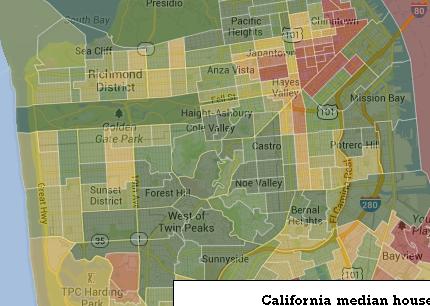
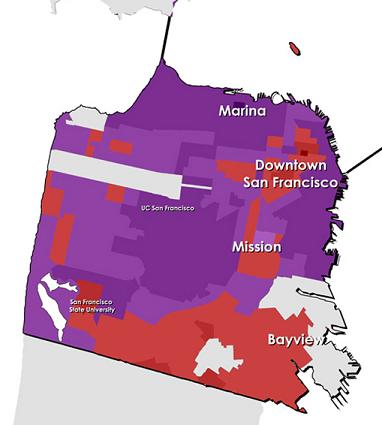
There’s a cool interactive map that gives you a visual picture of wealth and poverty in San Francisco. Check it out here. Just type in “San Francisco, CA” and click “income.”

What you see is a city full of green (wealth), with a few pockets of poverty. The data is at least two years old, so it’s almost certain that, say, the inner Mission no longer has a median income of $36,000 and the median in Noe Valley is above $108,000. The median in Vis Valley is (or was) $17,000. Nobody at that level could buy a house in VV now, not even close.

The fun thing is to imagine the income map overlaid with this map to see where housing costs — and thus median income — is rising fast. Check out, for example, the tiny Duboce Triangle area, with median income of $84, 000 (certainly no more than middle class by San Francisco standards). There were at least 17 buildings in that one census tract cleared of tenants by Ellis Act evictions; I wonder how much the median income has gone up.

It’s interesting to contrast SF to, say, Oakland and Berkeley, or to Los Angeles, where there are plenty of rich people (on the coast and in the hills) but also large swaths of more middle-income middle-class communities.

Just some thoughts for a Monday afternoon.


Democratic Party chair signs on with Realtors

14

Gee, which is worse: Having the chair of the local Democratic Party working for Pacific Gas and Electric Co., which blows up neighborhoods, or for the San Francisco Board of Realtors, which pushes anti-tenant legislation and whose members profit from gentrification and evictions?

Either way, Mary Jung, the Democratic County Central Committee chair, isn’t exactly a good representative for the city’s progressive Democracts. She just left her job as a lobbyist for PG&E and took a new position running government affairs for the landlords. From the Realtors press release:

Jung stated, “I am excited to have this opportunity to build upon and expand the REALTORS® Association role in the community. I look forward to working collaboratively with our local, state and national elected officials, and with our members, to ensure that the robust housing market continues to grow and our voice is heard effectively at City Hall.”

The “robust housing market.” In other words, displacement central. From the elected chair of the Democratic Party in San Francisco. I can’t think of the last time the chair of the local party was paid to represent corporate interests. Not a good sign.

The “L” word

35

Friend of mine sent me a great piece from the (I hope this isn’t verboten) SFGate about the gentrification of South Boston, the section of Boston once ruled by the iron fist of Jim “Whitey” Bulger. Landmarks that were once the alleged mobster’s HQ’s now turned wineries, the death of the local Irish pub, all the elements you’ve seen in a million stories about ethnic enclaves turned “Starbucks Nation”. 

Pretty good read as things tend to be (I lived in Boston for 12 years and rarely spent any time in Southie), but one quote stood out like a sore thumb: “The liberals came in and started to buy real estate. They realized how beautiful it is and they started throwing money at it.” This from a “Jamie Donnelan”, a 41 year old electrician. 

What’s that you say, Jamie? “Liberals?” Why, by gosh almighty, I’d a thought “liberals” never worked and were lazy and all on welfare (as that’s the meme one sees all over the Net and radio and cable news). Now, it seems that these sloth-like parasites are driving up land and property values–a strange thing occurs to me here. It isn’t possible, Jamie my lad, that “liberals” are two polar opposites of each other. Either they’re a drain on the hard working people of (name any place) or they’re the scourge of “the working class” (a critical distinction) by being successful in business and pricing them out of their homes. (South Boston is a hop, skip and jump over the channel to the business district).

So, which one is it?

I doubt that Mr. Donnelan could answer that one. Because the word “liberal” is now the “L-word”. Just as there’s an “N-word” and an “S-word” and a “K-word” for the “hated others”, “liberal” has become the all purpose epithet of choice for every resentment-addled reactionary, coast to coast. And it isn’t that “liberal = bad”, it is, astonishingly, “bad = liberal”. All bad things are not only the result of liberalism, they ARE liberalism. By making a political point of view (and a vague one at that)synonymous with evil, “liberal” no longer means anything.

After all, the “liberal media” is the one that tells us things we don’t want to hear. “Liberal academics” brainwash children (Liberty University and others like it, nah). And were it not for “liberals in the church”, none of the pedophile scandals would have happened (yes, they actually believe this!!!!).

All that’s wrong with the world = liberal, all good, conservative. Never mind that the rich yuppies that are pricing Southie’s long time residents out are doing so because of financial deregulations implemented by, erm……….Nope, that can never be it. Never and ever.


Maxwell’s, RIP

3

Maxwell’s–one of the very first stops on the Indie rock circuit–closes up shop this July. In business since 1978, the Hoboken nightspot has hosted bands all the way from indie mainstays like Yo La Tengo and the Feelies and Husker Du and the Replacements to unlikelies like Blue Oyster Cult. But when their lease ends at the end of July, so do they.

Unlike their punkish forefather across the Hudson, CBGB, Maxwell’s wasn’t entirely done in by gentrification, although that undoubtedly had a part in it. Hoboken–once only famous for Sinatra–had gone from being a very cheap Big Apple alternative to another pricey borough. Mostly, the issues were parking (which had become impossible) and general malaise. Given that the place will have made 35 years in business, that’s a good run.

Whatever takes its place will have nowhere near the same effect. But it’s telling that club management says that their actual competition in Hoboken came more from sports bar and “big screen TV’s”.

That isn’t the only reason. Let’s get real here–tastes have changed and indie rock is not the music of choice among the most prized demo of club goers, folks 21-28. When I was bouncing at Bottom of the Hill and the Kilowatt in the mid 90’s, I noticed that while carding patrons, the number of habitues over 30 was rarely over 10%. This is 2013–the average clubgoer now was born in 1987, which means that by the time they came of age, most of what they’d heard was hip hop and techno. Rock hasn’t been a sizable player in radio listener demo (outside of oldies) for years. A 24 or 25 year old now has been into Electronic Dance Music for maybe 10 years and its reach has expanded as it has replaced or become a hybrid with hip hop as dominant pop music. The idea of a band with guitars is, well, quaint (and banjos and uke’s even quainter, and now commercially viable–who says “folk” is dead?). However much I’d like to think that the “Beatles set up” (two guitars, bass, drums) would live forever–nothing does.

The Maxwell’s of the world cannot compete with DJ’s. The latter are solo acts whose music is immediately accessible. They’re cheaper and the relentless and steady flow of beats mean dancing feet and drinking faces. Clubs love that. They do not love five bands jousting for 40 minute sets, changeovers, audiences fleeing and complete indifference–who can blame them?

Everything that lives has to die. I played Maxwell’s once, in 1984. Good place. Played a zillion other places that are now gone, from CB’s to the Rat to Raji’s to Nightbreak–and it doesn’t pain me to say that they’re gone. They’re rooms–what counts is the music and the people. Mourning the Mabuhay or the I-Beam or Max’s Kansas City or the Satyricon or Off Ramp is silly. They, like Maxwell’s, are alive in your memories just like the clubs the EDM fans go to now will live in theirs. Viva le whatever, OK?


On the Cheap listings

0

WEDNESDAY 5

SF Peace and Hope reading Sacred Grounds Café, 2095 Hayes, SF. www.sfpeaceandhope.com. 7pm open mic signup, 8:15 reading, free. Online poetry journal SF Peace and Hope takes its cues from 1960s idealism — if you’re feeling that flower vibe stop by its third anniversary open mic night.

“Radar Superstar” San Francisco Main Library, 100 Larkin, SF. www.sfpl.org. 6pm, free. To celebrate the progressive, queer-minded, reading series 10 years of life, the minds behind Radar have assembled crazy-like-a-fox performer Jibz “Dynasty Handbag” Cameron, founder of black gay theater posse Pomo Afro Homos Brian Freeman, Vice Magazine masculinity expert Thomas Paige McBee, and high femme performance artist Maryam Rostami.

THURSDAY 6

Etsy Craft Lab Museum of Craft and Design, 2569 Third St., SF. www.sfmcd.org. 7-9:30pm, $10. Rick Kitagawa makes his bread and butter at his SF print shop Lords of Print (not to mention with the zombie-printed ties he designs at www.monkeyandseal.com) — but today, he’s giving back and teaching the crowd. Attend his screen-printing workshop sponsored by Etsy today and walk with your very own poster.

Local Protest, Global Movements: Capital, Community, and State in San Francisco The Green Arcade, 1690 Market, SF. www.thegreenarcade.com. 7pm, free. Author Karl Beitel hashes out his new book on the battles against gentrification here in San Francisco.

FRIDAY 7

“Headspace” Krowswork, 480 23rd St., Oakl. www.krowswork.com. Through July 13. Opening reception: 6-9pm, free. “thru her eyes/there is love/in/lifes quiet things/as we take time/to recreate/our realities” Oakland photographer Sasha Kelley dreamy photo portraits show black life in the Bay with more style than you’ll see pretty much anywhere else. Check out her First Friday opening, where they’ll be paired with video and verse.

“Travesia: Journey of the Gray Whale” SF Zoo, 1 Zoo Road, SF. www.acs-sfbay.org. Mandatory RSVP at acs.sfbay@gmail.com. 5pm. Mexican whale lovers Proyecto Ballena Gris present on their mission to protect the habitats of the migratory gray whale, which travels up and down the West Coast. Tonight’s event is a companion to the “Travesia” exhibit that’ll be open at the SF Zoo’s Pachyderm Building tomorrow, Sat/8.

Temescal Art Hop Rise Above Gallery, 4770 Telegraph, Oakl. www.riseaboveoakland.com. 6-9pm, free. The Temescal neighborhood is joining the First Friday fray — pick up a “passport” from one of the participating 20 businesses and get them stamped at the neighbors to win raffle prizes.

SATURDAY 8

Bromeliad Society plant sale SF County Fair Building, Ninth Ave. and Lincoln, SF. www.sfbromeliad.org. Also Sun/9. 9am-5pm, free. Green thumbs and casual park strollers will both find something to love at this annual expo of cacti, succulents, and bromeliads. Pick up a Tillandsia airplant or an African aloe — you can find growths here starting at just $2.

“The Future is Electric: Plug in and Get There” San Francisco Main Library, 100 Larkin, SF. www.energycenter.org/cvrp-events. 10:30am-2pm, free. Learn how you can get up to $10,000 from the government towards buying a plug-in electric car, plus all the new infrastructure and programs that might make owning one easier to manage.

Urban farm tours Various locations in Albany, El Cerrito, Richmond, El Sobrante. www.iuhoakland.com. 11am-6pm, $5 per location. The Institute of Urban Homesteading wants you to realize the power of a plot when it comes to feeding your family. See how others are making urban farming work for them at this week’s farm tour day — register on the site and you’ll receive a map of locations where you can drop by and see rainwater collection systems, bee hives, veggie gardens, goats, and more.

“Head Over Heels” White Walls Gallery, 886 Geary, SF. www.whitewallssf.com. Through June 29. Opening reception: 7-11pm, free. Fragmented, weathered collages that take off from fashion photography don the walls at Greg Gossel’s new show at White Walls. Gossel hired a photog to snap the base images he hand-printed on these works, creating sexy, billboard-esque results.

SUNDAY 9

Sunday Streets Bayview and Dogpatch Third St. between Newcomb and 22nd St. and surrounding area, SF. www.sundaystreetssf.com. 11am-4pm, free. Cruise from AT&T Park to the Bayview Opera House on car-free streets courtesy of this recurring street festival. Bayview and Dogpatch’s edition will feature all the yoga, live tunes, and local business festivities Sunday Streets runners, bikers, skaters, and strollers have become accustomed to.

Habitot Children’s Museum LGBTQ family open house 2065 Kittredge, Berk. www.habitot.org. 10am-2pm, free. Kick off Pride month with your babies at Berkeley’s kid museum. Little ones can clamber around the museum’s fire truck, art studio, wind tunnel, and waterworks area — plus settle in for a LGBTQ-themed story hour.

MONDAY 10

Nancy Morejón 2969 Mission, SF. www.answersf.org. 7pm, $8-10 donation suggested. Cuban poet, daughter of one of Habana’s old colonial neighborhoods, and winner of her country’s National Literature Prize Morejón reads from her chronicles of Cuba’s capital and its residents.

Alerts

0

THURSDAY 6

Resisting gentrification in San Francisco The Green Arcade bookstore, 1680 Market, SF. www.thegreenarcade.com. 7-8:30pm, free. San Francisco author and political economist Karl Beitel will discuss his new book, Local Protest, Global Movements: Capital, Community, and State in San Francisco, which chronicles the history of anti-gentrification and housing rights activism in the city. The book focuses on the broader historical, political and global context of urban movements. Book talk followed by discussion.

Patent pending: The rise of GM humans Brower Center’s Goldman Theater, 2150 Allston, Berk. www.browercenter.org. 7:30pm, free. In 1997, New York Medical College cell biologist Stuart Newman applied for a patent on a “humanzee” — part human, part chimp — to call attention to the ethical hazards of biotech patenting. Last year, researchers in the UK and US sought approval for creating and implanting genetically modified (GM) human embryos. What is the state of human genetic modification? What is at stake for the species? Join Stuart Newman, PhD, in conversation with Milton Reynolds of Facing History and Ourselves for this talk, part of an East Bay Conversations series on the Promises and Perils of Biotechnology.

SATURDAY 8

Tenth anniversary World Naked Bike Ride Justin Herman Plaza, 1 Market, SF. 10:30am-4:30pm. Organizers of San Francisco’s Tenth Anniversary World Naked Bike Ride are hoping for the largest turnout yet. Meet on the northeast side of Vaillancourt Fountain at 10:30 AM to spend half an hour primping with body and face paint, then get ready to ride as bare as you dare. Route will pass through Fisherman’s Wharf, the Marina, Lombard, North Beach, the Embarcadero, the Civic Center, the Haight, past Golden Gate Park, and finally to Ocean Beach. The WNBR is part of a global against oil dependency.

TUESDAY 11

Our vanishing civil liberties St. John’s Presbyterian Church, 2727 College Avenue, Berk. 7:30-9:30pm, free. This panel talk on the erosion of civil liberties will feature Birgitta Jonsdottir, a member of Icelandic Parliament, Wikileaks and Bradley Manning supporter, and poet; Daniel Ellsberg of Pentagon Papers fame; and Nadia Kayyali of the Bill of Rights Defense Committee. Panelists will hit on concerns such as indefinite detention, the National Defense Authorization Act (NDAA), police militarization, and the prosecution of whistleblowers.

The Performant: Cracks in the pavement

2

Gentrification-proof poetry

Although the ongoing eviction saga (and upcomng relocation!) of Adobe Books, “the living room” of the Mission, from its 16th Street digs dredges up memories of all the neighborhood bookstores that have closed/moved in recent years, it’s worth being reminded that the book trade has only ever had a limited impact on the persistence of the written (and spoken) word, particularly where poetry is concerned.

In fact, the more tenuous the economic climate, the more tenacious poetry becomes, pushing itself like a hungry weed through the unavoidable cracks left in the superficially smooth pavement of gentrification. That poets are themselves accustomed to staying hungry yet artistically fruitful is a condition immortalized in the famous Robert Graves quip that “there’s no money in poetry, but there’s no poetry in money, either.”


There’s not much money, but plenty of poetry outside the 16th Street BART Station every Thursday night, rainy or not, when a constantly rotating crew shows up to the unnamed, (un)official poetry jam, armed with the essential tools of urban poets everywhere—tall boys in brown paper bags, open ears under fleece hoods, and a cache of words waiting to be unleashed.

As nightlifers in expensive shoes stroll out of the station en route to the increasingly upscaled Valencia Street, they pass by the chalk circle ringed by a throng of scrappy street poets, belting out their offerings with the hoarse-throated projection of people without a microphone to hide behind. Instigated in 2004 by a passel of performance poets from the now-defunct New College up the road, Thursday nights have continued to attract a wealth of wordsmiths for almost ten years: some published some not, some regulars some newbs, some lifers some dilettantes. There’s may be some good-natured vying for stage time, but the bottom line is anyone with something to share is welcome to jump into the circle, and there’s almost always at least one participant who electrifies beyond anticipation, making even the otherwise mostly oblivious passerby stop in their tracks and pay attention.

Meanwhile, in the Lower Haight, a more carefully curated reading series takes place at The Squat, attracting its own adherents with its appealing blend of irreverence and celebration. Conceptualized and commanded by one “Janey Smith,” The Squat is less of an actual squat (no-one actually lives in it) than a liminal territory for an underground intelligentsia to congregate without the burden of pretension.

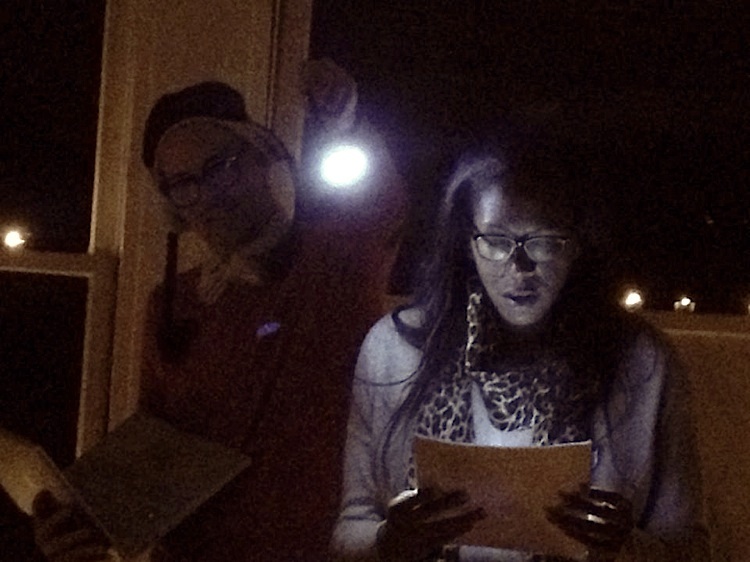
Beware the published starting time—the real determiner is the setting of the sun, since readings at The Squat are conducted, perhaps by necessity, in the dark. After night falls sufficiently, the group is led in abrupt silence from Smith’s iconic San Francisco apartment to the “venue,” a completely empty apartment upstairs, barely illuminated by rows of flickering tealights (“if you have hair, try not to catch on fire” Smith cracks). We squeeze into the “living room” together, encircling a pile of sawdust, the “stage.” 

Of the four readers, three locals (Ben Mirov, Erica Lewis, and Cedar Sigo) and a special “guest star” from the East Coast (Alex Dimitrov), the one whose poems most stick in my mind are Mirov’s, whose chilly distillations of word and image and deliberately affectless tone perfectly suit a body of poetry written in and for a digital age. Lewis reads from her latest project, a linked series called darryl hall is my boyfriend for which she provides mixed tapes of Darryl Hall’s music for emphasis, Sigo, most recently published by City Lights, presents a series of short poems rife with lush imagery, and Dimitrov works the increasingly vocal crowd with his confessional anecdotes, both written and spontaneous. The police don’t show and no-one catches on fire, so the event is deemed a success. Housing scarcity being what it is in this town, surely this apartment can’t stay empty forever, so get down there while you still have a chance, or head down to 16th Street on any Thursday around 10 p.m. Either way you’ll quickly discover that though our bookstores might be under siege, our poets refuse to surrender the fight.

Keep the focus on real estate

70

OPINION Let’s stop blaming the hipsters. The Google bus, that annoying icon of yuppie invasion and transit privatization, is not the lead driver of gentrification’s reckless stampede reshaping our city (though it does play a role). The upscale restaurants dominating commercial strips may be economically and aesthetically offensive to many, but they are the natural byproducts of gentrification’s much-ignored elephant in the room: the real estate industry.

While headlines, comment threads, and café chatter fixate on the tech industry and yuppies with fistfuls of dollars, it’s the profit-gobbling real estate companies and speculators who are jacking up rents and evicting so many small businesses and renters—and they are surely happy to stay out of the spotlight.

Gentrification is a many-layered beast nurtured by cultural and economic trends, regional and local labor and housing factors, and public policies (or lack thereof). Beneath the surface-level aesthetics, it is about displacement of people who don’t fit the dominant economic growth plan—radical market-driven upheavals of communities often abetted by government policies and inaction.

The stats are familiar but bear repeating as they are so destructive: average apartment rentals exceeding $2,700 a month, requiring someone making $70,000 a year to pay half of his or her salary in rent. Literally thousands of no-fault evictions in the past decade, according to the Rent Board.

Despite rampant displacement of thousands of San Franciscans, there has been little response from City Hall: no hearings, no proactive legislation, not even bully-pulpit style leadership. We must demand more.

Where is the leadership demanding the city do everything in its albeit limited power to halt further displacement of residents and small businesses? The toxic combo of tenant evictions and home foreclosures by the thousands — driven principally by major banks and real estate companies — is destroying lives and communities.

Some of this is beyond City Hall’s jurisdiction: state laws like the Ellis Act and Costa-Hawkins enable no-fault evictions and prevent vitally needed commercial rent control. Still, beyond their valiant opposition to the Wiener-Farrell condo conversion threat, city leaders have been largely silent about this latest wave of gentrification that’s eviscerating communities, driving out small businesses, and squeezing renters to the bone.

What can we do? We won’t defeat gentrification with city hearings or loud protests or online screeds and petitions — but we need all those things, along with serious public education, to shine a bright hot spotlight on the companies and individuals defining who lives and votes here.

We need a new era of citywide awareness, unity, and action to literally save San Francisco — a bold unapologetic vision that puts affordability and diversity at the forefront of what our city is about. We can’t have diversity without affordability; it’s that simple.

Renters are gearing up to fight back. An ‘Eviction Free Summer’ is being planned — an innovative campaign to counter the rash of evictions that are generating both displacement and skyrocketing rent prices. The idea of ‘Eviction Free Summer’ is to put evictions and evictors in the spotlight, to put would-be evictors on notice and capture the attention of city officials who have so far done little to stem their tide.

We must demand accountability and action by City Hall and state legislators to rein in the real estate industry and put the brakes on evictions and other displacement. People’s lives, neighborhoods and communities, and the very fabric and identity of our city are at stake.

To those who cheer “change” as if its victims were not real, or who wearily concede the fight, we must ask: are we really going to allow the profit-hungry market and wealth-seeking executives and speculators decide who lives and votes here? Are we going to let the market destroy what’s left of our city’s economic, cultural, racial and ethnic diversity — the very things that make San Francisco what it is?

Christopher D. Cook is an award-winning journalist and author, and former Bay Guardian city editor. Contact him at www.christopherdcook.com

Planning for displacement

70

tredmond@sfbg.com

The intersection of Cesar Chavez and Evans Avenue is a good enough place to start. Face south.

Behind you is Potrero Hill, once a working-class neighborhood (and still home to a public housing project) where homes now sell for way more than a million dollars and rents are out of control. In front, down the hill, is one of the last remaining industrial areas in San Francisco.

Go straight along Evans and you find printing plants, an auto-wrecking yard, and light manufacturing, including a shop that makes flagpoles. Take a right instead on Toland, past the Bonanza restaurant, and you wander through auto-glass repair, lumber yards, plumbing suppliers, warehouses, the city’s produce market — places that the city Planning Department refers to at Production, Distribution, and Repair facilities. Places that still offer blue-collar employment. There aren’t many left anywhere in San Francisco, and it’s amazing that this district has survived.

Cruise around for a while and you’ll see a neighborhood with high home-ownership rates — and high levels of foreclosures. Bayview Hunters Point is home to much of the city’s dwindling African American population, a growing number of Asians, and much higher unemployment rates than the rest of the city.

Now pull up the website of the Association of Bay Area Governments, a well-funded regional planning agency that is working on a state-mandated blueprint for future growth. There’s a map on the site that identifies “priority development area” — in planning lingo, PDAs — places that ABAG, and many believers in so-called smart growth, see as the center of a much-more dense San Francisco, filled with nearly 100,000 more homes and 190,000 new jobs.

Guess what? You’re right in the middle of it.

The southeastern part of the city — along with many of the eastern neighborhoods — is ground zero for massive, radical changes. And it’s not just Bayview Hunters Point; in fact, there’s a great swath of the city, from Chinatown/North Beach to Candlestick Park, where regional planners say there’s space for new apartments and condos, new offices, new communities.

It’s a bold vision, laid out in an airy document called the Plan Bay Area — and it’s about to clash with the facts on the ground. Namely, that there are already people living and working in the path of the new development.

And there’s a high risk that many of them will be displaced; collateral damage in the latest transformation of San Francisco.

CLIMATE CHANGE AND “SMART GROWTH”

The threat of global climate change hasn’t convinced the governor or the state Legislature to raise gas taxes, impose an oil-severance tax, or redirect money from highways to transit. But it’s driven Sacramento to mandate that regional planners find ways to reduce greenhouse gas emissions in California cities.

The bill that lays this out, SB375, mandates that ABAG, and its equivalents in the Los Angeles Basin, the Central Coast, the Central Valley and other areas, set up “Sustainable Communities Strategies” — land-use plans for now through 2040 intended to reduce greenhouse gas emissions by 15 percent.

The main path to that goal: Make sure that most of the 1.1 million people projected to live in the Bay Area by 2040 be housed in already developed areas, near transit and jobs, to avoid the suburban sprawl that leads to long commutes and vast amounts of car exhaust.

The notion of smart growth — also referred to as urban infill — has been around for years, embraced by a certain type of environmentalist, particularly those concerned with protecting open space. But now, it has the force of law.

And while ABAG is not a secret government with black helicopters that can force cities to do its will — land-use planning is still under local jurisdiction in this state — the agency is partnering with the Metropolitan Transportation Commission, which controls hundreds of millions of dollars in state and federal transportation money. And together, they can offer strong incentives for cities to get in line.

Over in Contra Costa and Marin counties, at hearings on the plan, Tea Party types (yes, they appear to exist in Marin) railed against the notion of elite bureaucrats forcing the wealthy enclaves of single-family homes to accept more density (and, gasp, possibly some affordable housing). In San Francisco, it’s the progressives, the transit activists, and the affordable housing people who are starting to get worried. Because there’s been almost zero media attention to the plan, and what it prescribes for San Francisco is alarming — and strangely nonsensical.

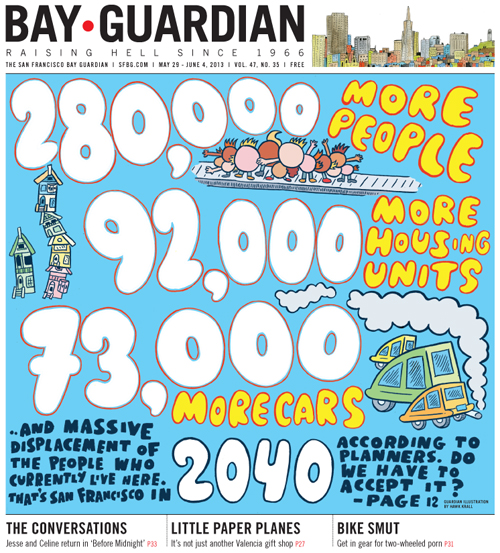
Under the ABAG plan, San Francisco would approve 92,400 more housing units for 280,000 more people. The city would host 190,000 more jobs, many of them in what’s called the “knowledge economy,” which mostly means high tech. Second and third on the list: Health and education, and tourism.

The city currently allows around eight cars for every 10 housing units; as few as five in a few neighborhoods, at least 10 in many others. And there’s nothing in any city or regional plan right now that seeks to change that level of car dependency. In fact, the regional planners think that single-occupancy car travel will be the mode of choice for 48 percent of all trips by 2040 — almost the same as it is today.

And since most of the new housing will be aimed at wealthier people, who are more likely to own cars and avoid catching buses, San Francisco could be looking for ways to fit 73,000 more cars onto streets that are already, in many cases, maxed out. There will be, quite literally, no place to park. And congestion in the region, the planners agree, will get a whole lot worse.

That seems to undermine the main intent of the plan: Transit-oriented development only works if you discourage cars. In a sense, the car-use projections are an admission of failure, undermining the intent of the entire project.

The vast majority of the housing that will be built will be too expensive for much of the existing (and even future) workforce and will do little to relieve the pressure on lower income people. But there is nothing whatsoever in the plan to ensure that there’s money available to build housing that meets the needs of most San Franciscans.

Instead, the planners acknowledge that 36 percent of existing low-income people will be at risk for displacement. That would be a profound change in the demographics of San Francisco.

Of course, adding all those people and jobs will put immense pressure on city services, from Muni to police, fire, and schools — not to mention the sewer system, which already floods and dumps untreated waste into the Bay when there’s heavy rain. Everyone involved acknowledged those costs, which could run into the billions of dollars. There is nothing anywhere in any of the planning documents addressing the question of who will pay for it.

THE NUMBERS GAME

Projecting the future of a region isn’t easy. Job and population growth isn’t a straight line, at best — and when you’re looking at a 25-year window in a boom-and-bust area with everything from earthquakes to sea-level rise factoring in, it’s easy to say that anyone who claims to know what’s going to happen in 2040 is guessing.

But as economist Stephen Levy, who did the regional projections for ABAG, pointed out to us, “You have to be able to plan.” And you can’t plan if you don’t at least think about what you’re planning for.

Levy runs the Center for the Continuing Study of the California Economy, and he’s been watching trends in this state for years. He agrees that some of his science is, by nature, dismal: “Nobody projects deep recessions,” much less natural disasters. But overall, he told me, it’s possible to get a grip on what planners need to prepare for as they write the next chapter of the Bay Area’s future.

And what they have to plan for is a lot more people.

Levy said he started with the federal government’s projections for population growth in the United States, which include births and deaths, immigration, and out-migration, using historic trends to allocate some of that growth to the Bay Area. There’s what appears at first to be circular logic involved: The feds (and most economists) project that job growth nationally will be driven by population — that is, the more people live in the US, the more jobs there will be.

Population growth in a specific region, on the other hand, is driven by jobs — that is, the more jobs you have in the Bay Area, the more people will move here.

“Jobs in the US depend on how many people are in the labor force,” he said. “Jobs in the Bay Area depend on our share of US jobs and population depends on relative job growth.”

Make sense? No matter — over the years it’s generally worked. And once you project the number of people and jobs expected in the Bay Area, you can start looking at how much housing it’s going to take to keep them all under a roof.

Levy projects that the Bay Area’s share of jobs will be higher than most of the rest of the country. “This is the home of the knowledge industry,” he told me. So he’s concluded that population in the Bay Area will grow from 7.1 million to 9.2 million — an additional 2.14 million people. They’ll be chasing some 1.1 million new jobs, and will need 660,000 new housing units.

Levy stopped there, and left it to the planners at ABAG to allocate that growth to individual cities — and that’s where smart growth comes in.

For decades in the Bay Area, particularly in San Francisco, activists have waged wars against developers, trying to slow down the growth of office buildings, and later, luxury housing units. At the same time, environmentalists argued that spreading the growth around creates serious problems, including sprawl and the destruction of farmland and open space.

Smart growth is supposed to be an alternative: the idea is to direct new growth to already-established urban areas, not by bulldozing over communities (as redevelopment agencies once did) but by the use of “infill” — directing development to areas where there’s usable space, or by building up and not out.

ABAG “focused housing and jobs growth around transit areas, particularly within locally identified Priority Development Areas,” the draft environmental impact report on the plan notes.

The draft EIR is more than 1,300 pages long, and it looks at the ABAG plan and several alternatives. One alternative, proposed by business groups, would lead to more development and higher population gains. Another, proposed by community activist groups including Public Advocates, Urban Habitat, and TransForm, is aimed at reducing displacement and creating affordable housing; that one, it turns out, is the “environmentally preferred alternative.” (See sidebar).

But no matter which alternative you look at, two things leap out: There is nothing effective that ABAG has put forward to prevent large-scale displacement of vulnerable communities. And despite directing growth to transit corridors, the DEIR still envisions a disaster of traffic congestion, parking problems, and car-driven environmental wreckage.

THE DISPLACEMENT PROBLEM

ABAG has gone to some lengths to identify what it calls “communities of concern.” Those are areas, like Bayview Hunters Point, Chinatown, and the Mission, where existing low-income residents and small businesses face potential displacement. In San Francisco, those communities are, to a great extent, the same geographic areas that have been identified as PDAs.

And, the DEIR, notes, some degree of displacement is a significant impact that cannot be mitigated. In other words, the gentrification of San Francisco is just part of the plan.

In fact, the study notes, 36 percent of the communities of concern in high-growth areas will face displacement pressure because of the cost of housing. And that’s region wide; the number in San Francisco will almost certainly be much, much higher.

Miriam Chion, ABAG’s planning and research director, told me that displacement “is the core issue in this whole process.” The agency, she said, is working with other stakeholders to try to address the concern that new development will drive out longtime residents. But she also agreed that there are limited tools available to local government.

The DEIR notes that ABAG and the MTC will seek to “bolster the plan’s investment in the Transit Oriented Affordable Housing Fund and will seek to do a study of displacement. It also states: “In addition, this displacement risk could be mitigated in cities such as San Francisco with rent control and other tenant protections in place.”

There isn’t a tenant activist in this town who can read that sentence with a straight face.

The problem, as affordable housing advocate Peter Cohen puts it, is that “the state has mandated all this growth, but has taken away the tools we could use to mitigate it.”

That’s exactly what’s happened in the past few decades. The state Legislature has outlawed the only effective anti-displacement laws local governments can enact — rent controls on vacant apartments, commercial rent control, and eviction protections that prevent landlords from taking rental units off the market to sell as condos. Oh, and the governor has also shut down redevelopment agencies, which were the only reliable source of affordable housing money in many cities.

Chion told me that the ABAG planners were discussing a list of anti-displacement options, and that changes in state legislation could be on that list. Given the power of the real-estate lobby in the state Capitol, ABAG will have to do more than suggest; there’s no way this plan can work without changing state law.

Otherwise, eastern San Francisco is going to be devastated — particularly since the vast majority of all housing that gets built in the city, and that’s likely to get built in the city, is too expensive for almost anyone in the communities of concern.

“This plan doesn’t require affordable housing,” Cindy Wu, vice-chair of the San Francisco Planning Commission, told me. “It’s left to the private market, which doesn’t build affordable housing or middle-class housing.”

In fact, while there’s plenty of discussion in the plan about where money can come from for transit projects, there’s virtually no discussion of the billions and billions that will be needed to produce the level of affordable housing that everyone agrees will be needed.

Does anyone seriously think that developers can cram 90,000 new units — at least 85 percent of them, under current rules, high-cost apartments and condos that are well beyond the range of most current San Franciscans — into eastern neighborhoods without a real-estate boom that will displace thousands of existing residents?

Let’s remember: Building more housing, even a lot more housing, won’t necessarily bring down prices. The report makes clear that the job growth, and population boom that accompanies it, will fuel plenty of demand for all those new units.

Steve Woo, senior planner with the Chinatown Community Development Center, sees the problem. In a letter to ABAG, he notes: “Plan Bay Area and its DEIR has analyzed the displacement of low-income people and explicitly acknowledges that it will occur. This is unacceptable for San Francisco and for Chinatown, where the pressures of displacement have been a constant over the past 20 years.”

Adds the Council of Community Housing Organizations: “It would be irresponsible for the regional agencies to advance a plan that purports to ‘improve’ the region’s communities as population grows while the plan simultaneously presents great risk and uncertainty for many vulnerable communities.”

Jobs are at stake, too — not tech jobs or office jobs, which ABAG projects will expand, but the kind of industrial jobs that currently exist in the priority development areas.

Calvin Welch, who has been watching urban planning and displacement issues in San Francisco for more than 40 years, puts it bluntly: “It is axiomatic that market-rate housing drives out blue-collar jobs,” he said.

Of course, there’s another potential problem: Nobody really knows where jobs will come from in the next 25 years, whether tech will continue to be the driver or whether the city’s headed for a second dot-com bust. San Francisco doesn’t have a good record of building for projected jobs: In the mid-1980s, for example, the entire South of Market area (then home to printing, light manufacturing, and other blue-collar jobs) was rezoned for open-floor office space because city officials projected a huge need for “back-office” functions like customer service.

“Where are all those jobs today?” Welch asked. “They’re in India.”

TOO MANY CARS

For a plan that’s designed to reduce greenhouse gas emissions by moving residential development closer to work areas, Plan Bay Area is awfully pessimistic about transportation.

According to the projections, there will be more cars on the roads in 2040, with more — and much worse — traffic. The DEIR predicts that a full 48 percent of all trips in 2040 will be made by single-occupant vehicles — just slightly down from current rates. The percentage of trips on transit will only be a little bit higher — and there’s no significant increase in projected bicycle trips.

That alone is pretty crazy, since the number of people commuting to work by bike in San Francisco has risen dramatically in the past 10 years, and the city’s official goal is that 20 percent of all vehicle trips will be by bike in the next decade.

Part of the problem is structural. Not everyone in San Francisco 2040 is going to be a high-paid tech worker. In fact, the most stable areas of employment are health services and government — and hospital workers and Muni drivers can’t possibly afford the housing that’s being built. So those people will — the DEIR acknowledges — be displaced from San Francisco and forced to live elsewhere in the region (if that’s even possible). Which means, of course, they’ll be commuting further to work. Meanwhile, if current trends continue, many of the people moving into the city will work in Silicon Valley.

Chion and Levy both told me that the transit mode projections were based on historical trends for car use, and that it’s really hard to get people to give up their cars. Even higher gas prices and abominable traffic delays won’t drive people off the roads, they said.

If that’s the case — if auto culture, which is a top source of global climate change, doesn’t shift at all — it would seem that all this planning is pointless: the seas will rise dramatically, and San Franciscans ought to be buying boats.

“The projections don’t take into account social change,” Jason Henderson, a geography professor at San Francisco State University and a local transportation expert, told me. “And social change does happen.”

Brad Paul, a longtime housing activist who now works for ABAG, said these projections are just a start, and that the plan will be updated every four years. “I think we’re finding that the number of people who want to drive cars will go down,” he said.

Henderson argues that the land-use policy is flawed. He suggests that it would make more sense to increase density in the Bay Area suburbs along the BART lines. “Elegant development in those areas would work better,” he said. You don’t need expensive high-rises: “Four and five stories is the sweet spot,” he explained.

Most of the transportation projects in the plan are already in the pipeline; there’s no suggestion of any major new public transit programs. There is, however, a suggestion that San Francisco adopt a congestion management fee for downtown driving — something that city officials say is the only way to avoid utter gridlock in the future.

SIDELINING CEQA

ABAG and the MTC have a fair amount of leverage to implement their plans. MTC controls hundreds of millions of dollars in transit money; ABAG will be handing out millions in grants to communities that adopt its plan. And under state law, cities that allow development in PDAs near transit corridors can gain an exemption from the California Environmental Quality Act.

CEQA is a powerful tool to slow or halt development, and developers (and some public officials) drool at the prospect of getting a fast-track pass to avoid some of the more cumbersome parts of the environmental review process.

Under SB 375 and Plan Bay Area, CEQA exemptions are available to projects that meet the Sustainable Community Strategy standards and are close to transit corridors. And when you look at the map of those areas, it’s pretty striking: All of San Francisco, pretty much every square inch, qualifies.

That means that almost any project almost anywhere in town can make a case that it doesn’t need to accept full CEQA review.

The most profound missing element in this entire discussion is the cost of all this growth.

You can’t cram 210,000 more residents into San Francisco without new schools, parks, and child-care centers. You can’t protect those residents without more police officers and firefighters. You can’t take care of their water and sewer needs without substantial infrastructure upgrades. And even if there’s state and federal money available for new buses and trains, you can’t operate those systems without paying drivers, mechanics, and support workers.

There’s no question that the new development will bring in more tax money. But the type of infrastructure improvements that will be needed to add 25 percent more residents to the city are really expensive — and every study that’s ever been done in San Francisco shows that the tax benefits of new development don’t cover the costs of public services it requires.

When World War II and the post-war boom in the Bay Area brought huge growth to the region, property taxes and federal and state money were adequate to build things like BART, the freeways, and hundreds of new schools, and to staff the public services that the emerging communities needed. But that all changed in 1978, with the passage of Prop. 13, and two years later, with the election of Ronald Reagan as president.

Now, federal money for cities is down to a trickle. Local government has an almost impossible time raising taxes. And instead of hiking fees for new residential and commercial projects, many communities (including San Francisco) are offering tax breaks to encourage job growth.

Put all that in the mix and you have a recipe for overcrowded buses, inadequate schools, overstressed open space (imagine 10,000 new Mission residents heading for Dolores Park on a nice day), and a very unattractive urban experience.

That flies directly in the face of what Plan Bay Area is supposed to be about. If the goal is to cut down on commutes by bringing new residents into developed urban areas, those cities have to be decent places to live. What would it cost to accommodate this level of new development? Five billion dollars? Ten billion? Nobody knows — because nobody has run those numbers. But they’re going to be big.

Because just as tax dollars have been vanishing, the costs of infrastructure keep going up. It costs a billion dollars a mile to build BART track. It’s costing more than a billion to build a short subway to Chinatown. Just upgrading the sewer system to handle current demands is a $4 billion project.

And if the developers and property owners who stand to make vast sums of money off all of this growth aren’t going to pay, who’s left?

The ABAG planners point out, correctly, that there’s a price for doing nothing. If there’s no regional plan, no proposal for smart growth, the population will still increase, and displacement will still happen — but the greenhouse gas emissions will be even worse, the development more haphazard.

But if the region is going to spend all this money and all this time on a plan to make the Bay Area more sustainable, more livable, and more affordable in 25 years, we might as well push all the limits and get it right.

Instead of looking at displacement as inevitable, and traffic as a price of growth, the planners could tell the state Legislature and the governor that it’s not possible to comply with SB375 — not until somebody identifies the big sums of money, multiples of billions of dollars, needed to build affordable housing; not until there are transit options, taxes, and restrictions on driving.

Because continued car use and massive displacement — the package that’s now facing us — just isn’t an acceptable option.


The Blob eats Quebec

0

culture@sfbg.com

THE BLOB If you thought the first thing you’d see when you landed in Quebec City, Canada, was a mime in a black mock turtleneck playing “My Heart Will Go On” on an accordion, you’d be almost right. Almost, because the Blob promptly devoured him — chewy! — and went on to enjoy a brief culinary tour of one of the most charming, clean, and friendly cities she’s visited.

Also surprisingly diverse: waves of Canadian immigration have gently streaked “traditional” Canadian cuisine (yes there is such a thing, from the “meat pie” pork tortierre of the Blob’s maternal grandmother to Canadian bacon, berry jams, sweet pickles, and caribou steaks) with global flavors. Quebec being heavily French, there’s also an attention to detail and service that boosts its current restaurant boom to another level — without stinting on any creamy richness.

Chefs here have dived into experimenting with local St. Lawrence Seaway ingredients like meaty Îles de la Madeleine sea scallops, tender green saltwort, smoked Kamouraska eel, late spring fiddleheads and asparagus (all experienced at the superior L’Échaudé in the stonewalled Vieux-Port area, www.echaude.com). Blackberry cassis and cider, made in the bright, tin-roofed farmhouses on Île d’Orléans across the river, boutique chocolate galore, and ubiquitous maple delights from Quebec’s interior sweeten the pot.

“Smoked meat,” a.k.a. molasses-cured pastrami, piled on a plate with a pickle (Joe Smoked Meat, www.joesmokedmeat.com) or tucked deliciously beneath cheese and a layer of butter spread on a pizza (Pizzeria TM in nearby Thetford Mines) fattens up, as does that ubiquitous Quebecois staple, poutine, in a panoply of forms. Let’s eat.


RABBIT PIE AT LE LAPIN SAUTÉ

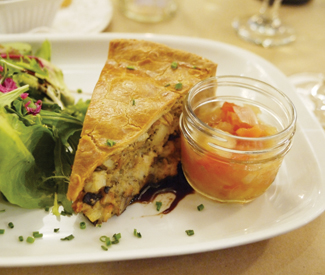
Holy leaping quaintness. This cozy joint in the Lower Town, tucked amid shops selling Inuit art and hip-mom scarves, is a true Quebec experience. Pretty waitstaff offer the house specialty, rabbit, in a dazzling variety of formats: juicy in white bean cassoulet, dipped in honey-rosemary sauce, roasted with “two mustards,” even plated with a hefty side of duck. Simplicity is best, the Blob may have learned from some Beatrix Potter book. So a slice of rabbit pie ($21.95) it was, savory-sweet, with currants and potatoes, atop a splash of balsamic sauce. Paired perfectly with a local Boréale Rousse beer? Mais oui!

52, rue du Petit-Champlain, www.lapinsaute.com


NEIGE RECOLTÉ D’HIVER FROM LA FACE CACHÉE DE LA POMME

Ice cider, who knew? The Blob has been put off by ice wines before — too sweet, too supermarket-y — but this premier line of Quebecois ciders ($47 per 375 ml, less expensive versions available), distilled from frosted apples, has changed her life. Wonderful after a spicy meal, the chilled-syrup, full-bodied sweetness lingers in your mouth like a very good port, but without the sting.

www.lafacecachee.com


DUCK POUTINE AT LE COCHON DINGUE

Le Cochon Dingue is a Denny’s-like restaurant chain (but better), and poutine — fries smothered in gravy and cheese curds — is a French Canadian staple that’s become popular in the US. Poutine is available everywhere, from fast food versions to ones with foie gras or hunks of venison. The measure to which all poutine is held? The squeakiness of its curds. And this affordable version ($10) with shredded duck in a sweet gravy has incredibly squeaky curds. It’s squeaky curdlicious.

www.cochondingue.com  


BOUDIN NOIR AT CLOCHER PENCHE

This is the place: a former bank on a corner in the neat Saint-Roch district, transformed into a magnet for foodies (there are some gentrification issues here, yes). The innovative menu doesn’t show its hand too much — you’re getting deeply thought-through, hyperlocal fare, but that fact’s not treated like a showy gimmick, plastered everywhere. One stand-out: blood pudding sausage ($23.95), melting with rich, dark pork and accompanied by pineapple (OK, not so local always) chutney and hearty fresh vegetables. Desserts are a must — tiny chocolate squares as dense as black holes dot caramelized bananas in rum sauce with sticky popcorn; érable (maple) flavor erupts in a warm fritter crusted with sweet pecans.  

203, rue Saint-Joseph Est, www.clocherpenche.ca

Do falling jobless numbers mean we’re smart and focused, or rich and exclusive?

73

The unemployment rate continues to drop in San Francisco and all over California, according to new numbers released today by the California Employment Development Department, which were trumpeted by Mayor Ed Lee as vindication for his economic development policies.

“San Francisco’s steady economic recovery is the result of our continued focus on job creation, education and training residents for the demands of the 21st century workforce. San Franciscans are getting back to work across the spectrum of job sectors – from hospitality to construction to technology to service industry jobs and we will continue to help these sectors grow in our City,” Lee said in a press release.

But are Lee’s neoliberal policies of promoting technology and other corporations with tax breaks and city-subsidized training programs and financing mechanisms really creating the rosy economic picture he’s painting? And even if it is helping to promote boom times, at what point have we essentially reached full employment, the point at which we should maybe turn our focus and resources to addressing the rising cost of living here?

After all, San Francisco’s unemployment rate of 5.4 percent is third only to Marin County (4.6 percent) and San Mateo County (5.1 percent). Those three counties also just happen to be the three counties with the highest per capita incomes in the state, a fact that explains our jobless rate more than the mid-Market payroll tax exemption and other taxpayer giveaways.

“Unemployment rates tend to be lowest in areas with high education attainment,” Ruth Kavanagh, EDD’s labor market consultant for this area, told us when we called to discuss the disparties among counties.

What about the rising cost of living in San Francisco? Clearly, this is becoming a much more difficult city for the unemployed and marginally employed to remain living in. How much are gentrification, evictions, and the exodus to the East Bay (Alameda County’s rate is 7 percent, still better than the statewide rate of 8.5 percent) and other locales a factor in our low jobless rate?

Kavanagh said the EDD doesn’t directly track that and so she couldn’t address the question. But she did say that the Bay Area was indeed experiencing the fastest job growth in the state, driven largely by the tech industry. In the last year, this three-county area has added 9,600 jobs in Professional Business Services (which includes tech) and 4,600 each in Leisure & Hospitality and Construction.

Indeed, in his State of the City speech in January, Lee touted the 23 construction cranes on the city skyline as the best gauge of the state of the city. And if counting jobs is one’s only measure of success, San Francisco is doing as well as can be expected. Kavanagh said most economists consider “full employment” within the capitalist system to be somewhere between 4-5 percent.     

Yet Lee says he’s not backing off from his full-throttle focus on economic development. “San Francisco’s unemployment rate today stands at a five-year low and I will continue to pursue policies that get people back to work, support San Francisco families and invest in our City’s future,” he said. “This Summer through San Francisco Summer Jobs +, we are setting an aggressive goal of putting 6,000 youth to work in paid jobs and internships, and I will continue working hard to make sure all San Franciscans have access to good paying jobs.”

Now if only we all had access to reasonably priced housing, health care, food, entertainment, and a transportation system built to handle a growing population.

-sigh-

Now get back to work!

The Performant: The real weekend warriors

Holding down the weekend of the weekend with the Dark Room Theatre’s “Ghostbusters: Live” and Har Mar Superstar

Among the true creatures of the night, Saturday Night has always been passé, amateur night if you will, when even the most accommodating of dive bars or clubs are suddenly jammed tight with lightweight dilettantes, whose allegiance to the night life is as superficial as it is truncated. But the real weekend has always begun on Thursday, straddling the line between Wednesday’s hump and Saturday’s slump, a connoisseur’s indulgence.

Though San Francisco is happily full of those who understand that Thursday is when the party starts, any number of theatres can still attest that packing the house on that particular evening can be a tricky prospect, a trend I can attest to from the personal experience of having attended many a Thursday show where the actors outnumbered the oddience. Awkward. Which made entering the oversold, packed to the rafters performance of “Ghostbusters: Live”! at the Dark Room Theatre that much more refreshing. This is one Mission Street outpost that has thus far ably resisted the siren song of gentrification and co-option, and remains a place where silly good fun can be had for the price of cheap, with an additional calendar of ten p.m. comedy shows that caters specifically to the committed night owl crowd.

“Ghostbusters: Live” was a perfect example of the Dark Room aesthetic from start to finish, one which other no-budget production companies would do well to take note of. Eschewing a set, which would really just impede the action on the tiny, 12’ x 8’ stage, but expending just enough effort on costuming, lights, and sound to support the storyline and bolster the humor, “Ghostbusters: Live!” opened with the three researchers (played by Adam Curry, Tim Kay, and Thomas Apley) looking for signs of a haunting in the public library, the best lines about great sponge migrations, family psychosis, and menstruation left intact. With clever puppetry standing in for any number of ghostly apparitions, and a strong supporting cast including Adam Vogel as a pitch-perfect Louis Tully, and Alexia Staniotes as the acerbic Janine Melnitz, “Ghostbusters: Live!” managed to capture both the essence of the movie it was sending up and the heady geist of a Thursday night out on the town, framing the possibilities for the rest of the weekend to come.

If Thursday Night is the prelude to the weekend, then Sunday night is its final salute, and the true testing ground of the dedicated denizens of the dark. Which made it perhaps the perfect day of the week for the rarified talent that is Har Mar Superstar to perform. True, the tough sell that is Sunday night kept the crowd at the Bottom of the Hill from swelling to the epic proportions you might expect for a performer of his caliber, but wasn’t that just more elbow room for the rest of us?

Often compared to the lovably schlubby porn star Ron Jeremy, the Bay Area celebrity Sean Tillmann most closely resembles is Josh Kornbluth, although Tillman’s a whole lot more exhibitionistic. His alter-ego’s double-entendre filled lyrics, funky dance moves, catchy hooks, and unabashed libido combine into a stage persona of pure sweaty id, while his true weapon, a silkily soulful croon, tongue-bathes the oddience in its liquid smooth. While a lot of his songs skew towards the humorous, including the trashy-pop “Tall Boy” and his boy-band ode to “the male camel-toe” “Almond Joy,” when Har Mar gets serious he wields an epic howl such as when he turns on the retro-soul for “Lady, You Shot Me” and further unleashes his formidable upper register on “Sunshine.”

And while there was some initial trepidation on the part of the crowd, perhaps fearful of the unpredictable intentions of the lascivious songster, by the end everyone was getting into the spirit of the moment, rubbing Tillman’s proudly bared belly for luck, swapping saliva, getting down. Rounding out the set with a literally stripped-down (to the briefs) acapella version of “It’s So Hard to Say Goodbye to Yesterday” provided the appropriate closure for the weekend’s last hurrah, and set the mood for all the weekends to come, the sunshine and the rain.    


A call to arms

38

OPINION No one can deny that the San Francisco of the new dot-com boom is a scary place to live. Rents are astronomical: $2,353 is the median rent for a one-bedroom in the Bayview, an area that has never had high rents. Ellis Act evictions are up 68 percent from last year, and buyouts and threats of Ellis (de facto evictions) are skyrocketing. Longterm rent-controlled tenants live in absolute dread that their buildings will be sold to a real-estate speculator who will decide, a month later, to “go out of the business of being a landlord.”

Neighborhoods are being transformed, and not for the better. The once immigrant Latino and working-class lesbian area of Valencia Street is now mostly white, straight and solidly upscale. The Castro has more baby strollers per square foot than a suburban mall, not to mention a high rate of evictions of people with AIDS. Along Third Street and in SOMA and other areas, people of color are being pushed out, and the working-class is being replaced by middle-income condo owners. The African American population of the city is down to 6 percent.

Small businesses, too, are being decimated, as landlords demand higher and higher rents and chain stores try and creep into every block. If the demographics of the city continue to change and become more moderate, many longstanding political gains could be lost.

Resistance is not futile.

During the Great Depression, the Communist Party in the Bronx and elsewhere successfully mobilized the working class to block doorways when the marshals arrived to evict tenants. In the 1970s here in San Francisco, the “redevelopment” of the Fillmore and the I-Hotel was met with widespread protests. Then-sheriff Richard Hongisto went to jail rather than evict the working-class Filipino tenants at the I-Hotel. In the late 1990s, organizing to fight the evictions and displacement happening in the wake of the first dot-com boom culminated in a progressive takeover of the Board of Supervisors.

These days, there’s no mass movement to fight the evictions and displacement. Occupy Bernal, ACCE and others have successfully stopped the auctions of foreclosed homes, and even twisted the arms of banks to renegotiate some mortgages. Tenant organizations have been holding back efforts to weaken rent control for years.

Where is the building-by-building organizing of renters? Where is the street outreach in every neighborhood? Where are the blocked doorways of those being forced out of their apartments by pure greed? Where are the direct actions against the speculators and investors who are turning our neighborhoods into a monopoly game? Where is the pressure on the Board of Supervisors to pass legislation to curb speculation and gentrification rather than approve tax breaks for dot-com companies? Where is the pressure on state legislators to repeal the Ellis Act and other state laws that prohibit our city from strengthening rent control and eviction protections?

Every moment we wait, more people are displaced from their homes, more neighborhoods become upscale, more small businesses are lost. Progressives wake up.

It’s time to take back what’s left of our city.

Tommi Avicolli Mecca is a longtime queer housing activist who works at the Housing Rights Committee. He is editor of Smash the Church, Smash the State: the early years of gay liberation (City Lights).


Boom life: Mattilda Bernstein Sycamore talks about ‘The End of San Francisco’

0

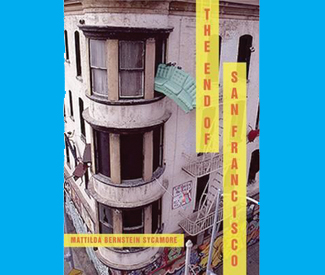
A picture of Brian Goggin’s iconic site-specific sculpture “Defenestration” (that 16-year-old “furniture leaping out of an abandoned building” piece in SoMa that may be demolished soon) is pictured on the cover of Mattilda Bernstein Sycamore’s latest book, The End of San Francisco — which I reviewed in this week’s Guardian.

It’s an almost too-perfect image to represent the book’s contents — “Defenestration” cheekily channeled the out-the-window frustration of the dawning of the first Internet boom, with its hordes of tech gold-rushers pushing out old San Francisco culture. (And now, in the middle of another tech boom, the artwork itself will be pushed aside to make way for affordable housing — the term for anything under $2500 per month rent pretty much at this point.) The End of San Francisco takes us on an atmospheric, highly personal through the turbulent period of the ’90s and early 2000s, while asking some hard questions about the queer activism, participatory gentrification, and “alternative culture” of the period. Along the way, Mattilda intimately delves into issues like her recovered memories of sexual abuse as a child at the hands of her father; the rampant drug use, mental illness, and hostile attitudes of Mission queer culture; the gynophobia and transphobia of many “underground” scenes, and much, much more. 

I asked Mattilda a few questions over email in advance of her appearances here at City Lights (April 30) and the GLBT Historical Society (May 9) to help set her book in the context of what was happening then, and what’s still happening now. As always, she pulled no punches. 

MATTILDA BERNSTEIN SYCAMORE reads Tue/30, 7pm, free at City Lights Bookstore, 261 Columbus, SF. www.citylights.com, and Thursday, May 9, 7pm, free at the GLBT History Museum, 4127 18th St., SF. www.glbthistory.org

SFBG What was the impetus for writing such a wide-ranging memoir? You cover almost your entire life, from some of your earliest memories to when you officially moved away from San Francisco. Was there a specific purpose when you sat down to write it?

MATTILDA BERNSTEIN SYCAMORE
With my anthologies, I always have a specific purpose in mind, a political intervention, but for this kind of personal writing – I write to stay alive. So it’s a different kind of intervention. I started with 1200 pages of material, and then separated different sections into themes. So, for example, the chapter called “The Texture of the Air,” originally that was something like 200 pages of writing about cruising and its limitations, about trying to regain a sense of hope in my own sexuality. Now it’s 15 pages. At some point I realized that the book centered around the myths and realities of San Francisco as a refuge for radical queer visions in community building. I first moved to San Francisco in 1992, when I was 19, and it’s where I figured out how to challenge the violence of the world around me, how to embrace outsider visions of queer splendor, how to create love and lust and intimacy and accountability on my own terms. I left San Francisco in 2010, and in some ways this book is an attempt to figure out why or how this city has such a hold on me, in spite of the failure of so many of my dreams, over and over and over again.

SFBG I think the most fascinating parts of the End of San Francisco are your spot-on description of life here in the 1990s, and your detailing of the excruciating decline of that era in the dot-com boom. Now
that we’re undergoing another dot-com boom, what are some of your thoughts as to how that’s once again affecting “alternative culture.” Is there any such thing as “alternative culture” anymore?

MBS Oh, it’s so sad! The way gentrification has progressed over these last 20 years. The displacement, the homogenization, the transformation of cultures of resistance into commodities. The way all of this limits people’s imaginations. At the same time, I don’t want to romanticize the past. In the early-‘90s, it felt like everywhere people were dying of AIDS and drug addiction and suicide; it was a desperate time, even if in some ways there were more possibilities for choosing a life outside status quo normalcy. But, no matter when we are living in this country so responsible for genocide, endless war, the destruction of the environment, we are living in a desperate time and we still need to come up with radical alternatives to giving up.

SFBG I figure a lot of the people who were here in that era (me included) will recognize a lot of truth in what you describe, including some pretty scathing but deadly accurate words about the people who thought they were on the forefront of alternative culture back then — how a lot of it was “vintage store glamour” and the “strung-out junkie look.” Have you had any reactions from anyone about that? Or from any of the people who were close to you back then that you’ve written about?

MBS I offered the manuscript ahead of time to everyone in the book who plays a major role. A few people didn’t respond. Some offered detailed feedback. And some, of course, are featured in conversations about the book, in the book – while The End of San Francisco is about my memories, of course these memories exist in the context of the relationships I’m describing. I want to challenge the notion of one true story, while at the same time I obsess about figuring out all these formative moments for me – politically, socially, sexually, ethically, emotionally. One of the funniest responses was from the first person who I trusted, we moved to San Francisco together in 1992. She wanted me to take out the parts where we do drugs, so she could show her kids!

SFBG Another fascinating part is your account of the rise and peter-out of Gay Shame [the guerilla anti-assimilationist co-founded by Mattilda]. You’ve talked about this before in previous books, like the anthology That’s Revolting — how did you approach writing about it within the context of this memoir?

MBS This writing is more self-critical. It’s more about the relationships I formed through activism, the gaps between our rhetoric of inclusiveness and the more complicated realities. Ultimately I’m looking at this activist group that meant so much to me, that challenged and inspired me in so many ways, but ultimately failed me. I’m not saying that it failed, but it did fail me and I’m trying to figure out why.

SFBG Do you think there’s any space now, in SF or anywhere else, for a true queer resistance movement?

MBS
There never is space. We have to create it. There is so much self-congratulatory rhetoric in San Francisco, especially in radical-identified queer spaces, and we’re never going to get to something beyond a cooler marketing niche unless we can examine the ways that so often in radical queer spaces people treat one another just as horribly as in dominant straight culture or mainstream gay culture, and it hurts so much more when this kind of viciousness comes from people you actually believe in.

SFBG I loved your take on the Eagle even while I disagreed with some of it. Have you been following the whole return of the Eagle thing, spearheaded by probably our loudest current voice in queer anti-assimilationism, Glendon Anna Conda Hyde?

MBS In the book, mostly I’m talking about how the Eagle, a bar entrenched in mainstream gay norms of mandatory masculinity, objectification without appreciation, racial exclusion, and fear of all things feminine without beards, became a hipster hotspot without changing its core values. I can’t comment specifically on Glendon Anna Conda Hyde, but I will say that it depresses me when people embrace tragic gay institutions as “community,” as if they have ever offered us anything meaningful beyond a place to get smashed with people we’ll hate in the morning. Yes, it’s also depressing that public sex cultures that used to exist South of Market have basically disappeared, but I think we need to envision new possibilities instead of fetishizing the past.

SFBG You write so boldly and candidly about sexual abuse, drug will addiction, illness, relationships, politics … were there any memoir models you worked off of, and were there any rituals you went through to be able to open up so much?

MBS I think most memoirs take the most fascinating, multifaceted, complicated lives and turn them into Choose Your Own Adventure books without the choice. I wanted to create something more layered and honest — I was drawn to exploring the places where my analysis stops, to using those gaps as openings into something more spontaneous and incisive. As a teenager I needed to create a facade of invulnerability in order to survive, in order to find other kids like myself, in order to go on living. But now that façade leaves me feeling shut off rather than connected. Now I’m drawn towards expressing vulnerability, I think that’s what will save me.

SFBG
I felt like you left us with a cliffhanger in terms of your father reconciling with you over memories of your childhood sexual abuse. Was there ever any resolution?

MBS
I love that it felt like a cliffhanger for you even though the part about visiting my father before he died was right at the beginning. That was an incredibly intense moment for me, to visit him on his deathbed, to go to the house where I grew up with all that violence and still be able to express everything, to sob and tell him that I loved him, something I would never have imagined I would even want to say, but it’s what I felt in the moment and so I figured why not, he’ll be dead soon and I don’t want to hold anything in. For me that felt really powerful: it meant that all this work I’d done to become someone other than the person my parents wanted me to be, it really had worked. That was a certain kind of closure, that openness. But no, he refused to acknowledge anything. He wouldn’t even tell me that he loved me.

SFBG In terms of queer relationships and friendships, The End of San Francisco speaks insightfully about pain, desire, co-dependence, processing, betrayal, apathy, need, and abuse. Was there ever any love? Could there be?

MBS Yes, there was so much love – I hope that comes through in the book! And nothing has let me down more than love.

Laid bare

0

marke@sfbg.com

LIT “I met Johanna at a party in New York in 1998 — actually I was talking to her boyfriend first, barrettes in his dyed black hair and painted nails, I was trying to figure out if he was a fag or from Olympia.”

If you were “alternative” in the ’90s, that priceless sentence should ring strikingly true, as will this one: “Obviously we believed in attitude: if someone said something about not wanting to judge people, that was New Age garbage. New Age garbage was almost as bad as a trust fund, it was the same thing as stealing from your friends because you were stealing their rage.”

Mattilda Bernstein Sycamore — outspoken queer anti-assimilation activist, genderblending thriftstore style icon, archetypal Mission District character, huge-hearted den mother, insufferable gadfly — is the posterchild for all that was culturally alternative in San Francisco in that pierced-lip poser decade, while at the same time possessing one of the loudest voices cutting through the bullshit clamor back then and questioning it all.

She’s also a brilliant writer, with two novels and several anti-assimilationist essay anthologies, including last year’s Why Are Faggots So Afraid of Faggots?, under her sparkly little purple belt. Her new memoir The End of San Francisco from City Lights Books is written in such a hypnotically elliptical style (summoning City Lights’ Beat poet legacy) and contains so many spot-on observations and era-damning epigrams that anyone who lived through the period described will cling to its pages while wishing to hurl the book at a wall in embarrassed self-recognition.

Searing, funny, maudlin, elegiac, infuriating, and confessional, The End of San Francisco is a deliberately disordered collection of vignettes dealing mostly with Sycamore’s span living in the city and launching the highly influential Queeruption, Fed Up Queers, and Gay Shame activist movements.

“At some point I realized that the book centered around the myths and realities of San Francisco as a refuge for radical queer visions in community building,” Sycamore told me via email.

“I first moved to San Francisco in 1992, when I was 19, and it’s where I figured out how to challenge the violence of the world around me, how to embrace outsider visions of queer splendor, how to create love and lust and intimacy and accountability on my own terms. I left San Francisco in 2010, and in some ways this book is an attempt to figure out why or how this city has such a hold on me, in spite of the failure of so many of my dreams, over and over and over again.”

Along the way we get drug overdoses, AIDS, lesbian potlucks, heroin chic, crystal meth, ACT UP, the birth of the Internet, the dot-com boom, the dot-com bust, mental breakdowns, outdoor cruising, phony spirituality, Craigslist hookups, hipster gentrification, Polk Street hustling, fag-bashing, shoplifting, house music, the Matrix Program, crappy SoMa live/work lofts, “Care Not Cash,” gallons of bleach and hair dye, and processing, processing, and more processing.

It’s definitely not a nostalgia-fest: Juicy passages about SF club history, ’90s queer life in the Mission, and Gay Shame’s internal dynamics and gloriously kooky pranks (guerrilla Gay Shame Awards ceremonies blocking Castro traffic; a Pride adjacent, corporate-sponsor-tweaking “Budweiser Vomitorium” where you could “barf up your pride”) are accompanied by an Oprah-load of issues including chronic pain, incest, personal betrayals, anorexia, depression. The moving opening chapter describes Sycamore confronting her father in the upscale Washington, DC home she grew up in about her recovered memories of his sexual abuse, as he lay dying.

And Sycamore has surprising words for those who think queer punk, riot grrrl, the bathhouse disco and clone-look revival, or the scene at the SF Eagle were essential to the queer activist movement (Kathleen Hanna of Bikini Kill makes a memorable appearance — Sycamore befriended her without knowing who she was, and later attended the first Le Tigre show.) Her habit of questioning everything can often paint her into corners of abrasive self-absorption, but she continues to raise interesting points about the fetishization of machismo in the FTM, leather, and punk communities, the emptiness of hipster activism, and the capitalist-colluding hypocrisy of “alternative culture.”

As usual though, she saves her heaviest judgments for the mainstream gay morass, its Borg-like drive toward cultural hegemony via marriage, military, and consumerism — even as she acknowledges the necessary symbiosis that binds queer outcasts together. At 1993’s March on Washington, “where suddenly there were a million white gay people in white t-shirts applying for Community Spirit cards”: “Gays in the military was the big issue and what could be more horrifying but here’s the thing: freaks actually found one another — we were so alienated that we went right up and said hi, I like your hair…”

This, then, is the tenderness that drives Bernstein to keep speaking out, despite the personal costs. As we weather another dot-com boom of homogenizing gentrification, The End of San Francisco is a timely reminder of the community that can spring from resistance.

MATTILDA BERNSTEIN SYCAMORE reads Tue/30, 7pm, free at City Lights Bookstore, 261 Columbus, SF. www.citylights.com, and Thursday, May 9, 7:30pm, free at the GLBT History Museum, 4127 18th St., SF. www.glbthistory.org


“Street Fight” examines the politics of mobility in San Francisco

16

Ideology plays a bigger role in shaping San Francisco than most people realize, as we’ve discussed in this space before. Nowhere is that more true than in the politics of land use and transportation, as my friend Jason Henderson, a San Francisco State University geography professor, discusses in his insightful new book, Street Fight: The Politics of Mobility in San Francisco.

He’ll be discussing his work this Friday, April 19, from 7-9pm during a book launch party hosted by Green Arcade Bookstore across the street at the upstairs loft space of McRoskey Mattress, 1687 Market. Or if you miss that but want to join the discussion, you can catch Henderson’s forum on May 15 at SFSU or what will surely be other local events on this pivotal topic.

Henderson chronicles the seminal events in San Francisco’s history with “automobility” and related transportation issues, from the freeway revolts of the late ’50s through 2000 to today’s continuing political struggles over parking, bicycles, livability, gentrification, and the form, function, and financing of Muni.

Yet the lens that Henderson brings to understanding all of these issues and struggles is ideology, which he breaks down into three major categories: progressive, neoliberal, and conservative. Whether we realize it or not, we can all be fairly easily placed in one of those three categories when it comes to how we think about automobility, or the primacy of cars in modern life.

“A progressive framework conceptualizes mobility as a systemic problem that requires deep social commitment and responsibility. How we get there matters. It posits that there can be too much mobility, as exemplified by high levels of [Vehicle Miles Traveled] in the United States, and that excessive mobility results in both environmental degradation and major social inequality at a local, state, and global scale. The main problem, obviously, is that automobility is part of a wider, systemic moral and social problem of over-consumption and disproportionate materialism,” Henderson writes, sounding themes that I echoed in this week’s cover story.

On the other end of the ideological spectrum are those with conservative views on mobility, who see driving as a basic right, which is the dominant mindset on the west side of supposedly liberal San Francisco. “Unlike progressives, conservatives do not think about responsibility as relating to broader systems such as the economic structure of society. Instead, they think in terms of direct causation and of each individual being responsible for the consequences of his or her actions. For example, poverty is a result of individual shortcomings caused by personal and moral characteristics, not of structural themes like socioeconomic forces beyond an individual’s control. Getting to work on time and providing one’s daily needs are not collective concerns but the responsibility of the individual,” he writes.

Of course, these conservatives still rely on government to build and maintain their transportation infrastructure, which they believe should be centered around cars. “Government should guarantee and accommodate automobility, not seek to discourage it or make it more expensive. Government-sponsored road building and other explicit policies that encourage motoring reflect an optimal use of government to stabilize conservative social relations centered on automobility,” Henderson write of the conservative mindset.

Between those two poles are the neoliberals, who have come to dominate City Hall, particularly in the last few years with the ascendancy of Mayor Ed Lee, Board President David Chiu, and Sup. Scott Wiener, who has taken the lead role on transportation issues. Neoliberals rely on market-based solutions to almost any problem, and they end up partnering with either conservatives or progressives in the politics of mobility depending on the issue.

“Neoliberals, consistent with the broader agenda of the privatization of space and market-based pricing of public access to space, envision a mobility system shaped by pricing and markets rather than by regulation and collective action. Unlike progressives, neoliberals feel the built environment must be allowed to develop with the efficacy of the market. Movement, paid for by the individual user, should be unrestrained. Yet such efficacy can include a commodification of nonmovement or slower movement or the package of quality-of-life goods surrounding the ‘walkability’ and ‘livability’ of the city, a package reserved for those who can afford to enter. To that end, neoliberal mobility includes the aggressive use of government to both enhance mobility and rein it in, but only inasmuch as government policy helps realize the goals of profit and facilitating economic growth and development,” Henderson writes.

It’s fascinating to explore how these three distinct mindsets have shaped San Francisco in recent decades, and how they interact today to create the city that we’ll be moving through in the future.

Treats

5

culture@sfbg.com

THE BLOB Your globe-trotting Blob is currently in her bustling hometown Detroit, gorging on favorite treats, including the kick-ass fried bologna sandwich at Mercury Bar, served on an onion roll with grilled onions, mustard, and local brand Better Made potato chip “smosh.” And of course that Motown favorite, Coney Islands (hot dogs in white bread buns smothered in chili and raw onions) which is everywhere, but best at the old school Lafayette Coney Island downtown. She has some favorite recent treats in SF as well, which she can’t wait to get back to inhaling.

JOOK NOOK AT B STAR BAR

The Blob is calling it: in terms of adventurous flavors, cute and spicy Burma Superstar offshoot B Star in the Inner Richmond has the best brunch going in SF right now. The Zen-lovely space draws a diverse crowd, the prices are “nice brunch” (satisfying entrees, $8–$13, from 10am-3pm) without getting opportunistic about it, and the menu includes Mexican favorites with a Burmese twist.

First, a couple piquant Bloody Marys ($6.75 each) and a dive into a good-sized cauldron of justly renowned roasted Brussels sprouts ($6.75), savory with furikake, fish sauce, and parmesan, but perked up perfectly with crispy popped rice. The star of the dazzling B Star brunch menu is a duck hash quesadilla — probably the least Burmese thing you can think of (roasted potatoes and veggies topped with two eggs over easy and zingy radish slaw), until you notice the “quesadilla” is in fact a platha, a delicately fried and spiced flatbread related to Indian paratha, similar in texture to a tortilla, but both more oily and flaky, giving the shredded duck a hearty base.

If you’re not a duck brunch fan (or you have a share-friendly companion) head to B Star’s yummy “jook nook” menu. The Blob is forever addicted to the home style, DIY version of the steamy-hot, Asian rice porridge comfort food served at Outer Richmond faves like Ton Kiang or Jook Time. But B Star’s gussied up big-bowl selection, starting with base ingredients like shredded chicken with thousand year old egg or pork sung with pickled mustard greens and fried noodles, comes loaded with all the extras, including scallions, chili, ginger, and peanuts. A dash of soy and your day is made.

127 Clement, SF. (415) 933-9900, www.bstarbar.com

DUCK FLAUTAS AT CHILANGO

A recent return to this genteel Mexican hotspot near Church and Market confirmed the Blob’s addiction to the crispy, crema-smothered, incredibly popular duck flautas there. Three huge tubes of delectable shredded quacker with cabbage and cotija cheese ($9) are enough for a filling lunch, but don’t deny yourself the pleasures of the rest of the menu. Feeling light and pescaterian? Splash into tangy ceviche de pescado with chunks of mahi mahi, avocado, and orange ($10), but maybe skip the ceviche de camarones ($10) — the Blob, a ceviche snob freshly back from a tour of the Southern Mexican coast, found the generous bits of shrimp overpowered by a bland, ketchupy cocktail sauce.

Don’t skip, however, an incredible pambazo (Mexican white bread bun stuffed with potatoes and chorizo and dipped in red guajillo pepper sauce, $6) or, if the duck’s left any room, juicy brisket-loaded soft tacos de saudero ($6 for two). Then go back for the pambazo’s big sister, torta ahogado ($10), a carnitas and pickled onion sandwich drowned in mild red sauce and eatable only with a knife and fork, and several napkins.

235 Church, SF. (415) 552-5700, www.chilangorestaurantsf.com

L GNUDI ALLA COSIMO DE MEDICI AT FARINA PIZZA

The new Farina pizzeria at 18th and Valencia, immaculately white-tiled and accented with neat portraits of vintage Italian comics characters (think Mary Worth in Naples), has become one of the latest flashpoints of the ongoing gentrification debate. The Blob detests the Borg, and $15 personal pizzas are a bit of a stretch — although there are $22 ones, though worthy, at Una Pizza Napoletana down the way at SoMa. The Blob’s orifice, however, was soon spattered with an excellently fiery, soft crust pizza diavolo, with spicy salame, San Marzano tomatoes, fior di latte mozzarella, romano cheese, basil and EVOO.

But she was truly blown away by the L Gnudi Alla Cosimo De Medici, i.e. several large spinach ricotta dumplings ($15), hefty balls of al dente pasta sheets, with the slightly chewy give of mochi, stuffed with wonderfully grassy shredded spinach and bathed in butter-sage sauce, a vegetarian treasure worth its own trip (with a glass of Italian red, natch).

700 Valencia, SF. (415) 565-1900, www.farina-foods.com


Alerts

0

WEDNESDAY 24

Forum: Art and politics with Rebar 518 Valencia, SF. rebargroup.org. 7:30-10:30pm, free. Operating in San Francisco since 2004, Rebar has been transforming cities with urban art and creative actions with an aim toward reclaiming the city by and for citizens themselves. Join founder and principal Blaine Merker for a discussion exploring how people both inside and outside positions of power can help the city benefit from urban art and other creative actions.

THURSDAY 25

Protest Gap sweatshops Gap Headquarters, 2 Folsom, SF. laborrights.org/gappetition. Noon, free. Call on the Gap to pay 10 cents more per garment and to join a fire safety agreement to improve conditions in their overseas garment factories. Sumi Abedin, a Bangladeshi garment worker who survived a factory fire that killed 112 workers producing garments for Walmart, and Bangladeshi labor organizer Kalpona Akter will attend this action. Sponsored by Corporate Action Network, International Labor Rights Forum, San Francisco Jobs with Justice, SumOfUs, SweatFree Communities, and United Students Against Sweatshops.

Muslim women’s transformative activism panel California Institute of Integral Studies, 1453 Mission, SF. tinyurl.com/ciismuslimwmn. 7-9pm, $15. RSVP. Facilitated by Dr. Anshu Chatterjee, this panel aims to spotlight the activism of Muslim women. Panelists include Samina Ali, a novelist, feminist organizer and curator of the International Museum of Women; Ghazala Anwar, a pioneer in the movement of LGBTIQ Muslims, and Jane Sloane, Vice President of Programs at Global Fund for Women.

FRIDAY 26

“Pipeline Paradigm” panel Commonwealth Club, 595 Market, SF. tinyurl.com/pipelinepdgm. 11:30am, $20 or $7 for students. Hosted by Climate One, this talk on the Keystone XL pipeline will focus on why the controversial oil pipeline project has inspired “the largest expression of civil disobedience since the Civil Rights movement of the 1960s.” Featuring Sam Avery, author of The Pipeline and the Paradigm, and others in a conversation about climate and activism.

Conference: Socialism versus capitalism Niebyl Proctor Marxist Library, 6501 Telegraph Ave. Oakl. sfsocialistaction@gmail.com, 510-268-9429. 7pm, $5-$10. This three day event will feature a host of speakers exploring socialist theory, attacks on civil liberties, and movements against the corporate elite.

SATURDAY 27

Annual Walk Against Rape The Women’s Building, 3543 18th St, SF. www.sfwar.org/walk. 11am, free. Registration required. Join the movement against sexual violence by participating in the Walk Against Rape. Registration begins at 10am. Followed by a festival from 1-3pm featuring dance, spoken word and musical performances.

SUNDAY 28

Public forum on education and the forces of gentrification San Francisco Community School, 125 Excelsior, SF. www.politicaleducation.org. 3-6pm, free. Pauline Lipman, an activist scholar and organizer with Teachers for Social Justice in Chicago, will lead a dialogue on the intersection between school closures, the attacks on City College of San Francisco, and the forces of gentrification.


Class divisions in SF (sorta)

38

Richard Florida, who got famous creating the “creative class,” has a new series of maps out charting class structure in American cities — not on the basis of income or wealth but on the type of work people do. Sfist has a nice copy of the San Francisco version here. It shows, on the surface, that this city has virtually no “working class,” some “service class” and lots of “creative class.”

Overall, it’s a picture of a city in the late stages of terminal gentrification — but it’s also a bit misleading.

San Francisco long ago lost much of it’s traditional blue-collar work — manufacturing, production, distribution, and repair — although there’s still some left. What we don’t have is a lot of unionized blue-collar jobs (like the Port of Oakland offers). That’s pretty clear.

But unionized jobs that don’t require advanced degrees still exist in San Francisco — they’re just in the public sector. I suppose Muni drivers get defined as “service class” by Florida, but that’s really not accurate.

Nor is the notion that “creative class” people all make a lot of money. I suppose there are artists and musicians who are getting rich in San Francisco, but I don’t know any of them.

If anything, Florida’s approach just underscores the changes in the American economy in the past few decades. It doesn’t do much to help understand how the actual demographics of the city have changed, how wealth has become more concentrated and poverty more dire. So I don’t really get the point.