There are always bad tenants. Always will be. Human interactions are imperfect, and renting out a room in your flat or a flat under your apartment to a stranger is always a bit of a gamble. I’ve lived with housemates, and it’s always been great, but not everyone has that experience — one old friend of mine lived with a guy who threatened to kill him by writing demonic messages in blood on the bathroom wall and then smashed his car to bits with a street sign.
Yet most of the time, tenants pay the rent and keep things clean and it all works out — and that doesn’t make the news. Real drama is Pacific Heights, Michael Keaton breeding cockroaches and driving a poor young couple to bankruptcy and despair. Real drama is a guy who smashes the door in with a borrowed sledgehammer, floods the basement and throws a live appliance into the sink.
And when stories like that, written by a conservative man who clearly thinks the city is too soft on tenants, make the New York Times, it’s easy for the rest of the country to start thinking that San Francisco is some kind of commie paradise where even the worst tenants have all the rights and the nicest, most generous landlords always get screwed.
Such is the case with the Scott James tale of woe that has become one of the most-shared stories in the Times over the past week. Unfortunately, there’s nothing about this case that says anything about the state of landlord-tenant law in San Francisco.
James has decided not to rent out his available unit because he had a bad tenant. But he takes a bizarre example of unacceptable behavior and turns it into an argument that the city’s generally unfavorable to landlords — even when it’s clear that, in his case, the tenant could have been (and fairly easily was) evicted.
He argues that “it is a widely held belief among renters here that laws are so tilted in favor of tenants (and against landlords) that renters can get away with any outrageous behavior.” I know lots of renters and tenant lawyers, and I don’t know anyone who would say that breaking into the building with a sledgehammer and shorting out all the circuit breakers is something you can “get away with.” The laws that protect tenants essentially say that someone who pays the rent on time, honors the terms of the lease, and doesn’t do anything crazy like this guy did, gets to stay in place. The city restricts arbitrary, retailiatory, and purely economic evictions; what Scott found when he filed an eviction notice is that tenants who damage the property are not protected; in his case, there was no long battle, no expensive eviction process. He filed for eviction and the tenant left.
Story over.
If the tenant damaged the place, his or her security deposit would not be returned — and in most cases, the insurance would cover the rest of the damage. (Michael Petrelis has a nice takeout here; he also remembers that hideous Michael Keaton movie.)
Scott is clearly wealthy enough to pay for his turn of the century Victorian (which he bought for $1.3 million in 2004, according to public records) without renting out the downstairs unit. He’s not about to lose his home; in fact, he says he’s just as happy to have visitors stay there. So he’s not one of those landlords who says he can’t possibly survive without raising the rent or using the Ellis Act.
Instead, he’s just a whiner. He’s holding a valuable rental unit off the market because he wants … what? The right to throw out any tenant any time without any due process? What exactly is the problem he’s facing? How, exactly, did the city’s allegedly pro-tenant laws harm him?
I dunno. I have been trying to reach him; I send him emails and a message on Facebook. No response.
Here’s the truth: Most tenants are decent people who have, and should have, every right to stay in their homes. But these days, the amount of money flowing into the housing market (much of it, by the way, from big out-of-town investment groups) and the inability of the city to enact effective tenant protections has skewed the balance way, way in favor of the landlords.
The state Legislature has removed the only tools that actually protect low-income tenants in the long term, like rent controls on vacant apartments and anti-eviction rules. So San Francisco, in reality, is anything BUT a tenant paradise.
As for landlords who leave units vacant? They ought to pay a penalty. A tax on vacant residential units might encourage them to take the (modest) risk for the (big) reward, and put their places back on the market. Pacific Heights was just a movie.
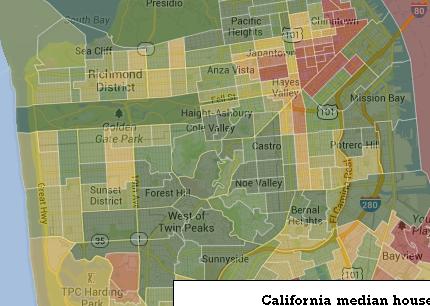
There’s a cool interactive map that gives you a visual picture of wealth and poverty in San Francisco. Check it out here. Just type in “San Francisco, CA” and click “income.”
What you see is a city full of green (wealth), with a few pockets of poverty. The data is at least two years old, so it’s almost certain that, say, the inner Mission no longer has a median income of $36,000 and the median in Noe Valley is above $108,000. The median in Vis Valley is (or was) $17,000. Nobody at that level could buy a house in VV now, not even close.
The fun thing is to imagine the income map overlaid with this map to see where housing costs — and thus median income — is rising fast. Check out, for example, the tiny Duboce Triangle area, with median income of $84, 000 (certainly no more than middle class by San Francisco standards). There were at least 17 buildings in that one census tract cleared of tenants by Ellis Act evictions; I wonder how much the median income has gone up.
It’s interesting to contrast SF to, say, Oakland and Berkeley, or to Los Angeles, where there are plenty of rich people (on the coast and in the hills) but also large swaths of more middle-income middle-class communities.
Gee, which is worse: Having the chair of the local Democratic Party working for Pacific Gas and Electric Co., which blows up neighborhoods, or for the San Francisco Board of Realtors, which pushes anti-tenant legislation and whose members profit from gentrification and evictions?
Either way, Mary Jung, the Democratic County Central Committee chair, isn’t exactly a good representative for the city’s progressive Democracts. She just left her job as a lobbyist for PG&E and took a new position running government affairs for the landlords. From the Realtors press release:
Jung stated, “I am excited to have this opportunity to build upon and expand the REALTORS® Association role in the community. I look forward to working collaboratively with our local, state and national elected officials, and with our members, to ensure that the robust housing market continues to grow and our voice is heard effectively at City Hall.”
The “robust housing market.” In other words, displacement central. From the elected chair of the Democratic Party in San Francisco. I can’t think of the last time the chair of the local party was paid to represent corporate interests. Not a good sign.
As of late, it seems as though the cries of anti-displacement activists and small business owners threatened with dramatic address changes have penetrated the city’s consciousness: San Francisco has woken up to the fact that the town is changing, and how. But amid the smashing of Google bus piñatas and — albeit hilarious — echo chamber of bloggers placing and sloughing off blame from the young tech royalty, there are community-based, heartfelt attempts being made at contextualizing soaring rents and shifting cultural majorities.
There’s two happening in the Mission, in fact. Regardless of your programming aptitude or discretionary budget, they’ll both provide moments to learn about where San Francisco is coming from, and a moment to reflect on where it’s going.
“La Llorona: A Public Lament on Ellis Act Evictions in the Mission”
A march to remember the working-class neighborhood that was, this processional open to all comers starts at a Mission home called the “Secret Garden” (coincidentally, hosting both events in this post) with a prayer by Jorge Molina and winds up at Adobe Books’ new location (3130 24th St., SF), where the bookshop is hosting “Layers of History: 40 Years of Resistance” curated by SF historian Chris Carlsson and artist Paz de la Calzada. “La Llorona” will be led by neighborhood chronicler Adriana Camarena. Check out this 2010 Mission Mission interview to read about her passion for the stories of the ‘hood.
UPDATE: The event is part of MAPP’s Sat/1 takeover of 20 businesses and other spaces in the Mission. More on that here
Here’s how author Benjamin Bac Sierra — who grew up on these streets in a much different time — summed up the event in his post on our Facebook page:
Every moment is an exact time. This is our time, one of our last opportunities to cry our voices out to the streets we always thought would be ours. Homeboys and Homegirls, this Saturday at 7:00 p.m. we need you to walk the Mission streets with us and cry out our emotions over all la gente that are being evicted and expelled from our San Francisco Mission district, from all of San Francisco itself. Why does this matter? Won’t they have cheaper, perhaps even bigger homes out in Modesto, Concord, San Quentin, or the Colma cemetery?! Gente, as we lose ground in international San Fran, we lose the opportunity of world class resources, education, economic opportunities, and cultural identity. Meditate on this: San Fran is the most powerful capital of class, business, and arts on the entire west coast. Are not brown grassroots people allowed into the doors of opportunity? Don’t just like this posting. Come out in full force with your homeboys, homegirls, and grandmas this Saturday, June 1 at 7:00 p.m. starting at 2710 Harrison and 23rd street. We need you; the gente need you for the future and for hope. Always your homeboy in amor!
Over the past year and a half, POOR Magazine has sat down with 45 adults and 10 younger people, all born right here in the land of the Ohlones, to get their thoughts on displacement and fighting to stay in the city they grew up in in six-week cycles of creative storytelling classes. Today, in the sunny backyard of the Secret Garden, they’ll celebrate the publication of those conversations. Come check out the compilation, plus plant seeds, eat food, and help raise money for POOR’s Al Robles Living Library — an assemblage of works by working class people that is housed in the magazine’s headquarters.
UPDATE: Muralist Juana Alicia (whose mural “La Llorona” features in the image on this post) clarifies that the piece is a comment on the struggle for human rights. She also added, in the comments below:
I myself was evicted from the Mission, and moved to the East Bay 18 years ago because I could no longer afford to live in my neighborhood, the one I had worked so much to humanize and adorn. But our daughter, Lucia Ippolito, has just created a fantastic new mural on Balmy Alley: a witty and animated lampoon at gentrification and police brutality. Entitled “Mission Makeover”, it is an eloquent stitching together of many issues, like original sin, from the Garden of Eden to Wall Street. Please check out the “Mission Makeover” while accompanying Jorge Molina on his sacred pilgrimage.
OPINION Let’s stop blaming the hipsters. The Google bus, that annoying icon of yuppie invasion and transit privatization, is not the lead driver of gentrification’s reckless stampede reshaping our city (though it does play a role). The upscale restaurants dominating commercial strips may be economically and aesthetically offensive to many, but they are the natural byproducts of gentrification’s much-ignored elephant in the room: the real estate industry.
While headlines, comment threads, and café chatter fixate on the tech industry and yuppies with fistfuls of dollars, it’s the profit-gobbling real estate companies and speculators who are jacking up rents and evicting so many small businesses and renters—and they are surely happy to stay out of the spotlight.
Gentrification is a many-layered beast nurtured by cultural and economic trends, regional and local labor and housing factors, and public policies (or lack thereof). Beneath the surface-level aesthetics, it is about displacement of people who don’t fit the dominant economic growth plan—radical market-driven upheavals of communities often abetted by government policies and inaction.
The stats are familiar but bear repeating as they are so destructive: average apartment rentals exceeding $2,700 a month, requiring someone making $70,000 a year to pay half of his or her salary in rent. Literally thousands of no-fault evictions in the past decade, according to the Rent Board.
Despite rampant displacement of thousands of San Franciscans, there has been little response from City Hall: no hearings, no proactive legislation, not even bully-pulpit style leadership. We must demand more.
Where is the leadership demanding the city do everything in its albeit limited power to halt further displacement of residents and small businesses? The toxic combo of tenant evictions and home foreclosures by the thousands — driven principally by major banks and real estate companies — is destroying lives and communities.
Some of this is beyond City Hall’s jurisdiction: state laws like the Ellis Act and Costa-Hawkins enable no-fault evictions and prevent vitally needed commercial rent control. Still, beyond their valiant opposition to the Wiener-Farrell condo conversion threat, city leaders have been largely silent about this latest wave of gentrification that’s eviscerating communities, driving out small businesses, and squeezing renters to the bone.
What can we do? We won’t defeat gentrification with city hearings or loud protests or online screeds and petitions — but we need all those things, along with serious public education, to shine a bright hot spotlight on the companies and individuals defining who lives and votes here.
We need a new era of citywide awareness, unity, and action to literally save San Francisco — a bold unapologetic vision that puts affordability and diversity at the forefront of what our city is about. We can’t have diversity without affordability; it’s that simple.
Renters are gearing up to fight back. An ‘Eviction Free Summer’ is being planned — an innovative campaign to counter the rash of evictions that are generating both displacement and skyrocketing rent prices. The idea of ‘Eviction Free Summer’ is to put evictions and evictors in the spotlight, to put would-be evictors on notice and capture the attention of city officials who have so far done little to stem their tide.
We must demand accountability and action by City Hall and state legislators to rein in the real estate industry and put the brakes on evictions and other displacement. People’s lives, neighborhoods and communities, and the very fabric and identity of our city are at stake.
To those who cheer “change” as if its victims were not real, or who wearily concede the fight, we must ask: are we really going to allow the profit-hungry market and wealth-seeking executives and speculators decide who lives and votes here? Are we going to let the market destroy what’s left of our city’s economic, cultural, racial and ethnic diversity — the very things that make San Francisco what it is?
Christopher D. Cook is an award-winning journalist and author, and former Bay Guardian city editor. Contact him at www.christopherdcook.com
On a recent Tuesday night, some of the city’s most influential developers, architects, and land-use lawyers gathered in a conference room at the ritzy W Hotel for a panel discussion, titled, “San Francisco’s Housing Crisis: Can the Tech Boom Help Us?”
It was a provocative question by any measure, but equally intriguing was the lack of even a hint of objection to the dead-serious framing of increasing unaffordability as a “crisis.”
Even among well-heeled property brokers at the event, which was hosted by San Francisco Magazine and the San Francisco Housing Action Coalition, there appears to be universal acceptance that the city stands at a crossroads.
“The question asks itself: Who gets to live in San Francisco?” Tim Colen, HAC’s executive director, stated by way of introduction.
To break it down into extremely simplified terms: High-salaried professionals easily make the cut, while tenants of modest means who lack stable rent control are more hard-pressed to find housing they can afford. Opinions on how to approach this problem differ sharply.
Colen and other panelists posited that the solution is to build as the city has never built before, aiming for the construction of 100,000 units in the next two decades. But panelist Peter Cohen of the San Francisco Council of Community Housing Organizations countered that today’s development projects aren’t being constructed for people who actually live in the city, 61 percent of whom make less than 120 percent of the Area Median Income.
The city’s real-estate market is invariably described by those who closely track it as “hot,” or “bubbly,” bringing to mind a cappuccino, perhaps, that induces a jittery feeling. Speculation abounds.
The ripple effect extends beyond residential units. All across the seven-by-seven peninsula that once represented a haven for misfits and iconoclasts, stories abound of arts organizations, nonprofits, and community gathering spaces getting priced out, pressured to move, or otherwise swept away due to economic circumstances beyond their control.
From 2009 to 2013, UC Berkeley economist Enrico Moretti noted, explosive job growth coincided with San Francisco bearing the third-largest spike in rental prices on average, nationwide. In 2011, San Francisco rents were 34 percent higher than they had been 2003; by 2012, they had jumped to 53 percent higher, according to a market analysis prepared by The Concord Group. According to San Francisco Rent Board data, 1,757 eviction notices were filed from March of 2012 to February of 2013, reflecting a 12-year high.
“The problem has serious social consequences,” Moretti said at the event, sounding for an instant like a tenant advocate. “There is a serious amount of displacement.”
Every upheaval is messy, every tenant-landlord rift is complicated, and circumstances vary case by case. But taking a broad view, the overwhelming consequence of San Francisco’s gale-force property market pressure is a cultural shift; the fabric of a longstanding community is unraveling. Below are a few stories of the people and projects that are finding they won’t be able to stay in the San Francisco spaces they occupy for much longer.
THE CORNER OF HAIGHT AND RESENTMENT
Jon Zuckman, better known as Jon Sugar, showed up for a May 15 court appearance on his pending eviction proceeding with an entourage in tow. He was flanked by LGBT housing activist Tommi Mecca, perennial political candidate and sex worker Starchild, and radical activist Jerry the Faerie, among others, all longtime characters of the city’s lefty, radical LGBT scene.
Judge James Robertson, citing a letter he’d received from Zuckman’s doctor, agreed to grant a 60-day continuance, “for the purpose of allowing the defendant to try and locate alternative housing.”
A former KPFA radio personality, comic, writer, and DJ, Zuckman moved to San Francisco in his early 20s and lived in the Haight for 40 years. He’s now 63. He played in a band, ran an underground sex venue called the Mini Adult Theater, helped organize against a Republican-led 1978 proposal to ban gay teachers from California schools, supported AIDS benefits and battered-women support groups, and founded GAWK, the Gay Artists and Writers Kollective. He’s getting evicted from the Stanyan Street apartment building he’s lived in for 25 years, and has no idea where he’ll go after that.
Officially, he’s being evicted for violating the terms of a legal stipulation hashed out with landlord Al DeLorenzi pertaining to a bedbug infestation treatment. Zuckman claims he notified his landlord about the pest problem two years ago and no action was taken until he phoned the Department of Public Health.
DeLorenzi told the Bay Guardian that Zuckman is to blame for the bugs and that he’s just trying to keep the infestation in check. “There is no comment, he can say what he wants to say about this and that,” DeLorenzi said when reached by phone.
Complaints filed with the city’s Department of Public Health reveal a host of issues associated with the property over the years, from mice to broken light fixtures to a malfunctioning door buzzer.
Zuckman lives with a roommate in a rent-controlled unit, paying considerably less than tenants who pay market rate to live in the building. “I live,” he tells people, “on the corner of Haight and resentment.”
Zuckman is disabled, and says he’s undergone seven surgeries on his foot, plus a knee replacement. Asked if he’s on a fixed income, he responds, “It’s broken. I am on disability. It’s $869 a month. My rent is $600. My phone and Internet is like $55 to $60. And the rest is like, party, party, party.”
Tony Robles, of the elder advocacy organization Senior Disability Action, submitted a letter to the court in support of Zuckman. Robles said his office has experienced a spike in demand for services lately. “We’ve been having a large increase in calls, and people walking in and wanting to know if there’s available housing,” he says, adding that most clients are seniors grappling with eviction. “A lot of these folks, they’re scared.”
For his part, Jon Sugar is trying to maintain his sense of humor. “If I curl into a ball and let out with great heaving sobs, it’s not going to help,” he says. He doesn’t know of any good answers for stemming the tide of evictions currently sweeping San Francisco. “There’s got to be other ways than throwing crippled old DJs out into the street,” he says. Then he lets out a laugh. “I crack me up.”
URBAN FARMS AND CIRCUS ARTS: MAKE WAY FOR DEVELOPMENT
On a recent Saturday, the collective that started Esperanza Gardens hosted an event at its tiny fenced-in San Francisco garden plot, billed as a “be-in.” Ukulele music floated in the air as several people painted sweeping brushstrokes onto a mural. Volunteers dished up organic pizza with donated ingredients, cooked in a handcrafted cob oven. A dreadlocked gardener named Ryan Rising was preparing to host a permaculture workshop. The sun was hot, and flowers bloomed in vibrant hues.
Esparanza Gardens was started four years earlier, and the suntanned gardeners gathered under the shade of a 20-foot high cypress that had been a wee sapling when they first started out. But the afternoon gathering was bittersweet; this was a farewell ceremony.
They’d always known the project would be temporary. “We definitely understood what we were getting into,” explained Jonathan Youtt, an urban farmer clad in purple overalls and a straw hat, who’s recently been devoting more time to an urban farming project in Oakland.
The landlord, Lloyd Klein, had granted rent-free use of the space to the underfunded farmers with the stipulation that they’d have to clear out when the time came. He’s since secured entitlements for an ultra-green, four-unit building for that lot and told the Guardian he hopes to break ground by July, if he can secure building permits in time. “We’re trying to accomplish a net-zero energy usage building,” Klein told the Guardian in a telephone interview. “It will create its own energy from solar.”
None of the gardeners seemed to harbor bitter feelings toward Klein, who sanctioned their all-volunteer effort, but all those interviewed expressed concern that the loss of Esperanza coincides with the loss of two other urban farming plots in San Francisco. This was a space where they’d raised bees, harvested produce together, and led workshops with groups of at-risk youth from the surrounding area.
“The loss of space to teach farming is what the issue is,” Youtt says. “Without that, we’re going to have a void. It’s tragic in light of what’s happening simultaneously.”
The Hayes Valley Farm, at Fell and Octavia streets, is also on its way to being cleared to make way for housing, an outcome that was anticipated from the start of the project. Another urban agriculture project on Gough and Eddy, called the Free Farm, also has to vacate by the end of the year, when a development project goes up on that lot.
For years, the produce grown at Esperanza and Free Farm has supplied the nutritious bounty that is freely distributed every Sunday at a Mission intersection via the Free Farm Stand. An urban farmer, who goes simply by Tree, spearheaded the all-volunteer project in 2008. “We wanted to make sure that low-income people have access to fresh, locally grown produce,” Tree explained when reached by phone. “Everywhere I look in the Mission, there’s new restaurants. But wherever there’s affluence, there’s always people thrown in the cracks.”
The loss of a sliver of urban farms is just one change that could dramatically transform that Mission District parcel, located on Bryant between 18th and 19th streets. The Esperanza garden plot is sandwiched up against an arts venue called Inner Mission, which has been hosting events like circus and burlesque shows and aerial arts performances in its recently renovated space since January. Inner Mission is located in the same building that previously housed CELLspace (“CELL” stood for Collective Exploratory Learning Lab), a famed underground San Francisco arts collective launched in the 1990s.
An online “obituary” penned for CELLspace by caretaker Devin Holt offered a glimpse into what it was like in the early days: “It was 1996 in San Francisco. A time when you could still find a room in the Mission for $300, and the dotcom boom hadn’t turned empty warehouses into prime real estate. When the screen printing business moved out, the dreamers moved in. … The early years at Cell were marked by chaos and construction. Dave X was known to test his flamethrowers behind the building on Florida St., Jojo La Plume created an open craft loft in the homemade mezzanine, and the Sisterz of the Underground offered free break dancing lessons for aspiring b-girls on the main space floor.”
On March 14, the Nick Podell Company, a development firm, submitted a project review application to the San Francisco Planning Department, city records show. The developer has initiated talks about a proposal to raze the warehouse where Inner Mission operates and erect a six-story, 166-unit apartment complex in its place, with parking for 141 vehicles. The company is under contract to purchase the property, according to company representative Linsey Perlov, but it has not yet changed hands. Klein declined to discuss the sale or development proposal at this stage, saying, “I’m not at liberty to speak about it.”
A statement distributed at the “be-in” noted that a group called Mission of the Commons envisions a crowd-funding project that would raise enough funds to purchase the warehouse, though details are sketchy on how exactly this would be accomplished. “Selling off this block to a developer will deeply disable our community, displace many,” the notice reads, “and perpetuate these very issues [of gentrification] we seek to mitigate and stop.”
MISSION BUILDING IS NO PLACE FOR RADICAL ACTIVISTS
The thwack of a stick against a Google-bus piñata at the 16th Street BART station attracted considerable attention on Twitter a few weeks ago during a May 5 event billed as a Mission Anti-Gentrification Block Party. It was organized in part because a 5,200-square feet collective space run by a group of activists is facing eviction from 3265 17th Street. Sometimes called the 17 Reasons building, the property houses Thrift Town, Discount Fabrics and several other businesses at Mission and 17th streets.
The activists signed a four-year commercial lease on the space in August of 2011. Since then, they’ve been using it as a Food Not Bombs cookhouse, where volunteers prepare giant vats of food for the homeless using donated ingredients, and serve it up weekly at the 16th and Mission BART station. The Food Not Bombs collective and two other collective groups, known as In the Works and Rincon, have used the space to host political events, fix bicycles, and provide a place where penniless activists can get projects off the ground.
“The whole point was to make an accessible space,” explained Chema Hernandez Gil, who is involved with the In the Works collective. “We don’t have that in the Mission anymore.”
Now, their idealistic endeavor is quickly spiraling toward a messy legal clash. This past April, Rick Holman, a managing partner at Asher Insights Inc. whose background is in investment banking and corporate finance, purchased the property. On April 10, leaseholders received a three-day notice to quit, the first step in an eviction, charging they’d subletted the space in violation of their lease terms.
In the Works collective members told the Guardian that the building’s locks were changed and they still haven’t been issued new keys, although they are able to gain access using a keypad. They’ve hired an attorney and are exploring their legal options. They view their plight as part of a wider trend of Mission gentrification.
“Every legitimate tenant who was asked has been issued keys,” Holman said when reached by phone. He declined to answer questions about the eviction, saying, “I’m respectful of these people and their privacy.”
TIME’S ALMOST UP FOR BOOKSTORE OF 41 YEARS
On May 8, Modern Times Bookstore Collective sent out an email blast inviting supporters to a town hall meeting to address the loaded question of what their future holds.
“For 41 years, Modern Times has had its doors open to activists, educators, rabble-rousers, queers, and scholars of all stripes,” the collective members of the bookstore wrote. “We’ve maintained our position as a progressive resource, stocking thousands of titles and collections that you’d be hard-pressed to find at most bookstores: queer theory, sex/uality, disability justice, well-curated and left-leaning section of libros en espanol, critical race studies, anarchy, radical retellings of US history, political economy, socialism, Raza studies, African American and Asian American history and analysis, criticisms of the Prison Industrial Complex, and global activism (just to name a few).”
There are myriad reasons why the bookstore is facing challenges, one being the declining market for print books. But there’s also been an erosion of the store’s membership and customer base; so many of the former shoppers have been priced out.
Collective member Lex Non Scripta described the collective’s community as “politically radical, rabble-rousing activists, artists, and a variety of just total weirdos.” But a lot of them “just can’t afford to be in San Francisco anymore,” they went on, singing a familiar tune. “There’s just been a huge shift over to the East Bay.”
On May 16, the bookstore held a town hall meeting with supporters to hash out possible future scenarios. “We don’t want to close. We’re all very attached to it,” they said. But at the same time, “we want a more sustainable model, and it’s hard to figure out what it looks like for books.”
The future of Modern Times remains unclear, and Non Scripta chalked it up to this: “Capitalism and community don’t really mix well.”
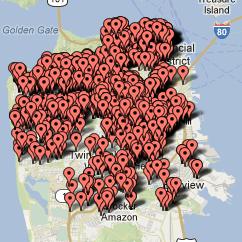
Every point on the map (click here for the detailed, interactive version) is a building where the landlord has used the state’s Ellis Act to evict all the tenants. (The points typically involve multi-unit buildings, so the number of tenants displaced is even worst than it looks). Some tenants have been here for decades, living in rent-controlled apartments, contributing to the community. And when the eviction notice arrives, they have nowhere else to go.
It feels as if all of crazy, radical, artistic, and unconventional San Francisco is under attack, as if a city that once welcomed waves of weirdos and malcontents — who, in turn, gave the city its attractive reputation and flavor — is changing forever. It’s as if there’s no longer any room for the working class — the people who, for example, keep the city’s number one industry (that’s hospitality and tourism, not tech) functioning.
It’s terrifying. Neighborhood after neighborhood is losing affordable rental housing as landlords cash in on soaring prices. And there’s a huge human cost.
In the end, if trends continue, this will soon be a very different city. We all know that change is part of life (and certainly part of hyper-capitalism) but the notion that there’s a value to a city culture that needs low rent housing and cheap commercial space has been all-but abandoned by the administration of Ed Lee, which wants high-paying jobs at all costs.
And it’s hard to imagine how the best of San Francisco — the city whose culture and sense of madness attracted all these creative folks in the first place — will ever survive. Call it Urbicide — because as Rebecca Bowe reports here, it goes way beyond residential evictions.
I almost don’t know what to say, except: Finally, someone admits it.
Rebecca Pederson, writing in The Bold Italic, explains why she actually likes the idea that San Francisco is becoming so expensive that thousands of longtime residents are being forced out; see, if it’s more expensive to live here, then young, creative people will work harder:
People who want to make a living here from their creative work should have to hustle; it makes the successes much more meaningful.
Ah, yes. “Hustle.” So all the older people who are, say, not trained in the tech field, or might be disabled and unable to “hustle,” or the single parents who “hustle” all the goddam day just to keep the family together, or all the “creative” people who work for nonprofits or (gasp) are artists — and trust me, they “hustle” as much as any tech worker … they don’t get to live here any more. Because
We can’t afford to walk barefoot around Golden Gate Park and write half-sonnets about trees. This city’s too expensive now.
I don’t know anyone who thinks we still live in the Beat era. I don’t know anyone who has ever written a half-sonnet about trees, and nobody with any sense of public health walks barefoot in Golden Gate Park. Get a clue.
But I do know a whole lot of people, including some who work for websites, who are seeing their lives and their community destroyed by rising prices — which are due primarily to greed in the real-estate industry.
I don’t think all tech workers are anywhere near as dumb as Rebecca Pederson, but I do see a lot of her attitude around: We are young and have money, and you are old and in the way. That’s capitalism.
The “older people are losers” attitude was the worst part of the Sixties ethos (although disdain for labor — often reciprocated by conservative unions — was pretty bad, too.) This is a big city, with a diverse population. Not everyone is healthy and able to “hustle.” Not everyone is young and carefree. Please, my friends: Have respect for the community you recently dropped into.
Yes, I was a San Francisco immigrant, too, in a different era, and I know things will always change, but I don’t remember my young friends believing that they were by nature better and smarter than the people who already lived here. It’s called respect.
The unemployment rate continues to drop in San Francisco and all over California, according to new numbers released today by the California Employment Development Department, which were trumpeted by Mayor Ed Lee as vindication for his economic development policies.
“San Francisco’s steady economic recovery is the result of our continued focus on job creation, education and training residents for the demands of the 21st century workforce. San Franciscans are getting back to work across the spectrum of job sectors – from hospitality to construction to technology to service industry jobs and we will continue to help these sectors grow in our City,” Lee said in a press release.
But are Lee’s neoliberal policies of promoting technology and other corporations with tax breaks and city-subsidized training programs and financing mechanisms really creating the rosy economic picture he’s painting? And even if it is helping to promote boom times, at what point have we essentially reached full employment, the point at which we should maybe turn our focus and resources to addressing the rising cost of living here?
After all, San Francisco’s unemployment rate of 5.4 percent is third only to Marin County (4.6 percent) and San Mateo County (5.1 percent). Those three counties also just happen to be the three counties with the highest per capita incomes in the state, a fact that explains our jobless rate more than the mid-Market payroll tax exemption and other taxpayer giveaways.
“Unemployment rates tend to be lowest in areas with high education attainment,” Ruth Kavanagh, EDD’s labor market consultant for this area, told us when we called to discuss the disparties among counties.
What about the rising cost of living in San Francisco? Clearly, this is becoming a much more difficult city for the unemployed and marginally employed to remain living in. How much are gentrification, evictions, and the exodus to the East Bay (Alameda County’s rate is 7 percent, still better than the statewide rate of 8.5 percent) and other locales a factor in our low jobless rate?
Kavanagh said the EDD doesn’t directly track that and so she couldn’t address the question. But she did say that the Bay Area was indeed experiencing the fastest job growth in the state, driven largely by the tech industry. In the last year, this three-county area has added 9,600 jobs in Professional Business Services (which includes tech) and 4,600 each in Leisure & Hospitality and Construction.
Indeed, in his State of the City speech in January, Lee touted the 23 construction cranes on the city skyline as the best gauge of the state of the city. And if counting jobs is one’s only measure of success, San Francisco is doing as well as can be expected. Kavanagh said most economists consider “full employment” within the capitalist system to be somewhere between 4-5 percent.
Yet Lee says he’s not backing off from his full-throttle focus on economic development. “San Francisco’s unemployment rate today stands at a five-year low and I will continue to pursue policies that get people back to work, support San Francisco families and invest in our City’s future,” he said. “This Summer through San Francisco Summer Jobs +, we are setting an aggressive goal of putting 6,000 youth to work in paid jobs and internships, and I will continue working hard to make sure all San Franciscans have access to good paying jobs.”
Now if only we all had access to reasonably priced housing, health care, food, entertainment, and a transportation system built to handle a growing population.
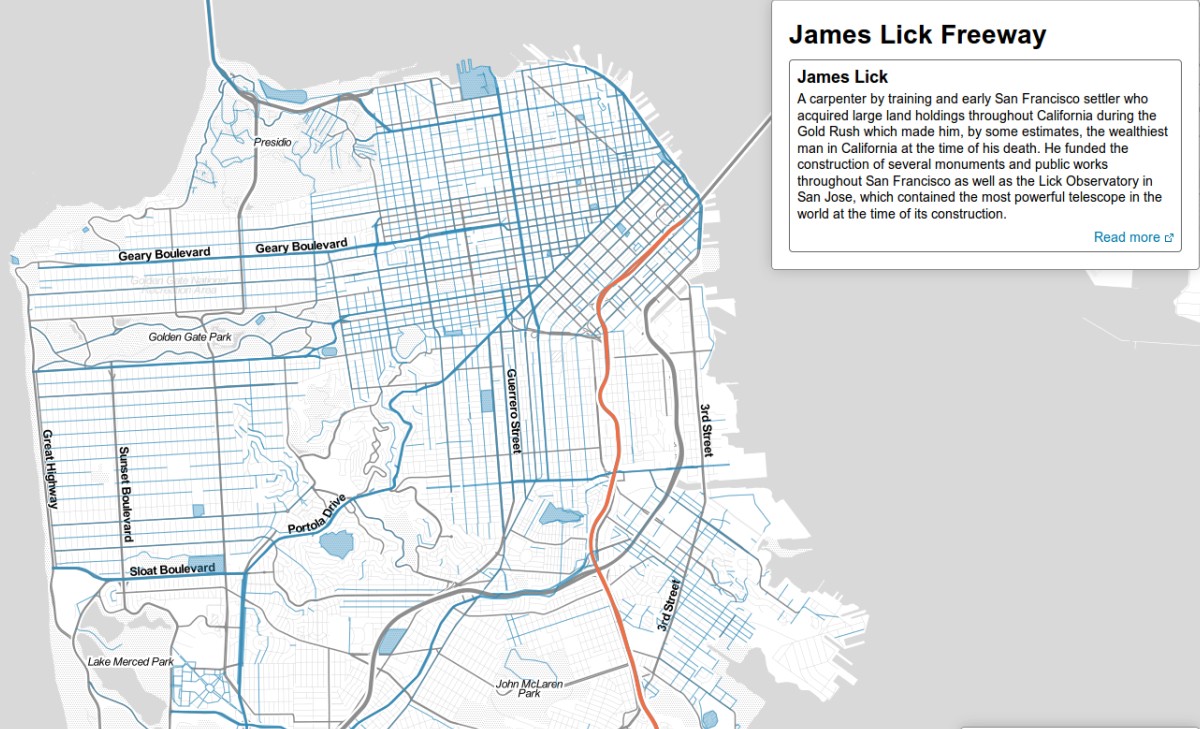
Many of us have encountered various bits of street name history along our travels, but here was a comprehensive aggregator that was fun to play with, and covered James Lick Freeway to Main Street, all in one handy spot. Did you know that Baker street was named after Edward Dickinson Baker, the lawyer who defended accused US Marshal killer Charles Cora, before Cora was lynched by the Vigilance Commitee in 1856? Or that Moraga was named for José Joaquín Moraga, founder of San Jose? Or how about Germania — it’s actually named after German people!
(One thing you do realize after a couple of minutes is that most of the streets are named after dudes, both military and wealthy. Maybe going forward, SF will institute gender parity naming regulations, like Berlin just did.)
I wanted to talk to Noah more about what inspired him to make the map, where he got his info from, and if the SF map — and the mapping project as a whole — would continue to grow. So I sent him an email. Here are the smart, and smartly civic, things he had to say
“I’m a Web developer by trade, I’ve always made interactive graphics like this for fun, although this is probably my most ambitious (you can see some of my other side projects here). I grew up on the peninsula, and lived in San Francisco for the last 4 years, but I moved to London in January for a one-year fellowship doing interactive graphics and data journalism at the BBC.
“I made the map because I thought it would be a neat way to take San Francisco’s colorful history and connect to everyday experience, give you a new sense of your neighborhood and your city. I used to walk down these streets all the time and never had any idea that they all pointed to so many larger-than-life characters and pivotal events. The names tell stories that you couldn’t make up if you tried: duels, saloon shootouts, mob justice, espionage, overnight millionaires, explorers, tycoons, battles, rebellions. They also give you a lot of insight into people who in some cases literally built the city, people who created its skyscrapers or its railroads or its parks. That kind of local history has an immediacy you don’t get when you’re learning about something like the Founding Fathers. You walk past it on your way to work every day.
“There were a number of surprising histories to me, like the fact that Main Street isn’t a generic name, it’s named after Charles Main. I also never knew Crissy Field used to be a military airfield – I’m sure there’s a plaque explaining that somewhere but I had never come across it. Some other favorites:
“I got the information from lots of places — a few different books, but also old news clippings, military records, historical society sites, that sort of thing. Usually I would start with a claim that a street was named for somebody, and then find as much corroborating evidence as I could, and if it seemed solid, research for other colorful details about the person’s life. Needless to say it was a time-intensive process.
“I’ll definitely be adding more to the map over time, there are lots of histories missing, and I’ve gotten lots of helpful tips from others since posting the map. Some streets are left out by design though. Many are self-explanatory or don’t have a historical component (for example, lots of names are just Spanish words or trees or foreign cities), I wanted to focus on ones that would be interesting and not clutter up the map with the rest. I also had to leave out a lot of ones with potentially interesting histories that were hard to verify. I wanted to be careful about not presenting rumor as fact, and there’s plenty of rumor to go around when it comes to how the streets got their names. It’s a tough balancing act, a lot of judgment calls, and I’m sure I still got a few wrong.
“This wasn’t originally meant to be a larger project, but once I got deeper into it I realized that I’d really like to expand it to other cities, so I’m going to be working on that in the coming weeks. I’d like to work on additional cities myself (maybe LA and London next) but I’d also like to generalize the template and create blank versions for lots of cities in the world and open them up for others to work on. I’ve gotten tons of feedback from folks who would be excited to make something similar for their home cities, and I’d love to help make that happen.
“As far as other upcoming projects, in addition my work at the BBC and taking the street name map beyond San Francisco, I’m hoping to start on a project to visualize diasporas from different countries around the world.”
OPINION No one can deny that the San Francisco of the new dot-com boom is a scary place to live. Rents are astronomical: $2,353 is the median rent for a one-bedroom in the Bayview, an area that has never had high rents. Ellis Act evictions are up 68 percent from last year, and buyouts and threats of Ellis (de facto evictions) are skyrocketing. Longterm rent-controlled tenants live in absolute dread that their buildings will be sold to a real-estate speculator who will decide, a month later, to “go out of the business of being a landlord.”
Neighborhoods are being transformed, and not for the better. The once immigrant Latino and working-class lesbian area of Valencia Street is now mostly white, straight and solidly upscale. The Castro has more baby strollers per square foot than a suburban mall, not to mention a high rate of evictions of people with AIDS. Along Third Street and in SOMA and other areas, people of color are being pushed out, and the working-class is being replaced by middle-income condo owners. The African American population of the city is down to 6 percent.
Small businesses, too, are being decimated, as landlords demand higher and higher rents and chain stores try and creep into every block. If the demographics of the city continue to change and become more moderate, many longstanding political gains could be lost.
Resistance is not futile.
During the Great Depression, the Communist Party in the Bronx and elsewhere successfully mobilized the working class to block doorways when the marshals arrived to evict tenants. In the 1970s here in San Francisco, the “redevelopment” of the Fillmore and the I-Hotel was met with widespread protests. Then-sheriff Richard Hongisto went to jail rather than evict the working-class Filipino tenants at the I-Hotel. In the late 1990s, organizing to fight the evictions and displacement happening in the wake of the first dot-com boom culminated in a progressive takeover of the Board of Supervisors.
These days, there’s no mass movement to fight the evictions and displacement. Occupy Bernal, ACCE and others have successfully stopped the auctions of foreclosed homes, and even twisted the arms of banks to renegotiate some mortgages. Tenant organizations have been holding back efforts to weaken rent control for years.
Where is the building-by-building organizing of renters? Where is the street outreach in every neighborhood? Where are the blocked doorways of those being forced out of their apartments by pure greed? Where are the direct actions against the speculators and investors who are turning our neighborhoods into a monopoly game? Where is the pressure on the Board of Supervisors to pass legislation to curb speculation and gentrification rather than approve tax breaks for dot-com companies? Where is the pressure on state legislators to repeal the Ellis Act and other state laws that prohibit our city from strengthening rent control and eviction protections?
Every moment we wait, more people are displaced from their homes, more neighborhoods become upscale, more small businesses are lost. Progressives wake up.
It’s time to take back what’s left of our city.
Tommi Avicolli Mecca is a longtime queer housing activist who works at the Housing Rights Committee. He is editor of Smash the Church, Smash the State: the early years of gay liberation (City Lights).
EDITORIAL In a stunning victory, tenant advocates have managed to derail a terrible piece of condo-conversion legislation — and replace it with a compromise that actually improves the current situation and could help slow the wave of speculative evictions.
The supervisors need to support the revised version of the bill — and if Mayor Lee wants to have any credibility at all with tenants, he needs to sign it.
For some 30 years, San Francisco has had a strict policy limiting the conversion of rental apartments to condominiums. Only 200 units a year get permission, through a lottery.
But thanks to the popularity of tenancies in common (a backdoor way around the limit) and the state’s Ellis Act, which allows landlords to evict all their tenants and sell the units as TICs, there’s now a long waiting list.
TIC owners say it’s unfair that they have to accept (somewhat) higher mortgage payments and reduced value on their homes because the wait for a conversion permit has grown to ten years or more. Real-estate speculators see huge profits in clearing buildings of long-term tenants with rent-controlled apartments and selling the places as TICs.
When Supervisors Scott Wiener and Mark Farrell first proposed allowing more than 2,000 tenancy-in-common units to bypass the lottery, tenant advocates began organizing to defeat the bill. Nobody thought a compromise was possible — particularly when the landlord-backed Plan C refused to negotiate in good faith and look for a solution everyone could accept.
But with the help of Supervisors Norman Yee, Jane Kim, and David Chiu, the tenants were able to craft a deal that clears up the backlog — and then prevents any further conversions for at least a decade. That’s fair: If the limit is 200 a year, and TIC owners want to clear up a backlog of 2,000 all at once, a ten-year moratorium makes sense. The tenant package also bars conversion of any buildings with more the five units and includes more protections for existing tenants.
If this proposal is really about helping TIC owners who face a long and uncertain time on the conversion list, then the compromise ought to be fine — and indeed, many TIC owners support it. The real-estate speculators who want to see evictions continue at a rapid pace hate it — this would make TICs less appealing and less valuable. But that’s fine: Buying a TIC has never been, and should never be, based on a future promise of condo conversion. And if this slows down the horrifying epidemic of evictions and displacement, it will be a very positive change.
Wiener and Farrell didn’t accept the compromise, but it was amended into their legislation anyway. The new version will come before the supervisors May 7. The supervisors should see this for what it is — greedy speculators against everyone else — and vote yes.
It’s stunning: Between 1997 and 2013, it seems as if most of the Mission, Noe Valley, North Beach, the Marina, and Potrero Hill was evicted. Hundreds and hundreds of apartments turned into TICs, which now want to convert to condos. Hundreds and hundreds of tenants, who once had rent-controlled apartments, losing their homes — and given the price of housing, losing their ability to live in San Francisco.
Each little red flag is a human tragedy. Each one represents a transforming city that no longer has room for the middle class, much less poor people. It makes we want to cry. Or throw up. Or something.
A small but enthusiastic crowd marched through the Castro April 20 to bring some attention to the rash of Ellis Act evictions that are forcing seniors and disabled people out of the city. The activists stopped at the home of Jeremy Mykaels, whose plight is symbolic of the state of housing in San Francisco today. Mykaels insists he’s not a public speaker, but his remarks were poignant; we’ve excerpted them here:
I have AIDS and I am being evicted through the use of the Ellis Act. I want to welcome you to my home for the past 18 years, and to my Castro neighborhood where I’ve spent the last four decades, or two-thirds of my life.
I was there at some of the earliest Gay Pride Parades and Castro Street Fairs, listening to speakers like Harvey Milk and seeing entertainers like Sylvester with Two Tons ‘O Fun and Patrick Cowley. I proudly voted for Harvey to become the city’s first openly gay supervisor. I participated in the fight against the Briggs amendment, which would have outlawed gay teachers in California schools. I walked in the candlelight march honoring the lives of Harvey Milk and Mayor Moscone after their assassinations by Supervisor Dan White. And I’ve been here for many other protests and for many other celebrations.
And like most of you, I’ve seen how HIV and AIDS have devastated this community over the years and I have lost most of my closest friends and lovers to this disease. Until 12 years ago I thought I had somehow miraculously escaped it’s clutches, but that was not to be and I have been dealing with that reality as best as I can ever since, with mixed results. And now on top of the great losses this disease has cost our gay community, even more losses are occurring in the form of more and more long-term tenants with HIV/AIDS living in rent-controlled apartments being forced to move out of their homes and/or out of the city after being evicted through the use of the Ellis Act, or who have been scared and bullied by just the threat of an Ellis eviction into accepting low buyout offers to vacate.
I had always thought that I would spend the rest of my life living in this neighborhood and city that I love. Now I know that, like so many others before me who found themselves in similar situations, I will have no choice but to move out.
Tech boom 2.0 has brought out what I call the Vultures of Greed, a de facto alliance of banks, the real estate lobby, and, whether unwittingly or not, city officials like the mayor and several supervisors and the Planning Commission. But the worst Vultures of Greed have been the real estate speculators, many of whom I have listed on my website.
And here I would like to call out my own personal vultures as a prime example of how uncaring real estate speculators can be. The new owners of this property are Cuong Mai, William H. Young and John H. Du, and their business entity is 460Noe Group LLC, based in Union City. These are truly callous individuals who knew from the very beginning that they had a person with AIDS living in the building, and soon after they bought the place they began threatening me with an Ellis eviction if I didn’t accept their low-ball buyout offer and vacate. On September 10th, 2012 they subsequently Ellised the building and served me with eviction papers which means that I will only have until September 10th of this year to legally occupy my apartment. All these men want is the highest profit they can get after they remodel and re-sell this building. They could care less what happens to me when I am forced to move out of the city and no longer have access to all my HIV specialists who have kept me alive for this long. A prospect I’ll admit that, yes, scares me. But these guys, they won’t lose even a seconds sleep over my fate.
Yes, the Vultures of Greed are soaring high with sharpened talons ready to feed upon our city’s seniors and disabled, and on what’s left of our already decimated San Francisco gay community. But we don’t have to allow it. Together with our growing number of allies, we can change minds and we can eventually reclaim this city from the Vultures of Greed.
BTW, we couldn’t reach Mai, Young, or Du, and their lawyer, Saul Ferster, did not return a call seeking comment.
San Francisco Supervisors Norman Yee, Jane Kim and Board President David Chiu gathered with a cluster of tenant advocates at City Hall April 15 to unveil a proposal billed as a more equitable alternative to a highly controversial condominium conversion legislation that’s fueled a months-long battle over affordable housing.
Crafted with the input of tenant advocates, the new plan seeks to amend controversial legislation proposed earlier this year by Sups. Scott Wiener and Mark Farrell to allow a backlog of approximately 2,000 housing units to convert immediately from jointly held tenancies-in-common (TICs) to condos.
The proposal would effectively shut down the city’s condo conversion lottery for a minimum of 10 years, a measure aimed toward ending the cycle of real estate speculation that tenant advocates say has given rise to a spike in evictions in San Francisco’s supercharged housing market.
The proposal would still allow a current backlog of TICs to convert to condos without having to wait in a lottery system created to limit the number of units lost from the city’s rental housing stock. The board’s Land Use and Economic Development Committee, which is currently in session, will take up the legislation and proposed amendments later this afternoon.
The 10-year suspension on condo conversions would allow time for permanently affordable units to be built in place of the rental units that would be lost in the one-time conversion, proponents of the alternative legislation said. “If more affordable housing isn’t produced, then units don’t get to convert,” Housing Rights Committee executive director Sara Shortt told the Guardian.
Chiu stressed that the proposal was crafted to “ensure that as we expedite condo conversions … we protect tenants by suspending the lottery for at least 10 years.”
The 10-year minimum suspension is based on current regulations capping condo conversions at 200 per year. It would last a decade because an estimated 2,000 units would be converted, but could last longer than that.
“For example, if 2,200 units are converted,” Chiu explained, “the suspension would last for 11 years.”
Meanwhile, the proposal would require the conversions that would be intially allowed to be staggered over the course of three years.
The plan “puts the Board of Supervisors on record that we strongly believe in preserving our affordable housing stock,” said Sup. Yee, adding that the package of amendments seeks to “address the risk of speculation that will ensue with a large number of TICs being converted to condominiums.”
The Wiener-Farrell proposal spurred a months-long opposition campaign led by tenant advocates, who said it would permanently remove affordable rental units from the city’s housing stock and incentivize evictions of long-term tenants at a time when Ellis Act evictions are already on the rise.
“Condo conversions are the number one reason why people are being evicted from the city,” San Francisco Tenants Union executive director Ted Gullicksen said at the April 15 rally and press conference.
Wiener and Farrell’s proposal was presented as a way to remedy TIC owners’ complaints that onerous shared mortgages had left them financially strapped.
But Sup. David Campos, who also appeared at the rally, commented that the real challenge “is for the renters who are finding it very hard to live in San Francisco.”
Campos seemed dubious that a one-time condo conversion should be allowed to move forward at all. “If anything, I think we should be doing more to protect tenants,” he said. “My hope is … if it’s something we cannot live with as a community, we will make sure it dies,” he added, referring to the original condo conversion proposal.
In an earlier attempt to strike a compromise between TIC owners and tenant advocates, “negotiations broke down quickly,” Shortt said in an interview. At the rally, she said this alternative was “drafted in a way that’s not trying to meet any political agendas.”
For many elderly and low-income tenants who have few options if they are faced with eviction, “there is no price tag that you can put on their units,” said Matt McFarland, a staffattorneyat the Tenderloin Housing Clinic, who spoke at the rally. “Their most valuable possession is the long-term rent control on their property. For these tenants, it’s basically a death sentence when you get these eviction notices.”
According to studies, queer seniors are poorer than their straight counterparts. They’re half as likely to have health insurance, and two-thirds as likely to live alone. Not to mention facing discrimination in medical and social services, retirement homes, and nursing care facilities. So much for the “golden years.” Here in San Francisco, LGBT seniors face another grave threat: evictions. Many of our elderly live in rent-controlled apartments that are targeted by real-estate speculators and investors out to make big bucks turning them into tenancies-in-common.
With median rents close to $3,000 a month and vacancy rates low, the odds are pretty good that an evicted senior won’t find an affordable place in the city. For a senior with AIDS, an eviction is especially threatening since our city offers the best treatment and services. Studies show that people with AIDS who lose their apartments tend to die sooner, especially if they become homeless.
The only LGBT organization that actually addresses the housing needs of queer seniors is Open House. Its 110 units at 55 Laguna will be the first affordable queer senior housing development in the city. I hope it’s not the last. As for seniors with AIDS, there’s only one AIDS organization in the vast list of groups and services — the AIDS Housing Alliance — that actually finds housing for its clients. It was started by Brian Basinger, a gay man with AIDS, after he was evicted and his apartment was sold as a TIC.
No one knows how many LGBT seniors have been, and are being, evicted. Ditto for how many seniors with AIDS end up on the streets. We also don’t have stats on how many transgender seniors are victims of real estate greed or live in absolute terror of losing their homes.
The Rent Board doesn’t break down its eviction stats by sexual orientation or even age. The city’s homeless count doesn’t mention if someone’s queer or transgender. There is no way to determine how many LGBT seniors live in SROs or with life-threatening conditions such as mold or lack of heat. Or how many live in homes that have been — or are being — foreclosed.
That’s why the housing subcommittee of the city’s LGBT Aging Policy Task Force is holding a hearing into the housing needs and concerns of queer seniors. Information is power.
All LGBT seniors — housed and homeless — are invited to come testify about their housing issues. Whether they live in an SRO or a home that they own, whether they sleep in a shelter or a rent-controlled apartment, whether they’re in a subsidized unit or an illegal in-law, the subcommittee wants to hear from them about their concerns and needs.
The subcommittee will ultimately be making recommendations that will be included in a task force report on what the city can do to address LGBT issues. LGBT seniors deserve their golden years.
The hearing is Monday, April 1, 9am to 12 noon, room 416, City Hall. Written testimony accepted. For more info, call Tommi at 415-703-8634. Tommi Avicolli Mecca is a longtime queer and tenants rights/affordable housing activist who works for Housing Rights Committee. He is a member of the LGBT Aging Policy Task Force.
“It’s been difficult to pin down any kind of trend,” said Elizabeth Ancker, assistant program director at the nonprofit Compass Connecting Point, the group that manages the waiting list and helped find Bailey a shelter room. “We’re really just seeing more of everybody – every demographic, in every situation.”
No shit.
Of course there are more homeless families. The cost of housing is beyong the reach of even many full-time employed people, and anyone who lacks a sizable weekly paycheck is completely out of luck. When dozens of high-paid workers are competing for every single available apartment, there’s no room at all for anyone else.
And more and more families are losing their homes to eviction as landlords seek to cash in on the demand for tenancy-in-common units.
Gavin Newsom calls it “the burden of success.” But it’s not a burden for the successful; it’s a burden for those who are struggling — and this city has never asked the winners in the economic boom to pay a fair share to help those who are being displaced and hurt.
The city’s scrambling to find public-housing and nonprofit alternatives, but there aren’t anywhere near enough places to meet the need. And there won’t be, not for a long time, not without a whole lot more money. Building affordable housing is expensive and time-consuming.
The bottom line: In a crisis like this one, the cheapest affordable housing is existing affordable housing, and the best way to prevent homelessness and keep families off the streets is to prevent evictions and TIC/condo conversions. Why the Chron can’t figure that out is anyone’s guess.
FILM Rebellious Chinese bloggers, women crusading against domestic violence in Southern India, basketball sensation Jeremy Lin, and a high-energy Thai cheerleading team: if you seek inspiration, head straight to the documentary films of CAAMFest, formerly the San Francisco International Asian American Film Festival. The Center for Asian American Media rolls out its newly revamped festival March 14-24, with an array of films, music, and food-themed programs. Though the fest does typically boast a noteworthy selection of docs, the 2013 slate is particularly strong.
North Korea is never really out of the news, but it’s been spotlighted recently thanks to pop-culture punch line Dennis Rodman’s recent visit. Publicity stunts have no place in either Memory of Forgotten War or Seeking Haven, both of which offer wrenching stories of families separated by the troubled country’s tightly-controlled borders. Memory centers on now-elderly survivors of the Korean War, which “ended” 60 years ago with no formal peace agreement. Deann Borshay Liem and Ramsay Liem’s sensitive portrait mixes old photos, newsreel footage, and present-day interviews to piece together the devastating effects of the civil war — especially the pain of not being able to contact relatives living mere miles away in the north, due to the threat of harsh repercussions on both sides.
A younger protagonist faces a similar struggle in Seeking Haven. Hein S. Seok, Lee Hark-joon, and Ko Dong-kyun’s film follows Young-soon, a North Korean refugee whose successful escape to China and then South Korea (a perilous journey through jungles and across rivers, amazingly documented here) is tainted by worries about the family she left behind. In particular, she fears for a sister who may be near death in a prison hospital — and there’s not enough bribe money in the world that can free her. The film’s most striking sequence occurs when the filmmakers drive Young-soon along the border and up a mountain in China overlooking the village where she grew up. Her reaction to being so close to a place she can never return to is a mix of excitement, fear, nostalgia, and longing — and relief, too.
Borders also figure prominently in Stephen Maing’s engaging High Tech, Low Life, about two pioneering Chinese bloggers, or “citizen journalists” — although here, the invisible line refers mostly to the “Great Firewall,” which controls and censors much of China’s internet content. Both men are constantly under threat of arrest thanks to the stories they report, though they otherwise couldn’t be more different. “Zola” is a young, Twitter-addicted upstart who enjoys his online fame (“I used to be a nobody, until I discovered the internet”) as much as he enjoys exposing illegal evictions and corrupt murder investigations. Older, wiser “Tiger Temple” uses his blog as a force for real change, cycling hundreds of miles to talk with struggling farmers, and taking an active role in helping their situation.
Also from China, When Night Falls is not strictly a documentary, but it’s closely drawn from real-life events. It concerns a high-profile, notoriously complex case in which a Shanghai man slashed his way through a police station, killing six cops as revenge for an alleged beating he’d been administered earlier for the crime of riding an unlicensed bicycle. The film, which focuses on the man’s quiet but determined mother (played by Nai An), is less notable for its cinematic merits than its political ones; needless to say, Chinese authorities are neither fans of the film nor its director, Ying Liang.
An ultimately more uplifting tale can be found in Invoking Justice, Deepa Dhanraj’s revealing examination of women’s rights in Tamil Nadu, South India (spoiler alert: there ain’t many, violence against women is sadly common, and many cases go unpunished). Hope comes in the form of Muslim wives, mothers, and daughters who form the first-ever Women’s Jamaat, assertively working to change the way divorces, abuse cases, rapes, and worse are handled in their communities. “If we talk about our problems openly, we will be able to overcome them,” one member reasons, and the film does indeed chart some baby-steps of progress as a result of their efforts.
Bay Area filmmaker Evan Jackson Leong’s highly enjoyable Linsanity is the perfect fit for CAAMFest’s opening-night celebration. It follows Palo Alto’s own Jeremy Lin, a hugely charismatic documentary subject, as he rises from Harvard standout to struggling NBA rookie, giving plenty of context to his apparent insta-fame while considering how his Asian American-ness both helped and hindered his career. Also from the Bay Area is Debbie Lum’s remarkably all-access — often uncomfortably so — Seeking Asian Female, look at the relationship between sixtysomething white guy Steve and the half-his-age Sandy, a Chinese woman who agrees to marry him after meeting him online. Neither partner is as stereotypical as they first appear, and as Lum herself is reluctantly drawn into the story, a complicated, frustratingly human (but always compelling) drama emerges.
One more plug: Luke Cassady-Dorion’s The Cheer Ambassadors, about Bangkok University’s internationally acclaimed cheerleading team. The kids are guided through their high-flying, hip-thrusting routines by a dynamo of a coach, equal parts sparkle and steel, who speaks only in quotable declarations (“I was born to be a cheerleader!”) and motivational phrases (“Dreams are what make your life better”). This has gotta be the feel-good movie of the festival; insert your own “stand up and cheer” joke here.
I’m not really sure what the connection is between “homeless czar” and former Castro district supe Bevan Dufty embracing pescetarianism on his 58th birthday and raising money for an LGBT-friendly homeless shelter, but Sliderbar is certainly making it.
Tonight, Tue/26, 6-10:30pm, the Castro burger joint is hosting a fundraiser celebrating Dufty’s birthday and creating a “shrimp sandwich” especially for him. (In case you’re not up on such things, every successful restaurant opening in the Castro lately has been burger-based — not sure if it’s something to do with mainstreaming of gay culture or what but it’s sizzling red meat everywhere — so a seafood option is certainly welcomed. No horsemeat, please! j/k, Sliderbar, j/k)
Accidental equestrivorianismy aside, this is a great cause — many queer homeless people have reported harassment at shelters due to their sexual orientation, and the creation of an LGBT-friendly shelter would be a relief — especially as, well, evictions are rising in the Castro (and everywhere else). Dolores Street Community Services is on it, and 50% of the proceeds from food and drink tonight go to the cause (plus $1 from every pescatarian slider throughout March).
UPDATE: The sandwich is actually called a Pickled Pink.
So grab a slidey piece of our Director of Housing Opportunities, Partnerships and Engagement tonight, it promises to be a bit of a scene. Shrimp sliders, ahoy! I am not going to tell you what shrimping means.
Not so much the disease itself — although the rate of HIV infections has been rising again in young gay men, according to a report last year by the Centers for Disease Control and Prevention, and African Americans continue to be the hardest hit population in the US. And California, especially the Internet of California, has been gripped by another paroxysm of debate about barebacking porn, one that reached all the way to the ballot box in November with the passage of Measure B in Los Angeles, requiring all porn actors to wear condoms when filming in the city.
However, it’s the vibrant culture that grew up in resistance to the disease in the 1980s and ’90s that’s capturing the attention of a new generation, sparking a revival of interest that goes beyond typical retro-cycle nostalgia. For many young queers and allies frustrated by HIV discrimination, evictions, predatory pharmaceutical companies, sex-work criminalization, and immigration policy failures, it’s a newfound inspiration.
Rowdy AIDS resistance, defined by the loud-mouthed, street-closing, bridge-blocking, cathedral-occupying international AIDS Coalition to Unleash Power activist network, has been thrust back in the cultural spotlight after being overshadowed by more recent, conservative fights for marriage equality and military service rights. Initiated by NYC rabblerouser Larry Kramer in 1987, ACT UP defined queer politics for almost a decade and successfully changed the way government policy and the medical industry approached AIDS. (There would be no life-sustaining HIV drug combination therapy without ACT UP’s in-your-face civil disobedience.)
In San Francisco, the homegrown AIDS Action Pledge organization, started in 1985, laid the foundation for nonviolent yet radically confrontational AIDS activism, before partnering with ACT UP/New York and changing its name to ACT UP/San Francisco, helping to create a coast-to-coast juggernaut of information- and strategy-sharing. In its early ’90s heyday, thousands of virile ACT UPpers (and participants in related groups like Queer Nation, Gran Fury, and Boy With Arms Akimbo) from Kansas City to Copenhagen took to the streets, scaled walls, pilloried politicians, got arrested, and yes, got laid, too — it was a heady, cruisey time.
https://www.youtube.com/watch?v=wwhFS1mUaVY
During the past two years four documentaries about the period have been released to critical acclaim — How to Survive a Plague, nominated for a 2013 Academy Award, which documents the enormous influence ACT UP and its offshoot Treatment Action Group had on the development of life-saving combination drug therapies by major pharmaceutical companies; United in Anger, director Jim Hubbard’s eye-opening ode to the diverse membership, complex infrastructure, and social issue agenda of ACT UP in New York, which draws on the immense ACT UP Oral History Project archives Hubbard started 10 years ago with writer Sarah Schulman; Vito, an HBO documentary about outspoken AIDS activist and Celluloid Closet author Vito Russo; and We Were Hereby director David Weissman (currently being Ellis Act evicted from his Castro apartment), which focuses on San Francisco at the very beginning of the epidemic leading up to ACT UP’s founding, and the development here of innovative treatments.
Kramer’s own polemical, overwhelming 1985 play about the dawn of the disease in New York, The Normal Heart, was revived on Broadway in 2011 (it played here at A.C.T. last year), snagged three top Tony Awards, and is being made into a movie with Mark Ruffalo, Alec Baldwin, and possibly Julia Roberts. The artwork of hyperkinetic grafitti artist Keith Haring, who designed some of the most recognizable anti-AIDS iconography before succumbing to the disease in 1990, was everywhere in 2012, from Google Doodles and iPhone cases to collectible sex toys and a retrospective at the Brooklyn Academy of Music. Dangly pink triangle earrings and “Silence = Death” t-shirts and buttons, emblems of ACT UP, are popping up on hipsters all over.
And, um, Justin Bieber wore an ACT UP T-shirt to the 2012 CMT Country Music Awards?
FANNING THE FLAMES
Last year, a 28-year-old sex worker and activist named Cyd Nova, along with others who had been involved with the Occupy movement, started contacting ACT UP veterans about the upcoming 25th anniversary of ACT UP that March.
“My friend Kentaro and I had developed a common obsession with ACT UP because we saw it as reflection of what is missing in our community,” he told me. Nova had discovered ACT UP when he was 17, as he made an attempt to “understand who I was in the world I was living in.” When he began researching the ACT UP Oral History Project online and watching New Queer Cinema classics like the 1993 HIV-themed musical Zero Patience he “found it all incredible.”
“The emergence of ACT UP represented to us this time when queers stood together when faced with a genocide of indifference, devoting their lives to fighting for the those of their friends, lovers, family and themselves. This stands in contrast to gay and lesbian culture of the 2000s — the focus on marriage and class climbing. For people of color, sex workers, drug users, and transgender people HIV still exists. I wanted to get involved in some deeper way.”
Kentaro updated ACT UP graphics with a new “Act the Fuck Up” design, and there was enough traction about the anniversary idea among curious young people and elders to plan a “NOT OVER: 25 Years of ACT UP” panel at the Women’s Building in March, followed by a march in April through the Castro and Mission protesting the evictions of people living with HIV/AIDS, condoms being used as evidence to prosecute sex workers, and the Catholic Church’s homophobic and sex-phobic policies.
Both the panel and the march were well-attended, and another panel — this time featuring ACT UP veteran Sarah Schulman reading from The Gentrification of the Mind, her impassioned memoir of how queer rebellion to the AIDS crisis vanished into conservatism and consumerism, — overflowed its Luggage Gallery setting. Several of the attendees decided to start holding regular meetings and full-on reactivate the movement, reviving the name ACT UP/San Francisco.
The new ACT UP/SF joining with OccuPride at the 2012 Pride Parade. Photo by Liz Highleyman
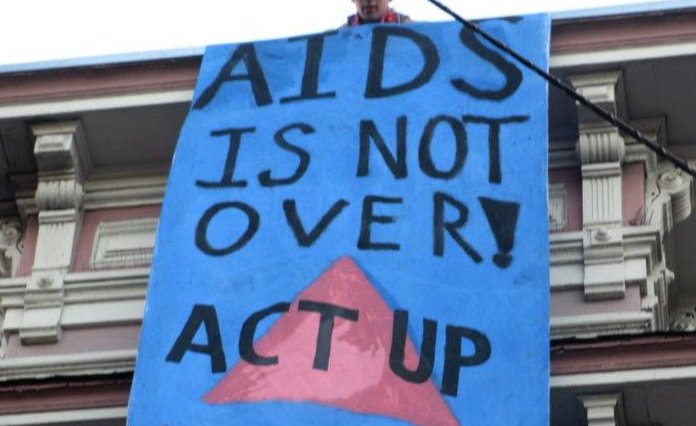
These events were followed by more old school-style ACT UP actions: slogan-bearing banner drops at Pink Saturday in the Castro, guerilla street art bombs, a “Cumdumpsters of the GOP” condom toss at Folsom Street Fair. A nexus of affiliation emerged among fellow radical queer groups like OccuPride, Homonomixxx, and active ACT UP chapters in other cities. In December, a small group managed to enter Bay Area-based pharmaceutical giant Gilead’s headquarters to protest the exorbitant pricing — $28,500 per year — of its new, more convenient HIV drug Stribild. An action is planned for February 25 to deliver letters protesting Stribild’s price to Gilead, and another for ACT UP’s 26th anniversary in March.
One of the less-emphasized aspects of ACT UP was its reverence for procedure and attention to order, its organization into multiple affinity groups and action committees: a trick learned from classical anarchism and the Civil Rights Movement. The young ACT UP/SF members I’ve met — there are about 25-30 core members — seem to have absorbed these techniques: they speak calmly and deliberately but candidly, seeking out consensus but unafraid to disagree. Their actions, too, seem deliberately organized and calmly executed.
The delicately butch-featured Nova joined me at Church Street Cafe, along with fellow ACT UP/San Francisco revivalists Mayra Lopez, 24, a poised yet vivacious nonprofit worker with striking red lips, and Alan Guttirez, 23, the kind of soft-voiced, sharply intelligent sex worker who somehow survives Dennis Cooper novels.
“I was 18 and taking a summer sociology class at SF State with this flaming faggot professor,” Guttirez told me. “Usually queer teachers like to talk about themselves a lot, and at some point he mentioned ACT UP. No one knew what he was talking about, that there was this whole radical movement here that had been almost completely buried. I was immediately curious about the possibilities.”
Lopez told me, “I grew up in Sonoma — for half my life, HIV wasn’t even on my radar. You never talked about sex in the Latino community I’m from, nevermind queer issues or HIV. Then, in high school, I watched a documentary about HIV and wanted to do a history of the disease for a project. I picked up a book of posters, included ones from ACT UP, that’s how I found out about it. From there I went to work for a nonprofit — but nonprofits have a problem with being able to address issues about migrant workers and HIV, which is my focus. They have to be so P.C. I feel like ACT UP is a tool to address those issues openly.”
A 2012 ACT UP/SF die-in outside Mission Dolores Basilica, protesting the Catholic Church’s homophobic and sexphobic policies. Photo by Liz Highleyman
Is any of the motivation for the ACT UP renewal a matter of trendy nostalgia? “We’re too busy for nostalgia,” Guttirez says. “We wish the people wearing ACT UP things or looking back at the ’90s would dig deeper into the meanings to know what those things stood for, that we’re still fighting against the same shit. Categorizing people on hookup sites as ‘clean’ or ‘dirty’ according to their HIV status or making fun of poor people is just perpetuating behaviors that were once used against us, and killed us.”
A BROADER AGENDA
One of the original ACT UP’s main goals was access to life-sustaining drugs. What’s the agenda of a new ACT UP? Besides addressing the prohibitively high costs of AIDS meds — something most HIV-positive people with insurance may take for granted, a lack of awareness that drug companies can take advantage of by price gouging or delaying more cost-effective treatments, and leaving uninsured people scrambling and dangerously stressed as public programs are increasingly cut — and the lack of an HIV safety net for many immigrants, the new ACT UP/SF also gives priority to sex worker and housing issues.
ACT UP/SF joined a coalition of local organizations, including Nova’s employer St. James Infirmary, to successfully demand that the San Francisco Police Department ban the use of condoms found on someone suspected of prostitution from being used evidence against them. (On January 14, however, Police Chief Greg Suhr announced that the ban would remain “temporary” for 90 days.)
And ACT UP/SF is also agitating around a provision in the $15 billion, George W. Bush-initiated PEPFAR international AIDS relief program, which forces organizations to pledge to oppose prostitution in order to receive funds. The US Supreme Court has agreed to hear a case against the provision this year.
A more local, immediate concern, however, one that ACT UP/SF places at the top of its list, is the skyrocketing cost of rent in San Francisco and the increasing numbers of evictions and stressful threat of evictions that many people living with HIV/AIDS face today.
“Evictions are killing us, they’re murder,” Lopez said, as Guttirez and Nova voiced their agreement. “People think medication is the number one priority for people with HIV — but it’s not, it’s housing. SROs are being pushed out, affordable housing stock is shrinking, people are being forced to leave. Without stability, it’s very hard to comply with your drug regimen, which is already complicated enough.
“I hear people all the time say, well if you can’t afford it here, then just move. They don’t understand that San Francisco is still one of the few places where queer people feel safe, that there’s a network of services here with proven results that you can’t find anywhere else, especially places many people living with HIV can afford to live. And there are support networks here, too, that aren’t available anywhere else.”
In fact, one of the most valuable things ACT UP/SF may be doing right now is offering a community for people, especially young people, with HIV to connect beyond the isolation of computer screens, to share information, enter into a positive dialogue, and receive support in a sympathetic environment geared toward changing the status quo.
Guttirez sums it up: “We’re for people who realize an angry Facebook post isn’t enough.”
BACK IN THE DAY
Have any old-guard feathers been ruffled by the ACT UP revival?
“The only real resistance we’ve had is to the name ACT UP/San Francisco — our intention is to reclaim the name from the mess that happened in the past,” Cyd told me. He’s referring to perhaps the most acrimonious legacy of local queer history. In 1990, after a phenomenally successful year of protest and media attention, several people left ACT UP/San Francisco to form ACT UP Golden Gate, intending to focus specifically on advocating for drug development and treatment, rather than address broader social issues like economic justice and gay equality.
The split was amenable at first, until things got really weird. Two men, David Pasquarelli and Michael Bellefountaine, moved here from Florida in 1993 and took over Act Up San Francisco. They quickly went from questioning the wisdom of poisoning one’s body with chemicals from the medical industry to flat out denying that HIV was the cause of AIDS, telling HIV-positive followers to forego medications altogether, saying that’s what was really killing them. Many panicked young people were swept into the new ACT UP/SF’s cultlike atmosphere, and to their doom.
“They were whackadoos!” old school ACT UP member Waiyde Palmer exclaimed when I brought up Pasquarelli and Bellefountiane. “They killed hundreds of people — and now they’re dead. Of AIDS. But the bitterness still lingers.”
I met the svelte and sassy Palmer, contributing editor of the Castro Biscuit news website and longtime survivor of AIDS, at Church Street Cafe, along with other ACT UP veterans Dean Ouellette, bushy-bearded gardener and musician, and respected journalist and activist Liz Highleyman. The three formed an uncanny, silver-haired mirror image of their younger counterparts I’d met with earlier.
A lively conversation careened among several milestones of queer radical AIDS activist history. The major early, roof-climbing takeover of pharmaceutical giant Burroughs Wellcome’s Burlingame office in 1987. The packed week of successful demonstrations around the sixth International AIDS Conference in 1990. Protesting a 1989 episode of NBC program “Midnight Caller,” which featured a murderous bisexual HIV-positive character. The 1989 day that Stop AIDS Now or Else blockaded the Golden Gate Bridge, two weeks after members of ACT UP/SF chained themselves to the Pacific Stock Exchange.
Juicy tidbits dropped: owner Marty Blecman of Megatone Records, Sylvester’s label, bankrolled ACT UP until he died in 1991; a fresh-faced Rachel Maddow, member of the AIDS Legal Referral Panel in 1994, stole some other cute dyke’s look. We tried to pin down a timeline of everything, but memories were fuzzy, exact dates had faded.
“I’m pleased to be a part of what’s happening, and I’m glad that it’s so intergenerational,” said Palmer (all three are active in the new ACT UP/SF) “but we need to maintain a momentum, and the motivation is different than when people were dying around you every day. Back then, the movement had members from every walk of life — yuppies, deadheads, people I never would have dreamed of associating with as a punk — united by this life-threatening illness.”
Highleyman agreed. “HIV has been taken over by the medical industry, we’re narcotized. A lot of ACT UP was based on exchanging information on these bewildering scientific things. Now people just ask their doctor what medicine to take. But who’s monitoring the doctors or watching the drug companies?”
“And the economics of the city have changed so much,” she continued. “I wonder if there are the resources anymore to support a protest movement. It’s just so expensive to live here, who has time to organize and follow through? The fact that these kids are taking it on is incredible and rare.”
“Back then we all worked three jobs, too” Palmer said. “But our rent was only $300 dollars — and if you had to leave one job to go to a protest, something else would pop up. I’m not sure if that can happen now.”
TIME PASSAGES
What happened to ACT UP? Leafing through the mesmerizing ACT UP Golden Gate files in the GLBT Historical Society archives in SoMa (especially those of its young star activist, Edward Zold, who succumbed to AIDS in 2009 at 38), a blizzard of drug names zips past: liposomal, foscarnet, fluconzole, sp-pg, TNP470, D4t, clarithromycin, AZT, Deovythymidine, xylocaine.
Every week it seemed, a new hope rose with a new drug name, only to be quashed when that drug failed. As several of the recent AIDS movies posit, the overwhelming amount of death just became too much, people couldn’t handle it anymore. Activists began turning on each other, the movement faded, and activist queer culture sank into despair. Until 1997, that is, when everyone began to realize the new anti-retroviral drug therapies would actually work. They were going to live, and then it was the best Folsom Street Fair ever.
Maybe more importantly, whatever happened to radical queer activism in general? I met with writer K.M. Soehnlein, who’s working on a novel based on his experiences of the ACT UP period — he was there from the very beginning in New York. He’s featured in United in Anger, and Queer Nation, an ACT UP offshoot formed to combat gay-bashing and promote queer visibility through renegade tactics, began in his living room in 1990.
“Occupy was a blip on the everyday gay person’s radar screen — and the police response to it was enormously more brutal and scary than when we protested in the ’90s and police usually worked with us,” he said. “But honestly, most gay people now are happy to see their president onscreen saying the word ‘gay’ before the word ‘marriage’ and that’s good enough for them.”
Soehnlein also has thoughts about why ACT UP may be resonating again. “There’s been talk about AIDS PTSD, and it really was a war. ACT UP felt like the only thing you could do to stay sane. Many people had to shut themselves off from that time in order to move on, and activism may be included in that.
“But 20, 25 years is a long time. It could just be a matter of waking people back up.”
ACT UP/SF meets at 7pm every first, third, and fifth Thursday — including Thu/21 at Alley Cat Books, 3036 24th St., SF. www.facebook.com/ACTUPSF
Texas Guv Rick Perry made a spectacle of himself trying to take businesses away from California, but as everyone with any sense predicted, his trip was a bust. Fact is, very few businessess anywhere make major relocation decisions because of taxes and regulations. But as Calitics points out (with a nice chart), the real reason people have left California of late is the cost of housing.
The so-called “job creators” have enough money to afford to live here, so they aren’t going anywhere. What’s happening is that the rest of the workforce, particularly the middle-class workforce, is finding the gap between the amount they can earn and the amount they have to pay for a home is getting so radical that they’re leaving altogether.
That’s happening in San Francisco, as evictions are driving people out of the city. Some may move to other parts of the Bay Area, creating what most environmentalists and economists agree is an unsustainable situation: Workers living so far from their jobs that vast amounts of energy have to be expended getting them back and forth. But the data shows that people are leaving California altogether. Calitics:
If we are to really continue our growth, we must address the housing crunch that is going on, especially along the coast. That isn’t accomplished through slashing services and budgets, but rather working to create new affordable housing solutions and ways for young families to stay here in California, where most would rather stay.
And let’s remember: One of the biggest factors that does drive business location decisions is the availability of skilled labor. If people are leaving the state because they can’t afford to live here, who’s going to work in the industries that are the biggest employers in San Francisco (hint: It’s not tech)? Tourism is this city’s greatest economic engine, and jobs in the hospitality industry don’t pay enough for housing in the city that depends on it.
That’s a dilemma we all ought to be talking about — and Rick Perry trying to get businesses to go to Texas is not.
Pending legislation that would require seismic retrofitting of thousands of properties at the building owners’ expense could hit renters harder than anyone, causing evictions and increasing rents by up to 10 percent, impacts that tenant advocates are trying to get the Mayor’s Office and sponsoring Supervisors David Chiu and Scott Wiener to address.
As stated in the Earthquake Safety Implementation Program (ESIP) Workplan, retrofit costs are expected to range from $10,000 to $20,000 per dwelling unit. In a five-unit building, this could add up to as much as $100,000. According to a public statement by Mayor Ed Lee, before the first retrofit is required, they will “develop financial incentives and assistance programs to help defray costs for property owners.”
But with apartment owners allowed to pass the cost of the work on to their tenants — a class of San Franciscans already being hit with rising rents, a wave of evictions, and legislation that would encourage more conversation of apartments into condos — this earthquake safety measure could make their situation even worse.
“We have concerns about this, mainly that landlords will be able to pass on the costs to tenants and that landlords will use it as a pretext to evict long-term tenants with affordable rents, so we’ll be working to increase tenant protections in this plan,” says Ted Gullicksen from the San Francisco Tenants Union.
According to the San Francisco Rent Board (SFRB) website, for seismic work that is required by law, 100 percent of the capital improvement cost may be passed through to the tenants, regardless of property size, over a period of 20 years. The increases are subject to an annual limitation of 10 percent of the tenant’s base rent. Gullicksen says that rent increases will be up to $100 a month for many tenants, which is on top of the annual 1.9 percent increase landlords are allowed to impose in rent-controlled apartments.
Another worry for long-term tenants is the possibility of eviction. The SFRB also states some of the just cause evictions these landlords could use would be “…non-payment or habitual late payment of rent… to perform capital improvements which will make the unit temporarily uninhabitable while the work is being done, and… to perform substantial rehabilitation of a building that is at least 50 years old, provided that the cost of the proposed work is at least 75 percent of the cost of new construction.” This would mean rent increases and nearly any construction could be the reason a long-term tenant would be evicted.
This seismic retrofitting could drive up rent prices around the city and be one more obstacle tenants have to face. As Gullicksen said, “I think the mayor and sponsors don’t understand the impact this will have on tenants, so we will look to educate them and press for amendments to lower the rent increases.”
Not to go all gloomy on a day when it’s finally not cold and the sun is out and San Francisco was just named the happiest city in America, (based on things like the number of shopping centers and cultural events), but really: Let’s not all jump up and down and celebrate. This is a very happy city for people who have money; it’s becoming a very anxiety-filled city for everyone else.
I’ve gotten quite a few comments and emails from friends on our cover story this week, and most of them go something like this:
“Great story. Really scary. I hope they don’t Ellis Act my building or I won’t be able to stay here, either.”
If you’re a renter in San Francisco, and you’ve been here a while, and you’re under rent control, chances are you’re nervous about your future. Because if you get evicted, you’re almost certainly leaving town. Maybe you can find a place in Oakland that’s smaller than what you currently have at twice the price, or maybe you can’t.
This is a city under immense pressure, and while the economically secure can happily go to shopping centers and see the Opera, I would say a majority of the current residents of San Francisco are more stressed about their future than they have been in years. And that doesn’t seem to be addressed in the happiness calculus.