Eviction

Alerts

0

WEDNESDAY 23

An Evening with the Authors of DOLLAROCRACY First Congressional Church, 2345 Channing Way, Berk. 7:30-9:30pm, $15. John Nichols and Robert McChesney will discuss their new book, DOLLAROCRACY: How the Money and Media Election Complex is Destroying America. The authors will address issues such as the forces they believe have robbed national elections of their meaning, the far-reaching and drastic consequences of these developments for the American democratic process, and proposed solutions.


THURSDAY 24

8 Washington Debate First Unitarian Universalist Society, Martin Luther King Room, 1187 Franklin, SF. Doloresmp@gmail.com. 7-9pm, free. Jon Golinger, campaign manager of No Wall on the Waterfront, will debate Alec Bash, supporter of the 8 Washington project. The luxury waterfront development is the subject of Ballot Propositions B and C, which will appear on the Nov. 5 ballot. Golinger is an attorney and environmental activist; Bash is a former city planner. The San Francisco chapters of Progressive Democrats of America and Unitarian Universalists for Peace are sponsors of this event.


FRIDAY 25


MisLEAD: America’s Secret Epidemic San Francisco Main Library, 100 Larkin, SF. www.misleadmovie.com 2-5pm, FREE. Screening of the new feature-length documentary directed by Tamara Rubin, an Oregon mother whose sons were poisoned by lead. The film follows Rubin as she travels around the country meeting with experts and other parents of poisoned children. It showcases the on-the-ground effects of the lead-poisoning epidemic and investigates how lead poisoning was ever allowed to become such a serious problem in the US. Free lead check swabs will be given to all attendees and the event will include an educational session on how to properly use the swabs. SATURDAY 26 Our Mission: No Eviction! Brava Theater, 2781 24th St, SF. tinyurl.com/noevict. 8pm, $10–$35. An evening of art, performances, and tributes to Mission artists Rene Yañez and Yolanda Lopez. All proceeds will go to the artists’ legal expenses in fighting their eviction from the Mission home where they have lived for thirty-five years. Their plight is part of a rash of evictions of artists and working class communities from San Francisco in recent years, especially in the Mission District. Yañez and Lopez are pillars in the San Francisco arts community, and rallying around them is an opportunity to protest the larger issue of evictions throughout San Francisco.

Guardian forum examines who San Francisco is building housing for

218

Our original intention for “Housing for Whom?” — a Bay Guardian community forum tomorrrow night (Wed/23) at the LGBT Center — was to look at the hottest items on an otherwise lackluster fall election: Propositions B and C, which would allow a controversial waterfront luxury condo project to be build at 8 Washington St.

So we booked key proponents on the each side the measure: Jon Golinger, president of the Telegraph Hill Dwellers and a key opponent of the project; and Tim Colen of the Housing Action Coalition, one of three proponents of Prop. B. We’re excited to hear what they have to say and to discuss the measures.

But in the weeks since then, there’s been explosion of public concern over the related issues of gentrification and evictions, accompanied by a renewal of progressive activism that has scored some notable victories, all of its set against a skylight of construction cranes building a glut of high-end housing in Upper Market and other areas.

So we’ve decided to broaden our discussion to look at the implications of the city’s current housing and economic development policies, examining what the San Francisco of the the future will look like if we continue on our current course and what can be done to control our destiny.

To help guide that discussion, our panel will also include Fred Sherburn-Zimmer, an activist with the Housing Rights Committee who recently went through her own personal eviction battle; and Peter Cohen of the Council of Community Housing Organization, who will offer an overview of the housing now being built and the challenges in meeting the needs of current city residents.

We’ll also be turning to you, Guardian readers, for your input and observations. And to help with that, the crowd will include veterans of the successful recent campaign to prevent high-ending clothing chain Jack Spade from opening a store in the Mission and the struggles to prevent the Lee family eviction and a mass eviction on Market Street that would be the biggest single eviction since the I Hotel.

Moderating the discussion will be yours truly, Editor Steven T. Jones, and News Editor Rebecca Bowe. So come join us from 6-8pm at on the fourth floor of the LGBT Center, 1800 Market St.   

Commodifying urban real estate hurts the culture of big cities

98

When urban real estate is turned into merely a commodity — or just another safe place for the wealthy to park their cash in uncertain economic times, while also providing pied-a-terres in which to crash a few times a year — it tears at the social fabric of big cities such as San Francisco, New York City, and London.

That’s been the message in some excellent, widely circulated articles in the last week or so — including David Byrne’s Guardian article about New York City and “London’s Great Exodus” in Sunday’s NY Times — and it’s one that San Franciscans should be thinking about as we work through current eviction and gentrification battles and vote on the 8 Washington project through Props. B&C in a few weeks.

It’s also something that we’ll be discussing at Housing for Whom?, a free community forum that the Guardian is sponsoring on Oct. 23 from 6-8pm at the LGBT Center, 1800 Market Street, featuring opponents and proponents of those measures along with other activists and experts.

While both London and New York City may be ahead of the curve in letting capitalists and the real estate market drive away creative types and destroy what once made those cities great, San Francisco isn’t far behind, particularly given its current housing and economic development policies.

Another striking article on the issue comes from San Francisco Urban Research Association Executive Director Gabriel Metcalf, who wrote an article published in The Atlantic on Monday. It repeats his previous calls for San Francisco to build 5,000 new housing units per year and opens with a line many of us have uttered: “My friends keep moving to Oakland.”

But Metcalf (who hasn’t yet returned my calls for comment) also takes this familiar observation and his promotion of market rate housing a step further, basically calling for San Francisco and Oakland to start acting as one city: Rich people in SF, cool people and workers in Oakland, ala Brooklyn and Manhattan.

“If we were one city, San Francisco could spend some of its incredible wealth on the things Oakland needs, like hiring more cops and teachers, not to mention more transit connections between the two cities,” Metcalf writes. “This is not an argument for annexation but a call to think about the answers to our problems from a regional perspective. We can’t solve affordable housing or transit access within the limits of any one city.”

Actually, I’d argue that we can and should solve these problems within our borders rather than just ceding San Francisco to the wealthy. Yes, regional planning is good, and yes, there are things that San Francisco can do for Oakland (perhaps starting with not poaching it professional basketball team).

But regionalism isn’t the same thing as plutocracy — and San Francisco is still worth fighting for rather than just letting it go to the highest bidders.


Watch this depressing time-lapse visualization of Ellis Act evictions

A series of red circles explodes on the screen, each representing another rental unit where tenants were driven out by an eviction through no fault of their own.

With a new time-lapse visualization of San Francisco Rent Board data spanning from 1997 to August of 2013, viewers can instantly grasp the cumulative impact of Ellis Act evictions in San Francisco.

It was created by the Anti-Eviction Mapping Project, a newly hatched volunteer effort started to raise awareness about the rising trend of displacement in the San Francisco Bay Area.

Watch it here.

A landlord doesn’t need just cause to oust a tenant under the Ellis Act; the law permits a property owner to stop renting units, evict all tenants, and sell the building for another purpose. The recent wave of tech startups and resulting influx of highly paid employees has fueled a spike in Ellis Act evictions as demand for housing has increased.

Working in collaboration with the San Francisco Tenant’s Union, Anti-Eviction Mapping Project volunteer Erin McElroy teamed up with core volunteers Olivia Jackson, Jennifer Fieber and a team of several others to analyze and map data from the San Francisco Rent Board.

The Ellis Act visualization is the first of several planned by the Anti-Eviction Mapping Project. The size of the circles that pop concurrently with each date corresponds with the number of units displaced.

“We started it with the idea of making a comprehensive map that would show things that weren’t being documented by the Rent Board,” McElroy explained. To that end, the project team has spearheaded a survey to gather data on tenant buyouts, harassment by landlords, rent increases, and bogus attempts to use the Ellis Act to carry out an eviction. The survey is available in Spanish and English, with a Chinese version coming soon. 

“We also want to map where people relocate to, in order to display the current and pending gentrification of other areas – particularly the East Bay,” she added.

In the next few weeks, the team will release maps based on data showing owner move-in evictions and foreclosures.

“We don’t have funding or anything like that,” McElroy explained, but the Tenants Union has allowed them use of its office space for meetings. The effort took several months of research and programming, and the result is a story of the displacement of 3,705 housing units over the course of 16 years – all of which can be absorbed a matter of minutes.

No room left in San Francisco for an artist who helped make the Mission what is

74

After four decades living and creating art in the Mission, iconic San Francisco artist and curator Rene Yañez is being threatened with eviction.

Yañez made local history in 1972 when he brought Dia de los Muertos, the Mexican holiday honoring the dead, to San Francisco. The parade through the Mission District every Nov. 2 quickly became a Bay Area tradition, drawing thousands of people each year.

He founded the Galeria de la Raza and brought Latin America’s premier artists and photographers to showcase their work there. When the Museum of Modern Art rejected the work of a little-known Mexican woman, it was Yañez who gave a young Frida Kahlo a space to exhibit her paintings. He taught art classes for youths in the community and offered crucial support to many of the Mission’s mural projects.

In 1998, the San Francisco Foundation awarded Rene the “Special Trustees Award in Cultural Leadership.” Now, the man who has contributed so much to the culture of this city finds himself on the verge of being expelled from it.

Rene’s impending eviction from the house on San Jose Avenue where he has lived for the for 35 years is producing a fierce reaction. Fellow artist and personal friend Guillermo Gómez-Peña recently released an open letter expressing his outrage and rallying for public support of Rene’s cause.

“You are being physically and culturally evicted,” Gómez-Peña writes. “Shame on this city! Shame on the greedy landlords and politicians! Your sadness is ours…A city without Rene Yañez…can’t be called San Francisco.”

Gómez-Peña’s cry to action will be answered tomorrow (Sat/12) at 2pm at the Brava Theater on 24th Street with Our Mission: No Eviction, a march in protest of the Ellis Act, the law used to evict all of the tenants living in the five-unit house on San Jose, including Rene, his partner Cynthia, his former wife Yolanda, and his son Rio. (For more on tomorrow’s event and the city’s eviction trend, see our Politics blog).

On Saturday, Oct. 26, Brava Theater in the Mission will host “Our Mission: No Eviction!” a fundraiser in honor of Rene and Yolanda featuring art and performances.  All proceeds from ticket sales to the event will go to the legal expenses of fighting the eviction, as well as Rene and Cynthia’s medical bills; both the artist and his partner are currently battling cancer.

“They were kind of at peace that this would be their home when they passed away, in the community they’ve put so much into,” Rio told us. “Cynthia could be dying or dead while they are in the process of moving.”

Under the Ellis Act, Rene and Cynthia qualify for a year-long postponement of their eviction because of their illness, a fact which their landlord, Sergio Iantorno of Golden Properties, LLC, neglected to tell Rene when he offered him $21,000 and a years’ free rent if he accepted his eviction immediately.

Consulting his lawyer, Raquel Fox, Yañez was informed about the legal extension and proceeded to successfully apply for it. Even without her advice, though, Yañez would not have accepted Iantorno’s offer. As Rio explained, that amount is nowhere near enough for Rene and Cynthia Yañez to get another place in San Francisco, especially in the neighborhood that they call home.

“They are in their 70s. They aren’t looking for a huge buyout so that they can start a new life,” Rio told us.

When their original landlord died 13 years ago, Yañez and his fellow tenants pooled their money to make a bid for the house. Golden Properties saw their offer, and doubled it. Now, they are banding together again to refuse Iantorno’s money and fight  the eviction.

“I would rather take my chances and fight it,” Yañez told the Guardian. “And also I see it as resistance to what is going on and affecting a lot of people.”

On Oct. 1, the San Francisco Rent Board released its Annual Statistical Report for fiscal year 2012-2013. The report revealed a 36 percent increase in eviction notices since the year before. Evictions from rent-controlled apartments in particular are at an 11-year high.

The Ellis Act was used 81 percent more than last year, providing the basis for almost 10 percent of all evictions. The law was used with greatest frequency by landlords in the Mission District. Meanwhile, city public health officials estimate that someone earning minimum wage would need to work more than eight full-time jobs to be able to afford a two-bedroom apartment downtown.

“It is a disaster,” states Christopher Cook, an organizer with the nonprofit group Eviction Free Summer. “Individuals, families, and increasingly small businesses are being hammered by these twin tsunamis of evictions and dramatic rent increases. Those two factors have been driving people out of the city in ever greater numbers for the past 10 to 15 years.”

Gómez-Peña blames these changes on the mass of high-paid young people produced by the second dot-com boom. They may work in Silicon Valley, but they play in San Francisco, and this new class of wealthy young techies can and will pay any price to live in the city—especially the Mission District.

“I see them everyday, the hordes of iPad and iPhone texting zombies, oblivious to us and our lives, our inspirations and tribulations,” he writes. “I see them in my building and on the street, invading the city with an attitude of unchecked entitlement, taking over every square inch and squeezing out the last drops of otherness.”

It is no easy task to make room for all that wealth when the majority of the city’s residents are renters protected by law against unfair rent increases, landlord mistreatment, and unwarranted evictions. The actual strength of these safeguards may be waning, though, leading Gómez-Peña to warn the public in his letter that, “As renters our hours here are numbered.”

The only way to evict a tenant in San Francisco is by claiming one of 15 “just cause” reasons for removing them. Among those 15, the Ellis Act is something of a landlord’s dream date, skipping all the talking to get straight to the action—eviction. Established in 1985, the California law gives landlords the unconditional right to evict tenants if they are “going out of business.”

In order to implement the Ellis Act, a landlord must evict all of the tenants in his or her building, giving them 120 days notice, and wait five years before they can put the units back on the rental market at an increased price. However, the law does not prevent landlords from renting the units out as short-term lodgings, or converting them to be sold as one massive unit, tenancies in common or condominiums.

“Ellis Act evictions are impossible to fight,” admitted Ted Gullickson, the head of the San Francisco Tenants Union. This makes them an ideal weapon against rent control, which has allowed residents from lower income brackets to hold onto their homes in San Francisco for decades while the values of the real estate grew and grew. Even then, many tenants do not feel secure. Guerra has heard stories about people with rent control living for decades without hot water, working windows, heat, or even a stove. “To have this amazing rent control,” she concludes, “they put up with substandard living.”

When something broke in their building, Yañez and his family often did not even tell the landlord about it. If they did ask him to fix something, and he ignored their request, no complaints were ever made. “Because of rent control, we tried to keep a low profile,” Yañez acknowledges. “We tried not to bother the landlord or make too much of a fuss, because we did not want to find ourselves in this position.”

Rene has been aware of how precarious his situation is for years. Iantorno attempted to evict him multiple times. He watched as neighbors, nonprofit organizations, and local artists accepted their own eviction notices without a fight. When he first opened the Galeria in 1970, Yañez had a list of artists living in the Mission that neared 200 names. Today, it does not even reach 20.

“Since 2000, they’ve started this thing in the Mission,” he states. “They were very quiet about it at first, but now it’s accelerating. Willie Brown started it, this trend of redevelopment, eviction, displacing people without consideration. He opened up this gaping wound in the Mission, and now these developers are throwing salt on it, trying to kill the patient,” he chuckles. “People get really upset when somebody paints over a mural, like, ‘It has history, it has value, it’s been here for years,’ but they don’t have anything to say if the muralist gets evicted.”

Legally, there is not much that Yañez and his family can do in the coming year to stop their eviction. Even an advocate like Cook admits, “You can’t reverse an Ellis Act. All you can do is fight it, try to make it clear that it’s not worth the landlord’s while, that they’re gonna be in for a world of headaches, costs, and public shaming if they do this.”

Yañez has not accepted the eviction, but he is preparing for the worst, searching for a new home for Cynthia and himself. He continues to scour the Mission, in vain. “I love the Mission,” he explains. “I’ve been there 40 years. I adopted it, it adopted me. And it needs cultural preservation,” he says, curling his hands into fists that bang the air. “We saved the community from really greedy people who had absolutely no interest in who we were as a people. They just saw us as savages standing in the way of them making money. That attitude is still here. It’s actually worse than ever—unregulated and devastating. When I see the trucks moving people out, older people who have no idea where they’re going, sometimes they go downtown to the hotels—I just think it’s really heartless,” he finishes, his eyes wide in earnesty.

Guardian of San Francisco culture that he may be, Rene and Cynthia Yañez will be forced to leave the city in search of somewhere more affordable if their eviction occurs. In that event, there is little chance that the elderly man will be able to return to the city to curate SOMArts annual Dia de los Muertos exhibition as he has every year since he began it.

“I’m hoping that I can hang in. It’s a throw of the dice, but I still have some miles left in me,” he says, his eyes drooping wearily.

There is a chance that the exhibition, which opened today (Friday/11), might be Yañez’s last. Every year, he changes the theme. This November, the Dia de los Muertos exhibition is dedicated to all the living battling cancer, and  all the dead for whom that battle is over. Each piece is haunting, and all together it is a stunning collection encompassing a range of ages and races to touch any and every person that sees it. Like a loved one lost to cancer, the exhibit leaves you wanting more, yet so grateful fpr what you have experienced.

His last or not, it is something that Yañez can be very proud of.

Mayor Lee responds to political furor with more funding to fight evictions

136

We’re not sure whether it was the high-profile recent protests against the eviction of the Lee family, our well-read “City Hall must address rising rents” editorial or eviction and gentrification coverage last week, our earlier focus on record eviction rates, or just the growing view that City Hall is too friendly to landlords and neglectful of tenants, but the Mayor’s Office has finally awoken to the biggest issue facing this city.

With skyrocketing rents — and with increasingly common efforts by the landlords of rent-controlled apartments to take advantage of that market by forcing out their tenants — Mayor Lee this afternoon announced that he’s tripling funding to fight illegal Ellis Act evictions, making populist statements along the way.

Now, spending an additional $700,000 to fight greedy, deep-pocketed landlords is not exactly going to change the playing field, but it’s a nice gesture and an indicator that Mayor Lee is starting to notice the problem. Hopefully, with pressure by progressive politicians and activists, this will be just the first of many such actions.

His press releases follows in it entirety:

*** PRESS RELEASE ***

MAYOR LEE ANNOUNCES ADDITIONAL RESOURCES FOR EVICTION PREVENTION IN SAN FRANCISCO

San Francisco to increase resources to support residents and families affected by illegal Ellis Act evictions and releases Eviction Prevention Funding from Housing Trust Fund

San Francisco, CA—Mayor Edwin M. Lee announced San Francisco will triple the amount of funding to prevent illegal Ellis Act evictions and that the City will release $700,000 in funding for other eviction prevention services from the Housing Trust Fund.

“San Francisco must remain a viable place to live and work for people at all levels of the economic spectrum,” said Mayor Lee. “That’s why I am providing additional resources to stop unlawful evictions and provide tenant counseling for our residents, so that San Francisco remains a City for the 100 percent.”

The Human Services Agency (HSA) currently provides nearly $8 million in homeless prevention and eviction defense services, an increase of $1.3 million from last year’s budget. In this year’s budget, the City was providing nearly $125,000 to fund free legal advice and represent 55 San Francisco families who have been affected by illegal Ellis Act eviction threats. Today, Mayor Lee tripled the amount of funding with an additional $250,000, which will immediately be available to eligible organizations that provide Ellis Act prevention legal work and will help more families and people at all levels of the economic spectrum remain in San Francisco.

“Providing resources to stop unlawful evictions has proven to be one of the most effective strategies to prevent displacement and homelessness in our City,” said Trent Rhorer, Director of the San Francisco Human Services Agency. “This additional $250,000 will help keep San Francisco families in their homes.”

The Mayor’s Office of Housing will also provide $700,000, from the Affordable Housing Trust Fund, to fund tenant counseling services. This is a 63 percent increase in funding and brings the total amount to more than $2.3 million in eviction prevention services from the Mayor’s Office of Housing. These additional resources will be distributed to community based organizations specifically expanding legal representation for individuals facing eviction; rental assistance to individuals and families who are currently homeless or are struggling to keep their current rental housing; and to provide outreach to San Franciscans to better inform them about their legal rights.

The Mayor’s Office of Housing has prioritized eviction prevention services and funds activities including legal services, tenant counseling, rental assistance, move-in assistance, know your rights trainings, and other types of tenant support.  Services are offered through a diverse group of community based organizations that reach San Francisco’s many communities including seniors, people with disabilities, immigrants, the homeless and families.

The HSA will issue an ‘Invitation to Bid’ this week so eligible organizations can apply and use the HSA funding to expand their legal services in order for them to be available to vulnerable tenants within 30 days. It is anticipated that the additional HSA funds will help at least 150 households receive legal advice and representation.


Last days at the Albany Bulb

2

To supplement Carly Nairn’s excellent story about the Albany Bulb, whose inhabitants face imminent eviction from this strange, artsy shoreline park, photographer Tim Daw offers this gallery of images that he captured there last weekend. Check em out. 

Battle of the Bulb

33

news@sfbg.com

On a sunny September afternoon, Osha Neumann slowly walks onto the dirt path leading to the Albany Bulb, using a walking stick for balance against the pebbles. With a white beard and lanky frame, the 74-year-old artist and attorney is no stranger to this landfill turned art space turned homeless encampment that juts out of the East Bay shoreline near the Berkeley Marina and the Golden Gate Fields racetrack.

Neumann has been coming for more than a decade, with his son-in-law Jason DeAntonis to build driftwood sculptures, and as an attorney fighting for the rights of the homeless who live on the 31-acre plot. He’s witnessed its evolution from rubble-filled no man’s land to one of the last undeveloped stretches of open shoreline in the Bay Area.

“The Bulb has been a refuge, a solace, a place of inspiration,” he said. “It’s a place where I can get off the grid and live in this wonderful, successful, fruitful anarchy. I came to really love this place.”

But the Albany Bulb is now facing another transition point in its evolution, one that pits nature lovers and city officials against those who have call this strange stretch of shoreline “home.”

>>Check out a slideshow of the Albany Bulb here


TRASH TO TREASURE

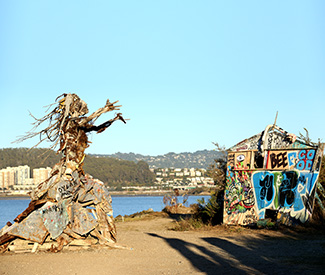
The Albany Bulb is a radical space of massive debris sculptures and structures, huge concrete slabs of graffiti, tents and tree houses, and artifacts from wreckage that, incorporated into the natural landscape of acacia and eucalyptus trees, is a unique and beloved slice of land symbolizing the free spirit of the region.

It’s where sparrows and other birds come to nest, and where dog walkers take dirt paths to the water’s edge. It’s also a space that major organizations such as the East Bay Regional Parks District, the Sierra Club, Save the Bay, the state park system, and the city of Albany have all fought for decades to preserve, with the idea that humans should not be allowed to live there. And in October, due to the enforcement of a no-camping policy approved on May 6 by the Albany City Council, the people living at the Albany Bulb will have to tear down their makeshift homes and say goodbye permanently.

“This has been in the works for 40 years,” said Robert Cheasty, a former Albany mayor and the current president of Citizens for East Bay Parks.

The Bulb became a part of the Eastshore State Park, a stretch of land with a trail along the East Bay shoreline that connects Oakland to Richmond, in the mid 1980s. And with the proclamation of a park came the people. Cheasty has become one of the most outspoken critics of people occupying the Bulb.

“It cannot be allowed to be privatized by any group or person,” he said.

It’s an argument that’s been made many times over the years, but now it seems to be on the verge of coming true.

The first people living in the Bulb came to take up residence after the eviction of the homeless campers from People’s Park in Berkeley in the mid ’90s. Before that, it was used as a landfill for BART and highway construction materials.

Nature inevitably took over, and much of the debris has been moved to certain areas within the park. Some of the first residents were immortalized in the documentary film Bum’s Paradise, where they lived in harmony with four artists known as Sniff, whose paintings and sculptures came to beautify the unconventional living space. In 1999, the first major eviction took place.

“Then, as now, the city provided them no place to go,” Neumann said. “People just scattered with no place to go, into the surrounding jurisdictions primarily.”

Neumann said he worked unsuccessfully with the people living at the Bulb in fighting the 1999 eviction, telling the Guardian, “People were unorganized and it felt hopeless and despairing.”

Neumann said little has changed. The Bulb remained the same, a landfill, albeit without a regular crew of humans living on it. In 2002 the planning of the Eastshore State Park moved ahead, and Neumann, not content to let the Bulb become homogenized, formed the group Let It Be, advocating to keep the “wildness” of the space. It didn’t go over well, and plans moved forward to clear the plateau of its coyote bush, in an area directly north of the racetrack, and fill it in with dirt.

Norman Laforce, who chairs the Sierra Club’s East Bay Shoreline Park Task Force and East Bay Public Lands Committee, has been involved in the planning since its creation. He says hundreds of people worked to make the park possible. He believes that because the city of Albany did not engage in strict enforcement of illegally camping after 1999, it was ripe to be occupied again. And it was.

The city of Albany handed over the deed of the park to the state park system, and the cap and seal order from the Regional Water Board — which stated that the area was clear of any hazardous waste leaching into the bay — was lifted in 2005. Over time, the Bulb’s current 64 residents sought refuge there, about the same number of people who were forced to leave in 1999.

Of those, at least 36 residents don’t have any regular income, while those who do rely mostly on government programs such as Supplemental Security Income. Laforce and Neumann may not agree on much, but both understand the impending enforcement of the no-camping policy to be a new chapter in the Bulb’s story.


WHOSE PARK?

As Neumann makes his way to one of the resident campsites, he stops to take in the view. It’s an unrivaled panoramic portrait of the San Francisco skyline against the glittering bay. He shakes his head when I ask him about the people who oppose campers at the Bulb.

“I think there is a small group of people who are committed to kicking people out of here,” he said.

“Our position has been that the Albany Bulb is a part of the McLaughlin East Shore State Park and is not to be privatized,” Laforce said of the Sierra Club’s view. “We fully support the removal of the illegal campers that are currently out there.”

The Sierra Club and the Citizens for East Bay Parks cite safety concerns as a reason the campers need to leave.

“I was attacked by somebody’s pit bull,” Cheasty said. “It’s happening regularly out there. It’s the antithesis of open space and public land.”

The city of Albany, hesitant at first to ruffle feathers, now supports the removal of campers. “The City Council is working to achieve the Strategic Plan Goals, adopted in 2012,” said Albany City Clerk Nicole Almaguer in an email.” The goals include maximizing park and open space for all members of the community.”

Almaguer noted that the Albany City Council retained the services of Berkeley Food and Housing Project with a $60,000 contract to conduct outreach and engagement services to the city’s homeless, and voted unanimously to extend this agreement to help the campers at the Bulb.

But she made it clear that once October arrives, the people will need to leave. They will receive verbal and written warnings if they don’t. (A camping violation generally amounts to $161 in fines, according to one of the Bulb campers.) One of the major problems, both Laforce and Cheasty say, is that some of the campers don’t want BFHP’s or the city’s help.

They just want to stay on the Bulb.

Neumann introduces me to three-year resident Katherine Cody, or KC. With pink hair and a wide smile, she seems younger than her 60 years. She babies her shih tzu Eva and makes beaded jewelry. Before living in a tent at the Bulb, she lived in her van. One of the perks to living at the Bulb, she explained, is seeing dolphins swimming in the bay, and watching the 50 to 100 hummingbirds nest in the tree above her tent every year.

KC’s past isn’t so idyllic. She said she was stabbed 20 years ago and the traumatic experience of yelling for help to no avail made her grateful to find a place like the Bulb.

“I am terminally ill,” she said on a recent afternoon, “So I need a lot of help sometimes, and without my having to ask or go begging door to door, my neighbors show up.”

After losing a lot of blood from the stabbing, Cody contracted Hepatitis C from a blood transfusion. Despite its rough exterior, KC and other residents argue that their neighborhood at the Bulb is not any more conducive to drug addiction or infighting than any other neighborhood or town.

“They are not capable of doing this job,” KC said of the Berkeley Food and Housing Project’s efforts. “It’s ridiculous to expect in that time span to be able to get the job done. It’s just long enough to make it look like they were being kind and not throw us out immediately, but it’s not long enough to really do anything.”

For Neumann, who has never been homeless himself, watching his friends and people he has known for years struggle to find a place to live makes him want to resist the city’s enforcement.

“They are criminalizing the status of being homeless in Albany,” Neumann said outside of KC’s tent. “Albany doesn’t have anything. It doesn’t have a shelter, it doesn’t have transitional housing, it doesn’t have available subsided housing, doesn’t have any services. Nothing. Zero.”

Neumann and some of the Bulb campers claim that police from surrounding jurisdictions told many homeless people, forced to leave their encampments in other areas, to go to the Bulb. Albany Police deny the charge, with a spokesperson telling us, “the Albany Police Department did not/does not have a policy of instructing homeless people to relocate to the Bulb.”

Nonetheless, Neumann says, “For a long while, this was Albany’s homeless shelter.”

Amber Lynn Whitson, 32, said that she will celebrate her seventh year living at the Bulb on Oct. 31, if she is able to stay. But she is one of the few inhabitants, she said, who is actually preparing to leave.

“Me and my boyfriend have gotten rid of almost everything we own,” she said between cigarettes. Whitson said she came to stay at the Bulb after moving around a lot.

“It’s so nice here,” she laughed. “When you have been kicked around from place to place and told you don’t belong here, you don’t belong there, it’s so refreshing to be told by the local authorities you belong there.”

Whitson said she isn’t sure where she will go after the no-camping policy is enforced. She is sure though, that the fight to resist will continue.

“This won’t be over in October,” she said. “Even if we are out, it won’t be over in October.”


LIGHTS OUT

After we speak with some of the residents, Neumann and I part ways. Before he leaves, he encourages me to take a look around, meet people, and enjoy the art.

Along with the people residing at the Bulb, the art has become a major sticking point surrounding what the Bulb is and what it could be. Cheasty, while not wanting the people to stay, personally doesn’t see the harm in keeping the art intact. In contrast, Laforce believes that part of making the Bulb into a “usable” park requires the removal of the art.

But many people want it to stay. An activist group known as Friends of the Bulb organized a concert with Santa Cruz band Blackbird RAUM at the Bulb for Sept. 28, hoping to draw a large crowd to resist the city’s efforts to remove the campers, and discuss the future of the Bulb.

“We hope it will bring people that live on the Bulb and those that use it to enjoy it together, because who knows how much longer it’s going to be there,” said Doug Gilbert, one of the event’s organizers.

Gilbert said the group started out of the necessity to answer the question of who will control the space: “There are two fundamentally different world views. Those that use the space are the ones in control of it, and those who are truly privatizing it, by deciding who can go there, if the dogs have to be leashed, if the art will stay.”

In the coming month, Laforce said the Sierra Club will continue to support the city’s efforts to relocate the people living there.

“The Albany Bulb is not going to be the homeless solution to the East Bay,” he said. “It’s not just some wasteland.”

Neumann, for his own part, remains skeptical about what will actually take place in October, but he’s certain that, from now on, things at the Bulb will be different. “They do not want to have a repeat of what happened in ’99,” he said before he left for the day. “And that will be the end of this incredible experiment.”

Evictions and gentrification fuel widespread concern in the Mission

202

A mix of neighborhood merchants, community activists and a couple City Hall staffers met for a community forum Sept. 23 on Mission gentrification, voicing anger and frustration about rising displacement in the face of soaring rents.

Arranged by organizer Andy Blue, the forum was hosted by Rose Aguilar of Your Call Radio and held at the Eric Quezada Center for Culture and Politics on Valencia Street.

The recent controversy stemming from a bid by high-end retailer Jack Spade to move into a 16th Street storefront catalyzed the discussion, but many addressed the overarching transformation of a neighborhood that has been flooded with high-salaried residents who can afford to pay top dollar.

Gabriel Medina, policy manager of the Mission Economic Development Agency, said he’s troubled by the displacement of Latino-owned businesses. About 80 percent of Latino-owned businesses are passed onto proprietors’ children, he said, representing critical assets in a pricey city like San Francisco. “It’s getting cheaper to be able to start a business than to buy a house,” he pointed out.

Erick Arguello of Calle 24 (formerly the Lower 24th Street Merchants and Neighbors Association) said he’d seen a similar trend along his strip of the Mission, where some Latino-owned businesses have managed to hold strong since they bought their properties years ago.

Nevertheless, Arguello said, the pressure is on. “There’s been an onslaught of realtors and prospectors on 24th Street,” he said. “They ask about the neighbor next door: Do you know when their lease goes to?”

Nor are businesses the only ones impacted. “We’re seeing a lot of evictions of residents along the corridor,” he noted. “The majority of them are Latino families.”

Laura Guzman, executive director of the Mission Neighborhood Resource Center, decried a lack of funding for affordable housing and dedicated units for the homeless and impoverished.

She said many individuals living on the streets in the Mission lack options, leading them to pass the time in the BART plaza. “Support the people in the plaza. They’re human beings,” Guzman said.

Nick Pagoulatos, a legislative aid to Sup. Eric Mar who was previously involved with mid-90s anti-gentrification campaigns in the Mission, said he himself wasn’t sure if he would be able to remain in the city.

“I’m a partner to a woman who was born in the Mission,” he said, acknowledging the deep ties her family has to the neighborhood. “We know that when we lose our housing” – it is likely a question of when, not if, Pagoulatos said – “we’re not going to be able to stay in the Mission. And we’re probably not going to be able to stay in San Francisco.”

Some activist efforts have emerged. A direct action group called Eviction Free San Francisco has staged protests outside the doors of real-estate speculators. At the upcoming Dia de los Muertos 2013 celebration, curator Martina Ayala said at the meeting, “We are building altars to remember the life that we once enjoyed.” La Llorona, a Dia de los Muertos exhibit that will be held at the Mission Cultural Center for Latino Arts, is subtitled “weeping for the life and death of the Mission District.”

A similar transformation happened 10 years ago when the first dot-com boom flooded the Mission with deep-pocketed residents, Pagoulatos noted. Back then, “there was an organized reaction,” he said. “To be honest with you, we fought the good fight, we were at it for a long time and we didn’t win.”

This time around, “Our level of disgust for what’s been going on has been numbed,” he said. But he called for reaching out to engage unlikely allies, and for tapping into collective anger about displacement to bring about change.

“Get pissed, folks,” Pagoulatos said. “Anger is a good thing, especially in the face of injustice.”

Community forum planned on Mission gentrification

111

The recent debate about high-end retailer Jack Spade seeking to open up shop in the former location of Adobe Books has placed concerns about gentrification in San Francisco’s Mission District to the front burner yet again.

To spark a dialogue about an appropriate community response to the changing fabric of the neighborhood, community activists have organized a discussion forum scheduled for Monday, Sept. 23.

As rents soar, countless longtime businesses and residents are being priced out of the Mission. From the event description:

“How do we, as a community, feel about this? What can we learn from each other as we consider how to confront the issues of a changing neighborhood and city? Coming from our many perspectives, are there matters that some, most, or all of us can agree upon? … What urgent and long-term actions can we take to support existing local businesses and maintain the diversity and unique character of the Mission District? These are just a few of the questions we may discuss at this meeting.”

The meeting will be hosted at the Center for Political Education on Valencia Street, and participants will represent a host of local businesses and community organizations including Calle 24 SF, Eviction Free San Francisco, Encantada Gallery, the Mission Neighborhood Resource Center, PODER, Shaping San Francisco and the Valencia Corridor Merchants Association.

The discussion will be moderated by Rose Aguilar, host of Your Call on KALW.

The event will be held at 522 Valencia on Monday, Sept. 23 at 6pm and is free to attend.

Tenant defenders, hate-free billboards and budget hackers

Tech sector startups aren’t the only folks “disrupting” things in the Bay Area as of late. Social justice activists are mounting their own creative, grassroots responses to unjust practices – and while they don’t often have deep pockets, they’ve got the collective momentum of people who give a damn propelling them onward. Below, a few examples of what’s percolating on this front.

Landing at the landlord’s

Earlier this year, we told you about Jeremy Mykaels, a tenant and disabled senior living with AIDS who has rented his apartment in the Castro for more than four decades, and is now battling eviction. Here’s his story, posted to a website he created where he also lists other properties where seniors have been targeted with evictions.

Eviction Free Summer, a group of tenant activists who made a splash at the San Francisco Pride Parade this past June with a faux-Google bus, has started rallying people together to show up outside the homes and offices of landlords after they issue eviction notices. On Sat/10, they’re planning to caravan to Union City, where they’ll stage a protest outside the homes of the property owners who are evicting Mykaels. More information can be found here.

Disruptive enough for you?

Hate is lame

In response to a series of anti-Muslim ads that appeared on San Francisco transit vehicles, a group of online activists seeks to drown out the hate speech by taking things to a whole new level. Yes, they’re posting their anti-hate message onto a billboard.

From Aug. 5 until Sept. 1, a billboard at 10th and Howard streets will proclaim: “Hate Has No Place in Our City: San Francisco Embraces Diversity and Acceptance, Not Hate and Bigotry.”

The effort was crowd-funded through Louder, a platform for crowd promotion, through about $3,000 in donations from 100 individuals from throughout the country. It was spearheaded by San Francisco resident Christie George, who teamed up with New Yorker Ateqah Khaki to get the project off the ground.

 “When I read about the ads in other cities, I was horrified by how hateful they were. But when I learned that they were coming to San Francisco, I felt like I couldn’t be silent, and was compelled to do something to celebrate how much this city embraces diversity,” George said.

Next Thursday, Aug. 15, the “No Place For Hate” team will host a meet-up for contributors and supporters, featuring talks from the campaign organizers and some comments by Louder founder Colin Mutchler.

Budget for direct democracy

Meanwhile, in Oakland, the effort to hack Oakland’s budget with a ballot measure that would put discretionary spending in the hands of ordinary people is starting to pick up speed.

As Community Democracy Project co-director Sonya Rifkin explained in this interview with Shareable: “We care about a wide range of issues and lot of problems come back to questions of power – access to resources and self-determination and being engaged in decisions that affect our lives. Problems arise in politics from the right people not being invited to the table. The strength of this process is people getting connecting and understanding each others’ perspectives and empowering communities, which can have far reaching potential for enabling people to solve their own problems.”

Bonus: Sounds of badass señoras

Lastly, the Pacifica Radio Archives has received a $128,000 matching grant from the National Archives – the largest-ever grant for a public radio project, according to spokesperson Stephenie Hendricks — to restore historic recordings of powerful women. Once completed, the recordings will be made available – for free! – to colleges and universities through the archive’s “Campus Campaign.” Pacifica doesn’t accept corporate funding, and it’s hoping to fundraise a matching amount from its listeners.

The recordings were made between 1963 and 1987, and we even have a sample for you. This is the voice of Bella Abzug, a member of the House of Representatives and leader of the women’s movement, recorded in 1981.

Alerts: August 7 – 13, 2013

0

WEDNESDAY 7

Whither Modern Times? 2919 24th St., SF. moderntimesfuture@gmail.com. 7-9pm, free. Venerable indie bookstore Modern Times is in flux, but its collective members have been hosting town hall meetings to envision, as a community, what the future holds. Feel compelled to chime in? Are you a skilled event organizer or fundraiser? Join the conversation, bring a friend, or help spread the word that this beloved, lefty bookstore needs a boost.

THURSDAY 8

Boing Boing and the Beats Contemporary Jewish Museum, 736 Mission St., SF. www.thecjm.org. 6:30-8pm, $12. Presented in conjunction with the exhibit Beat Memories: The Photographs of Allen Ginsberg, this panel talk, exploring the Beats Influence in Underground Publishing, will be moderated by David Pescovitz of Boing Boing. Panelists include Ron Turner of Last Gasp Books; RU Sirius of Mondo 2000 cyberpunk magazine, V.Vale of RE/Search Publications and Layla Gibbon of Maximum RocknRoll.

From MLK to Trayvon Redstone Building, 2940 16th St, SF. 7-9pm, free. Award-winning columnist Gary Younge, who writes for the Guardian UK and The Nation and authored The Speech: The Story Behind Dr. Martin Luther King Jr.’s Dream, will lead this discussion on past and modern movements against racism. In the wake of the acquittal of George Zimmerman for the killing of Trayvon Martin, people have taken to the streets nationwide for rallies and vigils. Now, momentum is building for an upcoming rally in D.C. commemorating MLK’s “I have a dream” speech. What are the parallels between now and then?

Life During Wartime: Resisting Counterinsurgency La Peña Cultural Center, 3105 Shattuck Ave Berk. Lapena.org/events. 6pm, free with donation requested. This speaking tour on the military strategy of counterinsurgency will feature Kristian Williams, author of Hurt: Notes on Torture in a Modern Democracy, and Kevin Van Meter, co-editor of the collection Uses of a Whirlwind. The discussion will revolve around essays published in Life During Wartime, exploring U.S. counterinsurgency tactics.

SATURDAY 10

Eviction Free Summer: Landlords in the crosshairs San Francisco Tenants Union, 558 Capp Street, SF. ellishurtsseniors.org. 10:30am, free. Eviction Free Summer is a newly formed band of activists that has developed the unnerving habit of noisily visiting landlords who’ve sent out eviction notices. They would like you to join them. On this day they plan to target property owners who are using the Ellis Act to evict Jeremy, a disabled senior living with AIDS who’s lived in the Castro for over four decades.

SUNDAY 11

Trip out on the future with Jaron Lanier Diesel Bookstore, 5433 College, Oakl. tinyurl.com/whowns. 3pm, free. Author Jaron Lanier will be present for a discussion and book signing of his new work, Who Owns the Future? In it, the writer, computer scientist, and classical music composer explores the rise of digital networks as it relates to the recession and the decimation of the middle class.

“Eviction Free Summer” activists show up outside a landlord’s office to protest an eviction

On July 2, activists from “Eviction Free Summer,” formed to defend tenants facing eviction, gathered outside landlord Rick Holman’s South Park office building in San Francisco to protest an eviction he’d initiated against a Mission-based activist collective.

Organizer Fred Sherburn-Zimmer said it was one of many peaceful protests the housing activists plan to stage against property owners this summer. “We’re taking it to the landlord’s homes and offices,” Sherburn-Zimmer said. “They can’t pretend they’re not ruining people’s lives by displacing them.”

This past April, collective members from In The Works, an organization that rents space in what is often called the “17 Reasons” building, at 17th and Mission streets, received an eviction notice from Holman alleging illegal subletting.

Holman is a managing partner at Asher Investment Group, and from the perspective of Sherburn-Zimmer and other protesters, his move to evict the collective is helping to propel a trend of gentrification in the Mission. “We need this space, and if the whole neighborhood is high-end realty, then it’s not really helping the community,” Sherburn-Zimmer said.

The In The Works Collective bills itself as an anti-authoritarian, anti-capitalist arts and events collective, which regularly hosts skill-sharing workshops and other activism-oriented events. A collective member who introduced herself as Madeline said Holman has not been the most hospitable landlord.

“When he first came to talk to us, he said we had bad posture and body language,” she recounted. “The day after we got the three-day notice, the locks were changed.” 

When the Guardian reached Holman this past May seeking comment for a longer article about widespread evictions, he declined to comment on the matter but emphasized that he planned to keep the building as commercial office space rather than convert it into high-end condos, and said his other tenants had expressed no complaints.

Like many folks facing eviction from San Francisco rental properties, In The Works may be forced to find another space. Currently, Madeline says the collective is paying 72 cents a square foot for the 5,200 square foot place — and it’s highly unlikely that they’ll find a place in the Mission for a similar price. That’s why they welcomed support from the activists at Eviction-Free Summer.

“I totally respect them helping us out,” Madeline said. “It’s important that we stick together. Our place has always been big on solidarity and community building.” 

Eviction Free Summer hasn’t revealed what other landlords they might target, yet they plan to continue staging protests outside landlords’ homes and offices in coming months. “This is just the beginning of this direct action group,” Sherburn-Zimmer said. “We will do anything to prevent people from losing their homes and spaces.”

Wedding bells and Pride protests

0

rebecca@sfbg.com ; steve@sfbg.com

The city of San Francisco was a complete whirlwind from June 26 to June 30. First came the historic Supreme Court ruling that ended the ban on same-sex marriage in California and struck down the discriminatory Defense of Marriage Act. The historic decision, handed down just before the city’s Pride festivities got underway and as a rare heat wave gripped the city, unleashed widespread celebration June 26, culminating with a rally and dance party in the streets of the Castro.

The Supreme Court ruled that the Defense of Marriage Act, which denies federal recognition of same-sex marriage, “is unconstitutional as a deprivation of the equal liberty of persons that is protected by the Fifth Amendment.” According to the majority opinion, “DOMA’s principal effect is to identify a subset of state sanctioned marriages and make them unequal.”

Hollingsworth v. Perry, the Prop 8 case, was dismissed on standing due to the fact that the State of California refused to defend it in court. That meant the previous ruling invalidating Prop 8, by Judge Vaughan Walker and upheld by the Ninth Circuit Court, was upheld.

City Hall was totally packed at 7am when the Court convened, with hordes of journalists, gay and lesbian couples, and sign-wielding activists in the crowd. Cheers erupted when the decision was announced striking down DOMA. When the Prop 8 statement came down, the room went nuts.

“It feels good to have love triumph over ignorance,” said Mayor Ed Lee, who joined Lt. Gov. Gavin Newsom in escorting a fragile Phyllis Lyon down the stairway. When Lyon married the late Del Martin, they became the first same-sex couple to get legally married in California in 2004.

“San Francisco is not a city of dreamers, but a city of doers,” Newsom said. “Here we don’t just tolerate diversity, we celebrate our diversity.” He thanked City Attorney Dennis Herrera and others who’d contributed to the fight to for marriage equality. “It’s people with a true commitment to equality that brought us here.”

When Herrera took the podium, he turned to Newsom, and said, “Now you can say, ‘Whether you like it or not!'” — a joking reference to Newsom’s same-sex marriage rallying cry, which some blamed for boosting the anti-same-sex marriage cause. “We wouldn’t be here today if it wasn’t for Gavin Newsom’s leadership,” Herrera continued. “I remember in 2004 when people were saying it was too fast, too soon, too much.” Herrera also pledged to continue the fight that began here in City Hall more than nine years ago: “We will not rest until we have marriage equality throughout this country.”

Later that afternoon, clergy from a variety of faiths including Christianity, Judaism, Islam, Buddhism and the Church of Latter Day Saints gathered on the steps of Grace Cathedral on Nob Hill for a buoyant press conference to celebrate the court’s rulings.

“For 20 years I’ve been marrying gay and lesbian couples, because in the eyes of God, that love and commitment was real, even when it wasn’t in the eyes of the state,” said Rabbi Michael Lerner of the Beyt Tikkun Synagogue. “We as religious people have to apologize to the gay community,” he added, for religious texts that gave opponents of gay marriage ammunition to advance an agenda of discrimination.

He added that the take-home message of the long fight for marriage equality is, “don’t be ‘realistic.’ Thank God the gay community vigorously fought for the right to be married — because they were not ‘realistic,’ the reality changed. Do not limit your vision to what the politicians and the media tell you is possible.”

Mitch Mayne introduced himself as “an openly gay, active Mormon,” which is significant since the Mormon Church was a major funder of Prop 8. He called it “one of the most un-Christlike things we have ever done as a religion,” but noted that the sordid affair had brought on “a mighty change in heart from inside the Mormon community, with greater tolerance than ever before,” with many Mormons going out and marching in solidary with gay and lesbian couples, he said.

Then on June 28, earlier than expected, the County Clerk started issuing same-sex marriage licenses. Kris Perry and Sandy Stier, plaintiffs in the case against Prop. 8, became the first of dozens of happy couples to be married at City Hall that evening, and the marriages continued in the days that followed.

And as if that weren’t enough excitement, it all happened before the weekend, when Pride festivities got underway. This year featured not only the official Pride parade and myriad performances, but also an “Alternative to Pride Parade,” signifying that a radical Pride-questioning movement has been reawakened in San Francisco.

“Have you had enough with the poor political choices of some community leaders that claim to represent you? Are you over the over-corporatizing of SF Pride? Or just tired of the same old events that don’t reflect who you are, and how you want to celebrate your queer pride?” organizers wrote in a statement announcing the event.

The parade itself, meanwhile, also featured some dissenters. The third annual Bradley Manning Support Network contingent swelled in ranks this year, due to the political maelstrom touched off when the Pride Board rescinded Manning’s appointment as Grand Marshal.

The Bradley Manning Support Network contingent attracted more than 2,000 supporters who marched to show solidarity with the openly gay whistleblower, comprising the largest non-corporate contingent in the Parade. Former military strategist Daniel Ellsberg, who leaked secret government documents known as the Pentagon Papers to the press in 1971, donned a pink boa and rode alongside his wife, Patricia, in a pick-up truck labeled “Bradley Manning Grand Marshal.” Patricia told the Bay Guardian, “There is something about the energy and triumph of this beautiful event … Just as the gays have made a tremendous difference with marriage, we have to do the same with wars and aggression” in U.S. foreign policy.

Pride’s legal counsel, Brooke Oliver — who resigned over the Pride Board’s handling of the Manning debacle — marched along with the Bradley Manning contingent. Bevan Dufty, former SF Supervisor and now the mayor’s point person on homelessness, stepped down as a Grand Marshal, also because of the Pride Board’s actions, but didn’t march with the contingent.

Nor were the Bradley Manning supporters the only protest contingent to take part in the parade. A group seized the opportunity to make a political statement by marching with a faux Google bus, an action meant to call attention to gentrification and evictions in San Francisco. They rented a white coach and covered it with signs printed up in a similar font to Google’s corporate logo, proclaiming: “Gentrification & Eviction Technologies (GET) OUT: Integrated Displacement and Cultural Erasure.”

Some trailed the faux Google bus with an 8-foot banner depicting a blown-up version of an Ellis Act evictions map. Others donned red droplets stamped with “evicted” to signify Google map markers, while a few toted suitcases to represent tenants who’d been sent packing. However, their ranks were thin in comparison with the parade contingents surrounding them, which included crowds of workers representing eBay, DropBox, and, of course, Google — the largest corporate contingent in the parade.

“The organizers of this anti-gentrification and displacement contingent are not ‘proud’ that folks are being kicked out of this city that was once their refuge,” organizers of the faux Google bus contingent wrote in a press statement. “The 2013 SF Homeless Count and Survey shows that 29 percent of the city’s homeless population is ‘LGB and other.’ The Castro is experiencing the highest number of evictions in the city. Meanwhile, the SF Pride Parade is becoming as gentrified as SF. This group is calling on Pride to remember its roots.”