Eviction

Marcus Books can stay if it can raise $1 million

Marcus Book Store continues to be threatened with the loss of its Fillmore Street location – but if an ambitious community-based campaign can succeed in raising $1 million by Feb. 28, the institution will be able to remain where it is for the foreseeable future.

At a Thu/5 press conference at the bookstore’s 1712 Fillmore Street location, attorney Julian Davis announced that the bookstore proprietors and the San Francisco Community Land Trust had reached an agreement with the current property owners, Nishan and Suhaila Sweis, enabling the land trust to purchase the property for $2.6 million.

If the money is raised, the property will be transferred to the trust, which will preserve the bookstore as a tenant in perpetuity and keep the upstairs flats as permanent affordable housing.

“This is an opportunity,” Davis told reporters. If the campaign succeeds, “That is going to be a rare victory for retaining cultural diversity in San Francisco.”

Tomiko Johnson, daughter of Karen and Gregory Johnson, said she was proud of her family for securing the agreement.

Marcus Book Store has been facing eviction since earlier this year, when the building was sold to the Sweis family in a bankruptcy sale after a family member of the proprietors got behind on payments after taking out a bad loan.

The new owners operate a taxicab business in San Francisco and had planned on living there, according to Joe Sweis, who spoke at the press conference. But after a wide range of community supporters mobilized to halt the bookstore eviction, “We felt that the best solution was really to just come to the table. We saw that their property meant so much,” Sweis said.

Raising $1 million in less than three months is a tall order, but the land trust is using a new, web-based fundraising tool it hopes will help attract support.

Called FundRise, the tool is similar to a real-estate investment version of the microloan website Kiva.org. It offers some intriguing potential for re-shaping the way real-estate investment happens in practice, particularly in a city like San Francisco where market pressure is so intense that droves of low and middle-income tenants are being priced out.

Taking advantage of new federal financial regulations, it works by allowing anyone – not just bankers or finance professionals – to contribute investment funding of any amount toward property acquisition.

By opening the doors for a broader subset of individuals to invest, the platform can offer greater potential for community residents to pool their resources toward ownership of significant buildings or critical housing.

“It sort of opens up a new power to change the face of a city,” said Ben Miller, who started FundRise three years ago with his brother, Daniel, in Washington, D.C. The brothers said they started it because “The idea that you could invest in a Japanese company but you can’t invest across the street made no sense. I think it’s a revolution in how a city can develop.”

In the case of the FundRise campaign that is being created by the San Francisco Community Land Trust to save Marcus Books, any “accredited investor” who wants to invest in the bookstore can provide a loan in the amount they choose and expect an annual return of four percent.

“We are the first nonprofit affordable housing developer to use this platform,” said Tracy Parent of the Land Trust, adding that the plan is to look to “investors across San Francisco and the nation to achieve this fundraising goal.”

Under federal guidelines, investors are considered “accredited” if they have assets totaling more than $1 million, or an annual income of $200,000 a year or higher.

If Marcus Book Store had more time, it might have been possible to open the door for supporters of any income level to become investors, Miller said. “That usually takes three to four months for regulators to give the green light,” he explained. “February’s too fast – you can’t get the regulators to sign off that quickly.”

But Parent noted that nevertheless, the Land Trust is investigating ways to incorporate contributions from anyone who wants to donate toward the effort of saving Marcus Books, be they accredited investors or not.  

Ever since the prospect of losing Marcus Bookstore surfaced this past spring, neighbors and supporters from the surrounding community have pitched in to help preserve the cultural institution. It is the oldest African American bookstore in the nation, housed in an historic building where, decades ago when it was Jimbo’s Bop City jazz club, luminaries from Dizzy Gillespie to Charlie Parker held late-night jam sessions.

Karen Johnson, a co-owner of the bookstore, remembers when her parents, Raye and Julian Richardson first discovered the building, which had been sitting vacant. “When I found out it was the Bop City building, I figured it was waiting for us,” she said. They had opened the business in 1960 and moved to a series of locations before settling into the Victorian, which averted demolition during redevelopment because it was put on a truck and transported around the corner.

Johnson said she was overwhelmed by support from the community in recent months. “It’s heartwarming, and it’s a witnessing that humanity is still in San Francisco,” she said. “Humanity is a verb,” she added. “You can’t just think it. It’s an action verb.”

Karen Kai is a community member who helped round up supporters for the months long campaign to save the bookstore. When news that the store could be evicted started to spread, “there was such an outpouring,” she said. “People said, we can’t lose this. Because if we lose this, we lose a little piece of our soul.”


Last stand at the Bulb

8

news@sfbg.com

As the squatter residents of Albany Bulb make one final push against being evicted from their home in a former landfill, the city of Albany is pushing forward with its plan to change the untamed space into a waterfront state park (see “Battle of the bulb,” Sept. 24).

The first signs of the transition came on Nov. 22, when a temporary shelter was set up for residents whose camps would be cleared. The shelter came after a disappointing week in court left the 50 to 60 residents of the Bulb without the stay-away order their advocates had sought, which they intended to use to keep the city and police at bay during the winter.

On Nov. 18, the residents and their attorneys received word that the stay-away order was denied by U.S. District Judge Charles Breyer. After the decision and an Albany City Council meeting later that evening, campers and area activists set up a permanent settlement against the eviction after marching through the streets of Albany.

Barricades made of rocks were set up at the Bulb to resist police getting into the camps. However, the rain that followed for a few nights inhibited their efforts, according to activists involved in the action. And the police, using a backhoe, destroyed the rock barricades. The city of Albany, according to a press release, is calling the transition “ACT” which includes, “Assistance to homeless, including housing-centered outreach, transitional services, support, and shelter; Cleanup and maintenance of the Bulb; and Transfer of the Bulb to McLaughlin Eastshore State Park.” “As part of the City Council’s Strategic Planning Process conducted in 2012, the City Council identified key goals for the City,” Albany City Clerk Nicole Almaguer wrote in an email to the Guardian. “One of which is to ‘Maximize Park and Open Space’ including developing a plan to transition the Bulb into Eastshore State Park, and to improve accessibility for general public use of all of the Albany Bulb as a waterfront park.” Almaguer stated that part of the plan included a temporary shelter and support services, which started this summer and is headed by Berkeley Food and Housing Project. The BFHP also provides case management for the Albany campers interested in securing housing outside of the Bulb.

While the city has provided a housing subsidy program to help Bulb residents with rent, a portion of it will also need to be covered by the tenant. Many of the Bulb residents are only supported through government programs such as SSI, and cannot afford housing costs.

In addition, most residents, and their attorney Osha Neumann, who is also a longtime contributor to art at the Bulb, say that the city does not have any affordable housing in which the residents can transition into. Managed by Operation Dignity, a nonprofit designed to help homeless veterans, the transitional shelter is set up by Golden Gate Fields racetrack near the entryway into the Bulb.

“I was out… talking to people and was overwhelmed by the fragility and vulnerability of many of them, as well as their strengths,” Neumann said of the residents in an email to the Guardian. “The portables are awful. You look at the Bulb and all the life and beauty that’s out there, and then you look at those anonymous utilitarian boxes, and really you expect it all to be stuffed into those containers? 22 men in one, eight women in the other? It’s all really appalling.” According to the shelter’s posted rules, the doors for the shelter open at 5:30pm and close at 8:30am. Showers may be taken 8:30-9:30pm, and breakfast is served 7-8am. The sexes are separated, and pets must stay in kennels outside of the shelter. There are also no “in and out privileges” and if a person doesn’t return by 8pm they are not admitted into the shelter. No one stayed in the shelter the first three nights it was available, according to city reports. Amber Lynn Whitson, a Bulb resident, said that access to the shelter is difficult for people, and doesn’t address the need for people with disabilities to access a bed during the day. “At least two individuals were turned away at the door to the shelter, due to their names not being on ‘the list’, she said in an email. “Both were told that they could stay in the shelter, despite their names not currently being on ‘the list,’ but only after getting ‘a voucher’ from BFHP.” The transitional shelter came to the residents’ lives after Breyer rejected the campers’ request for an injunction to block the eviction with a temporary restraining order. A lawsuit also filed by the residents against the eviction remains open, according to Neumann.

Based on information obtained in court documents, $570,000 was allocated to remove the Bulb residents, based on a Albany City Council decision made on Oct. 21, with $171,000 spent on the cleanup of the campsites and the remainder spent on the two portable trailers with bunk beds to serve as transitional housing for six months. As of now, the shelter’s efficacy to get the campers off the Bulb, as well as the residents’ efforts to resist the transition, remains unclear.


BULB ART TO BE CLEARED

The Albany Bulb, a wild shoreline space near Golden Gate Fields and a former landfill for BART construction and other industries, is well known for its art. Now that a transitional shelter looms over the entrance as part of the city’s plan to remove the residents from the Bulb, campers, activists, and artists came together this past weekend for a festival of resistance against the eviction.

The rubble and sculpture filled space will soon be transformed into part of the Eastshore State Park system. The event drew around 60 people, according to resident Amber Whitson. She led an art walk on Nov. 29, giving the history of the art at the Bulb and explaining why it’s important to preserve it as a cultural resource.

“Some things should remain sacred, and Sniff paintings are out on the Albany Bulb,” she said, referencing works by a group of Oakland-based artists.

Other prominent Bulb artists, such as Osha Neumann and Jason DeAntonis, who built massive sculptures made of found wood and parts along the shoreline, were on hand to speak about their contributions and the personal significance the Bulb holds for them.

While residents have come and gone throughout the years, the art has remained a constant draw. Graffiti artists practice their craft, and sculptors work undisturbed, using debris that is scattered around. Even some of the campers’ shelters, makeshift shanties of concrete, wood and tarp, could be considered artistic.

Once the transition of the Bulb from untamed outcrop to a state park of well-kept trails is further along, the city plans to remove most of the art currently installed there.

The campers and activists organized the art walk as part of a three-day festival of trainings, workshops, and music, to enjoy the space, but also to educate residents and others about how the space could be kept in its current state. “I know that organizing is continuing, and again, the shape it takes will depend on how the city goes about the planned evictions,” said Neumann in an email to the Guardian.

For now though, the art stands, in between garbage, rubble, trees and shrubs, a constant reminder that artists and Bulb dwellers are still around.

Albany Bulb dwellers speak out on temporary shelter arrangement

The ongoing eviction saga at the Albany Bulb, which the Guardian has covered extensively in recent weeks, previously hinged on a debate around conflicting ideas over what was considered appropriate use for a waterfront park.

Environmentalists and others wanted encampments cleared so the Bulb could be a strictly recreational area, while longtime Bulb dwellers fought to stay on the waterfront land, which offered them a safe harbor where they could live peacefully in D.I.Y. spaces cobbled together with whatever materials they could find.

Now that the city has gotten the green light to move forward with clearing homeless residents’ camps, however, the ongoing saga is shaping up to be a study in how a city ought to deal with a newly uprooted population that has been, or is about to be, forcibly removed from self-styled dwellings that were at least safe and stable, if technically illegal and unconventional.

The city of Albany, working with a group called Operation Dignity, has installed temporary shelters at the Bulb that will remain there for six months. However, that approach has prompted the 49 organized homeless residents to issue a press release essentially condemning the arrangement as inadequate, dehumanizing, and ultimately ineffective at addressing homelessness.

In a press release issued today by Share the Bulb, a group of residents and supporters who’ve sought to defend their right to stay, residents described conditions in the newly installed shelters as prison-like, and labeled them “internment trailers.”

The Guardian was unable to reach the city of Albany or representatives from Operation Dignity for a response to the Bulb dweller’s complaints. But here’s an excerpt from Share the Bulb’s public statement:

“There are 49 current residents at the Bulb, but the internment trailers have room for only thirty people, stacked on top of each other in bunk beds. The trailers will only be open for six months. After that six-month period, Bulb residents who haven’t found housing elsewhere will be forced onto the streets of Albany or surrounding municipalities…

“The trailers open each day at 5:30pm and participants must be inside by 8pm, after which they are not permitted to step outside the trailers. Participants must then be out by 8:30am, without access to the facilities throughout the day…

“The rules also prohibit sexual interaction between participants and require gender separation, even for intimate partners who currently live together on the Bulb. One such couple has been together for 32 years.

“There are a total of four kennels for dogs of shelter participants, which is insufficient for the twenty dogs Bulb residents own. There are no accommodations for cats, effectively excluding the seven ESAs which are cats, and their owners.”

Uncomfortable as these conditions may be in comparison with what residents had built and settled into for years, the shelters are merely a temporary measure. The ultimate question is whether or not these individuals will succeed in finding housing once the camps have all been cleared, and the shelters cease to be an option.

Serial evictors named in mapping project

The San Francisco Anti-Eviction Mapping Project – the same tenant advocates who produced this time-lapse of Ellis Act evictions – have published a new interactive data visualization, displaying locations of properties where seniors and disabled tenants were ousted by no fault of their own.

Showing data over the last three years, the map plots locations of where tenants were evicted under the Ellis Act, and displays the identities of the responsible landlords for each affected unit.

“Waiting lists for public senior housing take years. Often senior and/or disabled tenants are forced to leave San Francisco altogether, or end up on the street homeless,” Anti-Eviction Mapping Project organizers wrote in a statement accompanying the interactive map. “If dispossessed from the city, they often lose access to vital city-subsidized healthcare and community support that they had been reliant upon.”

At today’s (Tue/26) Board of Supervisor’s Meeting, legislation seeking to assist seniors affected by Ellis Act evictions won preliminary approval by the full board. Called the Ellis Act Displaced Emergency Assistance Ordinance, it prioritizes evicted seniors when they seek to access affordable housing programs administered by the city.

“We need this measure to keep residents who have no other means of permanent housing from becoming homeless,” said Board President David Chiu, who cosponsored the legislation along with Sups. David Campos, Jane Kim, Eric Mar and London Breed.

The Anti-Eviction Mapping Project also released a time-lapse plotting the total number of no-fault evictions from 1997 to 2013. A counter that starts when you hit the play button breaks down the number of units where evictions were carried out under the Ellis Act, via owner move-in evictions, and through demolition.

The grand total for that timeframe is 11,766 no-fault evictions. That’s counting units, not individual tenants. Owner move-in evictions made up the lion’s share, with 6,952 units affected. Watch the visualization here.

Meanwhile, tenant advocates who are developing these data-driven presentations are also conducting a survey to gather information for another mapping project in the works.

More than a memorial

16

When Mayor George Moscone and Sup. Harvey Milk were assassinated in their City Hall offices on Nov. 27, 1978, San Francisco changed in innumerable ways. Among those ways is the city lost two of the leading progressive advocates for renters and affordable housing ever elected here.

Today, as San Franciscans mark this tragedy with their annual memorial march, organizers and activists have broadened and elevated the event by enlisting the support of 20 community organizations now doing work to combat the eviction, gentrification, and affordable housing crises that are gripping the city.

“We wanted to make this even more than just a candlelight vigil,” David Waggoner, one of the organizers of the event, told the Guardian. “We want to use this time to remember Harvey and George’s legacy in really fighting for the underdog.”

He noted that attendance at the march has waxed and waned from year to year, but the coalition putting this one together promises to have a strong turnout this year because of the surging progressive activism around housing issues and the need to organize the community to save the soul of the city.

“There is very little to stop what’s happening with the rapid gentrification,” Waggoner said, but he also noted, “By building coalitions, the same way Harvey and George did, we can fight.”

“We’re not only honoring the history of Harvey Milk and George Moscone, but we’re honoring their legacy by making them relevant today,” Brian Basinger, head of the AIDS Housing Alliance/SF, told us. “The Milk March is going to be very exciting. We have over 20 community groups invited and helping us put it together.”

Basinger said the progressive activism will continue through the 25th annual World AIDS Day on Dec. 1, and that participants in both events will be asked to present their demands to the city for dealing with the AIDS and housing crises. That list will be presented at City Hall during a noon rally on Dec. 2.

He said that affordable housing issues are LGBT issues given that nearly 30 percent of the city’s homeless population identifies as LGBT, while that identification makes up just 15 percent of the overall city population.

“Those of us who are lucky enough to talk to the folks who knew Harvey remind us that it’s about coalition-building,” Basinger said, noting that many of Milk’s contemporaries are now being forced to leave the city by evictions or economic displacement.

One voice from that era who is still around and active is gay activist Cleve Jones, who was an intern in Milk’s office at the time of the assassination and wrote a poignant guest editorial in the Nov. 21 issue of the Bay Area Reporter about what Milk and Moscone advocated.

“They fought for renters, honored labor, and built coalitions to connect, not divide, us from each other,” Jones wrote. “They would, I’m sure, be pleased by the progress that has been achieved on some of the issues they cared about. But they would be alarmed by the growing chasm between rich and poor, they would be angered by the evictions of the elderly, disabled, and people with AIDS. They would be fighting to keep City College open and they would be outraged by the violence and despair experienced by so many in our city’s neighborhoods.”

Organizers of the event say they think this is just the kind of memorial that Milk and Moscone would have wanted.

“We want the housing crisis to be front and center,” Waggoner said. “We want this to be a time for people to connect with the legacy of Milk and Moscone in a very direct way.”

The march begins at 7pm in Milk Plaza, Castro and Market streets, and continues with a rally outside City Hall.


Eviction epidemic spurs legislative solutions

3

Tenants, organizers and residents impacted by Ellis Act evictions packed the Board of Supervisors Chambers at San Francisco City Hall Nov. 14 for a hearing on eviction and displacement in San Francisco. As more and more residents face ousters only to be priced out, lawmakers and advocates are floating legislative fixes to try and reverse the trend before it reaches the soaring levels of the displacement epidemic that impacted the city during the first dot-com boom.

“It seems to me that we have a tale of two cities,” Sup. David Campos, who requested the hearing, said at the start of the discussion, held at the Board of Supervisors’ Neighborhood Services and Safety Committee. “We must act urgently to address this crisis, which I believe is a crisis,” he added. “We are fighting, I think, for the soul of San Francisco.”

Fred Brousseau of the San Francisco Budget and Legislative Analyst’s office shared his recent analysis on eviction and displacement trends across the city.

Overall evictions in San Francisco rose from 1,242 to 1,716 over the past three years, he said, reflecting an increase of 38.2 percent. Ellis Act evictions rose by 169.8 percent in that same time frame.

Almost 42 percent of individuals impacted by eviction had some form of disability, Brousseau noted, while 49 percent had incomes at or below the federal poverty level. On the whole, a total of nearly 43 percent of San Francisco households are “rent-burdened,” a term that officially means devoting more than 30 percent of household income toward rent, the study found.

Ted Gullicksen of the San Francisco Tenants Union emphasized that tenant buyouts, frequently offered in lieu of an eviction, are also driving displacement, although those transactions aren’t reflected in city records. “There are about three of them for every Ellis Act eviction,” he said. “When you consider them in combination with Ellis, the numbers are very dramatic.”

Throughout the afternoon, tenants shared their stories and fears about getting frozen out of San Francisco by eviction. “I’m looking at shopping carts, and I’m terrified,” one woman told supervisors during public comment. “You have to do something. It might not be enough for me right now, but you can’t do this to any more people.”

Campos is working with Assembly Member Tom Ammiano on a proposal to grant San Francisco the authority to place a moratorium on Ellis Act evictions. He’s also pursuing legislation that would create a mechanism at the San Francisco Rent Board to allow tenants to register formal complaints about landlord harassment and other kinds of pressure.

“I am eager to introduce a bill in January,” Ammiano noted. “One option might be a law that will allow the local jurisdictions, like San Francisco, to suspend the Ellis Act or establish a moratorium, because of the emergency housing situation. Another possibility is working to make sure that landlords are not skirting Ellis eviction requirements by improperly pressuring tenants to leave. We must do something, but we have to work together to make it successful.”

Meanwhile, Mayor Ed Lee recently announced that he is working with Sen. Mark Leno on legislation to curb Ellis Act evictions by requiring additional permits or hearings before they proceed. They’re also contemplating floating more stringent regulations on the sale and resale of properties where tenants have been evicted under Ellis.

At the end of the day, it’s clear that housing advocates are gaining momentum as the spike in tenant ousters continues in pricey San Francisco, where rents are the highest in the nation.


Albany Bulb squatters lose in court and turn to direct action to resist evictions

4

Yesterday marked a big day for Albany Bulb residents. The Bulb, a closed landfill turned homeless encampment, has been under the threat of eviction by the Albany City Council for the last month. 

After an afternoon in a San Francisco courtroom, Judge Charles Breyer of the US District Court for the Northern District of California denied a stay away order filed by the residents’ attorneys seeking to prevent an imminent eviction by the City of Albany. Later that day, after an Alban City Council meeting, residents and activists marched to the Bulb and set up a permanent occupation in protest of the impending eviction.

The stay away order was filed last week in order to prevent eviction during the winter. Osha Neumann, one of the residents’ attorneys and a longtime artist whose work is represented at the Bulb, said that it was unusually cruel to make the residents, some with severe disabilities and mental health issues, move off the Bulb without any homeless shelters or temporary housing available in Albany.

“They haven’t said what is the urgency or need to do it in the middle of winter,” Neumann said of the city, “It’s nonsense.”

Albany Housing Advocates was also a plaintiff, along with 10 of the Bulb residents in the lawsuit.  Julie Winklestein, the president of the AHA was in the court audience, said she hoped that the stay away order would be given: “We decided for a temporary restraining order to keep the conversation going.”

And while that conversation was put to a halt, another has started.

According to a press release issued by area activists and Bulb residents sent early this morning, “activists say they will be participating in trainings, hosting workshops, and planning more actions targeting the City of Albany, as well as the Sierra Club and Citizens for East Shore Parks, recreationalist organizations that are sponsoring the eviction.”

Based on information obtained in court documents, $570,000 was allocated to remove the Bulb residents, based on an Albany City Council decision made on October 21, with $171,000 spent on the cleanup of the campsites and the remainder spent on two portable trailers with bunk beds to serve as transitional housing for six months.

 Many of the campers, such as six-year resident Amber Lynn Whitson, believe that the transitional housing isn’t responsive enough for disabled people, as they believe it would not be open during the day.

“It’s ridiculous that they say they don’t know of any specific disabilities,” said Whitson about the city’s attempt provide transitional housing.

“If I’m not back there, I’m on the streets,” Kris Sullivan, an 18-month Bulb resident said about the encampment. “We’re safe back there.” 

Hundreds attend hearing to call for action on evictions

Tenants, organizers and residents impacted by Ellis Act evictions packed the Board of Supervisors Chambers at San Francisco City Hall today, Thu/14, for a hearing called by Sup. David Campos on eviction and displacement in San Francisco.

“It seems to me that we have a tale of two cities,” Campos said at the outset of the hearing, which was held by the Board of Supervisors Neighborhood Services and Safety Committee. “The vast majority of individuals are struggling to stay in San Francisco. We must act urgently to address this crisis, which I believe is a crisis.” He added, “We are fighting, I think, for the soul of San Francisco.”

Tony Robles of Senior and Disability Action, who showed up at the hearing wearing a black hooded sweatshirt with pobre (the Spanish word for “poor”) printed across the front, expressed his frustration with the surge of evictions taking place in the booming economic climate. “We have been overlooked – the workers, communities of color … it’s almost as if we are an afterthought,” he said.

Fred Brousseau of the San Francisco Budget and Legislative Analyst’s office delivered a report on his recent analysis of eviction and displacement trends across the city.

Overall evictions in San Francisco rose from 1,242 in 2010 to 1,716 in 2013, reflecting an increase of 38.2 percent, according to San Francisco Rent Board Data highlighted in Brousseau’s report. 

Ellis Act evictions in particular increased by 169.8 percent in that same time frame, he said, with the most recent data showing a total of 162 Ellis Act evictions over the twelve months ending in September 2013. That number reflects units evicted, not how many tenants were impacted.

Ted Gullicksen of the San Francisco Tenants Union emphasized that tenant buyouts, frequently offered in lieu of an eviction, are also driving displacement even though these transactions aren’t reflected in city records.

“We need to get in control of these buyouts,” he said. “There are about three of them for every Ellis Act eviction. When you consider them in combination with Ellis, the numbers are very dramatic.”

Brousseau also showed a slide profiling the people who’ve been impacted by evictions citywide. Almost 42 percent had some form of disability, the data revealed, while 49 percent had incomes at or below the federal poverty level.

On the whole, Brousseau said, a total of nearly 43 percent of San Francisco households are “rent-burdened,” a term that officially means devoting more than 30 percent of household income to monthly rental payments.

Throughout the afternoon, tenants shared their stories and fears about getting frozen out of San Francisco by eviction. “I’m looking at shopping carts, and I’m terrified,” one woman told supervisors during public comment. “You have to do something. It might not be enough for me right now, but you can’t do this to any more people.”

Hene Kelly noted that elderly tenants are being disproportionately impacted by Ellis Act evictions. “They don’t have the reserves, they don’t have the jobs, and they don’t have the money to be able to move if they are evicted,” she said. Referencing landlords and speculators who are driving displacement, she added, “It makes me think of cabaret. Money, money, money, money, money makes the world go round.”

Campos noted that he is working with Assembly Member Tom Ammiano on a proposal to grant San Francisco the authority to place a moratorium on Ellis Act evictions.

He’s also working toward legislation that would create a mechanism at the San Francisco Rent Board allowing tenants to register complaints of harassment or other forms of pressure from landlords seeking to drive them out.

His proposal also envisions doubling the amount of relocation assistance that landlords would have to provide to tenants, in the case of no-fault evictions. He also mentioned the possibility of regulating buyouts, by requiring landlords to record these transactions with the rent board, and possibly prohibiting property owners from charging market-rate rent directly after completing a tenant buyout.

Meanwhile, Mayor Ed Lee recently announced that he is working with Sen. Mark Leno on legislation that is meant to reduce Ellis Act evictions. That proposal would require additional permits or hearings before an Ellis Act eviction could go forward, and place more stringent regulations on the sale and resale of properties where tenants have been evicted under the state law.

Just a couple weeks ago, a coalition of housing advocates proposed a sweeping package to turn the tide on evictions.

At the end of the day, it’s clear that housing advocates are gaining momentum as the spike in tenant ousters continues in pricey San Francisco, where rents are the highest in the nation.

“We’ve never been late on our rent,” noted Beverly Upton, executive director of the San Francisco Domestic Violence Consortium, who is battling an Ellis Act eviction. “We’ve paid for every improvement ever done in 25 years. And now we have to leave.” She appealed for legislators to take action for the sake of the city’s future, asking, “Once the advocates and the organizers and the people who care are gone, who will be left in our city?”

Filipino group snubs mayor over evictions

4

The board members of a local Filipino heritage organization, with ties to a high-profile eviction defense battle at San Francisco’s International Hotel in the late 1970s, have declined to an accept an award that San Francisco Mayor Ed Lee had planned to extend to them as part of a Filipino American History celebration because they are angry about a growing trend of senior evictions.

In a written statement sent to the media by board member Tony Robles, the Manilatown Heritage Foundation explained that it couldn’t accept the award as long as “elders are being preyed upon, evicted and given a de facto death sentence thereof.”

The Manilatown Heritage Foundation board members were informed by Board of Supervisors President David Chiu that Lee had planned to recognize the I-Hotel as part of an annual cultural history celebration at City Hall, the statement noted.

“Part of the occasion was to honor the I-Hotel and its many tenants and activists for its contribution to Filipino American history,” board members explained.

In 1976, the I-Hotel was targeted for demolition, prompting a historic eviction defense battle led by housing activists who rallied to the defense of the impacted tenants. As a young attorney who worked with the Asian Law Caucus, Ed Lee was involved in that fight — as an activist defending tenants’ rights to stay. He frequently referred to this chapter of his personal history while running for mayor in 2011, to demonstrate his sensitivity to concerns about affordable housing.

But now that Lee is well into his mayoral term, a surge of evictions of low-income seniors is worsening on his watch. Tenant defense organizations such as Eviction Free San Francisco are showing up outside landlords’ homes and offices to protest eviction notices that threaten to push low-income seniors with few options out of the city.

“The I-Hotel fight was for dignity and it lived by the premise that housing is a human right,” the group’s statement explained. “The fight for the I-Hotel galvanized the community around the fight for affordable housing, particularly for seniors who sacrificed much and on whose shoulders we stand. The fight included tenants, elders, activists, artists and students who recognized that the real estate developers and financial interests were out of control—power unchecked.” 

Making it fit

300

joe@sfbg.com

San Francisco’s overheating housing market has polarized the city. While progressive activists push to protect rent-controlled apartments and encourage construction of new below-market-rate housing, moderates, Realtors, and developers say any new housing helps keep prices in check, calling on the city to build 5,000 units per year.

But there is a hidden side to the housing issue in San Francisco, one that offers both complex challenges and enormous potential as a source of housing for low-income city residents, and it’s getting a fresh look with desperate eyes.

Secondary units — also known as granny flats or in-law housing — dot the city by the thousands, and are for the most part illegal. They’re tucked behind garages, in basements, or in backyards, most of them single serving sized and largely ignored.

Such units are legal under California law, and the reasons they’re quasi-legal in San Francisco are complex. It mostly boils down to the fact that often these units aren’t up to Building or Planning codes, but there have also been decisions to deliberately limit density in some neighborhoods, sometimes driven by concerns about more competition for street parking spaces.

Tenants in such units can be reluctant to report housing code violations for fear of losing cheap apartments in this rapidly gentrifying city, even if that means living in substandard housing. And the owners of those units often can’t afford to bring them up to code or pay the fines. It remains an underground industry with few watchdogs.

Caught between conflicting realities of housing shortages, poverty, and safety, the city has largely turned a blind eye to in-law units, adopting what housing advocates call a “don’t ask, don’t tell” policy around inspecting in-law units. Now that may change.

Board of Supervisors President David Chiu and Sup. Scott Wiener have plans in the works that could spur development of secondary units in the city. San Francisco has been there and done that though, and the bodies of failed past granny flat campaigns litter the political wasteland.

“In-law legalization has been for a lot of housing advocates the holy grail, but for a lot of politicians, it’s been a third rail,” said Tom Radulovich, executive director of Livable City, a nonprofit group that advocates for a more walkable, livable San Francisco.

Despite the many failed jump starts over the years, Radulovich sees hope in the prospects of legalizing more secondary units because “it’s a good, cheap, and green way to add housing.”


BUILD SMALL

So what’s different now? First off, unlike past efforts, the politicians involved are taking some small but significant steps.

Wiener’s plan could directly spur the creation of new secondary units, but it’s limited to only the Castro District. It basically lifts caps on the number of units that can be built in a single residence, waiving some density and other Planning Code requirements.

Wiener views his plan as a pilot program. “I decided to try a more limited geographic area to show that it can work,” he told us, saying that the past failed campaigns tried to force the issue citywide.

The Castro is a prime candidate for more affordable housing. The neighborhood has many tenants who are single, Wiener said. And as gentrification slammed the Castro, the vulnerable were hurt as well. Jeremy Mykaels, a 17-year Castro tenant living with AIDS, recently fought back an Ellis Act eviction that would have cost him his home.

“I am not looking for pity,” Mykaels wrote on his website, addressing his eviction. “I just want to shed a light on a growing problem in this city for many senior and disabled tenants like myself.”

Wiener’s office declined to say how many secondary units could be built. But as he introduced the legislation to the Board of Supervisors on Oct. 22, he said that many longtime residents in the Castro, in terms of housing, “are living on the edge.”

Castro residents like Mykaels have lived under rent control for years, and once folks like him are pushed out, they often can’t afford to stay in the city.

Fair market rent in the Castro for a two-bedroom apartment is $3,295 a month, according to the Department of Public Health. According to its rental affordability map, a tenant would need 6.2 full-time minimum wage jobs to afford to live there.

“It’s a neighborhood in desperate need of additional housing options,” Wiener said.

Enter in-law units, which are often more affordable. Though there have been no citywide studies of their affordability, a study this year by the Asian Law Caucus, “Our Hidden Communities,” said the average cost of those units in the Excelsior neighborhood is between $1,000–$1,249 a month, way below average rents.

Wiener’s legislation was turned over to the Land Use and Economic Development Committee, where it will be evaluated for impacts to the neighborhood. The supervisors will hear it again in 30 days.


GO BIG

One housing advocate thinks Wiener is thinking too small and needs to expand his vision.

“I think Wiener’s proposal is creating a patchwork of regulation, but this will create a mess, which the board is accomplished at doing,” Saul Bloom, head of Arc Ecology, told the Guardian. He thinks a citywide proposal to legalize in-law units is the only way go to — because the city is in a housing crisis right now, he said, and we don’t have time for just a pilot.

One big advantage is the units are far cheaper to construct than traditional houses or condominiums. Bloom notes the Lennar Urban will be spending about $400,000 for each of the thousands of homes it will build at Hunters Point Shipyard and surrounding areas, but that small secondary units can be built in existing neighborhoods for $75,000 to $200,000 each.

“We’re not expanding units in affordable housing through existing strategies,” Bloom said, and he’s right.

San Francisco has mostly built about 1,500 new housing units a year, which is much less than needed to keep up with demand, according to San Francisco Planning and Urban Research Association (SPUR) and the Housing Action Coalition.

To keep up with the frantic demand, San Francisco would need to build 5,000 new units a year, the groups argue. If the city could keep up with demand for housing, the price of housing itself could go down — meaning lower rents for everyone.

“If we want to actually make the city affordable for most people — a place where a young person or an immigrant can move to pursue their dreams, a place a parent can raise kids and not have to spend every minute at work — we have to fix the supply problem,” SPUR Executive Director Gabriel Metcalf wrote in a recent article for The Atlantic (“The San Francisco Exodus,” Oct. 14).

Yet progressive housing activists have long said that the city can’t build its way to affordability, arguing that demand for market rate units is essentially insatiable, and that what the city needs to do is build housing specifically for low-income residents.

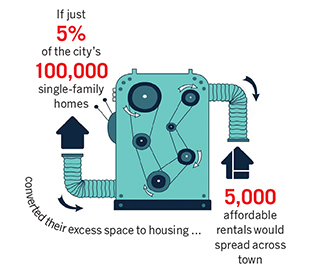
Bloom put out a study from Arc Ecology, suggesting that if just 5 percent of the city’s 100,000 single family homes converted their excess space into in-law units, an additional 5,000 affordable rentals would spread across town.

Wiener’s proposal looks at making new units in just a slice of the city, but another proposal will look at the issue citywide. Chiu’s legislation seeks to take that sea of hidden and unlawful granny flats and bring them up to code, but it wouldn’t look to build new ones.

“The big picture is that we’re exploring legalizing existing [in-law] units that are illegal, to make sure they become safe and protect residents there,” said Amy Chan, an aide in Chiu’s office.


UP TO CODE

Safety isn’t the only consideration, as this could also help the housing supply in the city, those involved told the Guardian. Often these in-law units are rented out to friends and family, and once up to code they’d open up to the market.

But safety is important because these units also often lack city permits because they’re dangerously constructed. Sometimes that can lead to death.

“A lot of time (the units) may not have proper egress for an emergency,” said Dan Lowrey, deputy director of inspection services at the Department of Building Inspection. “We just had a fire last month where three people died because of that.”

Lowrey is part of Chiu’s workgroup that’s navigating the complexities of his new legislation. Just how do you make these units legal? There’s a number of challenges, he said.

When looking at a unit, housing inspectors have a checklist to look through, and some of it is real garden variety stuff. Smoke detectors? Check. Proper floor covering? Check. Those are easy. The real challenge is when there are ceilings that are too low, hallways not wide enough to navigate in an emergency, or the unit has no windows from which to escape in a fire.

That’s when you have an in-law apartment that requires total reconstruction to be brought up to code, a straight up illegal unit. As the law stands now, the only recourse for the city in that case is to evict the people living there.

“That’s the challenge, what do we do with the [in-law apartments] that can’t be legalized?” said Bill Strawn, a spokesperson for DBI. Those are some of the questions that Chiu’s workgroup is tackling now.

The good news, he said, is that there are a good number of units that are up to the Building Code, but not the Planning Code — that’s a much easier hurdle to clear.

The Planning Code basically separates neighborhoods of the city into zones for one, two, or three families in a housing unit. This looks at the amount of available free space, sunlight, air, and parking. With those lifted, many units could be more easily converted to living use.

But finding the units that aren’t up to code is important, said Omar Calimbas, a senior staff attorney at the Asian Law Caucus.

He led the “Our Hidden Communities” study that revealed 33 percent of homes in the Excelsior district contained in-law units, far above the city’s estimates.

His team went door to door and found out for itself. What Calimbas saw was that those living in unregulated units often lived in substandard conditions with nowhere to go for help.

There are some units with no heating, he said. Other times the in-law unit is in a basement barely renovated for use as a living space. Sometimes the bathrooms and shower are really tiny cubes. There are mold and dampness problems.

“You’re living in a space that doesn’t make you feel protected from the elements,” he said. And when the units are made without permits, tenants feel they can’t go to the city for help.

To put it in a nutshell, they are in dire need of regulation. Calimbas is also working with Chiu on his legislation to do just that. But ultimately, each of the two ordinances around secondary units takes small bites out of the housing pie.

Bloom is calling for the city to move aggressively on this issue. “We’re rapidly becoming a more expensive city to live in, more and more so every year.” As more and more San Franciscans are priced out of their homes, time may soon run out.

Angered by senior evictions, Filipino American activists decline award

The board members of a local Filipino heritage organization, with ties to a high-profile eviction defense battle at San Francisco’s International Hotel in the late 1970s, have declined to an accept an award that San Francisco Mayor Ed Lee had planned to extend to them as part of a Filipino American History celebration because they are angry about a growing trend of senior evictions.

In a written statement sent to media by board member Tony Robles, the Manilatown Heritage Foundation explained that it couldn’t accept the award as long as “elders are being preyed upon, evicted and given a de facto death sentence thereof.”

The Manilatown Heritage Foundation board members were informed by Board of Supervisors President David Chiu that Lee had planned to recognize the I-Hotel as part of an annual cultural history celebration at City Hall, the statement noted. “Part of the occasion was to honor the I-Hotel and its many tenants and activists for its contribution to Filipino American history,” board members explained.

In 1976, the I-Hotel was targeted for demolition, prompting an historic eviction defense battle led by housing activists who rallied to the defense of the impacted tenants. A significant fixture in what was once a predominantly Filipino neighborhood known as Manilatown, the I-Hotel housed 196 tenants, predominantly low-income Filipino immigrants. 

“The I-Hotel fight was for dignity and it lived by the premise that housing is a human right,” Manilatown Heritage Foundation members explained in the written statement. “The fight for the I-Hotel galvanized the community around the fight for affordable housing, particularly for seniors—who sacrificed much and on whose shoulders we stand. The fight included tenants, elders, activists, artists and students who recognized that the real estate developers and financial interests were out of control—power unchecked.” 

The fight dragged on, at one point more than two thousand people surrounded the building to blockade the doors in an effort to prevent an eviction from going forward. The battle over the I-Hotel also brought on a famous San Francisco episode in which then-Sheriff Richard Hongisto served five days in his own jail for refusing to carry out the eviction order. In the end, the tenants were finally ousted. But the epic battle ultimately helped to produce a different outcome, many years later: The property became the site of low-cost senior housing, complete with a commemorative display in the interior documenting the dramatic I-Hotel fight.

As a young attorney who worked with the Asian Law Caucus, San Francisco Mayor Ed Lee was involved in that fight – as an activist defending tenants’ rights to stay. He frequently referred to this chapter of his personal history while running for mayor in 2011, to demonstrate his sensitivity to concerns about affordable housing.

But now that Lee is well into his mayoral term, a surge of evictions of low-income seniors is worsening on his watch. Tenant defense organizations such as Eviction Free San Francisco are showing up outside landlords’ homes and offices to protest eviction notices that threaten to push low-income seniors with few options out of the city. Some evictions have caught the attention of mainstream media, such as the ouster of elderly Chinatown couple Gum Gee Lee and Poor Heung Lee and their disabled daughter, Shiuman Lee.

Some advocates have proposed legislative solutions; meanwhile, the situation has evidently become so criticial that even city’s Human Services Agency is seeking outside assistance to provide eviction prevention services for elderly and disabled tenants facing Ellis Act evictions.

And today, the board of the Manilatown Heritage Foundation drew a line in the sand to send Lee a clear message by refusing to accept the honor of recognition in the current housing climate. So far, mayoral spokesperson Christine Falvey has not responded to the Bay Guardian’s request for comment in response to the Manilatown Heritage Foundation’s statement.

“Given the current state of San Francisco housing by forces out to make a killing by killing our communities, we as the torch bearers of the I-Hotel struggle and in the memory of its displaced elders and advocates Al Robles, Bill Sorro, Felix Ayson, Wahat Tampao and others, cannot, in good consciousness, accept any honor or award while elders are being preyed upon, evicted and given a de facto death sentence thereof. And it doesn’t matter if the honor is bestowed by Mayor Lee, President Obama or the pope. We have to say no.”

Here’s the full statement from the Manilatown Heritage Foundation. Here’s an historical essay about the I-Hotel from Shaping San Francisco’s digital archive at FoundSF.org.

Fight back to save your home

36

By Tommi Avicolli Mecca and Fred Sherburn-Zimmer

OPINION The good news from San Francisco these days is that tenants are fighting back in a big way to save their homes. Speculators and investors intent on making a killing in a sizzling real estate market are not always having an easy time getting rid of those who stand between them and obscene profits.

While tenant resistance has become a hot ticket item in the local mainstream media, legislators are introducing a slew of new laws aimed at curbing speculation and the housing crisis. Even the Mayor’s Office has gotten into the act, intervening in at least two recent high-profile evictions: the Lee family and 1049 Market.

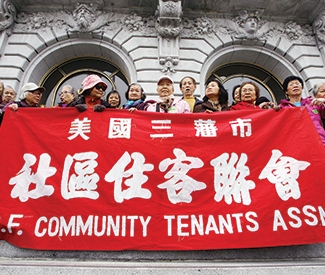
A low-income elderly Chinese couple and their disabled daughter, the Lee family chose to stay and fight when the Sheriff’s Department gave them notice that it was coming to lock them out after an Ellis Act eviction. Hundreds showed up in support, with a large number of people willing to block the door and risk arrest. TV went live from the protest. Within no time at all, the Mayor’s Office stepped in to negotiate with the landlord for more time so that the Lees could find an affordable place to live. While the Lee family didn’t ultimately get to stay, their struggle brought public attention to what is happening here in San Francisco.

When the tenants in the artist live/work lofts at 1049 Market received letters from their new landlord saying that the city was forcing him to evict them because of an outstanding code violation from 2007 that he inherited when he bought the building, they didn’t take it lying down. It wasn’t true that the city was making him evict anyone. He had the option to bring the building up to code, something he found “economically infeasible.”

Tenants from 1049 Market contacted Housing Rights Committee where we work, and we helped them organize. We were afraid the landlord’s other two buildings on the same block might meet the same fate. The story made the cover of the San Francisco Examiner about a week later.

Suddenly, the Department of Building Inspection announced that it had discretion in terms of the code violations, especially the costliest of them. DBI’s deputy director sent the notice of violation back to its staff for review. The city began meeting with the landlord to try and prevent the tenants from being evicted.

Negotiations are still in progress, but the fact that the City has stepped in so aggressively on the side of the tenants is a major victory. Of course, it’s due to tenants fighting back when so many people told them they couldn’t win.

Jeremy Mykaels, a gay disabled man who’s lived in the Castro for the past 40 years and in his current apartment for almost 18, decided not to move when new owners (investors from Atherton and Union City) threatened him with an Ellis eviction. They went through with it after he turned down a buyout.

Eviction Free San Francisco, a direct action group, organized protests in SF, Atherton, and Union City. Attorney Steve Collier of Tenderloin Housing Clinic challenged the eviction in court. A judge just threw out the eviction on a technicality. The jury is out on whether the investors will start the process all over again. Fight back. It could save your home. 

Tommi Avicolli Mecca and Fred Sherburn-Zimmer work at the Housing Rights Committee.

Shit happened (Oct. 23-29)

6

Tenant proposals and Guardian forum address eviction crisis

Tenant advocates have proposed a sweeping set of legislative proposals to address what they’re calling the “eviction epidemic” that has hit San Francisco, seeking to slow the rapid displacement of tenants by real estate speculators with changes to land use, building, rent control, and other city codes.

“In essence, it’s a comprehensive agenda to restrict the speculation on rental units,” Chinatown Community Development Center Policy Director Gen Fujioka told the Guardian. “We can’t directly regulate the Ellis Act [the state law allowing property owners to evict tenants and take their apartments off the rental market], but we’re asking the city to do everything but that.”

The package was announced Oct. 24 on the steps of City Hall by representatives of CCDC, San Francisco Tenants Union, Housing Rights Committee of SF, Causa Justa-Just Cause, Tenderloin Housing Clinic, UNITE HERE Local 2, Community Tenants Association, and Asian Americans Advancing Justice.

“San Francisco is falling into one of the deepest and most severe eviction crises in 40 years,” SFTU Director Ted Gullicksen said. “It is bad now and is going to get worse unless the city acts.”

The announcement came a day after the Lee family — an elderly couple on Social Security who care for their disabled daughter — was finally Ellis Act evicted from its longtime Chinatown home after headline-grabbing activism by CCDC and other groups had twice turned away deputies and persuaded the Mayor’s Office to intervene with the landlord.

But Mayor Ed Lee has been mum — his office ignored our repeated requests for comment — on the worsening eviction crisis, the tenant groups’ proposals, and the still-unresolved fate of the Lees, who are temporarily holed up in a hotel and still hoping to find permanent housing they can afford.

The package proposed by tenant advocates includes: require those converting rental units into tenancies-in-common to get a conditional use permit and bring the building into compliance with current codes (to discourage speculation and flipping buildings); regulate TIC agreements to discourage Ellis Act abuse; increase required payments to evicted tenants and improve city assistance to those displaced by eviction; require more reporting on the status of units cleared with the Ellis Act by their owners; investigate and prosecute Ellis Act fraud (units are often secretly re-rented at market rates after supposedly being removed from the market); increase inspections of construction on buildings with tenants (to prevent landlords from pressuring them to move); prohibit the demolition, mergers, or conversions of rental units that have been cleared of tenants using no-fault evictions in the last 10 years (Sup. John Avalos has already introduced this legislation).

“The evidence is clear. We are facing not only an eviction crisis but also a crisis associated with the loss of affordable rental housing across the city. Speculative investments in housing has resulted in the loss of thousands affordable apartments through conversions and demolitions. And the trend points to the situation becoming much worse,” the coalition wrote in a public statement proposing the reforms.

Evictions have reached their highest level since the height of the last dot-com boom in 1999-2000, with 1,934 evictions filed in San Francisco in fiscal year 2012-13, and the rate has picked up since then. The Sheriff’s Department sometimes does three evictions per day, last year carrying out 998 court-ordered evictions, Sheriff Ross Mirkarimi told us, arguing for an expansion of city services to the displaced.

At “Housing for Whom?” a community forum the Guardian hosted Oct. 23 in the LGBT Center, panelists and audience members talked about the urgent need to protect and expand affordable housing in the city. They say the current eviction epidemic is being compounded by buyouts, demolitions, and the failure of developers to build below-market-rate units.

“We’re bleeding affordable housing units now,” Fred Sherburn-Zimmer of Housing Right Committee said last night, noting the steadily declining percentage of housing in the city that is affordable to current city residents since rent control was approved by voters in 1979. “We took out more housing than we’ve built since then.”

Peter Cohen of the Council of Community Housing Organizations actually quantified the problem, citing studies showing that only 15 percent of San Franciscans can afford the rents and home prices of new housing units coming online. He said the housing isn’t being built for current city residents: “It’s a demand derived from a market calculation.”

Cohen said the city’s inclusionary housing laws that he helped write more than a decade ago were intended to encourage developers to actually build below-market-rate units in their projects, but almost all of them choose to pay the in-lieu fee instead, letting the city find ways to build the affordable housing and thereby delaying construction by years.

“It was not about writing checks,” Cohen said. “It was about building affordable units.”

Discussion at the forum began with a debate about the waterfront luxury condo project proposed for 8 Washington St., which either Props. B or C would allow the developer to build. Project opponent Jon Golinger squared off against proponent Tim Colen, who argued that the $11 million that the developer is contributing to the city’s affordable housing fund is an acceptable tradeoff.

But Sherburn-Zimmer said the developer should be held to a far higher standard given the obscene profits that he’ll be making from waterfront property that includes a city-owned seawall lot. “Public land needs to be used for the public good.”

Longtime progressive activist Ernestine Weiss sat in the front row during the forum, blasting Colen and his Prop. B as a deceptive land grab and arguing that San Francisco’s much ballyhooed rent control law was a loophole-ridden compromise that should be strengthened to prevent rents from jumping to market rate when a master tenant moves out, and to limit rent increases that exceed wage increases (rent can now rise 1.9 percent annually on rent controlled apartment).

“That’s baloney that it’s rent control!” she told the crowd. (Steven T. Jones)

Students fight suspensions targeting young people of color

Sagging pants, hats worn indoors, or having a really bad day — the list of infractions that can get a student suspended from a San Francisco Unified School District school sounds like the daily life of a teenager. The technical term for it is “willful defiance,” and there are so many suspensions made in its name that a student movement has risen up against it.

The punishment is the first step to derailing a child’s education, opponents said.

Student activists recognize the familiar path from suspensions to the streets to prisons, and they took to the streets Oct. 22 to push the SFUSD to change its ways. Around 20 or so students and their mentors marched up to City Hall and into the Board of Education to demand a stop of suspensions over willful defiance.

A quarter of all suspensions in SFUSD for the 2011-12 school year were made for “disruption or defiance,” according to the California Department of Education. Half of all suspensions in the state were for defiance.

When a student is willfully defiant and suspended, it’s seen as a downward spiral as students are pushed out of school and onto the streets, edging that much closer to a life of crime.

“What do we want? COLLEGE! What are we gonna do? WORK HARD!” the students shouted as they marched to the Board of Education’s meeting room, on Franklin Street.

They were dressed in graduation gowns of many colors, signs raised high. They smiled and danced and the mood was infectious. One driver drove by, honked and said “Yes, alright!” Assorted passersby of all ethnicities cheered on the group. The students were from 100% College Prep Institute, a Bayview tutoring and mentoring group founded in 1999 aiming to educate students of color in San Francisco. Their battle is a tough one. Though African American students make up only 10 percent of SFUSD students, they accounted for 46 percent of suspensions in 2012, according to SFUSD data. Latinos made up the next largest group, at 30 percent. (Joe Fitzgerald Rodriguez)

Techies to NSA: Stop spying on us!

Thousands of privacy and civil liberties activists, including many from the Bay Area, headed to Washington DC for an Oct. 26 rally calling for surveillance legislation reform, in response to National Security Agency spying programs. It was organized by more than 100 groups that have joined together as part of the Stop Watching Us coalition. The group has launched an online petition opposing NSA spying, and planned to deliver about 500,000 signatures to Congress. Many of the key drivers behind Stop Watching Us, from the Electronic Frontier Foundation to Mozilla, are based in San Francisco. (Rebecca Bowe)