Event

Rep Clock: February 5 -11, 2014

0

Schedules are for Wed/5-Tue/11 except where noted. Director and year are given when available. Double and triple features marked with a •. All times pm unless otherwise specified.

ARTISTS’ TELEVISION ACCESS 992 Valencia, SF; www.atasite.org. $5-7. “OpenScreening,” Thu, 8. For participation info, contact programming@atasite.org. Boom: The Sound of Eviction (2001), Fri, 7:30.

BALBOA THEATRE 3630 Balboa, SF; cinemasf.com/balboa. $7.50-10. “Popcorn Palace:” The Seventh Voyage of Sinbad (Juran, 1958), Sat, 10am. Matinee for kids. Barbie: The Pearl Princess (2014), Sun, 10am.

BERKELEY FELLOWSHIP OF UNITARIAN UNIVERSALISTS 1924 Cedar, Berk; www.bfuu.org. $5-10. In Transition 2.0, Thu, 6:30. More info at www.transitionberkeley.com.

CASTRO 429 Castro, SF; (415) 621-6120, www.castrotheatre.com. $8.50-11. “SF Sketchfest:” “NPR’s Ask Me Another,” Wed, 8 (this event, $25-35); “Tribute to Alan Arkin:” The In-Laws (Hiller, 1979), Thu, 7 ($25); Cabin Boy (Resnick, 1994), Fri, 7:30 (20th anniversary screening, hosted by Peaches Christ with Chris Elliot in person, $20); Top Secret! (Abrahams, Zucker, and Zucker, 1984), Sat, 1 (30th anniversary screener with writers-directors in person, $20); “The Benson Movie Interruption:” The Twilight Saga: New Moon (Weitz, 2009), Sat, 4:20 ($20); Revenge of the Nerds (Kanew, 1984), Sat, 8:30 (30th anniversary screening with cast in person, $30). Visit www.sfsketchfest.com for tickets and more info on SF Sketchfest events. •The Lady From Shanghai (Welles, 1947), Sun, 3, 7, and Gilda (Vidor, 1946), Sun, 4:45, 8:45. •I Am Divine (Schwarz, 2013), Mon, 7:30, and Bettie Page Reveals All (Mori, 2012), Mon, 9:10. “Veteran Documentary Corps,” short documentaries, Tue, 7. Special event; purchase tickets ($10-50) at www.veterandocs.org.

CHRISTOPHER B. SMITH RAFAEL FILM CENTER 1118 Fourth St, San Rafael; (415) 454-1222, www.cafilm.org. $6.50-$10.75. The Girls in the Band (Chaikin, 2011), call for dates and times. “Oscar Nominated Short Films 2014,” call for dates and times. The Past (Farhadi, 2013), call for dates and times. Gloria (Lelio, 2013), Feb 7-13, call for times. Breathing Earth (2012), Sun, 7.

CLAY 2261 Fillmore, SF; www.landmarktheatres.com. $10. “Midnight Movies:” The Room (Wiseau, 2003), Sat, midnight.

CRANEWAY PAVILION 1414 Harbour Way South, Richmond; www.craneway.com. $20-30. “Lunafest Film Festival,” short films by, for, and about women, Fri, 6:30.

EXPLORATORIUM Pier 15, SF; www.exploratorium.edu. Free with museum admission ($19-25). “Saturday Cinema:” “Teachers Institute Film Festival,” Sat, 11am-2pm.

MECHANICS’ INSTITUTE 57 Post, SF; milibrary.org/events. $10. “CinemaLit Film Series: Villains We Love:” Caged (Cromwell, 1950), Fri, 6.

NEW PARKWAY 474 24th St, Oakl; www.thenewparkway.com. Free. “First Friday Shorts,” films from Creative Growth Video Production Workshop, Fri, 6.

OAKLAND PUBLIC LIBRARY Rockridge Branch, 5366 College, Oakl; www.oaklandlibrary.org. Free. “90-Second Newbery Film Festival,” Sat, noon.

OSHER MARIN JCC 200 N. San Pedro, San Rafael; www.marinjcc.org. $10-20. “Best of the San Francisco Jewish Film Festival:” Arab Labor, Tue, 7. Three episodes from season four of the Israeli TV show.

PACIFIC FILM ARCHIVE 2575 Bancroft, Berk; (510) 642-5249, bampfa.berkeley.edu. $5.50-9.50. “Film 50: History of Cinema:” M (Lang, 1931), with lecture by Emily Carpenter, Wed, 3:10. “African Film Festival 2014:” Tey (Gomis, 2012), Wed, 7. “Funny Ha-Ha: The Genius of American Comedy, 1930-1959:” Will Success Spoil Rock Hunter? (Tashlin, 1957), Thu, 7. “Against the Law: The Crime Films of Anthony Mann:” Strange Impersonation (1946), Fri, 7; Desperate (1947), Fri, 8:30. “Screenagers: 16th Annual Bay Area High School Film and Video Festival,” Sat, 3. “Jean-Luc Godard: Expect Everything from Cinema:” Vivre sa vie (1962), Sat, 6:30; Les carabiniers (1963), Sat, 8:15. “The Brilliance of Satyajit Ray:” Three Daughters (1961), Sun, 3. “Documentary Voices:” The Specialist (Sivian, 1999), Tue, 7.

ROXIE 3117 and 3125 16th St, SF; (415) 863-1087, www.roxie.com. $6.50-11. SF IndieFest, Feb 6-20. For program info, visit www.sfindie.com.

TANNERY 708 Gilman, Berk; berkeleyundergroundfilms.blogspot.com. Donations accepted. “Berkeley Underground Film Society:” “LOOP Presents:” What’s Up, Tiger Lily? (Allen, 1966), Sat, 7:30; Duck Soup (McCarey, 1933), Sun, 7:30.

TEMESCAL ART CENTER 511 48th St, Oakl; www.shapeshifterscinema.com. Free. “Shapeshifters Cinema: Lori Varga,” old and new analog film work, Sun, 8.

YERBA BUENA CENTER FOR THE ARTS 701 Mission, SF; www.ybca.org. $8-10. “Femina Potens’ ASKEW Film and Performance Festival,” screenings and performances, Thu-Sat. *


The return of Pyno Man

1

LEFT OF THE DIAL As legend has it, there was a time when you couldn’t walk the streets of Berkeley without running into him. He accosted you from posters adorning bar bathroom doors; he lurked around corners, plastered to telephone poles. He was mischievous, sometimes foul-mouthed, usually up to no good, but he always meant well. He wanted you to rock out. He was Pyno Man, and he was everywhere.

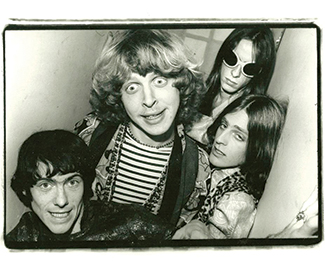
“Pyno Man was basically just the dream anybody has of being great, but instead of working a regular job and having fantasies about doing crazy rockstar things, he’s actually trying it all the time and failing. So he’s out there on the street acting like a rockstar, but everyone just thinks he’s crazy,” explains John Seabury, artist, creator of Pyno Man, and bass player for the relatively short-lived but locally legendary East Bay garage-punk outfit Psycotic Pineapple, for which the wild-eyed, mohawked, anthropomorphized pineapple served as mascot. “To me, that was logical.”

A staple of the East Bay punk club scene of the late ’70s, Psycotic Pineapple held court at the Keystone in Berkeley, sometimes playing SF’s fabled Mabuhay Gardens with friend bands, like the (underrated) power-pop maestros the Rubinoos. PP songs were about youth and drugs and sex, and you could count on them for an insane live show. But something in the band’s demeanor set them apart from the prevailing punk attitudes of the time: There wasn’t much they took seriously — least of all themselves.

“We didn’t really call them punks at that time, because that just wasn’t what we would call people who played music like them. They were just outlaws in a way, because they brought this sort of pop aesthetic to punk music. They were thumbing their nose at it and wrapping their arms around it at the same time,” says John Cuniberti, a producer, mastering engineer, and longtime friend of the band who helped the guys finally re-issue Psycotic Pineapple’s sole album, Where’s the Party?, on CD in 2012 — something that led to the band playing its first live show in more than two decades, which inspired Cuniberti to make a documentary about the band in the process.

There was something determinedly fun about Psycotic Pineapple, says Cuniberti. “I was working with the Dead Kennedys at the same time [’70s], and it was political, straight-up social commentary, songs about death and war and all these things. These guys played pop songs about relationships — really well-written pop songs, the songwriting was always very compelling to me — but they were rowdy, and they did it with an ‘I don’t care if you like us or not’ kind of attitude. There was an outrageousness to it.”

The band put out its lone record 1980, packed with 11 gleefully irreverent tracks that ran just over 25 minutes altogether. In 1981, something happened that no one could have predicted: Guitar player Henricus Holtman suffered a brain aneurysm, hindering his dexterity on his right side. The band stopped playing live. While most members remained involved in the local music scene — Seabury’s art adorns posters and t-shirts for a ton of other bands — Psycotic Pineapple mostly became the stuff of Bay Area folklore. But the fans were still out there. More than 30 years after PP disbanded, about a year after the band’s official reunion show at Bottom of the Hill, the music somehow doesn’t sound dated at all. They’ll headline the Gilman this week for the first time, with Pinole’s own Bobby Joe Ebola and the Children MacNuggits (whom could be said to follow in PP’s footsteps in terms of ethos, if not sound) opening.

“I don’t think the music feels old, but I’ve always thought that,” says Seabury, whose art fills a booklet that accompanies the re-issue CD. “By the time we broke up a lot of bands were starting to imitate that kind of attitude — Camper Van Beethoven, some others. I think we would have fit right into the alternative rock scene. We were kind of like these New Wave clowns making fun of punkers&ldots;which, as far as bands we gigged with go, their fans didn’t really like it. I remember opening for 999 and the Dickies, and both of their fans just hated us. They were booing us already, so we decided to close the set with ‘We’re an American Band,’ and that’s when the bottles started flying.”

They haven’t gotten to play together too often since the official reunion — for one, keyboard player Alexi Karlinski lives in Eastern Europe for most of the year. But while he’s back in the Bay for this stint, the guys plan to record a few new songs.

Maybe don’t call it a comeback just yet, says Cuniberti. But “I think they’re worth listening to, and there’s a lot of music being made that I can’t say that about. The songwriting is so good, and it’s timely, it still sounds fresh. You can hear in this record that they really love what they’re doing.”

While we’re immersed in the warm glow of East Bay punk history: 1-2-3-4 Go! Records, the independent record store, label, and all-ages venue housed in a deceptively small couple of rooms on 40th Street in Oakland, is expanding into the recently vacated space next door. From their crowdfunding campaign:

“A few weeks ago we were told our next door neighbors would be leaving and we could take a section of their space for an expansion. The catch is that we need to take the space by February 1st or it would go to someone else. As a small business with employees to take care of and regular bills to pay we don’t tend to have a lot of extra expansion capital on hand, especially on short notice. So we come to you, the good people who have supported us all these years and ask for you to join us in bringing the store to this next level and to continue to offer the great music and art we have been in our venue space.

In order to complete this expansion we need to do the following;

Knock out the adjoining wall.

Paint the interior and exterior to match our existing space

All new lighting that will stretch the length of both spaces.

Build additional custom fixtures; record bins, shelving etc.

Purchase new product; Records, books, supplies, turntables etc.

Purchase new Mic’s, Cords and Stands for the venue.

Close the store for 7 to 14 days (oof!)

Our plan is to have our Grand Re-Opening on March 15th to coincide with our 6th anniversary. We will have a sale during the day and a private event from 7pm to 10pm with food, drinks and music for supporters who come in at the $50 and above level who RSVP.”

As of this writing they have just under a week to go and still need to raise about $7,000. Want your as-of-yet unborn kids to know what actual record stores are? You know what to do: 1234gorecords.com.

Back here on this side of the Bay, A Million Billion Dying Suns — the psych-rock project of busy guitar virtuoso Nate Mercereau, who tours with Sheila E., among others (last week he was backing Dave Chappelle at the SFJazz Center) — have embarked on a mini-residency of sorts at the Knockout, starting with a Feb. 11 show. They recently had a song featured in a GoPro commercial, accompanying Shaun White as he blasts through snow-covered hills, but the band’s had my attention for about a year now, especially since the arrival last November’s Strawberry EP, with its slow-building, expertly crafted wall of spaced-out guitar fuzz, particularly on “Strawberry Letter 23,” a cover/homage to Shuggie Otis.

“I record a lot of stuff by myself, and Shuggie Otis has been a huge inspiration in that respect,” says Mercereau, who recently moved to LA, though he finds himself back in SF “every two weeks or so” — the band’s studio is still here. “Though it was also for our friend [manager and friend to many an SF musician] Steve Brodsky, who passed away last year. He really loved that song, and it felt like a way to do something for him.”

The Knockout feels a little small for the seriously powerful five-piece, Mercereau will acknowledge, but he wanted a residency at “a place our friends can walk to, a down-home punk rock spot that’s in the neighborhood.” If all goes well, he says, AMBDS will have another few shows here shortly, regardless of his new home base. “It’s easier than you might think,” he says. “We just live on Highway 5.”

PSYCOTIC PINEAPPLE
With Rock N’ Roll Adventure Kids, Bobby Joe Ebola and the Children MacNuggits, and the Gregors
Friday, Feb. 7, 7:30pm, $10
924 Gilman Street
924 Gilman, Berkeley
www.924gilman.org

A MILLION BILLION DYING SUNS
With What Fun Life Was and Lemme Adams
Tuesday, Feb. 11, 8:30pm, $6
Knockout
3223 Mission, SF
www.theknockout.com

…And horror for all

2

arts@sfbg.com

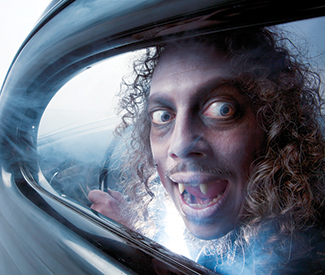
CULTURE Like a mad scientist who has decided to open up his secret laboratory and show off his work to select guests, Metallica guitarist Kirk Hammett hosts “Fear FestEvil,” a convention bringing together the worlds of horror and heavy metal. Hammett has long been a horror film aficionado, and has amassed an extensive movie memorabilia collection of original props, costumes, posters, toys, and more over the years — an obsession that dates back to his childhood growing up in San Francisco.

“I first got into horror movies as a young kid — I think I was five years old when I saw my first horror movie, The Day of the Triffids, and totally loved it,” remembers Hammett. “I used to go to San Francisco Comic Book Company, which was one of the very first comic book stores in the country, at 23rd and Mission, and that was my repository for buying comic books and magazines. I just got into it and never got out of it.”

The idea for the festival — er, festevil — grew out of Hammett’s desire to share his extensive horror-movie collection with fans; it’s the same urge that first inspired his 2012 book, Too Much Horror Business, stuffed with color photos of his creepy cache. Following the success of that tome, he set up “Kirk’s Crypt,” an exhibit at Metallica’s Orion festival in 2012 and 2013 where fans could catch a glimpse of his collection in person. The next logical step, as Hammett saw it, was to create a mini-convention in his hometown.

“It was so fun, and such a big hit at the festival, I thought, why can’t I keep on doing this, but do it here in the Bay Area, and make it bigger and better, with more stuff, more guests, and with some bands that would fit in music-wise,” says Hammett.

“It’s my way of taking my collection and sharing it and turning it into a more giving process, because for years and years I collected — and collectors to a certain extent are selfish, you know, they collect things for themselves. After a while, I got tired of that feeling, so I decided that I would share it with like-minded people.”

Scheduled guests include several luminaries in the horror and sci-fi genres, such as makeup and special effects innovator Tom Savini, Night of the Living Dead (1968) co-writer John A. Russo, and A Nightmare on Elm Street series star Heather Langenkamp. There will also be some actors whose faces might not be familiar to the public, but are fan-beloved for portraying iconic movie monsters: Kane Hodder, who slaughtered countless camp counselors as Jason Voorhees in four of the Friday The 13th films, and Haruo Nakajima, aka the man who donned Godzilla’s iconic rubber suit in 12 movies, including the original 1954 classic.

“I’ve known Tom Savini for a while now, but for the most part, I don’t really know these people, and for me to be able to have them appear at the festival, and for me to get to meet them, is fantastic. That’s another reason this festival is happening — so I can meet these people for myself! It means as much to me as it does to the person who buys a ticket and comes to the convention.”

The descendents of three of horror’s high royalty — Bela Lugosi, Boris Karloff, and Lon Chaney — will also be in the (haunted) house. “It’s incredible that I have a relationship with the Karloff, Lugosi, and Chaney families,” Hammett enthuses. “It’s a really, really big thrill.”

Adding a dimension to the event that hasn’t been widely seen before in the world of conventions, Hammett wanted to add metal music to the horror genre mix. “To me, it’s such an obvious thing. One of the reasons I embraced heavy metal was because of the imagery, and because the feelings I felt when I listened to heavy metal were very similar to those when I was watching horror movies.”

In addition to bands performing on Friday and Saturday nights — including Carcass, Exodus, and Death Angel — the fest also features music-minded guests who have ventured into horror-film production, such as Scott Ian and Slash, and those who have had a long history of using horror imagery in their artwork and lyrics, like guitar player Doyle of the Misfits. Hammett hero Count Dracula, noted fan of music made by “children of the night,” would surely approve. *


KIRK VON HAMMETT’S FEAR FESTEVIL

Thu/6, 7pm-midnight (preview); Fri/7, noon-midnight; Sat/8 11am-midnight, $37.50–$175

Regency Ballroom

1300 Van Ness, SF

www.fearfestevil.com

Did Feinstein see a drone?

6

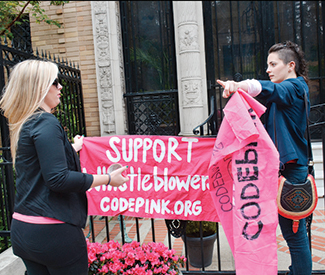
For years now, Bay Area organizers with the antiwar group Code Pink have been staging protests outside the Pacific Heights residence of Sen. Dianne Feinstein, who chairs the Senate Intelligence Committee.

Code Pink director Medea Benjamin has led delegations to Pakistan and Yemen in the past to protest US drone strikes, and San Francisco activists have frequently appeared outside the senator’s home to sound off against the US military’s use of drones.

But more recently, Code Pink activists have paid visits to Feinstein to let her know what they think of her comments condemning the actions of whistleblower Edward Snowden.

“We at Code Pink think Edward Snowden did a great service to this country,” by leaking secret National Security Agency documents detailing the intelligence agency’s dragnet surveillance program, said organizer Nancy Mancias.

So on June 15, 2013, “We flew a couple toy helicopters outside her home” as part of an anti-surveillance protest. It was an “Austin Powers” themed protest, she added, “playing spy-type music.”

But a couple months ago, Feinstein mentioned during a hearing about drones that she’d actually seen a drone peeking outside her window at her San Francisco home. She said it crashed shortly after she detected it.

But that left activists and others wondering about Feinstein’s account, since Mancias says the remote controlled device they sent up to fly around Feinstein’s mansion was not a drone, but rather a pink helicopter, “like a toy you pick up at Toys-R-Us.”

The Code Pink activists captured video of the event, she added, and sent it to the television program 60 Minutes. “Hopefully, they’ll air it when they interview Dianne Feinstein.”

Another wrinkle in Feinstein’s story is that “she said she was home when this demonstration was happening,” Mancias said. “But we were knocking on the door, ringing the doorbell.”

Believe it or not, Feinstein has actually responded to this sort of activity in the past by coming to the door and engaging with the concerned, pink-clad citizens.

“She’s a very old school politician,” Mancias said by way of explanation. “She’s very approachable. On that day she didn’t come outside, and if she was home, we would have loved to have a discussion with her about Edward Snowden.”

So was Feinstein’s account of spotting a surveillance drone rooted in nothing more than noticing a pink kid’s toy zip past her window during a routine Code Pink protest?

Nobody knows for sure but nevertheless, Code Pink activists feel vindicated. “I can say that we actually achieved our goal,” Mancias said. That’s because more recently, Feinstein has softened her stance somewhat and admitted that “we need to look into” the domestic surveillance program.

But that perception of a small victory doesn’t mean they aren’t going back. On Tuesday, Feb. 11, Code Pink plans to return to Feinstein’s Pac Heights mansion for yet another protest, this time to coincide with a national day of action being planned in opposition to NSA spying.

Called “The Day We Fight Back,” the Feb. 11 action day will consist of website owners installing banners to encourage their visitors to challenge online spying, and employees of tech companies calling on their organizations to do the same.

“We’re asking people to bring surveillance equipment, drones, and magnifying glasses,” to Feinstein’s house, Mancias said, presumably talking about props and not real surveillance equipment (does Google Glass count?). “We’ll just play some music,” she added, “and have a fabulous time.”

Alerts: February 5 – 11, 2014

0

THURSDAY 6


Speaking event: After the Arab Spring 312 Sutter, 2nd Floor Auditorium, SF. www.globalexchange.org/events. 7-8pm, $15 or $5 for students. Three years ago, the Arab Spring started with a single protest in Tunisia and quickly spread across the rest of the region, bringing with it promise of a brighter future. As part of the national Engage America Series, internationally renowned blogger and professor Marc Lynch will discuss the current state of affairs in the Middle East, what’s gone wrong across the region, and what it means for the United States.


FRIDAY 7


Speaking Event: Islamaphobia Holy Spirit Parish, 2700 Dwight Way, Berk. (510) 499-0537. 7pm, free. Newman Nonviolent Peacemakers and the Fr. Bill O’Donnell Social Justice Committee are honored to present Attorney Zahre Billoo, who will examine the roots of anti-Muslim hate (or Islamaphobia), the funding which makes it possible, how it overlaps with other forms of bigotry, and how best to challenge it.


SATURDAY 8  

LGBTQ Rally for Winter Olympics UN Plaza, 7th St and Market, SF. maketheworldbetterSF@gmail.com. 11-1pm, free. Show your support for the victims of escalating fascism in Russia on the opening day of the Winter Olympic Games in Sochi. Recent legislation from the Kremlin unfairly persecutes the LGBTQ community in Russia, with sweeping laws that repress virtually any expression of queerness. Join the rally — and stand up for people who are prohibited for standing up for themselves.  

Citywide Tenant Convention Tenderloin Community School, 627 Turk, SF. www.sftu.org. 12pm, free. The San Francisco Anti-Displacement Coalition was formed by tenant organizations and their allies, who banded together and led the successful fight to curb condo conversions. Its mission is to organize against soaring evictions and rent increases which have resulted in the displacement of thousands of residents. Help build tenant power in SF, and participate in crafting a ballot measure to protect tenant concerns.  

Stop privatization of public goods Mission Cultural Center for Latino Arts, 2868 Mission, SF. (415) 282-1908. 1-6pm, $10 donation (no one turned away for lack of funds). Veolia is a multinational corporation that works to privatize water supply, waste management, transport services, and energy. They are currently pushing for water privatization in Richmond, CA, working against unions and environmental groups. A Veolia VP was also hired to represent BART management during the recent negotiations. Educate yourself and learn more by attending this conference.

This Week’s Picks: January 29 – February 4, 2014

0

WEDNESDAY 29

Yuck

The year 2013 was a tumultuous one for this London indie outfit. It recorded and released its sophomore album within a matter of months, simultaneously announcing the record and frontman Daniel Blumberg’s departure from the band. This was a surprising turn of events for a band that should have been basking in the afterglow of the critical success of its 2011 debut, not to mention universal adoration by both music journalists and the blogosphere. Instead of disbanding or recruiting a new vocalist, guitarist Max Bloom has stepped up to the mic and taken a turn from its shoegaze-tinged debut to embrace other forms of alternative rock, but don’t worry — it still sounds like it emerged from a time capsule buried in 1997. (Haley Zaremba)

With GRMLN, The She’s

8pm, $15

The Independent

628 Divisadero, SF

(415) 771-1421

www.theindependentsf.com


THURSDAY 30

Performance Research Experiment #2

It sounds deceptively dry, but “Performance Research Experiment #2” is a fairly accurate description of what Jess Curtis and his partners will show this weekend: It’s simultaneously a show and a scientific inquiry of what a performance does to a viewer — like it or not. Some of it will be sheer fun, some of it puzzling, and some of it difficult to watch. Curtis admits that the experience can be “intense.” The work — about a dozen two-minute episodes performed by Curtis and his partner on stage Joerg Mueller with media artist Yoann Trellu — raises fascinating questions about our bodies’ involuntary responses to what comes at them. This performance shows that science and art, contrary to common assumptions, can in fact inhabit the same universe. (Rita Felciano)

Jan. 30-Feb.1, 8pm, $15-20

Joe Goode Annex

499, Alabamba St. SF

http://www.brownpapertickets.com/event/537659


“Melt: The Art of Macaroni and Cheese”

Oakland food writer and chef Stephanie Stiavetti has gone and done something we were all waiting for: made our near-constant urge to eat only macaroni and cheese for dinner seem like a reasonable, adult thing to do. Her new cookbook marries the sophistication of handcrafted artisan cheeses from around the world with the simple joy produced only by the smell of perfectly browned, parmesan-covered pasta filling your kitchen. There are classic recipes, to be sure; there’s also an entire roasted pumpkin stuffed with Italian sausage, pasta and Fontina. She’ll talk all things mac-and-cheesy at this reading, and of course — don’t forget your Lactaid — she’ll be bringing samples. (Emma Silvers)

6:30pm, free

Omnivore Books on Food

3885a Cezar Chavez, SF

(415) 282-4712

www.omnivorebooksonfood.com


FRIDAY 31

Jean-Luc Godard: Expect Everything from Cinema

We know him best for his 1959 black-and-white debut Breathless, a genre-changing film that came to epitomize the French New Wave with its philosophical angst, tender tragedies, and haphazard American-Western heroism — all set in Paris of the ’60s, with recklessness, heavy eyeliner, and a rejection of the traditional love story. Yet Jean-Luc Godard produced a number of works, and when viewed together they form an inventive collection, to say the least. Beginning Jan. 31, BAM/PFA will screen Godard’s shorts and features in the film series “Expect Everything From Cinema,” allowing Godard die-hards and New Wave newbies the chance to see his films on the big screen, and begin to recognize characteristics of his work on a continuum, from subversive political messages to his ambiguous-realism style. (Kaylen Baker)

Times vary per week, visit BAMPFA website for details, $9.50

Pacific Film Archive Theater

2575 Bancroft Way, Berkeley

(510) 642-1124

bampfa.berkeley.edu


Dirty Harry

Of all of Clint Eastwood’s many iconic film roles, that of rogue San Francisco Police Detective Harry Callahan in 1971’s Dirty Harry is perhaps the most indelible. Shot on location throughout the city and Marin County, the film mixed the traditional cop drama with a harsh and gritty approach, incorporating then-recent events such as the Zodiac into the script about a serial killer terrorizing the populace. Here’s your chance to cheer on one of the most famous — but misquoted — lines in film history: “You’ve got to ask yourself one question: ‘Do I feel lucky?’ Well, do ya, punk?!” Feature preceded by cartoons, newsreels, games, and more. (Sean McCourt)

8pm, $5

Paramount Theatre

2025 Broadway, Oakland

(510) 465-6400

www.paramounttheatre.com


SATURDAY 1

Reggie and the Full Effect

For a guy who played with classic emo outfits like the Get Up Kids and My Chemical Romance, Kansas City’s James Dewees sure seems like a happy guy. His solo act, Reggie and the Full Effect, is the polar opposite of Dewees’ other musical endeavors. This bizarre and completely hilarious side project bounces back and forth between genres as varied as hardcore, emo pop, and bluegrass, sporting song titles like “Happy Chickens” and “Revenge is a Dish Best Served at Park Chan-Wook’s.” Though Dewees hit the road for a farewell tour in 2008, he’s back this year with a new album (thanks, Kickstarter) and his first solo tour in half a decade. The only thing to expect from this show is the unexpected. And trust us, the unexpected is very, very entertaining. (Zaremba)

With Dads, Pentimento

8:30pm, $16

Bottom of the Hill

1233 17th St, SF

(415) 626-4455

www.bottomofthehill.com


Millennium Film Journal: 35th Anniversary Celebration

Sprung from the still-vital Millennium Film Workshop, which had its edgy beginnings in New York City’s fertile 1960s Lower East Side scene, the bi-annual Millennium Film Journal has been studying and celebrating avant-garde film since 1978 (and has since expanded to include video and works in other mediums, too). This San Francisco Cinematheque presentation welcomes current editor Grahame Weinbren to celebrate the publication’s 58th issue with a program of film and video by Stella Brennan, Catherine Elwes, and others, as well as a slideshow that looks back through its long and varied history on the printed page. (Cheryl Eddy)

7:30pm, $6-$10

Yerba Buena Center for the Arts

701 Mission, SF

www.sfcinematheque.org


SUNDAY 2

The Fourth Annual Super Bowl: Men In Tights

If you’d rather do your taxes than watch three hours of football this weekend, join SF Indiefest at the Roxie for the Fourth Annual Super Bowl: Men in Tights comedy show — “Come for the comedy, stay for the commercials.” Indiefest’s SportsSweater comedians will provide hysterical (and most likely incorrect) play-by-play commentary, raunchy sketches, and general debauchery while the game plays on Roxie’s big screen. Ad junkies rejoice, as the only untouched part of the Superbowl comes every 15 minutes. Watch America’s top-notch commercials uninterrupted by the horde of jokesters. And what Sunday football viewing is complete without beer, wine, bloodies, and snacks? Tickets benefit the Roxie Theater and IndieFest. (Laura Childs)

3pm, $10

The Roxie

3117 16th, SF

www.roxie.com


The Toasters

Everything has changed since 1981. The Soviet Union has fallen, the Internet has taken over the world, smartphones have taken over our brains, and no one listens to Kim Carnes. One thing, however, has stayed completely, unflaggingly consistent: New York’s checker-caped crusaders of third-wave ska. Thirty-three years, nine albums, and 40 lineup changes later, the Toasters are still skanking. Though they haven’t released a new record since 2007, these ska kings have been touring nearly constantly for three decades. If you’re looking for up-and-coming, hip, or new and different, this is not the show for you. But if you’re looking for an absolute blast with some well-practiced dudes who know how to put on a show better than just about anyone, you definitely want to be at the Gilman tonight. (Haley Zaremba)

With Monkey, Jokes for Feelings, The Skunkadelics, Skank Bank

5pm, $10

924 Gilman, Berkeley

(510) 524-8180

www.924gilman.org


Groundhog Day

If you’re among the grouchy, local Niners fans looking for something else to do this Sunday, why not enjoy the uniquely brilliant 1993 comedy Groundhog Day screening on the holiday itself? The cult classic stars Bill Murray as a cantankerous TV reporter who is grudgingly sent to cover the annual proceedings in Punxsutawney, Pa., only to be trapped in a mysterious time loop where he is forced to repeat the same day, over and over again. Following his journey, going from annoyed and suicidal to finally embracing life and love, this funny and touching film was added to the National Film Registry in 2006. (Sean McCourt)

2pm, $8-$8.50

CineArts @ Empire Theater

85 West Portal, SF

(415) 661-2539

www.cinemark.com


MONDAY 3

Burroughs at 100: The Films of William S. Burroughs

William S. Burroughs is best known for his powers with the written word. Specifically, his tendency to do terrible, wonderful, innovative, influential, shocking and heroin-laced things with it over the course of 18 novels, six collections of short stories, and four collections of essays. His work in films, however — the result of collaboration with artist Brion Gysin and filmmaker Anthony Balch at the Beat Hotel in Paris — showcases an entirely new side to the writer, who was interested in the ways visual art could adapt his “cut-up” method and other themes in his writing. Part of City Lights’ celebration of Burrough’s 100th birthday, the films Towers Open Fire, The Cut-Ups, and Bill and Tony will be screened with commentary by Burrough’s friend, filmmaker, and film historian Mindaugis Bagdon. (Emma Silvers)

8pm, free

City Lights Bookstore

261 Columbus, SF

www.citylights.com


TUESDAY 4

From Russia Without Love: The 2014 Winter Olympics and Human Rights in Russia

Two good things, at least, that have come from the worldwide outrage at the horrifying persecution of homosexuals going on right now in Russia: a wake-up call that, despite many encouraging gains, us LGBTs are far from out of the woods yet. (The other good thing? Tons of hilarious memes of Putin in drag. Oh, and also we discovered which vodkas were actually Russian, so we could boycott them.) This discussion with educators and advocates will discuss the treatment of Russian homosexuals and queer athletes and spectators in the shadow of the upcoming Winter Olympic Games in Sochi. The panel includes Dr. Krista Hanson, SFSU professor of Russian culture, and Helen Carroll, sports project director at the National Center for Lesbian Rights. (Marke B.)

5:30pm, $8-$20

Commonwealth Club

595 Market, SF

www.commonwealthclub.org

Theater Listings: January 29 – February 4, 2014

0

Stage listings are compiled by Guardian staff. Performance times may change; call venues to confirm. Reviewers are Robert Avila, Rita Felciano, and Nicole Gluckstern. Submit items for the listings at listings@sfbg.com.

THEATER

OPENING

Hir Magic Theatre, Fort Mason Center, Bldg D, Third Flr, SF; www.magictheatre.org. $20-60. Previews Wed/29-Sat/1, 8pm; Sun/2, 2:30pm; Mon/3, 7pm. Opens Tue/4, 8pm. Runs Wed-Sat, 8pm (no show Feb 5; additional show Feb 19, 2:30pm); Sun, 2:30pm (also Feb 9, 7pm); Feb 11, 7pm. Through Feb 23. Magic Theatre presents the world premiere of Taylor Mac’s comedic drama about a woman determined to help her two wayward children succeed, while stretching the boundaries of her own gender identity

The Scion Marsh San Francisco, 1062 Valencia, SF; www.themarsh.org. $15-60. Previews Thu/30-Fri/31, 8pm. Opens Sat/1, 5pm. Runs Thu-Fri, 8pm; Sat, 5pm. Through March 1. Brian Copeland’s fourth solo show takes on “privilege, murder, and sausage.”

BAY AREA

Gideon’s Knot Aurora Theatre, 2081 Addison, Berk; www.auroratheatre.org. $32-60. Previews Fri/31-Sat/1 and Feb 5, 8pm; Sun/2, 2pm; Tue/4, 7pm. Opens Feb 6, 8pm. Runs Tue, 7pm; Wed-Sat, 8pm; Sun, 2 and 7pm. Through March 2. Aurora Theatre Company performs Johnna Adams’ drama set within the tense atmosphere of a parent-teacher conference.

The House That Will Not Stand Berkeley Repertory Theatre, Thrust Stage, 2025 Addison, Berk; www.berkeleyrep.org. $29-59. Previews Fri/31-Sat/1 and Tue/4, 8pm; Sun/2, 7pm. Opens Feb 5, 8pm. Runs Tue and Thu-Sat, 8pm (also Sat, Feb 13, and March 13, 2pm; no Sat matinee Feb 15); Wed, 7pm; Sun, 2 and 7pm. Through March 16. Berkeley Rep performs the world premiere of Marcus Gardley’s tale of free women of color in 1936 New Orleans.

ONGOING

Foodies! The Musical Shelton Theater, 533 Sutter, SF; www.foodiesthemusical.com. $32-34. Fri-Sat, 8pm. Open-ended. AWAT Productions presents Morris Bobrow’s musical comedy revue all about food.

Hemorrhage: An Ablution of Hope and Despair Dance Mission Theater, 3316 24th St, SF; www.dancemission.com. $20-25. Thu-Sat, 8pm (Feb 8, shows at 4 and 7pm); Sun, 6pm. Through Feb 8. Dance Brigade presents this “dance installation at the intersection of the new San Francisco and world politics.”

Jerusalem San Francisco Playhouse, 450 Post, SF; www.sfplayhouse.org. $20-100. Tue-Thu, 7pm; Fri-Sat, 8pm (also Sat, 3pm); Sun/2, Feb 9, and 16, 2pm. Through March 8. SF Playhouse performs the West Coast premiere of Jez Butterworth’s Tony- and Olivier-wining epic.

Lovebirds Marsh San Francisco Studio, 1062 Valencia, SF; www.themarsh.org. $15-50. Thu-Fri, 8pm; Sat, 8:30pm. Through March 15. Theater artist and comedian Marga Gomez presents the world premiere of her 10th solo show, described as “a rollicking tale of incurable romantics.”

Major Barbara ACT’s Geary Theater, 415 Geary, SF; www.act-sf.org. $20-140. Wed/29-Sat/1, 8pm (also Wed/29, 2pm); Sun/2, 2pm. American Conservatory Theater performs a new production of George Bernard Shaw’s political comedy.

Noises Off Shelton Theater, 533 Sutter, SF; www.sheltontheater.org. $38. Thu-Sat, 8pm. Through Feb 8. Shelton Theater presents Michael Frayn’s outrageous backstage comedy.

The Oy of Sex Marsh San Francisco, 1062 Valencia, SF; www.themarsh.org. $20-100. Sat, 5pm. Extended through Feb 22. Comedian Alicia Dattner performs her solo show, based on her stories from her own life and love addiction.

Pardon My Invasion Phoenix Theatre, 414 Mason, SF; pardonmyinvasion.brownpapertickets.com. $15-30. Thu-Sat, 8pm; Sun/2, 2pm. Through Feb 8. A pulp fiction writer’s characters come to life in this dark comedy by Joy Cutler.

The Paris Letter New Conservatory Theater Center, 25 Van Ness, SF; www.nctcsf.org. $25-45. Wed-Sat, 8pm; Sun, 2pm. Through Feb 23. New Conservatory Theatre Center performs Jon Robin Baitz’s tale of a Wall Street powerhouse desperately trying to keep his sexual identity a secret.

The Pornographer’s Daughter Z Below, 470 Florida, SF; www.zspace.org. $32. Thu-Sat, 8pm (also Sat, 10:30pm); Sun, 5pm. Through Feb 16. Liberty Bradford Mitchell was a good kid growing up, and a pretty innocent one — probably more than you would expect given her proximity to the family business, the veritable empire of porn founded and run by her father and uncle, San Francisco legends Artie and Jim Mitchell. Now in her 40s and a mother of her own, Mitchell proves a likeably earthy presence if a less-then-compelling actor-playwright in her new one-woman show, directed by Michael T. Weiss, a firsthand account of growing up in San Francisco’s first family of raunch. Inseparable brothers Artie and Jim were the 1970s porn pioneers who founded the O’Farrell Theatre and road high in the industry, weathering court battles and substance abuse and divorce, but succumbing ultimately to their own lethal fallout — Jim Mitchell shot and killed Liberty’s father Artie in 1991. The material here is rich to say the least, and together with generous and explicit excerpts from archival footage and classic porn (including the Mitchells’ own era-defining Behind the Green Door, from 1972), it makes a fascinating bed for Liberty Mitchell’s reminiscences. Musical accompaniment by three-person SF band the Fluffers, meanwhile, punctuates the chronology with blasts of period rock, though often just a few bars worth, and backs up Liberty on the a single, rather awkward musical number. Moreover, despite the keen interest the basic historical facts and family anecdotes can generate, Mitchell’s filial narrative lens is only intermittently effective, being finally too pat, poorly drawn, and predictably sentimentalized to fully reverberate with the larger, almost archetypical or classical themes hovering nearby. (Avila)

“SF Sketchfest: The San Francisco Sketch Comedy Festival” Various venues, SF; www.sfsketchfest.com. Prices vary. Through Feb 9. This year’s 13th Sketchfest features over 200 shows in more than 20 venues, featuring both big-name talents (Alan Arkin, Tenacious D, Laura Dern and the cast of Enlightened, Maya Rudolph, etc.) and up-and-comers, plus tributes to films, theatrical and musical events, improv showcases, and more. Much, much, much more.

Shit & Champagne Rebel, 1772 Market, SF; shitandchampagne.eventbrite.com. $25. Fri-Sat, 8pm. Through Feb 8. D’Arcy Drollinger is Champagne White, bodacious blonde innocent with a wicked left hook in this cross-dressing ’70s-style white-sploitation flick, played out live on Rebel’s intimate but action-packed barroom stage. Written by Drollinger and co-directed with Laurie Bushman (with high-flying choreography by John Paolillo, Drollinger, and Matthew Martin), this high-octane camp sendup of a favored formula comes dependably stocked with stock characters and delightfully protracted by a convoluted plot (involving, among other things, a certain street drug that’s triggered an epidemic of poopy pants) — all of it played to the hilt by an excellent cast that includes Martin as Dixie Stampede, an evil corporate dominatrix at the head of some sinister front for world domination called Mal*Wart; Alex Brown as Detective Jack Hammer, rough-hewn cop on the case and ambivalent love interest; Rotimi Agbabiaka as Sergio, gay Puerto Rican impresario and confidante; Steven Lemay as Brandy, high-end calf model and Champagne’s (much) beloved roommate; and Nancy French as Rod, Champagne’s doomed fiancé. Sprawling often literally across two buxom acts, the show maintains admirable consistency: the energy never flags and the brow stays decidedly low. (Avila)

The Speakeasy Undisclosed location (ticket buyers receive a text with directions), SF; www.thespeakeasysf.com. $60-90 (add-ons: casino chips, $5; dance lessons, $10). Thu-Sat, 7:40, 7:50, and 8pm admittance times. Through March 15. Boxcar Theatre presents Nick A. Olivero’s re-creation of a Prohibition-era saloon, resulting in an “immersive theatrical experience involving more than 35 actors, singers, and musicians.”

Too Much Light Makes the Baby Go Blind Boxcar Playhouse, 505 Natoma, SF; www.sfneofuturists.com. $11-16. Fri/31, 9pm. Thirty plays in 60 minutes, with a show that varies each night, as performed by the Neo-Futurists.

Ubu Roi Exit on Taylor, 277 Taylor, SF; www.cuttingball.com. $10-50. Opens Thu/30, 7:30pm (gala opening Fri/31, 8pm). Runs Thu, 7:30pm; Fri-Sat, 8pm (also Sat, 2pm); Sun, 5pm. Through Feb 23. Cutting Ball Theater performs Alfred Jarry’s avant-garde parody of Shakespeare’s Macbeth, presented in a new translation by Cutting Ball artistic director Rob Melrose.

The World’s Funniest Bubble Show Marsh San Francisco, 1062 Valencia, SF; www.themarsh.org. $8-11. Sun, 11am. Through March 9. The popular, kid-friendly show by Louis Pearl (aka “The Amazing Bubble Man”) returns to the Marsh.

BAY AREA

Can You Dig It? Back Down East 14th — the 60s and Beyond Marsh Berkeley, 2120 Allston, Berk; www.themarsh.org. $20-35. Sat/1, 8:30pm; Sun/2, 7pm. Don Reed’s new show offers more stories from his colorful upbringing in East Oakland in the 1960s and ’70s. More hilarious and heartfelt depictions of his exceptional parents, independent siblings, and his mostly African American but ethnically mixed working-class community — punctuated with period pop, Motown, and funk classics, to which Reed shimmies and spins with effortless grace. And of course there’s more too of the expert physical comedy and charm that made long-running hits of Reed’s last two solo shows, East 14th and The Kipling Hotel (both launched, like this newest, at the Marsh). Can You Dig It? reaches, for the most part, into the “early” early years, Reed’s grammar-school days, before the events depicted in East 14th or Kipling Hotel came to pass. But in nearly two hours of material, not all of it of equal value or impact, there’s inevitably some overlap and indeed some recycling. Note: review from an earlier run of the show. (Avila)

Geezer Marsh Berkeley, 2120 Allston, Berk; www.themarsh.org. $25-50. Thu, 8pm; Sat, 5pm. Through March 1. Geoff Hoyle moves his hit comedy about aging to the East Bay.

The Grapes of Wrath Hillbarn Theatre, 1285 E. Hillsdale, Foster City; www.hillbartheatre.org. $23-38. Fri-Sat, 8pm; Sun, 2pm. Through Feb 9. Hillbarn Theatre continues its 73rd season with Frank Galati’s adaptation of John Steinbeck’s classic American novel.

Man in a Case Berkeley Repertory Theatre, 2015 Addison, Berk; www.berkeleyrep.org. $45-125. Tue and Thu-Sat, 8pm; Wed, 7pm; Sun, 2pm. Through Feb 16. Mikhail Baryshnikov returns to Berkeley Rep to star in a play based on a pair of Anton Chekhov’s short stories, “Man in a Case” and “About Love.” Obie-winning Big Dance Theater stages the high-tech adaptation.

Silent Sky TheatreWorks, Mountain View Center for the Performing Arts, 500 Castro, Mtn View; www.theatreworks.org. $19-73. Tue-Wed, 7:30pm; Thu-Sat, 8pm (also Sat, 2pm); Sun 2 and 7pm. Through Feb 9. Lauren Gunderson’s drama explores the life of groundbreaking early 20th century astronomer Henrietta Leavitt.

PERFORMANCE/DANCE

Caroline Lugo and Carolé Acuña’s Ballet Flamenco Peña Pachamama, 1630 Powell, SF; www.carolinalugo.com. Sat/1, Feb 8, 14, 16, 22, 6:15pm. $15-19. Flamenco performance by the mother-daughter dance company, featuring live musicians.

“Dance and Diaspora” ODC Theater, 3153 17th St, SF; www.odcdance.org. Sat/1-Sun/2, 8pm. $25-35. Works by Persian artists Farima Berenji and Shahrzad Khorsandi.

“Does This Joke Make Me Look Fat?” Mutiny Radio, 2781 21st St, SF; www.mutinyradio.org. Fri/31, 8pm. $10. Also Sat/1, 5pm, $10, Purple Onion at Kells, 530 Jackson, SF; www.purpleonionatkells.com. Pam Benjamin performs her solo comedy show at two different venues. Aaron Barrett and Christopher Conatser open.

Feinstein’s at the Nikko Hotel Nikko, 222 Mason, SF; www.feinsteinssf.com. This week: Anita Gillette in “After All,” Thu/30, 8pm, $30-40; Leslie Jordan in “Fruit Fly,” Fri/31, 8pm, $25-35; Terry White, Sat/1, 7pm, $25-30.

“Gang Bang Comedy Show” Playland, 1351 Polk, SF; www.playlandbar.com. Wed/29, 8pm. $10. Hella gay Comedy presents queer and queer-friendly stand-up with Charlie Ballard, Carrie Avritt, Jesus Fuentes, Yuri Kagen, and Sampson McCormick.

Jess Curtis/Gravity Joe Goode Annex, 401 Alabama, SF; www.joegoode.org. Thu/30-Sat/1, 8pm. $15-20. The company performs Performance Research Experiment #2.2.

“Live Yiddish Radio Show” Contemporary Jewish Museum, 736 Mission, SF; www.thecjm.org. Sun/2, 1-3pm. $20 (includes museum admission). Musicians, comedians, and actors combine their talents to re-create a Yiddish radio show as it might have sounded in the 1930s.

“Magic at the Rex” Hotel Rex, 562 Sutter, SF; www.magicattherex.com. Sat, 8pm. Ongoing. $30. Magic and mystery with Adam Sachs and mentalist Sebastian Boswell III.

“Point Break Live!” DNA Lounge, 373 11th St, SF; www.dnalounge.com. Feb 7, March 7, and April 4, 7:30 and 11pm. $25-50. Dude, Point Break Live! is like dropping into a monster wave, or holding up a bank, like, just a pure adrenaline rush, man. Ahem. Sorry, but I really can’t help but channel Keanu Reeves and his Johnny Utah character when thinking about the awesomely bad 1991 movie Point Break or its equally yummily cheesy stage adaptation. And if you do an even better Keanu impression than me — the trick is in the vacant stare and stoner drawl — then you can play his starring role amid a cast of solid actors, reading from cue cards from a hilarious production assistant in order to more closely approximate Keanu’s acting ability. This play is just so much fun, even better now at DNA Lounge than it was a couple years ago at CELLspace. But definitely buy the poncho pack and wear it, because the blood, spit, and surf spray really do make this a fully immersive experience. (Steven T. Jones)

“The Romane Event Comedy Show” Make-Out Room, 3225 22nd St, SF; www.pacoromane.com. Wed/29, 8pm. $10. With Paco Romane, Jules Posner, Matt Gubser, Rajeev Dhar, Cameron Vaninni, Joey Devine, and host Nicole Calasich.

“This Boy is Just So Strange” Eric Quezada Center, 518 Valencia, SF; www.518valencia.org. Sat/1, 8pm; Sun/2, 3pm. Free. Original songs and monologues with Tommi Avicolli Mecca, Joel Mark, and Diana Hartman.

“Untitled Feminist Show” Yerba Buena Center for the Arts, Lam Research Theater, 700 Howard, SF; www.ybca.org. Thu/30-Sat/1, 8pm. $30-35. Playwright and director Young Jean Lee’s latest work “shakes up gender norms through movement and music.”

BAY AREA

Company C Contemporary Ballet Lesher Center for the Arts, 1601 Civic, Walnut Creek; www.companycballet.org. Thu/30-Sat/1, 8pm (also Sat/1, 3pm). Also Feb 13-14, 8pm; Feb 15, 6pm (benefit gala); Feb 16, 3pm. $25-48. Yerba Buena Center for the Arts, Lam Research Theater, 701 Mission, SF; www.companycballet.org. The company’s winter program includes premieres by Susan Jaffe and Charles Anderson.

Diablo Ballet Shadelands Arts Center, 111 N. Wiget Lane, Walnut Creek; www.diabloballet.org. Fri/31-Sat/1, 8pm (also Sat/1, 2pm). $29-34. The company’s 20th anniversary season continues with its Emotions Into Movement program.

“Die Fledermaus” Napa Valley Performing Arts Center, Yountville; www.lincolntheater.com. Sat/1, 8pm; Sun/2, 2pm. $15-59. Lamplighters Music Theatre (noted for its Gilbert and Sullivan productions) performs Johann Strauss’ “bubbly tale of revenge and temptation.” Continues at Bay Area theaters through Feb 23; visit www.lamplighters.org for future dates.

“MarshJam Improv Comedy Show” Marsh Berkeley, 2120 Allston, Berk; www.themarsh.org. Fri, 8pm. Ongoing. $10. Improv comedy with local legends and drop-in guests.

Martha Graham Dance Company Zellerbach Hall, Bancroft at Telegraph, UC Berkeley, Berk; www.calperformances.org. Fri/31-Sat/1, 8pm. $30-92. Performing Appalachian Spring (1944), Cave of the Heart (1946), and Maple Leaf Rag (1990). *


The language of hope

11


By Fernando Andres Torres

arts@sfbg.com

LIT When Alejandro Murguía was named San Francisco’s sixth Poet Laureate in July 2012, he brought a fresh momentum to poesía en español, a movement with historical traction in the city. Murguía, the first Latino appointed to the two-year seat, is a noted bilingual poet whose sharp takes on the city by night, dark notes on tumultuous love, and verses raging against poverty have helped his work rise to prominence. The last lines of his 16th & Valencia: “And we were going to stay angry/And we were not leaving/Not ever leaving/El corazón del corazón de La Mission/El Camino Real ends here.”

Murguía’s post as San Francisco laureate builds on a recent trend, along with Juan Felipe Herrera — California’s current poet laureate — and José Montoya, who was Sacramento’s poet laureate at the time of his death last year. And if we sprinkle in Obama’s second inaugural poet, Richard Blanco, we could say that the national establishment is also paying attention.

Lately, Latino poetry written in both English and Spanish (or “Spanglish”) is blossoming with a vigor not seen since the 1994 passage of Proposition 187 — when many poetas surfaced to protest the vindictive initiative to prohibit undocumented persons from using social services. In this great moment for poesía en español, many fresh voices are rising up and challenging the norms of two intertwined languages.

“There are thoughts in Spanish, and maybe the next one is in English. My poetry is the rhythm of the speech; it is born while I walk, giving me a poetic sense,” says Silvia Parra, also known as Mama Coatl, who strolls the streets of the Mission with her poems and Mayan-Quiché spiritual teachings. Descended from Sonora, Mexico’s Yaqui people, Mama Coatl is also a performance-art activist, and a strong advocate of preventing violence against women; she co-presents Guardianas de la Vida, an annual performance and healing event in honor of San Francisco’s observation of the International Day for the Elimination of Violence Against Women and Girls.

“Poetas have always existed in San Francisco,” says Salvadorean poet Jorge Argueta. Many of us have come from Latin America. Bilingual readings are organized all over the city where poets express themselves in the way they want.”

In 1980, Argueta fled El Salvador’s brutal military regime for San Francisco, where he began mingling with the Mission District’s Chicano poets. He went on to publish his first chapbook, Del Ocaso a la Alborada (From Sundown to Dawn). Several books later, 2001’s award-winning memoir Una Película En Mi Almohada (A Movie in My Pillow) made him one of the top children’s book authors in North America.

According to renowned California poet Francisco X. Alarcón, author of 13 bilingual books, the growing interest in bilingual poetry has turned the genre into “a boom reflecting the linguistic and demographic of the times. Poetry is the only literary genre Latinos continue to write in Spanish. It has to do with life experience and emotions.”

Latino poets reflect their own reality in the language of their intimacy, he says. “Besides, English and Spanish are cousins, sharing the same Roman alphabet.”

But poesía en español is hardly a new phenomenon in San Francisco. By 1959, the beatniks were already looking to the south when Chilean poet Gonzalo Rojas visited City Lights Bookstore to invite several of them to the First Encounter of Writers of the Americas at the Universidad de Concepción. In 1966, Pablo Neruda’s UC Berkeley reading packed the house, with prominent poets and writers (including Lawrence Ferlinghetti, Mario Vargas Llosa, Allen Ginsberg, and Fernando Alegría) in attendance. That night, many ended up at Alegría’s home, and it was a meeting of two different languages with one common denominator: poetry. It was also a historic gathering “of profoundly different movements, the counterculture of the Beats a contrast to the aspirations of Western acclaim of the Latin Americans,” writes author Deborah Cohn, who details the many points of intersection between Latinos and Beat poets since the 1950s in her 2012 book The Latin American Literary Boom and US Nationalism During the Cold War.

And what about those purists alarmed by the Spanglish? “It is ridiculous! Both languages are enriching themselves from each other,” insists Alarcón. Adds Argueta, “Sometimes newcomers are bothered; they see it as an insult. You can call it bilingualism or Chicanismo, but for me it doesn’t denigrate the language — it embellishes the language.”

Late Sacramento laureate Montoya, one of California’s most celebrated poets, mixed English and Spanish with ease. In 1969, he wrote El Louie; along with Corky Gonzales’ 1967 I’m Joaquin, it became one of Chicano poetry’s most famous works. Maximizing the natural rhythms of the languages, words intertwine in a ravishing dance. The poet crosses back and forth between English and his mother tongue, emerging with the language of California.

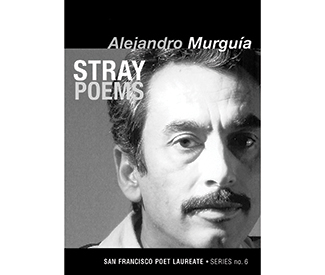
Which brings us to San Francisco, 2014: el poeta de las corbatas brillantes, the poet of the glittering ties, and the first Latino appointed as the city’s Poet Laureate, Alejandro Murguía. As part of its San Francisco Poet Laureate series, City Lights has just published Stray Poems, a collection of bilingual poems written on napkins, matchboxes, parking tickets and wrinkled pieces of paper over the past 12 years. He’ll celebrate its release at a reading next week, appropriately enough at the very bookstore where Rojas first met the Beats. *

ALEJANDRO MURGUÍA

Feb. 5, 7pm, free

City Lights Bookstore

261 Columbus, SF

www.citylights.com


Events: January 29 – February 4, 2014

0

Listings are compiled by Guardian staff. Submit items for the listings at listings@sfbg.com. For further information on how to submit items for the listings, see Selector.

WEDNESDAY 29

Sean Strub Books Inc., 2275 Market, SF; www.booksinc.net. 7:30pm, free. The author discusses Body Counts: A Memoir of Politics, Sex, AIDS, and Survival.

THURSDAY 30

“Playland After Dark” Playland-Not-at-the-Beach, 10979 San Pablo, El Cerrito; www.playland-not-at-the-beach.org. 6-10pm, $10. Adults (18 and up) get full run of Playland’s pinball and carnival games, plus board games galore and unique exhibits.

SATURDAY 1

Lunar Chinese New Year Festival on Fourth Street Near 1780 Fourth St, Berk; www.teance.com, www.fourthstreet.com. Noon-4pm, free. Welcome the Year of the Horse with Chinese Opera vignettes by Kei Lun Martial Arts, traditional lion dancing, drummers, and more.

“Sam & Max: A Look Back with Steve Purcell” Cartoon Art Museum, 655 Mission, SF; www.cartoonart.org. 4-5pm, free (reception, 7-9pm, $5). Booksigning celebrating The Collected Sam & Max: Surfin’ the Highway. The later reception also includes Purcell in person and a chance to check out the Cartoon Art Museum’s Sam & Max exhibit, as well as the concurrent exhibits “Grains of Sand: 25 Years of the Sandman” and “Searle in America.”

“Peralta Hacienda Saturday Kids Club” Peralta Hacienda Historical Park, 2465 34th Ave, Oakl; www.peraltahacienda.org. 2:30-5pm, free. Ongoing through May 31. Outdoorsy games, sports, and team-building fun for kids, who can learn about Ohlone Native American life, make crafts using dyes drawn from local plants, and go birdwatching, to name just a few of the offered activities.

Art Peterson Emerald Tablet, 80 Fresno, SF; www.emtab.org. 2-5pm, free. The author reads from Why Is That Bridge Orange? San Francisco for the Curious.

“Sick Plant Clinic” UC Botanical Garden, 200 Centennial, Berk; events.berkeley.edu. 9am-noon, free. Feeling like a green-thumb failure? Bring your ailing plants (covered or in a container) for diagnosis by volunteer plant pathologists and entomologists at this long-standing monthly event.

Gene Luen Yang SF Public Library, Latino/Hispanic Community Meeting Room, 100 Larkin, SF; www.sfpl.org. 2-3:30pm, free. The two-time National Book Award finalist discusses and signs his latest work, graphic novel Boxers & Saints: A Historical Duology of the Boxer Rebellion.

SUNDAY 2

Exploratorium free day Exploratorium, Pier 15, SF; www.exploratorium.edu. 10am-5pm, free. Regular adult admission is $25, so here’s your chance to check out (for free!) the science museum’s six exhibit galleries, including a Bay Observatory, and other attractions.

“Poetry Unbound #9” Art House Gallery, 2905 Shattuck, Berk; berkeleyarthouse.wordpress.com. 5:15pm, $5 donation (no one turned away for lack of funds). With Paradise, Jan Steckel, and Martin Heimstra, followed by a brief open mic. Hosts are Clive Matson and Richard Loranger.

MONDAY 3

Colin Meloy and Carson Ellis Booksmith, 1644 Haight, SF; www.booksmith.com. 7pm, $5 (advance tickets at www.brownpapertickets.com). Portland, Ore.-based author Meloy (also known at the lead singer and songwriter of the Decemberists) and illustrator Ellis — real-life partners and parents to two sons — share their latest literary collaboration, fantasy epic Wildwood Imperium: The Wildwood Chronicles, Part III. *


H. Brown: Goodbye to all that, we hope

137

OPINION While we mourn the tamping down of the fiery progressive idealism that characterized City Hall in the early 2000s, we celebrate the departure of that era’s dated man-warrior posturing. Last week proved a good occasion to pop a bottle: Misogynist blogger and progressive scene queen H. Brown announced he would soon be leaving San Francisco for destinations unknown.

Brown, a proud bigot famed for hurling invective from behind a double shot of whiskey at ex-Supervisor Chris Daly’s since-closed progressive hangout Buck Tavern, took the occasion to hang out for posterity with an SF Weekly reporter. Joe Eskenazi wrote a lyrical, subtly satiric ode to the aging troll’s legacy, “Last Call for Know-It-Alls: The Departure of a Classic Specimen of Old-San Francisco Bon Vivantery.”

But nuanced pokes at the longtime “character” proved too subtle to the victims of his bullying throughout the years. And since the piece failed to include the voice of a single woman, we thought we’d remedy with a retrospective of our own. Behold, the legacy of a real jerk:

“At a benefit at the Buck Tavern I walked in and there were all these progressive journalists sitting around a table with him. [Brown] said ‘you’re the one with the great ass!’ He started asking me if I had family members he could date. I was standing there horrified. I’m a mouthy lady, and even I couldn’t think of anything to come back with — not just to him, but to every other progressive journalist who was sitting there listening to him who laughed! I said hi to a few people, and then I left the event.”

– Laura Hahn, president of the San Francisco Women’s Political Committee

“H. is a bully and a sexist. If you want to look at why the progressive movement is failing it’s because it alienates youth, women, and people of color. Deifying somebody like him is shutting women out, the message is they aren’t welcome. It’s not separated from the fact that progressives are really faltering right now with no leadership and very little inspiration.”

– Debra Walker, artist and longtime activist

“As a purveyor of alcohol, I found that the man was a lawbreaking mooch and a pain to deal with. As a woman, I found him pathetic, insulting, gross, or all three, depending on his mood. The first time I met him he cussed me out for an imagined slight in a way that was actually shocking — and it takes a lot for cuss words to flummox me. For a time, I simply refused to serve him.”

– Siobhann Bellinger, Buck Tavern bartender

“His behavior symbolized the running joke amongst some progressive men that women were there for their own entertainment to be mocked and harassed with no one blinking an eye. FUCK. THAT.”

– Anonymous ex-City Hall aide

Ah, old San Francisco bon vivantery. Of course, the real reason we’re cheering on whatever Greyhound that will ferry this foul-mouthed sprite from our burg has nothing to do with Brown. Rather, we’re hoping no one will step into his shoes as your supervisor’s personal Bobby Riggs, to invoke the publicity-pig chauvinist who famously challenged tennis legend Billie Jean King to a match, the infamous Battle of the Sexes in which King mopped the floor with her opponent.

We hope that our purported progressive leaders will no longer invite woman-haters and homophobes to their household Sunday salons, or take Speedo-clad dips with them in the bay. That they will no longer think it’s OK to enable the presence of their own yapping id in polite company.

In the middle of City Hall’s current and unfortunate drift toward elite-serving “moderation,” one must wonder about what hangers-on like Brown did to the strength of our political movement. He and his ilk were allowed to establish through constant bullying, both online and off, that only straight men have the right to feel comfortable in our city’s high-powered progressive circles. What heroes did we lose in the process?

Caitlin Donohue is a staff writer at Rookie magazine and editor of AHDM4U.com.


Drought

41

steve@sfbg.com

I remember the dead lawns, 90-second timed showers, empty fountains and pools, and water cops issuing tickets for washing one’s dirty car. “If it’s yellow let it mellow, if it’s brown flush it down,” went the toilet edict they taught us in school. Water was too precious to just wantonly flush away.

I was 8 years old in 1976-77 during California’s last severe drought, but I retain vivid, visceral memories of that time. Water was an ever-present concern. I learned how dependent we are on the natural world and the role that individual responsibility plays in collective action, particularly in times of turmoil.

Everyone’s yards were brown; nobody’s cars were clean. We were in it together.

But even deeply implanted memories and learned behaviors fade. I may still feel subtle emotional pangs when I watch the water running down the drain when I shave or wash the dishes, yet I’d content myself with the knowledge that water is a renewable resource and we were no longer in a severe drought.

Or at least I was able to do that until this season. California experienced its driest year in recorded history in 2013, and it’s still not raining as we go to press. Yes, there are welcome predictions of finally getting some rain this week, but not the sustained precipitation we need to make a difference.

If current long-range weather forecasts hold true, this winter could be even drier than last winter, causing by far the most severe drought in state history, worse than ’76-’77, even worse than 1923-24, the driest winter ever and the beginning of a seven-year drought.

“We’re facing the worst drought California has ever seen,” Gov. Jerry Brown told reporters on Jan. 17 as he proclaimed a state of emergency, invoking powers to redirect water resources and asking Californians to reduce their consumption by 20 percent.

Yet as dire as this situation may be — and we’ll have a better idea by the end of March, when more stringent water restrictions will be enacted if we don’t get some serious rainfall by then — one of the scariest aspects to this drought is that it may be just a preview of things to come.

This could be the new normal by the end the century. Most reputable climate change models predict California’s average temperature will increase 3-8 degrees by 2100. That’s enough to radically change our climate, causing shorter winters with less precipitation, and more of it coming in the form of rain than snow, undermining the elegant system of storing water within the Sierra snowpack.

That also translates into more extreme conditions, from more flooding in the winter and spring to more dangerous heat waves and wildfires in the summer and fall — and more frequent and severe droughts.

“People should reflect on how dependent we are on rain, nature, and other another,” Brown said at the end of his news conference. “This is Mother Nature. At some point we have to decide to live with nature and get on nature’s side and not abuse the resources we have.”

That theme of interdependence was one he returned to several times during that 14-minute event. Brown was governor during that last big drought in ’76-’77, and when a reporter asked what lessons he took from that experience, he said, “We’re dependent on rain, we’re dependent on one another.”

He expressed confidence that Californians will find their way through even the most severe drought, although he acknowledged it will exacerbate existing conflicts between cities and rural areas, farmers and environmentalists, and Northern and Southern California as each fights for its interests.

“This takes a coming together of all the people of California to deal with this serious and prolonged event of nature,” Brown said. “This is going to take a lot of support and a lot of collaboration on the part of everybody.”


STATE OF DENIAL

California is on a collision course with reality. Whether or not it’s this drought that wakes us up, at some point we’ll awaken to the fact that a growing population can’t survive on dwindling water resources without a major shift in how we operate.

“California does not today live within its means. We want more water than nature is naturally providing, even in normal years,” said Dr. Peter Gleick, president of the Oakland-based Pacific Institute and a world-renowned expert on water issues whose research has fueled United Nations studies as well as his own books. “Some of the most serious impacts of climate change are going to be on water.”

That’s particularly true for California, whose large population and huge agricultural and other water-dependent industries belie a Mediterranean climate that is actually quite fragile and susceptible to droughts and the impacts of climate change.

“You’ve got 30 million people perched on the edge of a physical impossibility, unless we act with huge speed,” said Bill McKibben, an author and researcher who founded 350.org, one of the leading advocacy organizations for addressing climate change.

Gleick and McKibben are leading voices on the related issues of water policy and climate change, respectively, and they both told the Guardian that this drought should finally get people serious about conservation, efficiency, reducing our carbon output, and generally living in greater harmony with the natural world.

“The current drought ought to be a wake-up call to tell us we have to start thinking about our water resources differently,” Gleick told us, calling for far greater efficiency in how we use water, particularly in cities and the agriculture industry. “California has made great progress over the last several decades, but we’re nowhere near where we could be or should be.”

From low-flow toilets and shower heads to smarter irrigation techniques and recycled wastewater, California has made tremendous advances in its water efficiency since the last big drought. But Gleick and McKibben both say California needs a seismic shift in its thinking to grapple how a growing population can function within a changing climate.

“The assumption has always been that as we get larger populations, we’ll figure out their resource needs,” Gleick said, pointing out that climate change challenges that assumption and calls for more proactive thinking. “We need to do a better job at planning for future resource needs.”

Times of crisis can trigger that kind of shift in thinking. Gleick said Australia’s “Millennium drought” from 1995 to 2009 began with basic conservation measures and eventually led to a complete overhaul of water rights, “policies that we haven’t even contemplated” in California.

But Californians may soon be forced into such contemplations.

“It’s physics in action. This is what happens when you start to change the way the world has worked throughout human history,” McKibben told us. “Some people will be empowered to act, and some will have to go into denial. A truly interesting test will be Jerry Brown — he ‘gets it’ on climate, but he’d love to frack as well apparently. He’s like a Rorschach for the state.”

Brown’s call to work with nature and one another is encouraging, but neither Gleick nor McKibben were willing to wager that Brown is ready to lead the big discussion Californians need to have about our long-term needs.

Yet Gleick says something will have to start that conversation before too long: “It’s either going to take a more severe drought or better political leadership.”


FIRES IN JANUARY

California is a tinderbox right now, with a high risk of wildfires that could get unimaginably worse by this summer.

“We’re experiencing conditions in California that we typically see in August,” CalFire spokesperson Daniel Berlant told us. “We never really moved out of fire season in Southern California.”

And that will only get worse as global warming changes California’s climate.

“As summers get longer, it extends the window for fires,” Berlant said. “It’s a clear sign that this generation is seeing more and bigger fires.”

Farmers are also worried, facing the prospect of fields going fallow.

“There is considerable anxiety on farms and ranches throughout California,” Dave Kranz, spokesperson for the California Farm Bureau, told the Guardian. “We know it’s going to be bad, we just don’t know how bad.”

He described ranchers selling their animals before they reach market weight and farmers considering whether to plant field crops and how to keep trees and vines alive if things get bad.

“You have people irrigating crops in January, which is a very unusual occurrence,” Kranz said. And if the rains don’t come this winter, “hundreds of thousands of acres of land would be left unplanted.”

Kranz said that “farmers have become significantly more efficient in their water use,” citing stats that crop production doubled in California between 1967 and 2005 while the water used by the industry dropped 13 percent. “We talk about more crop per drop.”

But Gleick also said the fact that agriculture accounts for 80 percent of water use in California must be addressed, something that Kranz acknowledges. For example, he said Central Valley fields that once grew cotton, which takes a lot of water, have mostly switched to almonds. Pistachios are also big now, partially because they can be grown with saltier water.

“Farmers adapt, that’s what they’ve done historically in response to weather trends and market demands,” he said.

“There’s only so much water and much of it is spoken for for the environment,” Kranz said, acknowledging species needs but also complaining about much of the last big rains, in November and December of 2012, were released to protect the Delta smelt. “We should have saved some of that water.”

While the 1927-28 winter was the driest on record in the state, dropping just 17.1 inches of rain, this winter already looks worse, with just 3.5 inches falling so far as of Jan. 27. That could change quickly — indeed, a chance of rain was finally in the forecast for Jan. 30 and Feb. 2 — but it doesn’t seem likely that we’ll get enough to end this drought.

“Right now, we are saying the odds do not indicate a Miracle March, which is not good,” a meteorologist with the National Weather Service’s Climate Prediction Center told the San Jose Mercury News on Jan. 16 following release of its three-month forecast.

The worse it gets, the more heated the political battles will become over how to address it.

“You’re going to hear a lot of talk about additional water storage,” Kranz said. “We’re paying now for not creating more storage 10-15 years ago. Droughts happen in California.”

But even Kranz and his generally conservative constituency is talking about tweaks to existing reservoirs — such as increasing Shasta Lake’s capacity and expanding the Sykes Reservoir in Colusa County — rather than big new dam projects.

Gleick agrees that the era of building big dams in California is over. “You can’t build a new dam in California, with their enormous political, economic, and environmental costs.”

And that makes the challenges this state faces all the more vexing.


PAST AND FUTURE

California has dealt with drought many times before, including several that lasted for a few years. The last sustained drought was in 1987-1992, but it wasn’t nearly as dry as earlier droughts, such the 1928-1934 drought, the worst one on record.

Officials try to learn from each drought, studying what happened and trying to develop long-term solutions, such as the water banking and distribution systems established during the 1976-77 drought. Yet a study by the Department of Water Resources in 1978 also concluded that we’re essentially at the mercy of nature.

“The 1976-77 drought has again shown that finite nature of our resources and our limited ability to control nature,” read the introduction to the report “The 1976-77 California Drought: A Review.”

DWR’s then-Director Ronald Robie warned at the time that there was no way to predict when or how severe the next drought might be. “We can be assured, however, that drought will return,” he wrote, “and, considering the greater needs of that future time, its impact, unless prepared for, will be much greater.”

Those words could carry a special resonance now, but it’s even scarier given long-range climate change forecasts that Robie wasn’t taking into account when he wrote those words. California estimates it will add more than 15 million people between 2010 and 2060, crossing the 50 million people mark in 2049.

“California could lead the nation into renewable energy. You’ve got the sun. But it would take a 21st century statesman. I guess we’ll find out whether Brown’s that guy — he could be, freed from the need for political popularity after this next election,” McKibben said, calling Brown “a true visionary in many ways, but also a politician. What a fascinating gut check!”

Gleick said that he sometimes gets asked whether climate change is causing the current California drought or other specific weather incidents, and he said that question misses the crucial point: “All of our weather today is influenced by climate change.”

As the climate changes and the world warms, that becomes the new normal for California and other regions, affecting all of its weather patterns. “As goes our climate,” Gleick said, “so goes our water, and we’re not ready.”

SFMTA approves tech shuttle plan

8

The San Francisco Municipal Transportation Agency Board of Directors approved a pilot program Jan. 21 that allows operators of private commuter shuttles to use public bus stops, something they’ve been doing illegally for years on a very predictable basis.

The program will establish an “approved network” of 200 designated San Francisco stops where private shuttles may pick up and drop off passengers. It will issue permits and identifying placards to the private buses and require them to adhere to certain set of rules, like yielding to Muni buses if they approach the stop at the same time. (There’s already a Curb Priority Law stating that any vehicles not operated by Muni will be fined $271 for blocking a bus zone. But the city has chosen to ignore that law when it comes to private commuter shuttles.)

Finally, the program will charge shuttle operators $1 per stop per day, which seeks to cover the costs of the program implementation and no more. The meeting drew a very high turnout that included the protesters who have been blockading the buses, Google employees, private commuter shuttle drivers, and residents of various San Francisco neighborhoods.

Sup. Scott Wiener said at the meeting he was fully supportive of the pilot program, which was developed over the course of many months in collaboration with tech companies who operate the shuttles.

“These shuttles are providing a valuable service,” Wiener said. He said he was sensitive to widespread “frustration and anxiety” around the high cost of housing and rising evictions, but thought it was unfair to blame tech workers: “We need to stop demonizing these shuttles and these tech workers.”

Then Sup. David Campos addressed the board. “I think it’s really important for us to have a dialogue to find common ground,” Campos said, adding that pushing shuttle riders into private automobiles was not a good outcome. But he also urged the SFMTA board to send the proposal back to the drawing board: “It’s a proposal that simply does not go far enough.”

Campos was also critical of the SFMTA’s process of studying the growing private shuttle problem for years and drafting a proposal in collaboration with members of the tech community, with Campos pointing out, “Public input is being sought after the fact.”

Bus plan ignores real cost

Many community members have criticized the new $1 per stop tech shuttle fee as being too low, but city officials say their hands are tied by a state law prohibiting them from charging any more than that.

Yet under Proposition 218 — the state law that limits local governments’ ability to impose new fees — the city has more discretion about how to calculate “cost recovery” than officials have let on.

“Prop. 218 is part of a legal scheme that doesn’t so much limit how we calculate cost recovery,” San Francisco City Attorney’s Office spokesperson Gabriel Zitrin told us, “but limits the city to cost recovery.”

At the Jan. 21 SFMTA meeting, Project Manager Carli Paine explained how her team had arrived at the $1 per stop, per day fee amount.

“We identified everything it would take to implement this program,” Paine said. After identifying all the program components, the agency “took the number of stop events and came up with a ‘per stop event’ cost…The kinds of costs we included are upfront costs, ongoing program costs.”

Under Prop. 218, however, the SFMTA could determine whether there are other costs associated with allowing private commuter shuttles to use public transportation infrastructure, beyond just the cost of issuing and enforcing permits and placards.

Zitrin said the city can identify any costs not already being recovered elsewhere. If shuttles’ use of public bus stops cause transit delays, for instance, what are the costs associated with those delays? More overtime pay for bus drivers?

Low-income kids getting to school late and missing breakfast? What’s the cost of that?

If rents rise in neighborhoods located along the shuttle routes (and studies show they do), what are the associated costs of that phenomenon? What’s the cost of displacement resulting from those higher rents?

The bulging eyes of rock-stardom absurdity: An evening with Tenacious D

2

About 15 minutes into taking a seat at center stage of the Castro Theatre last night before an enthusiastic and fairly inebriated crowd, Jack Black turned to the audience and sheepishly confessed, “I’m getting sleepy.” To which, his cohort Kyle Gass added, “Is any of this even interesting?’

It was an honest, and funny, way to acknowledge a slow-out-of-the-gate interview moment for Tenacious D — comedic duo Black and Gass as the greatest acoustic heavy metal band in the world — who would probably have felt more in their element battling Satan in an epic guitar showdown than awkwardly sitting in tall chairs answering questions with a moderator.

And after all, expectations in the room were considerable. For the high-profile opening night of SF SketchFest on Jan. 23, the devoted audience in attendance had waited outside nearly two hours — in a quarter mile line that rambled throughout the neighbor — in an effort to see the duo take the Castro stage to be honored for their hyper brand of rock-stardom absurdity and Spinal Tap genius. But after a big-screen montage of the duo’s funniest clips got the event rolling, the D sitting down to chat with moderator and fellow comedian Paul F. Tompkins took a moment to get momentum.


Although early musings on how the band got their start via Mr. Show and a short-lived HBO series lumbered along, the interview got interesting as the band deviated from explaining their origins and just started telling funny tour stories, such the D’s disastrous opening slot for TOOL (“The boos had extra strength, cause you know…that band’s music plumbs the depths of man’s soul”), an equally terrible promotional show for Miller Genuine Draft in Las Vegas (“It was unanimous, all these people from the around the country hated us”) and a concert that had to be stopped at the House of Blues because someone had been stabbed (“The Rolling Stones did a whole movie on their stabbing”).

The session of crowd questions got nutty quickly, ranging from the duo being asked to name their favorite Muppet (Animal), to what it would take to get another Tenacious D film made (“If everyone here could just donate $500,000”), as well as fanatical inquiries into the band’s song catalogue (“Alaskan Fan Club here, let’s talk about ‘Jesus Ranch’”).

All in all, the “seated” portion of the show actually proved pretty good, and the stilted vibe that surfaced early on had quickly given way to some genuinely funny off-the-cuff moments, like when a meowing sound filtered through the crowd and Black pondered its source (“I’m like a sommelier of bad trips”).

To the great joy of the crowd, the interview session soon transitioned to the band pulling on their acoustic guitars and charging into a riotous 15-song set ranging from the band’s self-titled debut album (“Tribute,” “Friendship,” and “Kyle Quit the Band”) to Pick of Destiny (“Kickapoo”) and the more recent Rize of the Fenix (“Low Hanging Fruit” and Roadie”).  Finally in their element, the D just started killing place as Jack Black went full throttle — all bulging eyes and rubber expressions — and Gass strummed along with mostly deadpan stage presence to favorites like “Classico” and “Double Team,” as well as covers of Van Halen’s “Panama” and Black Sabbath’s “War Pigs.” By the time the band reached “Fuck Her Gently” the crowd left their theater seats and just flooded to the front of the stage to sing along, “And then I’ll fucking fuck you discreetly/And then I’ll fucking bone you completely.”

What else can you say? It’s the Motherfuckin’ D, and long lines and tall chairs were a small price for such a big showcase. If opening night was any indication, it’s gonna be one hell of Sketchfest this year.


The worst music beats the best bomb: A conversation with legendary composer Van Dyke Parks

1

“Yours falsely!” Van Dyke Parks chimes, as he picks up the phone at home in Pasadena, where the weather is “room temperature.” He adds, “all we have is the attorneys. Get rid of them, and we can have another perfect day.”

Right away, the veteran composer’s way with words resembles his musical sensibility: whimsical, scattered with detail, and liable to make left turns at a moment’s notice. From his lyrics for Brian Wilson’s legendary SMiLE project, to his orchestral arrangements that have served generations of artists (Ry Cooder, Harry Nilsson, Little Feat, Medicine, Joanna Newsom, and Skrillex, to name a few), to his quietly revolutionary solo records that balance Americana and cosmopolitanism, with panoramic scope and whiplash dynamics, Parks’ nonlinear, all-embracing approach to sound has extended pop and rock’s self-imposed limitations as facelessly, yet unmistakably, as that of any American musician alive.

With the release of last year’s wonderful Songs Cycled (his first LP of new material since 1989’s Tokyo Rose) Parks is as focused and driven as ever before, even at age 71. This Sunday, Parks will add to his ever-growing list of collaborators, with a one-off performance at Oakland’s Malonga Casquelord Center featuring LA musician-composer Matt Montgomery, and the Bay Area’s joyfully independent Awesöme Orchestra.

Montgomery, a young musician, whose first exposure to Parks’ arrangements came in the form of Silverchair’s Diorama (2002), has also taken a multifaceted approach to his career, supplying vocals and guitar for the pop punk-tinged three-piece Versus Them, arranging and composing scores for television and film, and developing software (most recently Rocksmith 2014 by Ubisoft) centered around guitar instruction. This weekend’s show will celebrate the release of Montgomery’s debut EP, Petty Troubles: a set of McCartney-esque pop songs recorded in a single day with 30 Bay Area musicians, and accompanied by a documentary film chronicling the zippy creative process.

“I’m really excited to have a package to hand someone, and say, ‘this is me,’” Montgomery tells the Bay Guardian from his parents’ home in San Rafael, where he’s staying during a week of rehearsals leading up to Sunday’s concert, describing the rapidly produced EP as “homemade, but slick at the same time.”

Similarly homemade/slick, casually organized, yet seriously proficient, the Awesöme Orchestra’s approach fits intuitively with those of Montgomery and Parks. A volunteer ensemble with monthly rehearsals, and a repertoire ranging from Mozart, to Terry Riley, to Daft Punk, the group has crossed genre boundaries consistently since its formation last spring, challenging orchestral music’s inherent elitism at every juncture. Sunday’s show will begin with a set from Parks, with Montgomery on guitar, followed by a performance of Montgomery’s Petty Troubles in its entirety. The Awesöme Orchestra will back both musicians, in a lineup that can be expected to deliver maximalist results. “Big is back!” Parks declares. “This is not going to be a ‘think small’ concert. It’s gonna be ‘think big.’”

How did Parks, a living legend among composers, come to join forces with a relatively low-key figure like Montgomery, and a joyfully unorthodox ensemble like the Awesöme Orchestra? I spoke at length with Parks earlier this week about this project’s inception, his return to solo work on Songs Cycled, 50 years of arrangements for pop’s finest, and why he doesn’t like to hear guitar solos while traveling in Czechoslovakia.

SFBG What’s your role in this upcoming performance?

VDP I’m trying to blow some wind in the sails of a youth symphony. That’s a euphemism I use. I’m 71, so anything is youthful. [Laughs.] I will be the oldest thing in the room, I promise you. But, the idea is to bring attention to [the Awesöme Orchestra]. I love the way they spelled… you know the way they spell their name?

SFBG Yeah! With the umlaut over the “ö”, there.

VDP Yeah! The conductor is Dave Möschler. I’m not sure there will be a mosh pit, but at any rate, I’m very impressed with their umlaut.

SFBG What’s your experience with the Awesöme Orchestra, as well as [Montgomery], and how did this collaboration get off the ground?

VDP Well, I’ll tell you something. I met Matt Montgomery at my daughter’s wedding reception in Berkeley. This is maybe five years ago. I know his dad, who’s a celebrated Bay Area musician. So, I was already sold on him. But, I was impressed with the fact that he… reaches out to this acoustic world of instruments that I like to celebrate, in the rock arena, or with pop music. He referred me to [Möschler], and pointed out that its a hard-scrabble thing for musicians. These people, they get together once a month, to just celebrate the fact that they can all play their asses off. Everything from Beethoven, to John Williams… I know they do the overture to Candide, which is one of my favorite pieces.

So he said, “Hey man, let’s get together. What do you need?” I said, I don’t know. I could use a stand-up bassist, five french horns, four trombones. And then he says, “no, how many musicians would you like?” I say, “what do you want? I’ve got the music.” And so, we’re going for, “big”. Big is back. [Laughs.] This is not going to be a “think small” concert. It’s gonna be “think big.” And yeah, I’m delighted. I’m excited. I get to bring a lot of music out of my trunk, bring it up there, and they can blow their brains out. Man, this’ll be great. I don’t know what this set will be… 40 minutes or so, I guess. I have all the music in the world. I have some charts I’ve done for orchestras in Europe, and most recently Australia for a much larger group. But, the point is, I have the charts. Most of them come from the charts that I have in my musical library. Most of it comes from the opportunities I’ve had in film scoring, or in doing albums. And that’s when there was such a thing called “patronage.” There is no patronage now. But, a lot of it, I have simply done for performances, and reconfiguring things that I have recorded, or want to. It’ll be ear candy. It’ll be a fine show.

SFBG Have you had much experience in the past, working with ensembles that are a bit more loosely organized, or less traditional in their approach, like the Awesöme Orchestra? How do you feel ensembles like that facilitate your compositions differently?

VDP That’s an incisive question, because it’s true: most orchestras, let’s call them “legit” orchestras, when they do stuff with pop, or popular musicians, usually it’s wallpaper. Orchestral wallpaper. It’s very ho-hum. But there are some groups that I’ve worked with (the Metropole Orkest in Holland, the Britten Sinfonia in London, I just worked with the Adelaide Symphony) that have a much more inquiring, loose-knit approach, and I like that a lot. I like the idea that they’re trying to bring real interest, and with no fear of what we think of as lowbrow. I think that’s an important ingredient.

I just worked in a Beck concert. I had heightened expectations, and I don’t know for sure that I was any happier about it than the L.A. Philharmonic, who was playing the work. It’s a hit-or-miss thing, but I sense with this group, because of what they’ve tackled, they have a real appetite for real music that matters, and there’s no elitism about it. It’s not elite. And so, to me, they’re like quality folk, and I want to go that way. Matt told me, it’s pro-bono, and I thought, you know, maybe I’ll get a chance to meet Cher, even if her husband isn’t there. [Laughs.] I was making a joke, but it turns out Sonny will not be there, but it is pro-bono. Anyway, I’m very happy about it.

https://www.youtube.com/watch?v=sPOcjHuHWdA

SFBG What about [Montgomery’s] approach to music, or his compositions, really caught your attention initially?

VDP To me, he’s somebody who has the ability to keep reinventing himself. I think this is his first invention, but I suspect that he will make many more. So, you know, I have great respect for him. And, he’s modest. That’s a very desirable rarity. [Also], it’s what he has done with the song form. I feel like I’m in flight formation with him. We both approach that same chamber music sensibility. He likes all kinds of instruments, and I think that shows. And there’s no big taboo about eclecticism. He’s got a big sense of adventure, and I think there are a lot of people that have that now, that I respect.

Yesterday, Rufus Wainwright was over here. I’ve met a young kid, much younger, called Gabriel Kahane, who’s also done a lot of exploration. [I’ve worked] for Joanna Newsom… and a guy by the name of Sondre Lerche: I did an arrangement for him last month. And then, Efterklang, a group you can’t pronounce over here, but they’re very fine. So I kind of gravitate toward people of a new generation, who really aren’t afraid of acoustics, and to mash them up with electronica sometimes. You know, I think it just shows a great deal of inquiry and freethinking, and I like that.

SFBG Your music has an omnivorous quality to it, eating up everything in its path, appropriating the highbrow, the lowbrow, and a lot in between. Are there some people you’ve heard recently who you admire for having a similar perspective?

VDP I think every artist has a primary obligation, and that is to be true to the self. Anything of artistic merit is self-revelatory. It reveals the self; that’s what it does. I’ve heard a whole bunch of stuff. I didn’t just grow up listening to music post-Elvis Presley. I’ve listened to music from the ages, and that’s reflected in who I am. But, the work I’ve done as a recording artist has been a training ground for me, and it has trained me how to serve others, and I’m happy in both those worlds.

Right now, I’m writing an arrangement for Kimbra. She’s 23, and one of the smartest musicians I’ve ever met. That music, it must be seamless, and serve her, and my role in that must be invisible, and yet somehow very pivotal to how she sounds. It’s decidedly an arena that I don’t appear in, myself, in my own works. It’s… techno. Super laptop info comes out of that woman, and I’m so happy with it. I love it all. I love every bit of it. My favorite songwriter is entirely different from me. His name is Paolo Conte. He is, to me, the greatest songwriter of my time, and he’s Italian. I don’t speak a word of Italian, but somehow, I get it.


SFBG
You mentioned the collaborative aspect with Kimbra. When it comes to arranging or producing music for other people, do you ever experience tension between accentuating someone’s work, and imposing a certain brand on it? Do you try to approach your collaborations with a consistent balance between those two?

VDP I don’t come to the conclusion that I’ve imprinted, or put my brand, on anyone else. I think, at best, I’ve magnified who they were, or perhaps sharpened the image they were trying to present. I think that’s the job of an arranger. It’s a matter of immersion in the work. I don’t like to call it collaboration. I think that arranging frames a work, if anything. At best, it brings a proscenium to the work, without imposing any further brand. I like that idea, of recognizing each artist as a maverick, somehow unbranded, and maintaining that. That’s a hard job.

It’s like working for a director who says, “this picture needs a lot of music,” rather than a director who says, “it’s about the flutes in bar 43.” It’s almost like being given complete freedom, and suffering the burden that puts on you. I mean, to be given liberty to arrange is, like, somebody’s handing you a hand in a birthing process, almost. It’s like, “here’s my baby.” So that’s the way I feel about it. Some people think they know when I’ve been in the room with a songwriter. But, I don’t think that’s because I have a brand. I think that’s because there’s very little work being done in arranging, anymore. And, the reason for that is that there aren’t that many people that can afford a few strings. I think that’s the truth.

SFBG Are there any arrangements you’ve done for musicians in the past, where you really saw your sensibility gelling with theirs, and something really nice resulting from that?

VDP Well, I loved working for Ry Cooder on his first record. That was pioneering work, you know, to put a mandolin (that’s a very soft instrument) in a room full of brass and strings, and so forth, and to have it heard. That was when we were just learning those possibilities in recording existed. So, I’m real happy with that. I’m happy that I worked for five weeks on arranging an album for Inara George [An Invitation, 2008], and it took us nine hours to record it. And then, once again, she gave me a voice and a guitar, and then when I did the orchestra, she threw the guitar away.

One person, I think a dear heart from the San Francisco Chronicle, thought it was a very confusing… he said, listening to a Van Dyke Parks arrangement is like being, oh, tossed out to sea. Because, it was highly syncopated. I forget who insulted me, [Aidin Vaziri, for the record] but he forgot to pay attention to the artist, Inara. So, win some, lose some. Make some up in double-headers. You know, to me, it’s the most glorious way I could spend a life, and I have no complaints. I’ve been very fortunate. I know so many people, far more talented than I am, who haven’t had the opportunity to hear what they write, and, my heart… I can’t express my gratitude for this, and for the opportunity to end up someplace like with the Awesöme Orchestra.

There’s a group in Holland. Actually, it’s a nation filled with small groups like this: volunteer, young groups from teens to 30s, and really able players. It’s called the Ricciotti Ensemble, and they’ve done several of my arrangements, and they are totally off the wall, out of the park, inventive. And, you know, to be among the people they have played… they’ve played Zappa, they’ve played Stravinsky, and they’ve played me. Just to say, you know, I could never go back and recover or change a note that I’ve written, that is splayed publicly, but you know, it just makes me feel more like moving forward, and pursuing this thing called arranging.

https://www.youtube.com/watch?v=AFxdAkfjeVg

SFBG You were just in Australia. Are you familiar with an outfit called the Avalanches, by chance?

VDP Oh, yes! I love them. Darren Seltmann: I’ve had some good social time with him down there. Very bright, wonderful people. Why did you bring them up?

SFBG I’ve always noticed a little parallel between your work and theirs. There’s a panoramic way that their music moves, and the way it shifts between music you’d classify as highbrow and lowbrow… this really democratic approach to different forms of music. I think electronic, sample-based music in general has a way of facilitating the impulse to use everything, but on the other hand, you have a focus on rapid production, and doing things quickly, and maybe not arranging things as meticulously…

VDP I’m very honored that you would even make that comparison, as I think a lot of them. But, I’ll tell you: there’s a case in point. Two great arrangements that I’ve done that I’m really happy with, and somehow, in spite of myself, I just sailed right through them: one was a trio for Sam Phillips, called “Wasting My Time.” Three cellos… I added three cellos to her basic track. Then, she threw out the basic track, and all you can hear is three cellos. Never done a better job. Another one, for a fellow by the name of Peter Case… He did a song once, called “Small Town Spree,” a quartet. Somehow or another, hot as a whore’s dream, this thing really sailed.

I can’t say that about all the work I’ve done. There’ve been some pieces of smaller consequence to me, that’ve been giant orchestrations. But, somehow or another, if you weigh an arrangement as if, instead of thinking of it as simple or complex, but if you think of an arrangement as an instrument to bring out some truth, and also to somehow add plausibility to the emotional content in the song, that, to me, that’s something of value. Don’t put it in terms of, complexity as just to be able to use every instrument as economically as possible, to get to the target, which is, of course, the heart of some casual observer.

SFBG Is there anyone you dream of arranging for, or think you’d work especially well with?

VDP There’s nobody that I’d exclude. I did enjoy the Skrillex situation. I enjoy the improbabilities. There’s some Brazilian artists that I would like to work for. I just… they called me the curator of a record called Bamboula by Tom McDermott (2013), and I introduced him to Jules Selwan. He’s really my favorite New Orleans pianist, and I’d like to adorn his work orchestrally. But there are many directions to go in, and a lot of things in discussion, and among them, theater. I have an unfulfilled fascination with musical theater. Not like any theater that I’ve heard, really, but I’m pursuing that. Hey, the rent’s paid this month. What could be wrong?

SFBG About Songs Cycled, and some of your newer material: I was reading an interview you did after working on Ys (2006), by Joanna Newsom. Back then you maybe seemed surprised that she’d have pursued you based on a real fascination with Song Cycle in particular. Now, in 2014, your debut album enjoys its best reputation maybe ever; you have two new issues of SMiLE by Brian Wilson and the Beach Boys; and now there’s this new record: your first of new material since the late ’80s, being discussed as a companion piece to your debut. Would you say you might have more confidence in your early material, or its reception, than you did 10 years ago?

VDP Well, no. I don’t think I have any more confidence. I think I’m more decidedly deer-in-the-headlights than ever before. I’m 71 years old, and I think a lot of reporters would ask…it’s the nature of their event in journalism…“What’s new?” they say. Well, I like what’s old, too, and nobody asks what’s old. But, I’m here to tell you: what’s old begins with me. [Laughs.]

There is an element in what I do…I’m trying to prove to myself that I can do everything I could do, with the athleticism of my youth. For me to move my fingers… and I do move my fingers, unlike a lot of pianists who are famous. I actually move my fingers. It is athletic. This year, I had hand surgery for trigger finger. I was on a table for two hours, in San Francisco. I came up to San Francisco to find the best doctor, and I got him. And I want to tell you something: it was a major event in my life, and so just going out and playing what’s old is obviously very novel, very frightening, and very confirming, too. As far as the record is concerned, the album I just put out last year… to me, a lot of that invention was born of things which have appeared post-9/11. These songs are darker, and I’m not so obsessed with keeping it light, but to admitting what is dark. I made every effort to make it beautiful, but this is not the world I wanted to come out of the ‘60s. I wanted a better world.

If King had lived, if Kennedy had lived, I really feel we would be in a less materialistic, less racially polarized, and economically polarized country. So, there is a tremendous obligation to move forward, and to get pushy with lyrics, and to shake people up, and I attempt to do that. I don’t think it should be obtuse. I still try to maintain a little bit of decorum, you know. I don’t want to get anybody mad But, I like to think we are moving forward, and that my work helps illuminate.

SFBG Would you say you feel a similar disillusionment with the state of affairs now, culturally and politically, to what you might have back then?

VDP Well, there’s an admission of dashed expectations. I have come to learn that people are born to disappoint, and so often meet that expectation. For example, I did a song, and I was criticized for it, for revisiting a song called “The All Golden,” I did on my first record. I stripped it down on this album. But, I think an underpinning consideration to this recent work is, the more things change, the more they stay the same. And I think in many ways, certainly sociopolitically, we have descended.

I think that we’re still a democracy, but we’re a wounded democracy in the face of the plutocracy: the incredible wealth that is centralized among so few. It’s funny, my answers to any question you might have seem tremendously, maybe, mannered or arrogant in a way. You have to accept that I believe that the song form is that important, and that is job one: to make songs that matter. One time, I wrote a song called “Out of Love.” It was an affectionate salute to my wife. She said, “when are you gonna write a love song?” [Laughs.] So, I have come as close as I could to love songs… but now, you see, there’s something else that I have to prioritize, because time is my only enemy. There’s only so much time.

SFBG You mentioned the importance of the song form. Do you feel like there are lots of missed opportunities to aspire to something bigger in modern music artistically, politically, etc.?

VDP I’ll tell you something. I like all kinds of songs. They don’t have to meet my expectations. I try to keep an open heart about what I hear. Honestly, I listen to a lot of music that cannot be branded first-world-pop-culture. I don’t really pay too much attention to folks who theorize from positions of privilege. I don’t listen to a lot of rock ’n’ roll. When I’m in Czechoslovakia, the last thing I want to do is hear a guitar solo by a man who maybe loves Mick Jagger. This is not the world I inhabit, musically. But the worst music, to me, beats the best bomb. The dumbest music is better than the smartest bomb. And, when I start to feel critical of some musician, I try to remind myself: “At least these people are not in munition. They’re not making bombs.” And I try to be merciful. I have a great respect for all kinds of music, as long as it’s well designed.

SFBG Is there any advice you’d like to offer to young people making music right now?

VDP Yeah, I would. Always remember, your best work is ahead of you. It must be. Don’t seek immediate praise. Don’t be crippled by condemnation. It may teach something. So basically, the fundamentals apply: be true to yourself. That’s been enough for me. It hasn’t made me a corporate wonder, but it’s satisfied our family, and it’s easier than the alternative, as telling the truth is easier than trying to remember which lie you told. I’m very happy with the result so far. I’m just petrified about what mayhem could take place on Sunday. To me, live performance is very much like that. The stakes are high. It is, to me, like aerial ballet, without a net, and it’s not safe. There’s nothing safe about it. But, I’m a tough old bird; I can take it.

Sun/26: Van Dyke Parks with Matt Montgomery and Awesome Orchestra
4pm, $15-45
Malonga Casquelord Center
1428 Alice, Oak.
(510) 238-7526
www.mccatheater.com


H. Brown: Goodbye to all that, we hope

451

In an SF Weekly piece published yesterday, it was announced that progressive political blogger and gadabout H. Brown – an “irascible” man who has attained a specific sort of fame in equal measure for his political connections, his egregious sexism, and his unfortunate alcoholism — was leaving San Francisco. Where’s he going? The article didn’t see fit to mention. It’s whatever. One can assume Brown’s destination is that netherworld set aside for those whose behavior was enabled by the old school boy’s club blinders of the San Francisco progressive movement, still worn at the dawn of the 21st century.
 
“Last Call For Know-It-Alls: Classic Specimen of Old-San Francisco Bon Vivantery,” the article was called. It was written by a man; if a woman had written it, the title might have been closer to: “I Just Bought an Evil Eye Necklace, Don’t Look at Me You Cursed Troll.”


Do I sound angry? In 2008 at a DCCC, Brown inquired at top volume and in front of an ex-President of the Board of Supervisors if I was the politician’s escort. When said political leader bailed on the situation, Brown interrogated me on camera about my knowledge of local politics. I wrote about it, most names omitted, for the Guardian. In the article’s wake, I received thankful and supportive emails from men and women across the San Francisco political scene. On his part, Brown sent out multiple emails about me to his prodigious correspondence rolls, one in which he shared an communique from his niece calling me an “ignorant cunt,” another in which he addressed an un-cc’ed me about the election night in question: “You tried to make up for your ignorance by wearing revealing clothing. I was mocking you. And rightly so.”
 
Nearly every woman in San Francisco politics has one of these stories. When a male politician was accused of any wrong against a woman, Brown could be depended on to dig through the Internet to find evidence that the victim had been asking for it. Those unwilling to suffer him had to opt out of the hobnobbing happy hours and salons in the homes of city leaders, at which Brown was a constant presence.
 
Ah, old San Francisco bon vivantery. But I’ve said it before and I’ll say it again, you don’t have to care about Brown. You do have to care that this man was your Supervisor’s drinking buddy, that he took Speedo-clad swims in the Bay with progressive leaders. You do have to wonder about what that did to the strength of our political movement. And you might want to wonder about the dynamics behind ubiquitous bigots who are tolerated by people who should know better.
 
“If comedy is indeed tragedy plus time, however, Brown will leave ’em laughing for posterity,” wrote Weekly reporter Joe Eskenazi. “Friend after friend recalled anecdotes of offensive, bourbon-fueled behavior invariably culminating with Brown being instructed to “Get the fuck out, H.!” But, always, these were happy memories, if not happy occasions.”
 
None of these friends — “former supervisors, consultants, academics, political Svengalis, and other city luminaries” – in Eskenazi’s article were women. (The writer, whose work on city issues I do appreciate, told me he did interview women, but apparently none of them said anything printworthy.)
 
Let’s remedy that now with a few female voices. Not coincidentally, most of these bourbon-fueled memories took place in ex-Supervisor Chris Daly’s since-closed Market Street progressive gathering spot, the Buck Tavern. None are happy.
 
“This was the first time I was introduced to H. At a benefit at the Buck Tavern I walked in and there were all these progressive journalists sitting around a table with him. He said ‘you’re the one with the great ass!’ He started asking me if I had family members he could date. I was standing there horrified, I just didn’t know what to say. I’m a mouthy lady, and even I couldn’t think of anything to come back with – not just to him, but to every other progressive journalist who was sitting there listening to him who laughed! I said hi to a few people, and then I left the event.”
– Laura Hahn, president of the San Francisco Women’s Political Committee
 
“Really, I don’t give much of a shit about one sad dude calling me a slut and a spy (for Newsom or Pinkerton Guards, depending on the year), but seeing some (not all) progressive men continue to put up with him was pretty demoralizing.”
– Anonymous volunteer on several progressive political campaigns
 
“The confrontation started because I came in to wish [ex-Supervisor and then-owner of the Buck Tavern] Chris Daly a happy birthday and have a drink, and H. asked Chris ‘Who the hell is she?’ To which Chris said, ‘She’s the President of the Harvey Milk Club.’ To which H began, ‘You’re not even gay, are you?’ I replied, ‘I’m queer.’ ‘Queer?!’ he said, ‘What the fuck is that? Some Shona Gochenauer shit? You’re not gay. I can tell you’re not gay by looking at you. She doesn’t know anything about politics. Look at her — she’s clearly just a vanity president.’ He said something about enjoying things because, “that ass isn’t gonna last forever, sweetheart. They [the other patrons in the bar] are only standing up for you because they want to fuck you.’”
– Stephany Joy Ashley, ex-president of the Harvey Milk LGBT Democratic Club
 
“As a purveyor of alcohol, I found that the man was a lawbreaking mooch and a pain to deal with.  As a woman, I found him pathetic, insulting, gross, or all three, depending on his mood. The first time I met him he cussed me out for an imagined slight in a way that was actually shocking — and it takes a lot for cuss words to flummox me. For a time, I simply refused to serve him.”
– Siobhann Bellinger, Buck Tavern bartender
 
“H. is a bully and a sexist. If you want to look at why the progressive movement is failing it’s because it alienates youth, women, and people of color. Deifying somebody like him is shutting women out, the message is they aren’t welcome. It’s not separated from the fact that progressives are really faltering right now with no leadership and very little inspiration.”
– Debra Walker, artist and longtime activist
 
“His behavior symbolized the running joke amongst some progressive men that women were there for their own entertainment to be mocked and harassed with no one blinking an eye. FUCK. THAT.”
– Anonymous ex-City Hall aide
 
These women – and the progressive men who were their allies – were not laughing at the hijinx of a mouthy old man. But people were, and they will be at the party that will be held in honor of Brown’s departure and attended by member’s of our city’s progressive elite.
 
Supporters say the guy’s behavior was a premeditated mockery of San Francisco’s political correctness, that he was an actor in the grand tradition of political theater. But if he is remembered by generations to come, it will be as the embodiment of an age-old archetype: the dude that other dudes keep around because he says the shit they can’t say to people who aren’t them. After all, who can control their own id?
 
Eskenazi compares Brown to F. Scott Fitzgerald and notwithstanding that both are writers, I’d like to posit an alternative historical precedent for Brown’s passionate trolling. Remember Bobby Riggs, the proud chauvinist who taunted tennis legend Billie Jean King until she wiped the floor with him in the widely broadcast Battle of the Sexes match? Man, that guy should have been in politics.
 
Brown was allowed to establish through constant bullying both online and off that only men have the right to feel comfortable in our city’s high-powered progressive circles. As San Francisco continues to cozy up with its new moderate identity, I hope he is remembered less for being a bon vivant and more as a sign that our once-vaunted avatars of progressivism were spending too much time pounding double shots at the Buck Tavern — while the world changed around them.

The SFMTA could legally charge commuter shuttles a higher fee

Under a newly approved pilot program that sanctions private commuter shuttles’ use of San Francisco public bus stops, shuttle operators will be made to pay a fee of $1 per stop, per day.

Many community members have criticized this fee as being too low. In response, city officials have indicated that their hands are tied due to a state law prohibiting them from charging any more than that.

But we’ve just learned that under Proposition 218 – the state law that limits local governments’ ability to impose new fees – the city has more discretion about how to calculate “cost recovery” than officials have let on.

“Prop. 218 is part of a legal scheme that doesn’t so much limit how we calculate cost recovery,” said spokesperson Gabriel Zitrin, of the San Francisco City Attorney’s office, “but limits the city to cost recovery.”

At the San Francisco Municipal Transportation Agency Board meeting yesterday afternoon (Tue/21), Project Manager Carli Paine explained very clearly how her team had arrived at the $1 per stop, per day fee amount.

“We identified everything it would take to implement this program,” Paine said. After identifying all the program components, the agency “took the number of stop events and came up with a ‘per stop event’ cost.” Further clarifying, Paine said, “The kinds of costs we included are upfront costs, ongoing program costs.”

Even while remaining within the limitations of Prop. 218, however, the SFMTA could determine whether there are other costs associated with allowing private commuter shuttles to use public transportation infrastructure, beyond just the cost of issuing permits and placards.

It would be well within the legal rights of the city to recover identified costs, as long as they were not already being recovered elsewhere, according to Zitrin’s explanation.

If shuttles’ use of public bus stops cause transit delays, for instance, what are the costs associated with those delays? More overtime pay for bus drivers?

Low-income kids getting to school late and missing breakfast? What’s the cost of that?

If rents rise in neighborhoods located along the shuttle routes (studies show they do), what are the associated costs of that phenomenon? What’s the cost of displacement resulting from those higher rents, which can create a new class of commuters originating from the East Bay?

There are no simple answers, of course. But thanks to data and technology (two things Google seems to know an awful lot about) many costs associated with the private use of public infrastructure can likely be identified.

Zitrin said it was tough to say more without having the details. 

“As far as our office is concerned,” he said, “we would need full detail on what costs are being recovered.”

Rep Clock: January 22 – 28, 2014

0

Schedules are for Wed/22-Tue/28 except where noted. Director and year are given when available. Double and triple features marked with a •. All times pm unless otherwise specified.

ARTISTS’ TELEVISION ACCESS 992 Valencia, SF; www.atasite.org. $7-10. Screaming Queens: The Riot at Compton’s Cafeteria (Stryker and Silverman, 2005), Sat, 8. With filmmaker Susan Stryker in person.

BALBOA THEATRE 3630 Balboa, SF; cinemasf.com/balboa. $10. “Popcorn Palace:” Kung Fu Panda (Osborne and Stevenson, 2008), Sat, 10am. Matinee for kids.

CASTRO 429 Castro, SF; (415) 621-6120, www.castrotheatre.com. $8.50-12. •Chinatown (Polanski, 1974), Wed, 7, and The Fortune (Nichols, 1975), Wed, 5:10, 9:25. SF Sketchfest: Napoleon Dynamite (Hess, 2004), 10-year anniversary celebration with Jon Heder and other stars in person, Thu, 7; “Tribute to Tenacious D: An Evening of Conversation, Clips, and Songs with Jack Black and Kyle Gass,” Thu, 9:30. Tickets ($25) and more program details at www.sfsketchfest.com. “Noir City:” •Journey Into Fear (Foster and Welles, 1943), Fri, 7:30, and The Third Man (Reed, 1949), Fri, 9; •Border Incident (Mann, 1949) Sat, noon, In the Palm of Your Hand (Gavaldón, 1951), Sat, 2, and Victims of Sin (Fernandez, 1951), Sat, 4; •Too Late for Tears (Haskin, 1949), Sat, 7:30, and The Hitch-Hiker (Lupino, 1953), Sat, 9:30; •Drunken Angel (Kurosawa, 1948), Sun, 1:15, 6, and Stray Dog (Kurosawa, 1949), Sun, 3:30, 8:15; •The Murderers Are Among Us (Staudte, 1946), Mon, 7:15, and Berlin Express (Tourneur, 1948), Mon, 9; •Death of a Cyclist (Bardem, 1955), Tue, 7:15, and Death is a Caress (Carlmar, 1949), Tue, 9. Advance tickets ($10) and more program details at www.noircity.com.

CHRISTOPHER B. SMITH RAFAEL FILM CENTER 1118 Fourth St, San Rafael; (415) 454-1222, www.cafilm.org. $6.50-$10.75. The Girls in the Band (Chaikin, 2011), call for dates and times. The Past (Farhadi, 2013), call for dates and times. A Touch of Sin (Jia, 2013), call for dates and times.

CLAY 2261 Fillmore, SF; www.landmarktheatres.com. $10. “Midnight Movies:” The Rocky Horror Picture Show (Sharman, 1975), Sat, midnight. With the Bawdy Caste performing live.

COBB’S COMEDY CLUB 915 Columbus, SF; www.sfsketchfest.com. $15. “Say Hello To My Little Funny: A Night of Short Films Made By Stand-Up Comedians,” Tue, 8. Part of SF Sketchfest.

EXPLORATORIUM Pier 15, SF; www.exploratorium.edu. Free with museum admission ($19-25). “Saturday Cinema: Experimental Films for Kids,” Sat, 1, 2, and 3.

KAISER CENTER 300 Lakeside #206, Oakl; documented.eventbrite.com. $15-20. Documented (Vargas, 2013), with filmmaker and Pulitzer-winner journalist Jose Antonio Vargas in person, Tue, 7:30.

KANBAR HALL JCCSF, 3200 California, SF; www.jccsf.org. $25. “Mark Cantor’s Giants of Jazz: Treasures from the Archives,” Sat, 8.

MECHANICS’ INSTITUTE 57 Post, SF; milibrary.org/events. $10. “CinemaLit Film Series: Over the Top: Precode Hollywood:” Skyscraper Souls (Selwyn, 1932), Fri, 6.

PACIFIC FILM ARCHIVE 2575 Bancroft, Berk; (510) 642-5249, bampfa.berkeley.edu. $5.50-9.50. “Film 50: History of Cinema:” “Introduction to Film Language plus Avant-Garde Shorts,” Wed, 3:10. “Funny Ha-Ha: The Genius of American Comedy, 1930-1959:” It Happened One Night (Capra, 1934), Wed, 7; The Bank Dick (Cline, 1940), Fri, 7; His Girl Friday (Hawks, 1940), Fri, 8:40. “The Brilliance of Satyajit Ray:” The Bicycle Thief (De Sica, 1948), Thu, 7; The Music Room (Ray, 1958), Sat, 6:30; Ray: Life and Work of Satyajit (Ghose, 1999), Sun, 3; The River (Renoir, 1950), Sun, 5:10. “African Film Festival 2014:” Mother of George (Dosunmu, 2012), Sat, 8:30; Le Président (Bekolo, 2013), Tue, 7.

ROXIE 3117 and 3125 16th St, SF; (415) 863-1087, www.roxie.com. $6.50-11. The Square (Noujaim, 2013), Wed-Thu, 6:45, 8:45. “Sundance Short Films,” Wed, 7. A Touch of Sin (Jia, 2013), Wed, 9. “Ruth’s Table Benefit:” Ruth Asawa, Roots of an Artist (Toy), with “Hearing Voices: The Ruth’s Table Story” (Butnaru), Thu, 7. This event, $30. “Roxie’s Future Filmmakers Program: SFFS Youth Filmmaker Showcase,” Sat, noon. SF Sketchfest film screenings with artists in person, Sat-Sun and Feb 1. Visit www.sfsketchfest.com for program details. “SFMOMA on the Go: An Evening with Mike Mills,” Sun, 7.

TANNERY 708 Gilman, Berk; berkeleyundergroundfilms.blogspot.com. Donations accepted. “Berkeley Underground Film Society:” “LOOP Presents: Cartoon Carnival #3,” short films, Sat, 7:30; Breathless (Godard, 1960), Sun, 7:30.

YERBA BUENA CENTER FOR THE ARTS 701 Mission, SF; www.ybca.org. $8-10. “Ravishing, Radical, and Restored: The Films of Jack Smith:” No President (1967-70) with “I Was a Male Yvonne DeCarlo” (1967-70), Thu, 7:30; •Ray Cohn/Jack Smith (Godmilow, 1995), Sun, 2, and “Shorts and Ephemera,” Sun, 3:45. *


Events: January 22 – 28, 2014

0

Listings are compiled by Guardian staff. Submit items for the listings at listings@sfbg.com. For further information on how to submit items for the listings, see Selector.

WEDNESDAY 22

“Black Widow Stars: Vengeful Star Corpses” Smithwick Theater, Foothill College, 12345 El Monte, Los Altos Hills; foothill.edu/ast. 7pm, free (parking, $3). Stanford’s Dr. Roger Romani delivers an illustrated, non-technical talk on the intriguingly violent “black widow” star corpses discovered by NASA’s Fermi Gamma-ray Space Telescope.

Kirsten Chen Booksmith, 1644 Haight, SF; www.booksmith.com. 7:30pm, free. Chen discusses her “foodie love story” Soy Sauce for Beginners with fellow author Aimee Phan.

FRIDAY 24

Gem Faire Marin Center Exhibit Hall, 10 Avenue of the Flags, San Rafael; www.gemfaire.com. Noon-6pm, free. Also Sat/25, 10am-6pm; Sun/26, 10am-5pm. Over 70 importers, exporters, and wholesalers gather to showcase fine jewelry, costume jewelry, precious and semi-precious gemstones, crystals, minerals, jewelry-making tools, and more. Jewelry repair, cleaning, and ring-sizing services will also be available.

SATURDAY 25

Golden Gate Kennel Club Dog Show Cow Palace, 2600 Geneva, Daly City; www.goldengatekennelclub.com. 8:30am-5pm, $7-12 ($30 for both days for a family of four). Also Sun/26. Nearly 1,500 dogs representing over 135 breeds vie for the coveted “Best in Show” title at this long-running competition. The event also features a “dog rally” grading dog-handler partnerships as well as a dog fashion show and “dog dancing.”

Chris Johanson Adobe Books and Arts Cooperative, 3130 24th St, SF; www.adobebooks.com. 6-10pm, free. As part of indie stalwart Adobe Books’ 25th anniversary, the Mission School artist signs copies of his new book on Phaidon Press. With live music by Ovarian Trolley.

“Knitting Hour” Berkeley Public Library, 2090 Kittredge, Berk; www.berkeleylibraryfriends.org. Sat/25, 3:15-4:45pm. Free. Learn how to knit at this intergenerational knitting group, aimed at all ages 8 and above and all skill levels.

“MakeArt: Aluminum Foil Sculpture” Museum of Craft and Design, 2569 Third St, SF; ww.sfmcd.org. 1:30-3:30pm, $10. No tin-foil hat jokes here — this workshop (aimed at kids ages 8-12, or kids 6-7 with parent participation) guides kids in creative fun inspired by “A Sense of Balance: The Sculpture of Stoney Lamar.”

San Francisco Fine Print Fair Golden Gate Club, Presidio Trust, 135 Fisher Loop, SF; www.sanfrancisco-fineprintfair.com. 10am-6pm, free. Also Sun/26, 11am-5pm. The International Fine Print Dealers Association presents this annual survey of printmaking by renowned artists, with a full gamut of goods: traditional Japanese woodcuts, 19th century etchings, contemporary works, and more.

“Vascularium: Closing Show for Freya Prowe” Accident & Artifact, 381 Valencia, SF; (415) 437-9700. 7pm, free. A closing reception for artist Freya Prowe’s “Vascularium,” an exhibit filled with inky, visceral works inspired by arteries, roots, and tentacles.

TUESDAY 28

Jessica Alexander Booksmith, 1644 Haight, SF; www.booksmith.com. 7:30pm, free. The author discusses her memoir, Chasing Chaos: My Decade in and Out of Humanitarian Aid.

Melinda Chateauvert Books Inc., 2275 Market, SF; www.booksinc.net. 7:30pm, free. The author discusses Sex Workers Unite: A History of the Movement from Stonewall to Slutwalk. Visit sexworkersunite.brownpapertickets.com for info on Chateauvert’s participation in a fundraiser for the Litigate to Emancipate Fund this week.

“Dennis McKenna: The Brotherhood of the Screaming Abyss” Emerald Tablet, 80 Fresno, SF; www.emtab.org. 7-8:30pm, free. The younger brother of late philosopher, writer, and counterculture icon Terence McKenna discusses their relationship at this event co-hosted by City Lights.

“The Shape of Sound” Saylor’s Restaurant, 2009 Bridgeway, Sausalito; www.acs-sfbay.org. 7-9pm, $5 suggested donation. The San Francisco Bay Area American Cetacean Society presents this talk by Mark Fischer on his work creating images from the sounds of birds, whales, and dolphins using the Aguasonic process.

“Sutro’s Glass Palace: The Rise and Fall of Sutro Baths” St. Philip’s Catholic Church, 725 Diamond, SF; www.sanfranciscohistory.org. 7:30pm, $5. Ever wondered about those ruins out by the Cliff House? Get the full story on the Sutro Baths at this San Francisco History Association-hosted talk by fourth-generation San Franciscan and professional researcher John Martini. *


By the people

3

rebecca@sfbg.com

A growing number of people seem to be convinced that “civic innovation” is sexy.

Tech-oriented events at San Francisco City Hall, like hackathons for improving government services, have become increasingly common. App developers are gaga over the idea of revolutionizing government through software, and the concept is gaining momentum.

To borrow an analogy referenced in an essay by tech publisher Tim O’Reilly, some software purveyors are moving away from the idea of government as a vending machine: “When we don’t get what we expect, our ‘participation’ is limited to protest—essentially, shaking the vending machine.”

Instead, they’re latching onto the idea of government as an open platform that citizens can tinker with.

That’s exciting. Can it lead to a government that is more responsive to the people, as enthusiasts predict? Can we really hack away the ineffective and irresponsive parts of the public sector?

Or is some of this just hype and libertarian idealism from a cash-drenched tech sector seeking business opportunities and greater political influence?


HACK THE LAW

Sup. Mark Farrell recently proposed doing away with an outmoded and widely disregarded law disallowing bicycle storage in garages. The legislative tweak matters because it was spurred by feedback submitted through a new website, SanFranciscoCode.org.

Operated by a private nonprofit organization called the OpenGov Foundation, the website presents an interactive, online version of the city’s municipal code with an open platform where anyone can easily comb through the thicket of city laws and leave comments on specific sections, using the software as a magnifying glass.

Farrell touted the website — launched in partnership with Mayor Ed Lee’s Office of Civic Innovation last September — as a tool that could spur “a more transparent and accountable city government.”

“I see this leading to better engagement,” said Jess Montejano, Farrell’s legislative aide. Seamus Kraft, executive director of the OpenGov Foundation, has been compiling all the comments submitted via SanFranciscoCode.org, and recently sent a memo with all user feedback to each member of the Board of Supervisors.

“Our mission is to put as much public information into the public’s hands as possible,” Kraft said, “so that people can access their laws the way they deserve in 2013.”

The idea that a law would be changed instantly based on public comments is a new take on an old concept, with shades of being enamored by that shiny new thing. After all, many supervisors have a habit of turning their backs, or very obviously zoning out, during public comment sessions at weekly board meetings.

Yet anyone with an Internet connection can run with this new portal for citizen engagement. How about a reinvigorated response to San Francisco’s Sit/Lie Ordinance? A torrent of online commentary about the public nudity ban? Not everyone has the same idea about what it means to fix a broken law.

In some respects, City Hall appears to be lending itself out as a laboratory in which to test the wide-ranging theories of civic innovators. Mayor Lee has greeted the technology sector with arms wide open, and empowered the Office of Civic Innovation to foster tech-fueled government fine-tuning.

With the rise of amply funded organizations such as Code for America, droves of programmers stand at the ready, eager to chip in and do their part to help transport the public sector out of the analog ages.

A recent brigade of Code for America fellows partnered with the city’s Department Health and Human Services to create an app that automatically notifies food stamp recipients via text when they are about to be automatically dis-enrolled. The idea is to give recipients advance notice so they can take steps to renew their enrollment.

Other initiatives, such as the Department of Public Health’s release of an open data set to reveal housing inspection records, can arm citizens with useful knowledge — like empowering apartment hunters to spot a slumlord from a mile away.

The use of tech for transparency holds potential: What if each and every public record — down to every last email, calendar appointment, or police report — were instantly uploaded to a publicly accessible database, easy to locate, and fully searchable? Would that be a check against corruption?

Ron Bouganim, a San Francisco-based venture capitalist and mentor to the very Code for America teams industriously improving city government through technology, recently filed paperwork with the Securities and Exchange Commission to create GovTech. It’s a new kind of venture capital fund, specifically devoted to fostering companies looking to find their way in the “civic innovation” sector.

Bouganim laid out the dynamics driving the civic innovation trend: First, “2008-2009 was like a nuclear bomb,” he explained. “The financial crisis was a cataclysmic event. The money is not coming back, ever.”


THE NEW NORMAL?

This new normal, characterized by dramatically depleted public-sector finances, has helped make government more open to working with startups instead of trusted brands like IBM, Bouganim said, since startups can help government “do more with less.”

Bouganim also said adoption of cloud computing has changed the game. Whereas governments were initially hesitant to move their data to the cloud, the recent migration has made it possible for companies seeking government contracts to price below the “procurement threshold,” a price point that triggers a long public approval process before a purchase can go through. Now that technology has helped software developers slice through red tape, startups are flooding in, eager to land public sector contracts.

The city’s Entrepreneurship in Residence webpage (entrepreneur.sfgov.org), which markets a program rolled out by the Office of Civic Innovation, says it all. Sporting a gleaming picture of San Francisco City Hall, it bears the caption: “Develop products & services for the $142 billion public sector market.”

Bouganim wasn’t willing to say much in the way of GovTech’s plans, but he mentioned that his accelerator provides mentorship for startups that are paired with government agencies, and hinted that his initial investments would lead to “a dramatic impact on government savings.”

An underlying goal of the whole civic innovation movement, Bouganim added, “is to fundamentally change this concept that government is over there, and I am over here. We the people are the government, we’ve just lost touch with it.”

Bouganim responded to the Guardian’s call within 15 minutes, mentioning he was in London. “I wanted to get back to you so you didn’t think I was ignoring you,” he said, “because that would be awful.”

But the well-compensated public servants at the Mayor’s Office of Civic Innovation evidently had no such compunction. The Bay Guardian placed multiple calls to that office for this story, only to be met with radio silence.

And that’s a quandary. One cannot trumpet lofty goals of citizen engagement while habitually walling off government critics, and still expect to be taken seriously. And therein lies the rub with civic innovation: Even if technology is neutral, politics will never be so.

Alerts: January 22 – 28, 2014

0

WEDNESDAY 22

Housing forum at an historic location I-Hotel Manilatown Center, 868 Kearny, SF. 630pm, free. Join Sup. David Campos and others for a community forum on the housing affordability crisis in San Francisco at the Manilatown Center, the site of the historic International Hotel housing battle. Other panelists will include Gen Fujioka of the Chinatown Community Development Center; Lisa Gray Garcia aka Tiny, POOR Magazine and Angelica Cabande of the South of Market Community Action Network. The evening will also mark the debut of the “I-Hotel Anti-eviction, anti-gentrification Hit Squad” spoken word group.

Community forum on surveillance in Oakland Oakland Metropolitan Chamber of Commerce boardroom, 475 14th St., Oakl. www.lwvoakland.org. 6pm-7:30pm, free. The League of Women Voters of Oakland plans to host this discussion about Oakland surveillance. How does a city like Oakland respond to residents’ demands for more effective crime prevention and reduction while protecting everyone’s civil liberties? How will the Domain Awareness Center impact Oakland? How much surveillance is enough — or too much — to enhance our law enforcement capabilities? Bring your ideas and a friend to discuss these important issues with knowledgeable resource people and fellow Oaklanders.


TUESDAY 28


Economic Strategies for Japantown’s Cultural Preservation SPUR Urban Center, 654 Mission, SF. www.spur.org/events.12:30pm, $10 non-member fee. This meeting is intended to help promote new strategies in improving and preserving the economic and cultural heritage of Japantown. The event will include speakers Bob Hamaguchi and Karen Kai of the Organizing Committee, Diana Ponce de Leon of the Office of Economic and Workforce Development, as well as Shelley Caltagirone and Steve Werthelm from the San Francisco Planning Department. Show your support and help guide the future of this historic neighborhood, while remembering its past.


WEDNESDAY 29

Spaghetti Dinner and a Fight for Global Justice and Anti Capitalism Unitarian Universalist Center, 1187 Franklin, SF. www.sf99percent.org. 6-9pm, $20 requested donation. The San Francisco 99% dinner will feature a hearty meal plus a program featuring Jerry Mander, author of The Capitalist Papers: Fatal Flaws of an Obsolete System, political satirist Will Durst, poetry from Revolutionary Poets Brigade, and recognition of local activists. No one turned away for lack of funds. Sponsored by the Unitarian Universalists for Peace-San Francisco.

Promo: The Edwardian Ball is happening this weekend

0

The Edwardian Ball is an elegant, whimsical celebration of art, music, theatre, fashion, technology, circus, and famed author Edward Gorey, set in an imagined “Edwardian” era. Now in its fourteenth year, this year’s event features an original staging of Gorey’s classic, “The Curious Sofa”, presented by co-hosts Rosin Coven and Vau de Vire Society.

Enthusiastic attendees, traveling from all corners of the globe, flock to this SF tradition – hailed as “the quintessential must-never-miss event of the year!” – for a delightful blend of ballroom dancing, live music, riveting stage shows, DJs, art galleries, absinthe cocktails, steam machinery, parlour games, sideshows, a carefully curated vendor bazaar, and much more. All ages are welcome and appropriate in this darkly humorous and elegant setting, where the only guiding rule is that you join in on the fun!

Tickets are $40-$90 in advance and $45-$100 at the door. For info and tickets please visit edwardianball.com.

Friday, January 17 and Saturday, January 18 from 8pm-2am @ the Regency Ballroom, 1300 Van Ness, SF

The Edwardian Vendor Bazaar will be held on Saturday, January 18 from noon-5pm @ The Regency Sutter Room, 1270 Sutter, SF

This Week’s Picks: January 15 – 21, 2014

0

Word spears to pierce the stoniest of hearts

THURSDAY 1/16


“Ravishing, Radical, and Restored: The Films of Jack Smith”

Legendary underground filmmaker Jack Smith gets the Technicolor-red carpet treatment in this series co-presented with the San Francisco Cinematheque, which screens sparkling 16mm restorations of his films, plus two Smith-centric documentaries. First up is his best-known work, Flaming Creatures (1962-63), a film so “obscene” and “orgiastic” it was, of course, banned upon release. Upcoming programs include Jack Smith and the Destruction of Atlantis (2006), Mary Jordan’s excellent doc, and unfinished extravaganza Normal Love (1963-65), which just may convert you to the church of Maria Montez — Smith icon and star of 1944’s lavishly camp Cobra Woman. (Cheryl Eddy)

Through Jan. 30

Flaming Creatures tonight, 7:30pm, $8-$10

Yerba Buena Center for the Arts

701 Mission, SF

www.ybca.org


Reflecting China in a California Vision

Tired of hearing the same old techno-dystopian nay-saying about San Francisco’s growth? Get thee to our dear city’s urban planning think tank, SPUR, for some solutions-oriented and original thoughts about how we might skim some brilliant urbanization ideas for another booming place — China. For anyone who’s keeping score on high-speed rails: China, more than 6,000 miles of active tracks; California, zero, but maybe 520 miles in 2029 if we’re lucky? With our state’s population projected to grow about 30 percent by 2050, it’s time we start taking notes. (Rebecca Huval)

6pm, $10 for non-members/free for members

SPUR Urban Center

654 Mission, SF

www.spur.org


Fresh and Freaky Fiction

George Saunders sits on a make-believe throne as the king of the short story of our time. His writing often takes us into a futuristic, dystopian Midwestern America, where completely average and unusual events converge in dry, hilarious, and sometimes disturbing ways. Karen Russell dances ahead of the Pied Piper to the lyrical composition of her own prose, which flows and sings and rushes like water. Her writing lures readers into her wild imagination, be it the marshes of the deep South or the thorny forest behind Madame Bovary’s backyard. Together, these authors create dynamite, discussing their out-of-bounds genres, surreal realities, and literary inspirations. (Kaylen Baker)

7pm, $25-45

JCCSF Kanbar Hall

3200 California, SF

www.jccsf.org


FRIDAY 1/17


YBCA presents Wayne McGregor

I can’t think of a choreographer, besides Mark Morris, who so easily moves between Ballet — SFB will reprise his Borderlands on Feb. 18 which is influenced by Josef Albers’ color studies—and Modern Dance—he has his own Random Dance Company—as Wayne McGregor. His work is conceptually so far out that your brain begins to vibrate; his dancers are out of this world and yet so very human. It’s a fascinating approach to what the human body—the complete dancer—can do. For its second SF appearance, Random will present the West Coast premiere of Far, based on McGregor’s reading of a historical analysis of the Enlightenment. No need to get out your history books, just stay tuned. (Rita Felciano)

Jan.17/18, 7:30pm, $30-60

Jan. 19, 2pm

Lam Research Theater, YBCA

700 Howard, SF

www.sfperformances.org


Bad News

Replicant Presents’ electronic and experimental noise reaches into Oakland again with a dose of “weird core,” industrial and straight-up sounds out of a horror-film soundtrack. BR-OOKS will have the home-court advantage and push the boundaries of any genre, then the more palpable Names will bring a dancier, more rhythmic approach, while maintaining roots in the realm of noise. But the true industrial strength will be heard when Bad News takes over. This commanding SF/LA guitar and synth duo, composed of Sarah Bernat and Alex Lukas, should whip you into shape with sounds of precision and perfection. But before they totally slay you, you’ll reflect on any angst past or present and why it feels so right. Look for their new material in 2014! (Andre Torrez)

With Names and BR-OOKS

9pm, $7

The Night Light

311 Broadway, Oakland

www.thenightlightoakland.com


Big Trouble in Little China

Once upon a time, a big-mouthed big-rig driver named Jack Burton (Kurt Russell) barreled into San Francisco’s Chinatown on the Pork Chop Express — and blundered into a strange world controlled by Lo Pan (James Hong): crusty old businessman by day, evil magician by night. And thus begins Big Trouble in Little China, John Carpenter’s wacky, Western-comedy-martial arts extravaganza, which was way too high-concept (or just too insane) for audiences in 1986 but achieved immortality thanks to the wonders of home video and late-night cable. Fittingly, it has a three-night stand in the Clay’s midnight series, so you’ll have plenty of time to prep your favorite quotes. “The check is in the mail!” (Eddy)

Through Sun/19, midnight, $10

Clay Theatre

2261 Fillmore, SF

www.landmarktheatres.com


SATURDAY 1/18


Edwardian Ball

Legendary illustrator Edward Gorey created a delightfully ominous world full of creepy curiosities out of pen and ink, inspiring and entertaining generations of fans. Celebrating and honoring his work, the 14th Annual Edwardian Ball & World’s Faire offers revelers the chance to travel back in time. Partygoers dress in fantastic Edwardian period fashion, gothic attire, and steam punk costumes that look like they could have stepped from the pages of Gorey’s books. Expect a wide variety of live entertainment, including music, dancing, games, circus performances, and even a stage show re-creation of one of his stories at this truly one-of-a-kind event. (Sean McCourt)

8pm, $40-$95

The Regency Ballroom

1300 Van Ness, SF

www.theregencyballroom.com

www.edwardianball.com


An Evening with Big Tree, Idea the Artist, and The Parmesans

They may hail from Brooklyn, but Big Tree members have taken root in the Bay Area if the latest single off of their EP My, How You’ve Grown is anything to go by. With the song recorded at Tiny Telephone and the music video shot and edited by local media group Three Thirds Visual, “Like a Fool” is the product of an inspiring setting, as well as the inspiring emotion of frustration. The band is releasing the track for the low price of free, and what better way to say thank you than to join them for a night of some of the best indie music the Bay Area has to offer? With Idea the Artist’s tremulous, heartfelt melodies, and The Parmesans’ harmonious, bluesy folk on strings, listeners are in for an evening of moving tunes. (Kirstie Haruta)

8pm, $7-10

Brick & Mortar Music Hall

1710 Mission, SF

www.brickandmortarmusic.com


SUNDAY 1/19


“In the Name of Love”

Music played a key role in Dr. Martin Luther King Jr.’s teachings, and today, amid his legacy of nonviolent protest and charismatic speechmaking, songs like “We Shall Overcome” remain an important part of his civil rights message. Appropriately, much joyful noise will ensue at Living Jazz’s 12th annual tribute to the humanitarian. Talents on tonight’s bill: “rebel soul” singer-songwriter Martin Luther McCoy; the acclaimed Marcus Shelby Jazz Orchestra with guest vocalist Faye Carol; the 55-member Oakland Interfaith Gospel Choir; the 300-member Oakland Children’s Community Choir; and the Oaktown Jazz Workshops. (Eddy)

7pm, $8-$23

Oakland Scottish Rite Center

1547 Lakeside, Oakl.

www.mlktribute.com


Queer/Trans* Night

Celebrate being queer in the New Year with Gilman’s first Queer/Trans* Night of 2014, when MC Per Sia hosts a night of hard-hitting punk from some of the coolest queers in Bay Area music. The show features masked trio Moira Scar, San Cha, DADDIE$ PLA$TIC, Oakland punks Didisdead, post-punk duo Bestfriend Grrlfriend, and Alice Cunt all the way from LA. Show goers can also look forward to DJ Johnny Rose and a video booth by Lovewarz. This is a safe and sober show, so leave the booze and drugs at home, as well as any racism, misogyny, transphobia, or homophobia. (Kirstie Haruta)

5pm, $5 + $2 membership

924 Gilman St.

924 Gilman, Berkeley

www.924gilman.org


MONDAY 1/20


Winter Fancy Food Show

Three Twins sea salt caramel ice cream. Fava Life hummus. Bacon Hot Sauce. Camembert from Caseificio Dell’Alta Langa. Moon Dance biscotti. Amella caramels. Drooling yet? We’ve only just begun — these food items represent just a handful of the 13,000 producers coming from all over the globe to display their edible wares at the 39th annual Winter Fancy Food Show. This year, 360 food artisans represent California, showing off everything from luscious micro-greens to rainbow-colored, homemade kombucha. Whether you’re a home cook or a Michelin-starred-restaurant buyer, this market is great for stocking up on strange, rare, and quality food items, discovering in-state artisans, and creating new ideas for your next cooking adventure. (Kaylen Baker)

10am-5pm Sun-Mon, 10am-4pm Tues, free entrance

Moscone Center 747 Howard, SF www.specialtyfood.com Bringing the Noise for Dr. Martin Luther King Jr. If you want to feel the power of King’s legacy on MLK Day, look no further than the fierce spoken word from literary organization Youth Speaks. These teens spin rhymes that will make you bristle at the sorry state of the world and might even inspire you to start a protest. They’ll also have you wanting to smack your younger self around for playing video games instead of forging word spears sharp enough to pierce the stoniest of hearts. See the future of activism for yourself at this annual celebration. (Rebecca Huval) 7-9pm, $5 youth/$10 adults Nourse Theater 275 Hayes, SF www.youthspeaks.org TUESDAY 1/21 Armistead Maupin “Mary Ann Singleton was twenty-five years old when she saw San Francisco for the first time.” So begins the famed Tales of the City series by Armistead Maupin, originally a serialized fiction project for The San Francisco Chronicle, depicting the impressions and day-to-day discoveries of a fresh young newcomer to San Francisco in the ’70s. Amassing fans through its humor, quick chapters (the perfect Muni bus-stop read), and on-point depictions of diverse, vibrant characters in three decades and eight novels, Maupin has finally drawn the story to a close, in the recently published The Days of Anna Madrigal. Find out how 92-year-old transgender landlady Anna Madrigal has been keeping busy by coming down to Book Passage, and get a copy signed by Maupin himself. (Kaylen Baker) 12:30pm, free Book Passage 1 Ferry Building, SF www.bookpassage.com

Events: January 15 – 21, 2014

0

WEDNESDAY 15

“Lyrics and Dirges: A Monthly Reading Series” Pegasus Books Downtown, 2349 Shattuck, Berk; www.pegasusbookstore.com. 7:30pm, free. With authors Brian Ang, Carmella Fleming, Judy Juanita, Hugh Behm Steinberg, and Harold Terezón.

Peace Corps recruiting event San Francisco Public Library, Mary Louise Strong Conference Room, 100 Larkin, SF; www.peacecorps.gov. 6-7:30pm, free. Learn about opportunities from returned Peace Corps volunteer Jazmian Allen.

THURSDAY 16

Sam Wasson Booksmith, 1644 Haight, SF; www.booksmith.com. 7:30pm, free. The author discusses Fosse, his biography of the legendary and influential choreographer.

Michael Shorb poetry reading Books Inc., 3515 California, SF; www.booksinc.net. 7pm, free. Toast the late, award-winning poet with a reading from his collection Whale Walker’s Morning.

FRIDAY 17

“An Afternoon in Conversation with David Broza” Osher Marin JCC, 200 N. San Pedro, San Rafael; www.marinjcc.org. 3:30-5pm, free (pre-register at marinjcc.org/broza). Israeli superstar and activist David Broza sings, signs CDs, and discusses his life and career.

“Literary Foolery Finale Show” Booksmith, 1644 Haight, SF; www.booksmith.com. 8pm, $10. Literary Clown Foolery closes out its series at Booksmith with a performance and interview with the store’s owner, Christin Evans.

“Sea Lion 24th Anniversary: Opening Day” Pier 39, SF; www.pier39.com. Tours at noon, 1, 2, 3, and 4pm, free. Through Mon/20. Gather at the Sea Lion Statue for a free, 20-minute stroll with Aquarium of the Bay naturalists around sea lion central to celebrate the blubbery beasts’ spontaneous arrival at Pier 39. The tour includes a stop at the aquarium’s brand-new, educational Sea Lion Center.

SATURDAY 18

“BAASICS.4: Watershed” ODC Theater, 3153 17th St, SF; baasics.com/baasics-4-watershed/. 9pm, free/sliding scale (seating is limited, so reserve tickets in advance). A diverse group of artists and scientists — including Megan Prelinger, Derek Hitchcock, and Jay Lund — gather to discuss the Bay Area watershed.

“Good Food Awards Marketplace” Ferry Building, 1 Sausalito, SF; www.goodfoodawards.org. 9am-2pm, $5. This year’s Good Food Award winners — in categories that include charcuterie, cheese, and chocolate — showcase blue-ribbon fare at this special marketplace, with tasty treats available for sampling and purchasing.

SUNDAY 19

“Pedestrian Press: A.D. Winans and John Domini” Emerald Tablet, 80 Fresno, SF; www.emtab.org. 7pm, $5. The Pedestrian Press authors read from their works.

“Zeitgeist Press Release Party for Joie Cook Collections” Readers Café and Bookstore, Bldg C, Rm 165, Fort Mason Center, Marina at Laguna, SF; friendssfpl.org/?Readers_FM. 2-4pm, free. The late poet is celebrated with two new collections, read by local literary luminaries including Jack Hirschman, Julia Vinograd, Q.R. Hand, Kathleen Wood, and others.

MONDAY 20

Free square dance lessons St. Paul’s Church Hall, 1399 43rd Ave, SF; www.sfsquaredancing.com. 7-9:30pm, free. Also Jan 27. Caper Cutters, the oldest square dancing club in SF, hosts two free introductory classes for aspiring do-si-do-ers. Wear soft-soled shoes.

“Martin Luther King, Jr. Celebration” Piedmont Community Center, 711 Highland, Piedmont; piedmontdiversity.wordpress.com/about/. 1-4pm, free. The Piedmont Appreciating Diversity Committee hosts the city’s annual MLK Day celebration, with speakers and performances from Piedmont Choirs’ Ensemble Choir, Oakland School for the Art’s One Voice Choir, and others.

“MLK Day with Uhuru Furniture” World Ground Café, 3726 Macarthur, Oakl; uhurufurniture.blogspot.com. 10am-3pm, free. Uhuru Furniture and the African People’s Education and Defense Fund present a one-hour program of historical clips of Martin Luther King, Jr. and the civil rights movement. Volunteers (email apedf.volunteer@yahoo.com) are needed for a community outreach service project that follows. *


On the waterfront

6

steve@sfbg.com

Who should decide what gets built on San Francisco’s waterfront: the people or the Mayor’s Office and its political appointees? That’s the question that has been raised by a series of high-profile development proposals that exceed current zoning restrictions, as well as by a new initiative campaign that has just begun gathering signatures.

Officially known as the Voter Approval to Waterfront Development Height Increases initiative, the proposal grew out of the No Wall on the Waterfront campaign that defeated Propositions B and C in November, stopping the controversial 8 Washington luxury condo tower in the process.

“The idea was to have a public process around what we’re going to do with the waterfront,” campaign consultant Jim Stearns told the Guardian.

San Franciscans have been here before. When developers and the Mayor’s Office proposed big hotel projects on the city’s waterfront, voters in 1990 reacted by approving Proposition H. It created a temporary moratorium on new hotels and required the city to create a Waterfront Land Use Plan to regulate new development, which was approved in 1997 and hasn’t been updated since.

It was an important transition point for the city’s iconic waterfront, which was still dominated by industrial and maritime uses when the Loma Prieta Earthquake of 1989 led to the removal of the Embarcadero Freeway and opening up of shoreline property controlled by the Port of San Francisco.

Ironically, then-Mayor Art Agnos supported a luxury hotel project at Seawall Lot 330 (which is now part of the proposed Warriors Arena project at Piers 30-32) that helped trigger Prop. H. Agnos stayed neutral on that measure and says he was supportive of setting clear development standards for the waterfront.

Today, Agnos is one of the more vocal critics of the Warriors Arena and how the city is managing its waterfront.

“What’s happened in the last three to four years is all those height limits have been abrogated,” Agnos said of the standards set by the WLUP. “With the sudden availability of big money for investment purposes, there is now funding for these mega-developments projects.”

The trio of high-profile projects that would be most directly affected by the initiative are the proposed Warriors Arena, hotel, and condos at Piers 30-32/Seawall Lot 330; a large housing and retail project proposed by the San Francisco Giants at Pier 48/Seawall Lot 337; and a sprawling office, residential, and retail project that Forest City wants to build at Pier 70. Each project violates parts of the WLUP.

“We need to let the people protect the waterfront and current height limits,” Agnos said, “because clearly there is no protection at City Hall.”


CAMPAIGN LAUNCH

On a drizzly Saturday, Jan. 11, a few dozen activists crowded into the office at 15 Columbus Avenue, preparing to go collect signatures for the new waterfront initiative. It was a space that was already familiar to many of them from their fall campaign against height increases on the 8 Washington project.

“What we’re doing today is launching the next phase of that campaign,” campaign manager Jon Golinger told the assembled volunteers, calling this space “the center of the fight for San Francisco’s future.”

The campaign must collect at least 9,702 valid signatures by Feb. 3 to qualify for the June election, but Golinger said those involved in the campaign actually have six months to gather signatures if they want to wait for the November election.

Golinger said they would prefer June in order to build off of the momentum of the fall campaign and not get caught up in the more crowded November ballot. “There’s a lot of enthusiasm from the last election to ensure the waterfront gets the protection it needs,” he told us.

As for getting the necessary signatures, Golinger said he isn’t worried, noting that almost two years ago, he and other activists collected twice that many signatures — referendums require 10 percent of those voting in the last mayor’s race, but initiatives need only 5 percent — to challenge just the 8 Washington project.

Here, the stakes are much higher, spanning the entire seven-mile waterfront.

“We want the voters to have a say when a project goes beyond the rules that are in place,” said Sup. David Campos, the first elected official to endorse the measure and the first person to sign Golinger’s petition.

Campos also connected the campaign to the eviction crises and tenant organizing now underway, including the first in a series of Neighborhood Tenants Conventions taking place that day, culminating in a Feb. 8 event adopting a platform. “That struggle is part of this struggle,” Campos said. “We have to make sure we’re working collectively.”

The official proponent of the initiative is Becky Evans, who has been working on issues related to San Francisco’s waterfront for more than 40 years. “I remember walking along the waterfront with Herb Caen back in the ’70s,” she said of the late San Francisco Chronicle columnist for whom the promenade on the Embarcadero is now named.

Evans is a longtime Sierra Club member who also served on the city’s first Commission on the Environment, and she believes the shoreline is a critical intersection between the city’s natural and built environments, one where the citizens have an active interest.

“I think the 8 Washington process — including the petition gathering and the vote — awoke a bunch of people to making a difference in what happens to the city,” Evans told us, calling the waterfront a defining feature of San Francisco. “For many people, our skyline is the bay, not the buildings.”


BEYOND THE PLAN

The initiative has few overt critics at this point. Both city and Port officials refused to comment on the measure, citing a City Attorney’s Office memo advising against such electioneering. “I’m incredibly limited as to what I can say,” the Port’s Brad Benson told us.

And none of the spokespeople for the affected development projects wanted to say much. “We’re taking a wait and see attitude,” PJ Johnston, a spokesperson for the Warriors Arena, said when he finally responded to several Guardian inquiries.

“Right now, we’re trying to understand it,” said Staci Slaughter, the senior vice president of communications for the San Francisco Giants, whose proposal for Pier 48 and Seawall Lot 337 includes 3.7 million square feet of residential, commercial, parking, and retail, including the new Anchor Steam Brewery.

That project is just launching its environmental studies, which was the subject of a public scoping meeting on Jan. 13. Slaughter did tell us that “right now, the majority of the site doesn’t have an established height limit,” a reference to the fact that most of the site is zoned for open space with no buildings allowed.

Diane Oshima, associate director of waterfront planning at the Port, told us that during the adoption of the WLUP, “We did not broach the subject of changing any height limits.” But the plan itself says that was because tall buildings weren’t appropriate for the waterfront.

“Maintain existing building height and bulk limitations and encourage building designs that step down to the shoreline,” is the plan’s first design objective. Others include “Improve views of the working waterfront from all perspectives” and “Remove certain piers between Pier 35 and China Basin to create Open Water Basins and to improve Bay views.”

The plan also specifies acceptable uses for its various waterfront properties. Residential isn’t listed as an acceptable use for either Pier 48 or Seawall Lot 337, both of which are slated mostly for open space and maritime uses. Office space and entertainment venues are also not deemed allowable uses on either property, although it does list retail as an allowable use on Pier 48.

By contrast, Piers 30-32 and the adjacent Seawall Lot 330 were envisioned by the plan to allow all the uses proposed for it: “Assembly and Entertainment” and retail on the piers and residential, hotels, and retail on the property across the street — but not at the heights that are being proposed.

The plan calls Pier 70 a “mixed use opportunity area” that allows most uses, but not hotels or residential, despite current plans that call for construction of about 1,000 homes at the site to help fund historic preservation efforts.

Slaughter answered questions about her project’s lack of compliance with the WLUP by saying, “The whole project is going through a community planning process.”

Yet Agnos said that neither that process nor the current makeup of the Port or Mayor’s Office can get the best deal for the public against rich, sophisticated teams of developers, investors, and professional sports franchises.

“They don’t have the expertise for the multi-billion-dollar deals that are in front of them,” Agnos said of the Port of San Francisco. “The new identity for San Francisco’s Port is it has the most valuable land in the country, and maybe the most valuable land in the world.”