Election

What are people?

4

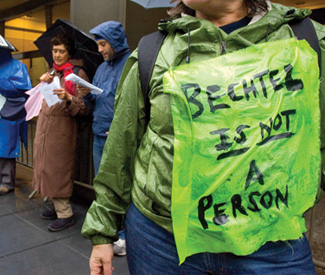
Protesters from the Occupy movement and beyond gathered in front of the Ninth Circuit Court of Appeals in San Francisco on Jan. 20, calling for the adoption of a 28th amendment to the U.S. Constitution aimed at refuting the idea that corporations should have the same rights as people, a legal doctrine know as corporate personhood.

The event was part of a day of action at courthouses around the country, seeking to raise public awareness about the unfettered influence of corporate money in U.S. elections and draw attention to the second anniversary of the landmark corporate personhood decision by U.S. Supreme Court, Citizens United vs the Federal Elections Commission.

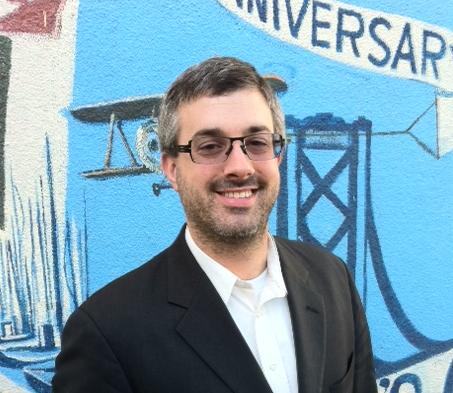
“We are here not to protest, not to petition, and not to plead, but to proclaim a truth that should be self evident, even to the Supreme Court: Corporations are not people; money is not speech,” said Abraham Entin, of North Bay Move To Amend, addressing a crowd gathered at the courthouse. “Corporations work very hard to convince us that we cannot do without them and the products they produce. They tell us they are too big to fail, and that our survival is dependent on their survival … Occupy has changed all that.”

In a contentious 5-4 ruling handed down on Jan. 21, 2010, the Citizens United case solidified the legal framework that bequeaths corporations the same rights under the Constitution as real, living, breathing, U.S. citizens, and by merit of their First Amendment rights as citizens bars any restrictions placed on a corporation’s ability to spend money to influence elections.

When Republican presidential candidate Mitt Romney famously said on the campaign trail that “corporations are people, my friend, because corporations have people inside them,” he is reflecting the logic of the majority opinion in the Citizens United case. The court’s majority asserted that corporations are essentially an association of people and thus enjoy the same rights as individuals.

The court also claimed that it is impossible to distinguish between the corporate media outlets and other corporate speech, so all corporations should enjoy the free speech rights saved for the press. Furthermore, because journalists often have to spend money to achieve speech, money spent on messaging by all corporations represents protected speech.

Corporations, a relatively modern invention, aren’t actually discussed in the Constitution. But the notion of corporation personhood began around 1886 in the case of Santa Clara County v. Southern Pacific Railroad. What Citizens United did was equate corporate money spent to influence elections with protected political speech, upending attempts at election reforms and gutting the McCain-Feingold Act of 2002 that regulated federal election campaigns.

That corporations act to corrupt our democratic systems for their own profit is not conspiracy, it’s simply a byproduct of what they are. Corporations are legally obligated to act to maximize their profits for the benefit of their shareholders, otherwise their board and corporate officers are considered negligent of their obligations to their shareholders’ financial interests. Unlike journalists, whose professional credo calls for fairness and acting in the public interest, corporations are designed to act in their own interests.

As Justice John Paul Stevens wrote for the dissenting judges in Citizens United, “Corporations have no consciences, no beliefs, no feelings, no thoughts, no desires. Corporations help structure and facilitate the activities of human beings, to be sure, and their ‘personhood’ often serves as a useful legal fiction. But they are not themselves members of ‘We the People’ by whom and for whom our Constitution was established.”

The resulting flood of corporate money into election campaigns since the court’s ruling is delivered through an aqueduct known as the Super PAC (political action committee). In the wake of Citizens United, election spending by Super PACs in the 2010 midterm elections exceeded $300 million dollars, more spending than the overall spending in the previous five midterm elections combined.

Unlike donations to campaigns, which so far remain regulated, Super PAC money is spent directly by the Super PAC, and can be spent attacking as well as supporting candidates, leading to fears that corporations can exert influence on incumbents before a re-election campaigns by threatening to spend money attacking them in the upcoming election cycle.

“Corporations are human creations, state creations, legal entities … There is no reason we cannot limit their spending,” said Carlos Villarreal, executive director of the National Lawyers Guild’s Bay Area chapter. “Nonprofit organizations are limited in their political spending. Churches and charitable organizations are also limited in their spending. So why not for-profit corporations?”

Perhaps no group knows more about government limits to free speech than participants of the Occupy movement. Elastic restrictions on individual free speech and freedom of association rights spelled out in the First Amendment, resting on alleged risks to health and public safety, have led to Occupy encampments across the nation being restricted and evicted, at times enforced by brutal police crackdowns.

The right of the government to restrict individual and group speech that officials believe represents a clear and present danger was established by the Supreme Court in the 1919 Schenck v United States case — the famous “don’t yell fire in a crowded theater” case. What is not widely known is that this case was a re-examination of the famous 1917 Espionage Act. The “crowded theater” was our nation’s entry into World War I, and those being jailed for “yelling fire” were labor organizers and pacifists expressing their opposition to our entry into the war.

Relying on Schenck, courts have consistently defended restrictions on individual free speech when there is a compelling interest to public safety, the so-called “clear and present danger” standard. Villarreal and the crowd gathered before the Ninth Circuit asserted that corporate influence in our democratic processes represents a clear and present danger to society. “There is no more compelling interest than protecting democracy,” said Villarreal.

Despite the apparent double standard, legal experts say the courts action in the Citizens United case leaves a constitutional amendment as the only avenue left for regulating corporate money in elections and ending corporate personhood, but the movement to take on that Herculean task has already begun.

U.S. Sen. Bernie Sanders (I-VT) and Rep. Ted Deutch (D-FL) have introduced legislation proposing a 28th Amendment to the Constitution. While the language differs from another amendment presented by the group Move to Amend, it also takes aim at ending corporate personhood.

“Two years ago, the United States Supreme Court betrayed our Constitution and those who fought to ensure that its protections are enjoyed equally by all persons regardless of religion, race or gender, by engaging in an unabashed power-grab on behalf of corporate America,” Sanders wrote in a Jan. 20 Guardian(UK) column.

In Sanders’ home state of Vermont, the state Senate is also considering a resolution calling for a constitutional amendment against corporate personhood. A similar resolution, authored by Alix Rosenthal, was adopted by the San Francisco Democratic County Central Committee during a special meeting on Jan. 21. There was just one dissenting vote, and DCCC members say they plan to push for the state party organization to also adopt the stance.

The hurdles set forth to amend the U.S. Constitution, outlined in Article V, are substantial. In order for an amendment to even be considered, a super majority of both houses of Congress must initiate the process, or two-thirds of states must call for the amendment. Proposed amendments passing this threshold are then adopted only after three-quarters of state legislatures ratify the proposed amendment. But that difficult road is one the protesters said they are ready to travel. “We are here on a rainy day with warm hearts and wet feet. We are the 100 percent, the humans. No corporation has every experienced the thrill of wet feet,” said Gangs of America author Ted Nace. “We are the fools who go out on a wet day to fix a broken world. Eighty percent of the public want to fix this. That means we are halfway to our goal. What remains is organization, mobilization.”

How should San Franciscans vote?

36

The Board of Supervisors Rules Committee will consider competing proposals for changing how elections are conducted in San Francisco tomorrow (Thu/26) at 2 p.m., taking public testimony and voting on which ideas should go before voters in June.

Sups. Sean Elsbernd and Mark Farrell propose to end the ranked-choice voting (RCV) system and go back to runoff elections, while Sups. David Campos and John Avalos propose modifying RCV to allow more than three candidates to be ranked and changing the public campaign financing system to make qualifying more difficult and thus thin the electoral herd a bit. They would also consolidate odd-year elections for citywide offices into a single year, a proposal that Sup. Scott Wiener is also offering as a stand-alone measure.

“We believe our current election system fundamentally works. However, we heard concerns from voters during our last election that it was difficult to discern the different ideas and ideologies of the numerous candidates in the race. We are introducing an ordinance today that is designed to address this concern,” Avalos said in a public statement on Jan. 10 when their measure was introduced.

That package came in reaction to the proposal to repeal the RCV system that voters approved in 2002, a campaign that has been strongly promoted for years by political moderates, downtown groups such as the San Francisco Chamber of Commerce, and the San Francisco Chronicle and other mainstream media outlets.

During a forum at the San Francisco Planning and Urban Research Association last week, Elsbernd debated Steven Hill – the author and activist who created the city’s RCV system – on the issue. Much of it came down to differences over how to gauge the will of voters and allow them to make good decisions.

Hill’s argues that runoff elections – which have traditionally been held in December, although the current proposal could create either June/November or September/November elections – tend to have very low turnout of voters (who tend to be more white, rich, and conservative than in general elections). And they are usually dominated by nasty, corporate-funded independent expenditures campaigns designed to sully the more progressive candidate.

“Let’s face it, December was just a terrible time of year for an election,” Hill said, adding that September would be just as bad, June is too early, and both options would also likely have low turnouts.

Hill said that while RCV may have flaws, so does every electoral system, but that RCV is an accurate gauge of voter preference. He displayed charts and statistics showed that the winning candidate in every election since RCV started has won a majority of the continuing ballots, which are those that remain after a voter’s first three choices have been eliminated.

But Elsbernd seized on that idea to say, “Continuing ballots, that’s what this issue is all about.” He made the distinction between continuing ballots and total ballots cast, saying the latter is what’s important and that few winners under RCV receive a majority of total ballots cast.

“Our elected officials should be elected by a majority of the votes cast,” Elsbernd said.

He said that runoff elections offer voters a clear distinction between different candidates and their ideologies, and he even dangled a proposition that might have appealed to progressives in the last mayor’s race: “Wouldn’t we have loved our month of Ed Lee debating John Avalos about the future of San Francisco?”

Elsbernd cited crowded field free-for-all races like the District 10 race of 2010, in which Malia Cohen came from behind to win using RCV, saying they muddy up the contests. “The benefit of the runoff is you get that true one on one,” Elsbernd said, calling for “real discussion, real debates, about what San Franciscans want.”

Yet Hill said the crowded fields of candidates in some recent races wasn’t caused by RCV, a system that promotes real democracy by giving voters more than one choice of candidates rather than being stuck with the lesser of two evils. And rather than showing the problems with RCV, Hill said Cohen’s election (an African-American woman elected to serve a largely African-American district) and that of Mayor Jean Quan in Oakland (who came from behind to beat Don Perata, who many perceived as a corrupt party boss) show how RCV can help elevate minority and outsider candidates.

All those arguments – and many, many more – will likely be made during what’s expected to be a long afternoon of public testimony.

Will Obama bring the populist fire in tonight’s speech?

13

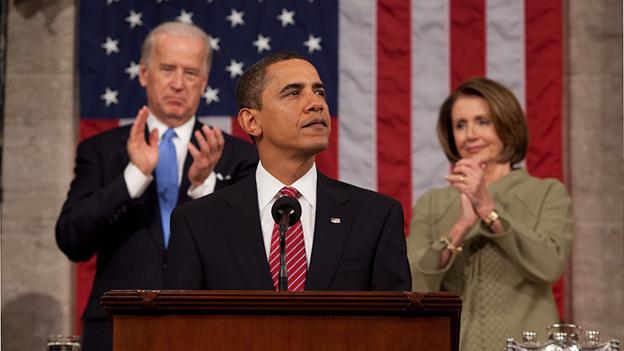
President Barack Obama has a choice for how he uses his State of the Union speech this evening. He could follow the advice of Blue Dog Democrats like Mark Penn, who wrote in The Hill today that Obama should avoid “rhetoric that could be interpreted as class warfare.” Or he can find his inner populist and give the speech that the 99 percent needs to hear by announcing that the rich and the Right have already declared that war, and now he intends to win it on behalf of the people.

I’m rooting for the latter, but fearful that Obama is no William Jennings Bryant – or either of the Presidents Roosevelt – and that he is just not up for seizing this moment and going to war with the powerful plutocrats who are ruining this country.

But there are signs that Obama is at least prepared to “double down on taxing the rich,” as the Christian Science Monitor put it today. Certainly, all signs indicate that he will at least raise the economic inequity issue again tonight, and it’s a positive sign that the invited audience will include Debbie Bosanek, the secretary to billionaire investor Warren Buffet that he famously complained shouldn’t be paying his same tax rate. Certainly, Obama intends to push for his “Buffet rule” that would tax investment returns as income rather than at lower capital gains rates.

But those sorts of reasonable arguments aren’t enough. Obama has been calling for higher taxes on the rich throughout his presidency, albeit never as forcefully as he did on the presidential campaign trail in 2008. And since then, he’s repeatedly betrayed that pledge in cutting deals with Republicans in Congress, exacerbating historically high concentrations of wealth and betraying his own stated principles.

The Occupy movement and most of the left – and even segments of the Tea Party right that complain about the economic elites – no longer trust Obama and the Democrats to fight for the interests of the commoner. We’ve become cynical about putting any hopes in a president poised to shatter campaign fundraising records this year.

Yet as Obama prepares to run for reelection against either a vulture capitalist or hypocritical moralist – both of whom will be openly shilling for the 1 percent – he should realize that it’s both good policy and good politics to capitalize on the opportunity that the Occupy movement has opened up, join the class war, and help us finally win it and seize the resources we need to deal with this country’s myriad problems.

Today’s Chronicle includes a front page story about Rep. Nancy Pelosi’s hopes that Democrats will pick up the 25 seats needed to retake the House of Representatives this year – along with analysts poo-pooing that possibility. The only hope they offered for Pelosi’s plan is a meltdown by the Republican presidential nominee.

But that sort of clear contrast between Democrats and Republicans won’t simply happen on its own, it is something that Obama and the Democrats will need to force by finally relying more on populist ire than using campaign contributions from the wealthy to tarnish their opponents. Simply winning the presidential election won’t help Obama break this country’s political gridlock, he needs to make this race about the undue power of the rich and the Right and win it on those terms.

Pelosi acknowledged that her best hopes for gaining a substantial number of Congressional seats are in California, but they don’t seem to realize that the real potential here is with changing the political dialogue and tapping the 58 percent of California voters who said in a November Field Poll that they agree with the economic critiques that sparked the Occupy movement (and even higher percentages have supported taxing millionaires). Even those who didn’t join the Occupy movement agree with its basic analysis that the few are exploiting the many.

There is a simmering populist discontent that will play out in unpredictable ways this year. And it’s possible that many of the left will never trust Obama until his deeds finally match his words. But there is no larger mainstream political podium in this country than the State of the Union speech, and if Obama misses this opportunity to declare his allegiance with the 99 percent – and his willingness to fight for us – then we may all just be in for the nastiest yet most meaningless presidential election in modern history.

Occupy Nation

15

news@sfbg.com

The Occupy movement that spread across the country last fall has already changed the national discussion: It’s brought attention to the serious, systemic problem of gross inequities of wealth and power and the mass hardships that have resulted from that imbalance.

Occupy put a new paradigm in the political debate — the 1 percent is exploiting the 99 percent — and it’s tapping the energy and imagination of a new generation of activists.

When Adbusters magazine first proposed the idea of occupying Wall Street last summer, kicking off on Sept. 17, it called for a focus on how money was corrupting the political system. “Democracy not Corporatocracy,” the magazine declared — but that focus quickly broadened to encompass related issues ranging from foreclosures and the housing crisis to self-dealing financiers and industrialists who take ever more profits but provide fewer jobs to the ways that poor and disenfranchised people suffer disproportionately in this economic system.

It was a primal scream, sounded most strongly by young people who decided it was time to fight for their future. The participants have used the prompt to create a movement that drew from all walks of life: recent college graduates and the homeless, labor leaders and anarchists, communities of colors and old hippies, returning soldiers and business people. They’re voicing a wide variety of concerns and issues, but they share a common interest in empowering the average person, challenging the status quo, and demanding economic justice.

We chronicled and actively supported the Occupy movement from its early days through its repeated expulsions from public plazas by police, particularly in San Francisco, Oakland, and Berkeley. We supported the right of the protesters to remain — even as we understood they couldn’t and shouldn’t simply stay forever. Occupy needed to evolve if it was to hold the public’s interest. The movement would ultimately morph into something else.

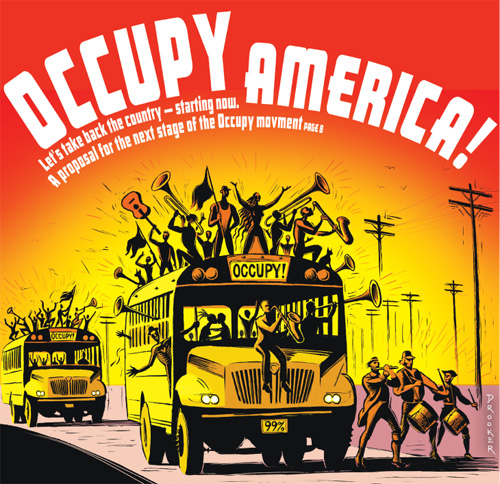
That time has come. This spring, Occupy is poised to return as a mass movement — and there’s no shortage of energy or ideas about what comes next. Countless activists have proposed occupying foreclosed homes, shutting down ports and blocking business in bank lobbies. Those all have merit. But if the movement is going to challenge the hegemony of the 1 percent, it will involve moving onto a larger stage and coming together around bold ideas — like a national convention in Washington, D.C. to write new rules for the nation’s political and economic systems.

Imagine thousands of Occupy activists spending the spring drafting Constitutional amendments — for example, to end corporate personhood and repeal the Citizens United decision that gave corporations unlimited ability to influence elections — and a broader platform for deep and lasting change in the United States.

Imagine a broad-based discussion — in meetings and on the web — to develop a platform for economic justice, a set of ideas that could range from self-sustaining community economics to profound changes in the way America is governed.

Imagine thousands of activists crossing the country in caravans, occupying public space in cities along the way, and winding up with a convention in Washington, D.C.

Imagine organizing a week of activities — not just political meetings but parties and cultural events — to make Occupy the center of the nation’s attention and an inspiring example for an international audience.

Imagine ending with a massive mobilization that brings hundreds of thousands of people to the nation’s capitol — and into the movement.

Occupy activists are already having discussions about some of these concepts (see sidebar). Thousands of activists are already converging on D.C. right now for the Occupy Congress, one of many projects that the movement can build on.


DEFINING MOMENTS

Mass social movements of the 20th Century often had defining moments — the S.F. General Strike of 1934; the Bonus Army’s occupation of Washington D.C.; the Freedom Rides, bus boycotts and Rev. Martin Luther King Jr.’s March on Washington; Earth Day 1970; the Vietnam War teach-ins and moratoriums. None of those movements were politically monolithic; all of them had internal conflicts over tactics and strategies.

But they came together in ways that made a political statement, created long-term organizing efforts, and led to significant reforms. Occupy can do the same — and more. At a time of historic inequities in wealth and power, when the rich and the right wing are stealing the future of generations of Americans, the potential for real change is enormous.

If something’s going to happen this spring and summer, the planning should get under way now.

A convention could begin in late June, in Washington D.C. — with the goal of ratifying on the Fourth of July a platform document that presents the movement’s positions, principles, and demands. Occupy groups from around the country would endorse the idea in their General Assemblies, according to procedures that they have already established and refined through the fall, and make it their own.

This winter and spring, activists would develop and hone the various proposals that would be considered at the convention and the procedures for adopting them. They could develop regional working groups or use online tools to broadly crowd-source solutions, like the people of Iceland did last year when they wrote a new constitution for that country. They would build support for ideas to meet the convention’s high-bar for its platform, probably the 90 percent threshold that many Occupy groups have adopted for taking action.

Whatever form that document takes, the exercise would unite the movement around a specific, achievable goal and give it something that it has lacked so far: an agenda and set of demands on the existing system — and a set of alternative approaches to politics.

While it might contain a multitude of issues and solutions to the complicated problems we face, it would represent the simple premise our nation was founded on: the people’s right to create a government of their choosing.

There’s already an Occupy group planning a convention in Philadelphia that weekend, and there’s a lot of symbolic value to the day. After all, on another July 4th long ago, a group of people met in Philly to draft a document called the Declaration of Independence that said, among other things, that “governments … deriv[e] their just powers from the consent of the governed … [and] whenever any Form of Government becomes destructive of these ends, it is the Right of the People to alter or to abolish it, and to institute new Government, laying its foundation on such principles and organizing its powers in such form, as to them shall seem most likely to effect their Safety and Happiness.”


ON THE ROAD

If the date is right and the organizing effort is effective, there’s no reason that Occupy couldn’t get close to a million people into the nation’s capital for an economic justice march and rally.

That, combined with teach-ins, events and days of action across the country, could kick off a new stage of a movement that has the greatest potential in a generation or more to change the direction of American politics.

Creating a platform for constitutional and political reform is perhaps even more important than the final product. In other words, the journey is even more important than the destination — and when we say journey, we mean that literally.

Occupy groups from around the country could travel together in zig-zagging paths to the Capitol, stopping and rallying in — indeed, Occupying! — every major city in the country along the way.

It could begin a week or more before the conference, along the coasts and the northern and southern borders: San Francisco and Savannah, Los Angeles and New York City, Seattle and Miami, Chicago and El Paso, Billings and New Orleans — Portland, Oregon and Portland, Maine.

At each stop, participants would gather in that city’s central plaza or another significant area with their tents and supplies, stage a rally and general assembly, and peacefully occupy for a night. Then they would break camp in the morning, travel to the next city, and do it all over again.

Along the way, the movement would attract international media attention and new participants. The caravans could also begin the work of writing the convention platform, dividing the many tasks up into regional working groups that could work on solutions and new structures in the encampments or on the road.

At each stop, the caravan would assert the right to assemble for the night at the place of its choosing, without seeking permits or submitting to any higher authorities. And at the end of that journey, the various caravans could converge on the National Mall in Washington D.C., set up a massive tent city with infrastructure needed to maintain it for a week or so, and assert the right to stay there until the job was done.

The final document would probably need to be hammered out in a convention hall with delegates from each of the participating cities, and those delegates could confer with their constituencies according to whatever procedures they prescribe. This and many of the details — from how to respond to police crackdowns to consulting of experts to the specific scope and procedures of this democratic exercise — would need to be developed over the spring.

But the Occupy movement has already started this conversation and developed the mechanisms for self-governance. It may be messy and contentious and probably even seem doomed at times, but that’s always the case with grassroots organizations that lack top-down structures.

Proposals will range from the eminently reasonable (asking Congress to end corporate personhood) to the seemingly crazy (rewriting the entire U.S. Constitution). But an Occupy platform will have value no matter what it says. We’re not fond of quoting Milton Friedman, the late right-wing economist, but he had a remarkable statement about the value of bold ideas:

“It is worth discussing radical changes, not in the expectation that they will be adopted promptly, but for two other reasons. One is to construct an ideal goal, so that incremental changes can be judged by whether they move the institutional structure toward or away from that ideal. The other reason is very different. It is so that if a crisis requiring or facilitating radical change does arrive, alternatives will be available that have been carefully developed and fully explored.”

After the delegates in the convention hall have approved the document, they could present it to the larger encampment — and use it as the basis for a massive rally on the final day. Then the occupiers can go back home — where the real work will begin.

Because Occupy will wind up spawning dozens, hundreds of local and national organizations — small and large, working on urban issues and state issues and national and international issues.


WASHINGTON’S BEEN OCCUPIED BEFORE

The history of social movements in this country offers some important lessons for Occupy.

The notion of direct action — of in-your-face demonstrations designed to force injustice onto the national stage, sometimes involving occupying public space — has long been a part of protest politics in this country. In fact, in the depth of the Great Depression, more than 40,000 former soldiers occupied a marsh on the edge of Washington D.C., created a self-sustaining campground, and demanded that bonus money promised at the end of World War I be paid out immediately.

The so-called Bonus Army attracted tremendous national attention before General Douglas Macarthur, assisted by Major George Patton and Major Dwight Eisenhower, used active-duty troops to roust the occupiers.

The Freedom Rides of the early 1960s showed the spirit of independence and democratic direct action. Raymond Arsenault, a professor at the University of South Florida, brilliantly outlines the story of the early civil rights actions in a 2007 Oxford University Press book (Freedom Rides: 1961 and the Struggle for Racial Justice) that became a national phenomenon when Oprah Winfrey devoted a show and a substantial online exhibition to it.

Arsenault notes that the rides were not popular with what was then the mainstream of the civil rights movement — no less a leader than Thurgood Marshall thought the idea of a mixed group of black and white people riding buses together through the deep south was dangerous and could lead to a political backlash. The riders were denounced as “agitators” and initially were isolated.

The first freedom ride, in May, 1961, left Washington D.C. but never reached its destination of New Orleans; the bus was surrounded by angry mobs in Birmingham, Alabama, and the drivers refused to continue.

But soon other rides rose up spontaneously, and in the end there were more than 60, with 430 riders. Writes Arsenault:

“Deliberately provoking a crisis of authority, the Riders challenged Federal officials to enforce the law and uphold the constitutional right to travel without being subjected to degrading and humiliating racial restrictions … None of the obstacles placed in their path—not widespread censure, not political and financial pressure, not arrest and imprisonment, not even the threat of death—seemed to weaken their commitment to nonviolent struggle. On the contrary, the hardships and suffering imposed upon them appeared to stiffen their resolve.”

The Occupy movement has already shown similar resolve — and the police batons, tear gas, pepper spray, and rubber bullets have only given the movement more energy and determination.

David S. Meyer, a professor at U.C. Irvine and an expert on the history of political movements, notes that the civil rights movement went in different directions after the freedom rides and the March on Washington. Some wanted to continue direct action; some wanted to continue the fight in the court system and push Congress to adopt civil rights laws; some thought the best tactic was to work to elect African Americans to local, state and federal office.

Actually, all of those things were necessary — and Occupy will need to work on a multitude of levels, too, and with a diversity of tactics.

Single-day events have had an impact, too. Earth Day, 1970, was probably the largest single demonstration of the era — in part because it was so decentralized. A national organization designed events in some cities — but hundreds of other environmentalists took the opportunity to do their own actions, some involving disrupting the operations of polluters. The outcome wasn’t a national platform but the birth of dozens of new organizations, some of which are still around today.

There’s an unavoidable dilemma here for this wonderfully anarchic movement: The larger it gets, the more it develops the ability to demand and win reforms, the more it will need structure and organization. And the more that happens, the further Occupy will move from its original leaderless experiment in true grassroots democracy.

But these are the problems a movement wants to have — dealing with growth and expanding influence is a lot more pleasant than realizing (as a lot of traditional progressive political groups have) that you aren’t getting anywhere.

All of the discussions around the next step for Occupy are taking place in the context of a presidential election that will also likely change the makeup of Congress. That’s an opportunity — and a challenge. As Meyer notes, “social movements often dissipate in election years, when money and energy goes into electoral campaigns.” At the same time, Occupy has already influenced the national debate — and that can continue through the election season, even if (as is likely) neither of the major party candidates is talking seriously about economic justice.

That’s why a formal platform could be so useful — candidates from President Obama to members or Congress can be presented with the proposals, and judged on their response.

Some of the Occupy groups are talking about creating a third political party — a daunting task, but certainly worth discussion.

But the important thing is to let this genie out of the bottle, to move Occupy into the next level of politics, to use a convention, rally, and national event to reassert the power of the people to control our political and economic institutions — and to change or abolish them as we see fit.

OCCUPY AMERICA IS ALREADY UNDERWAY

All across the country, Occupy organizers are developing and implementing creative ways to connect and come together, many of which we drew from for our proposal. We hope all of these people will build on each other’s ideas, work together, and harness their power.

From invading the halls of Congress to “occutripping” road trips to ballot initiatives, here is a list of groups already working on ways to Occupy America:


OCCUPY CONGRESS

Occupy Congress is an effort to bring people from around the country — and, in many cases, from around the world — to Washington DC on Jan. 17. The idea is to “bring the message of Occupy to the doorstep of the capital.” The day’s planned events include a “multi-occupation general assembly,” as well as teach-ins, idea sharing, open mics, and a protest in front of the Capitol building.

A huge network of transportation sharing was formed around Occupy Congress, with a busy Ridebuzz ridesharing online bulletin board, and several Occupy camps organizing buses all around the country, as well as in Montreal and Quebec.

There are still two Occupy tent cities in DC, the Occupy DC encampment at McPherson Square and an occupation called Freedom Plaza, just blocks from the White House. Both will be accepting hundreds of new occupiers for the event, although a poster on the Occupy Congress website warns that “the McPherson Square Park Service will be enforcing a 500 person limit.”

www.occupyyourcongress.info


OCCUPY BUS

The Occupy Bus service was set up for Occupy Congress, but organizers say if the idea works out, it can grow and repeat for other national Occupy calls to action. They have set up buses leaving from 60 cities in 28 U.S. states as well as Canada’s Quebec province. The buses are free to those who can’t afford to pay, and for those who pay, all profits will be donated to Occupy DC camps.

If all goes to plan, buses will be packed with passengers, their gear, and bigger donations for the event, as the “undercarriages of a bus are voluminous.” What gear do they expect each occupier to bring? “One large bag, one small bag, and a tent.”

congress.occupybus.com


DENVER OCCUTRIP

Many occupations have put together car and busloads of people to road trip to other occupations, hoping to learn, teach, network, and connect the movement across geographic barriers. One example is the Denver Occutrip, in which a handful of protesters toured West Coast occupations. The tenacious Occupy Denver recently made headlines when, rather than allow police to easily dismantle their encampment, a couple of occupiers set the camp on fire. It sent delegates to Occupations in Las Vegas, Los Angeles, Long Beach, Oakland, San Francisco, Berkeley, and Sacramento.

Sean Valdez, one of the participants, said the trip was important to “get the full story. What I’d been told by the media was that Occupy Oakland was pretty much dead, but we got there and saw there are still tons of dedicated, organized people working on it. It was important to see it with our own eyes, and gave a lot of hope for Occupy.”

Like lots of road-tripping Occupiers, they made it to Oakland for the Dec. 12 West Coast Port Shutdown action there. In fact, “occutrippers” from all around the country have flocked to Bay Area occupations in general, and especially the uniquely radical Occupy Oakland.

www.occupydenver.org/denver-occutrip-road-trip/


OCCUPY THE CONSTITUTION

An Occupy Wall Street offshoot — Constitution Working Group, Occupy the Constitution — argues that many of the Occupy movements concerns stem from violations of the constitution. They hope to address this with several petitions on issues such as corporate bailouts, war powers, public education, and the Federal Reserve bank. The group hopes to get signatures from 3-5 percent of the United States population before the list of petitions is “formally served to the appropriate elected officials.”

www.givemeliberty.org/occupy


THE 99% DECLARATION

This is a super-patriotic take on the Occupy movement, described on its website as an “effort run solely by the energy of volunteers who care about our great country and want to bring it back to its GLORY.” The group’s detailed plan includes holding nationwide elections on the weekend of March 30 to choose two delegates from “each of the 435 congressional districts plus Washington, D.C. and the U.S. Territories.”

These delegates would write up lists of grievances with the help of their Occupy constituents, then convene on July 4, 2012 in Philadelphia for a National General Assembly. They plan to present a unified list of grievances to Congress, the President, and the Supreme Court. If the grievances are not addressed, they would “reconvene to organize a new grassroots campaign for political candidates who publicly pledge to redress the grievances. These candidates will seek election for all open Congressional seats in the mid-term election of 2014 and in the elections of 2016 and 2018.”

www.the-99-declaration.org/


MOVE TO AMEND/OCCUPY THE COURTS

Move to Amend is a coalition focusing on one of the Occupy movement’s main concerns: corporate personhood. The group hopes to overturn the Citizens United vs. Federal Elections Commission ruling and “amend our Constitution to firmly establish that money is not speech, and that human beings, not corporations, are persons entitled to constitutional rights.”

The group has drafted a petition, signed so far by more than 150,000 people, and established chapters across the country. Its next big step is a national day of action called Occupy the Courts on Jan. 20. On the anniversary of the Citizens United ruling, the group plans to “Occupy the US Supreme Court” and hold solidarity occupations in federal courts around the country.

www.movetoamend.org/


THE OCCUPY CARAVAN

The Occupy Caravan idea originated at Occupy Wall Street, but the group has been coordinating with occupations across the country. If all goes according to plan, a caravan of RVs, cars, and buses will leave Los Angeles in April and take a trip through the South to 16 different Occupations before ending up in Washington DC.

Buddy, one of the organizers, tells us that the group already has “a commitment right now of 10 to 11 RVs, scores of vehicles, and a bio-diesel green machine bus. This caravan will visit cities, encircle city halls, and visit the local Occupy groups to assert their presence, and move on to the next, not stopping for long in each destination.”

This caravan is all about the journey, calling itself a “civil rights vacation with friends and family” and planning to gather “more RVs, more cars, more supporters…and more LOVE” along the way.

occupycaravan.webs.com

OCCUPY WALL STREET WEST

The Occupy movement in San Francisco has been relatively quiet for the past few weeks, but it’s planning to reemerge with a bang on Jan. 20, with an all-day, multi-event rally and march that aims to shut down the Financial District.

The protest is an effort to bring attention to banks’ complicity in the housing crisis plaguing the United States, and how that process manifests itself here in San Francisco.

At least 20 events are planned, centered in the Financial District. The plans range from teach-ins at banks to “occupy the Civic Center playground” for kids to a planned building takeover where hundreds are expected to risk arrest. A list of planned events can be found at www.occupywallstwest.org/wordpress/?page_id=74.

The day is presented by the Occupy SF Housing Coalition, which includes 10 housing rights and homeless advocacy groups. Dozens of other organizations will be involved in demonstrations throughout the day. “We’re asking the banks to start doing the right thing,” said Gene Doherty, a media spokesperson for the Occupy SF Housing Coalition. “No more foreclosures and evictions for profits. On the 20th, we will bring this message to the headquarters of those banks.”




Democracy in distress, but it’s the best of the alternatives

0


By Dominique Moisi

Dominique Moisi is the author of The Geopolitics of Emotion.

PARIS – Is democratic time too slow to respond to crises, and too short to plan for the long term?

At a time of deepening economic and social crisis in many of the world’s rich democracies, that question is highly relevant. In Italy, for example, Prime Minister Mario Monti has the necessary and legitimate ambition to carry out comprehensive reform. He is both competent and honest, but faces a quasi-structural impediment: whereas leaders once had three years to convince voters of their policies’ benefits, they now have three hours to convince global financial markets to back their approach.

Caught between Italian legislators who, deep down, do not understand that change and markets in quest of near-immediate certainties, can Monti transcend his natural prudence and act with sufficient clarity and decisiveness?

In the United States, too, the political system is becoming increasingly dysfunctional. The political philosopher Francis Fukuyama goes so far as to say that “vetocracy” could triumph over democracy, regardless of who wins the 2012 presidential election. The separation of powers, a principle established by the US founders under the influence of philosophers such as Montesquieu, is leading today to near-paralysis.

Democracies suffer not only from their slow reaction time at moments of crisis, but also from the difficulty that they face in projecting themselves into the future and planning for the long term. On both sides of the Atlantic, political leaders know what they must do for their countries, but don’t know how to get re-elected if they actually do it. They seem to be structurally condemned to short-termism.

But it is not because democracies have a “time problem” that their era seems to some to be over. China is rightly proud to be able to project itself into the twenty-second century. But China owes that quality of long-term thinking much more to its culture than to the nature of its political system. Chinese think long term because they are Chinese, not because they are not democrats.

China’s leaders can, of course, react to events without much regard for Chinese public opinion. After all, the great majority of Chinese do not dream of democracy, even if something like a civil society is emerging, generating new interests and demands that can no longer be totally controlled or manipulated, as in the past.

But that is precisely the weakness of non-democratic regimes in a global age dominated by transparency: Who dreams of becoming a Chinese citizen, or even a citizen of Singapore? In the aftermath of North Korea’s hereditary succession, strategic thinkers rightly emphasize China’s key role in shaping the peninsula’s future. But, despite the scenes of hysteria that followed the death of the “Great Leader” Kim Jong-il, most North Koreans probably dream of joining democratic South Korea (even if many South Koreans fear that prospect).

The majority of Chinese may not want to be governed like Westerners, but it would be wrong to assume that their only ambition is to spend like Westerners. The more successful they are, the more individualistic they will become and the more they will expect the respect and consideration of those who govern them.

By contrast, if China’s economic growth slows, which is likely in the coming years, protest against corruption – a source of fragility for any regime – will escalate. Indeed, it is important to bear in mind that, ahead of the upcoming Chinese leadership transition, new occupants for only the top two posts have been chosen, and that through a process of gradual anointment by roughly a hundred people at most.

The current crisis in the advanced countries, which may very well lead to a global recession (if it is not already doing so), not only reveals the many maladies of democratic regimes, but also acts as their incubator and accelerator. And yet the crisis may turn out to have an even greater impact on non-democratic systems that seem to be more efficient, but are in reality much more fragile. We see this in mounting unrest in both Russia and China.

Contrary to what one might think, democracy is more resilient than the alternatives in the long run. This will remain true as long as democrats remain convinced of it. Non-democratic models cannot truly challenge democracy. Only the misbehavior of democrats can do that.

Dominique Moisi is the author of The Geopolitics of Emotion.

Copyright: Project Syndicate, 2012.
www.project-syndicate.o

States push back on Citizens United ruling

44

With the upcoming anniversary of the Citizens United decision, the U.S. Supreme Court ruling that allowed corporations to make unlimited campaign contributions, California Assembly member Julia Brownley (D-Santa Monica) is pushing a bill to ensure that corporate entities making political donations are required to at least disclose those contributions.

The California Disclose Act, AB 1148, specifically addresses accountability in election campaign ads, forcing corporate sponsors to step out from behind cryptic political action committee (PAC) names when they fund political advertisements.

“Currently the top two donors must be disclosed on political ads, usually behind meaningless campaign committee ads,” said Michelle Romero, manager of the Our Democracy program at the Greenlining Institute, which is supporting the legislation. “We hope to really pierce through the committee names to the top three donors behind ballot measure expenditure campaigns.”

Romero’s ideal realization of this bill would be to require political ads to list donors by the name of the corporation, rather than just its made-up PAC name. “Instead of saying, ‘This ad was paid for by the Committee for Responsible California,’ the ad would list the logos and names of top donors,” said Romero. “For example: the donors are Chevron, Comcast, etc.”

Yet other states have taken even bolder steps to counteract the Citizens United decision. The Montana Supreme Court recently affirmed a ban on unlimited corporate spending on political campaigns, seemingly defying the U.S. Supreme Court. But the Montana judges said that due to the rural state’s low-budget elections and the ability of a few large corporations (particularly mining interests) to drown out everyone else, the Citizens United case did not apply to Montana’s Corrupt Practices Law, which bars corporations from using company resources to make political contributions.

“The government is supposed to represent the people,” Romero said, “not corporate interests.” said Romero.

Newt Gingrich, commie radical

11

Actually, more likely Newt Gingrich, Scorched Earth Opportunist, but whatever, we’ll take it: Newt — he the friend of plutocrats and one-time lobbyist for predatory lenders — is launching an assault on Mitt Romney, calling him, in essence, a capitalist pig who exploits the workers.

The fact that it’s true makes the story even more fun. As does the fact that Romney has run so far to the right in the primaries that Obama — by any standard in serious trouble — now has a natural line of attack against the candidate most likely to offer him a credible challenge.

Here’s CalBuzz:

The Occupy Wall Street movement has succeeded in pushing the issue of the nation’s vast wage and wealth disparity onto the agenda of the 2012 campaign. While Republicans in the past have been successful in dismissing discussion and debate about the Third World levels of wealth concentration in the U.S. as unpatriotic “class warfare,” the inarguable facts about the massive gap between the wealthiest Americans and everyone else are now well-known by many mainstream voters, at a time when Romney stands as a central casting character representing the 1%.

Paul Hogarth at BeyondChron says that ” many of us wish that Democrats had the chutzpah to be this scathing and direct,” and I can’t argue with that. The good news is that the Newtclear Bombs in South Carolina will probably work: Romney’s going to win the nomination, and everybody knows it, but the blitz of revenge ads may wound Romney enough to convince the Obama folks that this is the line of attack to use during the general election.

In other words, Newt is pushing the Democratic party to the left, legitimizing the class warfare that the Republicans so love to denounce as unAmerican.

How much do we love this?

On the Cheap Listings

0

Submit items for the listings at listings@sfbg.com. For further information on how to submit items for the listings, see Picks.

WEDNESDAY 11

Humpday Happy Hour Good Vibrations, 899 Mission, SF. www.goodvibes.com. 6:30-7:30 p.m., free. How about this: Good Vibes will help you find your G-spot for free. But don’t cancel tonight’s date. Seasoned staff will be telling a come-one-come-all happy hour gang how to use the sex toy shop’s line of G-reat stimulators – and the first 10 attendees get a free tool, which will make any homework assigned a lot easier.

THURSDAY 12

“The Story of an Oyster” discussion California Historical Society Museum, 678 Mission, SF. www.californiahistoricalsociety.org. 5:30 p.m., free. RSVP to rsvp@calhist.org. The salty contention over Point Reyes’ Drakes Bay Oyster Farm revolves around allegations of scientific misconduct as well as possible environmental damage. Today, the owners come to San Francisco for a mediated discussion of all things oyster.

FRIDAY 13

“Four Painters California” opening party Firehouse North Gallery, 1790 Shattuck, Berk. firehouseartcollective.blogspot.com. 7-9 p.m., free. Four painters from Berkeley’s Firehouse Art Collective display their artistic takes on the Golden State at this California-spirited shindig, which will feature a kombucha bar and live music.

“You Must Not Blame Me If I Do Not Talk to Clouds” opening party Satellite66, 66 Sixth St., SF. www.satellite66.org. 7-10 p.m., free. Artist Robert Long has created a rather nebulous dreamscape of an installation through which visitors can roam and explore the cumulonimbus of their imaginations.

“Tall Tales of Bad Luck” Writer’s Grotto open reading The Grotto, 490 Second St., SF. www.sfgrotto.org. 7 p.m., free. You know how you get a writer onstage? Let them talk about how hard their life is, and provide beer. Hey, it would work for us – and will tonight, as Guardian alumni writers take the Friday the 13th stage at this venerable writer’s den. The unaffliated are welcome to read as well if they get there early enough to sign up. Refreshments provided by 21st Amendment Brewery, so no whining.

SATURDAY 14

Writers with Drinks Make Out Room, 3225 22nd St., SF. www.makeoutroom.com. 7:30-9 p.m., $5. Thomas Roche (zombie novelist — no, not undead, just likes to write about them), Mary van Note (zinester supreme) and Justin Chin (forceful poet, writer on subjects like the avian flu) get together for “an evening of uncomfortable sex talk.” Proceeds benefit the Center for Sex and Culture.

Sacred Harp singing convention Casa de Flores, 737 Walnut St., San Carlos. Also Sun/15. 9 a.m.-3 p.m., free. A sort of congenial triathalon for singers across the country, the Sacred Harp style of singing dates back before the Civil War, when church music was more egalitarian in spirit. Particularly noteworthy are the musical notes themselves, conveyed in an obsolete, polygon-based style.

SUNDAY 15

Godwaffle Noise Pancakes performance The Lab, 2948 16th St., SF. www.thelab.org. 12 p.m., $5. Sonic experimenters R K Faulhaber and Hora Flora join forces over vegan pancakes for a “savage and transcendent” performance.

Masala Boom Room for Big Ideas, Yerba Buena Center for the Arts, 701 Mission, SF. www.ybca.org. 2 p.m., free. Derick Ion, nomadic photographer, Burning Man-Day of the Dead busy bee, and Room for Big Ideas’ resident artist, brings Kirtan and gypsy music, chai, and henna to Yerba Buena for an interactive afternoon with guests.

MONDAY 16

Free admission day Museum of the African Diaspora, 685 Mission, SF. www.moadsf.org. 11 a.m.-5 p.m., free. MoAD celebrates Martin Luther King Day with free admission and two filmmaker-led screenings. More Than a Month examines the problems inherent to condensing black history into one month; The Barber of Birmingham recounts, through the lens of the 2008 election, the discovered story of haircutting Civil Rights activist James Armstrong.

TUESDAY 17

“How Money Corrupts Congress – and a Plan to Stop It” Novellus Theater, Yerba Buena Center for the Arts, 700 Howard, SF. www.ybca.org. 7:30 p.m., $10. Sponsored by the Long Now Foundation, responsible for installing a 10,000 year clock in the side of a mountain, Lawrence Lessig talks congress reform.


Editor’s notes

0

tredmond@sfbg.com

It’s hard for California cities to raise taxes. Almost anything that amounts to a tax hike has to go before the voters, and most of the time, it requires a two-thirds vote.

But in a year when the local legislators are also up for election — and six of the supervisorial districts are up this fall — the voters can pass taxes with a simple majority.

That’s one reason that 2012 is a perfect year for tax reform in San Francisco. The other is the spirit of Occupy.

The tent-city protests changed the political dynamics all over the country, putting the message of economic injustice on the agenda and on the front pages. That’s even more true in this city, which was one of the epicenters of the national movement.

Mayor Ed Lee announced in his inauguration speech that he’s going to be the mayor “of the 100 percent,” an effort to preach the message that we’re all good pals and we all love each other here in this great city of ours, but the truth is we aren’t, and we don’t. The very rich in San Francisco not only have little in common with the rest of us; for the most part, they like it that way. The biggest corporations and wealthiest individuals have an interest in preserving economic injustice, and they’ve shown repeatedly that they will go to great lengths to prevent progressive change.

San Francisco needs to change the way it raises revenue, and one of the key elements of that is the local business tax. Right now it’s a flat tax on payroll, and a lot of people (including me) don’t like it. So there’s movement for a new type of tax, maybe on gross receipts.

That’s fine — but it has to be more than a shift in how taxes are determined. San Francisco desperately needs more money — probably at least $250 million a year — to balance the budget without further cuts and to make up for what the state and federal government have taken away. And a new business tax needs to be progressive — to hit the biggest and the richest harder than the small and struggling.

I fear the mayor is not going to be pushing that kind of agenda, so someone on the board has to do it. This is the year that a “tax the one percent” measure can win. But we need to get started now.

Who will push progressive taxes in 2012?

47

Mayor Ed Lee talked to the Examiner about his plans for the next year, and it’s a lot of the usual political crap: I’m going to create jobs, I’m going to bring people together and promote civility, ho hum. But he did mention, briefly, the need to change the city’s business tax, and here’s how he put it:

We have given ourselves four months to reach out to all the business groups. There will be different views and opinions. You can have a hybrid [between a payroll and gross receipts tax], and you can also have a phase-in period of time. We want to have a good conversation with everybody and get their best ideas, and then use those ideas to craft what we think could be on the ballot. We’re not saying it has to be on the November ballot, but it could be. We want to have something that is not job punishing, but also something that does not decrease our revenue.

First: He’s going to reach out to all the business groups — but what about everyone else in the city? The level of business taxes has a direct impact on city services; is that not part of the equation? Clearly, he’s talking about something that’s at best revenue-neutral, something that “does not decrease our revenue.”

And please, don’t tell me about “job punishing” — it makes me even crazier than I already am. Look: There has to be a business tax in San Francisco. And any time you tax businesses, you take money for the city that could be used for other things. In some cases — not that many — the extra money might be used to hire a few people. In reality, for most businesses, the payroll tax is absolutely NOT a factor in job creation. It sounds bad — Gasp! a tax on jobs! — but the truth is that payroll is a rough approximation for the size of a company, and that’s what the city uses as a tax base.

Of course, we could change that to a gross receipts tax — another rough approximation for the size of a company. It’s also imperfect — some companies have a lot of money (VC funding, for example) and a lot of employees, but at this point not much in the way of sales. Some companies (supermarkets, for example) have high gross receipts but relatively low profit margins. And, of course, if you do a gross receipts tax the same people who complain about the payroll tax will have a new line: The GR tax penalizes growth! It penalizes success! The more money you make the more you pay! Unfair! Un-American! Job killer!

Because some people in this town (mostly big business types) just want lower taxes, period — not different taxes, lower taxes

So let’s get rid of the “job killer” rhetoric and start talking about what the city’s tax policy should be. And it should go like this: The individuals and businesses with the most money should pay the highest tax rates. The rich don’t pay their fare share anywhere in the U.S., and while the mayor and the supervisors can’t change federal policy, they can do their part on a modest level at home.

This a great year for tax reform in San Francisco. The spirit of Occupy is very much alive. There is, for the first time in decades, a national discussion about income and wealth inequality. There’s strong evidence that the middle class is vanishing in San Francisco. And, thanks to the wierdness of state law, in 2012, when there’s an election for the Board of Supervisors, a tax measure can pass with a simple majority vote In many ways, this is the single most important policy issue in the city, the one that defines who pays for what and who gets what and whether (public sector) jobs are created or destroyed and what kind of a city we want to be.

So let’s take it seriously. Instead of allowing Mayor Lee and the (big) business folks set the agenda, the progressives really need to move forward on a tax-reform plan that looks at making big business pay more and small business pay less — and that brings in another $250 million a year for the local coffers If gross receipts is the flavor of the day, I’m good with that — but not a flat tax. Exempt, say, the first $250,000 (or the first $500,000, whatever, run the numbers and see what we can afford). Put a 1 percent tax on the next million, a 1.5 percent tax on all receipts between $1.5 million and $5 million, a 2 percent tax on $5 million to $10 million and 3 percent on everything higher. Adjust the numbers either way, but that’s the general idea. Then add in a tax on commercial rents (again, exempt the first $500,000 or whatever) to make sure the the big landlords (who get away with murder under Prop. 13) are paying, too. And yes, based on market supply and demand, some will try to pass that on to their tenants, but companies (including a lot of law firms) that rent enough space to be paying millions of dollars a year in rent can afford to modest tax hike.

It will take the city controller or the city’s economist to do the math and see what the options are and how you get to $250 million net new revenue, so my proposal is just a start. But somebody needs to take this on, some member of the Board of Supervisors — or else we’ll just be responding to what the Chamber of Commerce wants. Who wants to be the champion of Tax Reform for the 99 Percent? Time is getting short.

Daly is back in a progressive leadership role

45

Chris Daly, a pivotal organizer of progressive politics during his decade on the San Francisco Board of Supervisors, has returned to a high-profile role in the movement. Last month, he went to work for Service Employees International Union Local 1021, the city’s largest public employee year. And today, he was named its interim political director.

“I’m excited and I think everyone here is excited to have Chris’s talent and experience and energy on this team,” local President Roxanne Sanchez, who was elected as part of a progressive reform slate in 2010, told the Guardian. “Part of the vision of the executive board, and the mandate that we were elected on, is to build a long-lasting sense of power at the rank-and-file level.”

Even before lending support to the Occupy movement and its challenge to the power of the richest 1 percent of society, Local 1021 was targeting banks and other downtown financial institutions with its Fight for a Fair Economy campaign. Now Daly can continue pushing that agenda and connecting the dots between the consolidation of wealth and the hardships faced by workers and local government.

“The spark has been the Occupy movement, but it’s been 1021 that has been helping to instigate some of these possible next steps…It has an opportunity to be successful if there’s some institutional support for it,” Daly said of San Francisco’s progressive movement, which suffered a setback when he and other board progressives were termed out, and a bit of a revival in the fall with the emergence of OccupySF.

“Occupy is going to need some foundation to continue its work,” Daly said. “Without organizational or structural support, that could have been a one-time thing.”

But now, during an important election year when the union’s contracts with the city expire, Daly sees an opportunity to forward the interests of both union members and the broader progressive movement. Both Daly and Sanchez say educating their members and the general public about the importance of progressive issues is essential to advocating for their members, who are among the city’s lowest paid workers and those who have suffered the most layoffs in recent years.

“If there’s not a notion of the distribution of wealth and the 99 percent, we won’t be successful,” Daly said. “Downtown is powerful, and labor needs to be here to offset the power of downtown. Without that, we’re stuck.”

Sanchez said the reorganization now underway in her union, of which hiring Daly is a key component, is about turning the clock back on the labor movement and returning to an agenda of broadly building working class power, as unions did in the ’30s and ’40s before becoming more bureaucratic institutions in the ’50s.

“Chris, and his perspective of building community strength, is our focus,” Sanchez said. “This is the time when unions have to help move a working family agenda and to push back on the opportunistic wealthy interests in this society.”

In the year since he left the board, Daly has been running the bar he purchased, The Buck (formerly Buck Tavern) – which became like a progressive clubhouse and gathering spot – as well as helping John Avalos’s mayoral run and other campaigns. Daly says he wants to maintain that role by continuing to tend bar on Friday nights, but he plans to pour most of his energies into a new role that is really a continuation of his old role.

“For me, it was never about being on the Board of Supervisors. It was about trying to make the progressive movement strong and more effective…In some ways, I was one of the unofficial political directors of progressive San Francisco,” Daly told us. “I have a strong motivation to build a progressive political program, and now I have the opportunity to do that.”

What? Glenn Beck in for Strephanie Miller on Green 960

20

As we were driving to work this morning (1/4/2012), we were surprised and angered to find Glenn Beck, the rightwing  broadcaster who was too much for Fox News, replacing Stephanie Miller, the liberal, articulate, and clever talk show host on Green 960. How in the world could that be?  How in the world could the Clear Channel broadcast conglomerate put Beck on morning drive time on Green 960, which up to now had “proudly” proclaimed itself as the progressive radio station in progressive San Francisco? .How could it make this crucial political change at the very start of the presidential electon season?  Was it because Clear Channel is now owned by another conglomerate involving Mitt Romney? (In 2008, a Boston-based private equity firm purchased Clear Channel in a leveraged buyout, according to the Bradblog.)  Has Clear Channel/Romney no shame?

I have often tried in vain through the years to contact Clear Channel for explanation or comment on news stories. This time, I  am happy to turn the job over to the Bradblog below, operated by Brad Friedman, who runs an excellent independent blog specializing in investigative reporting, broadcast analysis, and election integrity issues.

Read what he has to say and get good and mad. Clear Channel is screwing the City and County of San Francisco yet again. Resist! B3
http://www.bradblog.com/?p=8974


What the new year brings

0

caitlin@sfbg.com

HERBWISE 2011 was a harsh year for medical marijuana. During its first half, the number of California dispensaries burgeoned. But a federal crackdown in September has left much of the industry shaking in its buds. By bombarding landlords with cease-and-desist letters threatening 40 years of jail time if they continue to let marijuana be sold on their property, the Department of Justice has effectively closed down walk-up operations for many smaller dispensaries.

But as we head into the year of the Mayan overhaul, one thing seems certain: advocates for safe and available access to medical cannabis aren’t going anywhere. How can they? Since Proposition 215 made it legal in 1996, 200,000 Californians have gotten physician recommendations to alleviate health concerns with marijuana. People use it for chronic pain, to make it through chemotherapy, for multiple sclerosis, severe anxiety.

“We can’t wait for the federal government to do the right thing in California,” said the state director of Americans for Safe Access Don Duncan. “As the state of California gets its marijuana house in order there will be less incentive for the feds to come in.”

Duncan and his organization were co-authors of the Medical Marijuana Regulation, Control, and Taxation Act — a unified voter initiative that was turned in to the California Secretary of State’s office last Wednesday, Dec. 21. Other contributors include NORML, the California Cannabis Association, the Humboldt Growers Associations, and the United Food and Commercial Workers — the union that now represents workers across the state, including Oaksterdam University employees.

“We’re hoping that this policy will reassure people that we can have a rational system,” continued Duncan in a phone interview with the Guardian. Duncan is convinced that the recent aggression by the Obama administration can be traced to people’s discomfort with the industry’s wild growth, and that a good faith effort to institute a comprehensive regulation system will assuage people’s confusion and fears about marijuana.

His initiative calls for the establishment of a centralized bureau of medical marijuana enforcement, to be comprised of 21 members from various state government offices, patients, advocates, a physician, a nurse, individuals from the marijuana research and policy fields and six people with experience in dispensary operations.

The bureau would be in charge of cannabis registration, industry regulations, and the use of funds that are generated by administrative fees. The initiative also calls for a sales tax of 2.5 percent on medical marijuana retail sales and states that cities — unless voters approve other guidelines — must follow a minimum zoning restriction of a dispensary for every 50,000 people.

In January, a campaign supporting the initiative will begin to drum up awareness. Backers are hoping that by instituting stricter and more consistent controls of dispensaries and growing operations, 2012 will look a lot brighter for the 200,000 Californians that have relied on their marijuana prescription to live their lives.

“I think this is really going to resonate with voters,” said Duncan. “We just need for officials to be able to step outside the controversy of it all.” It’s a hopeful stance. Let’s see how it holds up in the roiling of the upcoming election year.

Zero for conduct

1

arts@sfbg.com

YEAR IN FILM American cinema lost several of its troubadours this past year: genuine independents like Robert Breer, Owen Land, Adolfas Mekas, Richard Leacock, Jordan Belson, and George Kuchar. Critical appraisal of these sui generis filmmakers tends to rest upon masterpieces and technique, but several were also influential as teachers.

Mekas founded the film department at Bard College, which today boasts a remarkable faculty including Peter Hutton and Kelly Reichardt. German filmmaker Helga Fanderl dedicated her San Francisco Cinematheque show earlier this fall to Breer, her mentor at Cooper Union. Leacock used his post at MIT in the 1970s to develop relatively affordable video systems for student filmmaking. Kuchar brought several generations of San Francisco Art Institute kids into moviemaking laboratories flying under banners like “AC/DC Psychotronic Teleplays” and “Electro-graphic Sinema.” After Kuchar’s passing SFAI professor and administrator Jeannene Przyblyski wrote, “I will very much miss waking up at night worrying about what might be going on in Studio 8.”

Teaching remains an underappreciated aspect of the whole adventure of avant-garde filmmaking. The late 2010 release Radical Light: Alternative Film and Video in the San Francisco Bay Area, 1945–2000 (University of California Press) lovingly detailed the instructional incubators that have contributed to a long-flourishing Bay Area avant-garde, but one still hungers for more particular chronicles along the lines of “Professor Ken,” Michael Zryd’s contribution to Optic Antics: The Cinema of Ken Jacobs (Oxford University Press). Zryd persuasively links Jacobs’ intensive teaching style at SUNY Binghamton to his thrilling feature-length frame analysis, Tom, Tom, the Piper’s Son (1969). The story of the American avant-garde’s alliance with the academy has everything to do with the mid-century college boom and the rise of theory, but this general view doesn’t take into account those outlying autodidact instructors who reoriented the teacher-student exchange in much the same way that they called upon a different kind of spectatorship.

Among the many treasures in the SFAI archive’s George Kuchar file are a couple of his syllabuses: “In this workshop atmosphere we all embark on making a moving picture using the equipment at school and … whatever else falls into our hands.” Class participation is what the class was. It’s also discretionary: “Come as frequently as you wish so that we can showcase your unique talents or specialty acts and help us try to solve the many technical and creative problems involved in making moving pictures.” Asked about his unorthodox teaching materials, Kuchar responded, “Am I going to show the students Potemkin and then talk about our class movies? With the kind of words I use and my accent? It’ll be like sacrilege or something … It’s stupid anyway. Renting movies is expensive as hell, and you can put that money into making a movie.”

Kuchar’s creativity took a liberating form in the classroom. Elsewhere in the SFAI file, the filmmaker reflects upon having to rescue terrible class productions in the editing room. One laughs at first and then is touched that he considered these real movies, imperfect but necessary to see through.


RAY OF LIGHT, RAY OF DARKNESS


One of the year’s most significant film restorations originated in a comparable workshop environment. Nicholas Ray arrived at SUNY Binghamton in 1971 not having directed since 55 Days at Peking (1963). As in Kuchar’s workshops, he took his students as collaborators: everyone rotated production jobs and worked toward the common ends of We Can’t Go Home Again, an unspooled picture of dissolution spanning the election years of 1968 and 1972. The workshop process became central to the psychodrama itself. As in other films of the era by John Cassavetes, Robert Kramer, and Shirley Clarke, the filmmaking style dives deep into breakdown narratives: he and four students charting out self-destructing versions of themselves.

In Leo Tolstoy’s prescriptive essay “Are the Peasant Children to Learn to Write from Us, or Are We to Learn from the Peasant Children?”, the great Russian author dramatizes his teaching experience to show how an attuned instructor can enrich a student’s intrinsic sense of harmony. Ray evinces a similar degree of trust in his pupils, but towards the ends of drawing out their intrinsic disharmony (this was Nixon time, after all). The composition of the drama and the drama itself bleed into one another; performance is inescapable, the film grasping how the phrase “the personal is political” was reversing itself.

We Can’t Go Home Again — which plays in a restored and reconstructed version along with Susan Ray’s contextualizing documentary Don’t Expect Too Much at Yerba Buena Center for the Arts in January 2012 — was long thought unsalvageable for both technical and artistic reasons. Ray conceived the film as a multi-projector performance, with several streams of narration playing simultaneously and various 16 mm/Super 8 mm frames affecting a kind of cinematic Guernica. The limitations of the novice crew are readily apparent, though the amateur acting likely plays differently in our present media environment. Ray continued to tinker long after presenting a version at the 1973 Cannes Film Festival, and the present reconstruction doesn’t claim to be definitive. It does, however, make Ray’s vision a feasible if still challenging theatrical proposition.

As always in the director’s work, the characters’ emotions are primary and sharply defined in space. Vulnerable figures reach across their loneliness; improvised family units emerge from the ashes of corruption and betrayal. The thin veneer of middle-class reality that gives 1955’s Rebel Without a Cause and 1956’s Bigger Than Life their magnificent tension is gone, leaving only the characters’ own psychological mirrors and Ray himself clad in James Dean’s red jacket. Student Tom Farrell is the last of Ray’s boy angels, a bewildered innocent suffering moral estrangement from his policeman father (whom he loves). The agonizing close-up in which he shears his beard in front of both a mirror and Ray’s camera is both visceral and symbolically telling, the beating heart of the film.

Though deeply marked by shame and pain, We Can’t Go Home Again also has a comic streak. The counterculture dream is pictured as eating raw cauliflower without any pants on. As he prepares to act out his suicide Ray mutters to himself, “I made ten goddamned westerns, and I can’t even tie a noose.” Of course this kind of flaunted martyrdom requires its own vanity, which might lead one to wonder about the lasting impact of Ray’s teaching — that is, whether his ferocious movie might have superseded the students’ learning.

His colleague Ken Jacobs certainly thought so: “I had the dumb idea that he would balance the little department, teaching from his narrative/Hollywood experience but he was self-aggrandizing BS throughout, with tantalizing glimpses of a former self.” Don’t Expect Too Much justifiably avoids department politics to focus on the film itself, but knowing this acrimonious background colors Ray’s former students’ awed remembrances of the Great Artist. There’s a lot of talk about the director working by instinct, exactly the kind of mystification Jacobs targets when he draws a distinction between “living through the cinema” and “using film to enrich your engagement with life and the real world”: “One is an experience that dominates while the other condemns you to be free.” The irony is that it’s hard to imagine a public university giving either man so much freedom today — if they even hired them at all.

The redistricting furor

55

I opposed the measure that created California’s new Redistricting Commission. As we noted in our endorsements at the time:

The commission is hardly a fair body — it has the same number of Republicans as Democrats in a state where there are far more Democrats than Republicans. And most states still draw lines the old-fashioned way, so Prop. 20 could give the GOP an advantage in a Democratic state. States like Texas and Florida, notorious for pro-Republican gerrymandering, aren’t planning to change how they do their districts.

But Prop. 20 passed anyway, and control of the critically important task of drawing lines for state Legislature and Congressional districts fell to an unbalanced group of people with no political experience. They commission held hearings up and down the state, took reams of testimony — and wound up with a map that will probably add six or seven Democratic seats to the Congressional delegation.

That’s not a big surprise: Democratic Party registration is stable in a very blue state, and Republican registration is declining. Any fair redistricting would likely lead to more Democratic seats. And it’s clear that the likes of Phil Burton were not involved: In Los Angeles, two powerful veteran members of the House, Brad Sherman and Howard Berman, wound up in the same district. No matter what happens, the Democratic Party will lose one of its heaviest hitters.

But ProPublica, the national (and generally very solid) investigative reporting group, took on the process and concluded that the Democratic Party managed to wire the deal:

As part of a national look at redistricting, ProPublica reconstructed the Democrats’ stealth success in California, drawing on internal memos, emails, interviews with participants and map analysis. What emerges is a portrait of skilled political professionals armed with modern mapping software and detailed voter information who managed to replicate the results of the smoked-filled rooms of old.

(Memo to the folks at PP: There haven’t been “smoked filled rooms” in this state in quite a while. By the time the 1990 census was done, most of the state (including most public facilities) had strict limits on indoor smoking, and in 2000, nobody smoked in any rooms controlled by any governmental agency. But we get the point.)

The story has set off a furor. Robert Cruikshank, one of my favorite political bloggers, did a fairly brutal takedown on the report:

Of course, the core assumption that California Republicans deserved any new seats is challenged by their collapse in the November 2010 elections. While Republicans across the country were having a banner night, California Republicans lost every single statewide election (including losing the governor’s race by 13 points despite outspending the Democrats nearly 10 to 1). They also failed to pick up a single seat in either the legislature or Congress, losing one Assembly seat. California voters made explicitly clear in November 2010 that they do not like Republicans. That doesn’t appear to have actually influenced the commission’s deliberations, but it does mean the claim that Republicans had any reasonable expectation of gains is ridiculous.

Then Jerry Roberts and Phil Trounstine, two poltical reporters with at least 50 years of experience between them, did their own examination at CalBuzz, and asked PP’s Jeff Larson to explain himself. The result is scathing:

  Plainly put, their piece is the worst kind of ersatz “investigative” reporting: lots of heavy breathing and over-reaching conclusions drawn from selectively using, twisting or ignoring facts, relying on innuendo and suggestion, and mischaracterizing crucial elements of the story to inferentially allege an impropriety where none exists. Wink, wink, nudge, nudge, say no more. Moreover, ProPublica never even called the commission for a comment on its much-ballyhooed “findings.”

In failing the smell test, this clunker promises plenty, but simply doesn’t deliver the goods.

Wow. Harsh.

But the Roberts/Trounstine takedown holds up pretty well. The point they make is that everyone — the GOP, the Dems, city and state officials, groups like the Mexican American Legal Defense and Education Fund and more — tried to influence the process. In Northern California, the Dems were apparently a little better at it (and managed to create at least one fake front group to promote the interests of Rep. Jerry McNerney); in the southland, the big Democratic operation of Howard Berman and his brother, Michael, which, as CalBuzz points out, have played a key role in past redistricing efforts (those “smoke-filled rooms”), got totally fucked and Howard may lose his seat after 28 years.

I will say that PP dug up some new info and exposed how the Dems managed to create “communities of interest,” some of them bogus, to try to influence the final lines. But I’ve been watching this stuff for a long time, and I can tell you: Reapportionment is political. Always has been, always will be. There are better lines and worse lines, there are scandalous cases of gerrymandering and political payback and there are (relatively) honest attempts to create districts that are fairly compact and also comply with federal law and don’t dilute minority representation. But there’s no such thing as “clean” reapportionment — and if the Dems and Republicans weren’t trying their best to influence the outcome, they’d be guilty of partisan misconduct.

The CalBuz conclu:

The plain fact is that while Democratic registration has been essentially flat in recent years, Republican registration has fallen into the toilet, and the GOP now represents less than one-third of state voters.

This means that Democrats represent an increasing proportion of the electorate; add to that the fact that decline-to-state independents, the fastest growing bloc of registered voters, also tend to vote Democratic, as we’ve shown previously.

This makes Johnson’s claim that Republicans are entitled to at least their current number of seats, which is the money quote of the Pierce-Larson opus, not only laughable but also intellectually dishonest. Sort of like the whole piece.


Dick Meister: A decent living for all?

11

Dick Meister, former labor editor of the SF Chronicle and KQED-TV Newsoom, has covered labor and politics for more than a half-century. Contact him through his website, www.dickmeister.com, which includes more than 350 of his columns.

Finally there’s some good news for the millions of Americans who must to live on pay at or close to the legal minimum wage. Eight states are raising their minimum wage on January First, in line with state laws requiring the minimum to keep pace with inflation.

The raises to come are modest by any measurement. But any increase must be welcomed as desperately needed and hopefully as a major start toward increasing the minimum wage everywhere to a level that will provide a decent living to all working Americans, many of them living in poverty or near-poverty.

The minimum wage is just as important now as it was in 1938, when the wage law was enacted as part of the Fair Labor Standards Act, with a promise of guaranteeing workers “a standard of living necessary for health, efficiency and general wellbeing.”

The federal rate was set at 25 cents an hour, with states and local governments free to set their own minimums, as long as they are above the federal rate.

Today’s rates are much higher, of course, although barely adequate. The federal rate is $7.25 an hour, only about $15,000 a year for full-time workers before taxes and other deductions. Eighteen states, more than 100 cities and counties and the District of Columbia have higher rates, but their rates also are clearly inadequate.

During his 2008 election campaign, President Obama proposed raising the minimum to  $9.50 an hour by 2011. But even though that would merely adjust the minimum wage for inflation, Congress and the White House have done little to make it happen.

Some of Obama’s Republican opponents in Congress actually have called for the minimum wage to be abolished, largely because their big money backers in the restaurant business, who employ about 60 percent of all minimum wage workers, are against it, as are many other business and corporate interests.

Congress’ failure to act has left it up to the states. The eight that are raising their rates on New Year’s Day include Arizona, Colorado, Florida, Montana, Ohio, Oregon, Vermont and Washington.  Their rates will increase by 28 to 37 cents an hour to between $7.64 and $9.04. The National Employment Law Project (NELP) calculates that will bring nearly 1.4 million full-time minimum wage workers an extra $582 to $770 per year.

Another 400,000 will get raises as pay rates are adjusted upward to reflect new minimum wage rates. It’s not just individual workers who will benefit from the raises. Like all low-wage workers, they must spend virtually every cent they earn, thus raising the overall demand for goods and services and the hiring of new employees to help provide them.

NELP estimates that the increased consumer spending generated by the raises will add $366 million to the gross domestic product and create the equivalent of more than 3,000 full-time jobs. Other estimates indicate that every dollar increase in wages for workers at the minimum creates more than $3,000 in new spending after a single year.

And we shouldn’t forget that those earning the minimum include many of our most valuable yet needy and exploited workers.  Most work in the service or retail fields, as domestics providing home health care for the elderly and other household services or caring for the children of working mothers, for example. Others work in agriculture.

Many can’t find full-time jobs even at the bare minimum.  More than one-third are the main or sole support of their families. Almost two-thirds are women, many of them single mothers. One-third are African-American, Latino or Asian. Many are recently arrived immigrants. Only a few belong to unions or have other protections aside from the law.

But wouldn’t a minimum wage increase cause businesses to cut back their hiring, as opponents of minimum wage raises claim? No. Studies show that even during times of high unemployment, raising the minimum does not lead to a loss of jobs. Actually, the number of jobs has grown after each of the 19 times the federal minimum has increased over the past 73 years.

Consider this, too: Taxpayers are providing billions of dollars in subsidies to employers of minimum wage workers, since much of the money paid out in public assistance goes to families whose working mothers do not earn enough to be self-supporting. Private charities provide additional millions in aid.

There’s no doubt employers are shifting a significant part of their labor costs to the general public, and no doubt that welfare costs could be reduced substantially if the minimum wage they had to pay was raised to a decent level.

Think of the benefits to society generally if the minimum wage workers who now must depend on government assistance could earn enough to make it on their own.

Think of the benefits to employers. As several studies have shown, raising workers’ pay raises workers’ morale and with it, their productivity, while decreasing absenteeism and replacement costs.

Think of the benefits to small retail businesses. Opponents of a minimum wage increase say they’d be hurt the most by a higher minimum wage, but it’s far more likely they’d be among the greatest beneficiaries. For minimum wage workers have no choice but to spend most of their meager earnings in neighborhood stores for food and other necessities.

Tiffany Williams of the Institute for Policy Studies says raising the minimum wage “would be a step toward restoring dignity for millions of workers, enabling many ordinary working Americans to become part of the economic recovery rather than its collateral damage.”

Hard to argue with that, or with Christine Owens, NELP’s executive director,  who says the minimum wage increases “represent bright spots on an otherwise bleak economic horizon. Workers’ buying power is the secret weapon in the fight to get our economy back on track. States are taking action to protect that critical buying power. Congress should follow their example to realize those benefits for the national economy.”

Let the minimum wage raises in eight states be just the beginning of raises in all states.  Let all Americans have the right to a decent living

Dick Meister, former labor editor of the SF Chronicle and KQED-TV Newsoom, has covered labor and politics for more than a half-century. Contact him through his website, www.dickmeister.com, which includes more than 350 of his columns.

The unlikely sheriff

1

Michael Hennessey has served as San Francisco’s sheriff for half of his life, the longest such career in California history — and by all accounts the most progressive. Since taking office in 1980, Hennessey has been an island of liberal enlightenment in a political climate and law enforcement culture where tough-talking conservatism has been ascendant.

Yet in that era, Hennessey pioneered the creation of innovative programs to compassionately deal with drug abuse, violence, recidivism, and lack of education among jail inmates. He proactively brought unprecedented numbers of minorities, women, LGBT employees, and ex-convicts onto his staff. And he sometimes resisted carrying out evictions or honoring federal immigration hold orders, bold and risky social-justice stands.

His stances drew scorn from the local law enforcement community, which never endorsed him in contested elections, and criticism from political moderates and national media outlets. But San Francisco voters reelected him again and again, until he finally decided to retire as his current term ends next month.

He credits his success and longevity to the people of San Francisco, who have also bucked the harsh national attitude toward criminals and the poor. “San Francisco is still largely a liberal voting town,” he told us in his well-worn office at City Hall, “and not many liberals run for sheriff.”

That logic held up in this year’s election when progressive Sup. Ross Mirkarimi — Hennessey’s hand-picked successor — was elected to the post. Mirkarimi, who led a tribute to Hennessey at the Dec. 13 Board of Supervisors meeting, said he’s honored to be able to continue the legacy of someone he called “the most innovative sheriff in the United States.”


LONG RECORD

Hennessey was a 32-year-old Prisoner Legal Services attorney for the Sheriff’s Department in 1979 as he watched then-Sheriff Eugene Brown letting go of reform-minded staffers and ending his predecessor Dick Hongisto’s early experiment with a school in the jail. So Hennessey quit his job and focused on running for the office.

“I said to myself that I’m not sure if I’ll be a good sheriff or not, but I know I’m better than anyone else running,” he told us, later adding, “I certainly never expected to be sheriff for 32 years.”

Rank-and-file deputies — with whom Hennessey has periodically clashed throughout his career — always preferred one of their own in the job. “As seen in this election, they would like to see someone coming from their ranks,” said Hennessey, even though he notes that at this point, he has hired all but three of the department’s nearly 1,000 employees.

But Hennessey’s outsider status allowed him to deal with the inmate population in a way that the average San Franciscan appreciated, even if the average cop didn’t. “When you’re in law enforcement, all you see are criminals, victims, and people in law enforcement. But I would talk to all kinds of people in the community,” Hennessey said, noting that his experience as a jailhouse attorney gave him a holistic view of his job. “I worked in the jail and I got to know prisoners as people.”

They were people who had certain needs and problems, such as substance abuse, a common problem among criminals. And they were people who would be returning to society at some point, as Hennessey constantly reminded those who expected prisoners to be treated harshly or simply warehoused.

So he broke down the wall between the jail and the community, bringing the city’s social service providers and educators to work programs in the jails, and developing anti-recidivism and vocational programs that allowed ex-offenders to re-engage with the local community.

“Take the bold step of inviting the public in, not all the public, but those who can provide services and help address people’s problems,” Hennessey said. “Then we took the same concept and applied it to violent offenders, which is a little riskier.”

But it was a risk that has paid off as recidivism rates among jail inmates has dropped, and it’s been without any serious cases of inmates harming outsiders. Hennessey is particularly proud of the high school he created in the jail, which will graduate its next class on Jan. 3.

He said the school can truly transform those who end up behind bars. “It gives them a leg up and it’s like a booster shot,” Hennessey said. “They’re at the lowest point in their lives when the come to jail, and then they’re given an opportunity to accomplish something they haven’t been able to on the outside.”

One of many controversial moves during Hennessey’s storied career was his decision to allow female inmates to leave the jails and perform in theaters around San Francisco with the Medea Project, which was created by Rhodessa Jones and the Culture Odyssey art collective to turn the stories of female inmates into plays.

“Rhodessa is a very persuasive person who talked me into letting these women out of jail to perform,” Hennessey said, smiling at the memory. “It was very controversial.”


HIRING REFORMERS

Hennessey’s mentor in the Sheriff’s Department — the man who hired him, ran his first campaign, and then became his longtime chief-of-staff — was the late Ray Towbis, a tough activist whose social justice stands on behalf of tenants, prisoners, and other marginalized members of society would sometimes put Hennessey into difficult positions.

“Ray caused me aggravation many times,” said Hennessey, who nonetheless kept a life-sized cutout photo of Towbis in his office long after he was gone, a reminder to fight for the values he believed in.

There was the time when Towbis angrily flipped over a table and cursed at a panel of parole commissioners after failing to win the release of a model inmate, triggering a demand from the presiding judge that Hennessey fire Towbis, which the sheriff ignored.

Later, Towbis adopted a compassionate approach to the evictions that sheriff’s deputies are forced to perform, allowing deputies to spare tenants who were disabled or elderly and personally calling journalists to help publicize cases in which the parties bringing the eviction action might back off. That sensitivity stays with Hennessey today.

“That’s one of the tough spots I’m in is doing these foreclosure evictions,” Hennessey said, clearly troubled by his duty but also aware that it is one that he is required to perform, despite pressure from progressive groups urging him to refuse to carry them out.

As a lawyer, Hennessey said he must respect court orders and avoid being held in contempt of court, as Hongisto was in the mid-1970s for refusing to carry out evictions against tenants in the International Hotel.

Hennessey and his staff have always been willing to help tenants resist eviction. His office has an eviction assistance program, and Towbis would sometimes tip off the media to publicize certain unjust evictions. One time, Hennessey said Towbis even called hotel magnate Leona Helmsley and talked her out of allowing her company to evict an elderly ParkMerced resident. Instead, Helmsley allowed the woman to live rent-free for the rest of her life, an unlikely gesture of kindness from the “queen of mean” that Towbis helped publicize.

Hennessey draws the line at outright refusal to carry out a judge’s eviction order. “The sheriff shouldn’t be a law-breaker,” he says. Yet Hennessey’s lawyerly approach to complex issues also resulted in his recent policy of not honoring federal detention holds on undocumented immigrants in the jail, after discovering that the holds are administrative — different than arrest warrants — so defying them isn’t a crime.

The policy Hennessey created last year was to ignore ICE requests for prisoners who aren’t charged with felonies or domestic violence charges, noting that the latter charges are often brought but eventually dropped against people who are the victims of domestic violence.

Hennessey tapped federal and foundation grant money to fund his new treatment and educational programs, hiring an ex-convict to write his grant proposals, something that particularly irked many of his deputies.

But Hennessey believed that ex-offenders had something to offer the department so he didn’t back down in hiring them, going so far as to elevate Michael Marcum, who had gone to prison for killing his own abusive father, to the top position of undersheriff in 1993.

Police groups were outraged, but Hennessey said he had known Marcum for many years and valued his counsel and perspective on the criminal justice system. “It wasn’t hard because I knew him and I know of his integrity and loyalty,” Hennessey said.

Hennessy also irked conservative cop culture for aggressive efforts to make the department more diverse. “We wanted more minorities, we wanted more women, and we wanted gay people,” said Hennessey, who initiated outreach efforts to each of those communities.

In 1984, when he approved of an outreach event in Chaps, a gay leather bar in the Castro — complete with flyers around the Castro publicizing the event — it generated a furor that made headlines not just locally in the San Francisco Chronicle, but the National Enquirer tabloid as well.

Yet Hennessey was able to ride out each of the controversies, many of which happened to fall years away from his next reelection campaign. “Those are good times to make dramatic changes,” Hennessey said.

And because he also saw to some neglected basics in the Sheriff’s Department — such as improving training and the jails’ physical structures to prevent escapes and instituting policies to reduce violence between inmates and guards — Hennessey endured and became a beloved sheriff.


VICTORY OF PERSISTENCE

“I’ve always felt somewhat isolated in these beliefs,” said Hennessey, who said that the biggest failure of his career was not proselytizing those beliefs to a statewide and national audience more aggressively. Instead, he has focused on San Francisco, quietly turning the city into a national model for a different kind of policing.

Despite his progressive record, Hennessey has won plaudits and respect from across the political spectrum. In the last election, even the cops who sought to replace him and to undermine his endorsement of Mirkarimi — Chris Cunnie, Paul Miyamoto, and David Wong — all praised Hennessey and promised to continue his programs.

During the Dec. 13 board meeting, Sup. Mark Farrell — consistently one of the most conservative votes on the board — said he has known Hennessey almost his entire life (the sheriff and Farrell’s dad were law school classmates). “I cannot think of anyone with more integrity, a more trustworthy and honest person, than I’ve ever know in my life,” Farrell said.

Sup. David Campos said the immigrant community owes Hennessey a tremendous debt of gratitude. “You have been a tremendous champion for civil rights,” Campos said. “For that, history will judge you very kindly.”

It is a history that Mirkarimi pledges to continue. “Who’s going to fill his shoes? It’s impossible,” Mirkarimi said at the board meeting. “But we certainly have an incredible standard to try to live up to.”

As for Hennessey, he has a fairly clear idea of what he plans to do now that his long and unlikely run as one of the city’s top cops is over: “I’m going to goof around.” *

Lots of buzz and politicking around D5 appointment

65

There is eager speculation – and lots of public and private pressure being applied to Mayor Ed Lee – over the question of who he will appoint to fill the District 5 seat on the Board of Supervisors that is being vacated by Sheriff-elect Ross Mirkarimi.

Anti-progressive entities from the San Francisco Chamber of Commerce to the San Francisco Chronicle are urging Lee to appoint a fellow moderate to the solidly progressive seat, despite the outrage that would trigger on the left and the difficulty that appointee would likely have keeping the seat after the November election.

Chron columnist CW Nevius today published a weird little puff piece plugging London Breed – a moderate who wants the D5 seat, a fact he strangely didn’t mention – and her leadership of the African American Art & Cultural Center. Chron columnist Leah Garchik also pumped up Breed as a D5 appointee last week. Nevius’ column in particular seemed to be a thinly veiled attempt to influence the decision, despite the regular insistence by Nevius and others at the Chron that they never have a political agenda or try to influence City Hall. Yeah, right – at least we at the Guardian are honest about our advocacy for more progressive city leadership.

Breed is being strongly pushed by Willie Brown, the former mayor and current Chron columnist, as well as most of the city’s African American ministers, such as Revs. Amos Brown and Arnold Townsend, who showed up at last week’s Board of Supervisors meeting and followed Lee back to his office after his appearance before the board.

Sources connected to the ministers told us that Lee hadn’t returned their phone calls in recent weeks and they were angry about the snub, so they showed up to let him know and mau-mau him into appointing Breed. Indeed, Brown did get a private meeting with Lee after his followers wedged their way into the office.

Reporters had asked Lee about the D5 appointment just moments before and he said that he was in no hurry to make a decision. “I want to pay my respects to many groups in District 5,” Lee said.

While many names have been floated as D5 contenders, there are a few that rise to the top. Malcolm Yeung, public policy director of the Chinatown Community Development Center, is being pushed by Rose Pak, the Chinatown power broker who worked with Brown to get Lee into Room 200.

But given Lee will probably avoid simply choosing between the Brown and Pak choices – unless they can privately coalesce around someone, which is certainly a possibility – most City Hall speculation these days falls on Christina Olague. The Planning Commission president comes from the progressive camp but she also served as a co-chair of Progress for All, creators of the Run, Ed, Run campaign that persuaded Lee to run for a full term.

Speaking to the Guardian in October, Olague denied that her early endorsement of Lee had anything to do with the D5 seat, which she said she wasn’t seeking but would take if offered. “If we get progressives to support him early on, maybe we’ll have a seat at the table,” was how she explained her support for Lee.

On Friday, Olague showed up for Mirkarimi’s art opening and holiday party in his City Hall office, and she chatted with other possible contenders for the D5 seat, including Quintin Mecke, Julian Davis, Gabriel Haaland, Jason Henderson, and Michael O’Connor. Asked by the Guardian if she had any insights into how the appointment was going, she said all she knows is what she’s read online and in the newspapers.

And so we wait.

The Performant: Please appropriate me

0

Bryan Boyce and Negativwobblyland pump up the culture jams at L@te

Nighttime at the Berkeley Art Museum. An undercurrent of glee emanating from the patrons, as with a roomful of children up past their bedtimes. Enhancing the playground vibe, a giant orange mountain of rippling wooden waves designed by Thom Faulders, squats in the middle of the room, serving as seating for the assembled crowd, as well as pre-show entertainment as we scramble up its sides.

We’re here for the last L@te program of the year for a fanciful pairing between filmmaker Bryan Boyce and electronic noise ensemble Negativwobblyland, comprised of two parts Negativland (Mark Hosler and Peter Conheim) and one part Wobbly (Jon Leidecker). Pop culture appropriationists all, Boyce may be best known as the creator of the crassly hilarious political short “America’s Biggest Dick,” a tortured marriage of Dick Cheney and “Scarface,” while Negativland has been creating sonic mash-ups of samples and electronically-generated noise since 1979—including the infamous, legally-contested “U2” which combined a rude Casey Kasem rant with a casio-tone undercurrent of “I Still Haven’t Found What I’m Looking For,” and landed Negativland on the Fair Use frontlines.

As the lights dim, a brief burst of fanfare grabs attention, while on the projection screen the face of G.W. Bush superimposed on top of a cartoon sun, rises above the placid hills of Teletubbyland as a baby giggles offscreen. As cute little bunnies come out to play, the G.W. Bush sun firebombs them into oblivion with unexpected superpowers, smiling genially the whole time.

Terry Gilliam springs immediately to mind, and as more politically-pointed clips roll, so do the Yes Men, except instead of dressing up as politicians or corporate shills, the “characters” employed by Boyce is tweaked footage of actual politicians. “This is absolutely unbelievable,” boasts an “infomercial host” G.W. Bush with Jonathan Crosby’s “stunt mouth,” hawking macaroni and glitter “Election Collectibles” alongside Al Gore. Veering into more introspective ground, Boyce’s final two pieces ditch the politics for poetry-in-motion with “More is Always on the Way,” a series of quietly remarkable photographs of signs and billboards in their “native” urban habitat displayed with a spare, electronic soundtrack, and the other, “Whisper Hungarian Softly to Me,” a haunting blend of old Bela Lugosi footage and a trio of modern belly dancers with original music composed by Dan Cantrell. 

Negativwobblyland, clad in identical grey plaid shirts, take their places at a table set with piles of gear, in particular a series of five devices they call “boopers”—feedback devices inventively engineered from recycled radio and amplifier parts. The sonic onslaught created by these deceptively simple devices (and a few judiciously appended drum loops and samples of insect and animal noises) can be likened in some ways to the meandering of jazz improvisation, and inspires (in me, anyway) similar free-associations of image and impression. As the drone of an underwater sea creature, the loneliness of the long-distance trucker, a buzzing chainsaw disco, a teenage Atari foxtrot, the rumble of Tibetan long horns, and the high whine of a Himalayan mosquito swirl through my particular streams of consciousness, onstage, three fearless captains set a course for the opposite shore, jamming our earwaves with their slyly subversive, yet ultimately inclusive, collaboration.


The Phil Ting for Assembly campaign is under way

11

Just a few days after the race for mayor of San Francisco ended, Assessor-Recorder (and mayoral candidate) Phil Ting began his next campaign — for state Assembly.

The Westside district now represented by Fiona Ma opens up in 2012, when Ma will be termed out. And Ting was moving to set himself up as the frontrunner almost as soon as the ink had dried on on the final results from the mayoral election (where he finished a disappointing 11th, behind even Green Party candidate Terry Baum). Philting.com, which had been the official website for Phil Ting for Mayor, has been switched over to Phil Ting for state Assembly. I got an email Dec. 7 inviting me to a reception for his Assembly campaign; several prominent local politicians told me Ting had called even earlier than that to ask for support.

And he’s getting it — both state Sen. Mark Leno and Assemblymember Tom Ammiano are on his already-impressive list of endorsments.

Which is no surprise: The 12th District (which will become the 19th under the new redistricting) is the more conservative side of San Francisco, and by the standards of the state Assembly, Ting would be a pretty solid progressive. He actually understands tax policy, and he’s made a huge issue of removing the commercial property loophole from Prop. 13.

So now comes the interesting part: Who’s going to run against him?

Ting has a relatively cordial relationship with Mayor Ed Lee, and didn’t spend much time in the campaign attacking the appointed incumbent. He’s a former executive director of the Asian Law Caucus, where Lee worked in his early days as a tenant and civil-rights lawyer. There shouldn’t be any reason for the mayor or his pals to try to drum up a candidate to take on Ting … or should there?

Ting is not an enemy of the Willie Brown-Rose Pak folks. But he’s not a loyal ally, either. The most obvious conservative/pro-downtown candidate, one the mayor and his big-business pals could count on, would be Sup. Carmen Chu. I couldn’t get her on the phone, but in the past she’s been only lukewarm about running. The other strong potential candidate would be Sup Sean Elsbernd, but he told me he’s absolutely not running. “I was very interested during my first few years on the Board, but since my son was born, there’s no way I would consider it,” he said. “I am not a candidate and shouldn’t be talked about as a candidate.”

So will we see a “Run, Carmen, Run” campaign? Or will Brown and Pak think about it and realize that giving the mayor an appointment to Ting’s office might be a real advantage? Would they rather control a state Assemblymember — of the county assessor?

Stayed tuned to this one.


Michael Goldstein, 1953-2011

7

news@sfbg.com

San Francisco lost a valued champion of progressive causes on Dec. 2 when Michael Goldstein lost his battle with stage 4 lymphoma after surviving nearly 20 years living with HIV, a disease that helped awaken his political activism.

Michael was born in 1953 in New Mexico, where he was raised. His grandparents had come to New Mexico after surviving the Holocaust, and Michael came to the San Francisco in the early 1980s. Like many gay men of his generation, Michael came here to find community, to create family, and to be welcomed when much of the country was still hostile to the LGBT community.

He worked at Neiman Marcus, dressing “the San Francisco A list,” as he used to say. He studied at City College towards a paralegal certificate and was heavily involved in student politics. He landed a job at AIDS Legal Research Panel, where he worked when he was diagnosed HIV-positive in the mid-’80s.

The news hit hard, and the treatment he began took its toll. The HIV drugs were harsh then and there were many horrible side-effects with these early drugs. At that time, there was very little information or education about HIV/AIDS and there was even less support, from families and from the public.

Our San Francisco political community became Michael’s family. He was also blessed with an amazing friend in Lorae Lauritch. They worked together at NM, became roommates, and lived together with some incredible cats that were dear to him, including Paloma, Huey, Cadeau, and Missy.

Michael was a proud feminist who valued the women in his life and community, leading him to endorse a pair of successive female candidates for the Castro’s District 8 seat on the Board of Supervisors: Eileen Hansen in 2002 and Alix Rosenthal in 2006.

Over the years, Michael served as an elected member of the Democratic County Central Committee (serving as vice president), served as President of the Harvey Milk LGBT Democratic Club, and was appointed to a San Francisco City College citizen oversight board, where his questioning helped bring attention to mishandling of funds at that institution.

Michael was determined, opinionated, persistent, intolerant of bullshit, prickly, always questioning. He challenged us all to move a common agenda, come together beyond our own personal ambitions, but to also never back down out of convenience or feigned civility. “Civility doesn’t make change,” he often said.

I came to know Michael as many came to know him. Michael always showed up in support of every one of our causes. He not only showed up, he advised, opined, debated, argued, protested, got arrested, drafted policy, and so much more. Campaign after campaign, issue after issue — our friendships grew around our passion for politics, our deep concerns about everything, and a strong and unwavering belief that anyone can help make change.

Michael believed that and Michael lived that.

In the past few years, many of us noticed that Michael wasn’t feeling well. We pushed him to go to the doctor. This is a man who spent hours fighting to push through HIV/AIDS policy and funding, healthcare reform, Healthy SF — and he did not have healthcare, had not seen a doctor in nearly 10 years, and was not treating his HIV.

As many know, Michael and I were like brother and sister…often bickering back and forth on whatever was going on. We “debated” like the dear friends we had become. His lack of healthcare was one of the more important issues I would bring up often. As a long term survivor of this condition, Michael knew the score.

As the symptoms of this disease ravaged his body, he retreated from us and attempted to make sense of the unimaginable alone.

Finally at the end of September, Michael was admitted to General Hospital. With the amazing care of Ward 5A, Diane Jones, and all the amazing General Hospital workers, as well as Laguna Honda Staff and at his final resting place UCSF — his care, though coming too late, was the best in the world and gave Michael a fighting chance. He was clearly comforted and supported by his community in his final days, support that mattered so much to him.

If you knew Michael, you know there is a “what comes out of this” part. We all got to really see the results of the hard work we all participated in to rebuild General Hospital, to rebuild Laguna Honda, and to provide healthcare access to everyone, even the poorest among us. Michael, personally, was able to experience the fruits of our collective labor over these years.

He also experienced some areas where there really is a need for some work. We need to remember that AIDS/HIV is still killing people every day. We must improve people’s access to healthcare. We need to protect patients’ access to medical cannabis, even in General Hospital. We need services and we need housing, particularly affordable housing for those who need it, people struggling through this bad economy.

These are our issues and this is our agenda on the left that we have been fighting for.

I will never forget Michael. One of the last real discussions we had about politics was around election time, with Michael remembering the 2010 elections. Michael was probably more upset about what has come out of that election — the beginning of a political shift to the right in San Francisco — than many.

He has been such an integral part of the work that brought our progressive community together and he was devastated by the events tearing it apart. More than anything, he wanted to bring us together, but he ran out of time.

Michael had an agenda. His agenda was to move forward our agenda. It is time to come together and do that.

Debra Walker is an artist, activist, DCCC member, and city commissioner who ran for the District 6 seat on the Board of Supervisors last year.

Stop downtown’s attack on RCV

52

OPINION The long-time foes of political reform at the Chamber of Commerce and San Francisco Chronicle have launched an effort to repeal ranked choice voting (RCV) and public financing of campaigns. Supervisors Sean Elsbernd and Mark Farrell have introduced a June 2012 charter amendment to repeal RCV, with public financing also in their crosshairs.

Many of us fought hard to pass these reforms, and I am reminded of when the downtown corporate interests repealed district elections in 1980. They blamed the assassinations of Harvey Milk and George Moscone on district elections and the election of Supervisor Dan White. San Francisco has a history of the anti-reformers waiting for their moment of opportunity. Now these same corporate interests think that moment has arrived again.

The Bay Guardian first reported about an anti-RCV campaign in 2009, when a meeting of downtown business leaders was hosted by Steve Falk, Chamber of Commerce CEO (and past publisher of the Chronicle) to discuss repealing RCV.

As part of that effort, polling also was done to see if they could repeal district elections and public financing. They also filed a bogus anti-RCV lawsuit which was unanimously rejected by two courts. Elsbernd’s repeal legislation is the culmination of their calculated efforts.

It’s clear what these special interests want: a return to the days when local races were decided in low-turnout December elections, and those who had the most money pounded their opponents into submission. An Ethics Commission report in 2003 found that independent expenditures increased by a factor of four during December runoffs, while another study found that voter turnout dropped by more than a third in 10 of the 14 December runoff races held from 2000-2003. Turnout in one city attorney runoff dropped to 16 percent.

Just as importantly, the December electorate did not represent the diversity of San Francisco’s population. Voters in the runoffs were overwhelmingly whiter, older and more conservative than the city as a whole, as voter turnout plummeted in December among racial minorities, the poor and young people. Simply put, a return to December runoffs will allow groups like the Chamber and its allies to dump huge amounts of money into negative campaigns aimed at the more conservative December electorate when most San Franciscans don’t vote.

In the era of unlimited independent expenditures by corporations (thanks the Supreme Court decision in Citizens United), political reforms like RCV are crucial for protecting our democracy. Both RCV and public financing have greatly improved local elections — since their inception San Francisco has doubled the number of racial minorities elected to the Board of Supervisors. Elections are now decided in higher turnout November contests, allowing more people to have a voice in choosing their local representatives. Winning candidates in RCV contests have won with an average of 30 percent more votes than winners in the old December runoffs.

San Francisco has saved $10 million in taxes by not holding second elections, money used for other public needs. Candidates also haven’t needed to raise money for a second election, which helps level the playing field. Progressive candidates have never done well in citywide elections, but this year in RCV contests Ross Mirkarimi was elected sheriff and John Avalos mobilized and finished a strong second. That bodes well for progressives’ future.

It’s no coincidence that Supervisor Elsbernd is trying to get his charter amendment on a low-turnout June ballot, when the electorate is more conservative. The downtown corporate interests are clear on what they must repeal in order to elect the candidates they want — RCV, public financing, and ultimately district elections. Progressives need to be just as clear on what reforms we must defend.

Assemblymember Tom Ammiano represents the 13th District.