Election

The problem with the tax initiative

3

EDITORIAL The Occupy movement — despite police abuse, official hostility and dismissive media — is changing the mainstream of discussion in American politics. For the first time in years, it’s actually possible to talk about raising taxes on the very wealthy. All the polls show strong, and growing, public sentiment in favor of economic equality. It’s a great opportunity to reform California’s tax system — but Gov. Jerry Brown seems unwilling to take advantage of what could be the most important moment in his political career.

At least five groups are preparing tax-reform measures for the November, 2012 ballot. One of them — the so-called Think Long proposal supported by billionaire Nicolas Berggruen and Google executive Eric Schmidt — is largely regressive. Much of the $10 billion it would raise would come from sales taxes on services, which amounts to a whopping new tax on the middle class. Another, known as the Clean Energy Jobs Act (also backed by a billionaire, hedge fund manager Tom Steyer) would force corporations to pay taxes based on sales in the state, which in and of itself isn’t a terrible idea. But that’s the beginning and end of the measure, and half of the $1 billion it would raise would be earmarked for (private sector) clean energy projects.

Then there are the income tax proposals. One, sponsored by a Los Angeles attorney named Molly Munger (whose father happens to be a billionaire investor) would raise almost everyone’s income taxes, although the wealthy would pay more; every penny of the $10 billion in new revenue would be earmarked for education. The Courage Campaign and the California Federation of Teachers want to raise taxes on incomes of more than $1 million, with the money also dedicated to education.

Then there’s the governor’s plan. Brown’s offering a mix of a half-cent sales-tax hike and higher income taxes to raise about $7.5 billion. Some major labor groups are already on board — as are some business groups, which would rather see a tax on consumers than higher taxes on big corporations and the wealthy. His plan may seem pragmatic — but it’s hardly progressive and won’t solve the state’s $13 billion budget shortfall for this year, much less restore funding to the services that have been cut in past budget battles.

All of the plans have problems. While we’re much more aligned with the Courage Campaign’s goal of taxing the rich, and we agree that education is a critical need, there are other critical needs in the state, too (affordable housing, health and social services, for example) and we’re not sure the education earmark makes sense. And most of them don’t go beyond personal income taxes, when taxes on big businesses are often scandalously low.

Brown ought to be taking the best of the various proposals, adding other ideas that have been put forward by Democrats in the Legislature, and producing a final product that would shift the state’s tax burden onto those who can most afford it. That means scrapping the sales tax and replacing it with steeper income tax increases on the highest earners and an oil-severance tax (which could alone bring in as much as $8 billion a year). Higher taxes on financial institutions ought to be part of the deal, too.

With the presidential election driving a high turnout in California, and public anger at the greed of the top one percent defining the electoral debate, it’s foolish to put forward a half-assed measure that doesn’t amount to real reform. Brown and his team need to make some major changes before a tax measure heads to the Nov. 2012 ballot.

Guardian editorial: The problem with the tax initiatives

1

 The Occupy movement — despite police abuse, official hostility and dismissive media — is changing the mainstream of discussion in American politics. For the first time in years, it’s actually possible to talk about raising taxes on the very wealthy. All the polls show strong, and growing, public sentiment in favor of economic equality. It’s a great opportunity to reform California’s tax system — but Gov. Jerry Brown seems unwilling to take advantage of what could be the most important moment in his political career.

At least five groups are preparing tax-reform measures for the November, 2012 ballot. One of them — the so-called Think Long proposal supported by billionaire Nicolas Berggruen and Google executive Eric Schmidt — is largely regressive. Much of the $10 billion it would raise would come from sales taxes on services, which amounts to a whopping new tax on the middle class. Another, known as the Clean Energy Jobs Act (also backed by a billionaire, hedge fund manager Tom Steyer) would force corporations to pay taxes based on sales in the state, which in and of itself isn’t a terrible idea. But that’s the beginning and end of the measure, and half of the $1 billion it would raise would be earmarked for (private sector) clean energy projects.

Then there are the income tax proposals. One, sponsored by a Los Angeles attorney named Molly Munger (whose father happens to be a billionaire investor) would raise almost everyone’s income taxes, although the wealthy would pay more; every penny of the $10 billion in new revenue would be earmarked for education. The Courage Campaign and the California Federation of Teachers want to raise taxes on incomes of more than $1 million, with the money also dedicated to education.

Then there’s the governor’s plan. Brown’s offering a mix of a half-cent sales-tax hike and higher income taxes to raise about $7.5 billion. Some major labor groups are already on board — as are some business groups, which would rather see a tax on consumers than higher taxes on big corporations and the wealthy. His plan may seem pragmatic — but it’s hardly progressive and won’t solve the state’s $13 billion budget shortfall for this year, much less restore funding to the services that have been cut in past budget battles.

All of the plans have problems. While we’re much more aligned with the Courage Campaign’s goal of taxing the rich, and we agree that education is a critical need, there are other critical needs in the state, too (affordable housing, health and social services, for example) and we’re not sure the education earmark makes sense. And most of them don’t go beyond personal income taxes, when taxes on big businesses are often scandalously low.

Brown ought to be taking the best of the various proposals, adding other ideas that have been put forward by Democrats in the Legislature, and producing a final product that would shift the state’s tax burden onto those who can most afford it. That means scrapping he sales tax and replacing it with steeper income tax increases on the highest earners and an oil-severance tax (which could alone bring in as much as $8 billion a year). Higher taxes on financial institutions ought to be part of the deal, too.

With the presidential election driving a high turnout in California, and public anger at the greed of the top one percent defining the electoral debate, it’s foolish to put forward a half-assed measure that doesn’t amount to real reform. Brown and his team need to make some major changes before a tax measure heads to the Nov. 2012 ballot.


Sup. Elsbernd ducks more Impertinent Questions

4

Well, I am sad to report that my neighborhood supervisor, Sean Elsbernd, has once again refused to answer my Impertinent Questions and to say if he voted for Ed Lee for mayor. Perhaps I will tell you, he says, perhaps not and he chose to perhaps not. He has thus refused to shed light on his role in one of the most fateful nominations in San Francisco history.

 Here’s the latest version of the almost famous Que Syrah correspondence between Elsbernd and me on these critical Impertinent Questions. (As attentive readers of this blog know, I have been trying for months to get Elsbernd to meet me to talk about these questions at Que Syrah, a nifty little wine bar in the West Portal area of Elsbernd’s district. I am still trying.)

 When Willie Brown, Rose Pak, and the downtown gang were plotting their move  to outfox the progressives in City Hall in January  and install Ed Lee as the interim mayor, they chose Sean Elsbernd to take the lead and nominate Lee for this crucial job.

 He intoned at the time and later in writing to me that he was nominating Lee only on condition that Lee would serve as an interim mayor to fulfill the vacancy created by then Mayor Newsom who was off to Sacramento as the newly elected lieutenant governor. Lee, Elsbernd emphasized, thumping the lectern, would not run for mayor.

 Well, the Guardian and many progressives and I said at the time that this was just the Willie and Rose play, to get Lee in as interim mayor and then roll him over to run for mayor in the fall with the major advantage of incumbency.

 And so when Lee as we expected changed his mind and ran for mayor, Elsbernd was left in the position of being a key player in the plot to put Lee into the mayor’s office under false pretenses. And of course in the process he would ace out two more qualified candidates, former Mayor Art Agnos, and retiring sheriff Mike Hennessey.. Both were ready to serve as interim mayor and both pledged they would not run for mayor and most important neither would operate as enablers for Willie, Rose, and their undisclosed clients. (Willie, for starters, is on a  $200,000 plus a year retainer for PG&E, according to PG&E filings with the California Public Utilities Commission.)

 When the tide of sleaze started rising in the mayor’s office and Willie, Rose, and the gang were pounding on Lee to run, I asked Elsbernd another Impertinent Question: Would he have nominated Lee if he knew Lee was going to reverse field and run for mayor?

Elsbernd replied that he had not endorsed anyone, but that “I have been most attracted to the candidacies of City Attorney Dennis Herrera and former Supervisors Alioto-Pier and Bevan Dufty.” He said that these three have the “right combination of qualifications, experience, intelligence, skills and integrity to serve as mayor. Should Mayor Lee run for election, I would only consider endorsing his effort under one circumstance—if, and only if, I was convinced that without his candidacy, Sen. Leland Yee would be elected. That is, if I see that no one else can beat Sen, Yee other than Mayor Lee, then I would support a Mayor Lee campaign. At this point, I’m not convinced of that—I still think any one of the three I mentioned above could beat Sen.Yee.”

Just before election day when Lee was running solidly ahead in the polls, I posed more Impertinent Questions to Elsbernd: who did he support for mayor and why? He replied that he had not yet voted and had not endorsed a candidate and then stated, “Talk to me on November 9 and perhaps I’ll tell you who I voted for. Rest assured, the Bay Guardian’s endorsements will certainly influence my decision-making process.”

And again,  after Lee won handily thanks in large part to the decisive advantage that Elsbernd helped give him, I took Elsbernd up on his promises and emailed him more Impertinent Questions: Who  did he vote for and why? He ducked again and asked me to read his “original email” and to note the significance of the word “perhaps.”

Perhaps he would tell me, perhaps he wouldn’t tell me. He chose not to tell me, and the rest of his constituents,  why he made the nomination as a “neighborhood” supervisor  that helped return Willie, Rose, and the downtown gang to power in City Hall.

His explanation was classic Elsberndese and I quote it in full in all of its elegance.

”Another e-mail?  Another entry in your blog? And now a deadline?  At what point am I going to start receiving a byline in the “Guardian?” I am not going to share with you and your readers for whom I voted.  I’ll keep that one between me and my ballot.  I voted for 3 candidates who I believed had integrity, intelligence , and some grasp of the daunting fiscal challenges facing the State and the City.

“Am I happy with the results?  Again, I’m going to deflect that question because I have learned in the short time I’ve been around here, that focussing on wins and losses of past elections can take you down a rabbit hole from which you’ll never recover.  Rather, the most pragmatic thing I can do for my constituents, which is, after all, what I am here to do, is to recognize the result, accept it, and move forward with it.  Ed Lee is now San Francisco’s Mayor-elect, and I am very excited about being able to work with him during my remaining 13 months in office.  He and I worked extremely well together in developing Proposition C, which the voters overwhelmingly endorsed (and, yes, thank you to the Guardian for your endorsement – you actually got a few right this year).

“We have had some policy disagreements (e.g.  Proposition B), but I have always found him to be open to dialogue, extremely deliberate and thoughtful, and, most importantly, honest.  When we have disagreed, he has explained why and has done so with a logical argument.  While that may sound simple, I can assure you, that is a rare characteristic in this building and it is one I very much appreciate. Have fun parsing this e-mail apart.”

Final Impertinent Questions: If Elsbernd really finds Lee “open to dialogue, extremely deliberate and thoughtful and most importantly honest” and Lee explains his disagreements with Elsbernd with “a logical argument,” how in the world does Elsbernd explain the months of lies and deceptions by Lee before he decided, gosh, golly, gee, that he changed his mind and  was running for mayor after all? How does Elsbernd explain how the sleaze continues to rise in Lee’s office?  How does Elsbernd explain why, as a “neighborhood” supervisor, that he has once again followed the Willie Brown/RosePak/downtown gang agenda by introducing a June 2012 charter amendment to repeal rank choice voting, with public financing and perhaps even district elections in his gun sights? Wasn’t this all part of the master plan to gut progressive measures to level the playing field on local  elections?

Sean? Sean? Let’s talk about all of this this over flights of the wondrous wines from small, locally owned wineries and the Barcelona -style tapas served up  at Que Syrah. To that end, I will keep sending you the notices of Que Syrah special events. B3


About that “acrimonious fall”

Catch this. Mayor Ed Lee’s mayoral victory had nothing to do with millions of dollars in campaign contributions from private interests, a sophisticated get-out-the vote effort targeting Lee supporters, the advantage of incumbency, some funny business, or a calculated campaign strategy concentrating efforts on absentee ballots.

Instead, the fact that Lee triumphed over voters’ second pick, the significantly less well-funded progressive candidate Sup. John Avalos, is proof that the left in San Francisco has plummeted into a dark abyss. In fact, the progressive movement has descended so far into disarray and become so irrelevant that its condition warrants front page news.

That’s essentially the narrative that Benjamin Wachs and Joe Eskenazi of the San Francisco Weekly offer in their cover article, “Progressively Worse: The Tumultuous Rise and Acrimonious Fall of the City’s Left,” in which they refer to the Guardian as “the movement’s cajoling ward boss, kingmaker, and sounding board.” Gosh, I feel so goddamn important right now.

Once the blood pressure returned to normal, my initial reaction to this piece was that Wachs and Eskenazi seem to misunderstand who and what progressives actually are. They portray the city’s left as a caricature, a brash bunch of power mongers now on the losing end that can be easily summed up with pithy video game references, Happy Meal toy bans, and bikes.

Witness the contrast between the Weekly’s portrayal of progressives (helped along by former Newsomite Eric Jaye), and the portrait of the left the Guardian offers this week with an Op-Ed written by NTanya Lee — an actual progressive who volunteered for the Avalos for Mayor campaign.

Here’s the Weekly on the left:

“This is an eclectic group, one often bound not by mutual interests as much as mutual enmity — toward Brown, his successors, and the corporate interests of ‘downtown.’ As a result, progressive principles are often wildly inconsistent. Progressives favor more government control over people’s lives for their own good, as when they effectively banned McDonald’s Happy Meals. But sometimes progressives say the government needs to let people make their own choices … Progressives believe government should subsidize homeless people who choose to drink themselves to death, while forbidding parents from buying McNuggets because fast food is bad for us. … Without consistent principles, it’s easy to associate progressives with the craziest ideas to come out of City Hall, and the movement’s bad ideas are memorable. … Daly’s pledge to say ‘Fuck’ at every public meeting makes a killer Internet meme. Hey, let’s legalize prostitution and outlaw plastic bags!”

Here’s Lee on the left:

“The Avalos coalition was largely community forces: SF Rising’s base in working class Black, Latino, Filipino and Chinese communities; the Bike Coalition’s growing base of mostly white bike riders; affinity groups like Filipinos, Queers, Latinos and Arabs for Avalos; progressive Democrats; social networks of creative, young progressive activists affiliated with the League of Young Voters; and loyal families and neighborhood leaders from John’s own District 11. The campaign prioritized communicating to voters in four languages, and according to the Chinese press, John Avalos was the only non-Chinese candidate with a significant Chinese outreach program. There were stalwarts from progressive labor unions (most notably SEIU 1021 and USWW) who threw down — but overall, labor played it safe and invested resources in other guys. And then, in the great surprise development of the race, supporters of the new national occupy movement came to be a strong part of the Team Avalos base because the campaign was so well positioned to resonate with the call to take on the one percent.”

When it comes to takeaways from the November election, the Weekly’s conclusion is essentially opposite that of progressives. While many on the left see themselves as regaining momentum and building the power to rise even in the face of defeat by the established powers-that-be, the Weekly casts San Francisco’s left as deflated and out-of-touch.

Speaking of out-of-touch, the SF Weekly refers to San Francisco’s “increasingly imaginary working class.”  But in reality, 61 percent of students attending public schools in S.F. Unified School District qualify for free or reduced lunch, and a majority of San Franciscans cannot afford market-rate housing.

However, the Weekly is correct in pointing out that shifting demographics have dealt a blow to the progressive base.

“Between 2000 and 2010, the city grew older (every age group over 50 increased), wealthier (there are now 58 percent more households earning $125,000 or more), and more heavily Asian (up from around 30 to nearly 35 percent of the city’s population): exactly the groups progressives don’t win with. These voters don’t respond well to campaigns against developments or for city services, because they’re often living in those developments and don’t need city services.”

I take issue with the Asian part of that statement as a sweeping generalization, however, having witnessed the solid organizing work of the Chinese Progressive Association, for example.

The Weekly also says progressives and the Guardian never called out former Mayor Gavin Newsom for ripping off their best ideas. Oh, they didn’t?  That’s news to me.

The Weekly article implies that progressives got trounced by moderates because jobs are priority No. 1 for voters, and the left has no feasible economic plan — but at the same time, the article completely dismisses ideas that the Guardian has put forth, like creating a municipal bank, implementing Avalos’ Local Hire legislation, or taxing the rich.

Taxing the rich is precisely the kind of economic solution the international Occupy movement is clamoring for, and the concept has even attracted a few unlikely supporters, like billionaires Warren Buffet and Sean Parker, who is not some conservative a*hole by the way.

“The Guardian … stays on the progressive agenda because they put it there, along with taxing the rich, tapping downtown to subsidize Muni, and other measures … Proposing the same old solutions to every new problem turns policies into punch lines.”

Speaking of predictable, no profile authored by the Weekly mentioning the Guardian would be complete without some dig about public power. “The Guardian has been flogging public power since Tesla invented the alternating-current generator,” the S.F. Weekly squawks. Those clever reporters, turning policies into punch lines.

But wait, I thought the problem was that progressives couldn’t get it together on the job creation thing. Consider the CleanPower SF program, which has been strongly advocated for by progressive Sup. and Sheriff-elect Ross Mirkarimi (who it turns out is “not toxic,” according to the Weekly, since he was elected citywide and all). According to an analysis by the Local Clean Energy Alliance, CleanPowerSF will create 983 jobs — 4,357 jobs when indirect job creation is factored in — over the course of three years, assuming the 51 percent renewable energy target is met. Presented with this kind of information, the Weekly will only yawn and say, “Are we on that again?”

That being said, our friends’ article might actually have a pearl of wisdom or two buried somewhere in that nauseating sea of sarcasm. Everyone needs to engage in self-reflection. So right after you’re done throwing up, think about how to take advantage of the opportunity this article presents for a citywide dialogue about progressivism in San Francisco.

Dear Obama

0

caitlin@sfbg.com

HERBWISE Dear Obama,

Hey, how are you? You haven’t responded to my tweets, so I though I’d get at you on here. We have some things to discuss.

In all of the hubbub surrounding Occupy, the nationally-coordinated strikes on encampments, the general unrest, and the inspirational organizing taking place during this dour period of history our country is now experiencing, you’ve made next to no response.

But your federal agencies have managed to find time in the middle of said havoc to attack marijuana dispensaries and grow-ops that are legal under state law. Last week, they raided (way too much of that word going around these days) 15 of them in Washington State.

Weird, why?

On a related note, we need to talk about Sativex. Oh what, you thought we didn’t know? Don’t make this turn into a Beyonce video.

Let me tell you what I’m for sure about, and then we can talk about what I don’t understand.

I know for sure that Sativex is a drug developed by British company GW Pharmaceuticals, which declined to answer any of my phone calls while researching this letter so it’s a little unclear where exactly the drug stands on its path to legality in the US (it’s already being prescribed in Europe and Canada). Sativex is used to treat multiple sclerosis spasticity, or muscle tightness. Currently, it is in Stage III trials in the United States for use in the treatment of cancer patients, trials that are being conducted by Otsuka Pharmaceuticals, the company handling the drug’s development in the US.

Sativex (and this really gets to the heart about why I’m writing to you via the Guardian cannabis column) is made from marijuana. It has been tinctured and refined into a mouth spray that contains both THC, and — unlike the synthetically engineered Marinol, which is currently being prescribed in the United States to deal with nausea and lack of appetite in cancer patients — cannabidiol, or CBD, the other cannabinoid in marijuana. It doesn’t work as fast as smoking the stuff though, in a doobie say, or bong.

But it is still cannabis albeit in an adulterated form and if things proceed as they have been, doctors will be able to legally prescribe it. Of course, it’ll be way more expensive than Humboldt’s finest — estimates for cost of treatment are pegged around $16 a day.

Now. The other day, as I wrote in this selfsame column (“Some joy in Mudville”, 10/16/11) I ran into a one Lynette Shaw, who runs the Marin Alliance for Medical Marijuana. She’s a patient herself and has been fighting for safe, comprehensive access to medical cannabis for over two decades. Her Fairfax dispensary, which sits on land the city specifically zoned for the purpose, is in danger of being closed because federal agents have threatened her landlord with jail time for allowing his property to host illegal drug trafficking.

Marin County, for whatever reason, has one of the highest incidents of breast cancer in the country. Is this where Sativex will be marketed?

We’ve all been wondering, Prez, why on Earth your administration would choose this moment in time to make moves on state-legal growing operations. We’ve been told that it’s election year maneuvering, but even that’s not cynical enough for me.

Here is what is not: you’ve received more than $1.6 million from the health sector — doctor’s associations, health insurance companies, pharmaceutical companies — since the beginning of the year. That’s more than any other candidate, in fact you edged out the next runner-up Mitt Romney by over $700,000. It would appear that Big Pharma has identified its horse in this race.

So that’s it on my end. From you, I’m just looking for some answers. Why processed drugs over plants? Why does cannabis have to be passed through a lab and profit the pharmaceutical industry to get fair clinical trial testing? Must all of our medicine be corporatized to be deemed beneficial to us?

My email’s up there.


Sincerely,

A Concerned Citizen

Lessons of the Avalos campaign

157

By N’Tanya Lee

It’s the middle of the night. His two kids and wife are home in bed. Supervisor John Avalos, candidate for mayor, heads downtown in his beat-up family car. He parks and walks over to 101 Market Street, and casually starts talking to members of OccupySF. He’s a city official, but folks camped out are appreciative when they see he’s there to stand with them, to try to stop the cops from harassing them, even though its 1 a.m. and he should be in bed.

John Avalos was the first elected official to personally visit Occupy SF. It wasn’t a publicity stunt — his campaign staff didn’t even know he was going until it was over. He arrived and left without an entourage or TV cameras. This kind of moment — defined by John’s personal integrity and the strength of his personal convictions — was repeated week after week, and provides a much-needed model of progressive political leadership in the city.

John Avalos is more than “a progressive standard bearer,” as the Chronicle likes to call him. He’s also a Spanish-speaking progressive Latino, rooted in community and labor organizing, with a racial justice analysis and real relationships with hundreds of organizers and everyday people outside of City Hall. He’s demonstrated an authentic accountability to the disenfranchised of the city, to communities of color and working people, and he knows that ultimately the future of the city is in our hands.

Some accomplishments of John’s campaign for mayor are already clear: He consolidated the progressive-left with 19%, or nearly 40,000, first-place votes, despite the confusion of a crowded field; he came in a strong second to incumbent Ed Lee despite being considered a long shot even weeks before the election; after RCV tallies, he finished with an incredible 40% of the vote, demonstrating a much wider base of support across the city than he began with, and much broader than former frontrunners Leland Yee and David Chiu, who outspent him 3-1. He won the Castro, placed third in Chinatown (ahead of Yee), and actually won the election-day citywide vote. Not bad. In fact, remarkable, for a progressive Latino from a working class district in the southern part of town, running in his first citywide race.

I believe John Avalos demonstrated what can be accomplished with a new kind of progressive leadership — and suggests the elements of a new progressive coalition that can be created to win races in 2012, and again, in 2015.

It’s Monday afternoon, 1:35pm, time for our weekly Campaign Board meeting. John rushes in, after a dozen appointments already that day. The rest of us file into the ‘cave’ — the one private room in Campaign headquarters, with no windows, a makeshift wall and furniture that looks to be third-hand. The board makes the key strategy, message, and financial decisions. There are no high paid political consultants here. Most of us are, or have been, organizers. Today, we need to approve the campaign platform. Finally. We’ve decided to get people excited about our ideas, an agenda for change. We leave the meeting excited and nervous, wondering if anyone will get excited about the city creating its own Municipal Bank.

We were an unlikely crew to lead a candidate campaign — even a progressive one in San Francisco. We come from membership based community and labor organizations, and share a critique of white progressive political players and electeds who spend too few resources on building power through organizing and operate without accountability to any base. We are policy and politics nerds, but we hate traditional politics. Seventy percent of us are people of color — Black, Filipina, Latino, and Chinese. We are all women except John, the candidate, and nearly half of us are balancing politics with parenting.

The campaign board — including John himself—shared a vision for building progressive power. The campaign plan was explicit and specific about achieving outcomes that included winning room 200 but went beyond that central goal. We set out to strengthen progressive forces, to build towards the 2012 Supervisor races, and increase the capacity of the community-based progressive electoral infrastructure so we can keep building our collective power year-round, for the long-term.

We hope these victories will shape progressive strategy moving forward:

1. In just a few months, Team Avalos consolidated a new and unique progressive bloc. We brought together people and organizations who’d never worked together before — white bike riders and Latino anti-gentrification organizers, queer activists and African American advocates for Local Hire. The Avalos coalition was largely community forces: SF Rising’s base in working class Black, Latino, Filipino and Chinese communities; the Bike Coalition’s growing base of mostly white bike riders; affinity groups like Filipinos, Queers, Latinos and Arabs for Avalos; progressive Democrats; social networks of creative, young progressive activists affiliated with the League of Young Voters; and loyal families and neighborhood leaders from John’s own District 11. The campaign prioritized communicating to voters in four languages, and according to the Chinese press, John Avalos was the only non-Chinese candidate with a significant Chinese outreach program. There were stalwarts from progressive labor unions (most notably SEIU 1021 and USWW) who threw down — but overall, labor played it safe and invested resources in other guys. And then, in the great surprise development of the race, supporters of the new national occupy movement came to be a strong part of the Team Avalos base because the campaign was so well positioned to resonate with the call to take on the one percent.

2) Team Avalos built popular support for key progressive ideas. We used the campaign to build popular support for a citywide progressive agenda. Instead of leading with our candidate we led with bold, distinctive issues that provided a positive alternative vision to the economic crisis: Progressive taxation, municipal banking, and corporate accountability for living wage jobs instead of corporate tax breaks. By the end of the campaign, at least three other candidates came to support the creation of a city-owned bank, and the idea had enough traction that even the San Francisco Business Times was forced to take a position against it.

3) Team Avalos built the electoral capacity of grassroots organizations whose members have the most at stake if progressives gain or lose power in SF: poor and working-class communities of color. We developed the electoral organizing skills of a large new cohort of grassroots leaders and organizers of color with no previous leadership experience in a candidate campaign. They are ready for the next election.

For the last few months, I had the privilege of working with an unusual but extraordinary Avalos campaign team, who were exactly the right people for the right moment in history, to lead a long shot campaign to an unlikely, remarkable and inspiring outcome. Let’s build on these gains. In the coming weeks and months, we must be thorough in our analysis of this election, engage and expand the Avalos coalition base, and build unity around one or more collective demands of Mayor Lee from the left. And in time, we will have a progressive voting majority and a governing bloc in City Hall. We will win, with the mass base necessary to defend gains, hold our own electeds accountable, and truly take on the city’s one percent.

NTanya Lee was the Executive Director of Coleman Advocates for Children & Youth, and served as a volunteer chair of the Avalos for Mayor campaign board. You can find her now at USF or working on her new project about a long-term vision for left governance called Project 2040.


Dick Meister: The lessons of Ohio

0

By Dick Meister

Dick Meister, former labor editor of the SF Chronicle and KQED-TV Newsroom, has covered labor and politics for more than a half-century. Contact him through his website, www.dickmeister.com, which includes more than 350 of his columns.

AFL-CIO President Richard Trumka has drawn some important lessons from last week’s election in Ohio that repealed a state law severely limiting the collective bargaining rights of public employees. Worse, it threatened to inspire passage of similar anti-bargaining laws elsewhere.

Listen to Trumka, a man who obviously knows what he’s talking about. In an article he wrote for Reader Supported News, he cites post-election polls showing that more than half of Ohio’s voters correctly “perceived the law as a political maneuver by Gov. John Kasich and state Republicans to weaken labor unions, rather than a genuine effort to make state government more efficient.”

Another poll, done for the AFL-CIO, showed that more than half the voters also found that Kasich and his allies “are putting the interests of big corporations ahead of average working people.”<–break->

Voters everywhere in the mid-term elections clearly wanted change. But, as Trumpka says, they did not want “political maneuvers and overreach” like those of Kasich and Republican legislators. They want effective action to curb unemployment, create jobs and deal with the other severe economic problems facing the country.

As Trumka notes, public employees, union members, Democrats and liberals voted overwhelmingly to repeal the Ohio law, but so did a majority of voters “from households with no public employee, workers without union representation and independents – as well as 30 percent of Republicans and 36 percent of conservatives.”

One of the key lessons Trumka draws from Ohio’s election is that “the myth of the pampered public employee has been busted. Public employees didn’t cause the economic crisis and they’re not the enemy. Demonization of public employees is neither a strategy nor a solution and the heartland Americans who voted to restore rights for public employees understood that.”

The election also reinforced the continued need for working people, public and private employees alike, to join closely together. That’s what happened in Ohio. There, as Trumka notes, “firefighters, teachers and other public employees were joined by plumbers, pilots and all kinds of private sector employees to win. Worker to worker, neighbor to neighbor, the message spread, and what began as an attempt to divide workers flopped famously. In the end, working people’s solidarity was the message.”

Politicians could also learn important lessons – if they will. For the Ohio voters “showed that when fundamental rights and livelihoods are targeted, working people will not only defend themselves, but come back stronger.”

The outcome of the Ohio vote should show politicians seeking office that it would be wise for them to pay much more attention to the wishes of working and middle class voters than to those of the wealthy and privileged. Says Trumka:

“Cutting taxes for millionaires and billionaires, scapegoating working Americans and their unions and downsizing Social Security and Medicare may get you a standing ovation from the 1%, but the voters who decide elections will not be fooled – and you may just get more than you bargained for.”

Trumka’s correct. But despite the results in Ohio and the lessons they hold for the anti-labor political right, many undoubtedly will continue what the AFL-CIO sees as “part of Wall Street’s strategy to chip away at collective bargaining rights, piece by piece, law by law, until unions and collective bargaining rights are destroyed.”

Working people and their unions can be reasonably certain, at least, that they’ll have strong support in trying to withstand the attack – including support from the Occupy Wall Street movement, which Trumka credits with “redefining the political narrative.”

The next major test will come in the presidential and congressional elections in 2012. They’re especially looking for support from the swing voters who supported President Obama in the 2008 election and generally have the same political views as the majority of Ohio voters.

Trumka describes the swing voters as “working Americans with modest incomes, moderate views and little patience for polices that aren’t fair and don’t work.”

He says politicians seeking election or re-election next year must heed them and “support public policies for the 99 percent – policies that create jobs, invest in America’s future, safeguard Social Security, Medicare and Medicaid, and promote fiscal sanity by requiring millionaires and billionaires to pay their fair share.”

OK, that’s asking for much more than we’ve been getting. But the Ohio vote demonstrated that it is possible to garner the votes necessary to overcome the forces that would deny us vital economic and political rights.

Dick Meister, former labor editor of the SF Chronicle and KQED-TV Newsroom, has covered labor and politics for more than a half-century. Contact him through his website, www.dickmeister.com, which includes more than 350 of his columns.

OccupySF is worth the investment

30

Thirteen labor and community leaders wrote to Mayor Ed Lee Nov. 17 asking him not to evict the OccupySF protesters. The message of the hand-delivered letter: It’s worth the time and effort the city will have to make to allow the encampment to remain. It was signed by Conny Ford, OPEIU Local 3, Bob Offer-Westord, Coalition on Homelessness, Pilar Sciavo, California Nurses Association, Elizabeth Alexander, SEIU 1021, Rev. Carol Been, Clergy and Laity United for Economic Justice, Steve Williams, POWER, Gabriel Haaland, SEIU 1021, Tim Paulson, San Francisco Labor Council, Kate Huge, La Raza Centro Legal, Gordon Mar, Jobs with Justice, Forrest Schmidt, ANSWER, Shaw-San Liu, Chinese Progressive Association, and Mike Casey, UNITED-HERE Local 2.

Here’s the full letter:

Dear Mr. Mayor:

Occasionally a movement takes hold of the imagination of a people, resulting in major social and economic shifts in public policy. Thirty to forty years ago, such a movement driven by a coalition of the religious right and corporate America and spearheaded by the National Chamber of Commerce and the National Association of Manufacturers, changed the course of our nation for the worse.

With the election of Ronald Reagan and scores of corporate-backed politicians since then, our nation has seen a reversal of the progressive gains made in the decades immediately preceding 1980, from the New Deal to the War on Poverty.

In yesterday’s meeting, you and several city department heads questioned whether it is “worth the investment” to meet and work with the SF Occupy movement to address certain health and safety issues. We think it is.

The national Occupy Wall Street movement has brought dramatic focus to the disproportionate concentration of wealth and power held by the top 1% of America.  They have drawn broad attention to the devastation wrought by Wall Street upon communities throughout the country:  home foreclosures, record unemployment, attacks on immigrants, union busting, school closures, social service cutbacks, etc.

Over the years, in our own city, a number of legendary movements and causes have led to meaningful and lasting progressive change. The 1934 General Strike and the I-Hotel are but two examples. These and other struggles such as the Civil Rights movement are iconic not based on whether they resulted in victory or defeat, but because these struggles inspired and trained a new generation of organizers and activists committed to economic and social change.

Whether the Occupy movement is helping usher in yet another shift remains to be seen. But of this we are certain: the City of San Francisco working with Occupy SF to support their vision and work is “worth the investment.”

Provocative police actions in Oakland resulted in unnecessary injuries and threatened the very safety of the community they’ve sworn to protect.

We appeal that you not shut down the occupation of Justin Herman Plaza and continue to meet, daily if necessary, in order to work through the issues connected with Occupy SF.

Will Obama win in 2012?

43

Right now, all the signs say no — the economy isn’t improving, he’s pissing off his base, the GOP kicked his ass in the 2010 midterms, and a vast majority of Americans think the country is headed in the wrong direction. But then, at this time in 1991, all the signs said that George Bush I was unbeatable.

And then, of course, you have the Republican candidates.

That’s why the political consultant brain trust at CalBuzz predicts by a 2-1 margin that Obama will be relected. We’re talking Democrats and Republicans, from across the ideological spectrum (although mostly centrist; there aren’t many radical political consultants, since they have to make a living working with all sorts of candidates).

I always get these things wrong — a good way to win an election-day bet is to listen to my predictions then go the other way — and I’m not the Obama supporter I once was. But I think these folks have a point — is there a single Republican now in the field who won’t self-destruct by the end of next year, in the heat of battle? You can say all you want about his namby-pamby positions and the bimbo eruptions, but Bill Clinton was a hell of a campaigner — and it takes a hell of a campaigner to unseat an incumbent president, no matter how bad he looks in the polls.

Some of their comments:

As much as history points to no president being re-elected with unemployment numbers this high, there is no sign that the GOP can get its act together and nominate anyone capable of defeating Obama. As amazing as it may be the GOP is poised to grasp defeat from the jaws of victory — what a party!

Romney, the probable GOP nominee, combines most of the worst features of Walter Mondale, Michael Dukakis, Al Gore and John Kerry. That’s some feat — and it won’t get him to the White House.

Obama will win . . . more because the Republican field is pathetic.  “Mittens” is the likely winner, but has flip-flopped more than a tuna on the deck of a boat.

Harsh — but possibly true. Thoughts?

Some joy in Mudville

0

caitlin@sfbg.com

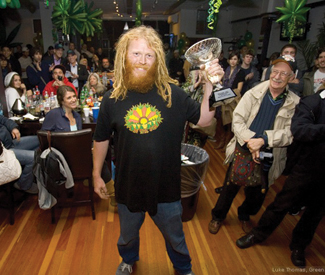
“I like the way you trim it/I got to bag it/Bag it up.” A ganja-fied version of Blackstreet’s “No Diggity” was playing over the speakers the night of Saturday, November 12 at 847 Lounge, an event space above the SoMa dispensary Green Door. The party’s mood was — yes — high as patients awaited the announcement of the winners in three categories of cannabis products at the Patient’s Choice awards ceremony, conversation with the activists and patients assembled in the room veered towards the serious.

Medical marijuana activist Mellody Gannon enjoyed the scene from a table in the center of the room: “As a patient, it’s really important right now that things like this are going on,” she said. Amid puzzling federal crackdowns, the future of her medicine is smoky. Recent pressure from the Department of Justice on landlords and banks has caused many dispensaries to consider shutting their doors (see “Feds crack down,” 10/12/11).

Which is why she was heartened to see cannabis connoisseurs coming together to celebrate the best of what California cannabis producers have to offer.

This year’s Patient’s Choice event was a much more intimate affair. Attendance was open to the public in 2010, but this year was limited to dispensary staff, activists, and the patients who had paid the $350 for a judge’s testing package. Judges had to sample over 30 strains (not to mention other products) in the 10 days leading up to Friday, when their votes were tallied and winners announced to stoned elation.

The event, sponsored by many of the city’s best-known dispensaries, was a fundraiser for Americans for Safe Access (ASA), an organization that promotes secure and available ways for prescribed patients to access medical marijuana.

Gannon, a patient since 1996, said that ASA’s advocacy is important — many times her doctors have turned up their nose at the medical efficacy of her marijuana prescription. “They tell you that you’re crazy or just a pothead,” she said.

After breaking a host of bones in a car accident, she relies on cannabis to mitigate chronic pain. “If they start closing these clubs, where are you going to go?” she asked.

Lynette Shaw sat nearby, smoking a strain home-grown buds she’s named Bonanza Jellybean. Shaw founded the Marin Alliance dispensary in Fairfax in 1997 after working on the Proposition 215 campaign the year before. She obtained special zoning from the city for the dispensary and insisted “we’ve done everything they told us to, even when the rules changed. We’re completely regulated to the satisfaction of the community.”

Nonetheless, one of the Department of Justice’s cease-and-desist letters landed in the mailbox of her landlord. Now unless something changes, Shaw’s dispensary — located in a county with one of the highest rates of breast cancer in the nation — will be out on the streets. Her landlord was threatened with 40 years in prison for renting to an illegal drug trafficker.

While others have pegged the Obama administration’s about-face on the tolerance of medical cannabis to election year grandstanding, Shaw thinks the persecution of state-legal marijuana operations like her own is a harbinger of much more dire civil rights violations.

“They’re trying to break the Constitution over marijuana. That’s why it’s important that we fight back now,” she said.

It was clear from the crowd at 847 Lounge that the medical marijuana movement wasn’t going to lose their meds without a fight. Perhaps strangely, the family producers that proudly hoisted their glass, Stanley Cup-looking trophies for best strain and other products still had an air of winning about them.

Ed Lee’s challenges

2

EDITORIAL Mayor Ed Lee has always talked about bringing the city together, about avoiding division and harsh conflict. And how that he’s won a four-year term, he’s going to have to address a wide range of city problems that in the past haven’t responded well to consensus and compromise.

He’s going to have to do it in the wake of an election in which the centrist candidates all finished low in the pack — and the strongest progressive actually won more votes than anyone else on Election Day. And his victory comes at a time when there’s more concern over economic inequality than this country has seen since the 1930s — represented most visibly by the large and growing OccupySF encampment.

The mayor received huge financial support — in the hundreds of thousands of dollars — from some of the same people and businesses that the Occupy movement is targeting. Some of his campaign contributors have an conservative economic agenda that’s way to the right of the center of San Francisco politics. And some of his closest allies (and strongest supporters) are, to put it kindly, ethically challenged.

So it’s not going to be easy for the mild-mannered mayor to lead the city — and if he wants to be successful, he needs to work with and not ignore the left.

There are a few critical steps that would show the people who opposed him that he’s not a captive of big-business interests and that he can be trusted:

1. Appoint a real progressive to Sheriff-elect Ross Mirkarimi’s District Five supervisorial seat. If Lee is really a mayor who’s above petty politics, the chief criterion for the appointment shouldn’t be loyalty to Lee.

District Five supported Avalos over Lee by a solid margin (in the Haight, Avalos got twice as many votes as Lee). The district has been represented by two people, Matt Gonzalez and Mirkarimi, both of whom were elected as Green Party members. It’s almost certainly the most left-leaning district in the city, and deserves a supervisor who represents that political perspective. Most of the qualified people who fit that description supported a candidate other than Ed Lee for mayor.

2. Don’t send the cops to roust OccupySF. The movement has support all over the city and is making an historic statement. It’s probably the most important political demonstration in San Francisco since the 1960s. A mayor who has any shred of a progressive soul should recognize that the most important issue facing this city and this nation is the wealth and income gap and help OccupySF make its voice even louder.

3. Present a plan for more than a “cuts only” budget. Yes, the sales tax measure lost, putting a hole in the city budget, and yes, it will be a year before a credible new revenue measure can go on the ballot. But now is the time to start bringing people together to look at what comprehensive tax reforms might be more appealing than a regressive sales tax.

4. Don’t give away the city to the One Percent. A developer wants to build 160 condos for the very, very rich on the waterfront at 8 Washington. Mayoral ally Rose Pak supports the project. It’s about as blatant an example as possible of something that only benefits multimillionaires, and it will be one of the first major land-use decisions Lee will have to grapple with. Making his opposition clear would demonstrate his independence.

5. Run an open administration. Both previous mayors, Gavin Newsom and Willie Brown, were openly hostile to the press, hostile to open government and supremely arrogant. Lee has a different personal style — and he ought to show that he respect the Sunshine Ordinance by directing his departments to abide by the rulings of the Sunshine Task Force.

That’s what good government would look like.

Rank complaints

27

steve@sfbg.com

Even before all the votes had been cast on election day, the two most conservative members of the San Francisco Board of Supervisors proposed a ballot measure to repeal the city’s ranked-choice voting (RCV) system, prompting all the usual critics of this voter-approved electoral reform to denounce it as confusing and undemocratic.

Those same two supervisors, Sups. Sean Elsbernd and Mark Farrell, were also the ones who unsuccessfully pushed for a weakening of the public financing system last month, changes that will likely be wrapped into discussions in the coming weeks over how elections are conducted in the city. And progressive supporters of both systems warn that district supervisorial elections will probably be the next target of this concerted push to roll the clock back on electoral reforms in the city.

"The [San Francisco] Chronicle and the [San Francisco] Chamber [of Commerce] have been at it from day one," Steven Hill, who helped crafted both the RCV and public financing systems, told us. "They’re really clear about what they want to eliminate, so we should be clear about what we need to defend and we can’t get confused by this."

Indeed, the Chronicle ran an editorial Nov. 14 advocating the repeal of ranked-choice, calling it "a fundamentally flawed system that is fraught with unintended consequences." The paper, as well as its allies at the Chamber and other downtown institutions, has been equally vociferous in criticizing public financing and district elections.

Hill said that’s because moneyed interests prefer systems that they can manipulate using the millions of dollars in unregulated independent expenditures they can summon — an ability they demonstrated again in his election on behalf of Mayor Ed Lee — such as low-turnout runoff elections, citywide supervisorial races, and elections without the countervailing force of public financing. "They’ve been doing this steadily and looking for ways to chip away at it," Hill said.

But conservatives aren’t the only ones raising questions about RCV; some progressives say the system needs adjustment, too.

Although Farrell opposes all three of those electoral reforms, he insists that his concerns about RCV are about voter confusion and the perception that winners don’t have majority support and could be viewed as illegitimate. "There is just so much voter confusion out there," Farrell said, citing comments from voters who don’t understand how their votes are tabulated to produce a winner.

Hill counters that voters do have a clear understanding of how to rank their choices, downplaying the importance of whether they understand all the details of what happens next. But Farrell said that and the majority rule issue have undermined people’s faith in the elections.

"People get very upset when they realize someone didn’t get a majority of the vote," he told us, referring to how the majority threshold drops as voters’ top three candidates are eliminated. "To me, it’s just simpler to go back to the runoff system."

Many moderate politicians agree. "I don’t like ranked choice voting and I never have," City Attorney Dennis Herrera, who finished third in the mayor’s race, told us on election night. "I defended it all the way to the 9th Circuit [Court of Appeals in his role at City Attorney], but I think it’s bad policy."

Sup. Scott Wiener, a Herrera supporter we spoke to at the same election night party, also wants to see a change. "I supported ranked-choice voting and until recently I continued to support it, but this race changed by mind," Wiener said, attributing the large mayoral candidate field and free-for-all debates to RCV. "There is no way most voters will be able to distinguish among the candidates."

But Hill says it’s a mistake to attribute the large field to RCV, or even to the public financing system that some are also trying to blame, a problem he said can be addressed in other ways, such as changing when and how candidates qualify for public matching funds.

Wiener said he hasn’t made up his mind about repealing RCV, and he said that he absolutely opposes a return to the December runoff election. One alternative he suggested was a system like that in place in New York City, with the initial election in September and the runoff during the general election in November. But he does think some change is needed, and he’s glad Elsbernd and Farrell proposed an RCV repeal.

"They’re starting a conversation with the repeal, but that’s not where it’s going to end," Wiener said.

Indeed, the system still has the support of most progressives, even Sup. John Avalos, who finished second in the mayor’s race and would now be headed into a runoff election against Ed Lee under the old system. "I continue to support ranked choice voting," Avalos told us. It takes six supervisors to play the charter amendment repealing RCV on the ballot.

Sup. Ross Mirkarimi, who was narrowly elected sheriff in the ranked-choice runoff despite a 10-point lead in first place votes, said of the Farrell and Elsbernd proposal, "I do want to hear their criticisms."

"I understand the larger discussion, which was a bit of a misguided approach that some of our colleagues used to go after ranked choice voting on election day," Mirkarimi said. "But they are good politicians and they seized an opportunity."

Mirkarimi did say he was open to "maybe some tweaks. I do think ranked choice works better when you have many choices." Others, such as former Sup. Matt Gonzalez, have also recently advocated a ranked-choice system that allows more choices, which would address the majority-vote criticism because fewer ballots would be exhausted.

Hill said the legislation that voters approved back in 2002 already calls for more choices, but the technology used in the city’s current system only allows three choices. Yet he said the city’s vendor, Dominion Voting Systems, has developed a system allowing up to 11 choices, for which it is currently seeking federal certification.

Although he said various tweaks are possible, "I think the system worked well in this election," Hill said, noting that few San Franciscans would have wanted to drag this long campaign out by another month or to pay for another election.

State of the occupations

0

rebeccab@sfbg.com

The police evictions of OccupyOakland and OccupyCal over the last week, and the looming threat of another attempt to evict OccupySF, presented challenges for the Bay Area protests just as similar police crackdowns targeted Occupy encampments in Portland, Denver, New York, and other cities nationwide.

These fast-moving developments also come at a time when university students from around California will be descending on San Francisco for a Nov. 16-17 University of California Board of Regents meeting that was canceled this week because of public safety concerns. All of this adds up to a big and unpredictable moment for the widening movement (see “The growing 99 percent,” 11/9).

So we’ve decided to start a regular feature to track the latest developments in an Occupy movement that seems adamant about standing its ground even as it’s forced to deal with threats from police, organizing challenges, and the coming of winter.


#OCCUPYCAL GROWS UP FAST

Students at the University of California at Berkeley burst onto the Occupy scene Nov. 9 with the launch of OccupyCal, a student-led protest that made waves nationally after university police advanced on around 500 students in Sproul Plaza, the historic epicenter of the Free Speech Movement, and struck them with batons after they tried to set up camp.

UCB police made 39 arrests in two separate actions against protesters, fueling student protesters’ resolve at a general assembly convened afterward that drew more than 1,000 people and lasted well into the night. At around 1:30 am, students voted to hold a student strike on Nov. 15 in solidarity with others throughout the UC system.

The harsh police response prompted condemnation from the Free Speech Movement Archives (FSM-A). “It appears that the campus police are in need of remedial education concerning fundamental protections offered by the US Constitution — including First Amendment rights to Free Speech and Free Assembly that were clearly recognized and enshrined on the UCB campus 47 years ago on these very steps,” the group noted in an open letter.

UC Berkeley Chancellor Robert J. Birgeneau, who was out of the country during the violent police crackdown, issued a statement on Nov. 14 ordering a third-party investigation of the clash and granting amnesty under the Student Code of Conduct to all students who were arrested for blocking police from removing the encampment.

“It was only yesterday that I was able to look at a number of the videos that were made of the protests on November 9. These videos are very disturbing. The events of last Wednesday are unworthy of us as a university community. Sadly, they point to the dilemma that we face in trying to prevent encampments and thereby mitigate long-term risks to the health and safety of our entire community,” he wrote. “Most certainly, we cannot condone any excessive use of force against any members of our community.”


#OCCUPYSF, THE NEXT BATTLEGROUND

At press time, student and labor groups that were planning to converge on the UC Regents meeting at UCSF Mission Bay on Nov. 16 by the thousands were deciding how to respond to the meeting cancellation, but protests are still planned for that day, with support from OccupySF.

Meanwhile, Mayor Ed Lee continues to insist that OccupySF break camp, but instead it has only grown larger, with the tents spreading out from Justin Herman Plaza onto the nearby sidewalk along Market Street in front of the Federal Reserve. At press time, protesters feared what seemed an imminent police raid, particularly now that the election is over and busloads of student protesters were headed into town.


TRAGEDY STRIKES #OCCUPYOAKLAND

On Nov. 10, Kayode Ola Foster, 25, suffered a fatal gunshot wound to the head following an argument, just yards from the Occupy Oakland encampment in Frank Ogawa Plaza (Oscar Grant Plaza to the occupiers who’d camped there for a solid month).

A somber mood settled over the plaza in the hours following the shooting as the tent city dwellers absorbed the gravity of the situation, and occupy activists held a candlelight vigil. Although initial reports suggested Foster had no relationship to the camp, police later said they believed he and one of two shooting suspects had spent time there.


#OCCUPYOAKLAND GETS THE BOOT

Three days after the fatal shooting near the OccupyOakland encampment sparked a hard-line response from local government officials, the camp was dismantled in an early morning police raid Nov. 14, the second to befall the occupation since it began a month ago. That evening, thousands marched back to the plaza in response to the raid and held a general assembly.

On the night of the raid, it took several hours for police to arrive at 14th and Broadway streets, where protesters began congregating in the intersection around 2 a.m. in anticipation of the forced eviction from camp. Law enforcement came en masse, with mutual aid support from seven different regional law enforcement agencies.

While two lines of riot police formed an L-shaped formation blocking protesters’ access to the plaza and nearby streets, hundreds more poured into the plaza to dismantle tents, flatten structures, and make arrests. Police arrested 32, the majority of whom belonged to a group of clergy members from the occupation’s Interfaith Coalition tent who sat calmly together in the plaza and sang by candlelight as they waited for police. Occupiers who witnessed the dismantling of the camp from behind police barricades yelled out, “Shame! Shame! Shame!”

Steven T. Jones contributed to this report.

Uh oh … feds raid pot clubs in Seattle

10

The feds have launched a coordinated series of raids on medical marijuana dispensaries in the Pacific Northwest. The Stranger in Seattle has extensive coverage:

Federal agents and local law enforcement are executing a volley of raids on medical-marijuana disperses throughout Western Washington this afternoon, according to several sources, who say some of the proprietors are being handcuffed and taken away in squad cars. Thus far, we’ve received reports of busts in Olympia, Lacey, Tacoma, Puyallup, and Seattle.

The Cannabis Defense Coalition has posted a tally of 14 dispensaries raided today.

The raids are leaving patients empty handed and it’s not clear what comes next or whether any of the Western Washington clubs will survive.

This is very bad news, and you have to wonder:

The feds have threatened pot clubs across California and shut down at least two in San Francisco. They’re trying to shut down a lot more in the Seattle area. At least 14 mayors have been on a conference call to coordinate strategy against the Occupy movement. Are the feds involved in that, too?

Is November the month that governments across the country, working together, are going to strike back at medical pot and Occupy? What possible reason could the Obama administration have to do that, one year before an election that he won’t win without the support of the people who are getting arrested, evicted, abused and forced to lose their medical suppliers?

What the fuck is going on?


Guardian editorial: Mayor Ed Lee’s challenges

21

 Mayor Ed Lee has always talked about bringing the city together, about avoiding division and harsh conflict. And now  that he’s won a four-year term, he’s must address a wide range of city problems that in the past haven’t responded well to consensus and compromise.
He’s going to have to do it in the wake of an election in which the centrist candidates all finished low in the pack — and the strongest progressive actually won more votes than anyone else on Election Day. And his victory comes at a time when there’s more concern over economic inequality than this country has seen since the 1930s — represented most visibly by the large and growing OccupySF encampment.
The mayor received huge financial support — in the hundreds of thousands of dollars — from some of the same people and businesses that the Occupy movement is targeting. Some of his campaign contributors have an conservative economic agenda that’s way to the right of the center of San Francisco politics. And some of his closest allies (and strongest supporters) are, to put it kindly, ethically challenged. So it’s not going to be easy for the mild-mannered mayor to lead the city — and if he wants to be successful, he needs to work with and not ignore the left.
There are a few critical steps that would show the people who opposed him that he’s not a captive of big-business interests and that he can be trusted:

1. Appoint a real progressive to Sheriff-elect Ross Mirkarimi’s District Five supervisorial seat. If Lee is really mayor who’s above petty politics, the chief criterion for the appointment shouldn’t be loyalty to Lee or Willie Brown or Rose Pak et al.  District Five supported Avalos over Lee by a solid margin (in the Haight, Avalos got twice as many votes as Lee). The district has been represented by two people, Matt Gonzalez and Mirkarimi, both of whom were elected as Green Party members. It’s almost certainly the most left-leaning district in the city, and deserves a supervisor who represents that political perspective. Most of the qualified people who fit that description supported a candidate other than Ed Lee for mayor.

2. Don’t send the cops to roust OccupySF. The movement has support all over the city and is making an historic statement. It’s probably the most important political demonstration in San Francisco since the 1960s. A mayor who has any shred of a progressive soul should recognize that the most important issue facing this city and this nation is the wealth and income gap and help OccupySF make its voice even louder.

3. Present a plan for more than a “cuts only” budget. Yes, the sales tax measure lost, putting a hole in the city budget, and yes, it will be a year before a credible new revenue measure can go on the ballot. But now is the time to start bringing people together to look at what comprehensive tax reforms might be more appealing than a regressive sales tax.4. Don’t give away the city to the One Percent. A developer wants to build 160 condos for the very, very rich on the waterfront at 8 Washington. Mayoral ally Rose Pak supports the project. It’s about as blatant an example as possible of something that only benefits multimillionaires, and it will be one of the first major land-use decisions Lee will have to grapple with. Making his opposition clear would demonstrate his independence.

5. Support public power and community chocie aggregation. And appoint SPUC commissioners with visible, credible public power credentials. PG&E has maintained its illegal private power monopoly in San Francisco for decades  by muscling  mayors to appoint only PG&E-friendly commissioners who keep City Hall safe for PG&E.

6.  Run an open administration. Both previous mayors, Gavin Newsom and Willie Brown, were openly hostile to the press, hostile to open government and and supremely arrogant. Lee has a different personal style and he ought to show that he respects the Sunshine Ordinance by directing his departments to abide by the rulings of the Sunshine Task Force. That’s what good government would look like.

Lessons from 2011 for 2012

4

With the release of precinct results for the 2011 election, we are able to actually see, for the first time, what San Francisco voters did, as opposed to hearing what various nabobs said they did.  There are a couple of key conclusions about the vote that should guide any left-liberal thinking of the key 2012 Supervisor races.

The first thing San Francisco voters did- about 40,000 of them-  was stay home.  Turnout – about 40% – was the lowest for a mayor’s race in 40 years. Moreover, counter to several “expert” narratives, turnout in neighborhoods with large numbers of Chinese voters — Chinatown, the Richmond, the Sunset, and Vis Valley — was lower (average 33%) than in neighborhoods with few Chinese voters — Diamond Heights, Noe Valley, the Castro and West of Twin Peaks — where turnout averaged 40%.

There seems to be four reasons for this curious outcome. A couple of them have lessons for us for the 2012 election that we ignore at our peril.
First, in a City that is clearly center-left, voters were presented with nine center-right candidates, seven of whom were declared by the Chronicle at one time or another to be “serious.” Only John Avalos was a clear center-left choice. This was shown in the huge number undecideds that appeared in poll after poll. Undecided voters are often unhappy at the lack of choice being offered by the field and simply don’t vote.

Second, professional campaign management of the supposedly serious candidates was terrible and actually counter-productive to their candidates’ best interests. The pros actually seemed to have suppressed turnout in key neighborhoods. Ace Smith and Bill Barnes, working for for Ed Lee, spent most of their time trying to distance their candidate from his base and key supporters, made rookie fund-raising mistakes time and again and gave their counterparts in the Yee and Herrera campaigns ample ammunition for a  series of negative ads and mailers.  John Whitehurst and Mark Mosher, working for Herrera, and Jim Sterns, working for Yee, took the opportunity and went negative on the least threatening figure in San Francisco politics in recent memory. 

As we all know negative campaigns generally suppress turnout — and that seems to be the case in this election. Avalos, who after September had no professional management, stayed positive and gained votes by doing so.

Third, organized labor, for the first time in living memory, did not endorse the winning candidate for mayor. Indeed, its official candidate, Yee, came in FIFTH. It’s as if labor decided to concentrate only on its issue — pension reform — and devote no energy, people or money to the myors race. Without labor’ support,effective GOTV in left-liberal neighborhoods is all the more difficult and was clearly beyond the ability of the Avalos campaign to carry by itself.

Labor knew who it wanted to vote on pension reform and narrowly focused only on those voters. That it still has the ability to do electoral politics can be seen in the fact that more total votes were cast on  Proposition C (186,336) — labor’s pension- reform measure –than were cast for all candidates in the mayors race (179,888).

Finally, there were 160 fewer polling places this election than last year, and to make matters worse the Department of  Elections mailed 115,000 voter handbooks with the wrong polling place address causing them to send postcards with the corrections. While this in no way was responsible for the 40,000 fewer votes cast, it was probably worth several hundreds of missed votes.

The lessons for next year? We need good candidates who actually align with political sensibility of the voters. This will be especially true in District Five after Mayor Lee appoints some center-right clone in the most left-liberal district in the city, and equally true in District Three with David Chiu, who has certainly turned to the right since his election. 

Supervisor David Campos in District 9 will be fine in this regard as will Supervisor Eric Mar in District 1 — where he will face a real fight.
Avalos’ showing in the mayors race should do him well in District 11 and offers a real chance for him to be board president in 2013.
Community-based left-liberals and labor must come together closer than in this election and perhaps closer than at any time since the Great depression. Labor’s support for the Occupy movement is a good indication that fruitful common ground can be found. We need each other more than ever in 2012.

We need to work to get good lines for the new districts and have a grand meeting of the minds on how we address the absentee voter issue.  Both labor and the Mirkarimi campaign did absentees well enough to win.  We need to apply their lessons to the Supervisors races.

Dare to struggle, dare to win.

Calvin Welch is a housing activist who has been watching San Francisco elections for more than 40 years.


Dick Meister: Strange bedfellows: Labor’s Tim Paulson and the Chamber’s Steve Falk

5

By Dick Meister

Dick Meister, former labor editor of the SF Chronicle and KQED-TV Newsroom and a former city editor of the Oakland Tribune, has covered labor and politics for a half-century as a reporter, editor, author and commentator. Contact him through his website, dickmeister.com, which includes more than 300 of his columns.

It’s hard to imagine organized labor and the thoroughly anti-labor Chamber of Commerce on the same side, especially in a city like San Francisco with a major union presence.

It’s especially hard to imagine it at a time when unions everywhere are joining with Occupy Wall Streeters to demand justice from anti-labor business and corporate leaders like those who control the Chamber.

But consider what Tim Paulson, executive director of SF’s Labor Council, and President Steve Falk of the SF Chamber of Commerce had to say in a joint statement about the results of Tuesday’s election.

They were downright overjoyed about the passage of Proposition C, which will raise the amounts city employees must pay toward their less-than lucrative pensions and limit future cost-of-living raises. That’s a way to avoid raising business taxes to maintain city services in these recessionary times.

Perhaps most distressing, the passage of Prop C shifted control of the City Health Service System from the employees who are covered by the system to City Hall appointees who won’t have to demonstrate any particular experience in health care matters.

At least Paulson and Falk said they were pleased with the defeat of Public Defender Jeff Adachi’s outrageous Prop D – even though it would have changed the city pension system in almost exactly the same ways as Prop C.

In any case, the difference between C and D was not necessarily their content, but how they got on to the ballot.

Why, exclaimed Paulson in a separate, self-congratulatory statement, the results “sent new shock waves across San Francisco and America as workers demonstrated that collaborative democracy is the best way to set public policy.”

Collaborative democracy? By that I guess Tim was referring to the joining together of labor leaders and public employee unions and Chamber of Commerce members in a coalition with city officials, non-profit social agencies and community groups to put Prop C on the ballot.

The collaborators didn’t even include representatives of the retired employees whose health care would be seriously affected and who were quite active in helping elect labor-friendly candidates.

Paulson, a generally ineffective leader who always seems to be seeking approval of the City establishment, singled out billionaire Warren Hellman for being one of the principal collaborators.

Paulson boasted that every city employee union joined in what he actually described as “a real San Francisco way of doing things.” Hardly. If there really were such a thing, it would be a far cry from the “collaborative” approach that involved labor giving in to the wishes of its anti-labor corporate and business opponents.

Paulson and Falk claimed the approach will be “a model for the rest of the country.” Thankfully for the rest of the country, that seems highly unlikely given the widespread demands for actual reform triggered by the Occupy Wall Street protests.

Negotiations between labor and management eventually reach agreements that both can live with, albeit often uncomfortably. But no agreement can be reached, or should be reached, when one party – the Chamber of Commerce in this case – is not seeking real compromise with an enemy – namely unions – that it would like to put out of business, or at least seriously weaken. Unions, of course, have the same feelings about union foes like the Chamber.

Tim Paulson actually declared the election results “a great victory during difficult times.”

Dick Meister, former labor editor of the SF Chronicle and KQED-TV Newsroom and a former city editor of the Oakland Tribune, has covered labor and politics for a half-century as a reporter, editor, author and commentator. Contact him through his website, dickmeister.com, which includes more than 300 of his columns.


Is SF moving to the right?

92

The Bay Citizen/New York Times thinks so. The headline on the story — “more conservative is the new normal” — says it all. Matt Smith (formerly of our price-fizing rival SF Weekly) and Gerry Shih say the Nov. 8 election signals a turn to the right for this famously liberal city:

But Tuesday’s election signaled a palpable shift: In addition to Lee, a pro-business moderate, voters overwhelmingly picked George Gascón, the law-and-order former police chief — and former Republican — as district attorney.

“To whoever thinks San Francisco is loopy and left-wing, this election basically said, ‘No, it’s really not,’” said David Latterman, associate director of the Leo T. McCarthy Center for Public Service and the Common Good at the University of San Francisco. “We just elected an ex-Republican, pro-death penalty district attorney by a landslide. Just ponder that.”

Well: It’s interesting that they call Lee a “pro-business moderate,” which is probably accurate but differs from how Lee’s more progressive supporters see the new mayor. But while they talk about Gascon, they conveniently leave out the fact that San Francisco has elected the first solid progressive to a citywide office in a long, long time. Ross Mirkarimi — a former Green Party member and without a doubt one of the most left-leaning supervisors — won a tight, contested race for sheriff running honestly as a progressive. I think you have to go back to 1987, when Art Agnos ran for mayor as the candidate of the left, to find another example of a progressive champion winning all across town.

The interesting element of all of this — and something I think Smith and Shih got absolutely right — is that the demographic makeup of the city is changing, and has been for a while:

“From a political perspective, the tech companies are employing young workers who often prefer to live in San Francisco, even if they commute to Silicon Valley, said Wade Randlett, a Bay Area technology executive and top fund-raiser for President Obama.”

Wade Randlett is not my favorite person in local politics, but the point he makes is valid — and it’s not happening by accident. Virtually all of the new housing that’s been built in San Francisco in the past decade has been aimed at wealthy people, a lot of them young tech types who commute from the city to Silicon Valley. The other people moving into new housing are empty-nest retirees from places like Marin County. If you walk through the new condo buildings in Soma, the residents are mostly white, with a few Asians; there are almost no African Americans, very few families and essentially zero working-class people.

For years, downtown groups (including Randlett’s former employer, SFSOS) have pushed for this kind of housing, and some of them have been very open about their goal: By bringing in more rich people and tech workers, you can change the politics of the city. Housing activist Calvin Welch puts it succinctly: Who lives here, votes here.

That’s the reason why land use and housing are so critically important in this town. If poor and working-class people are pushed out to make way for a more upscale set of residents, then progressives who talk about taxing the wealthy to provide services for the poor will have a harder time getting elected.

It’s not a conspiracy; it’s an open, stated policy goal of the people who spent vast sums of money electing Ed Lee.


Occupy SF: The eviction drumbeat begins

38

We all knew that Mayor Lee wouldn’t risk sending the cops in to evict OccupySF until after the election. But now the newspaper drumbeat has begun — the place is filthy, there’s shoplifting nearby and (gasp) the Ferry Building has to spend more money on toilet paper.

There’s an easy solution to the toilet paper problem: Install and maintain some more portable toilets near the camp. Not difficult, not expensive. And when you have that many people around (the camp keeps growing) and some of them have been living on the streets for a long time, having to hustle to stay alive, it’s not surprising that some cookies have been stolen. For the most part, the camp is pretty self-sufficient and there’s plenty of food, but if theft is a problem, a couple more beat cops at the Ferry Building would probably put a lid on it.

It’s too bad the Bay is so cold at this time of year; a quick dip with some Dr. Bronner’s would solve the need for the alleged sponge baths (and I just can’t imagine anything worse than the thought of a few people washing themselves off in a …. bathroom). It really wouldn’t be hard to install a solar shower on the scene, if the Department of Public works cooperated.

We all know there are going to be challenges dealing with a growing outdoor encampment in the middle of a big city. But this is something special, something important, a popular movement that’s responding to an emergency situation in the United States. This is a sophisticated city; we can deal.

But just as the merchants complaining in Oakland is putting pressure on Mayor Jean Quan, this sort of stuff will put pressure on Lee to send in the cops. Ugh.


San Francisco’s political spectrum: a primer

120

During yesterday’s post-election wrap-up at the San Francisco Planning and Urban Research Association, political consultant and analyst David Latterman cited the ideological breakdown of San Francisco voters: 19 percent are progressive, 36 percent are liberal, 39 percent are “moderate,” and 6 percent are conservative. I cited those figures in a post I wrote yesterday on the latest election results, and some people responded by asking me to explain those terms, so let me take a crack at that because I think it’s important to understanding the city’s political dynamics.

I even discussed the matter with Latterman – who self-identifies as moderate, whereas I and the Guardian have a progressive worldview. “That’s a fantastic question and I don’t think any of us can give suitable answers,” Latterman said. “These aren’t hard lines. It’s like: I don’t know how to define pornography, but I know it when I see it.” Nonetheless, we agreed on the basic outlines and borders between the labels, even though we might frame them and value them a little differently.

In San Francisco, there is general agreement on most social issues among the moderates, liberals, and progressives, although we may disagree on political tactics. We all basically support gay rights, reproductive freedom, the value of diversity, environmentalism, and freedom of expression. That’s why most people consider San Francisco to be a famously liberal city, because of our tolerance on social issues, which only that 6 percent who are conservatives don’t share.

Yet San Francisco is still a deeply divided city on economic issues, including land use and the role of government. This is where most of the political conflicts and divisions occur, and it is here where our political spectrum is as wide as anywhere – perhaps even wider given the extreme wealth and poverty here, as well as the long history of political activism and the setting of national political trends. And it is in this realm that our labels come from.

A “moderate” in San Francisco – which is a real misnomer despite its widespread usage – is a fiscal conservative: anti-tax, anti-regulation, an almost religious faith in the free market, and a resentment of the poor (particularly the homeless and the jobless) and those who advocate for them. They want bare minimal government and see the role of government as primarily to facilitate economic activity in the private sector and to provide the basic infrastructure that the private sector needs to operate efficiently. They even believe social services should be provided by the private sector, such as nonprofits, rather than by government. On economic issues, they’re almost indistinguishable from conservatives, with whom they disagree on social issues.

On the other end of the spectrum are the progressives, who don’t trust capitalists and large corporations and believe they need to be heavily regulated and taxed to provide for the common good. We believe in progressive taxation and a redistribution of wealth, particularly from the richest 1 percent, and that government has an important role to play in leveling the economic playing field and playing referee. Progressives generally believe this country has been drifting to the right for at least the last 31 years and that this is a dangerous trend that needs to be addressed with fundamental, systemic reforms. And at this point, we’re willing to adopt radical strategies for triggering that change, such as Occupy Wall Street or other forms of civil disobedience.

The liberals of San Francisco are somewhere in the middle. They’re Democrats (or DTS) who don’t believe in radical change or anything that might disrupt the existing order, preferring incremental reforms over long period of time. They accept the legitimacy of the two-party political system and an economic system governed by Wall Street and powerful corporations, and they believe we need to do what we can within that framework. They use neoliberal economic policies like business tax cuts and incentives to encourage private sector job creation and housing development, and they accept a shrinking public sector, which they expect to operate more like the private sector, and a waning labor movement.

The reactions to the OccupySF movement is an interesting illustration of the dividing lines. Moderates have voiced tepid support for the movement’s critique of the growing gap between rich and poor, but they’re appalled at the tactic of occupation, believing curfew and anti-camping laws are more important. Progressives have been the most enthusiastic supporters of a movement that echoes their core values and physically challenges the status quo. Liberals basically support the movement, but they’ve been very uneasy with the tactic of occupation and have been vacillating on how to deal with it.

Latterman and the moderates – as well as many liberals – see ideology as a dirty word, and he was happy that in this election “it was the least ideological race we’ve seen in a long time.” Mayor Ed Lee and Board President David Chiu – both of whom hover in the liberal to moderate range, depending on the issue – also treat the notion of ideology with disdain, claiming to support practical, pragmatic, or common sense solutions to problems.

But progressives see ideology as the essence of politics. They understand the world in terms of class struggle, and believe that the very rich have been aggressively exploiting the people and the planet for too long, and that the only real way to make progress is to fight them and win. They believe in the Occupy paradigm that the 1 percent – the greedy rich who have corrupted our political and economic systems – are actively hostile to the interests of the 99 percent. We know that’s an unsustainable system and we’re hopeful that this is the moment when progress – the core of our belief system, that it’s possible to devise better economic and political systems than the ones we’ve inherited – could finally be attainable if we continue to organize and challenge the system.

That’s my general analysis of San Francisco’s political dynamics. What’s yours?

The low-turnout election

25

A factor that hasn’t been discussed much in the analysis of the election results is the very low turnout for a contested mayor’s race. The turnout without the provisionals and final absentees was about 30 percent; by my figures, when the 35,000 remaining ballots are counted, it will total about 37 percent.

That’s about the same level as the 2007 race, when Gavin Newsom had no serious opposition and the races for sheriff and district attorney were essentially uncontested.

The past two contested mayoral races had much higher turnout. In 1999, when Tom Ammiano ran against Willie Brown, 45 percent of the voters turned out; same for the 2003 race pitting Matt Gonzalez against Gavin Newsom.

It’s odd — the weather was good, there were three contested races, all of the candidates had and spent money … and even in traditionally high-turnout areas, not that many voters went to the polls.

In the Mission, where John Avalos won overwhelmingly, turnout was only 30 percent.

Clearly, one of the reasons that Ed Lee won is that he got his voters to the polls. Would higher turnout on election day have made a difference? Maybe. Lee had support all over the city, and he was going to be tough to beat. He also got most of the second-place votes from candidates like David Chiu and even Leland Yee, who had spent much of the fall attacking him. And although Avalos won on election day, Lee was so far ahead from the absentees that catching him would have been difficult.

Still: The race certainly would have been closer. And the low turnout is curious. Did people just assume Lee was going to win? It’s hard to imagine that voters had no appealing candidates — there were so many choices. And there was so much election hype — I got about 30 mail pieces in the last week.

By the way: Randy Shaw did his list of winner and losers, and he left out Avalos entirely. Avalos didn’t win the election, but his suprisingly strong finish established him as a progressive leader for the future and helped keep the left organized and in the game. He also left out Ross Mirkarimi, who is the first solid progressive to win a citywide office in quite a while — and he did it running for sheriff against two law-enforcement types. Mirkarimi has now established himself as someone who can win in all parts of town and has made crime and law-enforcement a progressive issue.

Then there’s OccupySF — and while a lot of the people there probably didn’t vote, the fact that that Avalos stood with the occupiers and contrasted himself to Ed Lee (who came very close to using the cops to evict the protesters) helped his campaign immensely.

Lee, Mirkarimi, and Gascon win first ranked choice tally

67

San Francisco’s first run of ranked choice voting tallies for yesterday’s election shows Ed Lee winning the mayor’s race (with progressive favorite John Avalos in second), George Gascon remaining district attorney, and Ross Mirkarimi becoming the new sheriff in town.
“Progressive victory, citywide, that’s huge,” Sup. David Campos told Mirkarimi this afternoon outside the Elections Department, where a scrum of journalists and politicos gathered to get the results. It would indeed be a rare citywide victory for progressives, which analyst David Latterman says constitute about 19 percent of the electorate, compared to 39 percent who identify as moderate and 36 percent who call themselves liberals.   
About 7,500 provisional and 24,000-25,000 absentee ballots remain to be counted over the next few days, said Elections Chief John Arntz, telling reporters, “I’m not saying these are the final results by any stretch.” But there is good reason to believe these winners will stick.
In the sheriff’s race, where Mirkarimi faced off against three candidates with long law enforcement backgrounds, David Wong was the first to be eliminated, and the lion’s share of his 9,487 votes went to fellow Sheriff’s Deputy Paul Miyamoto rather than Chris Cunnie, the former head of the San Francisco Police Officers Association, knocking Cunnie out of the race.
Of Wong’ votes, 3,828 went to Miyamoto, 2,637 were exhausted (meaning Wong voters had no second choice), 1,682 went to Mirkarimi, and just 1,325 went to Cunnie, who had been in second place. That gave Mirkarimi almost 40 percent of the vote, compared with 30.7 percent for Miyamoto and 29.8 percent for Cunnie.
On the next round, Cunnie’s 42,877 votes were redistributed as follows: 16,820 to Miyamoto, 14,675 exhausted, and 11,322 to Mirkarimi, giving him 53 percent of the vote. “I’m optimistic, but I’m not declaring victory,” Mirkarimi told reporters. He said that he hopeful that he’ll get the chance to continue the 30-year progressive legacy of retiring Sheriff Michael Hennessey, who endorsed Mirkarimi.
The only real variable in the sheriff’s race is how Cunnie’s second place votes break in the event that incoming ballots change who gets eliminated after Wong, but Mirkarimi said he was happy with how well progressive campaigns did in this election.  
“I want to say how proud I am of the Avalos campaign. It did a good job at getting people out who have felt disenfranchised,” Mirkarimi added.
Indeed, Avalos surprised much of the political establishment by finishing strongly in second place with 18.3 percent of the vote compared to Lee’s 31.5 percent and Dennis Herrera’s 11.3 percent. In the first ranked choice run, it took 11 rounds of eliminations for Lee to break the 50 percent threshold of victory. And when he did, he jumped all the way to 61 percent, mostly because voters who chose Herrera as their third choice exhausted their ballots.
When Herrera was eliminated in Round 10, 18,276 of his 29,717 votes were exhausted, and of the balance, 6,683 went to Avalos and 4,705 went to Lee, where they had been at 28 percent and 49 percent respectively. Avalos then finished second with 39 percent of the vote.
Other notable rounds in the mayoral runoff were when fourth place finisher David Chiu was eliminated and his nearly 20,000 votes broke most heavily in favor of Ed Lee and being exhausted, reinforcing the idea that he draws his support mostly from moderates and is no longer part of the progressive movement that helped elect him to the Board of Supervisors.
Avalos got just 2,376 of Chiu’s second place votes, compared to 5,894 for Lee and 3,832 for Herrera. By contrast, when Leland Yee was eliminated a round earlier, his votes were redistributed fairly evenly among Lee, Chiu, Herrera, and Avalos. Part of the reason that Avalos never gained ground on Lee was that the mayor got more second place votes than his progressive challenger on every elimination between Round 3 and the final round.
In the DA’s race, Gascon’s 42 percent total of first place votes is an insurmountable lead, particularly given that he also did well on the second place votes, showing that attacks on his secrecy and police connections didn’t do much to hurt him. When third place finisher Sharmin Bock was eliminated in the third round, Gascon got 13,301 of her votes, compared with 10,430 for David Onek, and 11,840 exhausted.
The Elections Department will run new totals every day at 4 pm