Education

Green buds

56

steve@sfbg.com

CANNABIS Most marijuana sold in Bay Area dispensaries is grown indoors, where the ability to precisely control conditions creates the kind of buds — strong, dense, crystal-covered, fragrant, beautiful — that consumers have come to expect. But that perfection comes at a high price, both financially and environmentally.

So some local leaders in the medical marijuana movement have begun to nudge the industry to return to its roots, to the days before prohibition and the helicopter raids of the Campaign Against Marijuana Planting chased the pot growers indoors. They say it’s time for California to start growing more of its cannabis outdoors again, in the soil and sunlight, just like the rest of the state’s crops.

Growers have long known how inefficient it is to grow indoors. All they need to do is look at their huge monthly energy bills. Between the powerful grow lights, constantly running air conditioners, elaborate ventilation systems, pumps and water purifiers, and heaters used for drying and curing, this is an energy-intensive endeavor.

But a widely circulated study released in April — “Energy Up in Smoke: The Carbon Footprint of Indoor Cannabis Production” by Evan Mills, a researcher with Lawrence Berkeley National Laboratory — revealed just what a huge cumulative toll the practice was taking on California and the planet.

It found that indoor pot production accounts for about 8 percent of California household energy use, costing about $3 billion annually and producing about 4 millions tons of greenhouse gases each year, the equivalent of 1 million automobiles. Producing one joint was the equivalent of driving 15 miles in a 44 mpg car.

“The emergent industry of indoor Cannabis production results in prodigious energy use, costs, and greenhouse-gas pollution. Large-scale industrialized and highly energy-intensive indoor cultivation of cannabis is driven by criminalization, pursuit of security, and the desire for greater process control and yields,” Mills wrote in the report’s summary.

Yet while opponents of marijuana seized on the report to condemn the industry, proponents say there’s a very simple solution to the problem: grow it outdoors. And with the artisanship and quality in the fields and greenhouses now rivaling that of indoor buds, the biggest barriers to moving most marijuana production outdoors are federal laws and the biases of pot consumers.

“There’s a misconception out there that indoor is better marijuana than outdoor, but we don’t think that’s true,” Erich Pearson, who runs the San Francisco Patient and Resource Center (SPARC) dispensary and sits on the city’s Medical Cannabis Task Force. “Marijuana is a plant that came from the earth and that’s where we should grow it, just like our food.”


INDOOR VS. OUTDOOR

There are definitely some benefits to growing indoors, beyond just the ability to hide it from the prying eyes of law enforcement. The grow cycles are shorter, allowing for multiple harvests around the year. The generally small operations and precise control over growing conditions also tend to produce the best-looking buds, which command the highest prices and win the top prizes in competitions.

Kevin Reed, who runs Green Cross — a venerable medical marijuana delivery service that works closely with an established group of growers — told us there are several reasons why indoor buds have dominated the marketplace.

“The most important factor is local laws and regulations and the enforcement of those various laws. A second factor is space and climate — obviously outdoor cultivation will flourish is some places better than other. And, a final factor is sustainability of the market; indoor cultivators can produce crops on a year-round basis, providing some stability in the market over the long-term, especially in the event of crop failure or other unforeseen and unexpected disasters,” Reed told us.

Yet he also said, “If cultivated correctly and with care, there should be no difference between the same strain grown in- or outdoors.” And he said that from an environmental standpoint, outdoor is clearly superior: “So far as environmental factors are concerned, there is little doubt in my mind that outdoor cultivation is kinder to Mother Earth.”

Wilson Linker, with Steep Hill Laboratories, Northern California’s largest tester of medical marijuana, said that outdoor plants generally have more vegetative growth because of the longer light cycles, meaning that “indoor tests generally higher in cannabanoids, with THC [marijuana’s main psychoactive compound] in particular.”

But he and other marijuana experts also say that the quality of the buds ultimately depends on a wide variety of factors, from the strain used to the expertise of the cultivators to the time and care taken by the trimmers.

“I’ve seen outdoor that can compete with the best indoor strains,” said David Goldman, who runs San Francisco’s Americans for Safe Access (ASA) chapter, sits on the city’s Medical Marijuana Task Force, and is active in rating the various dispensaries and pot strains in terms of quality, using magnifying glasses to investigate the trichomes and other characteristics. “I would match the best outdoor I know up with anybody’s indoor, any day.”

Even when indoor buds look better, Pearson said, that doesn’t means they are better. Looks can be deceiving, he said, noting how local consumers now accept that those perfect-looking, genetically modified apples and tomatoes in the store aren’t as tasty or good for you as their ugly, organic counterparts.

“It’s not all about appearance,” he said, noting that marijuana grown in the sunshine is more robust and complex than its indoor cousins.

“We’re starting to find [outdoor] strains that were scoring just as high as indoor,” says Rick Pfrommer, the purchasing manager for Oakland’s Harborside Health Center.

And that’s especially true when the cannabis is grown in greenhouses, where it gets natural sunlight but growing conditions can be controlled better than in the fields.

“Greenhouses can attain a level of cosmetic attractiveness that is right up there with indoor,” Pfrommer said.

“There are a lot of products coming out of greenhouses that even trained eyes can’t tell the difference with [compared to indoors],” Linker said. “Greenhouses are the future.”

Or at least they might be the future if there is a change in the federal laws, which still view any marijuana cultivation as a crime — which is why indoor grows flourished in the first place.


LINGERING PROHIBITION

Rising demand for medical marijuana has created some regulatory pushback, even in pot-friendly San Francisco, where the Department of Public Health announced earlier this year that it wanted to create a registry of growers that work with the dispensaries in order to weed out the illegal growing operations.

“In the last few years, there’s been a proliferation of both illegal and legal cultivators,” Dr. Rajiv Bhatia, San Francisco’s environmental health director, told us earlier this summer. “We’re asking for this information to try to steer them back toward legal cultivation.”

Reed, Goldman, and other industry representatives strongly condemned the move, mostly on the grounds that creating lists of growers could subject them to federal prosecution, so the idea was shelved for now. But Bhatia said the problem remains, and in San Francisco, it’s a problem created largely by the demand for cannabis grown indoors.

But allowing for a more widespread conversion to sustainably grown marijuana will require a relaxation of the federal enforcement to allow for more land cultivation and the development of high-tech greenhouses.

“A lot of that rests in the hands of law enforcement,” Pearson said.

But it isn’t just the cops. Consumers are also supporting indoor grows.


SUPPLY AND DEMAND

Pfrommer said there are many factors that influence whether customers choose indoor or outdoor, or what he calls the “bag appeal” that causes customers to zero in on one strain among the 40 or so that can be offered at one time.

Generally, indoor grows are smaller operations, allowing greater care in the tending and processing of the buds, whereas outdoor grows usually produce large crops harvested all at once, “so frequently people won’t manicure it as well,” Pfrommer said.

Smell is another big factor, Pfrommer said, and that’s one area where he thinks outdoor actually has an advantage. “Outdoor generally has a more pungent smell,” he said. “Cannabis is very sensitive to the environment, so it can pick up elements from the soil, the wind, and the surroundings. It picks up different qualities.”

For that reason, he also said, “I personally find outdoor to taste better when it’s grown well,” comparing it to the subtle qualities that various appellations can give to fine wines.

The final factor is price, and that’s one area where outdoor has a distinct advantage. SPARC is currently selling quarter-ounces of greenhouse-grown Big Buddha Cheese with a THC content of more than 17 percent for just $70. And when the buds from open outdoor fields arrive this fall, they’ll be as low as $50.

“This,” Pearson said, holding up a beautiful bud of greenhouse-grown Green Dragon, “was grown at a fraction of the cost of indoor and it’s outstanding.”

“That’s why indoor sells for so much more,” Goldman said, ” because it costs so much more to grow.”

So if outdoor cannabis is cheaper, better for the environment, less risky for the industry, and just as good, why are the indoor stains still so much more popular?

“You’re looking a 20-plus years of indoor being the standard,” Pfrommer said, noting that the hardest part of creating a more substantial changeover in people’s buying habits is their expectations.

He said Harborside started offering more outdoor strains three years ago, “but the market wasn’t responding as strongly.” In other words, people still preferred indoor.

Yet things are changing, prompted partly by the Mills study. “That was what kicked off this latest round,” Pfrommer said. “There is a small but growing awareness among the regular marijuana consumers about the costs of growing indoors…The consciousness is starting to shift, but it’ll be slow, probably over the next two seasons.”

Harvests usually take place during the full moons in September and October, after which they are cured and processed for about four weeks, finally coming to market around Thanksgiving.

“It’s mostly an education process,” Pfrommer said. “We’re going to have a vigorous push around harvest time this year.”

“We’re trying to transition completely to outdoor because the environmental toll is less, the cost is less, the yield is higher, and our testing is showing that the quality is just as good,” said Nick Smilgys, who has done both marketing and purchasing at SPARC. “It just makes more sense to grow it outdoors.”


Rep Clock

0

Schedules are for Wed/17–Tues/23 except where noted. Director and year are given when available. Double features are marked with a •. All times are p.m. unless otherwise specified.

ARTISTS’ TELEVISION ACCESS 992 Valencia, SF; www.atasite.org. $10. Face of a Stranger (Michalak, 1977), Fri, 8.

BALBOA 3620 Balboa, SF; www.balboamovies.com. $17.50-20. “Opera and Ballet at the Balboa:” Macbeth, from the Royal Opera house, London, Wed, 7:30; Swan Lake, from the Bolshoi Ballet, Moscow, Sat-Sun, 10am.

CASTRO 429 Castro, SF; (415) 621-6120, www.castrotheatre.com. $7.50-13. “Viva Pedro:” •Bad Education (Almodóvar, 2004), Wed, 2:50, 7, and Law of Desire (Almodóvar, 1987), Wed, 2:45, 7; •Talk to Her (Almodóvar, 2002), Thurs, 2:45, 7, and All About My Mother (Almodóvar, 1999), Thurs, 4:55, 9:10; •The Flower of My Secret (Almodóvar, 1995), Fri, 3:05, 7, and Women on the Verge of a Nervous Breakdown (Almodóvar, 1988), Fri, 5, 8:55. “SF Sketchfest presents: 25th Anniversary Celebration: Labyrinth (Henson, 1986), Sat, 5. This event, featuring Jim Henson Company puppeteers in person, $15 at www.sfsketchfest.com. “SF Sketchfest: Rifftrax Presents:” “Night of the Shorts II: Electric Riffaloo,” Sat, 8:30. This event, $25 at www.sfsketchfest.com. •2001: A Space Odyssey (Kubrick, 1968), Sun, 2, 7, and 2010: The Year We Make Contact (Hyams, 1984), Sun, 4:35, 9:35.

“CENTER STREET SUMMER CINEMA” 2219 Center, Berk; (510) 548-5335, www.downtownberkeley.org. Free (bring your own chair, or $5 to rent a chair). Raiders of the Lost Ark (Spielberg, 1981), Sat, 7:30.

CHRISTOPHER B. SMITH RAFAEL FILM CENTER 1118 Fourth St, San Rafael; (415) 454-1222, www.cafilm.org. $10.25. Crime After Crime (Potash, 2011), call for dates and times. The Names of Love (Leclerc, 2010), call for dates and times. The Whistleblower (Kondracki, 2010), call for dates and times. Senna (Kapadia, 2011), Aug 19-25, call for times.

“FILM NIGHT IN THE PARK” This week: Creek Park, 451 Sir Francis Drake, San Anselmo; (415) 272-2756, www.filmnight.org. Donations accepted. Cinema Paradiso (Tornatore, 1988), Fri, 8; To Kill a Mockingbird (Mulligan, 1962), Sat, 8.

JACK LONDON SQUARE 66 Franklin, Oakl; www.jacklondonsquare.com. Free. “Waterfront Flicks:” Dinner for Schmucks (Roach, 2010), Thurs, sunset.

PACIFIC FILM ARCHIVE 2575 Bancroft, Berk; (510) 642-5249, www.bampfa.berkeley.edu. $5.50-9.50. The Makioka Sisters (Ichikawa, 1983), Wed, 7. “Bernardo Bertolucci: In Search of Mystery:” The Dreamers (2003), Thurs, 7. “Hands Up: Essential Skolimowski:” Essential Killing (2010), Fri, 7 and Sat, 9; Moonlighting (1982), Fri, 8:45. “Japanese Divas:” Late Autumn (Ozu, 1960), Sat, 6:30. “The Timeless Cinema of Marcel Pagnol:” Fanny (Allégret, 1932), Sun, 5.

PIEDMONT 4186 Piedmont, Oakl; www.landmartheatres.com. $8. The Room (Wiseau, 2003), Sat, midnight.

ROXIE 3117 and 3125 16th St, SF; (415) 863-1087, www.roxie.com. $5-9.75. Jay Reatard: Better Than Something (Hammond and Markiewicz, 2011), Wed, 7:30, 9:30. Vigilante Vigilante (Good, 2011), Wed-Thurs, 7, 8:45. The Arbor (Barnard, 2010), Aug 19-25, 7, 9 (also Sat, 5). “Atheist Film Festival,” Sun, 11am. Single films, $12; fest pass, $20; more info at www.sfatheistfilmfestival.org. Rita, Sue, and Bob Too! (Clarke, 1986), Mon, 9:30. YERBA BUENA CENTER FOR THE ARTS 701 Mission, SF; (415) 978-2787, www.ybca.org. Free. “Smut Capital of America: San Francisco’s Sex Cinema Revolution:” “Wildcard Film Night,” Thurs, 7:30. Film title TBA.

Editor’s notes

0

marke@sfbg.com

“We live in turbulent times,” my uncle observed last Saturday. He’s right: the world is roiling.

This past week alone: 100,000 students marched in Santiago, Chile to protest education cuts. (The protest turned violent on Friday when police used excessive force and tear-gassed the crowd.) On Saturday, 300,000 people from across the political spectrum marched in Israel, mainly to protest rising housing costs. (A million-person march is planned for next week.)

Syria saw probably its bloodiest weekend of protests yet, as the government sent in more forces to crush anti-authoritarian uprisings. In Spain, a resurgent M-15 — the huge yet ambiguous protest organization that occupied Madrid’s main square this summer — was blocked by anti-riot police from re-occupying Puerto del Sol. And, in Tottenham, London, a peaceful vigil for a man slain by police was stoked into a weekend of riots that is spreading throughout the city as of this writing.

The swelling protests are all unique in their ways, but we certainly seem to be in the midst of a global “protest movement movement.” Many of the demonstrations — at least the nonviolent ones — have been presented in the media as a continuation of the Arab Spring, due to the important role of online social media and the peaceful, game-changing aspirations of participants. And in most of the recent protests, there is evidence of a frightened and over-reactive government (the Chinese government, quaking over growing unrest due to its cover-up of a train crash last month, is flailing at online censorship) or a woefully unprepared police force (the Tottenham police were severely late in addressing public questions about the shooting, and failed to heed community leader warnings about potential violence).

But all have to do with economic inequality, an overwhelming feeling of powerlessness in the face of ineffectual governance, and an onslaught of austerity cuts imposed from above. Last week’s odious debt ceiling charade by American “leaders” has just ensured massive national austerity cuts, and made the economy a lot more anxious (and unequal). Hands up if you feel powerless.

I think of two recent large examples of Bay Area economic unrest: the 2009 student demonstrations against University of California tuition hikes and the reaction to the Mehserle verdict last year. Are we prepared to channel the coming frustration into an expansive, nonviolent popular movement that builds on positive momentum, includes everyone, and brings a whiff of the Arab Spring to our shores?

Class clowns

0

THEATER Linda Brown is a maid at the end of her tether, and tender, as the much-put-upon employee-slave of an exclusive country club. The signs are there from the moment she steps onto the stage: the circles under the young woman’s eyes, her frightened stare, the desperate swigs from a ready flask, not to mention her shameless histrionic intensity as she addresses the audience about the soul-sucking richies perpetually at her back.

But it will take the full length of playwright-director Jeff Bedillion and Back Alley Theater’s sometimes ambling, generally rowdy new farce, Country Club Catastrophe, before our lower-class heroine manages a proper escape — only it’s unclear even to her if it’s a genuine escape at all, as she stares into the eyes of her replacement with an eerie shock of recognition.

In this uneven but promising production by newcomers Back Alley Theater, performances are at times stilted and pacing might be tightened in places, and perhaps as much as 20 minutes of meandering dialogue productively lost from the second half. But Country Club Catastrophe gets laughs in part because it knows what it is about. Inspired equally by classical French farce — Molière’s five-act structure in particular — and recognizably American figures from the yawning class divide, it aims at a contemporary social crisis churned by the obscene disparities in wealth in post–middle-class America. (All glimpsed at the preview ahead of opening night.)

Thus, long before her existentially fraught exit, both Linda (played by a comically intense yet sympathetic Katharine Otis) and her handsome gold-digging coworker, the doorman Max (a winningly boisterous Joshua Rice), largely retreat from view behind an onslaught of self-absorbed club members (numbering only a handful in fact, and yet a real handful just the same).

First to arrive is Mrs. Montgomery (a sharp, coolly imperious Jennifer Lucas), her teased hair rising to just within the frame of the front door center stage (in A.J. Diggins’ spare, functional set design) and a long leash trailing from her wrist to an unseen standard poodle with an unhealthy appetite for the doorman. (Exit Max for some scenes.)

Separately from Mrs. Montgomery — who in a manipulative confessional gesture lets Linda know her first name is Tabytha, only to insist she still call her Mrs. Montgomery — arrives the rest of her small but attenuated family. There is husband Miles (Len Shaffer, dispensing affable sleaze), a jolly and salacious philanderer; and son Tristan (a humorously shrill Salvadore Mattos), Tabytha’s barely closeted Brown University brat whose constant companion is a houseplant he calls Sister.

Greater than Tristan’s fixation on foliage, however, is his unbounded lust for childhood playmate Edward (Jeremy Bardwell), the egomaniacally cocksure but increasingly put out fortunate son of club members Biff and Muffy Birmingham (played, respectively, by a buoyantly silly John Weber and a hilariously sugary yet menacingly bitchy Meaghan M. Mitchell). Biff and Miles are best friends; Muffy and Tabytha not so much. Muffy prefers the company of club member and shy post-debutante Peggy Dupont (a harried Sabrina De Mio), whom Muffy bosses and harshly abuses with an almost innocent glee.

Last and, in the opinion of the club house anyway, certainly least comes Cynthia Anniston (an amusingly oblivious and high-keyed Gloria Terese McDonald), Brown University first-year and cheerleader desperately chasing one-night-stand Edward, her lax outfit reading alternately “prostitute” and “foreign exchange student” to the club’s members and its equally indignant staff.

For the play finds stark but amusing ways to underscore the primacy of money over every other social divide, be it race or sexual orientation or education. Even the mere appearance of not having money is enough to put one squarely outside the club — or rather, squarely within its steep hierarchies of privilege and worth. As the plot gets increasingly tangled, we’re left to consider the intoxicating stench of money in everyone’s noses as the ultimate obscenity.

And yet, Linda (and the play) asks, can the greed, selfishness, backstabbing, dirty dealing, and rampant mistreatment that runs rife through these perverse excuses for families really continue without some final judgment befalling such a club and such a country?

Intonations of just such a judgment are there already in the title, in a gathering electric storm outside, in the self-consciously heightened language, and in the rumblings of piano keys from musician Mike Miraglia’s offstage upright. But the catastrophe that finally breaks in on this world isn’t exactly The Day of the Locust. It is, instead, an ironic and apt judgment on the misspent lives and deflated hopes of the present day, so semi-cozy and quietly desperate despite the raging storm outside. 2

COUNTRY CLUB CATASTROPHE

Through Aug. 13

Thurs.—Sat., 8 p.m., $20

Exit Theatre

156 Eddy, SF

www.brownpapertickets.com


Perverts give good poetry

0

culture@sfbg.com

LUST FOR LIFE I work at the St. James Infirmary, an occupational health clinic for current and former sex workers. The clinic is a beneficiary of Dore Alley’s Up Your Alley Fair — a pride celebration for kinky people and little sister of the Folsom Street Fair — so every year I have to a work a shift at the festival. I haven’t been able to enjoy the actual street fair aspect of it for a while. But I always look forward to this week, and to Dore Alley Eve (as those of us in the kink and leather communities jokingly call it) because of Perverts Put Out (PPO), which this year takes the stage Saturday, July 30.

Now, it’s impossible for me to write about PPO without bias. I’m good friends with the producers and I’ve been on their rotating roster of performers since 2007. But I’ve also been coming to PPO as an audience member since 2004, right about the time I graduated from teen poetry slams and started performing my own works around the Bay Area.

Attending PPO for those first three years as an adult performer (in all senses of that term) and newly-minted sex writer trying to find her place in the SF spoken word scene, I received an amazing lesson in our sex and art communities. PPO is responsible for much of my education about both writing and performance. I sat back. I watched. I learned. I took a lot of notes.

So consistently well curated it borders on absurd, PPO is an impressive mix of genre and content — everything from poetry to performance art, diatribes to elegantly crafted erotic short stories. The unifying theme of PPO is of course sexuality, and most of the performers are queer in some way. But queerness and sexuality can cover a lot of ground.

Some of my favorite PPO memories from over the years: Kirk Read’s tragically beautiful piece about going duck hunting with a new lover. Daphne Gottlieb’s gorgeous poem “Carpe Nocturne” about (among other things) desire, lineage, death, and love. Lori Selke’s razor-sharp breakup letter to the racist and sexist mainstream BDSM scene. Meliza Banales’ riotously funny story about doing crystal healing sex work in Santa Cruz. Steven Schwartz’s “Bearlesque,” a smart and funny rumination on bear identity, complete with dancing and tassles. Jaime Cortez’s eerily beautiful short story “Excelsior,” about queer men cruising not in the Castro or SoMa, but in the Excelsior District. Fran Varian’s secret and brutal cop fantasy, told from the perspective of an anti-imperialist queer activist protagonist. Pretty much everything poet Horehound Stillpoint has ever done, ever. I could go on. But really, you should just come to the show.

PERVERTS PUT OUT: THE DORE ALLEY EDITION

Sat/30 7:30 p.m., $10–$15

Center for Sex and Culture

1349 Mission, SF

(415) 902-2071

www.sexandculture.org


Guardian forum July 28: Immigration, education and youth

3

The next Guardian Forum on issues in the mayor’s race will take place Thursday, July, when we’ll be talking about immigration, education and youth issues. We’ve got a great panel lined up:


Sherilyn Adams, Larkin Street Youth Services
Angela Chan, Asian Law Caucus
David Campos, Supervisor, District 9
Mario Yedidia, Director, Youth Commission*
Pecolia Manigo, Coleman Advocates


(*for identification only)


It’s at the Bayanihan Community Center, 1010 Mission (at 6th), 6-8 p.m.


(Powell Street BART and MUNI 14, 19, 27, or 31)


As always, plenty of time for audience participation. Hopy you can make it.

Best of the Bay 2011 Readers Poll: City Living

1

BEST OF THE BAY 2011: READERS POLL

CITY LIVING


BEST STREET FAIR

Folsom Street Fair

www.folsomstreetfair.com


BEST HOTEL

The Fairmont Hotel

950 Mason, SF. (415) 772-5000, www.fairmont.com


BEST TOURIST ATTRACTION

Golden Gate Bridge


BEST TOUR

Local Tastes of the City

2179 12th Ave., SF. (415) 665-0480 and 588 Sutter, SF. (415) 665-0480 www.localtastesofthecitytours.com


BEST OVERALL LOCAL BLOG

SFist

www.sfist.com


BEST OVERALL LOCAL WEBSITE

Funcheap SF

www.sf.funcheap.com


BEST STARTUP COMPANY

Square

www.squareup.com


BEST NEWS BLOG OR SITE

Bay Citizen

www.baycitizen.org


BEST STYLE BLOG OR SITE

No Pants 2011

www.nopants2011.com


BEST SEX BLOG OR SITE

Tiny Nibbles

www.tinynibbles.com


BEST POLITICIAN, BEST POLITICIAN YOU LOVE TO HATE

Gavin Newsom


BEST NONPROFIT ORGANIZATION

Rocket Dog Rescue

www.rocketdogrescue.org


BEST ADULT EDUCATION

The Writing Salon

Various locations, www.writingsalons.com


BEST TV NEWSCASTER

Dana King of CBS


BEST LOCALLY PRODUCED TV SHOW

Check Please Bay Area

blogs.kqed.org/checkplease


BEST RADIO STATION

97.3 Alice

radioalice.radio.com


BEST RADIO DJ

Sarah and Vinnie of 97.3 Alice


BEST RADIO SHOW

Fernando and Greg of Movin 99.7


BEST PLACE TO GET A TATTOO

Black and Blue Tattoo

381 Guerrero, SF. (415) 626-0770, www.blackandbluetattoo.com


BEST TATTOO ARTIST

Karen Roze of Sacred Rose


BEST LOCAL ANIMAL RESCUE

SF SPCA

www.sfspca.org


BEST DOG-WALKING SERVICE

Oakland Dog Walker

(510) 863-0691,www.oakland-dog.com


BEST PET GROOMER

VIP Grooming

4299 24th St., SF. (415) 282-1393


BEST VETERINARIAN

Mission Pet Hospital

720 Valencia, SF. (415) 552-1969, www.missionpet.com


BEST DENTIST

Blair A. Keck, DDS

4128 18th St., SF. (415) 863-9255


BEST DOCTOR

Erika Horowitz, ND

(415) 643-6600, www.sfnatmed.com


BEST PLUMBER

Thomas Friel Plumbing

245 Connecticut, SF. (415) 626-1662


BEST ELECTRICIAN

Pauric Electric

541 Scott, SF. (415) 234-0839, www.thesfelectrician.com


BEST MOVING SERVICE

Delancey Street Moving and Trucking

600 Embarcadero, SF. (415) 512-5110, www.delanceystreetfoundation.org


BEST ALTERNATIVE HEALING

Double Happiness Health

1501 Mariposa, Suite 318, SF. (415) 255-2252, www.doublehappinesshealth.com


BEST THERAPIST

Kendra Rae of Linea Body

www.lineabody.com


BEST CAR MECHANICS

Pat’s Garage

1090 26th St., SF. (415) 647-4500, www.patsgarage.com


BEST MOTORCYCLE REPAIR

Charlie’s Place

3084 17th St., SF. (415) 255-0316, www.charlies-place.com


BEST BICYCLE REPAIR

Valencia Cyclery

1065 and 1077 Valencia, SF. (415) 550-6601, www.valenciacyclery.com


BEST SHOE REPAIR

Haight Street Shoe Repair

1614 Haight, SF. (415) 565-6710


BEST TAILOR

Al’s Attire

1314 Grant, SF. (415) 693-9900, www.alsattire.com


BEST LAUNDROMAT

Brain Wash

1122 Folsom, SF. (415) 431-9274, www.brainwash.com


BEST SALON

Carmichael Salon

619 Post, SF. (415) 409-2353, www.carmichaelsalon.com


BEST HAIRSTYLIST

Greg Griffin of the Barber Lounge

854 Folsom, SF. (415) 934-0411, www.barberlounge.com


BEST MASSAGE

The Mindful Body

2876 California, SF. (415) 931-2639, www.themindfulbody.com


BEST DAY SPA

Blue Turtle

57 West Portal, SF and 170 Columbus, SF. (415) 699-8494, www.blueturtlespa.com


BEST GYM

World Gym

290 De Haro, SF. (415) 703-9650, www.worldgym.com


BEST PERSONAL TRAINER

Jennifer Pattee, Basic Training

3301 Lyon, SF. (415) 519-6483, www.basictrainingsf.com


BEST YOGA STUDIO

Monkey Yoga Shala

3215 Lakeshore, Oakl. (510) 595-1330, www.monkeyyoga.com


BEST YOGA INSTRUCTOR

Deborah Burkman of Burkman Yoga

2876 California, SF. (415) 931-4367, www.burkmanyoga.com


BEST AMATEUR SPORTS TEAM

Fog Rugby

www.sffog.org


BEST PUBLIC SPORTS FACILITY

Kezar Stadium

755 Stanyan, SF


BEST BEACH

Baker Beach


BEST NATURE SPOT FOR PEOPLE WITH DISABILITIES

Muir Woods

(415) 388-2596, www.nps.gov/muwo


BEST CAMPGROUND

Samuel P. Taylor State Park

Sir Francis Drake, Lagunitas. (415) 488-9897


BEST CAMP FOR KIDS

Silver Tree Day Camp

www.sfrecpark.org


BEST PARK FOR DOGS

Fort Funston


BEST SKATE SPOT

Potrero Del Sol


BEST SURF SPOT

Linda Mar


BEST PLACE TO WATCH THE SUNSET

Land’s End

Dismantle death row

0

The moment has arrived to eliminate the death penalty in California and, for the first time in decades, it is a goal we can accomplish.

My legislation, Senate Bill 490, would close death row and replace the death penalty with life imprisonment without the possibility of parole. Last week it passed its first legislative test by a vote of 5-2 in the Assembly Public Safety Committee.

The witnesses who appeared in support of the bill were most certainly not people we think of as the usual suspects. One of them — Don Heller — was the author of the 1978 initiative that reinstituted the death penalty in California. A former prosecutor and a Republican, Heller now believes it should be eliminated. He says it has been applied unequally, that at least one possibly innocent person has been executed, and that it is not making us safer in our communities.

More striking testimony came from Jeanne Woodford, who presided over four executions as the warden of San Quentin State Prison, where she worked for almost 27 years. She called the death penalty process a “broken, costly, failed system.”

Finally, Judith Kerr testified about the heartbreaking murder of her beloved brother in 2003. “I want Bob’s killer to be apprehended and punished — I do not want someone else’s brother to be killed and I do not want to wait 25 years for the case to finally close,” she said. “Public safety would be better served by spending the money solving the 46 percent of California murders that go unsolved every year.”

Reconsidering the death penalty is particularly important at a time when the state is making heartbreaking cuts to higher education, children’s health, help for the elderly and disabled, and all the great public institutions took decades to build and that are now being allowed to wither. The fact is, the death penalty is costing us a fortune.

Since 1978, California has spent approximately $4 billion on death penalty costs and has executed only 13 people. That’s $308 million per condemned inmate. And every year it costs Californians $185 million more to maintain the 714 prisoners on death row than if they were housed in a maximum-security prison.

We aren’t being tough on crime; we’re just being tough on the taxpayer.

Those stunning figures come from a study released earlier this week by U.S. Ninth Circuit Judge Arthur L. Alarcon and Loyola Law School professor Paula M. Mitchell. Their neutral analysis, based on previously unavailable data from the California Department of Corrections, estimates the state could save $1 billion every five years by replacing the death penalty with life in prison without parole.

It might seem counterintuitive that sentencing people to death is more costly than life in prison without parole. But death penalty cases require longer trials, careful investigation, heightened security, and legal reviews mandated by both the state and federal constitutions. A death penalty trial can cost as much as 20 times more than sentencing an inmate to life without parole.

It’s more likely for a death row prisoner in California to die of illness, suicide, or old age than execution.

As a state senator, a mother, and a grandmother, I cannot justify this expense. Not when we are all tightening our belts and accepting deep cuts to education, health care, and environmental protections — cuts that diminish the life prospects for us and for generations to come.

My bill would also eliminate the risk of wrongful execution. At least 138 people across the country have been released from death row after new evidence emerged proving they were innocent.

Opponents claim that public support for the death penalty is strong in California. However, a 2011 poll released by David Binder Research found that 63 percent of likely California voters support replacing the death penalty with permanent imprisonment without the chance of parole. It seems that voters have had enough.

Now is the time. Eliminating the death penalty will save hundreds of millions of dollars every year. It is the right thing to do.

State Senator Loni Hancock represents the East Bay.


Tom Ammiano and Brad Pitt

6

That’s just the headline to get your attention. Actually, Tom made a great, impassioned speech on the floor of the state Assembly about Sen. Mark Leno’s SB 48, which would mandate that school textbooks include information on the historic role of LGBT people in the development of California. Seems like a no-brainer, but some of the Republicans were pretty awful about it, and there was a fair amount of talk about “sexual preference.”


So up stands Ammiano, who urges his colleagues: “Don’t live in a bubble and encourage me to live a lie because you aren’t confortable. …. I don’t want to be invisible in a textbook. I will not be erased.


“This is about education, about leveling the playing field. This isn’t about trivialization of a very important issue, a life-death issue for so many of us.


“And while I’m at it, let me correct something: My sexual orientation is gay. My sexual preference is Brad Pitt.”


One of the many reasons we love Tom.


Check out the video here.  Tom’s speech is at about 1:25.


The bill passed, 49-25.


Campaign for the Woolsey legacy

0

Rep. Lynn Woolsey (D-Marin, Sonoma counties) is a rarity on Capitol Hill. She’s a lawmaker with guts who speaks from the heart.

Whether focusing on children and seniors at home or the victims of war far away, Woolsey insists on advocating for humane priorities. Several hundred times, she has gone to the House floor to speak out against war. She stands for peace, social justice, human rights, a green future, and so much more.

Last week, after more than 18 years in the U.S. House of Representatives, Woolsey announced that she will not run for reelection next year.

She has set a high bar for representing the region in Congress. It’s a high bar that I intend to clear.

Back in January, I wrote in the Guardian that “if Rep. Woolsey doesn’t run in 2012, I will” (“Why I may run for Congress,” 1/25/2011).

At the time I noted that “alarm is rising as corporate power escalates at the intersection of Wall Street and Pennsylvania Avenue.” I cited such realities as “endless war, massive giveaways to Wall Street, widening gaps between the rich and the rest of us, erosion of civil liberties, outrageous inaction on global warming … “

Six months later — with war even more endless, giveaways to Wall Street even more massive, and overall conditions even worse — my grassroots campaign for Congress is well underway.

Redistricting lines are in flux this month, but the political lines are clear as corporate Democrats salivate for this congressional seat. They want it bad.

This is a grassroots vs. Astroturf campaign. I’m facing opposition with a long history of big corporate funding. But we have something much better going for us: a genuine progressive campaign that’s growing from the ground up.

Already, more than 750 people have made donations to my campaign (we topped $100,000 weeks ago) and nearly 300 have signed up as volunteers. You’re invited to join in at www.SolomonForCongress.com.

We have to hold the North Bay congressional seat for the values that Lynn Woolsey has represented. That means directly challenging the undue corporate power that stands in the way of real change.

As a member of Congress, I want to work on building coalitions to fight for a wide-ranging progressive agenda — including guaranteed health care, full employment, workers’ rights, green sustainability, full funding for public education, fundamental changes in federal spending priorities, and an end to perennial war.

On Capitol Hill, I will insist that we need to bring our troops and tax dollars home — and that caving in to Wall Street and polluters and enemies of civil liberties is unacceptable.

Every day, the ideals we cherish are up against what Martin Luther King Jr. called “the madness of militarism,” running amok in tandem with corporate greed.

Nuclear power is emerging as one of the big issues in this campaign. I reject the claim that we need to wait for more “studies” from nuclear-friendly federal agencies before closing down the likes of California’s Diablo Canyon and San Onofre reactors. We need to fight for serious public investment in renewable energy, conservation, and a nuclear-free future.

Overall, the obstacles to gaining electoral power for progressives may seem daunting. But the narrow definition of politics as “the art of the possible” has led to disaster. What we need is the art of the imperative. 

Norman Solomon is national co-chair of the Healthcare Not Warfare campaign, launched by Progressive Democrats of America. His books include War Made Easy: How Presidents and Pundits Keep Spinning Us to Death. For more information go to www.SolomonForCongress.com.


One Hundred Days of Spring: As Mid-Market talks, two organizers do

1

All photos by Stephen Heraldo

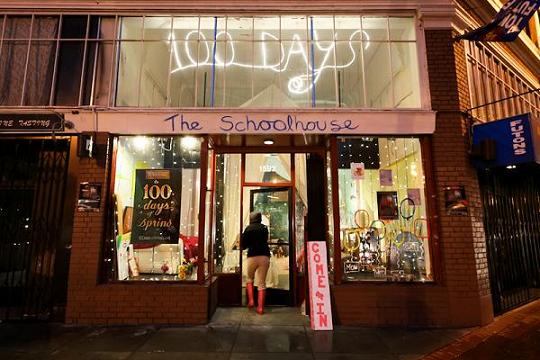
Just beyond the scope of the perpetual debate of revitalizing Mid-Market — defined as the stretch from Fifth Street to Van Ness Avenue — an extraordinary project is quietly closing its doors on an oblique, no-man’s-land corner of Market near Franklin. There, for one hundred days and nights, an empty glass storefront opened up to spill a swath of light and music onto the cigarette-studded sidewalk — without funding, a business model, or (as founders Will Greene and Sam Haynor are the first to say) much of anything else.

“Ask us our mission statement,” One Hundred Days of Spring organizer Haynor challenges.

“We don’t have one,” Greene, his creative partner, cuts in.

“Well, yes we do,” says Haynor.

“Yeah, that not doing it seemed like a cop-out,” the pair concludes.

“It” was creating more than three months of free and donation-based events, classes, and recorded stories representing a variegated slice of the local population: hipster kids in art collectives, professionals on their Market Street commutes, and low income neighborhood residents, including many who bed down each night on the block.

As part of Central Market Partnership’s ongoing efforts to inject arts and culture into revitalization plans for mid-Market, the San Francisco Office of Economic and Workforce Development is joining with the Arts Commission to hold a series of focus groups exploring ways to engage artists, small businesses and cultural organizations in the making of a thriving creative district.

Five focus groups have already met, according to OEWD’s Jordan Klein, and over the coming weeks, more gatherings — of community residents, transportation advocates, historical preservation advocates, and nonprofit leaders — will provide insight for the Central Market Economic Strategy, to be released in the late summer or early fall.

One Hundred Days of Spring wasn’t on the agenda of any of these meetings. A former boutique clothing store sandwiched between SROs and auto body shops on a strip shadowed by the sheer, block-long face of a Honda dealership, the space’s previous tenants didn’t last long. But transformed into a gypsy-tent-circus-wagon-theater-gallery-cum-classroom, the storefront, reborn as the Schoolhouse, rooted itself in the neighborhood in just a few months.

The hundred days are now over. But if the packed closing ceremony was any indication, Haynor and Greene’s model is one that the community is keen to reproduce. Mark Singer, a research librarian and freelance writer who found the project in what the two founders call the “analog way” — by stumbling across the threshold — told supporters, “I challenge everyone in this room to replicate what we’ve seen here, seen in the last hundred days.”

“The ultimate goal,” Haynor said, “is not only to share and to educate, but at the end of one hundred days, to have created one hundred new ideas for people to carry out into the world.”


Nothing to it

One Hundred Days of Spring was an experiment in community-supported programming. Rather than relying on or waiting for grant money, Haynor and Greene hoped to show that a community space can be self-sustaining — for the benefit of those who can contribute more and those who must contribute less.

“San Francisco is grant rich,” Haynor explains, “but it’s also full of people waiting for grants. They have a bunch of awesome ideas, but by the time the grant cycle comes around, the initial spark is gone. For us, going after a grant would just eat up time, and we wouldn’t end up doing what we wanted.”

Instead, the two 25-year-olds pooled their savings and paid $2,000 a month for rent from March to June, $200 for utilities, plus a few hundred extra for renovations and insurance. Within three weeks of the initial idea, they had moved into the space and populated a calendar of events through friends, friends of friends, and tools like SF Chalkboard. They were running full tilt by day six. 

In just over three months, the team offered more than 250 classes, shows, and tutorials — sometimes five in a day — covering everything from truffle-making and fermentation to bike repairs, aerial silks, and open mics. By collecting donations on a pay-what-you-can basis, Haynor and Greene were able to recover a large portion of their initial output, and also garner an extra $4,000 to reinvest into the project.

Greene on the value of 100 days of events: “If you try to put a value on what we have now, that we didn’t have then, you couldn’t buy it for $4,000.”

Though the Schoolhouse founders ended up $4,000 short, Greene says they “could have broken even” if they had focused more on the project’s revenue-generating components, like filming videos for musicians who performed in the space.

Even so, for Greene the worth of One Hundred Days of Spring was indisputable. “If you try to put a value on what we have now, that we didn’t have then, you couldn’t buy it for $4,000,” he says.

When Judy Nemzoff, community arts and education program director for the Arts Commission, stopped by the Schoolhouse and asked how Haynor and Greene did what they did, the two replied, “Well, we just signed a lease.”


It takes two

Inside the Schoolhouse, the laid-back attitude seemed to likewise shrug “nothing to it but to do it.” But the warm, easy atmosphere belied the late nights and hard work it took to get ‘er done.

Understanding how One Hundred Days of Spring came to be — and why it worked so well — means understanding a bit about its creators

Greene and Haynor, hanging at the Schoolhouse

Haynor and Greene have the kind of friendship people make movies about. Besides the sort-of charming things like finishing each other’s sentences and bragging about accomplishments each knows the other would never mention for himself, there’s the sense that somehow, these two unassuming fellows are going to change the world.

“We’re a good balance,” Greene says. With the air of someone showing how two-plus-two equals four, he explains, “Sam’s a bit spastic, and I can plunge a toilet.”

“We have different skill sets, but we share goals,” he continues. “We keep each other in check. We’re both very often wrong, but we’re rarely both wrong at the same time.”

Coco Spencer, who joined One Hundred Days of Spring as an intern partway through and become an indispensible team member, says she was willing to dedicate so many hours to the Schoolhouse because, “Basically, Sam and Will are the most inspiring people I’ve ever met.”

Haynor and Greene were campers and later counselors together at the Bar 717 Ranch in Trinity County. There, they found each other, and also a passion for teaching — or, as they put it, “helping people to be good versions of themselves.”

Though each has traveled and embarked on sundry individual projects — Greene as a musician and videographer, Haynor as a chess champion and conflict-area journalist — they continue to connect over their drive to educate in unique new ways.


Bathroom, beats, and big ideas

At the Schoolhouse, that meant engaging community members through a service-based approach. “Our main goal is to provide resources to people who need resources,” Greene says. “We’re not interested in providing resources to people who have resources.”

Given the diversity of The Schoolhouse’s participants, “resources” could mean different things.

Haynor explains, “For some people, we’re a bathroom. For some we’re a place to stop in and say ‘hi.’ For some, we’re a place to do events.”

“We’re successful because we’re always doing something fun, and everyone feels invited,” Greene says. “It’s the loose nature of our project. There’s no doorman, no guy with a cash box.”

There were challenges (“Sam’s been trying to put together homeless poetry readings, but he’s scheduled them for the first of the month. That’s when everyone gets their checks, so everyone gets drunk,” Greene says at one point), but there were also many moments — like when a woman from the block walked up and started giving Haynor a massage, or when Greene calmly negotiated with a rowdy, intoxicated visitor, encouraging her to pipe down and eventually leave — that pointed to a deft interface with the surrounding community.

“They respect our storefront more than they do the others,” Greene says. Some locals worked shifts at the Schoolhouse in return for resources. Others stopped in for music, for food and nutrition classes, or to look at the art. Some simply came by to talk about living in the area.

During an “Un-Talent Show”, a performer named SofT humorously described a street-dweller’s perpetual problem: carrying belongings. He showed an in-stitches audience how to bundle objects in an old sweater — a wholly relatable rap on wrapping. Another visit came from Benny, one of SF’s famous itinerant tamale sellers, who lives in an SRO across the street and makes what partakers described as “possibly the world’s best tamales” across town in his girlfriend’s kitchen.

Haynor describes a woman who walked into a sewing workshop — run by SF Social Fabric, a volunteer-staffed bike maintenance and sewing skills collective — with “some trepidation.”

“She was in a room with a bunch of people who were nothing like her,” he says, “but we got to know each other over the fact that we all wear clothes. And they all fall apart.”

Neighborhood connections at the Schoolhouse

“There’s a duality to this corner,” Haynor says. “From doctors to the people who live on the block to all the people in the middle who travel Market Street. Before us, some wouldn’t even cross the street.”

“At our best,” he continues, “we’re a place people from another demographic can discover the old-fashioned way — with their eyes and their feet. They cross the threshold, ask what we’re doing, decide to stay, and learn something. Now, I can’t go five minutes without seeing someone I know, or someone who I recognize, or someone who just popped in.”

Singer, a perfect example of the phenomenon, started stopping by between two and five times a week after his initial discovery. He framed the project’s importance in simpler terms: “This is where we need these things to happen. Where it smells like urine on a hot day.”


Let’s put on a show!

Singer believes that projects like the Schoolhouse can “transform parts of San Francisco” by providing services that are more than “just artists and gallery-talk.” The Schoolhouse, he says, “was something visceral.”

“One Hundred Days of Spring created an infinite possibility for community that can’t be replicated on a screen or keyboard. We’re not talking Internet cafés with white earbuds, but humans breathing in the same space — collaborating, communicating in one room, and that room changing every darn day.”

Indeed, the walls of the Schoolhouse were repainted so many times over the course of the hundred days — with layers of murals, street art, installations, white space for projecting films — that Spencer, who took charge of many of the events’ logistics, joked she was hoping to reduce the interior square footage, and thus, the rent.

The zealous energy required to transform the space again and again was reminiscent — Singer pointed out — of Babes-in-Arms-era Mickey Rooney and Judy Garland exclaiming Hey, kids! Let’s put on a show in this old barn! That down-home, DIY energy may be just what efforts like the Mid-Market revitalization require.

Greene, who attended one of the Central Market Partnership’s focus groups, says the consensus was that knowledge about and access to space were the biggest obstacles to creating and executing programs of any kind.

“People are looking for answers,” he says, “looking for some larger entity to hand them space, or looking tax breaks. There’s the feeling that you can’t just do what you want to do.”

“Rather than saying ‘if you give us space, we’ll fill it with beautiful things,’ you can say ‘I’m just going to do it.’ If you’re willing to make it happen, if you work really hard, if you work with the people you’re trying to reach, then you don’t have to worry about anything else.”

Despite the waiting, wanting, hoping attitudes Greene says he encountered, he points out that plenty of others are “just doing it.” The Schoolhouse helped along a few such visionaries by sponsoring two “Grant Prix Dinners.” During the informal roundtables, entrepreneurs presented project ideas between courses. Participants paid a fee for dinner and a ballot on which to elect their favorite projects – to whom the entry frees were turned over as seed money at the end of the night. 


Bringing together the neighborhood

At times, especially in San Francisco and other urban areas where real estate is costly, amping up a neighborhood’s arts and cultural amenities has acted as a roundabout measure to invite the type of gentrification that sweeps streets clean. That kind of programming is not intended to serve current residents so much as to usher in new ones. 

By contrast, the Schoolhouse made a conscious decision to serve the neighborhood’s existing population — with safer-feeling streets resulting, and much more quickly, at that. 

One Hundred Days of Spring was a bold, direct move to engage the local community. As such, it was highly effective not only at providing needed resources, but at tempering the less-desirable qualities of the neighborhood by creating a sense of community and responsibility among residents and passers-through.

“Coming out of Muni, walking home on Market Street,” Singer had said, “can frankly be pretty scary. There’s substance abuse, drug deals, and people who may or may not be harmless.” The Schoolhouse, he said, helped diffuse that lack of ownership and feeling of “anything goes.” For Singer – and Schoolhouse denizens of all backgrounds — the space managed to help tie a few new knots. 

“The Schoolhouse brought me closer to a world that’s very marginal,” Singer said. “the homeless world.”

Whether or not Mid-Market planners will look to the Schoolhouse for a lesson in effective community building, the project’s two masterminds have undoubtedly developed a model they can draw on in the future.

Haynor and Greene plan to continue working together on community education projects. With One Hundred Days of Spring under their belts, they will be able to approach supporters “not just with an idea, but with a proven concept.”

“We are both in this together to see what we’re both capable of,” Haynor said. “To see if we’re any good at this thing.”

In the style of banter so typical of the pair, Greene added, “So we can figure out the rest of what we’re going to do with our whole darn lives.”


Smells like motherland spirit

0

cheryl@sfbg.com

FILM When North Korea makes the news, it’s usually under unpleasant headlines containing words like “nuclear” and “hostilities.” What most Americans know of this secretive country is either drawn from these dire reports or formed via pop culture. Notable are Vice magazine’s surprisingly illuminating North Korean travelogue, which “aired” online, and a pair of 2004 films: doc A State of Mind, about two girls training for the country’s circus-on-a-terrifying-scale Mass Games, and, of course, Team America: World Police.

For the sum of a few thousand euros, Beijing-based Koryo Tours can book Westerners (except journalists — NO JOURNALISTS ALLOWED!) on trips that include the Mass Games, the DMZ, Baekdu Mountain, and more (act now for the “Kim Il Sung 100th Birthday Ultimate Mega Tour 2012”!) The Koryo website’s FAQ (“Will the guides try to brainwash me?”) offers quite an education about how controlled access to the country really is — as you might suspect, tourists have to be extremely careful where they point their cameras. Still, a vacation in North Korea would surely be a one-of-a-kind experience.

With that in mind, Koryo is sponsoring a screening of a one-of-a-kind — at least in America — film, Centre Forward, a 1978 curio that was digitally restored in 2010. Directed with limited artistic flair by Pak Chong-Song (according the Yerba Buena Center for the Arts’ website, “considered one of the DPRK’s finest filmmakers”), this 75-minute, black-and-white propaganda piece weaves the tale of Comrade In Son, a gifted but inexperienced soccer player struggling to succeed on a team that recently upgraded its training regime from merely exhausting to sadistically brutal.

Along the way, the lad wearing No. 17 learns important lessons from his sister (a dancer whose training also tends toward the sadistically brutal), his roommate (an older player with international triumphs under his belt), his coach (who gives motivational speeches that invoke the teachings of the Fatherly Leader), and the lyrics of the rousing tunes that play over the film’s many montages — “Oh we are sportspersons of the Leader, let us demonstrate wisdom and vigor,” that sort of thing. There’s never any doubt, because it’s emphasized over and over, that sporting glory is owned by the motherland, not individual players. (Though if you fail, you’re personally responsible for hindering the DPRK’s pursuit of being “a kingdom of sports.”)

Centre Forward‘s original release must’ve stirred the hearts of North Korean soccer fans who recalled the national team’s best-ever World Cup showing; in 1966, it reached the quarter-finals after defeating perennial powerhouse Italy. Contemporary fans might better remember the 2010 World Cup, though they’d probably prefer not to — while even qualifying for the tournament was an accomplishment (and the extreme underdogs did score a goal in their game against Brazil), the team exited after three losses, including a humiliating 0-7 defeat versus Portugal.

The media, of course, feasted on the oddities the outsider country brought to the World Cup stage: the identically-dressed fans that were alleged to be Chinese actors imported to South Africa for the occasion; the assertion that the North Korean coach was getting pitch-side advice from Kim Jong-il via an invisible phone invented by the Supreme Leader himself. We chuckled, sure. But who didn’t worry a bit when the team had to trudge back to Pyongyang, still stinging from having their asses handed to them on international television by Cristiano Ronaldo and company?

Multiple sources reported the team and coach were “publicly rebuked” (some said for six hours) for their poor showing, and that the team was forced to “reprimand” their own coach, who was then quickly shunted into a laboring job (see above, re: “kingdom of sports.”) Superstar striker Jong Tae-se — loyal to North Korea, but born in Japan, so he enjoys the decadent luxury of playing in Europe — was spared from this punishment. But what happened to the other players? If Centre Forward‘s “no pain-no gain” training philosophy at all resembles real life, I shudder to imagine.

CENTRE FORWARD

Thurs/30, 7:30 p.m., $6–$8

Yerba Buena Center for the Arts

701 Mission, SF

(415) 978-2787

www.ybca.org

Jerry’s bad budget

19

The Democrats in the Legislature did what they had to do, and passed the only budget that the governor would agree to. But Jerry’s Budget — and this will always be Jerry’s budget, since he’s the one who insisted on the terms — is pretty bad news.


I could have told the governor six months ago that he’d never, ever get Republican support for tax extensions. I could have told him that things are very different from the 1970s, when he was last governor. Back then, Republicans were actually interested in governing and would work with Democrats. Now they’re only interested in obstructing — and in sticking to a “no taxes” pledge that has severely damaged the state.


But no: Jerry had to be Jerry, and veto the budget the Democrats passed the first time, because he still thought he’d get his way.


Now he has a budget that (a) won’t work unless the economy continues to pick up and (b) protects prisons at the expense of education.


Imagine: The Democratic governor of California saying that he is willing to cut a week out of the school year — but isn’t willing to make comparable cuts in the state prison system.


Oh, and guess what? It gives Republicans the ability to crow about how California didn’t need those tax extensions in the first place.


Way to go, Guv.

DREAM Act would reduce deficit, strengthen military…and perhaps save the world

23

Last December, when the DREAM (Development, Relief, and Education for Alien Minors) Act came up five votes short in the Senate, advocates began to worry that this seemingly modest piece of immigration reform, which offers a pathway to citizenship for undocumented youth who do well in college and/or serve in the military would not be able to get the necessary votes, even with Barack Obama as President. Rahm Emanuel, who served as Obama’s Chief of Staff up until last October, was reportedly criticized by some for allegedly not doing enough to support immigration reform. And frustration was high, as the community was forced to petition U.S. Immigration and Customs Enforcement (ICE) each and every time they heard that a well-performing student, with no criminal record, like Steve Li or Mandeep was about to be sent to a country that they barely knew–taking their education and knowledge of the United States with them.

But six months later, the DREAMers (undocumented students who want to serve their adopted country) are refusing to take “no” for an answer. (In December, Steve Li won a reprieve, and last week ICE decided not to deport Mandeep, who was voted in high school as “most likely to save the world.” ) And now Emanuel, who was sworn in as Chicago’s mayor in May, is raising his voice in support of the DREAM Act, which Sen. Dick Durbin (D-IL), who has been fighting for immigration reform for more than a decade, is sponsoring. And they are hoping to turn the tide and get Republicans to vote for legislation they say will reduce the deficit, build up the military and perhaps, by not deporting young U.S. trained geniuses, even save the world.

“The DREAM Act is consistent and reinforces the values of citizenship,” Emanuel said during a June 27 telephone call with reporters on the eve of the U.S. Senate’s first-ever hearing on the DREAM, which Durbin will chair June 28. “Having a DREAM Act pass at the national level will help us reinforce the right type of values,” Emanuel continued, noting that Colin Powell, a retired four-star general who was Secretary of State under President G.W. Bush, and Obama’s retiring Sec. of Defense Robert Gates, both support Durbin’s bill

Rahm was joined by Obama’s Education Secretary Arne Duncan and Margaret Stock, a former professor at the U.S. Military Academy at West Point, in arguing that the DREAM Act will stimulate the economy and benefit themilitary, by allowing thousands of top-performing U.S.-educated youth to give back to their adopted country rather than face deportation to countries they barely remember, where they could fall victim of forces that don’t have America’s interests at heart.

As former head of Chicago Public Schools, Duncan said he met plenty of students who “happened not to be born in America” but had excelled in public schools, only to find the door slammed shut, when it was time to go to college. “We need to summon the courage and political will to do the right thing for our country,” he said.

Duncan pointed to Pulitzer Prize-winning journalist Jose Vargas, whose story about his life as an undocumented immigrant was turned down by the Washington Post, before the New York Times magazine published it this weekend. “How many other Pulitzer Prize winners are there out there?” he asked.

And former West Point professor Margaret Stock explained that many of the DREAMers have great potential as military recruits, but are barred from enlisting, even though some of them try to anyway, under the current system.  “They are patriotic, honorable and want to serve the country,” Stock said.

Some of these potential recruits won’t qualify, because they have asthma or physical impairments, Stock noted. But she predicted that those that do, will do very well, based on a Pentagon study that showed that legal immigrants who enlist outperform U.S. citizens. And that, Stock added, could help fill the recruitment gap that is coming, as the economy recovers, and the U.S.-born population continues to age.

Records show that the military hasn’t had any difficulty meeting its goals since the economy tanked, a few years ago. But Stock predicted that the U.S. Armed Forces will face a difficult recruitment climate, as the recession ends. Unless the DREAM Act, which would dramatically enlarge the number of potential military recruits, passes.  “It would allow us to tap into a pool of homegrown talent that is highly motivated to join,” she said.

Asked what the point of the June 28 hearing is, given that the Republican votes for the DREAM Act still don’t seem to be there, Secretary Duncan, who will testify June 28 on behalf of the DREAM Act with Homeland Security Secretary Janet Napolitano, and Clifford Stanley, the Pentagon Undersecretary for Personnel and Readiness, replied,” to continue to raise awareness and build a groundswell of support.”

“I don’t think anyone has given up hope that we can do the right thing,” Stock added. “What may have changed is the serious talk about reducing the debt. “
.
According to a December 2010 Congressional Budget Office report, enacting the DREAM Act would save an estimated $1.3 billion over the next ten years. Supporters say that in addition to helping the military, the legislation would help fill 3 million job vacancies in the fields of stem cell, science and mathematics.
And as Stock pointed out, it makes no sense to deport large numbers of U.S. educated youth to foreign countries, where they risk being recruited to work for foreign governments against the U.S.’s best interests.

Asked whether new military recruits are really needed, now that Obama has announced a troop draw down in Afghanistan, Stock said that taking troops out of Afghanistan and Iraq doesn’t really reduce the global situation. “We constantly face crises in which we need the intervention of the U.S. military,” Stock said.

“We’re not turning into an era of full peace, and we expect to see a ten percent decline in pool of eligible recruits,” she said, noting that 35 percent of the U.S. citizens who sign up for the military fail medical fitness tests, another 18 percent fail because of drug and alcohol abuse, and 5 percent have criminal conduct problems.

“So, a crisis is coming, even with the draw down,” Stock continued, noting that the population of legal green card holders remains “relatively flat” even as the numbers of those who are legally here but can’t get a green card, and the numbers of those without documents but willing to serve, grows.

Stock noted that when you deport young people to countries they barely know and where they have no social safety net, they are in danger of being recruited by folks who might be at cross purposes with the United States. “The rise of MS-13 is directly related to our deportations to Central America,” Stock said. “The gang became their social network.”

Stock acknowledged that DREAM Act eligible students are “highly educated, high quality Americanized people,” and aren’t likely to become members of a gang. But they could be of interest to foreign militaries and intelligence organizations, she warned.

Asked how many non-citizens who are in the U.S. legally enlist in the military each year, Stock said about 9,000 non-citizens. But she noted that while documented non-citizens can join the military, they are however barred from becoming officers or attending West Point. “Most jobs are not open to them,” she said.  In other words, the DREAM Act doesn’t change the military’s requirements. But it would allow a much bigger number of non-citizens to join the military and eventually become citizens, which, in turn, would open more doors to them in the military, too.

And so ended the press conference ahead of Tuesday’s first-ever Senate hearing on the DREAM Act, which reportedly is being held in a large hearing room to accommodate at least 200 student supporters, including the daughter of a family of Albanian immigrants who was valedictorian of her Michigan high school class and is currently fighting deportation.

“These are young people who have that kind of exciting look in their eyes that they want to be part of the world,” Durbin, whose mother was a Lithuanian immigrant, recently said. “But they can’t make that first move toward the life that they want to live because they are undocumented.”

Predictably, the DREAM Act is being used as a recruiting tool for conservative groups, who argue that the DREAM is tantamount to amnesty for folks whose parents broke the law. These groups are already battling state-level Dream Act legislation in Maryland, which does not provide a pathway to citizenship but provides in-state tuition for qualified undocumented students. But a poll from Opinion Research Corporation in June 2010 found that 70 percent of likely voters support the DREAM, including 60 percent of Republican likely voters.

With the next election already looming, DREAMers aren’t likely to let up the pressure any time soon…so this could be an interesting political ride. Let’s hope it ends well for all the young people who are currently stuck in the middle of this Catch 22-like situation.
 

Ethics chief says “Run, Ed, Run” must register honestly

24

As the pseudo-campaign to convince Mayor Ed Lee to change his mind and run for mayor prepares to open a campaign office tomorrow morning – an event with all the trappings of a real campaign but without the candidate or the regulatory controls – the Ethics Commission is asking it to re-register in a less deceptive way.

As the Examiner reported this morning, Progress for All, the group behind the Run, Ed, Run campaign – which has set up a website, bought advertising, and printed and circulated campaign materials around the sole purpose of promoting a mayoral campaign – registered as a political action committee (one not subject to campaign contribution limits or other controls) even though Ethics Director John St. Croix said it is clearly formed around a primary purpose.

Today, St. Croix tells the Guardian that he has asked Progress for All to re-register as a committee formed around the specific purpose of promoting Lee for mayor, but that “I don’t know that they responded completely in the affirmative.” Guardian calls to the group’s main contract Gordon Chin, who also runs the Chinatown Community Development Center, were not returned.

Despite statements to the Examiner by Progress for All campaign consultant Enrique Pearce that this campaign isn’t unprecedented (he cited the 1999 mayoral write-in campaign of Tom Ammiano, who was a willing participant in the effort and formed a campaign committee), St. Croix said it is unprecedented and his office is figuring out how to regulate it.

“There aren’t regulations specifically designed for a scenario like his,” he told us. “They can’t operate in the absence of regulations.”

Right now, while Progress for All lists five co-chairs of the committee, the public has no way of knowing who’s funding the group, how much individual donors have given, or how much is being spent to make the campaign appear to have popular support. That will become more clear at the end of July when the semi-annual campaign finance reports are due, and St. Croix said his office plans to “carefully examine” those filings in order to decide how to proceed.

The group’s current filings list its purpose as “general civic education and public affairs,” but St. Croix said the public has a right to know that it has actually formed around a single candidate. While the courts have struck down fundraising limits for committees like this, the group’s website seems to limit contributions to the maximum individual contribution of $500, apparently acknowledging that there are potential legal problems with its current approach.

Lee has repeatedly said that he doesn’t want to run for mayor and has not encouraged this effort, but he has done little to discourage the efforts by a group led by his closest political allies, so he could be sullied by group’s tactics if he eventually decides to run. St. Croix says that if Lee runs and his campaign has any overlap with the current efforts, it will raised troubling issues of whether there has been any collusion between the two campaigns, which is illegal.

Despite the concerns expressed by Ethics, the agency doesn’t have a great track record of being tough with powerful campaign finance violators, as a Grand Jury report released this week argues. For example, although the Guardian and Bay Citizen each reported back in October about an independent expenditure (partially funded by Willie Brown) on behalf of Jane Kim’s supervisorial campaign that was done through Pearce’s Left Coast Communications, which was Kim’s campaign consultant, that apparently illegal action was never followed up by the Ethics Commission. St. Croix has said he can’t comment on that incident, and he responded to the grand jury report by noting that its recommendations were mild even though “the report itself uses some fighting words,” and he said he was preparing a formal response.

Although some activists have argued that those expressing concerns about this stealth campaign are somehow being undemocratic, the reality is that Progress for All is the only mayoral campaign not playing by the rules. And there are rules that govern elections, rules set up precisely so the public knows who’s really behind the campaign propaganda.

The cab driver protest

4

I’m on the side of the taxi drivers who held that noisy demonstration at City Hall. The folks who drive taxis get screwed in so many ways — the gate fees (the price of leasing a cab for a shift) go up faster than the fares the drivers can charge. Gas (which comes out of the drivers’ pockets) goes up even faster. And now they’re getting dinged for credit-card fees (even though by law they’re supposed to take credit cards). Add it all up, and the drivers are losing thousands of dollars a year — and they weren’t making all that much in the first place.


Wonder why drivers are bombing along 101 at 80 miles an hour from SFO to the city? The less time they spend on a fare the more fares they can take. It’s dangerous and the drivers don’t like it, but if you have to make a living and the city and the cab companies keep squeezing every dime out of your pocket, you have to drive like crazy.


I understand why Ross Mirkarimi was pissed at the noise — he’s trying to hold a press conference on education and nobody can hear the kids talking. Bad timing. But still — I’m amazed the drivers aren’t more angry. I’m amazed more of them aren’t calling for a strike. Driving a cab used to be a decent way to make a living (half the freelance writers in San Francisco were cab drivers). Now it’s a nasty grind for a stingy reward (and no helath insurance).


A note to journalists covering this story: Most of the drivers I know hate the word “cabbie.” They’re drivers. Taxi drivers. They’re rather be treated as professionals.