Education

Film Listings

0

Film listings are edited by Cheryl Eddy. Reviewers are Kimberly Chun, Michelle Devereaux, Peter Galvin, Max Goldberg, Dennis Harvey, Johnny Ray Huston, Louis Peitzman, Lynn Rapoport, Ben Richardson, and Matt Sussman. For rep house showtimes, see Rep Clock. For first-run showtimes, see Movie Guide.

FRAMELINE

The 35th San Francisco International LGBT Film Festival runs through Sun/26 at the Castro, 429 Castro, SF; Rialto Cinemas Elmwood, 2966 College, Berk; Roxie, 3117 16th St., SF; and Victoria, 2961 16th St., SF. For tickets (most films $9-$15) and complete schedule, visit www.frameline.org.

OPENING

Bad Teacher Cameron Diaz don’t need no education. (1:29) Shattuck.

Buck This documentary paints a portrait of horse trainer Buck Brannaman as a sort of modern-day sage, a sentimental cowboy who helps “horses with people problems.” Brannaman has transcended a background of hardship and abuse to become a happy family man who makes a difference for horses and their owners all over the country with his unconventional, humane colt-starting clinics. Though he doesn’t actually whisper to horses, he served as an advisor and inspiration for Robert Redford’s The Horse Whisperer (1998). Director Cindy Meehl focuses generously on her saintly subject’s bits of wisdom in and out of a horse-training setting — e.g. “Everything you do with a horse is a dance” — as well as heartfelt commentary from friends and colleagues. In the harrowing final act of the film, Brannaman deals with a particularly unruly horse and his troubled owner, highlighting the dire and disturbing consequences of improper horse rearing. (1:28) Embarcadero, Shattuck, Smith Rafael. (Sam Stander)

Cars 2 Owen Wilson, Larry the Cable Guy, Michael Caine, and others give voice to the autos in this spy-themed Pixar sequel. (1:52) Balboa, Shattuck.

Conan O’Brien Can’t Stop Conan O’Brien Can’t Stop seems less of a movie title and more like a hushed comment shared between one of the many hangers-on during the filming of the “Legally Prohibited From Being Funny On Television Tour.” Throughout 23 cities’ worth of footage, O’Brien seethes, paces, sweats, yells and beats dead jokes so hard that they spring back to life, as he is wont to do.

At this point, the Leno/Coco drama is a bit stale — at least in internet time — but the documentary is a fascinating comedian character study nonetheless. It may be hard to sympathize with a man nursing a bruised ego as he cashes a $45 million dollar check, but it’s easy to see that he’s one of the best late night hosts (temporarily off) the air. Split primarily between clips of O’Brien performing songs on stage with a myriad of celebrity guests and bemoaning how exhausted and frustrated he is, Can’t Stop derives most of its hilarity from the off-the-cuff comments that pepper Conan’s everyday conversations. (1:29) Lumiere, Shattuck. (David Getman)

Oki’s Movie See review at www.sfbg.com. (1:20) Yerba Buena Center for the Arts.

*Viva Riva! Gritty, riveting, and even heartbreaking, Viva Riva!, the first Congolese feature film to get distribution in the states, is much like its small-time crook of an anti-hero, Riva (Patsha Bay Mukuna) — in love with life and prepared to laugh in the face of death when it comes knocking. Director Djo Tunda Wa Munga’s African Movie Academy Award winner tumbles with the grimy details of its Kinshasa, Congo, backdrop, and rarely stumbles. A mere foot soldier in a sprawling crime world, Riva has seized his chance at breaking into the big time, with a score of stolen gasoline, and has returned home. His eyes are on an unlikely prize, Nora (Marie Malone), the well-guarded moll of a Kinshasa gangster. As Riva stalks his lithe prey, he’s tailed by the ruthless Angolan crime boss he’s crossed (Hoji Fortuna) and a local military commander under the thug’s thumb (Marlene Longage). As sexy and violent as a contemporary noir, and as familiar as a folk tale unraveled round a campfire, Viva Riva! holds your attention with all the bruised bravado of its Stagger Lee-like protagonist, catching you in with the way the gorgeous Nora undulates at an outdoor gathering at one moment, then squats in the dirt to take a piss at the next. (1:36) Lumiere, Shattuck. (Chun)

ONGOING

*L’Amour Fou Pierre Thoretton’s documentary L’amour fou opens with two clips of men bidding farewell. The first, from 2002, is of the French-Algerian couturier Yves Saint Laurent announcing his retirement in a moving and emotional speech worthy of his favorite writer Marcel Proust. The second is of Pierre Bergé, Saint Laurent’s longtime business partner and former lover, eulogizing his departed friend at the designer’s memorial service six years later. Thoretton’s film is suffused with goodbyes, many tender and candid, some portentous and rehearsed. To be sure, L’amour fou is a touching portrait of the powerful and tempestuous bond between Saint Laurent and Bergé, a bond that lasted close to five decades and resulted in one of the great empires of 20th century fashion. But it is also, alongside David Teboud’s two 2002 YSL documentaries, another entry in the hagiography of Saint Laurent, one cannily steered by Bergé as much as by Thoretton. Well-spoken and charming, Bergé still comes off as the punchy entrepreneurial foil to Saint Laurent’s dazzling but fragile genius. He can be both hyperbolic (praising Saint Laurent’s gifts) but also forthcoming (discussing the designer’s demons). Former muses Loulou de la Falaise and Betty Catroux are also interviewed, but this is clearly Bergé’s show. (1:43) Opera Plaza. (Sussman)

The Art of Getting By The Art of Getting By is all about those confusing, mixed-up and apparently sexually frustrating months before high school graduation. George (Freddie Highmore) is a trench coat-wearing misanthrope — an old soul, as they say — whose parents and teachers are always trying to put him inside a box and tell him how to think. He finds a kindred sprit in Sally (Emma Roberts) who smokes and watches Louis Malle films. Hot. Heavily scored by the now-ancient songs of early ’00s blog bands, it may all sound like indie bullshit but this one has charm and wit despite its post-trend package. Like a sad little crayon, Highmore is a competent Michael Cera surrogate du jour. Writer-director Gavin Wiesen embraces hell of clichés, but he suitably sums up a generational angst along the way. The film may not always feel real, but it does have real feeling. Look out for great performances from Blair Underwood and Alicia Silverstone. (1:24) 1000 Van Ness, Sundance Kabuki. (Ryan Lattanzio)

*Beautiful Boy Save the children, but pity the parents. Director-cowriter Shawn Ku’s Beautiful Boy is one of two recent films concerning parents of kids who go on school killing sprees, and it’ll get potentially shortchanged due to the forthcoming We Need to Talk About Kevin‘s head-turning cast and its Hitchcockian literary source material. Still, Beautiful Boy shines in its own humble way, by dint of its quiet sense of integrity and refusal to pander. The bone-deep unhappiness suffusing the family concerned was present long before 18-year-old college student Sammy (Kyle Gallner) picked up a gun, killed more than a dozen people, then took his own life. Surviving parents Kate (Maria Bello) and Bill (Michael Sheen) already kept separate bedrooms under the same roof and led separate lives, with Bill pasting an unsettling grin on for work and Maria relentlessly pushing to make everything all right, neither noticing the barely perceptible warning signs that their only son was succumbing to despair. Belying its title, Beautiful Boy is less focused on the desperate youngster than on the adults attempting to cope with the horror he’s wrought — not necessarily cleaning up after him or picking up the pieces, but somehow finding their way through their own explosive responses. Bolstered by fine performances by Bello and Sheen, it’s yet another installment in the post-9/11 cinema of trauma — this time, attempting to imagine the unimaginable and to comprehend a kind of healing. (1:40) SF Center. (Chun)

*Beginners There is nothing conventional about Beginners, a film that starts off with the funeral arrangements for one of its central characters. That man is Hal (Christopher Plummer), who came out to his son Oliver (Ewan McGregor) at the ripe age of 75. Through flashbacks, we see the relationship play out — Oliver’s inability to commit tempered by his father’s tremendous late-stage passion for life. Hal himself is a rare character: an elderly gay man, secure in his sexuality and, by his own admission, horny. He even has a much younger boyfriend, played by the handsome Goran Visnjic. While the father-son bond is the heart of Beginners, we also see the charming development of a relationship between Oliver and French actor Anna (Mélanie Laurent). It all comes together beautifully in a film that is bittersweet but ultimately satisfying. Beginners deserves praise not only for telling a story too often left untold, but for doing so with grace and a refreshing sense of whimsy. (1:44) Embarcadero, Piedmont, Sundance Kabuki. (Peitzman)

*Bill Cunningham New York To say that Bill Cunningham, the 82-year old New York Times photographer, has made documenting how New Yorkers dress his life’s work would be an understatement. To be sure, Cunningham’s two decades-old Sunday Times columns — “On the Street,” which tracks street-fashion, and “Evening Hours,” which covers the charity gala circuit — are about the clothes. And, my, what clothes they are. But Cunningham is a sartorial anthropologist, and his pictures always tell the bigger story behind the changing hemlines, which socialite wore what designer, or the latest trend in footwear. Whether tracking the near-infinite variations of a particular hue, a sudden bumper-crop of cropped blazers, or the fanciful leaps of well-heeled pedestrians dodging February slush puddles, Cunningham’s talent lies in his ability to recognize fleeting moments of beauty, creativity, humor, and joy. That last quality courses through Bill Cunningham New York, Richard Press’ captivating and moving portrait of a man whose reticence and personal asceticism are proportional to his total devotion to documenting what Harold Koda, chief curator at the Costume Institute at the Metropolitan Museum of Art, describes in the film as “ordinary people going about their lives, dressed in fascinating ways.” (1:24) Opera Plaza. (Sussman)

Bride Flight Who doesn’t love a sweeping Dutch period piece? Ben Sombogaart’s Bride Flight is pure melodrama soup, enough to give even the most devout arthouse-goer the bloats. Emigrating from post-World War II Holland to New Zealand with two gal pals, the sweetly staid Ada (Karina Smulders) falls for smarm-ball Frank (Waldemar Torenstra, the Dutchman’s James Franco) and kind of joins the mile high club to the behest of her conscience. The women arrive with emotional baggage and carry-ons of the uterine kind. As the harem adjusts to the country mores of the Highlands, Frank tries a poke at all of them in a series of sex scenes more moldy than smoldery. This Flight, set to a plodding score and stuffy mise-en-scene, never quite leaves the runway. Not to mention the whole picture, pale as a corpse, resembles one of those old-timey photographs of your great grandma’s wedding. These kinds of pastoral romances ought to be put out to, well, pasture. (2:10) Opera Plaza. (Lattanzio)

*Bridesmaids For anyone burned out on bad romantic comedies, Bridesmaids can teach you how to love again. This film is an answer to those who have lamented the lack of strong female roles in comedy, of good vehicles for Saturday Night Live cast members, of an appropriate showcase for Melissa McCarthy. The hilarious but grounded Kristen Wiig stars as Annie, whose best friend Lillian (Maya Rudolph) is getting hitched. Financially and romantically unstable, Annie tries to throw herself into her maid of honor duties — all while competing with the far more refined Helen (Rose Byrne). Bridesmaids is one of the best comedies in recent memory, treating its relatable female characters with sympathy. It’s also damn funny from start to finish, which is more than can be said for most of the comedies Hollywood continues to churn out. Here’s your choice: let Bridesmaids work its charm on you, or never allow yourself to complain about an Adam Sandler flick again. (2:04) Empire, 1000 Van Ness, Shattuck, Sundance Kabuki. (Peitzman)

*Cave of Forgotten Dreams The latest documentary from Werner Herzog once again goes where no filmmaker — or many human beings, for that matter — has gone before: the Chauvet-Pont-d’Arc Cave, a heavily-guarded cavern in Southern France containing the oldest prehistoric artwork on record. Access is highly restricted, but Herzog’s 3D study is surely the next best thing to an in-person visit. The eerie beauty of the works leads to a typically Herzog-ian quest to learn more about the primitive culture that produced the paintings; as usual, Herzog’s experts have their own quirks (like a circus performer-turned-scientist), and the director’s own wry narration is peppered with random pop culture references and existential ponderings. It’s all interwoven with footage of crude yet beautiful renderings of horses and rhinos, calcified cave-bear skulls, and other time-capsule peeks at life tens of thousands of years ago. The end result is awe-inspiring. (1:35) SF Center, Shattuck. (Eddy)

*The Double Hour Slovenian hotel maid Sonia (Ksenia Rappoport) and security guard Guido (Filippo Timi) are two lonely people in the Italian city of Turin. They find one another (via a speed-dating service) and things are seriously looking up for the fledgling couple when calamity strikes. This first feature by music video director Giuseppe Capotondi takes a spare, somber approach to a screenplay (by Alessandro Fabbri, Ludovica Rampoldi, and Stefano Sardo) that strikingly keeps raising, then resisting genre categorization. Suffice it to say their story goes from lonely-hearts romance to violent thriller, ghost story, criminal intrigue, and yet more. It doesn’t all work seamlessly, but such narrative unpredictability is so rare at the movies these days that The Double Hour is worth seeing simply for the satisfying feeling of never being sure where it’s headed. (1:35) Opera Plaza. (Harvey)

Green Lantern This latest DC Comics-to-film adaptation fails to recognize the line between awesome fantasy-action and cheeseball absurdity, often resembling the worst excesses of the Christopher Reeve Superman movies. A surprisingly palatable Ryan Reynolds stars as Hal Jordan, the cocky test pilot who is chosen to wield a power ring as a member of an intergalactic police force called the Green Lantern Corps. He must face down Parallax, an alien embodiment of fear, who appears here as a chuckle-inducing floating head surrounded by tentacles. Peter Sarsgaard is effectively nauseating as Hector Hammond, who becomes Parallax’s crony after he is transformed by a transfusion of fear energy. The acting is all over the map, with Blake Lively’s blank-faced love interest caricature as the weakest link, and the effects are hit-or-miss, but scenes featuring alien Green Lanterns should please fans, and you could probably do worse if you’re looking for an entertaining popcorn flick. (1:45) 1000 Van Ness, Sundance Kabuki. (Stander)

The Hangover Part II What do you do with a problematic mess like Hangover Part II? I was a fan of The Hangover (2009), as well as director-cowriter Todd Phillips’ 1994 GG Allin doc, Hated, so I was rooting for II, this time set in the East’s Sin City of Bangkok, while simultaneously dreading the inevitable Asian/”ching-chang-chong” jokes. Would this would-be hit sequel be funnier if they packed in more of those? Doubtful. The problem is that most of II‘s so-called humor, Asian or no, falls completely flat — and any gross-out yuks regarding wicked, wicked Bangkok are fairly old hat at this point, long after Shocking Asia (1976) and innumerable episodes of No Reservations and other extreme travel offerings. This Hangover around, mild-ish dentist Stu (Ed Helms) is heading to the altar with Lauren (The Real World: San Diego‘s Jamie Chung), with buds Phil (Bradley Cooper) and Doug (Justin Bartha) in tow. Alan (Zach Galifianakis) has completely broken with reality — he’s the pity invite who somehow ropes in the gangster wild-card Mr. Chow (Ken Jeong). Blackouts, natch, and not-very-funny high jinks ensue, with Jeong, surprisingly, pulling small sections of II out of the crapper. Phillips obviously specializes in men-behaving-badly, but II‘s most recent character tweaks, turning Phil into an arrogant, delusional creep and Alan into an arrogant, delusional kook, seem beside the point. Because almost none of the jokes work, and that includes the tired jabs at tranny strippers because we all know how supposedly straight white guys get hella grossed out by brown chicks with dicks. Lame. (1:42) 1000 Van Ness, SF Center, Shattuck, Sundance Kabuki. (Chun)

Judy Moody and the Not Bummer Summer Try not trying so hard, Judy Moody. The tween paperback fave gets an OTT makeover for the cineplex, as director John Schultz and company throw as many bells, whistles, silly new slang, kooky gruesome colors, CGI twinkles, sing-along subtitles, and zany hijinks into the mix as possible, in vain hope of keeping kiddie eyeballs from drifting. Bright-eyed redhead Judy Moody (Jordana Beatty) — think Pippi Longstocking, only way more annoying — is stuck at home for the season, sans most of her pals and parentals, scuttling her plans for a Not Bummer Summer filled with weirdly competitive thrill points (her very own invention) and pointless faux adventures (ditto). Her cute, arty, wack-eee Aunt Opal (Heather Graham) offers some diverting solace, but the summer seems to find its groove only after Judy slimily co-opts younger bro Stink’s (Parris Mosteller) obsession with Bigfoot. Lovers of visceral kid stuff will appreciate Judy and mob’s affection for pee and puke references — too bad the entire enterprise just reeks of very bummer desperation. (1:31) 1000 Van Ness. (Chun)

Kung Fu Panda 2 The affable affirmations of 2008’s Kung Fu Panda take a back seat to relentlessly elaborate, gag-filled action sequences in this DreamWorks Animation sequel, which ought to satisfy kids but not entertain their parents as much as its predecessor. Po (voiced by Jack Black), the overeating panda and ordained Dragon Warrior of the title, joins forces with a cavalcade of other sparring wildlife to battle Lord Shen (Gary Oldman), a petulant peacock whose arsenal of cannons threatens to overwhelm kung fu. But Shen is also part of Po’s hazy past, so the panda’s quest to save China is also a quest for self-fulfillment and “inner peace.” There’s less character development in this installment, though the growing friendship between Po and the “hardcore” Tigress (Angelina Jolie) is occasionally touching. The 3-D visuals are rarely more than a gimmick, save for a series of eye-catching flashbacks in the style of cel-shaded animation. (1:30) 1000 Van Ness, SF Center. (Stander)

*Making the Boys In 1968 The Boys in the Band revolutionized Broadway and opened a lot of minds by being a hit play (and film) about NYC homosexuals. Yet on the cusp of “Gay Liberation” and for many years thereafter, much of the actual gay community hugely objected to author Mart Crowley’s fictive portrait of its ‘mos as insular, shallow, classist, bitchy, and guilt-ridden. It was (as interviewee Edward Albee notes here) a picture ideally suited to straight Broadway audiences who lined up to see queers rendered pitiful if still identifiably human. Crayton Robey’s absorbing documentary chronicles the bumpy road of Boys and its creators — Crowley never had another hit, floundering until he moved into TV series scripting. The cast of the 1970 movie version, directed by William Friedkin (one year before The French Connection, followed by The Exorcist), saw their big break turn into a virtual industry blacklisting. Exceptions were unimpeachably heterosexual thespians Laurence Luckinbill and Cliff Gorman, who only “played” gay. This engrossing document recalls a work that trailblazed, was rejected as politically correct, then re embraced as an important touchstone in gay visibility and self-empowerment. (1:33) Roxie. (Harvey)

Midnight in Paris Owen Wilson plays Gil, a self-confessed “Hollywood hack” visiting the City of Light with his conservative future in-laws and crassly materialistic fiancée Inez (Rachel McAdams). A romantic obviously at odds with their selfish pragmatism (somehow he hasn’t realized that yet), he’s in love with Paris and particularly its fabled artistic past. Walking back to his hotel alone one night, he’s beckoned into an antique vehicle and finds himself transported to the 1920s, at every turn meeting the Fitzgeralds, Gertrude Stein (Kathy Bates), Dali (Adrien Brody), etc. He also meets Adriana (Marion Cotillard), a woman alluring enough to be fought over by Hemingway (Corey Stoll) and Picasso (Marcial di Fonzo Bo) — though she fancies aspiring literary novelist Gil. Woody Allen’s latest is a pleasant trifle, no more, no less. Its toying with a form of magical escapism from the dreary present recalls The Purple Rose of Cairo (1985), albeit without that film’s greater structural ingeniousness and considerable heart. None of the actors are at their best, though Cotillard is indeed beguiling and Wilson dithers charmingly as usual. Still — it’s pleasant. (1:34) Albany, Balboa, Embarcadero, 1000 Van Ness, Piedmont, Sundance Kabuki. (Harvey)

Mr. Popper’s Penguins (1:35) 1000 Van Ness.

*My Perestroika Robin Hessman’s very engaging documentary takes one very relatable look at how changes since glasnost have affected some average Russians. The subjects here are five thirtysomethings who, growing up in Moscow in the 70s and 80s, were the last generation to experience full-on Communist Party indoctrination. But just as they reached adulthood, the whole system dissolved, confusing long-held beliefs and variably impacting their futures. Andrei has ridden the capitalist choo-choo to considerable enrichment as the proprietor of luxury Western menswear shops. But single mother Olga, unlucky in love, just scrapes by, while married schoolteachers Lyuba and Boris are lucky to have inherited an apartment (cramped as it is) they could otherwise ill afford. Meanwhile Ruslan, once member of a famous punk band (which he abandoned on principal because it was getting “too commercial”), both disdains and resents the new order just as he did the old one. Home movies and old footage of pageantry celebrating Soviet socialist glory make a whole ‘nother era come to life in this intimate, unexpectedly charming portrait of its long-term aftermath. (1:27) Balboa. (Harvey)

Submarine (1:37) Opera Plaza, SF Center.

*Super 8 The latest from J.J. Abrams is very conspicuously produced by Steven Spielberg; it evokes 1982’s E.T.: The Extra-Terrestrial as well as 1985’s The Goonies and 1982’s Poltergeist (so Spielbergian in nature you’d be forgiven for assuming he directed, rather than simply produced, the pair). But having Grandpa Stevie blessing your flick is surely a good thing, especially when you’re already as capable as Abrams. Super 8 is set in 1979, high time for its titular medium, used by a group of horror movie-loving kids to film their backyard zombie epic; later in the film, old-school celluloid reveals the mystery behind exactly what escaped following a spectacular train wreck on the edge of their small Ohio town. The PG-13 Super 8 aims to frighten, albeit gently; there’s a lot of nostalgia afoot, and things do veer into sappiness at the end (that, plus the band of kids at its center, evoke the trademarks of another Grandpa Stevie: Stephen King). But the kid actors (especially the much-vaunted Elle Fanning) are great, and there’s palpable imagination and atmosphere afoot, rare qualities in blockbusters today. Super 8 tries, and mostly succeeds, in progressing the fears and themes addressed by E.T. (divorce, loneliness, growing up) into century 21, making the unknowns darker and the consequences more dire. (1:52) California, Empire, 1000 Van Ness. (Eddy)

*13 Assassins 13 Assassins is clearly destined to be prolific director Takashi Miike’s greatest success outside Japan yet. It’s another departure for the multi-genre-conquering Miike, doubtless one of the most conventional movies he’s made in theme and execution. That’s key to its appeal — rigorously traditional, taking its sweet time getting to samurai action that is pointedly not heightened by wire work or CGI, it arrives at the kind of slam-dunk prolonged battle climax that only a measured buildup can let you properly appreciate. In the 1840s, samurai are in decline but feudalism is still hale. It’s a time of peace, though not for the unfortunates who live under regional tyrant Lord Naritsugu (Goro Inagaki), a li’l Nippon Caligula who taxes and oppresses his people to the point of starvation. Alas, the current Shogun is his sibling, and plans to make little bro his chief adviser — so a concerned Shogun official secretly hires veteran samurai Shinzaemon (Koji Yakusho) to assassinate the Lord. Fully an hour is spent on our hero doing “assembling the team” stuff, recruiting other unemployed, retired, or wannabe samurai. When the protagonists finally commence their mission, their target is already aware he’s being pursued, and he’s surrounded by some 200 soldiers by the time Miike arrives at the film’s sustained, spectacular climax: a small village which Shinzaemon and co. have turned into a giant boobytrap so that 13 men can divide and destroy an ogre-guarding army. A major reason why mainstream Hollywood fantasy and straight action movies have gotten so depressingly interchangeable is that digital FX and stunt work can (and does) visualize any stupid idea — heroes who get thrown 200 feet into walls by monsters then getting up to fight some more, etc. 13 Assassins is thrilling because its action, while sporting against-the-odds ingeniousness and sheer luck by our heroes as in any trad genre film, is still vividly, bloodily, credibly physical. (2:06) Bridge, Shattuck. (Harvey)

The Tree of Life Mainstream American films are so rarely adventuresome that overreactive gratitude frequently greets those rare, self-conscious, usually Oscar-baiting stabs at profundity. Terrence Malick has made those gestures so sparingly over four decades that his scarcity is widely taken for genius. Now there’s The Tree of Life, at once astonishingly ambitious — insofar as general addressing the origin/meaning of life goes — and a small domestic narrative artificially inflated to a maximally pretentious pressure-point. The thesis here is a conflict between “nature” (the way of striving, dissatisfied, angry humanity) and “grace” (the way of love, femininity, and God). After a while Tree settles into a fairly conventional narrative groove, dissecting — albeit in meandering fashion — the travails of a middle-class Texas household whose patriarch (a solid Brad Pitt) is sternly demanding of his three young sons. As a modern-day survivor of that household, Malick’s career-reviving ally Sean Penn has little to do but look angst-ridden while wandering about various alien landscapes. Set in Waco but also shot in Rome, at Versailles, and in Saturn’s orbit (trust me), The Tree of Life is so astonishingly self-important while so undernourished on some basic levels that it would be easy to dismiss as lofty bullshit. Its Cannes premiere audience booed and cheered — both factions right, to an extent. (2:18) California, Embarcadero, Smith Rafael, Sundance Kabuki. (Harvey)

*The Trip Eclectic British director Michael Winterbottom rebounds from sexually humiliating Jessica Alba in last year’s flop The Killer Inside Me to humiliating Steve Coogan in all number of ways (this time to positive effect) in this largely improvised comic romp through England’s Lake District. Well, romp might be the wrong descriptive — dubbed a “foodie Sideways” but more plaintive and less formulaic than that sun-dappled California affair, this TV-to-film adaptation displays a characteristic English glumness to surprisingly keen emotional effect. Playing himself, Coogan displays all the carefree joie de vivre of a colonoscopy patient with hemorrhoids as he sloshes through the gray northern landscape trying to get cell reception when not dining on haute cuisine or being wracked with self-doubt over his stalled movie career and love life. Throw in a happily married, happy-go-lucky frenemy (comic actor Rob Brydon) and Coogan (TV’s I’m Alan Partridge), can’t help but seem like a pathetic middle-aged prick in a puffy coat. Somehow, though, his confused narcissism is a perverse panacea. Come for the dueling Michael Caine impressions and snot martinis, stay for the scallops and Brydon’s “small man in a box” routine. (1:52) Albany, Clay, Smith Rafael. (Devereaux)

*Trollhunter Yes, The Troll Hunter riffs off The Blair Witch Project (1999) with both whimsy and, um, rabidity. Yes, you may gawk at its humongoid, anatomically correct, three-headed trolls, never to be mistaken for grotesquely cute rubber dolls, Orcs, or garden gnomes again. Yes, you may not believe, but you will find this lampoon of reality TV-style journalism, and an affectionate jab at Norway’s favorite mythical creature, very entertaining. Told that a series of strange attacks could be chalked up to marauding bears, three college students (Glenn Erland Tosterud, Tomas Alf Larsen, and Johanna Morck) strap on their gumshoes and choose instead to pursue a mysterious poacher Hans (Otto Jespersen) who repeatedly rebuffs their interview attempts. Little did the young folk realize that their late-night excursions following the hunter into the woods would lead at least one of them to rue his or her christening day. Ornamenting his yarn with beauty shots of majestic mountains, fjords, and waterfalls, Norwegian director-writer André Ovredal takes the viewer beyond horror-fantasy — handheld camera at the ready — and into a semi-goofy wilderness of dark comedy, populated by rock-eating, fart-blowing trolls and overshadowed by a Scandinavian government cover-up sorta-worthy of The Girl with the Dragon Tattoo (2009). (1:30) Lumiere. (Chun)

*X-Men: First Class Cynics might see this prequel as pandering to a more tweeny demographic, and certainly there are so many ways it could have gone terribly wrong, in an infantile, way-too-cute X-Babies kinda way. But despite some overly choppy edits that shortchange brief moments of narrative clarity, X-Men: First Class gets high marks for its fairly first-class, compelling acting — specifically from Michael Fassbender as the enraged, angst-ridden Magneto and James McAvoy as the idealistic, humanist Charles Xavier. Of course, the celebrated X-Men tale itself plays a major part: the origin story of Magneto, a.k.a. Erik Lehnsherr, a Holocaust survivor, is given added heft with a few tweaks: here, in an echo of Fassbender’s turn in Inglourious Basterds (2009), his master of metal draws on his bottomless rage to ruthlessly destroy the Nazis who used him as a lab rat in experiments to build a master race. The last on his list is the energy-wrangling Sebastian Shaw (Kevin Bacon), who’s set up a sweet Bond-like scenario, protected by super-serious bikini-vixen Emma Frost (January Jones). The complications are that Erik doesn’t ultimately differ from his Frankensteins — he pushes mutant power to the detriment of those puny, bigoted humans — and his unexpected collaborator and friend is Xavier, the privileged, highly psychic scion who hopes to broker an understanding between mutants and human and use mutant talent to peaceful ends. Together, they can move mountains—or at least satellite dishes and submarines. Jennifer Lawrence as Raven/Mystique and Nicholas Hoult as Hank McCoy/Beast fill out the cast, voicing those eternal X-Men dualities — preserving difference vs. conformity, intoxicating power vs. reasoned discipline. All core superhero concerns, as well as teen identity issues — given a fresh charge. (2:20) Empire, 1000 Van Ness, Sundance Kabuki. (Chun)

 

Alerts

0

ALERTS

 By Jackie Andrews


THURSDAY, JUNE 23


Radical Women meeting

Attend this round-up of radical women and LGBTQ organizers who work hard to improve their communities to fight against racism, sexism, homophobia, and labor exploitation. Tonight there will be a light summer supper followed by a discussion and brainstorming session inspired by the “It Gets Better” campaign — a national group that provides hope for queer youth around the country. Collaborate with like-minded people who want to make change happen at home and help hammer out a plan to translate the mission of the “It Gets Better” campaign to our local queer community’s needs.

6:15 p.m., $7.50

New Valencia Hall

625 Larkin, SF

(415) 864-1278

www.radicalwomen.org


Medicare for all

Many progressives around the country are less than enthusiastic with the current administration’s reform on health care, which they see as a sellout to corporate interests. The San Francisco chapter of the Progressive Democrats of America presents this public forum on the topic, where Don Bechler, a tireless organizer for single-payer healthcare since 1994, and clinical psychologist Stephen Berman will discuss just how close we are to having a truly universal healthcare.

7 p.m., free

Unitarian Universalist Center

Martin Luther King Room

1187 Franklin, SF

(415) 776-4580

www.pdaamerica.org


SATURDAY, JUNE 25


People’s Movement assembly

Attend this community forum and planning session for next year’s East Bay Social Forum — inspired by the U.S. Social Forum in Detroit last June where more than 20,000 diverse people came together to build strong progressive movements for housing, health, justice, education, immigration, ecology, and peace.

9:30 a.m.–4:30 p.m., free

Lutheran Church of the Cross

1744 University, Berk.

(510) 848-1424

www.eastbaysocialforum.org


TUESDAY, JUNE 28


Clean Air Act

Find out how the Clean Air Act, signed into law by President Nixon in 1970, is the U.S.’s most important and successful law for controlling air pollution and why it is our best hope in curbing climate change. If used effectively, it could significantly reduce greenhouse gases to a level deemed safe by climatologists. Learn how the Clean Air Act works, what kinds of threats it faces from Congress, and how it can be used to protect the planet and our future.

7–10 p.m., free

Unitarian Universalists’ Hall

1744 University, Berk.

(510) 841-4824

www.bfuu.org 


Mail items for Alerts to the Guardian Building, 135 Mississippi St., SF, CA 94107; fax to (415) 437-3658; or e-mail alert@sfbg.com. Please include a contact telephone number. Items must be received at least one week prior to the publication date.

Will another DREAMer be deported, despite ICE’s S-Comm reforms?

51

Last week, ICE announced reforms to its controversial Secure Communities program. Civil rights advocates denounced these changes as window dressing, and the Guardian broke the news about S-Comm’s importance to the FBI’s Next Generation Identification (NGI) initiative, which appears to be using S-Comm on undocumented folks to secure support for a fingerprint dragnet to cover a much broader segment of the population than undocumented immigrants. But now, even before folks have had a chance to fully process the potential civil liberties impacts of the FBI’s NGI’s initiative, comes word that Mandeep, a DREAM Act honors pre-med student at UC Davis, who was once voted “most likely to save the world” by her peers at Los Altos High in Mountain View, could be deported to India on Wednesday.


Mandeep is pursuing a degree in Neurology, Physiology, and Behavior at UC Davis. But she is undocumented, and thanks to Congress’ failure to pass the DREAM Act last year, she now faces deportation to a country she barely knows. Immigrant rights advocates note that it was only a  month ago that President Obama spoke about the importance of providing a path to citizenship for students like Mandeep.


“We should stop punishing innocent young people for the actions of their parents,” Obama said. “We should stop denying them the chance to earn an education or serve in the military.”


They note that Obama has authority to grant administrative relief, which would make qualified DREAM Act youth safe from deportation, but that he has said he can’t use his executive authority in that way. So they’ve been sounding the alarm about Mandeep’s plight by faxing government officials about her situation.


But weren’t ICE’s newly announced S-Comm reforms supposed to provide relief for students like Mandeep?


Immigrant rights advocates say they are concerned that the reforms may not have much real impact on Mandeep because they rely on advocates and attorneys to get attention on individual cases. They note that Mandeep and her mother turned themselves into ICE this morning because they are scheduled to be deported tonight at 1am. And that ICE released them. But it is not clear what will happen next….


Meanwhile, ICE today announced the results of a seven-day targeted “Cross Check” enforcement operation that led to the arrest of more than “2,400 convicted criminal aliens and immigration fugitives” in May, as part of its promise to focus S-Comm resources on undocumented residents who have also broken criminal laws.


“The results of this operation underscore ICE’s ongoing focus on arresting those convicted criminal aliens who prey upon our communities, and tracking down fugitives who game our nation’s immigration system,” ICE Director John Morton said. “This targeted enforcement operation is a direct result of excellent teamwork among law enforcement agencies who share a commitment to protect public safety.”


ICE notes that everyone taken into custody as part of this latest sweep had prior convictions for crimes such as armed robbery, drug trafficking, child abuse, sexual crimes against minors, aggravated assault, theft, forgery and DUI. ICE also noted that 22 percent of the individuals were immigration fugitives-convicted criminal aliens with outstanding orders of deportation who failed to leave the country.


ICE says it conducted its first successful Cross Check operation in December 2009,  and has since conducted similar operations in 37 states, but that this seven-day operation, was the largest of its kind, and involved the collaboration of more than 500 ICE agents and officers, and coordination with the U.S. Marshals Service, the U.S. Diplomatic Security Service, U.S. Customs and Border Protection, the U.S. Postal Inspection Service, and ICE’s state and local law enforcement partners throughout the United States.


Arrestees included a 32-year-old man residing in Amesbury, Mass., from the Dominican Republic, who is a registered sex offender convicted of assault, battery on a household member, indecent assault, battery on a child, and leaving the scene/person injured; a 51-year-old man residing in Denver, Colo. from Libya convicted of first degree sexual assault against a child and assault domestic violence; a 38-year-old man residing in Orlando, Fla. from the Philippines convicted of battery on a law enforcement officer, resisting officer with violence, reckless driving and refusal to submit to blood/urine test; andaA 37-year-old residing in North Hills, Calif. from Mexico convicted of aggravated felony sex crime and rape of an unconscious victim. He was also identified as re-entering the United States after deportation. He will be removed following prosecution for illegal re-entry after deportation; and a 47-year-old man residing in Magnolia, Texas from Mexico convicted of injury to a child with intent to cause bodily injury, burglary, marijuana possession, driving while license suspended and indecency with a child by sexual contact.


“ICE is focused on smart, effective immigration enforcement that prioritizes efforts first on removing those serious criminal aliens who present the greatest risk to the security of our communities, such as those charged with or convicted of homicide, rape, robbery, kidnapping, major drug offenses and threats to national security. ICE also prioritizes the arrest and removal of those who game the immigration system including immigration fugitives or those criminal aliens who have been previously deported and illegally re-entered the country, “ ICE stated.


Hmm. It sure sounds like Mandeep doesn’t fit ICE’s criminal alien profile or priorities any more…

3348 with a bullet

3

arts@sfbg.com

A name like writer James Boice’s no doubt washes up waves of adulation. His partner-in-assonance is a certain modernist master whom Boice, at 29, surely knows something about. The Good and the Ghastly (Scribner, 288 pages, $25), a wicked new novel, is the kind of towering bildungsroman-cum-crime fiction carnival that is both entertaining and well-crafted — something we’ve come to expect from writers like Chuck Palahniuk, but don’t usually get these days.

For all its explosions, the book isn’t mere spectacle for spectacle’s sake. Often contemporary imaginations of literary violence sink into the page-filling, glittery sands of ersatz — but James Boice, quite the contrarian, has conjured a brutal, sharp diamond in the literary rough. The Good feels fresh and urgent while culling themes as old as the Bible and as zeitgeist-y as The Sopranos: the neo-noir crime epic. Boice has certainly eaten his cultural vegetables; at the same time, he isn’t afraid to spew them up to create a pulpy piece of work that is contemporary and allusive. It’s enough to satisfy readers in need of instant gratification as well as those less ravenous who prefer to sip and savor.

The Good and the Ghastly is a mad picaresque, the story of antihero Junior Alvarez’s rise and fall as criminal overlord. It is the 34th century. Seminal cultural artifacts were lost in some kind of nuclear devastation centuries before, so Sarah Palin and Oprah are among this world’s spiritual and intellectual pundits. Someone called Kevin Lithis is the new Jesus Christ. Everybody believes Stephen King wrote the works of Shakespeare. Ikea tables are considered antiques. But down in the underbelly, an implacable race to power wages between the Italians and the Irish as Josefina, a good mother turned hardened revenge-seeker, sets out to avenge the death of her son — one of Junior’s victims — by assassinating Junior and his unctuous underlings. And how far she goes I won’t say, but it does involve, in one scene, a bazooka, a baby, and a priest’s garb. Yeah.

A peak at the epigraphs inaugurating The Good and the Ghastly give a real sense of Boice’s literary antecedents. There are quotes from Faulkner, Shakespeare, Stephen King, and the OJ Simpson trial. With this mixed bag of chestnuts as synecdoche, Boice traverses the furrows of the high- and lowbrow in his novel. At once, The Good deserves the literary fiction crown and yet, it is also, in its own right, a piece of glorious trash. It is ugly and sensational, yet Boice is an evocative writer who knows what he’s up to.

With no degree to speak of, he has made himself something of a literary wunderkind. When Boice began writing, he “purposefully wanted no formal education,” he explained to me in an e-mail. “I did not want to be a proficient and well-executed writer. I wanted to be a writer who writes in blood. I wanted to live on the margins of decency and write things that were dangerous and true.” After dropping out of college, he moved to San Francisco and holed up in a room at the Halcyon Hotel on Jones Street, writing, drinking coffee, listening to Blood on the Tracks. Now, he lives in New York City and “life is good. I’m happy as a pig in shit.” And he should be. He already has two novels — MVP and NoVA — under his belt. This third entry is set in northern Virginia, where Boice is from. “I feel it is a microcosm of America, the quintessential American place,” he said. But here, NoVA is run by gangsters.

“Part of the impetus for the book was to sort of acknowledge our culture’s twisted relationship to gangsters,” Boice said. “We glorify them. We do. We love Scarface and Goodfellas and The Godfather. It’s fucked up that we do, because gangsters are evil motherfuckers.” Boice says the best writing is “the work of the subconscious.” Guy’s got a sick subconscious.

Like The Godfather, Boice creates a kind of ensemble piece, oscillating between a few different characters and third- and first-person while also generating a universe peppered with striking verisimilitude. Pop cultural references abound, and Boice’s prose contains an arsenal of neologisms — “smuck” is the new “fuck,” Visa rules the world, and Bar With Pool Table is Junior’s haunt. Boice’s invocation of particular brand names and coinages — reminiscent of Anthony Burgess, Bret Easton Ellis, or more recently, Junot Díaz — underscores the kind of fully imagined, multifaceted literary universe that would sate science fiction or fantasy nerds. And like those contemporaries, Boice is doing satire here, although it never feels heavy-handed because the mores of this literary world mirror ours. The year 3348 isn’t looking so glamorous after all.

The novel’s balls-to-the-walls violence, in scenes that glide as giddily as Scorsese’s camera, has a point: “Violence is not fun to think about, but it exists and has a way of interrupting your peace and penetrating your isolation out of the blue whether you want it to or not,” Boice said. “I believe in describing violence in a violent way. Otherwise you’re not telling the truth.”

Great works of art are always something of a mystery, and Boice leads us unflinchingly into the dark while cutting believable characters out of cardboard archetypes, right down to their flesh and bone (literally). Boice saves his most packed punches for last, where he rains down a reckoning upon Junior and Josefina. But all the while, Boice sidesteps easy moral punctuations in favor of ambiguity and open questions. In the end, it’s like a brick through a windshield.

The Guardian Forum: Issues for the next mayor

0

A series of panel discussions and participatory debates framing the progressive issues for the mayor’s race and beyond

Forum Two: Budget, Healthcare and Social Services
• Gabriel Haaland, SEIU 1021
• Brenda Barros, Health Care Worker, SF General Hospital
• Debbi Lerman, Human Services Network
• Jenny Friedenbach, Budget Justice Coalition
And others to be confirmed!

June 21 • 6 pm – 8 pm
UNITE HERE Local 2, 209 Golden Gate

Outline of Programs:
June 9: Economy, Jobs and the Progressive Agenda
June 21: Budget, Healthcare and Social Services
July 14: Tenants, Housing and Land Use
July 28: Immigration, Education and Youth
Aug. 25: Environment, Energy and Climate Change

Cosponsors:
• Harvey Milk LGBT Democratic Club
• San Francisco Tenants Union
• SEIU Local 1021
• San Francisco Rising
• San Francisco Human Services Network
• Council of community housing organizations
• Community congress 2010
• Center for Political Education

All events are free. Sessions will include substantial time for audience participation and discussion.
Please join us!

Appetite: Sustainable seafood with Gaston Acurio

5

The average American still doesn’t know enough about sustainable fish. Most of us eat whatever is on the menu with little to regard to where it’s sourced, its health properties (or lack thereof) — totally unaware if the creature we’re eating is endangered or close to it. Consider this Appetite your 101 on the latest happenings in sustainable fish — and a primer on how to make sure your seafood dinner is safe for the waters of the world. 

I was privileged to attend a recent intimate round-table discussion with Peru’s leading chef Gaston Acurio and management from Monterey Bay Aquarium, the number one seafood source in the nation on what is or isn’t safe to eat at any given time.

Naturally, we met in the offices of La Mar Cebicheria, Acurio’s first stateside restaurant and my top spot in SF for Peruvian (New York is also about to get its first La Mar outpost). As San Francisco’s breezy, bayside location of La Mar just went fully sustainable, it was an ideal time to discuss the necessity of planet-minded dining.

(Bait and) tackle these apps at Ki without fear of deprieving your grandkids of maritime meals

Acurio says chefs, cooks, and kitchen staff in general, are “the best weapons” in the struggle to change America’s fish-eating habits. While many say consumers should educate themselves, Acurio rightly pinpoints a need for education among restaurant staff. He shared a story of a Peruvian restaurant relaying to diners that their children would not know what their beloved local river shrimp tasted like if over-fishing in the area continued. With this kind of schooling, consumers themselves began asking every restaurant they dined at not to serve the shrimp. Locals changed habits – and may have saved the shrimp based on information learned on a night out.

The Peruvian’s commitment to sustainability is apparent. Acurio is working to take the message he’s spread throughout his home country worldwide. “Restaurants are instruments for sharing our culture with the world,” he says. He prefers to train his staff by inspiration, getting them involved in a mission — not just teaching them to perform a predetermined role.

Here are three things that restaurant staff and individual consumers can do to support sustainable seafood consumption, thus preserving the over-fished seafood we are at risk of losing like tuna and mahi mahi. (And remember, downloadable guides of what to eat and what to avoid avoid are available on the Monterey Aquarium website.)

1. Support local fisherman. Locally, buy sustainable fish at places like Royal Hawaiian in Potrero Hill or in the Ferry Plaza Building at San Francisco Fish Co.

2. Eat “down” the food chain – smaller fish need less time to mature, and make more sustainable catches. Try clams, anchovies, sardines, mussels, etc. 

3. Avoid aquaculture, farmed fish raised in controlled conditions.

Acurio believes more creativity happens when one cooks with what is fresh and available on a day-to-day basis. Rather than being limited by the diner who’s going to be upset that you didn’t serve tuna tartare, he challenges his chefs to “dream big”: to create dishes that will win customers over to a new way of looking at fish dinner. 

A few local restaurants serving only sustainable seafood:

1. Tataki and Tataki South, Pacific Heights and Noe Valley – The first fully-sustainable sushi restaurant in the US was Tataki, right here in our own backyard.

2. Ki, SoMa – Part of the funky, spacious “Zen Compound” that includes Temple Nightclub and a rooftop garden. Ki is an artsy new izakaya-sushi-drinks lounge.

3. Hecho, FiDi – Sustainable sushi sources called out by name – with tequila to accompany.

4. Pacific Catch, Marina – has elected June to be its sustainable shrimp month – it will be serving safe shrimp from various parts of the world.

And a little homework for those who’d like to learn more about keeping your sea meals safe for the ocean environment: don’t miss local resident Casson Trenor’s book, Sustainable Sushi (Trenor helped launch both Tataki and Ki). Also, the fabulous 18 Reasons is throwing a “Good Fish” event (cooking demo and lecture, $25-35) Sunday afternoon, June 12, sure to help you navigate the confusing terms that are involved in selecting a more sustainable fish.

— Subscribe to Virginia’s twice-monthly newsletter The Perfect Spot


OPINION: The “people’s seat” on the Police Commission

68

Editor’s note: School Board member Kim-Shree Maufas submitted this opinion piece on the upcoming Police Commission appointment.


On Friday, October 11, 2002, what began as an early morning school fight turned into a uniformed police officer-driven melee against students and teachers at Thurgoom Marshall High School. A total of 126 cops (some in SWAT/Riot gear) and sheriff’s deputites (tactical training was nearby) with firefighter and helicopter air support occupied the campus into the late afternoon.


That was so awful — but the real crime and shame for San Francisco was the subsequent behavior of the then Police Commission, which ignored hundreds of requests (delivered in writing and in person at commission meetings) for accountability, transparency, and reform to address ongoing police misconduct and bad practices so that San Francisco and its youth could actually feel safe and secure – not just from the criminals but from the city’s police force. 


I recall that one woman, who lived in Pacific Heights, asking the commission to “deal with what happened at that high school across town because we all want to know what happened.” 


After attending Police Commission meeting after Police Commission meeting with staff from the Ella Baker Center, Coleman Advocates for Youth and their Families and the ACLU of Northern California, the only response that I ever heard from that commission about the incident was: “We handle things in our own time.” 


These painful memories had me in tears as I walked home after attending the recent Board of Supervisor’s Rules Committee meeting on June 2, 2011, where I watched the recommendation for the board’s appointment to the commission go forward.


Back in October 2002, I was the Parent Teacher Student Association president at Marshall, my daughter was a student, and I suddenly thrust forward to a public podium over and over again to demand justice for our families … goodbye fundraising and bake sales.


My social justice journey to the Board of Education is closely tied to the 2003 Proposition H, the police reform measure that gave people a voice for reform and accountability by expanding the  Police Commission from five to seven, three to be selected by the Board of Supervisors and four by the mayor.  San Franciscans slapped the old Police Commission squarely in the face, screaming that the people MUST have a VOICE.


Because of what my family and countless others have been through and died for, I will forever consider the seats appoinnted by the board as “the People’s Seats for the People’s Voice,” meaning that those seats are for people who openly fight on behalf of disenfranchised community members, for people who stand as unashamed/outspoken advocates for common sense police policies and practices — and as seats for those who don’t get mayoral appointments because they’re a part of the in crowd.


On June 14, 2011, the entire Board of Supervisors will vote for the Police Commission appointment — and it doesn’t have to be the recommendation from the Rules Committee. The supervisors can take a different position – they can stand with the people on this one.


With all due serious respect to the other applicants, this opening on the Police Commission belongs to David Waggoner, who represents that “People’s Voice for the People’s Seat” — and I believe all those voters who reformed the commission in 2003 would say so too.


Dick Meister: Unions save lives

1


A miner’s life is like a sailor’s

‘Board a ship to cross the waves

Every day his life’s in danger

Still he ventures being brave

—Traditional labor song

A new study shows that unionization is a sure way to dramatically lessen the many deaths and serious injuries that have been all too common in the nation’s coal mines.

That ‘s the unequivocal conclusion of the independent study of coal mining between 1993 and 2008 conducted by Stanford law professor Allson Morantz and funded by the National Institute for Occupational Safety and Health (NIOSH).

There’s no doubting it: Workers in unionized mines are far less likely to be killed or seriously injured than are workers in non-union mines.

The study indicates that the number of fatalities in individual non-union mines can decline by one-third up to nearly three-fourths and serious injuries decline by as much as one-third if the mines unionize.

It’s no coincidence, notes President Cecil Roberts of the United Mine Workers Union, that several major mine disasters recently were at non-union mines. That includes the explosion at Massey Energies’ Upper Big Branch mine in West Virginia that killed 29 miners last year, the Crandell Canyon, Utah, blast that killed nine miners in 2007 and the Sago explosion in West Virginia in 2006 that killed 12.

“The simple truth,” Roberts concludes, “is that union mines are safer mines, and this study proves that.”

He gets ready agreement for that obvious truth from union leaders and members at all levels of the labor movement, right up to AFL-CIO President Richard Trumka. He was a coal miner himself, as were his father and grandfather.

Trumka says he learned firsthand “the vital importance of workers having a voice on the job through their union.”

Spreading unionization throughout the coal mining industry is a key mission of the United Mine Workers. But though that doubtlessly would lead to greater coal mine safety, the union’s Democratic Party allies must meanwhile continue pressing for stronger mine safety laws – and stronger enforcement of the laws.

Those steps and the labor-management cooperation in collective bargaining and otherwise that the steps would require would guarantee that coal mine job safety would continue to improve – perhaps at even a faster rate than shown by Professor Morantz’ study.

Labor, management and government would be in a far better position to do much more of what’s needed to continue lowering the still high number of mine worker fatalities.

That’s not just a daydream. Listen to the AFL-CIO’s Mike Hall. He knows. Says Hall: “With all we know today, and all the avenues of protection available, there is simply no need for even one life to be lost on the job.”

One of Congress’ most outspoken and effective safety advocates, veteran Democratic Rep. George Miller of California, sees the study as unassailable evidence that unionization leads to greater safety.

Miller, ranking Democrat on the House Education and Workforce Committee, is certain that “when workers have a voice in the mine through their union, they are safer. In union mines, workers are empowered to point out dangerous conditions to inspectors without fear of retaliation from management.”

It clearly demonstrates that “by giving miners the support they need to speak out, unions can save miners lives.”  So can the United Mine Workers’ stepped-up campaign to bring more workers under the direct protection of the union and the union’s expanding safety training programs for miners everywhere.

Saving lives. No union could have a greater purpose.


Dick Meister, former labor editor of the SF Chronicle and KQED-TV Newsroom has covered labor and politics for more than a half-century. Contact him through his website, www.dickmeister.com, which includes more than 300 of his columns.


On the Cheap Listings

0

On the Cheap listings are compiled by Jackie Andrews. Submit items for the listings at listings@sfbg.com. For further information on how to submit items for the listings, see Picks.

WEDNESDAY 1

Wicked Plants indeed Conservatory of Flowers, 100 JFK Drive, Golden Gate Park, SF; (415) 831-2090, www.conservatoryofflowers.org. 6:30-8pm, $10. Meet botanical rockstar Amy Stewart, author of the bestselling book Wicked Plants: The Weed that Killed Lincoln’s Mother and Other Botanical Atrocities – which happens to be the inspiration for the Conservatory’s current exhibition, also called Wicked Plants. Hear about a tree that sheds poison daggers, a red seed that stops the heart, a shrub that causes paralysis, a vine that strangles, and a leaf that triggered a war.

THURSDAY 2

“Bestia Mundi” art opening Bone Room, 1573 Solano, Berk.; (510) 526-6262, www.boneroompresents.com. 7-9pm, free. Check out the latest work of Ron Pippin, the artist who creates museums of “wunderkammers” – specimens of an empyrean other-world consisting of boxes and skeletons articulated with strange machinery – at his opening for “Bestia Mundi.” Of course, given the venue, you will be able to peruse the wonders of natural history as well as the oddities that the Bone Room has to offer.

FRIDAY 3

Small space, big taste Books, Inc., 2551 Chestnut, SF; (415) 931-3633 , www.booksinc.net, www.biggirlssmallkitchen.com. 7pm, free. Having a large kitchen, especially in San Francisco, is not always an option. Quarter-life Cooks Cara Eisnepress and Phoebe Lapine understand all too well and have got you covered with their new cookbook to accompany their cooking blog, Big Girls Small Kitchen. They teach you everything from buying your first spatula to must-have kitchen essentials and recipes that reflect a twenty-something and cramped-for-space point-of-view.

SATURDAY 4

Eco-urban festival Union Street between Gough and Steiner, SF; www.unionstreetfestival.com. Sat/4 and Sun/5, 10am-6pm, free. This year the Union Street Festival promises to be even more focused on on health, green education, and sustainable living. Dine at the many healthy food booths, cafes, and bistros, and peruse the local green vendors while listening to live entertainment featuring jazz, classical and swing music. But be sure to leave your brown bags at home – this year the festival is alcohol-free.

King of RPGs launch party Cartoon Art Museum, 655 Mission, SF; (415) CAR-TOON, www.cartoonart.org. 5:30-7:30pm, free. Celebrate the release of the second volume of this popular Graphic novel, King of RPGs, a tongue-in-cheek tale of nerd rage due to a crippling World of Warcraft addiction. Tonight, writer and manga expert Jason Thompson and artist Victor C. Hao meet and greet fans with beverages, light food and a talk about the process of making professionally published manga.

SUNDAY 5

Dance church el Rio, 3158 Mission, SF; (415) 282-3323, www.elriosf.com. 11am-3pm, $3-$5 suggested donation. Its parties like this that helped save Lyon Martin Health Services from closure, but that doesn’t mean you have to stop showing the love. This Sunday’s Dance Church – a booty dancing, bloody mary drinking alternative to traditional church – will be donating the cover charges to the much needed health clinic. There will be breakfast, bloody marys (of course,) and a queer communion on the back patio.

MONDAY 6

The Lazy Gourmet book launch party Bazaar Cafe, 5927 California, SF; (415) 831-5620, www.twolazygourmets.com. 6-9pm, free with drink purchase. Help celebrate the launch of Robin Donovan and Juliana Gallin’s new cookbook, The Lazy Gourmet: Magnificent Meals Made Easy, and learn how even the most unmotivated person with an empty stomach can make simple, elegant, and delicious dishes. Come hungry, buy a book, and sample the recipes prepared by the authors themselves.

TUESDAY 7

Viral Time Cowell Theater, Fort Mason Center, SF; (415) 752-5537, www.longnow.org. 7-8:30pm, $10, free for members. This installment of the Long Now Foundation’s monthly series called “Seminars About Long-term Thinking” features science journalist Carl Zimmer as he discusses blazingly fast and ancient viral time in his new book, A Planet of Viruses. Whole Earth Catalog founder Stewart Brand hosts this discussion about these microscopic organisms – some good, some bad – that are a major engine for the evolution of all other life on the planet.

Whore! Magazine release party Casanova Lounge, 527 Valencia, SF; www.whoremagazine.net. 7-10pm, free. The second issue of Whore! Magazine – the quarterly publication that celebrates the women who define themselves outside of the status quo – features vagina fashion, women of the French Revolution, feminism (duh!), and more. Kick back with a cocktail among like-minded feministas and give cheers to another issue of this provocative magazine.


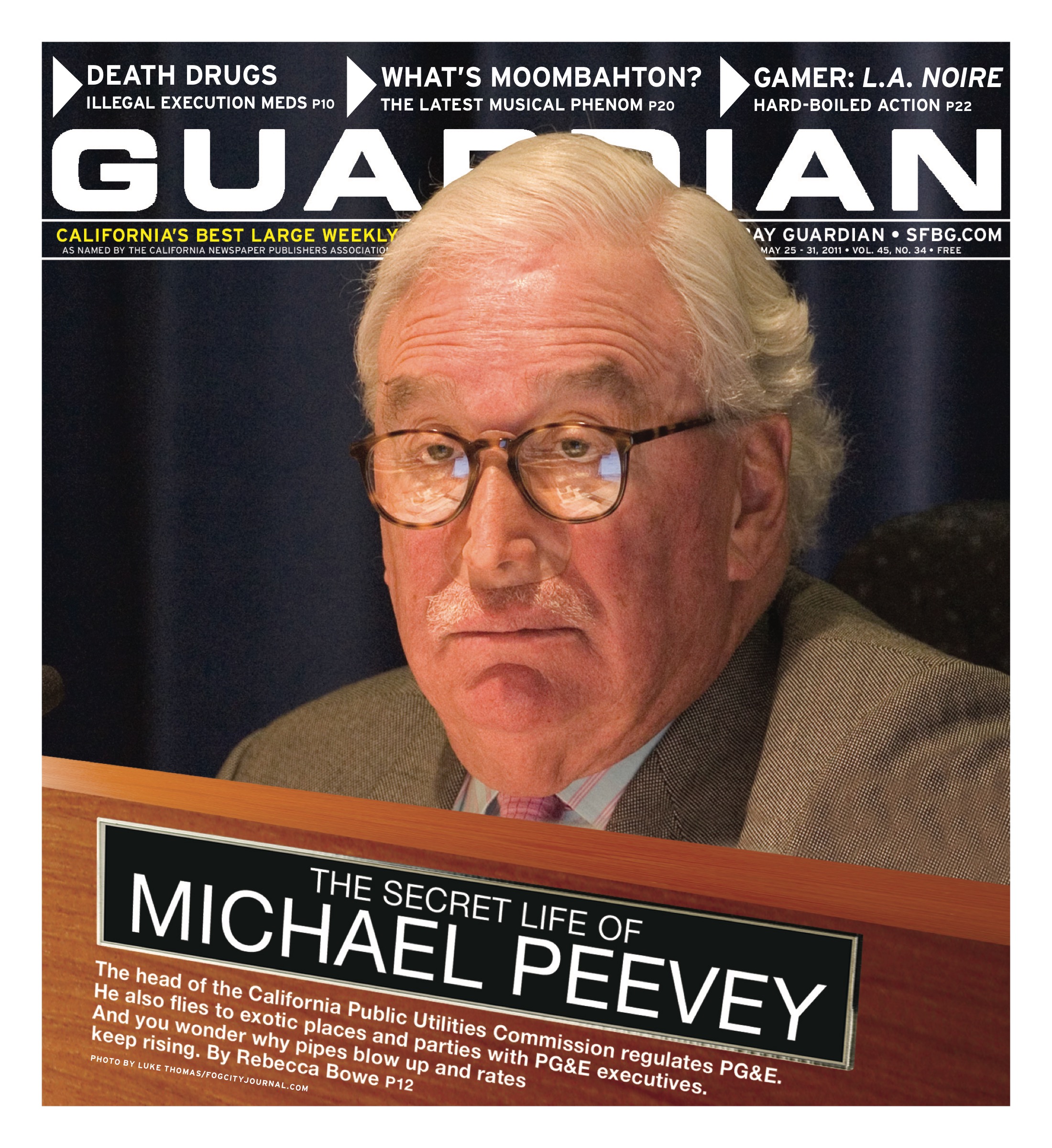
The secret life of Michael Peevey

11

rebeccab@sfbg.com

Inside a legislative hearing room at the state capitol, things were beginning to get uncomfortable. Roughly five weeks had passed since a Pacific Gas & Electric Co. pipeline explosion killed eight and leveled an entire San Bruno neighborhood, and this California Senate committee hearing was an early attempt to get answers.

San Bruno residents who lost loved ones in the deadly explosion huddled in the front row, their eyes fixed on company representatives and agency bureaucrats as they spoke. At the back of the room, a band of immaculately dressed PG&E executives and utility lawyers sat clustered together.

Richard Clark, director of the consumer protection and safety division of the California Public Utilities Commission (CPUC), fielded questions from visibly frustrated state legislators. Sen. Dean Florez (D-Shafter) wanted know why the CPUC hadn’t done anything when PG&E ignored an impaired section of the ruptured pipeline even after it was granted $5 million to fix it.

“Did the PUC do any accounting when you gave them $5 million?” Florez demanded. “Do we just give them money and cross our fingers and hope they fix it? Is that what we do? Until some terrible tragedy occurs?”

Sen. Mark Leno (D-San Francisco) said the CPUC needed to step it up and start practicing serious hands-on oversight. He recalled a tragedy that occurred in 2008 when a gas leak in Rancho Cordova triggered a pipeline explosion, killing one person and injuring several others. Although an investigation determined that PG&E was at fault, the CPUC hadn’t yet gotten around to fining the company.

“We’ve got a pattern here,” Leno said. “And we’re not doing anything differently.”

Less than three weeks after CPUC staff members were grilled in Sacramento, Michael Peevey — president of the CPUC and the top energy official in the state — boarded an airplane for Madrid. He was embarking on a 12-day travel-study excursion, with stops in Sevilla and Barcelona, sponsored by the California Foundation on the Environment and the Economy (CFEE).

Peevey’s wife, California Sen. Carol Liu (D-Glendale), was along for the trip. So were two other state senators, several members of the state Assembly, CPUC commissioner Nancy Ryan, and a host of representatives from the energy industry. The group included executives from Chevron, Mirant (now GenOn, the owner of the Potrero power plant), Covanta Energy Corporation, Shell Energy North America, and engineering giant AECOM. High-ranking executives of the state’s investor-owned utilities also participated, including Fong Wan, the senior vice president of energy procurement for PG&E.

Although strict rules normally govern commissioners’ interactions with parties that have a financial stake in the outcomes of commission rulings, there wasn’t anything especially unusual about Peevey traveling internationally with a group that included representatives from the same companies his regulatory commission oversees. CFEE trips happen every year. The nonprofit has footed the bill to fly groups of regulators, legislators, and utility executives to prime vacation destinations like Italy, Brazil, and South Africa in recent years, excursions organizers say are critical for educating top-level stakeholders about worldwide best practices for sustainable systems. However, groups such as The Utility Reform Network (TURN) have decried CFEE trips as “lobbying junkets.”

As PG&E and the CPUC both work to win back the public’s confidence after their latest deadly failure, it’s worth analyzing whether their relationship — shaped by vacations together at exotic locales — has grown too cozy.


THE BUDDY SYSTEM

CFEE isn’t the only nonprofit that regularly flies Peevey overseas for green travel tours with high-ranking utility executives, and the 12 days he spent in Spain wasn’t the only time he spent away from official duties and in the company of the corporations his commission regulates.

These controversial getaways are just a small part of Peevey’s involvement with private-sector interests. He also chairs the board of a nonprofit investment fund created as part of a $30 million settlement agreement with PG&E. Called the California Clean Energy Fund, it funnels money into private venture-capital funds that invest in green start-ups, plus a few companies in the fossil-fuel sector.

While legislators have voiced frustration that lax CPUC oversight of PG&E on pipeline-safety issues opened the door to disaster in San Bruno, inside observers are critical of the outright favors Peevey has granted utilities, such as guaranteeing an unprecedented, higher-than-ever profit margin for PG&E as part of the company’s 2004 bankruptcy settlement.

The CPUC is set up to perform as a watchdog agency, yet social and professional ties running deep within California’s insular energy community mean regulators sometimes run in the same circles as the executives who answer to them, making for cozier relationships than the general public might anticipate. It’s an old-fashioned insider game that one longtime observer wryly characterizes as “the buddy system.” But the buddy system can bring consequences.

As the public face of the CPUC, Peevey repeatedly has been thrust into the spotlight. He has absorbed advocates’ concerns about pipeline safety, rising electricity rates, SmartMeters, missed targets for energy efficiency, and municipalities’ David-vs.-Goliath battles with PG&E to implement community choice aggregation (CCA), to name a few. He’s a magnet for public scrutiny while occupying the center seat at commission meetings, but Peevey’s behind-the-scenes engagements with private-sector organizations bent on shaping statewide energy policy demonstrate how power is wielded in California’s energy world, a system in which regulators seem to be partnering with utilities rather than policing them.

Based at Pier 35 in San Francisco, CFEE’s board of directors is composed of a small group of officers, plus a long list of members who hail from some of the most prominent businesses nationwide. Shell, Chevron, J.P. Morgan, Goldman Sachs, AT&T, and PG&E all hold positions on CFEE’s membership board, and each entity chips in to fund the foundation’s activities and travel excursions.

The group also includes representatives from labor organizations like the International Brotherhood of Electrical Workers and mainstream environmental groups such as the Natural Resources Defense Council. Among the emeritus members of CFEE’s governing board are some high-ranking figures, such as CIA director-turned-Pentagon boss Leon Panetta. CFEE received $45,000 in donations from PG&E in 2009 (the most recent year available) and was granted similar amounts in prior years.

CFEE spokesperson P.J. Johnston, the son of former state senator and CFEE officer Patrick Johnston and the press secretary under former Mayor Willie Brown, described the trips as valuable opportunities for top-level stakeholders to gain insight on best practices and engage in noncombative dialogue on key issues.

“The idea for us was that it made sense to have someplace where it was nonconfrontational to engage in policy, work-type discussions,” Johnston explained. He added that the trips are “all about policy, on the 30,000-foot level,” and emphasized that discussions aren’t about specific decisions pending before the CPUC.

Loretta Lynch, a former president of the CPUC who brought a reformist spirit to the agency and was never shy about rebuking utilities, is skeptical of CFEE’s stated program goals. When she was first appointed to the commission, Lynch said, CFEE contacted her to ask where she wanted to travel. If the trips are arranged to fly regulators to destinations they’ve been itching to visit, she reasoned, must-see green innovations probably aren’t dictating the itineraries. “To me,” Lynch said, “they don’t have anything to study in mind.”


“PARTYING WITH THE JUDGE”

The CFEE trip to Spain included a briefing on developing wind energy from AES, a company working on wind and solar development in California that also operates polluting, gas-fired power plants in Huntington Beach, Long Beach, and Redondo Beach. There was a round table on solar energy featuring a presentation from the Independent Energy Producers Association, a trade group that regularly files petitions and comments on CPUC proceedings. The trip included a tour of a desalination plant, a talk from the president of the Madrid Chamber of Commerce, and discussions about California’s energy market. Scheduled activities ended by midafternoon on some days, and the itinerary left a Friday afternoon, Saturday, and Sunday in Sevilla wide open.

Asked to comment on concerns about inappropriate lobbying, Johnston said: “We’re not guarding against anyone’s potential behavior any more than we would be on the streets of Sacramento. We’re not setting ourselves up as the guardians. We’re not facilitating that, per se, either.” He added, “I realize there are critics of any kind of travel and any kind of commingling. But it is wise for us not to close our eyes to the rest of the world, and there’s not a great appetite for spending taxpayer money on these trips.”

Yet Lynch countered that there is an important distinction between the roles of Sacramento legislators and that of utility commissioners. “Regulators are not legislators,” Lynch said. “They’re more like judges. Their decisions have the power of a judge’s decision.” By inviting commissioners along on these lavish getaways, she said, “it’s as if you’re partying with the judge.”

Mindy Spatt, a spokesperson for TURN, echoed Lynch’s concerns. “These ostensibly educational trips are essentially lobbying junkets, where utilities … wine and dine legislators,” Spatt said. TURN raised the issue several years ago, she said, when Peevey joined a CFEE trip attended by a representative of Southern California Edison “just coincidentally at the exact same time that he was penning an alternate decision in Edison’s rate case.” She added: “In TURN’s perspective, the commissioners need to be more in touch with what actual utility customers are experiencing, rather than in touch with the top restaurants in Brazil.”

While Peevey is only one of a host of officials who attend CFEE trips, he has more than just a casual tie to the nonprofit. From 1973 to 1983, he served as president of the California Coalition for Environment and Economic Balance (CCEEB), an organization CFEE grew out of and whose membership shares some overlap with CFEE.

Based in San Francisco, CCEEB was founded by Edmund G. “Pat” Brown (Gov. Jerry Brown’s father) in 1973. CCEEB backed a late-1970s proposal to construct a series of nuclear power plants along the California coastline. More recently, the group honored BP with a 2009 award for environmental education — shortly before the company and lax federal regulators were responsible for the worst oil spill in U.S. history.


A YEAR IN THE LIFE

Spain wasn’t the only country Peevey jetted off to with complimentary airfare in 2010. According to a Form 700 filing with the Fair Political Practices Commission, he also traveled to Germany from Aug. 1–5 for a sustainable energy study tour organized by the Energy Coalition. Joining that trip were representatives from investor-owned utilities PG&E, Southern California Edison, and Sempra, plus various city officials and energy experts from the Swedish Energy Agency.

The group stayed at the Radisson Blu Berlin Hotel, which is famous for its AquaDom. “Standing at 25 meters high, it is the world’s largest cylindrical aquarium containing 1 million liters of saltwater,” according to the hotel website. All Radisson Blu Berlin guests have free access to “the hotel’s well-being area,” called Splash, which features a pool, sauna, steam bath, and fitness room.

Based in Irvine, the Energy Coalition’s Board of Directors is chaired by Warren Mitchell, a retired chair of the Southern California Gas Co. and San Diego Gas & Electric Co.. Another director is a utility lawyer who also sits on the board of directors of the Northeast Gas Association, a consortium of natural gas companies in the northeastern U.S.

Founded in the late 1970s by John Phillips to get large businesses to reduce energy consumption in partnership with utilities, the Energy Coalition has arranged excursions for years to bring energy regulators, city officials, and utility executives to Sweden (where Phillips’ wife was born) to exchange ideas on energy issues. The nonprofit organizes an annual summit called the Aspen Accord, “an energy policy forum where cities, utilities, regulators, and end-users collaborate to identify problems and propose solutions to our most pressing energy issues,” according to a 2009 tax filing. While it used to be held in Aspen, Colo., the most recent Aspen Accord was held at San Francisco’s Westin St. Francis. Peevey gave introductory remarks, and the conference featured talks from PG&E, among others.

Craig Perkins, executive director, told the Guardian that the Aspen Accord and study trips are designed to create a venue for major stakeholders to arrive at outside-the-box solutions. “What we try to do is get everybody out of their comfort zone, if you will — that’s the best way to support more creative thinking,” he said. Official regulatory proceedings are “so rigidly legalistic and bureaucratic that it almost prevents any creative thought from happening,” he added. “We’re not in San Francisco, we’re not in Sacramento, we’re not in corporate offices — let’s just talk about these really big issues, and really big challenges.”

The Germany tour included meetings with the Berlin Energy Agency, talks about climate policy, and a tour of an eco-community in Freiburg. Perkins said utility companies must to pay their own way on the trips, but costs are covered for governmental officials.

An Energy Coalition tax filing reveals that board members receive a monthly retainer of $1,000, quarterly meeting fees of $1,000, plus $500 for each board committee meeting. Teleconferences also result in $500 meeting fees.

Several years ago, the Energy Coalition partnered with PG&E to create the Business Energy Coalition, which paid businesses including Bank of America and the Westin St. Francis $50 per KW of energy savings for banding together to reduce energy during peak load hours. According to a tax filing, total annual Energy Coalition revenue dropped from $10.7 million in 2008 to $3.75 million in 2009 “due to large revenue receipts for participant incentives” for the Business Energy Coalition program, as “revenues were used for direct pass-through payments to program participants and contractors.” In 2006, according to a CPUC filing, PG&E paid the Energy Coalition $227,373 for unspecified consulting services.

In addition to the $8,880 trip to Spain (comped), and the $6,583 trip to Germany last year (comped), Peevey’s 2010 disclosure form shows that he also went to Australia May 14-19 to participate in a conference hosted by the Sydney-based Total Environment Center called “Smart Metering to Empower the Smart Grid” ($12,577, comped). And while it doesn’t show up on his FPPC filing, an agenda for CFEE’s Energy Roundtable Summit from Dec. 9-10 at the Carneros Inn in Napa lists Peevey as a participant. A glance through past filings suggests that 2010 was no anomaly; it’s a typical year in the life of a jet-setting utilities regulator.


GREEN CAPITALISM

Peevey once served as president of the Southern California Edison, an investor-owned utility, and was president of NewEnergy, Inc., an electricity company that later was sold to Williams Energy. Yet his professional image is that of a forward-thinker on climate change. According to a bio on the CPUC website, he’s received awards for achievements on green and sustainable energy from various organizations throughout California.

In 2005, speaking in Berkeley at an annual conference for the California Climate Action Registry, Peevey touted a list of his accomplishments on sustainable energy. My final example of PUC actions on climate change is related to PG&Es bankruptcy, he said. When they emerged from bankruptcy last year, one of many conditions of our support for their reorganization plan was that they create a $30 million Clean Energy Fund, devoted to investing in California businesses developing and producing clean technologies.

What Peevey didnt mention is that he chairs the board of directors of that fund. As a nonprofit venture capital fund, the obscure, San Francisco-based CalCEF sounds like an oxymoron. Based on the terms of the PG&E bankruptcy settlement, its governed by a nine-member board consisting of three CPUC appointees, three PG&E appointees, and the rest selected jointly by the CPUC and PG&E appointees. Other board members include past PG&E executives, a former member of the California Energy Commission, and a former chair of the board of governors of the California Independent System Operator (Cal-ISO), the body that ensures statewide grid reliability and blocked the closure of the Mirant Potrero Power Plant for years.

The nonprofit’s stated mission is to catalyze clean energy investment to aid in the state’s transition away from fossil fuels. CalCEF president Dan Adler described it as a sort of seasoned guide for fledgling green companies that might otherwise fail to navigate the murky, complicated clean-energy sector. CalCEF is in a position to usher start-ups toward success with a combination of funding, networking, and insider wisdom on state energy policy.

Among the challenges that the clean-energy sector faces, Adler said, are the utilities themselves. “They are effectively monopoly, or oligopoly, controllers of the energy industry,” he said. “And they don’t like outside innovation coming and disrupting their work process or their relationship with their customers.”

CalCEF aims to guide the finance community “to be partners with what public policy is doing around clean tech and clean energy,” Adler went on. “There’s a tremendous amount of money to be made, but there’s also a lot of opportunity for money to be wasted. If you don’t have a private-sector investment community that understands these rules and can put their money alongside these rules in a collaborative framework, we’re very unlikely to achieve the really aggressive energy targets that California has set.”

Yet as one skeptical energy insider noted, “there are 15 to 20 other funds, with 10 times as much money, an hour south in the same field,” referring to the burgeoning clean-tech hub in Silicon Valley. It’s questionable whether the CPUC is actually fulfilling some dire need with CalCEF, this person said.

Lynch, not surprisingly, takes a dim view of CalCEF. The former CPUC president questions what business the CPUC has creating a private foundation to guide venture capital investment. “It is a fundamental distortion of the PUC’s authority,” she charged, “all in service of Peevey’s ambitions.”

Peevey’s economic disclosure showed that he holds more than $1 million in a private family trust, without disclosing whether private investments contributed to that fund.

Adler stressed that there is arms-length relationship between CalCEF board members and the companies that benefit from the fund’s investments. “Because we are a nonprofit, and because we have on our board members of the regulatory community, we recognized quickly that we can’t be making direct investments into companies,” said Adler, a former CPUC staff member who was highly regarded even by the critics of CalCEF. “So … we’ve picked the venture-capital funds that we wanted to partner with.”

CalCEF funnels its capital into three different for-profit investment firms, which in turn select the companies that will be included in CalCEF’s investment portfolio. Several directors of the partnering investment firms also sit on the boards of directors of the companies they invest in. The startups run the gamut, from carbon-offset outfits, to energy-efficient lighting manufacturers to solar and wind companies, to biofuels startups to various kinds of technology firms related to the smart grid.

But CalCEF has also poured money into companies that bolster the fossil-fuel industry. One of its first investments was CoalTek, a company developing technology for so-called “clean coal.” Asked to explain why, Adler told the Guardian, “We don’t have veto power on every deal that goes down.”

Adler said he personally believes that “there’s no such thing as clean coal,” but tempered this by adding, “there are some very smart people in our community who will tell you that there’s no future … without coal.”

Another CalCEF investment, DynaPump, is developing technology to make it more energy efficient to pump oil and gas. Asked about this decision, Adler responded: “I will say that when we were approached with this investment by the venture partner that ultimately undertook it, we had our misgivings. If you can save energy in the production of oil and gas, then you’re definitely making a contribution to overall energy efficiency.”


TAX-EXEMPT TESLA

There appear to be some closer-than-arms-length links between CalCEF board members and the investment fund’s beneficiaries. A bio for CalCEF director Nancy Pfund, for example, notes that in her capacity as manager of an outside investment fund, she had “worked closely” with Tesla Motors, a CalCEF investment. Tesla provided CalCEF’s first investment return earlier this year after Tesla went public. A principal of one of the investment firms that works with CalCEF, Stephen Jurvetson of Draper Fisher Jurvetson, holds Tesla shares in a personal trust, according to a filing with the U.S. Securities and Exchange Commission.

Tesla manufactures sleek, electric, zero-emission sports cars with prices in the six-figures, and it’s gearing up to roll out a model that will cost somewhere closer to $50,000. The company’s success was helped by a sales-and-use-tax exclusion granted by the state of California last year. Peevey had a hand in that, too. Few Californians may have heard of the California Alternative Energy and Advanced Transportation Financing Authority (CAEATFA), a state body within the Office of the Treasurer, which has the power to authorize sales-tax exclusions for companies that are developing alternative energy technologies. Peevey has a seat on it.

In October 2009, according to a CAEATFA document, Tesla was granted a sales tax exclusion from that financing authority. The sports car manufacturer had received a tax break of $3.3 million as of December 2010, and stands to gain a tax break as large as $29.1 million, depending on its property purchases. As a CAEATFA member, Peevey approved the deal by proxy.

A central question is whether the CalCEF dollars that benefited Tesla and other CalCEF portfolio investments were originally derived from PG&E shareholder profits or ratepayer funds. Adler was careful to note that the initial $30 million came from company shareholders, not PG&E customers. But Lynch pointed out that every dime in PG&E coffers originates with the millions of customers who pay utility bills.

Lynch noted another provision of the bankruptcy settlement agreement, which guarantees PG&E a minimum annual profit of 11.2 percent, catapulting it forever into a higher rate of return than the 8 percent to 11 percent profit traditionally granted by the CPUC in prior decades. “They’re manipulating how big this bucket is to siphon off funds into programs like CalCEF,” Lynch said. “It’s all to give Peevey and his friends access — and to greenwash what was a very stinky deal for the ratepayer.”


ELUSIVE CLEAN ENERGY FUTURE

In California, a national leader in addressing climate change, the stakes are high in the energy sector. The CPUC is tasked not only with shoring up transmission-pipeline safety to prevent another San Bruno disaster, but helping to chart a course away from reliance on fossil fuel-powered energy sources.

CFEE, the Energy Coalition, and CalCEF share a common thread — their missions relate to advancing the cause of a clean energy future in California. And while utility funding and partnership is evident in all three operations, the overarching goal is understood to be green.

But as Adler observed, the utilities themselves present one of the greatest obstacles to progress on a clean-energy transition. While California has increased renewable energy sources, it’s done a poor job at supplanting fossil fuel generation with green alternatives, in part because the CPUC has allowed for increasing fossil fuel power generation even as renewable energy expands. According to a listing on the California Energy Commission website, nine natural gas power plants have won approval statewide and are moving toward construction, while six new ones are under review.

The CalCEF approach to addressing climate change, rather than aggressively targeting polluting industries, is to encourage the fledgling green industry in hopes of facilitating success in partnership with the financial sector. In many cases, the backers of the clean-tech companies are the same players behind the big energy giants.

Environmental advocates are critical. “If anyone thinks the CPUC is set up to serve public interests, forget that,” says Al Weinrub, executive director of the Local Clean Energy Alliance, a group that organized against PG&E’s ill-fated Proposition 16 last year. “They never have and they never will.”

Weinrub said he viewed proponents of green energy as falling into two camps: Moneyed interests motivated by a growing new market sector, and activists motivated by environmental and social justice causes. Major green investment firms “want to de-carbonize capitalism,” he observed. “But everything else stays the same.”

Peevey is considered a major driver behind the state’s climate change legislation, and he’s highly regarded for his dedication to green energy. Yet as long as the interlocking dynamic between energy regulators and California’s largest utilities goes unchallenged, change will only come in a way that’s as comfortable, profitable, and manageable for the state’s top polluters as they wish. And in a state with an aging energy infrastructure that’s vulnerable to the impacts of climate change, that pace isn’t nearly quick enough. 


Editor’s notes

3

tredmond@sfbg.com

When Cornel West blasted President Obama May 16 in an interview with the website Truthdig, it set off a pretty wild debate on the left. For the most part, it’s been more heat than light (imagine that happening on the left!), but it raises a crucial question about the role progressives play in the Democratic Party — particularly in the 2012 election season.

The best analysis so far comes from Robert Cruikshank, who writes for the blog Calitics. In a May 23 piece, he noted that the right keeps winning battles because the conservatives know how to play coalition politics:

“Conservative communication discipline is enabled only by the fact that everyone in the coalition knows they will get something for their participation…. Everyone knows they will get their turn. Why would someone who is primarily motivated by a desire to outlaw abortion support an oil company that wants to drill offshore? Because the anti-choicers know that in a few weeks, the rest of the coalition will unite to defund Planned Parenthood. And a few weeks after that, everyone will come together to appease Wall Street and the billionaires by fighting Elizabeth Warren. And then they’ll all appease the U.S. Chamber by fighting to break a union.”

Not so with the Democratic Party under Obama. The Wall Street Democrats (the neoliberals, the DLC types, and the power-at-any-price folks) get their way all the time. And those us of who consider ourselves part of the economic left (also known as progressives) not only get thrown under the bus — we see our existing gains rolled back, in exchange for nothing.

Sure, we all agree on a lot of social issues. The neolibs and the progressives support abortion rights and gays in the military and, for the most part, same-sex marriage. We agree that evolution is science and creation is religion.

But on basic economic issues — who pays the taxes, who gets the money, military spending vs. education spending, radical inequality, concentration of wealth, corporate power — we might as well be on different political planets. And while we’re the most active, hard-working members of the Democratic coalition, we get completely ignored on national policy.

Obama ought to be worried — not just by West’s criticism (any president ought to expect some allies to be pissed off) but by the fact that he has created an unsustainable coalition. And some of the San Francisco politicians who call themselves progressives ought to be paying attention too: When your political partners get nothing, they eventually walk. 


Alerts

0

ALERTS

By Jackie Andrews


WEDNESDAY, MAY 25

The true cost of Chevron

Join the global resistance movement against Chevron’s callous methods of operation and confront the oil giant at its annual shareholders meeting. Representatives from communities that have suffered the dire impacts of the company’s reckless pursuit of profits will be on hand to testify, including Humberto Piaguaje of the Amazon Defense Coalition in Ecuador and Elias Isaac of the Open Society Initiative in Angola.

7–11 a.m., free

Chevron’s World Headquarters

6001 Bollinger Canyon Road., San Ramon

www.truecostofchevron.com


Fundraiser for at-risk youth

The John Burton Foundation for Children Without Homes hosts this food truck fundraiser to support former foster youth in their pursuits of higher education. The event features tastings from favorite local food trucks, breweries, and wineries, as well as live music and a silent auction.

6–9 p.m., $150

Herbst Pavilion, Fort Mason

Buchanan and Marina, SF

(415) 348-0011

www.brownpapertickets.com

www.johnburtonfoundation.org


FRIDAY, MAY 27

Critical Mass

Take part in this peaceful, leisurely bike parade that follows no set route and obeys no traffic laws or authorities except yielding to pedestrians and emergency vehicles.

6 p.m., free

Justin Herman Plaza

Market and Embarcadero, SF

Facebook: SF Critical Mass


SATURDAY, MAY 28

Sit-in against violence and intolerance

In response to the brutal beating of a transgendered woman in a Maryland McDonalds, where employees filmed and heckled the incident, demonstrations have been organized around the country. Attend this peaceful sit-in to help spread the message that the franchise needs to update its polices and employee training.

10 a.m.–1 p.m., free

McDonalds

5454 Mission, SF

inoculatedcityblog@gmail.com


SUNDAY, MAY 29

Library fundraiser

Help raise funds for the Niebyl-Proctor Library, whose goal is to preserve the history of radical politics, labor movements, and social struggles with a book sale featuring a good selection of novels, poetry, art, pamphlets, and books, including selected works by Marx, Lenin, and Mao.

10 a.m.–2 p.m., free

Niebyl Proctor Marxist Library 6501 Telegraph, Oakl.

(510) 595-7417

www.marxistlibr.org


TUESDAY, MAY 31

Talkin’ Trotsky

This is the first session of a 12-week course to discuss Leon Trotsky and the concept of “Permanent Revolution,” including workers’ power, internationalism, and social transformation.

7–-8:30 p.m., $2 suggested donation

New Valencia Hall 625 Larkin, No. 202, SF

415-864-1278

www.socialism.com 


Mail items for Alerts to the Guardian Building, 135 Mississippi St., SF, CA 94107; fax to (415) 437-3658; or e-mail alert@sfbg.com. Please include a contact telephone number. Items must be received at least one week prior to the publication date.

Held underwater

1

sarah@sfbg.com

Since the recession began four years ago, 2,000 homes have been lost to foreclosure in San Francisco. These numbers sound insignificant compared to other counties in the Bay Area, but they primarily have hit communities of color already struggling to remain in this expensive city.

As panelists at a recent seminar on foreclosures noted, the first wave hit the Bayview and the Excelsior, while the second hit the Richmond and the Sunset. And as the recession drags on and more borrowers go underwater, another 2,000 foreclosures are on the local horizon.

Although foreclosures continue to destabilize communities and drain resources from local governments, the banking lobby continues to oppose legislative reforms that would allow more people to remain in their homes. And this deep-pocketed resistance has labor, religious, and educational organizations forming the New Bottom Line coalition in an effort to find grassroots solutions to the crisis.

“Foreclosures are the new f-word,” said Regina Davis, CEO of Bayview’s San Francisco Housing Development Corporation, at SFHDC’s April 29 foreclosure seminar.

Sups. John Avalos and Malia Cohen illustrated that there is no shortage of horror stories about predatory lending and dual tracking, in which borrowers apply for loan modifications while the bank continues to pursue foreclosure. Representatives for Sup. Ross Mirkarimi and Assessor-Recorder Phil Ting noted that the banking lobby has blocked even the most modest reforms, even as uncertainty continues to devastate the housing market.

Avalos said his family underwent a housing crisis in 2009, when his wife left her job to home school their special-needs daughter. “We tried to get a loan modification and were told we could only get it by going into default,” he said, recalling how Mission Economic Development Agency (MEDA) helped them navigate the process. “If this could happen to an elected official, it could happen to anyone.”

Cohen, who lost her condo in the Bayview to foreclosure earlier this year, described foreclosure as “an incredible beast that has ravaged and wrecked the finances of many Latino, African American, and Asian communities who were sold the American dream of homeownership but then had the rug pulled away.”

Mirkarimi aide Robert Selna, a former San Francisco Chronicle reporter, said the banking industry spent $70 million last year to kill legislation by state Sen. Mark Leno (D-SF) and Senate President Darrell Steinberg (D-Sacramento) to end dual tracking. This year, the industry has been opposing SB729, Leno and Steinberg’s latest attempt to require banks to give people a definitive answer on loan modification, identify who owns the loan, and give borrowers legal recourse if banks don’t take these steps.

“SB729 gets to the heart of helping to keep people in their homes, but it’s difficult to combat the spending power of the banking industry,” Selna said.

Ben Weber, an analyst in the Assessor-Recorder’s Office, said approximately 277,000 homes in California are going through the foreclosure process; an estimated 1.8 million California residents are underwater on their mortgage; and California is sixth in “negative equity” nationwide. “Negative equity is one of the best indicators of foreclosures — so can we expect another 1.5 million to 1.6 million foreclosures statewide?” he asked.

Weber noted that Ting is supporting AB 1321 by Assemblymember Bob Wieckowski (D-Fremont), which would require that all mortgage assignments be recorded within 30 days of their execution; prevent notices of default from being recorded until 45 days after any deed of trust has been recorded; and provide consumers with better transparency about who owns their debt. Yet Ting’s office reports that the banking industry has lobbied against this and other foreclosure-related legislation

Weber said the legislation is a response to problems with the industry’s Mortgage Electronic Registration System (MERS), which was introduced 15 years ago. “The mortgage industry wanted to expedite the transfer of mortgages between entities so that they could be sold and resold on Wall Street,” Weber said, noting that the system also allowed the industry to avoid paying recording fees to counties.

MERS records an average of 6,700 deeds of trust annually in San Francisco, and MERS deeds of trust are usually transferred two to four times, Weber observed. “So MERS members avoided — conservatively — $134,000 per year in fees.”

Grace Martinez of Alliance of Californians for Community Empowerment noted that the banking lobby already killed AB935 by Assemblymember Bob Blumenfield (D-Northridge), which sought to charge a $20,000 fee to compensate for the estimated cost of a foreclosure to local government. “That money would have gone back to the city,” she said.

In an April 14 letter, the banking lobby claimed Blumenfield’s bill was a tax that increases the costs of homeownership for new borrowers. “It also serves to discourage the importation of capital into California at a time when the federal government is winding down their involvement in mortgage finance and protracts and complicates California’s economic recovery,” stated the letter, which the California Bankers Association, the California Chamber of Commerce, and other business groups signed.

But Dan Byrd, research director at Berkeley’s Greenlining Institute, reminded the mostly black and brown crowd at SFHDC’s foreclosure seminar that declining property values due to foreclosures have drained $193 billion from African American and $180 billion from Latino communities nationwide. “Folks from these communities who had credit good enough to qualify for a prime loan were given subprime loans with adjustable mortgage rates,” he said

Byrd stressed that homeowners facing foreclosures need to be more financially literate. “A lot of loan documents are written in language that people can’t understand, and they don’t have the money to hire a lawyer,” Byrd said, as he urged politicians to fund organizations that provide financial counseling and education. “Our elected federal officials just cut the budget that supports SFHDC and similar groups.”

SFHDC housing counselor Ed Donaldson said appraisal values make it hard to sell the below-market-rate units that are coming online. “So if we don’t do something about the foreclosure problem, the housing market will continue to unwind,” he said, urging people to protests banks and show up at City Hall and in Sacramento to support reform.

The Rev. Arnold Townsend, vice president of the local branch of the National Association for the Advancement of Colored People, said San Francisco likes to pretend that the foreclosure crisis didn’t really affect the city. “But it did,” he said. “It badly hit people of color that the city, by its policies, doesn’t seem to care if they leave.”

Attorney Henri Norris noted that bankruptcy can be an alternative to foreclosure. “A bankruptcy can stop a foreclosure, at least temporarily,” Norris said. He recommends that people make their loans current and try to get a loan modification approved. “But it’s going to take running a marathon.”

Avalos, who is running for mayor, noted that the city does not fund enough affordable housing and he proposed an affordable housing bond that would include assistance for mortgage assistance, ownership downpayment, seismic retrofitting, and energy efficiency. “I understand that voters see no personal benefit, but it would raise wealth in property values,” he said.

Cohen observed that the federal Homeowners Affordable Modification Program (HAMP), which President Obama unveiled in March 2009, “hasn’t worked” and that most of the important reform proposals are “happening at the state level.” She encouraged people to show support for SB729, but wasn’t ready to declare support for Avalos’ housing bond.

“I want to make sure the climate is ripe, that Sups. Carmen Chu and Eric Mar are included, because their districts will be impacted by foreclosures, and that the support is broad-based,” she said. “But folks can divest from banks that have not treated us right.”

Noting that divestment was the most effective way to end apartheid in South Africa, SFHDC’s Davis invited seminar participants to a free screening of Charles Ferguson’s documentary Inside Job, which shows how subprime loans, dual tracking, and mortgage bundling triggered the 2008 financial meltdown — and how many of the main players are still calling the shots.

But despite SFHDC’s informative seminar and the New Bottom Line campaign’s May 3 protest at Wells Fargo’s annual shareholder meetings in San Francisco, SB729 failed to make it out of committee May 4, when Sen. Alex Padilla (D-Van Nuys) announced he would introduce an alternative dual tracking bill. In addition, Wieckowski turned his MERS reform into a two-year bill, suggesting the votes weren’t there to approve it.

Paul Leonard, California director of the Center for Responsible Lending, observed that SB729 supporters include a broad array of consumer, civil rights, labor, faith-based groups, and homeowners, but the only groups in opposition were the California Bankers Association, the Mortgage Bankers Association, and the Chamber of Commerce.

“I find it remarkable that after the exposure of deep-seeded scandals about robo-signing and the systematic shortcomings of mortgage loan service operators, none of the bills intended to address these issues got out of their first committee hearing,” Leonard said.

In an April 20 letter, the banking lobby claimed that SB729 was “unnecessarily complex,” could overlap and contradict actions by federal regulators and state attorneys general, and promote strategic defaults that would negatively affect communities and cloud title for a year following a foreclosure, leaving properties vacant.

Dustin Hobbs of the California Mortgage Bankers Association claims the average time for a foreclosure is more than 300 days. “This would have dragged it out further, and the last thing we need is more vacant homes and more homes in foreclosure,” he said.

Ting noted that Wieckowski made the call to turn AB1321 into a two-year bill. “But you would have thought we were offering the end of home ownership,” Ting said, noting that the banking industry was shocked when advocates produced a MERS memo that encourages banks to record documents and pay fees. “It basically recommended our legislation,” Ting observed.

“Assignments out of MERS name should be recorded in the county land records, even if the state law does not require such a recording,” a Feb. 16 MERS memo said.

Ting describes MERS as “a Wall Street set-up, the ultimate in smoke and mirrors.”

“We did a little poking around in MERS and found that it would help if the name of the loan owner was recorded,” Ting said, noting that the confusion MERS created is bad for consumers, the real estate industry, and homeowners.

“Part of the problem is computer systems doing what banks used to do,” Ting said. “It ended up with robo-signing and foreclosures being sent to the wrong people. I thought AB1321 was a no-brainer, but we had to take it to five or six legislators before anyone would pick it up. This is a prime example of how a particular industry has made a huge amount of money and is unwilling to bend any rules to give consumers any recourse.”

But CMBA’s Hobbs described AB1321 as “part of a broader attack on MERS.” And an April 21 opposition letter from the banking industry describes it as “creating impediments for attracting capital to California’s mortgage marketplace and imposing significant new workloads on county recorders and clerks.”

Ting says he has heard lobbyists make that argument. “But my assessor recorders organization supported it — and they are mostly not elected officials,” he said, noting the group usually doesn’t get involved in promoting legislation.

Ting admits that it’s hard to get the national reforms that are needed. “San Francisco still has a big part to play. And our legislators are still very powerful, so we have no excuse not to be fighting in Sacramento where the Democrats have a supermajority. I mean, how could these bills not get out of committee? It’s not like we didn’t take amendments, but no level of amendments would have made anything happen.”

“Foreclosures typify this financial and political era,” he continued. “They are about all the things we should have seen coming — and some of us did. But even then, and now, there is political amnesia. For all the families that lost their homes, shouldn’t we do something to make sure this doesn’t happen again? Wall Street was bailed out two years ago, but Main Street is still waiting.”

Igniting a union

5

news@sfbg.com

The most contentious and pivotal election ever for the union of academic student employees at the University of California concluded May 8 in a landslide victory for reformers who will now have the chance to deliver on their promise of a more militant and democratic union. In many ways, it was a microcosm for the larger struggle over how to respond to proposals for deep cuts and tuition hikes in the public university systems.

Local 2865 of the International Union, United Automobile, Aerospace and Agricultural Implement Workers of America (UAW), represents 12,000 teaching assistants, tutors, readers, and researchers, making it the largest UAW union on the West Coast. Higher education workers make up 40,000 of the 390,000 active UAW members, just over 10 percent.

The caucus of reformers, organized under the banner Academic Workers for a Democratic Union (AWDU), won all 10 executive board positions and 45 out 80 seats at the Joint Council, taking control from incumbent leaders from United for Economic and Social Justice (USEJ), which has presided over the union for most of its 11-year history.

Voter turnout spiked tenfold over the last triennial election with 3,400 ballots cast this election cycle. Union organizers said the hike reflects intensive campaigning by both sides and a political atmosphere that is threatening both higher education in California and public employees across the country.

“This was the first real contested election our union ever had,” said Mandy Cohen, a comparative literature graduate student at UC Berkeley and the AWDU recording secretary-elect. “There was a huge increase in participation, and it was very contentious. Our leadership never had to fight for their position.”

The intensive campaigning translated into an unusually bitter battle for votes with ensuing accusations of foul play. The allegations include intimidation, personal attacks on the character of candidates, and ballot tampering. But the height of controversy and drama came once all the ballots were cast, when the USEJ-dominated elections committee suspended the vote count midway and AWDU members responded with an office sit-in of the union’s headquarters.

Each side tells a different tale for these 1,500 disputed ballots from UC Berkeley and UCLA, the two largest campuses.

From USEJ’s perspective, the sheer number of challenged ballots and the heated environment in the counting room overwhelmed elections officials, who decided to refer the matter to the Joint Council, the governing body of the local.

“AWDU had 20-plus people in the [vote-counting] room. They were continuing the intimidation and aggression. The elections committee decided that it was too much to handle,” said Daraka Larimore-Hall, outgoing president of the local. He said that USEJ elections committee members have been so harangued since the incident that they are not granting requests for media interviews.

AWDU members, who consider UC Berkeley their stronghold, think the vote-counting freeze was the first step on the road to invalidating ballots from a campus with many AWDU supporters.

“Even though we knew they were really threatened by us, the very idea that we would try to disenfranchise 800 voters from the biggest campus — and that’s how they would try to win the election — was really shocking,” Cohen said.

She defended the AWDU decision to videotape the remaining ballots via webcam and take over union offices in protest. “We weren’t taking a partisan position; we just said we wanted the votes counted. I felt like we were clearly in the right. We just wanted to defend the election — and that position was so strong.”

Counting resumed when both sides finally settled on a third-party mediator, delivering 55 percent of the vote to AWDU.

However, on May 16, USEJ released a statement documenting a slew of alleged misconduct throughout the election and calling for a rerun. “It is critical that our members have confidence that the election process is fair and democratic,” reads the statement. “It seems that several categories of problems, with many more individual examples, occurred that are serious enough to justify setting this election aside.”

Whatever happens, reformers at least will have some opportunity to translate their political platform into action. They say they will focus on two areas: increasing the participation and power of the rank and file, and a more aggressive stance toward the university administration and the budget cuts.

“There is real institutional power in this union that should be better mobilized in those fights [for public education],” said president-elect Cheryl Deutsch. “We are hoping to bring into that debate a more mobilized membership … so that we can be a stronger coalition [with others in California].”

She added that the election was already a huge victory in the long-term plan to increase involvement. A history of member indifference and vacancies in the governing board hopefully will give way to a revival in the higher education labor movement, she said.

But Larimore-Hall expressed strong disagreement with the sentiment that the election was a victory for the labor movement. He said he heard AWDU people tell workers that USEJ represents “centrist sell-outs” and “out of touch union bureaucrats,” tactics he criticized. “Going around and telling people their union leaders are corrupt union bosses … in a culture that is steeped in anti-union rhetoric is an easy thing to sell people on,” he said.

Deutsch said she couldn’t take responsibility for the actions of a few amid hundreds of supporters and activists, but that AWDU as a whole did not engage in personal attacks. She said she is proud that her winning slate came from rank-and-file workers, not from traditional union leadership and staff.

It wasn’t the first time the two factions confronted each other. The origin of the tensions can be traced to the recent wave of budgets cuts at the university, and to the ensuing protests. In the summer of 2009, the UC Board of Regents announced a 33 percent tuition hike; the resulting discontent sparked a student movement with its own fair share of ups and downs. Among the protestors were many graduate students who would go on to become AWDU leaders.

Cohen recalls that in fall 2009, there was a “huge explosion of organizing and activism on our campus trying to organize resistance to the cuts — but not within our union.”

Cohen said that she and other graduate students approached the union to encourage action, but that union bureaucracy stifled their efforts. “It was too top-down and difficult to participate. We realized the local wasn’t structured in a way that could be powerful.”

Larimore-Hall said UAW already was “one of the unions that [the university administration] fears most.” He said that AWDU’s position overlooks the union’s accomplishments on the public education front, citing a petition to Sacramento legislators that USEJ organizers got thousands of members to sign.

Early this spring, the issue of labor properly and sufficiently flexing its muscles came center stage as the UAW and the university negotiated a contract. With no concessions to management and gains such as a 2 percent wage increase and more childcare subsidies, Larimore-Hall said the contract is a resounding success.

But Deutsch says that the contract is a perfect example of her disillusionment with traditional union organizing and the previous leadership. Union members ultimately voted to ratify it despite AWDU criticism that the union didn’t seek enough input from members or push for a better deal. AWDU gained traction and established a significant public presence for the first time with this opposition.

“It’s not that I think it’s the worst contract we could have gotten,” she said, explaining that her problem is with the process, not necessarily with the results. If more members had been consulted and included, she would have been content. She mentioned the dire need for affordable housing at the Irvine campus as an example of member concerns that were not prioritized.

Peter Chester, chief contract negotiator for the university, said that in the “current budgetary circumstances,” UAW did “very well” and expressed concern that the slate, which opposed the contract, did so well among academic workers.

But the victory by reformers probably signals a new militancy in the union, which is expected to resist proposals to privatize campus services and push for a stronger voice in the tough decisions facing the university system. Cohen said that making the case for taxing the rich to pay for public education is the wider goal and the reason she ran for a position at the union.

“It’s eye-opening to be a student and benefit from education here at the UC, but also to identify as a public employee,” she said. “When I got to the UC, I was so proud. And then this struggle came to my doorstep, and I didn’t have a choice in this moment.” 


Fear the beard

12

rebeccab@sfbg.com

Christopher Hanson, a 38-year-old single father who lives in Albany, doesn’t have one of those scraggly, runaway beards that one might associate with jam bands or train hopping. He keeps his goatee neat and trimmed, sometimes using scissors to clip back the mustache. Yet Hanson says he got fired last month because his facial hair was deemed a violation of his company’s employee appearance policy. Now, he’s fighting back.

Hanson worked as an audio-video technician for Swank Audio Visuals, a company that does conferences and events at major hotels throughout the Bay Area, including the Westin St. Francis, the Claremont, and the Four Seasons. On the day he was fired, he was on his hands and knees taping down a power cord for an event that was about to start at the Claremont when his supervisor asked to have a word with him. Having spoken with his boss about the beard situation before, he got a funny feeling.

“I just knew what he was going to say,” Hanson recalled. “I thought: are these guys really going to push this, this far?”

For Hanson, having a beard is not a matter of personal expression; nor is it related to religious reasons. He has psoriasis, which prevents him from being able to shave. About a week before he was let go, his dermatologist sent a note to Swank’s human resources department explaining that although he was undergoing treatment, she had counseled him never to shave his beard. It could exacerbate the disease, she explained. Shaving the affected area could cause pain, redness, and irritation on a daily basis, as well as unsightly rash. The doctor urged Swank to grant a medical exception for Hanson.

Hanson says he reminded his boss, Ken Reinaas, and Reinaas’ boss, Todd Liedahl, about that letter when he was approached for their final conversation about the beard. “I said, ‘I have a medical condition,” Hanson recalled. But he says the response he got was, “I’m sorry, but that’s the way it is.” Hanson says he didn’t yell or let himself become agitated. “I just kind of stood there and tried to keep a calm and humble mannerism,” he said.

About a week later, Swank’s human resources department issued a letter at Hanson’s request explaining why he’d been fired. It stated: “The reason for [sic] end of your employment is due to the fact that we are unable to accommodate your medical request not to shave because this is a standard of our company appearance policy.” Swank did not return multiple Guardian requests for comment.

The job, which had a strict dress code requiring AV techs to wear ties and shirts with collars, paid around $15 an hour. With a teenage daughter to support, Hanson needed every cent to make ends meet. He also had taken on substantial debt to finance an education at Ex’pression College for Digital Arts — a for-profit school in Emeryville with a tuition rate of $11,200 per semester for full-time students — and he needed to be able to pay back the student loans.

Hanson began to suspect that his former employer might have broken the law, so he sought legal representation. According to a complaint filed May 12 on Hanson’s behalf by attorney Albert G. Stoll Jr., the Claremont Hotel — which houses the Swank office where Hanson was based — has no employee restrictions against facial hair. “The manager of hotel banquets had a goatee; one of the hotel banquet employees had a goatee; another hotel banquet employee had a mustache; and at least two other employees had facial hair,” the lawsuit points out.

However, Swank employees were barred from having facial hair because company policy was pegged to the most conservative hotel employee appearance policy in the region, Hanson said.

In the case of the Bay Area, that hotel is the Four Seasons. Before being hired as a full-time AV tech based in Berkeley, Hanson took on part-time gigs for Swank to set up for hotel events as far north as Sausalito and as far south as San Jose. He says that when he was first hired, nobody informed him of the no-beard policy — and he had sported the goatee at the time he was offered the job.

The first time he learned there was a problem was when he was called on to do a job at the Four Seasons in San Francisco. He completed the first job without incident, yet when he was asked to go back a second time, Reinaas told him he would have to shave. He said it was impossible to do that, so the job went to someone else.

When the Guardian phoned the San Francisco Four Seasons to find out just what its employee appearance policy was — and to ask whether exceptions are granted for individuals who cannot shave due to medical or religious reasons — assistant director of human resources Jason Brown said he could not comment.

Months later, after Hanson had been hired as a full-time staff member based at the Claremont, Hanson says he was informed that Swank was ramping up enforcement of its no facial hair policy. He was told he’d have to comply even though he was willing to opt out of work at the Four Seasons. He asked his dermatologist to send the letter urging the company to grant an exception, and shortly after, he was fired.

The lawsuit charges that it was illegal for Swank to fire Hanson because the Fair Employment and Housing Act forbids employers from discharging an employee for designated reasons, including disability. Since Hanson’s psoriasis is a disability, the argument goes, his termination constitutes a form of illegal discrimination.

However, not all medical conditions are considered disabilities in the court of law. Under state law, a disability is considered a serious medical condition that limits a major life activity. If Hanson is successful in proving that psoriasis constitutes a disability, Swank could be ordered to make a reasonable accommodation — such as retaining him as an AV tech while allowing him to opt out of work at the Four Seasons. Hanson’s lawyer Tim Phillips describes this case as being “on the cutting edge of discrimination law.”

There have been similar face-offs over appearance policies in the past, but none that fit Hanson’s circumstance exactly — and, ironically, it seems that he might have an easier time arguing his case in court if he is unable to shave for religious reasons, or if he belongs to a racial minority that is disproportionately affected by a particular medical condition.

Not all cases brought against employers with similar policies in the past have been successful. In 1984, a Sikh machinist working for Chevron refused to shave his beard, in violation of a company policy, and wound up getting demoted to a lower-paid job as a janitor. Chevron’s no-beard rule was created to ensure that employees had a gas-tight seal on respirators worn to protect against exposure to toxic gases, but the machinist could not shave for religious reasons. The Sikh man sued Chevron and lost.

In 1999, Sunni Muslim police officers in Newark sued when they were required to shave their beards to comply with an officer appearance policy, and the court ordered the police department to create an exception for those who couldn’t shave for religious reasons.

Meanwhile, a spate of cases have been brought against no-beard policies at fire departments around the country by African American men suffering from a common skin condition called pseudofolliculitis barbae. The condition, which disproportionately affects African Americans, leaves pimply bumps on the beard area after shaving and can cause scarring over time — and the 100 percent effective cure is to refrain from shaving. No-beard policies in fire departments are borne out of the need for firefighters to wear respirators when battling infernos. While the results of those cases varied from city to city, some plaintiffs were able to show that the policies were a form of racial discrimination because they had a disparate impact on African Americans.

Meanwhile, staff attorney Linda Lye of the American Civil Liberties Union (ACLU) of Northern California was willing to weigh in. There are no laws banning no-beard policies on the state or federal level, Lye said, yet courts have ordered employers to make exceptions for religious reasons and to prevent racial discrimination in the case of the black firefighters. She added that certain municipalities such as Santa Cruz have enacted employment laws that prevent discrimination in appearance policies. In general, Lye noted, the ACLU is “troubled whenever employees are penalized because of medical conditions, race, sexual orientation, or other similar factors.” 

Dick Meister: Child Labor-Back to the 19th Century?

3

Dick Meister, formerly labor editor of the SF Chronicle and KQED-TV Newsroom, has covered labor, politics and other matters for a half-century.

Even the most casual students of American labor history undoubtedly have come across the appalling accounts of child labor, accompanied by photos of exhausted, grime-covered teen and pre-teen children staring sad-eyed into the camera.

The children stand outside the mines, mills, farms and other often highly dangerous places where they worked 10, 12, 15 hours a day, sometimes even more. They worked at home as well, in their impoverished families’ dilapidated tenement flats, rolling cigars, stitching garments and doing other work for long, miserably paid hours.

It began with the New England colonists, who brought the practice of child labor with them from England. Use of child labor regardless of the age or frailty of the child was common throughout the colonies, and remained common after independence – including in the southern U.S., where the black slaves’ children were ordered to work along with their captive parents.

Finally, in the 1840s, reform groups managed to pressure several state legislatures in New England to ban the labor of minors under 15 for more than 10 hours a day without their parents’ written consent. Yes, that’s how bad it was – so bad that allowing kids under 15 to work more than 10 hours a day was OK. All they needed was the agreement of their economically desperate parents.

The ten-hour, six-day workweek became standard for minors in most states. Again, that was considered a major reform. Most states also adopted reforms that prohibited children from working in hazardous industries. That was ignored, however, in the particularly dangerous coal mines of Pennsylvania and Appalachia.

In 1914, the federal government stepped in to levy a 10 percent excise tax on employers who hired 14-year-olds. In 1916, President Woodrow Wilson signed a law prohibiting some employers from hiring anyone under 16. But, believe it or not, the Supreme Court voided both laws.

Child advocates couldn’t even get congressional approval for a law empowering the government to regulate the labor of minors under 18, mainly because of a business campaign that called that idea “socialism.” Sound familiar? Then, as now, that could be enough to defeat progressive measures.

But finally, with the coming of President Franklin D. Roosevelt’s New Deal reforms in the 1930s, decisive steps were taken to regulate the use of child labor. They came mainly with passage of the Fair Labor Standards Act in 1938. The law, which covers workers under 18, limits the hours they can work, depending on their age and occupation.  They must be paid at least as much as the legal minimum wage, and they must be covered by the protective laws that apply to adult workers.

The idea was not only to protect children from the harmful exploitation they commonly suffered but specifically to give them the time and opportunity to get a decent education, to get enough rest and time for study.

Passage of the Fair Labor Standards Act obviously did not end the misuse of child labor. Yet it did set a standard for protecting young workers that’s been followed by states that have enacted their own versions of the act, some more liberal than the federal law.

But now come business trade associations, employer groups, reactionary Republican politicians and Tea Party activists to urge severe weakening of the state laws, and, ultimately, of the federal law. They agree with Supreme Court Justice Clarence Thomas that the child labor laws are unconstitutional for a variety of obscure legal reasons. They’ve begun their legal attacks on state laws with the laws in Maine and Missouri.

In Maine, which was among the first states to enact child labor laws, they’ve been pushing a bill that would allow employers to pay anyone under 20 a six-month “training wage” that would be more than $2 an hour below the minimum wage. They’d also eliminate rules setting a maximum number of hours kids 16 and older can work during school days and allow those under 16 to work up to four hours on school days and up to 11 p.m.

The Missouri bill is even worse. It would lift provisions in the current state law that bar children under 14 from employment, They’d be allowed to work all hours of the day and no longer need work permits from their schools. What’s more, businesses that employ children would no longer be subject to inspections by the federal agency that enforces the child labor laws.

By the time you read this, the proposed laws in Maine and Missouri may have been passed – or, hopefully, rejected. But that’s almost beside the point. What’s worse is that 11 years into the 21st century, people are actually taking seriously proposals that would send us back into the 19th century.

Dick Meister, former labor editor of the SF Chronicle and KQED-TV Newsroom, has covered labor and politics for a half century. Contact him through his website, www.dickmeister.com, which includes more than 300 of his columns.


The case for local taxes

8

When state Sen. Darrell Steinberg introduced SB 653, a bill that would allow cities to impose an income tax, a car tax and excise taxes, I called his press office and asked if the senator was serious. Me, I thought this was one of the best ideas I’d ever heard of out of Sacramento, but I couldn’t believe Steinberg was actually going to push it.


After all, Steinberg has been in heated discussions with the Republicans over the state budget, and they’ve been refusing to bend, even an inch, on new revenue. And the Democrats can’t pass a budget alone; the two-thirds requirement for new taxes means at least four members of the recalictrant GOP have to go along.


But if Steinberg could threaten the jerks with a bill that requires only a majority vote but would open the door to all kinds of new taxes up and down the state, maybe they’d start to come around. That seemed like the theory.


But his staff told me that he was entirely serious — and to my astonishment (and perhaps his) the bill is moving forward. We did an editorial endorsing it two weeks ago, and all of a sudden, it’s getting a lot of attention. And it’s exposed a fascinating political debate in the state and raised a lot of questions that ought to be part of the political conversation.


Jerry Brown’s been talking for months about “realignment” — sending more state services back to local government. It’s part of the populist side of the guv, and it flies in the face of 50 years of liberal thought. The federal government used to be our friend — the feds enforced civil rights laws in the racist South. The feds put money into inner cities. The state of California enforced equality, too — the famous Serrano v. Priest decision, in state court, guaranteed that public schools in all areas, not just rich ones, had the resources to provide a quality education to all. “State’s rights” was the cry of segregationists; rich people in conservative communities wanted school funding to be a local decision.


But things are different now, and the political stars are realigned. The most important civil rights moves are coming from cities (see: San Francisco, same-sex marriage) and progressive communities are defying the feds on issues from immigration to medical pot. (The flip side is also happening, see: Arizona and SB 1070).


Right now, today, the single most important issue in the United States (with the possible exception of stupid foreign wars) is the wealth gap and taxation. So much flows from that — the collapse of social services, the cost of health care, unemployment, the crisis in state budgets, the decline in public education … name an issue, and it has at least some roots in the way the nation handles money. And two things have happened in the last 15 years or so, at least at the national level:


1. The Republican Party has been taken over by the far right.


2. The Democratic Party has been taken over by Wall Street.


So nothing good’s going to happen in Washington. And in California, thanks to our two-thirds rule, nothing good’s going to happen in Sacramento as long as a tiny minority of really bad Republicans can hold the state hostage.


Which means that the only hope for progressive economic policy is going to come from local government — and the best thing the Democrats can do in the state Legislature is to stand back and allow it to happen. Which is exactly what the Steinberg bill would do.


Now, the San Francisco Chronicle has come out against the Steinberg bill, saying it would


mark a regrettable retreat from the notion that Californians of many lifestyles and cultures – city dwellers, beach-goers, farmers, ranchers, techies, loggers, entrepreneurs – share a common bond. The delegation of a greater tax burden and government duties to 58 counties and hundreds of cities would only compound the disparities that make this state nirvana for some and Appalachia for others.


The problem is, that notion — that romantic vision of One California — is already gone. California isn’t one state any more; it’s too big to be a state, and it ought to be at least three states. The Democrats control both houses of the Legislature and the governor’s office — and it’s almost impossible even to pass a state budget. There’s nothing resembling a political consensus in California, and we might as well admit it.

I understand the problem of economic disparity — but you can’t address it under the current system. There are, indeed, a few counties that have very little tax base, and that will need substantial state aid; I’m good with that. I’m happy to have my tax money go to the poorest counties. But I’m not seeing the Steinberg bill as a reason to cut state spending; I think we ought to increase state spending. I just think that what comes out of Sacramento should be a floor, not a ceiling. If people in San Francisco want to spend more on their public schools — and do it in a progressive way — what’s wrong with that?

The problem with local taxes is that the most progressive, fair revenue solutions aren’t available to cities. Income taxes are far better than sales taxes; ad valorem property taxes are better than parcel taxes. But cities can’t impose traditional income taxes, and are hobbled by Prop. 13 on property taxes. So when cities DO try to impose their own taxes, the results aren’t fair — the poor pay more than the rich.

Interestingly, Dan Walters of the SacBee, who is by no means considered a liberal, likes the Steinberg bill:

California’s experiment in centralized budgeting, the unintended consequence of Propostition 13’s approval in 1978, has been an abject failure. California is simply too diverse for one-size-fits-all decision making from Sacramento, especially when the Capitol can’t even decide what that size should be.

And City Attorney Dennis Herrera, who is running for mayor, likes the idea, too:


California communities that view government as a needless intrusion into people’s lives are morally entitled to limit their local government, and to pay less for fewer services.   Conversely, California communities that see government’s potential to improve the lives of their residents deserve to fully realize the benefits of the public services they’re paying for.


But the notion that we must bind the fate of 37 million Californians to the governance of lowest common denominator is absurd. 


Steinberg’s bill isn’t perfect — it doesn’t include corporate income taxes. But it’s a lot better than what we have now.

I realize that we’re in tricky territory here — should counties where 80 percent of the voters want mandatory prayer in schools and a curriculum that says God doesn’t like homosexuality have the right to overrule state and federal law and ignore the Constitution in the name of local control? Of course not.

But I think you can argue that local government, after meeting the basic federal and state requirements, has the right to go a step further in the pursuit of civil and Constitutional rights. Just as cities, after receiving their minimum allotment of stae money, have the right to raise more. And do it in a fair way.

At the very least, the bill creates a discussion that we all ought to be having. Cuz the way we’re running the state right now isn’t working.

City’s local power program will be greener, but not so local, at first

The San Francisco Public Utilities Commission (SFPUC) is in negotiations with Shell Energy North America to purchase power for a new version the city’s community-choice aggregation (CCA) program that will be smaller — but greener — than what city officials had originally envisioned.

While the forward momentum and the prospect of offering 100 percent renewable energy seems to have ushered in a rare moment of harmony among the players in City Hall who are crafting the program, not all the grassroots advocates were fully sold on the idea, saying they were still waiting to see how committed the city was to moving ahead with a plan to build municipal green energy facilities which could ultimately bolster the local economy and create jobs.

The new plan for CleanPower SF was unveiled by the SFPUC at a May 6 meeting of the Local Agency Formation Commission (LAFCo), which has been working with the city’s utility commission for half a decade to implement CleanPower SF. Emerging after a false start last year, the new plan would target 75,000 electricity customers at the outset – far less than under the original idea of enrolling all of San Francisco’s Pacific Gas & Electric Co. customers while providing the chance to opt out.

The CCA would offer 100 percent renewable power right off the bat, instead of the 51 percent renewable target that was previously envisioned. That fully green product offering is possible because the city would hire a contractor, most likely Shell, to purchase the green energy on the open market. The energy mix could be derived from sources within California or out of state.

“We’re having productive discussions,” noted Mike Campbell, who directs the CCA program for the SFPUC, but noted that it would be awhile yet before all the terms of the deal were cemented. Shell also contracts with the Marin Energy Authority for its CCA program, which San Francisco is looking to as a model.

The new scheme abandons a prior goal of meeting or beating PG&E electricity rates, but the SFPUC justified this switch by pointing to market research suggesting that the higher price would not necessarily subvert the program’s success.

Campbell said the new model came to fruition after poll results identified a core segment of San Franciscans who would be willing to stick with the green power program even if the price was slightly higher. “There’s such a strong segment of folks who are eager to do something about global climate change,” he said.

Campbell added that estimated generation fees could climb from around 7 cents to 13.5 cents per kilowatt-hour, amounting to a roughly $10 monthly utility bill increase on average. Since PG&E is expected to increase rates for customers who use less energy, “it’s going to help make it more attractive,” Campbell noted.

The new plan seemed to sit well with Ross Mirkarimi, a longtime advocate for community choice who chairs the Local Agency Formation Commission, which is tasked with overseeing the SFPUC’s implementation of the program. “The new program has great potential and goes where PG&E can’t or won’t,” Mirkarimi told the Guardian. “Carving out a customer niche that delivers a true green load is strategically more beneficial to the longevity of CCA in San Francisco. Once we establish an economic foundation for CCA, we then are positioned to build a renewable energy infrastructure as originally envisioned.”

Mirkarimi noted that the forward momentum had changed the dynamic in a historically fractious process, since, after years of being at loggerheads, the SFPUC and LAFCo finally seemed to be on the same page.

Both Campbell and Mirkarimi acknowledged that they expected PG&E to put up a fight, as it did when Marin County rolled out its CCA using a similar model to the one San Fransico now plans to adopt. Since PG&E will still be in charge of customer billing, it could employ tactics such as artificial spikes as it did in Marin to try and scare off CCA customers. “We do expect PG&E to do everything it can think of to try and encourage customers not to participate,” Campbell said.

Meanwhile, organizers from the San Francisco Green Party and the Local Clean Energy Alliance, who have closely tracked the process and held meetings with the SFPUC, say they’re supportive of the general concept but are still waiting to see whether the city is fully dedicated to laying the groundwork for building city-owned energy generating facilities.

Over time, this aspect of the program — which has been part of the plan all along — could supply green energy locally, gradually replacing the energy supply that Shell would be purchasing from elsewhere. San Francisco Green Party organizer Eric Brooks also pointed out that over time, city-owned generating facilities and local energy-efficiency upgrades could enable the SFPUC to bring down the cost of the green power to make it competitive with PG&E.

Campbell noted that the city would move ahead with the build-out, but “it certainly won’t be in the first year.”

Unless the build-out aspect of CCA moves ahead with a strong level of commitment, said Al Weinrub of the Local Clean Energy Alliance, the social-justice goals of creating new jobs and bringing generation costs down to make green power accessible to everyone may not be realized.

“We have a commitment from staff that they will pursue studies” to move ahead with the build-out, noted Weinrub. “The problem … is that they’re really dragging their feet.” He added, “We’ll have a lot of trouble supporting CleanPower SF is there’s no local build-out.”

Organizers also voiced concerns that without moving forward with this second element, the CCA could end up catering exclusively to an upper-middle class, predominately white customer base.

At the LAFCo meeting, the SFPUC delivered a presentation explaining the results of the poll that had been conducted to determine who would purchase green electricity from CleanPower SF. A longer version of that presentation, delivered to grassroots advocates in a separate meeting and provided to the Guardian by Brooks, showed that on average, CleanPower SF customers were expected to have higher levels of education and higher income levels — individuals making more than $100,000 per year had the greatest enthusiasm for the program. Those results also showed that 67 percent of survey respondents representing African American, Asian / Pacific Islander, or other communities of color indicated that they would not be interested in enrolling in CCA when they were given information about the program and the estimated rates.

Weinrub said this demographic profile of the initial CCA customer base would be problematic if it represented the only customers who would ever subscribe, because the whole notion of CCA from the start had been to create an accessible, community-owned power source that benefited San Franciscans across the board and offered an alternative to PG&E. But he said he believed the program could have more widespread appeal and grow its customer base if there was a sound strategy to bring down rates over time by employing local energy generation and energy-efficiency projects. “Our whole pitch is, what about everybody else?” he said. “We feel pretty strongly that with a well designed build-out program, you can offer very competitive services.”

The fun side of bikes

3

steve@sfbg.com

Paul Freedman, a.k.a. the Fossil Fool, is a singer-songwriter and builder of elaborate art bikes who lives in San Francisco’s Mission District. Since 2001, when he decided to apply his Harvard University education to building custom bikes, accessories, pedal-powered products, and mobile sound systems, Freedman created Fossil Fool and Rock the Bike to sell his creations and provide a platform for his performances and alternative transportation advocacy work.

But anyone who’s watched Freedman build and ride his creations — such as his latest, El Arbol, a 14-foot fiberglass tree built around a double-decker tall bike with elaborate generator, sound, and lighting systems and innovative landing gears — knows this is a serious labor of love by an individual at the forefront of Bay Area bike culture. We caught up with him recently to discuss his work and vision.

SFBG How did Rock the Bike start?

FOSSIL FUEL I was working at a shop in Berkeley and I decided to make my first bike music system, which I called Soul Cycles. So I had that other job at a bicycle nonprofit, which is cool, and that was the first impetus. I did two innovative things with my first bike music system: I put the controls on the handlebars, which I’d never seen anyone do, and I put speaker back-lighting to make the speakers look nice at night. I used a really nice CFL fluorescent lamp, and I started playing around with those and it looked great, so that was our first product for those first three or four years.

SFBG What was going on in the larger culture at the time that led you to believe your interest in bikes and technology was going to be fruitful or make an interesting statement?

FF I care deeply about biking and a lot of the people I was with did too, but I felt like the bicycle advocacy scene was not very effective when it came to actual outreach. I felt like the thing that had been really formative for me was this person-to-person interaction, in my case by hanging out with the guys who started Xtracycle, and going on quests to get ingredients for dinner and riding late at night with the music systems on the tour. I felt like those experiences were what made bicycling appealing, but the bike advocacy scene was using guilt trips and telling people you should ride a bike because you’re too fat and you should ride a bike because there’s too much traffic. And I felt like we needed to shift that mindset and really start focusing on the fun aspects of biking and the social aspects to grow the scene.

SFBG Do you feel like it has, and what effect do you think it had on those who weren’t already riding bikes?

FF I think it’s moving that direction. Even within traditional bike advocacy groups, those people are starting to really focus on their events and creating community, in a good way, and challenging themselves with doing so. And I think that’s really positive.

SFBG Your timing also dovetailed with heightened green awareness — with a push for renewable energy, concerns over peak oil, and things like that.

FF Yeah, I feel that transportation choices are the main thing people need to examine about their lives with respect to their impact on global warming. And that’s not just a feeling, that’s the consensus of the Union of Concerned Scientists. They say that if you want to have an impact on the planet, positive or negative, the first thing you should consider is your transportation habits. So that means flying, it means driving, and everything else. I don’t think it’s really beneficial to focus on what people need to do with a car, like they need to drop their kids off. It’s more important how people do the optional things with cars like the trips to Tahoe, and the flights to Mexico. It’s those optional things I want to focus on, which is why I’m so interested in Sunday Streets, which is like the antidote. It’s this thing you can do here, that you can walk and bike to, that’s as fun as driving to Tahoe.

SFBG Through your technology and design work, it also seems like you’re showing a broad range of what people can do on a bike, with lots of cargo or a whole performance stage setup. Do you think design is convincing people that bikes are more versatile that they thought they were?

FF Oh yeah, I think that would be a really beneficial outcome of this work. By riding through town with our music gear, of course people are going to look at that and think, oh yeah, I could probably go to Rainbow Grocery and buy a bunch of food for my household on a bike. So it would be a great outcome if people would make that connection.

SFBG Is there anything about San Francisco that makes people here more receptive to your message?

FF San Francisco is a very tight city geographically. It’s not like Phoenix. The blocks are pretty short here and the distances are pretty short here, and you can ride year-round here, which is not true in Boston where I grew up.

SFBG The focus on technology and design here also probably helps, right?

FF Oh, for sure. This is an awesome place to be prototyping and doing funky mechanical, electrical art. There’s a lot of support for it. There are places like Tap Plastics for learning about fiberglass. There are lots of electronics stores that serve the Silicon Valley tech developer communities. You can buy stuff there that’s helpful. You can learn about Arduino [an open source microprocessor] at Noisebridge. There are a lot of resources for doing interactive art here or for doing bicycle-related projects. There are a lot of welders here.

SFBG Where do you think we are on the arch with this stuff — the beginning, the middle? — in terms of gaining wider acceptance of biking as an imperative and an option for anyone?

FF I think there’s an important generational shift underway, and I don’t know whether it’s my focus on bikes that leads me to meet all these kinds of people, but it feels like I’m meeting more people these days that are going to pick their next city or their next neighborhood based on how it is to bike there. They’re bringing it up in conversation, it’s not me. So it seems like people are really considering what their daily life is going to be like and how the community feels, and biking is one of the symbols of a whole swath of other beneficial things. They know that if they see a bunch of bikes when they visit a place, then there’s probably a lot of other cool stuff like music, arts, farmers markets. Those kinds of things are sort of linked together, and the bike is the key indicator. So there’s been this generational change of thought. The idea that having a bigger, faster car is better, I just don’t think that’s popular with these people. They no longer believe it.

SFBG It’s having cooler bike.

FF It’s having cooler bike and being able to use it and not have to step into the stress of car culture if you can avoid it.

SFBG What’s your next step?

FF One of the really positive things for me has been the Rock the Bike community, with its roadies, performers, musicians — all types of people who are on our e-mail list. So I can just say, I need three roadies for a three-hour performance slot and there’s going to be a jam at the end, so bring your instruments. That’s an awesome thing and it’s just going to improve, so I think the community will grow as we continue do gigs where we have fun and the people have fun.

In terms of my own art, this tree [gesturing to his El Arbol bike] has been my focus for the last year or two, and it’s not done yet. It has to look undeniably like a tree. It looks like a tree, but with a light green bark that you really don’t see in nature, so that has to change. I want it to have brown bark, but I still want it to do beautiful things at night with translucency. And I want it to have a true canopy of leaves, so that when you’re far away from it at Sunday Streets and you’re wondering whether to go over there, you’ll see a tree. Not just a representation of a tree, but I want them to be like, how the hell did he ride a tree over here?

SFBG Why a tree?

FF I don’t know. You get these ideas, and you start drawing them and can’t shake them. There are all sorts of reasons why trees are interesting. They are gathering points.

SFBG And you’re doing some very innovative design work on this bike, such as the landing gear.  

FF The roots. Yeah, that’s never been done before. Through the course of doing the project, people would send me tips and interesting things, and one guy sent me a link to a photo of tall bikes being used in Chicago in the early 1900s as gas lamp lighting tools, and they were very tall. I’d say 10 to 12 feet tall, and they were tandems, so there was a guy on top and a stoker on the bottom providing extra power, and they didn’t have landing gears. So they would ride from one lamp to another and hold the lamp as they refilled it. And I just love that story because if you were growing up in Chicago, and you saw these gas lamp people coming by in the early evening to turn the lights on, and if you were a little kid trying to fall asleep or whatever, that would have an indelible mark on your childhood, and that whimsical quality is what I’m going for. That should be part of what it’s like to grow up in the Mission District in 2011.

SFBG How does that fit into the other cultural stuff that you’re also bringing to the bike movement, the music you’re writing, design work, the style, and the events that you’re creating?

FF Sometimes I wish it wasn’t so multipronged. I would clearly be a better performer and musician if it was the only thing I did, so I apologize to all my fans for not putting 100 percent into the music. But I put 100 percent into the whole thing, including creating bikes and running Rock the Bike, which is a business.

SFBG But are you doing all these things because you find a synergy among them?

FF It’s the fullest expression of who I am.

SFBG Where do you see this headed? What will Rock the Bike be like five years from now?

FF I would like to see the quality of our entertainment offerings steadily improve to the point where people genuinely look forward to it, and not just to the gee-whiz aspect of look what they’re doing, but just for the feeling of being there. So I’d like to challenge ourselves with the quality of the music, how it is to be engaged in the setup process — because I think the setup is cool, with biking to the event and engaging in the transition to a spectacle, where every step along the way is part of the show. I like that idea. I’d like to challenge ourselves to be a carbon-free Cirque du Soleil, a show that is slamming entertainment and they bike there and pedal-power everything: the lighting, the sound, the transportation. And I want the performers to be just as good.

SFBG Are there people in other cities doing similar things?

FF The Bicycle Music Festival is spreading to other cities, which is cool. I think there are going to be over a dozen bicycle music festivals this summer. In terms of people doing really inspiring work with bike culture or this kind of mobile art, you definitely see some amazing things at Burning Man. That’s probably one of the best venues for this type of art. But I can’t think of another city where people are doing all of this. I’m part of a group on Flickr called Bicycle and Skater Sound Systems, and there’s nothing on that whole group that I see as being on this level. I don’t know why.

SFBG When you ride a cool custom bike down the street, the reactions it elicits from passersby is just so strong and happy. What is that about?

FF It’s a reaction to an expression of personal freedom. People light up when they see you expressing yourself, and a part of them thinks, oh yeah, that would be fun, I’d like to express myself. And there are just so many ways to express yourself and be human — and that’s something that we need to remind ourselves because, in many ways, our personal freedoms are declining and there’s more surveillance.

SFBG And people might take that spark and do any number of things with it.

FF One of the very cool things about bicycle art is that it’s mobile. So you ride your bike and you might turn heads a couple dozen times a day. I ride this tree, and if it’s in the full mode where it’s 14-feet tall and there’s music on, and I’m going from here to Golden Gate Park, I’d estimate that 500 people see it. There’s probably no other art form you can do that with. I can’t think of any other that’s like that. So it’s a really cool art form. Those people aren’t paying you, but you shared art with them, and it’s a good way to get exposure. It’s a great way for a lot of people to see your art.

SFBG With your mobile, pedal-powered stages, you’re also demonstrating green ways of powering even stationary art.

FF It is an interesting time for pedal power. I feel like there’s a turning point that’s maybe beginning in the field of events with how they’re powered. I think there are going to be a lot more people who are going to festivals in the coming years who are looking at the diesel generators and saying, ‘My summertime festival experience is being powered by diesel.’ And I think there are going to be a lot of people seeing that and wanting to do something else.

SFBG Have the technologies for how much juice you’re able to get out of pedal power been advancing since you’ve been working on it?

FF Yes, it’s truly impressive right now, particularly if you’re putting that juice into music because we have very efficient generators where there’s no friction interface anymore, nothing rolling on the tire, it’s all just ball bearings rolling on the hub. Then we put that power into these new modified amps, and they have a DC power supply now, as opposed to an AC power supply, so we don’t have to put the power into an inverter. So the net sum of that is one person can pedal-power dance music for 200 people, which is pretty amazing and inspiring.

SFBG And the battery technology is also improving, right?

FF Yeah, the batteries are what you use for the mobile rides, and that’s getting better. If you’ve been to a bike party, it’s just incredible how many good, loud sound systems there are right now. It’s a very kinetic art form, although I wish people would focus more on the visual aspects of their system, because I feel like there’s a trend to get big and loud fast. But I wish there were more people doing the work that Jay Brummel is doing, where he doesn’t just want to ride on a bicycle, so he turned his bike into a deer and he steers by holding the antlers.

SFBG But there has been some push-back from the police. Have you gotten many tickets?

FF Well, I got tickets for riding up high on this quadracycle. There is a law against riding tall bikes in California. It says you shouldn’t ride a bicycle in such as manner as to not be able to stop safely and put your foot down. Obviously you can’t put your foot down on a tall bike.

SFBG The fact that you have landing gears on your bike didn’t make a difference?

FF Well the officer didn’t take it seriously, but the court sided in my favor. The judge was flipping through photos of the landing gear the entire trial — he couldn’t stop flipping through them. And he asked, ‘How do you get on? Where do you step?’ So I was like, ‘Well, you step here, you step there, and you swing.’ It was pretty fun. 

BICYCLE MUSIC FESTIVAL

Saturday, June 18

11 a.m.–10 p.m., free

Various locations, SF

www.rockthebike.com

www.fossilfool.com


Cycling race

2

caitlin@sfbg.com

In contrast to the alley cat fixie fiends and placid Venice Beach cruisers, some of Los Angeles’ most ardent bicyclists were going unnoticed and underserved by bike advocacy groups. Working class Latinos are often the only ones on two wheels in several of the city’s most disadvantaged communities — but you weren’t going to catch them at Critical Mass or grabbing a seat at L.A. County Bike Coalition meetings.

The organizers of the community group Ciudad de Luces recognized that these riders, often stuck commuting on the L.A.’s most dangerous roads with substandard safety gear and rickety bikes, needed a voice in the development of the city’s biking infrastructure, and were being missed by the biking movement’s traditional outreach tactics.

The organization started distributing bike lights and Day-Glo visibility vests at day laborer centers; started a weekly bike repair workshop at one of the sites in response to popular demand from workers; and, in 2010, convinced the city to install 73 much-needed bike racks throughout the low income Pico-Union neighborhood. Ciudad de Luces coined a term to describe the community it works with: the invisible riders.

Biking is not a white middle class privilege, but many times the popular face of bike activism is perceived as such. In the case of Ciudad de Luce’s struggle for recognition, that meant the minority communities that do ride aren’t given necessary resources to keep them safe and secure. And according to Jenna Burton of the Oakland community bike group Red, Bike and Green, it also harms cycling’s popularity among some prospective riders.

“If you see something that is predominantly white, it’s automatically not going to be as appealing to the black community,” she said in a phone interview with the Guardian. Burton moved to the Bay Area from the East Coast, and was taken by the strong biking culture. Looking for community, she assumed there had to be some kind of African American bicycle meet-up. (“The Bay Area has everything, right?”) She was surprised to find that one didn’t exist.

Burton realized that blacks were underrepresented in the biking community. When she asked acquaintances about their reluctance to pedal through their daily lives, she found that many were intimidated by the ubiquity of bikes in the area. “It can be really intimidating to get out there for the first time. The culture is so strong here, it seems hardcore to people who are curious about biking.”

“There needed to be a targeted effort toward the black community.” Burton’s solution: create an organization that spoke directly to African Americans about why they should bike. She developed a Black Panthers-style three-point plan to break it down. Black people on average make less money and biking is cheap; black people are subject to chronic health problems and biking makes people stronger; black people are often the subjects of environmental racism and biking is a way to speak out against carcinogenic injustice. To spread the word, the group would hold social rides so riders could see that black bike riders really did exist.

Nick James didn’t own a bike, but when Burton told him about Red, Bike and Green, he was compelled to buy one. Already an activist for HIV/AIDS, education, youth, and health causes, James said in an e-mail interview with the Guardian that he believed Burton had hit upon a way to pull all those social issues together — through an experience that would not only be positive, but fun. Now he uses his bike to get to work and run everyday errands.

“Any space where African Americans can get out stress, laugh, communicate, or heal, I’m there,” he said. “Red, Bike and Green is a space where exercise, socializing, and activism flows seamlessly.”

Core volunteers publicized early rides through word of mouth, often handing out flyers to other black bicyclists that they passed in the streets. They found partners in the East Bay’s burgeoning minority biking advocacy network: Cycles of Change, an umbrella organization that includes the LGBT and minority-run Bikery and Changing Gears Bicycle Shop, and P.O.K.E.R. (People of Kolor Everyday Ridin’).

On Saturday, April 23, Red, Bike and Green held its first ride of 2011. Seventy people rode a route that took them through many of Oakland’s black residential neighborhoods — a tactic that organizers employ, as Burton puts it, to make other black people aware that they can rock some handlebars “to build community in our community.”

Since last year, the rides have attracted cyclists from age seven to 65, families, and strangers who can spend the ride connecting and networking. People have used the rides to announce impending garden harvest surpluses, Oscar Grant protests, and job openings.

As Bay Area bike lanes grow smarter and more numerous, and as gas prices soar and environmental issues become more troublesome, it’s pretty much a done deal that more people are going to be riding bikes. And yes, bike movement, that’s something to ring those bells over. But we have to turn the gears democratically: to really improve access to cycling, the needs of all communities have to be taken into account — and that means getting creative with outreach strategies.

Red, Bike and Green uses bikes to carve out a space for its riders — not only in the velo advocacy movement, but in the social fabric of the Bay Area. Burton is confident that the sight of so many black people rolling by will introduce a thought into the heads of spectators — a thought that really shouldn’t need to be introduced but does anyway: “This is our community, there needs to be space made for us too.”


Republican budget revolutionizes education

0

Ask anybody about education, and anybody will tell you that nothing is more important than education if our nation hopes to succeed in the highly competitive economic universe of the 21st century.  But is America keeping up?  Many might say no, but they are just behind the times.  There are places where progress is already being made, methods are being devised that will give our children the mental and emotional tools they will need to face tomorrow’s realities.  So don’t despair.  Today it is our good fortune to have at hand a representative transcription of a recent elementary school class:

     All right, students, pay attention now. As you know, we are on the cutting edge of reform in this school, and today we’re going to try something brand new that our principal informs me is bound to revolutionize primary education. Instead of more of that tiresome reading and writing, we are going to play a learning game called the Republican Budget. It was developed by some people known as the Heritage Foundation and is marketed by a sales representative named Paul Ryan.

     I know you kids are too young to care about that last part but the School Board tells me if I don’t mention them by name they’ll charge us more for the game.

     Anyway, it takes a really big class to play this game and luckily because of the cuts in government money for education we have a really big class.

     That doesn’t mean I can’t see you back there. Just be still.

     Now, the first thing we have to do is divide you into three groups. You see this big jar of marbles? The marbles represent wealth, and in order to start playing we have to have some people who own most of the wealth. That would be you, Tarquin and Bootsie.

     No, just Tarquin and Bootsie. They get to sit in the front of the room and guard their wealth.

     Next we have what they call the Middle Class. We’ll start with you, Lance, and then take the rest of the row. That should be enough.

     Don’t even think about it, Jesus. That goes for you, too, Consuelo. Stay right where you are.

     The Middle Class gets this much smaller jar of marbles, and they sit here, between Tarquin and Bootsie and the rest of you.

     The rest of you now represent Everybody Else. If you want to, for fun you can dress up as farmers and nurses and even teachers, but it really doesn’t matter to the game. You’re still just Everybody Else. Everybody Else gets one marble each.

     Everybody Else can now scatter around the room.

     You have a question, DeShawn? Oh, you want to stay with Tashika.

     That’s fine. You don’t have to, there’s no rule about it, but you can if you like. It will make it easier to find you.

     Why would we want to find you? Never mind.

     Now to start the game, the members of the Middle Class roll some of their marbles down the floor towards Everybody Else, and you children down at that end try to catch some of those marbles without losing the one you already have.

     (The sound of rolling marbles.)

     The good part is that anybody who accumulates five marbles gets to move into the Middle Class.

     (The sound of rolling marbles and the excited cries of children.)

     Oh, isn’t this cute? Michael and Myra have organized a little group to help one another accumulate marbles. Sorry, kids, but that’s a big no-no. No organizing.

     (A muttered protest, and the sound of rolling marbles.)

     The bad part, for some of you, is that whenever a member of Everybody Else moves into the Middle Class, anybody who only has one marble has to give that marble to Tarquin and Bootsie and start over with nothing.

     Sorry, that’s how it works. I don’t make the rules, I just administer them.

    (The sound of rolling marbles and the anguished cries of children.)

     What’s that, Joanie? You don’t think this is any fun and don’t see why you should bother to catch any marbles at all? I’ll tell you why you want to catch marbles. Because if you don’t have any marbles you won’t get a snack when break-time comes. And if you don’t have any marbles and you have an owie, you won’t get a Bandaid.

     Nobody’s going to kiss it and make it well, either. That went out with pensions.

     (The sound of rolling marbles and weeping children.)

     One thing, though. I’ve read these rules very carefully and I have to give the inventors of this game credit. They have been very scrupulous about preserving your Second Amendment rights. The Second Amendment is very important to them and their supporters.

     What’s the Second Amendment? Let’s just say that because of the Second Amendment all you kids who are Everybody Else can add a new element to the game tomorrow.

     What’s that?

     Bring slingshots.

Jess Brownell is a freelance writer living in Milwaukee.


Hot sexy events: May 4-10

3

I’ve been informed that there is an art installation being installed at the English bohemian seaside town of Brighton that will change my life – “the lives of all women, forever”! It’s a wall of 400 plaster cast lady’s genitals, entitled “The Great Wall of Vagina.”

Included in the nine meter wall installation (which will debut at the Brighton Fringe Festival, according to Juxtapoz) are the pussies of transgendered folks, recent mothers, family members, before and after shots of a woman who underwent labiaplasty. It seeks to represent the genitalia gamut, defy the cult of normalcy that’s been drummed into us by the perfect pussies of mainstream pornography. 

It is a phenomenal work — it took five years to cast the participants and then cast their body parts – and I applaud anything that brings feminine sexuality into the public mindframe. I want to like this project, I do! And yet, and yet… 

A one Jamie McCartney was the brave soul to undertake the project, which explains but does not excuse his lack of anatomical knowledge (the casts rarely show their subjects’ vaginas, but rather their labias, “vaginal vestibule,” and clitoris).

Anatomy lesson, for those inclined.

And change the lives of women? That’s what his website says about the piece, and though I think the “Wall” is a neat idea, if we’re digressing with the over-Barbification of women’s sexuality, we need to think about who exactly that message needs to be addressed to. If nothing else, every woman has her own vagina to look at – the same cannot be said of men. 

And before I escort you onto the weekly sex events, let me beat my fist once more against the Wall. 400 vaginas, all makes and models, all bald as a cueball. In the interest of education, can Mr. McCartney please post a plaque next to his pussies that says “not pictured: pubic hair”?


“100 Ways to Play: A Catalog of Kink”

“A plethora of perversity.” “It still seems scary, but now in a good way.” “Like drinking from a fire hose. I attended, twice.” God bless participant surveys at sex events. The Citadel hosts this buffet of BDSM every once in awhile so that newbies can sample a taste of all sorts of sex play (fetish, impact, medical, and psychological are all represented) and old hands can get out of that metal-studded rut they may have found their dungeon-time stuck in. 

Thurs/5 7-10:30 p.m., $15-25

SF Citadel

1277 Mission, SF

(415) 626-2746

www.sfcitadel.org


Lube Wrestling Party

We’re taking “bump and grind” to the next level here. Because not only will the lovelies from Red Hots Burlesque be shimmy-shaking all over El Rio’s stage – getting down on the floor will be some sweaty, shiny girls hammerlocking and elbow dropping (maybe?) all over the damn place. Well, hopefully in the designated lube wrestling area, unless you like a little slick in your seven and seven. 

Thurs/5 9 p.m., $10-15 sliding scale

El Rio 

3158 Mission, SF

(415) 282-3325

www.elrio.com


Essence: On Fire

Calling all Sagittari, Leos, and Aries(es?): Mission Control’s sacred sexuality party turns the dial to fire for this month’s celebration of the life force-giving powers of Eros. New Age? In fact, Essence features a temple of innocence, temple of deep Eros, and chamber of dark arts. So leave your cynical friend at home – this is not their sex party. 

Sat/7 10 p.m.-3 a.m., $25-35 members only

Mission Control 

www.missioncontrolsf.org


Get your master’s in the filthy arts

Do you faun behind your drink at our city’s dirty storytelling nights, yearning to be among the foul-mouthed floozies onstage? Bawdy Storytelling’s grande dame Dixie De La Tour recognizes your needs, and to help out her less filthily verbose community members, is offering this three week course in staged dirty storytelling. Participants receive a diploma, a coursebook, and a video of themselves regailing classmates to study and share (perhaps with some special someones?)

Sun/8, May 15, and May 22 2-6 p.m., $250 for three class series

The Jellyfish Gallery

1286 Folsom, SF

www.dirtystorytellingworkshop.eventbrite.com


The San Francisco Men’s Spanking Party

Now don’t get this party wrong, this isn’t a play party for the hardcore leathermen. No no, this is more for the frisky fella interested in a little “fraternity hazing” or a scene where daddy spanks his bad boy into submission (um, leathermen: don a polo and flip-flops or maybe a tie?). Traipse on down to this safe environment to explore your yen for a little punishment (given or received) in your life. 

Sun/8 1-6 p.m., $20

Power Exchange

220 Jones, SF

www.voy.com/201188


“Give Spanks: Spanking for Sexual Pleasure”

So our story on Mistress Minax’s toy box piqued your pleasure points – but now you’re not quite sure how to make that first step down the BDSM dungeon stairs? Your wish is Good Vibes’ command – Minax will be lending a strong, swift hand to the sex toy company’s spanking workshop. A clothed demo will accompany this class, as well as tips on how to coax an unsure partner into the pleasure of pain. 

Tues/10 6-8 p.m., $20-25

1620 Polk, SF

(415) 345-0500

www.goodvibes.com

Editorial: Let counties raise taxes

3

The president of the state Senate, Darrell Steinberg (D-Sacramento), has a bill that could profoundly change that way California pays for government. At lot of insiders think it’s just a ploy, a way to force Republicans to come to the table and accept some tax measures, but Steinberg appears serious. He’s presenting the bill to the Governance and Finance Committee May 4, and a simple party-line majority vote could get it to the governor’s desk.

The bill, SB653, would allow counties and school districts to approve taxes — a wide range of taxes, the type that are now entirely under the control of the state. Local governments could impose an income tax, a transactions and use tax, an oil severance tax, a vehicle license fee, or a tax on alcohol, cigarettes, or marijuana. It’s part of what Gov. Jerry Brown calls “realignment” — returning more authority to local government, which is complicated and has advantages and disadvantages. But on its own, the tax measure makes perfect sense: if the residents of San Francisco want to pay a higher car tax, or income tax, or tax on booze, and use the money for better schools and public services, why shouldn’t they be allowed to do it?

San Franciscans pay far more in state taxes than the city gets in state money. That’s one of the great ironies of California finance: the more liberal counties, where the voters support adequate public services, wind up subsidizing the more conservative areas that demand tax cuts. A certain amount of that is inevitable, and even laudable: richer areas should be helping pay for schools, police, and roads in poorer areas. It’s certainly true in the arena of public education, where the courts have, properly, ruled that that state has to make sure every school district gets adequate funding so that kids in Marin County don’t get better educational opportunities than the kids in Tulare County.

And there’s always the risk that realignment will push the state back to the days when geographic inequality was even more dramatic, that California will wind up being, as Sen. Mark Leno (D-SF) once put it: “Hollywood next to Mississippi.”

But Steinberg’s bill doesn’t cut state funding at all; in fact, he’s among the Democrats working to avoid more budget cuts. SB653, properly administered, wouldn’t mean less money for any local agency. It would just remove the ceiling.

California is becoming too big to govern effectively with the current rules — and under the state Constitution, written in a very different era with a smaller, more homogeneous population, even a tiny number of Republicans can hold the budget process hostage. That means, for better or worse, that cities like San Francisco, where residents want decent services and a credible social safety net, are on their own. And if Brown’s proposals to put more of the service burden on the counties (for example, by shifting thousands of state prisoners into county jails) move forward, local governments are going to need the ability to raise their own resources.

Unfortunately, many of the taxes that state law currently allows local government to impose (sales taxes, for example) are regressive. Taxes on income and motor vehicles are far more fair and progressive, and ought to at least be available to cities and counties.

The Democrats in Sacramento need to take this seriously and work for its passage. It’s not the entire solution to the budget crisis and to economic inequality — but it’s an excellent start.