Education

Mad dreams

0

SUPER EGO One of the best yet worst-kept secrets of the plastic fantastic SF underground has been Vinyl Dreams, a pop-up record shop in DJ Mike Bee’s living room. It’s been a must for visiting headliner DJs — and those of us who get all giddy at the mere flash of a fresh vinyl platter gingerly unsleeved in a private space. I’ve long yearned to write about this parlor of grooved delights, where Mike Bee would happily try to get his hands on any underground tune one desired. But a girl must have her secrets. And I’m not one to gossip!

Wow, it actually hurt me to type that last thing. Well, out of the living room and onto the streets: at last, Mike, who is one of the sweetest people ever and a killer decksmith himself, has opened an official hot chops shop in Lower Haight called, yes, Vinyl Dreams (593 Haight, SF. www.tinyurl.com/vinyldreamssf). Go there and live the vinyl dream! It’s tucked in the cozy basement spot formerly occupied by the legendary Tweekin Records (and the first iteration of Black Pancake, now closed), so there’ll be a lot of twitterpating rave ghosts hanging at the record racks. Eeeeeeeee.


CHICHA WHOMP

This new first Thursdays joint at the Showdown sounds real cute. Dancehall, riddim, rap, tropical bass, and downtown Latin twists are all on deck — as are DJs Tom Doane and Yoni Klein, plus this month’s slammin’ guest B Majik, a.k.a. Sergio Flores.

Thu/6, 9pm, free. Showdown, 10 Sixth St., SF. www.showdownsf.com


THE FIELD

It’s been a minute since we heard from brilliant hypnotic electronic looper Alex Willner. The last time he was here, supporting 2011 album Looping State of Mind, he came with a full band and blew the crowd away with a 10+ minute version of seminal “Over the Ice.” (Alas, a bunch of talky gay bears kept breaking the spell.) This time around he’s performing a special live ambient set on all-analog audio and video equipment. (Gay bears, hush!)

Thu/6, 8:30 doors, $16.50 advance. The Independent, 628 Divisadero, SF. www.blasthaus.com


MADLIB MEDICINE SHOW: THE SOUNDS OF ZAMROCK!

Yes! Wonderful beat konducta Madlib takes to the tables to reprise the ecstatic golden age of Zambian 1970s rock. Get into it, it’s afreakin’ amazing. Bandleader Emmanuel “Jagari” Chanda of seminal Zamrock outfit WITCH will be there, too, for his first appearance in North America ever, so can’t miss.

Fri/7, 10pm-3am, $20. 1015 Folsom, SF. www.1015.com


HOUSE OF HOUSE

Saw these two NYC cats — whose actually epic, 12-minute “Rushing to Paradise (Walking These Streets)” is a soundtrack for life — tear down the house-house a couple years ago at LA’s infamous A Party Called Rhonda, and often still recall the acid-happy, bass-bliss moment I couldn’t stop screaming on the dancefloor.

Sat/8, 9:30pm-3am, $10–$15. Public Works, 131 Erie, SF. www.publicsf.com


TECHNO CASINO

The sublime Voices from the Lake, Monolake, and Deadbeat perform at this casino-themed party upstairs in the stunning upstairs Lodge Room of the Regency. This is cool, OK. Also cool is that it’s a fundraiser for the Gray Area Foundation for the Arts’ Creative Code Education program, which helps bring artists and performers to the coding table, expanding everyone’s digital-magical horizons.

http://www.youtube.com/watch?v=IhCrzCpdvVU

Sat/8, 9pm-late, $30. Regency Center Lodge, 1300 Van Ness, SF. www.gaffta.org


RITE SPOT 61ST ANNIVERSARY

Woah, everybody’s favorite unpretentious, old-timey hang in the Mission is almost as old as me. Join its awesome cast of regulars — and others who love fried appetizers, drink specials, and wicked Tin Pan Alley-type piano-playing — in a big “hats off” to this gem.

Wed/12, 5pm-close, free. Rite Spot, 2099 Folsom, SF. www.ritespotcafe.net


Go deep

0

SEX Public Sex, Private Lives filmmaker Simone Jude was on set with Kink.com dominatrix Isis Love when Love received a call from Child Protective Services. The single mom would have to meet with CPS staff — there’d been questions raised about her parenting of 12-year old Rusty. For most documentarians, plot line would pause there.

But Jude was a cameraperson for the San Francisco BDSM porn company before and while embarking on the four-year challenge of following three of Kink’s most known dommes for PSPL (screening Sat/8 at the Roxie for SF DocFest). She was a trusted quantity.

So Jude jumped in the backseat behind Love’s sweet, aspiring dancer offspring Rusty, and was there when the mother-son duo emerged relieved that the cause for the meeting had been not Love’s penchant for hogtying subs for the Internet, but rather Rusty’s petulant reportage of a minor fight they’d had to a mandatory reporter employee at his school.

Though it will be judged as such by mainstream audience (not necessarily a bad thing), this is not a documentary on Kink.com, or BDSM porn, or porn at all. Leave that to James Franco’s documentary kink, which makes its SF debut at Frameline Fri/21 (www.frameline.org).

In another stressful scene, we watch PSPL protagonist Lorelei Lee agonize as she prepares to explain to the jury at John “Buttman” Stagliano’s 2010 obscenity trial her reasons for starring in a film featuring milk enemas. Jude’s third muse Princess Donna not only allowed her real first name to be used in the film (a name that I, even after years of interviewing and hanging out with Donna, learned for the first time thanks to PSPL), but let Jude film her beloved dad’s funeral and an awkward moment exploring her newly-kink-curious mom’s bag of sex toys.

Through this intimacy, PSPL emerges not as a love letter to, or exposé of, rough sex on camera, but rather a portrait of three extraordinary women, whose singularity dictated, rather than resulted from, their career path.

“You have to be willing to be outside the norm of society,” Stagliano muses, regarding porn industry careers. The dairy enemas and tit slaps that the PSPL three undergo are far from the three dommes’ primary hurdles — those would be dealing with the outside world’s perception of their lives.

Which is not to say the film’s a downer. Some shots sing: a golden ray slices behind Tina Horn’s bound figure as Lorelei strides into a Donna-directed bondage scene; Princess Donna and her mother connect post-funeral by a blue river framed by rolling hills.

“It’ll be interesting to see how [Donna, Lee, and Love]’s fans react,” Jude tells me. But given the film’s easy access point — even “BDSM” is defined by a cue card flashed on screen — she hopes the wider world will learn a little about the objects of its desire.

Public Sex, Private Lives Sat/8 and June 12, 9pm; $11. Roxie Theater, 3117 16th St., SF. June 15, 7pm, $11. New Parkway, 474 24th St., Oakl. www.sfindie.com/festivals/sf-docfest

THIS WEEK’S SEXY EVENTS

“Fairoaks Project” Through June 30. Opening reception: Fri/7, 7-10pm, free. Center for Sex and Culture, 1349 Mission, SF. www.sexandculture.org. Photographer Frank Melleno’s Polaroids from the Fairoaks Hotel Haight-Ashbury bathhouse between 1977-’79. Play parties, commune living, history galore.

“Hot, Healthy, Happy, and Living With Herpes” Tue/11, 6:30-8:30pm, free. Good Vibrations, 1620 Polk, SF. www.goodvibes.com. Sex educators Midori and Charlie Glickman teach how to live (sexily) with herpes, including ways to break the news to partners, safe sex practices, more.

Dan Savage Tue/11, 7pm, $80. Castro Theatre, 429 Castro, SF. www.commonwealthclub.org. The source of Senator Rick Santorum’s SEO problems and the country’s leading voice on progressive sex education comes to the Castro to chat about his new book American Savage.

No security

3

rebeccab@sfbg.com

To qualify for his job as a security officer, Jerry Longoria had to obtain a license, undergo a background check, and take a drug test. He’s required to wear a suit to work. He’s stationed at a downtown San Francisco high rise that houses Deloitte, a multinational consulting, finance, and real-estate firm that reported $31.3 billion in revenues last year. His employer is Universal Protection Services, a nationwide security contractor with a slick online marketing pitch emphasizing that all guards are “electronically supervised around the clock,” and “kept accountable on the job through our 24-hour command center.”

If an intruder showed up at his office building brandishing a firearm, it would be Longoria’s problem; that’s the job. Nevertheless, he says he doesn’t earn enough to cover rent for an apartment in San Francisco. Instead, he stays in a single room occupancy hotel near Sixth and Mission streets, an area known for a high rate of violent crime. Walking home still wearing the suit makes him stand out on the street.

He’s lived in the 150-unit building, which has shared bathrooms and a shared basement-level kitchen, for 11 years. “It’s affordable for me, and it allows me to be closer to work,” he explains. He can’t afford a car, and says a public transit delay could prove disastrous if he relocated outside the city. “If you’re late to your post, you get fired.”

At press time, about 7,000 security officers throughout the Bay Area and Los Angeles were gearing up for a strike that could begin any day. Members of United Service Workers West, affiliated with Service Employees International Union, authorized their bargaining committee to call for the work stoppage because officers have been without a contract since the end of 2012.

The starting wage for a security officer is $14 an hour in the city, which comes to slightly more than $29,000 a year before taxes. In some places that would be sufficient to meet basic needs. In San Francisco, where the median market rate on rental units recently peaked above $3,000 a month, it doesn’t go very far. “With the cost of living here in San Francisco, $14 an hour is simply not enough to make ends meet,” Kevin O’Donnell, a USWW spokesperson, told us.

The security officers’ threats to strike coincided with a second worker action in the Bay Area last week. Despite lacking any form of union representation, Walmart associates from stores in Richmond, Fremont, and San Leandro affiliated with the nationwide organization OUR Walmart joined 100 employees from across the country in walking off the job and caravanning to Bentonville, Arkansas to raise awareness about their poverty-level wages and insufficient benefits at Walmart’s annual shareholders’ meeting. But first, they paid a visit to the Four Seasons in downtown San Francisco, which houses the 38th floor penthouse apartment of Yahoo CEO Marissa Mayer, a Walmart director.

Despite seeking full-time working opportunities and staying with the company for years, a handful of associates we interviewed said they can’t earn enough at Walmart to cover basic needs, so they rely on government assistance or help from extended family to make ends meet. Some said they had witnessed their coworkers get fired after participating in OUR Walmart activities.

Walmart associates in the Bay Area are in a considerably more precarious situation than the security officers, earning lower hourly wages. But in the pricey Bay Area, security officers, Walmart employees, and scores of other low-wage private sector workers all share something in common. Despite reporting to work every day and working long hours in many cases, they’re forced into impoverished conditions due to economic circumstances, while a middle-class existence remains far out of reach.

FIGHTING FOR STABILITY

ABM Security and Universal Protection Services are the largest employers in the private security contractor industry; in the Bay Area, the majority of guards are stationed at office buildings in downtown San Francisco. On May 30, Supervisors John Avalos, David Campos, David Chiu, Jane Kim and Scott Wiener all voiced support for the guards at a rally outside City Hall. “Better working conditions for security officers mean more stable, family-supporting jobs, less turnover, and more ability to handle challenges at work,” Avalos said.

Matt Roberts has been working as a security officer for years, and originally moved into his unit in a San Francisco SRO in a financial pinch. “I figured, I’ll get out of this rut eventually. And here I am, seven years later, still paying $1,000 a month for a space that’s really not much bigger than a walk-in closet,” he told us. Roberts was terminated recently, and believes it’s because he spoke up to his site director about workplace issues his fellow guards felt needed to be addressed.

In Roberts’ view, the situation he’s found himself in is reflective of the broader erosion of the middle class, which is particularly acute in an area with a soaring cost of living. He was born and raised in San Francisco’s Crocker Amazon district, with a father who worked as a firefighter and a mother who worked as a clerk typist at the Cow Palace.

“They were able to achieve the American dream,” he said. “They had a house, they paid their mortgage off in 25 years, they were able to send me and all my three siblings to good schools. I realized when I was still in my 20s that I’m probably going to be a renter the rest of my life. The American dream is totally eclipsing my generation.”

Keven Adams, a security officer of 23 years who lives in Oakland, also attended the City Hall rally on May 30. “We’re fighting for wages, health care, and stability in the workplace,” Adams said. “We’re in a city we love so very much, but the community and the middle class is shrinking.” Adams said he was once held at gunpoint for four hours during a work shift. He’d love to live in San Francisco, he said, but can’t afford it.

According to a June 3 media advisory, unions throughout the Bay Area were preparing to demonstrate support for the security officers as they geared up to strike. “The support could come in the form of workers attending rallies, non-violent civil disobedience or perhaps even non-security workers refusing to cross picket lines,” according to USWW, “and walking off their own jobs in solidarity.”

‘STAND UP, LIVE BETTER’

Among the small group of protesters who had assembled on the sidewalk far below Mayer’s San Francisco penthouse on May 29 were associates who had taken the drastic and unusual step of going on strike from Walmart — the nation’s largest private employer. Clad in bright green shirts and waving signs, they chanted, “stand up, live better,” a play on Walmart’s slogan, and also, “What do we want? Respect.”

Dominic Ware, who works part-time at a Walmart in San Leandro, led chants and sounded off on a megaphone about the need for greater respect in the workplace. Ware, who’s been involved with OUR Walmart activities on a national level, said he earns $8.65 an hour and stays with his grandmother, since his paycheck isn’t enough to cover rent. He estimated that roughly half his earnings go directly back to Wal-Mart, where he purchases groceries and other basic items. Asked what motivated him to strike, Ware mentioned his daughter, who turned eight on June 1. “What if she has to work there some day?”

He added that some elderly colleagues were experiencing problems such as being unable to get a shift changed so as to catch a bus home at the end of the night. Another one of his coworkers was let go after it became clear to management that he was participating in OUR Walmart activities, Ware said.

While only a tiny fraction of Walmart’s 1.4 million workers took action to strike, their campaign appears to resonate in high places. A report recently released by the Democratic staff of the U.S. House Committee on Education and the Workforce seized on Walmart’s low wages, emphasizing that so many of its workers are forced to turn to government assistance that it is resulting in a collective drag on taxpayers.

“Rising income inequality and wage stagnation threaten the future of America’s middle class,” the report notes. “While corporate profits break records, the share of national income going to workers’ wages has reached record lows. Walmart plays a leading role in this story. Its business model has long relied upon strictly controlled labor costs: low wages, inconsiderable benefits and aggressive avoidance of collective bargaining with its employees. As the largest private-sector employer in the U.S., Wal-Mart’s business model exerts considerable downward pressure on wages throughout the retail sector and the broader economy.”

Keep the focus on real estate

70

OPINION Let’s stop blaming the hipsters. The Google bus, that annoying icon of yuppie invasion and transit privatization, is not the lead driver of gentrification’s reckless stampede reshaping our city (though it does play a role). The upscale restaurants dominating commercial strips may be economically and aesthetically offensive to many, but they are the natural byproducts of gentrification’s much-ignored elephant in the room: the real estate industry.

While headlines, comment threads, and café chatter fixate on the tech industry and yuppies with fistfuls of dollars, it’s the profit-gobbling real estate companies and speculators who are jacking up rents and evicting so many small businesses and renters—and they are surely happy to stay out of the spotlight.

Gentrification is a many-layered beast nurtured by cultural and economic trends, regional and local labor and housing factors, and public policies (or lack thereof). Beneath the surface-level aesthetics, it is about displacement of people who don’t fit the dominant economic growth plan—radical market-driven upheavals of communities often abetted by government policies and inaction.

The stats are familiar but bear repeating as they are so destructive: average apartment rentals exceeding $2,700 a month, requiring someone making $70,000 a year to pay half of his or her salary in rent. Literally thousands of no-fault evictions in the past decade, according to the Rent Board.

Despite rampant displacement of thousands of San Franciscans, there has been little response from City Hall: no hearings, no proactive legislation, not even bully-pulpit style leadership. We must demand more.

Where is the leadership demanding the city do everything in its albeit limited power to halt further displacement of residents and small businesses? The toxic combo of tenant evictions and home foreclosures by the thousands — driven principally by major banks and real estate companies — is destroying lives and communities.

Some of this is beyond City Hall’s jurisdiction: state laws like the Ellis Act and Costa-Hawkins enable no-fault evictions and prevent vitally needed commercial rent control. Still, beyond their valiant opposition to the Wiener-Farrell condo conversion threat, city leaders have been largely silent about this latest wave of gentrification that’s eviscerating communities, driving out small businesses, and squeezing renters to the bone.

What can we do? We won’t defeat gentrification with city hearings or loud protests or online screeds and petitions — but we need all those things, along with serious public education, to shine a bright hot spotlight on the companies and individuals defining who lives and votes here.

We need a new era of citywide awareness, unity, and action to literally save San Francisco — a bold unapologetic vision that puts affordability and diversity at the forefront of what our city is about. We can’t have diversity without affordability; it’s that simple.

Renters are gearing up to fight back. An ‘Eviction Free Summer’ is being planned — an innovative campaign to counter the rash of evictions that are generating both displacement and skyrocketing rent prices. The idea of ‘Eviction Free Summer’ is to put evictions and evictors in the spotlight, to put would-be evictors on notice and capture the attention of city officials who have so far done little to stem their tide.

We must demand accountability and action by City Hall and state legislators to rein in the real estate industry and put the brakes on evictions and other displacement. People’s lives, neighborhoods and communities, and the very fabric and identity of our city are at stake.

To those who cheer “change” as if its victims were not real, or who wearily concede the fight, we must ask: are we really going to allow the profit-hungry market and wealth-seeking executives and speculators decide who lives and votes here? Are we going to let the market destroy what’s left of our city’s economic, cultural, racial and ethnic diversity — the very things that make San Francisco what it is?

Christopher D. Cook is an award-winning journalist and author, and former Bay Guardian city editor. Contact him at www.christopherdcook.com

Planning for displacement

70

tredmond@sfbg.com

The intersection of Cesar Chavez and Evans Avenue is a good enough place to start. Face south.

Behind you is Potrero Hill, once a working-class neighborhood (and still home to a public housing project) where homes now sell for way more than a million dollars and rents are out of control. In front, down the hill, is one of the last remaining industrial areas in San Francisco.

Go straight along Evans and you find printing plants, an auto-wrecking yard, and light manufacturing, including a shop that makes flagpoles. Take a right instead on Toland, past the Bonanza restaurant, and you wander through auto-glass repair, lumber yards, plumbing suppliers, warehouses, the city’s produce market — places that the city Planning Department refers to at Production, Distribution, and Repair facilities. Places that still offer blue-collar employment. There aren’t many left anywhere in San Francisco, and it’s amazing that this district has survived.

Cruise around for a while and you’ll see a neighborhood with high home-ownership rates — and high levels of foreclosures. Bayview Hunters Point is home to much of the city’s dwindling African American population, a growing number of Asians, and much higher unemployment rates than the rest of the city.

Now pull up the website of the Association of Bay Area Governments, a well-funded regional planning agency that is working on a state-mandated blueprint for future growth. There’s a map on the site that identifies “priority development area” — in planning lingo, PDAs — places that ABAG, and many believers in so-called smart growth, see as the center of a much-more dense San Francisco, filled with nearly 100,000 more homes and 190,000 new jobs.

Guess what? You’re right in the middle of it.

The southeastern part of the city — along with many of the eastern neighborhoods — is ground zero for massive, radical changes. And it’s not just Bayview Hunters Point; in fact, there’s a great swath of the city, from Chinatown/North Beach to Candlestick Park, where regional planners say there’s space for new apartments and condos, new offices, new communities.

It’s a bold vision, laid out in an airy document called the Plan Bay Area — and it’s about to clash with the facts on the ground. Namely, that there are already people living and working in the path of the new development.

And there’s a high risk that many of them will be displaced; collateral damage in the latest transformation of San Francisco.

CLIMATE CHANGE AND “SMART GROWTH”

The threat of global climate change hasn’t convinced the governor or the state Legislature to raise gas taxes, impose an oil-severance tax, or redirect money from highways to transit. But it’s driven Sacramento to mandate that regional planners find ways to reduce greenhouse gas emissions in California cities.

The bill that lays this out, SB375, mandates that ABAG, and its equivalents in the Los Angeles Basin, the Central Coast, the Central Valley and other areas, set up “Sustainable Communities Strategies” — land-use plans for now through 2040 intended to reduce greenhouse gas emissions by 15 percent.

The main path to that goal: Make sure that most of the 1.1 million people projected to live in the Bay Area by 2040 be housed in already developed areas, near transit and jobs, to avoid the suburban sprawl that leads to long commutes and vast amounts of car exhaust.

The notion of smart growth — also referred to as urban infill — has been around for years, embraced by a certain type of environmentalist, particularly those concerned with protecting open space. But now, it has the force of law.

And while ABAG is not a secret government with black helicopters that can force cities to do its will — land-use planning is still under local jurisdiction in this state — the agency is partnering with the Metropolitan Transportation Commission, which controls hundreds of millions of dollars in state and federal transportation money. And together, they can offer strong incentives for cities to get in line.

Over in Contra Costa and Marin counties, at hearings on the plan, Tea Party types (yes, they appear to exist in Marin) railed against the notion of elite bureaucrats forcing the wealthy enclaves of single-family homes to accept more density (and, gasp, possibly some affordable housing). In San Francisco, it’s the progressives, the transit activists, and the affordable housing people who are starting to get worried. Because there’s been almost zero media attention to the plan, and what it prescribes for San Francisco is alarming — and strangely nonsensical.

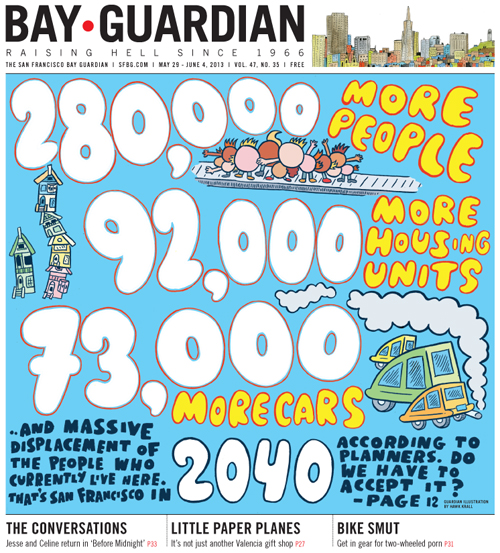
Under the ABAG plan, San Francisco would approve 92,400 more housing units for 280,000 more people. The city would host 190,000 more jobs, many of them in what’s called the “knowledge economy,” which mostly means high tech. Second and third on the list: Health and education, and tourism.

The city currently allows around eight cars for every 10 housing units; as few as five in a few neighborhoods, at least 10 in many others. And there’s nothing in any city or regional plan right now that seeks to change that level of car dependency. In fact, the regional planners think that single-occupancy car travel will be the mode of choice for 48 percent of all trips by 2040 — almost the same as it is today.

And since most of the new housing will be aimed at wealthier people, who are more likely to own cars and avoid catching buses, San Francisco could be looking for ways to fit 73,000 more cars onto streets that are already, in many cases, maxed out. There will be, quite literally, no place to park. And congestion in the region, the planners agree, will get a whole lot worse.

That seems to undermine the main intent of the plan: Transit-oriented development only works if you discourage cars. In a sense, the car-use projections are an admission of failure, undermining the intent of the entire project.

The vast majority of the housing that will be built will be too expensive for much of the existing (and even future) workforce and will do little to relieve the pressure on lower income people. But there is nothing whatsoever in the plan to ensure that there’s money available to build housing that meets the needs of most San Franciscans.

Instead, the planners acknowledge that 36 percent of existing low-income people will be at risk for displacement. That would be a profound change in the demographics of San Francisco.

Of course, adding all those people and jobs will put immense pressure on city services, from Muni to police, fire, and schools — not to mention the sewer system, which already floods and dumps untreated waste into the Bay when there’s heavy rain. Everyone involved acknowledged those costs, which could run into the billions of dollars. There is nothing anywhere in any of the planning documents addressing the question of who will pay for it.

THE NUMBERS GAME

Projecting the future of a region isn’t easy. Job and population growth isn’t a straight line, at best — and when you’re looking at a 25-year window in a boom-and-bust area with everything from earthquakes to sea-level rise factoring in, it’s easy to say that anyone who claims to know what’s going to happen in 2040 is guessing.

But as economist Stephen Levy, who did the regional projections for ABAG, pointed out to us, “You have to be able to plan.” And you can’t plan if you don’t at least think about what you’re planning for.

Levy runs the Center for the Continuing Study of the California Economy, and he’s been watching trends in this state for years. He agrees that some of his science is, by nature, dismal: “Nobody projects deep recessions,” much less natural disasters. But overall, he told me, it’s possible to get a grip on what planners need to prepare for as they write the next chapter of the Bay Area’s future.

And what they have to plan for is a lot more people.

Levy said he started with the federal government’s projections for population growth in the United States, which include births and deaths, immigration, and out-migration, using historic trends to allocate some of that growth to the Bay Area. There’s what appears at first to be circular logic involved: The feds (and most economists) project that job growth nationally will be driven by population — that is, the more people live in the US, the more jobs there will be.

Population growth in a specific region, on the other hand, is driven by jobs — that is, the more jobs you have in the Bay Area, the more people will move here.

“Jobs in the US depend on how many people are in the labor force,” he said. “Jobs in the Bay Area depend on our share of US jobs and population depends on relative job growth.”

Make sense? No matter — over the years it’s generally worked. And once you project the number of people and jobs expected in the Bay Area, you can start looking at how much housing it’s going to take to keep them all under a roof.

Levy projects that the Bay Area’s share of jobs will be higher than most of the rest of the country. “This is the home of the knowledge industry,” he told me. So he’s concluded that population in the Bay Area will grow from 7.1 million to 9.2 million — an additional 2.14 million people. They’ll be chasing some 1.1 million new jobs, and will need 660,000 new housing units.

Levy stopped there, and left it to the planners at ABAG to allocate that growth to individual cities — and that’s where smart growth comes in.

For decades in the Bay Area, particularly in San Francisco, activists have waged wars against developers, trying to slow down the growth of office buildings, and later, luxury housing units. At the same time, environmentalists argued that spreading the growth around creates serious problems, including sprawl and the destruction of farmland and open space.

Smart growth is supposed to be an alternative: the idea is to direct new growth to already-established urban areas, not by bulldozing over communities (as redevelopment agencies once did) but by the use of “infill” — directing development to areas where there’s usable space, or by building up and not out.

ABAG “focused housing and jobs growth around transit areas, particularly within locally identified Priority Development Areas,” the draft environmental impact report on the plan notes.

The draft EIR is more than 1,300 pages long, and it looks at the ABAG plan and several alternatives. One alternative, proposed by business groups, would lead to more development and higher population gains. Another, proposed by community activist groups including Public Advocates, Urban Habitat, and TransForm, is aimed at reducing displacement and creating affordable housing; that one, it turns out, is the “environmentally preferred alternative.” (See sidebar).

But no matter which alternative you look at, two things leap out: There is nothing effective that ABAG has put forward to prevent large-scale displacement of vulnerable communities. And despite directing growth to transit corridors, the DEIR still envisions a disaster of traffic congestion, parking problems, and car-driven environmental wreckage.

THE DISPLACEMENT PROBLEM

ABAG has gone to some lengths to identify what it calls “communities of concern.” Those are areas, like Bayview Hunters Point, Chinatown, and the Mission, where existing low-income residents and small businesses face potential displacement. In San Francisco, those communities are, to a great extent, the same geographic areas that have been identified as PDAs.

And, the DEIR, notes, some degree of displacement is a significant impact that cannot be mitigated. In other words, the gentrification of San Francisco is just part of the plan.

In fact, the study notes, 36 percent of the communities of concern in high-growth areas will face displacement pressure because of the cost of housing. And that’s region wide; the number in San Francisco will almost certainly be much, much higher.

Miriam Chion, ABAG’s planning and research director, told me that displacement “is the core issue in this whole process.” The agency, she said, is working with other stakeholders to try to address the concern that new development will drive out longtime residents. But she also agreed that there are limited tools available to local government.

The DEIR notes that ABAG and the MTC will seek to “bolster the plan’s investment in the Transit Oriented Affordable Housing Fund and will seek to do a study of displacement. It also states: “In addition, this displacement risk could be mitigated in cities such as San Francisco with rent control and other tenant protections in place.”

There isn’t a tenant activist in this town who can read that sentence with a straight face.

The problem, as affordable housing advocate Peter Cohen puts it, is that “the state has mandated all this growth, but has taken away the tools we could use to mitigate it.”

That’s exactly what’s happened in the past few decades. The state Legislature has outlawed the only effective anti-displacement laws local governments can enact — rent controls on vacant apartments, commercial rent control, and eviction protections that prevent landlords from taking rental units off the market to sell as condos. Oh, and the governor has also shut down redevelopment agencies, which were the only reliable source of affordable housing money in many cities.

Chion told me that the ABAG planners were discussing a list of anti-displacement options, and that changes in state legislation could be on that list. Given the power of the real-estate lobby in the state Capitol, ABAG will have to do more than suggest; there’s no way this plan can work without changing state law.

Otherwise, eastern San Francisco is going to be devastated — particularly since the vast majority of all housing that gets built in the city, and that’s likely to get built in the city, is too expensive for almost anyone in the communities of concern.

“This plan doesn’t require affordable housing,” Cindy Wu, vice-chair of the San Francisco Planning Commission, told me. “It’s left to the private market, which doesn’t build affordable housing or middle-class housing.”

In fact, while there’s plenty of discussion in the plan about where money can come from for transit projects, there’s virtually no discussion of the billions and billions that will be needed to produce the level of affordable housing that everyone agrees will be needed.

Does anyone seriously think that developers can cram 90,000 new units — at least 85 percent of them, under current rules, high-cost apartments and condos that are well beyond the range of most current San Franciscans — into eastern neighborhoods without a real-estate boom that will displace thousands of existing residents?

Let’s remember: Building more housing, even a lot more housing, won’t necessarily bring down prices. The report makes clear that the job growth, and population boom that accompanies it, will fuel plenty of demand for all those new units.

Steve Woo, senior planner with the Chinatown Community Development Center, sees the problem. In a letter to ABAG, he notes: “Plan Bay Area and its DEIR has analyzed the displacement of low-income people and explicitly acknowledges that it will occur. This is unacceptable for San Francisco and for Chinatown, where the pressures of displacement have been a constant over the past 20 years.”

Adds the Council of Community Housing Organizations: “It would be irresponsible for the regional agencies to advance a plan that purports to ‘improve’ the region’s communities as population grows while the plan simultaneously presents great risk and uncertainty for many vulnerable communities.”

Jobs are at stake, too — not tech jobs or office jobs, which ABAG projects will expand, but the kind of industrial jobs that currently exist in the priority development areas.

Calvin Welch, who has been watching urban planning and displacement issues in San Francisco for more than 40 years, puts it bluntly: “It is axiomatic that market-rate housing drives out blue-collar jobs,” he said.

Of course, there’s another potential problem: Nobody really knows where jobs will come from in the next 25 years, whether tech will continue to be the driver or whether the city’s headed for a second dot-com bust. San Francisco doesn’t have a good record of building for projected jobs: In the mid-1980s, for example, the entire South of Market area (then home to printing, light manufacturing, and other blue-collar jobs) was rezoned for open-floor office space because city officials projected a huge need for “back-office” functions like customer service.

“Where are all those jobs today?” Welch asked. “They’re in India.”

TOO MANY CARS

For a plan that’s designed to reduce greenhouse gas emissions by moving residential development closer to work areas, Plan Bay Area is awfully pessimistic about transportation.

According to the projections, there will be more cars on the roads in 2040, with more — and much worse — traffic. The DEIR predicts that a full 48 percent of all trips in 2040 will be made by single-occupant vehicles — just slightly down from current rates. The percentage of trips on transit will only be a little bit higher — and there’s no significant increase in projected bicycle trips.

That alone is pretty crazy, since the number of people commuting to work by bike in San Francisco has risen dramatically in the past 10 years, and the city’s official goal is that 20 percent of all vehicle trips will be by bike in the next decade.

Part of the problem is structural. Not everyone in San Francisco 2040 is going to be a high-paid tech worker. In fact, the most stable areas of employment are health services and government — and hospital workers and Muni drivers can’t possibly afford the housing that’s being built. So those people will — the DEIR acknowledges — be displaced from San Francisco and forced to live elsewhere in the region (if that’s even possible). Which means, of course, they’ll be commuting further to work. Meanwhile, if current trends continue, many of the people moving into the city will work in Silicon Valley.

Chion and Levy both told me that the transit mode projections were based on historical trends for car use, and that it’s really hard to get people to give up their cars. Even higher gas prices and abominable traffic delays won’t drive people off the roads, they said.

If that’s the case — if auto culture, which is a top source of global climate change, doesn’t shift at all — it would seem that all this planning is pointless: the seas will rise dramatically, and San Franciscans ought to be buying boats.

“The projections don’t take into account social change,” Jason Henderson, a geography professor at San Francisco State University and a local transportation expert, told me. “And social change does happen.”

Brad Paul, a longtime housing activist who now works for ABAG, said these projections are just a start, and that the plan will be updated every four years. “I think we’re finding that the number of people who want to drive cars will go down,” he said.

Henderson argues that the land-use policy is flawed. He suggests that it would make more sense to increase density in the Bay Area suburbs along the BART lines. “Elegant development in those areas would work better,” he said. You don’t need expensive high-rises: “Four and five stories is the sweet spot,” he explained.

Most of the transportation projects in the plan are already in the pipeline; there’s no suggestion of any major new public transit programs. There is, however, a suggestion that San Francisco adopt a congestion management fee for downtown driving — something that city officials say is the only way to avoid utter gridlock in the future.

SIDELINING CEQA

ABAG and the MTC have a fair amount of leverage to implement their plans. MTC controls hundreds of millions of dollars in transit money; ABAG will be handing out millions in grants to communities that adopt its plan. And under state law, cities that allow development in PDAs near transit corridors can gain an exemption from the California Environmental Quality Act.

CEQA is a powerful tool to slow or halt development, and developers (and some public officials) drool at the prospect of getting a fast-track pass to avoid some of the more cumbersome parts of the environmental review process.

Under SB 375 and Plan Bay Area, CEQA exemptions are available to projects that meet the Sustainable Community Strategy standards and are close to transit corridors. And when you look at the map of those areas, it’s pretty striking: All of San Francisco, pretty much every square inch, qualifies.

That means that almost any project almost anywhere in town can make a case that it doesn’t need to accept full CEQA review.

The most profound missing element in this entire discussion is the cost of all this growth.

You can’t cram 210,000 more residents into San Francisco without new schools, parks, and child-care centers. You can’t protect those residents without more police officers and firefighters. You can’t take care of their water and sewer needs without substantial infrastructure upgrades. And even if there’s state and federal money available for new buses and trains, you can’t operate those systems without paying drivers, mechanics, and support workers.

There’s no question that the new development will bring in more tax money. But the type of infrastructure improvements that will be needed to add 25 percent more residents to the city are really expensive — and every study that’s ever been done in San Francisco shows that the tax benefits of new development don’t cover the costs of public services it requires.

When World War II and the post-war boom in the Bay Area brought huge growth to the region, property taxes and federal and state money were adequate to build things like BART, the freeways, and hundreds of new schools, and to staff the public services that the emerging communities needed. But that all changed in 1978, with the passage of Prop. 13, and two years later, with the election of Ronald Reagan as president.

Now, federal money for cities is down to a trickle. Local government has an almost impossible time raising taxes. And instead of hiking fees for new residential and commercial projects, many communities (including San Francisco) are offering tax breaks to encourage job growth.

Put all that in the mix and you have a recipe for overcrowded buses, inadequate schools, overstressed open space (imagine 10,000 new Mission residents heading for Dolores Park on a nice day), and a very unattractive urban experience.

That flies directly in the face of what Plan Bay Area is supposed to be about. If the goal is to cut down on commutes by bringing new residents into developed urban areas, those cities have to be decent places to live. What would it cost to accommodate this level of new development? Five billion dollars? Ten billion? Nobody knows — because nobody has run those numbers. But they’re going to be big.

Because just as tax dollars have been vanishing, the costs of infrastructure keep going up. It costs a billion dollars a mile to build BART track. It’s costing more than a billion to build a short subway to Chinatown. Just upgrading the sewer system to handle current demands is a $4 billion project.

And if the developers and property owners who stand to make vast sums of money off all of this growth aren’t going to pay, who’s left?

The ABAG planners point out, correctly, that there’s a price for doing nothing. If there’s no regional plan, no proposal for smart growth, the population will still increase, and displacement will still happen — but the greenhouse gas emissions will be even worse, the development more haphazard.

But if the region is going to spend all this money and all this time on a plan to make the Bay Area more sustainable, more livable, and more affordable in 25 years, we might as well push all the limits and get it right.

Instead of looking at displacement as inevitable, and traffic as a price of growth, the planners could tell the state Legislature and the governor that it’s not possible to comply with SB375 — not until somebody identifies the big sums of money, multiples of billions of dollars, needed to build affordable housing; not until there are transit options, taxes, and restrictions on driving.

Because continued car use and massive displacement — the package that’s now facing us — just isn’t an acceptable option.


The Performant: Dare to DIVA

0

A yearly performance fest supports XX creatives

Spring is in the air, and so is DIVAfest, the EXIT Theatre’s annual celebration of female artists and theater-makers. Founded in 2002 by Christina Augello to give female creators a secure space to showcase their craft, DIVAfest has hosted an estimated 500 participants have come through in the last 11 years, from visual artists (Sophie Kadow, Kathy Jo Lafreniere, Michelle Talgarow) to playwrights (Kerry Reid, Lee Kiszonas, Margery Fairchild) to music-makers (Beth Wilmurt, Shannon Day, Carrie Baum Love), to burlesque dancers (Odessa Lil, Red Velvet, If-N-Whendy). This year, the fest hits the stage May 9-June 2. 

If the idea of having such a space sounds redundant or unnecessary to you, I refer you to Valerie Weak’s excellent piece at Theatre Bay Area on gender parity which breaks down, in unambiguously hard numbers, exactly how wide the underrepresentation gap is between male and female theater artists in the Bay Area of the moment. Or consider this recent observation made by Lindy West in an open letter to white male comedians: “women are 50 percent of the population, yet when it comes to our interests and grievances, we’re treated like a niche group.” Sound familiar? If you’re a woman in the arts, or practically anywhere else in the public sphere, then it probably does. 

So it’s heartening to see DIVAfest not just thriving, but expanding its scope and mission. Now in its 11th year, DIVAfest has morphed into its own stand-alone, non-profit organization, in the process of developing a year-round season and artist incubation opportunities in addition to producing the annual festival, which Augello envisions as having the potential to someday go national.

“Festivals are great because … there is power in numbers to create more work and draw more audience,” she muses over email. “New companies have been born out of coming together, (and) networking and artistic collaboration also thrive.” Those would be staple side effects of the now-venerable San Francisco Fringe Festival, also co-founded by Augello, in 1992.

This year’s festival, which runs through June 2, presents as broad a spectrum of works as ever, including a new play, You’re Going to Bleed, by Melissa Fall, a staged workshop of an interconnected “modular” play The Helen Project, by Megan Cohen and Amy Clare Tasker, a storytelling-short works showcase and a performance art one, curated respectively by Catherine DeBon and Erica Blue, a songwriter evening hosted by Melissa Lyn, and a burlesque cabaret, Rebel Without a Bra, directed by Amanda Ortmayer.

Education and outreach being very much a part of the DIVA experience, theater-goers and makers will also have the opportunity to dialogue with each other and a panel of Bay Area creators including Valerie Weak, Fontana Butterfield Guzmán, and Susannah Martin at the “Yeah, I said Feminist” symposium on Saturday, May 25, from 3pm to 6pm.

And what exactly is a DIVA, apart from its original descriptor of a celebrated opera singer, or a slang term for an impossible pop star? Augello, who expresses a fondness for all of her fellow DIVAs, past and present, has a definition at the ready, which can be applied to pretty much every artist who has passed under the festival’s auspices over the years.

“A DIVA is a self-realized artist … committed to creativity, with a passion that endures the successes and failures and learns from them to become a better artist and human being.” Long may they thrive!

DIVAfest

Through June 2

Various times and prices

EXIT Theatre

156 Eddy, SF

www.divafest.info

Björkphilia

0

MUSIC Can you even recall your first run-in with the mythic, boundary-less creature that is Björk? Perhaps it was bounding through the neon blue forest with tiny crystals underneath her eyes as a giant paper-mache bear chased her through Michel Gondry’s video for “Human Behaviour,” off 1993 solo album Debut. Or maybe it was poised for the tabloids in an elegant swan dress, holding a large egg purse and preening for the worst dressed lists at the ’01 Academy Awards after her devastating performance in Dancer in the Dark (2000). Those long obsessed will likely point to first hearing ’88’s “Birthday” by the Sugarcubes, her early Icelandic act (post teenage punk bands), on international radio.

Whenever — and however — it went down, it left a lasting impression, the stunning shock of that otherworldly voice tends to permeate memories. Solo, Bjork has long coupled that voice with innovation, always grasping at new objects and sounds, or as she described it to me in conversation, she’s “like a kid in a toy shop.”

Her latest triumph was Biophilia, the ’11 album that paired science, nature, iPads, Tesla coils, and tinkling church bells. Since its release, she’s hopped the planet with her sonic education in tow, spreading pixie dust and learning tools at schools and museums along the way. Next up, she’ll play a trio of shows at the Craneway Pavilion in Richmond (Wed/22, Sat/25, and Tue/28). Also during that time, her Biophilia Education Program comes to the Exploratorium, which means interactive workshops exploring connections between music and technology, Wed/22 through Tue/28.

In her unassuming but confident way — with the most endearing accent I’ve ever heard — the avant-pop megastar opened up to the SF Bay Guardian about her song writing process (yes, there’s a new project in the works), early punk career, natural musicology, and how to keep it all DIY:

SF Bay Guardian How did you initially come up with idea to include apps for every song on Biophillia?

Björk It started in 2008. I wanted to use touch screens…though the iPads weren’t out ’till 2010 or something. But I’d been using touch screens on my Volta tour, but more just to perform on stage. When I started doing Biophillia, I was very determined that I wanted to write with [touch screens], not just perform. That’s when I started to map out, to visualize. I had to decide, what did I want to hear on the touch screen when I’m writing this song. That sent me back to my own music education as a child, when I felt the way they explained scales and rhythms and those basic musicology themes, was way too academic. It was like reading a book to learn to dance.

Music is something that doesn’t work that well in the written word, you know? Especially not explaining to kids. So I started making my own map…this is how I would I like to have scales and this is how I would like to have chords and this is how I would like to have arpeggios and this is how I would like to have counterpoint, and so on. This project became naturally educational. I was kind of like, repairing my own education. I was trying to cover what I thought was lacking when I was in music school. In that way, I was able to share it.

We [created] a different program for each song. For example, one song would feature arpeggios, and then I would pick an actual element that would be the simplest way for a kid to understand what an arpeggio is, to visualize it. So we took a pendulum to explain counterpoint, a little bit like how church bells swing back and forth, and that’s like a bass line that swings.

I wrote 10 songs and we did different programs for each song, and it came together using natural elements. For example, one song is called is called “Crystalline” and there are crystals kind of growing as the song changes.

In 2010, when we were programming this and were kind of almost done, the iPad arrived, so we were like, ‘wow!’ It’d be silly just to record these songs and put them on a CD because we’d already written all these programs, we might as well share the programs, and put them with some more poetic, natural things — the moons, the tides, things like this. It was a very gradual thing.

SFBG And now it’s been brought in to educate children at schools throughout Iceland, but also there are related events where you’re touring, as well?

Björk It differs from city to city. So far it’s been in Manchester, Iceland, New York, Buenos Aires, and Paris, and now it’s going to be in California. Some places, like for example, New York Library and the Children’s Museum of Manhattan, took on the curriculum for a few months, and the middle school of Reykjavik, the 10 to 12-year-olds, they have it now in their curriculum for the next three years. It’s looking like it’s going to go to more countries. It sort of keeps growing.

SFBG It seems like you’ve long been ahead of the curve, as far as creating music with new technology, is that something you grew up with as well?

Björk I’m actually really bad with technology. I think that’s why I’m so excited about, for example, the touch screen, because it’s like I waited until technology caught up with me, for it to be simple enough. You have your imagination, and whatever helps you express yourself, I’m all for it, if it’s the violin or piano or singing. Or what has been really helpful for me, since I started doing my own solo albums, the computer has made me a lot more self-sufficient. I guess that comes from being in bands for 10 years, where things are more democratic. It was always drums and bass and keyboards and guitars in every single song [laughs], which is great. But then when I started doing my own album, I was like a kid in a toy shop, I wanted to have every single noise. And this is great, using the computers to do this yourself. It’s quite empowering, especially for a girl. You don’t have to go through this whole hierarchy of whatever, you can just be self-sufficient.

SFBG Some of your early groups were punk bands [Tappi Tíkarrass, and KUKL, which toured with Crass], I was wondering how you discovered punk as a teen, and ended up working with Crass?

Björk I was hanging out with kids that were older than me, like the other guy who used to sing in the Sugarcubes and another guy who was friends with Crass. They played our country, and then we would go and visit them at their farm [Dial House in Essex], and for me what was most important was that one of the bands that was on Crass’ label, a band called Flux of Pink Indians, had a bass player called Derek Birkett and he helped the Sugarcubes release their first album, just from his bedroom. And he’s my manager still today. So I’ve worked with him for like, 30 years now.

It’s pretty much DIY, especially now when the labels are not really functional like they used to be. It’s pretty much just three of us that do most of my stuff.

SFBG Do you have any other long-term goals with Biophillia, or are you working on your next project?

Björk I think I will be doing that on the side, but when it comes to writing my own stuff, I always like the first couple of years to be kind of mysterious. It’s important to play around in the dark, blind-folded, not really knowing what you’re doing. Biophillia was very much like that the first two years, it was very intuitive and impulsive and having no idea what would come out of it. And I’m at that stage with my next album. I really enjoy that. As much as it’s rewarding when [an album] first sees the daylight, I think I even enjoy more the first half of the process, when it’s all still a mystery.

SFBG Were you living in New York during the early playing stage of Biophillia? It seems to have a real connection to natural elements, and science, so I assumed you were in Iceland?

Björk I’ve been living half the year in New York and half in Iceland. I think Biophillia addresses my life in Iceland and the financial crises in a direct way because it’s sort of very DIY. And one of my first dreams was that Biophillia would be a music house and each room would be a song — eventually these rooms became the apps. But it might be that we would be able to go back and make a musical house in Iceland that would serves also as a children’s’ museum and we would use one of the buildings that got kind of half-built in the financial crises and create jobs that way.

But also Biophillia is also about urban areas, because you could stay connected with the moon through your iPad, or to nature and natural structures with your phone.

SFBG My time is almost up but may I ask a few of your favorite things? Like your favorite songs currently, or music that’s helping inspire you creatively now?

Björk At the moment I’ve been listening to the new James Blake album a lot. These things change all the time!

SFBG Favorite mythological story or creature?

Björk I like Icelandic mythology, there’s a lot of amazing tales there.

SFBG And a favorite tour snack?

Björk Um, I like berries.

SFBG Any kind in particular?

Björk Mmmm, no, I like all of them.

BJÖRK

Wed/22, Sat/25, Tue/28, 8:30pm, $75

Craneway Pavilion

1414 Harbour Way, Richmond

www.craneway.com

Family meal: 18 Reasons joins forces with neighbor Three Squares to extend reach of healthy eating

3

Community food hub 18 Reasons has always had the back of the well-meaning kitchen newbie. With a cafe space, educational programming, and tasting events geared towards making a healthy, sustainable diet doable, since 2007 when the organization’s co-founders brought in Bi-Rite Market, a happy partner for the little space located a block from the family grocery store’s Mission digs. Now, the reach of 18 Reasons has grown even more. The non-profit working to create social change through food has merged with Three Squares, a neighbor food organization with a happily congruent mission to feed.

Both 18 Reasons and Three Squares aim to slow things down when it comes to the way we eat. Both non-profits serve through nutrition lessons and cooking classes with a healthy planet bent. Major difference? Three Square’s offerings, up until this point, have been free, focusing more closely on the low-income families who want to learn about eating well.

Three Squares’ founder — the now-executive director at 18 Reasons Sarah Nelson tells the Bay Guardian, “our goal is to teach people — no matter what neighborhood they live in — how to maximize their food resources. We believe the best way to fix our food system is by building skills and forging relationships among people across the economic spectrum.”

The idea for the merge arose after the companies began working on a few projects together. “I realized we had a very similar mission but were reaching out to difference audiences,” Nelson says. “I didn’t want to leave Three Squares – it is my baby. So I proposed merger.”

The merged companies will operate under 18 Reasons’ moniker, stay at its 18th Street location, and continue to hold its signature classes which include: cooking courses, urban gardening school, and various other workshops.

Three Squares will bring the group’s “Cooking Matters” course to the table. The six-week course – with different sections designed for adults, kids, and teens – includes an hour of nutritional education followed by an hour of hands-on cooking. The courses, designed for adults and teens, focus on cooking, while the kid’s section is aimed more towards getting young’ns to taste and appreciate new foods. Graduates of “Cooking Matters” walk away with a free bag of ingredients so they can go home and practice what they’ve made in class.

Recipes taught in Cooking Matters vary from class to class, but Nelson tells me dishes like veggie quesadillas, tilapia with cilantro sauce, and English muffin mini-pizzas have been students’ past favorites. 

“Our classes target home cooking,” says Nelson. “We are not teaching professional cooking skills. Our courses are for people who want to cook at home with their family.”

If you need to up your own kitchen skills but don’t frequent the Mission, don’t worry. “Cooking Matters” courses are conducted in community health centers, schools, food pantries, social services offices, and other sites all over the Bay Area.

18 Reasons, 3674 18th St., SF. (415) 568-2710, www.18reasons.org

Do falling jobless numbers mean we’re smart and focused, or rich and exclusive?

73

The unemployment rate continues to drop in San Francisco and all over California, according to new numbers released today by the California Employment Development Department, which were trumpeted by Mayor Ed Lee as vindication for his economic development policies.

“San Francisco’s steady economic recovery is the result of our continued focus on job creation, education and training residents for the demands of the 21st century workforce. San Franciscans are getting back to work across the spectrum of job sectors – from hospitality to construction to technology to service industry jobs and we will continue to help these sectors grow in our City,” Lee said in a press release.

But are Lee’s neoliberal policies of promoting technology and other corporations with tax breaks and city-subsidized training programs and financing mechanisms really creating the rosy economic picture he’s painting? And even if it is helping to promote boom times, at what point have we essentially reached full employment, the point at which we should maybe turn our focus and resources to addressing the rising cost of living here?

After all, San Francisco’s unemployment rate of 5.4 percent is third only to Marin County (4.6 percent) and San Mateo County (5.1 percent). Those three counties also just happen to be the three counties with the highest per capita incomes in the state, a fact that explains our jobless rate more than the mid-Market payroll tax exemption and other taxpayer giveaways.

“Unemployment rates tend to be lowest in areas with high education attainment,” Ruth Kavanagh, EDD’s labor market consultant for this area, told us when we called to discuss the disparties among counties.

What about the rising cost of living in San Francisco? Clearly, this is becoming a much more difficult city for the unemployed and marginally employed to remain living in. How much are gentrification, evictions, and the exodus to the East Bay (Alameda County’s rate is 7 percent, still better than the statewide rate of 8.5 percent) and other locales a factor in our low jobless rate?

Kavanagh said the EDD doesn’t directly track that and so she couldn’t address the question. But she did say that the Bay Area was indeed experiencing the fastest job growth in the state, driven largely by the tech industry. In the last year, this three-county area has added 9,600 jobs in Professional Business Services (which includes tech) and 4,600 each in Leisure & Hospitality and Construction.

Indeed, in his State of the City speech in January, Lee touted the 23 construction cranes on the city skyline as the best gauge of the state of the city. And if counting jobs is one’s only measure of success, San Francisco is doing as well as can be expected. Kavanagh said most economists consider “full employment” within the capitalist system to be somewhere between 4-5 percent.     

Yet Lee says he’s not backing off from his full-throttle focus on economic development. “San Francisco’s unemployment rate today stands at a five-year low and I will continue to pursue policies that get people back to work, support San Francisco families and invest in our City’s future,” he said. “This Summer through San Francisco Summer Jobs +, we are setting an aggressive goal of putting 6,000 youth to work in paid jobs and internships, and I will continue working hard to make sure all San Franciscans have access to good paying jobs.”

Now if only we all had access to reasonably priced housing, health care, food, entertainment, and a transportation system built to handle a growing population.

-sigh-

Now get back to work!

Selector: May 15-21, 2013

0

WEDNESDAY 15

Appleseed Cast

Change seems to be the only constant for Lawrence, Kansas’ meandering Appleseed Cast. Chris Crisci’s 14-year-old band has produced eight albums, dabbled in about as many different genres, and has a revolving-door lineup that would exhaust any frontperson. But Crisci shows no signs of tiring. In fact, the lyrics for the band’s most recent album, this year’s Illumination Ritual, were written over the course of three nights, between the hours of midnight and 4am. Though the band’s career has arced far from its oldschool emo beginnings, the vespertine Illumination Ritual gets back to its moody roots. With a fresh lineup and a nostalgic new sound, the Appleseed Cast’s tender instrumentals and Crisci’s earnest vocals have never sounded so good. (Haley Zaremba)

With Hospital Ships, the Dandelion War

8:30pm, $14

Bottom of the Hill

1233 17th St, SF

(415) 626-4455

www.bottomofthehill.com


THURSDAY 16

ArtPad

Here’s an idea for a surrealist film: enter one hotel room and find metal hands that respond to their viewers, enter another and find a strange light sculpture, then cut to a performance of a synchronized swimming team in a pool in the courtyard. This is no film plot, but a description of ArtPad, the arts fair that will take over the entire Phoenix Hotel for three days. With galleries from the Bay Area and beyond filling every room with experimental exhibitions, while food, drink, and performances contribute to the festive vibe, the event promises to be surreally epic. (Laura Kerry)

Through May 19

$15–$40

Phoenix Hotel

601 Eddy, SF

www.artpadsf.com


Liss Fain

It was almost exactly a year ago that Liss Fain Dance premiered her luminous The Water is Clear and Still at Z Space. It’s perhaps her must successful collaboration with her longtime designer Matthew Antaky, who created a translucent multi-level space that welcomed Fain’s choreography and her fine dancers. It was one of those wondrous installation pieces that you could walk around in, but most of us stayed glued to our spots in an attempt to catch everything. Water is steeped in Jamaica Kincaid’s lyrical memories of a Caribbean childhood, both painful and exotic. Fain now has added a prologue. Solid Ground, based on Kincaid’s latest book, in which she revisits those childhood memories from a mature woman’s perspective. The piece is also moving from Z Space to YBCA’s Forum, which has successfully hosted other Liss Fain Dance installations. (Rita Felciano)

Thu/16-Sat/18, 8pm; Sun/19, 5pm forum, $15–$30

Yerba Buena Center for the Arts

700 Howard, SF

www.lissfaindance.org


Sandra Bernhard

It’s hard to pinpoint the moment when one learned that Sandra Bernhard was amazing. The stand-up comedian has been doing the damn thing for so long (since the ’70s), that she’s always just — been around, a fixture of the alternative culture firmament. A foulmouthed, straightforward, erudite queer back when they never made it network TV, she languidly lent cameos to Isaac Mizrahi’s Stripped and Madonna’s Truth or Dare, turned in seam-busting rants for her epic performance art-concert films like 1990’s Without You, I’m Nothing, and yes, was the first regular-appearing gay character on a network sitcom on Roseanne. To miss Bernhard’s first run in San Francisco in two years would be a revocation of your cool card, don’t do it. (Caitlin Donohue)

Also Fri/17

9pm, $45

Bimbo’s 365 Club

1025 Columbus, SF

(415) 474-0365

www.bimbos365club.com


Big Boi

Any lingering notions of Big Boi as the “conventional” half of legendary Atlanta hip-hop duo Outkast should be dispelled by his two solo albums, including his most recent effort Vicious Lies and Dangerous Rumors, released last November. Aided by cameos from Phantogram and Little Dragon in “Vicious,” Big Boi dives into rock guitars, female vocalists, and electronic bass to present a fearless, kaleidoscopic vision of rap. Track “Objectum Sexuality” sees Big Boi wax lyrical about women in between Phantogram’s Sarah Barthel’s floating vocals, a French interlude, and samples of atmospheric harp plucking. And just when you think he has slipped too far into moody, indie-fusion territory, Big Boi snaps you back with a devastating, horns-laden, proudly Atlantan club banger “In the A” with T.I. and Ludacris. (Kevin Lee)

With Killer Mike, Fishhawk, Goast

8:30pm, $35

Mezzanine

444 Jessie

(415) 625-8880

www.mezzaninesf.com


Janelle Monae at the SF Symphony

“Is it peculiar that she twerk in the mirror?” You can’t really blame her if you’ve caught R&B andro-angel Janelle Monae’s newest single with Erykah Badu “Q.U.E.E.N.” — the ode to iconoclasm, with its simple, catchy bass line is the perfect soundtrack to strutting and popping in front of reflective surfaces. Catch the singer’s turn with the SF Symphony tonight — the musicians have prepared original arrangements for her songs, and you’ll get tunes from her new album to boot. The ticket price is fairly astronomical, but the evening is a fundraiser for the Symphony’s educational programs, so there’s that. Plus attendees are granted access to a pre-show sparkling wine reception and after-party at City Hall. (Donohue)

7pm reception, 8pm concert, $90-$275

Davies Symphony Hall

201 Van Ness, SF

www.sfsymphony.org


FRIDAY 17

Midi Matilda

The first time I was confronted with local pop duo Midi Matilda, I was not-so-patiently waiting for Starfucker to take the stage at the Regency Lodge last September. Not expecting much from an electronic duo that was playing one of its very first shows, I was dumbstruck by the second song. Midi Matilda is the embodiment of everything that’s missing from contemporary twee-pop. It has a sense of intimacy, soul, and joy, embodied by great hooks and hilarious choreographed dances that are absolutely infectious. Operating backward from most bands, Midi Matilda wrote and recorded music before it ever established a live presence, gaining attention on the web with its “Day Dreams” music video. The duo’s catchy, dreamy pop songs make for a nice listen, but it is its goofy antics and blissful onstage presence that make a great new addition to the San Francisco music scene. (Zaremba)

With OONA, holychild

8:30pm, $12

Rickshaw Stop

155 Fell, SF

(415) 861-2011

www.rickshawstop.com


Dale Earnhardt Jr. Jr.

“You’re Supposed To Roll Your Hips In Time/ You’re Supposed To See Your Age Rewind” intones Dale Earnhardt Jr. Jr. on the bright electronic pop track “If You Didn’t See Me (Then You Weren’t On The Dancefloor),” off its new Patterns EP. On its albums, the Detroit duo of Daniel Zott and Joshua Epstein alternate between aw-shucks folksiness and the party-hearty synth-and-rock of MGMT and Phoenix. While firmly rooted in the here and now, DEJJ have shown respect to its musical inspirations with covers to classics by Madonna and the Beach Boys. The duo paid homage to Gil-Scott Heron with a shimmering, upbeat take on his funk classic “We Almost Lost Detroit,” resplendent with a video showcasing authentic locals and establishments from the Motor City. (Lee)

9pm, $16

Independent

628 Divisadero

(415) 771-1421

www.theindependentsf.com


SATURDAY 18

Disappears

A 16-minute song has to do a lot of work to keep its listeners invested, but the strange thing about Disappears’ “Kone” off of the band’s April EP is that it is compelling because it doesn’t seem to make too much of an effort. An experiment in Kraut and psych-rock, the song harkens back to the very beginnings of proto-punk; though it involves less muddy intensity, it recalls those stretches in some Velvet Underground songs that don’t feel the need to arrive anywhere, but simply relish the ride. And isn’t that the aim of any good concert? It certainly will be at the Disappears’ Bottom of the Hill show. (Kerry)

With LENZ, the Tambo Rays

10pm, $12

Bottom of the Hill

1233 17th St., SF

(415) 626-4455

www.bottomofthehill.com


Exrays and Mwahaha

Going to the Lab is like a weekly, weekend celebration of “the other.” You might see any combination of drag, performance art interludes, or Sunday’s ritual Godwaffle Noise Pancakes, but should definitely count on some underground, experimental shit. Hidden among the crowded club corridor along 16th and Mission, at times it becomes a mini-rave cave. This Sat/18 should be no exception to those guidelines when Exrays (members of THEMAYS and Maus Haus) bring their old-school Atari-sounding glitchiness. The band hangs on to fun melodies while the frontperson delivers mopey vocals (it could just be that his voice is deep). Oakland’s Mwahaha headlines and goes for more of a sensory overload approach. It’s collaborated with tUnE-yArDs and will open for Sigur Ros in London this summer. (Andre Torrez)

With Seventeen Evergreen, Mohani

9pm, $7–$15 (sliding scale)

Lab

2948 16th St., SF

(415) 864-8855

www.thelab.org


Hunx and His Punx

It was a dark day here in the Bay when Seth Bogart, a.k.a Hunx, packed up his bags and moved to Los Angeles, leaving the city’s burgeoning garage rock scene a little less gay in every way. Despite this tragic loss, Bogart hasn’t slowed down at all since his relocation, with a variety web TV show (Hollywood Nailz), his own novelty record label (Wacky Wacko), a new solo album, and a brand new Hunx and His Punx record on the way. Despite the 2011 dissolution of the Punkettes, Hunx still rocks a deliciously genderqueer persona and is backed by some truly kickass ladies. This intimate show, featuring bandmate Shannon Shaw’s own group Shannon and the Clams as well as fellow SF ex-pat Ty Segall’s Fuzz is like a big, happy Bay Area reunion — and everyone’s invited! (Zaremba)

With Shannon and the Clams, Fuzz, Peach Kelli Pop, Twin Steps

8pm, $15

New Parish

579 18th St, Oakl.

(510) 444-7474

www.thenewparish.com


SUNDAY 19

Gothic Tropic

For a band that has released so little music — only the 2011 EP Awesome Problems — Gothic Tropic has a developed sense of itself. Part of it is in frontperson Cecilia Della Peruti’s tendency to perform shoeless so as not restrict her dance moves. Another aspect arises in her nickname for the trio, “the Sacred Three.” The primary feature, though, is the band’s sound. As its name suggests, Gothic Tropic plays sunny and exotic psych-pop tinted with some grit and darkness, and it plays it well. See the band in all of it’s fully-formed glory at Brick and Mortar. (Kerry)

With Seatraffic, Cruel Summer

9pm, $10

Brick and Mortar

1710 Mission, SF

(415) 800-8782

www.brickandmortarmusic.com


TUESDAY 21

“Eating Nose-to-Tail: The Whole Animal Movement”

Let’s face it, Americans loves meat. But everyday consumers and informed connoisseurs are grappling with an increasing number of unanswered health and environmental questions with their meat, questions that an increasingly centralized food industry has left mostly unanswered. Unsatisfied with the growing gaps along the production chain, farmers, butchers, and chefs have banded together under the Whole Animal movement, which emphasizes using all of an animal for preparation and consumption. At this talk, four of the Bay Area’s meat authorities slice into how the movement stresses conservation and connects local producers, preparers, and eaters. After the talk, Dave the Butcher gives a whole animal butchery lesson while diners delve into delectables at the Ferry Building, with proceeds going to the Center for Urban Education about Sustainable Agriculture. (Lee)

With Chris Cosentino, Ryan Farr, John Fink and Tia Harrison

6:30pm program, $12–$20; 8pm butchering demo, $80–$100

Commonwealth Club

95 Market

(415) 597-6700

www.commonwealthclub.org


The Guardian listings deadline is two weeks prior to our Wednesday publication date. To submit an item for consideration, please include the title of the event, a brief description of the event, date and time, venue name, street address (listing cross streets only isn’t sufficient), city, telephone number readers can call for more information, telephone number for media, and admission costs. Send information to Listings, the Guardian, 225 Bush, 17th Flr., SF, CA 94105; or e-mail (paste press release into e-mail body — no attachments, please) to listings@sfbg.com. Digital photos may be submitted in jpeg format; the image must be at least 240 dpi and four inches by six inches in size. We regret we cannot accept listings over the phone.

Changing the metaphor

2

news@sfbg.com

With my partner-in-crime Keith Chandler at the wheel, we’re driving through San Francisco on our way to Stanford University Law School for the Three Strikes Summit, a deeply personal topic to both of us. Three Strikes is partly why I served 15 years in prison, and Stanford’s Three Strikes Project is a big reason why I was released earlier this year.

Chandler is a renowned activist, ex-lifer, and my comrade in the struggle to reintegrate inmates back into life in the outside world. I have become a fanatic on a mission, and this May 2 event will feature many of the top criminal justice players responsible for last year’s Three Strikes reform measure, from Attorney General Kamala Harris to San Francisco District Attorney George Gascon.

So the path we carve through the City takes us deep into the heart of the reform movement that changed my life. Change is in the air, and I’m following the scent back to its roots.

POSTER CHILD

Three Strikes as a metaphor made perfect sense. In the 1980s, the justice system was a revolving door. Relatively short sentences for serious and/or violent crimes were the norm, sentences often cut in half by parole. Lengthy records of arrests and convictions fueled a movement to get tough on crime.

As per usual, bad things happened. In 1993, sexual predator Richard Allen Davis killed Polly Klaas, a 12-year-old girl from Petaluma. A general consensus formed that repeat offenders needed to be punished to the fullest. So prison industrialists came up with a catchy solution: three strikes and you’re out. Commit three violent crimes, the authors sold to the public in 1994, and you’ll serve 25 years to life.

However, the fine print expanded the concept to any third felony — even crimes that would be misdemeanors to non-parolees — and California’s prisons swelled.

In many ways, I was a Three Strikes poster child. As a wild youngster in Sacramento, I was a menace. At 18 in 1984, I began a four-year spree of crimes that included armed robbery, assault with a deadly weapon, and residential burglary. For those transgressions, among others, I received a 12-year sentence in 1988.

I embraced sobriety, college, and writing as I served six discipline-free years. Back then, we had a right to participate in rehabilitative endeavors. Effective programs like cognitive restructuring and life-skills classes might have been foreign concepts, but I benefitted from college, weight training, and family visiting.

But I was still trapped by my criminal thinking — plagued by my nefarious associations. Though I hid it well, I was all fucked up.

In 1994, I was paroled into a whole new ball game: the era of three strikes. As soon as the law passed, the horror stories began to amass. Guys were being struck out for stealing from stores or possessing small amounts of drugs. California became the republic of the intolerant. Mired by myriad imperfections, I stepped up to the plate and swung for the fences.

A 28-year-old undergraduate with a range of goals, I started a construction company and contemplated graduate school. And instead of taking my construction company seriously, or even finishing my undergraduate education, I started using and selling meth — partying like there was no tomorrow.

In my broken way of thinking, I convinced myself that supplementing my income made perfect sense. In reality, it was an excuse to get high for free and it all fell apart. Two parole violations for drug cases seamlessly lead to a felony drug case in 1999. I went from baller to squalor, and hit a line drive right to the catcher. I struck out and faced a lifetime behind bars.

When my life came to an end, I chose to change the rules of my game. I found purpose by advocating for my demographic. As the system began to shift towards smart-on-crime principles in the mid-’00s, I managed to shift with it. My two-pronged litigious and literary activism — a lifestyle that regularly put me at odds with my captors — morphed into rehabilitative advocacy.

As a result of voters approving Prop 36 last fall, my life sentence was lifted on March 22. The merits of my rehabilitative record coalesced with a successful one-time review. As I walked out of prison a week later and jumped into the arms of my childhood sweetheart, I told Charlotte, “Let’s get the hell out of here before they change their minds.”

ROAD TO REFORM

After all the craziness of 15 years of incarceration, I have been decompressing in a transitional housing program. With a bachelor’s degree and multiple drug counseling certifications, I’m establishing myself as rehabilitative consultant. Moreover, I received the ultimate welcome home gift when The Sacramento Bee covered my reentry.

As we arrived on the Stanford campus, I thought of the friends and foes I left behind in prison. To me, this is serious business, a personal progression of nonstop advocacy. Keith’s gig as a criminal justice consultant now includes a new task — delivering me into the apex of reform.

Stanford Law School started the Three Strikes Project in 2006. The human lessons learned from securing the release of 26 three strikers motivated project director and law professor Mike Romano to shift tactics. He decided to take a bigger swing at a very bad law. By avoiding the mistakes from a catastrophic 2004 reform initiative, Romano could secure the release of thousands rather than dozens.

The project decided a narrowly drafted initiative would have the best chance for success. To qualify for a reduced sentence, minor third strikers without murder or sex offenses in their backgrounds would be vetted by the courts to determine whether they currently posed an unreasonable risk to public safety. He took down one of the nation’s toughest laws with 69 percent of the vote.

Of the 9,000 three strikers in California prisons, Prop. 36 made nearly 3,000 eligible for review. On the day of the summit, a prison official reported 460 had already been released — a number that will climb daily. While most counties have over 100 candidates — and some hotly contested cases are on the horizon — Los Angeles has a staggering 1,325 cases. San Francisco, by contrast, only has two, the result of SF’s sober, compassionate approach to charging three strikes cases.

Hearing the statewide cries from their landmark measure, Stanford invited all relevant parties to discuss how to move forward. Harris, the keynote speaker, wrapped her entire speech around a unique prosecutorial career that began in San Francisco.

As the author of Smart on Crime: A Career Prosecutor’s Plan To Make Us Safer, Harris models cutting-edge thinking as the state’s top cop. She pursued data-driven policies as she learned to look at “other issues through the lens of public safety.” By doing so, Harris avoided the sensationalism mentality that leads to hyper-incarceration.

Her successor, Gascon, followed her approach. Research showed Gascon that “higher levels of incarceration don’t translate into increased public safety.” So he teamed up with Stanford, the NAACP, and other like-minded officials as early supporters of the Three Strikes Reform Act of 2012.

Overall, the summit included a range of panelists who discussed a number of relevant topics. But how to adjudicate all these cases was juxtaposed by the need to find resources for reentry services. Stanford professor Joan Petersilia has been instrumental in every recent criminal justice policy change in California, and she warned of the need for more reentry programs.

“What goes down can easily go up,” Petersilia said, warning the crowd about prison populations and crime rates. “Roughly $1 million is being spent on the average three striker, and zero is being spend on their reentry.”

FREEDOM

Most of us are being released without any supervision or any type of state or county funds associated with probation or parole. Since we have far exceeded our sentences, the average three striker is leaving prison with little to no resources, let alone being able to tap into existing programs. I’m paying for my program out of my own pocket.

While it took decades to create the worst justice and prison system in the country, it’s definitely going to take years to correct. I advocated for more than a decade while buried under draconian measures buttressed by dreadful prison policies. Thus, I am excited groundbreaking issues are being discussed by people like this.

For those officials still trapped in their broken thinking, I also know how hard it is to abandon criminal thinking. However, like Gascon said, “Prop 36 is changing the metaphor.”

Seated in Keith’s sports car with the top down, we are making our way up 280 towards the city. Heading back home to Sacramento, I felt like a passenger on the Titanic with an alternate ending. While I am still in the honeymoon stage of my reentry — and reluctant to let this feeling go — I am at the beginning of a new era. We all have work to do.

My life of crime and activism has been an open book — and so is my reentry. After spending the day with journalists and actors in the field of justice, now I feel an even greater obligation to repay my debts. For the first time the light at the end of the tunnel is no longer blurred by the cold hard steel of the penitentiary, or maintained by tone-deaf policy-makers.

I still can’t believe it — I am free.

Ultimate zero

3

rebecca@sfbg.com

In January, Mayor Ed Lee appeared on the PBS NewsHour to talk up the city’s Zero Waste program, an initiative to eliminate all landfilled garbage by 2020 by diverting 100 percent of the city’s municipal waste to recycling or compost. “We’re not going to be satisfied,” with the 80 percent waste diversion already achieved, Lee told program host Spencer Michels. “We want 100 percent zero waste. This is where we’re going.”

But somewhere in Te Anau, New Zealand, an environmental scholar tuning into an online broadcast of the program was having none of it. “I sat there thinking, no, you’re not. It would be great if you were, but you’re not — for obvious reasons,” said Robert Krausz, who’s working toward a PhD in environmental management, describing his reaction during a Skype call with the Bay Guardian.

Krausz, a Lincoln University scholar originally from Canada, spent three years studying municipal zero-waste initiatives internationally, and completed an in-depth, 40-page analysis of San Francisco’s Zero Waste program as part of his doctoral thesis.

He may as well have taken aim at a sacred cow. The city’s Zero Waste program has near-universal support among local elected officials, and has garnered no shortage of glowing media attention. San Francisco’s track record of diverting 80 percent of waste from the landfill is well ahead of the curve nationally, scoring 15 percent higher than Portland, Ore., a green hub of the Pacific Northwest, and 20 percentage points or higher above Seattle, according figures provided by Recology, San Francisco’s municipal waste hauler.

Despite the city’s well-earned green reputation, Krausz arrived at the pessimistic conclusion that “San Francisco’s zero waste to landfill by 2020 initiative is headed for failure.” In seven years’ time, he predicts, the program deadline will be marked with a day of reckoning rather than a celebratory gala. “I think the city is setting itself up,” Krausz told the Guardian. “Somebody’s going to be holding the bag in 2020.”


ANOTHER AFFLUENT CITY

Sporting a goatee and glasses, Krausz comes across as the type you might find locking up his bike outside a natural foods store with canvas bags at the ready. When he visited San Francisco, he said he was ready to be wowed by the example of an ecologically enlightened city, yet ultimately left in disappointment. “It was just another affluent American city, in terms of consumption.”

The problem, he argues, is that people are still buying way too much disposable stuff — and a significant amount can’t be recycled. Plastic bags, food wrapping, pantyhose, plastic film, pet waste, construction materials with resin in them (like the popular Trex decking), and particularly disposable diapers have nowhere to go but into the landfill.

San Francisco produces a total of about six kilograms of trash per person per day before diversion is factored in — three times the U.S. national average. That’s a sobering figure that puts a slight dent in the city’s eco-conscious image. It’s not really fair to denizens of the city by the Bay, because it counts trash generated by 20 million annual visitors, daytime employees, developers, and businesses as well as residents. Nevertheless, the trash output ranks well above the per capita average for the Eurozone, which clocks in at a minimalistic 0.5 kg per person per day.

The city has earned its bragging rights for making strides toward diverting waste from the landfill — yet truckloads of waste still leave the famously green city every day. Since 2003, Krausz notes, San Francisco’s overall waste generation has actually increased, from 1,900 to 2,200 kilograms per person per year. At the same time, the per capita amount of waste going into a landfill has dropped, from about 1,000 to 500 kilograms per year. That’s still a lot of garbage.

Krausz argues that San Francisco has no comprehensive plan for achieving Zero Waste, while at the same time having little control over “top of the pipe” consumption, which generates a glut of trash. “While the city has achieved success at managing waste at the end-of-pipe, it has thus far failed to address the fundamental problem of consumption, which is driving waste generation,” his study notes.

Guillermo Rodriguez and Jack Macy of San Francisco’s Department of the Environment counter that there is a strategy, involving a host of different measures ranging from education, to policy initiatives, to incentive programs aimed at reducing waste. They think zero waste is possible. “We’re probably at 99 percent diversion here in this office,” said Macy, who serves as the city’s Commercial Zero Waste Coordinator. “At least 90 percent of the discard stream is recyclable and compostable,” he added. And as for the last 10 percent, “that pie will be shrinking as we find more markets” for recyclables.

Krausz also raised skepticism about Recology’s bid for a landfill contract that would extend until 2025, five years beyond the deadline for all waste elimination. To that, Recology’s Eric Potashner responded that state law requires 15 years of disposal capacity to guarantee a safety net, regardless of municipal aspirations.

Krausz is critical of San Francisco officials for promising zero waste, but he acknowledges that manufacturers of disposable goods, not city officials, are to blame. Ambitious legislative measures such as San Francisco’s mandatory composting program and a ban on plastic bags have been enacted and achieved tangible results, but for items like ubiquitous thin-film plastics, dirty diapers, synthetic materials, and the like, good solutions have yet to be found.

Krausz’ study also determined that no city on the planet that’s set out to do so has ever actually succeeded at achieving zero waste. “If you are a city that is a member of Western civilization as we know it, you’re not going to be zero waste to landfill, because you participate in the global economy,” Krausz states plainly.


SF’S TRASH PIT

On a recent Friday morning, Recology’s Potashner and Paul Giusti led a tour of the city’s recycling and waste processing facilities. It featured a stop at the transfer station, housed in a large warehouse off of Tunnel Road where all the refuse from the black trash bins is deposited before being carted off to the Altamont Landfill. A sweet, pungent aroma hung in the air. “We call this the pit,” Giusti explained as we approached a sunken area that could have contained multiple Olympic-sized swimming pools, extending a story or two below us into the earth. “This is the last frontier,” Potashner added. “The last 20 percent.”

It was filled with an astonishing quantity of trash, making a tractor that ambled awkwardly over top the mound to compact it down appear toy-like in comparison. The sea of discarded material contained every hue, and floating around in the debris were orange juice containers, cardboard boxes, and thousands upon thousands of (banned) plastic bags. Between 200 and 300 garbage trucks eject their contents into the pit each day, and a single truck can hold up to four tons of trash.

Giusti started working for Recology, formerly NorCal Waste Systems, in 1978, following in the footsteps of his father. Back then, the pit was more like a mountain: “When I would dump my truck, I could walk up this pile,” he said, gesturing toward a set of sprinklers suspended from the ceiling to indicate how high it once extended. State data confirms the story: In 2011, according to CalReycle, San Francisco sent 446,685 tons of waste to the landfill. That number has steadily declined over time; in 2007, it stood at 628,914 tons.

Asked for his reaction to Krausz’s thesis that the Zero Waste program won’t ever actually get to zero, Guisti turned the question around by asking, what’s the harm in trying? “Let’s say you said, zero waste is unattainable,” he said. “Then what’s the number? I think zero waste is an ambitious goal — but if we get to 90 or 95 percent, what a tremendous achievement.” Setting the highest of bars is important, he said, because striving for it provides the motivation to keep diverting waste from the landfill.

In order to actually reduce the city’s garbage from 446,685 tons to zero in the next seven years, Zero Waste program partners Recology and San Francisco’s Department of the Environment face a twofold challenge. First, they must prevent compostable and recyclable material from getting into the landfill pile. Second, they must find solutions for diverting the waste that currently has nowhere else to go but the landfill. With a combination of seeking new markets for recyclables, using technology that can sort out the recyclable and compostable matter, and implementing incentives and educational outreach programs, they’re still focused on the goal. “It’s hard to tell how close we’ll get to zero in 2020,” Macy said. So even if zero waste does not actually mean zero waste in the end, that goal “sends a message that we want to move toward being as sustainable as we can.”

Alerts

0

WEDNESDAY 15

Bike ride for fallen cyclists Justin Herman Plaza, SF. ramona.wheelright@gmail.com. tinyurl.com/bq623vg. 6:30pm, free. On the third Wednesday of May each year, the Ride of Silence is held in cities throughout the world to honor cyclists injured or killed while riding. The ride is also intended to advocate for safe streets for all users. The San Francisco 2013 contingent will visit nine locations, where ten bicyclists have been killed since 2001, to honor their memories.

THURSDAY 16

Sportswriter Dave Zirin in conversation with KALW’s Rose Aguilar Mission Cultural Center for Latino Arts, 2868 Mission, SF. tinyurl.com/cyujal2. 7pm, $10. The Center for Political Education (CPE) and Solespace present Rose Aguilar, the host of KALW’s “Your Call,” for a special on-stage discussion with noted author Dave Zirin, an author who writes regularly for The Nation and whose commentaries decode the political messages and messaging embedded in sports. Aguilar has hosted Your Call, a daily public affairs radio show on KALW, since 2006. This the only chance to catch Zirin in SF; he’ll appear a second time on May 17 in Oakland (visit link for details).

SATURDAY 18

Yogathon to raise awareness of HIV Madison Square Park, 849 Madison, Oakl. asianhealthservices.org/0518/ 8:30am-1pm, $10. Join Asian Health Services’ HIV/AIDS program for its Fourth Annual Strike a Pose! Yogathon, held in observance of National Asian and Pacific Islander (API) HIV Awareness Day. The event was created to raise awareness and resources for HIV/AIDS prevention within the Asian American, Native Hawaiian, and Pacific Islander (AANHPI) community in Alameda County.

Bay Area Debtors’ Assembly. Unite Here, Local 2, 209 Golden Gate, SF. strike-debt-bay-area.tumblr.com. (415) 568-6037. 2-5pm, free. Strike Debt Bay Area, a local chapter of an international movement formed to resist unjust debt, will host its second Debtors’ Assembly, with the goal of rethinking debt as a political platform for collective resistance and action. Come to the Assembly to learn about tools for escaping debt, sharing resources, skills and experiences, and brainstorming.

MONDAY 20

Eve Ensler reads from her memoir First Congregational Church, 2501 Harrison, Oakl. tinyurl.com/brcvovn. 7:30pm, $35 advance / $38 door. KPFA Radio, Code Pink and Pegasus Books present “Eve Ensler: In the Body of the World,” hosted by Erica Bridgeman. Internationally renowned playwright, activist and author Eve Ensler is the founder of V-Day, the global movement to end violence against women and girls. Ensler will discuss her memoir, In the Body of the World, taking readers through her personal history of sexual abuse, her travels to the Congo, her diagnosis with cervical cancer, and her reflections on the resilience of humanity.

TUESDAY 21

An Evening with Eduardo Galeano First Congregational Church of Oakland, 2501 Harrison, Oakl. tinyurl.com/bl8mb4z. 7:30-9:30pm, $15 advance. One of Latin America’s most distinguished writers, journalists and historians, Eduardo Galeano is the author of the Memory of Fire Trilogy, Open Veins of Latin America, Days and Nights of Love and War, and many other works. Born in Montevideo in 1940, Galeano lived in exile in Argentina and Spain for many years before returning to Uruguay. In his latest work, Children of the Days: A Calendar of Human History, each page has an illuminating story that takes inspiration from that day of the calendar year. Hosted by KPFA Radio.

Brown raids cap-and-trade funds, delaying action on climate change

5

Greenhouse gas concentrations in the atmosphere continue to rise to dangerous levels, but still our political leaders delay taking meaningful actions to address the looming crisis. The latest example: Gov. Jerry Brown is borrowing $500 million from the state’s new cap-and-trade program — money designated specifically for efforts to address climate change — to help balance the revised state budget proposal that he released today.

And the worst part was that Brown is raiding these funds even though there was no good reason to do so. “The Governor’s Budget reflected California’s most stable fiscal footing in well over a decade,” was the first sentence in the budget document, which admirably begins to restore education funding, partly because voters approved the Prop. 30 tax package last year.

While Brown said that the $500 million raid is just a loan that will be paid back with interest, the action highlights the short-term thinking that animates our political and business leaders, who seem content with hollow gestures and symbolic actions that fall far short of what’s actually needed to minimize climate change and sea level rise (even the cap-and-trade system itself is a business-friendly half-measure; simply capping then decreasing emmissions would have been far more effective).

There are a multitude of immediate needs for that “borrowed” money that would have big impacts to the carbon emmissions that our state continues to spew into the atmosphere, such as helping Muni and other urban transit systems overcome budget deficits that hamper their ability to provide good alternatives to private automobile use, which is one of the top sources of greenhouse gas emmissions.  

Environmentalists and advocates for social and economic justice — who have fought to direct some of these funds to reducing emmissions in low-income communities, where it is an acute public health issue on top of the long-term climate change threat — immediately criticized the governor’s move.

“The governor is playing a dangerous game that could wreck California’s push toward clean energy,” Greenlining Institute Legal Counsel Ryan Young said in a press release. “Voters of color turned out in force to protect AB 32, the clean energy law, when it was under attack by Prop. 23 [last year’s effort to repeal it], and they did it based on the promise that it would bring clean energy investments to polluted and struggling communities. These are the same voters who provided Jerry Brown’s victory margin when he ran for governor. Seizing these funds for other uses will hurt our state’s neediest communities, and it’s simply not necessary.”

Longtime Sierra Club legislative director Bill Magavern, who works with the Coalition for Clean Air, told Capital Weekly that the money is urgently needed for a variety of programs to reduce pollution in communities of color: “These important goals are now shunted aside as broken promises. The Governor has spoken of the urgency of addressing our climate crisis, but he has not put his money where his mouth is. It’s important to remember that none of the dollars in the Greenhouse Gas Reduction Fund come from taxes, and they were never intended to go to the General Fund.”

Another gauge is also telling: how do the polluters feel about the governor’s new budget? Well, here’s another press release we got on the governor’s new budget, from a conservative business organization that has long opposed meaningful efforts to address climate change: “California Manufacturers & Technology Association president Jack Stewart made the following media statement after Gov. Jerry Brown’s proposed ‘May Revise’ budget: ‘We congratulate Gov. Jerry Brown on a proposed balanced budget that will help California provide important government services. We appreciate that the Governor proposes the addition of a statewide sales tax exemption on the purchase of manufacturing equipment.  This will make California a more competitive place to scale up production.”

Same as it ever was.

Tech guru says Internet destroying middle class

28

Jaron Lanier isn’t a Luddite. He can’t be dismissed as a crackpot, whiner critic who is jealous of the success of others. He virtually invented virtual reality; he was a tech guru when most of today’s tech titans were still in diapers. So when he says that the Internet is destroying the middle class, maybe everyone ought to stop for a second and listen.

Okay, as I’ve said before: The Internet didn’t destroy San Francisco. Technology is a tool; it can be used in good ways and bad ways, and its impacts on society, particularly on the poor, can be mitigated by government action (or greatly worsened by inaction).

But Lanier is concerned that the business boom that has been created by high tech has made social inequality worse and is wiping out the middle class that is so essential to a stable country. He talks about how Kodak had 140,000 workers, many of them middle class, and Instagram has 13:

You have this intense concentration of the formal benefits, and that winner-take-all feeling is not just for the people who are on the computers but also from the people who are using them. So there’s this tiny token number of people who will get by from using YouTube or Kickstarter, and everybody else lives on hope. There’s not a middle-class hump. It’s an all-or-nothing society.

More important, the youth-driven culture of the current economic boom ignores that fact that some people are old, and have families, and get sick and disabled, and need a kind of stability that our current march of “disruptive” capitalism is destroying:

We don’t realize that our society and our democracy ultimately rest on the stability of middle-class jobs. When I talk to libertarians and socialists, they have this weird belief that everybody’s this abstract robot that won’t ever get sick or have kids or get old. It’s like everybody’s this eternal freelancer who can afford downtime and can self-fund until they find their magic moment or something.

And Lanier IS a guy who can afford downtime and self-fund. But he’s also 53, and has a little more perspective on life. He recognizes that the middle class has always had, and needs, some sort of public-sector support, whether it’s through tax policy or education or job creation, particularly in unstable economic times. It’s fine for capitalism to be disruptive — as long as there’s a safety net to make sure that all the people disrupted out of their livelihoods aren’t disrupted out of their homes.

Young people, Googlers, Facebookians, Twitterati: Maybe you should listen to your elders.

Behind the attacks on City College

17

OPINION Last year the Accrediting Commission for Community and Junior Colleges harshly sanctioned City College of San Francisco and gave us just nine months to shape up or face the consequences. This was pushed on the community even though the quality of education provided at City College was never in question.

Since then, CCSF has changed student assessment metrics and addressed the governance, institutional planning, and enrollment management issues cited. We have done so even as we have also documented disquieting information about the ACCJC’s damaging role at CCSF and at community colleges throughout California.

Our research into ACCJC found that the commission failed to respect the law and public policy of the state and violated federal common-law due process and California common-law fair procedure. Further, at CCSF and in districts around the state, the ACCJC often acts arbitrarily, capriciously, unfairly, and inconsistently in evaluating colleges, thereby harming the schools and their communities.

San Francisco has shown valiant support for City College despite the drumbeat of negative publicity around our accreditation status.

Recently, the San Francisco Board of Supervisors voted unanimously in support of preserving the quality and diversity of education at City College of San Francisco, of tackling the achievement gap and ensuring equitable opportunities for students, and of utilizing Proposition A funds as intended.

In the age of the 24-7 corporate news cycle, educators and unions are too often portrayed as the opposition in attempts to push austerity, undermine the public sector, and efface the important educational work we do for students. We will not apologize for resisting the downsizing of our students’ educations, for saving jobs, and for protecting educational programs that benefit our students—particularly our most vulnerable students. We will not apologize for attempting to sustain employees’ health, working conditions, and well-being.

When San Franciscans passed Proposition A overwhelmingly last November, it was a ray of light for those of us who have devoted our lives to City College and its students. Providing $15.2 million, the tax was designed to reverse the cuts to classes and employees in our starved public educational system, helping sustain our college for San Franciscans. Now the administration is diverting millions of these dollars and pumping additional money into consultants, lawyers, computers, and maintenance. Under the administration plan, next year less than a third of that money will go toward the educational purposes voters were promised.

Meanwhile, the race to downsize continues. At the negotiating table and in the press, the administration uses the need to retain the college’s accreditation—something all of us agree is crucial—as reason, excuse, and threat. It has shirked its duties at the bargaining table, imposing pay cuts and implementing premature and damaging layoffs of staff and faculty.

We face a host of other dramatic changes that cut into our ability to serve student needs, including a reorganization that pushes faculty expertise and voices further into the background and a shocking lack of substantive dialogue or transparent processes. Our trustees now preside over meetings that squelch public speech, restricting access to a too-small meeting room with the windows literally papered over so that no one can see in or out.

Thankfully, we are not alone in this fight. In Chicago, in Seattle, and in communities around the country afflicted with disingenuous “reforms” and diminished access, we are gathering strength and allies and standing up for the principles that inform our work as educators, responsible for defending and improving quality, accessible public education for the public good.

To join the fight to save our City College, email aft@aft2121.org

Alisa Messer is an English instructor at City College of San Francisco and president of AFT Local 2121, which represents instructors, counselors, and librarians at the college.


Teachers try to dis-accredit accreditation group

14

The union representing teachers at San Francisco City College have fired back at the accreditation commission that’s threatened to shut the school down and forced dramatic changes in its mission. The California Federation of Teachers and AFT Local 2121 filed a legal complaint May 1 charging the Accrediting Commission for Community and Junior Colleges with violating its own rules and federal law — and the complaint asks the federal Department of Education to withdraw the accreditation of the accreditation commission.

The language of the 260-page complaint is harsh:

The Commission has violated nearly every Federal regulation which guides it, disregards its own policies, misrepresents
its actions or legal requirements, fails to respect the law and public policy of the State,violates Federal common law due process and California common law fir procedure, and acts arbitrarily, capaciously, unfairly and inconsistently in evaluating colleges and
districts throughout the State, thereby harming colleges, students, faculty and staff, boards of trustees and ultimately the People.

But in the end, union members on a conference call noted, the big issue is whether the ACCJC ought to be evaluating classroom instruction and offering constructive criticisms (which is what these panels have tended to do in the past) — or ought to be looking at overall college finances, including retirement costs and management structure.

For example, the ACCJC wants City College to pre-fund some of its retiree health-care benefits — diverting money that could be used right now in classrooms. “Accreditation agencies shouldn’t be looking at [those types of] finances,” union spokesperson Fred Glass said.

Alisa Messer, president of the Local 2121, said that the commission’s threat to withdraw accreditation from City College “has thrown the college into turmoil,” which is hardly news. Jim Mahler, president of the CFT Community College Council, took the broader view, saying that schools are now so afraid of the ACCJC that they’re spending disproportionate amounts of money and time just trying to please the agency.

CFT President Joshua Pechthalt said the goal of the legal filing was to get the ACCJC to withdraw its “show cause” order at City College — and the change the overall approach the accreditors are taking. “No other body operates like this,” he said. The Department of Education has to accredit the accreditors, and the ACCJC comes up for review this year — so in a sense, the unions want to put the oversight agency under the same type of scrutiny the schools are enduring.

So far, no response from ACCJC.

UPDATE: ACCJC posted the following on its website:

While we understand there is interest in obtaining information in this regard directly from the ACCJC,
the Commission will maintain its normal practice of reviewing third party comment and communicating
about that comment directly to the affected member institution. Further, complaints against the ACCJC
are treated formally, in accordance with policy; comment from the organization or its officers is limited
during this time.


Debt peons, unite!

49

rebecca@sfbg.com

David Graeber is renowned among occupiers and idealists as an intellectual founder, or anti-leader as it were, of the Occupy Wall Street encampment that sprung up in Zucotti Park in the fall of 2011. He’s an organizer, an anarchist, a professor of anthropology and sociology at Goldsmiths University of London, a former instructor at Yale, and the author of several books, including Debt: The First 5,000 Years, a tome tracing the concept of debt back to the roots of Western civilization.

His latest book, The Democracy Project: A History, a Crisis, a Movement (Spiegel & Grau, 2013), chronicles the rise of Occupy, a leaderless economic justice movement Graeber unapologetically characterizes as a success. In honor of International Workers Day, May 1, the Bay Guardian caught up with him over coffee to talk about economic pressures facing today’s workers, particularly the young and marginalized.

Turns out, it’s not a pretty picture out there — but at least Graeber, who has a propensity to collapse into giggles between full throttle ruminations on the absurdity of global economic policy, has a sense of humor about it.

Below are some excerpts.

San Francisco Bay Guardian: Looking at the Occupy movement, the mainstream narrative seems to be that it was a short-lived, failed experiment and now it’s over. But in your book, you ask the question ‘why did it work?’

David Graeber: Let’s put it this way. When was the last time that the issue of social class was put at the center of American politics? Probably the 1930s. Social movements have been desperately trying to do this for 50, 60, 70 years and gotten nowhere. We managed to do it in three months. Um, that’s pretty impressive. … And I’m pretty sure that if it weren’t for us, we’d have a President Romney right now. That whole 47 percent thing? It would not have resonated had it not been for the 99 percent thing.

SFBG: Why do you think the idea of wealth inequality, of all issues, resonated so much?

DG: I think because there’s a basic change in the way capitalism works in America. It’s been going for some time, but it just became unmistakably apparent after 2008. People talk about the “financialization” of capitalism, and it sounds very abstract. Casino capitalism, speculation, they’re playing these games, they’re making money appear out of thin air, which is not entirely untrue. … It’s based on getting everybody into debt. The profits of Wall Street are — they now say a very small percentage is actually based on commerce — it’s now based on finance. But what does ‘based on finance’ actually mean? It means they go into your bank account and take your money.

I’ve been trying to figure out just what percentage of the average American’s income is simply extracted every month by the finance sector. …You count mortgages, you count credit card debt, loan debt, all the fees and penalties that you don’t notice… all that stuff put together comes to about 20 percent at least, and probably higher. For example, families that are in their early 30s, it’s often 40 percent. … I saw a poll the other day that said, for the first time since they’ve been taking statistics, a majority of Americans don’t consider themselves middle class. … And I think the reason for this is because it really never was an economic category. It has to do with how you feel you relate to basic institutions. What middle class first and foremost means is, if you see a policeman, do you feel safer, or do you feel less safe? … Then there’s more going on. For the first time, we found that there is incredible solidarity between students and workers, which have traditionally not been friends — go back to the 60s and it’s hard-hats beating up hippies. Now, the transit workers in New York are suing the police over taking their buses to arrest us [occupiers].

SFBG: How would you reflect on the economic condition that workers are facing, compared with how things were historically over the last several decades?

DG: It’s atrocious. One thing that’s happened is there’s been this disconnect between productivity and wages. This is kind of the deal they struck at the end of World War II in most of the North Atlantic countries: It used to be that you work harder, you produce more, you get a share of the profits. And that was worked out through mass unionization, it was worked out through negotiations, and it was tacit somewhat, but you know, it was understood.

Since the ’70s, that deal is off. So, productivity goes up, wages stay flat. So that’s why they say all profits have now gone to one percent of the population. So workers are working harder and harder, more and more hours, under more and more stress. …It’s all the more difficult because of education, because now it’s gotten to the point where if you don’t have a college degree, your chance of having any benefits at work is basically nil. If you want to have health care, you need to go to college. At the same time, if you want to go to college, you need to pay student loans. So you’re double damned. … You have all these people who are sort of trapped: I’d like to finish, I’m still going, I’ll take night classes — for five or ten years, while you have a working class job. So the line between the students and the proletariat blurs, and this is one of the reasons why the student loan issue actually spoke to people in unions.

And there’s also a shift in the type of work. Did you ever see the “We are the 99 percent” tumblr page? It was all these people talking about their jobs… their debts and difficult medical problems…. One of the things that fascinated me about that was that like 80 percent of the people on that page were women. …They were all doing something where the work was clearly to the benefit of someone else. And I think that those are the people who are the most screwed right now, ironically. The more obviously your work benefits other human beings, the less you’re paid.

SFBG: Going back to this idea of debt — your book [Debt: The First 5,000 Years] looks at debt through the ages of human history. I’m curious to hear your thoughts on debt as it relates to personal freedom.

DG: That’s one of the most pernicious things about the current debt regime in America. Being young is supposed to be a place where you can let your imagination run free and explore your sense of possibility. That’s what college used to be. In a sense, those students who are just out of college, I always call them post-students, they’re the kind of people who are activists, the kind of people who are thinking okay I’ll start a band, maybe I’ll be an artist. That’s where everything comes out of in a generation, where everything new and exciting emerges. What could be more stupid than taking all those people and turning them into debt peons? … I think of it like horror movies — what is it that’s so scary about monsters? It’s that they turn you into them, right? Vampires, werewolves. But you don’t get to be like the really cool super count vampire, you get to be a pathetic minion vampire, where you’re in debt for the rest of eternity, as a flunkie. In a way, that’s what’s scary about debt. It forces you to think like a capitalist, you have to think about money and profit all the time. But it’s even worse, because you’re a capitalist with no capital. It like totally destroys your ability to think of anything but money, and you don’t even have any money.

SFBG: Another thing we’re seeing increasingly is austerity measures and public sector spending cuts. What’s the root cause of these rollbacks, and what do you see as the most appropriate response from economic justice activists?

DG: I am in the peculiar situation at the moment that some members of the ruling class actually talk to me and even ask for my advice. Which, you know they’re in trouble if they’re talking to me, right? Part of the reason for that is that these guys are on a completely self-destructive course. I live in the UK most of the time. They’re going into a triple debt recession because of these austerity programs. Now what are you going to make of it? It has nothing to do with economics.

SFBG: So why is it happening?

DG: It’s moral. It’s political, and moral. Neoliberalism is not basically an economic ideology. It’s about politics … Always prioritize the political advantage over the economic advantage. Breaking unions, getting rid of job security, making people work more and more hours — that’s not economically efficient … So what does it do? Well, it’s the best thing you could possibly do if you want to depoliticize workers … The classic justifications for capitalism are harder and harder to maintain. … So what excuse do they have left? They can say, well, it’s the only thing that’s possible. Basically all they can do is hammer away at our imagination. The only alternative is this, or North Korea. And the amazing thing is that the only war they’ve won, is the war against the imagination.


Pageant play

0

caitlin@sfbg.com

SEX Who could have anticipate that this year’s International Ms. Leather pageant (www.imsl.org) would do so much to temper the legacy of Sarah Palin? Thanks to the crowning of Sarha Shaubach, the world now has an alternative posterwoman for that tiny hamlet on the outskirts of Anchorage’s metropolitan area.

Shaubach, who accepted her title wearing a furry hat and a stole with paws on April 20, told us a little about herself via email the day after the pageant’s climax at the Holiday Inn Golden Gateway. The event drew leatherwomen from all over the world to the Van Ness Avenue hotel for play parties, history panels, kinky writing intensives, and extensive opportunities for forging a global network of BDSM broads.

2013’s International Ms. Bootblack bella (left) and International Ms. Leather Sarha Shaubach

SFBG: What does your new title mean to you?

Sarha Shaubach: The International Ms Leather title represents a long history of diverse women from all over the country sharing a passion to support and grow bonds between leatherwomen from many different kinds of background and experiences. To me, this title is a chance to learn, educate, grow, and thrive in my journey as a leatherwoman while building bonds between communities.

SFBG: Tell me about your winning outfit.

SS: I wore a combination of fur and leather for my last and final outfit on stage. I felt that [those materials] most authentically represented who I am and where I come from. The furs were harvested by me and my family in Meadow Lakes, Alaska, and the leathers were bought secondhand at various thrift stores.

Shaubach, to the north of her leather community, per usual

SFBG: Highlight of the pageant week?

SS: The excitement of all the hot leather folk at the IMSL “Seductions Show” on Thursday night was a highlight for sure, but calling home to talk to my husband John after the contest would have to take the cake. He seems to be just as excited for my new title as I am.

SFBG: As a leatherwoman, what do you consider your greatest achievement?

SS: My greatest achievement to this point would be producing the first Northern Exposure (www.northernexposurealaska.com) in 2010, Alaska’s only BDSM/leather education weekend. Since then, and with the help of my amazing tribe of friends and volunteers, we have brought more than 50 educators from all over North America to Alaska to teach and present on all kinds of kink and leather-related topics.

SEXY EVENTS

“Maximizing a Women’s Pleasure” Wed/24, 8-10pm, $35. Pink Bunny, 1772 Union, SF. www.pinkbunny.biz. Learn how to work a clit in the Marina? It’s true! Drop in on the adorable, independently owned sex shop Pink Bunny for this two-hour seminar by Japanese bondage expert and sex educator Midori on giving and receiving female feelings. Couples and solo enthusiasts of all genders welcome.

Home Movies 101 Sat/27, 2-5pm, $60 solo admission, $80 couples. Center for Sex and Culture, 1349 Mission, SF. www.sexandculture.org. Porn star Kara Price uses hawt, if clothed, demonstrations of various positions and orgasms to teach you how to make a pro sex tape. Get half off tuition if your partner is in the military or overseas.

Screening is believing

0

cheryl@sfbg.com

SFIFF Most contemporary Americans don’t know much about Uganda — that is, beyond Forest Whitaker’s Oscar-winning performance as Idi Amin in 2006’s The Last King of Scotland. Though that film took some liberties with the truth, it did effectively convey the grotesque terrors of the dictator’s 1970s reign. (Those with deeper curiosities should check out Barbet Schroeder’s 1974 documentary General Idi Amin Dada: A Self Portrait.) But even decades post-Amin, the East African nation has somehow retained its horrific human-rights record. For example: what extremist force was behind the country’s Anti-Homosexuality Bill, which proposed the death penalty as punishment for gayness?

The answer might surprise you, or not. As the gripping, fury-fomenting doc God Loves Uganda reveals, America’s own Christian Right has been exporting hate under the guise of missionary work for some time. Taking advantage of Uganda’s social fragility — by building schools and medical clinics, passing out food, etc. — evangelical mega churches, particularly the Kansas City, Mo.-based, breakfast-invoking International House of Prayer, have converted large swaths of the population to their ultra-conservative beliefs.

Filmmaker Roger Ross Williams, an Oscar winner for 2010 short Music by Prudence, follows naive “prayer warriors” as they journey to Uganda for the first time; his apparent all-access relationship with the group shows that they aren’t outwardly evil people — but neither do they comprehend the very real consequences of their actions. His other sources, including two Ugandan clergymen who’ve seen their country change for the worse and an LGBT activist who lives every day in peril, offer a more harrowing perspective. Evocative and disturbing, God Loves Uganda seems likely to earn Williams more Oscar attention.

>>Check out our short reviews of several SFIFF films of interest.

More outrage awaits in Fatal Assistance, Port-au-Prince native Raoul Peck’s searing investigation into the bungling of post-earthquake humanitarian efforts in Haiti. So many good intentions, so many dollars donated, so many token celebrities (Bill Clinton, Sean Penn) involved — and yet millions of Haitians remain homeless, living in “temporary” shelters. Disorganization among the overabundance of well-meaning NGOs that rushed to help is one cause; there’s also the matter of nobody trusting the Haitian government to make its own financial decisions. Peck, a former Minister of Culture, offers a rare insider’s perspective. Though the film’s voice-overs (framed as letters that begin “dear friend”) can get a little treacly, the raw evidence Peck collects of “the disaster of the community not being able to respond to the disaster” is powerful stuff.

There’s more levity sprinkled amid the tragedy (and bureaucratic frustration) contained in Ilian Metev’s Sofia’s Last Ambulance. If nothing else, this doc will make you extremely cautious if you ever find yourself visiting the capital of Bulgaria; its depiction of the city’s medical care is grim at best. An underpaid, harried trio — doctor, nurse, and driver — grapple with dispatchers who don’t pick up and drivers who don’t let ambulances pass, bad directions, outdated equipment, and other unbelievable situations that would be funny if lives weren’t hanging in the balance. Metev never films the patients, instead keeping his focus on the paramedics. Sarcastic nurse Mila Mikhailova is a standout, sweetly calming down an injured child, bluntly advising a drug addict, and joking about her love life with her co-workers. Only during rare moments of downtime does her exhaustion emerge.

>>Dennis Harvey on SFIFF’s Finnish angle.

More lives in chaos — albeit slightly more existentially — are depicted in A River Changes Course, which picked up a Grand Jury Prize for World Cinema Documentary at the 2013 Sundance Film Festival. Cambodian American filmmaker Kalyanee Mam followed a trio of rural Cambodian families over several years, eventually crafting a vividly-shot, meditative look at lives being forced to modernize. Talk about frustrating: farmers grapple with a new worry — debt — so the eldest daughter heads to Phnom Penh to work in a factory. But the paltry wages she earns aren’t enough to offset the money they will have to spend on food, since they can’t farm enough to eat without her around to help. Elsewhere, a teenage boy who figured he’d grow up to be a fisherman takes a backbreaking planting job when the fish grow scarce; he confesses to Mam that he’s long since given up any dreams of getting an education. “Progress” has rarely felt so bleak.

Adding a much-needed dose of quirk to all of the above is Kaspar Astrup Schröder’s Rent a Family Inc., about Ryuichi, a Tokyo man whose business name translates to “I want to cheer you up.” He’s a professional stand-in, offering himself or any of his rotating cast of staffers to pretend to be friends or relatives in situations, including weddings, where the real thing is either not available or won’t suffice.

That premise alone would make for an intriguing doc — though there’s a disclaimer that certain scenes with clients are “reconstructed” — but Ryuichi’s career choice feels even more surreal once it’s revealed how dysfunctional his own family is; among a wife and two kids, he gets along best with the family Chihuahua. Though Schröder focuses on Ryuichi’s ennui at the expense of delving into, say, what it is about Japanese culture that enables the need for fake family members, the guy is undeniably fascinating. “I’m like a handyman, fixing people’s social engagements,” he explains — but he has no clue how to mend his own. *

SAN FRANCISCO INTERNATIONAL FILM FESTIVAL

April 25-May 9, most shows $10-15

Various venues

festival.sffs.org


Wells Fargo foreclosure fighters: They’re baaaack!

See an update at the end of this article.

 A group of activists focused on organizing against Bay Area foreclosures will return to Wells Fargo’s San Francisco headquarters today for a protest timed to coincide with the banking giant’s shareholders’ meeting – even though the meeting was moved to Salt Lake City, Utah this year. (Perhaps the change of scenery had something to do with what happened last year, or the year before?)

Unfazed, the Alliance of Californians for Community Empowerment has sent some homeowners who are facing bank foreclosure on a road trip to Utah to bring their message to CEO John Stumpf in person, according to ACCE organizer Erin Franey.

Meanwhile, in San Francisco, activists focused on fighting foreclosure will congregate outside the bank’s Mongtomery Street headquarters. “Wells is foreclosing on more homeowners in California than any other bank,” says Franey, adding that there are currently 11,000 California homes in the foreclosure pipeline.

In attendance at this afternoon’s San Francisco rally will be Bernetta Adolf, a cancer survivor in her late 60s who has also struggled with blindness, a particularly challenging disability that forced her to retire from her city job as a Muni driver.

Adolf is locked in a battle with Wells Fargo over the foreclosure of her home in San Francisco’s Oceanview-Merced-Ingleside neighborhood. The trouble started when she borrowed against the home she’s lived in 20 years, to fund her son’s college education.

“It turns out the loan to provide for my son’s future was designed to ruin my own,” Adolf wrote in an online statement. “It was predatory, calculated to strip my equity and set me up for failure. When I tried to work with Wells to fix the loan, they offered a modification so small it didn’t make any difference. Then they started trying to take my house. The stress hastened my blindness and continues to aggravate my health problems.”

UPDATE: Wells Fargo spokesperson Ruben Pulido contacted us in response to this article and requested that we post a statement in response:

“Our foreclosure rate in 2012 fourth quarter was just 1.04 percent in California—less than half our national rate (2.1 percent) during that period.

Over the past four years, Wells Fargo has helped more than 850,000 customers nationwide with loan modifications, and has helped customers through $6.6 billion in principal forgiveness; the majority of that principal forgiveness has gone to borrowers in California.

When customers with financial challenges choose to work with us, we help 7 of 10 avoid foreclosure. Over the last 6 months, customers who completed a foreclosure were, on average, 19 months past due on their payments.”

Food for thought: 18 Reasons’ class series encourages the slow chew

0

Hippocrates said, “let food be thy medicine and medicine be thy food”. The axiom certainly sounds nice rolling off the tongue, but curative qualities aside, you’ll never stick to healthy if it doesn’t taste good. Luckily here in the Bay Area we have Carley Hauck of Intuitive Wellness, who proves in her “Mindful Eating and Cooking” series at community food hub 18 Reasons that comestibles can indeed be medicinal, and that medicine can taste amazing.

Health nuts and epicureans alike can revel in Hauck’s multi-layered, multi-course classes, in which students learn a comprehensive approach to mindful eating and cooking. This means all hands on deck — as well as all eyes, noses, mouths and minds — everyone in Hauck’s seminars are required to take a participatory role in this adventure for the taste buds. 

“In graduate school, I was teaching a weight-loss class and realized there was something missing,” Hauck told the Guardian in an email interview. When not teaching at 18 Reasons, she’s the president of Intuitive Wellness, where she works as a integrative life coach and wellness consultant in San Francisco and Berkeley.  

“I added the mindfulness component and saw that it really was the missing link,” she continued. “It’s not so much about looking outside of ourselves — adding up calories and exercising — but really about tuning in and understanding physical hunger but also emotional hunger.” Hauck is part of a research group at UCSF’s Osher Center for Integrative Medicine that is pioneering research, and looking at the long-term benefits of mindful eating in relation to stress reduction and weight loss. She also works with with corporate organizations like Pixar and LinkedIn, teaching mindfulness classes to corporate eaters.

“That’s the type of work that I do,” she wrote. “But the piece of work that I love is teaching classes which integrate these same practices into the broader community.”

You don’t have to be a downward-dog yogi to approach the dinner table with a sense of mindfulness. In the most pragmatic sense, Hauck defines mindful eating as the simple process of slowing the mind to pause the mouth from our oft-unconscious snack-shoveling. It’s about bringing intention to the processes of cooking and consuming, cultivating an appreciation for each ingredient’s unique feel, flavor, and smell. From morsel to mouthful, being mindful is about slowing down and savoring, rather than inhaling. 

The first class in Hauck’s 18 Reasons series was held on April 2, but if you missed it not to worry. There are two more on the way, and according to Hauck, each session “is created to be a stand-alone class which builds on techniques in mindfulness.”

Session two, “Food as Medicine”,  takes place on Saturday, and is focused on the healing properties of super foods. The antioxidant-charged menu, which Hauk was putting together right before our phone conversation, is geared to re-invigorate the body and stimulate the mind.

The goal is to “create really healing food varieties and also bring an intention into the process of cooking.” said Hauck. “It’s very experiential. We’re doing guided meditations, having great discussion, and we’re saying ‘Hey! Pick your knives and chop!’”

Hauk’s series opener “Intro to India” turned up the heat, focusing on Southern Indian cuisine while tackling the kitchen-borne insecurities of the average chef. “I hear from people that they are very intimidated by cooking” said Hauk, a fact she intends to put on ice. “This is a cooking class where we’re really teaching them about mindful eating and mindful cooking, but were also teaching them to be good cooks. I want to get people comfortable with something that they may think is hard.”

This love has brought her into the community at 18 Reasons and in a sense, full circle. Her lifework is not only corporate, but it is also deeply rooted in community. The common thread here of course is food — mindfully approaching food as a medicine and taking pleasure in all its gastronomical variations — and you shouldn’t need more than 18 reasons to eat amazing food that is good for the body, mind and soul.

The Mindful Eating Cooking Series: Food as Medicine

May 21, 6:30 pm, $50

18 Reasons

3674 18th St., SF

www.18reasons.org