David Chiu

Making it fit

300

joe@sfbg.com

San Francisco’s overheating housing market has polarized the city. While progressive activists push to protect rent-controlled apartments and encourage construction of new below-market-rate housing, moderates, Realtors, and developers say any new housing helps keep prices in check, calling on the city to build 5,000 units per year.

But there is a hidden side to the housing issue in San Francisco, one that offers both complex challenges and enormous potential as a source of housing for low-income city residents, and it’s getting a fresh look with desperate eyes.

Secondary units — also known as granny flats or in-law housing — dot the city by the thousands, and are for the most part illegal. They’re tucked behind garages, in basements, or in backyards, most of them single serving sized and largely ignored.

Such units are legal under California law, and the reasons they’re quasi-legal in San Francisco are complex. It mostly boils down to the fact that often these units aren’t up to Building or Planning codes, but there have also been decisions to deliberately limit density in some neighborhoods, sometimes driven by concerns about more competition for street parking spaces.

Tenants in such units can be reluctant to report housing code violations for fear of losing cheap apartments in this rapidly gentrifying city, even if that means living in substandard housing. And the owners of those units often can’t afford to bring them up to code or pay the fines. It remains an underground industry with few watchdogs.

Caught between conflicting realities of housing shortages, poverty, and safety, the city has largely turned a blind eye to in-law units, adopting what housing advocates call a “don’t ask, don’t tell” policy around inspecting in-law units. Now that may change.

Board of Supervisors President David Chiu and Sup. Scott Wiener have plans in the works that could spur development of secondary units in the city. San Francisco has been there and done that though, and the bodies of failed past granny flat campaigns litter the political wasteland.

“In-law legalization has been for a lot of housing advocates the holy grail, but for a lot of politicians, it’s been a third rail,” said Tom Radulovich, executive director of Livable City, a nonprofit group that advocates for a more walkable, livable San Francisco.

Despite the many failed jump starts over the years, Radulovich sees hope in the prospects of legalizing more secondary units because “it’s a good, cheap, and green way to add housing.”


BUILD SMALL

So what’s different now? First off, unlike past efforts, the politicians involved are taking some small but significant steps.

Wiener’s plan could directly spur the creation of new secondary units, but it’s limited to only the Castro District. It basically lifts caps on the number of units that can be built in a single residence, waiving some density and other Planning Code requirements.

Wiener views his plan as a pilot program. “I decided to try a more limited geographic area to show that it can work,” he told us, saying that the past failed campaigns tried to force the issue citywide.

The Castro is a prime candidate for more affordable housing. The neighborhood has many tenants who are single, Wiener said. And as gentrification slammed the Castro, the vulnerable were hurt as well. Jeremy Mykaels, a 17-year Castro tenant living with AIDS, recently fought back an Ellis Act eviction that would have cost him his home.

“I am not looking for pity,” Mykaels wrote on his website, addressing his eviction. “I just want to shed a light on a growing problem in this city for many senior and disabled tenants like myself.”

Wiener’s office declined to say how many secondary units could be built. But as he introduced the legislation to the Board of Supervisors on Oct. 22, he said that many longtime residents in the Castro, in terms of housing, “are living on the edge.”

Castro residents like Mykaels have lived under rent control for years, and once folks like him are pushed out, they often can’t afford to stay in the city.

Fair market rent in the Castro for a two-bedroom apartment is $3,295 a month, according to the Department of Public Health. According to its rental affordability map, a tenant would need 6.2 full-time minimum wage jobs to afford to live there.

“It’s a neighborhood in desperate need of additional housing options,” Wiener said.

Enter in-law units, which are often more affordable. Though there have been no citywide studies of their affordability, a study this year by the Asian Law Caucus, “Our Hidden Communities,” said the average cost of those units in the Excelsior neighborhood is between $1,000–$1,249 a month, way below average rents.

Wiener’s legislation was turned over to the Land Use and Economic Development Committee, where it will be evaluated for impacts to the neighborhood. The supervisors will hear it again in 30 days.


GO BIG

One housing advocate thinks Wiener is thinking too small and needs to expand his vision.

“I think Wiener’s proposal is creating a patchwork of regulation, but this will create a mess, which the board is accomplished at doing,” Saul Bloom, head of Arc Ecology, told the Guardian. He thinks a citywide proposal to legalize in-law units is the only way go to — because the city is in a housing crisis right now, he said, and we don’t have time for just a pilot.

One big advantage is the units are far cheaper to construct than traditional houses or condominiums. Bloom notes the Lennar Urban will be spending about $400,000 for each of the thousands of homes it will build at Hunters Point Shipyard and surrounding areas, but that small secondary units can be built in existing neighborhoods for $75,000 to $200,000 each.

“We’re not expanding units in affordable housing through existing strategies,” Bloom said, and he’s right.

San Francisco has mostly built about 1,500 new housing units a year, which is much less than needed to keep up with demand, according to San Francisco Planning and Urban Research Association (SPUR) and the Housing Action Coalition.

To keep up with the frantic demand, San Francisco would need to build 5,000 new units a year, the groups argue. If the city could keep up with demand for housing, the price of housing itself could go down — meaning lower rents for everyone.

“If we want to actually make the city affordable for most people — a place where a young person or an immigrant can move to pursue their dreams, a place a parent can raise kids and not have to spend every minute at work — we have to fix the supply problem,” SPUR Executive Director Gabriel Metcalf wrote in a recent article for The Atlantic (“The San Francisco Exodus,” Oct. 14).

Yet progressive housing activists have long said that the city can’t build its way to affordability, arguing that demand for market rate units is essentially insatiable, and that what the city needs to do is build housing specifically for low-income residents.

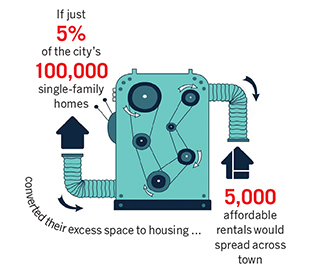
Bloom put out a study from Arc Ecology, suggesting that if just 5 percent of the city’s 100,000 single family homes converted their excess space into in-law units, an additional 5,000 affordable rentals would spread across town.

Wiener’s proposal looks at making new units in just a slice of the city, but another proposal will look at the issue citywide. Chiu’s legislation seeks to take that sea of hidden and unlawful granny flats and bring them up to code, but it wouldn’t look to build new ones.

“The big picture is that we’re exploring legalizing existing [in-law] units that are illegal, to make sure they become safe and protect residents there,” said Amy Chan, an aide in Chiu’s office.


UP TO CODE

Safety isn’t the only consideration, as this could also help the housing supply in the city, those involved told the Guardian. Often these in-law units are rented out to friends and family, and once up to code they’d open up to the market.

But safety is important because these units also often lack city permits because they’re dangerously constructed. Sometimes that can lead to death.

“A lot of time (the units) may not have proper egress for an emergency,” said Dan Lowrey, deputy director of inspection services at the Department of Building Inspection. “We just had a fire last month where three people died because of that.”

Lowrey is part of Chiu’s workgroup that’s navigating the complexities of his new legislation. Just how do you make these units legal? There’s a number of challenges, he said.

When looking at a unit, housing inspectors have a checklist to look through, and some of it is real garden variety stuff. Smoke detectors? Check. Proper floor covering? Check. Those are easy. The real challenge is when there are ceilings that are too low, hallways not wide enough to navigate in an emergency, or the unit has no windows from which to escape in a fire.

That’s when you have an in-law apartment that requires total reconstruction to be brought up to code, a straight up illegal unit. As the law stands now, the only recourse for the city in that case is to evict the people living there.

“That’s the challenge, what do we do with the [in-law apartments] that can’t be legalized?” said Bill Strawn, a spokesperson for DBI. Those are some of the questions that Chiu’s workgroup is tackling now.

The good news, he said, is that there are a good number of units that are up to the Building Code, but not the Planning Code — that’s a much easier hurdle to clear.

The Planning Code basically separates neighborhoods of the city into zones for one, two, or three families in a housing unit. This looks at the amount of available free space, sunlight, air, and parking. With those lifted, many units could be more easily converted to living use.

But finding the units that aren’t up to code is important, said Omar Calimbas, a senior staff attorney at the Asian Law Caucus.

He led the “Our Hidden Communities” study that revealed 33 percent of homes in the Excelsior district contained in-law units, far above the city’s estimates.

His team went door to door and found out for itself. What Calimbas saw was that those living in unregulated units often lived in substandard conditions with nowhere to go for help.

There are some units with no heating, he said. Other times the in-law unit is in a basement barely renovated for use as a living space. Sometimes the bathrooms and shower are really tiny cubes. There are mold and dampness problems.

“You’re living in a space that doesn’t make you feel protected from the elements,” he said. And when the units are made without permits, tenants feel they can’t go to the city for help.

To put it in a nutshell, they are in dire need of regulation. Calimbas is also working with Chiu on his legislation to do just that. But ultimately, each of the two ordinances around secondary units takes small bites out of the housing pie.

Bloom is calling for the city to move aggressively on this issue. “We’re rapidly becoming a more expensive city to live in, more and more so every year.” As more and more San Franciscans are priced out of their homes, time may soon run out.

Angered by senior evictions, Filipino American activists decline award

The board members of a local Filipino heritage organization, with ties to a high-profile eviction defense battle at San Francisco’s International Hotel in the late 1970s, have declined to an accept an award that San Francisco Mayor Ed Lee had planned to extend to them as part of a Filipino American History celebration because they are angry about a growing trend of senior evictions.

In a written statement sent to media by board member Tony Robles, the Manilatown Heritage Foundation explained that it couldn’t accept the award as long as “elders are being preyed upon, evicted and given a de facto death sentence thereof.”

The Manilatown Heritage Foundation board members were informed by Board of Supervisors President David Chiu that Lee had planned to recognize the I-Hotel as part of an annual cultural history celebration at City Hall, the statement noted. “Part of the occasion was to honor the I-Hotel and its many tenants and activists for its contribution to Filipino American history,” board members explained.

In 1976, the I-Hotel was targeted for demolition, prompting an historic eviction defense battle led by housing activists who rallied to the defense of the impacted tenants. A significant fixture in what was once a predominantly Filipino neighborhood known as Manilatown, the I-Hotel housed 196 tenants, predominantly low-income Filipino immigrants. 

“The I-Hotel fight was for dignity and it lived by the premise that housing is a human right,” Manilatown Heritage Foundation members explained in the written statement. “The fight for the I-Hotel galvanized the community around the fight for affordable housing, particularly for seniors—who sacrificed much and on whose shoulders we stand. The fight included tenants, elders, activists, artists and students who recognized that the real estate developers and financial interests were out of control—power unchecked.” 

The fight dragged on, at one point more than two thousand people surrounded the building to blockade the doors in an effort to prevent an eviction from going forward. The battle over the I-Hotel also brought on a famous San Francisco episode in which then-Sheriff Richard Hongisto served five days in his own jail for refusing to carry out the eviction order. In the end, the tenants were finally ousted. But the epic battle ultimately helped to produce a different outcome, many years later: The property became the site of low-cost senior housing, complete with a commemorative display in the interior documenting the dramatic I-Hotel fight.

As a young attorney who worked with the Asian Law Caucus, San Francisco Mayor Ed Lee was involved in that fight – as an activist defending tenants’ rights to stay. He frequently referred to this chapter of his personal history while running for mayor in 2011, to demonstrate his sensitivity to concerns about affordable housing.

But now that Lee is well into his mayoral term, a surge of evictions of low-income seniors is worsening on his watch. Tenant defense organizations such as Eviction Free San Francisco are showing up outside landlords’ homes and offices to protest eviction notices that threaten to push low-income seniors with few options out of the city. Some evictions have caught the attention of mainstream media, such as the ouster of elderly Chinatown couple Gum Gee Lee and Poor Heung Lee and their disabled daughter, Shiuman Lee.

Some advocates have proposed legislative solutions; meanwhile, the situation has evidently become so criticial that even city’s Human Services Agency is seeking outside assistance to provide eviction prevention services for elderly and disabled tenants facing Ellis Act evictions.

And today, the board of the Manilatown Heritage Foundation drew a line in the sand to send Lee a clear message by refusing to accept the honor of recognition in the current housing climate. So far, mayoral spokesperson Christine Falvey has not responded to the Bay Guardian’s request for comment in response to the Manilatown Heritage Foundation’s statement.

“Given the current state of San Francisco housing by forces out to make a killing by killing our communities, we as the torch bearers of the I-Hotel struggle and in the memory of its displaced elders and advocates Al Robles, Bill Sorro, Felix Ayson, Wahat Tampao and others, cannot, in good consciousness, accept any honor or award while elders are being preyed upon, evicted and given a de facto death sentence thereof. And it doesn’t matter if the honor is bestowed by Mayor Lee, President Obama or the pope. We have to say no.”

Here’s the full statement from the Manilatown Heritage Foundation. Here’s an historical essay about the I-Hotel from Shaping San Francisco’s digital archive at FoundSF.org.

What jobs?

16

For all its shiny gadgets and gleaming new luxury condo towers, San Francisco nevertheless houses a huge demographic that lives at or below poverty.

Officially, it affects about 12 percent of the city’s population, according to the most recent US Census data. Experts from the Stanford Center on Poverty and Inequality calculated an adjusted poverty figure to capture a more accurate portrait of economic disadvantage. According to that alternative yardstick, which factors in location-based costs such as the price of housing, a full 23.4 percent of San Franciscans live in poverty.

City agencies have documented ethnic identities, languages, neighborhoods of residence, and other data concerning poor people who seek assistance through city-administered services. But even though millions of dollars have flowed through city coffers to boost prospects for those who lack steady work, there’s scant documentation showing what this has actually achieved.

Despite budgeted expenditures totaling nearly $70 million for workforce development in 2013-14, not a single San Francisco city official can say how many individuals managed to rise above poverty as a result.


FIVE YEARS, NO IMPROVEMENT

At the behest of Board of Supervisors President David Chiu, the city’s Budget & Legislative Analyst recently analyzed the city’s myriad workforce development programs. It found that there is no standard measure to track the results of the programs, which are administered across 14 city departments.

The analysts recommended convening a committee to get a handle on it, “so there would be somebody accountable for compiling that information,” noted Severin Campbell, a principal at city budget analyst Harvey Rose Associates.

The analysis was a follow-up to a similar audit performed in 2007. The previous study concluded that the system to help struggling people obtain job skills and get hired “was fragmented, with inconsistent planning and coordination of resources and inadequate monitoring of programs to ensure that the programs’ goals and outcomes were achieved.”

Analysts who examined the workforce development system in 2007 discovered a lack of evidence that “individuals receiving services were eventually placed into jobs leading to economic self-sufficiency.”

To cure this dysfunction, the Board of Supervisors formulated a plan. In November 2007, it created Administrative Code Section 30, a new policy centralizing oversight of all workforce development initiatives under the Office of Economic and Workforce Development, overseen by the Mayor’s Office.

In 2007, OEWD’s annual budget for its workforce division was $547,841. By 2012-13, that amount had swelled to $19.3 million. The federal government contributes a lot, but citywide, about 65 percent of workforce development spending comes from local funds.

“Since 2007, the city has worked hard to incorporate the recommendations that came from the audit,” OEWD spokesperson Gloria Chan told the Bay Guardian earlier this year. She said the workforce division of OEWD “has made significant strides and progress to improve the city’s workforce system.”

But the latest Budget & Legislative Analyst report tells a different story. “The city continues to lack citywide policy and oversight of its workforce development system,” it notes. “Many of the key provisions of Administrative Code Section 30 have not been implemented.”

Five years have passed, and little seems to have changed. “We didn’t find a broken system,” Campbell said, “but it wasn’t what the city had envisioned.”

The report noted that the shortcomings could be partially attributed to constraints on funding provided by outside entities like the federal government, making collaboration among departments difficult.

Nevertheless, the lack of a cohesive citywide workforce development strategy coincided with one of the worst economic downturns in US history. While certain sectors have experienced recovery by now, many low-income San Franciscans are still grappling with losses sustained during the Great Recession.

A recent survey of panhandlers, commissioned by Union Square business owners, found that the majority were homeless individuals who said they didn’t have jobs, and thus couldn’t afford rent. Some apparently interpreted these findings as a revelation; the survey results were recently spotlighted on the front page of the San Francisco Chronicle.


LOOKING FORWARD TO WHAT?

Tiffany Green is one of the 10,883 clients served by San Francisco’s workforce development system in 2012-13. She’d previously worked at the security desk of a Tenderloin services provider, but left that job because she couldn’t find anyone to look after her young son during her shifts — and the job didn’t pay enough to cover child care costs.

So she enrolled in CalWORKS, a state program administered by the city’s Human Services Agency, which offers subsidized child care, food stamps, and cash aid for low-income parents while they complete six-month job training gigs with employers who have partnerships with the city.

She was less than optimistic when asked if she thought it would lead to a steady job. “The outcome is going to be everybody else’s outcome, which is nothing to look forward to,” she said, adding that for all her friends and family members who’d completed similar six-month job training programs, she didn’t know of any who’d landed full-time jobs as a direct result.

Karl Kramer, director of the San Francisco Living Wage Coalition, said his organization has been working with city agencies to build pathways to help participants in the programs connect with opportunities for full-time employment in civil service positions.

His organization is pushing for legislation to reform one of those initiatives, the Community Jobs Program, “to make it a real job training program that fast tracks participants into available entry-level city jobs. The reports that we get is, for people who have been through the programs, it leads to very few full-time jobs,” Kramer said. So far, his group hasn’t gotten much traction with city officials.

Steve Arcelona, deputy director in charge of Economic Support and Self-Sufficiency at the Human Services Agency, didn’t respond to multiple voicemails seeking comment.


UNEVEN RECOVERY

The report comes at an odd time — in San Francisco’s current economic climate, new jobs are being created all the time, and the unemployment rate has declined. But experts note that recovery has been uneven, and only certain sectors have reason to be optimistic about the future.

“The San Francisco region is doing better than most,” Chris Haney, executive director of the California Budget Project, told us.

The city boasts a rise in “high-scale, high-production, better paying jobs” in the flourishing tech sector, accompanied by a rise in “lower-paying service jobs,” he said. “But we’re not seeing a tremendous amount of growth in the middle class, middle paying categories.”

The dilemma follows a broader trend of wage inequality that’s persisted over the last couple decades, he added, giving rise to what economists have dubbed the “missing middle.” A decline in the unemployment rate can mask this dysfunction, he said, because “you may have folks who are employed, but they’re employed at lower wages than before … What’s coming back isn’t as solid as it was previously.”

It’s against this precarious backdrop that, despite $70 million dedicated to connecting the low-income or disadvantaged with decent jobs over the past year, the city’s workforce development system appears to be plagued by dysfunction. Chiu recently introduced legislation to implement the Budget Analyst’s recommendations of undertaking yet another system overhaul.

But for many still struggling to get by, few short-term solutions are in sight. Ever-increasing housing costs make the “missing middle” phenomenon especially thorny in the Bay Area, Haney noted. “It’s harder and harder for low and middle income folks to live in the region,” he said. “They are being given clear signals that they need to move.”

Homeless advocates fight Wiener on park closures

83

The Coalition on Homelessness has launched a campaign to defeat Sup. Scott Wiener’s legislation to close down all city parks and most major plazas from midnight to 5am, which the Board of Supervisors is set to consider on Oct. 29. Activists are targeting three swing votes who could decide the controversial issue: Sups. London Breed, Norman Yee, and Katy Tang.

In an email blast to supporters, COH urged people to contact those three supervisors to raise their concerns, even suggesting a script that includes these arguments, “It further eliminates access to public space for all, it will displace homeless people, and is a waste of city funds.” [UPDATE: To protest the proposal, the Harvey Milk LGBT Democratic Club is hosting a “sleep-in” protest at Dolores Park tonight (Mon/28) starting at 9pm.]

COH Executive Director Jennifer Friedenbach told the Guardian that she has the support of the four most progressive supervisors — John Avalos, David Campos, Jane Kim, and Eric Mar — and that she just needs two of the three swing votes that COH is targeting to kill the measure outright and avoid the kind of compromise that has become Board President David Chiu’s specialty this year.

She said the measure would be particularly harmful to the homeless LGBT community and other vulnerable populations that seek refuge at night in Golden Gate Park and other hidden spots, but that it’s bad for everyone. “It forces them out into the storefronts and streets and neighborhoods and nobody will be happy with that,” she said.

Wiener denies that the measure is aimed at the homeless, telling the Guardian that his intent is to address graffiti, illegal dumping, and damage done to park facilities overnight. “We’ve had an epidemic of vandalism in our parks and it’s getting worse,” Wiener told us. “It’s a significant problem and it absolutely degrades people’s ability to use the parks.”

Friedenbach said she appreciates that Wiener isn’t aiming his rhetoric at the homeless, even though she said that’s who will be most effected by it.

“It’s great in terms of not bashing homeless people, but we know every time something like this comes up, it increases public anger toward homeless people,” she told. And she notes that the measure is being trumpeted by people who do want to use it to go after the homeless, including Mayor Ed Lee, who went off script last month and told the Examiner that he hopes the measure will be a tool to clear the homeless from Golden Gate Park.

“The mayor said it was a great idea because we need to get the homeless people out of the park,” Friedenbach told us, noting also that, “Wiener has had a thing of going after homeless people.”

Wiener denies that this is about the homeless, and he responded to Lee’s comments by telling us, “I can’t speak for anyone else.” He also said that it’s already illegal to sleep in the parks and “to the extent the police want to do sweeps in the parks, they can already do so.”

The measure would apply the closing hours to all property controlled by the Recreation and Parks Department, which includes every city park and the city’s largest plazas, including Civic Center Plaza, Justin Herman Plaza, and Union Square.

“One thing people don’t think about is this also applies to the plazas,” Friedenbach told us. “A lot of our plazas are hangout spots late at night, and there’s no reason they shouldn’t be.”

Wiener said that small plazas, such as Harvey Milk and Jane Warner plazas in the Castro, aren’t under RPD jurisdiction and therefore aren’t effected by his legislation. And he said the ordinance was already modified to allow people to walk through the affected plazas without stopping, and that he’s open to further amendments.

As for his chances of success in the face COH’s activism on the issue, he told us, “I’m not sure what’s going to happen on the 29th.”

Homeless advocates fight Wiener’s effort to close parks at night

135

The Coalition on Homelessness has launched a campaign to defeat Sup. Scott Wiener’s legislation to close down all city parks and most major plazas from midnight to 5am, which the Board of Supervisors is set to consider on Oct. 29. Activists are targeting three swing votes who could decide the controversial issue: Sups. London Breed, Norman Yee, and Katy Tang.

In an email blast to supporters, COH urged people to contact those three supervisors to raise their concerns, even suggesting a script that includes these arguments, “It further eliminates access to public space for all, it will displace homeless people, and is a waste of city funds.”

COH Executive Director Jennifer Friedenbach told the Guardian that she has the support of the four most progressive supervisors — John Avalos, David Campos, Jane Kim, and Eric Mar — and that she just needs two of the three swing votes that COH is targetting to kill the measure outright and avoid the kind of compromise that has become Board President David Chiu’s specialty this year.

She said the measure would be particularly harmful to the homeless LGBT community and other vulnerable populations that seek refuge at night in Golden Gate Park and other hidden spots, but that it’s bad for everyone. “It forces them out into the storefronts and streets and neighborhoods and nobody will be happy with that,” she said.

Wiener denies that the measure is aimed at the homeless, telling the Guardian that his intent is to address graffiti, illegal dumping, and damage done to park facilities overnight. “We’ve had an epidemic of vandalism in our parks and it’s getting worse,” Wiener told us. “It’s a significant problem and it absolutely degrades people’s ability to use the parks.”

Friedenbach said she appreciates that Wiener isn’t aiming his rhetoric at the homeless, even though she said that’s who will be most effected by it.

“It’s great in terms of not bashing homeless people, but we know everytime something like this comes up, it increases public anger toward homeless people,” she told. And she notes that the measure is being trumpeted by people who do want to use it to go after the homeless, including Mayor Ed Lee, who went off script last month and told the Examiner that he hopes the measure will be a tool to clear the homeless from Golden Gate Park.

“The mayor said it was a great idea because we need to get the homeless people out of the park,” Friedenbach told us, noting also that, “Wiener has had a thing of going after homeless people.”

Wiener denies that this is about the homeless, and he responded to Lee’s comments by telling us, “I can’t speak for anyone else.” He also said that it’s already illegal to sleep in the parks and “to the extent the police want to do sweeps in the parks, they can already do so.”

The measure would apply the closing hours to all property controlled by the Recreation and Parks Department, which includes every city park and the city’s largest plazas, including Civic Center Plaza, Justin Herman Plaza, and Union Square.

“One thing people don’t think about is this also applies to the plazas,” Friedenbach told us. “A lot of our plazas are hangout spots late at night, and there’s no reason they shouldn’t be.”

Wiener said that small plazas, such as Harvey Milk and Jane Warner plazas in the Castro, aren’t under RPD jurisdiction and therefore aren’t effected by his legislation. And he said the ordinance was already modified to allow people to walk through the affected plazas without stopping, and that he’s open to further amendments.

As for his chances of success in the face COH’s activism on the issue, he told us, “I’m not sure what’s going to happen on the 29th.”

BEST OF THE BAY 2013: LOCAL HEROES

0

Bruce Brugmann, Jean Dibble, and Tim Redmond

The San Francisco Bay Guardian — which has had a significant impact on the Bay Area’s cultural and political dynamics and dialogue over the last 47 years — was largely the creation of three people with complementary skills and perspectives, an amalgam that gave the Guardian its voice and longevity.

Although they are no longer involved with running the paper, we’re honoring their contribution and legacy with a form of recognition they created: a Local Hero Award in our Best of the Bay issue, an annual edition that has been adopted by almost every alt-weekly in the country.

Bruce Brugmann and Jean Dibble launched the Guardian in October 1966 after years of planning by the married couple, and they ran it as co-publishers until the paper’s sale to the San Francisco Newspaper Co. last year, with Dibble running the business side and Brugmann in charge of editorial and serving as its most public face.

“We were one of the few husband and wife newspaper teams, a real mom and pop operation,” Brugmann told us. “We couldn’t have done it without the two of us, we needed both of our skill sets.”

They met in 1956 at the University of Nebraska, where Brugmann studied journalism and served as editor of the Daily Nebraskan, starting his long career as journalistic rabble-rouser. Dibble studied business, which she would continue in graduate school at Harvard University’s Radcliffe College while Brugmann got a master’s in journalism at Columbia University.

As graduation neared, they started talking about forming a newspaper together, an idea that percolated while Brugmann served in the US Army, where he wrote for Stars and Stripes, and Dibble moved to San Francisco with their two kids to work in personnel and administrative positions.

After the Army, they settled in Wisconsin, where Brugmann worked as a reporter for the Milwaukee Journal before moving to the Bay Area to work on launching the Guardian while Brugmann supported the family working for the Redwood City Tribune.

“We came out here with the idea of doing it and we immediately started planning. Jean did the prospectus, a damn good prospectus,” Brugmann said.

The Guardian published sporadically in the beginning, but it tapped into a vibrant counterculture that was clashing with the establishment and began publishing important articles highlighting inequities in the Vietnam War draft and exposing local political scandals, including how Pacific Gas & Electric illegally acquired its energy monopoly.

“A lot of it was just keep your head down and keep going,” Dibble said. “We never talked about alternatives, it was just what we were going to do.” The Guardian covered the successful revolts against new freeways in the city and plans to build Manhattan-style skyscrapers, publishing the book The Ultimate Highrise in 1971. In the mid-’70s, the Guardian won a successful unfair competition lawsuit against the Chronicle and the Examiner over their joint operating agreement, allowing the paper to become a free newsweekly. “Eventually, things got better, and we got some large advertisers in the ’80s and they really helped kick us off,” Dibble said. That was also when Tim Redmond, a journalist and activist steeped in radical politics, started writing for the Guardian, going on to serve as the paper’s executive editor and guiding voice for more than 30 years. “Tim was always more radical than I was,” Brugmann said, giving Redmond credit for the Guardian’s groundbreaking coverage of tenant, environmental, and economic justice issues. “Every publisher needs an editor who was more radical than they are to push them.” The two journalists had a prolific partnership, mentoring a string of journalists who would go on to national acclaim, turning the Guardian into a model for alt-weeklies across the country, exposing myriad scandals and emerging arts and cultural trends, and helping to write and pass the nation’s strongest local Sunshine Ordinance. “We always wanted to make things better,” Brugmann said of what drove the Guardian. “Even the battles that we lost, we got major concessions. Yerba Buena is much better because of the stories we did at the time, same thing with Mission Bay…San Francisco is much better that we were here. And we’re really proud and we appreciate the work of the current Guardian staff in keeping the Guardian flame alive.”


LOCAL HEROES: Kate Kendell

The night Proposition 8 passed was one of the hardest of Kate Kendell’s life. She remembers it with startling detail — and she should, because she was one of the most prominent opponents of the measure to overturn marriage equality in California.

“I was hopeful right up until the end that Prop. 8 would be defeated,” she said, speaking slowly as she pulled her thoughts from what sounded like a dark place. “Our initial polling numbers said we’d probably lose, but I really hoped in the deepest heart of my heart that when people got in there that they’d punch their vote in favor of the person they knew.”

But as the voters of California showed in that 2008 election, sometimes the good guys lose.

Kendell, executive director of the National Center for Lesbian Rights, fought the good fight since she started there in 1994. The NCLR litigates, creates policy, and performs outreach for LGBT civil rights on a national level, with headquarters in San Francisco. After years of anticipation, she poured herself into the campaign against the proposition that would make her marriage illegal, and then the measure passed.

That night she hung her head in disbelief. She felt physically ill, and her mind roiled in grief equaled only by the death of one of her parents. “It felt like that,” she said.

Kendell and her wife, Sandy, went home without speaking a word, and when she got in the door she tried to pull it together. Steeling herself to face her family, Kendell walked out of the bathroom and burst into tears. Her son said simply “this just means we have to fight more.”

So she did, and we all won.

That led to the moment for which Kendell may be remembered for a long time to come. When Prop. 8 was overturned by the US Supreme Court this year, a flock of San Francisco politicians descended the steps inside the rotunda at City Hall. Kendell took to the podium and spoke to the nation.

“My name is Kate Kendell with the National Center for Lesbian Rights,” she said, “and fuck you, Prop. 8!” The crowd erupted into cheers.

She regrets saying it now, but history will likely forgive her for being human. For someone whose own marriage’s validity was threatened and who spent two decades fighting for equality, she earned a moment of embarrassing honesty.

Kendell’s infamous declaration may be how she’s known, but one of her key decisions behind the scenes shaped the LGBT equality movement as well. When then-Mayor Gavin Newsom’s administration wanted a couple to be the first in his round of renegade gay marriages in 2004, it was Kendell who suggested Del Martin and Phyllis Lyon.

The two were in a relationship since 1953, pioneers of LGBT activism in San Francisco. Kendell said it was only right that they were first to read their vows in the city they helped shape. “Were it not for their contributions, visibility, and courage in the ’50s and ’60s, we wouldn’t be in that room with Newsom contemplating marriage licenses,” she said. “I’m just happy they said yes. It was absolutely appropriate.” And it’s with that sense of history that she herself pioneers forward, pushing in states across the US what Harvey Milk fought for in California — workplace protections for the LGBT community. “In 38 states, you can be fired from your job or being lesbian, gay, bisexual, or transgender. That has to change,” she said. “When the next chapter of history is written, it will be about a nation that treats the LGBT community as equals.”


Theo Ellington

Last year, when San Francisco Mayor Ed Lee floated the idea of implementing stop-and-frisk, a practice that many civil rights advocates say amounts to racial profiling, Theo Ellington stepped up to create a Change.org petition to oppose the idea — and won.

The policy would have given San Francisco police officers the authority to stop and search any individual who “looks suspicious,” in an effort to get guns off the streets.

“I found it was basically a predatory policing practice that didn’t belong in a city like San Francisco,” Ellington told us. His petition garnered a little more than 2,300 signatures, “enough to show policymakers we were paying attention,” he guesses. Faced with mounting pressure and a community outcry, Lee ultimately abandoned the idea.

“That was a win, I think, for everyone fighting for what’s really a civil right,” the 25-year-old, native San Franciscan told us in a recent phone interview. “It’s not a black issue or a white issue,” but it did strike a nerve and provide Ellington with some momentum for coalition building.

Ellington was born and raised in San Francisco’s Bayview Hunters Point neighborhood, home to a significant portion of the city’s dwindling black population. The campaign against stop-and-frisk helped catalyze his still-evolving political organization, the Black Young Democrats of San Francisco, of which he is president.

Go to BYDSF’s website and you’re confronted with some startling statistics about the experience of black San Franciscans: In the last 20 years, the African American community has dwindled to only 6 percent of the city’s population; meanwhile, the high school dropout rate stands at 38 percent, the unemployment rate is 18 percent, and the level of poverty stands at a disheartening 20 percent.

To tackle these looming challenges, BYDSF now faces the hurdle of getting local elected officials to care. “Since then, we have been trying to build our membership and figure out where we fit in the political climate of SF,” Ellington says.

His group’s chief concerns include closing the achievement gap in San Francisco public schools, doing something about the escalating cost of housing, and finding better solutions for public transit. “There’s the housing need, obviously. It’s a need that working class folks in general are facing,” he said.

He’s pursing a master’s degree in urban affairs at the University of San Francisco, and says he’s taken it upon himself to learn everything he can about how cities operate. To that end, he often ponders vexing questions: “How do you figure out a way to give those same opportunities to everyone? How do you provide opportunities for all income levels?”

His successful opposition campaign to stop-and-frisk didn’t stop Mayor Lee from appointing him to the Commission on Community Investment and Infrastructure, which oversees the successor to the San Francisco Redevelopment Agency. A major project under that body’s purview is the Hunters Point Shipyard development, a massive undertaking led by construction firm Lennar Urban, practically in Ellington’s backyard. Having grown up in the neighborhood, he sees himself as being in a unique position to ensure that the developers are providing jobs for local residents as required under the agreement. “It allows me to speak to both sides — on the community level, and in City Hall,” he said. “There are certain social dynamics you won’t understand unless you have lived in the community.” Ultimately, Ellington says, his goal is to push local politicians to find ways of making San Francisco a place where people of all income levels can find their way. “There’s a lot more work to do,” he said. “I think San Francisco is at a real pivotal point, where we can choose to go in the right direction … or we can choose the opposite.”


LOCAL HEROES: Shanell Williams

Shanell Williams is a chameleon activist, spearheading the effort to save City College of San Francisco from many fronts.

When City College fought off a statewide initiative to save money by stigmatizing struggling students, she defended the school as an Occupy activist. With a banner raised high, she faced down the California Community College Board of Governors, shouting their wrongs aloud at a meeting attended by hundreds. The board was stunned but her fellow activists were not, because that’s who Williams is: an uncompromising defender of San Francisco.

Now, as City College faces a fight for its existence, Williams is defending it again, this time as a duly elected CCSF student trustee.

Williams is at the forefront of Save CCSF, an Occupy-inspired group publicly protesting the Accrediting Commission of Community and Junior Colleges, the body trying to shut down City College. San Francisco is holding its breath until next July to hear if the accrediting commission will close the city’s only community college — and Williams was one of the key organizers helping students’ voices rise up to decry the decision to close the school.

She has reason to fight hard, growing up watching her community ravaged by those in power who purported to do good. She is a black woman and San Francisco native raised in the Fillmore and the long history of redevelopment and its role in the flight of The City’s African American population shaped her ethos. To Williams, there are forces that care about money at the expense of communities and those forces need to be fought.

“How are we supporting people to have a decent quality of life?” she said, and that’s the way she’s approached saving her community since a young age.

In 2003, while in high school, Williams got a taste of politicking as a member of San Francisco’s Youth Commission, appointed by then-Mayor Willie Brown. “I think he’s a very interesting character with a lot of influence over the city,” she said, with just an edge of steel to her voice.

As a teenaged politician, she discovered the work of the Human Rights Commission and was inspired. While a student of Washington High School and then Wallenberg High, she had a tough home life and entered the foster care system, getting a firsthand look at how the state takes care of its youth.

It galvanized her, honed her, and made her yearn for change. “I just innately had a sense of wanting to see justice and fairness,” she said.

Energized, she joined the Center for Young Women’s Development, the Youth Treatment Education Court, Urban Services YMCA, the Youth Leadership Institute, and more. She joined so many organizations and taught so many youth and government officials that even she can’t remember all of them off the top of her head.

At one point, she even taught judges across the country about cultural competency. “We had this whole spoken word performance thing we did,” she said, laughing.

In 2010, as Williams took classes at City College, she waved the banner defending San Francisco’s community college students. She pushed for city-level minimum wage requirements for City College workers, who earned dollars less. She also pushed back against state requirements to cut off priority registrations to those who took too long in the community college system — because she’s been there herself.

“They need a few chances to get it right and become a good student,” she said. When the struggle to save City College is done, win or lose, Williams sees herself remaining an advocate for students for years to come. At 29 years old, she’s still a student herself, and she eagerly awaits the day she’ll transfer to Cal or Stanford as an Urban Studies major. It all comes back to defending her city. “We have to broaden the movement,” she said. “The enemy is not about color, it’s about wealth inequality. It’s not just about City College either. It’s about the austerity regime that doesn’t care about working class people and poor folks.”


San Franciscans for Healthcare, Jobs, and Justice

When the San Francisco Mayor’s Office cut a deal with Sutter Health and its California Pacific Medical Center affiliate for an ambitious rebuild of hospital facilities — which would shape healthcare services in San Francisco for years to come — community activists began to find serious flaws in the proposal.

So they organized and banded together into a coalition to challenge the powerful players pushing the plan, eventually helping to hash out a better agreement that would benefit all San Franciscans. Representing an alliance between labor and community advocates, the coalition was called San Franciscans for Healthcare, Jobs, and Justice.

When the whole affair began, it seemed as if the CPMC rebuild would incorporate a host of community benefits — but those promises evaporated after the healthcare provider walked away from the negotiating table, unhappy with the terms.

Then a second agreement, with much weaker public benefits, came out of a second round of talks between CPMC and the Mayor’s Office. But by then, so much had been given up that “we were stunned,” said Calvin Welch, who joined the coalition on behalf of the Council of Community Housing Organizations. “We met with [Mayor Ed Lee] and told him, this is absolutely unacceptable.”

But the mayor wasn’t willing to address their concerns at that time. When the deal failed to win approval after a series of hearings at the Board of Supervisors, however, “the unacceptable deal that the mayor created melted in the sun of full disclosure,” Welch said.

That plan would have allowed St. Luke’s Hospital, a critically important facility for low-income patients, to shrink to just 80 beds with no guarantee that it would stay open in the long run. CPMC’s commitment to providing charitable care to the uninsured was disappointingly low. And while the project was expected to create 1,500 permanent jobs in San Francisco, the deal only guaranteed that 5 percent of those positions would go to existing San Francisco residents.

Enter the movers and shakers with San Franciscans for Healthcare, Housing, Jobs, and Justice. The coalition took its place at the negotiating table, along with CPMC, a mediator, and an unlikely trio of supervisors that included Board President David Chiu and Sups. David Campos and Mark Farrell. Over several months, the coalition put in some serious time and energy to push for a more equitable outcome.

“We pushed so hard for a smaller Cathedral Hill [Hospital] and a larger St. Luke’s,” Welch said, describing their strategy to safeguard against the closure of St. Luke’s. They also pushed for CPMC to make a better funding contribution toward affordable housing, a stronger guarantee for hiring San Franciscans at the new medical center, and improvements to transit and pedestrian safety measures as conditions of the deal.

Under the terms that were ultimately approved, St. Luke’s will remain a full-service hospital, and CPMC will commit to providing services to 30,000 “charity care” patients and 5,400 Medi-Cal patients per year.

CPMC also agreed to contribute $36.5 million to the city’s affordable housing fund, and promised to pay $4.1 million to replace homes it displaces on Cathedral Hill. Under the revised deal, 30 percent of construction jobs and 40 percent of permanent entry-level positions in the new facilities would be promised to San Francisco residents.

One of the greatest victories of all, Welch said, was how well coalition members worked together. “This was the most straight-up equal collaboration with labor and community people, equally supporting one another, that I’ve ever been involved with,” Welch said. Even though they were motivated to participate by different sets of concerns, the two sides remained mutually supportive, Welch said. During the long, grueling hearings, “The nurses never left,” he noted in amazement. “The nurses stuck around for all the community stuff.”


Photos by Evan Ducharme

Airbnb says its hosts should pay taxes

7

Under pressure in San Francisco and New York City for violating local tenant and land use laws and refusing to pay local taxes, Airbnb has finally acknowledged that transient occupancy taxes apply to the room rentals it facilitates. But the company still hasn’t taken any steps to collect the tax or admitted that it shares this tax debt with its hosts.

“Our hosts are not hotels, but we believe that it makes sense for our community to pay occupancy tax, with limited exemptions for those who earn under certain thresholds,” CEO Brian Chesky wrote on the Airbnb blog on Oct. 3, addressing the post to New York City and not San Francisco, where it is headquartered and where we have shown the company is shirking an annual tax debt of nearly $2 million.

Contacted by the Guardian, a company spokesperson extended the pledge to San Francisco, writing, “Yesterday, our CEO Brian Chesky announced that we believe it makes sense for our community of hosts to pay occupancy tax to the cities in which they live, with exceptions under certain thresholds, and we are eager to discuss how this might be made possible. We have been in substantive discussions with Board President David Chiu on these issues for some time, and we’d like to thank him for the open dialogue that helped lead to today’s announcement. We look forward to continuing our work with him and others in San Francisco to set forth clear, fair laws that allow regular people to rent out their own homes, while giving back to the city that makes it possible.”

As the Guardian has repeatedly reported, most recently in our Aug. 6 cover story “Into Thin Air,” the San Francisco Treasurer/Tax Collectors Office has ruled that the city’s TOT of about 15 percent applies to Airbnb guests, and that Airbnb shares that joint tax liability with its hosts.

The ability of individual hosts to receive business licenses for renting out rooms and to collect and remit the TOT is complicated by the fact that such rentals violate land use, tenant, and other city laws — and Chiu has been developing legislation that would legalize and regulate the stays.

Airbnb could easily collect the TOT on each San Francisco transaction, as some of its online competitors have already been doing, but it has so far refused to do so. And when the Guardian asked Airbnb whether it now plans to include the tax in its transactions, the company ignored the question.

In fact, Airbnb’s public statements and private communications indicate its intention to pass the buck to its hosts rather that paying the tax liability itself, and several hosts who commented on Chesky’s blog post expressed hopes they would get more support from the company.

Nonetheless, Chiu took the Airbnb’s statement yesterday as a positive sign, telling us, “I am pleased to hear that Airbnb has acknowledged the need for their users to pay the occupancy tax. This policy was developed as a result of discussions that I’ve led in the past year to regulate and tax shareable housing activity in San Francisco. While we continue to negotiate with shareable housing companies, housing advocates, and the Mayor’s Office to find sensible solutions, I am confident that we will be able to move forward on a regulatory framework that provides flexibility to residents, protects our affordable housing stock, and collects the fair share of taxes for the City. I look forward to introducing legislation in the coming months.”

Airbnb makes small admission on tax issue, saying its hosts should pay

105

Under pressure in San Francisco and New York City for violating local tenant and land use laws and refusing to pay local taxes, Airbnb has finally acknowledged that transient occupany taxes apply to the room rentals it facilitates. But the company still hasn’t taken any public steps to collect the tax, nor has it admitted that it shares this tax debt with its hosts.

“Our hosts are not hotels, but we believe that it makes sense for our community to pay occupancy tax, with limited exemptions for those who earn under certain thresholds,” CEO Brian Chesky wrote on the Airbnb blog yesterday, addressing the post to New York City and not San Francisco, where it is headquartered and where we have shown the company is shirking an annual tax debt of nearly $2 million.

Contacted by the Guardian, a company spokesperson extended the pledge to San Francisco, writing, “Yesterday, our CEO Brian Chesky announced that we believe it makes sense for our community of hosts to pay occupancy tax to the cities in which they live, with exceptions under certain thresholds, and we are eager to discuss how this might be made possible. We have been in substantive discussions with Board President David Chiu on these issues for some time, and we’d like to thank him for the open dialogue that helped lead to today’s announcement. We look forward to continuing our work with him and others in San Francisco to set forth clear, fair laws that allow regular people to rent out their own homes, while giving back to the city that makes it possible.”

As the Guardian has repeatedly reported, most recently in our Aug. 6 cover story “Into Thin Air,” the San Francisco Treasurer/Tax Collectors Office has ruled that the city’s TOT of about 15 percent applies to Airbnb guests, and that Airbnb shares that joint tax liability with its hosts.

The ability of individual hosts to receive business licenses for renting out rooms and to collect and remit the TOT is complicated by the fact that such rentals violate land use, tenant, and other city laws — and Chiu has been developing legislation that would legalize and regulate the stays.

Airbnb could easily collect the TOT on each San Francisco transaction, as some of its online competitors have already been doing, but it has so far refused to do so. And when the Guardian asked Airbnb whether it now plans to do so, the company ignored the question.

In fact, Airbnb’s public statements and private communications indicate its intention to pass the buck to its hosts rather than collect and pay the taxes itself, and several hosts who commented on Chesky’s blog post expressed hopes they would get more support from the company on the myriad issues that complicate its simplistic business model.

Nonetheless, Chiu took the Airbnb’s statement yesterday as a positive sign, telling us, “I am pleased to hear that Airbnb has acknowledged the need for their users to pay the occupancy tax. This policy was developed as a result of discussions that I’ve led in the past year to regulate and tax shareable housing activity in San Francisco. While we continue to negotiate with shareable housing companies, housing advocates, and the Mayor’s Office to find sensible solutions, I am confident that we will be able to move forward on a regulatory framework that provides flexibility to residents, protects our affordable housing stock and collects the fair share of taxes for the City. I look forward to introducing legislation in the coming months.”


Due Process For All must wait another week

54

Sup. John Avalos’ Due Process for All ordinance, legislation barring San Francisco law enforcement agencies from honoring detainer requests issued by U.S. Immigrations and Customs Enforcement (ICE) under the federal Secure Communities (S-Comm) program, faced obstacles at the Sept. 17 Board of Supervisors meeting and was ultimately continued to the following week.

The legislation initially had enough support for a veto-proof supermajority, but opposition has surfaced to prevent the legislation from winning approval as written.

In a recent editorial, Police Chief Greg Suhr called for it to be scaled back. Meanwhile, the San Francisco Deputy Sheriffs’ Association came out against it and Mayor Ed Lee threatened to veto the legislation in its current form.

At issue was whether to amend the legislation by including “carve-outs” — exceptions requiring law enforcement to honor ICE requests in cases where offenders are suspected of serious violent crimes, child molestation or human trafficking.

District 6 Sup. Jane Kim, an initial supporter of Avalos’ Due Process for All Ordinance, proposed an amendment that would grant the Sheriff discretion to honor ICE detainer requests in cases where the offender had been convicted of one of the aforementioned crimes in the past seven years.

Kim characterized her amendment as “thoughtful and limited,” but the proposal met with resistance from Avalos and Sup. David Campos. “I am afraid that in the process of trying to do the right thing, we’re going to end up with unintended consequences,” Campos said.

Board President David Chiu indicated that he agreed with including carve-outs in narrow circumstances.

Under S-Comm, if an arrestee shows up in a shared database as an undocumented immigrant, ICE can ask the arresting local law enforcement agency to detain the person in question, even after they would be otherwise eligible for release. Detainer requests, which police have no legal obligation to comply with, are routinely issued without warrants or a requirement to show probable cause.

Avalos’ legislation seeks to extend due process to all San Franciscans by making it illegal for local law enforcement to comply with such requests. In San Francisco, ICE detainer requests issued under S-Comm have resulted in at least 784 deportations since 2010.

The Board Chamber at City Hall was filled to capacity with supporters of Avalos’ legislation before the hearing even began. The line to get into the main chamber stretched all the way down the hallway to the first overflow room, which had standing room only just five minutes after the meeting began. When Avalos initially stood to speak, the chamber resonated with chants of “Si se puede! Si se puede!”


Cinthya Muñoz, Immigrant Rights Organizer with Causa Justa, remained hopeful despite the setbacks. “We’re excited that we were able to push back on the amendments being proposed because of how they would impact the vast majority of our communities,” she said. “And we’re still hopeful that we’ll be able to get our Due Process for All policy passed next week.”

Up until recently, Lee lacked veto power due to the ordinance’s supermajority approval. But when Avalos lost his supermajority support due to what he called “political pressure,” Lee regained that power. “Whether it’s relationships directly with the police chief, the mayor, the Police Officers Association,” Avalos told the Guardian, “[the pressure] kind of withered eight sponsor support for not having carve-outs.”

Not to be deterred, however, are those groups and individuals fighting for Due Process for All. Following the continuation announcement, the throngs of supporters filed out of the main chamber and down into the lobby of City Hall, where they gathered and prepared for another hearing, same time, same place.

“It’s actually really great because I think it gives us a bigger chance for the supervisors to hear from community members,” Muñoz said. “That what community wants is Due Process for All, everybody to be treated equally and to not make a differentiation between who’s worth it in our communities.”

Mayor Lee distorts reality in defending CleanPowerSF obstruction by his appointees

151

Mayor Ed Lee yesterday answered a series of five questions from the Board of Supervisors about CleanPowerSF, the renewable energy program it approved last year on a veto-proof 8-3 vote, but which three of Lee’s appointees on the San Francisco Public Utilities Commission are now blocking.

Lee reaffirmed his opposition to the program and support for the three commissioners who are refusing to approve a maximum rate for the program, while making a series of statements that were misleading, contradictory, and, according to Sup. John Avalos, some outright falsehoods.

CleanPowerSF would group tens of thousands of city residents into a renewable energy buying pool, a system called Community Choice Aggregation authorized by state legislation, which would compete against Pacific Gas & Electric’s illegal local monopoly. Initally, the energy would be purchased under a contract with Shell Energy, but the main goal of the program is to build city-owned renewable energy facilities by issuing revenue bonds supported by the program’s ratepayers.

Yet the program Lee described has little resemblance to CleanPowerSF — and his statements of support for the concept belie his longstanding opposition to the program and support for PG&E, whose union is leading the campaign to kill CleanPowerSF.

“I know that many members of the Board of Supervisors are upset,” Lee began in his first answer to similar questions posed by Sups. Eric Mar, David Chiu, London Breed, David Campos, and John Avalos, who all represent the odd-numbered districts whose turn it was to submit questions to the mayor for this month’s appearance.

Lee then explained that one of the duties of  the SFPUC is to protect ratepayers, which he called “the overriding concern they have when faced with any issue,” adding that, “The commission ultimately decided that the rate wasn’t a fair rate.”

Ironically, the top rate that the commission is being asked to approve in order to finally launch CleanPowerSF was just 11.5 cents per kilowatt-hour, only slightly more than current PG&E rates and a substantial reduction from the rate that was discussed last year when supervisors approved the program.

PG&E, Lee, and other critics of the program had attacked its high cost, so SFPUC staffers tweaked the program to allow the initial use of Renewable Energy Credits, which support the creation of renewable energy projects, rather than being purely juice directly from solar, wind, and other renewable sources, which is more expensive.

So Lee criticized that change as a departure from what the board approved last year, telling the supervisors that the program should be at least “95 percent renewable on day one,” saying that, “This is what a green power program should look like.”

Yet when it did look like that, Lee opposed it, something he didn’t mention yesterday. And yet he still made the argument that the SFPUC was simply exercising its fiduciary responsibility in blocking a program that has gotten cheaper than when the board approved it.

“The San Francisco Public Utilities Commission did its job in protecting ratepayers,” Lee said. “I agree with the majority of the PUC.”

So, on one hand, Lee said that CleanPowerSF has “gotten progressively more expensive as time goes on,” citing statements made years ago about the goal of trying to meet-or-beat PG&E’s rates, which have been subsidized by taxpayers over the years.

And when the program then got close to matching those rates, he criticized the use of RECs to get there, saying the climate change benefits “need to be real and tangible and not based on vague promises.”

Yet even city-commissioned studies have shown that San Francisco won’t meet its own greenhouse gas reduction goals without substantially changing the energy portfolio of city residents, and CleanPowerSF is the only plan on the table to get there, except for PG&E’s vague promises to offer more renewable energy in the future.

While Lee touted city efforts to improve the energy efficiency of commercial buildings and the recent launch of a regional bike share program — neither of which will come close to meeting city climate change goals — even he acknowledged the “need to expand our in-city renewable energy generation,” citing the $4 million SolarSF as an example.

But Lee never made reference to CleanPowerSF’s plan to build up to $1 billion in renewable energy projects whose impacts would be far more impactful. Instead, he said the program “creates no local jobs,” which wouldn’t be true during the buildout phase.

While praising PG&E, Lee also glossed over the fact that a majority of supervisors still support CleanPowerSF, and that the SFPUC vote was supposed to be on the rate and not these ancillary issues, raising fundamental democratic issues when three mayoral appointees can override the decision of elected supervisors who represent all city residents.

“When a final project is so vastly different than the original intent, the San Francisco Public Utilities Commission has to intervene,” Lee said.

Avalos called many of Lee’s statements “lies,” so I followed Mayor Lee back to his office after the hearing and we had the following conversation as several reporters from other media outlets listened in:   

SFBG: Supervisor Avalos just said that you’ve made a number of statements that are not factually accurate, and certainly misleading, including saying that the program has changed substantially. Given that you opposed the program initially, and you seem to make statements that criticize those changes, and clearly the majority still supports it, how can you make the argument that the PUC is acting against it because the program has changed?

Mayor Lee: Well, you know, I know that elements of this are somewhat complicated cause you have to actually read a lot of volumes of materials to understand the choice aggregation program, cause it has those three aspects and I would….

SFBG: As guidelines, not as rates….

Mayor Lee: I would point to those numbers that were discussed at the board and presented to the [SF] Public Utilities Commission, because that’s what I’m quoting from. I’m taking it, not from even verbiage, I’m taking it exactly from facts that were presented at the commission at the Board of Supervisors and I specifically lifted quotes from the board about their comments about local jobs and all the other things, so, I don’t think I’m inaccurate at all. I think I’m actually quite on point.

SFBG: But the rates have come down from when they approved it and you made it sound like the rates have gone up.

Mayor Lee: The rates were up and they came down in trade off with less green.

SFBG: Right…

Mayor Lee: That’s about the point I was trying to make is that we wanted these other goals to happen and they couldn’t happen cause people were trading off things in order to set the rates and that was going to become a bigger and bigger gap as to what the original goals were. That’s the way…

SFBG: But the board clearly wants this program. Why, as a matter of policy, as a matter of city procedure, why isn’t the elected body the one to make this decision, instead of your appointees?

Mayor Lee: Well, I think that’s the whole reason why they presented it to the Public Utilities Commission. They’re charter mandated to set these rates. It’s not just an automatic acceptance of what the board says. They also independently review what the board has said. And in their independent review, they said they had gone well beyond what they stated their goals were and so they couldn’t set the rates and still honor all the goals that the board was suggesting.

SFBG: But those rates are less than what the Board has approved. How can they be exercising fiscal oversight… I mean, it doesn’t make any sense.

Mayor Lee: I think we have a big disagreement there. They’re mandated by the charter to set those rates responsibly, not just to follow what the board has stated and so, in their independent review, they went and reviewed all the goals that the board has said and said ‘This is not the program that they have stated should be fulfilled.’

SFBG: Even though the majority of the Board of Supervisors disagree with that statement that you just made?

Mayor Lee: Well, you know, then again, are we not respecting peoples’ right to disagree over what is being done here?

SFBG: But your argument that the program changed from what they approved, a  majority is saying ‘that’s not true,’ that you’re misrepresenting that.

Mayor Lee: No, I don’t think that I’m misrepresenting that. I disagree with that.

SFBG: A majority of the Board of Supervisors who approved it says you are.

Mayor: Well, I disagree with that assessment.


Waiting for BRT

18

By Joe Fitzgerald Rodriguez

joe@sfbg.com

You’re on Muni’s underground line, the train stalled just shy of your stop, just stuck there, the light at the end of the tunnel right in front of you. It’s a frustrating feeling, right?

With more than six years worth of delays in three major transit overhauls — the Van Ness, Geary and Geneva Bus Rapid Transit Projects — it’s beginning to feel just like that.

The projects are designed to speed up the most trafficked transit routes in the city by making the buses run like trains. For the Van Ness Bus Rapid Transit, the 47 and 49 would drive in dedicated bus-only lanes shuttling riders north and south, reducing travel time by a third, according to project estimates.

Van Ness BRT was initially announced in 2004 with a planned unveiling of 2012. Eight years later, the new debut is set for 2018. The Geary Project is even worse, with a completion date slated for 2020.

The Van Ness BRT is finally getting its wheels turning this month, with the Environmental Impact Report set to be approved by a number of governmental bodies: the Van Ness BRT Citizen’s Advisory Committee, the Transit Authority board, and the San Francisco Municipal Transportation Authority.

Why the hell has this bus project taken nearly a decade to start its engine? As is customary in politics, fingers are pointed at all sides.

At a citizen’s meeting for the Van Ness BRT on Sept. 4, two angry factions gathered in the Old First Church Fellowship Hall on Van Ness. The SFMTA’s spokesperson for the project, Lulu Feliciano, wrapped up her presentation to the crowd of about 100, and that’s when they pounced.

“Van Ness’ three lanes will be limited to two, but it’s a highway, isn’t it?” asked Carole Holt, owner of Russian Hill Upholstery. “Why do cars have no consideration?” She told the Guardian she worried her customers from Marin would have trouble getting to her store.

Another Polk Street activist, Kelly Gerber, walked right up to Feliciano’s face and gestured with his hand like an angry schoolteacher. “Why has no one ever heard of this?” he bellowed, telling us he opposes the loss of parking spaces.

Ironically, transit planners say car traffic would move faster, partially because of the elimination of all left turns along Van Ness except Broadway.

“They’re just angry and zooming in on every little detail,” Mario Tanez, spokesperson for the SF Transit Riders Union, said of BRT’s opponents.

The mostly younger crowd of transit activists showed up in equal force to counter the Polk Street merchants, hoping to stem the tide of NIMBYism.

“We’re the generation that will actually see these improvements,” Teo Wickland told us. He’s an urban planning student who hopes to see Muni running on time.

Feliciano said the project was complicated by having to coordinate multiple city agencies, all with their own goals.

Instead of digging up the same stretch of concrete a dozen times in a decade, San Francisco tries to include as many agencies as possible when cement is broken in any part of the city, she said. Since the Van Ness project is a two-mile stretch between Lombard and Mission streets, many are involved.

infographic showing different city agencies involved in the reconstruction of Van Ness

Graphic by Brooke Robertson

Peter Gabancho, the project manager for Van Ness BRT, said that the San Francisco Public Utilities Commission will put in new water lines, institute a rainwater catch system, and do sewer work. The Department of Public Works plans to repave, and the SFMTA will replace overhead bus lines and light poles.

When asked how much the city would save by combining work, he couldn’t give an exact dollar amount but said it was in the tens of millions, at least.

He also said that the process requires community meetings at many steps in the process. City officials visited Mexico City to see how they planned and built its BRT in just three years, and Gabancho said it’s because that city didn’t really consult the community.

“We can’t do business like that in San Francisco and I don’t think we want to do that in San Francisco,” he said.

All of that governmental insanity had a member of the Geary BRT’s Citizen Advisory Council calling it quits in a fury — he even wrote about it in his blog.

“What I’ve seen in the past six years has been a severe disappointment during which I have lost trust in America’s regulatory framework to enact effective transit improvements,” Kieran Farr, the CEO and co-founder of VidCaster, wrote. He described the process as fraught with starts and restarts, slips and delays, mostly due to a lack of leadership. And that’s the rub: There is no point person on this project with strong political will, according the SFTRU. “The mayor is not saying this is high priority,” Tanez told us. “He’s at all the Central Subway events, but getting political clout behind this by writing to our supervisors is the only way to do this.” The Van Ness project runs through the districts of Sups. Mark Farrell and David Chiu, who were both unavailable at press time. The SFMTA is slated to approve the Van Ness BRT EIR on Tue/17 at 1pm in City Hall, Room 400.

Supervisors to grill Mayor Lee over CleanPowerSF sabotage

112

Mayor Ed Lee will be on the hot seat for his unqualified support of Pacific Gas & Electric Co. and his related opposition to the CleanPowerSF renewable energy program, which his appointees to the San Francisco Public Utilities Commission are trying to sabotage, when he shows up for the monthly mayoral question time at the Board of Supervisors meeting on Tuesday.

Hopefully the boring, scripted question time format that Lee created in collaboration with Board President David Chiu will finally give way to what the voters intended when they required the mayor to engage with the legislative branch: an actual, substantive, back-and-forth policy discussion meant to illuminate issues of public concern.

Because that’s what’s needed on this important issue. After more than a decade in the making, the board last year cast a historic vote to create the project on a veto-proof 8-3 vote. But the SFPUC is now refusing to set the maximum rate for the program, which should be a fairly technical and pro forma action, instead raising unrelated issues that the supervisors have already considered. In other words, unelected mayoral appointees have decided to veto a hard-won democratic gain, creating something akin to a constitutional crisis in a city that values public process and input. 

So for the first time ever, all the of the supervisors scheduled to ask questions (it rotates because odd- and even-numbered districts each month) have focused various aspects of a single important issue. Even though Lee has mastered the politicians’ dark art of speaking without saying anything, this one should still be a doozy as supervisors ask the following questions:

1. Mayor Lee – As you know, San Francisco has set ambitious goals to combat climate change. In many ways, the City is making great strides in this direction, from increasing bicycling, to pursuing zero waste goals, to hiring a new, excellent environmental policy advisor in Rodger Kim who has a strong background in environmental justice and community engagement. However, the Public Utilities Commission has repeatedly failed to set rates for CleanPowerSF, the most impactful local proposal yet designed to curb carbon emission. This program was adopted by the Board of Supervisors, the legislative body of the City. However, there are some allegations that your office is stalling its implementation. What specifically are you doing, as the City’s head executive, to implement this policy in a timely fashion? (Supervisor Mar, District 1)

2. Mr. Mayor, can you please outline your objections to the CleanPowerSF program as approved last year on an vote 8-3 by the Board of Supervisors? (Supervisor Chiu, District 3)

3. Recognizing the constraints imposed by state law, particularly with respect to opt-out provisions, how would a clean power program need to be structured in order for you to support it? Are you willing to work with the Board of Supervisors, and have your staff and commissioners work with the Board of Supervisors, to revise CleanPowerSF so that you can support it? Can we come to the table and make clean power a reality without any further delay? (Supervisor Breed, District 5)

4. The Board of Supervisors has been very supportive of CleanPowerSF. Do you think it is appropriate for a City Commission to go against the policy the Board of Supervisors set when it approved CleanPowerSF? (Supervisor Campos, District 9)

5. Days after the one-year anniversary of the 2010 PG&E San Bruno pipeline explosion, you called PG&E a “great local corporation” and a “great company that gets it.” However, the examples of PG&E’s immoral, illegal, and greedy behavior are legion:

– PG&E avoided admitting fault in the San Bruno explosion, failed to cooperate with the investigation, fought against paying a fair fine, and hopes to make ratepayers pay for the fine.

– PG&E’s current electric mix is only 20% California-certified renewable.

– Outages of PG&E-owned streetlights have increased over 400% in recent years, and PG&E wants to increase by $600,000 a year the amount it charges the City for streetlight maintenance without committing to improved service.

– Despite the fact that PG&E already has some of the highest electric rates in the country, PG&E is seeking to further increase rates in each of the next three years.

– While PG&E has proposed a new Green Tariff program, it remains only a vague proposal and there is no guarantee that it will ever be implemented.

– PG&E’s previous green campaigns-such as ClimateSmart and “Let’s Green This City”-have proven to be short lived and ineffective public relations stunts. Multiple public surveys conducted by the PUC to gauge the level of support for CleanPowerSF have all found that a substantial number of San Franciscans want the opportunity to pay a slight premium for a 100% renewable alternative to PG&E.

Why does your office continue to oppose providing City ratepayers with an alternative to PG&E’s monopoly by implementing CleanPowerSF? (Supervisor Avalos, District 11) 

North Beach conflict-of-interest zone

It’s been over a year since North Beach’s Piazza Market closed its doors – but nothing has come along to take its place. The property, boasting 12,000 square feet at $4 per square foot, has attracted plenty of interest yet still remains empty.

“There’s been strong activity on the space – we’ve had several offers,” notes realtor Jeremy Blateis. “If there were less restrictions this place would have been sold already.”

According to Blateis, the place has not been leased to prospective renters because of zoning issues. Though the ad for the building says that it’s zoned for retail and restaurant use, potential owners would have to go through “lots of red tape” to have it used as a restaurant – which North Beach doesn’t have a shortage of.

This is where Claudine Cheng, recently resigned member of the Treasure Island Authority Board, comes in. According to a San Francisco Chronicle report, as a public figure she was paid money to influence decisions of city officers. And a company by the name of 627 Vallejo LLC – the owners of 627 Vallejo – paid Cheng $10,000 in hopes that she would smooth out the zoning situation.

According to the same report, she had been emailing Board of Supervisors President David Chiu seeking amendments to existing legislation in order to change the zoning of the area. Former Board President Aaron Peskin authored that legislation to prevent North Beach retail stores from being transformed into restaurants and chain stores.

Asked whether Chiu would have been open to a possible legislative amendment, legislative aide Judson True responded, “Supervisor Chiu would be open to making legislative changes that have community support,” but added that “the issue was whether or not Claudine Cheng was a lobbyist.” Judson noted that Chiu “also understands that there are laws that should match particular circumstances in neighborhoods like North Beach.”

Peskin, who filed complaints against her with the Ethics Commission and Fair Political Practices Commission, didn’t mince words.

“What she did was illegal,” Peskin said of Cheng’s decision to accept the $10,000. “What should fill 627 Vallejo is something that would further serve the community. Not another restaurant.”

Compromises deliver results

5

OPINION When Guardian Editor Steven T. Jones asked me to respond to his recent columns (“Chiu becomes City Hall’s go-to guy for solving tough problems“, 7/23/13; “Chiu: Centrist Compromiser, Effective Legislator, or Both,” 7/30/13), I reflected on how our Board of Supervisors’ 2013 accomplishments exemplifies the lessons and rewards of working together.

After several decades of intense fights between TIC owners and tenants, I asked both sides to sit down, share perspectives, and brainstorm beyond the impasse. To our surprise, when TIC owners shared their struggles and offered to pay a fee to condo convert, tenant advocates agreed to finally support conversions as long as their core principle of preventing evictions — which I strongly shared — was addressed.

After a decade of failed CEQA reform attempts, the pundits predicted an epic battle between developers and neighbors this year. The breakthrough for unanimous support occurred when both sides acknowledged to me that real neighborhood input and predictability in the planning process are not mutually exclusive, and progressive leaders wanted to ensure that pedestrian, bike, affordable housing, and public projects are not delayed.

After years of controversy, CPMC/Sutter and the coalition of dozens of community-based organizations deadlocked over how to rebuild the Cathedral Hill and St. Luke’s hospital campuses. After exposing financial documents challenging the original proposal, I worked with colleagues for six months at a mediation table that refashioned a CPMC plan to rebuild those 21st century hospitals the right way.

While each story is unique, what all of these accomplishments — along with recently balanced budgets, business tax reform, and pension reform — have in common is hard work and extreme patience by dedicated San Franciscans seeking creative solutions.

As Board President, my job is to build consensus among our diverse supervisors and deliver results. When I first came to City Hall, I asked my colleagues to move beyond past politics that had magnified differences. I am proud that today’s Board has the highest approval ratings in a decade, as we do more together working through our differences.

At the negotiation table, it’s essential to stand firm on core values. My vision for San Francisco has been of a city that protects tenants and families; creates good jobs across the economic spectrum; offers high quality public services with Muni, our schools, and our parks; and embraces our diversity, our immigrants, our seniors, and those who have been historically disenfranchised.

When we can’t always find creative win-wins, it’s still important to fight for what’s right. I’ve taken my political lumps championing the right of noncitizen parents to vote in school board elections, standing up for workers requesting family-friendly workplaces, and taking on a Yellow Pages industry dumping millions of phone books on our streets.

When I hear criticisms of “compromise,” I reflect that the most important federal legislation in recent years — from the Civil Rights Act to the Affordable Care Act, Wall Street reform to comprehensive immigration reform — were also criticized as “compromises.” Critics often forget the big picture: by incorporating different views, reforms actually get done, and if we wait forever for the perfect policy, people will suffer.

San Franciscans are at our best when we unite around shared values — from marriage equality to universal health care to environmental protections. We still have plenty of challenges: housing affordability, struggling workforces, family flight, public transit.

Let’s continue to work together to show the rest of the country how our city can govern.

David Chiu, who represents District 3 (North Beach, Chinatown, Nob Hill), is serving his second term as president of the Board of Supervisors.

Get tough with defiant disrupters

8

EDITORIAL It may sometimes seem like we at the Bay Guardian don’t like the technology industry, but nothing could be further from the truth. We tweet, click, post, and share, playing with all the hot new tech toys that spring from the innovative minds of Bay Area residents. This is an important sector of the local economy, one that often empowers people who were just getting by to remain in expensive San Francisco.

Yes, we do regularly criticize tech (and some of its biggest neoliberal cheerleaders in City Hall), as we do to Airbnb, Lyft, and other so-called “shareable economy” companies in this issue. But that’s only because we strongly believe in open and transparent discussions about public policy and the needs of city residents.

And frankly, that’s not happening these days.

Instead of engaging directly and honestly with the people and our elected representatives, Airbnb has chosen to duck its obligations to the city of its birth and dodge attempts to create a public dialogue about its dangerously flawed business model. Same thing with Lyft, another company that acts as if it’s entitled to undermine civic institutions without so much as a public conversation first.

Yes, these companies have come up with cool ideas that have become popular with Bay Area residents. In a city where it was tough to find a cab on Saturday nights, Lyft made it easier to find rides and allowed people to make some extra cash off their cars. Airbnb was also a great idea that makes travel cheaper and more personal.

The beauty of these ideas is their simplicity — but that is also their main flaw, because San Francisco isn’t a simple city. It’s a complex, dynamic city with difficult landlord-tenant dynamics, and a congested city that tries to achieve the right balance of cabs on the roadways, both systems that are the products of decades-long struggles that have spawned reams of regulations.

These tech-savvy fortune hunters, who don’t understand or appreciate that history, think it’s enough to have a good idea and some rich venture capitalists willing to back it. They espouse vaguely libertarian ideas about “disruptive” technologies empowering people, but then they wait for government officials to solve the problems with their business models, raking in millions of dollars in profits in the meantime and delaying their day of public reckoning as long as possible.

For example, in a May interview on KQED’s Forum, Airbnb’s David Hantman was asked why the company was defying a city ruling that it must pay the transient occupancy tax, he said they were waiting for the city to adopt a new regulatory structure first.

That’s not an acceptable or defensible position, and it is only continuing because Mayor Ed Lee has publicly supported the company’s defiance of city law and rulings. Mr. Mayor, if these are the types of “jobs” you’re creating — part time jobs with no benefits in an underground economy that cannibalizes other industries, breaks city laws, and won’t pay local taxes — then this city is in real trouble.

We’re happy to see Board President David Chiu trying to solve Airbnb’s problems, but he needs the support of other top city officials who are willing to put pressure on the company to bargain in good faith. And yes, we’re talking to Mayor Lee, Tax Collector Jose Cisneros, and City Attorney Dennis Herrera, among others.

If you make the city appear impotent to enforce its own laws or too willing to go easy on wealthy corporations, it will only embolden more young opportunists to disrupt the city’s regulatory authority and its social fabric. You work for us, not the venture capitalists, and it’s time to show some spine.


Immigrants vulnerable to domestic violence

0

In San Francisco Sup. John Avalos’ District 11, half of all residents were born outside the U.S. In Sup. Jane Kim’s District 6, more than a third of residents are foreign-born, and almost half speak a language other than English.

Given the sizable immigrant population in San Francisco, it may not come as a surprise that Secure Communities (S-Comm), a federal immigration program administered by the U.S. Immigration and Customs Enforcement (ICE), is highly unpopular. What might not be so obvious is how dramatically S-Comm can impact the lives of foreign-born women who are survivors of domestic violence.

The reason for this is simple. “If you are a victim or a survivor of domestic violence and you call the police, you do not want to end up deported,” Beverly Upton of the San Francisco Domestic Violence Consortium explained at a July 23 rally, where advocates from organizations such as Mujeres Unidas y Activas, Causa Justa, the Filipino Community Center, and others stood and held banners demonstrating opposition to S-Comm. “We want it to be safer to call the police, not less safe.”

A member of Mujeres Unidas y Activas who introduced herself as Lourdes and spoke through a translator delivered a personal account of feeling fearful of police as well as an abusive partner. “Many times, abusers tell us not to call the police, because the police will not believe us. They say the police will probably deport us.”

The domestic violence and immigrant community advocates were there to champion Avalos’ Due Process for All Ordinance, which is being introduced at today’s Board meeting and is co-sponsored by seven other supervisors, essentially guaranteeing its passage. Avalos himself didn’t speak, and Sups. David Campos and Board President David Chiu, co-sponsors of the legislation, sent female staff members to make statements on their behalf as part of the all-female roster of speakers.

The legislation prohibits law enforcement officials from detaining individuals solely in response to immigration detainer requests issued by immigration authorities under S-Comm. As things stand, “the request has been honored in many cases,” Avalos explained in comments to the Guardian, even though California Attorney General Kamala Harris has affirmed that local law enforcement agencies are not obligated to comply with ICE detainers because they are mere “requests” and not legally binding. Since 2010, according to data provided be Avalos’ office, 784 San Franciscans have been deported after being turned over to federal authorities due to ICE detainers.

Sup. Jane Kim called S-Comm “a giant step backward when it comes to equality and fairness,” and added that S-Comm “makes our neighborhoods less safe.”

Legal Counsel Freya Horne read a statement on behalf of San Francisco Sheriff Ross Mirkarimi, stating that the sheriff has reduced the number of ICE detainers leading to deportations, and was supportive of Avalos’ legislation. She added that Mirkarimi had made it a policy to honor immigration detainer requests only in cases of criminal convictions of serious or violent felonies.

Avalos said he was compelled to move the legislation forward because “I’ve talked to so many people whose families have been separated, and have been devastated,” due to deportations under S-Comm. “We want to make sure we’re maintaining a level of due process,” he added, since the detainer requests are routinely issued without warrants or a requirement to show probable cause.

Chiu: centrist compromiser, effective legislator, or both

0

At the start of this year, when I wrote a Guardian cover story profile of Sup. Scott Wiener (which SF Weekly and San Francisco Magazine followed shortly thereafter with their own long Wiener profiles), he seemed like the one to watch on the Board of Supervisors, even though I noted at the time that Board President David Chiu was actually the more prolific legislator.

Now, it’s starting to seem like maybe we all focused on the wrong guy, because it is Chiu and his bustling office of top aides that have done most of the heavy legislative lifting this year, finding compromise solutions to some of the most vexing issues facing the city (ironically, even cleaning up some of Wiener’s messes).

The latest example is Wiener’s CEQA reform legislation, which the board unanimously approved on July 23, a kumbaya moment that belies the opposition and acrimony that accompanied its introduction.

That effort comes on the heels of Chiu’s office solving another big, ugly, seemingly intractable fight: the condominium lottery bypass legislation sponsored by Wiener and Sup. Mark Farrell. To solve that one in the face of real estate industry intransigence, Chiu showed a willingness to play hardball, winning over swing vote Sup. Norman Yee to get six votes using some hostile amendments.

In the end, Chiu won enough support to override a possible veto by the waffling Mayor Ed Lee, who has always echoed Chiu’s rhetoric on seeking compromise and consensus and “getting things done,” but who lacks the political skills and willingness to really engage with all sides. For example, it was Chiu — along with Sups. Farrell and David Campos — who spent months forging a true compromise on the hospital projects proposed by California Pacific Medical Center, replacing the truly awful CPMC proposal that Lee readily accepted.

“It’s been a very long year,” Chiu told the Guardian. “It’s been important for me to not just to seek common ground, but legislative solutions that reflect our shared San Francisco values.”

Next, Chiu will wade into another thorny legislative thicket by introducing legislation that will regulate the operations of Airbnb, the online housing rental corporation with a problematic business model.

After posting the preceding analysis of Chiu on the SFBG.com Politics blog on July 23, we heard lots of back channel concerns and complaints from progressive San Franciscans (and even some from moderates and conservatives who consider Chiu a raving socialist for helping suspend the condo lottery).

Nobody really wanted to speak on the record against Chiu, which is understandable given the powerful and pivotal position that he’s carved out for himself as a swing vote between the two ideological poles and on the Land Use Committee, whose makeup he personally created to enhance that role.

The main issue seems to be that Chiu allows both progressive and anti-progressive legislation to be watered down until it is palatable to both sides, empowering the moderates over the progressives. That’s a legitimate point. It’s certainly true that Chiu’s worldview is generally more centrist than that of the Guardian and its progressive community, and we’ve leveled that criticism at Chiu many times over the years.

The fact that he ends up in a deciding role on controversial legislation is clearly a role that Chiu has carved out from himself, no doubt about it. And that’s certainly why he played the pivotal role that he has this year. But when he uses that role to empower and support tenant groups, as he did on the condo lottery bypass measure, I think that’s something worth noting and praising.

On the CEQA reform legislation, it’s also a valid criticism of Chiu to note that Sup. Jane Kim had five votes for her legislation and that it was only Chiu who stood in the way of its passage (whether Mayor Ed Lee would have vetoed it, necessitating the need for two more votes, is another question).

In the end, Chiu can be seen as an effective legislator, a centrist compromiser, or both. Perspective is everything in politics.

Is the Guardian empowering Chiu or just recognizing his power?

67

I’ve been hearing lots of back channel complaints and concerns from progressive San Franciscans since last week’s blog post on Board of Supervisors President David Chiu and the role he’s played forging compromises on controversial pieces of legislation this year.

Some have even suggested that the Guardian has gone centrist under my freshly minted editorship, which I actually find kinda funny given my history, perspective, and the righteously anti-corporate and progressive perspective stories that I’ve written and edited in recent weeks. I can honestly tell you that I call ‘em like I see ‘em, now as always, even if that doesn’t always hew to the progressive orthodoxy of some.

Nobody really wants to speak on the record against Chiu, which is understandable given the powerful and pivotal position that he’s carved out for himself as a swing vote between the two ideological poles and on the Land Use Committee, whose makeup he personally created to enhance that role.

So for now, let me just air some of the criticisms and offer some responses and perspective. The main issue seems to be that Chiu allows both progressive and anti-progressive legislation to be watered down until it is palatable to both sides, empowering the moderates over the progressives.

That’s a legitimate point, it’s certainly true that Chiu’s worldview is generally more centrist than that of the Guardian and its progressive community, and we’ve leveled that criticism at Chiu many times over the years. The fact that he ends up in a deciding role on controversial legislation is clearly a role that Chiu has carved out from himself, no doubt about it. And that’s certainly why he played the pivotal role that he has this year.

But when he uses that role to empower and support tenant groups, as he did on the condo lottery bypass measure, I think that’s something worth noting and praising, particularly in my quick little blog post that seems to have grown in perceived significance beyond what I may have intended.   

Many of the criticisms involved the CEQA reform legislation that was unanimously approved by the board last week after progressives opposed its initial iteration by Sup. Scott Wiener.

As some have suggested, Sup. Jane Kim does deserve tremendous credit for resisting the initial legislation and working with activists on an alternative, and I included that recognition in my initial story on the legislation. And it’s valid criticism of Chiu to note that Kim had five votes for her legislation and that it was only Chiu who stood in the way of its passage (whether Mayor Ed Lee would have vetoed it, necessitating the need for two more votes, is another question).

But I quoted Eric Brooks, an activist who spent months working on the compromise, as saying the CEQA legislation ultimately does make it easier to oppose bad projects. And when it was approved unanimously by the board, I figured it was safe to place that piece of legislation on the list of Chiu legislative accomplishments for the year.

We at the Guardian will make mistakes, as we always have from time to time. But I’m going to try to err on the side of open, transparent public debates — while supporting a rejuvenation of the city’s progressive movement, so that it is able to start playing offense and protecting this city’s diversity, vitality, and progressive values.

And if you have any criticisms or advice for the Guardian, please come to our forum on Wednesday or offer them to me directly. Thanks for reading.

Due Process for All ordinance may offer better protection for domestic violence victims

In San Francisco Sup. John Avalos’ District 11, half of all residents were born outside the U.S. In Sup. Jane Kim’s District 6, more than a third of residents are foreign-born, and almost half speak a language other than English.

Given the sizable immigrant population in San Francisco, it may not come as a surprise that Secure Communities (S-Comm), a federal immigration program administered by the U.S. Immigration and Customs Enforcement (ICE), is highly unpopular. What might not be so obvious is how dramatically S-Comm can impact the lives of foreign-born women who are survivors of domestic violence.

The reason for this is simple. “If you are a victim or a survivor of domestic violence and you call the police, you do not want to end up deported,” Beverly Upton of the San Francisco Domestic Violence Consortium explained at a rally this afternoon, where advocates from organizations such as Mujeres Unidas Activas, Causa Justa, the Filipino Community Center and others stood and held banners demonstrating opposition to S-Comm. “We want it to be safer to call the police, not less safe.”

A member of Mujeres Unidas y Activas who introduced herself as Lourdes and spoke through a translator delivered a personal account of feeling fearful of police as well as an abusive partner. “Many times, abusers tell us not to call the police, because the police will not believe us. They say the police will probably deport us.”

The domestic violence and immigrant community advocates were there to champion Avalos’ Due Process for All Ordinance, which is being introduced at today’s Board meeting and is co-sponsored by seven other supervisors, essentially guaranteeing its passage. Avalos himself didn’t speak, and Sups. David Campos and Board President David Chiu, who were co-sponsors of the legislation, sent female staff members to make statements on their behalf as part of the all-female roster of speakers.

The legislation prohibits law enforcement officials from detaining individuals solely in response to immigration detainer requests issued by immigration authorities under S-Comm. As things stand, “the request has been honored in many cases,” Avalos explained in comments to the Guardian, even though California Attorney General Kamala Harris has affirmed that local law enforcement agencies are not obligated to comply with ICE detainers because they are mere “requests” and not legally binding. Since 2010, according to data provided be Avalos’ office, 784 San Franciscans have been deported after being turned over to federal authorities due to ICE detainers.

Sup. Jane Kim called S-Comm “a giant step backward when it comes to equality and fairness,” and added that S-Comm “makes our neighborhoods less safe.” 

Legal Counsel Freya Horne read a statement on behalf of San Francisco Sheriff Ross Mirkarimi, stating that the sheriff has reduced the number of ICE detainers leading to deportations, and was supportive of Avalos’ legislation. She added that Mirkarimi had made it a policy to honor immigration detainer requests only in cases of criminal convictions of serious or violent felonies.

Avalos said he was compelled to move the legislation forward because “I’ve talked to so many people whose families have been separated, and have been devastated,” due to deportations under S-Comm. “We want to make sure we’re maintaining a level of due process,” he added, since the detainer requests are routinely issued without warrants or a requirement to show probable cause.

Chiu becomes City Hall’s go-to guy for solving tough problems

60

At the start of this year, when I wrote a Guardian cover story profile of Sup. Scott Wiener (which SF Weekly and San Francisco Magazine followed shortly thereafter with their own long Wiener profiles), he seemed like the one to watch on the Board of Supervisors, even though I noted at the time that Board President David Chiu was actually the more prolific legislator.

Now, it’s starting to seem like maybe we all focused on the wrong guy, because it is Chiu and his bustling office of top aides that have done most of the heavy legislative lifting this year, finding compromise solutions to some of the most vexing issues facing the city (ironically, even cleaning up some of Wiener’s messes).

The latest example is Wiener’s CEQA reform legislation, which the board is poised to unanimously approve at today’s meeting, a kumbaya moment that belies the opposition and acrimony that accompanied its introduction. Rather than a battle between developers and the coalition of progressives, environmentalists, neighborhood activists, and historic preservationists, Chiu and board aide Judson True transformed the legislation into something that benefited both sides.

[UPDATE: For reactions to this post and another perspective on Chiu, read this.]

That effort comes on the heels of Chiu’s office solving another big, ugly, seemingly intractable fight: the condominium lottery bypass legislation sponsored by Wiener and Sup. Mark Farrell. To solve that one in the face of real estate industry intransigence, Chiu showed a willingness to play hardball and practice a bit of gamesmanship, winning over swing vote Sup. Norman Yee to get six votes using some hostile amendments to the legislation.

In the end, Chiu won enough support to override a possible veto by the waffling Mayor Ed Lee, who has always echoed Chiu’s rhetoric on seeking compromise and consensus and “getting things done,” but who lacks the political skills and willingness to really engage with all sides. For example, it was Chiu — along with Sups. Farrell and David Campos — who spent months forging a true compromise on the hospital projects proposed by California Pacific Medical Center, replacing the truly awful CPMC proposal that Lee readily accepted.

“It’s been a very long year,” Chiu told the Guardian. “It’s been important for me to not just to seek common ground, but legislative solutions that reflect our shared San Francisco values.”

Next, Chiu will wade into another thorny legislative thicket by introducing legislation that will regulate the operations of Airbnb, the online shared housing share corporation whose basic business model often violates local landlord-tenant laws, zoning codes, and lease conditions, in addition to openly defying rulings that it should be paying the city’s transient occupancy tax.      

“This challenge has been particularly difficult,” Chiu told us, referring the many hard-to-solve issues raised by companies such as Airbnb, who Chiu and board aide Amy Chan have been working with for several months. In fact, after originally predicting the legislation would be introduced before the board takes its August recess, Chiu now tells us it may need a bit more time to hammer out the details.

We’ll be watching to see how he sorts through the many tough issues raised by Airbnb’s approach, here and in other big cities with complicated landlord-tenant relations, which I will be exploring in-depth in an upcoming Guardian cover story. But if there’s anyone at City Hall capable of solving this one, it’s probably Chiu.

Giraudo (and activists) close CPMC deal

18

The takeaway message from a July 11 press conference held in the Mayor’s Office touting legislation authorizing California Pacific Medical Center’s construction of two new San Francisco hospitals was seemingly this: Everyone hearts Lou Giraudo.

A part owner of Boudin Bakery and former president of the San Francisco Police Commission, Giraudo was called in last year to help mediate a deal that seemed doomed when CPMC, city officials, and a coalition of labor and community organizations were unable to hash out an agreement that was acceptable to all sides.

Negotiations have been contentious over the past year due to early indications that CPMC would not guarantee that St. Luke’s, a health care facility relied upon by many low-income San Franciscans, would keep its doors open as a condition of moving forward with the new Cathedral Hill facility, a centerpiece of CPMC’s $2.5 billion project.

Enter Giraudo, who was, according to a not-so-subtle hint dropped by former Mayor Willie Brown in his San Francisco Chronicle column last year, “quietly brought in” by the mayor’s office to fix the half-baked mess that the CPMC deal had evidently devolved into.

Sup. David Campos sang Giraudo’s praises, saying, “I have yet to meet a finer public servant,” and calling Giraudo “a real hero of mine.”

Giraudo himself told the Guardian that his strategy was “to de-politicize the process and get people to think about the community.”

Board President David Chiu, who worked closely with Campos and Sup. Mark Farrell to negotiate with CPMC and other parties on behalf of the Board, went so far as to compare Giraudo to Batman. He even joked that he was going to shine a bat signal the next time a negotiator was needed, in hopes that Giraudo would save the day.

Yet while Giraudo may have provided the catalyst needed for a deal, it was community advocates who ensured that the public at large benefited from the CPMC plan more than they would have otherwise — since the mayor’s office seemed willing to go along with the health care giant’s original terms.

Long before Giraudo’s involvement, a coalition of labor and community organizations waged a campaign to rebuild CPMC “the right way,” holding strong on the issue of St. Lukes and refusing to agree to anything that would leave open the possibility that the hospital, a critically important facility for low-income patients, would be shuttered. “That coalition has been working for quite some time … to save St. Lukes,” Campos said of the diverse coalition of community and labor leaders, who formed under the name San Franciscans for Healthcare, Housing, Jobs and Justice. “It kept working for many years.” Under the terms of the agreement that was ultimately agreed upon, St. Luke’s will have a number of specified services to ensure it remains a full-service hospital, and CPMC will commit to providing services to 30,000 charity care patients and 5,400 Medi-Cal managed care patients per year. CPMC will also contribute $36.5 million to the city’s affordable housing fund, and it will pay $4.1 million to replace the homes it displaces on Cathedral Hill. While many advocates for San Francisco’s most vulnerable populations heralded the deal, some were disheartened that it did not dedicate space for psychiatric care.