Conservative

RCV repeal effort gets tricky with three alternatives

38

The Board of Supervisors is scheduled to vote on July 10 whether to place a controversial charter amendment on November’s ballot that would largely repeal San Francisco’s ranked-choice voting (RCV) system, but the outcome of that effort has become murky with the introduction of two competing alternatives.

The original charter amendment, sponsored by Sup. Mark Farrell, would eliminate RCV for all citywide elected officials, instead holding a primary in September and runoff in November. The board rejected an earlier effort by Farrell to repeal RCV, but Farrell came back with a modified measure that was co-sponsored by Sup. Christina Olague, much to the dismay of her progressive supporters, particularly Steven Hill, the father of RCV in San Francisco.

Hill said runoff elections in September, a month notorious for having low-voter turnout, will invariably favor the conservatives who always vote in high numbers. He said that RCV is a fairer representation of what voters want and a November election allows for more voters to be heard.

After widespread criticism from her progressive constituents, Olague publicly turned away from the measure, telling Hill and board members she would remove her name from it. Yet instead of removing her name, in a surprise move she proposed her own amendment to the charter, which only angered progressives more.

“Progressives are pretty furious with Christina right now because she is working with conservatives and went back on her word,” Hill said.

Olague’s proposal would eliminate RCV for only mayoral elections, with the primary still in September, even though she previously told the Guardian that she opposes having an election in September. Olague didn’t respond to email inquiries from the Guardian, but she has maintained in previous interviews that she is only trying to create a compromise between opposing parties on the board.

It’s unclear whether Farrell and the other center-right sponsors of his measure might back Olague’s alternative, but her colleagues who support RCV have put forward an alternative of their own. Board President David Chiu introduced another proposal amending Farrell’s measure that keeps RCV intact—more or less.

Although Chiu told the Guardian he thought the current RCV method has worked well for the city so far and that most people seem to understand how to use the system, he offered the amendment to address certain issues which have arisen because of Farrell’s measure and Olague’s amendment.

“My amendment addresses the concerns that have been raised in an appropriately tailored way,” Chiu told us.

Chiu’s proposal incorporates run-off elections for the top mayor candidates, but only after rank choice voting has narrowed the field to two candidates. It supports elections in November with the mayoral runoff in December.

However, this still allows for a second election, which RCV advocates think is a costly and unnecessary alternative that RCV was designed to eliminate – an imperative they see as more important than ever given court rulings that now allow unlimited spending by wealthy individuals and corporations to influence elections.

Although Hill isn’t happy with any repeal of the current voting methods, he said he reluctantly supports Chiu’s amendment.

“These are poorly made proposals,” Hill said. “It’s like being at the factory and watching sausage getting made.”

Hill fears that if Olague’s co-sponsorship of Farrell’s charter amendment or her own proposed amendment are approved by the board and allowed on the ballot in November that conservative money and power would most likely influence the election enough to pass the RCV repeal.

CPMC’s new numbers threaten St. Luke’s and the mayor’s deal

9

Can San Franciscans trust California Pacific Medical Center (CPMC) not to shutter St. Luke’s Hospital once the company gets what it wants from the city? And has the Mayor’s Office, in its desire to please the business community and building trades, accepted and promoted a bad deal that doesn’t adequately protect the city’s interests?

Those are some of the questions that arose Monday during a hearing on CPMC’s $2.5 billion, multi-hospital development proposal before the Board of Supervisors Land Use Committee when officials from the Mayor’s Office revealed that the development agreement they negotiated with CPMC might not be good enough to keep St. Luke’s open.

As we’ve reported, CPMC (a subsidiary of Sutter Health, a not-for-profit corporation that nonetheless has a well-earned reputation for profiteering and other bad corporate behavior) is seeking to build a 550-bed regional luxury hospital atop Cathedral Hill. In exchange, the development deal requires CPMC to rebuild St. Luke’s, a seismically unsafe hospital in the Mission District that is relied on by many low-income San Franciscans (as well as the city, which would otherwise have to shoulder more of that burden at General Hospital).

After years of stalled negotiations between CPMC and two consecutive mayors, Mayor Ed Lee announced a deal in March that would have CPMC build a smaller version of St. Luke’s (with just 80 beds) and agree to keep it open for at least 20 years as long as CPMC’s operating margins didn’t dip below 1 percent in two consecutive years.

Activists had criticized the deal as too small, too short, and without enough guarantees, but Mayor’s Office officials have consistently said they were confident it was enough to keep St. Luke’s from being shuttered. But now, based on new revenue projections offered by CPMC, even those officials have lost confidence in the deal and say it needs to be renegotiated.

“These new 2012 projections, while still showing CPMC will not breach the 1 percent margin, do not offer the same comfort level we previously had,” Ken Rich of the Mayor’s Office of Economic and Workforce Development told the committee.

The news hit like a bombshell, shaking the confidence of even supervisors who strongly supported the deal, such as Sup. Scott Wiener, who called it a “surprising, critical piece of information” and said, “It’s very, very important that this issue is quickly resolved.”

For supervisors who were already skeptical of the deal and CPMC – such as Sup. David Campos, whose District 9 includes St. Luke’s – it was further evidence that this was a bad deal that needed more work before being brought to the board. The Planning Commission has already approved the project and the full board was scheduled to consider it in just a few weeks.

“What does that say about the way the negotiation was done?” Campos told us. “How half-baked can something be? What have we done to verify the numbers that CPMC gave us? And what does this say about CPMC?…If the numbers on St. Luke’s aren’t accurate, how can we trust the rest of what they’re telling us?”

Yet during the hearing, when Campos tried to get reassurances from CPMC officials and requested that the board be allowed to review the company’s financial records, he was rebuffed and belittled by CPMC attorney Pam Duffy – who later tersely apologized for her comments after Committee Chair Eric Mar criticized them as “insulting to the board.”

Campos had questioned Rich about why the city was relying on CPMC rather than independently assessing the numbers. “Maybe if you had done an audit, you wouldn’t be in this position of being surprised by the numbers that were given to you,” Campos told Rich.

But Rich said “projections are guesses, we can’t ever guarantee that they are right,” noting that CPMC had revised its revenue estimates downward for the years after St. Luke’s would open (when it would be absorbing the high costs of construction), making its profit margin slimmer. “CPMC took a more conservative approach to forecasting the rate of increase in hospital charges as well as patient volumes in light of the greater uncertainty in health care finance,” Rich said.

So Campos asked whether the supervisors could review CPMC’s data. Rich, who has reviewed it, replied, “The conditions under which we were shown CPMC’s projections is that those are confidential.”

Campos noted that it is the board’s job to review and approval this deal to determine whether it’s in the city’s best interests, which shouldn’t simply involve trusting CPMC. “Why should the executive branch of the government see those numbers but not the legislative branch?” he asked.
“It’s really not our call,” said Rich, noting that he had no objections to the request.

But when Campos asked CPMC’s Duffy, she offered a legalistic refusal, and when Campos tried to explain his reasoning, she said, “I heard your speech a moment ago” and added, “this isn’t really a game of gotcha.”

When Campos said the board was simply exercising its due diligence over an important project. she said “nothing unusual or untoward has occurred here, and the suggestion that might be the case, I think it unfair.”

But Campos wasn’t alone in wanting more reassurance from CPMC, who supervisors, labor leaders, and community activists have criticized for its secrecy and bad faith negotiating tactics with both the city and its employee unions.

“This announcement is shocking, on a number of levels,” Board President David Chiu said at the hearing, noting that he had met with CPMC officials just days earlier and they hadn’t mentioned the new developments, instead assuring him that their operating margins were high and the deal protected St. Luke’s. “It’s not a great way to build the trust we’ll need to move this forward.”

Rich said he had learned of the new numbers 12 days earlier, drawing a rebuke from Campos and others who said the supervisors should have been notified earlier. But Rich said that he was hoping that the problem would be solved through negotiations with CPMC before the hearing, but that talks over the issue have so far been fruitless.

“We would have vastly preferred to have an agreement in hand,” Rich told the committee, reassuring the supervisors that the Mayor’s Office will not support the project until the St. Luke’s issue is resolved to its satisfaction.

But Sup. Malia Cohen criticized CPMC as an untrustworthy negotiating partner. “CPMC has an interesting corporate culture,” she said, noting that the company has repeatedly misled supervisors and community leaders, accusing it of being “disingenuous in its negotiations.”

Chiu emphasized that this is a make-or-break issue: “This is an escape clause that could allow St. Luke’s – and what St. Luke’s means to the city – to not be operational. So this is an incredibly important question.”

Campos said this latest episode only added to his suspicion that CPMC will play games with its finances to shutter St. Luke’s – whose construction must be completed before CPMC can build Cathedral Hill Hospital – once it gets the lucrative regional medical center that it really wants.

“How do we know they aren’t transferring money out of CPMC into Sutter in order to shut down St. Luke’s?” Campos said, adding that he wants to see a clear guarantee that St. Luke’s will remain open as a full-service hospital. “This deal, as far as I’m concerned, is not ready for prime time.”

No more fast food: Slow Sex Symposium proposes a love beyond capitalism

0

After a hectic Pride weekend, it’s about time to slow down. A Sat/30 performance-workshop (part of this week’s stellar This Is What I Want performance art fest — read Guardian theater critic Robert Avila’s enlightening interview with artistic director Tessa Wills here) should fit the bill nicely. Introducing “Slow Sex Symposia” and its curator, internationally-acclaimed writer and dancer Doran George. George is planning an afternoon exploration into alternative sexual practices, lifestyles, and unique relationships. Slow sex is a term the artist coined to serve as counterpoint to today’s fast-paced, commercialized notions of sex. Last week, George and I spoke about what it was like to work with a blockbuster lineup of artist, “the economics of queer desire,” and a childhood solo of  “Yankee Doodle.”

San Francisco Bay Guardian: Tell us about the slow sex movement. What makes it important?

Doran George: Slow sex is not a movement as far as I know. It’s a term that I coined for the symposium because I like the idea that communities of alternative sexual practice are engaged in the long-term process of cultivating a culture of sex that takes time, in contrast with the immediacy of practicing conventional ideas about sex. 

Setting up a good SM scene, negotiating non-monogamy, negotiating racist ideas about the sexuality of non-white bodies while still claiming the space for pleasure, these all take time. There is also a parallel [between slow sex and] the slow food movement, in the sense that I believe the radical pleasure community provides a model of sexual practice that is more nourishing, [similar to how] slow food is better than its fast equivalent. 

>>FOR MORE ON THE FESTIVAL, READ “ECONOMIES OF DESIRE”: ROBERT AVILA’S INTERVIEW WITH THIS IS WHAT I WANT‘S ARTISTIC DIRECTOR

SFBG: In your artist statement you reference accessibility to touch, conceptualizing new models of relationships, and the complexities of race in the sex industry. Can the slow sex movement move into mainstream and can queer forms of thought (around sex) be integrated into popular culture?

DG: There are many examples of alternative sexual practice entering mainstream culture. Unfortunately most of them are bitterly disappointing. Mainstream culture constantly needs new images and ideas to make it seem exciting, but at the same time it is usually committed to sustaining convention. Take Madonna’s use of SM imagery in the late 20th century as an example. Although some of the aesthetics were tantalizing, the bodies and constructions of gender were incredibly conservative. There were no sexy butch leather dykes on Madonna’s stage or in her videos. 

I think this is partly because the real power of alternative sexual culture is located in the fact that it is something you have learn and practice — it often entails carefully unpicking and rethinking relationships.. All of this takes careful work that is difficult for the fast consumer culture to contend with. In this sense I’m not sure that existing structures for the production and distribution of mainstream culture are very well designed for alternative sexual culture because radical sex depends upon local economy rather than global corporations. 

SFBG:  You are working with a blockbuster cast of queer artists, sex educators, and performers. What was it like working alongside all these influential queer people?

DG: I first heard about radical sex culture when I was in the fourth year of my dance training, nearly 20 years ago. Rachel Kaplan came to my dance academy and gave me a copy of More Out than In which was writing that came out of 848 space about the intersection between art, sex and community. 

A few years later I came to San Francisco from London with an artist’s grant to research diverse sexual cultures. It was 1999 and I was refusing to use gendered pronouns and regularly getting harassed on those big red buses for looking like a freak. When I first arrived in the Bay Area I felt like a queen. Susan Stryker showed me the hot-spots of transgender history and bought me my first\-ever burrito in the Mission. Pat (now Patrick) Califia and Matt Rice took me out for sushi. Annie Sprinkle gave me a pin badge that said “metamorphosexual” on it, and I met with Carol Queen and a host of other San Francisco folk. 

I was overwhelmed by the culture that had emerged in this city, the ideas and practices that people had pioneered, and the history that was being recorded. Returning to the UK I carried on making my own dance works that were influenced by the knowledge I had gleaned from people in the Bay. Being able to create a symposium that looks at how the unique sex culture of San Francisco has informed and been informed by the practice of art is therefore my own way of honoring the people and the gifts I was given as a young queer artists. 

SFBG: What does the term “the economics of queer desire” mean for you?

DG: I’m interested in how conventional economies of desire are queered, or how the queer dimensions of economies of desire become visible. Someone said to me recently that the extra-marital affair is the straight way to play. It made me laugh and struck me as a beautiful queering of heterosexuality, although Carol Queen’s Bend Over Boyfriend is still my all time favorite queering of straight sex.

SFBG: Where does art, desire, and sex intersect in your opinion?

DG: I don’t think that art, desire, and sex ever don’t intersect. Artistic practice has been involved in representing ideals of gender, desire and sex for centuries, and they inform the way that we practice sex. The symposium provides two different frames in which to think, one of them is

performance, and the other is sexual practice, but in reality these things are not separate. Having two frames is useful because it helps to start a conversation by giving us two different ideas to talk about: Performers make their work to represent or express something, and sex radicals do their practice to connect with people erotically (in all the different dimensions that the erotic can exist).

SFBG: How should attendees of the Slow Sex Symposia expect to walk away feeling? 

DG: I hope that attendees will walk away thinking about their feelings, and feeling about their thinking! I also hope their thinking and feeling moves in lots of different directions. My desire for the symposium is that it will provide a space for discourse about sexual and artistic practice to proliferate. A strong culture is one that can contend with diverse opinions being voiced.

SFBG: I enjoyed reading your bio on the This is What I Want website. You are quite an accomplished artist and scholar. Can you tell us something about yourself most people don’t know?

DG: My first major stage performance was a solo rendition of “Yankee Doodle” at the age of nine in the scout gangshow at the amateur dramatic theatre in a working class hosiery town in the British midlands. I don’t think the audience or I ever really recovered! 

Slow Sex Symposia 

Sat/30 noon-4pm, free with reservation

Center for Sex and Culture

1349 Mission, SF

www.theoffcenter.org

Conservative attitudes cost California, but the kids are on the case

57

I hope you’ll all indulge me a proud papa moment, because it’s one that also has important public policy implications for California as state officials and voters wrestle with serious budget problems and a severely overcrowded prison system against the backdrop of conservative interests wielding more political and fiscal power than their numbers should indicate.

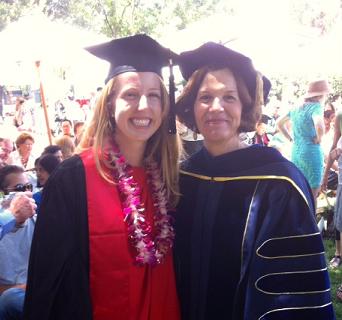
My oldest daughter, Breanna Jones, last week graduated with honors from Stanford University with a degree in public policy. At the ceremony, she received an award for her honors thesis – “California’s Tragedy of the Commons: How a Few Voters Disproportionately Influence County Use of State Prisons” – which I’m attaching as a PDF.

“California’s prison system has overrun maximum capacity, causing a public health conundrum, constitutional violations, and hemorrhaging finances. Even the public – which overwhelmingly endorsed past ‘tough-on-crime’ policies – has expressed its outrage about this waste of tax dollars. Recently, new research revealed that some California counties incarcerate more prisoners than the crime rate should dictate. That ‘surplus incarceration’ disproportionately contributes to the prison problem and thereby poses a significant tax burden on the state,” her report’s abstract begins.

Her research isolated a multitude of variables to show how it is the decisions that district attorneys in conservative counties make in how they charge crimes – with those prosecutors becoming especially aggressive after closely contested district attorneys races – that has the biggest impact on these high incarceration rates.

In other words, conservative attitudes toward crime and criminals are causing these usually small counties to have big impacts on the state’s prison budget – not to mention being unfair to those being sent to prison – something that ought to concern all of us.

Couple this with other studies showing that conservative counties also tend to use a disproportionate share of other state resources – and with the requirement of a two-thirds vote in the Legislature to raise taxes, which Democrats fall just a couple votes short of – and it becomes clear that these right-wing political attitudes aren’t benign. Indeed, we’re all suffering from the outsized influence of a vocal minority of state residents.

Luckily, voters will have some opportunities to correct this imbalance in November when there will be revenue measures that need only a simply minority to be approved, as well as measures that would repeal the death penalty and reform the Three Strikes You’re Out law, approval of which would begin to undo some of the damage done by these tight-fisted hypocrites.

California has lost its way and its balance. Luckily, the younger generation understands the situation and is willing to help us clean up the messes we’ve created for ourselves. It is the only thing that gives me hope for the future.

Olague is the swing vote on voting system repeal

58

Conservative Sup. Mark Farrell’s effort to repeal San Francisco’s ranked-choice voting system for citywide elected officials is headed to the Board of Supervisors tomorrow, and all eyes are on swing vote Sup. Christina Olague. She surprised her longtime progressive allies with her early co-sponsorship of the measure when it was introduced in March, but she’s now expressing doubts about the measure.

The board rejected an earlier effort by Farrell and Sup. Sean Elsbernd to repeal RCV outright, but then Farrell tried again with a measure that excludes supervisorial elections and has a primary election in September, and if nobody gets 65 percent of the vote then the two two finishers have a runoff in November.

“I’m not going to support something that calls for a runoff in September,” Olague told the Guardian, referring to the primary election, although she did echo the concerns from RCV’s critics who claim that it confuses voters. She also said that it hasn’t helped elect more progressives and that “some progressives I talked to aren’t 100 percent behind it.”

Such talk worries Steven Hill, the activist who helped create the voter-approved system, and who has been battling to shore up support for it in the face of concerted attacks by more conservative politicians, newspaper columnists, and downtown interests, all of whom preferred the old system of low-turnout, big-money December runoff elections.

“I think it’s working well. San Francisco saves a ton of money by not having two elections,” Hill said. He said downtown money will skew the runoffs elections even more in the wake of the Supreme Court’s Citizen United ruling allowing unlimited political spending. “With Citizen’s United,” he said, “they’ll just do a ton of independent expenditures.”

He said Olague had told him she intended to withdraw her co-sponsorship of the measure, but she hadn’t done so yet. Olague told us that she wanted to discuss the matter with Farrell before withdrawing her support, that she hasn’t been able to reach him yet, and that she’s been focused on other issues she considers more important, such as crime prevention.

The measure currently is being co-sponsored by the board’s five most conservative supervisors and Olague, meaning it will go before voters on the November ballot if they all remain supportive. Hill said that the measure may not be voted on tomorrow because of an administrative snafu dealing with noticing requirements, but the hearing would proceed anyway, possibly offering clues as to the measure’s chances of success.

Dueling pot protests precede rejection of a permit appeal

12

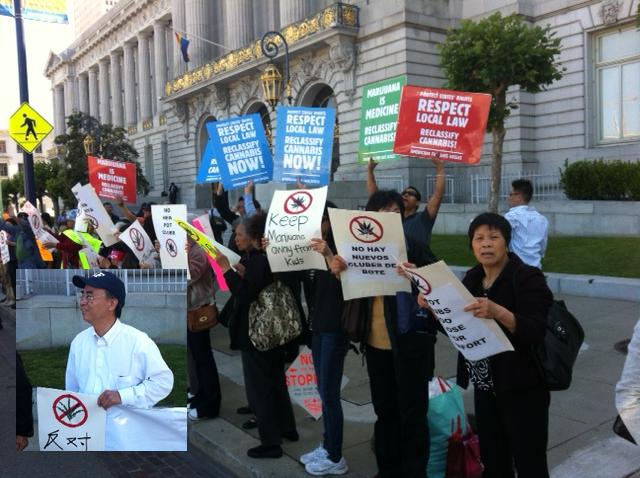
Dueling demonstrations in front of City Hall yesterday afternoon – with one side supporting medical marijuana dispensaries and the other protesting the city’s February approval of three new clubs in the Outer Mission/Excelsior area – preceded the Board of Permit Appeals decision to reject an appeal challenging Mission Organics.

That was the first of the three clubs to pull their building permits to open up shop in a part of the city that currently has no cannabis dispensaries. Yet a group of residents from the region – which includes District 11 supervisorial candidate Leon Chow – has been angrily agitating against the clubs and claiming they expose children to an illegal drug.

Bearing signs that included “Stay away from pot clubs” and “Keep the weeds away from kids” – most in both English and Chinese characters, with a smattering of Spanish translations – the predominantly Asian protesters squared off against a slightly larger crowd of medical marijuana supporters bearing signs that included “Respect Local Law” and “Marijuana is Medicine.” Together, it was a crowd of a couple hundred lining the sidewalk, drawing reactions from passing motorists.

Asked whether he would try to undermine the city’s system of regulating medical marijuana facilities if elected to the Board of Supervisors, Chow told us, “We’re opposing this, but I don’t think it would be my priority.”

Chow said he was “opposing high density,” noting that the Planning Commission approved three dispensaries in the area on Feb. 21, but he also raised concerns that the clubs make it easier for children to get marijuana, that they cater to healthy people just looking to get high, and that city regulations conflict with federal law.

“We don’t want healthy young people to be exposed to people coming out of medical marijuana clubs,” Chow told us. Asked whether he had similar concerns about bars and liquor stores, he said that he did but “there’s nothing I can do” to shut down existing businesses that sell alcohol.

“I don’t want there to be more liquor stores,” he said, although he assured us that, “I’m not a conservative, crazy, church-going Republican.”

Yet supporters of Mission Organics – whose workers will be represented by the United Food and Commercial Workers Union – did call Chow a hypocrite given that he works for SEIU-UHW. “So it’s a union representative opposing a union business,” said Matt Witemyre, an organizer with UFCW who was demonstrating in support of Mission Organics, which he said has agreed to a strict code of conduct that will make them good, responsible members of that community.

“The vast majority of the neighborhood is in support of the project,” Ariel Clark, an attorney representing Mission Organics, told us, characterizing protesters as a small yet vocal part of the neighborhood. The appeal was filed by Steve Currier, president of the Outer Mission Merchants and Residents Association.

Long after most of the protesters on both sides had gone home, the Board of Permit Appeals voted 3-1 to reject the appeal, clearing the way for Mission Organics to open on the 5200 block of Mission Street. But opponents have vowed to continue their fight and appeal the permits for the other two approved clubs – Tree-Med and The Green Cross, a venerable cannabis delivery service – when they apply for building permits.

The 8 Washington embarrassment

16

I wasn’t shocked by the vote on 8 Washington. I knew it was happening; I knew we’d lost when the EIR went through. I knew we couldn’t count on a solid progressive bloc any more. I knew that the lobbying was intense.

But I have to say, at the end of the day I was embarrassed. Because the supervisors sold the city cheap.

In the earlier board discussions, Sup. Christina Olague and Sup. Eric Mar mentioned their concerns about the heigh and bulk of the project and said they would work with the developer, Simon Snellgrove, on changes. But the final project was exactly the same size.

Olague and Sup. Jane Kim were concerned about the amount of parking; the developer agreed to cut 50 spaces. But the actual size of the garage won’t be reduced at all; the only promise: There won’t be valet parking, so maybe not so many cars will fit.

Yes, Snellgrove agreed to set aside some scholarships for low-income kids to swim in the pool, which is a great thing and I fully support it. For a project that, according to available figures, will net the developer $200 million in profit — according to Sup. David Chiu’s analysis, a 72 percent rate of return — the scholarship money is peanuts.

There’s an additional 50 cent parking levy to pay for surface improvements in the area.

But as Chiu asked at the June 12 meeting, “Is the city getting an appropriate level of benefits based on Snellgrove’s profits?” Project foe Brad Paul — a veteran of more than 30 years of the city’s development wars — doesn’t think so. “They got nothing,” he told me.

Here’s how it went down:

Chiu started off by introducing the board’s budget analyis, Harvey Rose. Rose said he’d reviewed the finances of the project, and concluded that the city would get $50 million less out of the project than the developer or the Port of San Francisco, which owns some of the land and is a primary proponent, had originally claimed. Chiu also noted that not all the documents were in the file, but nobody else seemed to care.

In fact, through most of the discussion — limited discussion — and final votes, it was pretty clear that nobody was swayed by any of the facts that Chiu put forward. This deal was done long before the board members took their seats.

Chiu offered a series of amendments, none of them terribly radical. He pointed out that the deal requires the city to pay the developer $5 million for open-space improvements. “That’s an anomaly,” Chiu said, and moved that it be removed.

Kim, who throughout the meeting was the strongest supporter of the project, argued that the city often reimburses developers for open space. More, she said, compared to what the city has asked other major residential developers to give, this project is just dandy. “I would not say this is not a fair deal for the city,” she told her colleagues.

The vote on the $5 million giveaway? Developer 6, SF 5. Siding with Snellgrove: Christina Olague, Scott Wiener, Carmen Chu, Sean Elsbernd, Mark Farrell, and Jane Kim. Siding with Chiu and project opponents: John Avalos, David Campos, Malia Cohen, and Eric Mar. It’s an odd lineup — Cohen doesn’t always vote with the progressives, and I have to say it’s strange to see Kim and Olague siding with the four most conservative supervisors.

Chius’s second proposal: Since the city’s benefits were $50 million less than advertised, why not add $14 million to the affordable housing fee?
Developer: 7. Affordable housing: 4. Voting for the developer: Olague, Wiener, Chu, Elsbernd, Farrell, Kim and Mar.

Okay, one last try. Chiu suggested maybe just $2 million more for affordable housing. Wiener, as is he way, went off on his usual complaint that too much of the affordable housing money is for poor people and not enough for the middle class. The final vote:

Developer: 6. Affordable housing: 5. Voting for the developer: Olague, Wiener, Chu, Elsbernd, Farrell, Kim.

Kim, again, took the lead in promoting the deal on the final vote, saying that a parking lot and a private club were not a good use for the space and that “we are achieving here is a higher and better use for the land.” That’s what every developer talks about, by the way — higher and better use.

She also talked about One Rincon, that hideous tower next to the Bay Bridge that was approved after then-Sup. Chris Daly cut a deal with the developer that the San Francisco Chronicle denounced as a “shakedown.

Kim said that, considering the much-smaller size of the Snellgrove project, the benefits were richer than the Rincon deal.

I never liked the Rincon deal — that tower’s a disaster, an ugly scar on the skyline, and there was nowhere near enough affordable housing money. That’s because I think that the city should be building six affordable units for every four market-rate units, that there’s no need for more housing for the very rich and that our current housing policy is a disaster. (The Guardian wrote an editorial at the time that said it was good that Daly had gotten that much money, but was dubious about the whole project. In retrospect, we were too kind.)

I think all my readers at this point know that. So does Daly.

But I asked the former supervisor anyway to comment on the difference between 8 Washington and One Rincon. His thoughts:

1. The Rincon Hill agreement was negotiated by the district Supervisor working together with the communities most impacted by the development. 8 Washington was opposed by the district Supervisor and many nearby residents.
2. Most people in the South of Market were not diametrically opposed to highrise development in that location. The Planning Department had been working on a Rincon Hill neighborhood plan and was recommending upzoning for the area.
3. Rincon Hill had no waterfront trust issues.
4. The Rincon HIll development impact fee was $25 per square foot (over and above the required inclusionary affordable housing fee even though the Mayor’s Office contended that over $20 per square foot would kill the deal.) According to Kim’s release, her 8 Washington deal netted an additional $2 million for affordable housing and a $.50 parking surcharge. This even though development in Rincon Hill is not as valuable as the northern waterfront.

Folks: I think the city got taken to the cleaners here. I’ll stipulate that I’m against this project for much broader reasons. And maybe I’m just an old commie who thinks that the richer you are, the more you should give back, that the affordable housing fees on the most expensive condos in San Francisco should be higher than normal, that if Snellgrove nets $200 million, then the city by definition left too much on the table.

But I don’t think I’m alone in believing that if you’re going to approve something that will make a developer this rich, and let him use public land to do it, on the waterfront, you ought to get your fair share. And that didn’t happen.

Embarrassing.

Guardian Voices: On losing

80

I’m turning 43 today and feeling glad to be alive. I would love to be writing about the joy of raising children and the mysteries of the universe. But instead, today I’m thinking about last week’s elections, about losing and the nature of long-term struggle. I’m thinking about being born black in 1969, and how, in fact, our side has been losing my whole life. And while this sobering reality about the balance of forces in the nation could make a sane person completely despondent, today I’m considering it a challenge to radically rethink the way we progressives try to change the world. 

The truth is that despite historic victories and truly incredible grassroots organizing over the last several decades, we’ve been getting our asses kicked for a long, long time. Since the right and the state got together to crush people’s movements of the 1960s. Since the Republicans built this rightwing coalition, began pushing wedge politics, winning the hearts and minds of white working people, and winning elections all over the country. And since capitalism shifted gears in the 1970s – we call it neoliberalism now — and the war on poverty was pushed aside to make way for the war on poor people specifically and working people generally. Since then, our cities have lost good jobs, union members, safety net services, and in San Francisco, more than half of the entire black population.

Thanks to Fox News, billionaire Republicans, and fragmentation on the left, conservative ideas about government, about individual vs. institutional responsibility, and about the supposed virtues of free markets have taken a powerful hold over the thinking of most Americans. One result: Last week in Wisconsin, despite the truly historic mobilization against the right’s Scott Walker, labor and social justice forces lost a big one. And here in San Francisco, in the heart of the “left coast,” progressives lost control of the Democratic Party to that special brand of “moderate” big-business Democrats who are socially liberal but have been making me embarrassed to be a registered Democrat since – well, since Bill Clinton was in the White House.

Clinton’s “ending welfare as we know it” third-way politics made it ok to talk about ending poverty while at the same time helping people get rich at the expense of poor people all over the world. Gavin Newsom was our local version – more socially liberal, and therefore successfully confusing to a lot of people, but he was nonetheless made of the same cloth.

Are you ready for the good news? Well, not quite yet. I didn’t mention the economic crisis.

If this were a boxing match, I don’t think the referees would have trouble judging this one. The current economic crisis was indeed once a crisis for capitalists — some financial institutions were forced to close shop, other lost billions and Wall Street seemed for a while to be in complete disarray. At one point, one third of Americans supported the Occupy movement and thought socialism was something to consider.

But even taking the ongoing Eurozone crisis into account, the US corporate elites in 2012 are more like a dazed prize fighter momentarily wobbly on his feet than a boxer who’s down for the count. Now, four years after the financial crash, the crisis is primarily a crisis for the rest of us, and our suffering is real. Even the middle class has taken serious punches, and our communities are badly bruised.

Good political spin will not change these real conditions. And the problem is not that organizers and activists, here in the Bay and around the country, aren’t brave and brilliant and working just remarkably hard. And even creating new forms of activism and alliances for the 21st century. But we have to think differently about how we do politics.

Most fundamentally, after so many years of losing in one way or another, too many social justice activists have lost hope of ever winning a truly more just society. Too many of us have settled for short-term gains, defensive fights, and building organizational power.

Don’t get me wrong – I’m deeply committed to local organizing that builds leadership and political power and win’s concrete improvements in people’s lives. But we will certainly never see the society we hold in our dreams without a bold, audacious belief that we can in fact win and govern our city, our state, and the entire country. Like the right – which was, objectively speaking, once weak and playing defense — progressive forces have to share a common belief that we too can build a majority, that we can govern the entire country based on values of racial justice, equity, sustainability and the collective good.  There’s a big difference between losing and feeling, en masse, like losers.

There is so much already in motion to build upon, so much potential to seize the opportunities that this historic moment provides. Inspired by Arab Spring, we too can be bold and audacious in our visions of what’s possible. After we rally against what’s wrong, let’s make plans for how we are really going to solve the crises of the 21st century and make the world a better place. Local political battles are essential opportunities to build new leadership (especially in communities of color), to change everyday people’s consciousness, and defend the ground we’ve already won. Across the nation, more organizations should take lessons from efforts like the National Domestic Workers Alliance, San Francisco Rising, CA Calls, and the national Unity Alliance that are breaking the fragmentation of progressive forces, moving beyond organizational ego, and consolidating people power. But above all, we have to let go of the idea that it’s someone else’s role to run the world or that having power is just for self-serving politicians. Unafraid of power and determined to slug it out, let’s make my next forty years about how we turned it around, had the Right on the run, built a movement and a society that we are proud to leave our children.

We are not down for the count. We are still in the ring swinging. Our opponent is powerful, and we’re already weak from a long fight, but we have the capacity to regroup, take advantage of our opponent’s weaknesses and make the most of our strengths, plot a new offensive strategy, and win — and win decisively. Losing is part of political struggle, it’s part of history, but there are more rounds to go. And what’s even better, unlike boxing, in the real world of building a movement for social justice, we engage in the struggle together. What happens next is up for grabs, and history is ours to make.

N’Tanya Lee was formerly the director of Coleman Advocates and one of the founding members of San Francisco Rising. She’s a veteran organizer with racial justice and LGBT and youth movement struggles in New York City, Michigan and the Bay. She now works on national movement building projects, advises local social justice leaders and is raising a son with her wife in Southeastern San Francisco.

Gimme more

0

For more on this year’s Frameline Film Festival, including times and prices, go to www.frameline.org

Mixed Kebab (Guy Lee Thys, Belgium/Turkey, 2012) A My Beautiful Launderette-type mix of culture clashes ethnic, religious, sexual, and otherwise, Guy Lee Thys’ Belgian-Turkish feature risks over-contrivance, but comes out a tasty blend of narrative and thematic ingredients. Ibrahim, a.k.a. Bram (Cem Akkanat), is the apple of his émigré Antwerp family’s eye, but then he’s kept his hunky-gay-man-at-large double life entirely off their conservative Muslim radar. Even as his best-friendship with Kevin (Simon Van Buyten) looks set to turn into something much more, he goes along with plans for an arranged marriage to Elif (Gamze Tazim), an educated cousin desperate to escape the gender restrictions of Turkey and her father’s home. Several factors will erode those best-laid plans, however, not least the prying eyes of Bram’s black-sheep brother Furkan (Lukas De Wolf), who goes from rebellious juvenile delinquency to obnoxious moral fundamentalism under a far-right local imam’s influence. Thu/14, 10pm, Castro. (Dennis Harvey)

North Sea Texas (Bavo Defurne, Belgium, 2011) Growing up is never easy — especially when you know who you are and who you love from a tender young age, and live in a sleepy Belgium coastal hamlet in the early ’70s. Sexual freedom begins at home, as filmmaker Bavo Defurne’s debut feature opens on our beautiful little protagonist, Pim — a melancholy, shy, diligent soul who has a talent for drawing, a responsible nature, and a yen for ritual dress-up in lipstick and lace. He has an over-the-top role model: an accordion-playing, zaftig mother who has a rep as the village floozy. Left alone far too often as his mom parties at a bar named Texas, Pim takes refuge with kindly single-mom neighbor Marcella, her earnest daughter, and her sexy, motorcycle-loving son, Gino, who turns out to be just Pim’s speed. But this childhood idyll is under threat: Gino’s new girlfriend and a handsome new boarder at Pim’s house promise to change everything. Displaying a gentle, empathetic touch for his cast of mildly quirky characters and a genuine knack for conjuring those long, sensual days of youth, Defurne manages to shine a fresh, romantic light on a somewhat familiar bildungsroman, leaving a lingering taste of sea salt and sweat along with the feeling of walking in one young boy’s very specific shoes. Fri/15, 9:30pm, Castro. (Kimberly Chun)

I Want Your Love (Travis Mathews, US, 2011) Local director Travis Mathews’ first full-length feature — produced by porn impresario Jack Shamama and the good, pervy folks at Naked Sword — is so beautifully shot, edited, paced, and true to life for a certain young, scruffy, artsy fag demographic (not to mention brimming with explicit sex scenes) that you probably won’t notice that hardly anything happens plotwise. A cute performance artist named Jesse, played by one of our top performance artists also named Jesse, is getting ready to move back to Ohio due to those all-too-familiar San Franciscan money woes, but maybe also to forge some deeper connection to life. That’s about it. The true joy here is seeing most of the Bay Area’s gay underground arts scene nailing peripheral roles: Brontez Purnell hilariously steals the movie, cute naked gay boys abound, and the whole thing really does come off as a lovely West Coast boho version of last year’s UK indie hit Weekend, with more fog and condoms. Sun/17, 9:30pm, Castro. (Marke B.)

Beauty (Oliver Hermanus, South Africa/France, 2011) The destructive toll of repression, psychological and otherwise, is vividly illustrated in Oliver Hermanus’ stark minimalist drama. Francois (Deon Lotz) is a middle-aged Afrikaaner husband and father living an entirely concealed double life: the hidden part acted out in secret orgies with other men as successful, privileged, and closeted as he. (When one member of this very exclusive “club” brings a black lover along, the reaction makes clear how sharp South Africa’s race/class divisions remain.) Francois’ control of that schizophrenic existence is masterful — until he spies Christian (Charlie Keegan), a model-handsome new corporate colleague, a close friend’s son, and eventually his younger daughter’s boyfriend. Despite all those red flags, his obsession builds toward a shocking, uncontrollable explosion. A deliberately chilly and unpleasant work of art à la Michael Haneke, Beauty weighs the consequences of living a lie, and finds them aptly repellent. Mon/18, 9:30pm, Castro. (Harvey)

 My Best Day (Erin Greenwell, US, 2012) Sans name stars or a catchy plot hook, Erin Greenwell’s indie comedy attracted little attention at Sundance, and it’s kinda buried in the Frameline program — a pity, since its uncontrived, even-handed balance of gay male, lesbian, and straight protagonists would have been perfect for a higher-profile slot. Not to mention that it’s totally goofy, funny, surprising, and sweet. Over the course of one Fourth of July in Bangor, Penn., a motley assortment of hapless but endearing characters circle one another warily, desiring everything from family reunion to crush-realization to acknowledgement of a closeted relationship. They’re all delightful, although there’s no getting around the wholesale scene stealing of Ashlie Atkinson, whose motorcycle- and slutty local-girl-covetous refrigerator-repair dyke dials down her “Muffler” in Another Gay Movie (2006) to create a character of nuanced comic beauty. My Best Day is unpretentious but so low-key skillful and open-hearted that in the end it feels ever-so-slightly profound. Tue/19, 7pm, Elmwood; June 20, 9:30pm, Castro. (Harvey)

Keep the Lights On (Ira Sachs, US, 2012) At times almost too intimately painful to watch, Ira Sachs’ autobiographical drama charts the long-term disintegration of a relationship between a filmmaker and a bright, adored but addicted and duplicitous soulmate. When expat Danish documentarian Eric (the exceptional Thure Lindhardt) first hooks up with publishing-biz newbie Paul (Zachary Booth), they have sexual chemistry and more. But the Manhattan life they build together is increasingly hole-riddled by Paul’s mood variances, unexplained absences, and other signs of serious drug usage. Sachs lets the narrative be controlled by the empty spaces such a habit leaves for concerned loved ones — time and circumstances often leap forward without full explanation, placing us in Eric’s frustrated position as a man in love with a man whose returned love is both genuine and entirely untrustworthy. Keep the Lights On is unabashedly difficult viewing. But it’s also the best (as well as the first gay-focused) feature Sachs has made since his equally unsettling 1997 debut The Delta. June 20, 6:30pm, Castro. (Harvey)  

Hospital standoff

2

steve@sfbg.com

The controversial and long-awaited proposal by California Pacific Medical Center (CPMC) to build a 550-bed luxury hospital atop Cathedral Hill and to rebuild St. Luke’s Hospital has finally arrived at the Board of Supervisors — where it appears to have little support.

So far, not one supervisor has stepped up to sponsor the deal, and board members say it will have to undergo major changes to meet the city’s needs. “There are still a lot of questions that remain,” Sup. David Campos told us, citing labor, housing, community benefits, and a long list of other issues that he doesn’t believe CPMC has adequately addressed. “It tells me there’s still more work to be done.”

CPMC, which is Sacramento-based nonprofit corporation Sutter Health’s most lucrative affiliate, has been pushing the project for almost a decade. Its advocates have subtly used a state seismic safety deadline for rebuilding St. Luke’s — a hospital relied on by low-income residents of the Mission District and beyond — as leverage to build the massive Cathedral Hill Hospital it envisions as the Mayo Clinic of the West Coast.

But the project’s draft environmental impact report shows the Cathedral Hill Hospital would have huge negative impacts on the city’s transportation system and exacerbate its affordable housing crisis. And CPMC has been in a pitched battle with its labor unions over its refusal to guarantee the new jobs will go to current employees or local residents and be unionized. There are also concerns with the market power CPMC will gain from the project, how that will affect health care costs paid by the city and its residents, and with the company’s appallingly low charity care rates compared to other health care providers (see “Lack of charity,” 12/13/11).

CPMC had refused to budge in negotiations with the Mayor’s Office under two mayors, for which Mayor Ed Lee publicly criticized the company’s intransigence last year. But under pressure from the business community and local trade unions who support the project, Lee cut a deal with CPMC in March.

That development agreement for the $2.5 billion project calls for CPMC to pay $33 million for public transit and roadway improvements, $20 million to endow community clinics and other social services, and $62 million for affordable housing programs, nearly half of which would go toward helping its employees buy existing homes.

While those numbers seem large, community and labor leaders from San Franciscans for Healthcare, Housing, Jobs and Justice (SFHHJJ), which formed in opposition to the project, say they don’t cover anywhere near the project’s full impacts. And given that CPMC made about $180 million in profit last year in San Francisco alone — money that subsidizes the rest of Sutter’s operations — they say the company can and should do better.

“This is about standing up to corporate blackmail,” SFHHJJ member Steve Woo, a community organizer with the Tenderloin Neighborhood Development Corporation, told us.


PIVOTAL PROJECT

CPMC is perhaps the most high-profile project the board will consider this year, one that will impact the city for years, so the political and economic stakes are high.

The Planning Commission voted 5-1 on April 26 to approve the deal and its environmental impact report, citing the project’s economic benefits and the looming deadline for rebuilding St. Luke’s. The Board of Supervisors was scheduled to consider the appeal of that decision on June 12 (after Guardian press time), but activists say supervisors planned to continue the item until July 17.

In the meantime, the board’s Land Use Committee has scheduled a series of hearings on different aspects of the project, starting June 15 with a project overview and presentation on the jobs issue, continuing June 25 with a hearing on its impacts to the health care system. Traffic and neighborhood impacts would be heard the next week, and then housing after that.

Calvin Welch, a progressive activist and nonprofit affordable housing developer, said the project’s EIR makes clear just how paltry CPMC’s proposed mitigation measures are. It indicates that the project’s 3,000 new workers will create a demand for at least 1,400 new two-bedroom housing units. Even accepting that estimate — which Welch says is low given that many employees have families and won’t simply be bunking with one another — the $26 million being provided for new housing construction would only create about 90 affordable studio apartments.

“We’re going to end up, if we want to house that workforce, subsidizing CPMC,” Welch told us.

Compounding that shortcoming is the fact that the Cathedral Hill Hospital is being built in a special use district that city officials established for the Van Ness corridor — where there is a severe need for more housing, particularly affordable units. The SUD calls for developers to build three square feet of residential for every square foot of non-residential development.

“That would require building 3 million square feet of residential housing with this project,” Welch said. “We don’t think $26 million meets the housing requirement for this project, let alone what was envisioned by this [Van Ness corridor] plan.”

SFHHJJ is calling for CPMC to provide at least $73 million for affordable housing, with no more than 20 percent of that going to the company’s first-time homebuyer assistance program. That assistance program does nothing to add to the city’s housing stock and critics call it a valuable employee perk that will only increase the demand for existing housing — and thus drive up prices.

But the business community is strongly backing the deal, and the trade unions are expected to turn out hordes of construction workers at the hearing to make this an issue of jobs — rather than a corporation paying for its impacts to the community.

“After a decade of discussion, debate and compromise, the city’s departments, commissions, labor, business and community groups all agree on CPMC,” San Francisco Chamber of Commerce President Steve Falk wrote in a June 8 e-mail blast entitled “Message to the Board of Supervisors: Don’t Stand in the Way of Progress.”

“The fate of our city’s healthcare infrastructure now lies solely with the Board of Supervisors,” the Chamber says. “When it comes time to vote, let’s insist they make the right choice.”

Yet it’s simply inaccurate to say that labor and community groups support the deal, and both are expected to be well-represented at the hearings.


CARE FOR WHOM?

Economic justice issues related to health care access and costs are another potential pitfall for this project. SFJJHH activists note that no supervisors have signed on to sponsor the project yet — which is unusual for something this big — and that even the board’s most conservative supervisors have raised concerns that the city’s health care costs aren’t adequately contained by the deal.

“There’s a significant amount of dissatisfaction with the deal, even among conservatives,” SFJJHH member Paul Kumar, a spokesperson for the National Union of Healthcare Workers, told the Guardian.

On the progressive side, a big concern is that CPMC is proposing to rebuild the 220-bed St. Luke’s with only 80 beds, which activists say is not enough. And even then, CPMC is only agreeing to operate that hospital for 20 years, or even less time if Sutter’s fortunes turn around and the hospital giant begins losing money.

CPMC Director of Communications Kathryn Graham, responding by email to questions and issues raised by the Guardian, wrote generally and positively about CPMC and the project without addressing the specific concerns about whether housing, transportation, and other mitigation payments are too low.

On the jobs issue, she wrote, “Our project will create 1,500 union construction jobs immediately—and preserves and protects the 6,200 health care professional jobs that exist today at the hospitals. Currently, nearly 50 percent of our current employees live in San Francisco. During the construction phase of this project, we are committed to hire at least 30 percent of workers from San Francisco. We will create 500 permanent new jobs in just the next five years—200 are guaranteed to be local hires from underserved San Francisco neighborhoods. We don’t know where you got the ridiculous idea that our employees must reapply for jobs at our new hospitals. That is incorrect.”

Yet CPMC has resisted requests by the California Nurses Association and other unions to be recognized at the new facility or to agree to card-check neutrality that would make it easier to unionize. And union representatives say CPMC has offered few assurances about staffing, pay, seniority, and other labor issues.

As one CNA official told us, “If they aren’t going to guarantee jobs to the existing employees, those are jobs lost to the city.”

“We’re giving Sutter a franchise over San Francisco’s health care system for 30 to 40 years, so we should ensure there are basic worker and community protections,” Kumar said.

Welch and other activists say they believe CPMC is prepared to offer much more than it has agreed to so far, and they’re calling on the supervisors to be tougher negotiators than the Mayor’s Office was, including being willing to vote down the project and start over if it comes down to that.

“They make too much money in this city to just leave town,” Welch said of CPMC’s implied threat to pull out of San Francisco and shutter St. Luke’s. “It’s bullshit.”

Sutter’s CPMC deal isn’t healthy

28

At 10am on Friday, June 15, at the main chambers of the Board of Supervisors, the first of a series of public hearings will be held on specific aspects of the  development agreement governing the $1.9 billion Sutter Health/California Pacific Medical Center proposal to expand and centralize the giant health-care outfit’s health center by building a new 555 bed hospital at Geary and Van Ness. The deal involves demolishing the existing 220-bed hospital at St. Luke’s at Mission and Cesar Chavez and rebuilding a new 80-bed facility, expanding the Ralph K. Davies hospital at Duboce and Noe and closing down the old Children’s Hospital in Laurel Heights.

The hearing will be the first before the Board of Supervisors. Thus far, the project has been before only the executive branch: the Planning Commission and the mayor. After a brief introduction on the overall project the hearing will focus on the issue of jobs.

This is the largest project to be negotiated by the Lee administration — and although the mayor introduced it to the board in May, not one supervisor has yet joined him to sponsor the legislation. That’s an an odd situation given the importance of the project – and the fact that Mayor Lee can usually count on an automatic four votes from the conservative faction of the board. But not this time.

The hearing was requested by a coalition of more than 60 community, neighborhood, labor, and environmental organizations — San Franciscans for Healthcare, Housing, Jobs and Justice (SFHHJJ) — which has been closely following the project for the last two years.  Members of the coalition have already appealed the project’s environmental impact report, passed last month by the Planning Commission, and SFHHJJ has developed a series of amendments to the agreement that it has been pressing on the Board of Supervisors.  Board President David Chiu agreed to set a series of hearings on the project before it voted on, along with the determination of the appeal of the EIR, in  late July.  SGHHJJ hopes to use the hearings to get across the serious shortcoming of the agreement.  In addition, depending upon the appeal of the EIR,  a law suit may well be filed by some members of the Coalition.

In short, what starts next Friday is a big deal.

Not only is it a big deal in the development war that is at the heart of San Francisco politics, but it also is a big deal given what may well be done by the Supreme Court in deciding the constitutionality of all or part of the Affordable Health Care Act. If Obama’s health reform is struck down by the court, in all or in part, which seems almost certain, Sutter/CPMC’s plan will most definitely take on even more importance for the future of health care and its costs in San Francisco.

Sutter currently controls about a third of the market for health care in San Francisco.  With the construction of this project, it will control about 40 percent — a portion most knowledgable observers feel will give it market dominance  and an ability to actually set health care costs in San Francisco. Sutter’s business model — as shown in Berkeley when it took over Alta Bates and elsewhere in the state – demonstrates that  with a dominate market position, it jacks up prices.

As the San Francisco Chronicle noted in 2010: “…Sutter Health Co. has market power that commands prices 40 to 70 percent higher than its rivals per typical procedure — and pacts with insurers that keep those prices secret”.

A US Supreme Court that weakens or strikes down health care reform will simply re-establish the status-quo ante, a situation in which Sutter will thrive.

And that’s why the board’s conservative members are not supporting Mayor Lee’s deal: it simply does not protect the city — itself a major health care consumer for both its workforce and Healthy San Francisco — from Sutter’s history of turning market power into high health care charges.

SFHHJJ want the development agreement amended to place a cap on the costs charged to the city, allowing Sutter no more than 115 percent of the average charged  by  San Francisco’s other private, nonprofit hospitals.  It also wants Sutter/CPMC low charity care payments pegged at an average of what other nonprofit hospitals contribute, and it is calling for rebuilding St. Luke’s in San Francisco medically underserved south east to 180 beds, not the sure-to-fail size of 80 beds.

But there’s even more to deplore about the proposed deal.

In housing, although the EIR showed that a demand would be created for some 1,500 new two-bedroom homes, Sutter/CPMC agreed to only provide funds to build about 90 such homes. Such a massive shortfall will boost housing prices all other San Franciscans will pay.

The project’s impact on public transit at the Geary / Van Ness intersection will be large and ongoing. More than 20,000 new car trips will be generated at that intersection by the new hospital. Plans for a Bus Rapid Transit raised roadway for the 38 Geary — the most used bus line in the city — will have to be altered at an unknown price since the project calls for all auto traffic to enter the site on the Geary Avenue side.

Again, San Francisco taxpayers will be on the hook to pay for these new costs.

But it is the jobs aspect of the deal that is the most distressing. Sutter/CPMC has a long history of labor disputes with its workforce. Last year it replaced nurses who took a day off to protest their working conditions, and a replacement nurse hired by Sutter accidentally killed a patient. Sutter/CPMC refuses to agree to hire all of its 6,000 current employees for the new facilities. It’s requiring them all to apply as new workers, losing all of their seniority, with a real prospect that many currently employed San Francisco residents will lose their jobs once the new facility opens. All that Sutter/CPMC has agreed to do is hire 50 residents a year for four years – 200 new local jobs, total.

The  June 15 hearing will focus on the jobs issue and public comment is sure to be hot on this laughable “commitment” agreed to by the “jobs” administration.

Calvin Welch is a longtime community organizer living in San Francisco. He currently teachs a course in the development history of San Francisco at San Francisco State University and the University of San Francisco.

Mecke joins crowded District 5 supervisorial race

26

Progressive activist Quintin Mecke jumped into the District 5 supervisorial race today, echoing gentrification concerns raised this week by the Guardian and The New York Times and promising to be an independent representative of one of the city’s most progressive districts, a subtle dig at Sup. Christina Olague’s appointment by Mayor Ed Lee.

“The City is at an economic crossroads. As a 15 year resident of District 5, I cannot sit idly by while our City’s policies force out our residents and small businesses, recklessly pursuing profits for big business at whatever cost,” he began a letter to supporters announcing his candidacy, going on to cite the NYT article on the new tech boom that I wrote about earlier this week.

“What we do next will define the future of San Francisco; the city is always changing but what is important is how we choose to manage the change. One path leads to exponential rent increases, national corporate chain store proliferation, and conversion of rent-controlled housing. The other path leads to controlled and equitable growth, where the fruits of economic development are shared to promote and preserve what is great about this City and our district,” Mecke wrote.

Mecke came in second to Gavin Newsom in the 2007 mayor’s race and then served as the press secretary to Assembly member Tom Ammiano before leaving that post last week to run for office. Mecke joins Julian Davis and John Rizzo in challenging Olague from her left, while London Breed and Thea Selby are the leading moderates in a race that has 10 candidates so far, the largest field in the fall races.

Although he never mentioned Olague by name, Mecke closed his message by repeatedly noting his integrity and independence, a theme that is likely to be a strong one in this race as Olague balances her progressive history and her alliance with the fiscally conservative mayor who appointed her.

“Politics is nothing without principles; and it’s time now to put my own principles into action in this race,” Mecke wrote. “District 5 needs a strong, independent Supervisor. I am entering this race to fight for the values that I believe in and to fight to preserve what is great about District 5 and the city. I have brought principled independence to every issue I’ve worked on and that’s what I’ll continue to bring to City Hall.”

In an interview with the Guardian, Mecke said he sees the campaign as a “five-month organizing project” to reach both regular voters and residents of the district who haven’t been politically engaged, including those in the tech sector. He’d like to see the perspective of workers represented in discussions about technology, not simply the narrow view of venture capitalist Ron Conway that Mayor Lee has been relying on.

“Local politics needs new blood,” Mecke said, “it needs to hear from these people.”

Reading Ed Lee’s mind

15

Political reporters love to believe we can read politician’s minds; it makes us feel important. (And Lord knows, these days we need something to make us feel important.) So let me go way out on a limb here and tell you what Mayor Lee is thinking right now:

1. Gotta minimize Prop. B. It was an aberration, a bunch of rich Nimbys from Telegraph Hill, nothing more to see here. Certainly not a public referendum on my Rec-Park director, Phil Ginsburg, and his efforts to make money by renting out city parks for private events. No no no, just ignore it and maybe it will go away.

2. We won back the Democratic Party. Good move to take a page from Aaron Peskin’s book and run a bunch of elected officials and former elected officials with high name recognition in a low-turnout election. Bevan Dufty, who happens to work for me, would make an excellent chair; should be easy to make that happen.

3. What if we look at the DCCC race in the 17th District as a first-pass primary for the 2014 Assembly seat when Tom Ammiano — who’s just way too independent and won’t get with my program — is termed out? Hmmm … David Chiu, who I can mostly deal with, is in first place — but John Avalos and David Campos are more popular than my pal Scott Wiener. And if the progressives get behind Campos, he’ll be tough to beat. Hmmm….

4. That oddball Michael Breyer ran for Assembly pretending he was me. He even put out a mailer with my mustache on the front suggesting that he’ll be just like I am (except that he’s white and has no experience and no credible program and isn’t going to win). But he got a lot of votes with the Ed Lee card and I could totally control him. Can’t support him over Phil Ting, of course, but maybe I can get him some help behind the scenes.

5. This was an unusual election with radically low turnout. I know I can’t read too much into it. If the DCCC were on the ballot in November, or if there were a real presidential primary to bring people out to vote, the results would be very different. But still: All that new housing for rich people that my mentor Willie Brown and my friend Gavin Newsom got started seems to be having an impact. The city’s getting more conservative. Let’s just keep that one going and I’m home free.

6. What’s up with Lincecum? Damn those Padres.

Nah — the mayor’s too nice a guy to be thinking like that. Right?


Tobacco money showing its power

1

The tobacco companies spent very, very heavily in Southern California to defeat Prop. 29, and as more results come in, it’s clear that the tens of millions of dollars worth of misleading TV ads had an impact. The numbers are now very, very close. With 15 percent of the vote in, it’s 50.3 Yes, 49.7 No. Still mostly conservative areas; LA and San Francisco aren’t in the mix yet, and only half of Sacramento’s been counted. Still: This is way, way closer than I thought it would be.

80 percent reporting: You can take (most of) this to the bank

6

WIth 80 percent reporting, you can take this much to the bank:

Prop A is dead. Prop. B has won. The left will no longer control the local Democratic Party.

Phil Ting will have an actual race in November (although he won more votes than the conservative Dem and the Republican combined and will almost certainly win the seat).

The Padres beat the Giants, 6-5, with a walk-off home run in the ninth.

Hell of a night.

40 percent reporting: Not a lot of change

0

Witrh 40 percent of the precincts reporting, there’s been very little change in the results, which is surprising: Typically the absentees don’t reflect the election-day turnout. But Prop. A is still going down by huge margins, Prop. B is still winning (and at this point, that one’s probably in the bag, striking a blow against the privatization of public resources and offering a vote of no-confidence in the direction of the city’s Rec-Park department).

It appears likely that there will be an expensive November race for Assembly in D19, with the downtown-funded (but otherwise unknown) Democrat Michael Breyer who ran an almost-Republican campaign heading for a second-place finish against Assessor Phil Ting.

And there’s no change in the results for the DCCC.

I’m a little surprised (and disappointed) that Gabriel Haaland, a longtime incumbent, isn’t making the cut this time, and I’m surprised (and pleased) that newcomer Justin Morgan, a public-health physician, is still in the top 14 on the East Side. Zoe Dunning and Matt Dorsey, two very visible LGBT leaders (she on DADT, he on same-sex marriage) are running strong; Dorsey’s in the progressive camp, and Dunning, a former military officer, is more conservative. School Board member Hyrda Mendoza isn’t making the cut, either, which is odd for a citywide elected official.

At this point, it appears that theSF Democratic Party will be a more conservative organization than we’ve been used to over the past four years. At most, the progressives will have 14 or 15 votes out of 32 (24 elected and eight ex-officio). There are plenty of reasons for that, among them the retirement of some longtime progressive members (Aaron Peskin, Jane Morrison, Milton Marks); the redistricting that created a West Side district very few progressives could compete in — and the move by the more conservative elements of the party to run a slate that included Dufty and Cohen.

Things could still change; I could be wrong. But I don’t think I am.

Tobacco tax tightens up

0

Whoa — with 10 percent of the state reporting, the tobacco tax, Prop. 29, is tightening up. It’s now 51.3 yes, 48.7 no. But I’ve checked the counties that have reported in, and they’re mostly the no-tax conservative areas. Only 5 percent of Los Angeles is in, and San Francisco hasn’t even reported to the state yet. So not time to worry yet.

In CD2, Norman Solomon has pulled to within 2.5 points of the Republican in the race for second place and a slot on the November ballot. I think he’s going to pull it off.

Early SF results: No on A, Yes on B

5

The first results just got posted, and it’s a fairly large number of votes. More than 60,000 people voted by mail, and there’s enough to draw a few conclusions.

Prop. A, the measure that would have required competitive bidding for the city’s garbage contracts, is dead, losing in the early absentees 77-23. No surprise that it’s losing; getting 23 percent of the vote with no campaign to speak of up against the full might of Recology’s money and political connections is actually pretty impressive.

Prop. B, the Coit Tower measure, is winning, 55-45, which is a good place to be at this stage. I’d say it’s time for the Yes on B camp to start celebrating.

The DCCC early returns show a lot of what we expected — the elected officials and incumbents are doing well. David Chiu is in first, beating Scott Wiener, who is beating John Avalos. For what it’s worth.

After that, it’s Bevan Dufty, David Campos, former Sup. Leslie Katz and former state Sen. Carole Migden.

Interestingly, Matt Dorsey, an appointed incumbent facing the electorate for the first time, is ahead of Sup Malia Cohen. Rafael Mandleman, Zoe Dunning, Alix Rosenthal, Petra DeJesus, and Justin Morgan finish out the top 14 on the East Side.

Those are the early absentees, and the difference between Morgan and incumbent Gabriel Haaland, now in 18th place, is just 800 votes. So it will change.

Right now, the progressives have 9 of the 14 seats on the East Side, but only 4 of the 10 on the West Side, which won’t be enough to elect a progressive chair and ensure good endorsements in the fall. But the margins are so thin and it’s so early we can’t call it yet.

On the West Side of town, Assessor Phil Ting is comfortably in the lead for the 19th Assembly District, but newcomer Michael Breyer, a conservative Democrat who spent a ton of money, is edging Republican Matthew Del Carlo by two points, setting up the possibility that Ting will have to raise money and face off against Breyer in November.

Statewide results: Tobacco tax close, term-limits change leading

0

The statewide results are very early, very limited and most likely very conservative, because they represent only absentees that have come from the few counties already reporting. Here’s what I can draw from them: The change in term limits, Prop. 28 — promoted by opponents of the current term-limits law but described as reducing the amount of time a legislator can serve — is going to win handily. It’s ahead 66-34. It doens’t mean voters are turning against term limits (sadly); there wasn’t a huge campaign on either side, so it’s mostly about the actual ballot language, and the sponsors were careful to say it “limits legislators terms in office.” Still, it’s good news for people like San Francisco Assessor Phil Ting, who is likely to head up to Sacramento for the first time and will be eligible to serve in the Assembly for 12 years.

The cigarette tax is also winning, despite about $40 million in spending by the tobacco companies. That one’s closer — 53-47 — but since absentees are usually more conservative than election-day votes, that’s a good sign. If things hold up the way they normally do, the gap will widen and both measures will win handily.

In the Congressional D2 race, Jared Huffman is, as expected, well in the lead with more than 40 percent of the vote. The second-place Dem is Norman Solomon, but he’s trailing the top Republican, Daniel Roberts, by three points. If Solomon does well with today’s voters, he may wind up in the November final.


The battle of 8 Washington

tredmond@sfbg.com

More than 100 people showed up May 15 to testify on a condominium development that involves only 134 units, but has become a symbol of the failure of San Francisco’s housing policy.

I didn’t count every single speaker, but it’s fair to say sentiment was about 2-1 against the 8 Washington project. Seniors, tenant advocates, and neighbors spoke of the excessive size and bulk of the complex, the precedent of upzoning the waterfront for the first time in half a century, the loss of the Golden Gateway Swim and Tennis Club — and, more important, the principle of using public land to build the most expensive condos in San Francisco history.

Ted Gullicksen, director of the San Francisco Tenants Union, calls it housing for the 1 percent, but it’s worse than that — it’s actually housing for the top half of the top half of the 1 percent, for the ultra-rich.

It is, even supervisors who voted in favor agreed, housing the city doesn’t need, catering to a population that doesn’t lack housing opportunities — and a project that puts the city even further out of compliance with its own affordable-housing goals.

And in the end, after more than seven hours of testimony, the board voted 8-3 in favor of the developer.

It was a defeat for progressive housing advocates and for Board President David Chiu — and it showed a schism on the board’s left flank that would have been unthinkable a few years ago. And it could also have significant implications for the fall supervisorial elections.

Sup. Jane Kim, usually an ally of Chiu, voted in favor of the project. Sup. Eric Mar, who almost always votes with the board’s left flank, supported it, too, as did Sup. Christina Olague, who is running for re-election in one of the city’s most progressive districts.

At the end of the night, only Sups. David Campos and John Avalos joined Chiu in attempting to derail 8 Washington.

The battle of 8 Washington isn’t over — the vote last week was to approve the environmental impact report and the conditional use permit, but the actual development agreement and rezoning of the site still requires board approval next month.

Both Mar and Olague said they were going to work with the developer to try to get the height and bulk of the 134-unit building reduced.

But a vote against the EIR or the CU would have killed the project, and the thumbs-up is a signal that opponents will have an upward struggle to change the minds of Olague, Kim, and Mar.


DEFINING VOTES

The 8 Washington project is one of a handful of defining votes that will happen over the next few months. The mayor’s proposal for a business tax reform that raises no new revenue, the budget, and the massive California Pacific Medical Center hospital project will force board members to take sides on controversial issues with heavy lobbying on both sides.

In fact, by some accounts, 8 Washington was a beneficiary of the much larger, more complicated — and frankly, more significant — CPMC development.

The building trades unions pushed furiously for 8 Washington, which isn’t surprising — the building trades tend to support almost anything that means jobs for their members and have often been in conflict with progressives over development. But the Hotel and Restaurant Employees Union joined the building trades and lined up the San Francisco Labor Council behind the deal.

And for progressive supervisors who are up for re-election and need union support — Olague and Mar, for example — defying the Labor Council on this one was tough. “Labor came out strong for this, and I respect that,” Olague told me. “That was a huge factor for me.”

She also said she’s not thrilled with the deal — “nobody’s jumping up and down. This was a hard one” — but she thinks she can get the developer to pay more fees, particularly for parking.

Kim isn’t facing re-election for another two years, and she told me her vote was all about the $11 million in affordable housing money that the developer will provide to the city. “I looked at the alternatives and I didn’t see anything that would provide any housing money at all,” she said. The money is enough to build perhaps 25 units of low- and moderate-income housing, and that’s a larger percentage than any other developer has offered, she said.

Which is true — although the available figures suggest that Simon Snellgrove, the lead project sponsor, could pay a lot more and still make a whopping profit. And the Council of Community Housing Organizations, which represents the city’s nonprofit affordable housing developers, didn’t support the deal and expressed serious reservations about it.

Several sources close to the lobbying effort told me that the message for the swing-vote supervisors was that labor wanted them to approve at least one of the two construction-job-creating developments. Opposing both CPMC and 8 Washington would have infuriated the unions, but by signing off on this one, the vulnerable supervisors might get a pass on turning down CMPC.

That’s an odd deal for labor, since CPMC is 10 times the size of 8 Washington and will involve far more jobs. But the nurses and operating engineers have been fighting with the health-care giant and there’s little chance that labor will close ranks behind the current hospital deal.

Labor excepted, the hearing was a classic of grassroots against astroturf. Some of the people who showed up and sat in the front row with pro-8 Washington stickers on later told us they had been paid $100 each to attend. Members of the San Francisco Planning and Urban Research Association, to which Snellgrove has donated substantial amounts of money in the past, showed up to promote the project.


BEHIND THE SCENES

But the real action was behind the scenes.

Among those pushing hard for the project were Chinese Chamber of Commerce consultant Rose Pak and community organizer David Ho.

Pak’s support comes after Snellgrove spent years courting the increasingly powerful Chinatown activist, who played a leading role in the effort that got Ed Lee into the Mayor’s Office. Snellgrove has traveled to China with her — and will no doubt be coughing up some money for Pak’s efforts to rebuild Chinese Hospital.

Ho was all over City Hall and was taking the point on the lobbying efforts. Right around midnight, when the final vote was approaching, he entered the board chamber and followed one of Kim’s aides, Matthias Mormino, to the rail where Mormino delivered some documents to the supervisor. Several people who observed the incident told us Ho appeared to be talking Kim in an animated fashion.

Kim told me she didn’t actually speak to Ho at that point, although she’d talked to him at other times about the project, and that “nothing he could have said would have changed anything I did at that point anyway.” Matier and Ross in the San Francisco Chronicle reported that Ho was heard outside afterward saying “don’t worry, she’s fine.”

Matier and Ross have twice mentioned that the project will benefit “Chinatown nonprofits,” but there’s nothing in any public development document to support that assertion.

Chiu told me that no Chinese community leaders called him to urge support for 8 Washington. The money that goes into the affordable housing fund could go to the Chinatown Community Development Corp., where Ho works, but it’s hardly automatic — that money will go into a city fund and can’t be earmarked for any neighborhood or organization.

CCDC director Norman Fong confirmed to me that CCDC wasn’t supporting the project. In fact, Cindy Wu, a CCDC staffer who serves on the city Planning Commission, voted against 8 Washington.

I couldn’t reach Ho to ask why he was working so hard on this deal. But one longtime political insider had a suggestion: “Sometimes it’s not about money, it’s about power. And if you want to have power, you need to win and prove you can win.”

Snellgrove will be sitting pretty if 8 Washington breaks ground. Since it’s a private deal (albeit in part on Port of San Francisco land) there’s no public record of how much money the developer stands to make. But Chiu pointed out during the meeting, and confirmed to me later by phone, that “there are only two data points we know.” One is that Snellgrow informed the Port that he expects to gross $470 million in revenue from selling the condos. The other is that construction costs are expected to come in at about $177 million. Even assuming $25 million in legal and other soft costs, that’s a huge profit margin.

And it suggests the he can well afford either to lower the heights — or, more important, to give the city a much sweeter benefits package. The affordable housing component could be tripled or quadrupled and Snellgrove’s development group would still realize far more return that even the most aggressive lenders demand.

Chiu said he’s disappointed but will continue working to improve the project. “While I was disappointed in the votes,” he said, “many of my colleagues expressed concerns about height, parking, and affordable housing fees that they can address in the upcoming project approvals.”

So what does this mean for the fall elections? It may not be a huge deal — the symbolism of 8 Washington is powerful, but if it’s built, it won’t, by itself, directly change the lives of people in Olague’s District 5 or Mar’s District 1. Certainly the vote on CPMC will have a larger, more lasting impact on the city. Labor’s support for Mar could be a huge factor, and his willingness to break with other progressives to give the building trades a favor could help him with money and organizing efforts. On the other hand, some of Olague’s opponents will use this to differentiate themselves from the incumbent. John Rizzo, who has been running in D5 for almost a year now, told me he strongly opposed 8 Washington. “It’s a clear-cut issue for me, the wrong project and a bad deal for the city.” London Breed, a challenger who is more conservative, told us: “I would not have supported this project,” she said, arguing that the zoning changes set a bad precedent for the waterfront. “There are so many reasons why it shouldn’t have happened,” she said. And while Mar is in a more centrist district, support from the left was critical in his last grassroots campaign. This won’t cost him votes against a more conservative opponent — but if it costs him enthusiasm, that could be just as bad.


Smalltown confidential

0

arts@sfbg.com

FILM When trial locations are moved, it is generally because the crime is so notorious, or the local populace so riled, that it is not expected the plaintiff can avoid a hostile jury. It is seldom, if ever, moved for the precise opposite reasons: say, because a defendant is wildly popular and the person he’s accused of murdering was considered “possibly the meanest woman in East Texas.”

Nonetheless, that scenario actually happened 15 years ago when wealthy Carthage, Tex. widow Marjorie Nugent, her absence finally a cause for concern rather than relief after several months, was discovered in her garage freezer under various frozen edibles. The immediately confessed culprit was none other than one Bernhardt Tiede II, the town’s beloved assistant funeral home director turned full-time companion to the elderly Mrs. Nugent. The mild-mannered, much-younger Tiede had simply snapped under the weight of her abuse one day, impulsively pumping four bullets into her backside. Trouble was, at least according to the ambitious local district attorney, that pretty much no one in Carthage blamed him, or felt the crime deserved much more than a slap on the wrist.

What might have appeared an obvious case of money-hungry predation to outsiders — after all, Tiede had become the sole beneficiary of Nugent’s will, in theory forever separating the family fortune from already-exasperated relatives she’d estranged herself from — didn’t look that way to townspeople. Bernie was generous to a fault with his own money; once he’d ingratiated himself to Marjorie, he accomplished the impossible and got her to use her money to help the local needy and contribute to charities. (Check forgery allowed this to continue after her death, until he was arrested.) He’d liberated her from a miserly, hermit-like old age, encouraging her to enjoy life on lavish vacations and cultural outings — which he also enjoyed, natch.

But then, Bernie was a tonic to everyone. At the funeral home he’d been a consummate consoler, corpse make-up artist, seller of upscale caskets, and had sung hymns with the theatrical fervor of a musical-theater queen. (He was also highly active in the local community theater.) He doted on all old ladies, while seemingly oblivious to the overtures of women nearer his age. Even if those gay rumors were true, well, conservative Carthage could turn a blind eye in his case.

Ergo the trial was, at D.A. request, moved to more neutral terrain. This bizarre love-story-gone-wrong of sorts is dramatized in Richard Linklater’s delicious new film, an ideal reunion with his School of Rock (2003) lead Jack Black. Bernie has Black as the pie-sweet titular figure, Shirley MacLaine — face like an old leather boot ready to kick a dog — as the formidable Marjorie, and Matthew McConaughey as Danny “Buck” Davidson, the vainglorious D.A. determined to make his name on this case. They’re all great, but in a way the film’s star is its Greek chorus: a colorful array of Carthage townsfolk (many played by actual residents) narrating and commenting on events that, naturally, they still gossip about today.

In town recently for Bernie‘s San Francisco International Film Festival screening, Linklater says the project had a hard time getting financed precisely because of that running pseudo-documentary commentary, nearly all of it lifted from quotes in co-scenarist Skip Hollandsworth’s original Texas Monthly reportage.

“There was so much of it — no one could make the leap with me,” the director explains. “[To funders] it just didn’t seem like a real movie. Yet now [the commentary] ends up a lot of people’s favorite element.” Once his lead actors signed on, things fell into place, although they still had to squeak by on a tight 22-day shooting schedule.

Linklater calls Bernie “my little ambiguous love letter” to East Texas, where he grew up. “It’s a place you get out of if you feel at all different, like I did in moving to Austin,” he says.

Returning homeward to shoot the film, he found locals “suspicious — they think they’re going to be portrayed as hicks — but still very friendly and open. They all had opinions.” He says the case illustrates “how arbitrary our justice system is,” and that once the trial was moved Tiede was prosecuted “for his otherness — [the D.A. describing] him flying first class on vacations to jurors who’ve never been on a plane.”

Wild rumors still swirl in Carthage, from alleged sex tapes (of Tiede and gentlemen friends) to Nugent family members’ belief that Bernie “still has [stolen] millions stashed in Swiss bank accounts.” Linklater scoffs at such unsubstantiated tales — after all, the truth on record is already quite satisfyingly strange enough. 2


BERNIE opens Fri/18 in Bay Area theaters.

Who’s running against Chris Daly?

8

I didn’t know former Sup. Chris Daly was running for state Assembly in the 19th District. Odd — I’ve been told he splits his time between Soma and Fairfield, but I had never heard anything about him moving to the West side of town.

But there he is, right on a flier produced by candidate Michael Breyer, who probably doesn’t deserve all the attention I’m giving him, but his campaign is so strange. First he’s for “old-fashioned San Francisco values” (whatever that means) — and now he’s running against Daly. Who, according to the latest data from the Department of Elections, isn’t in the race.

Breyer has a pic of Daly’s disembodied head surrounded by a happy meal, a goldfish and a Yellow Pages phonebook, three things that (other) supervisors have had issues with, mostly for very good reasons. Daly didn’t introduce the Happy Meal ban or the pet store legislation or the phone books limits; some of that happened after he left the board.

The flier compares Daly’s “Wild Antics” to “The Real San Francisco.” Which I guess is a conservative place “of old-fashioned neighborhood concerns.” (What — the west side of the city hasn’t changed in the past 40 years, since Breyer was a kid?)

Folks, please: Daly’s no longer in any public office. He was a good supervisor while he was there and willing to fight for his constituents. But now he owns a bar and works for a union. Aren’t we all getting tired of this shit?


What are “old-fashioned” SF values?

12

Michael Breyer, who has never held elective office in San Francisco and is running for state Assembly, is getting a fair amount of press — and although he has nowhere near the visibility of Assessor-Recorder Phil Ting, he has the support of Sen. Dianne Feinstein and may throw a boatload of money into the race. He’s already sent out one flier that features very little about him but a lot about his (more famous) family — his father, Steven Breyer, is a justice of the U.S. Supreme Court and his uncle, Charles Breyer, is a federal judge.

But here’s what intrigued me about the mail piece: It says that

“Sacramento needs a fresh perspective. It needs old-fashioned San Francisco values.”

What, exactly, are “old-fashioned San Francisco values?” One could certainly argue that the message harkens back to a day when the city was less diverse, less progressive, less open to the sometimes-radical ideas (remember this one?) that have changed the nation and the world. Of course, exploiting the workers and destroying the environment in the name of extracting riches was a famous SF value during the Gold Rush era; so was the Chinese Exclusion Act. On the other hand, resisting the Red Scare was a great traditional SF value in the 1950s, as were civil-rights sit-ins. Free love, free drugs and free lunch were vintage SF values a decade or so later. Labor struggles against capital are also a great San Francisco value.

So what, exactly, is Mr. Breyer talking about?

I called his campaign manager, Michael Terris, who wrote the piece, and asked him if Breyer was longing for a more conservative, less diverse era. “Not at all,” he said. “Old-fashioned values mean family, schools, neighborhoods, quality-of-life issues. Those are shared by the many diverse communities in the 19th District.” He added: “The West Side sees things a little differently.”

And while one of Breyer’s main issues is education, the great San Francisco value of taxing the wealthy to provide public services isn’t part of his platform. Although he does support Gov. Brown’s tax plan for November, he does not support amending Prop. 13 to shift the burden of taxation back to commercial property. He has the strong support of the Building Owners and Managers Association, which is all about keeping taxes low on huge commercial properties owned by vastly rich outfits.

So he clearly doesn’t share my old-fashioned San Francisco values. What about yours?

UPDATE: My mistake — Feinstein hasn’t endorsed Breyer. She supported him for D5 supervisor but is staying out of this race.