City Hall

Would Sept. elections be better than RCV?

25

A proposal by Supervisors Sean Elsbernd and Mark Farrell to end San Francisco’s experiment with Ranked Choice Voting will come before the board Feb. 14, and RCV suporters are organizing to fight it. According to an email I just got from Steve Hill, one of the leaders in the RCV movement, “the vote is going to be close.”

The first version of the Elsbernd-Farrell legislation would have returned the city to the pre-RCV situation — the general election for city offices would take place in November, and runoffs in any race where nobody got a majority (almost every contested city race these days) would take place in December. 

The December turnout in Board of Supervisors races was always way lower that the turnout in the November election (although that hasn’t always been the case in mayoral races — more people voted in the Matt Gonzalez-Gavin Newsom runoff than voted in that year’s general election).

But the two conservative supervisors have backed off that plan and replaced it with another one: The first election (in effect, the primary) would be held in September, with the runoff in November.

Some years, that would be three elections in the city in five months — the normal June state election, a September city election, and a November general election.

I realize that a lot of people, including some of my friends on the left, aren’t thrilled with RCV. If the mayor’s race had a runoff, it would have been a head-to-head contest between Ed Lee and Dennis Herrera, and that would have been fun. (Where would David Chiu, who got stabbed in the back by Lee and who criticized him during the general election, have gone in the runoff? What about Leland Yee?)

But I have to say, a September election seems like a really terrible idea. When are the candidates going to campaign — during August, when about half of the city is out of town? Would the candidates all have to trek out to Burning Man? (You can’t send direct mail flyers to the playa.) Maybe you hold the election late in September — but then the absentee ballots would arrive when, over Labor Day weekend? Talk about low turnout.

The whole idea of RCV was to get more people involved in electing their representatives at City Hall. You can talk about whether it helps the left or the right or incumbents or whatever, but it’s really all about turnout. One election: More people vote. Two elections: Fewer people vote. September election: Very few people vote.

Then in November, when the turnout is highest, the choice will be lowest, because the candidates who did well in the low-turnout election (typically the more conservative candidates) will be the only ones on the ballot.

On balance, I’m sticking with RCV — but if you have to change it, why not make the primary election in June? There’s already a June election in even-numbered years, it’s no added expense — and there’s the additional value of forcing candidates for mayor and supervisor to declare their intentions and get in the race early on. No more Ed Lee August surprise.

I asked Elsbernd about it and he told me that New York City holds its primary in September, and that’s an effective model. And, he pointed out, there’s no June primary in the odd-numbered years, when the mayor, sheriff, city attorney, treasurer and public defender are on the ballot.

True — but if you’re going to have a special municipal election anyway, June makes more sense to me. People are used to voting in June. I worry about September.

Hearing today on bizarre Occupy Oakland stay-away order case

8

The first Occupy Oakland protester to allegedly be in violation of a stay-away order has a hearing today.

Joseph Briones, 30, was arrested along with 408 others at an Occupy Oakland protest Jan. 28. He is one of 12 who were apparently issued the restraining orders, and is therefore barred from being within 300 yards of Oakland City Hall, potentially for the next three years, according to Alameda County Deputy District Attorney Teresa Drenick.

But based on a Feb. 8 hearing, Briones and his lawyer understood that he did not have a stay-away order against him, said Occupy Oakland media committee member Omar Yassin.

“That’s why he was at the plaza, carefree, on Wednesday,” said Yassin. That’s when Briones was arrested.

In a Feb. 9 press release, Officer Johnna Watson of Oakland Police media relations said that “Joseph Briones is one of four individuals charged with a violent felony offense stemming from the Jan. 28 protest.” But according to records at the District Attorney’s office, that’s incorrect; Briones is charged with three misdemeanors.

While everyone scrambles to get their story straight, Briones is still in jail. He has a hearing at 2 o’ clock today. If found to have violated a stay-away order, he could face six months in prison.

So far, Briones is legally innocent of any crime; he has not been convicted of any of the charges leveled on him in connection with Jan. 28. None of the other 11 who are prohibited from going near City Hall have been convicted of anything either.

Besides all that, the stay-away orders may be entirely illegal.

According to Jivaka Candappa, one of the attorneys working on the stay-away order cases, “the orders are unconstitutional and unreasonable.”

Most of the charges on the twelve are as benign as blocking the sidewalk and remaining at the scene of a riot (the latter is the same charge that was placed on  hundreds who were cited and released with no bail, and whose charges will likely be dropped—including me.) Even the felony charges, such as assault of a police officer, are common charges leveled on protesters that are usually dismissed. It is highly unusual to ban individuals from any public place, for any reason, let alone City Hall and a public plaza so obviously necessary for access to First Amendment rights, under any circumstances.

“This is legitimate action in, for example, a domestic violence situation. Here, protesters have not attacked anybody and they’re not a physical threat,” said attorney Mike Flynn, president of the San Francisco chapter of the National Lawyers Guild.

Candappa says that he and his colleagues may file motions in the Alameda County Superior Court challenging constitutionality of the stay-away orders.

Said Candappa, “preventing someone from exercising their First Amendment rights doesn’t promote public safety. Courts are very reluctant to restrain someone’s expressive rights, because its really a cornerstone of any democracy and if you want to be able to participate in democracy you’ve got to have a right to express yourself. To take away that fundamental right to express yourself is something courts are very reluctant to do, especially when those conditions are applied against someone who has not yet been convicted.”


Wiener wants a sunshine audit

44

Sup. Scott Wiener is calling for an audit of the costs of complying with the city’s Sunshine Ordinance — a move that could lead to some great ideas for better public access to records or to a dangerous attack on one of the city’s most important local laws.

I first learned about Wiener’s proposal from the Petrelis Files, which posted Wiener’s letter asking the ciyt’s budget analyst to determine how much each city department spends annually complying with the law, including staff time. That could turn out to be a fairly big number, the sort of thing that will make Matier and Ross and lead to headlines about a few crazy sunshine activists costing the taxpayers millions.

There will be a lot less discussion about the cost to the city and the taxpayers of government secrecy, which Wiener agrees is substantial but can’t be quantified.

Wiener told me he thinks the Sunshine Ordinance is important — “its value goes without saying.” He also said the Sunshine Ordinance Task Force is “poorly run and inefficient.” Wiener, who has been the subject of a sunshine complaint that wound up with the Task Force finding him in violation of the law, said city employees often have to spend hours and hours waiting at Task Force meetings. “They’re collecting overtime and sitting there waiting for their case to be called for five, six, seven hours,” he said. “Then it’s my understanding that sometimes the case doesn’t even get called.”

I called Rick Knee, who has been on the Task Force for many years, and he told me he agreed that there were probably some inefficiencies. But he said that in the past year, there’s been a huge backlog of complaints.

“Maybe that’s because of increased public awareness of the Task Force and the ordinance,” he said. “But I think there’s also an increase in sunshine problems.” Why? Well, for one thing, the Ethics Commission — which has enforcement power — almost never acts on Task Force findings. “The word has gotten out at City Hall that you can violate the sunshine law and skate,” Knee told me.

As for city employees having to wait around all day? “What about the people whose rights have been violated? They have to wait, too, and they aren’t even getting paid.”

No matter what Wiener’s survey finds, it’s pretty clear that the Task Force has saved both the city and the public money by resolving a lot of cases outside of court. Without the Task Force, the only recourse sunshine complainants have is to sue — which costs everyone involved a lot more than a few hours in a hearing room.

I’m not going to argue that the Task Force always operates with maximum efficiency or that there aren’t ways to make the hearings easier on both complainants and respondents. But there’s a much easier solution for everyone involved:

Make it easier to get public records in the first place.

I’ve been reporting on San Francisco City Hall for a long, long time, and I can tell you that, more often than not, it’s difficult and frustrating to get access to even basic records that ought to be handed over instantly. Why waste all of our time? Why not just make every document created by any city employee immediately available in an online database? Easy to do, cheap to do — and simple to check a box that would keep those very, very few records that truly ought to be confidential out of the public eye.

Wiener agreed there was merit to that suggestion, and I hope his audit looks beyond the dollars and cents of city workers complying with a city law and looks at the reason we have all these problems. The best way to save money on sunshine fights is not to force the public to fight to get access to information.


WTF, Debra Saunders?

12

I really, really can’t figure out what the Chron’s only local editorial page columnist, the conservative Debra Saunders, is trying to say. If I read her Feb. 8 column right, she’s opposing the Appeals Court ruling on same-sex marriage — and she seems to be saying that Mayor Gavin Newsom was wrong to allow gay marriages and that the whole matter ought to be decided by a statewide vote:

When the California Supreme Court ruled in favor of same-sex marriage, Newsom stood on the steps of City Hall crowing, “It’s going to happen – whether you like it or not.” Newsom didn’t bother trying to win Californians over to his cause. He figured the courts would impose same-sex marriage on them. And then voters don’t have to like it.

Again — I don’t get it. By the tone of her column, you could almost get the impression that she’s against same-sex marriage. At the very least, she doesn’t seem to fathom that some basic civil and human rights aren’t and never have been subject to the will of the voters. If you asked the voters in Topeka, Kansas in 1954 whether the local schools should be forcibly desegregated, I think it’s a good bet that segregation and racism would have won at the ballot box. Is she trying to argue against Brown v. Board of Education?

I wrote her an email and asked her to explain — really, Debra, I want to understand, but I’m baffled — and I gave her all day to get back to me, but I haven’t heard.


Downtown action: Sex shop Feelmore510 celebrates one year of community pleasure

2

The sex shop Feelmore510 is located on the corner of Oakland’s Telegraph and 17th streets, across from an Obama campaign office, in between a pawn shop and the oldest African-American owned shoe store in town. The neighborhood is in transition, a place with old roots and a lot of new blooms – most businesses on this stretch of Telegraph opened within the last five years. Feelmore510 will celebrate its one-year anniversary Sun/12 when owner Nenna Joiner helps host Town Love, a new party at Hibiscus’ Rock Steady.

But those businesses aren’t the shop’s only neighbors. This fall, Feelmore510 also lived alongside Occupy Oakland’s City Hall encampment. Though many local business owners have expressed anxiety about the effect that protests were having on their sales, Joiner is in full support of the movement. She sometimes walked over to visit friends who were “occupying,” and was happy to donate safe sex supplies to the camp. “Sex is a basic need for survival,” she said in a recent in-store interview with the Guardian. Joiner allows protestors to chill in the store and talk politics — as long as they aren’t running from the cops.

Joiner envisions her store as more than just a place to shop – it’s also a community center. On a recent afternoon, Joiner shook each customer’s hand and asked them their name. Her goal is that all comers can shop for augmentations to their love life in comfort. 

A cross-section of Oakland’s entire population converges in this particular area of downtown. Joiner sees everyone from rich vintage porn collectors — drawn to her extensive selection of old magazines and videos — to people who ask to pay with California welfare benefit cards. 

Her best-selling items, which are taken home by customers who are male, female, straight, bi, and trans, are the queer porn films that Joiner herself directed, edited, and produced. 2010’s Tight Places features diverse actors and she made Hella Brown with a cast of all African American women. Hella Brown is made in a semi-documentary style – Joiner shot interviews with over 50 queer and trans subjects about their sexual proclivities while making the movie. 

Artfully-displayed contraptions at downtown Oakland’s favorite sex shop. 

Joiner’s films are unique in the way that they showcase different sexual practices and different body types from mainstream porn, which is often geared towards a heterosexual male audience. Her films show women of all shapes, having queer sex — fellating strap-ons and other acts you might not catch in other kinds of porn. While the films are not shot with the straight male audience in mind, that group does seem to enjoy them, often buying the first film and then returning for more. Joiner sees her films as educational tools, especially for what she calls the “brown community,” where things like transitioning from one gender to another are often socially stigmatized and restricted by financial limitations. 

“Queer women of color possess a whole different intelligence and mentality,” she says, adding that many women have a certain shyness about “packing,” (wearing a flaccid prosthetic penis underneath clothing) and getting cosmetic gender modification surgery. Joiner fully embraces her role as an educator in the Oakland queer community. 

Joiner refers to dildos as “prosthetics,” – she says that this language is less alienating to those unfamiliar with their usage. She keeps a packer on prominent display, in order to provoke people into asking questions, which can open up a dialogue about passing as a man, transitioning, or simply stuffing one’s jock with something more substantial than a tube sock. She says customer preference in prosthetics can vary. Many want a life-like phallus, while others request dildos that don’t look like penises, going for glass, sculptural, or abstract designs.

Joiner feels that she is at the intersection of several different communities in Oakland. Joiner goes to two church services every Sunday. She buys passing school kids lunch at Ms. Tina’s, the little sandwich shop next door. She’s active in the queer scene, and she’s also a small business owner who encourages other vendors to promote their own businesses by using her store as a launchpad. 

“Having a space allows other people to identify with a vision of opening their own space.” When she first opened her store, naysayers questioned her brick-and-mortar approach over the Internet. But she says a website cannot replace the tactile satisfaction of a place to gather, to talk, to share. She uses her store to hold classes on topics rarely discussed other places, like sex industry work.

Joiner wants the toys she sells to be safe and fun for anyone, and to open up a conversation about sex, gender, and pleasure with Feelmore510. It works – her space encourages one to think of sex in a different, more open way. Joiner’s toys are all just tools for lovers to transfer feeling, power, and energy between each other. There is no single way to have sex, just endless different first-time experiences. It’s a new kind of space in an old part of Oakland, open for all comers to explore their most innovative sexual selves.


Feelmore510 one-year anniversary party at Town Love

Sun/12 5-11 p.m., $5

Rocksteady at Hibiscus

1745 San Pablo, Oakl.

(888) 477-9288

Facebook: Feelmore510 anniversary party at Town Love


San Francisco celebrates same-sex marriage ruling

30

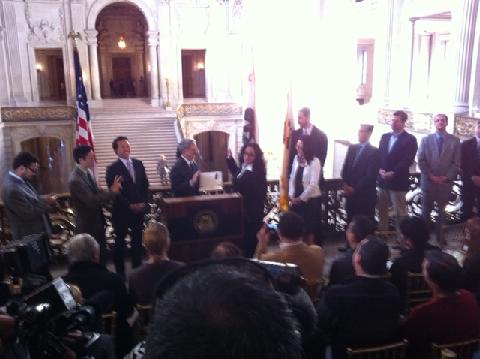
While the usual procession of heterosexual couples beamed as they said their wedding vows on City Hall’s Grand Staircase this morning, a historic celebration took place in the South Light Court: hundreds applauded the announcement that same-sex couples are a big step closer to achieving equality in the basic right to marry.

The Ninth Circuit Court of Appeals held today that Proposition 8, which eliminated same sex marriage rights for couples in California, violates the Equal Protection Clause of the U.S. Constitution.

The court ruled that Prop. 8 served no purpose but to discriminate against one class of people, and the Constitution does not allow for “laws of this sort.”

The ruling specifically addressed the arguments advanced by proponents of Prop 8 that gay marriage would interfere with childrearing and religious freedom in the state.

“All parties agree that Proposition 8 had one effect only. It stripped same-sex couples…of the right to obtain and use the designation ‘marriage’ to describe their relationships. Nothing more, nothing less,” the judges wrote.

The ruling does not mean that marriage licenses will immediately be issued to same sex couples. A stay on the ruling has not been lifted. But the stay could be lifted in as early as 21 days from now. But more probably, it will take months or even years; the case is likely to go to the U.S. Supreme Court.

Chief Deputy City Attorney Terry Stewart – the lead attorney that defended San Francisco’s 2004 decision to issue marriage licenses to same-sex couples, which later triggered the Prop. 8 campaign – said the city is eager to see marriage equality, and that “city mechanisms and machinery stand ready to do whatever we can to expedite the process.”

The decision was based partly on logic that, since LGBTQ Californians already have parental rights and the right to domestic partnerships, denying them the right to marry could not be rationalized. City Attorney Dennis Herrera said that this is a “narrow decision,” meaning that if the Supreme Court upholds the ruling, it would apply only to California.

There remains a possibility that the Supreme Court will reject the case, and in that situation the Ninth Circuit decision striking down Prop. 8 would take immediate affect.

Members of the Bay Area coalition of Welcoming Congregations were present at the announcement.

“I’m jubilant,” said Rev. Roland Stringfellow of the Pacific School of Theology in Berkeley. “When it comes to equality, this is something we preach.”

He adding that his church had been performing same-sex marriages since the 1970s, and that he eagerly awaits legal recognition of his own union with his partner.

Sup. Scott Wiener acknowledged, “the fight is not over yet.”

But he said, “Every so often we get a court ruling that reaffirms our faith in the judicial system…this is a time for us to come together and celebrate.”

California political leaders issued several statements praised the court’s decision.

“The court has rendered a powerful affirmation of the right of same-sex couples to marry. I applaud the wisdom and courage of this decision,” said Gov. Jerry Brown.

Mayor Ed Lee issued a statement saying:
“I celebrate the decision by the Ninth Circuit Court today. This is a great day for marriage equality and a great day for California families. The Court affirmed today that there is nothing in the Constitution that allows discrimination and we are on our way to protecting the fundamental rights of everyone in our State. And, we will continue the fight until everyone is treated equally.  

“San Francisco stands ready to begin marrying same sex couples, and we remain as deeply committed to the fight for marriage equality today as we did nearly eight years ago when then Mayor Gavin Newsom started one of the most important civil rights issues of our generation to ensure equality for all.

“I would also like to acknowledge the tireless work of our City Attorney Dennis Herrera and his team in defense of marriage equality and the California Constitution these last eight years. Together, we will take this fight all the way to the nation’s highest court, if necessary.”

Conflicted Chron buries the lead in city corruption case

67

UPDATE 2/15: READ OUR CURRENT STORY ON THE CASE HERE. The San Francisco Chronicle’s Matier and Ross love to poke snarky fun at progressives such as Matt Gonzalez, as they did again today when they wrote about his work on the Cobra Solutions vs. San Francisco case, for the second time. But they waited until the last paragraph in this second-to-last item in their column to reveal the real news: Mayor Ed Lee was deposed in the case last week and may be called as a witness.

Wow, talk about burying the lead. Here you have a sitting mayor implicated in a major corruption scandal – acting on orders from then-Mayor Willie Brown, who last year helped elevate Lee into Room 200 (and who just happens to write a weekly column for the Chronicle) – in a case that could cost city taxpayers $16 million.

The Chron hasn’t really covered the substance of the case, but Guardian readers may remember our investigative report on it last year. That’s when we unearthed evidence that Ed Lee, who was the city purchaser at the time, approved a fraudulent city contract – overruling city staff in the process – allegedly on orders from Brown.

It’s a complicated case and a long story well worth reading, but essentially it involves a company called Government Computer Sales Inc. (GCSI) that had ties to Brown. It’s accused of improperly getting a multi-million-dollar city contract with Lee’s help and then soliciting kickbacks from its subcontractors, including Cobra Solutions.

Cobra claims it didn’t know payments to GCSI were kickbacks and that it was damaged by the accusations and being frozen out of its city work by the City Attorney’s Office (under Dennis Herrera, who has his own interesting conflicts in the case). Also implicated in the case are SFPUC Director (and then-Controller) Ed Harrington; Monique Zmuda, still a top official in the Controller’s Office; and Steve Kawa, the chief-of-staff for Lee, Brown, and Gavin Newsom, and a powerful player at City Hall.

In a deposition, a city computer operations manager named Deborah Vincent-James testified that she and other city staffers knew GCSI was a fraudulent company, but that they were placed in the Computer Store (a list of qualified city contractors) to do work for the Department of Building Inspection on orders from above: “[Lee] was directed by the Mayor’s Office and told to do an evaluation process. They evaluated them. They were put in the store.”

UPDATE 2/7: Mayor Lee took the witness stand in court yesterday, where he was questioned by attorney Whitney Leigh about overruling staff to certify GCSI, which the City Attorney’s Office has deemed a fraudulent company that has since left town and evaded justice. More on what he said later.

America’s cup: What does Larry get?

8

The development agreement for the America’s Cup comes out next week, although the project is already under way. But there’s some concern that the number of visitors (and thus the revenue to the city) might not be as high as projected.

The project EIR is more conservative about the possible number of visitors than city officials had been at first, and now the Bay Citizen reports that “doubts are growing about the number of spectators who will actually come to the city this year and next.” Apparently the prelims in San Diego have been a bit of a bust — and there aren’t as many teams signing up for the challenge.

So here’s the question: If the city winds up taking in less money than expected, does Larry Ellison take a bath, too?

Of course, it’s not that simple: Ellison’s getting a lot from the city, but it’s not based on any revenue the city will get from the cup; it’s based on the investment he’s putting into the port. He’s getting a sweet deal from San Francisco — way too sweet in my mind. The guy’s the sixth-richest person in the world; he doesn’t need all the goodies the city’s handing over, and I’m not sure I want the arrogant, aggressive CEO of Oracle determining the future of a large part of the San Francisco waterfront. But in theory, since he’s renovating property that’s falling apart, he gets something in return.

And, as Jane Sullivan, the spokesperson for the America’s Cup project at City Hall, points out, the fewer the visitors, the lower the city’s costs.

She also told me that “we don’t think the number of competitors will affect the number of visitors,” which is probably true — people will come for the spectacle, and Oracle will hype it beyond imagination, and nobody knows who any of these other teams are anyway. (The one team that might have gotten some press, aside from Oracle, wasn’t allowed to put in an application.)

But here’s the thing: This entire project, and the motivation to give Larry Ellison a bunch of really valuable city property, was the economic impact the cup is supposed to have on the city. The Mayor’s Office has been throwing around numbers like $1.4 billion in economic impact — that’s new jobs, full hotel rooms, packed restaurants, spillover employment benefits — and, of course, more tax revenue to the city coffers.

What it we give away the store to the Oracle pirates and we wind up getting a lot less money than we were hoping for? Nothing against the Cup; I love boats, and I love a big party (although I try to make sure that when the party’s over, I’m not completely broke). But it seems to me that the city’s the only one taking the risk on the downside. Larry gets everything he wants no matter how this all turns out.

We won’t know all the details until we see the agreement, but am I the only one worried about this?


But doubts are growing about the number of spectators who will actually come to the city this year and next to watch the races of experimental catamarans. Preliminary races held on 45-foot vessels in San Diego and elsewhere are failing to attract expected crowds or sponsors.

Source: The Bay Citizen (http://s.tt/15upW)

After the tear gas clears

3

yael@sfbg.com

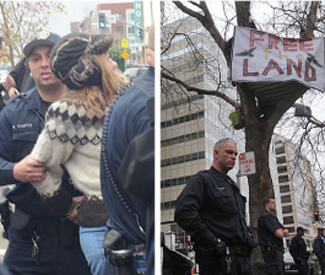
After a chaotic day of marches and confrontations between police and protesters Jan 28, I was arrested along with about 400 others who were trapped by police in front of the downtown Oakland YMCA. Seven of us were journalists.

The goal of the march was to take over an abandoned building — an the vacant Kaiser Convention Center, a city-owned building that’s been closed since 2005, was a prime target.

I have not yet been able to retrieve my property, including my recorder and notebook, which is being held by the Oakland Police Department. What follows is a pieced-together account and a perspective on what the events of Jan. 28.

I spend 20 hours behind bars, and missed the later parts of the action. But I was able to observe what happened in jail and make some sense of what happened.

Occupy people are constantly debating tactics and goals, and for many, the idea of occupying a vacant building made sense. When Occupy Oakland had a camp in Frank Ogawa Plaza, also known as Oscar Grant Plaza, and commonly shortened to OGP, it created a strong community. That community bridged divides between the homeless and the housed, between students and labor organizers, and between Oakland residents of different races, genders and levels of ability in an unprecedented fashion.

The camp had a kitchen that fed hundreds of people everyday and a network of shared tents and blankets which welcomed in hundreds who otherwise would have slept on the streets, often feeling isolated from other residents of their city and made to feel inferior.

The camp was repeatedly raided, Occupiers were tear gassed and shot with rubber bullets, and when OGP was cleared out, the community no longer had a home. And the police started that violence.

That was the practical reason for wanting to occupy a vacant building: to have a social center for Occupy Oakland.

Of course, there are other reasons. There’s the question that many squatters and homeless advocacy groups have been making for decades: why let buildings lie vacant while people freeze on the street?

Remember: The building that Occupy wanted to occupy is public property, and right now nobody is using if for anything.

In one exchange in jail, a guard asked a protester why the activists thought they had the right to take over a vacant building. “I mean, it’s not yours,” he insisted. The protester replied that many vacant buildings are government-owned and therefore public.

“So it’s the government’s,” the cop said.

“But I pay taxes,” the protester responded.

“Me too!” replied the cop. “It’s mine!”

“It’s both of ours,” smiled the protester. “It’s all of ours.”

That’s what made the convention center action such a clear and easy political decision.

A lot of people in Occupy would go further, saying that at a time of a severe housing crisis, it’s perfectly legitimate to take over privately owned buildings that are sitting there vacant. It’s part of the central argument of Occupy — that corporations and the rich unfairly own and continue to acquire much more wealth than the majority of people. For many people, owning a vacant building and doing nothing with it, while hundreds freeze on the streets, is a crime itself.


UP AGAINST THE COPS

Then there’s the question of the police — and violence.

The word “nonviolent” has a specific meaning in the history of political movements. Martin Luther King Jr. defined it in his essay “The Meaning of Non-Violence”: “If you are hit you must not hit back; you must rise to the heights of being able to accept blows without retaliating … But it also means that you are constantly moving to the point where you refuse to hate your enemy. You are constantly moving to the point where you love your enemy.”

It’s a philosophy but also, in political terms, a tactic.

Many of the people who make up Occupy Oakland get their start as activists organizing against police brutality in a city that has longstanding problems with violent and undisciplined officers.

Police Chief Howard Jordan said in a press release that “It became clear that the objective of this crowd was not to peacefully assemble and march, but to seek opportunity to further criminal acts, confront police, and repeatedly attempt to illegally occupy buildings.”

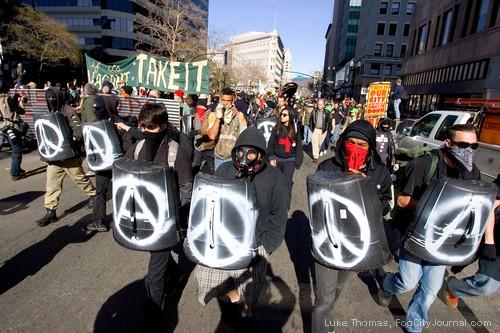
It was certainly clear that the intent of the crowd was to illegally occupy a building. And any honest assessment of Occupy Oakland would have to acknowledge that some members are not wedded to King-style nonviolent civil disobedience. (Neither, by the way, were a lot of the protest movements of the 1960s.) Many protesters wore masks and bandanas to disguise their identities and protect them from tear gas and pepper spray, and the march was led by protesters with makeshift shields, which suggests that they expected to be attacked. You could certainly argue that what those people were doing wasn’t confrontation; it was self-defense.

Frankly, it made sense to be prepared: In other Occupy Oakland actions, police have attacked with batons, tear gas, pepper spray, flash-bang grenades, and smoke bombs. And for quite a few Oakland residents, the police have always been seen as an outside force that can’t be trusted.

In fact, violence did break out. Many, including myself, have eyes still stinging from tear gas. I saw several wounds caused by rubber bullets shot at protesters. I spoke individually to at least a dozen people — one of them a pregnant woman — who were struck with police batons.

And protesters did not remain peaceful while this violence was being used against them.

Some picked up tear gas canisters and threw them back towards police; that much I saw. I also saw protesters throw empty plastic bottles at police.

According to the police, they also threw metal pipes, rocks and bricks. According to the protesters, they threw mainly empty plastic bottles and fruit at police. But as protesters often say of the police, “They’re the ones who showed up with the guns.” If the cops didn’t want violence, why unleash such an arsenal of weapons?

People got hurt, protesters and police alike. Several bystanders who had nothing to do with the situation were swept up in the mass arrest.

The city of Oakland, already in dire financial straits, likely spent hundreds of thousands of dollars reacting to the protests. Police claim that they were unable to sufficiently respond to violent crimes over the weekend, including five murders, because they were overwhelmed with Occupy troublemakers.

Of course, city officials were the ones who decided to arrest 400 people — with all the expense that involves.

There are, at this point, no reports of serious injuries to any police officers. However, at least a dozen protesters had welts on their faces or bodies from being beaten by clubs or shot with rubber bullets. One woman was shot in both arms with rubber bullet; one man was shot in the face with rubber bullets while holding a video camera to document the events. Several protesters were shoved to the ground and received wounds on their faces while being arrested. Police raised their rubber-bullet rifles to the faces of protesters throughout the day, threatening attacks. A rubber bullet to the face can cause brain damage and blindness.


DID IT HAVE TO HAPPEN?

How could this have been prevented?

Police say that “while peaceful forms of expression and free speech rights will be facilitated, acts of violence, trespassing, property destruction and overnight lodging will not be tolerated.” But 40 people were arrested during an ongoing Occupy Oakland vigil in the first weeks of January for having “illegal property” at OGP in what many saw as clearly a peaceful expression of First Amendment rights.

On KGO radio Jan. 29, Chief Jordan said that he has allowed Occupy Oakland to protest without a permit and would continue to do so, but those early January raids were ostensibly due to permit violations — violations of the terms of a permit that Occupy Oakland did in fact have.

There’s no question: The police response to Occupy Oakland over the past few months has caused some people in the movement to get more radical.

Many Occupy Oakland-affiliated medics condemned those who threw objects at police, saying that they provoked a backlash that caused more injuries. Many Oakland residents who might be in line with the socio-economic critique presented by the Occupy movement feel endangered and confused by marches that result in the massive use of police weapons in broad daylight. A lot of people would rather protest in a lot of ways that less resemble urban warfare.

On the other hand, there are also ways that Oakland officials could have prevented the consequences of weapons deployed and 400 arrested Jan. 28. They could, for example, have allowed protesters to occupy the vacant building.

When protesters seized a building Jan. 20 in San Francisco, police first attempted to prevent them. They lined up in front of the targeted building. They deployed pepper spray and struck several protesters with batons. When they were unsuccessful, and protesters entered the building from the back, they opted to block the surrounding streets and wait until the time seemed right to enter the situation and make arrests. Police spokesperson Carlos Manfredi told me that the cops were not going to rush into the situation and were trying to prevent injury and violence.

The Kaiser Convention Center has been vacant for years. The city of Oakland recently made plans to sell it to its Redevelopment Agency, but that plan fell into legal limbo when Gov. Jerry Brown signed AB26, a bill that dissolved all California redevelopment agencies.

At this point, nobody at Oakland City Hall has any plans whatsoever for the big, empty structure.

Why not allow Occupy to use the convention center? It’s not downtown, where Mayor Quan says businesses have been adversely affected by Occupy Oakland’s presence. It would give the movement a chance to stop focusing on trying to occupy spaces and start focusing on benefiting the community with food, shelter, and community programs that they provided when they had a camp. It would give the building tenants who could be held responsible for maintaining it. It might even help get Occupy Oakland and the Oakland Police Department out of the cycle of violence that they have been spiraling into for months.

Each time arrests occur, each time violence occurs, both sides blame the other. Both sides are correct that they were provoked. Both sides are correct that something that they think is worth defending was violated — for the cops, it’s the law. For the protesters, it’s the right of the people to assemble.

In fact, many Oakland residents have experienced violence at the hands of the Oakland Police Department for years before Occupy began. There was already a mass movement formed around the murder of Oscar Grant, and thousands of people fed up with police murders of unarmed, often black, suspects.

In recent decades, other radical groups, notably the Black Panthers, insisted that their community lacked basic needs because the city of Oakland refused to prioritize them. The Black Panther free breakfast program served food in a strikingly similar way to Occupy Oakland. Black Panthers were also notorious for carrying guns to defend themselves against police violence.

Occupy Oakland protesters (unlike Tea Party members) certainly don’t carry guns. But, more and more, they cry “fuck the pigs” as much as any Panther.

For much of the Occupy movement’s 99 percent, unjust actions by banks, corporations, and the government officials that they have often bought and paid for are the worst problems facing the United States today. For others, particularly the poor and people of color, these problems are magnified and exacerbated by the fact that they feel the threat of police harassment every day. For years, they’ve understood that police disproportionately do not investigate or solve crimes that happen to them and their families.


THE RADICALS AND THE BROADER MOVEMENT

The Oakland General Assembly Jan. 29 was the biggest it’s been in weeks. While there were still over 300 people in jail, 300 more came out to get involved with the meeting. That happened at the same time that many who felt that inexcusable violence and property destruction occurred Jan. 28 and concluded they could no longer have anything to do with Occupy Oakland.

It’s a challenge for the movement nationally, too: How do you accept and encourage the people whose legitimate anger at economic injustice and police abuse turns them toward more radical responses — and at the same time make room for a people who want nothing to do with the black bloc Fs, vandalism, and confrontation with the police?

There are tactical issues with the way the building occupation was planned. Many who were completely in line with the concept felt unsafe and uncomfortable with the secretive nature of the organizers who planned it. The location of the building targeted for occupation was kept secret for practical reasons; police could easily prevent a successful takeover. Supporters must often be led to the locations of planned takeovers without knowing where the action is and how they’ll get there. But how do you reconcile this with the transparency required when organizers are leading more than 1,000 people who want to use tactics they feel comfortable with and make their own choices?

Occupy Oakland is asking the people to imagine a world where property rights wouldn’t prevent them from doing all the good that they could do with a building like the Kaiser Convention Center. They must also ask themselves to imagine a world in which goals like a building occupation can be achieved in a way that everyone involved is able to consent to their involvement.

These debates continue to occur at Occupy Oakland. Some will leave the movement, some will join. Some will take the ideas and try to manifest them in new and different ways. Participants in Occupy Oakland desperately want basic needs of food and shelter met for their community members, and for the system that governs the city to do so in a way that allows people to thrive when it comes to health, education, and opportunities for creativity and growth. They think that they have the beginnings of a community and a process that can achieve those visions, better than the city government ever has, and they care more about achieving it than respecting the property rights of the owners of abandoned buildings.


Editor’s notes

13

tredmond@sfbg.com

I used to go to Grateful Dead shows at the Oakland Auditorium, which is now called the Kaiser Convention Center. One night I saw Bill Graham, the late concert promoter, ride a zip line from up near the ceiling to the stage in a giant paper mache joint called the “S.S. Columbian,” which looked like it was going to fall apart at any minute as he swung back and forth 50 feet over the crowd, trying to smile and wave in a bizarre promotional stunt that confused even the deadheads. I bet he shit his pants.

The place was a pretty good venue for a big concert, but it never worked out as a convention center, and the city shut it down in 2005. It needs seismic work and about $5 million in maintenance. It sits near Lake Merritt, on the edge of downtown Oakland, a giant empty building just waiting for something to happen to it.

It’s a perfect spot for an Occupy Oakland headquarters. I’m surprised it took the Occupy folks this long to figure it out.

Look: Oakland’s a working-class city, and it’s having severe financial problems, and sending hundreds of cops to arrest Occupy protesters is sucking up money that’s desperately needed for other things. Mayor Jean Quan complains that police were unable to respond to emergency calls in other parts of the city because they were all downtown dealing with the demonstration.

Understood — and it’s clear that the Oakland Police, whether the Occupy folks like it or not, are going to arrive in mass numbers to make sure that there’s no damage to local businesses or City Hall (where, oddly, there were no arrests, because the cops were elsewhere).

But the empty Kaiser Center, which isn’t even in the downtown center? Why bother?

Seriously: Why not just give it to Occupy Oakland? Tell the group that the city will strictly enforce fire and health codes, that the Occupy people will have to clean the place up and keep it clean, that they can’t damage the place … and hand over the keys?

It’s public property. Nobody using it now. Occupy might actually bring some excitement to the scene. If it became a center for political meetings and organizing, for education and performances, it could be a be a very positive thing.

Declare at truce in the Occupy wars. Let the cops go after murderers; give Occupy the vacant convention center. Nothing else is working. It’s worth a try.

Inside the Occupy Oakland protest

57

UPDATE: We’ve corrected a few factual mistakes. We originally reported that protesters forced open the door of the YMCA; in fact, they asked to be let in and they were. We regret the error.

An Occupy Oakland march that turned violent Jan. 28 led to the arrest of 400 people, including me.

The march, which peaked at about 2,000 protesters, was organized with the intention of entering a vacant building — the Kaiser Convention Center — and turning it into a new “Social Center” that participants in Occupy Oakland hoped to use to gather, teach, and organize.

The move was more than symbolic. Occupy activists have engaged in constant debate about tactics and goals, particularly when it comes to violence and property destruction, and it’s hard to argue at this point that Occupy Oakland is a nonviolent movement.

But many thought that the goal of occupying a vacant building made sense. When Occupy Oakland had a camp in Frank Ogawa Plaza, also known as Oscar Grant Plaza, commonly described as OGP, it created a strong community. It’s a community that bridged divides between the homeless and the housed, between students and labor organizers, and between Oakland residents of different races, genders and levels of ability in an unprecedented fashion.

Besides that, the camp had a kitchen that fed hundreds of people everyday. The camp had a network of shared tents and blankets that welcomed in hundreds who would have slept freezing on the streets, often feeling isolated from other residents of their city and made to feel inferior. Now, they had a place to stay that was warmer, more safe and secure, and was embedded in a community bound together by ties of solidarity.

That community was able to thrive in it’s centralized camp location.

That was the practical reason for wanting to occupy a vacant building: to have a social center for Occupy Oakland.

Of course, there are other reasons. There’s the question that many squatters and homeless advocacy groups have been making for decades: why let buildings lie vacant while people freeze on the street?

The march set off from OGP at 1 p.m. Jan. 28. There was no ambiguity about group’s goal: Many pushed carts stacked with furniture, hoping to furnish the new center; others held a large banner reading “Vacant? Take it!” 

Many other Occupy groups around the world, including protesters in Washington DC, London, England, and Belfast, Ireland, have taken over vacant buildings in an attempt to create social centers, house homeless community members and protest injustice symbolized by buildings lying vacant while people live on the street.

In Oakland, the attempts were staved off when riot police lined up in front of the march and declared unlawful assemblies.

In front of the  Convention Center, police threw smoke bombs into the crowd and warned that those who refused to disperse would be arrested. The march continued around the corner to 12th St and Oak, where protesters and police were involved in another confrontation. Police shot smoke bombs and “pepper bombs,” canisters of pepper spray that explode on impact, into the crowd. Some in the march responded by throwing canisters, along with plastic bottles, back at police. Masked protesters in the front of the group brandished makeshift shields. Protesters say the shields were there to protect them from rubber bullets and bean bag rounds.

The cops had a different perspective. “It became clear that the objective of this crowd was not to peacefully assemble and march, but to seek opportunity to further criminal acts, confront police, and repeatedly attempt to illegally occupy buildings,” said Oakland Police Chief Howard Jordan in a press release.

In a tense moment, hundreds knelt to hide behind the frontline shields while police fired rubber bullets into the crowd.
When police began to advance at both the front and back end of the group, protesters retreated, marching on 12th St back to Ogawa/Grant Plaza.

As they marched on 12th street, Occupy Oakland-affiliated street medics treated injuries from tear gas, pepper spray, and rubber bullets. Police followed in the rear of the march, continuing to project exploding flash-bang grenades at the crowd.

At about 5:30, another march left from the plaza, again with the stated attention of occupying a building. Police marched behind protesters. When the march cut through Fox Square in Oakland’s Uptown neighborhood, police filled in all surrounding sides of the march. Protesters have used the term “kettling” to describe a situation in which police line up on all sides of a group, blocking anyone in the group from leaving.
After “kettling” hundreds of protesters at this location, police began to deploy tear gas. Some protesters with makeshift plastic and metal shields, many marked with the “circle-A” anarchy symbol, advanced towards police. Several police beat the shield back with batons and struck some protesters.

One 19-year-old woman who was struck with a baton to the kidneys was brought to the hospital and treated for internal bleeding.
At Fox Square, police announced that the gathering was an unlawful assembly. Minutes later, some protesters knocked over a line of chain-link fencing, allowing the march to exit the “kettle.” The march continued on Telegraph.

When the march arrived at Broadway between 22nd and 23rd streets, protesters asked to be let into the YMCA and someone who was in there opened the doors. Police later closed in on both sides until they had formed a line preventing the approximately 400 protesters from exiting.

On Broadway, there was no dispersal order issued. This is in violation of the Oakland Police Department’s crowd control policy, which states that “If after a crowd disperses pursuant to a declaration of unlawful assembly and subsequently participants assemble at a different geographic location where the participants are engaged in non-violent and lawful First Amendment activity, such an assembly cannot be dispersed unless it has been determined that it is an unlawful assembly and the required official declaration has been adequately given.”

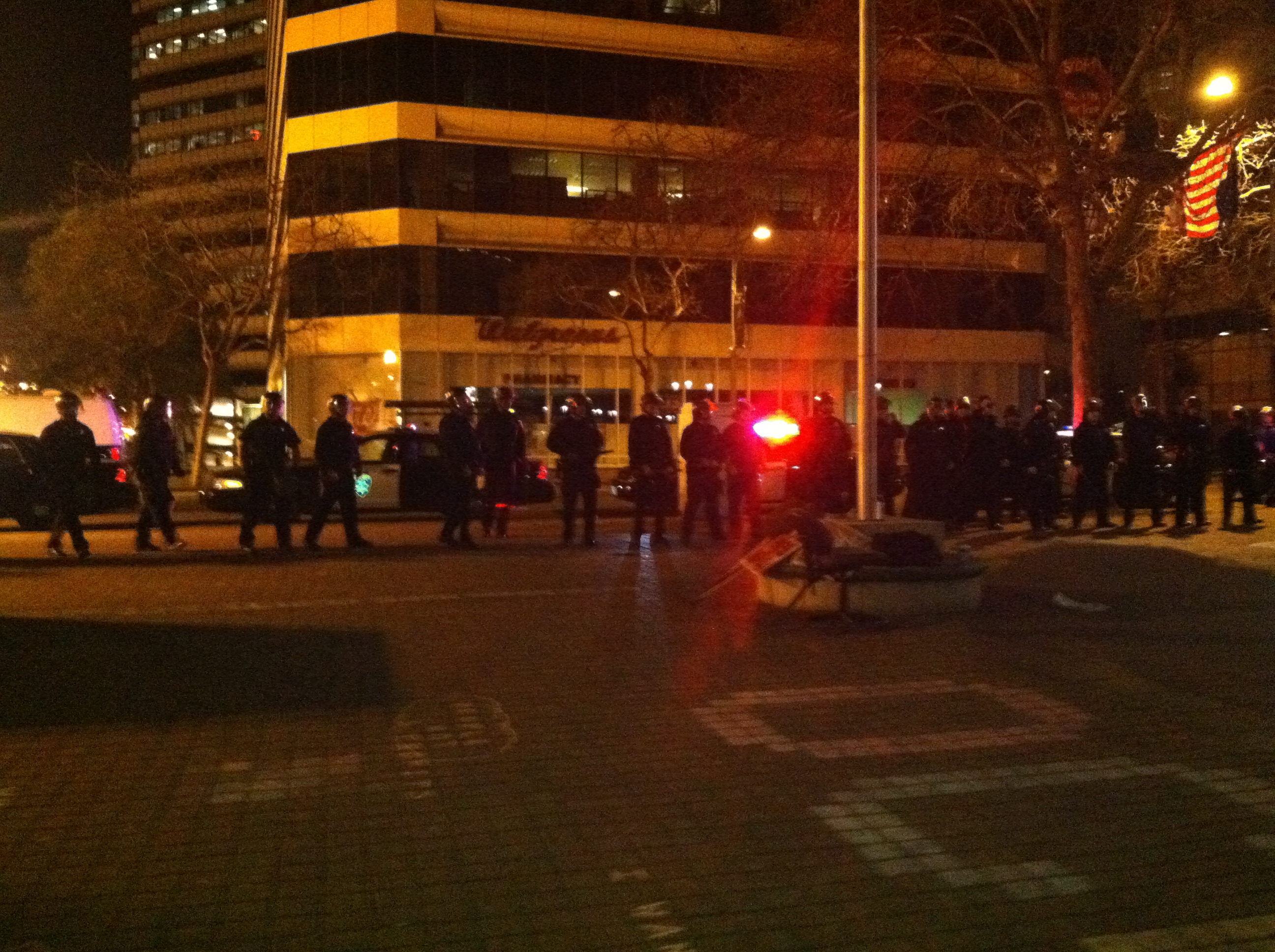
About 6:30 p.m., police announced that all of the blocked-in group was under arrest.

It was more than six hours before the sidewalk was cleared of all detainees. Most are charged with failure to disperse. Some, such as those who entered the YMCA, have been charged with burglary.

Dozens of protesters who had avoided arrest marched back to City Hall. There, they illegally entered the building and committed several acts of vandalism. According to a press release, these included “breaking an interior window to a Hearing Room, tipping over and seriously damaging the historic model of City Hall, destroying a case containing a model of Frank Ogawa Plaza, and breaking into the fire sprinkler and elevator automation closet.” Protesters also report setting off fireworks in the counsel chambers.

Some protesters took an American flag from City Hall and burned it in front of the government building.

Oakland officials have complained about the cost of the protests. The city had reportedly spent $2.4 million policing Occupy Oakland protesters as of November 15, just weeks after announcing the decision to close down five elementary schools to save $2 million.
Occupy activists say the huge — expensive — police presence is an overreaction.

“The amount of property damage by protesters has been minimal next to Mayor Quan’s destruction of the humanitarian Occupy Oakland community and excessive force against peaceful people, said Wendy Kenin, an Occupy Oakland spokesperson. “The City of Oakland’s commitment to militarism far outweighs its investment in schools. 

Kenin said she was back at Occupy Oakland outside City Hall, with her four children, the day after the incidents.
There were no arrests made in the City Hall incident, partly because so many police resources were deployed at the YMCA.

Cities and counties that provided police reenforcements to handle the mass arrests include Alameda County, San Mateo County, Santa Clara County, San Francisco County and Marin County and the cities of Fremont, Hayward, Berkeley, Pleasanton, San Francisco and Union City/Newark; and the University of California-Berkeley, according to an Oakland Police Department press release. 

Dozens of those detained were brought to Glenn Dyer jail, which quickly filled up; the rest were brought to Santa Rita jail in Dublin.
Several members of the press, as well as passers-by who were on their way to work in the area, were swept up in the arrests.

In jail, those detained debated tactics involved in the day’s demonstrations and discussed the future of Occupy Oakland.

The number of injured protesters is unknown, but in the 19-person sampling of arrestees with whom I spent 20 hours, two had bruises from baton strikes, one suffered from an injured foot after a pepper-bomb exploded upon impact with her ankle, and most had irritation in their eyes, ears, and throat from exposure to tear gas and pepper spray.

Oakland police report that three officers were injured.

As of the morning of Jan. 30, about 100 remained in Santa Rita.

Mayor Lee’s call for more hearings gets wary reception

41

Labor and the Left came out strongly against Mayor Ed Lee’s proposed charter amendment to require all city legislation be delayed and subjected to hearings by the Small Business Commission and other commissions if it might cost private sector jobs, putting its prospects of making the ballot in doubt.

 “This legislation is one, unnecessary; two, unbalanced; and three, divisive,” Mike Casey, president of the San Francisco Labor Council – whose executive committee voted unanimously to oppose the legislation – said during today’s Rules Committee hearing on the measure.

He and other labor leaders noted that members of the business community have plenty of opportunities to weigh in on legislation it opposes, but Lee’s proposal would elevate employers’ interests far above those concerning the environment, consumers, public health, or workers. “This legislation gives one stakeholder undue power in the democratic process, which is undemocratic,” said Kate Hegé of La Raza Centro Legal, which represents day laborers and other immigrants.

Teacher Ken Tray of United Educators of San Francisco said, “Often times ‘jobs’ is used as a red herring to divert the city from doing what it needs to do.” It was a common theme, as opponents of the proposal noted that paid sick leave, the local minimum wage, and requiring employee health benefits were all fiercely opposed by the business community. “Anything that raises workers up, we’re told it’s a job killer,” said Larry Bradshaw of SEIU Local 1021.

Small business representatives – a bit sheepishly, given the tenor of the hearing, and without support from their downtown brethren – said they were simply looking for the ability to express their concerns. “We’ve tried to let small business have a voice at the Board of Supervisors,” said longtime small business advocate Scott Hauge, a regular at City Hall.
Keith Goldstein of Potrero Dogpatch Merchants Association said, “We feel we don’t have a say in this process.”

Mayor’s Office board liaison Jason Elliott emphasized that Lee’s charter amendment would create a delay and an extra hearing or two, but that supervisors would still be free to approve the legislation anyway. “This is about public participation and feedback,” Elliott said.

But Sup. David Campos, who led the questioning of Elliott, wasn’t buying it. “What’s the reason behind this? Is there a specific reason the Mayor’s Office has decided to do this now and through a charter amendment?” Campos said, probing for instances in which the Mayor’s Office thought the business community hadn’t been heard.

Elliott continued to say it was about emphasizing jobs and taking more public input, but he couldn’t explain what’s lacking currently or what’s muting employers. Campos thanked the Mayor’s Office for being willing to work with supervisors and accept amendments – including many introduced today, which delayed the vote on the measure until next week.
But Campos questioned the need for the legislation, comparing it to the hollow jobs rhetoric from the current field of Republican presidential candidates. “It’s not just the number of jobs you have, it’s the quality of those jobs,” Campos said.

(Side note: the Mayor’s Office issued a press release today celebrating the first two businesses to take advantage of last year’s controversial mid-Market payroll tax exemption, Zendesk and Pearl’s Deluxe Burgers, which created 56 jobs between them. And to help create those great burger joint jobs, Pearl’s got Redevelopment Agency assistance, a low-interest city loan, and an exemption from the payroll tax. For hiring burger flippers that probably make minimum wage. But I digress…)

Campos said that everyone in City Hall wants to see more good jobs in the city, “but I don’t believe this is a constructive approach.” Sup. Jane Kim echoed the sentiment, saying private sector job creation isn’t the only imperative. “Lowering our minimum wage to $3 or $1 an hour would create plenty of jobs in San Francisco,” she said.

Even the more conservative third committee member, Sup. Mark Farrell, said he tends to agree with his committee colleagues and made the motion to continue the item until next week, when its prospects for passage look weak unless Lee can convince them that there’s more to this measure than just political grandstanding.

Why the public thinks government is fat

10

Polls from the PPIC are typically pretty accurate, so I have no reason to doubt the results of a recent one showing that a majority of Californnians still think government can be cut substantially without a reduction in services. It’s hard to fathom; as Brian at Calitics notes,


Cuts to government expenditures mean direct cuts to services. There is simply no way to provide the same level of services for an ever decreasing amount of money. Go take a look at your local government offices and then compare it to the offices of your local bank corporate office.  There are no fancy waterfalls and lavish breakrooms offering wide selections of Odwalla and Rice Krispies, there are just a dwindling level of state employees working ever harder to keep up.  


So, while most voters strongly support raising taxes on the rich, 59 percent also think that government can easily be cut just by eliminating waste. Even Arnold Schwarzenegger, who took office pledging the same thing, left saying there wasn’t much waste left to cut. And while I fully believe that any organization that spends $80 billion a year is going to have some things in the budget that don’t belong — it’s simply humanly impossible to run anything, public or private, that big without some employee sleeping in the supply room or somebody sneaking cookies on the company dime — it’s also the case that what’s missing in the California budget is more important than what’s being mis-spent.


Why don’t people get this? Part of the reason is a 30-year concerted campaign by the right wing to convince people that the public sector is a waste of money. But part of the reason is also that the news media, by its very nature, is much more likely to report on waste in government than similar (or worse) waste in the private sector.


For one thing, it’s easy: Government records are public. Figuring out how Enron, which kept its records private, stole $40 billion from the state of California is really, really hard. There’s also the (correct) notion that the government is spending OUR money, so we ought to watch where it goes.


And of course, corrupt politicians like Willie Brown give everyone in government a bad name, and there are plenty of them.


But remember: The government typically spends a lot of our money on private contracts with companies that don’t make their records public. How many employees of the contractors building the Central Subway are sleeping on the job, double-billing, charging fancy lunches and wasting the public’s dollars? That takes a lot more digging — weeks of investigative reporting — and it’s not the sort of stuff that can just pop up in a Matier and Ross column, the way a city worker who pulls in a lot of overtime can (and does).


I think there’s also a general lack of interest in exposing corporate wrongdoing. PG&E’s records are public, and all the money the company spends is OUR money (we’re ratepayers, and we have no choice). But how much do you see about overpaid PG&E executives compared to how much you see about (far less) overpaid city employees? PG&E has hundreds of executives making far more than the most bloated City Hall salaries, and they all have nice pensions — but you never hear about PG&E needing pension reform, or how the utility needs to tighten its belt to keep rates low in a recession.


When you’re bombarded day after day with stories about a deputy sheriff or a nurse who works a huge amount of overtime and takes home $150,000 a year, you can’t help but think that the public sector’s wasting your money. But the private sector does a lot worse.


And sure, under capitalism, a wasteful private company should pay the price in the marketplace — but we all know that a lot of the big private companies don’t really compete much (see: the financial sector), and when it comes to regulated utilities like PG&E, they don’t compete at all. You think ATM fees and checking account fees and all the other shit that banks hit us with isn’t in part a result of waste, fraud and bloated payrolls? Isn’t that my money, too?


Occupy is back — with horns and glitter

8

yael@sfbg.com

On Jan. 20, hundreds of activists converged on the Financial District in a day that showed a reinvigorated and energized Occupy movement.

The day of action was deemed “Occupy Wall Street West.” Despite pouring rain, the numbers swelled to 1,200 by early evening.

Critics have said that the Occupy movement is disorganized and lacks a clear message. Some have decried its supposed lack of unity. Others have even declared it dead.

But the broad coalition of community organizations that came together to send a message focused on the abuses of housing rights by corporations and the 1 percent sent a clear message:

The movement is very much alive.


A FULL SCHEDULE

Protesters packed the day with an impressive line-up of marches, pickets, flash mobs, blockades, and everything in between.

The action began at 6:30 a.m., when dozens chained and locked themselves together, blocking every entrance to Wells Fargo’s West Coast headquarters at 420 Montgomery Street. The bank didn’t open for business that morning.

Another group of protesters did the same thing at the Bank of America Building around the corner. A dozen blockaded one of the bank’s entrances from 8:30 a.m. to 6 p.m., preventing its opening. A group organized by Act Now to Stop War and End Racism (ANSWER) closed down the Bank of America branch at Powell and Market for several hours.

The Bank of America branch at Market and Main was also closed when activists turned it into “the Food Bank of America.” Several chained themselves for the door, while others set up a table serving donated food to hundreds of people.

Meanwhile, activists with the SF Housing Rights Coalition and Tenants Union occupied the offices of Fortress Investments, a hedge fund that has overseen the destruction of thousands of rent controlled apartments at Parkmerced. Direct actions also took place at the offices of Bechtel, Goldman Sachs, and Citicorp.

Hundreds picketed the Grand Hyatt at Union Square in solidarity with UNITE HERE Local 2 hotel workers.

A group of about 600 left from Justin Herman Plaza at noon and marched to offices of Fannie Mae, Wells Fargo, and the Immigration and Customs Enforcement Agency (ICE) in a protest meant to draw attention to housing and immigrant-rights issues.

“It’s not just a corporate problem. The government has been complicit in these abuses as well,” said Diana Masaca, one of the protest’s organizers.

More than 100 activists from People Organized to Win Employment Rights (POWER) and the Progressive Workers Alliance “occupied Muni,” riding Muni buses on Market Street with signs and chants demanding free transit for youth in San Francisco.

Another 200 participated in an “Occupy the Courts” action at the Ninth Circuit Court of Appeals, in protest of the Citizens United Supreme Court decision and corporate personhood.


GLITTER AND BRASS

Exhausted, soaked protesters managed to keep a festive spirit throughout the day, with colorful costumes, loud music, and glitter — lots of glitter.

The Horizontal Alliance of Very Organized Queers (HAVOQ) and Pride at Work brought the sparkly stuff, along with streamers and brightly colored umbrellas, to several different actions. Many painted protest slogans onto their umbrellas, proclaiming such sentiments as “I’ll show you trickle down” and “Not gay as in happy, queer as in fuck capitalism.”

According to protester Beja Alisheva, “HAVOQ is about bringing fabulosity to the movement with glitter, queerness, and pride. All day we’ve been showing solidarity between a lot of different types of oppression.”

There was also the Occupy Oakland party bus — a decked-out former AC transit bus — and carnival, a roving party that shut down intersections and bank entrances in its path while providing passengers a temporary respite from rain.

The Brass Liberation Orchestra, a radical marching band that has been energizing Bay Area protests for a decade, showed up in full force with trumpets, drums, trombones, and a weathered sousaphone.

The Interfaith Allies of Occupy also used horns to declare their message. About 30 participated in a mobile service, sounding traditional rams’ horns and declaring the need to “lift up human need and bring down corporate greed.”

Said Rabbi David J. Cooper of Kehela Community Synagogue in Oakland: “Leviticus 19 says, do not stand idly by in the face of your neighbor’s suffering. Well, we’re all neighbors here. Ninety-nine percent of us are suffering in some way, economically or spiritually. And maybe that number is 100 percent.”


FOCUS ON HOUSING

A coalition called Occupy SF Housing called for and organized the day of action, but the messages ranged from environmental to anti-war to immigrant rights.

Many groups did focus in on housing-related issues — and a takeover of a vacant hotel building stressed the urgency and need to house homeless San Francisco residents.

Housing protests included an anti wage-theft occupation led by the Filipino Community Center and the National Alliance for Filipino Concerns at the offices of CitiApartments, an action at the offices of Fortress Investments to demand a halt to predatory equity, and an “Occupy the Auction” demonstration in which protesters with Occupy Bernal stopped the day’s housing auction (at which foreclosed homes are sold) at City Hall.

“A lot of the displacement in this city is happening because of banks and because of things that are out of peoples’ control,” said Amitai Heller, a counselor with the San Francisco Tenants Union. “People will live in a rent controlled apartment for 20 years thinking that they have their retirement planned. A lot of the critiques of the movement are, if you couldn’t afford it you should move. But these people moved here knowing they could afford it because of our rent controls.”


LIBERATE THE COMMONS

Most of the early protests drew a few hundred people. But when the 5 p.m. convergence time rolled around, many people got off work and joined the march. A rally at Justin Herman Plaza brought about 600; by the time the march joined up with others at Bank of America on Montgomery and California, the numbers had doubled.

The evening’s demonstration, deemed “liberate the commons,” was also more radical than other tactics throughout the day; organizers hoped to break into and hold a vacant building, the 600-unit former Cathedral Hill Hotel at 1101 Van Ness.

When protesters arrived at the site, police were waiting for them. Wearing riot gear and reinforced by barricades, the cops successfully blocked the Geary entrance to the former hotel.

The darkness, rain, and uncertainty created a chaotic environment as protesters decided how to proceed. Some attempted to remove barricades; others chanted anti-police slogans.

Soon, cries of “Medic! We need a medic!” pierced the air. A dozen or so protesters had been pepper sprayed.

Police Information Officer Carlos Manfredi later claimed that the pepper spray was in response to “rocks, bottles and bricks” thrown by protesters. He also claimed that one officer was struck in the chest by a brick, and another “may have broken his hand.”

But I witnessed the entire incident, and I can say that no rocks, bottles or bricks were thrown at police.

When protesters opted to march down Van Ness, apparently towards City hall, several broke windows at a Bentley dealership at 999 Van Ness.

The march then turned around and headed back up Franklin, ending at the former hotel’s back entrance. There, it became clear that some protesters had successfully entered the building; they unfurled a banner from the roof reading “liberate the commons.”

Soon, many other protesters streamed into the building. They held it, with no police interference, for several hours.

Around 9:30, police entered the building and arrested three protesters for trespassing. About 15 others remained in the building, but left voluntarily by midnight.

This building has been a target of protest campaigns in San Francisco since it was purchased by California Pacific Medical Center, which closed the hotel in 2009. There are plans underway for a hospital to open at the site in 2015.

The project has been met with opposition from unions such as SEIU United Healthcare Workers West and UNITE HERE Local 2. The California Nurses Association (CNA) has also come out against the hospital proposal. In fact, it was the target of a CNA protest earlier in the day Jan. 20, when protesters created a “human billboard” reading “CPMC for the 1 percent.”

At a Jan.18 press conference, CNA member Pilar Schiavo said that at the former Cathedral Hill Hotel site, “A huge hospital is being planned with is being likened by Sutter to a five-star hotel. At the same time, Sutter is gutting St. Lukes Hospital, which is essential to providing healthcare for residents in the Mission, the Excelsior and Bayview- Hunter’s Point.”

Homes Not Jails, a group that finds housing for the homeless, often without regard to property rights, was crucial to planning the “Liberate the Commons’ protest. The group insists that the 30,000 vacant housing units in San Francisco should be used to shelter the city’s homeless, which they estimate at 10,000.


RAINY REBIRTH

Wet and cold conditions were not what Occupy SF Housing Coalition organizers had in mind they spent weeks planning Occupy Wall Street West, which was billed as the reemergence of the Occupy Movement in San Francisco for 2012.

Yet for many, the day was still a success.

“The rain’s a downer. But I think it speaks to the power of the movement, the fact that all these people are still out getting soaked,” said Heller on Jan. 20.

Perhaps hundreds of “fair-whether activists” did forgo the day’s events to stay out of the cold. If that’s the case, then occupy protesters with big plans for the spring should be pleased.

At this rate, it seems that Occupy will survive the winter- and emerge with renewed energy in 2012.


This article has been to corrected. We originally reported that a demonstration at the offices of Citi Apartments was led by the Chinese Progressive Association (CPA). In fact, it was led by the Filipino Community Center and the National Alliance for Filipino Concerns, and supported by a number of organizations including the Progressive Workers Alliance, of which CPA is a member organization. We regret the error.

Too much in the son

1

arts@sfbg.com

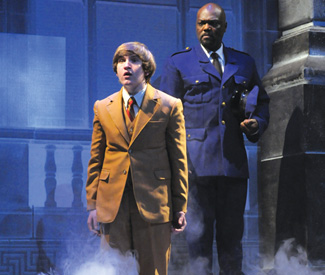
THEATER The Berkeley Rep’s thrust stage sinks to floor-level down front where a simply furnished living room freely communicates with the audience seated nearby, while to the back rises the imposing façade of San Francisco City Hall. The impressive jumble of a set (by Todd Rosenthal) ensures the jarring conflation of private and public life strikes us palpably before a single line is uttered in Ghost Light. As it happens, the first words are those famous ones spoken by Dianne Feinstein from City Hall on November 27, 1978, announcing the assassination of Mayor George Moscone and Supervisor Harvey Milk by former supervisor Dan White. They come over the television to a 14-year-old boy (Tyler James Myers) home sick from school the day his father died.

The dream play that follows is not realistic, but it is also more than fiction. A unique collaboration between Bay Area–based director and California Shakespeare Theater artistic director Jon Moscone (real-life youngest son of the slain mayor) and Berkeley Rep’s Tony Taccone, Ghost Light is an at times promising but otherwise laden attempt to explore the stifled grief of a man haunted by the death of a murdered father — a father who was also a public figure, a political leader whose legacy is in some sense embattled (or at least seriously overshadowed by the subsequent apotheosis of Harvey Milk).

The complex feelings this entails for the son of such a man — whose career in the state senate and as mayor was arguably more important than Milk’s to the legal and social battle for gay rights — are only heightened by the fact that the son is also gay, with a public profile of his own and the mixed blessing of a prominent family name.

If the son in this situation-turned-scenario sounds a little like Hamlet, the comparison was not lost on Taccone either, who penned the script while drawing on hours of freewheeling conversations with Jon Moscone, initiator of the project and the play’s director. (Ghost Light had its world premiere last year in Ashland at the Oregon Shakespeare Festival, where it was commissioned as part of its “American Revolutions: The United States History Cycle.”) Director-turned-playwright Taccone has the character “Jon” (played with manic energy and sudden introspection by a sympathetic Christopher Liam Moore) stuck midway through the preparations for a production of Hamlet, unable to decide what to do with the Ghost — indeed, haunted by the whole idea. This unusual block has his best friend and collaborator Louise (a lively if slightly affected Robynn Rodriguez) frustrated and worried.

Jon’s block also feeds a dream life populated by several characters — a Loverboy (Danforth Comins) spun from an online flirtation; his perennially 14-year-old self (Myers) locked in a battle of wills with some cosmic undertaker cum grief councilor named Mister (a sure, larger-than-life Peter Macon); the silent image of his black-veiled widow mother (Sarita Ocón); and a menacing prison guard in a soiled shirt (a sharp Bill Geisslinger), who turns out to be the grandfather he never knew.

It’s suggested more than once in the dialogue that all of these characters stalking his sleep (and often arriving onstage through the portal of Jon’s bed, pitch atop the shiny black granite steps of City Hall) are merely the dreamer himself in various disguises and aspects. This much, of course, we are already primed to assume. In fact, the fundamental problem facing the main character — namely, his inability to properly let go of his own grief and suffering around the death of his father, which appears here as an inability to let his own father’s “perturbed spirit” rest at last — is equally a condition readily recognizable to a modern audience in a therapeutic age. It may be grounds to build on in terms of character development, but the lack of mystery here also undercuts any suspense in the plot, as the increasingly blurred line between Jon’s dreaming and waking lives points toward nervous collapse and the threat of some self-inflicted disaster (personified by the foul-mouthed, homophobic, and gun-toting prison guard stalking his unconscious).

Taccone makes a valiant attempt to draw together a complicated and wrenchingly personal yet all-too-public story with a set of interrelated subplots and quick-moving dialogue (filled with as much quippy humor and menace as pathos). But the results are uneven. Although Geisslinger makes a serviceable villain, the danger he represents never feels palpable. Likewise, the underworld subplot involving boyhood Jon (played a little too typically “boyishly” by Myers to be readily believed) comes across as vague and treacly.

Perhaps unsurprisingly, it is the more realistic, down-to-earth scenes that play best and are most evocative. The intricacy of a life divided painfully between public and private personas, public and private pain and loyalties too, comes across best when the character of Jon is operating in the “real” world. To this end, Moscone the director shrewdly brings the audience in at key points as well, raising the houselights for an acting master class led by his onstage character. Meta-theater, town hall meeting, group therapy — the lines begin to blur here in a lively, resonant discussion of “acting” as social action.

Another interesting scene takes place in a bar, where Jon finally meets Basil (Ted Deasy), the man with whom he’s been having an online fling for weeks (and the inspiration for the Loverboy of his increasingly intrusive dream world). The awkwardness, defensiveness, and barely contained rage revealed here — as Jon discovers that Basil’s own fantasy projection incorporates his public familial tragedy — speak more eloquently to the messy particulars of the main character’s dilemma then perhaps any other scene in the play.

In the end, the thematic aptness of the mise-en-scène — which forces Jon, for instance, to open the front doors of City Hall just to retrieve a beer from the fridge — speaks also to the monumental task this play has set itself. If the results prove very mixed, they are all the more discomfiting because the root story is so fascinating, the dramatic project itself audacious and strange, and the insight to be potentially gleaned so tantalizing — speaking to our collective intersections with history in the deepest recesses of the psyche.


GHOST LIGHT

Through Feb. 19

Tues., Thurs.-Sat., 8 p.m. (also Sat. and Feb. 16, 2 p.m.); Wed. and Sun., 7 p.m. (also Sun., 2 p.m.), $14.50-$73

Berkeley Repertory Theatre, Thrust Stage, 2025 Addison, Berk.

(510) 647-2949

www.berkeleyrep.org

Supervisors make the Chamber of Commerce happy

7

You want a sense of what’s happened to politics at City Hall? Here you go: the San Francisco Chamber of Commerce is thrilled.


The Chamber just released its 2011 voting scorecard on the Board of Supervisors (which it calls the “Paychecks and Pink Slips Scorecard,” as if most of the stuff the Chamber supports had anything to do with actual job creation), and guess what? The board is more pro-downtown than it has been in a while:


The 2011 year-end scorecard reveals marked improvement in city’s efforts to create jobs and grow the economy. Overall, the Board of Supervisors received a score of 82 percent (equivalent to a B – grade), up from 60 percent (or a D – grade) in 2010. Individual rankings also improved, with five supervisors increasing their scores by at least 15 percent since last year. In 2011, a solid majority of supervisors voted in favor of jobs, the economy and government efficiency more than 75 percent of the time.


The top performer: Sup. Scott Wiener, who voted with the Chamber 88 percent of the time. Second best: Supervisor David Chiu (82%). The worst (or best, depending how you see downtown’s agenda of low taxes, reduced public services and minimual regulations) was Sup. John Avalos, who scored 56%.


The reality is that some of the Chamber’s key votes were relatively noncontroversial things that everone on the board supported — for example, a law sponsored by Sups. Ross Mirkarimi, Eric Mar, David Campos and Wiener making it easier for small cafes and restaurants to host live music and a measure restricting restaurant waste, both of which passed unanimously. There were some votes where nearly everyone opposed the Chamber — the cell phone disclosure requirements and the ban on yellow pages. And on a couple of them, even Chamber darlings Sean Elsbernd and Mark Farrell were on the wrong side — they voted against a tax exclusion for stock options because they wanted even greater tax reductions.


But on the key votes, you can see where the majority of the board lies: Six, sometimes seven votes with downtown, five, sometimes four with the rest of us. Not exactly a progressive majority. 

Staying on track

0

steve@sfbg.com

After weeks of attacks from critics of the high-speed rail system now being built in California — a campaign that even came home to San Francisco City Hall last week, when Sup. Sean Elsbernd challenged Mayor Ed Lee on the issue and called for a hearing — Gov. Jerry Brown and other supporters have stepped up efforts to keep the train from being derailed.

With seed money from a $10 billion bond measure that California voters approved in 2008 and an initial federal grant of $3.3 billion to help build the Central Valley section of the track, the California High Speed Rail Authority is working on construction of a bullet train that would carry riders from San Francisco to downtown Los Angeles in about 2.5 hours, traveling at speeds of up to 220 mph. That project is slated to cost nearly $100 billion, and the next phase would extend service to Sacramento and San Diego.

But Republicans in Congress and the California Legislature began to balk at funding the project last year. Earlier this month, a report by the California High-Speed Peer Review Group recommended that the Legislature indefinitely delay issuing $2.7 billion in rail bonds, citing the uncertainty of future funding sources and problems with the project’s business plan.

“It does not take a rocket scientist to see the future of high-speed rail is in serious doubt,” Elsbernd said at the Jan. 10 Board of Supervisors meeting, where he used the monthly mayoral question time to ask Lee, “What is Plan B with Transbay Terminal if the high-speed rail money does indeed go away? What do we do?”

The Transbay Terminal is now being rebuilt downtown. The first phase includes a $400 million “train box” being built with high-speed rail funds, and the next phase will require billions of dollars more to build train tunnels into the station from the current Caltrain terminus at 4th and King streets.

“I’m committed to seeing the full implementation of high speed rail, which includes having a northern terminus at the Transbay center,” Lee replied, refusing to entertain the idea that the bullet trains won’t be coming into San Francisco, a stand he communicated to state officials in a recent letter. “I want to state my unwavering support for the notion of high-speed rail. It is the future of transportation in this state.”

Lee acknowledged that cost estimates for the project have gone up and there are uncertainties over future funding, but he said the state will need to make the investment either way. “California is growing and those people need to move up and down the state. The question is do we make transportation investments on bigger, wider highways and airport runways? I’d say no, that this perpetuates a car-dependent culture.”

Instead, Lee says the state must find a way to build high-speed rail, whatever the obstacles. But Elsbernd called for a hearing on the issue before the Board of Supervisors, telling the Guardian that he supports the project, “but high-speed rail is in trouble and we need to acknowledge that.”

Meanwhile Gov. Brown — who has rejected calls to delay issuing the rail bonds — was working behind-the-scenes to get the project back on track. Sources say he asked for CHSRA Executive Director Roelof van Ark and CHSRA Board Chair Tom Umberg to resign, which they did at the Jan. 12 meeting, with Brown appointee Dan Richard becoming the new chair.

Richard and fellow new Brown appointee Mike Rossi spearheaded the creation of a proposed new business plan for the project that was unveiled in November. While it addresses some of the criticisms of the project, it raises fresh concerns about whether the bullet trains will arrive in Transbay Terminal.

In fact, it calls for high-speed rail service to end in San Jose, where S.F.-bound riders would have to transfer to Caltrain, largely to placate citizens and politicians on the peninsula who have objected to trains rocketing through their communities and filed lawsuits challenging the project.

“That business plan is unrealistic and unreasonable,” said Quentin Kopp, the former state senator from San Francisco who authored of the original legislation to create high-speed rail and has helped shepherd the project. He said having to transfer twice from S.F. to L.A. would discourage riders and hurt the project.

Kopp isn’t a fan of the Transbay Terminal rebuild, which he derides as “a real estate project” because its funding plan relies on significant private residential and commercial development; he’s called for the trains to stop at the current Caltrain station for financial reasons. But Elsbernd — who also chairs the Peninsula Corridor Joint Powers Authority, which operates Caltrain — wants to ensure the Transbay project is completed and worth the investment.

“I’m terrified that we continue moving along and then we end up with that being just a big, beautiful bus terminal,” he told us.

Adam Alberti, a spokesperson for the TJPA, said California needs to have improved rail service to handle a growing population and the Transbay Terminal is being build to accommodate that, whether it be Amtrak, Caltrain, or high-speed rail trains coming into the station.

“We are steadfast in our belief that it makes sense to have high-speed rail in California,” he said. “When it does happen, we will have the infrastructure already in place to receive it.”

Furthermore, he expects that the CHSRA business plan, which is the subject of a public comment period that ends Jan. 17, will extend the service beyond San Jose. “They’ll lose significant ridership and revenues if they don’t bring it into San Francisco,” Alberti said.

Sen. Mark Leno, who chairs the Senate Budget Committee, also expressed confidence that current efforts to derail high-speed rail won’t be successful.

“What is the alternative if we don’t do this? California will grow by 10-20 million people in the next decade. There’s no way we could build enough freeways and airport expansions to handle that,” Leno told us. “I don’t think we have the option not to make this work.” Leno also said he was pleased to see top political leaders stepping up to defend the project: “I’m impressed by the governor’s steadfastness, as well as President Obama’s stand. Leadership from the top is important, particularly during difficult times like this.”

Dick Meister: Walter Johnson did what needed to be done

4

BY Dick Meister

Dick Meister, former labor editor of the SF Chronicle and KQED-TV, has covered labor and politics for more than a half-century, Contact him through his website, www.dickmeister.com, which includes more than 350 of his columns,

Walter Johnson was everything a labor leader should be – a dedicated, unflinching, champion of working people and their unions. But more than that, Walter was also an unyielding advocate of all those  inside and outside the labor movement who wanted – and badly needed – a decent living , or who were in any way oppressed.

Johnson, who died in San Francisco of a heart attack on Jan. 12 at age 87, devoted his life to that noble – yes, noble – task as head of the Department Store and Retail Clerks unions in San Francisco. He also later headed the SF Labor Council for nearly 20 years, from 1985 until his retirement in 2004.

 Walter was a genuine humanitarian, a kind, thoughtful man who very much liked and sincerely wanted to help people, who freely acknowledged the contributions of others who joined him in his efforts for social, political and economic justice, who seemed always ready and eager to do what needed to be done.

He was a man of great good humor, an outgoing man who seemed to get along with just about everybody, even some of his toughest adversaries. I know, I know. That surely does sound like pure hyperbole. But, believe me, it’s not, as many others who knew Walter Johnson could tell you.

Listen to Art Pulaski, who heads the California State AFL-CIO. He declared that Johnson “was a big and fearless advocate for everyone and anyone who was wronged, mistreated, put down, left out, pushed aside or just down on their luck.  He was fearless because he always followed his faith, his values and his heart.”

Despite the seriousness of his undertakings and his militancy, Johnson was no grim advocate. Whatever the situation, there was always lots of good-natured teasing, and jibes to be traded with friends. And jokes, always jokes – always! Corny, make-you-groan jokes usually, but effective at lessening the tensions that invariably came with the struggles he helped lead.

One look at Johnson’s face made clear his Scandinavian background, a mixture of Norwegian and Swedish. But you wouldn’t necessarily recognize him as a labor leader. He didn’t fit the stereotype. He almost invariably dressed in coat and tie and otherwise looked more like the public image of a business leader, more like management than labor.

Many union leaders spend most of their time in their offices, but Walter was out on the picket lines, or marching or otherwise demonstrating in support of the demands of his union and others, as well as those of other organizations also demanding justice. He was arrested several times for joining in sit-ins and other demonstrations that the authorities wanted to halt. And Johnson kept that up, despite his retirement.

I met Walter thanks to my job as the Chronicle’s labor editor. That was in the early 1960s, a few years after he had arrived in San Francisco from his native North Dakota to work as a Sears appliance salesman.

Dave Selvin, the labor historian and former public information officer for the Labor Council, had told me I should be sure to check out “a young guy” who’d just been elected president of the Department Store Employees. Walter Johnson, of course.

Selvin predicted good things for Johnson, and he was right.

Under Johnson’s leadership, San Francisco store clerks, department store employees and others won labor contacts at least as rewarding as the contracts as those who held similar jobs elsewhere.

Johnson was a key leader in winning strong, virtually unprecedented support for labor from City Hall and the Board of Supervisors – especially from Mayor Joseph Alioto.

Union representatives were appointed to many city commissions, major job creating construction projects were approved, and Alioto stepped in to mediate settlements of major strikes. Picketing strikers could be pretty certain police wouldn’t interfere. New businesses unfriendly to labor found it difficult to get the necessary city permits. Thanks to Johnson and other leaders, labor had gained considerable political clout to go with its considerable economic clout.

Johnson didn’t fear clashing with the AFL-CIO and its other affiliated unions as long as he felt he was right. He was one of the few labor leaders to speak out against the Vietnam War, which was wholeheartedly supported by the AFL-CIO’s national leadership and most of its affiliates.

Johnson was a leader in the growing global union movement that aims to create a powerful international labor federation that would bring the world’s unions close together to deal with “global capitalism” and thus improve the often deplorable conditions of many workers in many countries.

Closer to home, Johnson was one of the first labor leaders to give unconditional support to the LGBT movement. He was an important supporter of proposals to create a gay organization within the labor movement, despite the homophobic nature of most unions at that time. Johnson played a key role in the founding of the LGBT group that became Pride at Work in 2004.

Nancy Wohlforth, the current president of Pride at Work and now an AFL-CIO Executive Council member, had approached Johnson with the idea of such a group in 1979 and was shocked when he readily agreed it was a great idea. Wohlforth was so thankful for his help she dubbed him “an honorary lesbian.”

“Walter was thrilled,” Wohlforth said.

She later was the new business manager of a San Francisco secretarial union that was on strike against a union group that employed its members. Wohlforth noted that Johnson could very easily have avoided being involved, but “he dove right in.”

“He walked the picket line on rainy days and led a toy drive for the strikers during the Christmas holiday. He was, as always, so concerned that workers would know that they were supported at that difficult time.

“Working people’s struggles were always on his mind. I’m sure he dreamed of them every night – and he constantly was coming up with ways to make people’s lives better. He truly was my hero and he will be missed so much by all who were fortunate enough to know him.”

Amen to that.

Dick Meister, former labor editor of the SF Chronicle and KQED-TV, has covered labor and politics for more than a half-century, Contact him through his website, www.dickmeister.com, which includes more than 350 of his columns,

Sheriff Mirkarimi charged with domestic violence

338

Sheriff Ross Mirkarimi has been charged with three misdemeanors in connection with an alleged domestic violence incident against his wife, Eliana Lopez, on New Year’s Eve, District Attorney George Gascón announced this afternoon. Gascón said a restraining order has been issued that bars Mirkarimi from contacting his wife and child and that bail has been set at $35,000, although he was unaware whether Mirkarimi had been booked yet.

Mirkarimi is being charged with one misdemeanor each of domestic violence battery, child endangerment, and dissuading a witness from testifying. Gascón said their young son, Theo, was present during the incident. Lopez has refused to speak with investigators, but she has publicly denied that her husband has ever abused her.

Mirkarimi has maintained his innocence, as he did again with Lopez by his side during a City Hall press conference held simultaneously with Gascón’s press conference at the Hall of Justice. “We believe that these charges are very unfounded and we will fight those charges. I’m confident in the end that we will succeed,” Mirkarimi said, according to the San Francisco Chronicle. It was unclear whether the appearance with Lopez violated the restraining order.

Gascón confirmed press reports that Lopez had communicated via text message about the incident with the neighbor who ultimately contacted police – although he refused to disclose or characterize the contents of the communications – and that there was a photo taken of an injury to Lopez’s arm. He also said there are indications that this was not an isolated incident and the investigation is continuing. “We have heard there have been other instances,” Gascón said.

The fact that the charges were misdemeanors wouldn’t require Mirkarimi’s removal from the office he assumed just last weekend if he’s convicted, but he has already been required to relinquish any weapons, including his service revolver. He faces a year in jail and three years probation on the charges.

“While we do not relish having to bring charges against a San Francisco elected official, I have taken an oath to uphold the laws of the state of California and as the chief law enforcement officer for the city and county of San Francisco it is my solemn duty to bring criminal charges when the evidence supports such action. No one is above the law,” Gascón said. “Whether this was the elected Sheriff or any other San Francisco resident, this type of behavior is inexcusable, criminal, and will be prosecuted.”

Gascón also said that while Lopez has refused to cooperate, he believes there is ample evidence to bring charges. “A case is always stronger if the victim is willing to testify. However, it is very common for victims to be uncooperative in domestic violence cases,” Gascón said, noting that his office filed 771 domestic violence cases last year. He also said, “Regardless of whether the victim supports a prosecution, it is the state’s and my office’s obligation to ensure the safety of the victim.”

Residents slam proposal for more parking meters

65

Nothing makes people more angry than when the city tries to take away their free street parking. The San Francisco Municipal Transportation Agency was reminded of that fact at a City Hall hearing this morning when residents and business owners unleashed a storm of angry criticism over a proposal to install new parking meters in Potrero Hill, Dogpatch, Mission Bay, and parts of the Mission District.

The plans for this pilot program, which were released on Dec. 20, are intended to address the increased demand for parking in the “Mission Bay Parkshed” from development now underway in the area, as well as concerns about increased demand for street spaces once the parking lot at Folsom and 17th Street is converted into a park.

As with previous SFMTA proposals for extended parking meter hours – which were also met with angry criticism – the idea is to encourage increased use of transit and to free up more street parking space for business customers by discouraging local residents from taking up street parking spots for extended periods of time.

But even people who support that idea in concept say that the SFMTA plans are badly designed and don’t take into account the conditions on the ground, largely because they say planners did an abysmal job of outreach and gathering community input before creating the plans.

“I’m urging a cooling off period,” said Tony Kelly, president of the Potrero Boosters Neighborhood Association. He wants to see more active parking management of that neighborhood, but said planners need to better consult local residents. “We’ve earned that right in our neighborhood and you have not earned our trust.”

And that was among the more mild criticisms at this sometimes raucous hearing, where there were standing room only crowds in the main hearing room and an overflow room showing the hearing on television. Officials were accused of hostility to working families, incompetence, arrogance, and with trying to drive businesses out of town.

“Are you insane?” asked one commenter, while another asked, “How do you look at yourself in the mirror?” Several business owners said they would leave the city in the plans were implemented, and one said half of his employees were driven to tears over the proposals. “I don’t hear anyone asking for meters,” said one commenter. “I don’t hear anyone saying this is good.”

But there are those who say the city shouldn’t be expected to supply free parking to residents who choose to own cars, particularly given the SFMTA’s tight budget situation and the role that drivers searching for limited street parking spaces play in increasing traffic congestion in the city, thus slowing down Muni.

“On behalf of Livable City (and as a Mission District resident), I want to express our support for the expansion of SFpark meters into the Mission Bay, 12th and Folsom, and 17th and Folsom neighborhoods,” Livable City Executive Director Tom Radulovich wrote in a recent letter to the SFMTA. “Each of these areas is seeing intensified activity – new residents, new businesses, and new restaurants, bars, and entertainment venues – and each is badly in need of intelligent parking management. The expansion of metered spaces will provide the parking turnover that neighborhood-serving businesses need. SFpark metering and pricing will also reduce cruising for parking in these neighborhoods.”

But the opinions expressed at the hearing were almost uniformly critical, saying the plans actually call for meters on streets that are mostly residential and that they need more work. We’ll have more detailed analysis of the proposals and related issues in upcoming issues of the Guardian.

Obstructions of justice

4

The uneasy relationship between OccupyOakland and the Oakland Police Department has resulted in a troubling spate of controversial arrests recently.

At a press conference last month, Police Chief Howard Jordan stated, “The plaza area outside of City Hall is a public area. We do not have any legal right to remove you if you’re standing there, at any time during the day, if you’re exercising you’re First Amendment rights. If you’re not breaking the laws, we’re not concerned about your presence.”

But now, Oakland police have arrested dozens of people who were doing little more than “standing there, exercising their First Amendment rights” — and one man even faces life in prison for it.

There have been 40 arrests in the last couple weeks, including two incidents at Frank Ogawa/Oscar Grant Plaza. In each episode, police say they were just doing their job, enforcing laws surrounding permit violations. But many supporters and lawyers associated with OccupyOakland say that police have created a targeted and discriminatory campaign to wipe out the movement.


VIGIL TURNS VIOLENT

About 100 protesters were present at a permitted vigil on Dec. 30. An OccupyOakland participant had been issued a permit for a teepee and one table, but police showed up at noon to explain that they were in violation of that permit, claiming people were sleeping, eating, bringing in trash cans, and storing belongings in the teepee

Protesters say they were cleaning up the plaza when police started making arrests; police say they refused to comply. But both parties say that the scene turned violent.

“Who instigates the violence? I don’t know,” Matt Perry, a movement supporter, told us. “A cop tells you to back up and you don’t back up, he’s gonna use his baton on you.”

But many of the arrests and citations had nothing to do with assault. Carly says she was arrested for “having a yoga mat under her arm.” She was later charged with obstruction of justice. In an even more puzzling case, 23-year-old Tiffany Tran was arrested and charged with “lynching.”

“The taking by means of a riot of any person from the lawful custody of any peace officer is a lynching,” reads California Penal Code 405a, a felony charge punishable by two to four years in prison.

The law attempts to prevent white mobs from forcibly taking African Americans from police custody to kill them, but police have a history of using it against protesters, stating that anyone trying to stop an arrest is guilty of lynching.

Tran says she was held in a pitch-dark police van for seven hours before she was booked at Santa Rita Jail, where she was held in 22-hour daily lockdown due to overcrowding. She was held for four days without being told why.

On the fourth day, she was finally arraigned, but prosecutors opted not to file charges and she was released. But Tran said the tactic left her uneasy because prosecutors said charges could still be filed until the statute of limitations expires in a year. As she told us, “Now I feel I can’t go out and express myself as I should be able to.”


ON THE GROUND

When I arrived at 10pm on Jan. 4 to investigate the situation at the vigil, the scene was calm. About 40 people sat and talked, a few worked on computers.

“Some of the people here were arrested mainly for contempt of cop, or being against the government. And then charges of lynching or obstruction of justice were brought after the fact to substantiate an unlawful arrest, to allow the wheels of so-called justice to turn a few more times,” Svend La Rose, an ordained minister and member of OccupyOakland’s tactical action committee, said of the Dec. 30 arrests.

Suddenly, the cry of “riot police!” rang out.

Police cars had pulled up on 14th street, and a line of police exited. In unison, they started advancing, brandishing batons. Many who were at the scene grabbed their possessions and fled. Most just backed away as the cops advanced. A handful stood in front of the teepee, and were arrested on the spot.

Twelve were arrested, including La Rose. Also arrested was Adam Katz, a photographer from the media committee who was documenting events. Katz said that police told him to back up, and when he complied and backed up “probably 50-60 feet,” he was still arrested.

“I took one picture and I was told to back up,” he said. “I repeatedly asked ‘Back up to where?’ as an army of police pushed me out of the plaza. They said, ‘Back up behind the line.’ I kept saying, ‘What line? I don’t see a line.'”

Then there’s Chris, another occupier arrested Jan. 4. According to Katz and other witnesses, Chris had already left the plaza and gone across the street when he was arrested for somehow delaying the police who were trying to clear the plaza.


DISCRETION

On Jan. 7, OccupyOakland held an “anti-repression march,” claiming that recent arrests are an overt attempt to repress the movement. The National Lawyers Guild issued a statement demanding an end to the “ongoing violence, harassment, and unconstitutional arrests of Occupy Oakland protesters.”

“There is evidence that would go to show that they were targeting people based on First Amendment activity, and not for illegal activity,” said attorney Mike Flynn, president of the NLG-SF. “Police charged into the plaza and grabbed whoever they could, and also targeted selective people who withdrew and didn’t even linger there.”

But OPD spokesperson Johnna Watson told us these arrests were perfectly legal. “The law allows us to use our discretion,” she said.

A person’s history with the movement is factored into this discretion. Many of those Perry deems “regulars” are, according to the police, “repeat offenders.” As Watson said, “There may be knowledge of a past history, like a repeat offender. If an officer has knowledge that a crime is occurring, has occurred, or is about to occur, we have the right to issue a citation or arrest. If we have someone constantly continuing to break the law, we may not issue a citation.”

In other words, involvement with this political movement can get people arrested who might otherwise not be.

“That police have escalated their attacks on people is pretty disturbing. It looks like they really think they can drive this movement out of Oakland with violence and repression,” said Dan Siegel, a former legal advisor to Mayor Jean Quan who resigned over her handling of OccupyOakland.

Siegel is now representing Marcel Johnson, aka Khali, one of the several protesters arrested Dec. 30, who faces life in prison. A homeless man who became an OccupyOakland regular, Khali was arrested when he tried to hold on to his blanket, which police wanted to throw away, saying that it was unpermitted property.

While in jail, he was charged with felony assault on a police officer, his third strike. A protester called Black Angel who knows Khali said he was transformed by the movement. “He came here and found a family,” he said. “He was like, I’m going to protect this. It gave me some sense of myself.”

But now, Siegel said, “He faces life in prison because of his status of being poor, homeless, and with mental health issues.”

Juries may decide whether OccupyOakland defendants are guilty, but Siegel said the arrests aren’t just: “You still have to ask yourself, why are the police doing this when we have 100 unsolved murders in Oakland?”

BREAKING: Lee appointing Olague to D5 seat

20

Sources say Mayor Ed Lee will appoint Christina Olague, the Planning Commission president and longtime progressive, to the District 5 seat on the Board of Supervisors that was vacated by Sheriff Ross Mirkarimi. Formal announcement set for 10 am. More after the ceremony.

UPDATE 11:30 AM: Lee announced his decision and administered the oath of office to Olague this morning at City Hall before a large crowd of mostly progressive political activists who said they were pleasantly surprised to see one of their own get the nod, taking it as a positive gesture from a moderate mayor who has pledged to work with all sides.

In their remarks, both Lee and Olague talked about the need to get past political labels and stressed her detailed knowledge of planning and land use issues, which they hope will help with Lee’s main focus on job creation.

“This is not about counting votes, it’s about what’s best for San Francisco and her district,” Lee said. Olague echoed the sentiment: “I think this is an incredible time for our city and a time when we are coming together and moving past old political pigeonholes.”

She pledged to get right to work on pressing issues facing the city and with winning the “respect and trust” of voters in District 5, one of the city’s most progressive.

We’ll have more analysis and reaction to this appointment and Lee’s inaugural address yesterday in this week’s Guardian.