City Hall

Hearing could work out flaws in Lee’s housing trust fund proposal

2

Mayor Ed Lee’s proposed Housing Trust Fund charter amendment — which he proposed during his inaugural address in January — will be up for review before the Board of Supervisors Rules Committee tomorrow (Wed/11) in the hopes of making its way onto the November ballot. The meeting is at 1:30pm in City Hall Room 263.

The measure, which would guarantee money for affordable housing for the next 30 years, was drafted primarily by the Council of Community Housing Organization (CCHO) and the Mayor’s Office, but included input from housing developers, the San Francisco Planning and Urban Research Association (SPUR), and some supervisors.

Supporters intend the housing trust fund to provide a consistent stream of funding that guarantees $1.2 billion over a 30-year period for affordable housing. Each year the fund would take in between $20 million and $50 million. In addition to building new housing, it would create a $15 million homebuyers assistance program, doubling the current funds, and a $15 million home stabilization fund to help homeowners facing foreclosure. But Lee hasn’t convinced his business community allies to adequately fund the measure and there are doubts about its revenue projections.

Sup. John Avalos is cosponsoring the measure and helped draft some content, but he isn’t ready to vote for it yet. He is concerned with some of the big concessions the measure grants to market-rate developers, which could end up actually hurting existing affordable housing programs.

“I am watching closely,” Avalos said, “to make sure we don’t give too much away.”

Here are the three concessions: 1) High-rise residential developers would be allowed to pay inclusionary housing fees for affordable housing after construction instead up upfront. 2) Low to mid-rise developers would have the percentage of onsite affordable housing unit requirements lowered from 15 percent to 12 percent. 3) Developers of small five-to-nine-unit buildings would no longer have the inclusionary housing fee or the onsite affordable housing requirement.

The housing trust gets its funding by trying recapture the disbanded Redevelopment Agency’s bond repayments and hotel tax funds, but Fernando Marti of CCHO doesn’t believe that would capture nearly as much as Lee hopes. Marti estimates that the money would eventually lead to $13 million a year, which is a far cry from the previous $50 million needed.

Marti said the rest of the funding he hopes will come from the two competing business tax reform measures developed by Lee and Avalos, although Avalos has make clear that the $40 million his measure would raise is intended for the General Fund to maintain city services that have been cut in recent years. Lee’s measure would generate $13 million that he would earmark for the housing trust fund.

Marti said if the housing trust is approved by voters but the business tax reform fails, Lee has inserted language into the measure that would allow him to unilaterally abolish the housing trust fund. Marti said the CCHO doesn’t want the money for the housing trust to come out of the cash-strapped general fund.

Avalos is skeptical of Lee’s approach, telling us, “That doesn’t sound like anything I’d vote for.”

Dick Meister: “We want bread and roses, too”

0

By Dick Meister

Dick Meister, former labor editor of the SF Chronicle and KQED-TV Newsroom, has covered labor and politics for more than a half-century. Contact him through his website, www.dickmeister.com, which includes more than 350 of his columns.

 “Our lives shall not be sweated from birth until life closes;

Hearts starve as well as bodies, give us bread, but give us roses!”

–From a poem by James Oppenheim

Bread and roses. It was the battle cry of the thousands of striking women and their supporters who marched through the streets of Lawrence, Massachusetts, in 1912, in the heart of the textile industry. Although it’s been 100 years since they marched, their militancy and bravery remain among the brightest highlights in the long history of the American labor movement.

The three-months long strike in Lawrence, led by the Industrial Workers of the World (IWW) pitted the 25,000 workers – half of them women under 20, many as young as 14 – against the violently anti-labor textile mill owners, who were strongly backed by the press, politicians , school officials, and clergy.

Striking was difficult for the workers, who had only their poverty-level wages to live on. They had barely enough to pay the rent for the run-down, disease-ridden shacks and tenement flats where most of them lived. Many were constantly in debt, having to borrow money to meet their bare necessities. Health care and other fringe benefits were virtually unheard of, and more than one-third of the workers died in their mid-twenties.

Working conditions were brutal. They commonly worked 12 hours a day in the hot, dusty and dangerous textile mills for but $6 to $8 a week. The workers had neither the leisure time nor the means to improve the quality of their lives, no time or money to enjoy the good things of life – the roses.

They desperately needed the help that unionization could provide them, but that could come only through a strike that would impose even more hardships on the already extremely hard-hit workers.  They hesitated about actually walking off the job, but finally were convinced that striking would bring long-term benefits to them, their families and their communities.

The mill workers moved into action after employers unilaterally cut their already rock-bottom pay even more.  They marched to the mills and throughout Lawrence to the tune of militant labor songs by IWW bard Joe Hill and others, holding high  placards that declared ,”We Want Bread and Roses too,” a demand that soon would be taken up by labor and feminist groups nationwide.

It wasn’t easy, bringing the workers together. They belonged to two-dozen different national groups, speaking 72 languages. They had been purposely kept apart by employers, who kept them in ghettoes by setting up separate housing areas for different nationalities, lest they forget their ethnic differences and join together to challenge their miserable pay and unhealthy conditions.

Employers got their friends in City Hall to enact an ordinance preventing strikers from picketing individual mills, but strikers responded by the extraordinary act of forming a picket line around the perimeters of the entire textile mill district. Thousands of pickets were on the line 24 hours a day throughout the 10-week-long strike.

Some spent part of their evenings hoping to disturb the sleep of strikebreakers who employers had hired to replace them, loudly serenading them with IWW songs.

Thousands paraded through the streets of Lawrence regularly, until the city enacted an ordinance forbidding parades and mass meetings. They switched to sidewalk parades of up to four-dozen strikers and supporters, who locked arms, blocking shoppers and others from entering downtown businesses.

Eventually, martial law was declared, enforced by violent police and militiamen, who charged in to try to break up the marches and other demonstrations. They even tried to block strikers from putting their children on trains that would take them to safety with sympathizers in other cities.  The city called in the Army to block the trains from moving, which led to the killing of a woman striker and the beating of many others, including several children and two pregnant women who had miscarriages.

Then the authorities arrested two of the IWW’s principal leaders for murder, on grounds that their illegal acts had provoked police into the action that led them to kill a striker.

The widespread publicity about the strike finally helped pressure employers to settle. The terms were modest, primarily granting the workers union recognition, a 15 percent pay increase and a 54-hour workweek with overtime pay at double the regular rate.  But the mere recognition of the workers’ right to make and be granted any demands was crucial.  It inspired many other workers, especially women, to also assert their basic rights and brought strong support nationally for many workers who sought decent treatment.

What’s more, many textile mill owners, fearing they also might be struck, granted pay raises totaling almost $15 million to an estimated 438,000 workers throughout New England and elsewhere.

A much longer and lasting result was that the strike put the needs of working women on labor’s agenda for the first time and showed that women could very well provide decisive leadership and indeed win bread – and roses.

Dick Meister, former labor editor of the SF Chronicle and KQED-TV Newsroom, has covered labor and politics for more than a half-century. Contact him through his website, www.dickmeister.com, which includes more than 350 of his columns.


Davis launches D5 campaign with fortuitous timing

14

When progressive activist Julian Davis formally launched his District 5 supervisorial campaign late last week with a well-attended kickoff party at the Peacock Lounge in Lower Haight, timing and circumstances seemed to be on his side.

Days earlier, Quintin Mecke – a rival for the progressive vote in this staunchly leftist district – announced to supporters that he needed to care for his ailing mother and wouldn’t be running after all. At the same time, appointed incumbent Christina Olague seemed to be rapidly falling from favor with many progressives.

First came the viral video of Olague gushing over all the support she’s received from Chinatown power broker Rose Pak during a fundraiser where she raised nearly $50,000, then her squirrely role in helping the moderates repeal ranked-choice voting, and finally the bizarre episode of clashing with a close progressive ally and friend to defend Mayor Ed Lee from perjury allegations.

Davis has sought to capitalize on the rapidly unfolding developments, today sending out a press release blasting Olague for having “joined the conservatives on the Board of Supervisors to repeal ranked choice voting for mayoral elections,” and telling the Guardian that Mecke’s exit will help clarify the choice D5 voters face.

“The fact that he’s out allows us to consolidate the progressive base,” Davis said, not mentioning that candidates John Rizzo and Thea Shelby will also be vying for the progressive vote.

At his kickoff party, Davis also demonstrated that he has substantial support from another significant D5 voting block – African Americans – for which he’ll be competing with political moderate London Breed, director of the African American Arts & Cultural Complex.

Davis said that with Olague’s support by Mayor Ed Lee and the city’s economic and political establishment, he’ll need to run a strong grassroots campaign based on “people power and shoe leather,” an approach that he’s also displaying with regular street corner campaigning.

“We’re at an economic, social, and political crossroads in San Francisco,” he said at his launch party. “Rogue developers are corrupting City Hall with a vision of luxury condos, corporate tax breaks, chain stores, and parking garages. It’s a vision of San Francisco that doesn’t include us. Everyday, progressive reforms are being dismantled and progressive values are being abandoned.”

Davis is hoping that Olague’s ties to Lee will drag her down in a district that voted almost 2-1 in favor of progressive John Avalos (whose campaign Davis actively worked on) over Lee in last year’s mayor’s race.

“Look what’s happening on the waterfront where Olague voted to approve the 8 Washington development. These are condos for the Kardashians, vacation homes for the ultra rich and the 1 percent. That’s not keeping it real for San Francisco,” he said at the kickoff. “So we’ve got to ask ourselves: how do they get away with it? The only way they can. By choosing your leaders for you. Over the past two years in San Francisco, we’ve had an appointed mayor, an appointed district attorney, an appointed sheriff, and an appointed District 5 supervisor. Does that sound like participatory democracy to you? Does that sound like your vote counts?”

And as Avalos also tried to do in his mayoral campaign, Davis says he wants to use his campaign to help restart the city’s progressive movement, which has been in tatters since being divided and nearly conquered by the politicians and political operatives who helped elevate Lee into Room 200 18 months ago.

As he told supporters, “We can re-launch the progressive movement in San Francisco from this district. We can take back City Hall. We will win this election with people power, street by street, block by block, neighbor to neighbor, shop by shop.”

Brown, Pak, and Olague

38

Christina Olague was a great planning commissioner. I’ve always liked her, and when she was appointed we pointed out how strongly she was rooted in the progressive community.

Olague has strong progressive activist credentials, from working with the Mission Anti-Displacement Coalition to protect low-income renters during the last dot-com boom to her more recent community organizing for the Senior Action Network. She co-chaired the 2003 campaign that established the city’s minimum wage and has been actively involved in such progressive organizations as the Milk Club, Transit Riders Union, and the short-lived San Francisco People’s Organization.

She also served two terms on the Planning Commission — appointed by Board of Supervisors then-President Matt Gonzalez in 2004 and reappointed by then-President Aaron Peskin in 2008 — where she was known for doing her homework on complicated land use issues and usually landing on the progressive side of divided votes.

We’ve had some disagreements since she took office — particularly around 8 Washington. (I also disagreed with the Labor Council on that one, and only three of the supervisors agreed with me.) And it’s not the first time an elected official I supported turned around and infuriated me on a development vote.

I want Olague to succeed; I want her to come to us in the fall with a record that makes us want to endorse her for a full four-year term. She’s been talking seriously about violence in the district and about young people, predominantly African Americans, getting killed. I feel like she wants to do the right thing.

But her reelection effort is starting to feature some bad actors.

At a recent fundraiser in Chinatown, former Mayor Willie Brown, who ranks as one of the most corrupt public officials in modern San Francisco history and whose administration was a disaster for poor and working-class people (he once even said that poor people ought to just get out of town because this city is too expensive for them), stood up and made a speech, warmly endorsed Olague and said he would be with her “all the way.” Olague then thanked Rose Pak, the Chinatown power broker, for “all of her support over the last few months.”

This makes me nervous. And it hasn’t helped my nerves that I’ve been trying to talk to Olague about these issues for the last week, and she keeps avoiding the conversation by not returning calls or cutting conversations short when I do reach her.

Willie Brown, with his Chron column, has taken on this funny, warm, man-about-town persona, but when he was running City Hall, everything was about money. He cut deals right and left that destroyed communities and neighborhoods. He oversaw, aided and encouraged what we called the “Economic Cleansing of San Francisco.” Tens of thousands of working-class people, artist, writers, young people … were driven out of the city by a steamroller of gentrification — all with the mayor’s blessing.

Now he’s working as a private attorney, and last time we checked was getting $200,000 a year to represent PG&E. We have no idea what other big corporate clients he has or what he does for them — but it’s clearly not writing legal briefs and handling litigation. He gets paid for being a political fixer. For the bad guys.

And he’s going to be with Olague “all the way.”

Damn.

Under oath

19

steve@sfbg.com

Mayor Ed Lee and suspended Sheriff Ross Mirkarimi each took some lumps on June 29 as they were cross-examined by opposing attorneys in front the Ethics Commission, which is conducting the official misconduct case that Lee brought against Mirkarimi over a Dec. 31 domestic violence incident. But the hearings proved unexpectedly dramatic when the room was suddenly cleared for an undisclosed security threat — following testimony by Lee that a city commissioner alleges included perjury.

The incident raises a number of issues that officials hadn’t yet answered by Guardian press time. Was the security threat real? If so, why wasn’t the room or the rest of City Hall properly secured after the mayor was whisked away? If not, who ordered the room cleared and why?

Undersheriff Paul Miyamoto, who ran against Mirkarimi last year, told the Guardian that the San Francisco Police Department notified his office that a caller claimed to have planted bombs outside of City Hall and on the Golden Gate Bridge. Deputies conducted a search and found nothing, and his office didn’t order the recess of the hearing. “We did not evacuate anyone,” he told us.

Speculation about the incident was heightened during the break when Debra Walker, a Mirkarimi supporter and longtime member of the city’s Building Inspection Commission, told the Guardian that Lee committed perjury when he denied speaking with any members of the Board of Supervisors before filing official misconduct charges. Lee was responding to a direct and pointed question from Mirkarimi attorney Shepherd Kopp — one that that Lee’s attorneys had unsuccessfully objected to.

Specifically, Walker said that her longtime friend and political ally Sup. Christina Olague — who Lee appointed to serve the last year of Mirkarimi’s term for the District 5 seat — had told her repeatedly that Lee had asked her advice before filing the charges against Mirkarimi, and that Olague’s advice was that Lee should ask for Mirkarimi’s resignation but drop the matter if he refused.

That allegation, which was first reported on the Guardian’s Politics blog shortly after the commission went into recess (Olague had not yet returned a call from the Guardian asking whether she had spoken to Lee about Mirkarimi), prompted reporters to confront Olague in the hallway outside her supervisorial office, where she tersely denied the allegation and then took refuge behind closed doors.

When the reporters lingered and persisted, waiting for a more complete answer, Olague finally emerged, reiterated her denial, refused to speculate about why her friend Walker would make that claim, and said, “We’re not allowed to discuss this matter with anyone before it comes to the board…I may have to recuse myself from voting on this.”

It was unclear why she thought recusal might be necessary, but if she does disqualify herself from voting on Mirkarimi’s removal later this summer after Ethics completes its investigation and makes its recommendations to the board, that would hurt Lee’s effort to get the nine votes needed to remove Mirkarimi.

When the Ethics Commission hearing resumed after a couple hours, Lee was again placed in a position of denying specific factual allegations that others have made, again raising the possibility that he committed perjury in his sworn testimony, which could expose him to felony criminal charges while undercutting his moral authority to remove Mirkarimi over the single misdemeanor count of false imprisonment that he pleaded guilty to in March.

The second instance was when Kopp asked Lee, “Did you ever extend any offer through third parties that you would find him another job if he resigned?”

“I don’t recall offering Sheriff Mirkarimi any job,” Lee replied.

Kopp specifically asked whether that job offer had been extended on Lee’s behalf by permit expediter Walter Wong or by San Francisco Democratic Party Chair Aaron Peskin, to which Lee replied, “Absolutely not.”

Mirkarimi supporters have told the Guardian that Peskin had made that offer, which Mirkarimi refused, shortly before the party chair publicly called for Mirkarimi’s resignation. The outgoing message on Peskin’s cell phone said he was unavailable and wouldn’t be checking his messages until July 5. Mirkarimi’s attorneys said they’re still figuring out how to respond to the developments and had no comment, but Walker said she’s willing to testify under oath.

But the dramas underscore the treacherous grounds opened up by these unprecedented proceedings, the first involving the Ethics Commission and the broadened definition of official misconduct placed into the City Charter in 1996. As baseball great Barry Bonds and former President Bill Clinton learned, being forced to testify under oath about sensitive topics can be a tough trap to negotiate.


MIRKARIMI TESTIMONY

Deputy City Attorney Peter Keith also seemed to be trying to spring that perjury trap on Mirkarimi as he took the stand on the morning of June 29 following an hour on the stand at the previous night’s hearing. Keith reminded Mirkarimi that he was advised not to discuss his testimony with anyone and asked, “Who have you spoken to since last night?”

“My attorneys,” Mirkarimi answered.

“What did you say to them?” Keith asked, drawing objections about attorney-client privilege that Commission Chair Benedict Hur sustained.

“Did you stop for coffee?” Keith then asked, seemingly concerned that Mirkarimi may have discussed his testimony with someone at the coffee shop that morning, which Mirkarimi denied. Keith let the allegation go but maintained an accusatory, hectoring tone throughout the next three hours that he had Mirkarimi on the stand, two more hours than he had told the commission he would need.

Much of the time was spent trying to establish support for the allegation that Mirkarimi had dissuaded witnesses and sought to thwart the police investigation, which was triggered by a call from Ivory Madison, a neighbor to whom Mirkarimi’s wife, Eliana Lopez, had confided. But the testimony yielded little more than the city’s unsupported inference that Mirkarimi must have directed Lopez and his campaign manager, Linnette Peralta Haynes, to contact Madison after she had called the police and urged her to stop cooperating with them.

Mirkarimi has maintained that he did nothing to dissuade Madison or anyone from talking to police, and that he wasn’t aware of the investigation or that Madison had made a videotape of Lopez showing a bruise on her arm until hours after the police were involved. He even sent a text to Lopez saying there was nothing he could do, as he noted.

“It was after 4pm on January 4 when I first learned of any of this,” Mirkarimi testified, later adding, “I was very clear to her in saying you can’t unring the bell, we have to follow through with this.”

Yet Lee and the deputy city attorneys who are representing him also maintain that they needn’t prove witness dissuasion or other allegations they have made, and that the Dec. 31 incident and Mirkarimi’s guilty plea to a single misdemeanor count of false imprisonment are enough to constitute official misconduct and warrant his removal, an interpretation that Mirkarimi’s attorneys dispute.

Keith sought to hammer home how Mirkarimi should have admitted to and publicly atoned for his crime right away rather than telling reporters it was a “private family matters” (which Mirkarimi admitted was a mistake) or fighting the charges by trying to discredit Madison publicly, an allegation he denies.

After unsuccessfully trying to get Mirkarimi to admit to directing efforts to question Madison’s credibility in local media accounts, Keith asked, “Did you ever direct anyone not to attack Ivory Madison?”

“I never directed anyone to attack or not attack,” Mirkarimi replied.

Keith also clarified that Mirkarimi denies the allegation Madison made that the physical abuse on Dec. 31 went beyond grabbing Lopez’s arm once in the car, as the couple has maintained. “It’s your testimony there was no punching, pulling, or grabbing in the house?” Keith asked, which Mirkarimi confirmed.

Yet Keith said that given the totality of what happened, Mirkarimi should have known he couldn’t continue on as sheriff. “Under those circumstances, wouldn’t resigning be the honorable thing to do?” Keith said, to which Mirkarimi replied that it’s a hard question and that he’s doing what he thinks is right.

Faced with friendlier questions from his own attorney, David Waggoner, Mirkarimi apologized for his actions, saying “I feel horrible and ashamed,” but that he was “sad and scared” to have his family torn apart against their will. He also said that he believes he can still be effective as sheriff because “what makes San Francisco special is our forward-thinking approach to criminal justice.”

Longtime Sheriff Michael Hennessey — who endorsed Mirkarimi and continues to support him — established a variety of programs emphasizing redemption and rehabilitation, hiring former convicts into top jobs in the department to emphasize a belief in restorative justice that Mirkarimi ran a campaign promising to continue.

“Never in my wildest dreams did I think I would be an example of what this redemption process looks like,” Mirkarimi said, choking back tears.

But Keith had the last word before Mirkarimi left the stand, belittling the idea that Mirkarimi offers an example to follow by noting how much probation time and court-ordered counseling he still has to undergo and asking, “The process of redemption doesn’t happen overnight, right?”


LEE ON THE STAND

Under questioning by Kopp, Mayor Lee admitted that he doesn’t have a written policy on what constitutes official misconduct, that his decisions are made on “a case by case basis,” and that he’s not sure whether conviction of a crime would always constitute official misconduct “because I’ve never confronted this before.”

“Were you aware that many members of the Sheriff Department have criminal convictions?” Kopp asked. Lee said he was not aware. Asked whether he was aware that Sheriff Hennessey had hired a convicted murderer into a top command staff position (see “The unlikely sheriff,” 12/21/11), Lee said he wasn’t.

Lee’s insistence that Mirkarimi’s crime makes him unable to deal effectively with other officials was also attacked by Kopp, who asked, “Isn’t it true that people get elected who have disagreements with other city officials?” He pointed out that City Attorney Dennis Herrera had nasty conflicts with Lee when they ran against each other for mayor last year, but that they’re working well together now.

Kopp also drilled into Lee about his decision to bring official misconduct charges before conducting an investigation or speaking with any witnesses besides Madison — an answer Lee blurted out just as city attorneys objected to the question. Much of Madison’s written testimony has been rejected by the commission as prejudicial hearsay evidence (see “Mayor vs. Mirkarimi,” July 27).

But the public’s perception of this case, if not it’s outcome, could turn on whether Lee is holding Mirkarimi to standards that he himself — as someone appointed mayor on a later-broken promise not to run for a full term — couldn’t meet. It was what Kopp seemed to be driving at before the bomb scare.

“You have asserted in your written charges that Sheriff Mirkarimi’s conduct fell below the standard of decency, good faith, and right action that is impliedly required of all public officials, correct?” Kopp asked.

“Yes,” Lee replied.

“We expect certain things of our elected officials, right?” Kopp asked.

After a long pause, in which Lee appeared to be thinking through his answer, he replied, “That’s generally true, yes.”

“And when the charter speaks of official misconduct, it doesn’t say we expect a certain standard for the sheriff, a different standard for the mayor, a different standard for the DA, a separate standard for the assessor, it just speaks in general terms about official misconduct for public officials, right?” Kopp asked.

Kaiser objected to the question on three counts, sustained on the grounds that it calls for a legal conclusion.

“Do you yourself believe there’s a separate standard for sheriff than for other elected officials?” Kopp asked, and this time the city’s objection was overruled and Lee replied, “It should be the same standard.”

“And would you agree with me that one of the things that is expected of elected officials is for them to be honest and forthright when dealing not only with their constituents, but with other elected officials?” Kopp asked, his final question before Chair Benedict Hur announced that the hearing would be suspended and the room would need to be cleared.

After the hearing reconvened, Kopp drew parallels to other city officials who remained on job after scandals, including former Mayor Gavin Newsom (who had an affair with a subordinate who was married to his campaign manager), former Sheriff Dick Hongisto (who was jailed for refusing to carry out a court’s eviction order), and current Fire Chief Joanne Hayes White (whose husband reported that she hit him in the head with a pint glass).

Asked about the latter case, Lee responded, “I don’t know all the circumstances around that and I don’t believe I was mayor at the time.”


Undocumented youth hold ‘graduation’ at Civic Center

7

“I’m undocumented and unafraid, queer and unashamed!” Javier Hernandez declared as he took the stage in front of City Hall June 30.

He was one of hundreds of undocumented students from across the western United States who showed up in Civic Center Plaza to celebrate undocumented immigrant youth and students.

During the ceremony, students, dressed  in caps and gowns, told their stories. Many involved a struggle to get through school while unable to work, and uncertainty and fear about their own fate and that of their families. 

Angela Davis spoke in support of the students.

Later, Pomp and Circumstance played as the students marched down the aisles, each taking a turn on stage to say speak their names and their undocumented status, followed with a bold “and I’m unafraid!”

“Our core message today was to celebrate how far the undocumented movement has come,” said Blanca Vazquez, a senior at San Francisco State studying child and adolescent development. “It’s been 10 years since the DREAM Act was first proposed.”

Many protesters were made more hopeful by President Obama’s recent “deferred action” Department of Homeland Security policy directive, calling on officers to defer the depaortaton of many undocumented youth.

“This is a huge win for our communities,” Hernandez said to a cheering crowd, “and you made it happen!”

For Vazquez, the directive is an important step, but there is still much to be done. She participated in a sit-in at Obama campaign offices last week. On day two of the sit-ins, Vasquez said, Obama issued his policy directive.

Vazquez said the group wanted an Executive Order, not a policy directive. They stayed to continue the sit-in, but after the policy directive passed security guards at campaign office stopped allowing them to eat or go to the bathroom. After enduring those conditions for a day, the students stopped the occupation.

Vazquez promised they would be back, however, if “Obama doesn’t implement the policies he promised.”

A video made by immigrant youth in support of the “(und)occupation” of the campaign offices points out that although the policy directive allows DREAMers to apply for deferment and work permits, it does not guarantee either and denied applications can lead to the start of the deportation process. 

One speaker said the was grateful for the directive and hoped to get a work permit, especially after living in fear of deportation her last year of high school. But as an 18-year, she said she was still worried at the prospect of being left alone if her parents are deported to Indonesia. 

“Deportation is not just a Latino issue!” the young woman, a member of Asian Students Promoting Immigrant Rights through Education, reminded the crowd. 

Hernandez was among dozens who emphasized the intersections between undocumented and queer movements. 

“We want to find a way to bridge communities affected by homophobia and xenophobia,” Hernandez said. “It’s the same struggle.” 

Artificial turf project appealed as opponents decry use of kids as lobbyists

14

As opponents of a controversial plan to install artificial turf soccer fields in Golden Gate Park appealed the project’s approval to the Board of Supervisors – with a hearing set for July 10 – they criticized how a soccer coach inappropriately used children to lobby for the project and raised hopes that a new alternative plan would be supported by supervisors.

Responding to the recently approved plan threatening to pave over seven acres of natural grass playing fields in Golden Gate Park, the main organizing opposition, SF Ocean’s Edge, and its attorney, Richard Drury, submitted the 300-page appeal to the board on June 12. The appeal challenges the environmental impact report, citing many of its inadequacies, including the renovation’s aesthetic and environmental inconsistencies with that of the Golden Gate Master Plan and its failure to consider other possibly better alternatives.

The Beach Chalet Athletic Fields Renovation was approved by the Planning Commission and Parks and Recreation on May 24 after a joint hearing that lasted more than six hours. During the hearing, opponents criticized many of the project’s features, but an especially outrageous concern came weeks afterward when a letter from an upset parent began circulating. In the letter, an angry father accuses a Vikings League soccer coach of using his unknowing son as a political pawn to support the renovation project.

“I was shocked and angered to learn that our eleven-year-old son was taken by his soccer coach, without our knowledge or consent, to attend the joint committee meeting in support of converting the Beach Chalet soccer fields to artificial turf.  He was one of the dozens of kids in team uniforms,” said the letter.

The parent said his son was picked up from school and was already dressed in uniform ready for practice but instead was taken to City Hall.

“It is really an outrage,” said Katherine Howard, SF Ocean’s Edge organizer, “to use children to further one’s own agenda instead of having an open and honest discussion.”

Renovation supporters argue that replacing the fields with artificial turf and bright lighting will allow children greater access and contribute to a growing need for more athletic fields throughout the City.

The letter accused the Vikings League of appointing itself speaker for San Francisco’s youth when not every parent or child agrees. And in this case, the boy was said to be in tears after the hearing.

“If my children were brought before a hearing for political purposes,” said Drury, “I would be livid.”

Drury and others maintained the park should be kept as a retreat from the pressures of urban life. Contained in the appeal is an alternative hybrid project that opponents are calling a “win-win solution.”

They propose renovating the playing fields at West Sunset Playgrounds with artificial turf and adequate lighting while keeping the Golden Gate Park fields natural with maintenance that includes adequate drainage and gopher control.

“It’s a very simple and very reasonable alternative,” Drury said, adding that the hybrid plan meets all the objectives of the city’s current proposal and wouldn’t increase the costs.

Although Parks and Recreation were uncooperative and refused to consider the hybrid plan, Drury and Howard feel optimistic about the appeal and think they will have better luck dealing with the Board of Supervisors.

Poverty Scholars Unite

2

This post has been updated. RYME orientation is July 3, not June 27.

July 3 will begin another session of Poor Magazine’s revolutionary youth media education program, or RYME.

Poor Magazine was founded in 1996 as a way to bring together poor people to produce media, teach and learn, and create community. From their space in the Mission, they have launched the printed Poor Magazine, Poor News Network TV and Poor Radio, published dozens of books at Poor Press, and hold programming throughout the year.

One such program is People Skool, sessions for and by the people. Poor rejects status indicators like degrees and job titles in favor of expertise based on experience. People are esteemed as Indigenous Scholars, Poverty Scholars, Youth Scholars, and Mama Scholars share their knowledge at People Skool.

The RYME session is “a multi-generational , mutli-lingual skool,” according to Tiny Gray-Garcia, Poor Magazine’s co-founder.

The program will “teach our children and families back their stolen indigenous languages through art and project based learning– this summer we will be teaching media, radio, music, art and journalism with a focus on eldership, indigenous herstories and histories ” Gray-Garcia said in an email.

Tuition for the program is based on ability to pay, and can range from $90 – 500. There are full scholarships and stipends provided for youth in poverty.

At tomorrow’s orientation, youth can learn about the program, which runs through July 31, and a “healthy homemade lunch” with “vegan and meat options provided” will be served, Gray-Garcia said.

Revolutionary Youth Media Education orientation/registration

July 3, 4pm, free

Poor Magazine

2940 16th St., #301, SF

www.racepovertymediajustice.org

Youth scholars from last summer’s RYME program conduct interviews outside City Hall

Students, parents, teachers march in support of Lakeview sit-in

7

More than 100 gathered outside Oakland City Hall for a rally and march June 23 to celebrate the sit-in at Lakeview Elementary School. The school is one of five that the Oakland School Board voted to close last fall, in a move that would save the city $2 million per year. 

The school’s unofficial reopening was initiated by Lakeview parents, and since has been organized and led by Lakeview parents and teachers. Organizers have also run a People’s School for Public Education, with more than 20 elementary-age children enrolled. Classes ran for the past week from 9am to 3pm and include music, art, gardening, social justice, and PE. A daily picket and rally was held to support the sit-in and the Peoples School at 5pm.

Organizers may extend the people’s school for another week.

The children and students involved in the effort led the march yesterday, which left from City Hall around 1pm. Protesters marched to the school, where they held a community barbecue.

At an Oct. 26 Oakland School Board meeting, the board voted to close Lakeview, along with four other elementary schools, at the end of the school year. The Save Oakland Schools campaign has been working to stop these closures. Lakeview officially shut its doors at the end of this school year, but with the ongoing sit-in, organizers hope to keep it open as long as possible.

The city plans to use the school’s building for administrative offices.

Speakers at the rally included parents and teachers of Oakland elementary school teachers. 

On the march, demonstrators chanted “Whose schools? Our schools!” and “Education is a right! For our children we will fight!” In reaction to police at the kid-led march, some chanted “their kids! They’re cute! Get those guns up off your suit!”

“The Lakeview sit-in demands a stop to all school closure, or the resignation of Tony Smith, superintendent of the Oakland Unified School District. The Sit-In at Lakeview is held in solidarity with all parents and teachers struggling to demand quality public education across the country,” according to a press release.

The now week-long action is the result of collaboration between Occupy Oakland and its various offshoots and the parents and teachers of Lakeview, as parents and teachers lead the efforts.

Photo via Justin Beck

Dueling pot protests precede rejection of a permit appeal

12

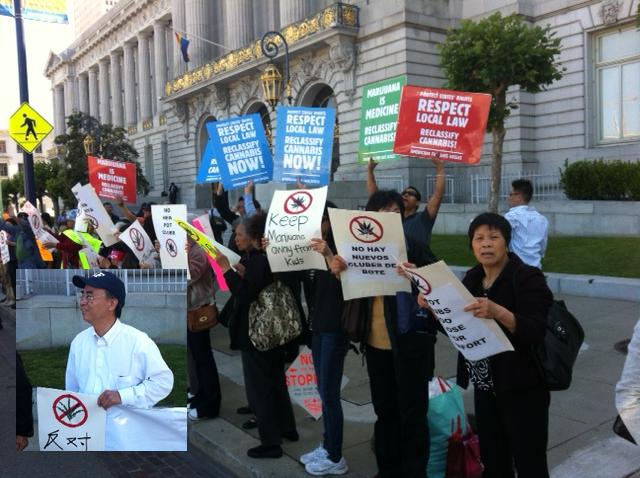
Dueling demonstrations in front of City Hall yesterday afternoon – with one side supporting medical marijuana dispensaries and the other protesting the city’s February approval of three new clubs in the Outer Mission/Excelsior area – preceded the Board of Permit Appeals decision to reject an appeal challenging Mission Organics.

That was the first of the three clubs to pull their building permits to open up shop in a part of the city that currently has no cannabis dispensaries. Yet a group of residents from the region – which includes District 11 supervisorial candidate Leon Chow – has been angrily agitating against the clubs and claiming they expose children to an illegal drug.

Bearing signs that included “Stay away from pot clubs” and “Keep the weeds away from kids” – most in both English and Chinese characters, with a smattering of Spanish translations – the predominantly Asian protesters squared off against a slightly larger crowd of medical marijuana supporters bearing signs that included “Respect Local Law” and “Marijuana is Medicine.” Together, it was a crowd of a couple hundred lining the sidewalk, drawing reactions from passing motorists.

Asked whether he would try to undermine the city’s system of regulating medical marijuana facilities if elected to the Board of Supervisors, Chow told us, “We’re opposing this, but I don’t think it would be my priority.”

Chow said he was “opposing high density,” noting that the Planning Commission approved three dispensaries in the area on Feb. 21, but he also raised concerns that the clubs make it easier for children to get marijuana, that they cater to healthy people just looking to get high, and that city regulations conflict with federal law.

“We don’t want healthy young people to be exposed to people coming out of medical marijuana clubs,” Chow told us. Asked whether he had similar concerns about bars and liquor stores, he said that he did but “there’s nothing I can do” to shut down existing businesses that sell alcohol.

“I don’t want there to be more liquor stores,” he said, although he assured us that, “I’m not a conservative, crazy, church-going Republican.”

Yet supporters of Mission Organics – whose workers will be represented by the United Food and Commercial Workers Union – did call Chow a hypocrite given that he works for SEIU-UHW. “So it’s a union representative opposing a union business,” said Matt Witemyre, an organizer with UFCW who was demonstrating in support of Mission Organics, which he said has agreed to a strict code of conduct that will make them good, responsible members of that community.

“The vast majority of the neighborhood is in support of the project,” Ariel Clark, an attorney representing Mission Organics, told us, characterizing protesters as a small yet vocal part of the neighborhood. The appeal was filed by Steve Currier, president of the Outer Mission Merchants and Residents Association.

Long after most of the protesters on both sides had gone home, the Board of Permit Appeals voted 3-1 to reject the appeal, clearing the way for Mission Organics to open on the 5200 block of Mission Street. But opponents have vowed to continue their fight and appeal the permits for the other two approved clubs – Tree-Med and The Green Cross, a venerable cannabis delivery service – when they apply for building permits.

Avalos emerges as the board’s main progressive champion

23

Sup. John Avalos seems to be the only consistent champion of progressive values at the Board of Supervisors these days, as he demonstrated once again yesterday as he tried to present some alternatives to the neoliberal corporatism that has seized City Hall over the last couple years.

Last week, Avalos was the only vote against a pandering proposal by Sup. Mark Farrell to exempt more small businesses from the city’s payroll tax, which is projected to cost the city $1.5 million next fiscal year and $2.5 million the following one, blowing a $4 million hole in the two-year budget that supervisors are now finalizing for approval in two weeks.

Yesterday, as the measure was about to receive final approval on its second reading, Avalos made a motion to delay it until after the fall election when voters may consider a pair of measures to transition from a payroll to gross receipts tax as the means of assessing local businesses. Mayor Ed Lee and Board President David Chiu introduced one measure that is revenue neutral, while an alternative by Avalos would bring in about $40 million per year.

Avalos didn’t have the votes for the long delay, so he got behind a compromise motion by Sup. Jane Kim to delay the measure until July 10 so the Budget Committee can at least factor it into its deliberations. Farrell opposed the move, insisting that “this is about creating jobs now,” despite the fact that businesses couldn’t apply for the exemption until next February.

A spirited debate followed, in which Avalos criticized City Hall’s current penchant for business tax cuts and questioned whether it really creates the jobs its boosters claim. He also noted that it is the multitude fee increases that local politicians have approved in recent years to balance the budget without raising taxes that have become most onerous for small businesses.

“When we were raising fees over the last five years, we were raising taxes on small businesses,” Avalos said, suggesting that rolling back those fees and taxing larger corporations that can afford it is a better strategy for helping small businesses and encouraging them to create jobs.

Eventually, Avalos won the short delay on a 7-4 vote, with Sups. Farrell, Carmen Chu, Sean Elsbernd, and Scott Wiener opposed.

Meanwhile, Avalos managed to place on the fall ballot an increase in the real estate transfer taxes paid on properties worth $2.5 million or more, convincing Sups. Kim, David Campos, and Eric Mar to support the proposal as the 5 pm deadline for at least four supervisors to place measures on the ballot neared. It would raise $16 million and compete with a similar measure by Lee that would raise $13 million through a smaller increase on properties worth more than $1 million.

Avalos also joined Campos and Chiu in opposing final approval for the 8 Washington housing project for the uber-wealthy. On the same 8-3 vote, the board also rejected Chiu’s efforts to allow opponents of the project to circulate referendum petitions without having to lug around a thick stack of all the studies referenced in the project approval.

Chiu appealed to his colleagues to support “citizens of San Francisco exercising the constitutional right to referendum,” but he won few sympathies on a board that these days seems most concerned with the interests of this city’s wealthiest individuals and corporations.

Why do Lee, Chiu, and others want to stifle economic growth?

16

Why do Mayor Ed Lee, Board of Supervisors President David Chiu, and San Francisco’s two major daily newspapers want to punish success? Because that’s exactly what their proposal to create a new gross receipts tax for businesses – in which corporations would be taxed more as they grow, thus encouraging economic stagnation – would do.

Right now, the city taxes businesses through a payroll tax, levying taxes based on the number of employees the company has. But under a gross receipts tax that would replace the payroll tax, employees have a disincentive to be productive and efficient and increase their companies’ profits because that would expose those companies to more of the city’s onerous tax burden.

Why would investors and employees want to grow a business in San Francisco when that would only submit them to higher taxes. Clearly, this is anti-business measure that is likely to plunge our local economy back into the depths of the recession. Don’t our leaders understand the need to help this fragile economic recovery?

Okay, okay, in case you haven’t guessed it yet, the previous three paragraphs are satire of the ridiculously overblown and misleading political rhetoric used by Lee and other critics of the city’s payroll tax, which they deride as as “job killer” that makes companies not want to hire new employees.

“Mayor Lee and Board President David Chiu proposed a gross receipts tax as an alternative to the City’s current payroll tax, which punishes companies for growing and creating new jobs in San Francisco,” Lee’s office wrote in a press release it distributed last week.

Yet my argument that a gross receipts taxes “punishes companies for growing” is just as logically sound as Lee’s argument that the payroll tax discourages companies from “creating new jobs” – and both arguments are also complete hyperbolic bullshit. But it’s seductively simple and widely parroted bullshit.

“To attract more companies to San Francisco and encourage existing employers to hire more employees, it is past time to do away with this tax,” our new neighbors down the hall, the editors of the Examiner, wrote in their editorial today, a oft-repeatedly refrain from the Chronicle and SF Chamber of Commerce as well. It later added that switching tax methods “wouldn’t penalize companies for employing people or paying them well. And city policy wouldn’t give employers any incentive to shed employees during a downturn.”

But the reality is that the 1.5 percent payroll tax is too small to really be a factor in the decision by corporations to add new employees, something they are already loath to do unless forced to by rising demand. It is simply one imperfect gauge of the size of a company and its ability to pay local taxes, just as the gross receipts tax is.

Health insurance costs, which Lee’s CPMC deal doesn’t adequate contain, is a far bigger factor in a company’s hiring decisions. So is commercial rent, which Lee’s corporate welfare policies are causing to go up downtown and throughout the city.

For decades, conservatives have tried to sell the general public on bogus trickle down economic theories that we all benefit from corporate tax cuts and that people will simply stop working if you tax them, ideas that should have been discarded as they were discredited. But they’re back with a vengeance, in supposedly liberal San Francisco of all places, actively peddled by key Lee supporters like billionaire venture capitalist Ron Conway, who only recently dropped his Republican party affiliation in favor of declined to state.

But it’s time to call out this voodoo economics for what it is: self-serving bullshit that ought to be rejected by citizens of a city that prides itself as being more educated and enlightened than the rubes in the flyover states that have been so thoroughly manipulated by the Republican Party and Blue Dog Democrats, to the detriment of our entire country.

Now, the Examiner’s argument that the business tax reform proposal would broaden and stabilize the tax base is a sound and meaningful argument, which is why the concept enjoys widespread support from across the ideological spectrum and is worth doing (although progressives rightful argue that if the tax base is being broadened then the city should reap some benefits from that, logic that Lee inexplicably resists).

Yet as the City Hall debates that will shape the details of business tax reform begin in a couple of weeks, it’s time to drop this misleading “job killer” label that has been promulgated by Republicans and other fiscal conservatives over the last decade and have an honest debate over what’s best for San Francisco’s private and public sectors.

No deal yet on business tax reform as competing measure are introduced

21

Mayor Ed Lee and his business community allies failed to reach an agreement with labor and progressives by today’s deadline for submitting fall ballot measures to the Board of Supervisors, leading progressive Sup. John Avalos to introduce a business tax reform measure that would compete with Lee’s proposal.

The Avalos measure would raise $40 million in new General Fund revenue to restore recent cuts to city services while Lee’s would essentially be revenue-neutral, although Lee did tweak the formulas to raise about $13 million in new revenue that would be dedicated to a new Affordable Housing Trust Fund, which would be created by another ballot measure that Lee was having a hard time funding in the face of business community opposition.

“I don’t believe trickle down economics works, except for the 1 percent,” Avalos told the Guardian, arguing the importance of recovering revenue that the city lost when the biggest downtown corporations sued the city in 2001 to invalidate a gross receipts tax. Both the Lee and Avalos measures would gradually convert the current payroll tax into a new version of the gross receipts tax, which is preferred by most of the business community.

So, will voters in the fall be faced with competing ballot measures? Probably not, according to the same sources from the business and progressive sides of the negotiations who told us last week that it appeared a deal was in the offing, something they still believe.

“This is the beginning of the negotiations,” said the business community source, noting that both measures won’t be approved until next month, with discussions about merging them ongoing. “I’m sure this is part of the process and they will agree on a number.”

Our labor source agreed, predicting the two sides will come to an agreement because neither side wants competing ballot measure, but noting that Lee appears to be trying to create divisions between the progressive revenue coalition and the affordable housing advocates. “That’s just positioning on their part, but it doesn’t feel like good faith bargaining,” the source said.

Mayoral Press Secretary Christine Falvey seemed to leave the door open for compromise, telling the Guardian, “The Mayor believes that to be successful, we should continue building consensus around business tax reform and that it’s important that the business community continue to be key partners in that effort.”

Lee is trying to placate an emboldened business community, which has taken a hard line position on opposing new taxes even while seeking ever more tax breaks and public subsidies. In fact, Sup. Mark Farrell had another business tax cut on today’s board agenda, cutting the payroll tax for small businesses at a cost of more than $2 million to city finances.

“I believe we need to do all we can to incentivize job growth in our small business community,” Farrell said.

Avalos said he agrees with helping small businesses – which is why both his and Lee’s business tax reform measure shifts more of the tax burden to the large corporations that have been so profitable in recent years – but that “we should not be putting a hole in the city’s budget to do so.”

In a sign of just how strong the business community has become at City Hall compared to the progressive movement that had a board majority just two years ago, the tax cuts were approved on a 10-1 vote, with only Avalos opposed.

The great car slowdown

49

EDITORIAL It’s going to be hard to reach San Francisco’s official bike transportation goal, which calls for 20 percent of all vehicle trips to be taken by bicycle by 2020. Everyone in town knows that; everyone at City Hall and in the biking community agrees that some profound and radical steps would need to be taken to increase bike trips by more than 500 percent in just eight years.

It starts with safety — you’re not getting anywhere near that number of people on light, two-wheeled vehicles unless, as international bicycling advocate Gil Peñalosa recently told San Franciscans, people between the ages of eight and 80 feel safe riding on the city streets.

At the San Francisco Bicycle Coalition’s 20th Annual Golden Wheel Awards, Peñalosa — executive director of 8-80 Cities, a nonprofit that promotes creation of cycling infrastructure that is safe and inviting — laid out a prescription for designing cities around pedestrians and bicyclists (he sees riding a bike as ” just a more efficient way of walking.”) Peñalosa laid out an agenda for achieving that goal — one that includes a step San Francisco can start taking immediately: Cut vehicle speeds on all city streets to no more than 20 miles an hour.

Even if that were only done in residential areas, it would have a huge impact, and not just on bicyclists. Peñalosa cited statistics showing that only about 5 percent of pedestrians hit by cars driving 20 mph will die — but the fatality rate shoots up to 80 percent when the vehicles are traveling 40 mph.

If there are some streets where it’s impractical to have such a low speed limit, it’s imperative to have bike lanes that are separated from cars by physical barriers.

San Francisco’s Municipal Transportation Agency director, Ed Reiskin, told us after Penalosa’s speech that the notion of reducing speed limits made sense: “The logic is unquestioned that slowing speeds reduces the risk of fatality.”

But the city, it turns out, doesn’t have the power to unilaterally lower speed limits: State law requires speed limits to be set based on formulas determined by median vehicle speeds. That seems awfully old-fashioned and out of touch with modern urban transportation policy, which increasingly emphasizes bikes, pedestrians, and transit, and city officials ought to be asking the state Legislature to review those rules and give more latitude to cities that want to control traffic speed.

In the meantime, Reskin argues that a lot can be done by redesigning streets, using bulb-outs and barriers to discourage speeding. That’s fine, and part of the city’s future bike-lane policy should start with traffic-calming measures (Berkeley, to the chagrin of many nonlocal drivers, has done a great job making residential streets into bike-friendly places where cars can’t travel very fast).

Peñalosa had some other great ideas; he noted that cities such as Guadalajara, Mexico require developers to give free bikes away with each home, a program that has put 102,000 more bikes on the streets. That’s a cheap and easy concept — except that so much of the new housing in the city is so expensive, and comes with so much parking, that it’s hard to believe the millionaires who are moving into these units will be motivated by a free bicycle.

But the notion of working with Sacramento to slow down car traffic makes tremendous sense — and that ought to be one of the transportation priorities of Mayor Ed Lee’s administration.

Why I hope Sup. Farrell is wrong about condos

213

So Sup. Mark Farrell thinks the Board of Supervisors is ready to turn its back on the tenants movement and vote for legislation that would increase evictions, eliminate rental housing and undermine one of the most important pieces of tenant legislation to come out of City Hall in decades?

Gawd, I hope he’s wrong.

From the Examiner:

Similar proposals have gone nowhere at City Hall. Farrell acknowledged it has been a “third rail,” but he suggested the political climate has shifted. “This is a different Board of Supervisors and this is a different time,” Farrell said.

Yeah, it’s a different Board of Supervisors. Five years ago, the 8 Washington project would never have been approved in its current form. Five years ago, Ed Lee wouldn’t have been elected mayor.

But I don’t think this board is ready to abandon the tenant vote.

Making condo conversions easier is a huge deal. When San Francisco put a limit on condo conversions more than 20 years ago, it was a landmark law that put the preservation of affordable, rent-controlled housing over the needs of speculators. Over the past decade, the single greatest threat to tenants in this city is Ellis-Act evictions done to create tenancies in common. And the only check on more of that happening is the disincentive posed by the limits on condo conversions.

If Farrell gets his way, and TIC owners can bypass the conversion lottery, tenant organizations will be furious. There are, at best, five reliable pro-landlord votes on the board, so It’s not going to happen without either David Chiu, Christina Olague or Jane Kim siding with Farrell. A lot of things suprise me in local politics, but that would be a shocker.


Mecke joins crowded District 5 supervisorial race

26

Progressive activist Quintin Mecke jumped into the District 5 supervisorial race today, echoing gentrification concerns raised this week by the Guardian and The New York Times and promising to be an independent representative of one of the city’s most progressive districts, a subtle dig at Sup. Christina Olague’s appointment by Mayor Ed Lee.

“The City is at an economic crossroads. As a 15 year resident of District 5, I cannot sit idly by while our City’s policies force out our residents and small businesses, recklessly pursuing profits for big business at whatever cost,” he began a letter to supporters announcing his candidacy, going on to cite the NYT article on the new tech boom that I wrote about earlier this week.

“What we do next will define the future of San Francisco; the city is always changing but what is important is how we choose to manage the change. One path leads to exponential rent increases, national corporate chain store proliferation, and conversion of rent-controlled housing. The other path leads to controlled and equitable growth, where the fruits of economic development are shared to promote and preserve what is great about this City and our district,” Mecke wrote.

Mecke came in second to Gavin Newsom in the 2007 mayor’s race and then served as the press secretary to Assembly member Tom Ammiano before leaving that post last week to run for office. Mecke joins Julian Davis and John Rizzo in challenging Olague from her left, while London Breed and Thea Selby are the leading moderates in a race that has 10 candidates so far, the largest field in the fall races.

Although he never mentioned Olague by name, Mecke closed his message by repeatedly noting his integrity and independence, a theme that is likely to be a strong one in this race as Olague balances her progressive history and her alliance with the fiscally conservative mayor who appointed her.

“Politics is nothing without principles; and it’s time now to put my own principles into action in this race,” Mecke wrote. “District 5 needs a strong, independent Supervisor. I am entering this race to fight for the values that I believe in and to fight to preserve what is great about District 5 and the city. I have brought principled independence to every issue I’ve worked on and that’s what I’ll continue to bring to City Hall.”

In an interview with the Guardian, Mecke said he sees the campaign as a “five-month organizing project” to reach both regular voters and residents of the district who haven’t been politically engaged, including those in the tech sector. He’d like to see the perspective of workers represented in discussions about technology, not simply the narrow view of venture capitalist Ron Conway that Mayor Lee has been relying on.

“Local politics needs new blood,” Mecke said, “it needs to hear from these people.”

Wage theft task force approved

24

The Board of Supervisors June 5 voted unanimously to create a wage theft task force. The task force will make recommendations to city departments concerning the prevention and correction of wage theft in the city.

Wage theft refers to employers paying less than their employees are due, and can include not paying extra for overtime, not allowing breaks, confiscating tips, and paying less than minimum wage. A 2010 study of labor conditions in Chinatown restaurants conducted by the Chinese Progressive Association (CPA) found that some 76 percent of employees did not receive overtime pay when they worked more than 40 hours in a week, and roughly half were not being paid San Francisco’s minimum wage.

The industries where wage theft is prominent range from restaurants and retail to domestic work. 

Approval of the task force is a step forward for groups like CPA that have been working to combat wage theft for years. It builds on the wage theft prevention ordiance, passed last July. The ordinance doubled the fine for employers who retaliate against workers that seek recourse for wage theft, and enhanced the power of the cit’s Office of Labor Standards and Enforcement (OLSE).

The Progressive Workers Alliance- a coalition of CPA, Young Workers United, the Filipino Community Center and others- advocated for the task force and helped bring in dozens of supporters to the meeting. 

Workers who suspect that their employers have violated local labor laws often come to these groups for help. Between the OLSA and advocacy groups, the people following up with these claims see a widespread problem. According to Shaw San Liu of the CPA, there are “probably hundreds if not thousands coming forward every year, and there are many more who don’t.” 

“There have been experiments in coordinating with the City Attorney and with the health department to revoke food permits,” said Liu. 

She hopes “the task force will build off these successful examples and see how we can expand them to a more comprehensive strategy.”


In the air

3

caitlin@sfbg.com

HERBWISE It’s Sunday afternoon and the hosts of Mutiny Radio’s Cannabis Cuts: The Next Generation have effectively commandeered the smoking lounge at SoMa’s Igzactly 420. They are deep into solving the world’s problems.

The crusade may just involve a pictorial calendar featuring sexy men smoking marijuana — a project which hosts Vaperonica Dee and Merry Toppins staunchly resist any attempts to qualify as frivolous. It’s about achieving parity in cannabis imagery, they say — much like their weekly podcast of marijuana news, product reviews, music, and banter.

“If you look at all the ads [for cannabis businesses and products], it’s sexy nurses or girls holding cannabis leaves over their tits,” Dee says between Volcano puffs. The young radio vet didn’t find that image particularly representative of her experience with the medicine (both she and Toppins are medical marijuana patients), so she jumped at the chance to work with DJ Wiid on his marijuana variety show at Pirate Cat Radio.

Merry Toppins and Vaperonica Dee plot their takeover of cannabis media (that’s not their car.) Guardian photo by Caitlin Donohue

Dee stuck with the project through Pirate Cat’s transformation into Mutiny Radio, the shuttering of its cafe and demise of its infamous maple bacon lattes — “I was excited!” she says. “I wanted to be in radio, I didn’t give a shit about the cafe” — and the exodus of her male co-host.

And when DJ Wiid moved onto new projects, it left the door open for an idea that seems nearly revolutionary in an industry filled with men: a platform for women’s perspectives on the cannabis movement.

Toppins was a natural choice as on-air co-host for Dee. The two had met when chef Toppins appeared on Cuts to hype her marijuana-infused olive oil that she had entered into the High Times Cannabis Cup. Toppins’ ebullience is the perfect compliment to Dee’s well-informed on-air tone. They both have natural radio voices, impeccable banter rhythm. “It was so cool to see a chick doing the news on a weed show,” says Toppins of their initial meeting. “I knew right away I’d either be their intern or host my own radio show.”

Listeners are responding. Toppins volunteers the following stats: 5,000 Cannabis Cuts podcast downloads each week, each one yielding an average of an hour spent with the two-hour long show. And though the women express views that aren’t always in lockstep with the cannabis establishment (a February 14 edition of the show highlighted a disempowering experience with Americans for Safe Access activists at a City Hall hearing and the two are candid about the fact that not all their tokes are strictly medicinal), many of the community’s luminaries have lent their support. They count Proposition 215 co-author Dennis Peron and Cannabis Action Network co-founder Debby Goldsberry as personal friends, and have interviewed Peron on the show.

The enthusiasm that has come their way makes sense — the continued strength of activists to improve cannabis access depends on developing and raising awareness about diverse viewpoints within the movement.

“We’re changing the idea that there could be a profile of a standard cannabis activist,” says Dee, who wants the world to know that it’s not just the grey-ponytailed Deadheads who care about access to pot. “Plus, radio doesn’t have that many women involved in it, cannabis doesn’t have that many women involved in it — the two go together.” 

Cannabis Cuts: The Next Generation Live podcast every Tuesday, 4pm-6pm. www.mutinyradio.org. Also available on www.stitcher.com and www.medicinalmarijuananetwork.org


Mayor Lee’s priorities are wrong

0

By Margaret Brodkin

OPINION There was much back slapping at City Hall last week as officials congratulated themselves on what was described as a welcome “philosophical shift” in San Francisco politics.

The beneficiary of the acclaim and virtual political consensus was Mayor Ed Lee’s proposed budget, the largest in history — including an unexpected windfall of new revenue. The budget’s signature element, described in glowing terms by the San Francisco Chronicle’s C.W. Nevius and warranting its own special mayoral press conference, is the expansion of the police and fire budgets — an $82 million increase over two years.

Amid last week’s ovations was an unsettling silence from voices normally willing to cut through obscure numbers and rhetoric. Not one official commented that the best way to ensure public safety is to build strong children, families, and communities.

The cumulative impact of the devastating state budget and years of inadequate funding on families and children should not permit celebration. In light of millions in unanticipated revenue, politicians should not be satisfied with addressing urgent needs simply by sparing a few city departments from cuts, as appeared to be the case. Here’s what they should be thinking about:

• Our schools face the worst budget cuts ever, with SFUSD preparing to lay off 400 employees, reduce the already-too-short school year, increase class size, eliminate most school bus lines and all high school after-school programs, and under-fund everything from food to special education.

• Our childcare system is being gutted by the state, with $20 million in losses this year on top of $9 million from last year. This will impact thousands of families and result in the closure of centers and family childcare homes. Many fewer parents will be eligible for childcare subsidies (no one with two kids earning more than $37,500 a year will qualify) — pushing parents out of work and onto “welfare,” and children out of quality care and into unsafe settings.

• Support systems for children with disabilities are being eliminated and reduced through simultaneous cuts in multiple agencies.

• Young people entering community colleges or state universities face years of uncertainty — including whether their campuses will even exist. Already, the majority of SF students who enter City College are unable to graduate — stymied by costs, lack of educational support, or the inability to get classes they need.

It appears that little of the new millions will address these problems. The mayor’s budget does not even fully fund the voter-approved Public Education Enrichment Fund, passed in 2004 to provide essential services to public schools and preschools. Funding falls short by more than $10 million. Providing schools the funds to which they are legally entitled is the least we can do when the city lands millions in new resources.

Let’s be clear: crime is at historic lows — and has gotten that way with 200 fewer officers than the mayor is now advancing. There is little rationale to suddenly swell the ranks, at a cost of $140,000 per officer. The Fire Department’s inefficiencies have been well documented by city budget experts, and many cost-saving recommendations have yet to be implemented.

Before signing off on a budget they have not yet discussed in public (as it appeared to last week), the Board of Supervisors must evaluate fiscal options in full view. Private meetings with the mayor are no substitute for a robust debate now that the revenue facts are known. This is the city’s first two-year budget, and its policy direction will impact us all for years to come.

What looks to Nevius like a positive “drama-free, signature moment” for San Francisco, looks to many advocates for children and families like an abdication of responsibility.

Margaret Brodkin is a former executive director of Coleman Advocates for Children, director of the Department of Children, Youth and their Families and New Day for Learning, and a veteran of numerous budget processes

The circus begins

199

steve@sfbg.com

Mayor Ed Lee and his attorneys are presenting a voluminous yet largely speculative case against suspended Sheriff Ross Mirkarimi in their effort to remove him for official misconduct, broadening the case far beyond their most damning core accusation -– that Mirkarimi dissuaded witnesses from telling police that he bruised his wife’s arm during an argument on Dec. 31. And so far, there’s no evidence to support that key allegation.

In fact, Mirkarimi and his attorneys insist there was no effort to dissuade witnesses, one of many unsupported aspects to a case they say should never have been filed without stronger evidence. And they say the mayor’s team is now compensating for the weakness of its case by piling on irrelevant accusations and witnesses in an effort that amounts to character assassination.

There are even signs that the city is nervous about its case. Knowledgeable sources told the Guardian that the City Attorney’s Office last week offered to settle the case with Mirkarimi, offering a substantial financial settlement if he would agree to resign, an offer that Mirkarimi rejected.

It was one of a series of rapidly unfolding developments that also included a raucous Ethics Commission hearing, the disclosure of phone records by Mirkarimi’s side, a new list of charges, and the city’s release of the video Mirkarimi’s wife, Eliana Lopez, made with neighbor Ivory Madison, documenting the bruise in case of a child custody battle over their son.

Lopez has maintained that Mirkarimi never abused her and that she’s been hurt most by the efforts to prosecute him and remove him from office.

“I hope they realize after reflection that what they have done is irreparable and perpetually damaging to me and my family,” Lopez said in a statement condemning the city’s release of a video that she fears will remain online for her children and grandchildren to see.

Yet all indications are this spectacle is only going to grow more sordid, divisive, and sensational as it moves forward — belying the statement Lee made last week as he introduced his annual budget: “As many of you know, I’m a person who does not like a whole lot of drama.”

SIMPLE OR COMPLEX?

The May 29 Ethics Commission hearing to begin setting standards and procedures for the official misconduct proceedings against Mirkarimi illustrated two sharply divergent views on when elected officials should be removed from office. It also displayed the increasingly bitter acrimony and resentments on each side, emotions only likely to grow more pronounced as the hearings drag on for months against the backdrop of election season.

Both sides would like to see the decision as a simple one. Lee and his team of attorneys and investigators say Mirkarimi’s bruising of his wife’s arm and his unwillingness to cooperate with their investigation of what followed make him unfit for office. Mirkarimi and his lawyers admit his crime, but they say that’s unrelated to his official duties and that the rest of Lee’s charges against him are speculative and untrue.

Yet there’s nothing simple about this official misconduct case — or with the implications of how each side is trying to counter the others’ central claims. So despite the stated desires of some Ethics commissioners to narrow the scope of their inquiry and limit the number of witnesses, San Franciscans appear to be in for a long, dramatic, and divisive spectacle, with Mirkarimi’s fate decided by the Board of Supervisors just a month or so before the five supervisors who have been his closest ideological allies face reelection. Nine of 11 votes are required to remove an official.

The Mayor’s Office wants to call the most witnesses and present an elaborate (and expensive) case that includes a number of outside experts on law enforcement and domestic violence, painting a portrait of Mirkarimi as a serious wife-batterer whose past and future actions can be divined from that malevolent distinction, making him obviously unable to continue as San Francisco’s chief law enforcement officer.

“The extent of the abuse was far greater than what Mr. Mirkarimi has testified to,” claimed Deputy City Attorney Peter Keith, going on to say “there were attempts to control what she ate,” an apparent reference to Mirkarimi’s decision not to take Lopez to a restaurant for lunch on Dec. 31 because they were having a heated argument. He also repeatedly referred to Mirkarimi as a batterer and said “batterers behave in a certain way.”

Mirkarimi attorney Shepard Kopp calls that portrayal exaggerated and unfair, ridiculing the Mayor’s Office claims that its domestic violence expert, attorney Nancy Lemon, can predict Mirkarimi’s behavior based on grabbing his wife’s arm once: “Apparently she’s some kind of clairvoyant in addition to being an expert,” Kopp told the commission as he unsuccessfully sought Lemon’s removal from the witness list.

Ethics Commission Chair Benedict Hur took the lead role in trying to limit the witness list, focusing on stripping it of the various law enforcement experts who plan to describe how different agencies might react to dealing with Mirkarimi. “What I don’t understand is how his ability to do his job relates to whether he committed official misconduct,” Hur said.

Mirkarimi’s team says its case could be very simple, with only Lee and Mirkarimi called as live witnesses — but the attorneys reserved the right to offer testimony to counter false or damaging claims made by the Mayor’s Office.

Hur tried to limit the case to just witnesses and arguments that relate to Mirkarimi’s actions, but he was outvoted by those who wanted to let the city argue how those actions would affect perceptions of Mirkarimi by the many people that a sheriff must interact with.

In the end, the commissioners agreed to trim the eight expert witnesses sought by the mayor down to three and to cut its 17 proposed fact witnesses down to 12, calling 15 total witnesses. Mirkarimi’s team will call 10 witnesses, down from an initial 17. All witnesses will submit written declarations and then be subjected to live cross-examination if any of their testimony is disputed.

EVIDENCE AND SPECULATION

The speculative and prejudicial nature of some of the city’s case was attacked at the hearing by Mirkarimi’s attorneys and the large crowd that came to support him.

Commissioner Paul Renne asked the Mayor’s Office attorneys why they hadn’t summarized the expected testimony of their expert witnesses and “How are any of those opinions relevant to the issues in this case?”

“I have not had time to work with the witnesses to see what their opinions are,” replied Deputy City Attorney Sherry Kaiser, prompting Kopp to incredulously note, “The mayor is preparing the expert witnesses without knowing what their testimony will be. How can I respond to that?”

The issues of bias and conflicts of interest also came up surrounding what sources should be called as witnesses. Mirkarimi’s team wanted longtime Sheriff Michael Hennessey, Mirkarimi’s predecessor, while the Mayor’s Office pushed for Acting Sheriff Vicki Hennessy to convey how the Sheriff’s Department should function.

“Vicki Hennessy was a political appoint of Mayor Lee,” Waggoner objected, although the commission decided to use that appointee.

On several critical procedural questions, the commission sided with the Mayor’s Office, ruling that the commission decision needn’t be unanimous, that guilt could be established based on a preponderance of the evidence rather than beyond a reasonable doubt, and that normal rules of evidence won’t apply, with some hearsay evidence allowed on a case-by-case basis.

The pro-mayor decisions angered the roughly 200 Mirkarimi supporters who packed the commission hearing and an overflow room, many bearing blue “We stand with Ross” stickers and flyers, which had “Respect Eliana” on the flip side. There were only a couple of Mirkarimi critics at the hearing wearing white “I support Casa de las Madres” stickers, referring to the domestic violence group that has been calling for Mirkarimi’s removal since shortly after the incident went public.

Mirkarimi got a rousing welcome from the crowd when he arrived at the hearing, his voice choking up and eyes welling with tears as he said, “I cannot tell you, on behalf of me and my family, how grateful we are.”

The crowd was boisterous during the proceedings, loudly reacting to some claims by the deputy city attorneys and offering comments such as “Ed Lee is the one you should put on trial,” with Hur finally recessing the hearing after an hour and having deputies warn audience members that they would be removed for speaking out.

Renne, a career litigator and the District Attorney’s Office appointee to the commission, raised the most doubts about both the standard of guilt and rules of evidence being lower than in criminal proceedings, telling his colleagues, “I have some reservations.”

PHONE LOGS

Mirkarimi’s team also released to the Chronicle and the Guardian redacted phone records from Mirkarimi, Lopez, and Linnette Peralta Haynes — a family friend and social worker who served as Mirkarimi’s last campaign manager. The city has sought to portray Haynes, who has not been cooperating with the investigation, as a conduit to Mirkarimi’s efforts to dissuade Lopez and Madison from going to the police on Jan. 4.

Mirkarimi previously told the Guardian that he was unaware that Lopez had told Madison about the abuse incident or that they had made a video of her injury until several hours after Madison had called the police and they had come to the house to talk to Lopez, during which time Mirkarimi was in a series of meetings at City Hall.

The phone records seem to support that claim. They show that Lopez and Haynes — who is close to Lopez and recently went to Venezuela to visit her — exchanged a series of telephone calls on Jan. 4 starting at 11am. Their longest conversation, nearly 40 minutes, occurred at 11:18am.

Neither woman could be reached to describe the substance of that call. At 12:24pm, Lopez sent Madison — with whom she had been communicating by phone and text over the previous couple days — a text message indicating that she didn’t want Madison to report the incident to police, but that she would instead go to her doctor to document the injury.

A minute later, Madison called the police to report that Lopez had been abused by Mirkarimi.

Starting an hour later, the records show, Haynes and Lopez called each other but didn’t connect until 3:31, when they had a nearly 14-minute phone conversation, presumably discussing the fact that police had visited the house, with Lopez reportedly giving the phone to Madison at one point so Haynes could talk to her.

Yet the phone records indicate that neither Lopez nor Haynes tried to reach Mirkarimi until after that conversation, despite the city’s claims that Mirkarimi “or his agents” used his power to dissuade witnesses, most notably Lopez and Madison. The first attempt to reach Mirkarimi was at 3:46pm when Haynes called him twice but didn’t connect. Lopez then sent Mirkarimi a text message at 3:53pm asking “Where are you and where is the car,” but she got not reply. She texted him again at 4:18pm to say “Call me. It’s an emergency.”

Lopez made one last appeal to Madison in a 4:18pm phone conservation that lasted four minutes and 27 seconds and then she finally reached Mirkarimi by phone at 4:23pm. Mirkarimi and attorney David Waggoner say this is the first time that he became aware that Lopez had talked to neighbors and that the police had been called. Their conversation lasted a little more than five minutes.

Mirkarimi called Haynes at 5:12pm and they spoke for seven minutes. At 5:51pm, an increasingly panicked Lopez sent a text to Mirkarimi saying, “You have to call [Sheriff Michael] Hennessey and stop this before something happen. Ivory is giving the investigators everything. Use your power.” To which Mirkarimi responded 10 minutes later, “I cannot. And neither can he. You have to reject Madison’s actions. We both do. I cannot involve new people.”

NEW CHARGES

On June 1, the city released an amended list of charges against Mirkarimi that was intended to be a more specific list of accusations, as Waggoner requested during the May 29 Ethics Commission hearing. In it, the city asserts that the charter language essentially gives the city two avenues by which to remove officials, defining distinct “wrongful behavior” and “required conduct” clauses. Violation of either, they contend, is enough to remove an official.

“Official misconduct means any wrongful behavior by a public officer in relation to the duties of his or her office, willful in its character, including any failure, refusal or neglect of an officer to perform any duty enjoined on him or her by law…,” begins the charter language. This “wrongful behavior” section has long been in the charter, referring to specific actions by public officials to neglect their duties.

The second “required conduct” clause of this sentence — which was created in 1996, never vetted by the courts, and which Mirkarimi’s attorneys say is unconstitutionally vague — continues, “…or conduct that falls below the standard of decency, good faith and right action impliedly required of all public officers and including any violation of a specific conflict of interest or governmental ethics law.”

In trying to indict Mirkarimi for actions before he was sworn in as sheriff, the city attempts to argue that his official duties really began with his election, claiming that in this interim period he “had the duty and the power in his official capacity as Sheriff-Elect to work with the Sheriff’s Department and its officials to prepare himself to assume the full duties of Sheriff.” And if that’s not enough, the city argues that he was chair of the Board of Supervisors Public Safety Committee during that same Nov. 8-Jan. 8 time period, further subjecting his actions to official misconduct scrutiny.

The “wrongful actions” charges against Mirkarimi were listed in the document as domestic violence, abuse of office, impeding a police investigation, and “crime, conviction, and sentence,” while the “breach of required conduct” charges were listed simply as his sheriff and supervisorial roles.

The document then attempts to paint an expansive portrait of the Sheriff’s official duties, going beyond the narrow construction of the charter to include the general law enforcement duties listed in state law, interactions with various government and nonprofit groups, administrative responsibilities as a city department head, and passing mentions in the California Family Code that police officers “must enforce emergency protective orders in domestic violence cases.”

Yet the promise that the rest of the document would detail Mirkarimi’s wrongful actions with greater specificity than the previous list of official charges doesn’t seem to be met by this document, which repeats the same narrative of actions that Waggoner had criticized for vagueness.

For example, on the pivotal charge that he dissuaded witnesses and impeded the police investigation, the new charges say that during the period from Dec. 31-Jan. 4, “Sheriff Mirkarimi participated in and condoned efforts to dissuade witnesses from reporting this incident to police and/or cooperating with police investigators,” without describing any specific witnesses or actions that he took.

And by the mayor’s team’s own admissions, the prosecutors don’t know what Mirkarimi did to dissuade witnesses, which they hope to learn through future testimony.

The closest the new document comes to directly tying Mirkarimi’s actions to the official misconduct language is with Mirkarimi’s plea to a misdemeanor false imprisonment charge: “False imprisonment of a spouse is a crime of domestic violence. The California Penal Code considers spousal abuse to be a ‘crime against public decency and good morals.'”

Mirkarimi disagrees with that interpretation, noting that he and his attorneys specifically considered whether pleading to false imprisonment -– a general charge with many possible meanings -– would violate the city’s official misconduct provisions, and he told the Guardian that he was assured by his attorneys it didn’t. Mirkarimi told us he would not have entered the plea and would have instead fought the charges in court if he thought it would disqualify him from serving as sheriff.

Waggoner told us that “The Mayor’s Amended Charges are further evidence that this entire ordeal is a political hatchet job reminiscent of a Soviet show trial. Far from being a careful analysis of any actual evidence, the new charges are vague, redundant, and conflate the offices of Sheriff and Supervisor.”

But ultimately, the case against Mirkarimi is a political one, not a legal case subjected to the normal standards of evidence and procedure. And whether Mirkarimi keeps his job will be a decision made by politicians based on a variety of factors, some of which have little relation to whatever happened on Dec. 31 and Jan. 4.

What’s next: the Ethics Commission will meet on June 19 to rule on more of the outstanding issues in the case and begin hearing testimony. To review the long list of documents from the case, visit www.sfethics.org.