Castro

Film Listings

0

Film listings are edited by Cheryl Eddy. Reviewers are Kimberly Chun, Max Goldberg, Dennis Harvey, Lynn Rapoport, and Matt Sussman. For rep house showtimes, see Rep Clock.

OPENING

*The Adventures of Tintin Producer Peter Jackson and director Steven Spielberg join forces to adapt the work of Belgian comic creator Hergé, using performance-capture 3D animation (and featuring that new technology’s most prominent performer, Andy Serkis, in a key role). Hergé wrote over 20 volumes following the globe-trotting exploits of intrepid young reporter Tintin (Jamie Bell) and his canine companion, Snowy; The Adventures of Tintin draws from a trio of books dating from the early 1940s, tweaking the tales a bit but retaining the series’ ebullient energy and sharp humor. After he impulsively buys a model ship, Tintin is sucked into a mystery involving a long-lost pirate treasure sought by the sinister Sakharine (Daniel Craig) and, eventually, newfound Tintin ally Captain Haddock (Serkis). Fan favorites Thompson and Thomson (Simon Pegg and Nick Frost — frequent compadre Edgar Wright co-wrote the script) and a certain “Milanese Nightingale” make appearances in a story that careens between exotic locales and high-seas battles, and is packed with epic chase scenes that would leave Indiana Jones breathless. And in case you were worried, Tintin boasts the least creepy, least “uncanny valley” performance-capture animation I’ve seen to date. (1:47) Presidio. (Eddy)

The Darkest Hour Aliens invade and drain the planet’s power supply, or something. Save us, Emile Hirsch! (1:29) Shattuck.

The Flowers of War Christian Bale stars in Zhang Yimou’s period drama as a man who poses as a priest to protect a group of women during the 1937 Nanking Massacre. (2:21) Bridge.

*The Girl With the Dragon Tattoo The meeting of Stieg Larsson’s first “Millennium” book and David Fincher promised fireworks, as he’s a director who can be equally vivid and exacting with just the elements key to the series: procedural detail, obsession, violence, tweaked genre conventions, mind games, haunted protagonists, and expansive story arcs. But perhaps because this possible franchise launch had to be rushed into production to ride the Larsson wave, what should have been a terrific matchup turns out to be just a good one — superior in some stylistic departments (notably Trent Reznor and Atticus Ross’ pulsing score), but overall neither an improvement nor a disappointment in comparison to the uninspired but effective 2009 Swedish film version. Daniel Craig plays Mikael Blomkvist, the muckraking Stockholm journalist whose public disgrace after a failed expose of a suspect corporate tycoon makes him the perfect candidate for an unexpected assignment: staying sequestered in the wealthy, warring Vanger clan’s island home to secretly investigate a teenage girl’s disappearance and presumed murder 40 years ago. His testy helpmate is the singular Lisbeth Salander (Rooney Mara), antisocial hacker, researcher, and ex-mental patient par excellence. Nearly three hours long, the compressed, slightly altered (get over it) storyline nonetheless feels rushed at times; Fincher manages the rare feat of making mostly internet research exciting in filmic terms, yet oddly the book’s more shocking episodes of sex and/or mayhem don’t have the memorable impact one might expect from him. The leads are fine, as is the big support cast of recognizable faces (Christopher Plummer, Stellan Skarsgård, Robin Wright, etc.) But the knockout suspense, atmosphere, and urgency one hoped for isn’t present in this intelligent, not entirely satisfying treatment. On the other hand, maybe those who’ve already read the books and seen the prior films have already had so much exposure to this material that a revelatory experience is no longer possible. (2:38) Four Star, Presidio. (Harvey)

I Melt With You See “The Unbearable Triteness of Being.” (1:47) Lumiere.

Mission Impossible: Ghost Protocol No world landmark (the Kremlin, the Burj Khalifia) is too iconic and/or freaking tall for uber-adrenalized Impossible Missions Force agent Ethan Hunt (Tom Cruise) and his team (Jeremy Renner, Paula Patton, Simon “Comic Relief” Pegg) to infiltrate, climb, assume false identities in, use as a home base for unleashing futuristic spy technology that seems almost plausible (with the help of lots of iPads), race a BMW through, etc. One kind of gets the sense that Cruise and company sat down with a piece of paper and were like, “What stunts haven’t we done before, and how many of them can I do with my shirt off?” Celebrated animation director Brad Bird (2004’s The Incredibles) is right at home with Ghost Protocol as his first live-action effort — the film’s plot (set in the present day, it involves a positively vintage blend of Russians and nukes) and even its unmemorable villain take a back seat to Cruise’s secret-agent shenanigans, most of which take the form of a crazy plan that must be altered at the last minute, resulting in an even crazier plan, which must be implemented despite the sudden appearance of yet another ludicrously daunting obstacle, like, say, a howling sandstorm. For maximum big dumb fun, make sure you catch the IMAX version. A warning, though: any time the movie screeches to a halt to explore emotions or attempt characterization … zzz. (2:13) Presidio. (Eddy)

*My Reincarnation Reincarnation may not only sound far-fetched to a Westerner, but also unsettling. Imagine being told that you’re the manifestation of someone else — a dead stranger, essentially — and that your life is a mere shadow of that someone’s past life. At the heart of Jennifer Fox’s sweeping documentary is a father-son relationship strained by this clash between Western culture and Buddhist tradition. Filmed over 20 years, the documentary follows a Tibetan Buddhist Master, Chögyal Namkhai Norbu, and his son, Yeshi, who is believed to be the reincarnation of his great uncle. Yeshi is a normal Italian teenager who wants to be a photographer and play music, and receive some attention from his detached father. But Chögyal Namkhai Norbu insists on treating his son like a student, not his own flesh and blood. Reincarnation is a vast and intriguing look at a faith and a family, how the two intertwine, and how they can both ultimately change. (1:22) Roxie, Smith Rafael. (James H. Miller)

*Silent Souls Director Aleksei Fedorchenko and scenarist Denis Osokin’s enigmatic feature follows two men on a modern road trip that might well be deep into the bottomless past of Russia’s diverse religious rituals, mysticisms, and folklore. Coworkers travel cross-country to perform complicated Meryan ethnic rites for one protagonist’s late, beloved younger wife. This involves the transport of two birds, some surprisingly graphic personal reminiscences, an oceanfront funeral pyre, and other incidents whose full import the filmmakers are happy to leave somewhat cryptic. Gently comic, lyrical, at times borderline surreal, Souls belies a short running time of just an hour and a quarter — for all its intangibles, by the end this beguiling journey feels too substantial to have possibly taken so little of our time. (1:15) SFFS New People Cinema. (Harvey)

*War Horse If the idea of watching heroic horses getting slaughtered amid the brutal trench warfare of World War I fills your heart with disgust, then you might want to applaud Steven Spielberg and his relatively sensitive touch with that material in the heartrending War Horse. The PG-13 rating also gives you some idea that the director will be hewing to the movie’s origins as a children’s book. Spielberg paints this tale about loss of innocence, be it in the fields of the farm or the battle, in broad strokes, but here, you might feel a bit less manipulated by his prowess as a crowd-pleasing storyteller, less conscious about the legacy he draws on, and more immersed in a story that stays as close as it can to its animal protagonist’s point of view, short of pulling a Mr. Ed. War Horse opens with Joey’s birth and follows him as he’s sold to a struggling English farm run by traumatized war veteran Ted (Peter Mullan), his spunky wife Rose (Emily Watson), and his animal-loving son Albert (Jeremy Irvine). Circumstance — and an unyielding landlord (David Thewlis) — sends Joey off to the so-called Great War, first into the care of an honorable captain (Tom Hiddleston), later a French girl (Celine Buckens), and worst, into the arms of the German enemy, where he toils as a disposable beast of burden charged with hauling the literal machines of war uphill. Spielberg shields viewers both young and old from the more explicit horrors, though gracefully imparts war’s terrors, sending fresh chills through a viewer when, for instance, a child riding a horse disappears over a ridge and fails to return. No one’s immune from tears, and you have to wonder how much healing is actually possible at War Horse‘s conclusion, despite its stylized, symbolism-laden beauty. Nonetheless cinephiles will glean a certain pleasure from images that clearly nod to the blood-red skies of Gone With the Wind (1939), the ominous deep focus of Orson Wells, and the too-bright Technicolor clarity-slash-artifice of National Velvet (1944). (2:26) Balboa, Presidio, Shattuck. (Chun)

We Bought A Zoo Notorious heartstring manipulator Cameron Crowe directs this tale of a single dad (Matt Damon) who unexpectedly becomes the owner of a small zoo. (2:03) Balboa.

ONGOING

Alvin and the Chipmunks: Chip-wrecked (1:27) 1000 Van Ness.

Arthur Christmas (1:37) 1000 Van Ness.

*The Artist With the charisma-oozing agility of Douglas Fairbanks swashbuckling his way past opponents and the supreme confidence of Rudolph Valentino leaning, mid-swoon, into a maiden, French director-writer Michel Hazanavicius hits a sweet spot, or beauty mark of sorts, with his radiant new film The Artist. In a feat worthy of Fairbanks or Errol Flynn, Hazanavicius juggles a marvelously layered love story between a man and a woman, tensions between the silents and the talkies, and a movie buff’s appreciation of the power of film — embodied in particular by early Hollywood’s union of European artistry and American commerce. Dashing silent film star George Valentin (Jean Dujardin, who channels Fairbanks, Flynn, and William Powell — and won this year’s Cannes best actor prize) is at the height of his career, adorable Jack Russell by his side, until the talkies threaten to relegate him to yesterday’s news. The talent nurtured in the thick of the studio system yearns for real power, telling the newspapers, “I’m not a puppet anymore — I’m an artist,” and finances and directs his own melodrama, while his youthful protégé Peppy Miller (Bérénice Béjo) becomes a yakky flapper age’s new It Girl. Both a crowd-pleasing entertainment and a loving précis on early film history, The Artist never checks its brains at the door, remaining self-aware of its own conceit and its forebears, yet unashamed to touch the audience, without an ounce of cynicism. (1:40) California, Embarcadero, Piedmont. (Chun)

Being Elmo: A Puppeteer’s Journey (1:25) Opera Plaza, Shattuck.

A Dangerous Method (1:39) Albany, Embarcadero, Sundance Kabuki.

*The Descendants (1:55) California, Marina, 1000 Van Ness, Piedmont, SF Center, Sundance Kabuki.

*Drive (1:40) Castro, Lumiere.

Footprints (1:20) Roxie.

Le Havre (1:43) Opera Plaza.

Hugo (2:07) 1000 Van Ness, Shattuck, Sundance Kabuki.

Immortals (1:50) 1000 Van Ness.

J. Edgar (2:17) 1000 Van Ness, Opera Plaza, SF Center.

*Melancholia (2:15) Lumiere, Shattuck.

Midnight in Paris (1:34) Shattuck.

The Muppets (1:38) 1000 Van Ness, Presidio.

My Week With Marilyn (1:36) Albany, Clay, 1000 Van Ness, Piedmont.

New Year’s Eve (1:58) 1000 Van Ness, Sundance Kabuki.

Paul McCartney: The Love We Make (1:34) Roxie.

*Shame (1:39) Embarcadero, Shattuck, Sundance Kabuki.

Sherlock Holmes: A Game of Shadows Maybe Guy Ritchie should’ve quit while he was ahead. Thanks to strong performances from Robert Downey Jr. and Jude Law, the British director’s first Holmes flick proved surprisingly fun. Two years later, it’s clear that Ritchie’s well of creatitivity has run dry. Sherlock Holmes: A Game of Shadows is cliched and overlong, burying a few good ideas under an avalanche of tired action movie stalwarts gone steampunk. To be fair, the set design and art direction are still sumptuous, creating a hyperbolic, detailed vision of Victorian Europe. New cast additions Jared Harris (as Moriarty, maliciously polite) and Stephen Fry (as Mycroft, eccentric and nude) do well with limited material. Noomi Rapace, playing a helpful gypsy, is superfluous. Downey Jr. and Law are still game for some amusing PG-13 homoeroticism, but it’s the former’s disinterested performance that ensures the movie’s downfall. Forced to make do without witty quips or interesting deductions, the Holmes of A Game of Shadows is part bruiser, part buffoon. The game’s a flop, Watson. (2:09) Four Star, Marina, 1000 Van Ness, SF Center, Sundance Kabuki. (Ben Richardson)

The Sitter (1:21) 1000 Van Ness.

The Skin I Live In (1:57) Opera Plaza, Shattuck.

*Tinker Tailor Soldier Spy (2:07) SF Center, Shattuck, Sundance Kabuki.

*Tomboy (1:22) Shattuck.

The Tree of Life Mainstream American films are so rarely adventuresome that overreactive gratitude frequently greets those rare, self-conscious, usually Oscar-baiting stabs at profundity. Terrence Malick has made those gestures so sparingly over four decades that his scarcity is widely taken for genius. Now there’s The Tree of Life, at once astonishingly ambitious — insofar as general addressing the origin/meaning of life goes — and a small domestic narrative artificially inflated to a maximally pretentious pressure-point. The thesis here is a conflict between “nature” (the way of striving, dissatisfied, angry humanity) and “grace” (the way of love, femininity, and God). After a while Tree settles into a fairly conventional narrative groove, dissecting — albeit in meandering fashion — the travails of a middle-class Texas household whose patriarch (a solid Brad Pitt) is sternly demanding of his three young sons. As a modern-day survivor of that household, Malick’s career-reviving ally Sean Penn has little to do but look angst-ridden while wandering about various alien landscapes. Set in Waco but also shot in Rome, at Versailles, and in Saturn’s orbit (trust me), The Tree of Life is so astonishingly self-important while so undernourished on some basic levels that it would be easy to dismiss as lofty bullshit. Its Cannes premiere audience booed and cheered — both factions right, to an extent. (2:18) Castro. (Harvey)

Twilight Saga: Breaking Dawn — Part One (1:57) 1000 Van Ness, SF Center.

*Young Adult (1:34) California, 1000 Van Ness. 


Catholic Church rejects LGBT ministers

32

I grew up in the Catholic Church, and it pretty much drove me away from religion. I could never quite get the basic contradictions between a message of love for all people and a politics of intolerance. (Jesus loves his children, except the women, who have to be second-class citizens, and the homosexuals, who are going to burn in Hell.)

Then there was the general wackiness: Every Sunday, we had to pray for “the Jews” in the hope that they would see the light of Jesus and be saved. I once asked our head parish priest, who was also the “Christian Doctrine” teacher at my Catholic school, what that was all about; the Jewish people I knew seemed to be doing fine on their own. They believed their thing, we believed ours, and so what? Were these folks all really going to suffer eternal damnation? That seemed so, you know, harsh.

The priest was very direct: Our way, the Catholic way, was the only way. Everyone else was wrong and would pay for it. People who didn’t believe the same things we did were doomed to hideous torture in the flames of Hades until the end of time and beyond. Too bad for them.

Oh, and by the way: It wasn’t just a sin to have sex, even with yourself — it was a sin to think about it.Later, Father.

Before the blog comments start, let me acknowledge that there are many wonderful Catholics who have done wonderful things for the world. I have nothing but respect for them and they way they live their lives. The nuns who live next door to my mom in Philadelphia are really sweet and helpful to her, and they were great when my dad was dying. I’m a proud atheist, but whatever turns your spirit on is fine with me. Just don’t tell me I have to agree with you.

That said, the dodos who run the organizational part of the Church have always been a bit of a problem.

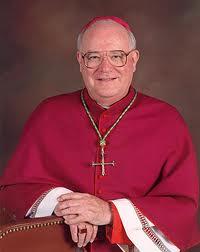
For example: this is San Francisco, and there are a decent number of gay Catholics, and a lot of them go to Most Holy Redeemer Church in the Castro, which is about as welcoming to gay people as any Catholic institution can ever be. And what does the Great and Exalted Archbishiop, Geroge Niederauer, do? According to a nice scoop by Cythina Laird in the BAR, he kicks a few lesbian and gay ministers out of an Advent service:

At least three gay and lesbian clergy members were disinvited from participating in Advent services at Most Holy Redeemer Catholic Church in the Castro, the Bay Area Reporter has learned. … “The basic reason is that Archbishop Niederauer felt the themes for vespers should better reflect the themes of Advent,” Wesolek told the B.A.R.

The “themes of Advent?” The only “theme of Advent” I know is that it celebrates the upcoming feast of the birth of Christ, who, at the time of his miraculous arrival into this world, hadn’t said a single thing about homosexuals.

Let’s be serious: This isn’t a religious statement, it’s a political statement about same-sex marriage. The archbishop can’t tolerate the idea that people — even respected religious people who also believe in Jesus, one of them a damn bishop, for Christ’s sake  — who happen to disagree with his teachings on marriage might share the stage with his holy crew:

Charles was the Episcopal bishop of Utah and was married to a woman for many years. After his retirement in 1993, he came out as a gay man, divorced his wife, and moved to San Francisco. In October 2008 he married Felipe Sanchez-Paris, Ph.D. in a civil ceremony in San Francisco. The couple had a church wedding in 2004 that was covered in the San Francisco Chronicle .

He told the B.A.R. that he received a call the night before his scheduled appearance “indicating that my participation in a liturgical service was unacceptable to the Chancery (in all likelihood, the archbishop): presumably, my participation as the first openly out gay bishop, legally married according to the laws of the state of California, might suggest approval of gay marriage.”

Kind of hard to believe. Or not.

I wish the folks at the archdiocese would talk to me about this, but they haven’t returned my calls.

UPDATE: George Wesolek, spokesperson for the archdiocese, just called me. He acknowledged that the archbishop had decided to disinvite the three ministers on the grounds that “it appeared they might be going to talk about topics with agendas. Advent is not the time for politicizing this, for divisive issues, it’s a time to bring people together.”

In other words: If you want to talk about same-sex marriage, shut up.


The Shining Holiday Spectacular

0

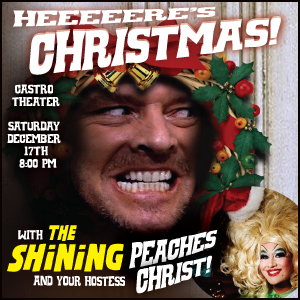
HEEEEEEEEEERE’S CHRISTMAS!

The Shining Holiday Spectacular is an insane Christmas extravaganza full of holiday madness and mayhem hosted by Peaches Christ and stars the fabulous Midnight Mass Players.
 
The historic Castro Theatre is proud to host Peaches’ screening of The Shining – especially the Torrance Family Christmas Review hosted by Jack, Wendy, and Danny Torrance, starring Peaches Christ and the Midnight Mass Players with special performances by The Twins, Lady in a Bathtub, and more!
 
Watch as the Castro Theatre is transformed into the Overlook Hotel and visit the Haunted Ballroom Bar in the mezzanine or order cocktails from a dead man. Dress up for the Crazy Christmas Costume Contest where your mentally ill wardrobe can win big prizes….and be ready to barely make it out alive.

For more information and to purchase tickets, fooooollow this link!

Saturday, December 17at 8pm @ Castro Theater, 429 Castro, SF

Rep Clock

0

Schedules are for Wed/14-Tues/20 except where noted. Director and year are given when available. Double and triple features are marked with a •. All times p.m. unless otherwise specified.

ARTISTS’ TELEVISION ACCESS 992 Valencia, SF; www.atasite.org. $6. “Other Cinema:” “New Experimental Works,” Sat, 8:30.

BALBOA 3630 Balboa, SF; www.brownpapertickets.com. $17.50-20. “Opera and Ballet at the Balboa Theatre:” Tosca, performed by the Royal Opera House, Wed, 7:30; The Nutcracker, performed by the Royal Ballet and the orchestra of the Royal Opera House, Sat-Sun, 10am.

CASTRO 429 Castro, SF; (415) 621-6120, www.castrotheatre.com. $7.50-10. “Noir City Xmas:” Lady on a Train (David, 1945), Wed, 7:30; Christmas Holiday (Siodmak, 1944), Wed, 9:20. •The Soft Skin (Truffaut, 1964), Thurs, 2, 7, and Shoot the Piano Player (Truffaut, 1960), Thurs, 5:15, 9:15. The Birds (Hitchcock, 1963), Fri, 2, 4:30, 7, 9:30. “Heeeere’s Christmas!”: The Shining (Kubrick, 1980), presented as part of “The Torrance Family Christmas Revue,” hosted by Peaches Christ, Sat, 8. This event, $25-45; more info at www.peacheschrist.com. “Santa’s Cool Holiday Film Festival:” Santa Claus Conquers the Martians (Webster, 1964), plus vintage Christmas cartoons, and more, Sun, 1:30.

CHRISTOPHER B. SMITH RAFAEL FILM CENTER 1118 Fourth St, San Rafael; (415) 454-1222, www.cafilm.org. $6.75-10.25. The Artist (Hazanavicius, 2011), Wed-Thurs, call for times. Golf in the Kingdom (Streitfeld, 2010), Wed-Thurs, call for times. The Nutcracker, performed by the Royal Ballet and the orchestra of the Royal Opera House, Sun, 1:30; Tues, 7.

ELECTRIC WORKS 230 Eighth St, SF; www.sfelectricoworks.com. “Imagine That,” animation screening curated by Sarah Klein for kids and adults, Sat, 6.

EXPLORATORIUM McBean Theater, 3601 Lyon, SF; www.exploratorium.edu. Free with admission ($10-15). A Child’s Christmas in Wales (Lightner, 1963), Sat, 2.

HOUSE OF AIR 926 Mason, SF; www.houseofair.com. $8. One for the Road, Fri, 8.

PACIFIC FILM ARCHIVE 2575 Bancroft, Berk; (510) 642-5249, bampfa.berkeley.edu. $5.50-9.50. Theater closed through Jan 11.

ROXIE 3117 and 3125 16th St, SF; (415) 863-1087, www.roxie.com. $6.50-10. “Southern (Dis)Comfort: The American South in Cinema:” Wild River (Kazan, 1960), Wed, 6:15; Spring Night, Summer Night (Anderson, 1968), Wed, 8:30; The Beguiled (Siegel, 1971), Fri, 7; Shy People (Konchalovsky, 1987), Fri, 9:15. Golf in the Kingdom (Streitfeld, 2011), Wed-Thurs, call for times. Footprints (Peros, 2011), Dec 16-22, 7, 8:45 (also Sat/17-Sun/18, 3, 4:45). Paul McCartney: The Love We Make (Maysles and Kaplan, 2011), Dec 16-22, 7, 9 (also Sat/17-Sun/18, 3:15, 5).

SAN FRANCISCO PUBLIC LIBRARY Koret Auditorium, 100 Larkin, SF; www.sfpl.org. Free. “Bay Area Community Cinema Series:” Taking Root: The Vision of Wangari Maathai (Merton and Dater), Wed, 5:45.

SFFS | NEW PEOPLE CINEMA 1746 Post, SF; www.sffs.org. $10-11. The Bride Wore Black (Truffaut, 1968), Fri and Dec 18-22, 2, 4:30, 7, 9:30.

VORTEX ROOM 1082 Howard, SF; www.myspace.com/thevortexroom. “Left Out of Radical Light: (A So-Called/Supposed Survey of) Alternative Film and Video in the San Francisco Bay Area, 1945-2000,” Fri, 8.

YERBA BUENA CENTER FOR THE ARTS 701 Mission, SF; (415) 978-2787, www.ybca.org. $6-10. “From Muppets to Metal: Music Movies:” Emmet Otter’s Jug-Band Christmas (Henson, 1977), Thurs, 7:30; Sun, 2; John Zorn: A Film in 15 Scenes (Klahr, Gobolux, Hills, and Izzo, 2011), Sat, 7:30.

Our Weekly Picks: December 14-20

0

WEDNESDAY 14

The Christmas Ballet

Not everyone is nutty enough to celebrate the nuclear family during the holidays. But that’s no reason not to go out and party. Smuin Ballet is a good place to start. The core of the late Michael Smuin’s The Christmas Ballet stays pretty much the same — classical music and (more or less) classical dancing in the first half, and a marvelous-fun, stylistically allover the place second half. Some ingredients have become classics: Santa Baby, Surfer, and Drummer Boy, among others. Every year, however, there are premieres. This December they are by Amy Seiwert and Robert Sund. (Rita Felciano)

Through Dec. 23, times vary

8 p.m., $25–$62

Yerba Buena Center for the Arts

701 Mission St. SF

415-556-5000

www.smuinballet.org


THURSDAY 15

Baths

Baths is 22-year-old electronic musician Will Wiesenfeld. Like many lumped into the chillwave category, Wiesenfeld recorded his debut album Cerulean (Anticon) in his bedroom. Cerulean is a soft and fuzzy collection of melodic, piano-driven love songs endowed with the contemporary flair of inventive rhythms and eclectic samples. The album features lots of strange, distant vocals and some unlikely cameos by clicking pens and rustling blankets. Weisenfeld’s music feels lukewarm, relaxing, laid-back. It’s like, well, warm baths. (Frances Capell)

With Dntel and Raliegh Moncrief

8 p.m., $18

Slim’s

333 11th St., SF

(415) 255-0333

www.slimspresents.com


Emmett Otter’s Jugband Christmas

With the Muppets currently making their highly anticipated comeback in movie theaters, Bay Area fans are in for a special treat, a trip down memory lane to Frogtown Hollow with screenings of 1977’s Emmet Otter’s Jug-Band Christmas. Featuring a cast of beloved furry and felt-covered magical creations of the Jim Henson Company, the film tells the tale of the adorable Ma Otter and her son, who both secretly enter a musical talent contest to win money to buy each other presents for Christmas. Hosted by Kermit the Frog, the talent show is propelled by a variety of foot-stomping musical numbers, and punctuated by the young otter’s heartwarming realization that family is the greatest gift of all. (Sean McCourt)

7:30 p.m.; Dec. 18, 2 p.m., $8

Yerba Buena Center for the Arts

701 Mission, SF

(415) 978-2787

www.ybca.org


Yip Deceiver

Think of Yip Deceiver as Of Montreal’s wicked cousin. Of Montreal multi-instrumentalist Davey Pierce has borrowed the band’s poppiest elements and let them run wild on his electronic side project. Lots of synthesizers and infectious hooks inform the retro dance blow-out that is Yip Deceiver. It’s like an Of Montreal that’s been fed party drugs and handed a glowstick. A naughtier, sweatier Of Montreal. “Dance like you’ve got no soul,” Pierce commands on Yip Deceiver’s “Sadie Hawkins Day.” (Capell)

With Shock, Loose Shus, and Tres Lingerie

8 p.m., $6

Milk Bar

1840 Haight, SF

(415) 387-6455

www.milksf.com


Loco Dice

Dusseldorfer techno DJ Loco Dice is kind of the alpha male of the underground dance scene. Not just because of his sculpted physique, impeccable five o’clock shadow, forceful opinions, and tendency to fill parties up with expensive sunglasses and hot chicks. No, it’s his refreshingly muscular style that elicits awe — he can make anybody’s record sound like his body-pumping own during a set, and his residencies on Ibiza helped add some speaker-engulfing German power to the island’s signature Spanish-samba techno sound. (The party line on this talent is that his years spent playing hip-hop cultivated a certain transformative energy.) Don’t write him off as some Jersey Shore Ibizan, though. Loco Dice also brings a roving ear and polished intelligence to the decks, as well as the kind of improvisatory magic only a live setting, and pulsing psychic conversation with the dancers, can provide. (Marke B.)

10 p.m., $15–$25

Vessel

85 Campton, SF

www.vesselsf.com


Dinosaur Jr.

Of all the pioneering alternative rock groups dragging out their old albums in their entirety, Dinosaur Jr. could easily have kept the past quarantined away. In the seven-odd years since J. Mascis and Lou Barlow put aside a long standing grudge, the band has been operating at peak form, releasing acclaimed albums including 2007’s Beyond and 2009’s Farm. The current tour, however, finds Dino looking back and performing 1988’s Bug, an album remembered for shredded guitars (“Freak Scene”) and destroyed vocal cords (“Don’t”) as much as a tour that resulted in the band’s unceremonious break-up. Former SST labelmate, Henry Rollins, will be on hand for a Q&A looking back on the era, and perhaps lay some issues to rest (Ryan Prendiville)

With Pierced Arrows

8 p.m., $32.50

Fillmore

1850 Geary, SF

(415) 346-6000

www.thefillmore.com


FRIDAY 16

Slow Hands

Slow food, slow cooking, slow money, slow living … why not a slow house movement? Well, at least “slow” in the non-metaphoric sense: NYC DJ Slow Hands was at the vanguard of a dance music moment that a couple of years ago began to slow house music tempos down to a sultry 100 beats per minute from the standard 120bpm. Sometimes he’d play slower tunes from outside the usual dance realm, sometimes he’d actually just slow down the records themselves. (The Moombahton genre followed the second method soon afterwards, slowing Dutch Euro-techno down to reggaeton speed.) But Slow Hands slow never equals boring. His mixes move with the hypnotic complexity of a dream machine, full of dubby effects, chugging momentum, and entrancing riffs. He may not even play slow at all, blasting off into wondrously ecstatic underground pop if the room feels it. Read my interview with him at www.sfbg.com/slowhands (Marke B.)

9 p.m., $15 before midnight, $20 after

Beat Box

314 11th St., SF.

www.ayli-sf.com


SATURDAY 17

A Child’s Christmas in Wales

Dylan Thomas’s prose poem A Child’s Christmas in Wales should stand alongside Dickens’ A Christmas Carol as one of the seasonal classics. It tells the story of a Welsh boy’s Christmas with witty anecdotes and rich language, reviving an earlier time “before the motor car” when everything — even the snow which “came shawling out of the ground and swam and drifted out of the arms and hands and bodies of the trees” — was unspoiled and dreamlike. Originally written for a BBC radio broadcast, the poem became a children’s book after Thomas’s death in 1953. This short film adaptation from 1963 was produced by Marvin Lightner and uses the bold and theatrical original recording by Thomas. (James H. Miller)

2 p.m., $15

Exploratorium

3601 Lyon, SF

(415) 561-0360

www.exploratorium.edu


“One-Minute Play Festival”

One of the shortest plays on record is Samuel Beckett’s Breath — it runs somewhere between 20 and 30 seconds and, from beginning to end, consists purely of sounds of a child crying, followed by heavy breathing, light changes, and a stage cluttered with trash. Not even Beckett attempted to put actors in the terse script. But at the One-Minute Play Festival, they do use actors. With more than 80 one-minute plays written specifically for the occasion, over 30 actors and five directors, the two-day festival provides quite the jarring experience. In 60 seconds, you can probably do little more than read this short article and blow your nose. But by that time at the festival, you would have already seen a contemporary drama. (Miller)

8 p.m.; Dec. 18, 2 and 7 p.m., $20

Thick House

1695 18th St., SF

(415) 626-2176

www.playwrightsfoundation.org


Lagwagon

Growing up, skate-punk trailblazer Lagwagon was a pretty big deal for me. In the band’s heyday, Lagwagon’s frontman Joey Cape was the poster boy for teenage fuck-ups everywhere. The band may have been made up of a bunch of slackers, but its music became the definitive sound of Fat Wreck Chords and inspired countless skate-punk bands to follow in its footsteps. I’d kind of forgotten about Lagwagon until I found out it was re-releasing five of its albums from the ’90s this year. For those of us who downloaded all its music on Napster and spent our allowance money on 40s, it’s payback time. (Frances Capell)

With Druglords of the Avenues and Heartsounds

9 p.m., $22

Slim’s

333 11th St., SF

(415) 255-0333

www.slimspresents.com


Pinback

Pinback tends not to burst into moments of wild intensity, but it doesn’t dwell on the lower end of things either. It finds, rather, a comfortable space between the two, much like the Sea and Cake, with whom it shares a similar texture and mood. Formed in the late 1990s as a side project by Zach Smith and Rob Crow after Smith’s band Three Mile Pilot went on hiatus, the San Diego band released its self-titled debut in 1999. In 2007, the band released Autumn of the Seraphs — an instant classic Pinback album that’s spearheaded by Smith and Crow’s complementary vocals and rhythmic guitar work. Since then, the band has been relatively quiet on the recording end, but it hasn’t yet renounced the tour bus. (Miller)

With Ghetto Blaster

10 p.m., $20

Bottom of the Hill

1233 17th St., SF

(415) 621-4455

www.bottomofthehill.com


SUNDAY 18

“Santa’s Cool Holiday Film Festival”

Something is happening to the children of Mars. Hooked on TV programs beamed from nearby Earth, they can’t eat or sleep — they’ve become fixated on foreign concepts like “playing with toys” and “Christmas.” After consulting with the planet’s resident 800-year-old wise man, Martian leaders come up with a solution: “We need a Santa Claus on Mars.” Interstellar kidnapping ahoy! Forget A Christmas Story (1983) — it’s all about 1965’s Santa Claus Conquers the Martians, an outrageously low-budget fruitcake of spunky kids, robot henchmen, bloop-bloop “space age” sound effects, zapping rays, a German-accented rocket expert, a villain with a mustache, and (naturally) a heartwarming final message about the true spirit of Christmas. This screening also features retro holiday cartoons and trailers, plus a toy drive hosted by the San Francisco Firefighter’s Toy Program. Hooray for Santy Claus! (Cheryl Eddy)

1:30 p.m., $7.50–$10 ($5 admission for children who contribute a new, unwrapped toy)

Castro Theatre

429 Castro, SF

(415) 621-6120

www.castrotheatre.com


TUESDAY 20

Zach Rogue

As an atheist gentile, I don’t know much about Judaism. But I do know that by the midpoint of December the bombardment of everything X-mas has me eyeing all the non-Christian events possible. Luckily, the Idelsohn Society has set up the Tikva Records pop-up shop, a non-red and white, non-ringing of the bells oasis. For the beginning of “the Festival of Lights” (Thanks Wikipedia!), local singing songwriter Zach Rogue, of indie-rock outfit Rogue Wave and recent project Release the Sunbird, will inaugurate the festivities with a performance and candle lighting. Candle lighting? I’ve got to see this. (Prendiville)

7 p.m., donation suggested (RSVP online)

Tikva Records

3191 Mission, SF

(415) 713-0649

www.tikvarecords.eventbrite.com  


The Guardian listings deadline is two weeks prior to our Wednesday publication date. To submit an item for consideration, please include the title of the event, a brief description of the event, date and time, venue name, street address (listing cross streets only isn’t sufficient), city, telephone number readers can call for more information, telephone number for media, and admission costs. Send information to Listings, the Guardian Building, 135 Mississippi St., SF, CA 94107; fax to (415) 487-2506; or e-mail (paste press release into e-mail body — no text attachments, please) to listings@sfbg.com. Digital photos may be submitted in jpeg format; the image must be at least 240 dpi and four inches by six inches in size. We regret we cannot accept listings over the phone.

On the Cheap Listings

0

Submit items for the listings at listings@sfbg.com. For further information on how to submit items for the listings, see Picks.

THURSDAY 15

Cacophony Christmas Duboce Park. www.thescoutpress.com. 7:30 p.m., free. “It’s not quality, it’s caroling,” explain the folks responsible for their aptly-named musical traipse around San Francisco. You don’t have to wear an gloriously ugly sweater, be tone deaf, or count yourself a Christmas time Scrooge to join in, but it might help.

Far From Over launch party SF Camerawork, 657 Mission, second floor, SF. www.ahomewithin.org. 5:30-7:30 p.m., free. Fostering Art, a program encouraging foster youth in artistic expression, releases an anthology tonight spanning the past eight years in its students’ work.

FRIDAY 16

Uncomfortable Zones of Fun Temescal Art Center, 511 48th St., Oakl. www.temescalartcenter.org. 8 p.m., free. Bay shaman Frank Moore has been doing his improvised explorations of sexuality (his, yours, your neighbor’s) for years to widespread acclaim, and he still says he never knows what exactly will happen next onstage. Musical instruments and unflappability are encouraged.

Fourteen Hills release party Space Gallery, 1141 Polk, SF. www.14hills.net. 7-10 p.m., free. The MFA program at SF State celebrates the birth of this semester’s squalling baby: the Fall 2011 literary journal that showcases young all-stars of the Bay poetry scene.

Ugly Sweater Christmas Party Lookout, 3600 16th St., SF. www.lookoutsf.com. 5-9 p.m., free. Walking under, around, or really just anywhere near Lookout always means getting an eyeful of some interesting Castro specimens, and tonight’s no exception — only this eve the offerings will be a bit more Rudolph and twinkly mistletoe than usual. A free buffet and cheap drinks make that sweater a little less itchy.

SATURDAY 17

Renegade Craft Fair Concourse Exhibition Center, 620 Seventh St., SF. www.renegadecraftfair.com. Also Sun/18. 11 a.m.-6 p.m., free. A DIY maelstrom strikes San Francisco for the third year: enter the terrarium-ed, silk-screened, and bike part-bedecked behemoth of craftiness that is the Renegade Craft Fair. An extra cool feature this year is the SF public library’s bookmobile, which will be parked out front of the expo and ready for offhand library card creation.

Punk Swap Meet Speakeasy Brewery, 1195 Evans, SF. www.goodbeer.com. 1-6 p.m., free. Get to know the dark, tortured hearts of your fellow swappers with a mixtape exchange sponsored by Speakeasy. Clothes, zines, records, and crafts — with maybe a few extra safety pins thrown in are also on the table.

Timebank holiday fair Happiness Institute, 1720 Market, SF. www.bace.org. 7-10 p.m., free. Those strapped for cash and still needing to purchase holiday scarves for second cousins (or really, pretty much everyone) can take heart. For the small price of a little time logged through the Timebank, a homemade gift of your own, or food to share, you can pick up all your holiday comestibles with minimal monetary loss.

Lower Haight holiday fair Peacock Lounge, 552 Haight, SF. Noon-5 p.m., free. Christian Ciscle owns Wing Wings, Lower Haight’s newest entrant in its already-admirable canon of late night munchie options. Today he’s throwing a holiday fair in the street’s most mysterious watering hole, the ever-shuttered Peacock Lounge. Swing through to pick up locally made pickles, skincare products, clothing, and more.

Mercado de Cambio/The Po’ Sto’ holiday fair and knowledge exchange 2940 16th St. No. 301, SF. www.poormagazine.org. 3-7 p.m., free. POOR Magazine organizes this push-back on the holiday season’s traditional reliance on big box stores for holiday cheer. Patronize your local micro-businesses at this bazaar, and catch performances by hip-hop artists and readings by some of POOR’s finest writers.

SUNDAY 18

The Joy of December festivity Casa de Cultura, 1901 San Pablo, Berk. www.ananitmar.com. 5:30 p.m., free. Folkloric ballet and Guatemalan chanteuse Ana Nitmar join forces for a Posada procession — the traditional Mexican re-enactment of Jesus, Mary, and Joseph’s quest to find housing on Christmas eve — that will usher in the Christmas holidays and celebrate the native, African, and colonial history of Central America.

TUESDAY 20

Feast of Words potluck SOMArts Cultural Center, 934 Brannan, SF. www.somarts.org. 6:30 p.m., $5 with potluck dish. Poet Arisa White wants to eat her words, and you to do the same. Young chefs from Old Skool Cafe and SOMArt’s Potluck Brigade share dishes inspired by poet’s work. They’re welcoming both edible and written contributions from attendees to round out the evening.

Police arrest 55 in early morning raid at Occupy SF

9

After more than two months, police have successfully cleared out all of the Occupy SF encampment on Market Street between Main Street and the Embarcadero. In an early morning raid, police completely cleared out the Occupy SF protest site at 101 Market St.

More than 50 protesters were present at 101 Market St. on the evening Dec. 10, as well as at a smaller site across the street. No tents, tarps or other structures had been erected; most protesters had sleeping bags and blankets. Following an afternoon march and a small concert that ended by midnight, protesters were quiet and mostly asleep.

Police previously warned protesters that they were in violation of California Penal Code section 647(e), “lodging in a public place.” Police entered the camp and read written notices aloud every 90 minutes or so for more than 24 hours before the raid, but did not give a specific warning as to when enforcement would take place.

Around 4:30 a.m. on Dec. 11, police rushed in, quickly surrounding those who slept in front of the Federal Reserve Building. Without giving them the option to pack up their belongings and leave, police arrested each individual one by one. Protesters who’d set up camp at a smaller site across the street looked on and yelled out in dismay.

Protesters had previously been informed that they were permitted to sleep on the sidewalk between 11 p.m. and 7 a.m., as outlined in San Francisco’s sit-lie ordinance.

Until about 6 a.m., Market Street between Main and Spear streets was blocked off by over 100 police officers in partial riot gear as well as several police vehicles. At about 5 a.m., Department of Public Works crews arrived and started loading all the protesters’ belongings — mostly sleeping bags, blankets, protest signs, and food — into trucks.

Several were arrested on charges other than public lodging. Two protesters, who yelled at police as they lined up on the street, were arrested for obstructing traffic.

One man yelled that he was a homeless war veteran and that he wanted his belongings back, which he’d left on the sidewalk in front of 101 Market. He had been loudly decrying police activity for almost 30 minutes when he jeered that an officer “carried a big stick because he had a small dick,” at which point three officers immediately grabbed him, brought him inside police lines, and were joined by several other officers in pushing him to the ground and zip-tying his wrists. Another man was arrested for spitting near the feet of a policeman.

In one bizarre incident, an officer confiscated a package of bottled water that an individual was carrying at the time of his arrest and then proceeded to distribute the bottles up and down the police line.

A man with a broken foot, who was walking on crutches, was pushed down by police for obstructing the street. He was arrested a few minutes later, after he and several others sat down in a crosswalk in defiance of orders to step onto the sidewalk.

By 6 a.m., everyone who remained at 101 Market St. had been arrested and all of their belongings confiscated; the sidewalk was clear.

Occupy SF began its 24 hour protest at 101 Market St. on Sept. 29. The camp remained until the first police raid on Nov. 20. Protesters subsequently reclaimed the site on Dec. 1.

As things stand, there is no Occupy SF presence at either of the original downtown locations. By 6:45 a.m., about 10 individuals — those who’d evaded arrest — had set up a small protest site, complete with signs and information table, at 532 Market St., in front of the offices of E Trade Financial.

In the past week, Occupy protest sites have also popped up at City College of San Francisco, San Francisco State University, and at the Bank of America at 501 Castro St. Occupy SF State is the only protest camp, complete with tents, still in place today in the city today.

Get read!

0


ROCK AND ROLL ALWAYS FORGETS

By Chuck Eddy

Duke University Press

352 pp., paper, $24.95

Chuck Eddy glides through music criticism like a grumpy fanatic. Each article included in Rock and Roll Always Forgets — culled from Eddy’s vast back catalogue of music journalism articles, beginning with the early 1980s — is packed with cultural references, touchstones, facts, witty asides, a dash of snark, and acknowledgments of once-obscure acts. Yet, he approaches each band like he’s the first to have discovered it. He’s a musical anthropologist, but also, archeologist, digging up the remains of musicians past, lest we forget. Take a piece on a Marilyn Manson show, written in 1996. More than simply describing the stage and the crowd (which he does, expertly: “[they] wore too much black makeup, but they didn’t scare me — most seemed to be upper-middle-class Catholic school teens from the burbs…”). He wanders near profundity, dissecting Manson’s overall persona, his ticks, his own cultural references, and those who came before him, namely Alice Cooper, but a great many more. Most importantly, Eddy alludes to why that all matters in the least. (Emily Savage)


TROPIC OF CHAOS

By Christian Parenti

Nation Books

295 pp., hardcover, $25.99

Through historical research and on-the-ground reporting in Kenya, war-torn areas of Afghanistan, and other regions marked by intense conflict, Christian Parenti offers an unusual and compelling analysis of violence through the lens of the environment. Tropic of Chaos: Climate Change and the New Geography of Violence teases out the idea that increasingly unstable weather patterns stemming from climate change have fueled conflict throughout impoverished areas of the Global South. In the savannahs of northwest Kenya, for instance, deadly cattle raids have intensified as intertribal warfare heats up in the face of water scarcity. Recurring droughts and floods in Afghanistan have made it exceedingly difficult for farmers raise traditional crops, making them increasingly reliant drought-resistant poppy — the raw ingredient for heroin — for economic survival. Parenti also turns a sharp eye upon the repression, surveillance, and counterinsurgency that first-world nations have employed to combat growing violence in water-scarce, conflict-ridden regions, and calls for a more enlightened approach. (Rebecca Bowe)


CAFE LIFE SAN FRANCISCO

by Joe Wolff

Interlink Books

224 pp., paperback $20

Small quirks in this guide to the city’s cafes and coffeehouses — the sixth in a series that includes Sydney, New York, and Venice — will let you know its not strictly, strictly for locals. Java Beach is lumped in with more gearhead-oriented Mojo Bicycle Cafe and Ninth Avenue’s Arizmendi Bakery is filed under the catchall “Sunset District and vicinity.” The introduction’s discussion of “San Fran” versus “Frisco” versus “the City” is one that became boring long ago. But those things matter little. In-depth histories of some of your favorite cafes, from Java Beach to Philz’ to Caffé Baonecci are lucid looks at the facts and rewards of small entrepreneurship in the city. And Roger Paperno’s loving photography of velvet crema and foccacia sheets combines with words to create an ode to the city’s third spaces that any caffeine-laptop addict will appreciate in their stocking. (Caitlin Donohue)


LIONS OF THE WEST: HEROES AND VILLAINS OF THE WESTWARD EXPANSION

By Robert Morgan

Algonquin Books

497 pp., hardcover, $29.95

Biography can be the best history; stories of the people who changed the world (for better, and often for worse) are more compelling than turgid texts of dates and places. Lions of the West recounts the development of the American frontier from the end of the Revolutionary War to the Civil War era through the lives of 10 men. Yeah, all men. In fact, Morgan (by choice or by the longtime bias of American historians) makes it appear as if all of the great and evil deeds done as the nation moved Westward Ho were the province of the male of the species. At times, the profiles are a bit over the top (I don’t really care that much about Kit Carson’s personal life.) Overall, though, it’s a detailed, lively, and informative book that minces no words, especially when discussing the theft of much of the southwest from Mexico. San Franciscans will enjoy learning who Stockton, Sloat, Castro, Winfield, and a few other streets were named after. (Tim Redmond)


VHS: ABSURD, ODD, AND RIDICULOUS RELICS FROM THE VIDEOTAPE ERA

By Joe Pickett and Nick Prueher

Running Press

272 pp., paper, $14

Found Footage Festival founders and comedy writers Joe Pickett and Nick Prueher are apparently the Indiana Joneses of VHS, unearthing remarkable video package cover art that would otherwise be relegated to hoarder basements, bonfires, and anywhere else the worst (a.k.a., the best) videotapes go to die. I salute these dudes, even though the captions they tag each page with aren’t always funny or necessary. Truly, the covers (soft-focus and garish, tacky and baffling) speak for themselves, direct dispatches from ye olden days, long before YouTube brought WTF-ness to anyone with an Internet connection. You see, children, back in the 1980s or 90s, home viewers had to seek this shit out: instruction in squirrel-calling, chair-dancing, seduction, hairstyling (“What the Heck Am I Going to Do With My Hair?”), baby-proofing, spotting counterfeit Beanie Babies, etc. Straight-to-video masterpieces (F.A.R.T.: The Movie). Horrible exercise fads (“Bunnetics: The Buttocks Workout”). Well-meaning but also ghoulish-looking self-improvement vids (“Face Aerobics”). Every page is magical. Your mind will be blown. (Cheryl Eddy)


BI-RITE MARKET’S EAT GOOD FOOD

By Sam Mogannam and Dabney Gough

Ten Speed Press

297 pp., hardcover, $32.50

Bi-Rite Market is the ultimate neighborhood grocery. Shockingly small (with ambition to expand), it’s jam-packed with the best in organic produce, meats, cheeses, and artisan food products, much of it local. Now, Bi-Rite founder Mogannam has a new book loaded with recipes for such inviting delectables as white bean puree with prosciutto crespelle and strawberry rhubarb pie. But don’t relegate it to the cookbook category. Hewing to Bi-Rite’s mantra of creating community through food, the authors share extensive tips on shopping seasonally and locally for the healthiest and best-tasting products, no matter where you may live. You’ll learn what to look for at the grocery, storage and usage tips, and more. Well-illustrated sections feature produce (broken down by season), wine, beer, cheese, deli meats, butchery, baked goods, and even farmer profiles. Bonus: stay tuned for Sweet Cream and Sugar Cones, Bi-Rite’s ice cream and frozen treats recipe book from its renowned creamery, out this April. (No word yet on whether it’ll tell us how to beat the ever-present line outside.) (Virginia Miller)


DAMNED

By Chuck Palahniuk

Doubleday

247 pp., hardcover, $25

Welcome to Hell, as seen through the eyes of 13-year-old Madison Spencer, the daughter of a jet-setting yet eco-hyperconscious movie starlet and philanthropist. This is Dante’s Inferno meets The Breakfast Club, a film that overtly informs the plot and its main characters. As in Palahniuk’s breakout novel Fight Club, it’s hard distinguish between reality and perception as Maddy leads readers past the Vomit Pond, across Dandruff Desert, and right into Satan’s black Town Car. As she recalls her final weeks on earth, you’re pretty sure that she didn’t really die from a marijuana overdose. Clearly, things are not what they seem as the novel looses an American teenager’s perspective on modern life in both the underworld and earthly realm, with wry commentary on everything from pop culture and capitalist excess to the defeated religions whose fallen gods roam Hades. The gags alone — like the telemarketing and chatroom porn the damned deliver to Earth, and Hell’s endless loop of The English Patient — make this a tough book to put down, all the way to its slightly unsatisfying conclusion. (Steven T. Jones)


BEST AMERICAN COMICS 2011

edited by Alison Bechdel

Houghton Mifflin Harcourt,

352 pp., paperback $25

Chris Ware’s textbooky flowcharts; Angie Wang’s Technicolor, spiraling pistil-armed super-flower-heroine; Peter and Maria Hoy’s intricately plotted cause-and-effect grid art — the sixth year of this hardcover assemblage of the year in superlative strip art soars as a holiday gift for your fave comic nerd. Visual trickery and innovative page staging aside, many of the graphic narratives in this book hold up on plot alone. An excerpt from Kevin Mutch’s Fantastic Life effectively mines zombie philosophy, dating paranoia, and begging drinks off your service industry friends for comic gold. Many of the best pieces, perhaps indicative of the graphic novel mood these days, explore the darker side of the human psyche. But what graphic novel fan is unfamiliar with complicated? (Caitlin Donohue)


THE TIPSY VEGAN

By John Schlimm

Lifelong Books/Da Capo

164 pp., paper, $17

Every time I think we’re past the stereotype of the sullen, uptight vegan, I get another comment like, “Wait, don’t you only eat vegetables?” Why yes, I do eat plenty of veggies, but I also eat decadent dishes such as The Tipsy Vegan‘s Party Monster Pancakes, loaded with the sweet nectar of amaretto and drenched in syrup. This book is a carnivorous teetotaler’s nightmare, boasting 75 boozy recipes stuffed with everything from “beer to brandy” for the liquor-loving vegan cooks among us. It’s not, as I initially imagined, a book on vegan cocktails — that would be far too easy. Written by John Schlimm (Ultimate Beer Lover’s Cookbook), a member of “one of the oldest brewing families in the United States,” the book includes booze-infused treats for parties, brunch, and supper: fried avocados, slur-baaaaked peaches with Cointreau, “Bruschetta on a Bender” — all of which kind of sound like stoner food to me. An nice touch: glossy food porn shots on every page. (Emily Savage)


PROJECT DOG

By Kira Stackhouse

self-published

352 pp., hardcover, $34.99

Local photographer Kira Stackhouse experienced an inspiration so intense that she ditched her high-profile marketing job to pursue it: she would photograph specimens of the 50 most popular canine breeds officially registered with the American Kennel Club (“purebred dogs”) that had been purchased from professional breeders — and pair them with photos of the exact same kinds of dogs found in local dog rescues and shelters. The purpose was to start a dialogue about the effects of professional breeding and highlight the many kinds of dogs available for adoption (and also to change peoples’ perceptions about rescue dogs). But a major part of the story — and what makes this book so fantastic — is the wonderful doggy photography and sumptuous layout. Dogs are posed, or pose themselves, against iconic Bay Area backdrops, accompanied by often hilarious, always revealing, biographies and profiles. Project Dog became an online sensation: this book cements its reputation. Available at www.projectdog.net. (Marke B.)


LISTEN TO THIS

By Alex Ross

Picador

384 pp., paper, $18

In the expanded paperback edition of his absorbing and erudite collection of essays, Alex Ross of the New Yorker writes what could be called his mantra as critic: “I have always wanted to talk about classical music as if it were popular music, and popular music as if it were classical.” Ross listened exclusively to classical until he was 20, something he admits may sound “freakish.” But whether he’s describing Björk in her recording studio in Iceland, or composer John Luther Adams’ sound and light installation in Alaska, Ross draws from an immeasurable well of knowledge and plunges into his subject with gusto. He can find commonalities between Radiohead’s “Pyramid Song” and Stravinsky’s Firebird Suite, clear away the myths that have clouded both Franz Shubert and Bob Dylan, and thoroughly explain why OK Computer and John Cage’s 4’33” are equally astonishing. Informative, eye opening, Ross is every lover of music thrown harmoniously into one. (James H. Miller)


MY FAMILY TABLE

By John Besh

Andrews McMeel Publishing

272 pp., hardcover, $35

To know anything about New Orleans’ dining scene is to know John Besh. As one of Nola’s great chefs, he has a number of restaurants, including the acclaimed August, elevating local cuisine in forward-thinking ways. His original book My New Orleans is a striking post-Katrina tome to one of the greatest cities in the world and its vibrant culinary history. It’s a gorgeous coffee table volume packed with photos of the region’s people, places, and foods — more than 200 recipes from Mardi Gras specialties to gumbo, many with a contemporary twist. Besh just released, My Family Table, with welcoming, everyday recipes he cooks with his family that are healthy, fresh, simple, and heartwarming. Besh’s star power (Iron Chef champion and James Beard award-winner that he is) never dominates. Like New Orleans, it’s a visually beautiful book, but this time themed by “School Nights,” “Breakfast with my Boys,” and recipes like “Curried Anything” or “Creamy Any Vegetable Soup.” Closing with the key element of cooking, the communal, he writes: “If asked what my last meal would be, I’d reply, ‘Any Sunday supper at home, cooked with love, for people I love.'” (Virginia Miller)


FOUR SEASONS OF YOSEMITE: A PHOTOGRAPHER’S JOURNEY

By Mark Boster

Time Capsule Press

128 pages, hardcover, $34.95

John Muir would have loved this book, the spectacular result of a passionate love affair with Yosemite National Park involving all of the principals in this impressive project. Muir helped glorify and preserve Yosemite with his voice and pen. Robert Redford, who fell in love with Yosemite as an 11-year-old boy recovering from a mild case of polio, wrote an eloquent introduction to the book. Photojournalist, Mark Boster was smitten by the beauty and grandeur of the Yosemite when he first visited the park as a child with his family. He spent a year in the park detailing its seasonal changes in more than 100 magnificent pictures. “I felt the breezes, analyzed the light, listened to the sound of the rivers and falls, and tried to capture the images that moved me,” he writes in his introduction. Catherine Hamm’s delicate haiku add a poetic touch to many scenes. (The two principals who brought this project to life with loving care are Narda Zacchino, a former editor of LA Times and the Chronicle, and Dickson Louie, a former executive at both those papers. Zacchino serves as publisher and editor and Louie as president and CEO of Time Capsule Press, which specializes in creating books by using the archival content of newspapers and magazines.) Available at www.fourseasonsofyosemite.com (Bruce B. Brugmann)


THE PDT COCKTAIL BOOK

By Jim Meehan

Sterling Epicure

368 pp., hardcover, $24.95

Few bars have made as much impact on the New York cocktail (and thus the international) scene than PDT. Known as an early mover in the speakeasy trend, PDT revives classic recipes and invents new ones in the classic spirit. Bartender Jim Meehan put PDT on the map, and he’s since gone on to write about drink and educate bar managers and tenders everywhere. In the PDT Cocktail Book, he shares more than 300 cocktail recipes in a comprehensive collection inspired by classic tomes like The Savoy Cocktail Book. There are recipes from generations of hard-working bartenders, tips on glassware, bar tools, equipment, garnishes, techniques, a listing of seasonal ingredients, even a spirits primer. In keeping with PDT’s connection to neighboring Crif Dogs who serve creative dogs in the bar, there’s a section of hot dog recipes from big-name chefs who are regulars at the bar, including David Chang (Momofuku), Wylie Dufresne (WD-50), and Daniel Humm (Eleven Madison Park). From the comfort of home, cook up a Mason Dog fried in cornmeal and huitlacoche (corn smut/fungus, a Mexican specialty) to go with the Little Bit of Country cocktail, which mixes bourbon, maple, and jalapeño. (Virginia Miller)


EVERYTHING IS ITS OWN REWARD: AN ALL OVER COFFEE COLLECTION

By Paul Madonna

City Lights

240 pp., hardcover, $27.95

Like Ben Katchor’s classic “Julius Knipl, Real Estate Photographer,” local artist Paul Madonna’s “All Over Coffee” — published every Sunday in the Chronicle and on essential Web zine The Rumpus (www.therumpus.net) — draws me into a psychic space that is at once serene and troubled, surreal and hyperreal. The effect comes as much from the drawing style as the dreamlike non-narrative: both are direct descendants of Winsor McKay’s “Little Nemo.” Madonna gets an extra chills-up-the-spine boost from his illustrations of semi-familiar San Francisco architecture and intersections, lucid as etchings of bleached Kodachrome shots. For this second collection of the strip, he broadens his nib to include not only the City by the Bay, but Paris, Rome, Buenos Aires, and Tokyo. Overheard quotes, snatches of philosophical discourse, interior monologue snippets, existential doubts, random observations, and short stories are floated over the images to capture a peculiarly lovely eddies in the zeitgeist.


I DON’T WANT TO KILL YOU

By Dan Wells

Tor

320 pp., paperback, $11.95

Some of this is sick shit. You need a warped sense of humor and a love for random violence to enjoy the tale of a young man who lives with his mom in a mortuary and fights a demon made of black goo who takes over the minds and bodies of humans. But it’s a different type of thriller — complete with its own kinda sweet moments of teenage love and angst — and it’s packed with great detail. (Did you know that undertakers use Vaseline to fill up bullet holes? Cool.) John Wayne Cleaver, perfect name for a demon hunter, is a sociopath who is beastly to his mother and can’t get along with the other kids . Except for a super-hot chick who he thinks must be a demon, otherwise why would she like such a loser geek? The demon is nasty and gouges out eyes, cuts off tongues, sticks bodies on poles … you gotta check it out. (Tim Redmond)


RICE AND CURRY: SRI LANKAN HOME COOKING

S.H. Fernando, Jr.

Hippocrene Books

224 pp., paperback, $19.95

After a tongue-inflaming visit to the East Village’s fantastic Sigiri restaurant in NYC a couple weeks back, my interest in — and lust for — spicy Sri Lankan treats like kiri hodhi (coconut milk gravy), rossam (coriander-tamarind broth), kool (seafood soup), Jaffna goat curry, and ulundu vai (savory donuts) was, er, inflamed. Fortunately for me, author “Skiz” Fernando recently spent a year on the island rediscovering his roots and delving into the varied cuisine (later serving as a guide for that cheeky culinary colonist Anthony Bourdain). The punchy, informative Rice and Curry is the result, and includes nice introductions to Sri Lankan geography and history, as well as tips on what to stock in your cupboard to achieve the certain Sri Lankan “oomph” that sets the cuisine apart from Indian. A particular passage that profiles Leela, Fernando’s aunt’s ancient maid, offers some real insight into the island’s food tradition and customs — and yields a marvelous, corruscating crab curry from her hometown of Chilaw, just in time for Dungeness season. (Marke B.)


HEDY’S FOLLY: THE LIFE AND BREAKTHROUGH INVENTIONS OF HEDY LAMARR

By Richard Rhodes

Doubleday

261 pp., hardcover, $26.95

An author best-known for his 1986 Pulitzer-winning The Making of the Atomic Bomb, Richard Rhodes might seem like an unlikely biographer for movie stunner Hedy Lamarr, who lit up Golden Age films like Cecil B. DeMille’s 1949 epic Samson and Delilah. But her above-average qualities (she was called “the most beautiful woman in the world”) extended beyond the superficial. After escaping her gilded-cage marriage to an Austrian munitions magnate, Lamarr found success — and five more husbands — in Hollywood; between roles, she started inventing “to challenge and amuse herself.” During World War II, she got serious about her hobby. Showbiz circles led her to avant-garde musician George Antheil, renowned for his groundbreaking composition for 1924 short Ballet Mécanique. As Rhodes writes, “[Lamarr] began thinking about how to invent a remote-control torpedo to attack submarines just at the time she met Antheil, who knew quite a lot about how to synchronize player pianos.” Together, the “charming Austrian girl” and “the bad boy of music” worked on that torpedo, as well as “spread-spectrum radio,” an innovation that paved the way for contemporary wireless technology. Unlikely? Yes. Fascinating? Indeed. Never underestimate a beautiful woman — or a skilled writer’s ability to humanize complicated characters and bring drama to a tale loaded with tech-speak. (Cheryl Eddy)


COME, THIEF

By Jane Hirschfield

Knopf

98 pp., hardcover, $25

As it happens, one of Bay Area poet Jane Hirschfield’s passages currently adorns the famous Kahn and Keville auto repair shop’s marquee in the Tenderloin: “What some could not have escaped/ others will find by decision/ each we call fate.” Well, you could never blame her for not thinking big. As a well-known and approachable poet, she sports a blurb from O, The Oprah Magazine on this, her ninth collection, the first in six years since releasing her arresting After. And while her slightly witchy, be-scarved, grandiloquent persona screams marketable poetess, there’s some understated magic in her latest poems. These ones are full of plums and glass and vague Zen spells that give off, in their overall effect, an rueful, anticipatory sigh. Some childlike wonder seeps in: “Another year ends./ This one, I ate Kyoto pickles,” says “Washing Doorknobs,” my favorite from the collection. “But one thing you’ll never hear from a cat/ is Excuse me” goes “A Small-Sized Mystery.” Sometimes you can almost Hirschfield her straining for ambiguity, the poems’ heavy life lessons tearing through her delicate webs of observation. Still, each poem here showcases Hirschfield’s incisive power. (Marke B.)


PLENTY

By Yotam Ottolenghi

Chronicle Books

287 pp., hardcover, $35

Recently I returned to London, eating my way extensively through the city. One of my gustatory highlights was Yotam Ottolenghi’s beloved bakery and restaurant, Ottolenghi (with four locations). Not only were his baked goods otherworldly delights, his straightforward but elegant dishes using pristine ingredients were among the freshest and satisfying of my London travels. Plenty, his new cookbook, is a cleanly designed book with vivid photos of recipes like broccoli gorgonzola pie and mushroom herb polenta. Most impressive? Ottolenghi’s recipes are 100% vegetarian. The meat-free aspect is barely emphasized, and one feels no lack in the diverse range of flavors (with Middle Eastern influences) presented. Since 2006, Ottolenghi has penned the UK Guardian’s vegetarian column — and he’s not even a vegetarian! This speaks to how respected he’s become as a chef in his use of veggies and grains. Plenty shows this talent off, but most importantly delivers approachable, easy-to-replicate recipes to tickle our palates. (Virginia Miller)


HILLBILLY NATIONALISTS, URBAN RACE REBELS, AND BLACK POWER

By Amy Sonnie and James Tracy

Melville House

201 pp., paper, $16.95

Gazing back in time to the era when the Black Panthers were serving up free breakfast to low income youth and coming into the crosshairs of COINTELPRO, few may be aware that an interracial coalition of radical organizers included a contingent of poor white southerners bent on fighting capitalism in solidarity with communities of color. Written by a cofounder of the Center for Media Justice and a longtime San Francisco housing activist, this detailed bit of radical history spotlights the organizing efforts of poor whites, transplanted from rural Appalachia to the low-income Uptown neighborhood of Chicago, to build coalitions of poor people in solidarity with civil rights leaders. Groups like Jobs or Income Now (JOIN), the Young Patriots, and Rising Up Angry launched campaigns against neglectful landlords and cops who brutalized their youth. They represented the white arc of the multiracial Rainbow Coalition, initiated by the Black Panthers in Chicago as “a code word for class struggle.” Bizarre as it may seem, “It became common to see [Panther] Fred Hampton ‘give a typically awe-inspiring speech on revolutionary struggle, while white men wearing berets, sunglasses, and Confederate rebel flags sewn into their jackets helped provide security for him.'”

(Rebecca Bowe)


MR. KILL

By Martin Limon

Soho Press

376 pp., hardcover, $24

Korea in the 1970s. The United States has 50,000 troops in country, mostly near the Demilitarized Zone, and they don’t always behave. In general, the Korean authorities allow the military to police its own — but when a young Korean woman is brutally raped on a train to Seoul, and the assailant appears to be an American, all hell breaks loose. Martin Limon lived in Korea for ten years, and he does a (fairly) good job of presenting a portrait of the Cold War tensions between the two supposed allies. There’s a little bit of American bias — the author is former military himself — and his potrayal of Korean society isn’t as sensitive or oddly loving as John Burdett’s descriptions of Thailand in the Bankok 8 series. Limon’s great storytelling and his lively and compelling protagonists, Sergeants George Sureno and Ernie Bascom, pull readers past those issues. Perfect gift for someone who likes international crime thrillers. (Tim Redmond)


THE RECIPE PROJECT

By One Ring Zero

Black Balloon Publishing

116 pp., hardcover, $24.95

It’s part cookbook, part music journalism, part rock opus, and hell, part coffee table book. The Recipe Project (subhead “A Delectable Extravaganza of Food and Music”) is a concept spearheaded by New York-based gypsy-klezmer act One Ring Zero. The band’s co-founders, Michael Hearst and Joshua Camp, created songs using the recipes of well-known chefs (Mario Batali, Isa Chandra Moskowitz, Chris Cosentino) as the word-for-word lyrics. The meals themselves served as musical influence; each recipe inspired a different sound. While the songs are not likely ones you’d listen to say, on a long lonesome drive, they do have a glint of childlike glee. It’s conceptual. The true genius of this project is its overall cohesiveness. It’s an all-in-one package. Follow the recipe, listen to the song, get some interesting background factoids. The Recipe Project also includes full recipe playlists, articles by rock journalists, and some pretty interesting interviews with chefs. (Emily Savage)


CARY GRANT: DARK ANGEL

By Geoffrey Wansell

Arcade Publishing

192 pp., hardcover, $24.95

Back in print (it was originally released in 1996), this paen to the dapper star of North By Northwest (1959), An Affair to Remember (1957), Notorious (1946), His Girl Friday (1940), and approximately 10 zillion other classic films is somewhere between a biography and a coffee-table book. It’s worth picking up for the lavish black-and-white photos alone, illustrating the span of Cary Grant’s career with film stills, behind-the-scenes shots, and the occasional almost-candid image (did he ever take a bad picture)? The accompanying text is straightforward, but — as its title suggests — doesn’t shy away from Grant’s well-documented countercultural experiments. (“Grant became so enthusiastic about the value of LSD that he extolled its virtues during the shooting of his next picture.”) Nor does it gloss over Grant’s vices (he smoked 30 to 40 cigarettes a day) and sometimes troubled personal life (he was married five times). But the book’s chief focus is Grant’s brilliant career. As Stanley Donen, who directed him three times, remarks to author Geoffrey Wansell, “He’s thought of as a man who achieved a certain elegance and savoir faire. But in truth he was a fantastic actor.” (Cheryl Eddy)


NATURAL HISTORY OF SAN FRANCISCO BAY

By Ariel Rubissow Okamoto and Kathleen M. Wong

University of California Press

352 pp., paperback, $24.95

Drag queens, beat poets, burlesque dancers, hyphy rappers, dot com techies — the human species of the Bay Area have been well-documented, but information on the non-human dwellers of the bay itself has been left to scattered guidebooks, obscure blogs, and academic sources. Authors Rubissow Okamoto and Wong have collected a wealth of biological and environmental information in their book, published this November. The cross-country saga of the striped bass, the hidden beauty of eelgrass, the varied contentions of the California water wars are presented in highly readable, easily digestible sections. The emphasis here is on environmental impact and recent conservation developments — I did not know that it’s officially dangerous to eat more than one pound a month of fish from the bay! — and the history of decades of restoration triumphs and setbacks is related sleekly and straightforwardly. Absorbing all the information in this illuminating primer helped me appreciate the seething loveliness and churning forces that make up the place I call home. (Marke B.)


Michael Goldstein, 1953-2011

7

news@sfbg.com

San Francisco lost a valued champion of progressive causes on Dec. 2 when Michael Goldstein lost his battle with stage 4 lymphoma after surviving nearly 20 years living with HIV, a disease that helped awaken his political activism.

Michael was born in 1953 in New Mexico, where he was raised. His grandparents had come to New Mexico after surviving the Holocaust, and Michael came to the San Francisco in the early 1980s. Like many gay men of his generation, Michael came here to find community, to create family, and to be welcomed when much of the country was still hostile to the LGBT community.

He worked at Neiman Marcus, dressing “the San Francisco A list,” as he used to say. He studied at City College towards a paralegal certificate and was heavily involved in student politics. He landed a job at AIDS Legal Research Panel, where he worked when he was diagnosed HIV-positive in the mid-’80s.

The news hit hard, and the treatment he began took its toll. The HIV drugs were harsh then and there were many horrible side-effects with these early drugs. At that time, there was very little information or education about HIV/AIDS and there was even less support, from families and from the public.

Our San Francisco political community became Michael’s family. He was also blessed with an amazing friend in Lorae Lauritch. They worked together at NM, became roommates, and lived together with some incredible cats that were dear to him, including Paloma, Huey, Cadeau, and Missy.

Michael was a proud feminist who valued the women in his life and community, leading him to endorse a pair of successive female candidates for the Castro’s District 8 seat on the Board of Supervisors: Eileen Hansen in 2002 and Alix Rosenthal in 2006.

Over the years, Michael served as an elected member of the Democratic County Central Committee (serving as vice president), served as President of the Harvey Milk LGBT Democratic Club, and was appointed to a San Francisco City College citizen oversight board, where his questioning helped bring attention to mishandling of funds at that institution.

Michael was determined, opinionated, persistent, intolerant of bullshit, prickly, always questioning. He challenged us all to move a common agenda, come together beyond our own personal ambitions, but to also never back down out of convenience or feigned civility. “Civility doesn’t make change,” he often said.

I came to know Michael as many came to know him. Michael always showed up in support of every one of our causes. He not only showed up, he advised, opined, debated, argued, protested, got arrested, drafted policy, and so much more. Campaign after campaign, issue after issue — our friendships grew around our passion for politics, our deep concerns about everything, and a strong and unwavering belief that anyone can help make change.

Michael believed that and Michael lived that.

In the past few years, many of us noticed that Michael wasn’t feeling well. We pushed him to go to the doctor. This is a man who spent hours fighting to push through HIV/AIDS policy and funding, healthcare reform, Healthy SF — and he did not have healthcare, had not seen a doctor in nearly 10 years, and was not treating his HIV.

As many know, Michael and I were like brother and sister…often bickering back and forth on whatever was going on. We “debated” like the dear friends we had become. His lack of healthcare was one of the more important issues I would bring up often. As a long term survivor of this condition, Michael knew the score.

As the symptoms of this disease ravaged his body, he retreated from us and attempted to make sense of the unimaginable alone.

Finally at the end of September, Michael was admitted to General Hospital. With the amazing care of Ward 5A, Diane Jones, and all the amazing General Hospital workers, as well as Laguna Honda Staff and at his final resting place UCSF — his care, though coming too late, was the best in the world and gave Michael a fighting chance. He was clearly comforted and supported by his community in his final days, support that mattered so much to him.

If you knew Michael, you know there is a “what comes out of this” part. We all got to really see the results of the hard work we all participated in to rebuild General Hospital, to rebuild Laguna Honda, and to provide healthcare access to everyone, even the poorest among us. Michael, personally, was able to experience the fruits of our collective labor over these years.

He also experienced some areas where there really is a need for some work. We need to remember that AIDS/HIV is still killing people every day. We must improve people’s access to healthcare. We need to protect patients’ access to medical cannabis, even in General Hospital. We need services and we need housing, particularly affordable housing for those who need it, people struggling through this bad economy.

These are our issues and this is our agenda on the left that we have been fighting for.

I will never forget Michael. One of the last real discussions we had about politics was around election time, with Michael remembering the 2010 elections. Michael was probably more upset about what has come out of that election — the beginning of a political shift to the right in San Francisco — than many.

He has been such an integral part of the work that brought our progressive community together and he was devastated by the events tearing it apart. More than anything, he wanted to bring us together, but he ran out of time.

Michael had an agenda. His agenda was to move forward our agenda. It is time to come together and do that.

Debra Walker is an artist, activist, DCCC member, and city commissioner who ran for the District 6 seat on the Board of Supervisors last year.

Homes for the 99 percent

0

news@sfbg.com

Pressed by foreclosures, evictions, and an economic crisis with the gnawing tenacity of an early winter flu, San Franciscans protested in neighborhoods throughout the city on Saturday, Dec. 3. Marches from four of the city’s most impacted neighborhoods merged in the Financial District to pressure landlords, banks, and what the Occupy movement has dubbed the 1 percent to ease the spreading hardship surrounding housing in San Francisco.

“The 99 percent tenants and homeowners can no longer let the 1 percent banks and real estate speculators destroy our city and our lives so we’re marching in the neighborhoods and on the streets today,” asserted the statement read by the Occupy SF Housing coalition to the crowd gathered in the Financial District. The message echoed through the glass and granite corridors in front of Wells Fargo, passed along in a thousand voices by the now ubiquitous “mic check” style of Occupy crowd communication.

Housing advocates warned that a steady stream of foreclosures, climbing rents, and lagging job opportunities are driving even native San Franciscans out of the city for the relatively affordable housing in the East Bay or forcing them out of the region altogether, transforming the face of San Francisco into an older, whiter, wealthier demographic.

Throughout the economic crisis, San Francisco as a whole has posted lower foreclosure rates than surrounding counties. At first glance, San Francisco, with one in 880 homes facing foreclosure, looks like a safe harbor in the state’s troubled residential real estate market compared with the statewide foreclosure rate of one home in 243, according RealtyTrac. That represents 55,312 residential units across the state. Nationally, one in 563 homes was in some stage of foreclosure as of October 2011, the most recently released numbers.

However, a near absence of foreclosures in affluent, stable, San Francisco neighborhoods like Pacific Heights and Noe Valley hide troubling foreclose rates in the city’s blue collar ZIP codes that far exceed national and statewide levels. In the 94124 zip code that includes the Bayview and Hunters Point, one in 180 homes received foreclosure filings, higher then Oakland’s overall average rate of one in 245 homes — levels that reflect the experience of some of the nation’s most hard hit areas.

Of the 1,513 homes currently listed on the San Francisco housing market, 1,255 were in the pre-foreclosure, auction, or bank-owned stages of the foreclosure process, representing roughly 82 percent of the available housing stock.

At the downtown headquarters of Wells Fargo, Occupy protesters were placing some of the blame for the deepening hardship at the feet of the big banks. According to the Occupy SF Housing coalition, Wells Fargo is the mortgage lender for 226 homes in San Francisco that are in some stage of foreclosure. That represents about 18 percent of the total homes in San Francisco under foreclosure.

In neighborhoods like Hunters Point, these evictions have turned into an economic cascade of household wealth in decline, even for those who have managed to hold onto their homes.

With foreclosures flooding the market, the median sales price for homes in Hunters Point from Aug. 11 to Oct. 11 was $167,500. This represents a decline of 13.2 percent, or $25,500 per home on average, compared to the prior quarter. Sales prices have depreciated 62.6 percent over the last five years in Hunters Point, wiping out equity families have built over years, and leaving those who hang on stuck in underwater mortgages, where their debt far exceeds the value of their home.

“Predatory equity loans make a quick profit (for the lender) at the expense of home owners in the Bayview,” said Grace Martinez of the Alliance of Californians for Community Empowerment (ACCE). “There are 11 homeowners on a two-block stretch of Quesada in default or have already lost their homes.”

While the Obama administration has tried to ease the foreclosure crisis through the federally subsidized Home Affordable Modification Program (HAMP), only a small percentage of people who apply through their mortgage holder for relief under the program receive a loan adjustment. At Wells Fargo, only one in five borrowers applying for HAMP relief have received a loan modification.

Protesters sitting in the streets in front of Wells Fargo demanded that the company establish a moratorium on all foreclosures until it reforms its loan modification practices, halts the eviction of homeowners who have faced foreclosure, and instead offers them a rental option to keep them in their homes — a solution they say will ease the suffering of those caught in the middle of the banking crisis.

The banking and real estate driven economic crash has lead to the largest drop in home ownership nationally since the Great Depression. At the same time that home ownership has become increasingly out of reach for many San Franciscans, increases in rental rates and high competition for rental units are driving out many blue collar San Franciscans from the transit-friendly Mission District, in favor of a generally younger, wealthier, more educated, tech-savvy population.

As rallies took place across the city Saturday in the lead up to the afternoon’s Wells Fargo protest, a group of concerned residents and community groups gathered at 24th and Mission to highlight San Francisco’s other housing crisis — the rental market. The other marches started in the Castro, the Bayview, and the Tenderloin.

Much of the turnover of long-occupied rent controlled housing units in San Francisco comes as a result of the Ellis Act, a state law that allows evictions when an owner’s family wants to move in or when the unit is taken off the rental market. Brenda Nedina’s family is facing an Ellis Act eviction at 874 Shotwell Street.

“I’ve lived in that unit my whole life. My family has lived in the unit for 28 years,” said the tearful, 25-year-old San Franciscan native. “We would love to stay here, but with rents so high, it is not likely that we would find a place in San Francisco.”

Nedina, who works a service industry job at Pier 39, says the economic crisis has made it more difficult for her survive in San Francisco. She has had to cut down her college course load to get by in the tough economy. The troubles will get more complicated if her family is priced out of the city, as critical health services that they rely on are available through their San Francisco residency.

“A lot of people suffer through this as a private problem, but we are making it a public problem, and if the problem belongs to all of us then so does the solution,” said Maria Poblet of Just Cause, hugging a tearful Nedina as she addressed a crowd gathered at 24th and Mission streets.

Latino families like Brenda’s continue to be forced out of the Mission District by rising rent, and less economic opportunity for them in the recession. According to the 2010 U.S. Census, the past decade has seen a 22 percent decrease in the Mission’s Latino population.

“Landlords often abuse the Ellis Act as a way to remove tenants from rent controlled units,” Just Cause organizer Maria Zamudio told the Guardian. “I’m occupying Kaleidoscope free speech zone art space on 24th and Folsom. My slumlord landlord is not down with that mission,” said artist and gallery proprietor Sara Powell, also facing a Ellis Act eviction after pressuring her landlord to address substandard building maintenance issues. Powell’s landlord withdrew a standard eviction process that housing advocates said was unlikely to succeed before launching the Ellis Act eviction.

“With the help off the 99 percent and with right on our side we are going to fight this and we are going to win,” said Powell, whose gallery next door to Philz Coffee is a cornerstone of the neighborhood’s multi-ethnic arts scene. The San Francisco Rent Board has received more than 4,000 petitions to remove rental units from the real estate market since 1999 through the Ellis Act. While Ellis Act evictions have seen some decline during the economic crisis, more Ellis Act evictions are now concentrated in the Mission District, where 40 percent of all Ellis Act petitions are now filed. At the same time, evictions based on breach of lease throughout the city are on track to double pre-recession numbers this year as more and more San Franciscans are have trouble earning enough to keep up with the city’s exorbitant rental rates. According to Just Cause, the average rent for a two-bedroom apartment in the Mission District is now $2,497. “The only way to keep our Chinese, Latino, Arabic, English speaking neighborhood is to fight like hell for our homes,” said Poblet. “Even before Wall Street was occupied, we have been defending this neighborhood. This is the neighborhood of the 99 percent.”

Rep Clock

0

Schedules are for Wed/7-Tues/13 except where noted. Director and year are given when available. Double and triple features are marked with a •. All times p.m. unless otherwise specified.

ARTISTS’ TELEVISION ACCESS 992 Valencia, SF; www.atasite.org. $7. “Other Cinema:” Live A/V program with Michael Gendreau and Lisa Seitz and others, Sat, 8:30.

BALBOA 3630 Balboa, SF; www.brownpapertickets.com. $17.50-20. “Opera and Ballet at the Balboa Theatre:” Sleeping Beauty, performed by the Bolshoi Ballet, Wed, 7:30. Tosca, performed by the Royal Opera House, Sat-Sun, 10am.

CASTRO 429 Castro, SF; (415) 621-6120, www.castrotheatre.com. $7.50-10. The Wayshower (John-Roger and Garcia, 2012), Wed, 7:30. Free preview with director and cast in person; for entry, email thewayshowermovie@gmail.com with full name and number of tickets requested. “Long Now Foundation: Seminars About Long-Term Thinking: “Rick Prelinger presents Lost Landscapes of San Francisco 6,” Thurs, 7:30. This event, $10; advance tickets at lostlandscapes.eventbrite.com. “Midnites for Maniacs: Home for the Holidays:” •Home Alone (Columbus, 1990), Fri, 7:30; Weird Science (Hughes, 1985), Fri, 9:45; Career Opportunities (Gordon, 1991), Fri, 11:45. •Saturday Night Fever (Badham, 1977), Sat, 2:20, 7, and Logan’s Run (Anderson, 1976), Sat, 4:35, 9:15. •Throne of Blood (Kurosawa, 1957), Sun, 1:30, 6:15, and Macbeth (Polanski, 1971), Sun, 3:35, 8:20.

CHRISTOPHER B. SMITH RAFAEL FILM CENTER 1118 Fourth St, San Rafael; (415) 454-1222, www.cafilm.org. $6.75-10.25. Eames: The Architect and the Painter (Cohn and Jersey, 2011), call for dates and times. The Artist (Hazanavicius, 2011), Dec 9-15, call for times. Golf in the Kingdom (Streitfeld, 2010), Dec 9-15, call for times. Sutro’s: The Palace at Land’s End (Wyrsch, 2011), Sun, 4:15. Filmmaker Tom Wyrsch in person.

JEWISH COMMUNITY CENTER OF THE EAST BAY 1414 Walnut, Berk; (510) 848-0237, www.brownpapertickets.com. $6-8. San Francisco Jewish Film Festival presents: The Matchmaker (Nesher, 2010), Thurs, 7:30.

PACIFIC FILM ARCHIVE 2575 Bancroft, Berk; (510) 642-5249, bampfa.berkeley.edu. $5.50-9.50. “Jeanne Moreau: Enduring Allure:” The Trial (Welles, 1962), Wed, 7; The Fire Within (Malle, 1964), Thurs, 7; Mademoiselle (Richardson, 1966), Sat, 6:30; The Bride Wore Black (Truffaut, 1968), Sat, 8:35; Chimes at Midnight (Welles, 1966), Sun, 3. “Southern (Dis)comfort: The American South in Cinema:” God’s Little Acre (Mann, 1958), Fri, 7; The Intruder (Corman, 1962), Fri, 9:10; Wise Blood (Huston, 1979), Sun, 5:15. Theater closed Dec 12-Jan 11.

ROXIE 3117 and 3125 16th St, SF; (415) 863-1087, www.roxie.com. $6.50-10. House of Boys (Schlim, 2010), Wed-Thurs, 7, 9:15. “Holidays with the Human Centipede!”: The Human Centipede (First Sequence) (Six, 2009), Fri, 7:30; The Human Centipede 2 (Six, 2011), Fri, 9:20. “2 Drunk 2 Die Hard:” Die Hard (McTiernan, 1988), Thurs, 7:30. “Southern (Dis)Comfort: The American South in Cinema:” Reflections in a Golden Eye (Huston, 1967), Sat, 2:45, 7; The Strange One (Garfein, 1957), Sat, 5, 9:15; Two Thousand Maniacs! (Lewis, 1964), Sun, 5:15, 9:15; God’s Little Acre (Mann, 1958), Sun, 2:45, 7; Moonrise (Borzage, 1948), Mon, 6:45; Swamp Water (Renoir, 1941), Mon, 8:30; Poor White Trash (Daniels, 1957), Tues, 6:15; Hurry Sundown (Preminger, 1967), Tues, 8.

SFFS | NEW PEOPLE CINEMA 1746 Post, SF; www.sffs.org. $12-15. “An Evening with Don Hertzfeldt,” Thurs, 7, 9:15. “The Dardy Family Home Movies By Stephen Sondheim By Erin Markey,” Fri-Sat, 8; Sun, 6.

YERBA BUENA CENTER FOR THE ARTS 701 Mission, SF; (415) 978-2787, www.ybca.org. $6-10. Louder Than a Bomb (Jacobs and Siskel, 2010), Thurs and Sat, 7:30; Sun, 2. “From Muppets to Metal: Music Movies:” Saxon: Heavy Metal Thunder — The Movie (Coolhead Productions, 2010), Fri, 7, 9:30.

Castro residents clash over proposed restrictions in public spaces

37

UPDATE: This article has been changed to include three corrections.

Community activists in the Castro District of San Francisco have been riled up by recent legislation proposed to limit public use of the Harvey Milk and Jane Warner plazas.

The ordinance proposes to ban “wheeled equipment” and prevent people from sleeping, camping, or selling merchandise. Further, the ordinance limits the time that seating will be available to 9 a.m. to 9 p.m. 

“Poor people and low income people can’t live in the neighborhood anymore,” said community activist and Housing Rights Committee member Tommi Avicolli Mecca. “This ordinance is a response to people’s discomfort with people who look homeless in the plaza.”

Mecca believes that this legislation was pushed forward by the Castro/Upper Market Community Benefit District and the Merchants of Upper Market and Castro (MUMC) as a way to privatize the public spaces and, in effect, prevent homeless people from occupying them.

“(The legislation) talks about sleeping and camping. Who is doing that other than homeless people and what printed materials are being distributed other than the Street Sheets?” said Bob Offer-Westort human rights organizer for the Coalition for Homelessness. “All of this really clearly targets homeless people.”

Other community activists, such as blogger Mike Petrelis, believe that this legislation is a preemptive act against the Occupy movement and that meetings discussing the ordinance intentionally excluded activists like himself. “This new legislation is part of a downtown agenda to prevent an Occupy encampment set up,” said Petrelis.

Petrelis wrote about the legislation on his blog, and among his arguments he states that preventing tents to be present in Harvey Milk and Jane Warner plazas expresses direct disapproval of the movement.

“I read this and hear fear on the part of [Sup. Scott] Wiener, MUMC and the CBD that an Occupy the Castro encampment could take root at the top of Market Street,” he said.

Wiener, who is sponsoring the legislation, says that it was drafted under the Pavement to Parks effort to transform the space into park land and that the provisions are standard for that use. 

“We’re trying to have usable vibrant public space and this legislation will help us have it,” Wiener told us. “This legislation provides what we already have in our parks. It’s pretty basic provisions.”

Wiener says that many local merchants and advocates, such as the Sisters of Perpetual Indulgence, have been involved in discussions around of this legislation, but the Sisters have not taken a stand on the measure.

“The Sisters, as far as I know, have not made a collective effort one way or another on the legislation at this time,” said Sister Barbi Mitzvah in an email. “The Sisters individually can comment, but coming from the organization takes a majority vote as we are a 501c3 non profit.”

Whether this legislation addresses homelessness, an attempt to prevent an Occupy Castro movement, or if it is to create a “usable vibrant public space,” the community is demanding participation in this decision.

“Both plazas play a vital role in the Castro community,” Petrelis said. “So why won’t he hold a public meeting?”


Rep Clock

0

Schedules are for Wed/30-Tues/6 except where noted. Director and year are given when available. Double and triple features are marked with a •. All times p.m. unless otherwise specified.

ARTISTS’ TELEVISION ACCESS 992 Valencia, SF; www.atasite.org. $6-10. “Frequency Structures: Works with Sound and Film,” featuring Paul Clipson and John Davis, Madison Brookshire and Tashi Wada, and John Davis and Ben Bracken, Fri, 8. “Other Cinema:” Films about Muzak by Dale Hoyt and others, Sat, 8:30.

BALBOA 3630 Balboa, SF; www.brownpapertickets.com. $17.50-20. “Opera and Ballet at the Balboa Theatre:” Sleeping Beauty, performed by the Bolshoi Ballet, Sat/3-Sun/4, 10am; Dec 7, 7:30.

CASTRO 429 Castro, SF; (415) 621-6120, www.castrotheatre.com. $7.50-10. The Sound of Music (Wise, 1965), Wed-Sun, 7 (also Sat-Sun, 1). Presented sing-along style; this event, $10-15.

CHRISTOPHER B. SMITH RAFAEL FILM CENTER 1118 Fourth St, San Rafael; (415) 454-1222, www.cafilm.org. $6.75-10.25. “The Films of John Korty:” Alex and the Gypsy (1976), Thurs, 7; Farewell to Manzanar (1976), Sun, 1; Twice Upon a Time (1983), Sun, 7. Seducing Charlie Barker (Glazer, 2010), Fri-Sat, call for times. Eames: The Architect and the Painter (Cohn and Jersey, 2011), Sun, 4:15.

DE ANZA COLLEGE 21250 Stevens Creek, Cupertino; (415) 810-2892. “De Anza Experimental Film Exhibition,” Fri, 7:30.

“OCEAN AVENUE FILM FESTIVAL” 1649 Ocean, SF; artsconn@comcast.net. $5-10. Short films in all genres. Sat, 6-9.

PACIFIC FILM ARCHIVE 2575 Bancroft, Berk; (510) 642-5249, bampfa.berkeley.edu. $5.50-9.50. “Alternative Visions:” “Flotsam and Jetsam: The Spray of History,” films by Lewis Klahr, Wed, 7:30. “Kino-Eye: The Revolutionary Cinema of Dziga Vertov:” The Fall of the Romanov Dynasty (Shub, 1927), Thurs, 7. “Afterimage: The Films of Nicolás Pereda:” Together (2009), Fri, 7; Perpetuum Mobile (2010), Fri, 8:45; Summer of Goliath (2010), Sat, 6:30; All Things Were Now Overtaken By Silence (2010), Sun, 3; Where Are Their Stories? (2007), Sun, 5. “Southern (Dis)comfort: The American South in Cinema:” Baby Doll (Kazan, 1956), Sat, 9.

ROXIE 3117 and 3125 16th St, SF; (415) 863-1087, www.roxie.com. $5-9.75. Sigur Rós: Inni (Morisset, 2011), Wed-Thurs, 7, 8:30. “World AIDS Day:” “Still Around,” short films, Thurs, 7; Sex in an Epidemic (Carlomusto, 2010), Thurs, 8:45. These screenings, $12; a portion of proceeds benefits the UCSF Health Project. House of Boys (Schlim, 2010), Dec 2-8, 7, 9:15 (also Sat/3-Sun/4, 2:30, 4:30). Star Udo Kier in person Fri/2. “Midnites for Maniacs: More Fun Than Games, A Tribute to Greydon Clark:” •Hi-Riders (1978), Fri, 7:30; Joysticks (1983), Fri, 9:20; Wacko (1981), Fri, 11:15. All three films, $12. “An Evening With Amy Sedaris,” Sun, 7:30. This event, a benefit for the Roxie, $100. “Christmas in Acidland! Presented by Johnny Legend:” “Christmas in Acidland (Part One),” Yuletide TV insanity, Mon, 6, 9:15; “Christmas Noir,” classic original TV episodes, Mon, 7:30; “Christmas in Acidland (Part Two),” more “in-Santa-ty” from TV, Tues, 6, 9:30; Christmas in Hell (Cardona, 1959), Tues, 7:15.

SFFS | NEW PEOPLE CINEMA 1746 Post, SF; www.sffs.org. $10-15. The Swell Season (August-Perna, Mirabella-Davis, and Dapkins, 2011), Wed-Thurs, 1, 5, 7, 9. “The Dardy Family Home Movies By Stephen Sondheim By Erin Markey,” Fri/2-Sat/3 and Dec 9-10, 8; Sun/4 and Dec 11, 6. The City Dark (Cheney, 2011), Tues, 3, 5, 7, 9.

YERBA BUENA CENTER FOR THE ARTS 701 Mission, SF; (415) 978-2787, www.ybca.org. $6-10. “From Muppets to Metal: Music Movies:” Chico and Rita (Trueba, Mariscal, and Errando, 2010), Thurs, 7:30; Coleman-Rollins-Kirk-Cage (Fontaine, 1966-68), Sun, 2. San Francisco Cinematheque presents: “Lewis Klahr’s Prolix Satori,” Fri 7:30.

Alerts

0

alert@sfbg.com

WEDNESDAY, NOV. 30


Protesting Muni firings

Transport Workers Solidarity Committee hosts a press conference to highlight Muni operators who have recently been fired. The group claims SF politicians, the MTA, and the current Transit Workers Union Local 250A leaders are culpable in unfair and unjustified dismissals. TWSC — with support from the NAACP and United Public Workers for Action — says it hopes to spur the TWU to speak out against unfair contracts and bosses.

11 a.m., free

San Francisco Chronicle 5th & Mission, SF

415-867-3320

www.transportworkers.org


Occupying foreclosed homes

Occupy Santa Cruz is taking opposition to the 1 percent a step further. Congregate and picket in front of corporate banks in downtown Santa Cruz to show contempt for unfair capitalistic practices. A march toward the foreclosed homes in Santa Cruz will protest against banks and highlight how many properties are left empty and unused despite many citizens who struggle to find affordable shelter.

2-6 p.m., free

Meet at the Courthouse on Water Street March to banks at *:30 p.m.

www.occupysantacruz.org


SATURDAY, DEC. 3


OccupySF Housing

OccupySF Housing, a coalition comprised of the Housing Rights Committee, OccupySF, Asian Law Caucus, San Francisco Tenants Union, Eviction Defense Collaborative, Tenants Together, and other groups leads a protest to protect San Franciscans from predatory banks and landlords who degrade the 99 percent’s access to affordable housing. The protest will highlight equity loans designed to turn a fast profit at the expense of homeowners and illegal evictions financed by big banks and their role in contributing to the city’s affordable housing crisis. Delegations from four of the most affected SF neighborhoods will converge on the banks most responsible for foreclosures in the city.

11 am, 3rd and Palou (Bayview)

Noon, Market and Castro (Castro)

1 p.m., Mission and *4th (The Mission)

1 p.m., Civic Center (Tenderloin)

March will end @ 3 p.m. in Justin Herman Plaza

Contact Amitai Heller at 415-971-9664

amitai@sftu.org

SUNDAY, DEC. 4


Occupy Oakland Self Defense

Occupy Oakland ensures that the 99 percent can protect itself. Girl Army spearheads community development as a self-defense collective, run through Suigetsukan Dojo, a nonprofit martial arts school in Oakland. Women and queer people are especially welcome, but the class is also geared toward those who are occupying foreclosed homes and camping in protest of the 1 percent.

1-2:30 p.m., free

Oscar Grant Park/Frank Ogawa Plaza, Oakland

Meet at North Plaza near the flower shop

Contact Melissa at girlarmyoakland@gmail.com

www.girlarmy.org

Mail items for Alerts to the Guardian Building, 135 Mississippi St., SF, CA 94107; fax to (415) 437-3658; or e-mail alert@sfbg.com. Please include a contact telephone number. Items must be received at least one week prior to the publication date.

Rep Clock

0

Schedules are for Wed/23-Tues/29 except where noted. Director and year are given when available. Double and triple features are marked with a •. All times p.m. unless otherwise specified.

ARTISTS’ TELEVISION ACCESS 992 Valencia, SF; www.atasite.org. $6. “Other Cinema:” The Price of Sex (Chakarova, 2011), Sat, 8:30.

CASTRO 429 Castro, SF; (415) 621-6120, www.castrotheatre.com. $7.50-10. “Woody Wednesdays:” •Stardust Memories (Allen, 1980), Wed, 3:15, 7, and Vicky Christina Barcelona (Allen, 2008), Wed, 5, 8:45. The Sound of Music (Wise, 1965), Nov 25-Dec 4, 7 (also Fri/25 and Sat-Sun, 1). Presented sing-along style; this event, $10-15.

CHRISTOPHER B. SMITH RAFAEL FILM CENTER 1118 Fourth St, San Rafael; (415) 454-1222, www.cafilm.org. $6.75-10.25. Melancholia (von Trier, 2011), Wed-Thurs, call for times. “The Films of John Korty:” The Autobiography of Miss Jane Pittman (1974), Sun, 1 (free admission); “A Variety of Shorts,” Sun, 7.

PACIFIC FILM ARCHIVE 2575 Bancroft, Berk; (510) 642-5249, bampfa.berkeley.edu. $5.50-9.50. “Southern (Dis)Comfort: The American South in Film:” The Beguiled (Siegel, 1971), Sat, 6; Hurry Sundown (Preminger, 1967), Sun, 3. “Jeanne Moreau: Enduring Allure:” La notte (Antonioni, 1961), Sat, 8:10; Diary of a Chambermaid (Buñuel, 1964), Sun, 6. “Kino-Eye: The Revolutionary Cinema of Dziga Vertov:” Three Heroines (1938), Tues, 7.

ROXIE 3117 and 3125 16th St, SF; (415) 863-1087, www.roxie.com. $5-9.75. Dragonslayer (Patterson, 2011), Wed-Thurs, 8:15, 9:40. Public Speaking (Scorsese, 2010), Wed-Thurs, 6:30. The Woodmans (Willis, 2010), Wed-Thurs, 7, 9. “Loads of Curt McDowell,” Sat-Mon, call for times. “It’s the Paul Meinberg Show!”, Tues, 7. Sigur Rós: Inni (Morisset, 2011), Nov 25-Dec 1, 7, 8:30 (also Sat-Sun, 3, 5).

Our Weekly Picks: November 23-29

0

WEDNESDAY 23

Immortal Technique

“So now that it’s proven, that a soldier of revolution/ Or head of an empire, disguised in a constitution/ Can not escape the retribution or manipulation/ Of the self-appointed rulers of the planet’s corporations.” So says Afro-Peruvian rapper Immortal Technique on new mixtape The Martyr (Viper Records). Born Felipe Coronel, Tech seizes every opportunity to eviscerate American class warfare and excoriate the United States government’s complicity. Tech’s angry sermons get a little lost in the first half of Martyr because of distracting riffs taken from the Beatles, Aerosmith, and The Goonies soundtrack, though there is a clever reworking of ABBA’s “Money, Money, Money” in reference to this generation’s “Rich Man’s World (1%).” Pure, undiluted Tech shines through on the mixtape’s second half. Swill with care. (Kevin Lee)

With Chino XL, Da Circle, DJ GI Joe

8 p.m., $32.50

Fillmore

1805 Geary, SF

(415) 346-6000

www.thefillmore.com


MOM’s Family Funk’tion

Before you indulge in caloric binges, first endear yourself to the soulful 1960s sound that has always sounded sweeter during the holidays: Motown. No one knows and appreciates this more than the masterminds behind MOM (Motown on Mondays) who bring originals, remixes, and “close relatives” of Motown label songs to venues and events across San Francisco, including Madrone Art Bar, Public Works, SF Funk Fest, even the Treasure Island Music Festival. The first MOM’s Family Funk’tion goes down the night before the turkey funeral that is Thanksgiving at Brick & Mortar, with DJs Gordo, Timo, Phleck, and Matteo spinning the tracks that get the tail-feathers shaking. The crew from MOM promises to provide “toasty soul and fresh funk jams.” (Emily Savage)

10 p.m., $5

Brick & Mortar Music Hall

1710 Mission, SF

(415) 800-8782

www.brickandmortarmusic.com


tUnE-YarDs

Before her set at Pitchfork Music Festival last summer, we were all given tubes of neon yellow warpaint so we could emulate tUnE-YarDs’ Merrill Garbus. Though we may have resembled her, it was no use. We would never be as badass as the woman on stage looping ukulele, smashing drums, and wailing something fierce. With help from additional saxophonists and drummers, the playful jams of Garbus’ quirky hit album w h o k i l l (4AD) burst forth into the calculated cacophony that is tUnE-YarDs. (Frances Capell)

With Pat Jordache

8 p.m., $23

Regency Ballroom

1300 Van Ness, SF

(415) 673-5716

www.theregencyballroom.com


FRIDAY 25

“Sing-A-Long Sound of Music”

Chances are “Sing-A-Long Sound of Music,” the classic musical from 1964 with lyric subtitles so the whole theater can burst into song, is your mother’s dream come true — unless I am the only one who has watched their mom caper around the house, singing “My Favorite Things” (a possibility). It’s fortunate that “Sing-A-Long Sound of Music” should show the weekend after Thanksgiving. If mom’s in town, it’s your best bet. Additionally, the theater hands out goody bags, holds a pre-film concert featuring organist David Hegarty, as well as a costume contest. Your mom can dress up as Maria, of course, and you can dress as one of the Von Trapp children. Come on, do it for family. (James H. Miller)

7 p.m., $15

Castro Theater

429 Castro, SF

(415) 621-6120

www.castrotheater.com


Nadastrom

Are there a lot of orphans in the DJ community? Why are they active the weekend after Thanksgiving, when touring bands are presumably in food comas? Thankfully, there’s still down and dirty shows like this to sweat the gravy out, featuring a big lineup of international and SF DJs including Nadastrom, the progenitors of the bastard toddler of Dutch house and reggaeton: moombahton. Put on by Soundpieces, Camp?, and Irie Cartel, the proceeds of the event will benefit DJs Bogl and Benjammin Taylor, who lost their home in the fire above the Haight and Fillmore Walgreens a couple months back.(Ryan Prendiville)

With Truth (NZ), Stylust Beats (CAN), Lorne B (CAN), Tuffist (SP), Dnae Beats and more

10 p.m., $15 advance

103 Harriet, SF

(415) 431-1200

www.1015.com


“Velveteen Rabbit”

There is a lovely tradition in English children’s books that dresses issues around growing up with imagination and a gentle but firm hold on reality. Winnie the Pooh and Wind in the Willows are two of them. Marjorie Williams’ 1922 The Velveteen Rabbit is another. ODC/Dance’s KT Nelson, a young mother at the time, choreographed it 24 years ago. Today, it’s as fresh and imaginative as ever, with wonderfully colorful costumes, Benjamin Britten’s splendid score and Geoff Hoyle’s intimate narration. The two-person high Nana has just a touch of Victorian strictness about cleaning up the nursery but her efficiency is more than held in check by the toys who have minds of their own. Opening performance is Grandparents’ (20 percent off) and photo day (Rita Felciano)

Through Dec. 11, times vary, $15–$45

Novellus Theater

Yerba Buena Center for the Arts

700 Howard, SF

(415) 978-2787

www.ybca.org


“Great Dickens Christmas Fair”

Do not discount the Dickens Fair’s potential for holiday weekend shenanigans. Opportunities for hijinx abound, and not just because the fair’s 800 performers — from dirty-overcoated “guvnah!” drunks to crinoline-encased ladies who tea — are encouraged to interact in character with passers-by (mess with them gently! They love it!) The fair fills the cavernous Cow Palace, and houses a corsetry with live models coordinated by local cinchers Dark Garden, an adventurer’s salon where you can share your rollicking tales of shot glass exploration with fantastically mustached gents — and yes, you can booze your face off. Four bars, people! Including an absinthery in an alley, where you can mix chemically-induced hallucinations in with your environment-induced ones. (Caitlin Donohue)

Through Dec. 18, $22–$25

Cow Palace

2600 Geneva, SF

1-800-510-1558

www.dickensfair.com


Boys Noize

Here’s a great way to shed those new extra turkey (or Tofurkey) pounds — waddle into the Mezzanine Saturday night in your most comfortable tight jeans and dance your ass off. Boys Noize throws down the kind of relentlessly squelchy music that might make pioneers of Detroit’s minimal techno scene wince. Noize, actually the moniker of German DJ Alex Ridha, has been busy as of late, pushing releases on his record label, BoysNoize Records and its digital offshoot BNR Trax. The label’s sounds range from acidy techno to sinister electro, with a sprinkle of wobbly dubstep and a dash of oddball, leftfield sounds — much like the label’s creator himself. (Lee)

10 p.m., $30

Mezzanine

444 Jessie, SF

415) 625-8880

www.mezzaninesf.com


SUNDAY 11/27

Jeffrey Luck Lucas and Nebulous Orchestra

The Mission District’s Episcopal Church of St. John the Evangelist is no ordinary church — sure, it holds regular worship services, but it is also highly progressive (vocally supportive of LGBT rights, for example), boasts a colorful mural on one of its exterior walls, and is staunchly community-oriented, welcoming the occasional secular event into its historic (circa 1910, after being rebuilt post-1906 quake) building. Tonight’s performance features Mission troubadour Jeffrey Luck Lucas, heading up an “orchestra” (pipe organ, oboes, clarinets, strings, and more) comprised of other local musicians. You can bet that the acoustics in the church — itself known for a strong music program — will render the experience even more amen-worthy. (Cheryl Eddy)

With Gloaming Boys

6 p.m., $8–$20 (no one turned away for lack of funds)

Episcopal Church of St. John the Evangelist

1661 15th St., SF

www.saintjohnsf.org


MONDAY 11/28

“You Are All Captains”

A beguiling and beautiful meta-fiction, You All Are Captains grew out of Oliver Laxe’s experience teaching film workshops to local kids in Tangiers. Everyone plays themselves in this reflexive movie, though Laxe casts himself as the fool — a presumptuous European director guiding students to his own ends. The disguise allows him to realize sly but substantive reflections upon the ontology and ethics of filming. It’s fitting that You All Are Captains is making its local premier in a classroom: a U.C. Berkeley student group flying under the banner of “Picturing Neo-Imperialism” has invited Laxe to present his debut in person more than a year after it won the FIPRESCI critics’ award at Cannes. (Max Goldberg)

7 p.m., free

UC Berkeley

Dwinelle B-4, Berk.

www.pnwg.wordpress.com/events


TUESDAY 11/29

Metal Mother

By some standards, Oakland’s Tara Tati came into music fairly late: she didn’t take up the piano seriously until she was 23. But you wouldn’t guess as much listening to her ethnic fusion project, Metal Mother. On the debut album Bonfire Diaries, the singer-songwriter builds up a bold and elemental sound. With its trudging percussion and distinctly dark temper, Metal Mother invokes ’80s goth rock, ethnic fusion bands like Dead Can Dance, and at times, world ambient soundscapes. And yet, at heart, Tati sounds like a pop artist in the same vein as Björk circa Homogenic, and that alone implies talent. (Miller)

With Horns of Happiness, Mortar and Pestle, Birdseye

8 p.m., $10

Cafe Du Nord

2170 Market, SF

(415) 861- 5061

www.cafedunord.com


Retox

Is the Locust a joke? With its speedy deliver, high vocals, beepy attack synth, and masked personas, I never could quite decide. And yet, who cares? The energy level was always high, the shows always masterful absurdist romps. Justin Pearson and Gabe Serbian from the screamy ’90s-born Three One G act have now formed Retox — like Locust 2.0. Masks now off, and sounds a bit filled in (but really, just a smidge — its new album clocks in at 13 minutes total), it’s shinier, thicker, less jokey. It’s helter-skelter rock’n’roll, minus the screeching buzz-saw, the painful intro to “Boredom is Counter-Revolutionary” notwithstanding. The band is matched well with frantic experimental Japanese noise-punk act Melt-Banana. Anticipate high-energy, non-medical spasms. (Savage)

With Melt-Banana, Peace Creep

9 p.m., $14

Bottom of the Hill

1233 17th St., SF

(415) 621-4455

www.bottomofthehill.com

Film Listings

0

Film listings are edited by Cheryl Eddy. Reviewers are Kimberly Chun, Max Goldberg, Dennis Harvey, Lynn Rapoport, and Matt Sussman. For rep house showtimes, see Rep Clock.

OPENING

Arthur Christmas Santa’s son (voiced by James McAvoy, who heads up an all-star, mostly-British cast) steps up to solve a North Pole crisis in this 3D animated tale. (1:37) Presidio, Shattuck.

Hugo Martin Scorsese directs this fanciful 3D tale of an orphan secretly living in a train station. (2:07) Shattuck, Sundance Kabuki.

The Muppets Of course The Muppets is a movie appropriate for small fry, with a furry cast (supplemented by human co-stars Jason Segel and Amy Adams) cracking wise and conveying broad themes about the importance of friendship, self-confidence, and keeping dreams alive despite sabotage attempts by sleazy oil tycoons (Chris Cooper, comically evil in the grand Muppet-villain tradition). But the true target seems to be adults who grew up watching The Muppet Show and the earliest Muppet movies (1999’s Muppets from Space doesn’t count); the “getting the gang back together” sequence takes up much of the film’s first half, followed by a familiar rendition of “let’s put on a show” in the second. Interwoven are constant reminders of how the Muppets’ brand of humor — including Fozzie Bear’s corny stand-up bits — is a comforting throwback to simpler times, even with a barrage of celeb cameos and contemporary gags (chickens clucking a Cee-Lo Green tune — I think you can guess which one). Co-writer Segal pays appropriate homage to the late Jim Henson’s merry creations, but it remains to be seen if The Muppets will usher in a new generation of fans, or simply serve as nostalgia fodder for grown-ups like, uh, me, who may or may not totally still own a copy of Miss Piggy’s Guide to Life. (1:38) Presidio. (Eddy)

My Week With Marilyn See “No Bombshell.” (1:36) Albany, Clay, Piedmont.

*Sigur Rós: Inni This ain’t your mom’s 3D IMAX arena-rocker exercise. The follow-up to 2007’s Heima, which set out to contextualize Sigur Rós in its native Iceland, Inni opens with a torrent of light and shadow that resolves into the image of frontperson Jónsi Birgisson on bowed guitar, a bright splinter on a stage otherwise drenched in black. The screen explodes with bleached-out light as Birgisson hits the high note, drummer Orri Pall Dyrason bashes his cymbal, and the combo picks up a symphonic head of noise. The still somewhat-mysterious ensemble that burst fully formed onto the international music scene along with the new millennium is seen here through the prism of live performance, worth catching on a big screen (Inní was also released this month on DVD along with a live double-CD). Director Vincent Morisset infuses the often-not-so-interesting genre of concert film with all the drama and unique strategies appropriate to a group that has charted its own indelible path from the start. Sigur Rós’ music may connect to that of Mogwai and other post-rock outfits, but those groups can only hope to score the moving-image counterpart that the Icelandic band finds here, its own variant of Inní‘s smoky, reflective black and white imagery, flickering in time to the beat, fading in and out of focus, and favoring off-center compositions. Undercutting the serious beauty onstage are clips of Sigur Rós’s slightly surreal reality of life on tour and snippets of archival footage from its first decade of life. (1:14) Roxie. (Chun)

*The Swell Season In 2008, musicians Glen Hansard (1991’s The Commitments, Irish band the Frames) and Markéta Irglová won an Oscar for the original song “Falling Slowly” from the folk rock musical Once, in which they star as a Dublin street busker and a young Czech immigrant who spend a week writing and recording songs that document their falling in love. The film boosted them into the public eye at hyperspeed, and they began to tour extensively, performing under the name the Swell Season. For three years following Once‘s debut, filmmakers Nick August-Perna, Chris Dapkins, and Carlo Mirabella-Davis followed the pair, who had become romantically involved, as they struggled to negotiate sudden fame, life on the road, and the stresses of time and change on their relationship. The beautifully filmed black-and-white documentary that resulted is a quiet affair whose visual intimacies and personal revelations are balanced by soft, muted monochromes that preserve some necessary degree of distance for Hansard and Irglová. Troubling issues are engaged in conversational tones, and the rest of the tale is told onstage amid Hansard’s gorgeous emotional storms and Irglová’s more spare but equally lovely compositions. The honesty is sometimes uncomfortable to witness, as two people accustomed to baring their souls in their songs agree to face the camera for a little while longer. (1:31) SFFS New People Cinema. (Rapoport)

*Tomboy In her second feature, French filmmaker Céline Sciamma (2007’s Water Lilies) depicts the brave and possibly perilous gender experimentations of a 10-year-old girl. Laure (Zoé Héran) moves with her family to a new town, falls in with the neighborhood gang during the summer vacation, and takes the stranger-comes-to-town opportunity to adopt a new, male persona, Mikael, a leap of faith we see her consider for a moment before jumping, eyes open. Watching Mikael quietly observe and then pick up the rough mannerisms and posturing of his new peers, while negotiating a shy romance with Lisa (Jeanne Disson), the sole female member of the gang, is to shift from amazement to amusement to anxiety and back again. As the children play games in the woods and roughhouse on a raft in the water and use a round of Truth or Dare to inspect their relationships to one another, all far from the eyes of the adults on the film’s periphery, Mikael takes greater and greater risks to inhabit an identity that he is constructing as he goes, and that is doomed to be demolished sooner, via accidental discovery, or later, when fall comes and the children march off to school together. All of this is superbly handled by Sciamma, who gently guides her largely nonprofessional young cast through the material without forcing them into a single precocious situation or speech. The result is a sweet, delicate story with a steady undercurrent of dread, as we wait for summer’s end and hope for the best and imagine the worst. (1:22) Embarcadero. (Rapoport)

ONGOING

*El Bulli: Cooking in Progress Oh to be a fly on the wall of El Bulli — back in 2008 and 2009, when director Gereon Wetzel turned his lens on the Spanish landmark, it was considered the best restaurant in the world. This elegantly wrought documentary, covering a year at the culinary destination (now closed), allows you to do just that. Wetzel opens on chef-owner Ferran Adrià shutting down his remarkable eatery for the winter and then drifting in and out of his staff’s Barcelona lab as they develop dishes for the forthcoming season. Head chef Oriol Castro and other trusted staffers treat ingredients with the detached methodicalness of scientists — a champignon mushroom, say, might be liquefied from its fried, raw, sous-vide-cooked states — and the mindful intuition of artists, taking notes on both MacBooks and paper, accompanied by drawings and much photo-snapping. Fortunately the respectful Wetzel doesn’t shy away from depicting the humdrum mechanics of running a restaurant, as Adrià is perpetually interrupted by his phone, must wrangle with fishmongers reluctant to disclose “secret” seasonal schedules, and slowly goes through the process of creating an oil cocktail and conceptualizing a ravioli whose pasta disappears when it hits the tongue, tasting everything as he goes. Energized by an alternately snappy and meditative percussive score, this look into the most influential avant-garde restaurant in the world is a lot like the concluding photographs of the many menu items we glimpse at their inception — a memorable, sublimely rendered document that leaves you hungry for more. (1:48) Opera Plaza. (Chun)

*The Descendants Like all of Alexander Payne’s films save 1996 debut Citizen Ruth, The Descendants is an adaptation, this time from Kaui Hart Hemmings’ excellent 2007 novel. Matt King (George Clooney) is a Honolulu lawyer burdened by various things, mostly a) being a haole (i.e. white) person nonetheless descended from Hawaiian royalty, rich in real estate most natives figure his kind stole from them; and b) being father to two children by a wife who’s been in a coma since a boating accident three weeks ago. Already having a hard time transitioning from workaholic to hands-on dad, Matt soon finds out this new role is permanent, like it or not — spouse Elizabeth (Patricia Hastie, just briefly seen animate) will not wake up. The Descendants covers the few days in which Matt has to share this news with Elizabeth’s loved ones, mostly notably Shailene Woodley and Amara Miller as disparately rebellious teen and 10-year-old daughters. Plus there’s the unpleasant discovery that the glam, sporty, demanding wife he’d increasingly seemed “not enough” for had indeed been looking elsewhere. When has George Clooney suggested insecurity enough to play a man afraid he’s too small in character for a larger-than-life spouse? But dressed here in oversized shorts and Hawaiian shirts, the usually suave performer looks shrunken and paunchy; his hooded eyes convey the stung joke’s-on-me viewpoint of someone who figures acknowledging depression would be an undeserved indulgence. Payne’s film can’t translate all the book’s rueful hilarity, fit in much marital backstory, or quite get across the evolving weirdness of Miller’s Scottie — though the young actors are all fine — but the film’s reined-in observations of odd yet relatable adult and family lives are all the more satisfying for lack of grandiose ambition. (1:55) California, Piedmont, SF Center, Sundance Kabuki. (Harvey)

Dragonslayer Dragonslayer tags along with Josh “Skreech” Sandoval, a Fullerton, Calif. skater celebrated for shredding pools and living a vagabond’s life. First-time director Tristan Patterson fronts with the kind of side-winding portraiture that prizes sensory impressions instead of back-story, but whittle away Dragonslayer‘s loose ends and you end up with an unremarkable lost generation romance, a Bonnie and Clyde with lower stakes. The film meets Skreech at 23: he’s turned his back on sponsorship gigs and a romance that produced a son (no trace of the mother here). In an arbitrarily defined chapter structure, Skreech investigates freshly abandoned pools, squats in a friend’s backyard, shows off his medical marijuana license, and cracks tallboys in Southern California’s magic light. He’s stunned by a pretty girl’s red lipstick and fades into a relationship with her (it takes a while before the movie treats her as anything more than scenery). He takes a few earnest stabs at fatherhood and rehearses his principles of no principles to the soundtrack’s well-stocked bangs. There are a few genuinely poignant moments — Skreech’s taking a call from his estranged mother in a bus full of punks — but in general Dragonslayer is too caught up in its own glossy reverie to register emergent emotions. Patterson’s tendency to use editing as dramatic shorthand is evident in an early sequence of Skreech muffing a skate contest abroad: repeated shots of Skreech wiping out are cut with the eventual winner’s triumphs and then back to our hero’s defeated expression. Arranged in the foregone style of reality television, the actual event is given no room to breathe. (1:14) Roxie. (Goldberg)

*Drive Such a lovely way to Drive, drunk on the sensual depths of a lush, saturated jewel tone palette and a dreamlike, almost luxurious pacing that gives off the steamy hothouse pop romanticism of ’80s-era Michael Mann and David Lynch — with the bracing, impactful flecks of threat and ultraviolence that might accompany a car chase, a moody noir, or both, as filtered through a first-wave music video. Drive comes dressed in the klassic komforts — from the Steve McQueen-esque stances and perfectly cut jackets of Ryan Gosling as the Driver Who Shall Remain Nameless to the foreboding lingering in the shadows and the wittily static, statuesque strippers that decorate the background. Gosling’s Driver is in line with Mann’s other upstanding working men who hew to an old-school moral code and are excellent at what they do, regardless of what side of the law they’re working: he likes to keep it clear and simple — his services as a wheelman boil down to five minutes, in and out — but matters get messy when he falls for sweet-faced neighbor Irene (Carey Mulligan), who lives down the hall with her small son, and her ex-con husband (Oscar Isaac) is dragged back into the game. Populated by pungent side players like Albert Brooks, Bryan Cranston, Ron Perlman, and Christina Hendricks, and scattered with readily embeddable moments like a life-changing elevator kiss that goes bloodily wrong-right, Drive turns into a real coming-out affair for both Danish director Nicolas Winding Refn (2008’s Bronson), who rises above any crisis of influence or confluence of genre to pick up the po-mo baton that Lynch left behind, and 2011’s MVP Ryan Gosling, who gets to flex his leading-man muscles in a truly cinematic role, an anti-hero and under-the-hood psychopath looking for the real hero within. (1:40) Lumiere. (Chun)

Happy Feet Two (1:40) Four Star, 1000 Van Ness, Presidio.

Le Havre Aki Kaurismäki’s second French-language film (following 1992’s La Vie de Boheme) offers commentary on modern immigration issues wrapped in the gauze of a feel good fairy tale and cozy French provincialism a la Marcel Pagnol. Worried about the health of his hospitalized wife (Kaurismäki regular Kati Outinen), veteran layabout and sometime shoe shiner Marcel (Andre Wilms) gets some welcome distraction in coming to the aid of Idrissa (Blondin Miguel), a young African illegally trying to make way to his mother in London while eluding the gendarmes. Marcel’s whole neighborhood of port-town busybodies and industrious émigrés eventually join in the cause, turning Le Havre into a sort of old-folks caper comedy with an incongruously sunny take on a rising European multiculturalism in which there are no real racist xenophobes, just grumps deserving comeuppance. Incongruous because Kaurismäki is, of course, the king of sardonically funny Finnish miserabilism — and while it’s charmed many on the festival circuit, this combination of his usual poker-faced style and feel-good storytelling formula may strike others as an oil-and-water mismatch. (1:43) Bridge. (Harvey)

Immortals Arrow time (comin’ at ya, in 3D), blood lust, fascinating fascinators, and endless seemingly-CGI-chiseled chests mark this rework of the Theseus myth. Tarsem Singh flattens out the original tale of crazy-busy hero who founded Athens yet seems determined to outdo the Lord of the Rings series with his striking art direction (so chic that at times you feel like you’re in a perfume ad rather than King Hyperion’s torture chamber). As you might expect from the man who made the dreamy, horse-slicing Cell (2000), Immortals is all sensation rather than sense. The proto-superhero here is a peasant (Henry Cavill), trained in secret by Zeus (John Hurt and Luke Evans) and toting a titanic chip on his shoulder when he runs into the power-mad Cretan King Hyperion (Mickey Rourke, struggling to gnash the sleek scenery beneath fleshy bulk and Red Lobster headgear). Hyperion aims to obtain the Epirus Bow — a bit like a magical, preindustrial rocket launcher — to free the Titans, set off a war between the gods, and destroy humanity (contrary to mythology, Hyperion is not a Titan — just another heavyweight grudge holder). To capture the bow, he must find the virgin oracle Phaedra (Freida Pinto), massacring his way through Theseus’ village and setting his worst weapon, the Beast, a.k.a. the Minotaur, on the hero. Saving graces amid the gory bluster, which still pays clear tribute to 1963’s Jason and the Argonauts, is the vein-bulging passion that Singh invests in the ordinarily perfunctory kill scenes, the avant-garde headdresses and costumes by Eiko Ishioka, and the occasional edits that turn on visual rhymes, such as the moment when the intricate mask of a felled minion melts into a seagoing vessel, which are liable to make the audience gasp, or laugh, out loud. (1:50) 1000 Van Ness. (Chun)

In Time Justin Timberlake moves from romantic comedy to social commentary to play Will Salas, a young man from the ghetto living one day at a time. Many 12-steppers may make this claim, but Salas literally is, because in his world, time actually is money and people pay, say, four minutes for a cup of coffee, a couple hours for a bus ride home from work, and years to travel into a time zone where people don’t run from place to place to stay ahead of death. In writer-director Andrew Niccol’s latest piece of speculative cinema, humans are born with a digitized timepiece installed in their forearm and a default sell-by date of 25 years, with one to grow on — though most end up selling theirs off fairly quickly while struggling to pay rent and put food on the table. Time zones have replaced area codes in defining social stature and signaling material wealth, alongside those pesky devices that give the phrase “internal clock” an ominous literality. Niccol also wrote and directed Gattaca (1997) and wrote The Truman Show (1998), two other films in which technological advances have facilitated a merciless, menacing brand of social engineering. In all three, what is most alarming is the through line between a dystopian society and our own, and what is most hopeful is the embattled protagonist’s promises that we don’t have to go down that road. Amanda Seyfried proves convincible as a bored heiress to eons, her father (Vincent Kartheiser) less amenable to Robin Hood-style time banditry. (1:55) 1000 Van Ness, Shattuck. (Rapoport)

*Into the Abyss: A Tale of Death, a Tale of Life How remarkable is it that, some 50-plus features along, filmmaker Werner Herzog would become the closest thing to a cinema’s conscience? This time the abyss is much closer to home than the Amazon rainforest or the Kuwaiti oil fields — it lies in the heart of Rick Perry country. What begins as an examination of capital punishment, introduced with an interview with Reverend Richard Lopez, who has accompanied Texas death row inmates to their end, becomes a seeming labyrinth of human tragedy. Coming into focus is the execution of Michael Perry, convicted as a teenager of the murder of a Conroe, Tex., woman, her son, and his friend — all for sake of a red Camaro. Herzog obtains an insightful interview with the inmate, just days before his execution, as well as his cohort Jason Burkett, police, an executioner, and the victims’ family members, in this haunting examination of crime, punishment, and a small town in Texas where so many appear to have gone wrong. So wrong that one might see Into the Abyss as more related to 1977’s Stroszek and its critical albeit compassionate take on American life, than Herzog’s last tone poem about the mysterious artists of 2010’s Cave of Forgotten Dreams (and it’s also obviously directly connected to next year’s TV documentary, Death Row). The layered tragedies and the strata of destroyed lives stays with you, as do the documentary’s difficult questions, Herzog’s gentle humanity as an interviewer, and the fascinating characters that don’t quite fit into a more traditional narrative — the Conroe bystander once stabbed with a screwdriver who learned to read in prison, and the dreamy woman impregnated by a killer whose entire doomed family appears to be incarcerated. (1:46) Embarcadero, Shattuck. (Chun)

J. Edgar The usual polished, sober understatement of Clint Eastwood’s directing style and the highlights-compiling CliffsNotes nature of Dustin Lance Black’s screenplay turn out to be interestingly wrong choices for this biopic about one of the last American century’s most divisive figures. Interesting in that they’re perhaps among the very few who would now dare viewing the late, longtime FBI chief with so much admiration tempered by awareness of his faults — rather than the other way around. After all, Hoover (played by Leonardo DiCaprio) strengthened his bureau in ways that, yes, often protected citizens and state, but at what cost? The D.C. native eventually took to frequently “bending” the law, witch-hunting dubious national enemies (he thought the Civil Rights movement our worst threat since the bomb-planting Bolshevik anarchists of half a century earlier), blackmailing personal ones, weakening individual rights against surveillance, hoarding power (he resented the White House’s superior authority), lying publicly, and doing just about anything to heighten his own fame. A movie that internalized and communicated his rising paranoid megalomania (ironically Hoover died during the presidency of Nixon, his equal in that regard) might have stood some chance of making us understand this contradiction-riddled cipher. But J. Edgar is doggedly neutral, almost colorless (literally so, in near-monochrome visual presentation), its weird appreciation of the subject’s perfectionism and stick-to-it-iveness shutting out almost any penetrating insight. (Plus there’s Eastwood’s own by-now-de rigueur soundtrack of quasi-jazz noodling to make what is vivid here seem more dull and polite.) The love that dare not speak its name — or, evidently, risk more than a rare peck on the cheek — between Hoover and right-hand-man/life companion Clyde Tolson (Armie Hammer, very good if poorly served by his old-age makeup) becomes both the most compelling and borderline-silly thing here, fueled by a nervous discretion that seems equal parts Black’s interest and Eastwood’s discomfort. While you might think the directors polar opposites in many ways, the movie J. Edgar ultimately recalls most is Oliver Stone’s 1995 Nixon: both ambitiously, rather sympathetically grapple with still-warm dead gorgons and lose, filmmaker and lead performance alike laboring admirably to intelligent yet curiously stilted effect. (2:17) Four Star, Marina, 1000 Van Ness, SF Center, Shattuck, Sundance Kabuki. (Harvey)

Jack and Jill (1:39) 1000 Van Ness, Shattuck.

*Like Crazy Jacob (Anton Yelchin) and Anna (Felicity Jones) meet near the end of college; after a magical date, they’re ferociously hooked on each other. Trouble is, she’s in Los Angeles on a soon-to-expire student visa — and when she impulsively overstays, then jets home to London for a visit months later, her re-entry to America is stopped cold at LAX. (True love’s no match for homeland security.) An on-and-off long-distance romance ensues, and becomes increasingly strained, even as their respective careers (he makes furniture, she’s a magazine staffer) flourish. Director and co-writer Drake Doremus (2010’s Douchebag) achieves a rare midpoint between gritty mumblecore and shiny Hollywood romance; the characters feel very real and the script ably captures the frustration that settles in when idealized fantasies give way to the messy workings of everyday life. There are some contrivances here — Anna’s love-token gift from Jacob, a bracelet engraved “Patience,” breaks when she’s with another guy — but for the most part, Like Crazy offers an honest portrait of heartbreak. (1:29) California, Piedmont, SF Center, Sundance Kabuki. (Eddy)

*Love Crime Early this year came the announcement that Brian De Palma was hot to do an English remake of Alain Corneau’s Love Crime. The results, should they come to fruition, may well prove a landmark in the annals of lurid guilty-pleasure trash. But with the original Love Crime finally making it to local theaters, it’s an opportune moment to be appalled in advance about what sleazy things could potentially be done to this neat, dry, fully clothed model of a modern Hitchcockian thriller. No doubt in France Love Crime looks pretty mainstream. But here its soon-to be-despoiled virtues of narrative intricacy and restraint are upscale pleasures. Ludivine Sagnier plays assistant to high-powered corporate executive Christine (Kristin Scott Thomas). The boss enjoys molding protégée Isabelle to her own image, making them a double team of carefully planned guile unafraid to use sex appeal as a business strategy. But Isabelle is expected to know her place — even when that place robs her of credit for her own ideas — and when she stages a small rebellion, Christine’s revenge is cruelly out of scale, a high-heeled boot brought down to squash an ant. Halfway through an act of vengeance occurs that is shocking and satisfying, even if it leaves the remainder of Corneau and Nathalie Carter’s clever screenplay deprived of the very thing that had made it such a sardonic delight so far. Though it’s no masterpiece, Love Crime closes the book on his Corneau’s career Corneau (he died at age 67 last August) not with a bang but with a crisp, satisfying snap. (1:46) Lumiere. (Harvey)

*Margin Call Think of Margin Call as a Mamet-like, fictitious insider jab at the financial crisis, a novelistic rejoinder to Oscar-winning doc Inside Job (2010). First-time feature director and writer J.C. Chandor shows a deft hand with complex, writerly material, creating a darting dance of smart dialogue and well-etched characters as he sidesteps the hazards of overtheatricality, a.k.a. the crushing, overbearing proscenium. The film opens on a familiar Great Recession scene: lay-off day at an investment bank, marked by HR functionaries calling workers one by one into fishbowl conference rooms. The first victim is the most critical — Eric Dale (Stanley Tucci), a risk-management staffer who has stumbled on an investment miscalculation that could potentially trigger a Wall Street collapse. On his way out, he passes a drive with his findings to one of his young protégés, Peter (Zachary Quinto), setting off a flash storm over the next 24 hours that will entangle his boss Sam (Kevin Spacey), who’s agonizing over his dying dog while putting up a go-big-or-go-home front; cynical trading manager Will (Paul Bettany); and the firm’s intimidating head (Jeremy Irons), who gets to utter the lines, “Explain to me as you would to a child. Or a Golden Retriever.” Such top-notch players get to really flex their skills here, equipped with Chandor’s spot-on script, which manages to convey the big issues, infuse the numbers with drama and the money managers with humanity, and never talk down to the audience. (1:45) Presidio, Sundance Kabuki. (Chun)

*Martha Marcy May Marlene If Winter’s Bone star Jennifer Lawrence was the breakout ingénue of 2010, look for Martha Marcy May Marlene‘s Elizabeth Olsen to take the 2011 title. Both films are backwoodsy and harrowing and offer juicy roles for their leading starlets — not to mention a pair of sinister supporting roles for the great John Harkes. Here, he’s a Manson-y figure who retains disturbing control over Olsen’s character even after the multi-monikered girl flees his back-to-the-land cult. Writer-director Sean Durkin goes for unflashy realism and mounds on the dread as the hollow-eyed Martha attempts to resume normal life, to the initial delight of her estranged, guilt-ridden older sister (Sarah Paulson). Soon, however, it becomes clear that Things Are Not Ok. You’d be forgiven for pooh-poohing Olsen from the get-go; lavish Sundance buzz and the fact that she’s Mary-Kate and Ashley’s sis have already landed her mountains of pre-release publicity. But her performance is unforgettable, and absolutely fearless. (1:41) Lumiere. (Eddy)

*Melancholia Lars von Trier is a filmmaker so fond of courting controversy it’s like he does it in spite of himself — his rambling comments about Hitler (“I’m a Nazi”) were enough to get him banned from the Cannes Film Festival earlier this year, where Melancholia had its debut (and star Kirsten Dunst won Best Actress). Oops. Maybe after the (here’s that word again) controversy that accompanied 2009’s Antichrist, von Trier felt like he needed a shocking context for his more mellow latest. Pity that, for Melancholia is one of his strongest, most thoughtful works to date. Split into two parts, the film follows first the opulent, disastrous, never-ending wedding reception of Justine (Dunst) and Michael (Alexander Skarsgard), held at a lavish estate owned by John (Kiefer Sutherland), the tweedy husband of Justine’s sister, Claire (Charlotte Gainsbourg). Amid the turmoil of arguments (John Hurt and Charlotte Rampling as Justine and Claire’s divorced parents), pushy guests (Stellan Skarsgard as Justine’s boss), livid wedding planner (Udo Kier, amazing), and hurt feelings (Michael is the least-wanted groom since Kris Humphries), it’s clear that something is wrong with Justine beyond just marital jitters. The film’s second half begins an unspecified amount of time later, as Claire talks her severely depressed, near-catatonic sister into moving into John’s mansion. As Justine mopes, it’s revealed that a small planet, Melancholia — glimpsed in Melancholia‘s Wagner-scored opening overture — is set to pass perilously close to Earth. John, an amateur astronomer, is thrilled; Claire, fearful for her young son’s future and goaded into high anxiety by internet doomsayers, is convinced the planets will collide, no matter what John says. Since Justine (apparently von Trier’s stand-in for himself) is convinced that the world’s an irredeemably evil place, she takes the news with a shrug. Von Trier’s vision of the apocalypse is somber and surprisingly poetic; Dunst and Gainsbourg do outstanding work as polar-opposite sisters whose very different reactions to impending disaster are equally extreme. (2:15) Albany, Embarcadero, Smith Rafael. (Eddy)

Midnight in Paris Owen Wilson plays Gil, a self-confessed “Hollywood hack” visiting the City of Light with his conservative future in-laws and crassly materialistic fiancée Inez (Rachel McAdams). A romantic obviously at odds with their selfish pragmatism (somehow he hasn’t realized that yet), he’s in love with Paris and particularly its fabled artistic past. Walking back to his hotel alone one night, he’s beckoned into an antique vehicle and finds himself transported to the 1920s, at every turn meeting the Fitzgeralds, Gertrude Stein (Kathy Bates), Dali (Adrien Brody), etc. He also meets Adriana (Marion Cotillard), a woman alluring enough to be fought over by Hemingway (Corey Stoll) and Picasso (Marcial di Fonzo Bo) — though she fancies aspiring literary novelist Gil. Woody Allen’s latest is a pleasant trifle, no more, no less. Its toying with a form of magical escapism from the dreary present recalls The Purple Rose of Cairo (1985), albeit without that film’s greater structural ingeniousness and considerable heart. None of the actors are at their best, though Cotillard is indeed beguiling and Wilson dithers charmingly as usual. Still — it’s pleasant. (1:34) Opera Plaza, Shattuck. (Harvey)

The Other F Word The 1980s U.S. hardcore punk scene was one refreshing bastion of opposition in the Reagan era of militaristic, monetary, and quasi-“family values” conformism. It was a fairly harmless outlet (if also a factory) for all that excess testosterone. Boys will be boys, etc. Sooner or later they’d have to grow the fuck up. Right? Well, punk became punk-pop, embraced by the musical product divisions of multinational corporations everywhere, and while the chords didn’t change much, the lyrics stopped being angry about political-economic injustice — now they were about dubious injustices like girl problems. How (let alone why) do you grow up when label execs and fans want you to stay the guy who causes shoulder dislocations worldwide? Illustrating one gun-to-head route toward responsible adulthood is Andrea Nevins’ The Other F Word, a fun if superficial new documentary in which the missing unmentionable is (gasp) fatherhood. Punks become dads! Like whoa! Break out the swear jar! Much of this is cute. But the notion that getting older and more sedate is any more revelatory in a 45-year-old man from a 20-year-old band than it is for the rest of us seems questionable. Our principal guide is very likeable Pennywise leader Jim Lindberg, seen getting less and less happy with his road-to-family-time ratio. Some other interviewees here look like parental recipes for future therapy; a deeper documentary might have probed that. But F Word seldom gets past the surface “shock” appeal of heavily tattooed, aging bad boys changing nappies and joining the PTA. It’s still stuck in a testosterone zone most of its subjects have at least learned to compartmentalize. (1:38) Lumiere, Shattuck. (Harvey)

Puss in Boots (1:45) 1000 Van Ness.

The Skin I Live In I’d like to think that Pedro Almodóvar is too far along in his frequently-celebrated career to be having a midlife crisis, but all the classic signs are on display in his flashy, disjointed new thriller. Still mourning the death of his burn victim wife and removed from his psychologically disturbed daughter, brilliant-but-ethically compromised plastic surgeon Robert (played with smoldering creepiness by former Almodóvar heartthrob Antonio Banderas) throws himself into developing a new injury-resistant form of prosthetic skin, testing it on his mysterious live-in guinea pig, Vera (the gorgeous Elena Anaya, whose every curve is on view thanks to an après-ski-ready body suit). Eventually, all hell breaks loose, as does Vera, whose back story, as we find out, owes equally to 1960’s Eyes Without a Face and perhaps one of the Saw films. And that’s not even the half of it — to fully recount every sharp turn, digression and MacGuffin thrown at us would take the entirety of this review. That’s not news for Almodóvar, though. Much like Rainer Werner Fassbinder before him, Almodóvar’s métier is melodrama, as refracted through a gay cinephile’s recuperative affections. His strength as a filmmaker is to keep us emotionally tethered to the story he’s telling, amidst all the allusions, sex changes and plot twists torn straight from a telenovela. The real shame of The Skin I Live In is that so much happens that you don’t actually have time to care much about any of it. Although its many surfaces are beautiful to behold (thanks largely to cinematographer José Luis Alcaine), The Skin I Live In ultimately lacks a key muscle: a heart. (1:57) Embarcadero, Shattuck. (Sussman)

Steve Jobs: The Lost Interview Is this a quickie cash-in following the tidal wave of appreciation following the death of Steve Jobs? Interviewer Robert Cringely made Triumph of the Nerds, a PBS miniseries about the birth of the personal computer industry, in 1995, and much of this lengthy talk with Jobs (his former employer) didn’t ultimately make the cut, although the Apple co-founder’s critique of Microsoft as lacking taste went down in history. The master tapes of this discussion were thought to be lost until the series editor unearthed an unedited copy of the entire interview in his London garage. This rush production isn’t quite unedited (at points Cringely steps in to contextualize) — and it was done more than 15 years ago, before Jobs sold NeXT to Apple and returned to the firm to shake the firmament with the iPod, iPhone, and iPad — but the interview and the answers Cringely fields are nevertheless fascinating, from the potentially silly question “are you a hippie or a nerd?” (“If I had to pick one of those two, I’m clearly a hippie,” Jobs responds with a sly look in his eye, “and all the people I worked with were clearly in that category, too”) to Jobs’ prophesies about the impact of the Web to musings like “I think everybody in this country should learn to program a computer, learn a computer language, because it teaches you how to think.” (1:00) Opera Plaza. (Chun)

Tower Heist The mildest of mysteries drift around the edges of Tower Heist — like, how plausible is Ben Stiller as the blue-collar manager of a tony uptown NYC residence? How is that Eddie Murphy’s face has grown smoother and more seamless with age? And how much heavy lifting goes into an audience member’s suspension of disbelief concerning a certain key theft, dangling umpteen floors above Thanksgiving parade, in the finale? Yet those questions might not to deter those eager to escape into this determinedly undemanding, faintly entertaining Robin Hood-style comedy-thriller. Josh Kovacs (Stiller) is the wildly competent manager of an upscale residence — toadying smoothly and making life run perfectly for his entitled employers — till Bernie Madoff-like penthouse dweller Arthur Shaw (Alan Alda) is arrested for big-time financial fraud, catching the pension fund of Josh’s staffers in his vortex. After a showy standoff gets the upstanding Josh fired, he assembles a crew of ex-employees Enrique (Michael Peña) and Charlie (Casey Affleck), maid Odessa (Gabourey Sidibe), and foreclosed former resident Mr. Fitzhugh (Matthew Broderick), as well as childhood friend, neighbor, and thief Slide (Murphy). Murphy gets to slink effortlessly through supposed comeback role — is he vital here? Not really. Nevertheless, a few twists and a good-hearted feel for the working-class 99 percent who got screwed by the financial sector make this likely the most likable movie Brett Ratner has made since 2006’s X-Men: The Last Stand — provided you can get over those dangles over the yawning gaps in logic. (1:45) 1000 Van Ness, Shattuck. (Chun)

Twilight Saga: Breaking Dawn — Part One Some may have found Robert Pattinson’s stalker-suitor Edward Cullen sufficiently creepy (fits of overprotective rage, flirtatious comments about his new girlfriend’s lip-smackingly narcotic blood) in 2008’s first installment of the Twilight franchise. And nothing much in 2009’s New Moon (suicide attempt) or 2010’s Eclipse (jealous fits, poor communication) strongly suggested he was LTR material, to say nothing of marriage for all eternity. But Twilight 3.5 is where things in the land of near-constant cloud cover and perpetually shirtless adolescent werewolves go seriously off the rails — starting with the post-graduation teen nuptials of bloodsucker Edward and his tasty-smelling human bride, Bella Swan (Kristen Stewart), and ramping up considerably when it turns out that Edward’s undead sperm are, inexplicably, still viable for baby-making. One of the film’s only sensible lines is uttered at the wedding by high school frenemy Jessica (Anna Kendrick), who snidely wonders whether Bella is starting to show. Of course not, in this Mormon-made tale, directed by Bill Condon (1998’s Gods and Monsters, 2004’s Kinsey). And while Bella’s dad, Charlie (Billy Burke), seems slightly more disgruntled than usual, no one other than lovesick werewolf Jacob Black (Taylor Lautner) seems to question the wisdom of this shotgun-free leap from high school to honeymoon. The latter, however, after a few awkward allusions to rough sex, is soon over, and Bella does indeed start showing. Suffice it to say, it’s not one of those pregnancies that make your skin glow and your hair more lustrous. What follows is like a PSA warning against vampire-bleeder cohabitation, and one wonders if even the staunchest members of Team Edward will flinch, or adjust their stance of dewy-eyed appreciation. (1:57) Marina, 1000 Van Ness, SF Center, Sundance Kabuki. (Rapoport)

A Very Harold and Kumar 3D Christmas Delivery of a mystery package to the crash pad Kumar (Kal Penn) no longer shares with now-married, successfully yuppiefied Harold (John Cho) forces the former to visit the latter in suburbia after a couple years’ bromantic lapse. Unfortunately Kumar’s unreconstructed stonerdom once again wreaks havoc with Harold’s well-laid plans, necessitating another serpentine quest, this time aimed toward an all-important replacement Xmas tree but continually waylaid by random stuff. Which this time includes pot (of course), an unidentified hallucinogen, ecstasy, a baby accidentally dosed on all the aforementioned, claymation, Ukrainian mobsters, several penises in peril, a “Wafflebot,” and a Radio City Music Hall-type stage holiday musical extravaganza starring who else but Neil Patrick Harris. Only in it for ten minutes or so, NPH manages to make his iffy material seem golden. But despite all CGI wrapping and self-aware 3D gratuitousness, this third Harold and Kumar adventure is by far the weakest. While the prior installments were hit/miss but anarchic, occasionally subversive, and always good-natured, Christmas substitutes actual race jokes for jokes about racism, amongst numerous errors on the side of simple crassness. There are some laughs, but you know creators Jon Hurwitz and Hayden Schlossberg are losing interest when the majority of their gags would work as well for Adam Sandler. Cho and Penn remain very likeable; this time, however, their movie isn’t. (1:30) 1000 Van Ness. (Harvey)

The Woman on the Sixth Floor There is a particular strain of populist European comedy in which stuffy northerners are loosened up by liberating exposure to those sensual, passionate, loud, all-embracing simple folk from the sunny south. The line between multicultural inclusion and condescension is a thin one these movies not infrequently cross. Set in 1960, Philippe Le Guay’s film has a bourgeoisie Paris couple hiring a new maid in the person of attractive young Maria (Natalia Verbeke). She joins a large group of Spanish women toiling for snobbish French gentry in the same building. Her presence has a leavening effect on investment counselor employer Jean-Louis (Fabrice Luchini), to the point where he actually troubles to improve the poorly housed maids’ lot. (Hitherto no one has cared that their shared toilet is broken.) But he also takes an inappropriate and (initially) unwanted romantic interest in this woman, lending a creepy edge to what’s intended as a feel-good romp. (For the record, Verbeke is about a quarter-century younger than Luchini — a difference one can’t imagine the film would ignore so completely if the genders were reversed.) Le Guay’s screenplay trades in easy stereotypes — the Spanish “help” are all big-hearted lovers of life, the Gallic upper-crusters (including Sandrine Kiberlain as J-L’s shallow, insecure wife) emotionally constipated, xenophobic boors — predictable conflicts and pat resolutions. As formulaic crowd-pleasers go, it could be worse. But don’t be fooled — if this were in English, there’d be no fawning mainstream reviews. In fact, it has been in English, more or less. And that ugly moment in cinematic history was called Spanglish (2004). (1:44) Opera Plaza, Shattuck. (Harvey)

*The Woodmans Francesca Woodman jumped off a building in 1981 when she was 22, despondent over the fact that her photographs hadn’t found a niche in New York’s competitive art world. She was no stranger to competition — she’d grown up with a parents who placed art-making above all other obligations. Fast-forward to the 21st century, and Francesca remains the most-acclaimed Woodman; her haunting black-and-white photos, often featuring the artist’s nude figure, have proven hugely influential in the realms of both fine art and fashion. She was, as the San Francisco Museum of Modern Art website says (an exhibit of her work opens Nov. 5), “ahead of her time.” Scott Willis’ documentary features extensive interviews with her parents, George and Betty, and to a lesser extent Francesca’s brother, Charles (also an artist); the film is both Woodman bio and incisive exploration of the family’s complex dynamics. Most fascinating is Charles, who remarks of his daughter’s posthumous success, “It’s frustrating when tragedy overshadows work.” But after her death, he took up photography, making images that resemble those Francesca left behind. (1:22) Roxie. (Eddy)

Young Goethe in Love You might be suspect North Face (2008) director Philipp Stölzl’s take on Germany’s most renowned writer is biting off of 1998’s Shakespeare in Love, but the filmmaker manages to rise above facile comparisons to deliver his own unique stab at re-creating the life and love of the 23-year-old polymath, long before he became an influential poet and cultural force. Stölzl and co-writers Christoph Müller and Alexander Dydyna spin off the autobiographical nature of what some consider the world’s first best-seller, 1774’s The Sorrows of Young Werther, though there were few sorrows at first for the young Johann Wolfgang von Goethe (Alexander Fehling) — a perpetually raging, playful party animal rather than the brooding forerunner of romanticism. Unable to move forward in his law studies and believed a wretched failure by his father (Henry Hübchen), Goethe is exiled to a job in a small-town court, beneath the thumb of the fiercely bourgeois court councilor Kestner (Moritz Bleibtreu). Embodying the charms of provincial life: Lotte Buff (Miriam Stein), the bright-eyed, artistic eldest daughter of a struggling widower. Naturally Goethe and Lotte end up caught in each other’s orbits, although rivals for affection and attention lie around each corner, as does a certain inevitable sense of despair. Charismatic lead actors and attention to period details — as well as an infectious joie de vivre — are certain to animate fans of historical romance. (1:42) Embarcadero, Shattuck. (Chun) 


Rare and juicy

1

FILM Longtime San Francisco resident George Kuchar’s death this September was a reminder of how many had been influenced by his loveably eccentric movies, from famous early fans like Andy Warhol and John Waters to the hundreds of students who passed through his San Francisco Art Institute courses over the decades. Among the latter, for a long time his most famous protégé — at least locally — was Curt McDowell, who started out as a teacher’s pet, moved on to heavy petting with teacher, and remained close to Kuchar as both friend and collaborator until his own AIDS-related demise in 1987.

George Kuchar’s half-century-plus output was always joyfully accessible “avant-garde” cinema, its mixture of the personal and the purple drawing on the conventions of those Hollywood melodramas he and brother Mike (who’s taking over George’s teaching responsibilities at SFAI) grew up watching in the 1950s Bronx. His films’ popularity was perhaps most hindered by the simple fact that he only felt moved to direct something in the more marketable feature length form once — 1973’s The Devil’s Cleavage.

McDowell’s films, often heavily influenced by George Kuchar’s (even when the latter wasn’t operating as scenarist and actor on them), also had a wide streak of camp parody, a Warholian mini-constellation of “stars,” a vivid aesthetic, and impulse toward autobiography. They were much more aggressively sexual, and ambitious — during his much-too-short career he made no less than four features, two of which were porn in the graphic-content if not commercial sense. The hour-long Peed in the Wind (1972), the same year’s Lunch, and 1985’s very-long-in-the-making Sparkle’s Tavern are basically forgotten now, the last not screened in the Bay Area for at least a decade, the others possibly unseen since the 1970s.

Thundercrack! (1975) — an even more daft shot at “adult” cinema than the experimental-minded Lunch — is better known, having had at least the beginnings of a midnight movie cult following. But with all its baroque, still-singular The Old Dark House (1932) meets Tennessee Williams charms (there is surely no other porn flick remotely like it), why isn’t it now as well known as, say, Pink Flamingos (1972) or Eraserhead (1977)? Part of that doubtless has to do with the disarray McDowell’s body of work has been in, access-wise, for nearly 25 years now. Some of his films are distributed by (but seldom rented from) Canyon Cinema. Others are in storage, or presumed lost. Nothing is available on DVD, and any videotapes have long gone out of print. Whether this is due to strife, disorganization, or financial limitations among the guardians of his trust remains as murky as it was in the 1990s, when the last, brief issue of Thundercrack! and some shorts on VHS occurred.

Thus, it’s sadly rare to get a McDowell program even here in SF, where his memory should flourish rather than be slowly slipping from public awareness. Just such an occasion arrives this week at the Roxie — co-founded by his longtime creative and domestic partner, Robert Evans — as two shows spread over three days reprise some (relatively) familiar as well as barely-seen material.

The main attraction, as well as the scarcest, is 1980’s 55-minute Taboo (The Single and the LP), which will be shown on projected VHS due to a typical bad-luck hurdle: its original materials, plus those for other films, were sent to New York’s Museum of Modern Art years ago, only to go missing in transit.

While McDowell often echoed George Kuchar’s use of narrative more as an erratic reference point than a rule to follow, Taboo has an unusually abstract relation to story even by his standards, at least those of his longer works. Purportedly crafted over four years — his output slowed considerably after Evans had replaced the incredibly prolific Kuchar as boyfriend — it has buxom, blonde-bewigged sis Melinda McDowell, recently departed Thundercrack! mad diva Marion Eaton, and a glowering Kuchar as three parts of a tempestuous two-couple marital equation variously simmering with unmet desire and boiling over with orgiastic excess.

But it’s the fourth player who dominates the filmmaker’s attention. One of his numerous onscreen Joe Dallesandros, but evidently a source of particular longtime obsession, Fahed (a.k.a. David) Martha hailed from a Palestinian family that owned the grocery store next to the Roxie; his petite yet muscle-bound Sal Mineo-like appeal piqued McDowell, who didn’t mind the frequent presence of an equally young girlfriend. (In fact, he freely admitted “really getting turned on by straight men.”) Throughout Taboo‘s mix of the poetical and camp, the black and white camera salivates over this nearly-naked Adonis’ body and cocky attitude; in turn, he displays an exhibitionist zeal he probably didn’t know he had in him. A producer here and close friend, former Castro Theatre programmer and current San Francisco Silent Film Festival artistic director Anita Monga says McDowell “just saw the deep sexual beauty in everyone,” turning them on with the sheer voracity of his admiring gaze.

In one of the shorts the Roxie is showing in a separate program, 1972’s Confessions, McDowell interviews friends and lovers, asking them to describe his best and worst qualities. Perhaps straddling both, one confides “You’ve always had this energy, it’s like an explosion. I think when people see your films they have to understand, like, sex. It seems like you need so much more sex than other people.” A satyr-like omnivorous seduction and insatiability still sweats off many of his films as if through pores, most notoriously 1985’s Loads (a Dionysian compilation of guys he’d lured up to masturbate and service in his Mission studio).

McDowell was a happily self-corrupted transplant from the Heartland (with typical alliterative flair, Kuchar called him “curt, cute, controversial, and not celibate … poet of the plebeian and perverse”); he enjoyed shocking the staid society left behind — 1970’s A Visit to Indiana is his amusingly sulky chronicle of a most reluctant trip home.

Also on the Roxie bill are such examples of pure, impish silliness as 1972’s Siamese Twin Pin Heads, a short perhaps dated by a “look ma, we’re naked!” glee that looked a lot more rebellious back then. But 1973’s Boggy Depot is a homemade musical anticipating Thundercrack!‘s puppet theater-Gothic look. Its variously scheming and schemed-against protagonists trill their ridiculous operetta-style lyrics to found orchestral tracks. This is one McDowell film in which people keep their pants on, but these 17 sublime minutes are orgasmically pleasurable nonetheless.

“LOADS OF CURT MCDOWELL”

Sat/26-Sun/17, 1 p.m.; Mon/28, 10 p.m., $5-9.75

Roxie

3117 16th St., SF

(415) 863-1087

www.roxie.com