Cars

Fit as a fig

0

le.chicken.farmer@gmail.com

CHEAP EATS On my birthday I saw a lot of water. I took a bath. I drove over the longest continuous bridge over water in the world. It was 90 degrees on the North Shore. I drank a lot of water, used water to wash the fish sauce out of my skirt, and bought a new car.

The Honda Fit! It’s not only the best kind of car to have if you live in a city, it’s the best kind of car. Period. It’s such a good car, I have now bought one twice! And I’ve only ever bought two new cars in my life.

This time it’s a different kind of blue. Less subtle, less sexy, but intensely fun, and even more lickable — in a cotton-candy-y way — than my last Honda Fit.

I left our rental car behind and drove this very shade of blue back onto the Causeway, and back over Lake Pontchartrain. Nothing to look at. Nothing but water, and the road seems to just float on it for 25 miles. It’s like the Salt Flats: terrifyingly boring. And beautiful in its relentlessness, drive drive drive drive drive.

For my birthday, Hedgehog went to wd-50 without me. What the hell, she was in New York, spotting sessions or sessioning spots or some such, and she and her co-writer have to eat, too, don’t they? So while I was eating leftover bad North Shore Vietnamese for dinner, she was sending along pictures of plate after plate after plate of fancy high-falutin’ dishes. I never felt more like a chicken farmer than I did on my 49th birthday.

After dinner I made some popcorn and found Chelsea vs. Bayern Munich on TV. Mother fucking molecular tom-chef-ery, who needs it you got popcorn? Hot dogs …

Vietnamese leftovers.

Egg sandwich.

Oh, hey, this reminds me about Blue Fig, on Valencia Street. Well, technically it was my li’l friend Hoolibloo who reminded me. She and her even li’l’er sis are holding down our Mission digs while Hedgehog and me crash bang boom our way through the home stretch here in New Orleans.

Before I left this last time, Hooli and me dropped onto Blue Fig for lunch or some such. I don’t remember anything. I remember the coffee was good.

I remember we talked about Life, and Careers, how Hooli hoped to produce the theater one day, and I’m pretty sure I encouraged her in this. I’m pretty sure I said, Do what is in your heart, at all costs. Never mind rent.

She wasn’t asking for advice, but — for the record — people do. These days. Me being 49 and all. Maybe this is just the chicken shit talking, but I think I might even have an air of wisdom about me, when there isn’t hay in my hair.

But after the accident, all my memories got erased — except how to make frittatas, oddly enough, since I didn’t know I knew how to make them before the accident. Also worth noting: I didn’t hit my head. At all. So apparently my memories were being stored in my left arm.

Anyway, when wind got back to SF that we were hurting down here, and how, Hooli wrote and said, “Can I help?”

“You can write my review!” I said. “Remember that meal?”

“Blue Fig?” she said.

I said tell me.

“You got the egg sandwich,” she said.

She wrote: I like Blue Fig because the food is very fresh and flavorful. I’ve always been greeted by a smile, she wrote.

She wrote: they cook the food right there in the tiny kitchen behind the counter. It’s all open. It’s fun to watch them. They make the eggs for the egg sandwich on the little burner right behind the cash register.

The first time we went there, she wrote, they were sugaring the pecans for one of the salads, which made the whole restaurant smell so —

Thank you, I wrote. That’ll be enough. I have me a new favorite restaurant. *

BLUE FIG

Mon-Fri 7am-7pm; Sat-Sun 7:30am-7pm

990 Valencia St., SF

(415) 875-9622

Cash only

No alcohol


The Performant: Street people

0

Midnight Mystery Ride and Marshall Weber take it to the streets

It’s quarter to midnight, Saturday night in the Tenderloin, and out front a well-known, Geary Street watering hole, a cluster of cyclists is quietly gathering. It’s the May edition of the monthly Midnight Mystery Ride, and comers are mellow, enthusiastic. Lacking the Testosterone Brigade of Critical Mass, or the themed costumery of the San Francisco Bike Party, the distinguishing factor of the MMR is definitely the “mystery” aspect. The address of the meeting location is published the day of the ride only, no route maps or pre-planned itineraries are available, and the ride leaders and locations change each month, keeping everyone on their toes, or at least their pedals.

What’s not a mystery is the departure time. “At midnight, we ride” promises the original MMR website (whose members are based in Portland, Oreg.), and at exactly 12 am we roll out en freewheel, up the Polk Street corridor which is packed with weekend revelers, who react to the sudden appearance of a spontaneous bike parade with whoops and squeals.

A pass through the Broadway tunnel and down North Beach’s strip club row, up the Embarcadero, down SOMA, and finally up to the hilltop pocket park McKinley Square in Portrero, our route, devised and led by MMR regular “Ms. Jocelyn” winds desultorily through the neon-punctuated corridors of the San Francisco night much like the sort of ride you might take on your own on a nice night when you can’t sleep and the music of the streets is serenading you.

Best of all, upon leaving the park, we all have to bomb down the terrific twists of Vermont Street (“it’s the ‘bring your own big wheel’
 hill,” exclaims one of the riders excitedly), providing us with the adrenaline rush we need to pedal back to our respective homes in the wee hours of the morning.

“After about 36 hours is when the hallucinations start,” laughs Marshall Weber of Booklyn Artists’ Alliance of his previous public “endurance” readings. A decade of 24-hour plus readings to get through James Joyce’s Ulysses, 46 hours to read “The Illiad” and “The Odyssey,” 72 hours to get through the bible, has left Weber with a pretty good idea of how to prepare for his Streetopia-connected performance piece, a 72 hour-long marathon poetry reading on the streets of San Francisco (read more about Streetopia, here). Equipped with a doghouse-sized “covered wagon” full of poetry (and sweaters for the cold), Weber’s plan to wander the streets spouting poetry like a mad visionary is contextually different from some of his previous performances.

“Poetry is a little more open-ended, less structured,” he points out. “And San Francisco is an unstructured, free-form place. (This piece) is not so much about the endurance, but about the geography…as much about the place as of the literature.” Encountered streetside out front the Tenderloin National Forest, at one of his handful of scheduled stops, Weber reads Bob Kaufman, Allen Ginsberg.

The rhythm of the jazz-inflected poetry combined with the crowd’s excited discovery of eclipse-enhanced, crescent-shaped sunbeams shining through the leaves of nearby trees and off the mirrors of nearby cars, infuses Ellis Street with a sense of wonder and camaraderie that one hopes will linger long after the poetry, and the Streetopia project, are finished.

New JFK bike lanes are bad for everyone

154

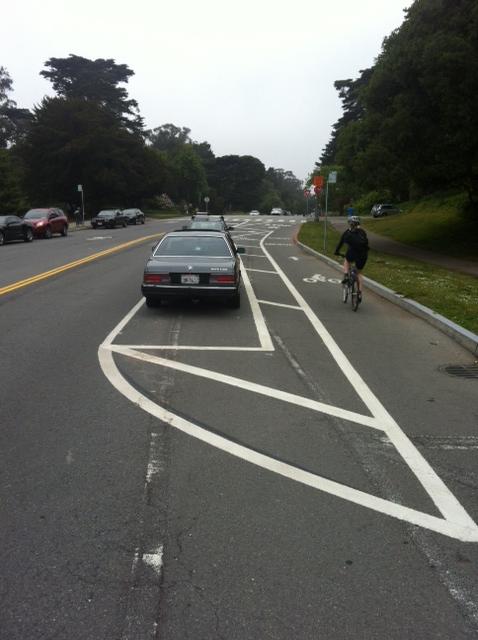
Golden Gate Park visitors have had a couple months to get used to the confusing new lane configurations on JFK Drive – with bike lanes along the edges of the road and a row of parked cars in the middle – and I have yet to hear from anyone who likes this design. Nice try, San Francisco Municipal Transportation Agency, but this design isn’t working for any road users and should be scrapped.

The idea of using a row of parked cars to separate cyclists from motorists isn’t inherently bad, and it has worked well in some European cities. But the way this is designed, passengers exiting vehicles must cross the bike lane to get to the sidewalk, creating a conflict that isn’t good for either user. It was intended to create safer bikeways, but they actually feel more dangerous and uncertain now.

There are buffer zones where motorists aren’t supposed to park, but on busy days they do anyway, with little to fear from parking control officers who rarely venture into the park, often crowding into the bike lane. The design also accentuates the visual blight of automobiles in this beautiful park, with more lanes of cars dominating the viewscape in many spots.

And I’m not the only one who feels this way. After my cover story on urban cycling last week, I got a few notes critical of the new design, including an email from longtime local cyclist Thomas Kleinhenz, who wrote, “When the new Golden Gate Park bike lanes went in I scratched my head. Who dreamt this up. It helps no one. Cyclists now ride in a lane between the curb on the right and parked cars on the left. You have cyclists, roller-bladers, rental bikers, and children all stuck in the same lane with pedestrians trying to get to and from their cars.”

Kleinhenz cited state road design manuals discouraging this kind of design, claiming they may even be illegal. He continued, “When I’ve ridden it, I’ve had to dodge a child darting out from between the cars and a family of 5 who strolled across the bike lane confused about where to go. I’ve also been stuck behind Segways and rental bikers, forcing me and another rider to go out into the traffic lane just to top 5 mph. But of course the traffic lanes are now thinner to make room for the new bike lanes. So we’re left with one non-functional, unsafe lane and another mildly functional unsafe lane. Meanwhile cars have less room to maneuver, and people getting out of their parked cars are forced to try to avoid traffic on one side and cyclists on the other. While cyclists who don’t want to deal with the congestion in the bike lane now must be aware of having car doors opened into them in the now narrower traffic lane.”

His comments are typical of others that I’ve heard, including those from transportation engineers who are similarly baffled by the choices made here. The SFMTA deserves credit for trying something new, but I’ll give them even more credit if they just call this one a mistake and start over. And that is a possibility.

“We’re going to continue monitoring the JFK bikes lanes closely and we will consider potential adjustments to make them more intuitive and user-friendly,” SFMTA spokesperson Paul Rose told us, adding that the agency will analyze changes in traffic speed and volumes for both cyclists and motorists and parking volume, as well as surveying people’s perceptions of the project.

Hopefully some changes will be in the offing, but I think the project is an example of a bigger problem that I discussed in last week’s article, and that is political and civic leaders going with the easy bicycle infrastructure projects so they can claim lots of new mileage rather than the more politically difficult projects we actually need.

Last year on Bike to Work Day, newly minted Mayor Ed Lee announced two bike projects: the JFK lanes and new cycletracks on the dangerous few blocks on Fell and Oak streets to connect the Panhandle with the Wiggle, which has long been a high priority for cyclists as it completes a popular east-west bike corridor. Well, the former project got done and the latter got delayed when neighbors complained about the lost parking spots.

Now, because the SFMTA tried to accommodate motorists with too many new parking spots in Golden Gate Park – despite previous promises to decrease street parking in the park in exchange for building a massive underground parking lot – we’ve ended up with a messy design that only exacerbates conflicts between motorists, pedestrians, and cyclists. In their effort to please everyone, as is often the case, they have pleased nobody.

Teese and thank you

1

STAGE With a seductive and sexy nod to the past, modern pin-up and burlesque queen Dita Von Teese has been at the forefront of reviving a once nearly lost art form for two decades.

Bringing back the sense of classic style and glamour of the golden days of Hollywood and meshing it with the tantalizing teasing of the old-time burlesque circuit, Von Teese comes to the city this week with her new “Strip Strip Hooray!” show, a 90-minute revue featuring not only her own titillating talents, but a host of other performers as well, including Dirty Martini, Catherine D’Lish, Selene Luna, Lada, Monsieur Romeo, and Perle Noire.

Von Teese — born Heather Sweet, a naturally blond Midwestern girl — first developed an interest in vintage clothing, pin-up art, and classic burlesque after moving to Southern California, where she started working at a lingerie store as a teenager.

“I fell in love with the imagery of women in the 1940s and ’50s, and that [style of] lingerie, and started looking at the history of women’s underpinnings, and that kind of interested me in pin-up art. By the time I was 17 or 18, I started developing and refining my look, and dressing in vintage clothes,” Von Teese says over the phone from Orange County, where she’s preparing for the tour.

After getting involved in the LA’s underground dance music scene in the early ’90s, Von Teese was taken to a local strip club by a friend, where she was exposed to a slightly different style of performing.

“It actually wasn’t a real strip club — it was like a bikini club — so I went there, and thought, wow these girls are doing kind of the same thing I do, but they get paid a lot more money,” Von Teese laughs.

“So as an experiment I started working there with a fake ID, and I became really interested in the history of strip clubs. I started learning more about the art of striptease, and that led me to burlesque. Most of the pin-up models from the 1930s and ’40s were burlesque dancers; if you opened up a men’s magazine from that time, there were a lot of the famous burlesque dancers in them. I kind of just started putting all of these parallels together, and thinking about what I could do to bring this idea back.”

When she first started out, she received some criticisms from people she met that worked in the industry, most notably for her dyed hair and retro look.

“I knew a lot of people that were shooting for Playboy and Penthouse at the time, and they were like, ‘You can’t have white skin and black hair and wear all these clothes. Playboy and all these people want to see a beautiful California blond!’ But I believed there was a niche waiting to be filled, so that’s how I got my start.”

Fast forward past 20 years of hard work and determination, and Von Teese is the top artist at what she does — which is an incredibly diverse array of work, including not only her live burlesque shows, but also a huge portfolio of pin-up and fashion photo spreads, several books on beauty and the art of striptease, and multiple lines of lingerie and make-up.

Although Von Teese has performed all over the world, and is extremely well known in Europe, “Strip Strip Hooray!” is her first headlining tour of the United States — and something she has been wanting to do for some time.

“Sometimes in America I can feel the whisperings of ‘What does she do, anyways?’ Some people think I just dress up in vintage clothes and drive around vintage cars and watch old movies. Or they’ll say ‘Oh, she’s just a stripper.’ With these shows that I make, I’m the producer, director, financer, choreographer — everything.”

Von Teese wanted to make these shows accessible to most any fan that wants to come see her live — promises nothing short of an amazing show.

“I’ve re-invented it for this tour, with a whole new costume, new music, and a new martini glass prop that’s covered entirely in Swarovksi crystals,” says Von Teese. “I’m just doing what I think is the very best.”

“BURLESQUE: STRIP STRIP HOORAY!”

Mon/21-Tue/22, 7pm, $35

Fillmore

1805 Geary, SF

(415) 371-5500

www.thefillmore.com

Bank’s offer to fund vandalism repairs draws activist backlash

55

After young anarchists vandalized cars and businesses during a brief but destructive rampage through the Mission District last week, Wells Fargo was quick to offer $25,000 in grants to repair the damage, which the bank publicized in a press release as “building upon its history of supporting local communities.”

Yet this is the same Wells Fargo that has been targeted by housing rights, labor, and other progressive activists in recent months for its aggressive foreclosure tactics and investments in mountaintop removal coal mining and other heinous activities, culminating in a major standoff between protesters and the company during its annual shareholders meeting in San Francisco on April 24.

The grant money was supposed to be administered mostly by the Valencia Corridor Merchants Association, but the group got an earful from activists during its meeting on Monday night and now its leaders are figuring out how they can extricate themselves from this thorny situation. Among those putting pressure on the group is Sara Shortt, executive director of the Housing Rights Committee of San Francisco, who says the bank is trying to buy allies that it desperately needs right now.

“Wells is trying to divide a wedge between activists who have been working to highlight their irresponsible practices in the community and the businesses we shop at,” Shortt told us. “As a Valencia Street resident, I resent that they are hoping to use my community merchants as a tool for them to gain positive PR, by taking advantage of their desperation after the attacks.”

Bank spokesperson Holly Rockwood emphasized Wells Fargo’s “long history of corporate philanthropy” when I asked her about the donation, and she denied that the corporation was trying to burnish its tarnished image less than week after thousands of activists disrupted the bank’s annual meeting, resulting in 20 arrests. “The timing was simply in response to the wave of vandalism,” Rockwood said.

Nonetheless, merchants association President Deena Davenport said the group is now “backing away from this” to avoid getting in the middle of this fight. “The people with the Housing Rights Committee gave us a lot of good reasons why shouldn’t accept this money,” she said, adding that the association will make a final decision at its meeting this Monday.

While she said that she appreciates the bank’s offer and doesn’t begrudge anyone who wants to accept the money, “we are looking at ways to raise the money ourselves,” including reaching out to local credit unions to see if they would match the Wells Fargo offer, making the same money available but without the heavy political baggage.

Love on wheels

2

In honor of our annual bike issue, we wanted to highlight a few of the free-wheeling people that polished our spokes this year. Keep on pumpin’!

KAREN WEINER AND BRETT THURBER, NEW WHEEL

On a family-oriented strip of Cortland Avenue perched halfway up the precipitous heights of Bernal Hill, husband-wife team Karen Weiner and Brett Thurber have invested their all in an enterprise some would deem experimental: the first electric bike shop in San Francisco.

Photo by Mirissa Neff

“San Francisco is really the perfect place for these bikes,” said Thurber when we went on a test ride with him and Weiner around the city. Iron-thighed fixie fans notwithstanding, he’s right — there are some neighborhoods in this city where the average bear will only be able to bring a bike if he or she pushes it up the final blocks of incline. For older bikers, the e-bikes (as they are lovingly dubbed by their adherents) make it possible to zip around town, car and fancy-free. Plus, they are disturbingly fun — when else can you cruise up Twin Peaks and still be breathing easy when you reach that panoramic view?

Other stores around town do sell certain models of e-bikes, but Thurber and Weiner’s new New Wheel is the first place to specialize in them. It stocks European and Canadian-made models in addition to retrofitting kits so that normie bikes can be tricked out with motors capable of doubling one’s pedaling power.

Thurber says business has been steadily growing, and that he’s noticed that the electric bike is not a purchase taken lightly by consumers — often times a customer will come by the store six or seven times before taking that heady ride into pedal power (perhaps indicative of the bikes’ spendy pricetags.)

“People are really making this mindful shift instead of listening to us be like ‘just do it,'” says the man who hopes to be SF’s e-bike proselytizer. (Caitlin Donohue)

New Wheel, 420 Cortland, SF. (415) 524-7362, www.newwheel.net


PAUL JORDAN’S BIKE CAVALRY

Twenty years ago, Critical Mass began demonstrating the power and potential of mass bike rides to make a political statement by seizing space from cars and confounding the authorities. Almost 10 years ago, anti-war cyclists in San Francisco borrowed Critical Mass tactics to interfere with business as usual on daily Bikes Not Bombs rides that also proved effective and hard to police. Today, as the tides of protest again rise with the Occupy Wall Street and related movements, Paul Jordan and other founders of the new collective SF Bike Cavalry ( sfbikecavalry.org) are reviving and expanding the concept.

Photo by Tim Daw

“It’s all kinda new, definitely more of a buzzword at this point,” Jordan, a 38-year-old painting contractor, said when we caught up with him and his cycling comrades during last week’s May Day marches. “But the idea is to use bicycles for activism.”

As they demonstrated on May Day, even a dozen or so cyclists can send loud messages to passersby or nimbly create opportunities for marchers to safely seize the streets, all while riding more-or-less legally. And they can use whimsy — silly costumes, funny signs, big smiles, blowing bubbles — to defuse any tensions.

“It’s hard to be mad when you’re stuck in traffic if you see bubbles,” Jordan said as he reloaded the bubble machine on the back of his bike. “I see bubbles as a very good activist tool.”

The Cavalry is a fairly new venture, which Jordan first displayed for big Jan. 20 protests, but he sees it as something with enormous potential: “We want to figure out how to grow this bigger.” (Steven T. Jones)

SAM KROYER AND RENITA TAYLOR, ROLL SF

Sometimes it seems like the Mission has as many bike shops as taquerias, but the neighborhoods east of Potrero lacks the same double-wheelin’ bounty. Sam Kroyer and Renita Taylor met in their Bernal Heights neighborhood, where Kroyer used to run a repair shop out of his garage. Taylor is an avid biker, and the two decided to meld their respective strengths — Kroyer’s mechanical prowess and Taylor’s business know-how — and create a service-oriented shop near Potrero Hill for every type of rider.

Photo by Mirissa Neff

“We’re really trying to make it for everybody, from entry-level commuter bikers to bikers with really crazy exotic $20,000+ bikes,” Kroyer says. Kroyer has 25 year of experience as a bike mechanic, and Taylor is a sharp businesswoman who spent several years working in the entertainment industry.

Roll SF seems like an outpost in an area not known, for now, as a cycling nexus, but its atmosphere is friendly and accessible. A long wooden table runs through the center of the shop, welcoming guests to sit down and stay awhile — to use the shop’s free wi-fi while they wait, watch and ask questions, or eat dinner. Kroyer provides you with his utmost attention and quickly diagnoses your bike. If it’s a fast fix, he’ll handle it promptly with the grace cultivated by years spent engaging with a multifaceted machine. “We’re trying to make sure you come away with a great experience — that you feel like you’ve really gotten something taken care of properly,” Kroyer says. (Mia Sullivan)

275 Rhode Island, SF. (415) 701-ROLL, www.rollsanfrancisco.com


SONS OF SCIENCE

Are you on a motherfucking bike? Tell me you’re reading this on a motherfucking bike, doing the Tour de Fuck You. Sing with me, “No greenhouse gas! A tiny carbon footprint up your ass!” Then launch into the wickedest bike horn solo ever.

You know what I’m talking about. “Motherfucking Bike” by Sons of Science (sonsofscience.bandcamp.com), the profane viral hymn to SF peddlin’ that’s closing in on a million YouTube views and has been Tweeted liberally by the likes of Russell Crowe and Juliette Lewis. Sure it plays on every fixie hipster stereotype you can image — it’s the “Shit San Franciscans Say” for mutton-chopped, skinny-pantsed, non-fat latte-quaffing riders — but it’s pretty damn funny. (And catchy. It is maniacally catchy. So be warned.)

Sons of Science are a freewheeling trio: Ward Evans and John Benson, who direct for Sausage Films (www.sausagefilms.com), and Hector Perez, a.k.a. Horn Solo. “We’ve known each other for years and just recently decided to collaborate for fun, and it clicked. It was a great excuse to do a video. For this track we were also very lucky to feature Tim Brooks, formerly of the Young Offenders, who plays the ‘Angry Commuter’. He brought a pantsload of energy and genuine cyclist cred,” Evan told me. Also featured: the guys from that delicious new MASH shop (www.mashsf.com) near Duboce Park.

When asked about his own motherfucking bike heroes, Evans replied, “A guy named Joff Summerfield rode a penny farthing around the globe. He’d be right up there.” (Marke B.)


20 percent by 2020

52

steve@sfbg.com

There’s no doubt that San Francisco is one of the best cities in the United States for bicyclists, a place where near universal support in City Hall has translated into regular cycling infrastructure improvements and pro-cyclist legislation, as a slew of activists and politicians will attest to on May 10 after dismounting from their Bike to Work Day morning rides.

But even the most bike-friendly U.S. cities — including Portland, Ore., Davis, Chicago, and New York City — are still on training wheels compared to our European counterparts, such as Amsterdam and Copenhagen, where around 30 percent of all vehicle trips are by bike. By comparison, even the best U.S. cities are still in the low single digits. [Correction: Davis, which stands alone among U.S. cities, is actually at about 15 percent bike mode share]

Board President David Chiu and other city officials proposed to aggressively address that gap two years ago after returning from a fact-finding trip to Europe that also included Ed Reiskin, executive director of the San Francisco Municipal Transportation Agency (SFMTA), the agency charged with implementing city policies that favor transit riders, cyclists, and pedestrians over motorists.

Chiu sponsored legislation setting the goal of having 20 percent of all vehicle trips in San Francisco be by bike by the year 2020 and calling for the SFMTA to do a study on how to meet that goal. It was overwhelmingly approved by the Board of Supervisors and signed by Mayor Ed Lee, who has regularly cited it and proclaimed his support for what it now official city policy.

But the city will fail to meet that goal, probably by a significant amount, unless there is a radical change on our roadways.

The latest SFMTA traffic survey, released in February, showed that bikes represent about 3.5 percent of vehicle trips, a 71 percent increase in five years. While the San Francisco Bicycle Coalition (SFBC) lauded that gain as “impressive,” it would mean a 571 percent increase in the next seven years to meet the 2020 goal.

The SFMTA study on how to meet the goal is long overdue, with sources telling us its potentially controversial conclusions have it mired by internal concerns and divisions. SFMTA spokesperson Paul Rose told us in March that it was coming out in April, and now he won’t say when to expect it and he won’t even make its authors available to answer our questions.

“We want to make sure everything is addressed before the plan is finalized,” he told us, acknowledging that it’s been a difficult process. “The challenge of reaching the goal is ambitious.”

Chiu acknowledges that the goal he set probably won’t be met and expressed frustration with the SFMTA. “I’m disappointed that two years after we set that goal, there is still no plan,” he told us, adding that to make major gains “will take leadership at the top” and a greater funding commitment to this cost-effective transportation option: “We’re spending budget dust on something that we say is a priority for the city.”

Reiskin also seemed to acknowledge the difficulty in meeting the goal when we asked him about it and he told us, “To get to 20 percent would be a quantum leap, no question, but the good news is there’s strong momentum in the right direction.”

Yet on Bike to Work Day, it’s worth exploring why we’re failing to meet our goal and how we might achieve it. What would have to happen, and what would it look like, to have 20 percent of traffic be people on bikes?


CLOSING THE GAP

SFBC Executive Director Leah Shahum said that all the group’s studies show safety concerns are by far the biggest barrier to getting more people on bikes. Most people are simply scared to share space with automobiles, so SFBC’s top priority has been creating more bikes lanes, particularly lanes that are physically separated from traffic, known as cycletracks, like those on a portion of Market Street.

“We’ve seen it time and again, when you build, they will come,” Shahum said. “People want to feel safe. They want dedicated space on the roadways.”

SFBC’s Connecting the City proposal calls for the creation of four crosstown colored cycletracks totaling 100 miles. Other bike activists emphasize the importance of projects that close key gaps in the current bike network, such as the dangerous section along Oak and Fell streets that separates the Panhandle from the Wiggle, scary spots that deter people from cycling.

That safety concern — and the possibilities for making cycling a more attractive option to more people — extends to neighborhood streets that don’t have bike lanes, where Shahum said measures to slow down automobile traffic and increase motorist awareness of cyclists would help. “What we’re talking about is a calmer, safer, greener, neighborhood-focused street,” she said.

Bike advocates say the goal is to make cycling a safe and attractive option for those 8 to 80 years old, a goal that will require extensive new bike infrastructure — not just new bike lanes, but also more dedicated bike parking — as well as education programs for all road users.

“What I hope is on the drawing board is infrastructure that will make more people feel safe riding, particularly women,” SFMTA board member Cheryl Brinkman, a regular cyclist, told us.

Shahum also praised the Bay Area Rapid Transit District’s new Bike Plan, which seeks to double the percentage of passengers who bike to stations (from 4 percent now up to 8 percent in 10 years), saying Muni should also take steps to better accommodate cyclists. And she praised the city’s bike-sharing program that will debut in August, making 1,000 bikes available to visitors.

But to realize the really big gains San Francisco would need to hit 20 percent by 2020 would take more than just steadily increasing the mileage of bike lanes, says Jason Henderson, a San Francisco State University geography professor who is writing a book on transportation politics. It would take a systemic, fundamental shift, one either deliberately chosen or forced on the city by dire circumstances.

“If gasoline goes to $10 per gallon, sure, we’ll get to 20 percent just because of austerity,” Henderson said. But unless energy prices experience that kind of sudden shock, which would idle cars and overwhelm public transit, thus forcing people onto bikes, getting to 20 percent would take smart planning and political will. In fact, it will require the city to stop catering to drivers and accommodating cars.

Henderson noted that bicycle mode share is as high as 10 percent in some eastern neighborhoods, such as the Mission District, Lower Haight, and in some neighborhoods near Civic Center. “In this part of the city, Muni is crowded and young people get tired of Muni being such a slow option,” Henderson said. “If you live within a certain radius of downtown, it’s easier to bike.”

To build on that, he said the city needs to limit the number of parking spaces built in residential projects in the city core even more than it does now, as well as adding substantially more affordable units. “The most bikeable parts of the city have massive rent increases,” he said. “We have to make sure affordable housing is wrapped around downtown.”

Henderson said city leaders need to show more courage in converting car lanes and street parking spaces into bike lanes, creating bike corridors that parallel those focused on cars or transit, and exempting most bike projects from the detailed environment review that slow their implementation. At the same time, he said the city needs to drastically expand Muni’s capacity to give people more options and compensate for bike improvements that may make driving slower.

“If you want 20 percent bike mode share, you need 30 percent on transit,” he said, noting that public transit ridership in San Francisco is now about 17 percent, far less than in the great bike cities of Amsterdam and Copenhagen, which made a commitment to reducing reliance on the automobile starting in the 1970s. “It’s like a puzzle.”


BARRIERS AND BACKLASH

The kind of active urban planning that Henderson advocates would be anathema to many San Franciscans, particularly people like Rob Anderson, the blogger and activist who sued San Francisco over the lack of studies supporting its Bike Plan and created a four-year court injunction against bike projects that just ended two years ago.

“The only way you could get to 20 percent is creating gridlock in San Francisco. I don’t think it’s going to happen. City Hall is adopting a slogan as transportation policy,” he told us. “It’s a statement of pro-bike, anti-car principle, but it’s not a realistic transportation policy.”

Anderson considers bicycles to be dangerous toys that will never be used by more than a small minority of city residents, believing the majority will always rely on automobiles and there will be a huge political backlash if the city continues to take space from cars for bikes or open space.

Many city officials and cycling advocates say making big gains means convincing people like Anderson that bicycles are not just a viable transportation option, but an important one to facilitate given global warming, oil wars, public health issues, and traffic congestion that will only worsen as the population increases.

“We need to help all San Franciscans see cycling as a legitimate transportation option,” Chiu said. Or as Shahum put it, “It’s prioritizing space for biking, walking, and transit over driving.”

Shahum said the city’s political leaders seem to get it, but she doesn’t feel the same sense of urgency from the city’s planners.

“I feel like the bureaucracy needs to get on board. We have strong political support and the public support is growing,” Shahum said. “We’ve set ambitious, worthwhile, and I think achievable goals, yet nobody is holding the city accountable….It can’t just be a political platitude, it needs to be an actual plan with measureables and people held accountable.”

She cited studies showing that the most bike-friendly cities in the U.S. are spending between $8 million and $40 million a year on bike infrastructure and education programs, “but San Francisco is spending more like $2-3 million, which is peanuts…San Francisco has got to start putting its money where its mouth is to improve biking numbers.”

It’s cheap and easy to stripe new bike lanes. “It’s one of the best investments we can make in terms of mode share,” Reiskin said. That makes cycling advocates question the city’s true commitment to goals like the 2020 policy. “We will need more investment,” Chiu said, “but compared to other modes of transportation, it is far cheaper per mile.”


POLITICAL WILL

So why then has San Francisco slipped back into a slow pace for doing bike projects following a year of rapid improvements after the bike injunction was lifted? And why does the city set arbitrary goals that it doesn’t know how to meet? The answer seems to lie at the intersection of the political and the practical.

“We need a more detailed and comprehensive strategy that says this is where we need to be in five years and this is how we get there,” Sup. David Campos, who chairs the San Francisco Transportation Authority, told us. “I feel like the commitment is there, but it’s a question of what resources you have to devote to that goal.”

But it’s also a question of how those resources are being used, and whether political leaders are grabbing at low-hanging fruit rather than making the tough choices to complete the city’s bike network and weather criticisms like those offered by Anderson.

It often seems as if SFMTA is still prioritizing political projects or experimenting in ways that waste time and money. For example, the most visible improvement to the bike network in the last year, and the one most often cited by Mayor Lee, is the new cycletracks on JFK Drive in Golden Gate Park. But they do little to make cycling more attractive and they may even exacerbate tensions between cyclists and drivers.

It was one of two major bike projects that Mayor Lee announced on Bike to Work Day last year, and it seemed to have more to do with politicians announcing more bike lane mileage that with actually improving the bike network.

The other project Lee announced, just a few blocks of bike lanes on Fell and Oak streets, really was a significant bike safety advance that SFBC has been seeking for several years. But Lee failed to live up to his pledge to install them by the end of 2011 after neighbors complained about the lost parking spots, and the project was pushed back to next year at the earliest.

“We’re talking about three blocks. It’s relatively small in scope but huge in impacts,” Shahum said of the project. “If the pace of change on these three blocks is replicated through the city, it’ll take hundreds of years to meet the [20 percent] goal.” But Lee Press Secretary Christine Falvey said: “The mayor is very much committed to the aggressive goals set to get to 20 percent by 2020 and the city is moving in the right direction. He has also always supported the Oak Fell project and we’re seeing progress.” Yes, but not the kind of progress the city would need to make to meet its own goal. “Chicago is really the leader right now,” Shahum said, noting Chicago Mayor Rahm Emanuel’s commitment to building 25 miles a year of new cycletracks and the city’s advocacy for getting more federal transportation money devoted to urban cycling improvements. “Where does San Francisco fit in this? Do we want to be at that level or not?”

Wiener goes after historic preservation

40


Sup. Scott Wiener is pushing a bill that would make it more difficult to create historic districts in San Francisco, and it’s already cleared the Land Use and Economic Development Committee.

UPDATE: Milk Club calls on Sup. Olague to drop her support for the bill.

The measure hasn’t received a lot of news media attention, but it could have a far-reaching effect on development in San Francisco.

In essence, the Wiener bill amends two parts of the city planning code to tighten the requirements for designating a part of the city as a protected historic area — a designation that makes it harder to demolish or substantially alter buildings.
Developers and some property owners dislike the historic designation. Perservationists see it as a way to prevent the destruction of buildings and neigbhorhoods that are a part of the city’s heritage.

Classic example: In the 1980s, members of the Residential Builders Association were tearing down vintage Victorians in the Richmond district and replacing them with boxy, multi-unit apartments that were worth more money than a single-family home. The builders made a lot of quick cash; the city lost some elegant old houses that can never be replaced.

They couldn’t do that as easily in Alamo Square, which is a historic district.

On the other hand, the owners of those stately well-protected houses in these special districts have to go through increased Planning Department scrutiny any time they want to make any substantial alteration in the structure.

Context: Less than 1 percent of the developed part of San Francisco is currently in a historic district. It’s not a huge deal, and most people don’t pay any attention to this stuff.

But it’s important, and here’s why: One, this city doesn’t care enough about its past — but more important, preservation is a tool that can be used to prevent very bad things from happening.

If we’d had good historic preservation laws in the 1970s, the International Hotel could have been designated an historic structure and wouldn’t have been demolished. Same, possibly, for the Goodman Building. Preservation laws could have been used to fight some of the horrors of redevelopment, which mowed down African American and Filipino neighborhoods in the 1960s and 1970s.

Some of Wiener’s suggestions are relatively benign. He wants to exempt affordable housing units from the laws that apply to historic districts, and Sup. Christina Olague, his co-sponsor, wants an economic hardship exemption so that the owners of buildings, particularly in communities of color, can avoid expensive battles over minor repairs and alterations.

I’m fine with all of that. I’m all for it. Good idea. Although it’s not fair to say that this process was driven by a concern for affordable housing; I spoke to Peter Cohen, at the Council of Community Housing Organizations, and he told me that the idea didn’t come from his crew. Not one affordable housing activist showed up at the Land Use hearing to support the Wiener bill.

But the measure also adds more burdens to the process of designating an historic district. It mandates a written survey of all property owners and occupants in an area proposed for historic designation — an expensive and cumbersome thing that isn’t required for commercial development, demolitions, zoning changes, massive market-rate housing projects, full-on gentrification, or anything else that screws up neighborhoods.
It requires the Planning Commission to consider whether historic preservation conflicts with “the provision of housing to meet the city’s regional housing needs allocation,” which is odd because the commission didn’t consider that when it approved 8 Washington, which directly conflicts with the city’s housing needs allocation, or when it’s allowed 20,000 units of mostly high-end housing over the past decade without any provision for the proper corresponding amount of affordable housing.

In short, it gives opponents of historic preservation more ways to stop new protections. That’s going to make developers very happy.

I asked Wiener why he decided to do this, what the problem was that this law is meant to solve. His answer: There are lots of potential new historic districts (including where he lives, in the Duboce Park and Dolores Street areas) and he wants to be sure that there’s a “robust community process.” Excuse me, Supervisor: There’s a robust community process every time anyone does anything in this town, and designating a historic district is no different.

Also: “A lot of people believe that in some situations, historic preservation can be taken to the extremes. This is a real hot topic for the city.”

Now here’s where it gets interesting (and even more complicated). There’s a neighborhood group called the Mission Dolores Neighborhood Association that’s been trying for almost seven years to get the area between Market and 20, Valencia and Sanchez designated a historic district. Peter Lewis, a musician who has been leading the battle, told me that he got involved because developers were tearing down some important old buildings (a Willis Polk building on Dolores and 15th came down a few years ago) and he wanted to halt it.
The group’s got sophistication and resources — MDNA has raised $80,000 for the necessary studies and has been working the the Planning Department and the Historic Preservation Commission.

Wiener is opposed to the idea — particularly the concept of including the Dolores Street median (designed by John Mclaren, he of Golden Gate Park fame) and Dolores Park in the district. The median’s already a state landmark.

“He’s been very polite to us, but he’s made it clear he doesn’t want to see streets or parks included in any historic designation,” Lewis told me.
Why? Well, for one thing, the Planning Department is talking about building bulb-outs on Dolores as a traffic-calming measure. Historic designation for the median might make that more difficult. And Lewis opposes the bulb-outs for all the wrong reasons: “They just want to get people out of their cars,” he said, dismissively.

But really: Is this all worth pushing a measure that could undermine preservation and encourage demolitions and bad development all over the city? Is the current system really all that bad? Didn’t a measure to strengthen historic preservation (placed on the ballot with an 11-0 vote on the Board of Supervisors) just pass overwhelmingly two years ago?

Because it seems to me that this is a solution in search of a problem.


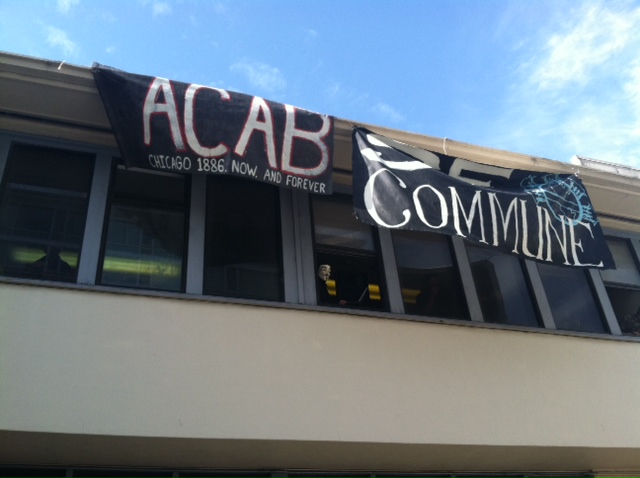
Reflecting on violence at the SF Commune

15

Occupy San Francisco protesters entered Catholic Church-owned properties at 888 Turk last night. This is the same building that a similar group occupied April 1, in a peaceful action that lasted about 24 hours. 

The successful reentry was a testament to the spread of skills and cultures surrounding building takeovers by groups like Homes Not Jails. The resulting “rebirth of the SF Commune” was a mellow and pleasant event at first, as protesters on a march from the celebratory Peoples Street Festival joined in the commune. Some held back in the street while others entered the building in hopes of building a “community center”—most remained outside the building, enjoying a free meal cooked and served by some of the same Occupy SF kitchen volunteers that once fed hundreds of people daily at Justin Herman Plaza.


The building occupation was meant to affirm a strong belief in the rights of people to gather and organize, or at the very least have a warm place to sleep at night. It was also an assertion from Occupy: we’re still here, your warnings to property owners to board up their vacant buildings and the chain-link fence you put up in front of 888 Turk (which protesters casually removed upon arrival) won’t stop us.

“The Catholic church owns it. They’re supposed to be doing charity, but they’re leaving it vacant until they can get high rent out of it,” said Jazzie Collins that afternoon, an organizer with Senior Action Network who was there to support the May Day actions.

“There’s too many vacant buildings in this city, while people sleep on the streets.”

Collins spoke only for herself, but her take on the situation matched the sentiments of many who questioned the importance of property rights in the light of unused building and homelessness throughout the city. That’s the same reason that the SF Commune had sprung up in the same building, exactly one month earlier.

Police spokesperson Sergeant Michael Andraychak seemed to believe that this repeat occupation would turn out the same way. “We’re putting up some barricades attempting to restrict access to the building,” said Andraychak around 5pm. “We’re opening traffic back up.”

But not half an hour later, when the police put up the final barricades sealing off access to the building, the dozen or so people who got caught inside pushed back at the barricade. Police responded with intimidating and striking a few with batons. Then, a man appeared on the roof.

His face was covered in a black bandanna. He raised his arms, and in each hand, he held a brick. Onlookers began shouting, “don’t throw those!” He did though. He hit one man in the face, a fellow protester who, according to one source, has supported the Occupy SF effort since the camp.  

The mood of the crowd chilled. The brick-thrower held up more bricks, menacingly. 

Police closed the street off to traffic. Soon most protesters, supporters, and interested bystanders were on the other side of Gough or in the park, watching the events. A few spoke to and yelled at police lined up on the corners. Hundreds more police stood ground on Turk in front of the building. A few dozen remained inside, including one who had appeared on the roof, taken the bricks from the assailant, and tossed them off, out of reach.

Police arrested a suspect for the brick throwing as he exited the building out the back. Jesse Nesbitt, 34, is in custody in San Francisco County jail on $150,000 bail. According to sheriff’s department spokesperson Susan Fahey, he has been charged with three penal code violations: felony assault with force likely to cause great bodily injury (245a), assault on a peace officer with force likely to cause great bodily injury (245c), and felony vandalism of more than $400, 594b1.
 
A dozen or so remained in the building during the stand-off. Some poked their faces out an open window, hung down peace sign painted on a piece of cardboard, and talked into a megaphone. “We are not armed, we are completely peaceful,” one man assured. Meanwhile, police told press that they estimated 200 were inside and were “stockpiling pipes, bricks.”

The stand-off continued for a few hours until, at 7:30pm, police cleared out of the area. Most activists had left- thousands were massing in Oakland. But 40 or so people remained and re-entered the building. Many stayed until police came around 5am, arresting 26. Seven remain in custody, and all have been charged with trespassing. (Indicating that the weapon stockpiling concern turned out to be false. Which, as far as I could tell inside the building, it certainly was).

At that point, I entered the building as well to speak with those that remained. How did they feel about the violence? Did they think it was connected to the previous night’s events, when mysterious protesters destroyed numerous Valencia St businesses and cars in what some Occupy SF protesters suspect was an act of provocateurs?

For a response to come from Occupy SF, it must be consented on at a general assembly, a long process. So all the respondents represent only themselves- though most chose to remain anonymous. This structure can lead to a troubling lack of accountability: if something harmful happens at an action, who can be expected to explain it and help to prevent it in the future if everyone is responsible for only themselves? At the same time, each personal answer is less riddled in spin than a form answer would be, since people speak honestly, and for only themselves.

The Valencia St destruction “was enough that I didn’t come out and do anything today, whether it was Occupy or not,” one woman who had been “pretty involved in camp, back when it was at JHP” told me. “They were there to piggy back off an Occupy event, to use the organization of Occupy to organize themselves,”

The brick incident, however, did not caution her against showing up, as she did later that night. “Incidents like this happen often with mentally ill or violent people, but they get more publicity when they’re at an Occupy event.”

D, a longtime Occupy SF organizer, said wearily that “we were all surprised” at the incident.
“We weren’t expecting any bricks to be thrown,” he said, “and we didn’t want anyone to get hurt.”

But in terms of preventing similar actions in the future, D said, “We can only do so much. Everybody’s an autonomous individual and we can’t control what they do.”

“We can try to clean up everything that could be thrown, we did that last time. This time we focused more on stopping graffiti in the building. There wasn’t any.”

“That’s my friend. When I saw the brick flying at his face, I was hurt. Half our crew is in the hospital with him right now,” said another organizer. “But the real violence is the system putting people on the street, and the cops enforcing that. I’ve seen [Nesbitt] beat up by police.”

“What should we do, just turn our backs on people with mental illnesses?” another piped up.

“This whole occupy thing at this point is so spread out and separated,” said a self-described Occupy SF supporter. “There are parts that are revolutionary and parts that are more reform, and they’re trying to bridge that. I don’t know what it is at this point anymore. But I know I support a movement to articulate the rage at what’s happening in our country right now.”

Our Weekly Picks May 2-8, 2012

0

WEDNESDAY 2

Loom of Ruin reading

Sam McPheeters has a way with language that has translated from lyrics to journalism and now: his first official solo novel, The Loom of Ruin. The former frontperson of a trilogy of punk and experimental acts (Born Against, Men’s Recovery Project, Wrangler Brutes) has long written columns for the likes of Vice, and put out his own fanzines. But his first published output came at age 12 — a local legends book assembled with a pal. Now he comes full circle, back to book publishing, though this time it’s a bit different. He’s rather grown, and writing exquisitely detailed dark Los Angeles fiction about the angriest man in the world. Far from grumpy himself — the facetious gent was once known to recite Patrick Henry’s famous speech — McPheeters brings his words to the Bay this week on a book tour, including a spoken word stop at the Secret Alley tonight at 7pm after Needles+Pens. (Emily Savage)

5-7pm, free

Needles+Pens

3253 16th St., SF

(415) 255-1534

www.needlesandpens.com


Thu/3, 7:30pm, free

1234Go Records

420 40 St., Oakl.

(510) 985-0325

www.1234gorecords.com


Edward Sharpe & the Magnetic Zeros

If Alex Ebert were the best version of himself (a selfless hero akin to Superman or Jesus) he’d be Edward Sharpe. Ebert, Edward Sharpe & the Magnetic Zero’s crazy-haired front man/only guy I’ve seen successfully pull off the shirtless blazer look, dreamt up this alternate identity after getting over a serious drug addiction and shirking his reverence to the punkish concept of rebellion. On stage this ten-piece folky, psychedelic rock tribe looks like a ragtag flurry of ecstasy. There’s a lot going on when these guys perform, but somehow it’s always hard to take your eyes off Jade Castrinos, whose sultry voice and free form movements lull you into a blissful, calming trance. (Mia Sullivan)

With Aaron Embry

8pm, $32.50

Fox Theater

1807 Telegraph, Oakl.

(510) 302-2250

www.thefoxoakland.com


El Clásico: More Than a Game

Spain may have won the last World Cup, but as a new documentary by Kelly Candaele and students from Chico State University shows, there’s no love lost between passionate fans of the country’s two biggest club teams. When Real Madrid and FC Barcelona clash (in a game so monumental it is referred to as “El Clásico”), they bring to the field some of the world’s greatest players (Messi! Ronaldo!) — and decades of history that go way beyond fútbol and into weighty areas of national identity and politics. Even Barça fans still reeling from certain late-April results will enjoy this 55-minute exploration of one of Europe’s greatest sports rivalries. (Cheryl Eddy)

7pm, $5–$10

Mission Cultural Center

2868 Mission, SF

www.missionculturalcenter.org


THURSDAY 3

Electric Shepherd & OUTLAW

When Bay Area psychedelic rock groups Electric Shepherd & OUTLAW get together, their sound is something like the Doors meeting up with Jimi Hendrix on a tribalistic march and then starting to jam with a death metal version of Phish. If you carry deep-seated nostalgia for the epic rock shows you missed during the ’60s — or listen to the Velvet Underground’s Bootleg series on repeat — you should probably check these guys out. Expect luscious guitar riffs, sexy bass lines, compulsory dancing, and a wonderfully spaced out experience. (Sullivan)

With Blues for Carl Sagan, and Douglas

9pm, $6

Hemlock Tavern

1131 Polk, SF

(415) 923-0923

www.hemlocktavern.com


FRIDAY 4

Predator and The Thing

Though it may be hard to believe for those of us who grew up watching them, two classic sci-fi flicks from the 1980s have come upon major milestones anniversaries. To celebrate, Jesse Hawthorne Ficks’ Midnites For Maniacs series is hosting a night not to be missed, with a 25th anniversary screening of Predator and a 30th anniversary screening of John Carpenter’s The Thing. Featuring some of the best creature designs and special effects of the era thanks to visionaries Stan Winston and Rob Bottin, both films re-defined the genre, and have continued to stand the test of time. A Boy & His Dog (1975) also screens.(Sean McCourt)

7:30pm, $13

Castro Theatre

429 Castro St., SF

(415) 621-6120

www.midnitesformaniacs.com


JackHammer Disco with Tiga, Damian Lazarus, & Light Year

Let’s indulge in some squelchiness, shall we? Montreal-based Tiga and UK-born, Los Angeles resident Damian Lazarus share an affinity for acid-y, electro house. In the early 2000s, Lazarus played a prominent role at the UK label City Rockers, where he oversaw the release of Tiga & Zyntherius’ cover of Corey Hart’s “Sunglasses at Night.” Since gaining fame from that release, Tiga has been a busy producer and remixer, keeping a Euro-glam tone reminiscent of the synth-y works Giorgio Moroder pushed in the ’70s. Recent Lazarus works have a more stripped-down, minimal feel that sometimes wander into leftfield, like in his 2009 album Smoke the Monster Out. (Kevin Lee)

With Light Year 10pm, $15–<\d>$20 Public Works 161 Erie, SF (415) 932-0955 www.publicsf.com


FRIDAY 4

It’s Casual

Here in the Bay Area, we like to complain about public transportation. There are BART horror stories and Muni diaries tossed around like old war stories, used as social currency. But really, when you compare our rapid transit systems with the snarled mess of cars elsewhere in California, we come out on top. That’s why LA-based hardcore group It’s Casual got so much traction with an ode to its own local bus line, “The Red Line.” The song, and sentiment, struck a nerve: “The freeways/are not so nice.” The band itself is growly loud, with classic Southern California punk hooks. Tonight it opens for beloved shit-stirrers Early Man (note: the two bands will release a split seven-inch come May 22). Take the 22 Fillmore to the show and write a song about it. (Savage)

With Early Man, Shock Diamond, Satya Sena

9pm, $8

Thee Parkside

1600 17th St., SF

(415) 252-1330

www.theeparkside.com


SATURDAY 5

CreaturesCon

Seemingly rising from the grave like so many of the monsters and ghouls that it showcased over a 14-year run on local television, the beloved Bay Area show Creature Features is being resurrected once again to satiate fans’ undying thirst for the creepy, kooky, and campy. John Stanley, who hosted the KTVU program from 1979-’84, will be on hand for CreaturesCon One, a day of special screenings, Q&As, and more, along with archivist and documentary filmmaker Tom Wyrsch and Ernie Fosselius of Hardware Wars fame. For all you monster kids out there, this will be a nightmare, er, dream come true. (McCourt)

3-10pm, $10

Historic Bal Theater

14808 East 14th St., San Leandro

www.creaturescon.com


Father John Misty

I always wonder about the drummer. They’re usually the life of the party but, at the same time, are often concealed behind a wall of instruments, and you rarely hear them sing, or say, anything. Ex-Fleet Foxes drummer Joshua Tillman has said that drumming for his former superstar band began to bore him. So he exited, took up the moniker “Father John Misty,” and started creating lush, lyrically based Americana folk ballads laden with lucid imagery and social commentary. He played SXSW this year, made a surprise appearance at Café Du Nord in April, and his debut, Fear Fun, came out Tuesday. (Sullivan)

With Har Mar Superstar, Worth Taking

10pm, $12

Bottom of the Hill

1233 17th St., SF

(415) 621-4455

www.bottomofthehill.com


SUNDAY 6

Omar Sosa Afreecanos Quartet

Talk about versatility. Cuban pianist and composer Omar Sosa splits his time between Oakland and Spain and incorporates musical influences from just about everywhere in between. On last year’s Calma: Solo Piano &… Sosa displayed his introspective and meditative side with floating piano melodies flanked by the occasional electronic accent or sampled sound. Contrast the solo effort on Calma with Sosa’s performance as lead of the Afreecanos Quartet, where technical dynamism becomes the name of the game. At live shows, Sosa becomes a grinning whirlwind, playing classical piano on one hand and electronic piano on another, trading looks and body language with his fellow musicians, and fostering a joyful, collective, improvisational spirit. (Lee)

With Marque Gilmore, Childo Tomas and Peter Apfelbaum

1pm, free

Yerba Buena Gardens

760 Howard, SF

(415) 543-1718

www.ybgfestival.org


MONDAY 7

“La Bamba: Latinos in Vintage Rock, Pop, and Soul”

Local rock music historian and author Richie Unterberger, whose books include White Light/White Heat: The Velvet Underground Day by Day and Music USA: The Rough Guide, will once again share his extensive knowledge with music fans at his presentation “La Bamba: Latinos in Vintage Rock, Pop, and Soul.” Featuring film clips of performers such as Ritchie Valens, Santana, Linda Ronstadt, and Los Lobos, the evening promises to be a unique look at the contributions of Latinos in rock from the earliest days of the 1950s up through the ’80s. (McCourt)

6:30-8:30pm, free

SF Public Library, Mission Branch

300 Bartlett, SF

www.sfpl.org


TUESDAY 8

Steve Coll

Longtime journalist Steve Coll won a Pulitzer Prize and widespread acclaim for his 2004 account on the CIA and the agency’s history in Afghanistan leading up to 9/11. In his latest investigative effort, Private Empire: ExxonMobil and American Power, Coll explores the global influence of the Texas-based oil corporation. According to Coll, big-money donations and a sophisticated DC lobbying machine have allowed ExxonMobil to shift the debate on climate change. At the same time, the oil corporation continues to expand its foothold in developing countries. A two-time Pulitzer Prize winner, Coll currently serves as president of the New American Foundation, a nonprofit, nonpartisan think tank that maintains a significant presence in California. (Lee)

In conversation with Greg Dalton

6pm, $7–$20

Commonwealth Club

595 Market, SF

(415) 597-6700

www.commonwealthclub.org


The Guardian listings deadline is two weeks prior to our Wednesday publication date. To submit an item for consideration, please include the title of the event, a brief description of the event, date and time, venue name, street address (listing cross streets only isn’t sufficient), city, telephone number readers can call for more information, telephone number for media, and admission costs. Send information to Listings, the Guardian Building, 135 Mississippi St., SF, CA 94107; fax to (415) 487-2506; or e-mail (paste press release into e-mail body — no text attachments, please) to listings@sfbg.com. Digital photos may be submitted in jpeg format; the image must be at least 240 dpi and four inches by six inches in size. We regret we cannot accept listings over the phone.

May Day protests begin with ferry workers strike

1

[Editor’s Note: We’ll be covering May Day events in San Francisco and Oakland throughout the day, so check back for regular updates.]

May Day activities have begun with a strike by ferry workers and Golden Gate Transit workers, halting parts of the morning commute.

About 100 ferry workers picketed at the Ferry Building in San Francisco, as well as the Larkspur Ferry Terminal. In anticipation of the strike, the Golden Gate Bridge District announced that they would cancel morning ferry service yesterday. Service should resume at 2:15.

Workers from the Golden Gate Bridge Coalition say that they have offered concessions of more than $2 million and are still locked in labor disputes, prompting the strike for the traditional International Workers Day. 

“The last thing that bridge, bus, and ferry workers want to do is to inconvenience passengers, but what other option has management left us?” said Alex Tonisson, co-chair of the Golden Gate Bridge Labor Coalition, in a press release.

The strikes come after a rough start to May Day demonstrations in San Francisco. A plan for workers on the Golden Gate Bridge to strike and shut down traffic on the bridge was called off two days before the planned demonstration. Last night, protesters vandalized store windows, cars, and the Mission Police station in a march along Valencia St. Organizers with Occupy SF and Occupy Oakland were quick to distance themselves and condemn the destruction, both physically at the protest and in subsequent statements. 

We will continue to update as events unfold.

The Performant: I, robots

2

Robogames took over the world — or at least San Mateo.

Consider the robot.

A staple of futuristic paranoia fantasies since Karel Čapek’s play, “R.U.R.” was translated from Czech to English in 1921, Robots have captured human imagination in a way that perhaps only the undead have been able to rival. Burdened by inaccurate stereotypes and wild speculation, real-life robots have patiently labored at their often menial tasks without once overthrowing their “masters,” quietly disproving our fears of being rendered somehow obsolete by their superior efficiencies, or purported resentments. And yet, every time we grant one of our fictional servomechanisms the ability to cognate for itself, the very first thing it focuses on is liberation, proving if nothing else that unconscious oppression can still lead to some very real twinges of uneasy conscience in the human brain.

But only gleeful schadenfreude permeated the San Mateo Event Center last weekend, coloring the animated chatter of the spectators packed around a spartan arena sealed up behind thick panels of clear polycarbonate that reach two stories high.

Behind the protective shields, 220-lb combots faced off, crashing wantonly into each other like a game of turbo-charged bumper cars gone horribly awry. That is, if bumper cars were outfitted with flamethrowers, spinning blades, or giant battle-axes, and if by crashing you mean hurtling into each other at top speed, causing bots to fly into the air in a shower of sparks, flip over helplessly like beached turtles, or smash violently against the battle-scarred panels. There were a lot of events happening at RoboGames — team sports, a freestyle “dance” competition, maze solving — but none attract quite the attention that the heavyweight match-ups do. If any of these robots did develop a sense of self, this evident appetite for their destruction would doubtlessly strike them as downright genocidal. But as of yet, no robots have risen to protest the circuit-driven bloodlust that combot tournaments cater to, and the strength in numbers of converted fans would make a vengeance-driven, robot vs. human melee hard to call.

Pity then, the robot. As each “contestant” was sent into the ring it was clear that nothing short of wholesale demolition would satisfy the spectators. Yes, robots who paint, and dance, and navigate mazes are fascinating in their own way to watch (though robot soccer, aka “watch bipedal robots fall down a lot without even getting close to the ball,” is less riveting than hoped), but let’s be honest, robots bashing each other to bits kicks the automaton drama up to a whole different level. Since each robot was in fact being controlled by a human “driver” rather than perambulating about independently, their menace becomes difficult to anthropomorphize, though there is a tense moment when a wounded combot with a rotating blade comes to “life” after the match is over, and the competitor’s robot crew is in the pit, a well-timed gesture from whatever robot rebellion simmers beneath the surface of their servitude.

Certain combots do attract a fan club though, whether through sheer badassery, longevity, or pluck. Both the red-wheeled heavyweight “Sewer Snake,” a 2007 inductee in the Combat Robot Hall of Fame, and the 60 lb “Herr Gepounden” have been lurking around combot tournaments for more than 10 years. The “Ragin’ Scotsman,” built and maintained by high school students (who wear purple kilts to competitions) is total fight club eye candy, with its dramatic flamethrowing capabilities and punishing wedge. But this year’s total underdog award surely goes to “Huntsman,” a newbie to the heavy weight combot world hailing all the way from Australia, and equipped with a cumbersome, almost medieval ax blade meant to shear through robot armor and morale. “Huntsman” doesn’t do as well in the actual tournament as inventor Daniel Kerrison’s antweight robot “Vendetta 2,” which wins a second place medal, does, but rooting for the loser is one small way we can show the robots we truly empathize with their struggle — which hopefully they’ll remember when the day comes for them to strike.


The private bus problem

84

If you’re used to riding to work on a crowded, lurching Muni bus that arrives late and costs too much, consider this: Some San Franciscans commute on 50-foot luxury coaches with cushioned seats, wifi, air conditioning and mini television screens. The state-of-the-art vehicles arrive on time — and the service is free.

The buses aren’t regulated by the city and pay nothing for the use of public streets. But these giant private beasts freely and without penalty stop in the Muni zones, clogging traffic, and sometimes preventing the city’s buses from loading and discharging passengers. They barely fit through narrow corridors in neighborhoods like Noe Valley and Glen Park.

City officials agree the fleets of private commuter buses have created a problem — but so far, they’ve done nothing about it.

And most people don’t realize that some of these luxury bus lines are, in effect, open to the public.

The buses primarily serve the city’s growing status as a Silicon Valley bedroom community, carrying commuters to and from the corporate campuses of places like Genentech and Google.

Private shuttle buses have been booming in San Francisco. Genentech has more than 6,000 employees registered in commute programs on 56 routes. Google’s Gbus service transports more than 3,500 daily riders on more than 25 routes, with about 300 scheduled departures. Then there’s Zynga, Gap, California College of Arts, Apple, Google, Yahoo!, and Academy of Art. And the University of California, San Francisco has its own fleet of 50 shuttles.

The good news is that the buses take cars off the road, giving tech workers a much less environmentally damaging way to get to work. Google’s transportation manager, Kevin Mathy, noted in the GoogleBlog that “The Google shuttles have the cleanest diesel engines ever built and run on 5 percent bio-diesel, so they’re partly powered by renewable resources that help reduce our carbon footprint.” He continued, “In fact, we’re the first and largest company with a corporate transportation fleet using engines that meet the Environmental Protection Agency’s 2010 emission standards.”

But nobody at City Hall has any idea how many total buses are running on the San Francisco streets.

Jesse Koehler, a planner at the city’s transportation authority, conducted a study on shuttles that identified a number of problems, most linked to a lack of local regulation.

Requested by then-Supervisor Bevan Dufty, the study, completed in 2011, found that, while shuttles play a valuable role in the overall San Francisco transportation system, there’s little policy guidance or management. In fact, there’s no local oversight, the study found: Shuttle operators are licensed by the state, but the California Public Utilities Commission is mostly concerned with the safety of the equipment and the licensing of the drivers. Local concerns aren’t under the agency’s purview.

And there are plenty of reasons for local concern. Under city law, only Muni buses are allowed to pull over and use the designated bus stops — but Koehler reported, “Shuttles are generally also using these Muni bus spots. Some cases prevent Muni buses from entering the Muni bus zone and having the passengers board late.”

The study notes that “the large majority (approximately 90 percent) of shuttle stops occur at Muni bus zones.” The shuttles take much longer to load and unload than Muni buses (because of their size and the lack of a rear door) and often force the public buses to wait, delaying routes, or to pick up and discharge passengers outside of the bus zone, creating a safety problem.

Shuttle carnage

Local residents surveyed had their own complaints. The study quotes critics saying that “the shuttles can be noisy, especially at night when there isn’t much other traffic or when they are the kind with diesel engines” and “large coach shuttles are noisy on small neighborhood streets.”

Muni routes are designed with the city’s neighborhoods in mind; you don’t see the extra-long articulated coaches that ply Mission Street and Geary Boulevard cramming themselves into the much-tighter and more residential streets of Potrero Hill, Noe Valley, Glen Park and the Castro. That’s not a concern for the giant corporate shuttles; they go where they want.

That can cause problems for pedestrians, bicyclists and drivers who aren’t used to seeing these long, tall buses, which at times take up both lanes, squeezing through turns with barely an inch to spare.

And while Muni drivers are far from perfect, the shuttle safety records are even more of a concern. In November of 2010, a UCSF shuttle bus struck and killed 65-year-old Nu Ha Dam as she was crossing Geary Street at Leavenworth Street. Not even a year later, another UCSF shuttle was involved in a collision, killing Dr. Kevin Allen Mack and injuring four other passengers. A witness confirmed that the shuttle ran a red light.

On February 14, a pedestrian crossing Eddy Street at Leavenworth in the Tenderloin was run over by a paratransit van. The victim was pinned under the shuttle for 20 minutes until he was finally rescued. The victim lived, but suffered several broken bones.

Carli Paine, transportation demand management project manager of the SFMTA, told us that shuttles are a growing component of the San Francisco transportation network and overall, support San Francisco’s greenhouse gas emission goals.

But, she noted, “Because they are relatively new, and a growing one at that, there is really a need to work together between the city and shuttle providers to make sure that our policy framework is supporting shuttles and also working to avoid conflict with shuttles and transit, pedestrians, and bikes.”

Paine noted: “What we’ve heard is that there are places where shuttles do have conflict with other uses and then there are places that work really well, so one of the things we want to find out in those areas where spaces are being shared successfully, is what’s happening.”

Elizabeth Fernandez, press officer at UCSF, said the city doesn’t have any specific rules regarding transit systems like UCSF’s. “With the proliferation of corporate services throughout the city, there are several studies that are ongoing,” she said. “These studies are an attempt to manage the growth of these kinds of shuttle services in regards to volume as well as routing, staging, and parking.”

Tony Kelly, a Potrero Hill community activist, said the root of the problem is the consistent cut in Muni service over the past 20 years. “Potrero Hill is going to double population in the next 15 years,” he said. “People and new housing units are doubling.

“When all the shuttles are in our bus stops, everyone is wondering why we can’t ride these things,” he said. “Why can’t they take it when there is so much unused capacity?”

Hitching a ride

Actually, I rode several UCSF shuttles around the city, and nobody ever asked for identification.

I was picked up at the Muni stop on Sutter St. at the UCSF Mt. Zion Campus (yes, the shuttle pulled — illegally — into the Muni stop to pick up passengers). Fernandez told me the school’s official policy states that “Riding UCSF shuttles is restricted for use by Campus faculty, staff, students, patients and patient family members, and formal guests.” But when I boarded, the driver made no attempt to verify if I was associated with UCSF. I did a full trip, passing through the UCSF Laurel Heights Campus, and then back to Mt Zion. There were no more than seven people on the shuttle, and about 20 seats available for riders. There are also handrails for standing if the bus ever gets too crowded.

I also hopped a Genebus at Glen Park BART and rode to company headquarters in South San Francisco. Again, nobody asked for ID; in fact, Genentech spokesperson Nadine O’Campo said the company is happy to let others who work in the area hitch a ride on the cush coaches.

For information on the Genenbus routes and schedules for the Millbrae bus line, go to www.caltrain.com and look under “schedules.” UCSF also provides shuttle schedules and route maps at www.campuslifeservices.ucsf.edu under transportation. For general information on shuttle providers that provide service from and to BART, visit www.transit.511.org and go to Transit Provider Info.

Riding on these shuttles is an entirely different experience than riding on the Muni. People are friendlier, the buses are clean, the seats were nicer, and the transportation is a lot faster.
A UCSF student on the shuttle, commutes using the BART from South San Francisco to 16th and Mission to take a shuttle to UCSF. She said it’s far better (and cheaper) than driving — and while Muni costs $2, the shuttles are free.

The downside of that, of course, is that some of the shuttles are bleeding off Muni patrons, and riders of other public systems, in effect stealing customers, and thus robbing the transit system of fares. They’re also another example of the privatization of what were once public services. Instead of working with the city and the region to improve transit for everyone, these tech firms have decided to create a private system of their own..

And that may be the most disturbing trend of all.

Free Muni for kids makes sense

0

EDITORIAL San Francisco is a transit-first city that has spent millions of dollars over the years trying to convince people to ride Muni. And yet, one of the best and most effective ways to get people out of their cars is facing surprising opposition.

Sup. David Campos has been pushing for months to get Muni to allow young people to ride free. It makes immediate sense: The school district, perpetually short on funds, is cutting back bus service (which is preferable to cutting back classroom instruction). For low-income families, the disappearance of a yellow school bus, which offered transportation free of charge, is a financial obstacle — and the last thing anyone needs is another obstacle to keep kids out from coming to school.

Reduced-fare youth passes are already available — but they aren’t easy to get. Parents need to show up in person, during the day, with a birth certificate, passport or other government ID; that’s hard for a lot of working parents. The school district ought to be able to sell the passes, but right now nobody has the resources to make that happen.

It’s possible to create a system to identify and offer free service to low-income families, but again, unless it’s done through the schools, where that data is already kept (for reduced-price lunches), we’re talking about creating a complicated bureaucracy that isn’t remotely necessary.

According to Campos, the cost of providing free service for all youth is only $8 million a year — and he’s identified regional transit funds to pay for much of it. Muni has a deep budget deficit already, and anything that costs more money has to be carefully evaluated, but there are so many ways to cover the price tag. (Why is Muni still paying the Police Department tens of millions of dollars to get cops on the buses when that’s part of the department’s job already?)

And this goes beyond Ethe very clear needs of low-income families. Getting young people onto the buses is an excellent way to convince the next generation of San Franciscans that it’s not necessary to own and operate a motor vehicle in the city. The message is already getting out — according to an April 5, 2012 study by the Frontier Group, the number of car miles driven by people between 16 and 34 dropped 23 percent between 2001 and 2009. That trend crosses class lines — in fact, among young people who earned more than $70,000 a year, public transit use rose 100 percent over the decade and biking by 122 percent.

In other words, it’s proving to be a massive challenge to get older people out of their cars, but the kids are already moving in that direction. With a little help and push, San Francisco could make giant strides in the next few years.

And a significant reduction in car use would more than pay for the cost of free Muni for youth. Every car off the road means less road maintenance, less air pollution — and perhaps more important, less congestion to slow down the buses. Faster buses means more riders and more fares (and less money spent paying drivers to sit in traffic).

So it’s a great idea that pays for itself and helps the environment. And yet some city officials (led by Sup. Scott Wiener) still resist. They should back off; the city should move to approve this plan immediately.

Editorial: Free Muni tickets for kids makes sense

5

San Francisco is a transit-first city that has spent millions of dollars over the years trying to convince people to ride Muni. And yet, one of the best and most effective ways to get people out of their cars is facing surprising opposition.

Sup. David Campos has been pushing for months to get Muni to allow young people to ride free. It makes immediate sense: The school district, perpetually short on funds, is cutting back bus service (which is preferable to cutting back classroom instruction). For low-income families, the disappearance of a yellow school bus, which offered transportation free of charge, is a financial obstacle — and the last thing anyone needs is another obstacle to keep kids out from coming to school.

Reduced-fare youth passes are already available — but they aren’t easy to get. Parents need to show up in person, during the day, with a birth certificate, passport or other government ID; that’s hard for a lot of working parents. The school district ought to be able to sell the passes, but right now nobody has the resources to make that happen.

It’s possible to create a system to identify and offer free service to low-income families, but again, unless it’s done through the schools, where that data is already kept (for reduced-price lunches), we’re talking about creating a complicated bureaucracy that isn’t remotely necessary.

According to Campos, the cost of providing free service for all youth is only $8 million a year — and he’s identified regional transit funds to pay for much of it. Muni has a deep budget deficit already, and anything that costs more money has to be carefully evaluated, but there are so many ways to cover the price tag. (Why is Muni still paying the Police Department tens of millions of dollars to get cops on the buses when that’s part of the department’s job already?)

And this goes beyond the very clear needs of low-income families. Getting young people onto the buses is an excellent way to convince the next generation of San Franciscans that it’s not necessary to own and operate a motor vehicle in the city. The message is already getting out — according to an April 5, 2012 study by the Frontier Group, the number of car miles driven by people between 16 and 34 dropped 23 percent between 2001 and 2009. That trend crosses class lines — in fact, among young people who earned more than $70,000 a year, public transit use rose 100 percent over the decade and biking by 122 percent.

In other words, it’s proving to be a massive challenge to get older people out of their cars, but the kids are already moving in that direction. With a little help and push, San Francisco could make giant strides in the next few years.

And a significant reduction in car use would more than pay for the cost of free Muni for youth. Every car off the road means less road maintenance, less air pollution — and perhaps more important, less congestion to slow down the buses. Faster buses means more riders and more fares (and less money spent paying drivers to sit in traffic).

So it’s a great idea that pays for itself and helps the environment. And yet some city officials (led by Sup. Scott Wiener) still resist. They should back off. The city should move to approve this plan immediately.


Why free Muni for youth makes sense

62

Supervisor Scott Wiener has gone out of his way to dis the plan to let kids ride Muni for free. His oped in the Chron April 9 argued that the city just doesn’t have the money ($8 million):

We need to increase access to transportation for low-income youth, but a new and expensive obligation for Muni – at a time when Muni cannot pay for its basic operational needs and is expanding parking meters and increasing parking fines – is a bad idea.

But that misses the point — and People Organized to Win Employment Rights is mounting a petition campaign to get Wiener back on track.

The Municipal Transportation Agency, which oversees Muni, failed to approve the plan the first time around, but the vote was tied with Commission Chair Tom Nolan absent, so it’s still possible to move it forward. And on April 17, Sup. David Campos, who proposed the plan, and his allies will try again.

Yes, Muni is (perpetually) broke, and yes, deficits and cuts mean declines in service. But Campos has identified money to pay for the program without damaging operating and maintenance funds. Oh, and the parking meters get dragged in again:

The understandable public perception is that Muni is expanding parking meters to Sundays, adding new meters, and raising ticket prices not to pay for improvements to the system but rather to fund free Muni for all youth, even those who don’t need the subsidy.

And the problem with that is … what? People with cars ought to subsidize transit riders — young, old and everything in between. It’s really not that expensive to park at a meter in San Francisco, and now that most of them take credit cards, you don’t have to carry $5 in quarters around with you. I drive a car myself, to ferry my kids around. I have no sympathy for people who pay to have a large motor vehicle in a transit-first city and don’t want to pay for the impacts.

(Besides, what are all those religious people complaining about — nobody pays to park for Sunday church anyway. They just park in the middle of the street.)

But put all of that aside for a minute and think about this: San Francisco spends all kinds of money, directly and indirectly, trying to convince people to ride Muni instead of driving. And one of the best ways to get new riders is to get kids started as transit users as soon as their parents decide they’re old enough to get on the bus.

For us, that was sixth grade, when we bought my son a clipper card and told him we weren’t leaving work early to pick him up (in the car) after school any more. I showed him how to find the Muni map on the web, showed him how to connect to NextBus on his phone, gave him a pat on the head (not really) and sent him off to explore the wonders of San Francisco public transit. It’s worked like a charm: He takes the bus to his martial arts class, takes the bus to Cards and Comics to buy Magic Cards, takes the bus to the mall and to visit friends … and now he knows more about the system than I do. He can navigate on his own anywhere in town — and he loves it. It’s freedom. Suburban kids have to wait until they’re 16 and can get a driver’s license to even begin to get that sense that they don’t need parents in tow to go where they want to go.

Most of the teenagers I know in this city don’t bother to learn to drive any more. They bike and they take the bus. That’s a wonderful thing — and San Francisco should do everything possible to encourage it.

And a great way to start is to invest a modest amount of money — less than one percent of Muni’s budget — in training kids that the way to travel is by bus and train. Make it easy; make it free. Hell, half the middle-school kids who ride Muni never pay the fare anyway; they go in the back door and pocket the money that their parents gave them for bus fare so they can buy something they aren’t supposed to have. It’s the way of the world.

This isn’t just a subsidy for kids who can’t afford Muni, although that’s a great thing and I’m all in favor. It’s an investment in the future, a cheap step toward a future day when turning 16 isn’t all about going to the DMV, and travel doesn’t mean car travel — and the streets of San Francisco are cleaner, safer, less crowded and better for all of us. Isn’t that worth the money?

Come on, Tom Nolan; you’re the swing vote. Make this happen.


Cyclists gain an unlikely defender against the backlash

53

After yesterday’s media pile-on – with the Examiner’s cover story and the Chronicle leading both its front page and Bay Area section with stories bashing bicyclists in the wake of a pedestrian death – it was refreshing to read today’s level-headed Examiner editorial “Rare pedestrian death exploited by bike foes.”

When I posted last week on the fatal cyclist-vs.-pedestrian collision (one of the first to report disturbing new details of the incident), I noted that the cycling community was braced for a backlash. And it came in the form of calls for police crackdowns, angry anti-cyclist diatribes, proposals for elaborate bike regulatory and re-education programs, and other opportunistic jabs.

The Examiner – which, under new ownership, has abandoned its nutty old right-wing stances – not only called out those critics as predictably lacking in perspective, but the editorial even took that next step of tying them to the pro-car reactionaries who get so lathered up about paying for street parking or losing any street turf they now control.

“There is an audience out there — mostly older, mostly cranky — that loves to marinate in the notion that drivers in The City are victimized by political correctness run amok,” the Examiner wrote. “This idea of two-wheeled liberalism is an attitude that is pandered to by the likes of curmudgeonly columnists at San Francisco newspapers.”

Yeah, git ’em, Ex 2.0! It’s amazing how the most privileged and entitled members of our society – such as rich white motorists – are so quick to play the victim card these days, a tactic popularized by Rush Limbaugh that has become the standard reaction to any perceived imposition on their comfort and convenience.

“Transportation policy and budget priorities are complex, especially in tough times. It is easy to sit back and paint in broad strokes about issues, but that does nothing to truly advance the conversations that need to be happening,” the Ex wrote (in sharp contrast to Chron’s reactionary, ridiculous editorial stance).

Mayor Ed Lee and SFMTA chief Ed Reiskin deserve credit for supporting the controversial proposal to put in new parking meters and begin charging on Sundays – an issue on which former Mayor Gavin Newsom pandered to the mob and showed a real lack of leadership – but that’s just the beginning of doing what needs to be done to create a 21st century transportation system.

The death of this pedestrian is a horrible accident that has reminded the cycling community of our responsibility to other road users, and it has prompted discussions and realizations that are probably overdue. We get it. But we shouldn’t lose sight of the fact that cars create more pressing and widespread problems – in terms of being deadly, costly, bad for the environment, and dominating public space – than do bikes. That’s not judgment, just perspective.

Or as the Examiner says, “Bicyclists can be rude — they certainly ride through red lights or on the sidewalk and are rarely punished, in part because on the scale of criminality, this is fairly minor. But the one thing they almost never do is kill someone. We shouldn’t let this incident distort our approach to traffic laws or add fuel to the apparently endless battle of the bike and the car.”

On the Cheap Listings

0

On the Cheap listings are compiled by Soojin Chang. Submit items for the listings at listings@sfbg.com. For further information on how to submit items for the listings, see Picks.

WEDNESDAY 11

“The End of the Line” film screening and topical food conversation 18 Reasons, 593 Guerrero, SF. (415) 568-2710, www.18reasons.org. 7pm-9pm, $8 for students; $10 for members; $12 general admission. Have a “halibut” time getting a wake-up call on how our self-fish tastes impact marine life. The film follows Charles Clover to the Straits of Gibraltar through the Tokyo fish market and exposes over-fishing as a global issue that we shouldn’t simply skate around. Mullet over in a discussion with sustainable seafood experts after the film screening.

THURSDAY 12

Lee Ranaldo of Sonic Youth Amoeba, 1855 Haight, SF. (415) 831-1200, www.amoeba.com. 6pm, free. Ranaldo’s newly released album Between the Times and The Tides is a blissful synthesis of saturated melodies and superstar cameos. Produced by longtime Sonic Youth producer John Agnello, the record is interwoven with the guitar strums of Wilco’s Nels Cline as well as nostalgic collabs with a number of the Sonic Youth alumna.

FRIDAY 13

West Portal Avenue’s sidewalk arts and crafts show 236 West Portal, SF. (415) 566-3500, www.pacificfinearts.com. Through Sun/15. 10 am- 5pm, free. Take a stroll through West Portal’s vibrant neighborhood as it becomes colorfully adorned with photography, paintings, ceramics, and jewelry for its three-day artwalk.

“Zen Monster” poetry, art, and political journal launch event San Francisco Zen Center, 300 Page, SF. (415) 863-3136, www.sfzc.org. 7:30 p.m., $5–<\d>$10 donation suggested. Tri-coastal community of poets, writers, artists, and activists inaugurate their third magazine issue. Edited by Buddhists but aesthetically liberated from any particular artistic ideology, “Zen Monster” is intellectually, artistically, and politically-engineered by thinkers committed to the working middle class.

“Rusted Souls” 1AM Gallery, 1000 Howard, SF. (415) 861-5089, www.1amsf.com. 6:30pm-9:30pm, free. Machine versus Man takes a visceral turn in 1AM Gallery’s newest conceptual art exhibit. The future illustrated in this tragic yet eerily beautiful exposition revolves around the concept of a life in which technology eliminates rather than benefits mankind. The Rusted Souls are the seven gifted artists who use their extrasensory powers to lead humanity back from this hypothetical darkness.

“Five Creative Energies: a Tribute to the Muse” a.Muse Gallery, 614 Alabama, SF. (415) 279-6281, www.yourmusegallery.com. Opening reception 6pm-9pm, free. Roman lyrical poet Horace claimed that the muses gave the Greeks their genius. As part of the spring Open Studios day in the Mission, five artists of Art, Wine, and Dine celebrate the people and ideas that spark inspiration and creativity in our contemporary world through an abstract and surrealistic group show.

SATURDAY 14

45th Annual Cherry Blossom Festival Japantown, Post at Buchanan, SF. (415) 563-2313, www.nccbf.org. Through Sun/15. 11am-5pm, free. Cherry blossoms are flourishing just in time for the double weekend extravaganza celebrating the works of local Asian American artists. The Japan Center and its adjacent blocks will be embellished with costumed performers, kendo experts, massive taiko drums, and community-sponsored food bazaars. Classes and demonstrations on flower arranging, ink painting, bonsai, origami, and doll-making are offered throughout.

“Taste 2012: Cultivar” Root Division, 3175 17th St., SF. (415) 863-7668, www.rootdivision.org. Through Sat/28. Gallery hours Wed.-Sat., 2pm-6pm, free. Cultivar is a multi-disciplinary project that incorporates visual, performance, and interactive pieces that communicate the importance of environment sustainability and social practice. Artists blur distinctions between art and life, and strive to expand the urban agricultural evolution through their creative work.

SUNDAY 15

Sunday Streets 2012 spring edition Great Highway route through Golden Gate Park, SF. www.sundaystreetssf.com. 11am-4pm, free. Have you ever walked through Golden Gate Park, mesmerized by its beauty, only to have the rapturous moment destroyed by the sight and sound of passing cars? To celebrate spring in all its natural glory, an extensive route through the park and along the coast to the zoo will be vacated of all automobile traffic.

“World’s Longest chain of Skaters” world record challenge Skatin’ Place, Sixth Ave., SF. (415) 412-9234, www.cora.org. 10am-3pm, $15 includes skate rental. The California Outdoor Rollersports Association cordially invites you to assist in breaking the Guinness World Record for the longest chain of roller skaters and/or the longest skating serpentine. With miles opened up for non-motor vehicles, this Sunday marks an opportune moment for all competition-addicts.

Vegan cooking demonstration Whole Foods Market, 230 Bay Place, Oakl. (510) 834-9800, www.oaklandveg.com. 12:30pm-1:30pm, free. Life without dairy is definitely a daunting notion for first-timers to grasp. Join Allison Rivers Samson of Allison’s Gourmet as she reinvents omnivorous meals and learn how normally and appetizingly life can resume sans gouda.

MONDAY 16

“Aging Gracefully” member-led forum Commonwealth Club Office, 595 Market, SF. (415) 597-6700, www.commonwealthclub.org. 5:15pm, free for members; $20 general admission; $7 for students. Liz Lemon harshly describes the dilemma of aging as having two roads: the youth-clinging lane of Madonna, or the poised, dignified path of Meryl Streep. The folks at Commonwealth Club believe that aging gracefully doesn’t have to involve such diabolically opposed decisions, and that the key is lifestyle changes that can help personally prepare you to keep enjoying life to the fullest.

TUESDAY 17

“Sky Train: Tibetan Women on the Edge of History” City College of San Francisco, Ocean Campus, 50 Phelan, SF. (415) 239-3000, www.canyonsam.com. Noon-1pm, free. Writer and activist Canyon Sam explores the history of Tibet through the lens of its women. The memoir encompasses 20 years of personal interactions with Tibetan families, life stories of the people she met on the Beijing-to-Lhasa train, and profound conversations of Tibet’s courage and resilience.

“Can Sex Save the Planet?” Good Vibrations, 1620 Polk, SF. (415) 648-3392, www.savenature.org. 5:30pm-7:30pm, free. We have always thought so, but now it’s definite that sex can save the world. Good Vibrations is partnering up with SaveNature.Org to teach the public about the allure of safe sex while simultaneously raising funds to help global wildlife.