Books

Editorial: Reject the CPMC deal!

17

EDITORIAL For most of the past year, Mayor Ed Lee had been taking a tough line with California Pacific Medical Center, the health-care giant that wants to build a state-of-the-art 555-bed hospital on Cathedral Hill. The mayor had been telling a stunningly recalcitrant CMPC management that the outfit would have to put upwards of $70 million into affordable housing and spent millions more on transit, neighborhood and charity-care programs to mitigate the impacts of the massive project.

But late in March, something happened. Under immense pressure from the Chamber of Commerce and other big business groups, the mayor buckled and agreed to a deal with woefully inadequate mitigation measures. The supervisors should reject the plan and force CPMC to do better.

The biggest problem with a project this size is the mix of jobs and housing. Lee is properly concerned about creating jobs in a city where unemployment in some neighborhoods is stubbornly high. But the proposed deal only guarantees a tiny fraction of the 1,500 permanent new jobs for San Francisco residents.

That means a city that has almost zero vacancy in affordable housing is going to have to absorb a workforce much of which won’t be able to buy or rent anything at current market rates. That means more competition for scarcer housing and higher rents and home costs for everyone.

By any basic planning logic, CPMC should be on the hook for providing enough affordable housing for at least some reasonable percentage of its workforce. Instead, the hospital chain is offering about $33 million, only $3 million of which will be paid up front. That won’t even address half of the housing impact. Besides, the jobs will be there when construction starts, and more when the hospital opens; the limited affordable housing money will come much later. The highest-paid doctors and administrators may be able to afford the pricey new market-rate condos the city is madly approving — but where, exactly, are the nurses, orderlies, clerks, janitors and other health-care workers going to live?

CPMC has agreed to provide charity care at the same level is currently does — which is abysmally low, among the lowest of all nonprofit hospital chains in California. So that’s not an advantage.

And it has promised to keep open St. Luke’s Hospital in the Mission — the only full-service hospital other than SF General in the southeast part of town. But the proposal calls for cutting the number of beds by nearly two-thirds, from 229 to 80. And it allows for the closure of that hospital if CPMC’s system-wide operating margin falls below 1 percent (something that will be hard for the city to challenge, since CPMC handles the books).

It’s cynical how CPMC is using this critical medical facility in an underserved area as a bargaining chip. Already, hospital lobbyists are warning that St. Luke’s will be shut down if they don’t get what they want on Cathedral Hill.

Meanwhile, CPMC has labor trouble and is refusing to guarantee that existing employees at facilities that will be demolished will be able to keep their jobs and seniority at the new hospital.

We realize that CPMC needs to build a new facility to replace aging and seismically unsafe structures elsewhere in town. But the hospital chain also has a responsibility to address the impacts this project will have on San Francisco. And right now, it’s not a good deal.


Heads Up: 8 must-see concerts this week

0

This week, most of the crucial shows are hella local (as is that faux pas slang). What can you do? We’re all cogs in the Bay Area machine. And we happen to have a lot of impressive musicians within spitting distance. There are cheap shows spread across the hyper-local map starring Religious Girls, French Cassettes, Midnite Snaxxx, Thee Oh Sees, and Il Gato.

A few non-locals made the list too, we can’t all be #based here, of course – where would the fun be in that? Visiting out-of-towners Polyphonic Spree, Caroline Chocolate Drops, and more, remind us that bands like to tour here too. Give them your hard-earned cash to support the ubiquitous hard-wrought traveling musician travails.

Here are your must-see Bay Area concerts this week/end:

Polyphonic Spree
Reach for the light with the colorful, cultish goodness of joy-poppers Polyphonic Spree, still spreading that spaced out cheer.
With New Fumes
Tue/3, 8pm, $20.
Great American Music Hall
859 O’Farrell, SF
www.slimspresents.com
http://www.youtube.com/watch?v=rHJo_klmPcA

Il Gato
Baroque pop excellence returns — for those playing along at home, Il Gato graced the cover of the Guardian’s fall preview way back in 2011. Now the band is hard at work on its next album, and it recently set up a Kickstarter campaign to help ease the costs.
With Passenger & Pilot, Red Weather, Drew Victor
Thu/5, 8pm, $10
Cafe Du Nord
2170 Market, SF
(415) 861-5016
www.cafedunord.com
http://www.youtube.com/watch?v=dvquZoRE5hY

Religious Girls, Mister Loveless, B Hamilton, French Cassettes
Not only are these all delectable Oakland acts (save for French Cassettes: SF) – including returning GOLDIES champs/tribal percussionists/weirdo synthsters Religious Girls – but this show is an Art Murmur freebie. Show up early to catch all the acts, and remember to tip your bartenders.
Fri/6, 6pm, free
Uptown
1928 Telegraph, Oakl.
(510) 451-8100
www.uptownnightclub.com

Thrones
Thrones is just one dude: Seattle’s Joe Preston, the metal-grinding doom bassist/Moog-enthusiast who’s spent time on tastemaker labels Kill Rock Stars and Southern Lord, and played alongside Earth, the Melvins, and High on Fire.
With Helms Alee, Grayceon
Fri/6, 9:30pm, $10
Hemlock
1131 Polk, SF
(415) 923-0923
www.hemlocktavern.com
http://www.youtube.com/watch?v=XacI2AknauM

ALL THE CHILDREN SING: Adobe Books Benefit Concert with Thee Oh Sees
Psych-garage rock experts/locals Thee Oh Sees swoop in to support Adobe Books — the event is a fundraiser for the beloved shop suffering an imminent rent increase. The benefit also includes more real live rockers, a silent art auction, and stand-up comedy by local comedians George Chen (whose own experimental noise band, Chen Santa Maria, plays Bottom of the Hill Mon/9) and Anna Seregina.
With Sonny and the Sunsets, the Mallard
Sat/7, 8:30pm, $10-$20 sliding scale
Lab
2948 16th St., SF
Facebook: All The Children Sing
adobebooksbackroomgallery.blogspot.com
http://www.youtube.com/watch?v=z1bHddYhtDw

Carolina Chocolate Drops
This Grammy Award-having old-time string band from North Carolina just released its seventh joyous, foot-stomping blues album (Leaving Eden) and has a song (“Daughter’s Lament”) on the lauded Hunger Games soundtrack.
Sat/7, 8pm, $20
Slim’s
333 11th St., SF
(415) 255-0333
www.slimspresents.com
Check this killer banjo-and-fiddle cover of Blu Cantrell’s “Hit ‘Em Up Style”
http://www.youtube.com/watch?v=wKTXJUYiAT4

Bear in Heaven
“In the kaleidoscopic video for the album’s charming lead single, “The Reflection of You,” cameras zoom in and out on [Jon] Philpot, guitarist Adam Wills, and drummer Joe Stickney at a rapid pace as strobe lights flash beneath them. It’s a hyper-stimulating, entirely accurate depiction of the band’s sound; once the rollercoaster ride is over, you can think of nothing but jumping back in line and doing it all over again.” (Frances Capell).
See Frances’ full story in this week’s issue.
With Blouse, Doldrums
Sun/8, 8pm, $15
Independent
628 Divisadero, SF
(415) 771-1421
www.theindependentsf.com
http://www.youtube.com/watch?v=tjW5rkXiQdc

Midnite Snaxxx
Oakland’s favorite punky, lo-fi garage rockers, Midnite Snaxx — featuring Trashwomen’s Tina Lucchesi, and the Guardian’s Dulcinea Gonzalez, formerly of Loudmouths — return to the cavernous inner Knockout sanctum.
With White Murder, Glitz
Sun/8, 9pm
Knockout
3223 Mission, SF
(415) 550-6994
www.theknockoutsf.com

Alerts

0

yael@sfbg.com

THURSDAY 29

End hunger and poverty

Keith McHenry is one of the founders of Food Not Bombs. The group’s simple concept—find some extra food in your area and feed your local people—took off worldwide and has endured for decades, still serving home-cooked meals in public spots and getting in trouble with police for serving food without commercial permits a few times a year. Join McHenry and local artist Carol Denney for a benefit for FNB’s East Bay chapter, and, of course, some delicious food.

6pm, donation suggested

Berkeley Art House

2905 Shattuck, Berk.

berkeleyarthouse.wordpress.com


SATURDAY 31

Anarchist Bookfair

You don’t want to miss this legendary San Francisco event, hosted annually by Bound Together Bookstore. It’s unclear whether another world is possible, but in a room jam-packed with books, pamphlets, zines and art, inspiring people, and 20 educational sessions per day, you may start to feel that it is. Learn about uprising from Haiti to China, surrealism and anarchism, art and anarchism, gender and anarchism, economics and anarchism, and the prospects of electoral politics (hint: hopeless.) Learn about the history of the commons, its relationship to communes, and what it means that so many people have been occupying them lately. Bay Area authors will talk about their work on everything from black power and social movements of the past to radical science fiction visions of the future. There will be free bike valet parking and a kids’ space.

10:30 am, Saturday and Sunday, free

County Fair Building

1199 9th Ave, SF

bayareaanarchistbookfair.wordpress.com


SUNDAY 1

We won’t get fooled again

People in 13 cities will take to the streets to demand an end to the criminalization of homelessness. And San Francisco, from sit-lie bans to “illegal lodging” laws, can’t seem to leave people on the street in peace. Show up for music, street theater, and teach-ins.

2pm, free

Union Square

www.cohsf.org


Sister Spit tour kick-off

Michelle Tea helped to found Sister Spit in 1994, and since then, the female writers tour has graced nationwide audiences with its “fantastically queer, profoundly talented” lineup. They will hit the road again this April, but not before a kick-off event in the city where it all began. Comic book authors, playwrights and poets will unite, and there will be cookies.

2pm, free

Koret Auditorium, San Francisco Public Library main branch

100 Larkin, SF

Facebook: Sister Spit San Francisco

Black Power now

28

More than 50 years after the Black Panthers started policing the police in Oakland, where does Black Power stand today? This week’s issue takes a look at the question through music, books, and political thought. 

>>BLACK POWER THEN AND NOW: How political struggle and concepts from the ’60s are animating a new generation. And what does Angela Davis have to say about the movement today?

>>THE LEGACY OF RACISM: Killing the Messenger explores Black Muslim ideology and the cycles of brutality

>>BLACK POWER AND OWS: The two movements have it in them to merge, but it’s going to take some work. An editorial by Davey D Cook

>>IT’S NOT WHAT YOU GET, IT’S WHAT YOU KEEP: BBC journalist gathers black voices for posterity, links them to a civil rights timeline

>>PANTHER CRY: Listen Whitey! A new Bay anthology plays the sounds of black power

Panther cry

0

culture@sfbg.com

LIT Over a five-year period in Oakland, California, archivist Pat Thomas befriended key leaders of the Black Power movement, dug through Huey Newton’s archives at Stanford University, spent countless hours and thousands of dollars on eBay, and talked to rank and file Black Panther Party members. He uncovered dozens of obscure albums, singles, and stray tapes. Along the way, he began to piece together a time period (1967-1974) when revolutionaries were seen as pop culture icons.

The result of Thomas’ discoveries is Listen Whitey!: The Sounds of Black Power 1967-1974 (Fantagraphics, 224pp, $39.99), a 70,000-word hardcover book with 200 full-color images of obscure recordings and ephemera, and an accompanying CD that traces the vast cultural output of the black power movement.

Besides being a visually stunning collection of photographs and album covers, Thomas’ book shines as a concise, clear-sighted history of the Black Panther movement and the ascendance of black power in American life. “While I can’t claim to know what happened, much less what it felt like to participate,” he says in the introduction, “it’s my hope that readers will find the personalities and music inspiring as I did. Dig deep; blood is thicker than mud.”

Done with a reverence of the times and people, Thomas distinguishes the Panthers from black nationalist movements like Karenga’s US and Amiri Baraka’s Black Arts by focusing on the diversity of the contributors and supporters. Listen, Whitey! steps outside of the boundaries established by other books covering the culture of the movement by showing black power as an engine that generated a multi-cultural global resistance.

This Black-Powered cross-cultural revolution is Bob Dylan’s album Highway 61 Re-visited in the hands of black radical imagination. A transformative album for Jimi Hendrix, the song “Ballad of a Thin Man” was on Huey Newton’s heavy rotation list during the early drafts of the Panther doctrine. Dylan later reciprocated with an elegy to “George Jackson”, an homage to Ruben “Hurricane” Carter, and other songs in service to the movement. The most curious inclusion on the CD, in fact, is white folk singer Roy Harper’s “I Hate The White Man,” a track that — to this day — is as enigmatic as it is honest.

Known musicians like Gil-Scott Heron and John Lennon mix with under-appreciated or unknown talent like Gene McDaniels and the marvelous Marlena Shaw. From the humorous seriousness of the Watts Prophets’ “Dem Niggas Ain’t Playing” to the serious humor of Dick Gregory, and on to the sublime sounds of struggle from Elaine Brown, the music is full and beautiful. The omission of any of any New Thing jazz and Jimi Hendrix (though Thomas sees Hendrix as disengaged, if not apathetic to the riots, “Look At The Sky” from Electric Ladyland opens the dialogue even further beyond the typical), makes the CD function more as a primer to the genre than a definitive review. But when all is said and done, this honky wrote a great black book. *

PAT THOMAS AUTHOR READINGS:

April 10 7 p.m., free

The Booksmith

1644 Haight, SF

(415) 863-8688

www.booksmith.com


April 11 7 p.m., free

Pegasus Books

2349 Shattuck, Berk.

(510) 649-1320

www.pegasusbookstore.com

It’s not what you get, it’s what you keep

0

caitlin@sfbg.com

LIT In Redefining Black Power (City Lights Books, 206pp, $16.95), Joanne Griffith’s assemblage of her interviews with black thought leaders, Obama is not the focus, but his presidency is the frame. Journalists, activists, an economist, a theologist who wrote speeches for Martin Luther King, Jr. — each chapter of the book is a dialogue faithfully transcribed from Griffith’s well-informed questionings, reminding readers that the fight for expanded democracy in the United States didn’t end when the brand-new First Family took the stage that night in Chicago’s Grant Park.

Because when it comes to the fight for equal rights in this country — as economist Julienne Malveaux quotes from Lauryn Hill in her Redefining Black Power interview — “it’s not what you get, it’s what you keep.”

Griffith wants to make sure that the words of black leaders are kept in history’s permanent ledger. The Redefining Black Power project was born after she visited KPFK in Los Angeles, where the Pacifica Radio Archives are kept. The archives, a repository for interviews with African American leaders going back for decades, inspired her role as a modern day chronologist. With the help of Brian DeShazor, director of the Archives, Griffith has been airing one historical interview a week on her BBC Radio 5 Sunday evening show.

She also started conducting interviews herself. This edition of Redefining Black Power (she hopes there will be more) is structured as a look at the state of black America since President Obama ascended to the Oval Office, public fist bumps, and dolorous battles over health care.

The book is important, more readable than you’d think interview transcripts would be, and includes seldom-heard perspectives like those of an activist who refuses to vote and calls President Obama “crack” for African Americans, and a Ghana-born New York journalist who asserts we must never forget what it meant when Malia Obama wears her hair in twists.

Griffith acts as the conduit of information, rarely the pontificator herself. That’s why we tapped her for a Guardian interview via email last month, eager to hear what she’s learned about black power today.

SFBG: Explain where the interviews in the book came from. How did you become acquainted with the Pacifica Radio Archives and why are they important?

JG: The idea for the Redefining Black Power Project, of which the book is part, was born out of the historic audio held in the Pacifica Radio Archives, a national treasure trove of material charting America’s history from a progressive perspective dating back to 1949. But it was one recording of Fannie Lou Hamer addressing the 1964 Democratic national convention that sparked the idea for Redefining Black Power. Brian DeShazor heard the tape and wanted to find a permanent way to preserve and share the voices held in the Archives with a wider audience, and what better way than through the written word? Brian approached City Lights Books with the idea, and this book is the result, drawing on the voices of history to link us to the election of Barack Obama, one of the most significant moments in the social and political history of the United States. Through this project, we hope to preserve the voices, opinions and perspectives of African-Americans in this so called ‘Age of Obama’ for historians to digest and explore in years to come.

How did I get involved? As a complete audio nut, I always make a point of visiting local radio stations wherever I travel in the world. Back in 2007, I was in Los Angeles, called KPFK to arrange a visit and was introduced to the Pacifica Radio Archives. Because of this work and the extensive list of people I have interviewed over the years, Brian invited me to do the interviews for the Redefining Black Power project. Through this book, we delve into the role of the activist from different perspectives; the legal system, the media, religion, the economy, green politics and emotional justice.

SFBG: Was there an interview from the book in which your subject’s answers deeply surprised you? 

Joanne Griffith: It was Dr Vincent Harding, the man behind Dr. Martin Luther King Jr.’s “Beyond Vietnam” speech that surprised me the most. A true veteran of the civil rights movement, he made the point that the election of President Obama was never the goal of the movement; instead he prefers to call the work “the movement for the expansion and deepening of democracy in America.” Put this way, it made me realize more than ever, that the work we do today is not in isolation, but part of a wider movement, stretching back all the way to slavery. And the work isn’t over.

SFBG: Who should read this book? How should it be used? 

JG: Use it as a conversation starter to discuss issues in your own community. Parents, use it as a way to engage your children in history. Students, use it as a resource for papers on race and the Obama presidency. Most importantly, everyone, share your thoughts at www.redefiningblackpower.com. This book is not the end of the project; we’re only getting started.


Nite Trax: American Mavericks fest brings big organ, Bach phantasm, fruit smoothie

0

“The best form of government … is no government at all!” announced singer Meredith Monk in the second program of the SF Symphony’s rollicking American Mavericks festival at Davies Hall on Sat., March 10, her trademark braided pigtails and Shuffling Elf gait in full effect. And while I could hear the pleated pants of several libertarians around me surely being wetted (and a few liberal feathers ruffling in the back), this was no mere Ron Paul back-pat, though it was delivered with all the empty bluster we’ve come to expect from the current campaign season. 

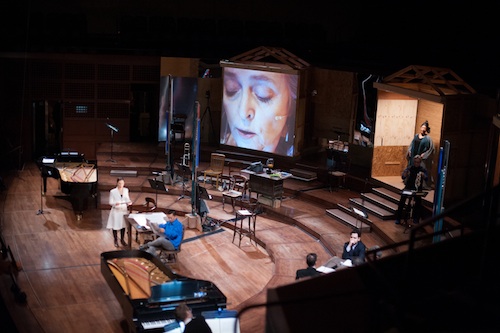
We were in the midst of an astonishing presentation of John Cage’s epic, random Song Books from 1970, after all — revered experimental vocalist Joan La Barbara had delivered a beribboned gift of apples or cranberries to an arbitrary audience member, magnificent diva Jessye Norman (in a stunning Issey Miyake gown) had joined in a boisterous card game and typed a letter on a mic’d typewriter, and conductor Michael Tilson Thomas had chopped up various fruits and veggies and Cuisinarted them into an orange-y beverage for the pianist. Cage, our 20th Century channeler of chance, would never allow such an inflexible utterance to stand unchallenged.

Meredith Monk, Jessye Norman, and MTT with Symphony members performing John Cage.

Sure enough, the phrase began to dissolve in Monk’s mouth as she repeated it, leaning from the stage like a satiric demagogue: “The b-best f-f-f-form of-f-f-f g-g-g …. ,” and adding “And we shall have it, when we are ready for it!” All the while, three large black flags were being hoisted on neon polls, unfurling into the wind from three fans, ghastly pennants at a flourescent funeral. No, we were not just in the land (our land) of anti-government sloganeering, mouthed by Tea Partiers, Occupiers, and hedge fund profiteers alike. With Monk as our guide, we were slipping through the black flags of anarchy into a gaudier lawlessness, that of death. And like pure music death, of course, shall have no dominion

Jessye Norman and MTT

We’ll probably not see such a lavish, loving tribute to Cage’s aleatory masterwork for a long time. The randomness-conjuring Song Books are governed, in a somewhat oxymoronic twist, by a large set of instructions — “Leave the stage by going up (flying) or by going down through a trap door. Return in the same way wearing an animal’s head,” for example — and forego traditional musical notation and expression for doodlings, drawings, charts, projections, lighting effects, electronic improvisation, bird calls, horn squonks, chess games, and a plethora of intersecting stage actions. (That’s not to say there weren’t gorgeous passages of melody — one especially near the end, a meandering duet with electronics in which Norman sang in a wistful voice about, I think, purple finches.)

That all this potential chaos not only didn’t come off as pretentious avant-gardism but actually formed something deeply touching, hilarious, human, and even quaint was a triumph for director Yuval Sharon and his cast and crew. Only one dude stormed out — perhaps to towel his pleats.  

Joan La Barbara, Meredith Monk, Jessye Norman, and MTT 

Bracingly, the American Mavericks festival — MTT’s tribute to the barbaric yawp of the American musical spirit — has retained most of the wonder, if not all of the risk, of its first installment a dozen years ago. 

Things had kicked off in splendid form on Thu., March 8, with program one — I saw the repeat performance that Friday — including an exciting and lush presentation of quintessential American composer Aaron Copland’s “Orchestral Variations” from 1967, which delivered both ethereal, avant-garde jaggedness (the piece is composed of 20 variations on a four-note “cell,” in an atonal manner) and occasional glimpses of Copland’s generous, down-home spirit (this was the composer of “Appalachian Spring” and “Rodeo,” after all).

It also gave us a bit of dish. 

In researching “Orchestral Variations,” I’d run into some trouble — I kept finding more evidence of Copland’s “Piano Variations” from 1930, a work deemed so stark and forbidding that no professional pianist would debut it. (So Copland, in a nifty show of self-confidence, played the premiere himself, to many critics’ disdain.) Here’s a version by pianist Marc-Andre Hamelin:

But what of the piano work’s expansive, full-bodied and spirited transcription for orchestra? It turns out that MTT himself had, in a visit to Copland’s home decades ago, suggested the piece be transformed from a single piano piece to an orchestral work, in order to reach more people on a different scale. “He turned to me, raised an eyebrow, and said, ‘Yes, yes, that all sounds nice — but who’s going to do all that work?'” MTT told the audience during the introduction. Then the big reveal: “And I said, ‘Well, with your permission …’ So — here’s a little thing that we do.”

Insider-y! It was a rare treat of a rare performance of a rare masterwork, from one of the major players involved.

It was also the perfect lead-in to the next piece on the program, Lou Harrison’s “Concerto for Organ with Percussion Orchestra” from 1972, in an absolutely transcendent rendition from Paul Jacobs on the enormous Davies Hall organ, with an ensemble of super-agile Symphony percussionists playing everything from Chinese crash cymbals and huge muted prayer gongs to celesta, rasp, and glockenspiel. 

Organist Paul Jacobs and the SF Symphony’s percussion orchestra performing Lou Harrison.

Previously I had a slight aversion to Harrison — while I appreciate him as an out-and-proud gay man in the 1960s (he has a kind of Burl Ives meets Harry Hay aura in queer iconography), I sometimes felt his musical project suffered from the same knee-jerk Orientalism that turns me off of a lot of famous Bay Area poets, mystics, artists, and composers who attempt “East meets West.” Hairy legs jutting from a silk kimono, shudder.   

My prejudices were quickly dispatched when the sprightly Jacobs immediately began coaxing the most amazingly powerful sounds from the organ, using a block-muffle tool to play whole ranges of keys at once in various rapid-fire combinations and agglomerations, accompanied by the percussionists’ clanging, hypnotically abstract tattoos. Movements ranged from crepuscular tootling to sci-fi bombast as Harrison ushered us into a kind of hallucinatory meditation full of bright oranges and shooting blues, neither East nor West but a cosmic recombinant being of both. I want to rediscover this formidable magician. Here’s a taste from another recording, although I found Jacobs’ playing to be even more spirited:

Harrisons counterpart on program two was Henry Cowell, the great popularizer of tone clusters (think of playing a whole bunch of clashing yet somehow wondrous-sounding notes at once) — Cowell’s “Piano Concerto of 1928, performed by Jeremy Denk with the orchestra, was a sensation to almost equal the Cage before it. You would never have thought odd cacophany could achieve such nuance. It sounded like a foray into negative beauty. Denk was using his entire forearms on the piano most of the time, with the symphony meeting him at a level of intense energy and empathy, and yet there were moments of quiet, complex reflection and runs of exhilirating virtuosity that matched the height of the redwoods in Henry Cowell state park (no relation, except metaphorically). Am I gushing? I am gushing. More Cowell everywhere, please. And as for the multi-talented Denk, check out his recent, revealing, and witty essay and podcast from the New Yorker.

Jeremy Denk performing Henry Cowell. 

Preceding Cowell on program two was Lukas Foss’ fantastic 1967 Phorion, given a perfectly out-there rendition by the Symphony, which feeds ragtag bits of the famed solo violin prelude to Bach’s “Partita in E” (phorion is Greek for borrow or steal) through a phtasmagorical wood-chipper of various twists and inversions that spews forth everything from droopy jazz-surrealism to hard-driving, proto-techno minimalism. It’s a monument of sampling avant la lettre, sure to prick up any iPod-shufflers ears. 

There were two slight fizzles on both nights, to my ear. Program one concluded with Charles Ives’ “A Conchord Symphony reconfigured, perhaps more accurately “massaged,” from other Ives works, (including his brilliant “Concord Sonata,” from around 1916) by comtemporary Canadian composer Henry Brandt. The piece — craggy, magniloquent, full of profound philosophical and unfettered musical ideas — is partly meant to invoke New England and its literary heroes, and in recordings is an excellent rush of jigging melody lines and bracing moods. Goatish, devoted, unabashedly intellectual, Ives is the spiritual godfather of American musical mavericks (and Mavericks), and MTT is one of his great champions. So I expected much. Here’s the Symphony’s recorded version:

But after the first two luminous movements the orchestra sounded a bit ragged (understandable in the face of the huge Mavericks project), the work lost some shape, and we ended up getting more a series of declarative statements than a metaphysical journey through the East Coast of the mind. (The great game of “Concord” is to see how many times Ives references those famous mortal knocks that open Beethoven’s Fifth Symphony, which is kinda fun.) At the end we’re supposed to be soul-hiking under the wheeling stars with Thoreau, but it felt more like soaking in a hot tub with the Sidewalk Guru from “Doonesbury” and a glass of good champagne.             

Carl Ruggles’ “Sun-treader of 1926-31 concluded program two, and tapped into a strident strain of deliberative machismo and sci-fi nerdiness that brought to mind none other than Newt Gingrich, of all people. Cosmic bombast is the aim of this 13-minute brass-churning blast, a fanfare to Big Idea perserverance. It came off as dude music in the extreme, which may have perked up some of the unwilling husbands in the house, but after all that came before seemed a wee bit threadbare in its unrelenting bravado. Still, it cut a bold, bronze shape in the quivering air. 


The Performant: In the Flash

0

Bodies and words collide in ‘this.placed’

It’s easy to overlook them, two dancers, still as mannequins, positioned near the entrance to the performance space, a silent video of a wet fleshy mouth, open wide as if ready for a filling, projected onto their motionless bodies. Just before the lights go down, they disappear, as does the fleshy mouth. Onstage a much larger projection of mouth, nose, cheek, fills the back wall, as the sounds of kissing, mumbling, chewing, and lip popping create a fanfare for the two dancers (Jill Randall and Amanda Whitehead), who enter while stretching their own faces into humorously exaggerated positions. Finally, Whitehead opens her mouth normally, to recite the jumbled text of Britta Austin’s Flash Fiction “Bite Marks,” which substitutes for music in their energetic duet.

“Her mouth was broken, there was a broken insistence to it….the insistence in her broken mouth was in her tongue, constantly poking out… to taste: citric acid honey pencil shavings the pages of her books the undersides of her fingernails…”

Choreographed by Nina Haft, five Flash Fiction-driven dances premiered last weekend at ODC in a collaborative venture with Sue Li Jue, who directed four additional pieces. (Read Guardian dance critic Rita Felciano’s take on the performances here.) Haft has choreographed work from Austin’s quirkily unsettling short-shorts before. In 2008, Austin’s publisher Watchword with Intersection for the Arts presented a radical interpretation of her works, in a multi-faceted showcase which included visual, theatre, and dance artists entitled “Notecards, a Living Museum”. In this.placed simultaneously earthy and beguiling lines such as “what can be written that doesn’t carry the stench of concepts digested before?” and “in a world where we are trained to be embarrassed by other peoples’ sex lives…I am faulty,” propel each action on a stage almost too wide to closely embrace the painful intimacy of the language.

Like dance, the art of Flash Fiction can be described as a series of fleeting yet powerful moments, caught as if in a headlight or camera-shutter, a brief transcendence. In “Flesh, Taste, Friction,” a mesmerizing Frances Sedayao stands in the foreground in a shaft of light with the appearance of a half-open window blind, while fellow dancers Rebecca Johnson and Edmer Lazaro, each in their own shaft of light, imitate the postures of her unsuspecting neighbors. “What She Asked,” an intense duet between Lisa Bush and Carol Kueffer veers into territories of suffocation and uncontrolled rage as Kueffer, breaking free from Bush’s persistent, over-bearing embrace, angrily demands that her body be “inside the room, my head outside the room, and the door shut…” before shuddering in a fit of whole-body emotion.

Sue Li Ju’s four pieces, each based on a particular degree of body awareness or circumstance, provide a balanced counterpoint to Haft’s snapshots of the vagaries of the human mind. “Half the Sky,” focuses on identity from the pov of adopted Chinese children while “Not What She Seams,” explores the conditions of textile factory workers, and includes some particularly colorful sequences involving billowing waves of fabric mirroring the movements of the dancers, adding startled beauty to the grimness of their toil. A flash of bright fiction requiring no words.  

The truth hopes: A preview of the Magic Johnson ESPN doc

0

The votes are in: Magic Johnson is one of the most amazing human beings to walk the earth. The basketball player’s announcement on November 7,1991 that he had the HIV virus forever changed the face of the disease. As the Nelson George-directed ESPN documentary, The Announcement — which premieres Sun/11 — tells us, after Johnson came out, suddenly everyone knew someone with HIV.

Hey, you just got diagnosed with a life-threatening mystery disease. Now go tell the world!

Most people know the basic plot of The Announcement. This was one of the league’s most talented players, a young pointguard who led his team, the Los Angeles Lakers. But Johnson’s five NBA championships required a lot of celebrating and he partied hard, without a condom, with a lot of women, at the chagrin of his long-suffering college sweetheart Cookie Kelly, who he later married. 

The movie’s candid treatment of Magic’s infidelities serve as the right dash of reality to temper Nelson’s film’s hero worship. You need a little texture to your protagonist, even if he is by most any definition The Man, which I mean in the awesome way and not in the don’t-let-him-get-you-down way. Seriously, that smile? Look at Magic Johnson’s smile. He is clearly the most handsome man who has ever lived. 

And then he got HIV. 

“This is not like my life is over, because it’s not.” When Johnson stood in front of cameras at that now-infamous press conference, most people probably didn’t believe those words. Back then, HIV was seen as a death sentence. The movie does a superlative job of capturing the fear tornado that surrounded the disease. 

Not to mention the crippling ignorance that led fellow NBA players like Karl “The Postman” Malone of the Utah Jazz to question whether it was safe to even play basketball with an HIV-positive person. Malone emerges as the movie’s villan, unrepentent about his harsh words even in the interviews director George shot recently. “He manned up,” he says of Johnson’s continued health after 20 years of living with the disease, a statement that caused boos to emerge spontaneously from the group I watched the advance copy of the movie with. The NBA developed “infection control procedure” inspired by Johnson’s diagnosis. Humiliating treatment for a player who used to be the king of LA. 

So yes, The Announcement is a heartstring-tugger. The musical score is a bit after-school special. (It’s actually the only thing about the movie that I just COULDN’T, with its treacle-y manipulation. The scene after Arsenio Hall recounts how he heard the big news for the first time — the driving piano chords made me laugh out loud, like a total asshole who is laughing out loud at a movie about AIDS.) There is one scene from an educational TV special Johnson made in which he is talking to HIV-positive children about what it’s like to live with the virus that is emotionally crushing. 

That the movie is good should come as no surprise — ESPN’s been making some phenomenal films over the last few years, most notably The Two Escobars, the Zimbalist brothers’ look at the braided paths of Colombia’s drug empire and its professional soccer scene. Sports serve as an epic canvas on which to make points about society, and that’s clearly being explored in some of the productions coming out of the media company. George is a budding film talent himself, and has proven himself to be an apt documentarian of the African American experience in his books on hip-hop culture and the intersections of art and sociology.

Humans triumphing over adversity! In The Announcement, George portrays Johnson as a preternaturally positive individual, smiling that god-like smile throughout a trial that would have sunk, if not killed someone less proactive. Johnson’s All-Star Game MVP award, won during the same season as “the announcement,” his Olympic gold medal, the way he calls Elizabeth Glaser, AIDS activist and wife of Paul Michael Glaser, a.k.a. Dectective David Starsky of Starsky and Hutch, for advice on living with the disease. Even before he is diagnosed with AIDS, his moves! His off-court outfits! Those belted purple short-shorts, the fur coat that looks like he’s wearing the largest lion’s mane of all time. 

The main emotion evoked by the film is relief. HIV, even AIDS, is no longer a death sentence. People no longer protest HIV-positive children in public schools or think the virus can be transmitted through sweat. It’s no considered a problem exclusive to gays. Johnson was the man most involved in changing those perceptions, so if the background music gets a little dramatic when he’s onscreen in The Announcement, that’s okay — the guy earned it. 

The Announcement premieres on ESPN Sun/11 at 9 p.m. For information on other screening times go here 

Against the grain

0

marke@sfbg.com

MUSIC It began as a burbling “Eeep!” It was June 7, 2000; we were in Davies Symphony Hall, in the middle of the second movement of Charles Ives’ super-intense Symphony No. 4 from 1910-1916. Yet despite the whirling maelstrom of that work — imagine three Fourth of Julys at once, in which a vast orchestra overlaps itself with marching band themes, spirituals, dance hall ditties, and children’s songs — I could still make out curious sounds coming from the audience behind me. Soon onlookers were shouting out nonsense; one down our row jumped up from his seat. For my part, I felt my shoulders twitch involuntarily, and my partner let out a loud hee-haw guffaw. The memory-triggering dissonance, expertly transmitted through conductor Michael Tilson Thomas, was having a spazzifying physical effect, making us active participants in Ives’ chaotic Main Street Parade.

http://www.youtube.com/watch?v=iYvWwI6YRsE

San Francisco has never lacked for excellent performances of works still often classified as “contemporary classical,” despite many being a century old. But the first American Mavericks festival, more than a decade ago, did much to elevate San Francisco’s status in the cultural world at large. We were at the very edge of the tech bubble, a maverick cultural achievement of its own, of course. Yet not much bold, native art had risen in response to all that “future now” attention and money. The much-hyped Mission School visual art movement was in its infancy, and concerned more with hermetic understatement than Bay reppin’ (a nice answer, in its way, to Web 1.0 bombast). Native dance music forms like turntablism and dirty breaks were being superseded by bland lounge house, hyphy was only hatching, Green Day was over, and literature hadn’t yet been Eggered and Chaboned.

The SF Symphony is justly famed for its impeccably polished sound and MTT’s cheeky programs pairing classical comfort food with spunky aperitifs. But American Mavericks was pretty damned ballsy for a major symphony — almost a month’s worth of edgy, attention-grabbing, well-funded gems from 20th century composers like Ruth Crawford Seeger, George Antheil, Meredith Monk, Duke Ellington, Steve Reich, Frank Zappa, Lukas Foss, and a dozen more. There was a plethora of symphonic reconfigurations and unique instrumentations: an extra brass section blared from the basement for the Ives symphony; audience members brought their own instruments to play along with Terry Riley’s ecstatic “In C.” At a very materialistic moment, American Mavericks illuminated the wild-eared, transcendentalist spirit of native music while showing the world that SF still had a huge, unfettered freak flag to fly.

American Mavericks is back Thu/8-Sun/18, this time spreading its wings to include Symphony stops in Chicago, Ann Arbor, and Carnegie Hall. And while some have bemoaned fewer and somewhat less ambitious performances on the whole (we’re in a recession, after all), there are plenty of pieces to jump up and shout about.

Ives returns, this time with astonishing masterpiece A Concord Symphony — I always hear crisp leaves crunch beneath my mental feet when this is played. Profoundly quirky enchantress Meredith Monk is back as well: in a coup of idiosyncrasy, she’ll be singing John Cage’s Song Books with magnificent diva Jessye Norman and experimental champion Joan La Barbara. Later, Hometown hero John Adams will premiere a new work, Absolute Jest, as will local techno-influenced composer Mason Bates, with “Mass Transmission.” There’s loads more packed into a mere 10 days, including pieces from Oakland instrument-inventor Harry Partch, San Francisco Tape Music Center founder Morton Subotnick, and Bay Area indigenous music devotee Lou Harrison.

Will it have the same cultural impact? Here we are back in an overconfident tech bubble — and once again our total cultural output seems a bit, well, blah. An irony of the social media onslaught is that all this personal expression seems to be quashing true individuality. So we’re having a materialist and conformist moment. A good dose of musical eccentricity from old school visionaries/crazies who turned their backs on the rat race might just do us a world of good. Here’s to more “Eeeps!” among the bleeps.

AMERCAN MAVERICKS FESTIVAL

Thu/8-Sun/18, various prices and times

Davies Symphony Hall

201 Van Ness, SF.

(415) 864-6000

www.americanmavericks.org


On the Cheap Listings

0

On the Cheap listings are compiled by Soojin Chang. Submit items for the listings at listings@sfbg.com. For further information on how to submit items for the listings, see Picks.

WEDNESDAY 7

San Francisco Green Film Festival closing night film and party San Francisco Film Society Cinema, 1746 Post, SF. (415) 742-1394, www.sfgreenfilmfest.org. 5:30 p.m., $12 per film. Whether you’ve had the chance to check out the second annual Green Film Fest’s activist-making movie screenings, make sure to check out its final night celebrating sustainable living and the fight to save our environment. The closing film Just Do It is a tale of modern-day outlaws and illegal activism in England.

THURSDAY 8

International Women’s Day March sign-making party New Valencia Hall, 747 Polk, SF. (415) 864-1278, www.radicalwomen.org. 7 p.m., $7.50 suggested donation for dinner. Sisters United Front is having a rally on March 10 to oppose budget cuts that have hit poor women the hardest. In anticipation of the march, Radical Women is hosting this evening of food and sign-making.

FRIDAY 9

Make Do! recycling exhibit and fashion show K Gallery at Rhythmix Cultural Works, 2513 Blanding, Alameda. (510) 865-5060, www.rhythmix.org. 6 p.m.-9 p.m., free. Recycling is not only something that happens when sorting out your garbage, but is also when finding creative ways to create functional treasures out of seemingly useless trash. The opening night of Make Do! will feature vintage vendors, delicious treats, and an upcycle-oriented fashion show.

SF Beer Olympics Impala Bar and Ultra Lounge, 501 Broadway, SF. (415) 982-5299, www.impalasf.com. 8:30 p.m., free to play; $10 to drink. Are you a lover of beer games with friends who hate them? Come make a mess with like-minded individuals who are more than ready to ditch the overpriced cocktails for a duel over brew.

Avant-garde sound and visual night with Edmund Campion Berkeley Art Museum and Pacific Film Archive, Gallery B, 2626 Bancroft, Berk. (510) 642-0808, www.bampfa.berkeley.edu. 7 p.m., $7. Edmund Campion is a pioneer of computer-enhanced performance practice and is the special guest for this week’s BAM/PFA Friday Late Night event. He promises to deliver a truly tripped-out experience through a mix of video projections, a choir scattered throughout Gallery B, and his unique take on electronic tunes.

SATURDAY 10

Lawrence Ferlinghetti’s Out of Chaos opening reception Kala Gallery, 2990 San Pablo, Berk. (510) 841-7000, www.kala.org. 4 p.m.-6 p.m., free. The friend and publisher of many Beat writers, Ferlinghetti drew from his well of experiences when working on his poetry and art. Come meet the one-time poet laureate of San Francisco as he launches Out of Chaos, a portfolio that showcases his original artwork and poetry.

“Sweeping of Giants” abstract ink artwork opening reception Old Crow Tattoo and Gallery, 362 Grand, Oakl. (510) 834-2769, www.oldcrowtattoo.com. Through April 9. 8 p.m., free. There are always samples of previously inked designs in the albums and on the walls of tattoo shops, but they’re usually small renderings or unsatisfying snapshots. Come see how visually orgasmic it is when detail-attentive ink artists really let loose in a surrealist painting, design-oriented composition, or a geometric field of color.

World Naked Bike Ride San Francisco edition Northeast corner of Justin Herman Plaza, 1 Market, SF. www.sfbikeride.org. 11 a.m.-4 p.m., free. Take a naked stance against our society’s global dependency on oil cartels in this mobile protest. Feel the liberating breeze as you ride as bare as you please through San Francisco’s favorite spots. Fingers are crossed for outstanding weather.

“Reflecting on his Politics, Music, Fighting Capitalism, and Cancer” jazz performance and panel discussion Multicultural Community Center in the Associated Student Union Center Building at UC Berkeley, Bancroft and Telegraph, Berkeley. (510) 548-2350, www.asiabookcenter.com. 2 p.m., free. Fred Ho is a saxophonist and social activist who underwent intense surgery and chemotherapy and came out of the battle with a new understanding of what “true healing” means. Join Ho as he discusses health, sustainability, raw foodism, and of course, indulges us with a little jazz.

Kiteboarding party and benefit event Rickshaw Stop, 155 Fell, SF. (415) 861-2011, www.rickshawstop.com. 6 p.m.-9 p.m., $10 donation. San Francisco is kind of the perfect place for kiteboarding because of the ever-present wind and the beautiful scenery. Help keep our city beautiful by supporting nonprofit Baykeeper’s work in preventing pollution in the Bay Area — you might even win some cool kite gear in the process.

SUNDAY 11

“Lazy Sunday Shopping Day”: Opening weekend of Chronicle Books at the Metreon Chronicle Books, 165 4th St., SF. (415) 369-6271, www.chroniclebooks.com. 10:30 a.m., free. Sunday should be for strolling and snacking, and Chronicle Books is honoring this sacred ritual with coffee and Top Pot doughnuts at its shop opening in downtown’s Metreon.

MONDAY 12

Bargain Basement Concert Night Bottom of the Hill, 1233 17th St., SF. (415) 621-4455, www.bottomofthehill.com. 8:30 p.m., free. The weekend might have drained your pockets but there’s not reason you can still dance. Local bands and DJs totally understand — they are hosting a cover-free night of surprisingly eclectic music. Think how delicious your moves will feel when you’re rocking them to Arms and Legs, Jackal Fleece, Surf Shit, and Junkdrawer sans financial damage.

15 lipsmacking cocktails for $5 and under

0

Screw on your drinking hats, cheapos — we tracked down 15 watering holes that’ll leave you toasted, in a financially stable kind of way. 

1. Tempest Bar’s $5 boilermaker

A shot of Jim Beam in a pint of PBR. Is this a terrible idea? Yes. Should you do it anyways? Yes. 

431 Natoma. (415) 495-1863

2. Phone Booth’s $4 tequila sunrise 

It’s a small place, but is embellished with awesome décor, cute bartenders, an eclectic mix of people, and really strong, cheap drinks. Their jukebox will have you coming back for more.  

1398 S. Van Ness, SF. (415) 648-4683


3. Moby Dick’s $6 2-for-1 margaritas 

Put both straws in your mouth, ease in to your brain freeze, and distract yourself with any of the three music videos playing on the screen overhead — a flawless solution for the worst of dates. 

4049 18th St., SF. (415) 861-1199, www.mobydicksf.com


4. Edinburgh Castle Pub’s $5 Jameson and coke 

It kind of looks like a barn — and this isn’t necessarily a bad thing. It’s a dive bar with a second floor, and is a fun place to go with a big group of friends.  

950 Geary, SF. (415) 885-4074, www.castlenews.com


5. Gold Cane Cocktail Lounge’s $4 bloody mary

The back patio here makes you forget you’re in a bar and feel like you’re in someone else’s backyard. The bartenders are sweet, the regulars always have a crazy story or four to share, and there’s free books in the back. 

1569 Haight, SF. (415) 626-1112


6. Butter’s $5 trailer tea 

Trailer tea, for those who were wondering, is sweet tea vodka. Butter also serves Prom Night punch in mason jars and has deep-fried Twinkies and SpaghettiOs. 

354 11th St., SF. (415) 863-5964, www.smoothasbutter.com 


7. You See Sushi’s $2.75 hot sake 

Now you see it, now you don’t. Your third round of sake will bring a whole new meaning to the restaurant’s name. 

94 Judah, SF. (415) 681-4010, www.youseesushi.com 


8. The Blue Light’s $3 SF Giant’s shot 

There’s not as much blue light as you think there would be, which is kind of disappointing. But their SF Giant’s shot — Harlem liqueur mixed with orange soda — will make you forget all of that anyway. 

1979 Union, SF. (415) 922-5510, www.thebluelightsf.com 


9. Delaney’s $4 vodka cranberry

A wonderful breath of dive bar air away from the typical Marina bars. Fully quipped with a jukebox, popcorn machine, and a Galaga/Pacman sit-down video game. 

2241 Chestnut, SF. (415) 931-8529 


10. Tornado’s $5 pomegranate cider 

This is a no-nonsense kind of bar. Know what you’re going to order, grab your drink, and gulp it down with a sausage from Rosamunde next door. 

547 Haight. (415) 863-2276, www.tornado.com


11. Lucky 13’s $4 whiskey sour

This dimly lit bar has cheap drinks, a good looking juke box, and free movie-grade popcorn (think butter). And the cutest dogs show up too.  

2140 Market, SF. (415) 487-1313 


12. Mission Bar’s $4 Manhattan

The red “BAR” sign that hangs outside lets you know this place gets straight to the point. Forget about names, just drink your drink. 

2695 Mission, SF. (415) 647-2300 


13. Specs’ Twelve Adler Museum Cafe’s $5 dirty vodka martini 

Postcards from around the world adorn the walls, a bluesy pianist playing in the corner, and an old school vibe that will take you back. 

12 William Saroyan, SF. (415) 421-4112 


14. Pittsburgh’s Pub’s $4 Ketel One and tonic 

If you ever fall asleep on the N-Judah and end up at the end of the Muni line, pick yourself up with any of the many cheap drinks at Pittsburgh’s Pub. 

4207 Judah, SF. (415) 664-3926 


15. Lexington Club’s $1 Margarita Fridays 

The only time it is perfectly okay to drink five margaritas in one sitting is at Lexington before 10 p.m. on Fridays. 

3464 19th St., SF. (415) 863-2052, www.lexingtonclub.com

Film Listings

0

Film listings are edited by Cheryl Eddy. Reviewers are Kimberly Chun, Max Goldberg, Dennis Harvey, Lynn Rapoport, and Matt Sussman. For rep house showtimes, see Rep Clock.

OPENING

*Crazy Horse Does the documentary genre need an injection of sex appeal? Leave it to ground-breaking documentarian Frederick Wiseman to do just that, with this hilarious, keenly-observed look into Paris’s rightfully legendary Crazy Horse Paris cabaret. For 10 weeks, the filmmaker immersed himself in all aspects of preparation going into a new show, Désirs, by choreographer Philippe Decouflé, and uncovers the guts, discipline, organizational entanglements, and genuine artistry that ensues backstage to produce the at-times laugh-out-loud OTT (e.g., the many routines in which the perky, planet-like posterior is highlighted), at-times truly remarkable numbers (the girl-on-girl spaceship fantasia; the subtle, surreal number that bounces peek-a-boo body parts off a mirrored surface) onstage — moments that should inspire burlesque performers and dance aficionados alike with the sheer imaginative possibilities of dancing in the buff, with a side of brain-teasing titillation, of course. Always silently commenting on the action, Wiseman pokes quiet fun (at the dancer vigorously brushing the horse-hair tail attached to her rear, the obsessed art director, and the sound guy who’s a ringer for Philip Seymour Hoffman’s Boogie Nights nebbish) while patiently paying respect to the mechanics behind the magic (Decouflé, among others, arguing with management for more time to improve the show, despite the beyond-rigorous seven-days-a-week, twice- to thrice-daily schedule). Crazy Horse provides marvelous proof that the battle of seduction begins with the brain. (2:08) Embarcadero, Shattuck, Smith Rafael. (Chun)
Dr. Seuss’ The Lorax Dr. Seuss’ environmental fable comes to (3D, CG-animated) life, with Danny DeVito voicing the iconic title creature. (1:26) Balboa, Presidio, Shattuck.

Project X Nope, not a remake of the 1987 Matthew-Broderick-befriends-a-chimp flick. This one’s a comedy about a chaotic high school party. (1:28) California.

*Tim and Eric’s Billion Dollar Movie See Trash. (1:32) Lumiere, Shattuck.

Undefeated Daniel Lindsay and T.J. Martin, who previously teamed up on a 2008 doc about beer pong, have a more serious subject for their latest tale: the unlikely heroics of an inner-city Memphis, Tenn. high school football team. The title refers more to the collective spirit rather than the (still pretty damn good) record of the Manassas Tigers, a team comprised of youths challenged by less-than-ideal home lives and anti-authority attitude problems that stem from troubles running deeper than typical teenage rebellion. Into an environment seemingly tailored to assure the kids’ failure steps coach Bill Courtney. He’s white, they’re all African American; he’s fairly well-off, while most of them live below the poverty line. Still, he’s able to instill confidence in them, both on and off the field, with focus on three players in particular: the athletically-gifted, academically-challenged O.C., who gets a Blind Side-style boost from one of Courtney’s assistant coaches; sensitive brain Money, sidelined by a devastating injury; and hot-tempered wild card Chavis, who eventually learns the importance of teamwork. With the heavy-hitting endorsement of celebrity exec producer Sean Combs, Undefeated is a high-quality entry into the "inspiring sports doc" genre: it offers an undeniably uplifting story and sleek production values. But it’s a little too familiar to be called the best documentary of the year, despite its recent anointing at the Oscars. If it was gonna be a sports flick, why not the superior, far more complex (yet not even nominated) Senna? (1:53) SF Center. (Eddy)

*We Need to Talk About Kevin It’s inevitable — whenever a seemingly preventable tragedy occurs, there’s public outcry to the tune of "How could this happen?" But after the school shooting in We Need to Talk About Kevin, the more apt question is "How could this not happen?" Lynne Ramsay (2002’s Morvern Callar) — directing from the script she co-adapted from Lionel Shriver’s novel — uses near-subliminal techniques to stir up atmospheric unease from the very start, with layered sound design and a significant, symbolic use of the color red. While other Columbine-inspired films, including Elephant and Zero Day (both 2003), have focused on their adolescent characters, Kevin revolves almost entirely around Eva Khatchadourian (a potent Tilda Swinton) — grief-stricken, guilt-riddled mother of a very bad seed. The film slides back and forth in time, allowing the tension to build even though we know how the story will end, since it’s where the movie starts: with Eva, alone in a crappy little house, working a crappy little job, moving through life with the knowledge that just about everyone in the world hates her guts. Kevin is very nearly a full-blown horror movie, and the demon-seed stuff does get a bit excessive. But it’s hard to determine if those scenes are "real life" or simply the way Eva remembers them, since Kevin is so tightly aligned with Eva’s point of view. Though she’s miserable in the flashbacks, the post-tragedy scenes are even thicker with terror; the film’s most unsettling sequence unfolds on Halloween, horror’s favorite holiday; Eva drives past a mob of costumed trick-or-treaters as Buddy Holly’s "Everyday" (one of several inspired music choices) chimes on the soundtrack. Masked faces are turn to stare — accusingly? Coincidentally? Do they even know she’s Kevin’s mother? — with nightmarish intensity heightened by slow motion. And indeed, "Everyday" Eva deals with accepting her fate; the film is sympathetic to her even while suggesting that she may actually be responsible. For a longer review of this film, and an interview with director Ramsay, visit www.sfbg.com/pixel_vision. (1:52) (Eddy)

ONGOING

Act of Valor (1:45) 1000 Van Ness, Sundance Kabuki.

Albert Nobbs The titular character in Rodrigo Garcia’s film is a butler of ideal bone-stiff propriety and subservience in a Dublin hotel whose well-to-do clients expect no less from the hired help. Even his fellow workers know almost nothing about middle aged Albert, and he’s so dully harmless they don’t even notice that lack. Yet Albert has a big secret: he is a she, played by Glenn Close, having decided this cross dressing disguise was the only way out of a Victorian pauper’s life many years ago. Chance crosses Albert’s path with housepainter Hubert (Janet McTeer), who turns out to be harboring precisely the same secret, albeit more merrily — "he" has even found happy domesticity with an understanding wife. Albert dreams of finding the same with a comely young housemaid (Mia Wasikowska), though she’s already lost her silly head over a loutish but handsome handyman (Aaron Johnson) much closer to her age. This period piece is more interesting in concept rather than in execution, as the characters stay all too true to mostly one-dimensional types, and the story of minor intrigues and muffled tragedies springs very few surprises. It’s an honorable but not especially rewarding affair that clearly exists mostly as a setting for Close’s impeccable performance — and she knows it, having written the screenplay and produced; she’s also played this part on stage before. Yet even that accomplishment has an airless feel; you never forget you’re watching an actor "transform," and for all his luckless pathos, Albert is actually a pretty tedious fellow. (1:53) Opera Plaza, Presidio. (Harvey)

*The Artist With the charisma-oozing agility of Douglas Fairbanks swashbuckling his way past opponents and the supreme confidence of Rudolph Valentino leaning, mid-swoon, into a maiden, French director-writer Michel Hazanavicius hits a sweet spot, or beauty mark of sorts, with his radiant new film The Artist. In a feat worthy of Fairbanks or Errol Flynn, Hazanavicius juggles a marvelously layered love story between a man and a woman, tensions between the silents and the talkies, and a movie buff’s appreciation of the power of film — embodied in particular by early Hollywood’s union of European artistry and American commerce. Dashing silent film star George Valentin (Jean Dujardin, who channels Fairbanks, Flynn, and William Powell — and won this year’s Cannes best actor prize) is at the height of his career, adorable Jack Russell by his side, until the talkies threaten to relegate him to yesterday’s news. The talent nurtured in the thick of the studio system yearns for real power, telling the newspapers, "I’m not a puppet anymore — I’m an artist," and finances and directs his own melodrama, while his youthful protégé Peppy Miller (Bérénice Béjo) becomes a yakky flapper age’s new It Girl. Both a crowd-pleasing entertainment and a loving précis on early film history, The Artist never checks its brains at the door, remaining self-aware of its own conceit and its forebears, yet unashamed to touch the audience, without an ounce of cynicism. (1:40) Balboa, California, Embarcadero, Marina, 1000 Van Ness, Piedmont, Sundance Kabuki. (Chun)

*Chico and Rita This Spain-U.K. production is at heart a very old-fashioned musical romance lent novelty by its packaging as a feature cartoon. Chico (voiced by Eman Xor Oña) is a struggling pianist-composer in pre-Castro Havana who’s instantly smitten by the sight and sound of Rita (Limara Meneses, with Idania Valdés providing vocals), a chanteuse similarly ripe for a big break. Their stormy relationship eventually sprawls, along with their careers, to Manhattan, Hollywood, Paris, Las Vegas, and Havana again, spanning decades as well as a few large bodies of water. This perpetually hot, cold, hot, cold love story isn’t very complicated or interesting — it’s pretty much "Boy meets girl, generic complications ensue" — nor is the film’s simple graphics style (reminiscent of 1970s Ralph Bakshi, minus the sleaze) all that arresting, despite the established visual expertise of Fernando Trueba’s two co directors Javier Mariscal and Tono Errando. When a dream sequence briefly pays specific homage to the modernist animation of the ’50s-early ’60s, Chico and Rita delights the eye as it should throughout. Still, it’s pleasant enough to the eye, and considerably more than that to the ear — there’s new music in a retro mode from Bebo Valdes, and plenty of the genuine period article from Monk, Mingus, Dizzy Gillespie, Chano Pozo and more. If you’ve ever jones’d for a jazzbo’s adult Hanna Barbera feature (complete with full-frontal cartoon nudity — female only, of course), your dream has come true. (1:34) Opera Plaza, Smith Rafael. (Harvey)

*Chronicle A misfit (Dane DeHaan) with an abusive father and an ever-present video camera, his affable cousin (Matt Garretty), and a popular jock (Michael B. Jordan) discover a strange, glowing object in the woods; before long, the boys realize they are newly telekinetic. At first, it’s all a lark, pulling pranks and — in the movie’s most exhilarating scene — learning to fly, but the fun ends when the one with the anger problem (guess which) starts abusing the ol’ with-great-power-comes-great-responsibilities creed. Chronicle is a pleasant surprise in a time when it’s better not to expect much from films aimed at teens; it grounds the superhero story in a (mostly) believable high-school setting, gently intellectualizes the boys’ dilemma ("hubris" is discussed), and also understands how satisfying it is to see superpowers used in the service of pure silliness — like, say, pretending you just happen to be really, really, really, good at magic tricks. First-time feature director Josh Trank and screenwriter Max "son of John" Landis also find creative ways, some more successful than others, to work with the film’s "self-shot" structure. The technique (curse you, Blair Witch) is long past feeling innovative, but Chronicle amply justifies its use in telling its story. (1:23) 1000 Van Ness. (Eddy)

*Coriolanus For his film directing debut, Ralph Fiennes has chosen some pretty strong material: a military drama that is among Shakespeare’s least popular works, not that adapting the Bard to the screen has ever been easy. (Look how many times Kenneth Branagh, an even more fabled Shakespearean Brit on stage than Ralph, has managed to fumble that task.) The titular war hero, raised to glory in battle and little else, is undone by political backstabbers and his own contempt for the "common people" when appointed to a governmental role requiring some diplomatic finesse. This turn of events puts him right back in the role he was born for: that of ruthless, furious avenger, no matter that now he aims to conquer the Rome he’d hitherto pledged to defend. The setting of a modern city in crisis (threadbare protesting masses vs. oppressive police state) works just fine, Elizabethan language and all, as does Fiennes’ choice of a gritty contemporary action feel (using cinematographer Barry Ackroyd of 2006’s United 93 and 2008’s The Hurt Locker). He’s got a strong supporting cast — particularly Vanessa Redgrave as Coriolanus’ hawkish mother Volumnia — and an excellent lead in one Ralph Fiennes, who here becomes so warped by bloodthirst he seems to mutate into Lord Voldemort before our eyes, without need of any prosthetics. His crazy eyes under a razored bald pate are a special effect quite alarmingly inhuman enough. (2:03) Bridge. (Harvey)

*The Descendants Like all of Alexander Payne’s films save 1996 debut Citizen Ruth, The Descendants is an adaptation, this time from Kaui Hart Hemmings’ excellent 2007 novel. Matt King (George Clooney) is a Honolulu lawyer burdened by various things, mostly a) being a haole (i.e. white) person nonetheless descended from Hawaiian royalty, rich in real estate most natives figure his kind stole from them; and b) being father to two children by a wife who’s been in a coma since a boating accident three weeks ago. Already having a hard time transitioning from workaholic to hands-on dad, Matt soon finds out this new role is permanent, like it or not — spouse Elizabeth (Patricia Hastie, just briefly seen animate) will not wake up. The Descendants covers the few days in which Matt has to share this news with Elizabeth’s loved ones, mostly notably Shailene Woodley and Amara Miller as disparately rebellious teen and 10-year-old daughters. Plus there’s the unpleasant discovery that the glam, sporty, demanding wife he’d increasingly seemed "not enough" for had indeed been looking elsewhere. When has George Clooney suggested insecurity enough to play a man afraid he’s too small in character for a larger-than-life spouse? But dressed here in oversized shorts and Hawaiian shirts, the usually suave performer looks shrunken and paunchy; his hooded eyes convey the stung joke’s-on-me viewpoint of someone who figures acknowledging depression would be an undeserved indulgence. Payne’s film can’t translate all the book’s rueful hilarity, fit in much marital backstory, or quite get across the evolving weirdness of Miller’s Scottie — though the young actors are all fine — but the film’s reined-in observations of odd yet relatable adult and family lives are all the more satisfying for lack of grandiose ambition. (1:55) Four Star, Piedmont, Presidio, SF Center, Shattuck, Sundance Kabuki. (Harvey)

Ghost Rider: Spirit of Vengeance (1:36) 1000 Van Ness, SF Center.

*The Girl With the Dragon Tattoo The meeting of Stieg Larsson’s first "Millennium" book and David Fincher promised fireworks, as he’s a director who can be equally vivid and exacting with just the elements key to the series: procedural detail, obsession, violence, tweaked genre conventions, mind games, haunted protagonists, and expansive story arcs. But perhaps because this possible franchise launch had to be rushed into production to ride the Larsson wave, what should have been a terrific matchup turns out to be just a good one — superior in some stylistic departments (notably Trent Reznor and Atticus Ross’ pulsing score), but overall neither an improvement nor a disappointment in comparison to the uninspired but effective 2009 Swedish film version. Daniel Craig plays Mikael Blomkvist, the muckraking Stockholm journalist whose public disgrace after a failed expose of a suspect corporate tycoon makes him the perfect candidate for an unexpected assignment: staying sequestered in the wealthy, warring Vanger clan’s island home to secretly investigate a teenage girl’s disappearance and presumed murder 40 years ago. His testy helpmate is the singular Lisbeth Salander (Rooney Mara), antisocial hacker, researcher, and ex-mental patient par excellence. Nearly three hours long, the compressed, slightly altered (get over it) storyline nonetheless feels rushed at times; Fincher manages the rare feat of making mostly internet research exciting in filmic terms, yet oddly the book’s more shocking episodes of sex and/or mayhem don’t have the memorable impact one might expect from him. The leads are fine, as is the big support cast of recognizable faces (Christopher Plummer, Stellan Skarsgård, Robin Wright, etc.) But the knockout suspense, atmosphere, and urgency one hoped for isn’t present in this intelligent, not entirely satisfying treatment. On the other hand, maybe those who’ve already read the books and seen the prior films have already had so much exposure to this material that a revelatory experience is no longer possible. (2:38) Castro. (Harvey)

Gone Still-shaky if now highly self-defensive Jill (Amanda Seyfried) was abducted from her bed a year ago, thrown into a deep hole in a forest outside Portland, Ore., and escaped death only by overcoming her barely-glimpsed captor. Or so she insists — the police never found any corroborating evidence, and given Jill’s history of mental instability, wrote off her whole purported adventure as delusional. When sister Molly (Emily Wickersham) goes inexplicably missing the morning of an important exam, however, Jill is convinced the serial kidnapper-killer has struck again, going off on a frantic manhunt of her own with no help from the authorities. There is nothing spectacularly wrong with Gone, but nothing right, either — to justify the ponying up of cash money at a theater these days you have to offer something a little more than the routine execution of a derivative, uninspired script with little suspense but plenty of plot holes. That sort of thing is best experienced at a sleepless 2 a.m. on cable, for free. (1:34) 1000 Van Ness, SF Center. (Harvey)

Hugo Hugo turns on an obviously genius conceit: Martin Scorsese, working with 3D, CGI, and a host of other gimmicky effects, creates a children’s fable that ultimately concerns one of early film’s pioneering special-effects fantasists. That enthusiasm for moviemaking magic, transferred across more than a century of film history, was catching, judging from Scorsese’s fizzy, exhilarating, almost-nauseating vault through an oh-so-faux Parisian train station and his carefully layered vortex of picture planes as Hugo Cabret (Asa Butterfield), an intrepid engineering genius of an urchin, scrambles across catwalk above a buzzing station and a hotheaded station inspector (Sacha Baron Cohen). Despite the special effects fireworks going off all around him, Hugo has it rough: after the passing of his beloved father (Jude Law), he has been stuck with an nasty drunk of a caretaker uncle (Ray Winstone), who leaves his duties of clock upkeep at a Paris train station to his charge. Hugo must steal croissants to survive and mechanical toy parts to work on the elaborate, enigmatic automaton he was repairing with his father, until he’s caught by the fierce toy seller (Ben Kingsley) with a mysterious lousy mood and a cute, bright ward, Isabelle (Chloe Grace Moretz). Although the surprisingly dark-ish Hugo gives Scorsese a chance to dabble a new technological toolbox — and the chance to wax pedantically, if passionately, about the importance of film archival studies — the effort never quite despite transcends its self-conscious dazzle, lagging pacing, diffuse narrative, and simplistic screenplay by John Logan, based on Brian Selznick’s book. Even the actorly heavy lifting provided by assets like Kingsley and Moretz and the backloaded love for the fantastic proponents at the dawn of filmmaking fail to help matters. Scorsese attempts to steal a little of the latters’ zeal, but one can only imagine what those wizards would do with motion-capture animation or a blockbuster-sized server farm. (2:07) Four Star, Presidio, Shattuck, Sundance Kabuki. (Chun)

*In Darkness Agnieszka Holland is that kind of filmmaker who can become a well known, respectable veteran without anyone being quite sure what those decades have added up to. Her mentor was Andrzej Wadja, the last half-century’s leading Polish director (among those who never left). He helped shape a penchant for heavy historical drama and a sometimes clunky style not far from his own. She commenced her international career with 1985’s Angry Harvest, about the amorous relationship between a Polish man and the Austrian, a Jewish woman, he hides during Nazi occupation. Her one indispensable feature is 1990’s Europa, Europa, an ideal vehicle for her favored mix of the grotesque, sober, and factual — following a Jewish boy who passed as Aryan German. The new In Darkness is her best since then, and it can’t be chance that this too dramatizes a notably bizarre case of real-life peril and survival under the Nazis. Its protagonist is Leopold Socha (Robert Wieckiewicz), an ordinary family man in Lvov (Poland then, Ukraine now) who’s not above exploiting the disarray of occupation and war to make ends meet. A sewer inspector, he uses his knowledge of underground tunnels to hide Jews who can pay enough when even the fenced-off ghetto is no longer safe. For such a long, oppressive, and literally dark film, this one passes quickly, maintaining tension as well as a palpable physical discomfort that doubtlessly suggests just a fraction what the refugees actually suffered. In Darkness isn’t quite a great movie, but it’s a powerful experience. At the end it’s impossible to be unmoved, not least because the director’s resistance toward Spielbergian exaltation insists on the banal and everyday, even in human triumph. (2:25) Embarcadero. (Harvey)

The Iron Lady Curiously like Clint Eastwood’s 2011 J. Edgar, this biopic from director Phyllida Lloyd and scenarist Abi Morgan takes on a political life of length, breadth and controversy — yet it mostly skims over the politics in favor of a generally admiring take on a famous narrow-minded megalomaniac’s "gumption" as an underdog who drove herself to the top. Looking back on her career from a senile old age spent in the illusory company of dead spouse Denis (Jim Broadbent), Meryl Streep’s ex-British Prime Minister Margaret Thatcher steamrolls past hurdles of class and gender while ironically re-enforcing the fustiest Tory values. She’s essentially a spluttering Lord in skirts, absolutist in her belief that money and power rule because they ought to, and any protesting rabble don’t represent the "real England." That’s a mindset that might well have been explored more fruitfully via less flatly literal-minded portraiture, though Lloyd does make a few late, lame efforts at sub-Ken Russell hallucinatory style. Likely to satisfy no one — anywhere on the ideological scale — seriously interested in the motivations and consequences of a major political life, this skin-deep Lady will mostly appeal to those who just want to see another bravura impersonation added to La Streep’s gallery. Yes, it’s a technically impressive performance, but unlikely to be remembered as one of her more depthed ones, let alone among her better vehicles. (1:45) Albany, Marina, Vogue. (Harvey)

My Week With Marilyn Statuette-clutching odds are high for Michelle Williams, as her impersonation of a famous dead celebrity is "well-rounded" in the sense that we get to see her drunk, disorderly, depressed, and so forth. Her Marilyn Monroe is a conscientious performance. But when the movie isn’t rolling in the expected pathos, it’s having other characters point out how instinctive and "magical" Monroe is onscreen — and Williams doesn’t have that in her. Who could? Williams is remarkable playing figures so ordinary you might look right through them on the street, in Wendy and Lucy (2008), Blue Valentine (2010), etc. But as Monroe, all she can do is play the little-lost girl behind the sizzle. Without the sizzle. Which is, admittedly, exactly what My Week — based on a dubious true story — asks of her. It is true that in 1956 the Hollywood icon traveled to England to co-star with director Sir Laurence Olivier (Kenneth Branagh) in a fluff romance, The Prince and the Showgirl; and that she drove him crazy with her tardiness, mood swings, and crises. It’s debatable whether she really got so chummy with young production gofer Colin Clark, our wistful guide down memory lane. He’s played with simpering wide-eyed adoration by Eddie Redmayne, and his suitably same-aged secondary romantic interest (Emma Watson) is even duller. This conceit could have made for a sly semi-factual comedy of egos, neurosis, and miscommunication. But in a rare big-screen foray, U.K. TV staples director Simon Curtis and scenarist Adrian Hodges play it all with formulaic earnestness — Marilyn is the wounded angel who turns a starstruck boy into a brokenhearted but wiser man as the inevitable atrocious score orders our eyes to mist over. (1:36) Clay, Four Star, Shattuck. (Harvey)

Norwegian Wood Haruki Murakami’s global best-seller — a melancholic, late-1960s love story — hits the big screen thanks to Tran Anh Hung (1993’s The Scent of the Green Papaya). Kenichi Matsuyama (2011’s Gantz, 2005’s Linda Linda Linda) and Rinko Kikuchi (2006’s Babel) play Watanabe and Naoko, a young couple who reconnect in Tokyo after the suicide of his best friend, who was also her childhood sweetheart. There’s love between them, but Naoko is mentally fragile; she flees town suddenly after they sleep together for the first time. Meanwhile, Watanabe meets the vivacious Midori (Kiko Mizuhara) — who is also already involved, though not quite so deeply as he — and they spark, though he’s devoted to Naoko, and visits her at the rural hospital where she’s (sort of) working through her emotional issues. Tran is an elegant filmmaker, and Radiohead’s Jonny Greenwood contributes an appropriately moody score. But amid all the breathless encounters, the uber-emo Norwegian Wood drags a bit at over two hours, and the film never quite crystallizes what it was about Murakami’s book that inspired such international rapture. (2:13) Four Star. (Eddy)

*Pina Watching Pina Bausch’s choreography on film should not have been as absorbing and deeply affecting of an experience as it was. Dance on film tends to disappoint — the camera flattens the body and distorts perspective, and you either see too many or not enough details. However, improved 3D technology gave Wim Wenders (1999’s Buena Vista Social Club; 1987’s Wings of Desire) the additional tools he needed to accomplish what he and fellow German Bausch had talked about for 20 years: collaborating on a documentary about her work. Instead of making a film about the rebel dance maker, Wenders made it for Bausch, who died in June 2009, two days before the start of filming. Pina is an eloquent tribute to a tiny, soft-spoken, mousy-looking artist who turned the conventions of theatrical dance upside down. She was a great artist and true innovator. Wenders’ biggest accomplishment in this beautifully paced and edited document is its ability to elucidate Bausch’s work in a way that words probably cannot. While it’s good to see dance’s physicality and its multi dimensionality on screen, it’s even better that the camera goes inside the dances to touch tiny details and essential qualities in the performers’ every gesture. No proscenium theater can offer that kind of intimacy. Appropriately, intimacy (the eternal desire for it) and loneliness (an existential state of being) were the two contradictory forces that Bausch kept exploring over and over. And by taking fragments of the dances into the environment — both natural and artificial — of Wuppertal, Germany, Wenders places them inside the emotional lives of ordinary people, subjects of all of Bausch’s work. (1:43) Shattuck, Sundance Kabuki. (Rita Felciano)

Rampart Fans of Dexter and a certain dark knight will empathize with this final holdout for rogue law enforcement, LAPD-style, in the waning days of the last century. And Woody Harrelson makes it easy for everyone else to summon a little sympathy for this devil in a blue uniform: he slips so completely behind the sun- and booze-burnt face of David "Date Rape" Brown, an LAPD cop who ridicules young female cops with the same scary, bullying certainty that he applies to interrogations with bad guys. The picture is complicated, however, by the constellation of women that Date Rape has sheltered himself with. Always cruising for other lonely hearts like lawyer Linda (Robin Wright), he still lives with the two sisters he once married (Cynthia Nixon, Anne Heche) and their daughters, including the rebellious Helen (Brie Larson), who seems to see her father for who he is — a flawed, flailing anti-hero suffering from severe testosterone poisoning and given to acting out. Harrelson does an Oscar-worthy job of humanizing that everyday monster, as director Oren Moverman (2009’s The Messenger), who cowrote the screenplay with James Ellroy, takes his time to blur out any residual judgement with bokeh-ish points of light while Brown — a flip, legit side of Travis Bickle — just keeps driving, unable to see his way out of the darkness. (1:48) Embarcadero. (Chun)

*Roadie Michael Cuesta’s first film as both director and writer (again co-authoring with brother Gerald) since 2001’s startling debut feature L.I.E. is also his best work since then. After nearly a quarter-centurty spent schlepping equipment for Blue Oyster Cult — the arty metal band ("Don’t Fear the Reaper," i.e. "more cowbell!") that was already sliding from the spotlight when he signed on — Jimmy Testergross (Ron Eldard) is fired, the reasons unknown to us. With nowhere else to go, he lands on the doorstep of his childhood home in Queens, where he hasn’t been seen in at least 20 years. Mom (Lois Smith) is going senile, though somehow her disapproval comes through with perfect clarity (and hasn’t changed in all that time). Seeking a liquid solace at a bar, our hero instead runs into Randy (Bobby Cannavale), who bullied him mercilessly way back when — and is now married to "Jimmy Testicle’s" still-hot former girlfriend Nikki (Jill Hennessey), who has rock-star aspirations of her own. Taking place over less than 24 hours’ span, Roadie is a very small character study, but a well-observed one. "Developmentally stunted by rock ‘n’ roll," as one character puts it (when it emerges 40-something Jimmy has never learned to make coffee for himself), its protagonist is the kind of likable boy-man loser usually found in Fountains of Wayne songs, an aging lifelong air guitarist pining over good old days that probably weren’t even that good. His nostalgia is as touchingly hapless as his dubious future. (1:35) SF Film Society Cinema. (Harvey)

Safe House Frankly, Denzel Washington watchers are starved for another movie in which he’s playing the smartest guy in the room. Despite being hampered by a determinedly murky opening, Safe House should mostly satisfy. Washington’s Tobin Frost is well-used to dwelling into a grayed-out borderland of black ops and flipped alliances — a onetime CIA star, he now trades secrets while perpetually on the run. Fleeing from killers of indeterminate origin, Tobin collides headlong with eager young agent Matt (Ryan Reynolds), who’s stuck maintaining a safe house in Cape Town, South Africa. Tasked with holding onto Tobin’s high-level player by his boss (Brendan Gleeson) and his boss’s boss (Sam Shepard), Matt is determined to prove himself, retain and by extension protect Tobin (even when the ex-superspy is throttling him from behind amid a full-speed car chase), and resist the magnetic pull of those many hazardous gray zones. Surrounded by an array of actorly heavies, including Vera Farmiga, who collectively ratchet up and invest this possibly not-very-interesting narrative — "Bourne" there; done that — with heart-pumping intensity, Washington is magnetic and utterly convincing as the jaded mouse-then-cat-then-mouse toying with and playing off Reynolds go-getter innocent. Safe House‘s narrative doesn’t quite fill in the gaps in Tobin Frost’s whys and wherefores, and the occasional ludicrous breakthroughs aren’t always convincing, but the film’s overall, familiar effect should fly, even when it’s playing it safe (or overly upstanding, especially when it comes to one crucial, climactic scrap of dialogue from "bad guy" Washington, which rings extremely politically incorrect and tone-deaf). (2:00) 1000 Van Ness, SF Center, Sundance Kabuki. (Chun)

*A Separation Iran’s first movie to win Berlin’s Golden Bear (as well as all its acting awards), this domestic drama reflecting a larger socio-political backdrop is subtly well-crafted on all levels, but most of all demonstrates the unbeatable virtue of having an intricately balanced, reality-grounded screenplay — director Asghar Farhadi’s own — as bedrock. A sort of confrontational impartiality is introduced immediately, as our protagonists Nader (Peyman Moadi) and Simin (Leila Hatami) face the camera — or rather the court magistrate — to plead their separate cases in her filing for divorce, which he opposes. We gradually learn that their 14-year wedlock isn’t really irreparable, the feelings between them not entirely hostile. The roadblock is that Simin has finally gotten permission to move abroad, a chance she thinks she must seize for the sake of their daughter, Termeh (Sarina Farhadi). But Nader doesn’t want to leave the country, and is not about to let his only child go without him. Farhadi worked in theater before moving into films a decade ago. His close attention to character and performance (developed over several weeks’ pre-production rehearsal) has the acuity sported by contemporary playwrights like Kenneth Lonergan and Theresa Rebeck, fitted to a distinctly cinematic urgency of pace and image. There are moments that risk pushing plot mechanizations too far, by A Separation pulls off something very intricate with deceptive simplicity, offering a sort of integrated Rashomon (1950) in which every participant’s viewpoint as the wronged party is right — yet in conflict with every other. (2:03) Albany, Embarcadero. (Harvey)

*The Secret World of Arrietty It’s been far too long between 2008’s Ponyo, the last offering from Studio Ghibli, and this feature-length adaptation of Mary Norton’s children’s classic, The Borrowers, but the sheer beauty of the studio’s hand-drawn animation and the effortless wonder of its tale more than make up for the wait. This U.S. release, under the very apropos auspices of Walt Disney Pictures, comes with an American voice cast (in contrast with the U.K. version), and the transition appears to be seamless — though, of course, the background is subtly emblazoned with kanji, there are details like the dinnertime chopsticks, and the characters’ speech rhythms, down to the "sou ka" affirmative that peppers all Japanese dialogue. Here in this down-low, hybridized realm, the fearless, four-inches-tall Arrietty (voiced by Bridgit Mendler) has grown up imaginative yet lonely, believing her petite family is the last of their kind: they’re Borrowers, a race of tiny people who live beneath the floorboards of full-sized human’s dwellings and take what they need to survive. Despite the worries of her mother Homily (Amy Poehler), Arrietty begins to embark on borrowing expeditions with her father Pod (Will Arnett) — there are crimps in her plans, however: their house’s new resident, a sickly boy named Shawn (David Henrie), catches a glimpse of Arrietty in the garden, and caretaker Hara (Carol Burnett) has a bit of an ulterior motive when it comes to rooting out the wee folk. Arrietty might not be for everyone — some kids might churn in their seats with ADD-style impatience at this graceful, gentle throwback to a pre-digital animation age — but in the care of first-time director Hiromasa Yonebayashi and Ghibli mastermind Hayao Miyazaki, who wrote co-wrote the screenplay, Arrietty will transfix other youngsters (and animation fans of all ages) with the glorious detail of its natural world, all beautifully amplified and suffused with everyday magic when viewed through the eyes of a pocket-sized adventurer. (1:35) California, 1000 Van Ness, Sundance Kabuki. (Chun)

*Shame It’s been a big 2011 for Michael Fassbender, with Jane Eyre, X-Men: First Class, Shame, and A Dangerous Method raising his profile from art-house standout to legit movie star (of the "movie stars who can also act" variety). Shame may only reach one-zillionth of X-Men‘s audience due to its NC-17 rating, but this re-teaming with Hunger (2008) director Steve McQueen is Fassbender’s highest achievement to date. He plays Brandon, a New Yorker whose life is tightly calibrated to enable a raging sex addiction within an otherwise sterile existence, including an undefined corporate job and a spartan (yet expensive-looking) apartment. When brash, needy, messy younger sister Cissy (Carey Mulligan, speaking of actors having banner years) shows up, yakking her life all over his, chaos results. Shame is a movie that unfolds in subtle details and oversized actions, with artful direction despite its oft-salacious content. If scattered moments seem forced (loopy Cissy’s sudden transformation, for one scene, into a classy jazz singer), the emotions — particularly the titular one — never feel less than real and raw. (1:39) Lumiere. (Eddy)

Star Wars: Episode 1: The Phantom Menace 3D (2:16) SF Center, Sundance Kabuki.

*Straight Outta Hunters Point 2 In 2001, filmmaker Kevin Epps turned a camera on his own neighborhood: Bayview-Hunters Point, the southeastern San Francisco community best-known by outsiders for Candlestick Park, toxic pollution, and gang violence. Straight Outta Hunters Point was an eye-opener not just locally but internationally, as its runaway success opened doors for Epps to travel with the film and establish his career. These days, Epps is no longer an emerging talent — he’s a full-time independent filmmaker with multiple credits (including The Black Rock, a documentary about Alcatraz’s African American inmates, and hip-hop film Rap Dreams), collaborations (with Current TV and others), and an artist fellowship at the de Young Museum under his belt. For his newest project, he returns to the scene of his first work. He no longer resides in Bayview-Hunters Point, but he still lives close by, and he’s never lost touch with the community that inspired the first film and encouraged him to make its follow-up. Described by Epps as a "continuation of the conversation" launched by the first film, SOHP 2 investigates the community as it stands today, with both external (redevelopment) and internal (violence) pressures shaping the lives of those who live there. It’s a raw, real story that unspools with urgency and the unvarnished perspective of an embedded eyewitness. (1:20) Roxie. (Eddy)

*Tinker Tailor Soldier Spy Tomas Alfredson (2008’s Let the Right One In) directs from Bridget O’Connor and Peter Straughan’s sterling adaptation of John le Carré’s classic spy vs. spy tale, with Gary Oldman making the role of George Smiley (famously embodied by Alec Guinness in the 1979 miniseries) completely his own. Your complete attention is demanded, and deserved, by this tale of a Cold War-era, recently retired MI6 agent (Oldman) pressed back into service at "the Circus" to ferret out a Soviet mole. Building off Oldman’s masterful, understated performance, Alfredson layers intrigue and an attention to weird details (a fly buzzing around a car, the sound of toast being scraped with butter) that heighten the film’s deceptively beige 1970s palette. With espionage-movie trappings galore (safe houses, code machines), a returned-to flashback to a surreal office Christmas party, and bang-on supporting performances by John Hurt, Mark Strong, Colin Firth, Toby Jones, and the suddenly ubiquitous Benedict Cumberbatch, Tinker Tailor epitomizes rule one of filmmaking: show me, don’t tell me. A movie that assumes its audience isn’t completely brain-dead is cause for celebration and multiple viewings — not to mention a place among the year’s best. (2:07) Piedmont, Shattuck, Sundance Kabuki. (Eddy)

Tyler Perry’s Good Deeds (1:51) 1000 Van Ness, Shattuck.

"2011 Oscar-Nominated Short Films, Live Action and Animated" Lumiere, Opera Plaza, Shattuck, Smith Rafael.

The Vow A rear-ender on a snowy Chicago night tests the nuptial declarations of a recently and blissfully married couple, recording studio owner Leo (Channing Tatum) and accomplished sculptor Paige (Rachel McAdams). When the latter wakes up from a medically induced coma, she has no memory of her husband, their friends, their life together, or anything else from the important developmental stage in which she dropped out of law school, became estranged from her regressively WASP-y family, stopped frosting her hair and wearing sweater sets, and broke off her engagement to preppy power-douchebag Jeremy (Scott Speedman). Watching Paige malign her own wardrobe and "weird" hair and rediscover the healing powers of a high-end shopping spree is disturbing; she reenters her old life nearly seamlessly, and the warm spark of her attraction to Leo, which we witness in a series of gooey flashbacks, feels utterly extinguished. And, despite the slurry monotone of Tatum’s line delivery, one can empathize with a sense of loss that’s not mortal but feels like a kind of death — as when Paige gazes at Leo with an expression blending perplexity, anxiety, irritation, and noninvestment. But The Vow wants to pluck on our heartstrings and inspire a glowing, love-story-for-the-ages sort of mood, and the film struggles to make good on the latter promise. Its vague evocations of romantic destiny mostly spark a sense of inevitability, and Leo’s endeavors to walk his wife through retakes of scenes from their courtship are a little more creepy and a little less Notebook-y than you might imagine. (1:44) 1000 Van Ness, SF Center. (Rapoport)

*Wanderlust When committed Manhattanites George (Paul Rudd) and Linda (Jennifer Aniston) find themselves in over their heads after George loses his job, the two set off to regroup in Atlanta, with the reluctantly accepted help of George’s repellent brother Rick (Ken Marino). Along the way, they stumble upon Elysium, a patchouli-clouded commune out in the Georgia backcountry whose members include original communard Carvin (Alan Alda), a nudist novelist-winemaker named Wayne (Joe Lo Truglio), a glowingly pregnant hippie chick named Almond (Lauren Ambrose), and smarmy, sanctimonious, charismatic leader Seth (Justin Theroux). After a short, violent struggle to adapt to life under Rick’s roof, the couple find themselves returning to Elysium to give life in an intentional community a shot, a decision that George starts rethinking when Seth makes a play for his wife. Blissed-out alfresco yoga practice, revelatory ayahuasca tea-induced hallucinations, and lectures about the liberating effects of polyamory notwithstanding, the road to enlightenment proves to be paved with sexual jealousy, alienation, placenta-soup-eating rituals, and group bowel movements. Writer-director David Wain (2001’s Wet Hot American Summer, 2008’s Role Models) — who shares writing credits with Marino — embraces the hybrid genre of horror comedy in which audience laughter is laced with agonized embarrassment, and his cast gamely partake in the group hug, particularly Theroux and Rudd, who tackles a terrifyingly lengthy scene of personal debasement with admirable gusto. (1:38) 1000 Van Ness, SF Center, Shattuck. (Rapoport)

W.E. Madonna’s first directorial feature, 2008’s Filth and Wisdom, was so atrocious, and the early word on this second effort so vitriolic, that there’s a temptation to give W.E. too much credit simply for not being a disgrace. Co-written by Madge and Alek Keshishian, it’s about two women in gilded cages. One is Wallis Simpson (the impressive Andrea Riseborough), a married American socialite who scandalized the world by divorcing her husband and running about with Edward, Prince of Wales (James D’Arcy), who had to abdicate the English throne in order to marry her in 1936. The other is fictive Wally Winthrop (Abbie Cornish), a childless Manhattan socialite in the late 1990s who’s neglected by her probably-unfaithful husband (Richard Coyle). Over-eagerly intertwined despite their trite-at-best overlaps (the main one being Wally’s obsession with Wallis), these two strands hold attention for a while. But eventually they grow turgid. We’re presumably meant to be carried away by their True Love, but the film doesn’t succeed in making Wallis and Edward seem more than two petulant, shallow snobs who were fortunate to find each other, but didn’t necessarily make one another better or more interesting people. (It also alternately denies and glosses over the couple’s fascist-friendly politics, which became an embarrassment as England fought Germany in World War II.) Meanwhile, Wally is a mopey blank too easily belittled by her spouse, and too handily rescued by a Prince Charming, or rather "Russian intellectual slumming as a security guard" (Oscar Isaac) working at Sotheby’s during an auction of the late royal couple’s estate. As is so often the case with Madonna, she seems to be saying something here, but precisely what is murky and probably not worth sussing
out. Likewise, the attention to showy surface aesthetics — in particular Arianne Phillips’ justifiably Oscar-nominated costumes — is fastidious, revealing, and to an extent satisfying in itself. Somewhat ambitious and in several ways quite well crafted, the handsomely appointed W.E. isn’t bad (surely it wouldn’t have attracted such hostility if directed by anyone else), but the flaws that finally suffocate it reach right down to its conceptual gist. There is, however, one lovely moment toward the end: Riseborough’s Wallis, a well-preserved septuagenarian, dancing an incongruous yet supremely self-assured twist on request for her bedridden husband. (1:59) Opera Plaza. (Harvey)

The Woman in Black Daniel Radcliffe (a.k.a. Harry Potter) plays a grieving young widower in an old-fashioned ghost story, set in the era of spirit hands and other visitations from beyond the veil. But while Victorian séances were generally aimed at the dearly departed, the titular visitant (Liz White), who haunts the isolated estate of Eel Marsh House and its environs, is a vindictive, mean-spirited creature, avenging the long-ago loss of her child by wreaking havoc and heartbreak among the families of the nearby village, among them a local landowner (Ciarán Hinds) and his wife (Janet McTeer). Radcliffe’s character, a lawyer named Arthur Kipps, has been tasked with settling the affairs of the mansion’s recently deceased owner, an assignment that requires sifting through mounds of dusty, crumpled ephemera in one of the creakiest, squeakiest buildings ever constructed. Set at the end of a narrow spit of land that disappears into the surrounding wetlands when the tide is high, Eel Marsh House is a charming place to be marooned after dark. But no amount of horrified screams from the audience will keep Kipps from his duties, though it’s hard to make much headway amid the unrelenting creepiness. Nearly every moment brings a fresh inexplicable thumping noise from an upper floor; a new room full of dead-eyed dolls that Kipps has no business wandering into; another freakishly screaming face next to his as he gazes out the window. The house is a richly textured set piece; the horror is of the sort that makes you jump and then laugh, both at the filmmakers, for springing the same tricks on you over and over, and at yourself, for falling prey to them every time. (1:36) 1000 Van Ness. (Rapoport)

Image Comic Expo showcases new stars and the old guard

1

Comic cons serve a variety of functions. They can be press junkets, costume parties, swap meets, social retreats, even museums. Comics writer Warren Ellis has a habit of referring to San Diego’s huge Comic Con as “nerd prom,” which perfectly captures the glow of excitement for mass socialization in funny costumes. By contrast, this year’s Image Comic Expo was more like a nerd Sadie Hawkins dance – a deliberate reversal of the standard hierarchy, where creator-owned books are championed over the widely beloved DC and Marvel franchises that sometimes seem to oversaturate the comics market. It was also a little less garish and hectic than some larger cons, but the sense of community and pride was still richly evident.

The event coincided with two historic peculiarities – the twentieth anniversary of Berkeley-based Image Comics and the migration of San Francisco’s WonderCon to Anaheim this year. And, fittingly, there was no shortage of Image worship over the con’s three days. In the center of the convention floor like a hub was the main Image vendor, which sold books, distributed tickets to panels and workshops, and hosted signings, all in the shadow of a massive edifice with Image book covers on one side and images from Robert Kirkman’s Skybound imprint on the other.

Local vendors were well-represented on the con floor, with Berkeley’s Fantastic Comics (shout-out to my hometown comic book guys and gals) and Escapist Comic Bookstore, and San Francisco’s Two Cats Comic Book Store, among others. The “artist alley” was rife with independent artists and creators selling their wares and producing sketches, while several Image creators, including Jonathan Hickman (Red Wing), Nick Spencer (Morning Glories), and the MAN OF ACTION gents, got their own booths around the con.

As for the sort of crowd the Image Expo attracted, based entirely on my casual observations, there was a notable diversity of age, gender, and ethnicity. There were strikingly few cosplayers, though I spotted one full-blown Aang from Avatar: The Last Airbender, a group of ladies in anime-inspired dress (I made out one Sailor suit), and two young’uns dressed as Batgirl (or a female Batman) and Captain America. Among con guests, the Skybound booth featured an Atom Eve cosplayer, and the comedians of Dipstick Swagger sported a variety of disguises including their own mascot, Luchacat.

By virtue of the con’s Image-centric organization, the panels which ran through Saturday and Sunday were occasionally redundant, with guests like Kirkman, Joe Casey, and Brian K. Vaughan each appearing in multiple places. But breaking announcements and a sense of fan enthusiasm for these beloved creators’ upcoming work kept it all going. Among the exciting announcements at Friday night’s keynote speech by Image publisher Eric Stephenson: the long-awaited sequel to Howard Chaykin’s Black Kiss, a third volume of Phonogram from Gillen/McKelvie, a collaboration between Grant Morrison and Darick Robertson called Happy, and several other new titles.

The most enjoyable panels were the ones that featured folks with a less-established fanbase, who were in a position to introduce new readers to their ideas. The inaugural Saturday panel, moderated by G4’s Blair Butler, focused on the forthcoming Kickstarter-funded collection Womanthology, a showcase for comics by female creators. The panel featured Trina Robbins, Mariah Huehner, Nicole Sixx, Fiona Staples, and Bonnie Burton, all of who contributed in various capacities. The audience, though smallish, was enthusiastic about both the cause and the content, and discussions of such exasperating issues as the “brokeback pose” (slightly NSFW tumblr here) drew applause and thoughtful questions.

Also engrossing was Sunday’s “Image Introduces…” panel, with a slate of recently recognized creators whose series are still in their early issues, including Joe Keatinge (Glory, Hell Yeah), S. Steven Struble and Sina Grace (Li’l Depressed Boy), Daniel Corey (Moriarty), Jim Zub (Skullkickers), Brandon Seifert (Witch Doctor), and Kurtis J. Wiebe (Peter Panzerfaust). It was a joy to see their pride in their creations and their genuine pleasure at getting to share their work with potential new fans.

But let us not forget the old guard: at the “Twenty Years of Independence” panel, the founders of Image told their story and the audience got a chance to witness controversial icons like Todd McFarlane and Rob Liefeld; the “Stories and Scripts: Writing Comics” panel featured Image’s hottest properties, including Jonathan Hickman, Ed Brubaker, Nick Spencer, John Layman, Joe Casey, Steven T. Seagle, and Brian K. Vaughan, who basically all teased each other and had a grand old time.

Since it was an Image-minded convention, creators came first, which is always refreshing, especially for less iconic newcomers with a lot to offer, but the apotheosis of one publisher might wear thin if the convention continues in subsequent years. With a bit of expansion, though, an East Bay comics event might differ enough from WonderCon to hold an audience.

All photos by Taryn Erhardt


6 great author readings in the next 12 days

0

Opt for a night sans sloppy drunks, covers, reality TV, or morning-after regret. Opt for a book reading — here, we’ll get you started with a list of upcoming page-turners. 

Joshua Foer: Moonwalking with Einstein

Foer investigates the inner workings of our brain by drawing on scientific research, cultural history of memory, and personal explorations of different memory techniques.  

Fri/5 7:30 p.m., free. The Booksmith, 1644 Haight, SF. (415) 863-8688, www.booksmith.com.

Karen Joy Fowler: The Jane Austen Book Club 

Fowler is an American science fiction and fantasy author who writes mostly about the lives of women. Her readings will be a part of Babylon Salon’s Spring 2012 reading and Performance event. 

Sat/ 3 7 p.m., free. Cantina SF, 580 Sutter, SF. (415) 398-1095, www.cantinasf.com. 

Joy Wilson: Joy the Baker Cookbook

Wilson loves butter, sugar, and dark chocolate, and shares her creative and delicious baking methods in her cookbook. We’re hoping she’s bringing brownies. 

Sun/4 3 p.m., free. Omnivore Books, 3885 Caesar Chavez, SF. (415) 282-4712, www.omnivorebooks.com. 

Kim Harrison: Perfect Blood

Harrison’s newest book is centered on a witch turned day-walking demon who is fleeing from human hate groups. She has fought against vampires and werewolves before, but humans are turning out to be the trickiest opponent of all.  

Mon/5 7 p.m., free. Borderlands Cafe, 870 Valencia, SF. (415) 970-6988, www.borderlands-cafe.com. 

Aaron Shurin: Citizen

Shurin uses lyrical prose and visceral language as he explores the nuances of civic and domestic life in his collection of poems. 

Mon/5 7:30 p.m., free. Moe’s Books, 2476 Telegraph, Berk. (510) 849-2133, www.moesbooks.com. 

Pamela Druckerman: Bringing Up Bebe

Druckerman investigates cultural differences involved in American and Parisian childbearing. 

Tues/6 7 p.m., free. Bookshop West Portal, 80 West Portal, SF. (415) 564-8080, www.bookshopwestportal.com


On the Cheap

0

On the Cheap listings are compiled by Soojin Chang. Submit items for the listings at listings@sfbg.com. For further information on how to submit items for the listings, see Picks.

WEDNESDAY 22

“An Edward Gorey Birthday Party” Cartoon Art Museum, 655 Mission, SF; (415) 227-8666, www.cartoonart.org. 6 p.m.-8 p.m., free. Edward Gorey: a cool guy who not only made pop-up matchbox-sized books by hand, but also redefined the macabre nonsense that makes up children’s literature. Come celebrate the world-renowned author’s birthday with an evening of readings, interpretations, and cake.

BAY AREA

“Path to Prison Reform: Freeing Jails from Racism Berkeley-East Baby Gray Panthers” North Berkeley Senior Center, 1901 Hearst, Berk; (510) 548-9696, berkeleygraypathers.mysite.com. 1:30 p.m., free. Plenty of things go down in jails that are neither documented nor resolved. Join ACLU members and former prisoners in a discussion of how racism may be the culprit behind prison brutality.

THURSDAY 23

“A Mnemosyne Slumber Party” Mechanic’s Institute, 57 Post, SF; (415) 393-0101, www.mililibrary.org. 6 p.m., $12. Mnemosyne is a free online journal that features art, fiction, and nonfiction work dedicated to the science of memory and the mind. Come to the premiere of their newest “Sleep and Dreams” issue, stay for a night of live readings and artist appearances.

FRIDAY 24

“Diversity and Evolution of Hummingbirds” City College of San Francisco Ocean Campus, 50 Phelan, SF; (415) 239-3475, ccsf.edu/upcomingevents. Noon-1 p.m., free. Hitchcock ruined birds for some of us, but for those who still find these flying feathered creatures non-terrifying, this is a chance to join ornithology instructor Joe Morlan as he discusses the many birds he saw in his adventures in California, Arizona, Belize, Costa Rica, Trinidad, and Ecuador.

BAY AREA

Oakland Food Not Bombs benefit show Revolution Cafe, 1612 Seventh St., Oakl; (510) 625-0149, www.revcafeoak.com. 7 p.m., $4-$13. Food Not Bombs is all about non-violence, consensus decision-making, and tasty vegetarian meals, distributed for free to the community. What’s not to love? Support the group’s efforts this weekend in a benefit show featuring local bands Nate Porter and Wagon Boat.

SATURDAY 25

“Noise Pop Culture Club” Public Works, 161 Erie, SF; (415) 932-0955, www.publicsf.com. 11:30 a.m.-6:30 p.m., $10. Noise Pop would not be possible without the visionary artists in the music, film, art, design, technology, and food communities. This event features a discussion by Johnny Jewel of Glass Candy, artwork by Grimes, an Ableton Live workshop with Thavius Beck, a talk on animation by Aaron Rose and Syd Garon – plus a bounce lesson taught by New Orleans bounce belle, Big Freedia.

Punk Swap Meet Speakeasy Ales and Lagers, 1195 Evans, SF; (415) 642-3371, www.goodbeer.com. 1

p.m.-6 p.m., free. If you thought flea markets were just for old knitting ladies, you have never been more wrong. Punk Swap Meet has tables selling records, zines, tapes, DIY crafts, clothing, and is open to all ages. There will be food by Eagle Dog, with vegetarian and vegan options available, and brew on tap for $3.

San Francisco Crystal Fair Fort Mason Center Building A, 99 Marina, SF; (415) 383-7837, www.crystalfair.com. 10 a.m.-6 p.m. (also Sun/26, 10 a.m.-4 p.m.), $6 for two-day admission. Is your chakra out of sync? Not to worry. Pacific Crystal Guild is coming with over 40 exhibitors carrying crystals from Nepal, Bali, Afghanistan, and China.

SF Flea Herbst Pavilion at Fort Mason Center, One Buchanan, SF; (415) 990-0600, www.sf-flea.com. Sat., 11 am.1-6 p.m. (also Sun/26, 11 a.m.-5 p.m.), $5. SF Flea is a modern public market that brings together local design, style, food, art, and entertainment.

BAY AREA

Miss and Mister Oakland Punk Rock Pageant East Bay Rats Club House, 3025 San Pablo, Oakl; (510) 830-6466, www.eastbayrats.com. 8:30 p.m., $5 (free for contestants). Who says you have to be a six-year-old from Georgia or proclaim world peace in a bikini to be in a pageant? Have your long-awaited tiara moment by showcasing how swiftly you can open a beer bottle with your teeth at Oakland’s very own punk rock pageant.

Stories of Old San Francisco Chinatown reading Eastwind Books of Berkeley, 2066 University, Berk; (510) 548-2350, www.asiabookcenter.com. 3 p.m., free. A long walk through Chinatown conjures ghosts – one can’t help cogitating on these streets’ secrets and history. Join Lyle Jan, a San Francisco native, for a journey through his youth spent growing up in Chinatown.

SUNDAY 26

San Francisco Bookstore and Chocolate Crawl Meet at Green Apple Books, 506 Clement, SF. (415) 387-2272, www.greenapplebooks.com. Noon-6 p.m., free. Go on a walking tour of some of San Francisco’s finest bookstores, buy some books, and eat a lot of chocolate.

The Fairy Dogfather signing Books Inc., 3515 California, SF; (415) 221-3666, booksinc.net/SFLaurel. 3 p.m., free. In Alexandra Day’s new book, a dyslexic boy asks for a fairy dogfather instead of a fairy godfather. And we’re so glad he did, because the combination of a fedora-wearing dog-friend and a confused child makes for one adorable picture book.

MONDAY 27

Guitar Zero: The New Musician and the Science of Learning reading Booksmith, 1644 Haight, SF; (415) 863-8688, www.booksmith.com. 7:30 p.m., free. Is it really true that an old dog can never learn a new trick? In his book Guitar Zero, NYU professor Gary Marcus chronicles his own experience learning to play the guitar at age 38, and finds that there isn’t necessarily a cut-off age for mastering a new skill.

TUESDAY 28

“Pritzker Family Lecture” with Claude Lanzmann and Regina Longo Jewish Community Center of San Francisco, 3200 California, SF. (415) 292-1200, www.jccsf.org. 7 p.m., free with reservation. Lanzmann not only lived through the German occupation of France and fought with the French Resistance, but helped document the whole thing as the editor of Les Temps Modernes, Jean Paul Sartre’s political-literary journal. Come pick his brain as he discusses his new memoir, The Patagonian Hare, and his film, Shoah.

Riding the ‘Dark Wave’: Jay Howell comes home for a zine release

1

Jay Howell may have left us for the palm trees in Silverlake, but that doesn’t mean that he’s gone forever. 

You may know Howell for his zine Punks Git Cut, his drawings of people with neon faces on vintage book pages, or as that really tall guy you always used to see in the coffeeshop. Upon moving to sunny (and smoggy) Los Angeles, Howell has gotten a car, finished up doing the character development for Bob’s Burgers, and is currently working as the art director for a show on Nickelodeon. He returns to San Francisco on Sat/18 for an art show at Fecal Face Dot Gallery to celebrate the release of his new zine The Dark Wave — a 50-page comic book about the lead singer of a death metal band and his existential journey to the ocean.

On a rainy Monday afternoon, the Guardian called up Howell – who was more than likely basking beneath the Southern Californian sun – for a phone interview about writing The Dark Wave and his obsession with Harlequin romance novels: 

San Francisco Bay Guardian: Hey Jay. How’s life in Los Angeles? 

Jay Howell: LA is awesome. I love the weather. I like beach-sunny-California style stuff. It’s really cheesy but I love it. I’ve been drawing more beach themes and things like that. I moved here to work on Bob’s Burgers and then around the same time got offered a pilot deal for Nickelodeon. Our show is just about completed and I think it’s the most favorite thing I’ve ever made.

SFBG: We’re excited to have you back this weekend for your show. What’s Dark Wave all about anyways? 

JH: The lead singer of a death metal band has a panic attack on stage and runs in to the night. He runs in to the forest and finds surfing somehow. It’s pretty weird. He basically falls asleep in an empty coffin, then a flash flood spills him out of the coffin, and then the coffin lid comes off and turns in to a surfboard. There’s some writing, but the pictures mostly tell the story. I drew everything in pieces with Rapidograph pens and used Photoshop to put it all together. 

THE DARK WAVE from Eighty Four Films on Vimeo.

SFBG: Is the story all in the course of one night?

JH: It’s a wild night.

SFBG: Does this guy have a name? And are there other characters? 

JH: I just call him the singer. There are other people in the beginning but it’s usually just him and his surfboard. [The story] is all about this guy’s weird journey. He just wants to keep running and see what happens. 

SFBG: What prompted your panic attack?

JH: I don’t know. I get them all the time too. Probably living too much outside of your mind and then wondering where the hell you are.

SFBG: Why death metal and why a coffin? 

JH: I was drawing and I thought it would be really funny to have black metal dudes surfing. You know, like really morose surfers. And then I just started writing a story in my head about it. [The singer] never turns in to a happy dude, but he takes up surfing the only way that suits him. 

SFBG: You usually ditch the canvas and opt for pages off of books for your artwork. Do you have specific books that you use? 

JH: I generally buy the same brand of book every time. They’re called Harlequin novels and they have a romance series. I was in a thrift store maybe six months ago and I noticed that the titles in these books were just so funny. I was doing all these drawings about people reading books with funny titles [because] I really like making up fake names and fake book titles. Then I saw those books and it was just so perfect. It turned out that there were hundreds and hundreds of these books published in the 1970s and ‘80s. So I bought them on eBay 40 or 50 at a time. 

SFBG: Back to Dark Wave. Is it much different from Punks Git Cut

JH: Definitely. It’s way more of a comic book. I’ve been reading tons of comic books lately and I’ve been doing some comics myself. I’m moving away from the zine format a bit and I’m even working on a full, proper comic book right now. I just kind of want to get more in to that kind of stuff.

SFBG: I noticed that a lot of your usual humor was toned down for television. What can readers expect from Dark Wave?

JH: Dark Wave is all about sex and drugs. Yeah, it’s nasty. It’s definitely an adult comic for sure. I’m really excited for people to see it. My buddy Scott – he’s in a death metal band in San Diego – even wrote a theme song for it.

“Midnight on the Sun” zine release and art show

Sat/18 6-9 p.m., free.

Fecal Face Dot Gallery

2277 Mission, SF

(415) 500-2166

www.ffdg.net 


NATHANIEL BLUMBERG, 1922-2012

3

Nathan Blumberg, a great journalist who insisted on meeting deadlines, wrote his own obituary so that he would not miss his final deadline,  on Valentine’s Day, in 2012, when he died of complications from a stroke in Kalispell, Montana. Below is his obit,and his final byline, updated and corrected by Wilbur Wood, his former student and former city editor of the Guardian in the late 1960s.  Wood said that  Nathaniel wrote his own obit to insure that it would be complete and accurate. Nathaniel’s critique of mainstream journalism, and his  vision of independent journalism, were a major influence in the founding of the Guardian and the alternative press.

Nathaniel Blumberg was a World War II combat veteran, Rhodes Scholar, investigative reporter, national press critic, novelist, visiting professor and lecturer at major universities, dean and professor during his 35-year tenure at the University of Montana, and a man devoted to Montana for the last 55 years of his life.

He died February 14, 2012, at the age of 89 in Kalispell, Montana, where he had been hospitalized since a stroke February 8 in his home near Big Fork.     

Born April 8, 1922, in Denver, Colorado, Nathaniel Bernard Blumberg was the eighth and last child of Dr. Abraham Moses and Jeanette Blumberg. His father was a country doctor in Siebert, Colorado, for many years and had moved to Denver with his family to serve as superintendent of a tuberculosis sanitarium.

Nathaniel grew up in the west side of Denver with his four brothers and three sisters in a vibrant home filled with newspapers, magazines, books, music and long discussions of current events at the dinner table. He was graduated from East Denver High School after covering the city’s high school sports for the Rocky Mountain News while a senior.

His education at the University of Colorado was interrupted by the attack on Pearl Harbor and in August, 1942, he enlisted in the Army. After basic training, he was sent to the Army Specialized Training Program in Logan, Utah, and then to Camp Bowie in Texas. He was assigned to the forward observation team of Battery C of the newly formed 666th Field Artillery Battalion, a 155mm howitzer non-divisional unit trained to change mission on short notice. The Triple Sixes entered the war during one of the coldest winters of the century in Belgium against elite German SS troops in the Battle of the Bulge, the largest land battle in the history of the United States Army. The battalion then drove across the Roer river and the Rhine, through the heart of Germany and into occupation in Austria. He earned three battle stars and a Bronze Star in combat. 

Shortly after VE Day in 1945, he published the first history of a unit in World War II, “Charlie of 666,” which he had begun writing when the battalion was formed in 1944. With his poker winnings and combat pay, he published the 32-page booklet in a German print shop and distributed it to members of his battery to send home.

After the war he returned to the University of Colorado, was named editor of the student newspaper and received a bachelor of arts in journalism and a master of arts in history. He was awarded a Rhodes Scholarship for two years of study at Oxford University, where he earned a doctorate in modern history under the tutelage of the internationally known and controversial historian, A.J.P. Taylor. He was a starting guard for Oxford in the first Oxford-Cambridge basketball game ever played in 1949.

Nathaniel was an assistant professor of journalism at the University of Nebraska from 1950 to 1955, when in 1954 the University of Nebraska Press published his “One-Party Press?,” the first significant study of press performance in a presidential election. He went to Michigan State University for a year as an associate professor and in 1956 at the age of 34 he was brought to the Universty of Montana by President Carl McFarland to become dean and professor of the School of Journalism. He served under four presidents and two interim presidents during his 12 years as dean.

He established the annual Dean Stone Night in 1957 to honor the founder and first dean of the School of Journalism, to present awards to outstanding students and to bring a prominent journalist to lecture on the campus, a tradition still followed.

He formed the Department of Radio-Television in 1957 and brought in Phil Hess to put KUFM on air Jan. 31, 1965, six years before National Public Radio was begun in 1971. He has been called on air “the grandfather of Montana Public Radio, a public service of the University of Montana.”

With Mel Ruder of the Hungry Horse News, president of the Montana Newspaper Association, Nathaniel installed the Montana Newspaper Hall of Fame in the School of Journalism in 1958.

Also in 1958, he founded the Montana Journalism Review, the first journalism review in the United States, three years before the Columbia Journalism Review. It is still going.

Shortly after the inauguration of President Kennedy in 1961, the U.S. State Department asked him to serve as an “American Specialist” in Thailand for the summer. Three years later, under President Johnson, he again served in the same capacity for the summer in Trinidad, Guyana, Surinam and Jamaica.

He was elected vice president of the American Association of Schools and Departments of Journalism in 1962, declining to run for president because it meant he would be sponsoring a national journalism competition he and his faculty regarded as unethical. He was elected national chairman of the accreditation committee of the American Council on Education for Journalism in 1967 and national president of Kappa Tau Alpha, the society honoring scholarship in journalism, in 1969.

He was a member of the Rhodes Scholarship state selection committee from 1956 to 1987, including seven years as state secretary. He served six times on the western seven-state Rhodes regional selection committee.

Nathaniel was a staff writer for the Denver Post, associate editor of the Lincoln (Neb.) Star and assistant city editor of the Washington Post. He accepted invitations to serve as a visiting professor at Pennsylvania State University for fall quarter of 1964, Northwestern University’s Medill School of Journalism for the 1966-67 year and the Graduate School of Journalism at the University of California at Berkeley in 1970.

He married Lynne Stout in 1946 and they had three daughters, Janet Leslie, Jenifer Lyn and Josephine Laura. They divorced in 1970 but remained a close family. Their children and grandchildren gathered in Missoula on many occasions and spent long summers on the east shore of Flathead Lake.

Starting a new life in 1970, Nathan took the full name of Nathaniel on his birth certificate. In 1973, he married Barbara Farquhar, a college English professor and a widely published poet, who came to Missoula with her daughter, Nina. Barbara introduced him to Newfoundland dogs and they shared their 34 years together with seven Newfies (and a wolf with a touch of dog in her from the Helena hills). They enjoyed traveling together to beaches and fishing villages in the Canary Islands, Morocco, Spain, Portugal, Nova Scotia, and frequently to Florida, Mexico, Costa Rica, Orcas Island and the central Oregon coast. They balanced these adventures with quiet periods of writing in the cabin they designed and helped build near Big Fork.

In 1980 he established WoodFIREAshes Press to publish books which he hoped to write, edit and design without commercial publishers, editors or agents. He crafted “The Afternoon of March 30, A Contemporary Historical Novel” in l984, which centered on facts never reported by mainstream newspapers or on television about the attempted assassination of President Reagan by John W. Hinckley Jr. It received many warm reviews except for the Missoulian reviewer who didn’t care for the book although he termed the chapter on Hinckley’s trial “riveting.” Bud Guthrie wrote that he had “written a pretty bad novel but a forceful and persuasive book.” Doris Lessing, years before she was awarded the Nobel Prize for Literature, wrote Nathaniel, “I have read ‘The Afternoon of March 30’ with fascination. I really could not put it down, once I had started. If you ever come to London – and why should you, if you live in Montana, which I understand from friends of mine is one of the special places – then do let me know.”    
 
Nathaniel rarely spoke of his part in World War II until 19 survivors of his artillery battery gathered for a reunion in 1992 and urged him to write the uncensored story of their time at war. He returned to Belgium and Germany three times, including a three-day meeting with 32 German veterans of the Ardennes battle. In 2000 he published “Charlie of 666, a Memoir of World War II,” which included his 1945 history and his recollections on the war 55 years later. It was nominated for the 2002 Distinguished Book Award of the Society of Military History.

From 1991 to 1999 he published 20 issues of the “Treasure State Review, A Montana Periodical of Journalism and Justice.” Many of his graduates contributed to the 12-page newsletter. It served as his commentary on that decade of Montana history.

He wrote many articles for magazines, but he was most proud of his coverage of the “March on the Pentagon” in 1967 and his long essay, “Chicago and the Press,” based on his time on the streets and in the parks covering the protesters during the chaotic week of the 1968 Democratic National Convention. He was co-editor with Warren Brier of “A Century of Montana Journalism” and editor of the two-volume “Mansfield Lectures in International Relations.”

He was a demanding teacher with high standards who encouraged his students to live up to the highest principles of the journalism profession, to treat their native language with accuracy and affection, to always be skeptical but never cynical, and to remember that “sacred cows make the best hamburgers.” He was teacher, friend and counselor to hundreds of his students and took great pride in their professional success, their contributions to journalism in Montana and the nation, and their strong sense of public service in their chosen careers. They have written an extraordinary number of books. Scores of his graduates became lifelong friends.

Nathaniel was outspoken and had strong opinions. When he was honored by the Montana Newspaper Association along with Mel Ruder of the Hungry Horse News and Hal Stearns of the Harlowtown Times as the first three Master Editor/Publishers in 1991, he told a cheering audience of weekly journalists that “I am just as proud of the kind of people who don’t like me as I am of the kind of people who love me.” At the 25th anniversary of the Montana Constitutional Convention in Helena in 1997, his critique of the Montana daily press drew the longest standing ovation of the meeting.

His beloved Barbara Ann died of a stroke on the Autumnal Equinox, Sept. 21, 2007, a few days before her 73rd birthday. He also lost his youngest daughter, Josephine Loewen, in a tragic accident on Jan. 7, 2001, at the age of 46.

Survivors include his daughters, Janet Leslie Blumberg of Bothell, Wash., Jenifer Blumberg of Charlo, and stepdaughter Nina Gutierrez and husband Miguel of Ciudad Colon, Costa Rica; grandchildren Caleb Knedlik and wife Janine of Philadelphia, Pa., Asher Loeb of San Francisco, Ariel Diaz and husband Victor of Phoenix, Aram Loeb of Dayton, Ohio, Laramie and Kiam Loewen of Missoula, Adam Loewen of Portland, and Helen, Valerie and Sofia Gutierrez of Ciudad Colon, Costa Rica; numerous nieces and nephews and his first wife, Lynne Blumberg in Missoula.

He spent his last years in his cabin working on a book, including a chapter on “My 30 Years With John W. Hinckley, Jr.” in which he named Neil and Sharon Bush as co-conspirators in the attempt to assassinate President Reagan.

He requested no formal services and that his ashes be scattered with those of Barbara among the trees around their home near Big Fork.