Books

Is the tax revolt over?

46

The most optimistic piece I’ve read on the results of the November election is on Calitics, where Robert Cruikshank argues that the tax revolt that started with Prop. 13 in 1978 is finally over.

And while there is still a lot of work ahead to overturn the legal and constitutional legacies of the tax revolt, it no longer has political power. That in turn means the California Republican Party, and the California conservative movement, are as dead as Monty Python’s parrot.

That’s a pretty sweeping statement for a fairly modest tax package supported by the same governor who called himself a born-again tax-cutter in the wake of Prop. 13. But Cruikshank makes a good point:

This victory over the tax revolt happened because of years of progressive organizing against further tax cuts and for tax increases. Progressive voices and organizations completely rejected the post-1978 Democratic logic that the tax revolt had to be appeased. Instead, we insisted that the tax revolt had to be confronted and defeated. With Prop 30 that’s exactly what happened.

I know the Democrats in the Legislature are going to be nervous about more tax hikes, particularly since the two-thirds majority includes some folks from pretty conservative districts who are going to be scared of “overreaching.” But it’s not just about general tax hikes; we got one this year, and we may not get another. It’s about all of the long list of tax loopholes that art on the books that take a two-thirds majority to undo. It’s about a budget that includes addition as well as subtraction. And it’s about not being afraid to say that investment in the state has economic value.

Maybe the Dems don’t have to be afraid; maybe this two-thirds majority isn’t an anomaly and isn’t going to change. Maybe the state is getting so much more Democratic that supermajorities are the way of the future and people are sick of the GOP no-new-taxes nonsense. Maybe (as I’ve long said with same-sex marriage) it’s part of an inevitable demographic change:

Many of those angry white suburbanites convinced that people of color and their liberal allies were going to destroy their suburban paradise have left California, either by relocation or by the intervention of the Grim Reaper. In their place has grown up a native-born population that is diverse, that isn’t ideologically wedded to car-centric postwar suburbs, and that rejected the “I’ve got mine, screw you” mentality of Howard Jarvis.

In which case we really can start turning this state around.

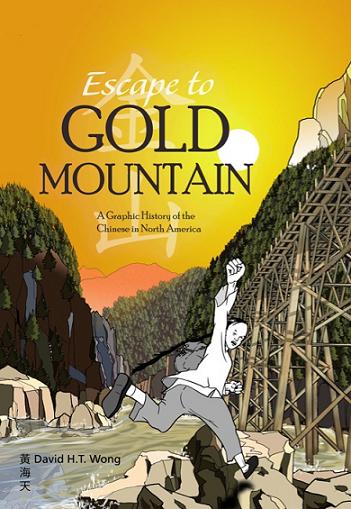
The comic formally known as ‘The Iron Chink’

0

It’s a symbol of the atrocities suffered by Chinese Americans on this continent: a lumbering machine that stripped thousands of their livelihood and was even named for the epithet used against them, the Iron Chink.

For Escape To Gold Mountain graphic novelist and community activist David H.T. Wong, who will read from the book at a Sun/11 event in Berkeley’s Eastwind Books, the 1903 invention of the mechanized fish gutting machine that stole cannery jobs from Asian immigrants — who already had to fight racism to find jobs at all — made the perfect title for his historical graphic novel. 

But, and perhaps this is a sign of the historical progression that Wong converted into panels for us in his graphic novel, things just don’t get named the c-word anymore. 

“Though it’s a historically accurate name of a real artifact, people today will not accept these sorts of racist terms,” writes Wong in the afterword of Gold Mountain. The name was changed before it was officially released.

We don’t get enough Chinese history in the United States. Growing up, even in a Sunset District public elementary school that had 90 percent Asian American students, the only thing I recall learning about the Asian diaspora here was Chinese New Year, Japanese internment camps.

This is a wrong that Wong’s Escape to Gold Mountain corrects, and in comic book form at that. The book follows Chinese laborer Wong Ah Gin to the United States, where he becomes inextricably linked with the capitalists’ quest to build a railroad across the United States.

The task was accomplished using Asian immigrant labor, the cheapest on the market. After the coasts were connected, many communities rejected the workers who made the task possible. We all know this story: use immigrant labor to accomplish previously-impossible tasks, then castigate the same people for stealing jobs.

In the case of Asian communities in the United States and Canada, this xenophobia lead to extreme violence. In 1885, mass killings occured in Wyoming and Washington. Tacoma’s Chinatown was even burned to the ground by bigoted townspeople. After the physical violence came the bureaucratic castigation: elaborate immigration codes that stopped refugees from coming to North America and separated parents from their kids.

Escape to Gold Mountain wends its way through all this injustice via Wong and other characters, ending up at a Chinese restaurant in Victoria, BC. The author’s panel work makes an at-times painful history easily read (my only quibble is small: why must most of the characters’ mouths be frozen in mid-word?) 

Spoiler alert: there’s a hopeful ending. Escape to Gold Mountain ends on a look at the Chinese Americans who have been elected to public office in the 20th and 21st centuries, and a real-life reconciliation story that will make you grateful for your own awkward trips home for the holidays.

The comic is really a jumping-off point for those interested in the subject matter — the epic research that Wong put towards the book made for enough bibliography and reading resources to launch a thousand syllabi, or at least a sense that an important portion of history may have been missing from your childhood textbooks. 

David H.T. Wong reads from Escape From Gold Mountain

Sun/11 7pm, free

Eastwind Books

2066 University, Berk. 

www.asiabookcenter.com

Hi-fidelity weather

0

emilysavage@sfbg.com

MUSIC Shellacked gummy worms, cherubic Ebay’d figurines, one of those ships in a glass bottle usually reserved for nautical-themed offices, a red bike reflector, a holarctic blue copper butterfly, a vintage stenograph. The physical items sit on separate pedestals as part of the release for Michael Zapruder’s newest album, Pink Thunder (www.michaelzapruder.com).

You have through Nov. 18 to visit the Curiosity Shoppe on Valencia in the Mission, stick some headphones on your ears, and press a small red button on a bubblegum-pink square circuit board affixed with a kitschy sculpture of a bear holding an empty pot attached, or that bowl of shellacked gummy worms, or that holarctic blue copper butterfly, and hear the single track encased within. Zapruder dubbed the structures “portmanteaus” after the linguistic term meaning two blended words.

These particular portmanteus are blends of vision and sound, sculpture and music. The objects, and the individual songs that pump out of them — Zapruder’s free-form pop built from poetry — force you, the listener, to think beyond your lazy current manner of music absorption.

“Just generally, I love the idea of a totally unconnected song. This is a song. That feels like an object that’s somewhere closer to the stature of the music, as opposed to a CD. This celebrates music. It dresses it up,” Oakland’s Zapruder says, smiling in the center of his portmanteaus.

Plus, it’s fun to touch the art.

“Imagine if you went into a record store and there weren’t that many things but each thing was really cool, you wanted to pick it up and play with it, and there was only one copy of each thing. Don’t you think that’d be cool?” He laughs after he says it. Could this be the future of the now-shuttered mega record stores? Could downsizing have saved the behemoths?

Of course, it all goes a bit deeper than that, the vision behind this multifaceted, six-year-long project.

“I think it’s good when people listen to stuff in an uncertain state. So many listening experiences are so familiar. You’re working on your computer and you’re listening, or you’re in a club. And it can be amazing. But you know what you’re going to get, you know the structure. [Pink Thunder] songs are all experimental, all free-composed. Hopefully they’re very listenable, but they’re odd, and I thought it’d be good for people to be in a ‘what is this?’ state.”

Though the songs are also being released through a few more traditional venues. Pink Thunder as a whole is the portmanteaus, each with one of 22 songs that are also compiled into CD form and 12-inch vinyl on The Kora Records (known for releasing records such as Philip Glass’ recent Reworked), seven-inches released by Howells Transmitter, which Zapruder helps run, and a bright pink poetry book, put out by Black Ocean.

The whole process took half a decade to create, completed with the Oct. 16 release on The Kora and the installation at Curiosity Shoppe, which opened in mid-October. Though clearly, the wider range of this project, beyond the physical objects, is the relationship between poetry and music.

It all began with a poetry tour organized by Seattle’s Wave Books; Zapruder’s renowned poet brother Matthew helps run the small publishing house. Zapruder jumped on the Green Tortoise poetry bus for a week of the 50-city tour and after a few false starts, he came up with the idea: “I wanted to see if songs could communicate those same kinds of things that these poets’ poems do.”

He gathered up poems by the likes of the Silver Jews’ David Berman, Carrie St. George Comer, Gillian Conoley, Noelle Kocot, Sierra Nelson, Hoa Nguyen, D. A. Powell, Mary Ruefle, James Tate, Joe Wenderoth, and his brother, and turned them into lyrics.

“The poets are such badasses,” Zapruder says, when asked if he sees the project as a way to deliver poetry to the masses. “Most of them are better known than me. The idea that I could give something to them, introduce people to their work, that’s incredible.”

As musician-writer Scott Pinkmountain says in the book’s introduction, “these are poets who understand that the big grabs — Love, Family, Confession, Death — can no longer be approached directly in a convincing way. Today’s audience is too savvy, too wary of manipulation and sentimentality. These poems instead stake their foundation on the minutia of accidental revelation, trusting the details of life to point out the bigger picture.”

We, as the music listener, hear this in the subtlety of a track like “Book of Life,” created from Noelle Kocot’s story about a monk and a phoenix meeting in the woods. At one point, the monk gives the phoenix a squirming worm — hence the shellacked bowl of gummy worms portmanteau at Curiosity Shoppe.

There are slightly more literal interpretations in songs such as the deceptively upbeat string-heavy “Storm Window,” based on the poem by Mary Ruefle, which tells a story of a sedentary couple — “She sat writing little poems of mist/he in his armchair/reading blood-red leather novels/their three-legged white cat wandering between them/24 champagne glasses sparkle on a shelf/never a one to be broken.” It’s about empty domestic harmony, so Zapruder created the portmanteau with that cheery Ebay bear holding an empty bowl. The found object is eerily revealing.

The project’s title came from Zapruder’s brother’s poem “Opera,” which ends with the line,”still riding your bike under pink hi-fidelity thunder.” (The object represented here is a red bicycle reflector.)

One of the more arresting combinations is for the song “John Lomax: I Work With Negroes.” The object is an old voltage meter. The poem, written by award-winning African-American author Tyehimba Jess, and subsequently the song, are about John Lomax, who “discovered” fabled blues musician Lead Belly in the 1930s.

The theme throughout is of the racism of exoticism, the way Lomax exoticized Lead Belly. “Racism that’s couched in admiration, this condescending accolade,” as Zapruder describes it. “So the idea [for the voltage meter] was that he’s constantly measuring and evaluating — but also, Lomax brought all this stuff in his car on tour, hundreds of pounds of equipment, so I thought maybe he had one of those.”

The piano-driven song is brief, just a minute and 35 seconds, but shifts from quiet plea to deep gravelly question mark, and back again, using multiple vocal backing tracks.

The songs often deviate, in tone, and in tempo. As a whole, it’s an impressive, if difficult listen. There are so many layers, so many twists and turns. They don’t have expected pop hooks, there isn’t a whole lot of repetition. Zapruder lets the songs wander, as if he’s creating a melodic new method of storytelling, occasionally dipping into child-like wonder. He builds songs in a Jon Brian-esque style, with Elliot Smith-like sensitivity and raw ache in his vocals, treading ever-so-lightly over tracks of electric guitar, drums, synthesizers, and in some cases, marimba or brass horns.

The actual songwriting process was quick. He wrote half of the them during a solo 10-day residency in a Napa cabin. The recording of said tracks took considerably longer — nearly three years, beginning in December of 2008. The Oakland resident hopped around with the songs in mind, recording some vocals in his own studio, some instruments at Closer Studios in San Francisco, and New, Improved in Oakland (where tUnE-yArDs and her ilk record), and mixed at Tiny Telephone.

He sang and played many of the instruments, but got backup musical help from dozens of fellow musicians, including Nate Brenner (aka Natronix) of tUnE-yArDs, bassist Mark Allen-Piccolo, and multi-instrumentalist Marc Capelle. An aside: Allen-Piccolo and his father are the ones who designed the music player circuit in all the wooden bases of the portmanteaus, as they have a circuit design business.

So Zapruder pieced together recordings from different studios and time periods in a situation he describes as a “free for all.”

“It took years,” Zapruder says with a shrug, “That’s what it’s like when you do something you’ve never done before. You make a lot of mistakes.”

And it is a relatively unique idea — there isn’t much to compare this project with. Zapruder mentions Tristan Perich’s 1-Bit Symphony on Bang on a Can Records, an electronic composition in five movements on a microchip in the jewel case. Also, a release from German ambient-experimental label tomlab that featured an album with an object (though the music wasn’t inside the object as with Pink Thunder).

In his own career, Zapruder’s recorded three well-received albums; Spin Magazine once called his work prolific, and described his compositions as “in the mold of Sufjan Stevens or Andrew Bird,” a pretty weighty and favorable comparison in the indie music world. But so far, he’s never done anything quite like Pink Thunder. The stunt for which he’s perhaps most well known is 1999’s 52 Songs, in which he wrote, recorded, and posted one new song a week for a full year; and this was back before the ease of the modern web with ubiquitous sites like Youtube, Bandcamp, or Soundcloud.

So while he’s dabbled in the avant garde, this was certainly the first time he Ebay’d and thrift-shopped physical items (he went to Urban Ore in Berkeley) to display and interlock with his music.

And now he’s back to his other undertakings. The married father of two also works part-time at Pandora (where he was the curator of the music collection for seven years), is in graduate school for music composition at California State University East Bay, and is making another record. He’s a third of the way through recording, and hopes to put it out next year. “I have a lot of songs that didn’t come out because I’ve been working on this,” he explains. He plans to release that in object form as well.

And he’ll be taking Pink Thunder on the road in the next year as well, stopping by the Mission Creek Festival in Iowa City, lecturing at New York University, and making an appearance with Wave Books and Black Ocean at the AWP (Association of Writers and Writing Programs) in Boston, which is “the SXSW for writers.” AWP is also where he first premiered Pink Thunder.

As he describes all this, he wonders aloud if he has dark circles around his eyes, worn from the general life trajectory, and perhaps from explaining his vision for the last hour plus while standing in the diminutive Mission store. He doesn’t have raccoon eyes today, munching on a health bar as he first describes the portmanteaus, but I can see why he’d be tired.

On the same day the Curiosity Shoppe installation closes — Nov. 18 — Zapruder will also perform Pink Thunder live at Amnesia. Earlier in the day, there will be a closing party at the store; that will be followed by the live performance down the street.

At Amnesia, it’ll be a duo with backing tracks and audience participation. “Honestly, I think it can be hard to listen to these one after another if you’ve never heard them before,” he explains. “It’s a lot of new information. Without the help of familiar forms, you’re dealing with new sounds but also like, ‘where is this thing going?'” To help with that, there will be samples and audience members will likely be invited to come up and trigger different sounds during the show. A mad scientist approach to live music.

“Even with everything that’s going on, the main thing is that I’m a musician, and that’s why I did this,” says Zapruder. “It’s to clear the way for these songs to get through to people. The music is the center. I want people to hear it and be affected by it. But that probably goes without saying.”

PINK THUNDER

Through Nov. 18

Curiosity Shoppe

855 Valencia, SF

www.michaelzapruder.com

MICHAEL ZAPRUDER CLOSING NIGHT SHOW

Nov. 18, 8pm

Amnesia

853 Valencia, SF

www.amnesiathebar.com


Listen to the comic! Save CCSF, vote yes on Prop A

10

San Franciscans were bummed when, this summer, it looked for a second like we’d lose our only community college. And we weren’t the only ones who would have been affected — City College of San Francisco isn’t just the biggest school in the city, it’s the biggest school in the entire state, providing vital job training, family development classes, continuing education, and a springboard into four-year university for undergrads. 

The folks at Mission Mini-Comix sent us this comic stating the case for Prop A, which would ensure that CCSF gets the funds it needs to keep educating us. (You can check it out in its full glory on their website, or snag one of the free mini-books they’ve been handing out around town.

>>PRINT OUT OUR QUICK ‘N’ GUIDE TO THE CITY, STATE, AND NATIONAL RACES

>>READ UP ON THE FULL GUARDIAN ENDORSEMENTS 

Here’s the skinny on the panels, from Mini-Comix artist Rio Roth-Barreiro (who won an all-ages Guardian comics contest when he was younger — says mom Robin Roth the recognition “got him started on this path!”): 

So, this is another comic that attempts to tackle local San Francisco issues. We do tend to do this every couple years or so, with mixed results, but we’re normally drawing a comic against whatever legislation is being voted on. In this case, we’re happy to do a comic supporting Proposition A and City College of San Francisco.

City College is a very personal issue for me. Not only are my mom and god-cousin teachers there, but I got my AA degree and most of my job skills training there which did end up setting me up well with a career in the tech industry (newsflash, cartooning doesn’t really pay the bills) and I’d like to see every young person in this city, county and larger bay area have access to the same opportunity and resources I did. This goes to the larger issue of where our priorities are in this country, with trillions being spent on our military, foreign wars and tax cuts for the rich while schools at home are literally falling apart (both physically and financially). Even in the liberal “hotbed” of San Francisco, we’re seeing the same tired arguments that are being trotted out all over the country to justify the systematic dismantling of public education.

“Teacher’s are getting paid too much!” “It’s all the Teacher’s Unions’ fault!” I see this sentiment getting echoed with infuriating regularlity in the Chronicle and in online news sources such as SFGate, but it doesn’t really mesh with the actual facts of life for City’s teachers, who have seen their classes double in size (twice the work) with many not having seen a raise in 5+ years. Having California cut money to education every year isn’t helping things. CCSF is being starved for funds and then the fact that they can’t meet their budget is being used as an excuse to take away their accreditation and/or close them down. Teachers are being painted as being greedy when every year they are getting less and having to work more.

Meanwhile, crushing education is going to have long term negative impact on local and national economies as our schools prepare less kids with the skills they need for technical and skilled jobs. People getting paid less means there will be even less government income to pay for things in the next budget and having a less skilled workforce will only lead to more jobs getting outsourced to India and China. It’s a vicious cycle pulling our economy down the drain, but some can’t see beyond the latest budget or the need to invest in our (and our children’s) future.

Proposition A on the San Francisco ballot and Proposition 30 on California’s ballot both seek to raise funds and prioritize education and I hope y’all be voting for them. And if you aren’t registered to vote yet, go get yourself registered, son! California now has online registration so you can be ready to stand by our schools and CCSF’s mission statement for a affordable and high quality education to be available for all. Registration deadline is October 22nd and voting is on November 6th

Oh yeah, I almost forgot our own accreditations, but this comic was written by me with a lot of help and input from Robin Roth, Leslie Simon and Amber Straus (and my wife Beth came up with the subtitle) and was drawn by me, Mike, Audrey and Justin.


Lightning strikes twice

0

emilysavage@sfbg.com

TOFU AND WHISKEY If experimental artist Nick Zammuto was pulling from a storied sample library after all those years with beloved former band the Books, he’s now building from scratch with his new band, Zammuto. The first Zammuto record sprang from a more angsty place, a fear of the unknown after the breakup of the Books. Skyping from a McDonald’s in Springfield, Mass., a humble Zammuto admits to fears about “lightning striking twice,” regarding his musical evolution.

His fears are unwarranted; the Zammuto self-titled debut (Temporary Residence, 2012) is as invigorating as it is multifaceted; mixing classic pop sensibilities with digital burps, buzzy electronics, sampled found objects, and still a more traditional band set-up than the Books, the artist has again found his own creative niche: the mad scientist family man, digging through crates of toys and creating emotional connections with the sounds he squeezes out of them. And he’s kept his humor in tact, with tracks titled “Zebra Butt,” “Groan Man, Don’t Cry,” and “FU C-3PO.”

Zammuto, the band, travels to the Independent this week (Sat/3, 9pm, $15. 628 Divisadero, SF. www.theindependentsf.com) but it’s been to SF once before. It came out west this spring to open for Explosions in the Sky at the Palace of Fine Arts. And after that show, Zammuto met some young Australian rockers. I’ll let him tell the story:

Nick Zammuto I was at the merch table, and this group of Australians comes up and buys everything on the table. I’m like, ‘you guys look like you’re in a band or something.’ And they’re like, ‘oh yeah, we’re Gotye.’ And I’m like, ‘cool, I’ve never heard of you, I’ll check it out.’ Literally, in that moment, they had the number one single in like, eight countries. I felt like a moron. Two weeks later I got a call from Wally [De Backer] to come tour with them, so we ended up playing seven shows with them. I live under a rock, I don’t have time for anything except working in my studio, and playing with my kids.

San Francisco Bay Guardian Has having children has affected your music?

NZ I have all boys, three sons, who are six, three, and one, you can’t help but live vicariously through them, because they experience life in such directness. I think it’s tuned me in to a simpler way of looking at things, and to be around that kind of innocence is inspiring. Just the sense of wonder they have is infectious.

SFBG How has your approach to songwriting shifted with Zammuto, as compared to the Books?

NZ I’ve never really been part of a band, I sort of came to that realization when we started rehearsing the [Zammuto] material. The Books was really a meta-band in a lot of ways, and at the end I was starting to think of it as a sort of glorified karaoke; we’d get up on stage and have all these electronic rhythms going on and we would just kind of play along with it. With the new project I really wanted to make something that was meant to be played live.

Key to that was finding a great drummer, and I think I found just an amazing drummer [in Sean Dixon]. Having a live time keeper on stage has been the biggest difference between the new project and the Books. And for me it’s been the most fun, to play with him, and see what he does. We really connected over this idea of polyrhythms. He helps me find these grooves that are really unusual. And I think the reason why I shied away from drums for so long is that it’s a very kind of genre-fying instrument. It’s hard to do anything out of the ordinary because it all sounds too ubiquitous. But Sean’s the kind of guy who sounds like nobody else. It’s a real balance with Sean between precision and heart.

I have [Dixon, Gene Back, and brother Mike Zammuto] up for sessions and we record things in a very loose way and then I go through those recordings later and pull out the parts that can go beyond expectation and build from those elements, rather than the sample library that the Books were drawing from.

SFBG But you’re still creating your own instruments out of found objects.

NZ It’s such a weird habit, and it’s something I’ve been doing a long time. My interest in music came out of recording these sculptures back in college…I started to make these sculptures that had this sound component, and I needed a way to record those sculptures. So it’s kind of been in the backdrop of everything I’ve done for a long time.

One of the first things I started doing was cutting into vinyl, cutting patterns into the circle at the end of each side of a record, and using that as a percussion. That sound sounds like clicks and pops, but if you take those impulses and put them through various environments you get amazing sounds, so playing them through PVC pipes or through filing cabinets with subwoofers installed in them you get these really strange but kind of naturalistic sounds at the same time, where you can’t put your finger immediately on what they are, and I think that’s why I’m interested in them. They have this mysterious quality.

SFBG What about the thematic elements, lyrically, on the record, it seems like it’s coming from a lot of new beginnings, new experiences, “The Shape of Things to Come” and so forth?

NZ The end of the Books was a harrowing experience, it took a very long time for it to go through its death throes. Lots of frustrations, then finally giving up and being like, ‘OK, what the hell do I do now?’ I’m asking lightning to strike twice, starting another band at this point in my life, so the lyrics are coming out of a very angsty place on this record. And I think I’m getting out of it, finally. Now that the band has come together in such an amazing way. I’m not in such a dark mood anymore [laughs].

I think I was writing about my own experiences, but in the frame of something more universal, for somebody who is frustrated out of their minds and in need of a new beginning. Just a general expression of having this need to move forward, but also going into unexplored territory.

ENDLESS SUMMER

San Francisco’s own Future Twin (soundcloud.com/futuretwin) released the second of its Summer Single series tracks last week. Angular “Sara” is tethered by a driving guitar line, and singer Jean Yaste’s caramel-coated vocals. Lyrically, it’s a testament to Yaste’s personal female heroes, and a call to action to all women to question the status quo and explore alternative experiences.

WOODKID (CANCELLED DUE TO TRAVEL CONDITIONS AFTER THE STORM)

French composer-artist Woodkid (a.k.a Yoann Lemoine) creates sounds that bloom like live-action role-playing background music. Or, video game music using entirely classical orchestration, strings, and Lemoine’s low octave, accented pipes. (You could easily picture Link chasing after Zelda during “Iron.”) Each track builds like a sassy, page-turning epic, which make his two EPs feel like brief odysseys. That’s right, he’s yet to release a full-length, but that record — The Golden Age — is coming. Though you might have seen his stylish videos for Agyness Deyn-featuring “Iron” or “Run Boy Run.” Or hell, you may know him from his other life as a music video director: Katy Perry’s “Teenage Dream,” anyone? With Pacific Air.

Fri/2, 9pm, $20

Bimbo’s

1025 Columbus, SF

www.bimbos365club.com

Man for the moment?

25

steve@sfbg.com

This year’s supervisorial race in District 5 — representing the Haight, Panhandle, and Western Addition, some of the most reliably progressive precincts in the city — has been frustrating for local leftists. But as the long and turbulent campaign enters its final week, some are speculating that John Rizzo, whose politics are solid and campaign lackluster, could be well-positioned to capitalize on this strange political moment.

Appointed incumbent Sup. Christina Olague has been a disappointment to some of her longtime progressive allies, although she’s now enjoying a resurgence of support on the left in the wake of her vote to reinstate Sheriff Ross Mirkarimi. Now two allies of the mayor — tech titan Ron Conway and landlord Thomas Coates — are funding a $120,000 last-minute attack on Olague.

The campaign of one-time left favorite Julian Davis lost most of its progressive supporters following his recent mishandling of accusations of bad behavior toward women (see “Julian Davis should drop out,” 10/16).

The biggest fear among progressive leaders is that London Breed, a well-funded moderate candidate being strongly supported by real estate and other powerful interests, will win the race and tip the Board of Supervisors to the right. The final leg of the campaign could be nasty battle between Breed and Olague and their supporters, who tend to see it as a two-person race at this point.

But in a divisive political climate fed by the Mirkarimi and Davis scandals and the unprecedented flood of hundreds of thousands of dollars in real estate and tech money, it’s hard to say what D5 voters will do, particularly given the unpredictably of how they will use ranked-choice voting to sort through this mess.

Running just behind these three tarnished and targeted candidates in terms of money and endorsements are Rizzo and small business person Thea Selby, who described their candidacies as “the grown-ups in the room, so there’s an opportunity there and I’m hopeful.”

Selby hasn’t held elective office and doesn’t have same name-recognition and progressive history as Rizzo, although she has one of the Guardian’s endorsements. It probably didn’t help win progressive confidence when the downtown-backed Alliance for Jobs and Sustainable Growth recently did an independent expenditure on behalf of both Selby and Breed.

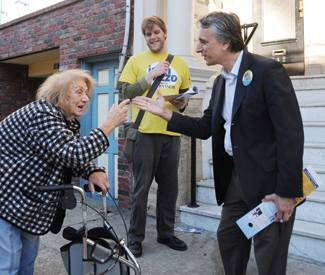
And then there’s Rizzo, who has been like the tortoise in this race, quietly spending his days on the streets meeting voters. Between fundraising and public financing, Rizzo collected about $65,000 as of Oct. 20 (compared to Breed’s nearly $250,000), but he’s been smart and frugal with it and has almost $20,000 in the bank for the final stretch, more than either Olague or Davis.

But perhaps more important than money or retail politics, if indeed D5 voters continue their strongly progressive voting trends, are two key facts: Rizzo is the most clear and consistent longtime progressive activist in the race — and he’s a nice, dependable guy who lacks the oversized ego of many of this city’s leaders.

“I see consistency there and a lack of drama,” Assembly member Tom Ammiano, an early Rizzo endorser, told us. “He’s looking not like a flip-flopper, not like he owes anyone, and he doesn’t have a storied past.”


PROGRESSIVE HISTORY

Rizzo, who was born in New York City 54 years ago, is downright boring by San Francisco standards, particularly given his long history in a local progressive movement known for producing fiery warriors like Chris Daly, shrewd strategists like Aaron Peskin, colorful commenters like Ammiano, bohemian thinkers like Matt Gonzalez, and flawed idealists like Ross Mirkarimi.

Rizzo is a soft-spoken family man who has lived in the same building on Waller Street in the Haight-Ashbury for the last 27 years. Originally, he and Christine, his wife of 25 years, rented their apartment in a tenancy-in-common building before they bought it in the early 1990s, although he’s quick to add, “In all the years we’ve owned it, we never applied for condoship.”

He supports the city’s limits on condo conversions as important to protecting working-class housing, although he said, “The focus should be on building new affordable housing.” That’s an issue Rizzo has worked on since joining the Sierra Club’s San Francisco Bay Chapter more than 20 years ago, an early advocate for broadening the chapter’s view of environmentalism.

He’s a Muni rider who hasn’t owned a car since 1987.

Michelle Myers, director of the Sierra Club’s San Francisco Bay Chapter, said Rizzo brings a wealth of experience, established relationships, and shrewd judgment to his role as the group’s political chair. “We really rely on John’s ability to weigh what is politically feasible, not just what’s ideal in our minds,” she told us.

Yet that political realism shouldn’t be confused for a lack of willingness to fight for big, important goals. Rizzo has been an advocate for public power in San Francisco for many years, strategizing with then-Sup. Ammiano in 2001 to implement a community choice aggregation program, efforts that led to this year’s historic passage of the CleanPowerSF program (with a key vote of support by Olague) over the objections of Mayor Lee and some business leaders.

“CleanPowerSF was carried by John Rizzo, who has been working on that issue for 10 years,” Myers said.

Rizzo is a technology writer, working for prospering computer magazines in the 1990s “until they all went away with the dot.com bubble,” as well as books (his 14th book, Mountain Lion Server for Dummies, comes out soon).

He sees the “positives and the negatives” of the last tech boom and this one, focusing on solving problems like the Google and Genetech buses blocking traffic or Muni bus stops. “On the one hand, these people aren’t driving, but on the other hand, they’re unregulated and using our bus stops,” he said. “We need to find some solution to accommodate them. Charge them for it, but accommodate them.”

That’s typical of how Rizzo approaches issues, wanting to work with people to find solutions. As president of the City College of San Francisco Board of Trustees, Rizzo suffered the bad timing of the district having its accreditation threatened just as his supervisorial race was getting underway, but he’s steadily worked through the administrative problems that predated his tenure, starting with the criminal antics of former Chancellor Phil Day and continuing with “a management structure still in place, and it had calcified.”

Despite being on the campaign trail, Rizzo called the trustees together six times in August to deal with the accreditation problems. “We now have a plan that shows all the things the district needs to do to keep it afloat. City College is back on track.”


WEAKNESS BECOMES STRENGTH

Eileen Hansen — a longtime progressive activist, former D8 supervisorial candidate, and former Ethics Commissioner — gave her early endorsement to Rizzo, who never really seemed to catch fire. “There hasn’t been a lot of flash and I would love for there to be more energy,” she admitted.

So, like many progressive leaders, she later offered her endorsement to Davis, believing he had the energy needed to win the race. But after Davis’ problems, Hansen withdrew that endorsement and sees Rizzo as the antidote to its problems.

“We are in such a mess in D5, and I’m hoping they will say, ‘enough already, let’s find someone who’s just good on the issues, and that’s John,” Hansen said. “As a progressive, if you look at his stands over many years, I’d be hard-pressed to find an issue I don’t agree with him on. He’s a consistent, strong progressive voice, someone you can count on who’s not aligned with some power base.”

Other prominent progressive leaders agree.

“What some people may have viewed as his weak point may end up being his strength,” said former Board President Aaron Peskin, who endorsed Rizzo after the problems surfaced with Davis. “A calm, steady, cool, collected, dispassionate progressive may actually be the right thing for this moment.”

Sup. Malia Cohen, a likable candidate who rose from fourth place on election night to win a heated District 10 supervisorial race two years ago, is a testament to how ranked-choice voting opens up lots of new possibilities.

“Ranked choice voting defies conventional wisdom,” Peskin said. “There may be Julian Davis supporters and Christina Olague supporters and London Breed supporters who all place John Rizzo as their second.”

In fact, during our endorsement interviews and in a number of debates and campaign events, nearly every candidate in the race mentioned Rizzo as a good second choice.

Yet Rizzo doesn’t mince words when he talks about the need for reconstitute the progressive movement after the deceptions and big-money interests that brought Mayor Lee and “his fake age of civility” to power. Lee promised not to seek a full term “and he broke the deal,” Rizzo said. “And it was a public deal he broke, not some backroom deal.” 

That betrayal and the money-driven politics that Lee ushered in, combined with the divisive political climate that Lee’s long effort to remove Mirkarimi from office created, has deeply damaged the city’s political system. “I think the climate is very bad It’s bad for progressives, and just bad for politics because it’s turning voters off,” Rizzo said.

He wants to find ways to empower average San Franciscans and get them engaged with helping shape the city’s future.

“We need a new strategy. We need to regroup and think about things long and hard. I think it’s not working here. We’re doing the same things and it’s not working out. The money is winning.” He doesn’t think the answers lie in continued conflict, or with any individual politicians “because people are flawed, everyone is,” Rizzo said.

Yet Rizzo’s main flaw in the rough-and-tumble world of political campaigns may be that he’s too nice, too reluctant to toot his horn or beat his chest. “That kind of style is not me. That aggressive person is not who I am,” Rizzo said. “But I think voters like that. Voters do want someone who is going to focus on policy and not themselves.”

Who needs candy? Get your Halloween fix with creepy crafts!

0

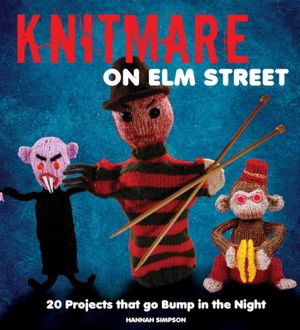
Crafters! Ghouls! Two adorable books appeared in the mail recently: Chris Marks’ Horrorgami: 25 Creepy Creatures, Ghastly Ghouls, and Other Fiendish Paper Projects (Running Press, 128 pp., $13) and Hannah Simpson’s Knitmare on Elm Street: 20 Projects That Go Bump in the Night (Running Press, 127 pp., $17).

Horrorgami comes with a pack of papers to help you start “bending the normal folding techniques of origami to your evil will,” and begins with symbols that are used throughout the directions of the various projects. (I don’t recommend you skip these, no matter how awesome of a cootie-catcher maker you already are.) Each project is rated, or “rat-ed,” by degrees of difficulty, from one rat (“easy”) to four rats (“fiendish”).

Easy projects that even an all-thumbs type (like myself) can master include the “Friendly Ghost,” though the book quickly escalates in difficulty to trickier (trickier-or-treatier?) fold-ups resembling an “Evil Witch’s Cat” (pretty cute, actually); the “Hooded Grim Reaper” (with scythe); a “Ghastly Ghoul;” and a “Stupefying Spider.”

Some of the shapes require multiple sheets of paper, scissors, and glue sticks, so you may need to assemble additional materials beyond what’s included with the book. The instructions (complete with detailed diagrams) are easy to follow, though noobs will likely need practice before ascending to four-rat status.

Knitmare‘s beasties are far more dynamic than Horrorgami‘s (no offense to origami, but yarn allows for much more expressiveness than paper), but they’re also more complicated, and the book doesn’t come with any materials to get you going. “This book assumes a basic level of knitting skill,” warns author Simpson, who nonetheless includes a brief knitting 411 (“Basic Stitch Variations,” etc.), and explains each project with careful, cleverly-illustrated (are those witch hands holding those needles?) instructions.

And for those who know their knits from their purls, the stuff you can make from Knitmare is cuuuuute. But, like, spooky-cute: “Monkey With Miniature Cymbals” sculpture; “Necronomicon iPad Cozy;” the name-changed-to-prevent-copyright-issues-but-we-know-he-lives-on-Elm-Street-and-wears-a-striped-sweater “Ferdy Hand Puppet;” the truly “Creepy Clown Cushion Cover;” the LED-deploying “Light-up Ghost;” and the “Creature from the Black Lagoon Sleep Mask” — which, not to mingle my holidays too much, but if I had any knitting skills at all, that’d be the numero uno Christmas gift I’d give to all my spooky-minded buddies this year.

Film Listings

0

Film listings are edited by Cheryl Eddy. Reviewers are Kimberly Chun, Dennis Harvey, Lynn Rapoport, and Sara Vizcarrondo. For rep house showtimes, see Rep Clock.

Opening

Chasing Mavericks The Bay Area’s big-wave spot hits the big screen, with Gerard Butler and Jonny Weston as real-life surfers Rick “Frosty” Hesson and Jay Moriarity. (1:45)

Cloud Atlas Cramming the six busy storylines of David Mitchell’s wildly ambitious novel into just three hours — the average reader might have thought at least 12 would be required — this impressive adaptation directed (in separate parts) by Tom Twyker (1998’s Run Lola Run) and Matrix siblings Lana and Andy Wachowski has a whole lot of narrative to get through, stretching around the globe and over centuries. In the mid 19th century, Jim Sturgess’ sickly American notory endures a long sea voyage as reluctant protector of a runaway-slave stowaway from the Chatham Islands (David Gyasi). In 1931 Belgium, a talented but criminally minded British musician (Ben Whishaw) wheedles his way into the household of a famous but long-inactive composer (Jim Broadbent). A chance encounter sets 1970s San Francisco journalist Luisa (Halle Berry) on the path of a massive cover-up conspiracy, swiftly putting her life in danger. Circa now, a reprobate London publisher’s (Broadbent) huge windfall turns into bad luck that gets even worse when he seeks help from his brother (Hugh Grant). In the not-so-distant future, a disposable “fabricant” server to the “consumer” classes (Doona Bae) finds herself plucked from her cog-like life for a rebellious higher purpose. Finally, in an indeterminately distant future after “the Fall,” an island tribesman (Tom Hanks) forms a highly ambivalent relationship toward a visitor (Berry) from a more advanced but dying civilization. Mitchell’s book was divided into huge novella-sized blocks, with each thread split in two; the film wastes very little time establishing its individual stories before beginning to rapidly intercut between them. That may result in a sense of information (and eventually action) overload, particularly for non-readers, even as it clarifies the connective tissues running throughout. Compression robs some episodes of the cumulative impact they had on the page; the starry multicasting (which in addition to the above mentioned finds many uses for Hugo Weaving, Keith David, James D’Arcy, and Susan Sarandon) can be a distraction; and there’s too much uplift forced on the six tales’ summation. Simply put, not everything here works; like the very different Watchmen, this is a rather brilliant “impossible adaptation” screenplay (by the directors) than nonetheless can’t help but be a bit too much. But so much does work — in alternating currents of satire, melodrama, pulp thriller, dystopian sci-fi, adventure, and so on — that Cloud Atlas must be forgiven for being imperfect. If it were perfect, it couldn’t possibly sprawl as imaginatively and challengingly as it does, and as mainstream movies very seldom do. (2:52) Balboa, California, Presidio. (Harvey)

Fun Size When a teen (Victoria Justice) is forced to baby-sit her brother the night of the social event of the Halloween season, PG-13 chaos ensues. (1:45) Shattuck.

Masquerade A king hires an actor from the local village (both portrayed by Korean megastar Byung-hun Lee) to be his body double in this historical drama. (2:11) Metreon.

Nobody Walks In Ry Russo-Young’s LA-set film, from a screenplay co-written with Lena Dunham, an alluring young woman named Martine (Olivia Thirlby) is welcomed into the Silver Lake home of psychotherapist Julie (Rosemarie DeWitt) and sound engineer Peter (John Krasinski), who has agreed to help Martine with the soundtrack for her film, destined for a gallery installation back in New York. While Martine’s film constructs a fiction around the fevered activities of the insect world, Russo-Young’s drifts quietly through the lives of its human household, offering glimpses of the romantic preoccupations of a teenage daughter (India Ennenga) and Julie’s interactions with one of her patients (Justin Kirk), and revealing a series of relationships hovering tensely on the border of unsanctioned behavior. The uncomfortable centerpiece is the intimacy that develops between Peter and Martine; tracking their progress through the family’s sprawling home as the two collect sounds for her project, the camera zooms in toward the sources, making the spaces the pair inhabit seem ominously small. Their eventual collision is unsurprising, but Peter hardly comes across as a besieged, frustrated family man. He tells Martine that “marriage is complicated,” but against the warm, appealing backdrop of his and Julie’s home life, it sounds like a pretty flimsy excuse for kissing a pretty, proximal 23-year-old. As for Martine, she seems not to need any rationale. But even factoring out the callousness of youth (or at least the genre of youth presented here), the film offhandedly suggests that the tipping point away from domestic happiness is depressingly easy to reach. (1:22) Bridge, Shattuck. (Rapoport)

Pusher A pusher has been pushed to the limit—this time around in a charm-free, deal-driven London. This remake of the Nicolas Winding Refn’s 1996 hit was given the seal of approval by the Drive (2011) auteur, who took a role here as an executive producer, with Luis Prieto in the director’s seat. Prieto does his best to keep the pressure on at all moments, as small-time heroin dealer Frank (Richard Coyle, resembling Dominic West in urban-hustler safari mode) undergoes the worst week of his life. He appears to have a tidy little existence with goofy, floppy-haired cohort Tony (Bronson Webb) by his side and delicately beautiful stripper Flo (Agyness Deyn) providing sexual healing and safe harbor for his dough. He has just hooked up drug mule Danaka (Daisy Lewis) to bring back a batch from Amsterdam when acquaintance Marlon (Neil Maskell) hits him up for a large order. Frank goes to his supplier Milo (Zlatko Buric, reprising his role in the original), an avuncular sort who pushes baklava in space sprinkled with wedding-cake-like gowns. Frank already owe him money and can’t cover the heroin’s cost, but this is a business built on trust, as fragile as it is, and Milo likes him, so he goes along, provided Frank returns the money immediately. Those tenuous ties of understanding are tested when cops bust Frank and Marlon and the former must dump the dope in a park pond. He refuses to give up his connections to the cops but finds that the loyalty of others is being tested when it comes to threats, cash, and even love. Prieto is a more self-consciously lyrical moviemaker than Refn, choosing to a vaguely Trainspotting-style cocktail of lite surrealism and slightly cheesy low-budg effects like vapor-trail headlights to replicate the highs and lows of Frank’s joyless clubland hustle. Still, he makes us feel Frank’s stress, amid the fatalistic undertow of the narrative, and his sense of betrayal when Pusher’s players turn, despite a smalltime pusher’s workman efforts to shore up against the odds. (1:29) Presidio. (Chun)

Question One Question One goes behind the scenes of the 2009 campaign concerning the referendum which reversed legislature granting same-sex couples the right to marry in Maine. The film investigates both sides of the story, including marriage dreams of queer families and confessions of regret from the appointed leader for the Yes on One Campaign, Marc Mutty. Though listening to preachers and activists devalue love between two men or two women might make you cringe, the inclusion of these moments creates an emotionally tense experience that will remind you how important it is to bounce back from defeat. It shows that the next step will have to be more than just rallying voters, it will require a change in ideology — an understanding that gays who wish to marry deserve equal rights, not religious salvation. As Darlene Huntress, the director of field operations for the No on One Campaign says, “I want to sit down and break bread with these people. I want to sit down and say get to know me — open your mind up enough to get to know me.” (1:53) Vogue. (Molly Champlin)

The Sessions Polio has long since paralyzed the body of Berkeley poet Mark O’Brien (John Hawkes) from the neck down. Of course his mind is free to roam — but it often roams south of the personal equator, where he hasn’t had the same opportunities as able-bodied people. Thus he enlists the services of Cheryl (Helen Hunt), a professional sex surrogate, to lose his virginity at last. Based on the real-life figures’ experiences, this drama by Australian polio survivor Ben Lewin was a big hit at Sundance this year (then titled The Surrogate), and it’s not hard to see why: this is one of those rare inspirational feel-good stories that doesn’t pander and earns its tears with honest emotional toil. Hawkes is always arresting, but Hunt hasn’t been this good in a long time, and William H. Macy is pure pleasure as a sympathetic priest put in numerous awkward positions with the Lord by Mark’s very down-to-earth questions and confessions. (1:35) Embarcadero. (Harvey)

Silent Hill: Revelation 3D Game of Thrones reunion! Sean Bean and Kit Harington both star in this video game adaptation, which may be its only bragging point. (1:34)

Wake in Fright See “Points Of No Return.” (1:54) Opera Plaza, Shattuck. 

Ongoing

Alex Cross (1:41) 1000 Van Ness, SF Center, Shattuck.

Argo If you didn’t know the particulars of the 1979 Iranian Revolution, you won’t be an expert after Argo, but the film does a good job of capturing America’s fearful reaction to the events that followed it — particularly the hostage crisis at the US embassy in Tehran. Argo zeroes in on the fate of six embassy staffers who managed to escape the building and flee to the home of the sympathetic Canadian ambassador (Victor Garber). Back in Washington, short-tempered CIA agents (including a top-notch Bryan Cranston) cast about for ways to rescue them. Enter Tony Mendez (Ben Affleck, who also directs), exfil specialist and father to a youngster wrapped up in the era’s sci-fi craze. While watching 1973’s Battle for the Planet of the Apes, Tony comes up with what Cranston’s character calls “the best bad idea we have:” the CIA will fund a phony Canadian movie production (corny, intergalactic, and titled Argo) and pretend the six are part of the crew, visiting Iran for a few days on a location shoot. Tony will sneak in, deliver the necessary fake-ID documents, and escort them out. Neither his superiors, nor the six in hiding, have much faith in the idea. (“Is this the part where we say, ‘It’s so crazy it just might work?'” someone asks, beating the cliché to the punch.) Argo never lets you forget that lives are at stake; every painstakingly forged form, every bluff past a checkpoint official increases the anxiety (to the point of being laid on a bit thick by the end). But though Affleck builds the needed suspense with gusto, Argo comes alive in its Hollywood scenes. As the show-biz veterans who mull over Tony’s plan with a mix of Tinseltown cynicism and patiotic duty, John Goodman and Alan Arkin practically burst with in-joke brio. I could have watched an entire movie just about those two. (2:00) Four Star, Marina, 1000 Van Ness, SF Center, Sundance Kabuki. (Eddy)

Beasts of the Southern Wild Six months after winning the Grand Jury Prize at Sundance (and a Cannes Camera d’Or), Beasts of the Southern Wild proves capable of enduring a second or third viewing with its originality and strangeness fully intact. Magical realism is a primarily literary device that isn’t attempted very often in U.S. cinema, and succeeds very rarely. But this intersection between Faulkner and fairy tale, a fable about — improbably — Hurricane Katrina, is mysterious and unruly and enchanting. Benh Zeitlin’s film is wildly cinematic from the outset, as voiceover narration from six-year-old Hushpuppy (Quvenzhané Wallis) offers simple commentary on her rather fantastical life. She abides in the Bathtub, an imaginary chunk of bayou country south of New Orleans whose residents live closer to nature, amid the detritus of civilization. Seemingly everything is some alchemical combination of scrap heap, flesh, and soil. But not all is well: when “the storm” floods the land, the holdouts are forced at federal gunpoint to evacuate. With its elements of magic, mythological exodus, and evolutionary biology, Beasts goes way out on a conceptual limb; you could argue it achieves many (if not more) of the same goals Terrence Malick’s 2011 The Tree of Life did at a fraction of that film’s cost and length. (1:31) Shattuck. (Harvey)

Bel Borba Aqui “The People’s Picasso” and “Brazil’s Pied Piper of Street Art” are both apt descriptions of veteran artist Bel Borba, who has spent decades bringing color and imagination to the streets of Salvador — his seaside hometown, and a place already graced with the nickname “Brazil’s Capital of Happiness.” It’s not a stretch to imagine that Borba’s commitment to public art (a giant Christmas tree made of plastic Coke bottles, a rhinoceros sculpture crafted from old boat planks, hundreds of large-scale mosaics, even a painted airplane) has done its share to lift spirits. Bel Borba Aqui isn’t the sort of doc to delve into its mustachioed subject’s history or personal life (despite a few angry cell phone conversations randomly captured along the way); instead, it’s much like Borba himself — freewheeling and spontaneous, and most alive when it’s showing art being created. Great soundtrack, too. (1:34) Roxie. (Eddy)

The Dark Knight Rises Early reviews that called out The Dark Knight Rises’ flaws were greeted with the kind of vicious rage that only anonymous internet commentators can dish out. And maybe this is yet another critic-proof movie, albeit not one based on a best-selling YA book series. Of course, it is based on a comic book, though Christopher Nolan’s sophisticated filmmaking and Christian Bale’s tortured lead performance tend to make that easy to forget. In this third and “final” installment in Nolan’s trilogy, Bruce Wayne has gone into seclusion, skulking around his mansion and bemoaning his broken body and shattered reputation. He’s lured back into the Batcave after a series of unfortunate events, during which The Dark Knight Rises takes some jabs at contemporary class warfare (with problematic mixed results), introduces a villain with pecs of steel and an at-times distractingly muffled voice (Tom Hardy), and unveils a potentially dangerous device that produces sustainable energy (paging Tony Stark). Make no mistake: this is an exciting, appropriately moody conclusion to a superior superhero series, with some nice turns by supporting players Gary Oldman and Joseph Gordon-Levitt. But in trying to cram in so many characters and plot threads and themes (so many prisons in this thing, literal and figural), The Dark Knight Rises is ultimately done in by its sprawl. Without a focal point — like Heath Ledger’s menacing, iconic Joker in 2008’s The Dark Knight — the stakes aren’t as high, and the end result feels more like a superior summer blockbuster than one for the ages. (2:44) Metreon. (Eddy)

Diana Vreeland: The Eye Has to Travel The life of legendary fashion editor Diana Vreeland is colorfully recounted in Diana Vreeland: The Eye Has to Travel, a doc directed by her granddaughter-in-law, Lisa Immordino Vreeland. The family connection meant seemingly unlimited access to material featuring the unconventionally glamorous (and highly quotable) Vreeland herself, plus the striking images that remain from her work at Harper’s Bazaar, Vogue, and the Costume Institute of the Metropolitan Museum of Art. “Narrated” from interview transcripts by an actor approximating the late Vreeland’s husky, posh tones, the film allows for some criticism (her employees often trembled at the sight of her; her sons felt neglected; her grasp of historical accuracy while working at the museum was sometimes lacking) among the praise, which is lavish and delivered by A-listers like Anjelica Huston, who remembers “She had a taste for the extraordinary and the extreme,” and Manolo Blahnik, who squeals, “She had the vision!” (1:26) Embarcadero. (Eddy)

End of Watch Buddy cop movies tend to go one of two ways: the action-comedy route (see: the Rush Hour series) or the action-drama route. End of Watch is firmly in the latter camp, despite some witty shit-talking between partners Taylor (a chrome-domed Jake Gyllenhaal) and Zavala (Michael Peña from 2004’s Crash) as they patrol the mean streets of Los Angeles. Writer-director David Ayer, who wrote 2001’s Training Day, aims for authenticity by piecing together much of (but, incongruously, not all of) the story through dashboard cameras, surveillance footage, and Officer Taylor’s own ever-present camera, which he claims to be carrying for a school project, though we never once see him attending classes or mentioning school otherwise. Gyllenhaal and Peña have an appealing rapport, but End of Watch’s adrenaline-seeking plot stretches credulity at times, with the duo stumbling across the same group of gangsters multiple times in a city of three million people. Natalie Martinez and Anna Kendrick do what they can in underwritten cop-wife roles, but End of Watch is ultimately too familiar (but not lawsuit-material familiar) to leave any lasting impression. Case in point: in the year 2012, do we really need yet another love scene set to Mazzy Star’s “Fade Into You”? (1:49) 1000 Van Ness, SF Center. (Eddy)

Fat Kid Rules the World It really does suck to be Troy (Jacob Wysocki from 2011’s Terri). An XXL-sized high schooler, he’s invisible to his peers, derided by his little brother (Dylan Arnold), and has lived in general domestic misery since the death of his beloved mother under the heavy-handed rule of his well-meaning but humorless ex-military dad (Billy Campbell). His only friends are online gamers, his only girlfriends the imaginary kind. But all that begins to change when chance throws him across the path of notorious local hellraiser Marcus (Matt O’Leary), who’s been expelled from school, has left the band he fronts, and is equal parts rebel hero to druggy, lyin’ mess. But he randomly decrees Troy is cool, and his new drummer. Even if he’s just being used, Troy’s world is headed for some big changes. Actor Matthew Lillard’s feature directorial debut, based on K.L. Going’s graphic novel, is familiar stuff in outline but a delight in execution, as it trades the usual teen-comedy crudities (a few gratuitous joke fantasy sequences aside) for something more heartfelt and restrained, while still funny. O’Leary from last year’s overlooked Natural Selection is flamboyantly terrific, while on the opposite end of the acting scale Campbell makes repressed emotion count for a lot — he has one wordless moment at a hospital that just might bring you to the tears his character refuses to spill. (1:38) Metreon, Smith Rafael. (Harvey)

Frankenweenie Tim Burton’s feature-length Frankenweenie expands his 1984 short of the same name (canned by Disney back in the day for being too scary), and is the first black and white film to receive the 3D IMAX treatment. A stop-motion homage to every monster movie Burton ever loved, Frankenweenie is also a revival of the Frankenstein story cute-ified for kids; it takes the showy elements of Mary Shelley’s novel and morphs them to fit Burton’s hyperbolic aesthetic. Elementary-school science wiz Victor takes his disinterred dog from bull terrier to gentle abomination (when the thirsty Sparky drinks, he shoots water out of the seams holding his body parts together). Victor’s competitor in the school science fair, Edgar E. Gore, finds out about Sparky and ropes in classmates to scrape up their dead pets from the town’s eerily utilized pet cemetery and harness the town’s lightning surplus. The film’s answer to Boris Karloff (lisp intact) resurrects a mummified hamster, while a surrogate for Japanese Godzilla maker Ishiro Honda, revives his pet turtle Shelley (get it?) into Gamera. As these experiments aren’t borne of love, they don’t go as well at Victor’s. If you love Burton, Frankenweenie feels like the at-last presentation of a story he’s been dying to tell for years. If you don’t love him, you might wonder why it took him so long to get it out. When Victor’s science teacher leaves the school, he tells Victor an experiment conducted without love is different from one conducted with it: love, he implies, is a variable. If that’s the variable that separates 2003’s Big Fish (heartbreaking) from 2010’s Alice In Wonderland (atrocious), it’s a large one indeed. The love was there for 29 minutes in 1984, but I can’t say it endures when stretched to 87 minutes 22 years later. (1:27) Balboa, Metreon, 1000 Van Ness. (Vizcarrondo)

Here Comes the Boom The makers of September’s Won’t Back Down might quibble with this statement, but the rest of us can probably agree that nothing (with the possible exception of Trapper Keepers) says “back to school” like competitive steel-cage mixed martial arts — particularly if the proceeds from the matches go toward saving extracurriculars at a down-at-the-heels public high school. Kevin James plays Scott Voss, a 42-year-old biology teacher at the aforementioned school, whose lack of vocational enthusiasm is manifested by poor attendance and classroom observations about how none of what the students are learning matters. He’s jolted from this criminally subpar performance of his academic duties, however, when budget cuts threaten the school’s arts programs, including the job of an earnest and enthusiastic music teacher (Henry Winkler) whose dedication Scott lazily admires. It seems less than inevitable that this state of affairs would lead to Scott’s donning his college wrestling singlet and trundling into the ring to get pummeled and mauled for cash, but it seems to work better than a bake sale. Less effective and equally unconvincing are Scott’s whiplash arc from bad apple to teacher-of-the-year; a percolating romance between him and the school nurse, played by Salma Hayek; and the script’s tortuous parade of rousing statements celebrating the power of the human spirit, seemingly cribbed from a page-a-day calendar of inspirational quotes. (1:45) 1000 Van Ness, SF Center. (Rapoport)

Hotel Transylvania (1:32) Metreon, 1000 Van Ness, Shattuck.

The House I Live In Much like he did in 2005’s Why We Fight, filmmaker Eugene Jarecki identifies a Big Issue (in that film, the Iraq War) and strips it down, tracing all of the history leading up to the current crisis point. Here, he takes on America’s “war on drugs,” which I put quotes around not just because it was a phrase spoken by Nixon and Reagan, but also because — as The House I Live In ruthlessly exposes — it’s been a failure, a sham, since its origins in the late 1960s. Framing his investigation with the personal story of his family’s housekeeper — whose dedication to the Jarecki family meant that she was absent when her own son turned to drugs — and enfolding a diverse array of interviews (a sympathetic prison guard, addicts and their families, The Wire’s David Simon) and locations (New York City, Sioux City), Jarecki has created an eye-opening film. Particularly well-explained are segments on how drug laws correlate directly to race and class, and how the prison-industrial complex has played a part in making sure those laws remain as strict as possible. (1:48) Shattuck, Sundance Kabuki. (Eddy)

Looper It’s 2044 and, thanks to a lengthy bout of exposition by our protagonist, Joe (Joseph Gordon-Levitt), here’s what we know: Time travel, an invention 30 years away, will be used by criminals to transport their soon-to-be homicide victims backward, where a class of gunmen called loopers, Joe among them, are employed to “do the necessaries.” More deftly revealed in Brick writer-director Rian Johnson’s new film is the joylessness of the world in which Joe amorally makes his way, where gangsters from the future control the present (under the supervision of Jeff Daniels), their hit men live large but badly (Joe is addicted to some eyeball-administered narcotic), and the remainder of the urban populace suffers below-subsistence-level poverty. The latest downside for guys like Joe is that a new crime boss has begun sending back a steady stream of aging loopers for termination, or “closing the loop”; soon enough, Joe is staring down a gun barrel at himself plus 30 years. Being played by Bruce Willis, old Joe is not one to peaceably abide by a death warrant, and young Joe must set off in search of himself so that—with the help of a woman named Sara (Emily Blunt) and her creepy-cute son Cid (Pierce Gagnon)—he can blow his own (future) head off. Having seen the evocatively horrific fate of another escaped looper, we can’t totally blame him. Parsing the daft mechanics of time travel as envisioned here is rough going, but the film’s brisk pacing and talented cast distract, and as one Joe tersely explains to another, if they start talking about it, “we’re gonna be here all day making diagrams with straws” —in other words, some loops just weren’t meant to be closed. (1:58) 1000 Van Ness, Piedmont, SF Center, Sundance Kabuki. (Rapoport)

The Master Paul Thomas Anderson’s much-hyped likely Best Picture contender lives up: it’s easily the best film of 2012 so far. Philip Seymour Hoffman stars as Lancaster Dodd, the L. Ron Hubbard-ish head of a Scientology-esque movement. “The Cause” attracts Freddie Quell (Joaquin Phoenix, in a welcome return from the faux-deep end), less for its pseudo-religious psychobabble and bizarre personal-growth exercises, and more because it supplies the aimless, alcoholic veteran — a drifter in every sense of the word — with a sense of community he yearns for, yet resists submitting to. As with There Will Be Blood (2007), Anderson focuses on the tension between the two main characters: an older, established figure and his upstart challenger. But there’s less cut-and-dried antagonism here; while their relationship is complex, and it does lead to dark, troubled places, there are also moments of levity and weird hilarity — which might have something to do with Freddie’s paint-thinner moonshine. (2:17) Albany, 1000 Van Ness, Sundance Kabuki. (Eddy)

Middle of Nowhere All the reasons why movie publicist turned filmmaker Ava DuVernay scored the best director award at the Sundance Film Festival are up here on the screen. Taking on the emotionally charged yet rarely attempted challenge of picturing the life of the loved one left behind by the incarcerated, DuVernay furthers the cause of telling African American stories — she founded AaFFRM (African-American Film Festival Releasing Movement) and made her directorial debut with 2008 LA hip-hop doc This Is The Life — with Middle of Nowhere. Medical student Ruby (the compelling Emayatzy Corinealdi) appears to have a bright future ahead of her, when her husband Derek (Omari Hardwick) makes some bad choices and is tossed into maximum security prison for eight long years. She swears she’ll wait for him, putting her dreams aside, making the long bus ride out to visit him regularly, and settling for any nursing shift she can. How will she scrape the money together to pay the lawyer for Derek’s parole hearing, cope with the grinding disapproval of her mother (Lorraine Toussaint), support the increasingly hardened and altered Derek, and most importantly, discover a new path for herself? All are handled with rare empathy and compassion by DuVernay, who is rewarded for her care by her cast’s powerful performances. Our reward might be found amid the everyday poetry of Ruby’s life, while she wraps her hair for bed, watches Ali: Fear Eats the Soul (1974), and fantasizes about love in a life interrupted. (1:41) Shattuck. (Chun)

Paranormal Activity 4 (1:21) Metreon, 1000 Van Ness, Presidio.

The Perks of Being a Wallflower Move over, Diary of a Wimpy Kid series — there’s a new shrinking-violet social outcast in town. These days, life might not suck quite so hard for 90-pound weaklings in every age category, what with so many films and TV shows exposing, and sometimes even celebrating, the many miseries of childhood and adolescence for all to see. In this case, Perks author Stephen Chbosky takes on the directorial duties — both a good and bad thing, much like the teen years. Smart, shy Charlie is starting high school with a host of issues: he’s painfully awkward and very alone in the brutal throng, his only friend just committed suicide, and his only simpatico family member was killed in a car accident. Charlie’s English teacher Mr. Andersen (Paul Rudd) appears to be his only connection, until the freshman strikes up a conversation with feline, charismatic, shop-class jester Patrick (Ezra Miller) and his magnetic, music- and fun-loving stepsister Sam (Emma Watson). Who needs the popular kids? The witty duo head up their gang of coolly uncool outcasts their own, the Wallflowers (not to be confused with the deeply uncool Jakob Dylan combo), and with them, Charlie appears to have found his tribe. Only a few small secrets put a damper on matters: Patrick happens to be gay and involved with football player Brad (Johnny Simmons), who’s saddled with a violently conservative father, and Charlie is in love with the already-hooked-up Sam and is frightened that his fragile equilibrium will be destroyed when his new besties graduate and slip out of his life. Displaying empathy and a devotion to emotional truth, Chbosky takes good care of his characters, preserving the complexity and ungainly quirks of their not-so-cartoonish suburbia, though his limitations as a director come to the fore in the murkiness and choppily handled climax that reveals how damaged Charlie truly is. (1:43) Balboa, California, Embarcadero, Piedmont, Presidio, Sundance Kabuki. (Chun)

Pitch Perfect As an all-female college a cappella group known as the Barden Bellas launches into Ace of Base’s “The Sign” during the prologue of Pitch Perfect, you can hear the Glee-meets-Bring It On elevator pitch. Which is fine, since Bring It On-meets-anything is clearly worth a shot. In this attempt, Anna Kendrick stars as withdrawn and disaffected college freshman Beca, who dreams of producing music in L.A. but is begrudgingly getting a free ride at Barden University via her comp lit professor father. Clearly his goal is not making sure she receives a liberal arts education, as Barden’s academic jungle extends to the edges of the campus’s competitive a cappella scene, and the closest thing to an intellectual challenge occurs during a “riff-off” between a cappella gangs at the bottom of a mysteriously drained swimming pool. When Beca reluctantly joins the Bellas, she finds herself caring enough about the group’s fate to push for an Ace of Base moratorium and radical steps like performing mashups. Much as 2000’s Bring It On coined terms like “cheerocracy” and “having cheer-sex,” Pitch Perfect gives us the infinitely applicable prefix “a ca-” and descriptives like “getting Treble-boned,” a reference to forbidden sexual relations with the Bellas’ cocky rivals, the Treblemakers. The gags get funnier, dirtier, and weirder, arguably reaching their climax in projectile-vomit snow angels, with Elizabeth Banks and John Michael Higgins as grin-panning competition commentators offering a string of loopily inappropriate observations. (1:52) Metreon, 1000 Van Ness. (Rapoport)

Samsara Samsara is the latest sumptuous, wordless offering from director Ron Fricke, who helped develop this style of dialogue- and context-free travelogue with Koyaanisqatsi (1982) and Baraka (1992). Spanning five years and shooting on 70mm film to capture glimmers of life in 25 countries on five continents, Samsara, which spins off the Sanskrit word for the “ever-turning wheel of life,” is nothing if not good-looking, aspiring to be a kind of visual symphony boosted by music by the Dead Can Dance’s Lisa Gerrard and composers Michael Stearns and Marcello De Francisci. Images of natural beauty, baptisms, and an African woman and her babe give way to the madness of modern civilization — from jam-packed subways to the horrors of mechanized factory farming to a bizarre montage of go-go dancers, sex dolls, trash, toxic discarded technology, guns, and at least one gun-shaped coffin. After such dread, the opening and closing scenes of Buddhist spirituality seem almost like afterthoughts. The unmistakable overriding message is: humanity, you dazzle in all your glorious and inglorious dimensions — even at your most inhumane. Sullying this hand wringing, selective meditation is Fricke’s reliance on easy stereotypes: the predictable connections the filmmaker makes between Africa and an innocent, earthy naturalism, and Asia and a vaguely threatening, mechanistic efficiency, come off as facile and naive, while his sonic overlay of robot sounds over, for instance, an Asian woman blinking her eyes comes off as simply offensive. At such points, Fricke’s global leap-frogging begins to eclipse the beauty of his images and foregrounds his own biases. (1:39) Opera Plaza, Shattuck. (Chun)

Searching for Sugar Man The tale of the lost, and increasingly found, artist known as Rodriguez seems to have it all: the mystery and drama of myth, beginning with the singer-songwriter’s stunning 1970 debut, Cold Fact, a neglected folk rock-psychedelic masterwork. (The record never sold in the states, but somehow became a beloved, canonical LP in South Africa.) The story goes on to parse the cold, hard facts of vanished hopes and unpaid royalties, all too familiar in pop tragedies. In Searching for Sugar Man, Swedish documentarian Malik Bendjelloul lays out the ballad of Rodriguez as a rock’n’roll detective story, with two South African music lovers in hot pursuit of the elusive musician — long-rumored to have died onstage by either self-immolation or gunshot, and whose music spoke to a generation of white activists struggling to overturn apartheid. By the time Rodriguez himself enters the narrative, the film has taken on a fairy-tale trajectory; the end result speaks volumes about the power and longevity of great songwriting. (1:25) Opera Plaza, Shattuck. (Chun)

Seven Psychopaths Those nostalgic for 1990s-style chatty assassins will find much to love in the broadly sketched Seven Psychopaths. Director-writer Martin McDonough already dipped a pen into Tarantino’s blood-splattered ink well with his 2008 debut feature, In Bruges, and Seven Psychopaths reads as larkier and more off-the-cuff, as the award-winning Irish playwright continues to try to find his own discomfiting, teasing balance between goofy Grand Guignol yuks and meta-minded storytelling. Structured, sort of, with the certified lucidity of a thrill killer, Seven Psychopaths opens on Boardwalk Empire heavies Michael Pitt and Michael Stuhlbarg bantering about the terrors of getting shot in the eyeball, while waiting to “kill a chick.” The talky twosome don’t seem capable of harming a fat hen, in the face of the Jack of Spades serial killer, who happens to be Psychopath No. One and a serial destroyer of hired guns. The key to the rest of the psychopathic gang is locked in the noggin of screenwriter Marty (Colin Farrell), who’s grappling with a major block and attempting the seeming impossible task of creating a peace-loving, Buddhist killer. Looking on are his girlfriend Kaya (Abbie Cornish) and actor best friend Billy (Sam Rockwell), who has a lucrative side gig as a dog kidnapper — and reward snatcher — with the dapper Hans (Christopher Walken). A teensy bit too enthusiastic about Marty’s screenplay, Billy displays a talent for stumbling over psychos, reeling in Zachariah (Tom Waits) and, on his doggie-grabbing adventures, Shih Tzu-loving gangster Charlie (Woody Harrelson). Unrest assured, leitmotifs from McDonough plays — like a preoccupation with fiction-making (The Pillowman) and the coupling of pet-loving sentimentality and primal violence (The Lieutenant of Inishmore) — crop up in Seven Psychopaths, though in rougher, less refined form, and sprinkled with a nervous, bromantic anxiety that barely skirts homophobia. Best to bask in the cute, dumb pleasures of a saucer-eyed lap dog and the considerably more mental joys of this cast, headed up by dear dog hunter Walken, who can still stir terror with just a withering gaze and a voice that can peel the finish off a watch. (1:45) Marina, Metreon, 1000 Van Ness, Piedmont, Sundance Kabuki. (Chun)

Simon and the Oaks Despite being gripping or heartwarming at times, Simon and the Oaks, based on the novel by Marianne Fredricksson, fails to cohere, serving as another reminder of the perennial dilemma of converting literature to film. It tells the story of Simon (Bill Skarsgard — son of Stellan, younger brother of Alexander), a boy coming of age in World War II Sweden. He befriends Isak, son of a Jewish bookkeeper who fled Nazi Germany, and their families become close when Isak’s father nurtures Simon’s love of books and Isak begins to heal his emotional scars by diving into carpentry work with Simon’s father. The moments of true human compassion between the two families begin to falter as the story jumps around to follow Simon’s search for love and identity. More missteps: Simon’s discovery of classical music is conveyed via a series of “artsy” montages, and his brief affair with a fiery Auschwitz victim — problematic, to say the least. (2:02) Albany, Clay. (Molly Champlin)

Sinister True-crime author Ellison Oswalt (Ethan Hawke) hasn’t had a successful book in a decade. So he uproots wife (Juliet Rylance) and kids (Michael Hall D’Addario, Clare Foley) for yet another research project, not telling them that they’re actually moving into the recent scene of a ghastly unsolved murder in which an entire family — save one still-missing child — was hanged from a backyard tree. He finds a box in the attic that somehow escaped police attention, its contents being several reels of Super 8 home movies stretching back decades — all of families similarly wiped out in one cruel act. Smelling best-sellerdom, Ellison keeps this evidence of a serial slayer to himself. It’s disturbing when his son re-commences sleepwalking night terrors. It’s really disturbing when dad begins to spy a demonic looking figure lurking in the background of the films. It’s really, really disturbing when the projector starts turning itself on, in the middle of the night, in his locked office. A considerable bounce-back from his bloated 2008 Day the Earth Stood Still remake, Scott Derrickson’s film takes the opposite tact — it’s very small in both physical scope and narrative focus, almost never leaving the Oswalt’s modest house in fact. He takes the time to let pure creepiness build rather than feeling the need to goose our nads with a false scare or goresplat every five minutes. As a result, Sinister is definitely one of the year’s better horrors, even if (perhaps inevitably) the denouement can’t fully meet the expectations raised by that very long, unsettling buildup. (1:50) Metreon, 1000 Van Ness. (Harvey)

Smashed A heartbreaking lead performance from Mary Elizabeth Winstead drives this tale of a marriage tested when one partner decides to get sober. And it’s time: after an epic night of boozing, first-grade teacher Kate (Winstead) pukes in front of her class, then lies and says she’s pregnant, not anticipating the pushy delight of the school’s principal (Megan Mullally). Plus, Kate’s gotten into the habit of waking up in strange, unsafe places, not really remembering how she stumbled there in the first place. Husband Charlie (Breaking Bad’s Aaron Paul) sees no reason to give up partying; he’s a music blogger whose “office” is the home his wealthy parents bought for the couple, and his problem isn’t quite as unmanageable as hers (at least, we never see him peeing in a convenience store). After Kate joins AA, she realizes she’ll have to face her problems rather than drinking them away — a potentially clichéd character arc that’s handled without flashy hysterics by director and co-writer (with Susan Burke) James Ponsoldt, and conveyed with grace and pain by Winstead —an actor probably best-known for playing Ramona Flowers in 2010’s Scott Pilgrim vs. the World, but just now revealing the scope of her talent. (1:25) Opera Plaza, Shattuck. (Eddy)

Tai Chi Zero A little boy dubbed “the Freak” for the curious, horn-like growth on his forehead grows up to be Lu Chan (Jaydan Yuan), who becomes a near-supernatural martial arts machine when the horn is punched, panic-button style. But activating the “Three Blossoms of the Crown,” as it’s called, takes a toll on the boy’s health, so he’s sent to the isolated Chen Village to learn their signature moves, though he’s repeatedly told “Chen-style kung fu is not taught to outsiders!” Stephen Fung’s lighthearted direction (characters are introduced with bios about the actors who play them, even the split-second cameos: “Andrew Lau, director of the Infernal Affairs trilogy”), affinity for steampunk and whimsy, engagement of Sammo Hung as action director, and embracing of the absurd (the film’s most-repeated line: “What the hell?”) all bring interest to this otherwise pretty predictable kung-fu tale, with its old-ways-versus-Western-ways conflict and misfit hero. Still, there’s something to be said for batshit insanity. (Be warned, though: Tai Chi Zero is the first in a series, which means one thing: it ends on a cliffhanger. Argh.) (1:34) Metreon. (Eddy)

Taken 2 Surprise hit Taken (2008) was a soap opera produced by French action master Luc Besson and designed for export. The divorced-dad-saves-daughter-from-sex-slavery plot may have nagged at some universal parenting anxieties, but it was a Movie of the Week melodrama made on a major movie budget. Taken 2 begins immediately after the last, with sweet teen Kim (Maggie Grace) talking about normalizing after she was drugged and bought for booty. Papa Neeson sees Kim’s mom (Famke Janssen) losing her grip on husband number two and invites them both to holiday in Istanbul following one of his high-stakes security gigs. When the assistant with the money slinks him a fat envelope, Neeson chuckles at his haul. This is the point when women in the audience choose which Neeson they’re watching: the understated super-provider or the warrior-dad whose sense of duty can meet no match. For family men, this is the breeziest bit of vicarious living available; Neeson’s character is a tireless daddy duelist, a man as diligent as he is organized. (This is guy who screams “Victory loves preparation!”) As head-splitting, disorienting, and generally exhausting as the action direction is, Neeson saves his ex-wife and the show in a stream of unclear shootouts. Taken 2 is best suited for the small screen, but whatever the size, no one can stop an international slave trade (or wolves, or Batman) like 21st century Liam. Swoon. (1:31) Metreon, 1000 Van Ness, Sundance Kabuki. (Vizcarrondo)

The Waiting Room Twenty-four hours in the uneasy limbo of an ER waiting room sounds like a grueling, maddening experience, and that’s certainly a theme in this day-in-the-life film. But local documentarian Peter Nicks has crafted an absorbing portrait of emergency public health care, as experienced by patients and their families at Oakland’s Highland Hospital and as practiced by the staff there. Other themes: no insurance, no primary care physician, and an emergency room being used as a medical facility of first, last, and only resort. Nicks has found a rich array of subjects to tell this complicated story: An anxious, unemployed father sits at his little girl’s bedside. Staffers stare at a computer screen, tracking a flood of admissions and the scarce commodity of available beds. A doctor contemplates the ethics of discharging a homeless addict for the sake of freeing up one of them. And a humorous, ultra-competent triage nurse fields an endless queue of arrivals with humanity and steady nerves. (1:21) Shattuck, Sundance Kabuki. (Rapoport) 


Cantonese country cousin

8

caitlin@sfbg.com

FEAST “Comfort food for the working man,” is how longtime Sunset Magazine food writer and Hakka Chinese daughter Linda Lau Anusasananan describes the food she grew up watching her grandmother prepare. Anusasananan spent years penning articles on everyone else’s soul foods in her professional career, and finally decided that the earthy — yet at times incredibly complex — eats that have been developed by the diaspora sprung from her nomadic ancestors deserved a cookbook of their own.

She traveled to Hakka hotspots in China, Malaysia, Toronto, Peru, and the Richmond District to explore the various permutations of the plates (and basins) of her ancestors. The result is her appropriately-titled The Hakka Cookbook (University of California Press, $39.95, 293pp), and a long overdue collection of the unique cuisine with hale roots in country eating. We caught up with her via email to learn more about the roots of Hakka cooking, and the path that led Anusasananan — who makes an appearance this week at Omnivore Books — to her most personal project to date.

>>GO HERE FOR A VEGAN RECIPE FROM THE COOKBOOK PERFECT FOR FALL IN THE BAY AREA

SFBG: In the book, there’s an incredibly elaborate recipe for a Hakka basin feast. Where did the basin feast originate?

LLA: There are several stories about how this dish was invented. Basically it is a multi-course banquet layered in a metal wash basin. Diners gather around the big pan and eat their way from top to bottom. This dish is popular in the New Territories of Hong Kong. One story is that when Emperor Bing of Song moved south during the Mongolian invasion, there weren’t enough dishes to hold food for his entire entourage. Inventive villagers filled their wash basins with the army’s banquet. Another story is that when the Qianlong emperor visited Guangdong, he liked to eat the villagers’ banquet leftovers.

SFBG: Where do you go for decent Hakka food in the Bay?

LLA: There are two SF Hakka restaurants mentioned in the book, Ton Kiang (5821 Geary, SF. (415) 387-8273, www.tonkiang.net) and Hakka Restaurant (4401 Cabrillo, SF. (415) 876-6898, www.hakkarestaurantsanfrancisco.com). Both menus also include other types of Chinese cuisine, and the owners of both are Hakka. At the Hakka Restaurant I love chef Jin Hua Li’s Chinese bacon with preserved greens and the chicken with preserved Greens. I also love the Chinese broccoli with rice wine. At Ton Kiang, they serve a fine salt-steamed chicken, it is moist and smooth.

SFBG: What characteristics of the Hakka people are reflected in their food?

LLA: Migration and adaptation. For example: the Hakka originally came from the north. When they arrived in the south, they wanted to make the dumplings they ate in the north. However, they could not find the wheat to make the flour used to make the dumpling wrappers, so they adapted to the available ingredients and stuffed the pork filling into chunks of tofu, creating a Hakka classic, stuffed tofu.

SFBG: What are the most emblematic ingredients in Hakka food?

LLA: Preserved vegetables, cured meats, soy sauce, rice wine and its by-products.

SFBG: What led you to write The Hakka Cookbook?

LLA: To discover my own Hakka identity through what I know best, food. When I was a child, my grandmother, who we called Popo, always told us, “you should be proud you are Hakka.” She would give us Chinese lessons, and sometimes cooks us dinners. Growing up in a small town where we were the only Chinese, we weren’t interested in learning how to be more unique. We just wanted to fit in. So much of her Chinese lessons were lost on us. Decades later, her words haunted me and I decided to research the meaning of those words after I left Sunset Magazine.

SFBG: In your previous food writing career, how did it feel to have limited access to writing about the food you grew up with?

LLA: In the 1970s and ’80s, we were allowed great freedom to explore. In fact, Sunset Magazine sent me on my first trip to China in 1987 to write about the food there. China had just opened up. A photographer and I spent two weeks scouting the food scene and came back with one of the first stories written about home cooking in China.

I wrote about all kinds of food. When I wrote about ethnic food I had to keep in mind that I was writing for a Western audience. So I would choose dishes and ingredients that might appeal to more mainstream tastes. As advertising and issues shrank, it was more difficult to write about ethnic foods because there were far fewer pages. Those few pages needed to appeal to the largest audience. That’s the reality of publishing.

This book is my own personal journey to write what I wanted. It is not a mainstream subject, so it took me a long time to find a publisher. But I feel, it is waste of time to write a book chasing a trend, you should write about what you think is important. Then hope enough people will also be interested enough to read it.

THE HAKKA COOKBOOK READING

Wed/24 6-8pm, free

Omnivore Books

3885A Cesar Chavez, SF

www.omnivorebooks.com


Drunks, drugs, kung fu, and rock ‘n’ roll: just another week at the movies

0

This week, get thee to the Roxie for “Not Necessarily Noir III” (Dennis Harvey’s preview here), or the wind-whipped moors for Andrea Arnold’s brutal new Wuthering Heights (my chat with Arnold here). Other new stuff we haven’t reviewed yet: the not-screened-for-critics-because-let’s-face-it-these-movies-are-critic-proof Paranormal Activity 4, and Tyler Perry’s first Madea-free enterprise in some time, Alex Cross.

Read on for more new reviews!

Bel Borba Aqui “The People’s Picasso” and “Brazil’s Pied Piper of Street Art” are both apt descriptions of veteran artist Bel Borba, who has spent decades bringing color and imagination to the streets of Salvador — his seaside hometown, and a place already graced with the nickname “Brazil’s Capital of Happiness.” It’s not a stretch to imagine that Borba’s commitment to public art (a giant Christmas tree made of plastic Coke bottles, a rhinoceros sculpture crafted from old boat planks, hundreds of large-scale mosaics, even a painted airplane) has done its share to lift spirits. Bel Borba Aqui isn’t the sort of doc to delve into its mustachioed subject’s history or personal life (despite a few angry cell phone conversations randomly captured along the way); instead, it’s much like Borba himself — freewheeling and spontaneous, and most alive when it’s showing art being created. Great soundtrack, too. (1:34) Roxie. (Cheryl Eddy)

http://www.youtube.com/watch?v=d-SQ0pgjXm0

Fat Kid Rules the World It really does suck to be Troy (Jacob Wysocki from 2011’s Terri). An XXL-sized high schooler, he’s invisible to his peers, derided by his little brother (Dylan Arnold), and has lived in general domestic misery since the death of his beloved mother under the heavy-handed rule of his well-meaning but humorless ex-military dad (Billy Campbell). His only friends are online gamers, his only girlfriends the imaginary kind. But all that begins to change when chance throws him across the path of notorious local hellraiser Marcus (Matt O’Leary), who’s been expelled from school, has left the band he fronts, and is equal parts rebel hero to druggy, lyin’ mess. But he randomly decrees Troy is cool, and his new drummer. Even if he’s just being used, Troy’s world is headed for some big changes. Actor Matthew Lillard’s feature directorial debut, based on K.L. Going’s graphic novel, is familiar stuff in outline but a delight in execution, as it trades the usual teen-comedy crudities (a few gratuitous joke fantasy sequences aside) for something more heartfelt and restrained, while still funny. O’Leary from last year’s overlooked Natural Selection is flamboyantly terrific, while on the opposite end of the acting scale Campbell makes repressed emotion count for a lot — he has one wordless moment at a hospital that just might bring you to the tears his character refuses to spill. (1:38) (Dennis Harvey)

The House I Live In Much like he did in 2005’s Why We Fight, filmmaker Eugene Jarecki identifies a Big Issue (in that film, the Iraq War) and strips it down, tracing all of the history leading up to the current crisis point. Here, he takes on America’s “war on drugs,” which I put quotes around not just because it was a phrase spoken by Nixon and Reagan, but also because — as The House I Live In ruthlessly exposes — it’s been a failure, a sham, since its origins in the late 1960s. Framing his investigation with the personal story of his family’s housekeeper — whose dedication to the Jarecki family meant that she was absent when her own son turned to drugs — and enfolding a diverse array of interviews (a sympathetic prison guard, addicts and their families, The Wire‘s David Simon) and locations (New York City, Sioux City), Jarecki has created an eye-opening film. Particularly well-explained are segments on how drug laws correlate directly to race and class, and how the prison-industrial complex has played a part in making sure those laws remain as strict as possible. (1:48)  (Cheryl Eddy)

http://www.youtube.com/watch?v=i1vOw9ykpQk

Middle of Nowhere All the reasons why movie publicist turned filmmaker Ava DuVernay scored the best director award at the Sundance Film Festival are up here on the screen. Taking on the emotionally charged yet rarely attempted challenge of picturing the life of the loved one left behind by the incarcerated, DuVernay furthers the cause of telling African American stories — she founded AaFFRM (African-American Film Festival Releasing Movement) and made her directorial debut with 2008 LA hip-hop doc This Is The Life — with Middle of Nowhere. Medical student Ruby (the compelling Emayatzy Corinealdi) appears to have a bright future ahead of her, when her husband Derek (Omari Hardwick) makes some bad choices and is tossed into maximum security prison for eight long years. She swears she’ll wait for him, putting her dreams aside, making the long bus ride out to visit him regularly, and settling for any nursing shift she can. How will she scrape the money together to pay the lawyer for Derek’s parole hearing, cope with the grinding disapproval of her mother (Lorraine Toussaint), support the increasingly hardened and altered Derek, and most importantly, discover a new path for herself? All are handled with rare empathy and compassion by DuVernay, who is rewarded for her care by her cast’s powerful performances. Our reward might be found amid the everyday poetry of Ruby’s life, while she wraps her hair for bed, watches Ali: Fear Eats the Soul (1974), and fantasizes about love in a life interrupted. (1:41) (Kimberly Chun)

http://www.youtube.com/watch?v=80_L_LsOexE

Simon and the Oaks Despite being gripping or heartwarming at times, Simon and the Oaks, based on the novel by Marianne Fredricksson, fails to cohere, serving as another reminder of the perennial dilemma of converting literature to film. It tells the story of Simon (Bill Skarsgard — son of Stellan, younger brother of Alexander), a boy coming of age in World War II Sweden. He befriends Isak, son of a Jewish bookkeeper who fled Nazi Germany, and their families become close when Isak’s father nurtures Simon’s love of books and Isak begins to heal his emotional scars by diving into carpentry work with Simon’s father. The moments of true human compassion between the two families begin to falter as the story jumps around to follow Simon’s search for love and identity. More missteps: Simon’s discovery of classical music is conveyed via a series of “artsy” montages, and his brief affair with a fiery Auschwitz victim — problematic, to say the least. (2:02) (Molly Champlin)

http://www.youtube.com/watch?v=QtT1cKo4RX4

Smashed A heartbreaking lead performance from Mary Elizabeth Winstead drives this tale of a marriage tested when one partner decides to get sober. And it’s time: after an epic night of boozing, first-grade teacher Kate (Winstead) pukes in front of her class, then lies and says she’s pregnant, not anticipating the pushy delight of the school’s principal (Megan Mullally). Plus, Kate’s gotten into the habit of waking up in strange, unsafe places, not really remembering how she stumbled there in the first place. Husband Charlie (Breaking Bad‘s Aaron Paul) sees no reason to give up partying; he’s a music blogger whose “office” is the home his wealthy parents bought for the couple, and his problem isn’t quite as unmanageable as hers (at least, we never see him peeing in a convenience store). After Kate joins AA, she realizes she’ll have to face her problems rather than drinking them away — a potentially clichéd character arc that’s handled without flashy hysterics by director and co-writer (with Susan Burke) James Ponsoldt, and conveyed with grace and pain by Winstead —an actor probably best-known for playing Ramona Flowers in 2010’s Scott Pilgrim vs. the World, but just now revealing the scope of her talent. (1:25) (Cheryl Eddy)

http://www.youtube.com/watch?v=_LSX_UH0F9g

Tai Chi Zero A little boy dubbed “the Freak” for the curious, horn-like growth on his forehead grows up to be Lu Chan (Jaydan Yuan), who becomes a near-supernatural martial arts machine when the horn is punched, panic-button style. But activating the “Three Blossoms of the Crown,” as it’s called, takes a toll on the boy’s health, so he’s sent to the isolated Chen Village to learn their signature moves, though he’s repeatedly told “Chen-style kung fu is not taught to outsiders!” Stephen Fung’s lighthearted direction (characters are introduced with bios about the actors who play them, even the split-second cameos: “Andrew Lau, director of the Infernal Affairs trilogy”), affinity for steampunk and whimsy, engagement of Sammo Hung as action director, and embracing of the absurd (the film’s most-repeated line: “What the hell?”) all bring interest to this otherwise pretty predictable kung-fu tale, with its old-ways-versus-Western-ways conflict and misfit hero. Still, there’s something to be said for batshit insanity. (Be warned, though: Tai Chi Zero is the first in a series, which means one thing: it ends on a cliffhanger. Argh.) (1:34) (Cheryl Eddy)

http://www.youtube.com/watch?v=NWIAjsf9Xq0

The Waiting Room Twenty-four hours in the uneasy limbo of an ER waiting room sounds like a grueling, maddening experience, and that’s certainly a theme in this day-in-the-life film. But local documentarian Peter Nicks has crafted an absorbing portrait of emergency public health care, as experienced by patients and their families at Oakland’s Highland Hospital and as practiced by the staff there. Other themes: no insurance, no primary care physician, and an emergency room being used as a medical facility of first, last, and only resort. Nicks has found a rich array of subjects to tell this complicated story: An anxious, unemployed father sits at his little girl’s bedside. Staffers stare at a computer screen, tracking a flood of admissions and the scarce commodity of available beds. A doctor contemplates the ethics of discharging a homeless addict for the sake of freeing up one of them. And a humorous, ultra-competent triage nurse fields an endless queue of arrivals with humanity and steady nerves. (1:21) (Lynn Rapoport)

SF Stories: About the illustrator

0

For the special issue marking the 46th anniversary of the Guardian, we gathered stories about the city from some of the its best writers. To illuminate the text, we asked ace San Francisco fine artist and illustrator Lisa Congdon to paint a series of images representing contemporary San Francisco iconography. Lisa is best known for her colorful paintings and collages, and her vast catalog of work includes illustrations for Chronicle Books, Harper Collins Publishing, and Simon and Schuster, among others. She’s also known for her hand-lettering and pattern design, and keeps a daily blog of her work called “Today is Going to be Awesome.” She lives in the Mission District of San Francisco with her partner, chihuahua, and two cats. 


SF Stories: Michelle Tea

0

46TH ANNIVERSARY SPECIAL When I was about 21, living with my parents outside Boston, I started making zines. I sent my first one, Bitch Queen, to Maximum Rock ‘n’ Roll, and it wound up getting reviewed in MRR‘s Queer Zine Explosion issue. I hadn’t even known there was a queer zine explosion happening, but my little P.O. box was soon stuffed with zines from zinesters wanting to trade issues, and with enough dollar bills that I could cross the street to the mall and get lunch. It was the first experience I had of being given something for my writing, and, more importantly, finding community with other writers.

Later that year my relationship fizzled and I found myself unexpectedly moving to San Francisco. It felt like I had stepped right into the zines I’d been devouring — not only because the punk-queer scene really embodied the content and aesthetics I’d become obsessed with — torn, cut ‘n’ paste, glue-sticked and Sharpied, riffing on radical feminism, dirty queer sex, anti-racist, anti-sizest and more — but because the people from the actual zines were slamming up against me at the queer clubs I was dancing at!

There was Lynn Breedlove, whose daredevil fucking-shit-up bike messenger adventure story I’d read in Chainsaw. There was Youme, the sweetly, long-haired girl who inked the pervy, graphic novel-zine Get What You Want. There’s Larry Bob from Holy Titclamps, and Matt Wobensmith from Outpunk! I think that woman with the spiral-shaved head in the front row of the poetry reading at the Bearded Lady is Kathy Acker, from the Angry Woman book. Yeah — it is. And I swear I saw those heavily tattooed, psychotically pierced girls over there in a DIY photo spread in some grainy, Xeroxed number.

An obsessive fan my whole life, it took me an awe-filled moment to understand that I had become obsessed with a scene I could actually participate in. Showing up to dance at Junk at The Stud and getting taken home by the girl on the cover of the latest modern-primitive zine was just something that happened when you were living in the center of everything interesting, San Francisco in the 1990s. No more longing for Warhol’s Factory, the heyday of the Mud Club, front row at CBGBs, a room at the Chelsea, London in the 70s, the East Village in the 80s or whatever cultural moment I was upset at time itself for causing me to miss. I had the tremendous feeling of being part of something larger than myself, righteous with activism and wild with sex and art.

I pierced one nipple at Fakir Musafar (wait, the guy from the ReSearch Book???)’s piercing school, where you only had to pay for the jewelry, the piercing, done by a student, was free. Even so, I could only afford a single ring, so I only pierced one nipple, and the ring fell out anyway, while having sex with someone I don’t remember anymore. The San Francisco queer-punk scene in the 90s was adamant in its invitation that anyone could participate. It didn’t matter what you looked like, you were invited to fuck yourself up a little and whammo, you are getting massively laid. Broke? Write about it, steal copies from Kinko’s –look, you’re a publishing magnate! Got a bad attitude? Awesome, you are now mayor of dyketown, go punch someone. Every bit of antisocial behavior punished elsewhere was here politicized and celebrated in the ongoing experiment of how far could everything be pushed. And at it’s heart, the culture was a literary one, with zines its many bibles, its textbooks, its canon.

Michelle Tea is the author of many books, including the 90s classic Valencia and the forthcoming A Mermaid in Chelsea Creek (McSweeney’s). She is the editor of Sister Spit Books, an imprint of City Lights, and the Executive Director of RADAR Productions, which hosts a Polka Dot Cocktail Party with queer studies scholar and curator Jonathan Katz, at a private home, on October 28th. The link: http://www.brownpapertickets.com/event/282115


SF Stories: Jessica C.Kraft

0

46TH ANNIVERSARY SPECIAL Everyone sees the neon signs on street posts over the weekend, but only a few types of people actually stop at estate sales. Early on Friday come the re-sellers—professionals intent on securing cheap, high quality goods that can be resold at pricey consignment shops and on eBay. On Saturdays come the casual shoppers, drawn by the novelty of IKEA prices on antique store treasures. And on Sundays, the hard-core hagglers and bargain hunters arrive, ready to seize upon whatever’s left for a few small bills.

My husband and I have gone “estate saling” all over the city for the past five years. While we’ve found plenty of cheap treasures, our real attraction to these final close-outs is their view into a hidden and historic San Francisco.

Walking into these properties, we marvel at the lush backyard gardens never visible from the street, and the secret views never seen from hilltop public parks. As in any scenic city, San Francisco builders smartly sited properties to maximize views, adding up to tens of thousands of private vistas that each offer a unique glimpse of the lambent sunsets, the columns of fog, or the itinerant Telegraph Hill parrots on parade.

We note how interior design styles have changed through the decades, and wonder how the elderly residents of these homes were able to put up with railroad hallways, stairways both too steep and too narrow, and the classic Doelger home’s miniature bathrooms.

There are always hordes of tchotchkes, outdated kitchenware, and piles of VHS tapes. But curious, bizarre objects also abound, mostly in mildewed basements where World War II veterans kept elaborate workbenches and harbored unconventional passions. An orthopedist in Forest Hill spent his free time jerry-rigging prosthetic devices in his basement, which, by the time of his sale, resembled a museum for medical patents. One dusty workbench was covered with scale models of world-famous buildings; the architect-collector had traveled to each of the sites and brought home a replica. Now his Hagia Sophia and Taj Mahal perch above our bathroom sink. My favorite find from one of these sub-floor collections was a drink stirrer with a pink, cheeky plastic butt affixed to the top. “Bottom’s Up!” the caption read.

Frequenting these sales allows visitors to paint a cultural map of the city that’s more nuanced than what you might learn on a City Guides walking tour. Headed out to the Sunset? You’ll likely find lacquered furniture, multiple tea sets and jade buddhas — but these might be surrounded by Guatemalan embroidery, Irish beer towels or French literature.

Who knew that Cow Hollow’s Union Street used to be a bohemian enclave? Amidst the posh wine bars and jewelry stores, we visited the apartment of a Life photographer and his oil painter wife who collected esoteric religious books, set their table with African textiles and, we imagined, spent evenings seated on the floor listening to sitar ragas. (We now use their Japanese gong to call our family to dinner.)

Stopping in at a sale in Noe Valley with other baby-clad parents, we’re delighted to discover a closet full of Carmen Miranda costumes, sequined carnival masks, fishnet tights and feather boas. A gay couple had lived there together since the ’50s, each year outdoing one another at Halloween. Thanks to them, our New Year’s party last year was extra sparkly.

At a sale just down the street from our house, at the foot of Grandview Heights in the inner Sunset, we inquired about an upright piano. We learned that its owner — a surgeon and well-known jazz photographer — had shot Duke Ellington and other jazz greats playing that very instrument. We never would have imagined that in our quiet hood of dog walkers and weekend gardeners, music history was made.

When we see these homes and prized collections being dismantled and dispersed, we become the last witnesses to episodes in San Francisco history. We get an intimate glimpse of the personalities that used to fill pockets of San Francisco real estate, before many of these neighborhoods became too costly for more than one privileged demographic.

Ultimately, though, we reckon with loss. Someone has died. Their family heirlooms are deracinated; a resale company makes some dough. A family grieves, and is compensated. The perpetual question that these sales seem to ask is: can we, should we, know a life by the objects left behind? When we bring an item home, we feel enriched, as if some facet of our inner world has been represented in solid substance. Yet we can’t help seeing these objects as memento mori. As my husband wistfully observed: when we’re gone, and after our kids have rifled through our dusty, obsolete books and tchotchkes, we’ll likely have one hell of an estate sale ourselves.

Jessica C. Kraft is a San Francisco writer.

SF Stories: Laura Fraser

3

46TH ANNIVERSARY SPECIAL

People marvel that I manage to live in San Francisco on what I make as a freelance writer. They wonder if I have a trust fund, secretly write speeches for CEOs, or run a phone-sex business on the side. They figure I must somehow make over six figures to live in a three-bedroom flat in the Haight with high ceilings, hardwood floors, a big kitchen, and a garden as big as a park.

No: I’m able to be a writer in San Francisco because of rent control.

If it weren’t for rent control, I would not live in the city I love, which has been my home since 1984, when I scored an apartment on Waller Street with one woman I’d met in a magazine collective called Processed World and another who’d just gotten off the Green Tortoise bus.

At first I wasn’t sure I wanted the apartment. It was filthy; the living room had been subdivided into four sections with hanging sheets, and only cockroaches dared to enter the kitchen. It was $750 a month, which seemed astronomical to us at the time. But it was so rundown that no one had ever bothered to rip away the original wainscoting, Victorian cabinets, hardwood floors, or clawfoot tub, so it had a lot of charm under its grime. The landlord — an entrepreneurial hippie who bought about ten buildings when the Haight was at its most depressed — insisted we do community service as part of our rent. We pooled our money, took the place, and began scrubbing and painting.

Over the years, by sheer luck, I never moved. Instead, people moved in with me. I lived with a constant parade of roommates, most of them artists or people who worked for nonprofits. There was a drummer, a guitarist, and a composer. Maria was a young journalist from Mexico City who came here to write about migrant farm workers. Stevious was a political refugee from South Africa who worked at Mother Jones. Gail was a chef who left to join the circus. Natalie taught English to new immigrants. Julia was an avant-garde theatre director. Danielle was a filmmaker who wanted to make a documentary about Ghana, where she’d lived in the Peace Corps. Vince worked for the alternative press. All these people had moved to San Francisco because they wanted to do something creative or humanitarian, and to Waller Street, because our rent made that possible.

During the dot-com boom, my flat became a refuge. Two friends, a photographer and a musician, had been effectively evicted by a landlord who made life so hellish they’d leave, so he could raise the rent at a time when Mission rents went up 40 percent in a year. They had nowhere to go, so they moved in with me. It was a very San Francisco story: the guy was my great-grand-ex, who used to live in the flat above me when we dated, and now he was living in my house with his girlfriend. We cooked and played music and got along fine, until they moved into a flat they could afford — in Oakland.

Until the dot-com years, thanks to rent control, you could make a living as an artist or activist and manage to live in San Francisco, even if it meant eating a lot of burritos. Today, that’s not possible, unless you’re as old as I am and somehow had the luck to hang on to the second apartment you moved into after college. I may envy people who had the foresight to buy real estate in the 1980s or 1990s, but the fact is, I didn’t have the money then, either, for what now seems like a laughably low down payment. Rent control is my equity. The neighbors who live in the mirror-image apartment in my building are not artists or activists; they are tech people, whose rent is double mine, and who do make six figures.

Recently, a talented young novelist visited my flat and was amazed at how spacious it is. He’s struggling to keep on living in San Francisco, and I don’t know how he and his wife manage writing and running an international creative nonprofit while paying our city’s rents, especially with a child. I do know that unless San Francisco makes room for people like him, as it made room for me, with rent control, we will lose the distinctive character of our city—or what remains of it. Rent control made it possible for me to be a writer, but 25 years later, it’s a lot harder for him.

Rent control is essential to keeping San Francisco’s creative character. But it isn’t sufficient if the city wants to help young people who are trying to embark on creative careers outside of the tech sector in San Francisco today. We need affordable housing; we need rent controls to extend to vacant apartments; mainly, we need to want to keep San Francisco weird.

Laura Fraser is the author of the New York Times bestseller An Italian Affair, among other books.

Alerts

0

THURSDAY 18

Culture as a weapon: poetry and storytelling SOUL School of Unity and Liberation, 1904 Franklin Suite 904, Oakl; www.schoolofunityandliberation.org, RSVP at info@schoolofunityandliberation.org. 6:30pm, $5-25. The second in a three-part series exploring how art and culture can be a form of political resistance. At this workshop, learn from poet, writer, artist and organizer Erika Vivianna Céspedes about writing that helps build movements. RSVP is required, and if you can’t get into this one, try their next event in the series, an activist printmaking workshop on Oct. 25.

Fall of the I-Hotel film screening New Nothing Cinema, 16 Sherman, SF; newnothing.wordpress.com. 8pm, free. A screening of a film depicting the historic struggle between residents and supporters of the International Hotel and the landlords that wanted it razed and turned into a parking lot. After massive neighborhood “revitalization,” the I-Hotel was one of the last remnants of the once-lively Manilatown neighborhood. See how residents fought for it at a screening presenting by Shaping San Francisco, New Nothing Cinema, and the CIIS Anthropology and Social Change Department.

FRIDAY 19

Say goodbye to condoms as evidence Jane Warner Plaza, 401 Castro, SF; www.tinyurl.com/condommarch. 6-8pm, free. As we reported this week, SFPD has decided to temporarily end the controversial practice of using possession of condoms as evidence in prostitution cases. For a three to six month trial period, condoms will not be seized or photographed if a cop thinks someone might be a sex worker. A group that was planning to march in opposition to the practice will now march in celebration of the decision, and to urge the city to make the trial period permanent.

Disobeying with great love Powell Street Bart station, Powell and Market, SF; www.tinyurl.com/disobeylove. 6pm, free. A flash mob meditation in the middle of the Disneyland-like shopping district. What better way to relax amongst the chaos?

SATURDAY 20

Op Trapwire Department of Homeland Security, 560 Golden Gate Ave, #36127, SF. WikiLeaks let loose information about Trapwire, the now-notorious company that uses surveillance and tracking to monitor people’s movements and aggregate them into patterns. It does this with a network of security cameras across the country, government and law enforcement uses its information, and the whole thing may be illegal. Some Occupy types have called for a national day of action against surveillance on Oct. 20, and San Francisco is joining in.

Picket Mi Pueblo market Mi Pueblo Mercado1630 High, Oakl; dignityandresistance@gmail.com. 1-4pm, free. Mi Pueblo Market is a successful and beloved grocery store chain. Workers were upset to learn that the company signed up to participate in E-Verify, a voluntary program that tracks the immigration status of all new hires. Managers say that the decision was made after serious pressure from ICE and the Department of Homeland Security. Workers and community supporters will picket the store in protest of the new policy.

SUNDAY 21

Amy Goodman speaks First congregational church of Oakland, 2501 Harrison, Oakl; www.kpfa.org/events. 7pm, $15 in advance. Amy Goodman co founded Democracy Now! The War and Peace Report in 1996. Since then, she has consistently brought progressive, hard hitting reporting to television screens and radios, authored a few books, and established herself as a distinctive voice in journalism. She’s also a kick ass speaker. Come hear her share her wisdom at a benefit for KPFA radio, where she’ll be speaking on “The Silenced Majority: Stories of Uprisings, Occupations, Resistance, and Hope”

MONDAY 22

Tasers forum Hamilton Recreation Center, 1900 Geary, SF; www.tinyurl.com/taserforums. 5pm, free. The SFPD has called a public forum to discuss the possible introduction of tasers into the police arsenal. Come to share your thoughts on the idea. And if you want to hear more, show up a half hour early for a community-led forum. “This summer, ACLU delivered a report of 532 documented Taser related deaths in the US since 2001, but that has not stopped SF Police Chief Greg Suhr from pushing the fourth attempt to spend several million dollars to equip SFPD with these deadly weapons,” say organizers.

Appetite: What’s new at Anchor? A lot.

0

Inside scoop from Anchor Distilling: A new clear hops spirit, line of Japanese whiskies, rooftop bar, world’s most extensive cocktail book library, and more

Anchor Distilling is a local treasure. Fritz Maytag pioneered craft beer and craft spirits in America long before most were even thinking about it. Tracing back Fritz’ brewing days to the 1960s puts San Francisco squarely on the map as a leader and trendsetter in beer, while in spirits Fritz — alongside Jorg Rupf at St. George, and Hubert Germain-Robin of Germain-Robin — were all pioneering American craft spirits here in Northern California decades before the current renaissance.

Though I was sad to see Fritz retire and sell Anchor in 2010, I’ve been encouraged to witness the care invested by the new owners. Conversing with Anchor President David King is a pleasure. He came from London and Berry Bros. & Rudd (BBR), an iconic name in spirits and wine, now partnered with Anchor Distilling, with a historic shop in London’s posh St. James’s district (which I visited last year in my London explorations). King oversees all imports in their growing portfolio and Anchor’s spirits catalogue, maintaining a humble yet visionary mindset behind the company’s growth.

In keeping with Anchor and Fritz’s legacy, he’s been working to create a spirit different from any before it.

It will be the first Anchor spirit to be releases since Genevieve years back: a hops-based spirit, appropriately named HopHead. Though King and Anchor brewmaster (of 41 years) Mark Carpenter long ago passed the conceptual stages, there’s still the waiting game of TTB approvals, including classification of the spirit. As King explains to me, HopHead is made in Anchor’s alembic still used to craft their whiskies, but it is produced like a gin, though made solely with hops in neutral grain spirit vs. gin botanicals.

Because it defies typical classification, it may even end up being categorized as vodka, which would be a mental hurdle for countless of us cocktail geeks and industry folk who have helped spur on the cocktail renaissance of the past decade plus. But HopHead is not flavored vodka. I’ve tasted numerous hoppy whiskies (a shining example being Charbay’s R5 made from Bear Republic Beer), but this is quite different. As King expressed, the goal is to have the taste of fresh hops without the bitter finish. It’s unexpectedly clean, smooth, vibrantly hoppy but with no lingering bitterness. Granted, IPA lovers and hops fanatics crave the bitter, but I find this a fascinating expression of hops, illuminated from other angles when chilled – unique cocktail creations are waiting to be made from this one. The HopHead label is designed by the same Sausalito houseboat artist who has designed Anchor’s Christmas beer labels for years.

Months back I visited Anchor’s new rooftop bar, a window-heavy respite with chic yellow couch, wood bar, and striking views of downtown San Francisco and the Bay Bridge. They are close to finishing a deck which will function as a beer garden of sorts, surrounded by herbs and hops. They’ve recently acquired bartending legend Brian Rea‘s cocktail library, considered to be the most extensive in the world. King says they plan to have a library room on the top floor of Anchor near the bar where industry folk can peruse vintage books (cozy on the couch with those views) and try them out at the bar with the extensive collection of Anchor spirits and imports. It will be one-of-a-kind as an industry space.

On top of this, Anchor Distilling continues to sell a number of exciting imports in an ever-growing catalogue, like Glenrothes’ brand new release of the first in a line of Extraordinary Casks from the 1960s and ’70’s, and elegant, refined Hine Cognac, the standout being Hine Antique XO poured at this year’s WhiskyFest. Especially exciting is the import of Nikka whiskies from Japan. We have had to stick to Nikka when overseas and in general, there’s not close to enough Japanese whiskies being imported into the US compared to what is available in Japan. King says he’s hoping in to soon have five or six Japanese whiskies from the Nikka portfolio here in the States, including Yoichi and Taketsuru. We sipped the latter while I learned of the compelling story of its namesake, Masataka Taketsuru. He worked in various distilleries in Scotland, married a Scottish woman, Rita, eventually returning to Japan and founding Nikka as a company (initially named Dai Nippon Kaju K.K.)

We ended our chat with a pour of 16 year Hotaling’s single malt whiskey, Anchor’s crowning beauty (and rarity – this release at only 274 bottles), which I have been privileged to taste a few times. With the view of San Francisco before us, it seems our city’s entrepreneurial, visionary spirit continues to inform Anchor’s direction, just as it has with Fritz Maytag since the 1960’s.

Subscribe to Virgina’s twice-monthly newsletter, The Perfect Spot

Overkill

0

Resident Evil 6

(Capcom)

Xbox 360, PS3, PC

GAMER Capcom really wants you to like Resident Evil 6. The Japanese developer has been turning out entries since 1996 in the survival horror franchise that has spawned countless films, games, books, and theme park attractions, and with each success came an increase in fans. Resident Evil 6 suggests Capcom has listened to each and every one of its fans, and instead of using fan feedback to make an informed decision about what type of game players want, they simply shrugged and stuffed four games into one.

Resident Evil 6 offers four separate story campaigns, each designed to appeal to a different kind of player. For fans of the original games, fan favorite Leon Kennedy gets top billing in a campaign with a tense atmosphere and sense of exploration. Resident Evil 5‘s Chris Redfield heads a combat-heavy campaign focusing on action and gunplay. New character Jake Muller takes on a story that plays like a mixture of the first two, and the unlockable final campaign stars a bizarrely deracialized Ada Wong as she solves puzzles.

Booting up the Leon campaign reveals mechanics and pacing that are baffling. Levels are designed to be played with a partner, but there are moments when one player performs a task while the other stands around with nothing to do. Quicktime events exist solely to make players jam on the sticks and buttons at inopportune times and lead mostly to cheap deaths. Melee combat is so overpowered it makes more sense to kick zombies to death rather than waste ammunition lining up a shot from a pistol. And the game is relentless with explosions and breakneck action sequences.

The schizophrenic design decisions start to fall into place when you begin Chris’ war-shooter themed campaign. The focus on guns, overpowered melee moves, and arena levels are specifically designed to enhance an action experience but have been applied across the board to campaigns that don’t support the play style. Understandably, it’s impossible to change the fundamental design of each campaign without ballooning the developers’ budget, but my response to that would be not to make four different campaigns. Longtime fans of the series were never going to accept Resident Evil 6. It makes the controversially action-packed fifth entry look like Citizen Kane and it’s a far cry from the slow, solitary experiences that made the franchise a hit. But even separating the game from its baggage, the game stumbles in simple mechanics, pacing, and level design. When a single failed release can sink a development company it may seem justifiable to want to focus-group your game, but in dividing their resources Capcom really just made four different bad games. 

PROJECT CENSORED 2012

6

yael@sfbg.com

People who get their information exclusively from mainstream media sources may be surprised at the lack of enthusiasm on the left for President Barack Obama in this crucial election. But that’s probably because they weren’t exposed to the full online furor sparked by Obama’s continuation of his predecessor’s overreaching approach to national security, such as signing the 2012 National Defense Authorization Act, which allows the indefinite detention of those accused of supporting terrorism, even US citizens.

We’ll never know how this year’s election would be different if the corporate media adequately covered the NDAA’s indefinite detention clause and many other recent attacks on civil liberties. What we can do is spread the word and support independent media sources that do cover these stories. That’s where Project Censored comes in.

Project Censored has been documenting inadequate media coverage of crucial stories since it began in 1967 at Sonoma State University. Each year, the group considers hundreds of news stories submitted by readers, evaluating their merits. Students search Lexis Nexis and other databases to see if the stories were underreported, and if so, the stories are fact-checked by professors and experts in relevant fields.

A panel of academics and journalists chooses the Top 25 stories and rates their significance. The project maintains a vast online database of underreported news stories that it has “validated” and publishes them in an annual book. Censored 2013: Dispatches from the Media Revolution will be released Oct. 30.

For the second year in row, Project Censored has grouped the Top 25 list into topical “clusters.” This year, categories include “Human cost of war and violence” and “Environment and health.” Project Censored director Mickey Huff told us the idea was to show how various undercovered stories fit together into an alternative narrative, not to say that one story was more censored than another.

“The problem when we had just the list was that it did imply a ranking,” Huff said. “It takes away from how there tends to be a pattern to the types of stories they don’t cover or underreport.”

In May, while Project Censored was working on the list, another 2012 list was issued: the Fortune 500 list of the biggest corporations, whose influence peppers the Project Censored list in a variety of ways.

Consider this year’s top Fortune 500 company: ExxonMobil. The oil company pollutes everywhere it goes, yet most stories about its environmental devastation go underreported. Weapons manufacturers Lockheed Martin (58 on the Fortune list), General Dynamics (92), and Raytheon (117) are tied into stories about US prisoners in slavery conditions manufacturing parts for their weapons and the underreported war crimes in Afghanistan and Libya.

These powerful corporations work together more than most people think. In the chapter exploring the “Global 1 percent,” writers Peter Phillips and Kimberly Soeiro explain how a small number of well-connected people control the majority of the world’s wealth. In it, they use Censored story number 6, “Small network of corporations run the global economy,” to describe how a network of transnational corporations are deeply interconnected, with 147 of them controlling 40 percent of the global economy’s total wealth.

For example, Philips and Soeiro write that in one such company, BlackRock Inc., “The eighteen members of the board of directors are connected to a significant part of the world’s core financial assets. Their decisions can change empires, destroy currencies, and impoverish millions.”

Another cluster of stories, “Women and Gender, Race and Ethnicity,” notes a pattern of underreporting stories that affect a range of marginalized groups. This broad category includes only three articles, and none are listed in the top 10. The stories reveal mistreatment of Palestinian women in Israeli prisons, including being denied medical care and shackled during childbirth, and the rape and sexual assault of women soldiers in the US military. The third story in the category concerns an Alabama anti-immigration bill, HB56, that caused immigrants to flee Alabama in such numbers that farmers felt a dire need to “help farms fill the gap and find sufficient labor.” So the Alabama Department of Agriculture and Industries approached the state’s Department of Corrections about making a deal where prisoners would replace the fleeing farm workers.

But with revolutionary unrest around the world, and the rise of a mass movement that connects disparate issues together into a simple, powerful class analysis — the 99 percent versus the 1 percent paradigm popularized by Occupy Wall Street — this year’s Project Censored offers an element of hope.

It’s not easy to succeed at projects that resist corporate dominance, and when it does happen, the corporate media is sometimes reluctant to cover it. Number seven on the Top 25 list is the story of how the United Nations designated 2012 the International Year of the Cooperative, recognizing the rapid growth of co-op businesses, organizations that are part-owned by all members and whose revenue is shared equitably among members. One billion people worldwide now work in co-ops.

The Year of the Cooperative is not the only good-news story discussed by Project Censored this year. In Chapter 4, Yes! Magazine‘s Sarah Van Gelder lists “12 ways the Occupy movement and other major trends have offered a foundation for a transformative future.” They include a renewed sense of “political self-respect” and fervor to organize in the United States, debunking of economic myths such as the “American dream,” and the blossoming of economic alternatives such as community land trusts, time banking, and micro-energy installations.

They also include results achieved from pressure on government, like the delay of the Keystone Pipeline project, widespread efforts to override the US Supreme Court’s Citizens United ruling, the removal of dams in Washington state after decades of campaigning by Native American and environmental activists, and the enactment of single-payer healthcare in Vermont.

As Dr. Nafeez Mosaddeq Ahmed writes in the book’s foreword, “The majority of people now hold views about Western governments and the nature of power that would have made them social pariahs 10 or 20 years ago.”

Citing polls from the corporate media, Ahmed writes: “The majority are now skeptical of the Iraq War; the majority want an end to US military involvement in Afghanistan; the majority resent the banks and financial sector, and blame them for the financial crisis; most people are now aware of environmental issues, more than ever before, and despite denialist confusion promulgated by fossil fuel industries, the majority in the United States and Britain are deeply concerned about global warming; most people are wary of conventional party politics and disillusioned with the mainstream parliamentary system.”

“In other words,” he writes, “there has been a massive popular shift in public opinion toward a progressive critique of the current political economic system.”

And ultimately, it’s the public — not the president and not the corporations—that will determine the future. There may be hope after all. Here’s Project Censored’s Top 10 list for 2013:


1. SIGNS OF AN EMERGING POLICE STATE

President George W. Bush is remembered largely for his role in curbing civil liberties in the name of his “war on terror.” But it’s President Obama who signed the 2012 NDAA, including its clause allowing for indefinite detention without trial for terrorism suspects. Obama promised that “my Administration will interpret them to avoid the constitutional conflict” — leaving us adrift if and when the next administration chooses to interpret them otherwise. Another law of concern is the National Defense Resources Preparedness Executive Order that Obama issued in March 2012. That order authorizes the President, “in the event of a potential threat to the security of the United States, to take actions necessary to ensure the availability of adequate resources and production capability, including services and critical technology, for national defense requirements.” The president is to be advised on this course of action by “the National Security Council and Homeland Security Council, in conjunction with the National Economic Council.” Journalist Chris Hedges, along with co-plaintiffs including Noam Chomsky and Daniel Ellsberg, won a case challenging the NDAA’s indefinite detention clause on Sept. 1, when a federal judge blocked its enforcement, but her ruling was overturned on Oct. 3, so the clause is back.


2. OCEANS IN PERIL

Big banks aren’t the only entities that our country has deemed “too big to fail.” But our oceans won’t be getting a bailout anytime soon, and their collapse could compromise life itself. In a haunting article highlighted by Project Censored, Mother Jones reporter Julia Whitty paints a tenuous seascape — overfished, acidified, warming — and describes how the destruction of the ocean’s complex ecosystems jeopardizes the entire planet, not just the 70 percent that is water. Whitty compares ocean acidification, caused by global warming, to acidification that was one of the causes of the “Great Dying,” a mass extinction 252 million years ago. Life on earth took 30 million years to recover. In a more hopeful story, a study of 14 protected and 18 non-protected ecosystems in the Mediterranean Sea showed dangerous levels of biomass depletion. But it also showed that the marine reserves were well-enforced, with five to 10 times larger fish populations than in unprotected areas. This encourages establishment and maintenance of more reserves.


3. US DEATHS FROM FUKUSHIMA

A plume of toxic fallout floated to the US after Japan’s tragic Fukushima nuclear disaster on March 11, 2011. The US Environmental Protection Agency found radiation levels in air, water, and milk that were hundreds of times higher than normal across the United States. One month later, the EPA announced that radiation levels had declined, and they would cease testing. But after making a Freedom of Information Act request, journalist Lucas Hixson published emails revealing that on March 24, 2011, the task of collecting nuclear data had been handed off from the US Nuclear Regulatory Commission to the Nuclear Energy Institute, a nuclear industry lobbying group. And in one study that got little attention, scientists Joseph Mangano and Janette Sherman found that in the period following the Fukushima meltdowns, 14,000 more deaths than average were reported in the US, mostly among infants. Later, Mangano and Sherman updated the number to 22,000.


4. FBI AGENTS RESPONSIBLE FOR TERRORIST PLOTS

We know that FBI agents go into communities such as mosques, both undercover and in the guise of building relationships, quietly gathering information about individuals. This is part of an approach to finding what the FBI now considers the most likely kind of terrorists, “lone wolves.” Its strategy: “seeking to identify those disgruntled few who might participate in a plot given the means and the opportunity. And then, in case after case, the government provides the plot, the means, and the opportunity,” writes Mother Jones journalist Trevor Aaronson. The publication, along with the Investigative Reporting Program at the University of California-Berkeley, examined the results of this strategy, 508 cases classified as terrorism-related that have come before the US Department of Justice since the 9/11 terrorist attacks of 2001. In 243 of these cases, an informant was involved; in 49 cases, an informant actually led the plot. And “with three exceptions, all of the high-profile domestic terror plots of the last decade were actually FBI stings.”


5. FEDERAL RESERVE LOANED TRILLIONS TO MAJOR BANKS

The Federal Reserve, the US’s quasi-private central bank, was audited for the first time in its history this year. The audit report states, “From late 2007 through mid-2010, Reserve Banks provided more than a trillion dollars… in emergency loans to the financial sector to address strains in credit markets and to avert failures of individual institutions believed to be a threat to the stability of the financial system.” These loans had significantly less interest and fewer conditions than the high-profile TARP bailouts, and were rife with conflicts of internet. Some examples: the CEO of JP Morgan Chase served as a board member of the New York Federal Reserve at the same time that his bank received more than $390 billion in financial assistance from the Fed. William Dudley, who is now the New York Federal Reserve president, was granted a conflict of interest waiver to let him keep investments in AIG and General Electric at the same time the companies were given bailout funds. The audit was restricted to Federal Reserve lending during the financial crisis. On July 25, 2012, a bill to audit the Fed again, with fewer limitations, authored by Rep. Ron Paul, passed the House of Representatives. HR459 expected to die in the Senate, but the movement behind Paul and his calls to hold the Fed accountable, or abolish it altogether, seem to be growing.


6. SMALL NETWORK OF CORPORATIONS RUN THE GLOBAL ECONOMY

Reporting on a study by researchers from the Swiss Federal Institute in Zurich didn’t make the rounds nearly enough, according to Censored 2013. They found that, of 43,060 transnational companies, 147 control 40 percent of total global wealth. The researchers also built a model visually demonstrating how the connections between companies — what it calls the “super entity” — works. Some have criticized the study, saying control of assets doesn’t equate to ownership. True, but as we clearly saw in the 2008 financial collapse, corporations are capable of mismanaging assets in their control to the detriment of their actual owners. And a largely unregulated super entity like this is vulnerable to global collapse.


7. THE INTERNATIONAL YEAR OF COOPERATIVE

Can something really be censored when it’s straight from the United Nations? According to Project Censored evaluators, the corporate media underreported the UN declaring 2012 to be the International Year of the Cooperative, based on the coop business model’s stunning growth. The UN found that, in 2012, one billion people worldwide are coop member-owners, or one in five adults over the age of 15. The largest is Spain’s Mondragon Corporation, with more than 80,000 member-owners. The UN predicts that by 2025, worker-owned coops will be the world’s fastest growing business model. Worker-owned cooperatives provide for equitable distribution of wealth, genuine connection to the workplace, and, just maybe, a brighter future for our planet.


8. NATO WAR CRIMES IN LIBYA

In January 2012, the BBC “revealed” how British Special Forces agents joined and “blended in” with rebels in Libya to help topple dictator Muammar Gadaffi, a story that alternative media sources had reported a year earlier. NATO admits to bombing a pipe factory in the Libyan city of Brega that was key to the water supply system that brought tap water to 70 percent of Libyans, saying that Gadaffi was storing weapons in the factory. In Censored 2013, writer James F. Tracy makes the point that historical relations between the US and Libya were left out of mainstream news coverage of the NATO campaign; “background knowledge and historical context confirming Al-Qaeda and Western involvement in the destabilization of the Gadaffi regime are also essential for making sense of corporate news narratives depicting the Libyan operation as a popular ‘uprising.'”


9. PRISON SLAVERY IN THE US

On its website, the UNICOR manufacturing corporation proudly proclaims that its products are “made in America.” That’s true, but they’re made in places in the US where labor laws don’t apply, with workers often paid just 23 cents an hour to be exposed to toxic materials with no legal recourse. These places are US prisons. Slavery conditions in prisons aren’t exactly news. It’s literally written into the Constitution; the 13th Amendment, which abolished slavery, outlaws  slavery nor involuntary servitude, except as a punishment for crime whereof the party shall have been duly convicted.” But the article highlighted by Project Censored this year reveal the current state of prison slavery industries, and its ties to war. The majority of products manufactured by inmates are contracted to the Department of Defense. Inmates make complex parts for missile systems, battleship anti-aircraft guns, and landmine sweepers, as well as night-vision goggles, body army, and camouflage uniforms. Of course, this is happening in the context of record high imprisonment in the US, where grossly disproportionate numbers of African Americans and Latinos are imprisoned, and can’t vote even after they’re freed. As psychologist Elliot D. Cohen puts it in this year’s book: “This system of slavery, like that which existed in this country before the Civil War, is also racist, as more than 60 percent of US prisoners are people of color.”


10. HR 347 CRIMINALIZES PROTEST

HR 347, sometimes called the “criminalizing protest” or “anti-Occupy” bill, made some headlines. But concerned lawyers and other citizens worry that it could have disastrous effects for the First Amendment right to protest. Officially called the Federal Restricted Grounds Improvement Act, the law makes it a felony to “knowingly” enter a zone restricted under the law, or engage in “disorderly or disruptive” conduct in or near the zones. The restricted zones include anywhere the Secret Service may be — places such as the White House, areas hosting events deemed “National Special Security Events,” or anywhere visited by the president, vice president, and their immediate families; former presidents, vice presidents, and certain family members; certain foreign dignitaries; major presidential and vice presidential candidates (within 120 days of an election); and other individuals as designated by a presidential executive order. These people could be anywhere, and NSSEs have notoriously included the Democratic and Republican National Conventions, Super Bowls, and the Academy Awards. So far, it seems the only time HR 347 has kicked in is with George Clooney’s high-profile arrest outside the Sudanese embassy. Clooney ultimately was not detained without trial — information that would be almost impossible to censor — but what about the rest of us who exist outside of the mainstream media’s spotlight? A book release party will be held at Moe’s Books, 2476 Telegraph, in Berkeley, on Nov. 3. You can listen to Huff’s radio show Friday morning at 8pm on KPFA.

Zombie dogs! Neeson! Southern-fried jail tales! And more, in this week’s new movies

1

It’s finally Halloweentime! (Though Walgreens would have you believe that season started in August.) Hollywood prepares appropriately with a few spookier picks (for kids, Frankenweenie, reviewed below; for older crowds, found-footage anthology V/H/S, discussed in my interview with some of the filmmakers here.) For good measure, you can check out my interview with Dee Wallace, star of some horror classics but making the press rounds for the 30th anniversary Blu-ray release of E.T. The Extraterrestrial.

Of local interest, the Mill Valley Film Festival is up and running, with some stellar picks noted here (HOLY MOTORS!) and an interview with indie pioneer Allison Anders, who debuts her new Strutter at the fest, here.

And, as always, there’s more. Read on for takes on films like The Paperboy and Taken 2, which each define “trashy entertainment” in their own special ways.

http://www.youtube.com/watch?v=QZtKB_KuASc

Bitter Seeds Just what we all needed: more incontrovertible evidence of the bald-faced evil of Monsanto. This documentary on destitute Indian cotton farmers follows an 18-year-old girl named Manjusha, a budding journalist who investigates the vast numbers of farmer suicides since the introduction (and market stranglehold) of “BT” cotton — which uses the corporation’s proprietary GMO technology — in the region of Vidarbha. Before BT took over in 2004, these cotton farmers relied on cheap heritage seed fertilized only by cow dung, but the largely illiterate population fell prey to Monsanto’s marketing blitz and false claims, purchasing biotech seed that resulted in pesticide reliance, failing crops, and spiraling debt. It’s a truly heartbreaking and infuriating story, but much of the action feels stagy and false. Should Indian formality be blamed? Considering the same fate befell Micha X. Peled’s 2005 documentary China Blue, probably not. Still, eff Monsanto. (1:28) Roxie. (Michelle Devereaux)

http://www.youtube.com/watch?v=qngB0vCmZV4

Frankenweenie Tim Burton’s feature-length Frankenweenie expands his 1984 short of the same name (canned by Disney back in the day for being too scary), and is the first black and white film to receive the 3D IMAX treatment. A stop-motion homage to every monster movie Burton ever loved, Frankenweenie is also a revival of the Frankenstein story cute-ified for kids; it takes the showy elements of Mary Shelley’s novel and morphs them to fit Burton’s hyperbolic aesthetic. Elementary-school science wiz Victor takes his disinterred dog from bull terrier to gentle abomination (when the thirsty Sparky drinks, he shoots water out of the seams holding his body parts together). Victor’s competitor in the school science fair, Edgar E. Gore, finds out about Sparky and ropes in classmates to scrape up their dead pets from the town’s eerily utilized pet cemetery and harness the town’s lightning surplus. The film’s answer to Boris Karloff (lisp intact) resurrects a mummified hamster, while a surrogate for Japanese Godzilla maker Ishiro Honda, revives his pet turtle Shelley (get it?) into Gamera. As these experiments aren’t borne of love, they don’t go as well at Victor’s. If you love Burton, Frankenweenie feels like the at-last presentation of a story he’s been dying to tell for years. If you don’t love him, you might wonder why it took him so long to get it out. When Victor’s science teacher leaves the school, he tells Victor an experiment conducted without love is different from one conducted with it: love, he implies, is a variable. If that’s the variable that separates 2003’s Big Fish (heartbreaking) from 2010’s Alice In Wonderland (atrocious), it’s a large one indeed. The love was there for 29 minutes in 1984, but I can’t say it endures when stretched to 87 minutes 22 years later. (1:27) Presidio. (Sara Vizcarrondo)

http://www.youtube.com/watch?v=LHoxzRt9yBI

The Mystical Laws As The Master gathers Oscar buzz for its Scientology-inspired tale, another movie based on the teachings of a similarly-named religion, Japanese fringe sect Happy Science, opens this weekend. But that analogy is incorrect, for The Mystical Laws way more resembles 2000’s Battlefield Earth, demonstrating and preaching its source material’s tenants rather than questioning them. Visit Happy Science’s website and you’ll find a New Age mix of Christianity and Buddhism, with woo-woo about truth and love. Its founder, Ryuho Okawa, claims to the reincarnation of “El Cantare,” sort of an über-god who controls all spiritual activity on Earth. Anyway, now there’s an anime flick based on one of Okawa’s hundreds of books; it’s about an evil overlord with planet-ruling aspirations who gets smacked down by the powerful combo of aliens, a guy who realizes he’s humanity’s “light of hope” (basically a Jesus-Buddha combo, with psychic powers to boot), and an eight-headed flying dragon. There is Nazi iconography; there are Star Wars-inspired plot points. At one point, the hero preaches directly to the camera. It’s all very heavy-handed. A far more amusing use of your time would be to go to Happy Science’s website and click the tab marked “Astonishing Facts” to learn the spiritual fates of historical figures: “Currently Beethoven lives in the lower area of the Bodhisattva Realm of the 7th dimension in the Spirit world, and aims to transcend the sadness evident in parts of his music and become an expert in the music of joy,” while proponent o’ evolution Darwin “is now serving a penance in Abysmal Hell.” Hey, wait a minute! Isn’t science supposed to be “happy?” (2:00) New People, 1746 Post, SF; www.newpeopleworld.com. (Cheryl Eddy)

http://www.youtube.com/watch?v=lEBknhHTe_I

The Oranges In director Julian Farino’s tale of two families, the Wallings and the Ostroffs are neighbors and close friends living in the affluent New Jersey township of West Orange. We meet David Walling (Hugh Laurie), his wife Paige (Catherine Keener), his best friend Terry Ostroff (Oliver Platt), and Terry’s wife, Carol (Allison Janney), during a period of domestic malaise for both couples — four unhappy people who enjoy spending time together — that is destined to be exponentially magnified over the Thanksgiving and Christmas festivities. We learn much of this in voice-over courtesy of stalled-out 24-year-old design school grad Vanessa (Alia Shawkat), a second-generation Walling whose narrative subjectivity the film makes plain. No one will fault Vanessa for editorializing, however, when her Ostroff counterpart, onetime BFF and present-day nemesis Nina (Leighton Meester), returns home after a five-year absence and, amid maternal pressure to date Vanessa’s visiting brother, Toby (Adam Brody), instead embarks on an affair with their father. The ick factor is large, particularly because it takes a while to keep straight all the spouses, offspring, and houses they belong in. But Farino works to convince us that the romantic spark between David and Nina should be judged on its merits rather than with a gut-level revulsion, a reaction we can leave to the film’s principals. To the extent that this is possible, it’s possible to enjoy The Oranges’ intelligent writing and fine cast, whose sympathetic characters (perhaps excluding Nina, whose heedlessness regarding the feelings of others verges on sociopathic) we wish the best of luck in surviving the holidays. (1:30) (Lynn Rapoport)

The Paperboy Lee Daniels scored big with Precious (2009), but this follow-up is so off-kilter in tone and story it will likely polarize critics and confuse audiences, despite its A-list cast. I happened to enjoy the hell out of this tacky, sweat-drenched, gator-gutting, and generally overwrought adaptation of Peter Dexter’s novel (Dexter and Daniels co-wrote the screenplay); it’s kind of a Wild ThingsThe HelpA Time to Kill mash-up, with the ubiquitous Matthew McConaughey starring as Ward Jansen, a Florida newspaper reporter investigating what he thinks is the wrongful murder conviction of Hillary Van Wetter (a repulsively greasy John Cusack). But the movie’s not really about that. Set in 1969 and narrated by Macy Gray, who plays the veteran housekeeper for the Jansens — a clan that also includes college dropout Jack (Zac Efron) — The Paperboy is neither mystery nor thriller. It’s more of a swamp cocktail, with some odd directorial choices (random split-screen here, random zoom there) that maybe seem like exploitation movie homages. As a Southern floozy turned on by “prison cock” (but not, to his chagrin, by the oft-shirtless Jack), Nicole Kidman turns in her trashiest performance since 1995’s To Die For. (1:46) (Cheryl Eddy)

Taken 2 Surprise hit Taken (2008) was a soap opera produced by French action master Luc Besson and designed for export. The divorced-dad-saves-daughter-from-sex-slavery plot may have nagged at some universal parenting anxieties, but it was a Movie of the Week melodrama made on a major movie budget. Taken 2 begins immediately after the last, with sweet teen Kim (Maggie Grace) talking about normalizing after she was drugged and bought for booty. Papa Neeson sees Kim’s mom (Famke Janssen) losing her grip on husband number two and invites them both to holiday in Istanbul following one of his high-stakes security gigs. When the assistant with the money slinks him a fat envelope, Neeson chuckles at his haul. This is the point when women in the audience choose which Neeson they’re watching: the understated super-provider or the warrior-dad whose sense of duty can meet no match. For family men, this is the breeziest bit of vicarious living available; Neeson’s character is a tireless daddy duelist, a man as diligent as he is organized. (This is guy who screams “Victory loves preparation!”) As head-splitting, disorienting, and generally exhausting as the action direction is, Neeson saves his ex-wife and the show in a stream of unclear shootouts. Taken 2 is best suited for the small screen, but whatever the size, no one can stop an international slave trade (or wolves, or Batman) like 21st century Liam. Swoon. (1:31) (Sara Vizcarrondo)

Shake, rattle, and read

1

LIT What do you get when you bring together a horde of ravenous bibliophiles in a city that’s known for the possibility of a future catastrophic event? No, not the zombie-nerd apocalypse: Litquake, the largest annual independent literary festival on the West Coast. This year’s nine-day festival runs from Fri/5 through Sat/13, ending with Lit Crawl, the infamous booklovers pub-crawl that words up the Mission. The festival’s venues are as diverse as its writers, ranging from theaters, coffee houses, bars to a barbershop, a bee-keeping supply store, even a parklet. The jam-packed program is expected to bring even more attendees than last year (a whopping 16,581), and features 850 authors in 163 events including hundreds of readings and a multitudinous array of panels and cross-media events.

Originally dubbed Litstock, the festival was conjured up by Jane Ganahl and Jack Boulware at the Edinburgh Castle pub in San Francisco, a watering hole where local authors had been doing readings of their work. Ganahl and Boulware’s idea was simple: get a bunch of writers together to read their work in Golden Gate Park, and see what happens. With the help of Phil Bronstein, then editor of the San Francisco Examiner, they got $300 for a sound system, and on July 16, 1999, Litstock was born. Twenty-five writers read from their work, and to the surprise of Ganahl and Boulware, 300 people came to hear them. In 2002, the festival acquired its new, quintessentially San Francisco moniker, Litquake, and has been growing exponentially — more than 3,650 authors have presented to more than 83,500 people.

(About this year’s installment, Boulware tells the Guardian, “”This year, the festival feels like the programming has more depth than in previous years. We’re including more events at museums, more events outside the city, in particular the Berkeley Ramble, more tributes to noteworthy authors — Lenore Kandel, Woody Guthrie, and Juan Rulfo — and much more diversity in our expanded Lit Crawl schedule. We’re overjoyed to help cement the Bay Area’s rightful place on the national and international literary map.”)

As the story goes, the renaming of the festival in 2002 was partly inspired by an article in USA Today reporting that San Franciscans spend more money on books and alcohol than the residents of any other major city in the nation, according to the Bureau of Labor Statistics. Added to the festival in 2004, Lit Crawl has becoming the living, breathing embodiment of San Francisco’s happy marriage of books and booze — more than 6000 scribes and fans take part in venues in the Mission. San Francisco’s Lit Crawl (this year on Sat/13) has been so successful that there are now Lit Crawls in New York, Austin, Brooklyn and, soon, Seattle.

As neighborhoods go, the Mission is the perfect setting for the event, given its noteworthy independent bookstores and Dave Eggers’s brainchild, 826 Valencia. Like North Beach and the Haight, the city’s former literary hotspots, the Mission has an inherited bohemian spirit (some would call it Beat) that gives life to the idea of literary community.

This year’s Liquake roster of readers is a hefty one, spanning various genres and including such notable participants as Christopher Coake and Daniel Alarcón, both among Granta’s Best of Young American Novelists, along with local legends like US Poet Laureate Robert Hass and poet D.A. Powell. A bound-to-be-popular panel featuring cartoonist Daniel Clowes and Eggers himself will surely to draw a crowd, as the two discuss everything from the creative process to their favorite comics, books, and movies.

And for history buffs, there will be panels on little-known and formerly censored poetry of Beat poet Kandel and a tribute to Jane Austen featuring Karen Joy Fowler, author of bestseller book The Jane Austen Book Club.

It’s a fitting testament to San Francisco’s rich intellectual heritage that, in a city known for its ballooning tech industry (the oft-feared culprit behind literature’s “imminent demise”), San Franciscans’ literary love affair shows no signs of waning. Our lust for books still causes the city to tremble.

LITQUAKE

Fri/5-Sat/13

Various times, venues, and prices, SF.

www.litquake.org