Books

Kickstarter America’s next war!

5

Got an email this morning from the pressing plant down in OC that is stamping a three-song vinyl single I recorded earlier this year. Ready next week–hoo-hah! As I did one of these last year also, the drill begins again–mailers to vinyl specialists and radio and first and foremost, to the backers of this project. “SHE” is the result of a successful Kickstarter campaign that I did last year.

For the 23 San Franciscans whose friends in the arts have not yet put the bite on them for project backing (not to mention the 23 San Franciscans that don’t have such projects brewing themselves), Kickstarter is a “crowd sourced” mechanism of raising capital for an artistic venture. Namely, Kickstarter  handles the logistics of  fund raising for music, art, film, tech and all kinds of other hobbies/dreams over the Net. In a given period of time (usually 30 days) the project’s creator has to raise a certain amount of cash or all of the donations are returned to the donors. Once the cash is raised, Kickstarter (and Amazon) take their cut and then transfer the money into creator’s bank account. Yes, the creator could do this themselves and cut out the middle man, but Kickstarter does confer a level of legitimacy to the process and can spread word on the Net past the circle of family, immediate friends and fans.

I’ve done two of them and they’ve been grand. My goals were modest–5K and 3500.00 respectively. Being a small fish in the great sea, it was better than I expected and nowhere near the level of what must be the most successful of all time, former Dresden Dolls singer, Amanda Palmer, who raised 1.2 million off hers in a month. (and preceded to piss off the music community with some remarkable post-Kickstarter chintziness by trying to get backing musicians to play for free, hugs or for beer. (What she lacks in musical talent, she makes up for in chutzpah)

Around the same time as I was reading my emails, news came over the wire about how Iraq is on the brink of descending into another civil war. 1,000 Iraqis have been killed as the reinvigorated and displaced Sunni are waging war against the Shi’a majority. Which is buried in American news as Americans really don’t want to think about Iraq, arguably the greatest foreign relations blunder and disaster in American history.

No one in the US wants to re-live this madness and certainly none of its avid proponents will ever admit what a catastrophe they brought down on both the US and Iraq with this. An unprovoked, unneeded invasion and occupation of a sovereign state that posed no threat to the US or its neighbors, everything the first Bush feared would happen (when he declined to invade Iraq in 1991) did happen. An unending guerilla war with 4600+ American servicemen killed, over 30,000 wounded and well over a quarter million Iraqis killed or wounded themselves. It is saddening and revolting to hear the justification for this idiocy now from the war’s defenders, who are the hawkish intellectual version of “ten minutes to Wapner” as they blandly recite lie after lie. About how Iraq is “free” and “better off”. And that it was “worth it”. 

If the latter is true in their minds, then I have a novel suggestion. Next time the Neo-Cons and their chickenhawk armchair keyboard commandos want to go to war, be it in Iran or Syria, let them pay for it–via Kickstarter.

Why the hell not? Lest the legions of war-mongers that would happliy have lined up to kiss Don Rumsfeld’s flabby ass in 2003 complain about how “war is a shared sacrifice”, ahem–the last 4 of 5 wars this nation has indulged in–Iraq, Afghanistan, Gulf War1, Vietnam and Korea–were all completely optional. And Afghanistan is a stretch–the state’s military never attacked the US. That would make 5. So, if one truly and really believes in these excursions, you fucking pay for them completely–and not off the books like the last two wars were waged by W.

I believe this would be called “putting your money where your mouth is”. And as any Kickstarter donor or creator knows, part of Kickstarter’s appeal is the “rewards program”–the more you donate, the more you get back (Amanda Palmer may have auctioned off a day or a dinner with her for some phenomenal sum, if memory serves). 

The real reason something like this would never come to pass is that optional war’s real proponents do so because it makes them money. The idea that they’d have to contribute cash for a “holy cause” is ridiculous, their cause is wealth accumulation, not the protection of the American people. That they can stick the bill for these follies on the American taxpayer via crap-spouting bought and paid for mouthpieces in Congress and the White House is more shameful than a million Amanda Palmer’s soaking her star struck Suburbo-Goth fans for a few bucks. And that’s being charitable.

Week Two

63

Week two of blogging here in the books.

To paraphrase your most famous musical export, what a short strange trip its been so far.

I have to admit that it’s taken me aback, the bizarre level of rancor aimed at a website by the same people that can’t seem to live without it. And the even more incredible fixation on the inner workings of a modest media institution that doesn’t pay your bills. It reminds me of the ladies at the local lavanderia completely absorbed in the telenovelas Mexicanas. They seem blissfully content to insert themselves into the lives of their onscreen heroes–here, it isn’t bliss but irate irrationality.

And over what and whom? Tim Redmond? I’ve known Tim 19 years (and he isn’t gonna like this, but fuck it): He isn’t that interesting–in fact, he’s kind of drab. A soccer dad that can’t sing that once tried to convince me of the athletic prowess and brilliance of Alex Smith–you get worked up over THAT? 

The fixation over me, who cares? 

The source of the fury strikes me as plain and simple—people love having sunshine blown up their asses and neither of us care to fill that role. Let’s face it–America, having no royalty or aristocracy invented one, our landed gentry. They play the part of kings and queens and when taken to task for arranging bailouts of their failures or creating sweetheart deals for themselves or having a symbiotic relationship with the people’s stewards, the government, their admirers scream bloody murder. “Class warfare“. Redmond thinks it’s the nonsensical paradigm of “one day I too will be rich and I want to be able to keep all my money”, I don’t. I think it’s more like people don’t want to be reminded of who they really are and can’t blame their paragons for their plight, so it’s either people below them or the messengers (HELLO!) that remind them of their actual and not imagined place.

This is a nation where the top 1% made 121% of the gains in the anemic recovery. And you didn’t and still identify with them. And don’t seem to grasp that Atlas Shrugged was fiction.

I love this gig.

See ya tomorrow!


The Performant: Cracks in the pavement

2

Gentrification-proof poetry

Although the ongoing eviction saga (and upcomng relocation!) of Adobe Books, “the living room” of the Mission, from its 16th Street digs dredges up memories of all the neighborhood bookstores that have closed/moved in recent years, it’s worth being reminded that the book trade has only ever had a limited impact on the persistence of the written (and spoken) word, particularly where poetry is concerned.

In fact, the more tenuous the economic climate, the more tenacious poetry becomes, pushing itself like a hungry weed through the unavoidable cracks left in the superficially smooth pavement of gentrification. That poets are themselves accustomed to staying hungry yet artistically fruitful is a condition immortalized in the famous Robert Graves quip that “there’s no money in poetry, but there’s no poetry in money, either.”


There’s not much money, but plenty of poetry outside the 16th Street BART Station every Thursday night, rainy or not, when a constantly rotating crew shows up to the unnamed, (un)official poetry jam, armed with the essential tools of urban poets everywhere—tall boys in brown paper bags, open ears under fleece hoods, and a cache of words waiting to be unleashed.

As nightlifers in expensive shoes stroll out of the station en route to the increasingly upscaled Valencia Street, they pass by the chalk circle ringed by a throng of scrappy street poets, belting out their offerings with the hoarse-throated projection of people without a microphone to hide behind. Instigated in 2004 by a passel of performance poets from the now-defunct New College up the road, Thursday nights have continued to attract a wealth of wordsmiths for almost ten years: some published some not, some regulars some newbs, some lifers some dilettantes. There’s may be some good-natured vying for stage time, but the bottom line is anyone with something to share is welcome to jump into the circle, and there’s almost always at least one participant who electrifies beyond anticipation, making even the otherwise mostly oblivious passerby stop in their tracks and pay attention.

Meanwhile, in the Lower Haight, a more carefully curated reading series takes place at The Squat, attracting its own adherents with its appealing blend of irreverence and celebration. Conceptualized and commanded by one “Janey Smith,” The Squat is less of an actual squat (no-one actually lives in it) than a liminal territory for an underground intelligentsia to congregate without the burden of pretension.

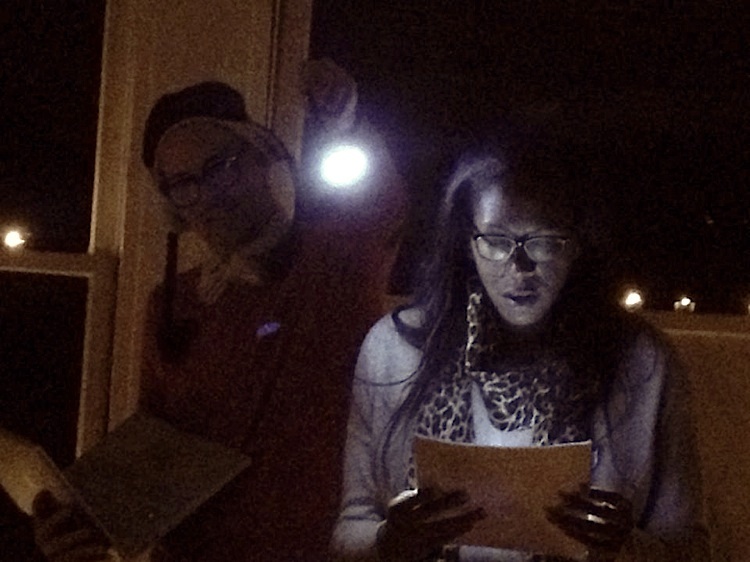
Beware the published starting time—the real determiner is the setting of the sun, since readings at The Squat are conducted, perhaps by necessity, in the dark. After night falls sufficiently, the group is led in abrupt silence from Smith’s iconic San Francisco apartment to the “venue,” a completely empty apartment upstairs, barely illuminated by rows of flickering tealights (“if you have hair, try not to catch on fire” Smith cracks). We squeeze into the “living room” together, encircling a pile of sawdust, the “stage.” 

Of the four readers, three locals (Ben Mirov, Erica Lewis, and Cedar Sigo) and a special “guest star” from the East Coast (Alex Dimitrov), the one whose poems most stick in my mind are Mirov’s, whose chilly distillations of word and image and deliberately affectless tone perfectly suit a body of poetry written in and for a digital age. Lewis reads from her latest project, a linked series called darryl hall is my boyfriend for which she provides mixed tapes of Darryl Hall’s music for emphasis, Sigo, most recently published by City Lights, presents a series of short poems rife with lush imagery, and Dimitrov works the increasingly vocal crowd with his confessional anecdotes, both written and spontaneous. The police don’t show and no-one catches on fire, so the event is deemed a success. Housing scarcity being what it is in this town, surely this apartment can’t stay empty forever, so get down there while you still have a chance, or head down to 16th Street on any Thursday around 10 p.m. Either way you’ll quickly discover that though our bookstores might be under siege, our poets refuse to surrender the fight.

Craft empire

1

caitlin@sfbg.com

STREET SEEN Located on a strip of Valencia that lacks not for the twee and handcrafted, the opening of Little Paper Planes might strike city dwellers as a bit of anti-news. Of course there’s a new place to shop for necklaces in the Mission. Obviously, the shop floor emphasizes artists who use locally-sourced materials. Oh, its gorgeous inside and former Design*Sponge senior editor Kate Pruitt designed the sweetly geometric shelves and displays? DUH. Next gift shop please.

But wait! What if I told you that Kelly Lynn Jones, who founded LPP back in 2004 (predating Etsy by a year) as an online marketplace for crafters, that she’s totally cognizant of the privilege of her new address’ attendant walk-in traffic, and is sharing her space with a bookstore curator and a rotating cast of creative community members?

Kayla Mattes

“In a city where art spaces are disappearing, I thought it was important to use this shop as a project space,” Jones tells me, in between the million tasks of a new business owner. True to her word, we barely talk about all the things happening in LPP in the half-hour I’ve snagged Jones’ attention.

Customers may first alight upon the window seat near Viniita “Neet” Moran’s carefully-curated mini-library Owl Cave Books (www.owlcavebooks.com). Moran started the collection and attendant series of events while living in London with a “mission to explore printed matter as a material for artists, a vehicle for expanding critical discourse, and as a mobile, versatile exhibition space for contemporary art,” she writes in an email. Here, Owl Cave can mean a Foucault treatise or out-of-print art history book.

Ilana Kohn

Colpa Press

Next, the LPP stock. On the day of my visit, Jones is particularly proud of black-and-white prints by SF’s Colpa Press, whose newsstand on Market and Sixth Streets carries titles from LPP’s own imprint like the Brian Nuda Rosch exhibition book that lies stacked on a low marble table nearby. Other stand-outs: Ilana Kohn’s printed tunics, leather pouch-chain necklaces by Nikki Katz, knit-and-plastic jewelry from Kayla Mattes’ “Summer Camp” collection.

A flatscreen that plays video art by a rotating cast of artists (at the moment, Jones’ fiancé Collin McKelvey, whose pink-green gradient she reappropriated for LPP’s current unofficial logo motif). Notably, the back of the store is gallery space.

Chinatown’s newly opened Et al. Gallery has taken over this space as LPP’s first artist-in-residence. To date, its offerings have included Aaliyah lyric-analyzing sessions, an analogue Instagram feed from curators Jackie Im and Aaron Harbour’s trip to Nada Art Fair, and DJ sets. On Fri/31, the duo host a panel discussion to share mid-realization art projects. Says Im, “We’re interested in making these small experiments more visible and sort of demystify and play on the role of ‘curator.'”

Nikki Katz

Ah, and design duo CCOOLL (www.ccooll.us) is teaming with 826 Valencia to teach teens how to make zines in the back gallery in between high-minded creative flights of fancy.

Jones insists that the only thing uniting the shop’s cast of characters is a shared trait that “they come to their work through a set of ideas. I know it when I see it,” she smiles.

Floss Gloss

Et al. artistic discussion Little Paper Planes 855 Valencia, SF. (415) 643-4616, www.littlepaperplanes.com. Fri/31, 6pm, free


Solomon: Our twisted politics of grief

1

By Norman Solomon
Norman Solomon is co-founder of RootsAction.org and founding director of the Institute for Public Accuracy. His books include “War Made Easy: How Presidents and Pundits Keep Spinning Us to Death” and “Made Love, Got War: Close Encounters with America’s Warfare State.”

Darwin observed that conscience is what most distinguishes humans from other animals. If so, grief isn’t far behind. Realms of anguish are deeply personal — yet prone to expropriation for public use, especially in this era of media hyper-spin. Narratives often thresh personal sorrow into political hay. More than ever, with grief marketed as a civic commodity, the personal is the politicized.

The politicizing of grief exploded in the wake of 9/11. When so much pain, rage and fear set the U.S. cauldron to boil, national leaders promised their alchemy would bring unalloyed security. The fool’s gold standard included degrading civil liberties and pursuing a global war effort that promised to be ceaseless. From the political outset, some of the dead and bereaved were vastly important, others insignificant. Such routine assumptions have remained implicit and intact.

The “war on terror” was built on two tiers of grief. Momentous and meaningless. Ours and theirs. The domestic politics of grief settled in for a very long haul, while perpetual war required the leaders of both major parties to keep affirming and reinforcing the two tiers of grief.

For individuals, actual grief is intimate, often ineffable. Maybe no one can help much, but expressions of caring and condolences can matter. So, too, can indifference. Or worse. The first years of the 21st century normalized U.S. warfare in countries where civilians kept dying and American callousness seemed to harden. From the USA, a pattern froze and showed no signs of thawing; denials continued to be reflexive, while expressions of regret were perfunctory or nonexistent

Drones became a key weapon — and symbol — of the U.S. war trajectory. With a belated nod to American public opinion early in the century’s second decade, Washington’s interest in withdrawing troops from Afghanistan did not reflect official eagerness to stop killing there or elsewhere. It did reflect eagerness to bring U.S. warfare more into line with the latest contours of domestic politics. The allure of remote-control devices like drones — integral to modern “counterterrorism” ideas at the Pentagon and CIA — has been enmeshed in the politics of grief. So much better theirs than ours.

Many people in the United States don’t agree with a foreign policy that glories in use of drones, cruise missiles and the like, but such disagreement is in a distinct minority. (A New York Times/CBS poll in late April 2013 found Americans favoring U.S. overseas drone strikes by 70 to 20 percent.) With the “war on terror” a longtime fact of political life, even skeptics or unbelievers are often tethered to some concept of pragmatism that largely privatizes misgivings. In the context of political engagement — when a person’s internal condition is much less important than outward behavior — notions of realism are apt to encourage a willing suspension of disbelief. As a practical matter, we easily absorb the dominant U.S. politics of grief, further making it our politics of grief.

The amazing technology of “unmanned aerial vehicles” glided forward as a satellite-guided deus ex machina to help lift Uncle Sam out of a tight geopolitical spot — exerting awesome airpower in Afghanistan and beyond while slowing the arrival of flag-draped coffins back home. More airborne killing and less boot prints on the ground meant fewer U.S. casualties. All the better to limit future grief, as much as possible, to those who are not us.

However facile or ephemeral the tributes may be at times, American casualties of war and their grieving families receive some public affirmation from government officials and news media. The suffering had real meaning. They mattered and matter. That’s our grief. But at the other end of American weaponry, their grief is a world of difference.

In U.S. politics, American sorrow is profoundly important and revs up many rhetorical engines; the contrast with sorrow caused by the American military could hardly be greater. What is not ignored or dismissed as mere propaganda is just another unfortunate instance of good intentions gone awry. No harm intended, no foul. Yet consider these words from a Pakistani photographer, Noor Behram, describing the aftermath of a U.S. drone attack: “There are just pieces of flesh lying around after a strike. You can’t find bodies. So the locals pick up the flesh and curse America. They say that America is killing us inside our own country, inside our own homes, and only because we are Muslims.

A memorable moment in the film Lincoln comes when the president says, “Things which are equal to the same thing are equal to each other” — in 1865, a daring leap for a white American assessing race. Truly applying the same Euclidean theorem to grief would be just as daring now in U.S. politics. Let’s face it: in the American political culture of our day, all grief is not created equal. Not even close.

We might say ’twas ever thus: countries and ethnic groups mourn their own while yawning or even rejoicing at the agonies of some “others.” And when grief weighs in on the U.S. political scale, the heaviness of our kind makes any other secondary at best. No wonder presidents have always been wary of red-white-and-blue coffins at Andrews Air Force Base. No wonder “Bring our troops home” is such an evergreen slogan of antiwar activism. If the only grief that matters much is American, then just getting Americans out of harm’s way is the ticket. The demand — like empathy for the war-torn grief of Americans — is vital. And grievously incomplete.

The world’s only superpower has been operating with vast impunity to strike targets and, in effect, summarily execute. (President Obama’s big speech on May 23 reasserted that prerogative; as the ACLU’s president Anthony Romero pointed out, Obama “still claims broad authority to carry out targeted killings far from any battlefield, and there is still insufficient transparency.”)  For American politics and mass media — perennially infatuated with the Pentagon’s latest tech advances in military capacities — such enormous power to smite presumptive evildoers has fed into a condition of jingo-narcissism. Some of its manifestations could be viewed as sociopathic: unwilling or unable to acknowledge, or evidently care much about, the pain of others.

Or the terror of others, if we are causing it. In the American political lexicon, terror — the keynote word for justifying the U.S. state of warfare so far in this century — is a supreme epithet, taken as ours to confer and to withhold. Meanwhile, by definition, it goes without saying, our leaders of the “war on terror” do not terrorize. Yet consider these words from New York Times reporter David Rohde, recalling his captivity by the Taliban in 2009 in tribal areas of Pakistan: “The drones were terrifying. From the ground, it is impossible to determine who or what they are tracking as they circle overhead. The buzz of a distant propeller is a constant reminder of imminent death.”

As part of tacit job descriptions, the U.S. network anchor or the president is highly selective in displayed compassion for the grieving. It won’t do to be seen with watery eyes when the Pentagon has done the killing (“friendly fire” a notable exception). No rulebook need be published, no red lines openly promulgated; the gist remains powerfully inherent and understood. If well acculturated, we don’t need to ask for whom the bell tolls; we will be informed in due course. John Donne, meet Orwell and Pavlov.

The U.S. Constitution — if not international law or some tenacious kind of idealism — could prevent presidential “kill lists” from trumping due process. But, as Amy Davidson wrote in a New Yorker online column last year, the operative approach is: “it’s due process if the president thinks about it.” Stephen Colbert summed up: “The Founders weren’t picky. Trial by jury, trial by fire, rock-paper-scissors — who cares?” After all, “Due process just means there’s a process that you do.” Satire from Colbert has been far more candid than oratory from President Obama, whose May 23 speech claimed a commitment to “due process” and declared: “I’ve insisted on strong oversight of all lethal action.”

Bypassing due process and shrugging off the human consequences go hand in hand. At the same time, it can be reassuring when the commander in chief speaks so well. But Obama’s lengthy speech at the National Defense University laid out a global picture with a big missing piece: grief due to U.S. military attacks. The only mention was a fleeting understatement (“for the families of those civilians, no words or legal construct can justify their loss”), instantly followed by a focus on burdens of top perpetrators: “For me, and those in my chain of command, these deaths will haunt us as long as we live…” As usual, the grief of the USA’s victims was quickly reframed in terms of American dilemmas, essential goodness and standing in the world. So, while Obama’s speech called for “addressing the underlying grievances and conflicts that feed extremism, from North Africa to South Asia,” some crucial grievances stoking the conflicts were off the table from the outset; grief and rage caused by U.S. warfare remained out of the picture.

Transcendent and truly illuminating grief is to be found elsewhere, close to home. “The greatest country in the world” presumes to shoulder the greatest grief, with more access to profundities of death. No wailing and weeping at the scene of a drone strike, scarcely reported by U.S. media anyway, can hold a candle. For American grief to be only as weighty as any other just won’t do. We’re number one! A national narrative of emotional supremacy.

Our politics of grief, bouncing off the walls of U.S. media echo chambers, are apt to seem natural and immutable while fueling much of the domestic political rhetoric that drives U.S. foreign policy. The story goes that we’re sinned against yet not sinning, engaged in self-protection, paying to defend ourselves. Consider the Google tallies for two phrases. “U.S. defense budget”: nearly 4,000,000. “U.S. military budget”: less than 100,000.

But for those in communities grieving the loss of people struck down by the USA’s “Defense Department,” the outlook is inverted. To be killed is bad enough. But to be killed with impunity? To be killed by a machine, from the sky, a missile fired by persons unseen who do not see who they’re killing from hundreds or thousands of miles away? To be left to mourn for loved ones killed in this way?

When, from our vantage point, the grief of “others” lacks major verisimilitude, their resentment and rage appear irrational. Heaven forbid that such emotions could give rise to deadly violence approaching the level of our own. People who are uneducated and unclear on the American concept sometimes fail to appreciate that our perception is to be enforced as hegemonic reality. By a kind of fiat we can elevate with fervent validation some — some — others’ grief. As for the rest, the gradations of importance of their grief, and the legitimacy of their resort to violence, are to be determined by our judicious assessment; for further information, contact the State Department.

There may be no worse feeling of human powerlessness than inability to prevent the death of a loved one. The unmatched power of bereavement forces people to cope with a basic kind of human algebra: love + death = grief. Whether felt as a sudden ghastly deluge or as a long series of sleeper waves with awful undertows, real grief can turn upbeat memories into mournful ones; remembering becomes a source of anguish, so that, as Joan Didion wrote, “Memories are what you no longer want to remember.” Ultimately, intimately, the human conditions of loss often move people to places scarcely mapped by standard news coverage or political rhetoric.

Imagine living in a village in Pakistan or Afghanistan or Yemen. From the sky, death has been visited on neighbors, and drones keep hovering. (As now-former Times reporter Rohde pointed out: “Drones fire missiles that travel faster than the speed of sound. A drone’s victim never hears the missile that kills him.”) Overhead are drones named Reaper, shooting missiles named Hellfire. Have the heavens been grabbed by people who think their instruments of death are godly?

“When scientific power outruns moral power,” Martin Luther King Jr. said, “we end up with guided missiles and misguided men.” For America, drones and other highest-tech weapons are a superb technological means of off-loading moral culpability from public agendas; on the surface, little muss, less fuss.

Disembodied killing offers plenty of pluses in U.S. politics, especially when wars become protracted. From Vietnam to Afghanistan, the reduction of troop levels has cut the number of American deaths (easing the grief that “counts”) in tandem with more bombardment from the air (causing the “other” grief). Today’s domestic politics of grief are akin to what emerged after mid-1969, when President Nixon initiated a steady withdrawal of U.S. troops from South Vietnam. During the three years that followed, Nixon reduced the number of soldiers in Vietnam by nearly half a million, to 69,000. During the same three years, the U.S. government dropped 3.5 million tons of bombs on Vietnam — more than all the bombing in the previous five years.

Then, as now, the official scenario had U.S. troops thinning on the ground, native troops taking up more of the combat burden, and the Pentagon helpfully bombing from the sky as only Americans could “know how.” Independent journalist I. F. Stone astutely identified the paradigm in 1970, when the White House struggled with fading public support for the war. The revamped policy, Stone wrote, was “imperialism by proxy,” aiming to buy “low-wage soldier-power,” an approach that “will be seen in Asia as a rich white man’s idea of fighting a war: we handle the elite airpower while coolies do the killing on the ground.” Stone would have swiftly recognized the pattern in President Obama’s upbeat statement on May 23 that “we will work with the Afghan government to train security forces and sustain a counterterrorism force.”

The number of U.S. ground troops in Afghanistan was down by one-third, to 66,000, at the start of this year, when Obama announced plans to gradually withdraw the remaining troops over a period of two years. High-tech warfare would pick up the slack. The outgoing Defense Secretary, Leon Panetta, told a news conference that a key mission in Afghanistan, persisting after 2014, would be “counterterrorism,” a buzzword for heavy reliance on airpower like drones and cruise missiles. Such weapons would give others grief.

A top “national security” adviser to the president, John Brennan, said as much in an April 2012 speech. “As we have seen,” he noted, “deploying large armies abroad won’t always be our best offense. Countries typically don’t want foreign soldiers in their cities and towns.” The disadvantages of “large, intrusive military deployments” were many. “In comparison, there is the precision of targeted strikes.”

But such “precision” is imperfect enough to be an other’s calamity. Likewise, the extreme relativity of “agony.” At his Senate confirmation hearing to become CIA director in February 2013, Brennan spoke of “the agony we go through” in deciding which individuals to target with drones. Perhaps to square some circles of cognitive dissonance, those who inflict major violence often seem moved to underscore their own psychological pain, their own mental wounds. (As if to say, This hurts me as much as it hurts them; maybe even more, given my far more acute moral sensitivities.) When the focus is on the agony of the perpetrators, there may be less room left to consider the grief of their victims.

Shifting the burden of protracted war easily meshes with a zero-sum geopolitical game. Official enthusiasm for air strikes has correlated with assurances that Americans would be facing much less grief than allied others. So, near the end of 2012, the USA Today front page reported that “the number of U.S. deaths in Afghanistan is on track to decline sharply this year, reflecting the drawdown in U.S. forces” — while the death toll for Afghan government forces had climbed to ten times the U.S. level. These developments were recounted as progress all the way around.

As top officials in Washington move to lighten the political load of American grief, their cost-benefit analyses find major strategic value in actions that inflict more grief on others. Political respects must be paid. Elites in the war corps and the press corps do not have infinite tolerance for American deaths, and the Pentagon’s latest technology for remote killing is a perpetual favorite. In the long run, however, what goes around tends to come around.

Advice offered by scholar Eqbal Ahmad before 9/11 bears repeating and pondering: “A superpower cannot promote terror in one place and reasonably expect to discourage terrorism in another place. It won’t work in this shrunken world.”
After the “war on terror” gained momentum, Martin Luther King III spoke at a commemoration of his father’s birth and said: “When will the war end? We all have to be concerned about terrorism, but you will never end terrorism by terrorizing others.” That was more than nine years ago.

Norman Solomon is co-founder of RootsAction.org and founding director of the Institute for Public Accuracy. His books include “War Made Easy: How Presidents and Pundits Keep Spinning Us to Death” and “Made Love, Got War: Close Encounters with America’s Warfare State.”

(The Bruce blog is written and edited by Bruce B. Brugmann, editor at large of The San  Francisco Bay Guardian, and editor and co-founder and co-publisher of the Guardian with his wife Jean Dibble (1966-2012). He can be contacted at Bruce@sfbg.com. b3

What we do is secret

2

emilysavage@sfbg.com

TOFU AND WHISKEY Bay Area garage pop quintet the Mantles will release Love Enough to Leave on Slumberland Records next month (June 18) and play the Rickshaw Stop a few short days before that (June 14). The breezy group formed in 2007, but sounds like it could just have easily been hanging out at Vesuvio in Jack Kerouac Alley or across the street at Specs Bar in 1968, grasping stiff drinks and talking politics and fashion with local drunks.

Although, singer-guitarist Michael Olivares, wife and drummer Virginia Weatherby, and their new dog Jumbo moved to Oakland’s Temescal neighborhood last year thanks to rising rents in Bernal Heights, where they formerly lived. So that old-time SF scenario isn’t quite as picturesque as conjured. But the band still bleeds Bay Area. Olivares and Weatherby frequent nearby 1-2-3-4 Go! Records for vinyl, and the Night Light, the Hemlock, the Knockout, and El Rio for live shows. The band recorded its new album with local legend Kelley Stoltz, and the other three band members — keyboardist Carly Putnam, bassist Matt Roberts and, newish lead guitarist Justin Loney — live scattered throughout SF, in the Tenderloin and the Mission.

Plus, it’s really more the sound that evokes those vintage tastes, those early Nuggets-esque psych-pop ideals. Olivares gets the comparisons and appeal, though hopes his band does not come off as just a carbon copies of the past (it doesn’t). “We definitely like all of that music and other things from that era, that culture,” he says. “We’re aware enough though that I hope to not become just a blatant revivalist band that’s trying to wear tie-dye shirts and bell-bottoms or something.”

But still, the favorable comparison is applicable, “Most of the music I listen to is from that era, the ’60s and ’70s, so I’d say we’re pretty heavily influenced by it.”

This may come as no surprise to listeners still besotted with the Mantles’ self-titled 2010 debut (Siltbreeze), with its nimbly Byrds-like appeal. Yes, three years later (and EP Pink on Mexican Summer in between) the mood remains upbeat, but like the musicians who created it, there’s an older wisdom to the approach.

There’s a seen-it-all-before strength from tracks off Love Enough to Leave such as “Brown Balloon” and only slightly more solemn album closer “Shadow of Your Step.” It’s like the group time-warped and took those free-wheeling early folk popsters back to the garage with them, plugged in and showed them proto-punk, then had a serious conversation about what would happen to the Bay Area in 2013: housing prices will rise again, there will be this thing called the web that changes everything.

When asked what’s changed since he first moved to SF a decade ago, Olivares says it seems like bands have gone poppier (including his own), but also notes there’s been a shift in the sheer number of house shows in SF proper.

He says their migration to the East Bay loosely influenced title track, “Long Enough to Leave,” and “Don’t Cross Town.”

Conversely, there are some more character-based tracks inspired by books and films like Mike Leigh’s comedic camping ode Nuts in May (1976), including jangly opener “Marbled Birds” and the illusory single “Hello,” which initially seems like a pleasant conversation. Cheery to begin with, it feels like candy and turquoise rotary telephones in teenage bedrooms (a ruse, the band members are all actually in their early 30s). But then, it gets to the line, “Hello/Maybe you can help me get out of here.” Ah, the hook, and out comes the reverb. Olivares told me it was actually about a time when his friend in France was sending postcards and he kept forgetting to respond.

While the Mantles may evoke vintage San Francisco, there’s something moving in this week that’s entirely new to the area and musical landscape. The America’s Cup Concert Series at the America’s Cup Pavilion (between Piers 27/29), stricken by neighborhood complaints, finally soldiers forward (but now down to 30 concerts from 40). It’ll be SF’s largest venue — holding up to 9,000 classic rock fans in an outdoor concert bulb connected to the equally maligned America’s Cup. Teamed up with Live Nation, the Pavilion will host a barrage of top 40 acts including Imagine Dragons this weekend, Fri/31, (already sold out).

Then there’ll be Sting, the Steve Miller Band, Counting Crows with the Wallflowers, 311, Train, Sammy Hagar, and it goes on. It’s a rather stale line-up, perhaps best suited for those legitimately excited for the boat races. The youngest group is the Jonas Brothers, after that Fall Out Boy and Panic! At the Disco (all well into their 30s). Perhaps the only really interesting additions are Weezer and the symphony. Here’s hoping the neighbors don’t keep complaining.


BAY FEVER

And now, a little spring-cleaning for Tofu and Whiskey. Some Bay Area bands are killing it in late May and June. Dreams in the Rat House (Hardly Art), the explosive new full-length from Oakland trio Shannon and the Clams dropped last week. As noted when the single “Rip Van Winkle” was released, the kings and queen of surfy doo-wop have kept up their hip-shaking guitar lines and voracious vocals with a joyfully trashy edge. There’s also now a mini doc on the band, OutofFocus TV’s “American Music Episode 6: featuring Shannon and the Clams,” which you can check on Youtube and Vimeo.

In it, Shannon Shaw, Cody Blanchard, and drummer Ian Amberson (who quit sometime during filming apparently) struggle to describe their band, which leads to a great video edit that includes snippets of each saying words such as “fantastical, ballads, cozy, weirdo, Muppet, punk, oldies.” shannonandtheclams.com. Song to check: “Rip Van Winkle”

After what seems like an eternity (three years and a brief hiatus) Rogue Wave will release new record Nightingale Floors Tue/4 on Vagrant Records. It’s the band’s fifth studio album, and newest since 2010’s Permalight. On Nightingale Floors, bandleader Zach Rogue and longtime drummer Pat Spurgeon battle out demons (death, personal tragedies) and come out the other end with trusted jangly guitars, Rogue’s delicate vocals that still sound like an old friend telling stories, and Spurgeon’s expert off-time drumming — a sharp new release produced by John Congleton (who also produced Rogue’s solo effort, Release the Sunbird). In addition to Rogue and Spurgeon, Nightingale Floors includes contributions by bassist Masanori Mark Christianson, guitarist Peter Pisano, vocalist Jules Baenziner (Sea of Bees) and Mwahaha’s Ross Peacock on synths.

The record seems to take listeners on a narrated life trip, through “College” and “Figured It Out” to the “Siren’s Song,” finally settling on the inevitable with twinkly “When Sunday Morning Comes” and unhurried “Everyone Want to Be You.” Rogue Waves plays the Independent July 13. roguewavemusic.com. Song to check: “No Magnatone”

And then there’s Oakland’s Mortar and Pestle. On its self-titled new full-length, the band projects a vibe akin to a trippier Little Dragon. There are bouncy keyboard lines and scattered found-sound touches boosted by the lush, dreamy vocals of lead singer Janaysa Lambert. On first single “U.V” there’s even the familiar ping-ping-ping of a classic pinball game, forcing you to picture the full Mortar and Pestle set-up placed neatly between games in a 1980s arcade. The synth-pop trio is also one of the first acts to see release on Metal Mother’s new label-collective, Post Primal, so you know it has her stamp of approval. www.mortarandpestlemusic.com Song to check: “Pristine Dream.”

Sarah Palin = REO Speedwagon

38

One of the more remarkable components of the so-called “Right Wing Entertainment Complex” (Fox/AM Radio/a gazillion reactionary websites) is the agonizing and complete predictability of its content. Barack Obama is the most evil, traitorious, illegal usurper, Muslim, Kenyan Socialist dictator alive and the besieged heroes of American patriotism are outnumbered and will be outgunned when Obama seizes their weapons, Obamacare will kill every member of your family assuming they haven’t committed suicide after it bankrupted them, Benghazi was worse than 9/11, Iraq and the 1962 Mets combined and the IRS only hates the brave and fierce Republican Party. Who are the only ones that can keep you safe against the fifth column of baby-killing Hollywood liberals that will brainwash your son into marrying a barnyard animal.

(Also remarkable is however much you try to lampoon their cray-cray, they’re inevitably more out there than even a parodist can dream of).

Flip on any of these mediums and this is what you get and if I know this in advance, so do their fans and they like it that way. Like a soothing wash of a New Age mixtape in the foyer of a yoga studio.Except that the whoosh of the mixtape is familiar in form and not content.

Nope, the real parallel between the RW Entertainment Complex and its musical equivalent would be the aging classic rock dinosaurs of the 70’s and 80’s and the state fair/shitty casino/low rent rally circuit. Glenn Beck, Bill O’Reilly, the battery of Sunday morning news show dildolatry and especially the Mega MILF of Moosery Sarah Palin are completely and totally identical to the slog it out warriors of faceless corporate FM rock–Foreigner, Journey, Styx, Nightranger and REO Speedwagon.

Think about it–what do Kevin Cronin (REO), Mick Jones (Foreigner, not the Clash’s Mick Jones) and whomever is left in the other bands do for a living? They mount the boards and play their hits–period. And vamoose off to the next hellhole whose main fiscal purpose at this point is alimony, child support and back taxes. 12 tunes, maybe, paycheck and screw. They try not to think about their better days, one imagines, and just do their jobs–which consist now of rote recitation. In that, they are exactly like Palin or Glenn Beck–who hit all the talking points, massage the prejudices of their chosen audience and remind them that only they understand their plight (and then batter them with ads for merchandise and books). Like peas in a pod.  

Except that at one time, these bands were cranking out hit songs and even if you don’t like their hits, writing a hit is hard to do. Regurgitating “the best of Joe McCarthy” only replacing “Communists” with “Muslims” or “libs” is all these verbal midgets need do to cash in. “Hot Blooded” or “Don’t Let Him Go” or “Babe” may sound trite and brittle and overwrought to some, but they had to be concocted, recorded with care and sung in tune. That is a hell of a lot more than these repulsive mountebanks on the right are capable of. 

(And there is, of course, the gent that straddles both worlds with ham-handed, blockheaded glory, the Nuge himself–except he’s third on the bill beneath REO and Styx this summer and is but a mere guest on FOX at best. Sorry, Ted).

Lastly, the rock bands who are on rickety stages this summer outside Lincoln NE or Bakersfield or Dothan Alabama next to livestock and ferris wheels are fucking honest men and women. They travel endless hours for vastly less pay than they used to get. They have seen their expected annuities disappear via digital downloading and YouTube. They look into the smaller crowds and see their reflections in the once fist pumping but now worn looking fans. And they still have enough pride to deliver the goods, because that’s what they do–not chauffered from their expensive mansions to TV and radio studios to spew out the party line that has been focus group and poll tested to perfection. And then home to mansion. I may not like the dino bands but I respect ’em–I have no respect for these reactionary carny barkers at all.


Solomon: Obama in Plunderland: Down the corporate rabbit hole

0


By Norman Solomon

Norman Solomon is co-founder of RootsAction.org and founding director of the Institute for Public Accuracy. His books include “War Made Easy: How Presidents and Pundits Keep Spinning Us to Death.” He writes the Political Culture 2013 column.

The president’s new choices for Commerce secretary and FCC chair underscore how far down the rabbit hole his populist conceits have tumbled. Yet the Obama rhetoric about standing up for working people against “special interests” is as profuse as ever. Would you care for a spot of Kool-Aid at the Mad Hatter’s tea party?

Of course the Republican economic program is worse, and President Romney’s policies would have been even more corporate-driven. That doesn’t in the slightest make acceptable what Obama is doing. His latest high-level appointments — boosting corporate power and shafting the public — are despicable.

To nominate Penny Pritzker for secretary of Commerce is to throw in the towel for any pretense of integrity that could pass a laugh test. Pritzker is “a longtime political supporter and heavyweight fundraiser,” the Chicago Tribune reported with notable understatement last week, adding: “She is on the board of Hyatt Hotels Corp., which was founded by her family and has had rocky relations with labor unions, and she could face questions about the failure of a bank partly owned by her family. With a personal fortune estimated at $1.85 billion, Pritzker is listed by Forbes magazine among the 300 wealthiest Americans.”

A more blunt assessment came from journalist Dennis Bernstein: “Her pioneering sub-prime operations, out of Superior Bank in Chicago, specifically targeted poor and working class people of color across the country. She ended up crashing Superior for a billion-dollar cost to taxpayers, and creating a personal tragedy for the 1,400 people who lost their savings when the bank failed.” Pritzker, whose family controls Hyatt Regency Hotels, has a vile anti-union record.

Commerce Secretary Penny Pritzker? What’s next? Labor Secretary Donald Trump? SEC Chairman Bernie Madoff?

The choice of Penny Pritzker to run the Commerce Department is a matched set with the simultaneous pick of Tom Wheeler — another mega-fundraiser for candidate Obama — to chair the Federal Communications Commission.

With crucial decisions on the near horizon at the FCC, the president’s nomination of Wheeler has dire implications for the future of the Internet, digital communications and democracy. For analysis, my colleagues at the Institute for Public Accuracy turned to the progressive former FCC commissioner Nicholas Johnson, who called the choice “bizarre.”

“There is no single independent regulatory commission that comes close to the impact of the FCC on every American’s life,” Johnson said. “That’s why Congress, in creating it, characterized its mission as serving ‘the public interest’ — an expression used throughout the Act.

But with countless billions of dollars at stake, the corporate fix was in. As Johnson pointed out, “Wheeler’s background is as a trade association representative for companies appearing before the Commission, a lobbyist in Congress for other FCC customers, and a venture capitalist investing in and profiting from others whose requests he’ll have to pass on. He has no record, of which I am aware, of challenging corporate abuse of power on behalf of consumers and the poor.”

But wait. There’s more. “Nor does Wheeler’s membership on the president’s Intelligence Advisory Board bode well for those who believe Americans’ Fourth Amendment privacy rights should be getting at least as much attention as the government’s perceived need to engage in even more secret snooping.”

To urge senators to reject the nominations of Pritzker and Wheeler, click here.

Meanwhile, at the Securities and Exchange Commission, Obama’s recent appointment of Wall Street insider Mary Jo White as SEC chair is playing out in predictable fashion. Days ago, in an editorial, the New York Times faulted her role in an SEC decision on regulating the huge derivatives market: “Last week, in her first commission vote, Ms. White led the commissioners in approving a proposal that, if finalized, could leave investors and taxpayers exposed to the ravages of reckless bank trading.”

We need to ask ourselves how the forces of corporate capitalism have gained so much power over government, to the extreme detriment of people who aren’t rich. Humpty Dumpty’s brief dialectical exchange with Alice is on point

“When I use a word,” Humpty Dumpty said, “it means just what I choose it to mean — neither more nor less.”

“The question is,” Alice replied, “whether you can make words mean so many different things.””The question is,” Humpty Dumpty responded, “which is to be master — that’s all.

Denunciations and protests against the dominant power structure are essential. And insufficient. For the body politic and the potential of democracy, accommodating to the Democratic Party leadership is a deathly prescription. So is failure to fight for electoral power by challenging that leadership, fielding genuinely progressive candidates and organizing to win.

Norman Solomon is co-founder of RootsAction.org and founding director of the Institute for Public Accuracy. His books include “War Made Easy: How Presidents and Pundits Keep Spinning Us to Death.” He writes the Political Culture 2013 column.

(The Bruce Blog is written and edited by Bruce B. Brugmann, editor at large of the San Francisco Bay Guardian, and co-founder and editor and co-publisher with his wife Jean of the Bay Guardian, 1966-2012, now retired.)

Behold! Highlights of ArtPadSF and artMKT

0

In this week’s issue, Guardian visual arts Matt Fisher singled out some highlights of the big ArtPadSF and artMKT shows, which open tonight and run through Sun/19. Here’s a slideshow that shows you what he was talking about. Artist descriptions after the jump: 

ARTPADSF:

Andrew Benson, Johansson Projects

Benson’s sometimes gooey, sometimes crunkly digital video/experimental software work breathes some ragged, frenetic energy into the standard trope of “relationships between the body and technology.” His piece is scheduled to be projected from the Phoenix onto the six-story building next door at 8pm, Thu/16-Sat/18.

Justine Frischmann, Unspeakable Projects

Frischmann’s paintings look like something that one of those spiders on Benzedrine would make. If it lived inside an Etch A Sketch. And used neon spray paint. During a dust storm. Trust me, these are compliments.

David Hevel, Marx & Zavattero

Hevel makes collaged sculptures and sharp pop abstract paintings, usually riffing on American celebrity. His work at the fair will be very MTV 1983.

Scott Hove, Spoke Art

Will Oaklander Hove be showing one of his intensely drugged up fanged wall cakes, a knotted rope work installation, or a surrealism-on-meth painting? Yeah, it all sounds good to me, too.

Jason Kalogiros, Queen’s Nails Gallery

Kalogiros makes edgy, dense, cerebral, photo-based works, lately by manipulating found commercial images. I’m hoping to see a couple from his series of Cartier and Bvlgari watches.

Ed Loftus, Gregory Lind Gallery

Loftus does photorealism pretty much the right way, by marrying intense attention to detail with an obsessive and neurotic subject matter that crawls under your skin ever deeper the more time you spend with it. While you’re in Gregory Lind’s space, also check out Thomas Campbell and Jovi Schnell.

Matt Momchilov, Unspeakable Projects

Momchilov queers punk and rock fandom in the traditional sense of the word, meaning his paintings and sculpture snatch and redirect standard accoutrements of punk fanboys and girls to point that hardcore laser focus in new directions and at more fey subjects.

Gregg Renfrow, Toomey-Tourell

I won’t blame you one bit if you try to lick Renfrow’s luminous, vibrating color field abstractions. His meticulous, precise, wondrous paintings are like visual everlasting gobstoppers, and I fully expect that by the time I see ’em, they’ll have a layer of saliva all over.

Jonathan Runcio, Queen’s Nails Gallery

Runcio makes incisive 2 and 3D work that takes traditional hardedge abstraction in the art concrete vein, shacks it up with remnants of urban architecture, and has a post-formalist lovechild.


ARTMRKT

Johnna Arnold, Traywick Contemporary

The fair’s Collector’s Lounge will be showing Arnold’s video created to accompany the richly saturated, haunting landscape photos that will be showing offsite at the gallery.

Carol Inez Charney, Slate Contemporary

harney’s complex photographs were the single most outstanding thing I saw last year at ArtPad. That’s complex like a personality, not like your taxes. A year later, I’m prepared for the brainfreeze again.

Amanda Curreri, Romer Young

Curreri’s precisely conceived conceptual color and abstract works are subtle in that they tend to yield only small nibbles at first pass, but they’re deceptive that way, and usually end up smacking you around by the time it’s all over.

Lauren DiCioccio, Jack Fischer Gallery

DiCioccio has recently been applying her super-meticulous needlework to fastidiously x-ing out individual letters in pages of books, as an act of both scrutiny and physical redaction of the received, mediated world.

Joshua Hagler, Jack Fischer Gallery

Somewhere in the Hamptons summer home where Glenn Brown and Lucian Freud are renting with Mark Tansey and Matthew Day Jackson, Hagler is stoned on the couch making fart noises with his armpits. That is also a compliment.

Claire Rojas, Gallery Paul Anglim

Sure Gallery Paul Anglim shows Barry McGee, but I’ll be looking at the Rojas paintings, whose hard edge and off-kilter abstractions of interior architectural spaces are spot-on and mesmerizing.

Diane Rosenblum, Slate Contemporary

Rosenblum switches up hyperanalytical and conceptual works that incorporate research, crowdsourced interactions, and photography. I’m hoping to see images from a series of recent photos that work Flickr comments into the image.

Dana Hart Stone, Brian Gross

I can’t wait to examine Hart Stone’s paintings up close, which in the past have been made by repeatedly transferring or printing antique images in rows onto canvas. Also at Brian Gross are Bay Area stalwarts Roy de Forest and Robert Arneson.

Esther Traugot, Chandra Cerrito

Traugot combines found organic objects with crochet. I know what you’re thinking, but this is not a Portlandia skit. She does it the right way, promise.

Film listings

0

Film listings are edited by Cheryl Eddy. Reviewers are Kimberly Chun, Dennis Harvey, Lynn Rapoport, and Sara Maria Vizcarrondo. For rep house showtimes, see Rep Clock.

OPENING

The Iceman See “Assassination Character” at www.sfbg.com. (1:46) Embarcadero, Shattuck.

Midnight’s Children Deepa Mehta (2005’s Water) directs and co-adapts with Salman Rushdie the author’s Booker Prize-winning 1981 novel, which mixes history (India’s 1947 independence, and the subsequent division of India and Pakistan) with magical elements — suggested from its fairy-tale-esque first lines: “I was born in the city of Bombay, once upon a time.” This droll voice-over (read by Rushdie) comes courtesy of Saleem Sinai, born to a poor street musician and his wife (who dies in childbirth; dad is actually an advantage-taking Brit played by Charles “Tywin Lannister” Dance) but switched (for vaguely revolutionary reasons) with Shiva, born at the same moment to rich parents who unknowingly raise the wrong son. Rich or poor, it seems all children born at the instant of India’s independence have shared psychic powers; over the years, they gather for “meetings” whenever Saleem summons them. And that’s just the 45 minutes or so of story. Though gorgeously shot, Midnight’s Children suffers from page-to-screen-itis; the source material is complex in both plot and theme, and it’s doubtful any film — even one as long as this — could translate its nuances and more fanciful elements (“I can smell feelings!,” Saleem insists) into a consistently compelling narrative. Last-act sentimentality doesn’t help, though it’s consistent with the fairy-tale vibe, I suppose. (2:20) Opera Plaza, Shattuck, Smith Rafael. (Eddy)

Something in the Air After accidentally causing a guard serious harm during a Molotov-cocktail revenge attack on high school campus police, floppy-haired Gilles (Clément Métayer) and his baby anarchist comrades have to scatter for summer vacation. He heads to Italy along with potential new girlfriend Christine (Lola Créton), the last one (Carole Combes’ Laure) having tripped off to London and Ibiza with her artist parents. Gilles wants to be an artist, too. As much of a narrative arc as there is here details his gradual shift from dedication to political ideology toward decisions that might help further his career and define his aesthetic as a painter (or maybe a filmmaker). Always interesting but never involving, Olivier Assayas’ somewhat autobiographical feature is a portrait-of-a-young-man exercise that’s ultimately a little too much like everyone’s freshman college year: Fascinating and life-changing if you were there, not so much if you’re just hearing someone else’s counter cultural reminiscences. Gilles is a petulant blank whose revolutionist convictions seem borrowed rather than felt — which may be the writer-director’s intent, but it’s hard to tell. Originally titled Apres Mai — a much more useful reference to the French far-left political tumult of May 1968 and its aftermath — this is one more cinematic attempt to encapsulate the “turbulent” 1960s (extending here into the mid-’70s) that at least fleetingly captures the era’s fluidity of sex, love, community, and ideology. And that’s far less successful at convincing us the beliefs our protagonists tout are anything more than an immature following of cultural fashion. It’s an incongruously passive movie about a time in which passion reigned. (2:01) Opera Plaza, Shattuck. (Harvey)

Star Trek Into Darkness CUMBERBATCH! (2:07) Balboa, Presidio.

Stories We Tell Actor and director Sarah Polley (2011’s Take This Waltz) turns the camera on herself and her family for this poignant, moving, inventive, and expectation-upending blend of documentary and narrative. Her father, actor Michael Polley, provides the narration; our first hint that this film will take an unconventional form comes when we see Sarah directing Michael’s performance in a recording-studio booth, asking him to repeat certain phrases for emphasis. On one level, Stories We Tell is about Sarah’s own history, as she sets out to explore longstanding family rumors that Michael is not her biological father. The missing piece: her mother, actress Diane Polley (who died of cancer just days after Sarah’s 11th birthday), a vivacious character remembered by Sarah’s siblings and those who knew and loved her. Stories We Tell‘s deeper meaning emerges as the film becomes ever more meta, retooling the audience’s understanding of what they’re seeing via convincingly doc-like reenactments. To say more would lessen the power of Stories We Tell‘s multi-layered revelations. Just know that this is an impressively unique film — about family, memories, love, and (obviously) storytelling — and offers further proof of Polley’s tremendous talent. (1:48) Embarcadero, Shattuck, Smith Rafael. (Eddy)

Sun Don’t Shine Prolific indie producer and actor (Upstream Color) Amy Seimetz’s debut as feature writer-director is a intriguingly ambiguous mumblecore noir about a couple on the run, à la Bonnie and Clyde. Crystal (Kate Lyn Sheil) and Leo (Kentucker Audley) are driving south through Florida — a state that seemingly always relaxes demands on intelligence and legality — with a handgun, innumerable anxieties, and something problematic hidden in the trunk. We gradually realize she’s unstable, though to what extent remains unclear. Seimetz’s refusal to spell out that and other basic narrative elements lends her film a compelling aura of mystery, one that heightens some striking, tense sequences but also can prove somewhat frustrating in the long run. (A little more insight would have made it easier to understand why the seemingly level-headed Leo has hitched his wagon to the increasingly off-putting Crystal.) Overall, though, it’s the kind of first feature that makes you eager to see what she’ll come up with next. (1:20) Roxie. (Harvey)

ONGOING

Aftershock Dumped into theaters without fanfare or advance screenings, this collaboration between co-scenarist/producer/star Eli Roth and Chilean director Nicolás López deserves better — it’s possibly the most luridly entertaining of numerous recent jokey homages to retro grindhouse cinema. Roth plays a character known only as Gringo, a divorced Yank lawyer on vacation traveling around Chile with two local friends, brash Pollo (Nicolás Martínez) and mopey Ariel (Ariel Levy). Their tour of raves, clubs, drugz, and tail-chasing — the rare warm-up half-hour that’s actually very funny and enjoyable — comes to an abrupt halt in Valparaiso. Partying with three newly met multinational lady friends (Lorenza Izzo, Andrea Osvárt, Natasha Yarovenko) they find themselves caught in a major earthquake — and the carnage that it causes is just the beginning of their woes, as crisis piles upon crisis. Spinning ’70s disaster-flick tropes toward crass gore-horror, Aftershock is gleefully trashy enough to get away with outrageous cruelties, including mortal harm served out to characters shockingly high on the cast list. (1:30) (Harvey)

The Angels’ Share The latest from British filmmaker Ken Loach (2006’s The Wind that Shakes the Barley) and frequent screenwriter collaborator Paul Leverty contains a fair amount of humor — though it’s still got plenty of their trademark grit and realism. Offered “one last opportunity” by both a legal system he’s frequently disregarded and his exasperated and heavily pregnant girlfriend, ne’er-do-well Glaswegian Robbie (Paul Brannigan) resolves to straighten out his life. But his troubled past proves a formidable roadblock to a brighter future — until he visits a whiskey distillery with the other misfits he’s been performing his court-ordered community service with, and the group hatches an elaborate heist that could bring hope for Robbie and his growing family … if his gang of “scruffs” can pull it off. Granted, there are some familiar elements here, but this 2012 Cannes jury prize winner (the fest’s de facto third-place award) is more enjoyable than predictable — thanks to some whiskey-tasting nerd-out scenes, likable performances by its cast of mostly newcomers, and lines like “Nobody ever bothers anybody wearing a kilt!” (not necessarily true, as it turns out). Thankfully, English subtitles help with the thick Scottish accents. (1:41) Smith Rafael. (Eddy)

At Any Price Growing up in rural Iowa very much in the shadow of his older brother, Dean Whipple (Zac Efron) cultivated a chip on his shoulder while dominating the figure 8 races at the local dirt track. When papa Henry (Dennis Quaid) — a keeping-up-appearances type, with secrets a-plenty lurking behind his good ol’ boy grin — realizes Dean is his best hope for keeping the family farm afloat, he launches a hail-mary attempt to salvage their relationship. This latest drama from acclaimed indie director Ramin Bahrani (2008’s Goodbye Solo) is his most ambitious to date, enfolding small-town family drama and stock-car scenes into a pointed commentary on modern agribusiness (Henry deals in GMO corn, and must grapple with the sinister corporate practices that go along with it). But the film never gels, particularly after an extreme, third-act plot twist is deployed to, um, hammer home the title — which refers to prices both monetary and spiritual. A solid supporting cast (Kim Dickens, Heather Graham, Clancy Brown, Red West, newcomer Maika Monroe) helps give the film some much-needed added weight as it veers toward melodrama. (1:45) SF Center. (Eddy)

The Big Wedding The wedding film has impacted our concepts of matrimony, fashion, and marital happiness more than all the textbooks in the world have affected our national testing average; but it’s with that margin of mediocrity I report from the theater trenches of The Big Wedding. With this, the wedding movie again peters to a crawl. Susan Sarandon (an actress I love with a loyalty beyond sense) is Bebe, the stepmother/caterer swept under the rug by the selfishness of her live in lover Don (De Niro), his ex-wife/baby momma Elle (Diane Keaton) and their racist wackjob future in-laws. When Don and Elle faced the end of their marriage, they tried to rekindle with a Columbian orphan. Cue Ben Barnes in brownface. Alejandro is set to wed Amanda Seyfried and when his mother ascends from Columbia for the wedding, he decides Don and Elle have to act like their marriage never ended &ldots; which makes Bebe a mistress. Surprise! A decade of caring selflessly for your lover’s kids has won you a super shitty wedding you still have to cater! To give you a sense of the conflict management on display, Bebe — the film’s graceful savior —drops a drink on Don before fleeing the scene in her Alfa Romeo; she’s the one character not determined to act out her more selfish urges in the style of an MTV reality show. Despite some less imaginative conflicts and degrading “solutions,” this blended family still speaks some truth about the endearing embarrassment of the happy family. (1:29) SF Center. (Vizcarrondo)

Blancanieves If you saw the two crappy overblown Hollywood takes on Snow White last year, my condolences. This is probably its best cinematic incarnation ever not made by someone called Walt. Pablo Berger’s Blancanieves transplants the tale to 1920s Spain and told (à la 2011’s The Artist) in the dialogue-free B&W style of that era’s silent cinema. Here, Snow is the daughter of a famous bullfighter (a beautiful performance by Daniel Giménez Cacho) who’s paralyzed physically in the ring, then emotionally by the death of his flamenco star wife (Inma Cuesta) in childbirth. He can’t bring himself to see his daughter until a grandmother’s death brings little Carmencita (the marvelous Sofía Oria) to the isolated ranch he now shares with nurse-turned-second-wife Encarna — Maribel Verdú as a very Jazz Age evil stepmother. Once the girl matures (now played by the ingratiating, slightly androgynous Macarena García), Encarna senses a rival, and to save her life Carmen literally runs away with the circus — at which point the narrative slumps a bit. But only a bit. Where The Artist was essentially a cleverly sustained gimmick elevated by a wonderful central performance, Blancanieves transcends its ingenious retro trappings to offer something both charming and substantiative. Berger doesn’t treat the story template as a joke — he’s fully adapted it to a culture, place, and time, and treats its inherent pathos with great delicacy. (1:44) Opera Plaza, Smith Rafael. (Harvey)

The Company You Keep Robert Redford directs and stars as a fugitive former member of the Weather Underground, who goes on the run when another member (Susan Sarandon) is arrested and a newspaper reporter (Shia LaBeouf) connects him to a murder 30 years earlier during a Michigan bank robbery. Both the incident and the individuals in The Company You Keep are fictive, but a montage of archival footage at the start of the film is used to place them in the company of real-life radicals and events from the latter days of the 1960s-’70s antiwar movement. (The film’s timeline is a little hard to figure, as the action seems to be present day.) Living under an assumed name, Redford’s Nick Sloan is now a recently widowed public interest lawyer with a nine-year-old daughter, still fighting the good fight from the suburbs of Albany, NY — though some of his movement cohorts would probably argue that point. And as Nick heads cross-country on a hunt for one of them who’s still deep underground, and LaBeouf’s pesky reporter tussles with FBI agents (Terrance Howard and Anna Kendrick) and his besieged editor (Stanley Tucci) — mostly there to pass comment on print journalism’s precipitous decline — there’s plenty of contentious talk, none of it particularly trenchant or involving. Redford packs his earnest, well-intentioned film with stars delineating a constellation of attitudes about revolution, justice, and violent radical action — Julie Christie as an unrepentant radical and Nick’s former lover, Nick Nolte and Richard Jenkins as former movement members, Brendan Gleeson as a Michigan police detective involved in the original investigation, Chris Cooper as Nick’s estranged and disapproving younger brother. But their scrutiny, and the film’s, feels blurry and rote, while the plot’s one major twist seems random and is clumsily exposed. (2:05) Albany, SF Center, Sundance Kabuki. (Rapoport)

The Croods (1:38) Metreon.

Disconnect (1:55) Presidio, SF Center.

Evil Dead “Sacrilege!” you surely thought when hearing that Sam Raimi’s immortal 1983 classic was being remade. But as far as remakes go, this one from Uruguayan writer-director Fede Alvarez (who’d previously only made some acclaimed genre shorts) is pretty decent. Four youths gather at a former family cabin destination because a fifth (Jane Levy) has staged her own intervention — after a near-fatal OD, she needs her friends to help her go cold turkey. But as a prologue has already informed us, there is a history of witchcraft and demonic possession in this place. The discovery of something very nasty (and smelly) in the cellar, along with a book of demonic incantations that Lou Taylor Pucci is stupid enough to read aloud from, leads to … well, you know. The all-hell that breaks loose here is more sadistically squirm-inducing than the humorously over-the-top gore in Raimi’s original duo (elements of the sublime ’87 Evil Dead II are also deployed here), and the characters are taken much more seriously — without, however, becoming more interesting. Despite a number of déjà vu kamikaze tracking shots through the Michigan forest (though most of the film was actually shot in New Zealand), Raimi’s giddy high energy and black comedy are replaced here by a more earnest if admittedly mostly effective approach, with plenty of decent shocks. No one could replace Bruce Campbell, and perhaps it was wise not to even try. So: pretty good, gory, expertly crafted, very R-rated horror fun, even with too many “It’s not over yet!” false endings. But no one will be playing this version over and over and over again as they (and I) still do the ’80s films. (1:31) Metreon. (Harvey)

42 Broad and morally cautious, 42 is nonetheless an honorable addition to the small cannon of films about the late, great baseball player Jackie Robinson. When Dodgers owner Branch Rickey (Harrison Ford) declares that he wants a black player in the white major leagues because “The only real color is green!”, it’s a cynical explanation that most people buy, and hate him for. It also starts the ball curving for a PR shitstorm. But money is an equal-opportunity leveling device: when Robinson (Chadwick Boseman) tries to use the bathroom at a small-town gas station, he’s denied and tells his manager they should “buy their 99 gallons of gas another place.” Naturally the gas attendant concedes, and as 42 progresses, even those who reject Robinson at first turn into men who find out how good they are when they’re tested. Ford, swashbuckling well past his sell-by date, is a fantastic old coot here; his “been there, lived that” prowess makes you proud he once fled the path of a rolling bolder. His power moves here are even greater, but it’s ultimately Robinson’s show, and 42 finds a lot of ways to deliver on facts and still print the legend. (2:08) Metreon, 1000 Van Ness, Sundance Kabuki. (Vizcarrondo)

From Up on Poppy Hill Hayao (dad, who co-wrote) and Goro (son, who directed) Miyazaki collaborate on this tale of two high-school kids — Umi, who does all the cooking at her grandmother’s boarding house, and Shun, a rabble-rouser who runs the school newspaper — in idyllic seaside Yokohama. Plans for the 1964 Olympics earmark a beloved historic clubhouse for demolition, and the budding couple unites behind the cause. The building offers a symbolic nod to Japanese history, while rehabbing it speaks to hopes for a brighter post-war future. But the past keeps interfering: conflict arises when Shun’s memories are triggered by a photo of Umi’s father, presumed lost at sea in the Korean War. There are no whimsical talking animals in this Studio Ghibli release, which investigates some darker-than-usual themes, though the animation is vivid and sparkling per usual. Hollywood types lending their voices to the English-language version include Jamie Lee Curtis, Christina Hendricks, Ron Howard, and Gilllian Anderson. (1:31) Shattuck. (Eddy)

The Great Gatsby Every bit as flashy and in-your-face as you’d expect the combo of “Baz Luhrmann,” “Jazz Age,” and “3D” to be, this misguided interpretation of F. Scott Fitzgerald’s classic tale is, at least, overstuffed with visual delights. For that reason only, all the fashion-mag fawning over leading lady Carey Mulligan’s gowns and diamonds, and the opulent production design that surrounds them, seems warranted. And in scenes where spectacle is appropriate — Gatsby’s legendary parties; Tom Buchanan’s wild New York romp with his mistress — Luhrmann delivers in spades. The trade-off is that the subtler aspects of Fitzgerald’s novel are either pushed to the side or shouted from the rooftops. Leonardo DiCaprio, last seen cutting loose in last year’s Django Unchained, makes for a stiff, fumbling Gatsby, laying on the “Old Sports” as thickly as his pancake make-up. There’s nothing here so startlingly memorable as the actor and director’s 1996 prior collaboration, Romeo + Juliet — a more successful (if still lavish and self-consciously audacious) take on an oft-adapted, much-beloved literary work. (2:22) California, Four Star, Marina, 1000 Van Ness, Presidio, SF Center, Sundance Kabuki, Vogue. (Eddy)

In the House In François Ozon’s first feature since the whimsical 2010 Potiche, he returns somewhat to the playful suspense intrigue of 2003’s Swimming Pool, albeit with a very different tone and context. Fabrice Luchini plays a high school French literature teacher disillusioned by his students’ ever-shrinking articulacy. But he is intrigued by one boy’s surprisingly rich description of his stealth invasion into a classmate’s envied “perfect” family — with lusty interest directed at the “middle class curves” of the mother (Emmanuelle Seigner). As the boy Claude’s writings continue in their possibly fictive, possibly stalker-ish provocations, his teacher grows increasingly unsure whether he’s dealing with a precocious bourgeoisie satirist or a literate budding sociopath — and ambivalent about his (and spouse Kristin Scott Thomas’ stressed gallery-curator’s) growing addiction to these artfully lurid possible exposé s of people he knows. And it escalates from there. Ozon is an expert filmmaker in nimble if not absolute peak form here, no doubt considerably helped by Juan Mayorga’s source play. It’s a smart mainstream entertainment that, had it been Hollywood feature, would doubtless be proclaimed brilliant for its clever tricks and turns. (1:45) Opera Plaza, Shattuck, Smith Rafael. (Harvey)

Iron Man 3 Neither a sinister terrorist dubbed “the Mandarin” (Ben Kingsley) nor a spray-tanned mad scientist (Guy Pearce) are as formidable an enemy to Tony Stark (Robert Downey, Jr.) as Tony Stark himself, the mega-rich playboy last seen in 2012’s Avengers donning his Iron Man suit and thwarting alien destruction. It’s been rough since his big New York minute; he’s been suffering panic attacks and burying himself in his workshop, shutting out his live-in love (Gwyneth Paltrow) in favor of tinkering on an ever-expanding array of manned and un-manned supersuits. But duty, and personal growth, beckon when the above-mentioned villains start behaving very badly. With some help (but not much) from Don Cheadle’s War Machine — now known as “Iron Patriot” thanks to a much-mocked PR campaign — Stark does his saving-the-world routine again. If the plot fails to hit many fresh beats (a few delicious twists aside), the 3D special effects are suitably dazzling, the direction (by series newcomer Shane Black) is appropriately snappy, and Downey, Jr. again makes Stark one of the most charismatic superheros to ever grace the big screen. For now, at least, the continuing Avengers spin-off extravaganza seems justified. (2:06) Marina, Metreon, 1000 Van Ness, Presidio, Sundance Kabuki. (Eddy)

Jurassic Park 3D “Life finds a way,” Jeff Goldblum’s leather-clad mathematician remarks, crystallizing the theme of this 1993 Spielberg classic, which at its core is more about human relationships than genetically manufactured terrors. Of course, it’s got plenty of those, and Jurassic Park doesn’t really need its (admittedly spiffy) 3D upgrade to remain a thoroughly entertaining thriller. The dinosaur effects — particularly the creepy Velociraptors and fan-fave T. rex — still dazzle. Only some early-90s computer references and Laura Dern’s mom jeans mark the film as dated. But a big-screen viewing of what’s become a cable TV staple allows for fresh appreciation of its less-iconic (but no less enjoyable) moments and performances: a pre-megafame Samuel L. Jackson as a weary systems tech; Bob Peck as the park’s skeptical, prodigiously thigh-muscled game warden. Try and forget the tepid sequels — including, dear gawd, 2014’s in-the-works fourth installment. This is all the Jurassic you will ever need. (2:07) 1000 Van Ness. (Eddy)

Kon-Tiki In 1947 Norwegian explorer and anthropologist Thor Heyderdahl arranged an expedition on a homemade raft across the Pacific, recreating what he believed was a route by which South Americans traveled to Polynesia in pre-Columbian times. (Although this theory is now disputed.) The six-man crew (plus parrot) survived numerous perils to complete their 101-day, 4300-mile journey intact — winning enormous global attention, particularly through Heyderdahl’s subsequent book and documentary feature. Co-directors Joachim Roenning and Espen Sandberg’s dramatization is a big, impressive physical adventure most arresting for its handsome use of numerous far-flung locations. Where it’s less successful is in stirring much emotional involvement, with the character dynamics underwhelming despite a decent cast led by Pal Sverr Hagen as Thor (who, incredibly, was pretty much a non-swimmer). Nonetheless, this new Kon-Tiki offers all the pleasures of armchair travel, letting you vicariously experience a high-risk voyage few could ever hope (or want) to make in real life. (1:58) Albany, Embarcadero, Piedmont. (Harvey)

Love is All You Need Copenhagen hairdresser Ida (Trine Dyrholm) has just finished her cancer treatments — with their success still undetermined — when she arrives home to find her longtime husband Leif (Kim Bodnia) boning a coworker on their couch. “I thought you were in chemo” is the closest he comes to an apology before walking out. Ida is determined to maintain a cheerful front when attending the Italian wedding of their daughter Astrid (Molly Blixt Egelind) — even after emotionally deaf Leif shows up with his new girlfriend in tow. Meanwhile brusque businessman and widower Philip (Pierce Brosnan), the groom’s father, is experiencing the discomfort of returning to the villa he once shared with his beloved late wife. This latest from Danish director Susanne Bier and writing partner Anders Thomas Jensen (2006’s After the Wedding, 2004’s Brothers, 2010’s In a Better World) is more conventionally escapist than their norm, with a general romantic-seriocomedy air reinforced by travel-poster-worthy views of the picturesque Italian coastline. They do try to insert greater depth and a more expansive story arc than you’d get in a Hollywood rom com. But all the relationships here are so prickly — between middle-aged leads we never quite believe would attract each other, between the clearly ill-matched aspiring newlyweds, between Paprika Steen’s overbearing sister in-law and everyone — that there’s very little to root for. It’s a romantic movie (as numerous soundtracked variations on “That’s Amore” constantly remind us) in which romance feels like the most contrived element. (1:50) Embarcadero, Shattuck. (Harvey)

Mud (2:15) California, Metreon, 1000 Van Ness, Piedmont, Sundance Kabuki.

Oblivion Spoiler alert: the great alien invasion of 2017 does absolutely zilch to eliminate, or at least ameliorate, the problem of sci-fi movie plot holes. However, puny humans willing to shut down the logic-demanding portions of their brains just might enjoy Oblivion, which is set 60 years after that fateful date and imagines that Earth has been rendered uninhabitable by said invasion. Tom Cruise plays Jack, a repairman who zips down from his sterile housing pod (shared with comely companion Andrea Riseborough) to keep a fleet of drones — dispatched to guard the planet’s remaining resources from alien squatters — in working order. But Something is Not Quite Right; Jack’s been having nostalgia-drenched memories of a bustling, pre-war New York City, and the déjà vu gets worse when a beautiful astronaut (Olga Kurylenko) literally crash-lands into his life. After an inaugural gig helming 2010’s stinky Tron: Legacy, director Joseph Kosinski shows promise, if not perfection, bringing his original tale to the screen. (He does, however, borrow heavily from 1968’s 2001: A Space Odyssey, 1996’s Independence Day, and 2008’s Wall-E, among others.) Still, Oblivion boasts sleek production design, a certain creative flair, and some surprisingly effective plot twists — though also, alas, an overlong running time. (2:05) Balboa, Metreon, 1000 Van Ness, Sundance Kabuki. (Eddy)

Oz: The Great and Powerful Providing a backstory for the man behind the curtain, director Sam Raimi gives us a prequel of sorts to 1939’s The Wizard of Oz. Herein we follow the adventures of a Depression-era Kansas circus magician named Oscar (James Franco) — Oz to his friends — as he cons, philanders, bickers with his behind-the-scenes assistant Frank (Zach Braff), and eventually sails away in a twister, bound for a Technicolor land of massively proportioned flora, talking fauna, and witches ranging from dazzlingly good to treacherously wicked. From one of them, Theodora (Mila Kunis), he learns that his arrival — in Oz, just to clarify — has set in motion the fulfillment of a prophecy: that a great wizard, also named Oz, will bring about the downfall of a malevolent witch (Rachel Weisz), saving the kingdom and its cheery, goodhearted inhabitants. Unfortunately for this deserving populace, Oz spent his last pre-twister moments with the Baum Bros. Circus (the name a tribute to L. Frank Baum, writer of the Oz children’s books) demonstrating a banged-up moral compass and an undependable streak and proclaiming that he would rather be a great man than a good man. Unfortunately for the rest of us, this theme is revisited ad nauseam as Oz and the oppressively beneficent witch Glinda (Michelle Williams) — whose magic appears to consist mainly of nice soft things like bubbles and fog — stand around debating whether he’s the right man for the task. When the fog clears, though, the view is undeniably pretty. While en route to and from the Emerald City, Oz and his companions — among them a non-evil flying monkey (voiced by Braff) and a rather adorable china doll (Joey King) — wander through a deliriously arresting, Fantasia-esque landscape whose intricate, inventive construction helps distract from the plodding, saccharine rhetoric and unappealing story line. (2:07) SF Center. (Rapoport)

Pain & Gain In mid-1995 members of what became known as the “Sun Gym Gang” — played here by Mark Wahlberg, Dwayne Johnson, and Anthony Mackie — were arrested for a series of crimes including kidnapping, extortion, and murder. Simply wanting to live large, they’d abducted one well-off man (Tony Shalhoub) months earlier, tortured him into signing over all his assets, and left him for dead — yet incredibly the Miami police thought the victim’s story was a tall tale, leaving the perps free until they’d burned through their moolah and sought other victims. Michael Bay’s cartoonish take on a pretty horrific saga repeatedly reminds us that it’s a true story, though the script plays fast and loose with many real-life details. (And strangely it downplays the role steroid abuse presumably played in a lot of very crazy behavior.) In a way, his bombastic style is well-suited to a grotesquely comic thriller about bungling bodybuilder criminals redundantly described here as “dumb stupid fucks.” There have been worse Bay movies, even if that’s like saying “This gas isn’t as toxic as the last one.” But despite the flirtations with satire of fitness culture, motivational gurus and so forth, his sense of humor stays on a loutish plane, complete with fag-bashing, a dwarf gag, and representation of Miami as basically one big siliconed titty bar. Nor can he pull off a turn toward black comedy that needs the superior intelligence of someone like the Coen Brothers or Soderbergh. As usual everything is overamped, the action sequences overblown, the whole thing overlong, and good actors made to overact. You’ve got to give cranky old Ed Harris credit: playing a private detective, he alone here refuses to be bullied into hamming it up. (2:00) Metreon, 1000 Van Ness. (Harvey)

Peeples (1:35) 1000 Van Ness.

The Place Beyond the Pines Powerful indie drama Blue Valentine (2010) marked director Derek Cianfrance as one worthy of attention, so it’s with no small amount of fanfare that this follow-up arrives. The Place Beyond the Pines‘ high profile is further enhanced by the presence of Bradley Cooper (currently enjoying a career ascension from Sexiest Man Alive to Oscar-nominated Serious Actor), cast opposite Valentine star Ryan Gosling, though they share just one scene. An overlong, occasionally contrived tale of three generations of fathers, father figures, and sons, Pines‘ initial focus is Gosling’s stunt-motorcycle rider, a character that would feel more exciting if it wasn’t so reminiscent of Gosling’s turn in Drive (2011), albeit with a blonde dye job and tattoos that look like they were applied by the same guy who inked James Franco in Spring Breakers. Robbing banks seems a reasonable way to raise cash for his infant son, as well as a way for Pines to draw in another whole set of characters, in the form of a cop (Cooper) who’s also a new father, and who — as the story shifts ahead 15 years — builds a political career off the case. Of course, fate and the convenience of movie scripts dictate that the mens’ sons will meet, the past will haunt the present and fuck up the future, etc. etc. Ultimately, Pines is an ambitious film that suffers from both its sprawl and some predictable choices (did Ray Liotta really need to play yet another dirty cop?) Halfway through the movie I couldn’t help thinking what might’ve happened if Cianfrance had dared to swap the casting of the main roles; Gosling could’ve been a great ambitious cop-turned-powerful prick, and Cooper could’ve done interesting things with the Evel Knievel-goes-Point Break part. Just sayin’. (2:20) Embarcadero, Four Star, 1000 Van Ness, Presidio, Shattuck, Sundance Kabuki. (Eddy)

The Reluctant Fundamentalist Based on Pakistani novelist Mohsin Hamid’s award-winning 2007 novel, and directed by the acclaimed Mira Nair (2001’s Monsoon Wedding, 2006’s The Namesake), The Reluctant Fundamentalist boasts an international cast (Kate Hudson, Martin Donovan, Kiefer Sutherland, Liev Schreiber, Om Puri) and nearly as many locations. British-Pakistani actor Riz Ahmed (2010’s Four Lions) stars as Changez Khan, a Princeton-educated professor who grants an interview with a reporter (Schreiber) after another prof at Lahore University — an American citizen — is taken hostage; their meeting grows more tense as the atmosphere around them becomes more charged. Most of the film unfolds as an extended flashback, as Changez recounts his years on Wall Street as a talented “soldier in [America’s] economic army,” with a brunette Hudson playing Erica, a photographer who becomes his NYC love interest. After 9/11, he begins to lose his lust for star-spangled yuppie success, and soon returns to his homeland to pursue a more meaningful cause. Though it’s mostly an earnest, soul-searching character study, The Reluctant Fundamentalist suddenly decides it wants to be a full-throttle political thriller in its last act; ultimately, it offers only superficial insight into what might inspire someone’s conversion to fundamentalism (one guess: Erica’s embarrassingly bad art installation, which could make anyone hate America). Still, Ahmed is a compelling lead. (2:08) Opera Plaza, Shattuck, Smith Rafael. (Eddy)

Renoir The gorgeous, sun-dappled French Riviera setting is the high point of this otherwise low-key drama about the temperamental women (Christa Theret) who was the final muse to elderly painter Auguste Renoir (Michel Bouquet), and who encouraged the filmmaking urges in his son, future cinema great Jean (Vincent Rottiers). Cinematographer Mark Ping Bin Lee (who’s worked with Hou Hsiao-hsein and Wong Kar Wai) lenses Renoir’s leafy, ramshackle estate to maximize its resemblance to the paintings it helped inspire; though her character, Dédée, could kindly be described as “conniving,” Theret could not have been better physically cast, with tumbling red curls and pale skin she’s none too shy about showing off. Though the specter of World War I looms in the background, the biggest conflicts in Gilles Bourdos’ film are contained within the household, as Jean frets about his future, Dédée faces the reality of her precarious position in the household (which is staffed by aging models-turned-maids), and Auguste battles ill health by continuing to paint, though he’s in a wheelchair and must have his brushes taped to his hands. Though not much really happens, Renoir is a pleasant, easy-on-the-eyes experience. (1:51) Shattuck, Smith Rafael. (Eddy)

The Sapphires The civil rights injustices suffered by these dream girls may be unique to Aboriginal Australians, but they’ll strike a chord with viewers throughout the world — at right about the same spot stoked by the sweet soul music of Motown. Co-written by Tony Briggs, the son of a singer in a real-life Aboriginal girl group, this unrepentant feel-gooder aims to make the lessons of history go down with the good humor and up-from-the-underdog triumph of films like The Full Monty (1997) — the crucial difference in this fun if flawed comedy-romance is that it tells the story of women of color, finding their voices and discovering, yes, their groove. It’s all in the family for these would-be soul sisters, or rather country cousins, bred on Merle Haggard and folk tunes: there’s the charmless and tough Gail (Deborah Mailman), the soulful single mom Julie (Jessica Mauboy, an Australian Idol runner-up), the flirty Cynthia (Miranda Tapsell), and the pale-skinned Kay (Shari Sebbens), the latter passing as white after being forcibly “assimilated” by the government. Their dream is to get off the farm, even if that means entertaining the troops in Vietnam, and the person to help them realize that checkered goal is dissolute piano player Dave (Chris O’Dowd). And O’Dowd is the breakout star to watch here — he adds an loose, erratic energy to an otherwise heavily worked story arc. So when romance sparks for all Sapphires — and the racial tension simmering beneath the sequins rumbles to the surface — the easy pleasures generated by O’Dowd and the music (despite head-scratching inclusions like 1970’s “Run Through the Jungle” in this 1968-set yarn), along with the gently handled lessons in identity politics learned, obliterate any lingering questions left sucking Saigon dust as the narrative plunges forward. They keep you hanging on. (1:38) Piedmont, Shattuck. (Chun)

Scatter My Ashes at Bergdorf’s This glossy love letter to posh New York City department store Bergdorf Goodman — a place so expensive that shopping there is “an aspirational dream” for the grubby masses, according to one interviewee — would offend with its slobbering take on consumerism if it wasn’t so damn entertaining. The doc’s narrative of sorts is propelled by the small army assembled to create the store’s famed holiday windows; we watch as lavish scenes of upholstered polar bears and sea creatures covered in glittering mosaics (flanking, natch, couture gowns) take shape over the months leading up to the Christmas rush. Along the way, a cavalcade of top designers (Michael Kors, Vera Wang, Giorgio Armani, Jason Wu, Karl Lagerfeld) reminisce on how the store has impacted their respective careers, and longtime employees share anecdotes, the best of which is probably the tale of how John Lennon and Yoko Ono saved the season by buying over 70 fur coats one magical Christmas Eve. Though lip service is paid to the current economic downturn (the Madoff scandal precipitated a startling dropoff in personal-shopper clients), Scatter My Ashes is mostly just superficial fun. What do you expect from a store whose best-selling shoe is sparkly, teeteringly tall, and costs $6,000? (1:33) Clay. (Eddy)

The Source Family Under the guidance of charismatic, luxuriously-bearded leader Father Yod (once named Jim Baker, later known as YaHoWha), the Source Family operated one of the country’s first health food restaurants. They lived in a Hollywood Hills mansion, wore flowing robes, assumed dreamy new names, meditated, and studied Father Yod’s custom blend of Eastern and Western philosophy and mysticism. As the home movies that comprise Maria Demopoulos and Jodi Wille’s documentary, The Source Family, suggest, there were golden moments aplenty, even as the mainstream began to view the group with suspicion (and an aging Father Yod’s decision to take multiple wives confused some members — particularly the woman he was already legally married to). Tapping into the group’s extensive film and psych-rock music archives, as well as interviews with surviving members, The Source Family offers a captivating look at what had to be the most earnest (and most photogenic) cult of the 1970s. (1:38) Roxie. (Eddy)

Upstream Color A woman, a man, a pig, a worm, Walden — what? If you enter into Shane Carruth’s Upstream Color expecting things like a linear plot, exposition, and character development, you will exit baffled and distressed. Best to understand in advance that these elements are not part of Carruth’s master plan. In fact, based on my own experiences watching the film twice, I’m fairly certain that not really understanding what’s going on in Upstream Color is part of its loopy allure. Remember Carruth’s 2004 Primer? Did you try to puzzle out that film’s array of overlapping and jigsawed timelines, only to give up and concede that the mystery (and sheer bravado) of that film was part of its, uh, loopy allure? Yeah. Same idea, except writ a few dimensions larger, with more locations, zero tech-speak dialogue, and — yes! — a compelling female lead, played by Amy Seimetz, an indie producer and director in her own right. Enjoying (or even making it all the way through) Upstream Color requires patience and a willingness to forgive some of Carruth’s more pretentious noodlings; in the tradition of experimental filmmaking, it’s a work that’s more concerned with evoking emotions than hitting some kind of three-act structure. Most importantly, it manages to be both maddening and moving at the same time. (1:35) Roxie. (Eddy)

On the Cheap listings

0

Events compiled by Cortney Clift. For information on how to submit events for consideration, see Selector.

WEDNESDAY 15

Information Technology Talk World Affairs Council, 312 Sutter, SF. www.worldaffairs.org. 7-8pm, $15. Will the advancement of technology will solve all of humankind’s problems? One of today’s most respected cyber philosophers Evgeny Morozov doesn’t think so. Join him tonight as he discusses what might happen if we continue on our path that diverges from the natural imperfections of human life toward a digitally standardized age.

Oakland Walking Tour Paramount Theatre, 2025 Broadway, Oakl. www2.oaklandnet.com. 10am, free. RSVP at (510) 238-3234 or aallen@oaklandnet.com. Whether you’re an Oakland resident or looking to get better acquainted with the city, take to the streets and join this 90-minute walking tour of Uptown and Lake Merritt. Volunteers will guide you past sparkly Art Deco landmarks like the Fox and Paramount theaters and the Floral Depot. Finish up atop the Kaiser Center’s secret rooftop garden for a camera-worthy view of Lake Merritt. Because what better way to wrap up a walk than in a perfectly manicured rooftop garden?

THURSDAY 16

Jaron Lanier: "Who Owns the Future?" JCCSF Kanbar Hall, 3200 California, SF. www.jccsf.org/arts. 7pm, $10. Computer scientist, musician, and digital media pioneer Jaron Lanier will be at the Jewish Community Center to discuss his new book Who Owns the Future? Lanier will speak about the effects social media has on the economy and the paths we will take to move toward a new information economy.

FRIDAY 17

Fun Times with Friends Lost Weekend Video 1034 Valencia, SF. www.lostweekendvideo.com. 8pm, $10. So you’ve been to a stand-up show before. But have you been to a stand-up show with free cake? Fun Time with Friends (FTWF) aptly summarizes its event as something like "a comedy show crashing a party, or a party crashing a comedy show." As this is the premiere FTWF event, its hilarious founders will take to the stage. Some of which include: Ron Chapman, Aly Jones, Scott Simpson, and Brandon Stokes.

World Congress on Qigong and Tradition Chinese Medicine Hotel Whitcomb 1231 Market, SF. www.15thworldcongress.eventbrite.com. 9am-9:30pm, free. Register online. Think East this evening at a world-traveling event that aims to educate attendees on the benefits and practices of traditional Chinese medicine and Qigong– physical and breathing exercises related to tai chi. Acupuncturists, herbalists, martial artists, physicians, and clinical researchers will be hosting workshops throughout the day and opening festivities will kick off in the evening at 7pm.

SATURDAY 18

Little Paper Planes store opening 855 Valencia, SF. www.littlepaperplanes.com. 6-9pm, free. Be real, did you get Mom a present worth her love on Mother’s Day? Of course not, but today’s brick-and-mortar opening of this beloved website of goods made by small producers is the perfect opportunity to be a good child again. Little Paper Planes moves onto Valencia Street today, and DJs Jackie Im and Aaron Harbour will be dropping beats to which you can happily peruse the shop’s selection of well-made, quietly gorgeous clothes, housewares, and accessories. (Your momma thanks you in advance.)

Festival of the Silk Road Mexican Heritage Plaza Theatre, 1700 Alum Rock, San Jose. www.festivalsilkroad.com. 2-10pm, $10-45. The 7,000-mile Silk Road trade route extending through Iran, China, Turkey, India, Greece, and Egypt will be recreated today for a cross-cultural extravaganza. During the day take part in various dance and musical workshops, check out a costume exhibit, or snatch up some jewelry and art at the Silk Road Bazaar. In the evening sit back and enjoy performances by an array of ethnic dance groups.

Ferry Plaza Farmer’s Market Birthday Bash Ferry Plaza, Embarcadero at Market, SF. farmersmarketbirthdaybash.eventbrite.com. 9am-noon, free–$20. The best thing about birthday parties is often the food. We think it’s safe to say the food at this party is going to be hard to beat. Celebrate the 20th anniversary of the Ferry Plaza’s market and its contribution to the Bay Area’s farm to table movement. Ticket holders will enjoy a build-your-own shortcake station, a custom beverage and juice bar, and special party favors. Non-ticketed, free activities include a market-wide treasure hunt and presentation by local luminaries.

"The Whole Enchihuahua" Dolores Park, SF. www.sfspca.org. Noon-3pm, free. Be warned: your cuteness tolerance is going to be tested this afternoon. The third annual Whole Enchihuahua — a canine-filled afternoon organized to bring awareness to the high numbers of Chihuahuas in shelters — will consist of a doggie fashion show, adoptable animals, free dental checks for your pup, and food trucks (serving up people food, although we all know that your four-legged friend will get your scraps).

SUNDAY 19

Amgen Tour of California 2013 Marina Green, Marina and Fillmore, SF. www.amgentourofcalifornia.com. 8:15am-noon, free. Whether you are a cycle-to-work or cycle-across-the-country kind of biker, the Amgen Tour of California is sure to stir up some motivation within your little bike-loving skull. Competitors will be biking down from Santa Rose to cross the finish line of the 750-mile California coast race. Where’s the best place to watch? We advise snagging a spot on the Golden Gate Bridge, which will be closed to cars during the event.

TUESDAY 21

Feast of Words SOMArts Cultural Center 934 Brannan, SF. www.feastofwords.eventbrite.com. Doors open 6:30pm, $5 with potluck dish or $12 at the door. Scarf down some literature amongst friends and food at this monthly literary feast. Tonight’s special guest will be author of Birds of Paradise Lost Andrew Lam. Grab a plate of homemade goodies, take part in writing exercises led by Lam, and share your on-the-spot scribbles for a chance to be entered in a drawing for edibles, books, and other prizes.

Alerts

0

WEDNESDAY 15

Bike ride for fallen cyclists Justin Herman Plaza, SF. ramona.wheelright@gmail.com. tinyurl.com/bq623vg. 6:30pm, free. On the third Wednesday of May each year, the Ride of Silence is held in cities throughout the world to honor cyclists injured or killed while riding. The ride is also intended to advocate for safe streets for all users. The San Francisco 2013 contingent will visit nine locations, where ten bicyclists have been killed since 2001, to honor their memories.

THURSDAY 16

Sportswriter Dave Zirin in conversation with KALW’s Rose Aguilar Mission Cultural Center for Latino Arts, 2868 Mission, SF. tinyurl.com/cyujal2. 7pm, $10. The Center for Political Education (CPE) and Solespace present Rose Aguilar, the host of KALW’s “Your Call,” for a special on-stage discussion with noted author Dave Zirin, an author who writes regularly for The Nation and whose commentaries decode the political messages and messaging embedded in sports. Aguilar has hosted Your Call, a daily public affairs radio show on KALW, since 2006. This the only chance to catch Zirin in SF; he’ll appear a second time on May 17 in Oakland (visit link for details).

SATURDAY 18

Yogathon to raise awareness of HIV Madison Square Park, 849 Madison, Oakl. asianhealthservices.org/0518/ 8:30am-1pm, $10. Join Asian Health Services’ HIV/AIDS program for its Fourth Annual Strike a Pose! Yogathon, held in observance of National Asian and Pacific Islander (API) HIV Awareness Day. The event was created to raise awareness and resources for HIV/AIDS prevention within the Asian American, Native Hawaiian, and Pacific Islander (AANHPI) community in Alameda County.

Bay Area Debtors’ Assembly. Unite Here, Local 2, 209 Golden Gate, SF. strike-debt-bay-area.tumblr.com. (415) 568-6037. 2-5pm, free. Strike Debt Bay Area, a local chapter of an international movement formed to resist unjust debt, will host its second Debtors’ Assembly, with the goal of rethinking debt as a political platform for collective resistance and action. Come to the Assembly to learn about tools for escaping debt, sharing resources, skills and experiences, and brainstorming.

MONDAY 20

Eve Ensler reads from her memoir First Congregational Church, 2501 Harrison, Oakl. tinyurl.com/brcvovn. 7:30pm, $35 advance / $38 door. KPFA Radio, Code Pink and Pegasus Books present “Eve Ensler: In the Body of the World,” hosted by Erica Bridgeman. Internationally renowned playwright, activist and author Eve Ensler is the founder of V-Day, the global movement to end violence against women and girls. Ensler will discuss her memoir, In the Body of the World, taking readers through her personal history of sexual abuse, her travels to the Congo, her diagnosis with cervical cancer, and her reflections on the resilience of humanity.

TUESDAY 21

An Evening with Eduardo Galeano First Congregational Church of Oakland, 2501 Harrison, Oakl. tinyurl.com/bl8mb4z. 7:30-9:30pm, $15 advance. One of Latin America’s most distinguished writers, journalists and historians, Eduardo Galeano is the author of the Memory of Fire Trilogy, Open Veins of Latin America, Days and Nights of Love and War, and many other works. Born in Montevideo in 1940, Galeano lived in exile in Argentina and Spain for many years before returning to Uruguay. In his latest work, Children of the Days: A Calendar of Human History, each page has an illuminating story that takes inspiration from that day of the calendar year. Hosted by KPFA Radio.

Joyful noise

0

arts@sfbg.com

LIT If the intrinsic value of an ephemeral experience is its very impermanence, then attempting to capture it for posterity is an exercise fraught with peril. No sanitized textbook description of such chaos-driven movements as Dada, Situationism, and Fluxus could ever hope to capture the raw vibrancy of being a part of the action, and the true value of such movements has really never been in spectating, but from the transformation experienced by the participants while pushing their personal boundaries.

With that caveat in mind, the gorgeously-rendered, scrap-and-patchwork anthology Tales of the San Francisco Cacophony Society (Last Gasp, 300 pp., $39.95) does a pretty good job of conveying not just the external hi-jinks of a group bound together by a yen for the unpredictable, but also the internal philosophical trajectory of many of its members.

Designed to resemble a hardbound EC Comics collection, boldly adorned with a zombie-green, six-fingered hand further deformed by the presences of a bloodshot, unblinking eye smack in the middle of its lined palm, Tales of the San Francisco Cacophony Society is a collaborative effort between key cacophonists Kevin Evans, Carrie Galbraith, John Law, and, in a sense, the whole of the multi-faceted, loosely-knit “society” which ebbed and flowed through the secret pathways and deep underground spaces of the Bay Area and beyond from 1986 through the mid-aughts.

The comprehensive yet quirky tome gathers together an abundance of flyers, photographs, descriptions of momentous pranks and experiential escapades, and newspaper columns documenting such shenanigans as a Thomas Pynchon Walking Tour; the bunker-squatting “Atomic Café”; bridge-climbing; sewer-spelunking; art-car parades; a hide-and-chase game of “Smuggler” at Fisherman’s Wharf; and a rowdy afternoon of shopping cart sled-racing known as the Urban Iditarod. Strewn with colorful collages of ephemerabilia designed by Galbraith and brightly illustrated “Cacophony Factoids” by Evans, the densely-layered visuals bear a whiff of the cheerfully Dada-tastic aesthetic of counter-culture classic The Book of the SubGenius as well as the Cacophony Society’s own former newsletter of events, Rough Draft.

Birthed from the relatively short-lived but highly influential prankster cadre the Suicide Club, which operated from 1977 to 1982, the Cacophony Society itself has “spawned” a veritable pantheon of offbeat occurrences such as SantaCon, the Bay to Breakers Salmon Run, and that bloated megalopolis of arts festivals, Burning Man. In fact, it’s difficult to imagine a San Francisco without the insidious influence of an organization dubbed “the Merry Pranksters of the 1990s.” Even organizations and events (local and national) not specifically born of the society such as Improv Everywhere, Atlas Obscura, the Yes Men, and the Maker Faire bear its imprint: a sense of irreverence combined with a belief in the possible.

“There wasn’t anything that we could think of that we couldn’t figure out how to do,” reminisces Galbraith — who is notably the original instigator of the organizations’ iconic, unmediated Zone Trips (which came to include the first expedition to Black Rock Desert with Larry Harvey’s “man” in tow). This sentiment is echoed by Evans when asked his opinion on the key traits shared by cacophonists, “curiosity, creativity, a deep appreciation of the absurd and the silly, [and] an addiction to making something from nothing”.

Although the idea of a book about Cacophony had been floated around as early as the mid-’90s, it wasn’t until Evans called a meeting between some of his former cacophony comrades in 2010 that the idea began to take a concrete shape. A Bay Area-based fine artist and illustrator, Evans came to the meeting with an already thought-out concept for a “visual history” of the Cacophony Society, and though most of the other people at that first meeting decided against participating, Galbraith, who has a master’s degree in book arts, jumped onboard, eventually spearheading the layout and working most closely with publisher Last Gasp on the final incarnation.

Joining the project soon after Evans and Galbraith got rolling, John Law — a founding member of the Cacophony Society, and a long-time member of the Suicide Club before it — brought his extensive archive of flyers, newsletters, and more to the mix, and, with Galbraith, provided much of the written content. In the end the grueling, three-way editorial process became less about finding enough material for a book, but whittling all the available material down to 300 pages, a process Law likens to lopping off fingers.

“We could have compiled a thousand-page book without repeating anything, or becoming dull,” he muses ruefully by email. “My hope is that others who were involved will write their own books about the period.”

Until that happens, however, pranksters, subversives, free spirits, and urban explorers alike will want to go ahead and splurge on a copy of The Tales of the San Francisco Cacophony Society. And remember, though now technically defunct, the society has always been open to all. You may already be a member. *

TALES OF THE SAN FRANCISCO CACOPHONY SOCIETY

Thu/16, 7pm, free

City Lights

261 Columbus, SF

www.citylights.com


Sun/19, 6pm, free

Green Apple Books

506 Clement, SF

www.greenapplebooks.com

For more readings and related events, including a May 31 party at the Castro Theatre, visit www.lastgasp.com or www.talesofsfcacophony.com.

Fair play

4

arts@sfbg.com

VISUAL ART It’s art fair time again. Last year there were three, this year there are only two, though it looks like artMRKT, which is taking over now defunct SF Fine Art Fair’s slot at Fort Mason, has pretty much absorbed the former’s area galleries. ArtPadSF, the more festive of the two fairs, will again be renting out all the rooms at the Tenderloin’s Phoenix hotel. (Both fairs run Thu/16-Sun/19). I can’t help but wonder, will there be synchronized swimming again in the pool this year?

>>View a slideshow of our fair picks here

Say what you will about whether or not art fairs are a reasonable way to actually engage artworks in a serious way (read: they’re not), they do offer exposure to people that are worth knowing more about. With that in mind, here’s our locals only guide to Bay area artists — some emerging, some established — whose work you can catch at the fairs.


ARTPADSF

Andrew Benson, Johansson Projects

Benson’s sometimes gooey, sometimes crunkly digital video/experimental software work breathes some ragged, frenetic energy into the standard trope of “relationships between the body and technology.” His piece is scheduled to be projected from the Phoenix onto the six-story building next door at 8pm, Thu/16-Sat/18.

Justine Frischmann, Unspeakable Projects

Frischmann’s paintings look like something that one of those spiders on Benzedrine would make. If it lived inside an Etch A Sketch. And used neon spray paint. During a dust storm. Trust me, these are compliments.

David Hevel, Marx & Zavattero

Hevel makes collaged sculptures and sharp pop abstract paintings, usually riffing on American celebrity. His work at the fair will be very MTV 1983.

Scott Hove, Spoke Art

Will Oaklander Hove be showing one of his intensely drugged up fanged wall cakes, a knotted rope work installation, or a surrealism-on-meth painting? Yeah, it all sounds good to me, too.

Jason Kalogiros, Queen’s Nails Gallery

Kalogiros makes edgy, dense, cerebral, photo-based works, lately by manipulating found commercial images. I’m hoping to see a couple from his series of Cartier and Bvlgari watches.

Ed Loftus, Gregory Lind Gallery

Loftus does photorealism pretty much the right way, by marrying intense attention to detail with an obsessive and neurotic subject matter that crawls under your skin ever deeper the more time you spend with it. While you’re in Gregory Lind’s space, also check out Thomas Campbell and Jovi Schnell.

Matt Momchilov, Unspeakable Projects

Momchilov queers punk and rock fandom in the traditional sense of the word, meaning his paintings and sculpture snatch and redirect standard accoutrements of punk fanboys and girls to point that hardcore laser focus in new directions and at more fey subjects.

Gregg Renfrow, Toomey-Tourell

I won’t blame you one bit if you try to lick Renfrow’s luminous, vibrating color field abstractions. His meticulous, precise, wondrous paintings are like visual everlasting gobstoppers, and I fully expect that by the time I see ’em, they’ll have a layer of saliva all over.

Jonathan Runcio, Queen’s Nails Gallery

Runcio makes incisive 2 and 3D work that takes traditional hardedge abstraction in the art concrete vein, shacks it up with remnants of urban architecture, and has a post-formalist lovechild.

www.artpadsf.com


ARTMRKT

Johnna Arnold, Traywick Contemporary

The fair’s Collector’s Lounge will be showing Arnold’s video created to accompany the richly saturated, haunting landscape photos that will be showing offsite at the gallery.

Carol Inez Charney, Slate Contemporary

Charney’s complex photographs were the single most outstanding thing I saw last year at ArtPad. That’s complex like a personality, not like your taxes. A year later, I’m prepared for the brainfreeze again.

Amanda Curreri, Romer Young

Curreri’s precisely conceived conceptual color and abstract works are subtle in that they tend to yield only small nibbles at first pass, but they’re deceptive that way, and usually end up smacking you around by the time it’s all over.

Lauren DiCioccio, Jack Fischer Gallery

DiCioccio has recently been applying her super-meticulous needlework to fastidiously x-ing out individual letters in pages of books, as an act of both scrutiny and physical redaction of the received, mediated world.

Joshua Hagler, Jack Fischer Gallery

Somewhere in the Hamptons summer home where Glenn Brown and Lucian Freud are renting with Mark Tansey and Matthew Day Jackson, Hagler is stoned on the couch making fart noises with his armpits. That is also a compliment.

Claire Rojas, Gallery Paul Anglim

Sure Gallery Paul Anglim shows Barry McGee, but I’ll be looking at the Rojas paintings, whose hard edge and off-kilter abstractions of interior architectural spaces are spot-on and mesmerizing.

Diane Rosenblum, Slate Contemporary

Rosenblum switches up hyperanalytical and conceptual works that incorporate research, crowdsourced interactions, and photography. I’m hoping to see images from a series of recent photos that work Flickr comments into the image.

Dana Hart Stone, Brian Gross

I can’t wait to examine Hart Stone’s paintings up close, which in the past have been made by repeatedly transferring or printing antique images in rows onto canvas. Also at Brian Gross are Bay Area stalwarts Roy de Forest and Robert Arneson.

Esther Traugot, Chandra Cerrito

Traugot combines found organic objects with crochet. I know what you’re thinking, but this is not a Portlandia skit. She does it the right way, promise.

www.art-mrkt.com/sf

Gatsby who? Check out these cool rep flicks instead! Plus: more new movies.

2

This week: two, count ’em two, series dedicated to oft-overlooked films produced outside the mainstream, dedicated to the seamier things in life: “I Wake Up Dreaming 2013” at the Roxie (Dennis Harvey’s take here), and “Girls! Guns! Ghosts! The Sensational Films of Shintoho” at the Yerba Buena Center for the Arts (I drool here.)

Short takes on wider releases below, including The Great Gatsby, a film adaptation that finally realizes F. Scott Fitzgerald’s deathbed wish: that one day, his most beloved work would be shot in garish 3D. Clearly, only suckers read books anymore.

Aftershock Dumped into theaters without fanfare or advance screenings, this collaboration between co-scenarist/producer/star Eli Roth and Chilean director Nicolás López deserves better — it’s possibly the most luridly entertaining of numerous recent jokey homages to retro grindhouse cinema. Roth plays a character known only as Gringo, a divorced Yank lawyer on vacation traveling around Chile with two local friends, brash Pollo (Nicolás Martínez) and mopey Ariel (Ariel Levy). Their tour of raves, clubs, drugz, and tail-chasing — the rare warm-up half-hour that’s actually very funny and enjoyable — comes to an abrupt halt in Valparaiso. Partying with three newly met multinational lady friends (Lorenza Izzo, Andrea Osvárt, Natasha Yarovenko) they find themselves caught in a major earthquake — and the carnage that it causes is just the beginning of their woes, as crisis piles upon crisis. Spinning ’70s disaster-flick tropes toward crass gore-horror, Aftershock is gleefully trashy enough to get away with outrageous cruelties, including mortal harm served out to characters shockingly high on the cast list. (1:30) (Dennis Harvey)

The Crumbles The awkward slackers and damaged hipsters of The Crumbles live in a sun-strafed, paved-over Los Angeles habitat of coffee shops, taco trucks, bookstores, budding filmmakers, and living room band practice. Darla (Katie Hipol) is slouching nowhere fast when her zany, charismatic cool-girl chum Elisa (Teresa Michelle Lee) enters the picture, looking for a place to crash. Elisa’s wacky, erratic, and unreliable, but she’s also capable of generating real excitement — and a mean little keytar hook — and the girls’ band, the Crumbles, gets off the couch and threatens to get all involved to bust out of their shells. Though director Akira Boch never quite dips into the deep background of his characters’ various dysfunctions — the threatened readings of Darla and Elisa’s psychic friend never quite sheds light — the first-time feature filmmaker has a real feel for the drifting, up-for-anything quality of Cali 20-somethings and an appreciation for their highs and lows that makes this familiar, loving, lets-put-on-show-kids update compelling. (1:13) Roxie. (Kimberly Chun)

The Great Gatsby Every bit as flashy and in-your-face as you’d expect the combo of “Baz Luhrmann,” “Jazz Age,” and “3D” to be, this misguided interpretation of F. Scott Fitzgerald’s classic tale is, at least, overstuffed with visual delights. For that reason only, all the fashion-mag fawning over leading lady Carey Mulligan’s gowns and diamonds, and the opulent production design that surrounds them, seems warranted. And in scenes where spectacle is appropriate — Gatsby’s legendary parties; Tom Buchanan’s wild New York romp with his mistress — Luhrmann delivers in spades. The trade-off is that the subtler aspects of Fitzgerald’s novel are either pushed to the side or shouted from the rooftops. Leonardo DiCaprio, last seen cutting loose in last year’s Django Unchained, makes for a stiff, fumbling Gatsby, laying on the “Old Sports” as thickly as his pancake make-up. There’s nothing here so startlingly memorable as the actor and director’s 1996 prior collaboration, Romeo + Juliet — a more successful (if still lavish and self-consciously audacious) take on an oft-adapted, much-beloved literary work. (2:22) (Cheryl Eddy)

Kiss of the Damned This first feature by Xan Cassavetes isn’t remotely like the Method-y angstfests her late father John used to direct (although he did act in upscale genre movies like 1968’s Rosemary’s Baby and 1978’s The Fury). Instead, it’s an homage to the erotic European horror movies of the late 1960s through early ’80s, with further nods to Dario Argento, 1983’s The Hunger, and other fan-bait. Mysterious Djuna (Joséphine de La Baume) is immediately attracted to hunky screenwriter Paolo (Milo Ventimiglia), and vice versa. But she’s reluctant to follow through, and when he presses, she explains why: she’s a vampire, albeit the respectable kind who only “hunts” wild animals. When he decides that is a drawback he can deal with, they seem set to spend an undead eternity together. Unfortunately, they soon get an unwelcome guest in Djuna’s sister Mimi (Roxane Mesquida), a classic “bad girl” type who has no such compunctions about feasting on “stupid humans,” and whose recklessness threatens the cover of any associated fellow vampire. Like its models, Kiss drags at times, and probably will seem too arty and slow to those attuned to mainstream current horror cinema. But if you’re a dweeb enough to know who the likes of Jean Rollin and Jess Franco are, this aesthetically slavish (on a faithfully low budget) salute to their sexy-bloody vintage schlock should amuse, with Steven Hufsteter’s original score an encyclopedia of vintage Eurotrash soundtrack tropes. (1:37) (Dennis Harvey)

Love is All You Need Copenhagen hairdresser Ida (Trine Dyrholm) has just finished her cancer treatments — with their success still undetermined — when she arrives home to find her longtime husband Leif (Kim Bodnia) boning a coworker on their couch. “I thought you were in chemo” is the closest he comes to an apology before walking out. Ida is determined to maintain a cheerful front when attending the Italian wedding of their daughter Astrid (Molly Blixt Egelind) — even after emotionally deaf Leif shows up with his new girlfriend in tow. Meanwhile brusque businessman and widower Philip (Pierce Brosnan), the groom’s father, is experiencing the discomfort of returning to the villa he once shared with his beloved late wife. This latest from Danish director Susanne Bier and writing partner Anders Thomas Jensen (2006’s After the Wedding, 2004’s Brothers, 2010’s In a Better World) is more conventionally escapist than their norm, with a general romantic-seriocomedy air reinforced by travel-poster-worthy views of the picturesque Italian coastline. They do try to insert greater depth and a more expansive story arc than you’d get in a Hollywood rom com. But all the relationships here are so prickly — between middle-aged leads we never quite believe would attract each other, between the clearly ill-matched aspiring newlyweds, between Paprika Steen’s overbearing sister in-law and everyone — that there’s very little to root for. It’s a romantic movie (as numerous soundtracked variations on “That’s Amore” constantly remind us) in which romance feels like the most contrived element. (1:50) (Dennis Harvey)

Peeples Kerry Washington and Diahann Carroll star in this Tyler Perry-produced family drama set in the Hamptons. (1:35)

Scatter My Ashes at Bergdorf’s This glossy love letter to posh New York City department store Bergdorf Goodman — a place so expensive that shopping there is “an aspirational dream” for the grubby masses, according to one interviewee — would offend with its slobbering take on consumerism if it wasn’t so damn entertaining. The doc’s narrative of sorts is propelled by the small army assembled to create the store’s famed holiday windows; we watch as lavish scenes of upholstered polar bears and sea creatures covered in glittering mosaics (flanking, natch, couture gowns) take shape over the months leading up to the Christmas rush. Along the way, a cavalcade of top designers (Michael Kors, Vera Wang, Giorgio Armani, Jason Wu, Karl Lagerfeld) reminisce on how the store has impacted their respective careers, and longtime employees share anecdotes, the best of which is probably the tale of how John Lennon and Yoko Ono saved the season by buying over 70 fur coats one magical Christmas Eve. Though lip service is paid to the current economic downturn (the Madoff scandal precipitated a startling dropoff in personal-shopper clients), Scatter My Ashes is mostly just superficial, fan-service fun. What do you expect from a store whose best-selling shoe is sparkly, teeteringly tall, and costs $6,000? (1:33) (Cheryl Eddy)

From Lick to Main: Noah Veltman on his amazing interactive SF street name history map

0

When I saw Noah Veltman’s interactive SF street (and landmark) name history map pop up on feed last week, I was instantly engrossed. (It was especially refreshing after staring at this depressing interactive map of Ellis evictions.) Of course I looked up my own street immediately, duh.

Many of us have encountered various bits of street name history along our travels, but here was a comprehensive aggregator that was fun to play with, and covered James Lick Freeway to Main Street, all in one handy spot. Did you know that Baker street was named after Edward Dickinson Baker, the lawyer who defended accused US Marshal killer Charles Cora, before Cora was lynched by the Vigilance Commitee in 1856? Or that Moraga was named for José Joaquín Moraga, founder of San Jose? Or how about Germania — it’s actually named after German people!

(One thing you do realize after a couple of minutes is that most of the streets are named after dudes, both military and wealthy. Maybe going forward, SF will institute gender parity naming regulations, like Berlin just did.)

I wanted to talk to Noah more about what inspired him to make the map, where he got his info from, and if the SF map — and the mapping project as a whole — would continue to grow. So I sent him an email. Here are the smart, and smartly civic, things he had to say

“I’m a Web developer by trade, I’ve always made interactive graphics like this for fun, although this is probably my most ambitious (you can see some of my other side projects here). I grew up on the peninsula, and lived in San Francisco for the last 4 years, but I moved to London in January for a one-year fellowship doing interactive graphics and data journalism at the BBC.

“I made the map because I thought it would be a neat way to take San Francisco’s colorful history and connect to everyday experience, give you a new sense of your neighborhood and your city. I used to walk down these streets all the time and never had any idea that they all pointed to so many larger-than-life characters and pivotal events. The names tell stories that you couldn’t make up if you tried: duels,
saloon shootouts, mob justice, espionage, overnight millionaires, explorers, tycoons, battles, rebellions. They also give you a lot of insight into people who in some cases literally built the city, people who created its skyscrapers or its railroads or its parks. That kind of local history has an immediacy you don’t get when you’re learning about something like the Founding Fathers. You walk past it on your way to work every day.

“There were a number of surprising histories to me, like the fact that Main Street isn’t a generic name, it’s named after Charles Main. I also never knew Crissy Field used to be a military airfield – I’m sure there’s a plaque explaining that somewhere but I had never come across it. Some other favorites:

Green Street
Broderick Street
Woodward Street
Guerrero Street


“I got the information from lots of places — a few different books, but also old news clippings, military records, historical society sites, that sort of thing. Usually I would start with a claim that a street was named for somebody, and then find as much corroborating evidence as I could, and if it seemed solid, research for other colorful details about the person’s life. Needless to say it was a time-intensive process.

“I’ll definitely be adding more to the map over time, there are lots of histories missing, and I’ve gotten lots of helpful tips from others since posting the map. Some streets are left out by design though. Many are self-explanatory or don’t have a historical component (for example, lots of names are just Spanish words or trees or foreign cities), I wanted to focus on ones that would be interesting and not clutter up the map with the rest. I also had to leave out a lot of ones with potentially interesting histories that were hard to verify. I wanted to be careful about not presenting rumor as fact, and there’s plenty of rumor to go around when it comes to how the streets got their names. It’s a tough balancing act, a lot of judgment calls, and I’m sure I still got a few wrong.

“This wasn’t originally meant to be a larger project, but once I got deeper into it I realized that I’d really like to expand it to other cities, so I’m going to be working on that in the coming weeks. I’d like to work on additional cities myself (maybe LA and London next) but I’d also like to generalize the template and create blank versions for lots of cities in the world and open them up for others to work on. I’ve gotten tons of feedback from folks who would be excited to make something similar for their home cities, and I’d love to help make that happen.

“As far as other upcoming projects, in addition my work at the BBC and taking the street name map beyond San Francisco, I’m hoping to start on a project to visualize diasporas from different countries around the world.”

The Pulitzer Prize Board surrender – and how the New York Times blew the Ed Kennedy story (Part l)

10

In the May 19, 1945 edition of the New Yorker magazine, the legendary press critic A. J. Liebling wrote a prescient article on what happened when Edward Kennedy, an Associated Press combat correspondent, defied military censorship to break one of the century’s biggest and most important stories.

His lead said that “the great row over Edward Kennedy’s Associated Press story of the signing of the German surrender at Reims served to point up the truth that if you are smart enough you can kick yourself in the seat of the pants, grab yourself by the back of the collar and throw yourself out on the sidewalk. This is an axiom that I hope will be taught to future students of journalism as Liebling’s Law.” Liebling titled his piece, “The AP surrender,” because AP, caving in to government pressure, led the attack on its own reporter by publicly censuring and then firing him. He cited the New York Times as leading the charge with a nasty editorial blasting Kennedy only two days after it had splashed Kennedy’s story on the front page with huge heads. Kennedy, the editorial intoned solemnly, had done a “grave disservice to the newspaper profession.”

Liebling, a mid-1920s  student at the Graduate School of Journalism at Columbia University in New York City, was presumably aiming his axiom at his alma mater, which was in a building endowed by Joseph Pulitzer, a crusading liberal publisher in New York at the turn of the century.  Pulitzer also endowed the prestigious Pulitzer Prizes, which are housed in the school and administered by a senior member of the faculty.

I especially enjoyed Liebling’s Law as a Columbia journalism graduate (’58) and as a charter member of the committee working to get Kennedy a posthumous Pulitzer prize this year for his story. The axiom was timely because my wife Jean and I were at the journalism school in April to attend my 55th class reunion and the school’s centennial celebration. The event was full of Pulitzer references and remembrances, highlighted by an address by James McGrath Morris, a respected Pulitzer biographer, speaking in the World room, named after Pulitzer’s newspaper.

The day after the centennial weekend, the Pulitzer Prize Board announced its Pulitzers and rejected the two Kennedy nominations without comment. One nomination was for his story, the other for a previously unpublished book by Kennedy on his career as a WWII foreign correspondent. The rejections demonstrated a serious flaw in the Pulitzer Prize process.

The point of quoting Liebling today, in May of 2013, is that almost seven decades after his article, the Pulitzer Prize Board and the New York Times have once again left Kennedy out on the sidewalk for doing his job as a reporter who, in a favorite Pulitzer phrase, knew “the  right and had the courage to do it.” Since this is a historic story of military censorship for political reasons, it is as timely and relevant now as it was then, since the Pulitzer Board and the Times still do not get the point.

So let me put the issue in context. Let me start by quoting Liebling’s main arguments and link his full six page piece, written in the heat of the censorship battle.

Liebling, who was himself a distinguished World War II correspondent, wrote,  ”The important aspect of the story of the row, I am sure, is not that Kennedy got his dispatch out of Europe before the SHAEF Public Relations bosses wanted him to but that only three representatives of the American press were admitted to one of the memorable scenes in the history of man, and only on condition that they promise not to tell about it until the brigadier general in charge of public relations gave them permission.

“No correspondent of a newspaper published in the United States was invited to the signing; besides Kennedy, Boyd Lewis of United Press, and James Kilgallen, of Hearst’s International News Service, the official list included four radio men, an enlisted correspondent for the Stars and Stripes, and a collection of French, Russian, Australian, and Canadian correspondents.

“Whether a promise extorted as this one was, in an airplane several thousand feet up, has any moral force is a question for theologians…I suppose Kennedy should have refused to promise anything and thus made sure of missing an event that no newspaperman in the world would want to miss, but I can’t imagine any correspondent doing it.

“I do not think Kennedy imperiled the lives of any Allied soldiers by sending the story, as some of his critics   have charged. He probably saved a few, because by withholding the announcement of an armistice you prolong the shooting, and, conversely, by announcing it promptly you make the shooting stop. Moreover, the Germans had broadcast the news of the armistice several hours before Kennedy’s story appeared on the streets of New York, and Alsie, the OWI’s American Broadcasting Station in Europe, broadcast it in 24 languages, including English, within an hour after.”

Liebling noted that the Russians “had their own surrender show in Berlin, and probably had a better publicity break on it than they would have had if the two surrenders has been announced simultaneously… One unconditional surrender of the Reich a day is as much as the public can absorb.” 

Liebling brought out the crucial political censorship point. “Moreover, the row can do a lot of good if it brings into the clear the whole disturbing question of military censorship imposed for political, personal, or merely capricious reasons and reveals the history of the prodigious amount of pure poodle-faking that has gone under the name of Army Public Relations.” Liebling was right on because it later turned out that a secret agreement between Stalin, Roosevelt, and Churchill had imposed a 24 hour embargo on the surrender story so the Russians could announce it the next day in Berlin. Kennedy’s story was in effect the start of the Cold War.

Last year, almost 70 years later,  Tom Curley, as president and CEO of AP,  backed up Liebling’s Law and apologized publicly on behalf of  AP. for the way it treated Kennedy. “tt was a terrible day for AP,” he was quoted as saying on the AP wire.  “It was handled in the worst possible way,.” He wrote a strong  defense of Kennedy in an introduction to a book published last year by the Lousiana State University Press,  titled “Ed Kennedy’s War: V-E Day, Censorship & the Associated Press.” The book was a personal account by Kennedy of his career as a foreign correspondent and a detailed account of his side of the controversy. His daughter, Julia Kennedy Cochran, found Kennedy’s manuscript in his papers after he died in a pedestrian accident in Monterey in 1963 at age 58 where he was editing the Monterey Peninsula  Herald. 

Curley wrote that “Kennedy and his editors performed superbly. They delivered one of the most significant scoops in journalism history. They did four things right. A great correspondent was assigned to the story. He kept reporting even after the censors tried to shut him down. The London desk moved the news without hesitation. The correspondent and editors adhered to the wartime rules as they knew them.  Finally, Kennedy wins the argument on a technicality. With the signing of a surrender treaty, there was no longer a war in Europe and not any excuse to submit to censors.”

Curley said “the book matches the best memoirs by World War II combat reporters for the quality of writing and telling detail, some of it gripping.  And in one way it surpasses the others. Not only does Kennedy give his final, thoughtful explanation for what happened on May 7, 1945. In describing his struggles with censorship and bureaucratic red tape and stupidity over many months, not just on May 7, he provides the fullest first-person account we have of the difficulties World War II correspondents encountered every day trying to do their jobs.

“Perhaps in some small way we bring posthumous recognition to an American hero and embrace – too belatedly – what McClean and Cooper (B3: AP executives) and the AP board could not admit. Edward Kennedy was the embodiment of the highest aspirations of the Associated Press and American journalism.” Curley said his account drew upon newly available records held in the Associated Press Corporate Archives.

Curley’s co-author was John Maxwell Hamilton, founding dean of the Manship School of Mass Communications at LSU.  He is the editor of “From Our Correspondent,” a series of books that features forgotten works and unpublished memoirs by pioneering foreign correspondents and illuminates “the development of foreign news gathering at a time when it has never been more important.” Hamilton, once a foreign correspondent himself, is currently the executive vice chancellor and provost of LSU. The book was submitted by LSU Press for a Pulitzer in the book category but the board rejected the nomination and, in keeping with tradition, rejected it without comment.

Following V-E Day, Kennedy was out at AP and the big  mainstream dailies. He became a managing editor for two years at the Santa Barbara News-Press and then edited the Monterey County Herald, later the Monterey Peninsula Herald.   The Herald won lots of journalism awards under Kennedy and he wrote many international commentaries under the initials E.K. He loved his community and he loved his job. .A memorial to Kennedy stands in the form of a sundial in Laguna Grande Park in nearby Seaside. It reads: “He saved the world an extra day of happiness.”

Meanwhile, Ray March, editor of the Modoc (Calif.) Independent News  and a former reporter under Kennedy on the Herald, decided it was time to nominate Kennedy for a posthumous Pulitzer prize and help right a historic journalistic and public policy wrong. With the help of Eric Brazil, a former Examiner editor and reporter, he put together a committee and petition.  I signed up immediately when Brazil called me.  And I helped put together the first ever panel anywhere on the Kennedy story for last year’s annual meeting of the California Press Association. It featured as moderator Ward Bushee, the Chronicle editor whose father had been recruited by Kennedy to work on the Herald. (He turned down the offer.)  Ward’s father had earlier won a Pulitzer as editor of the Watsonville Register-Pajaronian for exposing corruption involving the local district attorney.

The historic panel included March, Kennedy’s daughter, and Dave Perlman, a Chronicle reporter at 93, who was in Paris as a reporter at the time of the surrender. Jim Ewert, general counsel of the California Newspaper Publishers Association, drafted  a stirring resolution supporting the nomination and the members approved it unanimously.  It was submitted as part of the nomination package, put together by the Chronicle’s promotion department. March, Brazil, and  Frank McCulloch, former bureau chief for Time magazine in Vietnam who later held top editorial positions at the LA Times, the Sacramento Bee, and the old San Francisco Chronicle, wrote the nomination letter. It stressed that Kennedy had been the victim of military censorship for political reasons.  Meanwhile, the nomination got much media coverage, including the Chronicle, Washington Post, Sacramento Bee, Atlantic Magazine, Portland Oregonian, Editor and Publisher, and many other print and online venues.

When the New York Times announced this year’s Pulitzers, the paper gushed that  it got four Pulitzers, giving it a total of 112 Pulitzers, ”far more than any other newspaper,” as trumpeted in full page promotion ads. Margaret Sullivan, the public editor, was even more glowing in her Sunday column (4/21/2013). Her lead:  “The Times, it is safe to say, had a very good week. On Monday, it won four Pulitzer prizes – “the third most in its history and twice a many as any other news organization this year.”  (She also quite properly gave credit to the Times for its coverage of the Boston bombings and in particular for staying on the safe side of the “Rubicon of inaccuracy” by not reporting that an arrest had been made and a suspect was in custody.) She concluded her appraisal by saying that “The Times is far from perfect.  But last week, in its intelligent and restrained handling both of images and facts, it looked like a newspaper worthy of this year’s Pulitzer glory.”

However,  I and many others weren’t as smitten by Pulitzer glory. We were disappointed to see that the Pulitzer Board  not only rejected a Pulitzer for Kennedy, but that it did so without reference or mention of the Kennedy nominations, made no special citation (such as the special citation to the late Chronicle columnist Herb Caen) and gave no reasons nor acknowledgment of any kind for the rejections or to the historic importance of righting a major  journalistic and public policy wrong on one of the most crucial issues of our time:  military censorship for political reasons of news the public needs to know. I couldn’t find any evidence that the Times ever changed its editorial opposition to Kennedy and that it ever properly covered Kennedy’s side of the story. And the Times, unlike AP and so many other papers, didn’t cover the current story of the nominations to award Kennedy a posthumous Pulitzer prize or the censorship issues, before or after the Pulitzer awards were announced. Will it do so now? I am sending this report to the public editor and other Times editors and public  for comment.

I emailed Sig Gissler, the former Milwaukee Journal editor who now administers the Pulitzers.as a journalism professor. I put the above points to him and asked why the committee “instead of coming down on the side of the free press that Pulitzer and his school and prizes represented, the committee in effect came down on the side of government censorship for political reasons and supported a politically charged embargo agreement that would allow Stalin to catch up on the surrender announcement and hold his own press conference in Berlin.” 

Specifically, I asked Gissler  “was there any discussion on the Kennedy nominations, was there a vote and what was it, who voted for and against, what were the reasons for the rejection, was there any real internal debate on the importance and timeliness of this issue, and anything else that you or the Columbia officials (Outgoing Dean Nicholas Lemann or incoming Dean Steve  Coll, President Lee Bollinger) or the committee chairs or member would like to add. Is there a spokeperson I can talk to?”  I also asked for the names and contact information of the full Pulitzer committee and subcommittees and the appropriate Columbia spokespeople.

Gissler is a good man in a tough job burdened with honoring a dated policy. He emailed me back promptly and thanked me for my “interesting note.”  He said that, “regarding Kennedy, your desire for an explanation is testimony to your earnestness. However, each year the Pulitzer process produces many similar situations. Entrants desire to know why they did not become finalists. Finalists desire to know why they didn’t become winners. Petitioners for special citations desire to know why no special citations were bestowed. The Board declines to provide explanatory details, consistent with its tradition of basically not discussing, debating or defending its decisions.

“I understand your disappointment. However, at the risk of eternal irritation, I can only reiterate that the request for a special citation for Ed Kennedy was duly considered and that we do not issue statements when a request does not result in a citation.” He didn’t send me the names or contact information of the board or Columbia spokespeople. 

To give Gissler every opportunity to explain, I emailed him again and asked more questions: “So, after all these years, are you saying that the Pulitzer Board has no way for anyone (entrants or journalists or the public) to comment on the awards or the contest or the process? If not, why not?” I also asked again how the Kennedy nominating committee and others could make comments this year, right now. I ended by saying there was now much interest in “making the Pulitzer process more transparent, representative, and accountable.” I hope you agree, I told Gissler, and that you “at least present the issue to the board and the proper Columbia officials.”  I got no further comment from Gissler.

The Pulitzer School of Journalism and the Pulitzer prizes are endowed by Joseph Pulitzer. The school has the venerable Columbia Journalism Review magazine with a mission to “encourage excellence in journalism in the service of a free society.” And it has the excellent  CJR.org website that “weighs in daily, hosting a conversation that is open to all who share a commitment to high journalistic standards in the U.S. and around the world” and that could, let me suggest,  display the Pulitzer winners properly and host a lively forum for congratulations and comment  on the Pulitzers and the Pulitzer process,  It has a large and distinguished faculty and hosts a wide array of newsworthy panels and programs. It attracts each year an excellent class of students. It has a huge statue of Thomas Jefferson, paid for by Pulitzer, standing as a beacon of press freedom in front of the entrance to the journalism building. It is situated in the media capital of the world and promotes itself as the best journalism school in the country and a source of many of the country’s best journalists. It can do better, much better, with the prizes that the New York Times proclaimed, in its full page ad promoting its four Pulitzers, as “widely considered journalism’s highest honor.” .

And so I recommend that Columbia, the Graduate School of Journalism, and its Pulitzer Prize Board use the rejected nominations of Edward Kennedy, the reporter who was tarred and feathered for the crime of committing journalism, as the catalyst for major Pulitzer reforms. I recommend making the Pulitzer process more transparent, more responsive, and more prepared in our militarized age to fight government censorship and more prepared to promote and defend the First Amendment values of free speech and free press.

I will keep you posted. B3

POSTSCRIPT:  THE RUSSIAN PLAN TO PREEMPT THE SURRENDER STORY:   Ed Kennedy writes in his book that in the turmoil over his dispatch the correspondents overlooked another story almost as big as the surrender story. It came from  “no less august an official spokesman”  than Brig. Gen. Frank A. Allen Jr., the SHAEF commanding officer,  who told the corresponents in a May 8 meeting that “the official announcement might be delayed even further beyond the time set for it–3 p.m., Paris time.  He revealed that the Russians, having induced Washington and London to hold up the announcement, until the hour set for their own ceremony in Berlin, now were asking that news of the real surrender at Reims be suppressed until some hours after the phony surrender of Berlin. HIs disclosure was ‘off the record’ at the moment but could have been legitimately been reported the following day. It never was. 

“The sole purpose of the Soviet request, it was later established–and even then was obvious–was to convince a large part of the world that the Russians had obtained the surrender of Germany, with but contributory help from the Western Allies, whom they had generously invited to share in the final honor.  The Berlin ceremony was staged purely for Soviet propaganda purposes. Although a Russian correspondent was one of those whom General Allen had invited to Reims to the exclusion of any reporter of an American newspaper, no word of the Reims surrender appeared in the Russian press. So far as I know, none has to this day.

“The Russian action was the inauguration of the propaganda build-up for the course of expansion on which the Soviet Union was shortly to embark in Europe. Its importance as news was that it was the first clue to Moscow’s postwar policy.  But it went unreported at that time.”

Bruce B, Brugmann, writing as editor at large of the San Francisco Bay Guardian, as editor and co-founder and co-publisher of the Guardian with his wife Jean Dibble (1966-2012, now  retired), as a graduate of the Columbia Graduate School of Journalism (’58), as a recipient of  the Columbia Journalism School’s  Distinguished Alumnus award (2011), as a former bureau chief of the Korea Bureau of the Pacific edition of Stars and Stripes who encountered milItary censorship  (1959-60), and as a charter member of the Kennedy nominating committee. 


Nice builds

5

marke@sfbg.com

STREETS ISSUE “Oh, we’re doing pretty well right now,” a hunky contractor with Cahill Construction said with a wink at a chic party a couple weeks ago. He was referring to the building boom that’s hitting SF, its slender cranes teetering across our skyline like a stilettoed bacherorette party drinking its way down Polk Street. In terms of new build, 2010s SF is the new 1990s Berlin (somebody wrap our Reichstag, already). And while some of the design is surprisingly gorgeous, and we thankfully haven’t fallen yet for too much trendy starchitect stuff, a lot of it is a bit perfunctory to say the least. For a region that produced visionary architects from A.G Rizzoli to Ant Farm (and the often gorgeous infrastructure of your personal computer), you’d think we could push beyond stacked glass boxes lined in travertine and looming USB-like forms a tad more.

Practicality intrudes, of course, and while we wait for this, one of the richest and most creative places on earth, to develop a contemporary street vernacular to replace those awful ’90s SoMa live/work lofts, there’s a lot of loveliness hitting our streets, This year’s American Institute of Architecture SF Awards, which took place April 25, were abuzz with great, recently completed projects that focused on ground-up design that was practical, sustainable, inventive, and just plain neato. Here are a few winners that caught my eye, mostly because I had seen them in action on my weekly walks through the city and beyond. Their worth a closer look on your own jaunts. (See more winners at www.aiasf.org.)

RICHARDSON APARTMENTS

Designed by David Baker + Partners (snappy sage of green design Baker is SF’s closest thing to a starchitect) and run by Community Housing Partnership, this Hayes Valley supportive housing complex is named for Drs. Julian and Raye Richardson, who started Marcus Books in the Fillmore, the country’s oldest black book store. It houses 120 formerly homeless tenants as well as several businesses, and its swoop of natural materials and neighborhood-brightening color “seek to repair the site of a collapsed freeway with homes.”


OAKLAND MUSEUM ENTRY PLAZA

You usually go to a museum to see (worship?) others’ creativity: Oakland Museum’s interactive entry plaza and event space, designed by Jensen Architects, allows you to express your own. Usable white garden furniture hangs from a giant blackboard — make a space to chill, and write out your thoughts. Simple and stunning.


OURCADIA

The parklet movement began in San Francisco in 2010 and has now spread throughout the world, decommissioning parking spaces for more humanely amenable uses. (Maybe parklets are our new native architectural vernacular? Hope so.) Now some of the sharper ones are being institutionally recognized, like this nifty zag outside farm:table restaurant in the Tenderloin, designed by Ogrydziak/Prillinger Architects and Reynolds-Sebastiani landscape architects. Funding by, duh, Kickstarter.


HAYES VALLEY PLAYGROUND

Hayes Valley has gotten so congested at this point, its need for some space to breathe is critical — and with patricia’s Green being pretty much overrun and Hayes Valley Farm about to disappear under a cloud of construction, it’s only getting worse. This groovy clubhouse and playground design by WRNS Studio (in association with the Trust for Public Land) updates the 1958 Parks and Rec space with some bright color, fun contraptions, and spacious feel, creating a safe space for kids to “foster an appreciation of nature and social gathering.”


LAND’S END LOOKOUT

Perched above Sutro Baths, on a cliff exploding right now with colorful blooms, this exceedingly graceful 4,050 sq. ft. National Park Service visitor center is one of my new favorite places in the world. It contains a smart little cafe, oodles of info on the natural surroundings and nearby historical hot spots, and a superfriendly staff. But the design itself, by EHDD, fits so perfectly into its Point Lobos surroundings (and puts further to shame the industrial barn-like Cliff House next door) that you may find yourself lingering beyond a cappuccino to enjoy the light and light-filled space, waves frothing on the rocks far below.


ONE KEARNY LOBBY

A walk through the Financial District at night is a journey into Mad Men nostalgia — further back, even, as elaborately sculpted Neo-Gothic lintels from the early 1900s beckon over entranceways, lit dramatically by the spacious lobbies within. Contemporary takes are worth searching out as well. Redeveloped century-old beauty One Kearny’s tiny new lobby, designed by IwamotoScott Architecture and entitled Lightfold (because we brand our lobbies now), is a wee swooner of luminescent stalactites, a.k.a. “an array of digitally-fabricated wood veneer lanterns” and bright, odd angles. Like all good entryways, it draws you fully in.


SFO T2

The glistening, organic-futuristic San Francisco International Airport Terminal Two “elevates the passenger experience with design strategies that reduce traveler stress, promote progressive sustainability measures and highlight the airport’s art installations.” It also kind of makes me not want to leave.

Unidentified filthy objects

0

caitlin@sfbg.com

SEX In an email interview in advance of her Fri/10 appearance at the Center for Sex and Culture, Suzie Silver told me that her interest in alien sex was spawned by a mix of her childhood fascination with Star Trek: The Original Series, NASA’s launch of the Kepler space observatory in 2009, and Isabella Rossellini’s “Green Porno” short film series on the sensual activities of insects and marine animals. Silver recently co-edited (along with Christopher Kardambikis and Jasdeep Khaira) Strange Attractors, a book-DVD project (www.extraterrestialsexuality.org) that explores the notions of extraterrestrial sexuality held by 70 artists, writers, and filmmakers. If that doesn’t inspire you to read the rest of this article, I give up on you.

San Francisco Bay Guardian Please explain your fascination with extraterrestrial sexuality.

Suzie Silver Strange Attractors  asks the participants and audience to try to imagine otherworldly and unknowable life-forms and sexualities. We are imagining sexual possibilities beyond gender, beyond genitalia. In my short story “Donkey Show,” one of the things I describe is a live sex show made up of shape shifting platonic solids that can create pleasurable and climactic responses from all audience members. I’m attempting to envision universal ecstasy and orgasm!

SFBG Have you noticed commonalities related in true-life alien sex experiences? 

SB I have read some accounts, mostly online. For the most part I find them rather unimaginative and not very interesting. The focus is usually on penetration. It all seems rather BDSM, which has its appeal, otherwise how to explain the success of all those 50 Shades books? Strange Attractors attempts a polymorphous perversity: sex outside of reproduction, for pleasure, communication, joy, connection, fun, more complicated power dynamics than dominance and submission. We imagine erogenous zones in, on, and outside of every part of the body and mind.

SFBG Which contributions to  Strange Attractors did you find particularly compelling?

SB I find all of the works truly amazing. Works that I’m particularly compelled by include Vanessa Roveto’s extraterrestrial dating profile where the being’s desirable qualities include “a body comprised mostly of healthy scrotal tissue, the ability to mimic my selves, an oral tolerance for liquid hand sanitizer, a traumatic childhood that will work in your erotic favor, and minimal bloating.” In Michael Mallis and Mikey McParlane’s “Love Puddles:” “In the golden fringe of a far off galaxy, an alien planet teems with exotic life. Twiggy creatures rush to an ominous volcano and rub their bodies against its glittering surface, enticing the volcano to awaken and spray its gooey chaos across the furry world.”

Strange Attractors video screening Fri/10, 7-10pm, $5-10 sliding scale. Center for Sex and Culture, 1349 Mission, SF. www.sexandculture.org


THIS WEEK’S SEXY EVENTS

Tricks and Chickenhawks reading Wed/8, 7:30pm, free. Booksmith, 1644 Haight, SF. www.booksmith.com. Sex worker literati — Madison Young, Kitty Stryker, Carol Queen, more — gather to read from a new anthology of sex worker and john experiences.

“How to Create an Effective Online Profile” Tue/14, 7-10pm, $20. Center for Sex and Culture, 1349 Mission, SF. www.sexandculture.org. Hear back from that babe on Scruff, FetLife, or Tinder after taking this one-off seminar.


Film listings

0

Film listings are edited by Cheryl Eddy. Reviewers are Kimberly Chun, Dennis Harvey, Lynn Rapoport, and Sara Maria Vizcarrondo. For rep house showtimes, see Rep Clock.

SAN FRANCISCO INTERNATIONAL FILM FESTIVAL

The San Francisco International Film Festival runs through Thu/9 at the Castro Theatre, 429 Castro, SF; New People Cinema, 1746 Post, SF; Pacific Film Archive, 2575 Bancroft, Berk; and Sundance Kabuki Cinemas 1881 Post, SF. For tickets (most shows $10-15) and complete schedule, visit festival.sffs.org.

OPENING

The Crumbles The awkward slackers and damaged hipsters of The Crumbles live in a sun-strafed, paved-over Los Angeles habitat of coffee shops, taco trucks, bookstores, budding filmmakers, and living room band practice. Darla (Katie Hipol) is slouching nowhere fast when her zany, charismatic cool-girl chum Elisa (Teresa Michelle Lee) enters the picture, looking for a place to crash. Elisa’s wacky, erratic, and unreliable, but she’s also capable of generating real excitement — and a mean little keytar hook — and the girls’ band, the Crumbles, gets off the couch and threatens to get all involved to bust out of their shells. Though director Akira Boch never quite dips into the deep background of his characters’ various dysfunctions — the threatened readings of Darla and Elisa’s psychic friend never quite sheds light — the first-time feature filmmaker has a real feel for the drifting, up-for-anything quality of Cali 20-somethings and an appreciation for their highs and lows that makes this familiar, loving, lets-put-on-show-kids update compelling. (1:13) Roxie. (Chun)

The Great Gatsby Baz Luhrmann reunites with his Romeo + Juliet (1996) star Leonardo DiCaprio for this long-awaited 3D adaptation of F. Scott Fitzgerald’s classic novel. (2:22) California, Four Star, Marina, Presidio, Vogue.

Kiss of the Damned This first feature by Xan Cassavetes isn’t remotely like the Method-y angstfests her late father John used to direct (although he did act in upscale genre movies like 1968’s Rosemary’s Baby and 1978’s The Fury). Instead, it’s an homage to the erotic European horror movies of the late 1960s through early ’80s, with further nods to Dario Argento, 1983’s The Hunger, and other fan-bait. Mysterious Djuna (Joséphine de La Baume) is immediately attracted to hunky screenwriter Paolo (Milo Ventimiglia), and vice versa. But she’s reluctant to follow through, and when he presses, she explains why: she’s a vampire, albeit the respectable kind who only "hunts" wild animals. When he decides that is a drawback he can deal with, they seem set to spend an undead eternity together. Unfortunately, they soon get an unwelcome guest in Djuna’s sister Mimi (Roxane Mesquida), a classic "bad girl" type who has no such compunctions about feasting on "stupid humans," and whose recklessness threatens the cover of any associated fellow vampire. Like its models, Kiss drags at times, and probably will seem too arty and slow to those attuned to mainstream current horror cinema. But if you’re a dweeb enough to know who the likes of Jean Rollin and Jess Franco are, this aesthetically slavish (on a faithfully low budget) salute to their sexy-bloody vintage schlock should amuse, with Steven Hufsteter’s original score an encyclopedia of vintage Eurotrash soundtrack tropes. (1:37) Shattuck. (Harvey)

Love is All You Need Copenhagen hairdresser Ida (Trine Dyrholm) has just finished her cancer treatments — with their success still undetermined — when she arrives home to find her longtime husband Leif (Kim Bodnia) boning a coworker on their couch. "I thought you were in chemo" is the closest he comes to an apology before walking out. Ida is determined to maintain a cheerful front when attending the Italian wedding of their daughter Astrid (Molly Blixt Egelind) — even after emotionally deaf Leif shows up with his new girlfriend in tow. Meanwhile brusque businessman and widower Philip (Pierce Brosnan), the groom’s father, is experiencing the discomfort of returning to the villa he once shared with his beloved late wife. This latest from Danish director Susanne Bier and writing partner Anders Thomas Jensen (2006’s After the Wedding, 2004’s Brothers, 2010’s In a Better World) is more conventionally escapist than their norm, with a general romantic-seriocomedy air reinforced by travel-poster-worthy views of the picturesque Italian coastline. They do try to insert greater depth and a more expansive story arc than you’d get in a Hollywood rom com. But all the relationships here are so prickly — between middle-aged leads we never quite believe would attract each other, between the clearly ill-matched aspiring newlyweds, between Paprika Steen’s overbearing sister in-law and everyone — that there’s very little to root for. It’s a romantic movie (as numerous soundtracked variations on "That’s Amore" constantly remind us) in which romance feels like the most contrived element. (1:50) Embarcadero. (Harvey)

Peeples Kerry Washington and Diahann Carroll star in this Tyler Perry-produced family drama set in the Hamptons. (1:35)

Scatter My Ashes at Bergdorf’s This glossy love letter to posh New York City department store Bergdorf Goodman — a place so expensive that shopping there is "an aspirational dream" for the grubby masses, according to one interviewee — would offend with its slobbering take on consumerism if it wasn’t so damn entertaining. The doc’s narrative of sorts is propelled by the small army assembled to create the store’s famed holiday windows; we watch as lavish scenes of upholstered polar bears and sea creatures covered in glittering mosaics (flanking, natch, couture gowns) take shape over the months leading up to the Christmas rush. Along the way, a cavalcade of top designers (Michael Kors, Vera Wang, Giorgio Armani, Jason Wu, Karl Lagerfeld) reminisce on how the store has impacted their respective careers, and longtime employees share anecdotes, the best of which is probably the tale of how John Lennon and Yoko Ono saved the season by buying over 70 fur coats one magical Christmas Eve. Though lip service is paid to the current economic downturn (the Madoff scandal precipitated a startling dropoff in personal-shopper clients), Scatter My Ashes is mostly just superficial fun. What do you expect from a store whose best-selling shoe is sparkly, teeteringly tall, and costs $6,000? (1:33) Clay, Shattuck. (Eddy)

ONGOING

The Angels’ Share The latest from British filmmaker Ken Loach (2006’s The Wind that Shakes the Barley) and frequent screenwriter collaborator Paul Leverty contains a fair amount of humor — though it’s still got plenty of their trademark grit and realism. Offered "one last opportunity" by both a legal system he’s frequently disregarded and his exasperated and heavily pregnant girlfriend, ne’er-do-well Glaswegian Robbie (Paul Brannigan) resolves to straighten out his life. But his troubled past proves a formidable roadblock to a brighter future — until he visits a whiskey distillery with the other misfits he’s been performing his court-ordered community service with, and the group hatches an elaborate heist that could bring hope for Robbie and his growing family … if his gang of "scruffs" can pull it off. Granted, there are some familiar elements here, but this 2012 Cannes jury prize winner (the fest’s de facto third-place award) is more enjoyable than predictable — thanks to some whiskey-tasting nerd-out scenes, likable performances by its cast of mostly newcomers, and lines like "Nobody ever bothers anybody wearing a kilt!" (not necessarily true, as it turns out). Thankfully, English subtitles help with the thick Scottish accents. (1:41) Opera Plaza, Smith Rafael. (Eddy)

At Any Price Growing up in rural Iowa very much in the shadow of his older brother, Dean Whipple (Zac Efron) cultivated a chip on his shoulder while dominating the figure 8 races at the local dirt track. When papa Henry (Dennis Quaid) — a keeping-up-appearances type, with secrets a-plenty lurking behind his good ol’ boy grin — realizes Dean is his best hope for keeping the family farm afloat, he launches a hail-mary attempt to salvage their relationship. This latest drama from acclaimed indie director Ramin Bahrani (2008’s Goodbye Solo) is his most ambitious to date, enfolding small-town family drama and stock-car scenes into a pointed commentary on modern agribusiness (Henry deals in GMO corn, and must grapple with the sinister corporate practices that go along with it). But the film never gels, particularly after an extreme, third-act plot twist is deployed to, um, hammer home the title — which refers to prices both monetary and spiritual. A solid supporting cast (Kim Dickens, Heather Graham, Clancy Brown, Red West, newcomer Maika Monroe) helps give the film some much-needed added weight as it veers toward melodrama. (1:45) SF Center. (Eddy)

The Big Wedding The wedding film has impacted our concepts of matrimony, fashion, and marital happiness more than all the textbooks in the world have affected our national testing average; but it’s with that margin of mediocrity I report from the theater trenches of The Big Wedding. With this, the wedding movie again peters to a crawl. Susan Sarandon (an actress I love with a loyalty beyond sense) is Bebe, the stepmother/caterer swept under the rug by the selfishness of her live in lover Don (De Niro), his ex-wife/baby momma Elle (Diane Keaton) and their racist wackjob future in-laws. When Don and Elle faced the end of their marriage, they tried to rekindle with a Columbian orphan. Cue Ben Barnes in brownface. Alejandro is set to wed Amanda Seyfried and when his mother ascends from Columbia for the wedding, he decides Don and Elle have to act like their marriage never ended &ldots; which makes Bebe a mistress. Surprise! A decade of caring selflessly for your lover’s kids has won you a super shitty wedding you still have to cater! To give you a sense of the conflict management on display, Bebe — the film’s graceful savior —drops a drink on Don before fleeing the scene in her Alfa Romeo; she’s the one character not determined to act out her more selfish urges in the style of an MTV reality show. Despite some less imaginative conflicts and degrading "solutions," this blended family still speaks some truth about the endearing embarrassment of the happy family. (1:29) 1000 Van Ness, SF Center. (Vizcarrondo)

Blancanieves If you saw the two crappy overblown Hollywood takes on Snow White last year, my condolences. This is probably its best cinematic incarnation ever not made by someone called Walt. Pablo Berger’s Blancanieves transplants the tale to 1920s Spain and told (à la 2011’s The Artist) in the dialogue-free B&W style of that era’s silent cinema. Here, Snow is the daughter of a famous bullfighter (a beautiful performance by Daniel Giménez Cacho) who’s paralyzed physically in the ring, then emotionally by the death of his flamenco star wife (Inma Cuesta) in childbirth. He can’t bring himself to see his daughter until a grandmother’s death brings little Carmencita (the marvelous Sofía Oria) to the isolated ranch he now shares with nurse-turned-second-wife Encarna — Maribel Verdú as a very Jazz Age evil stepmother. Once the girl matures (now played by the ingratiating, slightly androgynous Macarena García), Encarna senses a rival, and to save her life Carmen literally runs away with the circus — at which point the narrative slumps a bit. But only a bit. Where The Artist was essentially a cleverly sustained gimmick elevated by a wonderful central performance, Blancanieves transcends its ingenious retro trappings to offer something both charming and substantiative. Berger doesn’t treat the story template as a joke — he’s fully adapted it to a culture, place, and time, and treats its inherent pathos with great delicacy. (1:44) Opera Plaza, Shattuck, Smith Rafael. (Harvey)

The Company You Keep Robert Redford directs and stars as a fugitive former member of the Weather Underground, who goes on the run when another member (Susan Sarandon) is arrested and a newspaper reporter (Shia LaBeouf) connects him to a murder 30 years earlier during a Michigan bank robbery. Both the incident and the individuals in The Company You Keep are fictive, but a montage of archival footage at the start of the film is used to place them in the company of real-life radicals and events from the latter days of the 1960s-’70s antiwar movement. (The film’s timeline is a little hard to figure, as the action seems to be present day.) Living under an assumed name, Redford’s Nick Sloan is now a recently widowed public interest lawyer with a nine-year-old daughter, still fighting the good fight from the suburbs of Albany, NY — though some of his movement cohorts would probably argue that point. And as Nick heads cross-country on a hunt for one of them who’s still deep underground, and LaBeouf’s pesky reporter tussles with FBI agents (Terrance Howard and Anna Kendrick) and his besieged editor (Stanley Tucci) — mostly there to pass comment on print journalism’s precipitous decline — there’s plenty of contentious talk, none of it particularly trenchant or involving. Redford packs his earnest, well-intentioned film with stars delineating a constellation of attitudes about revolution, justice, and violent radical action — Julie Christie as an unrepentant radical and Nick’s former lover, Nick Nolte and Richard Jenkins as former movement members, Brendan Gleeson as a Michigan police detective involved in the original investigation, Chris Cooper as Nick’s estranged and disapproving younger brother. But their scrutiny, and the film’s, feels blurry and rote, while the plot’s one major twist seems random and is clumsily exposed. (2:05) Albany, SF Center. (Rapoport)

The Croods (1:38) Metreon, 1000 Van Ness.

Disconnect (1:55) 1000 Van Ness, Presidio, SF Center.

Evil Dead "Sacrilege!" you surely thought when hearing that Sam Raimi’s immortal 1983 classic was being remade. But as far as remakes go, this one from Uruguayan writer-director Fede Alvarez (who’d previously only made some acclaimed genre shorts) is pretty decent. Four youths gather at a former family cabin destination because a fifth (Jane Levy) has staged her own intervention — after a near-fatal OD, she needs her friends to help her go cold turkey. But as a prologue has already informed us, there is a history of witchcraft and demonic possession in this place. The discovery of something very nasty (and smelly) in the cellar, along with a book of demonic incantations that Lou Taylor Pucci is stupid enough to read aloud from, leads to … well, you know. The all-hell that breaks loose here is more sadistically squirm-inducing than the humorously over-the-top gore in Raimi’s original duo (elements of the sublime ’87 Evil Dead II are also deployed here), and the characters are taken much more seriously — without, however, becoming more interesting. Despite a number of déjà vu kamikaze tracking shots through the Michigan forest (though most of the film was actually shot in New Zealand), Raimi’s giddy high energy and black comedy are replaced here by a more earnest if admittedly mostly effective approach, with plenty of decent shocks. No one could replace Bruce Campbell, and perhaps it was wise not to even try. So: pretty good, gory, expertly crafted, very R-rated horror fun, even with too many "It’s not over yet!" false endings. But no one will be playing this version over and over and over again as they (and I) still do the ’80s films. (1:31) Metreon, 1000 Van Ness. (Harvey)

42 Broad and morally cautious, 42 is nonetheless an honorable addition to the small cannon of films about the late, great baseball player Jackie Robinson. When Dodgers owner Branch Rickey (Harrison Ford) declares that he wants a black player in the white major leagues because "The only real color is green!", it’s a cynical explanation that most people buy, and hate him for. It also starts the ball curving for a PR shitstorm. But money is an equal-opportunity leveling device: when Robinson (Chadwick Boseman) tries to use the bathroom at a small-town gas station, he’s denied and tells his manager they should "buy their 99 gallons of gas another place." Naturally the gas attendant concedes, and as 42 progresses, even those who reject Robinson at first turn into men who find out how good they are when they’re tested. Ford, swashbuckling well past his sell-by date, is a fantastic old coot here; his "been there, lived that" prowess makes you proud he once fled the path of a rolling bolder. His power moves here are even greater, but it’s ultimately Robinson’s show, and 42 finds a lot of ways to deliver on facts and still print the legend. (2:08) Metreon, 1000 Van Ness, Sundance Kabuki. (Vizcarrondo)

From Up on Poppy Hill Hayao (dad, who co-wrote) and Goro (son, who directed) Miyazaki collaborate on this tale of two high-school kids — Umi, who does all the cooking at her grandmother’s boarding house, and Shun, a rabble-rouser who runs the school newspaper — in idyllic seaside Yokohama. Plans for the 1964 Olympics earmark a beloved historic clubhouse for demolition, and the budding couple unites behind the cause. The building offers a symbolic nod to Japanese history, while rehabbing it speaks to hopes for a brighter post-war future. But the past keeps interfering: conflict arises when Shun’s memories are triggered by a photo of Umi’s father, presumed lost at sea in the Korean War. There are no whimsical talking animals in this Studio Ghibli release, which investigates some darker-than-usual themes, though the animation is vivid and sparkling per usual. Hollywood types lending their voices to the English-language version include Jamie Lee Curtis, Christina Hendricks, Ron Howard, and Gilllian Anderson. (1:31) Shattuck. (Eddy)

GI Joe: Retaliation The plot exists to justify the action, but any fan of badass-ness will forgive the skimpy storyline for the outlandish badassery in GI Joe: Retaliation. Inspired by action figures and tying loosely to the first flick, Retaliation starts with a game of "secure the defector," followed by "raise the flag," but as soon as the stakes aren’t real, the Joes outright suck. They don’t have "neutral," which is maybe why a mission to rescue and revive the Joes as a force is the most ferocious fight that ever pit metal against plastic. The set pieces are stunning: a mostly silent sequence with Snake Eyes (Ray Park) and Jinx (Elodie Yung) on a mountainside will leave the audience gaping in its high speed wake, and a prison break featuring covert explosives is nonstop amazing. You’ll notice an emphasis on chain link fences and puddles (terra nostra for action figures) and set pieces conceived as if by kids who don’t have a concept of basic irrefutable truths like gravity. It’s just that kind of imagination and ardor and limitlessness that makes this Joe incredible, memorable, and a reason to crack out your toys again. (1:50) Metreon. (Vizcarrondo)

In the House In François Ozon’s first feature since the whimsical 2010 Potiche, he returns somewhat to the playful suspense intrigue of 2003’s Swimming Pool, albeit with a very different tone and context. Fabrice Luchini plays a high school French literature teacher disillusioned by his students’ ever-shrinking articulacy. But he is intrigued by one boy’s surprisingly rich description of his stealth invasion into a classmate’s envied "perfect" family — with lusty interest directed at the "middle class curves" of the mother (Emmanuelle Seigner). As the boy Claude’s writings continue in their possibly fictive, possibly stalker-ish provocations, his teacher grows increasingly unsure whether he’s dealing with a precocious bourgeoisie satirist or a literate budding sociopath — and ambivalent about his (and spouse Kristin Scott Thomas’ stressed gallery-curator’s) growing addiction to these artfully lurid possible exposé s of people he knows. And it escalates from there. Ozon is an expert filmmaker in nimble if not absolute peak form here, no doubt considerably helped by Juan Mayorga’s source play. It’s a smart mainstream entertainment that, had it been Hollywood feature, would doubtless be proclaimed brilliant for its clever tricks and turns. (1:45) Albany, Embarcadero, Smith Rafael. (Harvey)

Iron Man 3 Neither a sinister terrorist dubbed "the Mandarin" (Ben Kingsley) nor a spray-tanned mad scientist (Guy Pearce) are as formidable an enemy to Tony Stark (Robert Downey, Jr.) as Tony Stark himself, the mega-rich playboy last seen in 2012’s Avengers donning his Iron Man suit and thwarting alien destruction. It’s been rough since his big New York minute; he’s been suffering panic attacks and burying himself in his workshop, shutting out his live-in love (Gwyneth Paltrow) in favor of tinkering on an ever-expanding array of manned and un-manned supersuits. But duty, and personal growth, beckon when the above-mentioned villains start behaving very badly. With some help (but not much) from Don Cheadle’s War Machine — now known as "Iron Patriot" thanks to a much-mocked PR campaign — Stark does his saving-the-world routine again. If the plot fails to hit many fresh beats (a few delicious twists aside), the 3D special effects are suitably dazzling, the direction (by series newcomer Shane Black) is appropriately snappy, and Downey, Jr. again makes Stark one of the most charismatic superheros to ever grace the big screen. For now, at least, the continuing Avengers spin-off extravaganza seems justified. (2:06) Marina, 1000 Van Ness, Presidio, Sundance Kabuki. (Eddy)

Jurassic Park 3D "Life finds a way," Jeff Goldblum’s leather-clad mathematician remarks, crystallizing the theme of this 1993 Spielberg classic, which at its core is more about human relationships than genetically manufactured terrors. Of course, it’s got plenty of those, and Jurassic Park doesn’t really need its (admittedly spiffy) 3D upgrade to remain a thoroughly entertaining thriller. The dinosaur effects — particularly the creepy Velociraptors and fan-fave T. rex — still dazzle. Only some early-90s computer references and Laura Dern’s mom jeans mark the film as dated. But a big-screen viewing of what’s become a cable TV staple allows for fresh appreciation of its less-iconic (but no less enjoyable) moments and performances: a pre-megafame Samuel L. Jackson as a weary systems tech; Bob Peck as the park’s skeptical, prodigiously thigh-muscled game warden. Try and forget the tepid sequels — including, dear gawd, 2014’s in-the-works fourth installment. This is all the Jurassic you will ever need. (2:07) 1000 Van Ness, SF Center, Shattuck. (Eddy)

Kon-Tiki In 1947 Norwegian explorer and anthropologist Thor Heyderdahl arranged an expedition on a homemade raft across the Pacific, recreating what he believed was a route by which South Americans traveled to Polynesia in pre-Columbian times. (Although this theory is now disputed.) The six-man crew (plus parrot) survived numerous perils to complete their 101-day, 4300-mile journey intact — winning enormous global attention, particularly through Heyderdahl’s subsequent book and documentary feature. Co-directors Joachim Roenning and Espen Sandberg’s dramatization is a big, impressive physical adventure most arresting for its handsome use of numerous far-flung locations. Where it’s less successful is in stirring much emotional involvement, with the character dynamics underwhelming despite a decent cast led by Pal Sverr Hagen as Thor (who, incredibly, was pretty much a non-swimmer). Nonetheless, this new Kon-Tiki offers all the pleasures of armchair travel, letting you vicariously experience a high-risk voyage few could ever hope (or want) to make in real life. (1:58) Embarcadero. (Harvey)

Mud (2:15) California, Metreon, 1000 Van Ness, Piedmont.

No Long before the Arab Spring, a people’s revolution went down in Chile when a 1988 referendum toppled the country’s dictator, Augusto Pinochet, thanks in part to an ad exec who dared to sell the dream to his countrymen and women — using the relentlessly upbeat, cheesy language of a Pepsi Generation. In No‘s dramatization of this true story, ad man Rene Saavedra (Gael Garcia Bernal) is approached by the opposition to Pinochet’s regime to help them on their campaign to encourage Chile’s people to vote "no" to eight more years under the brutal strongman. Rene’s well-aware of the horrors of the dictatorship; not only are the disappeared common knowledge, his activist ex (Antonia Zegers) has been beaten and jailed with seeming regularity. Going up against his boss (Alfredo Castro), who’s overseeing the Pinochet campaign, Rene takes the brilliant tact in the opposition’s TV programs of selling hope — sound familiar? — promising "Chile, happiness is coming!" amid corny mimes, dancers, and the like. Director-producer Pablo Larrain turns out to be just as genius, shooting with a grainy U-matic ’80s video camera to match his footage with 1988 archival imagery, including the original TV spots, in this invigorating spiritual kin of both 2012’s Argo and 1997’s Wag the Dog. (1:50) Shattuck. (Chun)

Oblivion Spoiler alert: the great alien invasion of 2017 does absolutely zilch to eliminate, or at least ameliorate, the problem of sci-fi movie plot holes. However, puny humans willing to shut down the logic-demanding portions of their brains just might enjoy Oblivion, which is set 60 years after that fateful date and imagines that Earth has been rendered uninhabitable by said invasion. Tom Cruise plays Jack, a repairman who zips down from his sterile housing pod (shared with comely companion Andrea Riseborough) to keep a fleet of drones — dispatched to guard the planet’s remaining resources from alien squatters — in working order. But Something is Not Quite Right; Jack’s been having nostalgia-drenched memories of a bustling, pre-war New York City, and the déjà vu gets worse when a beautiful astronaut (Olga Kurylenko) literally crash-lands into his life. After an inaugural gig helming 2010’s stinky Tron: Legacy, director Joseph Kosinski shows promise, if not perfection, bringing his original tale to the screen. (He does, however, borrow heavily from 1968’s 2001: A Space Odyssey, 1996’s Independence Day, and 2008’s Wall-E, among others.) Still, Oblivion boasts sleek production design, a certain creative flair, and some surprisingly effective plot twists — though also, alas, an overlong running time. (2:05) Metreon, 1000 Van Ness, Sundance Kabuki. (Eddy)

Oz: The Great and Powerful Providing a backstory for the man behind the curtain, director Sam Raimi gives us a prequel of sorts to 1939’s The Wizard of Oz. Herein we follow the adventures of a Depression-era Kansas circus magician named Oscar (James Franco) — Oz to his friends — as he cons, philanders, bickers with his behind-the-scenes assistant Frank (Zach Braff), and eventually sails away in a twister, bound for a Technicolor land of massively proportioned flora, talking fauna, and witches ranging from dazzlingly good to treacherously wicked. From one of them, Theodora (Mila Kunis), he learns that his arrival — in Oz, just to clarify — has set in motion the fulfillment of a prophecy: that a great wizard, also named Oz, will bring about the downfall of a malevolent witch (Rachel Weisz), saving the kingdom and its cheery, goodhearted inhabitants. Unfortunately for this deserving populace, Oz spent his last pre-twister moments with the Baum Bros. Circus (the name a tribute to L. Frank Baum, writer of the Oz children’s books) demonstrating a banged-up moral compass and an undependable streak and proclaiming that he would rather be a great man than a good man. Unfortunately for the rest of us, this theme is revisited ad nauseam as Oz and the oppressively beneficent witch Glinda (Michelle Williams) — whose magic appears to consist mainly of nice soft things like bubbles and fog — stand around debating whether he’s the right man for the task. When the fog clears, though, the view is undeniably pretty. While en route to and from the Emerald City, Oz and his companions — among them a non-evil flying monkey (voiced by Braff) and a rather adorable china doll (Joey King) — wander through a deliriously arresting, Fantasia-esque landscape whose intricate, inventive construction helps distract from the plodding, saccharine rhetoric and unappealing story line. (2:07) SF Center, Shattuck. (Rapoport)

Pain & Gain In mid-1995 members of what became known as the "Sun Gym Gang" — played here by Mark Wahlberg, Dwayne Johnson, and Anthony Mackie — were arrested for a series of crimes including kidnapping, extortion, and murder. Simply wanting to live large, they’d abducted one well-off man (Tony Shalhoub) months earlier, tortured him into signing over all his assets, and left him for dead — yet incredibly the Miami police thought the victim’s story was a tall tale, leaving the perps free until they’d burned through their moolah and sought other victims. Michael Bay’s cartoonish take on a pretty horrific saga repeatedly reminds us that it’s a true story, though the script plays fast and loose with many real-life details. (And strangely it downplays the role steroid abuse presumably played in a lot of very crazy behavior.) In a way, his bombastic style is well-suited to a grotesquely comic thriller about bungling bodybuilder criminals redundantly described here as "dumb stupid fucks." There have been worse Bay movies, even if that’s like saying "This gas isn’t as toxic as the last one." But despite the flirtations with satire of fitness culture, motivational gurus and so forth, his sense of humor stays on a loutish plane, complete with fag-bashing, a dwarf gag, and representation of Miami as basically one big siliconed titty bar. Nor can he pull off a turn toward black comedy that needs the superior intelligence of someone like the Coen Brothers or Soderbergh. As usual everything is overamped, the action sequences overblown, the whole thing overlong, and good actors made to overact. You’ve got to give cranky old Ed Harris credit: playing a private detective, he alone here refuses to be bullied into hamming it up. (2:00) Metreon, 1000 Van Ness, Shattuck. (Harvey)

The Place Beyond the Pines Powerful indie drama Blue Valentine (2010) marked director Derek Cianfrance as one worthy of attention, so it’s with no small amount of fanfare that this follow-up arrives. The Place Beyond the Pines‘ high profile is further enhanced by the presence of Bradley Cooper (currently enjoying a career ascension from Sexiest Man Alive to Oscar-nominated Serious Actor), cast opposite Valentine star Ryan Gosling, though they share just one scene. An overlong, occasionally contrived tale of three generations of fathers, father figures, and sons, Pines‘ initial focus is Gosling’s stunt-motorcycle rider, a character that would feel more exciting if it wasn’t so reminiscent of Gosling’s turn in Drive (2011), albeit with a blonde dye job and tattoos that look like they were applied by the same guy who inked James Franco in Spring Breakers. Robbing banks seems a reasonable way to raise cash for his infant son, as well as a way for Pines to draw in another whole set of characters, in the form of a cop (Cooper) who’s also a new father, and who — as the story shifts ahead 15 years — builds a political career off the case. Of course, fate and the convenience of movie scripts dictate that the mens’ sons will meet, the past will haunt the present and fuck up the future, etc. etc. Ultimately, Pines is an ambitious film that suffers from both its sprawl and some predictable choices (did Ray Liotta really need to play yet another dirty cop?) Halfway through the movie I couldn’t help thinking what might’ve happened if Cianfrance had dared to swap the casting of the main roles; Gosling could’ve been a great ambitious cop-turned-powerful prick, and Cooper could’ve done interesting things with the Evel Knievel-goes-Point Break part. Just sayin’. (2:20) Embarcadero, Four Star, 1000 Van Ness, Piedmont, Presidio, Shattuck, Sundance Kabuki. (Eddy)

The Reluctant Fundamentalist Based on Pakistani novelist Mohsin Hamid’s award-winning 2007 novel, and directed by the acclaimed Mira Nair (2001’s Monsoon Wedding, 2006’s The Namesake), The Reluctant Fundamentalist boasts an international cast (Kate Hudson, Martin Donovan, Kiefer Sutherland, Liev Schreiber, Om Puri) and nearly as many locations. British-Pakistani actor Riz Ahmed (2010’s Four Lions) stars as Changez Khan, a Princeton-educated professor who grants an interview with a reporter (Schreiber) after another prof at Lahore University — an American citizen — is taken hostage; their meeting grows more tense as the atmosphere around them becomes more charged. Most of the film unfolds as an extended flashback, as Changez recounts his years on Wall Street as a talented "soldier in [America’s] economic army," with a brunette Hudson playing Erica, a photographer who becomes his NYC love interest. After 9/11, he begins to lose his lust for star-spangled yuppie success, and soon returns to his homeland to pursue a more meaningful cause. Though it’s mostly an earnest, soul-searching character study, The Reluctant Fundamentalist suddenly decides it wants to be a full-throttle political thriller in its last act; ultimately, it offers only superficial insight into what might inspire someone’s conversion to fundamentalism (one guess: Erica’s embarrassingly bad art installation, which could make anyone hate America). Still, Ahmed is a compelling lead. (2:08) Embarcadero, Shattuck, Smith Rafael. (Eddy)

Renoir The gorgeous, sun-dappled French Riviera setting is the high point of this otherwise low-key drama about the temperamental women (Christa Theret) who was the final muse to elderly painter Auguste Renoir (Michel Bouquet), and who encouraged the filmmaking urges in his son, future cinema great Jean (Vincent Rottiers). Cinematographer Mark Ping Bin Lee (who’s worked with Hou Hsiao-hsein and Wong Kar Wai) lenses Renoir’s leafy, ramshackle estate to maximize its resemblance to the paintings it helped inspire; though her character, Dédée, could kindly be described as "conniving," Theret could not have been better physically cast, with tumbling red curls and pale skin she’s none too shy about showing off. Though the specter of World War I looms in the background, the biggest conflicts in Gilles Bourdos’ film are contained within the household, as Jean frets about his future, Dédée faces the reality of her precarious position in the household (which is staffed by aging models-turned-maids), and Auguste battles ill health by continuing to paint, though he’s in a wheelchair and must have his brushes taped to his hands. Though not much really happens, Renoir is a pleasant, easy-on-the-eyes experience. (1:51) Opera Plaza, Shattuck, Smith Rafael. (Eddy)

The Sapphires The civil rights injustices suffered by these dream girls may be unique to Aboriginal Australians, but they’ll strike a chord with viewers throughout the world — at right about the same spot stoked by the sweet soul music of Motown. Co-written by Tony Briggs, the son of a singer in a real-life Aboriginal girl group, this unrepentant feel-gooder aims to make the lessons of history go down with the good humor and up-from-the-underdog triumph of films like The Full Monty (1997) — the crucial difference in this fun if flawed comedy-romance is that it tells the story of women of color, finding their voices and discovering, yes, their groove. It’s all in the family for these would-be soul sisters, or rather country cousins, bred on Merle Haggard and folk tunes: there’s the charmless and tough Gail (Deborah Mailman), the soulful single mom Julie (Jessica Mauboy, an Australian Idol runner-up), the flirty Cynthia (Miranda Tapsell), and the pale-skinned Kay (Shari Sebbens), the latter passing as white after being forcibly "assimilated" by the government. Their dream is to get off the farm, even if that means entertaining the troops in Vietnam, and the person to help them realize that checkered goal is dissolute piano player Dave (Chris O’Dowd). And O’Dowd is the breakout star to watch here — he adds an loose, erratic energy to an otherwise heavily worked story arc. So when romance sparks for all Sapphires — and the racial tension simmering beneath the sequins rumbles to the surface — the easy pleasures generated by O’Dowd and the music (despite head-scratching inclusions like 1970’s "Run Through the Jungle" in this 1968-set yarn), along with the gently handled lessons in identity politics learned, obliterate any lingering questions left sucking Saigon dust as the narrative plunges forward. They keep you hanging on. (1:38) Opera Plaza, Piedmont, Shattuck. (Chun)

Scary Movie 5 (1:35) Metreon.

The Source Family Under the guidance of charismatic, luxuriously-bearded leader Father Yod (once named Jim Baker, later known as YaHoWha), the Source Family operated one of the country’s first health food restaurants. They lived in a Hollywood Hills mansion, wore flowing robes, assumed dreamy new names, meditated, and studied Father Yod’s custom blend of Eastern and Western philosophy and mysticism. As the home movies that comprise Maria Demopoulos and Jodi Wille’s documentary, The Source Family, suggest, there were golden moments aplenty, even as the mainstream began to view the group with suspicion (and an aging Father Yod’s decision to take multiple wives confused some members — particularly the woman he was already legally married to). Tapping into the group’s extensive film and psych-rock music archives, as well as interviews with surviving members, The Source Family offers a captivating look at what had to be the most earnest (and most photogenic) cult of the 1970s. (1:38) Roxie. (Eddy)

Trance Where did Danny Boyle drop his noir? Somewhere along the way from Shallow Grave (1994) to Slumdog Millionaire (2008)? Finding the thread he misplaced among the obfuscating reflections of London’s corporate-contempo architecture, Boyle strives to put his own character-centered spin on the genre in this collaboration with Grave and Trainspotting (1996) screenwriter John Hodge, though the final product feels distinctly off, despite its Hitchcockian aspirations toward a sort of modern-day Spellbound (1945). Untrustworthy narrator Simon (James McAvoy) is an auctioneer for a Sotheby’s-like house, tasked with protecting the multimillion-dollar artworks on the block, within reason. Then the splashily elaborate theft of Goya’s Witches’ Flight painting goes down on Simon’s watch, and for his trouble, the complicit staffer is concussed by heist leader Franck (Vincent Cassel). Where did those slippery witches fly to? Simon, mixed up with the thieves due to his gambling debts, cries amnesia — the truth appears to be locked in the opaque layers of his jostled brain, and it’s up to hypnotherapist Elizabeth (Rosario Dawson) to uncover the Goya’s resting place. Is she trying to help Simon extricate himself from his impossible situation, seduce Franck, or simply help herself? Boyle tries to transmit the mutable mind games on screen, via the lighting, glass, and watery reflections that are supposed to translate as sleek sophistication. But devices like speedy, back-and-forth edits and off-and-on fourth-wall-battering instances as when Simon locks eyes with the audience, read as dated and cheesy as a banking commercial. The seriously miscast actors also fail to sell Trance on various levels — believability, likeability, etc. — as the very unmesmerized viewer falls into a light coma and the movie twirls, flaming, into the ludicrous. (1:44) SF Center. (Chun)

Upstream Color A woman, a man, a pig, a worm, Walden — what? If you enter into Shane Carruth’s Upstream Color expecting things like a linear plot, exposition, and character development, you will exit baffled and distressed. Best to understand in advance that these elements are not part of Carruth’s master plan. In fact, based on my own experiences watching the film twice, I’m fairly certain that not really understanding what’s going on in Upstream Color is part of its loopy allure. Remember Carruth’s 2004 Primer? Did you try to puzzle out that film’s array of overlapping and jigsawed timelines, only to give up and concede that the mystery (and sheer bravado) of that film was part of its, uh, loopy allure? Yeah. Same idea, except writ a few dimensions larger, with more locations, zero tech-speak dialogue, and — yes! — a compelling female lead, played by Amy Seimetz, an indie producer and director in her own right. Enjoying (or even making it all the way through) Upstream Color requires patience and a willingness to forgive some of Carruth’s more pretentious noodlings; in the tradition of experimental filmmaking, it’s a work that’s more concerned with evoking emotions than hitting some kind of three-act structure. Most importantly, it manages to be both maddening and moving at the same time. (1:35) Roxie. (Eddy)

Don’t vent, organize and “primary” a Democrat near you

5

By Norman Solomon

Norman Solomon is co-founder of RootsAction.org and founding director of the Institute for Public Accuracy. His books include “War Made Easy: How Presidents and Pundits Keep Spinning Us to Death.” He writes the Political Culture 2013 column.

Progressives often wonder why so many Republican lawmakers stick to their avowed principles while so many Democratic lawmakers abandon theirs. We can grasp some answers by assessing the current nationwide drive called “Primary My Congressman” — a case study of how right-wing forces gain ground in electoral terrain where progressives fear to tread.

Sponsored by Club for Growth Action, the “Primary My Congressman” effort aims to replace “moderate Republicans” with “economic conservatives” — in other words, GOP hardliners even more devoted to boosting corporate power and dismantling the public sector. “In districts that are heavily Republican,” the group says, “there are literally dozens of missed opportunities to elect real fiscal conservatives to Congress — not more ‘moderates’ who will compromise with Democrats. . .”

Such threats of serious primary challenges often cause the targeted incumbents to quickly veer rightward, or they may never get through the next Republican primary.

Progressive activists and organizations could launch similar primary challenges, but — to the delight of the Democratic Party establishment — they rarely do. Why not?

Here are some key reasons:

*  Undue deference to elected Democrats.

Members of Congress and other elected officials deserve only the respect they earn. All too often, for example, plenty of Congressional Progressive Caucus members represent the interests of the establishment to progressives rather than the other way around. 

*  Treating election campaigns more like impulse items than work that requires long-term planning and grassroots follow-through.

The same progressives who’ve spent years planning, launching and sustaining a wide range of community projects are apt to jump into election campaigns with scant lead time. Progressives need to build electoral capacity for the long haul, implementing well-planned strategic campaigns with candidates who come out of social movements and have a plausible chance to win on behalf of those movements.

*  Assuming that millions of dollars are necessary to win.

Yes, successful campaigns require effective fundraising — but money is often a less significant obstacle than a shortage of commitment and willingness to do painstaking grassroots organizing.

*  Self-marginalization by ignoring elections.

Some on the left prefer to stay out of electoral contests while focusing on the next protest demonstration — thus leaving the electoral field to battles between corporate Democrats and Republicans. One sure result: a progressive won’t win.

*  Self-marginalization with third-party efforts in partisan races.

In congressional races, Green Party and other progressive third-party candidates have a zero record of success in our lifetimes. In other races with party affiliations also on the ballot (such as governor and state legislature), victories have been almost nonexistent. In such races, the corporate-military complex is not in the slightest threatened by third-party candidates, who rarely get higher than a low single-digit percentage of the vote. In nonpartisan races, by contrast, there are examples of successful and uplifting campaigns by third-party candidates, as with Green Party member Gayle McLaughlin, the mayor of Richmond, California. 

By changing just a few words in the Club for Growth’s “Primary My Congressman” manifesto, progressives have a road map for electoral progress: In districts that are heavily Democratic, there are literally dozens of missed opportunities to elect real progressives to Congress — not more of those who go along with the Obama White House as it keeps compromising with Republicans.

Anyone serious about getting genuine progressives elected to Congress next year should be engaged in developing campaigns now. To avoid the impulse-item syndrome, that means identifying key races where progressives have a real chance to win, while remaining mindful that election campaigns should be subsets of social movements and not the other way around.

If there’s a defining issue that now separates the Obama party leadership from social decency, it is the president’s push to cut Social Security benefits. Less ballyhooed but also crucial is his push to cut Medicare benefits and the ever-present danger of cuts to already woefully-underfunded Medicaid. Meanwhile, Democratic leaders are unwilling to seriously cut the enormous military budget.

Any incumbent Democrat who is not serving progressive interests should be weighed as a possible primary target. And the most fruitful primary challenges are beckoning in heavily Democratic districts where there are many progressive voters and incumbents aren’t measuring up.

By that standard, the Congress members who may be vulnerable to a primary challenge include the 44 who tout their membership in the Progressive Caucus but have refused to sign the letter (initiated by Congressmen Alan Grayson and Mark Takano) promising not to vote to cut Social Security, Medicare or Medicaid benefits.

A good starting point to consider launching a primary challenge in your area would be to look at those 44 members of Congress who continue to refuse to make such a promise, leaving themselves wiggle room to vote for cuts in three crucial programs of the social compact. To see the list of those self-described “progressives,” click here. (Meanwhile, wherever you live, you can let your Congress member and senators know what you think of proposals for such cuts by clicking here.)

It’s fair to say those 44 members of Congress are among the many Democratic incumbents showing themselves to be more afraid of the Obama White House and the Democratic Party hierarchy than they are of voters in their own districts. Progressives in and around those districts need to do less venting and more organizing.

Norman Solomon is co-founder of RootsAction.org and founding director of the Institute for Public Accuracy. His books include “War Made Easy: How Presidents and Pundits Keep Spinning Us to Death.” He writes the Political Culture 2013 column.