Beauty

Self service: SF Fringe Festival tells it like it is

1

Note: this is an extended version of an article that appears in this week’s print version.

Sitting in the Exit Café with a can of Guinness and the San Francisco Fringe Festival program is one of life’s modest but absorbing pleasures. For those without much inside knowledge on the lineup (currently encompassing 36 companies and 158 performances), it’s a little like taking a vacation by pitching darts at a wall map. There were several immediate sub-themes to choose from for 2013. I could have picked shows with bananas in the title, for instance. But for whatever reason, I dived into the service and servitude sector.

Of course, the Fringe, now in its 22nd year, is a lottery-based operation, so it is fate’s fingers that pluck these patterns from the cultural whirl. At the same time, you don’t need the I Ching to know that serving the rich is about all that’s left of the economy for most of us, making it hardly surprising to find so many stories of bartenders, wait staff, sex workers, and mermaids-who-are-also-sex-workers floating in the pool.

Things began on a high note with Jill Vice’s witty and deft solo, The Tipped & the Tipsy, which brings the querulous regulars of a skid-row bar to life vividly and with real (quasi-Depression era) charm. Without set or costume changes, Vice (who developed the piece with Dave Dennison and David Ford) proves a protean physical performer, seamlessly inhabiting the oddball outcasts lined up before bartender Candy every day at Happy’s — names as loaded as the clientele.

After some hilarious expert summarizing of the dos and don’ts of bar culture, a story unfolds around a battered former boxer and his avuncular relationship with Candy, who tries to cut off his bar service in fear of his deteriorating health, much to the consternation and even greater fear of his barfly associates and the self-aggrandizing sleazeball owner, Rocco. With a love of the underdog and strong writing and acting at its core, Tipsy breezes by, leaving a superlative buzz.

This was largely squandered a half hour later in Sandra Brunell Neace’s Parly Girl, an uneven and unpersuasive testimonial by a New York City waitress with a bad attitude and a traumatic back story. Neace, whose incidental characters are weakly written and delivered, is best in fleeting moments of genuine reflection. But these are few, and the piece flags early on, only to be at best partially redeemed in a hasty turnaround of a conclusion.

Service work gives way to involuntary servitude, and the horrifying reality of child sex trafficking, in writer-performer and activist Regina Y. Evans’ 52 Letters (co-directed with Louel Senores). More than a global scourge, this is a local story, and Evans delivers it with burning compassion in a poetical voice ringing with the resiliency and freighted history of the African American spiritual. The emotional register varies little, which can weaken somewhat the force it justly means to convey. Nevertheless, Evans and her urgent message as a modern-day abolitionist leave one impressed and unsettled.

O Best Beloved isn’t about service work, but the theme still crops up in the opening story — “How the Camel Got Her Hump” — an unburdened beast (played by Sam Jackson) whose relaxed work ethic draws negative attention. It’s one of three scheduled children’s tales by Rudyard Kipling (adapted by actor Joan Howard and director Rebecca Longworth), delivered by a rowdy six-person cast of storytellers. This playful piece is somewhat hectic and a bit garbled (in speech that can get lost in the reverberations of the Exit’s main stage). But it’s colorfully worked up (in costuming and properties as well as performances) and no doubt ideal for families or those happy to revel in light insouciance and unyielding silliness.

Sean Andries and Siouxsie Q’s Fish-Girl, meanwhile, has limited charm as a carny fable of doomed love between a nerdy young man (Andries, who also directed) and the freak-show beauty (Q, in sequined tail and half-shell bra) he’s hooked on. Co-creator Siouxsie Q hosts “The Whorecast” podcast showcasing the voices of American sex workers, and the mermaid’s plight takes on literal and metaphoric overtones of sex work. But the bland love story at the center keeps things bathtub shallow, albeit buoyed by a few decent songs belted out by poised songwriter Siouxsie Q to her own accompaniment on the ukulele — that spinet of the well-bred mermaid.

Hard on Fish-Girl‘s floppy heel came The Women of Tu-Na House, completing the evening’s sub-sub-theme of the aquatic erotic. (For cross-referencing purposes, another bartender’s tale, with fish tails too, stood out in the program but was not seen in time for review: Alexa Fitzpatrick’s sushi-restaurant confessional, Serving Bait to Rich People.) Nancy Eng’s solo is a smart, sassy, and blushingly frank account of the workers at an Asian massage parlor. Although Eng’s characters are not always readily distinct, she marshals an unexpected angle and winning élan in bringing this worthwhile story to life.

Not every show in the Fringe need conform to a surface or sub theme. Dark Porch Theatre’s StormStressLenz brings its own thematic taxonomy with it, in director Martin Schwartz’s uneven but intriguing, vivacious remixing of the work of Jakob Michael Reinhold Lenz (1751–1792), the Baltic German author of the proto-Romantic, anti-rational Sturm und Drang school of literature.

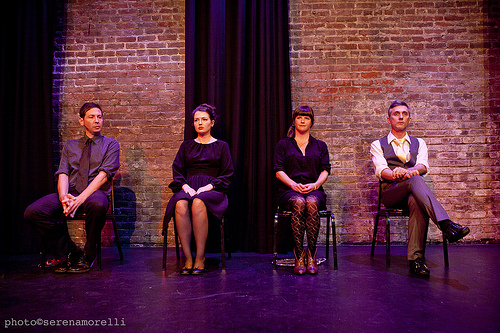
Schwartz’s Lenz remix comes across as an alternately cool and hyperactive investigation of the essence of melodrama, employing a fast-changing four-person ensemble (Nathan Tucker, Margery Fairchild, Ryan Hayes, Meg Hurtado) in a series of scenes shorn of their immediate context and aggregated under various section headings (“Love,” “Tricks,” “Sorrow,” etc.) The subheads are called out by Schwartz, seated at a table to the left of the stage calmly scrutinizing the action, asking the lighting booth for the odd musical interlude (MC5 one minute, Brahms the next), and bouncing his palm lightly on a desk bell to trigger the beginning and the end of each scene. These range widely and wildly, making for a raucous but tonally patchy hour. The broadest and subtlest range of characters comes from Tucker and Fairchild, who between them suggest some of the darker elements otherwise left out of a largely comic romp. But if the show leaves one wanting more complexity and shading, its eccentric enterprise is still worth a stab, as they say.

Finally, San Francisco dancer and performance maker Cara Rose DeFabio’s admirable solo strikes its own idiosyncratic tone, or rather many of them, in another intriguing investigation, this time of the online afterlife to which we are all increasingly subject — whether willingly or not. After the Tone is a smart and provoking exploration of the intersections of grief, technology, memory, ideology, and individuality that uses DeFabio’s sly narrative persona, movement, video, and audio pastiche, and interactive audience participation (via those celebrated and hated cellphones) to productively turn over a subject too close to most of us to be clearly grasped otherwise.

SAN FRANCISCO FRINGE FESTIVAL
Through Sept. 21, $12.99 or less
Exit Theatreplex
156 Eddy, SF
www.sffringe.org

Pumped up

3

marke@sfbg.com

ON THE MOVE The epic Pacific Crest Trail winds 2,650 miles from Mexico to Canada, through sun-roasted desert expanse and snow-covered mountain pass, past rushing waterfalls and over wildflower-studded Alpine plateau, roughly tracing the Sierras and Cascades, always out of sight of civilization. It takes most hikers roughly half a year to make the whole trip, an isolating, immersive communion with nature that foregrounds self-reliance, endurance, and more than a little ingenuity when it comes to where you’re going to sleep and what you’re going to eat.

On June 21, Alex Falcioni, a massage therapist and teacher, took to the 1,230-mile leg of the trail running from Tuolumne Meadow, Yosemite, to Portland. In high heels.

“I’d always dreamed of doing the trail — but the most I could take off would be three months, so I knew I couldn’t do the whole thing” he told me over a “beat-up” phone from Ashland, hitchhiking his way back to the Bay Area after completing his high-heeled hike on Aug. 31st at Cascade Locks, Ore. “And then I heard that my dear friend Sarah had been diagnosed with multiple sclerosis and was having trouble covering her medical bills, so I decided to make the hike a fundraiser.

“I needed a gimmick, though, to draw attention. And that’s where the pumps came in — it really just came to me one day. I’d start in Yosemite, and wear the pumps to Portland. Mostly for the alliteration, ha ha.”

Falcioni’s project, Pumps 2 Portland, was partly inspired by Hiking26, a 2012 performance art piece by Ron Ulrich, who completed the entire PCT wearing 26 wedding dresses along the way. So far, Falcioni has managed to raise over $2,500. (Interested parties can still donate and read firsthand about Falcioni’s adventures at www.pumps2portland.com.)

The first obvious question: What kind of pumps were they? “Oh, a strappy white pair of size-12 slingbacks from a drag queen shoe store. They’re completely destroyed,” Falcioni said. “My toes look like little Vienna sausages. But my calves are rocks.”

The second obvious question: Come on, did he really wear high heels the whole time?

Falcioni laughs. “No way! There are ascents up to 10,000 feet and sometimes I felt afraid for my life in hiking shoes. Plus, often ‘trail’ is a relative word — it’s not like clicking down a paved sidewalk. But I wore them when I could, and I strapped them on my backpack for all the other hikers to see when I couldn’t.

“They were there to keep me inspired and add a little spark when the trail got so monotonous it was like sensory deprivation — like, ‘if I see another Ponderosa pine I’m going to go insane!'” With the heels it all became a outdoor runway.

“The pumps really opened doors, too,” Falcioni continued. “People I’d encounter on the trail would ask about them and that would help along a conversation. Or when I’d go into town… One of the ways you survive the trail is to mail food ahead for yourself. (You learn little tricks, like mixing spicy ramen with a spoonful of peanut butter equals Thai food!) So I’d have to go down into towns to pick that up, and I hadn’t bathed in a week — same shirt, same pants, covered in dirt and smoke. But showing off these huge pumps.

“That not only got the attention of the Trail Angels — people who dedicate themselves to opening their homes and helping out PCT hikers — but of random strangers, too. I made so many real friendships, had so many actual conversations about real things in these places of enormous beauty. Not to mention some free showers.

“It was an incredible experience to just put yourself out there at the mercy of nature, other people, and even yourself. I’d urge anyone to do it, giant man-heels or no.”

Nevertheless: Hey, Rupaul — I think we have your next location for Drag Race.

Live Shots: Asteroid #4 and the Richmond Sluts at Brick and Mortar Music Hall

0

By Brittany M. Powell

Brick and Mortar Music Hall may have had some noise complaint troubles with the San Francisco Sound Commission earlier this summer, but that hasn’t kept the venue or Kymberli Jenson, of Kymberli’s Music Box Presents, from putting on great shows.  Last Saturday’s bill included the Asteroid #4 and the Richmond Sluts. It was a handful of loud rock’n’roll bands that blasted us back through the decades with sounds echoing 1960s and ‘70s psychedelia and punk, but also hints of the late ‘90s and early 2000s , when these bands were fresh on the music scene. 

They’ve all been around the block, or as frontperson-guitarist Scott Vitt of the Asteroid #4 put it, these are all “old heads” and “mainstays” at this point.

The Asteroid #4, which recently transplanted to the Bay Area from Philadelphia, released its first EP in 1995.  Its music is a blend of classic psychedelic rock, with a little melodic folk and shoe gaze tremor, and strong influences from late ‘60s psych rock bands like Love, and early ‘90s British bands like Spacemen 3. 

When I asked Vitt how he felt living in California was influencing his band’s sound, he responded, “living and breathing the natural beauty, the mountains, the forests and, of course, the ocean, first-hand, I think it’ll be very evident on our next record that we’ve become a California band.”

And the group sounded plenty at home on Saturday night, as if the packed music hall was its own cozy living room. The set was vibrant and full of the precise kinds of melodies and riffs that can only come from a band that’s been playing together as long as it has — and is more than comfortable in its own skin. When asked about this, Vitt quoted Miles Davis, “you have to play a long time to be able to play like yourself.”

The Asteroid #4’s set included personal favorites, “Hold On,” which seems to have a Brian Jonestown Massacre influence, “The Unknown,” and “I Want to Touch You,” a Catharine Wheel cover.  For the final song, Joel Gion of BJM joined the band on stage for “Into the Meadow.”

After the Asteroid #4, the Richmond Sluts went on, which was an excellent transition into an upbeat set closing out the night.

The Richmond Sluts formed in 1998, in the Richmond District. Imagine the NY Dolls on LSD, with a little bit of the Cramps and the Rolling Stones thrown in to keep it both weird and glammy. I have vague memories of hearing this band play at a few parties back in the day, but I have to say I don’t remember it sounding nearly as tight as it did the other night.

Frontperson Shea Roberts also looks nothing like the Stiv Baters (of the Dead Boys) gaunt 20-year-old look-alike I remember either. While the Sluts don’t really have the same excuse for playing trashy, angsty, garage rock about sex, drugs, and rock’n’roll as their post-pubescent selves did back in the late ‘90s, it doesn’t really matter, cause their talent has matured enough to take the material to whole other level. 

Said Shea, “I know some of the lyrics are a little goofy sometimes and the stuff I’m writing now tends to be a bit more serious…but they were all sparked by some emotion I was feeling at the time and I’m OK with that.  Maybe we shouldn’t take ourselves so seriously.”

We shouldn’t.  Not when we can rock out to music like this to keep it in perspective. 

Their set included tracks like “Sweet Something,” “Sad City,” and “Paddy Wagon” off their 2001 self-titled release. Shea says that he hopes to keep playing with the new Sluts and that’s the plan “until it’s not fun anymore.”

Hormone replacement therapy and video games: Anna Anthropy talks Dy5phoria

2

Video games go to alien worlds all the time, but rarely have they explored a transgender person’s identity until Dys4ia. The 2012 Adobe Flash game traced designer Anna Anthropy’s hormone replacement therapy journey, guiding the player through trying on women’s clothing for the first time, dealing with the agony of shaving, and correcting all the people who call you “sir” instead of “ma’am.”

Anthropy was kind enough to let the Guardian interview her in her Oakland home, dodge her energetic cats, and record an audio interview where she walks us through her new game, Dy5phoria, the new chapter and pseudo-sequel to Dys4ia. You can also read a selection from the audio interview below. 

SF Bay Guardian How do you pronounce the new title? 

Anna Anthropy I’ve been calling it Dys-five-ia out loud, but it’s spelled like Dys4ia with a 5 instead of an S. 

SFBG You’re hitting steam now with added content, can you tell us what’s new?

AA Dys4ia is made up of four chapters which represent different times in my life when I was starting to go on hormone replacement therapy. Dy5phoria which will come with Dys4ia is a fifth chapter that follows what’s happened in my life since the place Dys4ia ended.

SFBG Not quite a sequel but downloadable content?

AA Like a fifth chapter, if you will. 

Listen to the full 26 minute interview in the Sound Cloud file above.

SFBG Can you talk about what seperated it from mainstream games?

AA Oh god I’m so sick of talking about Dys4ia, but I will! It’s essentially a collection of short fast scenes, kind of like Wario Ware, that represents the different facets of what happened to me in this part of my life. The frustrations of dealing with gatekeepers and being misgendered. It’s also about the moments of beauty and hope that reassure me that things maybe are getting closer to how I want them to be in my life.

SFBG What were those moments of hope?

AA One of the things that happens to me in Dys4ia is my tits get bigger, and that was nice.

One of the things in Dy5phoria that has changed is the ways I’ve externalized my femininity more and felt prettier and better about being a girl. It was important that mixed in the bullshit I put in the reasons about why this is important to me.

SFBG Can you talk about how Dy5phoria is different than what came before it?

AA In Dys4ia the avatars in the scenes are really inconsistent. Depending on the context I might be a blobby stick figure, or a shield, a razor, a little munchy thing depending on the experience. My body was going through flux at the time, it made sense for the game to represent that by not having a consistent avatar. In Dy5phoria all the levels have a consistent avatar that look like me and who I’ve become comfortable being.

There’s a different motif in the game, there’s some consistency now, some sort of permanence.

SFBG There’s an 8-bit retro style right? It’s like an NES game.

AA Kind of. I don’t want it to be Nintendo retro because I think thats twee and bad, I think that’s overused.

SFBG Omni retro?

AA Sure.

SFBG Tell me where you are in development and what you’re doing today.

AA My process for this game is that every day I sit down and do a single scene. The one I’m working on today is about painting my nails, and the ways I’ve found to externalize my femininity more. The level is just that: a hand with a nail polish brush. Its just that.You paint my nails, and then its over.

Nails painted in screenshot of Dy5phoria

SFBG Well thats the power of videogames right? You carry out the narrative act, as opposed to simply watching it. You mentioned the TSA level earlier. What happened to you and what’s the problem making that read well?

AA There’s a level in Dy5phoria when I was groped by the TSA at the airport. The way that big horrible scanning thing works is there’s a button with a female and a male button. I’ve had it go either way. This particular time I got scanned as male. On the screen parts of me came up as suspicious areas, and there on the screen there were squares around my tits.

My tits came up as an anomaly, and this guy (security) was obliged to grope my breasts. I’m attempting to translate this to a scene in Dy5phoria. I don’t think it’s reading as well as it could because it’s a bit too complicated. 

SFBG Do you think your game designer chops have improved since you did Dys4ia?

AA It’s more like my interests have changed. I’m a lot less interested in making digital games than I used to be. I’ve sort of been envisioning what a fifth chapter of Dys4ia would look like, but when the opportunity came I’m actually more interested in board games than sitting down and coding a game. This is the last game I want to code myself, but I kind of have to because Dys4ia is all mine, all my project. This is kind of a closing of the book for me, in a lot of ways. 

SFBG So you’ll never do digital games again?

AA It’s not that I won’t do digital games again, I’m actually announcing a new game at Indiecade. I just don’t want to do the programming myself. I’ve always learned the coding I needed to do, a mish mash. That’s why I work on Twine games because I don’t have to do any coding. Dy5phoria will be the last project I’ll code myself but it won’t be my last digital game.

SFBG You mentioned you’re sick of talking about Dys4ia, but when I was at GaymerX I met this gal who recently transitioned her gender and was working at your workshop there. She has so completely totally inspired by you. You should have seen her face.

AA I did in fact see her face, she came up to my autograph session, and told me the game was meaningful. Those comments make me feel really good. I’m sick of answering questions about Dys4ia but I’m not sick of hearing it means something to people. That’s why I do anything, I want to make things that will actually connect with people. She told me and other people have told me Dys4ia gave her the confidence to make the decision to start going on hormones.

Hormones have been positioned as the central experience of being trans, which I don’t think is good, because there are trans people who don’t go on hormones. But for those people that are thinking of going on hormones is I hoped Dys4ia would give some sense about what that would be like an the challenges and really really nice things of being on hormones would be like. If it has done that for people I feel accomplished in that regard. 

SFBG And it seems sometimes you’re at the center to this kind of very indie, very LGBT conscious, very different game movement that seems to be happening a lot here in the Bay Area and other places as well. Can you talk about what’s bringing the rise of that about?

AA I think what’s important to outsiders of the mainstream game industry that the industry is mostly pitching to straight cis males. I think what’s making it possible for people to participate are tools like Twine, a hypertext tool where only recently people started realizing they could use it to make games.

Because the tool is so simple if you’re capable of writing you’re capable of making a game with Twine. You can make almost journal style, personal games. There are a lot more autobiographical games coming out with this tool.

The industry is spending millions to make games, they don’t have the liberty to make something risky and personal and weird. If something takes a few hours to make or a few days or a week, you can make what you want.

These avenues of gaming that are barred to queer and marginalized people, people who are barred from making games in this sexist, cisnormative tech culture have found an avenue in making games in Twine and other free game tools. There are avenues for making games for people who the industry don’t think are its mainstream. 

D5phoria is due out on Steam in the fall. You can play the first in the series, Dys4ia, here

Snap Sounds

0


KING KRULE  

6 FEET BENEATH THE MOON

(TRUE PANTHER/XL, AUG. 26)

Archy “King Krule” Marshall may look like a callow school-kid, dressed up in his father’s suit, but the South Londoner has the soul and voice of a wise, world-weary bluesman three times his senior. 6 Feet Beneath the Moon — his long-awaited debut LP — is an astonishing achievement, displaying Marshall’s nuanced storytelling, exceptional jazz-based guitar work, and versatility. Over the album’s 14 tracks, he weaves affecting tales of urban ennui, malaise, and disaffection, balanced by fleeting moments of ardent love and nostalgic surrender. Though he wears his influences on his ill-fitting sleeve (Drury, Strummer, Morrissey, Dilla), the finished article sounds like nothing else out now — with dark wave, blues, punk, indie, and electro all thrown into the mix. It is all filtered through Marshall’s singular lens and mature perspective, creating a fresh, cohesive sound while painting an engulfing portrait of his London. — Daniel Alvarez


BELLE AND SEBASTIAN

THE THIRD EYE CENTRE

(MATADOR RECORDS, AUG. 27)

Belle and Sebastian, ’90s twee sweethearts, are at it again — kind of. This time, the band is serving the general public a tray of audible assorted snacks featuring b-sides from the latter half of its career. Dubbed The Third Eye Centre, no song sounds the same — one track will boast a rockabilly twang (“Last Trip”) and another will be a previously unreleased remix of fan-favorite “Your Cover’s Blown (Miaoux Miaoux Remix).” It’s a solid album, but it’s easy to suss out the dated songs, such as “Suicide Girl,” an anxious love song about the object of singer-guitarist Stuart Murdoch’s affections, an alternative girl that wants him to take nudes of her for the famed early-2000s “punky” soft-core porn site of the same name. But in all, the fun of The Third Eye Centre is getting the chance to hear songs you may have not had the chance to listen to from the back end of Belle and Sebastian’s jam-packed catalog. — Erin Dage


KING KHAN & THE SHRINES

IDLE NO MORE

(MERGE, SEPT. 3)

For those who have oft pondered “What if a soul band and a Southern rock group got together and made sweet, beautiful music?” weirdo psychedelic soul band King Khan & the Shrines has the answer with its latest release, Idle No More. Featuring dancey soul numbers like “Luckiest Man,” Stooges-esque songs such as “Thorn in Her Pride,” ditties with ’60s girl group-esque guest spot vocals like “Pray for Lil” — Idle No More combines many genres and musical elements to form a cohesive, well produced album. The album can easily be separated into three acts: dance numbers, slow-ballad interlude, and soul revival resolution. Six years have passed since previous album, What Is!?, and Idle No More has definitely been worth the wait. — Dage


CHELSEA WOLFE

PAIN IS BEAUTY

(SARGENT HOUSE, SEPT. 3)

There’s always been this brutal, animalistic thread woven throughout Chelsea Wolfe’s output, and Pain is Beauty is no exception. The LA-via-Sacramento artist’s otherworldly vocals tend often to translate into a wild creature elegantly whipping through a foggy forest. (Indeed, Wolfe described her newest LP as a “love-letter to nature.”) Her powerful soprano hollers are matched to ethereal whispery echoes, maintaining a balance between lightness and darkness, which has become a common theme in her work, as it is in nature. And this vocal balance is a mainstay in Wolfe’s music, no matter what’s backing it instrumentally. Her previous release, 2012’s Unknown Rooms: A Collection of Acoustic Songs, was, obviously, acoustic, but the sparse record is still deeply unsettling. With Pain is Beauty, the singer-songwriter returns to a darker, grittier sound. And yet, there’s a more electronic twist on her early doomy experimental guitarwork (as with breakout 2011 record Apokalypsis), bursting with both synths and strings this time, without missing the black-hearted emotional core rooted in all living things. — Emily Savage


JOANNA GRUESOME

WEIRD SISTER

(SLUMBERLAND, SEPT. 10)

Jangly noisepop cacophony with pro-feminist and anti-homophobia lyrics — this Cardiff band’s debut full-length, Weird Sister, hits all the right hot spots and makes them tingle. Plus there’s the name, Joanna Gruesome, a cheeky play on a gentle fellow musician. But Weird Sister speaks for itself, with standout tracks like opener “Anti Parent Cowboy Killers” matching dissonant guitars and pounding drums with lovely melodious vocals that rise into screams at the hook, akin to the Vaselines in bed with L7. There’s also classic K Records-evoking twee ode “Wussy Void,” and jagged noiseball “Graveyard,” which starts off with what sounds like helium seeping out of a balloon. The record includes songs from a 2011 EP, “Sugarcrush,” “Madison,” and “Candy,” further deepening the getting-to-know-you state of the Welsh quintet, a group to which you do need to start paying attention. —Savage


Elegant alchemy

0

cheryl@sfbg.com

MUSIC Though San Francisco musician Jill Tracy is deeply fond of the macabre, “gloomy” is not an accurate word to describe her personality. The day I speak to her, she’s in exceptionally high spirits, having just wrapped up a hugely successful Kickstarter campaign.

“It’s really special to feel like it’s a big group effort,” she says. The funds will help complete a pair of videos lensed by Jeremy Carr, who directed Tracy in the 2006 thriller Ice Cream Ants. Appropriately, key scenes were filmed on a spooky night in Red Hook, Brooklyn — former ‘hood of horror author H.P. Lovecraft.

“[Carr] wanted to shoot me walking through these mysterious alleyways, but there was this sudden, intense thunderstorm. Hail coming down the size of golf balls, flooding — it was so dangerous it was like, how are we gonna do this?” she recalls. “But the universe intervened, and the rain finally tapered off. And it was so gorgeous, because there was still lightning in the sky. A lot of that will be kept in the video.”

Also caught on tape was intervention of another kind. “At one point there was this glowing amber light swirling around. I look over — and it was the cops, wondering what we were up to,” she says. “They were really nice and let us keep going, and it turned out that they were responsible for the most beautiful shot.”

Happy accidents, strange coincidences, unexplained phenomena: These are all things the composer-singer-pianist welcomes with delight. Her distinctive sound — she’s often described as a “neo-cabaret artist” — sparked a recent twist of fate, when Showtime contacted her about using a song to promote the final season of Dexter.

“That came out of the blue,” she says. “They said, ‘We think that your music would be perfect for this.’ That’s when being an independent musician is a great thing — because I own my song and my publishing. They just have to contact me and I can give permission [to use it].”

She continues. “I didn’t know what they were going to do with the song. I was so excited — are they just gonna use five seconds of it? But it ended up that it’s almost like a music video. I sing, ‘I’ll tie you up,’ and you see [star] Michael C. Hall tying up a body! I was really thrilled with what they did.”

It’s a testament to Tracy’s unique style that the Dexter song, “Evil Night Together,” dates back to her 1999 sophomore album, Diabolical Streak. (Her diverse discography also includes 2002’s Into the Land of Phantoms, a score for 1922 silent film Nosferatu; and last year’s holiday-themed Silver Smoke, Star of Night.)

“I strive for timelessness in my music,” Tracy says, noting that the Dexter exposure made some listeners assume that “Night” was a brand-new song. “It meant a lot to me because that’s [my intention], that it could be played at any time and still sound unique.”

Without trends to guide her, Tracy has sought inspiration elsewhere. After years of incorporating on-the-spot compositions (she calls it “spontaneous musical combustion”) into her live shows, she had an idea: why not test the vibes at a more off-kilter venue? At one memorable gig, both performer and audience experienced something … extraordinary.

“I was in Victoria, BC at Craigdarroch Castle, which is supposedly haunted,” she says. “At one point, someone in the audience is like, ‘Look at that lamp!’ And this old, brocade-shaded lamp had just started to flicker. So who knows! Strange things will happen like that.”

Tracy’s repertoire also includes “musical séances,” in which audience members bring in objects of personal significance to help her channel music. Along with violinist Paul Mercer, she hosted one such event earlier this year in Los Angeles, “at the mansion of a murderer from the 19th century.” (Clearly, she ain’t no fraidy-cat.) She’s hosted similar events at the Conservatory of Flowers in Golden Gate Park.

“We did a beautiful night tour of the Conservatory, followed by a performance,” she says. “People bring these items — we’ve had everything from cremated remains, to antlers, to a toothbrush. Swords! Haunted portraits! It’s almost like Antiques Roadshow for the netherworld. But the one thing I’ve learned through all of this is that every object, every place, and every person has a story to tell that will break your heart.”

Some of her most memorable tales come courtesy of the Mütter Museum, a medical-oddities collection that’s part of the College of Physicians of Philadelphia. She’s the first musician to receive a grant to compose inside the museum.

“This whole project is, like, the total goth girl dream come true,” Tracy laughs. “I was able to spend nights alone in the museum, writing music among the collection, and I just fell in love with the place. You look around, and you see all these skeletons and specimens in jars, but you don’t realize at first that these were all lives — brave souls who endured these rare afflictions, many of which you never see today. I was so moved, and I wanted to know their stories.”

Not only did the museum allow Tracy overnight access, it also let her do research in its library. She hopes to to spend the next year transforming her Mütter encounters — with subjects like conjoined twins Chang and Eng, and “Ossified Man” Harry Eastlack — into an album as well as an accompanying storybook. “It will probably be the biggest project that I’ve done to date,” she says. “It’s been almost like an excavation, digging into this information and creating pieces to honor these individuals. I want to give emotional context to the people in the collection.”

With all of her site-specific events and ongoing endeavors — in brief: a perfume line; a 7-inch split with Blixa Bargeld based on the writings of a 19th century Polish occultist; a set at Sat/7’s “ManulFest” benefit for wild cats held at a temple in Geyserville; a speaking engagement at LA’s Death Salon later this fall — it’s advisable for SF fans to hit up Café du Nord for what’s becoming an increasingly rare rock-club gig.

“I’m doing fewer shows at places like the du Nord, because I want to do more of a theatrical performance,” she says. “Today, my work is all about honoring the mystery, the beauty, and the romance of the dark side. I strive to transport people into what I refer to as ‘the elegant netherworld,’ and I find that music, that emotion, creates the portal for you to go there. Doing what I do, I feel like kind of a gatekeeper to this other place.”

JILL TRACY

With This Way to Egress and Vagabondage

Sun/8, 7:30pm, $12

Café du Nord

2170 Market, SF

www.cafedunord.com


Sublime nonsense: extended interview with Wet the Hippo’s John Gilkey

5

Note: this is an extended version of an interview that appears in this week’s paper.
 
The sets are gone, and the costumes, and that giant blue-and-yellow tent. Master clown and performance maker John Gilkey has ended his fourth stint with Cirque du Soleil since 1996. But if the wiry, often wild-haired Gilkey and his Muppet-like mug are no strangers to the big time, they move just as ferociously through a bare stage in a small venue wearing not much more than, these days, a bushy beard.
 
It’s been three years since Gilkey last performed in San Francisco — flanked by comedians Alec Jones-Trujillo and Donny Divanian, the deadpan naïfs of his avant-comedy trio, We Are Nudes. Just as the very funny yet vaguely unnerving, off-center style of Nudes occupied some indeterminate territory between sketch comedy and Dadaist destruction, Gilkey’s latest venture — the Los Angeles–based eight-member improvisational ensemble known as Wet the Hippo — takes its audience beyond the usual endpoints of improv.


Born out of his Idiot Workshop classes in clown, Wet the Hippo is a big brand new baby of a beast, only four months old but charging forward with gusto — and an edgy, searching brilliance Gilkey is clearly thrilled with. He is frankly in love with his cast members, with whom Gilkey interacts as director, prodding them from onstage and off. Ahead of their first tentative tour (a three-stop zero-budget swing through Arcata, Placerville, and San Francisco), Gilkey picked up the phone from his LA roost to talk Hippo-thetically.
 
SF Bay Guardian Wet the Hippo is quite a change from Cirque du Soleil, more low-to-the-ground, very much autonomous.
 
John Gilkey Yeah, what we’re doing now — there’s eight of us, there’s no budget. Yeah. Low-to-the-ground is a good way to put it.
 
SFBG It’s a big contrast, but maybe there are similarities?
 
JG One way I describe the show: I’m taking everything I learned from Cirque about the creation process they have — although I should be clear about that: The creation process changed after Franco [Dragone] left. But when Franco was still there. And also when I was on Franco’s creative team for [his independent Las Vegas spectacular] Le Rêve — I’ve taken that process and I’ve applied that to this ten-dollar-a-ticket show with eight people. It’s an amazing contrast. And in some ways it’s quite similar. When I’m working with the performers, I work with them similarly to Franco in that he’s trying really to get to the nut of the person. His number one question is, “Who are you?” He’s trying to figure out what is it about this person that’s interesting. Their strengths, their weaknesses, their physicality, their voice, all this stuff — how can we magnify this person into an interesting stage presence?

I do that with my little cast here. It’s why I’ll do things like try to play with the juxtapositions — surreal qualities that Franco looks for, taking things that don’t belong together and squishing them together, layering the mise-en-scène, so you’ve got different things going on. Things that if you don’t hit it just right they conflict or distract. But if you get it just right, in the pocket, somehow they’ll come together into a holistic focus.
 
SFBG It’s an improvised show, but it’s clearly not the Harold — or other improv forms we’re familiar with.
 
JG It’s something new that we’re trying to do, so we’re learning about it, discovering it as we go forward, as we search. It’s an evolving process. But what I’m looking for as the director, both offstage and onstage — or the conductor/director when I’m onstage — is to try to get everybody buzzing, ringing, in tune, and then see how they harmonize. I think when we hit, it is music. It’s on a level you can’t quite put into words. This is when we succeed. We don’t always succeed. Part of the show is us searching for that, which is also fun. We play a lot with success and failure. When we’re failing we try to really make sure that we acknowledge it and somehow use it to our advantage.
 
SFBG How can failure work to your advantage?
 
JG One thing we’re discovering is that the highs aren’t as high if the lows aren’t as low. So that’s one reason to fail. And I tell people when we’re rehearsing or in the classes that I teach (all of this came out of these classes): This is the spirit of clown. You’re always looking to get yourself into danger. You want to be in danger. That’s where the drama really comes. Instead of pretending, we try to really get into danger.
 
SFBG It seems that really good clown toys with disaster, really, or death, ultimately. It’s horror and laughter at once in the face of mortal truth.
 
JG Yeah, absolutely death. There’s this beautiful book, I don’t know if you ever read it, The Death and Resurrection Show. It’s out of print. You sometimes can get it online for like 200 bucks. Rogan Taylor. Anyway, his thought is that all modern entertainment can be traced back to early shamanism, to healers, and that even many modern performers have gone through something like the shaman’s journey. In fact, it’s the same as the hero’s journey — you get taken away from the place you know, you get torn asunder, you go through this process of learning how to put yourself back together, then you go back to this place that you’re originally from, and you share what you’ve learned. You learn about Charlie Chaplin growing up poor and unhealthy and having to survive that kind of childhood, and then anything that he creates is infused with those lessons he learned.

So death is always a part of it. We talk about dying onstage, when we’re doing comedy. It’s super visceral. We want to touch people on as many levels as we can.
 
SFBG In the show, you’re onstage and off as the director-conductor, prodding people. Where has that come from? Your work with Franco? Your work in the Idiot Workshop?
 
JG Yes, exactly. It’s inspired by my work with Franco and how Franco worked with the performers in Cirque. In turn, I think Franco got a lot of inspiration from working with guys like Philippe Gaulier, who was originally a teacher at the [École Jacques Lecoq] in Paris, and eventually went off on his own. He and Lecoq and this guy Pierre Byland were all credited with developing the modern clown form. So to be fair, Franco was heavily influenced by that. We, influenced by Franco, were in class and in rehearsals really trying to push the performers into the place where they don’t want to be — again, getting back to this danger and death idea. It’s that that’s where they become vulnerable, and that’s when you really see who they are.

So in rehearsals we often talked about am I going to be part of it, or do we get rid of me before we go onstage? As things developed, we [found] that with me there we could get into more danger — because I could help us get out of it. And I could push the performers into danger by being onstage. Also it just added a weird, wild element that was hard to define for the public. It kept the questions going, which felt engaged. There’s no fourth wall, so we want the public always to be engaged. When they’re not, that’s when we’re done.

In fact, all of the performers, except for the musician, have a fair amount of improv experience. And they’ve all felt limited by improv, because despite what it sounds like, there’s a lot of structure in improv. In terms of rules, but there’s also an imposed structure in terms of how you play as an actor, what’s accepted and what’s not. If you go too far, you freak out your fellow performers. So you have to stay in a particular window of commitment. There are certain emotional colors that you can share, and certain colors that you can’t, because otherwise you just freak people out and they don’t know how to follow you.

But we push to real extremes. I think that’s one of the things that makes us kind of special, that there’s this trust among us. We can go super far and the other [actor] can match us, no matter how far we go. We challenge each other with that.
 
SFBG This reminds me of a solo piece of yours, the one where you’re running in slow motion to a swelling score and you get shot down, and you get back up and get shot down again, and it goes on and on and on. It’s hilarious, at first, and then it’s something else, something more. You pass through the laughter to a mixture of horror and beauty.
 
JG Right. And that’s our goal. We want to find those moments. And we realize that to do that we have to push super far. It’s like when sense becomes nonsense, but somehow makes more sense. Earlier, in the beginning of the conversation, we were saying it becomes musical when we’re hitting. That musical quality is the sublime, another way to say it. It’s resonating on so many levels that we’re not quite sure; we’re not accustomed to processing it emotionally.
 
SFBG This is an exploration that goes beyond the usual endpoints — something riskier, unknown?
 
JG In standard improv, in standard comedy, you’re going for the laugh, always. I believe there’s something that is greater than the laugh. Maybe the easiest way to say it is that it’s the sublime. And the way to get to the sublime is to ask an actor to play at their most genius level—either absolute smartest or absolute stupidest. It’s not a linear progression from stupid to genius; it’s circular. It’s where they meet. It’s where the genius in you meets the idiot in you that you become so beautiful that you hit sublime. It’s beyond laughter. It’s the moment where you get your mind blown.
 
WET THE HIPPO

Mon/26-Tue/27, 7:30pm, $10 (advance tickets here)

Venue TBD (“Look for the skinny violinist at 22nd St and Valencia at 7:30pm; you will be escorted to the venue from there”), SF

www.wetthehippo.com

Film Listings: August 21 – 27, 2013

0

Film listings are edited by Cheryl Eddy. Reviewers are Kimberly Chun, Dennis Harvey, Lynn Rapoport, and Sara Maria Vizcarrondo. For rep house showtimes, see Rep Clock.

OPENING

Ain’t Them Bodies Saints See “Lone Stars.” (1:45) California, Smith Rafael.

Austenland Jane (Keri Russell) is a Jane Austen fanatic who finds real-life modern romance highly lacking as compared to the fictive Regency Era variety — though having a life-sized cutout of Colin Firth as Mr. Darcy in her bedroom surely didn’t help recent relationships. After yet another breakup, she decides to live her fantasy by flying to England to vacation at the titular theme park-fantasy role play establishment, where guests and staff meticulously act out Austen-like scenarios of well-dressed upper class leisure and chaste courtship. Upon arriving, however, Jane discovers she’s very much a second-class citizen here, not having been able to afford the “platinum premium” package purchased by fellow guests. Thus cast by imperious proprietor Mrs. Wattlesbrook (Jane Seymour) as the unmarriageable “poor relation,” she gets more flirtatious vibes from the actor cast as sexy stable boy (Bret McKenzie) than the one playing a quasi-Darcy (JJ Feild), at least initially. Adapting Shannon Hale’s novel, Jerusha Hess (making her directorial bow after several collaborations with husband Jared Hess, of 2004’s Napoleon Dynamite) has delightfully kitsch set and costume designs and a generally sweet-natured tone somewhat let down by the very broad, uninspired humor. Even wonderful Jennifer Coolidge can’t much elevate the routine writing as a cheerfully vulgar Yank visitor. The rich potential to cleverly satirize all things Austen is missed. Still, the actors are charming and the progress lively enough to make Austenland harmless if flyweight fun. (1:37) Albany, SF Center, Sundance Kabuki. (Harvey)

Cutie and the Boxer See “Scenes from a Marriage.” (1:22) Opera Plaza, Shattuck.

Long Distance Revolutionary: A Journey with Mumia Abu-Jamal Or, almost everything you ever wanted to know about the guy who inspired all those “Free Mumia” rallies, though Abu-Jamal’s status as a cause célèbre has become somewhat less urgent since his death sentence — for killing a Philadelphia police officer in 1981 — was commuted to life without parole in 2012. Stephen Vittoria’s doc assembles an array of heavy hitters (Alice Walker, Giancarlo Esposito, Cornel West, Angela Davis, Emory Douglas) to discuss Abu-Jamal’s life, from his childhood in Philly’s housing projects, to his teenage political awakening with the Black Panthers, to his career as a popular radio journalist — aided equally by his passion for reporting and his mellifluous voice. Now, of course, he’s best-known for the influential, eloquent books he’s penned since his 1982 incarceration, and for the worldwide activists who’re either convinced of his innocence or believe he didn’t receive a fair trial (or both). All worthy of further investigation, but Long Distance Revolutionary is overlong, fawning, and relentlessly one-sided — ultimately, a tiresome combination. (2:00) Roxie. (Eddy)

The Mortal Instruments: City of Bones Lily Collins stars as a teen who discovers her supernatural powers in this adaptation of Cassandra Clare’s YA fantasy novel. (2:00) Shattuck.

The World’s End The final film in Edgar Wright’s “Blood and Ice Cream Trilogy” finally arrives, and the TL:DR version is that while it’s not as good as 2004’s sublime zombie rom-com Shaun of the Dead, it’s better than 2007’s cops vs. serial killers yarn Hot Fuzz. That said, it’s still funnier than anything else in theaters lately. Simon Pegg returns to star and co-write (with Wright); this time, the script’s sinister bugaboo is an invasion of body snatchers — though (as usual) the conflict is really about the perils of refusing to actually become an adult, the even-greater perils of becoming a boring adult, and the importance of male friendships. Pegg plays rumpled fuck-up Gary, determined to reunite with the best friends he’s long since alienated for one more crack at their hometown’s “alcoholic mile,” a pub crawl that ends at the titular beer joint. The easy chemistry between Pegg and the rest of the cast (Nick Frost, Paddy Considine, Martin Freeman, and Eddie Marsan) elevates what’s essentially a predictable “one crazy night” tale, with a killer soundtrack of 1990s tunes, slang you’ll adopt for your own posse (“Let’s Boo-Boo!”), and enough hilarious fight scenes to challenge This is the End to a bro-down of apocalyptic proportions. (1:49) (Eddy)

You’re Next The hit of the 2011 Toronto Film Festival’s midnight section — and one that’s taken its sweet time getting to theaters — indie horror specialist (2010’s A Horrible Way to Die, 2007’s Pop Skull, 2012’s V/H/S) Adam Wingard’s feature isn’t really much more than a gussied-up slasher. But it’s got vigor, and violence, to spare. An already uncomfortable anniversary reunion for the wealthy Davison clan plus their children’s spouses gets a lot more so when dinner is interrupted by an arrow that sails through a window, right into someone’s flesh. Immediately a full on siege commences, with family members reacting with various degrees of panic, selfishness. and ingenuity, while an unknown number of animal-masked assailants prowl outside (and sometimes inside). Clearly fun for its all-star cast and crew of mumblecore-indie horror staples, yet preferring gallows’ humor to wink-wink camp, it’s a (very) bloody good ride. (1:36) (Harvey)

ONGOING

The Act of Killing What does Anwar Congo — a man who has brutally strangled hundreds of people with piano wire — dream about? As Joshua Oppenheimer’s Indonesia-set documentary The Act of Killing discovers, there’s a thin line between a guilty conscience and a haunted psyche, especially for an admitted killer who’s never been held accountable for anything. In fact, Congo has lived as a hero in North Sumatra for decades — along with scores of others who participated in the country’s ruthless anti-communist purge in the mid-1960s. In order to capture this surreal state of affairs, Oppenheimer zeroes in on a few subjects — like the cheerful Congo, fond of flashy clothes, and the theatrical Herman Koto — and a method, spelled out by The Act of Killing‘s title card: “The killers proudly told us stories about what they did. To understand why, we asked them to create scenes in whatever ways they wished.” Because Congo and company are huge movie buffs, they chose to recreate their crimes with silver-screen flourish. There are costumes and gory make-up. There are props: a stuffed tiger, a dummy torso with a detachable head. There are dancing girls. Most importantly, however, there are mental consequences, primarily for Congo, whose emotional fragility escalates as the filming continues — resulting in an unforgettable, at-times mind-blowing viewing experience. (1:55) Smith Rafael. (Eddy)

Adjust Your Tracking: The Untold Story of the VHS Collector Dan M. Kinem and Levi Peretic’s documentary peeks into the tidy lairs of borderline hoarders (all horror and genre fans) who oversee their massive VHS collections with a mixture of pride, good-natured defensiveness, and culty spirit. A few celebrities drop by (Troma’s Lloyd Kaufman admits he prefers DVDs “because of the extras”), but this is mostly regular-dude turf, with a home-video history lesson (“Blockbuster ruined it for everybody”) mixed into the nostalgia. High points include extended discussions of “VHS covers that lie to you,” as in, when box artwork promises wonders that aren’t actually in the film; and of Tales from the Quadead Zone, a (terrible) film so exquisitely rare it sparked an eBay bidding war and inspired at least one tattoo. (1:24) Balboa. (Eddy)

The Artist and the Model The horror of the blank page, the raw sensuality of marble, and the fresh-meat attraction of a new model — just a few of the starting points for this thoughtful narrative about an elderly sculptor finding and shaping his possibly finest and final muse. Bedraggled and homeless beauty Mercè (Aida Folch) washes up in a small French town in the waning days of World War II and is taken in by a kindly woman (Claudia Cardinale), who seems intent on pleasantly pimping her out as a nude model to her artist husband (Jean Rochefort). As his former model, she knows Mercè has the type of body he likes — and that she’s capable of restoring his powers, in more ways than one, if you know what I mean. Yet this film by Fernando Trueba (1992’s Belle Époque) isn’t that kind of movie, with those kinds of models, especially when Mercè turns out to have more on her mind than mere pleasure. Done up in a lustrous, sunlit black and white that recalls 1957’s Wild Strawberries, The Artist and the Model instead offers a steady, respectful, and loving peek into a process, and unique relationship, with just a touch of poetry. (1:41) Opera Plaza. (Chun)

The Attack After an explosion in Tel Aviv kills 17, respected surgeon Amin Jaafari (Ali Suliman of 2005’s Paradise Now) — an Palestinian with Israeli citizenship, who deflects moments like a bleeding man on his operating table gasping, “I want another doctor!” with a certain amount of practiced detachment — is called to ID a body nestled in the morgue of his hospital. It’s his wife, Siham (Reymonde Amsellem, seen in flashbacks) — the apparent suicide bomber. Amin can’t believe it, but Israeli officers sure do, and the doctor is interrogated for hours about his wife’s alleged terrorist leanings and her suspicious behavior in the days leading up to the attack. When Siham’s involvement in the bombing is confirmed, Amin visits family in the West Bank, intent on discovering more about her secret fundamentalism and answering one simple question: “Why?” Emotions and tension run high as he digs into a world that’s been carefully constructed to keep unsympathetic parties from obtaining access. Lebanese-born director Ziad Doueiri, directing from a script he co-wrote from the 2008 novel by Yasmina Khadra (former Algerian army major Mohammed Moulessehoul, who wrote under his wife’s name to evade military censorship), delivers a suspenseful tale that offers new perspective on the Palestine-Israel divide. (1:42) Vogue. (Eddy)

Blue Jasmine The good news about Blue Jasmine isn’t that it’s set in San Francisco, but that it’s Woody Allen’s best movie in years. Although some familiar characteristics are duly present, it’s not quite like anything he’s done before, and carries its essentially dramatic weight more effectively than he’s managed in at least a couple decades. Not long ago Jasmine (a fearless Cate Blanchett) was the quintessential Manhattan hostess, but that glittering bubble has burst — exactly how revealed in flashbacks that spring surprises up to the script’s end. She crawls to the West Coast to “start over” in the sole place available where she won’t be mortified by the pity of erstwhile society friends. That would be the SF apartment of Ginger (Sally Hawkins), a fellow adoptive sister who was always looked down on by comparison to pretty, clever Jasmine. Theirs is an uneasy alliance — but Ginger’s too big-hearted to say no. It’s somewhat disappointing that Blue Jasmine doesn’t really do much with San Francisco. Really, the film could take place anywhere — although setting it in a non-picture-postcard SF does bolster the film’s unsettled, unpredictable air. Without being an outright villain, Jasmine is one of the least likable characters to carry a major US film since Noah Baumbach’s underrated Margot at the Wedding (2007); the general plot shell, moreover, is strongly redolent of A Streetcar Named Desire. But whatever inspiration Allen took from prior works, Blue Jasmine is still distinctively his own invention. It’s frequently funny in throwaway performance bits, yet disturbing, even devastating in cumulative impact. (1:38) Metreon, 1000 Van Ness. (Harvey)

The Conjuring Irony can be so overrated. Paying tribute to those dead-serious ’70s-era accounts of demonic possession — like 1973’s The Exorcist, which seemed all the scarier because it were based on supposedly real-life events — the sober Conjuring runs the risk of coming off as just more Catholic propaganda, as so many exorcism-is-the-cure creepers can be. But from the sound of the long-coming development of this project — producer Tony DeRosa-Grund had apparently been wanting to make the movie for more than a dozen years — 2004’s Saw and 2010’s Insidious director James Wan was merely applying the same careful dedication to this story’s unfolding as those that came before him, down to setting it in those groovy VW van-borne ’70s that saw more families torn apart by politics and cultural change than those ever-symbolic demonic forces. This time, the narrative framework is built around the paranormal investigators, clairvoyant Lorraine Warren (Vera Farmiga) and demonologist Ed Warren (Patrick Wilson), rather than the victims: the sprawling Perron family, which includes five daughters all ripe for possession or haunting, it seems. The tale of two families opens with the Warrens hard at work on looking into creepy dolls and violent possessions, as Carolyn (Lili Taylor) and Roger Perron (Ron Livingston) move into a freezing old Victorian farmhouse. A very eerie basement is revealed, and hide-and-seek games become increasingly creepy, as Carolyn finds unexplained bruises on her body, one girl is tugged by the foot in the night, and another takes on a new invisible pal. The slow, scary build is the achievement here, with Wan admirably handling the flow of the scares, which go from no-budg effects and implied presences that rely on the viewer’s imagination, to turns of the screws that will have audiences jumping in their seats. Even better are the performances by The Conjuring‘s dueling mothers, in the trenches of a genre that so often flirts with misogyny: each battling the specter of maternal filicide, Farmiga and Taylor infuse their parts with an empathetic warmth and wrenching intensity, turning this bewitched horror throwback into a kind of women’s story. (1:52) 1000 Van Ness, SF Center. (Chun)

Despicable Me 2 The laughs come quick and sweet now that Gru (Steve Carell) has abandoned his super-villainy to become a dad and “legitimate businessman” — though he still applies world-class gravitas to everyday events. (His daughter’s overproduced birthday party is a riot of medieval festoonage.) But like all the best reformed baddies, the Feds, or in this case the Anti-Villain League, recruit him to uncover the next international arch-nemesis. Now a spy, he gets a goofy but highly competent partner (Kristen Wiig) and a cupcake shop at the mall to facilitate sniffing out the criminal. This sequel surpasses the original in charm, cleverness, and general lovability, and it’s not just because they upped the number of minion-related gags, or because Wiig joined the cast; she ultimately gets the short end of the stick as the latecomer love-interest (her spy gadgets are also just so-so). However, Carell kills it as Gru 2 — his faux-Russian accent and awkward timing are more lived-in. Maybe the jokes are about more familiar stuff (like the niggling disappointments of family life) but they’re also sharper and more surprising. And though the minions seemed like one-trick ponies in the first film, those gibberish-talking jellybeans outdo themselves in the sequel’s climax. (1:38) SF Center. (Vizcarrondo)

Drug War The sleek, gloomy Drug War is the latest from Hong Kong’s Johnnie To — a director who needs no introduction for fans of his prolific output (2001’s Fulltime Killer, 2005’s Election, 2006’s Exiled, 2009’s Vengeance). Unlike To’s previous crime dramas, Drug War was shot in mainland China, where heavy-handed censors rule. According to the film’s press notes, To decided “nobody will disagree with the idea of arresting drug dealers,” particularly in a country fond of imposing death sentences for drug-related offenses. The tactic appears to have worked, since this thing’s dripping with vicious shootouts — even as it subtly points out China’s surveillance-state abundance of CCTV cameras, and examines how just far criminals will go to avoid those draconian punishments. Timmy Choi (Louis Koo), for one, is terrified of execution. Busted for manufacturing meth after his factory explodes, Timmy runs up against Captain Zhang (Sun Honglei), a no-nonsense drug cop who reluctantly takes on a new informant with the goal of busting a kingpin higher up the cartel’s chain of command. Timmy’s a slippery character whose motivations remain murky right up until the last act; it’s all Zhang can do to keep up, which he does for the most part. In one incredible sequence, the cop pretends to be Chang, a taciturn junkie accompanying Timmy for a meeting with the flashy “Haha,” named for his staccato laugh. With a quick wardrobe change and seconds to spare, Zhang then morphs into Haha to meet with the real Chang. In the process, tiny cameras are deployed, drugs are snorted, and loyalties are stretched razor-thin. It’s a tour de force — yet remarkably unforced — moment for both actor and director. (1:45) Metreon. (Eddy)

Elysium By the year 2154, the one percent will all have left Earth’s polluted surface for Elysium, a luxurious space station where everyone has access to high-tech machines that can heal any wound or illness in a matter of seconds. Among the grimy masses in burned-out Los Angeles, where everyone speaks a mixture of Spanish and English, factory worker Max (Matt Damon) is trying to put his car-thief past behind him — and maybe pursue something with the childhood sweetheart (Alice Braga) he’s recently reconnected with. Meanwhile, up on Elysium, icy Secretary of Defense Delacourt (Jodie Foster, speaking in French and Old Hollywood-accented English) rages against immigration, even planning a government takeover to prevent any more “illegals” from slipping aboard. Naturally, the fates of Max and Delacourt will soon intertwine, with “brain to brain data transfers,” bionic exo-skeletons, futuristic guns, life-or-death needs for Elysium’s medical miracles, and some colorful interference by a sword-wielding creeper of a sleeper agent (Sharlto Copley) along the way. In his first feature since 2009’s apartheid-themed District 9, South African writer-director Neill Blomkamp once again turns to obvious allegory to guide his plot. If Elysium‘s message is a bit heavy-handed, it’s well-intentioned, and doesn’t take away from impressive visuals (mercifully rendered in 2D) or Damon’s committed performance. (2:00) Balboa, Metreon, 1000 Van Ness, Sundance Kabuki. (Eddy)

Europa Report Directed by Ecuador’s Sebastián Cordero (2004’s Crónicas), deep-space tale Europa Report benefits from its interesting international cast, including Michael Nyqvist (Mikael Blomkvist in the Swedish Girl With a Dragon Tattoo series); Romanian Anamaria Marinca (2007’s 4 Months, 3 Weeks and 2 Days); Bay Area-born Daniel Wu, who’s a megastar in Hong Kong; and South African Sharlto Copley, also in concurrent sci-fi release Elysium. Together, they comprise the bulk of a crew crammed into an elegant ship bound for Europa, a moon of Jupiter that may have water — and therefore, life — beneath its icy surface. These journeys never end well, do they? As we’re told by grim-faced Dr. Unger (Embeth Davidtz), what we’re watching has been pieced together from “recently declassified footage” — and yes, that makes Europa Report yet another “found-footage” movie. At this point, it’s a stale way to tell a story, though it’s mostly plausible in this case; time-stamped scenes are cut together from multiple cameras mounted aboard the spacecraft, plus some astronaut helmet-cam shots. From the start, we know the mission is doomed. But even if its conclusion is a little abrupt and dissatisfying, at least Europa Report heaps on the claustrophobic atmosphere while rocketing toward the inevitable. (1:30) Opera Plaza. (Eddy)

Fruitvale Station By now you’ve heard of Fruitvale Station, the debut feature from Oakland-born filmmaker Ryan Coogler. With a cast that includes Academy Award winner Octavia Spencer and rising star Michael B. Jordan (The Wire, Friday Night Lights), the film premiered at the 2013 Sundance Film Festival, winning both the Audience Award and the Grand Jury Prize en route to being scooped up for distribition by the Weinstein Company. A few months later, Coogler, a USC film school grad who just turned 27, won Best First Film at Cannes. Accolades are nice, especially when paired with a massive PR push from a studio known for bringing home little gold men. But particularly in the Bay Area, the true story behind Fruitvale Station eclipses even the most glowing pre-release hype. The film opens with real footage captured by cell phones the night 22-year-old Oscar Grant was shot in the back by BART police, a tragedy that inspired multiple protests and grabbed national headlines. With its grim ending already revealed, Fruitvale Station backtracks to chart Oscar’s final hours, with a deeper flashback or two fleshing out the troubled past he was trying to overcome. Mostly, though, Fruitvale Station is very much a day in the life, with Oscar (Jordan, in a nuanced performance) dropping off his girlfriend at work, picking up supplies for a birthday party, texting friends about New Year’s Eve plans, and deciding not to follow through on a drug sale. Inevitably, much of what transpires is weighted with extra meaning — Oscar’s mother (Spencer) advising him to “just take the train” to San Francisco that night; Oscar’s tender interactions with his young daughter; the death of a friendly stray dog, hit by a car as BART thunders overhead. It’s a powerful, stripped-down portrait that belies Coogler’s rookie-filmmaker status. (1:24) Metreon, 1000 Van Ness, Sundance Kabuki. (Eddy)

Hannah Arendt New German Cinema’s Margarethe von Trotta (1975’s The Lost Honor of Katharina Blum, 1986’s Rosa Luxemburg) delivers this surprisingly dull biopic about the great German-Jewish political theorist and the heated controversy around her New Yorker article (and subsequent book) about Israel’s 1961 trial of Nazi Adolph Eichmann. Played with dignified, slightly vulnerable countenance by the inimitable Barbara Sukowa, Arendt travels from her teaching job and cozy expat circles in New York to Jerusalem for the trial. There she comes face to face with the “banality of evil” in Eichmann, the petty careerist of the Holocaust, forcing her to “try and reconcile the shocking mediocrity of the man with his staggering deeds.” This led her to further insights into the nature of modern society, and triggered a storm of outrage and vitriol — in particular from the Commentary crowd of future neocons — all of which is clearly of relevance today, and the impetus for von Trotta’s revisiting this famous episode. But the film is too mannered, too slick, too formulaic —burdened by a television-friendly combination of posture and didacticism, and bon mots from famous and about famous figures in intellectual and literary history to avoid being leaden and tedious. A mainstream film, in other words, for a very unconventional personality and dissident intellectual. While not exactly evil, there’s something dispiriting in so much banality. (1:49) Smith Rafael. (Robert Avila)

The Heat First things first: I hated Bridesmaids (2011). Even the BFF love fest between Maya Rudolph and Kristen Wiig couldn’t wash away the bad taste of another wolf pack in girl’s clothing. Dragging and dropping women into dude-ly storylines is at best wonky and at worst degrading, but The Heat finds an alternate route. Its women are unlikable; you don’t root for them, and you’re not hoping they become princesses because such horrifying awkwardness can only be redeemed by a prince. In Bridesmaids and Heat director Paul Feig’s universe, friendship saves the day. Sandra Bullock is Murtaugh to Melissa McCarthy’s Riggs, with tidy Bullock angling for a promotion and McCarthy driving a busted hoopty through Boston like she’s in Grand Theft Auto. Circumstances conspire to bring them together on a case, in one of many elements lifted from traditional buddy-cop storylines. But! The jokes are constant, pelting, and whiz by like so much gunfire. In one running gag, a low-rung villain’s worst insult is telling the women they look old — but neither character is bothered by it. It’s refreshing to see embarrassment humor, so beloved by chick flicks, get taken down a peg by female leads who don’t particularly care what anyone thinks of them. (1:57) Castro. (Vizcarrondo)

The Hunt Mads Mikkelsen has the kind of face that is at once strikingly handsome and unconventional enough to get him typecast in villain roles. Like so many great foreign-accented actors, he got his big international break playing a bad guy in a James Bond film — as groin-torturing gambler Le Chiffre in 2006 franchise reviver Casino Royale. Currently, he’s creeping TV viewers out as a young Dr. Lecter on Hannibal. His ability to evoke both sympathy and a suspicion of otherness are particularly well deployed in Thomas Vinterberg’s very Danish The Hunt, which won Mikkelsen the Best Actor prize at Cannes last year. He plays Lucas, a lifelong small-town resident recently divorced from his son’s mother, and who currently works at the local kindergarten. One day one of his charges says something to the principal that suggests Lucas has exposed himself to her. Once the child’s misguided “confession” is made, Lucas’ boss immediately assumes the worst. She announces her assumptions at a parent-teachers meeting even before police can begin their investigation. By the time they have, the viral paranoia and suggestive “questioning” of other potential victims has created a full-on, massive pederasty scandal with no basis in truth whatsoever. The Hunt is a valuable depiction of child-abuse panic, in which there’s a collective jumping to drastic conclusions about one subject where everyone is judged guilty before being proven innocent. Its emotional engine is Lucas’ horror at the speed and extremity with which he’s ostracized by his own community — and its willingness to believe the worst about him on anecdotal evidence. Engrossing, nuanced, and twisty right up to the fade-out, The Hunt deftly questions one of our era’s defining public hysterias. (1:45) Smith Rafael. (Harvey)

In a World… (1:33) Sundance Kabuki.

Jobs With the upcoming Aaron Sorkin adaptation of Walter Isaacson’s biography nipping at its heels, Jobs feels like a quickie — true to Silicon Valley form, someone realized that the first to ship can end up defining the market. But as this independent biopic goes for each easy cliché and facile cinematic device, you can practically hear Steve Jobs himself spinning in the ether somewhere. Ashton Kutcher as Jobs lectures us over and over again about the virtues of quality product, but little seemed to have penetrated director Joshua Michael Stern as he distracts with a schmaltzy score (he should have stuck to Bob Dylan, Joe Walsh, and era-defining AOR), and relies on corny slow-motion to dramatize the passing of a circuit board. The fact that Kutcher might be the best thing here — he clearly throws himself into impersonating the Apple icon, from his intense, upward-glancing glare to his hand gestures — says a bit about the film itself, as it coasts on its self-made man-captain of enterprise narrative arc. Dispensing with much about the man Jobs became outside of Apple, apart from a few nods to his unsavory neglect of friends and offspring, and simply never acknowledging his work at, say, Pixar, Jobs, in the end, comes off as a lengthy infomercial for the Cupertino heavyweight. (2:02) 1000 Van Ness, SF Center, Sundance Kabuki. (Chun)

Kick-Ass 2 Even an ass-kicking subversive take on superherodom runs the risk of getting its rump tested, toasted, roasted — and found wanting. Too bad the exhilaratingly smarty-pants, somewhat mean-spirited Kick-Ass (2010), the brighter spot in a year of superhero-questioning flicks (see also: Super), has gotten sucker-punched in all the most predictable ways in its latest incarnation. Dave, aka Kick-Ass (Aaron Taylor-Johnson), and Mindy, otherwise known as Hit-Girl (Chloë Grace Moretz), are only half-heartedly attempting to live normal lives: they’re training on the sly, mostly because Mindy’s new guardian, Detective Marcus Williams (Morris Chestnut), is determined to restore her childhood. Little does he realize that Mindy only comes alive when she pretends she’s battling ninjas at cheerleader tryouts — or is giving her skills a workout by unhanding, literally and gleefully, a robber. Kick-Ass is a little unnerved by her semi-psychotic enthusiasm for crushing bad guys, but he’s crushing, too, on Mindy, until Marcus catches her in the Hit-Girl act and grounds her in real life, where she has to deal with some really nasty characters: the most popular girls in school. So Kick-Ass hooks up with a motley team of would-be heroes inspired by his example, led Colonel Stars and Stripes (an almost unrecognizable Jim Carrey), while old frenemy Chris, aka Red Mist (Christopher Mintz-Plasse) begins to find his real calling — as a supervillain he dubs the Motherfucker — and starts to assemble his own gang of baddies. Unlike the first movie, which passed the whip-smart wisecracks around equally, Mintz-Plasse and enabler-bodyguard Javier (John Leguizamo) get most of the choice lines here. Otherwise, the vigilante action gets pretty grimly routine, in a roof-battling, punch-’em-up kind of way. A romance seems to be budding between our two young superfriends, but let’s skip part three — I’d rather read about it in the funny pages. (1:43) 1000 Van Ness, SF Center. (Chun)

Lee Daniels’ The Butler (1:53) Balboa, 1000 Van Ness, SF Center, Sundance Kabuki.

Pacific Rim The fine print insists this film’s title is actually Warner Bros. Pictures and Legendary Pictures Pacific Rim (no apostrophe, guys?), but that fussy studio demand flies in the face of Pacific Rim‘s pursuit of pure, dumb fun. One is tempted to picture director/co-writer Guillermo del Toro plotting out the battle scenes using action figures — Godzillas vs. Transformers is more or less what’s at play here, and play is the operative word. Sure, the end of the world seems certain, thanks to an invading race of giant “Kaiju” who’ve started to adapt to Earth’s decades-long countermeasures (giant robot suits, piloted by duos whose minds are psychically linked), but there’s far too much goofy glee here for any real panic to accumulate. Charlie Hunnam is agreeable as the wounded hunk who’s humankind’s best hope for salvation, partnered with a rookie (Rinko Kikuchi) who’s eager, for her own reasons, to kick monster butt. Unoriginal yet key supporting roles are filled by Idris Elba (solemn, ass-kicking commander); Charlie Day (goofy science type); and Ron Perlman (flashy-dressing, black-market-dealing Kaiju expert). Pacific Rim may not transcend action-movie clichés or break much new ground (drinking game idea: gulp every time there’s an obvious reference or homage, be it to Toho or Bruckheimer), but damn if it doesn’t pair perfectly with popcorn. (2:11) Metreon, 1000 Van Ness. (Eddy)

Paranoia (1:46) Metreon, 1000 Van Ness.

Percy Jackson: Sea of Monsters (1:46) 1000 Van Ness, SF Center.

Planes Dane Cook voices a crop duster determined to prove he can do more than he was built for in Planes, the first Disney spin-off from a Pixar property. (Prior to the film’s title we see “From The World of Cars,” an indicator the film is an extension of a known universe — but also not quite from it.) And indeed, Planes resembles one of Pixar’s straight-to-DVD releases as it struggles for liftoff. Dreaming of speed, Dusty Crophopper (Cook) trains for the Wings Around the World race with his fuel-truck friend, Chug (Brad Garrett). A legacy playing Brewster McCloud and Wilbur Wright makes Stacy Keach a pitchy choice for Skipper, Dusty’s reluctant ex-military mentor. Charming cast choices buoy Planes somewhat, but those actors are feathers in a cap that hardly supports them — you watch the film fully aware of its toy potential: the race is a geography game; the planes are hobby sets; the cars will wind up. The story, about overcoming limitations, is in step with high-value parables Pixar proffers, though it feels shallower than usual. Perhaps toys are all Disney wants — although when Ishani (a sultry Priyanka Chopra) regrets an integrity-compromising choice she made in the race, and her pink cockpit lowers its eyes, you can feel Pixar leaning in. (1:32) Metreon, 1000 Van Ness. (Vizcarrondo)

Portrait of Jason Nearly half a century ago, Shirley Clarke’s documentary “portrait” of one rather flaming real-life personality — not just gay, but African American, too — seemed unprecedentedly exotic. The latest in Milestone Films’ “Project Shirley” series of restored Clarke re-releases, Portrait of Jason can’t be experienced that way now. Any surviving exoticism is now related to the subject’s defining a certain pre Stonewall camp persona, and the movie’s reflecting a 1960s cinema vérité style of which its director was a major proponent. The setup couldn’t be simpler: we spend 12 hours in the company of Jason Holliday, née Aaron Payne. Or rather, Clarke and her then-partner, actor Carl Lee, spend those hours — from 9 pm to 9 am — with Jason, while we get a 107-minute distillation. Nattily attired, waving a cigarette around while downing an epic lineup of cocktails, Jason is a natural performer who relishes this filmic showcase as “my moment.” No matter what, he says, he will now “have one beautiful something that is my own.” At first Clarke and Lee simply let him riff, prompting him to speak calculated outrages they’ve probably already heard. (“What do you do for a living, Jason?” “I’m a … I’m a stone whore. And I’m not ashamed of it.”) He’s indeed the life of his own party — increasingly smashed as wee hours encroach in Clarke’s Chelsea Hotel room — but there’s a certain desperation to this act that she and particularly Lee eventually pounce on. “Nervous and guilty and simple as I am,” Jason’s braggadocio camouflages a self-loathing he’s just as willing to expose. When actual tears-of-a-clown are shed, the filmmakers seem cruel. Still, the “portrait” is incomplete — Clarke and Lee don’t press their subject to explicate the past spousal abuse, suicide attempt, and “nuthouse” and jail stays he drops into conversation as casually as he mentions a friendship with Miles Davis. (1:47) Roxie. (Harvey)

Prince Avalanche It has been somewhat hard to connect the dots between David Gordon Green the abstract-narrative indie poet (2000’s George Washington, 2003’s All the Real Girls) and DGG the mainstream Hollywood comedy director (2008’s Pineapple Express, yay; 2011’s Your Highness and The Sitter, nay nay nay). But here he brings those seemingly irreconcilable personas together, and they make very sweet music indeed. Paul Rudd and Emile Hirsch play two men — one a fussy, married grown-up, another a short-attention-spanned manchild — spending the summer in near-total isolation, painting yellow divider lines on recently fire-damaged Texas roads. Their very different personalities clash, and at first the tone seems more conventionally broad than that of the 2011 Icelandic minimalist-comedy (Either Way) this revamp is derived from. But Green has a great deal up his sleeve — gorgeous widescreen imagery, some inspired wordless montages, and a well-earned eventual warmth — that makes the very rare US remake that improves upon its European predecessor. (1:34) Roxie. (Harvey)

Red 2 Are blockbusters entitled to senior moments? Even the best can fail the test — and coast along on past glories on their way to picking up their checks — as Red 2 makes the fatal error of skimping on the grunt work of basic storytelling to simply take up where the first installment on these “retired, extremely dangerous” ex-black ops killers left off. Master hitman Frank (Bruce Willis) and his girlfriend Sarah (Mary-Louise Parker) are semi-contentedly nesting in suburbia when acid-damaged cohort Marvin (John Malkovich) warns them that they’re about to get dragged back into the life. Turns out the cold war isn’t quite as iced out as we all thought, and a portable nuclear device, the brainchild of a physicist (Anthony Hopkins) once in Frank and Marvin’s care, just might be in Moscow. Good-old-days-style high jinks ensue, along with the arrival of old chums like Victoria (Helen Mirren), former flames such as Katja (Catherine Zeta-Jones), and new-gen assassins like Han (Byung-hun Lee). Plus, jet-setting, and the deaths of many, many nameless soldiers, goons, and Iranian embassy staffers (almost all played for laughs, as cued by the comic book-y intertitles). A pity that the thrown-together-ish, throwback story line — somewhat reminiscent of those trashy, starry ’60s clusters, like the original 1960 Ocean’s Eleven — lazily relies on the assumption that we care a jot about the Frank and Sarah romance (the latter now an stereotypically whiny quasi-spouse) and that Frank can essentially talk any killer into joining him out of, er, professional courtesy or basic human decency. Wasting the thoroughbred cast on hand, particularly in the form of Mirren and Hopkins, one wishes the makers had only had the professional courtesy not to phone this effort in. (1:56) Metreon. (Chun)

The Smurfs 2 (1:45) Metreon.

The Spectacular Now The title suggests a dreamy, fireworks-inflected celebration of life lived in the present tense, but in this depiction of a stalled-out high school senior’s last months of school, director James Ponsoldt (2012’s Smashed) opts for a more guarded, uneasy treatment. Charming, likable, underachieving, and bright enough to frustrate the adults in his corner, Sutter (Miles Teller, 2012’s Project X) has long since managed to turn aimlessness into a philosophical practice, having chosen the path of least resistance and alcohol-fueled unaccountability. His mother (Jennifer Jason Leigh), raising him solo since the departure of a father (Kyle Chandler) whose memories have acquired — for Sutter, at least — a blurry halo effect, describes him as full of both love and possible greatness, but he settles for the blessings of social fluidity and being an adept at the acquisition of beer for fellow underage drinkers. When he meets and becomes romantically involved with Aimee (Shailene Woodley), a sweet, unpolished classmate at the far reaches of his school’s social spectrum, it’s unclear whether the impact of their relationship will push him, or her, or both into a new trajectory, and the film tracks their progress with a watchful, solicitous eye. Adapted for the screen by Scott Neustadter and Michael H. Weber (2009’s 500 Days of Summer) from a novel by Tim Tharp, The Spectacular Now gives the quirky pop cuteness of Summer a wide berth, steering straight into the heart of awkward adolescent striving and mishap. (1:35) SF Center, Sundance Kabuki. (Rapoport)

This Is the End It’s a typical day in Los Angeles for Seth Rogen as This Is the End begins. Playing a version of himself, the comedian picks up pal and frequent co-star Jay Baruchel at the airport. Since Jay hates LA, Seth welcomes him with weed and candy, but all good vibes fizzle when Rogen suggests hitting up a party at James Franco’s new mansion. Wait, ugh, Franco? And Jonah Hill will be there? Nooo! Jay ain’t happy, but the revelry — chockablock with every Judd Apatow-blessed star in Hollywood, plus a few random inclusions (Rihanna?) — is great fun for the audience. And likewise for the actors: world, meet Michael Cera, naughty coke fiend. But stranger things are afoot in This Is the End. First, there’s a giant earthquake and a strange blue light that sucks passers-by into the sky. Then a fiery pit yawns in front of Casa Franco, gobbling up just about everyone in the cast who isn’t on the poster. Dudes! Is this the worst party ever — or the apocalypse? The film — co-written and directed by Rogen and longtime collaborator Evan Goldberg — relies heavily on Christian imagery to illustrate the endtimes; the fact that both men and much of their cast is Jewish, and therefore marked as doomed by Bible-thumpers, is part of the joke. But of course, This Is the End has a lot more to it than religious commentary; there’s also copious drug use, masturbation gags, urine-drinking, bromance, insult comedy, and all of the uber-meta in-jokes fans of its stars will appreciate. (1:46) 1000 Van Ness. (Eddy)

20 Feet From Stardom Singing the praises of those otherwise neglected backup vocalists who put the soul into that Wall of Sound, brought heft to “Young Americans,” and lent real fury to “Gimme Shelter,” 20 Feet From Stardom is doing the rock ‘n’ roll true believer’s good work. Director Morgan Neville follows a handful of mainly female, mostly African American backing vocal legends, charts their skewed career trajectories as they rake in major credits and keep working long after one-hit wonders are forgotten (the Waters family) but fail to make their name known to the public (Merry Clayton), grasp Grammy approval yet somehow fail to follow through (Lisa Fischer), and keep narrowly missing the prize (Judith Hill) as label recording budgets shrivel and the tastes, technology, and the industry shift. Neville gives these industry pros and soulful survivors in a rocked-out, sample-heavy, DIY world their due on many levels, covering the low-coverage minis, Concert for Bangladesh high points, gossipy rumors, and sheer love for the blend that those intertwined voices achieve. One wishes the director had done more than simply touch in the backup successes out there, like Luther Vandross, and dug deeper to break down the reasons Fischer succumbed to the sophomore slump. But one can’t deny the passion in the voices he’s chosen to follow — and the righteous belief the Neville clearly has in his subjects, especially when, like Hill, they are ready to pick themselves up and carry on after being told they’re not “the Voice.” (1:30) Smith Rafael. (Chun)

2 Guns Rob a bank of cartel cash, invade a naval base, and then throw down against government heavies — you gotta expect to find a few bullet-hole-sized gaps in the play-by-play of 2 Guns. The action flick is riddled with fun-sized pleasures — usually centered on the playful banter and effortless chemistry between stars Denzel Washington and Mark Wahlberg — and the clever knot of a narrative throws a twist or two in, before director Baltasar Kormákur (last year’s Wahlberg vehicle Contraband) simply surrenders to the tidal pull of action. After visiting Mexican mafia kingpin Papi (Edward James Olmos) and finding the head of their contact in a bag, Bobby (Washington) and Stig (Wahlberg) decide to hit Papi where he’ll feel it: the small border bank where his men have been making drops to safe deposit boxes. Much like Bobby and Stig’s breakfast-time diner gab fest, which seems to pick up where Vincent and Jules left off in Pulp Fiction (1994), as they trade barbs, truisms, and tells, there’s more going on than simply bank robbery foreplay. Both are involved for different reasons: Bobby is an undercover DEA agent, and Stig is a masquerading navy officer. When the payout is 10 times the expected size, not only do Papi, Bobby’s contact Deb (Paula Patton), and Stig’s superior Quince (James Marsden) come calling, but so does mystery man Earl (Bill Paxton), who seems to be obsessed with following the money. We know, sort of, what’s in it for Bobby — all fully identifiable charm, as befits Washington, who makes it rain charisma with the lightest of touches. But Stig? The others? The lure of a major payday is supposed to sweep away all other loyalties, except a little bromantic bonding between two rogue sharp shooters, saddled, unfortunately, with not the sharpest of story lines. (1:49) Metreon. (Chun)

The Way, Way Back Duncan (Liam James) is 14, and if you remember being that age you remember the awkwardness, the ambivalence, and the confusion that went along with it. Duncan’s mother (Toni Collette) takes him along for an “important summer” with her jerky boyfriend, Trent (Steve Carell) — and despite being the least important guy at the summer cottage, Duncan’s only marginally sympathetic. Most every actor surrounding him plays against type (Rob Corddry is an unfunny, whipped husband; Allison Janney is a drunk, desperate divorcee), and since the cast is a cattle call for anyone with indie cred, you’ll wonder why they’re grouped for such a dull movie. Writer-directors Nat Faxon and Jim Rash previously wrote the Oscar-winning screenplay for 2011’s The Descendants, but The Way, Way Back doesn’t match that film’s caliber of intelligent, dry wit. Cast members take turns resuscitating the movie, but only Sam Rockwell saves the day, at least during the scenes he’s in. Playing another lovable loser, Rockwell’s Owen dropped out of life and into a pattern of house painting and water-park management in the fashion of a conscientious objector. Owen is antithetical to Trent’s crappy example of manhood, and raises his water wing to let Duncan in. The short stint Duncan has working at Water Wizz is a blossoming that leads to a minor romance (with AnnaSophia Robb) and a major confrontation with Trent, some of which is affecting, but none of which will help you remember the movie after credits roll. (1:42) Metreon, Sundance Kabuki. (Vizcarrondo)

We’re the Millers After weekly doses on the flat-screen of Family Guy, Modern Family, and the like, it’s about time movieland’s family comedies got a little shot of subversion — the aim, it seems, of We’re the Millers. Scruffy dealer David (Jason Sudeikis) is shambling along — just a little wistful that he didn’t grow up and climb into the Suburban with the wife, two kids, and the steady 9-to-5 because he’s a bit lonely, much like the latchkey nerd Kenny (Will Poulter) who lives in his apartment building, and neighboring stripper Rose (Jennifer Aniston), who bites his head off at the mailbox. When David tries to be upstanding and help out crust punk runaway Casey (Emma Roberts), who’s getting roughed up for her iPhone, he instead falls prey to the robbers and sinks into a world of deep doo-doo with former college bud, and supplier of bud, Brad (Ed Helms). The only solution: play drug mule and transport a “smidge and a half” of weed across the Mexican-US border. David’s supposed cover: do the smuggling in an RV with a hired crew of randoms: Kenny, Casey, and Rose&sdquo; all posing as an ordinary family unit, the Millers. Yes, it’s that much of a stretch, but the smart-ass script is good for a few chortles, and the cast is game to go there with the incest, blow job, and wife-swapping jokes. Of course, no one ever states the obvious fact, all too apparent for Bay Area denizens, undermining the premise of We’re the Millers: who says dealers and strippers can’t be parents, decent or otherwise? We may not be the Millers, but we all know families aren’t what they used to be, if they ever really managed to hit those Leave It to Beaver standards. Fingers crossed for the cineplex — maybe movies are finally catching on. (1:49) Metreon, 1000 Van Ness, Sundance Kabuki. (Chun)

The Wolverine James Mangold’s contribution to the X-Men film franchise sidesteps the dizzy ambition of 2009’s X-Men Origins: Wolverine and 2011’s X-Men: First Class, opting instead for a sleek, mostly smart genre piece. This movie takes its basics from the 1982 Wolverine series by Chris Claremont and Frank Miller, a stark dramatic comic, but can’t avoid the convoluted, bad sci-fi plot devices endemic to the X-Men films. The titular mutant with the healing factor and adamantium-laced skeleton travels to Tokyo, to say farewell to a dying man who he rescued at the bombing of Nagasaki. But the dying man’s sinister oncologist has other plans, sapping Wolverine of his healing powers as he faces off against ruthless yakuza and scads of ninjas. The movie’s finest moments come when Mangold pays attention to context, taking superhero or Western movie clichés and revamping them for the modern Tokyo setting, such as a thrilling duel on top of a speeding bullet train. Another highlight: Rila Fukushima’s refreshing turn as badass bodyguard Yukio. Oh, and stay for the credits. (2:06) Metreon, 1000 Van Ness, Sundance Kabuki. (Sam Stander) *


Never enough hours in the weekend to see all these NEW MOVIES

0

Quite a few openings this week, although it seems like 10-plus new movies is becoming the norm these days. (At least there’s no big film festival to distract you from the regular ol’ cinema at the moment.) In the spirit of efficiency I did a combo-platter review of sci-fi chiller Europa Report; Johnnie To’s latest, Drug War; Tenebre, a 1982 Dario Argento giallo that’s screening at the Roxie tonight; and doc Adjust Your Tracking: The Untold Story of the VHS Collector, which plays the Balboa. Also at length, Dennis Harvey takes a look at Shirley Clarke’s freshly restored 1967 doc Portrait of Jason, also screening at the Roxie.

Ain’t enough for you? Read on for Kick-Ass 2, Jobs, and more on the week’s fresh crop of flicks.

http://www.youtube.com/watch?v=X7MdQjqRjyw

The Artist and the Model The horror of the blank page, the raw sensuality of marble, and the fresh-meat attraction of a new model — just a few of the starting points for this thoughtful narrative about an elderly sculptor finding and shaping his possibly finest and final muse. Bedraggled and homeless beauty Mercè (Aida Folch) washes up in a small French town in the waning days of World War II and is taken in by a kindly woman (Claudia Cardinale), who seems intent on pleasantly pimping her out as a nude model to her artist husband (Jean Rochefort). As his former model, she knows Mercè has the type of body he likes — and that she’s capable of restoring his powers, in more ways than one, if you know what I mean. Yet this film by Fernando Trueba (1992’s Belle Époque) isn’t that kind of movie, with those kinds of models, especially when Mercè turns out to have more on her mind than mere pleasure. Done up in a lustrous, sunlit black and white that recalls 1957’s Wild Strawberries, The Artist and the Model instead offers a steady, respectful, and loving peek into a process, and unique relationship, with just a touch of poetry. (1:41) (Kimberly Chun)

http://www.youtube.com/watch?v=0O7b4nTRy2A

Blue Exorcist: The Movie Though it’s spawned from Kazue Kato’s manga-turned-TV-series, familiarity with the source material is not necessary to enjoy Blue Exorcist: The Movie‘s supernatural charms. Set in True Cross Academy Town — named for the Hogwarts-ish school of exorcism at its center — the film opens with a folk tale about an adorable demon that wrecked an entire town by turning all of its inhabitants into lazy slackers. The creature was eventually captured, but nobody knows where it’s been hiding — until boyish exorcist-in-training Rin, half-demon himself, encounters a suspiciously adorable critter while chasing yet another demon, this one huge and prone to damaging city blocks (and cracking open things that should remain sealed in the process). Trouble ahead! Blue Exorcist does contain some yep-this-is-anime moments (there’s a powerful female exorcist … who wears a tiny bikini top that barely contains her enormous bazongas), but it’s mostly fun fantasy, with a sly sense of humor (“Let’s put a beatdown on these Tokyo demons!”) and some endearingly flawed heroes. (1:28) Four Star. (Cheryl Eddy)

http://www.youtube.com/watch?v=BpFNTvA93iY

In a World… Lake Bell (Childrens Hospital, How to Make It in America) writes, directs, and stars in this comedy about a women who sets her sights on a career in movie-trailer voiceovers. (1:33)

http://www.youtube.com/watch?v=3tDHH1eXKmA

Jobs With the upcoming Aaron Sorkin adaptation of Walter Isaacson’s biography nipping at its heels, Jobs feels like a quickie — true to Silicon Valley form, someone realized that the first to ship can end up defining the market. But as this independent biopic goes for each easy cliché and facile cinematic device, you can practically hear Steve Jobs himself spinning in the ether somewhere. Ashton Kutcher as Jobs lectures us over and over again about the virtues of quality product, but little seemed to have penetrated director Joshua Michael Stern as he distracts with a schmaltzy score (he should have stuck to Bob Dylan, Joe Walsh, and era-defining AOR), and relies on corny slow-motion to dramatize the passing of a circuit board. The fact that Kutcher might be the best thing here — he clearly throws himself into impersonating the Apple icon, from his intense, upward-glancing glare to his hand gestures — says a bit about the film itself, as it coasts on its self-made man-captain of enterprise narrative arc. Dispensing with much about the man Jobs became outside of Apple, apart from a few nods to his unsavory neglect of friends and offspring, and simply never acknowledging his work at, say, Pixar, Jobs, in the end, comes off as a lengthy infomercial for the Cupertino heavyweight. (2:02) (Kimberly Chun)

Kick-Ass 2 Even an ass-kicking subversive take on superherodom runs the risk of getting its rump tested, toasted, roasted — and found wanting. Too bad the exhilaratingly smarty-pants, somewhat mean-spirited Kick-Ass (2010), the brighter spot in a year of superhero-questioning flicks (see also: Super), has gotten sucker-punched in all the most predictable ways in its latest incarnation. Dave, aka Kick-Ass (Aaron Taylor-Johnson), and Mindy, otherwise known as Hit-Girl (Chloë Grace Moretz), are only half-heartedly attempting to live normal lives: they’re training on the sly, mostly because Mindy’s new guardian, Detective Marcus Williams (Morris Chestnut), is determined to restore her childhood. Little does he realize that Mindy only comes alive when she pretends she’s battling ninjas at cheerleader tryouts — or is giving her skills a workout by unhanding, literally and gleefully, a robber. Kick-Ass is a little unnerved by her semi-psychotic enthusiasm for crushing bad guys, but he’s crushing, too, on Mindy, until Marcus catches her in the Hit-Girl act and grounds her in real life, where she has to deal with some really nasty characters: the most popular girls in school. So Kick-Ass hooks up with a motley team of would-be heroes inspired by his example, led Colonel Stars and Stripes (an almost unrecognizable Jim Carrey), while old frenemy Chris, aka Red Mist (Christopher Mintz-Plasse) begins to find his real calling — as a supervillain he dubs the Motherfucker — and starts to assemble his own gang of baddies. Unlike the first movie, which passed the whip-smart wisecracks around equally, Mintz-Plasse and enabler-bodyguard Javier (John Leguizamo) get most of the choice lines here. Otherwise, the vigilante action gets pretty grimly routine, in a roof-battling, punch-’em-up kind of way. A romance seems to be budding between our two young superfriends, but let’s skip part three — I’d rather read about it in the funny pages. (1:43) (Kimberly Chun)

http://www.youtube.com/watch?v=9uBXH_DLxsU

Lee Daniels’ The Butler Forest Whitaker stars as the White House’s longtime butler in this based-on-a-true-story tale, with the added bonus of some creative POTUS casting (John Cusack as Richard Nixon; Alan Rickman as Ronald Reagan; Robin Williams as Dwight Eisenhower). (1:53)

http://www.youtube.com/watch?v=3-mO5AMZDMo

Paranoia A young go-getter (Liam Hemsworth) gets drawn into the world of corporate espionage thanks to a feud between evil tech billionaires (Harrison Ford and Gary Oldman). (1:46)

Bryan Batt at Society Cabaret in “Batt on a Hot Tin Roof”

0

Bryan Batt is most recently known for his two-time SAG Award winning performance as Salvatore Romano in AMC’s critically acclaimed series Mad Men which earned Emmys, Golden Globes, the SAG, and the Peabody award. As a Broadway veteran, Bryan’s leading and principal roles include: 2005 revival of La Cage Aux Folles, Beauty and the Beast, Sunset Blvd., Saturday Night Fever, The Scarlet Pimpernel, and Cats. Off Broadway: Forbidden Broadway (Drama Desk Nomination). Bryan also originated the role of Darius in the N.Y. and L.A. productions and the film adaptation of Paul Rudnick’s Jeffrey. Bryan tours his one-man show Batt on a Hot Tin Roof and will soon unveil an all-new concert. See more here.

August 15-17 at 8pm, with matinee at 4pm on August 17 @ Society Cabaret, Hotel Rex, 262 Sutter, SF CA | $40-$65

Film Listings: August 14 – 20, 2013

0

Film listings are edited by Cheryl Eddy. Reviewers are Kimberly Chun, Dennis Harvey, Lynn Rapoport, and Sara Maria Vizcarrondo. For rep house showtimes, see Rep Clock.

OPENING

Adjust Your Tracking: The Untold Story of the VHS Collector See “Midsummer Mayhem.” (1:24) Balboa.

The Artist and the Model The horror of the blank page, the raw sensuality of marble, and the fresh-meat attraction of a new model — just a few of the starting points for this thoughtful narrative about an elderly sculptor finding and shaping his possibly finest and final muse. Bedraggled and homeless beauty Mercè (Aida Folch) washes up in a small French town in the waning days of World War II and is taken in by a kindly woman (Claudia Cardinale), who seems intent on pleasantly pimping her out as a nude model to her artist husband (Jean Rochefort). As his former model, she knows Mercè has the type of body he likes — and that she’s capable of restoring his powers, in more ways than one, if you know what I mean. Yet this film by Fernando Trueba (1992’s Belle Époque) isn’t that kind of movie, with those kinds of models, especially when Mercè turns out to have more on her mind than mere pleasure. Done up in a lustrous, sunlit black and white that recalls 1957’s Wild Strawberries, The Artist and the Model instead offers a steady, respectful, and loving peek into a process, and unique relationship, with just a touch of poetry. (1:41) Opera Plaza. (Chun)

Blue Exorcist: The Movie Though it’s spawned from Kazue Kato’s manga-turned-TV-series, familiarity with the source material is not necessary to enjoy Blue Exorcist: The Movie‘s supernatural charms. Set in True Cross Academy Town — named for the Hogwarts-ish school of exorcism at its center — the film opens with a folk tale about an adorable demon that wrecked an entire town by turning all of its inhabitants into lazy slackers. The creature was eventually captured, but nobody knows where it’s been hiding — until boyish exorcist-in-training Rin, half-demon himself, encounters a suspiciously adorable critter while chasing yet another demon, this one huge and prone to damaging city blocks (and cracking open things that should remain sealed in the process). Trouble ahead! Blue Exorcist does contain some yep-this-is-anime moments (there’s a powerful female exorcist … who wears a tiny bikini top that barely contains her enormous bazongas), but it’s mostly fun fantasy, with a sly sense of humor (“Let’s put a beatdown on these Tokyo demons!”) and some endearingly flawed heroes. (1:28) Four Star. (Eddy)

Drug War See “Midsummer Mayhem.” (1:45) Four Star, Metreon.

Europa Report See “Midsummer Mayhem.” (1:30) Opera Plaza, Shattuck.

In a World… Lake Bell (Childrens Hospital, How to Make It in America) writes, directs, and stars in this comedy about a women who sets her sights on a career in movie-trailer voiceovers. (1:33) Shattuck.

Jobs Yep, it’s that biopic, in which Ashton Kutcher portrays Apple CEO Steve Jobs. (2:02) Presidio.

Kick-Ass 2 Hit-Girl (Chloë Grace Moritz) and company return in this sequel to the 2010 superhero hit. (1:43) California.

Lee Daniels’ The Butler Forest Whitaker stars as the White House’s longtime butler in this based-on-a-true-story tale, with the added bonus of some creative POTUS casting (John Cusack as Richard Nixon; Alan Rickman as Ronald Reagan; Robin Williams as Dwight Eisenhower). (1:53) Balboa, Marina, Piedmont.

Paranoia A young go-getter (Liam Hemsworth) gets drawn into the world of corporate espionage thanks to a feud between evil tech billionaires (Harrison Ford and Gary Oldman). (1:46)

Portrait of Jason See “Real to Reel.” (1:47) Roxie.

ONGOING

The Act of Killing What does Anwar Congo — a man who has brutally strangled hundreds of people with piano wire — dream about? As Joshua Oppenheimer’s Indonesia-set documentary The Act of Killing discovers, there’s a thin line between a guilty conscience and a haunted psyche, especially for an admitted killer who’s never been held accountable for anything. In fact, Congo has lived as a hero in North Sumatra for decades — along with scores of others who participated in the country’s ruthless anti-communist purge in the mid-1960s. In order to capture this surreal state of affairs, Oppenheimer zeroes in on a few subjects — like the cheerful Congo, fond of flashy clothes, and the theatrical Herman Koto — and a method, spelled out by The Act of Killing‘s title card: “The killers proudly told us stories about what they did. To understand why, we asked them to create scenes in whatever ways they wished.” Because Congo and company are huge movie buffs, they chose to recreate their crimes with silver-screen flourish. There are costumes and gory make-up. There are props: a stuffed tiger, a dummy torso with a detachable head. There are dancing girls. Most importantly, however, there are mental consequences, primarily for Congo, whose emotional fragility escalates as the filming continues — resulting in an unforgettable, at-times mind-blowing viewing experience. (1:55) Opera Plaza, Shattuck, Smith Rafael. (Eddy)

The Attack After an explosion in Tel Aviv kills 17, respected surgeon Amin Jaafari (Ali Suliman of 2005’s Paradise Now) — an Palestinian with Israeli citizenship, who deflects moments like a bleeding man on his operating table gasping, “I want another doctor!” with a certain amount of practiced detachment — is called to ID a body nestled in the morgue of his hospital. It’s his wife, Siham (Reymonde Amsellem, seen in flashbacks) — the apparent suicide bomber. Amin can’t believe it, but Israeli officers sure do, and the doctor is interrogated for hours about his wife’s alleged terrorist leanings and her suspicious behavior in the days leading up to the attack. When Siham’s involvement in the bombing is confirmed, Amin visits family in the West Bank, intent on discovering more about her secret fundamentalism and answering one simple question: “Why?” Emotions and tension run high as he digs into a world that’s been carefully constructed to keep unsympathetic parties from obtaining access. Lebanese-born director Ziad Doueiri, directing from a script he co-wrote from the 2008 novel by Yasmina Khadra (former Algerian army major Mohammed Moulessehoul, who wrote under his wife’s name to evade military censorship), delivers a suspenseful tale that offers new perspective on the Palestine-Israel divide. (1:42) Shattuck. (Eddy)

Blackfish The 911 call placed from SeaWorld Orlando on February 24, 2010 imparted a uniquely horrific emergency: “A whale has eaten one of the trainers.” That revelation opens Gabriela Cowperthwaite’s Blackfish, a powerful doc that offers a compelling argument against keeping orcas in captivity, much less making them do choreographed tricks in front of tourists at Shamu Stadium. Whale experts, former SeaWorld employees, and civilian eyewitnesses step forward to illuminate an industry that seemingly places a higher value on profits than it does on safety — skewed priorities that made headlines after veteran trainer Dawn Brancheau was killed by Tilikum, a massive bull who’d been involved in two prior deaths. Though SeaWorld refused to speak with Cowperthwaite on camera, they recently released a statement calling Blackfish “shamefully dishonest, deliberately misleading, and scientifically inaccurate” — read the filmmaker’s response to SeaWorld’s criticisms at film blog Indiewire, or better yet, see this important, eye-opening film yourself and draw your own conclusions. (1:30) SF Center, Shattuck. (Eddy)

Blue Jasmine The good news about Blue Jasmine isn’t that it’s set in San Francisco, but that it’s Woody Allen’s best movie in years. Although some familiar characteristics are duly present, it’s not quite like anything he’s done before, and carries its essentially dramatic weight more effectively than he’s managed in at least a couple decades. Not long ago Jasmine (a fearless Cate Blanchett) was the quintessential Manhattan hostess, but that glittering bubble has burst — exactly how revealed in flashbacks that spring surprises up to the script’s end. She crawls to the West Coast to “start over” in the sole place available where she won’t be mortified by the pity of erstwhile society friends. That would be the SF apartment of Ginger (Sally Hawkins), a fellow adoptive sister who was always looked down on by comparison to pretty, clever Jasmine. Theirs is an uneasy alliance — but Ginger’s too big-hearted to say no. It’s somewhat disappointing that Blue Jasmine doesn’t really do much with San Francisco. Really, the film could take place anywhere — although setting it in a non-picture-postcard SF does bolster the film’s unsettled, unpredictable air. Without being an outright villain, Jasmine is one of the least likable characters to carry a major US film since Noah Baumbach’s underrated Margot at the Wedding (2007); the general plot shell, moreover, is strongly redolent of A Streetcar Named Desire. But whatever inspiration Allen took from prior works, Blue Jasmine is still distinctively his own invention. It’s frequently funny in throwaway performance bits, yet disturbing, even devastating in cumulative impact. (1:38) Albany, Clay, Metreon, Piedmont. (Harvey)

The Canyons Now that “train wreck” is an official celebrity category popular media ignore at their peril, certain people and projects are deemed doomed automatically. Lindsay Lohan can’t redeem herself — she’d lose her entertainment value by regaining any respect. Ergo, The Canyons was earmarked as a disaster from the outset. How could it be otherwise, with the former Disney luminary co-starring opposite porn superstar James Deen in an envelope-pushing screenplay from literary bad boy Bret Eaton Ellis (Less Than Zero, American Psycho)? Lohan’s widely reported difficulty on set only heightened a sense that The Canyons would be a pretentious, full-frontal crapfest. But The Canyons isn’t exactly bad. Instead, it’s a middling exercise in upscale erotic-thrillerdom, beautifully crafted (on a Kickstarter dime), clever yet superficial in terms of psychological depth. Ellis trades on his usual themes of corrosive privilege, sex, and violence to deliver a rather simplistic if sardonic lesson in Hollywood amorality that director Paul Schrader angles toward credibility, turning the film into a stern, chilly, minimalist exercise in psychological suspense. A little underwhelming at first (in part because Lohan’s performance is little wobbly, Deen’s a tad one-note), it actually improves with repeat viewings. (1:40) Roxie. (Harvey)

The Conjuring Irony can be so overrated. Paying tribute to those dead-serious ’70s-era accounts of demonic possession — like 1973’s The Exorcist, which seemed all the scarier because it were based on supposedly real-life events — the sober Conjuring runs the risk of coming off as just more Catholic propaganda, as so many exorcism-is-the-cure creepers can be. But from the sound of the long-coming development of this project — producer Tony DeRosa-Grund had apparently been wanting to make the movie for more than a dozen years — 2004’s Saw and 2010’s Insidious director James Wan was merely applying the same careful dedication to this story’s unfolding as those that came before him, down to setting it in those groovy VW van-borne ’70s that saw more families torn apart by politics and cultural change than those ever-symbolic demonic forces. This time, the narrative framework is built around the paranormal investigators, clairvoyant Lorraine Warren (Vera Farmiga) and demonologist Ed Warren (Patrick Wilson), rather than the victims: the sprawling Perron family, which includes five daughters all ripe for possession or haunting, it seems. The tale of two families opens with the Warrens hard at work on looking into creepy dolls and violent possessions, as Carolyn (Lili Taylor) and Roger Perron (Ron Livingston) move into a freezing old Victorian farmhouse. A very eerie basement is revealed, and hide-and-seek games become increasingly creepy, as Carolyn finds unexplained bruises on her body, one girl is tugged by the foot in the night, and another takes on a new invisible pal. The slow, scary build is the achievement here, with Wan admirably handling the flow of the scares, which go from no-budg effects and implied presences that rely on the viewer’s imagination, to turns of the screws that will have audiences jumping in their seats. Even better are the performances by The Conjuring‘s dueling mothers, in the trenches of a genre that so often flirts with misogyny: each battling the specter of maternal filicide, Farmiga and Taylor infuse their parts with an empathetic warmth and wrenching intensity, turning this bewitched horror throwback into a kind of women’s story. (1:52) 1000 Van Ness, SF Center. (Chun)

Despicable Me 2 The laughs come quick and sweet now that Gru (Steve Carell) has abandoned his super-villainy to become a dad and “legitimate businessman” — though he still applies world-class gravitas to everyday events. (His daughter’s overproduced birthday party is a riot of medieval festoonage.) But like all the best reformed baddies, the Feds, or in this case the Anti-Villain League, recruit him to uncover the next international arch-nemesis. Now a spy, he gets a goofy but highly competent partner (Kristen Wiig) and a cupcake shop at the mall to facilitate sniffing out the criminal. This sequel surpasses the original in charm, cleverness, and general lovability, and it’s not just because they upped the number of minion-related gags, or because Wiig joined the cast; she ultimately gets the short end of the stick as the latecomer love-interest (her spy gadgets are also just so-so). However, Carell kills it as Gru 2 — his faux-Russian accent and awkward timing are more lived-in. Maybe the jokes are about more familiar stuff (like the niggling disappointments of family life) but they’re also sharper and more surprising. And though the minions seemed like one-trick ponies in the first film, those gibberish-talking jellybeans outdo themselves in the sequel’s climax. (1:38) 1000 Van Ness, SF Center, Shattuck. (Vizcarrondo)

Elysium By the year 2154, the one percent will all have left Earth’s polluted surface for Elysium, a luxurious space station where everyone has access to high-tech machines that can heal any wound or illness in a matter of seconds. Among the grimy masses in burned-out Los Angeles, where everyone speaks a mixture of Spanish and English, factory worker Max (Matt Damon) is trying to put his car-thief past behind him — and maybe pursue something with the childhood sweetheart (Alice Braga) he’s recently reconnected with. Meanwhile, up on Elysium, icy Secretary of Defense Delacourt (Jodie Foster, speaking in French and Old Hollywood-accented English) rages against immigration, even planning a government takeover to prevent any more “illegals” from slipping aboard. Naturally, the fates of Max and Delacourt will soon intertwine, with “brain to brain data transfers,” bionic exo-skeletons, futuristic guns, life-or-death needs for Elysium’s medical miracles, and some colorful interference by a sword-wielding creeper of a sleeper agent (Sharlto Copley) along the way. In his first feature since 2009’s apartheid-themed District 9, South African writer-director Neill Blomkamp once again turns to obvious allegory to guide his plot. If Elysium‘s message is a bit heavy-handed, it’s well-intentioned, and doesn’t take away from impressive visuals (mercifully rendered in 2D) or Damon’s committed performance. (2:00) Balboa, Marina, Metreon, 1000 Van Ness, Sundance Kabuki. (Eddy)

Fruitvale Station By now you’ve heard of Fruitvale Station, the debut feature from Oakland-born filmmaker Ryan Coogler. With a cast that includes Academy Award winner Octavia Spencer and rising star Michael B. Jordan (The Wire, Friday Night Lights), the film premiered at the 2013 Sundance Film Festival, winning both the Audience Award and the Grand Jury Prize en route to being scooped up for distribition by the Weinstein Company. A few months later, Coogler, a USC film school grad who just turned 27, won Best First Film at Cannes. Accolades are nice, especially when paired with a massive PR push from a studio known for bringing home little gold men. But particularly in the Bay Area, the true story behind Fruitvale Station eclipses even the most glowing pre-release hype. The film opens with real footage captured by cell phones the night 22-year-old Oscar Grant was shot in the back by BART police, a tragedy that inspired multiple protests and grabbed national headlines. With its grim ending already revealed, Fruitvale Station backtracks to chart Oscar’s final hours, with a deeper flashback or two fleshing out the troubled past he was trying to overcome. Mostly, though, Fruitvale Station is very much a day in the life, with Oscar (Jordan, in a nuanced performance) dropping off his girlfriend at work, picking up supplies for a birthday party, texting friends about New Year’s Eve plans, and deciding not to follow through on a drug sale. Inevitably, much of what transpires is weighted with extra meaning — Oscar’s mother (Spencer) advising him to “just take the train” to San Francisco that night; Oscar’s tender interactions with his young daughter; the death of a friendly stray dog, hit by a car as BART thunders overhead. It’s a powerful, stripped-down portrait that belies Coogler’s rookie-filmmaker status. (1:24) California, Metreon, 1000 Van Ness, Presidio, Sundance Kabuki. (Eddy)

Hannah Arendt New German Cinema’s Margarethe von Trotta (1975’s The Lost Honor of Katharina Blum, 1986’s Rosa Luxemburg) delivers this surprisingly dull biopic about the great German-Jewish political theorist and the heated controversy around her New Yorker article (and subsequent book) about Israel’s 1961 trial of Nazi Adolph Eichmann. Played with dignified, slightly vulnerable countenance by the inimitable Barbara Sukowa, Arendt travels from her teaching job and cozy expat circles in New York to Jerusalem for the trial. There she comes face to face with the “banality of evil” in Eichmann, the petty careerist of the Holocaust, forcing her to “try and reconcile the shocking mediocrity of the man with his staggering deeds.” This led her to further insights into the nature of modern society, and triggered a storm of outrage and vitriol — in particular from the Commentary crowd of future neocons — all of which is clearly of relevance today, and the impetus for von Trotta’s revisiting this famous episode. But the film is too mannered, too slick, too formulaic —burdened by a television-friendly combination of posture and didacticism, and bon mots from famous and about famous figures in intellectual and literary history to avoid being leaden and tedious. A mainstream film, in other words, for a very unconventional personality and dissident intellectual. While not exactly evil, there’s something dispiriting in so much banality. (1:49) Opera Plaza, Shattuck, Smith Rafael. (Robert Avila)

The Heat First things first: I hated Bridesmaids (2011). Even the BFF love fest between Maya Rudolph and Kristen Wiig couldn’t wash away the bad taste of another wolf pack in girl’s clothing. Dragging and dropping women into dude-ly storylines is at best wonky and at worst degrading, but The Heat finds an alternate route. Its women are unlikable; you don’t root for them, and you’re not hoping they become princesses because such horrifying awkwardness can only be redeemed by a prince. In Bridesmaids and Heat director Paul Feig’s universe, friendship saves the day. Sandra Bullock is Murtaugh to Melissa McCarthy’s Riggs, with tidy Bullock angling for a promotion and McCarthy driving a busted hoopty through Boston like she’s in Grand Theft Auto. Circumstances conspire to bring them together on a case, in one of many elements lifted from traditional buddy-cop storylines. But! The jokes are constant, pelting, and whiz by like so much gunfire. In one running gag, a low-rung villain’s worst insult is telling the women they look old — but neither character is bothered by it. It’s refreshing to see embarrassment humor, so beloved by chick flicks, get taken down a peg by female leads who don’t particularly care what anyone thinks of them. (1:57) SF Center. (Vizcarrondo)

The Hunt Mads Mikkelsen has the kind of face that is at once strikingly handsome and unconventional enough to get him typecast in villain roles. Like so many great foreign-accented actors, he got his big international break playing a bad guy in a James Bond film — as groin-torturing gambler Le Chiffre in 2006 franchise reviver Casino Royale. Currently, he’s creeping TV viewers out as a young Dr. Lecter on Hannibal. His ability to evoke both sympathy and a suspicion of otherness are particularly well deployed in Thomas Vinterberg’s very Danish The Hunt, which won Mikkelsen the Best Actor prize at Cannes last year. He plays Lucas, a lifelong small-town resident recently divorced from his son’s mother, and who currently works at the local kindergarten. One day one of his charges says something to the principal that suggests Lucas has exposed himself to her. Once the child’s misguided “confession” is made, Lucas’ boss immediately assumes the worst. She announces her assumptions at a parent-teachers meeting even before police can begin their investigation. By the time they have, the viral paranoia and suggestive “questioning” of other potential victims has created a full-on, massive pederasty scandal with no basis in truth whatsoever. The Hunt is a valuable depiction of child-abuse panic, in which there’s a collective jumping to drastic conclusions about one subject where everyone is judged guilty before being proven innocent. Its emotional engine is Lucas’ horror at the speed and extremity with which he’s ostracized by his own community — and its willingness to believe the worst about him on anecdotal evidence. Engrossing, nuanced, and twisty right up to the fade-out, The Hunt deftly questions one of our era’s defining public hysterias. (1:45) Smith Rafael. (Harvey)

Kid-Thing At last year’s Sundance Festival, Beasts of the Southern Wild rode its deserved attention all the way to the Oscars. Yet another, in some ways eerily similar Southern-wild-child tale — this latest by the Zellner Brothers, two things that are actually good about today’s Texas — was almost completely ignored. A pity, because it, too, is rather bizarre and inspired. Ten-year-old Annie (Sydney Aguirre) is a little terror running amok in the backwoods with scant-to-zero supervision by an airhead father (Nathan Zellner) much more interested in hanging with his equally dim sometime-demolition-derby-driver pal Caleb (David Zellner). Furious at a neglect she probably can’t even pinpoint as such, Annie acts out in all kinds of ways — from minor vandalism and crank calls to scaring local kids who don’t want to play with her anyway. Her clashing desire for company and resistance toward any authority reach a crisis when one day she hears a voice crying for help in the woods — an elderly woman (voiced by Susan Tyrell) has apparently fallen in a deep hole can’t get herself out of. The latter’s increasingly desperate pleas that Annie get outside assistance trigger mixed emotions in a child who’s at once sympathetic yet suspicious, because nothing in her own experience has taught her to trust adults making demands. This could have been played for grim tragic realism, but the Zellners still inject a large strain of absurdist humor even as they make Annie’s troubled psychology disturbingly vivid — greatly assisted by one helluva performance from wee Miss Aguirre (who could no doubt bring the wrath of God if circumstances necessitated). Though no one seems to be paying attention in commercial terms, these filmmakers are true originals who keep growing artistically in intriguing ways. Kid-Thing‘s belated week-long booking is one of those times when you just have to thank Zoroaster for a venue like the Roxie that’s willing to go out on a limb because a movie is just so damn interesting without necessarily being pleasant. (1:22) Roxie. (Harvey)

Lovelace We first meet Linda Boreman (Amanda Seyfried) in 1970 as a slightly prudish 21-year-old living under the thumb of her strict Catholic parents (Robert Patrick, Sharon Stone) in suburban Florida. Then she meets Chuck Traynor (Peter Sarsgaard), a titty-bar owner and all-around swinging dude who turns her on to all kinds of stuff —including the how-not-to-gag-while-giving-a-b.j. trick that would rocket her to fame two years later. The vehicle for that was Deep Throat, a crudely made XXX feature that arrived at just the right time to ignite the “porn chic” vogue and break down censorship laws. (It grossed as much as $600 million, all of which disappeared into the pockets of mob financiers.) Halfway through Rob Epstein and Jeffrey Friedman’s film, “Linda Lovelace” is basking in the glow of celebrity at a private screening orchestrated by Hugh Hefner (James Franco). At that point, however, the movie rewinds to present the dark underside of the Traynors’ marriage, in which (according to Linda several years later) she was regularly beaten, pimped, and kept a virtual prisoner. This second narrative feature from the Oscar-winning local documentarians is a much more straightforward biopic than 2010’s Howl. Andy Bellin’s script pretty much hews to the version of events put forward by the subject’s 1980 book Ordeal — an account still disputed in parts by some former associates. After a first section that’s a savvy, lively recreation of the Me Decade’s dawn (with particular attention to the era’s garish fashions and décor), film’s latter half turns into a somewhat one-note, familiar saga of domestic abuse, escape and recovery, albeit with a few very powerful scenes. The directors have assembled a great cast, with Juno Temple, Chris Noth, Hank Azaria, Wes Bentley, Eric Roberts, Bobby Cannavale, and Chloe Sevigny all turning up (sometimes unrecognizably) in supporting roles. For a different, fully contextualized take on a watershed moment in American cultural (and sexual) history, check out Fenton Bailey and Randy Barbato’s excellent 2005 documentary Inside Deep Throat. (1:32) Metreon. (Harvey)

Monsters University Seven-year-old Mike Wazowski is even more adorable than grown-up, Billy-Crystal-voiced Mike Wazowski. It’s a pity, then, that one of the big lessons Monsters University teaches is that the essence of monster-identity is how scary one is. What Mike loses in frightfulness he forcefully recovers in spunk, and after a trip to the scare floor that briskly reminds us the premise of 2001’s Monsters, Inc., mini-Mike becomes the first ever career-driven Pixar character. (For this, I love him.) We all know he eventually becomes a superstar in this scare-powered retro-verse, but first he has to overcome frat boy-inflicted embarrassment and flunk out of school. The most noteworthy thing about Pixar’s first prequel is how very massively its characters fail — it’s a lovely tilt that suggest the greatness of tomorrow begins when you overcome the failures of today. The administrators of Monsters University (in particular Helen Mirren’s dragon-lady Dean) require formal perfection in the scares they grade, but in the world of actual scarers, oddness and difference actually become advantages. It’s all theory but no rulebook. And doesn’t that sound like a good lesson from the studio that once proudly said “story is king,” yet now scrambles to meet Disney’s once-a-year feature demands? Such rigidity comes at a price. (1:50) SF Center. (Vizcarrondo)

Pacific Rim The fine print insists this film’s title is actually Warner Bros. Pictures and Legendary Pictures Pacific Rim (no apostrophe, guys?), but that fussy studio demand flies in the face of Pacific Rim‘s pursuit of pure, dumb fun. One is tempted to picture director/co-writer Guillermo del Toro plotting out the battle scenes using action figures — Godzillas vs. Transformers is more or less what’s at play here, and play is the operative word. Sure, the end of the world seems certain, thanks to an invading race of giant “Kaiju” who’ve started to adapt to Earth’s decades-long countermeasures (giant robot suits, piloted by duos whose minds are psychically linked), but there’s far too much goofy glee here for any real panic to accumulate. Charlie Hunnam is agreeable as the wounded hunk who’s humankind’s best hope for salvation, partnered with a rookie (Rinko Kikuchi) who’s eager, for her own reasons, to kick monster butt. Unoriginal yet key supporting roles are filled by Idris Elba (solemn, ass-kicking commander); Charlie Day (goofy science type); and Ron Perlman (flashy-dressing, black-market-dealing Kaiju expert). Pacific Rim may not transcend action-movie clichés or break much new ground (drinking game idea: gulp every time there’s an obvious reference or homage, be it to Toho or Bruckheimer), but damn if it doesn’t pair perfectly with popcorn. (2:11) Metreon, 1000 Van Ness. (Eddy)

Percy Jackson: Sea of Monsters (1:46) 1000 Van Ness, SF Center.

Planes Dane Cook voices a crop duster determined to prove he can do more than he was built for in Planes, the first Disney spin-off from a Pixar property. (Prior to the film’s title we see “From The World of Cars,” an indicator the film is an extension of a known universe — but also not quite from it.) And indeed, Planes resembles one of Pixar’s straight-to-DVD releases as it struggles for liftoff. Dreaming of speed, Dusty Crophopper (Cook) trains for the Wings Around the World race with his fuel-truck friend, Chug (Brad Garrett). A legacy playing Brewster McCloud and Wilbur Wright makes Stacy Keach a pitchy choice for Skipper, Dusty’s reluctant ex-military mentor. Charming cast choices buoy Planes somewhat, but those actors are feathers in a cap that hardly supports them — you watch the film fully aware of its toy potential: the race is a geography game; the planes are hobby sets; the cars will wind up. The story, about overcoming limitations, is in step with high-value parables Pixar proffers, though it feels shallower than usual. Perhaps toys are all Disney wants — although when Ishani (a sultry Priyanka Chopra) regrets an integrity-compromising choice she made in the race, and her pink cockpit lowers its eyes, you can feel Pixar leaning in. (1:32) Metreon, 1000 Van Ness, Shattuck. (Vizcarrondo)

Prince Avalanche It has been somewhat hard to connect the dots between David Gordon Green the abstract-narrative indie poet (2000’s George Washington, 2003’s All the Real Girls) and DGG the mainstream Hollywood comedy director (2008’s Pineapple Express, yay; 2011’s Your Highness and The Sitter, nay nay nay). But here he brings those seemingly irreconcilable personas together, and they make very sweet music indeed. Paul Rudd and Emile Hirsch play two men — one a fussy, married grown-up, another a short-attention-spanned manchild — spending the summer in near-total isolation, painting yellow divider lines on recently fire-damaged Texas roads. Their very different personalities clash, and at first the tone seems more conventionally broad than that of the 2011 Icelandic minimalist-comedy (Either Way) this revamp is derived from. But Green has a great deal up his sleeve — gorgeous widescreen imagery, some inspired wordless montages, and a well-earned eventual warmth — that makes the very rare US remake that improves upon its European predecessor. (1:34) Shattuck. (Harvey)

Red 2 Are blockbusters entitled to senior moments? Even the best can fail the test — and coast along on past glories on their way to picking up their checks — as Red 2 makes the fatal error of skimping on the grunt work of basic storytelling to simply take up where the first installment on these “retired, extremely dangerous” ex-black ops killers left off. Master hitman Frank (Bruce Willis) and his girlfriend Sarah (Mary-Louise Parker) are semi-contentedly nesting in suburbia when acid-damaged cohort Marvin (John Malkovich) warns them that they’re about to get dragged back into the life. Turns out the cold war isn’t quite as iced out as we all thought, and a portable nuclear device, the brainchild of a physicist (Anthony Hopkins) once in Frank and Marvin’s care, just might be in Moscow. Good-old-days-style high jinks ensue, along with the arrival of old chums like Victoria (Helen Mirren), former flames such as Katja (Catherine Zeta-Jones), and new-gen assassins like Han (Byung-hun Lee). Plus, jet-setting, and the deaths of many, many nameless soldiers, goons, and Iranian embassy staffers (almost all played for laughs, as cued by the comic book-y intertitles). A pity that the thrown-together-ish, throwback story line — somewhat reminiscent of those trashy, starry ’60s clusters, like the original 1960 Ocean’s Eleven — lazily relies on the assumption that we care a jot about the Frank and Sarah romance (the latter now an stereotypically whiny quasi-spouse) and that Frank can essentially talk any killer into joining him out of, er, professional courtesy or basic human decency. Wasting the thoroughbred cast on hand, particularly in the form of Mirren and Hopkins, one wishes the makers had only had the professional courtesy not to phone this effort in. (1:56) Metreon. (Chun)

The Smurfs 2 (1:45) Metreon, 1000 Van Ness, Shattuck.

The Spectacular Now The title suggests a dreamy, fireworks-inflected celebration of life lived in the present tense, but in this depiction of a stalled-out high school senior’s last months of school, director James Ponsoldt (2012’s Smashed) opts for a more guarded, uneasy treatment. Charming, likable, underachieving, and bright enough to frustrate the adults in his corner, Sutter (Miles Teller, 2012’s Project X) has long since managed to turn aimlessness into a philosophical practice, having chosen the path of least resistance and alcohol-fueled unaccountability. His mother (Jennifer Jason Leigh), raising him solo since the departure of a father (Kyle Chandler) whose memories have acquired — for Sutter, at least — a blurry halo effect, describes him as full of both love and possible greatness, but he settles for the blessings of social fluidity and being an adept at the acquisition of beer for fellow underage drinkers. When he meets and becomes romantically involved with Aimee (Shailene Woodley), a sweet, unpolished classmate at the far reaches of his school’s social spectrum, it’s unclear whether the impact of their relationship will push him, or her, or both into a new trajectory, and the film tracks their progress with a watchful, solicitous eye. Adapted for the screen by Scott Neustadter and Michael H. Weber (2009’s 500 Days of Summer) from a novel by Tim Tharp, The Spectacular Now gives the quirky pop cuteness of Summer a wide berth, steering straight into the heart of awkward adolescent striving and mishap. (1:35) SF Center, Shattuck, Sundance Kabuki. (Rapoport)

Star Trek Into Darkness Do you remember 1982? There are more than a few echoes of Star Trek II: The Wrath of Khan in J. J. Abrams’ second film retooling the classic sci-fi property’s characters and adventures. Darkness retains the 2009 cast, including standouts Zachary Quinto as Spock and Simon Pegg as comic-relief Scotty, and brings in Benedict “Sherlock” Cumberbatch to play the villain (I think you can guess which one). The plot mostly pinballs between revenge and preventing/circumventing the destruction of the USS Enterprise, with added post-9/11, post-Dark Knight (2008) terrorism connotations that are de rigueur for all superhero or fantasy-type blockbusters these days. But Darkness isn’t totally, uh, dark: there’s quite a bit of fan service at work here (speak Klingon? You’re in luck). Abrams knows what audiences want, and he’s more than happy to give it to ’em, sometimes opening up massive plot holes in the process — but never veering from his own Prime Directive: providing an enjoyable ride. (2:07) Metreon. (Eddy)

This Is the End It’s a typical day in Los Angeles for Seth Rogen as This Is the End begins. Playing a version of himself, the comedian picks up pal and frequent co-star Jay Baruchel at the airport. Since Jay hates LA, Seth welcomes him with weed and candy, but all good vibes fizzle when Rogen suggests hitting up a party at James Franco’s new mansion. Wait, ugh, Franco? And Jonah Hill will be there? Nooo! Jay ain’t happy, but the revelry — chockablock with every Judd Apatow-blessed star in Hollywood, plus a few random inclusions (Rihanna?) — is great fun for the audience. And likewise for the actors: world, meet Michael Cera, naughty coke fiend. But stranger things are afoot in This Is the End. First, there’s a giant earthquake and a strange blue light that sucks passers-by into the sky. Then a fiery pit yawns in front of Casa Franco, gobbling up just about everyone in the cast who isn’t on the poster. Dudes! Is this the worst party ever — or the apocalypse? The film — co-written and directed by Rogen and longtime collaborator Evan Goldberg — relies heavily on Christian imagery to illustrate the endtimes; the fact that both men and much of their cast is Jewish, and therefore marked as doomed by Bible-thumpers, is part of the joke. But of course, This Is the End has a lot more to it than religious commentary; there’s also copious drug use, masturbation gags, urine-drinking, bromance, insult comedy, and all of the uber-meta in-jokes fans of its stars will appreciate. (1:46) 1000 Van Ness, Shattuck. (Eddy)

Turbo It’s unclear whether the irony of coupling racing — long the purview of white southern NASCAR lovers — with an animated leap into “urban” South Central LA is lost on the makers of Turbo, but even if it is, they’re probably too busy dreaming of getting caught in the drift of Fast and Furious box office success to care much. After all, director David Soren, who came up with the original idea, digs into the main challenge — how does one make a snail’s life, before and after a certain magical makeover, at all visually compelling? — with a gusto that presumes that he’s fully aware of the delicious conundrums he’s set up for himself. Here, Theo (voiced by Ryan Reynolds) is your ordinary garden snail with big, big dreams — he wants to be a race car driver like ace Guy Gagne (Bill Hader). Those reveries threaten to distract him dangerously from his work at the plant, otherwise known as the tomato plant, in the garden where he and brother Chet (Paul Giamatti) live and toil. One day, however, Theo makes his way out of the garden and falls into the guts of a souped-up vehicle in the midst of a street race, gobbles a dose of nitrous oxide, and becomes a miraculous mini version of a high-powered race car. It takes a meeting with another dreamer, taco truck driver Tito (Michael Pena), for Theo, a.k.a. Turbo, to meet up with a crew of streetwise racing snails who overcome their physical limitations to get where they want to go (Samuel L. Jackson, Snoop Dogg, Maya Rudolph, Michael Bell). One viral video, several Snoop tracks, and one “Eye of the Tiger” remix later, the Indianapolis 500 is, amazingly, in Turbo’s headlights — though will Chet ever overcome his doubts and fears to get behind his bro? The hip-hop soundtrack, scrappy strip-mall setting, and voice cast go a long way to revving up and selling this Cinderella tall/small tale about the bottommost feeder in the food chain who dared to go big, and fast; chances are Turbo will cross over in more ways than one. (1:36) 1000 Van Ness, SF Center. (Chun)

20 Feet From Stardom Singing the praises of those otherwise neglected backup vocalists who put the soul into that Wall of Sound, brought heft to “Young Americans,” and lent real fury to “Gimme Shelter,” 20 Feet From Stardom is doing the rock ‘n’ roll true believer’s good work. Director Morgan Neville follows a handful of mainly female, mostly African American backing vocal legends, charts their skewed career trajectories as they rake in major credits and keep working long after one-hit wonders are forgotten (the Waters family) but fail to make their name known to the public (Merry Clayton), grasp Grammy approval yet somehow fail to follow through (Lisa Fischer), and keep narrowly missing the prize (Judith Hill) as label recording budgets shrivel and the tastes, technology, and the industry shift. Neville gives these industry pros and soulful survivors in a rocked-out, sample-heavy, DIY world their due on many levels, covering the low-coverage minis, Concert for Bangladesh high points, gossipy rumors, and sheer love for the blend that those intertwined voices achieve. One wishes the director had done more than simply touch in the backup successes out there, like Luther Vandross, and dug deeper to break down the reasons Fischer succumbed to the sophomore slump. But one can’t deny the passion in the voices he’s chosen to follow — and the righteous belief the Neville clearly has in his subjects, especially when, like Hill, they are ready to pick themselves up and carry on after being told they’re not “the Voice.” (1:30) Shattuck, Smith Rafael, Sundance Kabuki. (Chun)

2 Guns Rob a bank of cartel cash, invade a naval base, and then throw down against government heavies — you gotta expect to find a few bullet-hole-sized gaps in the play-by-play of 2 Guns. The action flick is riddled with fun-sized pleasures — usually centered on the playful banter and effortless chemistry between stars Denzel Washington and Mark Wahlberg — and the clever knot of a narrative throws a twist or two in, before director Baltasar Kormákur (last year’s Wahlberg vehicle Contraband) simply surrenders to the tidal pull of action. After visiting Mexican mafia kingpin Papi (Edward James Olmos) and finding the head of their contact in a bag, Bobby (Washington) and Stig (Wahlberg) decide to hit Papi where he’ll feel it: the small border bank where his men have been making drops to safe deposit boxes. Much like Bobby and Stig’s breakfast-time diner gab fest, which seems to pick up where Vincent and Jules left off in Pulp Fiction (1994), as they trade barbs, truisms, and tells, there’s more going on than simply bank robbery foreplay. Both are involved for different reasons: Bobby is an undercover DEA agent, and Stig is a masquerading navy officer. When the payout is 10 times the expected size, not only do Papi, Bobby’s contact Deb (Paula Patton), and Stig’s superior Quince (James Marsden) come calling, but so does mystery man Earl (Bill Paxton), who seems to be obsessed with following the money. We know, sort of, what’s in it for Bobby — all fully identifiable charm, as befits Washington, who makes it rain charisma with the lightest of touches. But Stig? The others? The lure of a major payday is supposed to sweep away all other loyalties, except a little bromantic bonding between two rogue sharp shooters, saddled, unfortunately, with not the sharpest of story lines. (1:49) Metreon, 1000 Van Ness, Sundance Kabuki. (Chun)

The Way, Way Back Duncan (Liam James) is 14, and if you remember being that age you remember the awkwardness, the ambivalence, and the confusion that went along with it. Duncan’s mother (Toni Collette) takes him along for an “important summer” with her jerky boyfriend, Trent (Steve Carell) — and despite being the least important guy at the summer cottage, Duncan’s only marginally sympathetic. Most every actor surrounding him plays against type (Rob Corddry is an unfunny, whipped husband; Allison Janney is a drunk, desperate divorcee), and since the cast is a cattle call for anyone with indie cred, you’ll wonder why they’re grouped for such a dull movie. Writer-directors Nat Faxon and Jim Rash previously wrote the Oscar-winning screenplay for 2011’s The Descendants, but The Way, Way Back doesn’t match that film’s caliber of intelligent, dry wit. Cast members take turns resuscitating the movie, but only Sam Rockwell saves the day, at least during the scenes he’s in. Playing another lovable loser, Rockwell’s Owen dropped out of life and into a pattern of house painting and water-park management in the fashion of a conscientious objector. Owen is antithetical to Trent’s crappy example of manhood, and raises his water wing to let Duncan in. The short stint Duncan has working at Water Wizz is a blossoming that leads to a minor romance (with AnnaSophia Robb) and a major confrontation with Trent, some of which is affecting, but none of which will help you remember the movie after credits roll. (1:42) California, Metreon, Presidio, Sundance Kabuki. (Vizcarrondo)

We’re the Millers After weekly doses on the flat-screen of Family Guy, Modern Family, and the like, it’s about time movieland’s family comedies got a little shot of subversion — the aim, it seems, of We’re the Millers. Scruffy dealer David (Jason Sudeikis) is shambling along — just a little wistful that he didn’t grow up and climb into the Suburban with the wife, two kids, and the steady 9-to-5 because he’s a bit lonely, much like the latchkey nerd Kenny (Will Poulter) who lives in his apartment building, and neighboring stripper Rose (Jennifer Aniston), who bites his head off at the mailbox. When David tries to be upstanding and help out crust punk runaway Casey (Emma Roberts), who’s getting roughed up for her iPhone, he instead falls prey to the robbers and sinks into a world of deep doo-doo with former college bud, and supplier of bud, Brad (Ed Helms). The only solution: play drug mule and transport a “smidge and a half” of weed across the Mexican-US border. David’s supposed cover: do the smuggling in an RV with a hired crew of randoms: Kenny, Casey, and Rose&sdquo; all posing as an ordinary family unit, the Millers. Yes, it’s that much of a stretch, but the smart-ass script is good for a few chortles, and the cast is game to go there with the incest, blow job, and wife-swapping jokes. Of course, no one ever states the obvious fact, all too apparent for Bay Area denizens, undermining the premise of We’re the Millers: who says dealers and strippers can’t be parents, decent or otherwise? We may not be the Millers, but we all know families aren’t what they used to be, if they ever really managed to hit those Leave It to Beaver standards. Fingers crossed for the cineplex — maybe movies are finally catching on. (1:49) California, Four Star, Metreon, 1000 Van Ness, Presidio, Sundance Kabuki. (Chun)

The Wolverine James Mangold’s contribution to the X-Men film franchise sidesteps the dizzy ambition of 2009’s X-Men Origins: Wolverine and 2011’s X-Men: First Class, opting instead for a sleek, mostly smart genre piece. This movie takes its basics from the 1982 Wolverine series by Chris Claremont and Frank Miller, a stark dramatic comic, but can’t avoid the convoluted, bad sci-fi plot devices endemic to the X-Men films. The titular mutant with the healing factor and adamantium-laced skeleton travels to Tokyo, to say farewell to a dying man who he rescued at the bombing of Nagasaki. But the dying man’s sinister oncologist has other plans, sapping Wolverine of his healing powers as he faces off against ruthless yakuza and scads of ninjas. The movie’s finest moments come when Mangold pays attention to context, taking superhero or Western movie clichés and revamping them for the modern Tokyo setting, such as a thrilling duel on top of a speeding bullet train. Another highlight: Rila Fukushima’s refreshing turn as badass bodyguard Yukio. Oh, and stay for the credits. (2:06) Metreon, 1000 Van Ness, Sundance Kabuki. (Sam Stander)

World War Z Or, Brad Pitt saves the world from undead beings with rotted brains but super-sharp hearing. Somehow, Max Brooks’ innovative multi-character book — written in the form of interviews with survivors of a recent zombie outbreak — becomes by-the-numbers action horror in the hands of director Marc Forster (2008’s Quantum of Solace, a.k.a. that Bond movie nobody remembers), complete with credit sequence filled with real news reports of environmental disasters, global unrest, and even a little shout-out to that guy who ate another guy’s face off last year in Florida. No bath-salt jokes here, though; instead, we have Pitt playing a verrrry serious former UN investigator — former, because he quit to spend more time with his family, a promise he actually considers keeping even when the survival of the world hinges, apparently, on his very specific expertise. He jets around the world (South Korea! Israel! Wales?) in search of a cure, but it’s obvious from the beginning — when he escapes immediate death in the initial rampage with his picture-perfect wife (Mireille Enos) and two daughters — that he’ll eventually suss out a planet-saving solution. (Sorry, but if that’s a spoiler you’ve never seen a movie before.) A few nifty setpieces can’t save World War Z from more or less embodying the descriptor “meh,” with its undynamic 3D, uninspiring CG, and cobbled-together script, complete with reassuring final voice-over. And one more thing: for the love of flesh-ripping gore, can we please make this the last PG-13 zombie movie? (1:56) 1000 Van Ness, Sundance Kabuki. (Eddy) *


Get tough with defiant disrupters

8

EDITORIAL It may sometimes seem like we at the Bay Guardian don’t like the technology industry, but nothing could be further from the truth. We tweet, click, post, and share, playing with all the hot new tech toys that spring from the innovative minds of Bay Area residents. This is an important sector of the local economy, one that often empowers people who were just getting by to remain in expensive San Francisco.

Yes, we do regularly criticize tech (and some of its biggest neoliberal cheerleaders in City Hall), as we do to Airbnb, Lyft, and other so-called “shareable economy” companies in this issue. But that’s only because we strongly believe in open and transparent discussions about public policy and the needs of city residents.

And frankly, that’s not happening these days.

Instead of engaging directly and honestly with the people and our elected representatives, Airbnb has chosen to duck its obligations to the city of its birth and dodge attempts to create a public dialogue about its dangerously flawed business model. Same thing with Lyft, another company that acts as if it’s entitled to undermine civic institutions without so much as a public conversation first.

Yes, these companies have come up with cool ideas that have become popular with Bay Area residents. In a city where it was tough to find a cab on Saturday nights, Lyft made it easier to find rides and allowed people to make some extra cash off their cars. Airbnb was also a great idea that makes travel cheaper and more personal.

The beauty of these ideas is their simplicity — but that is also their main flaw, because San Francisco isn’t a simple city. It’s a complex, dynamic city with difficult landlord-tenant dynamics, and a congested city that tries to achieve the right balance of cabs on the roadways, both systems that are the products of decades-long struggles that have spawned reams of regulations.

These tech-savvy fortune hunters, who don’t understand or appreciate that history, think it’s enough to have a good idea and some rich venture capitalists willing to back it. They espouse vaguely libertarian ideas about “disruptive” technologies empowering people, but then they wait for government officials to solve the problems with their business models, raking in millions of dollars in profits in the meantime and delaying their day of public reckoning as long as possible.

For example, in a May interview on KQED’s Forum, Airbnb’s David Hantman was asked why the company was defying a city ruling that it must pay the transient occupancy tax, he said they were waiting for the city to adopt a new regulatory structure first.

That’s not an acceptable or defensible position, and it is only continuing because Mayor Ed Lee has publicly supported the company’s defiance of city law and rulings. Mr. Mayor, if these are the types of “jobs” you’re creating — part time jobs with no benefits in an underground economy that cannibalizes other industries, breaks city laws, and won’t pay local taxes — then this city is in real trouble.

We’re happy to see Board President David Chiu trying to solve Airbnb’s problems, but he needs the support of other top city officials who are willing to put pressure on the company to bargain in good faith. And yes, we’re talking to Mayor Lee, Tax Collector Jose Cisneros, and City Attorney Dennis Herrera, among others.

If you make the city appear impotent to enforce its own laws or too willing to go easy on wealthy corporations, it will only embolden more young opportunists to disrupt the city’s regulatory authority and its social fabric. You work for us, not the venture capitalists, and it’s time to show some spine.


Drawing inspiration

0

arts@sfbg.com

DANCE Though only in its third incarnation, Amy Seiwert’s wide-open “Sketch” has become a hit. The idea behind this annual summer project is to give acclaimed choreographers a chance to tread unfamiliar territory. One of the drawbacks of having a sizable repertoire to your credit is that you develop a comfort zone. You know what’s worked for you in the past, but the world is not nearly as wide open as it used to be.

“Sketch” tries to be something like a playground for experienced dance makers, who are given between 40-50 hours to come up with a piece for Seiwert’s Imagery company dancers. This year’s version, “Sketch 3: Expectations,” for which Val Caniparoli, Marc Brew, and Seiwert herself stepped up to the challenge, must be considered a success. Not everything worked, but that’s to be expected. Still, you could see minds stretching themselves all evening long. The eight dancers — some local, some from other parts — performed heroically; they were Brandon “Private” Freeman, Rachel Furst, James Gilmer, Sarah Griffin, Weston Krukow, Annali Rose, Ben Needham-Wood, and Katherine Wells.

The most transparently cohesive work proved to be Caniparoli’s Triptych, which moved with consummate ease through its singular unisons that split up into multiple smaller configurations, only to gather its dancers again and again in the anonymity of military stand-at-attention stances. Caniparoli’s command of dance language is impressive.

He found inspiration for Triptych in Lalage Snow’s portraits of British soldiers deployed in Afghanistan. Contrasting contemporary string scores by John Tavener and Alexander Balanescu — meditative and quiet from the first, dramatic and dissonant from the second — worked well.

Instead of focusing on the horrors of war, Caniparoli investigated how it feels to be an anonymous cog in a machine. Again and again, he sent lineups around the stage, their precision and discipline suggesting confinement. Even the individualized gesture language suggested regimentation. Yet at Triptych’s center he placed a languid and intimate pas de deux for Griffin and Krukow, surely one of Caniparoli’s finest creations. But at the end, when the dancers moved straight toward the audience, you could only see their empty eyes.

For Australian-born, UK-based Brew, Awkward Beauty was a return to ballet — the style he trained in until an accident ended his performing career. As a choreographer he works in a wide variety of styles and media, but ballet is not usually one of them.

Awkward is, perhaps, ironically and yet appropriately named. A rather non-descript commissioned score by Dan Wool and murky lighting by Jim French didn’t bring much to a work in which Brew seemed interested in exploring some of ballet’s classic tenets, among them verticality. He appears to have assembled a lot of individual ideas that, unfortunately, didn’t coalesce into a comprehensive statement.

He put three of the women in pointe shoes — Wells is primarily a modern and post-modern dancer — and opened the piece with a striking image of the women standing on the men’s shoulders. From there, they individually worked their way to the ground. The maneuvers, however, looked forced and insecure — not something to attempt unless there is a lot more rehearsal time.

Upstage, a dance gesture traveled wave-like along a line; women were passed overhead in upside down splits, and (somewhat inexplicably) the dancers made repeated use of theater’s metal support beams. Center stage was given over to smaller units. The women’s trio — with the gorgeous Griffin as its center — looked balletically demure until the women literally let their hair down. Then Furst and Rose bourréed across the stage in lovely sync after a moment of looking like a sculpture of puppies.

An intricate duet for Wells and Needham-Wood played with verticality, and the giving and taking of support. Subtly, athletically, and with some poignancy, the piece showed what could have been by showing how awkwardness and beauty can coexist.

Seiwert has said that her work The Devil Ties My Tongue was inspired by Leonard Cohen’s poem S.O.S, fragments of which became part of Olafur Arnalds’ weather-inspired score. It also buzzed through dancers’ intimate whisperings. The piece opened with the dancers in semi-darkness watching a vulnerable Gilmer unfolding himself, before segueing into small units — double and triple duets, a male trio, and two contrasting pas de deux for Griffin and Krukow, and, to end the piece, Freeman and Wells.

Seiwert’s ability to layer complex, tension-filled structures that change kaleidoscopically with jutting limbs and interlocking legs — yet always look as if etched moment by moment — continues to surprise. Here, some of the encounters had a newfound intimacy about them, none more than the one for Freeman and Wells. The way he snuck around her, it wasn’t clear whether he was courting, protecting, or preying on her. Still, I want to see Devil again in a different context. It was not well suited as a closer. *


Rep Clock: July 24 – 31, 2013

0

Schedules are for Wed/24-Tue/30 except where noted. Director and year are given when available. Double and triple features marked with a •. All times pm unless otherwise specified.

CASTRO 429 Castro, SF; (415) 621-6120, www.castrotheatre.com. $8.50-11. •Gloria (Cassavetes, 1980), Wed, 7, and Escape from New York (Carpenter, 1981), Wed, 5, 9:20. San Francisco Jewish Film Festival, July 25-Aug 1. See www.sfjff.org for program information.

CHRISTOPHER B. SMITH RAFAEL FILM CENTER 1118 Fourth St, San Rafael; (415) 454-1222, www.cafilm.org. $6.75-$10.25. The Hunt (Vinterberg, 2012), call for dates and times. The Look of Love (Winterbottom, 2013), call for dates and times. One Track Heart: The Story of Krishna Das (Frindel, 2012), call for dates and times. Rebels With a Cause (Kelly, 2012), call for dates and times. Storm Surfers 3D (McMillan and Nelius, 2012), call for dates and times. 20 Feet From Stardom (Neville, 2013), call for dates and times. Dial M for Murder (Hitchcock, 1954), Thu and Sun, 7 (also Sun, 4:15).

CLAY 2261 Fillmore, SF; www.landmarktheatres.com. $10. “Midnight Movies:” Samurai Cop (Sharvan, 1989), Fri, midnight; The Rocky Horror Picture Show (Sharman, 1975), Sat, midnight, with the Bawdy Caste performing live.

“FILM NIGHT IN THE PARK” This week: Creek Park, 400 Sir Francis Drake, San Anselmo; www.filmnight.org. Free (donations appreciated). Moonrise Kingdom (Anderson, 2012), Fri, 8; The Road to El Dorado (Bergeron, Finn, Paul, and Silverman, 2000), Sat, 8.

FIRST UNITARIAN UNIVERSALIST CHURCH 1187 Franklin, SF; www.laborfest.net. Donations accepted. FilmWorks United: International Working Class Film and Video Festival: Roadmap to Apartheid (Nogueira and Davidson, 2012), Thu, 7.

518 VALENCIA SF; www.laborfest.net. Donations accepted. FilmWorks United: International Working Class Film and Video Festival: •The Machinist (Majid and York, 2010), and Bhopali (Carlson, 2011), Fri, 7.

JACK LONDON SQUARE Market lawn, Harrison at Water, Oakl; www.jacklondonsquare.com. Free. Brave (Andrews, Chapman, and Purcell, 2012), Thu, sundown.

MISSION CULTURAL CENTER FOR LATINO ARTS 2868 Mission, SF; www.laborfest.net. Donations accepted. FilmWorks United: International Working Class Film and Video Festival: Dreamworks China (Facchin and Fraceschini, 2012), with “War in Paterson, the Strike that Changed the Labor Movement” (Seidel, 2010), and “A Witness to the Paterson Strike” (Golzio), Sun, 7:30.

NEW PARKWAY 474 24th St, Oakl; www.thenewparkway.com. $6. “SPECTRUMQueerMedia.com presents:” Strange Frame: Love and Sax (Hajim, 2012), Sun, 3.

NEW PEOPLE CINEMA 1746 Post, SF; www.jffsf.org. $13. “J-Pop Summit Festival: Japan Film Festival of San Francisco,” new films and anime from Japan, July 27-Aug 4.

NIMBY’S 8410 Amelia, Oakl; www.brainwashm.com. $10. Brainwash Drive-In/Bike-In/Walk-In Festival, Fri-Sat, 9 (music at 8). All shows broadcast in FM stereo.

NINTH STREET INDEPENDENT FILM CENTER 145 Ninth St, SF; detourdance.com/TDFF. $10-15 (two-day pass, $25). detour dance presents: “Tiny Dance Film Festival,” short dance films from around the globe, Fri-Sat, 8.

PACIFIC FILM ARCHIVE 2575 Bancroft, Berk; (510) 642-5249, bampfa.berkeley.edu. $5.50-9.50. “A Call to Action: The Films of Raoul Walsh:” They Died with Their Boots On (1942), Wed, 7; What Price Glory (1926), Sat, 6. “Tales of Love: The Enchanted World of Jacques Demy:” Lola (1961), Thu, 7; Bay of Angels (1962), Fri, 7; The Umbrellas of Cherbourg (1964), Sat, 8:30. “Dark Nights: Simenon and Cinema:” Monsieur Hire (Leconte, 1989), Fri, 8:45; The Bottom of the Bottle (Hathaway, 1956), Sun, 7. “Castles in the Sky: Masterful Anime from Studio Ghibli:” Princess Mononoke (Miyazaki, 1997), Sun, 4:30.

ROXIE 3117 and 3125 16th St, SF; (415) 863-1087, www.roxie.com. $6.50-11. A Band Called Death (Covino and Howlett, 2012), Thu, 7. Big Star: Nothing Can Hurt Me (DiNicola and Mori, 2012), Wed, 9; Thu, 9:15. An Oversimplification of Her Beauty (Nance, 2012), Wed-Thu, 7, 9:15. “This Must Be the Place: Post-Punk Tribes 1983-1990,” docs and oddities, Fri-Sun. Check website for full schedule. Plimpton! Starring George Plimpton As Himself (Bean and Poling, 2012), July 26-31, 6:45, 8:45.

YERBA BUENA CENTER FOR THE ARTS 701 Mission, SF; www.ybca.org. $8-10. Viola (Piñeiro, 2012), with “Muta” (Martel, 2011), Thu and Sat, 7:30; Sun, 2. *


Damaged goods

0

emilysavage@sfbg.com

TOFU AND WHISKEY Jello Biafra could be your theatrical political science professor. The still-charismatic frontperson and song-composer has long spewed knowledge deep from the underbelly of political theater, from his influential early 1980s Bay Area punk band Dead Kennedys, and projects like the band Lard, through his nine dense spoken word albums, and up to his newest musical endeavor, louder than ever in his 50s, Jello Biafra and the Guantanamo School of Medicine.

That band, which also includes Victims Family guitarist Ralph Spight, plays the Uptown this weekend with D.I., the Divvys, and Gir-illa Biscuits — an excellent local Gorilla Biscuits tribute act (Fri/26, 9pm, $15. Uptown, 1928 Telegraph, Oakl. www.uptownnightclub.com.)

Given Biafra’s affinity for weaving news-worthy (though oft-overlooked) scandals into contextual lyrics, I have often wondered from where he gathered his news. “Why, the Bay Guardian, of course! Where would a local voter be without your fine rag?” Biafra tells me from his San Francisco home, while finishing up making a juice of apples and greens. Is he mocking me? “I just hope the new ownership and staff goes pedal to the metal to keep up the standard of muckraking and ethics. There’s so much corruption to dig up in this area.” No, his tone is just often sarcastic.

“Locally, we have you folks, among others. And then you know, the Nation, Progressive, Mother Jones, interesting things people send me in the mail, digitally or otherwise, putting two and two together — trying to write songs about stuff that no one else has. Or at least, not in the same way.”

He continues: “It’s just filling in the gaps with what’s interesting. I’m proud that no two of my music albums sound alike. Not even the Lard albums sound alike. From Dead Kennedys onward my mission as the main lyricist and composer of the damn tunes, I kind of stick to my punk core — whether I intend to or not, it’s just who and what I am —but widen the base of the pyramid to what you can do with that energy.”

Guantanamo School of Medicine’s White People and the Damage Done (Alternative Tentacles, 2013) is the group’s most recent album. A semi-concept album, Biafra says it’s about “grand theft austerity, and how unnecessary it is.”

He explains, “People have asked me…what I think is the biggest problem in the world today and they expect me to say something like ‘climate change’… or inequality, or war, or whatever. I say you know, there’s a worse one, it’s corruption. Because that is what’s blocking anything constructive from being done about all those other problems.”

The title track of White People and the Damage Done, a pounding, guitar-heavy, Dead Kennedys-esque song, explicitly points a finger toward attitudes of the higher-ups in the US and EU regarding countries run by people of color, and the need to step in and take control.

Anthemic single “Shock-U-Py!” has a chantable chorus, and moment-in-time impact. In it, Biafra howls “Wake up and smell the noise/We can’t take it any more/Corporate coup must go/We will Occupy/We will Shock-U-py.” The Occupy movement may have left the mainstream radar for now, but Biafra’s song commemorated the moment, much like he did in early career chants calling out yuppies and atrocities in places like Cambodia, in the early ’80s. His lyrics are typically both rooted in the present, and packed with historical references.

A fast-paced earlier released track (still with that Biafra-esque carnivalian breakdown), “Dot Com Holocaust,” recorded at the time of the The Audacity of Hype EP (AT, 2009), touched on problems more local to Biafra and this rag, of gentrification and a new class of tasteless techies coming in to the Bay. Dripping with satire, the song seemed to have touched a nerve when first released, and garnered scores of angry, faceless Internet comments.

“I had this funny feeling we weren’t done with the Dot Com Holocaust. Sure enough, now it’s more aggressive and obnoxious than ever. Dot Com Monte Carlo — that’s kind of what Willie Brown’s puppets are trying to turn this city into, yet again,” he says. “It has been really sad for me to see so many cool people and artists and service-workers and people of color just bulldozed out of this town to make room for more mini little yuppies who treat San Francisco as a suburb of Silly-clone Valley.” Yes, Biafra talks like he sings.

When we discuss newer bands, he notes many acts are fleeing SF for the East Bay, something bands across genre styles and influences have brought up with me during casual conversations and interviews.

“Now you don’t see people like me when I was 19, just moving out to San Francisco [from Boulder, Colo.], chasing a dream. There was a time when the vitality of the underground was maintained by entire bands moving here as a unit. Everybody from MDC and the Dicks to DRI and later, Zen Guerilla.”

But as an underground label owner (Alternative Tentacles) he knows times are tough for both bands and music fans, with a poisonous combination of the crashed economy and rampant file-sharing affecting all involved. “I wonder how many people save up money from their shitty jobs for years in order to make some really cool piece of music only to find that nobody actually gives anything back,” he says. “Maybe the solution for people who want to get their friends into really cool music, don’t just send them the whole album, pick some favorites and send them a little teaser package, a little file to inspire them to check out them more.”

For the complete Jello Biafra Q&A, see SFBG.com/Noise.


YASSOU BENEDICT

Counterpoint, there are still some bands and artist types heading way out west to San Francisco in these turbulent, high-priced times: Yassou Benedict. This band is not in the slightest akin to Biafra’s people, though it is a group of hopeful young dreamers.

The shoegazing dreampop four-piece formed at a small high school in Upstate New York. While most bands from the area would migrate south to New York City, Yassou Benedict made the “fairly random” decision to head to SF. “We all got into a Subaru Forrester with a Great Dane in the back and all our stuff in a trailer and drove across country,” says guitarist James Jackson, who traveled with singer-bassist Lilie Bytheway-Hoy, guitarist-keyboardist A.J. Krumholz, and drummer Patrick Aguirre.

Now in the Bay, they work as servers at Outerlands, a cook at Beauty Bagels and Wise Sons, a bartender at the Boxing Room, and a pizza-dealer at Lanesplitter Pizza and Pub.

But more importantly, the group of 20-somethings recently released its debut EP, In Fits in Dreams, a moody, complex, emotionally fraught record that leaves the listener itching for a full-length, and touches on themes of “anxiety, and wanting to be weightless, the desire to run through wide open spaces.” The album release party was actually a few weeks back, but you can catch the band this week at Milk Bar with Beautiful Machines, Hotel Eden, and NVO (Fri/26, 8:30pm, $10. Milk Bar, 1840 Haight, SF. www.milksf.com).

Led by Bytheway-Hoy’s dramatic, high-ranging vocals, and unconventional song structures (like shifting time signatures) In Fits in Dreams also features guest vocals by Hole’s Melissa Auf Der Maur on track “Cloisters.”

The subtle beats and rolling vocals of “Cloisters” feels like a doomed march toward the unknown, while closer “Last Cicada” ventures more into Radiohead In Rainbows territory (the band has been known to cover “Jigsaw Falling Into Place”). There’s also the church-like pop hymn of “Back Roads that Dead End,” which begins as an anxious vocal solo with faraway chimes, the beats and guitars slowing filtering in.

It’s surely been noted elsewhere on the blogosphere, but there’s something strangely seductive within Yassou Benedict, which I mention to Jackson. “I am not sure why that is. If we are making people feel, whether it is the desire to make love, or children or anything else, than we are succeeding. It is kind of strange though. Our music is fairly depressing. Now I’m just imaging people holding each other and crying while they listen. Lilie’s voice probably has a lot to do with that.” Bytheway-Hoy’s voice is indeed both haunting and captivating.

There’s also a cinematic quality to In Fits in Dreams, likely driven by that high emotional tug. Given the soundtrack capabilities, I asked Jackson what type of film would best be suited to Yassou Benedict and he picked a future Wes Anderson film, also noting that a dream opening slot would be an imaginary Radiohead show in an intimate venue (no arenas!).

While the record was recorded and produced back in Hudson, NY (with Steve Durand at Dioramaland Studios), the band is touring on it from its new homebase in the Bay.


Silent films, racing snails, haunted houses, and more in weekend movies!

2

Those long, well-dressed lines wrapping around the Castro Theatre signal the advent of the annual San Francisco Silent Film Festival, now in its 18th year and popular as ever. Though the fest opened last night, programming continues through the weekend; check out my take on some of the films (including one of tonight’s selections, 1928 rom-com The Patsy) here.

Elsewhere, in first-run and rep theaters, it’s a robust week for openings. There’s something for nearly every age and appetite (plus a few recommendations on what to avoid) in the short reviews below.

Big Star: Nothing Can Hurt Me The ultimate pop-rock cult band’s history is chronicled in Drew DeNicola and Olivia Mori’s documentary. Alex Chilton sold four million copies of 1967 Box Tops single “The Letter,” recorded when he was 15 years old. After years of relentless touring, he quit that unit and returned home just as fellow Memphis native and teenage musical prodigy Chris Bell was looking to accentuate his own as-yet-unnamed band. Big Star’s 1973 debut LP #1 Record, like subsequent years’ follow-ups Radio City and Third/Sister Lovers, got great reviews — but won no commercial success whatsoever, in part due to distribution woes, record-company politics, and so forth. The troubled Bell struggled to get a toehold on a solo career, while barely-more-together Chilton changed his style drastically once invigorated by the punk invasion. At the least the latter lived long enough to see Big Star get salvaged by an ever-growing worshipful cult that includes many musicians heard from here, including Robyn Hitchcock, Matthew Sweet, and Tav Falco, plus members of the Posies, Flaming Lips, Teenage Fanclub, Yo La Tengo, R.E.M., Mitch Easter, the dB’s, and Meat Puppets. Unfortunately the spoken input from Chilton and Bell is mostly limited to audio (didn’t anyone actually film interviews back then?) Still, this semi-tragic story of musical brilliance, commercial failure, and belated “legendary” beknighting is compelling — not to mention a must for anyone interested in the annals of power pop. Now, would somebody please make documentaries about Emitt Rhodes, Game Theory, and SF’s own Oranger? (1:53) Roxie. (Dennis Harvey)

http://www.youtube.com/watch?v=Vjk2So3KvSQ

The Conjuring Irony can be so overrated. Paying tribute to those dead-serious ‘70s-era accounts of demonic possession — like 1973’s The Exorcist, which seemed all the scarier because it were based on supposedly real-life events — the sober Conjuring runs the risk of coming off as just more Catholic propaganda, as so many exorcism-is-the-cure creepers can be. But from the sound of the long-coming development of this project — producer Tony DeRosa-Grund had apparently been wanting to make the movie for more than a dozen years — 2004’s Saw and 2010’s Insidious director James Wan was merely applying the same careful dedication to this story’s unfolding as those that came before him, down to setting it in those groovy VW van-borne ‘70s that saw more families torn apart by politics and cultural change than those ever-symbolic demonic forces. This time, the narrative framework is built around the paranormal investigators, clairvoyant Lorraine Warren (Vera Farmiga) and demonologist Ed Warren (Patrick Wilson), rather than the victims: the sprawling Perron family, which includes five daughters all ripe for possession or haunting, it seems. The tale of two families opens with the Warrens hard at work on looking into creepy dolls and violent possessions, as Carolyn (Lili Taylor) and Roger Perron (Ron Livingston) move into a freezing old Victorian farmhouse. A very eerie basement is revealed, and hide-and-seek games become increasingly creepy, as Carolyn finds unexplained bruises on her body, one girl is tugged by the foot in the night, and another takes on a new invisible pal. The slow, scary build is the achievement here, with Wan admirably handling the flow of the scares, which go from no-budg effects and implied presences that rely on the viewer’s imagination, to turns of the screws that will have audiences jumping in their seats. Even better are the performances by The Conjuring’s dueling mothers, in the trenches of a genre that so often flirts with misogyny: each battling the specter of maternal filicide, Farmiga and Taylor infuse their parts with an empathetic warmth and wrenching intensity, turning this bewitched horror throwback into a kind of women’s story. (1:52) (Chun)

http://www.youtube.com/watch?v=expPMt-TX_k

Crystal Fairy Mysteriously given a tepid reception at Sundance this year, Chilean writer-director Sebastián Silva’s new film is — like his 2009 breakout The Maid — a wickedly funny portrait of repellent behavior that turns unexpectedly transcendent and emotionally generous in its last laps. Michael Cera plays a Yank youth living in Santiago for unspecified reasons, tolerated by flatmate Champa (José Miguel Silva) and his brothers even less explicably — as he’s selfish, neurotic, judgmental, hyper, hyper-annoying, and borderline-desperately in endless pursuit of mind-altering substances. At a party he meets a spacey New Age chick who calls herself Crystal Fairy (Gaby Hoffman). The next morning he’s horrified to discover he’d invited her on a road trip whose goal is to do drugs at an isolated ocean beach, but despite their own discomfort, Champa and company insist he honor his obligation. What ensues is near-plotless, yet always lively and eventually rather wonderful. If you have an allergy to Cera, beware — he plays a shallow (if possibly redeemable) American brat all too well here. But it would be a shame to miss a movie as spontaneous and surprising as this primarily English-language one, which underlines Silva’s stature as a talent likely well worth following for the long haul. (1:40) (Dennis Harvey)

http://www.youtube.com/watch?v=NqNgrsxcwiY

Girl Most Likely Even an above-average cast (Kristen Wiig, Annette Bening, Matt Dillon) can’t elevate this indie entry from Shari Springer Bergman and Robert Pulcini (2003’s American Splendor) above so many life-crisis comedies that have come before. Blame the script by Michelle Morgan (who also cameos), which never veers from the familiar, except when it dips into cliché. After she’s dumped by her suit-wearing boyfriend, failed playwright Imogene (Wiig) realizes her life is superficial and meaningless. Oopsies! A faux suicide attempt forces her to leave the cold sparkle of NYC for the neon glimmer of the Jersey shore, where her batty mother (Bening, in “tacky broad” mode) lives with her says-he’s-a-CIA-agent boyfriend (Dillon) and Imogene’s older brother (Christopher Fitzgerald), an Asperger’s-y sort obsessed with hermit crabs. Also in the mix — because in a movie like this, the adorably depressed lead can only heal with the help of a new romance — is Glee‘s Darren Criss; by the time you realize his character is a Backstreet Boys impersonator who also happens to be a fluent-in-French Yale grad with the patience and kindness to help a bitchy stranger work through her personal drama, you’re either gonna be OK with Girl Most Likely‘s embrace of the contrived, or you’ll have given up on it already. The takeaway is a fervent hope that the talented Wiig will write more of her own scripts in the future. (1:43) (Cheryl Eddy)

http://www.youtube.com/watch?v=JtdYdT17Vuk

The Look of Love Though his name means little in the US, in the UK Paul Raymond was as famous as Hugh Hefner. Realizing early on that sex does indeed sell, he (played by Steve Coogan) began sticking half-naked girls in 1950s club revues, then once the Sexual Revolution arrived, helped pull down a prudish country’s censorship barriers with a variety of cheesy, nudie stage comedies, “members-only” clubs, and girly mags. En route he abandoned a first wife (Anna Friel) for a bombshell actress-model (Tamsin Egerton), all the while continuing to play the field mightily. Nothing — lawsuits, police raids, public denunciations of his smutmongering — seemed to give him pause, save the eventually tragic flailing about of a daughter (Imogen Poots) who was perhaps the only person he ever loved in more than a physical sense. This fourth collaboration between director Michael Winterbottom and actor Coogan is one of those biopics about a driven cipher; if we never quite learn what made Raymond tick, that may be because he was simply an unreflective man satisfied with a rich (he was for a time Britain’s wealthiest citizen), shallow, hedonistic life. But all that surface excess is very entertainingly brought to life in a movie that’s largely an ode to the tackiest decor, fashions, and music of a heady three-decade period. (1:41) Smith Rafael. (Dennis Harvey)

Only God Forgives Julian (Ryan Gosling) and Billy (Tom Burke) are American brothers who run a Bangkok boxing club as a front for their real business of drug dealing. When the latter kills a young prostitute for kicks, then is killed himself, this instigates a chain reaction bloodbath of retribution slayings. Their primary orchestrators: police chief Chang (Vithaya Pansingarm), who always has a samurai-type sword beneath his shirt, pressed against his spine, and incongruously sings the most saccharine songs to his cop subordinates at karaoke; and Crystal (Kristin Scott Thomas, doing a sort of Kabuki Cruella de Vil), who flies in to avenge her son’s death. (When told he’d raped and slaughtered a 16-year-old girl, she shrugs “I’m sure he had his reasons.”) Notoriously loathed at Cannes, this second collaboration between director-scenarist Nicolas Winding Refn and star-producer Gosling certainly isn’t for those who found their 2011 Drive insufferably pretentious and mannered. But that movie was downright gritty realism compared to this insanely stylized action abstraction, which blares its influences from Walter Hill and Michael Mann to Suzuki and Argento. The last-named particularly resonates in Suspira-level useage of garishly extreme lighting effects, much crazy wallpaper, and a great score by Cliff Martinez that duly references Goblin (among others). The performances push iconic-toughguy (and toughmutha) minimalism toward a breaking point; the ultraviolence renders a term like “gratuitous” superfluous. But there’s a macabre wit to all this shameless cineaste self-indulgence, and even haters won’t be able to deny that virtually every shot is knockout gorgeous. Haters gonna hate in the short term, but God is guaranteed a future of fervent cult adoration. (1:30) (Dennis Harvey)

http://www.youtube.com/watch?v=COpJwAeuWHo

An Oversimplification of Her Beauty Terence Nance’s original, imaginative feature is a freeform cinematic essay slash unrequited-love letter. He and Namik Minter play fictionalized versions of themselves — two young, African American aspiring filmmakers in Manhattan, their relationship hovering uneasily between “just friends” and something more. To woo her toward the latter, he makes an hour-long film called How Would You Feel?, and the movie incorporates that as well as following what happens after he’s shown it to Minter. En route, there’s a great deal of animation (in many different styles), endless ruminative narration, and … not much plot. The ephemeral structure and general naval-gazing can get tiresome, but Beauty‘s risk-taking plusses outweigh its uneven qualities. (1:24) Roxie. (Dennis Harvey)

Red 2 Sequel to the 2010 action hit starring Bruce Willis about a squad of “retired, extremely dangerous” secret agents. (1:56)

http://www.youtube.com/watch?v=X07xNrVd7DU

R.I.P.D. Expect to see many reviews of R.I.P.D. calling the film “D.O.A.” — with good reason. This flatly unfunny buddy-cop movie hijacks elements from Ghost (1990), Ghostbusters (1984), and the Men in Black series, but even 2012’s lackluster third entry in the MIB franchise had more zest and originality than this sad piece of work. Ryan Reynolds plays Boston police officer Nick, recruited into the afterlife’s “Rest In Peace Department” after he’s gunned down by his crooked partner (Kevin Bacon). His new partner is Wild West casualty Roy, embodied by a scenery-chomping Jeff Bridges in an apparent parody of both his own turn in 2010’s True Grit and Sam Elliott’s in 1998’s The Big Lebowski. Tasked with preventing ghosts who appear to be human (known as “deados”) from assembling an ancient artifact that’ll empower a deado takeover, Nick and Roy zoom around town cloaked by new physical identities that only living humans can see. In a joke that gets old fast, Roy’s earthly form resembles a Victoria’s Secret supermodel, while Nick is stuck with “Chinese grandpa.” That the latter’s avatar is portrayed by James Hong — deliciously villainous as Lo Pan in 1986’s Big Trouble in Little China, a vastly superior supernatural action comedy — is one bright spot in what’s otherwise the cinematic equivalent of a shoulder shrug. (1:36) (Cheryl Eddy)

http://www.youtube.com/watch?v=Mv_Rl0CBPNs

Still Mine Canadian production Still Mine is based on the true story of Craig Morrison (James Cromwell), an elderly man whose decision to build a new house on his own land — using materials he’d harvested himself, and techniques taught to him by his shipwright father — doesn’t go over well with local bureaucrats, who point out he’s violating nearly every building code on the books. But Craig has a higher purpose than just challenging the system; he’s crafting the home for the comfort of his physically and mentally ailing wife of 61 years (Geneviève Bujold). It’s pretty clear from the opening courtroom scene how Still Mine will end; though it’s well-crafted — and boasts moving turns by Cromwell and Bujold — it ultimately can’t overcome its sentimental, TV-movie vibe. A heartfelt tale, nonetheless. (1:43) (Cheryl Eddy)

http://www.youtube.com/watch?v=ADuKkRTiCfI

Turbo It’s unclear whether the irony of coupling racing — long the purview of white southern NASCAR lovers — with an animated leap into “urban” South Central LA is lost on the makers of Turbo, but even if it is, they’re probably too busy dreaming of getting caught in the drift of Fast and Furious box office success to care much. After all, director David Soren, who came up with the original idea, digs into the main challenge — how does one make a snail’s life, before and after a certain magical makeover, at all visually compelling? — with a gusto that presumes that he’s fully aware of the delicious conundrums he’s set up for himself. Here, Theo (voiced by Ryan Reynolds) is your ordinary garden snail with big, big dreams — he wants to be a race car driver like ace Guy Gagne (Bill Hader). Those reveries threaten to distract him dangerously from his work at the plant, otherwise known as the tomato plant, in the garden where he and brother Chet (Paul Giamatti) live and toil. One day, however, Theo makes his way out of the garden and falls into the guts of a souped-up vehicle in the midst of a street race, gobbles a dose of nitrous oxide, and becomes a miraculous mini version of a high-powered race car. It takes a meeting with another dreamer, taco truck driver Tito (Michael Pena), for Theo, a.k.a. Turbo, to meet up with a crew of streetwise racing snails who overcome their physical limitations to get where they want to go (Samuel L. Jackson, Snoop Dogg, Maya Rudolph, Michael Bell). One viral video, several Snoop tracks, and one “Eye of the Tiger” remix later, the Indianapolis 500 is, amazingly, in Turbo’s headlights — though will Chet ever overcome his doubts and fears to get behind his bro? The hip-hop soundtrack, scrappy strip-mall setting, and voice cast go a long way to revving up and selling this Cinderella tall/small tale about the bottommost feeder in the food chain who dared to go big, and fast; chances are Turbo will cross over in more ways than one. (1:36) (Kimberly Chun)

http://www.youtube.com/watch?v=o2i6gJjzX2Y

V/H/S/2 This surprisingly terrific sequel to last year’s just-OK indie horror omnibus rachets up the tension and energy in each of its four segments, again connected by a thread involving creepy “home videos” found in a seemingly abandoned house. Adam Wingard and Simon Barrett’s Phase 1 Clinical Trials is a straightforwardly scary tale in which the former stars as a wealthy slacker who finds himself victim to predatory ghosts after surgery changes his physiological makeup. Reunited Blair Witch Project (1999) alumni Eduardo Sanchez and Gregg Hale’s A Ride in the Park reinvigorates zombie clichés with gleefully funny bad taste. The most ambitious narrative, Timo Tjahjanto and Gareth Huw’s Safe Haven, wades into a Jonestown type cult and takes it a few steps beyond mere mass suicide. Finally, Hobo With a Shotgun (2011) auteur Jason Eisener’s Slumber Party Alien Abduction delivers on that title and then some, as hearty-partying teens and their spying little brothers face something a whole lot more malevolent than each others’ payback pranks. The found-footage conceit never gets old in this diverse and imaginative feature. Plus, kudos to any horror sequel that actually improves upon the original. V/H/S/3? Bring it on. (1:36) Clay. (Dennis Harvey)

Glamour revival

0

cheryl@sfbg.com

FILM The 18th San Francisco Silent Film Festival opens with Augusto Genino’s 1930 Prix de Beauté, literally translated as “beauty prize” but more often referred to in English as Miss Europe. Memo to all wannabe pageant queens: you might as well shuffle off the stage when Louise Brooks — flawless features, perfect hair, sparkling smile, star quality oozing from every pore — shows up to compete.

Though she knows her jealous boyfriend will disapprove, vivacious typist Lucienne (Brooks) impulsively enters herself into the Miss France contest; after she wins, she advances to Miss Europe, where she’s also victorious. (Apparently Miss Universe hadn’t been invented yet, because obviously she’d take that title, too.) When her sourpuss love orders her home, she mourns her lost-and-found glamorous life while confined to their small apartment, where she’s kept company by a caged bird and a cuckoo clock. Amid all this dreary symbolism, a movie contract (offered by a worldly, dandy prince who’d pursued her at the beauty pageant) seems just the ticket to a better life — but as any Brooks fan can tell you, happy endings were not exactly her specialty.

Scripted by frequent Brooks collaborator G.W. Pabst (with René Clair, director of 1924’s Entr’acte), Prix de Beauté was the Hollywood rebel’s last major starring role; though it was shot as a very early sound film, Brooks’ part was dubbed, and it’ll be shown at the Silent Film Festival in traditional silent form. Look forward to a gorgeous print, thanks to a full restoration done last year by Italian film archive Cineteca di Bologna, and accompaniment by seasoned silent film pianist Stephen Horne.

More movie-star charisma comes courtesy of the oft-misunderstood Marion Davies, who gets a chance to display her considerable comedic talents in King Vidor’s 1928 The Patsy. Modern audiences remember Davies for her long association with William Randolph Hearst; some assume she was more or less exactly like the shrill Susan Alexander character in 1941 roman à clef Citizen Kane. And while Hearst did manipulate her career, he was said to prefer her in costume dramas, like 1922’s When Knighthood Was in Flower, in which she played Mary Tudor — hardly similar to The Patsy‘s goofy heroine, sort of a proto-Greta Gerwig type.

The Silent Film Festival’s description of the film attributes The Patsy‘s existence to star director Vidor’s “Hollywood clout.” But its enduring popularity (it closed the 2008 fest) is surely due to Davies’ performance, which famously includes her dead-on impressions of fellow silent stars Mae Murray, Lillian Gish, and Pola Negri. Living in the shadow of her elegant older sister, Grace (Jane Winton), awkward Pat (Davies) is forever stumbling and messy-haired. (“I wish I were beautiful and seductive, like a stocking advertisement,” she says, in one of the play-turned-film’s many hilarious intertitles.)

Pat pines for Grace’s nerdy beau, Tony — but even when Grace starts sneaking around with a local bad boy, Tony doesn’t notice Pat, despite her attempts to get his attention via some silly self-improvement efforts. Blustering on the sidelines is stage and screen legend Marie Dressler, a 1930 Best Actress Oscar winner for Min and Bill, who plays the sisters’ comedically overbearing mother. The Library of Congress supplies The Patsy on 35mm, with live accompaniment by the five-piece Mont Alto Motion Picture Orchestra.

Also a tale of two siblings, Henri de la Falaise’s Legong: Dance of the Virgins (1935) — a two-strip Technicolor fable shot on location in Bali — is rapturously described by the Silent Film Festival program as “the delineation of Balinese culture … an absorbing and mesmerizing quasi-documentary.” That may be so, but one suspects neither its cultural content, nor its love-triangle story (comely temple dancer falls for the new gamelan musician in town, and he’s OK with that — until he decides he prefers her younger sis), were what lured audiences in 1935. Rather, the sight of “Balinese beauties bathing in all their native glory,” as one poster trumpeted at the time (that’s code for “topless women”), was likely the main draw.

Decades later, however, Legong‘s more exploitative elements feel pretty tame, and the film remains most interesting for its fairly respectful depictions of what was considered an outrageously “exotic” way of life at the time. The Silent Film Festival screens the UCLA Film and Television Archive’s restored 35mm print; a sure highlight will be Legong‘s live score, a collaboration between Bay Area-based ensembles Gamelan Sekar Jaya and Club Foot Orchestra.

Additional highlights include the premiere screening of the meticulously-restored The Last Edition (1925) — a newspaper yarn about a San Francisco Chronicle press worker, complete with thrilling Market Street scenes; Tokyo Chorus (1931), an early entry from the highly influential Yasujiro Ozu; “Winsor McCay: His Life and Art,” biographer John Canemaker’s tribute to the Gertie the Dinosaur (1914) animator; Douglas Fairbanks as the titular outcast in Alan Dwan’s newly-restored 1916 The Half-Breed; and closing-night crowd-pleaser Safety Last (1923), which contains one of silent film’s most famous scenes: comedian Harold Lloyd scaling a multi-story building and dangling from a clock face. *

SAN FRANCISCO SILENT FILM FESTIVAL

Thu/18-Sun/21, most shows $15

Castro Theatre

429 Castro, SF

www.silentfilm.org


Rep Clock: July 17 – 23, 2013

0

Schedules are for Wed/17-Tue/23 except where noted. Director and year are given when available. Double and triple features marked with a •. All times pm unless otherwise specified.

ARTISTS’ TELEVISION ACCESS 992 Valencia, SF; www.atasite.org. $6-9. “Periwinkle Cinema: Reality Check,” short films, Wed, 8. The Space Invaders: In Search of Lost Time (Von Ward, 2012), Fri, 8. “An Evening with Sublime Frequencies and filmmaker Hisham Mayet,” Sat, 8.

CASTRO 429 Castro, SF; (415) 621-6120, www.castrotheatre.com. $8.50-11. •Mystery Train (Jarmusch, 1989), Wed, 7, and Night on Earth (Jarmusch, 1991), Wed, 9:05. San Francisco Silent Film Festival: Prix de Beauté (Genina, 1930), Thu, 7; “Amazing Tales from the Archives,” Fri, 11am (free screening); The First Born (Mander, 1928), Fri, 2; Tokyo Chorus (Ozu, 1931), Fri, 4:30; The Patsy (Vidor, 1928), Fri, 7; The Golden Clown (Sandberg, 1926), Fri, 9:30; “Winsor McCay: His Life and Art,” presentation by John Canemaker, Sat, 10am; The Half-Breed (Dwan, 1916), Sat, noon; Legong: Dance of the Virgins (de la Falaise, 1935), Sat, 2:15; Gribiche (Feyder, 1926), Sat, 4; The House on Trubnaya Square (Barnet, 1928), Sat, 6:30; The Joyless Street (Pabst, 1925), Sat, 8:30; “The Kings of (Silent) Comedy,” Sun, 10am; The Outlaw and His Wife (Sjöström, 1918), Sun, 1; The Last Edition (Johnson, 1925), Sun, 3:30; The Weavers (Zelnik, 1927), Sun, 6; Safety Last! (Taylor and Newmeyer, 1923), Sun, 8:30. Tickets (most shows $15) and more info, including accompanists for each program, at www.silentfilm.org. The Great Gatsby (Luhrmann, 2013), Mon-Tue, 6, 9 (also Tue, noon, 3).

CHILDREN’S CREATIVITY MUSEUM 221 Fourth St, SF; www.artsanddialogue.org. Free (space is limited, so RSVP to info@ybcbd.org). “Arts and Dialogue presents the Yerba Buena Mini-Film Festival,” Thu, 6.

CHRISTOPHER B. SMITH RAFAEL FILM CENTER 1118 Fourth St, San Rafael; (415) 454-1222, www.cafilm.org. $6.75-$10.25. Augustine (Winocour, 2012), call for dates and times. Frances Ha (Baumbach, 2012), call for dates and times. One Track Heart: The Story of Krishna Das (Frindel, 2012), call for dates and times. Rebels With a Cause (Kelly, 2012), call for dates and times. Storm Surfers 3D (McMillan and Nelius, 2012), call for dates and times. 20 Feet From Stardom (Neville, 2013), call for dates and times. The Hunt (Vinterberg, 2012), July 19-25, call for times. The Oyster Princess (Lubitsch, 1919) with “Cops” (Cline and Keaton, 1922), Mon, 7:15. With live musical accompaniment; this event, $12.

CLAY 2261 Fillmore, SF; www.landmarktheatres.com. $10. “Midnight Movies:” V/H/S 2 (Various directors, 2013), Fri-Sat, midnight.

“FILM NIGHT IN THE PARK” This week: Creek Park, 400 Sir Francis Drake, San Anselmo; www.filmnight.org. Free (donations appreciated). The School of Rock (Linklater, 2003), Fri, 8; Brave (Andrews and Chapman, 2012), Sat, 8.

518 VALENCIA SF; www.laborfest.net. Donations accepted . International Working Class Film and Video Festival: •Strike (Eisenstein, 1925), and Even the Heavens Weep: The Mine Wars of West Virginia (McGuire, 1985), Thu, 7.

HUMANIST HALL 390 27th St, Oakl; www.humanisthall.org. $5. RiP!: A Remix Manifesto (Gaylor, 2008), Wed, 7:30.

NIMBY’S 8410 Amelia, Oakl; www.brainwashm.com. $10. Brainwash Drive-In/Bike-In/Walk-In Festival, Fri-Sat through July 27, 9 (music at 8). All shows broadcast in FM stereo.

PACIFIC FILM ARCHIVE 2575 Bancroft, Berk; (510) 642-5249, bampfa.berkeley.edu. $5.50-9.50. “Dark Nights: Simenon and Cinema:” The Man on the Eiffel Tower (Meredith, 1949), Wed, 7; La Marie du port (Carné, 1950), Fri, 7; The Brothers Rico (Karlson, 1957), Sat, 8:30. “A Call to Action: The Films of Raoul Walsh:” Objective Burma (1945), Thu, 7. “From the Archive: Treasures of Eastern European and Soviet Cinema:” And Give My Love to the Swallows (Jires, 1971), Fri, 8:45; The Maple and Juliana (Uher, 1972), Sat, 6:30. “Castles in the Sky: Masterful Anime from Studio Ghibli:” Spirited Away (Miyazaki, 2001), Sun, 4:30.

REDSTONE BUILDING 2940 16th St, SF; www.laborfest.net. Donations accepted. International Working Class Film and Video Festival: •Living As Brothers (Fraser, 2012), with “Newspeak” (Fero, 2011) and Mothers of Fukushima (Torii, 2013), Fri, 7.

ROXIE 3117 and 3125 16th St, SF; (415) 863-1087, www.roxie.com. $6.50-11. How to Make Money Selling Drugs (Cooke, 2013), Wed-Thu, 7, 9. An Oversimplification of Her Beauty (Nance, 2012), Fri-Sun, 9:15; July 22-25, 7. Big Star: Nothing Can Hurt Me (DiNicola and Mori, 2012), Fri-Sun, 6:45; July 22-25, 9. “Pictoclik Film Festival,” local film festival competition, Fri-Sat, 9. This event, $30-50.

YERBA BUENA CENTER FOR THE ARTS 701 Mission, SF; www.ybca.org. $8-10. Band of Sisters (Fishman, 2012), Thu-Sun, 6, 8 (also Fri, 4; Sat-Sun, 2, 4). *


HOT PINK LIST 2013: DRAG PHANTASMS

1

Hip-hop swagger meets goth-electro darkness, with the specters of legendary club disturber Leigh Bowery and e-art wunderkind Ryan Trecartin shimmering over the proceedings. But why stop there? Add in agitating performance art hijinks and a fundamental decontextualization of drag practices rooted in the shivery, negative emotions that the Internet pukes up on our screens. The new drag generation isn’t interested in conventional beauty or humor; instead it’s guided by hyperreal thrills, out-of-body chills, and post-Tumblr spills. SF’s most prominent phantasmagorian, boychild, is now hopping the globe as a fashion and video sensation, while seminal Dia Dear is blazing a performance “happening” trail in established venues, and godmother VivvyAnne ForeverMore is rising in art circles. Phantasmic supergroup Daddies Plastik and Persia produced sardonic anti-gentrification anthem “Google Google Apps Apps.” Spooky.

Phantasms: boychild, Daddies Plastik, Dick Van Dick, Rheal’Tea, Persia, Jem Jehova, VivvyAnne Forevermore, Julez Hale Mary, Amoania, Dia Dear, Craig Calderwood

What’s hot in Siberia

0

arts@sfbg.com

THEATER Emerald green rooftops and gold domes enliven the skyline of Omsk, a provincial city and former Soviet industrial hub of roughly one million people, located at the intersection of two Siberian rivers: the wide, island-populated Irtysh and the smaller, swifter Om. The latter gave its name to the town, which grew from a fort established at the meeting point of the rivers in 1716, back when this was the disputed frontier of the expanding Russian empire.

But now it’s the last week of May 2013. The fort is long gone. In its place stands the Lighthouse, a large white hotel-cum–shopping mall festively crowned with neon Cyrillic lettering. Rounded at one end and peaked with towers, it drolly resembles a cruise ship in port. The sun is still out at 10 p.m., and a gusty wind rolling off the plains churns the warm air pleasantly.

Sleepy though this town seems by comparison with St. Petersburg, Moscow, or even Yekaterinburg — the three other stops on a four-city tour I joined last month, in conjunction with a US-Russia theater dialogue developed by the Center for International Theatre Development — Omsk turns out to be not so remote in many ways. For one thing, it’s a hotbed of theatrical activity at the moment, with the biennial Young Theaters of Russia Festival in full swing. Nor is the Russian empire entirely a thing of the past, as tonight’s provocation by a troupe from the former Yugoslav republic of Slovenia makes plain enough.

Damned be the Traitor of His Homeland! — a production of Ljubljana’s internationally renowned experimental company, Mladinsko Theatre — is a no-holds-barred attack on jingoism, xenophobia, and the false allegiances they promote, as well as on complacency in the face of recent history, government corruption, and social decay. Taking its title from the last verse of the former Yugoslav national anthem, it gleefully lobs profanity, insult, accusation, nudity, a flurry of gunshots, and lots of local dirt (dug up for the occasion) at its unsuspecting audience — who frequently find themselves unnaturally exposed and singled out under merciless house lights.

It begins quietly enough: its ten cast members onstage, reclining on the floor and clutching musical instruments, looking like a freshly slaughtered marching band — until the sound of breathing through a tuba begins a general stirring that quickly escalates into an instrumental movement titled, “Won’t Go Against My Brother.” Next, the cast introduces itself with ribald, pointed, self-effacing humor through their own imagined obituaries — each of which makes explicit reference to an imaginary production of “Hey, Slavs!” (in fact, the title of the Yugoslav anthem) directed by acclaimed Bosnian Croatian bad-boy director Oliver Frljic (in fact, the production’s own director).

Cycling through various loosely related scenes, all built from improvisations, Damned delivers its pleas and gibes with a potent combination of muscular staging, lively wit, intrepid honesty, and moments of wrenching beauty. It produced some walkouts the night we saw it — many more the night before, reportedly — but its themes were undeniably urgent and its manner both raw and sure. This was all before Edward Snowden went public with details of the NSA’s PRISM program or had arrived in Moscow from Hong Kong en route to some hoped-for political asylum abroad. But there was no denying the implications for any Americans in the audience as well.

Omsk has nine large municipally funded or federally funded theaters, leaving far behind most American cities of a comparable or even much larger size. And in short it, and the Festival, had much more to offer beyond this one highlight, even if not as explicitly provocative or political in nature. (Those curious to learn more should know that Chris White, artistic director of Mugwumpin and the other San Franciscan on the tour, has written a series of reports on HowlRound with many further details).

Highlights in Moscow included an exquisite production from leading director Dimitry Kymov (whose collaboration with Mikhail Baryshnikov, In Paris, came to Berkeley Rep last year). Based (like In Paris) on the work of famed Russian short story writer Ivan Bunin, Katya, Sonya, Polya, Galya, Vera, Olya, Tanya … is an original production crafting a series of oddball, sometimes grim love stories into a kind of high art twist on Grand Guignol.

Also utterly memorable was the best production of Hamlet I’d ever seen —staged in a ramshackle venue whose lobby was stuffed with a vaguely foul-smelling array of garage sale toys, Soviet kitsch, and other odds and ends, and whose stage was a small, low-ceilinged black box packed into the aisles with what appeared to be mainly teens. The theater and the production belong to famed Russian director and playwright Nikolay Kolyada. Somewhat infamous after his endorsement of Putin in the last elections (which points to one way in which Russian theater, offstage, can be nothing if not political), Kolyada delivers a decisive reading of Shakespeare’s play as a bald, barbaric parable of power — in an incredibly meticulous, distinct, and forceful style whose macabre wit brought to mind some weird admixture of Richard Foreman, Tim Burton, and Terry Gilliam. Whatever else it demonstrated, it showed the Bard’s play as utterly, repulsively, and compellingly contemporary — something too rarely accomplished in any language. *

Music Listings

0


WEDNESDAY 26

ROCK/BLUES/HIP-HOP

AM and Shawn Lee, Chicano Batman, Giggle Party Rickshaw Stop. 8pm, $15.

Austra, Bestial Mouth Independent. 8pm, $20.

“Blue Bear School of Music Band Showcases” Café Du Nord. 7:30pm, $12-$20.

Guido vs Greg Zema Johnny Foley’s Dueling Pianos. 10pm, free.

HowellDevine Biscuits and Blues. 8 and 10pm, $15.

Rock Bottom, Jiffy Marker, Pleasure Gallows Hemlock Tavern. 8:30pm, $7.

Terry Savastano Johnny Foley’s. 10pm, free.

Shinobu, Great Apes, Wild, Daikon Thee Parkside. 8pm, $8.

Spyrals, Deep Space, Disappearing People, Al Love, Max Pain Brick and Mortar Music Hall. 8pm, $7.

Colin Stetson, Justin Walker Chapel, 777 Valencia, SF; www.thechapelsf.com. 9pm, $13-$15.

Valleys, Weeknight, Tall Sheep Bottom of the Hill. 8:30pm, $10.

JAZZ/NEW MUSIC

Dink Dink Dink, Gaucho, Eric Garland’s Jazz Session Amnesia. 7pm, free.

Terry Disley Burritt Room, 417 Stockton, SF; www.burrittavern.com. 6-9pm, free.

Freddie Hughes Royal Cuckoo, 3203 Mission, SF; www.royalcuckoo.com. 7:30-10:30pm, free.

Darren Johnston Revolution Café. 8:30pm, free.

FOLK/WORLD/COUNTRY

Dominique Banuelos-Matz Rite Spot. 9pm, free.

Timba Dance Party Bissap Baobab, 3372 19th St, SF; www.bissapbaobab.com. 10pm, $5.

Toast Inspectors Plough and Stars. 9pm.

DANCE CLUBS

Booty Call Q-Bar, 456 Castro, SF; www.bootycallwednesdays.com. 9pm. Juanita MORE! and Joshua J host this dance party.

Cash IV Gold Double Dutch, 3192 16th St, SF; www.thedoubledutch.com. 9pm, free.

CODE Drum N Bass: Submorphics, Leory Pepper, Aphonic Monarch, 101 Sixth St, SF; (415) 335-6776. 9:30pm, $5.

Coo-Yah! Slate Bar, 2925 16th St, SF; www.slate-sf.com. 10pm, free.

Full-Step! Tunnel Top. 10pm, free. Hip-hop, reggae, soul, and funk with DJs Kung Fu Chris and Bizzi Wonda.

Hardcore Humpday Happy Hour RKRL, 52 Sixth St, SF; (415) 658-5506. 6pm, $3.

Martini Lounge John Colins, 138 Minna, SF; www.johncolins.com. 7pm. With DJ Mark Divita.

Mark Pistel, Blk Rainbow and Crackwhore Elbo Room. 9pm, $7. BODYSHOCK night dedicated to Belgian New Beat and EBM.

THURSDAY 27

ROCK/BLUES/HIP-HOP

Mykki Blanco, matrixxman, Vin Sol, Stay Gold DJs Mezzanine. 9pm, $12-$15.

Bosnian Rainbows Great American Music Hall. 9pm, $17.

Dave Moreno and Friends Johnny Foley’s. 10pm, free.

New Diplomat, popscene DJs Rickshaw Stop. 9:30pm, $10.

Old Crow Medicine Show, Dale Watson Warfield. 8pm, $38.

Papi vs Jeff V Johnny Foley’s Dueling Pianos. 10pm, free.

Paper Route, HalfNoise, Via Coma Bottom of the Hill. 9pm, $12.

Permanent Collection, Courtneys, Crabapple Hemlock Tavern. 8:30pm, $7.

Johnny Vernazza Biscuits and Blues. 8 and 10pm, $16.

Warm Soda, Midnite Snaxxx, Primitive Hearts, Wild Ones Brick and Mortar Music Hall. 9pm, $8.

JAZZ/NEW MUSIC

Musical Art Quintet Yerba Buena Gardens Festival, Mission between Third and Fourth Streets, SF; www.ybgfestival.org. 12:30pm, free.

Shimmering Leaves Revolution Café. 8:30pm, free.

Chris Siebert Royal Cuckoo, 3203 Mission, SF; www.royalcuckoo.com. 7:30-10:30pm, free.

Karyn White Yoshi’s SF. 8pm, $39; 10pm, $29.

FOLK/WORLD/COUNTRY

Gigi Amos Tupelo, 1337 Grant, SF; www.tupelosf.com. 9pm.

Jascha Hoffman Rite Spot. 9pm, free.

Pa’lante! Bissap Baobab, 3372 19th St, SF; www.bissapbaobab.com. 10pm, $5.

Tipsy House Plough and Stars. 9pm.

DANCE CLUBS

Afrolicious Elbo Room. 9:30pm, $5-$8. With DJ Martin Perna, Vibrometers, DJ Jah Karma, and more.

All 80s Thursday Cat Club. 9pm, $6 (free before 9:30pm). The best of ’80s mainstream and underground.

Mods Vs Rockers Amnesia. 9pm, $5-$7.

Ritual Temple. 10pm-3am, $5. Two rooms of dubstep, glitch, and trap music.

Tropicana Madrone Art Bar. 9pm, free. Salsa, cumbia, reggaeton, and more with DJs Don Bustamante, Apocolypto Sr. Saen, Santero, and Mr. E.

FRIDAY 28

ROCK/BLUES/HIP-HOP

Back Pages Johnny Foley’s. 10pm, free.

Defiance, Ohio, Japanther, Psilovision Bottom of the Hill. 9:30pm, $10.

Delta Wires Biscuits and Blues. 8 and 10pm, $20.

Iris Dement Great American Music Hall. 9pm, $30-$35.

Butch Whacks and the Glass Packs Bimbo’s. 8pm, $60.

Gram Rabbit, Steer the Stars DNA Lounge. 8:30pm, $12.

Mother Hips Independent. 9pm, $25.

Neon Neon, Seventeen Evergreen, Mohani Slim’s. 9pm, $16.

Richmond Sluts, Prima Donna, Cash for Gold Hemlock Tavern. 9:30pm, $8.

Stompin Riff Raffs from Japan Knockout. 7:30pm, $5. Teenage Dance Craze party.

Synthetic ID, Priests, Glitz, Manatee, Flesh Lights Thee Parkside. 9pm, $8.

Jeff V, Papi, Jason Marion Johnny Foley’s Dueling Pianos. 10pm, free.

Y La Bamba Chapel, 777 Valencia, SF; www.thechapelsf.com. 9pm, $12-$15.

JAZZ/NEW MUSIC

Jonathan Butler Yoshi’s SF. 8pm, $29; 10pm, $23.

Hammond Organ Soul Jazz, Blues Party Royal Cuckoo, 3203 Mission, SF; www.royalcuckoo.com. 7:30-10:30pm, free.

Wants and Want Nots Revolution Café. 9pm, free.

FOLK/WORLD/COUNTRY

Baxtalo Drom Amnesia. 9pm, $7-$10.

Frisky Frolics Rite Spot. 9pm, free.

Elaine Ryan and Sebrina Barron Brainwash, 1122 Folsom, SF; www.brainwash.com. 8pm, free.

Secret Town Plough and Stars. 9pm.

Secret William Atlas Café. 8-10pm.

Sinister Dexter Tupelo, 1337 Grant, SF; www.tupelosf.com. 9pm.

Tall Sheep Grant and Green Saloon. 9:45pm, $5.

DANCE CLUBS

Drag Yourself to Pride Rickshaw Stop. 9:30pm, $5-$10.

Hella Gay Dance Party Brick and Mortar Music Hall. 9pm, $5. With GSTAR, DJ Black, Anu Jewn Ra, Balthazar.

Light House Café Du Nord. 10pm, $8. With DJs Warm Leatherette residents Justin, Jason P., Dreamweapon, and more.

Original Plumbing Elbo Room. 10pm, $10. Trans March After Party hosted by Rocco Katastrophe, Amos Mac, and more.

Paris Dakar Bissap Baobab, 3372 19th St, SF; www.bissapbaobab.com. 10pm, $5.

Trap and Bass DNA Lounge. 9pm, $20. With Alex Young, D Menis, Akuma.

SATURDAY 29

ROCK/BLUES/HIP-HOP

Adios Amigo Milk Bar, 1840 Haight, SF; www.milksf.com. 8pm.

Baths, Houses, D33J Great American Music Hall. 9pm, $16-$19.

Mark Bettencourt and the Aftermath Band Johnny Foley’s. 10pm, free.

Diego’s Umbrella, Super Adventure Club, izzy*wise Chapel, 777 Valencia, SF; www.thechapelsf.com. 9pm, $20-$25.

Flo, Dakila, Funkanauts Slim’s. 8pm, $14.

David J, Adrian H and the Wounds, Spiral Electric, Black Market Sunday Hemlock Tavern. 8:30pm, $15.

Low Riders Riptide Tavern. 9pm, free.

Mother Hips Independent. 9pm, $25.

Papi, Jason Marion, Jeff V Johnny Foley’s Dueling Pianos. 10pm, free.

Phenomenauts, Fracas, Go Time!, Bodice Rippers, Vans, Blank Spots Knockout. 5pm, $10 sliding scale. Benefit for Michael Scanland.

Royal Teeth, Colourist, Feral Fauna Bottom of the Hill. 9:30pm, $12.

Scorpios, Joey Cape, Jon Snodgrass, Travis Hayes Thee Parkside. 9pm, $8.

Juliet Strong, Mano Cherga, Fanfare Zambaleta Amnesia. 9pm, $8-$10.

Earl Thomas and the Blues Ambassadors Biscuits and Blues. 8 and 10pm, $24.

Butch Whacks and the Glass Packs Bimbo’s. 8pm, $60.

White Barons, Wild Eyes SF Bender’s, 806 South Van Ness, SF; www.bendersbar.com. 9pm, $5.

Wildcat! Wildcat!, In the Valley Below, Maus Haus Brick and Mortar Music Hall. 9pm, $12.

JAZZ/NEW MUSIC

Audium 1616 Bush, SF; www.audium.org. 8:30pm, $20. Theater of sound-sculptured space.

Jonathan Butler Yoshi’s SF. 8 and 10pm, $29.

Hammond Organ Soul Jazz, Blues Party Royal Cuckoo, 3203 Mission, SF; www.royalcuckoo.com. 7:30-10:30pm, free.

I’m Ensemble Revolution Café. 9pm, free.

North Beach Brass Band Tupelo, 1337 Grant, SF; www.tupelosf.com. 9pm.

FOLK/WORLD/COUNTRY

General Plough and Stars. 9pm.

Diana Gordon Emerald Tablet, 80 Fresno, SF; emtab.org. 7pm, $10.

“Hillbilly Hootenanny” Thee Parkside. 2pm, $8. With Rik Elswitt, Misisipi Mike, Pam Brandon, Toshio Hirano.

Mr. Lucky and the Cocktail Party Rite Spot. 9pm, free.

DANCE CLUBS

Bootie SF: Lady Gaga vs Madonna DNA Lounge. 9pm, $20. With A Plus D, Smash-Up Derby, Dada.

Cockblock’s Seventh Annual Dyke March After-Party Rickshaw Stop. 9pm, $12-$20.

Leroy Burgess Elbo Room. 9:30pm, $25. Sweater Funk anniversary.

EDEN Pride Signature Party Mezzanine. 9pm, $25-$35.

Paris Dakar Bissap Baobab, 3372 19th St, SF; www.bissapbaobab.com. 10pm, $5.

Pink Saturday Café Du Nord. 11:30pm, $10-$12. With Believe, DJ Heklina, Hostess Lady Bear, and more.

WE Party: Vogue Regency Center, 1300 Van Ness, SF; www.masterbeat.com. 9pm.

SUNDAY 30

ROCK/BLUES/HIP-HOP

Deltron 3030 Sigmund Stern Grove, 19th Avenue and Sloat Boulevard, SF; www.sterngrove.org. 2pm, free.

Lloyd Gregory Band Biscuits and Blues. 7 and 9pm, $15.

Bambi Lake, Carletta Sue Kay, Heidi Alexander Amnesia. 9pm, $10.

Johnette Napolitano, Benjamin Woods Chapel, 777 Valencia, SF; www.thechapelsf.com. 9pm, $22-$25.

La Luz Hemlock Tavern. 8:30pm, $7.

Memories, Boom!, Pookie and the Poodles Thee Parkside. 8pm, $5.

Mat Mchugh and the Seperatista Soundsystem Independent. 8pm, $15.

Old Man Markley, Truckstop Honeymoon, Three Times Bad Bottom of the Hill. 4pm, $12.

Terry Savastano Johnny Foley’s. 10pm, free.

Shook Twins, Brad Brooks, Kate Kilbane Café Du Nord. 7:30pm, $10.

We Are / She Is 50 Mason Social House, SF; www.50masonsocialhouse.com. 8pm, $5.

JAZZ/NEW MUSIC

Howell Devine Revolution Café. 8:30pm, free.

Irie Love, CRSB Yoshi’s SF. 7pm, $20.

Lavay Smith Royal Cuckoo, 3203 Mission, SF; www.royalcuckoo.com. 7:30-10:30pm, free.

FOLK/WORLD/COUNTRY

Michael Beach and Friends Rite Spot. 9pm, free.

Brazil and Beyond Bissap Baobab, 3372 19th St, SF; www.bissapbaobab.com. 6:30pm, free.

John Sherry, Kyle Thayer, and friends Plough and Stars. 9pm.

Sweet Chariot, E Minor and the Dirty Diamonds Thee Parkside. 4pm, free.

DANCE CLUBS

Beats for Brunch Thee Parkside. 11am, free.

Dub Mission Elbo Room. 9pm, $6. With DJ Sep, Robert Rankin, Spliff Skankin.

Hard French Hearts Los Homos Roccapulco, 3140 Mission, SF; hardfrenchpride2013.eventbrite.com. 4-11pm, $20-$65. With THEESatisfaction, Magic Mouth.

Jock Lookout, 3600 16th St, SF; www.lookoutsf.com. 3pm, $2.

MONDAY 1

FOLK/WORLD/COUNTRY

Barren Vines Tupelo, 1337 Grant, SF; www.tupelosf.com. 9pm.

Front Country Amnesia. 9pm.

DANCE CLUBS

Bass is Great Elbo Room. 10pm, $5. With Milo, Megabusive, Gel Roc, and Open Mike Eagle.

Crazy Mondays Beauty Bar, 2299 Mission, SF; www.thebeautybar.com. 10pm, free. Hip-hop and other stuff.

Death Guild DNA Lounge. 9:30pm, $3-$5. With Decay, Joe Radio, Melting Girl.

M.O.M. Madrone Art Bar. 6pm, free. DJs Timoteo Gigante, Gordo Cabeza, and Chris Phlek playing all Motown every Monday.

Soul Cafe John Colins Lounge, 138 Minna, SF; www.johncolins.com. 9pm. R&B, Hip-Hop, Neosoul, reggae, dancehall, and more with DJ Jerry Ross.

Vibes’N’Stuff El Amigo Bar, 3355 Mission, SF; (415) 852-0092. 10pm, free. Conscious jazz and hip-hop with DJs Luce Lucy, Vinnie Esparza, and more

TUESDAY 2

ROCK/BLUES/HIP-HOP

July Talk, Grounders Bottom of the Hill. 8pm, $15.

Lloyd Family Players, Fresh Juice Party, Chaos Revolution Theory Elbo Room. 9pm, $5.

Los Headaches, Indian Wars, Gravy Drops Hemlock Tavern. 8:30pm, $7.

Los Vincent Black Shadows, Little Thin Dimes, Copper Gamins, Born Petrified Knockout. 9:30pm, $7.

Pure Bathing Culture, Cocktails, Cannons and Clouds, CoolGreg Brick and Mortar Music Hall. 9pm, free.

Kyle Rowland Biscuits and Blues. 8 and 10pm, $15.

JAZZ/NEW MUSIC

Terry Disley Burritt Room, 417 Stockton, SF; www.burrittavern.com. 6-9pm, free.

FOLK/WORLD/COUNTRY

Canzoniere Grecanico Salentino Café Du Nord. 8pm, $10.

Underground Nomas Bissap Baobab, 3372 19th St, SF; www.bissapbaobab.com. 10pm, $5.