2012

Legal, not legal

4

caitlin@sfbg.com

HERBWISE It’s been a weird year to start a marijuana column. Shortly after we started Herbwise, which was intended to be our weekly look at marijuana culture and events, politics reared its ugly head, rendering it necessary to go to hearings at the State Building, call up California Assembly members, and occasionally wade through seas of legalese. Such is the state of cannabis under ongoing federal prohibition, but it’s been a particularly dramatic year.

And in some moments, news and culture reporting melded together in the marijuana world. Take, for example, the case of Oakland’s Harborside Health Center, which is often called the largest dispensary in the world (it is certainly the largest in California). After years of painstakingly crafting a working relationship with city government, the business was heavily audited by the IRS. The federal agency decided Harborside — and 40 other California dispensaries — fell under the jurisdiction of Section 280E of the Internal Revenue Code, which denies the right for businesses involved in illegal drug trafficking to claim standard business expenditures. The collective now owes $2.4 million in back taxes, an amount that founder Steve DeAngelo asserts will bankrupt it if his business is forced to pay up.

Despite the ever-growing acceptance of the plant in the United States — a Gallup poll put the number at 50 percent in the fall of 2011 — medical marijuana is under attack by the federal government. Last fall, US Attorney for Northern California Melinda Haag sent out letters to the landlords of roughly a dozen Bay Area dispensaries threatening them with civil forfeiture, or possibly four decades in prison, if they failed to move this “trafficking” off their property within 45 days. The letters targeted dispensaries considered to be in a school zone.

Most left without a fight. In San Francisco, the Tenderloin’s Divinity Tree Patients Wellness Cooperative, the Market Street Collective on Upper Market, and the Mission District’s Medithrive and Mr. Nice Guy were among the businesses that shut their doors, some completely and some to transition into delivery-only services. [UPDATE: Attorney Matt Kumin tells the Guardian that Divinity Tree and Medithrive have filed a “coordinated federal lawsuit” through his office in protestation of the closures]

Fairfax’s sole dispensary, Marin Alliance for Medical Marijuana, was forced to close after 15 years of legal operation overseen by long-time cannabis activist Lynette Shaw. The 7,500-person Marin County berg’s town council passed a resolution supporting the Alliance, which served as a symbol of popular support for legal cannabis in a county beset with some of the highest breast cancer rates in the country.

Assemblymember Tom Ammiano and Sen. Mark Leno have been the most outspoken California politicians in coming out against the federal government’s meddling with the state’s cannabis. At a press conference at San Francisco’s State Building in October 2011, Ammiano announced his frustration that the feds would “upset the will of the people” by curtailing safe patient access. Proud to be an elected gay official, he promised to continue to crusade for an issue that he says disproportionately affects the LGBTQ community.

One of the steps Ammiano took was to meet with Haag to discuss what could be done to assuage her concerns with the industry. “That was very, very disappointing,” Ammiano commented on this initial talk. In a recent phone interview with the Guardian, he remembered that Haag implied that the order was coming from above, from high up in the Obama Administration.

Ammiano doubts her assertion that she had little discretion in the matter. “She said she was only doing what the boss was telling her to do. We had a hard time with that.”

He does think that the Obama Administration is sending its attorneys mixed messages — case in point, US Attorney General Eric Holder’s repeated comments that federal interference in state-legal marijuana operations would be “a low priority.” Ammiano also makes the connection between the attacks on cannabis and the self-sustaining industries behind the War on Drugs. “The DEA, some of the diehards, this is like a jobs program for them,” he said.

His meeting with California Attorney General Kamala Harris went more smoothly. Ammiano says Harris, who voiced cautious support for the industry last fall, was eager for a more comprehensive regulatory system to be put into place, but she supported Proposition 215 — the 1996 measure that legalized medical marijuana in California — on principle.

Faced with an ambiguous future, medical cannabis’ proponents — politicians, activists, entrepreneurs, and patients — are putting forth plans for just such a system. This year will be the playing field for a passel of campaigns to take medical marijuana out of the under-supervised arena in which it’s found itself.

Three ballot initiative campaigns seek to address the issue. Two — Regulate Marijuana Like Wine and Repeal Prohibition — would legalize cannabis use for adults across the board. Another, which has perhaps the most likely chance to succeed in the $2 million process of getting onto the ballot, is being put forth by patient advocacy group Americans for Safe Access, the United Food and Commercial Workers (the union that represents many cannabis workers in California), and marijuana collectives. It’s called the Medical Marijuana Regulation, Control, and Taxation Act.

“We decided to focus on medical because we figured that taking that further step at this point is unwise given the federal government’s actions over the last months,” said attorney George Mull, who is part of the team that proposed the measure. If passed, the initiative would establish a 21-member state regulatory board comprised of doctors, industry folk, patients, activists, government officials, and others. A state supplemental tax on cannabis would be levied and local governments would be required to allow one dispensary per 50,000 residents. Ammiano said that he and Leno were also working on proposing legislation that would provide regulations.

But the future of medical marijuana in California remains somewhat cloudy. “I’m worried that even if we come up with the regulations, the feds will find something else,” said Ammiano. Complicating the matter, the California Supreme Court moved unanimously on Jan. 18 to review the power that cities and counties have to make their own laws concerning cannabis accessibility — plus, it plans to look at the old disconnect between state and federal law on the matter..

So much for the politics of marijuana in 2012. Away from the headlines, it’s plain to see that the plant is increasingly accepted in popular culture. On a local level, East Bay YouTube stoner Coral Reefer continues to tweet to thousands of followers every time she sparks a bowl, and on the national stage, Miley Cyrus admits to smoking “way too much fucking weed,” after seeing the birthday cake friends had gotten her. (It had Bob Marley’s face on it.)

On television, the United States is learning about Harborside’s travails — but not just from the news shows. Discovery Channel shot a season of reality TV following DeAngelo and his staff, telling the stories of patients and about the reality of running a dispensary for a show they entitled Weed Wars even before the final $20 million IRS ruling. As the collective is being persecuted by the feds, its fan base across the country grows.

Will Discovery Channel renew Weed Wars for a second season? Regardless of the network’s views on the protagonists’ profession, if the cameras are kept rolling they’re sure to capture another year of interesting times for California cannabis.
 

Calvin Trillin: Newt lays into Mitt

0

It’s “pious baloney.” Yes, pious baloney.

What Mitt speaks, Newt says, is remarkably phony:

His citizen pose is all hooey;

He’s hungered for office like Thomas E. Dewey.

And what he was doing those years spent at Bain

Was not create jobs but cause working stiffs pain.

While Newt covers Mitt’s smooth exterior with blotches,

Obama’s campaign staff just carefully watches.

Calvin Trillin: Deadline poet (The Nation 1/30/2012)

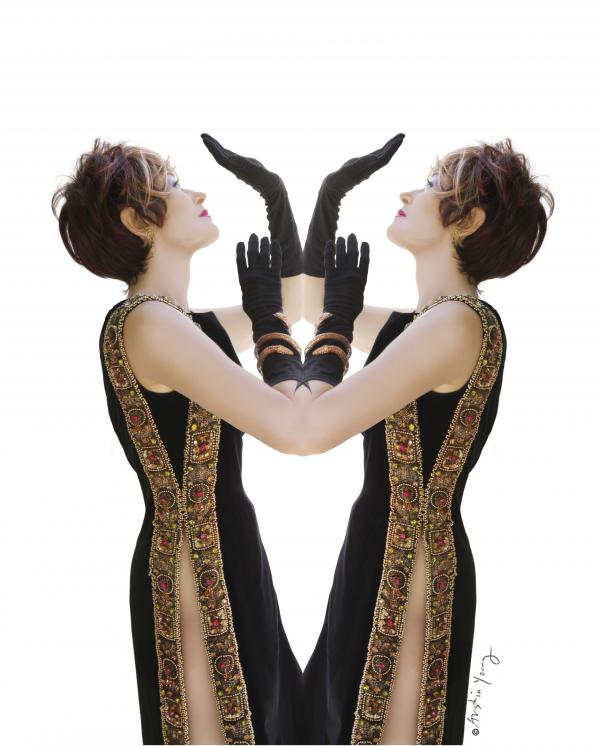
SF Sketchfest presents An Evening with Ann Magnuson: The Drawing Room Apocalypse

0

Because the Mayan calendar promises that the world shall end in late 2012, Ann Magnuson has decided to celebrate early. And, like Cher and Streisand before her, she shall begin the first of many ‘farewell’ tours to prepare for the aforementioned Apocalypse.

But because she wants to go out with neither a bang nor a whimper, she has chosen the route of Gentility, partly because of age but mostly because, in an increasingly vulgar world, it’s the most radical thing to do. A mashing up of ‘end of the world’ songs, appropriately themed spoken word stories and bona-fide poetry will be presented as a contemporary twist on the “Victorian Drawing Room Entertainment”.

With original songs by Ann Magnuson and Kristian Hoffman including material from the albums Pretty Songs & Ugly Stories, The Luv Show as well as golden nuggets from Ms. Magnuson’s former psycho-sexual-psychedelic alt-cult band, Bongwater.

Ms. Magnuson’s drawing room guests may also hear new variations on songs written by Jacques Brel, Kurt Weill, Bessie Smith, David Bowie, Skeeter Davis and the Doors (in a special Tribute to Occupy Oakland).

In keeping with Victorian Drawing Room tradition, Ms. Magnuson shall recite poetry both classical (by Percy Bysshe Shelley) and contemporary (by California’s own bard, The Lizard King himself, Jim Morrison) and premiere a new original spoken word piece.

With musical director Mr. Kristian Hoffman on grande pianoforte and Mr. Joseph Berardi demonstrating a variety of exotic primitive percussive instruments from cultures occidental, oriental, and accidental.

Celebrate the beginning of the end in true Victorian style.

To purchase tickets, follow this link.

Tuesday, January 24 & Wednesday, January 25 at 8pm @Yoshi’s Oakland, 510 Embarcadero West, Jack London Square, Oak. | $25 | Recommended for mature audiences


Check out this amazing video of a 1997 performance where Magnussun channels Kate Bush:


Nite Trax: Edwardian Baller Justin Katz tells of Gorey origins, steampunk youth, more

0

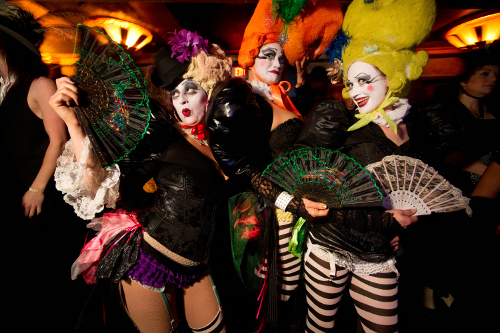
In this week’s Super Ego nightlife column in the paper, I write about this coming weekend’s giant Edwardian Ball at the Regency Ballroom, which spans five events and welcomes thousands into its playful goth-steampunk-burlesque embrace. Named for Edward Gorey but encompassing more than a few winks at the Edwardian Era of the last turn of the century, the all-ages ball has come to act as a summit for a certain essential, instantly recognizable San Francisco nightlife subculture.

The ball was launched in 2000 by Justin Katz of “premiere pagan lounge ensemble” Rosin Coven and Mike Gaines of the neo-cirque Vau de Vire Society, and has grown enormously in the 12 years since — including branching out to Los Angeles. I interviewed the genial Katz over email about the ball’s Gorey origins, the challenges of expansion, combatting the dreaded FOMO, and welcoming a new generation of Friends of Ed.

SFBG Congrats on 12 years of the Edwardian Ball. When you started this, did you think it would take off in this big a way? Can you share a couple of your favorite memories of the Ball since the “turn of the century”?

JUSTIN KATZ Thank you! Each year in the history of this event has been such an adventure, with unpredictability even for us being a constant! Our first year we used a slide projector to show images from a Gorey book. Slides! The second year we did our first interactive theater with the audience, inviting friends to come up and be part of “The Curious Sofa.” Our fifth year was the first with Vau de Vire Society, one of the best decisions Rosin Coven ever made, and I can’t believe the amount of theatre, aerial, and huge open flames that we fit into the back room of the Cat Club. From then on it’s been astounding to see the growth and participation, first the Great American Music Hall, then up to three nights there before waltzing into our current home, The Regency Ballroom.

SFBG You’re extending the festival over six events this year — can you tell me a little about that? Have you ever had this many events, and is this in response to demand?

JK This is definitely our biggest offering to date. The event has developed in so many ways concurrently that there is just too much to see and do during a nighttime event. The Vendor Bazaar (afternoon of Sat/21) has grown into a world of its own and people want more time to shop and mingle amongst the dozens of amazing artisan vendors we now house for the weekend. It gives people a chance to focus without dreaded FOMO — fear of missing out! — with all of the revelry of the Ball afterwards. And this year’s tea with Professor Elemental (also afternoon of Sat/21) is a new one. We are so pleased to have such an excellent artist flying all the way from the UK that it only seemed proper to have a tea party, and give fans a chance to get up close and personal in a more relaxed setting. So it’s about opening up and spreading things out a bit, to enjoy.

http://www.youtube.com/watch?v=0iRTB-FTMdk

SFBG This year’s theme book is the Iron Tonic — will there be specific references to the book, or do you adopt these just as general frameworks to work within? And what are some of the special things you’re looking forward to this year?

JK: Each year Rosin Coven & Vau de Vire Society, co-hosts of The Edwardian Ball, choose a featured Gorey story to bring to life on stage. So this year’s tale is “The Iron Tonic”, which will be presented on Saturday night with original music, staging, choreography, and video as our “big show.” So you will see the story in its entirety. And more, actually, because Vau de Vire always goes to the next level in creating the story – showing you what Gorey doesn’t. One of the most intriguing things about Gorey’s work is that he shows you so little, and implies so much. Vau de Vire plays with character, back story, scenes between the scenes, and really draws you in. Rosin Coven works closely with them developing this and creating the music and narrative that drives and showcases all of the amazing theatrics.

http://www.youtube.com/watch?v=6qgIGKobTe4

Another addition to this year’s event that I just can’t wait to see is our new Museum of Wonders – we’ve added an entire third floor of The Regency to the event, a dense, dark playground of eccentric collections, unusual artifacts, circus sideshows, mechanical dolls that sing you songs, fortune telling, tarot reading, a haunted pipe organ, and a living statue garden by Vau de Vire performing more Gorey stories. We’ve taken the wonderful art that has filled our ballroom and given it its own home, a whole new world to wander during the event, and a place to get away from the crowds for a different experience. This also allows us to open the Ballroom up even more for dancing and enjoying the show – more space to tango!

SFBG I’m fascinated by the general culture that’s coalesced in the past decade or so around the Edwardian Ball — it’s such a San Francisco signature style incorporating burlesque revivalism, playful goth, circus and steampunk, various aspects of Victoriana and Edwardiana. You guys seem to be the major exponents of this certain culture. Have you had any thoughts about it as you’ve seen it develop? What changes or developments have you seen in the Edwardian Ball culture through the years that you’re proud of or that have really made you think?

JK It’s an honor to be recognized as an influence on San Francisco’s style and trends, I’ve always seen us almost more of a great receiver of ideas and influences. We provide a creative, permissive space for people to inspire each other and cross-pollinate. By creating a mood but not strict rules, people have developed their own interpretations and styles over the years, the sum total of which become “Edwardian.” We initially used the name Edwardian just to dress up Edward Gorey, but its been fascinating to see people develop the historic elements of the event on their own. Steampunk is an interesting one too – when we started that word didn’t even exist. We’ve never self-promoted as a “steampunk” event, any more than we would be a “period recreation” event, but we’ve enjoyed the dovetailing of the trend and it’s expansion into more elaborate costume and character. I’ve enjoyed seeing people take Gorey’s work and meld it into their own creations too – characters and monsters and oddities from the pages of his books have been found in the most wonderful corners of the events.

http://www.youtube.com/watch?v=IjjDt2_oKyU

SFBG How has the Los Angeles Ball been going and do you plan to expand further?

JK Los Angeles has been inspiring and challenging. Our first year was gorgeous, held in the mostly-defunct, run down Tower Theater in Downtown LA. It was moody and intriguing, and difficult from a production standpoint. So last year we moved to The Music Box, which is such a great venue. We had a little hiccup when the venue double-booked the night and bumped our date, and we had to push it back a month. But this year The Music Box outdid themselves and shut down a week ago, out of business, so we’re hard at work on finding a new home and date in time to announce at the SF event. LA is just good at tossing us curveballs – but aside from the nuts and bolts we have a wonderful time down there and are inspired and impressed by how ready the crowd is to step up, dress up, and immerse themselves in the Edwardian world. I see no reason not to keep expanding the reach of this event: New York, Seattle, New Orleans, there are so many places that the Edwardian Ball could pay a delightful visit.

http://www.youtube.com/watch?v=D3ISx6UaKw0

SFBG You welcome all ages to the Ball. Do you find that, as steampunk and burlesque enter the mainstream consciousness more, that more younger people are drawn to the culture that the Ball represents?

JK I think that’s a good assessment. I think we’re seeing a couple of groups of younger people – there are those that are drawn to live music, circus, and performance, and this gives them a place to go when most shows are 18+. It’s such a well-behaved crowd – playful but respectful – that we feel good about including all ages and creating a safe space for young people. Their presence adds a really vital energy, and I think affirms that we are creating something that can continue on, it’s not just for the producers and their own social circles. New, young ideas can and will influence where this event goes.

Also, some of the longtime fans are getting older and having children themselves, and starting to bring them to see this unique world. We’re starting to see the “Under-10” crowd show up for the first few hours – they watch the show, climb aboard a bike-powered carnival ride, play midway games with clowns, pose for photos, and head back to school for an unbelievable round of show-and-tell.

Fri/20: Edwardian World’s Faire Kinetic Steam Works, Cyclecide, Vau de Vire, games, and more

Sat/21: Edwardian Ball 2012 “The Iron Tonic” with Jill Tracy, The Fossettes, Miz Margo, and more

Both at Regency Ballroom, 1300 Van Ness, SF. All ages, see www.edwardianball.com for prices, times, and more events.

BODY 2012

0

Coming February 1

REINVIGORATE your New Year’s resolutions. . .

The SF Bay Guardian’s special BODY supplement will guide readers to a
healthier lifestyle by highlighting the Bay Area’s best workouts, gyms, fitness
classes, sports and outdoor activities, spas, beauty and wellness programs.

Plus a special section on Winter workout and spa specials!

To find out more about advertising in this full-color section and reaching tens of thousands of our readers, please click here (PDF).


A Bay Area kind of stand-up: Frankie Quinones of For the People Comedy

2

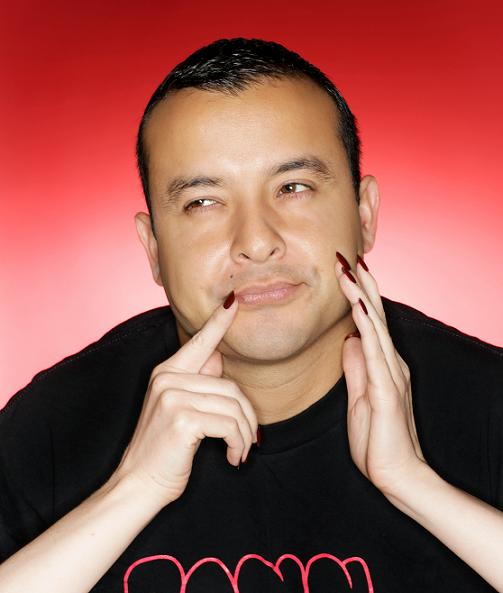
Common knowledge states that if you’re serious about becoming a stand-up comedian on the West Coast, you move to Los Angeles. But Frankie Quinones created the diversity of For the People Comedy here in San Francisco and despite his rising star on the stand-up scene, he’s sticking around for the moment.

Maybe that’s because Carmelita lives here. “She’s taken on a whole thing of her own, her own career,” says the Ventura County native of his sassed-up, club-going Latina sexpot. “Carmelita’s got her own list of things to do in 2012.” You can check out Quinones — and possibly Carmelita or his popular “Cholo Whisperer” skit — at the next For the People event at Cobb’s on Thu/19. 

Carmelita was created back in 1996 in Quinones’ high school improv class. She hails from Quinones’ stable of characters inspired by – well, what else – the people he sees on an everyday basis. In Carmelita’s case that’s his female family members, mixed with Quinones’ own mannerisms. “She’s really confident, but not really conceited,” he says. 

Her star vehicle was “Eh-So Eh-Spicy,” in which she half-dishes, half-raps about men looking at her tits in line at the store and courts suitors in a San Francisco bar. You’re definitely laughing at her, but somehow, Quinones escapes reducing the brash Carmelita into a stereotype like so many other male comedian’s female alter egos. Carmelita shares set time with a host of Quinones’ other personas, including a hippie character named Sun Diamond whose mannerisms are culled from the patchouli-scented denizens of our fair city.

Quinones is proud of being a Latino comic, part of a tradition that also includes his personal role models Gabriel “Fluffy” Iglesias and Paul Rodriguez, who his parents used to watch on TV when he was young. He often performs at Latino comedy nights in Los Angeles, but in San Francisco — where successful Latino comics are well-known for relocating quickly down south when fame beckons — he’s used to being the only Hispanic name on otherwise all-black and all-white bills.

His comedy often dances along the edge of racial tensions, ultimately resolving them in a feel-good way. In “Cholo Whisperer,” a upper-middle class suburban couple hires an expert to deal with the shanking, 40-drinking gangster (played by Quinones) they’ve adopted after being charmed by their neighbor’s cholo. The cholo whisperer, who walks with a mystic’s bauble-topped scepter but dresses in everyday street wear and a blue bandana, teaches the white husband how to be “the jefe,” a role that mainly involves puffing out his chest and barking short orders. 

“Some people think I’m stupid for not moving to LA already,” says Quinones, drinking a Negra Modelo in front of his combination plate on a sidewalk tables at the Valencia Street Puerto Alegre. “But I feel like I’m doing something for the San Francisco comedy scene.” You can check out For the People’s new monthly gig every last Wednesday at SoMa’s Sofa nightclub on Eighth Street and Minna. Quinones crafts the program for these nights with the newbie comedy fan in mind — usually they’ll feature stand-ups from all kinds of backgrounds, even a live DJ for musical interludes. 

“I’ve always been that fool in my family, like ah, fucking Frankie,” Quinones laughs. “People in my life are not surprised that I’m a stand-up comedian.”

Maybe that’s why they’ve been so supportive. “I have a good team of homies that believe in this as much as I do,” says Quinones, who says the word of mouth hype his group of friends give him is invaluable in promoting his shows – indeed, a word from a mutual friend was how I heard about his work. “Our brand of comedy is like, this is all of us, together. It’s like, I’m no better than you because I’m on stage. I try to create a family vibe so that when people come in they feel a part of it.”

Just don’t heckle him – that positivity has its limits. “If somebody heckles me that’s the green light,” he laughs forbodingly, for a moment seeming like the snarky comedians we’re used to from network television and BET. That impression doesn’t last long before we’re back to the group experience: “But my goal is to make it funny for everyone.”


For the People Comedy

Thu/19 8 p.m., $15

Cobb’s Comedy Club

915 Columbus, SF

(415) 928-4320

www.cobbscomedyclub.com

Get Gorey

1

marke@sfbg.com

SUPER EGO Wax up your handlebar mustache, dust off your stripy topcoat, burnish your steampunk petticoats, and oil those wheezy accordions: The Edwardian Ball, that phenomenal annual gathering of exquisitely decked-out freaks, is back for its 12th installment of mannered mayhem. This time it aims to quell any kvetching about crowding by stretching itself over five official local events (and a satellite ball in Los Angeles next month). But the Fri/20 World’s Faire and the Sat/20 Ball itself will still be the main attraction for thousands of Friends of Ed.

Where did it come from, the distinctly San Franciscan style that the Edwardian Ball represents, the curious — and, in some pale lights, socially conservative — amalgamation of circus revivalism, steampunk mechanicals, Wild West gumption, burlesque peekaboo, 1990s anarcho-sincerity, and more than a hint of Burning Man fairy dust? The ball itself, launched in 2000 by Justin Katz of “premiere pagan lounge ensemble” Rosin Coven and Mike Gaines of the neo-cirque Vau de Vire Society, delectably conflates affection for Edwards Gorey, author, and Windsor, British king, producing a turn-of-the-last-century high-brow goth fantasia that’s impossible to resist. There’s more than a hint of Burtonesque Scissorhands-worship in there as well, bringing our Ed count to three. (Check out my revealing interview with founder Katz.)

Like absinthe, the ball’s drink of choice, I savor this native subculture most in small, strong doses — sometimes its sheer mass can overwhelm, and its style seems always in a state of coalescence rather than expansion. (An Edwardian Ball in 2112 would, and probably should, be much like the one this week, hover-bikes notwithstanding.) That’s why the ball’s a perfectly cromulent occasion to check in on the dark-eyed, ruby-red, velvety feast of one of our essential undergrounds. Promenade, anyone?

Fri/20: Edwardian World’s Faire Kinetic Steam Works, Cyclecide, Vau de Vire, games, and more

Sat/21: Edwardian Ball 2012 “The Iron Tonic” with Jill Tracy, The Fossettes, Miz Margo and more

Both at Regency Ballroom, 1300 Van Ness, SF. All ages, see www.edwardianball.com for prices, times, and more events.

BENEFITS FOR DJ TOPH ONE Beloved “wino” Toph One got struck while riding his bike by a hit-and-run driver on Sun/8 and was hospitalized with a broken pelvis and internal bleeding. The DJ, bike activist and annual AIDS Rider, and party promoter (of the incredibly long-running Red Wine Social and Pepper) is OK and in good spirits now. And the great Bay Area nightlife scene is banding together once again to help out a friend in need. There are going to be two big benefits — all proceeds going to Toph’s bills — that are also serving as major bay talent summits. One’s at Public Works (Fri/20, 9 p.m.-3 a.m., $10. 161 Erie, SF. www.publicsf.com) with J-Boogie, Jimmy Love, Matt Haze, Pleasure Maker, E Da Boss, Chris Orr, and many more. The other’s at SOM (Sun/22, 8 p.m., $10–$20 but no one turned away. 2925 16th St., SF. www.som-bar.com) with Billy Jam, Sake One, DJ Pause, Rolo 1-3, Rascue, Jah Warrior Shelter Hi-Fi, and tons more. Get well soon, buddy — and anyone with information on the crime please call the anonymous police tip line at (415) 575-4444 or send a tip by text message to TIP411.


LAURENT GARNIER

One day, I will write an entire book about French techno polymath Laurent Garnier’s seminal 1993 “Acid Eiffel,” a monumental track whose throbbing chords (not quite nabbed from Mr. Fingers), squiggling acid jabs, and cheeky whale-song bass figures pretty much audibly nailed where my rave-fatigue head was at back then. He hasn’t been here in a decade: this time he arrives as part of the trio LBS (Live Booth Sessions) with Garnier DJing and knob-twisting, Benjamin Rippert on keyboards and Scan X on “machines.” They’ll be tearing through a whole host of electronic styles at this installment of the whip-smart As You Like It roaming party (co-produced with Public Works), throwing some brilliant corners on Garnier’s signature ecstatic style. With M3, Rich Korach, Briski, and P-Play.

Thu/19, 9 p.m.-3 a.m., $15–$25. Public Works, 161 Erie, SF. www.publicsf.com


THE QUEEN IS DEAD

Honey, is she ever! There has actually been quite an uptick in Smiths tribute nights (maybe making up for Morrissey’s string of Bay Area concert cancellations?). And this monthly one, celebrating a year on Saturday, is the Frankly Mr. Shanklyest of them, with a wide range of melancholy jangle-pop tunes and DJ Mario Muse on decks. Unhappy birthday!

http://www.youtube.com/watch?v=8oYsQ1Ra1hI

Sat/21, 9 p.m., $5. Milk, 1840 Haight, SF. www.milksf.com


OCTAVE ONE

The classic Detroit techno Burden Brothers whose seminal “I Believe” and “Black Water” will always get me on the dance floor hollering and waving my arms around like the homosexual muppet I am have been touring successfully. Catch them on the swell Club Six sound system.

Fri/20, 9 p.m.-4 a.m., $15. www.clubsix1.com


SOUKI

Kooky-rad monthly queer and friends party Dial Up dials up a special Friday night with Berlin ‘s Souki, whose deep-but-friendly techno prowess is making recent waves. She’ll be performing a live PA, sure to get funky.

Fri/20, 9 p.m.-3:30 a.m., free before 10 p.m., $6 after. Public Works, 161 Erie, SF. www.publicsf.com


DUBSTEP PRODUCER BATTLE FINALE

Some great beats have come out of the rounds leading up to this grand wobble finale — nice to see so much local talent holding forth (and stretching the often narrow dubstep definition.) Come jiggle and support finalists Fivel, Taso, and Kontrol Freqs at the new Fuel Lounge (formerly Etiquette).

Fri/20, 9 p.m., $5 before 10 p.m., $10 after. Fuel, 1108 Market, SF. www.fuelsf.com 


Way out East

0

THEATER The shows have been as varied and changeable as the weather this January in New York City, where the annual conference of the Association of Performing Arts Presenters (APAP) acts as catalyst for, by now, no less than four new-work festivals in the realms of theater, dance, and contemporary performance.

Near the beginning of the month, it got cold enough at night to make your nose hairs chime like little Christmas tree bells. “Every time you sneeze,” a friend explained to me, “a whole shitload of angels get their wings.”

This cheerful seasonal exchange took place in the Lower East Side during a frigid tromp to American Realness, a three-year-old festival offering a vital focus on contemporary dance and performance. Spread across three stages at the Abrons Art Center, American Realness is the brainchild of Ben Pryor, the festival’s 29-year-old curator and producing director, and once again features an eye-catching list of leading and emerging artists.

Indeed, 2012’s 11-day program (Jan. 5-15) is really pulling out the stops. Performances I’ve seen thus far have run a wide gamut, in every way, but have consistently attracted capacity houses to American Realness’s intriguing blend of the known, infamous, and brand new.

In addition to full-blown productions, the festival has added a new free series this year, “Show and Tell,” offering an opportunity to hear artists discuss their work or to glimpse work-in-progress. One recent afternoon was given over to a three-way discussion among songwriter and performance-maker Holcombe Waller, Cynthia Hopkins (at Yerba Buena Center for the Arts recently with The Success of Failure (Or, the Failure of Success)), and Miguel Gutierrez (last seen locally in July at the Garage with his solo, Heavens What Have I Done) about contemporary song-based performance. The Bay Area’s Keith Hennessy was on hand a couple of days earlier to discuss his collaborative project, Turbulence: A Dance About the Economy, which just had a two-night showing in December at CounterPulse. (Hennessy also premiered Almost, a “spontaneous performance action,” during the last week of the festival.)

American Realness opened with an evening lineup that included other San Francisco favorites, namely Laura Arrington Dance and New York–based Big Art Group. Arrington offered the New York premiere of Hot Wings (a piece born of her 2010 CounterPulse residency) to a sold-out house in the Abrons Art Center’s 100-seat Experimental Theater; while Caden Manson/Big Art Group debuted Broke House, a purposefully chaotic, multimedia camp meltdown loosely based on Chekhov’s Three Sisters, which sprawled across the proscenium stage in the 300-seat Playhouse Theater. The 99-seat Underground Theater, meanwhile, a cozy, brutalist semi-circle carved into the concrete basement, saw a U.S. premiere from Eleanor Bauer and Heather Lang (The Heather Lang Show by Eleanor Bauer and Vice Versa).

Those three initial shows together sounded an eclectic key that has been sustained throughout. The cold weather not so much. A few days later it was unseasonably warm. People tried to act concerned about it. Surely this was another sign of impending climactic collapse. But it was just too nice to care very hard about why it might be wrong.

The relaxed mood encouraged by the sudden warming trend was further augmented by an intimate little walking tour called Elastic City. Artists Todd Shalom and Niegel Smith conduct small groups of people around the grounds of the Abrons Art Center, training everyone’s attention, with a gentle and inviting playfulness, on the smallest and most quotidian details imaginable — with low-key but delighting results. A passage down one maintenance hallway, for instance, was an invitation to notice any little detail that caught the eye and stimulated the imagination and to share it with anyone around you, turning the seemingly bare walls into a topography that might have given a 16th-century explorer the chills, or … a woody. At one point, our guides led us outside barefoot onto the wide concrete steps in front of the building, for what was no doubt originally conceived of as a brief but striking encounter with the winter elements. Everyone stood there comfortably, however, thankful for the temperate bath of fresh air. “Yeah, it’s not very cold,” agreed Shalom. “Actually, it’s not cold at all.”

A couple more memorable moments as of this writing: Daniel Linehan spinning in a circle for a very long time, declaiming, “This is not about anything” — and variations on that theme. The young choreographer-performer (who’s worked with Big Art as well as Miguel Gutierrez, among others) delivered these poetically schematic lines at intricate length, in a voice precisely doubled by an offstage “doppelganger” piped through a nearby speaker, demonstrating a fairly wowing memory and focus, while alternating both the speed and shape of his whirling form to create a kinetic sculpture of transfixing beauty.

The stunning solo Not About Everything faltered only momentarily for me, when Linehan, pulling out and “reading” a self-conscious letter about his own art and practice from his pocket, shifted from mathematical-geometric abstraction to the all-too-specific. It was an almost rude awakening from a kind of syntactic ecstasy — the motive, unmooring meaninglessness of the mantra — back into the semantics of worldly and solipsistic concerns. It was saved ultimately by a combination of Linehan’s acuity and alacrity as a thinker and performer, however, and it was as fine, moving, and memorable a solo as any seen thus far.

Ann Liv Young presented a desultory piece called Sleeping Beauty Part I that held few surprises for anyone remotely familiar with her work. But the audience was caught off guard at one point at least, as Sleeping Beauty, having completed a Showgirls-style dance of seduction, pleads for understanding from her Prince Charming (a blowup doll sitting in the first row of the packed Experimental Theater). At that moment a soap machine above the stage suddenly erupted with a noisy rush of air and fluff, casting a snow-like arc of fine goo down onto the heads of maybe a third of the house, producing amusement and irritation in more or less equal measure. Only one patron actually got up and left. The rest sat stoically, trying to stifle coughs and sneezes for the next 20 minutes as the finer, mistier particles of whatever is in that stuff began lining breathing passages.

The remainder of the show was given over to an invitation to have your Polaroid portrait taken with the Sleeping Beauty (two bucks a pop). There were enough takers to drag this process out about half an hour. Then the performers left the stage. More ALY concessions were on sale as you exited.

www.tbspmgmt.com/AMERICAN_REALNESS_.html

Exporting our brains

0

By Gary Brechin

The chancellor was absent as University of California police, kitted out in battle gear, vigorously beat and arrested students and professors at on the Berkeley campus. Called to account by the academic senate two weeks later, Robert Birgeneau explained that he had been on a trip through Asia at the time. The trip, he said, concluded with a “phenomenally successful,” though unspecified, mission to Shanghai, so he did not hear how badly things went at home until the following day.

What Chancellor Birgeneau and the dean of Berkeley’s College of Engineering did on the trip was sign an agreement to open a 50,000-square-foot building in Shanghai’s Zhangjiang High-Tech Park two days after clubs fell on Cal students agitated by what they perceive as the progressive privatization and commercialization of their university. According to The New York Times, the new branch will give U.C. an Asian beachhead by opening “a large research and teaching facility as part of a broader plan to bolster its presence in China.” Other premier American universities such as Duke, NYU, and Stanford are, for a price, establishing similar “partnerships” that China “hope[s] will form the base of a modern high-tech economy.”

As U.S. funding dries up, college administrators hope that such collaborations will “support fundraising efforts that target wealthy Chinese alumni” — not to mention attracting their children, who are more able to pay ever-rising tuition than American students.

California’s business elite until recently oversaw the establishment and growth of a prestigious 12-campus system that was meant to do for the Golden State what the university now will do for China.

The promise of a virtually free and high quality education for Californians worked well to that end until 1978 when voters overwhelmingly passed Proposition 13 to cut their taxes.

Starved of funding, California’s public schools plummeted from the best to near worst — but many believed that the University of California’s crucial role in the state’s and the nation’s economy would immunize it from the rot consuming the rest of the Golden State’s educational apparatus. But as California piled up multi-billion dollar deficits, U.C inevitably joined the rest of the public sector on the dream factory’s cutting room floor.

As with any organism fighting for its life, available money has moved like blood from regions the university administration considers expendable to those regarded as vital profit centers — like business, biotechnology, sports, and online learning initiatives — as well as lavish executive pay packages.

Last year, for example, the university’s flagship campus at Berkeley quietly divested itself of its outstanding Water Resource Center Archives to save the cost of four clerical positions and thus free space for the expanding College of Engineering. At UC San Diego, three specialty libraries closed altogether while a fourth — the largest oceanographic library in the world — will close in 2012.

Advanced communications and information technology will be among the first areas of research undertaken by the College of Engineering’s new partnership with Chinese industries seeking to overtake California’s fabled Silicon Valley.

For centuries, city states and nations jealously guarded their home industries to the point of sending assassins to dispatch those trading secrets with rivals. Decades of neoliberalism have encouraged today’s elites to do the opposite. Availing themselves of the deregulation and lowered trade barriers for which they paid and the communications technology they developed, they exported their industries and jobs to wherever labor costs are lowest and environmental constraints absent. Derelict factories, ruined towns, failing infrastructure, and prisons now pock those countries still imagining themselves members of the First World.

The screams of students belabored for asking where their university is going and for whom raises the question whether intelligence will be our last export, or whether it was among our first.

Gray Brechin is a three-time U.C. Berkeley alumnus and visiting scholar in the UBC Department of Geography. He is the author of Imperial San Francisco: Urban Power, Earthly Ruin. A version of this piece ran first in the Anderson Valley Advertiser.

Occupy Nation

15

news@sfbg.com

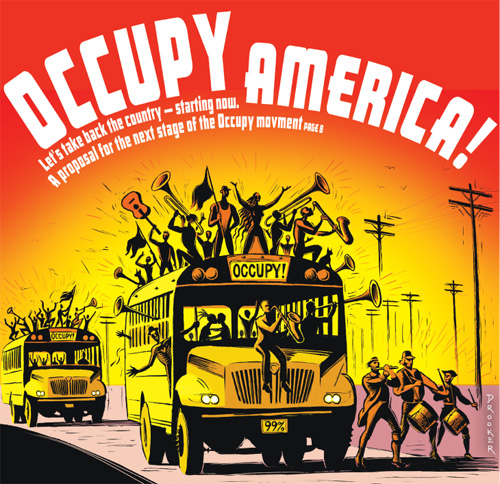
The Occupy movement that spread across the country last fall has already changed the national discussion: It’s brought attention to the serious, systemic problem of gross inequities of wealth and power and the mass hardships that have resulted from that imbalance.

Occupy put a new paradigm in the political debate — the 1 percent is exploiting the 99 percent — and it’s tapping the energy and imagination of a new generation of activists.

When Adbusters magazine first proposed the idea of occupying Wall Street last summer, kicking off on Sept. 17, it called for a focus on how money was corrupting the political system. “Democracy not Corporatocracy,” the magazine declared — but that focus quickly broadened to encompass related issues ranging from foreclosures and the housing crisis to self-dealing financiers and industrialists who take ever more profits but provide fewer jobs to the ways that poor and disenfranchised people suffer disproportionately in this economic system.

It was a primal scream, sounded most strongly by young people who decided it was time to fight for their future. The participants have used the prompt to create a movement that drew from all walks of life: recent college graduates and the homeless, labor leaders and anarchists, communities of colors and old hippies, returning soldiers and business people. They’re voicing a wide variety of concerns and issues, but they share a common interest in empowering the average person, challenging the status quo, and demanding economic justice.

We chronicled and actively supported the Occupy movement from its early days through its repeated expulsions from public plazas by police, particularly in San Francisco, Oakland, and Berkeley. We supported the right of the protesters to remain — even as we understood they couldn’t and shouldn’t simply stay forever. Occupy needed to evolve if it was to hold the public’s interest. The movement would ultimately morph into something else.

That time has come. This spring, Occupy is poised to return as a mass movement — and there’s no shortage of energy or ideas about what comes next. Countless activists have proposed occupying foreclosed homes, shutting down ports and blocking business in bank lobbies. Those all have merit. But if the movement is going to challenge the hegemony of the 1 percent, it will involve moving onto a larger stage and coming together around bold ideas — like a national convention in Washington, D.C. to write new rules for the nation’s political and economic systems.

Imagine thousands of Occupy activists spending the spring drafting Constitutional amendments — for example, to end corporate personhood and repeal the Citizens United decision that gave corporations unlimited ability to influence elections — and a broader platform for deep and lasting change in the United States.

Imagine a broad-based discussion — in meetings and on the web — to develop a platform for economic justice, a set of ideas that could range from self-sustaining community economics to profound changes in the way America is governed.

Imagine thousands of activists crossing the country in caravans, occupying public space in cities along the way, and winding up with a convention in Washington, D.C.

Imagine organizing a week of activities — not just political meetings but parties and cultural events — to make Occupy the center of the nation’s attention and an inspiring example for an international audience.

Imagine ending with a massive mobilization that brings hundreds of thousands of people to the nation’s capitol — and into the movement.

Occupy activists are already having discussions about some of these concepts (see sidebar). Thousands of activists are already converging on D.C. right now for the Occupy Congress, one of many projects that the movement can build on.


DEFINING MOMENTS

Mass social movements of the 20th Century often had defining moments — the S.F. General Strike of 1934; the Bonus Army’s occupation of Washington D.C.; the Freedom Rides, bus boycotts and Rev. Martin Luther King Jr.’s March on Washington; Earth Day 1970; the Vietnam War teach-ins and moratoriums. None of those movements were politically monolithic; all of them had internal conflicts over tactics and strategies.

But they came together in ways that made a political statement, created long-term organizing efforts, and led to significant reforms. Occupy can do the same — and more. At a time of historic inequities in wealth and power, when the rich and the right wing are stealing the future of generations of Americans, the potential for real change is enormous.

If something’s going to happen this spring and summer, the planning should get under way now.

A convention could begin in late June, in Washington D.C. — with the goal of ratifying on the Fourth of July a platform document that presents the movement’s positions, principles, and demands. Occupy groups from around the country would endorse the idea in their General Assemblies, according to procedures that they have already established and refined through the fall, and make it their own.

This winter and spring, activists would develop and hone the various proposals that would be considered at the convention and the procedures for adopting them. They could develop regional working groups or use online tools to broadly crowd-source solutions, like the people of Iceland did last year when they wrote a new constitution for that country. They would build support for ideas to meet the convention’s high-bar for its platform, probably the 90 percent threshold that many Occupy groups have adopted for taking action.

Whatever form that document takes, the exercise would unite the movement around a specific, achievable goal and give it something that it has lacked so far: an agenda and set of demands on the existing system — and a set of alternative approaches to politics.

While it might contain a multitude of issues and solutions to the complicated problems we face, it would represent the simple premise our nation was founded on: the people’s right to create a government of their choosing.

There’s already an Occupy group planning a convention in Philadelphia that weekend, and there’s a lot of symbolic value to the day. After all, on another July 4th long ago, a group of people met in Philly to draft a document called the Declaration of Independence that said, among other things, that “governments … deriv[e] their just powers from the consent of the governed … [and] whenever any Form of Government becomes destructive of these ends, it is the Right of the People to alter or to abolish it, and to institute new Government, laying its foundation on such principles and organizing its powers in such form, as to them shall seem most likely to effect their Safety and Happiness.”


ON THE ROAD

If the date is right and the organizing effort is effective, there’s no reason that Occupy couldn’t get close to a million people into the nation’s capital for an economic justice march and rally.

That, combined with teach-ins, events and days of action across the country, could kick off a new stage of a movement that has the greatest potential in a generation or more to change the direction of American politics.

Creating a platform for constitutional and political reform is perhaps even more important than the final product. In other words, the journey is even more important than the destination — and when we say journey, we mean that literally.

Occupy groups from around the country could travel together in zig-zagging paths to the Capitol, stopping and rallying in — indeed, Occupying! — every major city in the country along the way.

It could begin a week or more before the conference, along the coasts and the northern and southern borders: San Francisco and Savannah, Los Angeles and New York City, Seattle and Miami, Chicago and El Paso, Billings and New Orleans — Portland, Oregon and Portland, Maine.

At each stop, participants would gather in that city’s central plaza or another significant area with their tents and supplies, stage a rally and general assembly, and peacefully occupy for a night. Then they would break camp in the morning, travel to the next city, and do it all over again.

Along the way, the movement would attract international media attention and new participants. The caravans could also begin the work of writing the convention platform, dividing the many tasks up into regional working groups that could work on solutions and new structures in the encampments or on the road.

At each stop, the caravan would assert the right to assemble for the night at the place of its choosing, without seeking permits or submitting to any higher authorities. And at the end of that journey, the various caravans could converge on the National Mall in Washington D.C., set up a massive tent city with infrastructure needed to maintain it for a week or so, and assert the right to stay there until the job was done.

The final document would probably need to be hammered out in a convention hall with delegates from each of the participating cities, and those delegates could confer with their constituencies according to whatever procedures they prescribe. This and many of the details — from how to respond to police crackdowns to consulting of experts to the specific scope and procedures of this democratic exercise — would need to be developed over the spring.

But the Occupy movement has already started this conversation and developed the mechanisms for self-governance. It may be messy and contentious and probably even seem doomed at times, but that’s always the case with grassroots organizations that lack top-down structures.

Proposals will range from the eminently reasonable (asking Congress to end corporate personhood) to the seemingly crazy (rewriting the entire U.S. Constitution). But an Occupy platform will have value no matter what it says. We’re not fond of quoting Milton Friedman, the late right-wing economist, but he had a remarkable statement about the value of bold ideas:

“It is worth discussing radical changes, not in the expectation that they will be adopted promptly, but for two other reasons. One is to construct an ideal goal, so that incremental changes can be judged by whether they move the institutional structure toward or away from that ideal. The other reason is very different. It is so that if a crisis requiring or facilitating radical change does arrive, alternatives will be available that have been carefully developed and fully explored.”

After the delegates in the convention hall have approved the document, they could present it to the larger encampment — and use it as the basis for a massive rally on the final day. Then the occupiers can go back home — where the real work will begin.

Because Occupy will wind up spawning dozens, hundreds of local and national organizations — small and large, working on urban issues and state issues and national and international issues.


WASHINGTON’S BEEN OCCUPIED BEFORE

The history of social movements in this country offers some important lessons for Occupy.

The notion of direct action — of in-your-face demonstrations designed to force injustice onto the national stage, sometimes involving occupying public space — has long been a part of protest politics in this country. In fact, in the depth of the Great Depression, more than 40,000 former soldiers occupied a marsh on the edge of Washington D.C., created a self-sustaining campground, and demanded that bonus money promised at the end of World War I be paid out immediately.

The so-called Bonus Army attracted tremendous national attention before General Douglas Macarthur, assisted by Major George Patton and Major Dwight Eisenhower, used active-duty troops to roust the occupiers.

The Freedom Rides of the early 1960s showed the spirit of independence and democratic direct action. Raymond Arsenault, a professor at the University of South Florida, brilliantly outlines the story of the early civil rights actions in a 2007 Oxford University Press book (Freedom Rides: 1961 and the Struggle for Racial Justice) that became a national phenomenon when Oprah Winfrey devoted a show and a substantial online exhibition to it.

Arsenault notes that the rides were not popular with what was then the mainstream of the civil rights movement — no less a leader than Thurgood Marshall thought the idea of a mixed group of black and white people riding buses together through the deep south was dangerous and could lead to a political backlash. The riders were denounced as “agitators” and initially were isolated.

The first freedom ride, in May, 1961, left Washington D.C. but never reached its destination of New Orleans; the bus was surrounded by angry mobs in Birmingham, Alabama, and the drivers refused to continue.

But soon other rides rose up spontaneously, and in the end there were more than 60, with 430 riders. Writes Arsenault:

“Deliberately provoking a crisis of authority, the Riders challenged Federal officials to enforce the law and uphold the constitutional right to travel without being subjected to degrading and humiliating racial restrictions … None of the obstacles placed in their path—not widespread censure, not political and financial pressure, not arrest and imprisonment, not even the threat of death—seemed to weaken their commitment to nonviolent struggle. On the contrary, the hardships and suffering imposed upon them appeared to stiffen their resolve.”

The Occupy movement has already shown similar resolve — and the police batons, tear gas, pepper spray, and rubber bullets have only given the movement more energy and determination.

David S. Meyer, a professor at U.C. Irvine and an expert on the history of political movements, notes that the civil rights movement went in different directions after the freedom rides and the March on Washington. Some wanted to continue direct action; some wanted to continue the fight in the court system and push Congress to adopt civil rights laws; some thought the best tactic was to work to elect African Americans to local, state and federal office.

Actually, all of those things were necessary — and Occupy will need to work on a multitude of levels, too, and with a diversity of tactics.

Single-day events have had an impact, too. Earth Day, 1970, was probably the largest single demonstration of the era — in part because it was so decentralized. A national organization designed events in some cities — but hundreds of other environmentalists took the opportunity to do their own actions, some involving disrupting the operations of polluters. The outcome wasn’t a national platform but the birth of dozens of new organizations, some of which are still around today.

There’s an unavoidable dilemma here for this wonderfully anarchic movement: The larger it gets, the more it develops the ability to demand and win reforms, the more it will need structure and organization. And the more that happens, the further Occupy will move from its original leaderless experiment in true grassroots democracy.

But these are the problems a movement wants to have — dealing with growth and expanding influence is a lot more pleasant than realizing (as a lot of traditional progressive political groups have) that you aren’t getting anywhere.

All of the discussions around the next step for Occupy are taking place in the context of a presidential election that will also likely change the makeup of Congress. That’s an opportunity — and a challenge. As Meyer notes, “social movements often dissipate in election years, when money and energy goes into electoral campaigns.” At the same time, Occupy has already influenced the national debate — and that can continue through the election season, even if (as is likely) neither of the major party candidates is talking seriously about economic justice.

That’s why a formal platform could be so useful — candidates from President Obama to members or Congress can be presented with the proposals, and judged on their response.

Some of the Occupy groups are talking about creating a third political party — a daunting task, but certainly worth discussion.

But the important thing is to let this genie out of the bottle, to move Occupy into the next level of politics, to use a convention, rally, and national event to reassert the power of the people to control our political and economic institutions — and to change or abolish them as we see fit.

OCCUPY AMERICA IS ALREADY UNDERWAY

All across the country, Occupy organizers are developing and implementing creative ways to connect and come together, many of which we drew from for our proposal. We hope all of these people will build on each other’s ideas, work together, and harness their power.

From invading the halls of Congress to “occutripping” road trips to ballot initiatives, here is a list of groups already working on ways to Occupy America:


OCCUPY CONGRESS

Occupy Congress is an effort to bring people from around the country — and, in many cases, from around the world — to Washington DC on Jan. 17. The idea is to “bring the message of Occupy to the doorstep of the capital.” The day’s planned events include a “multi-occupation general assembly,” as well as teach-ins, idea sharing, open mics, and a protest in front of the Capitol building.

A huge network of transportation sharing was formed around Occupy Congress, with a busy Ridebuzz ridesharing online bulletin board, and several Occupy camps organizing buses all around the country, as well as in Montreal and Quebec.

There are still two Occupy tent cities in DC, the Occupy DC encampment at McPherson Square and an occupation called Freedom Plaza, just blocks from the White House. Both will be accepting hundreds of new occupiers for the event, although a poster on the Occupy Congress website warns that “the McPherson Square Park Service will be enforcing a 500 person limit.”

www.occupyyourcongress.info


OCCUPY BUS

The Occupy Bus service was set up for Occupy Congress, but organizers say if the idea works out, it can grow and repeat for other national Occupy calls to action. They have set up buses leaving from 60 cities in 28 U.S. states as well as Canada’s Quebec province. The buses are free to those who can’t afford to pay, and for those who pay, all profits will be donated to Occupy DC camps.

If all goes to plan, buses will be packed with passengers, their gear, and bigger donations for the event, as the “undercarriages of a bus are voluminous.” What gear do they expect each occupier to bring? “One large bag, one small bag, and a tent.”

congress.occupybus.com


DENVER OCCUTRIP

Many occupations have put together car and busloads of people to road trip to other occupations, hoping to learn, teach, network, and connect the movement across geographic barriers. One example is the Denver Occutrip, in which a handful of protesters toured West Coast occupations. The tenacious Occupy Denver recently made headlines when, rather than allow police to easily dismantle their encampment, a couple of occupiers set the camp on fire. It sent delegates to Occupations in Las Vegas, Los Angeles, Long Beach, Oakland, San Francisco, Berkeley, and Sacramento.

Sean Valdez, one of the participants, said the trip was important to “get the full story. What I’d been told by the media was that Occupy Oakland was pretty much dead, but we got there and saw there are still tons of dedicated, organized people working on it. It was important to see it with our own eyes, and gave a lot of hope for Occupy.”

Like lots of road-tripping Occupiers, they made it to Oakland for the Dec. 12 West Coast Port Shutdown action there. In fact, “occutrippers” from all around the country have flocked to Bay Area occupations in general, and especially the uniquely radical Occupy Oakland.

www.occupydenver.org/denver-occutrip-road-trip/


OCCUPY THE CONSTITUTION

An Occupy Wall Street offshoot — Constitution Working Group, Occupy the Constitution — argues that many of the Occupy movements concerns stem from violations of the constitution. They hope to address this with several petitions on issues such as corporate bailouts, war powers, public education, and the Federal Reserve bank. The group hopes to get signatures from 3-5 percent of the United States population before the list of petitions is “formally served to the appropriate elected officials.”

www.givemeliberty.org/occupy


THE 99% DECLARATION

This is a super-patriotic take on the Occupy movement, described on its website as an “effort run solely by the energy of volunteers who care about our great country and want to bring it back to its GLORY.” The group’s detailed plan includes holding nationwide elections on the weekend of March 30 to choose two delegates from “each of the 435 congressional districts plus Washington, D.C. and the U.S. Territories.”

These delegates would write up lists of grievances with the help of their Occupy constituents, then convene on July 4, 2012 in Philadelphia for a National General Assembly. They plan to present a unified list of grievances to Congress, the President, and the Supreme Court. If the grievances are not addressed, they would “reconvene to organize a new grassroots campaign for political candidates who publicly pledge to redress the grievances. These candidates will seek election for all open Congressional seats in the mid-term election of 2014 and in the elections of 2016 and 2018.”

www.the-99-declaration.org/


MOVE TO AMEND/OCCUPY THE COURTS

Move to Amend is a coalition focusing on one of the Occupy movement’s main concerns: corporate personhood. The group hopes to overturn the Citizens United vs. Federal Elections Commission ruling and “amend our Constitution to firmly establish that money is not speech, and that human beings, not corporations, are persons entitled to constitutional rights.”

The group has drafted a petition, signed so far by more than 150,000 people, and established chapters across the country. Its next big step is a national day of action called Occupy the Courts on Jan. 20. On the anniversary of the Citizens United ruling, the group plans to “Occupy the US Supreme Court” and hold solidarity occupations in federal courts around the country.

www.movetoamend.org/


THE OCCUPY CARAVAN

The Occupy Caravan idea originated at Occupy Wall Street, but the group has been coordinating with occupations across the country. If all goes according to plan, a caravan of RVs, cars, and buses will leave Los Angeles in April and take a trip through the South to 16 different Occupations before ending up in Washington DC.

Buddy, one of the organizers, tells us that the group already has “a commitment right now of 10 to 11 RVs, scores of vehicles, and a bio-diesel green machine bus. This caravan will visit cities, encircle city halls, and visit the local Occupy groups to assert their presence, and move on to the next, not stopping for long in each destination.”

This caravan is all about the journey, calling itself a “civil rights vacation with friends and family” and planning to gather “more RVs, more cars, more supporters…and more LOVE” along the way.

occupycaravan.webs.com

OCCUPY WALL STREET WEST

The Occupy movement in San Francisco has been relatively quiet for the past few weeks, but it’s planning to reemerge with a bang on Jan. 20, with an all-day, multi-event rally and march that aims to shut down the Financial District.

The protest is an effort to bring attention to banks’ complicity in the housing crisis plaguing the United States, and how that process manifests itself here in San Francisco.

At least 20 events are planned, centered in the Financial District. The plans range from teach-ins at banks to “occupy the Civic Center playground” for kids to a planned building takeover where hundreds are expected to risk arrest. A list of planned events can be found at www.occupywallstwest.org/wordpress/?page_id=74.

The day is presented by the Occupy SF Housing Coalition, which includes 10 housing rights and homeless advocacy groups. Dozens of other organizations will be involved in demonstrations throughout the day. “We’re asking the banks to start doing the right thing,” said Gene Doherty, a media spokesperson for the Occupy SF Housing Coalition. “No more foreclosures and evictions for profits. On the 20th, we will bring this message to the headquarters of those banks.”


Louis Dunn: ‘The Forgotten Wages of War’

0

Guardian graphic by Louis Dunn

John Tirman, executive director of the Center for International Studies at M.I.T., wrote the best account I’ve seen on what he calls “The Forgotten Wages of War” in an op ed piece on the end of the Iraq War (New York Times 1/3/2012.) The piece inspired Louis Dunn’s graphic comment. 

“We rarely question that war cause extensive damage, but our view of America’s wars has been blind to one specific aspect of destruction: the human toll of those who live in war zones,” wrote Tirman. .

“We tune out the voices of the victims and belittle their complaints about the midnight raids, the house-to-house searches, the checkpoints, the drone attacks, the bombs that fall  on weddings instead of Al Queda.

“Gen. Tommy R. Franks famously said during the early days of the war in Afghanistan, ‘We don’t do body counts.’ But someone should.”

Timan is author of “The Deaths of Others: The Fate of Civilians in American Wars.” 

See Tirman’s full piece:

http://www.nytimes.com/2012/01/04/opinion/the-forgotten-wages-of-war.html 


Democracy in distress, but it’s the best of the alternatives

0


By Dominique Moisi

Dominique Moisi is the author of The Geopolitics of Emotion.

PARIS – Is democratic time too slow to respond to crises, and too short to plan for the long term?

At a time of deepening economic and social crisis in many of the world’s rich democracies, that question is highly relevant. In Italy, for example, Prime Minister Mario Monti has the necessary and legitimate ambition to carry out comprehensive reform. He is both competent and honest, but faces a quasi-structural impediment: whereas leaders once had three years to convince voters of their policies’ benefits, they now have three hours to convince global financial markets to back their approach.

Caught between Italian legislators who, deep down, do not understand that change and markets in quest of near-immediate certainties, can Monti transcend his natural prudence and act with sufficient clarity and decisiveness?

In the United States, too, the political system is becoming increasingly dysfunctional. The political philosopher Francis Fukuyama goes so far as to say that “vetocracy” could triumph over democracy, regardless of who wins the 2012 presidential election. The separation of powers, a principle established by the US founders under the influence of philosophers such as Montesquieu, is leading today to near-paralysis.

Democracies suffer not only from their slow reaction time at moments of crisis, but also from the difficulty that they face in projecting themselves into the future and planning for the long term. On both sides of the Atlantic, political leaders know what they must do for their countries, but don’t know how to get re-elected if they actually do it. They seem to be structurally condemned to short-termism.

But it is not because democracies have a “time problem” that their era seems to some to be over. China is rightly proud to be able to project itself into the twenty-second century. But China owes that quality of long-term thinking much more to its culture than to the nature of its political system. Chinese think long term because they are Chinese, not because they are not democrats.

China’s leaders can, of course, react to events without much regard for Chinese public opinion. After all, the great majority of Chinese do not dream of democracy, even if something like a civil society is emerging, generating new interests and demands that can no longer be totally controlled or manipulated, as in the past.

But that is precisely the weakness of non-democratic regimes in a global age dominated by transparency: Who dreams of becoming a Chinese citizen, or even a citizen of Singapore? In the aftermath of North Korea’s hereditary succession, strategic thinkers rightly emphasize China’s key role in shaping the peninsula’s future. But, despite the scenes of hysteria that followed the death of the “Great Leader” Kim Jong-il, most North Koreans probably dream of joining democratic South Korea (even if many South Koreans fear that prospect).

The majority of Chinese may not want to be governed like Westerners, but it would be wrong to assume that their only ambition is to spend like Westerners. The more successful they are, the more individualistic they will become and the more they will expect the respect and consideration of those who govern them.

By contrast, if China’s economic growth slows, which is likely in the coming years, protest against corruption – a source of fragility for any regime – will escalate. Indeed, it is important to bear in mind that, ahead of the upcoming Chinese leadership transition, new occupants for only the top two posts have been chosen, and that through a process of gradual anointment by roughly a hundred people at most.

The current crisis in the advanced countries, which may very well lead to a global recession (if it is not already doing so), not only reveals the many maladies of democratic regimes, but also acts as their incubator and accelerator. And yet the crisis may turn out to have an even greater impact on non-democratic systems that seem to be more efficient, but are in reality much more fragile. We see this in mounting unrest in both Russia and China.

Contrary to what one might think, democracy is more resilient than the alternatives in the long run. This will remain true as long as democrats remain convinced of it. Non-democratic models cannot truly challenge democracy. Only the misbehavior of democrats can do that.

Dominique Moisi is the author of The Geopolitics of Emotion.

Copyright: Project Syndicate, 2012.
www.project-syndicate.o

The new board committes: Not great news

49

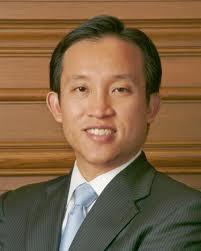
Board President David Chiu has released the new committee assignments for 2012, and they aren’t a whole lot different from last year’s — except in a few areas. And they aren’t exactly an indication of progressive power.

The three most conservative supervisors — Mark Farrell, Sean Elsbernd and Carmen Chu — all were named to chair committees. Supervisors Eric Mar and John Avalos also are committee chairs, although David Campos was relegated to the joint City and School District Select Commitee, which is important but takes no votes and has no role in the legislative process.

Word is, however, that Campos may wind up chairing the Transportation Authority.

The Budget and Finance Committee is run by Chu, but Avalos and Jane Kim are also members, giving a majority to the progressives. But during the budget season, that panel expands to five members — and the additional two, Scott Wiener and Malia Cohen, are both decidedly on the moderate side. That means progressives will not have a majority on the panel that plays the central role in setting the city’s budget.

The Rules Committee is improved from last year — Kim is the chair, joined by Campos and Farrell. But Land Use and Economic Development — possibly the second most important committee after Budget and Finance — is dominated by moderates; Mar is the chair but Cohen and Wiener will have a 2-1 majority.

State Assemblymember Tom Ammiano told me he’s concerned that the two openly gay members of the board, Campos and Wiener, aren’t in more prominent roles. “It seems like there are two very hardworking people who were slighted here,” he said.

But Chiu disagrees, saying that the assignments “reflect the diversity of the board and the city.” He added: “Last year (when conservatives were given key posts) everyone thought the sky would fall, and it didn’t.”

The sky falling is pretty dramatic; I suspect it won’t. But there’s a difference between the sky falling and the progressive agenda moving forward.


Newt Gingrich, commie radical

11

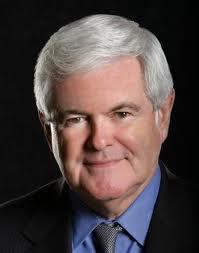
Actually, more likely Newt Gingrich, Scorched Earth Opportunist, but whatever, we’ll take it: Newt — he the friend of plutocrats and one-time lobbyist for predatory lenders — is launching an assault on Mitt Romney, calling him, in essence, a capitalist pig who exploits the workers.

The fact that it’s true makes the story even more fun. As does the fact that Romney has run so far to the right in the primaries that Obama — by any standard in serious trouble — now has a natural line of attack against the candidate most likely to offer him a credible challenge.

Here’s CalBuzz:

The Occupy Wall Street movement has succeeded in pushing the issue of the nation’s vast wage and wealth disparity onto the agenda of the 2012 campaign. While Republicans in the past have been successful in dismissing discussion and debate about the Third World levels of wealth concentration in the U.S. as unpatriotic “class warfare,” the inarguable facts about the massive gap between the wealthiest Americans and everyone else are now well-known by many mainstream voters, at a time when Romney stands as a central casting character representing the 1%.

Paul Hogarth at BeyondChron says that ” many of us wish that Democrats had the chutzpah to be this scathing and direct,” and I can’t argue with that. The good news is that the Newtclear Bombs in South Carolina will probably work: Romney’s going to win the nomination, and everybody knows it, but the blitz of revenge ads may wound Romney enough to convince the Obama folks that this is the line of attack to use during the general election.

In other words, Newt is pushing the Democratic party to the left, legitimizing the class warfare that the Republicans so love to denounce as unAmerican.

How much do we love this?

Create and destroy

0

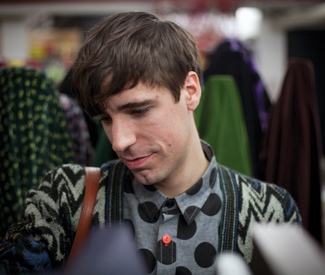
WINTER LOOKS You might have spotted Collin Weber running through the Mission on the way to the Knockout, frantic, with a bag full of satin bows to complete a trio of Sailor Moon costumes. Or perhaps you’ve seen his handy-work elsewhere, in the colorful capes and pointed hats Shannon and the Clams wear in their video for “Sleep Talk” or the sixties striped shifts the Dirty Cupcakes sport in “I Want It (Your Love).”

Weber, a library aid by day and seamster by night, has been creating costumed frocks for an incestuous batch of Bay Area garage rockers for the past two years — Dirty Cupcakes, Shannon and the Clams, Hunx and His Punx, Human Waste — and is open to taking on more acts. ” I think there’s a lot more payoff when you do something and it’s up on stage and out on tour and tons of people see it, and it’s in a music video,” he says leaning against an rack of cloth at Fabric Outlet, “not that I wouldn’t just want to make thing for people to wear. But the costumes are the fun project for me.”

Some of those projects include dinosaur hats, American flag bell-bottoms, gold fake snakeskin skirt and vest combos, and once, for Human Waste, he created full face-masking bodysuits. “The theme they gave me was prisoners on the moon in the future,” Weber laughs. “There’s a whole story behind it, but that’s what I had to go on.”

He created flesh-covering suits, with shiny knee pads and strips of mesh across the mouth and eyes. (Mesh so the band could still see its instruments.) “It’s pretty creepy. The first time I tried it on I was a little scared of my own reflection in the mirror. I think that was a sign that it was going in the right direction.”

I ask if he has his own signature design fixture, something that’s uniquely Weber, and he explains that it can be difficult because he’s often catering to bands’ specific visions, keeping with their imagined themes. Though he says, “one thing that shows up though — and I’ve always been kind of obsessed with — is futuristic, but circa 1960. Special effects, when people tried to guess what people would be wearing in 2012. Shiny, still really mod, but futuristic.” He smiles sheepishly, Queen’s “We Are The Champions” comes pumping through Fabric Outlet’s speakers.

Weber’s style is also influenced by David Bowie circa Ziggy Stardust era, and the designer of those costumes, Kansai Yamamoto. He drops references to the broader glam and loud statement pieces, along with interesting menswear, specifically Comme des Garçons which he describes as “crazy stuff for men that’s just barely wearable.”

His interest in sewing came from a bout of post-college, pre-work boredom while living in Milwaukee. While roommates with Dirty Cupcakes drummer Laura Gravander in the Midwest he learned how to use her sewing machine and begin deconstructing thrifted clothes, doing alterations, and eventually creating his own pieces. He’s all self-taught, and learned through both trial-and-error and diligent YouTube viewing.

Now living in San Francisco (though he moved first with Gravander from Milwaukee to the East Bay), he works shelving books at two library jobs, an aid at the Central Library in Berkeley and a page at the Main Library at Civic Center in SF. He awaits an open librarian position and has kept up the sewing and costume-making as a creative outlet.

Weber mentions that he likes making costumes for bands specifically because there’s a definite deadline: the night of the show. Do or die. He may have been known to run down the street trailing thread, or sew up a piece as the band is about to step on stage, but he also understands the great responsibility of outfitting hard rocking musicians — certain areas must be reinforced, seams must be sturdy because of fierce movement.

And with that comes the punk fate of it all, in sewing costumes for bands, he’s essentially creating what will likely be destroyed. “When you put a lot of work into something, it’s sad to see it get trashed, or blood on it,” says Weber, “but it’s just something you have to take into consideration, whether something just looks nice or whether it’s going to last through rock ‘n’ roll.”

Redrawing the map

43

tredmond@sfbg.com, steve@sfbg.com

The most important political change of 2012 may not be the appointment of a new District 5 supervisor or the inauguration of a new mayor and sheriff. A process moving slowly through a little-known city task force could wind up profoundly shifting the makeup, and balance of power, on the Board of Supervisors — and hardly anyone is paying attention, yet.

The Redistricting Task Force is in the process of drawing new lines for the supervisorial districts, as mandated every 10 years when new census data is available. The nine-member body is made up of three appointees each by the board, the mayor and the Elections Commission. While mandated to draw equal-sized districts that maintain “communities of interest,” the board has almost unchecked authority to decide which voters are in which districts.

While it’s difficult to draw 11 bad districts in San Francisco, it’s entirely possible to shift the lines to make it more difficult to elect progressives — something many groups out there are anxious to do.

VIEW THE CURRENT WORKING DRAFT MAP HERE


CONSOLIDATING THE LEFT

Downtown and pro-landlord groups are circulating their own draft maps, attempting to influence the outcome. Their goal is hardly a secret: If progressive voters can be concentrated in a small number of districts — say, districts 5, 6, and 9 — it’s more likely that a majority of the board will be moderates and conservatives.

The task force has looked at 10 “visualizations” prepared by a consultant, and each of them had some alarming aspects. For example, the visualizations mostly pushed such conservative areas as Seacliff and Presidio Heights into District 1, which is represented by progressive Sup. Eric Mar.

On Jan. 4, those drafts were replaced by a single working draft map, which is now on the task force’s hard-to-find website (www.sfgov2.org/index.aspx?page=2622) — and it’s not as bad as the earlier versions. The working draft keeps Seacliff and Presidio Terrace in District 2 — which share similar demographics.

“The working families in the Richmond don’t belong in the same community of interest as the millionaires with homes overlooking the ocean,” Mar told us.

But there are other changes that some may find alarming. The more conservative Portola neighborhood, which is now in District 9, would be included in District 11, while D9 would pick up the more liberal north Mission. That would make D9 an even safer progressive district — but make D11 harder for a progressive like the incumbent, John Avalos, to win.

The task force has been holding hearings on each of the districts — but there’s been little discussion about how the new lines will affect the makeup of the board, and the politics and policy of the city, as a whole.


POPULATION CHANGES

The driving force behind the changes in the districts is the rather dramatic population shift on the east side of the city. Most of the districts, census data show, have been relatively stable. But since 2000, 24,591 more people have moved into D6 — a nearly 30 percent increase — while 5,465 have moved into D10 (a 7.5 percent increase) and 5,414 into D11 (8.7 percent). D9 saw the biggest population decrease, losing 7,530 voters or 10.3 percent.

The huge growth in D6 has been the result of a boom in new high-end condos in the Rincon Hill and SoMa neighborhoods, and it’s changed the demographics of that district and forced the city to rethink how all of the surrounding districts are drawn.

No matter what scenario you look at, D6 has to become geographically smaller. Most of the maps circulating around suggest that the north Mission be shifted into D9 and parts of the Tenderloin move into districts 3 and 5. But those moves will make D6 less progressive, and create a challenge: The residents of the Tenderloin don’t have a lot in common with the millionaires in their high-rise condos.

As progressive political consultant David Looman noted, “The question is, how do you accommodate both the interests and concerns of San Francisco’s oldest and poorest population and San Francisco’s youngest, hippest, and very prosperous population?”

The working map is far from final. By law, the population of every district has to be within 1 percent of the median district population, or up to 5 percent if needed to prevent dividing or diluting the voting power of minority groups and/or keeping established neighborhoods together.

Under the current draft, eight of the 11 districts are out of compliance with the 1 percent standard, and District 7 has 5.35 percent more residents than the mean, so it will need to change. But task force Chair Eric McDonnell told the Guardian that he expects the current map to be adopted with only slight modifications following a series of public meetings over the next couple months.

“The tweaks will be about how we satisfy the population equalization, while trying to satisfy communities of interest,” McDonnell said, noting that this balancing act won’t be easy. “I anticipate everyone will be disappointed at some level.”


OUTSIDE INFLUENCES?

Some progressives have been concerned that downtown groups have been trying to influence the final map, noting that the San Francisco Board of Realtors, downtown-oriented political consultants David Latterman and Chris Bowman, and others have all created and submitted their own maps to the task force.

McDonnell said the task force considered solutions proposed by the various maps, but he said, “We won’t adopt wholesale anyone’s maps, but we think about what problem they were trying to solve.”

For example, some progressive analysts told us that many of the proposals from downtown make D9 more progressive, even though it is already a solidly progressive seat, while making D8 more conservative, whereas now it is still a contestable district even though moderates have held it for the last decade.

“It would be nice to see the Mission in one district, but it makes D8 considerably more conservative, so it’s a balancing act,” said Tom Radulovich, a progressive activist who ran for D8 supervisor in 2002.

Latterman told us he has a hard time believing the final map will be substantially similar to the current draft. “Once that gets circulated to the neighborhoods, I find that hard to believe it won’t change,” he said. “A lot of the deviations are big and they will have to change.”

He said that he approached the process of making a map as a statistician trying to solve a puzzle, and that begins with figuring out what to do with D6. “I fall back on my technician skills more than the political,” Latterman, who teaches political science at the University of San Francisco, said. “It’s a big puzzle.”

Latterman also disputed concerns that he or others have tried to diminish progressive voting power, saying that’s difficult to do without a drastic remaking of the map, something that few people are advocating.

“It’s hard to make major political changes with the other constraints we have to meet,” he said. “Unless you’re willing to scrap everything we have, it’ll be hard to make major political changes.”

Once the task force approves a final map in April, there’s little that can be done to change it. The map will go to both the Elections Commission and the Board of Supervisors, but neither can alter the boundaries.

“We are the final say,” McDonnell said. That is, unless it is challenged with a lawsuit, which is entirely possible given the stakes.

So long, farewell

0

arts@sfbg.com

FILM When Ingrid Eggers announced that 2012 would mark her last German Gems film festival, the news came as a bittersweet reminder that nothing lasts forever.

Perhaps not coincidentally, this theme is perfectly summed up by the quintet of films that comprise German Gems’ final line-up. From the scandal-inducing, incestuous love affair (and its slow-burning aftermath) between artistic siblings Georg and Margarethe Trackl in Christoph Stark’s Taboo: The Soul is a Stranger on Earth, to the rejection of childhood dreams portrayed in Robert Thalheim’s Westwind, this year’s festival deals overwhelmingly with the impacts and lingering reverberations of loss. Whether Eggers planned it this way — to help us work through our grief at losing her curatorial prowess — isn’t clear, but in any event, the selection does prepare the viewer emotionally to accept her graceful auf Wiedersehen.

An understated portrait of Germany’s relationship with nuclear power, Under Control is a quietly compelling observational documentary. Crafted simply from footage taken inside nuclear power plants across Germany and Austria, along with interviews with various plant operators and nuclear energy experts regarding each particular plant’s focus and future, Under Control offers an intriguing look at a side of nuclear power we’re not normally privy to: the somewhat banal day-to-day operations which go into its generation.

These glimpses include stark imagery of long, sterile white corridors; retro-futuristic control rooms filled with panels and flashing monitors; plant employees being scanned for radiation; steam curling above bucolic countryside from the giant mouths of cooling towers; a subterranean bunker where contaminated washrags go to be buried; and a tense emergency-preparedness training session during which a reactor shutdown is simulated.

By the film’s end an unexpected realization becomes apparent: the almost foregone conclusion that Germany’s nuclear age is drawing to an end. As filmmakers Volker Sattel and Stefan Stefanescu are given a tour of the remains of what was once the Kalkar nuclear facility, completed in 1985 but never taken "online," their guide mourns the loss of jobs, and more importantly, of the billions of Deutschmarks used to fund the construction of a doomed power plant.

"Chernobyl broke our backs," he asserts almost wistfully, while astonishing footage of a modern-day carnival ride built inside the shell of the old cooling tower spirals onscreen.

A film dealing more directly with loss of the utterly human variety, Jan Schomburg’s Above Us Only Sky follows Martha (Sandra Hüller), a soft-spoken schoolteacher married to PhD student Paul (Felix Schmidt-Knopp), with whom she plans to move to Marseilles after he accepts a job offer at a hospital there. Or so she thinks. In a series of brief, clipped scenes, she discovers that the man she has been living with for years has been leading a secret life she’s known nothing about.

Struggling to regain her bearings, she meets Alexander (Georg Friedrich), a charismatic, tattooed professor at Paul’s former university, and in a series of awkwardly-engineered moments, initiates a relationship with him. As their attachment grows, their pairing begins to resemble Martha’s previous relationship — right down to a discussion about moving to Marseilles. The main attraction of this film is Hüller’s nuanced performance, and her disarming veneer of almost girlish delicacy and neurotic sexuality concealing an iron will. Her previous tragedy informing her actions, she keeps her motivations to herself, revealing as little as possible for as long as possible, a stubborn survivalist strategy which finally unravels just enough for Alexander to be able to reveal his own hidden past.

A first feature for Schomburg, the deceptively simple Above Us Only Sky doesn’t waste a frame while tracing the subtle contours of a paradise lost, and one regained.


GERMAN GEMS

Sat/14, $8-$10

Castro Theatre

429 Market, SF

Sun/15, $8-$10

Arena Theatre

214 Main, Point Arena
www.germangems.com

Our Weekly Picks: January 11-17

0

WEDNESDAY 11

The Finches

The Finches are keen on the sounds of the 1960s and ’70s. While checking the band’s website recently, I found a couple of mixes that founding members Carolyn Pennypacker Riggs and Aaron Olson put together, comprised of songs by Harry Nilsson, Donovan, the Byrds, Joni Mitchell, and others. You might have been able to guess that they listened to some of those when writing their own songs. On the Finches’ most recent album, 2011’s On Golden Hill (their first in four years), there are smidgens of proto-punk, psychedelic rock, and singer-songwriter folk soaked in ’60s sheen. But while the band may quote from the past, the music is for now, distinctly their own. (James H. Miller)

With Brainstorm, and the Key Losers

9 p.m., $7

Hemlock Tavern

1131 Polk, SF

(415) 596-7777

www.hemlocktavern.com


Victims Family

With wailing guitar, gruff vocals, and jazzy bass lines, Victims Family has long crouched above the standard crusted punk pack, creating an aggressive punk-jazz-metal hybrid assault with political-circus style lyrics that satisfy the thinking-man’s pit. The long-standing hardcore act — born of Santa Rosa circa 1984 — is on Jello Biafra’s Alternative Tentacles label; AT describes Victims Family’s music in a fittingly verbose fashion: “groove/thrash/bad-acid/punk/noise/metal/samba.” All of the above. The band’s Elbo Room show this week is its first of the year, and the lineup is an Alternative Tentacles Showcase, fleshed out by the excellent Fleshies and Pins Of Light. Here’s to a pit-filled 2012. (Emily Savage)

With Fleshies, and Pins of Light

9 p.m., $10

Elbo Room

647 Valencia, SF

(415) 552-7788

www.elbo.com


THURSDAY 12

Burnt Ones

Though I’m not sure what it is about San Francisco that sparks the formation of retro garage-pop bands, I’m positive that Burnt Ones are doing it better than most. This trio laces sweet pop melodies with heavy reverb for some sweaty, good old fashioned fun. It’s been a while since Burnt Ones released its catchy debut LP Black Teeth & Golden Tongues (Roaring Colonel), yet it remains a staple in my rotation. Check out the addictive single, “Gonna Listen To T.Rex (All Night Long).” If this heavy hitter doesn’t get stuck in your head for the rest of the week, you might wanna get yourself checked out. (Frances Capell)

With the Mallard, and Koko and the Sweetmeats

9 p.m., $6

Hemlock Tavern

1131 Polk, SF

(415) 923-0925

www.hemlocktavern.com


French Cassettes

While there may not be anything explicitly French about this quartet of garage rockers from the Bay, the Baroque pop ménage they embrace along with their refined musical sensibilities suggests the French Cassettes are more quintessentially so than one might imagine. It’s a preference towards subtlety over excess, and an emphasis on the minutiae. A touch of strings here, a tinge of electric energy there, and a deep reserve of catchy hooks borrowed and reinvented from some of their forerunners in pop art. Think Kinks and Beatles, but more demure; The Shins but less morose. Their first EP Summer Darling came out last year and now the band starts the year off rocking ever-so-effortlessly at a divey venue in the Mission. (Courtney Garcia)

9 p.m., $8

Brick and Mortar Music Hall

1710 Mission, SF

(415) 800-8782

www.brickandmortarmusic.com


“Le Martyre de Saint Sébastien”

Here’s the stereotypical scandal in a nutshell: According to Roman Catholic legend, Saint Sébastien was martyred in the third century BCE during Emperor Diocletian’s persecution of Christians. First he was shot through with arrows (the homoerotic possibilities of a half-naked youth being pierced many times while in religious ecstasy has not escaped centuries of artists), then he was clubbed to death. In 1911, French composer Claude Debussy, with Italian poet Gabriele d’Annunzio, wrote a five act mystery about the saint’s life, incorporating narrative and musical accompaniment. But the star ballerina, Ida Rubinstein, was a Jewish woman, so Pope Pius X (himself later canonized) instructed Catholics to shun the performances, martyring the work. Le sigh. Now here’s the music: grounded yet unearthly, full of Debussy’s restless, swirling chords augmented with sacred-sounding chants and hypnotic figures. This multimedia interpretation by the SF Symphony, featuring narrator Frederica von Stade, should shoot to the stars.

Through Sat/14

8 p.m., $35–$140

Davies Symphony Hall

201 Van Ness, SF

(415) 864-6400

www.sfsymphony.org


FRIDAY 13

“For Your Consideration”

Unless you have the time, coin, and stamina to globe-trot around to every festival, you’re likely missing out on quite a bit of tasty international cinema. Sure, the latest Pedro Almodóvar will always hit the local art-house joint, but more obscure (and no less worthy) films that lack big-money distribution probably will not. Fortunately, San Rafael is a lot closer than Berlin or Cannes, where “For Your Consideration: A Selection of Oscar Submissions from Around the World” unspools starting today, with Sweden’s Beyond (starring Noomi “I Had the Dragon Tattoo First” Rapace); Hungarian standout Béla Tarr’s latest, The Turin Horse; Bulgarian youth-gone-wild treatise Tilt; and several others, including a movie from the Philippines (The Woman in the Septic Tank) that spoofs awards-grubbing “message” films. (Cheryl Eddy)

Through Jan. 19, $6.35–$10.25

Christopher B. Smith Rafael Film Center

1118 Fourth St., San Rafael

(415) 454-1222

www.cafilm.org


Ellis Avery

“La Belle Rafaela” (1927) is a decadent, highly erotic painting by the Polish Art Deco painter Tamara de Lempicka. The model de Lempicka used for the piece was Rafaela Fano — a woman she hired off the streets of Paris, painted several times, and with whom she became romantically involved. “La Belle” depicts Rafaela as a curvaceous nude, bathed in shadows, and flinching with euphoria. It conveys such feverish sensuality that probably would have been unachievable had the artist’s desires not been utterly real. The painting inspired author Ellis Avery to write The Last Nude, a historical novel that re-imagines the love affair from the perspective of Fano. At Books Inc., Avery reads from this story that plunges into the depths of a forbidden romance set in glamorous 1920s Paris. (Miller)

7:30 p.m., Free

Books Inc.

2275 Market, SF

(415) 864-6777

www.booksinc.net


“Midnites for Maniacs: The Mind is a Terrible Thing to Taste”

Oh, you didn’t think Midnites for Maniacs programmer Jesse Hawthorne Ficks would program a Friday the 13th flick to coincide with today’s sinister day-and-date combo? (Well, he might, but he’d pick one of the more ridiculous entries, like the one where Jason takes outer space.) Nay, fiends, tonight’s triple-feature is face-warping enough to be themed “The Mind is a Terrible Thing to Taste.” It kicks off with Sam Raimi’s 1992 Army of Darkness (Bruce. Fucking. Campbell.); followed by American Psycho, which came out in 2000 but remains eerily current in all ways (fashions excepted); and Alice Cooper’s Welcome to My Nightmare, a 1975 concert film capturing the shock rocker in his prime. All this for $12! Hockey mask optional. (Eddy)

7:30 p.m., $12

Castro Theatre

429 Castro, SF

(415) 621-6120

www.castrotheatre.com


Devo

If there is any band that is a testament to the variance in public recognition, it’s Devo. To many, it is simply the band with the flowerpot hats that sang “Whip It.” Another group, however, will assert that Devo is the greatest musical act to ever come out of the Akron, Ohio area (Ha! Take that the Black Keys!) and that those “hats” are in fact Energy Domes. But while its 2010 album Something For Everybody — the first in 20 years since 1990’s Smooth Noodle Maps — was ostensibly market tested to please all camps, it largely represents a return to the formula of cynical yet mind-numbingly catchy pop that made it a quintessential cult band in the first place. (Ryan Prendiville)

Through Sat/14, 9 p.m., $50

Fillmore

1850 Geary, SF

(415) 346-6000

www.thefillmore.com


SATURDAY 14

Coast Jumper

I recently put together a list of my top 10 self-released albums of 2011, and I’m now kicking myself for not listening to Coast Jumper’s ambitious Grand Opening before I did. As far as debuts go, this Bandcamp gem is surprisingly lush and cohesive. There are a few glimpses of Vampire Weekend and Grizzly Bear, but above all Grand Opening presents a young indie rock five-piece making an exciting contribution to our local music scene. So, I’m making a late New Year’s resolution to pay close attention to Coast Jumper in 2012. (Capell)

With Dogcatcher, Briertone, and Colin Carthen

9 p.m., $10

Hotel Utah

500 Fourth St, SF

(415) 546-6300

www.hotelutah.com


SUNDAY 15

Max Cooper

With a PhD in computational biology and a tendency to name, if not organize, tracks after abstract scientific concepts (see the Serie trilogy of Harmonisch, Stochastisch, and Chaotisch) the UK’s Max Cooper could come across as a purely heady figure — a brain floating in a jar in some IDM lab. But Cooper has made a name for himself — appearing on Resident Advisor’s Top 100 DJs of 2011 — with ambient techno that manages to be moving. A delicate, light touch at work, whether a twinkle of keys or burst of static, Cooper’s evocative effects create familiar cinematic imagery: a walk in the rain, a passing car, a gasp emitted from bright red lips. (Prendiville)

With William Wardlaw, Max Jack vs. Pedro Arbulu, Max Gardner vs. Brian Knarfield

9 p.m., $15–$20

Monarch

101 Sixth St., SF

(415) 284-9774

www.monarchsf.com


Vetiver

Vetiver’s lead singer Andy Cabic proved the value of wandering when his strolls through the Richmond District led to another critically-acclaimed album for one of San Francisco’s most compelling folk bands. The band gained serious traction last spring with the release of The Errant Charm, a title hinting there may be inherent misdeed in such vagrancy; though the music, channeling ’60s-style acoustics and California daze, is meant for musing. Through the close of last year the disheveled crooners were playing what seemed like every city in the country, promoting their newest record, and spreading the love. Now they return to their roots. The oracle predicts a jam session on a sparkly night in the Bay. (Garcia)

With Magic Trick, Prairiedog, DJ Britt Govea

8 p.m., $20

Independent

628 Divisadero, SF

(415) 771-1421

www.theindependentsf.com


MONDAY 16

“Martin Luther King Jr. Day Double Feature”

“All of us have something to say, but some are never heard” — Richard Pryor, Wattstax (1973). MLK Jr. Day calls into question how we remember the past. The Wattstax concert is sometimes recalled derivatively as “the black Woodstock.” But while soul music may have been the response, the event was put on by Stax Records to commemorate and come to terms with the seventh anniversary of the Watts Riots in LA, which challenged the limits of MLK Jr.’s nonviolent philosophy. As a double feature the Wattstax documentary will be shown with The Black Power Mixtape 1967-1975 (2011), a revelatory look at a movement’s era that sadly took the distance of continent and a few decades to make. (Prendiville)

Wattstax 3, 7p.m.; The Black Power Mixtape 4:55, 8:55 p.m., $7.50–$10

Castro Theatre

429 Castro, SF

(415) 621-6120

www.castrotheatre.com


The Guardian listings deadline is two weeks prior to our Wednesday publication date. To submit an item for consideration, please include the title of the event, a brief description of the event, date and time, venue name, street address (listing cross streets only isn’t sufficient), city, telephone number readers can call for more information, telephone number for media, and admission costs. Send information to Listings, the Guardian Building, 135 Mississippi St., SF, CA 94107; fax to (415) 487-2506; or e-mail (paste press release into e-mail body — no text attachments, please) to listings@sfbg.com. Digital photos may be submitted in jpeg format; the image must be at least 240 dpi and four inches by six inches in size. We regret we cannot accept listings over the phone.

Winter looks

0

Once upon a time, it was not 2012 and global warming had not amped up its breakneck pace towards tsunami apocalypse, earth crust melt, and vacuum-suck hurtling into the skies. (See ya, fundamentalists!)

In remembrance of these times, and recognizing that we are a long way yet from Indian summer, we asked a stylist (Leah Perloff, who also drops and pops on the decks for glitter-glued dance-down Stay Gold), a blogger (Erin Hagstrom, creator of the quietly ravishing and eminently resourceful Calivintage), and a boutique (urban-Western flannel-wrangler hotspot Welcome Stranger, represented by store manager Justin Hagar) to put together looks you can work in whipping winds and/or gentle, dewy showers.

The resulting outfits — which ace photog Matthew Reamer captured in his Mission District studio — utilized pieces from local boutiques like Mira Mira and Mission Statement. That means you can cop a lot of it for yourself. Which you should, because the thing about the end of the world is that no one’s going to care about your credit score anymore.

We hope.

>>LEAH PERLOFF: Lush layers

>>ERIN HAGSTROM: Stylin’ in the rain

>>WELCOME STRANGER: Warm, warm on the range

Editor’s notes

0

tredmond@sfbg.com

It’s hard for California cities to raise taxes. Almost anything that amounts to a tax hike has to go before the voters, and most of the time, it requires a two-thirds vote.

But in a year when the local legislators are also up for election — and six of the supervisorial districts are up this fall — the voters can pass taxes with a simple majority.

That’s one reason that 2012 is a perfect year for tax reform in San Francisco. The other is the spirit of Occupy.

The tent-city protests changed the political dynamics all over the country, putting the message of economic injustice on the agenda and on the front pages. That’s even more true in this city, which was one of the epicenters of the national movement.

Mayor Ed Lee announced in his inauguration speech that he’s going to be the mayor “of the 100 percent,” an effort to preach the message that we’re all good pals and we all love each other here in this great city of ours, but the truth is we aren’t, and we don’t. The very rich in San Francisco not only have little in common with the rest of us; for the most part, they like it that way. The biggest corporations and wealthiest individuals have an interest in preserving economic injustice, and they’ve shown repeatedly that they will go to great lengths to prevent progressive change.

San Francisco needs to change the way it raises revenue, and one of the key elements of that is the local business tax. Right now it’s a flat tax on payroll, and a lot of people (including me) don’t like it. So there’s movement for a new type of tax, maybe on gross receipts.

That’s fine — but it has to be more than a shift in how taxes are determined. San Francisco desperately needs more money — probably at least $250 million a year — to balance the budget without further cuts and to make up for what the state and federal government have taken away. And a new business tax needs to be progressive — to hit the biggest and the richest harder than the small and struggling.

I fear the mayor is not going to be pushing that kind of agenda, so someone on the board has to do it. This is the year that a “tax the one percent” measure can win. But we need to get started now.

Alerts

0

yael@sfbg.com

THURSDAY 12

Dinner for the 99 percent

Rebecca Solnit, author of A Paradise Built in Hell, will speak with her brother, long-time activist and OccupySF organizer David Solnit, about “hope, strategy and actions to build a better world.” A dinner featuring gluten-free spaghetti and real or tofu meatballs will be served. Following dinner, hosts will screen a documentary of the life and work of Martin Luther King Jr.. This event will raise money for the San Francisco 99% Coalition.

6 p.m., $10-20

Unitarian Universalist Center

1187 Franklin, SF

(415) 608-1585

www.occupysf.org/2012/01/09/spaghetti-dinner-for-the-99


FRIDAY 13

The shame of Guantanamo

Historian, journalist, and author of The Guantanamo Files, Andy Worthington, will join investigative reporter Jason Leopold for a “freewheeling interview” discussing the history of torture and illegal detention without accountability spanning the George W. Bush and Barack Obama presidencies. This event marks the 10-year anniversary of the opening of the Guantanamo Bay Prison.

Noon-2 p.m., free

Louis B. Mayer Lounge, UC Hastings College of the Law

198 McAllister, SF

www.andyworthington.co.uk


SATURDAY 14

Run on the banks

The Occupy Housing Coalition will demonstrate to protest evictions of renters for condo conversions in the Mission District. Join them to demand that Wells Fargo stop all pending evictions for profit.

Noon, free

16th and Mission, SF

www.occupysf.org/2012/01/07/run-on-the-banks-mission-district-january-14


SUNDAY 15

Mission community forum

For the first time, Occupy SF will hold its weekly community forum, a space to air general concerns and foster discussion, outside the Financial District. Come speak about topics specific to the Mission community, and discuss how to build a broad movement that “mirrors the diversity of San Francisco.”

6-8 p.m., free

Location TBA

Email Lisa Guide: lgru3221@gmail.com


MONDAY 16

MLK Day gathering

Celebrate the life of Martin Luther King Jr. and “call for a ceasefire in the streets” after a tragic year of 110 homicides in Oakland. A community gathering will include gospel, spoken word, drama, and time to talk with your neighbors.

10 a.m.-noon, free

Regeneration Church

238 E. 15th, Oakl

(510) 508-4888

www.regenerationweb.com/node/86