2012

Last chance to save the Botanical Gardens

133

GUARDIAN OP-ED Riddle me this: When is a public space a private space? Answer: When it is controlled by a “nonprofit” in a “public-private partnership.”

For more than two decades, the San Francisco Botanical Garden Society attempted to obtain entry fees to Strybing Arboretum. It first changed its name from the Strybing Arboretum Society, then hired a lobbyist to push through changes to the name of the Arboretum itself, reasoning that the new name was more commercial.

When, in 2009, it found that it could not find support for fees for everyone, it chose to hire lobbyist Sam Lauter, at a cost of hundreds of thousands of dollars, to push through a $7 “nonresident” fee for a one-year “trial”. Gates were closed; entrance hours were extended; and people (many of them residents, yet undocumented) turned away in droves.

Despite this fact, and counter to the recommendations of Harvey Rose and Associates, the fees (which include steep rate rises for rentals at the Hall of Flowers) were extended for a year.

The ruse of “revenues” notwithstanding, the fees are really a tax on working people, one designed to keep people out. As any visitor on a sunny day can attest, it has acheived dramatic events: The gardens are empty! Members of the San Francisco Botanical Garden Society, however, enter for free and benefit from the tax dollars of Californians, many of whom must pay for entry. Mysteriously, the Society received a $725,000 grant in 2012 and one for $400,000 in 2011.

This July 20th, the Recreation and Park Department will present its budget with a Trojan Horse hidden in it — a contract which will effectively privatize these precious 55 acres for perpetuity, making all of us all second-class citizens in our own City.

Philip A. Ginsburg, manager of the Recreation and Park Department, negotiated this contract behind closed doors. We taxpayers wil be on the hook for paying electricity at their new building, a sprawling walled complex covering two football fields which will require a new road, fell some 50 trees and will endanger the habitat of Mark Twain’s frog. The fact that this building — to be used for parties, a store and offices — will be called a “Center For Sustainable Gardening” makes me feel that we have entered an era in which irony can no longer outdo reality.

Is a vision of a future filled with food trucks, ritzy private events and complete control over public space (by a small number of wealthy people with no accountability to the public), what Helene Strybing had in mind? Will a Supervisor not have the courage to step forward and demand that this set of legislation be considered on its own?

If we fail to act one thing is certain: In the coming years we will find an increasingly commercialized with an entrance charge in the double digits for all and sundry.

READ THE BOTANICAL GARDENS CONTRACT HERE (PDF, 25MB)

More to grow on

1

Pit Stop (Yen Tan, US) One of the very best narrative features at Sundance this year, Yen Tan’s drama nonetheless completely flew under the radar of media attention. It’s a beautifully low-key tale of two 40-ish gay men in a Texas small town. Neither are closeted, but they aren’t exactly fulfilled, either, both being in awkward domestic situations. Gabe (Bill Heck) is still living with angry ex-wife Shannon (Amy Seimetz) for the sake of their six year-old daughter. Ernesto (Marcus DeAnda) still shares his apartment with younger, slackerish ex-BF Luis (Alfredo Maduro), who keeps dragging his feet about actually moving out. Everyone is dissatisfied, but not quite willing to risk making a leap into unfamiliar territory. We know Gabe and Ernesto are fated to meet, yet it’s Tan’s terrifically nuanced portrayal of the relationships they must exit first that dominates almost the entire feature. Pit Stop is the kind of slow burner that sneaks up on you, surprising with the force of well-earned climactic joy after so much concise observation of credibly ordinary, troubled lives. Fri/21, 4pm, Castro; June 27, 7pm, Elmwood. (Dennis Harvey)

http://www.youtube.com/watch?v=0rhaXvoGf0s

Free Fall (Stephan Lacant, Germany) A young German police cadet, Marc (Hanno Koffler), finds himself disturbingly drawn to a fellow cadet, Kay (Max Riemelt), during a weekend of training exercises — a regimen that proves to be not quite enough of an outlet to diffuse the erotic tension between them. Back home, though, are Marc’s very pregnant girlfriend, Bettina (Katharina Schüttler), and a circle of friends and family who expect him to continue along his current track of shacking up, forming a family, and demonstrating his loyalty to the macho brotherhood of his colleagues on the force. When Kay transfers into the department, his presence exerts a pressure on Marc that threatens to derail him. Director Stephan Lacant’s film, co-written with Karsten Dahlem, movingly depicts the painful breakdown of a man ruled by impulses he’s unable to face up to, and the consequences that come of remaining paralyzed in an impossible state. Fri/21, 6:30pm, Castro; Mon/24, 9:30pm, Elmwood. (Lynn Rapoport)

C.O.G. (Kyle Patrick Alvarez, US) The first feature adapted from David Sedaris’ writing, Kyle Patrick Alvarez’s film captures his acerbic autobiographical comedy while eventually revealing the misfit pain hidden behind that wit. Tightly wound David (Jonathan Groff), on the run from problematic family relations and his sexual identity, takes the bus from East Coast grad school to rural Oregon — his uninhibited fellow passengers providing the first of many mortifications here en route. Having decided that seasonal work as an apple picker will somehow be liberating, he’s viewed with suspicion by mostly Mexican co-workers and his crabby boss (Dean Stockwell). More fateful kinda-sorta friendships are forged with a sexy forklift operator (Corey Stoll) and a born-again war vet (Denis O’Hare). Under the latter’s volatile tutelage, David briefly becomes a C.O.G. — meaning “child of God.” Balancing the caustic, absurd, and bittersweet, gradually making us care about an amusingly dislikable, prickly protagonist, this is a refreshingly offbeat narrative that pulls off a lot of tricky, ambivalent mood shifts. Sat/22, 9:15pm, Castro. (Harvey)

Bwakaw (Jun Robles Lana, Philippines, 2012) Grumpy old man in the rural Philippines — OK, Jun Robles Lana’s seriocomedy isn’t going to top many lists as the sexiest movie at Frameline. But it’s one of the most deeply satisfying films at this year’s festival. Six-decade Filipino cinema veteran Eddie Garcia plays Rene, a crusty loner who lives alone and works without pay (he’s officially retired) at the local post office just to have something to do. He has cranky relationships — “friendships” would be a stretch — with the area priest, a widowed neighbor, and two over-the-top queens who run a hair salon. His closest bonds are to a rest-home denizen now too senile to remember who he is, and to the stray mutt who’s sort of his dog — though not so much that he’ll actually let it in the house. After decades in denial, Rene finally accepted his homosexuality at age 60, when “my time was [already] passed.” But he gets an unanticipated new surge of hope, possibly misdirected, upon befriending rough-hewn younger bicycle-taxi driver Sol (Rez Cortez). With its leisurely pace and seemingly stereotypical characters who turn out to be much more complex than they initially appear, Bwakaw is a disarmingly modest movie that gradually reveals a rather beautiful soul. Sun/23, 5:45pm, Victoria. (Harvey)

The Out List (Timothy Greenfield-Sanders, US) Documentarian Timothy Greenfield-Sanders, whose previous projects have focused on prominent African Americans and Latinos, supermodels, and porn stars, turns his lens on the LGBTs for a survey film set to air on HBO this month. While there’s no sign of the radical faeries or the poly queers with negative interest in the marriage equality battle, Greenfield-Sanders has gathered a decently varied collection of 16 LGBT individuals, mostly but not only celebrities, whose common thread is having gone public. Milk screenwriter Dustin Lance Black and ex-NFLer Wade Davis describe their time in the closet and their coming-out episodes, while Hollywood stars Neil Patrick Harris and Cynthia Nixon comment on strategies for getting work and fighting the good fight (which for the latter includes closeting her bisexuality). Only an hour long, The Out List merely skims the surface of its subjects’ experiences, but we do get some sense of their scope, which includes finding family in NYC’s ballroom scene, getting elected as a lesbian Democratic sheriff in Dallas County, Texas, and learning to view one’s orientation as a gift from god. Tue/25, 4:30pm, Castro. (Rapoport)

Beyond the Walls (David Lambert, Belgium/Canada/France, 2012) Aptly compared in the Frameline catalog to such intelligent recent gay relationship studies as Weekend (2011) and Keep the Lights On (2012), David Lambert’s finely crafted debut feature charts its protagonists through an unpredictable, rocky romance. Paolo (Matila Malliarakis) is living with an older woman when he meets bartender-musician Ilir (Guillaume Gouix), who’s amused by the young blonde’s drunken antics while wary of the mutual attraction between them. When immature, puppyish Paolo gets thrown out by his exasperated girlfriend, he lands on Ilir’s doorstep as an uninvited instant-boyfriend, and despite some initial grumbling, that’s pretty much how it works out. Yet an unfortunate turn of events forces a long, involuntary separation between the two that their coupledom might not survive. While it requires a certain suspension of disbelief that focused, self-confident Ilir would fall for the flighty, needy Paolo, the eventual complexity of their relationship makes for a powerful cumulative impact. June 27, 9:30pm, Castro. (Harvey)

Reaching for the Moon (Bruno Barreto, Brazil) Brazilian director Bruno Barreto (1997’s Four Days in September) offers a moving account of the romantic relationship between the American poet Elizabeth Bishop (Miranda Otto) and the Brazilian architect Lota de Macedo Soares (Glória Pires), which spanned the 1950s and the better part of the ’60s. The pair meet under inauspicious circumstances: traveling to Brazil, Elizabeth visits her old Vassar friend Mary (Tracy Middendorf) at the gorgeous rural estate where she lives with Lota, a wealthy woman from one of Brazil’s prominent political families. Unfortunately for Mary, Lota’s regard for the timid, restrained Elizabeth moves along a precipitous arc from irritation to infatuation, her subsequent impetuous pursuit of her lover’s friend revealing a heartless egoism — as well as an attitude toward householding that blends a poly sensibility with a ruling-class sense of entitlement. The film tracks Elizabeth and Lota’s enduring affair during a period marked by professional triumphs, personal lows, and political turmoil, all of which take their toll on the relationship. June 28, 6:45pm, Castro. (Rapoport)

Out Here: A Queer Farmer Film Project (Jonah Mossberg, US) Jonah Mossberg’s documentary crosses the country seeking out the perspectives of LGBT farmers, visiting some 30 farms before narrowing the focus to seven disparate subjects growing food in settings that range from a community garden in West Philadelphia to a farmstead in rural Alabama (or what one participant calls “the toenail of the Appalachians”). An allegiance to organics and other sustainable practices establishes some common ground. However, asked to encapsulate how queerness impacts her farming life, a woman raising crops and chickens in the Bronx’s Garden of Happiness observes, “I don’t think the land asks that question — if you’re gay or straight,” while others tease queerness out of acts like turning to permaculture and draw connections between heteronormativity and industrial agriculture. Look for fermentation guru Sandor Katz at Tennessee’s Little Short Mountain Farm, and stay seated for the longish closing credits interspersed with earnest (and otherwise) discussions of which veggie wins the title of queerest piece of produce. June 29, 1:30pm, Victoria. (Rapoport)

Young and Wild (Marialy Rivas, 2012) Structured around the anonymous and oft-graphic blog posts of a Chilean teenager, director-cowriter Marialy Rivas’s inventive, engaging film depicts a young woman’s navigation — both solitary and very, very public — of her sexual and romantic impulses as they clash with a rigid upbringing of spiritual indoctrination. Raised in an evangelical Christian household, Daniela (Alicia Rodríguez) bluntly documents, under the screen name Young and Wild, a period of upset and exploration during which she is outed as a fornicator and expelled from school, threatened by her hard-edged mother (Aline Küppenheim) with missionary exile, and faced with the sorrow of watching a beloved aunt (Ingrid Isensee) battle cancer. As Daniela begins a relationship with a young man (Felipe Pinto), begins a relationship with a young woman (María Gracia Omegna), and records the proceedings with a complicated mixture of comic insights, lyrical observations, and obscenities, her introspections play with the device of the straightforward voice-over—broadcast to untold numbers of unknown peers who avidly follow and comment on her adventures and misadventures. June 29, 8:30pm, Roxie. (Rapoport)

Frameline37 runs June 20-30 at the Castro Theatre, 429 Castro, SF; Roxie Theater, 3117 16th St, SF; Victoria Theatre, 2961 16th St, SF; and Rialto Cinemas Elmwood, 2966 College, Berk. For tickets (most shows $12) and complete schedule, visit www.frameline.org.

The young master

0

cheryl@sfbg.com

FILM After a banner 2012 and early 2013 — in which his 1958 Vertigo was named the best film of all time by Sight and Sound magazine; a critically-panned but still entertaining-enough biopic hit theaters; and a months-long career retrospective, “The Shape of Suspense,” played the Pacific Film Archive — Alfred Hitchcock’s revival continues. Next up is “The Hitchcock 9,” a San Francisco Silent Film Festival showcase of nine silent films — nearly his entire 1920s output, all made before he turned 30.

His best-known films continue to inspire pop culture (see: A&E’s hit Bates Motel), but Hitchcock’s earliest work isn’t widely circulated. That may change thanks to the British Film Institute’s restoration efforts, the fruits of which are unspooling stateside on a multi-city tour (along with the Silent fest, co-presenters include the Brooklyn Academy of Music and the Academy of Motion Picture Arts and Sciences) launching at the Castro Theatre. Live music by acclaimed musicians will enhance each screening, including the five-piece Mont Alto Motion Picture Orchestra, Bay Area pianist-composer Judy Rosenberg, and British silent-film specialist Stephen Horne.

In movie-crazed San Francisco, where Silent fest screenings regularly sell out (this year’s event is July 18-21; start your engines, Louise Brooks fans), the only dilemma will be deciding which of the Hitchcock 9 to see. Opening night offers a tempting option in 1929’s Blackmail, which Hitchcock — always adventurous with filmmaking technology — shot as a silent/sound hybrid.

Her blonde hair hinting at what would become a Hitchcock trademark, saucer-eyed beauty Alice (Anny Ondra) steps out on her inattentive boyfriend, a Scotland Yard detective, with an artist whose intentions prove shockingly lascivious. Alice has no choice but to stab her attacker (and rip one of his creepy clown paintings) and skulk off into the night, leaving the murder scene for her cop beau to find. What happens next is given away by the film’s title, but no matter — Blackmail is suspenseful to the end.

Another fair-haired lass encounters menace in closing-night film The Lodger (1926), a thriller that takes its stylistic cues from German Expressionist films, particularly 1920’s The Cabinet of Dr. Caligari. Sassy model Daisy (June Tripp, credited as “Miss June”) declares “No more peroxide for yours truly!” when London’s headlines begin shrieking about a serial killer, “The Avenger,” who exclusively targets blondes. Enter a gloomy-yet-dreamy stranger (Ivor Novello), who takes a room at the boarding house run by Daisy’s parents; it doesn’t take long before he makes the landlady uneasy (he does wear a cape, after all), though Daisy finds him intriguing. Naturally, her boyfriend — another cop — becomes highly jealous, not to mention suspicious.

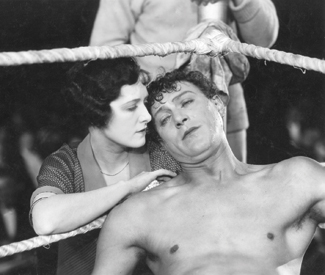
Blackmail and The Lodger are stuffed with elements that would later be easily identifiable as “Hitchcockian” (witness Blackmail‘s high-climbing climax — it ain’t Mount Rushmore, but you see where the idea’s heading). But The Ring, about a love triangle between two boxers and the (dark-haired) temptress that motivates their brawls, is Hitch’s only original script penned without collaborators, and it’s hardly chockablock with psychological terrors. It is, however, a charming sports romance with some nifty technical touches, including an early example of a drunken scene being shot in blurry “booze-o-vision.”

http://www.youtube.com/watch?v=F2T4ZrBel6A

The rest of the Hitchcock 9: 1928’s daffy-heiress tale Champagne; 1927’s Downhill, which also stars The Lodger‘s Novello; 1927’s Isle of Man-set The Manxman; 1928 comedy The Farmer’s Wife, with The Ring‘s Hall-Davis; 1927 Noel Coward adaptation Easy Virtue; and Hitchcock’s feature debut, 1926’s The Pleasure Garden. 

THE HITCHCOCK 9

Fri/14-Sun/16, $15–<\d>$20 (nine-film pass, $135)

Castro Theatre

429 Castro, SF

www.silentfilm.org


Thunder from West Portal: Quentin Kopp savages the Warriors’ Embarcadero Wall and its $220 million taxpayer subsidy

7

(Scroll down to read Kopp’s column from the Westside Observer)

When then State Sen. Quentin Kopp was appointed to the bench in San Mateo County, some of his fellow judges took him out to lunch.  “We hope you realize you have now given up your First Amendment rights,” he was told.

Judge Kopp did as he was told and kept silent for years on the bench on the many issues he felt strongly about and would have taken on in the public arena.   Today, however, he is retired, given up judicial restraint, and is back in action exercising his First Amendment rights with gusto. Operating from a desk in the office of Atty. Peter Bagatelos in West Portal, Kopp blasted the scavengers on behalf of an initiative aimed at upending the scavenger monopoly and controlling rates (he was right.) He has fired away at the RosePak/Willie Brown/Chinatown power structure on the Central Freeway.
He regularly blasts Mayor Lee for “compliancy” on big development, District Attorney for any number of misdemeanors and indiscretions, and former Sup. Sean Elsbernd for being Sean Elsbernd.

Now, in the current edition of the Westside Observer, Kopp has hit his stride with an acidic but well argued column titled appropriately, “The Art of Picking the Public Purse.” 

His lead: “It’s all privately funded!  Those aren’t my words; those are the words of the billionaire owners of the San Francisco Warriors and compliant Mayor Edward Lee respecting the proposed (and financially complicated) Warriors proposal to build a mammoth sports and entertainment arena on San Francisco Piers 30-32.”

Kopp wryly urges his readers to forget that the proposed project, “with Lee as the spear carrier (proudly proclaiming that the wrongly placed arena would be his ‘legacy’) would, if ever built, be higher than the “hated Embarcadero Freeway, which many San Franciscans spent years detesting and attempting to eliminate.”

Instead, he said taxpayers should concentrate on the “taxpayer subsidy of up to $200,000 (including interest) to the Warriors.” And he lays out the arguments and stats that demolish the Warriors’ line that “it’s all privately funded.”  Warming up, Kopp writes that the Warriors demand that Piers 30-32 be fully reconstructed, at Port cost, to a standard that will support the immense 19,000-seat arena.  The reconstruction cost is an estimated $120,000,000. Every single penny of such $120,000,000 is public money, i.e. the Port. The Port must borrow the money to reconstruct those piers.

“From whom? The Warriors, of course, and for the privilege of borrowing such money (for the Warriors’ benefit), the Port will pay the Warriors an exorbitant 13% per year as interest.”

More: “the port must sell the Warriors an enormously valuable piece of public land across the Embarcadero (Seawall 330) for a highrise hotel, condominium and retail development (b3: gulp).” Still more: “under the proposed Warriors’ deal, the $120,000,000 borrowing would be approved by a simple majority of the Board of Supervisors. The San Francisco Giants in 1996 and the San Francisco 49ers in 1971 were not afraid to secure voter/taxpayers approval. Maybe Lee and the Warriors are afraid the truth is that $120,000,000 is needed for the extraordinary cost of bearing the proposed arena’s weight, and supporting facilities the Warriors want to build on a platform over San Francisco Bay (b3: gulp again.)” You get the idea. 

Kopp’s arguments cry for an independent analysis by Harvey Rose, the city’s respected  budget analysis, who did a prescient assessment of the costs of the America’s Cup project. Kopp’s columns, along  with the excellent reporting of Patrick Monette-Shaw on Laguna Honda and George Wooding on the Ethics Commission and others, demonstrate that the Westside Observer under Editor Doug Comstock and Publisher Mitch Bull has become a sharp critic of City Hall from a neighborhood point of view and the best neighborhood paper in town.

Click here to read Kopp in full: http://westsideobserver.com/columns/quentin11.html#jun13
The paper is distributed monthly  West of Twin Peaks but you can see it easily by going to the Observer’s website at westsideobserver.com  b3

(Bruce B. Brugmann, who signs his blogs and emails b3, writes and edits the Bruce blog at the Bay Guardian website at sfbg.com. He is the editor at large of the Bay Guardian and former editor and co-founder with his wife Jean Dibble, 1966-2012.  He is now off to attend his 60th reunion of the dream high school class of 1953 in Rock Rapids, Iowa. He will keep you posted.)

Wish you weren’t here

2

arts@sfbg.com

FILM Austrian Ulrich Seidl has been making films since the early 1980s, but didn’t get much attention internationally until 2001’s Dog Days, a bleak and nasty ensemble piece about some seemingly ordinary — but all variably pathetic, ugly and/or perverse — Viennese suburbanites sweating through a heat wave. It was the sort of movie that demanded attention, being grotesque, funny, surprising, meticulously crafted, and arguably just plain mean.

Following decades of mostly documentary work, he’d suddenly joined the ranks of what you might call the New (though not necessarily young) Misanthropes: directors like his fellow countryman Michael Haneke, France’s Gaspar Noé, and the Philippines’ Brillante Mendoza. For some their invariably depressing, often upsetting films illuminate the human capacity for cruelty. For others, they wallow in it.

After taking his time making a Dog Days follow-up (2007’s Import/Export, a predictably grim comment on Europe’s immigration inundation), Seidl is back in atypical bulk with his Paradise Trilogy, three lightly interlocking (there’s no real overall arc) features more tightly focused on hapless individual protagonists. Each are observed — and this director is among the most ruthlessly clinical observers around, as if cinema were a laboratory and characters his test subjects — on vacation. But of course the experience of any earthly paradise is a sour joke in the contexts they find themselves in. Striking if unpleasant, the trio gets its Bay Area debut over the next three weekends at Yerba Buena Center for the Arts.

Paradise: Love (2012) makes the pursuit of pleasure look grim indeed, from the rather cheap-shot opening of Teresa (Margaret Tiesel) overseeing mentally handicapped adults as they enjoy an amusement-park outing on bumper cars — a scene whose “grotesquerie” feels exploitative. But once she’s on her holiday in sunny Kenya, it’s Teresa who does the exploiting. At the urging of a cheerfully horny friend (one among many plus-sized, German-speaking women well into middle age holidaying there), she partakes of the local populace of young men who offer gigolo-type services for a price.

But Teresa wants something more — or at least the illusion of it. Ergo she’s thoroughly suckered when the first seemingly non-predatory beach stud she encounters (Peter Kazungu as Munga) starts asking for money — he’s got no end of needy sick relatives, it seems — once they’ve consummated his declared “love.” Similar disappointments ensue. Teresa’s naiveté isn’t exactly sympathetic, however. She unconsciously brings the full weight of class/racial privilege and condescension with her, and is endlessly, petulantly demanding as a sex tourist who insists on being treated as a lover. (The negotiation around how her breasts should be touched by Munga seem to take half an hour alone.) She just wants to be desired. Yet she acts like a pushy colonialist bargain shopper.

In Paradise: Faith (2012), the spotlight is taken by Teresa’s older sister Anna Maria (Maria Hofstaetter), who most certainly is not looking for romance, let alone sex — without wearing a cowl, this hospital radiologist has become a fervent bride of Christ. She spends her vacation time alone in her over-large house, scrubbing it spotless, flogging herself clean of impure thoughts before Jesus, and singing hymns at the Casio keyboard. She also goes on daily outings to the homes of strangers, frequently immigrants. She barges in with sizable Virgin Mary statues crying “The Mother of God has come to visit you!,” and tries browbeating them into sin-abjuring prayer. Needless to say, this all seems much more about her needs than theirs.

She returns one day to the unwelcome surprise of husband Nabil (Nabil Saleh), an Egyptian Muslim back after an unexplained two-year absence. They’ve both changed greatly — back then he wasn’t yet paralyzed from the waist down, and she wasn’t a born-again fanatic. He’s nonplussed that her vinegary form of “Christian charity” treats him more as a home-nursing burden than a marital partner, and hostilities between them soon escalate to nightmarish proportions.

Ultimately, faith provides no comfort — and that failure induces a crisis of faith. Rigorously controlled in aesthetic terms, Seidl goes over the top content-wise at times — as when Anna Maria stumbles upon a public park orgy, or uses a crucifix à la Linda Blair — yet this cruel portrait of religious fixation has a certain compulsive, often cringe-inducing tension.

Finally, there’s some light at the end of the tunnel with Paradise: Hope (2013). While Teresa is fucking Africans and Anna Maria proselytizing, the former’s teenage daughter Melanie (Melanie Lenz) has been packed off to fat camp, where she and other pudgy youths endure long days of tortuous exercise and other “improving” programs. But the kids have each other; rather surprisingly, Seidl doesn’t rain gloom on their giddy rapport. Melanie also develops a serious crush on the resident doctor, a handsome, friendly, and flirtatious fellow (Michael Thomas) approximately four times her age.

Convinced she’s overdue to lose her virginity, she’s an avid pursuer — and disturbingly, he’s kinda interested. It is the movie’s major failing that seemingly kind, intelligent, grounded Dr. Arzt remains too much of an enigma for us to grasp why he’d even consider taking up a 13-year-old on the offer of herself. Yes, Melanie is cute, vivacious, and likable … but, well, come on. Of course this won’t end well. Still, Hope is indeed the most hopeful of the Paradise trilogy: its main character’s life isn’t ruined already, and she might well survive the hard knocks she’s given here to experience actual happiness.

ULRICH SEIDL’S PARADISE TRILOGY

June 13-30, $8-$10

Yerba Buena Center for the Arts

701 Mission, SF

www.ybca.org


Bully for the ACLU! It went after the real lawbreakers

1

Scroll down to read the ACLU complaint in the New York Times story

For me, the crucial question was not whether Edward J. Snowden broke the law but whether the U.S. government had broken the law in secretly setting up and secretly expanding what the American Civil Liberties Union called its “dragnet”collection of logs of domestic phone calls.

The ACLU, filing on Tuesday one of its most important lawsuits ever, stated that “this practice is akin to snatching every American’s address book, with annotations detailing who we spoke to, when we talked, for how long, and from where.  It gives the U.S. government a comprehensive record of our associations our associations and public movements, revealing a wealth of detail about our familial, political, professional, religious, and intimate associations.”

The suit stated that this mass tracking violates the Patriot Act and the First and Fourth Amendments to the U.S. Constitution.  The ACLU asked for the court to stop the Obama Administration from the practice and expunge the records.


“Every American” needs to read the ACLU suit embedded in the New York Times story. Let’s get our priorities straight and go after the real lawbreakers. Bully for the ACLU. b3

Click here to read the Times story and complaint.

Bruce B. Brugmann, who signs his blogs and emails B3, is the editor at large of the San Francisco Bay Guardian. He writes and edits the Bruce Blog on the Bay Guardian website at sfbg.com. He is the former editor and co-founder and co-publisher of the Bay Guardian with his wife Jean Dibble, 1966-2012.

Dede Wilsey re-elected prez of Fine Arts Museums board with little fanfare

At a quarterly meeting on June 6, Diane “Dede” Wilsey was summarily re-elected as president of the Board of Trustees of the Fine Arts Museums of San Francisco (FAMSF). The election marks her sixth consecutive term in a post she’s held since 1998, a tenure made possible when the board eliminated term limits in 2009.

She ran uncontested, and her unanimous endorsement by the board’s Nomination Committee was granted, in the words of Committee Chair Lisa Zanze, to be “mindful of the need for continuity” at FAMSF.

Earlier this year, Wilsey was the subject of harsh criticism by former and unnamed current employees at FAMSF, who anonymously submitted information to the Bay Guardian demonstrating that, among other things, Wilsey was directing staff members to assist with the maintenance of her personal art collection on museum time. Curator Emeritus Robert Flynn Johnson was even quoted in the New York Times as saying the museum was in a state of “Orwellian dysfunction” under Wilsey’s leadership.

Other allegations of mismanagement have included the ouster of several well-regarded, veteran members of the museum’s staff, such as European art curator Lynn Orr. Eyebrows were also raised over the exhibition of Wilsey’s son Trevor Traina’s photography collection at the deYoung last summer. Incidentally, Traina was re-elected to the FAMSF board last week after briefly retiring in April 2012, just before his show opened.

Despite the controversy, Wilsey’s position was never questioned at last week’s meeting. The need for “continuity” ostensibly stems from a gap in leadership at the museum following the death of Director John Buchanan in December 2011. The protracted recruitment effort for Buchanan’s replacement finally came to an end earlier this year, in the wake of the controversy, with the appointment of Colin Bailey, former deputy director and chief curator at The Frick Collection in New York. (On Thursday, Wilsey likened working with the selection committee to “herding cats.”)

It’s true that Wilsey has an extensive record of arts patronage in San Francisco. But with Wilsey retaining her post as president of the board, it’s unclear whether the “points of great concern amongst a broad range of professional staff” highlighted in an anonymous note sent to the Guardian this past February have been adequately addressed. The outcome of Wilsey’s re-election, perhaps, was the quiet dismissal of an ugly period in an institution otherwise concerned with beauty.

Film listings

0

Film listings are edited by Cheryl Eddy. Reviewers are Kimberly Chun, Dennis Harvey, Lynn Rapoport, and Sara Maria Vizcarrondo. For rep house showtimes, see Rep Clock.

OPENING

Becoming Traviata Philippe Béziat’s backstage doc offers an absorbing look at a particularly innovative production of Verdi’s La Traviata, directed by Jean-François Sivadier and starring the luminous Natalie Dessay (currently appearing in SF Opera’s production of Tales of Hoffman). Béziat eschews narration or interviews; instead, his camera simply tracks artists at work, moving from rehearsal room to stage as Sivadier and Dessay (along with her co-stars) block scenes, make suggestions, practice gestures, and engage in the hit-and-miss experimentation that defines the creative process. The film is edited so that La Traviata progresses chronologically, with the earliest scenes unfolding on a spartan set (Dessay’s practice attire: yoga clothes), and the tragic climax taking place onstage, with an orchestra in the pit and sparkly make-up in full effect. Dessay will appear in person at San Francisco screenings Sat/15 at 7pm and Sun/16 at 2pm. (1:53) Opera Plaza, Shattuck, Smith Rafael. (Eddy)

Dirty Wars Subtitled "the world is a battlefield," this doc follows author and Nation magazine writer Jeremy Scahill as he probes the disturbing underbelly of America’s ongoing counterterrorism campaign. After he gets wind of a deadly nighttime raid on a home in rural Afghanistan, Scahill does his best to investigate what really happened, though what he hears from eyewitnesses doesn’t line up with the military explanation — and nobody from the official side of things cares to discuss it any further, thank you very much. With its talk of cover-ups and covert military units, and interviewees who appear in silhouette with their voices disguised, Dirty Wars plays like a thriller until Osama bin Laden’s death shifts certain (but not all) elements of the story Scahill’s chasing into the mainstream-news spotlight. The journalist makes valid points about how an utter lack of accountability or regard for consequences (that will reverberate for generations to come) means the "war on terror" will never end, but Dirty Wars suffers a bit from too much voice-over. Even the film’s gorgeous cinematography — director Rick Rowley won a prize for it at Sundance earlier this year — can’t alleviate the sensation that Dirty Wars is mostly an illustrated-lecture version of Scahill’s source-material book. Still, it’s a compelling lecture. (1:26) Embarcadero, Shattuck. (Eddy)

The Guillotines Why yes, that is Jimmy Wang Yu, director and star of 1976 cult classic Master of the Flying Guillotine, in a small but pivotal role commanding a team of assassins who specialize in dispatching heads with airborne versions of you-know-which weapon. Unfortunately, this latest from Andrew Lau (best-known stateside for 2002’s Infernal Affairs, remade into Martin Scorsese’s 2006 Oscar-winner The Departed) doesn’t have nearly as much fun as it should; dudes be chopping heads off in a flurry of CG’d-up steampunky whirlygigs, but The Guillotines‘ tone is possibly even more deadly, as in deadly serious. When a rebellious prophet-folk hero known as Wolf (Xiaoming Huang) runs afoul of the Emperor’s top-secret Guillotine brotherhood, led in the field by Leng (Ethan Juan), the squad travels in disguise to a rural, smallpox-afflicted village to track him down. Along for the journey is the Emperor’s top operative, ruthless Agent Du (Shawn Yue), a boyhood friend of Leng’s. Leng and Du share a dark secret: the Guillotines have been deemed expendable — yep, in the Stallone sense — and the Emperor has decided to kill them off and replace them with armies toting guns and cannons in the name of progress. Lau is no stranger to tales of men grappling with betrayals, misplaced loyalties, and hidden personal agendas — and as historical martial-arts fantasies go, The Guillotines has higher production values than most, with sweeping, luscious photography. Too bad all the action scenes are punctuated by episodes of moody brooding — replete with slo-mo gazing off into the distance, dramatically falling tears, solemn heart-to-hearts, swelling strings, and the occasional howl of anguish. (1:53) Presidio. (Eddy)

Man of Steel As beloved as he is, Superman is a tough superhero to crack — or otherwise bend into anything resembling a modern character. Director Zack Snyder and writer David S. Goyer, working with producer Christopher Nolan on the initial story, do their best to nuance this reboot, which focuses primarily on Supe’s alien origins and takes its zoom-happy space battles from Battlestar Galactica. The story begins with Kal-El’s birth on a Krypton that’s rapidly going into the shitter: the exploited planet is about to explode and wayward General Zod (Michael Shannon) is staging a coup, killing Kal-El’s father, Jor-El (Russell Crowe), the Kryptonians’ lead scientist, and being conveniently put on ice in order to battle yet another day. That day comes as Kal-El, now a 20-something earthling named Clark Kent (Henry Cavill) — resigned to his status as an outsider, a role dreamed up by his protective adoptive dad (Kevin Costner) — has turned into a bit of a (dharma) bum, looking like a buff Jack Kerouac, working Deadliest Catch-style rigs, and rescuing people along the way to finding himself. Spunky Lois Lane (Amy Adams) is the key to his, erm, coming-out party, necessitated by a certain special someone looking to reboot the Kryptonian race on earth. The greatest danger here lies in the fact that all the leached-of-color quasi-sepia tone action can turn into a bit of a Kryptonian-US Army demolition derby, making for a mess of rubble and tricky-to-parse fight sequences that, of course, will satisfy the fanboys and -girls, but will likely glaze the eyes of many others. Nevertheless, the effort Snyder and crew pack into this lengthy artifact — with its chronology-scrambling flashbacks and multiple platforms for Shannon, Diane Lane, Christopher Meloni, Laurence Fishburne, and the like — pays off on the level of sheer scale, adding up to what feels like the best Superman on film or TV to date — though that bar seems pretty easy to leap over in a single bound. (2:23) Balboa, Marina. (Chun)

Pandora’s Promise Filmmaker Robert Stone has traveled far from his first film, 1988’s Oscar-nominated anti-nuke Radio Bikini, to today, with the release of Pandora’s Promise, a detailed and guaranteed-to-be-controversial examination of nuclear power and the environmentalists who have transitioned from fervently anti- to pro-nuclear. Interviewing activists and authors like Stewart Brand, Gwyneth Cravens, Mark Lynas, and Michael Shellenberger, among others, Stone eloquently visualizes all angles of their discussion with media, industrial, and newly shot footage, starting with a visit to the largest nuclear disaster of recent years, Fukushima, which he visits with the hazmat-suited environmental activist and journalist Lynas and continuing to Chernobyl and its current denizens. Couching the debate in cultural and political context going back to World War II, Stone builds a case for nuclear energy as a viable method to provide clean, safe power for planet in the throes of climate change that will nonetheless need double or triple the current amount of energy by 2050, as billions in the developing world emerge from poverty. In a practical sense, as The Death of Environmentalism author Shellenberger asserts, "The idea that we’re going to replace oil and coal with solar and wind and nothing else is a hallucinatory delusion." Stone and his subjects put together an enticing argument to turn to nuclear as a way forward from coal, made compelling by the idea that designs for safer alternative reactors that produce less waste are out there. (1:27) Embarcadero, Shattuck. (Chun)

This Is the End See "Hell Boys." (1:46) Four Star, Presidio, Shattuck.

ONGOING

After Earth In around a century, we’ll board penitentiary-style ships and evacuate Earth for a sexier planet. Let’s call it a middle-aged migration — we all saw this coming. It’ll be dour, and we’ll feel temporary guilt for all the trees we leveled, bombs we dropped, and oil refineries we taped for 1960s industrial films. Like any body post-divorce, our planet will develop defenses against its ex — us humans — so when Will Smith and son Jaden crash land on the crater it’s toxic to them, full of glorious beasts and free as the Amazon (because it was partly filmed there). Critically wounded General Raige (Will) has to direct physically incredible Kitai (Jaden) through the future’s most dangerous Ironman triathalon. It’s more than a Hollywood king guiding his prince through a life-or-death career obstacle course, it’s a too-aggressive metaphor for adolescence — something real-world Jaden may forfeit to work with dad. Call that the tragedy beneath After Earth: it makes you wonder why the family didn’t make a movie more like 1994’s The Lion King — they had to know that was an option. Director M. Night Shyamalan again courts the Last Airbender (2010) crowd with crazy CG fights and affecting father-son dynamics, but for once, Shyamalan is basically a hired gun here. The story comes straight from Papa Smith, and one gets the feeling the movie exists primarily to elevate Jaden’s rising star. (1:40) 1000 Van Ness, SF Center, Sundance Kabuki. (Vizcarrondo)

Before Midnight Proving (again) that not all sequels are autonomic responses to a marketplace that rewards the overfamiliar, director Richard Linklater and his cowriters Julie Delpy and Ethan Hawke reconnect with the characters Céline and Jesse, whom we first encountered nearly 20 years ago on a train and trailed around Vienna for a night in Before Sunrise, then met again nine years later in Before Sunset. It’s been nine more years since we left them alone in a Paris apartment, Céline adorably dancing to Nina Simone and telling Jesse he’s going to miss his plane. And it looks like he did. The third film finds the two together, yes, and vacationing in Greece’s southern Peloponnese, where the expansive, meandering pace of their interactions — the only mode we’ve ever seen them in — is presented as an unaccustomed luxury amid a span of busy years filled with complications professional and personal. Over the course of a day and an evening, alone together and among friends, the two reveal both the quotidian intimacies of a shared life and the cracks and elisions in their love story. (1:48) Embarcadero, Piedmont, Shattuck, Sundance Kabuki. (Rapoport)

The East In Zal Batmanglij and Brit Marling’s powerful second film collaboration (Batmanglij directs, and the pair co-wrote the screenplay, as in 2011’s Sound of My Voice), Marling plays Sarah, an intelligence agent working for a private firm whose client list consists mainly of havoc-wreaking multinationals. Sarah, presented as quietly ambitious and conservative, is tasked by the firm’s director (Patricia Clarkson) with infiltrating the East, an off-the-grid activist collective whose members, including Benji (Alexander Skarsgård), Izzy (Ellen Page), and Doc (Toby Kebbell), bring an eye-for-an-eye sensibility to their YouTube-publicized "jams." Targeting an oil company responsible for a BP-style catastrophe, they engineer their own spill in the gated-community habitat of the company’s CEO, posting a video that juxtaposes grisly images of oil-coated shorebirds and the unsettling sight of gallons of crude seeping through the air-conditioning vents of a tidy McMansion. A newspaper headline offers a facile framework for understanding their activities, posing the alternatives as "Pranksters or Eco-Terrorists?" But as Sarah examines the gut-wrenching consequences of so-called white-collar crime and immerses herself in the day-to-day practices of the group, drawn in particular to the charismatic Benji, the film raises more complex questions. Much of its rhetorical force flows from Izzy, whom Page invests with a raw, anguished outrage, drawing our sympathies toward the group and its mission of laying bare what should be unbearable. (1:56) California, Embarcadero, Piedmont, Sundance Kabuki. (Rapoport)

Elemental Even those suffering from environmental-doc fatigue (a very real condition, particularly in the eco-obsessed Bay Area) will find much to praise about Elemental, co-directed by Gayatri Roshan and NorCal native Emmanuel Vaughan-Lee (who also co-composed the film’s score). This elegantly shot and edited film approaches the issues via three "eco-warriors," who despite working on different causes on various corners of the planet encounter similar roadblocks, and display like-minded determination, along the way: Rajendra Singh, on a mission to heal India’s heavily polluted Ganges River; Jay Harman, whose ingenious inventions are based on "nature’s blueprints"; and Eriel Deranger, who fights for her indigenous Canadian community in the face of Big Oil. Deranger cuts a particularly inspiring figure: a young, tattooed mother who juggles protests, her moody tween (while prepping for a new baby), and the more bureaucratic aspects of being a professional activist — from defending her grassroots methods when questioned by her skeptical employer, to deflecting a drunk, patronizing Robert F. Kennedy Jr. at a big-ticket fundraiser — with a calm, steely sense of purpose. (1:33) Smith Rafael. (Eddy)

Epic (1:42) Metreon, 1000 Van Ness, Presidio.

Fast and Furious 6 Forget the fast (that’s understood by now, anyway) — part six in this popcorny series is heavy on the "furious," with constant near-death stunts that zoom past irrational and slam into batshit crazy. Agent Hobbs (Dwayne Johnson) lures the gang out of sunny retirement to bust a fast driver with a knack for strategy and an eye on world domination. Sure, Ludacris jokes their London locale doesn’t mean they’re in a Bond movie, but give cold-blooded Luke Evans some time and he’ll work his way up to antagonizing 007. Shaw (Evans) is smaller than our hero Toretto (Vin Diesel), but he’s convincing, throwing his King’s English at a man whose murky dialect is always delivered with a devilish baritone. If Shaw’s code is all business, Toretto’s is all family: that’s what holds together this cast, cobbled from five Fast and Furious installments shot all over the world. Hottie Gal Gadot (playing Sung Kang’s love interest) reassures Han (Kang) mid-crisis: "This is what we are." It’s not for nothing the gang’s main weapon is a harpoon gun that, once shot, leaves an umbilicus from the shooter to whatever’s in the crosshairs. That’s Torreto for you. Meanwhile, the villain’s weapon is a car with a spatula-like front end, that flips cars like pancakes. The climactic battle on a cargo plane has to give a face time to every member of the eight-person team, so naturally they shot it on the world’s longest runway. Of course the parade features less car porn than previous editions but it’s got a wider reach now — it’s officially international intrigue, not just fun for gearheads. For my money, it’s some of the best action in theaters today. Stick around for the inevitable sequel-suggesting coda during the credits. (2:10) Metreon, 1000 Van Ness. (Vizcarrondo)

Fill the Void Respectfully rendered and beautifully shot in warm hues, Fill the Void admirably fills the absence on many screens of stories from what might be considered a closed world: the Orthodox Hasidic community in Israel, where a complex web of family ties, duty, and obligation entangles pretty, accordion-playing Shira (Hada Yaron). An obedient daughter, she’s about to agree to an arranged marriage to a young suitor when her much-loved sister (Renana Raz) dies in childbirth. When Shira’s mother (Irit Sheleg) learns the widower Yochay (Yiftach Klein) might marry a woman abroad and take her only grandchild far away, she starts to make noises about fixing Shira up with her son-in-law. The journey the two must take, in possibly going from in-laws to newlyweds, is one that’s simultaneously infuriating, understandable, and touching, made all the more intimate given director Rama Burshtein’s preference for searching close-ups. Her affinity for the Orthodox world is obvious with each loving shot, ultimately infusing her debut feature with a beating heart of humanity. (1:30) Albany, Clay, Smith Rafael. (Chun)

Frances Ha Noah Baumbach isn’t exactly known for romance and bright-eyed optimism. Co-writing 2009’s Fantastic Mr. Fox with director Wes Anderson is maybe the closest to "whimsy" as he’s ever come; his own features (2010’s Greenberg, 2007’s Margot at the Wedding, 2005’s The Squid and the Whale, 1997’s Mr. Jealousy, and 1995’s Kicking and Screaming) tend to veer into grumpier, more intellectual realms. You might say his films are an acquired taste. But haters beware. Frances Ha — the black-and-white tale of a New York City hipster (Baumbach’s real-life squeeze, Greta Gerwig, who co-write the script with him) blundering her way into adulthood — is probably the least Baumbach-ian Baumbach movie ever. Owing stylistic debts to both vintage Woody Allen and the French New Wave, Frances Ha relies heavily on Gerwig’s adorable-disaster title character to propel its plot, which is little more than a timeline of Frances’ neverending micro-adventures: pursuing her nascent modern-dance career, bouncing from address to address, taking an impromptu trip to Paris, visiting her parents (portrayed by the Sacramento-raised Gerwig’s real-life parents), "breaking up" with her best friend. It’s so charming, poignant, and quotable ("Don’t treat me like a three-hour brunch friend!") that even those who claim to be allergic to Baumbach just might find themselves succumbing to it. (1:26) Embarcadero, Piedmont, Shattuck, Smith Rafael, Sundance Kabuki. (Eddy)

The Great Gatsby Every bit as flashy and in-your-face as you’d expect the combo of "Baz Luhrmann," "Jazz Age," and "3D" to be, this misguided interpretation of F. Scott Fitzgerald’s classic tale is, at least, overstuffed with visual delights. For that reason only, all the fashion-mag fawning over leading lady Carey Mulligan’s gowns and diamonds, and the opulent production design that surrounds them, seems warranted. And in scenes where spectacle is appropriate — Gatsby’s legendary parties; Tom Buchanan’s wild New York romp with his mistress — Luhrmann delivers in spades. The trade-off is that the subtler aspects of Fitzgerald’s novel are either pushed to the side or shouted from the rooftops. Leonardo DiCaprio, last seen cutting loose in last year’s Django Unchained, makes for a stiff, fumbling Gatsby, laying on the "Old Sports" as thickly as his pancake make-up. There’s nothing here so startlingly memorable as the actor and director’s 1996 prior collaboration, Romeo + Juliet — a more successful (if still lavish and self-consciously audacious) take on an oft-adapted, much-beloved literary work. (2:22) California, 1000 Van Ness, Presidio, SF Center, Sundance Kabuki. (Eddy)

The Hangover Part III Even the friendliest little blackout bacchanal can get tiresome the third time around. The poster depicting Bradley Cooper, Ed Helms, and Zach Galifianakis — stern in suits and ties — says it all: it’s grim men’s business, the care and maintenance of this Hangover franchise, this orgy of good times gone bad. Once a bad-taste love letter to male-bonding, Hangover Part III is ready for a chance, primed to sever some of those misbegotten ties. This time around, the unlikely troika — with the always dispensable normal-dude figurehead Doug (Justin Bartha) in tow — are captured by random sketchy figure Marshall (John Goodman, whose every utterance of the offensive "Chinaman" should bring back Big Lebowski warm-and-fuzzies). He holds Doug hostage in exchange for the amoral, cockfighting, coke-wallowing, whore-hiring, leather-wearing Leslie Chow (Ken Jeong), who stole his gold, and it turns out Alan (Galifianakis) might be his only chum. Jeong, who continues to bring the hammy glee, is still the best thing here, even as the conscience-free instigator; he’s the dark counterpart to tweaked man-child Alan, who meets cute with mean-ass pawn-star soulmate Cassie (Melissa McCarthy). Meanwhile, Cooper and Helms look on, puzzled, no doubt pondering the prestige projects on their plates and wondering what they’re still doing here. (1:40) 1000 Van Ness, SF Center, Shattuck. (Chun)

The Internship The dirty little secret of the new economy continues to be the gerbil cycle of free/cheap labor labeled "internships" that propels so many companies — be they corporate or indie, digital or print media. But gee, who’s going to see an intern comedy titled The Exploitation, besides me and my local union rep? Instead, spinning off a Vince Vaughn story idea and a co-writing credit, The Internship looks at that now-mandatory time-suck for so many college students through the filter of two older, not-quite-wiser salesmen Billy (Vaughn) and Nick (Owen Wilson) hoping to make that working guy’s quantum leap from watch sales to Google’s Mountain View campus, which director Shawn Levy casts as a bright and shiny workers wonderland with its free spring rolls and lattes, bikes, and napping pods. Departing from reality: the debugging/coding/game-playing/app-making competition that forces Billy and Nick to bond with their team of castoffs (Dylan O’Brien, Tiya Sircar, Tobit Raphael), led by noob manager Lyle (Josh Brener), in order to win a full-time job. Part of the key, naturally, turns out to be a Swingers-like visit to a strip club, to release those deeply repressed nerd sexualities — nothing like a little retrograde sexism to bring a group together. Still, the moment is offset by the generally genial, upbeat attitude brought to The Internship by its lead actors: Nick and Billy may be flubs at physics and clueless when it comes to geek culture, but most working stiffs who have suffered the slings and arrows of layoffs and dream of stable employment can probably get behind the all-American ideals of self-reinvention and optimism about the future peddled in The Internship, which easily slips in alongside The Great Gatsby among this year’s Great Recession narratives. Blink too fast and you might miss the microcameo by Google co-founder Sergey Brin. (1:59) Four Star, Marina, Metreon, 1000 Van Ness, Vogue. (Chun)

Iron Man 3 Neither a sinister terrorist dubbed "the Mandarin" (Ben Kingsley) nor a spray-tanned mad scientist (Guy Pearce) are as formidable an enemy to Tony Stark (Robert Downey, Jr.) as Tony Stark himself, the mega-rich playboy last seen in 2012’s Avengers donning his Iron Man suit and thwarting alien destruction. It’s been rough since his big New York minute; he’s been suffering panic attacks and burying himself in his workshop, shutting out his live-in love (Gwyneth Paltrow) in favor of tinkering on an ever-expanding array of manned and un-manned supersuits. But duty, and personal growth, beckon when the above-mentioned villains start behaving very badly. With some help (but not much) from Don Cheadle’s War Machine — now known as "Iron Patriot" thanks to a much-mocked PR campaign — Stark does his saving-the-world routine again. If the plot fails to hit many fresh beats (a few delicious twists aside), the 3D special effects are suitably dazzling, the direction (by series newcomer Shane Black) is appropriately snappy, and Downey, Jr. again makes Stark one of the most charismatic superheros to ever grace the big screen. For now, at least, the continuing Avengers spin-off extravaganza seems justified. (2:06) Metreon, 1000 Van Ness. (Eddy)

Kings of Summer Ah, the easy-to-pluck, easy-to-love low-hanging fruit of summer — and a coming of age. Who can blame director Jordan Vogt-Roberts and writer Chris Galletta, both TV vets, for thinking that a juicy, molasses-thick application of hee-hee-larious TV comedy actors to a Stand by Me-like boyish bildungsroman could only make matters that much more fun? When it comes to this wannabe-feral Frankenteen love child of Terrence Malick and Parks and Recreation, you certainly don’t want to fault them for original thinking, though you can understand why they keep lurching back to familiar, reliably entertaining turf, especially when it comes in the form of Nick Offerman of the aforementioned P&R, who gets to twist his Victorian doll features into new frustrated shapes alongside real-life spouse Megan Mullally. Joe (Nick Robinson) is tired of his single dad (Offerman) stepping on his emerging game, so he runs off with neurotic wrestling pal Patrick (Gabriel Basso) and stereotypically "weirdo foreign" kid Biaggio (Moises Arias) to a patch of woods. There, from scrap, they build a cool-looking house that resembles a Carmel boho shack and attempt to live off the land, which means mostly buying chicken from a Boston Market across a freeway. Pipes are pummeled, swimming holes are swum, a pathetically wispy mustachio is cultivated — read: real burly stuff, until the rising tide of testosterone threatens to poison the woodland well. Vogt-Roberts certainly captures the humid sensuality and ripe potential of a Midwestern summer — though some of the details, like the supposedly wild rabbit that looks like it came straight from Petco, look a bit canned — and who can gripe when, say, Portlandia‘s Kumail Nanjiani materializes to deliver monster wontons? You just accept it, though the effect of bouncing back and forth between the somewhat serious world of young men and the surprisingly playful world of adults, both equally unreal, grows jarring. Kings of Summer isn’t quite the stuff of genius that marketing would have you believe, but it might give the "weirdo foreign" art house crowd and TV comedy addicts something they can both stand by. (1:33) Shattuck, Sundance Kabuki. (Chun)

Kon-Tiki In 1947 Norwegian explorer and anthropologist Thor Heyderdahl arranged an expedition on a homemade raft across the Pacific, recreating what he believed was a route by which South Americans traveled to Polynesia in pre-Columbian times. (Although this theory is now disputed.) The six-man crew (plus parrot) survived numerous perils to complete their 101-day, 4300-mile journey intact — winning enormous global attention, particularly through Heyderdahl’s subsequent book and documentary feature. Co-directors Joachim Roenning and Espen Sandberg’s dramatization is a big, impressive physical adventure most arresting for its handsome use of numerous far-flung locations. Where it’s less successful is in stirring much emotional involvement, with the character dynamics underwhelming despite a decent cast led by Pal Sverr Hagen as Thor (who, incredibly, was pretty much a non-swimmer). Nonetheless, this new Kon-Tiki offers all the pleasures of armchair travel, letting you vicariously experience a high-risk voyage few could ever hope (or want) to make in real life. (1:58) Opera Plaza. (Harvey)

Midnight’s Children Deepa Mehta (2005’s Water) directs and co-adapts with Salman Rushdie the author’s Booker Prize-winning 1981 novel, which mixes history (India’s 1947 independence, and the subsequent division of India and Pakistan) with magical elements — suggested from its fairy-tale-esque first lines: "I was born in the city of Bombay, once upon a time." This droll voice-over (read by Rushdie) comes courtesy of Saleem Sinai, born to a poor street musician and his wife (who dies in childbirth; dad is actually an advantage-taking Brit played by Charles "Tywin Lannister" Dance) but switched (for vaguely revolutionary reasons) with Shiva, born at the same moment to rich parents who unknowingly raise the wrong son. Rich or poor, it seems all children born at the instant of India’s independence have shared psychic powers; over the years, they gather for "meetings" whenever Saleem summons them. And that’s just the 45 minutes or so of story. Though gorgeously shot, Midnight’s Children suffers from page-to-screen-itis; the source material is complex in both plot and theme, and it’s doubtful any film — even one as long as this — could translate its nuances and more fanciful elements ("I can smell feelings!," Saleem insists) into a consistently compelling narrative. Last-act sentimentality doesn’t help, though it’s consistent with the fairy-tale vibe, I suppose. (2:20) Smith Rafael. (Eddy)

Much Ado About Nothing Joss Whedon (last year’s The Avengers) shifts focus for a minute to stage an adaptation of the Shakespeare comedy, drawing his players from 15 years’ worth of awesome fantasy/horror/sci-fi TV and film projects. When the Spanish prince Don Pedro (Reed Diamond) pays a post-battle visit to the home of Leonato (Clark Gregg) with his officers Claudio (Fran Kranz) and Benedick (Alexis Denisof), Claudio falls for Leonato’s daughter, Hero (Jillian Morgese), while Benedick falls to verbal blows with Hero’s cousin Beatrice (Amy Acker). Preserving the original language of the play while setting his production in the age of the iPhone and the random hookup, Whedon makes clever, inventive use of the juxtaposition, teasing out fresh sources of visual comedy as well as bringing forward the play’s oddities and darker elements. These shadows fall on Beatrice and Benedick, whose sparring — before they succumb to a playfully devious setup at the hands of their friends — has an ugly, resentful heat to it, as well as on Hero and Claudio, whose filmy romance is unsettlingly easy for their enemies, the malevolent Don John (Sean Maher) and his cohorts, to sabotage. Some of Acker and Denisof’s broader clowning doesn’t offer enough comic payoff for the hammy energy expenditure, but Nathan Fillion, heading up local law enforcement as the constable Dogberry, delivers a gleeful depiction of blundering idiocy, and the film as a whole has a warm, approachable humor while lightly exposing "all’s well that ends well"’s wacky, dysfunctional side. (1:49) Albany, SF Center. (Rapoport)

Mud (2:18) Balboa, Opera Plaza, Shattuck.

Now You See Me Cheese can be a tough factor to quantify, but you get close to the levels Now You See Me strives for when you picture the hopelessly goofy, tragically coiffed Doug Henning lisping, "It’s magic!" somewhere between Bob "Happy Little Tree" Ross and a rainbow sprinkled with Care Bears. Now You See Me, however, is much less likely to be dusted off and adored by a Bronies-style cult. Four seemingly savvy street and stage magicians (Jesse Eisenberg, Woody Harrelson, Isla Fisher, and Dave Franco) are brought together by tarot card invite by a mysterious host. What follows is a series of corny performances by the crew, now dubbed the Four Horseman, that are linked to a series of Robin Hood-like, or not, thefts. Nipping at their heels are a loudly flustered FBI agent (Mark Ruffalo, working an overcooked Columbo impression), a waifish Interpol detective (Mélanie Laurent, as if slouching through a Sorbonne semester), and a professional debunker (Morgan Freeman, maintaining amusement). In the course of the investigation, the Horsemen’s way-too-elaborate and far-from-apocalyptic illusions are taken apart and at least one vigorously theatrical fight scene takes place — all of which sounds more riveting than what actually transpires under the action-by-the-book watch of director Louis Leterrier, who never succeeds in making the smug, besuited puppets, I mean Horsemen, who strut around like they’re in Ocean’s Eighteen 4D, anything remotely resembling cool. Or even characters we might give a magical rabbit’s ass about. For all its seemingly knowing pokes at the truth behind the curtain, Now You See Me lacks much of the smarts and wit of loving deconstructionists like Penn and Teller —glimmers of which can only be made out in the smirk of Harrelson and the knowing twinkle of Freeman — or even the tacky machismo of Criss Angel, as well as a will to get to a truth behind the mystery. Or is the mystery behind the truth? (1:56) California, 1000 Van Ness, Presidio, SF Center, Sundance Kabuki. (Chun)

Oblivion Spoiler alert: the great alien invasion of 2017 does absolutely zilch to eliminate, or at least ameliorate, the problem of sci-fi movie plot holes. However, puny humans willing to shut down the logic-demanding portions of their brains just might enjoy Oblivion, which is set 60 years after that fateful date and imagines that Earth has been rendered uninhabitable by said invasion. Tom Cruise plays Jack, a repairman who zips down from his sterile housing pod (shared with comely companion Andrea Riseborough) to keep a fleet of drones — dispatched to guard the planet’s remaining resources from alien squatters — in working order. But Something is Not Quite Right; Jack’s been having nostalgia-drenched memories of a bustling, pre-war New York City, and the déjà vu gets worse when a beautiful astronaut (Olga Kurylenko) literally crash-lands into his life. After an inaugural gig helming 2010’s stinky Tron: Legacy, director Joseph Kosinski shows promise, if not perfection, bringing his original tale to the screen. (He does, however, borrow heavily from 1968’s 2001: A Space Odyssey, 1996’s Independence Day, and 2008’s Wall-E, among others.) Still, Oblivion boasts sleek production design, a certain creative flair, and some surprisingly effective plot twists — though also, alas, an overlong running time. (2:05) Metreon. (Eddy)

1 Mile Above When his brother dies suddenly, sheltered Taiwanese student Shuhao takes possession of the older boy’s "riding diaries," determined to complete his sibling’s dream of biking to the highest point in Tibet. It’d be a perilous journey even for an experienced cyclist — but Shuhao’s got gutsy determination that (almost) makes up for his wobbly wheels. Fortunately, nearly everyone he meets en route to Lhasa is a kind-hearted soul, including a food-obsessed fellow traveler who doles out advice on how to avoid government checkpoints, prevent "crotch trouble" (from all that riding), and woo women, among other topics. (The cruel weather, steep inclines, and hostile wild dogs he faces, however, aren’t as welcoming.) Jiayi Du’s based-on-true-events drama doesn’t innovate much on similar adventure tales — spoiler alert: it’s the journey, not the destination, that counts — but it admirably avoids melodrama for the most part, and the gorgeous location photography is something to behold. (1:29) Metreon. (Eddy)

The Purge Writer-director James DeMonaco founds his dystopian-near-future tale on the possibly suspect premise that the United States could achieve one percent unemployment, heavily reduced crime rates, and a virtually carb-free society if only it were to sanction an annual night of national mayhem unconstrained by statutory law — up to and including those discouraging the act of homicide. Set in 2022, The Purge visits the household of home security salesman James Sandin (Ethan Hawke), wife Mary (Lena Headey), and their children, Charlie (Max Burkholder) and Zoey (Adelaide Kane), as the annual festivities are about to begin, and the film keeps us trapped in the house with them for the next 12 hours of bloodletting sans emergency services. While they show zero interest in adding to the carnage, James and Mary seem to be largely on board with what a news commentator describes as "a lawful outlet for American rage," not giving too much credence to detractors’ observations that the purge is a de facto culling of the underclass. Clearly, though, the whole family is about to learn a valuable lesson. It comes when Charlie, in an act of baseline humanity, draws the ire of a gang of purgers running around in bathrobes, prep school jackets, and creepy masks, led by a gleaming-eyed alpha-sociopath whom DeMonaco (whose other screenplay credits include 2005’s Assault on Precinct 13 remake) tasks with wielding the film’s blunt-object message alongside his semi-automatic weaponry. (1:25) Metreon, 1000 Van Ness, Shattuck. (Rapoport)

Rebels with a Cause The huge string of parklands that have made Marin County a jewel of preserved California coastline might easily have become wall-to-wall development — just like the Peninsula — if not for the stubborn conservationists whose efforts are profiled in Nancy Kelly’s documentary. From Congressman Clem Miller — who died in a plane crash just after his Point Reyes National Seashore bill became a reality — to housewife Amy Meyer, who began championing the Golden Gate National Recreation Area because she "needed a project" to keep busy once her kids entered school, they’re testaments to the ability of citizen activism to arrest the seemingly unstoppable forces of money, power and political influence. Theirs is a hidden history of the Bay Area, and of what didn’t come to pass — numerous marinas, subdivisions, and other developments that would have made San Francisco and its surrounds into another Los Angeles. (1:12) Smith Rafael. (Harvey)

Renoir The gorgeous, sun-dappled French Riviera setting is the high point of this otherwise low-key drama about the temperamental women (Christa Theret) who was the final muse to elderly painter Auguste Renoir (Michel Bouquet), and who encouraged the filmmaking urges in his son, future cinema great Jean (Vincent Rottiers). Cinematographer Mark Ping Bin Lee (who’s worked with Hou Hsiao-hsein and Wong Kar Wai) lenses Renoir’s leafy, ramshackle estate to maximize its resemblance to the paintings it helped inspire; though her character, Dédée, could kindly be described as "conniving," Theret could not have been better physically cast, with tumbling red curls and pale skin she’s none too shy about showing off. Though the specter of World War I looms in the background, the biggest conflicts in Gilles Bourdos’ film are contained within the household, as Jean frets about his future, Dédée faces the reality of her precarious position in the household (which is staffed by aging models-turned-maids), and Auguste battles ill health by continuing to paint, though he’s in a wheelchair and must have his brushes taped to his hands. Though not much really happens, Renoir is a pleasant, easy-on-the-eyes experience. (1:51) Smith Rafael. (Eddy)

Shadow Dancer Watching the emotions flicker across the exquisitely smooth, pale plane of Andrea Riseborough’s face is one of the central pleasures of Shadow Dancer. Likely the surest step Madonna made in making 2011’s W.E. was choosing the actress as her Wallis Simpson — her features fall together with the sweet symmetry of a, well, Madonna, and even when words, or the script, fail her, the play of thoughts and feelings rippling across her brow can fill out a movie’s, or a character’s, failings admirably. The otherwise graceful, good-looking Shadow Dancer fumbles over a few in the course of resurrecting the Troubles tearing apart Belfast in the 1990s. After feeling responsible for the death of a younger brother who got caught in the crossfire, Collette (Riseborough) finds herself a single mom in league with the IRA. Caught after a scuttled bombing, the petite would-be terrorist is turned by Mac (Clive Owen) to become an informant for the MI5, though after getting quickly dragged into an attempted assassination, Collette appears to be way over her head and must be pulled out — something Mac’s boss (Gillian Anderson) won’t allow. Director James Marsh (2008’s Man on Wire) brings a keen attention to the machinations and tested loyalties among both the MI5 and IRA, an interest evident in his Red Riding: In the Year of Our Lord 1980 (2009), and even imbues otherwise blanked-out, non-picturesque sites like hotel suites and gray coastal walks with a stark beauty. Unfortunately the funereal pacing and gaps in plotting, however eased by the focus on Riseborough’s responses, send the mind into the shadows. (1:44) Opera Plaza. (Chun)

Star Trek Into Darkness Do you remember 1982? There are more than a few echoes of Star Trek II: The Wrath of Khan in J. J. Abrams’ second film retooling the classic sci-fi property’s characters and adventures. Darkness retains the 2009 cast, including standouts Zachary Quinto as Spock and Simon Pegg as comic-relief Scotty, and brings in Benedict "Sherlock" Cumberbatch to play the villain (I think you can guess which one). The plot mostly pinballs between revenge and preventing/circumventing the destruction of the USS Enterprise, with added post-9/11, post-Dark Knight (2008) terrorism connotations that are de rigueur for all superhero or fantasy-type blockbusters these days. But Darkness isn’t totally, uh, dark: there’s quite a bit of fan service at work here (speak Klingon? You’re in luck). Abrams knows what audiences want, and he’s more than happy to give it to ’em, sometimes opening up massive plot holes in the process — but never veering from his own Prime Directive: providing an enjoyable ride. (2:07) Metreon, 1000 Van Ness, Sundance Kabuki. (Eddy)

Stories We Tell Actor and director Sarah Polley (2011’s Take This Waltz) turns the camera on herself and her family for this poignant, moving, inventive, and expectation-upending blend of documentary and narrative. Her father, actor Michael Polley, provides the narration; our first hint that this film will take an unconventional form comes when we see Sarah directing Michael’s performance in a recording-studio booth, asking him to repeat certain phrases for emphasis. On one level, Stories We Tell is about Sarah’s own history, as she sets out to explore longstanding family rumors that Michael is not her biological father. The missing piece: her mother, actress Diane Polley (who died of cancer just days after Sarah’s 11th birthday), a vivacious character remembered by Sarah’s siblings and those who knew and loved her. Stories We Tell‘s deeper meaning emerges as the film becomes ever more meta, retooling the audience’s understanding of what they’re seeing via convincingly doc-like reenactments. To say more would lessen the power of Stories We Tell‘s multi-layered revelations. Just know that this is an impressively unique film — about family, memories, love, and (obviously) storytelling — and offers further proof of Polley’s tremendous talent. (1:48) Smith Rafael. (Eddy)

Violet and Daisy The 1990s revival has already infiltrated fashion and music; Violet and Daisy, the directorial debut of Oscar-winning Precious (2009) screenwriter Geoffrey Fletcher, suggests that cinema may be next. Unfortunately, not enough time has passed since the first wave of Pulp Fiction (1994) knockoffs to make the genre feel particularly interesting again. And yet here comes a pair of assassins dressed as nuns, cracking long-winded jokes before unloading on their targets with guns they’ve concealed in pizza boxes … as an AM radio hit ("Angel of the Morning") swells in the background, and Danny Trejo stops by for a cameo. At least this Tarantino-lite exploration of crime and daddy issues has an appealing cast; besides Trejo, Alexis Bledel (sporting Mia Wallace bangs) and Saoirse Ronan play the jailbait titular killers, and James Gandolfini pops in as a sad-sack who manages to evade their bullets because, like, he’s nice and stuff. Despite their efforts, the over-stylized Violet and Daisy comes off like a plate of leftovers reheated too long after the fact. (1:28) Metreon. (Eddy)

What Maisie Knew In Scott McGehee and David Siegel’s adaptation of the 1897 Henry James novel, the story of a little girl caught between warring, self-involved parents is transported forward to modern-day New York City, with Julianne Moore and Steve Coogan as the ill-suited pair responsible, in theory, for the care and upbringing of the title character, played by Onata Aprile. Moore’s Susanna is a rock singer making a slow, halting descent from some apex of stardom, as we gather from the snide comments of her partner in dysfunctionality, Beale (Coogan). As their relationship implodes and they move on to custody battle tactics, each takes on a new, inappropriate companion — Beale marrying in haste Maisie’s pretty young nanny, Margo (Joanna Vanderham), and Susanna just as precipitously latching on to a handsome bartender named Lincoln (True Blood‘s Alexander Skarsgård). The film mostly tracks the chaotic action — Susanna’s strung-out tantrums, both parents’ impulsive entrances and exits, Margo and Lincoln’s ambivalent acceptance of responsibility — from Maisie’s silent vantage, as details large and small convey, at least to us, the deficits of her caretakers, who shield her from none of the emotional shrapnel flying through the air and rarely bother to present an appropriate, comprehensible explanation. Yet Maisie understands plenty — though longtime writing-and-directing team McGehee and Siegel (2001’s The Deep End, 2005’s Bee Season, 2008’s Uncertainty) have taken pains in their script and their casting to present Maisie as a lovely, watchful child, not the precocious creep often favored in the picture shows. So we watch too, with a grinding anxiety, as she’s passed from hand to hand, forced to draw her own unvoiced conclusions. (1:38) Opera Plaza. (Rapoport)


Developers should pay — on time

7

OPINION San Francisco used to be an eclectic city, filled with working class folks, people of color, lots of artists, and families. But that’s changed dramatically. The black population has dismally plummeted, to 6.3 percent, according to the most recent census. Families of color are streaming out, expensive condos and sky-high rentals are shooting up, and the unique mix that once was the city and made it such a diverse and culturally rich place to live and thrive is changing.

Three years ago, then-Mayor Gavin Newsom decided that private developers in San Francisco needed a local stimulus boost. The housing bubble had burst and taken the economy down with it, but Newsom wanted to ensure that private development in the city continued. So he proposed that private developers be allowed to defer paying the neighborhood impact fees on their projects, thus delaying funding for safety-net programs that help existing residents of working class neighborhoods fight displacement.

His proposal passed in 2010, and since then the Eastern Neighborhoods, SoMa, and the Octavia/Market Area have seen an upswing in private development projects coupled with rising eviction rates and housing costs, while affordable housing throughout the city becomes harder and harder to find. Because neighborhood impact fees were deferred services that would help vulnerable populations were underfunded by a total of almost $53.5 million — in 2011-2012 alone.

That lost money impacted affordable housing construction, affordable child care, development of parks and other types of open spaces, infrastructure and pedestrian-safety measures, neighborhood schools and libraries, and eviction prevention services.

Meanwhile, out-of-town private development companies are set to make millions of dollars building high-end rental units and luxury condominiums that the average San Franciscan can’t afford.

Given that private market-rate residential development in San Francisco is speeding up regardless of displacement dangers, it’s even more necessary today to strengthen and sharpen the tools our neighborhoods have for fighting displacement.

A longstanding question for San Francisco has been how to keep it from becoming a place where only the very wealthy can afford to live while the rest of us have to commute in to the city that we work in and love. Now as we field off another local housing boom fueled by speculation, we are faced again with needing to ensure that we prioritize San Franciscans over profit.

That’s why tenant groups, affordable housing advocates, and San Franciscans fighting for the right to stay in their city will be urging the Planning Commission to end the fee deferrals. The Planning Department staff has studied the issue and recommends that the Newsom program be allowed to expire; that would bring back the funds needed to invest in the vitality and vibrancy of our neighborhoods.

Come join us in helping get San Francisco’s priorities back on track at the Planning Commission meeting Thursday June 13th at 12pm in room 200 of City Hall. Private development is not worth more than the well being of working class communities, immigrants, families, LGBTQ, and tenant communities.

Maria Zamudio is a housing rights organizer for Causa Justa: Just Cause

A ‘reasonable’ cheek swab

7

Rebecca@sfbg.com

On June 3, the U.S. Supreme Court ruled that it’s legal for law enforcement to collect DNA samples from people who are arrested — even when the individuals taken into custody are never convicted of a crime. The justices were narrowly split, and the decision immediately drew criticism from civil liberties advocates like American Civil Liberties Union, who characterized it as a blow to American’s Fourth Amendment right to privacy.

Does the historic ruling carry implications for law enforcement practices in California? Not exactly. As it turns out, current state law allows police to collect DNA samples through cheek swabbing on a far more routine basis than in Maryland, where only a handful of serious offenses can trigger this kind of search. And in the Golden State, fewer protections are in place for arrestees.

The Supreme Court issued its ruling with a narrow 5-4 vote. “The majority’s take was that cheek-swabbing is reasonable … even without any suspicion of wrongdoing by the arrestee, because the intrusion is minimal, the arrestee has less of an expectation of privacy than a typical citizen, and the state has a strong interest in using DNA to identify people,” explained Andrea Roth, a law professor at the University of California at Berkeley and founding member of a group that studied and litigated forensic DNA typing.

In contrast, Roth said, conservative Justice Antonin Scalia “was concerned that this is the first time that we’ve ever allowed searches of someone’s body, without any type of individualized suspicion, for the purpose of general crime-solving. He thought that was a line the Constitution draws in the sand, and that the law is on the wrong side of that line.”

Despite drawing a scathing critique from a conservative Supreme Court justice, Maryland’s system for the collection and use of DNA is actually much narrower in scope than the law that went into effect in California in 2004, when Proposition 69 passed.

Maryland’s law “only applies to a limited number of offenses, it doesn’t apply at all to people who are simply arrested but not charged, and they can only make use of the sample after there’s been a judicial finding of probable cause,” Michael Risher, a lawyer with the Northern California Chapter of the American Civil Liberties Union, told us.

“California doesn’t have any of those safeguards,” Risher added. “It’s a different law.”

2.1 MILLION SAMPLES

When Prop. 69 was approved, California voters initially sanctioned DNA collection from people convicted of felony offenses. But on January 1, 2009, a different provision of that initiative kicked in, expanding it to allow police to collect DNA samples from “any adult person” arrested for “any felony offense,” regardless of whether that person is ever charged or convicted of a crime.

When used as a form of identification, DNA samples are processed to yield a 26-number sequence that aids law enforcement in verifying suspects’ identities.

Once they’re collected and used to produce unique identifiers, those cotton-swabbed samples aren’t destroyed; instead, they remain in the hands of a state agency. “The problem is that the state keeps your samples,” Roth said. “It’s not like they develop the 26-number profile and then throw the rest of the sample in the trash. So if you’re in a database, state officials still have your entire DNA strand.”

According to the California Department of Justice, since the start of the program, the DNA data bank had received and logged more than 2.1 million samples as of March 31. The data bank is shared with the National DNA Index System (NDIS), part of the Combined DNA Index System (CODIS), which is linked to federal records.

In its decision, the nation’s highest court determined that “taking and analyzing a cheek swab of the arrestee’s DNA is, like fingerprinting and photographing, a legitimate police booking procedure.”

Yet civil liberties advocates point out that the information contained in a DNA sample can reveal much more about an individual than either a fingerprint or a unique identifier generated from a sample.

“There’s a basic difference between your DNA and your fingerprint,” Risher explains. “Your fingerprint doesn’t tell you anything about yourself. And your DNA is your genetic blueprint. The profile that they generate might not say a lot about you … but they are keeping these physical samples. Current law says they can’t be tested for sensitive things, but laws change, and people can violate them.”

And a properly preserved DNA sample can last hundreds of thousands of years — essentially forever.

ANTI-WAR PROTESTER ASKED FOR DNA

Lily Haskell has been fighting the state of California over DNA collection ever since her arrest in March of 2009, at an anti-war demonstration in downtown San Francisco. Held to commemorate the anniversary of the start of the Iraq war, the protest was staged in Civic Center Plaza. “With no prior warning, police charged the crowd, penned us in, arrested us, and charged us with trying to incite a riot,” she told us.

But hours later, after she and a handful of others had been processed at the San Francisco County Jail, Haskell was summoned from her holding cell and presented with what struck her as an odd request. Although she says she had already been fingerprinted, and her identity already confirmed, an officer “told me I had to provide a DNA sample.”

Her first instinct was to decline. “I didn’t believe it was just to have to comply with that,” she said. “I told them I believed it was my right to refuse.” Haskell was told that if she continued to resist the sample collection, she’d be charged with a misdemeanor and would likely spend a few additional nights in jail. So she relented.

Although she was neither charged with a crime nor tried for a felony or any other offense after being released from jail 24 hours later, Haskell’s DNA sample remains in the state databank. Now she’s a lead plaintiff in a class action lawsuit filed by the ACLU.

Haskell said she’s never tried to get her DNA expunged from the state database, because she sees her participation in the lawsuit as an important challenge to a law she views as unjust. “I don’t want my DNA to be held,” Haskell says, “and I don’t want anybody else’s DNA to be held, either.”

Individuals who have tried to go the route of having DNA samples removed have found it can be tedious. “In California, the process of getting your DNA out of a database if your case ends in dismissal or acquittal is an onerous one,” Roth explained. “You have to pay your own filing and attorney fees, you have to wait until the statute of limitations has run, the judge has complete discretion to deny your motion, and you can’t appeal the judge’s decision.”

Legal upshot still unclear

Meanwhile, ACLU attorneys in Northern California were closely watching the Supreme Court case, Maryland v. King, to see how it might affect their class-action challenge to Prop. 69, a case known as Haskell v. Harris. Although a divided panel of Ninth Circuit judges upheld the law in February of 2012, the court took the unusual step last July of voting to rehear the case en banc, with a nine-judge panel. However, the court issued an order after oral arguments saying it wouldn’t issue a ruling until King had been decided in the Supreme Court.

“Yes, they will have to do something with our case — but what they do is actually up to them,” Risher explained. “There’s no binding opinion in our case right now. Everything was up in the air waiting for King to be decided.”

Risher added that in future arguments, the ACLU plans to highlight the differences between Maryland’s DNA collection law and California’s far broader Prop. 69. “If King was a 5-4 decision with a law that was so narrowly focused, with those safeguards,” he said, “well okay — this one crosses the line.”

Solomon: Historic challenge to support the moral actions of Edward Snowden

12

Norman Solomon is co-founder of RootsAction.org and founding director of the Institute for Public Accuracy. His books include “War Made Easy: How Presidents and Pundits Keep Spinning Us to Death.”

In Washington, where the state of war and the surveillance state are one and the same, top officials have begun to call for Edward Snowden’s head. His moral action of whistleblowing — a clarion call for democracy — now awaits our responses.

After nearly 12 years of the “war on terror,” the revelations of recent days are a tremendous challenge to the established order: nonstop warfare, intensifying secrecy and dominant power that equate safe governance with Orwellian surveillance.

In the highest places, there is more than a wisp of panic in rarefied air. It’s not just the National Security Agency that stands exposed; it’s the repressive arrogance perched on the pyramid of power.

Back here on the ground, so many people — appalled by Uncle Sam’s continual morph into Big Brother — have been pushing against the walls of anti-democratic secrecy. Those walls rarely budge, and at times they seem to be closing in, even literally for some (as in the case of heroic whistleblower Bradley Manning). But all the collective pushing has cumulative effects.

In recent days, as news exploded about NSA surveillance, a breakthrough came into sight. Current history may not be an immovable wall; it may be on a hinge. And if we push hard enough, together, there’s no telling what might be possible or achieved.

The gratitude that so many of us now feel toward Edward Snowden raises the question: How can we truly express our appreciation?

A first step is to thank him — publicly and emphatically. You can do that by clicking here to sign the “Thank NSA Whistleblower Edward Snowden” petition, which my colleagues at RootsAction.org will send directly to him, including the individual comments.

But of course saying thank-you is just one small step onto a crucial path. As Snowden faces extradition and vengeful prosecution from the U.S. government, active support will be vital — in the weeks, months and years ahead.

Signing the thank-you petition, I ventured some optimism: “What you’ve done will inspire kindred spirits around the world to take moral action despite the risks.” Bravery for principle can be very contagious.

Edward Snowden has taken nonviolent action to help counter the U.S. government’s one-two punch of extreme secrecy and massive violence. The process has summoned the kind of doublespeak that usually accompanies what cannot stand the light of day.

So, when Snowden’s employer Booz Allen put out a statement Sunday night, it was riddled with official indignation, declaring: “News reports that this individual has claimed to have leaked classified information are shocking, and if accurate, this action represents a grave violation of the code of conduct and core values of our firm.”

What are the “code of conduct” and “core values” of this huge NSA contractor? The conduct of stealthy assistance to the U.S. national security state as it methodically violates civil liberties, and the values of doing just about anything to amass vast corporate profits.

The corporate-government warfare state is enraged that Edward Snowden has broken through with conduct and values that are 180 degrees in a different direction. “I’m not going to hide,” he told the Washington Post on Sunday. “Allowing the U.S. government to intimidate its people with threats of retaliation for revealing wrongdoing is contrary to the public interest.”

When a Post reporter asked whether his revelations would change anything, Snowden replied: “I think they already have. Everyone everywhere now understands how bad things have gotten — and they’re talking about it. They have the power to decide for themselves whether they are willing to sacrifice their privacy to the surveillance state.”

And, when the Post asked about threats to “national security,” Snowden offered an assessment light-years ahead of mainline media’s conventional wisdom: “We managed to survive greater threats in our history . . . than a few disorganized terrorist groups and rogue states without resorting to these sorts of programs. It is not that I do not value intelligence, but that I oppose . . . omniscient, automatic, mass surveillance. . . .  That seems to me a greater threat to the institutions of free society than missed intelligence reports, and unworthy of the costs.”

Profoundly, in the early summer of 2013, with his actions and words, Edward Snowden has given aid and comfort to grassroots efforts for democracy. What we do with his brave gift will be our choice.

Norman Solomon is co-founder of RootsAction.org and founding director of the Institute for Public Accuracy. His books include “War Made Easy: How Presidents and Pundits Keep Spinning Us to Death.”

 (Bruce B. Brugmann,  or b3 as he signs his blogs and emails, writes and edits the Bruce blog on the San Francisco Bay Guardian website at sfbg.com. He is the editor at large of the Bay Guardian and editor and co-founder and co-publisher of the Bay Guardian  with his wife Jean Dibble, 1966-2012. He can be reached at bruce@sfbg.com.)

Solomon: An open letter to Sen. Dianne Feinstein, Chair of the Senate Intelligence Committee

15


By Norman Solomon


Norman Solomon is co-founder of RootsAction.org and founding director of the Institute for Public Accuracy. His books include “War Made Easy: How Presidents and Pundits Keep Spinning Us to Death.”

Dear Senator Feinstein:

On Thursday, when you responded to news about massive ongoing surveillance of phone records of people in the United States, you slipped past the meaning of the Fourth Amendment. As the chair of the Senate Intelligence Committee, you seem to be in the habit of treating the Bill of Rights as merely advisory.

The Constitution doesn’t get any better than this: “The right of the people to be secure in their persons, houses, papers, and effects, against unreasonable searches and seizures, shall not be violated, and no Warrants shall issue, but upon probable cause, supported by Oath or affirmation, and particularly describing the place to be searched, and the persons or things to be seized.”

The greatness of the Fourth Amendment explains why so many Americans took it to heart in civics class, and why so many of us treasure it today. But along with other high-ranking members of Congress and the president of the United States, you have continued to chip away at this sacred bedrock of civil liberties.

As The Guardian reported the night before your sudden news conference, the leaked secret court order “shows for the first time that under the Obama administration the communication records of millions of U.S. citizens are being collected indiscriminately and in bulk — regardless of whether they are suspected of any wrongdoing.”

One of the most chilling parts of that just-revealed Surveillance Court order can be found at the bottom of the first page, where it says “Declassify on: 12 April 2038.”

Apparently you thought — or at least hoped — that we, the people of the United States, wouldn’t find out for 25 years. And the fact that we learned about this extreme violation of our rights in 2013 instead of 2038 seems to bother you a lot.

Rather than call for protection of the Fourth Amendment, you want authorities to catch and punish whoever leaked this secret order. You seem to fear that people can actually discover what their own government is doing to them with vast surveillance.

Meanwhile, the Executive Branch is being run by kindred spirits, as hostile to the First Amendment as to the Fourth. On Thursday night, Director of National Intelligence James Clapper issued a statement saying the “unauthorized disclosure of a top secret U.S. court document threatens potentially long-lasting and irreversible harm to our ability to identify and respond to the many threats facing our nation.”

That statement from Clapper is utter and complete hogwash. Whoever leaked the four-page Surveillance Court document to Glenn Greenwald at The Guardian deserves a medal and an honorary parade down Pennsylvania Avenue in the Nation’s Capital. The only “threats” assisted by disclosure of that document are the possibilities of meaningful public discourse and informed consent of the governed.

Let’s be candid about the most clear and present danger to our country’s democratic values. The poisonous danger is spewing from arrogance of power in the highest places. The antidotes depend on transparency of sunlight that only whistleblowers, a free press and an engaged citizenry can bring.

As Greenwald tweeted after your news conference: “The reason there are leakers is precisely because the govt is filled with people like Dianne Feinstein who do horrendous things in secret.” And, he pointed out, “The real story isn’t just the spying itself: it’s that we have this massive, ubiquitous Surveillance State, operating in total secrecy.”

Obviously, you like it that way, and so do most other members of the Senate and House. And so does the president. You’re all playing abhorrent roles, maintaining a destructive siege of precious civil liberties. While building a surveillance state, you are patting citizens on the head and telling them not to worry.

Perhaps you should have a conversation with Al Gore and ask about his statement: “Is it just me, or is secret blanket surveillance obscenely outrageous?” Actually, many millions of Americans understand that the blanket surveillance is obscenely outrageous.

As a constituent, I would like to offer an invitation. A short drive from your mansion overlooking San Francisco Bay, hundreds of us will be meeting June 11 at a public forum on “Disappearing Civil Liberties in the United States.” (You’d be welcome to my time on the panel.) One of the speakers, Pentagon Papers whistleblower Daniel Ellsberg, could explain to you how the assaults on civil liberties and the wars you keep supporting go hand in hand, undermining the Constitution and causing untold misery.

Senator Feinstein, your energetic contempt for the Bill of Rights is serving a bipartisan power structure that threatens to crush our democratic possibilities.

A huge number of people in California and around the country will oppose your efforts for the surveillance state at every turn.

Sincerely,

Norman Solomon

Norman Solomon is co-founder of RootsAction.org and founding director of the Institute for Public Accuracy. His books include “War Made Easy: How Presidents and Pundits Keep Spinning Us to Death.”

(Bruce B. Brugmann, or b3 as he signs his blogs and emails, writes and edits the Bruce blog on the website of the San Francisco Bay Guardian  at sfbg.com. He is the editor at large of the Bay Guardian and former editor and co-founder and co-publisher of the Bay Guardian  with his wife Jean Dibble, 1966-2012.  He can be contacted at bruce@sfbg.com.) b3

Solomon: Bradley Manning is guilty of “aiding the enemy”–if the enemy is democracy

1


By Norman Solomon

Norman Solomon is co-founder of RootsAction.org and founding director of the Institute for Public Accuracy.

Of all the charges against Bradley Manning, the most pernicious — and revealing — is “aiding the enemy.”

A blogger at The New Yorker, Amy Davidson, raised a pair of big questions that now loom over the courtroom at Fort Meade and over the entire country:

*  “Would it aid the enemy, for example, to expose war crimes committed by American forces or lies told by the American government?”

*  “In that case, who is aiding the enemy — the whistleblower or the perpetrators themselves?”

When the deceptive operation of the warfare state can’t stand the light of day, truth-tellers are a constant hazard. And culpability must stay turned on its head.

That’s why accountability was upside-down when the U.S. Army prosecutor laid out the government’s case against Bradley Manning in an opening statement: “This is a case about a soldier who systematically harvested hundreds of thousands of classified documents and dumped them onto the Internet, into the hands of the enemy — material he knew, based on his training, would put the lives of fellow soldiers at risk.”

If so, those fellow soldiers have all been notably lucky; the Pentagon has admitted that none died as a result of Manning’s leaks in 2010. But many of his fellow soldiers lost their limbs or their lives in U.S. warfare made possible by the kind of lies that the U.S. government is now prosecuting Bradley Manning for exposing.

In the real world, as Glenn Greenwald has pointed out, prosecution for leaks is extremely slanted. “Let’s apply the government’s theory in the Manning case to one of the most revered journalists in Washington: Bob Woodward, who has become one of America’s richest reporters, if not the richest, by obtaining and publishing classified information far more sensitive than anything WikiLeaks has ever published,” Greenwald wrote in January.

He noted that “one of Woodward’s most enthusiastic readers was Osama bin Laden,” as a 2011 video from al-Qaeda made clear. And Greenwald added that “the same Bob Woodward book [Obama’s Wars] that Osama bin Laden obviously read and urged everyone else to read disclosed numerous vital national security secrets far more sensitive than anything Bradley Manning is accused of leaking. Doesn’t that necessarily mean that top-level government officials who served as Woodward’s sources, and the author himself, aided and abetted al-Qaida?”

But the prosecution of Manning is about carefully limiting the information that reaches the governed. Officials who run U.S. foreign policy choose exactly what classified info to dole out to the public. They leak like self-serving sieves to mainline journalists such as Woodward, who has divulged plenty of “Top Secret” information — a category of classification higher than anything Bradley Manning is accused of leaking. 

While pick-and-choose secrecy is serving Washington’s top war-makers, the treatment of U.S. citizens is akin to the classic description of how to propagate mushrooms: keeping them in the dark and feeding them bullshit.

In effect, for top managers of the warfare state, “the enemy” is democracy.”

Let’s pursue the inquiry put forward by columnist Amy Davidson early this year. If it is aiding the enemy “to expose war crimes committed by American forces or lies told by the American government,” then in reality “who is aiding the enemy — the whistleblower or the perpetrators themselves?”

Candid answers to such questions are not only inadmissible in the military courtroom where Bradley Manning is on trial. Candor is also excluded from the national venues where the warfare state preens itself as virtue’s paragon.

Yet ongoing actions of the U.S. government have hugely boosted the propaganda impact and recruiting momentum of forces that Washington publicly describes as “the enemy.” Policies under the Bush and Obama administrations — in Iraq, Afghanistan, Yemen and beyond, with hovering drones, missile strikes and night raids, at prisons such as Abu Ghraib, Bagram, Guantanamo and secret rendition torture sites — have “aided the enemy” on a scale so enormous that it makes the alleged (and fictitious) aid to named enemies from Manning’s leaks infinitesimal in comparison.

Blaming the humanist PFC messenger for “aiding the enemy” is an exercise in self-exculpation by an administration that cannot face up to its own vast war crimes.

While prosecuting Bradley Manning, the prosecution may name al-Qaeda, indigenous Iraqi forces, the Taliban or whoever. But the unnamed “enemy” — the real adversary that the Pentagon and the Obama White House are so eager to quash — is the incessant striving for democracy that requires informed consent of the governed.

The forces that top U.S. officials routinely denounce as “the enemy” will never threaten the power of the USA’s dominant corporate-military elites. But the unnamed “enemy” aided by Bradley Manning’s courageous actions — the people at the grassroots who can bring democracy to life beyond rhetoric — are a real potential threat to that power.

Accusations of aid and comfort to the enemy were profuse after Martin Luther King Jr. moved forward to expose the Johnson administration’s deceptions and the U.S. military’s atrocities. Most profoundly, with his courageous stand against the war in Vietnam, King earned his Nobel Peace Prize during the years after he won it in 1964.

Bradley Manning may never win the Nobel Peace Prize, but he surely deserves it. Close to 60,000 people have already signed a petition urging the Norwegian Nobel Committee to award the prize to Manning. To become a signer, click here.

Also, you can preview a kindred project on the “I Am Bradley Manning” site, where a just-released short video — the first stage of a longer film due out soon — features Daniel Ellsberg, Oliver Stone, Maggie Gyllenhaal, Phil Donahue, Alice Walker, Peter Sarsgaard, Wallace Shawn, Russell Brand, Moby, Tom Morello, Michael Ratner, Molly Crabapple, Davey D, Tim DeChristopher, Josh Stieber, Lt. Dan Choi, Hakim Green, Matt Taibbi, Chris Hedges, Allan Nairn, Leslie Cagan, Ahdaf Soueif and Jeff Madrick.

From many walks of life, our messages will become louder and clearer as Bradley Manning’s trial continues. He is guilty of “aiding the enemy” only if the enemy is democracy.

Norman Solomon is co-founder of RootsAction.org and founding director of the Institute for Public Accuracy.

(Bruce B. Brugmann, or b3 as he signs his emails and blogs, edits and writes the Bruce blog on the Guardian website at sfbg.com.  He is the editor at large of The San Francisco Bay Guardian and editor and founder and co-publisher of the Guardian with his wife Jean Dibble, 1966-2012, now retired.) He can be contacted at bruce@sfbg.com b3).

Security guard strike is “imminent”

10

At least a hundred SEIU members in purple jackets marched down Bush St. this afternoon (June 5), in preparation for a possible strike. Security guards who are a member of an affiliated union have been working without a contract since 2012; some make so little money that they can’t afford apartments in SF and wind up living in SROs.

The signs said “on strike,” but actually that hasn’t happened yet. I spoke to some of the marchers who said they weren’t a liberty to say when the security officers would walk out, but “it’s imminent.”

And they clearly got the message out, making noise loud enough that I could hear it on the 17th floor and backing up rush-hour traffic just North of Market.

I really don’t think any of the owners of these big commercial office buildings are so hard up right now in this boom market that they can’t afford to pay the people who protect their property and tenants a living wage.

Hello solo

0

arts@sfbg.com

DANCE Christy Funsch’s latest program, State: not anywhere near to now (May 31-June 2, CounterPULSE), represents what we have come to expect from her work: it is full of surprises, as comfortable as one’s own skin, and both immensely private and ever so open. It also keeps some of its secrets. Funsch’s primary output has been in solos, a genre she enters into with the utmost confidence. Her dance making is nuanced, rich in detail, and impeccably crafted. For all their quietness, her pieces resonate like finely tuned bells.

Last year’s illuminating and entertaining One on One at Z Space, in which Funsch set a number of her solos on other dancers, served as a reminder of just how bursting with possibilities the genre is. Yet there is no place to hide. The dancer and the dance are always on the spot.

Sharing this year’s concert with Funsch was Portland, Ore.-based Katherine Longstreth, clearly a kindred spirit in creating small-scaled works that are anything but modest.

The program opened with two of Longstreth’s own solos, O What, danced by Funsch, and O Where, performed by the choreographer. Highly condensed, they propose one vision but quickly turn it inside out. O What’s collage of Americana songs called up easy corn-fed living while Funsch explored the dark stage with a flashlight. Walking, stretching her arms, rolling through the torso, and rocking to the beat, Funsch seemed to relish entering the world of Oklahoma! But in the end, she stretched herself onto a narrow strip of Astroturf, her head stuck in what looked like a huge cloud of cotton candy.

With echoes of Over the Rainbow overlapping with “Home on the Range,” O Where pierced the concept of the Americana home. Dressed in black with a white blanket that turned into a shawl, a hood, and body covering, Longstreth carefully traced regular linear patterns. Rolling on the floor, she opened her blanket into wings and eventually an elegant white frock coat. Then very quickly, she discarded it to carefully fold it — like a military flag.

Nol Simonse reprised Funsch’s fine 2012 Kneel Before the Fire. He is an articulate, highly expressive dancer always good to watch, though I couldn’t help but wonder if he took a lot of liberties with Funsch’s choreography. Performed to Alex Keitel’s viola da gamba, Simonse embraced a free-spirited approach to the music that ended when he threw himself at Keitel’s feet. A gesture of thanks, well deserved.

The beautifully economic Narrative Medicine, choreographed by Longstreth and performed by her and Kelly Bartnik, traced what was a perhaps a friendship imperiled of illness. Casually rolling big wooden spools that became chairs and a table, the women tenderly examined each other’s hands. Then Longstreth moved to what looked like a medical screen to return to her partner, now stretched out on the table. Bartnik now fiercely resisted an examination. A lovely touch was the screen’s unraveling, ensnaring Bartnik in the process. Yet Longstreth held onto her.

Funsch’s newest solo, Moving Still(s), was apparently inspired by Fritz Lang’s 1931 film M, from which she borrowed 15 characters. It’s been too long since I’ve seen that movie to discern any echoes; however, Keitel’s suggestive sound collage proposed a world through which Funsch moved, at times searchingly, at times perhaps threatened by it. Above all she seemed to have her antennas out all the time, examining space close up but also peering into nowhere.

When the fingers of one hand began to tremble, it began to look like a conversation within her body. Grabbing her leg, she wanted to control a limp that careened her downstage. When the music switched into a jazz mode, she rollicked along with it. Opening and closing Moving were Funsch’s arms angled against her head. Their motion suggested that of the shutters on a lens. If Moving returns, I’ll revisit M beforehand.

At this point, the final work, she’s near she’s now she’s nowhere (which was announced as “in-progress”) is a loosely constructed trio for Celine Alwyn-Parker, Aura Fischbeck, and Peiling Kao. How and if its robust physicality eventually will be tamed and shaped will be the challenge. Tamara Alburtis’s sound sculpture of tiny speakers looked promising, but remained silent for much of the duration.