SFBG Blogs

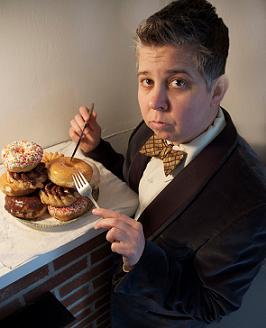
Can’t stop fashion: Style, as always, at Oakland’s First Friday

2

We’re stoked on next week’s Oakland First Fridays, where the style is weird, wild, and exactly what you would expect to see any time Bay Area folks, art, and mingling collide. In March, despite the previous month’s tragedy, looks were lively as ever. Attendees and vendors alike seemed to have all received the same memo: throw on some sort of headwear and layer up in as many different patterns as possible.

The fair usually takes over Telegraph Avenue from 17th Street to 27th Street. During last months’ edition, the shooting that occured at the street fair in February had wrought a few changes — the event was considerably smaller, still running along Telegraph Avenue, but only from West Grand Avenue to 27th Street, and about half the usual size. The evening came to a close an hour earlier at 9pm, and public drinking was prohibited. The community paid their respect the shooting victim with altars and peace vigils. 

But fashion pressed on. In a more conventional environment, the excessive use of prints at First Fridays would likely have appeared overdone, but amid street musicians jamming on homemade instruments, ambient street lamp lighting, and a general creative atmosphere, the spirited look fit in just right.

The vendors selling mostly handmade and thrifted goods made an obvious effort to dress in the style of their products. Tua-Lisa Runsten sported a pair of leopard leggings, a tweed jacket, and naturally some gigantic, neutral-toned earrings from her Etsy line. 

We saw blue hair, pink trench coats, and even a dangerously daggery necklace, but the steampunk-inspired style of the “Window Lady”, otherwise known as Janay Rose, topped them all. Rose wore a patchwork skirt, a furry collar, and a festive fascinator while her partner looked equally as dashing in a pair of worn-in overalls and a black bowler hat. 

The bundled up merchants adorned in polka dots, animal prints, and floral anorak jackets proved to us that busier is better. So what sartorial lesson did we take away from this bustling street fair? Go ahead, throw on two pieces that don’t match whatsoever. Mix blue and black. Sport a festive mini skirt with a pair of sequined Ugg boots with for a comfortable nighttime look. Wait no …don’t do that. Please never do that. But this for sure: even in trouble times, fashion braves on. 

Oakland First Fridays

First Fridays, 5-10pm, free

Telegraph between 19th and 27th Sts., Oakl.

www.oaklandfirstfridays.org

Airbnb’s tax and tenant law violations headed for hearings

80

As Airbnb continues to avoid making any public comment on the $1.8 million annual Transient Occupancy Tax obligation to the city that it appears to be dodging, with the complicity of the Mayor’s Office, Board of Supervisors President David Chiu is getting closer to introducing legislation to regulate so-called “shared housing” and holding public hearings on the issues it raises.

In addition to the tax issue, there are concerns that Airbnb, VRBO.com, and other Internet-based sites that facilitate short-term rentals of San Francisco apartments are increasingly being used to circumvent local tenant protections, often after evicting tenants from the apartments using the Ellis Act. That state law allows owners to leave the rental business and convert to other uses, and landlords can argue that Airbnb is a commercial use and not a residential use.

“I’ve been deep into a lot of these issues in my conversations with a lot of community stakeholders around Airbnb and the area of shareable housing and I’m hoping very soon to have a package of proposals in this area. And at that point, we’ll have public hearings on the topics that you describe,” Chiu told us when we asked about the tax and tenants issues.

Among those involved in Chiu’s negotiations with Airbnb is Ted Gullicksen, executive director of the San Francisco Tenants Union, who says the negotiations have been slow-going but he’s generally happy with how they’re proceeding and hopeful that the resulting legislation will rein in rampant current abuses of zoning, tax, and other regulations that city officials have been ignoring.

“All you have to do is sit in front of the computer for a few hours and you can identify a lot of the lawbreakers. But there’s no enforcement by the city,” he said, noting that the Tax Collector’s Office is the notable exception among city departments, such as the Planning and Building departments. “The taxes shouldn’t even be an issue because they’re illegal uses.”

For example, while landlords may be able to get around rental restrictions triggered by an Ellis Act eviction by calling the use for shared housing websites “commercial,” that’s usually a violation of local planning codes prohibiting commercial use of residential property. Chiu’s legislation approved late last year banning “hotelization,” in which entire apartment buildings are cleared of tenants and rented out on a short-term basis, allows nonprofit groups like the Tenants Union to help enforce the ban.

“We’ve been researching the buildings we want to go after with complaints and lawsuits,” Gullicksen said. “It’s a pretty widespread problem.”

He said the VRBO.com appears to be a bigger culprit in terms of being used by landlords to avoid tenant protections than Airbnb, whose hosts are evenly split between tenants and landlords. But as the biggest shared housing service in San Francisco, the tax issues are bigger for Airbnb and the city.

“We don’t mind the limited use of someone’s principal residence for short-term rental, where we’re concerned is about the whole buildings,” Gullicksen said.

Whether the issue is avoiding taxes or circumventing tenant protections, the complicated issues surrounding shared housing are long overdue for some public discussions and scrutiny, and it sounds like that’s what we’re see later this spring or summer.

The right wing and same-sex marriage

75

I had lunch with my old friend Johnny Angel Wendell, a musician, actor, and radio personality in LA, who was up here on vacation (and to hype his new vinyl, “My Lesbian Friend,”) and we got to talking about the Supreme Court and same-sex marraige, and Johnny and I have agreed for years that this debate is essentially over. When 80 percent of people under 30 think same-sex marriage is fine, then it’s really only a matter of time before it’s legal and encouraged in every single state.

Johnny knows a lot of folks in talk radio, and a lot of them are on the right-wingy side of things, so he’s a dinosaur watcher, and he had this suggestion: The reason the right wing is all agitated about same-sex marraige, and really wants the Supreme Court to avoid saying that Prop. 8-style laws are all unConstitutional, is that these folks are starting to run out of divisive social issues. The “god, guns, and gays” approach doesn’t have the power it once did — and once that stuff goes away, then they’ll have to start talking about economic issues — where they will always lose.

Thomas Frank figured that out in What’s the Matter with Kansas — social issues have been driving working-class Americans to vote against their economic interests. Imagine if the next generation doesn’t care about gay marriage at all; then maybe those voters will think about taxes and wealth inequality and corporate power. And for a certain segment of American politics, that’s really frightening.


Reagan’s legacy: Homeless death

130

The headline on sfgate is about as brutal as you can get: “The coming homeless die-off.” But the brief story points to an alarming set of statistics: The median age of homeless people on the streets of US cities is now 53. The life expectancy for homeless people is 64. You get the point.

But here’s the key political element:

Social scientists say the median age has been steadily increasing for many years, supporting the “big bang” theory that many of today’s street people hit the gutter back in the 1980s era of recession and slashings of social programs.

Having lived through the Reagan Era, and worked with homeless people in the early 1980s at the Haight Ashbury Switchboard, I can tell you that makes perfect sense. Vast libraries of books have been written about the Reagan Era, but one of the things it represented was the end of major federal support for low-cost housing in cities — and the end of any concept of linking welfare payments to the cost of housing.

There were a lot of people living on General Assistance and SSI in San Francisco in the late 1970s, and most of them had homes. That’s because public assistance programs provided enough income to cover the rent on a cheap place. Between GA and food stamps, people who were, for whatever reason, unable to work wound up in crappy apartments and sometimes crappier SROs, but they weren’t on the streets.

Yes: Some of those people had serious substance-abuse issues. Yes: SSI and GA checks were going, in part, for drugs and booze. But even ignroing the notion that it’s much better for a drunk to have an SRO room than to be homeless, it’s also cheaper. San Francisco spends a fortune on homeless services, and if the feds (and the City and County) had indexed public assistance to the cost of housing (which happened pre-Reagan) the toll on the local taxpayers would almost certainly be lower.

So Reagan’s policies are now killing people on the streets of San Francisco. All these years later.


Heartless Bastards’ Erika Wennerstrom on breaking writer’s block with travel

0

It seems like the Austin-based Heartless Bastards have made some drastic changes since the release of their debut album, Stairs and Elevators, shedding their punkish irreverence in favor of more candid Americana as illustrated in Arrow, their 2012 Jim Eno-produced release.

I caught up with frontperson Erika Wennerstrom before the band’s Great American Music Hall show this weekend, amid a van ride from Tucson to California to chat about her quartet’s ever-changing sound, her favorite SF food, Neil Young, and Arrow’s traveling backstory:
 
SFBG How do you think your sound has changed since you started playing under the Heartless Bastards moniker back in 2003, and what type of sound were you going for with ‘Arrow’?
 
Erika Wennerstrom I really like to try different things – that’s what I enjoy about creating. I don’t try to recreate the same album. I’d like to think I’ve evolved as a songwriter, but I’m very much proud of songs I did on my first album. I’d also like to think that we don’t have one sound and that it’s not necessarily “going” in a specific direction. I have a lot of diverse influences, and I feel like our music is a little all over the place.

http://www.youtube.com/watch?v=SBX22g53ZOQ
 
SFBG People call Heartless Bastards “garage rock” quite often, which seems kind of limiting and maybe even inaccurate. How do you feel about this characterization?
 
EW Yeah, I agree that it’s limiting. We recorded our first album really quickly and without a producer, so it kind of has a garage, rough around the edges feel. I’d say it’s still part of our sound, but it’s just one element and there are a lot of other elements. I’ve also gotten “country” a lot in the past several years between The Mountain and Arrow, and I get that but my country influences are more like Neil Young – artists that have a little bit of that country Americana sound but are very much rock’n’ roll artists as well.
 
SFBG Can you talk about the inspiration behind ‘Arrow’?
 
EW I had a bit of writer’s block at the time and decided to take some road trips, which ended up shaping the album. I went to the East Coast and the Catskills and stopped through Ohio and Pennsylvania. I also spent time in West Texas and went out hiking in Big Bend. There’s a lot of imagery on the album from my stay in West Texas.
 
SFBG What’s it like living in West Texas?
 
EW A lot of it is desert. There’s yellow grass; it’s dry. I find it inspiring out there – all that open space. The songs on the album have a lot of space in them, which is reflective of the imagery out there. I think I tried to channel the desert in Arrow.
 
SFBG What was your songwriting process like?
 
EW I approached each song on Arrow individually and hoped they’d all ended up fitting together and flowing. Usually I try to focus on one song at a time or I never get anything done and just have 100 unfinished songs. The album starts out with “Marathon,” which was written for The Mountain, but we ran out of recording space. I thought it was appropriate to start Arrow where I left off.

http://www.youtube.com/watch?v=71mt0FcgGI8
 
SFBG Is there anything you’re particularly excited about doing while you’re here in San Francisco?
 
EW Eating some fresh seafood!
 
 
Heartless Bastards
With Johnny Fritz
Sat/30, 9pm, $23
Great American Music Hall
859 O’Farrell, SF
(415) 885-0750
www.slimspresents.com

Hot sexy events: Nerd boobs, Bill Gates’ condom quest, and the Sheagle = landed

0

Hey, dudes who don’t like condoms, has Bill Gates got your back or what? During the same month that the Pope Emeritus reincarnates as a wall of condoms, the tech bajillionaire has donated the change he found in his couch ($100,000) to the Global Health research foundation Bill and wife Melinda founded through their foundation to developing a rubber that feels better on penises.

Yes, we know, yet more money that focuses on male reproductive health. But for those who regularly find themselves in contact with penis-bearers, the promise of never hearing another “but I can’t feeeel it with the condom on,” will be a definite boon to that largest of sexual organs: our brain, which non-scientifically speaking, shrivels up and dies a little from so much whining in bed. (Also, penis bearers? Golf claps for science, but in the meantime you might benefit from not jerking it so damn hard. Try a Fleshlight.)

Chat about the politics of sex research, or forget about politics altogether, at this week’s sexy events:

Sheagle

A night presented by the female-identified kinksters of San Francisco, but open to attendees in the newly (more or less) re-opened space of this beloved leather bar. The monthly party will benefit a different female-identified organization — this month it’s the SF girls of Leather, who rad work you can read about in this Guardian cover story on their cute kink from a few years ago. 

Wed/27, 8pm-2am, free. Eagle, 298 12th St., SF. www.sf-eagle.com

“Bling My Vibe” awards ceremony 

When Good Vibrations contacted me about crafting an project from a vibrator for their March art contest I said: sure. And though every time I’ve been back to see it proudly installed in the Polk Street store’s gallery/education space there’s been a class going on, I have nothing but the utmost faith that the room full of Conehead vibes, vibrators fashioned into magical steeds, and Ninja Turtles vibes (HuffPo has a nice slideshow if you’re curious) is an uplifting experience. Today, the top crafters take home gift certificates so that they can continue to make sweet projects with Good Vibes gear.

Fri/29, 6-8pm, free. Good Vibrations, 1620 Polk, SF. www.goodvibes.com

Nerd Nite at the Lusty Lady

SF’s only co-op strip club welcomes sci-fi freaks tonight. Lusty dancer Pandora wrote us in an email that the Lusty theme nights are all about costumes: “Well, as much as you can costume and still be naked, which as it turns out is quite a bit. 😉 Sometimes music or activities like naked Twister, naked light saber battle. naked karaoke. Pretty much anything fun, and put naked in front of it.” Check out this video for more on why the peep shows and VIP booths here rock:

Fri/29, 8am-3pm. The Lusty Lady, 1033 Kearny, SF. www.lustylady.com

Spring Breakers 

“Why you acting ‘spicious?” The ATL twins, James Franco Gucci Mane, Vanessa Hudgens, blatant perversion of typical crime movie gender roles — Harmony Korine’s latest cult classic is the sexiest film of 2013 and you should see it before you get secondhand sick of the catchphrases. Which reminds me, “spring break 4eva.”

http://www.youtube.com/watch?v=rVvn9T6bqls

Various Bay Area theaters

Goodbye Gauley Mountain screening and dinner

Feminist porn pioneer Annie Sprinkle and partner Beth Stephens premiere the couple’s documentary on their ecosexual relationship with the Appalachian mountains and the crusade to stop destructive mining practices. Come early for the pre-screening vegan Appalachian dinner.

Trailer Goodbye Gauley Mtn: An Ecosexual Love Story from Elizabeth Stephens on Vimeo.

Sat/30, dinner 6:30pm, screening 7pm, $10-100. Center for Sex and Culture, 1349 Mission, SF. www.sexandculture.org

Sutter/CPMC agrees to a contract with its nurses in SF, clearing the path for its hospital deal

10

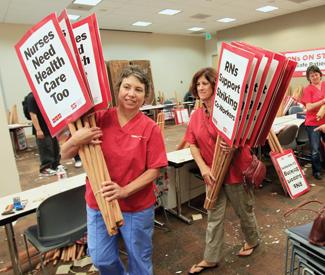
Ending a long and contentious labor impasse and setting the stage for the city to approve the pair of new hospitals that Sutter Health and its California Pacific Medical Center affiliate want to build in San Francisco, the California Nurses Association today announced that it has reached a tentative contract agreement with the hospital corporations.

As we’ve reported, reaching a deal with its nurses seemed to be the last major hurdle for Sutter/CPMC to overcome before the community-labor coalition would fully support the compromise hospital deal that a city-CPMC negotiating team announced on March 5. The nurses helped force that hard-won deal in part by aggressively advocating for St. Luke’s Hospital to remain financially viable and open to the low-income community it serves.

“We are delighted to finally reach a contract deal. It’s been six years of a very contentious relationship,” Eileen Prendiville, a registered nurse who works at CPMC’s California Campus, told the Guardian. She said that the nurses are thrilled to have attained good job security and patient advocacy standards while ensuring St. Luke’s stays open. “Working with a coalition of labor and community, we were successful at changing the face of healthcare in San Francisco.”

Under a previous agreement reached last year between CPMC and the Mayor’s Office, St. Luke’s would have had just 80 beds and could have been closed if the corporations revenues sagged. But activists and the Board of Supervisors were able to kill it and force the corporations back to the bargaining table.

In today’s print edition of the Guardian, I cover the movement to value caregiving in our uncaring economic system and the key role that CNA has played has in that growing movement. In San Francisco, CNA has faced down lawsuits, lock-outs, and harsh union-busting tactics as it pushed for contracts with strong patient advocacy protections.

Sup. David Campos, who help negotiate the latest hospital deal, said he was “thrilled” to hear Sutter/CPMC reached a deal with CNA. “We’ve always said it’s really important as we finalize the agreement that there is protection for the workers,” Campos told us.

Board President David Chiu, another key negotiator in the recent deal, told us, “I’m tremendously excited that there’s finally an agreement between oru nurses and CPMC, and thank the parties for their hard work in reaching this point. Along with the agreement we recently arrived at for the new Cathedral Hill and St. Luke’s campuses, this is an important moment for our city’s health care futue.”

CPMC spokespersons didn’t immediately respond to our calls for comment, but we’ll update this post if and when we hear back. The CNA press release announcing the deal and its details follows:


Nurses Reach Agreement with Sutter California Pacific

RNs Hail Community Support, Decision to Keep St. Luke’s Open 


Registered nurses at two San Francisco Sutter hospitals, California Pacific Medical Center and St. Luke’s Hospital, have, at long last, reached agreement with hospital officials on a new collective bargaining contract for the 800 RNs who work at the two facilities, the California Nurses Association said today.

The agreement expands patient protections, strengthens the nurses’ bargaining and job security rights, and provides for economic gains. It must still be ratified by CPMC and St. Luke’s nurses who will vote on the pact in membership meetings soon.

The RNs emphasized that they are especially pleased with the overall political and community framework, announced earlier this month, that preserves St. Luke’s after years of uncertainly and threats of closure for the historic hospital that serves a medically underserved community in San Francisco.

CNA Executive Director RoseAnn DeMoro praised the unity of the nurses over the long contract fight and the broad public support for nurses as critical to protecting St. Luke’s and winning a new agreement for the nurses.

“San Francisco nurses have worked extremely hard, with the widespread support of a very broad community coalition and the support of a number of community leaders, including members of the Board of Supervisors, to protect this vital community resource. We are proud of the efforts of everyone who has held the line for maintaining St. Luke’s,” DeMoro said.

For the first time, the RNs at both hospitals will be under one contract with equal job security and seniority rights. The pact includes safe patient handling provisions to stem patient falls and injuries to patients and nurses. Additionally it obligates the employer to provide for meal and rest breaks and stipulates that new technology not supplant RN professional judgment.

On economics, all the RNs will receive across the board pay increases of 6 percent over the next 34 months, as well as additional pay based on years of service in the San Francisco hospitals, at other Sutter facilities, and foreign nursing experience.

“We are delighted to finally reach a contract settlement with Sutter/CPMC,” said California Pacific campus RN Susan Blaschak RN.  “Our contract provides for continued patient advocacy and will keep our professional nursing standards high for years to come.”

“The process has been tumultuous but in the end we had a vision and we were successful in performing the ultimate in patient advocacy – saving St Luke’s,” said Jane Sandoval, a St. Luke’s RN and CNA board member. “In addition, with our collective bargaining agreement we have preserved patient care standards, having a voice in that and in our professional integrity.”

“Working with a coalition of labor and community groups, we have been successful in changing the face of healthcare for San Francisco’s future. St Luke’s will not only remain open it will offer more healthcare services to residents in the community south of Market,” said Eileen Prendiville RN at the California Pacific campus of CPMC.

“Our contract settlement was also made possible by the strong support for the nurses by San Franciscans for Healthcare, Housing, Jobs and Justice as well as elected leaders who knew San Franciscans overall would be best served by a fair collective bargaining agreement,” said Sandoval.

CNA also calls on Sutter officials in its headquarters in Sacramento, and other Sutter regions to view the San Francisco agreement as a new opportunity to resolve outstanding contract fights with RNs in the East Bay and North Bay.

Nurses have now reached agreement with CNA-represented Sutter hospitals in the past nine months at Mills-Peninsula in Burlingame and San Mateo, Sutter Santa Rosa, Sutter Lakeside in Lakeport, and Sutter VNA in Santa Cruz.

Contracts remain unresolved at Alta Bates Summit in Berkeley and Oakland, Eden in Castro Valley and San Leandro, Sutter Delta in Antioch, Sutter Solano in Vallejo, and Sutter Novato.

“Every one of those disputes could also be resolved if those hospital’s officials would approach negotiations with a desire to stop the war on their nurses, remove unwarranted and punitive concessions demands, and show the community served by their hospitals that they desire a cooperative relationship with nurses based on therapeutic healing for their patients,” said Sandoval.


Mayor Lee’s mysterious breakfast companions [UPDATED]

See an update to this story below. San Francisco Mayor Ed Lee has been having breakfast with CEOs to seek millions in funding for the America’s Cup, but the identities of those CEOs remain a mystery.

At a City Hall hearing two weeks ago, America’s Cup Organizing Committee chief Kyri McClellan told supervisors that Lee has been “putting an incredible amount of energy” into fundraising to cover city costs for the America’s Cup. As the yacht race draws closer, pressure is building around an anticipated funding shortfall that could deal a blow to city coffers.

McClellan told supervisors that Lee was “holding breakfasts with CEOs” to raise money. Encouragingly, she added, “people are responding.”

So, who are the CEOs? And how much have they agreed to contribute? So far, nobody has disclosed that information.

Shortly after the hearing, the Guardian submitted a public records request to Lee’s office seeking documentation on the fundraising breakfasts and records showing the names and affiliations of the CEOs.

In response, we received several pages from the mayor’s calendar. Entries show that Lee held half a dozen meetings concerning “economic development,” with no mention of the America’s Cup. The mayor had a meeting at Waterbar, a restaurant on the Embarcadero overlooking the Bay Bridge, on the morning of Jan. 25; he had another meeting there Feb. 1; he met at the Hotel Vitale on Feb. 22; met at City Hall on Feb. 28; had breakfast at the St. Regis Hotel on March 1, and had lunch with someone at Original Joe’s on March 4. But there was no information disclosing whom he met with.

After receiving the documents, the Guardian left multiple voicemails with the mayor’s press office asking for the identities of the CEOs. So far, nobody has responded.

The request also yielded a fundraising form that asks prospective donors to “join the 2013 America’s Cup San Francisco Host Committee.”

Donors could opt to become a “Legacy Benefactor” for committing to give or raise $5 million; a “Legacy Partner” for $2.5 million; a “Strategic Partner” for $1 million, a “Civic Champion” for $500,000, or a mere “Member” for $250,000. Donors with questions or who wished “to connect with Mayor Lee” could call Stephanie Roumeliotes, the form noted. 

Roumeliotes is a prominent fundraiser and political strategist who provided financial consulting for the re-election campaigns of Senators Dianne Feinstein and Barbara Boxer. She was appointed to serve on the Golden Gate Concourse Authority, a part of the Recreation and Parks Department, by former Mayor Gavin Newsom.

A call to the number listed went to SGR Consulting, Roumeliotes’ firm. The receptionist declined to comment or to connect the Guardian with Roumeliotes, saying, “All press inquiries should be directed to the Mayor’s Office.”

UPDATE: We just received a voicemail from Christine Falvey, Mayor Lee’s press secretary, who told us “I don’t have a list of the attendees for those breakfasts. They were hosted by the America’s Cup Organizing Committee.” Which raises more questions, but in any case we placed a call to race organizers and will update again when we know more.

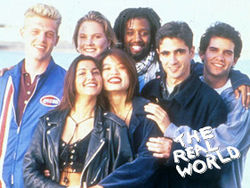
I survived the “Real World: San Francisco” marathon

0

 The 28th season of The Real World premieres tonight, and the trailer features some crying bros and a lot of slapping in Portland, Ore. To remind us of the show’s less … well, shitty origins, MTV ran a “retro marathon” of its first three seasons last weekend.

Before the Teen Mom franchise, before Jersey Shore (and its ever-multiplying spin-offs), and before something called Buckwild that I don’t feel like researching, there were true stories of seven strangers picked to live in houses in New York and Los Angeles. And then in 1994, some strangers came to the wonderful city of San Francisco. The third season, last weekend’s grand finale, often gets credited with sparking the show’s popularity and indirectly launching the reality TV craze. It almost lives up to its reputation.

Usually, watching a reality television show after it’s finished airing presents a predicament; the knowledge that the cast has returned to the world outside the screen takes away the precept — flimsy as it is to begin with — that we are seeing reality unfold. Watching the San Francisco season is a different experience. The 19 years of distance, a huge cultural gap (OMG, no smartphones!), makes the show a historical document.

The Real World: San Francisco is a fascinating record of 20-something life in the mid-90s (OMG, no texting!). And because at that time, the channel dealt with issues besides teen pregnancy, it’s also a depiction of an earlier era of gay rights, of a different political climate, and of a time when an AIDS educator had to reassure his peers that they did not need to fear sharing a bathroom with someone HIV-positive.

Pedro Zamora, one of the first openly gay and HIV-positive men on TV, has been tasked with the responsibility of giving a face to history (the use of B-roll that supplements parts of his story, such as his emigration from Cuba, adds to the sense of his role in the show as documentary). Bill Clinton, who took up the cause of honoring Zamora, believed his stint on The Real World made giant strides in the effort to humanize the struggle with HIV/AIDS and that lends great historical weight to the show.

So, counter to the typical experience of re-watching reality TV, our awareness of events after San Francisco heightens the drama. Knowledge of Pedro’s death right after the season’s premier gives his plotline — for lack of a better term — an eery poignancy. On a happier note, Pam Ling and Judd Winick’s marriage in 2001 their season makes us look for clues in their innocent beginnings as friends during taping. The show becomes primary source material for their romance. Less pleasant is the tale of Puck (David Rainey), the roommate kicked out of the house, whose life after the show comes as no surprise at all. (Don’t worry, he got out of jail in time to film this interview before the marathon.)

How can any reality show claim to show an authentic view of history, though? It probably can’t, but It’s worth noting that The Real World‘s claim to be a social experiment had some legitimacy back then; people didn’t sign up for reality TV to achieve the same fame that they do today because the cult of the reality TV star had not yet exploded (in 1994, Kim Kardashian was still in the early stages of puberty). As a result, most of the cast was intelligent and had real goals that made them compelling and seemingly genuine. (We do, however, find a proto-reality TV star in Rachel Campos, the pretty girl who gave up dreams of academia when she met her husband on Road Rules: All Stars. For a while, she occasionally guest-hosted The View, and her Wikipedia page lists her occupation as “television personality.”)

Much of what makes The Real World: San Francisco entertaining nearly two decades later, though, are the things that make all ‘90s artifacts entertaining. It is a history of those fun outdated cultural signs that make “Buzzfeed Rewind” slide shows so heartwarming for millennials. Look at the low resolution! Note the light wash high-waisted jeans worn by men and women alike! Everyone’s rollerblading! Remember pagers?

And don’t worry, there are the requisite black-and-white confessionals, a comically suggestive musical score, and some drama, too — yelling, making out (and subsequent regret), and name-calling. But a word of warning for fans of Bad Girls Club and Tila Tequila: the name-calling doesn’t get much worse than “brat.”

Which brings me to a final point that, yes, the show mostly lives up to its reputation; The Real World: San Francisco is compelling as a historical record and nostalgia machine, but I have to admit that overall, I found it a little bland. The cast has a good time together, argues about house cleanliness over the dinner table, and learns from each other, but the fact that one of the few drunken escapades happens as a ladies’ night in floral pajamas made the whole day-to-day feel a little too charming.

It’s official: today’s television has ruined me. I don’t want to see interesting people with ambitious goals or downtrodden youth with the passion to make society more tolerant. I don’t want a document of reality at all, but an absurd heightening of it.

Even so, I think I’ll probably skip The Real World: Portland.

Oh, and if you want your own fix of retro reality, you can stream the complete San Francisco season here.

SCOTUS talks same sex marriage: San Francisco responds

LGBT rights activists held a vigil outside the California Supreme Court building in San Francisco March 26 as part of several events launched in response to yesterday’s U.S. Supreme Court hearing on Proposition 8. Today, the court is considering the Defense of Marriage Act, a law that restricts federal marriage benefits for same-sex couples.

The slideshow features interviews with  (in order of appearance) Justin Taylor, who said he was there to stand up for the rights of his mothers, who have been together for 16 years; Jackie Jolly, who said that for her the issue is about the underlying principle of equality; Thomas Coy, who teared up as he addressed the crowd and shared a memory of his husband, who passed away three years ago; and Trey Allen, who helped organize a rally and march on Monday and expressed hope that the Supreme Court would reach a favorable outcome at the end of June.

Photos, audio and slideshow by Rebecca Bowe

This evening, LGBT activists will return to 350 McAllister Street in San Francisco to hold a second vigil from 4 to 8 p.m.

No golden years for LGBT seniors

139

According to studies, queer seniors are poorer than their straight counterparts. They’re half as likely to have health insurance, and two-thirds as likely to live alone. Not to mention facing discrimination in medical and social services, retirement homes, and nursing care facilities. So much for the “golden years.”
Here in San Francisco, LGBT seniors face another grave threat: evictions. Many of our elderly live in rent-controlled apartments that are targeted by real-estate speculators and investors out to make big bucks turning them into tenancies-in-common.

With median rents close to $3,000 a month and vacancy rates low, the odds are pretty good that an evicted senior won’t find an affordable place in the city. For a senior with AIDS, an eviction is especially threatening since our city offers the best treatment and services. Studies show that people with AIDS who lose their apartments tend to die sooner, especially if they become homeless. 

The only LGBT organization that actually addresses the housing needs of queer seniors is Open House. Its 110 units at 55 Laguna will be the first affordable queer senior housing development in the city. I hope it’s not the last. As for seniors with AIDS, there’s only one AIDS organization in the vast list of groups and services — the AIDS Housing Alliance — that actually finds housing for its clients. It was started by Brian Basinger, a gay man with AIDS, after he was evicted and his apartment was sold as a TIC.

No one knows how many LGBT seniors have been, and are being, evicted. Ditto for how many seniors with AIDS end up on the streets. We also don’t have stats on how many transgender seniors are victims of real estate greed or live in absolute terror of losing their homes. 

The Rent Board doesn’t break down its eviction stats by sexual orientation or even age. The city’s homeless count doesn’t mention if someone’s queer or transgender. There is no way to determine how many LGBT seniors live in SROs or with life-threatening conditions such as mold or lack of heat. Or how many live in homes that have been — or are being — foreclosed.

That’s why the housing subcommittee of the city’s LGBT Aging Policy Task Force is holding a hearing into the housing needs and concerns of queer seniors. Information is power.

All LGBT seniors — housed and homeless — are invited to come testify about their housing issues. Whether they live in an SRO or a home that they own, whether they sleep in a shelter or a rent-controlled apartment, whether they’re in a subsidized unit or an illegal in-law, the subcommittee wants to hear from them about their concerns and needs.

The subcommittee will ultimately be making recommendations that will be included in a task force report on what the city can do to address LGBT issues.
LGBT seniors deserve their golden years.

The hearing is Monday, April 1, 9am to 12 noon, room 416, City Hall. Written testimony accepted. For more info, call Tommi at 415-703-8634.
Tommi Avicolli Mecca is a longtime queer and tenants rights/affordable housing activist who works for Housing Rights Committee. He is a member of the LGBT Aging Policy Task Force.

Reality rap: Q&A with Saafir, the Saucee Nomad

6

Ed. note – this week’s music feature is all about emcee-producer Saafir, the Saucee Nomad. The wheelchair-bound associate of Hobo Junction and Digital Underground (and actor in ‘Menace II Society’) opened up to Guardian music writer Garrett Caples about his recent health struggles, making music, and what’s keeping him in check. Here’s the extended interview we couldn’t fit in the print edition:

San Francisco Bay Guardian Did you have any idea [Digital Underground leader] Shock-G was going to post about you on Davey-D’s blog?

Saafir Actually I had no idea that he was going to put that out. Shock had came and saw me one time and I didn’t really tell nobody that I was in a wheelchair as far as the DU crew. I wasn’t really in contact with anybody. Nobody really stayed in contact with me. If you ain’t really hollerin’ at me, I’m not just gonna call you and be like, “Hey bruh, what’s up? I’m in a wheelchair.”

But I had ran into Money B and he told Shock, and Shock came by and saw me in that wheelchair and it kinda hurt him. He was like, “We really need to do something for you, man. We gotta try to bust a move and do something to make this shit right.” I told him I was down for whatever.

As far as [Shock’s] article is concerned, I’m not really gonna go into it. [Laughs] I’m just gonna say that. The focus is to try to get some awareness up with my condition and my situation. My situation is that I’ll have to have surgery to get my shit corrected. So I’m trying to raise awareness and get as much assistance with it as possible just to make it happen. But shout out to Shock-G for his effort in getting the word out and letting people know about my condition. His way of doing it is unconventional but it’s appreciated.

https://www.youtube.com/watch?v=3Dc8I23sCeI

SFBG But is your condition the result of back injuries or the tumor you had to have removed?

Saafir My back wasn’t really the problem, it was moreso internal. I had a cancerous tumor in my spinal cord and they had to get it out as soon as possible. That was around ’05. The timeline was based off of Shock’s own memories and some of the details got mixed up. I had to have the surgery to get the tumor out. The doctor told me that if I didn’t take it out, by the time I was in my later 40s I would probably be paralyzed. And it’s ironic because I did the surgery and I’m still kinda in that situation. I’m not a paraplegic; my legs are still active and whatnot, it’s just getting the right kind of treatment to spark what needs to be sparked in order to get my legs to work.

I have insurance but insurance only covers so much so I’m trying to make sure I’m able to fully meet the criteria so I can step back into the position I need to be in.

But moreso than that, you have to have a stable environment to even complete the things you need to do with the doctor as far as transportation and living situation. I’ve been out here doing this on my own, but I’m trying to get reestablished into a stable enough situation where I can do the things that need to be done in succession. You have to have a foundation in order to do that so that’s what I’m really focusing on right now, trying to establish that foundation, so that I can complete that.

SFBG Why did you wait so long to reach out to anyone about your condition?

Saafir I didn’t really go into telling people I was in a wheelchair or disabled because a lot of people don’t want to be bothered with it. They pretend like they do but in reality they don’t really want to deal with that shit. And I understand that. I don’t take it personally. So to avoid any harsh feelings or bitterness towards either party, I just keep it to myself and just deal with it. I don’t have a problem with asking anybody for help or allowing people to help me or whatnot but people have their own agenda, people have their own lives. And I need a bit of assistance just to do the basic things, getting into the bathtub, that’s like a marathon for me. And alone it’s damn near impossible. There’s not a lot of people there so I just try to stay concrete and just try to tread through it.

SFBG Why couldn’t they help you at the laser surgery clinic in Arizona that Shock had taken you to?

Saafir At the time I felt that what may have been stopping me from being able to walk was scar tissue surrounding the spinal cord and creating pressure to where my legs wasn’t responding. I had saw that on TV one night on a commercial so I called them. The guy I initially talked to led me to believe that I had action, that it could be done.

My first surgery was like, seven or eight or hours. They split me open. I had to heal for like, 10 months. I was like, “I can’t go through that again.” If I have to I will, but if I don’t have to, I really don’t want to. So I thought the laser surgery would be a good alternative.

Shock helped me get the money together to do the surgery because it’s a private practice. So we get out there and they do a checkup on me and they basically say they didn’t have the facility to do the kind of surgery I needed. I thought that was bullshit. I guess it was more of a situation where they didn’t want to take a chance on messing up something more than what it was, so they just decided, “We don’t really know what was there prior so we don’t want to go in and mess anything up.” And I’m like, man, if you’re afraid to do the surgery, say that. Don’t tell me you don’t have the facility; you just afraid to do the surgery. You know how it is, a lot of them practices are just there to take your money. So we had to come home.

SFBG What’s your prognosis now?

Saafir I got back in touch with the doctor who did the initial surgery. He asked me, “Why you didn’t tell me your legs were going out?” And I was like, “I left messages for you, man, to let you know what was going on with my condition.” I never got a call back so I figured that he couldn’t really do anything for me. And I left multiple messages. But we got past it.

He said, “I think I can get you back walking, we just have to figure out what is the ’cause of the decline.” So that’s what we’re trying to do now. I gotta take a few more MRIs. And from the MRIs they should be able to spot exactly what the decline is and they should be able to work back from there. But again, that shit costs money so I’m trying to raise funds to be able to get that all done.

I keep missing my appointments because I don’t have a car. I try to take the bus to BART but I need assistance getting on the bus. I need to raise funds so I can get back and forth to these appointments and just to help with the basic shit I need every day.

I can’t really move at the capacity I was moving at before. I’m a hustler. I go out and get it on my own, you feel me? But you really don’t understand the blessing you have to be healthy and have access to all your limbs and all your faculties. Don’t take it for granted.

https://www.youtube.com/watch?v=o9v7cgA3xIM

SFBG Have you still been making music at this time?

Saafir I’m trying to get a place where I can complete an album but right now I’m just writing songs and doing little stuff. But I’m definitely writing about my experience, how I’m dealing with it and going through it. A lot of people look at my shit from the ’90s and think I’m going to do the exact same shit now and that’s just not reality. I’ve evolved as a person.

At that time I was a young man and mentally I was in a young frame of mind. Now I’m a grown ass man and I done been through a lot. Life has shown me a lot more shit than it had at the time when I was doing what I was doing. I tried to be innovative and poetic about what I was doing and at the time that was the flavor.

Now, I don’t even feel like that level of dedication or creativity would even be appreciated. That’s not saying that I’m not going to try to do it. It wouldn’t be a situation where it’s a street record or a hip-hop record. I just call it reality rap. I don’t particularly rap like I did in the ’90s anymore. I’m more focused on substance and content as opposed to how I swing a rhyme. But I’m always going to swing a rhyme with flavor. My rhythm has never been a problem. I understand the rhythm and the beat so it’s nothing for me to do it.

For the full story, see: Injured Player in the Game.

LGBT youth law, ignored

Thirteen years ago, the San Francisco Board of Supervisors enacted an ordinance designed to make city services more accessible to lesbian, gay, bisexual and transgender youth. Under Chapter 12N of the San Francisco Administrative Code, city departments must provide LGBT sensitivity training “to any employee or volunteer who has direct contact with youth.” It also applies to any collaborative youth service providers who receive $50,000 or more in city funding.

Fueled with great intentions, 12N is the letter of the law in a city known for its tolerance and forward-thinking, progressive values. “San Francisco is committed to ensuring that LGBTQ youth receive the same level of dignity and respect as granted to all residents when encountering city services and programs,” a statement on the Human Rights Commission website reads.

There’s only one problem. With the exception of one department, 12N has never actually been implemented.

Last week, Paul Monge-Rodriguez, a 23-year-old appointee to the San Francisco Youth Commission, approached the Harvey Milk LGBT Democratic Club to point out that 12N has never been put into practice.

“To this day, there’s only one city department in compliance, and that’s the Department of Public Health,” Monge-Rodriguez explained in an interview with the Guardian. Other major service providers include the Human Services Agency, the Department of Children Youth & their Families, and the Office of Economic and Workforce Development.

An effort to push implementation, led by the Youth Commission, the Human Rights Commission and LYRIC — a nonprofit organization addressing issues facing LGBT youth — is gaining traction. Sup. John Avalos called for a hearing; following Monge-Rodriguez’s presentation, the Milk Club voted to formally support the effort.

“We pass these laws, but then when it comes to putting it in action, we don’t always live up to the legislation,” Avalos told the Guardian. “Basically, the city hasn’t implemented the program in terms of providing training for city staff.”

Jodi Schwartz, executive director of LYRIC, argues that 12N implementation should involve collection of sexual orientation and transgender identity data so as to better inform agencies about the populations they serve. The San Francisco Unified School District is the only district nationwide that collects sexual orientation and gender identity data when studying risk behavior for middle and high school students — and the results of a 2011 SFUSD anonymous survey revealed an alarming number of suicide attempts reported among queer youth.

According to SFUSD’s suicide indicators analysis, more than a third of high school students and nearly half of middle school students who self-identified as transgender reported having attempted suicide at some point; meanwhile, about a third of middle school students and about 17 percent of high school students who identified as lesbian, gay or bisexual also reported having attempted suicide.

The data is based on extrapolations and assumes no overlap between transgender and LGB populations, and concrete data in this realm is generally difficult to obtain. But based on the SFUSD data, LYRIC estimated that more than 1,000 LGBT students in middle and high school had reported attempting suicide. It’s a disturbing figure to say the least. If other agencies begin collecting such data, Schwartz argues, “they’ll use it to inform their priorities as an institution.”

Youth Commissioner Mia Tu Mutch, 22, helped create a training video that was shown to city staff at the Department of Public Health as part of a pilot program to initiate the sensitivity training mandated under 12N.

“Some of the stories talked about trans people feeling unsafe or unwelcome by service providers,” she explained when asked about the video, which was not made publicly available. “One featured a gender-queer young person who felt more comfortable using gender-neutral terms, but the intake person went out of their way to use the wrong pronoun.”

Tu Mutch worked with LYRIC to create a Tumblr site, entitled 12N Now or Never, featuring photographs of queer youth holding up signs asking for immediate 12N implementation. Her own sign reads, “I need 12N because youth shouldn’t have to educate adults.” Another message, posted by a young person named Vincent, reads, “I need 12N because I don’t want my kids to be judged like I was.”

“I think it just speaks to the bureaucratic process,” David Miree, spokesperson for the Human Rights Commission, responded when asked about the long delay. “The great intentions were there to put it into an ordinance. But what had to happen was, there had to be someone, or some community, or some agency” to step in and make it happen.

Schwartz takes a different view on why so little has been done. “There’s a lack of political will,” she says, “to invest the resources to do the transformation that’s necessary.”

Calvin Trillin: On Dennis Rodman and his pal Kim Jong-un in North Korea

4

Kim Jong-un, dictator of North
Korea and BFF of Dennis Rodman,
threatens to use nuclear weapons
against the United States
Now Kim, who’s the strangest of big bomb possessors,
Says he’d use his nukes against Yankee aggressors.
Should we build some shelters? No, Kim is no menace,
Since he knows a nuke strike could take out his Dennis.

Calvin Trillin: Deadline Poet: The Nation 4/1/2013

Campaign to ban bottled water sales in national parks targets GGNRA

43

UPDATED A national campaign to ban the sale of disposal plastic water and soda bottles in our national parks – which is being actively opposed by Coca-Cola and others who bottle and sell water, that most basic of life-sustaining resources – has arrived in San Francisco as it targets Yosemite and the Golden Gate National Recreation Area.

“We have thousands of people in the area who are very supportive and working hard on this,” Alyse Opatowski, an organizer with Corporate Accountability International’s Think Outside the Bottle campaign, told the Guardian.

Opatowski and a host of local supporters – including Board of Supervisors President David Chiu, Sierra Club Chapter Executive Director Michelle Meyer, and Hans Florine, who holds a world record for speed climbing in Yosemite – will rally tomorrow (Wed/27) at 10:30am in Crissy Field to publicize the campaign and hold a blind taste tasting comparing San Francisco tap water to bottled waters.

And we know who wins that one, right? San Franciscans are justifiably proud of our water, the best urban water in the country, arriving to us through what’s essentially a gravity-fed straw from the Hetch Hetchy Reservoir adjacent to Yosemite. Even though that project broke famed naturalist John Muir’s heart a century ago, it was a engineering marvel and enduring source of clean power and water that we voted overwhelmingly to protect in November when voters rejected a study of the sentimentalists’ dream of removing it.

But back to the issue at hand: activists say that selling single-use water bottles in the national parks in antithetical to environmental stewardship. Health advocates have made some progress in curtailing our addiction to soda, but those crafty soda companies responded by commodifying that which is available basically for free in every locality in the country. And they aren’t about to give up that market without a fight.

Coca-Cola – whose spokespeople haven’t yet returned out calls for comment – gives lots of money to the National Parks Foundation and has used that influence to stall efforts to have the National Parks Service ban bottled water. So the campaign is targetting individual regions, including the GGNRA, which seems well positioned to advance the cause.

Cheers to that.

UPDATE 3/27: American Beverage Association spokesperson Chuck Finnie issued a prepared statement to us that began, “Eliminating plastic bottles altogether isn’t the answer because it limits personal choice and doesn’t address the bigger picture. People should have the choice to decide how they drink water in a National Park — from a bottle of water, from a water fountain, or from a refillable container. While making that choice, they should be educated on the benefits of recycling and ways to do so.”

The Performant: Life is but a dream…

0

Bouffonery and W. Kamau Bell’s stand-up at Stagewerx

Theater history is full of stories of legendary shows that caused riots at their opening night, difficult to imagine in these more apathetic times. We go to the theatre to be entertained, more rarely to be provoked, and more rarely yet, to be stirred to an action greater than the act of merely applauding at the end.

But the theater of Bouffon turns that theater-going complacency on its head. The entertainer in the room is not the curious creature onstage with exaggerated buttocks and an evil smile, but the squirming oddience stuck in the crosshairs of its merciless gaze.

When Eric Davis, a.k.a. the Red Bastard tumbles onto the stage, imitating the slightly baffled faces that gaze up at him in a brilliant, Tourettic flash, a slight tingle of danger vibrates around the room. A dawning awareness, there’s no place to hide. Even those of us who have cleverly ensconced ourselves in the back can tell we’re being scrutinized in the dim lighting of the anonymous warehouse space we’re crammed together in.

“As an audience, you have absolutely no presence,” the Bastard complains. Backs straighten. Chins raise. Challenge us will he? That wobbling, unitard-wearing freak stuffed suggestively with balloons and venom. Of course he will. That’s the whole point.

Red Bastard mocks us. He cajoles. He flirts. He leads the group in a series of physical exercises, dividing the room in two and forcing us to compete, exhorting us to GO BIG. He sticks his bulbous, balloon-stuffed bottom in the face of a pretty girl and makes her dig around for a five-dollar bill. What price dignity. He hocks a loogey onstage and calls it “art” — later he sits in it, “fucking art.” And just at the point where he could become just another one-trick provocateur, he softens the schtick and turns inward. Pressing the buttons of our emotional vulnerability as easily as he pushed our sense of outrage just moments before.

“The more you risk, the more you are rewarded,” he counsels. “If you can’t articulate your desires, you can’t achieve them.” Encouraging the crowd to shout out their deepest desires (“sail around the world,” “naked scuba,” “have a dog,” “fall in love”) he fills an invisible bag with them and pushes it up a “dream mountain” chanting “sissy fuss sissy fuss.”

“What’s difficult about falling in love?” he demands. What’s difficult, he insinuates, about achieving any of our dreams? What indeed.

The ultimate provocation comes when he urges a disgruntled worker bee to call her boss up and quit on the spot, which she gamely attempts but is foiled by the lack of cell phone reception in the room. “T-Mobile,” she explains, as we nod sympathetically. But the seed has been planted, and who knows what fruit it will bear later on.

Then, like the Buddha you kill on the road, Red Bastard sends us away, filled, if only for a moment, with the feeling we truly own our own destiny, a feeling worth every bit of humiliation it took for us to get there.

******

Speaking of owning our own destiny, and following our dreams, local comedian-making-good W. Kamau Bell performed a sold-out weekend at Stagewerx, his spiritual San Francisco home. The theme of much of the show spoke mainly to the heady weirdness of the nature of “celebrity”. Even the kind of ground-level celebrity of having a new television show (Chris Rock-produced Totally Biased on FX) comes with a set of unexpected side effects. Being forced onto The View, auditioning for a spot on The Howard Stern Show, moving to a non-gentrified part of Brooklyn from the Inner Sunset, it’s all fuel for the funny as life’s most awkward moments so frequently are. He’s still the same Kamau, and thank goodness. But the dream, and the comedy, has grown.

Mike Shine’s “Flotsam’s Harvest” at White Walls

2

By Molly Champlain

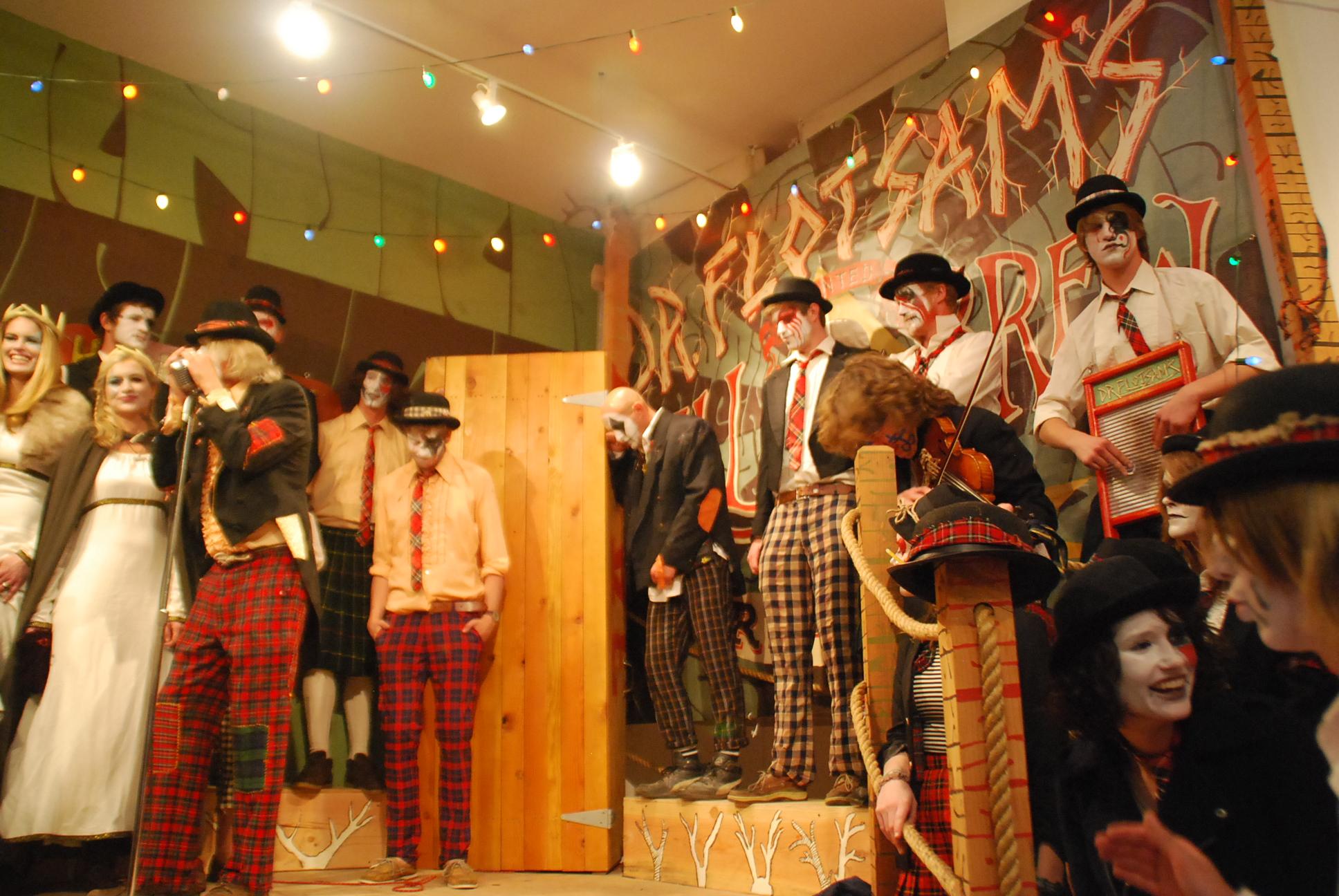
A promise that all our ailments will disappear and our wildest dreams will come true … for a small price. Or for the price of your soul? Dr. Flotsam and his self-described “crew of carny bastards,” sprung from the wild mind of San Francisco artist Mike Shine, ask us the worth of that exchange. The question is scattered through the paintings, performance, and graphic novel of his show, “Flotsam’s Harvest,” up now through April 6 at White Walls.

According to the show’s press release:

“‘Flotsam’s Harvest’ will be a sweeping installation of street art, paintings, films, a medicine show performance and the launching of Shine’s graphic novella. Each aspect of the show will provide different coded tips and hints, offered to help viewers solve the dark ‘World Riddle’ posed by Friedrich Nietzsche in his book, Thus Spake Zarathustra.”

Intrigued? The opening at White Walls Sat/16 had enough stimulation to dissolve even the hardest anti-consumerist into clapping, grinning, and Irish drinking-song singing. But the mystical “Hell Brew” the medicine show promoted wasn’t for sale. Whether it was ploy to sell the art or vice versa is still up for debate.

Shine’s devilish paintings of animals and figures fuse illustration and graffiti styles. Their rustic colors are blockish and thickly lined like cartoons, while the dripping paint, stray marks, collaged tickets, and spray paint give an urban art feel. These hip but simple paintings are enhanced by frames carved with animal figures and hung on walls painted with radiating text that’s as inscrutable as gang tags. Similar murals are also painted around in the city with Banksy-esque portraits of the “carny bastards.” But despite how cool they are, the artworks were not the selling point for me.

Shine’s opening night performance (similar to those he has done at Outside Lands and SFMOMA), was equally as rich and cryptic. It began in some form of Gaelic or Old English with subtitles on cards and continued with Dr. Flotsam selling his mystical tonic in a thick, comical accent. We all knew the audience volunteer selected to test the brew was a plant (in the form of YouTube dance star takesomecrime): he hobbled on stage but was “cured” after swigging from Dr. Flotsam’s flask, and began shuffling to electro swing by Skewiff.

This wildly entertaining evening can’t be isolated as the meat of what Shine has made either, but it began to make sense of what was going on. The sense of irony was ripe when Dr. Flotsam noted that the government doesn’t permit medicine shows because they “lie to you.” (This sense of danger in the promise was deepened in his disclaimer that you can have your widest dreams come true, if you’re willing to part with your soul.)

A similar theme emerges in the accompanying graphic novel, in which Dr. Flotsam intervenes in the lives of people who have notably impacted history, like the caveman who made fire, Jesus, or the inventor of penicillin. But each one pays a heavy price for the advice they receive. The conflation of good and bad creates a wild sense of anarchy which gives reason for, and holds the key to, the intense and scattered information Shine draws upon for his work.

In a culture where added dimension in art and immersive stimulation in film are often confused with creative quality, Shine has created a show which uses both to convey his meaning. But after the whole experience puzzling out the riddle, I was left wanting. The entertaining trail of information ended in a simple answer, but opened up a number of new questions: was it about merging the body and soul by processing his art in order to gain a stronger sense of identity? Or about how commodities are sold with flair and gusto, but in their mass production fail to truly appeal to the individual? Or is Shine just trying to fuck with people? Maybe you should take a look at the riddle and figure it out for yourself.

Mike Shine, “Flotsam’s Harvest”

Through April 6

White Walls Gallery

886 Geary, SF

www.whitewallssf.com

“It just gets different”: Ali Liebegott on her third book ‘Cha-Ching!’

1

When you’ve spent long, smelly months in a bus traveling the world sharing words with pockets of alternative community, the issue of place takes the fore. As she releases her third book Cha-Ching!, and as her decades-old Sister Spit collective embarks upon yet another tour of spoken word, queer revelry, and cramped living conditions, author Ali Liebegott is getting academic about it.

“I’m kind of obsessed with how artists can live,” she tells me in a SoMa coffeehouse. She had texted me for clarification the night before on whether it was okay to look “scummy” at our interview, but she looks pretty neat in her white tee, motorcycle helmet sitting next to her on a bench. “And how queer people can live. I always think, where would I live if I couldn’t live in San Francisco or New York?”

Liebegott teaches Sarah Schulman’s Gentrification of the Mind — a book that looks at how economic displacement changes our brain’s wiring — in her fiction class at Mills College. And in Cha-Ching!, the economy is an ever-present force, guiding protagonist Theo into shitty apartments in both NY and SF neighborhoods where there are few out gay people. (Not to mention a ludicrously depressing janitor job at a junk mail factory.) The book is Liebegott’s third after The Beautifully Worthless and The IHOP Papers

When I ask whether they’re getting easier to write as time goes on she just laughs. “If I had been a plumber, I’d be able to fix things in my sleep. It doesn’t get easier, it just gets different.”

Liebegott reads from Cha-Ching! at City Lights in October

In an ever-more-caffeinated manner, she and I discuss how those higher rents are coinciding with an era in which publishing houses are more hesitant about what they throw their weight behind. “[Queer literature] is the first to go,” Liebegott says. “All the queer books at Barnes and Noble are behind a potted plant, there’s like four of them, and one of those is Best Lesbian Erotica 1994.”

So it’s good that, as poor queers and creatives and poor creatives and queers get kicked out of their urban homes and prime shelf space, Sister Spit is on the rise. Once restricted to queer female writers, the tour now includes a variety of genders, and different kinds of artists.  

Liebegott’s book is one of the first to come out on the imprint that the group’s founder Michelle Tea was able to start through City Lights Books in the fall of 2012 — The Beautifully Worthless was also released through the imprint, as well as the amazing Sister Spit anthology from earlier this year. Tea’s fantastical young adult novel Mermaid in Chelsea Creek, set to drop this summer, is delicious. The collective’s gig at the main library on Sun/31 is in advance of yet another of its fabled tours. This time the path lies up and down the coasts, up to Canada, and into the Mid-West. 

>>LISTEN TO CITY LIGHTS BOOKS’ RECENT PODCAST INTERVIEW WITH ALI LIEBEGOTT 

Along the way, the Sister Spit artists will meet audience members in places where there is no queer community, places where people fundraised to get them there. 

“I don’t want to say we’re a beacon of hope, but it is nice to give people this connection that they might not have,” Liebegott says. 

And that connection, more and more, may not be associated with any specific urban area. San Francisco, for example, would be beyond Liebegott’s reach as a home if it weren’t for her and her girlfriend’s rent control. “I kind of feel like we’re headed towards hell,” Liebegott muses, taking in our swank, caffeinated surroundings. “I feel like we’re already there.”

Regardless, art. Cha-Ching! deals in gambling addiction, drug addiction, poverty, ennui, animal abuse, powerlessness — but nonetheless, can be laugh out loud funny even, especially, when characters hit their low points.

She’s already planning her next book, about a war vet obsessed with feeding ducks. “I feel like I’m so mired in depressing things!” Liebegott says. “My threshold for that is much higher than most people.”

Cha-Ching!‘s ending, though, leaves room to hope that queers can triumph over today’s adversities. Or does it? At any rate, you have ample chances to buy the book at this week’s readings (Liebegott is one of the featured artists at the Sister Spit reading on Sun/31 as well.)

In other news, Liebegott’s big into Sizzler. She told me to write that.

Ali Liebegott’s Cha-Ching! release party

Wed/27, 7pm, free

City Lights Bookstore

261 Columbus, SF

www.citylights.com


Sister Spit tour kick-off reading

Sun/31, 2-5pm, free

San Francisco Main Library

100 Larkin, SF

www.sfpl.org

Live Shots: LGBT Community Center celebrates 11 colorful years

0

Photos by Bowerbird Photography

Last Saturday, the disco ball sparkled from above, while below on the dance floor, party-goers glittered in gold. There was much to celebrate, with the SF LGBT Community Center‘s annual gala “Soiree” celebrating 11 years of sercing the community — and even more to drink, with bottomless bottles of champagne. There were also plenty of sights to drink in, including a few bottomless pairs of pants!

Of course, it was partying with a cause: tickets and auction items went to benefit the Center and their programs. With same-sex marriage equality rights in the balance this week at the U.S. Supreme Court, the Center made it clear that the LGBT community can always depend on them, regardless the outcome. District Supervisors David Campos and Scott Weiner also were in attendance and voiced their commitment to the Center.

Tita Aida worked the stage, introducing one great drag act after the other, including performances by Honey Mahogany, Ambrosia Salad, Miss Rahni, and Alotta Boutte. The theme was Studio 11, explaining why Salvador Dali watched haughtily from the VIP section, as boys in golden spanky pants made their rounds turning eyes. It was a night to remember, or at least a night to try to remember (after all that booze!). Congratulations to the LGBT Center for another year of amazing work and for throwing another wonderful gay-la.


Behind the Chron’s paywall

24

I wish the Chronicle luck at its experiment with a “paywall.” Once upon a time, we used to call that a “subscription” — that is, you pay money and someone delivers to you something worthwhile to read. Since nobody much likes to pay to read anything any more, it’s considered risky and a bit radical for a newspaper to charge money for access to the work that it pays a staff a fair amount of money to produce.

Let’s do the nice thing here, shall we, and set aside the question of whether the journalism the Chron produces is of such high quality that people ought to pay a premium for it. I have my gripes with the Chron, and always have, but seriously: Having a local newspaper that tells you what’s going on in town — even if it doesn’t always do it well — is worth a dollar a day. Which is what the print version costs.

Writers need to get paid. Reporters are necessary to the function of democracy, and if they can’t make a living doing the job, it’s not going to get done. Since most young people aren’t used to paying to read anything these days, the only option has been selling (more and more) ads.

That’s actually a model the alternative press has followed for decades, and it’s worked fine. In the days before cable, that’s how TV worked, too — it comes in free, and you pay for it by watching (annoying) ads.

But it’s a problem on the web, where ads don’t bring in the revenue they once did in print, so everyone’s scrambling to find a way to pay the bills. If you’re Markos over at Daily Kos, you build a huge, huge community that loves what you’re doing, and keep the staff fairly modest, and sell enough ads and bring in enough donations to pay for it all. If you’re Nick Denton’s Gawker Media Empire, you keep costs very low by hiring very limited staff (certainly not a lot of reporters) and sell ads ads ads everywhere, including “sponored posts.”

But if you’re the San Francisco Chronicle, with 280-plus reporters who need health care, and lots of editors and executives, and the Hearst Corp. demanding impossible profits, you’re kind of SOL.

Thus: Paywall.

These things don’t tend to work very well. Sfgate had a paywall for “premium content” years ago, and it just sort of faded away. The Wall Street Journal and the Business Times pubs get away with it, because people who read biz pubs are used to paying for information. I’m not sure how many truly loyal Chron readers there are who are willing to pay to read Matier and Ross and Chuck Nevius on the web. Most of those people already pay for a print subscription.
The other problem is that it’s really unclear what the identities of the two sites, sfgate and sfchronicle, will be. They look different (sfgate looks like a newsy website, sfchronicle looks like a print newspaper), but where do you go every day for news? If you read sfgate, you’re missing stuff that only appears on sfchronicle, but if you read sfchronicle, you’re missing stuff that appears on sfgate. It’s not like you get a “premium” edition of the paper in one place; you have to check two sites to get your local news, not one.

For example, today you can get The Chron’s own Carolyn Lochhead on the same-sex marriage case at sfgate. If you pay extra, you can go to sfchronicle and get an AP story that’s not exclusive and will run in lots of papers.

Why does this make me want to pay?

So I don’t know; it’s going to take a lot of evolving to make this work. Again, I wish them luck; anyone who’s trying to find a way to keep paying a news staff deserves credit. But at this point, it seems like a pretty dubious plan.

Willie Brown and Ammiano’s pot bill

35

Assemblymember Tom Ammiano’s new medical marijuana bill seems pretty straightforward. Almost everyone in the medpot biz thinks there ought to be some sort of statewide regulations for a growing industry that operates in a mish-mash of local jurisdictions with no overall rules. If nothing else, consumer-protection policies ought to be in place. And, of course, the more the dispensaries accept, and follow, reasonable regs, the easier it is to win the mainstream political support necessary to get the feds off all of our backs and ultimately follow Colorado and Washington.

All good, right?

So Ammiano, who has been on this issue for years, is proposing that the state’s Department of Alcoholic Beverage Control — which for all its problems has experience regulating mind-altering substances — draft and oversee medpot rules.

But the industry that makes a lot of money off the legalization of medicinal weed is famously fractured — and the politics of Sacramento are often nasty. Add in former San Francisco Mayor Willie Brown — who has his fingers in all sorts of business opportunities these days — and the story turns downright weird.
Ammiano’s been talking about Califonria and pot for years. He proposed legalization before the other states did, but frankly, this current state Legislature’s never going to have that kind of courage.

But he continues on with the effort. Last year, he tried to put pot under the Department of Consumer Affairs, which clearly didn’t want it; his bill died in the state Senate.

Normally, when new regulations are proposed for an industry, the Legislature holds what’s called a Sunrise Hearing, to bring all the stakeholders into a room and talk about what issues ought to be addressed. So Ammiano a few months back asked for a hearing in the Senate Business, Professions, and Economic Development Committee. No problem, said the chair, Curren Price, a Los Angeles Democrat.

But in February, five days before the hearing was set, Curran called the whole thing off. Turns out that the Governor’s Office and the Attorney General’s Office wanted no part of it, so it was hard to round up the essential players. Also, Curran was running for an open LA City Council seat and probably didn’t want the publicity. As Ammiano said at the time, “What’s up with marijuana? You can’t even have a hearing?”

Even without a hearing, he’s moving a new bill, AB 473, which would create under ABC a Division of Medical Cannabis Regulation and Enforcement. The bill is modeled on a successful effort in Colorado that has kept the feds at bay. Washington is also putting marijuana regulation under its liquor control authority.
“We’ve had not one federal intervention,” in Colorado, Matt Cook, a consultant who help write the rules in that state, said.

But just as Ammiano was preparing to line up support for his measure, another bill mysteriously appeared, in the state Senate. A “spot bill” with no actual content, the measure was set as a medical marijuana regulation placeholder. The authors: Senate President Darrell Steinberg and San Francisco’s Mark Leno.

Now: Leno’s been a big supporter of medical pot for years — but the bill wasn’t his idea. “Darrell told me he was going to do something about marijuana regulations, and he asked me if I would join him,” Leno told us.

What Leno didn’t know: Steinberg had been approached and asked to carry a bill by Willie Brown. Brown contacted the Senate president, sources tell us, and said that Ammiano was the wrong person to carry pot legislation.

Why? Who knows. Brown wouldn’t return my calls. But I can tell you with absolute certainty that Brown has been looking for ways to discredit Ammiano since 1999, when the then-supervisor challenged the mayor’s re-election in a legendary write-in campaign that galvanized the city’s left and created the momentum for the complete rejection of Brown’s politics and endorsed candidates a year later, in the first district elections.

And yes: Willie Brown carries a grudge. So it’s possible that he would go out of his way to make sure that Ammiano didn’t get credit for leading the way on what will evenutally be a huge sea chance in how California handles pot.

Now: This sort of thing isn’t viewed very highly in the hallowed halls of the state Leg, where people take their bills — and their history on issues — very seriously. Ammiano was furious, and talked to Steinberg, who (properly) apologized for stepping on his toes. Leno told us he had no intention of undermining his San Francisco colleague, that he had immense respect for Ammiano and all of his efforts, and that he wouldn’t move forward with any bill that didn’t have Ammiano’s input and support.

But it raises the question: Why is Brown even involved in medical marijuana? The only answer I can come up with is that he’s making money off it. Not as a dispensary owner or a grower, but as, in effect, a lobbyist.

When I heard Brown was messing around with the industry, I called Steve DeAngelo, who runs Harborside Health Center, the $22 million a year dispensary in Oakland. DeAngelo’s a promient leader on medical marijuana issues, and has built a respected business that pays taxes to Oakland, provides quality product, and is in many ways a model for what a dispensary should look like.

We talked for a while about Ammiano’s bill, and DeAngelo said he wants to be sure there’s community consensus. “The most important thing is that whatever passes addresses the issues and has broad supoprt in the industry,” he said. He agreed that regulation is needed, but stopped short of endorsing Ammiano’s bill, saying “there still needs to be further discussion.”

Then I asked him if he knew why Brown was talking to the state Senate president, and he told me:

“Willie Brown has been a political advisor to Harborside.”

I asked him if Harborside was paying Brown for his advice. He refused to say.

Okay then. But Brown doesn’t have much of a history of working on this issue pro bono, and is not known for serving as a “political advisor” (or doing much of anything else in the way of work) for free.

What does Brown think about the Ammiano bill? “He thinks,” DeAngelo said, “that it’s important it have a broad base of support.”

Willie Brown is not popular with the voters of California. His history of questionable (at best) ethics was among the reasons the voters approved terms limits for the Legislature. Hardly anyone on the left trusts him. A medical marijuana regulatory bill that has his fingerprints isn’t going to do much for “consensus” or “broad-based support.”

So maybe the best thing Brown could do for his client is stay the hell out of Sacramento.

Artists respond to hate-speech ads with “fabulous” alterations

When it comes to countering hate speech, there’s nothing like creative expression mixed with direct action. Activists affiliated with art collectives Bay Area Art Queers Unleashing Power (BAAQUP) and Street Cred declared yesterday to be “Hate Free Monday,” and celebrated by modifying hate speech ads recently plastered on Muni buses.

Purchased by the pro-Israeli American Freedom Defense Initiative (AFDI), the ads contain bigoted, inflammatory quotations directed at LGBT people, attributed to prominent Muslims. Although city officials have condemned the advertisements, they were nevertheless allowed to be displayed because Muni determined them to be within First Amendment guidelines.

Headed by conservative blogger Pamela Geller, AFDI has been deemed a hate group by the Southern Poverty Law Center and the Anti-Defamation League. Geller herself is the target of the activists’ handiwork.

“We believe that all public spaces, including public transit, should be welcoming and safe for all members of our community,” the artists, who did not give their names, wrote to the Guardian in a statement sent from baqupower@gmail.com. “The hate-filled messages purchased by Pamela Geller’s AFDI defame and vilify Muslims and are harmful and offensive to residents and visitors in San Francisco, both Muslim and non-Muslim. 
Since the city will not take action against these ads on city buses, we have.”

To read BAAQUP’s full description of the motivations behind their action, go here.

Their statement concludes: “As long as these advertising outrages continue to appear on our streets, we will continue to reconstitute them to reflect something more truthful, just, and ideally fabulous.”