SFBG Blogs

Potrero Hill History Night: a special occasion for a special neighborhood

3

Scroll down for Potrero Hill History Night photos

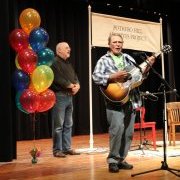
And so Country Joe McDonald ambled on to the stage Saturday night at the International Studies Academy on Potrero Hill and told an full auditorium full of history night groupies  that since he was playing in a school he would open with a spelling lesson.

“Give me an F,” he roared,  and the audience roared back with an F.

“Give me a U, give me a C, give me a K,” and the audience roared back again and again  with knowledge of the lyrics of the anti-war song “I Feel Like I’m Fixing To Die” that Country Joe made famous during the Vietnam war and has been singing as his trademark song ever since.

He would pause and the audience would continue on with the words. Country Joe was in top form, the audience loved him, and it was a stunning beginning to the 12th annual Potrero Hill History Night.  And the fact that Occupy SF and Occupy Oakland were fixing to explode sooner or later in nearby neighborhoods  only gave some timely poignancy to the occasion.

But Country Joe wasn’t at History NIght to perform as a singer or political activist. He explained that he was there as a turnaround artist to interview Joel Selvin, the veteran San Francisco Chronicle pop culture reviewer and author of “Smart Ass,” a collection of 40 years of Selvin’s music journalism. Significantly, Selvin also happens to be a longtime Potrero Hill resident. The latter phrase is the key, because the point of History Night is to focus on the rich history and colorful personalities of Potrero Hill and put them together into a lively program. In this segment, Joe the performer interviewed Joel the reviewer/reporter who had been writing about Joe for years.

The two made a splendid team and it turned out that Joel was as good onstage in this format as Country Joe. It was good fun, instructive at times, particularly with the stories about Bill Graham’s antics and angry outbursts and how each dealt with him. The audience had fun trying to figure out through questions just how rock n’ roll and Country Joe from Berkeley connected to the hill. Well, one answer was that Jann Wenner, the founder of Rolling Stone magazine, claimed three different addresses on Rhode Island Street.

The program this year was the best ever. A barbecue outside the building serviced by a platoon of History Night  groupies on a warm and wondrous Potrero Hill evening. And a program featuring a formal presentation of a chunk of goat hoofprints embedded in concrete, an interview with the woman who tended the goats decades ago, a surprise appearance by the lady who found and preserved the hoofprints for years, and a starring role by Phillip DeAndrade of Goat Hill Pizza who was given the goat hill hoofprints as a surprise gift because he once had goats in the back of his Goat Hill pizza parlor and because, well, he’s Phil DeAndrade.

DeAndrade is a Potrero Hill version of the Scarlett Pimpernel (he’s here, he’s there, he’s everywhere). For this evening, he was doing triple duty as the worthy receiver of goat hoofprints in concrete, as master of ceremonies, and as the Hot Interviewer of the Colorful Potrero Hill Veteran, the key finale of every history night event.

DeAndrade was specially eloquent in explaining the importance of history night. It is, he said, a special event (nobody else in town has one) that showcases Potrero Hill.as a special place and its people as special people who live in a special neighborhood with a special culture and a special history and such institutions as the Neighborhood House built in the 1920s  with Julia Morgan as the architect.

The goat hoofprints in cement  made his special point. The artifact dates from 1925 or so and was found and preserved by Rose Marie Ostler, a Potrero Hill native. She kept the hoofprints for years and then decided they should go to DeAndrade of Goat Hill for his historic connection with goats.  She presented them at the ceremony, with help from Dr. Frank Gilson, a local chiropractor wearing a Halloween type goat hill mask.

This year’s Potrero Hill veteran was Josephine Firpo Alioto, who was born on Potrero Hill 90 years ago, and now lives in San Jose.  She married Frank Alioto, son of Police Capt Calogero and Vincenza Alioto.  The Alioto family moved to 755 Carolina St. around 1930, just around the corner from Josephine’s house. There were no houses on the cornerin those days,  so they had a clear view of one another’s houses. Josephine and Frank were friends for 80 years and married for 65 and a half years.  They were married at nearby St. Theresa’s Church.  With expert coaching from DeAndrade, she was most articulate and provided the details of life and times of growing up on the hill in the 1920s and 1930s.

Perhaps the most “newsworthy” comment came when she took the audience by surprise when she mentioned that her cousin, Luis  Firpo, known as the Raging Bull of the Pampas in Argentina, knocked Jack Dempsey out of the ring in a  championship fight. (My google check showed she was right. Firpo did knock Dempsey out of the ring in the  famous 1923 heavyweight championship fight at the Polo Grounds in New York City and Dempsey’s head hit a reporter’s typewriter. But Dempsey got back in the ring on a contested long count and won the fight in the third round in what many think is the greatest fight of all time. It was Dempsey’s last successful defense of his title. The fight is on UTube and googleable under Firpo.)

As is the history night custom, there were lots of Firpos and Aliotos in the audience to help fill in Josephine Alioto’s story and answer questions from the audience and provide the evidence of a very special neighborhood.

All in all, it was a most memorable event and all to the credit of Peter Linenthal, the founder and impresario of Potrero Hill History Night. His event even got a nice writeup in Leah Garchik’s Chronicle column. UCSF at Mission Bay was the sponsor of the event and the Parkside, Chat’s Coffee, and Bottom of the Hill donated to the barbecue.  Linenthal  is also the curator of the Potrero Hill Archives project, assisted by Abigail Johnston. The two co-authored an excellent book on Potrero Hill.  For more on the archives project, go to potreroarchives.com.  You may find out more about Potrero Hill than you need to know.

I think Linenthal has done what every impresario dreams of doing:  making his event so special and so memorable that it will live on and on.  B3

history night 2

Rose Marie Ostler formally  presents the goat hoofprints in cement to Goat Hill Phi.

history night 4

The audience of History Night groupies.

history night 5

Selvin expands, Country Joe listen.

history night 6

Josephine and Phil,  a dynamic duo, 

history night 7

Josephine and Phil, getting ready for prime time.

history night 8

The Apollo  jazz group in concert at History Night.

history night 9

A student from the International Studies Academy selling tickets for the barbecue.  The money goes to the ISA student travel program.



LGBT leaders denounce attack on Herrera by the Chronicle

20

Leaders of the LGBT community from across the political spectrum yesterday denounced the San Francisco Chronicle and the anonymous sources it relied on to question City Attorney Dennis Herrera’s early support for legalizing same-sex marriage, calling the paper’s front page article a thinly veiled political hit piece designed to hurt Herrera’s mayoral campaign.

That strong showing of support in the LGBT community and the view offered by many that the attack came from supporters of Mayor Ed Lee – including top former Newsom Administration officials, some of whom now work for Lee – could not only mitigate damage from the article but further sully a Lee election effort that is already marred by allegations of vote tampering, money laundering, and deceptive campaign tactics.

“Those who are saying this now anonymously are as cowardly as Dennis and Gavin were courageous back then,” said Deputy City Attorney Theresa Stewart, the lead attorney who defended San Francisco’s decision in 2004 to unilaterally issue marriage licenses to same-sax couples, in defiance of state and federal law, which eventually led to the legalizing of such unions. “We can’t have our community turn on us for petty political gain.”

“WTF, Chronicle?” was how Assemblymember Tom Ammiano began his speech, going on to lay blame for the attack on surrogates for Lee. Ammiano also called out the mayor for campaign finance violations by his supporters, for undermining the Healthy San Francisco program that was created by Ammiano’s legislation, and for repeatedly ordering police raids on the OccupySF encampment.

“How about some fucking leadership?!” Ammiano said.

Cleve Jones, an early gay rights leader who marched with Harvey Milk, also denounced Lee and his supporters for cronyism, vote tampering, money laundering, and the “fake grassroots” efforts of the various well-funded independent expenditure campaigns, which he said have fooled the Chronicle.

“To the Chronicle and that reporters – really? – this is what you do two weeks before the election? You should be ashamed of yourself,” Jones said. “How stupid do you think we are?”

Yet Chronicle City Editor Audrey Cooper defended the article and disputed the political motivations of its sources. “Clearly, I disagree [with the criticisms],” she told the Guardian. “I personally vetted every one of the sources and I’m confident everything we printed is true.”

Beyond criticizing the obvious political motivations behind the attack, speakers at the rally called the article bad journalism and said it was simply untrue to suggest that Herrera didn’t strongly support the effort to legalize same-sex marriage from the beginning.

“I can tell you that Dennis never once shrank from this fight. I was there, I know,” Stewart said, calling Herrera “a straight ally who’s devoted his heart and soul to this community.”

Sen. Mark Leno, who introduced the first bill legalizing same-sex marriage to clear the Legislature, emphasized that he isn’t endorsing any candidates for mayor and that he didn’t want to comment on the details of the article’s allegations. But he noted that even within the LGBT community, there were differences of opinion over the right timing and tactics for pushing the issue, and that Herrera has been a leader of the fight for marriage equality since the beginning.

“I am here to speak in defense of the character and integrity of our city attorney, Dennis Herrera,” Leno said, later adding, “I do not appreciate when the battle for our civil rights is used as a political football in the waning days of an election.”

Ammiano also noted that even if Herrera raised doubts in early meetings, that was entirely appropriate given his role as city attorney. “Even if there are some questions, they’re about helping, not hurting,” he said, expressing disgust at the Newsom Administration officials for turning on someone who was instrumental to defending the decision: “In my day, you valued your friendships.”

Molly McKay, one of the original plaintiffs in the civil lawsuit that followed San Francisco’s actions, teared up as she described the ups and downs that the case took, working closely with Herrera throughout. “But this is one of the strangest twists I can imagine,” she said of the attack by the Chronicle and its anonymous sources. “It’s ridiculous and despicable.”

Representatives for both the progressive Harvey Milk LGBT Democratic Club and fiscally conservative Alice B. Toklas LGBT Democratic Club also took to the microphone together, both saying they often disagree on issues, but they were each denouncing the attack and have both endorsed Herrera, largely because of his strong advocacy for the LGBT community.

Sup. Scott Wiener called Herrera, “One of the greatest straight allies we’ve every had as a community.”

When Herrera finally took the microphone, he thanked mayoral opponents Joanne Rees and Jeff Adachi for showing up at the event to help denounce the attack and said, “This is bigger than the mayor’s race. It’s bigger than me.”

He criticized those who would trivialize this issue for petty political gain and said, “It was my pleasure and honor to have been a part of this battle from the beginning – from the beginning – and I’ll be there in the end.”

The end of the death penalty?

9

Could 2012 be the year when we finally end the death penalty in California? It’s entirely possible. The polls now show a majority of people in the state support replacing the death penalty with life without parole. There’s a growing movement against executions (in part because of the cost , in part because it doesn’t work (most death-row inmates die of old age before they are killed) in part because it’s so grisly — and, of course, in part because it’s barbaric and has been outlawed in most of the civilized worle.

And the ACLU and a wide range of allies are now starting to gather signatures for what will be a well-funded, well-organized ballot initiative campaign next November.

It’s the right time (a presidential election year), the right coalition (including law-enforcement folks, wrongfully incarcerated people and victims’ families), and the right message. The first step is to gather signatures; go the the web site here and sign up to help.

Poet of dissonance: Anna Moschovakis at Meridian Gallery

0

I bought Oprah’s O Magazine in March — my first — after learning it had 24 glossy pages to honor (or degrade, depending on how you look at it) National Poetry Month. In the issue, among other things, was a photo spread of eight female poets modeling the latest spring fashion. “Spring Fashion Modeled by Rising Young Poets” was one of those rare occasions when mainstream culture and poetry awkwardly attend the same party. It’s the kind of thing that makes poets and scholars blink in disbelief and send heavy sighs over the Internet. One of the poets featured in O was Anna Moschovakis: the author of two books of poems, a translator, and an editor at Ugly Duckling Presse. (Moschovakis, who lives between Brooklyn and Delaware County, NY, reads at San Francisco’s Meridian Gallery Sat/29.) She was modeling a pink Candela dress ($359) and an Haute Hippie jacket ($995). 

It started something of an Internet brawl.

David Orr for the New York Times: “It’s impossible to say what Moschovakis was thinking during this shoot — I certainly hope one of her thoughts was ‘I better get to keep this damn jacket’.”

Jessica Winter for Slate Magazine: “How have eight lady poets and their outfits managed to put Orr in such a despondent frame of mind?”

Orr’s criticism of Moschovakis was warranted in some respects. Her latest book of poems, You and Three Others Are Approaching a Lake (Coffee House Press 2011), which was awarded the 2011 James Laughlin Poetry Prize, is a critique of gluttonous contemporary culture — a culture she arguably sold into.

So, naturally, you do wonder what she was thinking. In the stark, analytical poems that make up You and Three Others Are Approaching a Lake, Moschovakis assualts materialism, waste, and the internet and repossesses elements of that culture in her poems — Craigslist ads, Wikipedia articles, and MySpace posts — in such a way that proves how demoralizing it can all be. Her style is somewhat similar to Rae Armantrout’s. Both poets are infinitely curious, and not only do they approach each poem with a question, but they often end the poem with a question. There’s rarely a straight answer. Nonetheless, the poems manage to tear down our comfortable preconceptions anyway. Here’s an excerpt from “The Tragedy of Waste”:
  
Human wants:

First the necklace of bone
then the shift of leather

tea, tobacco, and gambling

in other words

Ten men could live on the corn
where only one can live on the beef

Emily Warn, writing for the Poetry Foundation blog, called Moschovakis to ask her about the feature in O Magazine and to see whether Moschovakis could resolve her “cognitive dissonance.”

Warn writes: “[Moschovakis] asks whether ‘cognitive dissonance’ — mine or Orr’s — is necessarily a bad thing, if it might lead us to be more critical of our assumptions.” In essence, this is what Moschovakis’ poems do: challenge our assumptions. A quote from the poet by her photo in O reads: “Poems allow us to hold two ideas that don’t hold up.”
 
Perhaps this doesn’t resolve the overwhelming question. I myself cannot say for certain what Moschovakis was thinking. But I enjoy and appreciate her philosophically bent poetry, her austere use of language, and the sense of violence that charges her poems. She is always second-guessing herself and I like that, too. Besides, dark times call for a dark poet like Moschovakis.

With John Sakkis
Sat/29, 7:30 p.m., $10
Meridian Gallery
535 Powell, SF
(415) 398 7229
www.meridiangallery.org

Twin Peaks witch house, y’all

0

We’re stoked about the upcoming 20th anniversary tribute to Twin Peaks at the Roxie this Saturday — and we found this witch house tribute to really bring the uncanny spookiness home. Shivers.   

Progressive group stands out as the lone Lee endorser

86

Mayor Ed Lee’s support by the wealthy power brokers and his checkered history with the Willie Brown administration has caused most progressive groups to shun him in this election, with one notable exception. San Francisco Rising Action Fund, a grassroots organization for working class people of color, gave Lee its second place endorsement, right after progressive favorite John Avalos. It’s the only slate that the two political opposites appear on together.

The San Francisco Democratic Party, Sierra Club, San Francisco Labor Council, the Bay Guardian, and other progressive groups have all issued endorsement slates that generally include Avalos, Dennis Herrera, and sometimes Leland Yee. But Lee has been almost entirely shut out on the left – except for a third place endorsement by the San Francisco Bicycle Coalition, which is generally left but mostly single issue – making SFRAF the rare exception.

Alex Tom, one of the directors of SFRAF, clarified that its endorsement “ is not about Ed, but about the larger progressive movement.” Going against the endorsement grain, he said SFRAF consolidates the Asian, Latino, and Black communities— a strategy to compensate the divided nature in the political left.

“We need to step back in general and have a conversation with how people of color engage with politics and the progressive movement,” Tom told us.

Like many liberal groups, SFRAF is at the front lines of OccupySF and supports progressive bills like the Health Care Security Ordinance, which was the subject of Lee’s first veto this week, angering progressive groups who sought to close a loophole that lets businesses raid the health savings accounts of their employees.

But Tom points out that “there is an assumption in SF that to get progressive things passed you need to go to District 5, 6, and 9— you don’t go to the Southeast,” or other lower income neighborhoods. SFRAF is trying to reframe the broad spectrum of progressives, to “civically engage [voters of color and lower incomes] and [include them] in the electorate.”

Voters of color don’t engage in the same spaces that other progressive do. “We are not insiders, we are not even inside the progressive circle,” Tom says.

SFRAF’s Board of Directors includes Joel Aguilar, who recently left SF Day Labor Program; Chelsea Boilard with Coleman Advocates for Children and Youth; Antonio Diaz of People Organized to Demand Environmental and Economic Rights; Ariana Gil of Mujers Unidas y Activas; Adam Gold of Causa Justa: Alex Tom with the Chinese Progressive Association; and Steve Williams of People Organized to Win Employment Rights (POWER).

The Directors promote Ed Lee’s platforms on local hire, summer school, fight against wage-theft, and facilitating equitable budget process. Lee’s a viable candidate for a new type of progressive, says SFRAF, who doesn’t “agree with the insider game” in regards to Rose Pak and Willie Brown, Lee’s closest associates.

SFRAF doesn’t believe the company Lee keeps makes him untrustworthy. While many progressives see a politician’s connections as good indicators of their future actions and allegiances, SFRAF doesn’t seem to place much emphasis on this. Indeed, Lee seems to be an obstacle to much of the group’s agenda.

Take the SFRAF’s 10-point platform, which is diametrically opposed to many of Lee’s recent actions. In the matters of health care, SFRAF’s promotes, “policies that require employers to provide quality, affordable healthcare coverage to their employees and their families,” something that Lee’s recent veto seemed to weaken, letting businesses take about $50 million per year that city law required them to set aside for employee health care.

The next day, Lee faced the same groups he voted against— at a labor union rally— and explained his veto was an act of diligence to protect jobs. But the sponsor of the vetoed legislation, Sup. David Campos, said the veto was an setback for workers’ rights and consumer protection. “It’s a defining issue for us at City Hall,” Campos told us.

But Tom disagrees with progressive assessments that “pay to play” is a major force in City Hall politics, although to did say it is important to “acknowledge your power structure.” To SFRAF, the progressive sector cannot duplicate a city run by a few insiders— a fear SFBG expects to be a reality with Ed Lee as mayor. Instead, he says a progressive City Hall must bring a “multi-sectored” people into the decision-making process.

And he think Lee will be an ally in doing so.

Steven T. Jones contributed to this report.

“Total Decay” your Halloween holiday, the Soft Moon way

0

In anticipation of local haunted popsters The Soft Moon‘s Halloween concert at the Independent, here’s the static-drenched new video for track “Total Decay.” (And get into the band’s fresh and freaky mix for Fact Magazine here.)

Telegenic Band Check: Tiny Home

0

SFBG Videographer Ariel Soto-Suver spent an early Sunday morning in Glen Canyon with Tiny Home, who serenaded her, along with the help of some birds in the nearby trees.

Bronc busting: Allegations of cruelty to animals at this year’s Grand National Rodeo

78

When the Grand National Rodeo was in town Oct. 14-15 and 21-22, we wrote about the presence of animal rights advocates lofting signs in the parking lot of Cow Palace outside the vernerable event. But it turns out the activists got to catch the show too — the Guardian has been sent videos from a local animal advocate that suggest that animals were in fact being mistreated at the event. The video shows a man prodding a bronco that’s waiting to be ridden with a long, angular object. Broncs are also shown having their tail twisted and at one point, being touched with a black object by a cowboy that Andrew Zollman of animal rights group LGBT Compassion says the video is “clearly showing two instances of electric shocks administered to animals” — and that’s illegal.

But when contacted for comment Lindsay Branquinho, press liasion for the Grand National stuck by what she had told this reporter on the sidelines of the very event in the video.

“For these animals their quality of life far exceeds that of most. They are fed the highest quality feeds, given frequent regular medical attention (i.e., check-ups, vaccinations, etc). The amount of time, money, and love that is wrapped up in these animals is huge and the people that own them do all that they can to protect them. These animals are their livelihood, and they would not jeopardize that.” She denied that the black object seen in the video was an electric prod, and said she’d get back to us about what it really was.

But Zollman wasn’t surprised by the contents of the video at all. He says that abuse from the kinds of offenses he sees in it — in addition to “painful caustic ointments” and stabbing, all which he says are violations of California’s penal code section 597(b) which bars tormenting, needless suffering, and unnecessary cruelty towards animals with the exception of slaughter for food — is endemic to all rodeos. He leads a campaign against the Golden State Gay Rodeo Association as well. A history of the Grand National Rodeo’s past offenses can be found here

The official response from the Professional Rodeo Cowboys Association was as follows (yawn): 

The Professional Rodeo Cowboys Association (PRCA) is committed to the proper care and handling of all animals that participate in our sanctioned rodeos.  There are 60 rules governing the treatment of the livestock are enforced by on-site rodeo officials.  A veterinarian is in attendance at all rodeo competition.  In addition to the PRCA rules, we are aware that the Grand National has additional standards for livestock care. 

The PRCA and the management of the Grand National were contacted regarding videotapes taken by those who wish to ban many uses of animals, including rodeo.  The videotapes have been reviewed by officials at the Grand National, the PRCA  as well as experts on the care of livestock and upon initial review the overall opinion is that the livestock were properly handled in accordance with standard livestock practices and PRCA rules.  There were, however,  a few instances where the care and handling of the livestock was not up to Grand National standards.  In one case, a livestock handler’s actions did not meet Grand Nationals standards for livestock care and was dismissed from working the remainder of the show.  

 The PRCA will continue to work with local officials, rodeo judges, on-site rodeo veterinarians, rodeo livestock owners and our members to insure that the livestock at PRCA sanctioned events is afforded proper care and handling. 

Calls for comment from the SFPD Mounted Unit (who ride at the Grand National and were also forwarded Zollman’s emails) and the Peninsula Humane Society, the organization who handles animal cruelty law enforcement for San Mateo County Animal Control, have so far gone unanswered. We’ll update when they get back to us. 

But is tail twisting inexcusable abuse? Akin to a horseback rider’s spurs? This reporter attended the rodeo and was standing quite close to the bronco pit as the above video was being taken — the tail twisting seemed a little harmful, but it’s hard to say with animals this large how much permanent damage that could cause to a 1,700 pound bull. Of course, some would say that any abuse to animals, regardless of severity, counts as cruelty. And the cattle roping — in which calves are lassoed around the neck as they run at top speed through the ring and thrown to the ground — definitely gave me pause. How much discomfort should animals have to endure to lead cushy lives (as doubtless the broncs’ are, bred as they are for generations to be in top form for the events). 

Thoughts from the cowpokes?


Kamala Harris likes Bob Marley and Chris Cunnie

3

My Sublime station on Pandora just got interupted by California Attorney General Kamala Harris, telling me that she likes Jay Z, Bob Marley, and Chris Cunnie.

It was sponsored by the latter’s Sheriff campaign. I’m not surprised by the Cunnie part, but Bob Marley? With that kind of musical taste, you’d think Kamala would take a stronger stand in defense of California’s medical marijuana laws.

Bob would certainly be disappointed that she’s not standing up for our rights — and he’d probably back Ross Mirkarimi, who created San Francisco’s successful framework for dealing with the pot clubs.

Mayor Lee still moving toward showdown with OccupySF

22

Mayor Ed Lee continues to insist that OccupySF break down its encampment in Justin Herman Plaza and threaten to send in riot police if that doesn’t happen, even as this week’s violent police raid on Occupy Oakland has sparked international outrage, condemnation, and solidarity with other occupations.

Reporters packed into the Mayor’s Office for a photo op with a good samaritan who recently helped rescue an injured truck driver, clearly waiting for the chance to interview Lee and Police Chief Greg Suhr about last night’s aborted police raid on the OccupySF encampment, asking repeated questions seeking to clarify Lee’s confusing political doublespeak before his communication staff shuffled him out of he room after about 10 minutes.

“I, like all of you, were watching in somewhat of very big deep concern as I saw things unveiled in Oakland, certainly in constant communication with not only our chief of police, Chief Suhr, but also all of our departments to say that’s not what we want to happen in San Francisco,” Lee began. “We’re trying to enforce all the laws here, and of course it’s public health stuff that we’re emphasizing. We need to make sure our public spaces are clean and healthy, and to protect their First Amendment rights. But we didn’t want to get into a situation where we’re just busting heads because then it’s all lost.”

Yet neither Lee nor Suhr could articulate why they think Oakland’s raid turned so violent or how to guard against a similar fate here in San Francisco, particularly because they reiterated their position that the encampment must go and held open the possibility that another police raid – there have been two so far, the second more violent than the first, and the camp has only grown in size since then – could come at any moment.

They also offered shifting explanations for last night’s massing of SFPD troops in riot gear in buses on Treasure Island, which protesters believe was turned back only because of the huge presence in the camp, which included five members of the Board of Supervisors and various labor leaders, a group that Lee says he would be meeting with shortly after the event (“We’re seeing if they’d like to propose some additional solutions,” Lee said).

When asked about plans for yesterday’s raid, Suhr initially said it was simply a normal Wednesday evening training exercise. “There were that many police amassed last Wednesday, there will be that many police amassed next Wednesday. Wednesday is a standard training day for the Police Department,” Suhr said.

But when reporters expressed skepticism – many aware of the busloads of police in riot gear massing on Treasure Island, the last minute changes in police staffing schedules, and the notices of possible police activity sent to businesses around Justin Herman Plaza – Suhr said police were preparing to either assist in Oakland or deal with trouble from OccupySF.

“Out of deference for what was going on in Oakland, we felt that the more pressing need was whether we needed to assist Oakland and/or whether that situation was going to come to us,” Suhr said. “I didn’t say it was a training exercise, we took advantage of the presence on what was training day and to train to what we may have to do down the line.”

Lee also raised the concern that violent agitators might come to San Francisco: “They had to get ready for what they saw in downtown Oakland. They had to get ready for hundreds of people coming to San Francisco, either walking over the bridge or coming through the BART system. So they were trying to get ready for that particular activity because we didn’t know what was going to happen. We saw a lot of anger and a lot of frustration by people who wanted to come over to San Francisco and we didn’t know what their intention was.”

But reporters noted that Lee ordered OccupySF to take down its encampment two weeks ago, that he told reporters this week that they must do so “within days,” and that Suhr circulated a memo in the camp yesterday entitled “You are Subject to Arrest” if they didn’t heed city codes regarding overnight camping. Given all that, we again asked if there was any intention to go into the camp last night?

“That was not our intention, but I’ve always asked the chief to be ready. I’ve been insistent that we have to be ready to enforce our laws so he’s been under that instruction for quite some time. But the tactical decisions are the chief’s responsibilities,” Lee said.

Yet later in the press conference, after Lee had left the room, Suhr made it clear that the decision about if and when to stage another raid on OccupySF is the mayor’s. “Make no mistake about it, Mayor Lee is in charge of this situation,” Suhr said.

In fact, when we asked Suhr about this constant threat of a violent police raid in the middle of the night hanging over the protesters – which is a wearying distraction from the main economic justice purpose at best, and at worst what some protesters told us was akin to psychological warfare – Suhr said that even he didn’t know when a raid might come.

“There’s nobody more anxious that I am because I don’t know when the raid is coming either, so I can attest to the fact that it makes me anxious. We are working painstakingly and patiently to make sure that area is safe and sanitary,” Suhr said.

But while Lee insists that dialogue and compromise could still avert another crackdown, he refuses to accept that occupation is a tactic that protesters aren’t likely to abandon anytime soon. So Lee’s insistence that the camp be broken down seems to be putting the city and OccupySF on a collision course that most members of the Board of Supervisors – including those sponsoring resolution urging the city to allow overnight camping – fear could be a disastrous stain on the city.

“Our message to OccupySF is we’re still wanting you to comply,” Lee said. “That’s been the consistent message we’ve been sending clearly these last couple weeks…We’re trying to ensure that [the ban on] overnight camping is still enforced, but also respecting their rights to protest.”

I and other reporters tried to push Lee on the potentially harmful standoff he was creating, and he tried to make it sound as if the OccupySF movement could avoid another police crackdown, something he said depends on protesters submitting to his demands.

“It’s optimistic on our part that we would get some sensible minds who want to help us find a way to clean up the area, because that ultimately what we want to do,” he said.

But for all his statements of support for the Occupy Wall Street movement and stated desire to avoid the violent confrontation in Oakland, he refuses to allow tents on the site.

“There’s a fine line between occupying public space within your First Amendment rights and sleeping overnight and causing health conditions that we’ve been very concerned about. So we’re going to take it step by step,” Lee said. When asked about whether tents would still be allowed if the camp was clean and otherwise compliant, he said, “We’re still saying no tents.”

So then when and how will you be enforcing that, reporters kept asking.

“Let’s see what can voluntarily be done through the dialogue that trying to establish. We’ve given them a lot of notices. I want to be sure that if we have to do things to enforce our laws, that we’re quite justified and that everybody knows,” Lee said.

Yet that was the same stance that Oakland Mayor Jean Quan took, and it’s one that she is reportedly backtracking on in the wake of the violence and international condemnation. And Lee couldn’t explain how a crackdown might go differently in San Francisco, particularly none that OccupySF has grown larger and more empowered by defying Lee’s edict for so long.

“Everyone agrees that we don’t want to Oakland situation to happen here,” Lee said, at which point Press Secretary Christine Falvey said he would take only two more questions.

“We’re putting a responsible burden on the occupiers to work with us so we can avoid situations like Oakland,” Lee said. “They have to take responsibilities for what they’ve done.”

“Frankly, it sounds like you’ve said nothing, and I think some other reporters are feeling the same way,” KCBS reporter Barbara Taylor, the senior journalist stationed at City Hall, said with a tone of exasperation. “So can you just outline, when you say to do the right thing, what is the right thing? Do you expect them to voluntarily take down the tents, clean up the camp, only be there within certain hours?”

“Yes. The right thing for them to begin showing responsibility,” Lee responded.

“But what does that mean?” Taylor persisted.

Lee said they need to clean up the camp, saying that “cleanliness has been our number one concern….They have to show signs that they’re willing to work with us.” But the protesters have been diligent about regularly cleaning the camp, and they have complied with other city requests such as no open flames. And when the city refused to make porta-potties available at night, supporters of the camp rented four of their own after the city and its daily newspapers complained about public urination and defecation.

“I’ve said all along that public safety is our number one concern,” Lee said.

Fire Chief Joanne Hayes-White reinforced Lee’s point, complaining about open flames, car batteries, and generally “unhealthy and unsafe conditions.” When we noted that the protesters have already addressed and abated many of these issues in recent days, she admitted that she hasn’t been to the site recently, but said, “The tarps and the tents are not something we’re going to tolerate.”

Suhr made it clear that police action would be done in support of other city departments who ordered hazards to be abated. As for when and how officers would do so: “If we believe we could go into the camp safely, if we think we can go in and support the agencies that will be doing the cleanup, without having to go past a measured response, we would do that,” Suhr said. “That opportunity did not present itself last night.”

And so the standoff continues.

Guardian editorial: Let OccupySF and Oakland stay

5

With all of the police raids and arguments over messages and demands and tactics, it’s easy to forget that the Occupy Wall Street movement has a clear political point — and it’s right.The movement is about the devastating and unsustainable direction of the American economy, about the fact that a tiny elite controls much of the nation’s wealth, that virtually all of the income growth over the past 20 years has gone to the very top, about the collapse of the middle class and the rise of economic inequality that would have been unthinkable a generation ago. Those are the central issues facing the United States, the state of California and the cities of San Francisco and Oakland today — and instead of trying to crack down on the protests, city officials ought to be endorsing the occupy movement and talking about cracking down on the financial institutions and the wealthy.

A few things worth noting:

1. The protesters are almost entirely nonviolent. Although there have been a few isolated incidents in Oakland and SF, the overwhelming majority of the thousands of people at Justin Herman Plaza and Frank Ogawa Plaza are actively promoting and insisting on nonviolence. This is not a crowd that is a threat to anyone.

2. The city of San Francisco’s citations — reported without question in the daily newspapers — about health and sanitation problems are way overblown. The OccupySF protesters are making extraordinary efforts to keep the place clean. When the city failed to live up to its promise to provide portable toilets, the protesters ordered (and paid for) their own. As state Sen. Leland Yee (not known as a crazy radical) noted after a visit Oct. 26: “While hundreds gathered, there was not one incident of violence. If the interim mayor thinks there are health issues, I certainly didn’t see them.”

3. The SF Mayor’s Office and the police have made no serious effort to work with or negotiate with the protesters. Even the five supervisors who arrived Oct. 26 (and good for them) when there were rumors of a police action, had no idea what the cops were up to — and Police Chief Greg Suhr wasn’t responding to their phone calls. It’s the equivalent of psychological warfare; protesters have to be on edge at all times for fear of a crackdown that may or may not come.

4. Mayor Jean Quan made a bad mistake sending in the cops to roust Occupy Oakland. Nothing good at all can come of any further police eviction action.

Frankly, we don’t see why the protesters — who are well-behaved, represent no threat to anyone, and are doing a huge civic and national service by bringing attention to an issue that the powers that be in Washington, Sacramento and (sadly) San Francisco have largely ignored — can’t stay where they are. If there are health issues, let the Department of Public Health work with the occupiers. If there’s a problem with a portable kitchen, let the Fire Department show the protesters how to run it safely and legally (there are portable cooking devices at every street fair, in dozens of food trucks and in probably 100 other places around town).

The people at OccupySF and Occupy Oakland have done an amazing job of building a safe, respectful and inclusive community. They are the political heros of 2011. If there’s anyplace in America where the movement ought to be allowed to grow and thrive, it’s here in the Bay Area.

Guardian editorial: Let OccupySF and Oakland stay

18

With all of the police raids and arguments over messages and demands and tactics, it’s easy to forget that the Occupy Wall Street movement has a clear political point — and it’s right.

The movement is about the devastating and unsustainable direction of the American economy, about the fact that a tiny elite controls much of the nation’s wealth, that virtually all of the income growth over the past 20 years has gone to the very top, about the collapse of the middle class and the rise of economic inequality that would have been unthinkable a generation ago. Those are the central issues facing the United States, the state of California and the cities of San Francisco and Oakland today — and instead of trying to crack down on the protests, city officials ought to be endorsing the occupy movement and talking about cracking down on the financial institutions and the wealthy.

A few things worth noting:

1. The protesters are almost entirely nonviolent. Although there have been a few isolated incidents in Oakland and SF, the overwhelming majority of the thousands of people at Justin Herman Plaza and Frank Ogawa Plaza are actively promoting and insisting on nonviolence. This is not a crowd that is a threat to anyone.

2. The city of San Francisco’s citations — reported without question in the daily newspapers — about health and sanitation problems are way overblown. The OccupySF protesters are making extraordinary efforts to keep the place clean. When the city failed to live up to its promise to provide portable toilets, the protesters ordered (and paid for) their own. As state Sen. Leland Yee (not known as a crazy radical) noted after a visit Oct. 26: “While hundreds gathered, there was not one incident of violence. If the interim mayor thinks there are health issues, I certainly didn’t see them.”

3. The SF Mayor’s Office and the police have made no serious effort to work with or negotiate with the protesters. Even the five supervisors who arrived Oct. 26 (and good for them) when there were rumors of a police action, had no idea what the cops were up to — and Police Chief Greg Suhr wasn’t responding to their phone calls. It’s the equivalent of psychological warfare; protesters have to be on edge at all times for fear of a crackdown that may or may not come.

4. Mayor Jean Quan made a bad mistake sending in the cops to roust Occupy Oakland. Nothing good at all can come of any further police eviction action.

Frankly, we don’t see why the protesters — who are well-behaved, represent no threat to anyone, and are doing a huge civic and national service by bringing attention to an issue that the powers that be in Washington, Sacramento and (sadly) San Francisco have largely ignored — can’t stay where they are. If there are health issues, let the Department of Public Health work with the occupiers. If there’s a problem with a portable kitchen, let the Fire Department show the protesters how to run it safely and legally (there are portable cooking devices at every street fair, in dozens of food trucks and in probably 100 other places around town).

The people at OccupySF and Occupy Oakland have done an amazing job of building a safe, respectful and inclusive community. They are the political heros of 2011. If there’s anyplace in America where the movement ought to be allowed to grow and thrive, it’s here in the Bay Area.
 

Hans-Joachim Roedelius celebrates his 77th birthday at Cafe Du Nord

0

“What a cerebral evening,” a show companion observed as we exited Cafe Du Nord last night, pushing the doors open to a whoosh of cool fall air. Indeed. For the man who’s seen it all, first as a child actor in 1930s Germany, then as a reluctant member of the Hitler Youth, and finally a pioneer of early experimental krautrock in the 1970s and ambient jazz, Hans-Joachim Roedelius (Cluster/Harmonia) was not the confrontational artist one might expect. Tall and bald with wire-rimmed glasses, he was erudite, pleasant, subdued.

He looked concentrated while constructing music, focused mainly on lilting keyboard and buzzing MOOG and an Allen & Heath ZED 14 mixer (note: I read the back of machines well), but between the pieces Roedelius smiled wide, nearly goofy. It was his 77th birthday, a rather special occasion. He kicked off the set with a startling sample of America’s national anthem, followed by a half-hour-long piece of ambient drone. He then told us he’d play Europe’s national anthem and out came a crackling Beethoven’s Symphony No. 9 (“Ode to Joy”).

The crowd, mostly casual in black hoodies and  sportscoats, wished the living legend well, and sang him “Happy Birthday” (English version). Roedelius looked pleased, thanking us back repeatedly, tipping his handled glass of amber liquor. I guessed it spiced rum, just to keep it casual, another show companion thought perhaps brandy. Astute observations all around, companions.

An aside. These are the sounds I heard (or perhaps conjured) during the set of experimental openers, XAMBUCA:
1. Fat drops of metal tears.
2. Supposedly what it sounds like to have cochlear implants (according to a This American Life episode)
3. Fuzzy ham radio waves
4. A swarm of electronic birds
5. The knock-knock-knocking of a looming horror movie villain


*Note: excuse the red-soaked tone of the images. But really gives you a sense of the humming womb ambience, no?

Quan’s legal advisor: “Which side are we on?”

The scene in Oakland was calm and peaceful around 9 p.m. last night as some 2,000 occupiers met in the amphitheater outside Oakland City Hall at Frank Ogawa Plaza. In sharp contrast with the war zone-like scene the previous evening, police did not mobilize to try and put a stop to the massive and highly organized general assembly meeting. Protesters have vowed to reconvene at 14th and Broadway at 6 p.m. every single day to continue organizing using a consenus process.

The night before, police in riot formations threatened “serious injury” if protesters did not disperse and assailed them with projectiles and blasts of teargas. But spirits were high as a fence blocking Frank Ogawa Plaza came down and the occupiers regrouped in the square, which they’d renamed Oscar Grant Plaza.

According to some news reports, Oakland Mayor Jean Quan had a change of heart. “Clearly, a decision was made last night not to involve the police,” Attorney Dan Siegel, a legal advisor to Quan, told the Guardian.

“My sense of things is that the city as a whole made a conclusion that it did not want to have another confrontation with Occupy Oakland.” Siegel said that when he was at City Hall in the early evening Oct. 26, before the General Assembly got underway, he was challenged by protesters who were angered by police actions the night before. “I said I didn’t agree with the decision of the police to break up the encampment,” he explained.

“I thought the police overreacted and committed actions of improper violence.”

In the heat of the confrontation, he even said he would think about resigning as Quan’s legal advisor.

But Siegel added that he hoped Quan was coming around. “I’ve been trying to convince her and others that there’s a different paradigm at issue here,” he said.

Instead of focusing on inconveniences and city ordinances about camping overnight in public parks, he said, Oakland could be taking the perspective that “we are really in a situation of crisis in the United States … and the Occupy movement is a response to that. It is very likely to be a longstanding movement.”

He added that problems could be mitigated without involving police or using force. “As a city and as individuals, which side are we on?” Siegel said.

The Guardian sent messages to Quan’s office a short time ago to find out what the mayor’s intentions are regarding Occupy Oakland, whether instances of police violence are being investigated, and whether the city planned to meet with Occupy Oakland organizers. We haven’t yet heard back.

The Performant: Baring all

0

The Trial of Lucullus at CounterPULSE and Shazia Mirza at the Punchline

Open rehearsals are a hot topic in the theatre world, with compelling arguments on both sides of the debate about how much of the “process” in the creation of theatre should be public? On the one hand, the argument goes, the demystification of the process can only help audiences to understand a piece better, and connect more deeply with the finished production. On the other hand, the counter-argument proposes, so much is subject to change during rehearsal, that judging the potential merits of a future work based on an unfinished version may not be in the best interests of either audience or company.

My feeling is that transparency in art, as in life, enhances our experiences—and open rehearsals, like staged readings, can afford an audience a rare look at a work stripped down, naked, unencumbered by the dazzle of tech design and polish. To this end, during a special edition of the Shaping San Francisco Public Talk series at CounterPULSE, a group of San Francisco Sate University students performed an open rehearsal of Bertolt Brecht’s “The Trial of Lucullus,” which opens on the 27th for a weekend-long run.

For Joel Schechter, who co-directed the piece with fellow SFSU professor Barbara Damashek, the chance to test drive the work in front of an audience who probably won’t make the trek to SFSU for the finished production is definitely of value for the students. An ensemble cast of undergrads took the CounterPULSE stage to enact this little-performed Brecht play, which was originally written for the radio, and later staged as an opera with music by Paul Dessau.

Casey Robbins played the Roman General Lucullus on trial in the Underworld for his worldly deeds, the decision to send him to Hades or to the Elysian Fields in the hands of a panel of five jurors, commoners, whose ilk have not fared particularly well at the hands of fighting men. With movement, song, and somber monologue, the trial proceeds to its end, a plea for peace, as timely now as when Brecht wrote the play in 1939, and even as far back as 57/56 BC, when Lucullus himself passed away.

Are there any performers more naked than stand-up comedians? Those mercurial characters whose success so often comes at the expense of familial harmony. Friends, lovers, siblings, and parents are all perfect fodder for the stand-up comedian’s wry outlook and devastating observations, and the better the comedian, the less separate their “private” life becomes.

Shazia Mirza, who hails from Birmingham, England, the eldest daughter of devout Pakistani Muslims, has a wealth of family anecdotes to draw upon, many of which center around her parents’ desire to marry her off, or at least reap grandchildren from her. When Mirza points out laconically that for grandchildren to happen she “needs cock” for it to work, her mother apparently agrees. “Fine, have cock, have five cocks!”

Mirza, who also writes a column entitled “Diary of a Disappointing Daughter” for the Guardian (the UK Guardian), has a seemingly endless treasure trove of such stories, and during her set at the Punchline last Tuesday, she put a number of them on display. Naked. Beguiling. Human. Hilarious.

The Trial of Lucullus
Oct. 27-28, 2 p.m. and Oct 29-30, 2 p.m.
$5
SF State Studio Theatre
(415) 338-2467
creativearts.sfsu.edu/events/3086/trial-lucullus

How about Scott Olsen Plaza?

14

Occupy Oakland changed the name of Frank Ogawa Plaza; it’s time for OccupySF to do the same.

The place where the protesters are gathered is named for Justin Herman, the notorious director of San Francisco’s Redevelopment Agency in the terrible days of the 1950s and 1960s, when “redevelopment” meant removing black people from the Western Addition and removing poor people, particularly Filipinos, from South of Market and later the International Hotel. Herman once famously said that the SOMA land where he wanted to build hotels was “too valuable to permit poor people to park on it.”

In the 1960s, the battle against redevelopment was one of the defining political struggles in San Francisco, bringing Asians, African Americans, white progressives, young community organizers, affordable housing and tenant activists, poverty and civil rights lawyers … just about the whole spectrum of the city’s left. It’s been the subject of books and movies. The people who fought Justin Herman are part of a long political thread in San Francisco — as is OccupySF today.

I’ve always thought it was an abomination to have a downtown plaza named after a guy who did so much to destroy San Francisco. Maybe from now on we should all call it Scott Olsen Plaza.

Himalayan Bear turns out one of the greatest shows of the year at Hemlock Tavern

0

Tuesday night, while all my friends tweeted incessantly about Male Bonding at the Rickshaw Stop, I was quietly preparing for Himalayan Bear at the Hemlock Tavern. After writing an article on Himalayan Bear’s Hard Times (Absolutely Kosher), I found myself obsessively revisiting the album.

Each time I listened to Ryan Beattie’s range-vaulting voice and dark, reverb-drenched guitar, yet another reason to love the album revealed itself to me. I spotted Beattie grabbing a beer and a shot at the bar before ducking back into the dimly lit concert room. I made a mad dash to catch what I knew would be a memorable set. What I didn’t know was that his performance would turn out to be one of the greatest things I’ve seen all year.

As soon as Beattie launched into the first wailing guitar notes of the title track, “Hard Times,” and began crooning with that mournful, impassioned voice, I was floored. Assisted
by his brother Patrick Beattie on keys, Megan Boddy on viola, and Matt Skillings on drums, Beattie treated us to Hard Times in its entirety. Years spent playing guitar in Frog Eyes have paid off; Beattie filled the tiny room with lush reverberation. He floated marvelously in and out of his divine trademark falsetto.

Witnessing this cathartic performance in such an intimate setting, I felt as if I’d cheated somehow. Standing there, enraptured by Beattie, I recalled what he told me the first time we spoke: “To me, playing live is the greatest thing ever.”

Hot sexy events: October 27-November 1

0

Friday evening of the Folsom Street Fair saw a throng gathered in a second-story SoMa apartment for an art opening. The space was owned by a one Mark I. Chester, a man who counts as one of the city’s many hubs of sex culture. Chester tends towards the art side of rough sex — regularily hosting drawing sessions where men pose in various states of disarray — a harness here, a dog mask there, and not much else. But tonight, the crowd was more diverse. It was there to witness the opening of “Fear No Art,” the sex and power exhibition that you watch close its doors on Sun/30 this week.

Black-and-white photographs hung densely on Chester’s walls, but the opening party was 3D. On”stage” (the front of the living room), a man in a gold lamé thong performed comedic showtunes describing his life as a D-List porn star. Soliciting audience interaction, he neatly displayed his aptitude for deep-throating. Lucky banana. 

Any lingering effects of his levity was appreciated for the next act (at least, your hemophobic reporter appreciated them). Next up was Leland of the San Francisco girls of Leather, who announced to the crowd that she’d be etching the exhibition’s name onto the back of the helper she’d brought to the front of the cramped room with her. 

“Don’t be afraid to move in closer, it’s actually really quite beautiful,” she counseled the audience. A handful of art lovers obliged, pushing in for a closer look at her razor-thin lines that blossomed into strips of blood before their eyes as the woman who the back belonged to squirmed in agony — particularly when Leland went back over the lines for a more pronounced look. 

“Fear No Art” advises you in a similar manner — not to be afraid to look at sex in all its forms, and to consider what every kind of eroticism says about us as humans. It closes Sun/30, an excellent chance to take in 2D representations of human beauty, lust, and love. 


Naked Girls Reading: Neil Gaiman edition

So lit-sexy it’s scary, this regular reading event — hosted by the area’s hottest female sex activists in their alltogether — welcomes to its featured artist slot Rain DeGrey, professional bondage rigger, Kink.com star, and sex educator. She and the regular crew of NGR will be reading from the works of Neil Gaiman, a novelist whose children’s book featured a young orphan being raised by a graveyard, if that gives you any idication of the creepiness of his canon of work. C. Theodore Walker will perform a “half play, half ritual” based on the works of Aleister Crowley.

Thu/27 8-10:30 p.m., $15

Center for Sex and Culture

1349 Mission, SF

www.sexandculture.org


Steam’s one-year anniversary party

Powerhouse kicks off Halloween weekend with the 12-monther of its bathhouse revival shindig, Steam. It’ll be garaunteeing that the ghouls drop their sheets with a wet towel contest (winner gets $100, which will buy a zombie Amy Winehouse-sized load of vodka-Red-Bulls. Go-gos, power showers, hot boys — oh, boo. 

Fri/28 10 p.m.- 2 a.m., $5

Powerhouse

1347 Folsom, SF

www.powerhouse-sf.com


XXX Haunted Fun House

Halloween at Mission Control is like Christmas Day in Santa’s Workshop — all the work from around the year pretty much leads up to this one big spectacular. Do these swingers have mad flair game? Obviously. Pack more than a sheet with holes in it when you go to this two-night extravaganza featuring performances to fuck to from DJs Jocelyn and Cyril Noir, seances, zombie strippers, and virgin sacrifices (yeah right). 

Fri/28 10 p.m.-late, $25-$35 free membership required

Mission Control

www.missioncontrolsf.org


“Building Our Own White Picket Fences”

In a sex events column gone by we talked about Femina Potens’ plans for an art exhibit that re-envisioned what family and home meant in the alt sex-LGBT community. It’s opening on Fri/28, a multi-media presentation featuring artists Midori, Monica Canilao, Harrison Bartlett, Mev Luna, Amelia Reiff Hill, and Madison Young. Go to reflect on your own notion of what the future holds, and be inspired by the imaginings of others. 

Fri/28 7:30 p.m., free

Michele O’Connor gallery

2111 Mission, SF

www.feminapotens.org


“Fear No Art” closing party

“Things I Have Fucked Someone With: An Incomplete Collection” is photographic round-up of just those things by Patti Beadles. It looks like one of those kitchen posters that show you all the different kinds of chili peppers, and at this sex art exhibition she also displays a similarly-configured of things she has not fucked anyone with (shape seems to be the defining factor between the two). Pair this with Jim Duvall’s BDSM romance novel cover of a woman being used as a harp by a lover, Shilo McCabe’s pussy-baring fetish art, and others and you have yourself a panoramic view of human sexuality at local sex luminary Mark I. Chester’s SoMa apartment. 

Sun/30 2-5 p.m., donations suggested

1229 Folsom, SF

www.markichester.com

How OccupySF thwarted a police raid

9

More than 1,000 people amassed at the OccupySF camp last night based on word that police would be raiding the camp. At 4:30 am, there were still 500 gathered in Justin Herman Plaza when OccupySF organizer Ryan Andreola finally announced: “We just got a report from an official police statement that the raid has been called off because there were not enough police for the number of people here,” as the crowd erupted in applause.

It was the end of what was for many protesters a long — and remarkably successful — day. Word began circulating of possible police altercation at 6 a.m. October 26, when police passed through the encampment handing out notices titled “You are subject to arrest,” which claimed that the protest was in violation of several city and state laws and had become a public health hazard.

On Oct 19, city officials had communicated to OccupySF that they would provide portable toilets, but a week later had not followed through; to deal immediately with public health concerns, protesters acquired them on their own.

Around 8:00, having received various tips and seen a document warning nearby businesses of police activity that night, OccupySF put out a call for supporters, saying police raid was confirmed. Justin Herman Plaza officially closes at 10 p.m., so protesters mobilized to be ready for an attack then.
At 9:00, hundreds of people were at the encampment and were meeting about tactics in case the raid occurred. For the next several hours, as hundreds more continued to pour into camp, supporters practiced formations to defend the camp and separate those who were willing to risk arrest from those who weren’t.

At 9:30, photos began circulating social media of scores of police in riot gear waiting with six muni buses near the police operations building in Potrero Hill. Many feared that they were gearing up to descend on Justin Herman Plaza.

Different groups, including a group of clergy, SF Labor Council representatives, a meditation circle and groups practicing blockade formations met throughout the camp. Drum circles continuously pounded, and the Brass Liberation Orchestra jammed throughout the night.

Nurses and medic volunteers distributed materials to protect from and relieve the effects of tear gas, and National Lawyers Guild volunteers scoured the camp making sure protesters had their legal hotline phone number. Talk of the violence and mass arrests at Occupy Oakland that had happened the past few days permeated the group.

The BART stations closest to the OccupySF and Oakland camps were closed last night due to “civil disturbance,” but many supporters still crossed the Bay to swell the OccupySF ranks.

At 10:00, between 500 and 600 people had gathered at the camp. Protesters danced to the constant music and chanted political cries to the beat: “This system has got to die, hella hella occupy!”

Others waited in defense formation around the camp. After spotting Supervisor John Avalos, many began imploring him to sit down in the ranks, which he did.

As the night went on, sightings of police with buses continued. Some protesters joked, “the police are on the way, but they’re taking Muni so it will be a few hours.”

At 12:40, though much of the camp’s kitchen supplies and food had been moved offsite, protesters continued to serve free food. A young man serving up salad and bread gestured to several cases of food, saying “this has all been donated within the last hour.”

At 1 a.m., the group had reached its peak numbers. All sides of Justin Herman Plaza were blocked by masses of people, who also spilled out into the street on Steuart and Market, attracting virtually all passers-by into the crowd. Organizers urged supporters to stay prepared, but as one woman emphasized on a bullhorn “Remember, 99 percent means we are all individuals. It’s your choice how you respond.”

At 1:30, an impromptu speak-out began as protesters, amplified by the Peoples Mic, explained who they were and why they were there that night. Ten minutes later the group decided to allow a makeshift press conference, giving a formal space for five city officials present to speak.

Supervisors John Avalos, Jane Kim, David Campos, David Chiu and Eric Mar, along with state Senator Leland Yee, professed their support for OccupySF and commitment to protecting it from raids. The group was met with mixed responses. Many cheered their support, and one woman said, “I’m from Oakland and I wish Oakland supervisors had done what San Francisco supervisors have done tonight.” Others were less receptive, crying “I don’t trust you!” and “remember, these are the same supervisors that helped pass sit-lie!”

After the politicians finished speaking at 2:00, many supporters left the camp. One man declared, “I’m glad they came, but they do not represent us.”
About 30 minutes later, new reports were coming in that police were massing at Treasure Island. Protesters surveyed their drastically reduced numbers, and voted on what new formations to practice. As the group discussed, drummers punctuated each point, keeping energy high.

Protesters organized new strategies, but by 3:38 there was still no sign of cops. Representatives of labor organizations began a spontaneous rally, speaking to why they supported OccupySF. Mentions of Occupy Oakland’s vote to call for a general strike on Wednesday November 2 circulated, and one labor rep recalled the 1934 general strike.

At 4 a.m., hundreds were still awake and prepared in the camp. Said protester Robert Duddy, “I’m tired. I stayed up last night until 5:30 after getting the notice that we might be evicted. I think they’re trying to wait us out and have our numbers dwindle.” Duddy added that he did not expect the police to show up that night.

Won-Yin Tang wasn’t convinced. “I won’t feel [that we’ve won] until 7 a.m. when they’re not waiting in riot gear anymore. We have to stay focused. When everyone leaves, that’s when they’ll come.”

At 4:30, the long-awaited announcement of victory came. The crowd cheered, and many headed to nearby Muni stations, now open for the morning. Said protester Sam Miller, waiting exhausted in Embarcadero Station, “Tonight was a great triumph of the human sprit. It was the middle class showing we can’t be beaten down anymore. We’re not the zombies that they think we are.”

Protester Sean Semans also celebrated. Said Semans, “We won tonight. Now we just have to sure, if we need to, we can do the same thing tomorrow.”
Staying up until 5 a.m. on weeknights is no easy call to action. But it seems thousands throughout the Bay Area are willing to step up to the plate.

Think this is Judas Priest’s final concert? You’ve got another thing coming

1

With some of the most memorable and recognizable heavy metal anthems ever put to tape or performed live, Judas Priest has been at the forefront of the scene for some 40 years now. Featuring singer Rob Halford’s piercing vocals, the twin guitar attacks of Glenn Tipton and K.K. Downing, and the rock solid rhythm section of Ian Hill and Scott Travis, the band has come a long way from its humble beginnings in Birmingham, England, where it earned the moniker, “Metal Gods.”

Songs such as “The Ripper,” “Breaking The Law,” “Living After Midnight,” “Hell Bent For Leather,” and “You’ve Got Another Thing Comin’” are among just a few of the classic tracks that fans will be able to sing along with the band when they take the stage in Concord tonight. Although this outing for Judas Priest is being dubbed the “Epitaph” tour, and some venues are advertising it as a “farewell” tour, that doesn’t exactly mean what it might imply, as Halford explains over the phone from a tour stop in Las Vegas.

“We don’t want to get wrapped up in these farewell fiascos where people say ‘We’re quitting,’ and then come back three years later, we think that’s not a very cool thing to do, so we’re making it plain and clear to fans that this is not the end of Priest — this is our last world tour, but we will be going out for selected shows in the future.”  Halford, who recently turned 60, said the band’s decision to stop undertaking massive world tours after this one was due in part to several factors, with the desire to continue to making quality music and put on the caliber of shows that fans have come to expect from Judas Priest being the ultimate reason.

“We’re just facing mortality and reality — the fact that these big world tours take a couple of years to accomplish, and we’re such a physically demanding bunch of guys, we really push each other on stage, so it’s a workout as much as anything else. We just had three back to back shows and I’m feeling it today,” Halford says.

He promises fans an epic concert tonight, worthy of the band’s storied reputation — a nearly two and a half hour set featuring songs spanning the entire spectrum of it’s career, and of course, an elaborate stage show, complete with the lights, lasers, smoke, costume changes, and more. The singer adds that he will ride out on his signature Harley-Davidson motorcycle, which is something done for JP tradition, and it also represents something for him personally.

“The Harley really represents rock ‘n’ roll — it’s made of metal, which is very apropos, and then of course it’s loud and smells and pisses certain people off. Rock ‘n’ roll should still be a kick in the butt, it should still be offensive to some people who don’t understand it.”

As a sign that Judas Priest really is going to continue on in the future, Halford says the band is working on a new album. With most of the songs already written, he hopes to record and have it out sometime next year.  “We’ve been in each other’s lives for so long, it would just seem an impossible thought not to see each other again, and not to work with each other again. There will be more to come,” Halford laughs, “as Johnny Carson used to say…that’s showing my age!”

He ends in a more serious tone: “It’s a combination of a lot of feelings and emotions when you’ve been doing something as wonderful as we have for the last four decades — we’ve loved every minute of it.”

Judas Priest
With Thin Lizzy and Black Label Society
Thurs/27, 6pm, $20-$108.50.
Sleep Train Pavilion  
2000 Kirker Pass, Concord
www.livenation.com