SFBG Blogs

Big victory for OccupySF, Occupy Oakland reconvenes after crackdown (VIDEO)

36

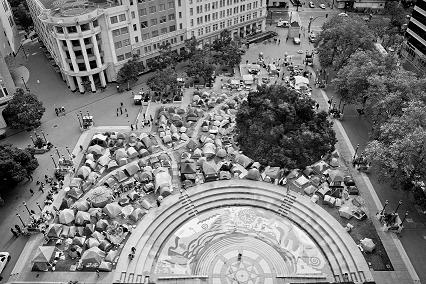
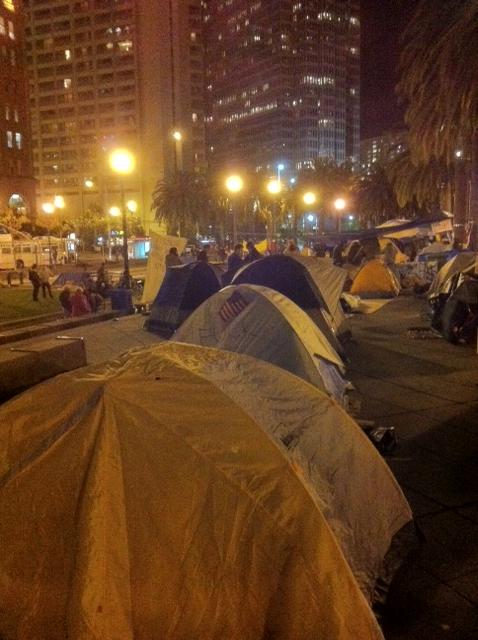
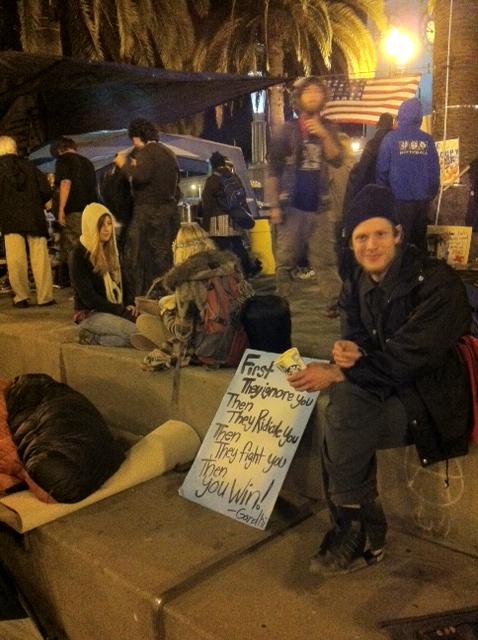
(UPDATED/CORRECTED AT 11:30 AM)The Occupy movements in San Francisco and Oakland reportedly scored big victories last night, with huge numbers of people overcoming police crackdowns and the shutdown of public transit stations, turning back city efforts to clear the OccupySF encampment and voting in the General Assembly in Oakland to call a general strike for Nov. 2.

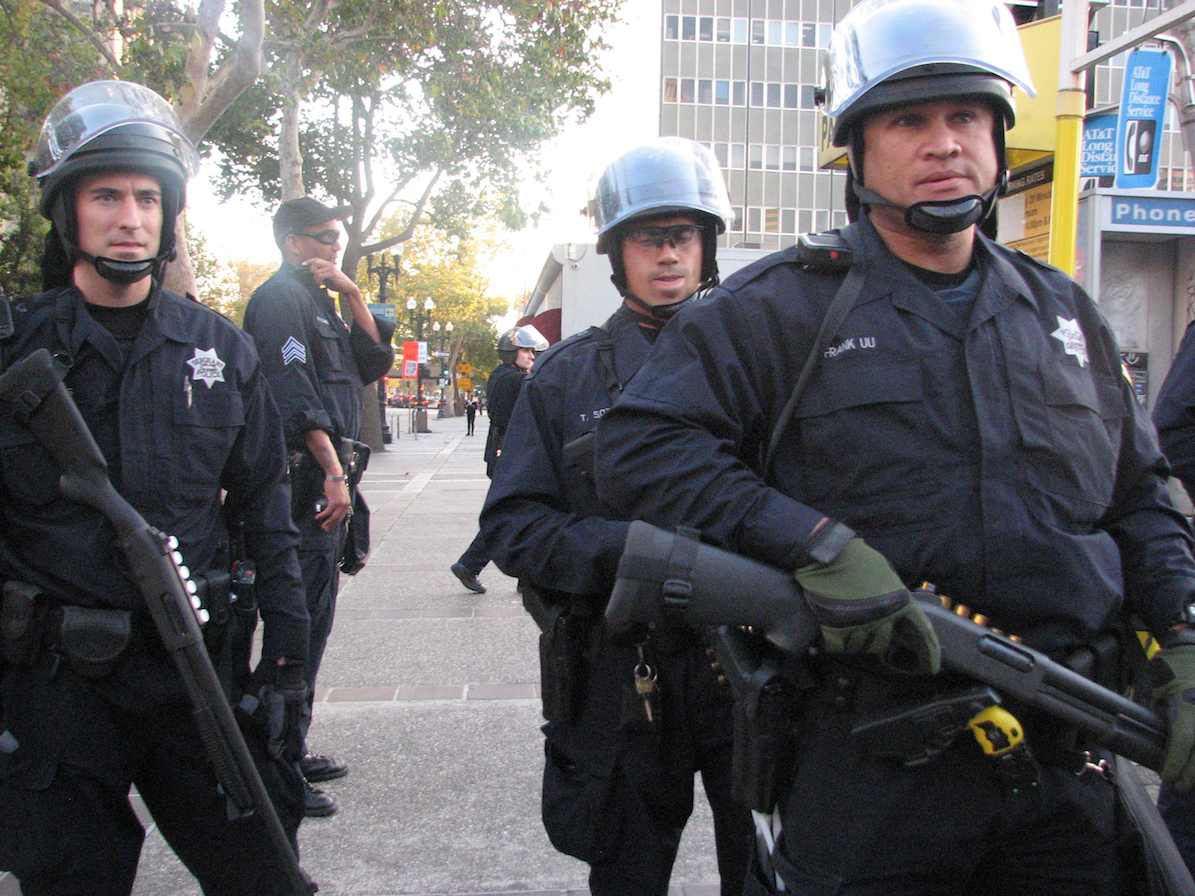
We’ll have a full reports later today. Occupy Oakland protesters showed up outside a cordoned-off Frank Ogawa Plaza to figure out how to respond to the previous day’s aggressive police raid, which made national news and left Iraq War veteran Scott Olsen in the hospital with a fractured skull after apparently being hit by a tear gas canister or some other projectile fired by police.

In San Francisco, Mayor Ed Lee and the SFPD threatened to shut down the OccupySF encampment over alleged public health problems – which the movement tried to address by bringing in their own porta-potties because the city refused to provide them at night – but the camp swelled with supporters. Among them were mayoral candidates John Avalos, Leland Yee, Jeff Adachi, and David Chiu, as well as Sups. Jane Kim, Eric Mar, and David Campos.

Video by Rebecca Bowe

They spoke to the crowd around 2 a.m., expressing their support and saying that neither police nor Lee had responded to requests for information about the city’s intentions. Other notables on the scene included writer Rebecca Solnit, SF Democratic Party Chair Aaron Peskin, Shawn San Liu of the Chinese Progressive Association, and local labor leaders Tim Paulson, Gabriel Haaland, and Mike Casey. Spirits were high, and protesters were ready to link arms and form a human blockade in the event that police showed up.

SF police reportedly massed nearby in the early morning hours, preparing to clear Justin Herman Plaza, and there were rumors that hundreds more were on the way. BART stations in the area were shut down to prevent more arrivals, while police in Oakland also reportedly stopped protesters there who tried to cross the bay to support OccupySF. But the raid was then reportedly called off because police were outnumbered and possibly to avoid a repeat of the violence and mass arrests that have plagued Oakland since the decision to clear the encampment there, and protesters sent out jubilant messages of victory.

Check back later for video and eyewitness details of what went down, from the the Guardian’s Rebecca Bowe (who contributed to this report) and Yael Chanoff, as well as information on what comes next. Or follow the Oakland live stream here or San Francisco live stream here.

Live Shots: Zahara! at Swedish American Music Hall

0

Yeah, so sometimes I cry a little when I listen to live music. You got a problem with that?

This may have happened last Friday night (10/21) when I went with Sam Love to Zahara!, a performance that featured singing and dance with roots in passionate flamenco from Kina Mendez, live Moroccan musicians (a group by the name of El Hamideen), and even some belly dancing.


My love for flamenco stems from when Sam Love and I lived in Cádiz, a small town in southern Spain, when I went to university. The first day of Spanish Lit class, my classmates and I sat down in a rather plain classroom, save for a poster on the wall of a man with a huge afro, and low-buttoned shirt revealing stacks of gold medallions around his neck. Beneath the photo, one word: Camarón.

In our naivete (and lack of Spanish culture) we thought it had something to do with shrimp. Our teacher entered and one of the first questions asked was not to do with Lorca, but about the dude in the photo. Our teacher’s answer: “ Camarón es Dios.” Wow! Here we were in a Catholic country and this guy was God? We needed to know more. Turns out, Camarón was one of the most famous flamenco singers in Spain, so much so that people wore gold saint medalions of him around their necks in place of Santa Maria. From that moment on, I couldn’t get enough of the emotional, heart-wrenching, powerful ballads known as flamenco.

So when Kina Mendez started singing during the Zahara performance, the potency, the tradition, the Spanishness that came from her lips induced salty tears to roll down my face. It was beatiful. I loved the mixing of cultures happening on stage, the air of pure nostalgia, and the fact that despite their different geographical provenances, the singing of Spain and the drumbeats of Morocco can come together in perfect harmony.

VALE! VALE!

Kina Mendez:
http://www.youtube.com/watch?v=VouPdlUE5I4

Camaron:
http://www.youtube.com/watch?v=FJKpyDEJs2U

Halloween style guide: A timely warning about hipster headdresses

22

One of my favorite activities of late seems to be railing against the prevalence of “Native American”-themed swag that a certain demographic has recently been using to accessorize their MDMA and Chromeo sets (no thanks to you Urban Outfitters — but reluctant semantic kudos for de-naming the line in question “Navajo”). Just in time for Halloween, along comes a blog that can neatly sum up these feelings, and do it in a constructive way. Please forward to your girlfriend frantically readying her dreamcatcher earrings.

Cherokee (“really!” as she asserts on her site) blogger Adrienne K. has assembled an ace 101 on why you can’t dress up like another ethnic group on her blog Native Appropriations, which is pretty much devoted to the topic. Her rationale (which comes structured as a conversation with a feather-sporting individual): you’re promoting a wildly stereotypical image of actual Native Americans, for one. Your godawful headdress is mocking someone’s spiritual rites, for two. Additional reasons are unnecessary, but they include the fact that you’re basically walking around in blackface. 

On a local note: Asterisk Magazine, I loved your recent Style Issue. But this single paragraph was enough to halt me in my see-through clothing raptures:

Just when you thought we took everything from American Indians, these Navajo prints are popping up on handbags and jackets everywhere. What may be culturally insensitive is also pretty sharp when done right. This is nothing new, but the urban arena is really just getting on board, and huge turquoise jewelry is surely close behind.

Who let that one slip through? Ick.

While we’re at it, you might want to check out this post by queer Chicana blogger April’s Eye on (white-and-)blackfacing it on Dia de los Muertos.

Live Shots: Gold Panda at the Independent

0

The endangered giant panda. The vulnerable red panda. But, the most rare variety of all, the elusive Gold Panda, emerged under the cover of a hooded sweatshirt (as is his nature) at the Independent Tuesday night, drawn out by the lure of a MPC, samples, and a sold out crowd.

Gold Panda’s music runs between melancholy and exuberance. Even when the BPM picks up on one level and the notes get more and more chopped up, the speedy, aggressive current that runs through so much electronic music never emerges. Maybe it’s the slow drone or the endless, never collapsing crashes that seem to be in the background of most of his songs, a building hypnotic tension behind his beats. (Hypnotic that is, until a quick little break comes around, smacks you in the ear, and leaves like nothing happened.)

As the UK/Germany based musician (“real” name Derwin Panda) played a fairly long set, covering most of the material off his LPs Lucky Shiner and Companion, the music seemed natural and organic, but also utterly inhuman. When voices appear, they’re abstracted, like the foreign ragas or the dissected “you.” (No setlist for this one; knowing the title of “I Suppose I Should Say ‘Thanks’ Or Some Shit”, contributes little to the appreciation, and is arguably distracting.) The stage setup was simple with some LED string lights and a paper lantern, but the live visuals by Ronni Shendar complemented the emotional mood of the songs perfectly, with found typographic examples, oceanic and urban triptychs, and some nature shots deserving of Attenborough.

Openers:
Blackout Make Out wins the best name award. A shaggy haired, jeans-clad, sunglassed, mustachioed, local singer songwriter sang ballads, sustaining notes on the electric guitar over synthetic beats. “Do you, you run away? Will you, will you stay?” At times a little ooh-ooh moan-y, but dude wasn’t afraid to let his guitar go to work over a building four-to-the-floor bass beat. Some cool moments sounded like he was having a conversation with his instrument, or more appropriately, arguing that no one is broken hearted like a man in denim.

At the conclusion of Jonti, a guy behind me said, “It was like a Rain Man set.” Burn, dude. That’s a little harsh, but I knew when Jonti, hailing from South Africa, took off his shoes right before starting, that it was going to be an idiosyncratic performance. Charmingly awkward, he lost a lot of momentum in his mic breaks, and was then be faced with the hard labor up building it back up. But there was a joy in watching Jonti get into his own distinctive beats enough to not just put words together but actually sing. Better than counting matchsticks.

Period piece: The San Francisco prostitute march of 1917

3

One morning in January 1917, 300 prostitutes marched into the church of their biggest detractor, Reverend Paul J. Smith. They were ready to show the anti-vice crusader what they were made of. The women were organizing in the face of what had become a decades-long dwindling of their rights, spearheaded by the reverend himself.

The world’s oldest profession flourished in brothels all over the city during the Gold Rush, thanks to all those lonely 49ers. But sex work has never been uncontroversial — and the local practice quickly accumulated its own critics.

Officials began cracking down on city brothels in the 1850s, slowly pushing them into tinier and tinier spaces. By 1909, sex work had been ghettoized in the Chinatown neighborhood and in 1911, to an even tinier strip of city known as the Barbary Coast. 

The 300 prostitutes had some community support, even a municipal clinic supposed to cater to their needs. But weekly checkups were mandatory. Anyone who refused could be arrested.

Reverend Smith took a hard line against what he saw as the heart of San Francisco’s vice. With friends, he gathered data on nightly wanderings through houses of ill repute (next time you find yourself in a gallivanting bachelor party, just use the “collecting evidence” excuse). Smith aggressively proposed a “state farm” – olden speak for rehab – for the sex workers, insisting he had their moral wellbeing at heart. 

The Reverend stepped on a few toes on the way, accusing police and politicians of having their hands in the pockets and up the skirts of brothels. An obviously annoyed Mayor James Rolph published an open letter in the San Francisco Chronicle lampooning Smith’s idea for a state farm. “I fail to see how it is proposed to reform the women by putting them on a farm. Is it your idea to make them milkmaids?”

But Smith’s most compelling challengers were the prostitutes themselves, who crowded into the reverend’s church the day of their march asking what, exactly, his intentions were for his campaign of persecution. 

“Are you trying to reform us or are you trying to reform social conditions?” asked one woman. Smith proposed that the sex workers turn to alternate professions where they would earn the minimum wage – $10 a week, half of what the prostitutes estimated they made through sex work. His suggestion was met with laughter.

“What ship are you going to send us away on?” challenged another. Smith brought up the possibility of doing housework, presumably while being financially dependent on a husband (numerous men, in fact, had written the reverend looking to be fixed up with a good-looking fallen woman). 

“What woman wants to work in a kitchen?” a member of the crowd shouted. 

Citing his “impassioned critics,” the reverend adjourned the meeting. By Valentine’s Day, the anti-vice movement forced a roundup of more than a thousand working women from city brothels and dance halls. 

But for a brief moment, sex workers native and foreign, young, old, and middle-aged, had made their voices heard in a city mostly hostile to their existence. At the time, the Chronicle characterized the march as “one of the strangest gatherings that ever took place in San Francisco.” 

Yeah right. In any case, “strange” isn’t the right word.


The richest 1 percent get richer

7

If there was any doubt in the message being sounded from the streets these days — that the richest 1 percent has been taking a disproportionate and growing share of the nation’s wealth — a long-awaited new study issued yesterday by the Congressional Budget Office makes it crystal clear.

Not only has their share of the nation’s income doubled in the last 30 years, but the report found that concentration was accelerated by a tax structure that has become steadily less progressive, allowing the very rich to keep more of the wealth that the rest of the country so desperately needs.

And the reason the tax code has become far less redistributive is because wealthy special interests have been rewriting it in their favor, and being allowed to do so by politicians in both major parties whose elections and post-service employment the wealthy sponsor.

These same politicians and the mainstream media have been trying to cast the Occupy movement as dirty, disorganized, and incoherent, but it central message — which is now being chanted in cities across the country — couldn’t be more clear and compelling.

“We are the 99 percent!” they’re shouting, a simple truth that highlights the biggest problem that our country is facing: an unfair and unsustainable consolidation of wealth, the central problem that spawns the myriad other problems we face, from underfunded schools and public infrastructure to corruption in our financial and political systems to the economic hardships that most of us face.

Politicians like Mayor Ed Lee, the clear choice of the 1 percent in this mayor’s race, can talk all he wants about “jobs” and the imperative of enforcing minor municipal codes against OccupySF, which is expecting its third raid by the police as soon as tonight. But those are meaningless abstractions compared to the simple truth that is being so clearly articulated by young people in streets.

We’re not the problem, they are. We are many, they are few. We know the truth and we aren’t giving up. Power to the people!

The new attack on Herrera

25

Well, the salvo coming from the Lee campaign trying to smear Dennis Herrera for not being a strong enough supporter of same-sex marraige shows at least one thing: The race is closer than the polls are reporting.

For the former staffers of Gavin Newsom — and everyone knows who they are, because there weren’t that many people in those meetings — to come forward two weeks before the election with these allegations was a serious political risk. For starters, Herrera is really popular in the LGBT community, and already, much of the city’s queer leadership (including Tom Ammiano, Mark Leno and Scott Wiener) has responded by denouncing the attack. The three, along with Phyllis Lyon and representatives of both major clubs, Harvey and Alice, will be holding a press conference Oct. 27 in the Castro. A letter that went out today under Lyon’s name notes:

A petty smear campaign is underway to personally discredit City Attorney Dennis Herrera over his years of work for marriage equality.  Incredibly, despite all the heroic efforts of Dennis and his office right from the start, anonymous sources have pushed a story in the San Francisco Chronicle that Dennis wasn’t “supportive” of Mayor Newsom’s decision to issue same-sex marriage licenses back in February 2004.  It’s not true.  These politically motivated attackers are hoping we’ll forget the years of hard work Dennis and his deputies invested — and continue to invest even now, in the federal challenge to Prop 8 — for LGBT equality.

So this could easily backfire and wind up focusing attention on all of Herrera’s LGBT support.

It’s also a risk for Lee. Although his name isn’t on any of this, his people are clearly behind it; Newsom (who just endorsed Lee) and his former staffers (some of whom are now Lee’s staffers) wouldn’t have contacted the Chronicle and pushed this story without the knowledge and permission of the mayor and his senior campaign people. Wiener, who is often one of Lee’s allies on the board, is clearly unhappy about the blast at his former boss. Leno, who isn’t involved in the election all, is now going to be pissed at the mayor. And if this winds up looking like a Lee-sponsored political swipe at an LGBT community ally, Lee’s going to lose votes and support.

So why do it? It makes no sense — Lee has tried to appear as the candidate of civility and reason, above the mudslinging fray. He’s trying to act so much like the inevitable winner that he doesn’t even show up for a lot of the debates and forums. There’s no point in dishing this kind of story up — unless the Lee camp has polling data showing the race tightenting and Herrera emerging as a serious challenger.

It’s a pretty basic rule in campaigns: You don’t risk political capital attacking candidates who are no threat to you. So if I were Herrera, I’d be mad — but also encouraged. They’re obviously worried.

Unknown Mortal Orchestra returns to the Bay, digs Dolores Park

0

No one could have predicted what was about to happen when Ruban Nielson uploaded a single  track – the fuzzy, undeniably catchy “Ffunny Ffriends” – to Bandcamp in late 2010.  A mere 24 hours later, Pitchfork had seized upon “Ffunny Ffriends,” posted the song on its site, and bloggers were going nuts for the new project, Unknown Mortal Orchestra.

When Nielson recorded the track that launched a thousand blog posts, he’d essentially given up any serious pursuit of a musical career. The New Zealand native had resigned to a job as an illustrator in his adopted home of Portland, Ore., after ending a lengthy stint as guitarist in the semi-successful noise rock outfit the Mint Chicks.

Despite its mysterious lack of identity, live gig offers for Unknown Mortal Orchestra started pouring in. Neilson recruited veteran Portland producer Jacob Portrait to play bass, enlisted wunderkind Julian Ehrlich on drums, then took his pet project on the road. The band ran out of money during the early stages of touring, so Nielson succumbed to relentless courting by Fat Possum and handed his recordings over to the label. With its clear psychedelic influences, glimpses of early Motown soul, and tripped out basement beats, Unknown Mortal Orchestra’s self-titled debut is one of the most entrancing albums of 2011.

When I speak with Nielson, he’s laid out on a friend’s couch, throttled to exhaustion by the rigorous performing schedule of CMJ. “I just need to sleep for, like, four days,” he says. Though he clearly needs it, sleeping for four days is beyond the bounds of possibility for Nielson. Unknown Mortal Orchestra is embarking on yet another national tour, this time bringing up-and-coming shout-pop duo Gauntlet Hair along for the ride. Unknown Mortal Orchestra has already hit up a bunch of local venues this year, and will return next week to play at the Rickshaw Stop on Nov. 3. “San Francisco is maybe our favorite place to play,” says Nielson. “We always go to Dolores Park for some reason and buy drugs and stuff. It seems kind of cheesy, [but] we always end up taking acid.”

Amidst the acid trips and endless touring itinerary, Nielson’s been steadily developing material for his next album. “I just write things down in the notepad on my phone and hum things into the recorder,” he says. The severely fatigued Nielson perks up a little when he tells me the writing of the album is almost complete.

He’s just purchased a house in Milwaukie  (a suburb of Portland), and is setting up a recording studio in the basement. Much of Unknown Mortal Orchestra’s debut was recorded in a similar location. “I didn’t have my own basement,” Nielson explains. “Some friends of mine went on tour and I would borrow their basement.”

“It’s just a nice place to get away from people,” he says. “I feel like I work better by myself.” With his crackly, witchy voice and a talent for arranging weirdly addicting instrumentals, a shadowy underground recording lair seems all too appropriate.

UNKNOWN MORTAL ORCHESTRA
With Gauntlet Hair and Popscene DJs
Nov. 3, 9 p.m., $12-14
Rickshaw Stop
155 Fell, SF
(415) 861-2011
www.rickshawstop.com

With Gauntlet Hair
Nov. 7, 9 p.m., $8-10
The New Parish
579 18th St., Oakland
(510) 444-7474
www.thenewparish.com

Check it: “Ffunny Ffriends”
http://www.youtube.com/watch?v=c-36lCKovBg

Occupy camps don’t create social ills, they showcase them

14

By Anna Lacey

OPINION When I entered the public square off Broadway and 14th on Oct. 17 — the site of the Occupy Oakland camp that police violently broke up this week — I immediately felt dazed by the atmosphere. But rather than seeing the squalor that has been highlighted by city officials and the media, I saw it as a place of real possibilities, particularly from my perspective as a social worker

Surrounded by tall buildings, the square is in the heart of downtown Oakland. It felt like I was in a commune of sorts. Walking through the rows of tents, I found myself amidst a sea of commotion; there were children of different ethnicities playing, a crowd was listening to some guy on a microphone talking about political freedom, a marching band was performing, and lines of people were dishing out and receiving free food. The energy in the air was almost tangible.

The police raided the square Monday night, October 24th, arguing that the occupiers were dangerous or directionless substance abusers. They had also been complaining about a rat infestation and other problems and about the camp being a magnet for homeless people. But when I visited the camp several times before it was raided, there were two important points that struck me about what has really been happening in Oakland’s occupation.

First: The occupation did not create new social problems. Instead, the movement has been making existing problems visible. Oakland is a city with an overwhelming crime problem and serious financial woes, a city known by many as “Oaksterdam” because of its many marijuana dispensaries as well as the presence of weed smokers on the streets. It’s a city with rats, gangs, unemployment, and school closures. Existing social problems have become more visible because people have congregated together, largely because they were sick of suffering from social ills in silence and isolation.

It should also be pointed out that the homeless population was in the square before the occupation. Yet only now are they able to receive free healthcare, learn about available social services, and enjoy respite from police harassment. The police were not allowed in the square for two weeks, and participants in the movement voiced extreme pride of the “liberated space.” As one organizer put it, “Here in Oakland we have a history that makes us unable to dialogue with the police. Occupy Oakland is unique due to the legacy of the Oscar Grant movement; we know the police are not on our side.”

It does seem quite clear that, instead of trying to resolve the problems being brought to light in the square, the police would prefer the protesters remain isolated from each other, so as not to bring attention to existing social problems. I suppose a gang of police in riot gear followed by the terrorizing and arrests of almost 100 peaceful organizers is easier, thanks to our flawed governmental system, than responding to the social issues put forth by the public.

Second: The occupation was never a party zone. Quite the opposite, for two weeks the participants functioned as an organized political and social union. By day, various presenters lectured the crowds on such things as the rights and responsibilities of political beings. One evening, several youth spoke of their hopes and dreams, saying things like, “I want to be the future of America, but I can’t if there’s no money to fund my school.”

Dusk would mark the start of the nightly General Assembly, a sort of lengthy debate giving all the opportunity to make propositions to influence the movement. The assembly would last until after midnight, and a 90 percent majority of votes was needed to pass any given proposition. One evening, the General Assembly closed with everyone chanting, “This isn’t Burning Man,” implying the seriousness of the movement and the need to leave the party in the desert.

At the same time, the square was far from utopian. There were a couple of fights, which were deescalated quickly. Another key issue remains how to manage the movement’s ethos of equality while still moving in a unified direction. However, as one organizer put it, “Our power is in the lack of a leader, and our diversity is a blessing. The media doesn’t know how to control the masses.” There are discussions of new occupations to bring attention not only to the recent jailing of many protestors but also to school closures, police brutality, prison hunger strikes, foreclosures, and other social and political injustices.

Obviously, the Occupy Oakland that I experienced was very different than what the media and police accounts would have you believe. I wish I could tell you to come and judge for your self, but unfortunately there is no longer any one identified place to congregate. Instead, following Monday night’s raid and Tuesday’s squirmishes, many involved in the movement have been scattered out on the streets, forced to defend themselves from the police without the sanctuary of a peaceful and supportive liberated space.

Snow Park, along Lake Merritt, originally an extension of the original camp, is currently one meeting place for those involved in the movement. While I think the police’s senseless and heartless behavior has, at least for the time being, destroyed much of the beauty taking place in Occupy Oakland, I still urge you to lend your support. As one occupier told me, “Be a part of the process. It’s not perfect. Then again, if it was so easy, it wouldn’t be worth it.”

Anna Lacey is MSW trainee and therapist with La Clínica de la Raza who lives in Oakland and is working on her master’s in social work at UC Berkeley

Dailies dutifully vomit out the city’s misleading portrait of OccupySF

8

Both the Examiner and the Chronicle reported this morning that the OccupySF encampment has become a public health hazard, setting the stage for what many believe is an imminent police raid. The newspapers’ only source: a notice that the Department of Public Health handed out to protesters, at their camp in Justin Herman Plaza, at 6am today. I have been reporting eyewitness accounts from OccupySF for several weeks, and if any reporters from these papers had bothered to go there themselves, they would be telling a very different story.

The Department of Public Health states that fecal matter, urine and vomit have been observed in Justin Herman Plaza and on surrounding streets. That’s accurate. Like many streets in San Francisco and in any city, members of the public sometimes relieve themselves on the streets. The difference is that at OccupySF, people from the 300-person community camped out there take it upon themselves to clean up any occurrences of waste as soon as it’s observed. Scheduled cleaning teams coordinated by the camp’s  Sanitation Committee sweep the streets three times per day, and wash when necessary. Late last night, even as protesters focused on plans in case of a police raid, which the city has been threatening everyday for most of the week, protesters went over the camp many times over with brooms.

Perhaps these issues could be resolved if the city were to provide the port-o-potties that Police Chief Greg Suhr and Mayor Ed Lee promised OccupySF last week. At last Wednesday’s Police Commissioner meeting, Suhr said, “We have no future plans to go into the demonstration. We know that it’s for the long haul…I’m actually working with the Mayor’s Office personally to put the port-o-potties and the handwashing stations down there to provide sanitation.”

In an Oct. 20 email to OccupySF, the deputy communications director for Mayor Ed Lee stated that “porta-potties are available by request.” A press release from OccupySF today claimed that “Port-o-potties are currently only available during daytime hours. OccupySF’s repeated requests for 24-hour port-o-potties have not been met.” When we asked mayoral Press Secretary Christine Falvey why the city hasn’t helped mitigate the public health issues they seem to be using as a pretext to break up the camp, she said, “There are porta-potties and hand washing stations at 101 Market Street, as the mayor directed, and are available for demonstrators to use. They are delivered in the morning and removed at night.”

I can confirm that port-o-potties for use at night, when no bathrooms on surrounding blocks are available, are yet to arrive. And police certainly have continued to “go into the demonstration”—making rounds and handing out notices from different city departments every day, “reminders” that protesters are illegally camping in a public park, violating sit/lie ordinances, and are now, apparently, a “public health hazard.” Today, a notice was circulated that cited all of these issues and informed protesters: “You are subject to arrest.” The camp is preparing for a possible police raid tonight.

These issues are not unique to San Francisco. Barbara Ehrenreich reported October 24 that, at Occupy demonstrations throughout the country, “for the individual occupier, one problem often overshadows everything else, including job loss, the destruction of the middle class, and the reign of the 1 percent. And that is the single question: Where am I going to pee?” In her piece in Mother Jones, “Why Homelessness is Becoming an Occupy Wall Street Issue,” Ehrenreich notes that “What the Occupy Wall Streeters are beginning to discover, and homeless people have known all along, is that most ordinary, biologically necessary activities are illegal when performed in American streets—not just peeing, but sitting, lying down, and sleeping.” San Francisco has some of the harshest laws in the country in this regard.

Many cities have accommodated Occupy protesters. Why won’t the city bring port-o-potties? And why are city publications reporting the city’s official statements without any perspective from the encampment itself? The people are speaking: that the powers that be won’t listen is what the Occupy movement is fighting against in the first place.

Live Shots: Portishead at the Greek Theatre

0

Once while talking music with friends on a long road trip I was posed with the task of describing Portishead’s sound. Struggling to articulate the sum of their collective parts, I did a hasty mental cut-and-paste and said, “They’re sorta like…if Pink Floyd was a hip-hop band…and Billie Holiday was their singer.” It’s a clunky description, not so much for the references, but because Portishead’s greatest attribute is their ability to bend genres so seamlessly that it all morphs into their own sort of singular sonic universe. Even the prevailingly appropriate moniker of trip-hop (of the Bristol variety) really seems more of a launching point than a description.

So it was a rare opportunity this past week to witness Portishead’s audio empire live in the Bay Area for the first time in over 13 years (when in 1998, it recorded an epic version of “Sour Times” during a Warfield performance for the Roseland NYC Live album, later that year). Playing the Greek Theatre in Berkeley on Friday October 21, Portishead worked through a 16-song set as a six-piece live band, dark silhouettes set against a backdrop of vibrant visuals as band members broadcasted an eclectic mix of their catalogue (pulling most heavily from their more recent LP, Third). Singer Beth Gibbons was in fine tortured form, even as the early part of the set was dominated by surprisingly straightforward renderings. But during the second half of the performance Portishead delved deep in their element with a batch of expanded arrangements on some prime tracks that produced stunning results, most notably a massively ominous “Wandering Star” and an out-for-blood “Machine Gun.”

Tracks off of the band’s self-titled second album showcased Portishead’s mastermind Geoff Barrows working his way from a cocoon of varying instruments to the turntables were he cut up gargantuan spots on “Over” and “Cowboys.”  The night’s showstopper came in the form of “Roads” (off of the band’s landmark debut Dummy) as Beth Gibbons’ vocals hit their apex for the evening.

Seeing Portishead again for the first time in a decade, I tried to improve on my original description of their sound, but I’m still not so sure how to peg it all: they sounded like Nina Simone scoring a James Bond film, and the beginning of the end of a great romance, and a DJ battle under pulsing blacklights. Of course, none of these are fully apt either. After all…it’s Portishead. For those who know, it’s description enough.

Setlist:

Silence

Hunter

Nylon Smile

Mysterons

The Rip

Sour Times

Magic Doors

Wandering Star

Machine Gun

Over

Glory Box

Chase the Tear

Cowboys

Threads

(Encore)

Roads

We Carry On


Avalos offers resolution supporting OccupySF and its camp

57

In the wake of last night’s violent police raid on the Occupy Oakland encampment (a still-tense situation that we’re now on the scene covering) and two similar late-night police crackdowns on OccupySF in recent weeks, Sup. John Avalos and co-sponsors Eric Mar and David Campos are introducing a resolution at today’s San Francisco Board of Supervisors meeting that calls for the city to explicitly allow the OccupySF encampment and its related infrastructure to remain.

That resolution (the full text follows below), which Avalos legislative aide Raquel Redondiez says will be the subject of a special hearing on Monday before being considered by the full board on Tuesday, Nov. 1, grew out of testimony from OccupySF participants that Avalos solicited at last week’s board meeting following a late night police raid on Oct. 16 that resulted in five arrests and many injuries.

As we report in this week’s paper (see “Mixed messages,” to be posted this evening, Tues/25), at that Oct. 18 board meeting, Mayor Ed Lee took the position that no tents, kitchens, or other infrastructure would be permitted, a stance that Police Chief Greg Suhr seemed to soften slightly at a raucous Police Commission hearing the next day. In the face of those mixed messages, OccupySF grew into a full-blown tent city in Justin Herman Plaza and there have been no real conflicts with police since.

Both the San Francisco Police Department and the Mayor’s Office were slow to respond to messages we left all week seeking to clarify the city’s policy toward OccupySF, but both finally got back to us last night after the article had gone to press.

SFPD spokesperson Daryl Fong told us, “We’re still currently doing daily safety inspections at Justin Herman Plaza and continuing to provide leafletting…We’re educating the campers about violations and concerns for public safety,” such as unsanitary conditions or unsafe camping structures.

But he said OccupySF hasn’t been given any deadlines for removing structures and there are no current plans for another raid. “Our goal is to get compliance from the campers voluntarily,” he said. “This situation is being continually monitored as it progresses.”

When we asked the Mayor’s Office about the contradiction being Lee’s stance and the city’s reaction to the growing tent city, Press Secretary Christine Falvey wrote, “The mayor’s position on Occupy SF has not changed. He has directed his departments to facilitate peaceful protest, but not allow structures, tents, or a permanent campsite. He wants to ensure the area is safe for demonstrators and the general public. If you have been to the site, you may have seen the Fire and Public Health Departments conducting inspections for public health and safety concerns and you may have seen Recreation and Park and Police staff informing people of the parks and public safety codes that prohibit camping equipment. Individuals are being informed daily of this and the city’s Homeless Outreach Team is offering services to anyone in the area who may need it. The policy stands and departments are educating the group about what is and is not allowed and the mayor expects those who want to use the space to protest, to follow the rules.”

But OccupySF protesters say they have no intention of leaving the space, believing it’s their right to be there as part of a national movement spotlighting the greed and corruption of the wealthiest 1 percent of Americans. And when I told Falvey that the encampment seems to defy the mayor’s stated position, she wrote, “The mayor has asked several departments to enforce the existing codes, and I understand a number of informational contacts have gone out daily to educate those using the plaza about what is allowable in addition to Fire and Public Health inspections to make sure open flames or dangerous materials are not being used or stored at the site.”

I told her that didn’t address my question, and I asked for a reaction to the Avalos legislation that would explicitly allow “tents, tarps, First Aid supplies, environmentally clean and fire-safe energy sources, and the ability to store, prepare, and serve hot food,” which is the reality now on the ground. I’ll update this post when I get a response.

In the meantime, here’s the full text of the resolution:

[Expressing Support for Occupy Wall Street Protest Movement and the People’s Right to Peaceful Assembly in San Francisco]

Resolution Supporting the Occupy Wall Street Protest Movement and Urging Mayor Lee to Uphold People’s Right to Peaceful Assembly and Collaborate with Occupy SF to Ensure Safety of the Protestors, their Supporters, and the Greater Public.

WHEREAS, “Occupy Wall Street” was formed by a broad spectrum of people coming together to protest the corporate-serving economic and political system controlled by the 1 percent, profiting at the expense of 99 percent of the people; and

WHEREAS, Three years after the current financial crisis caused by Wall Street speculators and profiteers, the unemployment rate in the United States is still at the highest level since the Great Depression with the unemployment rate in San Francisco currently at 8.3 percent; and,

WHEREAS, The United States’ major banking institutions, which have been bailed-out by the government and United States taxpayers, have done little to prevent massive foreclosure of residential properties or support the revitalization of local economies by sustaining small businesses; and,

WHEREAS, Since 2008, there have been 1.2 million foreclosures in California, with 12,410 homes in San Francisco alone; and,

WHEREAS, The “Occupy Wall Street” protest movement has struck a chord with the people of the United States and around the world, inspiring over 900 similar protests and solidarity actions across the country, where tens of thousands of people have come out to express their deep indignation against Wall Street greed and systemic socio-economic injustices; and,

WHEREAS, The “Occupy” demonstrations are a rapidly growing movement of people from all walks of life with the goal of occupying public space in order to create a shared dialogue and assert demands for economic justice; and,

WHEREAS, The “Occupy” demonstrations have been supported by the California Nurses Association/ National Nurses Association, American Federation of Labor -Congress of Industrial Organizations, Change to Win, International Longshore and Warehouse Union-International, Teamsters Joint Council 7, Services Employees International Union, Laborers International Union of North America, and many others; and,

WHEREAS, The OccupySF demonstrations began in September with small gatherings of people and have since grown and gained supported from thousands of individuals, community and faith-based organizations, and unions; and,

WHEREAS, On October 12, a 500-person march and civil disobedience organized by local community groups received national media attention, exposing the struggles of San Francisco residents against foreclosure, corporate control, and spiraling unemployment; and,

WHEREAS, The October march and protest action culminated in civil disobedience and, despite the arrest of 11 people, lacked any antagonistic conflict between the police and protestors; and,

WHEREAS, Similar to demonstrations in hundreds of cities across the United States, OccupySF demonstrators are asserting their rights to free speech and peaceful assembly 24 hours a day, seven days a week, in order to create public dialogue around corporate control of the political process and public space; and,

WHEREAS, Numerous and various groups continue to join the protesters at OccupySF, including an interfaith clergy contingent and the California Nurses Association, which has set up a First Aid tent to support the protestors and help ensure public safety; and,

WHEREAS, The City of San Francisco has a right and duty to ensure the safety and security of the general public including the protestors and their supporters; and,

WHEREAS, Since the beginning of the protest, City actions have resulted in the confiscation of food, tents, sleeping bags, and other belongings from the OccupySF demonstrators as well as causing preventable injuries and arrests; and,

WHEREAS, The City has a lengthy and proud history of political protest and has upheld the rights of people to free speech, freedom of assembly, and peaceful protest; and,

WHEREAS, With clear leadership from the Mayor, City departments can set a tone of cooperation and collaboration with OccupySF protestors and supporters, help mitigate harm, and address any public safety, health and sanitation concerns, all while avoiding unnecessary conflict; now, therefore, be it

RESOLVED, That the Board of Supervisors supports the Occupy Wall Street protest movement and the rights of all who protest to assemble peacefully and enjoy free speech in the City and County of San Francisco; and, be it

FURTHER RESOLVED, That the Board of Supervisors recognizes that Free Speech and Freedom of Assembly should not be limited to daytime nor short-term activities and we deem the need of protesters to have tents, tarps, First Aid supplies, environmentally clean and fire-safe energy sources, and the ability to store, prepare, and serve hot food reasonable; and, be it

FURTHER RESOLVED, That the Board of Supervisors urges the Mayor, the Police Department, and other City agencies to uphold the rights of protestors to political speech and public assembly, and to recognize that the full exercise of such rights requires that participants are able to attend to the needs of everyday life, and have a space free from harassment; and, be it

FURTHER RESOLVED, That the Board of Supervisors urges Mayor Ed Lee to direct the Recreation and Park Department, the Department of Public Works, the Police Department, and other City agencies, as relevant, to be flexible and to collaborate with protestors for the safe sharing of public spaces, in which demonstrators can exercise their political rights and the City can address legitimate safety concerns while avoiding unnecessary antagonism; and, be it

FURTHER RESOLVED, That the Board of Supervisors urges Mayor Ed Lee, in order to prevent further harm and conflict to any members of the public, including protestors of OccupySF, to direct the Police Department to ensure that there will be no use of force to dislodge the OccupySF demonstrators and confiscate their belongings.


Interview with a master pumpkin carver: Shawn Feeney of Team Bling Bats

0

The triumphant Team Bling Bats might owe some of their success to German electronic music pioneer Karlheinz Stockhausen. Without it, the champions of the Food Network reality design show Halloween Wars might not have had the kickass contributions of SF local Shawn Feeney, who helped drive the team to victory in the four-episode series final show on Sunday.

Feeney is an concept art illustrator working at Industrial Light and Magic, but in his spare time he creates these killer jack-o-lanterns that feature the face of a musician who has passed away in the last year (wo0o0o0o0o0oo!). Stockhausen, a composer who made music to be performed on helicopters, by three orchestras at once, and in weeklong cycles. His face was one of the ones that Food Network brass saw on Feeney’s website, who then contacted him to be on the show. 

On Sunday, Feeney sat down with buddies at Asiento in the Mission to watch his Bling Bats defeat Team Boo. Then he sat down to email us his secret tricks and what he’s going to say to Obama to put this country back on track, via pumpkinery. 


SFBG: Where’d you get them carving skills from?

SF: I used to work in a prosthetic hand laboratory. I also got a master of fine arts in New Zealand, and later worked as a forensic artist for the New York police. Recently, I have been working at effects studio Industrial Light and Magic, where I’ve further developed my analog and digital sculpting skills.

Karlheinz Stockhausen, German godfather of electronic music, composed pieces that were meant to be performed in a helicopter and one for three orchestras. He became Feeney’s gourd muse when he passed away in 2007.

SFBG: How did you prepare for last night’s battle?

SF: There was an enormous amount of surface area on that 1200-pound pumpkin, so I knew the ribbon loop tool I usually use wouldn’t suffice to get the skin off. Instead, I got an angle grinder – that thing vaporized the pumpkin skin into a fine mist (although it made the floor dangerously slippery).


SFBG: How would you rate your performance?

SF: I think Karen Portaleo, Susan Notter, and I really worked well together as a team, with each member contributing equally. I’m in awe of their talents. I didn’t approach this as a pumpkin carving contest – rather, I tried to develop designs that showcased everyone’s skills in a cohesive manner.


SFBG: How are you celebrating your triumph?

SF: I watched the final episode at Asiento in the Mission with some friends – the whole bar was on pins and needles! I’ve decided to use the winnings to further develop my carving practice, even beyond pumpkins. I’ll be making a lot more work in this field in the coming months, and I’m available for custom carvings, events, and teaching. I’ve really excited to offer my skills to the Bay Area foodie culture. 


SFBG: I hear you’re carving presidents for Obama. Please explain. 

SF: I’m carving pumpkins for Obama. A couple weeks ago, I got in touch with fruit and vegetable artist James Parker. He’d been watching Halloween Wars and liked my work. James organizes this event to bring some of the top carving and culinary artists to create displays for the White House lawn on Halloween. I feel honored that he invited me to participate.


SFBG: Also, can you tell him that we’re a little frustrated with him right now? I’m not sure if you can work that into pumpkin discussions, but surely you can craft a metaphor involving pumpkin smashing. Or whatnot. 

SF: Hopefully Obama is astute enough to realize there is much unrest in the country right now due to vast economic inequality. At this event though, I’m really aiming to inspire (and perhaps scare) the trick-o-treaters, and to collaborate with some of the top food sculptors in the country.


WTF, Chuck?

18

And now for a new installment in the ongoing saga of What the Fuck, Chuck?, our attempt to figure out the unfathomable positions of the Chron’s local columnist, C.W. Nevius. Today’s episode: Why is Nevius so determined to stir up a clash between the police and the OccupySF protesters?

Although the Oakland cops have rousted Occupy Oakland — with a nightime raid, arrests, and the works — things have been pretty mellow in San Francisco for the past week. Police Chief Greg Suhr has tried to avoid sending riot troops in to evict the camp. The campers are working with city officials to get a permit for a stove. The camp is largely peaceful; nobody’s hurting anyone or anything.

Oh, but Chuck is nervous:

Many of the city’s homeless residents have gravitated there, the sanitation is a nightmare, there are rats, and car batteries are neither a safe nor ecological energy source.

Well, there were rats there before the protesters arrived. City officials have offered to set up portable toilets. Car batteries aren’t perfect, but if you charge them by riding a stationary bicycle, the energy is pretty darn ecological. And really, unless you knock the battery over and it cracks and spills, car batteries are pretty safe; the don’t explode or emit fumes. The acid and lead are toxic, but they’re pretty well contained. There are more than 300,000 car batteries on the streets of San Francisco already; every car has one.

And so what if “many of the the city’s homeless residents” have gone to join the protests? Some are eager for the free food and shelter, which is fine — putting the more middle-class radicals side by side with homeless people isn’t a bad thing at all. In fact, it’s about the most radical thing that OccupySF is doing. Homeless people are the most visible victims of the economic injustict that the occupyers are protesting; shouldn’t they be part of the action?

I realize that some homeless people have mental health and substance abuse issues, but those didn’t start with OccupySF. Instead of whining about the situation, the city ought to be taking advantage of it — here’s a group of hard-to-reach folks who social workers can probably connect with more easily in an environment and community that’s supportive.

But Nevius can’t imagine anything good coming of any of this:

As Occupy SF gets bigger and louder, the potential for trouble only increases.

I guess Nevius doesn’t believe it’s possible for an alternative community that includes a wide range of activists and homeless people to grow and make its voice heard without “trouble.” And the only way out is to send in the troops.

What the Fuck, Chuck?


Lee fraud bumped by Hammer

24

The San Francisco Chronicle finally — finally — put the story about voter fraud by Ed Lee’s supporters on the front page Oct. 25, and it was on the top of sfgate for a few hours. But by 11:30 a.m., the story was off the front page of the paper’s website, buried where it’s impossible to find without searching — and replaced by a big story about this bizarre Ed Lee rap video featuring Hammer, will.i.am and Brian Wilson. It’s almost a joke, the video, a cartoon version of a music video featuring young women chanting “Ed Leeeeee” and lyrics that just about left me speechless:

My my my, music hits me so hard,
Newsom left and they put him in charge,
Thank you, for blessing me,
and the rest of the city with Mayor Ed Lee
Got us all sayin’ “Run Lee Run”
Only five-foot-five but he gets (bleep) done
So tell them other candidates to find a bus pass,
Unless you ridin’ with us…FEAR THE MUSTACHE!

It’s almost like Rappin Ronald Reagan. Except that one was actually funny.

So: A real, serious story about the kind of dangerous sleaze that we can expect from an Ed Lee administration is bumped off the top of the city’s daily newspaper website to make room for a weak joke. Go Chronicle. Go sfgate.

Oakland occupiers vow to fight back against police raid

The Occupy Oakland encampment, which was established Oct. 10 in solidarity with the Occupy Wall Street movement in Oakland’s Frank Ogawa Plaza, was dismantled by police in an early morning raid on Oct. 25. The city of Oakland had issued eviction notices over the last several days, and sent a strongly worded notice the night of Oct. 24.

Police in full force descended upon the city park — christened Oscar Grant Plaza by the activists — at 4 a.m., clad in riot gear. They moved in swiftly, deployed teargas, and made mass arrests.

As of noon on Oct. 24, Frank Ogawa Plaza was still blocked off, with the remnants of the camp still scattered in the square. Oakland City Hall was closed to all but city employees.

Occupy Oakland protesters planned to respond to the raid with an emergency demonstration against police repression, scheduled to be held Oct. 25 at 4 p.m. at the Oakland library on 14th and Madison.

“Occupy Oakland is not finished, it has only begun,” a media statement from the occupiers said. “Our numbers will be larger than ever.” The statement also noted, “Occupy Oakland urges people to contact Oakland’s mayor and tell her what you think of her actions.”

Sue Piper, Special Assistant to Mayor Jean Quan, rejected the idea that the order had come from Quan alone. “It was a team effort,” Piper said. “We have the mayor, the City Administrator, the police chief, and the fire chief. The decision was made by that team to do it early this morning.”

Piper said the raid was carried out because “the people who were camping out were contributing to a health and safety issue.”

Asked how the city would respond to concerns that this appeared to be a crackdown on freedom of speech, Piper said protesters had the to right to assemble in public parks between the hours of 6 a.m. and 10 p.m.

“They cannot occupy our parks,” she said.

For an in-depth account of what it was like inside the camp at Occupy Oakland, pick up tomorrow’s issue of the Guardian.

Localized Appreesh: Debbie Neigher

0

Localized Appreesh is our weekly thank-you column to the musicians that make the Bay. Each week a band/music-maker with a show, album release, or general good news is highlighted and spotlit. To be considered, contact emilysavage@sfbg.com.

This week’s Localized Appreesh is the lush-vocal’d Debbie Neigher. She’s a stunning jazz-tinged singer-songwriter, who recorded her recently released self-titled LP with John Vanderslice at his Tiny Telephone Studios, along with the backing orchestral help of Minna Choi of the Magik*Magik Orchestra.

Neigher, a transplant from New Jersey, has the kind of effervescent voice that transcends time.  She’s youthful (just 24), yet her voice is strong and conveys a wise understanding of past, similar to Michelle Branch or Fiona Apple. Her lyrics often dive into difficult topics, particularly on dramatic tracks like “Cathedral.” And her intricate piano work on the album soars.

The talented songstress plays the Haunted Hoedown at Bottom of the Hill this Friday, Oct. 28. She’ll be premiering a new song, and will be backed by guest musicians on bass, lap steel, drums, violin, guitar, and sax.  The event includes costume contests, free treats, and a rather creepy concert poster.  Get spooky. 

Year and location of origin: I started performing my original songs when I was 15 back in my hometown in New Jersey in 2002.  I wasn’t even legally allowed in half of the bars I played!

Personal motto:  If you are lucky enough to figure out what truly moves you, it’s your responsibility as a human to stop at nothing to pursue it.

Description of sound in 10 words or less:  Intricate/lush piano, jazz vocals, and painfully honest lyrics.
Instrumentation:  I sing and play the piano and have an absurdly talented crew of drummers (Jason Slota, Ezra Lipp, Andrew Maguire) and bassists (Jamie Riotto, Jesse Cafiero) that I call on for live shows.  We usually have lap steel (Jesse Cafiero) and guitar (Phil Pristia) as well.

Most recent release: I just released my debut full-length record (self-titled) this past July.  I had the honor of working with John Vanderslice (Spoon, The Mountain Goats) as my producer and the Magik*Magik Orchestra (Death Cab for Cutie, The Dodos) on the project.
Best part about life as a Bay Area musician: The warm, welcoming, and collaborative nature of the music community here.  I’ve never met so many talented players with such humility – I’m grateful to know these people every day!

Worst part about life as a Bay Area musician: I work a full-time job and teach piano lessons on top of writing/performing music to afford the rent in our fair city!

First record/cassette tape/or CD ever purchased: Oh god I just asked my mom and her guess was a New Kids on the Block cassette.  In an attempt to redeem myself, I also distinctly remember having Nirvana’s Nevermind CD and Bush’s Sixteen Stone CD when I was little.

Most recent record/cassette tape/CD/or Mp3 purchased/borrowed from the Web: Local Natives “Gorilla Manor”
Favorite local eatery and dish:  Plantain black bean burrito at The Little Chihuahua.

Haunted Hoedown
With Debbie Neigher, Owl Paws, Rin Tin Tiger, and Please Do Not Fight
Fri/28, 8:30 p.m., $10

Bottom of the Hill

1233 17th St., SF
www.bottomofthehill.com

Lee under fire over voter fraud accusations (VIDEO)

    Just over two weeks before election day, allegations of voter fraud carried out by agents of an independent expenditure committee created on behalf of Mayor Ed Lee threw a curveball into the San Francisco mayor’s race. Lee has been the clear front runner for months.

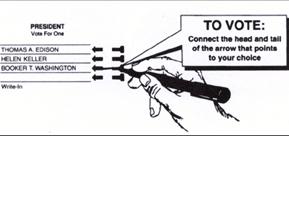
    Volunteers for Sen. Leland Yee, a mayoral candidate, accused Lee supporters working on behalf of the San Francisco Neighbor’s Alliance in Chinatown of marking ballots for San Francisco voters, guiding ballot selections with stencils, and collecting ballots in a bag, in apparent violation of election law. Videos of a voting station where the activity occurred were shot by Yee volunteers and aired on major media outlets.

    An onslaught of questions about these accusations were directed at Lee at a campaign event Oct. 24, in which Lt. Gov. Gavin Newsom, the former San Francisco mayor, announced his endorsement for Lee’s candidacy. Lee sought to distance himself from the independent expenditure committee in question, saying his own campaign has kept things clean. The mayor said he supported his rivals’ calls for investigation into any “fishy business,” and supported the idea of bringing in federal election monitors.

    Here’s a video of Lee getting the third degree from reporters at the press event, which was held in the office of a SoMa-based tech company called BranchOut.

Video by Rebecca Bowe

A vote-fraud video primer

29

The Leland Yee campaign has produced a nice little video primer on the Ed Lee vote scandal. It’s short, to the point, and gives you a sense of what has been going on with volunteers who are supposedly independent from the official Lee campaign. Check it out after the jump.