

Somehow, you never see headlines like this in the Chron:
Former SF Mayor Newsom endorses hand-picked incumbent Ed Lee amid ballot tampering charges
Pretty much says it all.
Somehow, you never see headlines like this in the Chron:
Former SF Mayor Newsom endorses hand-picked incumbent Ed Lee amid ballot tampering charges
Pretty much says it all.

Fascinating oped piece in the Oct 23 New York Times by Alexander Stille about economic and social equality. He starts right out with the issue:
It’s a puzzle: one dispossessed group after another — blacks, women, Hispanics and gays — has been gradually accepted in the United States, granted equal rights and brought into the mainstream.
At the same time, in economic terms, the United States has gone from being a comparatively egalitarian society to one of the most unequal democracies in the world.
The two shifts are each huge and hugely important: one shows a steady march toward democratic inclusion, the other toward a tolerance of economic stratification that would have been unthinkable a generation ago.
More:
Europe has maintained much more economic equality but is struggling greatly with inclusiveness and discrimination, and is far less open to minorities than is the United States.
Now: You can argue (and make a good case) that the dispossessed groups Stille talks about really haven’t won mainstream acceptance. But the fact is that over the past 30 years, this country has made considerable progress on the civil rights and social equality front — and has lost just as much ground or more in economic equality.
I don’t buy the hidden argument in here that social and economic equality are tradeoffs, that you have to give up one to get another. That’s ridiculous. And I think there are still times when race matters more than class. When you look at patterns of environmental justice, for example, you find that African American communities face far more toxic contamination than white communities — and income doesn’t seem to be as much a determining factor. In other words, middle class black communities have been dumped on more than poor white communities.
But I do think he makes an excellent point about class-based organizing in the U.S. It hardly exists anymore. And that’s something we all need to worry about.
The city is famous for its identify politics, and much of that is good. When Harvey Milk said that gay people should have their own supervisor, when Asians and Latinos and African Americans say they need to be represented in government, that’s not only valid but an important progressive goal.
But when we leave class, poverty, equality and economic justice out of the picture, or when we fail to make it a priority, we get what we have — a godawful economic mess.
Calvin Trillin: Deadline Poet
THE FAR RIGHT CONTEMPLATES THE REPUBLICAN FRONT-RUNNER
It seems that now we are stuck with Mitt.
Reciting right-wing holy writ,
He still sounds moderate, a bit.
Although it’s nothing he’ll admit,
A healthcare plan’s his biggest hit
(The thought of it gives us a fit.)
And born-agains, from where they sit,
Still state their firm belief, to wit:
As Christians, Mormons aren’t legit.
We’ve said for months, “This man’s not it.”
We wish that Palin hadn’t split.
We wish that Perry weren’t a nit
(His pilot light is not quite lit.)
Because, it seems, we’re stuck with Mitt.
Calvin Trillin: Deadline Poet (The Nation 10/31/11)
Beach squelch shimmy is back.
Just in time for its Halloween show at Brick & Mortar Music Hall, where it will take part in punk rock tradition alongside the likes of Nobunny and Ty Segall, Oakland’s Uzi Rash has gifted us this exclusive peek at its next album, a video directed Dan Shaw (big brother of Shannon of Shannon & the Clams).
I Was 30 in 2012, due out in November after some delay, features the song “Garbageland.” Enjoy scenes of what appears to be the band giving “Ring Around the Rosie” a go, mixed with horrifying images of half-human, half-beasts foraging for rotten foods. I would say that this is reminiscent of the “I am The Walrus” segment from Magical Mystery Tour on acid, but it’s fair to assume that was already the case. So take a gander here at this bum trip version — or perhaps it’s Uzi Rash’s take of a dystopian future, and remember to catch the band covering the Undertones for Halloween this Friday, Oct.28.
Uzi Rash
With Nobunny,Ty Segall, Apache, and Zulus
Friday/28, 8 p.m. $10, 18+
Brick & Mortar Music Hall
1710 Mission, SF
(415) 800-8782.
www.brickandmortarmusic.com

I realize that Mayor Ed Lee has denounced what appears to be clear voter fraud, but he has a problem and it’s not going to go away. Lee has allowed himself to be surrounded by the same sort of sleaze artists who circled around the administration of Willie Brown, doing the same sorts of things. And simply calling this crew and its actions “moronic” isn’t going to cut it.
Does anybody really believe that there’s no connection at all between Lee and the San Francisco Neighbors Alliance or the other independent expenditure committees working for Lee? No way that Rose Pak, Lee’s friend who meets with him regularly, is communicating with Enrique Pearce, the consultant for the IE, who worked with Pak on the Run Ed Run committee?
Does anybody really believe that this kind of activity would continue if Lee really wanted it to stop?
Lee’s supporters say the guy is new to this level of politics and is a little naive about the rules. Sorry — that’s not an excuse. The last thing we need is a mayor who doesn’t understand how important honest, open government is and who can’t figure out how to keep the likes of Enrique Pearce in line. Because then we get Willie Brown all over again.
Brown’s administration was full of lobbyists and so-called independent operators who had the mayor’s ear, got what they wanted — and had no accountability to anyone. Brown also had some problems with election laws.
This is a bad sign, and the district attorney ought to be investigating, fast — and releasing the results before Election Day.
“Sound check,” some dude yelled after the first song on Wednesday night. His voice was particularly loud, because at the Independent, there wasn’t much of a crowd. As if to clarify to his friends that he wasn’t just an obnoxious dick, he added, “Seriously, though.” Anika looked at him with a slightly amused glare. It was the largest reaction anyone would get out of the singer that night.
Were there sound issues? Well, Anika’s vocals weren’t exactly clear, but that was consistent with the sound of her debut record. Produced by Portishead’s Jeff Barrow and released in the the US on Stones Throw, the self-titled Anika album has an underwater, hollowed tone to it, as the singer runs through covers and a few original compositions. The Stones Throw label, which take pride in releasing material that’s as fun as it is challenging, called it an “experience in uneasy listening.” Which seems to be going a bit far: on the original ‘No One’s There,’ Anika’s seductively flat Nico voice combines with a dub beat and some snappy breaks in the chorus for a perfectly catchy effect. When they played it live, it got immediate recognition from the part of the crowd that came to hear it.
If anyone came to connect with the performer, however, they were most likely disappointed. A few times it looked like she was going to say something, before catching herself and pulling back. The occasional stretch of silence hung between songs, punctuated by what seemed to be the same person yelling, “You’re so sexy!” which didn’t seem to ease the tension between the singer and the audience.* Maybe the shyness is a calculated image, but mostly Anika just seemed awkward and not comfortable with being in front of a (small) audience. Which makes sense, given that the singer reportedly met Barrow while working as a political journalist in Berlin last year. It’s been a short road to where she is now.
Even seasoned artists had a hard time Wednesday night. The Starving Weirdos and Jel got sacrificed as openers, essentially just laying down material before a politely unenergetic crowd. Peanut Butter Wolf, the founder of Stones Throw, was a late addition to the lineup, perhaps to try and boost sales. (If there is crossover between Anika fans and Barrow’s, it wasn’t evident. Portishead plays a sold out show at the Greek Friday.) As a DJ, PBW can definitely get things going – his 45 party with Dam Funk at Public Works last spring was fantastic — but at best I can say it was a subdued performance. “I’d tell you to come up to the front of the stage,” PBW said before starting, “but you’d have to pull your chairs up,” referring to the cocktail tables the venue put in the back to make the place seem less empty. His VJ set, full of oddball clips of mostly quirky rock and roll, should have been a bonus, but the seated aspect made it sedate.
Anika’s voice has a lot of familiar character. Her covers of “Love Buzz” and “In the City” midway through had flattering Grace Slick elements to them. But closing the show with Talking Heads’ “Once in a Lifetime” made clear that she still has a ways to go as a performer. Maybe reading the lyrics out of a notebook is in keeping with the zeitgeist of studio recording – wherein Barrow reportedly told the singer to not rehearse – but there’s a difference between getting a live quality on record, and actually being live.
Peanut Butter Wolf partial VJ Set List
Public Image Limited — Bad Life
Kenneth Anger/Mick Jagger — Invocation of Demon Brother
Sparks — Beat the Clock
Josef K — Sorry for Laughing
New Order — Blue Monday
Jimi Hendrix — Hear My Train A Comin’
The Cure – 10:15 Saturday Night
Anika Set List
1 – Terry (Twinkle cover)
2 – End of the World (Skeeter Davis cover)
3 – No One’s There
4 – He Hit Me (And It Felt Like a Kiss) (The Crystals cover)
5 – Yang Yang (Yoko Ono cover)
6 – I Go To Sleep (Ray Davies cover)
7 – Masters of War?
8 – Love Buzz (Shocking Blue cover)
9 – In the City (Chromatics cover)
10 – Officer Officer
11 – Sadness Hides the Sun (Greta Ann cover)
12 – Once in a Lifetime (Talking Heads cover)
*If it’s creepy/inappropriate to yell something at a woman walking down the street, her standing on a stage probably doesn’t make it better for anyone.

Trust the Prince of Darkness – when it comes to health-matters, Ozzy knows what he’s talking about, and I say that with only a slight hint of sarcasm. The man who once cleaned four bottles of cognac each day, dumped a library of pharmaceuticals into his system, and was banned for a decade from San Antonio, Texas, for drunkenly urinating on the Alamo, is today a vegetarian on a diet of rice and beans, a regular exerciser, and sober, sober, sober. For the last year roughly, Ozzy (with the help of Chris Ayres who co-authored his memoir, I Am Ozzy) has been writing a hit column for Rolling Stone and the Sunday Times, answering questions about everything from hangovers, bedbugs, bad breath, love, and parenting with ribald humor, frankness, and lots of personal experience to reference.
In a new book, Trust Me, I’m Doctor Ozzy: Advice from Rock’s Ultimate Survivor (Grand Central 2011, Hardcover, $26.99), Ozzy and Chris Ayres collect the best of those columns, and on Saturday, Oct. 22, at 3 p.m., the Prince of Darkness himself comes to Booksmith in Upper Haight for a book signing. Bring on the doom!
Trust Me, I’m Doctor Ozzy is full of other zany stuff, too, like charts, quizzes, historic facts (“longest-ever attack of hiccups went on for 68 years–68 fucking years man!..”), and longer memoir like chapters such as the one about Ozzy getting his genome mapped. In 2010, an editor at the Sunday Times called Ozzy to tell him some scientists wanted to map his genome, because he was a “medical miracle.” Ozzy supposedly agreed after learning a disease might get named after him. Ozzy learned a few things after his genome was mapped, like that he was close cousins to Stephen Colbert, related to Jesse James, and they found 300,000 variations that they hadn’t seen before, like a gene that rapidly metabolizes alcohol.
So what does advice sound like from Ozzy Osbourne? Well, if you wanted to know how to, say, recover from jet-lag, Ozzy suggests “staying at fucking home.”
Sat/22
3 p.m., Free
The Booksmith
1644 Haight, SF
415-863-8688
www.booksmith.com

Moammar Gadafi was a tyrant and something of a nut job. I’m all for deposing dictators. But once again, the U.S. has participated in a summary execution — in this case, by an angry mob — that seems a little bit out of synch with international law.
I was one of the few people who didn’t like the idea that Osama Bin Laden was shot — apparently not during a fight but intentionally killed as part of a military action. OBL was a bad guy, and should have been tried as a criminal; the international court on the Hague doesn’t issue the death penalty, but he could have been locked up for life. Same with Anwar Al-Awlaki; he wasn’t my kind of guy, either (I’m not big on violent religious fundamentalists who kill people) but he was a U.S. citizen who was never arrested and charged with a crime.
In fact, it turns out the White House has a secret panel that can put U.S. citizens on a “kill list.”
Again: Not defending any of these creeps. But is it really okay to just kill them? Even in wartime, aren’t there rules of law?
By Dick Meister
Dick Meister, former labor editor of the SF Chronicle and KQED-TV Newsroom, has covered labor and politics for more than a half-century. Contact him through his website, www.dickmeister.com, which includes more than 350 of his columns.
There’s obviously no easy way to bridge the income gap between the rich and the rest of us or to combat the other serious economic problems raised by the Occupy Wall Street movement. But keep in mind the crucial – if not decisive – role that labor unions can play in righting our economic wrongs.
Union members earn a lot more than non-union workers overall and within particular occupations, and in age, gender and racial groups, and so spend more. They have more and greater fringe benefits, a greater voice in community and political affairs and otherwise are in a good position to span the income gap as well as contribute to the growth of the economy that’s so badly needed.
Unionized workers are paid nearly 30 percent more than non-union workers generally, a median of about $900 a week to about $700 a week. That’s an advantage of $4.95 an hour, or more than $10,000 a year, that can be spent to help boost the sagging economy.
The unionized workers’ much greater access to employer-financed health care helps, too, as does their invariably longer paid vacations, their sick pay and, among other key benefits, the pensions that go to more than three-fourths of unionized workers but to only about 20 percent of other workers.
Unions clearly provide the purchasing power needed to drive the economy and narrow the income gap between hugely paid corporate executives and the people who do the actual work of the country. Unions could very well do that, in part by helping improve working conditions that would attract more workers to particular employers and help the employers retain workers and compensate them well.
Although unions have been declining in numbers to the point that only about 13 percent of today’s workers are in unions, indications are that their numbers will be growing, thanks in part as a reaction to the current economic troubles.
The past practices of unions, in any case, indicate they’ll undoubtedly provide lots of help to ease the current crisis. They played a major role, for instance, in passage of the laws that set a minimum wage and a standard workweek, regulate on-the-job safety and provide workers’ compensation for on-the-job injuries.
What’s more, union members usually have more training and thus greater productivity. Their unions commonly work on local economic development in partnership with employers, community groups and local governments and commonly invest union pension funds to help rebuild declining communities and, among other local projects, help finance moderate–income housing.
Don’t forget, either, that non-union employers sometimes offer pay and benefits equal to union pay and benefits in their areas, in hopes of avoiding unionization.
Unions, which had much to do with pulling the nation out of the Great Depression and helping establish a true middle class, are in position to provide help that’s as necessary in 2011 as it was in the 1930s.
Dick Meister, former labor editor of the SF Chronicle and KQED-TV Newsroom, has covered labor and politics for more than a half-century. Contact him through his website, www.dickmeister.com, which includes more than 350 of his columns.

After ducking the issue for more than a week, Attorney General Kamala Harris has finally weighed in on the feds crackdown on medical marijuana. Just after Assemblymember Tom Ammiano and state Sen. Mark Leno denounced the bizarre move by the U.S. attorneys, Harris issued a weak, lame and overall pointless statement that shows she is unwilling to be a leader on this issue. The statement doesn’t even appear on the front page of her website.
Here’s what she has to say:
Harris said she was worried that “an overly broad federal enforcement campaign will make it more difficult for legitimate patients to access physician-recommended medicine in California.”
She urged federal authorities to make sure their enforcement efforts are focused on significant traffickers of illegal drugs.
Come on, Kamala. This is a blatant effort by the Obama Administration to overrule state law. It’s an attack on an industry that creates jobs, pays taxes and helps sick people. It’s another front in the failed War on (some) Drugs. And you’re the chief law enforcement officer in the state of California, charged by the Constitution to defend state statutes, including Prop. 215. You can do a lot better than this.
Harris should have joined Ammiano and Leno at their press conference. She should have pointed out that the state is trying to regulate dispensaries, but the federal government has made that almost impossible by pulling this kind of shit.
And the most frustrating this is that Harris could actually make a difference here. What, exactly, is she hiding from? Does she think fighting the U.S. attorneys will make her look soft on drugs or crime and hurt her changes to be elected governor? Doesn’t she realize that medical marijuana is really popular with the voters and that the anti-pot crowd is almost gone?
Dumb. Frustrating and dumb.
Let’s talk about what Theophilus London was wearing last night at his concert at Rickshaw Stop and get it out of the way.
It was: a disco ball of a black tank top, black leather jacket, the “LVRS” hat he sports in many of his model-filled music videos, non-denominational levels of chains (he is all about these, he told GQ, “from Cuban links to herringbone”) around his neck and wrist, and some real nice white pants. He looked good.
But you already knew that. Charges have been leveled against London that most of the 24-year old Brooklyn-to-Poconos Trindidadian emcee’s serious press has come from fashion magazines. Certainly one must raise an eyebrow when a Vogue profile assures that he has musical chops and to just look at his collaborators: “Mark Ronson, Sara Quin (one-half of the Canadian indie twins Tegan and Sara) and Solange Knowles.”
The crowd at Rickshaw wasn’t worrying about the merits of his hip-hop-via-Michael-Jackson tunes though – they were too busy dancing.
Because say what you like about London’s artistic merit, the relatively unvarying pace of his flow, any lingering questions about his “credibility” as a rapper (is there a more tired refrain in music?), his songs are more than serviceable as pop tunes. Well-constructed personas, like the cowboy-shirt-wearing, dookie-chained, perma-sunglassed one he’s got make for great eye candy and the twenty-something (and under, this was a Pop Scene show after all) crowd wasn’t taking his eyes off him.
One imagines that the next time London makes it to the Bay (he seemed stoked on us, by the way) his show won’t be $13 anymore.


Today’s Look: Cindy, Hayes and Octavia
Tell us about your look: “I love vintage and I own vintage stores in Hayes Valley.”
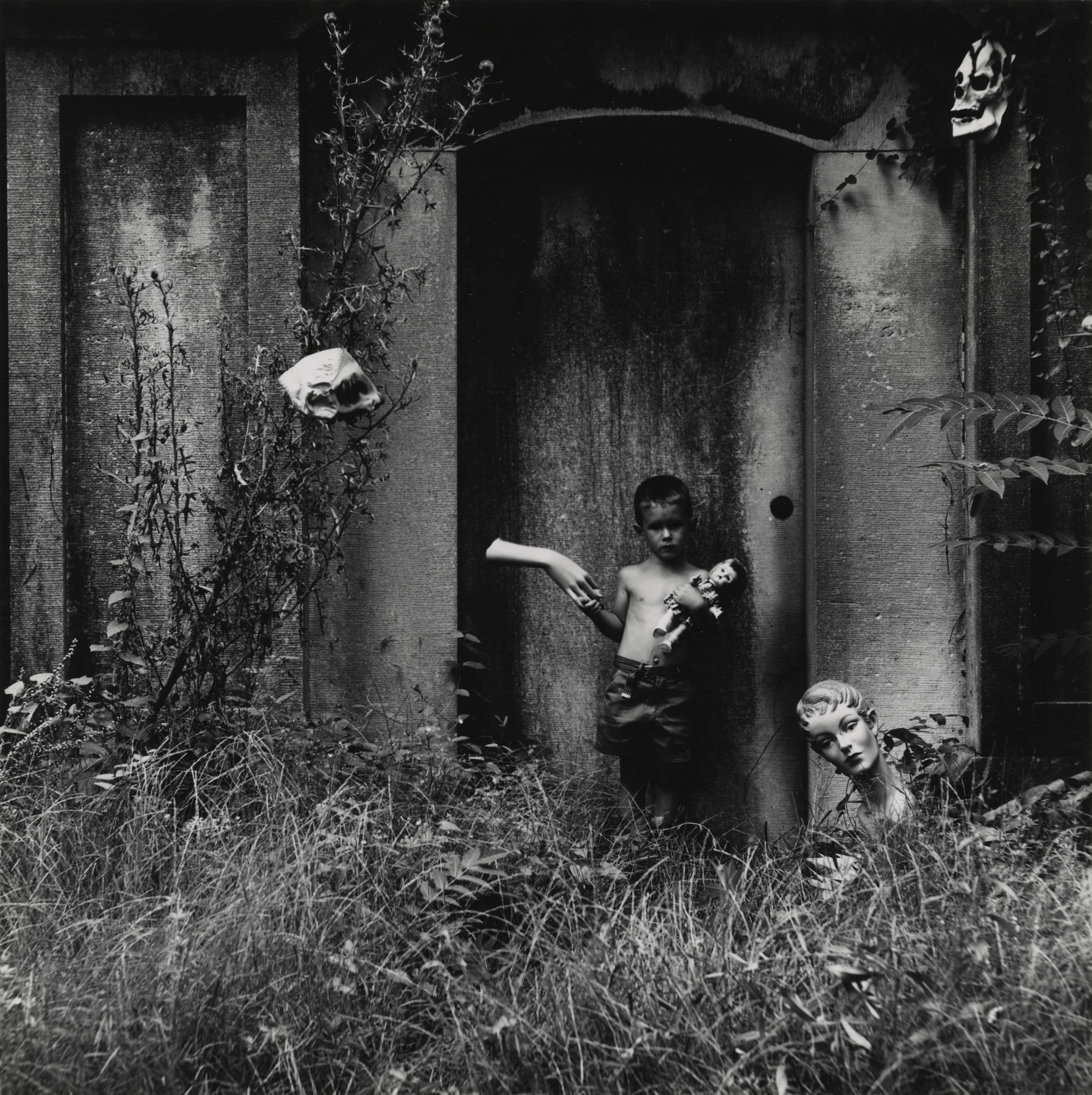
Photographer Ralph Eugene Meatyard (1925-1972) is an anomaly. There’s little consensus about the nature of his work beyond its unusualness. Throughout the late 1950s and 60s, Meatyard drove his wife and kids to dilapidated farm houses outside Lexington, Kent., where he used them as models for his photographs. He adorned them with cheap masks and accessorized the settings with broken mannequins, mutilated dolls, and other props that he would obtain from thrift shops and junkyards. He ultimately created a series of heavily shadowed, black and white photos that are chilling (but sentimental), surreal (but in an everyday sort of way), and at times, plain weird (I guess?)
Needless to say, the series is not an obvious one. “Ralph Eugene Meatyard: Dolls and Masks,” now showing at the de Young through February, collects 60 of the photos from that period — all of them not much larger than a CD case. But even the museum is ambivalent about explaining the work to visitors. They refer to quotes from Meatyard and have them by certain photos hoping they might shed some light. They mention, for instance, how Meatyard cited Zen Buddhism as an influence, and that he turned the idea of the family photo on it’s head. In truth, though, Meatyard was notoriously silent about how his work should be viewed. Guy Davenport, a close friend of Meatyard’s, said in the nine years he knew Meatyard, his friend said relatively little about his work: “He never instructed one how to see, or how to interpret the pictures, or what he might have intended.” Virtually all of the photographs in “Dolls and Masks” are untitled, too, which certainly makes the tour guide’s job difficult. “I will try my best to answer your questions,” I heard one guide say, overcome.
However, one influence that’s often mentioned and that does seem to ring true about Meatyard’s work is literature. Meatyard was a devoted reader (he even read while driving), had an immense library, and walked in the same circles as writers and poets; it seems, to a certain extent, the reason why it’s difficult to narrow down what the photos in “Dolls and Masks” are doing is because they aren’t necessarily exploring a theme, an idea, posing a question, or trying to evoke a particular sensation or response. Rather, Meatyard imagined an entire world with these photos as though he’d written a story, in the same way Lewis Carroll imagined a world in Alice in Wonderland and Franz Kafka evoked one in The Trial or The Castle. In Meatyard’s so-called world, it’s normal for people to be wearing hideous masks and wandering outside abandoned buildings with mutilated dolls; so that, in fact, the masks and props are secondary to understanding the work.
This makes the series as rich and elaborate as a novel, and it’s why it can be all the aforementioned things at once: chilling, surreal, sentimental, commonplace … etc. Collectively, they are like illustrations for an unwritten story, perhaps a children’s story. Occasion for Diriment, for instance, one of the few titled photos within “Dolls and Masks” that combines the words “Dire” and “Merriment” (something, of course, Carroll was known to do), shows two kids in the dark, one wearing a cartoonish mask, jumping up in the air and pounding their chests. The photo is not haunting, but instead, speaks to the spirit of childhood, like a scene out of Peter Pan. The same could be said of one of Meatyard’s more famous untitled photos, which shows a shirtless boy standing in a doorway and holding a mannaquin’s hand. It recalls the lost boys.
“I remember thinking that here was a photographer who might illustrate the ghost stories of Henry James,” Davenport wrote. Meatyard’s work suggests he could have illustrated James and more: Edgar Allen Poe, for instance, or even some poems by Samuel Coleridge (I’d appreciate an illustration of “The Devil’s Thoughts”). But Meatyard died of cancer in 1972 at the age of 46, shortly after the photos in “Dolls and Masks” were taken. And, as has always been the case with his photography, in life and posthumously, Meatyard will hold a relatively quiet and humble place in the museum.
“Ralph Eugene Meatyard: Dolls and Masks”
Through Feb. 26, 2012
de Young Museum
50 Hagiwara Tea Garden Dr., Golden Gate Park, SF
Bullfighting Cali-style
If you want to go to a bullfight in California, you have to do a little preliminary sleuthing. Just why you would decide to go in the first place can’t be easily explained. But it helps to note that unlike more traditional forms of bullfighting, California bullfighting is billed as “bloodless.” That is to say, no bulls are killed in the ring.
It helps too that bullfighting in California is allowed only in conjunction with religious festivals, conducted primarily by and for a tightly-knit yet far-flung community of Portuguese-Americans who travel long distances to attend, and connect with family from all across California, even farther.
Your bullfight-savvy buddy sleuths away. One website in particular yields good information. The last bullfights of the season are scheduled during the “Festa de Nossa Senhora de Fatima” in Thornton, California. You make a plan.
It’s a hot day, but the seats of the Praça de São João are packed. Portuguese is the vernacular language of the day; all announcements and introductions will be conducted in it, as well as much of the multi-generational spectator chatter. Portuguese bullfighting differs from its Spanish counterpart in its proscribed cast of characters. The first to enter the ring is a cavaleiro on horseback, who performs in tandem with two bandarilheiros whose job it is to distract the bull with capes at crucial times during the fight.
The cavaleiro rides slowly around the arena and cautiously approaches the bull, allowing it to rush at him whereupon he aims a Velcro-covered staff at a Velcro pad positioned on the back of the bull, then repeats in a series of daring passes. Once the cavaleiro has reached his quota of strikes, it’s time for the forcados to perform.
What could possibly compel a team of grown men to approach an angry bull unarmed, wait for it to charge, and grab onto its face (the pega de cara) for a joyride is truly a mystery, but there they are, one man strutting in front of the bull in a green-and-red elf cap, the others hanging back behind him in a line, ready to rush the bull and rescue their buddy as soon as his feet leave the ground. One experimental maneuver has the line of backup forcados waiting in the stands rather than standing in the ring. The audience becomes concerned—this is not the norm.
“What the hell is this?” grumbles the vocal gentleman in the row behind you. The experiment does not go well, a dramatic trampling ensues, not once but twice. A collective sigh of relief rises from the stands as once more, all eight men stand together in the ring, ready to pounce. Once they have successfully completed their counter-intuitive task, the bull is led out of the ring by a docile herd of cows, and the fighting team makes a circuit of the ring to be showered with flowers from the women, hats from the men.
Lest Ernest Hemingway enthusiasts feel completely left out, Spanish matador Sánchez Vara also displays his gracefully balletic bullfighting skills: drawing the bull in close with a flutter of an iconic red cape, pretending to ignore it by turning his back to it, then paying homage to it on bended knee, the ultimate bravery. Outside the ring, the prayerful begin to gather for the outdoor mass and the candlelight procession to honor “our lady of Fatima”. You eat lukewarm linguiça and piping-hot tacos from stands lining the road and ride off into the sunset—not on horseback, nor even clinging to the face of a charging bull — but in that ubiquitous new-world contraption, the rental car. You still aren’t entirely sure how you feel about California-style bullfighting. But at least you can say you went.
We here at the Guardian pride ourselves on being populist. That means documenting the latest in the people’s protests, and generally being a resources for students, artists, families, anyone in that good old 99 percent. But it’s not 100 percent for your benefit, dear readers. SF’s not a cheap city to live in. Case in point: Culture Editor Caitlin Donohue’s been chosen as Broke Ass Stuart’s Broke Ass of the Week.
Kudos, Donohue. Now the whole Internets is aware that you beg quarters off of us for beer.
And thanks for the shout-out. We quote:
I dig working there because it’s locally owned and I am no longer the weirdest person at the office.
In response to Stuart’s questionaire (the same queries are posed to each week’s Broke Ass) she also covers her favorite dive bar, favorite cheap meal, best thing she ever dropped serious cash on, and what she does when she’s hungover.

Today’s Look: Kylie, outside the San Francisco Opera House“Tell us about your look: “I was born in the wrong decade.”
When the Bay Guardian produced its first issue in October, 1966, the paper described itself as “a fortnightly journal of news, analysis and opinion.” Circulation was soon running at 20,000 copies.
Over the past 45 years, the Guardian has become one of the preeminent alternative weeklies in the country. The selection of past covers here gives a hint of the broad range of political and cultural events that have been part of the city — and its alt-weekly — in four and half momentous decades.
And so Mayor Ed Lee once again shows his true colors: he is tough as hell on Occupy SF protestors and, unlike every other mayor in every other U.S. city, sends in the cops to roust them out in two midnight raids and trumpets the word by bullhorn from the mayor’s office that he will harass them until the end of time. Meanwhile, he is is quietly sending sending out the message that under his stewardship that City Hall will be safe for PG@E, the downtown gang, the big developers, the bailed banks, and the feds who are going after the dispensers of medical marijuana and the newspapers who run their ads. (Full disclosure: that’s us at the Guardian.) B3
EDITORIAL This is what civility and compromise looks like:
At a little after 10 P.m. Oct 16, a squadron of San Francisco police equipped with riot gear raided and attempted to shut down the OccupySF protest. It was the second time San Francisco has embarrassed itself, becoming the only major U.S. city to attempt to evict members of the growing Occupation movement — and this time, the cops used a lot more force.
The first crackdown, on Oct. 5, was supposedly driven by concerns that the activists were using an open flame for their communal kitchen without the proper permits. This time around, the alleged lawbreaking was confined to a Park Code section that bans sleeping in city parkland after 10 p.m. And since Justin Herman Plaza, where OccupySF is camped, is technically under the jurisdiction of the Recreation and Park Department, that ordinance could be enforced.
But let’s be serious: The encampment endangered nobody, and if any Rec-Park officials had actually complained, the police couldn’t provide their names. This was all about rousting a protest against corporate greed and economic injustice. It came with police batons, several beatings and five arrests.
And the mayor of what many call the most liberal city in America hasn’t said a word. Mayor Ed Lee was clearly consulted on the raid, clearly approved it — and now becomes unique among the chief executives of big cities across the country, most of whom have worked to find ways to avoid police confrontations.
David Chiu, the president of the Board of Supervisors, issued a ridiculous statement saying that “Both the Occupy SF protesters and the San Francisco Police Department need to redouble their efforts to avoid confrontations like the ones we saw last night.” No: The protesters didn’t start it, didn’t provoke it, didn’t want it — and frankly, did their best to avoid it. The crackdown is all about the folks at City Hall trying to get rid of one of the most important political actions in at least a decade — and doing it with riot police.
This is what the civility and compromise so touted by Mayor Lee and Board President Chiu looks like. And it’s a disgrace.
In Oakland, where the encampment at Frank Ogawa Plaza, renamed Oscar Grant Plaza for the event, has far more people than Occupy SF, city officials approached the activists and offered to issue whatever permits were needed. Mayor Jean Quan visited the general assembly, waited her turn to speak, and then politely asked the group not to damage the somewhat fragile old oak tree on the site. In deference to her wishes, the group surrounded the tree with a fence.
In New York, the private owner of the park where Occupy Wall Street is camped agreed not to evict the demonstrators — or even move some of them to all for a regular park cleaning.
Why is San Francisco acting so hostile? Is this not a city with a reputation for political activism and tolerance? Is it really that big a problem to allow activists to peacefully occupy public space to denounce the greatest corporate thievery in a generation?
San Francisco ought to be supporting the OccupySF movement, not harassing it. Lee should immediately call off the police raids. The Board of Supervisors should have a hearing on this, bring Police Chief Greg Suhr, Mayor Lee and representatives of Rec-Park and the Department of Public Health and work out a solution that doesn’t involve repeatedly rousting the protesters in the middle of the night. And if this continues, perhaps OccupySF should move to the plaza in front of City Hall.
Sup. John Avalos is the only person at City Hall who is making an outspoken effort to protect the protest; he needs some support.

The new 49ers stadium in Santa Clara doesn’t exactly have financing yet and it’s not clear if the Niners will be sharing with the Oakland Raiders, but don’t worry — you can get on the waiting list to buy tickets today! Check out all the pretty pictures of Google Park or Twitter Tax Break Stadium or maybe — more appropriately — Silicon Valley Power Park, since it was the extra cash generated by Santa Clara’s public power agency that made all of this possible.
The reality is that San Francisco won’t lose much — and Santa Clara won’t gain much — from this deal. Niners fans are tailgaters; they bring their own food and beer, consume in the parking lot, and drive away after the game. The economic development benefits that the city got from the Giants stadium — built to minimize and disperse parking so people would walk or take public transit — are huge (although the displacement of low-end housing and manufacturing from that area were part of the deal). Not so with a football park next to the freeway in Silicon Valley.
No way to get there by train, but as long as you look burning gas, you can sign up for tickets now.

I listened to Big Harp’s debut album, White Hat, without any preconceived notions, and fell in drippy, folky, love. I fell into the slight country twang and gentle plucking of baritone singer-guitarist Chris Senseney, and the sweet backing vocals of bassist Stefanie Drootin-Senseney.
It was only after I went back and read up on it that I realized (1) Big Harp is a Saddle Creek band (my forever weakness) – meaning the musicians have been part of the ongoing Saddle Creek creative community, known for swapping members and working together in fluid ongoing capacities. Drootin-Senseney has played with Conor Oberst’s Bright Eyes and Tim Kasher’s the Good Life among many other bands on the label. Plus (2) the duo behind Big Harp is married with two kids. Too adorable.
So I jumped at the chance to learn more about Big Harp, chatting with Drootin-Senseney while she, her husband, her babies, her mother-in-law, and Big Harp’s drummer John Voris trekked through the Southwest in the modern folkrock take on the covered wagon caravan.
San Francisco Bay Guardian: Where are you in the tour?
Stefanie Drootin-Senseney: We’re driving through Arizona. We stayed in New Mexico at a Holiday Inn last night and they had a restaurant [laughs] – we had our first sit-down meal of the tour.
SFBG: How is it touring with the kids?
SDS: It’s so different, we rush home after the show because they wake up at six in the morning. It’s like a family road trip with a show at the end of the night. I’m seeing more of each place we go to then before we had the kids. We’re seeing lots of zoos and parks and museums.
SFBG: You and Chris actually met on a tour, right? When Good Life toured with Art in Manila.
SDS: We met a month before the tour, but we definitely got to know each other on tour. That was the end of 2007.
SFBG: When did you start making music together?
SDS: It happened out of nowhere, we were so wrapped up with raising the kids that we didn’t have time to make music – but I’d always been a big fan of Chris’ songwriting, and we’d been talking about him making a record, then he wanted me to work on it with him. He really writes all the lyrics and most of the melodies, I work on tempos and structure, change this and that, but he comes in with the core of the song.
SFBG: Are Chris’ lyrics autobiographical?
SDS: He says it would be a mistake to take the lyrics as him writing it personally, it’s more storytelling.
SFBG: Tim Kasher once said the same thing to me and yet, both of their lyrics seems so personal.
SDS: [Chris] and Tim both take inspiration from personal lives, but it’s not like reading a diary.
SFBG: Did you always know you’d want to put out Big Harp on Saddle Creek?
SDS: We really wanted to be on Saddle Creek – it’s family, going with another label would have been different, but we wanted to stay in the family. I was 17 when I met Conor and Tim and we really kept a closeness, there’s something so similar to the friends I had, their personalities, the relaxed, laid back, friendly, warm vibe. We’re on tour right now with [fellow Saddle Creek artist] Maria [Taylor] and I’ve played with Azure Ray and her solo work, she’s one of our best friends in the world. We’re all attached to each other in ways. We want to stick around the same people and play in each others bands.
SFBG: What did you and Chris grow up listening to?
SDS: [I listened to] Violent Femmes, Bob Dylan, fIREHOSE, Tom Waits. My mom listened to a lot of Neil Young and Carol King. Dad listened to Queen and Black Sabbath and jock rock [laughs]. I think it definitely had an influence on me. Chris grew up listening to a lot of old country, he grew up in a small, rural town, Valentine, Nebraska, and you can hear that.
SFBG: What do your kids listen to?
SDS: Twila is one so she listens to whatever we listen to. Hank [who is three] likes Fleetwood Mac, the Beatles, Neil Young. His favorite is “Back in the USSR” – that’s his song.
SFBG: Will you teach them to play instruments when they get older?
SDS: They definitely show an interest already, Hank will say “Let’s go to band practice.” We won’t push them, but we’ll encourage it.
Big Harp
With Maria Taylor and Dead Fingers
Sat/22, 9 p.m., $12-$14
Rickshaw Stop
155 Fell, SF
www.rickshawstop.com
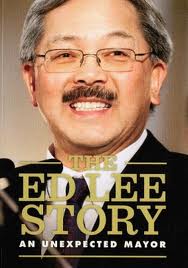
From the public’s perspective, it’s hard to tell where the official Ed Lee for Mayor campaign – with its $500 limit on campaign donations – ends and where the various independent expenditure campaigns that we cover in this week’s issue begin. And that’s a problem given their ability to raise cash in unlimited amounts, coordinate with one another, and essentially act in concert with the official campaign.
For example, when San Francisco voters recently got telephone calls that began, “Hi, how are you? May I speak with ______. My name is ______ and I am a volunteer for Mayor Ed Lee. Will you support Mayor Ed Lee this upcoming election?”
The average voter would probably assume that the caller was a volunteer for the Lee campaign, but the phone banking was actually done by a group called Committee for Effective City Management, although that was never identified in the script that it was required to file with the Ethics Commission.
Campaign consultant David Looman, who runs the group, disputed that interpretation, telling us, “It doesn’t present as part of the campaign.” When we noted that was the obvious impression it left, he still wouldn’t budge, “It doesn’t say I’m a part of the campaign or anything of the sort.” When we asked whether they are required to identify themselves as an independent expenditure, he responded, “I’m not clear about that.”
Ethics Commission Executive Director John St. Croix said it is a clear violation of the law for an IE to identify itself as part of the official campaign. When he read him the script, he responded, “I don’t like it, but I can’t say off the top of my head it’s absolutely a violation because that isn’t the exact name of the campaign, which is Ed Lee for Mayor 2011.”
But clearly, voters are left with the impression that it’s a Lee campaign volunteer calling, right? “I think that’s a legitimate layman’s perspective on this, yes,” St. Croix responded.
Will the Ethics Commission do anything about this, or the numerous other campaign finance law violations that CitiReport, Bay Citizen, and other media outlets have been unearthing? Don’t bet on it, particularly because of the commission’s history of ignoring problems and overcomplicating its role in watchdogging even the most obvious violations.
For example, at tonight’s Ethics Commission hearing, the body is considering relaxing rules that require the reporting of big campaign finance expenditures within 24 hours, pushing that requirement back to the last week before the election — right after the Guardian’s final pre-election issue hits the streets.

Okay, I thought American Idol was getting bad. And I missed Simon Cowell. But the Next Big Thing, called The X Factor — featuring not just Simon but Paula Abdul, along with L.A. Reid (who discovered Rihanna!) and Nichole Sherzinger (from Pussycat Dolls, and she once won Dancing With the Stars) — is out of control.
Epic Fail Number One: The 32 semi-finalists are broken up into four categories — girls, boys, over 30 and (gasp) groups. Four from each category move forward. That means four groups, even though almost all of the groups totally suck, four boys (although at least six of the girls were better than all but two of the boys) and four over 30s (well, I guess people over 30 deserve special consideration, particularly women who were once married to Ike Turner).
Epic Fail Number Two: The semifinal round is set at the judges “houses” (although I can’t believe Simon, who appears only in his designer shades, actually lives full time in that glorious mansion in St. Tropez). L.A. Reid is a serious music dude, but his McMansion in the Hamptons is hideous. Paula is (of course) in Santa Barbara, and Nichole is (of course, maybe, if that’s really her house) in Malibu. It’s like Lifestyles of the Rich and Famous; I desperately wanted to hear Robin Leach introduce the scenery.
Epic Fail Number Three: The Oct 18 show had no music at all. No entertainment. Just two hours of people getting kicked off (and weeping) or getting sent through (and weeping). We watched contestant after contestant bawling as the judges tried to drag out the drama as long as possible by saying things like “the news I have for you isn’t good …. (weep, weep, sniff, my young life is ruined) … actually, it’s fantastic” (weep, weep, joy, hug Simon, I’m gonna be a contender). I’ve never seen so much mascara running down so many cheeks. Pepsi’s the wrong sponsor; should have been Kleenex.
It’s like Total Drama Mansions. I can’t believe anyone (other than Vivian and me) actually sat through that whole thing.
The good news is that the homeless guy (Dexter Haygood) and the burrito maker (Josh Krajcik) made it through to the live performances starting next week. So did Rachel Crow, the 13-year-old from Colorado. Viv would have been boycotting the rest of the season if Simon had kicked her out.
As it is, sigh, we’re still watching, and maybe next week someone will actually sing.
Consider, if you will, the prosaic class issues in the green movement. The price of BART vs. driving, the utility of feeding one’s children McDonald’s after one’s shift is order so you can play with them outside the kichen, the inconvinient truth of Maslow’s hierarchy of needs. Now add race, and stir.
Dancer-community activist-poet Marc Bamuthi Joseph did. The result was the Life is Living festival, which he stages in underserved ‘hoods throughout the country (and took place in West Oakland Oct. 8). The festival’s amazing, but its creation was a journey — which Bamuthi has brilliantly set to stage with dancing and singing at the Yerba Buena Center for the Arts through Sat/22. It’s called red, black & GREEN: a blues“I’ve got this male Liz Gilbert eat-pray-hip-hop kind of thing,” recounts Bamuthi onstage during opening night at YBCA. Around him, bisected sharecropper’s cabins swing open and shut, revealing their innards and front porches by turns. The set was made from repurposed materials and clay by Theaster Gates (new favorite name), who is participating in double-time — Gates is one of three supporting characters in the play, mainly contributing those eponymous blues in a rich voice from a porch.
Bamuthi’s flip remark (it reaps a guffaw from the audience, one of many garnered from the play’s dealings with race and class) evokes the difficulties that he and his “do-gooder” team faced in cobbling together Life is Living. Originally meant as an eco-festival — Bamuthi’s account of meeting with New Age Oakland environmental activists is gold — the group shifted the traveling events focus to “the celebration of living.”

The cast of red, black & GREEN: the blues. Photo by Bethanie Hines
The play could be read as an explanation of why this transformation took play. In the scene that serves as the performance’s chorus, repeating through the play, Bamuthi talks to a grieving mom about his festival. “I ask a mother about environment/She tells me of guns/Of emotionally disabled boys.”
She’s got bigger fish to fry than hydroponic gardens. As does a sculptor: “He speaks to me of misters/Old men gathered to pastime/Play young/men games/Share news/Insult/Seed comfort/Cultivate friendship.” A freezing crackhead in the New York winter: “I’m calling collect from tomorrow/track riding.”
And you forget you’re being taught (Bamuthi is fond of likening himself to a 10th grade teacher) because it’s all gorgeous, real artists doing their real artist things. Characters recreate sunny day hip-hop cut-ups, but they also morph their bodies to evoke addiction, old age — two miraculous transformations that showcase the talent in their bodies through the way they restrict their own mobility.
Asking about “what sustains life” instead of “what is sustainable” could be an important cognitive shift for the green movement — one that would reactivate the choir and provide an entry point for people just coming to the green movement. Bamuthi was a featured artist for the NAACP’s centennial anniversary celebration during Barack Obama’s inauguration exercises. President Obama… I hear you’re having some PR troubles. Were you listening to this guy?
red, black & GREEN: a blues
Thu/20-Sat/22 7:30 p.m., $10-$25
Yerba Buena Center for the Arts
701 Mission, SF
(415) 978-2787