SFBG Blogs

Notes from the indie underground: the ATA Film Festival

0

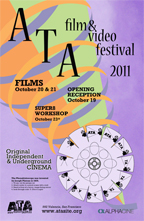
For more reviews from the sixth ATA Film and Video Festival, check out this week’s film listings. The fest kicks off tonight with an opening reception.

Piena En Mi Alexandra Cuesta’s short film “Piena En Mi” is an impressionistic portrait of Los Angeles, where, in addition to Quito, Ecuador, the filmmaker lives and works. Primarily shot from a bus that traverses the sprawling metropolitan, the film is told with the the city’s different neighborhoods, its sounds, and its patchwork of ethnic groups. It’s an honest portrait of  LA — economically depressed in most places, polluted, congested – but beautiful, nonetheless, and unapologetic. Cuesta treats her city with tenderness and it renders her film graceful and intimate. It’s sensitive to the very subtlties that make LA radiate with character, whether it’s odd haircuts, dirty bus windows, or bells on an ice cream carriage. It’s in these shots that the filmmaker’s background in street photography shows, and make it a highlight of the ATA festival. Program One, “City Symphonies”
Imperceptihole Vivid and atmospheric, “Imperceptihole” is a high contrast, black & white film by Lori Felker and Robert Todd. Developed from a correspondence wherein the two filmmakers exchanged film rolls, “Imperceptihole” is shot between desolate woods, a hay bail structure, an ice skating rink, and several other seemingly random places. Using sychzophrenic pans, transparent shots, breathing and harsh grating sounds that gradually intensify, the film creates the sensation of a deep, hair-raising descent. It’s the camerawork that builds up this sensation, which is either swinging, crawling, sprinting or dead still. And it’s that very camerawork that is most impressive about the film. Vaguely disquieting, the film is initially very stimulating, but in light of its ambiguity, rather too long. Over the course of the fourteen minutes,  the visual experience is lost and you’re wondering what it’s all about. Program One, “City Symphonies”

Workers Leaving the Googleplex While working for a company called TransVideo, Andrew Wilson was subcontracted by Google to work at its Silicon Valley headquarters where he started an investigation into the company’s class structure and what the different colored badges worn by employees represented. “I found the social situation interesting,” he says in the film. He became particularly interested in the yellow badge wearers, employees who are denied most of the Google benefits such as bikes and gourmet meals. Wilson’s investigation led him into conflict with Google when he was caught filming the yellow badge wearers in the parking lot and trying to interview them. Ultimately, he was fired from TransVideo. Wilson’s film is an interesting look at class as well as an honest personal story, and an inside look at the workings of one of America’s most powerful companies. It’s a story you could very well have heard on “This American Life.” Program Two, “Sling-Shots”

“ATA Film and Video Festival”

Opening reception Wed/19, 7 p.m

Short film screenings Thurs/20 (“City Symphonies”) and Fri/21 (“Sling-Shots”), 8 p.m.

Super 8 film workshop, Sun/23 and Nov. 12, 1-4 p.m., free-$35

Artists’ Television Access
992 Valencia, SF
www.atasite.org

Save a horse, ride these cowboy pictures: Shots of the Grand National Rodeo

0

So struck were we by the spectacle that is the first weekend of the Grand National Rodeo (read our print coverage of the event here), your Guardian news team lost a couple hundred dollars worth of camera equipment, by a conservative (uneducated in the ways of photography) estimate (your writer’s). Luckily, we still brought back photo documentation. They never should have let us stand by the bronc pit.

City slickers be forewarned: rodeo nights’ll make you dizzy. Thousands of cowboys hats cruise through the Cow Palace on each of the Grand National’s yearly four main evenings of existence. Last weekend two of these took place, but you’ve still got two more in store for you, should you want them: Fri/21 and Sat/22. You can check out the show ponies in the unfathomably large stables section of the event, take a stadium seat to watch the cattle roping, bronc riding, and barrel racing events, and eventually (they all do) wind up back in line at the concession stand for a cold Coors Light.

How’d we lose the camera lenses? Standing up on the same platform that the cowboys vault from to reach the backs of their designated bucking broncos. You’d do well to stay far from the gaze of these finely-bred, but nonetheless brutally strong hunks of animals. But they sure are fine to look at. So you’re welcome for the slideshow.


Grand National Rodeo

Remaining dates: Fri/21-Sat/22 7:30 p.m., $23–$44

Cow Palace

2600 Geneva, Daly City

www.cowpalace.com


The art and music of OccupySF: a work in progress

4

In a recent Super Ego clubs column, I challenged the San Francisco music, arts, and nightlife community to create a better OccupySF soundtrack than old Michael Franti tracks — and to perhaps update the slightly cliche V for Vendetta look of the movement a bit. (Not to mention throw a few hot-hot benefit parties.) We can do it!  

I was originally inspired by a bangin’ mix posted on Faceboook by former Bay Arean global funk DJ Tee Cardaci (see below). I was also stoked by news of amazing writer Hiya Swanhuyser’s “OccupySF: Art and Performance Series” which featured some major players performing at the ocupado camp downtown, like Heklina, Lil Miss Hot Mess, W. Kamau Bell, and Nato Green — and totally distraught that I had missed the series completely. (Although she just told me she’s got Michelle Tea and Brontez Purnell reading down there at 5pm on Thu/20 — check the series Tumblr for updated info.) In fact, there’s been so much Occupy SF art, music, and expression going on that it’s easy to miss quite a bit of it.

So I wanted to make a page that gathers together some of the stuff people are doing in solidarity with the OccupySF movement — DJ mixes, music tracks, guerilla artwork, unique performance, wild parties (oh hey, you should really hit up the rad Salsa Sunday OccupySF benefit at El Rio this Sunday, 10/23). 

I really want this page to grow and grow — and also help connect the activist-creative community that’s been mobilized and inspired by the #occupy movement in general. Rap tracks, recipes, animated gifs, spoken word, mixtapes, collages, mashups, whatever you’ve made and dedicated to the indignados. If you have something you’d like me to post, please email me at marke@sfbg.com and I’ll see about adding it (no attachments more than 2MB please). Let’s keep this thing rolling!

DJ Tee Cardaci’s #OccupyThisMixtape:

#OccupyThisMixtape – tee cardaci by OneLoveMassive

A great track composed by dread bass master Kush Arora last year in honor of Anonymous, rededicated here to the OccupySF folks hacking the system:

Kush Arora – The Hacker 2010 by KushArora

The group Classical Revolution performing as part of the Occupy SF: Arts and Performance Series:


Occupy Jello! (Biafra)

Brontez Purnell and Michelle Tea read at OccupySF

OccupySF appeals to City Hall, but the standoff continues

40

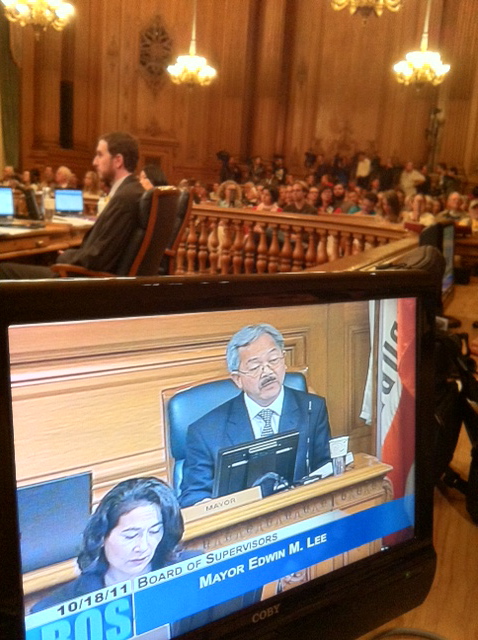
Frustrated by repeated late-night police raids on their encampments and empty statements of support by top city officials, hundreds of protesters with OccupySF entered City Hall today – under the watchful eyes of a large police presence with riot gear at the ready – to testify at today’s Board of Supervisors meeting.

The meeting began with the scripted monthly question time session with Mayor Ed Lee, who was asked by Sup. Jane Kim – whose District 6 includes the OccupySF encampment, which she visited for a couple hours last night – to “describe the plan that our offices have been developing” to facilitate the OccupySF movement.

But in Lee’s response and in exchanges with journalists after the meeting, as well as Guardian interviews with people in both offices, it doesn’t seem city officials have a coherent plan for carrying out Lee’s contradictory goals of supporting the Occupy movement and keeping sidewalks and parks clear of encampments.

Kim seemed to acknowledge as much later in the meeting when she said voiced support for OccupySF and for city officials who object to tents, kitchens, and other basic infrastructure that the month-old movement needs to continue. “We’re all struggling to figure out the best way to accommodate it,” she said.

Lee’s message was even more muddled, saying he supported the movement and agreed with its economic justice message. “From the very beginning, I have fully supported the spirit of the OccupySF movement,” Lee told the crowd, transitioning into reciting a litany of economic development efforts with little relevance to the demands of the movement.

“Then don’t send the police in to destroy it,” a protester shouted from the audience, which was filled to capacity and had a line out front and an overflow room. “We are working with you,” Lee responded, but then went on to complain about the lack of consistent contacts in the leaderless movement and emphasizing his bottom line that any kind of encampment with infrastructure is an impermissible violation of city codes.

“I need to make sure our public spaces are open to be used by anyone,” he said. Later, his Press Secretary Christine Falvey clarified the mayor’s stance by saying he supports the message but not the movement: “The tactic of camping overnight, he does not support.”  

Afterward, talking to reporters, Lee couldn’t really explain why the police needed to do their raids in the middle of the night, why San Francisco is cracking down on conditions that are being allowed in many other Occupy cities, or how the movement might be able to avoid future crackdowns if it continues, ignoring questions about where OccupySF might be able to go to avoid police raids.

Sup. John Avalos, who has been working to try to mediate the dispute between OccupySF and the city, responded to Lee’s speech by calling it “very frustrating. I’m alarmed that he is moving toward nightly standoffs with the Occupy movement.” Avalos says he supports protesters’ right to peacefully occupy public spaces and acknowledges their need for basic supplies to do so, calling the current standoff, “unsafe for both sides.”

“I’m proud to say that we are the 99 percent,” Sup. Eric Mar said, echoing the movement’s mantra and saying he would defer to Avalos’ leadership to create a “resolution strongly holding the police accountable for the crackdowns.”

Avalos had invited OccupySF participants to raise their concerns during the public comment portion of the meeting, and he said that he plans to use their input to form a resolution or plan for how the city should accommodate a movement that six of the 11 supervisors professed to support at the meeting.

When the long line of OccupySF protesters finally took to the microphone for public comment, they made it clear that the issue wasn’t as complicated as some city officials were trying to make it.
“It is outrageous and inhumane to see our camp raided in the middle of the night by San Francisco Police,” Magic, a middle-aged woman and lifelong activist, told the supervisors, closing with, “This can be a celebration or a battle, but we will not back down.”

Several speakers were dismissive of city claims to be protecting public health and safety, noting how dangerous the midnight confrontations have been, saying food and shelter are basic human needs, and noting how peaceful and cooperative OccupySF has been with the escalating series of city demands as the protest’s numbers have grown.

Michael Goldman said police have asked them to return to the sidewalk in front of the Federal Reserve, where they are densely packed in what he called unsafe conditions. “We have too many people to fit in front of 101 Market,” he said.

That was what prompted the move to nearby Justin Herman Plaza, where police cracked down Sunday night, citing a violation of the park’s 10 pm curfew. Another protester who works at the Ferry Building angrily noted that even before OccupySF began, he regularly watched city crews chase the homeless away from the site at 3 am with water trucks.

“We are a peaceful and nonviolent people and we do not deserve to be treated this way by our city and our country,” he said.  

“They were waiting to be talked to and not just run over by the police,” said iconic San Francisco activist Father Louie Vitale, who gestured to the waiting protesters and said, “We’re very proud of these people, very proud.”

It was a point echoed by others like local resident Andy Blue, who said, “They are doing a great service to this city and the world.”

Style Paige: Crushing on velvet

0

At Otis Lounge on a Thursday night when the bar’s eclectic crowd was enjoying the mellow party atmosphere, Kaz walked in with a quiet confidence. Dressed in a white button-up shirt, a cardigan sweater and a blazer, he said he was ready for a drink.

I complimented his outfit.

“Why thank you,” he said.

What I adored most was his blazer, which was a brown velvet material. Yes, men often wear blazers, but the velvet blazer is a novel entry on the fall fashion scene. You would think that such an eye-catching piece would only be fitting when attending a formal dinner (maybe in Vegas), but paired with a simple button-up — or even colored denim pants, the velvet blazer can be dressed up or down. It is sleek, polished and if styled correctly, effortless. Not stiff like tuxedo blazers, it often looks more expensive than its price tag.  

Of course department stores like Macy’s and Nordstrom sell velvet sportcoats by brands like Dolce and Gabbana and Paul Smith, but you may be able to find a jacket with the same modern cut at half the price at Buffalo Exchange or Crossroads Trading Co. – if you don’t mind digging through the racks. 

Not just for Halloween: bone tome “Empire of Death”

1

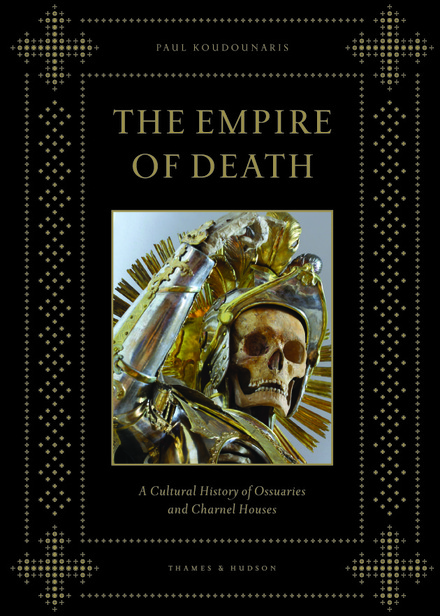
Sometimes, you can judge a book by its cover. Case in point: Dr. Paul Koudounaris’ The Empire of Death: A Cultural History of Ossuaries and Charnel Houses (Thames and Hudson, 224 pgs., $50), a hefty black tome emblazoned with shiny gold letters and a photo of a skeleton posed with its arm raised, clad in a helmet and suit of armor.

Sold! So, uh, what’s this book about, now? Koudounaris, whose credentials include a PhD in Art History from UCLA and an innate curiosity about things he terms “bizarre and suspicious,” spent five years traveling the globe learning more about the ancient (and primarily Catholic) practice of massing bones in charnel houses, often with eerily artistic results. He’ll be in town for a series of Empire of Death-related events starting Thurs/20.

To gather the book’s 260 photos (plus dozens of illustrations), the author traveled across multiple continents to 70 different locations, many of which are off-limits to the public. Lest you think he’s some kind of ghoulish Ed Gein type, Koudounaris explains his motivation on his website (a companion source for the book): “The Empire of Death [contains] hundreds of photographs and a text which not only recovers their history, but the history of the religious movement which gave birth to them. This is not a book about the macabre or death. It is a book about beauty and salvation. If you understand that when looking at these photos, then I hope you will choose to read the book.”

And the photos are beautifully presented, with accompanying text to contextualize, and share the significance of, exactly what you’re looking at: a wall of skulls arranged behind a “plague crucifix” in Switzerland; mummified monks posed beneath the memento mori symbol of an hourglass with wings (“time flies”) in Rome; painted skulls and a spectacularly bejeweled skeleton in Germany; and that fellow from Empire of Death‘s cover, martyr St. Pancratius, articulated using a “fine mesh fabric” and dressed in gleaming armor, forever on guard at the Church of St. Nikolaus in Wil, Switzerland.

Koudounaris’ author bio reveals that while he was working on the book, “he managed to become cursed, exorcized, arrested, and manacled by a deranged Italian monk,” so expect some hair-raising storytelling during his Bay Area appearances. Also on tap: slide shows, book signings, and a chance to check out prints of original photos from the book.

Thurs/20, 6:30 p.m., free
Paxton Gate
824 Valencia, SF
www.paxtongate.com

Thurs/20, 9 p.m., $20 (part of a larger event)
Trickster Salon, SF
For location information, RSVP here)

Fri/21, 7 p.m., free
Dark Carnival Imaginative Fiction Bookstore and Escapist Comic Bookstore
3086 and 3090 Claremont, Berk.
www.darkcarnival.com

Sun/23, 8 p.m., free
Dog Eared Books
900 Valencia, SF
www.dogearedbooks.com

We want the airwaves: KFJC’s birthday party

3

At 8 p.m. on Oct. 20, 1959, the first words spoken on local college radio station KFJC came pumping through the air waves. It was station manager Bob Ballou, operating from a broom closet at the old Foothill Junior College campus in Mountain View. In the decades that followed, the station has grown known for its eclectic show lineup and in-house concerts: Noothgrush, Exhumed, and Foxtails Brigade, among so many others.

With KUSF ripped off the air earlier this year (an aside: Save KUSF), the debate about local college radio has, if nothing else, continued. It’s part of a far bigger issue – where do people learn about new music and how do they listen? For those who tuned in to this type of programming as students, or those who live nearby and still click the dial as post-grads or never-grads, the gaping gap is felt. KFJC DJs have stood by KUSF throughout the protests and legal discussions, clearly aware of the brevity of the situation.

KFJC, 89.7 FM, which is operated as a teaching lab for the fine arts and communications department of Foothill College in Los Altos Hills, is thankfully still pumping – this year celebrating its 52nd anniversary. In honor of the milestone, there will be an open house Saturday, Oct. 22. Meaning: you can peek your nose around a living, breathing college station.  (It’s just south of San Francisco).

The station also is on the verge of possibly receiving CMJ’s most adventurous station College Radio Award – results are in this Thursday. On the eve of these events, I got the rundown on the news and events from KFJC DJ and volunteer Jennifer Waits and KFJC Publicity Director (and DJ) Leticia Domingo.

San Francisco Bay Guardian: What will take place during KFJC’s open house?
Jennifer Waits: Listeners will get an opportunity to meet KFJC DJs and tour KFJC’s studios at Foothill College. It’s also during our annual fundraiser, so they will be able to pick up some KFJC goodies in exchange for donations to the station.
SFBG: How has the station grown in the past year?
JW: A big project this year was the installation of new shelving at the station. KFJC has tens of thousands of pieces of music, from vinyl to CD to cassette tape, and we’ve been bursting at the seams. The new high density shelves helped give us some breathing room so that we can continue to add music to our library at the current pace. We also traveled to Milwaukee this summer in order to broadcast live from the Utech Records Festival.
SFBG: Why do you feel KFJC is up for CMJ’s most adventurous station award?
JW: During my tenure at KFJC, I’ve always felt like the station has been an innovator. Not only is KFJC’s airsound unique – with music ranging from experimental to country to soundtracks to metal to electronic – but the station has also been a pioneer in international live remote broadcasts. KFJC’s first international broadcast was from Brixton, England in 1996 and since that time we’ve traveled to New Zealand (2000) and Japan (2008) in order to present live music performances to our listeners. The 2008 live broadcast from Japan also featured a live four-camera video stream, so that listeners from around the world could both see and hear the musicians on stage.
SFBG: To what do you attribute KFJC’s longevity?
Leticia Domingo: Obviously our listeners have kept us alive for so long. They are our staff, the hands that feed us. They’ve allowed us to indulge our creativity and breathe life into the ho hum/indie/college radio scenes.
SFBG: What’s your take on the current state of college radio?
JW
: I’m saddened by the loss of some of our peers from the terrestrial dial, particularly KUSF in San Francisco. But at the same time, we’re lucky in the San Francisco Bay Area to have a number of thriving college radio stations on the dial. Personally, I’ve become even more connected with people from other stations this year and am happy to see the college radio community strengthening.
LD: Unfortunately and fortunately we are at crossroads. People don’t need DJs and college stations to turn them on to music or shows anymore. However at KFJC we are still very fortunate to be able to continue to discover new sounds and keep the saw sharpened. Without preemptive action, radio broadcasting is going to phase out like broadcast TV signals. And for college radio stations, we are at the mercy of the colleges.

KFJC Open House
Sat/22, 1-5 p.m., free
Directions: Here
www.kfjc.org

When OccupySF occupied my car

13

By David Adler

I began the week a brooding and self-pitying writer, who was spending far too much time sucking on sour grapes until they were bitter raisins.  I even went back and forth via email with an editor who had rejected one of my stories.  This is not a good way to endear yourself with potential future patrons.  But it had been far too long a time since I’d torched a bridge (and, in this case, I’m fairly certain that I burned the fucker to the ground), and in that sort of “I love the smell of napalm in the morning” empty machismo way, well, I still didn’t feel better.  I felt like I do when I yell at the television while watching a Laker game, screaming at Andrew Bynum as if I were sitting courtside next to Jack Nicholson and sneaking out with him for blow during TV timeouts or just when we damn well wanted to.  I was a crazy man.  A loon in sweats and a Cal hoodie. 

Determined to regain a semblance of human dignity, and equally committed to acquiring as little of it as necessary (the stuff is pricey, I don’t care what my therapist says), I got on the BART last Wednesday, October 5th, at the cavernous and exposed Millbrae station, the end of the peninsula line. 

The electric train screeched and squealed and screamed north into the city, where a half hour later I emerged from the Embarcadero station on Market Street.  A motley camp came into view, pitched on the sidewalk in front of the Federal Reserve building.  It was the Occupy San Francisco Financial District camp.  In solidarity with the original Occupy Wall Street movement, and the dozens other others cropping up daily, which defibrillates my long spasming liberal heart into a peaceful rhythm. The 99% in action. Could’ve been 1969.  They had a kitchen, a library/bookstore, it was a little city of dissent, and the forces of everyday people were now gathering, enlarging the camp’s population, in anticipation of the noon march.  The police were mostly in the background, talking with a few suits and ties out for a smoke, or lunch, who observed with amused smiles on their faces as they looked at the Occupy camp and the crowd.  Stupid people, they seemed to be thinking, though I obviously can’t know.  Perhaps they just didn’t get it. But they didn’t have to.  It was getting itself just fine. 

There were old and young, every race and color and creed.  There were hippies in their seventies and students in their teens and twenties, nurses of all ages, punks and patriots of equal concern, workers and laborers and normal folkies of every stripe and sandal.  Yes there was a progressive and lefty and outsider’s insider vibe to the signs and the chants. Banks got BAILED out, we got SOLD out!! Banks got BAILED out, we got SOLD out!!  We ARE the 99 percent!!  We ARE the 99 percent!!  But that’s the whole friggin’ point. There was a tiny dog, a Puggle the owner told me, who was wearing a sign that said “Justice for the Little Guys.”  A woman who looked to be on lunch break held a small sign aloft: “I’m here because I can’t afford a lobbyist.”  End The Fed.  Tax the Rich.  So many more, so varied.  And my favorite, which was a bit longer:

The Amercian Paradox:
Unionized Public Employees
Cracking Down on Those
Seeking to Save Their Jobs & Pensions

Now, I may not agree with everything and everyone in this movement, not even close, but the fetid financial powercore as the center of this mass and evolving dissent?  Bring it on.  My wife works for a good little bank, worked for another one in Southern California that was shut down by regulators and sold off under dubious circumstances, and those kinds of community institutions have been run over by the too-big-too-fail Gods.  I loved it, in other words.  And we marched.  The official count, I read, was 800.  Horseshit.  No way.  I couldn’t give an exact number, but I know it was many more than that paltry figure.  Cabbies were honking at us, but in a rhythm, a beat that said they were with us and not annoyed.  I carried my sign, given by a representative of the nurse’s union, because their cause really resonates with me: Tax Wall Street Transactions – Heal America.  I waved it for a few miles, but my arms never got sore.  The spirit was grand and vital and patriotic and American.  We were engaged in the only thing freedom really means.  The right to say no to the powers that be, to protest without the fear of unjust reprisal.

And there’s the rub.

After marching, I had to hop the train home quickly and pick up my son from school.  I rode south toward Millbrae, while behind me in the city the ruckus remained and grew and settled back into camp for the night. 

The night.

Always the best time for the authorities to do their dirty work. The next morning, after being told by my wife that on the news they reported the police had busted up the Occupy camp, I watched the videos that had already been posted online.  And there they were, those unionized public employees, heading down the street in riot gear toward the Occupy Camp.  The irony is too rich.  And disturbing.  They came in riot gear, apparently, to protect themselves from a bunch of barefoot hippies and thread-thin vegan rebels. The police confiscated a lot of the stuff from camp, ordering the reluctant Department of Public Works employees to carry out the deed, without giving the kids time enough to gather it themselves.  Then the police got rough, nightsticks into ribs and arms and thighs. All of it, needless to say, completely unnecessary.  The only thing freedom means, and that’s what it gets you.  In America.  Didn’t those police want to set a better example, to be better than the police and soldiers we see all over the world stomping on their people’s hopes?  I guess not.  They’ll say it was a safety issue, a private property issue, that it was this or that, but none of it required riot gear and physical violence at all. Disgraceful and depressing.

On Thursday evening, the 6th, on the Occupy SF website I saw that they had put out a call for anyone with a car or truck to help them get their stuff back.  It had been taken to the Department of Public Works yard off Bayshore.  Friday morning, as I sat staring at my computer trying to write, I decided to do something to help these kids out.  I got in my Prius and headed into the city, to the DPW yard.  On the way there, in my idealistic mind (at least I still have one at my age), I envisioned a huge caravan of progressive minded people arriving on the scene in solidarity, ready to help get this stuff back to whom it rightfully belonged. I wished.  But when I got there a little after nine, I was the only one there.  Soon, however, a tiny old Japanese hatchback rumbled past with what I took to be three activists of various ages riding inside.  They had to be Occupy people, I thought. But they drove past, appearing lost, and turned out of sight at the far corner.  Hmm.  In a few seconds, however, they reappeared, the car pulling to a stop at the red curb where I was standing at what looked like the front door to the DPW offices.

“Are you with Occupy?” I asked the bearded young man in the passenger seat, who had a thick mane of wavy dark hair pulled back into a long ponytail.

Yes, they all answered, who are you?  Where do we park?  The driver was in her sixties, clad in black I noticed, with long gray hair.  The passenger in the back seat was a younger gal, heavy, a punk lesbian vibe about her, with her short cropped hair painted red, blonde, and blue.

“I’m just a guy,” I told them.  “Just someone who showed up to help you out.”  The young gal in the back looked at me oddly, with an expression of curious surprise, then pointed at me slowly, like a b-ball teammate acknowledging a sweet assist, as if thinking, “Yes, even the fake hippies in the Adidas gear are with us!”

“And you probably want to park anywhere you can,” I continued. “I just got lucky across the street there.”

Just then we got the attention of a DPW worker inside the glass door.  A big African-American guy in a yellow work vest, he asked if we were from Occupy and looking to get our stuff back.  He gladly directed us where to pull our cars, and he told us he’d instruct someone to meet us back there.  This is when I learned, from the kid with the ponytail, that the DPW workers were not happy about having to obey the police and confiscate the protesters’ stuff, their own union supporting the Occupy movement.  So the courtesy and patience of all these DPW workers was no surprise.

A few minutes later, as the four of us waited on the sidewalk, I realized I’d forgotten their names, or if we’d exchanged them at all.  I thought we had, but I’m terrible with names, which I told the young guy with the beard and ponytail.

“Chris,” he replied to my re-query. “You’re Dave, right?”

I felt guilty that he remembered and I didn’t. 
“I’m Diana,” the younger gal introduced herself, “And I really have to pee.  You think you guys could form a perimeter here for me so I can go in the bushes?”

I suggested she go behind the black van that was completely blocking some bushes about twenty feet away.  She nodded, good idea, and walked over to relieve herself.

“I’m Dagny,” the older woman said as she sat on the curb and lit a cigarette.  “And the name’s not from that useless fucking Ayn Rand book, thank you very much.”  Dagny seemed an experienced San Francisco hellraiser, and I would discover that she had little time for taking any shit or wasting any time. 

Returning from her bathroom bivouac, Diana was hopping mad.  “You’ll have to excuse me, I really got a fire in me today, after what went down last night.  I may be young, but I can get stuff done.  And today we’re going to.”

I told her I understood the fire she had in her.  When I asked how old she was, she replied twenty-two.  Exactly half my age, I told her.  She thought for a second and mouthed forty-four, barely audible enough to be heard.  Just then another DPW worker showed up and told us to follow him in our cars.  He led us through the sprawling yard, crowded with trucks and tankers and service vehicles of every odd variety and size, many in the repair bays, where workers crawled under and around and atop them like Lilliputians upon Gulliver.

We finally made it to a parking area, filled with more trucks, and with a storage area surrounded by a patchwork chain link fence.  The DPW guy unlocked the fence gate and led us in.  There was junk covered in blue tarps on both sides, with a cleared path in between. Everything on the left, he told us, was homeless stuff, which made sense once we saw how many bicycles and shopping carts poked out from under the tarps.  On the right side was the Occupy SF stuff.  It had rained the previous night, so it was a wet mess of backpacks and chairs and tarps and toolboxes, storage containers and tents and camp stoves, furniture and clothes and food. A lot of food.  They’d been living there, after all. Some of it had spoiled, some was still good.  Chris and Diana were kind of overwhelmed at first, but Dagny just laid it down: let’s just get all the food out first, and figure out what’s still good to keep, and what’s not, and we’ll put the good stuff here, and the bad stuff goes in this trash bag.  Wet clothes over there, office stuff here, tarps in a pile, Dagny continued like a former flower-child field general, until we were moving with as swift an organization as possible under the shorthanded circumstances.

A half-hour later my car had been designated as the de-facto catering truck.  It was full of all the canned food, as well as the fresh stuff that hadn’t gone bad.   Bread and bagels that stayed dry, tea and coffee, oats and nuts, produce that included a large crate of oranges and a box full of various types of squash.

We had my Prius packed tight and Dagny’s hatchback full to the brim, with at least several more trips worth ahead of us, if no other vehicles showed up to help with the rest. More importantly, we had no place to go.  Diana made a harried phone call.  Then Chris made another.  There was supposed to be a storage space rented, but no one could seem to figure out who to contact to find out where it was.  It was then that a pickup truck and an SUV showed up.  Cool, now we could at least get the rest of the stuff loaded, those two trucks should be big enough to hold it all.  The truck and SUV, as well, brought four or five other people.  A guy about my age from Marin, who had picked up a gal from the city, and three younger guys in their early twenties (or so I assumed).  These threee were thin and vegan and dressed in clothes that looked like they’d been living outside for a couple of weeks.  When I introduced myself to one of them, he told me that I could call him “Just One.”  After a few moments, I got it.  A leaderless movement.  He was just one. There was something poetic and beautiful about it.  Just One seemed a tad wary of me at first, but by the end of the day was thanking me profusely.

“I really appreciate it, man.  I was worried I was gonna be the only mule out here.”

With more hands to help and more trucks to load, Just One and his friends started to voice their own concerns about how we should be separating the stuff.  They started to disagree among each other while trying to come to a community decision.  Dagny took charge once again, overriding the consensus confusion.

“We’re packing it all up and just taking it to this damn storage space, if anyone can figure out where the hell it is.  Then we’ll deal with it all there.  These people who volunteered their cars and trucks have to get other places, so we need to waste as little of their time as possible.”
Focused by a veteran of many movements, we got the remaining stuff loaded into the trucks, cramming in furniture and containers and everything we could that seemed worth saving. Dagny had decided to take all the wet clothes that looked like they could be salvaged and washed.  She told the kids that she’d bring it clean and dry to camp the next day.  She even told Chris that she was going to lend him her car for the rest of the day, all he needed to do was drop her off and pick her up from a class she teaches.  Lefty teamwork gave us an energizing rush.  Unity flowed like fine, and rare, wine.  On the last sweep of the space, Chris found the handmade red and black OccupySF flag, that had flown at the campsite. It was under a tarp and was still attached to the end of its long bamboo pole, having survived relatively undamaged.

“Yes!” Chris declared, holding it up.  “The flag survived!”  The others shared his small victory enthusiasm.  “We’ll take it with us,” he told me.

Colors ready to fly again, trucks and cars loaded with recovered possessions, we nonetheless continued to wait.  No one, still, could figure out where this storage space was.  A few people made a few more harried phone calls to certain people, not leaders of course, but people in the movement who might know who else in the movement would know where to send us.

“Quite a lovely clusterfuck” Dagny said to me.  “And what the hell am I thinking?  I’m missing prime smoking time here.”

As the guy from Marin, who brought the truck, finally managed to pin down the location of the storage space, I told Diana she could ride over with me, I had a passenger seat free.  She said okay, but didn’t seem too enthused.  As directions to the storage space were given out, Diana hung out next to the passenger door of Dagny’s car.

“I think she’d be more comfortable riding with you,” I said in Dagny’s ear. 

“I think you’re right.  Take Chris and we’ll meet you there.  It’s easy to find, right down 3rd.”

In the Prius and on the way, Chris told me he’d been living at the camp since he got into San Francisco.  He was raised in New Jersey, then he spent some time in Florida, which he hated.  “So I just took off west, ended up here, and I don’t think I’ll ever leave.  I just love the whole spirit here.”  I told him that I’d just moved to the bay area, with my wife and son, from San Diego, and that I’d spent my whole live in Southern California until we moved up here.  When he asked what I did, I talked for a few minutes about being a Hollywood dropout (though I made some good money for a brief time), and that I was now trying to write some fiction.  After I described what made SoCal and NoCal seem like two separate states, Chris repeated his mantra. “I just love it here.”

“Dagny’s a character,” I said after a moment.

“Oh man, she’s hilarious, you shoulda heard the stuff she was saying on the way over here.”

I asked him about Wednesday night, when the police in riot gear had busted up the Occupy camp in front of The Fed.. 

“They were the instigators of the violence, they really were,” he said.  “I mean a couple people yelled some stupid stuff, but we weren’t violent at all, and they just come at you with those batons.  I got nice lump right here on my arm.”

I said I’d heard that some of the police didn’t want anything to do with it.

“Yeah, there were some who wouldn’t even look at you, and you knew they were just torn and didn’t want to be there.  And the female cops, as usual, were fine.”

“Never had a problem with a woman in uniform,” I told him.  “Never even that cop attitude you get if you have the nerve to politely question them.”

He agreed, his eyes looking for the street off Third where we’d find the storage place. 

“Here it is!”

I made a quick sharp right, and I heard several oranges spill out of the crate and juggle down onto the floor.

Pulling into the parking lot, Chris and I realized everyone had made it there before us, even though we’d left pretty much first.  “That’s how you know we haven’t been in the city long,” he smiled, getting out to help unload.

Most of the food packed into my car, it turned out, was headed for a charity called Food Not Bombs.  I was going to drive it over there, a task Dagny had assigned to me, but she couldn’t get Food Not Bombs to pick up their phone, and no one knew where it was.

“They kind of operate under the radar,” Just One told us.  “They really don’t want the authorities to know where they are, so they kind of move around.”

I was stuck with a carload of provisions with no charity to feed.  Damn.  As my time got short, Dagny saved me again and told the kids that they should unload the food from my car, and set it aside with everything else that wasn’t going to stay at the storage space.
“We’ll put it all into one truck, keep it as organized as we can.”
Good call.  I pulled out the bamboo pole with the OccupySF flag on it.  I waved it around for them, and everyone gave a cheer.  “Let it fly, man!” Chris exhorted.  I flew it from the Prius for my last few minutes there.

Chris and I exchanged cell phone digits, and I told him to keep me in mind if they ever needed a car during the week, that mornings and early afternoons are when I’m mostly free.  We shook hands, and he thanked me again, so genuinely, as did everyone else. 

I drove away, got onto 101 south and headed back to Millbrae.  And, in my swelling head, I heard the line from Jack Kerouac’s “October in the Railroad Earth”: …and here’s all these Millbrae and San Carlos neat-necktied producers and commuters of America and Steel civilization rushing by with San Francisco Chronicles and green Call-Bulletins not even enough time to be disdainful…

I cherish those words: …not even enough time to be disdainful. 

So many critics fit that suit perfectly.  It offends them simply to take the time to disdain it.  It bothers them to even bother.  The people, many young, who started this Occupy movement and continue it, deserve much better, as does the entire nation.  These free and peaceful Americans have made the time to do much more than disdain or merely talk. For now, until who knows when, they have made it their lives to act.

The positive vibes from that day must have carried over, because on Sunday I pulled off another online poker miracle.  (I say another because last year I turned thin air, literally nothing but a few bucks won in a free tournament, into more than ten grand in about four months.  All of it ended up in the bank, thankfully.)

This was an equally daunting assignment.  Two thousand and fifty-six players were entered in the tournament on ClubWPT dot com.  It was first place or nothing.

Four hours later, I had beaten them all.

And I had won the grand prize: a $3500 Main Event seat at the World Poker Tour Jacksonville event in November, plus another $1000 in travel money. 

Now what the hell do I do?  I never play live.  And the tournament is at a dog track, of all places.  Greyhound Rescue, condemn me now.

But I could win a bundle.  Or nothing, in which case I’m still on the hook for taxes on this $4500 package.

Wall Street has their casino, albeit a much more rigged one, and I have mine.  Stay tuned.

Mormons and Republicans

12

CalBuzz, one of my favorite political sites, has an interesting essay on what the anti-Mormon sentiment in America means for Mitt Romney. Among the central points:

Gallup found that Democrats (27%) were more unlikely to support a Mormon than were Republicans (18%) – suggesting that in a general election, a Mormon’s hard-right views on gays, marriage, abortion and women’s rights might have more to do with resistance to an LDS candidate than religion itself.

Actually, not all politically active Mormons share that “hard right” approach — Stew Udall, the Arizona environmentalist, Congressmember and interior secretary under Kennedy and Johnson was a Mormon. So was his brother Mo, a liberal member of Congress who ran for president in 1976 as a left alternative to Jimmy Carter. But like evangelical Christians, Mormons in general tend to be conservative, especially on social issues.

The CalBuzzers are puzzled by the distrust of this particular religion:

It’s hard to determine what, exactly, drives anti-Mormon sentiments – whether it’s what people know, what they don’t know or what they think they know.

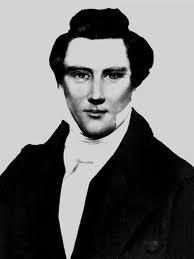
Are they familiar with Joseph Smith, Jr., the treasure digger from Palmyra, New York, who said he was visited by the angel Moroni in 1827 and guided to a box of golden plates which he said contained what is now known as the Book of Mormon, after he transcribed them from “reformed Egyptian”?

Are they thinking about the breakaway Mormons in HBO’s late great “Big Love” with Bill Paxton, Jeanne Tripplethorn, Chloe Sevigny, Ginnifer Goodwin, Bruce Dern, Mary Kay Place and Amanda Seyfried? Maybe they think Mormons are all like Roman Grant, the evil self-proclaimed prophet and leader of the Juniper Creek Compound played by Harry Dean Stanton.

Or are they like one wag we know who argues that the only difference between Mormonism and Scientology is the choir?

If you want to pounce on logical improbabilities in religions, you’ve got your parting of the Red Sea and the burning bush, the immaculate conception and the resurrection and that passel of virgins waiting for you in Heaven. Pick your myth.

The point, of course, is that the stuff Mormons believe is no odder than the teachings of most major religions. But there’s a big difference, and I find it fascinating.

The thing is, if you believe in Jesus or Abraham or Mohammed, you’re talking about people who lived a really long time ago, before there were accurate written records. Despite former Guardian writer Burton Wolfe’s best efforts, you can’t really prove that Jesus lived or didn’t live, or did or didn’t turn water into wine or cure lepers. The Bible has been translated so many times (and by many accounts, rewritten so many times) that it’s hard to know exactly what the original stories even were.

On the other hand, there are people alive today whose grandparents might have known Joseph Smith. Mormonism came to life in a time of newspapers and nearly-modern record keeping. Upstate New York in 1827 wasn’t exactly Manhattan today, but it wasn’t the Middle East in 44 B.C. either. There are still accounts of newspapers of the day denouncing Smith as a charlatan and fraud. Nobody can argue about whether he was into polygamy or not.

In the context of the 1800s, although there was plenty of strange religious stuff going on, the notion of a failed treasure hunter finding golden plates left by an angel (who then took the plates back after Smith made the one and only translation) seems pretty bizarre. That’s in part because the traditional religions all teach that the weird shit took place a really long time ago, which somehow makes it easier to justify.

If the son of a carpenter announced in 1827 that he was really the son of God, and that his mother was a virgin who had been impregnated by something called the Holy Spirit, who was also sorta, kinda part of God, isn’t it likely he might be called a nutjob? Ya think?

And the way the Mormon Church operates, with all of its official secrecy, just encourages people to think of it as a cult. But you ever tried really looking into the Vatican?

My point is that poor Mitt is going to face an uphill battle over his religion largely because the stuff that’s really, really hard to believe supposedly happened a couple millenia after stuff that’s really, really hard to believe was supposed to happen.

Not defending the Mormons here. (Although, if you stipulate that women have equal opportunity and gay people can get married, too, what IS wrong with polygamy?)

Just saying.


Localized Appreesh: Violet Hour

0

Localized Appreesh is our weekly thank-you column to the musicians that make the Bay. Each week a band/music-maker with a show, album release, or general good news is highlighted and spotlit. To be considered, contact emilysavage@sfbg.com.

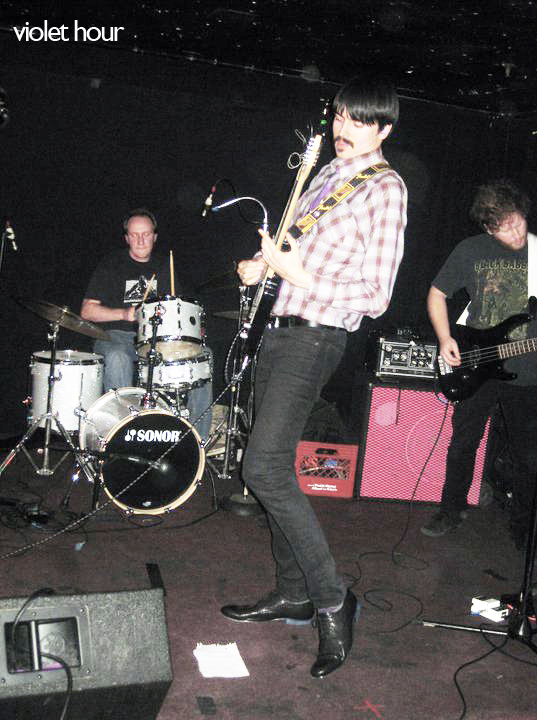
An album release is always cause for celebration. The Bay Area act Violet Hour’s Cowardly Loins EP release extravaganza goes down tomorrow night at Bottom of the Hill. The somewhat illusive indie rock act, supposedly led by Le Duc Violet (along with other equally ostentatiously named creatures) and said to be influenced by Bowie and French surrealist painter Yves Tanguy, brings to mind playful,  glam 90s post-punk. Check out the band’s description of its own sound below, it’s pretty magical.

Also check the deceivingly sweet intro’d song “Whatever It Takes” –  as the guitar line wobbles and grows more frenzied, the vocals follow, building to the chorus  “we all make the same god damn mistakes/whatever it gives/whatever it takes.” The reverb rises, voices blur, and out oozes melancholy. It’s like throwing a rock through an ex-lover’s window on a solo midnight bike ride; the build up and release, the instant regret.

But hey, snap out of it. Stop by the band’s live show on Wednesday, there also are some great  local openers.

Year and location of origin: Berkeley , Calif. 2007
Band name origin: A subsection of TS Eliot’s “Fire Sermon” in The Waste Land.
Band motto: The deadly serious business of rock’n’roll.
Description of sound in 10 words or less: Like a peregrine falcon overhearing an angel’s orgasm.
Instrumentation: Guitar, vocals, bass & drums, keys and crazy stuff Adam invents.
Most recent release: Cowardly Loins EP October 2011.
Best part about life as a Bay Area band: So many excellent venues, so many passionate and diverse music fans.
Worst part about life as a Bay Area band: It’s so fucking expensive to live here I’m gonna cry.
First record/cassette tape/or CD ever purchased: The Simpsons Sing the Blues
Most recent record/cassette tape/CD/or Mp3 purchased/borrowed from the Web: Stephen Malkmus Mirror Traffic
Favorite local eatery and dish: Sausages at Rosamunde’s on Haight

Violet Hour
With Myonics, Symbolick Jews, and Arms + Legs
Wed/19, 9 p.m., $8
Bottom of the Hill
1233 17th St., SF
www.bottomofthehill.com

Snap Sounds: Celsius 7’s “Life Well Spent”

1

“First date was lovely, and the second was stellar: by the third I was liking you hella,” Bay Area MC Celsius 7 states on my Indian Summer jam “Difficult” from his new album Life Well Spent. Leave it to  the former Psychokinetics crew member to vibrantly revive the hoary “hella” chestnut — it’s not the first time you hear it on a disc that’s full of sunny tracks from the hip-hop comfort zone, and also includes references to Wild Style, Krush Groove, Doug E. Fresh, Rubik’s Cube necklaces, “Where’s the beef?,” and Dungeons and Dragons. Hey, what’s that? An EPMD sample? Aw yeah.

“I don’t keep up much with current hip-hop,” the down-to-earth rapper told me over the phone. “A lot of it just doesn’t catch my ear. I’m drawn more to the classics like Outkast, Tribe Called Quest, De La Soul, Nas, like that. Or else more underground stuff like El-P, Zion I, Aesop Rock, Yelawolf. Later Eminem is good, too. And my friends laugh at me because I listen to a lot of what they call “Castle Rock,” like Arcade Fire, Muse, Black Keys. Heartfelt lyrics with good music.

“But Life Well Spent is my ode to the Golden Age of hip-hop — specifically the Golden Age of Bay Area hip-hop, in the late 1990s and early 2000s when there was such a tight family of MCs and clubs like Tru Skool and Elefunk, when you could go out to the club every night and there would be a free exchange of creativity and ideas.” Catchy tracks off the new joint like “Pop Rox,” “Heavy Mental,” and “Small Science” bring to mind that time, while the entrancing opening run of “Minds Like Me,” “Givin’ Up,” and “Don’t Take Time” perfectly embody it.

Cel’s style may hark back to the glory days with an easy flow, catchy hooks, and subject matter that roams from fly girls to money problems to ladder-climbing ambition (and back around to fly girls) — but the production on Life Well Spent, his follow up to 2008 solo debut “Wanderlust,” is sparkling fresh and hints at the new. A large roster of guest — including Baby Jaymes, iLL Media, Foreign Legion, Loyalist, Denizen, and the notorious Dirt Nasty (a lifelong friend from Cel’s days growing up in Alameda) — helps bring everything up to date.

And for those who may get the impression that Celsius 7 is a wholly wholesome soul — the opposite of his raunchy, raunchy cousin Smooth Rick of raunchy, raunchy Bay rap collective Kalri$$ian — well, Celsius still comes through with the outright dirty talk on “KnockFace” (unsurprisingly joined by Dirt Nasty).

“I’m always looking to challenge myself,” Cel told me. “My first album was pretty much all on my own. This one’s more a collaboration and explores more sides of me. The idea of it re-energized me to move on to the next phase.” 

Street Threads: Hayes Valley Edition

0

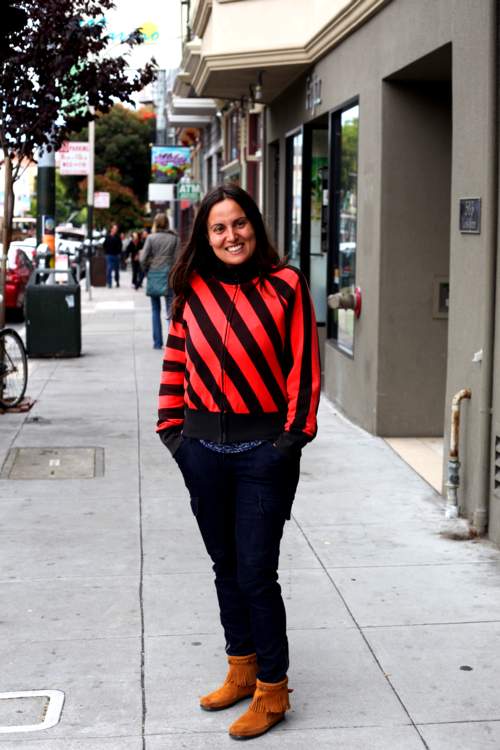
Today’s Look: Beatriz, Hayes and Laguna

Beatriz: “Soy de Bilbao, España.”


Introducing the Guardian’s 2011 Amateur Hour talent competition!

0

In anticipation of our annual arts awards, the GOLDIES, announced November 9, we proud to present 2011 Amateur Hour: The San Francisco Bay Guardian’s Undiscovered Talent Competition.

You could win $200 and be featured on SFBG.com by submitting a 30-second video that showcases your unique talent. Enter now!

HOW TO PARTICIPATE

   1. Upload your video
   2. Readers vote
   3. The video with the most votes wins!

 For more information, full contest rules, or to enter — click here
. Entry deadline is 10/25. Good luck!


SFBG Radio: Has official SF lost its mind?

54

Today Johnny and Tim talk about the police raid on Occupy SF — and why San Francisco officials insist on making this the only large city in the nation that’s sending the cops to clear out Occupy Wall Street protesters. Listen after the jump.


RiotGoinOnCops by endorsements2011

Oakland is hella occupied

The Occupy Oakland encampment at Frank Ogawa Plaza is about 150 strong at any given time, and with a march, rally, and live musical performances on Oct. 15, the protest zone in the heart of Oakland was buzzing with energy.

Oakland is home to hundreds of seasoned activists who’ve made headlines in the past for organizing mass demonstrations against police violence, pushing back against cuts to public education, and moving to save Oakland public libraries from closing their doors in the face of budget cuts. Now, in solidarity with Occupy Wall Street and the Occupy movements that have sprouted up across the country in recent weeks, they’ve staked out a tent city in front of Oakland City Hall to join the national chorus condemning income inequality, corporate influence in government, and the role of major banks in unleashing a tide of unemployment and foreclosure that has swept working-class and middle-class Americans.

In just a week’s time, the occupiers have managed to create a community space governed by consensus that has the feeling of being an established space. Wooden pallets create walkways that criss-cross through the tents, which are staked close together. A kitchen area has been set up, with industrial-sized pots and pans piled high, and regular meals served to more than 100 people. There are portable toilets, portable outdoor sinks, a library supplied with zines and radical literature, an arts and crafts area, a kids’ area, a first-aid tent, and a makeshift stage in the plaza near the entrance of the 12th Street BART station.

The space is continually evolving, several activists told me when I chatted with various people at the camp. A few small arguments have broken out here and there, but on the whole things have been extraordinarily peaceful despite the close quarters and wide-open vibe. This past weekend, a tall structure with a pointed rooftop materialized overnight, adorned with colorful fabric and curtains. Tables and chairs had been brought in so people could play cards, hay bales served as structural dividers between encampment spaces, and the plaza was adorned with posters bearing statements like “The First American Revolution Since the First American Revolution.”

What sets the Oakland occupation apart in some ways is the diversity of people who’ve been drawn to participate. From black youth born and raised in Oakland, to Muslim women donning traditional headscarves, to white anarchists, to parents of young kids, to college students, to people in wheelchairs, to aging hippies, to transgender people, Occupy Oakland reflects the diversity of the city — and it’s bringing together a group of people who might not necessarily share the same space at the same time on a regular basis.

Boots Riley of The Coup performed at Occupy Oakland on Oct. 13, and other musicians have treated occupiers to live music as well. Shane Bauer, Sarah Shourd, and Josh Fattal — the three activists who were imprisoned in Iran and are now back on the West Coast — were scheduled to speak on Oct. 17. At one point just before dark on Oct. 15, a group of bikers blew past the camp in what seemed to be a show of support, performing tricks while everyone applauded.

On Oct. 15, Move On staged a Jobs Not Cuts rally at Occupy Oakland, but because activists decided by consensus beforehand that they did not want any politicians speaking at their encampment, several elected officials whom the group had invited to speak were struck from the roster. (However, a representative from the office of Congressional Representative Barbara Lee did deliver a prepared statement, which some occupiers characterized as going back on their agreement with Move On.)

Danny Glover delivered a passionate speech at the rally, telling the crowd, “We are here because it’s the right time to be here.” He spoke about transforming and reinventing the system so that it could work for the people and the planet, asking, “What does it mean to be a human being in the 21st Century?” He urged the activists to hold their ground, and then said, “What it’s going to look like, I don’t know.” But he asked people to believe that a new system could come out of this grassroots movement, “based on our faith in humanity.”

All photos by Rebecca Bowe

Mini symphonies and Beach House: Treasure Island, day two

0

Though Wild Beasts’ brand of baroque, sensual dream-pop is better suited for a dark and smoky bar, I consider it an honor to catch the UK band in any setting. A sizable crowd gathered around the Tunnel stage at Treasure Island Music Festival to enjoy songs from this year’s Smother, along with older material like breakout hit “The Devil’s Crayon.” Hayden Thorpe’s heavenly falsetto rang out over chiming guitar provided by Ben Little.

“This song is about fucking,” Tom Fleming announced before launching into “All The King’s Men” from the 2009’s Mercury Prize-nominated Two Dancers. At this point, visible swooning ensued among a group of devoted female fans with a handwritten sign praising Fleming’s velvety baritone. It was the final show of a month-long stint in the States for this English bunch. As they directed our attention to the glittering bay behind them, I became quite certain it would be remembered fondly by band and audience alike.

Over on the Bridge stage, seasoned alt-rock vets Stephen Malkmus and the Jicks shredded super hard. Malkmus’ sharp-tongued stage banter kept me giggling between songs. However, anyone standing near where I was won’t need me to recount the wildly distracting antics of the boy dancing with a giant plush hot dog. Also, I’d be curious to hear from the burner brave enough to follow up on bassist Joanna Bolme’s request for “herbal cigarettes.” In an act of genius scheduling, Beach House took to the Bridge stage just as the sun began to set against the San Francisco skyline. The sky took on a surreal orange hue that fit all too well with the Baltimore, Md., ensemble’s hazy, dreamy tunes.

I’m not sure which was more jaw-dropping, the epic sunset or Victoria Legrand’s stunning features displayed on the jumbo screen behind her. Couples embraced and swayed to the melancholic arrangements of Alex Scally’s wailing guitar and Legrand’s organ; a few audience members were reduced to tears. Although I didn’t cry, Beach House’s flawless delivery of “Take Care” just as darkness fell over the island was, hands-down, my favorite TIMF moment.

Maybe I’m getting old, but all the excitement, running between stages, and daytime beers left me exhausted. Sorry Death Cab, Explosions In The Sky served as my TIMF grand finale. I had reservations about the instrumental rock band’s ability to hold my attention for a full set, and previous acts had already set the bar pretty high. However, my expectations were thwarted as the Austin, Texas post-rockers completely blew me away. Members of Explosions In The Sky threw themselves into the mini symphonies, sometimes sitting down due to the physical demand of their elaborate instrumentation. About halfway through the performance, a swarm of illuminated white fabric jellyfish appeared overhead and gracefully bobbed through the crowd. I watched the giant screen in awe as Munaf Rayani open-handedly slapped the strings of his guitar with dramatic emphasis to produce a piercing, eerily dissonant sound. Then Rayani and the band finished up a melodic masterpiece and the audience erupted into wild, reverberating applause.


Click here for day one.

Frothing group hugs at Metronomy’s Rickshaw Stop show

0

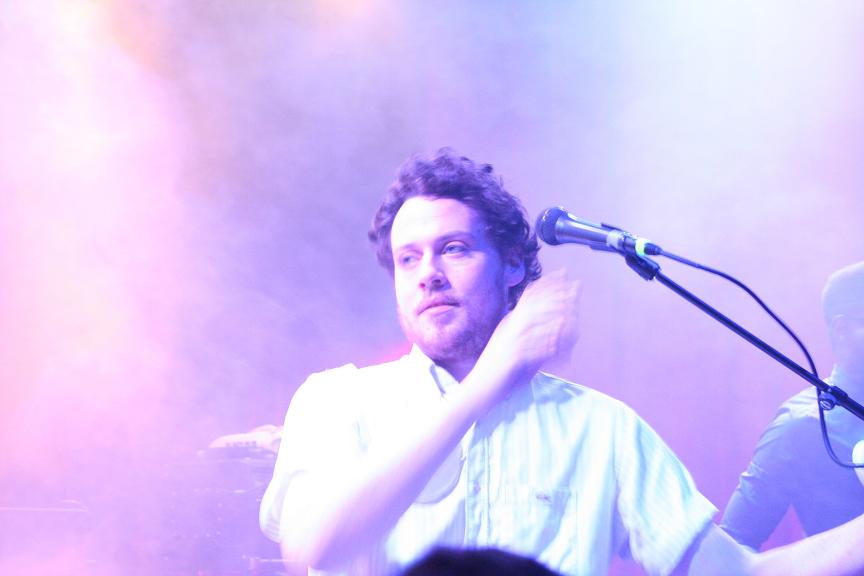
It’s safe to say that next time Metronomy comes to town, it will be playing a bigger venue. Friday’s show at the Rickshaw Stop was full, and had, to the surprise and dismay of at least a few, sold out a month before. Singer Joseph Mount graciously thanked the audience for snatching up tickets at the rate they did. It’s a sign of the growth Metronomy has had over the course  of three albums, a solo instrumental electronic project of Mount’s now grown into a tight, cool pop group.

The band came on stage, Gbenga Adelekan’s bass-line leading into “We Broke Free” from this year’s The English Riviera (an album which attempts to reclaim Devon, England as an alluring vacation hot-spot.) The bass is the anchor on that track and as a lot of Metronomy’s work, slow and sensual, a place to return to even after the drums, keys and, guitar built into a frenzy midway. Things stayed relaxed.

Which isn’t to say there wasn’t dancing. Just that there wasn’t a lot of extraneous selling required to work the crowd. Mount at one point played a one-sided game of guess-what’s-in-my-Solo-cup* and told a story about driving down to SF and looking for the sea, regally pronouncing Portland as Port Land, but generally, the music spoke for itself. By the time

Metronomy started playing “The Bay,” there were a few shouts of “Amazing!” and an alcohol enabled frothing group hug/dance broke out near the stage, sweaty arms clutching anyone within reach, partly out of comaraderie and partly in need for support.

About equal time was given to the new album as well as 2008’s Nights Out, where Mount first emerged as a catchy lyricist, with a breakdown right in the middle of the show for a few instrumentals from Metronomy’s debut, Pip Paine (Pay The £5000 You Owe). Despite the increased attention the band is getting, there’s still a nice sense that it doesn’t take itself seriously, striking the occasional playful dramatic pose and wearing chest mounted lights that were as goofy as mood enhancing. Also, Oscar Cash’s MIDI sax.

As an encore Metronomy played “Everything Goes My Way,” causing drummer Anna Prior’s voice to be stuck in my head for days, before closing the show with the shout-along “Radio Ladio.”

Set List
1. We Broke Free
2. Love Underlined
3. Back On The Motorway
4. Holiday
5. She Wants
6. Heartbreaker
7. The Bay
8. You Could Easily Have Me
9. The End Of You Too
10. Corinne
11. The Look
12. A Thing For Me
13. On Dancefloors
14. Some Written

Encore
15. Everything Goes My Way
16. Radio Ladio

*Vodka with a sweet and sour mix. “And it was very sweet. And it was very sour.”

Space Mayans and techno-African kuduro: Treasure Island, day one

0

Treasure Island Music Festival rewards the stout of heart and non-possessive of blanket space. The way the island fest is set up, no two concerts overlap – if one feels up to it, one can traverse the 100-some meters between the Bridge and Tunnel (get it?)  stages to catch any given day’s entire. Music. Lineup. Upshot? I spent a solid hour in the press tent with my feet on a card table, tapping away on my smart phone as though taking notes, incredibly unstout.

But the music!

We got there on one of the first, cushy shuttle buses of the day. Chair foursomes facing each other over tables with cupholders? A bike workshop run by Levi’s was set up next to the SF Bike Coalition’s valet services at AT&T so our cycles were tuned and gleaming by the well-deserved end of the festival day? Clearly, TIMF is doing it’s best to ameliorate the rage caused by the long shuttle lines one must endure after the headliner’s close.

Our haste was due to one man: Aloe Blacc (though we managed to catch the also-rad performance by local indies Geographer). Blacc might have been a slightly unconventional choice for the electro-dominant festival but it is, after all, not a bad idea to provide refuge from driving beats and plaintive whines for just a moment. He appeared onstage the embodiment of dapper, and went out of his way to inspire audience participation (singing and soul line) for his singles “You Make Me Smile” and “I Need a Dollar.” A late-in-the-set switch to reggae showcased his range.

Then: ferris wheel. If you want to really see this festival, you will do it from the whooping, screeching heights of an amusement park ride ($5, meh). Do this early in the day because by the time it gets dark, you’ll have lines all the way out to the Burning Man shipping container area (where the bonneted “grahamas” handed out graham crackers and freaky faux-old-woman coddling). Also, do the Silent Disco early in the day for the same, line-related reasons.

Shabazz Palaces was great, the Naked and Famous were great. Battles, I was tickled to learn upon reading my program prior to its set, holds in down in New York for “math rock,” which surely you can imagine as the climbing and descending wash of sounds that it is. I felt the unexamined logarithms washing over me… but it was time for Dizzie Rascal.

Why has this emcee achieved more renown in the United States than nearly any of his non-US peers? (Which I typed out just before being reminded by Wikipedia that Drake is from Canada) It’s been a long time since his 2003 debut album Boy in Da Corner. The Ghanian Brit gave us dubstep because he heard “Americans like dubstep,” got everyone dancing to the sound of police sirens, and generally set the international stage for Portugal’s Buraka Som Sistema, which jounced around the stage in a techno-African kuduro whirl.

One thing. Why is Native American the design motif of choice at festivals these days? I blame Urban Outfitters, but the numbers of TIMF-supplied teepees didn’t help, and to a lesser extent, neither did Workshop’s adorable and well-meaning dreamcatcher classes. Kids, dressing up as an ethnic group you do not belong to is a total no-no, even if you LOVE that neon feathered headdress. Just say no. I saw an awesome group on the Jumbotron whose crowd-locator totem pole had a plush broccoli strapped to it — you are welcome to try an animal, vegetable, or mineral theme. Chromeo turned in a good show, even if the duo doesn’t seem to have switched up its song retinue much since 2007’s Fancy Footwork album.

We stayed at the larger Bridge stage after that to begin the slow push to the front for the Australian end of the day one-two punch: Cut Copy and Empire of the Sun. This was the end of the day, and the well-prepared among us was revving up for the night while the rookies were drooping and falling backwards onto me every fucking time I was looking straight at their wobbly backside.

Can we talk about Empire of the Sun? I’d like to hear a reaction from someone in the back of the audience during that show, because honestly I feel bad for you. If you couldn’t see the costumes that the gaggle of space Mayans onstage were sporting, what was that like? If the epaulet-wigs weren’t easily visible flying through the air, if you couldn’t pick up the subtlety in the way the dolphin head dancers were cutting through the stage’s energy currents – the Jumbotron was tuned to the group’s Stargate-esque visuals instead of the close-up shots of the performers that had shown on it for every other show. Anyway, we were at the front and I will tell you right now what the show was like: awesome, even if most of the people around us were frozen looking at the stage in place of actually moving to the beat.

That was it. Then we waited in line for the shuttles. Which was fine, because we had a lot to talk about, like how there was no way in hell we’d be able to do this again the next day. (Unstout).


Click here for day two.

SFPD raids OccupySF again, using more force this time (PHOTOS AND VIDEO)

10

2:10 pm UPDATE: OccupySF plans to march on City Hall today (Mon/17) starting at 5 pm at Justin Herman Plaza.

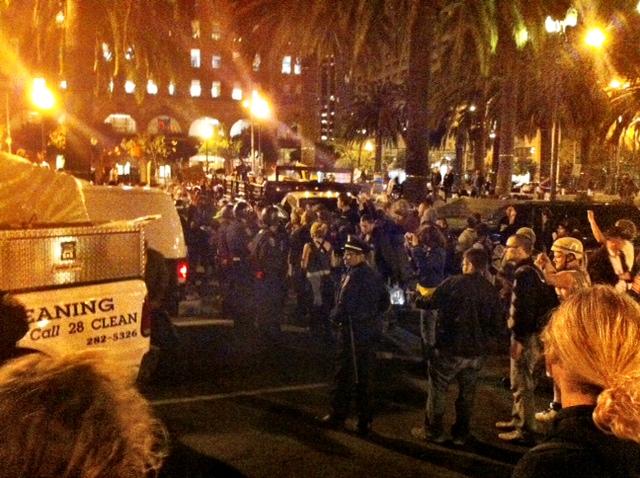
Police raided the OccupySF encampment for the second time last night. The events were similar to the Oct. 5 incident, where police stood in riot gear while the protesters’ materials were loaded into Department of Public Works trucks, then protesters sat, lay, and stood on the street around the trucks in an attempt to prevent them from leaving. In both cases, a kitchen and medical tent that had been set up by protesters were dismantled.

Police were by many accounts more aggressive than in the previous raid, which was the first direct police attack on an Occupy encampment in a major U.S. city. Last night, protesters were dragged, kicked, and struck by police officers, prompting the dispatch of an ambulance to take an injured protester to the hospital. There were at least five arrests.

Journalist Josh Wolf shot some excellent footage of the raid:

San Francisco Police Department spokespersons didn’t answer calls from the Guardian. Police Chief Greg Suhr told us after the last raid (which was also approved by Mayor Ed Lee) that they were only removing public safety hazards and “we will surgically and as best as possible and with as much restraint as possible try to deal with the hazards while protecting people’s First Amendment rights.” Yet last night’s raid shows the city is actually dealing more harshly with the Occupy movement than most cities. 

Around 10:15 pm, the group received a warning that police planned to enforce 10 pm curfew in Justin Herman Plaza. The camp had moved there on Saturday to accommodate growing numbers. Police informed protesters that they could not sleep in the park and that they would need to take down a few tarps that had been propped up, providing a roof for the kitchen and communications area in camp. They claimed that there would be no trouble if the camp moved back to their previous location at nearby 101 Market Street, on the sidewalk in front of the Federal Reserve Building.

Protester Katt Hobin served as a liaison with police throughout the night. She was skeptical of police claims that 101 Market Street was an “agreed upon spot.” Hobin told us, “We were encouraged to relocate. We were never told we could be at 101, or that we could be here.”

There were about 100 protesters gathered. In response to warnings of arrest for those who stayed at Justin Herman Plaza, about 30 moved to 101 Market Street. Protesters began texting, calling and tweeting supporters to come join, and by 11:30 pm there were about 200 protesters at camp.

At first, when asked, police could not provide any written statement detailing reasons for disturbing the camp or arresting participants. An officer whose nametag read G. Tom said they were there based on grievances from the Recreation and Parks Department, but that he could not name a specific individual who had complained. After some deliberation, police produced a copy of San Francisco Park Code Section 3.13, which prohibits sleeping in public parks during certain hours.

Sup. John Avalos, the mayoral candidate who has been most actively engaged with the OccupySF movement, negotiated with officers and protester representatives on speakerphone. Avalos suggested that the police come back during the day; Officer Tom replied, “It works better for us to do this in the middle of the night.”

After some negotiations, officers warned that if the tarps that had been erected were not taken down, they would have to proceed with the raid.

Around 11:30 pm, protesters met briefly and agreed not to comply with that order. Said one protester, “We took down the tents last time, and they still took our stuff and arrested people. We can’t trust them. We need to stand our ground.”

At 11:47, about 70 police in riot gear marched on to the scene. They surrounded the camp and began dismantling structures. At 11:53, Department of Public Works trucks pulled in and police began loading them with items from the camp. This included food, tarps, signs, and personal and communal items.

One protester had duct taped himself to a poll within the camp structure. Police ripped him off the poll, threw him to the ground and struck him in the head and ribs. When he left by ambulance a few hours later, he appeared to be convulsing or seizing.

As they had on Oct. 5, protesters poured into the street in an attempt to block trucks from leaving with their possessions. But the street next to Justin Herman Plaza, the southbound side of Embarcadero, separated from the northbound side by a large concrete platform, is quite narrow compared to Market Street where a similar confrontation happened last Wednesday.

Protesters were much more successful last night in blocking the trucks from leaving, and it took about an hour before the four DPW trucks were able to exit. Protesters sat, lay, and stood in the way of trucks, chanting “the people united shall never be divided” and “we shall not be moved.”

Between about midnight and 1:30 am, police tactics escalated. At first, they attempted to back the trucks out, but protesters ran to block all paths. Then one truck lurched forward onto the sidewalk dividing area, where protesters ran to block it as well as talk with the driver about why he was participating in confiscating their belongings.

Soon, police began dragging and pulling protesters who were in their way and the way of the trucks, throwing them from the street to the sidewalk. They also arrested four of those sitting in on the street.

Protester Ryan Hadar, 19, told us: “They bent back my thumbs, trying to pry me away from the people I was locking arms with. When I asked if they were trying to break my thumbs [one officer] replied, ‘only if I have to.’ Then they dragged me to the sidewalk by my index finger. I asked if they were trying to break my finger, and this time they replied, ‘Yes.’”

This level of activity continued about an hour. Protesters sprinted and zoomed back and forth on skateboards, blocking trucks from leaving in all directions. Police pushed protesters out of their path as they marched back and forth, trying to maintain hold of the situation.

At 1 am, the last truck successfully left. Police who had been behind the truck, pushing protesters away from it, were suddenly alone in a sea of OccupySF particpants. They quickly formed into a block, batons poised, as protesters encircled them. A tense moment passed before protesters broke out in cries of “the whole world is watching!”

There were reportedly 2,100 people viewing the live video stream of the events.

The altercation ended in a bizarre fashion, as police marched across Justin Herman Plaza, stopped in the tracks, then seemingly changed their minds and marched back towards the Embarcadero. A smaller contingent then reappeared at the corner of Mission and Steuart streets. Protesters formed a line confronting them and demanding that they release those arrested; a man who had been arrested at the previous week’s altercation had been held 10 days before he was released on bail funds raised by OccupySF.

One officer said that police would continue standing there until protesters left; many protesters were determined to stand until the police left. Eventually, around 1:40 am, police did decide to exit first. A chorus burst out, singing “Na na na na, hey hey hey, goodbye” as they left.

Ten minutes after the incident ended, about four tarps had been restrung and the camp had begun to rebuild its food and water supply. Protesters surveyed the aftermath, including loads of fresh vegetables and other food strewn on the ground near the former kitchen. Many picked up brooms and began cleaning, while others got to work compiling media information.

Those arrested were released around 3 am and arrived back at camp at 3:30. Xander, a protester who had been sleeping at the camp since its first night on Sept. 17, was one of those arrested. He recounted, “They hit me a couple of times on my shoulders and put me in the truck. We weren’t able to leave because our brothers and sisters had surrounded the truck. We were singing and banging on the walls.”

Those arrested were charged with resisting arrest and impeding traffic.


Live Shots: The Hula Show 2011 at Palace of Fine Arts

0

Images of chilling fog sweeping over the Golden Gate Bridge and a glowing sunset illuminating the Painted Ladies might not conjure thoughts of hula and Hawaii, but the Hula Show at the Palace of Fine Arts bridged that connection, bringing swaying hula hips to San Francisco in a unique aloha tribute to our fair city.

All the classic Hawaiian moves were there, with a twist of Bay Area flair — plus some Arabic chanting, Hindi ragga, New York house music, and even a cheeky tribute to Lady Gaga. A heart-stoppingly lovely performance of the classic Frank Sinatra song “Somethin’ Stupid,” a wholly enthralling Mexican-tinged hula solo, and a dance in honor of the Dungeness crab (performed with snappy aplomb by the warrior-like male members of the company) proved the full range of the graceful Na Lei Hulu I Ka Wekiu dancers. They flashed genuine, welcoming smiles when dancing; it was clear that they were having fun, and their easy island spirit wafted down from the stage. With live musicians giving rhythm to the dancers movements, a breath of fresh Hawaiian breeze didn’t seem all that far away. See them this coming weekend if you have the chance, and partake of the global island spirit.

The Hula Show 2011
Through Oct. 23
Palace of Fine Arts Theater
www.naleihulu.org
Tickets $35/$45


BREAKING: Police threaten another OccupySF raid

4

After moving yesterday from the sidewalk in front of the Federal Reserve into nearby Justin Herman Plaza, the OccupySF encampment is again being threatened by the San Francisco Police Department, which is telling the group the city will enforce the nighttime curfew on the park and protesters must disperse. Sup. John Avalos is trying to mediate the conflict and Guardian news intern Yael Chanoff is covering the situation from the scene. Check back in the morning for a full report on this and other developments in the Occupy movement and its many manifestations around the world.

UPDATE: During an impromptu General Assembly, OccupySF votes to peacefully defy the police and not take down the camp as ordered. You can follow live video of the action here.

Medical marijuana protesters gather at City Hall in wake of federal raids

9

Protesters met in front of the San Francisco Federal Building this afternoon to challenge the recent federal crackdown on California’s medical marijuana industry. The rally formed on the heels of yesterday (October 13)’s raid by federal agents on Northstone Organics, a Ukiah medical marijuana cooperative.  

“Our state, our medicine,” protesters chanted. Among those present — about 30 individuals, per Guardian estimates — were medical marijuana patients, patient advocates, dispensary employees, and a representative of the Medical Cannabis Association

“When you’re a part of the medical cannabis movement, you feel personally affected by these raids,” said Shantanae Todd, an advocate and patient herself. Todd suffers from seizures and says she has found relief through her medical cannabis presciption for two years.

“What’s the difference between Democrats and Republicans? I’m not seeing much of a difference here,” cried Shona Gochenaur, executive director of low income medicinal cannabis center Axis of Love and member of the city’s Medical Cannabis Task Force. Gochenaur urged Kamala Harris, California’s Attorney General — who has resisted taking a stand on the federal government’s persecution of medicinal cannabis producers — to lend more vocal support. 

“We need to give everyone a clear message today that patients are not willing to go underground,” said Gochenaur. The protesters plan to meet and rally at noon the day after each and any future large-scale federal raids on California marijuana producers.

Spike salute: Showing love for Mission High volleyball team

3

When head coach Geraldine Poon and assistant coach Kris Thomas got involved with Mission High School’s volleyball program two years ago, their goal was to significantly improve the team’s attitude on the court and in the classroom. They did. 

The young women on the team made such strides on and off the court, in fact, that Thomas got in touch with the Guardian to ask if we could show them some love. We would love to!

“Over the years our student athletes have really put in tons of effort and it really does show,” Thomas told the Guardian in an email. This year has been the strongest start of a season in the history of Mission High School’s volleyball program with a 5-1 record.  

When Poon and Thomas came aboard as the team’s coaches, they started teaching skills that had nothing to do with volleyball. The two thought that for this team, communication skills were more important. The 12 girls on the roster learned how to offer constructive criticism, how to identify a problem and fix it, how to be supportive of their teammates, and how to play with composure and poise. Their new set of skills improved their playing and their schoolwork. 

Most of Mission High School’s student body is made up of students who know or are learning English as a second language and live in underprivileged neighborhoods such as Bayview, Hunters Point, Fillmore, and the Tenderloin. The school is not known for high levels of academic achievement, but the volleyball team has improved its GPA from 3.06 in 2008 to 3.65 in 2010. Many of the girls received straight A’s. 

On the court, the girls have shown a great amount of improvement as well. Middle blocker junior Leonida Radford has been dominating at the net in kills and blocks, totaling 27 kills for the season. 

Thomas offered specific commendations for many of the young women. He expects co-captain and outside hitter sophomore Katie Regalia to continue to post big numbers for the team in kills, digs and aces. She totals 137 service aces and 62 assists for the season. “She is by far the biggest asset to the team,” Thomas wrote. “[Her] undying effort and sheer selflessness …She is the glue that holds the team together.”

Sisters seniors Tianna, middle blocker and Nailafou Mitchell, outside hitter have significantly improved their grades and have both boasted a formidable offense when attacking. “They both had a rocky start to the season, but have both made major adjustments and are also huge assets to the team,” Thomas wrote. 

Coaches also commended junior captain and setter Michelle Li for the way she rallies and holds her teammates responsible. 

Despite its success, the team still has to deal with challenges they have no control over: it’s had to wear the same uniforms for three years and there is no funding to purchase new ones. “Some of the uniforms have holes in the sleeves and are worn and discolored,” Thomas wrote. But that doesn’t discourage the girls when playing volleyball powerhouse high schools like Washington, Lowell, or Lincoln.

There is still a month of games left on their schedule, but next Tuesday is the team’s last home game. “We have full confidence in making playoffs this year,” Thomas wrote. “In fact, I think it would be quite a disappointment if we don’t. A championship would be the proverbial icing on the cake.”