SFBG Blogs

Live Shots: Gardens & Villa and Waterstrider at Bottom of the Hill

1

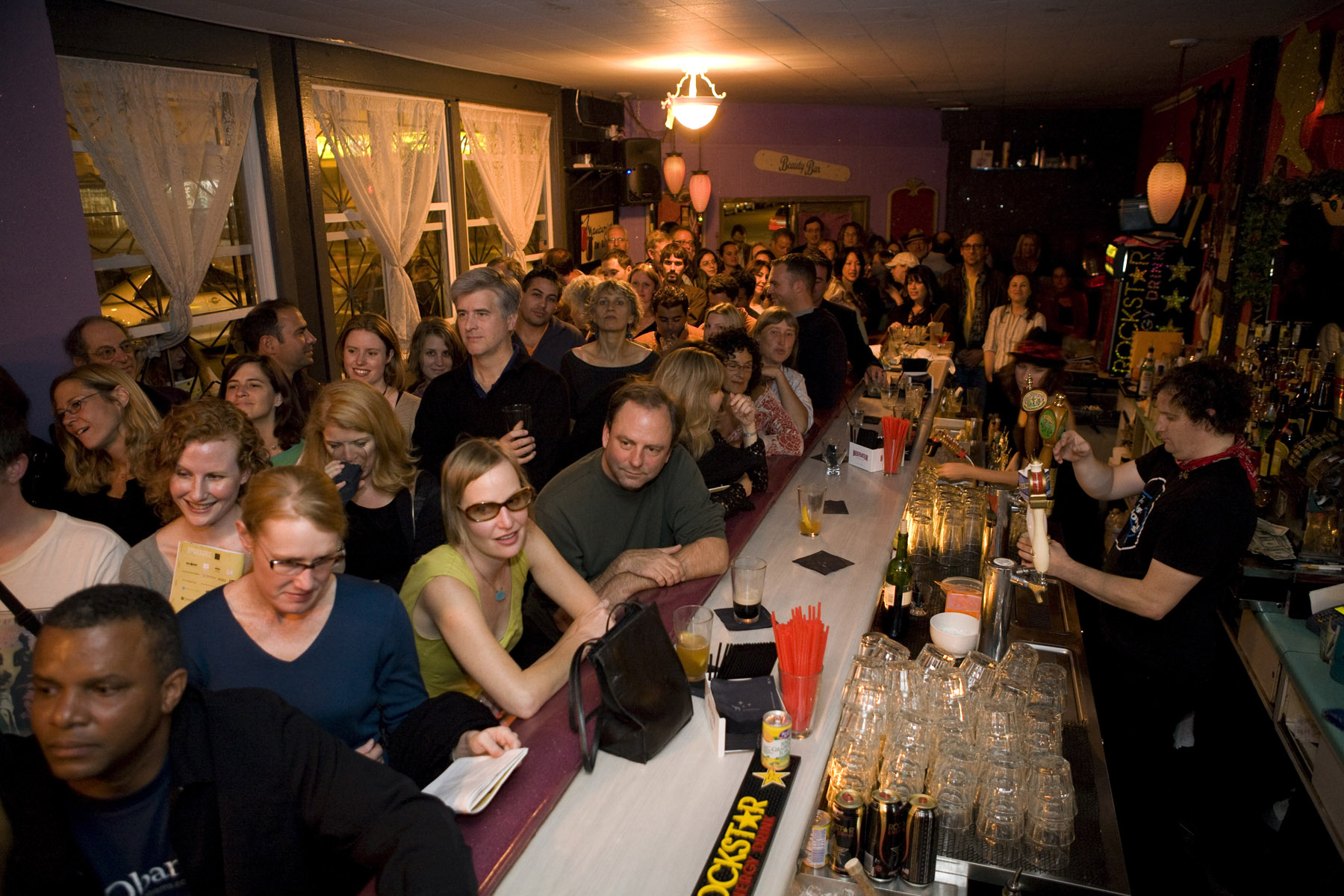
Rarely, if ever, do I see such unbridled joy at shows these days, at least not in the way I saw it last night for every band at Bottom of the Hill.

Even for barefoot Berkeley Afropop openers Waterstrider (this week’s Localized Appreesh) – not that the band isn’t excellent, because it is – but when was the last time you witnessed ecstatic masses losing their shit and screaming for “one more song” during the opening set of a Thursday night rock show? Perhaps it was the uncharacteristic heat. (Strange how strange it is to see San Franciscans out at night wearing little more than a strappy sundress or stretched-out tank top.) That kind of warmth and freedom does something to your endorphins. But I also chalk it up to the ‘Berkeley co-op factor.’ Waterstrider mentioned the co-ops (where it was spawned) and got a rousing reply. Like a hippie frat.

My show companion reminded me halfway through the night that one of our earliest visits to Bottom of the Hill was for Pretty Girls Make Graves, Your Enemies Friends, and Atom and His Package. Don’t jump to protest, the music of these bands and last night’s bill cannot compare sonically (the former was during the post-rock Aughts, a time when I was the one with the ‘X’ scrawled on my hand). But the youthful energy, and excitement, this is what triggered such memories. The kids throwing their hands in the air with abandon. I caught a young woman headbanging, swinging her hair back and forth, last night to music you wouldn’t expect.  And she was all smiles.

That ecstasy continued for touring headliners Gardens & Villa, hitting San Francisco with two stops left before its return to Santa Barbara. Opening the set with shuddering album opener, “Black Hills,” the five-piece began smooth and calm, soon sending the crowd into yet another tizzy with the more anthemic “Cruise Ship.” It moved along through other tracks off the recently released self-titled album, including “Spactime” (heavily profiled in print this week), and broke out a new, more upbeat dancey jam, to boot. The crowd ate it up, like ravenous heat monsters.


All photos by Chris Stevens.

Period Piece: A Carnegie library reopens in the Marina

0

Period Piece is Lucy Schiller’s recurring feature on the hidden histories of San Francisco. Give her a shout at culture@sfbg.com if you know of some hot dirt on olden times in the city

About a hundred years ago, Andrew Carnegie was giving away most of the money he had amassed from a gargantuan steel empire. Eight libraries in San Francisco directly resulted from Carnegie’s efforts, including the Marina’s Golden Gate Valley branch – the recipient of a much needed facelift that concluded last week.

The library was the eighth branch to open in San Francisco. It was born in 1918 to a city less than thrilled about accepting money from a man with a terrible labor rights record. Various arguments at City Hall had already played out over whether to accept the dirty money or refuse it, dedicate most of the funds to a main library or allocate more to several branches, elect trustees or keep the wealthy, elite ones around. 

After years of stalling, it was decided. Half of Carnegie’s grant went to the Main Library, the other half to seven branches. Last week, the Golden Gate Valley branch reopened after an extensive renovation thanks to B.L.I.P. (the inauspicious acronym for the Branch Library Improvement Project).

You can sense the money that went into this place’s initial construction. Shaped like a big wedge of cake, the Golden Gate Valley branch nestles into the corner of Octavia and Green and is decked out with stately columns, heavy copper doors, and high ceilings. 

Libraries have come a long way from their original intended purpose of providing literature to the masses. There are books here, of course — lots and lots of them. But the Golden Gate Valley branch also holds features for kids who can’t even read yet, digital signage in the teens’ area, a program room for community events, and of course, rows of computers for what is perhaps the library’s most salient role in today’s society: free Internet access. 

“Part of the mission of the library is to be a family destination,” says Mindy Linetzky, bond program administrator for BLIP. “We really want teens to come, for example.” With the library’s plans to hold occasional Wii gaming days, you can be sure they will, in droves.

B.L.I.P. has seen marked increase in community engagement since the start of the renovations. According to Michelle Jeffers, public relations officer at SFPL, the Visitation Valley branch’s recent renovation was met with a 406 percent increase in library card registration. 

BLIP’s job is almost done now with twenty-two refurbished libraries under its belt and only two more on the docket. Safer (with seismic bracing), greener (with solar panels), and more accessible (with elevators), our new libraries hold a lot of their former glory but also some fancy new swag.

Golden Gate Valley Public Library
 1801 Green, SF
(415) 355-5666


To the wonderful folks at Occupy SF/Wall Street/Everywhere

122

First of all, don’t get depressed by this sort of stuff. During the occupation and blockade at Diablo Canyon, when about two thousand people managed to prevent the opening of the nuclear power plant, the mainstream news media kept reporting that the blockade was failing, that the protesters were getting tired, that everyone had given up and was going home. One person starting walking around with a poster that said “The media is getting tired and hungry and going home.”

Press accounts typically understate the numbers and dedication of protest movements. Instead of talking about how amazing it is that so many people have given up everything else in their lives to protest economic injustice, the press will say: Why aren’t there more?

So hang in — overall, the message is getting out. As we said in an editorial this week:

If the demonstrators don’t have all the solutions, at least they’ve identified the problem. And that’s more than Obama, Congress, or the mainstream news media have done.

But as someone who has watched, written about, worked on, joined and been otherwise involved in direct action and community organizing efforts for more than 30 years (yeah, I’m old), let me make a friendly suggestion.

Saul Alinsky, who pretty much invented modern community organizing, always said that building an effective organization and agitating for social change was as much about empowering the powerless as it was about winning a specific battle. He and his students learned quickly that nothing is worse for an organized movement than the frustration of constant failure. The movement that arose against the Iraq and Afghanistan wars suffered from that — when it was clear that nothing any of us did (including electing Obama) was going to bring the troops home and end hostilities, a lot of people gave up and stopped marching.

The people I learned from back at the Connecticut Citizens Action Group, which practiced Alinsky-style organizing, used to say that victories, even small victories, would prove to people that they really could fight City Hall. If a low-income neighborhood was worried about cars speeding down the streets where kids were playing, fine: Organize everyone and demand stop signs, speed bumps and police patrols. Once you’ve shown disenfranchised people that they can force the powers that be to listen and respond, you have the basis for something much more ambitious.

I guess what I’m saying here is that you might want to think about setting a goal that’s a little bit short of decentralizing all of society. When I worked with the Abalone Alliance, we were all about changing the way people related in the world; everything worked by consensus, we spent an immense amount of time discussing power relationships and we all had a radical model for rebuilding the United States (and the world). But we also wanted to stop a nuclear power plant from being built on an earthquake fault. And when that happened — the protests actually delayed the opening for several years — it gave tremendous life and energy not just to the movement but to all the people in it. It was radically empowering.

The Livermore Action Group, which emerged out of the Abalone Alliance, was dedicated to ending the threat of nuclear war (and all war), among other things. But it had as an immediate first step ending weapons reasearch at the Lawrence Livermore Lab.

Around the same time, the American Friends Service Committee came up with a campaign called the Nuclear Freeze. The bumper stickers read: “Step one: Freeze Nuclear Weapons.” The idea: When you’re in a hole, stop digging. Nuclear proliferation was threatening the world; as a first step, we ought to stop building more bombs. 

Since this is all about Wall Street, and you’ve got momentum on your side, maybe you want to start talking about something specific. How about “Step One: Tax Wall Street Transactions and Create A Million Jobs.” A transactions tax dedicated to public-sector job creation would do wonders for the economy. It’s the kind of campaign that a wide range of allies could join. It’s got simple, populist appeal. It’s not everything you want, but it’s not bad — and remember, it’s ony Step One.

Just a thought from a friend.


Get lit! A handy guide to Saturday night’s LitCrawl

0

LitQuake has been rough. You’ve been dashing out of work, shoving people away from their cabs to make it to the Chuck Klosterman event and sprinting after buses to catch Karen Russell; you’ve had to make the hard decision between “Kafkaesque” and “Rock Out with your Book Out;” and all the while, you keep thinking Jeffrey Eugenides has just passed you on the street. With LitCrawl coming up Sat/15, things become even more overwhelming and terrific. In the Mission, bars, cafes, and bookstores together host 450 readers in 79 readings, all free and open to the public. One way to navigate the event might be to pick your favorite bar or cafe, find a chair, order a drink and wait for something to happen. Or, you can check these readings out:
 
I Live Here: SF. How We Got Here, Why We Stay
Not a lot of us can say we were born and raised in San Francisco. Most of us fled here from elsewhere for one reason or another: failed relationships, parents kicked you out, a nervous breakdown, a mid-life crisis, you formed an indie-rock band. Maybe you came for LoveFest and simply forgot whom you were. There are a thousand reasons for arriving and a thousand more for staying. In Clarion Alley, writers and non-writers alike including Mark Bittner and M.C. Mars talk about what brought them here and why they haven’t budged. 6 p.m., Clarion Alley, between Mission and Valencia, and 17th and 18th Sts, SF

BARTab’s Blame it on the a a a a a Alcohol: Tall Tales of Inebriated Adventures
Alcohol and writers have always had a vital, if tumultuous relationship. Hemingway said that when you worked in your head day after grueling day, the only viable remedy was whiskey; that “The only time it isn’t good for you is when you write or when you fight. You have to do that cold.” Luckily, a drunken night can become a source of inspiration, if not the next morning, sometime when you’re “cold.” At this reading, writers like Daphne Gottlieb, Jon Ginoli, Brenda Knight, and the editor of BARtab, Joe Provenzano, read about nights of drunken debauchery. 6 p.m., Martuni’s, 4 Valencia, SF
 
Come Cheer the Reaper: Readings from the San Francisco Writers’ Grotto
The San Francisco Writers’ Grotto was founded because, dammit, this writing business can be agonizing, but it’s more manageable when others surround you with whom you can collectively suffer. Convening at the Elbo Room for a night of readings tied around death, you might think that collectively suffering wasn’t working out so well for the Grotto. However, tonight is not a night for morbidity and gloom. Nine writers, including Janis Cooke Newman, Marianna Cherry, Gerard Jones, and Chris Colin read work that looks at death with humor and lightheartedness. 7:15 p.m., Elbo Room, 647 Valencia, SF
 
The Three-Penny Review Presents…
The Three-Penny Review, based out of Berkeley, would naturally host a night of premium writers at LitCrawl. The journal has been hosting the best authors, poets, and critics in its pages since 1980, and it publishes reviews and essays about everything under the sun (their recent issue features 3 great essays about live music). A good way to gauge the journal’s breath is looking at tonight’s lineup at the Summit. Kay Ryan is, of course, the former Poet Laureate of the U.S. and the Pulitzer Prize winner for The Best of It: New and Selected Poems; Walter Murch is a three-time Oscar-winning film and sound editor famous for his work on Apocalypse Now and The English Patient; Louis B. Jones is an author whose most recent novel is Radiance. Others tonight are poet Victoria Chang and the playwright and screenwriter Erik Tarloff. 7:15 p.m., Summit, 760 Valencia, SF
 
Zyzzyva Presents…
If you’ve taken a look at the West Coast writers and artists magazine Zyzzyva lately, you probably noticed some substantial changes: a new design, a full color art spread, an additional 40 pages of content. The changes are credited to the magazine’s first new editor since its founding in 1985, Laura Cogan. At 29, Cogan has breathed new life into the magazine and given it more presence in the community by doing, among other things, events like this one. Contributors to the fall issue of the magazine W.S. Di Piero and Troy Jollimore are joined by Heather Altfeld, and Malena Watrous. 7:15 p.m., Blue Macaw, 2565 Mission, SF
 
From Buddha to Batman
If you’re a fan of comic superheroes and also have a costume you’re dying to wear before Halloween, this event is most certainly for you. Gotham Chopra, co-founder of Liquid Comics and co-author of the comic Bullet Proof Monk, discusses our persistent fascination with muscles, spandex, super powers, and sidekicks. If you’re one of the first 20 to arrive to the event in a superhero costume, you get a free drink, while the best three costumes win signed books. 8:30 p.m., Laszlo Bar, 2526 Mission, SF

McSweeny’s and The Believer Present…
McSweeny’s and The Believer need no introduction. They are of what they are, and everyone knows that, together, the publisher and magazine support the very best writing. This event features a handful of those talent writers and personalities: poets Matthew Zapruder and Tess Taylor, columnist Daniel Handler (known by some as Lemony Snicket), and Anthony Myint and Karen Leibowitz, founders of Mission Street Food, and authors of the book Mission Street Food: Recipes and Ideas from an Improbable Restaurant. 8:30 p.m., Latin American Club, 3286 22nd St., SF

The World Cries Out for Revolution
Some, like the protestors defiantly camping outside the Federal Reserve Building for OccupySF, get their voices heard by taking to the streets. Others, like us at the San Francisco Bay Guardian, stir things up with the written word. You can see this every week in the articles written by our own Steven T. Jones (check out his article on the pot club crackdowns in this week’s issue). At Cafe La Boheme, Jones reads in the spirit of dissent with former Black Panther Richard Brown, as well as Larry Everest, the author of Oil Power & Empire: Iraq and the U.S. Global Agenda.
8:30 p.m., Cafe La Boheme, 3318 24th St., SF

Protesters disrupt Murdoch speech (VIDEO)

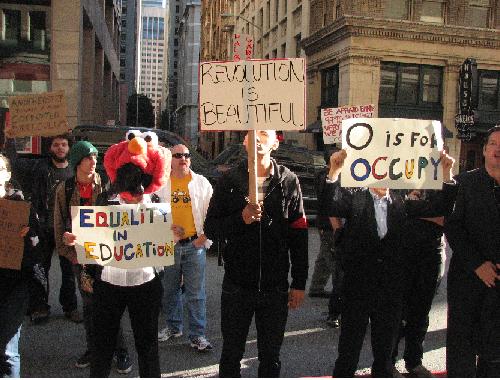
In the Grand Ballroom of the Palace Hotel in downtown San Francisco on Oct. 14, News Corporation CEO Rupert Murdoch delivered a keynote address to a crowd that included senators, businesspeople, and high-ranking education officials from throughout the country — yet he was interrupted repeatedly by activists, some of whom were dressed as Sesame Street characters.

Murdoch was there to speak at an annual summit held by the Foundation for Excellence in Education, a Florida-based nonprofit led by Jeb Bush. The billionaire media mogul, who came under pressure in recent months as the News of the World phone-hacking scandal erupted, spoke about revolutionizing education with technology.

Several moments after he began speaking, a man wearing a suit stood and yelled out, “Isn’t it time to resist corporate domination?” In what seemed like an odd statement, he added, “They’re occupying Wall Street — maybe they should be occupying Sesame Street!” He was quickly escorted out by hotel security, but this proved to be only the first of a handful of outbursts orchestrated by San Francisco U.S. Uncut, a grassroots organization that plans actions to draw attention to income inequality and low taxes for major corporations.

Murdoch referenced his friendship with Apple founder Steve Jobs, who passed away less than a week ago, and praised the iPad as an educational tool. But protesters dressed as characters from Sesame Street — Elmo and Count von Count, for instance — stood and spoke out of turn from tables throughout the room. “Mr. Murdoch, I’ve been doing some counting,” the activist dressed as the Count yelled out. “Seven corporations own all the media in the world — why shouldn’t they own all the education as well?”

There were five different interruptions in all, the final featuring a woman who yelled out, “Occupy, occupy, occupy!”

Appetite: Recapping Whiskyfest 2011

1

Another year, another WhiskyFest. I’ve been attending a number of years now, ever relishing an opportunity to try unexplored whiskies, refresh my taste memory on others, and connect with whisk(e)y industry folk and distillers here from Kentucky to Scotland.

A number of options listed as VIP tastes (more than ever this year) were not, in fact, available at all. Some purveyors said these bottles — like Isle of Jura’s Shackleton or Pierre Ferrand Ancestrale Cognac — hadn’t reached the States yet. I find this a problem, particularly for those paying more to hit VIP hour for these rare tastes ($135 regular tickets; $185 for VIP hour).

One that WAS there however, was the soft, layered, fruity yet slightly oaky, Tamdhu 30 year from Gordon and MacPhail.

Their Benromach 10 yr (available all night, not just during VIP hour) is surprisingly complex, with essence of cedar, nuts, smoke, and spice. Aged in bourbon casks, then finished off in sherry, it does not taste a full 20 years younger than the Tamdhu. I chatted with the company’s friendly managing director, Michael Urquhart, one of 3rd and 4th generations of the Urquhart family who own the company and have been making single malts long before they were ever marketed as a category.

My favorite VIP taste may have been Ardmore’s gorgeous 30 yr Scotch. Surprisingly light, it evokes coffee, caramel, dried orange and a long, gently peaty finish. I found this beauty at the Laphroaig table, where I also enjoyed another taste of Laphroig’s Cairdeus and Triple Wood whiskies).

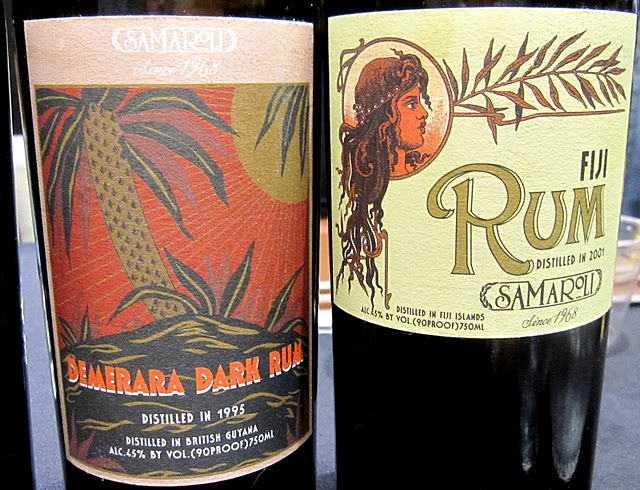
Italian company Samaroli imports a number of special edition whiskies, but of greater interest to me were their unique rums, some layered and elegant, others funky, but all fascinating, particularly Caribbean2003, a rum that is predominantly Cuban, and a French-style rhum agricole: Guadaloupe 1998.

Bruichladdich, who wins for hippest, out-of-the-norm packaging, is doing some interesting things, particularly with their new gin (yes, I said gin), The Botanist. Though containing far too many botanicals (22 in all, from bog myrtle leaves to apple mint), somehow it manages to come together in a cohesive, smoothly refined whole. Their unique Black Art 2 whisky, an uber-secretive recipe that purportedly only distiller Jim McEwan knows, was aged in a range of unlisted barrels, possibly sherry, even wine casks, just like the first limited edition of Black Art.

High West Distillery in Park City, Utah, has a new bottled Manahattan cocktail. Though it’s a decent product, I couldn’t fathom preferring it to a freshly made (or barrel-aged at a bar) Manhattan. All initial barrels in Utah sold out in 8 days, so they launched the product beyond. I sampled their new 21 yr Rocky Mountain Rye, but actually preferred another new bottling: OMG (meaning Old MononGahela, a Western Pennsylvania river) Pure Rye Silver Whiskey. They left the heads and tails in, giving it a rugged, green profile of Meyer lemon citrus and rye spice, best enjoyed neat at room temperature.

Tequila Corrido, a tequila line I enjoy from start to finish, poured their new Extra Anejo from the first barrel to ever leave the distillery. It tastes of lemongrass, oak and chocolate, with agave actually detectable (a fault of many anejos when wood drowns out the agave).

Great King Street
, a blended Scotch made by the Compass Box Whisky Company wasn’t my top taste of the night, but is a smooth blend of Lowland, Highland and Speyside single malts, lightly toasty with vanilla and spice. It’s fresh, classically modern packaging and approach of bringing back respect for blends make it stand out.

WHISKYFEST Seminar with Parker Beam and Alain Royer

My seminar of choice was the evening’s highlight, led by one of my whiskey heros, Parker Beam (who I had the privilege of meeting last year and chatting again with this week), and master Cognac blender Alain Royer of the Renaud Cointreau Group. Beam and Royer discussed Parker’s Heritage Collection 2011 release: a 10-year bourbon aged first in charred American white oak barrels, then 6 months in used Limousin oak Cognac casks. You wouldn’t know it’s a bracing 100 proof, as it goes down smooth, sweet and silky with maple, apple, and gentle spice. It might not be as revelatory as Parker’s Golden Anniversary or 27 year whiskeys, but alongside last year’s robust Wheated Bourbon, it’s yet another winner in Beam’s impeccable collection.

Only Heaven Hill, the company that makes Parker’s Heritage Collection (among my top bourbons of all time), can claim that since 1934 every drop of whiskey from their distillery (all their brands) is overseen by Earl, Parker or Craig Beam of the esteemed Beam family. They produce 900,000 barrels of whiskies out of 49 rickhouses across 30+ acres.

Parker ever charms with his slow-as-molasses (or maybe even slower) Southern drawl belying his feisty sense of humor. Keeping it real, he says, “If you want to make good bourbon, you make it in Kentucky. If you want to sell it, you damn well make it in Kentucky.” He sips one of Heaven Hill’s most popular, affordable whiskeys during his down time, however: “At home I kick back with our Evan Williams single barrel.”

In regards to joining forces with Parker to make Parker’s Heritage Cognac Barrel-finished Bourbon, Alain states: “When I tasted Parker’s bourbon, it reminded me of Borderies.” Known for their floral richness, Cognacs from Cognac’s Borderies region are often elegant beauties with heart, just like Parker’s Cognac Bourbon.

Parker talked about the process of deciding what this year’s special release would be (each of his annual releases are rare, limited editions): “We had some older products [older than his 27yr bourbon] that wasn’t up to snuff. I didn’t like it, anyway… To make Cognac bourbon we went gung ho, as we knew the bourbon was gonna be good… and we trusted Alain’s selection of barrels”.

Next to the final product, we sampled Heaven Hill’s Bourbon Rye Mashbill (10yr bourbon, 100 proof) from new charred white oak barrels. Even in its raw form, the rye exhibits fullness and spice, coconut and vanilla. We also savored Alain’s Chateau de Fontpinot XO Cognac, aged an average of 18-20 years and produced on one single estate from ugni blanc grapes. It’s seductive with apple and apricot, subtly earthy with hay and wood notes, a sophisticated Cognac.

Subscribe to Virgina’s twice monthly newsletter, The Perfect Spot

SFBG Radio: Jerry Brown, WTF?

4

In today’s episode, we try to figure out WTF is up with Jerry Brown — and what Californians can do about it. Listen after the jump.

RecallMoonbeam by endorsements2011

Homeless families in SF hits record high

10

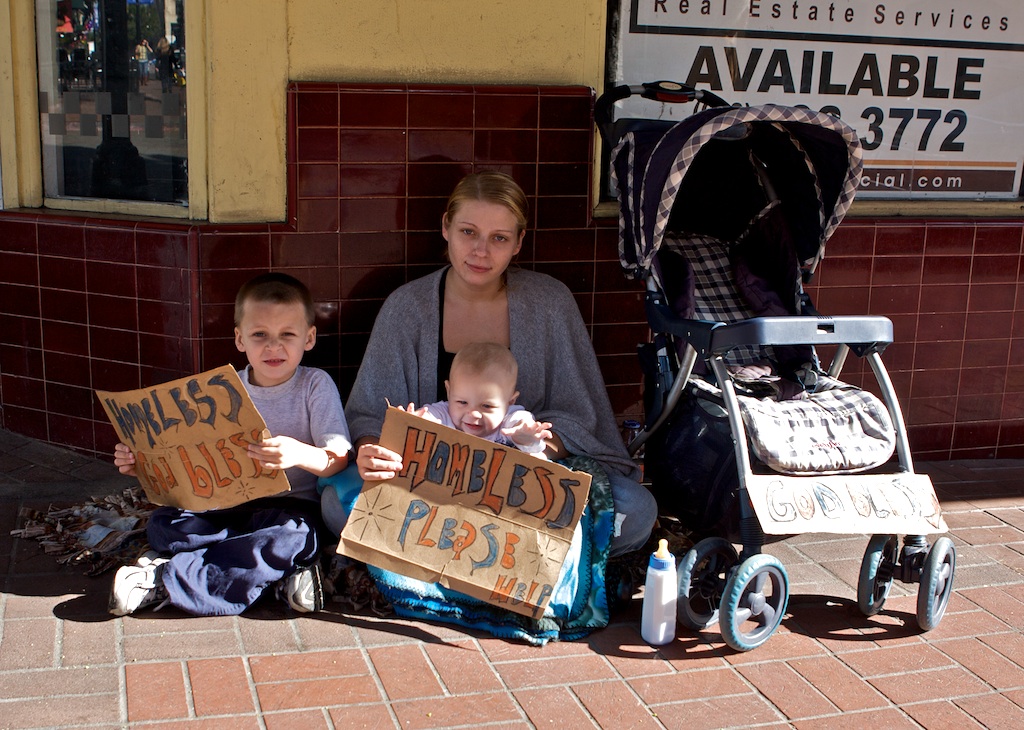
The number of homeless families awaiting shelter space in San Francisco has reached an all-time high, and homeless advocates say city officials are ignoring the problem, which can have disastrous consequences when parents are forced to choose among bad options out of desperation.

Compass Connecting Point, a nonprofit agency with a city contract to provide homeless services and outreach, reports that 227 families – including 342 children – are now on a waiting list for temporary housing, with waits of at least six months. That’s 13 more families than the previous peak during the height of the recession in 2009.

“We’re seeing an increase in families coming in for the first time,” Elizabeth Ancker, an assistant program manager for the agency, told us. “There is definitely not enough shelter space.”

That’s been a complaint from a variety of homeless individuals and advocates who note that the city has reduced the number of shelter beds due to budget cuts at a time when they are needed more than ever. And a fall ballot measure that would have freed up shelter beds that have been set aside for Care Not Cash recipients and other mayoral pet projects was removed from the November ballot under pressure from Mayor Ed Lee.

“A couple weeks ago, it was the largest number [of homeless families on shelter waiting lists] since the recession first hit, and now it’s just the largest number overall,” Jennifer Friedenbach, executive director of the Coalition on Homelessness, told us. “We’re really concerned and we’re particularly concerned that there has not been any kind of response from the city…The most eerie part is the absolute silence from Room 200.”

Indeed, even the Guardian’s repeated requests for comment from the office of Mayor Ed Lee (aka Room 200) have not yielded any answers or explanations. Friedenbach said Lee’s promise to release more shelter beds from mayoral programs like CNC and the Community Justice Court – where they often go unused despite long shelter waiting lists – have only freed up a few beds, nowhere near the actual demand.

“They’re ignoring the problem,” she said. “What’s happening in San Francisco is a mirror of what’s happening nationally to poor families.”

Some studies place the number of homeless children in the U.S. at 1.5 million, although most advocates believe that number has actually risen in the last two years. Meanwhile, the budgets of nonprofits and government agencies who provide homeless services have been shrinking.

Ancker said her agency – which provides a variety of homeless services and gets partial funding from the city and the U.S. Department of Housing and Urban Development – has actually avoided deep budget cuts in the last two years. “But we have the budget we had when we had 79 families on the waiting list,” she said.

Both she and Friedenbach say homeless families present particular challenges for social service agencies. “What happens with families is they end up being in really unsafe situations,” Friedenbach said. “They’ve forced to stay with people they otherwise wouldn’t, or they end up in their cars, or with children being separated from their parents.”

Ancker agreed: “Right now, the wait for a shelter is six months and increasing, and people can’t wait for six months.”

Get on the bus: St. James Infirmary’s new sex worker PSAs are

3

St. James Infirmary has been providing free, non-judgmental medical and social services for sex workers since 1999. This week, it’ll take the next step. The clinic is putting ads up in Muni buses throughout the city this month meant to educate and inspire Muni riders throughout the city.  

But the campaign, entitled “Someone you know is a sex worker,” won’t be seen on a billboard near you. The ads, which feature actual sex workers, were rejected outright by both Clear Channel and CBS Outdoor before transit ad company Titan 360 agreed to the bus campaign.

You can preview the controversial images — as well as mingle with fabulous people who work for the health and safety of Bay Area sex workers every day — at an exhibit and launch party on Sun/16.

Artist Rachel Schreiber — who created the campaign with photographer Barbara DeGenevieve, and whom the Guardian reached by phone yesterday — thinks advertisers may be hesitant to seem aligned with sex workers rights.

“The anti-trafficking community has such a monopoly on the voice of the issue that I think people are afraid to speak out in another way. People are afraid of being perceived as not supporting that position. Anti-trafficking campaigns are really well funded, often overstated and under researched. Of course we are anti-trafficking and one of our big goals is to fight violence against sex workers”

“There are a lot of people who work in the industry by choice,” she continues. “And everyone deserves access to labor rights and health care and shouldn’t be stigmatized.”

The 27 individuals — sex workers as well as friends and family members of sex workers — who agreed to have their portraits and quotes displayed are taking a risk. It can be dangerous for sex workers to let their identities be known to the public. But Schreiber praised the participants for taking that risk for the good of the sex workers rights movement.

“There are a lot of activists in the community who are willing to go out on a limb…one impressive feature of this community is their support for one another, their willingness to go public to make the topic less secretive and stigmatized,” she says. 

Campaign slogans include “sex work is real work” and “sex workers rights are human rights.” Those are central tenets of the sex worker rights movement, which strives to gain respect and rights for everyone from legal workers like adult film performers and dancers to people who work illegally, including those who exchange sex for survival or sustenance. 

Most sex workers go to great lengths to separate their sex work from the rest of their lives. Schreiber notes a case where a high school teacher in Berkeley was outed, and lost her teaching job as a result. 

“We have a really intense social and cultural taboo against the notion that people trade sex for any kind of money,” says Schreiber. “It’s really deeply ingrained.” She says other, legal occupations, present similar challenges. 

“Agricultural workers, they’re using their bodies and their bodies are in harm’s way. Same with construction workers,” she goes on to say. “Sex work, yes it’s a form of labor that uses the body, but just because it involves sexuality its taboo is blown out of proportion.”


“Someone you know is a sex worker” campaign launch

Sun/16 5-8 p.m., $10 suggested donation

 Intersection for the Arts

925 Mission, SF

www.stjamesinfirmary.org


Telegenic Band Check: The GoldDiggers

2

SFBG videographer Ariel Soto-Suver met up with local alt-country band the GoldDiggers in Golden Gate Park for a live concert at the band stand, and learned about the band’s passions for spelunking and mumblety-peg.

The next week and a half in free bike events

0

“Everything I do for the environment, I do it for my own vanity” remarked a friend of mine while we hoofed it towards a social engagement. I will be the first to tout the glut-shaping powers of the bicycle, but – being as we are still three days away from my payday – I have to tinker with his truism. Everything I do for the environment, I do it for my wallet. That being said, here’s this list of free bike events around the city over the next 10 days.


Pedal Across the Americas send-off

Set to coincide with Hayes Valley Farm’s harvest festival, well wishers can stop by today to say bon voyage to the PAA team, who will be following up its last trek from Ontario to San Francisco with a bike ride all the way from SF to Costa Rica. The riders do it all to raise awareness about sustainability initiatives in the Americas. Hop abroad your cruiser to accompany them at 3 p.m. on a ride out to Ocean Beach. 

Sun/16 1-5 p.m., free

Hayes Valley Farm

450 Laguna, SF

www.hayesvalleyfarm.com


“How Women Rode on Bike to Freedom”

History has it that back when the Outer Sunset was nothing but dunes and people living in repurposed street cars (Carvillehttp://www.sfbg.com/pixel_vision/2010/05/10/carville-black-rock-city-more-history , don’tchaknow), there was a woman’s cycling club out there in the sand drifts. Their techniques for navigating the terrain has been lost in the tides of history, but documentation of women and bikes throughout history is still there. Sue Macy wrote the book on the 1890s connection between bikes and female radicals. It’s called Wheels of Change, and she’ll be sharing her findings at this reading at the Public Bikes HQ.

Mon/17 6-8 p.m., free

Public Bikes headquarters

123 South Park, SF

www.suemacy.com/books


Artcrank

Bike nightlife, bike empowerment, bike fashion – but let’s hear it for bike art, shall we? Fliers for Critical Mass and other group rides have long attracted the skills of talented artist types. Artcrank is a yearly expo of such two-wheeled images. The event began in Minneapolis and has expanded to biking towns across the country: SF, Portland, Des Moines, and St. Louis among other towns. Catch the wonder at 111 Minna, where they’ll be raffling off Chrome bags full of prints. Drinks will be available, because early holiday shopping (yeah I said it) goes better when you’re tipsy.

Fri/21 7 p.m., free

111 Minna, SF

www.artcrank.com


Pedalfest

Handmade bikes, vintage bikes, chances to ride on a velodrome – this all day fest is a great chance to see all the ways people are taking their rides to another level (or sideways, as the case may be). Unique and one-of-a-kind bikes will be on display, not to mention BMX and dirt jump demos, vendors, kid’s stuff, a beer garden, and a stage powered by the generator steeds of Rock the Bike. 

Sat/22 10 a.m.-5 p.m., free

Jack London Square, Oakl.

www.pedalfestjacklondon.com


Hot sexy events: October 12-18

0

What does the future look like for our alternative sexuality community? While the political system borders on redundancy and no one cares about it anymore, perhaps now’s the time to turn our focus inward. Two projects are in the works to look at the interior world of queers – and they both could use a hand from you.

First up, Madison Young and Femina Potens’ “Building Our Own Picket Fences,” a group art show that will turn FP’s new gallery space into a series of experiencial multimedia projects. Young, Midori, Monica Canilao, Mev Luna, Amelia Reiff Hill, and Harrison Bartlett have been selected to depict what their new family traditions look like. 

“As a child I knew I didn’t want to exist within that traditional construct of that white picket fence,” says Young in her Kickstarter video (yep, the project is looking for $5,000). “I want the white picket fence, but I want it my way.”

Wanting it your way is a prerequisite if you’re going to help out filmmaker Danielle Fernández.  Fernández is creating a documentary called In My Room for the Queer Women of Color Media Arts Project, and – shocking, San Francisco! – needs your help in tracking down queers of color to invite her and her crew into their bedroom. Got what it takes? She’s asking interested party to send her a photo of themselves, their room, and a list of three things they do in their bedroom on a regular basis. Find more info here.  

Now, sex events. 


“Bawdy Storytelling: Infomaniac”

Semantics? Maybe, but words have power, baby – the power to entertain and arouse, in this event’s case. This month’s Bawdy features a Good Vibrations strap-on fashion show, and cerebral stories from Carol Queen, transgender comedian Morgan, Mollena, and slutty blogger Fleur De Lis.

Wed/12 8 p.m., $15

The Blue Macaw

2565 Mission, SF

www.bawdystorytelling.com


Jack Davis’ Penis Show

Look at it – Jack Davis’ singular passion, the crocheted penis. Struck by the number of women creating vulva art in his college art classes, Davis has been building the pincushion phalli for decades. View whole walls of them at this art opening in Good Vibes’ back gallery space. 

Thu/13 6-8 p.m., free

Good Vibrations

1620 Polk, SF

www.goodvibes.com


“Exploring the Taboos of Intimate Fun” with Frank Moore

Rub one out at this presentation by shaman-performer Frank Moore. He’s seeking to unlock a state of erotic friction called Lila. Finally, an excuse to dry hump like you mean it. 

Sat/15 8 p.m., sliding scale $5-$25

Center for Sex and Culture

1349 Mission, SF

www.sexandculture.org


Beatpig one-year anniversary

Walter Gomez and Juanita More take their drag-BDSM slutfest into its second year of existence tonight. Break down to More’s beats and knock back $1 shot specials. Even better? Your five bucks of cover go to fund the Transgender Law Center. See, it feels good to feel good – or bad, as the case might be. 

Sat/15 9 p.m.-2 a.m., $5

Powerhouse

1347 Folsom, SF

Facebook: Beatpig One-Year Anniversary


St. James Infirmary ad campaign launch 

The peer-based sex worker clinic is taking a bold move in its quest for justice for those that trade sex for funds. They’ll be placing ads featuring real sex workers on Muni buses all over town – putting them in the public eye and boldly asserting “You know a sexworker” (that’s the campaign’s title). Come eat, drink, and be merry with those involved at this reception. 

Sun/16 5-8 p.m., $10 suggested donation

Intersection for the Arts

925 Mission, SF

www.stjamesinfirmary.org


OccupySF protesters shut down Wells Fargo HQ

30

At 7 a.m. this morning (Wed/12), protesters against corporate greed were poised for one of the most impactful actions since OccupySF began.

About 50 people associated with the Foreclose Wall Street coalition were seated in front of all the entrances to the Wells Fargo corporate headquarters on California and Montgomery streets. Back at the site of the OccupySF camp in front of the Federal Reserve Bank on Market Street, protesters gathered. They held a rally there that included a speech from Sup. John Avalos, the only mayoral candidate to actively support the movement.

When the march started off to join those blockading Wells Fargo, there were about 1,000 protesters present, according to estimates of those present. They stopped off at the Hyatt across the street from the Fed to support Unite Here Local 2 hotel workers who are involved in a boycott against the Hyatt before continuing in the march. Protesters chanted, “make banks pay” and “we are the 99 percent.”

The march reached the Wells Fargo building and began rallying there. The sit-ins in front of entrances were still going strong. There, activist and author Naomi Klein addressed the crowd.

When Wells Fargo employees began to arrive at work. According to Max Bell Alper, one of those involved in the blockade, “a number of bankers were trying to get in and yelling at us.” Then they called the police.

When the police arrived, Alper says, “at first, the people from the march were physically blocking them from arresting us.”

Around 8:30 a.m., 11 were arrested. They were brought to the North Beach/Chinatown police station, were they were cited for trespassing, held for about an hour and then released. When I spoke to Alper, he was back from the police station, chanting and marching with the crowd.

He told me that when his parents’ home was foreclosed this year, they moved in with his uncle, whose home was then foreclosed. Currently his grandmother is facing foreclosure. He listed Chase, Wells Fargo, and Bank of America as the banks involved in his family members’ foreclosures.

“Enough is enough. Banks need to recognize that they need to pay,” said Alper.

Protesters continued to block every entrance besides the employee entrance on Leidesdorff Street with sit-ins, as well as march in picket lines, chant “banks got bailed out, we got sold out”, and cheer as organizers spoke. The bank was unable to open until they chose to leave around noon.

SFPD Lt. Troy Dangerfield said that no more arrests were made because Wells Fargo did not request them- apparently, they preferred to wait it out. Said Dangerfield, “It would make it worse if they had to remove them. It doesn’t look good.”

Dangerfield insisted that he “had no stake whatsoever” in what will result from the Occupy movement throughout the country. He has noticed, “it seems like it’s growing nationwide.”

Activist Lucia Kimble sat helping to block the bank’s California entrance from 7:15 to noon. She says protesters voluntarily left at noon because, “We’ve been out here five hours. We successfully shut down the bank. I think our message has been heard.”

Kimble, 27, is a Bay Area resident and housing counselor with Causa Justa :: Just Cause, a group that works to advocate for housing and tenants rights for low income and African American and Latino communities in San Francisco and Oakland. Kimble said that her group was part of the coalition that put on this event “to give a voice to those most affected by our economic crisis.”

Kimble listed the Foreclose Wall Street West coalition’s demands with this action: an immediate moratorium on foreclosures, fixed annual interest rates, an end to Wells Fargo’s financing of high-interest Pay Day Loans, and that they “pay their fair share – pay taxes and give them to the community.”

Shaw San Liu of the Chinese Progressive Association – which just voted to endorse OccupySF and today joined the movement – was an energetic and inspiring speaker throughout the event. Said Liu: “A lot of folks have been saying there’s no diversity in the Occupy movement…In San Francisco it’s becoming clear the diversity of groups that support this movement. Youth, community groups, anti-war, we’re all coming together”

Liu maintained that the problems she was fighting did not start with the financial collapse in 2008. “In my work in Chinese immigrant communities, I know that even before the recession, we were already suffering from unemployment, low wages, and poor housing. I’m excited to see how the country is waking up to oppose a system that allows 1 percent of the people to control 42 percent of the wealth.”

The California Nurses Association, one of the many labor organizations that have showed support for OccupySF, was present at the protest. Said Pilar Schiavo, 36, a CNA organizer from Oakland, “I’m fed up with social inequity. I’m tired of corporate America buying politicians and passing laws to benefit the rich.”

“Patients are foregoing treatment and losing their healthcare. The nurses are here fighting for everyone,” she said.

Schiavo’s father, Bill, drove from Sonora to be at the protest today. A 65-year-old retired electrician, he says that the medical benefits he felt fortunate to have after retiring from a secure job have become unaffordable. “My medical benefits went up $300 a month this year. Who can afford that? Does anyone get a $300 raise? But Wall Street has benefits galore.”

Schiavo made his opinion clear about the Wall Street crisis and bailouts: “It was unbridled theft. We’re angry.”


Two words Ed Lee doesn’t want to hear

13

There are two words no candidate wants to hear a month before Election Day:

“Criminal investigation.”

I give District Attorney George Gascon credit — I didn’t think he’d ever really go after municipal corruption, but he’s showing at least a bit of political spine here, launching an investigation into the dubious campaign contributions of Ed Lee. Lee’s campaign immediately said there would be full cooperation:

Last week, Mayor Lee’s campaign returned 23 contributions associated with Go Lorrie’s Shuttle company as a result of the campaign’s own concerns and compliance review. On Friday, the campaign reached out to the District Attorney’s Office, the U.S. Attorney’s Office, the Ethics Commission and the Fair Political Practices Commission to offer its full assistance in any investigation or review. It is important to note that there is nothing about the District Attorney’s statement or initiation of an investigation that suggests that Mayor Lee’s campaign is a target.

And at this point, there’s no way to know how far the investigation will go or what it will turn up. But the very fact that the D.A. is looking into all of this looks bad for Lee.

And if Gascon’s office scours not only the Go Lorrie’s money but the rest of Lee’s campaign contributions — and the independent expenditure committees that aren’t supposed to be coordinating with each other or the main campaign — he might find more.

Bill Barnes, who works with the Lee campaign, told me that he was doing everything possible to make sure the contributions were all on the up-and-up. “I can’t control the i.e.’s,” he said, “but we are very careful to follow the law.”

He also said that it’s possible there were mistakes, like the Go Lorrie’s money. “We’re raising a lot of money in a short period of time,” he said.

But you see, that’s part of the problem. You enter the race late, refuse to accept public financing (and abide by spending limits) and start trying to raise more than a million bucks in a few weeks, and it’s too easy to get sloppy. Add in the fact that people like Willie Brown, who never cared much for campaign contribution or ethics laws, are involved in the fundraising, and you have a recipe for real trouble.


Why are Harris, Newsom, and other pols silent on the federal pot crackdown?

24

UPDATED BELOW As I worked on this week’s story about the federal crackdown on California’s marijuana industry, I tried to get a statement from California Attorney General Kamala Harris. After all, it’s her job to defend California’s medical marijuana laws, which she was fairly supportive of as our district attorney. And she was an early Barack Obama backer who could probably get him or U.S. Attorney General Eric Holder on the phone to say, “What the hell are you guys doing? Please, for your own sake and California’s, just back off.”

After all, as I reported, this multi-agency federal crackdown could destroy a thriving industry that is pumping billions of dollars into California’s economy and employing tens of thousands of people – at a cost of many millions of dollars in enforcement costs to simply destroy the state’s top cash crop, ruin the lives of people working in the industry, and strain our already overtaxed court and prison systems.

“It’s a policy with no upsides and all downsides,” Steve DeAngelo of Harborside Health Center correctly told me.

But when I finally got Harris’ Press Secretary Lynda Gledhill on the phone, she said Harris had nothing to say on the issue. “Nothing?” I asked, “Really?” What about off-the-record, I asked, how does she feel about it and might she make some statement in the future. Again, nothing to say, no comment.

So I tried Lieutenant Governor Gavin Newsom, another San Franciscan who as mayor helped oversee the creation of the city’s widely lauded system for regulating the dispensaries, which by all accounts has made it a legitimate and thriving member of the business community. Given Newsom’s current obession with job creation and how hungry he’s been for attention, surely he’d have something to say in defense of the good jobs that this sustainable industry has created in California. Again, nothing. I haven’t even gotten a call back yet from his press secretary, Francisco Castillo.

Also, no public statements have been issued by Mayor Ed Lee, David Chiu, or most other mayoral candidates who have put “jobs” at the center of their agendas – or from the SF Chamber of Commerce or other business groups that regularly deride bad government actions as “job killers – despite this move by the Obama Administration to destroy an important industry in California.

The only major politician from San Francisco (SEE UPDATE BELOW) to come out strongly against the federal crackdown was Assemblymember Tom Ammiano, author of measures to legalize and tax marijuana, who put out the following statement: “I am bitterly disappointed in the Obama Administration for this unwarranted and destructive attack on medical marijuana and patients’ rights to medicine.  Today’s announcement by the Department of Justice means that Obama’s medical marijuana policies are worse than Bush and Clinton.  It’s a tragic return to failed policies that will cost the state millions in tax revenue and harm countless lives. 16 states along with the District of Columbia have passed medical marijuana laws – whatever happened to the promises he made on the campaign trail to not prosecute medical marijuana or the 2009 DOJ memo saying that states with medical marijuana laws would not be prosecuted?  Change we can believe in?  Instead we get more of the same.”

But from most of the politicians who claim to support both jobs and the right of patients to access medical marijuana, we also get more of the same. They pander to people’s economic insecurities in order to give corporations and wealthy what they want – tax cuts, deregulation, union-busting, corporate welfare — but aren’t willing to risk any political capital defending the rest of us.

UPDATE (11/13): San Francisco’s other two representatives in the Legislature have also criticized the crackdown.


Sen. Leland Yee put out a statement saying: “Medical marijuana dispensaries are helping our economy, creating jobs, and most importantly, providing a necessary service for suffering patients. There are real issues and real problems that the US Attorney’s Office should be focused on rather than using their limited resources to prosecute legitimate businesses or newspapers. Like S-Comm, our law enforcement agencies – both state and local – should not assist in this unnecessary action. Shutting down state-authorized dispensaries will cost California billions of dollars and unfairly harm thousands of lives.”

Sen. Mark Leno, another medical marijuana support, also criticized the move. He told the Los Angeles Times, “”The concern here is that the intimidation factor will directly impact safe and affordable access for patients.” And he told Associated Press, “”I don’t understand the politics of it, and certainly if we haven’t learned anything over the past century, it’s that Prohibition does not work.”

The Ed Lee Story: Gack!

4

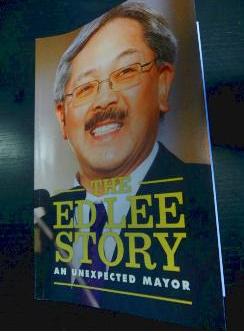
I finally got a copy of The Ed Lee Story — a 132-page paperback hagiography written by campaign flak Enrique Pearce — and it’s way, way over the top. I shouldn’t even compare it to the lives of the saints — I read that stuff in Catholic School, and none of it was a sappy, drippy and utterly lacking in perspective as this. The Ed Lee Story reads like what it is — a giant, extended campaign flier, produced by a supposedly independent group backing Lee for mayor.

Willie Brown appears in the first chapter, speaking with “characteristic showmanship and hypnotic charm.” Pearce once worked for Matt Gonzalez — who ran for supervisor as a strong opponent of Brown’s administration and was such a critic of the City Hall corruption that the mayor represented that he didn’t even return Brown’s call congratulating him on winning a seat on the board. But he has either forgotten or utterly sanitized that era.

Rose Pak appears a page later, described as a “community leader and Ed’s longtime friend,” which is one way of putting it.

I haven’t been able to reach Pearce; if he calls me I’ll update this post. But in other news accounts, Pearce insists that Lee had no role in the great work — it’s described as an “unauthorized biography,” and Tony Winnicker, the press spokesperson for the official Ed Lee for Mayor campaign, told me his crew had nothing to do with it. Pearce must have gone to great lengths to get all those high school and college photos.

Most of the footnotes cite the San Francisco Examiner and BeyondChron, but Pearce interviewed a number of Lee’s old friends. This was a fair amount of work, including a lot of research.

But here’s the thing: Pearce (who’s had problems with keeping independent campaigns independent in the past) supposedly wrote this book without any help or support from any of the people who are involved in the Lee adminstration or in his campaign. I don’t know, maybe he did. But that’s the problem with these “independent expenditure” committees — it’s hard to believe that there’s truly zero coordination between the various groups that are working to get Lee elected.

The Chron notes at least one indication that it’s not all as independent as it seems:

Pearce said he never spoke with Lee or his family for the book. However, at a golf tournament at the Olympic Club on Monday to benefit the nonprofit Chinese Hospital, Lee’s wife, Anita, beamed as she signed copies.

Plus, he clearly worked with Pak on the book:

Pearce swears all those family photos in the book were gleaned from various websites and family friends. And where did Pearce get Lee’s favorite recipe for “No-longer secret Poongaloong” (basically spaghetti with frozen peas, corn and a half-bottle of Del Monte ketchup thrown in)?

“The recipe was from Rose,” he said. Of course it was.

And we know that Pak meets with the mayor regularly.

Independent expenditure committees have a huge advantage — they can raise unlimited money, in unlimited amounts. In San Francisco, candidates for mayor can only take money in $500 chunks, and can’t accept contributions from corporations or entities that have contracts with the city. The folks who funded this book — and we still don’t know who they are — were under no such regulations.

The trade off is that the “real” campaign — the one financed with regulated money — can’t have any contact at all with the “independent” campaign.

Meantime, Enrique Pearce wrote 132 pages about Ed Lee, complete with childhood anecdotes, pictures, interviews with old friends and testimonial statements — and the mayor’s office and campaign had no input, connection, information, coordination or anything? Geez. Maybe Kitty Kelley’s got some competition.


A decade of DocFest: more reviews!

0

Check out more coverage of the 10th San Francisco Documentary Film Festival in this week’s Guardian.

Beaverbrook (Matthew Callahan, U.S., 2010) If you attended Camp Beaverbrook, which operated in California’s Lake County from 1961-85, this film is required viewing. It offers an intensely wistful look at an old-fashioned sleepaway camp that thrived in an era before insurance companies started frowning on things like helmet-free kids galloping wildly on horseback. If you don’t have Beaverbrook in your blood, however, watching 1979’s Meatballs will offer a similar overdose of nostalgia, plus the huge added bonus of Bill Murray. Sun/16, 5 p.m. and Oct. 18, 7:15 p.m., Roxie; Fri/14, 7:15 p.m., Shattuck.

Heavy Metal Picnic (Jeff Krulik, U.S., 2010) Everyone’s seen Heavy Metal Parking Lot, the 1986 Jeff Krulik and John Heyn short that became a pre-internet cult classic. Shot amid the beer-y, mullet-y, “party-as-a-verb” shenanigans that transpired before a Judas Priest-Dokken show, Parking Lot is a seminal document for metalheads and anthropologists alike. Twenty-five years later, the prolific Krulik, again with Hayn, returns to the subject matter that made him famous with Heavy Metal Picnic, a 666 … er, 66-minute look at an notorious 1985 concert known as “The Full Moon Jamboree” — described as a “heavy metal Woodstock” by the nervous local press at the time. Basically, this is Parking Lot shifted to the Maryland woods; there’s a concert going on in the background (the bigger acts were Pentagram and the Obsessed, but there’s hardly any footage of them; local boys Asylum and show organizer Billy Gordon of Blue Rockers are prominently featured, however) but the main attraction is, as ever, the fans assembled for raucous raging.

Krulik adds depth to the footage shot that weekend (not by him; from what I can tell, he didn’t actually attend) by tracking down various participants — from the show’s perma-grinning hosts to the members of Asylum to the ne’er-do-wells who patrolled the crowds with a video camera, still a novelty at the time, pouncing on pretty girls and eliciting slurred commentary from the assembled shirtless masses — and interviewing the 21st century versions. The film also traipses back to the spot where the party was held, still intact but now closely surrounded by McMansions. Times have changed, hairlines have receded, cut-off T-shirts are no longer fashionable — but the pursuit of establishment-ranking good times remains irresistible. Essential hesher viewing. Sat/15 and Mon/17, 7:15 p.m., Roxie; Oct. 19, 9:30 p.m., Shattuck.

http://www.youtube.com/watch?v=pBdzQxVWnVU

Peep Culture (Sally Blake, Canada, 2011) Sally Blake’s Peep Culture adds one more layer of media to the journey of one Hal Niedzviecki, following him as he agrees (for the documentary) to have cameras installed in his house so he can join the legions of “lifecasters,” everyday folks who believe sharing every detail of their lives will lead to internet-borne fame and possibly fortune. (His wife, who lives in the house too, along with the couple’s young daughter, is less than thrilled by this.) Though his online profile was previously pretty low, Niedzviecki did build up some expertise on the matter: he’s the author of The Peep Diaries: One Man’s Journey into Self-Exposure, Surveillance, and the Future of Voyeurism. But why read the book when you can actually peep at the guy, as he goes about his everyday life (making lunch, sleeping, peeing) on camera?

Fortunately, there’s more to Peep Culture than pee-pee. Niedzviecki also launches an investigation into the movement he’s recently, somewhat reluctantly, become a part of. He visits a few folks who’ve become “famous” due to their online openness, then travels to Hollywood to attend a boot camp for people desperate to get cast on reality TV shows, then checks out the Fox Reality Channel’s headquarters. That channel has since ceased to be, but reality shows are still going strong: hunting the next great American singer or chef, charting the foibles of Teen Moms and Housewives, exposing hoarders of objects and children, manufacturing lavish Kardashian weddings, etc., feeding the belief that absolutely anyone can be famous. (Which is, of course, the most important thing in life ever, aside from getting gloriously rich off that fame … right?) Though Niedzviecki is not the most compelling film subject ever (probably the biggest reason his online “life” never really takes off — he can’t quite put aside how ridiculous the whole thing is, and never lets totally loose) Peep Culture offers a timely take on the overshare era. Oct. 22 and 26, 7:15 p.m., Roxie; Fri/14, 12:30 p.m., Shattuck.

SAN FRANCISCO DOCUMENTARY FILM FESTIVAL
Oct 14-27, $11
Roxie Theater
3117 16th St, SF
Shattuck Theatre
2230 Shattuck, Berk
www.sfindie.com

The odd twist to the Chron’s Chiu endorsement

18

The most obvious interpretation of the San Francisco Chronicle’s endorsement of David Chiu is that the Chron thinks Chiu has completely left the progressive camp and is now aligned with the political wing the daily paper calls “moderates:”

What is impressive about Chiu is that “change” and “jobs” are not just campaign slogans for him. He can go into detail about the redundancies and red tape at City Hall that are holding back economic development: the 15 departments that regulate the private sector, the hundreds of fees that burden businesses big and small, a payroll tax that is a disincentive to hire … If elected, he would have a mandate to make city government more efficient and effective.

(I don’t know how many times I have to say this, but the payroll tax is NOT a disincentive to hire.)

The Chron — which, on economic issues like taxes and development, is a very conservative paper — clearly thinks Chiu can be trusted, which ought to make progressives nervous.

But here’s the other interesting twist.

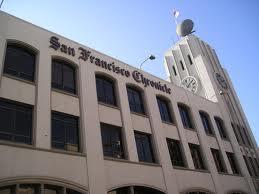
Hearst Corporation bought the San Francisco Chronicle in 2000, at the top of the market, for more than $500 million. I guarantee the paper isn’t worth more than a tiny fraction of that today. It’s still losing money, and has been for years, and nobody’s buying daily newspapers any more, and if Hearst wanted to unload the Chron, the New York publishing chain would be lucky to get $50 million. Hell, they’d be lucky to get $25 million.

So the bean counters in New York have this nonperforming half-billion-dollar asset on their balance sheets, and there’s no way to recover that money — except for one thing: The Chron owns a bunch of land around Fifth and Mission, including its own historic building. And that property is potentially worth a whole lot of money. When the economy picks up, Hearst can develop the parking lots, old press facilities and even its HQ; turn it all into condos and office space, and suddenly there’s a real chance of recouping some of those deep losses.

The process is already underway — the Chron’s been moving tech firms into vacant space in its building, and is working with developers on the shape of what could be a major project still to come.

And guess what? In June, William Randolph Hearst III — heir to part of the Hearst fortune and a member of the Hearst Corp. board — made a rare campaign contribution to a San Francisco political candidate. He gave the maximum allowable $500 to … David Chiu. Around the same time, Michael Cohen and Jesse Blout, the partners in a firm called Strada that’s working on the redevelopment of the Chron’s property, also gave Chiu the maxiumum $500.

I figured the top people at the Chron would back Ed Lee because they figured he’d be down with whatever they wanted to do with that land — particularly since Lee’s good buddy Willie Brown is now a San Francisco Chronicle columnist. But it appears they’ve cast their lot with Chiu. As Mr. Spock would say, fascinating.

Get used: Your retro fix is waiting at the Alameda Point Vintage Fashion Faire

2

That inevitable turn of the seasons is fast approaching. Perhaps you’ve already had one of those moments when, standing in front of your closet, you wonder where all your cable-knit cardigans and berets got too. But no worries – next weekend provides the best indoors opportunity to re-up on retro: the second Alameda Point Vintage Fashion Faire (Sat/22).

But why wait until the hectic fair itself to scope out your crisp weather wardrobe? Three large ballrooms of vintage fashion will be on view at the fair’s preview party the day before (Fri/21) – and if you go, your ticket includes re-admittance to Saturday’s faire. 

The sneak peek will allow you to purchase items early, drink signature cocktails (the event is only open to those of legal drinking age, sorry tykes), and enjoy the smooth live jazz of the Blue Bone Express. This being the Bay Area, there will even be a Halloween costume contest with prizes. 

Something for that treasure chest. Photo by Calibree Photography

With any luck, the fair’s venue is soaked in enough glam history that it’ll rub off on your fashion sense. The Albert H. Dewitt O’Club was built on the Alameda Naval Air Station in 1941, when America was entering World War II – a time during which Uncle Sam wasn’t too keen on luxuries. 

But the O’Club is glamorous – there’s massive front doors and a 40-foot-long canopy that shelters the walkway from the street to the front doors. John F. Kennedy once attended a gala at the club, and Lucille Ball, Henry Fonda, and Van Johnson filmed a scene on the base in the movie Yours, Mine and Ours (1968). 

All in all, the perfect setting for 50 booths of fabulous fashions from the Victorian eras all the way up to the 1980s. Attendees can support the troops at the event by bringing food, DVDs, CDs, toiletries, batteries and phone cards for donation to Operation Care and Comfort.  


Alameda Point Vintage Fashion Faire

Preview party: Fri/21 6 p.m.-9 p.m., $10, 

Fair: Sat/22 10 a.m.-5 p.m., $5 

Albert H. Dewitt O’Club

641 West Red Line, Alameda

(510) 522-7500

www.alamedapointantiquesfaire.com


Live Shots: Prince Rama, Gang Gang Dance at the Independent

0

A few things Prince Rama –  show openers at the Independent last night –  and Gang Gang Dance –  headliners – have in common: a whole lot of rhythm, standing tribal drumming (Gang Gang also has a more Western seated drummer), psychedelic visuals (damn, should have brought those drugs the kids take), and high, reverberating, Bollyhood-recalling vocals.

Sanskrit chanting-synth act Prince Rama, somewhat of a baby-Gang Gang-in-training, had a lesser stage show, but the crowd still dug it. As noted by Taraka and Nimai Larson, their families were in attendance (I peeked a whole lot of them dancing up front and in the balcony) –  wait, are they really sisters? No matter, midway through the set, there was a trust fall, during the song “Trust,” off the band’s newest release Trust Now (Paw Tracks). That’s a whole lot of trust for such a sparse front row. Also on stage: the folded-over visuals producer, mixing warped live feeds of the Larson girls, eerily recalling Grace Slick’s color-saturated turn in Jefferson Airplane’s “White Rabbit.”

Gang Gang had such a strangely unceremoniously beginning, each musician casually making their way to the stage, then slowly grabbing the instruments; with singer-percussionist Lizzi Bougatsos –  wearing an over-sized skeleton vest, winged patterned blouse, and killer heels – holding up a large drum and banging. It did help build momentum, likely the point. Once the thumping bass and beats got going, it was a memorizing set, full of rave-like whimsy and “positive energy” (the floating triangle projected on the screen behind included those words, and vibrated with the rest of the sound). Bougatsos moved effortlessly from standing drums to mic to rhythmic dance-off with peculiar on-stage “spirit guide” Taka Imamura (who spent much of the set maneuvering a plastic bag covered stick). The wicker-tree-hat-dance was an odd moment, but thankfully brief.

Gang Gang played nearly every song off newest release Eye Contact (4AD), and saved the older tracks for the encore. All the while, a figure in one of those Scream masks filmed from the sidelines and drank straight tequila. Clearly, an entertaining night. Though I can’t help but recognize that the areas of the crowd where plumes of smoke rose were likely having the most fun.

Chronicle taps Chiu, opening up the mayoral field

112

David Chiu has snagged the mayoral endorsement of the San Francisco Chronicle, beefing up his fairly paltry list of endorsers and giving his campaign something to trumpet with its hefty cash reserves in the final weeks. Most importantly, the endorsement opens up the race and probably hurts perceived frontrunner Ed Lee.

After the Examiner endorsed Lee as its top pick, it would have solidified the appointed incumbent mayor’s standing as the consensus pick of pro-business centrists – who always have a strong influence in the mayor’s race – if the Chron had also gone that way. But now, both that vote and the Chinese-American vote will be divided, with some of the latter also picked up by Leland Yee, who got the top endorsements of the Labor Council, Sierra Club, and other influential groups.

The Chronicle endorsement probably gives the biggest advantage to Dennis Herrera, who has placed second in most public opinion polls as well as many endorsements, including getting the second place nod in the Guardian, Examiner, Labor Council, Milk Club, San Francisco Democratic Party, and others – an impressive array that covers the full spectrum of San Francisco politics.

Lee, Herrera, and Jeff Adachi also got praised by the Chronicle in a companion editorial entitled “Three other candidates to consider,” and that will also help Adachi with his left-right punch and outsider appeal, making him another candidate who can’t be counted out just yet.

By opening up the mayor’s race and creating a more complicated calculus in the city’s ranked choice voting system, the varied list of endorsements and the dethroning of Lee as a done-deal could also be a boon to John Avalos, the consensus pick of the city’s left who has a long list of first place endorsements (including those of the Guardian, Milk Club, SF Democratic Party, and many others). Avalos could capitalize on the rising frustration with corporate America that is embodied to the Occupy movement, which he has been nearly alone among the mayoral field in actively supporting.

(You can read an Excel file of the endorsements of various San Francisco organizations, which we’ll periodically update, here.)

While the Lee campaign and the many independent expenditure groups that back him are expected to vastly outspend the rest of the field, obscene displays of corporate cash could end up backfiring this year, particularly against the backdrop of OccupySF and the business community’s raid on employee health care funds and deceptive surcharges on restaurant bills, which Chiu and Lee have been supporting.

Bottom line: with four weeks left until Election Day, the mayor’s race is still up for grabs.

One last cannabis fest? Despite IRS ruling, medical community soldiers on

1

Last week, the IRS’ two year audit of Harborside Health Center ended poorly for the medical marijuana industry. The federal government agency decided that the dispensary (Oakland’s largest, as the Bay Citizen reported in its coverage of the craziness — check out our story in today’s paper about the additional threats that have been made) couldn’t deduct standard business expenses, a move that left Harborside in the hole for $2 million and the rest of its industry in need of a joint. 

Such was the setting for the West Coast Cannabis and Music Festival this weekend (Fri/7-Sun/9). Things got a little weird. Which is not to say that things weren’t also good. The 215 legal smoking area was ample proof that medical cannabis is alive and thriving, especially in the here and now. How else to explain the booths hawking aphrodisiac cannabis drinks and medicated vanilla chai truffles? Outside, the fresh-faced and strongly-quadricepped carried forth at the Rock the Bike music stage, its live and DJ offerings projected into the Cow Palace parking lot by a woefully shallow pool of volunteers. The muscle mass we pay for music… 

Even the charming gentlemen at the Harborside booth were all kinds of upbeat, eager to talk about their new Discovery Channel reality TV show. They were handing out copies of their dispensary’s newsletter, the Harborside Illuminator. In it, general manager Andrew DeAngelo’s column, which contained a transcript of a conversation he had with the show’s producer, Chuck Braverman:

DeAngelo: Chuck, I really liked the name Cannabis Confidential — why did they go with Weed Wars?

Braverman: Bigger tent

DeAngelo: What do you mean bigger tent?

Braverman: The title Weed Wars will get more people into the tent to watch the show.

DeAngelo: But we don’t call it ‘weed’ and there is no war.

Of course, some would say there is a war on now. It certainly felt like I was being drafted by Sunday afternoon, when California state senator John Vasconsellos’ time to occupy the speaker’s stage was approaching. A barker alternatively sang and cajoled into the microphone, eventually resorting to bribes. “Anyone who sits down over here will receive a free joint. People, you need to hear this!” Ever obliging, we sat and listened to the woman who introduced the senator. She informed us she was filming the talk, although the final destination of the video was unclear to those of us who had just made her acquaintance. 

“Senator,” she trilled. “Look at all these people here who love you!” You and free marijuana, doll. 

Which is a really snarky thing to say, because we had little to say against the senator’s speech, which was 45 minutes of a call to arms to save patients’ right to access their medicine. And truly, we had to agree with the woman who had repurposed an electric green sleep sack as a dress, but not before cutting out the tits, donning a black mesh garment underneath, affixing a fake weed plant to the crotch area, and boldly Sharpie-ing across the front of it all “Obama can you replace our tax revenue?”

She giggled and posed in front of a strangely perfect WCCMF logo-ed wall when asked by (more than one) photographer if they could digi-capture her. Probably because she knew we all agreed with her, which come to think of it is a big part of these festivals: meeting other stoners that share your concerns. 

Like, does that aphrodisiac stuff really work or what?

Editorial: The Occupy Wall Street platform

6

In New York City, the protesters who started the Occupy Wall Street movement remain camped out in Zuccotti Park. In Washington, DC, President Obama said at an Oct. 6 press conference that he understands the sentiment driving the activists. Yet in San Francisco, Mayor Ed Lee has approved a police crackdown and the confiscation of camping supplies in an effort to debilitate the occupation in front of the Federal Reserve Bank.

The move comes at a time when Lee is doing nothing to crack down on foreclosures that cost the city money, nothing to force the big banks that have the city’s deposits to lend more in the community, and nothing to promote local taxes on the wealthy.

While Lee says he supports the First Amendment rights of the protesters, he sent the cops in at 10:30 at night to confiscate their belongings — using, in part, the sit-lie law (which is only in effect until 11 p.m.)

His approach is just wrong. This city ought to be embracing and supporting the demonstrations. San Francisco makes room for all kinds of public events; this one should be no different. The people at City Hall should be working with the people in the streets to make San Francisco a central part of this growing national movement.

Make no mistake about it: What started as a small-scale, leaderless, somewhat ragtag group in lower Manhattan now has the potential to become a potent political force in this country. Occupy Wall Street has tapped into a deep feeling of frustration that’s shared by people in blue states and red states, in cities and towns and rural communities. The feeble economy impacts almost everyone — and this movement has managed to point the finger at the people who caused the problem, who are preventing solutions and who are making big money off the suffering of others.

We realize that at this point, there’s no specific focus for Occupy Wall Street. The civil rights movement and the anti-war movements of the 1960s and the antinuclear movement of the 1970s, the demonstrations against free trade agreements in the 1990s and the marches against the Iraq War in the past decade included people with hundreds of ideological agendas, but they had a pretty clear message — and, generally speaking, specific actions that government officials could take to address the issues.

Occupy Wall Street hasn’t called for any bills, regulations or policies. It’s still a group that is simply calling attention to a basic truth — the very wealthy in general, and the financial sector in particular, are enjoying economic gains at the expense of the rest of us. But that alone is a profound and potent message — if the demonstrators don’t have all the solutions, at least they’ve identified the problem. And that’s more than Obama, Congress, or the mainstream news media have done.

There’s been plenty of talk of a formal platform — one Occupy Wall Street activist posted a proposed list of 13 demands on the group’s website. It’s not a bad list (a guaranteed living wage, single-payer health care, free college education, debt forgiveness, a racial and gender equal rights amendment) with a few somewhat random elements (outlaw all credit agencies). Fox news has picked up the list, although the organization, such as it is, has made it clear that there is no consensus on any platform and agenda. And the labor unions that are joining the protests — with the proper respect for the folks who started things — have legislation in mind (a financial transaction tax, for example).

There’s a danger that the message becomes so diffuse, and imbued with every possible issue that anyone on the left cares about, that it loses the potential to have an impact on the 2012 elections. Occupy Wall Street could go a long way to providing a populist progressive message to counter the Tea Party (which is funded by and largely organized by billionaires but tries to claim grassroots legitimacy).

And there’s no need for a laundry list of agenda items. The focus is right where it ought to be: The richest Americans — and the big financial institutions — have been sucking all the money and energy out of the economy. The remaining 99 percent are suffering. Tax the top 1 percent and create a robust jobs program to put the rest of the country back to work; that’s a winning platform for 2012.