

“Corporations are people, my friend,” says Mitt Romney on the campaign trail.
Hear him emphasize and embellish the point:
www.youtube.com/watch?v=E2h8ujX6T0A
Guardian graphic by Louis Dunn

“Corporations are people, my friend,” says Mitt Romney on the campaign trail.
Hear him emphasize and embellish the point:
www.youtube.com/watch?v=E2h8ujX6T0A
Guardian graphic by Louis Dunn

I managed to fit a helluvalotuv parties in this week’s Super Ego column — but since nightlife is proving to be completely recession-proof, of course there are many more I must list here. And they are good ones! Plus some news about old favorites: check out the scoop.
>>BALLIN’ AGAIN Let’s start with a big ball, why not: The announcement came yesterday via this amazing video, directed by Dirty Glitter and playing cheekily off this, about classic soul party Hard French’s highly anticipated Winter Ball, taking place on Feb. 4 near the Santa Cruz boardwalk — and already there are like 100 entries for king and/or queen:
>>222 NEWS One of my favorite clubs in the city, 222 Hyde, has been closed for a wee bit (since early December) in order to remodel. Reopening was said to be scheduled for earlier this month, but no go yet. A number of people, including moi, are straining at the bit to get back on 222’s underground dance floor. I wrote to owner (and friend) Emilio to ask what was up, and got this reply:
“Hi Marke! Thanks for getting in touch. Its nice to hear that people are interested in what’s going on at the club! We’re still getting the work done, doing it myself with the building owner. Taking a little longer than expected, as it usually is with stuff like this. Looking at two weeks out maybe before a soft opening, and a few weeks after that for the grand reopening. We will have another fire exit, so higher capacity, bar and coat check on the dancefloor (back left corner), added a lounge style hangout room, and outdoor smoking area (so folks wont have to go out front). Newly tuned soundsystem, cdj2000s, and the most impressive addition will be on the dancefloor and will be unique in sf (more on this soon 🙂 [:-)] So we are very excited to show everyone what we’ve been up to making 222 even better! I’ll keep you updated and would love to give a tour once its all done.”
I’ll pass on the details to y’all — but sounds pretty spectacular …
>>RITUAL ONE-YEAR ANNIVERSARY
The raging — yet brain-tickling — dubstep weekly from the Irie Cartel, amazingly the city’s first, just celebrated one year of residence at Temple Nightclub 9the party itself turns two in May). Ritual’s still going strong, this week with special appearances by Tankman, Blackheart, Maneesh the Twister (the killer Surya Dub head is back!) and more at Temple. Irie Cartel member and one of my personal favorite DJs Nebakaneza Dubstep just boosted me this deeper mix — perfect tunes for the low barometric pressure:
Nebakaneza’s Redemption (Deeper Mix For The Headz) by NEBAKANEZA
Thu/19, 10 p.m., $5. temple, 540 Howard, SF. www.templesf.com
>>CRUISING FOR SOME THING
After a triumphant two-year anniversary, weekly dragstravaganza party Some Thing is doing something else special — bringing in bathhouse disco god DJ Bus Station John (of the Tubesteak Connection and Love Will Fix It) to celebrate his 21st birthday for the 30th time. With a twist! he’s picked out special rare disco and funk songs for all the performers to take on — who will be the first to shake their sacrophiliac?
Fri/20, 10 p.m..-3 a.m., $7. The Stud, 399 Ninth St., SF. www.studsf.com
>>ICEBREAKERS BALL
Famed ’90s funky breaks innovator DJ Icey’s sugar rush style will melt this annual affair at Mighty, which brings together some classic SF progressive house and breaks heads for a banging good time. Dress in white — Silent Disco outside.
Sat/21, 10 p.m.-4 a.m., $15-$20. Mighty. 119 Utah, SF. www.mighty119.com
>>SCREATURE
Sacramento expetimental act Screature joins Tint and Hobo Seance (plus resident DJs C.L.A.W.S., Nay Nay, and (Keep It) Keith Slogan at essential monthly new music showcase O.K. Hole.
Sat/21, 9 p.m., $5. Amnesia, 853 Valencia, SF. Facebook invite here.
You want a sense of what’s happened to politics at City Hall? Here you go: the San Francisco Chamber of Commerce is thrilled.
The Chamber just released its 2011 voting scorecard on the Board of Supervisors (which it calls the “Paychecks and Pink Slips Scorecard,” as if most of the stuff the Chamber supports had anything to do with actual job creation), and guess what? The board is more pro-downtown than it has been in a while:
The 2011 year-end scorecard reveals marked improvement in city’s efforts to create jobs and grow the economy. Overall, the Board of Supervisors received a score of 82 percent (equivalent to a B – grade), up from 60 percent (or a D – grade) in 2010. Individual rankings also improved, with five supervisors increasing their scores by at least 15 percent since last year. In 2011, a solid majority of supervisors voted in favor of jobs, the economy and government efficiency more than 75 percent of the time.
The top performer: Sup. Scott Wiener, who voted with the Chamber 88 percent of the time. Second best: Supervisor David Chiu (82%). The worst (or best, depending how you see downtown’s agenda of low taxes, reduced public services and minimual regulations) was Sup. John Avalos, who scored 56%.
The reality is that some of the Chamber’s key votes were relatively noncontroversial things that everone on the board supported — for example, a law sponsored by Sups. Ross Mirkarimi, Eric Mar, David Campos and Wiener making it easier for small cafes and restaurants to host live music and a measure restricting restaurant waste, both of which passed unanimously. There were some votes where nearly everyone opposed the Chamber — the cell phone disclosure requirements and the ban on yellow pages. And on a couple of them, even Chamber darlings Sean Elsbernd and Mark Farrell were on the wrong side — they voted against a tax exclusion for stock options because they wanted even greater tax reductions.
But on the key votes, you can see where the majority of the board lies: Six, sometimes seven votes with downtown, five, sometimes four with the rest of us. Not exactly a progressive majority.
This week’s Guardian cover was illustrated by Eric Drooker. Drooker is best known for creating amazing paintings that have graced many a New Yorker cover and for the fact that he designed the illustrations used in the recent film adaptation of Allen Ginsberg’s HOWL.
The illustrator is also an outspoken supporter of all things OCCUPY. He’s designed several posters for the movement and we were beyond pleased to have him capture our thoughts on how to take back the country. Have a look through some recent illustrations that he’s done for the cause, including one that promotes tomorrow’s Occupy Wall Street West protests…

Diane Ravich, who used to be on the wrong side of school reform but has pretty much come around, was on Forum Jan. 18 talking about education policy. For the most part, she was right on target, explaining that too much of a focus on testing (as a measure of school and teacher accomplishment, not as a diagnostic tool) and too narrow an emphasis on math and reading has damaged public schools.
Neither she nor host Michael Krasny spent much time talking about the bigger problem — money — or the fact that other nations that are eclipsing the United State in education actually tax people and spend that money on schools. California has already cut the number of classroom days, and may cut as much as a week out of the school year. That’s a huge deal, one that’s directly related to the intransigence of a few state legislators who can hold the entire budget hostage — and to the unwillingness of California residents to amend Prop. 13 and allow reasonable property taxes.
But one of the things that struck me was a caller who complained that tenure was making it impossible to fire bad teachers.
Tenure, Ravich noted, is badly misunderstood. At the college level, it’s essentially a lifetime commitment; a college professor gets tenure and he or she understands that, for the most part, it means a career at an institution — with minimal job requirements. Tenured professors teach a few classes, but are free to spend a lot of time on academic research (without any set requirement for success or publication.)
For K-12 teachers, tenure is just a word meaning that they get due process in employment. It’s basically the same as the civil-service rules that San Francisco city employees have — the right to a hearing on discipline and freedom for arbitrary actions on the part of management.
You think it’s hard to fire a teacher? Try firing a cop. The police, who have nothing called “tenure,” have more and broader rights than any other public-sector employees, including the right to have all disciplinary matters kept completely secret. And police officers are armed and given the ability to arrest and even shoot people.
So yeah, let’s blame the inability to fire teachers. That’ll fix the problems.
The Crucible’s “Machine: A Fire Opera” puts a blowtorch on it
First off let’s just all admit that fire is freaking cool. Or, rather, hot. And fire art? That’s about as hot as it gets. ‘Cause it’s art, see, but it’s also fire, and fire is awesome. Unless it’s busy burning down your apartment, then maybe not so much. But we are talking abut fire art right now, and if it’s fire art you want, then the first place you’re going to want to go is West Oakland’s Crucible, one of the most intriguing arts studios in the Bay Area.
With a focus on the industrial arts, The Crucible offers classes in all kinds of crafting, including blacksmithing, stoneworking, jewelry-making, and leather-working. But probably the most memorable pieces to come out of the Crucible are the signature large-scale sculptures and installations with flaming components that dominate its Fire Arts Festivals and stage productions. Currently lighting up the warehouse stage is their latest exploration of fire and art, “Machine,” an opera written by composer Clark Suprynowicz and librettist Mark Streshinsky, which — probably not incidentally — manages to showcase a large spectrum of Crucible-created work.
In fact, not long into the opera, it becomes apparent that the true star of the show may be the multi-level, interactive set, designed by Jean-François Revon, which gives a solid foundation to the abbreviated tale of a man enslaved by a great machine, which in turn sustains an imprisoned goddess. Solid metal scaffolding encloses an army of percussionists as well as the center stage, and the supertitles are displayed on a chunk of detritus emblazoned with the ghostly remnants of an EXIT sign. The rest of the musicians huddle beneath a large platform, above which a bare-chested strongman turns an enormous wheel, while beside them a cage of laser-like beams keeps the Goddess, Brigid (Dawn McCarthy) in her chamber. What appears to be a modified shipping container hulks in the background of the center platform, sliding open occasionally as a portal into memory. A scattered array of monitors display an understated video montage designed by Lucas Benjamin Krech, and the low throb of factory sounds and ambience by Phil Lockwood set the overall tone, sometimes more so than the actual score. Theatre design and industrial arts nerds will find much to praise.
Whether the opera nerds will concur is somewhat debatable, not least because the singers are all miked, and the libretto often seems at odds with the musical composition. But it seems safe to say that they’re probably not the target audience anyhow. Of the performers, the true standout is Eugene Brancoveanu, whose mellow baritone and expressive features serve the staging well, even during moments when the staging fails to serve him. Playing the role of a man awakening from a 10-year-long trance during which he has worked in the machine without memories of himself as a man, he is aided in his quest to escape by one of the only self-aware individuals in the establishment, the controller Sonya (Valentina Osinski), whose Thunderdome dominatrix gear brooks no subordination. Naturally they fall in love, and naturally there are unforeseen consequences for same, but really what’s important to know is that surrounding all the action is fire and fire—especially on a cold winter night—totally rules.
Through January 21
8:30 pm, $45-$65
The Crucible
1260 7th St., Oakl.
www.thecrucible.org

Guardian graphic by Louis Dunn
“Occupy America,” as the Guardian says on the front page in this week’s issue. “Let’s take back the country–starting now. A proposal for the next stage of the Occupy movement.”
Louis Dunn comments on the response of the corporate media to Occupy. B3
Guardian culture editor Caitlin Donohue will be live Tweeting the AVNs this year. For the latest in Lycra and non-judgemental observations, follow her @caitlindonohue
Once a year, the porn industry gathers to honor its own. Cash is dropped on sparkly stripper gowns, breasts are wedged into places that are too small for them, too-little or too-much time is spent on crafting acceptance speeches and: Viagra. Sometimes Flo Rida is there (this year Coolio will captain the official after-party) – but like an enthusiastic blow job, the Adult Video News Awards are always a triumphant good time. This weekend the ceremony and attendant fan expo are at the Hard Rock Hotel in Vegas. The Guardian’s going to be there on the red carpet, obviously – but we thought we’d get you all hot-and-bothered with some sage words from two industry insiders – who happen to be members of the academy to boot.
Your skin flick experts are Chris Thorne and Steve Javors, who graciously submitted to phone interviews with us last week. Thorne is the founding editor of Xcritic.com, a Portland-based website that reviews stacks upon stacks of adult DVDs round-the-calendar. Thorne’s been voting in the awards for two years now, but has been following them “since the Tera Patrick-Jenna Jameson era.”
Javors is the managing editor of AVN Magazine, so he’s not only a voter in the awards, he also decides the nominations. It’s a small porn world, after all. He’s been voting for the awards for five years, our veteran judge. He’s confident that this year’s awards will continue to be the screaming climax of a time they’re always been. “We have a pretty successful formula,” he told us. “I think the challenge is just to top what we did last year.”
On being an AVN voter:
Chris Thorne: It’s punishing. It’s punishing. I don’t think anybody quite realizes the magnitude of the task that is voting in the AVNs. It is by far the most demanding thing you can do in the adult industry. The box of DVDs – we had two stacks of them, both around six feet high. We’re talking about high 800s to a thousand titles. Some titles are nominated for specific scenes, so you’re like okay, I’ve watched that scene, I don’t have to watch the rest of [the movie].
Big winner predictions:
CT: This year’s field is not as clear-cut as it was in years past. There were a lot of really good performances and good films, but in years past it was pretty darn clear that one or two movies would take it and go. Digital Playground’s Pirates and Pirates 2 — when those films came out it was pretty clear that they were above and beyond everything else that was going on. In terms of handicapping it, I think it’s going to be a difficult year.
Steve Javors: I think Bobbi Starr had a spectacular year. She’s been a critics’ favorite for a few years now. She distinguished herself more so this year, she’s one to look out for. Also, the star of Portrait of Call Girl, Jessie Andrews, that movie should do well. With Jessie it’s her wide-eyed innocence that grabs you. She’s naturally beautiful, she’s 19, she looks like a girl form an American Apparel ad. I thinks that’s her appeal. I think this is going to be her star vehicle. She’s so sweet, so accommodating, super-professional.
Dark horse picks:
CT: I am particularly enamored with a company called New Sensations, their Romance series. [Xcritic.com] named one of the films from that series as our top title of the year. That was called Lost and Found. This was an interesting year for porn, it’s adjusted quite a bit for the recession – it’s found in the last couple years that it’s not recession-proof. One of the things it’s done is try to expand its audience. Lost and Found is a romantic comedy with sex. Also, Wicked Picture’s Horizon, Elegant Angel’s Stephen Soderberg-esque Portrait of a Call Girl, and Digital Playground’s Top Guns and Fighters. Vivid did a few notable parodies: Spiderman XXX, Superman XXX, The Incredible Hulk XXX, Wicked’s Rocki Whore Picture Show, that was really good! Sometimes you see something and you’re like, there’s actual filmcraft involved, it’s not just two hours of people fucking with a loose plot attached.
SJ: Brooklyn Lee might be one of those. Last year was her first full year in the business and she came out doing incendiary scenes in Spiderman XXX from Axel Braun and Vivid.
On the best part of the AVN Awards:
CT: In terms of the awards show, it’s gone from cool, to watching-paint-dry-boring, to absolute absurd. You never know if this year it’s going to be a good year or a bad year. My favorite parts are not on the program. Everyone knows each other, especially the performers. Some of them know each other quite intimately. They’re “on” when they’re on the red carpet, but there are some nice moments when they don’t have to be on and performing. Everybody kind of comes together, so there’s this nice opportunity to connect.
On the worst part:
CT: The middle part of the awards show. It starts out really fun and exciting but there are hundreds of awards. Somewhere in the middle there it can feel like there’s no end in site. It’s like, there’s an award for best porn soundtrack? In the big butt category there’s four awards. Sometimes the acceptance speeches are longer than the Academy Awards.
On who was cheated this year out of a nomination:
CT: Y’know, they nominate so many people. There are so many nominations. I think the nominations are extensive enough that they cover their bases. Sometimes there’s 15 nominations in a category.
On the evergreen appeal of DVD porn:
SJ: When people say the DVD market is dying – it’s not what it once was, but going through the list of nominees this year, you can see products that people want to buy. Viewership has moved to the Internet, but there’s tons of stuff that people want to own. Parodies have really propped up the DVD market. It’s unbelievable the quality of the parodies that have come out. It needs to be that way because otherwise you upset the fans. If you read the chat boards and go to Comic Con, see what goes on with the fans that are new audiences to porn – they’ve taken to these parodies in a big way.
On his voting critiera for the Best Double Penetration Scene category:
CT: How we evaluate sex scenes is not necessarily rocket science. Great sex scenes boil down to a couple key critieria. One, chemistry between the performers. It’s like fine wine, you know it when you see it. When two performers like each other — or maybe they don’t like each other but they have real chemistry. Two, you look at presentation – how do the three performers work with each other? Is it exciting to watch? Do you look at it and say wow, that looks painful? When you look at [a sex act] that’s – I don’t want to say on the fringe – you want to see it presented in a way that is exciting, titillating, it fulfills a fantasy that the viewer might have. Third, how is it shot? Are we close up and center on the penetration? Good directors can present scenes in a way where it’s not just that.
On the evolution of the awards:
SJ: it’s really evolved, it’s become this gigantic event. Even if you’re not a fan, everyone and their mother has heard of the AVN Awards. It’s now broadcasted on Showtime, seen by millions of people – they’re still repeating last year’s show. It’s in its 29th year and it’s changed from a smaller ceremony for industry people in a small ballroom in Vegas to this grand spectacle that is certainly on par with the Golden Globes or other Hollywood awards show. Girls spend thousands of dollars on their dresses, Dave Attel is hosting this year. Dave’s a perfect fit for our business. He’s a big fan of the business, he knows all the girls.
Correction: An earlier version of this article identified Rocki Whore Picture Show as a Vivid Entertainment production. It was actually made by Wicked Pictures.

Politically connected club owner Steven Lee will be sworn onto the Entertainment Commission by Board of Supervisors President David Chiu tomorrow night during a party that Lee is throwing for the occasion at The Grand nightclub, but Lee’s appointment is shrouded in some strange political twists and turns.
As we reported last week, the board overruled the Rules Committee recommendation that the appointment go to Castro club owner Tim Eicher, who was supported by Sup. Scott Wiener, a leader on nightlife issues. Instead, the board voted 6-5 to substitute Lee, even though he needed a residency waiver because he lived in San Mateo to care for his sick, elderly father.
It was already a strange move that seemed at least partially prompted by lobbying on Lee’s behalf by Chinatown power brokers Rose Pak and David Ho, both of whom seem to have the run of City Hall these days. It certainly wasn’t Lee’s awkward Dec. 15 testimony to the Rules Committee (watch it here, and note his comment at the 32-minute mark about his goal for the commission being, “I want to come in there and boost the morale.”). As the Examiner’s Melissa Griffin reported last week, Lee also gushed over politically powerful allies (including “Your majesty Rose Pak”) in a Facebook album entitled “My famous friends” that he appears to have since taken down.
Yet as a third-generation San Francisco business owner (he currently runs The Grand, formerly the Glas Kat Supper Club, formerly the Trocadero Transfer), Lee does have relationships with some supervisors that won their support. “I’ve known of his work since I was a student at San Francisco State in the ’80s, when he used to do the dances,” Sup. Eric Mar, who nominated Lee, told the Guardian. “Rose Pak and David Ho had no impact on me in terms of my supporting Steven Lee.”
So Lee got the appointment. But then, the City Attorney’s Office ruled that because the Entertainment Commission is a charter commission, which doesn’t allow for residency waivers, Lee couldn’t be appointed. The appointment was headed back to the board for next week’s agenda, with the recommendation to instead go with Eicher.
Then, despite listing San Mateo as his address on application forms, and testifying about how he needs to care for his ailing father, Lee said that he was a San Francisco resident after all. Contacted by the Guardian, Lee said that he was moving in with a friend of his in Cow Hollow, and that he would commute back-and-forth to care for his father.
“I’m moving back to the city. I have no choice,” Lee said, later adding, “It’s not my first choice, but this commission seat is only for about two and a half years…I was torn. I wanted to stay with my dad.”
So why does Lee want to serve on this commission so badly? And is he really going to establish a permanent residence at his buddy’s house, or are we looking at a potential Ed Jew situation, with that former supervisor’s false claims of living in the city?
Whatever the case, Wiener said the whole thing seems a little fishy, but he’s just going to let it slide. “I don’t want to speculate whether he lives there or doesn’t live there,” Wiener said. “I’m just disappointed by the whole thing.”

It’s described as Hollywood v. Silicon Valley, a battle of powerful giants, the entertainment world against the tech world, and at first, the entertainment world won out — the Stop Online Piracy Act soared through its first Senate hearing and won unanimous committee approval. It sounded so simple — who’s in favor of piracy?
But the tech titans quickly realized what the bill really said and how dangerous it could be; DailyKos said that SOPA and the companion Protect IP Act (PIP) could “end the Internet as we know it” and dubbed The Great Firewall. So today a lot of major sites are going dark (or launching other protests) to fight the bills — and it’s making an impact.
The Obama administration now says the bills go too far, and it’s possible that neither will ever emerge from Congress.
More than 200 people gathered at a tech-community rally and press conference in opposition in San Francisco January 18. Framed by protesters holding signs with messages like “Innovate, not legislate” and “SOPA kills jobs,” a long list of tech industry giants testified against the bills, from Craig Newmark of Craigslist to Harvey Anderson of Mozilla to tech industry investor MC Hammer. Many mentioned that the tech industry is the only growing industry in the United States right now, and has created 50% of new jobs in the past three years, and claimed that SOPA and PIPA would halt that “engine of growth” in it’s tracks.
Hammer said that SOPA and PIPA would repress artists’ creativity. Said the former rapper, “When they say that it is to protect rights and content, that may be the surface, but underneath, as you drill down, you see all these other clauses that will put a tremendous burden upon service providers and a whole lot of other people and give the government the ability shut down sites without due process. This is just barbaric in it’s very nature.”
While to a certain extent this is a grassroots rebellion, it’s also part of a concerted campaign funded and run by some of the biggest corporations in the world (Google, Facebook, etc.)
The thing is, there are two groups of big evil corporations fighting over this — but one of them is wrong and one is right. The two Internet bills are terrible — they’ll damage free speech, and they aren’t going to stop piracy.
I called my friend Victor Krummenacher to ask him his thoughts, because Victor — a rock star, bass player for Camper Van Beethoven and someone who has made his living as a musician — is actually impacted by piracy. But he’s not in favor of SOPA:
A lot of music I’ve made has actually been pirated. When we’ve been able to successfully track down the source of the piracy, it’s been from China.
But the truth of the matter, especially in relation to music, is that the Internet has successfully deposed/destroyed scalable economies of manufactured goods (i.e. CDs/LPs etc) and exchanged that for a distribution system that allows for reduced royalty for internet sale and internet radio play (i.e. Pandora) and hard to monitor electronic files that are easy to share. And it’s hard to evaluate peer to peer sharing as piracy, from my point of view.
As an independent artist with hard left leanings, I view this as a way to censor alternative points of view, using failed/outmoded business models as an excuse. Media business has a LOT to contend with in as far as business models. I don’t know the solution to monetization, nor do you, or we would be rich men. But this bill, as it’s written, and as I understand it, only serves to allow the government another route to censor voices at a time when I feel they’re most needed, using corporate income streams as the excuse.
The Internet in spirit, as conceived of (by a bunch of hippies in California, essentially) cannot espouse censorship as a means of financial control. Jaron Lanier in “You Are Not A Gadget” hits on a lot of the morality ideas and questions I have about the “Internets.” But I think innovation in regards to our concepts of commerce, if not in fact about money itself, are where actual solutions lie. The Internet Piracy act has very severe authoritarian undertones that I find disturbing. I think you can coherently argue that something like the Arab Spring could be dissuaded using the Internet Piracy act because uprising is, by nature, bad for business.
Which is an excellent reason to oppose these bills.
I also asked Johnny Calcagno, a musician and tech head and old friend of mine who at one time worked for one of these giant corporations, to weigh in:
I have mixed feelings about the piracy/creativity duality. Ultimately it comes down to common sense. I believe most of what is pirated is from highly successful artists and companies in the entertainment and software industries. I just don’t feel too sorry for them, although maybe the 2% of Bruce Springsteen’s bottom line that is pirated away might have gone to support progressive causes.
Mostly though, I think we have to figure out a way for creative types to make a living, to have health care, and housing that works. For artists, I don’t think piracy is nearly as big a problem as the cost of health care, insurance, housing, and student loans.
It’s also worth pointing out that one would think that between piracy and the information-wants-to-be-free mentality we would be nearing the end times for commercially-oriented creativity, but if anything, there has been of late an explosion in output from musicians, writers, and filmmakers. Some of the same technology that is “ripping off” artists allows (sometimes the same) artists to cheaply and easily get their work before the public.
But still, making a living is a tough row to hoe for even the most talented of artists, and having money sucked out of the creative system and redistributed to Russian mobsters doesn’t exactly seem like it is helping.
Alec Baldwin tweeted today “I support strong anti-piracy laws, but the SOPA bill is typical, latter day US Congress overkill.” That’s farther in the anti-pirate direction than I would go, but I understand the sentiment. And plus, I don’t want him to get mad at me!
Jeez. I’m not following Alec Baldwin on Twitter. But I think you get the point: This isn’t about stopping piracy as much as it is protecting profits. And I suspect most musicians and artists (those who are in the artistic 99 percent) are going to oppose these bills. Because the big Hollywood players don’t really care about the rights of artists — and they never have.

California Gov. Jerry Brown this morning used a big portion of his annual State of the State speech to promote the construction of a high-speed rail system for California – a project that has been under attack by conservatives, as we reported in this week’s paper – chiding those who believe the state can’t do big things anymore.
“Contrary to those declinists, who sing of Texas and bemoan our woes, California is still the land of dreams,” Brown said, a theme that he developed and returned to throughout his speech, calling them “critics who fantasize that California is a failed state.”
Instead, Brown optimistically called for California to take on big projects, singling out high-speed rail, the conversion to sustainable energy sources, and a major water project that will address environmental issues in the Delta and the needs for drinking water and agricultural uses.
But it was the high-speed rail project, for which the Legislature must approve the issuance of bonds this year, that Brown used to make his strongest statement against retreating from big ideas, noting that California can’t simply build enough new freeway and airport expansions to handle a growing population.
“Those who believe that California is in decline will naturally shrink back from such a strenuous undertaking. I understand that feeling but I don’t share it, because I know this state and the spirit of the people who choose to live here,” he said.
And he exhorted Californians to remember the past as they plan for the future: “Critics of the high-speed rail project abound as they often do when something of this magnitude is proposed. During the 1930’s, The Central Valley Water Project was called a ‘fantastic dream’ that ‘will not work.’ The Master Plan for the Interstate Highway System in 1939 was derided as ‘New Deal jitterbug economics.’ In 1966, then Mayor Johnson of Berkeley called BART a ‘billion dollar potential fiasco.’ Similarly, the Panama Canal was for years thought to be impractical and Benjamin Disraeli himself said of the Suez Canal: ‘totally impossible to be carried out.’ The critics were wrong then and they’re wrong now.”

In this week’s Super Ego nightlife column in the paper, I write about this coming weekend’s giant Edwardian Ball at the Regency Ballroom, which spans five events and welcomes thousands into its playful goth-steampunk-burlesque embrace. Named for Edward Gorey but encompassing more than a few winks at the Edwardian Era of the last turn of the century, the all-ages ball has come to act as a summit for a certain essential, instantly recognizable San Francisco nightlife subculture.
The ball was launched in 2000 by Justin Katz of “premiere pagan lounge ensemble” Rosin Coven and Mike Gaines of the neo-cirque Vau de Vire Society, and has grown enormously in the 12 years since — including branching out to Los Angeles. I interviewed the genial Katz over email about the ball’s Gorey origins, the challenges of expansion, combatting the dreaded FOMO, and welcoming a new generation of Friends of Ed.
SFBG Congrats on 12 years of the Edwardian Ball. When you started this, did you think it would take off in this big a way? Can you share a couple of your favorite memories of the Ball since the “turn of the century”?
JUSTIN KATZ Thank you! Each year in the history of this event has been such an adventure, with unpredictability even for us being a constant! Our first year we used a slide projector to show images from a Gorey book. Slides! The second year we did our first interactive theater with the audience, inviting friends to come up and be part of “The Curious Sofa.” Our fifth year was the first with Vau de Vire Society, one of the best decisions Rosin Coven ever made, and I can’t believe the amount of theatre, aerial, and huge open flames that we fit into the back room of the Cat Club. From then on it’s been astounding to see the growth and participation, first the Great American Music Hall, then up to three nights there before waltzing into our current home, The Regency Ballroom.
SFBG You’re extending the festival over six events this year — can you tell me a little about that? Have you ever had this many events, and is this in response to demand?
JK This is definitely our biggest offering to date. The event has developed in so many ways concurrently that there is just too much to see and do during a nighttime event. The Vendor Bazaar (afternoon of Sat/21) has grown into a world of its own and people want more time to shop and mingle amongst the dozens of amazing artisan vendors we now house for the weekend. It gives people a chance to focus without dreaded FOMO — fear of missing out! — with all of the revelry of the Ball afterwards. And this year’s tea with Professor Elemental (also afternoon of Sat/21) is a new one. We are so pleased to have such an excellent artist flying all the way from the UK that it only seemed proper to have a tea party, and give fans a chance to get up close and personal in a more relaxed setting. So it’s about opening up and spreading things out a bit, to enjoy.
http://www.youtube.com/watch?v=0iRTB-FTMdk
SFBG This year’s theme book is the Iron Tonic — will there be specific references to the book, or do you adopt these just as general frameworks to work within? And what are some of the special things you’re looking forward to this year?
JK: Each year Rosin Coven & Vau de Vire Society, co-hosts of The Edwardian Ball, choose a featured Gorey story to bring to life on stage. So this year’s tale is “The Iron Tonic”, which will be presented on Saturday night with original music, staging, choreography, and video as our “big show.” So you will see the story in its entirety. And more, actually, because Vau de Vire always goes to the next level in creating the story – showing you what Gorey doesn’t. One of the most intriguing things about Gorey’s work is that he shows you so little, and implies so much. Vau de Vire plays with character, back story, scenes between the scenes, and really draws you in. Rosin Coven works closely with them developing this and creating the music and narrative that drives and showcases all of the amazing theatrics.
http://www.youtube.com/watch?v=6qgIGKobTe4
Another addition to this year’s event that I just can’t wait to see is our new Museum of Wonders – we’ve added an entire third floor of The Regency to the event, a dense, dark playground of eccentric collections, unusual artifacts, circus sideshows, mechanical dolls that sing you songs, fortune telling, tarot reading, a haunted pipe organ, and a living statue garden by Vau de Vire performing more Gorey stories. We’ve taken the wonderful art that has filled our ballroom and given it its own home, a whole new world to wander during the event, and a place to get away from the crowds for a different experience. This also allows us to open the Ballroom up even more for dancing and enjoying the show – more space to tango!
SFBG I’m fascinated by the general culture that’s coalesced in the past decade or so around the Edwardian Ball — it’s such a San Francisco signature style incorporating burlesque revivalism, playful goth, circus and steampunk, various aspects of Victoriana and Edwardiana. You guys seem to be the major exponents of this certain culture. Have you had any thoughts about it as you’ve seen it develop? What changes or developments have you seen in the Edwardian Ball culture through the years that you’re proud of or that have really made you think?
JK It’s an honor to be recognized as an influence on San Francisco’s style and trends, I’ve always seen us almost more of a great receiver of ideas and influences. We provide a creative, permissive space for people to inspire each other and cross-pollinate. By creating a mood but not strict rules, people have developed their own interpretations and styles over the years, the sum total of which become “Edwardian.” We initially used the name Edwardian just to dress up Edward Gorey, but its been fascinating to see people develop the historic elements of the event on their own. Steampunk is an interesting one too – when we started that word didn’t even exist. We’ve never self-promoted as a “steampunk” event, any more than we would be a “period recreation” event, but we’ve enjoyed the dovetailing of the trend and it’s expansion into more elaborate costume and character. I’ve enjoyed seeing people take Gorey’s work and meld it into their own creations too – characters and monsters and oddities from the pages of his books have been found in the most wonderful corners of the events.
http://www.youtube.com/watch?v=IjjDt2_oKyU
SFBG How has the Los Angeles Ball been going and do you plan to expand further?
JK Los Angeles has been inspiring and challenging. Our first year was gorgeous, held in the mostly-defunct, run down Tower Theater in Downtown LA. It was moody and intriguing, and difficult from a production standpoint. So last year we moved to The Music Box, which is such a great venue. We had a little hiccup when the venue double-booked the night and bumped our date, and we had to push it back a month. But this year The Music Box outdid themselves and shut down a week ago, out of business, so we’re hard at work on finding a new home and date in time to announce at the SF event. LA is just good at tossing us curveballs – but aside from the nuts and bolts we have a wonderful time down there and are inspired and impressed by how ready the crowd is to step up, dress up, and immerse themselves in the Edwardian world. I see no reason not to keep expanding the reach of this event: New York, Seattle, New Orleans, there are so many places that the Edwardian Ball could pay a delightful visit.
http://www.youtube.com/watch?v=D3ISx6UaKw0
SFBG You welcome all ages to the Ball. Do you find that, as steampunk and burlesque enter the mainstream consciousness more, that more younger people are drawn to the culture that the Ball represents?
JK I think that’s a good assessment. I think we’re seeing a couple of groups of younger people – there are those that are drawn to live music, circus, and performance, and this gives them a place to go when most shows are 18+. It’s such a well-behaved crowd – playful but respectful – that we feel good about including all ages and creating a safe space for young people. Their presence adds a really vital energy, and I think affirms that we are creating something that can continue on, it’s not just for the producers and their own social circles. New, young ideas can and will influence where this event goes.
Also, some of the longtime fans are getting older and having children themselves, and starting to bring them to see this unique world. We’re starting to see the “Under-10” crowd show up for the first few hours – they watch the show, climb aboard a bike-powered carnival ride, play midway games with clowns, pose for photos, and head back to school for an unbelievable round of show-and-tell.
Fri/20: Edwardian World’s Faire Kinetic Steam Works, Cyclecide, Vau de Vire, games, and more
Sat/21: Edwardian Ball 2012 “The Iron Tonic” with Jill Tracy, The Fossettes, Miz Margo, and more
Both at Regency Ballroom, 1300 Van Ness, SF. All ages, see www.edwardianball.com for prices, times, and more events.
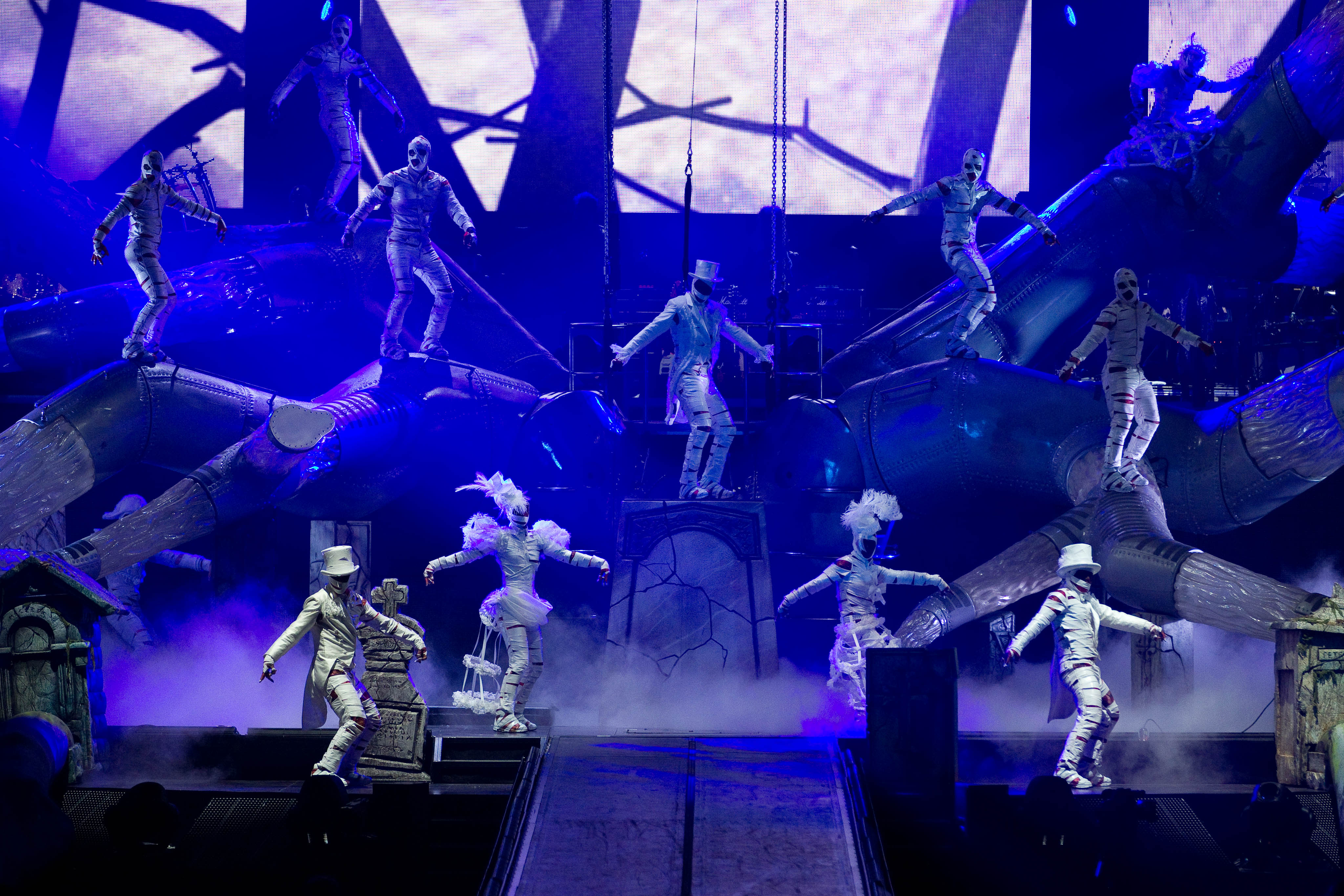
I consider myself a casual Michael Jackson fan; I’ve long owned worn vinyl copies of Thriller and Off the Wall, and have fuzzy memories of attempting — painfully — to learn the dance moves in the videos for “Beat It” and “Scream” (oddly, a personal favorite). But I know I will never fully appreciate what Michael did for his fans, how much he obviously meant to the costumed group sitting in front of me at the Oracle Arena in Oakland on Tuesday evening during Cirque du Soleil’s thrilling new production, Michael Jackson: The Immortal World Tour. But I was there for the spectacle of it all, and spectacle I got.
It began with a whimper, as I suspect most Cirque du Soleil productions do, to impress with the thundering glittery expanse soon thereafter and to later highlight the true magnitude of the event. Start small, end gigantic. Tumbling on to the rounded area of the stage at the center of the arena, a few young Michaels in bright bell-bottoms and ‘fros stumbled around in a clowny dance routine. Drop the curtain, flash the lights, and shoot the pyrotechnics into electric showers of flickering white; and the stylized beauty of the production was on its way.
There were dozens of costume changes, impressive backdrops, and a few totems of MJ (hearts, globes, a giant hot air balloon). The physical humming, lit-up red heart was a constant throughout the night, with dancers holding up flashing hearts during big important moments. Michael’s “Heal the World” sentiment was also a recurring theme; bulbous globes appeared in both dancers’ paws and hovering above, raised into the Oracle’s huge space, as contortionist acrobats spun on spindly hoops. Near the end dancers came marching out holding gigantic national flags. Throughout the evening there were taut bodies wearing light-up costumes – the bodysuits sometimes shone harsh and bright with severe neon curve-defining lines a la Tron, other times twinkled with sparkling stars during heartfelt numbers — those moments occasionally nearing schmaltzy.
Each number popped with Michaelian (Jacksonian?) intensity, be it by force or remembrance. From the bold, stomping silver heart-shaped military marching during “They Don’t Really Care About Us” to the sweet, earthy white-draped mid-air tumbling during the more somber songs. I suspect those more subdued, tender parts — “You Are Not Alone” et al. — were for the true, obsessed fans in the audience, of which there were many. They were for those who miss him dearly, eternally, and came out dressed in bright red military garb, a solitary sequin glove, liquid black eyeliner, and delicate Michael-style curls plastered to the nape of the neck (again I’m talking about the crew near me). I felt the devotion and melancholy of the impersonator in Harmony Korine’s Mr. Lonely. It was luck that I got to be so near these fans, I felt their heat, and I danced when they danced.
http://www.youtube.com/watch?v=VPP9wVmxtVk
I much enjoyed the clock-cranking steampunk dance number with brassy robots pulling dancers, tapdancers atop pedestals, and high-flying acrobats flipping over machines. “Thriller” was also properly awesome, a smoky graveyard filled with mummy-like zombies wrapped in sexy gauze. There were song montages, classic choreography, and videos throughout, along with a man-sized sequined glove dancing, a pair of giant loafers, and plenty of actual Michael clips and quotes.
The musicians on stage brought a sense of the present, playing over MJ’s own recordings. With live brass horns, an insanely awesome bikini-clad electric cellist, and a seriously shredding guitarist (along with a full backing band), the show was also very much an arena concert.
Cirque and Michael merged best when a cluster of expert dancers would move seamlessly from classic choreography to high-flying acrobat, shot to the roof on pulleys and chords while the live band played below. An expert breakdancer mime in a sequined b-boy cap, the ringmaster also provided a nice bridge between the late King of Pop and the French-Canadian company.
While celebrating Michael in likely the most spectacular way possible, the night also served as a sobering reminder of his untimely passing. I saw many wiping tears from their cheeks. I couldn’t help but feel the same. The touring show is not for just the eternally Michael obsessed (though they’ll be there), it’s for the casual fan as well, those who only pull out Off The Wall when it’s time to dance.

Common knowledge states that if you’re serious about becoming a stand-up comedian on the West Coast, you move to Los Angeles. But Frankie Quinones created the diversity of For the People Comedy here in San Francisco and despite his rising star on the stand-up scene, he’s sticking around for the moment.
Maybe that’s because Carmelita lives here. “She’s taken on a whole thing of her own, her own career,” says the Ventura County native of his sassed-up, club-going Latina sexpot. “Carmelita’s got her own list of things to do in 2012.” You can check out Quinones — and possibly Carmelita or his popular “Cholo Whisperer” skit — at the next For the People event at Cobb’s on Thu/19.
Carmelita was created back in 1996 in Quinones’ high school improv class. She hails from Quinones’ stable of characters inspired by – well, what else – the people he sees on an everyday basis. In Carmelita’s case that’s his female family members, mixed with Quinones’ own mannerisms. “She’s really confident, but not really conceited,” he says.
Her star vehicle was “Eh-So Eh-Spicy,” in which she half-dishes, half-raps about men looking at her tits in line at the store and courts suitors in a San Francisco bar. You’re definitely laughing at her, but somehow, Quinones escapes reducing the brash Carmelita into a stereotype like so many other male comedian’s female alter egos. Carmelita shares set time with a host of Quinones’ other personas, including a hippie character named Sun Diamond whose mannerisms are culled from the patchouli-scented denizens of our fair city.
Quinones is proud of being a Latino comic, part of a tradition that also includes his personal role models Gabriel “Fluffy” Iglesias and Paul Rodriguez, who his parents used to watch on TV when he was young. He often performs at Latino comedy nights in Los Angeles, but in San Francisco — where successful Latino comics are well-known for relocating quickly down south when fame beckons — he’s used to being the only Hispanic name on otherwise all-black and all-white bills.
His comedy often dances along the edge of racial tensions, ultimately resolving them in a feel-good way. In “Cholo Whisperer,” a upper-middle class suburban couple hires an expert to deal with the shanking, 40-drinking gangster (played by Quinones) they’ve adopted after being charmed by their neighbor’s cholo. The cholo whisperer, who walks with a mystic’s bauble-topped scepter but dresses in everyday street wear and a blue bandana, teaches the white husband how to be “the jefe,” a role that mainly involves puffing out his chest and barking short orders.
“Some people think I’m stupid for not moving to LA already,” says Quinones, drinking a Negra Modelo in front of his combination plate on a sidewalk tables at the Valencia Street Puerto Alegre. “But I feel like I’m doing something for the San Francisco comedy scene.” You can check out For the People’s new monthly gig every last Wednesday at SoMa’s Sofa nightclub on Eighth Street and Minna. Quinones crafts the program for these nights with the newbie comedy fan in mind — usually they’ll feature stand-ups from all kinds of backgrounds, even a live DJ for musical interludes.
“I’ve always been that fool in my family, like ah, fucking Frankie,” Quinones laughs. “People in my life are not surprised that I’m a stand-up comedian.”
Maybe that’s why they’ve been so supportive. “I have a good team of homies that believe in this as much as I do,” says Quinones, who says the word of mouth hype his group of friends give him is invaluable in promoting his shows – indeed, a word from a mutual friend was how I heard about his work. “Our brand of comedy is like, this is all of us, together. It’s like, I’m no better than you because I’m on stage. I try to create a family vibe so that when people come in they feel a part of it.”
Just don’t heckle him – that positivity has its limits. “If somebody heckles me that’s the green light,” he laughs forbodingly, for a moment seeming like the snarky comedians we’re used to from network television and BET. That impression doesn’t last long before we’re back to the group experience: “But my goal is to make it funny for everyone.”
For the People Comedy
Thu/19 8 p.m., $15
Cobb’s Comedy Club
915 Columbus, SF
(415) 928-4320

So the Presidio Trust, the only private agency ever to control a national park, is going to make some cuts to meet its goal of complete economic self-sufficiency. But in tall the talk about this, it’s easy to forget that the creation of the trust changed the mandate of the park — and for the first time in the nation’s history, established that a national park is all about making money:
In preparation for an end to federal funding, the trust purposely prioritized projects that would garner the greatest revenue, including residential units and the Letterman Digital Arts Center, said trust spokeswoman Dana Polk.
“We wanted to generate a revenue stream for the park right away,” she said.
Never before in the nation’s history has anything like this happened. Yosemite doesn’t have to generate enough revenue to cover its operating costs. The Grand Canyon doesn’t have to accept real-estate development to pay its park rangers. National parks are something we use tax dollars to support.
Or at least, we used to. Until Rep. Nancy Pelosi came up with the idea of making the Presidio into a money machine.
Along the way, that great pauper George Lucas wound up with a $60 million tax break.
And we wound up with commercial office development and high-end residential uses in a national park.
What an awful precedent.

Localized Appreesh is our weekly thank-you column to the musicians that make the Bay. Each week a band/music-maker with a show, album release, or general good news is highlighted and spotlit. To be considered, contact emilysavage@sfbg.com.
It takes some serious chutzpah to name your band the Fucking Buckaroos. But then, the Fucking Buckaroos is a seriously ballsy act. Eschewing glamour and easy labeling, the playful San Francisco band blazes dusty trails, boasting a noisy, boozy, punkish bluegrass clatter.
The punkabilly act’s newest release (suitably titled The Fucking Buckaroos: II) is said to “make the angriest metalhead a Christian and the soberest dad chug a bottle of Night Train,” whatever that means. See for yourself, the Fucking Buckaroos are offering their new album by donation. Be a gentleperson and pony up for the record, then ride that bucking bronco (49 Van Ness-Mission) down to the Knockout for the riotous album release party this weekend. How many more cowboy references can I fit here? A horse walks into a bar:
Year and location of origin: San Francisco, 2004
Band name origin: Buck Owens had his Buckaroos, so why couldn’t Fuck Owens have his Fucking Buckaroos?
Band motto: Shiniest coat, best of show!
Description of sound in 10 words or less: New-Rage Punkabilly Psychograss
Instrumentation: Mandolin, Banjo, Guitar, Bass, Drums, (in studio: Accordion, Piano, Lapsteel, Tuned 40oz Bottles)
Most recent release: The Fucking Buckaroos: II.
Best part about life as a Bay Area band: Having so many cities to play right at your fingertips.
Worst part about life as a Bay Area band: Not having a combined place to both practice and hang out.
First record/cassette tape/or CD ever purchased: Weird Al Even Worse.
Most recent record/cassette tape/CD/or Mp3 purchased/borrowed from the Web: Ovens “Now It’s Over” 7″
Favorite local eatery and dish: Mission’s Kitchen – Breakfast Burrito.
The Fucking Buckaroos
With Filthy Thieving Bastards, Deadly Gallows
Sat/21, 4-8 p.m., $8
Knockout
3223 Mission, SF
(415) 550-6994
www.theknockoutsf.com
There are no words for this:
http://www.youtube.com/watch?v=vZBY-a4Eqqg&feature=related

Activists held a massive banner and pitched a tent on the roof of the Wells Fargo branch at 16th and Mission Jan 14, while 150 supporters watched from the parking lot. Seven were arrested.
Organizers say the demonstration was meant to draw attention to the bank’s complicity in unfair foreclosures and evictions.
The protest was planned by a coalition of Bay Area housing rights and homelessness advocacy groups, along with organizers from Occupy San Francisco.
Sarah Shortt, Executive Director of the San Francisco Housing Rights Committee, says that abuses by corporate banks are inextricably linked to issues that her group has been working on for years; “evictions, displacement, affordable housing, and tenants rights.”
After rallying at 16th and Mission, protesters looked up to see that six had climbed to the roof. They unfurled a banner reading “Banks: No Foreclosures/Evictions for Profit!”
A fire truck arrived ten minutes later, and put up a ladder to give the police and firefighters access to the roof.
The Police Department cooperated with protesters, assisting a negotiation with the bank branch’s manager. A letter detailing their demands, including a moratorium on foreclosures and an end to predatory and speculative loans, was apparently faxed to Wells Fargo spokeswoman Holly Rockwood.
Protesters said that they would not leave the roof until they had a meeting scheduled with Wells Fargo CEO John Stumpf. Six were arrested.
According to an SFPD statement, “A bank employee signed a private person’s arrest (citizens arrest) for trespassing.”
After those arrested were painstakingly shuttled down the ladder and into a police van, protesters blocked the van from leaving Hoff street between 16th and 17th for about ten minutes until it sped out through the parking lot. Protesters then marched to the nearby Mission Police Station, where a drummer from the Brass Liberation Orchestra, which often accompanies protest events in the city, was arrested for allegedly assaulting a police officer with her drum.
Those arrested on the roof were cited for trespassing and released within hours. Supporters have put up money to release the drummer, known as Montana; bail was set at $8,100.
While the drama on the roof unfolded, Shortt, along with organizers from Causa Justa: Just Cause and the San Francisco Tenants Union, spoke about abuses committed against tenants and homeowners. They also spoke about Wells Fargo’s investment in private prisons.
In a press release, organizers said that the protest was meant to call attention to “predatory equity scams, Ellis Act evictions, and immoral home loans.”
The Ellis Act allows landlords to evict tenants for any reason, if they don’t re-rent the units at a higher price in the next five years. The act hasno restrictions on selling the units as tenancies in common — a backdoor way to create condos — and that’s a lucrative and common practice in the Mission.
Ellis Act evictions increased by 8% in 2011, According to the San Francisco Rent Board Annual Report.
Jose Morales, a tenant who was evicted based on the Ellis Act and activist with the San Francisco Tenants Union, spoke to the crowd Saturday. Said Morales, “I have osteoporosis, I’m 82 and a half years old, but you still see me walking around with my sign.”
He displayed protest signs declaring that housing is a human right and urging single-payer health care.
Mesha Irizarry also told her story to the protesters. Her Bayview home was sold to Bank of New York, then transferred to Bank of America on September 1, but says that she refuses to leave and is fighting the foreclosure.
“We do not play the blame-the-victim game. We are not alone. We are not ashamed to sat ay what has happened to us. We are fighting back, and we are going to win” said Irizarry, who named several other women who are resisting foreclosures in Bayview.
Irizarry began a San Francisco chapter of Occupy the Hood, a group dedicated to confronting problems that disproportionately affect the poor and people of color within the Occupy Movement. In San Francisco, the branch has focused mainly on defending homes from foreclosure and eviction. Saturday’s protest was part of that effort.
This demonstration was also a part of a series targeting banks, that protesters plan to top off with a day-long “occupation of the financial district” January 20th.
Said Occupy SF Housing Coalition media spokesman Gene Doherty, “The banks and the development companies that have gotten us all into (the foreclosure crisis) are a major part of the problem…it is their ethical duty, moral duty right now to be fixing this. And if that means it’s going to eat into their profit, that means it eats into their profit.”
EDITORIAL You want a quick way to cut a huge chunk out of the city’s budget deficit? A way to save essential services without having to put a tax increase before the voters?
Just force the owners of large commercial properties to pay their property taxes.
It’s an open secret in California that the biggest properties are bought and sold under a loophole in the Proposition 13 that prevents city’s from reassessing them. It’s a fairly easy scam, one that almost never happens with lower-priced residential property: Instead of selling, say, a large commercial office building, the owners simply incorporate the building as a limited liability corporation and then sell shares in the LLC. That doesn’t count as a property transfer under Proposition 13, so the building is never reassessed.
That means a building that may have sold for $500 million still pays taxes on an earlier assessment, which is often far, far lower. That loophole alone is costing San Francisco millions of dollars a year, according to Assessor Phil Ting.
The California Tax Reform Association, in a May, 2010 report, notes that many of the biggest mergers, acquisitions, and property sales in the state over the past 30 years have taken place with legal tricks that keep property taxes artificially low.
Assembly Member Tom Ammiano has introduced a bill, AB 448, that would classify any substantive transfer of property, even if it’s done through subsidiaries and corporate shells, as a sale and allow counties to reassess the property. It’s a fairly mild step, far short of a split-roll measure that would treat commercial and residential property differently. In fact, Ting told us, 99 percent of all commercial sales (mostly smaller properties) don’t use the loophole. It’s just (once again) the 1 percent taking advantage of everyone else.
Los Angeles Mayor Antonio Villaraigosa has contacted Ammiano and asked to testify and help pass the bill. But at press time, Ammiano had heard nothing from San Francisco Mayor Ed Lee. (Lee’s spokesperson, Christine Falvey, told us she didn’t think the bill was still alive. It is.)
Lee needs to take a high-profile position in support of this bill — and he needs to encourage every other mayor in the state to do the same. The Board of Supervisors ought to pass a resolution of support — and push the County Supervisors Association of California to make this bill a top priority.
Making even a minor, eminently reasonable change in Prop. 13 is tough, and Ammiano’s best chance is if local elected officials really push for this. It’s crazy that Mayor Lee isn’t leading the way.
Berkeley-based musician Lia Rose enchanted SFBG videographer Ariel Soto-Suver and a handful of others with her beautiful voice during an intimate living room concert in the Castro hills last week.
BY Dick Meister
Dick Meister, former labor editor of the SF Chronicle and KQED-TV, has covered labor and politics for more than a half-century, Contact him through his website, www.dickmeister.com, which includes more than 350 of his columns,
Walter Johnson was everything a labor leader should be – a dedicated, unflinching, champion of working people and their unions. But more than that, Walter was also an unyielding advocate of all those inside and outside the labor movement who wanted – and badly needed – a decent living , or who were in any way oppressed.
Johnson, who died in San Francisco of a heart attack on Jan. 12 at age 87, devoted his life to that noble – yes, noble – task as head of the Department Store and Retail Clerks unions in San Francisco. He also later headed the SF Labor Council for nearly 20 years, from 1985 until his retirement in 2004.
Walter was a genuine humanitarian, a kind, thoughtful man who very much liked and sincerely wanted to help people, who freely acknowledged the contributions of others who joined him in his efforts for social, political and economic justice, who seemed always ready and eager to do what needed to be done.
He was a man of great good humor, an outgoing man who seemed to get along with just about everybody, even some of his toughest adversaries. I know, I know. That surely does sound like pure hyperbole. But, believe me, it’s not, as many others who knew Walter Johnson could tell you.
Listen to Art Pulaski, who heads the California State AFL-CIO. He declared that Johnson “was a big and fearless advocate for everyone and anyone who was wronged, mistreated, put down, left out, pushed aside or just down on their luck. He was fearless because he always followed his faith, his values and his heart.”
Despite the seriousness of his undertakings and his militancy, Johnson was no grim advocate. Whatever the situation, there was always lots of good-natured teasing, and jibes to be traded with friends. And jokes, always jokes – always! Corny, make-you-groan jokes usually, but effective at lessening the tensions that invariably came with the struggles he helped lead.
One look at Johnson’s face made clear his Scandinavian background, a mixture of Norwegian and Swedish. But you wouldn’t necessarily recognize him as a labor leader. He didn’t fit the stereotype. He almost invariably dressed in coat and tie and otherwise looked more like the public image of a business leader, more like management than labor.
Many union leaders spend most of their time in their offices, but Walter was out on the picket lines, or marching or otherwise demonstrating in support of the demands of his union and others, as well as those of other organizations also demanding justice. He was arrested several times for joining in sit-ins and other demonstrations that the authorities wanted to halt. And Johnson kept that up, despite his retirement.
I met Walter thanks to my job as the Chronicle’s labor editor. That was in the early 1960s, a few years after he had arrived in San Francisco from his native North Dakota to work as a Sears appliance salesman.
Dave Selvin, the labor historian and former public information officer for the Labor Council, had told me I should be sure to check out “a young guy” who’d just been elected president of the Department Store Employees. Walter Johnson, of course.
Selvin predicted good things for Johnson, and he was right.
Under Johnson’s leadership, San Francisco store clerks, department store employees and others won labor contacts at least as rewarding as the contracts as those who held similar jobs elsewhere.
Johnson was a key leader in winning strong, virtually unprecedented support for labor from City Hall and the Board of Supervisors – especially from Mayor Joseph Alioto.
Union representatives were appointed to many city commissions, major job creating construction projects were approved, and Alioto stepped in to mediate settlements of major strikes. Picketing strikers could be pretty certain police wouldn’t interfere. New businesses unfriendly to labor found it difficult to get the necessary city permits. Thanks to Johnson and other leaders, labor had gained considerable political clout to go with its considerable economic clout.
Johnson didn’t fear clashing with the AFL-CIO and its other affiliated unions as long as he felt he was right. He was one of the few labor leaders to speak out against the Vietnam War, which was wholeheartedly supported by the AFL-CIO’s national leadership and most of its affiliates.
Johnson was a leader in the growing global union movement that aims to create a powerful international labor federation that would bring the world’s unions close together to deal with “global capitalism” and thus improve the often deplorable conditions of many workers in many countries.
Closer to home, Johnson was one of the first labor leaders to give unconditional support to the LGBT movement. He was an important supporter of proposals to create a gay organization within the labor movement, despite the homophobic nature of most unions at that time. Johnson played a key role in the founding of the LGBT group that became Pride at Work in 2004.
Nancy Wohlforth, the current president of Pride at Work and now an AFL-CIO Executive Council member, had approached Johnson with the idea of such a group in 1979 and was shocked when he readily agreed it was a great idea. Wohlforth was so thankful for his help she dubbed him “an honorary lesbian.”
“Walter was thrilled,” Wohlforth said.
She later was the new business manager of a San Francisco secretarial union that was on strike against a union group that employed its members. Wohlforth noted that Johnson could very easily have avoided being involved, but “he dove right in.”
“He walked the picket line on rainy days and led a toy drive for the strikers during the Christmas holiday. He was, as always, so concerned that workers would know that they were supported at that difficult time.
“Working people’s struggles were always on his mind. I’m sure he dreamed of them every night – and he constantly was coming up with ways to make people’s lives better. He truly was my hero and he will be missed so much by all who were fortunate enough to know him.”
Amen to that.
Dick Meister, former labor editor of the SF Chronicle and KQED-TV, has covered labor and politics for more than a half-century, Contact him through his website, www.dickmeister.com, which includes more than 350 of his columns,
By Dick Meister
Dick Meister, former labor editor of the SF Chronicle and KQED-TV Newsroom, has covered labor and politics for more than a half-century. Contact him through his website, www.dickmeister.com, which includes more than 350 of his columns.
Historians invariably cite the sit-down strikes at the country’s auto plants in the 1930s as a key to the spread of unionization throughout the automobile industry and throughout American industry generally.
The strikes helped establish the United Auto Workers Union – the UAW – as one of the country’s most economically and politically powerful, progressive and influential organizations, and its president, Walter Reuther, as one of the country’s important leaders.
But that was then, when the American automobile industry was virtually unchallenged by foreign automakers. Now U.S. automakers face heavy competition from Asian and German firms, especially from the firms that have opened plants in the United States. The steady growth of the non-union plants has been accompanied by a steady weakening of the UAW. The union’s membership, once in the millions, has declined to 350,000.
There are 14 foreign-owned assembly plants and several dozen parts factories now operating in the American South and Midwest – “transplants,” as the UAW calls the foreign-owned facilities. The transplants have become a major part of the U.S. auto industry, accounting for the industry’s only growth in the past 30 years. They employ about 50,000 workers, and as Jane Slaughter of Labor Notes reports, the workers produced more than 40 percent of all vehicles made in the United States last year.
If the UAW is to regain its power and influence and standing as a cornerstone of the labor movement, it will have to organize the transplants, whose owners are generally as hostile to unions as their American predecessors were in the thirties.
Organizing the transplants could very well be as tough – or tougher – as organizing U.S. plants was eight decades ago. In the thirties, many auto workers were already organized and able to act as a strong unified body to demand union contracts – and get them. But today, the UAW is faced with having to first convince workers to join the union and then make a unified demand for contracts from their staunchly anti-union employers, most of them based in the heavily anti-union South.
As a recent report from Reuters News Service noted, workers in the transplants “have rebuffed the union repeatedly,” in large part because of heavy employer pressures on them, including not-so-veiled threats of moving their plants elsewhere.
The UAW is initially seeking union rights for workers at the facilities owned and operated by the German companies Volkswagen and Daimler. The union sees the German companies as relatively easier targets than the Japanese and South Korean manufacturers who also operate U.S. plants.
Reuters found that the UAW’s failure to organize workers at the foreign-owned facilities has put the union in a financial bind. It has forced the UAW to sell some of its assets and shift money from its fund for financing strikes in order to pay for its operations. That includes trying to organize workers in the foreign-owned plants at the same time that the decline in the union’s membership has greatly lessened its dues income.
Despite its financial problems, the union is planning a worldwide $60 million campaign aimed at pressuring the transplants into agreeing to elections in which their workers could freely vote for or against unionization. The UAW is hoping to get strong support for elections from other unions and its Democratic political allies.
The UAW will also need broad public support, and that may not be easy to get, given the widespread popular opinion that the automobile industry’s problems stem at least in part from the relatively high pay and benefits the union has won from auto makers. The union is trying to overcome that by promising that contracts resulting from the voting would commit the UAW to sharing responsibility with employers for “quality, innovation, flexibility and value.” But if the union concedes what workers perceive as too much, it may lose many potential new members.
The situation facing the United Auto Workers, long one of America’s most important institutions, is indeed drastic – so drastic, says UAW President Bob King, that if the union fails to effectively organize the foreign-owned plants, the union will have no future.
King insists he is not exaggerating. “I have said that repeatedly,” he declared, “and I believe it.”
Dick Meister, former labor editor of the SF Chronicle and KQED-TV Newsroom, has covered labor and politics for more than a half-century. Contact him through his website, www.dickmeister.com, which includes more than 350 of his columns.

Sheriff Ross Mirkarimi has been charged with three misdemeanors in connection with an alleged domestic violence incident against his wife, Eliana Lopez, on New Year’s Eve, District Attorney George Gascón announced this afternoon. Gascón said a restraining order has been issued that bars Mirkarimi from contacting his wife and child and that bail has been set at $35,000, although he was unaware whether Mirkarimi had been booked yet.
Mirkarimi is being charged with one misdemeanor each of domestic violence battery, child endangerment, and dissuading a witness from testifying. Gascón said their young son, Theo, was present during the incident. Lopez has refused to speak with investigators, but she has publicly denied that her husband has ever abused her.
Mirkarimi has maintained his innocence, as he did again with Lopez by his side during a City Hall press conference held simultaneously with Gascón’s press conference at the Hall of Justice. “We believe that these charges are very unfounded and we will fight those charges. I’m confident in the end that we will succeed,” Mirkarimi said, according to the San Francisco Chronicle. It was unclear whether the appearance with Lopez violated the restraining order.
Gascón confirmed press reports that Lopez had communicated via text message about the incident with the neighbor who ultimately contacted police – although he refused to disclose or characterize the contents of the communications – and that there was a photo taken of an injury to Lopez’s arm. He also said there are indications that this was not an isolated incident and the investigation is continuing. “We have heard there have been other instances,” Gascón said.
The fact that the charges were misdemeanors wouldn’t require Mirkarimi’s removal from the office he assumed just last weekend if he’s convicted, but he has already been required to relinquish any weapons, including his service revolver. He faces a year in jail and three years probation on the charges.
“While we do not relish having to bring charges against a San Francisco elected official, I have taken an oath to uphold the laws of the state of California and as the chief law enforcement officer for the city and county of San Francisco it is my solemn duty to bring criminal charges when the evidence supports such action. No one is above the law,” Gascón said. “Whether this was the elected Sheriff or any other San Francisco resident, this type of behavior is inexcusable, criminal, and will be prosecuted.”
Gascón also said that while Lopez has refused to cooperate, he believes there is ample evidence to bring charges. “A case is always stronger if the victim is willing to testify. However, it is very common for victims to be uncooperative in domestic violence cases,” Gascón said, noting that his office filed 771 domestic violence cases last year. He also said, “Regardless of whether the victim supports a prosecution, it is the state’s and my office’s obligation to ensure the safety of the victim.”

Guardian graphic by Louis Dunn
John Tirman, executive director of the Center for International Studies at M.I.T., wrote the best account I’ve seen on what he calls “The Forgotten Wages of War” in an op ed piece on the end of the Iraq War (New York Times 1/3/2012.) The piece inspired Louis Dunn’s graphic comment.
“We rarely question that war cause extensive damage, but our view of America’s wars has been blind to one specific aspect of destruction: the human toll of those who live in war zones,” wrote Tirman. .
“We tune out the voices of the victims and belittle their complaints about the midnight raids, the house-to-house searches, the checkpoints, the drone attacks, the bombs that fall on weddings instead of Al Queda.
“Gen. Tommy R. Franks famously said during the early days of the war in Afghanistan, ‘We don’t do body counts.’ But someone should.”
Timan is author of “The Deaths of Others: The Fate of Civilians in American Wars.”
See Tirman’s full piece:
http://www.nytimes.com/2012/01/04/opinion/the-forgotten-wages-of-war.html