SFBG Blogs

Why the parks bond could lose

13

A general obligation bond to improve San Francisco parks ought to be a slam dunk, particularly when it’s getting pushed by Sup. Scott Wiener, who isn’t exactly a pro-tax kind of guy. The left always votes for these things. Wiener’s lining up the moderates. Proposition B would, in normal circumstances, get 70 percent of the vote.

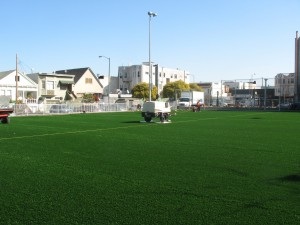
But there’s an awful lot of pent-up anger at the Rec-Park department, and if you want to know why, just check this out. A group of mostly immigrant soccer players, who’ve been using a park in the Mission for pickup games for more than a decade, are now getting kicked out two nights a week — because Rec-Park has turned the place over to a private outfit that charges money to enter the games.

Oh, and you have to register on your smartphone.

So the young white techies who want to play soccer and can afford $7 for a game on parkland our taxes paid for get to play, and the Latino immigrants — who, by the way, were there first — lose out.

You like that? It’s the direction Rec-Park is going under the direction of Phil Ginsburg.

Even the Guardian, which has never opposed a GO bond for anything except prisons, had a lot of trouble with Prop. B. And while Wiener, in a meeting with us, dismissed most of the opposition as marginal, it doesn’t take much to prevent a bond from getting a two-thirds vote. Here’s the question Ginsburg needs to think about:

Would he rather have his park bond — or evict the Haight Ashbury Neighborhood Council recycling center? Would he rather have his $195 million for badly needed capital projects — or privatize recreation facilities? Will he do anything, anything at all, to show some good faith that he’s heard the message from his critics?

Ginsburg and Wiener both support the idea of coming up with a new (tax-based) revenue source for Rec-Park. And we went along with the park bond, reluctantly. But if doesn’t show us any reason to believe there’s hope for the Latino immigrants to play soccer without paying $7, if he isn’t changing his tune at all, he may not get his two-thirds vote Nov. 6. And he’s going to have a hell of a time convincing any of us to give him any more money in the future.


Presenting the Nebraska Wave

0

And so here’s the famous Nebraska Wave, slow and fast, at the Nebraska Stadium on a football Saturday in Lincoln, Nebraska. There is no place like Nebraska. Especially in San Francisco. Watch the video after the jump. b3

Louis Dunn: Would you vote for a Mormon bishop?

4

Louis Dunn, longtime Guardian cartoonist, asks a key question: Would you vote for a Mormon bishop? Click on the art work for a full size image.


Dick Meister: Stalking and killing for sport

1

By Dick Meister

Dick Meister is a San Francisco writer. You can contact him through his website, www.dickmeister.com, which includes more than 350 of his columns

Imagine leading a snarling hound – or a pack of them – to chase a badly frightened bear or bobcat up a tree for you to shoot to death. There are lots of hunters – “sportsmen,” as they’re called – who think that to be great fun.

Boy, are they mad at Gov. Jerry Brown for recently signing a bill that will outlaw the practice in California beginning next year.  As the bill’s author, State Senator Ted Lieu, noted, “There is nothing sporting in shooting an exhausted bear clinging to a tree limb, or a cornered bobcat.”

California legislators thankfully are not the only ones who agree with that. The barbaric practice of using dogs to hunt bears has been banned in two-thirds of the other states. But why not ban it everywhere, along with all other hunters’ cruelties?

Why? Because, say hunting advocates such as Assemblyman Jim Nielsen, that would infringe on hallowed traditions of hunters that date back hundreds of years. Not to mention that it would deprive states of the thousands of dollars they collect for hunting tags. In California, the state’s take amounts to $278,000 a year for bear and bobcat tags alone.

Nielsen said he has received thousands of phone calls and letters protesting Brown’s bill signing.  That, sadly, should be no surprise. Many people, if not most people, seem to approve of stalking and killing our fellow creatures for sport.

Every year, more than 20 million hunters are out searching America’s countryside for winged and four-legged victims. And manufacturers of guns and other hunting equipment, and state fish and game departments, including California’s, are trying hard to increase their incomes by increasing the number of “sportsmen” who are chasing innocent animals. They’re urging more Americans, including youngsters, to go out and kill for sport.

Think especially of the message that’s being delivered to the young. As opponents of hunting have long argued, it tells impressionable youngsters that it’s all right to violently take an innocent life for the fun of it.

Certainly we still kill animals for food. But that is not the same as killing them for amusement. You can argue that killing animals is still necessary for survival, at least unless you’re a vegetarian. But killing them for sport in today’s circumstances is cruel and unnecessary.

In a fully civilized society, the money and energy spent by government agencies and others to promote hunting would instead be devoted to protecting our fellow creatures from human killers, and expanding and protecting their habitats, too many of which are now game preserves open to hunters.

We could at least deny hunters and their bloody practices the respect and approval of society and its leaders that they now enjoy. This is the 21st century, is it not?

Dick Meister is a San Francisco writer. You can contact him through his website, www.dickmeister.com, which includes more than 350 of his columns.


Michele Myers is coming … to slay (slightly NSFW!)

0

Our favorite pretty psychopath, Michele Myers, is back and cruising the bushes (for blood) as she brings a her hilarious horror musical to SF, Oct. 19-31. It’s a mashup of Halloween and other horror flick faves — plus “The Facts of Life”! What the hell could be scarier than that? Don’t go into the closet, Tootie! Here’s Michele in action — and we’ve also fgot the official trailer for the show below. Hi-scarious.


Open doors await on Affordable Housing Day

2

Tomorrow, 10/6 from 1pm-4pm, you can tour several of the city’s affordable housing sites — there’s even a handy citywide bike tour! — and  get an indepth look inside many of the innovative buildings that have recently gone up (or been rehabbed) in San Francisco, helping to house the homeless and make the city an affordable place to live for seniors, families, and people with special needs.

There will be refreshments! And also access to detailed information about the design, finances, and management of the buildings. And if you’re interested in finding out how to apply to live at one of the sites, there’ll be info about that, too. 

For Nosey Parkers like me who just like to go inside buildings and have a good gander, this will be pretty neat. (Also, my husband works in non-profit housing, and I get the backstory on a lot of the great stuff going on at these buildings, but never get to see it all!) And many of the buildings are doing really cool things environmentally and designwise. Complete list of locations and official press release after the jump.

SITE LIST:

Armstrong Place, 3rd Street & Armstrong
Bayview Commons, 4445 3rd Street
Bishop Swing, 275 10th Street
Broadway Family Apartments, 810 Battery Street
CASA, 5199 Mission Street
I Hotel, 868 Kearny Street
Mendelsohn House, 737 Folsom
Mosaica, 2949 19th Street
Notre Dame Plaza, 347 Dolores Street
St. Peters Place, 29th Avenue & Geary Street
The Hayes, 55 Page Street
Westbrook Plaza, 255 7th Street
Zygmunt Arendt House, 850 Broderick

Affordable Housing Day San Francisco to be held on Saturday, October 6
The Council of Community Housing Organizations, the American Institute of Architects San Francisco, and SPUR invite the community to an open house highlighting the benefits of affordable housing in San Francisco.

SAN FRANCISCO ─ As part of a citywide Affordable Housing Day, neighborhood affordable housing organizations throughout San Francisco will open up selected buildings for tours, info sessions and refreshments. Included in the tours will be examples of housing designed for seniors, families and people with special needs. The goal of the citywide day is to provide an opportunity for up close and personal experience with the people and places that make up San Francisco’s affordable housing. Each location will have detailed information about design, finance and management of these housing developments as a sample of the many affordable housing sites across the city. And for individuals interested in obtaining affordable housing, each participating organization will have information about qualifications, the application process, and vacancies.

Fernando Martí, co-director of the Council of Community Housing Organizations which is sponsoring the event, said “These are great examples of housing for everyday San Franciscans, slowing SF’s family flight, so that our children and grandchildren can continue to live in the City they helped build. Affordable housing also preserves the diversity of our neighborhoods, stabilizing communities from gentrification, while improving living conditions.”

There will be building tours throughout the city including the South of Market, Richmond, Mission, Excelsior, Bayview and Western Addition neighborhoods. Participants are welcome to visit all the open house locations, or just stop by the building in their neighborhood. Participating organizations include: Bernal Heights Neighborhood Center, Bridge Housing, Chinatown Community Development Center, Community Housing Partnership, Episcopal Community Services, Mercy Housing, San Francisco Housing Development Corporation, Tenants and Owners Development Corporation, Tenderloin Neighborhood Development Corporation , and The Hayes (55 Page).

“Creating affordable housing helps build our economy, creates jobs in San Francisco and supports families so they can stay, live and succeed in our City,” said San Francisco Mayor Ed Lee. “We must create a permanent source of revenue to fund the production of housing in San Francisco to ensure that seniors, people with disabilities and San Francisco families can continue to call San Francisco home.” Supervisor Christina Olague representing the city’s Western Addition and Hayes Valley neighborhoods where two sites will be open on Affordable Housing Day, said “We are fortunate to have such wonderful examples of affordable housing in my district, it’s a critical part of making diverse and stable neighborhoods.”

Please join us for San Francisco Affordable Housing Day, a free event to be held Saturday, October 6 from 1:00pm – 4:00pm. This is an open house format, so visitors can start at any of the 13 sites.


Zombie dogs! Neeson! Southern-fried jail tales! And more, in this week’s new movies

1

It’s finally Halloweentime! (Though Walgreens would have you believe that season started in August.) Hollywood prepares appropriately with a few spookier picks (for kids, Frankenweenie, reviewed below; for older crowds, found-footage anthology V/H/S, discussed in my interview with some of the filmmakers here.) For good measure, you can check out my interview with Dee Wallace, star of some horror classics but making the press rounds for the 30th anniversary Blu-ray release of E.T. The Extraterrestrial.

Of local interest, the Mill Valley Film Festival is up and running, with some stellar picks noted here (HOLY MOTORS!) and an interview with indie pioneer Allison Anders, who debuts her new Strutter at the fest, here.

And, as always, there’s more. Read on for takes on films like The Paperboy and Taken 2, which each define “trashy entertainment” in their own special ways.

http://www.youtube.com/watch?v=QZtKB_KuASc

Bitter Seeds Just what we all needed: more incontrovertible evidence of the bald-faced evil of Monsanto. This documentary on destitute Indian cotton farmers follows an 18-year-old girl named Manjusha, a budding journalist who investigates the vast numbers of farmer suicides since the introduction (and market stranglehold) of “BT” cotton — which uses the corporation’s proprietary GMO technology — in the region of Vidarbha. Before BT took over in 2004, these cotton farmers relied on cheap heritage seed fertilized only by cow dung, but the largely illiterate population fell prey to Monsanto’s marketing blitz and false claims, purchasing biotech seed that resulted in pesticide reliance, failing crops, and spiraling debt. It’s a truly heartbreaking and infuriating story, but much of the action feels stagy and false. Should Indian formality be blamed? Considering the same fate befell Micha X. Peled’s 2005 documentary China Blue, probably not. Still, eff Monsanto. (1:28) Roxie. (Michelle Devereaux)

http://www.youtube.com/watch?v=qngB0vCmZV4

Frankenweenie Tim Burton’s feature-length Frankenweenie expands his 1984 short of the same name (canned by Disney back in the day for being too scary), and is the first black and white film to receive the 3D IMAX treatment. A stop-motion homage to every monster movie Burton ever loved, Frankenweenie is also a revival of the Frankenstein story cute-ified for kids; it takes the showy elements of Mary Shelley’s novel and morphs them to fit Burton’s hyperbolic aesthetic. Elementary-school science wiz Victor takes his disinterred dog from bull terrier to gentle abomination (when the thirsty Sparky drinks, he shoots water out of the seams holding his body parts together). Victor’s competitor in the school science fair, Edgar E. Gore, finds out about Sparky and ropes in classmates to scrape up their dead pets from the town’s eerily utilized pet cemetery and harness the town’s lightning surplus. The film’s answer to Boris Karloff (lisp intact) resurrects a mummified hamster, while a surrogate for Japanese Godzilla maker Ishiro Honda, revives his pet turtle Shelley (get it?) into Gamera. As these experiments aren’t borne of love, they don’t go as well at Victor’s. If you love Burton, Frankenweenie feels like the at-last presentation of a story he’s been dying to tell for years. If you don’t love him, you might wonder why it took him so long to get it out. When Victor’s science teacher leaves the school, he tells Victor an experiment conducted without love is different from one conducted with it: love, he implies, is a variable. If that’s the variable that separates 2003’s Big Fish (heartbreaking) from 2010’s Alice In Wonderland (atrocious), it’s a large one indeed. The love was there for 29 minutes in 1984, but I can’t say it endures when stretched to 87 minutes 22 years later. (1:27) Presidio. (Sara Vizcarrondo)

http://www.youtube.com/watch?v=LHoxzRt9yBI

The Mystical Laws As The Master gathers Oscar buzz for its Scientology-inspired tale, another movie based on the teachings of a similarly-named religion, Japanese fringe sect Happy Science, opens this weekend. But that analogy is incorrect, for The Mystical Laws way more resembles 2000’s Battlefield Earth, demonstrating and preaching its source material’s tenants rather than questioning them. Visit Happy Science’s website and you’ll find a New Age mix of Christianity and Buddhism, with woo-woo about truth and love. Its founder, Ryuho Okawa, claims to the reincarnation of “El Cantare,” sort of an über-god who controls all spiritual activity on Earth. Anyway, now there’s an anime flick based on one of Okawa’s hundreds of books; it’s about an evil overlord with planet-ruling aspirations who gets smacked down by the powerful combo of aliens, a guy who realizes he’s humanity’s “light of hope” (basically a Jesus-Buddha combo, with psychic powers to boot), and an eight-headed flying dragon. There is Nazi iconography; there are Star Wars-inspired plot points. At one point, the hero preaches directly to the camera. It’s all very heavy-handed. A far more amusing use of your time would be to go to Happy Science’s website and click the tab marked “Astonishing Facts” to learn the spiritual fates of historical figures: “Currently Beethoven lives in the lower area of the Bodhisattva Realm of the 7th dimension in the Spirit world, and aims to transcend the sadness evident in parts of his music and become an expert in the music of joy,” while proponent o’ evolution Darwin “is now serving a penance in Abysmal Hell.” Hey, wait a minute! Isn’t science supposed to be “happy?” (2:00) New People, 1746 Post, SF; www.newpeopleworld.com. (Cheryl Eddy)

http://www.youtube.com/watch?v=lEBknhHTe_I

The Oranges In director Julian Farino’s tale of two families, the Wallings and the Ostroffs are neighbors and close friends living in the affluent New Jersey township of West Orange. We meet David Walling (Hugh Laurie), his wife Paige (Catherine Keener), his best friend Terry Ostroff (Oliver Platt), and Terry’s wife, Carol (Allison Janney), during a period of domestic malaise for both couples — four unhappy people who enjoy spending time together — that is destined to be exponentially magnified over the Thanksgiving and Christmas festivities. We learn much of this in voice-over courtesy of stalled-out 24-year-old design school grad Vanessa (Alia Shawkat), a second-generation Walling whose narrative subjectivity the film makes plain. No one will fault Vanessa for editorializing, however, when her Ostroff counterpart, onetime BFF and present-day nemesis Nina (Leighton Meester), returns home after a five-year absence and, amid maternal pressure to date Vanessa’s visiting brother, Toby (Adam Brody), instead embarks on an affair with their father. The ick factor is large, particularly because it takes a while to keep straight all the spouses, offspring, and houses they belong in. But Farino works to convince us that the romantic spark between David and Nina should be judged on its merits rather than with a gut-level revulsion, a reaction we can leave to the film’s principals. To the extent that this is possible, it’s possible to enjoy The Oranges’ intelligent writing and fine cast, whose sympathetic characters (perhaps excluding Nina, whose heedlessness regarding the feelings of others verges on sociopathic) we wish the best of luck in surviving the holidays. (1:30) (Lynn Rapoport)

The Paperboy Lee Daniels scored big with Precious (2009), but this follow-up is so off-kilter in tone and story it will likely polarize critics and confuse audiences, despite its A-list cast. I happened to enjoy the hell out of this tacky, sweat-drenched, gator-gutting, and generally overwrought adaptation of Peter Dexter’s novel (Dexter and Daniels co-wrote the screenplay); it’s kind of a Wild ThingsThe HelpA Time to Kill mash-up, with the ubiquitous Matthew McConaughey starring as Ward Jansen, a Florida newspaper reporter investigating what he thinks is the wrongful murder conviction of Hillary Van Wetter (a repulsively greasy John Cusack). But the movie’s not really about that. Set in 1969 and narrated by Macy Gray, who plays the veteran housekeeper for the Jansens — a clan that also includes college dropout Jack (Zac Efron) — The Paperboy is neither mystery nor thriller. It’s more of a swamp cocktail, with some odd directorial choices (random split-screen here, random zoom there) that maybe seem like exploitation movie homages. As a Southern floozy turned on by “prison cock” (but not, to his chagrin, by the oft-shirtless Jack), Nicole Kidman turns in her trashiest performance since 1995’s To Die For. (1:46) (Cheryl Eddy)

Taken 2 Surprise hit Taken (2008) was a soap opera produced by French action master Luc Besson and designed for export. The divorced-dad-saves-daughter-from-sex-slavery plot may have nagged at some universal parenting anxieties, but it was a Movie of the Week melodrama made on a major movie budget. Taken 2 begins immediately after the last, with sweet teen Kim (Maggie Grace) talking about normalizing after she was drugged and bought for booty. Papa Neeson sees Kim’s mom (Famke Janssen) losing her grip on husband number two and invites them both to holiday in Istanbul following one of his high-stakes security gigs. When the assistant with the money slinks him a fat envelope, Neeson chuckles at his haul. This is the point when women in the audience choose which Neeson they’re watching: the understated super-provider or the warrior-dad whose sense of duty can meet no match. For family men, this is the breeziest bit of vicarious living available; Neeson’s character is a tireless daddy duelist, a man as diligent as he is organized. (This is guy who screams “Victory loves preparation!”) As head-splitting, disorienting, and generally exhausting as the action direction is, Neeson saves his ex-wife and the show in a stream of unclear shootouts. Taken 2 is best suited for the small screen, but whatever the size, no one can stop an international slave trade (or wolves, or Batman) like 21st century Liam. Swoon. (1:31) (Sara Vizcarrondo)

We don’t feel “tepid” about either Nevius or Davis

40

When we make our endorsements here at the Guardian, we try to be honest with our readers about each candidates’ strengths and weaknesses, allowing you to understand our thinking and to feel free to choose a different candidate if you disagree with our conclusions. After doing dozens of hours of endorsement interviews and research each election, we share as much as we can about what we know, warts and all.

Most San Franciscans understand this, knowing that we have a reputation for often giving even the candidates we endorse a black eye in the process (after all, we’re journalists, not partisans or campaign boosters), but apparently this decades-long practice is news to Chronicle columnist C.W. Nevius. He just wrote a blog post noting our “tepid” top endorsement of Julian Davis for District 5 supervisor.

As usual, this sports-turned-city columnist doesn’t know what he’s talking about – adding this to a whole heap of things that Nevius doesn’t understand but writes about anyway. Perhaps that’s to be expected from a political columnist who describes himself this way on his blog: “Movies, media, sports – and as little politics as possible. Light reading for those who follow the entertaining parts of life, but don’t take them too seriously.”

Well, we at the Guardian do take our politics rather seriously. And as we wrote in our editorial, we care a great deal about who represents the city’s most progressive district: “We hold this truth to be self-evident: District 5 is the heart of progressive San Francisco, the most left-leaning district in the city. The supervisor who represents the Haight, Western Addition, and Inner Sunset has to be a reliable part of the progressive community, someone who can be counted on to vote the right way pretty much 100 percent of the time. That’s what we’ve had since the return of district elections in 2000. ”

Nevius finds fault with our values, quipping, “so much for independent thinking.” Again, he doesn’t seem to understand the nature of representative democracy, particularly in our system of district elections. Voters cast their ballots for the people they think share their values and worldview, and who have the integrity to represent that perspective in the face of economic and political pressure. The “independent thinking” that Nevius values is necessarily unpredictable, unaccountable, and prone to pressure from powerful interests, something we’ve seen too much of in the last two years.

It was important to us that District 5 be represented by someone shares its values, which also happen to be the Guardian’s values, and not the reactionary approach of people like Nevius. We never doubted that Davis shares our values and has the willingness and ability to fight for them.

That isn’t a sign of being tepid, we were simply being honest, just as we were when we wrote that Davis has the “strongest progressive credentials” of any candidate in the race, and our belief that he has “tremendous political potential.” The Guardian and our endorsements can be called many things, but I really don’t think “tepid” is on that list.

The Performant: Drink up, Brunhilde

0

Oktoberfest by the Bay pours it on

In vino veritas, aber in bier auch etwas.

Every year when Oktoberfestzeit rolls around, my thoughts turn nostalgic for liter-sized beers, chewy brezeln, and oompah bands playing “Country Roads.” And that this year’s Berlin and Beyond Film Festival fell smack in the middle of Oktoberfest’s traditional 16-day season only exacerbated the quasi-homesickness that feeds my Teutonic obsessions. Having lived for some time in Munich, and hoisted many a Maßkrug on the Wiesn, I’ve purposefully avoided its San Francisco counterpart, Oktoberfest by the Bay, for years. After all, Munich’s Oktoberfest is the largest beer festival in the world, boasting more than six million visitors a year, an adrenaline-pumping array of roller-coasters, and mountains of Bavarian food to soak up the rivers of beer. Any other city’s regional edition will naturally far short of this admittedly high mark.

But when it comes to beer fests, is it really the size that matters, or just the beers? I figured I owed it to myself to find out.

Unlike the pictures of this year’s Oktoberfest in Munich featuring lots of soggy umbrellas and cloudy skies, Saturday midday at San Francisco’s Pier 48 was sunny and hot, ideal conditions for cold beer and chintzy, costume shop St Pauli girl attire, both of which were in visible abundance. On a small dance floor in the middle of the cavernous warehouse, a group of folk dancers clumsily showed off their Schuhplattler skills to pre-recorded music and a smattering of applause, and the smell of grilled sausages and Underberg wafted temptingly. Patrons in hats shaped like beer steins and aprons printed with big-breasted barmaids mingled with those sporting real leather lederhosen and billowy, low-cut dirndln, as vendors hawked bags of cinnamon almonds, chicken hats, and weirdly inauthentic deep-fried pickles.

“I wonder what Adorno would say about all of this,” my fellow obsessive muttered as we searched the perimeter for the purveyor of liter-sized mugs, sold separately. Clever people had brought their own from home, and cheapskates merely purchased the beer by the pint in disposable plastic cups, but since beer-by-the-liter is really the one unalienable Oktoberfest rite, we went ahead and bought the one for sale, finding out too late that it was plastic. But it did hold a liter of beer, and getting it filled with Spaten Oktoberfest brew was definitely the highlight of our pilgrimage. The copper-colored märzen went down smooth and lightened our mood, as did the appearance of the Internationals, whose oompah renditions of American classics such as “Sweet Caroline,” and yes, “Country Roads” were torn straight from the Wiesn playbook. We amused ourselves further by checking out the German-themed t-shirts of the decidedly American crowd. Our favorite was definitely “I (heart) döner,” followed by one with an image of a St Pauli girl and the directive to “Drink up Bitches”. Not exactly the most enlightened sentiment, but certainly appropriate to the occasion.

Properly fortified the authenticity of the beer and our kulturpessimismus we headed on over to Berlin and Beyond for a special screening of Volker Schlöndorff’s The Tin Drum, the West Coast premiere of the director’s cut, and part of a tribute retrospective of the work of Austrian actor Mario Adorf, who plays the luckless, venal Alfred Matzerath. The downbeat film sobered us up faster than a plate of Schweinshaxe, and fully rounded out our quota of German-ia for another year. Or at least until Weihnachten.


Berkeley Police implement new limits on spying and mutual aid

4

The Berkeley Police Department is undergoing some major policy changes after mounting pressure from the community to enact reforms, with new limits on its participation with other law enforcement agencies.  

“There will be some extra reporting standards required, but procedures have been put in place for us to handle these new requirements,” BPD’s Public Information Officer Jennifer Coats told us, although she did not provide details on how they will be implemented. “This will not affect the high level of service the Berkeley Police Department continues to provide the community.”

Sparked by overzealous police responses to the Occupy movement in neighboring Oakland and UC Berkeley and by the issue of local police agencies working with the FBI to spy on law-abiding citizens, community groups in Berkeley urged city officials to revise policies regarding surveillance, intelligence activities, and police mutual aide.  

Leading the charge was the Coalition for a Safe Berkeley and the ACLU of Northern California.  Both groups attended the Sept. 18th Berkeley City Council meeting where the council voted to modify the city’s policing procedures.

Berkeley police will no longer respond immediately and automatically to mutual aid requests from other police agencies. “The policy change that the council approved said that in a case in which there is not serious or violent crime or destruction of property, that our police will seriously evaluate whether or not to respond,” says Councilmember Jesse Arreguin.  “We won’t automatically respond in cases of civil disobedience or peaceful protest.”

Mutual aid agreements were suspended last year while the city adjusted its policies.

“The Berkeley Police Department has a strong working relationship with other police departments,” writes Coats via email. “We are able to review the need for services on a case by case basis and we look forward to continuing to work closely with other agencies.”

Other revisions include the end of surveillance and intelligence gathering of residents who participate in political activity or express First Amendment rights. Police must also have at least reasonable suspicion in order to submit a Suspicious Activity Report, which will then be reviewed by the City Manager for approval before being made available to other police agencies. 

The council postponed a decision on the issue of immigration jail detainers after the ACLU of Northern California expressed its concerns with the proposed policy. The changes come after a decade of police agencies nationwide upping their law enforcement efforts, particularly in border and coastal states like California where local police often work with federal immigration and customs officers.

“After 9/11, there were a lot of agencies reorganized under the Department of Homeland Security and they all started collaborating in ways they hadn’t before,” says Nadia Kayyali of the Bill of Rights Defense Committee, which consulted with the Coalition for a Safe Berkeley.  “Federal and local collaborations are extending across the country and I have yet to see strong evidence that what they’re doing is making us any safer.”

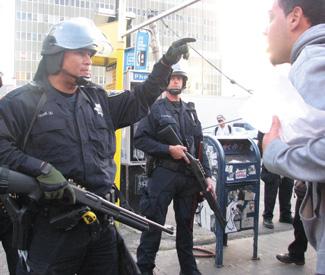
It was almost one year ago that Occupy Oakland made international headlines as clashes between police and protesters turned violent.  The Oct. 25 melee pit police officers from Oakland, Berkeley, and San Francisco against protesters occupying Frank Ogawa Plaza, resulting in serious injuries to protesters.  The mutual aid deployed from Berkeley left many residents livid after watching their police officers assist in using force against peaceful protesters.  

“If you’re involved in something that hurts the rights and security of protesters in a public place, it raises questions of complicity.  We don’t want our police to be used to halt civil liberties,” says George Lippman of the Berkeley Peace and Justice Commission, which was involved in pushing the reforms. “There should be more oversight given to these types of activities of mutual aid when there are First Amendment activities going on.”

Lippman sees increased law enforcement as a growing trend to militarize local communities nationwide, and he points to the armored tank that Berkeley police almost acquired earlier this year as an example. The City Council blocked that effort and it remains unclear why exactly BPD wanted such a bellicose piece of equipment.  

“Fear is always a great substitute for rational thought in American politics,” says Lippman. “It’s also the benefit of those who profit from warfare to have something to base their weapon sales on.”

San Francisco has also taken steps to limit law enforcement practices. In May, the city implemented legislation that will force police officers collaborating with the FBI to adhere to privacy rights as stated in local and state laws.  Although hailed as a step in the right direction, that legislation was watered down after an earlier version was vetoed by Mayor Ed Lee.

On the Om Front: The divine essence of play

1

Yoga can be so serious. Ever look around class while people are doing backbends or pressing their quads to their bones in a standing pose? Wrinkled brows. Flared nostrils. Gripping toes. You’d think we’re all training to go into battle. Not that I have an issue with intensity– in the right amounts and on the right occasions. But if we don’t balance passion, dedication, and hard work with lightness and ease, we may be doing warrior pose but we’re not doing yoga.

So, play. Play means different things to different people. When I was a child, play meant begging my older brother to let me cavort with him and his friends while they played fighting-soldier-shoot-out in the backyard. My brother let me play sometimes, but only if I would take on the secret code name of Mop Top.

That wasn’t the most delightful kind of play.


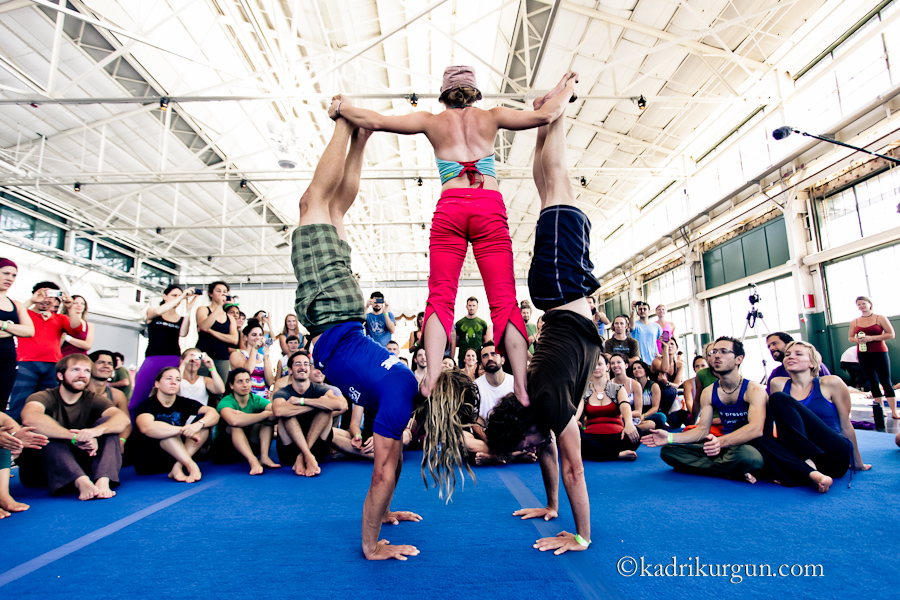
But as an adult, I love to play. Play keeps me connected to the lighter part of who I am. It reminds me not to take myself too seriously (and I often need that reminder). I like to play by doing handstands, Acro Yoga, laughing till the point of internal combustion with an old pal. You know who you are.

There is a word in Sanskrit for play: It’s lila. It relates to yoga and the spiritual path, though its interpretations vary. Lila can be thought of as the play of the universe, in the sense that the whole creation and dance of life is a wild game that was invented by the gods. This is often thought of as Divine Play. (If you’ve ever seen Shakespeare’s A Midsummer Night’s Dream, that’s a delicious commentary on Divine Play.) Lila can also be thought of as the crazy, marvelous, confusing dance between two lovers (or between the male and female energies that reside in all of us).

To live a life of ease, play is necessary. Not the kind of play that lands you in the ER at 5am with someone else’s clothes on after imbibing copious amounts of illicit substances in the backseat of your ex’s car. (That’s called escapism.)  But lighthearted, clean fun that helps you loosen the reins on rigid thinking, and lighten the load when your practice gets too heavy.

Acro Yoga’s Divine Play Festival (coming up next week — details below) is a sweet example of play’s importance in your yoga practice. Organizer Jenny Sauer-Klein told me that, “Play keeps you connected to innocence and wonder. It keeps you fresh. In Acro Yoga, we’re playing to create connection and see the highest and best in each other, to see the divine in each other through the vehicle of play.”

If the whole universe is just an unpredictable giant puppet laser light show dance party, we may as well get on the dance floor. Go forth and play.

——

Around the Bend: Ways to Play

Painting Yantras and Mandalas
Play with spiritual painting. Learn how to create sacred yantras and mandalas with Master Sacred Artist Pieter Weltevrede.
10/5-10/7, $150, Yoga Tree Telegraph, Berk. www.yogatreesf.com

Divine Play Festival
In its third year, the annual Acro Yoga Festival is the pinnacle of ridiculous fun for both acro newbies and old school trees and elves. Flying required—no wings necessary. The Acro Yoga mantra, which I love: “Work honestly. Meditate every day. Meet people without fear. And play.” –Baba Hari Das
10/12-14, $325 for entire event (various prices for other passes), Fort Mason Center, SF. www.acroyoga.org/acroyogafestival

Yoga Rave
Not like a rave rave. Like a yoga rave. Insane dance party minus substances. No booze equals no age restrictions. So bring your baby, bring your grandma, or just bring yourself. Presented by the Art of Living and in conjunction with Divine Play.
10/12, $20-$30, Herbst Pavilion at Fort Mason Center, SF. www.yogarave.org/us

Strong Yogini
Trouble rockin’ those chatturangas or inversions? Not sure how to access your physical (or emotional) core? In this playful, strength-building workshop for women (taught by your truly!), we’ll learn ways to build muscle and confidence through yoga. Come play for the day! 
10/27, $35 by Oct. 20, $40 after, Yoga Garden, SF. www.yogagardensf.com

Slackline Classes with the Yoga Slackers

You haven’t played till you’ve gotten on a rope. Learn to walk it, learn to do yoga on it, learn to fall off it with the fabulous local Yoga Slackers, helmed by Ariel Mihic and Liz Williams.
Various dates in Nov and Dec, free, Sports Basement, SF. freeslacklineclasses.eventbrite.com

Karen Macklin is a yoga teacher and multi-genre writer in San Francisco. She’s been up-dogging her way down the yogic path for over a decade, and is a lifelong lover of the word. To learn more about her teaching schedule and writing life, visit her site at www.karenmacklin.com.

Party Radar: Kafana Balkan, Maurice Fulton, Never Knows, Body and Soul, Glamamore and more

0

I finally made it to Tradition, the new bar from the Bourbon and Branch guys that mashes up classic bar types — English pub, dive bar, Mad Men cocktail hour, classic drawing room, tiki lounge, etc. — in a gorgeous Tenderloin (oh, sorry, er “Union Square”) space with awesome vintage liquor ads plastered on the walls and really cuuute staff.

Well, not quite mashes up: there are no great drunk Irish-whiskey brawlers breaking through the walls of a girl-drink-drunk gaggle of video-bar gays to form some kind of mutant queer neon St. Patrick’s Day Parade. Or, you know, the Catholic Church. (Laugh track.)

But there are some great-sounding “blends” — liquor aged in barrels cured with various wines and coffees. I’d like to go back and drink my way through them. last night, however, Hunky Beau opted for a winning sazerac, I tried a yummy “surfer on acid” (various rums ‘n things, including housemade coconut marmalade), and we both reveled in the attentions of the fine bartenders. The labor-intensive cocktails are somewhat deservedly priced around $10, so save Tradition for something special, but it’s totally worth it.

And now we dance. Click on the names of the fun events below to view the FB invites, if applicable.


>> GLAMAMORE’S BIRTHDAY

Mr. David, aka Glamamore, is, in my opinion, SF’s best drag performer (and couturier, too). Often with little by way of prop, his trademark cigarette angled toward his pouted, dark-painted lips, his regal forehead topped by a tangle of wig, silent movie eyes ablaze, he draws you hypnotically into the worlds of the classic showtunes and diva numbers he knows and loves so well. It’s truly a mystical transformation, no reality required. His weekly Friday club Some Thing is essential: three drag shows featuring more than a dozen queens will pay him tribute, plus late-night dancing with DJ Josh Cheon.

Fri/5, 10pm-late, $8. The Stud, 399 Ninth St., SF. www.studsf.com


>> MAURICE FULTON

When it comes down to gorgeous and multi-faceted talent, it’s very hard to beat this Sheffield house (and occasional arty techno) producer. As a DJ, he’s most respected for glittering, balanced beat constructions that don’t stint on great soul classics and otherworldly vibes. (I absolutely adored what he did with British-Zanzibari singer Mim Suleiman in 2010 and the remix above is one of my favorites.) Oh, and did we mention he had a hand in Crystal Waters’ “Gypsy Woman”? Oh yes he did.

Fri/5, 10pm, $10-$20. 222 Hyde, SF.


>> KAFANA BALKAN

One of the city’s absolute best parties — a Romany romp through the great styles of the Balkans, complete with whooping brass, big drums, and lots of stomping and twirling. It only comes around once every two months or so, so don’t miss it. especially since the Brass Menazeri ensemble, Jill Parker & The Foxglove Sweethearts, and Kafana mastermind DJ Zeljko (where does he find all this great music?) are gonna be there.

Sat/6, 9pm-2am, $13. Rickshaw Stop, 155 fell, SF. www.rickshawstop.com


>> NEVER KNOWS

Dark and delicious local lord of sensual technoise and Untitled & After label head (“wants to be the 4AD of techno), Never Knows will help is step into the future — live — at the wonderfully advenuturous monthly Haceteria party. Should be a neat trip into razor-edged, goth-tinged, liquid moods, plus propulsive rhythms. With DJs Nihar, Tristes Tropiques, Jason P., and SMAC.

Sat/6, 9pm-3am, free before 10:30, $5 after. Deco Lounge, 510 Larkin, SF.


>> BODY AND SOUL

I’ve waxed rapturous about actually legendary NYC party Body and Soul several times before — for me, it’s what helped saved Clubland from some mighty phony times in the late 90s and early 2000s. Many people I know on the West Coast would save up to fly in just for the weekly bash, which boasted one of the most eclectic crowds I’ve seen outside of early rave-times (and sadly ended regular installments a few years back in favor of yearly reunions) . There were also incredible tunes, of course, from mind-blowing Carribean singalongs to 15-minute deep-house rave-ups, diva croons to electro gems. Afro-Latin jams were always on the menu and, considering one fo the DJs was incredibly influential producer Francois K (along with Danny Krivit and Joe Clausell), a ton of disco rareties as well. Come to Mighty and see what the fuss is about.

Sat/6, 10pm-5am, $20-$30. Mighty, 119 Utah, www.mighty119.com


>>CMAC SFDJ SHOWCASE

Underground star-studded fundraiser time! The California Music and Culture Association fights for our right to party in many ways — not it is actually throwing a party, at Mighty, with DJs Syd Gris, Sleazemore, Maneesh the Twister, Ryury, and many more. It’ll be a blast.

Mon/8, 8pm-1am, $5 CMAC members /$10 non members /Free entrance with $25 purchase of CMAC membership. Mighty, 119 Utah, SF. www.cmacsf.org


The return of the Irish Newsboys to Lefty O’Doul’s

1

Fresh from a recent command performance at Lee Houskeeper’s Boys Night Out gathering at Lefty O’Doul’s, the Irish Newsboys return to Lefty O’Doul’s this Friday night.

Friday, October 5 from 6:30pm-9:30pm @ Lefty O’Doul’s, 333 Geary, SF

David Lee and his landlord backers raise the stakes in District 1

29

Realtors and commercial landlords have transformed the supervisorial race in District 1 into an important battle over rent control and tenants’ rights, despite their onslaught of deceptive mailers that have sought to make it about everything from potholes and the Richmond’s supposed decline to school assignments and economic development.

It’s bad enough that groups like the Coalition for Sensible Government – a front group for the San Francisco Association of Realtors, which itself is in the middle of internal struggles over its increasing dominance by landlords rather than Realtors – have been funding mailers attacking incumbent Eric Mar on behalf of downtown’s candidate: David Lee. Combined spending by Lee and on his behalf is now approaching an unheard of $400,000 (we’ll get more precise numbers tomorrow when the latest pre-election campaign finance statements are due).

What’s even more icky and unsettling is the fact that Lee – a political pundit who has been regularly featured in local media outlets in recent years, usually subtly attacking progressives while trying to seem objective – has refused to answer legitimate questions about his shady background and connections or the agenda he has for the city. He refused to come in for a Guardian endorsement interview or even to respond to our questions. His campaign manager, Thomas Li, told me Lee is too busy campaigning to answer questions from reporters, but he assured me that Lee will be more accessible and accountable once he’s elected.

Somehow, I don’t find that very reassuring. But I can understand why Lee is ducking questions and just hoping that the avalanche of mailers will be enough to win this one. In a city where two-thirds of residents rent, but where landlords control most of the city’s wealth, it’s politically risky to be honest about a pro-landlord agenda.

“It’s pretty clear that is a real estate-tenant battleground,” Ted Gullicksen, executive director of the San Francisco Tenants Union, told us. “District 1 is all about rent control, really. If David Lee wins, we’ll see the Board of Supervisors hacking away at rent control protections. The only question is whether it will be a severe hack or outright repeal.”

Real estate and development interests have already been able to win over Sups. Jane Kim and Christina Olague on key votes – and even Mar, who has disappointed many progressives on some recent votes, which many observers believe is the result of the strong challenge by Lee and his allies – but an outright flip of District 1 could really be dangerous.

“I want people to know how high the stakes are in this election. I want people to know that outside special interests are trying to buy this election,” Mar told us.

Mar is far from perfect, but at least he’s honest and accessible. With all the troublesome political meddling that we’ve seen in recent years from Willie Brown and Rose Pak on behalf of their corporate clients, particularly commercial landlords – which has been a big issue in District 5 this election and the mayor’s race last year – progressives were disturbed by rumors that Pak is helping Mar.

When we asked him about it, he didn’t deny it or evade the issue. “Yes, I have the support of just about all the Chinatown leaders, including Rose Pak,” Mar told us. “I’m proud to have a strong Chinese base of support.”

When asked about that support and how it will shape his votes, Mar noted that he also has strong support from labor and progressives, and that he will be far stronger on development and tenants issues than Lee. “I view myself as an independent, thoughtful supervisor who works very hard for the neighborhood,” Mar said. “There’s an accusation [in mailers paid for the Realtors] that the Richmond has become unlivable, and that’s just not true.”

We have a stack of official documents showing how Lee has used his Chinese-American Voter Education Project and his appointment to the Recreation and Parks Commission to personally enrich himself and his wife, using donations from rich corporations and individuals whose bidding he then does, and we mentioned some of that in our endorsements this week. We’ll continue seeking answers from Lee and his allies about their agenda for the city.

In fact, just as I was writing this post, Lee sent a message to supporters responding to our editorial and other efforts to raise these issues. “I know it is shocking, but while working as a full-time employee for CAVEC for the last twenty years, I was paid a salary. But let me tell you this was no six figure job with benefits,” he wrote. Actually, CAVEC’s federal 990 form shows he was paid $90,000 per year, while his wife, Jing Lee, was paid up to $65,000 per year as “program director” up until 2006. 

“We did not receive any money from the government. All of our activities were funded by private donations and grants and our finances were audited on a regular basis,” Lee wrote, not noting that he has refused to make public a full list of his donors, although we know from a 2001 report in Asian Week that they included Chevron, Wells Fargo, Anheuser-Busch, Bank of America, Marriott, Levi Strauss, Norcal Waste Management (now known as Recology), State Farm, and the late philanthropist Warren Hellman, who at the time was funding downtown attacks on progressives through groups including the Committee on Jobs.

District 1 has always been an important San Francisco battleground. During the decade that progressives had a majority on the Board of Supervisors, District 1 was represented first by Jake McGoldrick and then by Mar. Neither McGoldrick nor Mar always voted with the progressives, yet McGoldrick had to endure two failed recall drives funded by business and conservative interests.

Now, they have increased their bet, raising the question that President Barack Obama posed in last night’s presidential debate: “Are we going to double down on the top down policies that got us into this mess?”

Let’s hope not.

Live Shots: Peter Gabriel at HP Pavilion

0

Peter Gabriel strolled onto the stage at HP Pavilion on Tuesday with the house lights still glaring and the upper tier of the arena empty save for a scant few concertgoers sprinkled throughout the vast space.

Standing at the center stage microphone, Gabriel matter-of-factly began to explain to the audience how the concert would be structured for the rest of the evening. For an ever artistically-minded musician known for the theatrical nature of his live performances, it was a strangely stilted beginning to the start of his concert, exuding all the excitement of a CPR certification course.

Gabriel came to San Jose touring on the 25th  anniversary of his much-celebrated 1980s-era gem, So, set to perform the album in its entirety, amongst other greatest hits material. It was a show that held unique promise as a concert experience, and was therefore all the more surprising that the results were merely, well, so-so.

Performing along with many of the highly talented original musicians from So, the 62-year-old Gabriel ultimately put on a mixed bag of a performance, at times stunningly brilliant, and at others, awkward under the weight of it’s own production. He started the show with three strong tracks – “Obut,” “Come Talk to Me,” and “Shock the Money” – only to have them languish under the fluorescent house lights of the hockey arena. Gabriel’s idea (as he carefully explained at the start of the concert) was to convey the atmosphere of an acoustic rehearsal session, or really, as it came across – soundcheck.

The show finally gained momentum as the lights came down and the instruments went electric. Gabriel delved into the depths of his catalogue with tracks like “Digging in the Dirt,” and “Solsbury Hill,” roaming back-and-forth from his keyboard to center stage amid pulsing lights, and embellishing the lyrics via his lumbering dance moves. The surprising inclusion of the obscurity “Humdrum” rounded out this middle set in subtle though engaging fashion.

The evening then transitioned into So, without a break, starting with Gabriel’s soaring vocals on “Red Rain,” and then delivering on all the heft and weight of “Sledgehammer,” much to the delight of his dancing fans. “Mercy Street” quickly proved to be a high point, beginning with a amazing harmony section before Gabriel fell to the floor and proceeded to sing the brooding lyrics flat on his back throughout the massive looming atmosphere of the song.

Yet for as solid as Gabriel and his band sounded, the show began to sag in spots. “Big Time” quickly obliterated the compelling mood generated by “Mercy Street” with its second-rate “Sledgehammer” pop, just as other tracks such as “That Voice Again” proved sub-par to the better material on the album.

As the performance proceeded to the latter part of the night, Gabriel’s choreographed dance moves grew redundant as they persisted from song to song, while the massive production of the light show – involving a small swarming army of lighting technicians, dressed ninja-like for discreetness – really only rendered mediocre (and distracting) results.

Of course, as Gabriel moved through a 10 minute-plus version of “In Your Eyes” and a spirited “Biko,” his adoring fans continued to embrace every second of the show. If there were flaws in the performance, or rather, better Peter Gabriel shows to be had in years past, they seemed to be met with a collective – “So?”


All photos by Charles Russo.

Obama choked. Big time.

38

I realize Romney lied, over and over. I realize that the Democrats are trying to point that out, and the president is trying to spin his way out of it. And some people actually think Obama “won” the debate. But debates are about image as well as substance, about appearing confident and presidential — and speaking in a way that reaches the average undecided voter. That means using stories and simplifying things and delivering information in an understandable, linear way. Romney did that, beautifully. Obama did not.

I kept trying to find reasons to think Obama was doing well, but after an hour or so it was like watching a bad boxing match where one of the fighters is so punch drunk you with the ref would just step in and end it. And that’s scary — Romney is a dangerous candidate whose vision for the nation is as bad as GW Bush. Our guy needs to do a little better here.

And the killer is, he could have done it so easily:

Obama let him sail through 90 minutes with no mention of General Motors, choice, the 47%, union rights, dumping patients in the emergency room, the phony $716 million cut in Medicare, privatizing Social Security, Paul Ryan’s budget, Bain — you name it.

It’s disturbing — Obama can be such an inspiring speaker.I don’t think he lost the election last night — nothing that dramatic happened. But he could have pretty much clinched the victory if he’d been on his game.

And next time, can we have a real moderator who doesn’t let Romney stomp on him like last year’s grapes?


Asking men vapid questions

4

Guardian staffers adore Seattle’s “only newspaper in town,” the Stranger. And we’re sending a major air kiss north for its cover package this week “Men Who Rock.” The Rolling Stone send-up apes that rag’s oft-copied Janet-with-her-boobs-being-held cover shot and typical lady musician coverage, asking local XY chromosones like cover boy Gary Smith of Partman Parthouse probing questions like “Do you set up your own gear?,” “How does it feel to play music in a largely male environment? It has to be scary or overwhelming at times,” and “How did a handsome man like you manage to get into music, of all things?” Clap, clap, alt weekly sisters.

[h/t Bitch Magazine]

Cheap basics, side of rainbow magic: Uniqlo’s full-size store opens this week

5

“We’re trying to impress you with the amount of colors we have for socks,” says Aldo Liguori, Uniqlo global director of corporate PR as he guides us through his Japanese clothing brand’s soon-to-be-open San Francisco store. There are indeed, a lot of sock colors. The three-story Union Square space is home to many wonders, however. Walls of affordably-priced cashmere sweaters, a magic mirror, color-shifting staircases, heat-generating clothing, and — perhaps most compelling to your reporter — a $9.90 special on “Japanese engineered denim.”

They have eggplant, dark gold, forest-colored jeans. An autumn palette rainbow. Grab them while they last. “They are manufactured in ChIina,” said Liguori in a reserved cadence befitting a person whose office is in the Minato ward of Tokyo. “But to Uniqlo Japanese standards.”

Not even $10. Elbows out on Friday, shoppers. 

Sure, I spent the morning touring a chain clothing store. But Uniqlo is an exciting chain clothing store, way more exciting than Target, although maybe not as exciting as Top Shop. Te Powell Street location is the fifth full-fledged US location, although a San Francisco pop-up shop has been open since August a few blocks away. Would you believe New Jersey got a full-sized Uniqlo before the Bay Area? It did 🙁

Nonetheless, Uniqlo’s been busy at the hype game here in SF — promotional gambits have included online games involving Japanese cult cat Maru, and panel discussions held in the pop-up with Goapele and Mission Chinese Food’s Danny Bowein. 

Those $9.90 jeans are one of a few opening days sales — you can also get their heavily-promoted, weirdly-lightweight down jackets for $49.90, and no less than six pairs of socks for $9.90. Uniqlo’s big on basics, but a lot of the basics come with twists, like aforementioned Heatech line of heat-producing long underwear, tank tops, etc. I swooned at the SF store over the wool cocoon coats and Double Standard by Masahisa Takino line of solid, Helmut Lang-like pieces. Slouchy sweatshirt shrugs, futuristic-looking rain trenches, etc. 

But maybe you’re in it for the majick. You’ll find it here — like I said the staircases breathe rainbow. There are rotating army of fedora-wearing rainbow-clad mannequins, LOOK: 


… and a mirror that, with the touch of a button, will change the color of the reflection of the fleece or down jacket you are wearing, so that you can see whether you’re more of a rose or a silver. 

DISCLAIMER: By popular demand, we’d like to remind you that clothes produced in China are not subject to the same labor laws as clothes produced here in the United States (love you, Guardianistas.) Please note, Uniqlo has a mediocre history when it comes to these issues.

Uniqlo San Francisco store opening 

Fri/5

Store hours: Mon.-Sat., 10am-9pm; Sun., 10am-8pm

111 Powell, SF

www.uniqlo.com

Feminist vigilante gangs to march on Oakland Friday

58

Oakland’s last feminist vigilante gangs march was a demonstration promoting offensive feminism in response to rape, assault, and murder of “women, queers, gender rebels and allies.” It was also a birthday party.

“The first march basically came about because it was my 30th birthday,” said Lauren, one of the organizers of that march and a second feminist vigilante gangs march, which will take place in Oakland on Friday.

“I had been talking a big game about feminist vigilante gangs and calling attention to the need for people to form affinities for a long time. When I was asked what I wanted for my 30th birthday I said, I want a feminist vigilante gangs march, as a joke. But people were into it.”

Last time, a group, equipped with and radical queer and feminist literature, banners, and glitter, marched from the “fake neighborhood” of uptown Oakland to downtown Oakland, Lauren said, ending with a dance party in “Oscar Grant Plaza,” Occupy Oakland’s longtime home base outside City Hall.

Along the way, organizers “stopped at some places to talk about things have had happened there,” said Lauren. “For instance, the place where Brandy Martell was killed.”

Brandy Martell was transgender woman who was shot April 29. Her murder remains unsolved. Martell’s is a “a high-profile case of transgender bashing. She died, and so we know about. But these types of things happen everyday on the streets in Oakland,” said Lauren.

The next feminist vigilante gangs march begins Friday at 7pm from 19th and Telegraph. It will also stop at the spot where Martell was killed, as well as other spots where queer bashing, rape and assault have taken place.

Lauren says the march is a few things. It’s a call-out “encouraging women, queers, gender outlaws in the Bay Area to start thinking offensively about the abuse that we’re on the receiving end of.”

It’s also “a way for us to practice discipline in the streets. Because we live in a culture that’s so abusive towards women, queers, gender variant people, its really hard for us to form affinities.”

The group plans for a tightly organized march. A security team and a league of bike scouts to protect the march have already begun training, and before the march begins a generalized security training is planned. Anyone who arrived alone will be given the chance to hook up with a marching buddy. Street medics and “emotional medics” from the Occupy Oakland safer spaces working group– “people who have some training to interact with people who are experiencing PTSD or who are experiencing emotions that are making it difficult for them to participate”– will be on hand.

“We have a bloc that is set up for people with limited mobility, that’s wheelchair users, cane users, people using walkers,” Lauren said.

Community self-defense

Organizers of the march hope that its spirit and practice of community building and self-defense can extend to the everyday lives of participants.

One way is by connecting demonstrators “with the resources to begin things like self-defense training, especially in a feminist and collective environment,” Lauren said. Groups like the Offensive Feminist Project, the Suigetsukan Dojo, and Girl Army.

“Something that we should be creating in marginalized communities is community self-defense. That’s something that the Black Panthers worked on. It’s not a new concept, in Oakland we have a lot of history with that,” said Lauren.

Community self-defense, of course, is supposed to be unnecessary; crime prevention and retribution is supposed to be relegated to the police and the criminal justice system. But Lauren said that these institutions are not working.

“I don’t believe that the criminal justice system is just, or serving anyone. And I think that’s a perspective shared by the people who are organizing the march, and probably by most of the people who will attend it,” she said. “I say this as someone who’s watched the police interrogate a rape victim and– interrogate is the correct word. There’s no justice in the criminal justice system for victims of rape and assault. So we want to talk about extra-legal methods of dealing with these issues.”

Extra-legal means of dealing with violence, she says, is “what feminist vigilante gangs is all about.”

After the march, organizers plan to continue this conversation at “a series of plenaries and salons in the East Bay” where participants will discuss questions like “What does feminist vigilantism look like?” Lauren said.

“As these conversations continue we will be spending a lot of time focusing on issues like race, and things like the history in the United States of falsely accusing men of color of assaulting white women so that they can be imprisoned or abused or killed,” Lauren said.

The group also has an open call for entries for a feminist vigilante gangs zine, for those who want to continue the discussion on paper. “People have been writing about bashing back. The Bash Back book Queer Ultraviolence just came out this year,” she noted.

Still, many people have not been exposed to the ideas and practices behind the feminist vigilante gangs march. On Friday, a lot of people will be– the march will coincide with Art Murmur, and downtown Oakland’s streets will already be crowded. A contingent from GLITUR, aka the Grand Legion of Incendiary and Tenacious Unicorn Revolutionaries, is coming down from Seattle. This march might get big.

But never fear, Lauren assured: “We should have enough glitter bandanas for everyone who comes.”

Much ado about nudity

69

There was no public outcry when Pedro Villamore, a 44-year-old homeless gay man, was found dead in a doorway in the 500 block of Castro Street last December, a couple of weeks before Christmas and across the street from the holiday tree that the Merchants of Upper Market and Castro puts up every year to welcome big spenders into the neighborhood.

MUMC, which in years past opposed three homeless queer youth shelters and a free meals program at a local gay church, did not decry the fact that a member of our community died on the street — and where were the city’s homeless outreach teams? Nor did any of the residents of the neighborhood express any concern that others who have a problem with methamphetamine, the area’s drug of choice, might meet a similar fate — and shouldn’t the community be doing something about it?

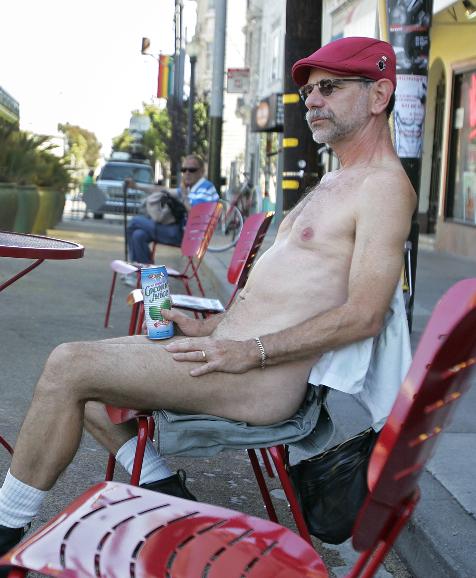
Of course, if he had been one of the nudists who hang out naked in the Castro these days Villamore would’ve found himself on the front-page of Bay Area Reporter, the city’s gay weekly, while he was still alive. Not to mention the target of diatribes from the SF Chronicle’s chronically right-wing columnist C.W. Nevius.  

Sadly enough, a neighborhood that once stood for sexual and personal freedom has succumbed to anti-nudism hysteria, even to the point of echoing Anita Bryant’s old rallying cry, “Save the children!”

Hysteria it is, of epic proportions. Some Castro residents and MUMC merchants actually persuaded their elected official, Supervisor Scott Wiener, to introduce anti-nudism legislation because a few naked men prance around the hood au natural, even sometimes sporting (horrors!) cock rings on their dicks. In a neighborhood where there’s no dearth of cock rings or any other sex toy, not to mention every variety of gay porn imaginable, and where guys walk around bars in underwear, residents don’t want public nudity. Huh? The neighborhood’s historic live-and-let-live attitude has obviously gone the way of Halloween and being able to walk into Pink Saturday without being scanned by a metal detector.

Has gay marriage and the freedom to “be all that you can be” in the military afflicted residents of the Castro with assimilation fever? What’s next — fundraising parties for Mitt Romney or a Castro chapter of the Moral Majority?

In a community that, according to a recent Williams Institute study, is rampant with poverty and suffers a serious lack of full-time employment for transgender people (75%, according to a report from this paper and the Transgender Law Center), not to mention a major drug and alcohol problem that makes gay men easy targets for muggings as they leave the bars at night, you’d think that public nudity would the last thing on anyone’s mind.  

People with AIDS continue to be pushed out of apartments in the Castro so that landlords and realtors can make tons of dough and LGBT seniors are forced to live with little economic or social support, regular cuts to services and benefits, and discrimination and isolation in nursing care facilities.

Yet from the volume of letters in the BAR and the number of calls Wiener says he’s received, you’d think that public nudity is the biggest problem in the world.

Pedro Villamore might disagree with that.

Tommi Avicolli Mecca has been a queer activist for the past 42 years, and a Castro resident for 20. He is editor of Smash the Church, Smash the State: the early years of gay liberation (City Lights).

Amanda (Fucking) Palmer unites the freaks at the Fillmore

0

Theatrics! Camp! Bravado! Glitter! Body hair! Going to an Amanda Palmer concert is like taking a trip to the island of misfit toys. Standing in the crowd, I was surrounded by top hats, tutus, tuxedos, pink mohawks, steampunk creations, and many more accessories that I can’t begin to identify. 

The audience at the Fillmore last Wednesday was incredibly diverse in age, gender, and style, seemingly united only by their love for the many artistic eccentricities of Amanda Fucking Palmer, as her fans call her.

An electric performer, Palmer ruled the stage, looking like the black swan in dark, heavy makeup and a corset as she spit her venomously witty lyrics and jerked around like a marionette, swinging a megaphone, banging on her keyboard, and running instrumental drills with her band, the Grand Theft Orchestra. The setlist, dominated by her new album Theatre is Evil, crackled with energy and emotion.

The night’s dynamic itinerary offered many emotional highs and lows. In a particularly heartbreaking segment, Palmer brought up a box that had been left on the merch table for people to fill with all the bad and sad things that had happened in their bedrooms. Usually Palmer reads the box, but her husband, writer Neil Gaiman, offered to read tonight. 

The tragic and highly personal details people shared cast an incredible hush over the sold-out room. Usually, Palmer records this reading and mashes it into a new song, but she forgot on this night (she later issued an online apology and a promise to make it up to the fans with a recorded version.) 

Despite this omission, the segment was incredibly powerful. These dark secrets saw the light in a crowd of people who were really listening. Palmer does something truly incredible here, using performance art to de-stigmatize past trauma and to turn sharing into a beautiful, communal experience.

This solemn moment was balanced with the transcendent song “Bottom Feeder” in which Palmer, looking like a mermaid, jumped into the crowd wearing a jacket that trailed yards of rippling chiffon over the audience. Under the fabric, holding it up with our hands, the audience members were grinning widely at each other in a moment that perfectly captured the whimsical beauty of the song and the entire night.


‘Fire’ insight: talking with David Wojnarowicz biographer Cynthia Carr

9

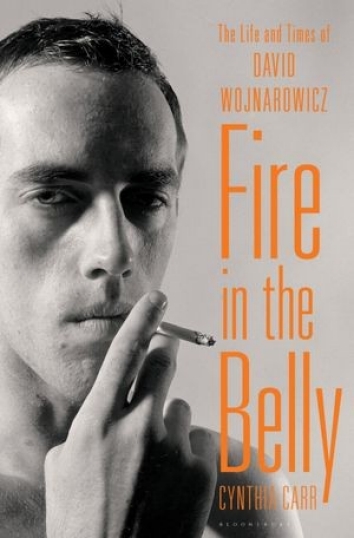
The following interview took place with Cynthia Carr, author of Fire in the Belly: The Life and Times of David Wojnarowicz (Bloomsbury USA, 624 pp., $35), on an early fall afternoon at the old Odessa Restaurant on Avenue A in the Lower East Side, New York City — one of the few places left where you can still pretend you’re in the LES of Wojnarowicz’s day. Carr will be at the San Francisco Art Institute Wed/3 to discuss her book. Read Erick Lyle’s review of the book here.

San Francisco Bay Guardian Your book is the first real biography of David Wojnarowicz. Up until now, the best book on him I thought was that Semiotext(e) book, David Wojnarowicz: A Definitive History of Five or Six Years on the Lower East Side. Your book has a lot of that same feel, the layers and layers of neighborhood detail. But, of course, your book has the advantage of having all of David’s thoughts and perspective on the same events because you have his journals and his correspondence. How were you able to access all of that material?

Cynthia Carr All of his papers are at Fales Library at NYU — all of his journals and the letters he kept. And I did get letters from quite a few other people, like his boyfriend in Paris, Jean-Pierre. At the beginning of the relationship, David wrote to JP at least every other day and later at least once a week.

When I went to Paris I took a scanner with me and back home I printed them out. The stack was like four inches thick! It was filled with information about what he was doing or working on every day. While the journals from those times are mostly about him going to the piers for sex, which he didn’t tell his boyfriend too much about! [Laughs.] The letters, though, are all about where he was living or where he was working, or … really, most of the time, he was looking for work… I was very fortunate to get that.

SFBG How long have you been working on this?

CC Five years. I started in ’07.

SFBG One of the things I think is really great about the book is how you break down the reporter objectivity and place yourself into the narrative. And I think it works because it’s really a story in a way that only you could tell, because it has the rich detail that could only come from an observer who was really here in this place the whole time. What led you to take this on? What was your inspiration to tell the story of David or of the neighborhood through him?

CC Well, David’s last boyfriend, Tom Rauffenbart, actually mentioned to me that he would really like there to be a book about David and that he thought I should be the person to write it. I had written another book and when that came out in 2006, I wasn’t at the [Village] Voice anymore. I was freelancing, which is rough, as you know. And Tom had mentioned this to me, and I thought maybe I should give it a try, writing a book about David.

I wasn’t sure of all the details of David’s life, but I thought it seemed like a compelling life story. Over the years, too, people had questioned “the mythology,” — I mean, people didn’t believe his childhood stories, so I thought maybe there was a mystery there I could figure out. It was a period of time when I had lived in the same neighborhood as David and this would give me a chance to write about the East Village arts scene, the AIDS crisis, and the culture wars of the 80s all in one book, because he was a central player in all of those things.

SFBG In the end of the book, David approaches you and starts to tell you things about his life before he dies. Do you feel like in some way he knew you were a reporter and he was choosing you to do this book?

CC That might be a little too mystical to get credence, but he did open up to me and reach out. He started calling me to come over a lot. He also chose Amy Scholder who will be on stage with me in San Francisco. She was an editor at City Lights and he got to know her and chose her to edit his journals.

SFBG Those last couple years of his life — even though we know how it ends, that part of the book is so full of suspense Because it was amazing to see someone be so driven to do everything they wanted to die before they died and to actually almost do it all! It was really amazing to see how much art he was able to make across so many different media in such a short time.

CC David had tremendous inner strength and very solid will power that got him through all of this stuff. For the last year or really eight or nine months of his life he actually wasn’t really able to work, but he always talked about it. He always wanted to. I describe him as workaholic who had trouble holding a job. He worked constantly.

There was a trip he went on with Tom and their friend, Anita, near the end of his life that I describe in the book. One day, they find David just lying contentedly in a hammock and Tom says, “Look! He’s not working!” Because David was always working. Like, if he was walking with you on the beach, he’d also the whole time be picking up twigs or shells or driftwood that he thought he could use in a piece. It was like that.

SFBG So obviously you were already pretty far along with this when the latest controversy with David’s art happened at the “Hide/Seek” show at the Smithsonian. What were you thinking when that happened?

CC In a way, I liked that it happened because it drew attention to David and a lot of people didn’t know who he was, so I thought it would be helpful for the book. But in another way, it was shocking that he would get back into the news in this absurd way, which was for about 11 seconds of a film that he didn’t even finish that was completely misinterpreted by everybody. I mean, even the art world people who defended David by saying that the film was about AIDS didn’t have it right.

SFBG It was such a weird déjà vu … I first encountered Wojnarowicz as a teen during the era of that culture war controversy. There was his work, the Piss Christ, Karen Finley, Mapplethorpe, of course. That’s when I first heard about a lot of cool art! But I couldn’t believe it was happening all over again. Like, “Are we still HERE?” Not really, I guess, but they are. It’s really incredible.

CC It shows that David still has the power to be a lightning rod.

SFBG Why do you think that is?

CC David was very blunt in both his imagery and his feelings about things. He didn’t pull any punches. He used powerful symbols that are hard to explain as sound bites, so it’s easy for the Right to pick them up and take them out of context.

SFBG Personally, I’ve always felt like David’s writing is more timeless than his art. Some of the art is so linked to the time and place of the AIDS/culture war era that it sometimes seems dated to me, whereas the writing is this beautiful, timeless narrative of the outlaw in America, the outsider. But it was interesting that those artworks from that time and place are still so triggering, so perhaps they are timeless after all.

CC There are certain themes of his that really live on. His work is in major museums, of course.

SFBG You’re doing this panel tomorrow at the Brooklyn Book Festival. What is it? “The Creative City”?

CC Yeah, I think it’s about the 70s and 80s in NYC…

SFBG Here’s the notice: “The Creative City: The 70’s, 80’s, AND BEYOND”! [Laughs] Beyond? That must be like a blank, white space on the map…

CC Right! [Laughs]

SFBG In the past couple years there has been so much nostalgia for the NYC of the 70s and 80s in books and films. It’s coming from all sides. What do you think accounts for all of the interest in this lost time and place?

CC Well, the city has changed so much and the culture has changed so much. I think people look back to the freedom of that era when there was so much more uncolonized space, even in Manhattan, and it was cheaper to live here so people could just come here and try things. There was room to experiment. You didn’t have to make a lot of money immediately. You could just, say, go to a vacant lot between Avenue B and C and put on a performance with a cast of 30 or 40 people and no one would bother you. I saw many things like that then but there’s no way that could happen today. It’s starting to feel like everything has a stricture on it.

Not everybody looks back with longing for those days, of course. And when I look back with longing, I try to remember how dangerous it was then, because it really was very dangerous here. There was more crime, more rats, more garbage…

SFBG The price of freedom!

CC [Laughs] Right! But it starts to look like this golden age of Bohemia because there’s nothing like it now. Everyone’s so spread out. Williamsburg is completely gentrified. There are artists living all over the city from Red Hook, Brooklyn, all the way up to the Bronx. Also, people are starting out in MFA programs and artists are going to graduate school, so it’s a different way of coming up in the art world. David was so uneducated. I was thinking tomorrow on the panel I would read something about the piers. Not just the sex piers but the two art piers where David sometimes painted and took photos. There you had people making this art in this abandoned space with a total freedom and also working with the knowledge that it was not going to last, that it would be destroyed. David loved that part of it.

SFBG That’s one of the most poignant things about the book. David really identified with this idea that the Empire was falling, that the civilization was in ruins. Like the painting he titled, Some Day All of This Will Be Picturesque Ruins. But then it turned out that it was really just his own civilization or community that would soon crumble and disappear. And now a generation later, the inhabitants of this new Lower East Side are walking around on top of this lost civilization that has disappeared without a trace and is buried just under their feet. Could anyone at that time have imagined that the neighborhood would turn into what we have here today?

CC Oh, I think not. It was clear from as early as 1990 that the neighborhood was undergoing changes. The galleries had to leave because the rents were going up. I lived between Avenue A and B and I heard about someone buying an apartment for $250,000 on my block! I couldn’t believe it. But now you have luxury hotels up in the LES and every old parking lot has a high-priced condo on it. But when you’re younger, I guess, you don’t really think about what things will turn into.

SFBG Do you still live in the neighborhood?

CC Yes, I do. I can’t afford to move! I have a rent-stabilized apartment and have been there since the 70s. When I moved in there was only one bodega between Houston and 14th street on Avenue A – that and the Pyramid Club. Before that I lived between Avenues C and D, and people wouldn’t come over to visit me.

SFBG Where do you think your book fits into this flow of books full of nostalgia for that era, then? To me it’s almost a corrective to the nostalgia, since it’s not romantic at all. It shows the struggle and loss that happened from there to here.

CC I don’t know that those other books really went into what happened in the AIDS crisis. The AIDS epidemic is a shadow that was behind the East Village arts scene the entire time right from the beginning and no one knew it. I found news stories about people coming down with Kaposi’s Syndrome as early as the late 1970s. It was starting to spread then and no one knew it. And the people that died from AIDS were the biggest risk takers, the people who were most creative… the people who had the biggest impact on the arts scene. Losing all those people changed the world for the worse.

SFBG So, the building where David lived his last few years and where he died was his late best friend, Peter Hujar’s loft. Am I right that Hujar’s loft is now that multi- screen movie theater on Second Avenue at 12th?

CC Yeah.

SFBG Have you been to see movies there?

CC Oh yeah! It’s really weird! I haven’t seen a movie there in a few years, but I do think about, about David dying right upstairs. I’ve been told that the loft is now an office space. The first time I went to the theater part of the building was for Charles Ludlum’s memorial service. It was still being converted then from an old Yiddish theater into the cinema multiplex. It’s been a couple years, and I can’t remember what I saw there last, but, sure, I’ve gone to see films there.

SFBG Where was David’s room in the building? It’s such a strange layout for a theater.

CC Well, he was up on the Third floor. There are windows shaped like Old West tombstones that face 12th street and that was where his kitchen table was, where he sat and worked. Recently, I was thinking that out of all of us who were there taking care of David in those last months, none of us took a picture of the place. I wish now I could remember what all the piles of stuff were, because David was just such a pack rat. There were piles not just of art projects and supplies, but piles of paper, The NY Post — he liked using the tabloids in his collage pieces…

SFBG That Nan Goldin photo in the book is so great. What is he sitting with here? Like are those giant sperm?

CC Yeah, they are sperm — homemade props from his In the Shadow Of Forward Motion performance. And there is his baby elephant skeleton. And some movie posters he must have brought back from Mexico…

SFBG Well, let’s talk about David and San Francisco. For such a noted queer artist and activist, he seems to have surprisingly limited connection with San Francisco. But he did make it to the city a couple of notable times, right?

CC One of his early goals in life was to go to City Lights Books and he actually took a bus all the way across the USA just to go there.

SFBG Well, he’s not the only one. That’s so great!

CC And when he took this early hitchhiking and rail-riding trip in 1976, he went to SF and stayed there at the YMCA in the Tenderloin for awhile. He liked San Francisco.

SFBG Did he also appear at the SF Arts Institute?

CC I believe he performed In the Shadow Of Forward Motion there. But he also did a reading for Close To The Knives in SF at the bookstore, A Different Light. That was the only reading he did for that book tour. His first idea was to drive across the country and do readings here and there, but he just wasn’t feeling well enough. So he decided he would only do one reading and it would be in San Francisco. That same day, he joined in a march about AIDS awareness in SF.

SFBG What do you think is next for you?

CC It might be time for me to move my work out of the East Village. My first book was a collection of my Village Voice articles and now there’s this book, so maybe I’ve told all of my story here. I got so exhausted with this. I really worked every single day except Christmas Day, working around the clock, and I got really depleted. So I’m recovering from all of that work.

SFBG Well, that work really paid off! This book is very special. Is there anything you want to add to this?

CC Well, one thing I’ve noticed is that reviewers tend not to talk about the love stories in the book. The importance of Peter Hujar and Jean Pierre to David. And Tom Rauffenbart. And maybe it’s natural that people focus on the art and the AIDS crisis. But the love stories are to me really important.

SFBG I got that from the book. His life was so improvised. He never reached a place of safety or security where he had the luxury of saying, “OK, here’s what I’m going to do next.” It was like he was reacting all of the time to whatever came up. He had difficulty trusting in the future or in relationships with other people. I think all of that is common with people who have abuse histories and I think you got that across.

CC Yes, he always reacted to stuff. Like he found an obscene drawing on the street where someone had scrawled “Fuck you, faggot fucker!”. So he used it in a painting and based a whole work around the drawing and called it Fuck You Faggot Fucker! He was always responding. The things that troubled him became the subject of his work. That is what inspired him.

David Wojnarowicz: Cynthia Carr and Amy Scholder in Conversation
Wed/3, 7:30pm, free
Lecture Hall
San Francisco Art Institute
800 Chestnut, SF
www.sfai.edu/event/CynthiaCarr