• No categories

Politics Blog

Taser debate takes off once again at Police Commission

11

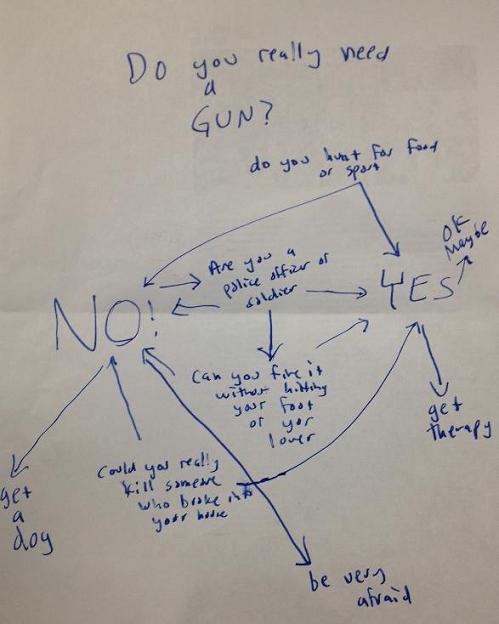
At a police commission meeting last night, commissioners delayed the vote on a controversial agenda item: adding tasers to the SFPD toolbelt. Specifically, Chief Greg Suhr proposed discussing a pilot program that would allow tasers for the 74 officers who have been trained through the department’s Crisis Intervention Team (CIT) program, created last year.

This is not the first time a police chief has introduced the possibility of tasers. In February of both 2010 and 2011, the police commission discussed adding the less-than-lethal weapon to the SFPD arsenal.  But community opposition, ACLU opinions, and commissioners concerned about the risks of tasers thwarted the effort.

Suhr says he brought up the issue in light of the July 18 killing of Pralith Pralourng. Suhr said he believes that if the officer involved had been equipped with a taser, Pralourng, who wielded only a boxcutter, may be alive today.

Several members of Proalong’s family attended the commission meeting last night. His sister, Savee Pralourng, read a statement asking that her brother’s death not be politicized for police department purposes.

“The SFPD wants to use his death to justify getting tasers,” said Pralourng.

She added other concerns about the police deparment’s handling of the death.“We have not been given any information about his last moments or how he died,” she said. “They need to know how to deal with mental illness, police need to address them differently.”

“This is an issue of the department having options available to them to mitigate the need for lethal force,” Commander Mikail Ali said at last night’s meeting.

But opponennents say that issuing tasers will lead to officers using them in questionable scenarios.

Tasers are called less-than-lethal, but can result in death. The risk of death is increased if the tased individual is child, elderly, pregrant, very thin, has acidoss, or on cocaine or methamphetamine. Police are trained to aim their guns for center mass, but with tasers the risk of death is increased if the subject is hit in the chest– the electric shock’s proxmimity to the heart can cause ventricular fibrillation.

“You have pepper spray, you have billy clubs, you have rubber bullets. What more do you need?” activist Debray “Fly Benzo” Carpenter admonished the police chief.

As a result of last year’s iteration of the year’s-long debate, the police department was tasked with preparing a report on the  potential use of tasers and what other less-lethal options were available.

The report was never completed.

This concerned several commissioners, as well as ACLU attorney Micaela Davis, who presented at the meeting. The ACLU sent a 12-page letter to Mayor Ed Lee outlinging their issues with tasers, and has reported in the past that police use of tasers in Northern California is dangerously unregulated and leads to death at a surprising rate.

Of the top 20 largest police departments in the coutry, San Francisco officers are the only ones without tasers. Even Memphis, the city with a police traning program for interacting with mentally ill people in crisis that has become a national model, recently voted to allow tasers. San Francisco’s CIT program is based on the Memphis model.

The conversation may have been happening for years but, commissioners decided, this new attempt was too hasty. Many were surprised to see the item on this week’s meeting agenda. Many members of the public were angered as well that no public comment period was sheduled for the item, and expressed their opposition to tasers during comment periods meant for other topics.

“The virtue of good government is patience and consideration,” said Commissioner Julius Turma. “I don’t feel fully informed on this issue.” Turman, along with Commissioner Angela Chan, called for a delay on the vote.

Commissioner Petra DeJesus said that if more notice had been given on the vote she would have “asked the city attorney’s office for an opinion on wheather we can tase just a certain population.” The proposed pilot program would put tasers in the hands of only officers who have been through CIT program, a training for interacting with mentally ill people.

Suhr said that was a false characterization. The police department would not be “singling out a demographic of people they might be used on,” he said. Instead, CIT officers simply “have done more training to deal with the mentally ill.”

The CIT program is meant to train officers who will be dispatched to respond to calls involving mentally ill people in crisis. However, these officers do not work exclusively in these situations.

The CIT training, whose formation marked a rare consensus between the police department, commission, community mental health organizations and advocacy groups, have begun but are running behind schedule. Davis argued that to distribute tasers to the officers in the training before they complete it would be premature– and that, if they know that at the end of the training they will get tasers, they may be less inclined to practice crisis intervention using other, less dangerous tools.

Carpenter, who was thrown out of the meeting after he and other activists shouted “he’s lying!” when Suhr reported the number of officer-involved shootings over the past year as well as other interuptions, said the prospect of tasers worries him. “I’ve been pepper sprayed for no reason before,” said Carpenter. “If they had tasers, would they have tased me?”

The comission will continue to research and discuss the issue, and, with more notice, public input into the issue promises to mount. The next police commission meeting will take place August 15. The controversial topic, which has produced what Police Commission Vice President Joe Marshall called “robust conversations” several times before, is likely to produce another in the next few weeks, both in and outside police comission meetings.

“The violence in the southeast sector over the past four days has been devastating to our City– we know we can do much better.  Let’s work together to and create San Francisco solutions to San Francisco problems. The Black Young Democratic Club is open to help facilitate this conversation,” reads a statement the club released yesterday in response to the taser proposal.

“I can guarantee you, you look at the communities of color, those are going to be the folks that are dealing with the police and the tasers,” said Theo Ellington, president of the San Francisco Black Young Democratic Club.

Survivor recounts life of rape and abuse by Your Black Muslim Bakery leader

8

Editor’s Note: This story is part of the Chauncey Bailey Project, a collaboration of Bay Area media outlets (including the Guardian) to investigate Bailey’s murder by members of Your Black Muslim Bakery.

By Louise Rafkin, Center for Investigative Reporting

 In 2002, five years before journalist Chauncey Bailey was murdered by members of Your Black Muslim Bakery, a woman identified only as Jane Doe 1 stepped forward to report decades of sexual abuse, welfare fraud and violence by the bakery’s leader, Yusuf Bey Sr.

She was prepared to hand over to Oakland police DNA from three of her children evidence that Bey had impregnated her, the first time when she was 12 years old.

Given the history of violence by members of Your Black Muslim Bakery, this was a risky move. But the woman was fueled by a mother’s anger. Her daughter, then 18, alerted her that Bey was trying to abuse her – his own daughter.

Now a devout Christian, Jane Doe 1 has decided she no longer wants to be the nameless whistle-blower. Her name is Kowana Banks and, in her first public interview, she said she made the decision to come forward to help other children trapped in similar situations. She hopes to publish a book about her experiences.

“Abused people go one of two ways: Either they are going to self-destruct or they’re going to make a difference,” said Banks, 44. “I’m going to make a difference.”

The violent saga of Your Black Muslim Bakery is fading into Oakland history, but wounds remain among Bey’s victims and family members today marks the fifth anniversary of the murder of Bailey, the Oakland Post editor who had been investigating the bakery’s finances.

The facts behind Banks’ story have been outlined in court proceedings and depositions, but her decision to come forward allows her to detail her unique insider’s perspective as a victim and survivor.

Today, Banks is an optimistic, composed woman who has moved on as best she can. One of her three children by Bey, Yusuf V, 25, is in San Quentin State Prison for his part in the 2007 kidnapping of two Oakland women, one who was tortured, a crime related to the bakery’s demise. The other two are doing well.

Banks considers the three to be the “blessing out of what happened to me.”

Married for 18 years to a man she met after leaving the bakery, Banks says the bitterness and anger that grew from her childhood abuse dissolved when she fell in love. The couple have two children together.

“But it’s difficult to look back and know I was just a child then and that no one cared,” she said.

Throughout her childhood at the bakery, Banks said she felt abandoned by the social welfare system, invisible even to those at local hospitals where she – and many other underage girls at the bakery compound – gave birth to multiple children while still children themselves.

She delivered the first of three children by Bey at Alta Bates Hospital in Berkeley at 13. A social worker questioned Banks about the paternity of her son, she said, but under the watchful eye of one of Bey’s “wives,” Banks kept silent. Later, she said she told a child protection worker that she was working long hours and not going to school.

“She told me she would check into it, and I never saw her again,” Banks said.

Bey, a self-appointed minister who gave himself the title of “Dr.,” was formerly a hairdresser. He opened Your Black Muslim Bakery in the late 1970s, espousing black self-reliance and his own interpretation of Islam, which included racist attacks on whites. Nevertheless, in his more than 30 years in North Oakland, Bey gained the support of local business leaders, clergy and politicians eager to align with the underclass.

In 2003, Bey died before facing trial, setting off the struggle for power and control that escalated into mayhem and multiple murders. Banks said she saw the violence coming.

“You cut off the head,” Banks said, “and the body will go crazy.”

Molestations began at age 8

Banks, who was born in the East Bay, said her father was a drug addict who met Bey’s followers while doing jail time for drug-related crimes. Banks can’t remember her mother, who she said abandoned her as a toddler, along with a younger brother and older sister.

In 1976, Banks’ father brought the children to live at the bakery compound, where he’d gotten a job. A hive of single-family homes, retail storefronts and apartments clustered on the corner of San Pablo Avenue and 59th Street in North Oakland, the compound housed bakery workers and Bey’s sprawling family of children and women he called his wives.

One Sunday night in 1976, Bey invited Banks to spend the night in his apartment, telling her she could play with his baby daughter. Banks was nervous and thought it strange to spend time with Bey, then 41. But her older sister had spent the night there and returned toting candy and new clothes. She said that night marked the first time Bey molested her. She was 8.

Bey told her to tell no one, she said. If she did, she would be killed.

“But he didn’t stop with me,” she said. “He told me he’d murder my whole family, everyone.”

Banks believes her father did not know about the incident, but the family moved away soon after that first molestation. They lived in Hayward for a while, and later, Banks’ father left her and her siblings with a grandmother near Monterey.

In 1978, after another arrest, her father brought them back to the bakery and left them with Bey.

Not long after, Banks said, Bey came into her bedroom above the bakery while she was sleeping, and raped her. She was 10 and remembers wearing one-piece pink zip-up pajamas. After the assault, she sought help from Nora Bey, then 23, one of the minister’s many “wives.” Banks’ father had surrendered his paternal rights so Yusuf Bey could receive welfare for their care; the court appointed Nora Bey, later known as Esperanza Johnson, as their legal guardian.

“ ‘I need you to help me because he’s trying to do things to me,’ ” Banks recalls telling Nora Bey. “And her comment was, ‘Oh, girl, he’s not going to do anything to you that he hasn’t done to anyone else.’ ”

Living in various bakery-owned homes, Banks was kept out of public school. She was smart, though, and soon became an integral part of the bakery, which sold pies and sandwiches from its San Pablo Avenue storefront. She learned bookkeeping and taught basic math and reading at the bakery’s school. Her life was regimented; she baked from 4 to 8 a.m., taught in the bakery’s combined school and day care until 6 p.m., and then wrapped bakery products until 10 p.m.

It was not until several years later that Banks even received a wage, just $25 per week.

At the time, Banks remembers not understanding why those living in the compound all were so isolated from outsiders, why they were punished for sneaking out once to see a movie, “The Wiz.”

“But as an adult, I understand now,” she said, “because he had secrets, and he didn’t want those secrets to get out.”

Learning Bey’s doctrine

In the bakery’s school, Yusuf Bey’s doctrine was drilled into the children. Girls were taught to cover their heads; everyone was addressed as “brother” or “sister.” Bey preached the superiority of men over women and of blacks over whites. Whites, he said, were “the devil” and responsible for all the world’s problems.

“The men were the ceiling, and women were the floor,” Banks said, quoting Bey.

She, however, was hardly subservient, growing into a feisty and hardheaded young woman, often chastised for speaking out against unfair treatment.

“I was known for saying whatever was on my brain,” Banks said.

Once when Banks complained about the long hours of work, she said she was forced to get up even earlier. When one of the other women found Bey with Banks in his bedroom late at night, the woman’s questions were silenced with a beating. Banks was then given a beating herself.

Banks said Bey tried to turn others against her and, because her mother was white, called her “nobody but the devil.”

But he continued to rape her repeatedly. At 13, she gave birth to the first of the three children she would have with Bey.

All the while, Banks said, Bey received – and kept for himself – welfare payments and food stamps intended for Banks, her siblings, others and eventually the children born as a result of the rapes. Bey was said to have more than 40 children and called up to 100 women his wives.

The atmosphere of fear was total, Banks said. In 1986, a young man, Peter Kaufman, who’d spoken out about having seen Bey rape a boy in the bakery’s bathroom, turned up dead on a nearby side street, shot in the head. Beatings – for both women and men in the bakery community – were commonplace.

Bey, Banks said, was a persuasive man who used intimidation, violence and a flashy lifestyle to control his mostly down-and-out followers, many of whom were parolees. There were cameras in the bakery and microphones in every room to monitor conversations. Among the women, the abuse was ubiquitous and unspoken. It was some time before Banks realized that Bey was molesting her sister, too.

Banks said she was instructed by Nora Bey not to identify him as the father of her children on their birth certificates. And Banks wasn’t allowed to choose names for her kids. Particularly painful to Banks was that her second son was named Yusuf by Nora Bey.

Banks said she had nowhere to turn. She blames racism, fear and a hands-off attitude for the lack of oversight by welfare officials and police.

“They were fed Brother Bey’s line that he was doing a lot for the black community,” she said. “No one wanted to intervene.”

Escape from bakery life

For years, Banks dreamed of leaving. But under the constant threat of violence, she waited. She planned to leave at 18, but was again pregnant. In 1988, then 20, she became romantically interested in a man her own age she met at the bakery. Bey caught wind of this and held a meeting at which he directed his other women to teach Banks a lesson by beating her.

Warned of her impending punishment, Banks made her escape that night, Aug. 28, 1988. A cousin on her father’s side agreed to pick her up. As she was collecting her children, Bey confronted her and threw her belongings at her.

“I picked up as much as I could that he threw at me and packed it into the car,” said Banks, laughing at the memory. “I don’t think he realized he was helping me.”

At first, she “felt so free” in a world outside the bakery, but soon she began to live in fear that Bey would send someone to harm her.

“My fear was a stranger that I didn’t even know would walk up to me and do something, because of course they had pictures of me,” she said.

Moving forward with her life was difficult, and keeping hold of the children she had with Bey ultimately proved too much of a challenge. Banks found work at restaurants as a server, but money was always tight. Bey wouldn’t pay child support, and the welfare she received never seemed to be enough.

“I was just a child when my kids were born,” she said. “It would be different if today I was having children, or even 20 years ago.”

Soon, Bey, exerting his power, sent for the kids, and they returned to the bakery. The boys spent most of their childhood there. Banks said her daughter, despite spending some time at the bakery and with foster families, mainly grew up with her.

At the bakery, Bey tried to turn her kids against her, Banks said, telling them she wanted them only for their welfare checks. While still a child, her oldest asked why she didn’t live with them at the bakery, like the parents of the other kids. Banks explained to him that “it wasn’t a good place” for her.

“I felt it was a better environment for men than it was for women,” she said, noting that at the time, she assumed Bey would not molest his own children.

In 1989, she met her husband through an acquaintance. The couple had their two children in the ’90s.

More than a decade passed. Banks took community college classes, found work in restaurants, earned her GED diploma and occasionally visited her boys at the bakery. There was constant intimidation; she feared retribution for leaving and was always looking over her shoulder.

Concern for daughter prompts action

Banks never told her kids about her abuse. It was hard to watch her boys be lured in by Bey’s flashy lifestyle – a Mercedes or Cadillac was always parked curbside – but Banks held out hope that she had been right, that it really was a better place for boys than it was for girls.

In June 2002, her 18-year-old daughter, who was working at the bakery but living elsewhere, told Banks a story that suggested Bey had tried to molest her. Banks was devastated, unable to even ask her daughter for details.

“I prayed, asking God who was going to stop him,” said Banks, then 34. “And then, suddenly, I knew it was me.”

With DNA testing available, she could prove Bey’s paternity. It offered the proof she had always hoped to find. In an angry phone conversation with Bey, she told him her plan.

“You, sir, are a rapist and a child molester, and let me tell you what I’m going to do to you,” she recalls saying. “First, I’m going to go to the police, and I’m going to press charges against you, and then, when I’m done, I’m going to sue you and I’m going to take all your money. And then I won’t have to ask you to help your children, my children, with anything else, because I’m going to have all your money.”

Bey, she said, told her she’d soon be “floating in a river.”

To show Bey her determination, she called him again from a phone at the Oakland Police Department. “He knew from that day forth that it was over for him,” she said.

Three months later, Bey was taken into police custody. With DNA test results in hand, Banks pressed felony criminal charges of rape and assault. Bey posted bail, but died in the hospital a year later before facing the criminal trial.

Banks was disappointed that Bey never faced a trial but took pleasure in knowing that he had at least faced the charges.

“He lived a long life of getting away with it,” she said. “By the grace of Jesus, I know he’s boiling in hell.”

Another Jane Doe revealed

Along with two other women, Banks also filed a civil suit, alleging that Alameda County did nothing to protect them. The county eventually settled with Banks and the two other Jane Does, admitting no liability.

Another of the Jane Does in the suits, a former foster child who worked at the bakery between 1994 and 1996 and was raped by Bey, also has decided to publicly identify herself for the first time.

Malikha Hardy said she reported her abuse on three occasions to a county social worker, to a guidance counselor at juvenile hall and, in 1996, to the Oakland police. No one followed up until seven years later, she said, when an Oakland detective working on Banks’ case turned up at her door.

“The people feared Bey,” Hardy, now 32, said in a recent phone interview. “He had people who would do anything for him.”

To protect the two women, California Watch is not providing information about their current whereabouts or employment. During multiple interviews for this story, a family therapist was present to provide support.

Having wrestled with low self-worth, nightmares, and other aftereffects of childhood trauma, Banks is writing a book about her life with the therapist’s help. She credits her conversion to Christianity with making it possible for her to smile again.

“I’m resilient, and I’m positive,” Banks said. “I say, ‘If people are preying on you, God has chosen you.’ ”

Banks remains in contact with her son Yusuf V, who is imprisoned at San Quentin and serving a 10-year sentence as part of a plea agreement in the kidnapping incident.

“I’m trying to reform my son’s way of thinking,” Banks said. “Him sitting in one spot is the best time for me to do it, because his mind is open.”

During a recent visit to the former bakery compound, Banks said she thinks the reign of terror is now over. Many of the buildings have been sold or renovated; little is left to indicate what went on, outside or inside. The old bakery is a beauty supply store. The former school is a martial arts studio.

As Banks walked through memorable rooms and haunted hallways, she recounted stories both benign and horrific.

“I’ve seen stuff here,” she said, “that will scare me for the rest of my life.

This story was edited by Robert Salladay and Amy Pyle and copy edited by Nikki Frick and Christine Lee.


This story was produced by the independent, nonprofit Center for Investigative Reporting in collaboration with the Chauncey Bailey Project. For more, visit www.cironline.org and www.chaunceybaileyproject.org. Rafkin can be contacted at Louise.Rafkin@gmail.com.


 

Antonini, quarterback for development interests, wins the game

20

If there was any doubt about the loyalty to developers of Planning Commissioner Michael Antonini, he put them to rest yesterday shortly after finally winning reappointment to a fourth, four-year on a 6-5 vote by the Board of Supervisors. Afterward, in comments to Examiner reporter Joshua Sabatini, Antonini likened his role on the commission to that of a successful football team’s quarterback.

“You want to knock out the quarterback for the other team,” Antonini said. “It’s a tribute in a way – backhanded.”

The five supervisors who opposed Antonini – Sups. David Chiu, John Avalos, David Campos, Eric Mar, and Jane Kim, the board’s most progressive members – seemed to understand that Antonini saw himself playing for the developers and big corporations that see San Francisco mostly as a place to make money, even at the expense of eastern neighborhoods and the city’s long-term interests.

The voting record of this Republican dentist – an elected member of the San Francisco Republican County Central Committee who advocates for right-wing causes (such as crackdowns on the homeless) and candidates – makes clear which team Antonini plays for, and it isn’t the same team as the vast majority of people in San Francisco, where Republicans constitute less than 10 percent of the electorate.

It says a great deal about the corporatist politics of Mayor Ed Lee for re-appointing him, as well as the politics and integrity of the swing votes, Sups. Malia Cohen and Christina Olague, the Lee appointee now running for election in District 5, one of the city’s most progressive districts.

Both supervisors mouthed meaningless platitudes and justifications for their votes, but in reinstating the developers’ quarterback just as the progressives were about to remove him from the game, one wonders what team they’re playing for – or whether they even understand the dimensions of the game they have unexpectedly found themselves playing.

But Antonini clearly understands. And despite the ridiculous statements that Cohen and Olague made about holding him “accountable,” Antonini now has four more years to continue leading a team that is rapidly gentrifying San Francisco, making it more inviting to the Google-busers and Twitterati and their landlords, but less so for the average teacher, clerk, and social worker.

Two of SF’s most venerable cannabis dispensaries get shut down

7

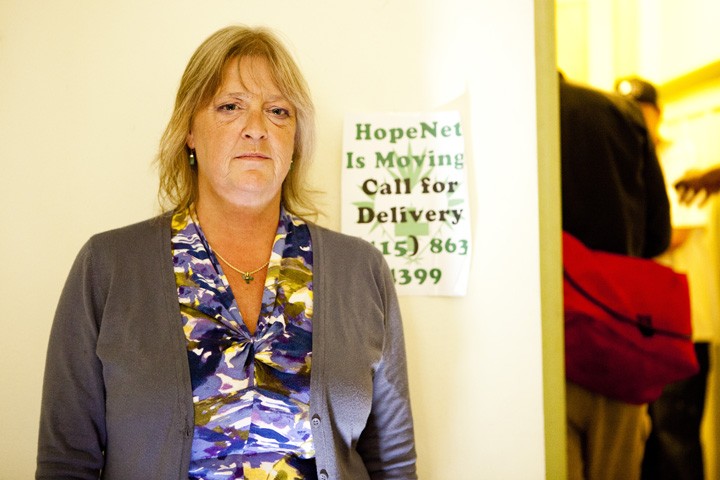
Sadness, anger, and confusion hung thick in the fragrant, smoky air of two of San Francisco’s oldest and most prominent medical marijuana dispensaries – HopeNet in SoMa and Vapor Room in Lower Haight – during their last day in business yesterday, the latest victims of an aggressive federal government crackdown on the industry.

Throughout the day, vendors, patients, neighbors, and well-wishers stopped in to say goodbye and commiserate over a trend that just doesn’t make sense to them, or to the local politicians and city officials that have spent years setting up a regulatory structure that had legitimized the cannabis industry, which thrived as the rest of the economy suffered through the recent recession.

“I’ve always treated this as if it were just a nice coffee house. I’m not an outlaw,” said Martin Olive, whose Vapor Room was a friendly community gathering place and active member of the local business community that gave away free bags of vaporized marijuana to low-income patients on a daily basis. “I almost forgot I was breaking federal law. It was so normal, so legitimate.”

Despite previous promises to respect state laws legalizing medical marijuana, President Barack Obama and federal agencies under his control did a sudden about-face last year, with the Drug Enforcement Agency threatening landlords with property seizure, the Justice Department threatening prison sentences, and the Internal Revenue Service doing audits and refusing to allow routine business expenses.

The result has been the forced closure of eight of San Francisco’s 24 licensed dispensaries in the last seven months, with more closures likely in the coming months. Almost all of the remaining clubs have been forced to deal only in cash after the feds threatened their bankers and credit card companies. The industry that grows and sells California’s biggest cash crop is essentially being driven back underground, hurting patients and the sometimes gritty neighborhoods that dispensaries had improved with security systems and a flow of customers that put more eyes on the streets and cash in the pockets of nearby stores and restaurants.

“The people that live here are afraid the neighborhood is going to come back in here. We took care of the entire block. Before us, it was all dealers, so there’s a safety issue,” HopeNet founder Cathy Smith told me as the once-welcoming club on 9th Street near Howard was reduced to bare walls, noting that the owner of the Starbucks on the corner told her he expects his business to drop by 15 percent.

Olive shared the concerns expressed at HopeNet, which he considers “a sister dispensary,” one that also had a generous compassion program for giving cannabis to low-income patients and offering other free services like yoga.

“I’m curious to see what this neighborhood looks like in six months. I know what it was like six months before we got here,” Olive said of his club’s opening in 2004.

But for now, it’s over. Vapor Room continued to do business for most of the day yesterday, but HopeNet was already stripped bare and essentially shut down, and by 3:30pm they removed the cash register and their pot stock. “The signs are down, we’re no longer a pot club, break out the beer,” announced Smith’s son, Bill, a member of the cooperative, referring to one of the many tight restrictions of what the city allowed in clubs. “I’m the only one making light of things today, as a coping mechanism. I laugh so we don’t cry.”

Like the patients, vendors, and local officials we spoke to – who you’ll hear from in an upcoming Guardian cover story looking the end of medical marijuana’s golden age – Olive and Smith are grappling with a federal crackdown they say has myriad downsides and no benefits to anyone but federal agencies that profit from drug-related seizures and the criminal syndicates that now have less competition.

Both Olive and Smith say they voted for Obama in 2008, they believed his statements that he wouldn’t go after businesses that complied with state and local law, and now they feel betrayed.

“I feel fucked by it, betrayed is too easy a word,” Howard said.

“It’s complicated emotions that I’m feeling – let down, confused – at the end of the day, I don’t understand why this is happening,” Olive said. “It’s a community tragedy, it really is.”

Like MediThrive and other recently shuttered clubs, both Vapor Room and HopeNet will still be operating as delivery-only services, but the future seems less certain now that their direct, brick-and-mortar connection to their community has been severed.

They urge those concerned about the crackdown to contact their political representatives, and to turn out today (Wed/1) at 4pm for a funeral march that starts at Haight and Steiner streets near the now-shuttered Vapor Room and goes to the Federal Building on Golden Gate Avenue, where there will be a rally and speeches starting at 5pm.

Bay Area activists join in anger over Anaheim police shootings

24

Last weekend in Anaheim, police shot and killed two young men. Every day since, protesters have taken to the streets. This weekend, a national day of protest following the killings helped spread the call for justice in Anaheim spread to the Bay Area. 

Manuel Diaz, 25, was unarmed when he was killed by Anaheim police July 21. When a crowd gathered at the scene as Diaz lay bleeding, police fired rubber bullets and pepper balls into the crowd. One police dog got loose, charged at a baby, and bit the child’s father. Police say they used crowd control because the people had grown rowdy, and that some were throwing rocks. The next day, police shot a 21-year-old, Joel Acevedo, who they say shot at officers while fleeing. 

Anaheim police shot another man the next day, a suspected burglar, marking the eighth officer-involved shooting in Anaheim so far this year. Five of the shootings resulted in death, and all but one of those killed were Latino.

“What’s going on here in Orange County is symbolic of a problem with the system,” Eduardo Perez, a 21-year-old student who attended Sunday’s protest told the Orange County Register. “This wouldn’t happen to white people. This is racism, simple as that.” 

Saturday was a designated a national day of action, and protests in New York, Oakland, Seattle, and Chicago took place, while a smaller group marched Friday in San Francisco. 

Tensions boiled over between protesters and Anaheim police Tuesday. Police say that protesters smashed windows and set fires. They shot at a crowd of hundreds with rubber bullets, beanbags and pepper balls, arresting 24 by the end of the night. That was what an Occupy Oakland medic, who preferred to be quoted as Elle, want to head down. 

“I saw an insane amount of force being used to disperse protesters who I think are rightfully angry. I noticed there was nobody there as a medic, reaching out to do first aid,” Elle said. 

On Sunday, protesters rallied at the APD headquarters and attempted a march to Disneyland. Law enforcement officers in camoflauge uniforms, toting tear gas launchers, blocked them the crowd from getting near Disneyland.

“They were stopped by the SWAT team that apparently wears desert camo,” said Elle, noting that Anaheim police and Orange County sheriff’s deputies, many on horseback, also confronted the march. 

Although Elle says that she did observe mounted police “using their horses almost as batons to shove and hit protesters onto the street,” she only treated minor injuries as a medic. 

”The unfortunate thing about being a medic is that these people who are being arrested need your help the most,” she said.

“The arrests they made were pretty violent, the ones that I saw. They hit one guy over the head with their baton as they were taking them to the van. They carried another woman out from a back alley, and she was crying and terrified. They were pretty brutal to the people they were arresting.”

Elle says she wanted to go help in Anaheim in part to help build a unified movement.

“We’re building a movement in Oakland around a really similar situation,” she said.

“If our state, community, country is going to make these murders stop all these communities need to rise up together and say this is unacceptable, we need to stop. It’s going to take a lot of people getting out there into the streets and building constant popular support to say this is an unacceptable use of our tax dollars.”

That “constant popular support” has been mounting in the Bay Area so far in 2012. Occupy Oakland started off the year with a march to the Oakland City Jail, and, the next day, joined with the Oscar Grant Committee for a march and rally commemorating his death. As officer-involved shootings have continued throughout the year, family and supporters have continued to take to the streets in response. 

“I also wanted to help build a bridge between Oakland and Anaheim,” Elle says of her trip. 

“If every community is issuing statements saying we want police to be held accountable for these deaths, we want to revoke the police officers’ bill of rights, we want active legislation preventing stop and frisk, active legislation to protect people’s fourth amendment rights, I think it could accomplish something,” Elle said.

Janitors continue pressure as negotiations’ close draws near

19

As contract negotiations with several employers come to an end August 1, the SEIU Local 87 janitors union has been coming out in force. More than 1,000 rallied in Union Square and marched over the weekend. Today, 500 janitors marched through the financial district.

“If we don’t get no contract, you don’t get no peace,” the crowd chanted as it marched down Market, before turning on First towards Mission. The group periodically stopped to picket intersections.

In negotiations with the city, the Westfield Mall, and Macy’s, janitors risk a significant increase in monthly healthcare costs.

Members have voted to strike if demands are not met.

“Our members clean up after companies that got bailed out, and we’re getting screwed,” said Olga Miranda, president of Local 87.

“We depend on our hands. We work hard for our money, We’re not looking for hand-outs.” a union janitor who preferred to be quoted as Elhady said.

“The trash can outside your office? The bathroom? The hallways? No matter how dirty it is, we do it,” Elhady said. “And we’re not given respect.”

After marching, leaders switched from English to Chinese to Spanish to Arabic as they rallied the crowd to continue fighting for health care benefits.

“We clean these buildings, and we’re proud of it,” Miranda said to cheers from the crowd. “Don’t take away my family’s health and welfare.”

Miranda laid out the next few days, telling that if they have not heard that a resolution has been reached by midnight August 1, “it means we have no contract.” However, she said that the strike would not begin immediately Wednesday.

Another action is planned for tomorrow at 2pm.

Guardian Voices: Hassle-free housing

64

I’m talking to the amazing organizers at Causa Justa:: Just Cause (CJJC) about their work to protect homeowners from foreclosure by the big banks, about their long history of tenants’ rights work, and what they are up to right now. Blanca Solis says they’ve launched a new campaign for what they’re calling the “Hassle-Free Housing” ordinance. She’s a grassroots leader from CJJC, and she’s asking for our support. To protect tenants from unscrupulous landlords. To stop unfair evictions. To stop wringing our hands about gentrification and families leaving the city. She says we can do something very straightforward to keep working families in their homes.
 
On Tuesday July 31st, Solis will join other tenant leaders, advocates and supporters at city hall to call for an end to tenant harassment by landlords. The San Francisco Tenants Union will be there. Organizers at CJJC have learned from years of experience with Latino tenants struggling to make ends meet in the midst of this rapidly gentrifying city that “one of the quickest and cheapest ways to evict a tenant is by harassing them until the situation becomes unbearable and the tenant moves on their own. Whey they leave, the landlord has an empty unit that they can rent to new tenants at market-rate rent.”
 
Faced with a pattern of such blatantly unfair practices, tenant activists took the issue to the voters in 2008; when “Prop M” passed, it was an important victory for this still-majority-renter-city. But then, the landlord’s lawyers got hold of it, and sued to stop implementation.
 
No one seems to be denying that landlords do this, and that it’s wrong. But what can a family do to stop the harassment, hold on to their housing and get some relief? Here’s where the “Hassle-Free Housing” ordinance comes in. It builds on Prop M and addresses the landlords’ legal issue. It would “allow tenants to claim damages from their landlords for each incident of harassment in small claims court to collect statutory damages of up to $2,000 for each incident.”
 
Sounds good, let’s do it. City Hall – get on it.
 
All over San Francisco, probably every night, people are sitting around shaking their heads about how expensive the city has become. How families have been pushed and priced out. Folks shrug and say “But, what can you do?”
 
There is a long, proud, and painful history in San Francisco of everyday people organizing to put a stop to unfair evictions, developer-driven displacement, and the over-production of luxury housing. From the African American community’s fight to save the Fillmore from redevelopment’s “negro removal” in the 1960s, to the Filipino-led struggle to stop the eviction of elderly men at the I-Hotel in the 1970s, and to Mission activists’ campaigns to control land use during the intense gentrification of the 1990’s dot-com boom. (Just this week there’s a big celebration marking the 35th Anniversary of the I-Hotel struggle.) 
 
These “housing justice” fights are ultimately about who has the power to shape the future of our city and who has the power to determine who can and cannot afford to live here. That’s where we all come in – all of us who are renters whose lives will be better with a “Hassle-Free Housing” ordinance; all of us whose housing is insecure – because we fear foreclosure or are a paycheck away from homelessness. This is an issue of people power, and you can do something now – attend the press conference at 10am tomorrow on the steps of City Hall, or go to CJJC’s website to sign up as a campaign supporter. Being right is good, but ultimately it’s people power that matters.
 
When Solis was asked why she joined the hassle-free housing campaign and why she’s coming to City Hall tomorrow, she said:
 
“Que los supervisores aseguren que los inquilinos estemos protegidos de los desalojos injustos por parte de los caseros y asi mismo vivamos en lugares dignos, seguros y libres de hostigamiento”
 
“So that the supervisors can ensure that we, tenants, are protected from illegal and unjust evictions by landlords and be able to live in homes that are dignified, safe and free of harassment”
 
Solis and the other incredible grassroots leaders at CJJC are full of courage and determination, and have not given up hope that there is a bright future for San Francisco. Let’s join them!

Why should a Republican dentist decide what gets built in San Francisco?

34

The Board of Supervisors is almost evenly divided on confirming Mayor Ed Lee’s appointment of Republican dentist Michael Antonini to his fourth four-year term on the city’s powerful Planning Commission. After delaying its decision at each of its last two board meetings, the board is expected to finally decide this Tuesday.

Sup. Malia Cohen appears to be the swing vote between the progressive-to-neoliberal bloc of supervisors that would rather see new blood that is more reflective of San Francisco’s values and priorities, and the board’s moderate-to-conservative bloc that wants to keep Antonini there as a sure vote for whatever developers want (a bloc that strangely includes progressive-turned-mayoral-shill Sup. Christina Olague, a former planning commissioner who said during the July 17 discussion that she doesn’t agree with Antonini’s politics and that more diversity was needed on the commission, but that she’s voting for him anyway while offering this hollow threat: “This may be the last time I’ll support this kind of move that doesn’t support a diverse body.”)

Sup. Sean Elsbernd, who led the charge for Antonini, fairly effectively picked apart some of the vague and misleading “diversity” arguments made by some supervisors who oppose the nomination, a discussion that Examiner columnist Melissa Griffin dramatized in yesterday’s paper. And everyone praised Antonini as a hard worker.

But almost the entire discussion skipped over what should be the main point: Why the hell is San Francisco even considering appointing a Republican dentist with no particular land use expertise to a fourth term on the Planning Commission?!?! Shouldn’t someone else – preferably not a rubber stamp for developers – be given a chance to serve the city? And why isn’t Mayor Lee – whose main political benefactor and economic adviser, venture capitalist Ron Conway, is also a longtime Republican – paying a political price for this ridiculous appointment?

While supportive supervisors praised Antonini as thoughtful and fair, I can’t gauge that for myself because this supposed public servant hasn’t returned my phone calls. But I’m not sure it would have mattered because his voting record shows he is a consistent vote for developers and their interests, as even Griffin acknowledged in an otherwise supportive column.

Board President David Chiu came the closest to telling it like it is when he said, “Every person who has reached out to me from the northeast neighborhoods has asked me to oppose this nominee.” And for good reasons: Antonini is a right-winger who votes against neighborhood interests every single time. Not just neighborhood interests, but city interests as well, as shown by the commission’s approval earlier this year of a CPMC project that was found to have fatal flaws that were then exposed by supervisors.

Elsbernd argued that the board should give deference to the appointing authority, noting that he’s often voted for nominees whose politics he doesn’t agree with, including Olague. And there certainly is some value to have different perspectives on appointed bodies. But when we grant a Republican dentist tenure in shaping what this embattled city will look like for generations, and pretend that his ideology is less important than his work ethic, we make a mockery of the political system that is supposed to reflect the values and interests of city residents.

The worst archibishop ever

92

As they say … Jesus!

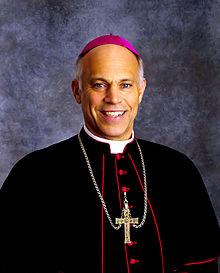
The new archbishop of San Francisco isn’t just a conservative. All the bishops appointed by this pope are conservatives. The new guy overseeing the Catholic Church in one of the most socially liberal parts of the world is a genuine culture-warrior, someone who (literally) says that same-sex marriage is the work of the devil and who wanted to make the use of contraception a mortal sin.

Salvatore Cordileone also happens to be the father of Proposition 8. The East Bay Express, in an excellent profile, noted in 2009 that he

has cultivated one of the most theologically conservative worldviews imaginable. Especially when it comes to sexual matters, Bishop Sal is conservative and uncompromising.

What I hear through the Catholic rumor mill is that the Vatican folks who screen candidates for these jobs gave the pope a list of three names. He rejected them all and chose Cordileone.

So now the center of the crazy-looney-here-comes-the-devil branch of the Church has a powerful throne here in San Francisco. What this is going to do, of course, is drive gay people, and liberals, and moderates, and pretty much everyone who’s sane to question why they even stay in the Catholic Church. And maybe, as one gay Catholic told me, that’s exactly what Rome has in mind — get rid of the malcontents and the thinkers until the Catholic Taliban is all that’s left.

I suspect Bishop Sal is going to have some problems in his new assignment.

There goes the SF Democratic Party

41

We all knew that the progressives didn’t win a majority on the Democratic County Central Committee, but for a while there it looked as if there might still be a chance to elect someone who isn’t one of the most conservative members of the panel as the chair. But no: Mary Jung, who works for PG&E, now controls the San Francisco Democratic Party.

Jung was elected unanimously July 27, which means the progs realized they didn’t have a candidate who could get a majority. Most of the other leadership roles are from the conservative side of the party. Yes, Alix Rosenthal is second vice-chair, but it’s clear who is going to be in charge of the party — and it’s not the folks who have run it for the past four years.

The slate-card committee, which has the key job of creating and delivering the powerful endorsement card, will be dominated by conservatives, Jung and Tom Hsieh, with only one progressive, Rafael Mandelman. It’s pretty much a train wreck all around.

Samson Wong (who is a good guy) says it’s a new era of civility, which is the same thing we used to say about City Hall (and I agree with him that it’s historic: The mayor, the president of the board and the chair of the party are now Asians). But when civility means you stop fighting (loudly, even if you lose) for things that matter in the name of keeping the peace, I’m against it.

In a press release, the DCCC’s new corresponding secretary, Matt Dorsey, notes that the local party’s priorities this fall are re-electing Barack Obama (who will win California even if the SF DCCC members all take a six-month nap) and restoring Democratic control of the House (which won’t be decided in the Bay Area). No mention of electing progressives to the Board of Supervisors — which is where the local party really matters.

The race to watch will be D1, where incumbent Eric Mar is part of the progressive bloc that lost the DCCC. We’ll see what happens.


Workers launch global Hyatt boycott, hundreds picket at Union Square

1

As shoppers scurried around Union Square yesterday, a picket that drew more than 300 people could be heard for blocks. The grand-scale noise-making was in front of the Grand Hyatt, where workers and supporters demonstrated against what they say is unsafe and unfair treatment of hotel workers.

UNITE HERE Local 2 has been supporting a boycott of a couple Hyatt locations in San Francisco for years now. But this week the national union, along with a broad coalition of supporters, has called for a worldwide boycott of the hotel chain.


Wong says the boycott will end if the Hyatt capitulates to three demands. Two of these are a “fair and mutual process for non-union workers to organize” and to “agree to a fair contract for thousands of unionized Hyatt workers that have been without contract for three years.” But the most important, according to Local  2 spokesperson Julia Wong, is to implement the workplace safety measures that the Occupational Safety and Health Administration (OSHA) recently outlined in a letter to the Hyatt corporation and its CEO, Thomas J. Pritzker.

Year after year, boycott organizers say, Hyatt adds new worker abuses to its track record.

“In 2009, Hyatt fired 100 housekeepers in Boston and replaced them with temporary workers making minimum wage,” Wong said. Rose Sia, a 31-year San Francisco Hyatt worker, recalls being alarmed that Boston workers who had held their jobs for 15 and 20 years were made to train their minimum wage-earning replacements. “They were treated like trash that day,” Sia said.

In a July 2011 incident, Hyatt workers in Chicago were picketing in 100-degree weather when their employers turned on heat lamps to beat down on them.

“They’re continuing to spread subcontracting around in more cities,” Wong said. “In Baltimore there used to be 40 or 50 in-house housekeepers. Now there are only eight or nine, and everybody else is subcontracted.”

Most recently a Hyatt worker in Indianapolis, Elvia Bahena, was fired, she believes, as a direct result of speaking out about her negative workplace experiences at a city council meeting.

Mona Wilson, who has worked at the Grand Hyatt since 1980, says that learning the difference between how union and non-union hotel workers are treated at Hyatt was an “eye-opening experience.”

Many Hyatt workers must clock in 30 every week to receive heathcare benefits, and meeting that quota can be a struggle. “I’ve met with people who work in banquets,” Wilson said. “The guys that move the tables around. They bring them all in, they’ll rush them through to hurry up and finish the job, and then send them home before the shift is over, so they never make enough hours to qualify for healthcare. I’ve met with one guy whose been working there for three years and he hasn’t been able to get healthcare.”

“He’s a regular hired worker, but it’s a non-union hotel,” Wilson said.

Even in San Francisco, where most Hyatt workers are unionized and experience relatively fair treatment, Hyatt workers have seen their workloads increase to back-breaking proportions and had to fight to get raises and benefits.

Sia says Local 2 has been instrumental in improving working conditions. “They are the ones helping us get our pension, get our raise, get everything. Without the union, we’re nothing,” she said.

Workers in San Francisco have been locked in contract negotiations for three years. One of their key issues is the freedom to protest in solidarity with other workers, which Sia says is particularly important as non-union Hyatt workers continue to suffer abuses.

http://www.youtube.com/watch?v=UCbsAl4bQwM
Picketers sing labor songs at yesterday’s demonstration

Hotel workers are largely women, and UNITE HERE’s Hyatt Hurts campaign has always called out their mistreatment as a feminist issue. They protested on International Women’s Day, focusing on two sisters who experienced disrespectful treatment and objectification of their bodies at the Hyatt Santa Clara. A few weeks later, the Reyes sisters met with Gloria Steinem, who pledged her support for the boycott.

Women’s rights groups like the National Organization of Women, the National Women’s Health Network, and the Feminist Majority Foundation have endorsed the worldwide boycott of Hyatt hotels. GLBT rights groups like the National Gay and Lesbian Task Force, the National Stonewall Democrats, the National Black Justice Coalition, and Pride at Work have also signed on. So has the national AFL-CIO.

A more unusual supporter, the NFL Players Association, is also getting behind the boycott, promising that the organization will not spend it’s money at Hyatt and discourage players from staying there.

“Many football players were raised by hardworking men and women who punch time cards just like the hotel workers at Hyatt. This is why we decided to get in the game and support Hyatt housekeepers who suffer abuse and debilitating injuries at work,” said DeMaurice Smith, the association’s executive director.

This kind of support is keeping spirits high for union organizers and workers as they escalate their tactics, but the fight may not be over any time soon.

“It took us seven years to bid the Mariott,” said Chito Cuellar, head of UNITE HERE’s hotel division. “It took us five years to defeat Park 55. It’s been three years that we’ve been fighting the Hyatt. And we don’t know how long it’s going to take, but we know we’re going to win.”

Cell phone radiation documentary screens tomorrow

17

The pre-screening wine bar won’t erase the sinister implications of tomorrow’s Artist’s Television Access showing of Reconnect. On Sat/28, filmmaker Kevin Kunze will show a rough cut of the film that will make you think twice about answering your next phone call.

When East Bay father Alan Marks pegged his brain tumor on cell phone usage a few years ago, the issue of cell phone radiation had its brief moment in the limelight. But the media focus eventually fizzled out. And with so many friends to talk to, deals to make, lunch dates to plan, and distant relatives to keep at bay, our reliance on phones wasn’t so easily put on hold. 

But some kept their eyes on the story. One of these believers was independent filmmaker and activist Kunze, who was deeply affected by meeting Alan Marks’ wife Ellie and later teamed up with Nobel Prize-winning author and scientist Devra Davis to make a documentary on the issue of cell phone radiation and its rather serious implications. The film picks up the story at the industry’s initial boom in 1993. 

Reconnect (formerly called Disconnect) interviews experts hailing from Yale, Stanford, UC Berkeley, and UCLA. Apple co-founder Steve Wozniak and California Senators Mark Leno and Leland Yee offer their thoughts on the matter, and Kunze digs up the stories of multiple brain tumor sufferers, whose stories went oddly uncovered by the media. Though the potential for brain cancer was a projected side-effect that’s been discussed since the promulgation of mobile phones, more and more studies are popping up that suggest the long-term usage of devices cause DNA damage, blood-brain barrier damage, breast cancer, sperm reduction, and infertility.

San Francisco’s own history with cell phone health has been an intense one. The Right to Know Act of 2010 required cell phone retailers post information about possible health risks associated with phone usage. The law came under fierce attack from the telecommunications industry, however. 

“Since the beginning,” says Kunze in explanation of the film on a fundraising website. “There was always talk of cell phone radiation and the possibility it could cause cancer.” Check out the screening at Artists’ Television Access this Saturday, have a drink, and take the post-film Q&A as an opportunity to ask Kunze about what life looks like post-iPhone.

Reconnect

Sat/28 7pm cocktail hour, 8pm screening, free

Artists’ Television Access

998 Valencia, SF 

www.atasite.org

Activists rally for alleged victim of illegal foreclosure

1

A few dozen rallied in front of the building that houses a branch of PNC bank July 26, demanding that the bank not foreclose on Yin Wong, an elderly Bayview resident who says the bank is foreclosing on her illegally.

Wong says she never missed a mortgage payment on the home that she and her family have lived in since 2001. She was paying through electronic transfer, where payments were automatically transferred from her bank account monthly. She says that in October 2009, she discovered the bank had rejected her previous two payments. The next month, she received a foreclosure notice for non-payment. 

“I never said I cannot pay,” Wong says. She says after she was tracked for foreclosure, all efforts to pay were refused, even though she had the money.

“If it happened to another person, I wouldn’t believe it. But it happened to me,” Wong said, adding that “In other countries all over the world this wouldn’t happen…just America, of freedom and democracy.”

Protesters chanted in support of Wong and blocked the main entrance to 575 California, where PNC has offices. A security guard said the building hadn’t seen that kind of demonstration since it housed Chevron.

Activists compare Wong’s case to that of the Cruz family, who also had their electronic transfer payments to PNC rejected without explanation, resulting in being tracked for foreclosure and eviction from their Minnesota home. Their case galvanized national support and made headines when they travelled with supporters to PNC’s Pittsburgh headquarters last week.

Wong has received support from the Eviction Defense Collaborative (EDC), and two attorneys from the group were at the rally protesting on her behalf. One EDC lawyer, Deepa Varma, said that even with fairly obvious illegal foreclosures such as Wong’s, homeowners usually lose in the courts. The EDC would often warn clients that fighting against banks in these cases was a largely unwinnable uphill battle.

But she said the recent push to fight back against foreclosures, fueled largely by various Occupy efforts, has changed all that.  

“A year before Occupy, the position in our office was to say, you’ll just have to move,” said Varma. “It would have felt impossible”

But now, Varma said, “there’s more of us, and people have actually made it happen. The turning point for me was seeing Josephine get back in her house,” she said. Josephine Tolbert, 76, was locked out of her home was little warning last fall. After pressure from activists, including Occupy the Hood SF, Occupy San Francisco, and Alliance of Californians for Community Empowerment (ACCE), Tolbert has now received a loan modification and is back in her home.

“After that I was like, anything is possible so long as they realize we’re not going to keep quiet outside the courts,” Varma said.

Wong has been working with the EDC since she was served her first eviction notice three years ago. 

California is a non-judicial foreclosure state, meaning local governments automatically enforce foreclosures that lenders call for. Foreclosure cases are generally not reviewed unless a homeowner challenges a lender legally. Then, according to Varma, lenders need only prove that they filed appropriate eviction paperwork to prove their case—not that the foreclosure itself has legal merit.

Wong wanted to go to trial to prove her case, Varma said. “She said, I did everything right. I have nothing to hide.” But PNC wanted to settle the case through a series of motions of summary judgment. “They filed motion after motion,” recounts Varma, saying that courts almost always decide in favor of lenders in these types of motion. But Wong’s case was unusual– “we kept beating them.”

After three years, PNC finally beat Wong at a bench trial last month when a judge ruled against her. Their win was only based on being able to prove to the judge that they had record of the appropriate paperwork in Wong’s foreclosure preceedings, not that Wong had missed payments, meriting the foreclosure in the first place, according to EDC attorney Josh Schieber. 

Scheiber said that while he’s been working on Wong’s case, she has consistently tried to submit her payments and on the occasions offered to pay the whole mortgage. The bank doesn’t seem interested.

But Wong refuses to give up, and she hopes that the confrontation yesterday might have reopened those lines of communication.

Wong and an interpreter from Occupy Bernal waited in the building’s lobby about 45 minutes while supporters chanted “keep Yin in her home.” 

“They want to make me become homeless, but they still don’t want to talk to me,” Wong said as she waited, guessing “they’re scared because they know they did the wrong thing.”

PNC sent down a representative to meet with Wong who assured her that he would fax the documents that she had brought with her, evidence of the unlawful foreclosure, to corporate headquarters

Wong and her family are scheduled for eviction Wednesday.

“I hope they postpone it so we can keep talking,” Varma said.

Two calls to investigate SF restaurant surcharges as consumer fraud

49

The surcharges that many San Francisco restaurants charge their customers – ostensibly to help cover their employee health care obligations, although in practice it has often just padded their profits – should be investigated by the District Attorney’s Office as consumer fraud, according to Sup. David Campos and San Francisco’s Civil Grand Jury, which recently issued a scathing report scrutinizing the practice.

Campos raised the issue during Tuesday’s Board of Supervisors meeting, calling for a criminal investigation and City Hall hearing. He even questioned whether businesses that have been so hostile to city’s Health Care Security Ordinance – the landmark 2008 measure that created the Health San Francisco universal care program and required businesses to help pay for their employees’ health coverage – should benefit from the tax cuts it would receive under a business tax reform ballot measure the board also considered that day.

“In the restaurant industry, we have an issue that remains unresolved,” Campos said during the business tax debate, after earlier in the meeting calling for the DA “to begin an investigation for fraud against the people of San Francisco by businesses that use this surcharge.”

DA’s Office spokesperson Stephanie Ong Stillman confirmed that the office is looking at the issue: “The Grand Jury report was just released and we are in the process of evaluating the results.”

Mayor Ed Lee last year vetoed legislation by Campos that would have banned the practice and prevented businesses from simply pocketing money from Employer Health Reimbursement Accounts they create to comply with the mandate (federal law bars the city from dictating how businesses cover employee health care) at the end of each year. Lee later signed a watered down version sponsored by Board President David Chiu requiring employers to keep the money in the fund for two years, to let their employees know about the fund on a quarterly basis, and to dedicate surcharge revenue to employee health care.

Rob Black, executive director of Golden Gate Restaurant Association – which unsuccessfully sued the city over the employer mandate and appealed the case all the way to the US Supreme Court – criticized Campos and the Grand Jury, saying they were relying on data from last year and that the situation has improved since Chiu’s legislation went into effect (Chiu told us data collection from his legislation will allow the city to better assess what’s happening).

“Supervisor Campos know this information is based on data that was prior to the new ordinance,” Black told us, acknowledging that many restaurants profited from the surcharges “but that was before the law was changed.” Campos responded by saying the grand jury concluded that the Chiu legislation didn’t go far enough the prevent the abuses, which are tough to detect because they are based on self reporting by the businesses.

The Grand Jury looked at 38 restaurants, of which 25 used the surcharges and 22 use the reimbursement accounts rather than either health insurance or Healthy San Francisco, which health care experts uniformly say are better options for employees. It analyzed data submitted to the city by these 22 restaurants with a total of 1,562 employees, finding that of the more than $2 million earmarked for the health reimbursement funds, just $123,612 was paid to employees and $1.9 million was kept by the employers.

Black said the quarterly noticing requirement in the Chiu legislation is already helping with the low reimbursement rate: “My hope is, and my belief is, we’re going to see significant…improvements in utilization rates in people taking advantage of their benefits, and that’s great.”

The grand jury also looked specifically at the health care surcharges collected by 18 restaurants with almost $64 million in gross revenue. Despite collecting almost $2.2 million in the surcharges it placed on customers bills, they reimbursed their employees for $1.16 million medical expenses and kept the more than $1 million that remained as profits.

Black criticized the grand jury for selectively picking the restaurants in its study and for targetting private sector businesses rather than the public agencies it traditionally investigates. “They’re outside of what the government charter calls for,” he said.

But Mark Busse, the chair of the Grand Jury Health Committee that led the study, told the Guardian that while it’s unusual to look at the private sector, there was a legitimate public policy interest here and its work was approved and overseen by Presiding Judge Katherine Feinstein (who happens to be the daughter of US Sen. Dianne Feinstein, San Francisco’s former mayor).

He also denies hand-picking the restaurants, saying he asked jurors to simply keep the receipts from all restaurants they frequented. While that may not be representative of all restaurants, he said it was a large enough sample to draw some conclusions and that he was more surprised than anyone at their findings.

“I thought our results would be totally different. I didn’t think they would be that abusive, I really didn’t. I thought we would find we have some outstanding restaurants and entrepreneurs,” Busse said, adding that he was alarmed by their actual findings. “It turned our stomachs. It makes us sick. It is not a level playing field. There are legitimate businesses that accept the spirit of the law and are taking care of their employees, but a lot of them aren’t.”

Given that these employees handle the food of city residents, he said that they should get the health care to which they’re entitled. As Busse told us, “The intention of the jury was to make sure the workers are getting health care and the customers aren’t getting deceived.”

7/27 Update: We heard back from the Mayor’s Office, whose Chief Deputy Communications Director Francis Tsang wrote: “Mayor Lee is a strong supporter of the Healthcare Security Ordinance. The Civil Grand Jury surveyed only 38 restaurants and its report restates facts we already know – some businesses add a surcharge and in the past, it was not well regulated.  Working with Supervisors, Mayor Lee strengthened practices effective January 2, 2012 to ensure employees could make better use of the program.  We will know the results in 2013, when we collect and report on 2012 data informed by the new regulations.”

Chow withdraws from D11 race after residency questioned

15

Sup. John Avalos appears to be cruising to an uncontested reelection now that Leon Chow, an organizer and executive with SEIU-UHW, has been chased out of the District 11 supervisorial race by journalist Chris Roberts, the SF Appeal, and their reporting on what appears to be Chow’s false claims that he lived in the district.

Chow had been banking on support from his union and the district’s substantial Chinese immigrant population, which he had been helping rally against new medical cannabis dispensaries that the city had approved for the Outer Mission/Excelsior area, presenting Avalos with a challenge that needed to be taken seriously.

But Roberts dropped a journalistic bomb on Chow’s ambitions a couple weeks ago when he unearthed documents indicating that Chow actually lived in Walnut Creek and that he was registered to vote at Chinatown business address – both in violation of election law – doing the solid reporting that journalists failed to do when Ed Jew was elected to the District 4 seat without living there. It wasn’t until Jew was caught in an FBI bribery sting that journalists dug into the background of a politician who had flown into office largely under the press’s radar.

As the Appeal reported this afternoon, Chow sent this email to the Elections Department: “Since I have not filed for Candidacy, I am notifying your department simply with this email, please let me know if there is any other process I will need to do. Please kindly remove my names [sic] from the Potential Local Candidate List in the department web site.”

Although it made no mention of Roberts’ story – which hadn’t gotten much journalistic traction yet, although that was bound to happen as the campaign wore on – the connection seems obvious. So, congratulations to Roberts … and to Avalos.

The Peripheral Canal emerges from the dead like Dracula

8

The Chron has pretty much signed off on the inevitability of a giant set of tunnels moving water from the Sacramento River to the San Joaquin River, screwing up even futher the ecosystem of the San Francisco Bay and Delta:

The water world has already separated into three camps: the water contractors, the federal government, the governor and the state Department of Water Resources, which support the “conveyance” as a necessary part (but only one element) of providing future water supplies;

the environmental community, which does not speak with a single voice but, conceding that the $14 billion facility probably is inevitable, is focusing on how it might be operated.

The last group, the delta residents and the Northern California congressional delegation, is opposed, seeing a loss of water and productive farmland and little tangible benefit in return.

But let’s remember: When this came up in 1982, it was voted down statewide, with something like 80 percent of Northern California saying “no.” And it wasn’t just the pumps and the Big Suck — it was the whole concept of shifting more water to unsustainable agriculture in the desert. That point hasn’t changed at all. Until we get a handle on why the state allows farmers to grow rice and tomatoes in the US version of Africa’s Serenghetti, I don’t see why we’re spending a whole lot of money to make things worse.


Environmental groups call for fracking moratorium in California

8

California’s biggest environmental organizations are gathering in Sacramento tomorrow (Wed/25) to call for a moratorium on the controversial practice of hydraulic fracturing – also known as fracking, in which a mixture of water and chemicals is injected at high pressure deep underground to increase production in oil and natural gas wells – until its impacts are better understood.

The occasion is the last in a series of workshops on the issue by the California Department of Conservation’s Division of Oil, Gas and Geothermal Resources, which is considering new rules on a practice that is mostly unregulated in California. Other recent legislative and administrative efforts to address fracking have been scuttled by the powerful fossil fuel industry.

Earlier this year, Sen. Fran Pavley (D-Santa Monica) discovered that state officials didn’t even know how much fracking is happening in California – while it requires state permits to drill an oil or natural gas well, fracking them doesn’t – although the industry has since estimated that more than 600 wells were fracked last year, most of them in Kern Country around Bakersfield.

But there is growing concern by environmentalists that the oil industry plans to expand its use of fracking in the Monterey shale formations that run from the Central Coast to the Central Valley, where an estimated 15 billion barrels of oil could be extracted if loosened up by fracking.

“We’re calling for the Division of Oil and Gas to slow down and not rush through these regulations,” said Andrew Grinberg, spokesperson for Clean Water Action. “We’re calling for a moratorium until we have good regulations that ensure the protection of our water, air, health, and communities.”

Other organizations joining the event – which begins at 5:30pm outside the California Environmental Protection Agency building at 1001 1st St. in Sacramento, where the DOGGR hearing will be held at 7pm – and the call for a moratorium includes the Sierra Club, Planning and Conservation League, Center for Biological Diversity, Environment California, and Food & Water Watch.

Public concerns about fracking have been on the increase in recent years, fueled by a high-profile debate in New York about ending a state moratorium against the practice and by alarming stories of groundwater contamination caused by fracking – including cases in which hydrocarbon content in drinking water is so high that people could set their faucets on fire – told in the 2010 documentary film Gasland and other media accounts.

But Tupper Hull, spokesperson for the influential trade group Western States Petroleum Association, told us fracking has been happening in California for 60 years – almost exclusively in oil wells rather than for the natural gas fields discussed in Gasland – and that it has not caused any detrimental environmental impacts, nor has its use been increasing, despite the increased public attention to the practice.

“We understand there is a lot of interest in this topic and questions about the technology,” Hull said. “We expect there will be new regulations and whatever they are, we hope they are based on facts and science and not emotional responses.”

But he said WSPA opposes the call for a moratorium because “this is a technology that aids in the production of energy.”

Yet the environmental groups say the need for energy shouldn’t cause government to abdicate its role of studying and regulating a potentially harmful practice that was given a broad federal exemption from the Clean Water Act by Congress in 2005, when it approved the Energy Policy Act that was spearheaded by then-Vice President Dick Cheney.

Environmental groups dubbed it the “Halliburton loophole” after Cheney’s former employer, which has greatly expanded the use of fracking in the US.

Burning Man challenged as La Contessa arson trial begins

5

Burners aren’t too worried about an appeal that’s been filed challenging federal permits that will allow more than 60,000 people to attend Burning Man this year, but some of them are more hopeful that a trial starting next week in Reno will finally get some justice in the 2006 arson attack that destroyed the iconic art car La Contessa.

Members of San Francisco’s colorful Extra Action Marching Band and other creators of La Contessa – an authentic-looking Spanish galleon built around a bus, which appeared to sail across the Black Rock Desert – have rented a house in Reno where they’re preparing for a trial set to begin on Monday.

As we reported in a Guardian cover story shortly after the incident, Nevada landowner Mike Stewart – who had a history of conflicts with Burning Man – torched and removed La Contessa, which was being stored with permission on a property that he purchased near Gerlach, Nev., without first trying to contact its owners. The massive vehicle was too large to legally drive on the highway and its builders say they would have relocated it if they were contacted, as state law requires before destroying abandoned vehicles.

This trial has been years in coming. Plaintiffs Simon Cheffins and Greg Jones – the main designers of La Contessa – originally filed a federal lawsuit under the Visual Artists Right Act, which makes it a crime to destroy sculptures or other works of art, but a judge ruled that La Contessa didn’t qualify because it was a vehicle and therefore “applied art.”

The case is now a simple “conversion claim” in state court, alleging Stewart acted in a malicious and negligent manner, but the trial is expected to last more than two weeks as a parade of Bay Area burners involved with the project paint a picture of the long and difficult process used to create the artwork and its iconic role in Burning Man history.

Meanwhile, the appeal of Burning Man’s permits was filed last week by Christopher Brooks, who uses the Black Rock Desert for wind sailing and alleges that Burning Man is impacting the playa’s surface by creating sand dunes. Black Rock City LLC, the SF-based company that stages Burning Man, denies the charge and says the detailed environmental assessment recently approved by the Bureau of Land Management (BLM) found no significant cumulative impacts created by the event.

“We’re not too concerned about it,” BRC spokesperson Megan Miller said of the appeal. “We work hard to minimize our impact on the desert.”

Regardless, the appeal won’t have an impact of this year’s event, which begins Aug. 26. The appeal will be heard by the Interior Board of Land Appeals, which is so backlogged that it still hasn’t heard BRC’s appeal of BLM’s decision to place Burning Man on probation for exceeding last year’s population cap of 50,000 on two days, which BRC filed late last year.

As Miller said, “We’re right on track for a great year.”


Guardian City Editor Steven T. Jones is the author of The Tribes of Burning Man: How an Experimental City in the Desert is Shaping the New American Counterculture, which includes the story of La Contessa’s life and death.

President or no president, medical marijuana shows up in Oakland

2

So the President was late. Around the time the “Fire Melinda Haag” press conference (as it had been called in emails I’d received from the various cannabis advocacy groups) at downtown Oakland’s federally-threatened Oaksterdam University was starting, one attendee drily mentioned that Obama was reported to still be in Las Vegas.

“I mean, I know the private jets can get you places really quickly and all, but still.”

It didn’t matter — medical marijuana had assembled in Oakland, the world cannabis community was watching, and there was going to be a show of numbers, regardless of what Air Force One was doing or when the President’s scheduled appearance at the Fox Theater a block away would actually get going.

But first, the formal press conference at Oaksterdam. Grow lights warmed the pot plants on one side of the room as dispensary founders, politicians, and patients said their piece on stage. 

“Name the advantages of continuing the drug war,” said Oaksterdam University president Dale Sky Jones (OU founder Richard Lee on stage a few feet to her right.) “We continue the failed drug policy that targets young people of color.”

“This is simply not the right thing to do,” said Jim Gray, a retired Orange County superior court judge and former assistant US Attorney. “It will not result in less marijuana being sold or consumed in Oakland or anywhere else.” Later on, during the march that would take medical marijuana users on a lap around the Fox, some protesters were seen lofting signs with the ex-official’s name on it — he’s the Libertarian Party’s nomination for vice president. His crowd-pleasing efforts struck gold at Oaksterdam in the form of a quip. “I think going forward, the slogan should be ‘the hempire strikes back.”

Steve Deangelo, founder of Harborside Health Center, was adamant in his call for an immediate freeze on all enforcement actions until courts deemed them consistent with the Obama administration’s policy. Deangelo and the patients that depend on his dispensary have a lot to lose should their call go unheard: a recent letter sent to Harborside by US Attorney Melinda Haag ordered the collective’s closure based on the rationale that it is a “marijuana superstore.”

“If the US Attorneys can come after a dispensary like Harborside,” Deangelo told the assembled crowd, “No dispensary in this country is safe.” Commonly referred to as the best-known dispensary in the country, Deangelo’s dispensary and its staff were the subject of last year’s Discovery Channel reality series Weed Wars

Perhaps the most poignant voices from the day were those of the consumers who will be most affected by the loss of safe and accessible medical-grade marijuana. Yvonne Westbrook-White, a multiple sclerosis sufferer, credited cannabis with getting her out of the house that day and appealed to the President to keep his promise to leave state-legal dispensaries alone.

Jason David’s baby son has Dravet Syndrome, a rare disease with epilepsy-like symptoms. He told the crowd at Oaksterdam that a non-psychoactive cannabinoid tincture had made his boy go from acting like a zombie to being a bubbly kid that greets people at church and at home alike. His voice and hands trembled as he thought out loud about what he would do if Harborside went the way of so many other cannabis businesses in the Bay Area.

“What am, going to ask a drug dealer ‘do you have CBD?’ You’re going after the wrong drug.”

An hour later, feet from the massive Obama-as-cop “Dear Leader” design that members of Chalkupy had painstaking sketched out the same day, a crowd that police later estimated at 800 to 1000 people were ready to march for their cannabis rights. The route took us up Broadway, past the lines of Obama fans patiently waiting for their president to show, down 20th Avenue to San Pablo Avenue, and right back to Oakland’s City Hall.

Would things continue to go as peacefully through the President’s eventual visit? All signs pointed to yes when your Guardian journalist left around 4:30pm, but one protester put it rather succinctly. “Today’s not over yet,” he said. 

Medical marijuana patients demand an end to federal raids as President Obama arrives in Oakland

17

As President Obama arrives in Oakland for a fundraiser today, medical marijuana activists have already made a point with a rally on the steps of Oakland City Hall this morning. Protesters demanded that the President halt raids of dispensaries and other operations legally allowed by California law.

Present at the rally were representatives from Oaksterdam University and Harborside Health Center, two Oakland medical marijuana businesses that have been the target of federal attacks in recent months.

Speakers argued that Obama should use his power to stop threats to these institutions. Oaksterdam, the school that teaches the politics and history of cannabis along with practical knowledge for working in the industry, was raided April 2. Harborside, a dispensary that also offers free health services such as acupuncture and yoga, received a letter from US Attorney General Melinda Haag filing federal forfeiture action July 9.

“This is the time to show them what we’re made of,” said Harborside co-founder Steve DeAngelo at the rally.

DeAngelo emphasized that Harborside complies with state regulations and that the city of Oakland benefits from its success, not least with tax revenue.

Marijuana is illegal under federal law and is classified as a Schedule 1 controlled substance. Schedule 1 drugs “have a high potential for abuse” and “no currently accepted medical use in treatment in the United States,” according to the DEA.

But a procession of medical marijuana patients and caregivers at today’s rallies said that their experiences conflict with the DEA’s claims. Patients recovering from surgeries and suffering from cancer and HIV/AIDS said that medical marijuana provided pain relief and lessened their symptoms without the detrimental side effects of other medication.

“If the federal government takes away my medical cannabis, I could go blind,” said David Goldman, 61, a retired teacher who uses cannabis to treat his glaucoma.

The Compassionate Use Act, which passed in California in 1996 when voters approved Proposition 215, allows both patients and designated primary caregivers to legally purchase marijuana at licensed dispensaries.

One such caregiver, Evelyn Hoch, said that she has been caring for her best friend, a survivor of stomach cancer, for more than 20 years. “She had 90 percent of her stomach removed,” said Hoch. “They gave her six months to live.”

Hoch’s friend survived, but had to choose between constant pain and medication that left her “like a zombie,” according to Hoch. She was prescribed barbituates that, as a side effect, suppressed her breathing. Hoch said her friend was resistant to cannabis recommendations that her doctors gave her unofficially, even before medical marijuana was legal, because she “just didn’t like pot. It wasn’t her thing.” But after she began using medical marijuana two years ago, she has improved significantly.

“She can’t believe the difference,” said Hoch. “She can read again. She’s got a little bit of life. She’s not in bed 24/7, compromised from the side effects of other medication.”

Hoch is a Harborside customer, and says that if medical marijuana dispensaries close, “the only choice patients are going to have is buying it illegally.”

A march was leaving Oakland City Hall at 3pm to bring the message as close as possible to the president.

The NY Times and class struggle

7

The NY Times isn’t exactly a revolutionary left-wing publication — and while columnist Paul Krugman routinely talks about the income and wealth divide, it’s not typically a staple of how the Times cover the news. But David Leonhardt is starting a blog on the decline in the middle class and is going to turn it into an article during the later parts of the presidential campaign — and amazingly enough, he’s got it pretty much right:

In addition to the slow growth in overall size of the pie, the share that has been going to anyone but the richest Americans has been declining. The top-earning 1 percent of households now bring home about 20 percent of total income, up from less than 10 percent 40 years ago. The top-earning 1/10,000th of households — each earning at least $7.8 million a year, many of them working in finance — bring home almost 5 percent of income, up from 1 percent 40 years ago. In the simplest terms, the relatively meager gains the American economy has produced in recent years have largely flowed to a small segment of the most affluent households, leaving middle-class and poor households with slow-growing living standards.

It’s simple, and it’s pretty clear — as is the fact that it’s not random but the result of specific policies. From one of the (many intelligent) comments (my trolls, please take note):

The middle class is an artificial construct, something deliberately created through the enactment of policy. It emerged in the U.S. largely because of political, economic and social changes that were imposed: the New Deal, the Great Society, the creation of the suburbs and highway systems, strong unions that demanded fair wages and protections, etc. All of these developments happened only because people willed them and fought to ensure economic expansion benefited regular people. It could have just as easily gone the other way; indeed, it IS going the other way now (and has been for the last 30 years or so). The choices today are different: to let the markets decide, to deregulate and bolster corporations, to exacerbate the wealth divide, to enforce an unfair tax system, to shift essential costs (healthcare, environmental remediation, etc.) to the taxpayer, and so on. And so the middle class erodes. It should come as no surprise.

What’s talked about less in this NYT piece is the role of government in redistributing income. The idea that the US tax system should take more than half of the income people earn beyond a certain point is hardly radical; as early as the 1920s, the highest earners turned over as much as 70 percent to the government — and unlike today’s billionaires, they actually paid it. The JP Morgans of the world got really really rich AND paid high taxes AND gave a lot of money to public enterprises (public libraries, public museums etc.).

That as much as unionization and post-War industrialization created the middle class.

Another interesting comment:

Our “free-market” policies of the last 30 years have favored efficiency and productivity above all else. The result has been sending American jobs overseas on a massive scale. Now we have inexpensive tee-shirts and computers, but vast unemployment and underemployment. Instead, I believe our culture should favor creating as many high paying middle-class jobs as possible without regard to “productivity”. This requires protective trade barriers. Yes, prices will go up, but for a more affluent society, it’s a cheap price to pay.

Obama talks a good line about the middle class, but he’s not offering any specific ideas that would fundamentally change the direction of US economic policy. In fact, the biggest issue in the campaign isn’t even an issue.

Oh, and by the way: I have to note that Randy Shaw at BeyondChron is now talking about the important of “class diversity.” He’s right — there need to be more tenants (and working-class tenants) on the Planning Commission and Board of Appeals. There also needs to be a consciousness of class issues in general at City Hall — and a discussion of how policies that favor high-tech companies, like those of his beloved Mayor Lee, are pretty clearly NOT in the interests of protecting class diversity in the city.


Alex Cockburn, funny man

13

So Alex Cockburn is dead. What a piece of work he was.

Yeah, he was vitriolic and could be savage when going after his enemies. Yeah, he was an old-fashioned leftist who was sometimes accused of Stalinist tendencies (tho he also had a weird libertarian side to him). But most of the obits missed the fact that Alex could be really, really funny.
Left-wing writers (and right-wing writers) have a grand tendency toward self-importance, and he was as guilty as any of us. But he didn’t always take himself and what he was doing so seriously that he couldn’t make fun of it.

I remember hearing him talk once about a piece he was doing lambasting some poor East Coast academic for writing something that Alex found way too pro-Israel. The poison pen was out and sharpened, the vitriolic hit-piece for The Nation was halfway done … and then, he said, he decided he ought to call the guy for comment.

Big mistake. Turns out the man was a huge Alex Cockburn fan, his comments had been misinterpreted, he really agreed with everything Alex was writing and saying … and, as Alex told us, it totally ruined a good column.

“I learned,” he said with a smile, “that you should never call the other side, because it just screws up the story.”

He was at his best when he was being funny; the piece on McNeil and Lehrer and the insanity of balanced journalism is one of the best things I’ve ever read, and I cite it all the time when I talk to journalism students:

ROBERT MACNEIL (voice over): A Galilean preacher claims he is the Redeemer and says the poor are blessed. Should he be crucified? (Titles)
MACNEIL: Good evening. The Roman procurator in Jerusalem is trying to decide whether a man regarded by many as a saint should be put to death. Pontius Pilate is being urged by civil libertarians to intervene in what is seen here in Rome as being basically a local dispute. Tonight, the crucifixion debate. Jim?

In a classic 1986 piece in the Nation, he discussed a missive from the Spartacist League discussing ways to travel across the nation without hitting any states with anti-sodomy laws:

I am in receipt of mail from intending vacationers, perturbed by the Supreme Court decision upholding the Georgia sodomy laws and anxious about their travel plans. For many of them the question comes down to this: Can you drive coast to coast across the United States without entering states that have legal sanctions against the practicing sodomite, remembering that the Georgia law defines sodomy as “any sex act involving the sex organs of one person and the mouth or anus of another’?

After laying out the best options for “sods on the road,” he ended: “And I didn’t think the Sparts were into that sort of thing.”

He will be remembered for his columns in the Village Voice, for being the token leftist on the Wall Street Journal oped page, for blasting all of us who weren’t quite pure enough for him …. And I will remember how he was a rare guy on the Left who made me laugh, even in the 1980s when we were all way too serious.

Guardian feminism panel calls for change, gang activity

31

In the interest of behaving badly, let us first say that we won’t apologize for the “roving feminist gangs” comment, nor the laughter that ensued at our July 11 “Bay Area Feminism Today” panel. In the light of the sexual attacks that have terrorized Mission District residents this year, Celeste Chan’s joke (actually a reference to comments made by Fox News in reference to the New Jersey Seven) has to be read as a self defense tactic — and source of comfort and strength to the women living in the neighborhood. Not a threat to men. Unless they’re commiting sexual assault, of course — but then, women commiting sexual assault will probably have the gang’s wrath to face as well. 

Seven women from all walks of Bay Area activism — arts, nightlife, immigrant advocacy, domestic violence organizations, and more — came together at City College’s Mission branch to discuss what our SF progressive community needs to work on, recent feminist victories, whether they even believe in the term “feminism,” and everything in between. Our “Faces of feminism” cover story announcing the event attracted a decent-sized crowd of around 120 (mainly young women, with zero male elected officials in attendance.) We laughed, we nearly cried, we came away with a lot to think about. Here’s some of the general topics that were discussed. And here’s to this being a spark for continued talks, however a Fourth Wave Bay feminism may take shape.

>>FOR THE FULL BIOS OF OUR PANELISTS, CHECK OUT THE EVENT ANNOUNCEMENT 

Reproductive justice

Reproductive justice has long been a feminist goal, but with the recent spate of attacks on birth control and abortion access it’s come up again. Are we here in the Bay Area isolated from the War On Women?Some panelists thought we can affect the country’s situation positively.

“Part of what we do here in the Bay Area is we send strong women to Washington,” the Drug Policy Alliance‘s Laura Thomas said. “We are responsible for a significant amount of women in Congress.” But California’s reproductive justice situation is more complicated than it may seem. St. James Infirmary‘s Stephany Ashley noted that reproductive health here is under attack with “criminalization of HIV-positive people,”  and that California “just cut all funding for HIV prevention for women.”

>>CHECK OUT REBECCA BOWE’S RECORDED LIVESTREAM OF THE EVENT HERE

Chan, founder of Queer Rebels Productions, added that California is cutting domestic violence services through slashing CalWORKS funding. Mujeres Unidas‘ Juana Flores noted that the Bay’s Latino communities can find it difficult to support aspects of reproductive health because of religion and tradition. But she said that people need to work together and realize that “it’s a real war. It’s a real war on us.” She warned that “politicians are not going to fix things just because they want to improve our lives. We need to fight back.”

Transgender activist and member of SF’s Youth Commission Mia Tu Mutch said that part of the war on women has been a wave of anti-trans legislation across the country, as well as a wave of hate crimes, especially against trans women of color. Some legislation in Tennessee is making it more difficult for trans people to go the bathroom, she said. “Reproductive justice is important, but we also need just the simple right to pee.”

But what about the word itself?

Does feminism have power as its own concept now, or has its work been rightly subsumed into the queer movement, the civil rights movement, and other forms of activism? “A lot of us can agree that there isn’t something you can point to and say, this is the feminist movement in San Francisco,” Ashley said. “But there are many important feminist projects happening.”
Alix Rosenthal, who created a controversial women’s slate in her bid for re-election on the SF Democratic County Central Committee recalled how “30 to 40 years ago, we all had to join together because there weren’t enough of us. Now people have splintered off.” Chan brought up the bicycle scene in 1983’s feminist sci-fi film Born in Flames, and quoted Audre Lourde: “for so long, we’ve been on the edge of each other’s battles.”

Tu Mutch said that she “would rather identify as fighting for LGBT rights, progressive rights” than as feminist. But, she continued that it is “under the system of patriarchy that we’re all getting screwed over.” She said that women are treated as second-class citizens, and trans and gender non-conforming people are treated as third class citizens in our society.  Edaj, longtime Bay Area DJ and director of the Women’s Stage at Pride for a decade, agreed that the word feminism “sparks a lot of emotion in people” and can create obstacles in growing support. Said Flores: “it’s a big word. People call me a feminist when I claim my rights. When I see another women who is suffering or being abused it’s unbearable to me,” Flores said. “When someone calls me a feminist, I feel proud.”

The inward gaze: how does the San Francisco progressive community do on feminist issues?

In a word: okay. But there’s work to be done even here, in “progressive” San Francisco. Thomas led the charge, talking about the state’s current legal ability to shackle women prisoners during childbirth. Tu Mutch expressed a need to stop “pitting groups against each other,” and to get rid of a City Hall attitude that says “my budget is more important than yours.” Tu Mutch said “there’s still rampant transphobia and gender essentialism,” that affects not just women, but the “countless people born with intersex conditions and who identify outside the binary.”

Ashley pointed out that “even some of our favorite male progressive politicians, you don’t see them cultivating leadership among women, queer people, trans people.” She talked about how that’s a traditional feminist organizing principle, “mentorship and meaningful participation, not just tokenizing participation.”

As a (not) side note, there wasn’t a single male politician in the audience that day. As Ashley put it, “patriarchy is really the problem.” Ashley and panel moderator, SFBG culture editor Caitlin Donohue shared the fact that they’ve felt diminished by remarks made by and in the company of the city’s so-called “progressive politicians.”

Recent feminist victories

But enough depressing stuff. How about recent feminist victories, asked an audience member.

This question was met with a disconcerting silence. Until Chan jumped in: “I’m really inspired by the place queer arts are at right now.” She told of the “lineage of resistance” of art that deals with questions like “how do people survive the unimaginable? How do people survive the truly horrific?” Disturbing incidents like that of transgender prisoner Cece McDonald beg the question, “is the perfect victim a dead victim? If you fight back, you’ll be criminalized? Now more than ever we need a movement. We really need to come together,” concluded Chan.

Rosenthal saw hope in surprising places. “Sarah Palin and Michelle Bachman,” she said. “These women are so incompetent. But they made it. They really made it.” She talked about how usually women have had to be five times better than the men they competed with, but “Sarah Palin and Michelle Bachman are not five times better than anyone. But they made it.”
Laura Thomas was inspired by Julia Bluhm, the 14-year old ballet dancer from Maine whose online petition led Seventeen to promise to stop using Photoshop to alter women’s body types. Ashley acknowledged Tu Mutch’s advocacy work, and said she was recently inspired by a “take back the plaza” event Tu Mutch had organized. Edaj was inspired by being named a Pride Grand Marshall, and the feeling that the Pride organization was acknowledging the importance of the space created at the Women’s Stage. She was also inspired by Morningstar Vancil, a Filipino vet who is a two-spirit drag king, and Vancil’s commitment to disabled veterans issues.

Action items

In response to a question that asked what the 2012 action plan for Bay Area feminists should involve, Ashley said “principles of intersectionality, anti-colonialism, anti-capitalism” had to be valued more than they have been in past feminist movements. They’re there in Third Wave feminism, Ashely said, only they are “wrapped up in theory and academia.” Those guiding principles should have “more on the ground” applicability. What needs to happen right now, speaking of on the ground? Back to 2012’s spate of sexual violence in the Mission, there’s a distinct necessity for “a perfect community response that doesn’t involve the police, so that we all of a sudden feel really comfortable taking a walk at 3 in the morning through our favorite neighborhood.”

Flores said that any new form of feminism would need to be about “mutual respect” and “against any form of injustice,” to which Thomas agreed, saying it needs to be “less theory, more practice.” It also, Thomas said “has to deal with gender in a different way. A new feminism needs to go beyond gender, or deal with gender differently” in the sense of respecting gender non-conforming identities. A tricky prospect, she admitted. “How you develop a gendered movement that doesn’t use gender as a defining construct, I don’t know.” More specifically, she underlined the importance of “progressive revenue measures,” and “an end to cuts to childcare and domestic violence programs.” “Our economy’s not coming back through more cuts. We need revenue, more taxes,” she said, to cheers from the crowd. Well this was a Guardian forum, after all. 

Edaj reiterated that “that word scares off a lot of people who might otherwise want to join.” Tu Mutch underlined that it would need to “take up the idea that men and women are opposites. That only serves to degrade women.” A new feminism, she said, would be about “turning away from that and realizing there’s lots of different genders.”

Tu Mutch said she would like to see success for her organization to fight for trans healthcare rights, FEATHER. “People have to spend ridiculous amounts of money to transition,” she said. “We need universal healthcare for all, including trans people.”

Chan pondered the question. In the end, she concluded, “roving feminist gangs,” inspiring at least one angry letter from a slighted middleaged white man in the crowd. Which wasn’t the only reason why we deemed the panel a success, but an important one.

A 2nd Amendment Infographic

5

With apologies to the Awl, where they draw better than I do.