• No categories

Politics Blog

A week after police crack down, People’s Library still operating in East Oakland

13

The building where activists, some from Occupy Oakland, created a free library and garden August 13 was raided by police that night. But that was Monday, this is Friday– and the Biblioteca Popular Victor Martinez, or People’s Library, is still in full form.

The books and garden have moved from the building, which was built in 1918 in the Spanish Colonial Revival style, to the sidewalk. But it’s still a lively scene. Books are shelved the block in front of the old library’s entrace, and around the corner participants have built gadren beds. In the sidewalk library and garden, children browse books, play chess, dig holes for seeds, water plants, ride bikes and scooters, and casually work on the fence around the building with pliers. 

The building at 1449 Miller was donated to the city of Oakland as part of a grant from Andrew Carnegie, and functioned as a library until 1979. It was one of eight libraries closed by the City Librarian following the passage of Prop 13, according to Harry Hamilton, City of Oakland public information officer. It was subsequently used for the Emiliano Zapata Street Academy, an alternative high school that now operates on 29th street. It was owned by the Oakland Redevelopment Agency, whose members allocated money to it in their 2005 five-year plan, but no redevelopment of the building had begun when redevelopment agencies across California were dissolved last fall. It is now owned by the the Redevelopment Successor Agency housed within the City of Oakland’s Office of Neighborhood Investment, and, for all official purposes, remains vacant.

On Monday morning, activists entered the building, intent to revitalize it themselves. Empty wooden bookshelves covered the walls, and the floor was strewn with trash. A few mattresses indicated that the officially vacant building certainly hasn’t been.

Those building the People’s Library brought in brooms, sponges and trashbags. A few hours later, the place was cleaned up and hundreds of donated books lined the long-empty shelves. Neighbors came in through the open doors, helping to clean, checking out books, and reading to their kids. In the backyard, kids and adults built raised beds and started planting in them.

At 6:30, there was a potluck and a poetry reading. Most families had wandered off by 10pm. At 11:30, about a dozen people remained. That’s when 80 police arrived, blocked off the street for two blocks in all directions, and told them that they had 15 minutes to gather their books and exit the building, or risk arrest.

The creators of the Victor Martinez People’s Library did as they were told. But they didn’t go far. The next morning, they set up the library again, this time on the sidewalk outside the now-boarded up building. The kids and families came back. Police did, too, but they stayed in cars on corners around the building, watching.

Now, it’s been a week, and what organizer Jaime Yassin calls “the only 24-hour library in the US” is still here.

“That was on their agenda, at some point, to do this. What the people are doing now,” said Emji Spero, a poet who heard about the action from people invovled in Monday’s poetry reading. “But instead, they’re spending money on police to come shut it down. Someone said to me, I can see the dollar signs floating off the police cars as they run their engines.”

“This is the social reform that the city is supposed to be doing,” said Khalid Shakur, another Oakland resident who was involved in setting up the library.

On Wednesday Yassin, who had been researching the building’s history, sat down with me on a couch by the library. He explained that the clean sidewalk where the couch now sits was an unofficial garbage dump days earlier, covered in old clothes, drug paraphenalia, and other trash.

Yassin showed me a 2005 report from the Urban Ecology 23rd Avenue Working Group. the plan, a result of focus groups and surveys of people in the neighborhood of the People’s Library, includes a plan to “rehabilitate Miller Library” as a top priority for beneficial development in the neighborhood.

“Renovation, however, will be expensive and require the city’s help,” the report reads. “the city-owned library needs seismic reinforcement, repair to flood damage, asbestos removal and handicap accesibility improvements.”

As I spoke with Yassin, a 10-year-old who had been gardening and playing on the sidewalk scooted up. He handed some scissors, just retrieved from his home a block away, to one of the people making signs to organize the library.

“I never saw nobody use it using it since I got here,” he said when I asked him about the building.

“I liked it when you guys came,” he added to Yassin, smiling, before racing off on his scooter.

Juan Delgadillo, who owns Plaza Automotive, a business across the street from the library, said he plans to borrow some books from the People’s Library. “It’s a very good idea,” said Delgadillo. “I support it.”

The group has been holding nightly potlucks, and is planning to host a community barbecue tomorrow (August 18) at 2pm.

Commission narrows Mirkarimi charges to one but recommends removal

238

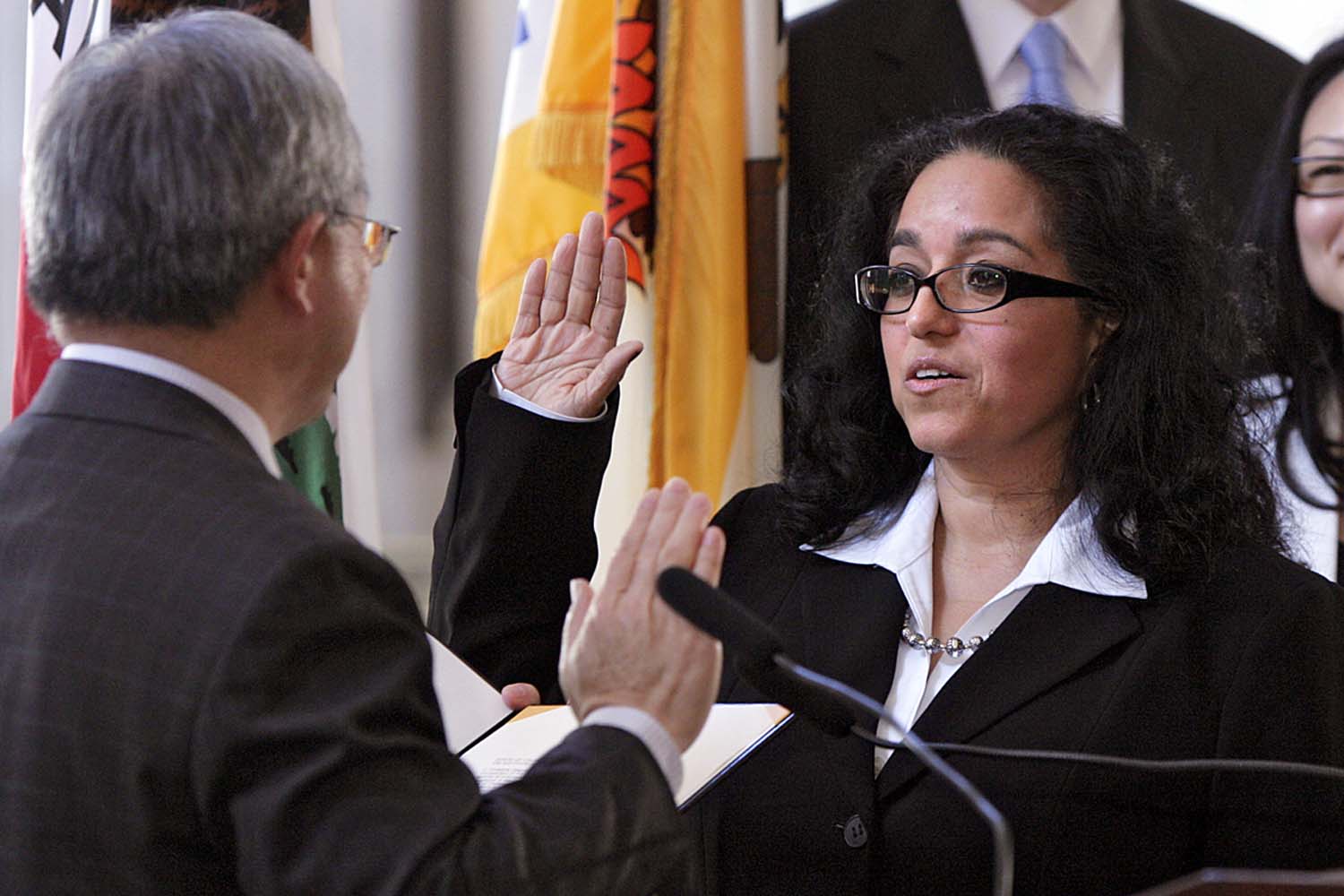
The Ethics Commission today unanimously rejected most of Mayor Ed Lee’s official misconduct charges against suspended Sheriff Ross Mirkarimi – including abuse of power, impeding a police investigation, and dissuading witnesses – but voted 4-1 to recommend the Board of Supervisors find him guilty of official misconduct for grabbing his wife’s arm on Dec. 31 and pleading guilty to the resulting misdemeanor charge of false imprisonment.

The sole dissenting vote, Chair Benedict Hur, said he had “grave concerns” that such as a broad interpretation of what behaviors constitute official misconduct would give mayors a “strong tool” to inappropriately remove their political adversaries (or at least invite charges that they were), as Mirkarimi supporters allege is happening now.

But the rest of the commission adopted a broad interpretation of what city officials and voters intended in 1995 when they overhauled the City Charter and added a new official misconduct clause banning “conduct that falls below the standard of decency, good faith and right action impliedly required of all public officers.”

“I have a lot of concerns about where you draw the line if you don’t relate it to official duties,” Hur said, appealing to his colleagues that, “I think this charter provision was meant to be narrow.”

Commissioner Paul Renne – who in earlier hearings had taken a strong role in excluding prejudicial evidence against Mirkarimi and was thought to be a possible vote in his favor – today led the charge in interpreting misconduct in the broadest possible way, arguing it didn’t even have to be related to his official duties, while the three other votes against Mirkarimi made the case that his conduct and conviction were related to a sheriff’s role overseeing the jail and its domestic violence programs.

“I think the voters would be shocked if we were to say a public official who pleaded guilty to domestic violence has not committed an act of official misconduct,” Renne said.

But Mirkarimi’s attorneys and supporters – who outnumbered those urging his removal (mostly domestic violence advocates) by more than 4-to-1 during the three hours of public testimony taken today – say the shocking thing is for a just-elected official to be unilaterally removed from office by a political adversary for reasons that today’s proceedings showed were tenuous.

“No case has ever been upheld in court to remove an elected official for a low-level misdemeanor,” said Paula Canny, the attorney for Mirkarimi’s wife, Eliana Lopez, who sat next to and supported his husband throughout today’s nine-hour proceedings.

Indeed, the city is wading into uncharted waters and the commission had few court precedents to draw from in making its findings. It’s also possible that the charter provision is unconstitutionally vague, as Mirkarimi’s attorneys have alleged, both here and in court, with an earlier judge opting to wait until after the city’s process plays out before ruling on the question.

But first, it will be up to the Board of Supervisors, where nine votes on the 11-member body are required to remove Mirkarimi. Today’s hearing got complicated at the end – as commissioners wrestled with what it means to essentially throw out the mayor’s charges and adopt their own more narrow accusation, and how to present everything to the board – that it decided to hold one more meeting in early September to adopt a summary and send everything to the board, which will then have 30 days to act.  

“I leave this process concerned that the will of the voters is being undermined,” Mirkarimi told reporters after the hearing. Holding his hand, Lopez said, “I’m shocked to see what happened today, but we are fighters.”


For complete coverage and analysis of what happened today, what it means, and what’s next, read next week’s Bay Guardian.

Guess who’s unopposed for supervisor?

34

Here’s an interesting fact to think about: There are exactly two people running unopposed for the SF Board of Supervisors, two people whose constituents support them strongly enough that nobody thinks a challenge would be effective (or necessary). And those are two supes who have consistently stuck to the progressive agenda and uncompromising progressive politics. They’ve done exactly what they promised to do four years ago; they haven’t moved to the center, haven’t tried to redefine their politics … they are who they are. And that works.

Just worth noting.

As classes begin again, CCSF reconsiders its mission

0

Fall classes at City College of San Francisco began yesterday.  Students streamed through all nine campuses, navigating their schedules.

But they are coming back to a different school than they left. On July 3, Interim Chancellor Pamila Fisher received a letter from the Accrediting Commision of Community and Junior Colleges saying that the school could lose it’s accreditiaton, leading to its closure, unless it is able to succesfully “show cause” for staying open. The letter laid out 14 “major problems” that the accreditation board says CCSF must fix.

Now, the race is on, as students, faculty, staff, administrators, trustees, and community members rush to keep the school open without compromising its unique and succesful qualities.

Welcome Weeks

At the Ocean and Mission campuses, student organizers put on rallies that thousands of passers-by saw on their way to class. Volunteers holding “welcome weeks” events hosted music and speakers, and implored students walking past to talk into the mic about what CCSF means to them. Organized by the Save CCSF coalition that formed in July, the welcome weeks activities, which may include speakers, music, litterature, film screenings, and other events will continue until August 31.

“This is a community, not just a college. And right now, our community is under attack,” said Robert Chu, a former CCSF student who was volunteering with the welcome weeks events.

For Jason Bowden, another student who spoke at the rally, yesterday was the first day of college. Bowden said he is planning to earn his EMT certification and Associate Degree in fire science. “The dream is to be a firefighter,” Bowden said at the rally.

Bowden said he is confident the school will stay open. “Initially, I was freaked out,” he said. “But with 90,000 students, from a sociological perspective it would be disastrous. But I don’t want to say its not going to happen. Stupider things have happened.”

Chu said he was assisted by the Extended Opportunities Programs and Services Program (EOPS).“I’m actually an orphan,” said Chu. “EOPS supported me graciously and helped me out.”

The EOPS office is in a building near Ram Plaza, where the Ocean Campus rally took place yesterday. The adjacent Student Union building houses other programs that aid students, such as Students Supporting Students and the Multi Cultural Resource Center. Nearby, offices of the Veterans Educational Transition Services and Guardian Scholars program, which supports students coming to CCSF from the foster care system.  Some expressed concern that programs like these will be deprioritized for funding as the school tries to meet its accreditation requirements.

The rally’s backdrop was a banner reading “Keep community in community college. Accessibility and affordability are non-negotiable.”

Mission statement

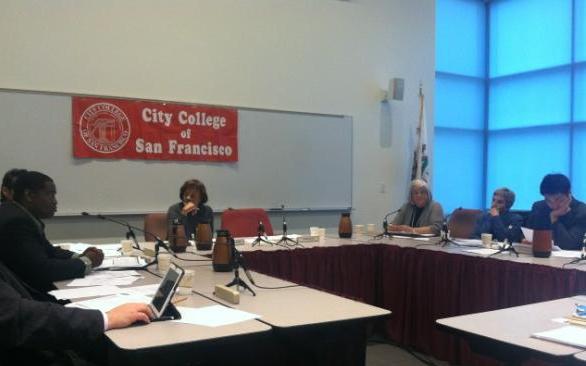
The evening before classes began, at an August 14 special board of trustees meeting, the trustees were discussing their priorities for CCSF moving forward.

The first recommendation in the accreditation board’s report regards CCSF’s mission statement.

“The team recommends that the college establish a prescribed process and timeline to regularly review the mission statement and revise it as necessary,” the text of the reccommendation reads. “The college should use the mission statement as the benchmark to determine institutional priorities and goals that support and improve academic programs, student support services and student learning effectively linked to a realistic assessment of resources”

In the wake of the accreditation crisis, the school set up 15 working groups to focus on different aspects of the process. The mission statement working group, tasked with evaluating the mission statement, and potentially, changing it, presented their work August 14– a new mission statement for the board to consider.

The board approved the first version of the new mission statement, which will be revisted at an August 23 meeting.

The new version includes a few changes. The new mission statement lists four goals: “transfer to baccalaureate institutions; acheivement of Associate Degrees in Art and Science; Acquisition of certificates and career skills needed for success in the workplace;” and “Basic Skills, including learning English as a Second Language.”

The goals that have been cut out of the mission statement: “Active engagement in the civic and social fabric of the community, citizenship preparation; completion of requirements for the Adlt High School Diploma and GED; Promotion of economic development and job growth” and “lifelong leaning, life skills, and cultural enrichment.”

The mission statement already read “CCSF provides educational programs and services to meet the following needs of our diverse community”; the new version adds the phrasing “that promote succesful leaning and student achievement.” Another phrase was added: “the college offers other programs and services supplementrary to our mission, only as resources allow and whenever possible in collaboration with partnering agencies and community business organizations.”

The mission statement working group was one of the first to complete their initial work. As Chancellor Fisher explained in the board of trustees meeting, “We need to finish recommendation one as early as possible because it will affect out planning.”

The working group that wrote the mission statement was comprised of faculty, administrators, trustees, and community members. No students were involved, until two– Associated Students president Shanell Williams and Student Senator Diamond Dave Whitaker– were added to the working group last week. Today, the mission statement working group, with its two new additional members, meets to discuss the ongoing process of documenting CCSF’s priorties. Their meeting is public and will take place 1:30-2:30pm at Batmale Hall.

Hate (and free) speech

20

How far can you push free speech? Is it okay for Muni to run ads that are utterly, inexcusably offensive to Arabs and Muslims in the name of political expression?

I’m pretty much always on the side of the First Amendment. And we were furious when a Bay Guardian ad campaign accusing then-mayor WIllie Brown of political corruption suddenly vanished from the sides of the local buses. It’s hard to seek government limitations on any political statement. But if the ads that appeared Aug. 7 on Muni aren’t over the line, they’re pretty close to it.

Here you have an organization described not only by the Southern Poverty Law Center but by the Anti-Defamation League as a hate group buying space on San Francisco buses for ads that effectively disparage a vast religious, ethnic and cultural community as “savages.” The campaign is obviously designed to get publicity; not that many San Franciscans are going to be convinced to join the American Freedom Defense Initiative. Nobody’s opinion on the Middle East will be swayed by this shit.

But this tiny cadre of loonies, led by Pamela Geller, who is really fucking scary, wants attention. In New York, the anti-Muslim group sued when the city tried to take down the same bus ads, and you know they’d love it if that happened here. Muni says it can’t legally pull the ads, which is probably true — although BART has a more restrictive policy.

It’s not just idle rhetoric — this stuff frightens people. “We’re hearing from people that they’re uncomfortable riding Muni,” Zahra Biloo, executive director of the Bay Area office of the Council on American-Islamic Relations, told me.

Obviously, you can’t run ads that enourage someone to engage in violence. Is dehumanizing people and calling them “savages” the same thing? Biloo thinks it’s pretty close: “It’s important for progressive cities to say, ‘not in our city,'” she said.

A change.org petition condemning the ads has more than 2,000 signatures.

On the other hand, I don’t want to give Geller the pleasure of suing San Francisco and making this into a Free Speech cause. Because that’s exactly what she wants, and probably the reason she bought the ads in the first place. So how about this: The supervisors pass a resolution denouncing the ad and the message, and Muni agrees to give CAIR the same number of ads, free, in the same locations (gee, maybe even on the other side of the same buses) to present an alternative message.

At least it’s a start.


Reports, rally, and hearing call for more public benefits from nonprofit hospital chains

7

A rally and legislative hearing in Sacramento tomorrow (Wed/15) will highlight how little community benefits and charity care large nonprofit healthcare corporations offer despite their tax-exempt status. At the center of that critical spotlight is Sutter Health, the healthcare behemoth that owns California Pacific Medical Center and is locked in a high-stakes standoff with the city over whether to rebuild St. Luke’s Hospital in exchange for approval of a massive luxury hospital on Cathedral Hill.

Last year, we reported on a local study that found CPMC provided far less charity care and other community benefits than any other healthcare provider in the city, despite its tax-exempt status and extraction of $744 million in profits from San Francisco between 2006-2010. CPMC reported $189 million in profits for its San Francisco operations last year, and that’s expected increase sharply if Cathedral Hill Hospital is built.

Last week, the California State Auditor issued a scathing report – based on investigating four nonprofit California hospitals, including St. Luke’s – calling for stronger demands on these supposedly nonprofit corporations. Among its findings were “The amounts of community benefits the hospitals provide cannot be used to justify their tax-exempt status” and “Neither federal nor state law requires nonprofit hospitals to deliver specific amounts of community benefits for hospitals to quality for tax-exempt status.”

Tomorrow’s hearing by the California Senate Select Committee on Charity Care and Nonprofit Hospitals, and a rally afterward by the California Nurses Association, will spotlight those problems and call for tougher new standards. CNA’s research arm, the Institute for Health and Socio-Economic Policy, will also unveil a new report that defines the problem and reinforces the need for reform.

“These hospital chains are exploiting their nonprofit status to enjoy enormous tax benefits while returning very little to their communities,” CNA spokesperson Chuck Idelson told the Guardian.

He said the problem began with the “corporatization of health care” in the late-’80s, when deregulation and corporate-friendly legislative changes encouraged the consolidation of health providers and lowering of public accountability standards, coupled with a corporate culture that began providing excessive pay and benefits to executives.

“There used to be better standards, certainly at the federal level, with what they were required to do to maintain nonprofit status,” Idelson said. “But the distinctions of for-profit and not-for-profit has become blurred and the burden is falling of public hospitals like SF General Hospital.”

Nonetheless, Sutter/CPMC continues its aggressive tact with San Francisco city officials, refusing to offer firm guarantees that St. Luke’s – which serves much of the city’s low-income population, second only to General, which would be overwhelmed if St. Luke’s closes – will remain open for at least 20 years and promising only modest improvements in its charity care standards. Despite taunts from Sutter spokespersons that city officials are endangering public safety by stalling the rebuild of St. Luke’s, which isn’t seismically sound, the Board of Supervisors refused to approve the lucrative development agreement last month, delaying consideration until after the election in November in the hopes that CPMC will offer better guarantees and community benefits.

“It’s an extremely timely issue for San Francisco,” Idelson said tomorrow’s hearing (which is from 10am to noon in Room 3191 of the State Capitol) and rally (from 12:15-1pm on the Capitol’s North Steps).

Newsom votes for — and pushes — housing for the rich

10

I can’t say if the campaign contributions had anything to do with it (in fact, nobody seems to know when campaign contributions become bribery) but for whatever reason, Lt. Gov Gavin Newsom not only voted for 8 Washington on the State Lands Commission — he pushed hard to make sure the project went through.

According to former City Attorney Louise Renne, who was at the hearing making the case against the project, the director of the governor’s office of finance, Ana Matosantos, sent a proxy. So did state Controller John Chiang. Newsom appeared in person.

And when Matosantos’s person reviewed the evidence, he decided that it wasn’t appropriate for the panel to take any action — thanks to a successful referendum effort, the whole matter is in legal limbo in San Francisco until Nov. 2013. But Newsom was having none of it.

“It was very close at first, the controller’s representative went back and forth,” Renne told me. “But the lieutenant governor was very clear that the matter should be addressed today, and he swayed the vote.”

In the end, it was 2-0 to approve the deal, with Matosantos’s rep abstaining.

So as if there were any doubt, we know where Newsom is when it comes to giving public land to a developer to build housing for the top sliver of the 1 percent.


Newsom will vote on campaign donors’ projects

7

On the front page of the Chronicle Aug. 12, California Watch reported that Lieutenant Governor Gavin Newsom has been promoting the interests of campaign donors in San Diego and San Bernardino. It’s nothing criminal, but it looks bad – and it’s just the start.

Newsom, who sits on the state Lands Commission (one of the few critical duties of the Lite Guv) has received thousands of dollars in donations from interested parties looking to exploit San Francisco’s waterfront, public records show. And he will be voting on the future of their projects.

Newsom received $2,000 for his 2014 campaign from two lawyers, Neil Sekhri and Mary Murphy. Both attorneys are at the law firm Gibson, Dunn and Crutcher, and are involved with the controversial 8 Washington project – which comes before the Lands Commission Aug. 14. Since part of the site of the most expensive condos in San Francisco history is state Tidelands Trust property, the state has to approve the deal. Newsom will be one of three members voting.

The future site for the Golden State Warriors arena is along the waterfront. The decision to turn over that land to private investors will come before Newsom’s panel, too – and Newsom has received more than $6,000 from interested parties.
The Strada Investment Group, which is representing the Warriors as a development consultant, gave Newsom $5,000, records on file with the Secretary of State show. Jesse Blout, real estate investor for the group contributed $750. Scott Stafford, principal, contributed $750. Marty Glide, chief executive officer of the Warriors, contributed $2,000 Newsom’s campaign.

Aaron Peskin, former supervisor and a foe of 8 Washington, issued a press release Aug. 13 calling on Newsom to recuse himself from voting on that project. Newsom’s office hasn’t responded to us, but it’s a safe bet that’s not going to happen. Newsom didn’t get where he is by stiffing campaign donors when they need him on a big vote.

There’s another  problem with the Lands Commission vote on 8 Washington. According to former City Attorney Louise Renne, the commission can’t vote on a project that doesn’t actually exist.

Her argument, laid out in an Aug. 7 letter to the commission, is simple: More than 31,000 San Francisco voters signed a petition demanding a vote on the project – and the Department of Elections has certified the referendum for a citywide vote. That can’t happen until November 2013. “Under these circumstances,” Renne wrote, “you do not have a currently valid 8 Washington Street/Seawall Lot 351 project before you for consideration. Approvals of the project are suspended by law.”

Does the commission even care if what it’s doing is legal? Anyone placing bets?

UPDATE: We just got a statement from Newsom’s chief of staff, Chris Garland, who told us that the Attorney General’s Office and the Lands Commission legal staff agreed that none of the panel members have a conflict of interest.  “The lieutenant governor has enjoyed the support of parties on both sides of this issue and is capable of looking at the item impartially and doing what is right for the state,” he said. “This isn’t a matter of contributions; it’s matter of calling balls and strikes on an important project.”

Okay then.

Rafael Mandelman enters City College board race

6

After the really bad news that Community College Board member Milton Marks died, there’s some good news: Rafael Mandelman, an energetic, smart, progressive lawyer and member of the DCCC, has decided to run for that board.

City College badly needs the help. There’s a real chance that a state monitor could be placed over the district, robbing the board of much of its ability to set policy and spend money. And even if that doesn’t happen, the state — which disagrees with San Francisco on how community colleges should be run — is going to keep tyring to mess with CCSF.

So it would be nice to have someone like Mandelman, who has political experience but also works for a law firm that does a lot of public-sector work, around to help.

Marks’s untimely and tragic death leaves an open seat and he hadn’t filed to run for re-election. So the mayor has the ability to appoint someone to serve out Marks’s term — and if he does it before Aug. 15, that person can file and run as an incumbent. But for those of us who are getting sick of having so much of our government appointed for us, it would be nice if Mayor Lee would wait until after the filing deadline then name a real caretaker — Mandelman suggests former trustee Tim Wolford, who is now in the business of helping troubled nonprofits. The board will need help in the next four months, and someone qualified — and skilled in dealing with fiscal and political problems — would be an immense help.

But appointing a political hack who is pals with the mayor’s inner circle and sees a shot at running as an incumbent would be a big mistake.

Of course, Lee hasn’t done too well in the “caretaker” department. We’ll see what happens.

Local parking permits — and fees

70

So the city’s going to take a look at the neighborhood parking program. Good. Here’s my first question: Why do the car owners get away so cheap?

It costs $64 a month to buy a Muni Fast Pass. It costs at least $300 a month to rent a garage. But if you’re in the neighborhood parking program, you get essentially a guaranteed parking space on a city street — public property — for $104 a YEAR, or about 28 cents a day.

That’s crazy.

I’m not for eliminating the neighborhood parking stickers; the program keeps out-of-town commuters from driving into SF and using residential areas as free parking lots. But let’s make the car owners — who, by the way, are still reaping the Schwarzenegger VLF windfall — pay their fair share. 

Double the fee and you get another $6.5 million. And the parking permits would still be the bargain of the decade.

And then maybe we can get God out of the parking system.


Big week ahead as City College classes start

2

Classes at City College of San Francisco start for the fall on August 15. That makes this a big week for the coalition of students, staff, and community working on its future. 

As the college welcomes students back, this coalition will set up on the Ocean campus in Ram Plaza and at the Valencia entrance of the Mission Campus. With litterature from community groups, music and speakers, they hope to let incoming students get the chance to learn about the efforts to save the college- making sure it continues to exist, as well as maintaining its academic standards, accessibility, and other core values. The celebration will include music and speakers.

There’s also plenty happening before Wednesday. Today, a student organizing meeting will take place at the student union at the CCSF Ocean Campus. Then, at 6pm, CCSF will be the focus of the weekly Occupy Forum, an open space to discuss issues of importance to the occupy movement. William Walker, CCSF student trustee, will speak at this week’s forum, called “Education Under Attack: Austerity, Privatization and Profit.”

On Tuesday, the CCSF Board of Trustees will hold a special meeting at CCSF’s Ocean Campus. They are scheduled to discuss the progress of the working groups that have been set up to work towards meeting accreditation requirements. The meeting is public, and stakeholders and community members will definitely be making an appearance. The meeting is at 4pm in multi-use building room 140.

“There are a lot of people that have opinions on how we need to move forward,” said Walker. “It’s the job of students to come together to figure out what austerity is actually going to mean for city college, and what our must-have demands.”

Creating activist scholars: extended interview with Andrej Grubacic

16

For this week’s paper, we talked with with Andrej Grubacic, the new head of the anthropology department at the California Institute for Integral Studies. Here’s the extended interview with Grubacic, where he talks more about the new Anthropology and Social Change program, as well as the history of anarchist schools, how his grandmother influenced his politics growing up in Yugoslavia, and the state of the occupy movement.

San Francisco Bay Guardian: What’s the structure of the new program going to look like?

Andrej Grubacic: It’s going to be called Anthropology and Social Change, and we have two levels. One is MA, the other is PhD. Philosophically speaking and politically speaking, in the age of occupy and all of these movements, the great question for me was how to organize a department that’s actually going to be useful for all of these social struggles and that activism that’s happening outside of education. I’ve been in academia as a scholar-activist for a long time. And what I’ve discovered is the most painful thing in my experience is the separation. The fact of actual separation between the grassroots knowledges, produced outside of the academia, and academic knowledge produced within the universities. So the best things, the way that I was thinking about this was that what we should do on both levels, MA and PhD, is to construct a space of translation of different knowledge. So to put these two knowledges, one produced outside of academia and the other produced in the university, in dialogue.

So we have Boots Riley for example, he’s going to be teaching community organizing, or organizing for social justice. Then we’re going to have Sasha Lilley teaching an eminently practical course on how to create and produce radical radio. So you’re going to get activist media skills. Then we’re going to have a few other people teaching also different skills, and knowledge that’s inspired by art, bringing artists in, and knowledge that’s inspired by people who are thinking about social theory and social emancipation. We’re going to create something really exciting. 

SFBG: Do you think the students who attend are going to be the same kind of mix of academics, artists, activists, and people who want to organize within their own communities here in San Francisco?

AG: I think so. That’s the idea. The idea is to make this department work for the students, but also for the people in San Francisco Bay Area. And we can do that by bringing students who are interested in local work, and I think that’s going to be a pretty amazing. If we are of course able to do things right, but I think that we will be. So Chris Carlsson for example, he’s going to be teaching labor and ecological history of San Francisco, so a very local topic. We’re going to be teaching courses on activist ethnography, and activist ethnography is the center for the whole program, which is how can we relate to community– and this is where we’re also using the term integral– in an integral way? Meaning how do we integrate community into every step of the research process? And the traditional anthropology, as you probably know, is all about participant observation. We would like to have instead observant participants. People who are involved with the communities. People who are trying to dissolve the distinction between the researcher, between who’s on the outside, and who’s on the inside. And they’re creating something together. 

SFBG: I saw when you spoke at the University of the Commons launch. You were talking about how there’s a wave of radical activity going on at schools throughout the world.

AG: Oh yeah.

SFBG: This is obviously very different, because this is an institution putting out something radical, but do you think it fits into that trend right now?

AG: I think it does. Because if you know my biography, I’ve been travelling through all of these experiences in schools for many many years now. I had to leave Yugoslavia where I’m from because of my oppositional political activity and, you know, I finally arrived here to work at New College of California which was also a private institution, and I was very inspired by the department of Activism and Social Change, and I completely fell in love with the history of radical schools in San Francisco. Now I don’t know how much you know about them, but they’re, like, great stuff. There was a liberation school, there were Black Panther schools, of course. There is a great history of alternative schools and experiments. So New College was a private institution, but still, many of my activist friends, who became friends later, have actually been through New College and they got their MA s in activism and social change or media studies. So CIIS actually took many of these people, many of the professors from these programs, and invited them here. So in a certain sense, I think what was done in terms of Activism and Social Change, and orientation to social justice and emancipation, was that at New College we are still keeping that spirit alive. But, in communication- and I think this is the crucial thing for our department- we are doing this in communication with radical educational experiments, movement-based experiments from all over the world. Manolo Callahan, who is going to be teaching here next semester, he is one of the people involved in University of the Earth- Universidad de la Tierra in Oaxaca and in Chiapas, so we are creating relationships with them. Which you know are completely radical experiences outside of institutions, they call themselves deprofessionalized intellectuals. We have already relationships with the Activism and Social Change department in Leeds, in England, they have a great school there. With people in Brazil, the landless workers movements. We’re in touch with people from Ecuador and people form Bolivia. So it’s a whole network of educational, tendency of educational experiences that this department is now creating.

SFBG: Do you have economics courses here?

AG: Yeah.

SFBG: So are there classes that are non-capitalist economics?

AG: Yes, it’s called radical political economy. We are trying to understand political economy from a feminist perspective, from an anarchist perspective, from a post-colonialist- so in that sense we are engaging multiple emancipatory frameworks of understanding social reality. So I myself, I come from the anarchist experience in social science, in politics. We have people who are feminists- Roxanne Dunbar-Ortiz for example. She’s sort of a legend in San Francisco Bay Area and she’s teaching three courses. Roxane Dunbar-Ortiz is going to be teaching about Native American struggles. As it pains me to say, that kind of a focus is mostly missing not only in private but also in public universities now. 

SFBG: So could you tell me a little more about the anarchist background you come from?

AG: I became an anarchist fairly early on, I was 13 or something. Because I was living in Yugoslavia. At that time, Yugoslavia was a socialist state. And because it was a socialist state for me it was a very interesting place to grow up, because you see socialism, real existing socialism, and you see many things that are beautiful about socialism. But you also see many things that are not so beautiful. And I was thinking about the alternatives to it. And for me it was really, sounds cheesy, but a conversation with my grandmother that decided it. She was a communist; she was a Yugoslav revolutionary communist. And Yugoslavia was falling apart, Yugoslavia was in a series of really brutal ethnic wars back in the 90s, and my grandmother, this lifelong communist, told me– my question was, are you still a communist? Do you still believe in communism in the context of this country falling apart? And she said yes, I do, I think that we have chosen a path to communism that was wrong. But I think the responsibility of your generation is to find a different path. The ideal is OK, the ideal is good. It’s a different path that you’re generation needs to find, and you have a great responsibility to do so. And the alternative that I discovered that seemed to me, back when I was 13 years old, and it still does, rational– as an alternative to the Marxist-Leninst way of getting from here to there, right– is anarchism. So for me anarchism, or libertarian socialism is another name that people are using, is a way of organizing for social justice and creating an egalitarian system that takes democracy very seriously. It’s like democracy without a state. 

SFBG: What happened that made you leave Yugoslavia?

AG: I was raised a Yugoslav. So I was raised to be a citizen of a country that doesn’t exist anymore. And on one hand, you had people who were Serbian nationalists, and I couldn’t really get along with those. On the other hand you had people who were neoliberal capitalists, who thought that everything coming from Europe and the United States was great and I couldn’t really agree with those either. And being a young academic, I was a historian at the time and working within the university, there was a great deal of pressure to get me out of the university. So it became very unpleasant. So I already had a relationship with Noam Chomsky, and Chomsky was following everything that was happening to me in Yugoslavia. And he told me at some point OK, it’s time for you to go. So he got me out of Yugoslavia, moved me to the United States or helped me move to the United States, introduced me to a man whose name is Immanuel Wallerstein, a great, amazing sociologist, who helped me get to his program at the Center for the Study of Economics, Historical Systems, and Civilization at SUNY-Binghamton to finish my graduate studies. So that was a– it was a long journey. 

Let’s just say that it was an active disagreement with the political class active at that time in Yugoslav-Serbia. It was actually funnily enough still called Yugoslavia. We only had two countries of the former Yugoslavia, Serbia and Montenegro. But the political cultures and political groups in power were either Serbian nationalists or these hyper-capitalists, right. And going after them, because I was publishing and I was doing a lot of things, was– let’s say, not smart career choice. But it made it possible for me to meet people like Chomsky and some other people. And they liked what I was doing and they were concerned that, for health reasons, United States might be a better environment.

SFBG: Even within these more welcoming academic environments, do you feel your activism or anarchism is stifled in some way?

AG: I had a bad experience here at one university, a local university here in San Francisco, and it wasn’t a good experience. That felt unpleasant and it felt very stifling. CIIS is very different. Actually this is the first place where I think that I was hired because I was an anarchist, or I am an anarchist. It’s kind of funny. But in other places, in Yugoslavia and there was another institution here, I had problems because of my politics. Here, that was exactly the reason I was hired. So it gives you an idea that the school is very different than most other universities. 

SFBG: Could there be such a thing as an anarchist school?

AG: I hope University of the Commons can become something like an anarchist school. Anarchist schools actually used to exist. And they still exist. But the really big one was Francisco Ferrer in Spain. It was called Modern School. It was created in 1904. It became so huge– especially after Francisco Ferrer was killed by the Spanish state in 1909- that there were 60 schools only in Spain and there were I don’t know how many schools in the United States but the last one closed only in 1958 in New Jersey. Modern Schools were amazing places. One could also argue that Yasnaya Polyana of Leo Tolstoy was also an anarchist school. It was in many ways. 

But anarchist schools were schools where you had a few elements. Integral education was number one. Education of the whole person. You don’t only educate somebody as an intellectual but you aim at education of the whole person. The other thing was something that anarchists called reality of the encounter. Which means that all the questions in pedagogical practice needs to come from real questions posed by life itself. So you need to do something that’s practical. Another thing was the complementary role of the teacher, which means the teacher needs to be a facilitator who listens and who offers something in return. But the first thing, the first kind of show of interest, comes from the student. So the role of the teacher is complementary. Another huge thing was something Proudhon called démoédie, or self-government of the school. So school becomes a place where you teach students arts of self-government and self-management. Schools are organized in the spirit of direct democracy. Another thing which was Paul Goodman, famous anarchist educator, his idea was to organize decentralized “teeny schools,” as he called them. So to have a small teaching environment. To have students go to the bank to be taught about mathematics, to go to a museum and then to teach them about geography, to do these things. And then the most important thing for anarchist schools on all levels is the idea of natural motivation and natural learning which was first formulated by Tolstoy. The idea is the students have this natural motivation to learn. And what you do is basically you create an environment where that kind of learning becomes possible. And another thing for anarchist schools was the idea of spontaneous order. So there is no imposed order by the teacher, but there is a spontaneous order that the students themselves discover. In other words, discipline is– I think this is Tolstoy’s, the word that he used– discipline is being discovered, not imposed. What would that mean for a university is a different question. I think the one obvious thing would be that everybody, students and professors, there needs to be a horizontal relationship between them. There needs to be an atmosphere of collective production of knowledge in the classroom. There cannot be a curriculum that’s linear. It needs to be dialogical, it needs to be participatory, you need to talk about this and co-create a syllabus. You need to be as horizontal and participatory as possible. You need to be as imaginative as possible in diminishing your own role as a teacher, which is a very tricky thing, without becoming a populist in the classroom, you know. Empowering students, and finding appropriate structure together with students. Again we are coming back to the idea of listening. We need to listen to the students and together with them, create an atmosphere in the classroom that’s going to be genuinely transformative. 

SFBG: I’d love to ask you more about how this will relate to anarchism and occupy.

AG: In terms of anarchism, we are gonna have- this is going to be one of the few places where anarchism is going to be studied. So anarchist social theory, anarchist education, anarchist ideas in general. We are going to study them, seriously, because they need to be recognized seriously. They’re part of- it’s a beautiful history, it’s a beautiful tradition. How important it is, I think, is revealed, by the recent rediscovery or reinvention of anarchism at occupy. So I think that it’s more relevant than ever to create a space where anarchism will be studied. 

In terms of occupy, occupy is going through the process of fragmentation right now, and they are looking for a new political space of conversation I think. So the way that we can relate to occupy, I think, is to have our students participate in whatever different movements occupy helped. Because you know that occupy now how occupy patriarchy, there is decolonize, there are many different groups. So I expect our students to be involved in occupy, and I expect us to be able to offer a space where many of the debates related to occupy can happen. So, and you know there is an actual affinity. When Silvio Federici comes, or John Holloway, or Michael Hardt, or any of these people, these are the people that occupy people read, and these are some of the bibles of the occupy movement. So what are we going to do is, we are going to make them available and accessible to these people who come here, and we are going to bring here,  and we are going to take them to the occupy movements and we are going to invite people from the occupy movements to come here. But we are also going to do more I think. What we can do, and this is now only a plan an idea, is to invite the movement itself, not only occupy but different movements, and say, OK, please come here and tell us what would you like us to do. And one person from our department had this idea and I think it is brilliant. So to have the movement, different movements– is it food, is it the environment, is it one of the occupy-related movements- come here. We provide the space. And they tell us- social theorist, social scientists, people in the academia, they tell us what do they need us to do. It comes back to this idea of listening. So give a movement or movements a real possibility and opportunity to speak. Because usually academics, we are people who speak. Well we would like to see academics become people who actually listen. 

SFBG: I agree that occupy is basically an anarchist movement and a lot of the tenants of anarchism are being used in it. And I think this is a time when, in the mainstream, people are talking about anarchism more. But for a lot of people it has the image of people who wear black and smash stuff. So I’m curious, how does black bloc, or property damage, relate to the anarchism that’s going to be studied in the department?

AG: It doesn’t relate at all. The anarchism that we are going to study is– in Katrina, the Common Ground collective. That for me is a great example. Common Ground collective is a relief group of activists who went there from all over the place, they went to New Orleans, they were all anarchists and they said OK, we don’t believe in charity, we believe in solidarity. And they built a common ground center and they did relief work with the community for a couple of years. And there is a new book about it by a person who actually came here and spoke, one of the New Orleans activists, Scott Crow. And this is the kind of anarchism I am myself inspired by, the constructive side, not the destructive side. So how to build alternatives in the present for people, what sometimes referred to as prefigurative politics. How to think about positive stuff, constructive stuff. Building alternatives that are going to be persuasive enough– not about breaking windows. I don’t see any particular point in breaking windows. And I think it’s an unfortunate thing that people would reduce anarchism to that. If you think about it, the most important public intellectuals in the United States, one of them recently died, Howard Zinn, and Noam Chomsky thankfully is still alive, they’re both anarchists. So this is the kind of anarchism that I subscribe to, and both of them were my mentors. And I studied with Howard. I studied with Noam, he was the chair of my PhD committee. So these are the people whose anarchism I take very seriously, and this is the kind of anarchism that I like. 

SFBG: But it’s hard to ignore organizing tactics.

AG: But even orgnanizing tactics– black bloc as a tactic comes from the autonomen movement in Germany, which was not an anarchist movement. It comes from the 80s. People dressed in black in Germany, you know, doing property destruction thinking that property destruction is going to contribute to the tactical efficiency of a particular action. Then it went through the environmental movement in particular places, in the environmental movement here in the United States. And it’s being used not only by anarchists, it’s being used by people who would call themselves communists, left, anti-state communists, by different varieties, autonomous Marxists. So it’s not only a tactic that anarchists use. And, you know, it’s a tactic. Anarchism is far broader. 

SFBG: Than just tactics.

AG: Yes. If you would ask me what is the most distinguishing, for me, character of anarchism I would say prefigurative politics– creating the new within the shell of the old—the idea of direct democracy, and the idea of direct action. Direct action being producing alternatives within the present, and direct democracy, behaving in the way that general assemblies are being set up. So that is I think the greatest lesson that anarchism can teach, direct democracy and direct action. 

SFBG: Occupy Oakland, they only had their camp for less than two months, but so much happned.

AG: They did great things. I really feel bad when I read mainstream media completely dismissing that experience. I was there, and the amount of work that went into keeping the medical facilities there, to helping homeless, feeding homeless, helping people with medicine, with immediate healthcare, taking care of children, creating children-friendly spaces, I mean it was amazing. Sure there were problems, of course there are going to be problems. But the stuff that people did there was just incredible. And the general strike, and shutting the port, and all of that, these were great things.

SFBG: And part of the reason the city started cracking down on it was when police tried to enter the space, people wouldn’t let them in.

AG: And they shouldn’t let them in, because the way police behave in Oakland was just outrageous.

This interview has been edited for length.

Davis snags a trio of top progressive endorsements

36

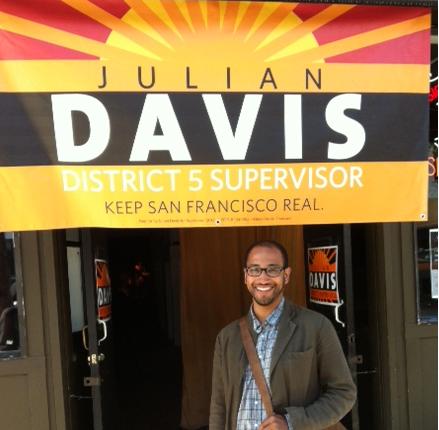
District 5 supervisorial candidate Julian Davis is emerging as the progressive standard-bearer in that competitive race after today receiving the endorsements of a trio of top progressive politicians: Sups. John Avalos and David Campos and attorney Matt Gonzalez, the former board president, mayoral candidate, and D5 supervisor.

Gonzalez had endorsed appointed incumbent Sup. Christina Olague – who he appointed to the Planning Commission in 2004 – but he withdrew that endorsement last month after being frustrated by a series of actions in which she sided with Mayor Ed Lee, moderates, and developers over her longtime progressive colleagues and constituents.

Avalos and Gonzalez are endorsing just Davis, at least for now, while Campos added to his early endorsement of Olague by today endorsing Davis and John Rizzo, who had earlier snagged the other prized progressive endorsement by winning the support of Assembly member Tom Ammiano.

Davis, who was already endorsed by former supervisor and local Democratic Party chair Aaron Peskin, said he’s thrilled with today’s triple endorsement. While some have questioned his anemic fundraising so far, raising less than $10,000 as of June 30, Davis notes that he had been in the race for less than a month before that deadline and that he expects to have more than $150,000 to get his message out.

“What these endorsements signal is a confidence from San Francisco’s progressive leaders, not only in the vision of this campaign, but in our capacity to win,” Davis told us.

Avalos said that he has confidence in Davis’ values, experience, and his ability to run a strong race that will help to reinvigorate the progressive movement.

“Julian is a solid candidate who has been around for years on a number of progressive causes. Running for mayor, I was impressed with his connection to neighborhood issues ranging from small business development to urban cycling and youth and worker rights. His campaign has a good buzz about it, one that I expect will resonate with District 5 residents,” Avalos told us.

Milton Marks, City College defender, dies at 52

3

Milton Marks III, the son of a state senator who for 12 years tried, often against long odds and strong opposition, to clean up the San Francisco Community College District, died Aug. 9 of complications from a brain tumor. The whole city — particularly the college district and its community of teachers and students — should be mourning a genuinely good guy who stood up to corruption and secrecy and was an honest progressive on the College Board back when that was a lonely position.

“Of all the public servants I’ve known, he was the one I really admired most,” his colleague, board member John Rizzo, said. “For all the shit he took, he never wavered. He was the nicest guy in politics, but he never backed down.”

Marks was elected to the board in 2000, when it was a snake pit of sleaze, and he fought valiently — often against the board majority and the administration — to bring accountability and openness to the district.He’s been re-elected twice, and would have been a shoo-in for another term this fall. (Unlike many College Board members, Marks wasn’t constantly running for higher office. He loved City College and saw his role right there on the board.)

With all the problems the college is facing today, Marks and his voice of reason and credibility will be sorely missed.

The mayor will appoint a new member to that seat, and the person will have to run in November.

I don’t know all the details about memorial arrangements; I’m still waiting for the formal statement from City College. The school paper, the Guardsman, has a solid obit you can read here. I’ll fill in more details when I have them.

Meanwhile, we’ll all miss you, Milton. You gave it the good fight.


In Richmond, is it safe to eat your garden fruits and veggies?

12

Questions remain about the safety of eating homegrown fruits and vegetables from gardens in Richmond and other areas affected by a fire at the Chevron refinery August 6.

The official line from Contra Costa County–where residents were told to shelter-in-place during Monday evening’s fire–is to wash the produce in your gardens extra well.

“It’s safe to eat your fruit and vegetables,” said Randy Sawyer, the county’s chief environmenta and hazardous materials officer. “We do recommend that you wash them in a weak soap solution like a dish soap.” If there was harmful residue on the plants, it would be visible, he said. “It wouldn’t be a dust product, it would be sooty.”

But local gardeners and environmentalists beg to differ, and many are anxious about the fire’s potential long-term effect on the area’s urban agriculture. At a tense community meeting on Tuesday night, gardeners from Urban Tilth rolled in wheelbarrows of wilted produce they said was destroyed by the refinery fire, which was contained after a few hours but burned into the night. 

“We have extreme concerns,” Urban Tilth executive director Doria Robinson told the Guardian. “We’re trying to work with soil and air quality scientists to figure out what we need to test and how we can test it to determine what is safe. In the meantime, we can’t stand by the food we have.”

Until we know what chemicals were burning in the fire and what remains in the air, it’s dangerous to assume our garden products are not contamminated, said Robinson, a Richmond resident herself. “If it’s particulate matter or dust, in theory you can wash it off. At the same time, you’re not exactly sure how certain chemicals react. More importantly, if you can wash the plant, what happens to the soil? Heavy metals like mercury are used in some processing. If that stuff was in the plume and it deposited in the soil” there could be lasting detrimental effects on our gardens, she said. 

When a Richmond resident at Tuesday’s community meeting asked what chemicals might be in the air, and Jeff McKay, Deputy Air Pollution Control Officer at Bay Area Air Quality Management District (BAAQMD), listed hydrogen sulfide, benzene, sulfur dioxide, and styrene. All four compounds are either considered poisonous, or suspected to be carcinogens. 

The BAAQMD’ lab analysis report tested for 23 compounds, including Benzene, but not the other three chemicals. Most of the chemicals “have been identified by the state of California as Toxic Air Contaminants,” according to the BAAQMD. And although the same report insists that the air pollution levels were “significantly below federal health standards,” the San Francisco Chronicle reported that 1,700 people ended up in the emergency room with respitory problems during or after the fire. 

Robinson said it is extremely difficult to trace health problems to individual pollutants. 

“The way that companies like Chevron have been able to pollute the air without liability is it’s extremely hard to trace back, and they can point to things like the highways,” she said. “This particular instance was so extreme that if we get a list of what was burning, we might be able to trace it back for the first time.”

Robinson and her team hope to have a plan to test Urban Filth’s produce by Monday, though she said financial barriers will make a comprehensive analysis difficult or impossible. Until the products are deemed safe, the organization is planning on suspending its school programs and refraining from eating from its 11 Richmond gardens, and Robinson urged residents to do the same with their personal plants.

“Before we take someone else’s word for it, we owe it to ourselves and our community” to ensure our food is clean, she said.

City College students, in their own words

6

City College of San Francisco (CCSF) students and freelance journalists Joe Fitzgerald and Sara Bloomberg this week continued giving Guardian readers some of the most insightful coverage of that institution’s struggles available, supplementing it with profiles on students effected by CCSF’s current woes.

And this enterprising pair of reporters didn’t stop there. You can now hear directly from a couple of students they interviewed in these videos they made as part of the project:

To hear the perspectives of other CCSF students, in their own words, check out these two Tumblr blogs, where they post their thoughts.

Olague faces her challengers during first D5 debate

58

Tonight’s inaugural District 5 supervisorial debate will be a key test for Sup. Christina Olague – who has fallen from favor with many progressives after a series of bad votes and prickly or evasive interactions with one-time allies – and a test for the rival candidates who are seeking to become the main progressive champion in one of the city’s most leftist districts.

The elected incumbents on the Board of Supervisors have ended up with surprisingly easy paths to reelection [8/9 UPDATE: with the exception of Eric Mar in D1], leaving D5 – as well as conservative District 7, where FX Crowley, Norman Yee, and Michael Garcia are part of a competitive field seeking to replace termed out Sup. Sean Elsbernd – as the race to watch this year.

Olague has been trying to execute a tough balancing act between the progressive community that she’s long identified with and the moderates she began courting last year with her early support for Mayor Ed Lee, who returned the favor and appointed her to serve the final year of Ross Mirkarimi’s D5 term. But by most accounts, she hasn’t executed the feat well, usually siding with Lee on key votes, but doing so in a waffling way that has frustrated both sides.

Progressive candidates such as Julian Davis and John Rizzo will have plenty of fodder with which to attack Olague as a turncoat, including her votes on the 8 Washington project and Michael Antonini, her strange antics on repealing ranked-choice voting, and her close ties to power brokers such as Rose Pak, who hosted a fundraiser that provided more than half of the $81,333 Olague has raised this year, much of it from developers and other interests outside of D5.

Matt Gonzalez – the former D5 supervisor, board president (from where he appointed Olague to the Planning Commission), and mayoral candidate – was so frustrated with Olague that he withdrew his endorsement of her last month, a decision that her other progressive endorsers are also said to be mulling.

With Mirkarimi tarnished by his ongoing official misconduct probe, the endorsement of Gonzalez could be the most significant in this race, and he told us that he plans to make a decision by Friday, the deadline for submission of ballot statements and a point at which we may hear about other changed or dual endorsements from prominent progressives. Other key nods in the race so far have been Aaron Peskin endorsing Davis and Tom Ammiano endorsing Rizzo, two candidates each vying to become the favorite of the left, with Thea Selby, Hope Johnson, and Andrew Resignato also courting support from the left.

Yet so far, the strongest challenge of Olague seems to be coming from her right, with moderate London Breed leading the fundraising battle with $85,461 as of late June 30, including the maximum $500 donation from venture capitalist Ron Conway – the main fundraiser behind Lee’s election last year – which may be a sign that Olague’s support among moderates is also soft.

Olague may be trying to get back in good with the progressives, last week introducing pro-tenant legislation sought by the San Francisco Tenants Union. But impressions have formed and the pressure is now on, and so far Olague – who didn’t answer our calls seeking comment, another troubling trend – hasn’t performed well in public appearances, mangling organizations’ names and generally not winning over her audiences.

Will Olague step up now that the campaign in entering its public phase? Will another candidate catch fire with progressives? Find out tonight from 6-7:30pm at the Park Branch Library, 1833 Page Street. It’s sponsored by the District 5 Democratic Club, the D5 Neighborhood Action Committee and the Wigg Party.

Or if you miss it, catch the next one on Tuesday, sponsored by the Harvey Milk Democratic Club, starting at 7pm in the Eric Quezada Center, 518 Valencia Street.

Forum tonight cancelled after Mayor’s ‘no stop and frisk’ announcement

30

A community forum to discuss stop and frisk tonight has been cancelled, in the wake of Mayor Lee’s announcement yesterday that he would not be implementing the controversial policy.

“We will not be implementing the stop and frisk program, or variations of that, in San Francisco,” Lee said at a press conference yesterday that was well-attended by neighbors, faith leaders and other interested parties.

Before the announcement, a forum was planned tonight for a panel discussion about stop and frisk at the CCSF Southeast campus. It was organized by filmmaker Kevin Epps, known for Straight Outta Hunter’s Point and Straight Outta Hunter’s Point 2, and the Osiris Coalition.

“There’s still a problem,” Epps said. “But as far as what they had planned on doing, the mayor actually backed off of implementing any part of that.”

Instead of stop and frisk, Lee said, the police will use “interrupt, prevent and organize” (IPO). The program involves keeping tighter tabs and the city’s 200 parolees as well as formerly incarcerated people in general, using computer data to track and send police to high crime areas, and working with community groups to “liaison” between police and residents.

Many hope that the conversation continues, however. “Ed Lee needs to meet with some of the younger people in this community about how to stop this violence,” said Jameel Patterson, organizer with the Bayview-based Black Star Liner Coalition. 

On 67th anniversary of bombs in Japan, nuclear energy challenged

4

An hour before the Chevron refinery in Richmond started to burn, Bay Area residents were demonstrating against a different type of energy that posed different environmental and health risks. It was August 6, the 67th anniversary of the day Hiroshima was devastated by a nuclear bomb. August 9 will be the anniversary of the bomb in Nagasaki.

To mark the day, about 50 met in front of the Japanese consulate in San Francisco. They then marched a few blocks to PG&E, bells chiming in beat with chants of “Radiation has no border,” “No nukes, shut the plants down” and “Hiroshima, Nagasaki, Fukushima. Never again, never again, never again.” 

The protest also commemorated the nuclear disaster at Fukushima on March 11, 2011, On Monday, the Japanese government released videos from the day of the disaster.

Speakers emphasized the ill-health effects still felt in the regions where the bombs were dropped.  Between 150,000 and 240,000 people were killed by the bombs, and survivors often suffer cancer and other radiationrelated problems due to their exposure. 

“People are still suffering. Children still have deformities. This is not over,” said Steve Zeltzer, KPFA radio host and member of No Nukes Action Committee 

Long-term reprecussions of military use of nuclear technology are felt strongly Hunter’s Point as well. That was where the US navy docked 79 ships that had been exposed to radiation following a bomb test in Bikini Attol. They docked in San Francisco to be decontaminated and, in the process, released radioactive material. Stationed in Hunter’s Point, and tasked with testing the material on the ships along with other research, was the Naval Radiological Defense Laboratory, which continued testing involving radioactive material in the area for decades. 

“We’re struggling very hard to force them to clean up the nuclear waste that’s buried in BVHP,” said Marie Harrison of Greenaction for Health and Environment. 

“As a mother, grandmother, and great grandmother who happens to live in Bayview-Hunters Point,” said Harrison, “this madness needs to stop. And if we don’t say it, no one else will.”

At the demonstration, protesters passed around a petition calling on the Japanese government. The petition calls for an end to nuclear power in Japan and government funds to evacuate people who remain in Fukushima because they can’t afford to leave.

Protesters also expressed concern about the San Onofre nuclear power plant, which was taken offline in January following a radioactive gas leak. The plant is of concern to San Diego Gas & Electric as well, who say that meeting energy needs for the area will be difficult this summer following the leak.

Community questions Chevron in wake of refinery fire

46

This post has been updated to correct information concerning the Ecuadorian lawsuit against Chevron.

In the wake of last night’s fire at Chevron’s oil refinery in Richmond, community members are asking questions about exactly what happened, what health risks the public was exposed to, and whether the facility is safe.

Tonight [Tue/7], they’ll get a chance to ask those and other questions of Chevron representatives as the company hosts a townhall meeting at 6pm, preceded by a rally called by Asian Pacific Environmental Network at 5:30, both at Richmond Memorial Auditorium, 403 Civic Center Plaza, Richmond.

The fire ignited just before 6:30pm and burned for more than three hours before it was contained. As the fire burned, thousands of residents were warned to stay indoors, seal off all doors and windows, and, preferably hiding in rooms with no windows or doors within their homes.

This morning, Chevron spokesperson Heather Kulp reported that a preliminary investigation showed that the fire was a result of a hydrocarbon vapor leak that ignited. She denied that any explosion occurred, despite witness reports that they heard loud booms.

“There was an ignition. That may be what people are talking about hearing,” she told ABC.

On KQED’s Forum program this morning, she implied that an expansion of the plant that was stalled by the courts after being challenged by environmentalists — which she termed an “upgrade” — might have prevented the fire. But that notion by dismissed by Communities for a Better Environment, which said in a prepared statement, “This crude unit was not part of what it was going to replace.”

They and others were also skeptical of company assurances that the fire never presented a danger to the community. “We do have in place comprehensive plans and procedures to respond to situations like the ones we are facing this evening, and we are taking appropriate measures necessary to provide for the safety and security of our facilities, our employees and our surrounding community,” said the refinery’s general manger Nigel Hearne last night.

But APEN reports that a multi-lingual warning system that includes boxes installed in residents homes may have failed. “To compound Chevron’s lack of safety accountability in last night’s refinery fire/explosion, the multi-lingual warning systems that APEN and our allies fought for and won, failed. Many residents reported not being properly notified and are now experiences dizziness, headaches and other symptoms of exposure to toxins,” the statement reads.

More than 300 people flooded emergency rooms in the hours after the fire ignited complaining of respiratory problems. This is not the first time that Richmond residents have been affected by toxic fumes from the Chevron oil refinery. A similar fire happened in 2007 and burned for 10 hours.

Sierra Club put out a cautionary statement on the incident: “No one should have to live downwind of a dangerous oil refinery. Our thoughts are with the families living near the Chevron facility who must now contend with the aftermath and long-term health consequences of breathing in smoke filled with dangerous particulate matter, soot and cancer-causing toxins like sulfur compounds.”

Yeterday was already a bad day for Chevron — midnight was their deadline to pay a $19 billion settlement, to be paid into a fund managed by the Ecuadorian government, following a decades-long lawsuit. The company was found guilty of widespread land contanimation there, including releasing toxic water into rivers and streams, dumping waste in unlined pits, and frequent oil spills and gas flares.

The company did not pay by the midnight deadline.

“The plaintiffs will continue to seek enforcement of that ruling in other countries where Chevron has assets,” said Paul Paz y Mino, spokesperson for Amazon Watch.

Chevron claims that the ruling in Ecuador was invalid and based on fraud, and has refused to pay the settlement money. “The Ecuador judgment is a product of bribery, fraud, and it is illegitimate. Chevron does not believe that the Ecuador judgment is enforceable in any court that observes the rule of law,” reads a statement from the company.

“I don’t know if the two are connected in any way,” said Karen Hinton, spokesperson for the Amazon Defense Council. “But certainly the fire is in keeping with what we see in other countries, which is a disregard for the rule of law and an attitude of, if we can skirt safety regulations, we will.”

Activists win legal victory just as the circus comes to town

52

Animal welfare advocates and other critics of Ringling Bros. and Barnum & Bailey Circus just won an important free speech court victory against the city of Oakland just as they prepare to protest the circus starting its annual run there tomorrow.

The grassroots group Humanity Through Education announced that it has reached a $500,000 settlement with Oakland to a lawsuit that plaintiffs Pat Cuviello and Deniz Bolbol filed following their 2004 and 2005 arrests while trying to document abuses of elephants by circus employees.

The settlement includes an injunction allowing the activists to freely videotape the circus operations and to distribute literature critical of circus practices, which they will exercise starting tomorrow (Wed/8) at 6:30pm outside Oakland Arena, where Ringling Bros. begins a five-day run.

“Pictures of Ringling Bros. Circus training of baby elephants will be on display and behind-the-scenes video of Ringling elephant handlers beating the animals will be shown on a large screen. The Ringling elephant handlers videotaped beating the elephants are the same handlers working the elephants in Oakland this week,” the group said in a press statement.

To read more about how Ringling Bros. treats its elephants and its critics, read our 8/12/08 cover story “Dirty Secrets Under the Big Top.”

Is the War on Fun over, or do we still need to fight for our right to party?

6

On Monday, the Entertainment Commission brings together a slew of City folk and party people at its fourth annual Nightlife Industry Summit. The three-hour affair includes speeches from Police Chief Greg Suhr, Sup. Scott Weiner, and perhaps Mayor Ed Lee, as well as a panel of speakers, and break-out sessions where club owners, security officers, and outdoor event planners can respectively brainstorm, said commission director Jocelyn Kane.

Past summits have resulted in legislation and policy changes, Kane said, pointing to loitering laws and Sup. David Chiu’s parking lot security legislation last year. This year, Kane thinks there aren’t any pressing problems to address or big controversies that have roiled the commission in past years.

“There’s very little violence and our security staff is much more professionalized than they’ve ever been,” she said. “For me, it’s a year when we can raise the bar in terms of programming inside venues and diversifying the patron experience.”

Club owners and event producers will have some free time to swap tips when the structured portion of the day ends. Kane thinks all neighborhoods should attempt to mimic the Mission, where the wide variety of venues allows a partyer to buy a “big fat martini at Blondies, roll down and eat a burritto, and catch some music at the Elbo Room” as opposed to those who spend the evening on Broadway, where “everyone’s offering the same thing.”

Though Kane couldn’t identify any negative issues on the Summit’s agenda, Opel event producer Syd Gris has plenty of grievances he plans to address on Monday. Gris, who will be speaking on the panel for the first time, said what the Guardian coined as the “War on Fun” in 2006 wages on in 2012.

Gris plans to bring up June’s Opulent Temple Massive on Treasure Island, which was designed to be for visitor aged 18 and over, but the San Francisco Police Department captain that oversaw the event insisted it only allow in those of drinking age, “despite ample precedence of events in the city being 18 and over.”

“For them to deny us the ability to do something that happens all the time in the city just because one captain didn’t like it was unfair and had a huge economic impact,” Gris said. “It’s a great example of what’s wrong with how certain things work in the city. Arbitrary decisions that are inconsistent, unfair, and have a deleterious impact on an event producer can be made by small groups of people.”

His was not a stand alone experience, but part of a broader, Gris said. The mellow Fillmore Jazz Festival had to have beer gardens for the first time this year, Power to the Peaceful was cancelled last September, as was LovEvolution this year after the SFPD places onerous restrictions on it.

“I am certainly glad that the conversation is happening with people that need to be hearing about it,” Gris said of the Summit. “Will a real change come out of it? I’m not optimistic but I certainly hope so.”

The event — held in the Main Library’s Koret Auditorium — is free and open to the public, so come fight for your right to party 1-4pm. 

Supervisors prepare to receive Mirkarimi case from Ethics

37

The Board of Supervisors this week adopted a plan for considering ousting their former colleague, suspended Sheriff Ross Mirkarimi, on the official misconduct charges brought by Mayor Ed Lee in connection with Mirkarimi grabbing his wife’s arm on Dec. 31. The Ethics Commission is scheduled to make its final recommendation on Aug. 16, after which it will cull together the mountain of documents and evidence developed over the last four months.

Ethics Commission Executive Director John St. Croix tells the Guardian that it will take at least three weeks after the commission votes to compile an official record that already includes documents that now fill three five-inch-thick binders, which will grow with the “findings of fact” and recommendations that the commission will adopt on Aug. 16.

So the board won’t formally get the case until Sept. 6 at the earliest, at which point it will have a City Charter-mandated 30 days to make a decision, which requires at least nine votes from the 11-member board to remove Mirkarimi from office. Board sources say they want to give supervisors some time to review the voluminous record before the hearing, but still allow for a continuance if necessary, making the likely hearing date Sept. 18 if all goes according to schedule.

“Everything we have so far is available online, so if they wanted to get a head start, they’re welcome to,” St. Croix said of the supervisors.

Despite the fact that the commission spent lots of painstaking hours ruling on the admissibility of evidence – including cutting out most of the 22-page declaration of Lee’s star witness, Mirkarimi neighbor Ivory Madison, with commissioners ruling it was a prejudicial attempt to “poison the well” – St. Croix said the entire record will be passed on to supervisors, with strike-throughs or similar indicators for evidence ruled irrelevant or prejudicial.

“It’s got to be easy to understand because once the board gets it, the 30-day clock is ticking, so it needs to be clear,” said St. Croix, who says he is still weighing how much of the evidence can be transmitted electronically versus in paper form.

The Ethics Commission opted not to explore accusations that Mayor Lee committed perjury on two separate issues during his live testimony, but the issue of whether he consulted with any supervisors is likely to come up again as it goes to the board. Supervisors, who essentially act as jurors in these proceedings, have been legally barred from discussing the case, particularly with Lee.

Building Inspection Commissioner Debra Walker said her friend Sup. Christina Olague told he that Lee once asked her about filing charges against Mirkarimi. Olague denied it, but then told reporters that she may recuse herself from the case. One other supervisor is also rumored to have discussed the case with Lee (who denied it under oath).

When Mirkarimi attorney David Waggoner addressed the board on Tuesday, he asked them to affirmatively declare they have not discussed the case with anyone before deliberating. Any supervisors who recuse themselves would become de facto votes to keep Mirkarimi in office because doing do still takes nine votes, no matter now many supervisors actually vote.

Waggoner also objected to the short schedule – which includes a 10-minute presentation by a representative from Ethics, 20 minutes by the Mayor’s Office, 20 by Mirkarimi’s side, a five-minute mayoral rebuttal, and unlimited questions from supervisors and public comment – saying that it belies the serious and unprecedented decision to override voters and remove an elected official.

“This proceeding is extraordinary in its nature,” he said, objecting to the board adopting essentially the same procedures it uses for appealing routine Planning Commission project approvals.

But St. Croix said he welcomed the board’s shortening of his agency’s presentation, saying its recommendation and the record it compiled should speak for itself. “I don’t even know what the commission would present,” he said. “To try to sell it is not seemly.”